Review

Recent Progress in High-Entropy Alloys: An Overview of Preparation Processes, Properties, and Applications

1
School of Materials and Chemical Engineering, Ningbo University of Technology, Ningbo 315211, China
2
Zhejiang Institute of Tianjin University, Ningbo 315201, China
*
Author to whom correspondence should be addressed.
Metals 2026, 16(2), 211; https://doi.org/10.3390/met16020211
Submission received: 9 October 2025 / Revised: 15 January 2026 / Accepted: 25 January 2026 / Published: 12 February 2026

Abstract

High-entropy alloys (HEAs) have rapidly evolved from a seminal concept in 2004 to a mainstream materials science frontier, witnessing exponential growth since 2010. To date, the preparation and research methods for HEAs have undergone substantial diversification, the systems have been optimized, and their application scope has widely broadened. Herein, we provide a systematic review of various synthesis methodologies, including mechanical alloying, vacuum smelting, magnetron sputtering, and additive manufacturing. This paper meticulously summarizes a series of findings on the crucial properties of HEAs, such as mechanical properties, wear resistance, and corrosion resistance, as well as functional properties, including irradiation resistance, hydrogen storage capacity, and biocompatibility. In addition, this review explores the promising applications of HEAs in fields such as aerospace and ocean engineering. Modeling techniques applicable to HEAs, namely ab initio molecular dynamics simulations and CALPHAD modeling, are introduced and discussed. Finally, despite significant successes, the current shortcomings of HEAs, as well as future opportunities and challenges, are outlined. In summary, this review aims to offer both theoretical references and practical guidelines for the rapid evolution of HEAs.

1. Introduction

As is well known, the progression of human civilization has been fundamentally shaped by the advancement of materials. Among these, the exploration of metallic materials initially began with pure metals and gradually evolved to binary, ternary, and even higher-order alloys to accomplish desirable properties to meet increasingly demanding needs. Over the past millennia, the mainstream strategy has been constrained to select one principal element as solvent and then add small amounts of other elements as solutes to regulate certain properties toward expectant directions. Certainly, the above approach has propelled advancements in materials science, primarily motivated by the pursuit of enhanced properties. However, since the mid-20th century, progress in developing novel metallic alloys has decelerated significantly. This trend likely originates from the fundamental constraints imposed by conventional composition-design principles that rely predominantly on a single principal solvent element.
High-entropy alloys (HEAs), which are composed of at least five elements or components, are an extension of traditional materials based on one major element, and have become a novel emerging field in materials science since the publication of the first six papers in 2004 [1,2,3,4,5,6]. Since the introduction of HEAs, researchers have employed diverse terms to characterize these novel materials, such as multicomponent alloys [7], multi-principal element alloys [8], compositive complex alloys [9], and complex concentrated alloys [10]. In contrast to traditional alloy design approaches, HEAs are characterized by their composition, which consists of multiple principal elements mixed in equimolar or near-equimolar ratios, typically with each element ranging between 5 at. % and 35 at. % [11]. Supplementary to the major elements, HEAs contain additional minor constituents at levels less than 5 at. % [12,13]. Essentially, these alloys are termed “HEAs” because their liquid or random solid-solution states have significantly higher mixing entropies than those in conventional alloys which mainly based on one element. Thus, the effect of entropy is much more pronounced in HEAs. Up to now, the HEA family has expanded significantly, now encompassing several specialized categories, such as 3d transition high-entropy alloys (THEAs), refractory high-entropy alloys (RHEAs) [14], lanthanide high-entropy alloys [15], lightweight high-entropy alloys (LHEAs) [16], eutectic high-entropy alloys (EHEAs) [17], noble-metal high-entropy alloys [18], high-entropy superalloys (HESAs) [19], and high-entropy metallic glasses (HEMGs) [20].
As novel alloy systems, HEAs have attracted extensive attention in recent years [21,22,23,24,25,26]. According to the current physical metallurgy knowledge and binary/ternary phase diagrams, the more principal components there are, the easier the alloy is to form complex phases (e.g., intermetallic compounds). As a result, there is a reduction in the desirable properties of the alloys [27]. Contrary to this expectation, however, the experimental data demonstrate that increased configurational entropy in these alloys promotes the stabilization of simple-structured solid solutions, consequently reducing phase multiplicity. For instance, the FeCoNiCrMn HEA consists of a face-centered cubic (fcc) structure [3], the TaNbHfZrTi HEA has a body-centered cubic (bcc) structure [28], and the GdHoLaTbY HEA has a hexagonal close-packed (hcp) phase [29]. This phase-simplification phenomenon directly results from HEA’s high configurational entropy, which preferentially stabilizes solid solutions while thermodynamically suppressing intermetallics. The prevailing explanation attributes this to entropy-driven Gibbs free energy minimization through atomic-level disorder, which naturally limits intermetallic formation [1]. In a word, the studies of HEAs offer a great opportunity to ameliorate, advance, and refine physical metallurgy knowledge.
Expectedly, the expansion of the compositional space alloys would undoubtedly bring about rich possibilities in achieving affluent, diverse properties unseen before. In fact, some compelling, previously unseen properties have already been reported. The FeCoNiCrMn high-entropy alloy displays exceptional fracture toughness, particularly under cryogenic conditions [22]. Remarkably, its strength–ductility synergy shows unique temperature sensitivity, with both properties improving at lower temperatures [22]. Such anomalous temperature dependence, absent in conventional alloys, renders this HEA particularly suitable for low-temperature applications. Also, the long-standing strength–ductility trade-off is overcome in a dual-phase Fe50Mn30Co10Cr10 HEA through a partial martensitic transformation from the fcc structure to the hcp structure upon cooling [21]. Moreover, HEAs possess high hardness [21,25], superior fatigue resistance [30,31,32,33,34,35], excellent wear resistance [36], and strong corrosion resistance [37,38,39,40]. Functionally, HEAs have demonstrated versatile applications across multiple materials’ research domains. Significant progress has been reported in their utilization as magnetic materials, catalytic systems [41,42], precision-machining components, nuclear-engineering materials [43,44], and hydrogen storage media [45,46], as well as in defense and biomedical applications [47,48,49,50,51]. Recent studies have placed increasing emphasis on both fabrication methods and material characteristics, with research efforts becoming more comprehensive and in-depth. In addition, the application scope of HEAs is further enlarged and encompasses more different fields of fundamental research, materials science, and engineering. Largely due to the complexity of the multicomponent system in HEAs, there are increasing interests in combination of experimental and computational modeling techniques to study the structure, thermodynamics, kinetics, and property prediction [52,53,54,55].
Accordingly, in this work, recent scholarly developments on the HEAs are briefly reviewed. A basic interpretation of the four core effects is presented. The processing routes for the manufacturing and properties of HEAs are discussed. The application areas of HEAs are more or less given. The simulation approach of modeling techniques is briefly summarized. Furthermore, potential research directions are outlined. In short, this review aims to introduce people to the richer world of HEAs, which could facilitate a solid foundation for future research and practical development of HEAs.

2. Definition of HEAs

The existence of multiple definitions for HEAs has led to considerable confusion and ongoing debates regarding the proper classification of certain alloys. This section will introduce the most widely accepted definitions and address current controversies in the field.

2.1. Composition-Based Definition

One of the pioneering studies defines HEAs as alloys consisting of five or more principal elements in equimolar ratios [1]. While this equimolar requirement appears restrictive, the authors subsequently extend the definition within the same work to encompass alloys containing principal elements with concentrations in the range of 5 at. %~35 at. % for each component. This broader compositional criterion significantly expands the range of potential HEAs by eliminating the strict equimolar constraint. Furthermore, the definition permits the incorporation of minor alloying elements to tailor the properties of the base HEA system (e.g., toughness, oxidation, ductility, strength, and creep) [56,57], thereby further diversifying the compositional space of HEAs [11]. It should be noted that this definition is exclusively based on element composition and imposes no restrictions on the absolute value of configurational entropy. Additionally, the definition does not require the formation of a single-phase solid-solution microstructure.

2.2. Entropy-Based Definition

Evidently, entropy quantifies the intrinsic degree of disorder within a closed system, where an increase in entropy corresponds to a higher degree of system disorder. In the field of materials science, elevated entropy is typically reflected in enhanced atomic-scale disorder, particularly in the stochastic distribution of constituent elements within the crystal lattice. This increased configurational randomness is a fundamental characteristic of high-entropy systems.
Based on Boltzmann’s principle, the change in configurational entropy during the mixing process of an n-component equimolar alloy transitioning from pure elements to a random solid solution can be determined by the following [1]:
Δ S mix n = k ln ω = R ln n
where k is the Boltzmann’s constant, ω is the number of available energies that can be mixed among the system, R is the gas constant, and n is the total number of the constituent elements. Binary equimolar alloys exhibit a mixing configurational entropy of 0.69R, while ternary, quaternary, quinary, and senary equimolar alloys are calculated to be 1.10R, 1.39R, 1.61R, and 1.79R, respectively. Therefore, the correlation between the number of principal elements and the resulting mixing configurational entropy, as quantified by this equation, provides a thermodynamic basis for classifying HEAs according to their degree of entropic stabilization [11]: (i) high-entropy alloys with ΔSmix ≥ 1.61R for alloys with more than five principal elements, (ii) medium-entropy alloys (MEAs) with 1.61R > ΔSmix > 0.69R for alloys with two to four principal elements, and (iii) low-entropy alloys (LEAs) with ΔSmix ≤ 0.69R for traditional alloys. There exists an inherent contradiction between these two definitional approaches: while composition-based criteria may include certain non-equiatomic quinary alloys, entropy-based definitions necessarily exclude them. To address this discrepancy, Miracle et al. [47] proposed modifying the entropy threshold to ΔSmix ≥ 1.5R. Nevertheless, this revised criterion still fails to encompass certain compositionally defined quinary HEAs, particularly those exhibiting ΔSmix values as low as 1.36R (the theoretical minimum value for non-equiatomic five-component systems).
Given the definitional uncertainties surrounding HEAs, researchers have progressively embraced more expansive terminology such as multi-principal element alloys (MPEAs), multicomponent alloys (MCAs), concentrated solid-solution alloys (CSSAs), complex concentrated alloys (CCAs), and metal buffets (MBs) [58,59,60]. These extended classifications mitigate the rigid constraints of traditional HEA definitions [61,62]. While “HEA” persists as the predominant term due to historical convention, its contemporary application frequently transcends initial theoretical limitations. For instance, equiatomic ternary alloys are often also termed “HEAs” [63].

3. Four Core Effects of HEAs

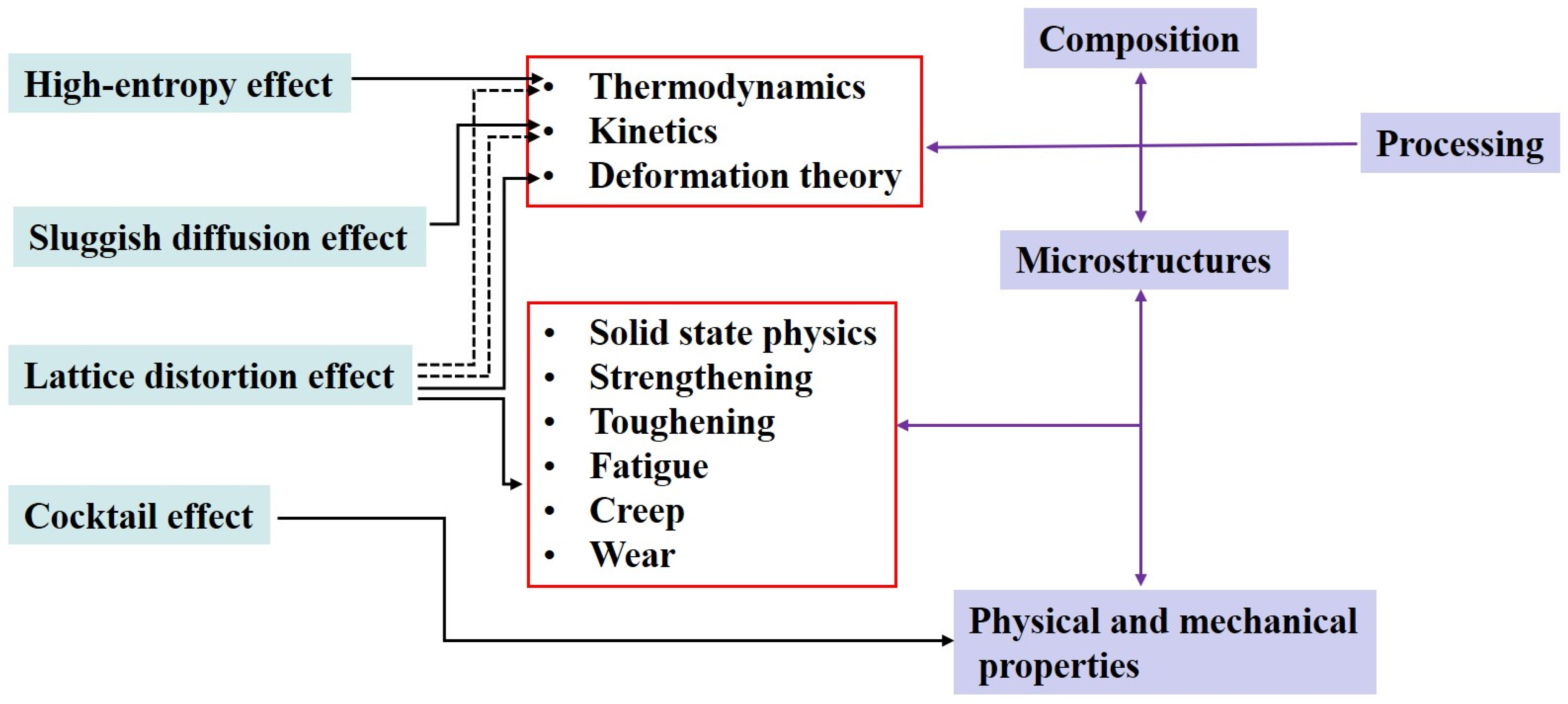
HEAs derive their unique characteristics from four fundamental effects that distinguish them from conventional alloy systems [64]. These core effects significantly influence both the microstructure and performance attributes of HEAs [64,65]. Yeh [1,64,66,67,68] outlined four core effects for HEAs: the high-entropy effect, the lattice distortion effect, the sluggish diffusion effect, and the cocktail effect, corresponding to the four aspects of materials—thermodynamics, structure, kinetics, and performance. These characteristic effects are markedly obvious in HEAs, as these species contain multi-principal elements, unlike traditional alloys. As illustrated in Figure 1 [69], the high-entropy effect fundamentally affects thermodynamic stability by promoting multi-element solid solutions in the equilibrium state, particularly under high-temperature conditions. The severe lattice distortion effect modifies the structural properties of materials as their behavior during deformation; on the other hand, it would affect the thermodynamic stability and kinetic processes. The sluggish diffusion effect substantially reduces the atomic mobility, thereby inhibiting phase-transformation kinetics through decreased diffusion rates. The cocktail effect could induce significant property enhancements that surpass the conventional rule of mixtures prediction (a weighted-average approach typically employed for predicting various properties of composite materials). These synergistic improvements in mechanical properties (e.g., strength, toughness, fatigue resistance, and creep resistance) and functional characteristics (e.g., thermal/electrical conductivities) originate from two fundamental mechanisms: (i) unique atomic interactions between dissimilar elements, and (ii) severe lattice distortion effect. It is an overall effect based on the composition, structure, and microstructure. The following sections would provide more details on these four core effects separately.

3.1. High-Entropy Effect

The high-entropy effect, first proposed by Yeh [1], plays a critical role on stabilizing high-entropy phases through thermodynamic mechanisms. This phenomenon is fundamentally associated with the thermodynamic properties of HEAs. According to the second law of thermodynamics, the equilibrium state of a system corresponds to its minimum Gibbs free energy configuration [10,65]. Elevated configurational entropy has been shown to enhance the thermodynamic stability of solid-solution phases while simultaneously inhibiting the formation of brittle intermetallic compounds that exist significant characterization challenges [10]. The maximum entropy production theory [70] provides further theoretical support for this stabilization mechanism, demonstrating that high-entropy systems preferentially form solid-solution phases rather than intermetallic compounds. This contrasts with conventional alloy behavior where equiatomic or near-equiatomic compositions typically favor intermetallic phase formation. A representative example is the monoclinic AlCoCe compound observed in the central region of the Al-Co-Ce ternary-phase diagram [71], which illustrates the exceptional phase stability achieved by high-entropy effects in HEAs. Following the fundamental Gibbs phase rule [72], the equilibrium-phase quantity, P, in an alloy at constant pressure is governed by the following:
P = C + 1 F
where C is the number of components, and F is the maximum number of thermodynamic degrees of freedom. Contrary to conventional expectations, HEAs predominantly form solid-solution phases rather than intermetallic compounds [1,3,73,74]. However, it does not suggest that all equimolar multicomponent systems necessarily develop solid-solution phases.
It is crucial to note that the stabilization of single-phase solid solutions in HEAs is not governed only by configurational entropy, as the atomic size factor, the mixing binding energy, and the temperature are also factors affecting the phase formation. Specifically, the early paradigm of “high-entropy stabilization” has been refined by recognizing the critical role of the competition between mixing enthalpy and configurational entropy [69]. A highly positive enthalpy, indicative of strong repulsive atomic interactions, can drive phase separation even in the presence of a high configurational entropy. Conversely, a sufficiently negative enthalpy can promote the formation of intermetallic compounds. For example, the presence of a (Cr, Fe)-rich boride phase in AlBxCoCrCuFeNi alloys has been reported, in which the competition between enthalpy and entropy determines the phase formation [1,67]. In the case of AlBxCoCrCuFeNi alloys, the stability of (Cr, Fe)-rich borides at high temperatures can be justified by their large negative enthalpy of formation. Similar phenomena have also been revealed by another high-temperature HEA annealing study [6]. Furthermore, short-range ordering (SRO) structure, the preferential bonding between certain element pairs, is now recognized as a common phenomenon in many HEAs [75]. The presence and degree of SRO are dictated by the chemical interactions between constituent elements and can be significantly affected by processing conditions. Recently, SRO has been shown to have a profound impact on mechanical properties, diffusion behavior, and phase stability [76,77]. Therefore, a comprehensive understanding of HEAs must extend beyond a simple entropy maximization principle to include the interaction of thermodynamic, chemical, and structural factors.

3.2. Lattice Distortion Effect

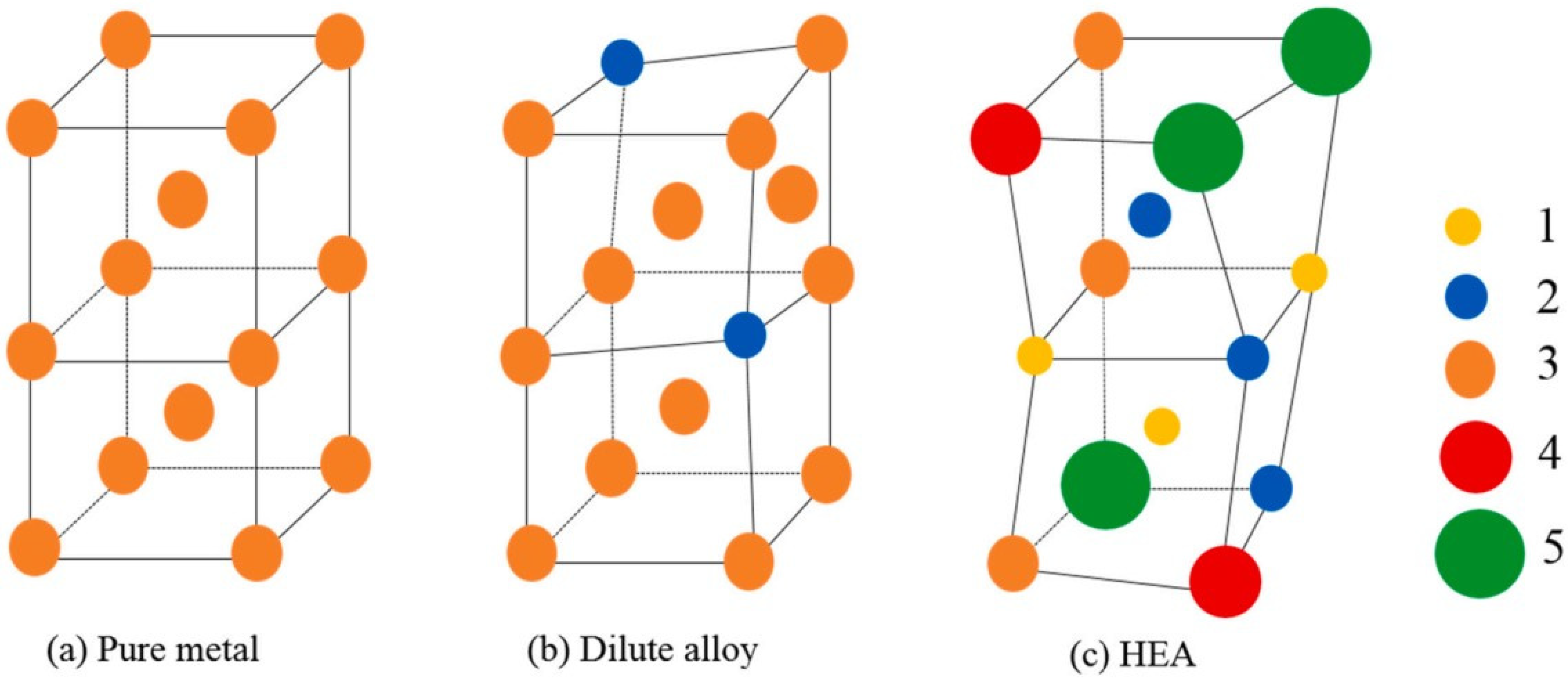
The incorporation of multiple principal elements in HEA solid solutions induces significant lattice distortion due to atomic size mismatches. Each lattice site experiences heterogeneous local environments created by neighboring atoms of varying sizes and types, generating substantial internal strain fields. The degree of lattice distortion in pure metals, traditional dilute alloys, and HEAs may be determined by examining the relative hard-sphere models of their lattices. As demonstrated in Figure 2 [78], while pure metals preserve undistorted lattices through atomic uniformity, and dilute alloys induce minor distortion via solute atoms, HEAs generate severe lattice strain through random incorporation of multiple principal elements with significant size mismatch. The severe lattice distortion in HEAs has been detected by X-ray and neutron diffractions [79,80,81]. Macroscopically, this lattice distortion is considered to contribute significantly to enhanced mechanical strength while simultaneously decreasing thermal and electrical conductivity through intensified scattering of both electrons and phonons [66,82].
It is generally believed that bcc structures exhibit more pronounced lattice distortion compared to fcc structures, leading to enhanced solid solution-strengthening effects [83]. Although numerous experimental studies have confirmed the superior mechanical properties of bcc HEAs, the fundamental mechanisms underlying this distortion-induced strengthening remain theoretically unresolved. Wang et al. [84] developed an analytical framework to investigate the strengthening mechanism induced by lattice distortion in single-phase bcc HEAs, demonstrating excellent correlation between theoretical predictions and experimental observations. Li et al. [85] introduced a grain size–lattice distortion-coupled model for calculating strengthening mechanisms in fcc/bcc HEAs, and the prediction results for various HEAs were in perfect agreement with the experimental data.
Lattice distortions could be described in different ways, but the most common description only considers the atomic size factor [69], which indicates that lattice distortions in HEAs could be directly related to the difference in atomic size, δ, by the following equation:
δ = 100 i n c i 1 r i r ¯ 2
where the average atomic radius, r ¯ = i n ciri, and ci and ri are the atomic percentage and atomic radius of the ith element, respectively. In general, a higher δ value indicates a greater degree of static lattice distortion due to atomic size differences. In addition, the local lattice strain, ε, another primary quantitative measure of lattice distortion, could measure the relative deviation of the local interplanar spacing from a reference value. Usually, the magnitude and heterogeneity of local lattice strain could be revealed by advanced techniques like Geometric-Phase Analysis of HRTEM images or synchrotron X-ray diffraction. A high-δ alloy will inherently generate a complex field of local lattice strain. This field would increase yield strength by acting as a frictional barrier to glide of dislocations, and enhance the strain-hardening capacity of HEAs by promoting planar slip of dislocations and dislocation accumulation. In addition, secondary mechanisms (i.e., twinning and phase transformation) would be potentially activated, thus significantly improving the strength–ductility match of alloys [69]. Therefore, lattice distortion is not merely a characteristic, and it is also a fundamental design parameter. Through quantifying it via δ and local lattice strain, it is possible to achieve superior mechanical properties.

3.3. Sluggish Diffusion Effect

The sluggish diffusion effect could suppress elemental interdiffusion, inhibit phase transformation kinetics, and delay coarsening behavior. These collectively contribute to refined precipitation, restrained grain growth, amorphous-phase stabilization, elevated recrystallization thresholds, and improved creep performance [48]. It was proposed that the diffusion and phase-transformation kinetics in HEAs are slower than those in their conventional alloys [86]. This could be explained from two aspects.
Firstly, the diffusion kinetics in HEAs are fundamentally affected by their unique atomic-scale heterogeneity. In these multicomponent systems, each lattice site possesses distinct neighboring atomic configurations. This atomic-scale variation causes site-specific bonding environments with differing local energy states. When a diffusing atom occupies a low-energy site, the corresponding energy barrier significantly reduces its probability of subsequent jumps. Conversely, occupation of high-energy sites would promote reverse hopping to the original position. Both scenarios collectively contribute to the characteristic sluggish diffusion behavior observed in HEAs. This mechanism contrasts sharply with conventional dilute alloys, where the limited solute concentration typically maintains identical local atomic configurations before and after vacancy-mediated diffusion events. The homogeneous bonding environments in such systems consequently exhibit faster diffusion kinetics compared to HEAs.
Secondly, the heterogeneous diffusion behavior in HEAs stems from elemental differences in activation energies, resulting in competitive vacancy occupation where kinetically disadvantaged atoms show lower transition success rates. However, phase-transformation kinetics in multicomponent systems necessitate synchronized elemental diffusion. Specifically, new phase formation through nucleation and growth demands compositional redistribution of all constituent elements. Similarly, grain boundary migration during grain growth requires cooperative atomic movement. Consequently, elements with lower diffusivity dominate the kinetic barriers for microstructural evolution.
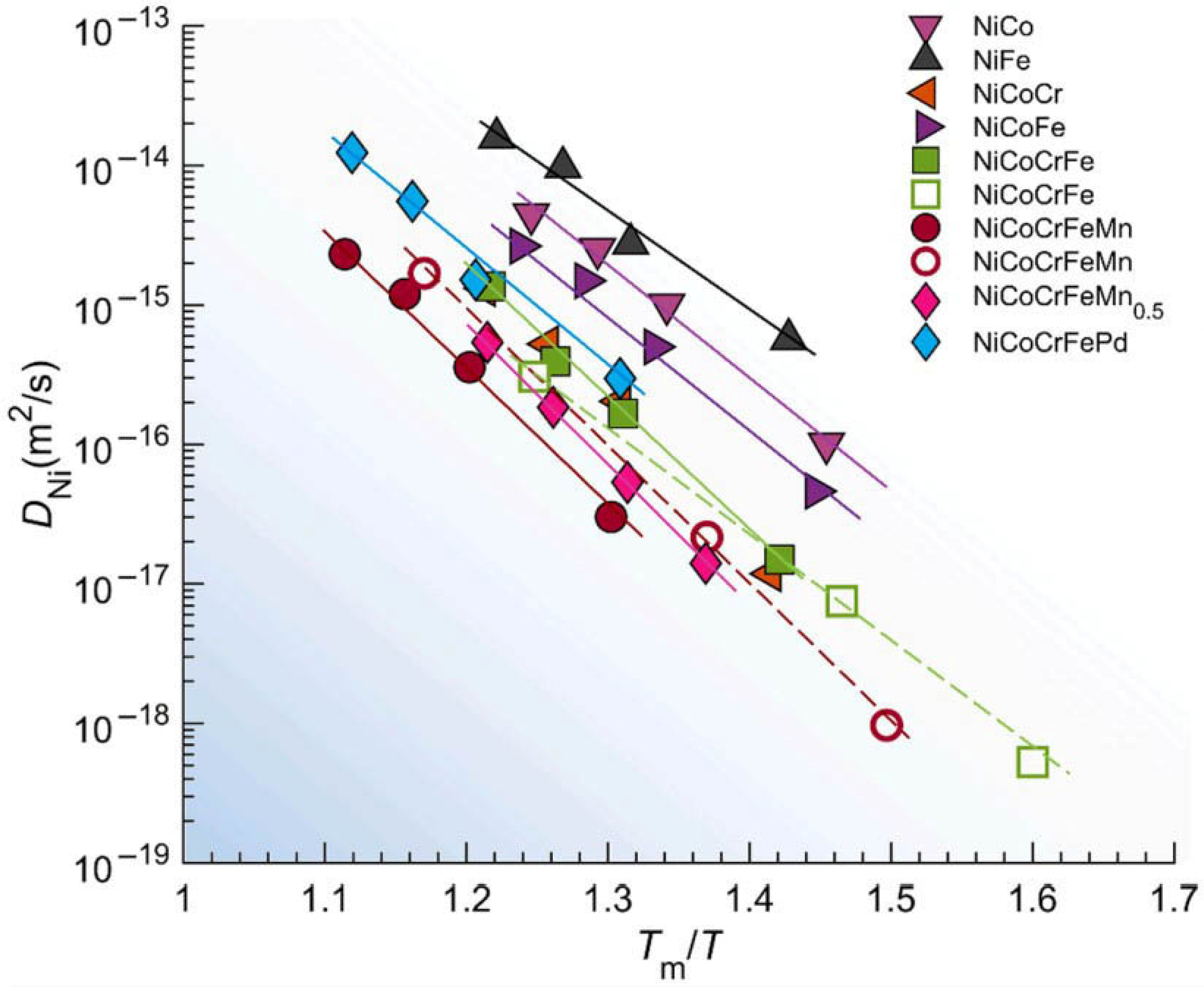
To date, the direct observation of sluggish diffusion in HEAs has been gained by diffusion couple experiment. Tsai et al. [87] conducted the diffusion experiment on diffusion couples that included Fe-Co-Ni-Cr-Mn systems, and the result showed that the diffusion coefficients for Cr, Mn, Fe, Co, and Ni in the HEAs are much smaller than in the pure matrix. It is obvious that sluggish diffusion effect occurred in HEAs. Subsequent investigations further confirm this feature by comparing the diffusion rates of Ni in HEAs and MEAs [87,88,89,90,91], as summarized in Figure 3 [92]. Complementing non-radiotracer approaches, radiotracer analysis of FeCoNiCrMn [93,94] reveals markedly depressed bulk diffusion coefficients under homologous temperature normalization. This scaling method isolates lattice distortion effects, demonstrating their direct contribution to reduced atomic mobility. Moreover, analogous diffusion retardation has also been confirmed in high-entropy ceramics [95,96].
Recently, the universality and mechanism of “sluggish diffusion” as a core effect have been subjects of increasing discussion. Some recent studies have challenged its generality, pointing out that diffusion coefficients in some HEAs can be comparable to or even faster than those in binary counterparts under specific conditions [97,98,99]. Specifically, diffusion is intrinsically heterogeneous, both among different elemental species and across different local atomic environments. Migration barriers of atoms are related to the local chemical environment of the jumping atom. An atom in a less-constraining local cluster may have a lower barrier than one in a tightly bound cluster. This leads to a wide distribution of activation energies, making the average diffusivity appear low, while some atoms can still move relatively easily. The effective diffusivity is thus a complex average over diverse local paths. SRO structure is a critical factor that could override predictions based on a random entropy-stabilized model. Generally, SRO develops naturally to lower enthalpy. Certain element pairs exhibit positive or negative chemical affinities, leading to non-random nearest-neighbor distributions. If negative enthalpy pairs form, they can trap atoms, and they can increase the effective activation energy for leaving their favored environment, which is a primary cause of apparent sluggishness. On the contrary, in some cases, SRO can create percolating fast channels of certain element types, potentially accelerating diffusion along those paths. The diffusivity thus becomes a function of the degree of SRO, which varies with composition. In short, sluggish diffusion could be regarded as a consequence of local chemical ordering and heterogeneous energy condition, rather than a sole consequence of high configurational entropy.

3.4. Cocktail Effect

Originally conceptualized in psychoacoustics to characterize selective auditory attention in multi-source environments, the cocktail-party effect has been adapted to metallurgy to describe emergent properties arising from multi-element interactions. Ranganathan’s pioneering work [100] established that such synergistic effects in alloys produce unique characteristics unattainable by individual components, and this phenomenon was subsequently confirmed through extensive mechanical and physical property analyses [101,102,103,104,105].
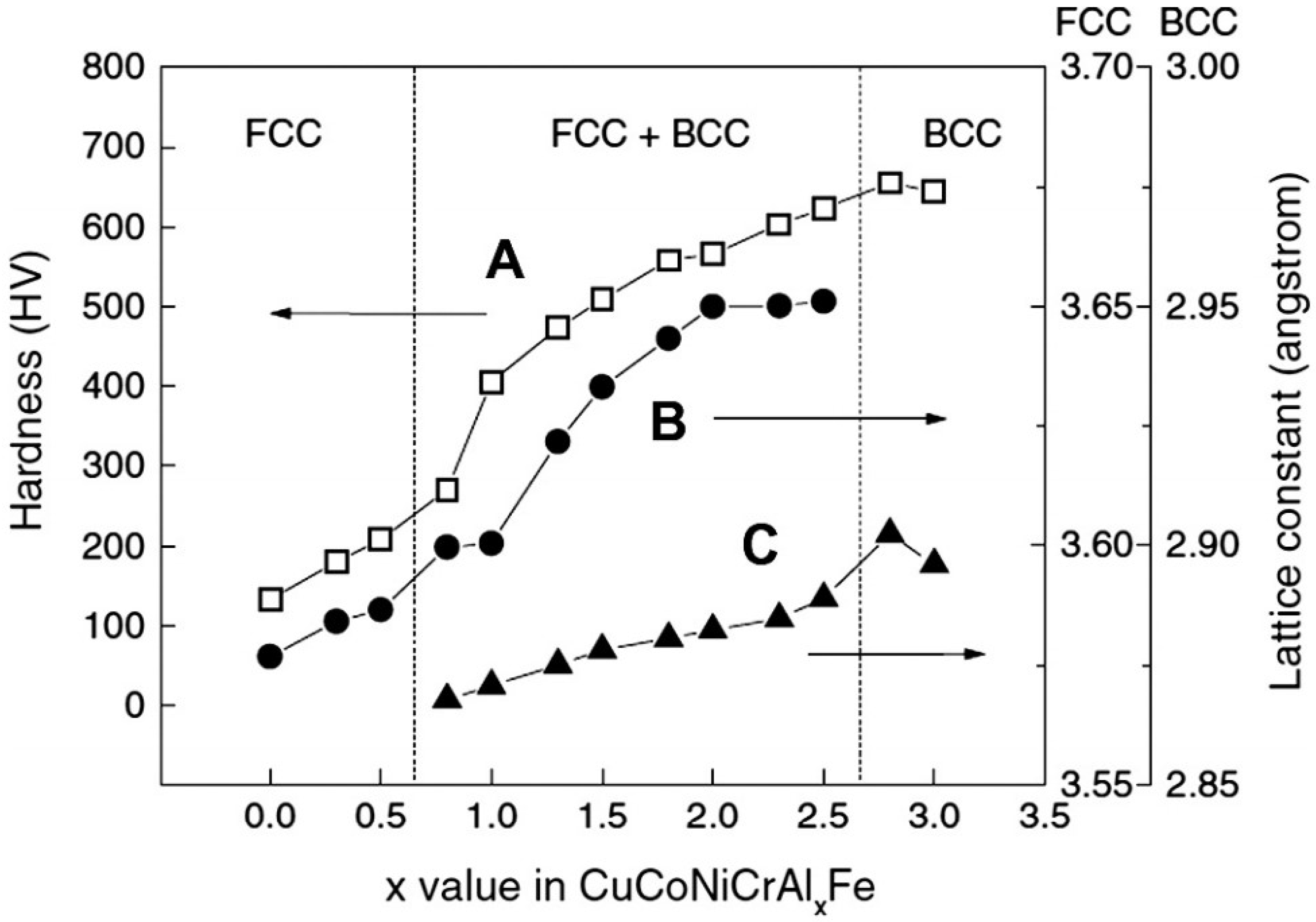
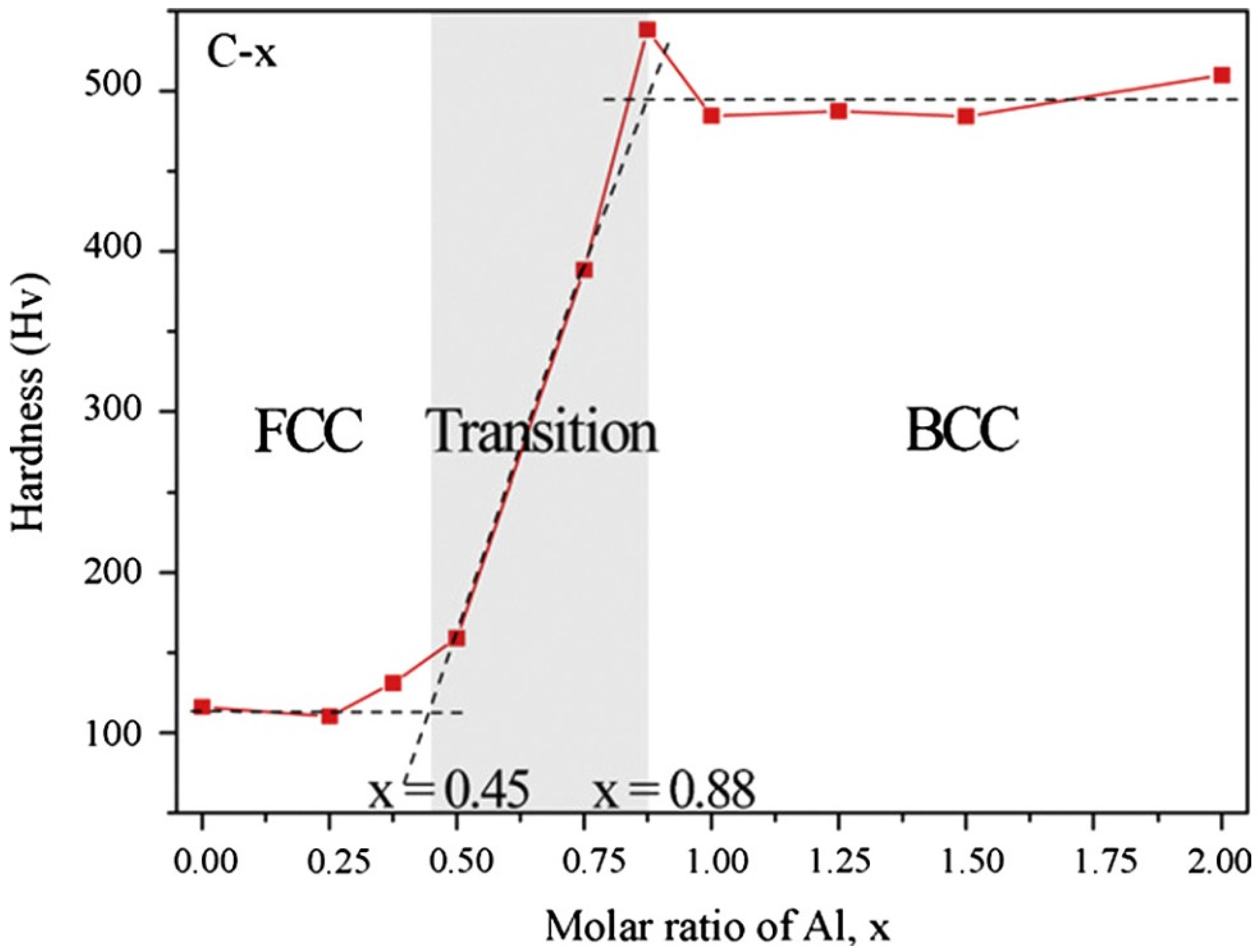
The cocktail effect implies that the alloy properties could be greatly adjusted by the composition variation and alloying. As displayed in Figure 4 [1], progressive Al addition in CoCrCuNiAlx HEAs induces phase transformations, initially from fcc to mixed fcc/bcc structures, and then to bcc structure. Consequently, the hardness of the HEAs dramatically increases. Figure 5 demonstrates the effect of Al content on hardness in Cu-free CoCrFeNiAlx HEAs [106]. Notably, the hardness of fcc phase remains relatively stable, whereas bcc-phase hardness declines from 538 HV to 480 HV. Comparative analysis reveals the fcc + bcc biphasic region in CoCrFeNiAlx is significantly narrower than in Cu-containing counterparts, indicating Cu clement has the advantage of stabilizing the fcc phase. Virtually, Cu element tends to segregate and form Cu-rich phase in CoCrCuFeNiAlx [103,107]. Cu could form isomorphous solid solution with Ni, but it is insoluble in Co, Cr, and Fe; it would dissolve 20 at. % of Al but also evolve into various stable intermetallic compounds with Al element.
Recently, Liu et al. [108] demonstrated that Cu addition could modulate phase morphology in HEAs, specifically increasing the aspect ratio of particular phases. This microstructural modification was shown to significantly enhance megahertz-range electromagnetic wave absorption capabilities through optimized magnetic properties. Furthermore, it has been reported that the addition of Cr element would bring about excellent mechanical properties and corrosion resistance in other HEAs [109,110,111]. Briefly, by utilizing the cocktail effect, that is, increasing suitable elements in HEAs, better combinations of properties for engineering applications could be gained, offering additional flexibility to the design of HEAs properties.
Beyond the four core effects, HEAs exhibit additional distinctive characteristics when compared to conventional alloys. Table 1 [92] provides a representative summary of these differential features, many of which originate as secondary manifestations of the fundamental effects of HEAs.
While the high configurational entropy was initially proposed as the cornerstone for stabilizing single-phase solid solutions in HEAs, subsequent research has revealed a more complex and scientifically challenging landscape. The field has moved beyond a simplistic entropy-based narrative to grapple with fundamental issues such as the prevalent presence of SRO and its profound impact on properties [112], the intricate cocktail effect that complicates predictive modeling, and the unpredictable kinetic pathways during synthesis and thermal processing. These challenges underscore the fact that the stability and properties of HEAs are governed by a delicate interplay of thermodynamic, kinetic, and chemical factors, making their rational design a non-trivial endeavor.
The conceptual framework of multi-principal elemental materials continues to evolve and expand. The original focus on metallic alloys has now broadened into the paradigm of entropy-engineered materials [113], where entropy is actively harnessed as a key design parameter to achieve targeted microstructures and functionalities. Furthermore, it has successfully permeated into the realm of ceramics, giving rise to a new class of multi-principal element ceramics (MPECs), including high-entropy oxides [114], nitrides [115], and carbides [116]. These emerging material systems not only open up new avenues for applications in extreme environments and energy technologies but also present fresh fundamental questions, highlighting the dynamic and interdisciplinary nature of this rapidly advancing field.

4. Advantages of HEAs

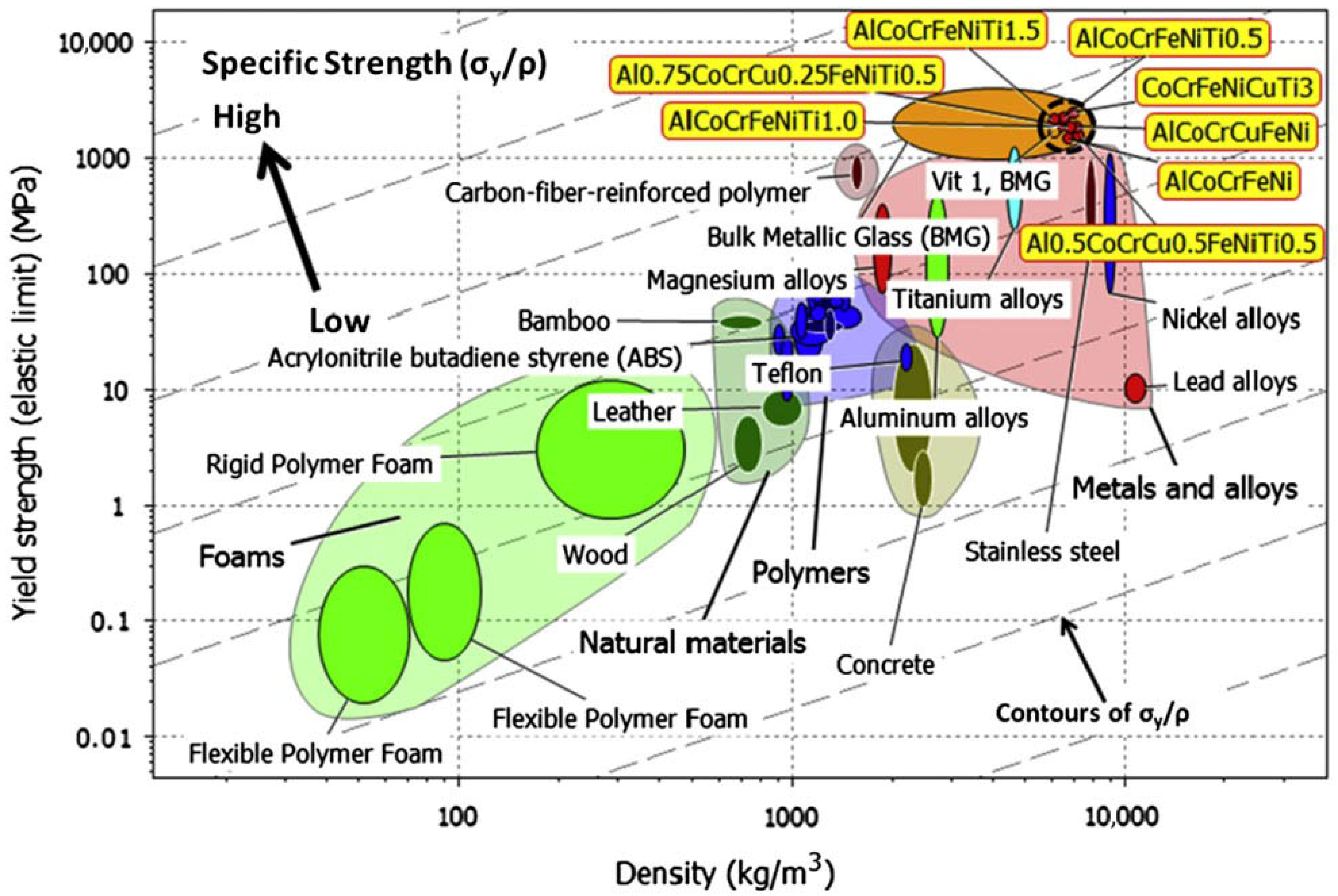
While conventional alloys have achieved widespread industrial adoption through prolonged development, HEAs must demonstrate comparable or enhanced properties to enable practical applications. Figure 6 presents a comparative analysis of specific strength (yield strength/density) and density across different material classes, including HEAs, traditional alloys, metallic glasses, foams, and polymers [117,118]. The data reveal that although the density of HEAs is similar to that of stainless steel, their specific strengths markedly exceed conventional materials. This exceptional strength-to-weight ratio, coupled with superior strength–ductility match, positions HEAs as promising candidates for multifarious engineering applications. Furthermore, the tunable Young’s modulus of HEAs offers additional design flexibility compared to conventional alloys.
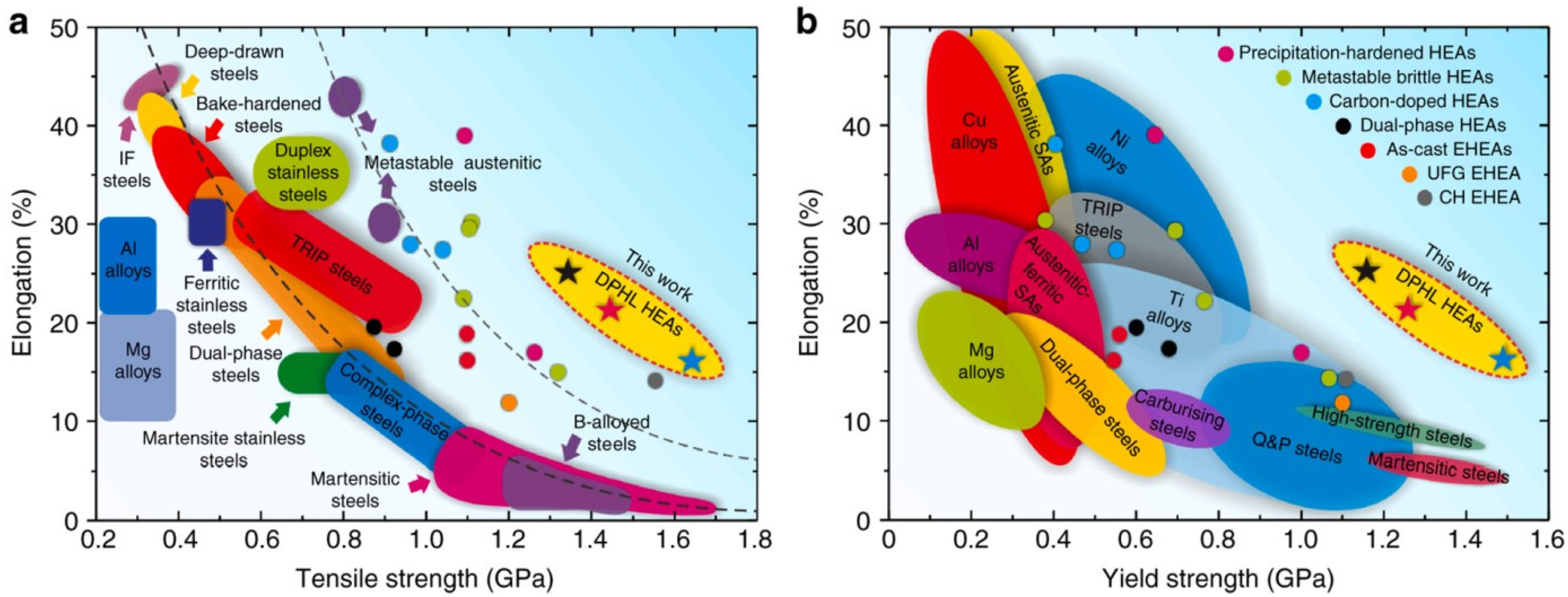
In Figure 7, the tensile properties of hierarchical dual-phase heterogeneous lamella (DPHL) HEAs, advanced steels, and traditional alloys are compared [119,120,121,122,123,124,125,126,127,128]. In Figure 7a, diverging from conventional metallic materials, both cold-rolled/annealed AlCoCrFeNi2.1 DPHL HEAs and previously published HEAs exhibit exceptional strength–ductility synergy. In contrast, only AlCoCrFeNi2.1 demonstrates significant deviation in the yield strength–elongation diagram (Figure 7b). While achieving balanced tensile properties in HEAs is feasible, maintaining elevated yield strength remains challenging. Transitioning from single-phase equiatomic to precisely engineered multiphase non-equiatomic designs with controlled phase instability enables fabrication of strong yet ductile HEAs. This paradigm shift activates multiple strengthening mechanisms synergistically [129]. Consequently, HEAs redefine performance boundaries, offering transformative potential for transportation, aerospace, and infrastructure applications through enhanced energy efficiency.
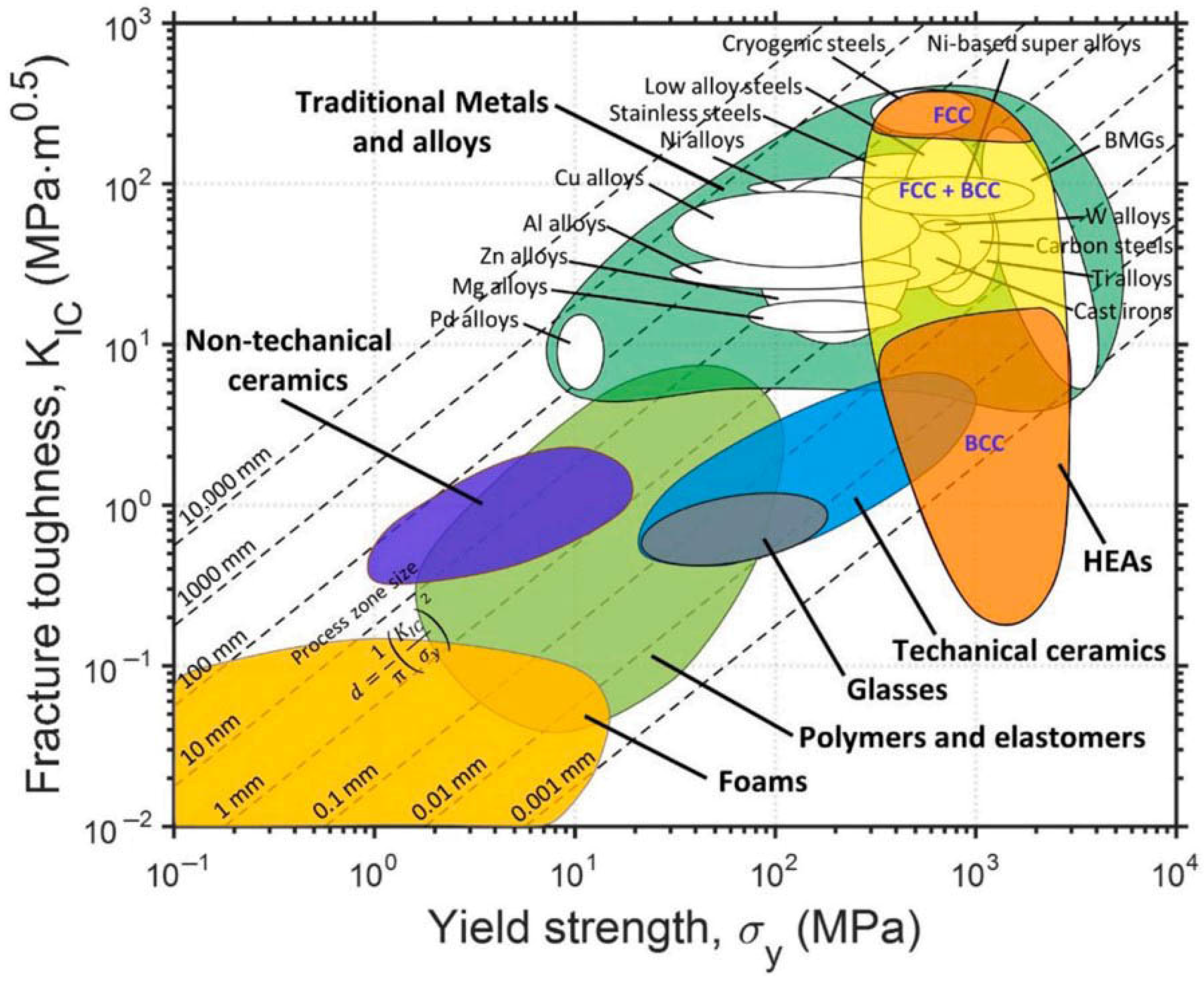
Damage tolerance, representing the critical balance between fracture toughness and strength under service conditions, is a pivotal mechanical criterion for structural materials. Fracture toughness for HEAs (Figure 8) exhibits considerable variation [130], with single-phase fcc alloys demonstrating superior performance compared to bcc HEAs. Dual-phase microstructures (bcc + martensite or bcc + fcc) display intermediate toughness values. The strength spectrum of HEAs (400 MPa~2 GPa) approaches that of high-performance metallic glasses [131,132,133]. Notably, HEA property combinations are expanding the boundaries of Ashby’s fracture toughness–strength space toward the coveted upper-right quadrant. While achieving optimal damage tolerance in bcc or dual-phase HEAs remains challenging [130], strategic alloy design and microstructural engineering offer viable pathways for enhancing the performance of fcc-based HEAs.

5. Preparation of HEAs

At present, typical processing routes for HEAs can be summarized, which can be divided into four main routes: mechanical alloying, vacuum smelting, magnetron sputtering, and additive manufacturing. Later, more details of these four routes will be discussed.

5.1. Mechanical Alloying

Mechanical alloying (MA) is a powder-processing technique involving repeatedly cold welding, fracturing, and rewelding of powder particles in a high-energy ball mill [134]. This overall procedure comprises three principal stages: ball milling, alloying, and post-processing. Extended milling duration promotes elemental homogenization via repetitive mechanical impaction of powder particles. Nevertheless, contamination from chamber walls and thermally activated oxidation during milling often results in impurity-containing products. Such purity challenges can be effectively addressed by using Ar atmosphere for inert gas protection [135] or by processing in a reducing atmosphere condition. After ball milling, consolidated powders typically undergo sintering treatments to enhance structural integrity and ensure phase stability.
The synthesis of HEAs via MA requires subsequent consolidation treatments to achieve optimal densification. Three principal powder consolidation techniques include spark plasma sintering (SPS) [136], hot pressing sintering (HP) [137], and hot isostatic pressing (HIP) [138]. The selection of an appropriate consolidation method is critically dependent on the target application requirements, as each technique exhibits unique advantages and limitations in terms of phase-stability preservation, microstructural control, and mechanical property optimization. For example, SPS demonstrates unique capabilities for achieving rapid consolidation with nanoscale grain retention, while HIP is more suitable for producing bulk components with exceptional density and minimal structural defects.

5.1.1. MA + SPS

The SPS process utilizes simultaneous application of high-intensity pulsed direct current and high pressure to achieve rapid powder consolidation [139]. This advanced sintering technique enables three key advantages: (i) significantly reduced processing time compared to conventional methods, (ii) precise control over heating rates, and (iii) lower overall sintering temperatures. These characteristics collectively facilitate the formation of nanocrystalline microstructures, which directly contribute to enhanced mechanical properties in the consolidated materials.
Jahani et al. [140] prepared FeNiMnCux (x: Co, Cr, Mo, Ti, W) HEA using a combination of MA and SPS. Following 15 h of mechanical milling, the resultant dense alloy powder underwent consolidation under uniaxial pressure (30 MPa) with simultaneous thermal treatment at 1000 °C, employing a constant heating rate of 20 °C/min. XRD analysis showed that the HEA exhibited a single-phase fcc structure, alongside the coexistence of fcc1 and fcc2 phases, an fcc solid solution, orthogonal intermetallic compounds, and other multi-phase configurations. The sintering treatment induced an increase in grain size for all constituent metals and significant reduction in lattice strain, thereby improving the thermal stability of the HEA.
Zhu et al. [141] synthesized equiatomic TiZrNbMoTa RHEAs via MA, producing nanocrystalline powders with metastable fcc structures. SPS across varying temperatures (1300–1600 °C) yielded ZrO2-containing composites. Finally, it was found that the compressive fracture strength of RHEAs at 1400 °C was 3759 MPa, and the corresponding strain was 12.1%. Similarly, TiAlV0.5CrMo RHEAs were prepared by Gao et al. [142], adopting the same strategy. After the sintering process, the bcc structure precipitated bcc2 and Al2O3 phases. As a result, the ultimate compressive strength and plastic strain of the RHEA were 2989 MPa and 17.8%, respectively. These exceptional properties originate from synergistic strengthening effects combining solid solution, grain boundary, and precipitation mechanisms.
MA enables the production of HEA powders with homogeneous microstructures, while subsequent SPS provides an efficient route for rapid powder consolidation. This integrated MA-SPS approach has emerged as a promising methodology for fabricating high-performance bulk HEAs with optimized characteristics.

5.1.2. MA + HIP

The HIP process employs pressurized inert gas (e.g., argon and nitrogen) as a uniform pressure-transmitting medium through high-pressure containment vessels during high-temperature processing. This advanced consolidation technique provides omnidirectional isostatic compression, eliminating mold-induced stress anisotropy characteristic of conventional pressing methods. The HIP process demonstrates three advantages over traditional sintering: (i) substantial reduction in required sintering temperatures, (ii) marked decrease in processing duration, and (iii) effective inhibition of microstructural coarsening.
Varalakshmi et al. [143] investigated the CuNiCoZnAlTi HEA synthesized by MA, and found that the Vicker’s hardness and compressive strength of the HEA after HIP are 8.79 and 2.76 GPa, respectively. Szklarz et al. [144] fabricated innovative FeCoNiCrMn-based nanocomposites through MA and HIP. Their comprehensive study demonstrated that 5 wt.% SiC incorporation could effectively enhance the corrosion performance of the alloy through passivation mechanism, simultaneously reducing pitting propensity while improving both corrosion resistance and mechanical characteristics.
MA provides a distinct non-equilibrium pathway for synthesizing HEAs, fundamentally differentiating them from their cast counterparts in terms of phase formation, microstructure, and strengthening. This process circumvents conventional solidification constraints by employing severe plastic deformation to force atomic-level mixing in the solid state, often resulting in metastable phases, nanocrystalline grains, and a unique defect architecture. First, regarding phase stability, MA can produce phases that are inaccessible under equilibrium conditions. Though thermodynamic parameters like mixing entropy and enthalpy offer reasonable predictions for the phase composition of cast and annealed HEAs, they frequently fail for MA-derived materials. The high-energy ball-milling process imposes kinetic control over alloying, enabling the formation of metastable single-phase solid solutions even in compositions predicted to form intermetallics. This apparent stability is, however, transient; subsequent annealing typically reveals the thermodynamic drive for decomposition, leading to precipitation or phase separation that is absent in well-homogenized cast equivalents. Second, concerning grain size evolution, MA inherently drives the microstructure to a nanocrystalline state. Continuous cold welding, fracturing, and deformation during milling introduce an extreme density of dislocations and boundaries. This results in a saturated grain size in the nanometer range, representing a dynamic equilibrium between deformation-induced refinement and recovery. Consolidating these powders into bulk material without catastrophic grain growth presents a significant challenge, contrasting sharply with the straightforward grain coarsening observed in deformed and annealed cast HEAs. Third, the defect-induced strengthening in MA-processed HEAs is notably synergistic. MA-processed HEAs benefit from a concurrent and interacting hierarchy of defects. The nanocrystalline matrix provides substantial Hall–Petch strengthening. Furthermore, high density of dislocations and lattice strains would lead to immediate forest hardening. Perhaps most critically, the metastable solid-solution and non-equilibrium state facilitate the formation of nanoscale precipitates upon annealing and may promote SRO structures. These features act in concert: grain boundaries and dislocations provide nucleation sites for precipitates, while solutes, SRO, and fine precipitates can pin boundaries and dislocations, thereby stabilizing the nanocrystalline structure against relaxation. This multi-scale defect interaction results in a strengthening synergy where the combined effect exceeds the sum of individual contributions, a phenomenon less pronounced in conventionally processed HEAs.

5.2. Vacuum Smelting

As the most widely adopted approach in HEA fabrication, vacuum smelting provides critical advantages in terms of compositional homogeneity and impurity minimization, which usually includes both vacuum arc melting (VAM) and vacuum induction melting (VIM). The main distinction between two approaches is whether the molten material comes into direct contact with the electrode.

5.2.1. VAM

The VAM process entails complete liquefaction and homogenization of constituent elements prior to solidification in copper crucibles. To achieve optimal chemical uniformity, multiple melting–solidification cycles are typically employed. The copper crucible’s bowl-shaped geometry yields button-shaped ingots upon solidification. Alternatively, employing a pre-machined bottom orifice in the copper crucible enables melt transfer into a cylindrical copper mold, enabling enhanced cooling rates. This technique also facilitates subsequent mechanical-testing specimen preparation and has proven effective for synthesizing various HEAs with unique properties. However, the primary limitation of this rapid solidification process lies in the inherent challenges associated with controlling solidification dynamics. It would contribute to microstructural heterogeneity, manifesting as gradual transitions in dendritic morphology from fine grains to columnar dendrites and eventually coarse equiaxed dendrites in central regions. Furthermore, the mechanical performance of HEAs is detrimentally affected by intrinsic microstructural imperfections, notably compositional inhomogeneity, metastable-phase precipitation, internal stress concentrations, and various forms of structural discontinuities. Consequently, developing effective strategies to mitigate or eliminate these defects is regarded as a critical research direction for the preparation of HEAs.
Zhu et al. [145] synthesized MnFeCoNix alloys via VAM, systematically investigating the role of Ni on the mechanical properties. Their results revealed a direct correlation between Ni concentration and ductility enhancement, evidenced by progressively improved fracture elongation. Conversely, reduced Ni content promoted tensile strength through fcc1-fcc2 interfacial strengthening. This strengthening mechanism became less pronounced beyond a critical Ni threshold, where diminished Cu/Mn-rich fcc2-phase content led to reduced interfacial effects and consequent strength deterioration. Recently, Mpofu et al. [146] investigated Sn-modified AlCrFeNiMn HEAs prepared via VAM, with Sn additions ranging from 1 to 5 at. %. Their findings revealed that Sn-induced intermetallic precipitation during cooling effectively pinned grain boundaries, resulting in microstructural refinement. Furthermore, Sn promoted the formation of protective film, dramatically improving corrosion resistance in extreme pH environments through barrier-effect enhancement.

5.2.2. VIM

The VIM method is more suitable for active metals, as it allows for precise control over the melting process while minimizing the induction of impurities. Specifically, the VIM technique utilizes electromagnetic induction heating in high-vacuum environments to achieve thorough elemental fusion, producing homogeneous alloy melts. Subsequent rapid solidification via mold casting enables fabrication of HEAs with enhanced characteristics. This technique offers distinct advantages, including precise control of reactive elements, accelerated melting kinetics, and minimized elemental vaporization. Particularly for alloys containing low-melting-point reactive components (e.g., Mg and Li), VIM represents the preferred processing route [147,148].
Dong et al. [149] fabricated an Al0.6CoCrFeNi2Mo0.08V0.04 HEA via the VIM technique, revealing a characteristic fcc/B2 dual-phase dendritic structure at room temperature. Microchemical analysis revealed elemental partitioning (i.e., Co/Cr/Fe/Ni enrichment in dendritic fcc regions versus Al/Ni concentration in inter-dendritic B2 phases). This microstructure, attributed to Mo/V-induced solid-solution strengthening, resulted in exceptional mechanical properties. In short, the VIM process could dramatically regulate the active elements concentrations, reduce the occurrence of gas and inclusions, and lead to significant improvement in the final purity of the alloy. However, this method necessitates specialized equipment with stringent technical requirements. Furthermore, the propensity for casting-induced imperfections, including structural discontinuities and internal stress concentrations, persists as a notable manufacturing consideration; as a result, additional heat treatment may be necessary following the alloy melting process to optimize its microstructure and mechanical properties [150,151].
Another liquid technique is Bridgman solidification, which is also called the Bridgman–Stockbarger method [152]. The technique primarily serves for single-crystal growth through controlled directional solidification. The process entails melting polycrystalline feedstock, followed by gradual cooling initiated from a seed crystal positioned at one extremity. This results in epitaxial crystal growth maintaining the orientation of seed throughout the container length. Implementation can utilize either horizontal or vertical configurations, establishing it as a prevalent approach for semiconductor crystal production. Two critical processing variables (i.e., temperature gradient, G; and crystal growth rate, V) are precisely regulated through coordinated control of heating power and withdrawal speed, thereby enabling targeted microstructural development. Zhang et al. [153] observed a microstructural transition in AlCoCrFeNi HEA from dendritic (copper mold casting) to equiaxed grains (Bridgman method), attributed to elevated G/V ratio during solidification. Unlike conventional casting, where variable G and rapid V yield low G/V values, Bridgman processing’s higher G/V ratio reduces constitutional undercooling, effectively suppressing dendritic growth.
Laser cladding (LC) represents a prominent surface engineering method employing high-energy laser irradiation to fuse deposited metallic coatings with substrate surfaces. This process achieves simultaneous melting of coating and substrate materials with minimal dilution, followed by rapid solidification that produces superior metallurgical bonding. The resultant surface enhancement substantially improves corrosion resistance, wear performance, and oxidation stability of the treated components. Chen et al. [154] developed CrFeNbTiMox coatings to enhance the properties of 40Cr coal-mining cutter teeth and revealed a compositional dependence of phase evolution, where increasing Mo content could promote the formation of bcc phase while suppressing the Laves-phase development. The Mo1 coating exhibited maximal content of bcc phases and dendritic areas. The deposited coatings benefit from synergistic strengthening mechanisms, including solid solution, diffusion, and grain refinement effects, collectively enhancing mechanical hardness, wear performance, and corrosion stability. In addition, from the perspective of oxidation resistance, AlNbTaZrx [155] and TiNiSiCrCoAl [156] HEA coatings were successfully applied to Ti6Al4V substrate, demonstrating remarkable improvements in wear resistance and oxidation resistance at high temperature. These coatings effectively addressed the inherent limitations of the titanium alloy in extreme operating conditions. However, the application of LC for extensive surface coverage remains constrained by two primary factors: the restricted processing area inherent to the technique and the elevated operational costs associated with cladding material melting. Meanwhile, the LC process is inherently susceptible to defect formation resulted from the thermomechanical incompatibility between the deposited layer and substrate material, which would lead to various defects, including pores, cracks, deformations, and surface irregularity, presenting substantial challenges for industrial-scale implementation.

5.3. Magnetron Sputtering

The magnetron-sputtering technique utilizes magnetic field-confined plasma to deposit HEA components onto substrates under high-vacuum conditions. Precise control of sputtering parameters combined with optimized target composition enables the production of uniform thin films with desired material characteristics. This method has become the predominant approach for fabricating HEA-based thin films, which demonstrate unique surface properties and distinctive interactions [157]. Furthermore, the functional characteristics of deposited films can be precisely tailored through strategic compositional design of constituent elements in the HEA system [158].
Tsai et al. [159] developed the AlMoNbSiTaTiVZr HEA interlayer, demonstrating exceptional diffusion barrier properties in Si/Cu systems. Their sandwich-structure configuration effectively suppressed Cu-Si interdiffusion at elevated temperatures, establishing this HEA as a promising candidate for copper metallization applications. Further performance enhancements are anticipated through ongoing compositional optimization of such multicomponent alloys. Jia [160] employed vacuum-melted FeNiCoCrAl HEA as the target material for magnetron-sputtering deposition onto single-crystal Si substrates. This experimental design enabled systematic investigation of annealing-duration effects on the composition and properties of films. As-deposited films exhibited amorphous features under optimized conditions of 120 W with 90 min, and the films showed a uniform composition with a thickness of 300 nm. After annealing at 1000 °C, the film’s alloy structure was changed from the amorphous structure into either a simple fcc phase or bcc phase solid solution due to the occurrence of a crystallization transformation. Quantitative analysis revealed a positive correlation between annealing time and surface-morphology improvement, with extended durations producing progressively flatter film surfaces.
Magnetron sputtering enables accurate regulation of both chemical composition and microstructural characteristics during HEA thin film deposition, enabling tailored modification of substrate material properties and phase structures. Despite these advantages, the magnetron-sputtering technique exhibits three notable limitations: (i) much higher production costs compared to alternative fabrication methods, (ii) practical constraints in achieving large-scale thick film deposition, and (iii) relatively low deposition rates that often require supplementary post-processing to optimize the performance of films. These factors currently restrict its primary application to specialized thin film-production scenarios.

5.4. Additive Manufacturing

Additive manufacturing (AM), commonly known as 3D printing, represents an innovative fabrication approach utilizing layer-by-layer material deposition. This technique transforms digital 3D models into physical components through precise fusion of alloy powders using high-energy-beam sources such as lasers or electron beams. Compared to conventional cast HEA components, the AM approach could produce geometrically complex architectures with minimal material waste. Rapid solidification in the non-equilibrium state could be beneficial to refining the grain size and obtaining an ultra-fine crystalline microstructure.
Up to now, AM techniques could be divided into two main categories: powder bed fusion (PBF) and directed energy deposition (DED). Specifically, PBF processes include selective laser melting (SLM) [161], selective electron-beam melting (SEBM) [162], direct metal laser sintering (DMLS), and selective laser sintering (SLS). PBF processing involves the sequential deposition and energy-beam melting (laser/electron) of HEA powder layers, characterized by rapid solidification rates, low porosity, and exceptional microstructural homogeneity. Furthermore, mechanical properties can be optimized through precise parameter modulation and post-processing treatments. DED encompasses multiple technical variations, including laser-engineered net shaping (LENS) [163], laser-melting deposition (LMD), direct metal deposition (DMD) [164], electron-beam additive manufacturing (EBAM), and wire-arc additive manufacturing (WAAM) [165]. These techniques utilize concentrated energy beams to generate localized melt pools along deposition paths, enabling component fabrication through synchronized powder or wire feedstock introduction. DED could significantly alleviate the composition segregation and improve the mechanical properties of material.
Cast HEAs exhibit homogeneous microstructure and isotropic mechanical behavior. In contrast, AM processes would generate strongly textured microstructures due to directional heat input during layer-by-layer deposition. This localized energy causes thermal gradients that promote residual stress accumulation and thermal stress development, frequently leading to crack initiation and degraded mechanical properties [166]. Post-processing techniques, including heat treatment and mechanical surface treatment, have proven effective in mitigating these manufacturing-induced defects [167]. Recently, Zhang et al. [168] employed LMD to fabricate crack-resistant AlxCoCrFeNi HEAs, systematically examining the role of Al on microstructural development and corrosion behavior. Their investigation identified a compositional threshold at 10 mol.% Al that induces transformation from fcc to bcc phase while simultaneously optimizing corrosion performance through enhanced Cr2O3-rich passive film formation. These results demonstrate Al alloying as an effective approach for enhancing corrosion resistance in LMD-processed HEAs. Wang et al. [169] fabricated lightweight refractory VNbTiSi HEA via LMD. The LMD-processed material demonstrated significant microstructural refinement of eutectic spacing and enhanced elevated-temperature compressive strength compared to conventionally cast counterparts. These superior properties demonstrate the technological advantages of LMD for fabricating components designed for extreme service environments. Xu et al. [170] synthesized porous FeCoNiCrMn HEAs exhibiting three-dimensionally continuous porosity through integrated binder jetting and sintering processing. The resulting microstructure demonstrated homogeneous pore morphology and size distribution, with samples processed under reduced sintering temperatures and durations showing elevated porosity levels. The porous samples demonstrated exceptional compressive properties and corrosion resistance comparable to 316 L stainless steel (SS) when processed under optimal sintering conditions, establishing their potential for advanced filtration applications.
Overall, DED has emerged as an invaluable tool for the exploration of HEAs and rapid screening of alloy compositions. By utilizing multi-hopper powder feed systems and enabling instantaneous composition variations, DED facilitates the fabrication of functionally graded structures and locally tailored chemical gradients. This capability positions DED as a natural experimental platform for establishing and elucidating composition–microstructure–property relationships in HEAs. However, current demonstrations of DED-printed HEAs remain largely confined to thin-wall geometries, which often exhibit warpage, distortion, porosity, and cracking. To date, successful fabrication of complex-shaped components has not been reported, highlighting a considerable gap between laboratory-scale compositional screening and the manufacture of robust, application-ready parts. Looking forward, transitioning DED-printed HEAs from simple thin-wall specimens to reliable, geometrically complex parts will necessitate enhanced control over melt-pool thermal dynamics and element vaporization, improved mitigation of partially melted particles, and the integration of process modeling to accelerate and reduce the cost of parameter optimization.
PBF enables the highest geometric accuracy and surface finish among AM methods for HEAs. The process benefits from high cooling rates that promote refined cellular or columnar microstructures, offering the potential for fabricating near-net-shape, geometrically complex components. Compared with DED, PBF affords more precise layer-by-layer control and more uniform energy input. Parameter optimization studies have further demonstrated the feasibility of producing defect-free HEA parts via PBF, avoiding typical flaw regimes such as lack-of-fusion and keyhole porosity. However, PBF processing of HEAs faces significant challenges, including sensitivity to elemental volatility, the persistence of unmelted particles, and recurrent crack formation when preheating or scan strategies are inadequate. Feedstock availability also presents a constraint: commercially produced, low-oxygen pre-alloyed refractory powders remain costly and limited in supply, while in situ alloying from elemental powder blends carries risks of segregation and incomplete melting. Future advances will require the development of reliable preheating and scanning strategies specifically tailored to multicomponent systems. Broader implementation of in situ monitoring is needed to stabilize melt-pool dynamics and compositional homogeneity. Additionally, establishing systematic correlations among powder specifications, process windows, and defect characteristics will be essential to transition from successful coupon-level demonstrations to the repeatable production of certifiable components.
AM enables precise microstructural control and property optimization in alloy systems, achieving homogeneous elemental distribution while effectively suppressing both macroscopic and microscopic segregation. This advanced fabrication approach offers dual benefits of reduced production costs and enhanced manufacturing efficiency [171]. These advantages have established AM as a transformative technique across aerospace, biomedical, and automotive industries, with growing potential to revolutionize next-generation material manufacturing.
AM of HEAs is characterized by extreme and localized thermal cycles, which define a unique microstructural and mechanical properties distinct from conventional processing routes. The interplay between rapid solidification, repeated thermal transients, and directional heat extraction fundamentally governs the resultant microstructure and its properties. The exceptionally high thermal gradients and solidification rates intrinsic to AM processes like laser PBF dictate the initial solidification morphology. These conditions typically result in fine columnar or cellular grains aligned with the build direction, a consequence of epitaxial growth along the maximum thermal gradient. The characteristic high-entropy effect is challenged by this non-equilibrium solidification. Though some HEAs retain a single-phase fcc or bcc structure, the rapid cooling can kinetically suppress equilibrium phases, leading to the formation of metastable phases, nanoscale elemental segregation within cellular structures, or even amorphous regions in HEAs. Thermal gradients and solidification rates directly control the scale of these microstructural features, influencing the initial strength and anisotropy [166]. The steep thermal gradients, combined with rapid heating and cooling cycles, inevitably generate significant residual stresses. These stresses arise from the constrained thermal contraction of newly solidified layers by the underlying, cooler material. In HEAs, which often exhibit complex phase behavior and varied coefficients of thermal expansion among constituent elements, this can lead to substantial stress accumulation. Tensile residual stresses at the surface and near the melt-pool boundaries are particularly detrimental, as they can promote distortion, delamination, or serve as nucleation sites for fatigue cracks. Furthermore, the residual stress state can interact with the columnar grain structure, potentially exacerbating anisotropic mechanical behavior and reducing ductility perpendicular to the build direction [166]. Consequently, post-process heat treatment is a critical necessity to tailor the performance of AM-fabricated HEAs. Its objectives are stress relief, microstructural homogenization, and phase stabilization. Annealing at moderate temperatures could effectively reduce residual stresses, thereby improving dimensional stability and ductility. More importantly, it facilitates atomic diffusion to homogenize the segregation patterns formed during solidification. Sometimes, targeted aging treatments can be employed to precipitate secondary phases in a controlled manner, transforming the as-built microstructure to achieve enhanced strength via precipitation hardening. However, the treatment parameters must be meticulously optimized, as excessive temperature or time can lead to undesirable grain coarsening or phase transformations that degrade the unique benefits of the refined AM microstructure.
This section examines four primary techniques for synthesizing HEAs: MA, vacuum smelting, magnetron sputtering, and AM. A comparative analysis of these methods is provided, highlighting their respective advantages and limitations. To enable a systematic evaluation, Table 2 [172] summarizes the key characteristics and potential applications of each technique, offering a clear reference for selecting appropriate processing routes based on specific material requirements.
Up to now, the scaling of HEA preparation processes is relatively tough, and the core issue lies in the transition from equilibrium condition to industrially relevant scales, where thermodynamic and kinetic phenomena manifest detrimentally. First, cracking is a primary impediment to scaling, particularly in solidification-based processes. The tendency for solidification cracking becomes obvious with the increase in thermal strain and brittle intermetallic phases [166]. These inevitable phases would act as stress concentrators and low-energy fracture sources. In addition, sluggish diffusion would kinetically trap non-equilibrium phases during rapid cooling, which induces subsequent initiation of cracks under strain process. Second, residual stress is intrinsic to processes involving rapid, localized heating and cooling, and they are severely pronounced in many HEAs. Low thermal conductivity usually leads to steep thermal gradients during processing. Considering the high yield strength in HEAs resists stress-relieving plastic deformation, these thermal gradients would lock in severe residual stresses [166]. In this case, spontaneous cracking happens during or after processing. Third, printability extends beyond AM to general shapeability via melting and solidification. In fact, HEA compositions often contain elements with different melting points, densities, and vapor pressures. During scaling up in a melt furnace, it can lead to macrosegregation and elemental loss. In addition, for novel HEAs, the processing window for achieving crack-free parts is extremely narrow. Consequently, the composition space for printability is currently a small part of the theoretically promising HEA area. Future research should predict cracking criteria, residual stress fields, and solidification dynamics for specific HEA systems under scalable processing conditions, which is beneficial to reliable industrial-scale manufacturing of HEAs.
The processing parameters in the four primary techniques for synthesizing HEAs have direct and profound effects on phase stability and defect density: (1) The key parameters of MA are milling time, ball-to-powder ratio, and milling energy. Specifically, with the increase in milling time and ball-to-powder ratio, more mechanical energy would be induced to increase the defect density (e.g., severe lattice strain, dislocation tangles, and grain boundaries). This high defect state provides a strong kinetic barrier against diffusion, which suppresses equilibrium phase separation and often stabilizes amorphous phases or nanocrystalline solid solutions [134]. (2) The primary parameters of vacuum smelting include cooling rate, number of remelts, and superheat temperature. A faster cooling rate could retain metastable single-phase solid solution by suppressing the precipitation of equilibrium brittle intermetallics, but it may also increase thermal stress-induced dislocation density. Multiple remelts could improve chemical homogeneity and enhance the stability of the intended single phase by reducing segregation of elements. High superheat temperature could improve mixing of elements but also easily cause elemental loss through evaporation [150,151]. (3) For magnetron sputtering, substrate temperature, deposition rate, and applied bias voltage are dominant parameters. Low substrate temperature would confine atomic mobility, promoting the formation of metastable solid solutions with high density of point defects. High bias voltage could increase the extend of ion bombardment, which densifies the film but also induces compressive stress and additional defects. Deposition rate mainly affects adatom mobility, making an effect on film crystallinity and defect density [157,158]. (4) For AM, the laser- or electron-beam-specific parameters are quite important. Laser power, scan speed, and hatch spacing jointly determine the energy density. Low energy density leads to lack-of-fusion defects and incomplete melting, leading to the chemical inhomogeneity and local phase instability. Excessively high energy density would cause keyhole instability and evaporation. The extremely high cooling rate is beneficial because it kinetically stabilizes a fine, metastable microstructure, but the severe thermal gradient always generates high residual stress and dislocation density [166].

6. Properties of HEAs

6.1. Mechanical Properties

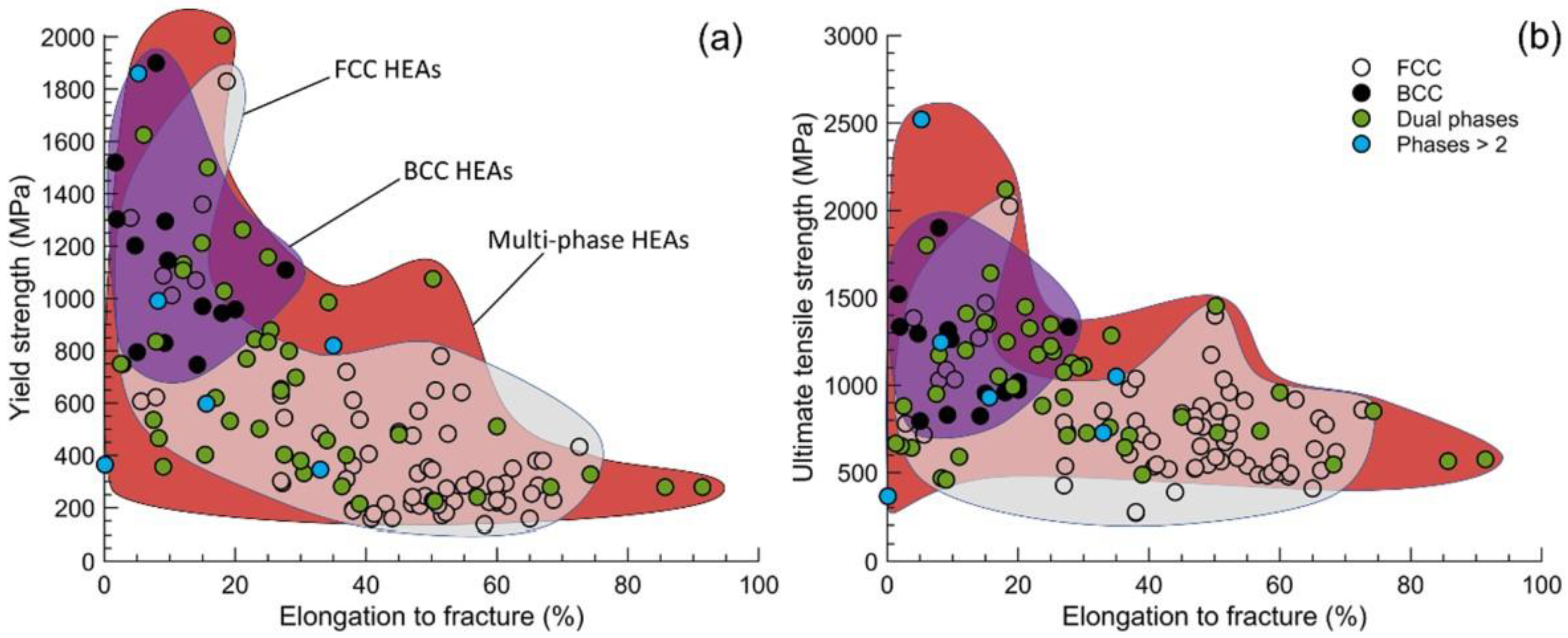
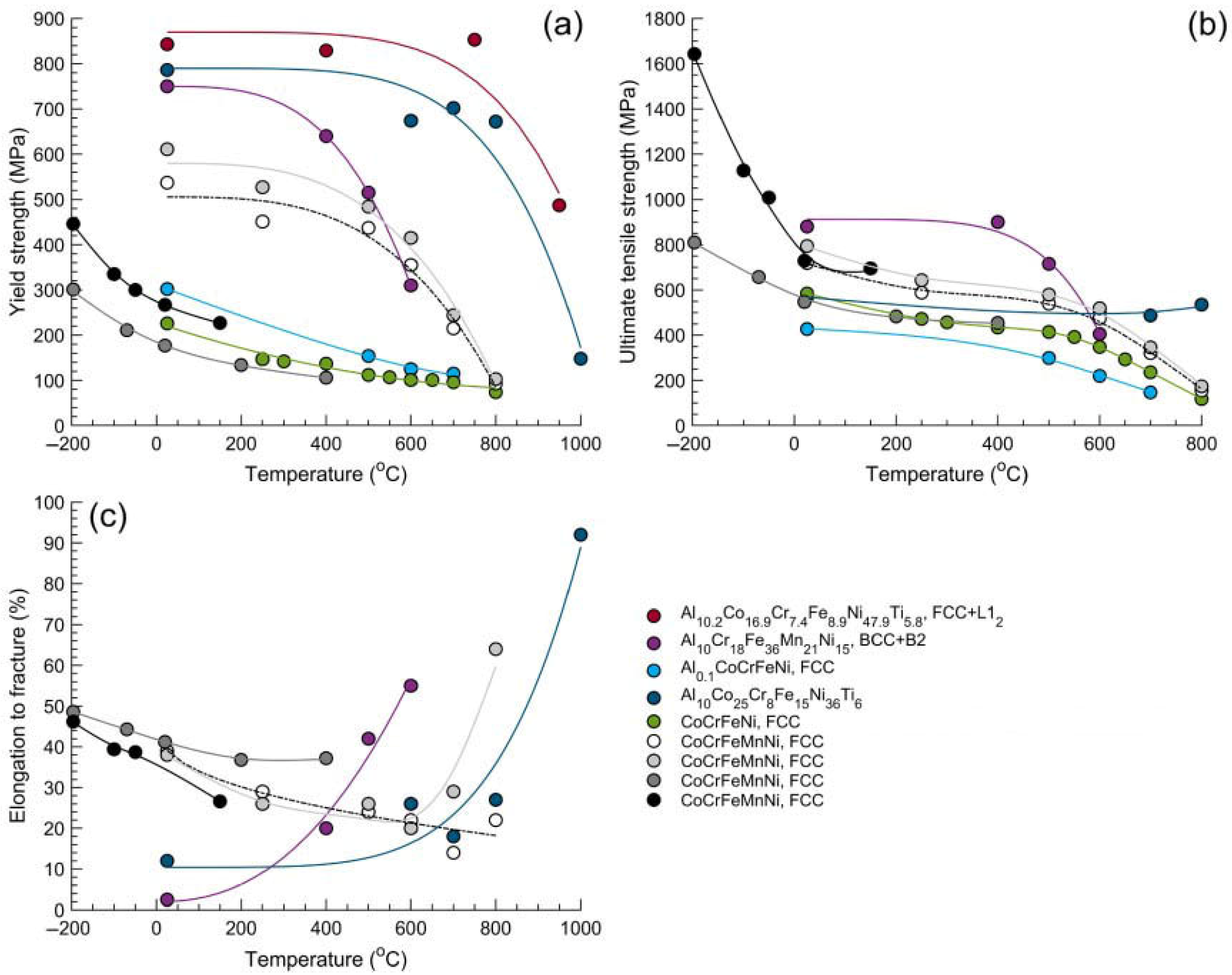
Advanced structural alloys with exceptional performance are critically needed for engineering applications under extreme conditions, especially in the aerospace, turbine, and nuclear sectors. Owing to the unique microstructures, HEAs are revealed to possess high hardness and excellent compressive strength both at room and elevated temperatures [1,173]. HEAs demonstrate outstanding combinations of tensile properties, achieving both high ultimate tensile strength and considerable ductility [173,174]. In general, fcc-structured HEAs tend to exhibit relatively low strength but high ductility, while bcc variants possess high strength accompanied by limited ductility. These observations indicate that crystal structure plays a decisive role in determining the mechanical performance of HEAs. This section reviews recent advances in understanding the mechanical behavior of HEAs, with emphasis on structural–property relationships.

6.1.1. Hardness

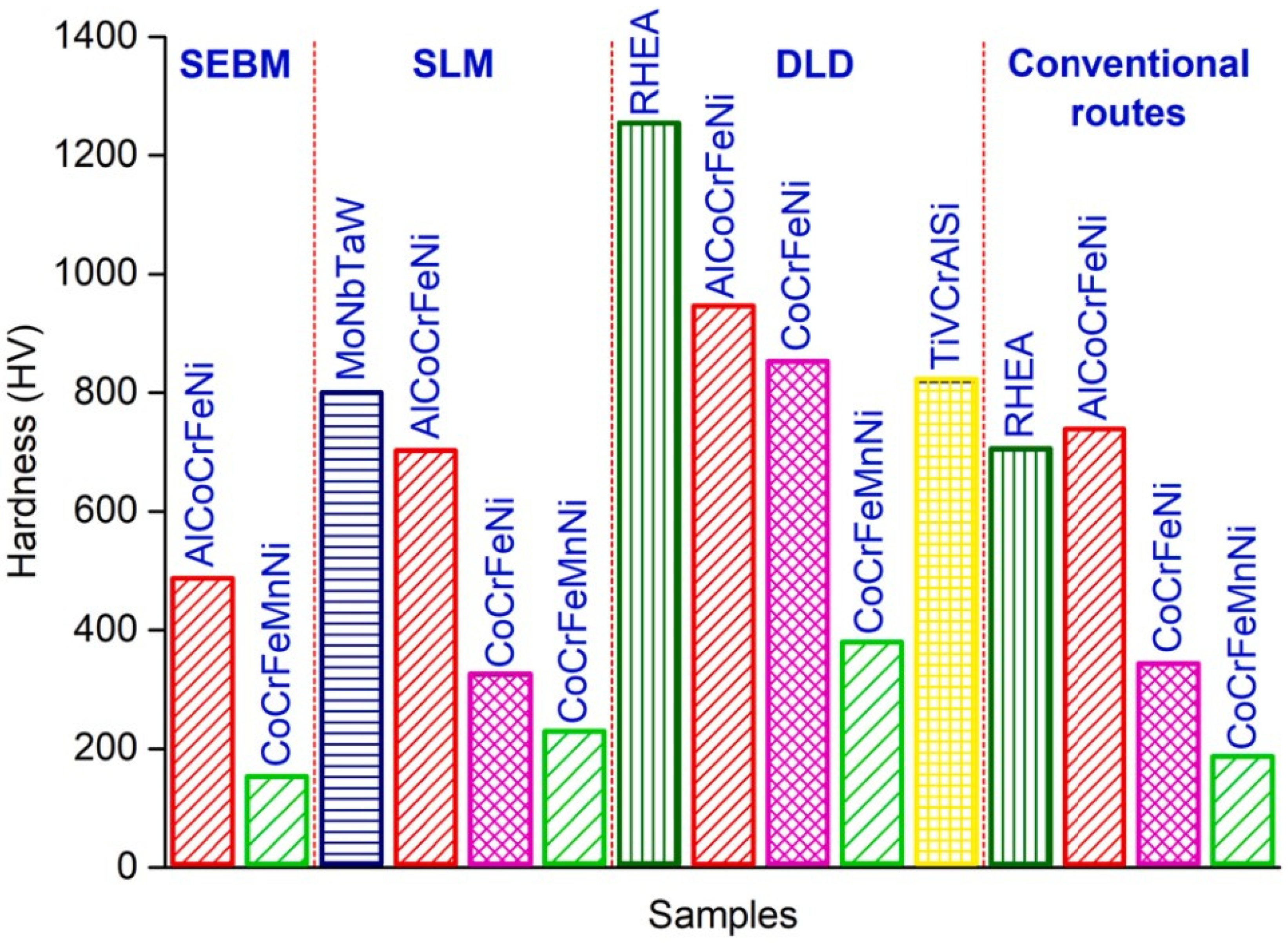
Hardness, as a measure of a material’s resistance to localized plastic deformation, is intrinsically linked to its strength characteristics. In HEAs, hardness values exhibit a broad range, from approximately 150 HV [175] to 1200 HV [176], depending on processing routes and chemical composition (Figure 9) [177]. This significant variation, as documented by Diao et al. [178], underscores the critical role of microstructural design and alloying strategies in tailoring the mechanical properties of HEAs. The Vickers hardness HV correlates approximately with the yield strength, σy, according to the following empirical equation [179]:
HV = C V σ y
where CV is a constant approximately equal to 3. A low-density Li20Mg10Al20Sc20Ti30 HEA synthesized via MA was found to form a single-phase fcc structure with an average grain size of approximately 12 nm. The resulting nanocrystalline microstructure contributed to a notably high microhardness of 606 HV [16]. According to Zhang et al. [176], laser-induced rapid solidification resulted in a significant hardness of 1152 HV in the FeCoNiCrCuTiMoAlSiB0.5 HEA, which can be attributed to microstructural refinement and enhanced solid-solution strengthening under non-equilibrium conditions. The martensitic phase, whose nucleation resulted from the joint effect of the laser-induced rapid solidification and the presence of B interstitials, improves the hardness of the HEA. Based on the analysis, this strengthening method could be extended to other rapidly solidified HEAs.
In fact, bcc HEAs consistently demonstrate superior hardness relative to their fcc counterparts. This enhancement is largely attributable to the stronger directional atomic bonding and the absence of close-packed slip planes in bcc crystal structures. Moreover, the overall hardness of HEAs increases with both the intrinsic hardness of individual phases and the volume fraction of hard phases. Additionally, the spatial arrangement and connectivity of phases further contribute to the mechanical properties of HEAs [180].
AM HEAs, including systems such as AlCoCrFeNi and TiZrNbHfTa, generally exhibit higher hardness compared to their conventionally cast counterparts. The reported hardness values, however, span a broad range from 195 to 860 HV, affected significantly by variations in chemical composition and specific processing parameters [181,182,183]. In contrast, the hardness of AM AlCoCrFeNi HEAs exhibits no significant variation across different processing techniques, such as SLM and DED. As mentioned above, hardness is predominantly influenced by microstructural characteristics (e.g., fcc or bcc). Furthermore, both the building orientation during fabrication and the loading direction during mechanical testing considerably affect the measured hardness. For instance, the maximum microhardness of the SLM-processed CrMnFeCoNi HEA along the build direction reached 370 HV, which is more than twice the minimum value of 164 HV. This pronounced variation has been explained by the coexistence of both hardening and softening mechanisms associated with complex heterogeneous microstructures across different regions. Softening in the upper deposited layers aligns with the classical Hall–Petch relationship, whereas hardening is attributed to elevated dislocation densities and the formation of cellular dislocation structures. Consequently, the enhanced hardness is achieved through the synergistic effects of high-density dislocations and deformation twins.

6.1.2. Strength–Ductility Match

Strength and ductility are critical yet often mutually exclusive mechanical properties in structural materials. As a novel category of multicomponent metallic systems, HEAs provide a versatile platform for discovering unprecedented structural behaviors. The balance between strength and ductility in HEAs is governed by multiple interdependent factors, with chemical composition playing a predominant role. Other influential parameters include microstructure, service temperature, and processing routes. Importantly, these factors are not isolated but exhibit strong synergistic interactions.
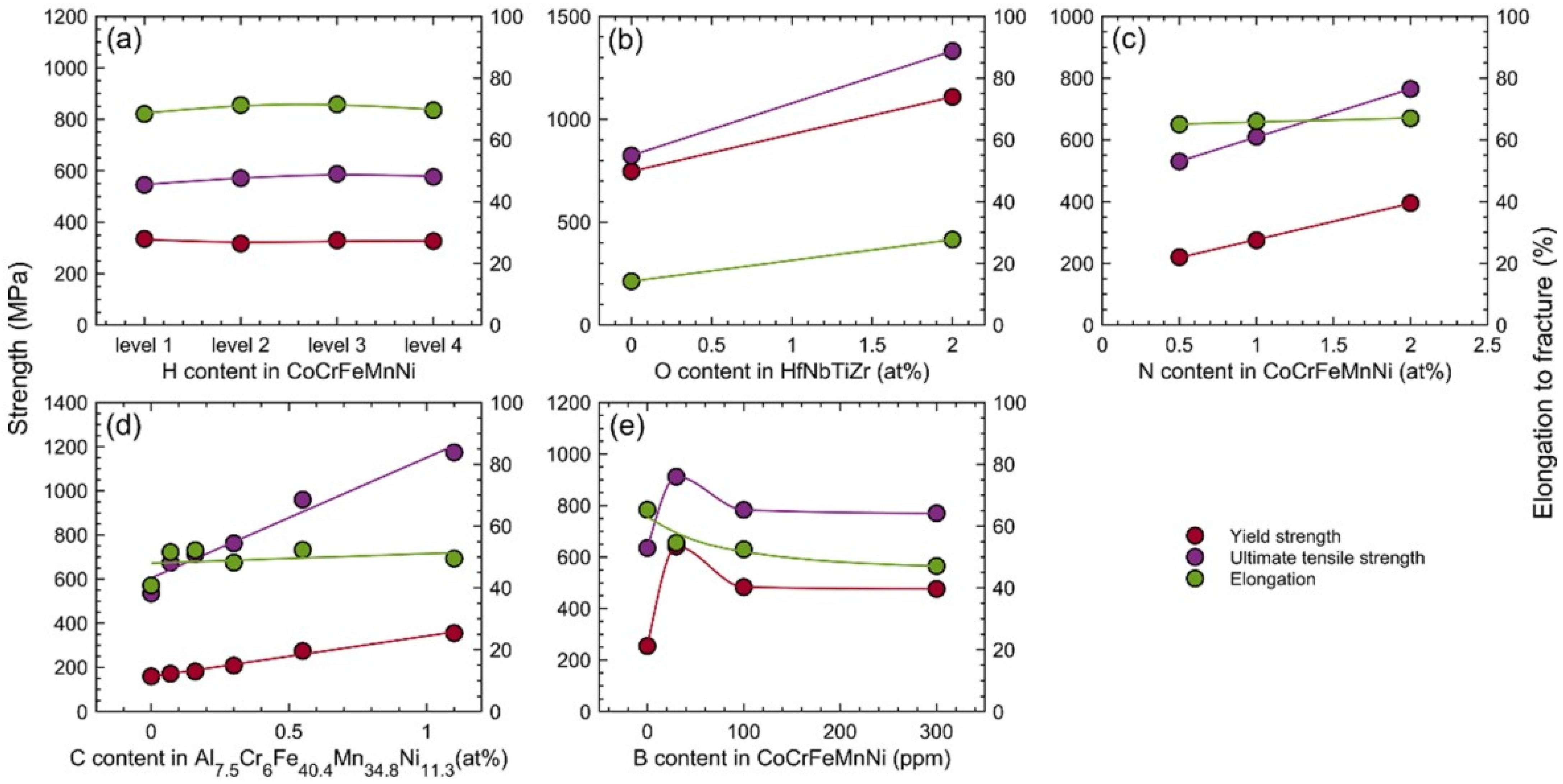
Contrary to the conventional understanding that hydrogen typically induces embrittlement in metallic alloys, the fcc FeCoNiCrMn HEA exhibits no degradation in mechanical properties after hydrogen charging. Instead, a slight improvement in strength–ductility synergy is observed [184]. This beneficial effect is attributed to hydrogen-induced reduction in stacking fault energy and decreased phase stability, which promote the formation of nanoscale twins and enhance strain-hardening capacity. Oxygen has been reported to form ordered interstitial complexes with Zr and Ti in the bcc HfNbTiZr HEA, resulting in simultaneous enhancement of both strength and ductility [25]. Adding nitrogen and carbon to the FeCoNiCrMn and fcc Al7.5Cr6Fe40.4Mn34.8Ni11.3 alloys is beneficial to strength, without compromising ductility [185,186]. The effects of all these elements on the strength–ductility match are summarized in Figure 10 [92].
For traditional alloys, the damage caused by hydrogen embrittlement could be inhibited by adjusting the types of grain boundaries. Similarly, design of grain boundary engineering is also applicable to HEAs for overcoming the inverse relationship between strength and hydrogen embrittlement resistance. This approach includes twinning-induced grain refinement and gradient nano-twin structure. (1) Twinning-induced grain refinement: At a low temperature, the twinning deformation is easily activated due to the low stack fault energy, while plasticity dominates in the pattern of planar dislocation slip and dislocation cell at room temperature [187]. For example, Kwon et al. [188] employed the dependence of the deformation mechanism on temperature and prepared nano-twin refined-CoCrFeMnNi HEA at cryogenic temperature, significantly improving both tensile strength and hydrogen embrittlement resistance of the HEA. (2) Gradient nano-twin structure: In the presence of hydrogen, stack fault energy would decrease, facilitating the nucleation of twins, while a high hydrogen concentration corresponds to a high fraction of twins [189,190]. Therefore, the formation of hydrogen-promoted nano-twin structure at low temperatures is regarded as a self-accommodation process, which is conducive to overcoming the contradiction between strength and hydrogen embrittlement resistance. It provides a new pathway to design HEAs under hydrogen-containing environment and cryogenic conditions.
Processing plays a critical role in the processing–structure–properties paradigm, as it governs the development of microstructures in alloys, which further dictate their mechanical performance. As we discussed above, an alloy could be prepared by various methods, such as MA, VAM, VIM, Bridgeman solidification, PVD, AM, and so on. The selection of processing techniques significantly affects the strength–ductility match in HEAs. Even within a single method, adjustments to key parameters (e.g., temperature, duration, and deformation degree) can markedly alter mechanical properties. Given the extensive diversity in thermomechanical treatments (e.g., homogenization, forging, rolling, and heat treatment) and their parameters, the processing landscape can be considered virtually infinite. Due to the complexity of establishing universal processing–property relationships, the effects of various processing routes on strength and ductility are summarized in Table 3 [92,191,192,193,194] using representative HEAs subjected to different treatments. For instance, the yield strength of Cr15Fe20Co35Ni20Mo10 HEA decreases from 1.31 GPa at 800 °C to 0.8 GPa at 1000 °C, and so does the ultimate tensile strength (1.41 GPa to 1.13 GPa). This is mainly ascribed to grain size. Average grain size increases with the increase in annealing temperature, 2.5 ± 0.5 μm as annealing at 700–850 °C, 4.0 ± 0.5 μm as annealing at 900–1000 °C, and 6.0 ± 0.5 μm as annealing at above 1000 °C. Corresponding to the increase in grain size, the yield strength decreases, being consistent with the Hall–Petch relation [191]. For Al0.3CoCrFeNi HEA, as the solution time increases from 2 min to 1 h, the grain size increases from 23 μm to 144 μm, while the corresponding yield strength decreases from 263 MPa to 159 MPa, exhibiting a similar trend with Cr15Fe20Co35Ni20Mo10 HEA [192]. Recently, Hui et al. [195] explored the effect of Al content in CoCrFeNiAlx HEA on mechanical properties and found that the hardness of CoCrFeNiAlx HEA gradually increased with increasing Al content, which is mainly attributed to significant solid-solution strengthening and lattice distortion effect. Specifically, lattice distortion could inhibit the movement of dislocation, resulting in increased deformation resistance, thus strengthening the hardness and strength of HEAs. Thanks to the large atomic radius of Al element, increasing the Al content would induce the lattice distortion effect and increase the hardness of CoCrFeNiAlx HEA.
Microstructures in metallic materials can manifest in diverse forms, including phase constituents, grain size, dislocation density, twins, and stacking faults, as well as the size and distribution of precipitates. To illustrate the influence of phase structure on mechanical behavior, strength–ductility maps are presented in Figure 11 [92] based on a compilation of tensile properties from numerous HEAs reported in the literature [21,196,197,198,199,200]. HEAs can be categorized into four groups based on their phase structures: fcc, bcc, dual-phase, and multi-phase systems comprising more than two distinct phases. For clarity in comparative analysis, dual-phase and multi-phase HEAs are collectively referred to as multi-phase HEAs, as represented by the shaded regions. As depicted in Figure 11, bcc HEAs are typically located in the high-strength, low-ductility region, whereas fcc HEAs mainly occupy the low-strength, high-ductility domain, although some compositions deviate toward the opposite extreme. In contrast, multi-phase HEAs cover the broadest range across the strength–ductility maps, bridging both extremes. In general, bcc HEAs exhibit high strength but limited ductility, while most fcc systems offer superior ductility with moderate strength. Multi-phase HEAs show the greatest potential for achieving an optimal combination of high strength and high ductility, though such properties may also be attainable in certain bcc or fcc alloys.
The influence of temperature on the strength–ductility match of HEAs is critical for their high-temperature applications. Figure 12 [92] illustrates the variation in strength and ductility with temperature for several representative HEAs. Although all alloys exhibit a decline in strength at elevated temperatures, the rate of reduction varies significantly. For instance, the Al10.2Co16.9Cr7.4Fe8.9Ni47.9Ti5.8 [201] and Al10Co25Cr8Fe15Ni36Ti6 HEAs [202] retain a substantial portion of their room-temperature strength up to approximately 800 °C. In contrast, a more pronounced decrease occurs at lower temperatures (400–600 °C) for systems such as CoCrFeMnNi [203,204], Al10Cr18Fe36Mn21Ni15 [205], CoCrFeNi [204], and Al0.1CoCrFeNi [206]. In addition, fast decrease in strength is also detected in CoCrFeMnNi HEA as temperature increases from cryogenic to room temperature [207,208]. The effect of temperature on ductility demonstrates two opposing trends. First, the ductility of Al10Co25Cr8Fe15Ni36Ti6 HEA [202] and Al10Cr18Fe36Mn21Ni15 HEA [205] increases with increasing temperature. On the other hand, the CoCrFeMnNi HEA [203,204,207,208] exhibits a reduction in ductility with increasing temperature. However, this decreasing trend reverses beyond a critical elevated temperature, as indicated by the light-gray data for CoCrFeMnNi HEA [204].
Significant efforts have been made to overcome the strength–ductility trade-off in HEAs through rational compositional and microstructural design. Several effective strategies have been demonstrated to enhance both strength and ductility simultaneously, including stress-induced transformation plasticity (TRIP) [21], tailored eutectic microstructures [120], ordered interstitial oxygen complexes [25], and nanoscale precipitates or lamellar architectures [209,210]. These approaches have been proven successful in achieving an improved balance between strength and ductility in HEAs.
Due to the large penetration depth of high-energy X-rays and the brilliance of synchrotron sources, in situ synchrotron diffraction has been broadly used to investigate the orientation-dependent strains, dislocation densities, and phase fractions [211]. For example, stress partitioning between austenite and martensite phases, as well as the effects of deformation-induced martensitic transformation (DIMT) on strain-hardening behavior, have been widely studied in TRIP-assisted alloys using in situ neutron diffraction analysis [212,213,214]. The deformation behaviors of hetero-structured metallic materials have also been investigated through in situ synchrotron X-ray diffraction analysis [215,216,217]. Recently, Lee et al. [218] performed in situ synchrotron X-ray diffraction during the tensile loading on a partially recrystallized metastable Fe57.5Co18Cr13Ni7.5Mo3C1 MEA to quantitatively analyze each deformation mechanism. The results suggest that the predominant contribution shifts from DIMT in the recrystallized domain to DIMT in the non-recrystallized domain during deformation, indicating the distinctive strain-hardening mechanisms between recrystallized domain and non-recrystallized domain. Jain et al. [219] used in situ tensile testing coupled with synchrotron X-ray diffraction to investigate the deformation behavior of metastability-engineered Fe38.5Mn20Co20Cr15Si5Cu1.5 HEA. Further, a modeling framework based on stacking fault energy was developed to predict the critical stress for transformation. This strategy can be extended to effectively design alloys based on critical stress required for activating different deformation mechanisms to further push the limits of the strength–ductility match.
At present, researchers have explored various methods to improve both strength and ductility in metastable dual-phase HEAs. These strategies, including severe deformation, precisely controlled heat treatment, and the complex thermal-cycling effects of additive manufacturing to induce phase transformation, precipitation, and interface strengthening [220,221]. Generally, there are two types of martensitic phase transformations in metastable alloys, including fcc-to-hcp or fcc-to-bcc phase transformations [222,223]. Fe50Mn30Co10Cr10 dual-phase HEA consists of the fcc matrix and a laminated hcp phase. The simultaneous activation of multiple deformation mechanisms (e.g., fcc-hcp martensite-phase transformation) ensures an exceptional strength–ductility synergy. The studies on the grain size effect in Fe50Mn30Co10Cr10 dual-phase HEA indicated that fine-grained samples always show a better combination of strength and ductility than the coarse-grained samples [224]. For metastable dual-phase HEAs prepared by friction stir processing, superior tensile properties in the stir zone could be realized by increasing the rotational speed [225]. Anisotropic mechanical behavior is observed in HEAs fabricated by laser-melting deposition, leading to different fracture morphologies [226]. In situ neutron diffraction and in situ synchrotron X-ray diffraction experiments provided the real-time, lattice-scale insights into its work-hardening behaviors and deformation dynamics in Fe50Mn30Co10Cr10 under uniaxial tension [227]. Moreover, mechanical responses of Fe50Mn30Co10Cr10 to dynamic loading with high-speed tensile-testing machine, split Hopkinson pressure bar system, and gas gun were also investigated [228], including the strain rate effects, dynamic mechanical properties, and spallation damage. In addition, numerical simulations are also conducted to complement experiments. Molecular dynamics simulations show that plastic deformation in Fe80−xMnxCo10Cr10 HEAs is mediated by multiple mechanisms, including phase transformation, grain boundary glide, dislocation slip, and twining formation [229]. Additionally, a micromechanical crystal plasticity model was proposed to quantify the contributions of different strengthening mechanisms and reveal the impact of temperature on yield strength of Fe49.5Mn30Co10Cr10C0.5 metastable dual-phase HEAs [230].
The interplay between dislocation dynamics and phase transformations plays a crucial role in the mechanical behavior of HEAs. These mechanisms have been explored to improve strength–ductility match [231]. The twinning- and transformation-induced plasticity (TWIP/TRIP) mechanisms take advantage of extra plasticity effects by adjusting the stacking fault energy of the system [232]. In HEAs, emphasis is on tailoring the metastability of the phases instead of stabilizing the phases or ensuring the formation of single phases. Being plasticity mechanisms, TWIP/TRIP are dependent on the sizes, morphology, and distribution of the grains [233]. Therefore, the mechanisms can be induced simultaneously by designing the alloy compositions, grain size, and deformation conditions, thus correlating with stacking fault energy [234]. Initially, the fcc matrix is strengthened by solid-solution effects and precipitates, and with the increase in local strain, especially at lower temperatures, activated stacking faults would lead to the occurrence of deformation twins (TWIP). Further straining would induce hcp martensite nucleation and growth (TRIP) due to stacking fault interactions and phase instability [232]. These concurrent mechanisms would enhance strain-hardening ability, delaying plastic instability and improving strength–ductility match. In fcc HEAs, reduced stacking fault energy promotes deformation twinning, multiple slip systems, and improved strain hardening, as observed in CrCoNi [235] and B-doped FeMnCoCr alloys [236]. These effects underpin the TWIP mechanism, while TRIP effects in FeMnCoCr [237] and FeCoCrNiVSi HEAs [238], driven by phase transformations and grain refinement, could ensure continuous strain hardening, playing a crucial role on strength–ductility synergy. The key differences between TRIP and TWIP mechanisms in HEAs are their distinct deformation processes and resulting mechanical properties. The combined effects of TWIP and TRIP can achieve ductility up to 50% with tensile strength exceeding 1 GPa [239,240].
Besides the room-temperature mechanical properties, exploring the cryogenic mechanical properties of HEAs might be quite interesting. As discussed above, decreasing the deformation temperature would decrease the stacking fault energy and boost the additional plasticity mechanisms such as TRIP and TWIP effects in HEAs. For example, Al0.3CoCrFeNiMn HEA fabricated by microalloying and laser powder bed fusion exhibits exceptional cryogenic tensile properties. The combined effects of dislocations, nanotwins, stacking faults, and nano-Al2O3 yield simultaneous improvements in both strength and ductility, achieving a yield strength of 831.9 MPa, tensile strength of 1118.7 MPa, and uniform elongation of 30.5% [241]. Fan et al. [242] developed CoCrFeNi HEA with a novel heterostructure comprising coarse-grained zones, fine-grained zones, and non-recrystallized zones via a multi-step short-term annealing process. The heterostructure leverages a distinct strain-partitioning mechanism to maximize hetero-deformation-induced (HDI) strengthening and strain hardening. The HDI effect is amplified at the cryogenic temperature, promoting deformation twinning and further enhancing strain-hardening capacity, thereby achieving an exceptional strength–ductility combination. Yi et al. [243] proposed a novel strategy to significantly increase the cryogenic performance of Fe44Co36Cr10V10 HEA. This method involves cryogenic rolling at −196 °C, followed by short-term annealing at 745 °C; a bimodal grain structure and dual-phase (fcc/bcc) heterogeneous structure within the Fe44Co36Cr10V10 HEA were formed. This design effectively triggers a pronounced TRIP effect at −196 °C, leading to exceptional synergistic properties. Jiao et al. [244] optimized the cryogenic mechanical performance of a metastable Fe46Co30Cr10Mn5V5Si4 HEA through a simple and efficient two-step continuous rolling strategy that combines warm rolling with cold rolling (WRCR). The WRCR-processed alloy exhibits outstanding cryogenic mechanical properties, including a yield strength of 1.8 GPa, an ultimate tensile strength of 2.1 GPa, and a uniform elongation of 16.8% at 77 K. Furthermore, the refined lamellar structure promotes crack path deflection and delamination fracture modes, significantly improving fracture resistance. Wu et al. [245] employed molecular dynamics simulations to investigate the deformation processes of CoCrFeNi HEA at room and cryogenic temperatures. The combined experimental and simulation results demonstrate that twinning and hcp-phase formation are the dominant deformation mechanisms responsible for the enhanced strength and ductility at cryogenic temperatures. These findings provide a comprehensive understanding of the microstructural evolution and strengthening mechanisms in HEAs under extreme conditions, offering a promising processing route for producing materials for aerospace applications with high strength and ductility.

6.1.3. Fatigue Properties

Fatigue refers to the progressive degradation of materials subjected to cyclic loading, commonly categorized into high-cycle fatigue (~104–108 cycles) and low-cycle fatigue (<104 cycles). High-cycle fatigue occurs under cyclic elastic deformation at low stress amplitudes, typically less than two-thirds of the yield strength. In contrast, low-cycle fatigue involves stress levels above the yield point, leading to repeated plastic deformation. Numerous potential applications of HEAs, including aircraft engine components, involve cyclic loading conditions. For aerospace and related industries, understanding fatigue deformation behavior and predicting service life are quite critical.
Fatigue performance of HEAs with diverse microstructures has been extensively studied in ambient air [92]. Most investigations emphasize high-cycle fatigue modeling via stress-life approaches, with limited attention given to fatigue crack propagation behavior and low-cycle fatigue regimes. As depicted in Figure 13 [246], it can be concluded that certain HEAs demonstrate potential as structural materials with high fatigue strength. However, fatigue deformation mechanisms for the same HEA systems are sometimes contradictory. For example, in the fcc CoCuFeMnNi HEA, twin boundaries have been identified as resistant to fatigue damage, while another investigation of the same composition found them to be sites for crack initiation. Furthermore, existing fatigue research is predominantly derived from room-temperature tests in air; thus, future studies should prioritize thermal fatigue behavior under varying temperature conditions. Similarly, for HEAs intended for aggressive environments, corrosion fatigue performance under relevant service conditions must be thoroughly evaluated.
Hemphill et al. [30] investigated the fatigue behavior of the Al0.5CoCrCuFeNi HEA and compared the results to some conventional alloys. Figure 14 [30] depicts curves of a typical stress range vs. the number of cycles to failure (S-N), comparing fatigue ratios of the HEA to other conventional alloys [36]. The lower bound of fatigue ratios in HEAs is competitive with that of steels, titanium alloys, and nickel alloys, and exceeds the performance of zirconium alloys, as well as select Zr-based BMGs. Notably, the upper bound of the fatigue limit in HEAs substantially surpasses that of conventional structural alloys, indicating their potential for superior performance in fatigue-critical applications through optimized processing and microstructure. Liu et al. [247] investigated the influence of nanoprecipitates on the fatigue behavior of a layered Al0.7CoCrFeNi HEA. The as-cast material exhibited a lamellar microstructure consisting of fcc and B2 phases. Following low-temperature annealing, nanoscale L12 precipitates formed within the fcc phase, leading to a notable increase in tensile strength. However, fatigue performance showed limited improvement, primarily due to the shearing mechanism of the L12 precipitates under cyclic loading. Recently, Hu et al. [248] studied the ultra-long-life fatigue behavior of FeCoNiCrMn HEAs and elucidated the associated failure mechanisms. The as-cast material contained porosity and shrinkage cavities, which significantly degraded fatigue performance. Furthermore, elemental segregation was observed near these shrinkage pores, promoting initiation of fatigue crack. In addition, experimental evidence also indicated that crack initiation can occur on the {110} slip plane, in addition to the commonly reported {111} slip plane.

6.1.4. Creep

Creep, a fundamental high-temperature property, serves as an important standard to evaluate service life, safety, and reliability of engineering components. Despite the excellent properties of HEAs at room and cryogenic temperatures, their creep behavior has not been systematically studied by far.
Currently, limited studies have addressed the creep resistance of HEAs, with only a few publications employing nanoindentation techniques to investigate this behavior [249]. Creep is characterized as the time-dependent penetration of a rigid indenter into a material under sustained load. Existing research on HEAs provides only a preliminary understanding of creep mechanisms. Based on available data, proposed deformation processes include dislocation climb, dislocation glide, grain boundary sliding, and Coble diffusion creep. Lee et al. [250] employed spherical nanoindentation to examine the influence of grain size on the room-temperature creep behavior of single-phase FeCoNiCrMn HEAs. Ma et al. [251] systematically studied the effect of crystal structure on the creep response of two HEA films (i.e., CoCrFeNiCu with fcc structure, and CoCrFeNiCuAl2.5 with bcc structure) using a Berkovich indenter. Tsai et al. [252] investigated the roles of grain orientation and solid-solution strengthening on the creep performance of the FeCoNiCrMn and dual-phase Fe18Co18Ni20Cr18Mn18Al8 HEAs via nanoindentation across temperatures ranging from 300 to 600 °C. Although the high-temperature deformation mechanisms in HEAs share similarities with those in conventional alloys, microstructural characteristics significantly affect dislocation glide and diffusion processes. These microstructural features distinguish the deformation behavior of HEAs from that of conventional alloy systems [92]. However, the uniaxial creep properties of HEAs have not been studied extensively, and many issues are still indistinct. Current research on creep behavior exhibits three significant knowledge gaps. First, while numerous studies have investigated CoCrNi-based systems, RHEAs for elevated-temperature applications remain understudied. Second, creep resistance is related to some factors concerning the deformation mechanisms, such as diffusion and stacking fault energy. As a result, a systematical study is necessary for practical guidance. Third, HEAs are distinguished from conventional materials by the pronounced atomic-scale heterogeneity within their crystal lattices, resulting from the coexistence of multiple principal elements. The relationship between creep behavior and these distinctive structural characteristics remains incompletely understood.

6.2. Wear Resistance

Wear resistance is a critical indicator for assessing the durability of HEAs under sliding or abrasive conditions. The exceptional wear performance of HEAs is largely attributed to high-entropy effect and severe lattice distortion, which promote the stabilization of solid-solution phases and enhance wear resistance. Notably, some HEAs maintain excellent wear resistance even at elevated temperatures, making them suitable for demanding industrial applications. Wear resistance is not solely an intrinsic material property but also a system-level characteristic influenced by operational conditions, contact configuration, and material composition within a tribological system. Durability refers to the service life during which a material maintains its functional performance above acceptable thresholds prior to failure. Long-term wear tests are essential for accurately assessing durability, whereas short-term evaluations are primarily suitable for machinability studies, as they may not reflect true long-term performance. In addition, all methods of laboratory wear testing emphasize the problem of the probability of the obtained results, since they could only be used if they are exactly matched to industrial conditions.
Wu et al. [253] produced AlCrFeCoNi and AlCrFeCoNiTi0.5 HEAs via arc melting and compared the tribological performance with 316 stainless steel. The AlCrFeCoNiTi0.5 HEA exhibited the highest hardness, followed by AlCrFeCoNi and 316SS, attributable to solid-solution strengthening and precipitation effects induced by Ti addition. Worn-out surface of the AlCrFeCoNi HEA revealed broad, deep grooves along the sliding direction (Figure 15a), consistent with scratch features observed in 3D profiles (Figure 15b), along with minor wear debris and adhered patches. In contrast, the AlCrFeCoNiTi0.5 HEA displayed extensive oxide coverage (Figure 15c), resulting in narrower and shallower scratches due to its superior hardness and protective oxide layer formation (Figure 15d). Unlike the HEAs, 316SS developed a thicker, denser oxide film during sliding, with no evident grooving (Figure 15e,f). Although AlCrFeCoNi HEA possessed higher hardness than 316SS, its wear resistance was inferior, underscoring the critical role of the oxide scale in enhancing wear performance.
Luo et al. [254] synthesized a TiZrHfTaNb HEA via vacuum arc melting and applied laser surface treatment to produce a heterogeneous gradient nanostructure (GNS). This treatment resulted in a continuous increase in grain size from the surface inward, with the GNS layer measuring 100 μm in thickness. Specifically, the grain size varied from 8 μm at the top surface to 200 μm at the bottom of the GNS layer, leading to a corresponding gradient in hardness that decreased with depth. Compared to the as-cast counterpart, the laser-treated HEA exhibited a lower wear rate and reduced surface roughness (Figure 16b–e), indicating enhanced suitability for wear-resistant applications. Although the friction coefficient remained unchanged after laser treatment (Figure 16a), both conditions exhibited similar wear mechanisms, including adhesive, abrasive, and oxidative wear.
Liu et al. [255] deposited CoCrFeNiWx (x, atomic ratio = 0–1.0) HEA coatings onto AISI1045 steel via LC. The W-doped coatings exhibited a microstructure composed of an fcc solid-solution matrix, fcc/intermetallic eutectic phases, and partially unmelted W particles. Increasing the W content enhanced both microhardness and wear resistance. The coatings also demonstrated superior wear performance at elevated temperatures compared to room temperature, owing to the formation of a protective oxide layer during sliding. Among the compositions, the CoCrFeNiW1.0 coating exhibited optimal wear resistance at 600 °C. However, at 800 °C, sublimation of WO3 compromised the oxide layer and reduced wear resistance. As illustrated in Figure 17 [255], the wear mechanism involves multiple stages: the W and μ phases form a rigid skeleton that enhances wear resistance (Figure 17a). Under cyclic contact, spallation of the oxide layer exposes fresh surfaces (Figure 17b). Thick oxide layers shield the underlying material from direct abrasive contact (Figure 17c). Detachment of hard phases generates wear debris (Figure 17d), while dynamic formation and consumption of oxides lead to a continuous protective film (Figure 17e). At higher temperatures, dense nanoscale pores promote crack initiation and fatigue spallation, reducing the protective efficacy of the oxide scale (Figure 17f).

6.3. Corrosion Resistance

Corrosion resistance is a critical performance indicator for evaluating the structural integrity and service life of alloys in aggressive environments. In fields such as marine engineering, chemical processing, and energy systems, there is a growing need for advanced alloys with superior corrosion resistance. HEAs, characterized by multi-principal solid-solution structure, high configurational entropy, and sluggish diffusion effects, exhibit exceptional chemical stability and reduced permeability to corrosive agents. These attributes enable HEAs to surpass conventional alloys in corrosion-resistant performance.
Zheng et al. [256] fabricated a (Fe33Cr16Co15Ni15Ti1)96Al4 HEA via VIM. As shown in Figure 18 [256], the open-circuit potential (OCP) of the HEA exceeded that of 304SS. As we all know, a higher OCP is associated with reduced electrochemical activity and improved corrosion resistance of the alloy. In addition, the HEA showed lower Icorr and higher Ecorr values, with an Epit value of 846 mV in the NaCl solution, nearly three times greater than that of 304SS, which indicates that the HEA possesses much superior corrosion resistance. The enhanced corrosion resistance can be attributed to the formation of a protective passivation film on the alloy’s surface, and it is obvious when exposed to NaCl solution that simulates the marine environment, in contrast to conventional 304SS.
In the study by Wang et al. [257], Mo was introduced at varying concentrations (x = 0, 0.1, 0.3, and 0.5) into Co1.5CrFeNi1.5Ta0.1Mox HEAs to evaluate its influence on corrosion behavior. The Mo0.3 composition demonstrated the highest corrosion resistance in 3.5 wt.% NaCl solution, whereas the Mo0.1 alloy showed optimal passivation capability in 1 mol/L NaOH environment. These findings suggest that controlled Mo addition enhances the corrosion performance of CoCrFeNiTa-based HEAs, particularly in saline and alkaline media. Conversely, excessive Mo content was found to degrade corrosion resistance under acidic conditions. This study provides an important experimental basis for designing corrosion-resistant HEAs tailored to specific service environments.
Recently, it has been found that the electromagnetic pulse treatment (EMP) technique has an active role in improving the microstructure and properties of alloys, and its initial application on fcc-structured CoCrFeNiCu HEAs has been revealed by Guo et al. [258]. EMP treatment was shown to reduce corrosion current density and enhance corrosion resistance in HEAs. Subsequently, Guo et al. [259] applied this technique to fabricate bcc AlCoCrFeNi HEAs and systematically investigated its effect on their corrosion behavior. The results showed that the pitting resistance of HEAs was enhanced after EMP treatment, and the pitting potential increased from −0.24 V to 0.14 V in the impulse direction, and from −0.26 V to 0.05 V in the magnetization direction, indicating the EMP-treated alloy had better pitting resistance than the untreated alloys. In a word, it can be demonstrated that the EMP technique could be regarded as an effective strategy for the improvement of corrosion resistance of HEAs.

6.4. Functional Properties

6.4.1. Irradiation Resistance

The accelerated advancement of nuclear technology imposes increasingly stringent demands on structural materials for nuclear applications. Energetic particle irradiation causes displacement damage and subsequent microstructural evolution, resulting in the formation of defect clusters and alterations in dislocation configurations. These microstructural changes adversely affect the macroscopic thermal and mechanical properties of materials, constituting what is commonly identified as radiation damage.
Certain HEAs exhibit superior resistance to ion irradiation. For example, the fcc CrFeCoNiPd HEA demonstrated only 0.31% volumetric swelling at 38 dpa, while the fcc FeCoNiCrMn HEA showed merely 0.10% swelling at 60 dpa. Under equivalent irradiation, 316SS typically swells by 5–10%, and ferritic–martensitic (FM) steels by approximately 1–2%. Studies on commercial pure Ni and Ni-containing alloys indicate that both increased chemical complexity and specific elemental selection significantly suppress void swelling, reducing it from around 6.7% in pure Ni to below 0.2% in systems such as NiCoFe and NiCoFeCrMn [260].
The irradiation resistance and hardening rate of most HEAs increase with accumulated irradiation damage at constant temperature. This behavior is attributed to the rising density of partial and full dislocations induced by irradiation, which impedes initial dislocation motion and glide, thereby enhancing dislocation strengthening and overall hardness. The formation and evolution of irradiation-induced defects in HEAs are strongly influenced by their specific chemical composition [261,262]. For instance, the addition of Mn or C has been shown to reduce swelling rates under irradiation [262]. Mn, with its large atomic radius, promotes the recombination of vacancies and interstitials, reduces defect mobility, extends the incubation period for cavity nucleation, and suppresses void growth. C, even in small amounts, facilitates the formation of stacking fault tetrahedra and secondary precipitates, which inhibit cavity expansion and improve swelling resistance [262].
Radiation damage studies have frequently employed thin films, where surface-mediated defect annihilation reduces accumulated damage compared to bulk materials [263]. Alternative approaches include using nanocrystalline structures with high-density grain boundaries acting as defect sinks, or conducting irradiations at room temperature to limit defect mobility [263]. Furthermore, the damage mechanisms differ significantly between electron/light-ion irradiation and neutron/heavy-ion exposure. Currently, the intrinsic radiation resistance of HEAs remains inadequately understood, and it is unclear whether HEAs possess unique mechanisms for mitigating radiation damage. While sluggish diffusion and lattice distortion are characteristic of HEAs, their influence on radiation tolerance may not substantially exceed that in certain conventional steels and alloys. Although preliminary studies suggest potential nuclear applications for HEAs, research remains at an early stage, predominantly relying on ion irradiation simulations. Thus, systematic investigations into the fundamental mechanisms of irradiation resistance are urgently needed to guide the design of HEAs with enhanced performance under radiation.

6.4.2. Hydrogen Storage

Amid global warming and the overexploitation of conventional energy resources, the development of a green and sustainable “hydrogen economy” has become increasingly urgent. Hydrogen is widely recognized as a promising alternative to fossil fuels. Although it serves as a clean and renewable secondary energy carrier, its storage and transportation remain major challenges. Conventional hydrogen storage materials include Mg-based hydrogen storage materials [264], AB2-type [265], AB5-type [266], and V-based hydrogen storage materials [267]. They often suffer from high dehydrogenation temperatures and sluggish kinetics, limiting their practical applicability. In this context, HEAs have garnered significant interest for hydrogen storage due to their tunable compositions, unique microstructures, and tailorable functional properties.
Up to now, many HEAs with bcc structures have exhibited the superior hydrogen storage properties. For example, Sahlberg et al. [268] reported that TiVZrNbHf HEA exhibits a high hydrogen absorption capacity. They also observed that the inherent lattice strain in the alloy facilitates hydrogen occupancy at both tetrahedral and octahedral interstitial sites within its bcc structure (Figure 19a [269]). Similarly, Montero et al. introduced Al and Ta into the Ti0.325V0.275Zr0.125Nb0.275 HEA to enhance its cycling stability and reduce the thermal stability of the resulting hydrides [270]. Further, certain Ti-Cr-V-based HEAs [271] demonstrate enhanced hydrogen absorption capacity at room temperature, as illustrated in Figure 19b. Other bcc-type HEAs, such as TiZrNbHfTa [272], TiZrNbTa [273], V0.3Ti0.3Cr0.25Mn0.1Nb0.05 [274], and other alloys, also exhibit analogous crystal structures and hydrogen storage behaviors. De Marco et al. [275] synthesized MgVTiCrFe alloys through reactive ball milling and high-pressure torsion (HPT), obtaining materials with a significant proportion of amorphous regions. Montero et al. [276] incorporated Mg into the refractory TiVZrNb system. The resulting TiVZrNbMg alloy, fabricated via MA, exhibited improved cycling stability and an increased hydrogen storage capacity of 2.4 wt.%, surpassing the original alloy (Figure 19c,d). In comparison, several Laves-phase HEAs demonstrate reversible hydrogen absorption and desorption at room temperature, albeit with lower capacities. For instance, TiZrCrMnFeNi HEAs, characterized by low hydrogen binding energy, achieved a reversible capacity of up to 1.7 wt.% at ambient conditions, along with rapid kinetics and exceptional cycling performance (Figure 19e,f).
Addressing hydrogen storage remains a major obstacle in the advancement of the hydrogen economy. Although metal hydrides enable safe and compact storage and release of hydrogen, the hydrogen storage alloy materials investigated so far are still quite far from being applied to on-board hydrogen storage devices, as their storage capacities are low or require strict conditions for hydrogen absorption and release. On the other hand, HEAs offer considerable potential for tailoring hydrogen storage properties, although they do not inherently exhibit superior performance in this regard. Bcc and lightweight HEAs demonstrate advantages in hydrogen capacity, but they often require stringent conditions for desorption. Conversely, Laves-phase HEAs enable reversible hydrogen absorption and release at room temperature, though their storage capacity remains limited. Future efforts should prioritize optimizing synthesis routes and investigating amorphous or nanocrystalline HEAs to facilitate the development of efficient and economically viable hydrogen storage materials.

6.4.3. Biocompatibility

Driven by the growing global demand for medical implants, metallic materials have demonstrated significant potential owing to their superior formability, corrosion resistance, and biocompatibility. Previous studies indicate that only a limited number of metallic elements (e.g., Ti, Zr, Nb, and Ta) exhibit minimal biotoxicity and are suitable for implant applications [277]. Consequently, clinically employed metallic materials primarily consist of these four biocompatible metals, along with stainless steel, Co-based alloys, Ti alloys, Ni-Ti shape memory alloys, and magnetic alloys.
Co-Cr alloy is widely used as a bearing material due to its corrosion resistance, wear resistance, and fatigue strength. However, its high elastic modulus and biotoxicity severely impede applications. Additionally, bone resorption caused by stress shielding may cause aseptic loosening and failure of implants [278]. Medical stainless steels offer versatility in manufacturing diverse prosthetic shapes, including dental crowns, fixation nails, and screws, owing to their formability. SUS302, one of the earliest high-strength medical stainless steels, suffers from limited corrosion resistance and biocompatibility, restricting its broader application. In contrast, Ti-based alloys such as Ti-6Al-4V have gained widespread use due to their favorable mechanical properties, biocompatibility, and cost-effectiveness. However, Al dissolution and V segregation in these alloys may induce cytotoxicity, reducing their biocompatibility compared to pure Ti. Pure Ta, known for its exceptional chemical stability, is often termed a “biophilic” metal [278] due to its outstanding biocompatibility, low toxicity, and high corrosion resistance. Implants made from Ta exhibit superior biocompatibility relative to Ti-based alloys, showing great potential for medical applications. Nevertheless, Ta’s high affinity for oxygen necessitates processing under protective atmospheres or vacuum conditions [279], while its high material cost further increases manufacturing expenses.
TiZrNbTa HEA offers a novel material system for biomedical applications [280]. This alloy demonstrates excellent biocompatibility and allows for modulation of its elastic modulus through adjustment of principal element ratios. Systematic evaluation of its mechanical properties at room temperature revealed tensile strengths ranging from 690 to 1050 MPa. The equiatomic TiZrNbTa HEA exhibited particularly high compressive strength (800–1200 MPa) and significant compressive plasticity (up to 40%). These findings indicate that the TiZrNbTa HEA satisfies essential mechanical and biocompatibility requirements for biomaterials, highlighting its broad application potential.
Recently, electrochemical and biological characterization of Ti-Nb-Zr-Si alloy for orthopedic applications was investigated and compared with commercially pure Ti, and Ti-6Al-4V alloy [281]. The results showed an effect of the H2O2 in inflammatory condition and the synergistic behavior of H2O2, albumin, and lactate in severe inflammatory condition towards decreasing the corrosion resistance of the Ti biomaterials. Electrochemical tests revealed that Ti-Nb-Zr-Si alloy has a superior corrosion resistance in all conditions due to the presence of silicide phases. Subsequently, this Ti-Nb-Zr-Si alloy was tested for cell culture investigation to explore the biocompatibility nature, and it exhibited favorable cell–materials interactions in vitro compared with Ti-6Al-4V, indicating that Ti-Nb-Zr-Si alloy is a competitive biomaterial for orthopedic applications.
Conventional methods for fabricating HEAs often encounter issues such as structural inhomogeneity, elemental segregation, and excessively high elastic modulus, limiting their suitability for bone-specific customization. In contrast, additive manufacturing offers an efficient, energy-saving, and environmentally friendly alternative that circumvents these drawbacks. Samples produced via AM exhibit uniform composition and microstructural stability. The ability to design bone-mimetic architectures facilitates precise modulus tailoring, and the resulting porous structures feature regular morphology, enhanced permeability, and improved osseointegration and cell proliferation, which can be achieved at low cost with high customizability.
Despite significant advances in biomedical HEA research, several critical challenges remain unresolved. First, current research on biomedical HEAs remains limited, with most studies concentrating on mechanical properties, corrosion resistance, and biocompatibility, while paying insufficient attention to antimicrobial performance and degradability. Comprehensive biological evaluation frameworks should be developed to establish a robust theoretical foundation for these materials. Second, most biomedical HEA designs currently rely on as-cast state, so they frequently contain processing-induced defects, including elemental segregation and shrinkage holes that affect the performance of the alloys. Subsequent thermal treatment is necessary to achieve microstructural homogenization and compositional uniformity.

7. Applications of HEAs

7.1. Aerospace Field

The aerospace industry operates under unique service conditions and imposes stringent requirements, necessitating materials that offer exceptional safety and reliability under extreme operational environments. With the rapid advancement of the global aerospace sector, there is a growing need for materials that combine low density, high strength, and superior resistance to high temperatures and corrosion. Refractory HEAs with bcc structures demonstrate outstanding wear resistance, corrosion resistance, and mechanical performance at elevated temperatures. Owing to these advantageous properties, refractory HEAs show considerable potential for aerospace applications [282].
Zhang et al. [283] reported that refractory HEAs fabricated via laser additive manufacturing exhibit exceptional high-temperature mechanical properties. These alloys primarily consist of metals with melting points above 1650 °C, including W, Ta, Mo, Nb, Hf, Zr, and V. Notably, the AlMo0.5NbTa0.5TiZr alloy demonstrated remarkable performance under high-temperature conditions, with strengths reaching 1600 MPa at 800 °C and 745 MPa at 1000 °C. Owing to their excellent thermal resistance, these HEAs are promising candidates for applications such as jet nozzles and critical aircraft engine components. Moreover, Mo and Ta were identified as key elements affecting the oxidation behavior of the alloy. Optimizing these elements can significantly enhance high-temperature oxidation resistance, suggesting potential use in thermal protection systems for spacecraft.
Laser direct energy deposition (L-DED) was utilized to integrate TA15 alloy with AlNbTiVZr HEA, resulting in a multi-principal element system with enhanced strength and toughness [284]. Figure 20 illustrates the L-DED process and the corresponding HEA fabrication process. This technique enables direct powder delivery to the deposition zone, where rapid melting and layer-wise consolidation occur under high-energy laser irradiation. The 70 wt.% AlNbTiVZr HEA/Ti multi-principal element alloy exhibited a tensile strength of 1068 MPa, which is 18% higher than that of TA15 alloy. This improvement is attributed to the refined equiaxed grain structure and the presence of a ductile bcc phase. The superior mechanical performance underscores its potential for aerospace load-bearing structural applications.
To address the degradation challenges faced by spacecraft-exposed polymers from atomic oxygen erosion, radiation damage, and electrostatic hazards (ESC/ESD), Zhang et al. [285] fabricated innovative (TiAlCrSiV)Nx/TiAlCrSiV-CPI(PEI) composite films with multifunctional durability. Through advanced spectroscopy and microstructural characterization, the engineered interface demonstrates synergistic chelation-crosslinking interactions that optimize interfacial cohesion and fracture toughness. The exceptional atomic oxygen resistance stems from the cubic high-entropy nitride layer acting as an effective diffusion barrier, achieving ultralow erosion yield values. In addition, the customized composition and architecture exhibit sufficient electrostatic dissipation capability to resolve potential ESC/ESD issues. This fabrication strategy presents a viable solution for developing next-generation spacecraft materials capable of withstanding space synergistic effects.

7.2. Marine Engineering

The ocean represents the largest uncharted domain on Earth and holds critical importance for global sustainable economic development. However, its complex and extreme environmental conditions impose severe challenges, demanding materials with exceptional performance. HEAs offer a promising solution due to their tunable compositional design, which enhances oxidation and corrosion resistance. Furthermore, HEAs exhibit an excellent balance of strength and toughness, making them suitable for offshore structures and marine vessels. In deep-sea applications, specialized HEA-based coatings can markedly improve resistance to hydrogen embrittlement and sulfide-stress corrosion cracking.
Xue et al. [286] fabricated Al2Cr5Cu5Fe53Ni35 HEA through cold rolling and annealing, and systematically studied the effect of grain size on its corrosion behavior in simulated marine environments. Their study revealed that grain refinement significantly enhanced the alloy’s resistance to localized corrosion. Specimens subjected to a 3 min annealing treatment exhibited superior corrosion performance in both diluted and standard seawater solutions. Surface analysis confirmed that finer grains could promote the formation of a denser and more stable passive film, improving overall corrosion protection. These findings offer valuable theoretical guidance for designing marine-grade HEAs with enhanced corrosion resistance.
CoCuFeNiMo alloys were synthesized via vacuum arc melting to evaluate their wear and corrosion behavior [287]. The positive mixing enthalpy results in an enhancement of the friction coefficient with the increase in load. In addition, the CoCuFeNiMo HEA showed pitting corrosion when exposed to a 3.5 wt.% NaCl solution, with a recorded corrosion potential value at −0.616 V and a corrosion current density of 2.22 × 10⁻⁵ A/cm2. These findings demonstrate that the CoCuFeNiMo HEA exhibits outstanding wear and corrosion resistance, showing strong potential for marine applications, such as ship propellers and protective coatings for submarine pipelines and cables.
Han et al. [288] prepared FeCrNiCuAlx (x = 0, 0.4, 0.8, and 1.2) HEA coatings on 304 stainless steel via laser cladding. Regarding corrosion resistance, it initially increases and then decreases, and FeCrNiCuAl0.4 displays the highest corrosion resistance with the smallest corrosion current density of 0.27 μA/cm2. Furthermore, Cu is uniformly distributed as nano precipitates showing interwoven structures in FeCrNiCuAl1.2, and it possesses the highest antibacterial rate of 93.25% and the thinnest biofilm against pseudomonas aeruginosa, because of the durable releasing of Cu ions to effectively inhibit the formation of bacterial biofilms. This finding provides insights into the design and fabrication of structure–function-integrated HEA coatings for marine applications.

8. Simulation of HEAs

The complex multicomponent nature and disordered solid-solution structures of HEAs pose significant challenges for predictive computational modeling. Consequently, computational approaches are attracting growing interest for investigating the structural characteristics (including defects), thermodynamic behavior, kinetic properties, and mechanical performance of HEAs. For instance, Kao et al. [52] employed tight-binding molecular dynamics to simulate the atomic structures of HEAs containing up to eight elements (Ni-Al-Cu-Co-Ti-V-Zn-Zr). Their results indicated that structural randomness increases with the number of constituent elements. Zhang et al. [53] developed the thermodynamic database for the Al-Co-Cr-Fe-Ni system by using the CALPHAD method. Irving and Koch [79] investigated elastic constants and stacking fault energies through first-principles density functional theory calculations complemented by experimental validation, enabling accurate prediction of the mechanical stability of HEAs based on stacking fault energy. Gao et al. [55] utilized ab initio molecular dynamics simulations to predict the structural characteristics and diffusion behavior in various HEAs. Simulations of liquid-phase structures provide valuable insights into HEA formation mechanisms during solidification and subsequent solid-state evolution.
The simulation of HEAs’ properties necessitates a multiscale strategy, wherein ab initio calculations and the CALPHAD method operate synergistically across atomic, thermodynamic, and kinetic scales. Phase prediction is achieved through a sequential data flow. Ab initio methods, primarily density functional theory, provide foundational energetics for stoichiometric compounds and phases, thereby providing critical parameters for phases lacking experimental data, and constraining the lattice stability in thermodynamic models. Subsequently, the CALPHAD method assimilates these ab initio data to parameterize Gibbs free energy functions for individual phases within multicomponent systems. By minimizing the Gibbs energy in the total system, CALPHAD could calculate complex multicomponent phase diagrams, predicting phase fractions and compositions under different temperatures and conditions [289,290]. For diffusion analysis, ab initio calculations could quantify the elementary kinetic parameters, vacancy formation energy, and migration energy barrier for atomic jumps, which furtherly define the intrinsic activation energy for diffusion. The CALPHAD approach extends into kinetics through DICTRA 2023a software, which combines with abundant thermodynamic databases. This integration allows for the simulation of diffusion-controlled phase transformations (e.g., precipitate growth/dissolution and homogenization process) [290]. For mechanical property simulation, ab initio calculations provide intrinsic mechanical properties, including single-crystal elastic constants and stacking fault energy. The CALPHAD approach could be used to define the metastable or equilibrium microstructure; meanwhile, the stability regimes of brittle intermetallic phases could also be recognized by CALPHAD, avoiding the occurrence of detrimental phases during alloy design [291,292].
Among the above methods, the CALPHAD method is considered the most straightforward tool for alloy design, as it minimizes the global Gibbs free energy of the system with respect to temperature and composition. Otto et al. [293] examined the phase stability of several HEAs and observed that only the CoCrFeMnNi system formed a single-phase fcc solid solution following annealing at 800 °C or 1000 °C. When employing the TCNI7 database, CALPHAD predictions align closely with experimental results. Notably, both the TCNI7 and TTNI8 databases consistently predicted a single fcc phase exclusively for the CoCrFeMnNi alloy. Zhang et al. [53] developed a thermodynamic database for the AlCoCrFeNi alloy system by extrapolating binary and ternary systems to broader composition ranges, though it does not include quaternary or quinary interaction parameters. Using this database, they constructed phase diagrams consistent with existing experimental data. Interestingly, accurate phase diagrams can sometimes be obtained without developing new databases. For instance, a Ni-based superalloy database [294,295] successfully predicted phases and phase fractions in Al0.5CoCrCuFeNi, Al23Co15Cr23Cu8Fe15Ni16, and Al8Co17Cr17Cu8Fe17Ni33, showing good agreement with minor discrepancies.
Recently, the CALPHAD method has obtained significant attention in the compositional design of HEAs due to its advantage to predict phase stability and equilibria in complex multicomponent systems [296,297], and design of refractory, hypo-eutectic [298], hyper-eutectic, and divorced micro-structed HEAs are also becoming popular. The enhanced precision and integration with complementary computational techniques have made it an essential strategy for the optimization of alloy compositions and the targeted design of HEAs for specialized applications.
For instance, the presence of certain intermetallic compounds (IMCs) remains a concern due to their potential detrimental impact on mechanical properties. In order to address the issue of IMCs in HEA design, a Nb intermetallic composite elaboration method using CALPHAD [299] was proposed for designing Nb-silicide-based HEAs, which are considered potential replacements for Ni-based superalloys in high-temperature applications [300]. The use of CALPHAD in simulating high-temperature phase stability [301], chemical potential [297], and compositional effects [302] on the mechanical properties of HEAs offered a significant contribution to HEA design. However, the systematic correlation between composition and phase evolution still requires further exploration. As a result, a Python 3.12-based high-throughput screening CALPHAD method was used for compositional-phase design of HEAs [303], which could improve the accuracy of phase variation. Specifically, recently extended quinary system assessments for TiZrHfNb refractory HEAs [299] and earlier investigation on hypo-eutectic structures [304] provided thermodynamic parameters for TiZrHfNbTa refractory HEAs, indicating the importance of continually updating multicomponent databases.

9. Summary and Outlooks

This review comprehensively introduces the four core effects, processing techniques, properties, potential applications, and computational modeling of HEAs. Owing to their multi-principal-element solid-solution structures, HEAs exhibit outstanding mechanical performance; wear and corrosion resistance; and unique functional characteristics, such as irradiation tolerance, hydrogen storage capability, and biocompatibility. Through processing routes including mechanical alloying, vacuum melting, magnetron sputtering, and additive manufacturing, researchers can tailor the composition and microstructure of HEAs to predict and optimize their properties. Significant progress has been made in HEA research to date, with demonstrated advantages such as high-temperature stability and exceptional stress resistance expanding their potential applications. Consequently, HEAs have emerged as promising candidate materials for aerospace, marine, and other extreme-environment applications.
There are still many challenges ahead to study and develop future HEA-based materials: (i) Despite the variety of available synthesis methods, most HEAs are currently produced only on a small scale due to technical constraints, thus limiting their practical deployment. Moreover, the high manufacturing costs of HEAs hinder their adoption in large-volume industrial production. It is therefore essential to develop more efficient and cost-effective preparation techniques. Furthermore, current processing parameters remain largely experimental; their optimization and refinement will require validation through industrial-scale applications of HEAs. (ii) Significant efforts are underway to develop CALPHAD-based tools for phase prediction in HEAs, though substantial research is still required to enhance predictive accuracy and reliability. The broader integration and maturation of materials genomics approaches are anticipated in the future, driven by growing computational resources and data availability. Current exploration of HEAs remains at an early stage, with thermodynamic databases underdeveloped and alloy design still largely reliant on binary and ternary data. Thus, generating comprehensive experimental datasets is critical for progress. These challenges represent key directions for future research in the HEA field.
Drawing insights from the latest developments, more research work is needed in the following points. (i) Encouragement of interdisciplinary exchange and resource sharing: The development of HEAs presents a multifaceted, interdisciplinary challenge that necessitates collaboration across diverse research fields to foster synergistic advances in design methodologies. Promoting data sharing and open-source software, along with improvements in program extensibility and usability, is essential for supporting the robust and sustainable progression of HEA design. (ii) Development of experimental equipment: Developing efficient and precise experimental platforms for preparation and characterization is urgent, alongside enhanced utilization of large-scale facilities such as synchrotron radiation and neutron diffraction. Concurrent advances in data acquisition and analytical techniques are also crucial. In computational domains, the expansive compositional space of HEAs demands substantial processing power, underscoring the necessity for supercomputing with formidable capabilities. (iii) Cost-effectiveness and life cycle assessment: For alloys intended for industrial applications, great emphasis should be placed on environmental friendliness, taking into account the environmental impact of HEAs throughout their entire life cycle. Additionally, cost-effectiveness should be considered to offer a competitive advantage for the industrial application of HEAs. (iv) Expansion on biomedical application of HEAs: While HEAs have achieved groundbreaking progress in biomedical fields, in the respiratory system, digestive system, urinary system, and other aspects of systems of the human body, we have not yet seen the relevant application reports on them, so the future should broaden the application of HEAs in other systems of the body.
HEAs have become one of the most important material research fields, and the comprehensive investigation of HEAs has markedly propelled the progress of materials science. As materials science continues to evolve, HEAs are positioned to play an increasingly critical role in material applications; we believe that in the future, the research on HEAs will have many positive impacts to our societal progress and make the world more wonderful.

Funding

This work was financially supported by the Specialty Fund of Zhejiang Institute of Tianjin University (Grant No. ZITJU2024-ZYHT006), Start-up Fund from Ningbo University of Technology (2130011540026), and Yongjiang Sci-Tech Innovation 2035 Key Technologies Project (Grant No. 2024Z077).

Data Availability Statement

No new data were created or analyzed in this study. Data sharing is not applicable to this article.

Conflicts of Interest

The authors declare no conflict of interest.

References

  1. Yeh, J.W.; Chen, S.K.; Lin, S.J.; Gan, J.Y.; Chin, T.S.; Shun, T.T.; Tsau, C.H.; Chang, S.Y. Nanostructured high-entropy alloys with multiple principal elements: Novel alloy design concepts and outcomes. Adv. Eng. Mater. 2004, 6, 299–303. [Google Scholar] [CrossRef]
  2. Chen, T.K.; Shun, T.T.; Yeh, J.W.; Wong, M.S. Nanostructured nitride films of multi-element high-entropy alloys by reactive DC sputtering. Surf. Coat. Technol. 2004, 188–189, 193–200. [Google Scholar] [CrossRef]
  3. Cantor, B.; Chang, I.T.H.; Knight, P. Microstructural development in equiatomic multicomponent alloys. Mater. Sci. Eng. A 2004, 375–377, 213–218. [Google Scholar] [CrossRef]
  4. Yeh, J.W.; Lin, S.J.; Chin, T.S.; Gan, J.Y.; Chen, S.K.; Shun, T.T.; Tsau, C.H.; Chou, S.Y. Formation of simple crystal structures in Cu-Co-Ni-Cr-Al-Fe-Ti-V alloys with multiprincipal metallic elements. Metall. Mater. Trans. A 2004, 35, 2533–2536. [Google Scholar] [CrossRef]
  5. Huang, P.K.; Yeh, J.W.; Shun, T.T.; Chen, S.K. Multi-principal-element alloys with improved oxidation and wear resistance for thermal spray coating. Adv. Eng. Mater. 2004, 6, 74–78. [Google Scholar] [CrossRef]
  6. Hsu, C.Y.; Yeh, J.W.; Chen, S.K.; Shun, T.T. Wear resistance and high-temperature compression strength of FCC CuCoNiCrAl0.5Fe alloy with boron addition. Metall. Mater. Trans. A 2004, 35, 1465–1469. [Google Scholar] [CrossRef]
  7. Luo, L.; Chen, L.; Li, L.; Liu, S.; Li, Y.; Li, C.; Li, L.; Cui, J.; Li, Y. High-entropy alloys for solid hydrogen storage: A review. Int. J. Hydrogen Energy 2024, 50, 406–430. [Google Scholar] [CrossRef]
  8. Senkov, O.N.; Miller, J.D.; Miracle, D.B.; Woodward, C. Accelerated exploration of multiprincipal element alloys with solid solution phases. Nat. Commun. 2015, 6, 6529. [Google Scholar] [CrossRef]
  9. Gao, M.C.; Liaw, P.K.; Yeh, J.W.; Zhang, Y. High-Entropy Alloys: Fundamentals and Applications; Springer: Berlin/Heidelberg, Germany, 2016. [Google Scholar]
  10. Miracle, D.B.; Senkov, O.N. A critical review of high entropy alloys and related concepts. Acta Mater. 2017, 122, 448–511. [Google Scholar] [CrossRef]
  11. Yeh, J.W. Recent progress in high entropy alloys. Eur. J. Control 2006, 31, 633–648. [Google Scholar] [CrossRef]
  12. George, E.P.; Raabe, D.; Ritchie, R.O. High-entropy alloys. Nat. Rev. Mater. 2019, 4, 515–534. [Google Scholar] [CrossRef]
  13. Murty, B.S.; Yeh, J.W.; Ranganathan, S.; Bhattacharjee, P.P. High-Entropy Alloys; Elsevier: Amsterdam, The Netherlands, 2019. [Google Scholar]
  14. Senkov, O.N.; Wilks, G.B.; Miracle, D.B.; Chuang, C.P.; Liaw, P.K. Refractory high-entropy alloys. Intermetallics 2010, 18, 1758–1765. [Google Scholar] [CrossRef]
  15. Zafar, H.; Albedwawi, S.H.; Polychronopoulou, K.; Anjum, D.H. Characterization of lanthanide high entropy oxides using transmission electron microscopy. Mater. Lett. 2022, 324, 132628. [Google Scholar] [CrossRef]
  16. Youssef, K.M.; Zaddach, A.J.; Niu, C.; Irving, D.L.; Koch, C.C. A novel low-density, high-hardness, high-entropy alloy with close-packed single-phase nanocrystalline structures. Mater. Res. Lett. 2015, 3, 95–99. [Google Scholar] [CrossRef]
  17. Wang, Q.N.; Lu, Y.P.; Yu, Q.; Zhang, Z. The exceptional strong face-centered cubic phase and semi-coherent phase boundary in a eutectic dual-phase high entropy alloy AlCoCrFeNi. Sci. Rep. 2018, 8, 14910. [Google Scholar] [CrossRef]
  18. Sohn, S.; Liu, Y.; Liu, J.; Gong, P.; Prades-Rodel, S.; Blatter, A.; Scanley, B.E.; Broadbridge, C.C.; Schroers, J. Noble metal high entropy alloys. Scr. Mater. 2017, 126, 29–32. [Google Scholar] [CrossRef]
  19. Chen, Y.T.; Chang, Y.J.; Murakami, H.; Gorsse, S.; Yeh, A.C. Designing high entropy superalloys for elevated temperature application. Scr. Mater. 2020, 187, 177–182. [Google Scholar] [CrossRef]
  20. Chen, Y.; Dai, Z.W.; Jiang, J.Z. High entropy metallic glasses: Glass formation, crystallization and properties. J. Alloys Compd. 2021, 866, 158852. [Google Scholar] [CrossRef]
  21. Li, Z.; Pradeep, K.G.; Deng, Y.; Raabe, D.; Tasan, C.C. Metastable high-entropy dual-phase alloys overcome the strength-ductility trade-off. Nature 2016, 534, 227–230. [Google Scholar] [CrossRef]
  22. Gludovatz, B.; Hohenwarter, A.; Catoor, D.; Chang, E.H.; George, E.P.; Ritchie, R.O. A fracture-resistant high-entropy alloy for cryogenic applications. Science 2014, 345, 1153–1158. [Google Scholar] [CrossRef]
  23. Zou, Y.; Ma, H.; Spolenak, R. Ultrastrong ductile and stable high-entropy alloys at small scales. Nat. Commun. 2015, 6, 7748. [Google Scholar] [CrossRef] [PubMed]
  24. Otto, F.; Dlouhy, A.; Pradeep, K.G.; Kuběnová, M.; Raabe, D.; Eggeler, G.; George, E.P. Decomposition of the single-phase high-entropy alloy CrMnFeCoNi after prolonged anneals at intermediate temperatures. Acta Mater. 2016, 112, 40–52. [Google Scholar] [CrossRef]
  25. Lei, Z.F.; Liu, X.J.; Wu, Y.; Wang, H.; Jiang, S.H.; Wang, S.D.; Hui, X.D.; Wu, Y.D.; Gault, B.; Kontis, P.; et al. Enhanced strength and ductility in a high-entropy alloy via ordered oxygen complexes. Nature 2018, 563, 546–550. [Google Scholar] [CrossRef] [PubMed]
  26. Gludovatz, B.; Hohenwarter, A.; Thurston, K.V.S.; Bei, H.; Wu, Z.; George, E.P.; Ritchie, R.O. Exceptional damage-tolerance of a medium-entropy alloy CrCoNi at cryogenic temperatures. Nat. Commun. 2016, 7, 10602. [Google Scholar] [CrossRef]
  27. Naka, S.; Khan, T. Alloy Design, Intermetallic Compounds-Principles and Practice; Wiley: Hoboken, NJ, USA, 2002; pp. 841–855. [Google Scholar]
  28. Senkov, O.N.; Scott, J.M.; Senkova, S.V.; Miracle, D.B.; Woodward, C.F. Microstructure and room temperature properties of a high-entropy TaNbHfZrTi alloy. J. Alloys Compd. 2011, 509, 6043–6048. [Google Scholar] [CrossRef]
  29. Zhao, Y.J.; Qiao, J.W.; Ma, S.G.; Gao, M.C.; Yang, H.J.; Chen, M.W.; Zhang, Y. A hexagonal close-packed high-entropy alloy: The effect of entropy. Mater. Des. 2016, 96, 10–15. [Google Scholar] [CrossRef]
  30. Hemphill, M.A.; Yuan, T.; Wang, G.; Yeh, J.; Tsai, C.; Chuang, A.; Liaw, P.K. Fatigue behavior of Al0.5CoCrCuFeNi high entropy alloys. Acta Mater. 2012, 60, 5723–5734. [Google Scholar] [CrossRef]
  31. Tang, Z.; Yuan, T.; Tsai, C.W.; Yeh, J.W.; Lundin, C.D.; Liaw, P.K. Fatigue behavior of a wrought Al0.5CoCrCuFeNi two-phase high-entropy alloy. Acta Mater. 2015, 99, 247–258. [Google Scholar] [CrossRef]
  32. Liu, K.; Komarasamy, M.; Gwalani, B.; Shukla, S.; Mishra, R.S. Fatigue behavior of ultrafine grained triplex Al0.3CoCrFeNi high entropy alloy. Scr. Mater. 2019, 158, 116–120. [Google Scholar] [CrossRef]
  33. Li, W.D.; Chen, S.Y.; Liaw, P.K. Discovery and design of fatigue-resistant high-entropy alloys. Scr. Mater. 2020, 187, 68–75. [Google Scholar] [CrossRef]
  34. Thurston, K.V.S.; Gludovatz, B.; Hohenwarter, A.; Laplanche, G.; George, E.P.; Ritchie, R.O. Effect of temperature on the fatigue-crack growth behavior of the high-entropy alloy CrMnFeCoNi. Intermetallics 2017, 88, 65–72. [Google Scholar] [CrossRef]
  35. Lam, T.N.; Lee, S.Y.; Tsou, N.T.; Chou, H.S.; Lai, B.H.; Chang, Y.J.; Feng, R.; Kawasaki, T.; Harjo, S.; Liaw, P.K. Enhancement of fatigue resistance by overload-induced deformation twinning in a CoCrFeMnNi high-entropy alloy. Acta Mater. 2020, 201, 412–424. [Google Scholar] [CrossRef]
  36. Chuang, M.H.; Tsai, M.H.; Wang, W.R.; Lin, S.J.; Yeh, J.W. Microstructure and wear behavior of AlxCo1.5CrFeNi1.5Tiy high-entropy alloys. Acta Mater. 2011, 59, 6308–6317. [Google Scholar] [CrossRef]
  37. Li, Q.; Yue, T.; Guo, Z.; Lin, X. Microstructure and corrosion properties of AlCoCrFeNi high entropy alloy coatings deposited on AISI 1045 steel by the electrospark process. Metall. Mater. Trans. A 2013, 44, 1767–1778. [Google Scholar] [CrossRef]
  38. Shi, Y.; Yang, B.; Xie, X.; Brechtl, J.; Dahmen, K.A.; Liaw, P.K. Corrosion of AlxCoCrFeNi high-entropy alloys: Al-content and potential scan-rate dependent pitting behavior. Corros. Sci. 2017, 119, 33–45. [Google Scholar] [CrossRef]
  39. Shi, Y.; Collins, L.; Feng, R.; Zhang, C.; Balke, N.; Liaw, P.K.; Yang, B. Homogenization of AlxCoCrFeNi high-entropy alloys with improved corrosion resistance. Corros. Sci. 2018, 133, 120–131. [Google Scholar] [CrossRef]
  40. Shi, Y.; Yang, B.; Liaw, P.K. Corrosion-resistant high-entropy alloys: A review. Metals 2017, 7, 43. [Google Scholar] [CrossRef]
  41. Katiyar, N.K.; Biswas, K.; Yeh, J.W.; Sharma, S.; Tiwary, C.S. A perspective on the catalysis using the high entropy alloys. Nano Energy 2021, 88, 106261. [Google Scholar] [CrossRef]
  42. Pedersen, J.K.; Batchelor, T.A.A.; Bagger, A.; Rossmeisl, J. High-entropy alloys as catalysts for the CO2 and CO reduction reactions. ACS Catal. 2020, 10, 2169–2176. [Google Scholar] [CrossRef]
  43. Zhang, Y.; Osetsky, Y.N.; Weber, W.J. Tunable chemical disorder in concentrated alloys: Defect physics and radiation performance. Chem. Rev. 2021, 122, 789–829. [Google Scholar] [CrossRef]
  44. Lu, Y.P.; Huang, H.F.; Gao, X.Z.; Ren, C.L.; Gao, J.; Zhang, H.Z.; Zheng, S.J.; Jin, Q.Q.; Zhao, Y.H.; Lu, C.Y.; et al. A promising new class of irradiation tolerant materials: Ti2ZrHfV0.5Mo0.2 high-entropy alloy. J. Mater. Sci. Technol. 2019, 35, 369–373. [Google Scholar] [CrossRef]
  45. Yadav, T.P.; Kumar, A.; Verma, S.K.; Mukhopadhyay, N.K. High-entropy alloys for solid hydrogen storage: Potentials and prospects. Trans. Indian Natl. Acad. Eng. 2022, 7, 147–156. [Google Scholar] [CrossRef] [PubMed]
  46. Yang, F.; Wang, J.; Zhang, Y.; Wu, Z.; Zhang, Z.; Zhao, F.; Huot, J.; Novaković, J.G.; Novaković, N. Recent progress on the development of high entropy alloys (HEAs) for solid hydrogen storage: A review. Int. J. Hydrogen Energy 2022, 47, 11236–11249. [Google Scholar] [CrossRef]
  47. Miracle, D.B.; Miller, J.D.; Senkov, O.N.; Woodward, C.; Tiley, J. Exploration and development of high entropy alloys for structural applications. Entropy 2014, 16, 494–525. [Google Scholar] [CrossRef]
  48. Praveen, S.; Kim, H.S. High-entropy alloys: Potential candidates for high-temperature applications—An overview. Adv. Eng. Mater. 2018, 20, 1700645. [Google Scholar] [CrossRef]
  49. Yan, X.; Zhang, Y. Functional properties and promising applications of high entropy alloys. Scr. Mater. 2020, 187, 188–193. [Google Scholar] [CrossRef]
  50. Wang, X.; Guo, W.; Fu, Y. High-entropy alloys: Emerging materials for advanced functional applications. J. Mater. Chem. A 2021, 9, 663–701. [Google Scholar] [CrossRef]
  51. Zhou, E.; Qiao, D.; Yang, Y.; Xu, D.; Lu, Y.; Wang, J.; Smith, J.A.; Li, H.; Zhao, H.; Liaw, P.K. A novel Cu-bearing high-entropy alloy with significant antibacterial behavior against corrosive marine biofilms. J. Mater. Sci. Technol. 2020, 46, 201–210. [Google Scholar] [CrossRef]
  52. Zaddach, A.J.; Niu, C.; Koch, C.C.; Irving, D.L. Mechanical properties and stacking fault energies of NiFeCrCoMn high-entropy alloy. JOM 1989, 65, 1780–1789. [Google Scholar] [CrossRef]
  53. Zhang, C.; Zhang, F.; Chen, S.; Cao, W. Computational thermodynamics aided high-entropy alloy design. JOM 2012, 64, 839–845. [Google Scholar] [CrossRef]
  54. Baerends, E.J. Perspective on “Self-consistent equations including exchange and correlation effects”. Theor. Chem. Acc. 2000, 103, 265–269. [Google Scholar] [CrossRef]
  55. Gao, M.C.; Alman, D.E. Searching for next single-phase high-entropy alloy compositions. Entropy 2013, 15, 4504–4519. [Google Scholar] [CrossRef]
  56. Lopes, J.G.; Oliveira, J.P. A short review on welding and joining of high entropy alloys. Metals 2020, 10, 212. [Google Scholar] [CrossRef]
  57. John, M.; Peraka, A.K.; Kuruveri, U.B. Effect of employing metal cored filler wire for single V butt joint welding of Ti-Nb microalloyed 800 MPa steels. AIP Conf. Proc. 2020, 2236, 9. [Google Scholar]
  58. Gao, M.C.; Zhang, C.; Gao, P.; Zhang, F.; Ouyang, L.Z.; Widom, M.; Hawk, J.A. Thermodynamics of concentrated solid solution alloys. Curr. Opin. Solid State Mater. Sci. 2017, 21, 238–251. [Google Scholar] [CrossRef]
  59. Gorsse, S.; Miracle, D.B.; Senkov, O.N. Mapping the world of complex concentrated alloys. Acta Mater. 2017, 135, 177–187. [Google Scholar] [CrossRef]
  60. Kim, J.Y.; Greer, J.R. Tensile and compressive behavior of gold and molybdenum single crystals at the nano-scale. Acta Mater. 2009, 57, 5245–5253. [Google Scholar] [CrossRef]
  61. Senkov, O.N.; Miller, J.D.; Miracle, D.B.; Woodward, C. Accelerated exploration of multi-principal element alloys for structural applications. Calphad 2015, 50, 32–48. [Google Scholar] [CrossRef]
  62. Senkov, O.N.; Wilks, G.B.; Scott, J.M.; Miracle, D.B. Mechanical properties of Nb25Mo25Ta25W25 and V20Nb20Mo20Ta20W20 refractory high entropy alloys. Intermetallics 2011, 19, 698–706. [Google Scholar] [CrossRef]
  63. Middleburgh, S.C.; King, D.M.; Lumpkin, G.R.; Cortie, M.; Edwards, L. Segregation and migration of species in the CrCoFeNi high entropy alloy. J. Alloys Compd. 2014, 599, 179–182. [Google Scholar] [CrossRef]
  64. Yeh, J.W. Alloy design strategies and future trends in high-entropy alloys. JOM 2013, 65, 1759–1771. [Google Scholar] [CrossRef]
  65. Pickering, E.J.; Jones, N.G. High-entropy alloys: A critical assessment of their founding principles and future prospects. Int. Mater. Rev. 2016, 61, 183–202. [Google Scholar] [CrossRef]
  66. Yeh, J.W. Recent progress in high-entropy alloys. Ann. Chim. Sci. Mat. 2006, 31, 633–648. [Google Scholar] [CrossRef]
  67. Tong, C.J.; Chen, M.R.; Chen, S.K. Mechanical performance of the AlxCoCrCuFeNi high-entropy alloy system with multi-principal elements. Metall. Mater. Trans. A 2005, 36, 1263–1271. [Google Scholar] [CrossRef]
  68. Yeh, J.W. Physical metallurgy of high-entropy alloys. JOM 2015, 67, 2254–2261. [Google Scholar] [CrossRef]
  69. Hsu, W.L.; Tsai, C.W.; Yeh, A.C.; Yeh, J.W. Clarifying the four core effects of high-entropy materials. Nat. Rev. Chem. 2024, 8, 471–485. [Google Scholar] [CrossRef]
  70. Martyushev, L.M.; Seleznev, V.D. Maximum entropy production principle in physics, chemistry and biology. Phys. Rep. 2006, 426, 1–45. [Google Scholar] [CrossRef]
  71. Gao, M.C.; Ünlü, N.; Mihalkovic, M.; Widom, M.; Shiflet, G.J. Glass formation, phase equilibria, and thermodynamic assessment of the Al-Ce-Co system assisted by first-principles energy calculations. Metall. Mater. Trans. A 2007, 38, 2540–2551. [Google Scholar] [CrossRef]
  72. Daub, E.E. Gibbs phase rule: A centenary retrospect. J. Chem. Educ. 1976, 53, 747. [Google Scholar] [CrossRef]
  73. Zhang, Y.; Yang, X.; Liaw, P.K. Alloy design and properties optimization of high-entropy alloys. JOM 2012, 64, 830–838. [Google Scholar] [CrossRef]
  74. Zhang, Y.; Zhou, Y.J.; Lin, J.P.; Chen, G.L.; Liaw, P.K. Solid-solution phase formation rules for multi-component alloys. Adv. Eng. Mater. 2008, 10, 534–538. [Google Scholar] [CrossRef]
  75. Bo, H.Y.; Song, H.Y.; Li, X.Y. Effect of short-range ordering on crack propagation behavior of high-entropy alloys. J. Mater. Sci. Technol. 2025, 227, 262–275. [Google Scholar] [CrossRef]
  76. Hobhaydar, A.; Wang, X.; Li, H.J.; Qiu, Z.J.; Tran, N.V.; Zhu, H.T. Influence of short-range ordering on mechanical properties of FeCrV-based refractory medium entropy alloys via deep neural network potentials. J. Mater. Sci. Technol. 2026, 248, 155–164. [Google Scholar] [CrossRef]
  77. Rasooli, N.; Daly, M. Searching for evidence of strengthening from short-range order in the CrCoNi medium entropy alloy. Scipta Mater. 2026, 271, 116997. [Google Scholar] [CrossRef]
  78. Kumar, D. Recent advances in tribology of high entropy alloys: A critical review. Prog. Mater. Sci. 2023, 136, 101106. [Google Scholar] [CrossRef]
  79. Guo, W.; Dmowski, W.; Noh, J.Y.; Rack, P.; Liaw, P.K.; Egami, T. Local atomic structure of a high-entropy alloy: An X-Ray and neutron scattering study. Metall. Mater. Trans. A 2013, 44, 1994–1997. [Google Scholar] [CrossRef]
  80. Yeh, J.W.; Chang, S.Y.; Hong, Y.D.; Chen, S.K.; Lin, S.J. Anomalous decrease in X-ray diffraction intensities of Cu-Ni-Al-Co-Cr-Fe-Si alloy systems with multi-principal elements. Mater. Chem. Phys. 2007, 103, 41–46. [Google Scholar] [CrossRef]
  81. Owen, L.R.; Pickering, E.J.; Playford, H.Y.; Stone, H.J.; Tucker, M.G.; Jones, N.G. An assessment of the lattice strain in the CrMnFeCoNi high-entropy alloy. Acta Mater. 2017, 122, 11–18. [Google Scholar] [CrossRef]
  82. Eißmann, N.; Kloden, B.; Weißgarber, T.; Kieback, B. High-entropy alloy CoCrFeMnNi produced by powder metallurgy. Powder Metall. 2017, 60, 184–197. [Google Scholar] [CrossRef]
  83. Lu, Y.; Dong, Y.; Guo, S.; Jiang, L.; Kang, H.; Wang, T. A promising new class of high-temperature alloys: Eutectic high-entropy alloys. Sci. Rep. 2014, 4, 6200. [Google Scholar] [CrossRef]
  84. Wang, Z.; Fang, Q.; Li, J.; Liu, B.; Liu, Y. Effect of lattice distortion on solid solution strengthening of BCC high-entropy alloys. J. Mater. Sci. Technol. 2018, 34, 349–354. [Google Scholar] [CrossRef]
  85. Li, L.; Fang, Q.; Li, J.; Liu, B.; Liu, Y.; Liaw, P.K. Lattice-distortion dependent yield strength in high entropy alloys. Mater. Sci. Eng. A 2020, 784, 139323. [Google Scholar] [CrossRef]
  86. Cheng, K.H.; Lai, C.H.; Lin, S.J.; Yeh, J.W. Recent progress in multi-element alloy and nitride coatings sputtered from high-entropy alloy targets. Ann. Chim.-Sci. Mat. 2006, 31, 723–736. [Google Scholar] [CrossRef]
  87. Tsai, K.Y.; Tsai, M.H.; Yeh, J.W. Sluggish diffusion in Co-Cr-Fe-Mn-Ni high-entropy alloys. Acta Mater. 2013, 61, 4887–4897. [Google Scholar] [CrossRef]
  88. Dąbrowa, J.; Kucza, W.; Cieslak, G.; Kulik, T.; Danielewski, M.; Yeh, J.W. Interdiffusion in the FCC-structured Al-Co-Cr-Fe-Ni high entropy alloys: Experimental studies and numerical simulations. J. Alloys Compd. 2016, 674, 455–462. [Google Scholar] [CrossRef]
  89. Chen, W.; Zhang, L. High-throughput determination of interdiffusion coefficients for Co-Cr-Fe-Mn-Ni high-entropy alloys. J. Phase Equilib. Diff. 2017, 38, 457–465. [Google Scholar] [CrossRef]
  90. Jin, K.; Zhang, C.; Zhang, F.; Bei, H. Influence of compositional complexity on interdiffusion in Ni-containing concentrated solid-solution alloys. Mater. Res. Lett. 2018, 6, 293–299. [Google Scholar] [CrossRef]
  91. Zhao, Y.Y.; Chen, H.W.; Lu, Z.P.; Nieh, T.G. Thermal stability and coarsening of coherent particles in a precipitation-hardened (NiCoFeCr)94Ti2Al4 high-entropy alloy. Acta Mater. 2018, 147, 184–194. [Google Scholar] [CrossRef]
  92. Li, W.D.; Xie, D.; Li, D.Y.; Zhang, Y.; Gao, Y.F.; Liaw, P.K. Mechanical behavior of high-entropy alloys. Prog. Mater. Sci. 2021, 118, 100777. [Google Scholar] [CrossRef]
  93. Vaidya, M.; Trubel, S.; Murty, B.S.; Wilde, G.; Divinski, S.V. Ni tracer diffusion in CoCrFeNi and CoCrFeMnNi high entropy alloys. J. Alloys Compd. 2016, 688, 994–1001. [Google Scholar] [CrossRef]
  94. Vaidya, M.; Pradeep, K.G.; Murty, B.S.; Wilde, G.; Divinski, S.V. Bulk tracer diffusion in CoCrFeNi and CoCrFeMnNi high entropy alloys. Acta Mater. 2018, 146, 211–224. [Google Scholar] [CrossRef]
  95. Li, Z.S.; Zhou, F.F.; Xu, B.S.; Guo, D.H. Characterization of novel high-entropy (La0.2Nd0.2Sm0.2Dy0.2Yb0.2)2Zr2O7 electrospun ceramic nanofibers. Ceram. Int. 2022, 48, 12074–12078. [Google Scholar] [CrossRef]
  96. Zhang, W.; Chen, L.; Xu, C.; Lv, X.; Wang, Y.; Ouyang, J.; Zhou, Y. Grain growth kinetics and densification mechanism of (TiZrHfVNbTa)C high-entropy ceramic under pressureless sintering. J. Mater. Sci. Technol. 2022, 15, 57–64. [Google Scholar] [CrossRef]
  97. Dabrowa, J.; Zajusz, M.; Kucza, W.; Cieslak, G.; Berent, K.; Czeppe, T.; Kulik, T.; Danielewski, M. Demystifying the sluggish diffusion effect in high entropy alloys. J. Alloys Compd. 2019, 783, 193–207. [Google Scholar] [CrossRef]
  98. Nayak, G.K.; Kretschmer, A.; Mayrhofer, P.H.; Holec, D. On correlations between local chemistry, distortions and kinetics in high entropy nitrides: An ab initio study. Acta Mater. 2023, 255, 118951. [Google Scholar] [CrossRef]
  99. Zhang, J.F.; Xu, X.; Kormann, F.; Yin, W.; Zhang, X.; Gadelmeier, C.; Glatzel, U.; Grabowski, B.; Li, R.X.; Liu, G.; et al. Lattice distortions and non-sluggish diffusion in BCC refractory high entropy alloys. Acta Mater. 2025, 297, 121283. [Google Scholar] [CrossRef]
  100. Ranganathan, S. Alloyed pleasures: Multimetallic cocktails. Curr. Sci. 2003, 8, 1404–1406. [Google Scholar]
  101. Zhou, Y.J.; Zhang, Y.; Wang, Y.L.; Chen, G.L. Solid solution alloys of AlCoCrFeNiTix with excellent room-temperature mechanical properties. Appl. Phys. Lett. 2007, 90, 181904. [Google Scholar] [CrossRef]
  102. Wang, X.F.; Zhang, Y.; Qiao, Y.; Chen, G.L. Novel microstructure and properties of multicomponent CoCrCuFeNiTix alloys. Intermetallics 2007, 15, 357–362. [Google Scholar] [CrossRef]
  103. Singh, S.; Wanderka, N.; Murty, B.S.; Glatzel, U.; Banhart, J. Decomposition in multi-component AlCoCrCuFeNi high-entropy alloy. Acta Mater. 2011, 59, 182–190. [Google Scholar] [CrossRef]
  104. Li, C.; Li, J.C.; Zhao, M.; Jiang, Q. Effect of alloying elements on microstructure and properties of multiprincipal elements high-entropy alloys. J. Alloys Compd. 2009, 475, 752–757. [Google Scholar] [CrossRef]
  105. Zhao, K.; Xia, X.X.; Bai, H.Y.; Zhao, D.Q.; Wang, W.H. Room temperature homogeneous flow in a bulk metallic glass with low glass transition temperature. Appl. Phys. Lett. 2011, 98, 141913. [Google Scholar] [CrossRef]
  106. Kao, Y.F.; Chen, T.J.; Chen, S.K.; Yeh, J.W. Microstructure and mechanical property of As-cast, homogenized, and deformed AlxCoCrFeNi (0 ≤ x ≤ 2) high-entropy alloys. J. Alloys Compd. 2009, 488, 57–64. [Google Scholar] [CrossRef]
  107. Tong, C.J.; Chen, Y.L.; Yeh, J.W.; Lin, S.J.; Chen, S.K.; Shun, T.T.; Tsau, C.H.; Chang, S.Y. Microstructure characterization of AlxCoCrCuFeNi high-entropy alloy system with multiprincipal elements. Metall. Mater. Trans. A 2005, 36, 881–893. [Google Scholar] [CrossRef]
  108. Liu, X.J.; Duan, Y.P.; Yang, X.; Huang, L.X.; Gao, M.M.; Wang, T.M. Enhancement of magnetic properties in FeCoNiCr0.4Cux high entropy alloys through the cocktail effect for megahertz electromagnetic wave absorption. J. Alloys Compd. 2021, 872, 159602. [Google Scholar] [CrossRef]
  109. Lee, C.P.; Chen, Y.Y.; Hsu, C.Y.; Yeh, J.W.; Shih, H.C. Enhancing pitting corrosion resistance of AlxCrFe1.5MnNi0.5 high-entropy alloys by anodic treatment in sulfuric acid. Thin Solid Films 2008, 517, 1301–1305. [Google Scholar] [CrossRef]
  110. Zhang, X.R.; Guo, J.; Zhang, X.H.; Song, Y.P.; Li, Z.X.; Xing, X.F.; Kong, D. Influence of remelting and annealing treatment on corrosion resistance of AlFeNiCoCuCr high entropy alloy in 3.5% NaCl solution. J. Alloys Compd. 2019, 775, 565–570. [Google Scholar] [CrossRef]
  111. Duan, Y.P.; Wen, X.; Zhang, B.; Ma, G.J.; Wang, T.M. Optimizing the electromagnetic properties of the FeCoNiAlCrx high entropy alloy powders by composition adjustment and annealing treatment. J. Magn. Magn. Mater. 2020, 497, 165947. [Google Scholar] [CrossRef]
  112. Luo, G.X.; Wang, J.N.; Ding, J.; Cao, Y.X.; Ma, Y.Z.; Liu, W.S.; Cai, Q.S.; Liang, C.P. Chemical short-range order synergistically strengthening and toughening Cu-Fe-Ni medium entropy alloys for tungsten-based composites. Mater. Sci. Eng. A 2025, 924, 147801. [Google Scholar] [CrossRef]
  113. Zhang, H.; Hu, T.F.; Qi, H.; Yu, H.F.; Li, L.S.; Wu, J.; Chen, L.; Chen, J. High-entropy engineered dipole glass in tungsten bronzes for high capacitive energy storage. Acta Mater. 2025, 297, 121380. [Google Scholar] [CrossRef]
  114. Wang, W.; Cheng, C.; Qiao, J.; Han, L.; Li, Y.; Miao, Y. Fabrication and mechanical properties of multi-principal cation (Mg, Ti, Cr, Zr, Al, Si) mullite ceramic. Ceram. Int. 2024, 50, 25738–25748. [Google Scholar] [CrossRef]
  115. Yu, H.Y.; Liang, W.P.; Miao, Q.; Yin, M.J.; Jin, H.M.; Sun, Y.Y.; Xu, Y.H.; Chang, X.L. Study on the wear resistance and thermodynamic stability of (MNbTaZrTi)N (M=Cr, Hf) high-entropy nitride coatings at elevated temperatures. Surf. Coat. Tech. 2025, 497, 131792. [Google Scholar] [CrossRef]
  116. Li, J.C.; Lu, F.Y.; Li, T.; Fu, Y.Q.; Zhao, J.H.; Lv, J.S.; Zhang, Y.L. Superior synergistic oxidation resistance of medium-entropy carbide ceramic powders rather than multi-phase carbide ceramic powders. J. Adv. Ceram. 2024, 13, 1223–1233. [Google Scholar] [CrossRef]
  117. Zhang, Y.; Zuo, T.T.; Tang, Z.; Gao, M.C.; Dahmen, K.A.; Liaw, P.K. Microstructures and properties of high-entropy alloys. Prog. Mater. Sci. 2014, 61, 1–93. [Google Scholar] [CrossRef]
  118. Zhang, Y.; Ma, S.G.; Liaw, P.K.; Tang, Z.; Cheng, Y.Q. Broad guidelines in predicting phase formation of high-entropy alloys. MRS Commun. 2014, 4, 57–62. [Google Scholar] [CrossRef]
  119. Ye, Y.F.; Wang, Q.; Lu, J.; Liu, C.T.; Yang, Y. High-entropy alloy: Challenges and prospects. Mater. Today 2016, 19, 349–362. [Google Scholar] [CrossRef]
  120. Shi, P.; Ren, W.; Zheng, T.; Ren, Z.; Hou, X.; Peng, J. Enhanced strength-ductility synergy in ultrafine-grained eutectic high-entropy alloys by inheriting microstructural lamellae. Nat. Commun. 2019, 10, 489. [Google Scholar] [CrossRef]
  121. Huang, H.; Wu, Y.; He, J.; Wang, H.; Liu, X.; An, K. Phase-transformation ductilization of brittle high-entropy alloys via metastability engineering. Adv. Mater. 2017, 29, 1701678. [Google Scholar] [CrossRef]
  122. Wani, I.S.; Bhattacharjee, T.; Sheikh, S.; Lu, Y.P.; Chatterjee, S.; Bhattacharjee, P.P. Ultrafine-grained AlCoCrFeNi2.1 eutectic high-entropy alloy. Mater. Res. Lett. 2016, 4, 174–179. [Google Scholar] [CrossRef]
  123. Lu, Y.; Gao, X.; Jiang, L.; Chen, Z.; Wang, T.; Jie, J. Directly cast bulk eutectic and near-eutectic high entropy alloys with balanced strength and ductility in a wide temperature range. Acta Mater. 2017, 124, 143–150. [Google Scholar] [CrossRef]
  124. Jin, X.; Zhou, Y.; Zhang, L.; Du, X.; Li, B. A novel Fe20Co20Ni41Al19 eutectic high entropy alloy with excellent tensile properties. Mater. Lett. 2018, 216, 144–146. [Google Scholar] [CrossRef]
  125. Bhattacharjee, T.; Wani, I.S.; Sheikh, S.; Clark, I.T.; Okawa, T.; Guo, S. Simultaneous strength-ductility enhancement of a nano-lamellar AlCoCrFeNi2.1 eutectic high entropy alloy by cryo-rolling and annealing. Sci. Rep. 2018, 8, 3276. [Google Scholar] [CrossRef] [PubMed]
  126. Wang, Z.; Baker, I.; Guo, W.; Poplawsky, J.D. The effect of carbon on the microstructures, mechanical properties, and deformation mechanisms of thermo-mechanically treated Fe40.4Ni11.3Mn34.8Al7.5Cr6 high entropy alloys. Acta Mater. 2017, 126, 346–360. [Google Scholar] [CrossRef]
  127. He, J.Y.; Wang, H.; Huang, H.L.; Xu, X.D.; Chen, M.W.; Wu, Y. A precipitation-hardened high-entropy alloy with outstanding tensile properties. Acta Mater. 2016, 102, 187–196. [Google Scholar] [CrossRef]
  128. Baker, I.; Meng, F.; Wu, M.; Brandenberg, A. Recrystallization of a novel two-phase FeNiMnAlCr high entropy alloy. J. Alloys Compd. 2016, 656, 458–464. [Google Scholar] [CrossRef]
  129. Li, Z.; Raabe, D. Strong and ductile non-equiatomic high-entropy alloys: Design, processing, microstructure, and mechanical properties. JOM 2017, 69, 2099–2106. [Google Scholar] [CrossRef]
  130. Li, W.; Liaw, P.K.; Gao, Y. Fracture resistance of high entropy alloys: A review. Intermetallics 2018, 99, 69–83. [Google Scholar] [CrossRef]
  131. Johnson, W.L. Bulk metallic glasses—A new engineering material. Curr. Opin. Solid State Mater. Sci. 1996, 1, 383–386. [Google Scholar] [CrossRef]
  132. Yang, B.J.; Yao, J.H.; Zhang, J.; Yang, H.W.; Wang, J.Q.; Ma, E. Al-rich bulk metallic glasses with plasticity and ultrahigh specific strength. Scr. Mater. 2009, 61, 423–426. [Google Scholar] [CrossRef]
  133. Yao, J.H.; Wang, J.Q.; Li, Y. Ductile Fe-Nb-B bulk metallic glass with ultrahigh strength. Appl. Phys. Lett. 2008, 92, 251906. [Google Scholar] [CrossRef]
  134. Suryanarayana, C. Mechanical alloying and milling. Prog. Mater. Sci. 2001, 46, 1–184. [Google Scholar] [CrossRef]
  135. Huang, M.; Jiang, J.; Wang, Y. Effects of milling process parameters and PCAs on the synthesis of Al0.8Co0.5Cr1.5CuFeNi high entropy alloy powder by mechanical alloying. Mater. Des. 2022, 217, 110637. [Google Scholar] [CrossRef]
  136. He, H.; Wang, Z.; Li, B.; Chen, J.; Luo, W.; Yang, Z.; Gao, R.; Chu, M.; Kou, H.; Li, Y. Comparisons between the high-pressure SPS and routine SPS of dense YH2-x. J. Alloys Compd. 2024, 1002, 175416. [Google Scholar] [CrossRef]
  137. Fan, J.; Yuan, Y.; Li, J. Densification and grain growth in oscillatory pressure sintering of alumina toughened zirconia ceramic composites. J. Alloys Compd. 2020, 845, 155644. [Google Scholar] [CrossRef]
  138. Duan, W.; Yin, Y.; Zhou, J.; Wang, M.; Nan, H.; Zhang, P. Dynamic research on Ti6Al4V powder HIP densification process based on intermittent experiments. J. Alloys Compd. 2019, 771, 489–497. [Google Scholar] [CrossRef]
  139. Madugundo, R.; Rao, N.V.R.; Schonhobel, A.M.; Salazar, D.; El-Gendy, A.A. Recent developments in nanostructured permanent magnet materials and their processing methods. In Magnetic Nanostructured Materials; Elsevier: Amsterdam, The Netherlands, 2018; pp. 157–198. [Google Scholar] [CrossRef]
  140. Jahani, N.; Reihanian, M.; Gheisari, K. Microstructure, deformation behavior, and dynamic recrystallization kinetics of FeNiMnCu-based high entropy alloys prepared by mechanical alloying and spark plasma sintering. J. Alloys Compd. 2024, 977, 173408. [Google Scholar] [CrossRef]
  141. Zhu, C.; Li, Z.; Hong, C.; Dai, P.; Chen, J. Microstructure and mechanical properties of the TiZrNbMoTa refractory high-entropy alloy produced by mechanical alloying and spark plasma sintering. Int. J. Refract. Met. Hard Mater. 2020, 93, 105357. [Google Scholar] [CrossRef]
  142. Gao, F.; Sun, Y.; Hu, L.; Shen, J.; Liu, W.; Ba, M. Microstructure and strengthening mechanisms of novel lightweight TiAlV0.5CrMo refractory high-entropy alloy fabricated by mechanical alloying and spark plasma sintering. J. Alloys Compd. 2023, 932, 167659. [Google Scholar] [CrossRef]
  143. Varalakshmi, S.; Kamaraj, M.; Murty, B.S. Formation and stability of equiatomic and nonequiatomic nanocrystalline CuNiCoZnAlTi high-entropy alloys by mechanical alloying. Metall. Mater. Trans. A 2010, 41, 2703–2709. [Google Scholar] [CrossRef]
  144. Szklarz, Z.; Lekki, J.; Bobrowski, P.; Szklarz, M.B.; Rogal, Ł. The effect of SiC nanoparticles addition on the electrochemical response of mechanically alloyed CoCrFeMnNi high entropy alloy. Mater. Chem. Phys. 2018, 215, 385–392. [Google Scholar] [CrossRef]
  145. Zhu, C.Y.; Wu, H.; Zhu, H.G.; Li, X.D.; Tu, C.L.; Xie, Z.H. Mechanical properties and fracture mechanism of as-cast MnFeCoCuNix high-entropy alloys. Trans. Nonferrous Met. Soc. China 2021, 31, 222–231. [Google Scholar] [CrossRef]
  146. Mpofu, P.; Malatji, N.; Shongwe, M.B.; Kanyane, L.R. Corrosion performance of Sn-doped AlCrFeNiMn high-entropy alloy synthesized via Arc-melting technique. J. Bio-Tribo-Corros. 2024, 10, 1. [Google Scholar] [CrossRef]
  147. Sanchez, J.M.; Vicario, I.; Albizuri, J.; Guraya, T.; Garcia, J.C. Phase prediction, microstructure and high hardness of novel light-weight high entropy alloys. J. Mater. Res. Technol. 2019, 8, 795–803. [Google Scholar] [CrossRef]
  148. Shao, L.; Zhang, T.; Li, L.; Zhao, Y.; Huang, J.; Liaw, P.K.; Zhang, Y. A low-cost lightweight entropic alloy with high strength. J. Mater. Eng. Perform. 2018, 27, 6648–6656. [Google Scholar] [CrossRef]
  149. Dong, Y.; Duan, S.G.; Huang, X.; Li, C.Q.; Zhang, Z.R. Excellent strength-ductility synergy in as-cast Al0.6CoCrFeNi2Mo0.08V0.04 high-entropy alloy at room and cryogenic temperatures. Mater. Lett. 2021, 294, 129778. [Google Scholar] [CrossRef]
  150. Zarei, Z.; Zohrevand, M.; Momeni, A.; Sadeghpour, S.; Somani, M. Effect of heat treatment regime on microstructure and phase evolution of AlMo0.5NbTa0.5TiZr refractory high entropy alloy. J. Alloys Compd. 2023, 949, 169818. [Google Scholar] [CrossRef]
  151. Gu, X.H.; Huang, Q.Y.; Chen, J.B.; Hu, H.S.; Sun, Q.Q.; Wu, L.K.; Cao, F.H. Optimizing corrosion resistance of equiatomic AlCoCrFeNi high entropy alloys via heat treatment. J. Alloys Compd. 2023, 968, 172091. [Google Scholar] [CrossRef]
  152. Distanov, V.E.; Nenashev, B.G.; Kirdyashkin, A.G.; Serboulenko, M.G. Proustite single-crystal growth by the Bridgman-Stockbarger method using ACRT. J. Cryst. Growth 2002, 235, 457–464. [Google Scholar] [CrossRef]
  153. Zhang, Y.; Ma, S.G.; Qiao, J.W. Morphology transition from dendrites to equiaxed grains for AlCoCrFeNi high-entropy alloys by copper mold casting and Bridgman solidification. Metall. Mater. Trans. A 2011, 43, 2625–2630. [Google Scholar] [CrossRef]
  154. Chen, B.; Li, X.; Tian, L.; Jia, H.; Li, H.; Li, Y. The CrFeNbTiMox refractory high-entropy alloy coatings prepared on the 40Cr by laser cladding. J. Alloys Compd. 2023, 966, 171630. [Google Scholar] [CrossRef]
  155. Zhao, P.; Li, J.; Zhang, Y.; Li, X.; Xia, M.M.; Yuan, B.G. Wear and high-temperature oxidation resistances of AlNbTaZrx high-entropy alloys coatings fabricated on Ti6Al4V by laser cladding. J. Alloys Compd. 2021, 862, 158405. [Google Scholar] [CrossRef]
  156. Li, S.; Yamaguchi, T. High-temperature oxidation performance of laser-cladded amorphous TiNiSiCrCoAl high-entropy alloy coating on Ti-6Al-4V surface. Surf. Coat. Technol. 2022, 433, 128123. [Google Scholar] [CrossRef]
  157. Sharma, A. High entropy alloy coatings and technology. Coatings 2021, 11, 372. [Google Scholar] [CrossRef]
  158. Li, W.; Liu, P.; Liaw, P.K. Microstructures and properties of high-entropy alloy films and coatings: A review. Mater. Res. Lett. 2018, 6, 199–229. [Google Scholar] [CrossRef]
  159. Tsai, M.H.; Yeh, J.W.; Gan, J.Y. Diffusion barrier properties of AlMoNbSiTaTiVZr high-entropy alloy layer between copper and silicon. Thin Solid Films 2008, 516, 5527–5530. [Google Scholar] [CrossRef]
  160. Jia, Y.Y. Study on Microstructure and Properties of FeNiCoCrAl High Entropy Alloy Thin Films Prepared by Magnetron Sputtering. Master’s Thesis, Dalian University of Technology, Dalian, China, 2018. [Google Scholar]
  161. Zhang, J.; Fan, J.; Peng, Y.; Yang, D.; Wang, K. Microstructures and properties of AlCoCrFeNi2.5 eutectic high entropy alloy fabricated by selective laser melting. Mater. Sci. Eng. A 2023, 875, 145081. [Google Scholar] [CrossRef]
  162. Xiao, B.; Jia, W.; Tang, H.; Wang, J.; Zhou, L. Microstructure and mechanical properties of WMoTaNbTi refractory high-entropy alloys fabricated by selective electron beam melting. J. Mater. Sci. Technol. 2022, 108, 54–63. [Google Scholar] [CrossRef]
  163. Narayanan, D.; Liu, M.; Martinez, A.; Brooks, R.; Kuttolamadom, M.; Castaneda, H. Effect of Mo content on the passivation and localized corrosion behavior of laser engineered net shaped (LENS) Co-Cr-Mo alloys in a simulated physiological solution. Addit. Manuf. 2023, 77, 103812. [Google Scholar] [CrossRef]
  164. Dobbelstein, H.; Thiele, M.; Gurevich, E.L.; George, E.P.; Ostendorf, A. Direct metal deposition of refractory high entropy alloy MoNbTaW. Phys. Procedia 2016, 83, 624–633. [Google Scholar] [CrossRef]
  165. Osintsev, K.A.; Konovalov, S.V.; Gromov, V.E.; Ivanov, Y.F.; Panchenko, I.A. Microstructure and mechanical properties of non-equiatomic Co25.4Cr15Fe37.9Mn3.5Ni16.8Si1.4 high-entropy alloy produced by wire-arc additive manufacturing. Mater. Lett. 2022, 312, 131675. [Google Scholar] [CrossRef]
  166. Du, C.C.; Hu, L.; Ren, X.D.; Li, Y.J.; Zhang, F.; Liu, P.; Li, Y. Cracking mechanism of brittle FeCoNiCrAl HEA coating using extreme high-speed laser cladding. Surf. Coat. Technol. 2021, 424, 127617. [Google Scholar] [CrossRef]
  167. Laleh, M.; Sadeghi, E.; Revilla, R.; Chao, Q.; Haghdadi, N.; Hughes, A.E.; Xu, W.; Graeve, I.D.; Qian, M.; Gibson, I.; et al. Heat treatment for metal additive manufacturing. Prog. Mater. Sci. 2023, 133, 101051. [Google Scholar] [CrossRef]
  168. Zhang, C.L.; Huang, L.F.; Li, S.X.; Li, K.; Lu, S.Y.; Li, J.F. Improved corrosion resistance of laser melting deposited CoCrFeNi-series high-entropy alloys by Al addition. Corros. Sci. 2023, 225, 111599. [Google Scholar] [CrossRef]
  169. Wang, J.F.; Wu, M.X.; Wang, S.B.; He, Y.; Yang, C.; Wang, D.H.; Shu, D.; Sun, B.D. Microstructure and mechanical properties of VNbTiSi light refractory eutectic high entropy alloy fabricated by additive manufacturing. J. Heat. Treat. Mater. 2019, 45, 38–45. [Google Scholar]
  170. Xu, Z.; Zhu, Z.; Wang, P.; Meenashisundaram, G.K.; Nai, S.M.L.; Wei, J. Fabrication of porous CoCrFeMnNi high entropy alloy using binder jetting additive manufacturing. Addit. Manuf. 2020, 35, 101441. [Google Scholar] [CrossRef]
  171. Li, J.W.; Liu, W.; Shen, J.; Zhang, X.; Li, S.J.; Wang, Z.S. Research progress of the metal powder reuse for powder bed fusion additive manufacturing technology. Powder Technol. 2024, 441, 119815. [Google Scholar] [CrossRef]
  172. Yang, Y.F.; Hu, F.; Xia, T.; Li, R.H.; Bai, J.Y.; Zhu, J.Q.; Xu, J.Y.; Zhang, G.F. High entropy alloys: A review of preparation techniques, properties and industry applications. J. Alloys Compd. 2025, 1010, 177691. [Google Scholar] [CrossRef]
  173. Tsai, C.W.; Tsai, M.H.; Yeh, J.W.; Yang, C.C. Effect of temperature on mechanical properties of Al0.5CoCrCuFeNi wrought alloy. J. Alloys Compd. 2010, 490, 160–165. [Google Scholar] [CrossRef]
  174. Kuznetsov, A.V.; Shaysultanov, D.G.; Stepanov, N.D.; Salishchev, G.A.; Senkov, O.N. Tensile properties of an AlCrCuNiFeCo high-entropy alloy in As-cast and wrought conditions. Mater. Sci. Eng. A 2012, 533, 107–118. [Google Scholar] [CrossRef]
  175. Schuh, B.; Mendez-Martin, F.; Völker, B.; George, E.; Clemens, H.; Pippan, R. Mechanical properties, microstructure and thermal stability of a nanocrystalline CoCrFeMnNi highentropy alloy after severe plastic deformation. Acta Mater. 2015, 96, 258–268. [Google Scholar] [CrossRef]
  176. Zhang, H.; He, Y.; Pan, Y. Enhanced hardness and fracture toughness of the laser-solidified FeCoNiCrCuTiMoAlSiB0.5 high-entropy alloy by martensite strengthening. Scr. Mater. 2013, 69, 342–345. [Google Scholar] [CrossRef]
  177. Moghaddam, A.O.; Shaburova, N.A.; Samodurova, M.N.; Abdollahzadeh, A.; Trofimov, E.A. Additive manufacturing of high entropy alloys: A practical review. J. Mater. Sci. Technol. 2021, 77, 131–162. [Google Scholar] [CrossRef]
  178. Diao, H.; Feng, R.; Dahmen, K.; Liaw, P. Fundamental deformation behavior in high-entropy alloys: An overview. Curr. Opin. Solid State Mater. Sci. 2017, 21, 252–266. [Google Scholar] [CrossRef]
  179. Hutchings, I.M. The contributions of David Tabor to the science of indentation hardness. J. Mater. Res. 2009, 24, 581–589. [Google Scholar] [CrossRef]
  180. Tsai, M.H.; Yeh, J.W. High-entropy alloys: A critical review. Mater. Res. Lett. 2014, 2, 107–123. [Google Scholar] [CrossRef]
  181. Arif, Z.U.; Khalid, M.Y.; Rehman, E.U. Laser-aided additive manufacturing of high entropy alloys: Processes, properties, and emerging applications. J. Manuf. Process. 2022, 78, 131–171. [Google Scholar] [CrossRef]
  182. Khodashenas, H.; Mirzadeh, H. Post-processing of additively manufactured high-entropy alloys—A review. J. Mater. Res. Technol. 2022, 21, 3795–3814. [Google Scholar] [CrossRef]
  183. Liu, H.; Yang, D.; Jiang, Q.; Jiang, Y.; Yang, W.; Liu, L.; Zhang, L.C. Additive manufacturing of metallic glasses and high-entropy alloys: Significance, unsettled issues, and future directions. J. Mater. Sci. Technol. 2023, 140, 79–120. [Google Scholar] [CrossRef]
  184. Luo, H.; Li, Z.; Raabe, D. Hydrogen enhances strength and ductility of an equiatomic high-entropy alloy. Sci. Rep. 2017, 7, 9892. [Google Scholar] [CrossRef]
  185. Klimova, M.; Shaysultanov, D.; Semenyuk, A.; Zherebtsov, S.; Salishchev, G.; Stepanov, N. Effect of nitrogen on mechanical properties of CoCrFeMnNi high entropy alloy at room and cryogenic temperatures. J. Alloys Compd. 2020, 849, 156633. [Google Scholar] [CrossRef]
  186. Wang, Z.; Baker, I.; Cai, Z.; Chen, S.; Poplawsky, J.D.; Guo, W. The effect of interstitial carbon on the mechanical properties and dislocation substructure evolution in Fe40.4Ni11.3Mn34.8Al7.5Cr6 high entropy alloys. Acta Mater. 2016, 120, 228–239. [Google Scholar] [CrossRef]
  187. Lee, J.; Park, H.; Kim, M.; Kim, H.J.; Suh, J.Y.; Kang, N. Role of hydrogen and temperature in hydrogen embrittlement of equimolar CoCrFeMnNi high-entropy alloy. Met. Mater. Int. 2021, 27, 166–174. [Google Scholar] [CrossRef]
  188. Kwon, Y.J.; Won, J.W.; Park, S.H.; Lee, J.H.; Lim, K.R.; Na, Y.S.; Lee, C.S. Ultrahigh-strength CoCrFeMnNi high-entropy alloy wire rod with excellent resistance to hydrogen embrittlement. Mater. Sci. Eng. A 2018, 732, 105–111. [Google Scholar] [CrossRef]
  189. Xie, Z.C.; Wang, Y.J.; Lu, C.S.; Dai, L.H. Sluggish hydrogen diffusion and hydrogen decreasing stacking fault energy in a high-entropy alloy. Mater. Today Commun. 2021, 26, 101902. [Google Scholar] [CrossRef]
  190. Li, X.F.; Yin, J.; Zhang, J.; Wang, Y.F.; Song, X.L.; Zhang, Y.; Ren, X.C. Hydrogen embrittlement and failure mechanisms of multi-principal element alloys: A review. J. Mater. Sci. Technol. 2022, 122, 20–32. [Google Scholar] [CrossRef]
  191. Ming, K.; Bi, X.; Wang, J. Precipitation strengthening of ductile Cr15Fe20Co35Ni20Mo10 alloys. Scr. Mater. 2017, 137, 88–93. [Google Scholar] [CrossRef]
  192. Gwalani, B.; Soni, V.; Lee, M.; Mantri, S.A.; Ren, Y.; Banerjee, R. Optimizing the coupled effects of Hall-Petch and precipitation strengthening in a Al0.3CoCrFeNi high entropy alloy. Mater. Design 2017, 121, 254–260. [Google Scholar] [CrossRef]
  193. Schuh, B.; Volker, B.; Todt, J.; Schell, N.; Perriere, L.; Li, J. Thermodynamic instability of a nanocrystalline, single-phase TiZrNbHfTa alloy and its impact on the mechanical properties. Acta Mater. 2018, 142, 201–212. [Google Scholar] [CrossRef]
  194. Li, P.; Wang, A.; Liu, C.T. A ductile high entropy alloy with attractive magnetic properties. J. Alloys Compd. 2017, 694, 55–60. [Google Scholar] [CrossRef]
  195. Hui, J.Q.; Qin, J.Y.; Zhou, Y.N.; Sun, X.K.; Dong, W.W.; Zhu, S.G. Effect of Al content in CoCrFeNiAlx HEA on mechanical properties and high temperature oxidation resistance of WC-10%CoCrFeNiAlx hard alloy. Int. J. Refract. Met. Hard Mater. 2024, 122, 106712. [Google Scholar] [CrossRef]
  196. He, J.Y.; Liu, W.H.; Wang, H.; Wu, Y.; Liu, X.J.; Nieh, T.G. Effects of Al addition on structural evolution and tensile properties of the FeCoNiCrMn high-entropy alloy system. Acta Mater. 2014, 62, 105–113. [Google Scholar] [CrossRef]
  197. Rao, Z.; Wang, X.; Wang, Q.; Liu, T.; Chen, X.; Wang, L. Microstructure, mechanical properties, and oxidation behavior of AlxCr0.4CuFe0.4MnNi high entropy alloys. Adv. Eng. Mater. 2017, 19, 1600726. [Google Scholar] [CrossRef]
  198. Huo, W.; Zhou, H.; Fang, F.; Xie, Z.; Jiang, J. Microstructure and mechanical properties of CoCrFeNiZrx eutectic high-entropy alloys. Mater. Design 2017, 134, 226–233. [Google Scholar] [CrossRef]
  199. Stepanov, N.D.; Shaysultanov, D.G.; Tikhonovsky, M.A.; Salishchev, G.A. Tensile properties of the Cr-Fe-Ni-Mn non-equiatomic multicomponent alloys with different Cr contents. Mater. Design 2015, 87, 60–65. [Google Scholar] [CrossRef]
  200. Juan, C.C.; Tseng, K.K.; Hsu, W.L.; Tsai, M.H.; Tsai, C.W.; Lin, C.M. Solution strengthening of ductile refractory HfMoxNbTaTiZr high-entropy alloys. Mater. Lett. 2016, 175, 284–287. [Google Scholar] [CrossRef]
  201. Tsao, T.K.; Yeh, A.C.; Kuo, C.M.; Kakehi, K.; Murakami, H.; Yeh, J.W. The high temperature tensile and creep behaviors of high entropy superalloy. Sci. Rep. 2017, 7, 12658. [Google Scholar] [CrossRef]
  202. Daoud, H.M.; Manzoni, A.M.; Wanderka, N.; Glatzel, U. High-temperature tensile strength of Al10Co25Cr8Fe15Ni36Ti6 compositionally complex alloy (high-entropy alloy). JOM 2015, 67, 2271–2277. [Google Scholar] [CrossRef]
  203. Fu, J.X.; Cao, C.M.; Tong, W.; Hao, Y.X.; Peng, L.M. The tensile properties and serrated flow behavior of a thermomechanically treated CoCrFeNiMn high-entropy alloy. Mater. Sci. Eng. A 2017, 690, 418–426. [Google Scholar] [CrossRef]
  204. Licavoli, J.J.; Gao, M.C.; Sears, J.S.; Jablonski, P.D.; Hawk, J.A. Microstructure and mechanical behavior of high-entropy alloys. J. Mater. Eng. Perform. 2015, 24, 3685–3698. [Google Scholar] [CrossRef]
  205. Shaysultanov, D.G.; Salishchev, G.A.; Ivanisenko, Y.V.; Zherebtsov, S.V.; Tikhonovsky, M.A.; Stepanov, N.D. Novel Fe36Mn21Cr18Ni15Al10 high entropy alloy with bcc/B2 dual-phase structure. J. Alloys Compd. 2017, 705, 756–763. [Google Scholar] [CrossRef]
  206. Yang, T.; Tang, Z.; Xie, X.; Carroll, R.; Wang, G.; Wang, Y. Deformation mechanisms of Al0.1CoCrFeNi at elevated temperatures. Mater. Sci. Eng. A 2017, 684, 552–558. [Google Scholar] [CrossRef]
  207. Wu, Z.; Bei, H.; Pharr, G.M.; George, E.P. Temperature dependence of the mechanical properties of equiatomic solid solution alloys with face-centered cubic crystal structures. Acta Mater. 2014, 81, 428–441. [Google Scholar] [CrossRef]
  208. Laplanche, G.; Bonneville, J.; Varvenne, C.; Curtin, W.A.; George, E.P. Thermal activation parameters of plastic flow reveal deformation mechanisms in the CrMnFeCoNi high-entropy alloy. Acta Mater. 2018, 143, 257–264. [Google Scholar] [CrossRef]
  209. Yang, T.; Zhao, Y.L.; Tong, Y.; Jiao, Z.B.; Wei, J.; Cai, J.X. Multicomponent intermetallic nanoparticles and superb mechanical behaviors of complex alloys. Science 2018, 362, 933. [Google Scholar] [CrossRef]
  210. Fan, L.; Yang, T.; Zhao, Y.; Luan, J.; Zhou, G.; Wang, H. Ultrahigh strength and ductility in newly developed materials with coherent nanolamellar architectures. Nat. Commun. 2020, 11, 6240. [Google Scholar] [CrossRef]
  211. Cornelius, T.W.; Thomas, O. Progress of in situ synchrotron X-ray diffraction studies on the mechanical behavior of materials at small scales. Prog. Mater. Sci. 2018, 94, 384–434. [Google Scholar] [CrossRef]
  212. Kwon, H.; Harjo, S.; Kawasaki, T.; Gong, W.; Jeong, S.G.; Kim, E.S.; Sathiyamoorthi, P.; Kato, H.; Kim, H.S. Work hardening behavior of hot-rolled metastable Fe50Co25Ni10Al5Ti5Mo5 medium-entropy alloy: In situ neutron diffraction analysis. Sci. Technol. Adv. Mater. 2022, 23, 579–586. [Google Scholar] [CrossRef]
  213. Mao, W.; Gao, S.; Gong, W.; Bai, Y.; Harjo, S.; Park, M.H.; Shibata, A.; Tsuji, N. Quantitatively evaluating respective contribution of austenite and deformation-induced martensite to flow stress, plastic strain, and strain hardening rate in tensile deformed TRIP steel. Acta Mater. 2023, 256, 119139. [Google Scholar] [CrossRef]
  214. Mao, W.; Gong, W.; Harjo, S.; Morooka, S.; Gao, S.; Kawasaki, T.; Tsuji, N. In situ neutron diffraction revealing the achievement of excellent combination of strength and ductility in metastable austenitic steel by grain refinement. J. Mater. Sci. Technol. 2024, 176, 69–82. [Google Scholar] [CrossRef]
  215. Sjögren-Levin, E.; Pantleon, W.; Ahadi, A.; Hegedüs, Z.; Lienert, U.; Tsuji, N.; Ameyama, K.; Orlov, D. Stress partitioning in harmonic structure materials at the early stages of tensile loading studied in situ by synchrotron X-ray diffraction. Scr. Mater. 2023, 226, 115186. [Google Scholar] [CrossRef]
  216. Wang, Y.D.; Wang, Y.; Li, S.; Li, R. Synchrotron-based high-energy X-ray diffraction and microdiffraction investigations on the mechanical heterogeneity of heterostructured metals. Scr. Mater. 2023, 224, 115144. [Google Scholar] [CrossRef]
  217. Shen, J.; Lopes, J.G.; Zeng, Z.; Choi, Y.T.; Maawad, E.; Schell, N.; Kim, H.S.; Mishra, R.S.; Oliveira, J.P. Deformation behavior and strengthening effects of an eutectic AlCoCrFeNi2.1 high entropy alloy probed by in-situ synchrotron X-ray diffraction and post-mortem EBSD. Mater. Sci. Eng. A 2023, 872, 144946. [Google Scholar] [CrossRef]
  218. Lee, J.H.; Kwon, H.; Gu, G.H.; Lee, J.Y.; Jeong, S.G.; Maawad, E.; Ha, C.; Seol, J.B.; Hong, S.I.; Yi, S.B.; et al. Complex deformation behavior of a partially recrystallized metastable medium-entropy alloy: In-situ synchrotron X-ray diffraction study. Acta Mater. 2025, 286, 120757. [Google Scholar] [CrossRef]
  219. Jain, R.; Haridas, R.S.; Agrawal, P.; Sharma, A.; Park, J.S.; Mishra, R.S. Understanding the deformation behavior of the γ rich transformative Fe38.5Mn20Co20Cr15Si5Cu1.5 complex concentrated alloy using in situ synchrotron diffraction. Mater. Sci. Eng. A 2025, 945, 148999. [Google Scholar] [CrossRef]
  220. Agrawal, P.; Thapliyal, S.; Nene, S.S.; Mishra, R.S.; McWilliams, B.A.; Cho, K.C. Excellent strength-ductility synergy in metastable high entropy alloy by laser powder bed additive manufacturing. Addit. Manuf. 2020, 32, 101098. [Google Scholar] [CrossRef]
  221. Lyu, Z.; Li, Z.; Sasaki, T.; Gao, Y.; An, K.; Chen, Y.; Yu, D.; Hono, K.; Liaw, P.K. Micromechanical origin for the wide range of strength-ductility trade-off in metastable high entropy alloys. Scr. Mater. 2023, 231, 115439. [Google Scholar] [CrossRef]
  222. Lee, B.J.; Shim, S.H.; Lee, H.B.; Hong, S.K.; Lee, B.J.; Kim, H.S.; Hong, S.I. Deformation-induced multi-step TRIP/TWIP (fcc, hcp) behaviors in metastable Fe55Mn25Co10Cr10 high-entropy alloy at ambient and cryogenic temperatures. Mater. Sci. Eng. A 2024, 913, 147030. [Google Scholar] [CrossRef]
  223. Hu, H.; Li, M.; Cao, Q.; Wang, X.; Ding, S.; Zhang, D.; Jiang, J. Cryogenic strength-ductility synergy in FeCrNiAl-Mo dual-phase high-entropy alloys via deformation-induced martensitic transformation. J. Alloys Compd. 2025, 1040, 183536. [Google Scholar] [CrossRef]
  224. Gu, Y.L.; Yi, M.L.; Chen, Y.; Tu, J.; Zhou, Z.M.; Luo, J.R. Effect of the amount of SiC particles on the microstructure, mechanical and wear properties of FeMnCoCr high entropy alloy composites. Mater. Charact. 2022, 193, 112300. [Google Scholar] [CrossRef]
  225. Sun, S.; Wang, Z.; Yang, Z.; Zhou, L.; Song, X. Effect of abnormal grain refinement on synchronous strengthening behavior of Fe50Mn30Co10Cr10 high entropy alloys. Mater. Sci. Eng. A 2024, 899, 146485. [Google Scholar] [CrossRef]
  226. Niu, P.; Li, R.; Fan, Z.; Yuan, T.; Zhang, Z. Additive manufacturing of trip-assisted dual-phases Fe50Mn30Co10Cr10 high-entropy alloy: Microstructure evolution, mechanical properties and deformation mechanisms. Mater. Sci. Eng. A 2021, 814, 141264. [Google Scholar] [CrossRef]
  227. Lopes, J.; Shen, J.; Maawad, E.; Agrawal, P.; Schell, N.; Mishra, R.; Oliveira, J. Time-resolved evolution of the deformation mechanisms in a trip/twip Fe50Mn30Co10Cr10 high entropy during tensile loading probed with synchrotron X-ray diffraction. Int. J. Plast. 2024, 179, 104048. [Google Scholar] [CrossRef]
  228. Zhang, N.B.; Zhang, C.; Li, B.; Sun, Y.; Chen, L.; Cai, Y.; Zhao, X.; Tang, Y.; Lu, L.; Luo, S.N. Impact response of metastable dual-phase high-entropy alloy Cr10Mn30Fe50Co10. J. Alloys Compd. 2023, 965, 171341. [Google Scholar] [CrossRef]
  229. Pan, Z.; Fu, Y.; Wei, Y.; Yan, X.; Luo, H.; Li, X. Deformation mechanisms of TRIP-TWIP medium-entropy alloys via molecular dynamics simulations. Int. J. Mech. Sci. 2022, 219, 107098. [Google Scholar] [CrossRef]
  230. Zhang, X.; Lu, X.; Zhao, J.; Kan, Q.; Li, Z.; Kang, G. Temperature effect on tensile behavior of an interstitial high entropy alloy: Crystal plasticity modeling. Int. J. Plast. 2022, 150, 103201. [Google Scholar] [CrossRef]
  231. Sohrabi, M.J.; Kalhor, A.; Mirzadeh, H.; Rodak, K.; Kim, H.S. Tailoring the strengthening mechanisms of high-entropy alloys toward excellent strength-ductility synergy by metalloid silicon alloying: A review. Prog. Mater. Sci. 2024, 144, 101295. [Google Scholar] [CrossRef]
  232. Niu, R.; An, X.; Li, L.; Zhang, Z.; Mai, Y.W.; Liao, X. Mechanical properties and deformation behaviours of submicron-sized Cu-Al single crystals. Acta Mater. 2022, 223, 117460. [Google Scholar] [CrossRef]
  233. Yang, Z.; Yan, D.; Lu, W.; Li, Z. A TWIP-TRIP quinary high-entropy alloy: Tuning phase stability and microstructure for enhanced mechanical properties. Mater. Sci. Eng. 2021, 801, 140441. [Google Scholar] [CrossRef]
  234. Yuan, S.; Gan, B.; Qian, L.; Wu, B.; Fu, H.; Wu, H. Gradient nanotwinned CrCoNi medium-entropy alloy with strength-ductility synergy. Scr. Mater. 2021, 203, 114117. [Google Scholar] [CrossRef]
  235. Tsianikas, S.J.; Chen, Y.; Xie, Z. Deciphering deformation mechanisms of hierarchical dual-phase CrCoNi coatings. J. Mater. Sci. Technol. 2020, 39, 7–13. [Google Scholar] [CrossRef]
  236. Li, Q.; Li, X.; Jin, C.; Li, H.; Hua, K.; Deng, X. Trace B doping Fe50Mn30Co10Cr10 high entropy alloy: Mechanical response and multi-microstructure evolution under TWIP and TRIP effects. Mater. Sci. Eng. A 2023, 873, 145037. [Google Scholar] [CrossRef]
  237. Li, Q.; Tian, L.; Li, X.; Deng, X.; Wang, H. Sensitivity of reduction rate on the mechanical response of boron-doped Fe50Mn30Co10Cr10 high entropy alloy. J. Alloys Compd. 2024, 985, 174030. [Google Scholar] [CrossRef]
  238. Mehranpour, M.S.; Sohrabi, M.J.; Kalhor, A.; Lee, J.H.; Heydarinia, A.; Mirzadeh, H. Exceptional strength-ductility synergy in the novel metastable FeCoCrNiVSi high-entropy alloys via tuning the grain size dependency of the transformation-induced plasticity effect. Int. J. Plast. 2024, 182, 104115. [Google Scholar] [CrossRef]
  239. Mishra, R.S.; Haridas, R.S.; Agrawal, P. High entropy alloys-tunability of deformation mechanisms through integration of compositional and microstructural domains. Mater. Sci. Eng. 2021, 812, 141085. [Google Scholar] [CrossRef]
  240. Mishra, R.S.; Nene, S.S.; Frank, M.; Sinha, S.; Liu, K.; Shukla, S. Metastability driven hierarchical microstructural engineering: Overview of mechanical properties of metastable complex concentrated alloys. J. Alloys Compd. 2020, 842, 155625. [Google Scholar] [CrossRef]
  241. Qiu, H.W.; Chen, Y.; He, C.; Zhai, W.G.; Wang, C.; Wang, Q.Y.; Zhou, W.; Liu, Y.J.; Liu, F.L. Cryogenic and room-temperature mechanical behavior of Al0.3CoCrFeNiMn high-entropy alloy fabricated by laser powder bed fusion. Mater. Charact. 2025, 226, 115206. [Google Scholar] [CrossRef]
  242. Fan, J.C.; Lu, X.C.; Ran, H.; Cheng, Q.; Su, W.L.; Zheng, X.H.; Yang, B.; Wang, Q.Y.; Fan, G.H.; Huang, C.X. Heterostructure and twinning driven enhancement of strength and ductility in CoCrFeNi HEA at the cryogenic temperature. Mater. Sci. Eng. A 2025, 943, 148770. [Google Scholar] [CrossRef]
  243. Yi, H.L.; Yang, H.B.; Fan, J.R. Heterogeneous microstructure fabricated by cryogenic rolling and annealing reinforced TRIP effect for superior cryogenic strength-ductility in Fe44Co36Cr10V10 HEA. Mater. Sci. Eng. A 2025, 944, 148888. [Google Scholar] [CrossRef]
  244. Jiao, M.X.; Zhang, T.W.; Ma, J.Y.; Hou, J.X.; Zhao, D.; Zhao, J.W.; Kim, H.S.; Wang, Z.H. Superior cryogenic strength-ductility synergy in a multiphase lamellar-structured metastable high-entropy alloy. J. Mater. Sci. Technol. 2026, 257, 73–86. [Google Scholar] [CrossRef]
  245. Wu, Y.Z.; Li, Z.D.; Kong, C.L.; Fu, M.W.; Yu, H.L. Twinning- and transformation-induced high cryogenic strength and ductility of the CoCrFeNi high-entropy alloy: Experiment and MD simulation. Int. J. Plast. 2026, 196, 104553. [Google Scholar] [CrossRef]
  246. Slobodyan, M.; Pesterev, E.; Markov, A. Recent advances and outstanding challenges for implementation of high entropy alloys as structural materials. Mater. Today Commun. 2023, 36, 106422. [Google Scholar] [CrossRef]
  247. Liu, K.; Gwalani, B.; Komarasamy, M.; Shukla, S.; Wang, T.; Mishra, R.S. Effect of nano-sized precipitates on the fatigue property of a lamellar structured high entropy alloy. Mater. Sci. Eng. A 2019, 760, 225–230. [Google Scholar] [CrossRef]
  248. Hu, J.; Yang, K.; Wang, Q.; Zhao, Q.C.; Jiang, Y.H.; Liu, Y.J. Ultra-long life fatigue behavior of a high-entropy alloy. Int. J. Fatigue 2024, 178, 108013. [Google Scholar] [CrossRef]
  249. Diao, H.Y.; Xie, X.; Sun, F.; Dahmen, K.A.; Liaw, P.K. Mechanical Properties of High-Entropy Alloys; Springer: Berlin/Heidelberg, Germany, 2016. [Google Scholar]
  250. Lee, D.H.; Seok, M.Y.; Zhao, Y.; Choi, I.C.; He, J.; Lu, Z. Spherical nanoindentation creep behavior of nanocrystalline and coarse-grained CoCrFeMnNi high-entropy alloys. Acta Mater. 2016, 109, 314–322. [Google Scholar] [CrossRef]
  251. Ma, Y.; Feng, Y.H.; Debela, T.T.; Peng, G.J.; Zhang, T.H. Nanoindentation study on the creep characteristics of high-entropy alloy films: Fcc versus bcc structures. Int. J. Refract. Met. Hard Mater. 2016, 54, 395–400. [Google Scholar] [CrossRef]
  252. Tsai, M.T.; Huang, J.C.; Lin, P.H.; Liu, T.Y.; Liao, Y.C.; Jang, J.S.C. Creep of face-centered-cubic 111 and 100 grains in FeCoNiCrMn and FeCoNiCrMnAl alloys: Orientation and solid solution effects. Intermetallics 2018, 103, 88–96. [Google Scholar] [CrossRef]
  253. Wu, M.; Setiawan, R.C.; Li, D.Y. Benefits of passive element Ti to the resistance of AlCrFeCoNi high-entropy alloy to corrosion and corrosive wear. Wear 2022, 492, 204231. [Google Scholar] [CrossRef]
  254. Luo, J.; Sun, W.; Duan, R.; Yang, W.; Chan, K.C.; Ren, F. Laser surface treatment-introduced gradient nanostructured TiZrHfTaNb refractory high-entropy alloy with significantly enhanced wear resistance. J. Mater. Sci. Technol. 2022, 110, 43–56. [Google Scholar] [CrossRef]
  255. Liu, H.; Gao, Q.; Dai, J.; Chen, P.; Gao, W.; Hao, J. Microstructure and high-temperature wear behavior of CoCrFeNiWx high-entropy alloy coatings fabricated by laser cladding. Tribol. Int. 2022, 172, 107574. [Google Scholar] [CrossRef]
  256. Zheng, Q.F.; Lü, W.Y.; Qiu, K.Q. Mechanical properties and corrosion behavior of cast (Fe33Cr36Co15Ni15Ti1)96Al4 high entropy alloy. Foundry 2024, 73, 143–149. [Google Scholar]
  257. Wang, K.; Zhu, Y.; Wang, P. Enhancing corrosion resistance in CoCrFeNiTa high entropy alloys via Mo addition. Electrochim. Acta 2024, 480, 143951. [Google Scholar] [CrossRef]
  258. Guo, Y.; Liu, L.; Zhang, W.; Yao, K.D.; Chen, W.; Ren, J. A new method for preparing high entropy alloys: Electromagnetic pulse treatment and its effects on mechanical and corrosion properties. Mater. Sci. Eng. A 2020, 774, 138916. [Google Scholar] [CrossRef]
  259. Guo, Y.; Liu, L.; Zhang, W.; Yao, K.; Zhao, Z.; Shang, J. Effects of electromagnetic pulse treatment on spinodal decomposed microstructure, mechanical and corrosion properties of AlCoCrFeNi high entropy alloy. J. Alloys Compd. 2021, 889, 161676. [Google Scholar] [CrossRef]
  260. Moschetti, M.; Burr, P.A.; Obbard, E.; Kruzic, J.J.; Hosemann, P.; Gludovatz, B. Design considerations for high entropy alloys in advanced nuclear applications. J. Nucl. Mater. 2022, 567, 153814. [Google Scholar] [CrossRef]
  261. Zhang, Y.; Wang, L.; Weber, W.J. Charged particles: Unique tools to study irradiation resistance of concentrated solid solution alloys. J. Mater. Sci. Technol. 2023, 140, 260–276. [Google Scholar] [CrossRef]
  262. Cheng, Z.; Sun, J.; Gao, X.; Wang, Y.; Cui, J.; Wang, T.; Chang, H. Irradiation effects in high-entropy alloys and their applications. J. Alloys Compd. 2023, 930, 166768. [Google Scholar] [CrossRef]
  263. Pickering, E.J.; Carruthers, A.W.; Barron, P.J.; Middleburgh, S.C.; Armstrong, D.E.J.; Gandy, A.S. High-entropy alloys for advanced nuclear applications. Entropy 2021, 23, 98. [Google Scholar] [CrossRef]
  264. Feng, H.; Li, H.B.; Dai, J.; Han, Y.; Qu, J.D.; Jiang, Z.H.; Zhao, Y.; Zhang, T. Why CoCrFeMnNi HEA could not passivate in chloride solution?—A novel strategy to significantly improve corrosion resistance of CoCrFeMnNi HEA by N-alloying. Corros. Sci. 2022, 204, 110396. [Google Scholar] [CrossRef]
  265. Inman, S.B.; Sur, D.; Han, J.; Ogle, K.; Scully, J.R. Corrosion behavior of a compositionally complex alloy utilizing simultaneous Al, Cr, and Ti passivation. Corros. Sci. 2023, 217, 111138. [Google Scholar] [CrossRef]
  266. Luo, H.; Li, Z.; Mingers, A.M.; Raabe, D. Corrosion behavior of an equiatomic CoCrFeMnNi high-entropy alloy compared with 304 stainless steel in sulfuric acid solution. Corros. Sci. 2018, 134, 131. [Google Scholar] [CrossRef]
  267. Lin, C.; Meng, L.; Tan, M.; Ke, L.; Qi, T. Microstructures and properties of Crx-FeNiCu0.5Ti0.5 high-entropy alloys for corrosion resistance. Intermetallics 2023, 153, 107781. [Google Scholar] [CrossRef]
  268. Yang, Z.X.; Li, X.G.; Yao, Q.L.; Lu, Z.H.; Zhang, N.; Xia, J.; Yang, K.; Wang, Y.Q.; Zhang, K.; Liu, H.Z.; et al. 2022 roadmap on hydrogen energy from production to utilizations. Rare Met. 2022, 41, 3251. [Google Scholar] [CrossRef]
  269. Zhang, W.T.; Wang, X.Q.; Zhang, F.Q. Frontiers in high entropy alloys and high entropy functional materials. Rare Met. 2024, 43, 4639. [Google Scholar] [CrossRef]
  270. Montero, J.; Ek, G.; Laversenne, L.; Nassif, V.; Sahlberg, M.; Zlotea, C. How 10 at% Al addition in the Ti-V-Zr-Nb high-entropy alloy changes hydrogen sorption properties. Molecules 2021, 26, 2470. [Google Scholar] [CrossRef]
  271. Yartys, V.A.; Lototskyy, M.V. Laves type intermetallic compounds as hydrogen storage materials: A review. J. Alloys Compd. 2022, 916, 165219. [Google Scholar] [CrossRef]
  272. Kumar, S.; Jain, A.; Ichikawa, T.; Kojima, Y.; Dey, G.K. Development of vanadium-based hydrogen storage material: A review. Renew. Sustain. Energy Rev. 2017, 72, 791. [Google Scholar] [CrossRef]
  273. Edalati, P.; Fuji, M.; Edalati, K. Superfunctional high-entropy alloys and ceramics by severe plastic deformation. Rare Met. 2023, 42, 3246. [Google Scholar] [CrossRef]
  274. Keith, A.; Zlotea, C.; Szilágyi, P.Á. Perspective of interstitial hydrides of high-entropy alloys for vehicular hydrogen storage. Int. J. Hydrogen Energy 2024, 52, 531. [Google Scholar] [CrossRef]
  275. De Marco, M.O.; Li, Y.T.; Li, H.W.; Edalati, K.; Floriano, R. Mechanical synthesis and hydrogen storage characterization of MgVCr and MgVTiCrFe high-entropy alloy. Adv. Eng. Mater. 2019, 22, 1901079. [Google Scholar] [CrossRef]
  276. Montero, J.; Ek, G.; Sahlberg, M.; Zlotea, C. Improving the hydrogen cycling properties by Mg addition in Ti-V-Zr-Nb refractory high entropy alloy. Scr. Mater. 2021, 194, 113699. [Google Scholar] [CrossRef]
  277. Song, Y.; Xu, D.S.; Yang, R.; Li, D.; Wu, W.T.; Guo, Z.X. Theoretical study of the effects of alloying elements on the strength and modulus of β-type bio-titanium alloys. Mater. Sci. Eng. A 1999, 260, 269. [Google Scholar] [CrossRef]
  278. Sundfeldt, M.V.; Carlsson, L.B.; Johansson, C.; Thomsen, P.; Gretzer, C. Aseptic loosening, not only a question of wear: A review of different theories. Acta Orthop. 2006, 77, 177. [Google Scholar] [CrossRef] [PubMed]
  279. Wang, N.; Li, H.; Wang, J.; Chen, S.; Ma, Y.; Zhang, Z. Study on the anticorrosion, biocompatibility, and osteoinductivity of tantalum decorated with tantalum oxide nanotube array films. ACS Appl. Mater. Interfaces 2012, 4, 4516. [Google Scholar] [CrossRef] [PubMed]
  280. Wang, H.; Niu, Z.; Chen, C.; Chen, H.; Zhu, X.; Zhou, F.; Zhang, X.; Liu, X.; Wu, Y.; Jiang, S. Powder production of an equimolar NbTaTiZr high-entropy alloy via hydrogen embrittlement. Mater. Charact. 2022, 193, 112265. [Google Scholar] [CrossRef]
  281. Aydin, B.K.; Michael, G. Electrochemical and biological characterization of Ti-Nb-Zr-Si alloy for orthopedic applications. Sci. Rep. 2023, 13, 2312. [Google Scholar]
  282. Wang, M.; Ma, Z.L.; Xu, Z.Q.; Cheng, X.W. Designing VxNbMoTa refractory high-entropy alloys with improved properties for high-temperature applications. Scr. Mater. 2021, 191, 131–136. [Google Scholar] [CrossRef]
  283. Zhang, Z.B.; Li, Z.; Su, B. High temperature oxidation properties of AlMoNbTaTiZr refractory high entropy alloy fabricated by laser additive. J. Mater. Eng. 2024, 52, 33. [Google Scholar]
  284. Zhang, Y.M.; Zhao, Y.Q.; Sun, L.X.; Wang, L.L.; Li, L.Q.; Zhan, X.H. Formation mechanism of AlNbTiVZr high entropy alloy/Ti multi-principal element alloy by laser direct energy deposition: Microstructure evaluation and mechanical properties. J. Alloys Compd. 2024, 997, 174782. [Google Scholar] [CrossRef]
  285. Zhang, Y.F.; Chen, S.N.; Li, Q.; Dai, S.Q.; Hou, Q.Y.; Pang, P.; Chen, L.; Liao, B. Energetic deposition of polymer-based high-entropy composite films for aerospace applications. Compos. Part A Appl. Sci. Manuf. 2026, 201, 109425. [Google Scholar] [CrossRef]
  286. Xue, L.; Ding, Y.; Pradeep, K.G.; Case, R.; Castaneda, H.; Paredes, M. The grain size effect on corrosion property of Al2Cr5Cu5Fe53Ni35 high-entropy alloy in marine environment. Corros. Sci. 2022, 208, 110625. [Google Scholar] [CrossRef]
  287. Sünbül, S.E. A study on the structural, wear, and corrosion properties of CoCuFeNiMo high-entropy alloy. J. Alloys Compd. 2024, 996, 174881. [Google Scholar] [CrossRef]
  288. Han, S.X.; Ma, H.; Chen, H.; Zou, W.H.; Mo, C.D.; Fan, Z.P.; Li, L.G.; Cui, H.Z. The wear, corrosion and antibacterial behaviors of FeCrNiCuAlx high-entropy alloy coatings prepared by laser cladding for marine applications. J. Mater. Res. Technol. 2025, 35, 5034–5051. [Google Scholar] [CrossRef]
  289. Zhu, S.Y.; Sariturk, D.; Arroyave, R. Accelerating CALPHAD-based phase diagram predictions in complex alloys using universal machine learning potentials: Opportunities and challenges. Acta Mater. 2025, 286, 120747. [Google Scholar] [CrossRef]
  290. Zhu, S.Y.; Shittu, J.; Perron, A.; Nataraj, C.; Berry, J.; Mckeown, J.T.; Walle, A.; Samanta, A. Probing phase stability in CrMoNbV using cluster expansion method, CALPHAD calculations and experiments. Acta Mater. 2023, 255, 119062. [Google Scholar] [CrossRef]
  291. Anamu, U.S.; Ifeolu, O.P.; Olubambi, P.A. Investigation of the nano-mechanical properties of pulse electric sintered TiAl-based high entropy alloys by CALPHAD-based simulation and experimental studies. Manuf. Lett. 2025, 44, 157–166. [Google Scholar] [CrossRef]
  292. Li, T.X.; Wang, S.D.; Fan, W.X.; Lu, Y.P.; Wang, T.M.; Li, T.J.; Liaw, P.K. CALPHAD-aided design for superior thermal stability and mechanical behavior in a TiZrHfNb refractory high-entropy alloy. Acta Mater. 2023, 246, 118728. [Google Scholar] [CrossRef]
  293. Otto, F.; Yang, Y.; Bei, H.; George, E.P. Relative effects of enthalpy and entropy on the phase stability of equiatomic high-entropy alloys. Acta Mater. 2013, 61, 2628–2638. [Google Scholar] [CrossRef]
  294. Ng, C.; Guo, S.; Luan, J.H.; Shi, S.Q.; Liu, C.T. Entropy-driven phase stability and slow diffusion kinetics in an Al0.5CoCrCuFeNi high entropy alloy. Intermetallics 2012, 31, 165–172. [Google Scholar] [CrossRef]
  295. Manzoni, A.; Daoud, H.; Mondal, S.; Van Smaalen, S.; Völkl, R.; Glatzel, U.; Wanderka, N. Investigation of phases in Al23Co15Cr23Cu8Fe15Ni16 and Al8Co17Cr17Cu8Fe17Ni33 high entropy alloys and comparison with equilibrium phases predicted by Thermo-Calc. J. Alloys Compd. 2013, 552, 430–436. [Google Scholar] [CrossRef]
  296. Rao, Y.; Baruff, C.; De Luca, A.; Leinenbach, C.; Curtin, W.A. Theory-guided design of high-strength, high-melting point, ductile, low-density, single-phase BCC high entropy alloys. Acta Mater. 2022, 237, 118132. [Google Scholar] [CrossRef]
  297. Liu, C.; Davis, A.; Fellowes, J.; Prangnell, P.B.; Raabe, D.; Shanthraj, P. CALPHAD-informed phase-field model for two-sublattice phases based on chemical potentials: η-phase precipitation in Al-Zn-Mg-Cu alloys. Acta Mater. 2022, 226, 117602. [Google Scholar] [CrossRef]
  298. Jia, Y.; Wang, Z.; Wu, Q.; He, F.; Li, J.; Wang, J. Enhancing the yield strength of Ni-Co-Cr-Fe-Al as-cast hypoeutectic high-entropy alloys by introducing γ precipitation. Mater. Sci. Eng. A 2022, 858, 144190. [Google Scholar] [CrossRef]
  299. Park, H.; Haftlang, F.; Heo, Y.U.; Seol, J.B.; Wang, Z.; Kim, H.S. Periodic spinodal decomposition in double–strengthened medium–entropy alloy. Nat. Commun. 2024, 15, 5757. [Google Scholar] [CrossRef] [PubMed]
  300. Zeng, Y.; Man, M.; Koon, C.; Aitken, Z.; Bai, K.; Wuu, D. Search for eutectic high entropy alloys by integrating high-throughput CALPHAD, machine learning and experiments. Mater. Des. 2024, 241, 112929. [Google Scholar] [CrossRef]
  301. Kim, Y.S.; Ozasa, R.; Sato, K.; Gokcekaya, O.; Nakano, T. Design and development of a novel non-equiatomic Ti-Nb-Mo-Ta-W refractory high entropy alloy with a single-phase body-centered cubic structure. Scr. Mater. 2024, 252, 116260. [Google Scholar] [CrossRef]
  302. Eggert, B.G.F.; Delczeg-Czirjak, E.K.; Maccari, F.; Kumar, S.; Gutfleisch, O.; Fjellvåg, H. Exploring V-Fe-Co-Ni-Al and V-Fe-Co-Ni-Cu high entropy alloys for magnetocaloric applications. J. Alloys Compd. 2022, 921, 166040. [Google Scholar] [CrossRef]
  303. Lu, E.; Zhao, J.; Makkonen, I.; Mizohata, K.; Li, Z.; Hua, M. Enhancement of vacancy diffusion by C and N interstitials in the equiatomic FeMnNiCoCr high entropy alloy. Acta Mater. 2021, 215, 117093. [Google Scholar] [CrossRef]
  304. Ramkumar, K.R.; Park, H.; Lee, J.; Kwon, H.; Vikram, R.J.; Kim, E.S. Development of a novel CoCrNi-based eutectic high entropy alloy for a wide temperature range. Mater. Sci. Eng. A 2023, 885, 145606. [Google Scholar] [CrossRef]
Figure 1. The scheme of physical metallurgy and the influence of the four core effects, Adapted from Ref. [69].
Metals 16 00211 g001
Figure 2. Schematic showing lattice distortion in bcc pure metals, traditional dilute alloys, and HEAs. Numbers 1–5 indicate distinct element species in general, Reprinted with permission from Ref. [78]. 2023 Elsevier.
Metals 16 00211 g002
Figure 3. Diffusion coefficients of Ni and DNi in a series of fcc alloys, including high-entropy alloys against the inverse homologous temperature, Tm/T. Tm denotes melting temperature, Reprinted with permission from Ref. [92]. 2021 Elsevier.
Metals 16 00211 g003
Figure 4. Hardness and lattice constants of a CuCoNiCrAlxFe alloy system with different x values: (A) hardness of CuCoNiCrAlxFe alloys, (B) lattice constants of an fcc phase, and (C) lattice constants of a bcc phase, Reprinted with permission from Ref. [1]. 2004 John Wiley and Sons.
Metals 16 00211 g004
Figure 5. Hardness of a CoNiCrAlxFe alloy system with different x values. The Cu-free alloy has lower hardness than that of the CuCoCrAlxFe alloy, Reprinted with permission from Ref. [106]. 2009 Elsevier.
Metals 16 00211 g005
Figure 6. Yield strength (σy) vs. density (ρ). HEAs (dark dashed circles) compared with other materials, particularly structural alloys. Gray dashed outlines (indication arrow) designate the specific strength (σy/ρ), from low (bottom right) to high (top left), Reprinted with permission from Ref. [117]. 2014 Elsevier. Adapted from Ref. [118].
Metals 16 00211 g006
Figure 7. Comparison of (a) elongation vs. tensile strength, and (b) elongation vs. yield strength of HEAs in context with other conventional materials, Reprinted with permission from Ref. [120]. 2019 Springer Nature. DPHL—dual-phase heterogeneous lamella.
Metals 16 00211 g007
Figure 8. Ashby plot of fracture toughness vs. yield strength of HEAs in context with conventional alloys/metals. The dotted lines reflect the size of the process zone at the crack tip, Reprinted with permission from Ref. [130]. 2018 Elsevier.
Metals 16 00211 g008
Figure 9. Microhardness of bulk HEAs fabricated by various methods at room temperature, Reprinted with permission from Ref. [177]. 2021 Elsevier.
Metals 16 00211 g009
Figure 10. The effect of interstitial elements on the tensile strength and ductility of HEAs, Reprinted with permission from Ref. [92]. 2021 Elsevier. (a) Hydrogen in the FCC CoCrFeMnNi, where level 1 represents the virgin alloy without hydrogen; and levels 2–4 denote electrochemical charging of hydrogen of 12 h at 15 mA⋅cm−2, 72 h at 25 mA⋅cm−2, and 240 h at 100 mA⋅cm−2, respectively. (b) Oxygen in the bcc HfNbTiZr. (c) Nitrogen in the fcc CoCrFeMnNi. (d) Carbon in the fcc Al7.5Cr6Fe40.4Mn34.8Ni11.3. (e) Boron in the fcc CoCrFeMnNi.
Metals 16 00211 g010
Figure 11. Maps of (a) tensile yield strength and (b) ultimate tensile strength versus elongation to fracture of HEAs, grouped by phase structures, Reprinted with permission from Ref. [92]. 2021 Elsevier.
Metals 16 00211 g011
Figure 12. The effect of temperature on the (a) tensile yield strength, (b) ultimate tensile strength, and (c) ductility of HEAs, Reprinted with permission from Ref. [92]. 2021 Elsevier.
Metals 16 00211 g012
Figure 13. The fatigue endurance limit (a) and the (EL/UTS) fatigue ratio (b) versus ultimate tensile strength Ashby diagrams for some HEAs and conventional materials at room temperature, Reprinted with permission from Ref. [246]. 2023 Elsevier.
Metals 16 00211 g013
Figure 14. S-N curves comparing (a) the endurance limits and (b) the fatigue ratios of the Al0.5CoCrCuFeNi HEA, other conventional alloys, and bulk metallic glasses, Reprinted with permission from Ref. [30]. 2012 Elsevier.
Metals 16 00211 g014
Figure 15. SEM and corresponding 3D profilometer images of AlCrFeCoNi HEA (a,b), AlCrFeCoNiTi0.5 HEA (c,d), and 316 SS steel (e,f), Reprinted with permission from Ref. [253]. 2022 Elsevier. Points 1–6 indicate the EDS point analysis locations.
Metals 16 00211 g015
Figure 16. (a) COF vs. time of as-cast and laser-treated TiZrHfTaNb HEA; (b) wear rate vs. normal load of as-cast and laser-treated TiZrHfTaNb HEA; (c) wear depth vs. distance of as-cast TiZrHfTaNb HEA; (d) wear depth vs. distance of laser-treated TiZrHfTaNb HEA; (e) 3D profilometer image of as-cast TiZrHfTaNb HEA; and (f) 3D profilometer image of laser--treated TiZrHfTaNb HEA, Reprinted with permission from Ref. [254]. 2022 Elsevier.
Metals 16 00211 g016
Figure 17. CoCrFeNiW1.0 HEA-coating wear model, Reprinted with permission from Ref. [255]. 2022 Elsevier.
Metals 16 00211 g017
Figure 18. Open-circuit potential and potentiodynamic polarization curves of (Fe33Cr16Co15Ni15Ti1) 96Al4 and 304SS in 3.5 wt%NaCl solution, Reprinted with permission from Ref. [256]. 2025 Elsevier.
Metals 16 00211 g018
Figure 19. Some hydrogen storage properties of hydrogen storage HEAs, Data from Refs. [269,270,271,272,273,274,275,276]. (a) Schematic view of tetrahedral site (T-site) and octahedral site (O-site) in TiVNbTa HEA. (b) PCT desorption curves of alloy samples after the 1st-cycle hydrogen absorption at 25 °C. (c) XRD pattern of ball-milled Mg0.10Ti0.30V0.25Zr0.10Nb0.25 alloy. (d) Comparison between variation of reversible hydrogen storage capacity during absorption/desorption cycling for Mg0.10Ti0.30V0.25Zr0.10Nb0.25 and Ti0.325V0.275Zr0.125Nb0.275 HEA alloys. (e) Schematic illustration of hydrogen binding energy on hydrogenation and dehydrogenation of different materials. (f) Corresponding PCT absorption/desorption isotherms for cycles 4, 30, 100, and 1000 for Ti0.4Zr1.6 CrMnFeNi HEA.
Metals 16 00211 g019
Figure 20. L-DED process equipment diagram and preparation method of the alloy, Reprinted with permission from Ref. [284]. 2024 Elsevier.
Metals 16 00211 g020
Table 1. Differences between conventional dilute alloys and high-entropy alloys considered from different aspects, Reprinted with permission from Ref. [92]. 2021 Elsevier.
AspectsConventional Dilute AlloysHEAs
Compositional spaceLow-dimensionalHigh- and hyper-dimensional
CompositionLimitedLimitless
Alloy design strategyBased on one principal elementBased on multiple principal elements
Concentration of secondary elementsDiluteConcentrated
Solid solutionDistinguishable solvent and solute atomsIndistinguishable solvent and solute atoms
Phase diagramCorners and edgesCentral region
Configurational entropy of mixingLowHigh
Modulus mismatchMildSevere
Atomic size mismatchMildSevere
Lattice distortionMildSevere
MicrostructureLess diversifiedMore diversified
PropertiesLimited possibilitiesNumerous possibilities
DiffusionRelatively quickSluggish
Solid-solution strengtheningWeakStrong
Table 2. Comparison of different preparation methods of HEAs, Reprinted with permission from Ref. [172]. 2025 Elsevier.
Methods for
Producing HEAs
AdvantagesDisadvantages
Mechanical alloying1. Nanocrystalline and amorphous particles, can be prepared by breaking the melting point difference limit.
2. Simple operation, easy to control.
3. The alloy has excellent mechanical properties, such as high strength and high hardness.
1. Powder purity problem, may introduce impurities.
2. The long reaction time, the realization of alloy element mix and alloying take a long time.
Vacuum melting1. To provide accurate composition and purity of control.
2. High-vacuum environment to minimize reaction gas pollution.
3. Rapid solidification promotes formation of solid-solution phase.
1. The composition of low boiling point may be evaporation in the process of preparation.
2. Rapid solidification leads to the change from the surface to the center of microstructure and characteristics.
Magnetron sputtering1. Easy to get with the stoichiometric of target-similar film.
2. Rapid quenching rate.
3. Easy to manufacture superior mechanical properties and corrosion resistance of HEA coating.
1. Gas flow slight change could significantly change the HEA thin film.
2. The entire process takes longer time.
Additive manufacturing1. Higher accuracy and rapid solidification characteristics are more conducive to the uniformity of the alloy.
2. The waste of raw materials is reduced to a greater extent, especially in high-precision complex parts.
3. It can realize the rapid melting and solidification of high-entropy alloy with complex structure and larger size.
1. The production cost is higher.
2. On the material itself, it is limited; not all materials are applicable.
Table 3. Effect of thermomechanical processing steps on the tensile yield strength (YS), ultimate tensile strength (UTS), and elongation to fracture (EL) of HEAs, Reprinted with permission from Ref. [92]. 2021 Elsevier. Adapted from Refs. [191,192,193,194].
AlloyProcessingPhaseYS (MPa)UTS (MPa)EL (%)
Cr15Fe20Co35Ni20Mo10AM, HMfcc + μ40871422
AM, HM, HR, CR70%, AN800 °C/1 h, ACfcc + μ1311141012
AM, HM, HR, CR70%, AN850 °C/5 min, WQfcc + μ1212136015
AM, HM, HR, CR70%, AN900 °C/5 min, WQfcc + μ1028124918
AM, HM, HR, CR70%, AN1000 °C/5 min, WQfcc + μ879119425
AM, HM, HR, CR70%, AN1000 °C/1 h, ACfcc + μ799112728
AM, HM, HR, CR70%, AN1150 °C/1 h, ACfcc + μ35091862
Al0.3CoCrFeNiAM, CR 90%, SN 1150 °C/1 h, WQfcc15941065
AM, CR 90%, SN 1150 °C/5 min, WQfcc22055060
AM, CR 90%, SN 1150 °C/1 h, AG 700 °C/50 h, WQfcc21552043
AM, CR 90%, SN 1150 °C/1 h, AG 550 °C/150 h, WQfcc28554055
AM, CR 90%, SN 1150 °C/2 min, WQfcc26358960
AM, CR 90%, SN 1150 °C/2 min, AG 620 °C/50 h, WQfcc49084045
TiZrNbHfTaAM, IM, CR, HT 1100 °C/5 hbcc8308309
AM, IM, CR, HT 1100 °C/5 h, HPTbcc190019008
AM, IM, CR, HT 1100 °C/5 h, HPT, AN 500 °C/1 hbcc + hcp152015202
AM, IM, CR, HT 1100 °C/5 h, HPT, AN 800 °C/1 hbcc1 + bcc27957955
FeCoNiMn0.25Al0.25AMfcc13848458
AM, CR 70%fcc62310308
AM, CR 70%, AN 900 °C/1 h, WQfcc33165148
Notes: AM, arc melting; IM, induction melting; HM, homogenized; HR, hot rolling; CR, cold rolling; AN, annealing; AC, air cooling; WQ, water quenching; SN, solutionization; AG, aging; HT, heat treatment; HPT, high-pressure torsion.
Disclaimer/Publisher’s Note: The statements, opinions and data contained in all publications are solely those of the individual author(s) and contributor(s) and not of MDPI and/or the editor(s). MDPI and/or the editor(s) disclaim responsibility for any injury to people or property resulting from any ideas, methods, instructions or products referred to in the content.