


Abstract
To address the limitations in the corrosion resistance of 316L stainless steel, ceramic reinforcements are increasingly utilized in additive manufacturing. However, their influence on corrosion behavior varies significantly. Via laser powder bed fusion (LPBF), 316L stainless steel composites reinforced with, respectively, 1 wt.% ceramic particles (TiC, SiC, SiO2, WC, Y2O3) were fabricated, and the comparing microstructure and corrosion performance was investigated in this work. The results indicated that ceramic particle addition increased porosity (0.24% to 1.40%) due to the thermal expansion coefficient mismatch between particles and matrix and defects from incompletely melted particles. Microstructural analysis revealed that LPBF-processed 316L exhibited cellular sub-grain boundaries with distinct melt pool boundaries. Ceramic particle addition refined sub-grain boundaries to varying degrees across composites, accompanied by increased sub-grain boundary density. Interfacial reactions and thermal stresses induced crack formation in SiC/316L and SiO2/316L composites. Electrochemical testing demonstrated that Y2O3/316L exhibited the highest corrosion resistance, followed by TiC/316L and WC/316L. The corrosion resistance of the as-built L-BPF 316L matrix was inferior to that of these three composites. Conversely, SiC/316L and SiO2/316L exhibited the poorest corrosion resistance. The optimized corrosion resistance of Y2O3/316L is hypothesized to result from pronounced grain refinement and the highest sub-grain boundary density, which provided abundant nucleation sites for passive film formation. Conversely, SiC/316L and SiO2/316L showed lower corrosion resistance than the as-built L-BPF 316L matrix due to elevated defect density. Corrosion morphology analysis indicated preferential corrosion propagation along melt pool boundaries in 316L, TiC/316L, WC/316L, and Y2O3/316L. In contrast, pores and microcracks in SiC/316L and SiO2/316L accelerated pit nucleation, indicating failure dominated by localized corrosion mechanisms.
1. Introduction
316L stainless steel is a low-carbon austenitic stainless steel exhibiting excellent corrosion resistance and mechanical properties, widely applied in medical, chemical, marine, and aerospace fields requiring high corrosion resistance and biocompatibility [1,2]. Rapid advancements in modern defense, aerospace, medical, and energy sectors have escalated demands for high-strength and corrosion-resistant materials, driving continuous research on stainless steel [3,4]. Conventional fabrication methods, such as casting, forging, powder metallurgy, and machining, exhibit advantages for mass-producing simple-shaped components but suffer from limitations including high tooling costs, low material utilization, difficulties in fabricating complex geometries, lengthy processing routes, and manufacturing challenges [5]. With 316L carbon content below 0.03 wt. %, conventional heat treatment provides limited effectiveness in enhancing the strength and hardness of 316L stainless steel [6]. Given the constraints of traditional methods for enhancing 316L properties, ceramic particle-reinforced 316L stainless steel metal matrix composites (MMCs) represent a promising research direction for performance improvement [7]. In general, incorporating controlled proportions of ceramic particles into the 316L stainless steel matrix enhanced properties, including hardness, strength, wear resistance, corrosion resistance, thermal stability, and impact resistance, and tailoring reinforcement phase type, size, and content enables customized composite design for specific engineering requirements [8,9].
Laser powder bed fusion (LPBF) is an advanced additive manufacturing technique that fabricates three-dimensional solid parts directly by selectively melting metal powder layers with a high-energy laser beam [10]. Compared to conventional manufacturing methods, LPBF technology distinguishes itself through core advantages: high material utilization (exceeding 95%), exceptional capability for fabricating complex structures, micron-level precision with superior mechanical properties, shortened production cycles with design flexibility, and unique material processing capabilities [11]. Furthermore, LPBF achieves micro-scale manufacturing precision due to its high laser-focusing accuracy, enabling the fabrication of intricate features. Moreover, the fine-grained microstructure formed by rapid solidification significantly enhances component mechanical properties [12,13]. LPBF technology can process highly reflective materials and manufacture composites, achieving uniform dispersion of reinforcement particles while avoiding agglomeration issues common in conventional processes [14]. In representative applications including medical devices, aerospace components, and cemented carbide tools, LPBF demonstrates substantial performance enhancements and cost reductions [15,16].
To enhance the mechanical properties of 316L, recent LPBF processes incorporate hard ceramic nanoparticles to produce metal matrix nanocomposites for stainless steel reinforcement. Numerous researchers globally have conducted extensive studies on LPBF processing of 316L stainless steel. For instance, Jeyaprakash et al. incorporated nanosilicon particles (Si, Mo, Cr) into 316L via LPBF, revealing unique nano-scale dispersion strengthening features and nano-twin structures in LPBF-processed specimens, which exhibited exceptional corrosion resistance [17]. Jandaghi et al. introduced Ti and Mn simultaneously into 316L via in situ alloying during LPBF, forming Ti-rich intermetallic compounds that substantially increased strength [18]. Wei et al. fabricated SiC/316L composites via high-precision laser powder bed fusion (HP-LPBF), observing significant enhancement in ultimate tensile strength and hardness at the expense of ductility reduction. Strengthening originated from SiC-induced grain refinement and the Zener pinning effect [19]. Zhai et al. introduced TiB2 particles into 316L via LPBF, constructing unique core–shell melt pool architectures. Synergistic Ti/B interactions triggered substantial grain refinement, achieving simultaneous strength-ductility enhancement with superior comprehensive properties compared to other ceramic reinforcement systems [20]. By controlling WC content along the build direction during LPBF fabrication of WC/316L gradient-layered structures, Yang et al. achieved a columnar-to-equiaxed grain transition with significant texture weakening, which enhanced tensile strength while maintaining >50% elongation and effectively suppressed necking [21]. Through LPBF fabrication of La2O3-reinforced 316L composites, Zhang et al. achieved tunable properties across wide temperature ranges (−196 to 700 °C), with room-temperature specimens exhibiting high strength-ductility synergy and cryogenic conditions activating α′-martensite transformation plus twinning (TRIP/TWIP effects) [22]. Zhai et al. confirmed that during LPBF, TiC particles decompose into Ti/C atoms, forming a supersaturated solid solution in the 316L matrix, where 3 wt% TiC addition significantly increased yield strength to 832 MPa, and subsequent annealing precipitated nano-scale TiC dispersoids, further enhancing yield strength by 38.5% [23]. Ghazanlou et al. investigated CNT-ZrO2 nanohybrids at varying concentrations to enhance the microstructure, mechanical properties, wear resistance, and corrosion resistance of LPBF-processed 316L stainless steel, where multi-technique analysis confirmed synergistic reinforcement effects between CNTs and ZrO2 nanoparticles [24]. Javidi et al. fabricated Al2O3/316L composites via optimizing LPBF parameters, concluding that Al2O3 nanoparticles significantly refined the grain structure, increased material hardness, and strengthened the metal matrix through in situ reactions [25].
Furthermore, previous studies had investigated the corrosion performance of LPBF-fabricated 316L stainless steel [26,27,28,29]. For instance, Shaeri Karimi et al. studied the corrosion behavior of LPBF 316L stainless steel in alkaline solutions, concluding that LPBF-processed 316L exhibited superior corrosion resistance due to suppression of detrimental phases and enhanced passive film stability [26]. Li et al. investigated the corrosion characteristics of 316L stainless steel by Desulfovibrio bacteria, revealing that LPBF 316L exhibited 8.8 times higher resistance to microbiologically influenced corrosion (MIC) than wrought 316L [27]. Zhou et al. demonstrated laser power-dependent effects of subcritical heat treatment (950 °C) on corrosion resistance of LPBF 316L: high-laser-power specimens showed improved corrosion resistance through elimination of melt pool boundary dislocations and homogenization of nano-inclusions, whereas low-power specimens exhibited degradation due to residual melt pool boundaries and inclusion agglomeration [28]. Failure of 316L typically occurs via intergranular corrosion, as it primarily relies on chromium-rich oxide films for corrosion protection. When exposed to corrosive media, chromium-depleted zones lose the ability to form stable passive films, while chromium content remains high within grain interiors and carbides. These chromium-depleted zones act as anodic sites relative to grain bodies and carbides, undergoing preferential dissolution. Corrosion propagates rapidly along grain boundary networks, potentially causing grain detachment or catastrophic loss of structural integrity [29]. LPBF-manufactured 316L exhibits microstructural characteristics distinct from conventionally processed 316L, featuring refined grain structures with irregular cellular sub-grain boundaries and altered surface microstructures.
Incorporating ceramic particles induces further alterations to microstructures, generating interfaces and porosity. Changes in matrix composition and microstructure lead to defect formation and potential inclusion generation. Previous studies have extensively investigated the microstructural characteristics, mechanical properties, and corrosion behavior of various ceramic-reinforced 316L stainless steels [30]. However, previous investigations predominantly focused on the effects of individual ceramic particle types. Comparative studies on corrosion behavior and underlying mechanisms across different ceramic-reinforced 316L composites remain unreported. Consequently, this study focuses on the differential effects of distinct ceramic additions on microstructure and corrosion performance in laser powder bed fusion 316L stainless steel. Specifically, a total of five different types of composites based on 316L as the substrate material were prepared. Each composite contained only one type of ceramic particle with a fixed weight percentage, and all were fabricated following uniform L-PBF (laser powder bed fusion) parameters. Given that this study focused on the influence of ceramic particles, microstructural characterization and corrosion evaluations were conducted exclusively on cross-section perpendicular to the build direction for all samples. Microstructural characterization of ceramic-reinforced 316L composites was conducted using an optical microscope and a scanning electron microscope, followed by standardized electrochemical evaluation of their corrosion resistance using a potentiostat/galvanostat electrochemical workstation in identical aggressive media. Corrosion morphologies and degradation mechanisms were elucidated, thereby establishing intrinsic correlations among ceramic particle typology, microstructural attributes, and corrosion performance.
2. Materials and Methods
2.1. Preparation of Materials
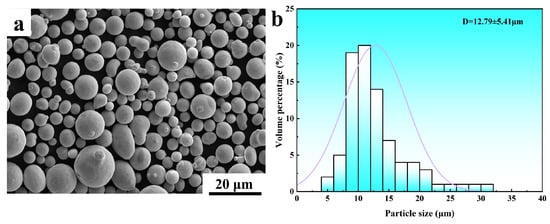
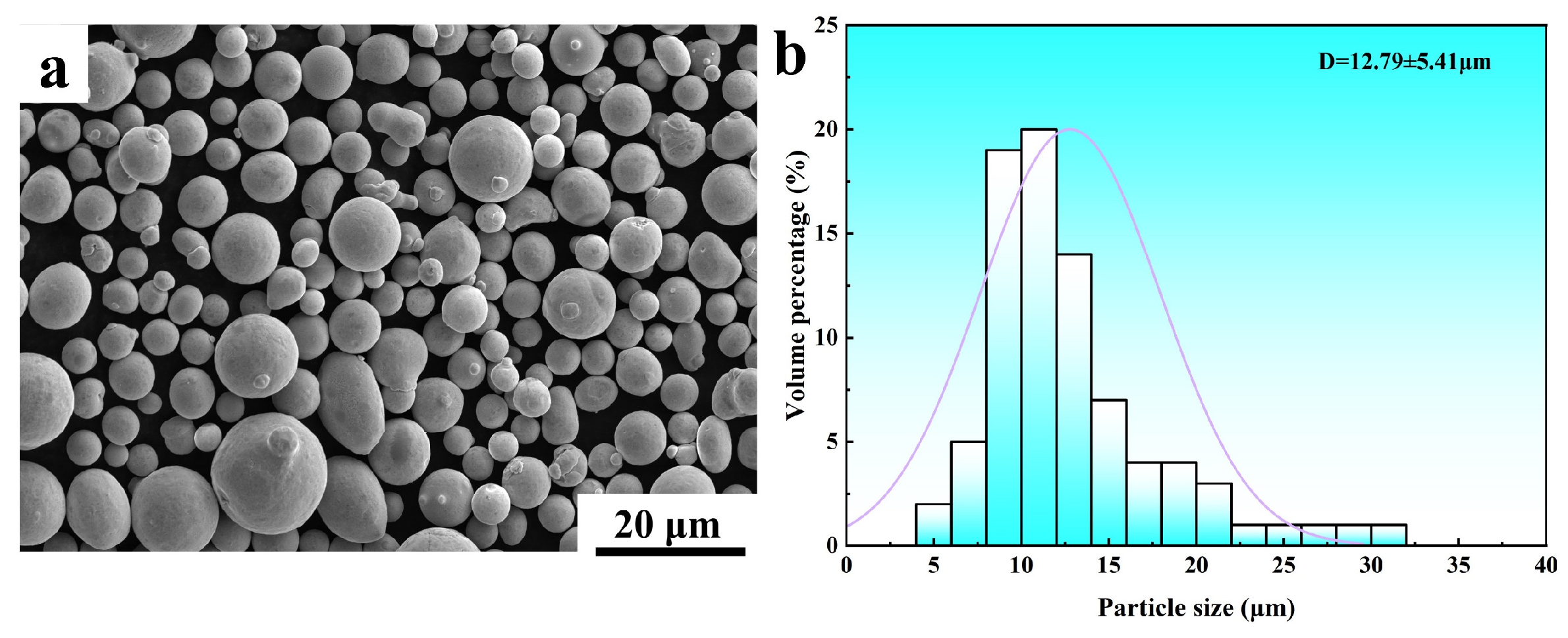
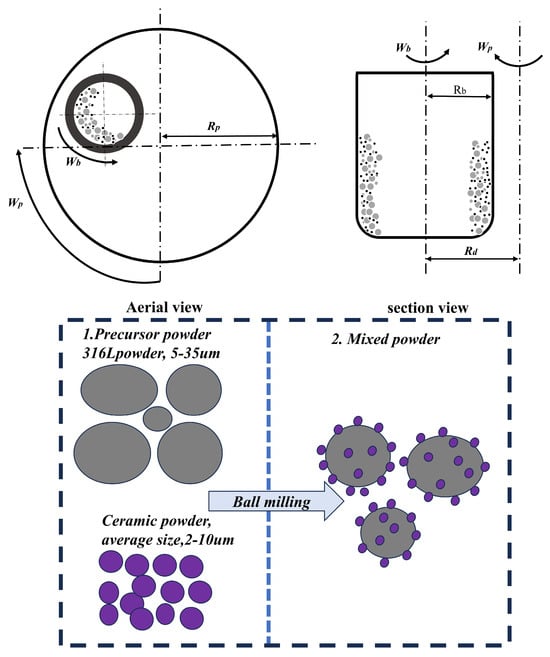
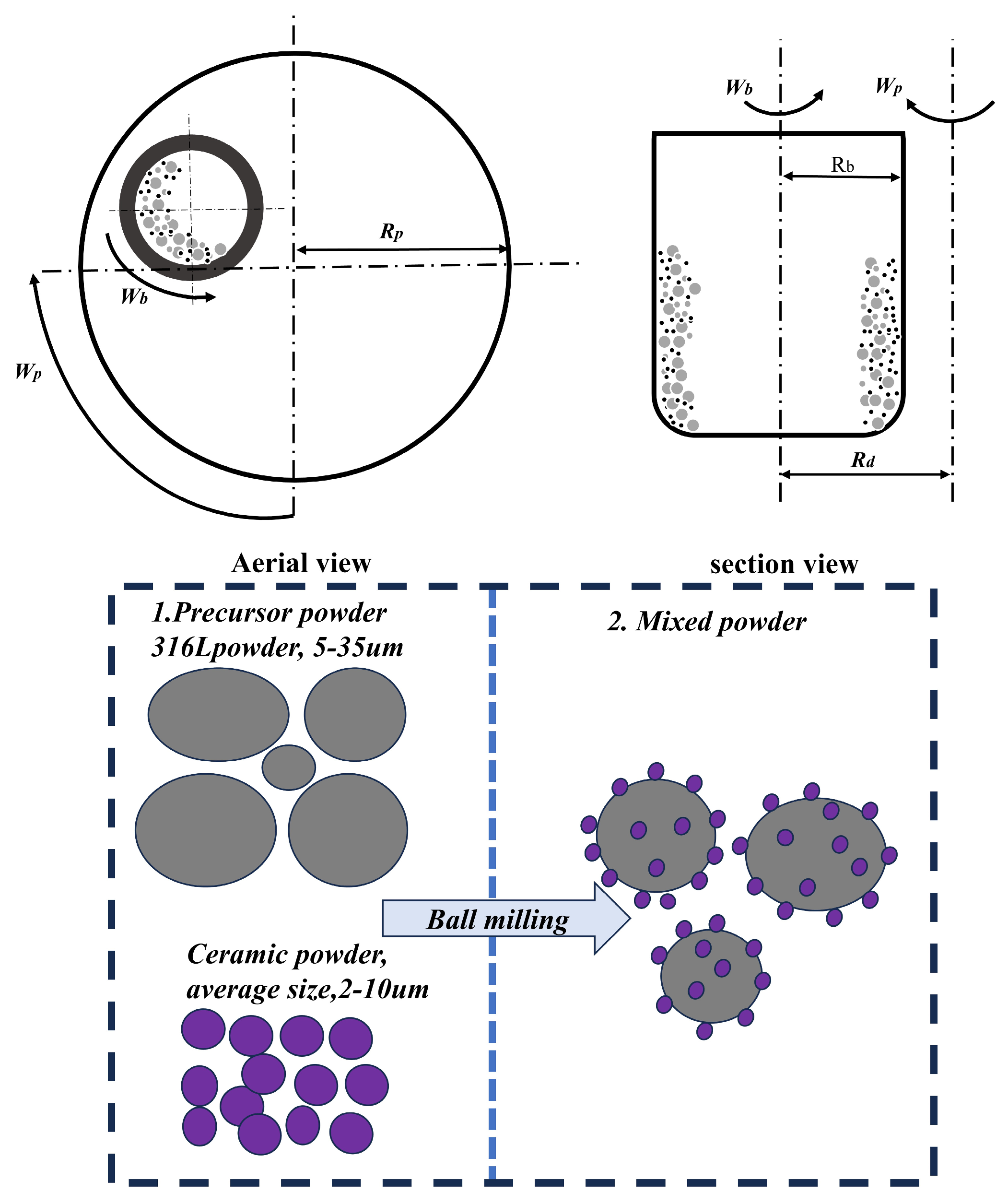
The experimental materials comprised high-purity (>99.9%) gas-atomized 316L stainless steel powder (Avimetal Powder Metallurgy Technology Co., Ltd., Beijing, China), with particle size distribution centered at 500 mesh (~25 μm), and its chemical composition and trace impurity profiles are listed in Table 1. Characterization of the as-received 316L powder (Figure 1a) revealed highly spherical particles with a measured size distribution of 5–35 μm and a mean diameter of 12.79 μm (Figure 1b). To enhance composite properties, five ceramic reinforcement phases—adding 1 wt% of TiC, SiC, SiO2, WC, and Y2O3 (2–10 μm particle size)—were homogenized with the matrix powder using a QM-3SP2 planetary ball mill under rigorously controlled parameters. As schematically depicted in Figure 2, processing employed a 4:1 ball-to-powder weight ratio, 300 rpm rotational speed, and a 4 h milling duration to ensure uniform dispersion.
Table 1.
Chemical composition (wt.%) of 316L stainless steel powder.
Figure 1.
(a) SEM observation of the initial alloy powder of 316L; (b) diameter distribution of the initial alloy powder.
Figure 2.
Schematic diagram of mixed 316L powder and ceramic particles by ball milling.
2.2. Laser Powder Bed Fusion Technology
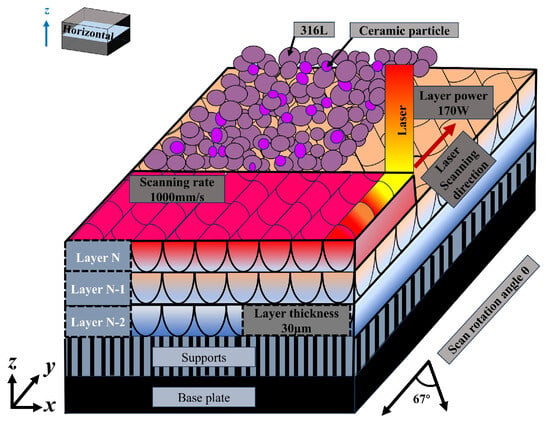
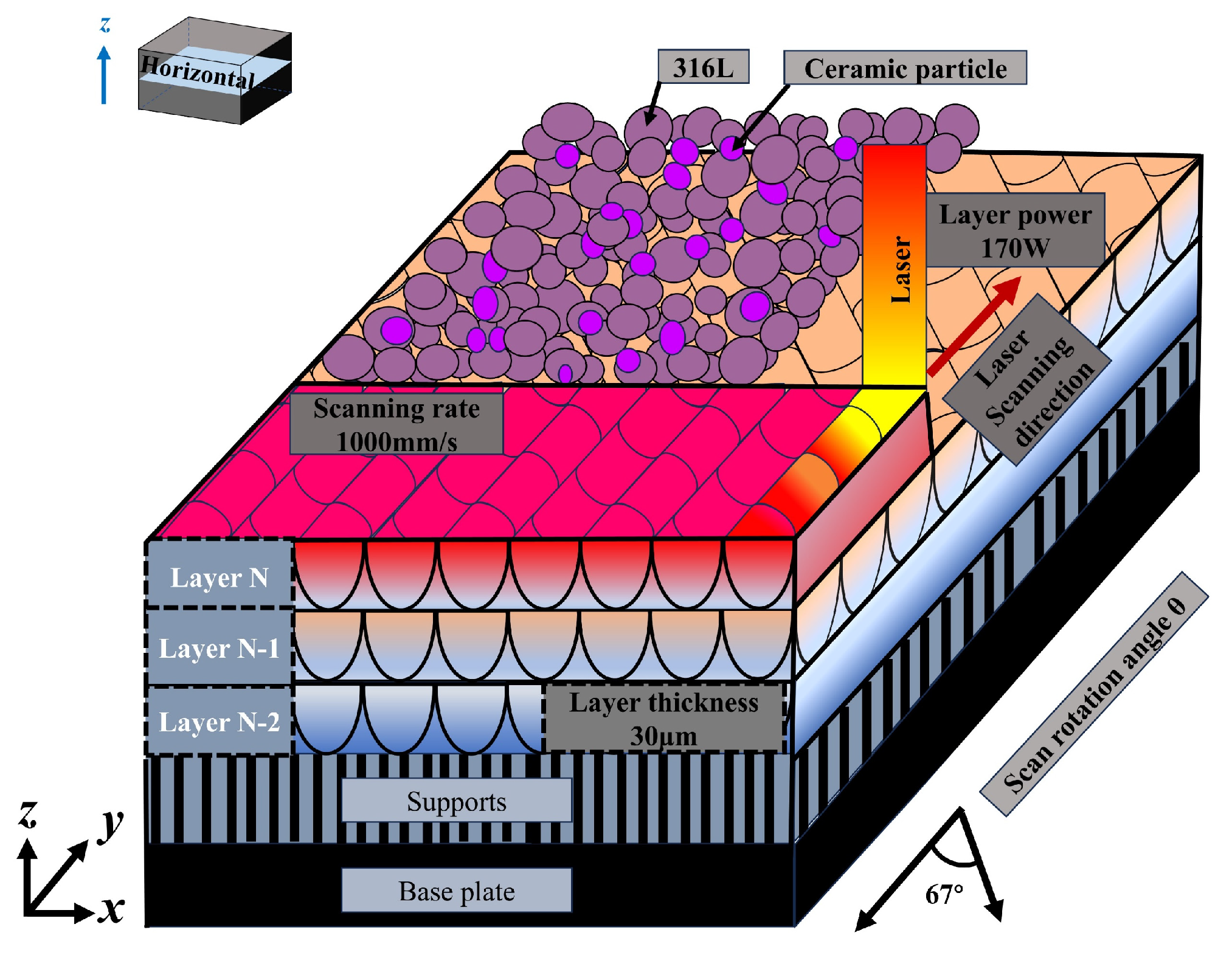
All composite specimens—designated as TiC/316L, SiC/316L, SiO2/316L, WC/316L, and Y2O3/316L—were fabricated via laser powder bed fusion (LPBF) employing an HBD-150 system (HBD-150, Guangdong Hanbang 3D Tech Co., Ltd., Zhongshan, China) under optimized processing parameters: 30 μm layer thickness (t), 100 μm hatch spacing (h), 1000 mm/s laser scan speed (v), and 170 W laser power (P), with interlayer oxygen content rigorously controlled below 100 ppm throughout manufacturing. Adopting a 67° rotation strategy between successive layers (N and N + 1) [31]—as schematically detailed in Figure 3—7 × 7 × 7 mm3 cubic specimens were digitally modeled using Voxeldance Additive software 4.1 and subsequently processed through Materialise Magics for parameter assignment and STL (Standard Tessellation Language) file generation. Prior to fabrication, powder mixtures underwent vacuum drying to ensure optimal flowability and build reliability, while processing occurred within a nitrogen-purged low-oxygen (Air Liquide (Guangdong) Industrial Gases Co., Ltd., Zhuhai, China) atmosphere on preheated substrate platforms. The layer-wise production sequence comprised (1) uniform powder recoating, (2) selective laser-induced melting and solidification of designated regions, and (3) incremental platform lowering—with this sequence iteratively repeated until completion.
Figure 3.
The model of the LPBF-printed layout.
2.3. Porosity and Microstructural Characterization
Porosity, as a common defect in additively manufactured metallic components, was characterized through standardized specimen preparation involving sequential grinding with 400-, 1000-, and 2000-grit abrasive papers followed by polishing (Zhengzhou Research Institute for Abrasives & Grinding Co., Ltd., Zhengzhou, China). Surface pore morphology obtained from optical microscopy (Carl Zeiss AG, Oberkochen, Germany) was analyzed using ImageJ 1.54p software, with three micrographs examined per specimen. Micrographs were binarized and converted to black-and-white images using predefined thresholds, where black regions represented pores and white areas denoted the metallic matrix. The porosity volume percentage (vol.%) was determined by calculating the ratio of black to white pixels.
For LPBF-fabricated composite samples, surface morphology examination required initial coarse grinding with 100-grit abrasive paper to remove wire-cutting marks, followed by sequential grinding with 400-, 1000-, and 2000-grit water-resistant abrasive papers. Polishing was subsequently performed using 1 μm diamond abrasive paste. Specimens underwent 60 s ultrasonic cleaning in ethanol prior to etching in freshly prepared aqua regia (3:1 HCl:HNO3) [32], with immersion duration optimized for each material. Etched samples were immediately rinsed with ethanol and dried. Microstructural examination was conducted first on a Leica DMI3000-M optical microscope (Wetzlar, Germany), then extended to a JEOL JSM-IT100 scanning electron microscope (Tokyo, Japan), with an accelerating voltage of 20 kV, in secondary electron mode, a beam current of 4.5 nA, a working distance of 12 mm, and a horizontal field width of 363 μm.
Phase analysis of all five composite types and 316L was performed using a Bruker D8 ADVANCE X-ray diffractometer (XRD) (Billerica, MA, USA). Specimens were ground sequentially with 400-, 800-, and 2000-grit abrasive papers to achieve flat surfaces. XRD scans were executed at 6°/min over a 20°–100° 2θ range, with acquired data analyzed using Jade 6.2 software.
2.4. Electrochemical Measurement
In the electrochemical characterization process, a standard three-electrode configuration was utilized, which consisted of a saturated calomel reference electrode (SCE), a platinum counter electrode, and a working electrode with specimens securely mounted in Teflon holders, exposing a surface area of 0.5 cm2. A range of electrochemical measurements, including open-circuit potential (OCP) monitoring, potentiodynamic polarization scans, and electrochemical impedance spectroscopy (EIS), were carried out at a controlled temperature of 25 °C using a Corrtest CS350H (Corrtest CS350H, Wuhan Corrtest Instruments Corp., Ltd., Wuhan, China) multichannel workstation. The testing sequence commenced with a 120 s cathodic polarization step at −1 V versus SCE to precondition the electrode surface. This common procedure was implemented to electrochemically reduce and remove the variable, air-formed oxide layer on the sample surface. We acknowledge that this pre-treatment effectively initializes all samples to a clean, reduced surface state, thereby masking any inherent differences in the stability of their respective air-formed oxides. However, the benefit is that the subsequent open circuit potential (OCP) monitoring and polarization scans more accurately reflect the intrinsic passivation kinetics and corrosion resistance of the material in the test solution, ensuring a standardized and comparative starting condition. This was followed by a 30 min OCP monitoring period to allow the surface conditions to stabilize. For EIS measurements, a 10 mV AC amplitude was applied across a frequency range spanning from 10 kHz to 0.01 Hz to assess the impedance characteristics of the system. While this range captures the primary interfacial processes, it is explicitly acknowledged that the EIS analysis is intended to provide comparative, qualitative insights into the impedance response of the different composites, rather than a complete kinetic characterization of long-term corrosion behavior. Ideally, characterization of full charge transfer resistance and long-term film stability would benefit from even more extended low-frequency measurements (≤0.01 Hz). Potentiodynamic polarization scans were conducted at a scan rate of 0.5 mV/s, starting from −1 V versus OCP and extending to −1.3 V versus SCE. Both the polarization and EIS data obtained were subjected to equivalent circuit modeling using Zsimpwin 3.6 software to extract meaningful electrochemical parameters. To ensure the statistical reliability of the results, triplicate tests were performed under each experimental condition. Moreover, to ensure comparability of the corrosion resistance of LPBF-fabricated 316L stainless steel with different ceramic particle additions, all electrochemical tests (as well as the observations of the original microstructure and corrosion morphology) were performed on the section perpendicular to the build direction. Following the electrochemical testing, the microstructures of the corroded specimens were examined using scanning electron microscopy (SEM). This allowed for a comparative evaluation of the effects of ceramic reinforcement on the corrosion behavior of LPBF-fabricated 316L stainless steel composites, providing insights into the corrosion resistance and degradation mechanisms of these materials.
3. Results and Discussion
3.1. Porosity of 316L Stainless Steel with Different Ceramic Particles
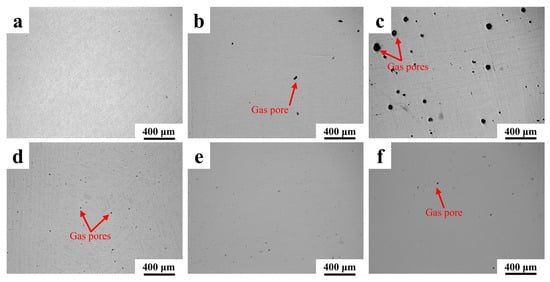
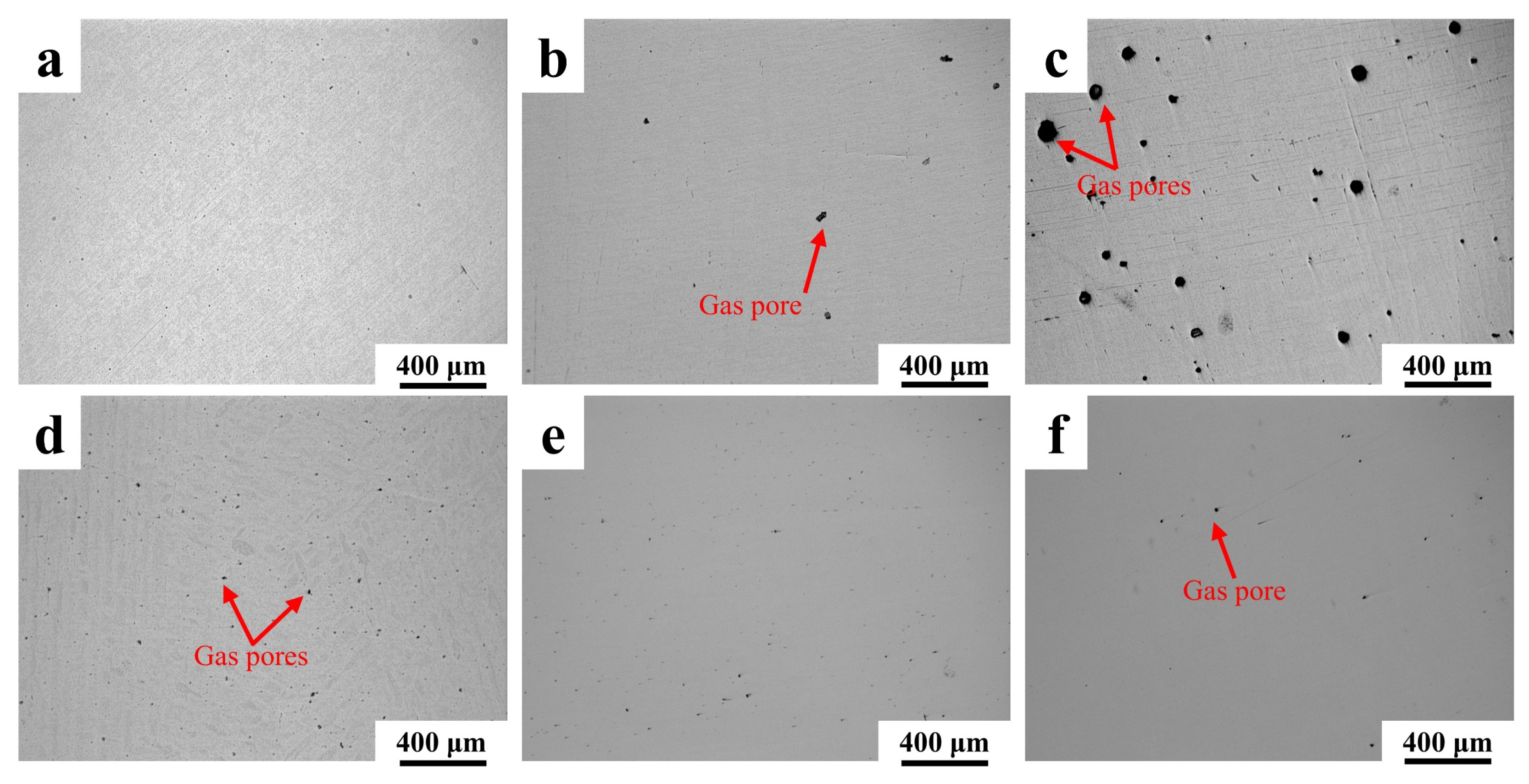
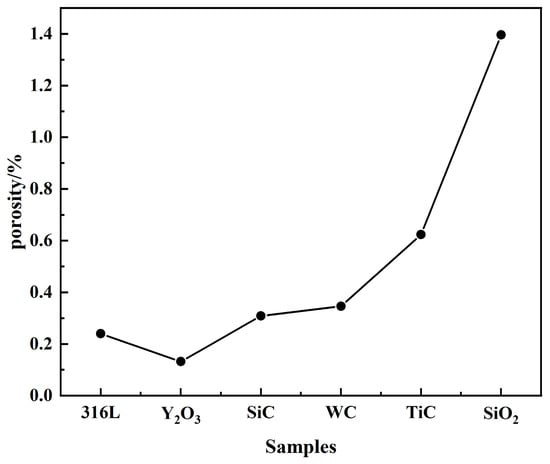
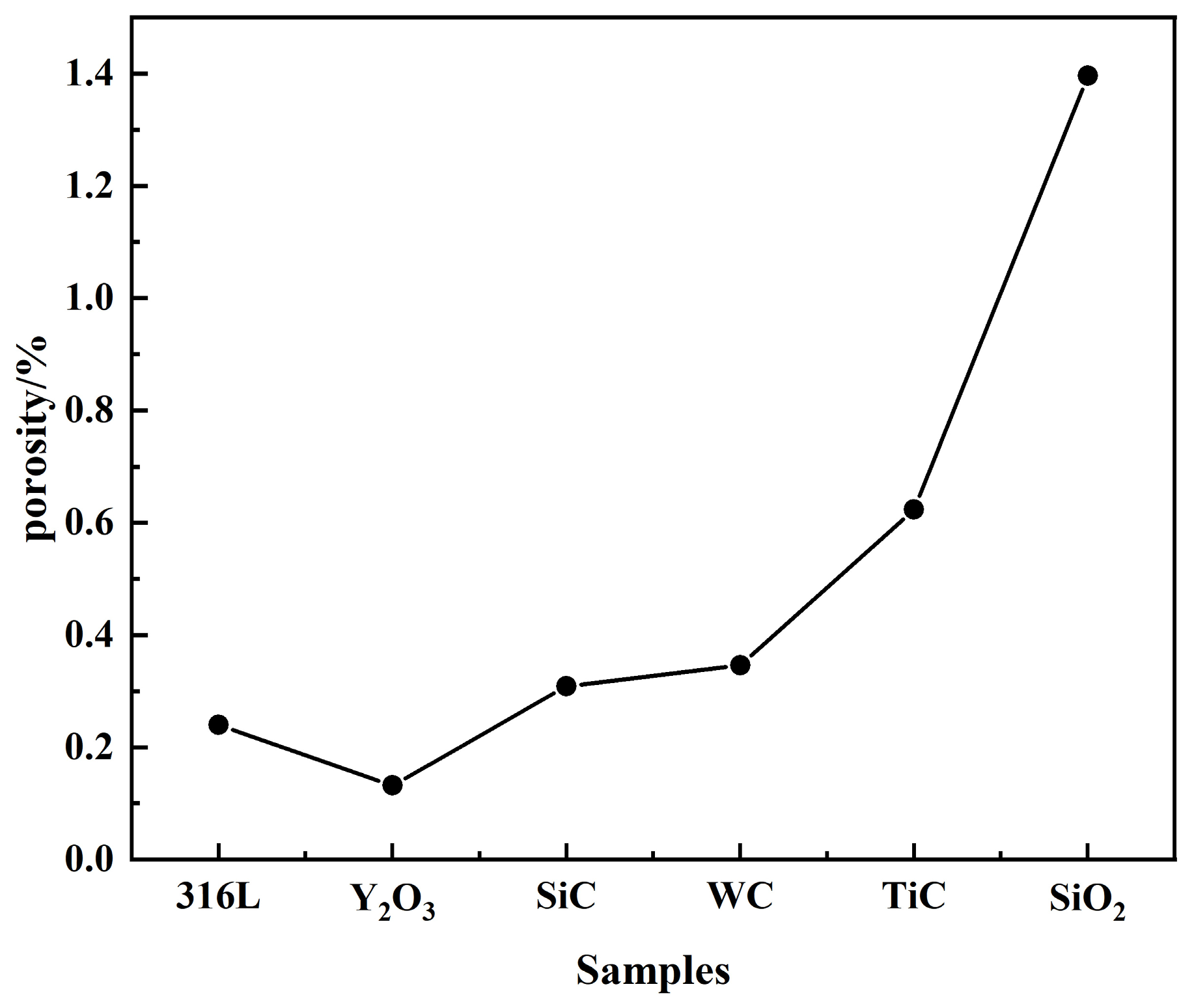
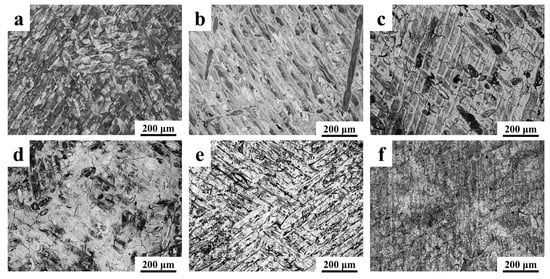
As depicted in Figure 4, OM images of 316L stainless steel and its composite variants—TiC/316L, SiC/316L, SiO2/316L, WC/316L, and Y2O3/316L—processed via the laser powder bed fusion (LPBF) technology reveal that uniformly distributed fine pores are observed in the 316L stainless steel, as illustrated in Figure 4a. In contrast, the SiC/316L and SiO2/316L composites exhibit a smaller number of pores, though these pores are of larger sizes (Figure 4b,c). Comparatively, Figure 4d–f demonstrate that the TiC/316L, WC/316L, and Y2O3/316L composites are characterized by smaller pore radii but a more widespread distribution. As quantitatively illustrated in Figure 5, a porosity value of 0.24% is recorded for 316L, while a lower value of 0.132% is measured for Y2O3/316L—though localized large pores are observed in the latter material despite favorable processability [33]. All other ceramic composites are found to possess higher porosity than 316L, with SiO2/316L exhibiting the maximum porosity level of 1.396%. Gas-atomized powders with high apparent density are utilized, where enhanced printability and densification are enabled. During LPBF processing, remelting and solidification are induced under steep thermal gradients coupled with gravitational and capillary forces, leading to process-induced defects in which gas porosity is identified as the predominant type. Fine pores are primarily attributed to inert gas entrapment during protective atmosphere processing: rapid melting and solidification under high laser temperatures prevent trapped inert gas within powder particles from escaping during fast solidification, generating pores [34]. Larger irregular voids are partially caused by insufficient energy density input, resulting in incomplete powder melting and solidification defects [35]. The differing melting points of ceramic reinforcement phases constitute another key factor, where incomplete melting of these particles is induced by insufficient laser energy, thereby creating larger pores compared to unreinforced 316L. Additionally, ball-milling-induced variations in powder flowability are recognized as contributing factors, leading to non-uniform powder layer deposition during recoating and ultimately generating powder-spreading deficiency defects [36]. Although the porosity analysis is based on two-dimensional optical microscopy (OM) area fraction measurements and has inherent limitations in fully characterizing three-dimensional pore connectivity and subsurface lack-of-fusion defects, this method nevertheless provides a reliable and widely accepted estimate of relative porosity levels in LPBF materials.
Figure 4.
OM observation of the porosities of 316L stainless steel composites with different ceramic particles: (a) 316L, (b) SiC/316L, (c) SiO2/316L, (d) TiC/316L, (e) WC/316L, (f) Y2O3/316L.
Figure 5.
Porosity of 316L stainless steel composites with different ceramic particle reinforced phases.
3.2. Phase Analysis
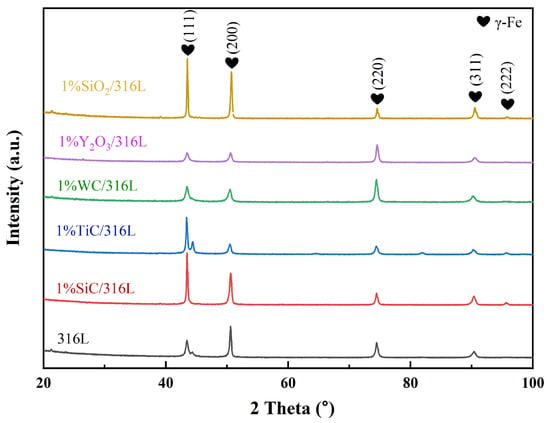
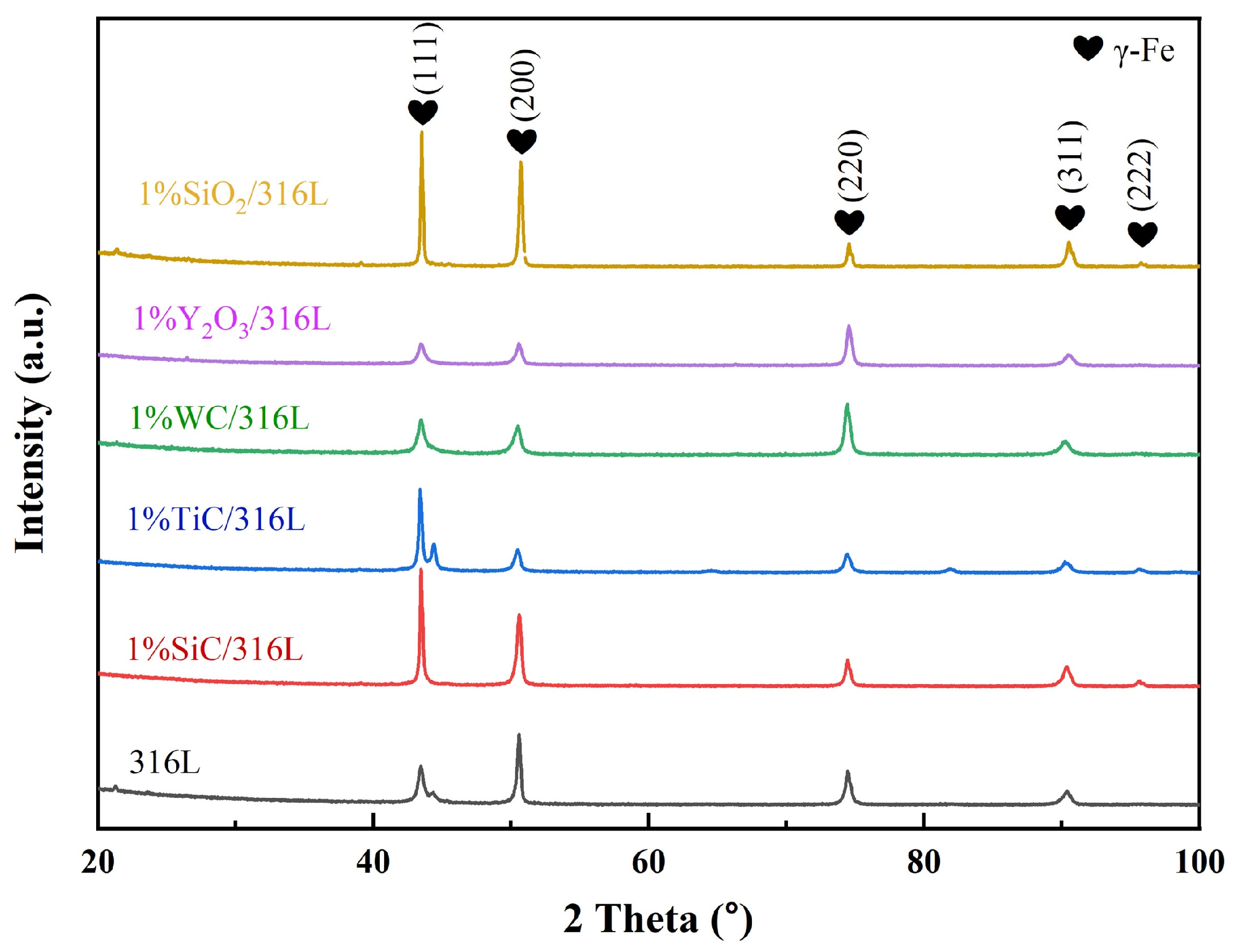
As revealed in Figure 6, XRD patterns of ceramic-reinforced 316L composites exhibit minor variations in specific phase diffraction peak intensities. Nevertheless, the phase composition of as-built specimens is exclusively constituted by austenitic γ-Fe diffraction peaks, with no additional crystalline phases being detected. Given the low ceramic reinforcement content of only 1 wt.%, any potential secondary phases resulting from interfacial reactions would likely be present in quantities below the typical detection limit of XRD. In addition, five principal diffraction peaks are exhibited by unreinforced 316L: (111), (200), (220), (311), and (222), with corresponding 2θ values at 43.46°, 50.56°, 74.48°, 90.41°, and 95.68° being recorded for the face-centered cubic (FCC) structure, confirming this phase as the key equilibrium constituent [37]. The splitting of the (200) peak around 50° is attributed to the tetragonal distortion of the austenite lattice caused by the rapid solidification and residual stresses inherent to the LPBF process. Consistent austenitic γ-Fe peaks are identified across all composite variants, while significantly enhanced (111) peak intensities for γ-Fe austenite are observed in SiC/316L, TiC/316L, and SiO2/316L systems [38]. According to Scherrer’s formula, increased full width at half maximum (FWHM) values are interpreted as indicating reduced crystallite sizes, suggesting that additional grain refinement is induced during post-melting solidification. This phenomenon is attributed to rapid solidification kinetics inherent to LPBF processing, whereby grain growth is effectively inhibited [39].
Figure 6.
XRD patterns of 316L stainless steel composites reinforced with different ceramic particles.
3.3. Microstructure
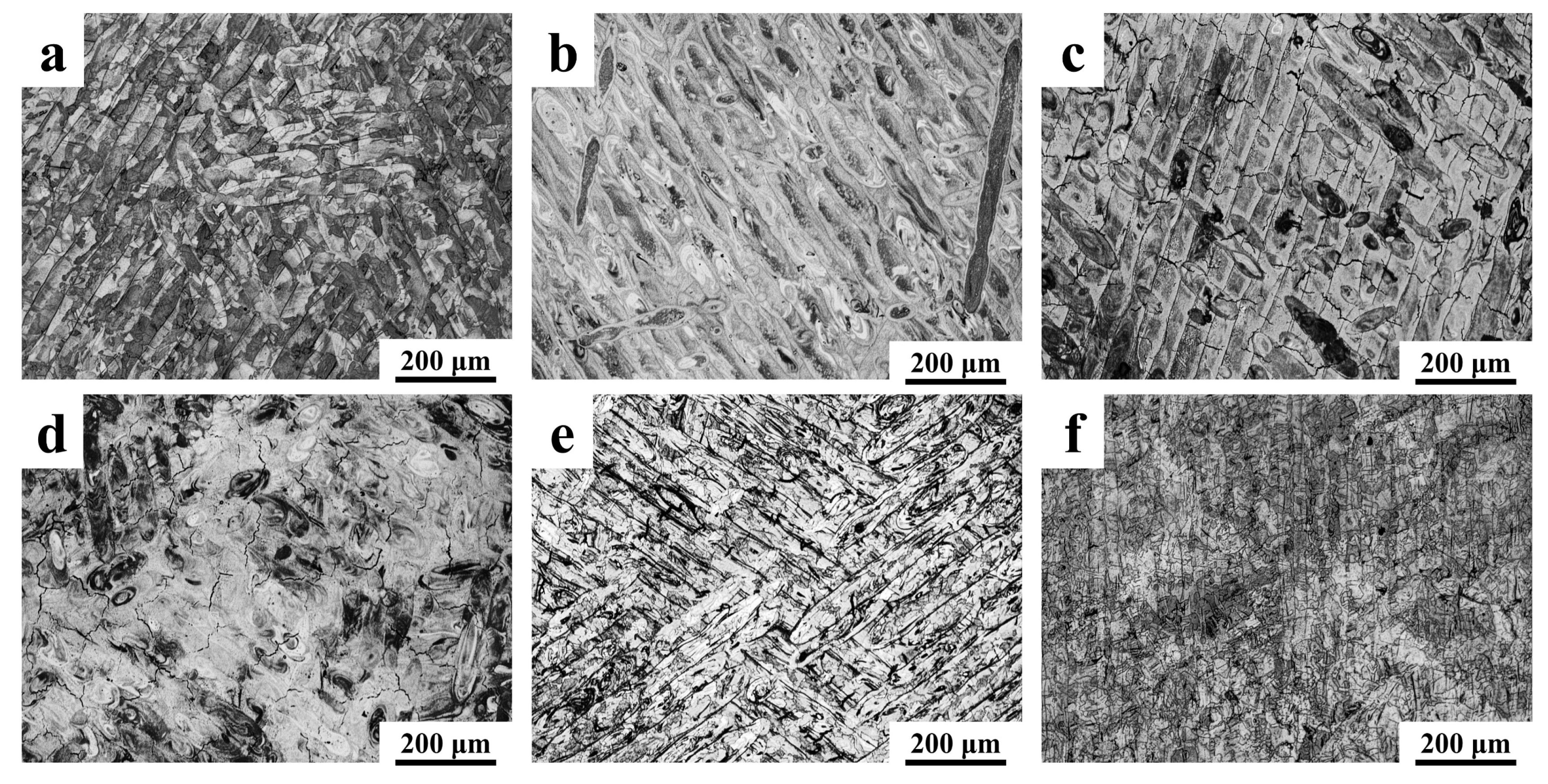
Aqua-regia-etched microstructures of 316L and ceramic-reinforced composites are compared, as presented in Figure 7, revealing that complete melting of 316L powder during LPBF processing is suggested (Figure 7a), where adjacent melt pool boundaries exhibit intimate interlayer bonding with sound metallurgical fusion. No discernible pores or cracks are observed on 316L surfaces. Characteristic LPBF melt pools are revealed through etching, with distinct boundaries becoming visible at low magnification. Orthogonally aligned melt pools with periodic distribution patterns are formed due to the 67° interlayer rotation strategy, causing overlapping scan tracks. Individual melt pools demonstrate consistent size and morphology, while equiaxed austenitic grains with homogeneous distribution are identified [40]. Optical micrographs of ceramic-reinforced composites (Figure 7b–f) indicate that well-defined cross-hatched melt pool networks are exhibited by all ceramic composites except SiC/316L and SiO2/316L systems, in which minor cracks and pores are observed. Continuous melt tracks with wavy yet unbroken bead morphology are formed, signifying that laser power parameters are optimized and sufficient energy input is provided, thereby achieving high relative density and favorable surface integrity [41]. However, in SiO2/316L processing, melt pool overextension, spattering, and keyhole-induced pores/cracks are attributed to the mismatch between the input laser energy density and the thermophysical properties of the SiO2 particles, with microstructural coarsening and spheroidization being simultaneously induced [42]. Conversely, abundant pores and cracks are developed in SiC/316L, with four potential mechanisms being identified: (1) internal stress concentration is induced by degraded powder flowability, resulting in multiple microstructural defects; (2) tensile stresses are generated by hindered melt pool contraction under rapid cooling, initiating cracks when material strength limits are exceeded; (3) stress concentration is caused by SiC agglomeration or inhomogeneous distribution; (4) pore formation is generated by obstructed melt flow [43].
Figure 7.
OM images of 316L stainless steel composites with different ceramic particles: (a) 316L, (b) TiC/316L, (c) SiC/316L, (d) SiO2/316L, (e) WC/316L, (f) Y2O3/316L.
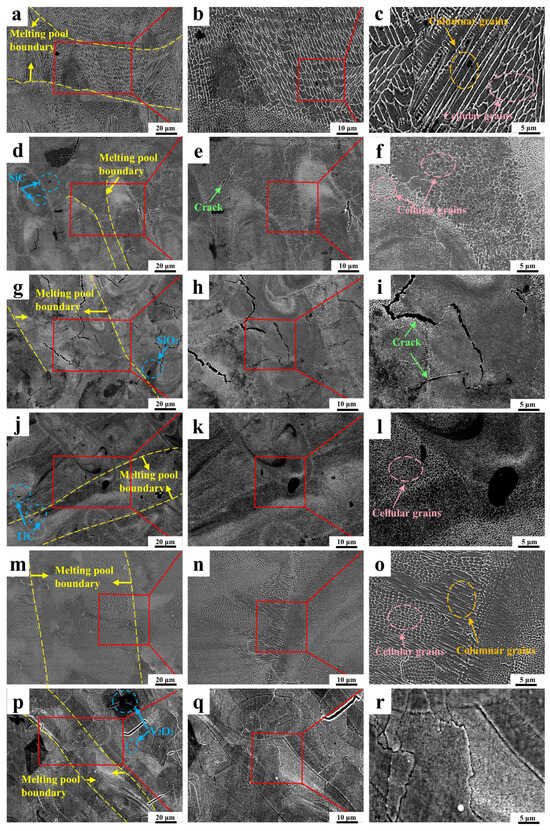
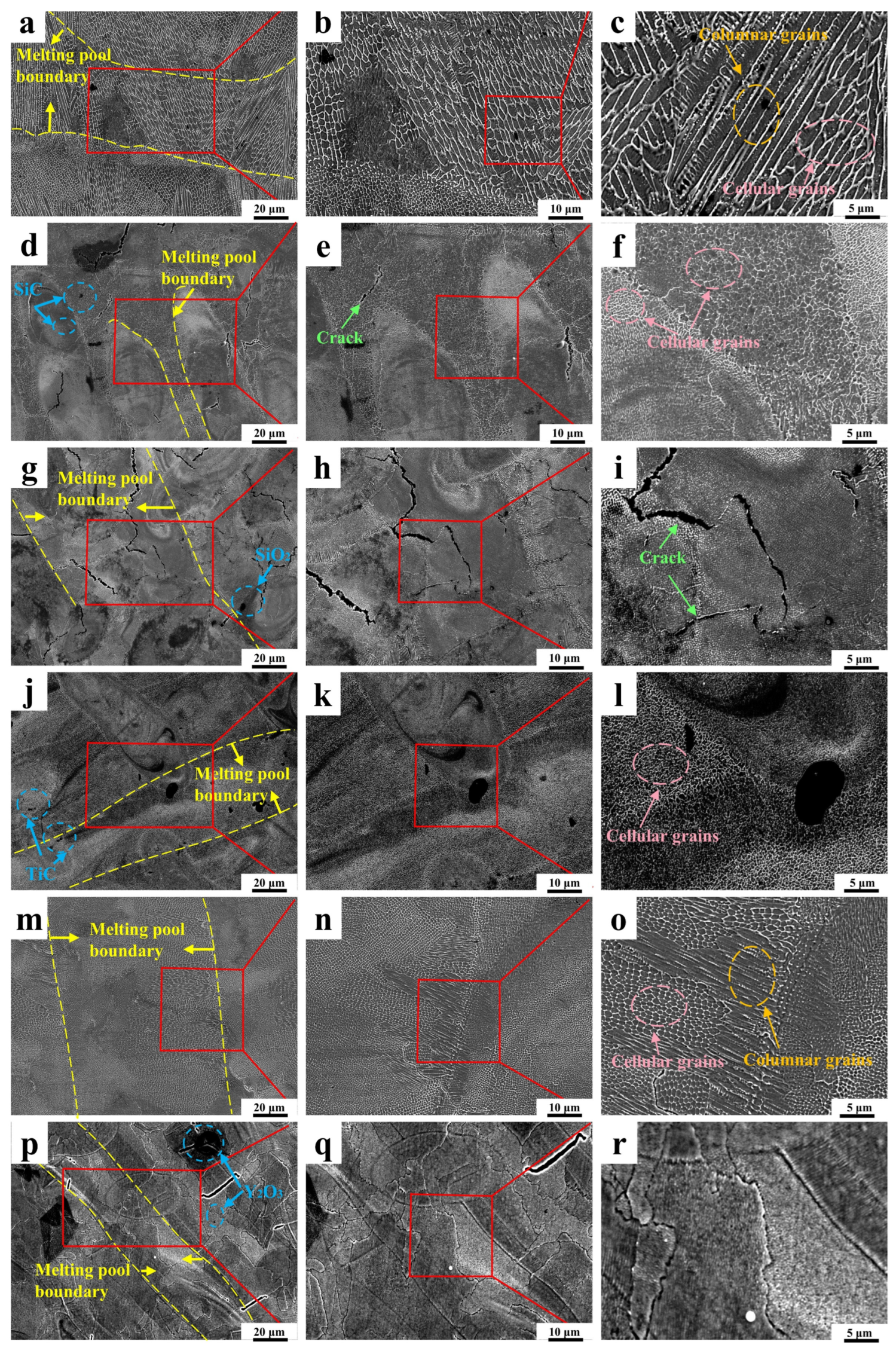
As exhaustively documented in Figure 8, SEM characterization of distinct ceramic-reinforced 316L composites is systematically presented, wherein Figure 8a–c depict monolithic 316L stainless steel features while Figure 8d–r display various ceramic composite systems. Melt pool morphologies are discernible at low magnification (Figure 8a,d,g,j,m,p), with boundaries being demarcated by yellow dashed lines. Cross-aligned configurations are produced through implementation of the 67° interlayer rotation strategy, resulting in vertically stacked successive melt pools across deposited layers, whose overlap and non-overlap regions are comprehensively delineated in Figure 9. Epitaxially grown elongated grains along melt pool boundaries are revealed in Figure 8b, whereas honeycomb-structured grains dominating melt pool interiors are concurrently identified. Cellular dendritic structures exhibiting dimensional variations within melt pools are suggested in Figure 8c, arising from non-equilibrium thermodynamics inherent to LPBF processing that induce substructure development through the generation of asymmetric thermal gradients by nonlinear temperature fields, thereby instigating substantial thermocapillary force gradients that activate the Marangoni effect to drive multimodal convection [44]. Under accelerated cooling regimes, stratified solidification of the melt is promoted, forming subgrain network structures possessing complex fractal topologies while surface tension gradients concurrently govern molten metal flow and heat dissipation directionality. Cellular crystal growth is facilitated under constitutional supercooling conditions, with solidification microstructure being critically determined by the G/R ratio (temperature gradient vs. solidification rate) [45]. Elevated G/R ratios are observed to promote cellular grain formation exhibiting equiaxed or near-spherical morphologies averaging 2 μm at boundaries versus 1.5 μm in melt pool interiors, whereas reduced ratios facilitate columnar or equiaxed growth where epitaxy-dominated directional solidification yields columnar grains possessing strong crystallographic texture, approximately 0.9 μm in width and extending tens of micrometers in length with growth orientation toward melt pool centers, culminating in directionally selective solidification structures through synergistic mechanisms [46]. Grain refinement is suggested across all ceramic-reinforced 316L composites via SEM analysis (Figure 8d–r); the SEM observations suggest a trend of grain refinement. However, it should be noted that these observations remain qualitative, and quantitative validation through electron backscatter diffraction (EBSD) or statistical size distribution analysis would be required to provide definitive microstructural metrics, where surface microstructures retaining columnar grains and cellular features akin to monolithic 316L are evidenced, with finer cellular networks indicated in Figure 8f,i,o. Refined subcellular structures localized at Cr/Mo segregation boundaries are revealed in Figure 8r [47], wherein hierarchical substructures effectively impede dislocation motion during plastic deformation. Microcracks in SiC/316L and SiO2/316L composites are respectively suggested in Figure 8e and Figure 8i, whereas macroscopic cracks developing in SiC/316L are primarily attributed to SiC’s superior melting point and thermal expansion coefficient relative to the 316L matrix, causing incomplete powder melting that elevates melt viscosity and compromises fluidity, consequently reducing melt pool spreading and wettability which directly deteriorate build quality, further compounded by agglomeration tendencies of nanoscale SiC particles that facilitate pore formation [19]. Simultaneously, significant CTE (coefficient of thermal expansion) mismatch (SiO2: 0.5 × 10⁻⁶/K vs. 316L: 16.0 × 10⁻⁶/K) is identified as principally causing macrocracks in SiO2/316L, where differential thermal contraction during rapid thermal cycling generates high interfacial residual tensile stresses that concentrate to trigger microcrack nucleation during cooling, subsequently propagating through brittle interfaces to form macrocracks [43].
Figure 8.
SEM images of 316L stainless steel composites with different ceramic particles: (a–c) 316L/316L, (d–f) SiC/316L, (g–i) SiO2/316L, (j–l) TiC/316L, (m–o) WC/316L, (p–r) Y2O3/316L.
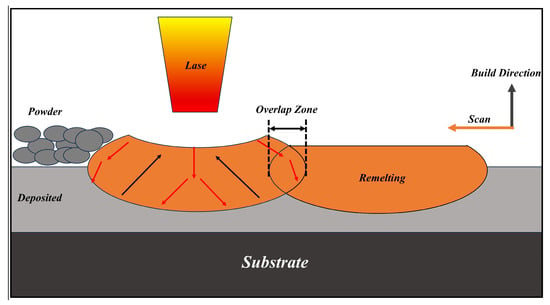
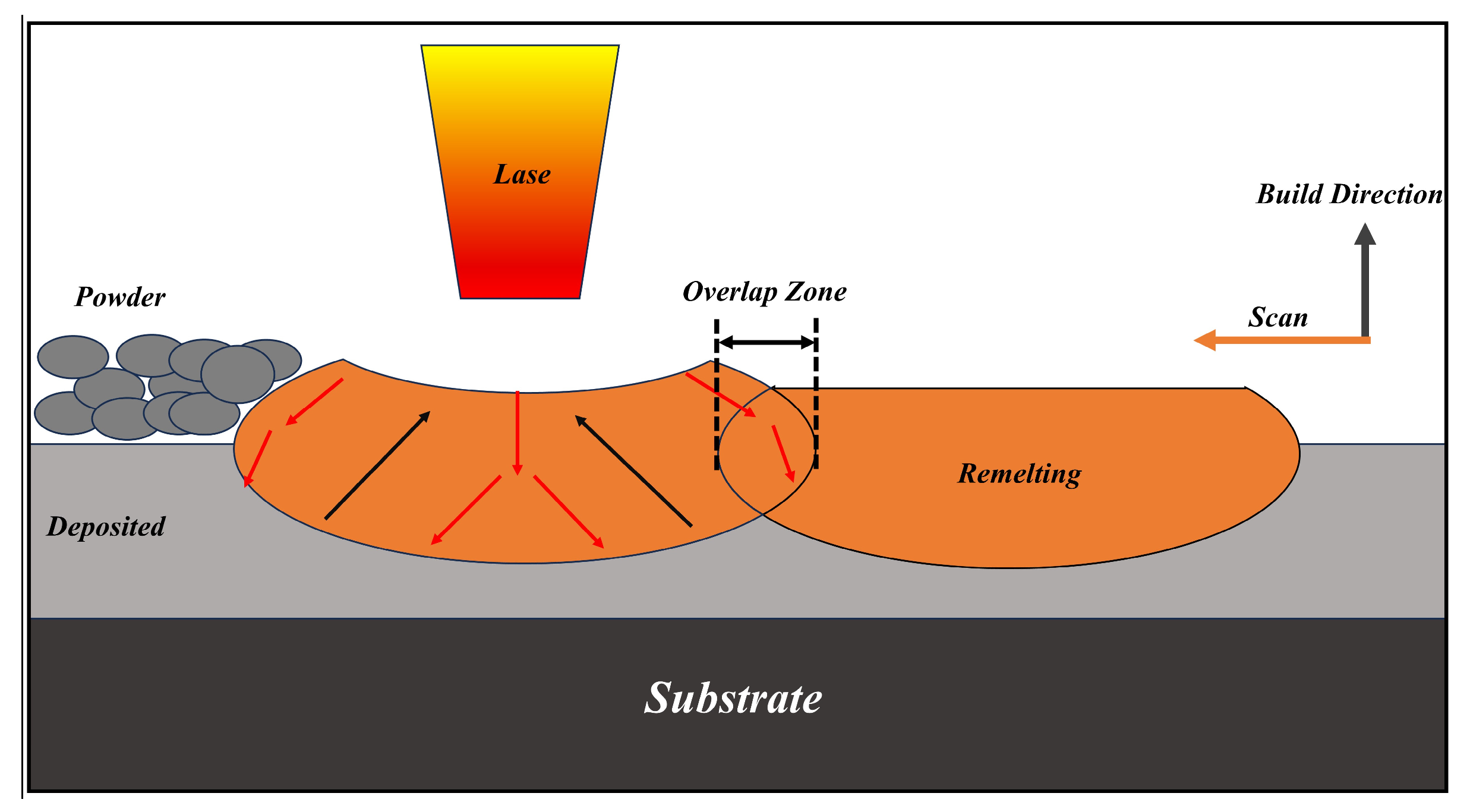
Figure 9.
Illustration of temperature distribution and fluid flow distribution in the molten pool.
3.4. Electrochemical Testing
3.4.1. Open Circuit Potential
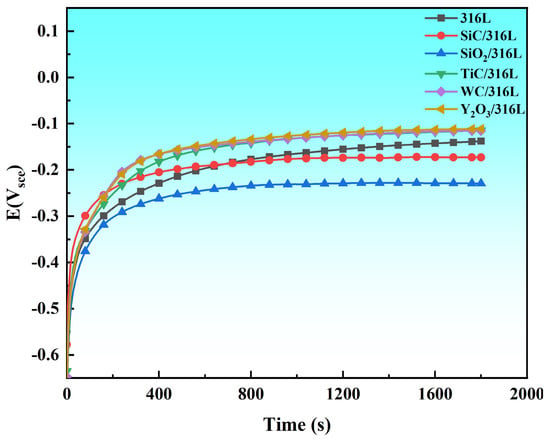
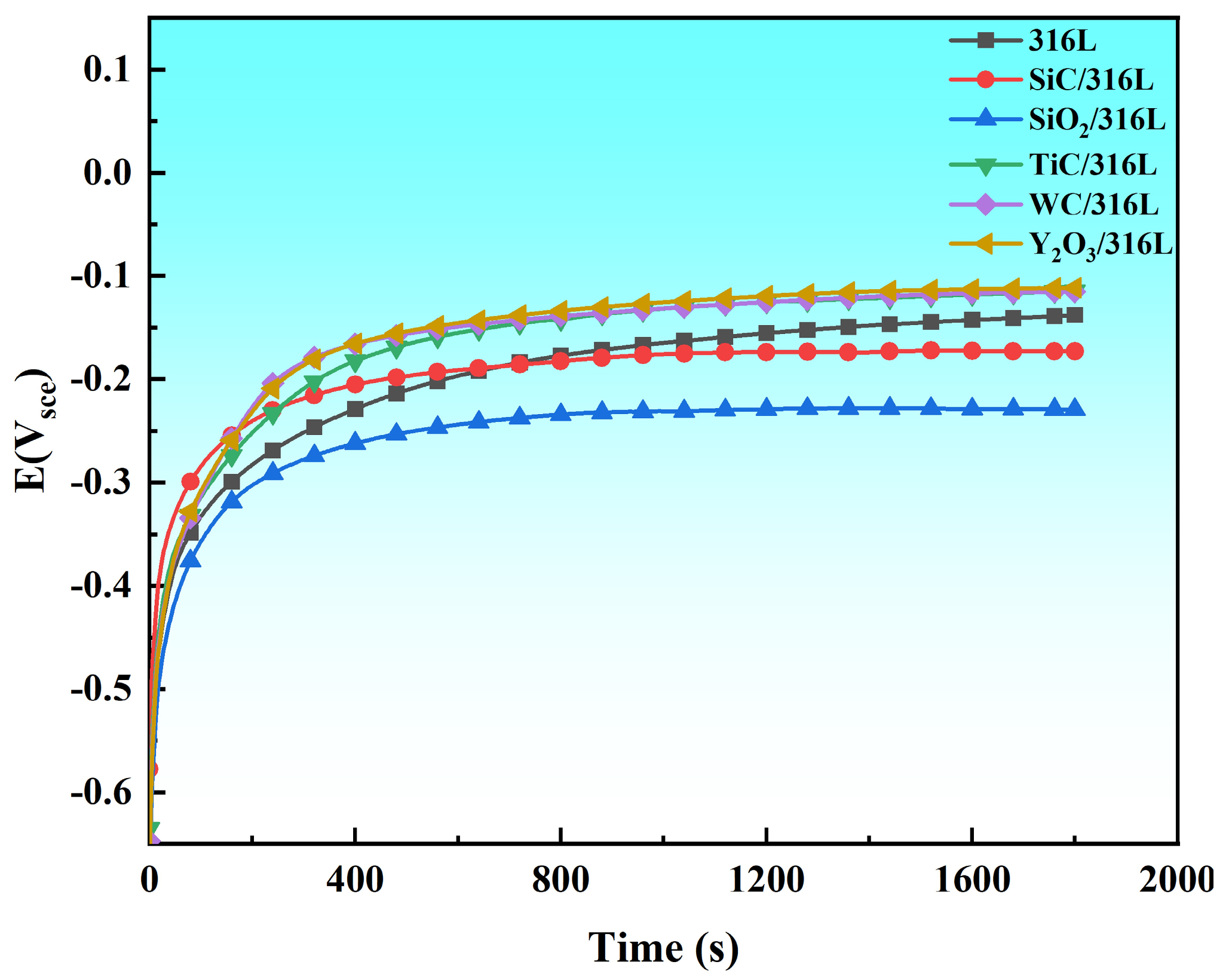
Open-circuit potential (OCP) is recognized as a critical indicator for assessing corrosion susceptibility in electrochemical studies, characterizing the formation, dissolution, and stability of passive oxide films [48]. As shown in Figure 10, the OCP evolution of ceramic-reinforced 316L composites immersed in 3.5 wt.% NaCl solution is systematically documented. When positive OCP shifts are observed over time, passive film formation on material surfaces is signified, indicating decreased corrosion susceptibility and enhanced corrosion resistance. Conversely, negative OCP shifts suggest degradation or absence of protective oxide layers, resulting in increased corrosion susceptibility and diminished resistance [49]. All specimens exhibit gradual positive potential shifts, with stabilization being achieved after approximately 1200 s. Beyond this duration, insignificant potential variations are recorded, indicating spontaneous passivation is induced, whereby protective films are progressively formed on sample surfaces. The OCP values of the composites are generally more positive than those of unreinforced 316L stainless steel, with the exception of SiO2/316L and SiC/316L. This positive shift, particularly pronounced in composites containing more noble ceramic phases (Y2O3, WC, TiC), may partly result from galvanic coupling between the noble ceramic particles and the metal matrix, rather than solely reflecting improved passivation. Given that lower OCP values are often associated with higher corrosion susceptibility in similar systems, a preliminary susceptibility ranking based on OCP would be SiO2/316L < SiC/316L < 316L < TiC/316L < WC/316L < Y2O3/316L [50]. It is noted that while 30 min of OCP monitoring provided initial stabilization data sufficient for comparative ranking, longer-term immersion tests would be beneficial in future studies to fully evaluate the long-term stability of the passive film.
Figure 10.
Open-circuit potential maps of 316L stainless steel composites with different ceramic particles.
3.4.2. Potentiodynamic Polarization
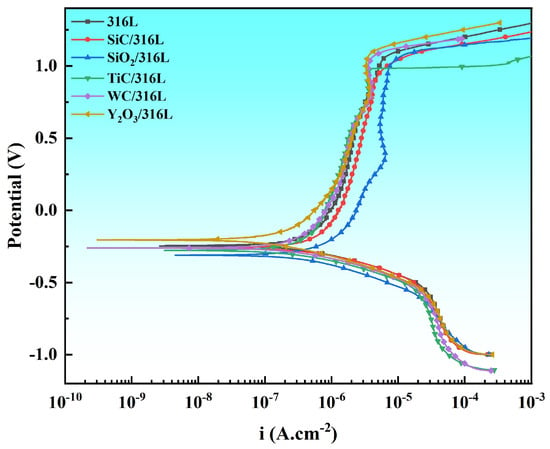
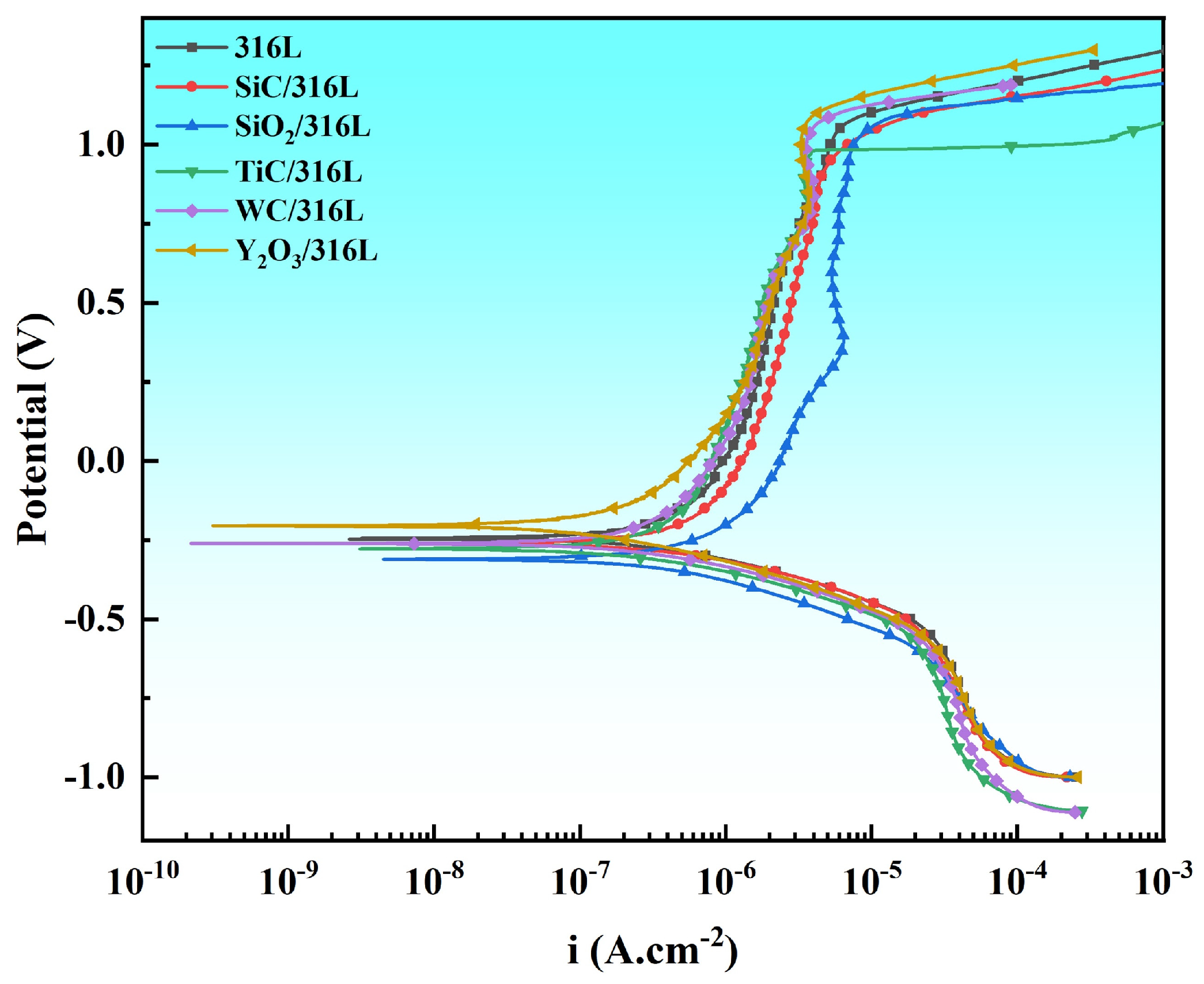
The corrosion resistance of materials in diverse environments was assessed through potentiodynamic polarization measurements, with the resulting polarization curves for 316L stainless steel composites incorporating distinct ceramic reinforcement phases—acquired in a 3.5 wt.% NaCl solution at a scan rate of 0.50 mV s−1—presented in Figure 11. Corrosion performance parameters were subsequently determined by Tafel extrapolation of these curves. In the cathodic branch, all materials exhibit remarkably similar curve shapes, characterized by a near-linear Tafel region at more negative potentials followed by a transition to a limiting current density plateau at potentials close to −0.8 to −1.0 VSCE. This behavior is typical of oxygen reduction reaction (ORR) control under mixed activation-diffusion regime in aerated neutral chloride solutions. The slight reduction in cathodic current density observed for the WC/316L, TiC/316L, and Y2O3/316L composites compared to unreinforced 316L suggests that the presence of these more noble ceramic particles mildly suppresses cathodic kinetics, possibly by reducing the effective metallic surface area available for ORR or by altering local electron transfer rates. In contrast, SiO2/316L and SiC/316L show marginally higher cathodic currents, consistent with increased active surface area due to higher porosity and defects. Within the anodic region, a distinct passivation zone characterized by a slow variation in current density with increasing applied potential was evident for all materials. As shown in Figure 11, the Y2O3/316L composite displays the widest passivation range and the most stable passive current density, indicating a superior capability to re-passivate metastable pits compared to the SiC/316L sample, which shows current fluctuations indicative of unstable film breakdown. Corresponding corrosion parameters—corrosion potential (Ecorr), corrosion current density (icorr), and breakdown potential (Ebrk)—determined through this analysis are compiled in Table 2. The corrosion current densities of 316L, SiC/316L, SiO2/316L, TiC/316L, WC/316L and Y2O3/316L were 9.12 × 10⁻⁷ A·cm−2, 1.69 × 10⁻⁶ A·cm−2, 2.93 × 10⁻⁶ A·cm−2, 5.51 × 10⁻⁷ A·cm−2, 5.69 × 10⁻⁷ A·cm−2, and 4.47 × 10⁻⁷ A·cm−2, with breakdown potentials of 1.021 VSCE, 0.935 VSCE, 0.996 VSCE, 0.981 VSCE, 1.048 VSCE, and 1.081 VSCE, respectively. The Y2O3/316L composite, exhibiting the minimal icorr and optimal passivation capability, demonstrates performance consistent with the corrosion susceptibility ranking derived from open-circuit potential (OCP) measurements, confirming that the incorporation of ceramic reinforcements generally enhances the corrosion resistance of 316L stainless steel. The pitting potential (Ebrk), serving as a critical indicator of passive film stability, further supports this conclusion, as an elevated Ebrk signifies enhanced film integrity and superior resistance to localized corrosion [51]; notably, the maximum Ebrk is confirmed for Y2O3/316L, signifying its reduced pitting susceptibility, optimal passive film stability, and superior overall corrosion resistance, with this Ebrk progression aligning fully with OCP observations [52]. The enhanced performance is hypothesized to be linked to microstructural features evidenced by SEM analysis (Figure 8). Specifically, the high-density subgrain boundaries, which are characteristic of the LPBF process, are postulated to enhance surface reactivity and accelerate chromium diffusion kinetics. The enhanced corrosion resistance inetics. These interfacial features are postulated to enhance surface reactivity through elevated electron activity and accelerated diffusion kinetics, thereby promoting nucleation sites for protective oxide films [53]. Furthermore, silicon within austenitic stainless steels is known to form protective oxides in alkaline or oxidizing environments, effectively isolating the underlying material from corrosive media and consequently reducing susceptibility while enhancing resistance [54]. Paradoxically, despite this inherent benefit of silicon, the degraded corrosion resistance observed for SiC/316L and SiO2/316L composites is attributed to several factors: non-uniform dispersion of reinforcement particles, processing-induced spheroidization and porosity, and crack formation leading to reduced part density. While silicon is theoretically beneficial for passivation, in the SiC and SiO2 systems, this chemical advantage is negated by severe structural defects. The significant CTE mismatch (SiO2: 0.5 × 10⁻⁶/K vs. 316L: 16.0 × 10⁻⁶/K) generates residual tensile stresses, leading to microcracks that act as direct diffusion channels for chloride ions [55]. A clear quantitative correlation establishes that defect density influences the corrosion kinetics. The SiO2/316L composite, which exhibits the highest porosity of 1.396%, corresponds to the highest corrosion current density 2.93 × 10⁻⁶ A·cm−2. In contrast, the Y2O3/316L sample, with the lowest porosity (0.132%), demonstrates the lowest icorr 4.47 × 10⁻⁷ A·cm−2. This trend indicates that increased porosity leads to a higher icorr in the material. all of which consequently degrade corrosion resistance, with these underlying mechanisms being directly validated by the microstructural evidence presented in Figure 8.
Figure 11.
Dynamic potential polarization of 316L stainless steel composites with different ceramic particles.
Table 2.
Kinetic potential polarisation parameters of 316L stainless steel composites with different ceramic particles.
3.4.3. Electrochemical Impedance Spectra
Although OCP monitoring and potentiodynamic polarization represent conventional methodologies for evaluating corrosion susceptibility and quantifying corrosion rates, the accuracy of these techniques may be compromised by preexisting cathodic reactions occurring at specimen surfaces. To circumvent this limitation, electrochemical impedance spectroscopy (EIS) was employed to characterize the electrochemical interface between the electrode and electrolyte within a 3.5 wt.% NaCl solution. Through systematic analysis of EIS spectra, key interfacial parameters—including charge transfer resistance and double-layer capacitance—were extracted to provide comparative information on the impedance response and elucidate the relative differences in corrosion mechanisms among the composites.
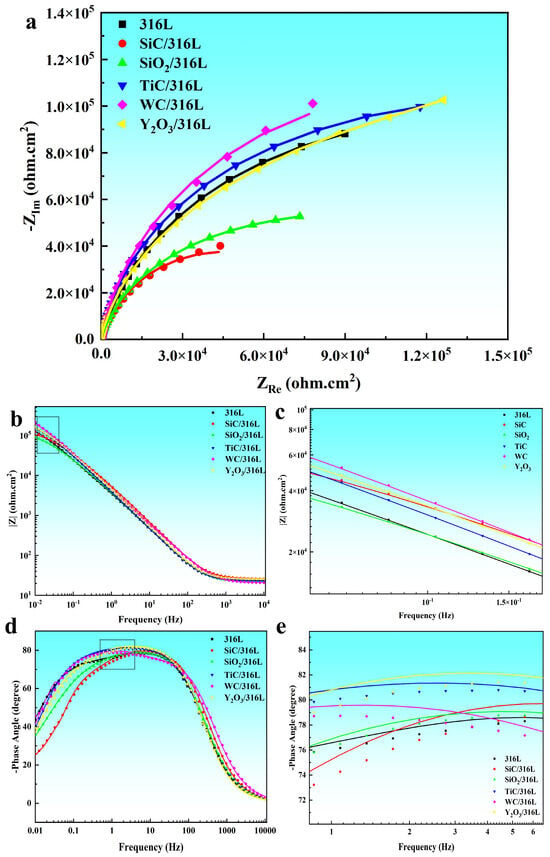
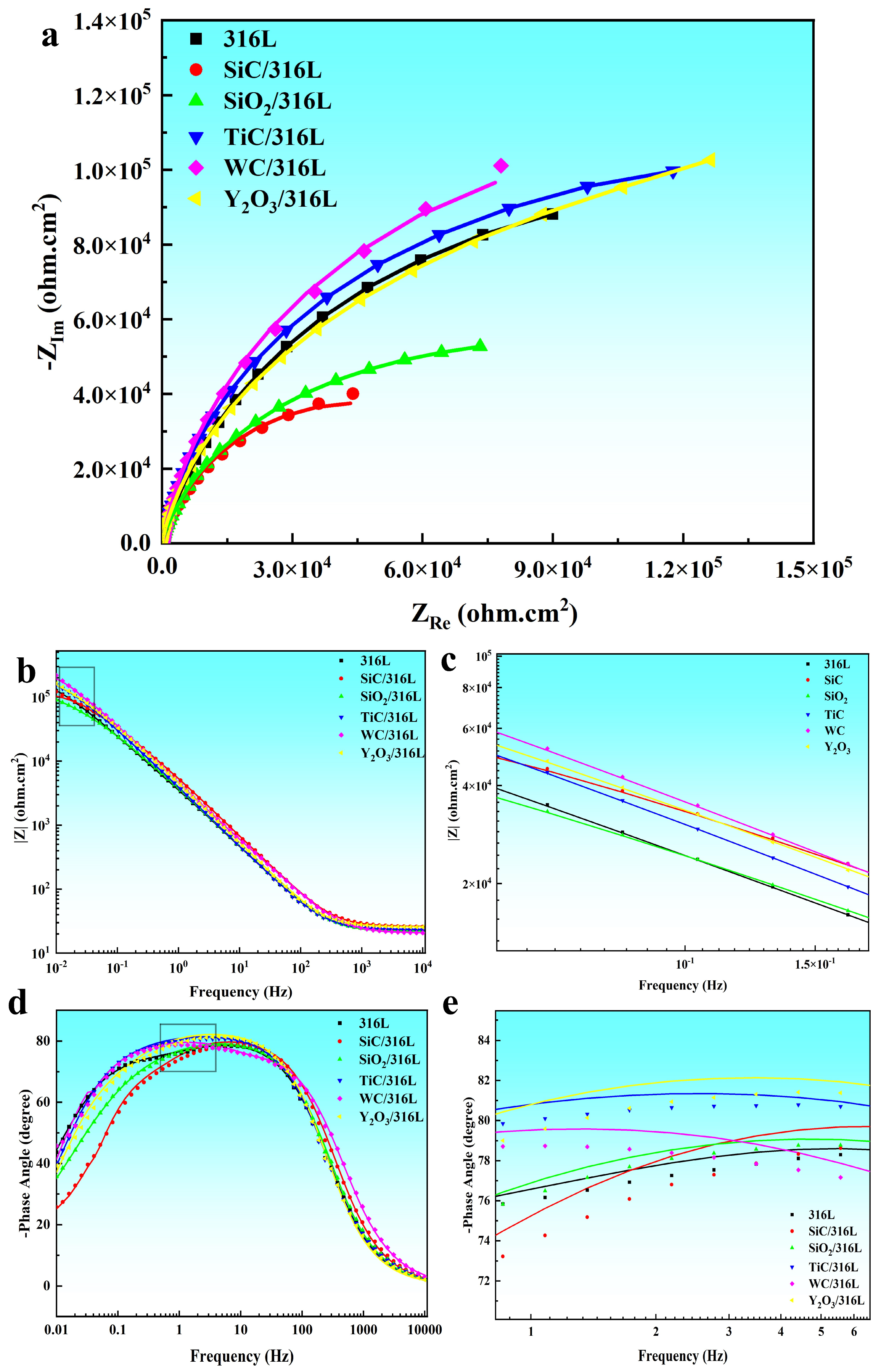
Electrochemical impedance spectra (EIS) of ceramic-reinforced 316L stainless steel composites are presented in Figure 12, with Nyquist plots for laser powder bed fusion (LPBF)-processed monolithic 316L and its composite variants detailed in Figure 12a. These plots reveal significant variations in interfacial responses within NaCl electrolytes across material systems. All specimens exhibit depressed semicircular arcs within low-to-mid frequency domains—characteristic of predominant capacitive behavior [56]—where larger arc radii correlate fundamentally with superior corrosion resistance. The EIS results provide comparative information on the impedance response, which would ideally extend to ≤0.01 Hz for a more exhaustive characterization of charge transfer resistance and long-term passive film behavior. However, the current data clearly illustrates the relative enhancement in impedance offered by ceramic reinforcement. Notably, WC/316L, TiC/316L, and Y2O3/316L composites demonstrate substantially enlarged arc radii relative to monolithic 316L, consistent with enhanced corrosion resistance. Conversely, SiO2/316L and SiC/316L exhibit diminished arc radii compared to unreinforced 316L, with nearly identical arc dimensions between these two composites, indicating compromised corrosion performance. This degradation is mechanistically linked to elevated microstructural defect density [57], as substantiated by SEM analysis in Figure 8. In the equivalent circuit model, R2 represents the resistance of the passive film, serving as a barrier against ion diffusion. A higher R2 implies a denser and more continuous film. R3 corresponds to the charge transfer resistance at the metal/electrolyte interface. The significantly lower R3 values observed in SiC/316L (5.16 × 10⁴) despite a moderate R2 suggest that electrolyte infiltrates through the micro-cracks and pores, bypassing the passive film and facoiginated fomilitating active dissolution at the substrate interface [58]. Although SiO2/316L exhibits a relatively high film resistance (R2) compared with that of monolithic 316L, this value likely reflects the properties of the local passive film on intact surfaces. However, the global corrosion resistance is compromised by the physical discontinuity of the film caused by macroscopic cracks (Figure 8g,h), which serve as preferential pathways for aggressive ions, as evidenced by the high corrosion current density. Collectively, these EIS-derived findings corroborate trends established by prior open-circuit potential (OCP) monitoring and potentiodynamic polarization measurements.
Figure 12.
(a) Nyquist plots of 316L stainless steel composites with different ceramic particles reinforcing phases. (b) Bode amplitude vs. frequency plots and (c) zoomed-in plots in the low frequency region. (d) Bode phase angle vs. frequency plots and (e) zoomed-in plots in the mid-frequency region of phase angle plots.
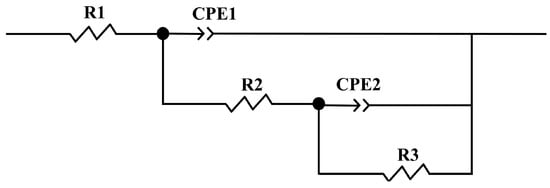
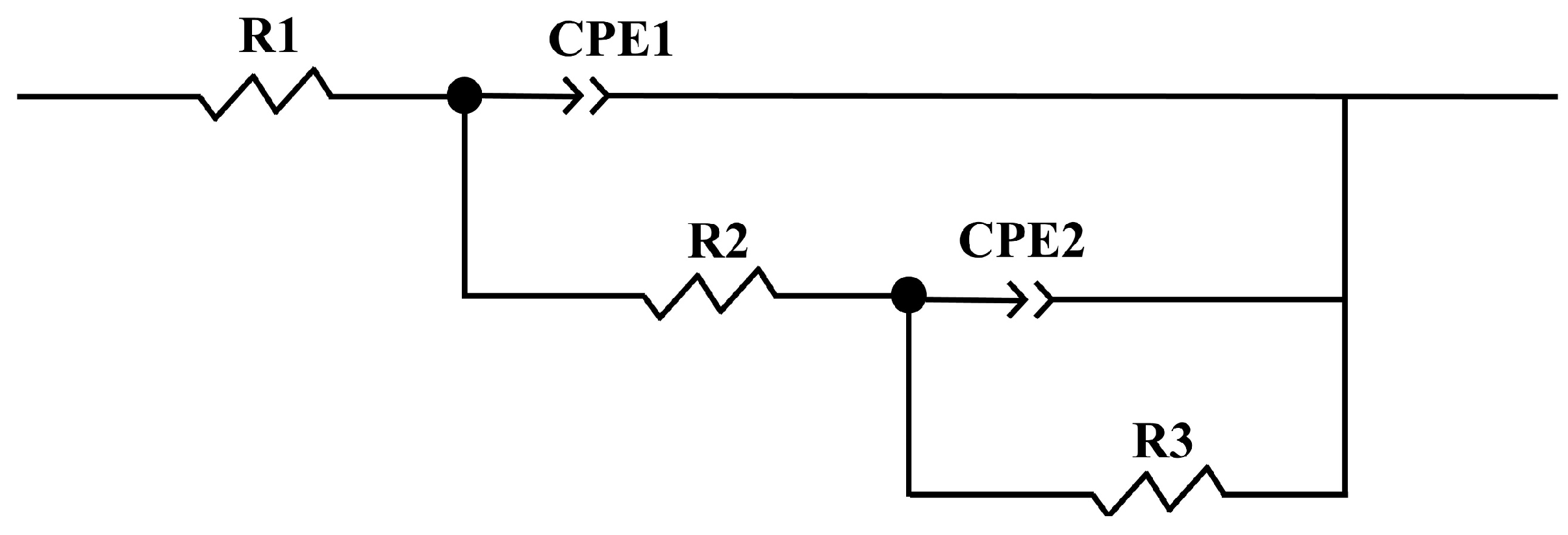
Bode magnitude plots presented in Figure 12b feature amplified low-frequency regions (Figure 12c), while phase angle-frequency diagrams in Figure 12d display mid-frequency expansions (Figure 12e). Analysis of low-frequency impedance modulus (Figure 12c) reveals elevated |Z| values for WC/316L, TiC/316L, Y2O3/316L, and SiO2/316L relative to monolithic 316L, indicating increased corrosion resistance. Conversely, diminished |Z| magnitudes observed in SiC/316L reflect compromised corrosion performance. Phase angle-frequency relationships exhibit minimal variation across materials within mid-frequency ranges (−78° to −82°), signifying predominantly capacitive characteristics of surface oxide layers [59]. Notably, peak phase angles exceeding −80° in TiC/316L and Y2O3/316L evidence the formation of complete and robust passivation films. In contrast, systems failing to attain −80° (WC/316L, SiO2/316L, SiC/316L) demonstrate defective and metastable passive layers [60]. The presence of a single peak in the Bode phase angle-frequency plots with a maximum phase angle less than 90° indicates that all samples exhibit frequency response characteristics consistent with non-ideal double-layer capacitance behavior. Consequently, impedance spectra were fitted using the equivalent circuit model in Figure 13 through ZsimpWin 3.6 software, comprising: R1 (electrolyte resistance), R2 (passive layer resistance), R3 (charge transfer resistance), and a constant phase element (CPE) accounting for capacitive dispersion through parameters Q (pseudo-capacitance) and n (dispersion factor). The equivalent circuit shown in Figure 13 is utilized here as a phenomenological fitting tool to facilitate a relative comparison of the impedance characteristics among the different composites. It is important to note that while this consistent model allows for qualitative assessment, it does not imply that the underlying interfacial processes or corrosion mechanisms are identical across the dense, porous, and cracked microstructures. The physical parameters (e.g., R2 and R3) are interpreted as indicative indicators of the impedance response rather than absolute representations of uniform interfacial behavior.
Figure 13.
AC impedance fitted equivalent circuit model.
The fitting results are shown in Table 3. The passivation film resistances for 316L, SiC/316L, SiO2/316L, TiC/316L, WC/316L, and Y2O3/316L are 1.94 × 10⁴ Ω·cm2, 3.65 × 10⁴ Ω·cm2, 2.11 × 10⁴ Ω·cm2, 8.68 × 10⁴ Ω·cm2, 5.41 × 10⁴ Ω·cm2, and 2.11 × 10⁵ Ω·cm2, and the charge transfer resistances were 2.11 × 10⁵ Ω·cm2, 5.16 × 10⁴ Ω·cm2, 1.74 × 10⁵ Ω·cm2, 1.58 × 10⁵ Ω·cm2, 2.42 × 10⁵ Ω·cm2, and 7.50 × 10⁴ Ω·cm2, respectively. WC/316L, TiC/316L, and Y2O3/316L composites are characterized by elevated passive film resistance (R2) relative to monolithic 316L, contributing to a higher overall impedance response, which is suggestive of enhanced protective properties of the surface interface [61]. Within the frequency range employed, the trend in charge transfer resistance (R3) provides an indication of the electrochemical reaction kinetics, where higher R3 values are typically associated with a lower tendency for charge transfer across the double layer. While monolithic 316L demonstrates moderately high R2, and SiO2/316L and SiC/316L exhibit higher R2 values than the unreinforced matrix, the integrated analysis of both R2 and R3 (Table 3) indicates a more pronounced capacitive response and higher total impedance for the WC/316L, TiC/316L, and Y2O3/316L systems. Conversely, a comparatively lower impedance response was observed for the SiO2/316L and SiC/316L composites [62]. It should be noted that the relatively high R2 in SiO2/316L likely reflects the resistance of the surface in less defective regions; however, the lower overall performance is hypothesized to be linked to the higher porosity and microstructural defects, which may act as pathways for electrolyte penetration and localized electrochemical activity. Overall, the EIS results provided comparative information on the impedance response, suggesting that the addition of ceramic particles may enhance interfacial stability and potentially contribute to improved corrosion resistance.
Table 3.
AC impedance fitting datasheet.
All composites were fabricated using identical LPBF parameters. Given the significant defects observed in the SiC and SiO2 systems, it is unclear whether their poor corrosion performance is an intrinsic material property or a result of sub-optimal processing. Therefore, the lack of parameter optimization for each specific reinforcement limits the generalizability of the comparative conclusion.
3.4.4. Corrosion Morphologies
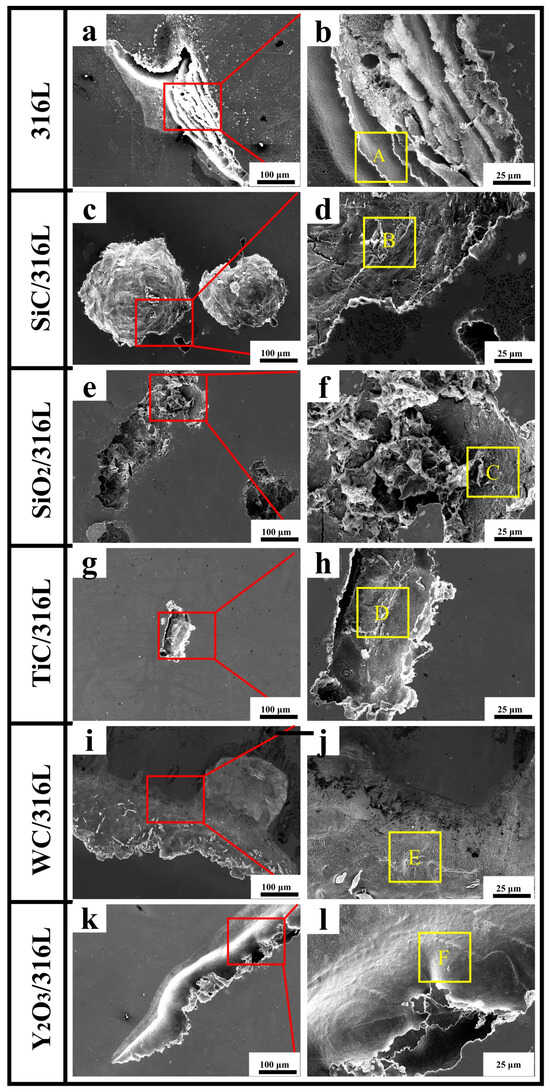
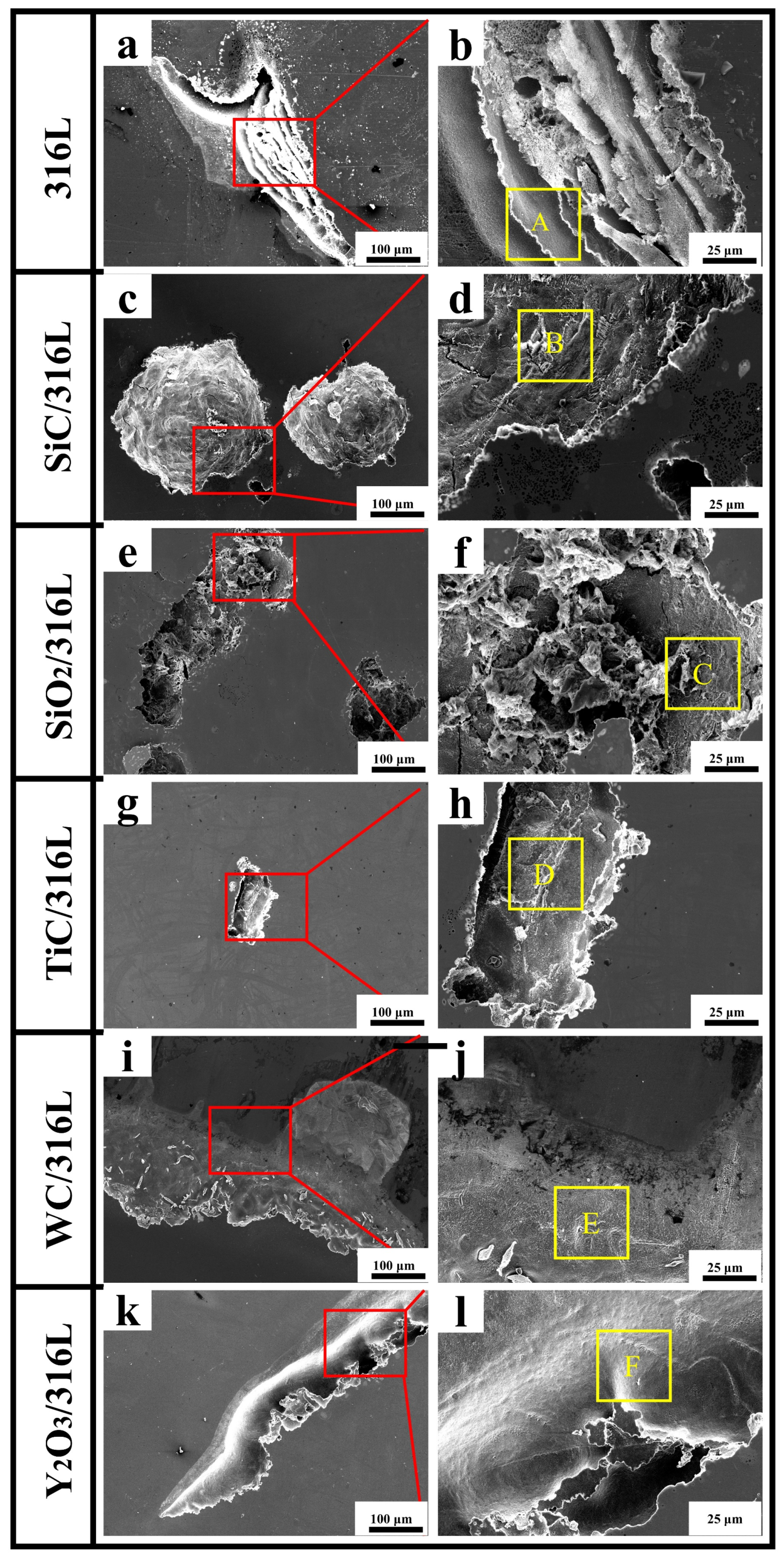
To elucidate the effects of ceramic reinforcement phases upon the corrosion behavior of 316L stainless steel, post-corrosion morphological characterization was observed by SEM, wherein comparative corrosion morphologies of 316L alongside its ceramic-reinforced composite counterparts are evidenced in Figure 14, with elemental compositions from selected regions of interest being listed in Table 4. EDS analyses, confirming consistent chromium and oxygen enrichment across all specimens, verify the formation of protective Cr-rich oxide passive layers that effectively inhibit chloride ion penetration [63]. Significantly elevated Cr content was detected in SiO2-, TiC-, WC-, and Y2O3-reinforced composites relative to monolithic 316L; this may have formed denser and more coherent passive films, thereby potentially improving corrosion resistance, whereas reduced Cr content quantified within SiC/316L correlates directly with its documented inferior electrochemical performance. Within 316L, the propagation of a major crack originating from electrochemical testing peripheries, accompanied by severe adjacent pitting, is shown in Figure 14a,b, indicating pit nucleation preferentially occurring along these crack zones, while preferential corrosion traces along melt pool boundaries are further revealed in Figure 14b. Although intergranular corrosion conventionally initiates at grain boundaries in wrought alloys, the rapid solidification inherent to laser powder bed fusion (LPBF) generates refined microstructures exhibiting heterogeneous elemental distribution that obscures conventional grain boundary delineation; consequently, melt pool boundaries—intrinsically linked to subgrain structures and elemental segregation phenomena [64]—emerge as the dominant pathways facilitating corrosion propagation. The SiO2/316L composite, which exhibits the highest corrosion current density (icorr = 2.93 × 10⁻⁶ A·cm−2) and the lowest Ebrk, displayed an extensive, lace-like porous corrosion morphology, confirming that its failure is dominated by rapid localized attack at severe processing defects such as large pores and microcracks. Conversely, the superior performance of the Y2O3/316L sample (lowest icorr and highest Ebrk) is visually reflected by only very shallow and sparse etching after polarization, which is indicative of a highly stable passive film that effectively resists pit propagation and shifts the failure mechanism towards slow, uniform dissolution.
Figure 14.
Corrosion morphology of 316L stainless steel composites with different ceramic particles: (a,b) 316L, (c,d) SiC/316L, (e,f) SiO2/316L, (g,h) TiC/316L, (i,j) WC, (k,l) Y2O/316L; The marked A–F areas correspond to the EDS scanning results listed in Table 4.
Table 4.
Chemical composition of marked A–F areas in Figure 14 (in wt. %).
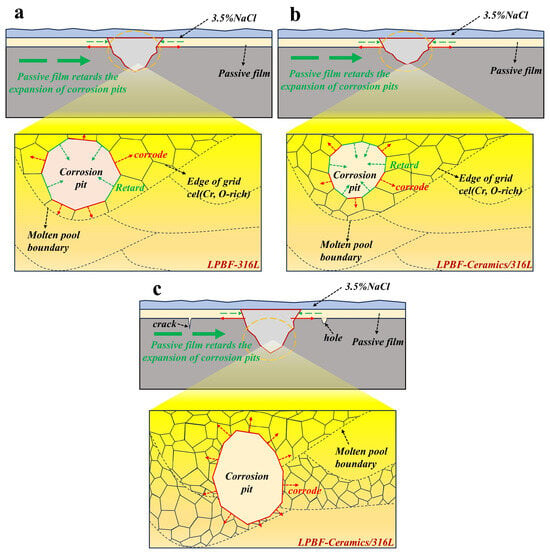
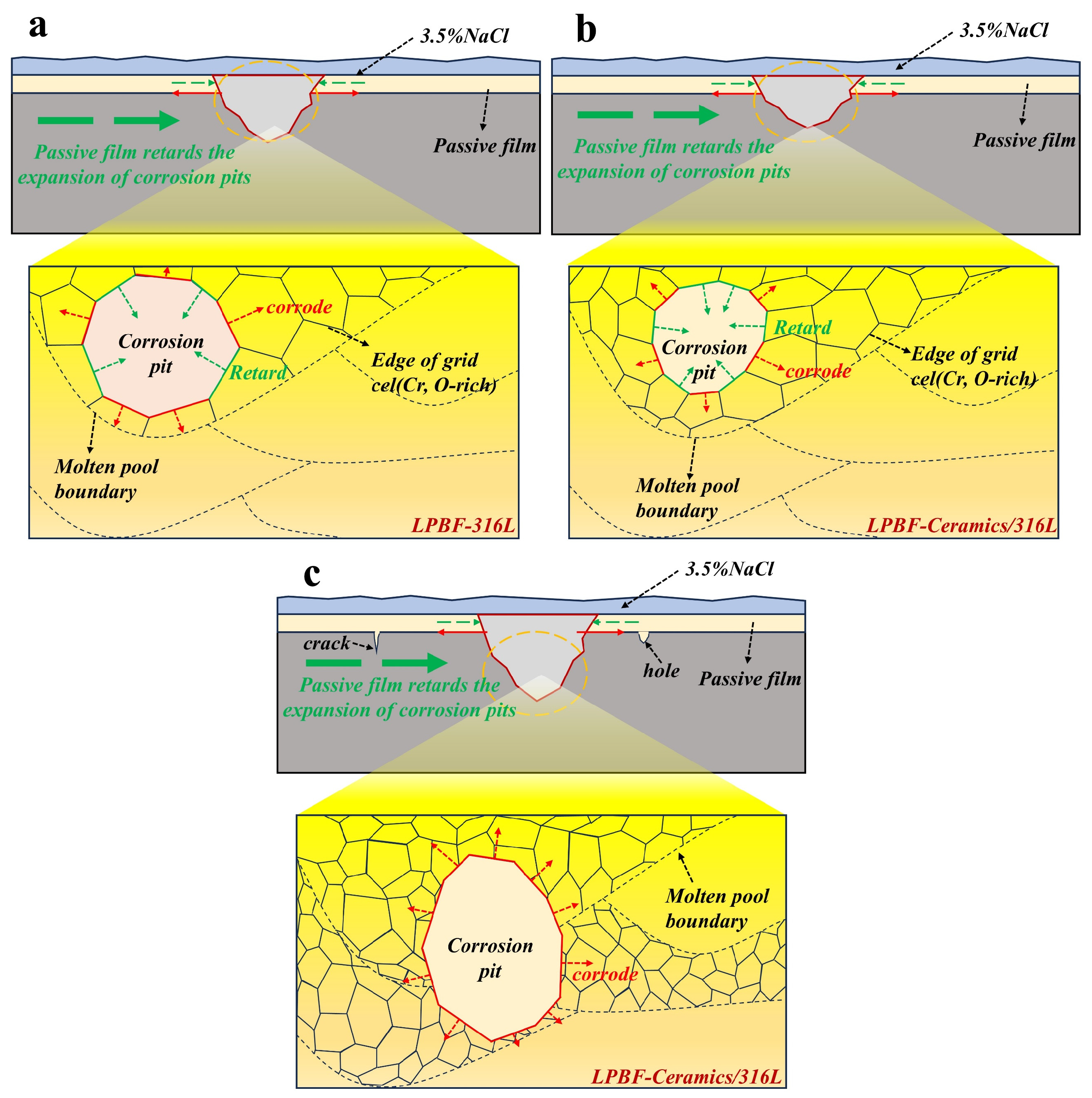
Corrosion morphologies exhibiting variable degradation severity across ceramic-reinforced composites are documented in Figure 14c–l, among which TiC/316L, WC/316L, and Y2O3/316L exhibit substantially reduced crack dimensions and depths in Figure 14g–l when compared against monolithic 316L. Corrosion propagation within reinforced systems, as schematized in Figure 15b, persists principally along melt pool boundaries consistent with unreinforced matrix behavior; however, high-magnification SEM examinations revealing refined subgrain structures possessing elevated Cr/O concentrations suggest enhanced passivation capability. This microstructural refinement, supported by pre-corrosion SEM evidence in Figure 8 demonstrating minimal porosity and crack absence, is proposed to operate through a grain-boundary-density-mediated mechanism whereby ceramic reinforcement potentially promotes denser subgrain networks that provide augmented nucleation sites facilitating passive oxide layer formation, thereby enhancing their inherent stability, continuity, and resultant corrosion resistance [65].
Figure 15.
Illustration of the corrosion mechanism: (a) LPBF-316L melt pool boundary corrosion; (b) TiC/316L, WC/316L, Y2O3/316L melt pool boundary corrosion; (c) SiC/316L, SiO2/316L crevice corrosion and pitting corrosion; the arrow indicates the direction of corrosion expansion.
Corrosion features of SiC/316L and SiO2/316L composites (Figure 14c–f) are characterized by extensive macro-pitting without degradation along melt pool boundaries. Smaller secondary pits developing along primary pit peripheries form a characteristic lace-like porous network [51]. When correlated with as-built microstructures evidenced in Figure 8, the degradation mechanisms are schematized in Figure 15c: cracking and pitting constitute the principal failure modes. Compared to melt pool boundary corrosion, surface defects (pores/cracks) are identified as preferred initiation sites where voids facilitate analyte diffusion pathways [66]. This mechanistic interpretation, validated by electrochemical data in Figure 12, indicated compromised corrosion resistance.
3.4.5. Corrosion Mechanism
Corrosion mechanisms for laser powder bed fusion (LPBF)-processed 316L and its ceramic-reinforced composites are schematically illustrated in Figure 15. Monolithic 316L fabricated via LPBF develops a unique microstructure characterized by semi-elliptical fish-scale-like melt pool morphology, wherein materials undergo rapid heating/cooling cycles during processing that generate refined subgrain boundary microstructures. As evidenced by SEM in Figure 8, these microstructures exhibit densely arranged cellular networks, with significant chromium (Cr) enrichment at cellular boundaries—correlating with increased dislocation density—having been revealed by researchers [67,68,69]. The potential for micro-galvanic corrosion must also be considered, as ceramic reinforcement phases may act as local cathodes against the metallic matrix [50]. Conductive ceramic additions, such as TiC and WC, may establish micro-galvanic couples that accelerate 316L matrix dissolution at the interfaces, thereby compromising localized corrosion resistance. This detrimental effect is minimized in the Y2O3/316L system due to the insulating and chemically inert nature of the oxide phase. As depicted in Figure 15a, this configuration is proposed to impede corrosion propagation, potentially enabling LPBF-processed 316L stainless steel to exhibit enhanced continuous passivation capability through its unique Cr-enriched cellular surface structure, thereby facilitating the formation of denser and more stable passive films. Following ceramic particulate incorporation, grain refinement in TiC/316L, WC/316L, and Y2O3/316L composites is observed to yield finer subgrain boundary cellular networks relative to monolithic 316L, indicating increased cell density and significantly reduced cell size. The enhanced corrosion resistance observed in the Y2O3-reinforced samples is hypothesized to arise from accelerated chromium diffusion kinetics and potential enrichment of the Cr2O3 passive film. This is postulated to be facilitated by the high-density subgrain boundaries—characteristic of the LPBF process—evidenced by SEM analysis (Figure 8), which may enhance surface reactivity. Corrosion of LPBF samples in NaCl solutions is primarily associated with chloride-induced localized attack, whose severity is significantly amplified by pores and cracks. As illustrated in Figure 15c, although subgrain refinement shows possibilities in SiC/316L and SiO2/316L, residual micropores and surface cracks may serve as preferential sites for chloride ion chemisorption that potentially accelerate corrosion initiation, while concurrently compromising the integrity of both cellular substructures and passive films, consequently leading to a decrease in overall corrosion resistance [70]. It should be noted that the contradictory phenomenon of simultaneous grain refinement and decline in corrosion resistance is primarily caused by the formation of microcracks and the increase in porosity, the detrimental effects of which far outweigh the benefits afforded by subgrain refinement [71].
4. Conclusions
- (1)
- Five ceramic-reinforced 316L composites (1 wt.% TiC, SiC, SiO2, WC, Y2O3) were fabricated via laser powder bed fusion (LPBF). An increase in porosity within the range of 0.24–1.396% was induced by ceramic additions, among which minimal porosity (0.132%) was exhibited by Y2O3/316L. Macro-cracking was developed in SiO2/316L due to thermal stress and interface reactions, resulting in a peak porosity of 1.396%. Porosity generation was primarily attributed to three factors: unmelted particles, reduced powder flowability, and coefficient of thermal expansion (CTE) mismatch.
- (2)
- The surface micro-morphology of laser powder bed fusion (LPBF)-fabricated composites is characterized by a cellular grain structure with distinctly delineated melt pool boundaries. Following ceramic reinforcement incorporation, refinement of subgrain structures is achieved across composites to varying degrees, accompanied by increased subgrain boundary density. Grain refinement and dislocation pinning appear to be promoted by TiC, WC, and Y2O3 additions, potentially resulting in reduced cell size and elevated cell density within subgrain boundary networks of Y2O3/316L, TiC/316L, and WC/316L—with Y2O3/316L exhibiting the most pronounced refinement. Despite the apparent subgrain refinement observed in SiC/316L and SiO2/316L, localized cracking is induced by SiC and SiO2 reinforcements due to decomposition reactions and brittle interphase formation.
- (3)
- Electrochemical testing results suggested that among all evaluated composites, Y2O3/316L exhibited optimal corrosion resistance, wherein its passive film was suggested to possess superior stability. Suboptimal performance was observed in TiC/316L and WC/316L, which manifested moderate passive film stability coupled with relatively low corrosion current density, while simultaneously exhibiting comparatively elevated breakdown potentials. Conversely, the poorest corrosion resistance was displayed by SiC/316L and SiO2/316L, manifesting not only increased icorr but also reduced Ebrk values. The systematic comparison in this study suggests that Y2O3 and TiC are the most effective reinforcements for improving the corrosion resistance of the as-built L-BPF 316L.
- (4)
- Corrosion propagation in laser powder bed fusion (LPBF)-processed 316L is preferentially localized along melt pool boundaries. This mechanistic pathway remains operative in TiC/316L, WC/316L, and Y2O3/316L composites post-ceramic reinforcement; however, grain refinement accompanied by the formation of finer subgrain networks is proposed to be through particulate additions, potentially providing augmented nucleation sites for passive oxide layers. Consequently, enhanced stability and continuity may be imparted to these protective films, potentially elevating corrosion resistance. In contrast, SiC/316L and SiO2/316L exhibit elevated defect densities where degradation is predominantly governed by cracking and pitting mechanisms, resulting in corrosion resistance inferior to that of the as-built L-BPF 316L.
Author Contributions
Methodology, Data curation, Investigation, Writing—Original, J.L.; Methodology, Investigation, Validation, J.Y.; Funding acquisition, Writing—Review and Editing, Supervision, C.L.; Formal analysis, Writing—Review and Editing, Funding acquisition, Y.Y. All authors have read and agreed to the published version of the manuscript.
Funding
The work was supported by the National Natural Science Foundation of China (Grant No. U25A20304, 52475328), the Guangdong Basic and Applied Basic Research Foundation (Grant No. 2024A1515030065), the Guangzhou Municipal Science and Technology Project (Grant No. 2024A04J6299), and the Young Talent Support Project of Guangzhou Association for Science and Technology (Grant No. QT2024-012).
Data Availability Statement
The original contributions presented in this study are included in the article. Further inquiries can be directed to the corresponding author.
Conflicts of Interest
The authors declare no conflicts of interest.
References
- Morgan, R.; Sutcliffe, C.J. Density analysis of direct metal laser re-melted 316L stainless steel cubic primitives. J. Mater. Sci. 2004, 39, 1195–1205. [Google Scholar] [CrossRef] [Scilit]
- Simonelli, M.; Tuck, C.; Aboulkhair, N.T.; Maskery, I.; Ashcroft, I.; Wildman, R.D.; Hague, R. A study on the laser spatter and the oxidation reactions during selective laser melting of 316L stainless steel, Al-Si10-Mg, and Ti-6Al-4V. Metall. Mater. Trans. A 2015, 46, 3842–3851. [Google Scholar] [CrossRef] [Scilit]
- Sanaei, N.; Fatemi, A. Defects in additive manufactured metals and their effect on fatigue performance: A state-of-the-art review. Prog. Mater. Sci. 2021, 117, 100724. [Google Scholar] [CrossRef] [Scilit]
- Chen, H.; Gu, D.; Dai, D.; Ma, C.; Xia, M. Microstructure and composition homogeneity, tensile property, and underlying thermal physical mechanism of selective laser melting tool steel parts. Mater. Sci. Eng. A 2017, 682, 279–289. [Google Scholar] [CrossRef] [Scilit]
- Ukwaththa, J.; Herath, S.; Meddage, D.P.P. A review of machine learning (ML) and explainable artificial intelligence (XAI) methods in additive manufacturing (3D Printing). Mater. Today Commun. 2024, 41, 110294. [Google Scholar] [CrossRef] [Scilit]
- Guo, Y.; Zaman, L.; Cao, Y.; Lv, J.; Zhou, Z. Hardening and sensitization of conventional 316 L stainless steel and Selective Laser Melted 316 L stainless steel by cold rolling. Mater. Today Commun. 2025, 47, 113271. [Google Scholar] [CrossRef] [Scilit]
- Yoon, T.S.; Lee, Y.H.; Ahn, S.H.; Lee, J.H.; Lee, C.S. Effects of sintering conditions on the mechanical properties of metal injection molded 316l stainless steel. ISIJ Int. 2003, 43, 119–126. [Google Scholar] [CrossRef] [Scilit]
- AlMangour, B.; Grzesiak, D.; Yang, J.M. In-situ formation of novel TiC-particle-reinforced 316L stainless steel bulk-form composites by selective laser melting. J. Alloys Compd. 2017, 706, 409–418. [Google Scholar] [CrossRef] [Scilit]
- Jia, D.; Shi, W.; Li, K.; Lu, C.; An, F.; Lin, L.; Gou, F. Effects of rare earth oxides on wear resistance and corrosion resistance of 316L/TiC composite coating by laser cladding. Mater. Today Commun. 2024, 39, 109001. [Google Scholar] [CrossRef] [Scilit]
- Florian, B. Changing the future of additive manufacturing. Metal. Powder Rep. 2014, 69, 37–40. [Google Scholar]
- Ahmed, N.; Barsoum, I.; Haidemenopoulos, G.; Abu Al-Rub, R.K. Process parameter selection and optimization of laser powder bed fusion for 316L stainless steel: A review. J. Manuf. Process. 2022, 75, 415–434. [Google Scholar] [CrossRef] [Scilit]
- Zhu, Y.; Zou, J.; Yang, H. Wear performance of metal parts fabricated by selective laser melting: A literature review. J. Zhejiang Univ.-Sci. A 2018, 19, 95–110. [Google Scholar] [CrossRef] [Scilit]
- Gorsse, S.; Hutchinson, C.; Gouné, M.; Banerjee, R. Additive manufacturing of metals: A brief review of the characteristic microstructures and properties of steels, Ti-6A1-4V and high-entropy alloys. Sci. Technol. Adv. Mater. 2017, 18, 584–610. [Google Scholar] [CrossRef] [Scilit] [PubMed]
- Jenkins, B.M.; Etienne, A.; Baustert, E.; Rose, G.; Pareige, C.; Pareige, P.; Radiguet, B. Multiscale characterisation study on the effect of heat treatment on the microstructure of additively manufactured 316L stainless steel. Mater. Today Commun. 2024, 39, 108849. [Google Scholar] [CrossRef] [Scilit]
- Vandenbroucke, B.; Kruth, J.P. Selective laser melting of biocompatible metals for rapid manufacturing of medical parts. Rapid Prototyp. J. 2007, 13, 196. [Google Scholar] [CrossRef] [Scilit]
- Ponnusamy, P.; Rashid, R.A.R.; Masood, S.H.; Ruan, D.; Palanisamy, S. Mechanical properties of slm-printed aluminium alloys: A review. Materials 2020, 13, 4301. [Google Scholar] [CrossRef] [Scilit]
- Jeyaprakash, N.; Prabu, G.; Yang, C.H. Inclusion of nano silicon particle in SS316L through LPBF and its responses on corrosion behaviour. Ceram. Int. 2023, 49, 26450–26468. [Google Scholar] [CrossRef] [Scilit]
- Jandaghi, M.R.; Pouraliakbar, H.; Shim, S.H.; Fallan, V.; Hong, S.I.; Pavese, M. In-situ alloying of stainless steel 316L by co-inoculation of Ti and Mn using LPBF additive manufacturing: Microstructural evolution and mechanical properties. Mater. Sci. Eng. A 2022, 857, 144114. [Google Scholar] [CrossRef] [Scilit]
- Wei, Y.; Chen, G.; Wang, H.; Tao, N. High-precision laser powder bed fusion of 316L stainless steel and its SiC reinforcement composite materials. Opt. Laser Technol. 2025, 190, 113267. [Google Scholar] [CrossRef] [Scilit]
- Zhai, W.; Zhou, W.; Yu, Y.; Nai, S.M.L. Additive manufacturing of TiB2 particles enabled high-performance 316L with a unique core-shell melt pool structure. J. Manuf. Process. 2025, 139, 144–155. [Google Scholar] [CrossRef] [Scilit]
- Yang, W.; Guo, A.; Sheng, X.; Tang, R.; Qu, P.; Wang, S.; Liu, C.; Yin, L.; Sui, S.; Guo, S. Preparation of 316L stainless steel/WC gradient layered structures with excellent strength-elongation synergy using laser powder bed fusion. J. Manuf. Process. 2025, 133, 692–704. [Google Scholar] [CrossRef] [Scilit]
- Zhang, X.; Zhai, W.; Liu, Y.; Wei, W.; Chen, Y.; He, C.; Zhang, H.; Wang, C.; Wang, Q.; Liu, F. Temperature-dependent mechanical properties of La2O3-reinforced 316L stainless steel fabricated by laser powder bed fusion. Mater. Sci. Eng. A 2025, 925, 147884. [Google Scholar] [CrossRef] [Scilit]
- Zhai, W.; Zhou, W.; Yu, Y.; Nai, S.M.L. Direct evidence of melting and decomposition of TiC particles in laser powder bed fusion processed 316L-TiC composite. J. Mater. Sci. Technol. 2024, 198, 166–175. [Google Scholar] [CrossRef] [Scilit]
- Ghazanlou, S.I.; Ghazanlou, S.I.; Ghazanlou, S.I.; Mohammadzadeh, R. The multifunctional performance of the laser powder bed fusion 316L stainless steel matrix composite reinforced with the CNT-ZrO2 nanohybrid. Mater. Chem. Phys. 2024, 313, 128693. [Google Scholar] [CrossRef] [Scilit]
- Javidi, M.J.; Hosseini, S.M.; Khodabakhshi, F.; Mohammadi, M.; Orovcik, L.; Trembošová, V.N.; Nagy, Š.; Nosko, M. Laser powder bed fusion of 316L stainless steel/Al2O3 nanocomposites: Taguchi analysis and material characterization. Opt. Laser Technol. 2023, 158, 108883. [Google Scholar] [CrossRef] [Scilit]
- Shaeri Karimi, M.H.; Yeganeh, M.; Alavi Zaree, S.R.; Eskandari, M. Corrosion behavior of 316L stainless steel manufactured by laser powder bed fusion (L-PBF) in an alkaline solution. Opt. Laser Technol. 2021, 138, 106918. [Google Scholar] [CrossRef] [Scilit]
- Li, J.; Chen, L.; Wei, B.; Xu, J.; Wu, T.; Sun, C. Corrosion characterization in SLM-manufactured and wrought 316 L Stainless Steel induced by Desulfovibrio desulfuricans. Constr. Build. Mater. 2025, 470, 140602. [Google Scholar] [CrossRef] [Scilit]
- Zhou, C.; Wu, F.; Tang, D.; Zhang, Z.; Zhang, L.; Zheng, J. Effect of subcritical-temperature heat treatment on corrosion of SLM SS316L with different process parameters. Corros. Sci. 2023, 218, 111214. [Google Scholar] [CrossRef] [Scilit]
- Wang, C.; Yin, J.; He, J.; Zhu, X.; Wu, Z.; Luo, K.; Luo, F. Effect of grain boundary engineering on electrochemical and intergranular corrosion of 316 L stainless steel. Corros. Sci. 2025, 254, 113050. [Google Scholar] [CrossRef] [Scilit]
- Yu, J.; Ho, H. Microstructure and mechanical properties of (Ti, Nb) C ceramic-reinforced 316L stainless steel coating by laser cladding. Appl. Sci. 2022, 12, 6684. [Google Scholar] [CrossRef] [Scilit]
- Zhang, Q.; Peng, J.; Li, M.; Miao, X.; Liu, X.; Zhu, X.; Lu, D. Anisotropy of Mechanical Property and Fracture Mechanism for SLM 316L Stainless Steel under Quasi-uniaxial and Biaxial Tensile Loadings. Mater. Sci. Eng. A 2025, 926, 147960. [Google Scholar] [CrossRef] [Scilit]
- ASTM E407-07; Standard Practice for Microetching Metals and Alloys. ASTM: West Conshohocken, PA, USA, 2007.
- Yusuf, S.; Nie, M.; Chen, Y.; Yang, S.; Gao, N. Microstructure and corrosion performance of 316L stainless steel fabricated by Selective Laser Melting and processed through high-pressure torsion. J. Alloys Compd. 2018, 763, 360–375. [Google Scholar] [CrossRef] [Scilit]
- Kruth, J.; Levy, G.; Klocke, F.; Childs, T.H.C. Consolidation phenomena in laser and powder-bed based layered manufacturing. CIRP Ann. 2007, 56, 730–759. [Google Scholar] [CrossRef] [Scilit]
- Li, R.; Liu, J.; Shi, Y.; Wang, L.; Jiang, W. Balling behavior of stainless steel and nickel powder during selective laser melting process. Int. J. Adv. Manuf. Technol. 2012, 59, 1025–1035. [Google Scholar] [CrossRef] [Scilit]
- Deng, Y.; Dai, Q.; Wang, D.; Yang, Y.; Zhang, P.; Li, C. Insight into the Enhancing Mechanical Strength of CoCrNi/TiC Composites Fabricated by Laser Powder Bed Fusion. Mater. Sci. Eng. A 2025, 924, 147786. [Google Scholar] [CrossRef] [Scilit]
- Li, P.; Yang, Q.; Li, L.; Gong, Y.; Zhou, J.; Lu, J. Microstructure evolution and mechanical properties of in situ synthesized ceramic reinforced 316L/IN718 matrix composites. J. Manuf. Process. 2023, 93, 214–224. [Google Scholar] [CrossRef] [Scilit]
- Liu, Y.; Chen, H.; Han, R.; Peng, Y.; Wang, K.; Li, X. Investigating the microstructure and mechanical properties of 316L/TiB2 composites fabricated by laser cladding additive manufacturing. J. Mate. Res. Technol. 2024, 29, 28–39. [Google Scholar] [CrossRef] [Scilit]
- Zhai, W.; Zhou, W.; Nai, S.M.L. In-situ formation of TiC nanoparticles in selective laser melting of 316L with addition of micronsized TiC particles. Mater. Sci. Eng. A 2022, 829, 142179. [Google Scholar] [CrossRef] [Scilit]
- Wang, W.; Wang, S.; Chen, F.; Zhang, X.; Xu, Y. Microstructure and mechanical properties of TiN/Inconel 718 composites fabricated by selective laser melting. Acta Metall. Sin. 2021, 57, 1017–1026. [Google Scholar]
- Liverani, E.; Toschi, S.; Ceschini, L.; Fortunato, A. Effect of selective laser melting (SLM) process parameters on microstructure and mechanical properties of 316L austenitic stainless steel. J. Mater. Process. Technol. 2017, 249, 255–263. [Google Scholar] [CrossRef] [Scilit]
- Gu, D.; Shen, Y. Balling phenomena in direct laser sintering of stainless steel powder: Metallurgical mechanisms and control methods. Mater. Des. 2009, 30, 2903–2910. [Google Scholar] [CrossRef] [Scilit]
- AlMangour, B.; Grzesiak, D.; Cheng, J.; Ertas, Y. Thermal behavior of the molten pool, microstructural evolution, and tribological performance during selective laser melting of TiC/316L stainless steel nanocomposites: Experimental and simulation methods. J. Mater. Process. Technol. 2018, 257, 288–301. [Google Scholar] [CrossRef] [Scilit]
- Khairallah, S.; Anderson, A.; Rubenchik, A.; King, W. Laser powder-bed fusion additive manufacturing: Physics of complex melt flow and formation mechanisms of pores, spatter, and denudation zones. Acta Mater. 2016, 108, 36–45. [Google Scholar] [CrossRef] [Scilit]
- Yin, Y.; Liu, P.; Lu, C.; Xiao, M.; Zhang, R. Microstructure and tensile properties of selective laser melting forming 316L stainless steel. Trans. China Weld. Inst. 2018, 39, 77–81. [Google Scholar]
- Suryawanshi, J.; Prashanth, K.G.; Ramamurty, U. Mechanical behavior of selective laser melted 316L stainless steel. Mater. Sci. Eng. A 2017, 696, 113–121. [Google Scholar] [CrossRef] [Scilit]
- Zhong, Y.; Liu, L.; Zou, J.; Li, X.; Cui, D.; Shen, Z. Oxide dispersion strengthened stainless steel 316L with superior strength and ductility by selective laser melting. J. Mater. Sci. Technol. 2020, 42, 97–105. [Google Scholar] [CrossRef] [Scilit]
- Olsson, C.; Landolt, D. Passive films on stainless steels—Chemistry, structure and growth. Electrochim. Acta 2003, 48, 1093–1104. [Google Scholar] [CrossRef] [Scilit]
- Sun, L.; Xiong, Z.; Qiu, J.; Zhu, Y.; Macdonald, D. Corrosion behavior of carbon steel in dilute ammonia solution. Electrochim. Acta 2020, 364, 137295. [Google Scholar] [CrossRef] [Scilit]
- Ahuir-Torres, J.; Al-Mahdy, A.; Sharp, M.; Opoz, T.; Zhu, G.; Bashir, M.; Kotadia, H. The influence of texture density and free surface energy on the corrosion resistance of laser-textured 316L stainless steel. npj Mater. Degrad. 2025, 9, 115. [Google Scholar] [CrossRef] [Scilit]
- Newman, R. Pitting corrosion of metals. Electrochem. Soc. Interface 2010, 19, 33. [Google Scholar] [CrossRef] [Scilit]
- Laleh, M.; Hughes, A.; Xu, W.; Cizek, P.; Tan, M. Unanticipated drastic decline in pitting corrosion resistance of additively manufactured 316L stainless steel after high-temperature post-processing. Corros. Sci. 2020, 165, 108412. [Google Scholar] [CrossRef] [Scilit]
- Luo, S.; Huang, W.; Yang, H.; Yang, J.; Wang, Z.; Zeng, X. Microstructural evolution and corrosion behaviors of Inconel 718 alloy produced by selective laser melting following different heat treatments. Addit. Manuf. 2019, 30, 100875. [Google Scholar] [CrossRef] [Scilit]
- Fu, Y.; Zhang, J.; Hu, Z.; Chen, F.; Zheng, L. Microstructure and corrosion resistance of NiCrMoSi-SiC coatings via laser alloyed on Ti6Al4V surfaces. J. Alloys Compd. 2025, 1020, 179358. [Google Scholar] [CrossRef] [Scilit]
- Zhao, Z.; Li, J.; Bai, P.; Qu, H.; Liang, M.; Liao, H.; Wu, L.; Huo, P.; Liu, H.; Zhang, J. Microstructure and mechanical properties of TiC-reinforced 316L stainless steel composites fabricated using selective laser melting. Metals 2019, 9, 267. [Google Scholar] [CrossRef] [Scilit]
- Tang, Y.; Shen, X.; Lu, Z.; Qian, Y.; Yang, L.; Lu, D.; Zou, J.; Xu, J. Corrosion behaviors of selective laser melted inconel 718 alloy in naoh solution. Acta Metall. Sin. 2022, 58, 324. [Google Scholar]
- Sun, Z.; Tan, X.; Tor, S.; Yeong, W. Selective laser melting of stainless steel 316L with low porosity and high build rates. Mater. Des. 2016, 104, 197–204. [Google Scholar] [CrossRef] [Scilit]
- Ahuir-Torres, J.; Yang, X.; West, G.; Kotadia, H.R. Corrosion behaviour of SiC particulate reinforced AZ31 magnesium matrix composite in 3.5% NaCl with and without heat treatment. Mater. Chem. Phys. 2024, 320, 129467. [Google Scholar] [CrossRef] [Scilit]
- Szummer, A.; Janik-Czachor, M.; Hofmann, S. Discontinuity of the passivating film at nonmetallic stainless steels. Mater. Chem. Phys. 1993, 34, 181–183. [Google Scholar]
- Lv, J. Effect of grain size on mechanical property and corrosion resistance of the ni-based alloy 690. J. Mater. Sci. Technol. 2018, 34, 1685. [Google Scholar] [CrossRef] [Scilit]
- Lodhi, M.; Deen, K.; Greenlee-Wacker, M.; Haider, W. Additively manufactured 316L stainless steel with improved corrosion resistance and biological response for biomedical applications. Addit. Manuf. 2019, 27, 8–19. [Google Scholar] [CrossRef] [Scilit]
- Feng, H.; Li, H.; Dai, J.; Han, Y.; Qu, J.; Jiang, Z.; Zhao, Y.; Zhang, T. Why CoCrFeMnNi HEA could not passivate in chloride solution—A novel strategy to significantly improve corrosion resistance of CoCrFeMnNi HEA by n-alloying. Corros. Sci. 2022, 204, 110396. [Google Scholar] [CrossRef] [Scilit]
- Trepanier, C.; Venugopalan, R.; Pelton, A.R. Corrosion resistance and biocompatibility of passivated NiTi. In Shape Memory Implants; Springer: Berlin/Heidelberg, Germany, 2000; pp. 35–45. [Google Scholar]
- Singh, R.K.; Arya, S.B.; Nayak, J. Meltpool Characteristics, Microstructure, and Corrosion Performance of Laser-Directed Energy Deposition Cladded 316 L SS/X70 Steel for Oilfield Applications. Mater. Today Commun. 2025, 46, 112898. [Google Scholar] [CrossRef] [Scilit]
- Ralston, K.D.; Birbilis, N. Effect of grain size on corrosion. Corrosion 2010, 66, 075005-1–075005-13. [Google Scholar] [CrossRef] [Scilit]
- Sasaki, K.; Burstein, G.T. The generation of surface roughness during slurry erosion corrosion and its effect on the pitting potential. Corros. Sci. 1996, 38, 2111–2120. [Google Scholar] [CrossRef] [Scilit]
- Xiong, Y.; Shi, W.; Zhao, T.; Akiyama, E.J.; Ramamurty, U. Corrosion and stress corrosion cracking resistances of laser powder bed fused and binder jetted 316L austenitic stainless steel. Corros. Sci. 2025, 252, 112968. [Google Scholar] [CrossRef] [Scilit]
- Sprouster, D.J.; Cunningham, W.S.; Halada, G.P.; Yan, H.; Pattammattel, A.; Huang, X.J.; Olds, D.; Tilton, M.; Chu, Y.S.; Dooryhee, E.; et al. Dislocation microstructure and its influence on corrosion behavior in laser additively manufactured 316L stainless steel. Addit. Manuf. 2021, 47, 102263. [Google Scholar] [CrossRef] [Scilit]
- Zhao, Y.; Xiong, H.; Li, X.; Qi, W.; Wang, J.; Hua, Y.; Zhang, T.; Wang, F. Improved corrosion performance of selective laser melted stainless steel 316L in the deep-sea environment. Corros. Commun. 2021, 2, 55–62. [Google Scholar] [CrossRef] [Scilit]
- Godec, M.; Zaefferer, S.; Podgornik, B.; Podgornik, B.; Šinko, M. Quantitative multiscale correlative microstructure analysis of additive manufacturing of stainless steel 316L processed by selective laser melting. Mater. Charact. 2020, 160, 110074. [Google Scholar] [CrossRef] [Scilit]
- Adamiak, M.; Appiah, A.; Woźniak, A.; Nuckowski, P. Impact of titanium addition on microstructure, corrosion resistance, and hardness of As-Cast Al+ 6% Li alloy. Materials 2023, 16, 2671. [Google Scholar] [CrossRef] [Scilit]

Disclaimer/Publisher’s Note: The statements, opinions and data contained in all publications are solely those of the individual author(s) and contributor(s) and not of MDPI and/or the editor(s). MDPI and/or the editor(s) disclaim responsibility for any injury to people or property resulting from any ideas, methods, instructions or products referred to in the content. |
© 2026 by the authors. Licensee MDPI, Basel, Switzerland. This article is an open access article distributed under the terms and conditions of the Creative Commons Attribution (CC BY) license.