


Abstract
New grades of dual-phase (DP) steels with ultimate tensile strength (UTS) up to 1500 MPa have been developed using a continuous annealing process. This study investigates the effects of over-aging temperature and NbC precipitates on the microstructure and hydrogen embrittlement of these DP steels. Increasing the over-aging temperature promotes carbide coarsening, which reduces tensile strength, but simultaneously stabilizes retained austenite by inhibiting martensite transformation and enhances ductility through the TRIP effect. Compared to the reference DP steel, the Nb-added DP steel exhibits further strength enhancement due to fine-grain strengthening and precipitation strengthening. Results from slow strain rate tensile (SSRT) and thermal desorption spectroscopy (TDS) tests demonstrate that the Nb-added DP steel possesses superior resistance to hydrogen embrittlement. This improvement is primarily attributed to the hydrogen trapping effect of NbC precipitates, complemented by their grain refinement capability.
1. Introduction
Dual-phase (DP) steels are characterized by a microstructure consisting of a soft ferrite matrix reinforced with hard martensitic phases, which provides an excellent balance between strength and ductility along with low processing cost [1]. As the first generation of advanced high-strength steels (AHSSs), DP steels exhibit a low yield ratio and a high work hardening rate, making them the subject of extensive research studies [2,3]. However, to meet the growing demand of the automotive industry for lightweight materials and reduced pollutant emissions, ultra-high-strength DP steels are being actively developed [4,5,6,7]. The highest ultimate tensile strength (UTS) reported for commercial DP steels in the current literature has reached 1470 MPa [8,9]. One prevalent research direction for enhancing the strength of DP steels involves increasing both the volume fraction (Vm) and carbon content of the martensite phase. For instance, Soliman et al. [10] reported that the UTS increased from 600 MPa to 1100 MPa as Vm rose from 17% to 86%. Another approach focuses on grain boundary strengthening through fine-grained (FG) and ultrafine-grained (UFG) microstructures [11,12]. In the FG and UFG DP steels, the improvement in tensile strength is mainly attributed to an increase in the density of geometrically necessary dislocations at the ferrite–martensite interface, which enhances the strain hardening rate. However, both strategies may lead to a significant reduction in ductility and crash resistance [13]. Furthermore, such ultra-high-strength DP steels often exhibit microstructures comprising a large fraction of tempered martensite, along with minor amounts of ferrite or other phases such as bainite, fresh martensite, or retained austenite. It is well established that tempered martensite and, particularly, quenched martensite are susceptible to hydrogen embrittlement (HE), which can cause unpredictable catastrophic failure in AHSS components in hydrogen-containing environments [14,15,16].
Microalloying elements such as Nb, V, and Mo are often added to DP steels to exploit their effects on grain refinement and precipitation strengthening, thereby enhancing both strength and damage tolerance [17,18,19]. However, their efficacy and the underlying mechanisms concerning resistance to HE—particularly in the case of niobium carbides (NbC)—remain active areas of research, with sometimes conflicting reports in the literature. Samei et al. [18] demonstrated that a DP1300 steel with 0.14 wt.% V could reduce the ferrite grain size from 4.8 µm to 1.6 µm along the rolling direction. Pelligra et al. [19] further reported that V-added DP1300 steel exhibits significantly improved micromechanical compatibility and enhanced local ductility due to grain refinement. In parallel, numerous studies have confirmed that Nb microalloying effectively refines both ferrite and martensite grains, leading to improved strength in DP steels. For instance, Almatani, R.A. [20] observed that the addition of Nb to Cr–Mo DP steel further increases tensile strength without compromising plasticity, which is attributed to microstructural refinement and an optimized volume fraction of recrystallized ferrite and martensite. Mohrbacher et al. [21] also emphasized that Nb promotes the formation of fine carbides and carbonitrides, contributing to both precipitation strengthening and grain refinement. Beyond strengthening, these precipitates and the resulting refined microstructures directly influence hydrogen behavior. Defects such as dislocations, grain boundaries, phase interfaces, precipitates, and precipitate/matrix interfaces can all act as hydrogen trapping sites and accommodate a certain amount of hydrogen [22]. The role of Nb in HE is complex. While studies such as those by Pang [23] and Chen [24] provide direct evidence of NbC interfaces serving as beneficial hydrogen traps, others [25,26,27] suggest that the associated grain refinement may exacerbate HE by introducing additional trapping sites that facilitate harmful local hydrogen accumulation. Given this dual role of Nb in enhancing mechanical properties and its debated impact on HE resistance, Nb microalloying was incorporated in the development of an ultra-high-strength DP steel with a target tensile strength of 1500 MPa and elongation of 9.0%, aiming to systematically evaluate its net effect.
In the present work, we systematically investigated the effects of over-aging temperature on the microstructure and mechanical properties of both reference and Nb-added DP1500 steel. Electrochemical hydrogen charging combined with SSRT tests was conducted to evaluate HE susceptibility and to elucidate the role of Nb-containing precipitates in the HE resistance of DP1500 steel. The central hypothesis is that nano-sized NbC precipitates act as irreversible hydrogen traps, effectively reducing hydrogen diffusivity and mitigating hydrogen-induced degradation, thereby imparting superior HE resistance compared to the Nb-free reference steel.
Although the grain refinement effect of Nb in DP steels is well-established, its precise role in governing HE resistance remains controversial. This is because Nb concurrently introduces both potential hydrogen diffusion pathways (e.g., grain boundaries) and hydrogen trapping sites (e.g., precipitates). Furthermore, the interaction between over-aging temperature—which governs the stability of metastable phases such as retained austenite and the precipitation state of carbides—and Nb microalloying in the context of HE is not fully understood. Therefore, this study is designed to decouple and clarify these complex interactions within a DP1500 steel system. The primary objectives are threefold:
1. To systematically investigate the influence of over-aging temperature (240–300 °C) on the microstructure (especially the fraction of tempered martensite, quenched martensite, and retained austenite) of both reference and Nb-added DP steels.
2. To correlate these microstructural changes with the resulting tensile properties, focusing on the strength–ductility balance.
3. To critically evaluate the HE susceptibility and identify the underlying mechanisms by comprehensively analyzing hydrogen trapping efficiency (via permeation and TDS tests) and fracture behavior (via SSRT). The central hypothesis is that the nano-sized NbC precipitates will serve as irreversible hydrogen traps, effectively mitigating hydrogen-induced degradation and leading to superior HE resistance compared to the Nb-free reference steel.
2. Materials and Experimental Procedure
2.1. Experimental Materials
Two DP1500 steel sheets with a thickness of 1.2 mm were prepared via vacuum induction melting, followed by forging, hot-rolling, and cold-rolling processes. To evaluate the effect of Nb, two compositions were studied: a Nb-free composition and one with 0.032 wt.% Nb addition, designated as reference steel and Nb-added steel, respectively. Their chemical compositions are listed in Table 1.
Table 1.
Chemical composition of two experimental steels (wt%).
2.2. Heat Treatment Process
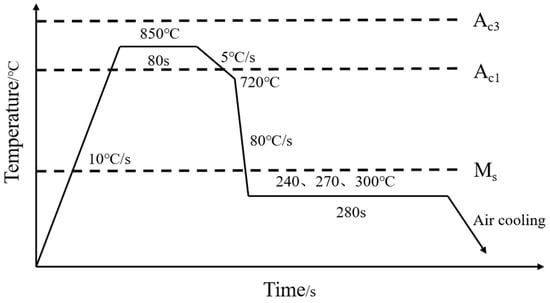
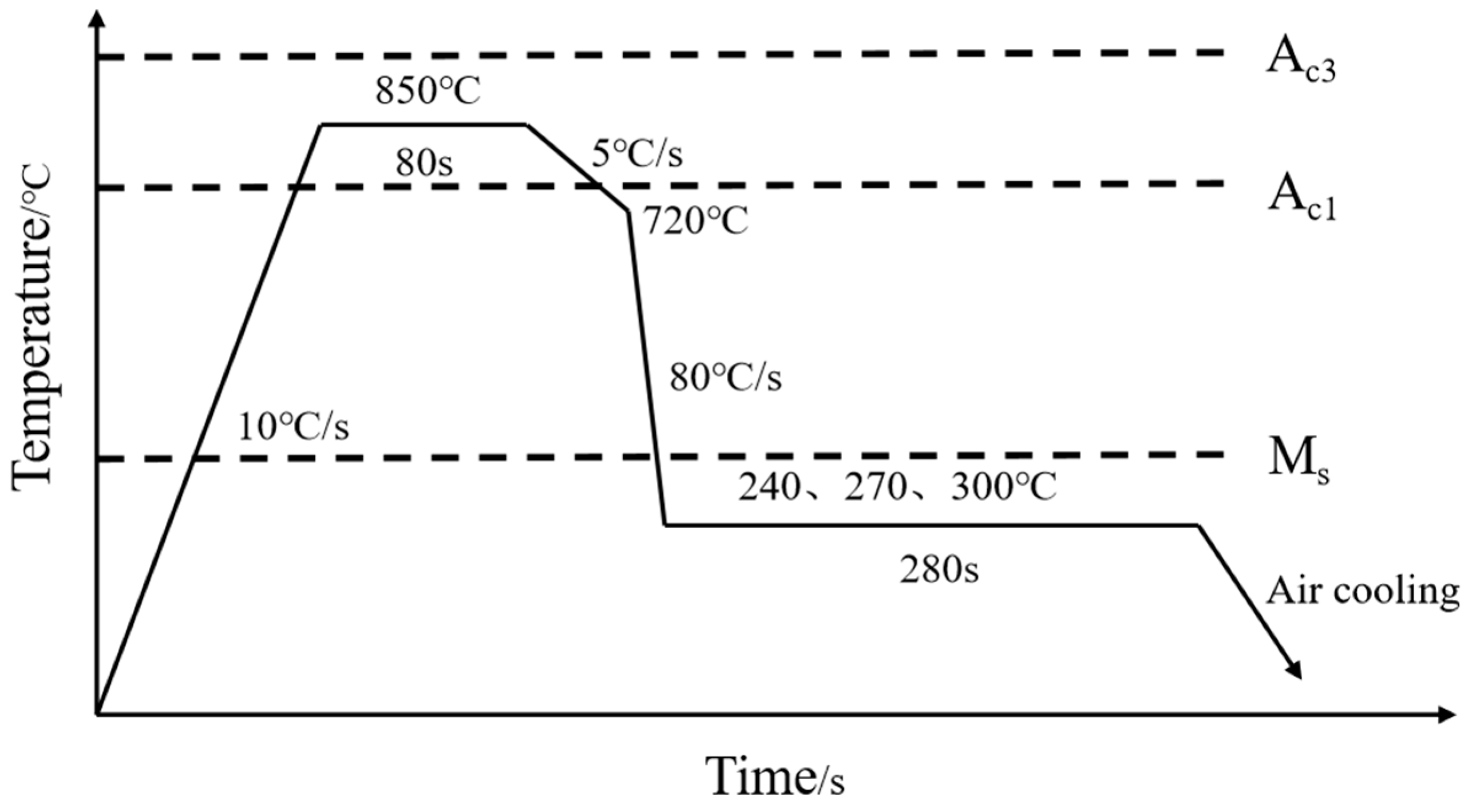
Figure 1 illustrates the continuous annealing process applied to the DP1500 steels, which was carried out using a continuous annealing simulator. The cold-rolled sheets were first subjected to intercritical annealing at 850 °C for 80 s. This was followed by slow cooling to 720 °C, subsequent rapid cooling to the over-aging temperatures of 240 °C, 270 °C, or 300 °C, and finally holding at the respective over-aging temperature for 280 s.
Figure 1.
Continuous annealing process for cold-rolled DP1500 steel.
2.3. Material Characterizations
For metallographic analysis, the samples were cold-mounted and ground using grinding sandpaper with grades from 400 to 1200. Etching was performed using a 4.0 vol% nitric acid alcohol solution for 10 s. A DMI8A inverted optical microscope (OM, Leica, Wetzlar, Germany) and FEI QUANTA 450 scanning electron microscope (SEM, FEI, Hillsboro, OR, USA) were used to characterize the macroscopic and microscopic morphology of the experiment samples. Microstructural features and precipitates were further examined using a Tecnai G2 F20 transmission electron microscope (TEM, FEI, Hillsboro, OR, USA).
2.4. Mechanical Testing
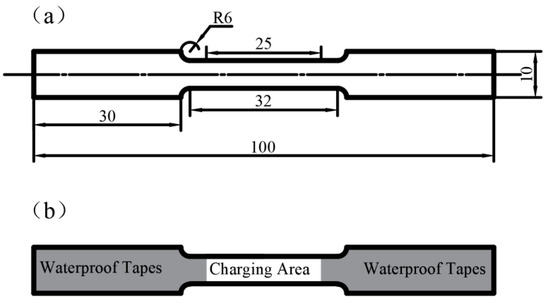
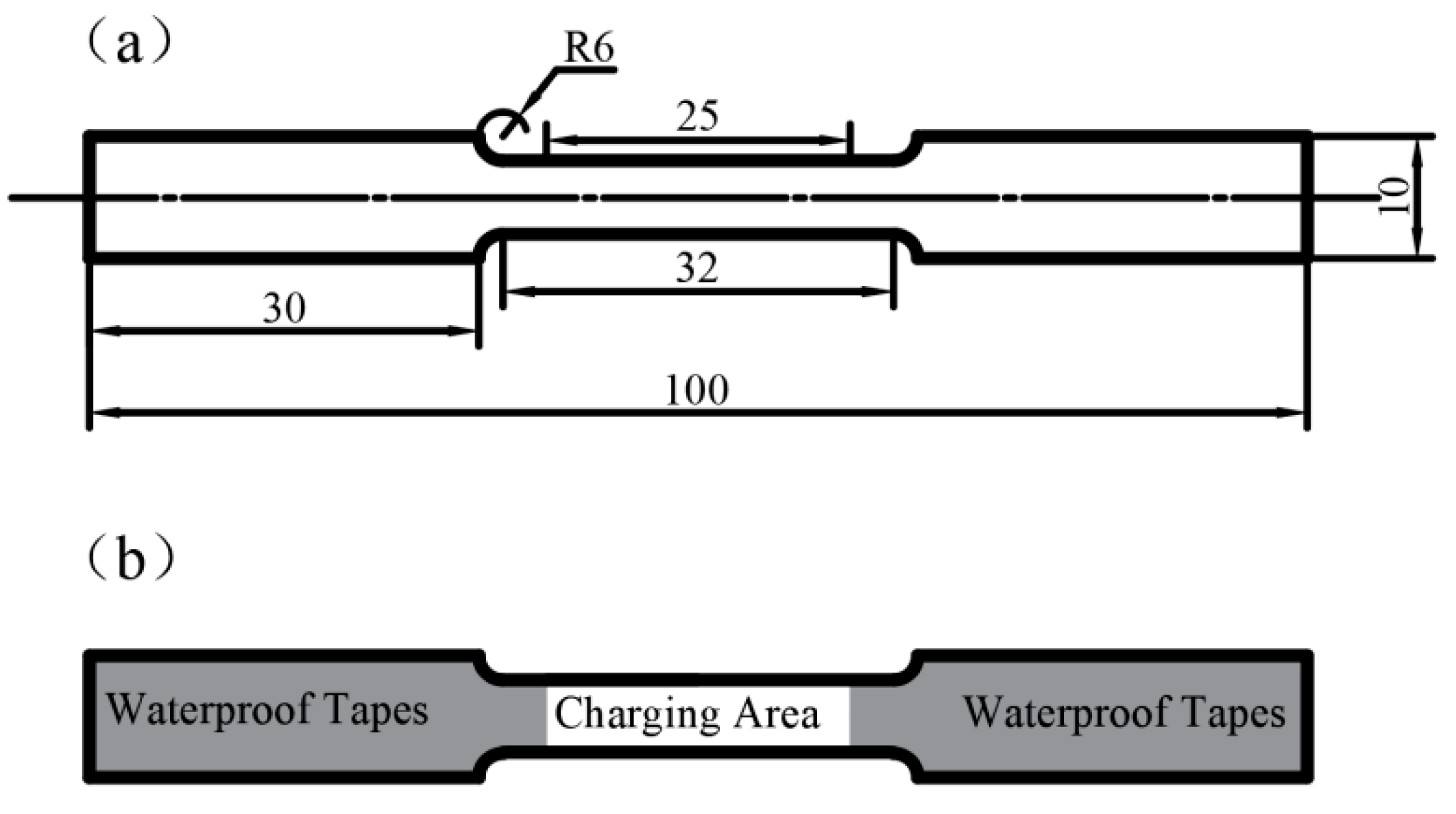
The ZwickRoell Z100 tensile testing machine (Zwick, Ulm, Germany) with an Epsilon extensometer was used to conduct routine tensile tests, according to ASTM E8 [28], with a tensile rate of 0.5 mm/min. All tensile specimens are standard-size specimens with a gauge length of 25 mm and a width of 6 mm, as shown in Figure 2a. Three tests were conducted for each sample group, and the average value was calculated.
Figure 2.
(a) Geometry of tension specimen, with all dimensions in millimeters. Schematic diagram of (b) SSRT specimen subjected to hydrogen charging.
To electrochemically charge hydrogen exclusively into the gauge section, the remaining areas of the specimen were sealed with insulating waterproof tape. Hydrogen charging was conducted at room temperature (25 ± 2 °C) using a 0.5 mol/L H2SO4 aqueous solution containing 1 g/L CH4N2S (thiourea) as a hydrogen recombination poison. A constant current density was applied under galvanostatic control, with the specimen serving as the cathode and a high-purity platinum wire as the anode, as schematically shown in Figure 2b.
Following pre-charging, the SSRT tests were conducted at a strain rate of 0.015 mm/min. The hydrogen charging conditions varied in current density (1, 2, and 15 mA/cm2) and time (1, 5, and 30 min). The susceptibility to HE was quantified using the total elongation loss (ElLoss), calculated according to Equation (1):
2.5. Hydrogen Trap Characterizations
Hydrogen permeation tests were conducted using a dual electrolytic cell setup. Samples were mechanically polished with sandpaper from grit 240 to 2000 prior to testing. In the cathode chamber, the specimen acted as the working electrode, and a platinum wire served as the counter electrode, where hydrogen atoms were oxidized (H → H+ + e−). The anode chamber contained the hydrogen entry side, with a nickel-plated sample as the working electrode, a Hg/HgO reference electrode, and a platinum plate as the counter electrode, immersed in a 0.2 mol/L NaOH electrolyte. Hydrogen permeation transients were recorded by monitoring the anodic oxidation current over time. The steady-state current density (I∞) was determined once the current stabilized. Key hydrogen transport parameters—including hydrogen permeability (J∞L), effective hydrogen diffusion coefficient (Deff), apparent hydrogen concentration (Capp), and trap density (NT)—were calculated using Equations (2)–(5):
where A represents the effective hydrogen charging area, which is 78.5 mm2 in this study. D1 is the lattice diffusion coefficient of hydrogen (1.28 × 10⁻⁴ cm2/s), F is Faraday’s constant (96,485 C/mol), and NA is Avogadro’s number (6.02 × 10²³ mol−1) [29].
The heating temperature range set for the hydrogen thermal desorption spectrometer (TDS) experiment is 25~850 °C, and the heating rate is 100 °C/h. The activation energy (Eα) of hydrogen traps corresponding to each peak in the TDS spectrum is calculated using the approximate Equation (6) proposed by P.A. Redhead [30]. Among them, β is the heating rate (K/s), TP is the desorption peak temperature in TDS (K), R is the gas constant (8.314·mol−1·K−1), and υ is the trial frequency (taken as 1013 s−1 in this study).
3. Results
3.1. Microstructural Observations
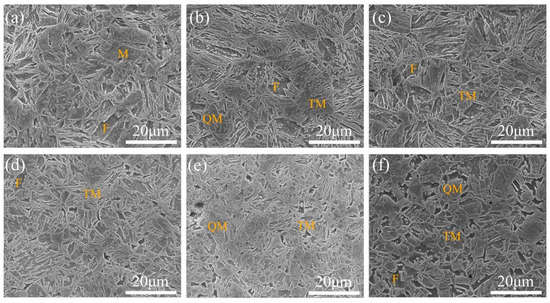
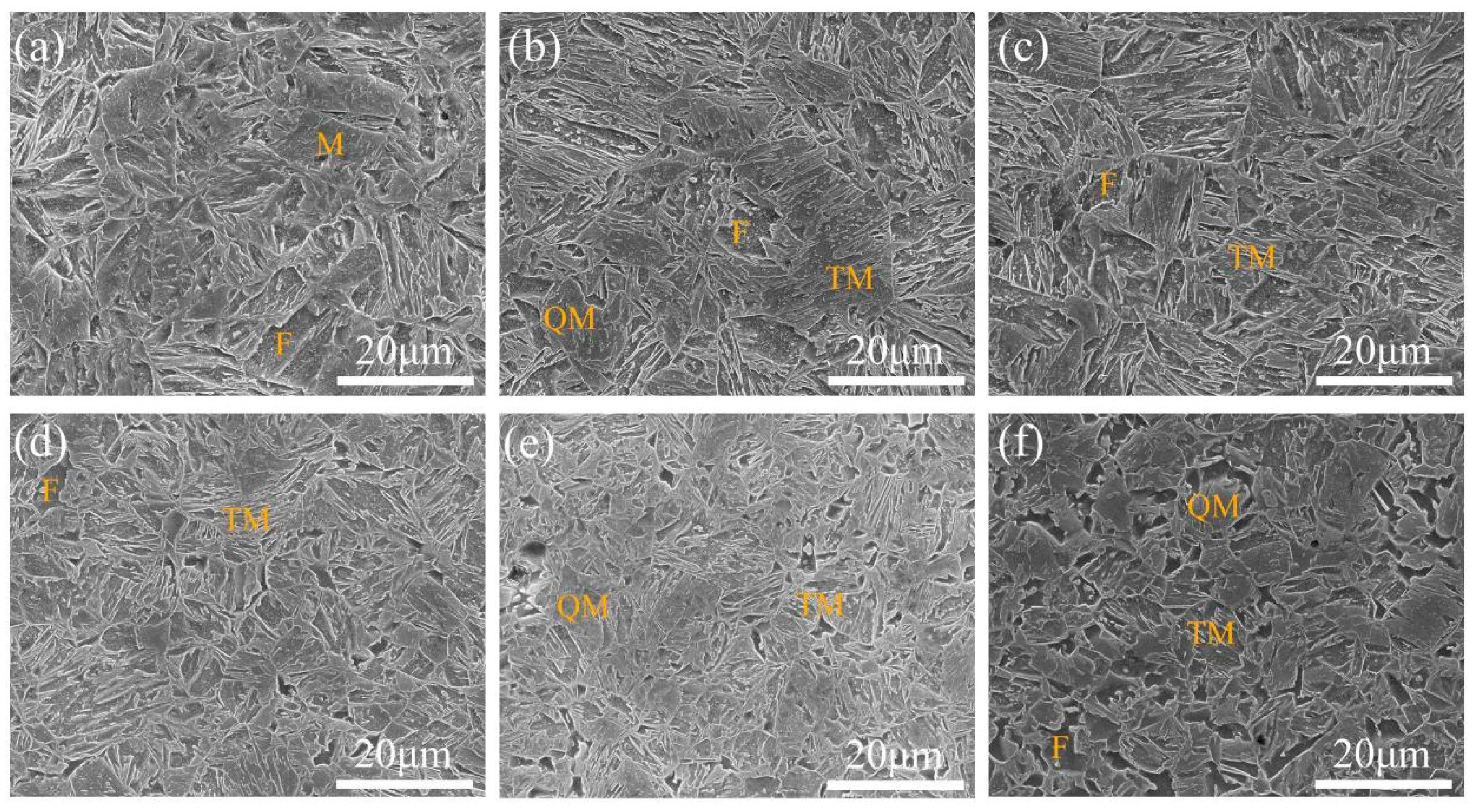
Figure 3 presents SEM micrographs of the reference and Nb-added steels subjected to over-aging at different temperatures. The corresponding prior austenite grain sizes, statistically evaluated using Image J software (ImageJ1.53, USA), are summarized in Table 2. The microstructure of the ultra-high-strength DP1500 steel primarily consists of tempered martensite, with minor fractions of quenched martensite and polygonal ferrite. Intercritical annealing at a relatively high temperature (850 °C) promoted the formation of a significant volume fraction of austenite. During subsequent rapid cooling, the majority of this austenite transformed into quenched martensite. A portion of this martensite subsequently underwent tempering during the over-aging stage. Upon final cooling to room temperature, any unstable retained austenite is further transformed into fresh, untempered martensite. With increasing over-aging temperature (Figure 3a–c), the amount of quenched martensite increases, while that of tempered martensite decreases. This trend occurs because higher over-aging temperatures deviate further from the martensite finish temperature (Mf), reducing the amount of martensite available for tempering [31]. Concurrently, the tempered martensite gradually decomposes; although its characteristic lath morphology is retained, carbide precipitation becomes evident. Comparisons between Figure 3d–f reveal that Nb addition significantly refines both the prior austenite and ferrite grains. For example, at an over-aging temperature of 240 °C, the prior austenite grain size decreases from 2.61 µm in the reference steel to 2.14 µm in the Nb-added steel. Furthermore, in the Nb-added steel over-aged at 300 °C, an increased fraction of quenched martensite and noticeably refined ferrite grains are observed.
Figure 3.
SEM images of reference steel and Nb-added steel over-aging at various temperatures: (a) 240 °C; (b) Ref 270 °C; (c) Ref 300 °C; (d) Nb-added 240 °C; (e) Nb-added 270 °C; (f) Nb-added 300 °C. Note: M is martensite; F is ferrite; QM is quenched martensite; and TM is tempered martensite.
Table 2.
The original austenite grain sizes of reference steel and Nb-added steel over-aging at various temperatures.
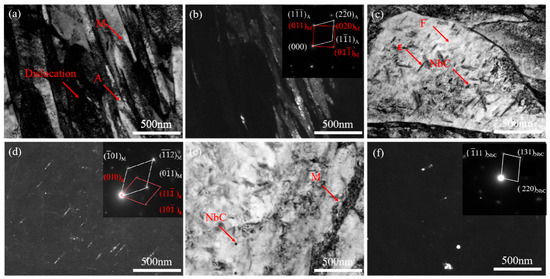
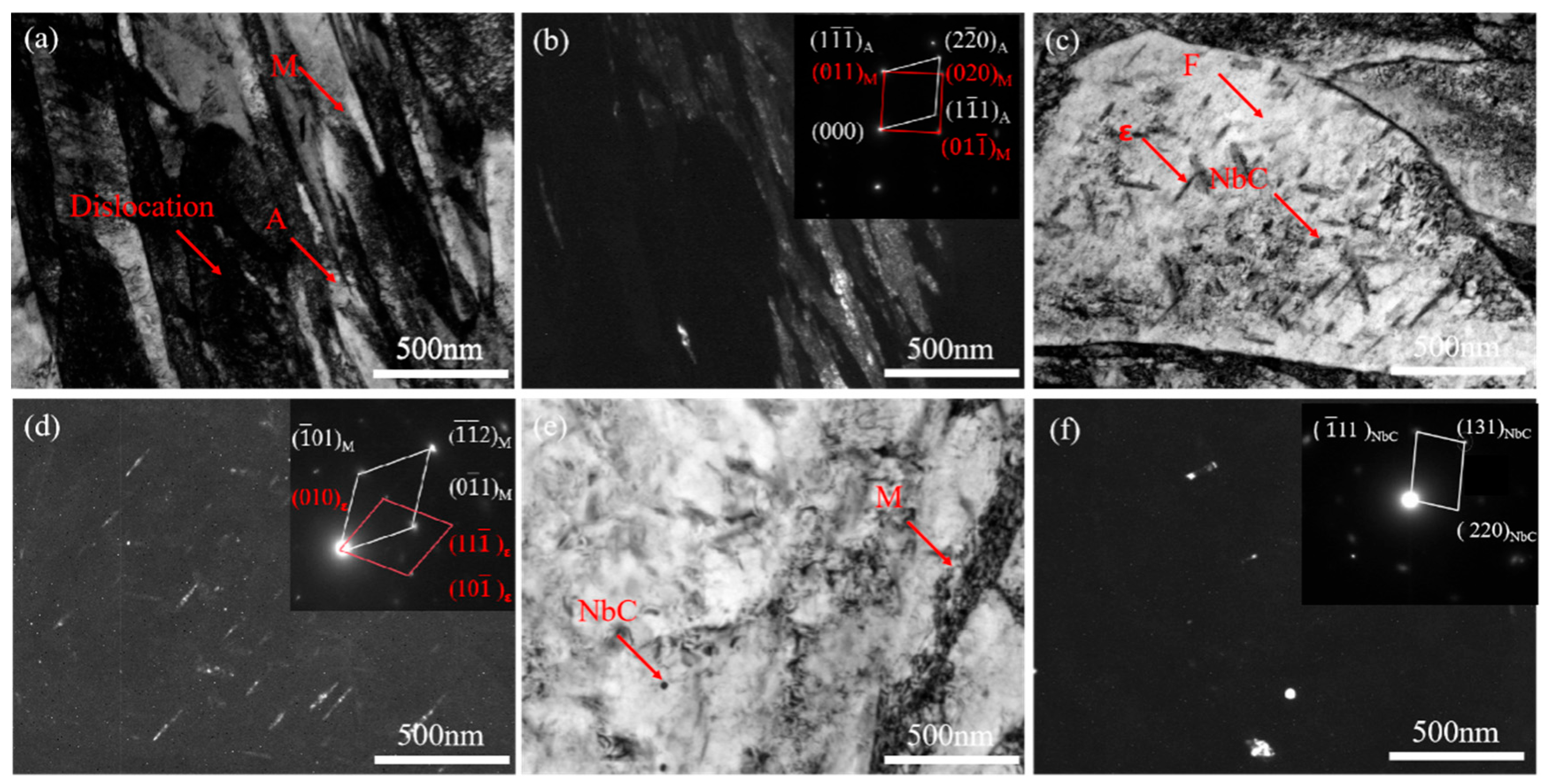
The TEM micrographs of Nb-added steel over-aging at 270 °C are shown in Figure 4. Figure 4a,b show the bright-field (BF) image of martensite and the dark-field (DF) image of retained austenite, as well as the corresponding selected area electron diffraction (SAED) patterns. The microstructure of the Nb-added specimen consists of a lath martensite matrix and the inter-lath retained austenite. The average thickness of the lamellar retained austenite in the reference specimen was about 65 nm. The orientation relationship (OR) between lath martensite and the retained austenite is identified by SAED patterns as [01]α//[2]γ, (011)α//(1)γ (N-W relationship). Furthermore, Figure 4c,d present a large number of fine flaky carbides dispersed in ferrite, which are transition-type ε carbides, as identified by the SAED inserted in Figure 4d. Meanwhile, Figure 4e,f show the fine-grained NbC precipitates distributed on the martensite matrix. The special OR between the granular carbides and martensite is (110)MC//(100)α and [110]MC//[011]α, or, namely, the Baker–Nutting (B-N) OR. From Figure 4f, it can be seen that the average size of carbides is less than 10 nm, and it is distributed dispersively.
Figure 4.
TEM micrographs of Nb-added steel. (a) BF image and (b) DF images of retained austenite; (c,e) BF images and (d,f) DF images of ε-carbide and NbC precipitates, respectively. The corresponding SAED patterns are in (b), (d), and (f), respectively. Note: M is martensite; F is ferrite; ε is ε-carbide; and A is austenite.
3.2. Mechanical Properties
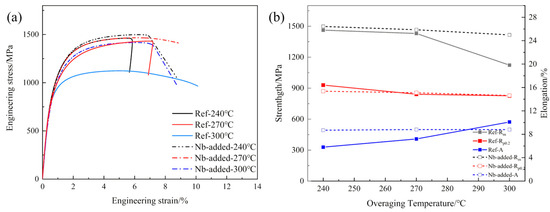
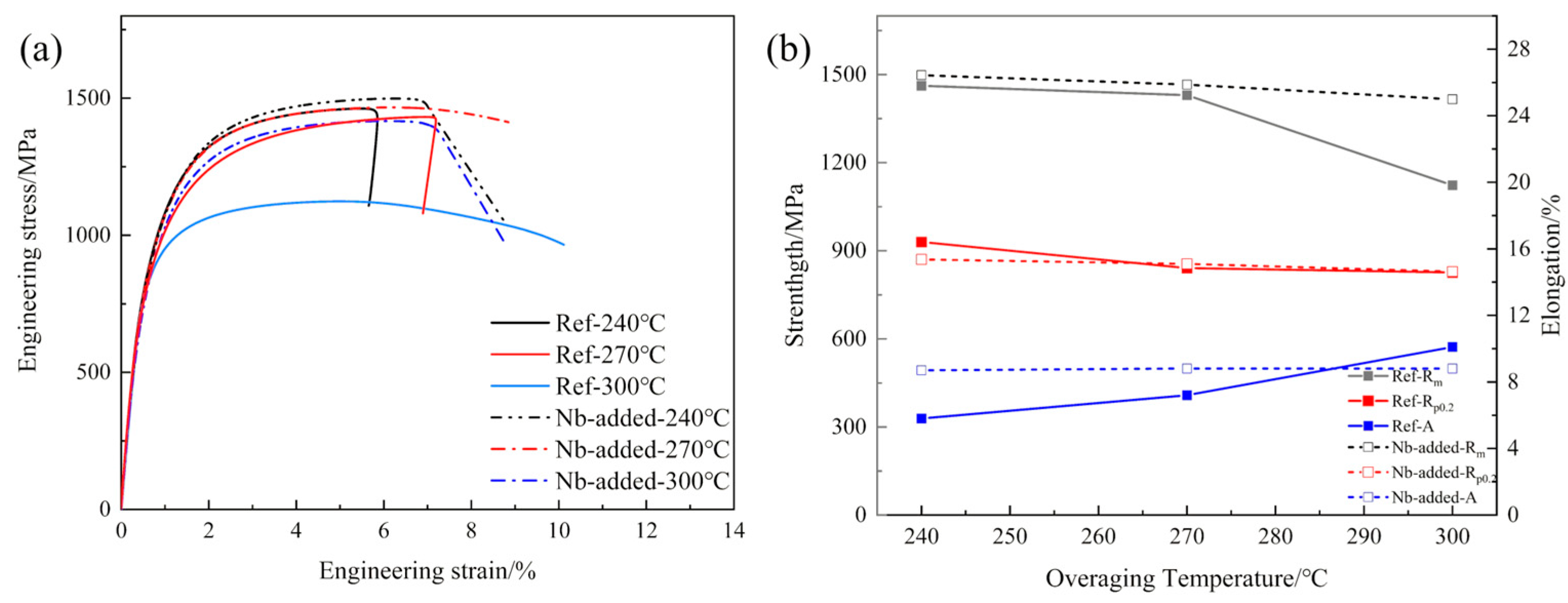
Figure 5 presents the engineering stress–strain curves and the corresponding mechanical properties of the reference and Nb-added steels over-aged at temperatures ranging from 240 °C to 300 °C, with the detailed data listed in Table 3. Both steels exhibit continuous yielding without a distinct yield plateau. As the over-aging temperature increases, the yield strength (Rp0.2) and ultimate tensile strength (Rm) of both steels gradually decrease. In contrast, the total elongation (A) of the reference steel increases noticeably, whereas that of the Nb-added steel remains relatively stable. For instance, when the over-aging temperature rises from 240 °C to 300 °C, the Rm of the reference steel decreases from 1462.8 MPa to 1123.5 MPa, while that of the Nb-added steel decreases from 1498.1 MPa to 1416.8 MPa. Similarly, Rp0.2 decreases from 909.7 MPa to 826.5 MPa for the reference steel and from 870.6 MPa to 829.4 MPa for the Nb-added steel. The elongation of the reference steel increases from 5.8% to 10.1%, while that of the Nb-added steel remains around 9%. It is noteworthy that the addition of Nb significantly enhances both the yield strength and tensile strength of the DP steel. Moreover, at higher over-aging temperatures, the Nb-added steel shows a smaller reduction in strength compared to the reference steel.
Figure 5.
Engineering stress–strain curves (a) and mechanical properties (b) of reference steel and Nb-added steel over-aged at different temperatures, respectively.
Table 3.
The mechanical properties of reference steel and Nb-added steel after over-aging at different temperatures.
3.3. Hydrogen Embrittlement Sensitivity
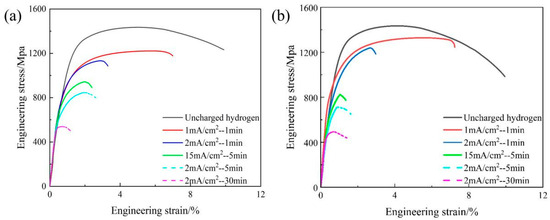
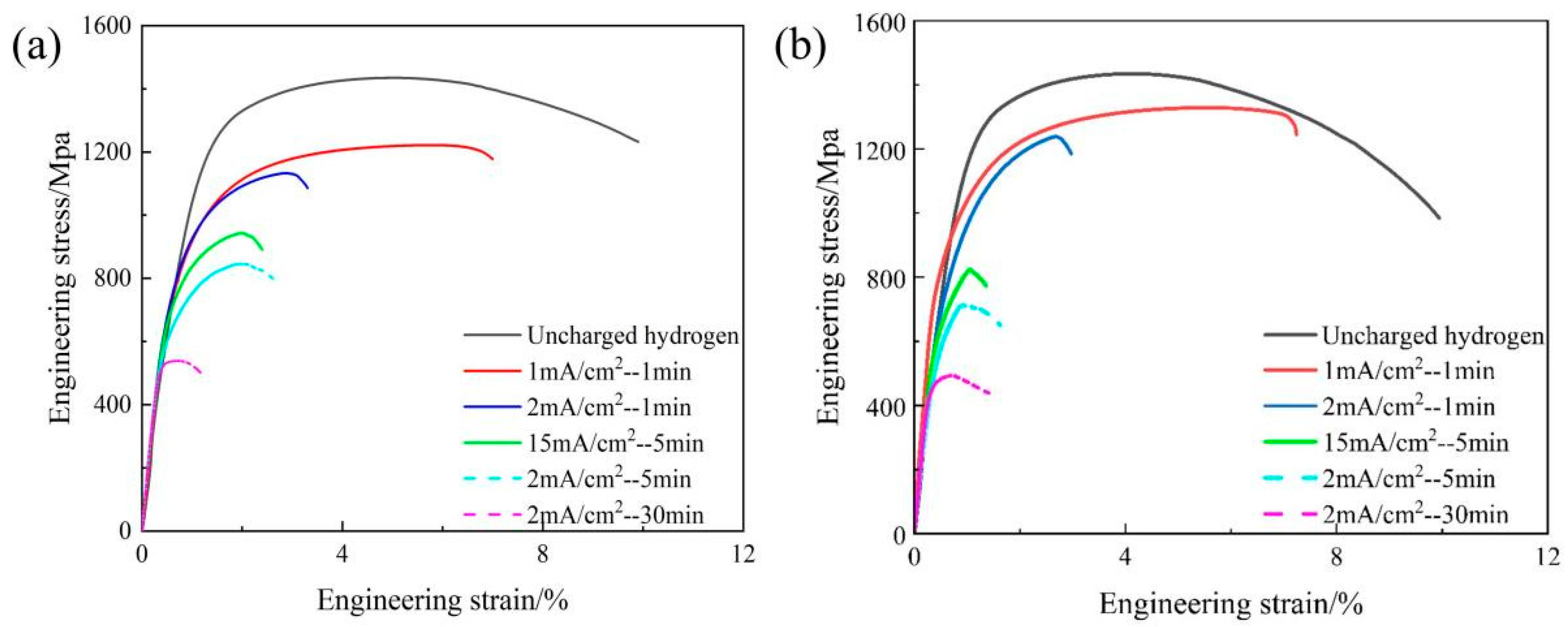
Figure 6 depicts the SSRT curves of the reference and Nb-added steels over-aged at 270 °C under various hydrogen charging conditions, with the corresponding mechanical parameters summarized in Table 4. Compared to their uncharged counterparts, all hydrogen-charged specimens exhibited progressive degradation in mechanical performance with increasing charging time and current density. When charged for 1 min at a current density of 1 mA/cm2, the Rm of the reference steel decreased significantly to 1215.87 MPa, accompanied by an Elloss of 35.4%. Under the same conditions, the Nb-added steel also showed a notable reduction in Rm to 1327.85 MPa, with an Elloss of 30.9%. As the charging severity increased, the Nb-added samples consistently demonstrated lower elongation losses than the reference steel, indicating that Nb addition effectively mitigates hydrogen-induced ductility degradation.
Figure 6.
SSRT curves of reference steel (a) and Nb-added steel (b), cathodically hydrogen charged at different charging times and current densities.
Table 4.
Mechanical properties of reference sample and Nb-added sample, cathodically hydrogen charged at different charging times and current densities.
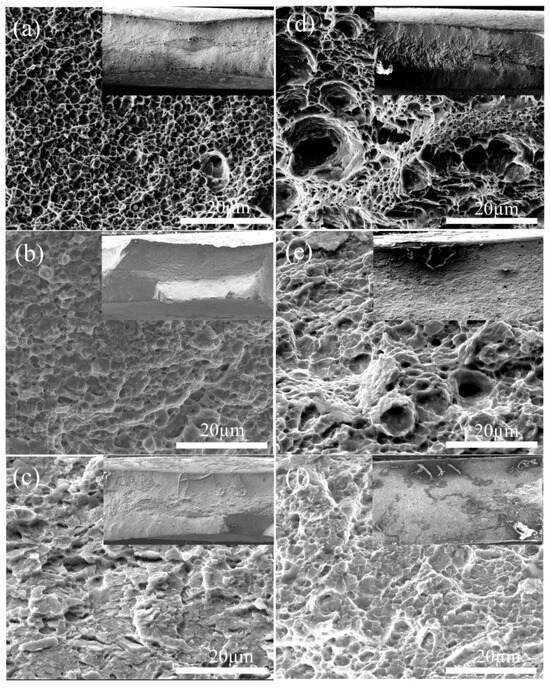
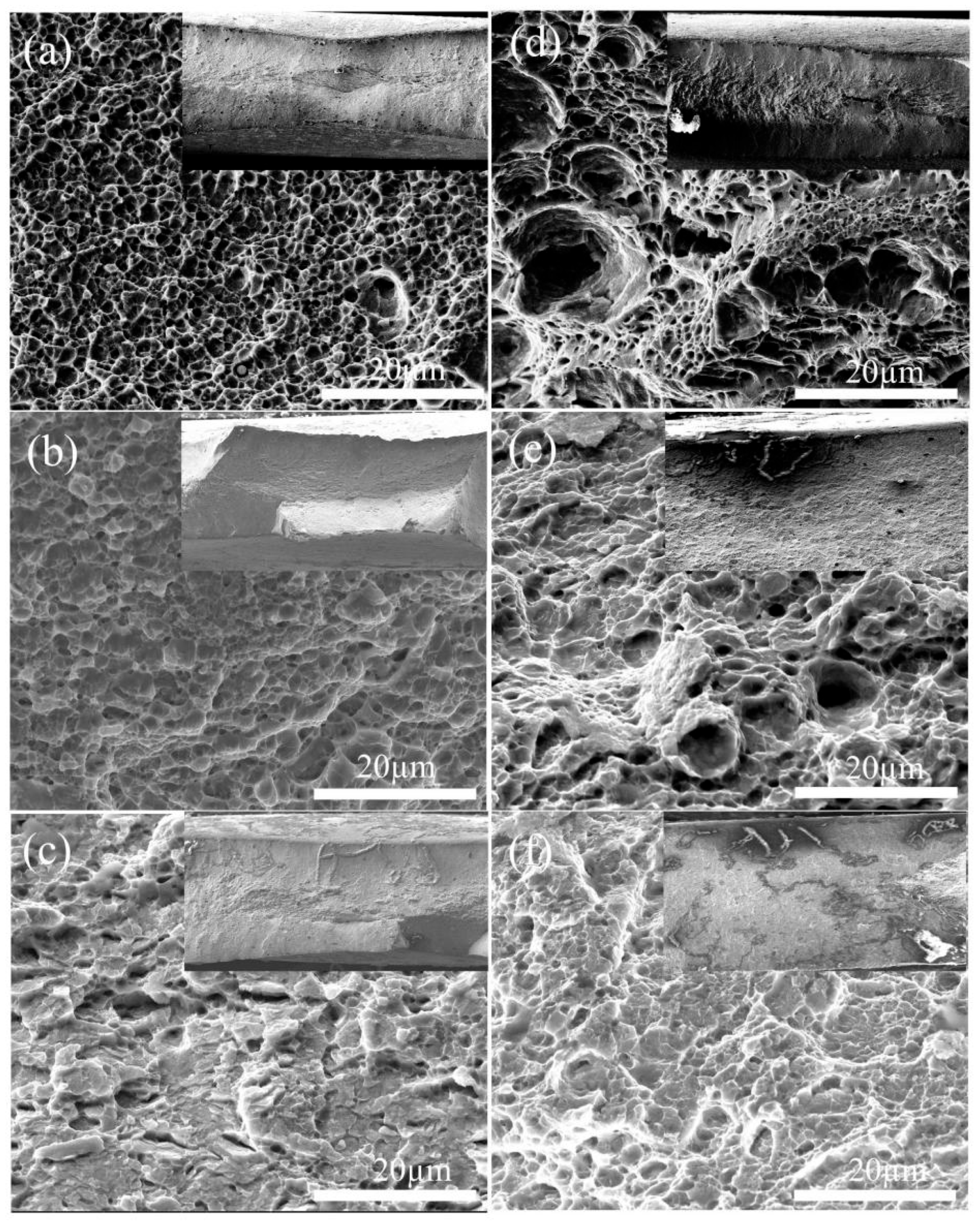
Figure 7a,d illustrate the tensile fracture morphologies of the reference and Nb-added steels over-aging at 270 °C in the uncharged condition. Both alloys exhibit typical ductile fracture characteristics dominated by numerous dimples. The fracture surface of reference steel (Figure 7a) consists of uniformly distributed fine dimples, whereas that of Nb-added steel (Figure 7d) is composed of larger and deeper dimples, reflecting its superior plasticity and toughness. Upon hydrogen charging at a current density of 2 mA/cm2 for 1 min (Figure 7b,e), the fracture surface of reference steel displays a pronounced decrease in dimple density accompanied by the emergence of flat regions and quasi-cleavage features, indicating an enhanced susceptibility to HE. In contrast, Nb-added steel under the same condition retains a predominantly dimpled morphology, though the dimples become coarser, suggesting a more stable ductile response and improved resistance to HE. When the charging current density is further increased to 15 mA/cm2 (Figure 7c,f), both steels exhibit clear brittle fracture features. The reference sample (Figure 7c) is characterized by extensive cleavage facets with only a few residual dimples, signifying severe hydrogen-induced brittleness. Likewise, the Nb-added specimen (Figure 7f) also shows a noticeable shift toward brittle fracture, manifested by a reduced dimple population and the appearance of cleavage planes. These observations demonstrate that, despite the beneficial effect of Nb in mitigating hydrogen damage, excessive hydrogen ingress can still induce a ductile-to-brittle transition and result in hydrogen-assisted failure [32].
Figure 7.
SEM fracture photographs of reference sample (a–c) and Nb-added sample (d–f) at different hydrogen charging current densities. (a,d) Uncharged hydrogen; (b,e) 2 mA/cm2, 1 min; (c,f) 15 mA/cm2, 1 min.
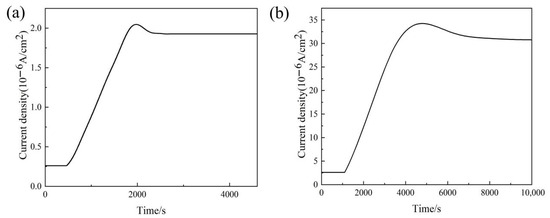
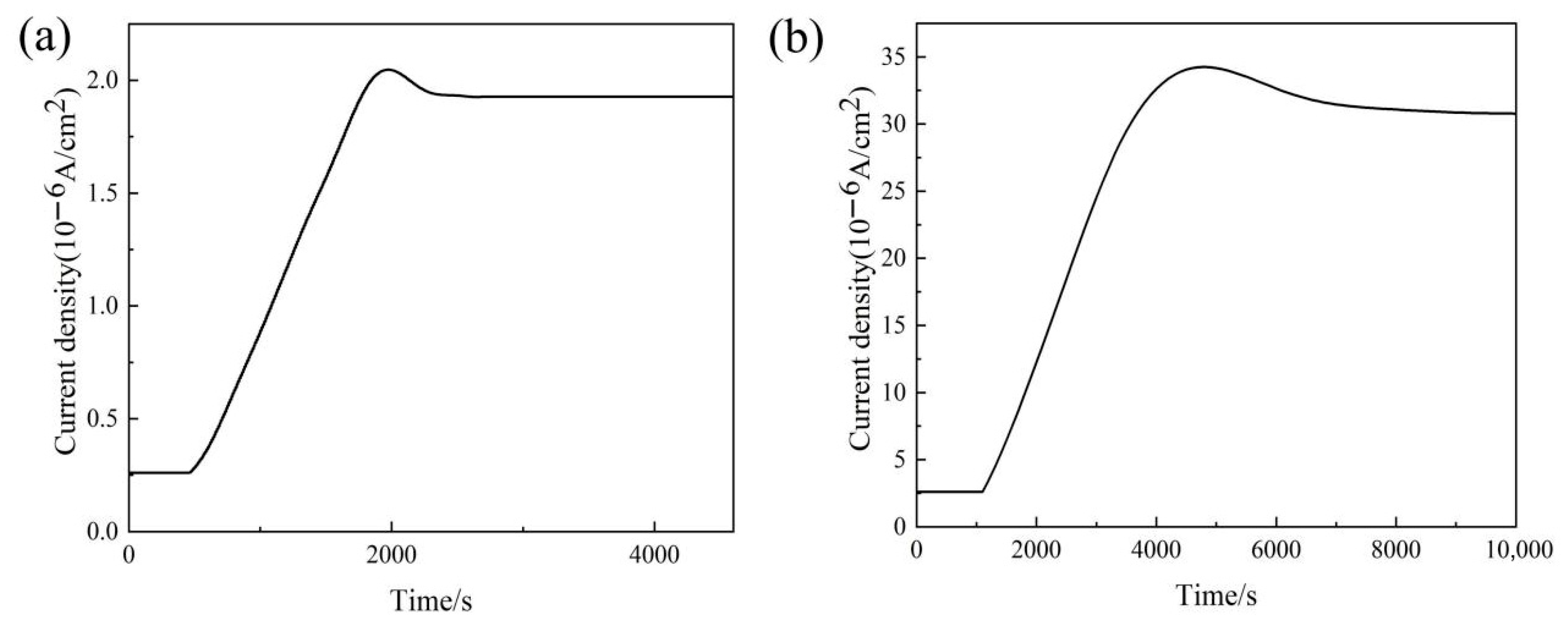
Figure 8 displays the hydrogen permeation transients of the reference and Nb-added steels over-aging at 270 °C, with the corresponding kinetic parameters summarized in Table 5. A comparative assessment reveals pronounced differences in hydrogen transport and trapping behaviors between the two materials. The most direct indicator of hydrogen permeability, the steady-state permeation flux (J∞L), is nearly twenty times higher in the Nb-added steel than in the reference steel, indicating a substantially enhanced overall hydrogen permeability. In contrast, the Deff of Nb-added steel is slightly lower, suggesting a marginally slower hydrogen migration rate within its microstructure.
Figure 8.
Hydrogen permeation curve: (a) reference sample; (b) Nb-added sample.
Table 5.
The hydrogen permeation test parameters of reference and Nb-added steels.
This seemingly contradictory observation—higher permeability yet reduced diffusivity—can be rationalized by analyzing the trapping-related parameters. Both the Capp and the calculated NT of Nb-added steel exhibit dramatic increases, approximately 23-fold and 25.5-fold, respectively, relative to the reference. Such behavior implies that Nb addition, through the precipitation of fine Nb-rich particles, generates a dense population of irreversible hydrogen traps. These traps effectively capture and immobilize hydrogen atoms, accounting for the reduction in Deff and the substantial rise in Capp due to the increased number of trapping sites [33].
Although a slight decrease in diffusivity can slow down hydrogen transport toward stress concentrators, the markedly elevated total Capp in Nb-added steel represents a potential hazard. Under applied stress, the trapped hydrogen can be released and redistributed to critical microstructural regions such as phase boundaries, thereby facilitating crack initiation and propagation. Consequently, despite its slower diffusion, the stronger trapping capacity of Nb-added steel is expected to aggravate HE by enabling greater local hydrogen accumulation. This interpretation is consistent with the SSRT findings discussed earlier, where the Nb-added steel exhibited more pronounced embrittlement. The nature and thermal stability of these hydrogen traps are further elucidated through TDS in the subsequent section [34].
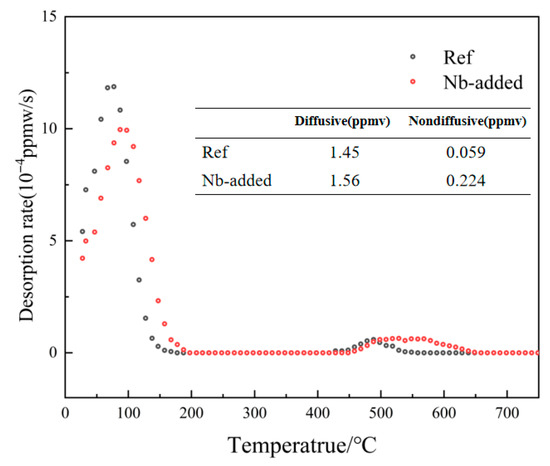
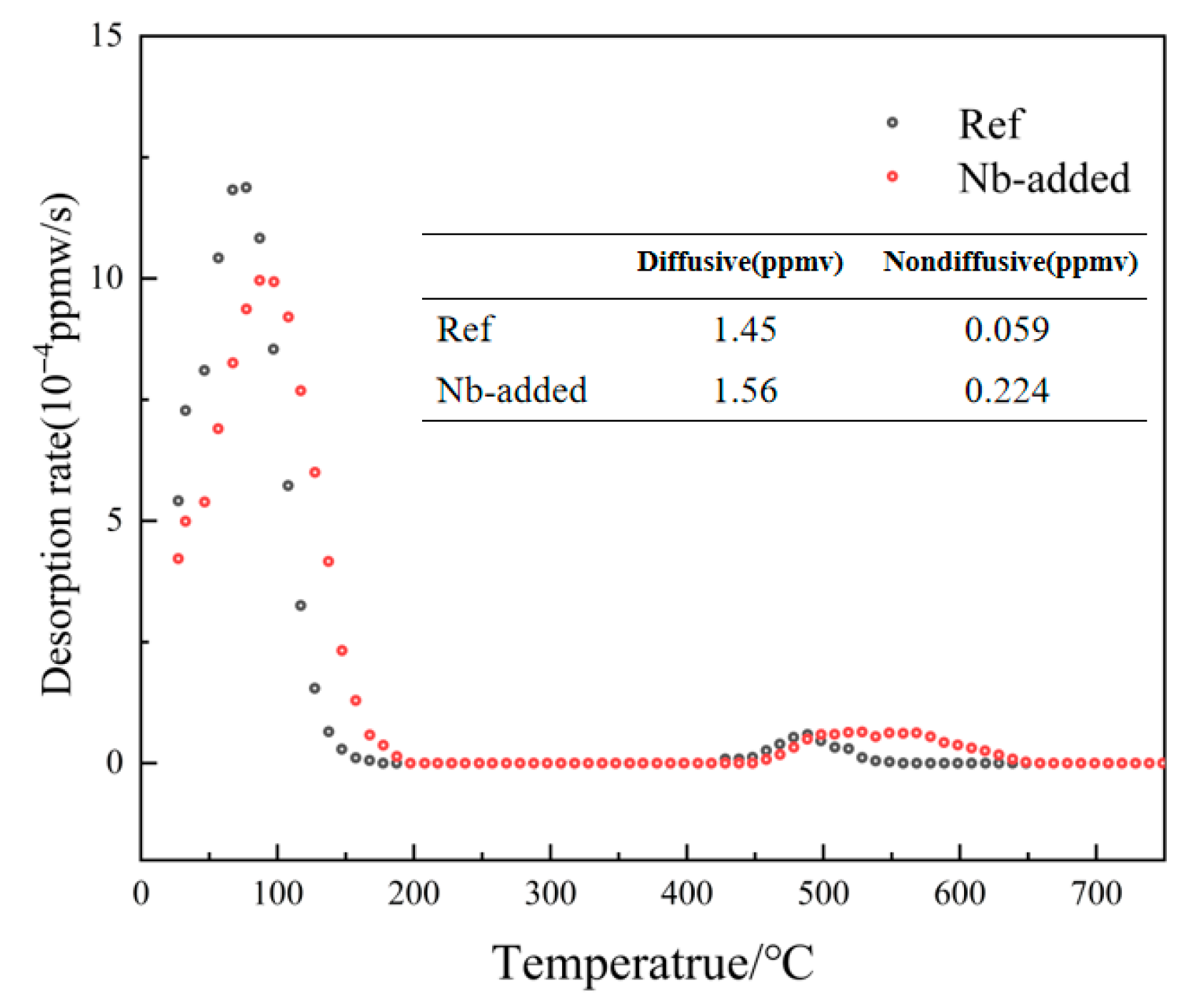
A comparison of the hydrogen TDS of reference and Nb-added steels over-aging at 270 °C is shown in Figure 9, which reveals that both alloys exhibit two distinct desorption peaks under identical charging conditions: a pronounced low-temperature peak between 100 °C and 200 °C, and a weaker high-temperature peak located between 400 °C and 600 °C. The low-temperature peak is commonly attributed to hydrogen release from reversible trapping sites such as dislocations, low-angle grain boundaries, and retained austenite, whereas the high-temperature peak corresponds to desorption from irreversible traps, including high-angle grain boundaries and second-phase precipitates such as carbides and nitrides [35].
Figure 9.
TDS of reference and Nb-added steels. The inserted table is a summary of the hydrogen content.
To further elucidate the nature of hydrogen trapping, the activation energy corresponding to the low-temperature desorption peak (observed at 97.4 °C) was estimated using the Redhead approximation. With a heating rate of 100 °C/h (0.0278 K/s) and a pre-exponential factor of 1013 s−1, the calculated activation energy was approximately 37.7 kJ·mol−1, which lies within the typical range for reversible traps such as dislocations and low-angle grain boundaries, thereby confirming that this peak originates from weakly bound hydrogen.
As summarized in the inserted table in Figure 9, the Nb-added steel exhibits significantly higher levels of both diffusible hydrogen (1.60 ppmv) and non-diffusible hydrogen (0.17 ppmv) compared to the reference steel (1.45 ppmv and 0.059 ppmv, respectively). The increased diffusible hydrogen content in the Nb-added steel implies enhanced hydrogen mobility and a greater propensity for accumulation at microstructural heterogeneities—such as phase boundaries—thereby elevating the risk of hydrogen-assisted cracking. Although retained austenite, with its high hydrogen solubility and low diffusion coefficient, is generally expected to improve HE resistance, the TDS results reveal that the Nb-added steel retains more hydrogen in both reversible and irreversible states. This phenomenon may be explained by stress-induced transformation of retained austenite, which releases trapped hydrogen and facilitates its redistribution to interfaces, in addition to the higher dislocation density and internal stresses inherent to its multiphase microstructure.
The TDS spectra in Figure 9 provide further insight into the hydrogen trapping mechanism associated with NbC. Two notable distinctions are observed in the Nb-added steel compared to the reference steel: a shift in the main desorption peak toward higher temperature and a broader, flatter peak profile. The elevated desorption temperature reflects trapping sites with higher binding energy, characteristic of irreversible traps such as the coherent/semi-coherent interfaces of nano-sized NbC precipitates (Figure 4e,f). Hydrogen trapped at these interfaces requires more thermal energy for release, resulting in desorption at higher temperatures.
The broadened and flattened TDS peak suggests a wider distribution of trap energies in the Nb-added steel, which can be attributed to the multi-scale trapping landscape introduced by Nb microalloying. While NbC/matrix interfaces serve as dominant high-energy traps, the significant grain refinement also increases the density of grain boundaries, which act as low- to medium-energy traps. The superposition of these trap types—from high-energy NbC interfaces to the spectrum of trapping sites associated with grain boundaries and dislocations—results in a continuous range of desorption kinetics, manifesting as a broadened TDS peak. In contrast, the reference steel exhibits a sharper, more defined desorption peak, consistent with a more uniform trap distribution dominated by reversible sites such as dislocations and phase boundaries.
Collectively, the SSRT, hydrogen permeation, and TDS results confirm that the addition of Nb significantly enhances the HE resistance of DP1500 steel. Under identical hydrogen charging conditions, the Nb-added steel consistently exhibits a lower Elloss than the reference steel (Table 4), indicating reduced susceptibility to HE. This improvement is primarily attributed to the hydrogen trapping effect of nano-sized NbC precipitates. These fine, homogeneously distributed precipitates act as a high density of benign irreversible traps, which uniformly distribute and immobilize hydrogen throughout the microstructure. As a result, they effectively hinder hydrogen diffusion and subsequent accumulation at critical locations—such as ferrite/martensite interfaces or prior austenite grain boundaries—where hydrogen-induced cracks typically initiate.
4. Discussion
The present results demonstrate that Nb microalloying effectively enhances both the strength–ductility balance and HE resistance of DP1500 steel. The underlying mechanisms can be rationalized by considering the complex interplay between microstructural evolution induced by over-aging temperature and the multifaceted role of Nb in hydrogen trapping. This discussion aims to decouple these factors, linking our experimental observations to the central hypothesis and the existing literature.
4.1. Synergistic Strengthening and the Role of Over-Aging Temperature
The continuous yielding behavior observed in all conditions (Figure 5a) is a hallmark of DP steels, resulting from the generation of mobile dislocations in the soft ferrite phase due to the strain incompatibility with the hard martensite phases during the early stages of deformation.
The decrease in Rm with increasing over-aging temperature, observed in both steels (Figure 5, Table 3), is a direct consequence of martensite tempering. During the over-aging stage, the precipitation of transition carbides such as ε-carbide reduces the carbon content in the martensite lattice, leading to its softening and a corresponding reduction in the overall strength of the composite microstructure. However, the Nb-added steel exhibited a markedly smaller strength loss (e.g., Rm decreased by only ~80 MPa compared to ~340 MPa in the reference steel between 240 °C and 300 °C). This superior stability is attributed to the dual role of Nb: grain refinement strengthening (evident from the refined prior austenite grains in Table 2) and precipitation strengthening from nano-sized NbC (Figure 4e,f). The presence of fine, thermally stable NbC precipitates compensates for the strength loss from martensite softening, a phenomenon consistent with findings by Wang et al. in Q-P-T steels [36]. The significant refinement of prior austenite grains in the Nb-added steel (e.g., from ~2.6 µm to ~2.1 µm at 240 °C; Table 2) directly contributes to higher strength via the Hall–Petch mechanism.
Furthermore, the microstructural evolution with over-aging temperature is critical. As the temperature increases from 240 °C to 300 °C, the degree of martensite tempering intensifies, leading to more pronounced carbide precipitation and carbon depletion. This shifts the phase balance, increasing the fraction of fresh, untempered martensite (QM) formed during final cooling, as corroborated by SEM analysis (Figure 3). The increased elongation in the reference steel at higher over-aging temperatures is likely linked to two factors: (1) the softening of the tempered martensite, which reduces the strength mismatch with ferrite and delays void initiation, and (2) the potential role of stabilized retained austenite. The TRIP effect, where retained austenite transforms to martensite under strain, relieves local stress concentrations and enhances uniform elongation. The more stable ductility of the Nb-added steel across all temperatures suggests a more optimized and uniform microstructure, where the benefits of grain refinement and precipitation strengthening maintain a high strength–ductility balance, effectively countering the variations in retained austenite stability and QM fraction.
4.2. Decoupling the Dual Role of Nb in Hydrogen Embrittlement: The Triumph of Beneficial Trapping
The central and most significant finding of this work is the superior HE resistance of the Nb-added steel, as evidenced by its consistently lower Elloss in SSRT tests (Table 4) and the preservation of a more ductile fracture morphology under identical hydrogen charging conditions (Figure 7). This enhancement, however, presents an apparent paradox when viewed alongside the hydrogen permeation and TDS data, which indicate a higher Capp and a significantly higher NT in the Nb-added steel (Table 5, Figure 9). Resolving this paradox is key to understanding the mechanism and hinges on a critical distinction between the quantity and the nature of hydrogen traps.
Our data strongly support the central hypothesis that nano-sized NbC precipitates serve as irreversible hydrogen traps. The TDS results provide direct evidence: the shift in the desorption peak to a higher temperature in the Nb-added steel indicates the presence of traps with higher binding energy, characteristic of coherent/semi-coherent interfaces like those of NbC/α-Fe [23,24]. This is further corroborated by the reduction in the effective Deff. The fine, homogeneously distributed NbC precipitates act as a dense array of deep traps, continuously capturing mobile hydrogen atoms, thereby slowing their overall transport through the lattice.
This mechanism explains the paradox: although the total hydrogen inventory is higher, the mobile hydrogen concentration—the fraction responsible for diffusing to and accumulating at critical, stress-concentrated sites like ferrite/martensite interfaces—is substantially reduced. The hydrogen is effectively “sequestered” in harmless, irreversible sites. This interpretation aligns strongly with the atomic-scale observations of Chen et al. [24] and the computational work of Pang et al. [23], who confirmed the efficacy of the NbC/α-Fe interface as a potent hydrogen trap.
However, a complete analysis must acknowledge the competing effect of microstructural refinement. As our results and others [25,26] note, grain refinement increases the density of grain and phase boundaries, which typically act as reversible traps. This contributes to the higher total hydrogen content observed in TDS and explains the potential risk noted in the literature. Our study demonstrates that in the present DP1500 steel system, the beneficial effect of the irreversible NbC traps outweighs the potential detriment of the increased reversible trapping. The finer, more uniform microstructure may also lead to a more homogeneous distribution of both stress and hydrogen, reducing local concentrations that could initiate cracks.
Therefore, the net effect of Nb microalloying on HE resistance is not merely a function of grain refinement but is dominantly controlled by the population and efficacy of nano-precipitates as irreversible hydrogen sinks. This clarifies the conflicting reports in the literature: the outcome depends on which effect dominates—the introduction of harmful hydrogen diffusion paths (grain boundaries) or beneficial immobilization sites (precipitates). In our alloy and processing design, the latter prevails, leading to a net improvement in HE resistance. The fine and uniform dispersion of NbC precipitates ensures that hydrogen is stabilized throughout the microstructure, successfully mitigating its detrimental interaction with the microstructure under stress and validating our initial hypothesis [37,38].
5. Conclusions
This study systematically investigated the effects of over-aging temperature and NbC precipitates on the microstructure, mechanical properties, and HE susceptibility of DP1500 steel. The main observations and conclusions are as follows:
- (1)
- Increasing the over-aging temperature promotes martensite decomposition and carbide precipitation, resulting in blurred martensite morphology, an increased fraction of quenched martensite, and the stabilization of retained austenite. The addition of Nb significantly refines the microstructure, including prior austenite grains, martensite laths, and ferrite, thereby enhancing microstructural homogeneity.
- (2)
- The evolution of mechanical properties reveals a synergistic effect between the over-aging temperature and Nb microalloying. Although the strength of both steels decreases due to martensite softening during over-aging, the Nb-added steel exhibits a superior strength–ductility balance under all processing conditions. This is attributed to the pronounced effects of fine-grained strengthening and precipitation strengthening, which effectively compensate for the strength loss.
- (3)
- The superior HE resistance of Nb-added steel is attributed to the irreversible hydrogen trapping capability of nano-sized NbC precipitates. While these precipitates increase the total hydrogen content, they effectively reduce mobile hydrogen diffusivity and prevent detrimental hydrogen accumulation at critical microstructural interfaces, thereby mitigating hydrogen-induced degradation.
Author Contributions
Conceptualization, K.Z., F.M. and W.L. (Wei Li 2); methodology, K.Q., B.C. and F.M.; validation, B.C. and Y.T.; investigation, W.L. (Wei Li 1) and Y.T.; data curation, W.L. (Wei Li 1), B.C. and K.Q.; writing—original draft preparation, W.L. (Wei Li 1); writing—review and editing, K.Z. and W.L. (Wei Li 2); supervision, W.L. (Wei Li 2) and F.M.; project administration, K.Z.; funding acquisition, W.L. (Wei Li 2). All authors have read and agreed to the published version of the manuscript.
Funding
The work is financially supported by the National Natural Science Foundation of China (no. 51971148).
Data Availability Statement
The original contributions presented in this study are included in the article. Further inquiries can be directed to the corresponding author.
Acknowledgments
We thank the Analysis and Testing Center of the University of Shanghai for Science and Technology for its support and help.
Conflicts of Interest
Author Wei Li was employed by Baoshan Iron & Steel Co., Ltd. The remaining authors declare that the research was conducted in the absence of any commercial or financial relationships that could be construed as a potential conflict of interest.
References
- Khosravani, A.; Cecen, A.; Kalidindi, S.R. Development of high throughput assays for establishing process-structure-property linkages in multiphase polycrystalline metals: Application to dual-phase steels. Acta Mater. 2017, 123, 55–69. [Google Scholar] [CrossRef] [Scilit]
- Khan, A.S.; Baig, M.; Choi, S.H.; Yang, H.S.; Sun, X. Quasi-static and dynamic responses of advanced high strength steels: Experiments and modeling. Int. J. Plast. 2012, 30–31, 1–17. [Google Scholar] [CrossRef] [Scilit]
- Lu, Q.; Lai, Q.Q.; Chai, Z.S.; Wei, X.L.; Xiong, X.C.; Yi, H.L.; Huang, M.X.; Xu, W.; Wang, J.F. Revolutionizing car body manufacturing using a unified steel metallurgy concept. Sci. Adv. 2022, 7, eabk0176. [Google Scholar] [CrossRef] [Scilit] [PubMed]
- Calcagnotto, M.; Ponge, D.; Demir, E.; Raabe, D. Orientation gradients and geometrically necessary dislocations in ultrafine grained dual-phase steels studied by 2D and 3D EBSD. Mater. Sci. Eng. A 2010, 527, 2738–2746. [Google Scholar] [CrossRef] [Scilit]
- Pierman, A.P.; Bouaziz, O.; Pardoen, T.; Jacques, P.J.; Brassart, L. The influence of microstructure and composition on the plastic behaviour of dual-phase steels. Acta Mater. 2014, 73, 298–311. [Google Scholar] [CrossRef] [Scilit]
- Lai, Q.; Bouaziz, O.; Gouné, M.; Brassart, L.; Verdier, M.; Parry, G.; Perlade, A.; Brechet, Y.; Pardoen, T. Damage and fracture of dual-phase steels: Influence of martensite volume fraction. Mater. Sci. Eng. A 2015, 646, 322–331. [Google Scholar] [CrossRef] [Scilit]
- Pushkareva, I.; Allain, S.; Scott, C.; Redjaïmia, A.; Moulin, A. Relationship between microstructure, mechanical properties and damage mechanisms in high martensite fraction dual phase steels. ISIJ Int. 2015, 55, 2237–2246. [Google Scholar] [CrossRef] [Scilit]
- Kalhor, A.; Taheri, A.K.; Mirzadeh, H.; Uthaisangsuk, V. Processing, microstructure adjustments, and mechanical properties of dual phase steels: A review. J. Mater. Sci. Technol. 2021, 37, 561–591. [Google Scholar] [CrossRef] [Scilit]
- Atreya, V.; Bos, C.; Santofimia, M.J. Understanding ferrite deformation caused by austenite to martensite transformation in dual phase steels. Scr. Mater. 2021, 202, 114032. [Google Scholar] [CrossRef] [Scilit]
- Soliman, M.; Palkowski, H. Tensile properties and bake hardening response of dual phase steels with varied martensite volume fraction. Mater. Sci. Eng. A 2020, 777, 139044. [Google Scholar] [CrossRef] [Scilit]
- Calcagnotto, M.; Adachi, Y.; Ponge, D.; Raabe, D. Deformation and fracture mechanisms in fine-and ultrafine-grained ferrite/martensite dual-phase steels and the effect of aging. Acta Mater. 2011, 59, 658–670. [Google Scholar] [CrossRef] [Scilit]
- Matsuno, T.; Teodosiu, C.; Maeda, D.; Uenishi, A. Mesoscale simulation of the early evolution of ductile fracture in dual-phase steels. Int. J. Plast. 2015, 74, 17–34. [Google Scholar] [CrossRef] [Scilit]
- Speer, J.; Matlock, D.K.; Cooman, B.C.; Schroth, J.G. Carbon partitioning into austenite after martensite transformation. Acta Mater. 2013, 61, 3324–3334. [Google Scholar] [CrossRef] [Scilit]
- Figueroa, D.; Robinson, M.J. The effects of sacrificial coatings on hydrogen embrittlement and re-embrittlement of ultra high strength steels. Corros. Sci. 2008, 50, 1066–1079. [Google Scholar] [CrossRef] [Scilit]
- Wang, G.; Yan, Y.; Li, J.; Huang, J.Y.; Qiao, L.J.; Volinsky, A.A. Microstructure effect on hydrogen-induced cracking in TM210 maraging steel. Mater. Sci. Eng. A 2013, 586, 142–148. [Google Scholar] [CrossRef] [Scilit]
- Peet, M.J.; Hojo, T. Hydrogen susceptibility of nanostructured bainitic steels. Metall. Mater. Trans. A 2016, 47, 718–725. [Google Scholar] [CrossRef] [Scilit]
- Li, C.H.; Chen, C.Y.; Tsai, S.P.; Yang, J.R. Microstructure characterization and strengthening behavior of dual precipitation particles in Cu-Ti microalloyed dual-phase steels. Mater. Des. 2019, 166, 107613. [Google Scholar] [CrossRef] [Scilit]
- Samei, J.; Zhou, L.F.; Kang, J.D.; Wilkinson, D.S. Microstructural analysis of ductility and fracture in fine-grained and ultrafine-grained vanadium-added DP1300 steels. Int. J. Plast. 2019, 117, 58–70. [Google Scholar] [CrossRef] [Scilit]
- Pelligra, C.; Samei, J.; Kang, J.; Wilkinson, D.S. The effect of vanadium on microstrain partitioning and localized damage during deformation of unnotched and notched DP1300 steels. Int. J. Plast. 2022, 158, 103435. [Google Scholar] [CrossRef] [Scilit]
- Almatani, R.A.; DeArdo, A.J. Rational Alloy Design of Niobium-Bearing HSLA Steels. Metals 2020, 10, 413. [Google Scholar] [CrossRef] [Scilit]
- Mohrbacher, H.; Yang, J.R.; Chen, Y.W.; Rehrl, J.; Hebesberger, T. Metallurgical Effects of Niobium in Dual Phase Steel. Metals 2020, 10, 504. [Google Scholar] [CrossRef] [Scilit]
- Vercruysse, F.; Claeys, L.; Depover, T.; Verleysen, P.; Petrov, R.H.; Verbeken, K. The effect of Nb on the hydrogen embrittlement susceptibility of Q&P steel under static and dynamic loading. Mater. Sci. Eng. A 2022, 852, 143652. [Google Scholar] [CrossRef] [Scilit]
- Shi, R.J.; Ma, Y.; Wang, Z.; Gao, L.; Yang, X.S.; Qiao, L.J.; Pang, X.L. Atomic-scale investigation of deep hydrogen trapping in NbC/α-Fe semi-coherent interfaces. Acta Mater. 2020, 200, 686–698. [Google Scholar] [CrossRef] [Scilit]
- Chen, Y.S.; Lu, H.Z.; Liang, J.T.; Rosenthal, A.; Liu, H.W.; Sneddon, G.; McCarroll, I.; Zhao, Z.Z.; Li, W.; Guo, A.M.; et al. Observation of hydrogen trapping at dislocation, grain boundaries, and precipitates. Science 2020, 367, 171–175. [Google Scholar] [CrossRef] [Scilit] [PubMed]
- Xu, P.D.; Li, C.Y.; Li, W.; Zhu, M.Y.; Li, W.; Zhang, K. Effect of microstructure on hydrogen embrittlement susceptibility in quenching-partitioning-tempering steel. Mater. Sci. Eng. A 2022, 831, 142046. [Google Scholar] [CrossRef] [Scilit]
- Hua, Z.; Hui, W.J.; Fang, B.Y.; Xu, Y.X.; Zhao, S.X. Hydrogen embrittlement of a V+Nb-microalloyed high-strength bolt steel subjected to different austenitizing temperatures. Eng. Fail. Anal. 2025, 169, 109178. [Google Scholar] [CrossRef] [Scilit]
- Gong, P.; Turk, A.; Nutter, J.; Yu, F.; Wynne, B.; Ricera-Diaz-del-Castillo, P.; Rainforth, W.M. Hydrogen embrittlement mechanism in advanced high-strength steels. Acta Mater. 2022, 223, 117881. [Google Scholar] [CrossRef] [Scilit]
- ASTM E8/E8M-22; Standard Test Methods for Tension Testing of Metallic Materials. ASTM International: West Conshohocken, PA, USA, 2022.
- ISO 17081:2004(E); Method of Measurement of Hydrogen Permeation and Determination of Hydrogen Uptake and Transport in Metals by An Electro-Chemical Technique. ISO: Geneva, Switzerland, 2004.
- Redhead, P.A. Thermal desorption of gases. Vacuum 1962, 12, 203–211. [Google Scholar] [CrossRef] [Scilit]
- He, K.J.; Baker, T.N. The effects of small titianium additions on the mechanical properties and the microstructures of controlled rolled niobium-bearing HLSA plate steels. Mater. Sci. Eng. A 1993, 169, 53–65. [Google Scholar]
- Michael, B.; Hoche, H.; Oechsner, M. Hydrogen-assisted cracking (HAC) of high-strength steels as a function of the hydrogen pre-charging time. Eng. Fract. Mech. 2022, 261, 108246. [Google Scholar]
- Zhang, S.; Wan, J.F.; Zhao, Q.Y.; Liu, J.; Huang, F.; Huang, Y.H.; Li, X.G. Dual role of nanosized NbC precipitates in hydrogen embrittlement susceptibility of lath martensitic steel. Corros. Sci. 2020, 164, 108345. [Google Scholar] [CrossRef] [Scilit]
- Zhao, H.; Chakraborty, P.; Ponge, D.; Hickel, T.; Sun, B.; Wu, C.H.; Gault, B.; Raabe, D. Hydrogen trapping and embrittlement in high-strength Al alloy. Nuture 2022, 602, 437–441. [Google Scholar] [CrossRef] [Scilit] [PubMed]
- Timmerscheidt, T.A.; Dey, P.; Bogdanovski, D.; Appen, J.V.; Hickel, T.; Neugebauer, J.; Dronskowski, R. The Role of κ-Carbides as Hydrogen Traps in High-Mn Steels. Metals 2017, 7, 264. [Google Scholar] [CrossRef] [Scilit]
- Wang, X.D.; Xu, W.Z.; Guo, Z.H.; Wang, L.; Rong, H.Y. Carbide characterization in a Nb-microalloyed advanced ultrahigh strength steel after quenching–partitioning–tempering process. Mater. Sci. Eng. A 2010, 527, 3373–3378. [Google Scholar] [CrossRef] [Scilit]
- Malard, B.; Remy, B.; Scott, C.; Deschampa, A.; Chene, J.; Dieudonne, T. Hydrogen trapping by VC precipitates and structural defects in a high strength Fe-Mn-C steel studied by small-angle neutron scattering. Mater. Sci. Eng. A 2012, 536, 110–116. [Google Scholar] [CrossRef] [Scilit]
- Smith, A.; Vercruysse, F.; Petrov, R.; Verleysen, P. The effect of Niobium on austenite evolution during hot rolling of advanced high strength steel. J. Phys. Conf. Ser. 2019, 1270, 012030. [Google Scholar] [CrossRef] [Scilit]

Disclaimer/Publisher’s Note: The statements, opinions and data contained in all publications are solely those of the individual author(s) and contributor(s) and not of MDPI and/or the editor(s). MDPI and/or the editor(s) disclaim responsibility for any injury to people or property resulting from any ideas, methods, instructions or products referred to in the content. |
© 2025 by the authors. Licensee MDPI, Basel, Switzerland. This article is an open access article distributed under the terms and conditions of the Creative Commons Attribution (CC BY) license (https://creativecommons.org/licenses/by/4.0/).