Review

Slip Irreversibility, Microplasticity, and Fatigue Cracking Mechanism in Near-α and α + β Titanium Alloys


1
School of Mechanical and Electrical Engineering, Quanzhou University of Information Engineering, Quanzhou 362000, China
2
Institute of Metal Research, Chinese Academy of Sciences, Shenyang 110016, China
3
School of Materials Science and Engineering, University of Science and Technology of China, Shenyang 110016, China
*
Author to whom correspondence should be addressed.
Metals 2026, 16(2), 144; https://doi.org/10.3390/met16020144
Submission received: 23 December 2025 / Revised: 14 January 2026 / Accepted: 20 January 2026 / Published: 25 January 2026

Abstract

The micromechanisms “slip transfer, slip irreversibility, microplasticity, and fatigue cracking” in titanium alloys are reviewed, with a special emphasis on near-α and α + β alloys. As the interplay between slip activity, microplasticity, and fatigue cracking governs both the microscale and macroscale mechanical response, we reveal how the slip irreversibility and localized dislocation activity at the grain boundaries (GBs) and α/β interfaces generate dislocation pile-ups and strain localization, subsequently driving fatigue crack initiation and propagation. The review highlights the favorable crack initiation along basal planes and the roles of α grain orientations, slip transfer barriers, and the β phase in governing fatigue cracking, while addressing unresolved questions about localized interactions and texture effects. It also explores the complex interactions that govern the effects of microstructures, textures, and defects on fatigue cracking. Ultimately, the review provides a unified framework for linking slip events to microplasticity and to fatigue failure, offering actionable insights for alloy design and fatigue prediction.

1. Introduction

Understanding slip irreversibility [1], slip transfer [2,3], strain localization [4], persistent slip bands (PSBs) [1], microplasticity [5], and fatigue crack mechanisms [1,2,3,4] is fundamental for advancing the design and durability of structural alloys [1,2,3,4,5], particularly in high-performance applications [6,7,8]. Slip activity dictates how dislocations move through crystallographic planes, governing plastic deformation and work hardening [9], while microplasticity reveals the localized strain heterogeneities that precede macroscopic yielding [10]. These phenomena are critical because they determine the initiation and propagation of fatigue cracks [1,2,3,4], which are the primary cause of failure in cyclically loaded components [7]. By elucidating the interplay between slip systems, phase boundaries, and grain orientations, it can be predicted how microstructural features like GBs and α/β interfaces in titanium alloys influence dislocation motion and stress accumulation [11]. This knowledge can enable the strategic engineering of alloys with tailored grain morphologies, texture control, and phase distributions to impede crack nucleation and enhance fatigue life [12]. Furthermore, insights into microplasticity [4] can help identify the critical thresholds for irreversible damage [1], guiding the development of alloys that can resist strain localization [4] and premature failure [1]. Ultimately, a mechanistic understanding of these processes will allow for the optimization of alloy compositions [13], ensuring superior performance in demanding applications such as aerospace, biomedical implants, and energy systems, where reliability and longevity are paramount.
The deformation behavior of α and β phases in titanium alloys is strongly influenced by their chemical composition [14,15,16]. At room temperature, the α phase in pure titanium can deform by slip and twinning [16,17,18], while the β phase in β titanium alloys may undergo slip, twinning, or stress-induced martensitic transformation [19,20,21]. According to the Von Mises criterion, homogeneous deformation requires at least five independent slip systems [22]. However, studies have shown that the α phase can only activate a maximum of four independent slip systems through basal and prismatic 〈a〉 slip [23,24]. To accommodate further deformation, additional mechanisms, such as pyramidal 〈c + a〉 slip and twinning, are necessary [23]. In pure titanium, twinning is typically favored over 〈c + a〉 slip for strain accommodation [5]. However, in near-α and α + β titanium alloys, the increased aluminum and oxygen content suppresses twinning in the α phase [25,26]. Consequently, further deformation relies more heavily on pyramidal 〈c + a〉 slip and on the β phase, which offers multiple slip systems [5,27], making slip the dominant deformation mechanism in the α phase for these alloys [28]. Therefore, the slip initiation and transfer behavior significantly influence the yield strength and crack nucleation [29]. For example, studies have indicated that alloys with an easier slip activation exhibit lower yield strength [30], while an enhanced slip transfer between adjacent grains improves plasticity by facilitating strain accommodation [27]. Conversely, microplasticity tends to lead to crack formation and degrade both the ductility and fatigue resistance [31].
Fatigue cracking is a complex process involving several microstructural features, cyclic loading, local stresses and strains [32], and other contributing factors [33]. The fatigue failure process initiates at an interior or surface location where the stresses are concentrated. It consists initially of slip bands [1] or slip traces along slip planes [7]. Over a number of cyclic loadings, these slip bands/traces generate intrusions and extrusions that begin to resemble cracks and material failure [9,10]. Fatigue cracking in materials without inclusions or porosity often begins in regions where the local microstructure promotes irreversible slip [1], further developing into a slip band and later into a shear band that acts as the site of crack initiation [34,35,36]. For example, if the texture leads to the formation of GBs that are preferentially oriented in the direction of the applied load, fatigue crack nucleation and growth may accelerate along the GBs [37]. On the other hand, if the texture leads to the formation of grains with favorable orientations for slip or deformation, it may improve the fatigue resistance of the alloys [38].
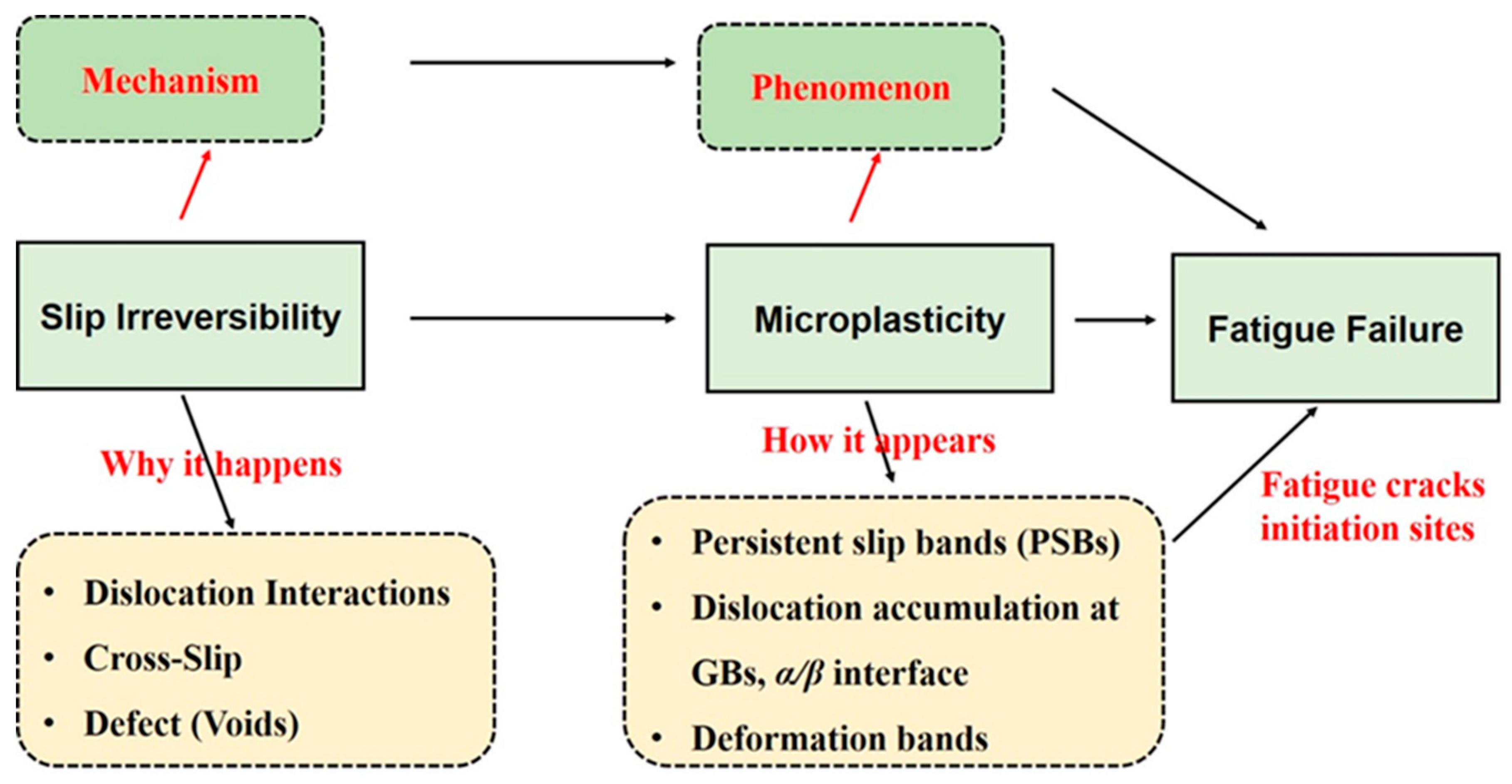
Recent studies on the plastic deformation mechanisms of titanium alloys have employed various in situ techniques, each offering unique advantages. In situ X-ray diffraction (XRD) is well-suited for analyzing the lattice strain and stress evolution in individual grains during deformation [39,40]. Meanwhile, in situ bright field transmission electron microscopy (BF-TEM) enables direct observation of dislocation nucleation and movement, providing insights into dynamic microstructural changes [41]. In contrast, in situ scanning electron microscopy (SEM) combines crystalline data with slip trace morphology to investigate slip behavior [42,43]. Therefore, studies utilizing SEM and BF-TEM [44,45] have effectively demonstrated how fatigue cracking mechanisms are linked to strain localization and slip activity. Several works have investigated fatigue cracking mechanisms in near-α and α + β alloys [31,32,33]. However, the core relationship between the fundamental micromechanisms and the related physical phenomena that lead to fatigue failure [1] is still not clearly understood. Therefore, this research aims to bridge this gap by offering a comprehensive review that directly links slip irreversibility to the development of microplasticity and localized deformation bands, as schematically illustrated in Figure 1. Moreover, this research extends to a review of how slip irreversibility is driven by different microstructures and textures, influencing early plastic slip activity and fatigue life. This systematic approach significantly helps in understanding how localized dislocation activity evolves into PSBs and accumulates at the GBs and α/β interfaces, which are the direct sites of fatigue crack initiation. By elucidating these micromechanisms, this comprehensive review provides a valuable framework for future research directions on strengthening mechanisms and the design of next-generation titanium alloys for high fatigue resistance applications.

2. Slip Activity

2.1. Slip Systems in α and β Phases

The main microstructural morphologies obtained for dual-phase Ti alloys under thermomechanical processing are lamellar, bimodal, and equiaxed with different textures, namely, basal, basal/transverse, and transverse [46,47,48]. These microstructures and their features significantly influence the slip activity. Slip is the main deformation mode in many metallic materials. In near-α and α + β alloys, due to the low volume fraction of the soft β phase, the strong α phase with an HCP structure dominates plastic deformation [47]. Most active slip systems have been reported for α phase, namely, basal ( 0001 )   11 2 ¯ 0 ; prismatic { 10 1 ¯ 0 }   11 2 ¯ 0 ; pyramidal 10 1 ¯ 1   11 2 ¯ 0 〈a〉 type; and pyramidal 〈c + a〉, which consists of 1st order 10 1 ¯ 1     11 2 ¯ 3 and 2nd order 11 2 ¯ 2   11 2 ¯ 3 slip [49,50], as presented in Table 1. Prismatic slip is the primary active slip system in Ti alloys [48]. Slip with the same Burgers vectors (BVs) may also occur on the basal and pyramidal 〈a〉 type [47]. However, these 〈a〉 slips share the same BVs lying within the basal planes. Hence, they do not fulfill the requirement for five independent deformation systems capable of accommodating 3D deformation because they do not accommodate the deformation along the c-axes of a crystal [48]. Therefore, dislocations slip on either the first- or second-order pyramidal planes with 〈c + a〉 BVs or twinning [51] are the potential deformation systems that provide a crystal with an additional degree of freedom [48]. The easy activity of prismatic slip is due to its low critical resolved shear stress (CRSS), while the second activated slip system is basal slip with the second-lowest CRSS, followed by the pyramidal 〈a〉 type. In contrast, pyramidal planes with 〈c + a〉 have the highest CRSS. The β phase with a BCC structure has up to 48 slip systems, as shown in Table 1, but the 110   1 1 ¯ 1 and the 112   1 1 ¯ 1 with 12 slip systems are mainly considered for most deformation conditions. The {123} 〈111〉 also has 24 slip systems [47,52], which are difficult to activate [53].

2.2. Slip Initiation and Transfer

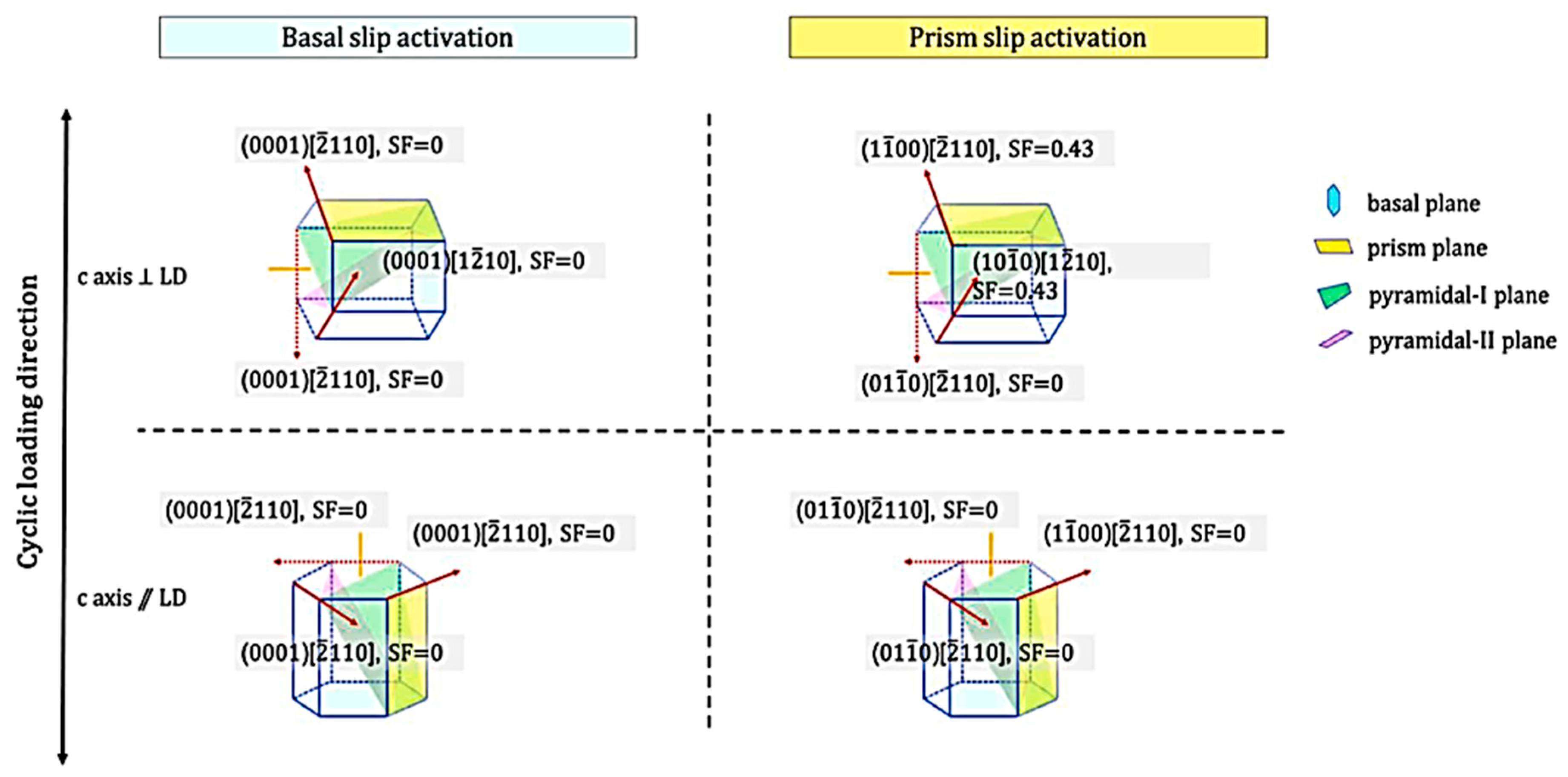
Slip initiation and transfer involves complex interactions between dislocations and the two phases, α and β [54]. Therefore, the strong texture that develops during thermomechanical processing [50,55] and additive manufacturing [56,57,58] significantly influences slip activity at room temperature. The deformation behavior is governed by the initiation of specific slip systems in each phase, the interaction between these systems, and the transfer of dislocations across phase boundaries [2]. The relative activity of these slip systems depends on the crystal orientation, temperature, strain rate, phase morphology, and alloy composition [59]. The slip transfer between the α and β phases is particularly important, as the geometric compatibility and stress concentrations at the interfaces influence how dislocations propagate through the microstructure [54]. The α phase typically dominates deformation at lower temperatures due to its higher volume fraction, with prismatic slip often being the easiest activation path [60], as schematically shown in Figure 2. At elevated temperatures or in β-rich alloys, the β phase contributes more significantly to plasticity [61]. The activation of 〈c + a〉 slip in the α phase is critical for achieving homogeneous plastic deformation [3], because the yield strength depends on the critical resolved shear stress (CRSS) of the easiest slip system, while work hardening stems from the dislocation interactions within the α and between the α and β phases [54]. Therefore, plasticity requires sufficient slip system availability, particularly in the α phase [49], while fatigue resistance correlates strongly with slip reversibility and planarity, because plastic deformation is governed by the slip transfer [1,2,3], which is highly sensitive to the microstructure [2,3]. The slip transfers most easily when the crystal orientations align across a boundary, reducing the stress needed for dislocations to cross the GBs [2,3]. The GB type is critical: high-angle boundaries block slip, causing dislocation pile-ups, while low-angle or twin boundaries allow for dislocation and easier transmission [2,3]. The α/β phase morphology adds complexity; their strength difference and crystallographic relationships create specific slip paths [62]. In lamellar structures, the slip transmits easily within a single colony but is blocked at the colony boundaries [61]. In equiaxed microstructures, the slip tends to initiate in favorably oriented α grains with basal or prismatic slip systems [62], while lamellar structures also promote slip transfer across α/β interfaces or confined deformation within α colonies [60]. This competition between easy and impeded slip transfer controls the overall strength, plasticity, and fatigue resistance.
The slip transfer is most favorable when the slip systems in adjacent α grains or across an α/β interface have relatively aligned slip planes and directions, e.g., a low misorientation and high Schmid factor. Within α colonies that share a similar crystal orientation, the slip can therefore transfer very easily over long distances. This is a primary mechanism for intense slip band formation [5]. Furthermore, if the slip systems are compatible, dislocations from the α grains can transmit across the α/β interfaces into the β grains. Consequently, an easy slip transfer in soft α grains induces load shedding into hard α grains, promoting faceted fracture along the 〈a〉 slip [63] in an HCF regime. Conversely, the slip is obstructed at microstructural barriers where the misorientation is high and the slip systems are misaligned. Barriers, such as α/β interfaces, GBs, and α colony boundaries, significantly influence crack initiation [64]. When the slip in an α grain is blocked by a layer of β phase or a differently oriented α grain, dislocation pile-ups occur at the α/β interface, leading to a stress concentration [3]. In some cases, the strain localizes in the soft β phase, or the obstructed slip causes intense plastic deformation in the soft β phase. This can result in void formation within the β grain or at the α/β interface [26]. Therefore, slip obstruction leads to crack initiation at α/β interfaces or GBs, or within the β phase. This is often observed as interface separation or small crack initiation at boundaries in a fracture surface [2]. One can conclude that slip obstruction is more likely to induce crack initiation in near-α and α + β titanium alloys.
Figure 2. Schematic illustration of basal and prismatic slip activation in different loading directions. Adapted from Ref. [65].
Metals 16 00144 g002

3. Microplasticity and Strain Localization

Microplasticity and strain localization in near-α and α + β titanium alloys are critical phenomena governing their deformation behavior, particularly at low strains and near yield strength [5]. Microplasticity refers to early, heterogeneous deformation occurring at the microscale, often before macroscopic yielding, driven by localized slip irreversibility in softer α phase regions or at α/β interfaces [5]. Strain localization manifests as concentrated deformation bands, shear bands, or PSBs [66,67], influenced by microstructural features, such as α phase morphology (equiaxed, bimodal, or lamellar), β phase distribution, grain orientation, and texture [5]. The strain localization is exacerbated by plastic incompatibility between phases, leading to stress concentrations at phase boundaries. Furthermore, the texture strongly influences the microplasticity and strain localization by governing the slip activation [24], plastic anisotropy [68], and deformation heterogeneity [4]. In textured microstructures, favorably oriented α grains (e.g., those with basal or prismatic planes aligned with the loading direction) preferentially undergo early slip, initiating microplasticity before macroscopic yielding [24]. This localized deformation arises due to the limited number of slip systems in the α phase [67], with prismatic slip dominating in weakly textured regions, while basal or pyramidal 〈c + a〉 slip becomes active in grains with hard orientations. This development of basal slip traces lead to microcracks along the GBs, where [0001] misorientations are indicated with white lines [4]. The strain localization is further dictated by the α/β phase distribution and their orientation relationships [4]. Colonies of similarly oriented α lamellae in transformed β microstructures promote slip transmission across the interfaces, leading to planar slip bands [69]. In contrast, equiaxed α grains with a strong texture induce plastic incompatibility, concentrating the strain at the grain or phase boundaries [68]. The β phase, though more isotropic, can channel deformation between the α regions, amplifying localization in textured α + β alloys. The texture affects the strain localization patterns under cyclic loading, influencing the fatigue crack initiation sites [1]. For instance, clustered grains with a common slip orientation favor the formation of PSBs and accelerate damage [70].
Hémery et al. [4] investigated fatigue crack formation at the (0001) twist boundary in three different alloys: Ti624, Ti6246, and Ti64. The analysis of the basal plane traces shows that the cracks coincided with the basal planes in the α grains adjacent to the microcracks. These results confirm the alignment of cracks parallel to the basal planes, with a [0001] misorientation across these cracks [4]. These findings indicate that the cracks propagated precisely along a boundary aligned with the basal planes [30,47]. Consequently, these fractured interfaces were classified as (0001) twist boundaries. The fact that the cracks spanned the entire length of these boundaries implies a rapid propagation mechanism. Furthermore, the dislocation structures adjacent to the cracks provided evidence of plastic deformation accompanying the cracking process along the basal planes. Ismaeel et al. [30] investigated the effect of CRSS on basal and prismatic slip, and found that the yield strength of Ti64 is more sensitive to an increase in the CRSS for the basal slip than for prismatic slip [30,47]. The basal dislocation interacts with the pyramidal 〈c + a〉 dislocations, causing grain refinement and higher strength [71], while influencing the microplasticity [5] and initiating microcracks along the basal planes [72]. In contrast, an increased CRSS for the prismatic slip leads to interactions between the prismatic and pyramidal 〈c + a〉 dislocations, resulting in the dissociation and transmission of prismatic dislocations to the pyramidal 〈c + a〉 dislocations through slip-to-slip transmission [73], which enhances the plasticity [74]. In order to deeply understand slip–strength, Ismaeel et al. [30] investigated the relative frequency as a function of Mises stress for each single α and β phase, and the α + β phase. The findings revealed that the relative frequency decreases with an increasing CRSS for the basal slip; it can be understood that increasing the CRSS for the basal slip causes high interactions between basal dislocation and pyramidal 〈c + a〉 dislocation, hardening the soft α grains, which leads to high strength [30] while this action reduces microplasticity [4]. The relative frequency increases with an increasing CRSS for the prismatic slip; this confirms the favorable interactions between prismatic dislocation and pyramidal 〈c + a〉 dislocation [69], effectively enhancing the microplasticity [30]. In addition, the slip in the β phase potentially modulates the local dislocation-based hardening and local microstress states within the microstructure of the α + β alloy [75], contributing to its microplasticity due to its easy, multiple, and low CRSS. Therefore, the texture type significantly influences the slip irreversibility, microplasticity, and strain localization.
The work of Shaolou et al. [24] provides a detailed analysis of heterogeneous plastic strain in a Ti-Al-V-Fe (α + β) alloy using in situ μ-DIC, revealing key mechanisms of localization bands. Their results show that the initial plastic deformation nucleates noticeable strain localization bands, despite a generally homogeneous strain distribution in the surrounding α + β phase microstructure [52]. A critical finding is that the progression of these bands is largely unaffected by the α/β phase boundaries. These results reveal a homogeneous distribution of the α and β phases in the region, with no signs of clustering. At moderate deformation levels, strain localization bands form, even though the surrounding microstructure experiences only moderate plastic strain. The propagation of these bands appears largely unaffected by the α/β phase boundaries. With continued deformation, these initial bands intensify rather than spread, eventually merging into a connected network that dominates the strain accommodation. Many authors have reported that the strain is always localized on kinematically softer grains with a high Schmidt factor [76,77,78]. Evidently, at a higher deformation, the strain distributions reveal sequential transmutations from soft into hard grains [30,69], attributed to the slip transfer and slip-to-slip transmission of 〈a〉 into the 〈c + a〉 type.

3.1. Heterogeneous Deformation Due to Soft/Hard Grain Orientations

Zhihong et al. [79] investigated internal microcracks and observed that crack formation involved the creation of basal slip bands and the emission of 〈a〉 dislocations from the crack tip. The analysis revealed that these slip bands consisted of pile-up ( 1 / 3 )   [ 11 2 ¯ 0 ] 〈a〉 dislocations in some grains. In contrast, other grains contained a combination of ( 1 / 3 )   [ 11 2 ¯ 0 ] and ( 1 / 3 )   [ 2 ¯ 110 ] 〈a〉 dislocations. Analysis of microcracks revealed a transgranular crack that propagated from grains with ( 1 / 3 )   [ 11 2 ¯ 0 ] 〈a〉 dislocations into grains with ( 1 / 3 )   [ 11 2 ¯ 0 ] and ( 1 / 3 )   [ 2 ¯ 110 ] 〈a〉 dislocations. This crack crossed a 14° misorientation GB without deflection [79], a direct result of the coplanar alignment of the basal planes in both grains, and was ultimately arrested at the α/β interface of primary α grains and the transformed β matrix. The deformation in the grains was characterized by a planar dislocation slip. Within the grain interiors, slip bands composed of 〈a〉 were observed. In contrast, the region near the crack tip showed a high density of 〈a〉 dislocations, which likely formed due to the stress concentration at the tip and contributed to crack blunting. A microscopic observation indicated that the deformation occurred primarily through planar slip, with the dislocations organizing into bands parallel to the basal planes. While the bulk of the material contained slip bands of 〈a〉, the crack tip vicinity featured a concentration of 〈c + a〉 dislocations [79]. This suggests that the stress concentrations at the advancing crack tip activated these 〈c + a〉 dislocations, which in turn promoted crack blunting and impeded further propagation.
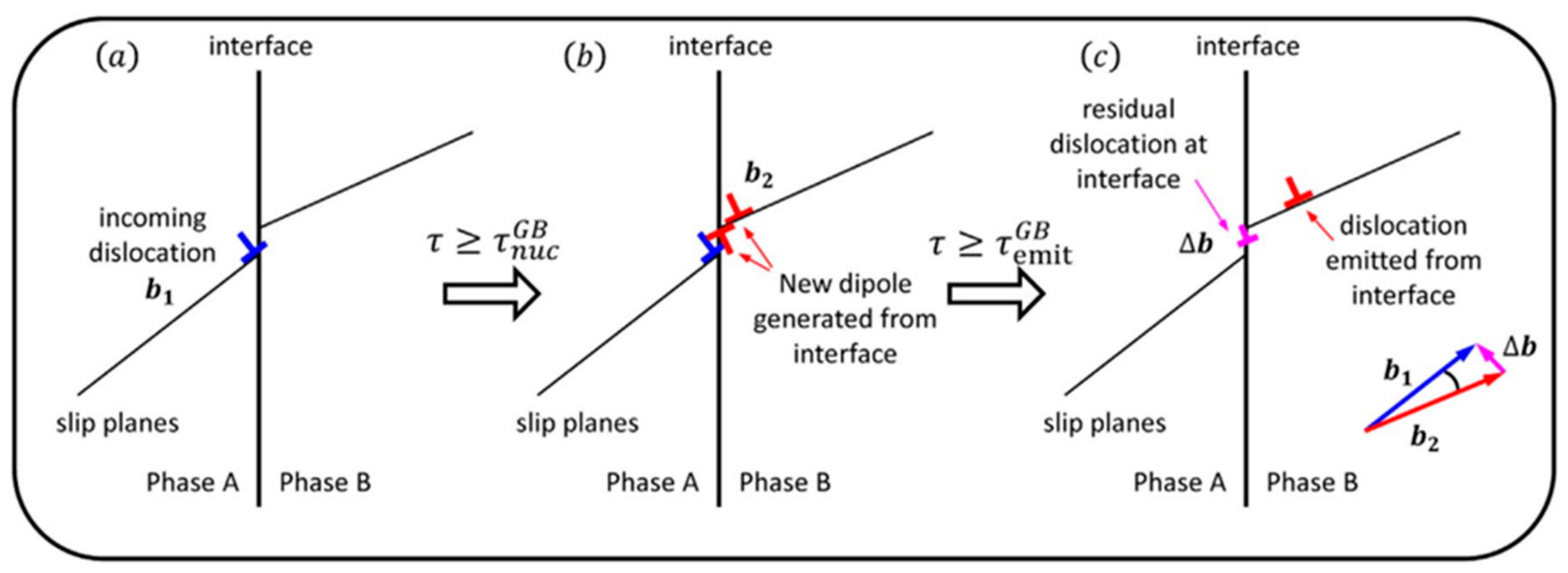
Strong texture of near-α and α + β titanium alloys leads to heterogeneous deformation due to the contrasting plastic behavior of soft and hard grain orientations at an early stage of deformation [52]. In the α phase, the grains oriented for easy prismatic slip (soft orientations) yield early, while those requiring a higher CRSS for basal or pyramidal c + a slip (hard orientations) resist deformation [80]. This mismatch creates local strain gradients, stress concentrations, and plastic incompatibility at the grain and phase boundaries [81]. In the presence of strong texture, clusters of soft-oriented α grains preferentially deform, forming slip bands that terminate at the hard-oriented α grains or β phase regions [80]. The β phase, though more ductile, can either accommodate strain or constrain deformation depending on its local orientation and distribution [52]. This heterogeneity is exacerbated in lamellar microstructures [61], where α colonies with favorable slip transmission directions deform uniformly, while misoriented colonies experience localized shear [81]. Dislocation slip transmission occasionally occurs across an interface [64], as schematically illustrated in Figure 3. The resulting stress and strain partitioning influences fatigue initiation, where the hard α grains are often the sites of void nucleation or microcracking [82,83].
The stress and strain distribution depends on the slip transfer as the core deformation mechanism across GBs [66,67]. According to the effect of texture, the deformation heterogeneity for a basal texture is slightly lower than that for basal/transverse and transverse textures [30]. A basal texture has fewer soft grains, and thus the dislocation slip is favored along the basal planes [81]. This results in low dislocation interactions between basal and prismatic dislocations, leading to uniform deformation [4]. The stress concentration along the RD is relatively lower than that along the TD, with a higher fracture toughness along the RD [84]. In the TD, high interactions of different types of dislocations and dislocation–twin interactions influence the slip transfer [85], leading to a higher deformation heterogeneity [81], which facilitates fatigue cracking along the TD. Along the RD, multiple 〈a〉-type slip activities lead to a more distributed slip strain and quite uniform strain localization [81]. In contrast, fewer but more intense localized strain bands along the TD might be attributed to grain alignment and low ductility [81]. These bands are reported to form when the 〈a〉 slip is misoriented away from the shearing direction.
Fanchao et al. [86] investigated and identified fatigue cracking after cyclic loading. The crack initiation sites and their crystallographic orientations revealed a direct link between the crack paths and active slip systems. Cracks were found to propagate along both the basal and prismatic slip traces, which possessed high Schmid factors of 0.49 and 0.34, respectively. The cracks were aligned with the basal slip trace, associated with a very high Schmid factor of 0.49. This slip trace evidence indicates that the predominant mechanism for plastic deformation is the slip on the basal and prismatic planes [81]. The stress concentration from a slip transfer can generate a high RSS in adjacent hard grains, facilitating the formation of slip bands [87,88]. Under the combined influence of the applied stress and RSS, these bands can tear apart, leading to crack nucleation [3,87]. Furthermore, the intense localized strain within shear and slip bands diminishes their capacity to accommodate plastic deformation, which also promotes cracking during continued loading [42,89]. A grain’s size and morphology influence this process; fine α laths coordinate deformation poorly, leading to immediate crack initiation from shear bands [45]. In contrast, larger equiaxed α grains initially form multiple slip bands, which better distribute the strain. However, at higher strain levels, deformation becomes concentrated in a single band, overwhelming its capacity to accommodate plasticity and ultimately resulting in crack formation [90,91].

3.2. Dislocation Pile-Ups at Phase Boundaries Leading to Stress Concentrations

Texture plays a critical role in the formation of dislocation pile-ups at grain and phase boundaries, which generate localized stress concentrations that influence deformation and fatigue mechanisms [67]. During plastic deformation, dislocations moving through the α phase along preferred slip systems, such as prismatic, basal, or pyramidal 〈c + a〉, encounter α/β interfaces, where differences in the crystal structure, slip systems, and elastic moduli act as barriers [92]. In textured microstructures, grains with soft orientations (favorably aligned for easy slip) deform first, leading to planar dislocation arrays that pile-up against hard-oriented grains or β phase regions [69]. The BOR between the α and β phases can either permit slip transmission across the interfaces or block dislocations entirely, depending on the local misorientation [3]. When dislocations are blocked, their accumulation creates stress fields that scale with the number of dislocations in the pile-up, following a Hall–Petch-type relationship [54]. The intense dislocation slips or slips traces were reported as a result of elastic rotations, leading to stress concentration [93].
The stress concentrations may activate secondary slip systems in neighboring grains, induce interface decohesion, or nucleate voids [82], particularly in regions where hard-oriented α grains or β phase barriers resist plastic flow [83,94]. Yaoxin et al. [95] investigated fatigue failure due to dislocation pile-up. The primary soft lamellar α grain contained a substantial number of dislocations, which accumulated into pile-ups at the GBs. In strongly textured alloys, clusters of soft-oriented grains exacerbate pile-up severity, while lamellar microstructures experience slip confinement within α colonies, further concentrating the stress at colony boundaries [96]. The severity of dislocation pile-ups at the α/β phase boundaries depends strongly on the prevailing texture, which determines the geometric alignment of slip systems relative to the interfaces and loading directions [68]. When the (0001) basal plane is aligned with the loading axis, the α grains are in hard orientations for an 〈a〉-type slip, but may activate a 〈c + a〉 slip with a high CRSS [92]. Pile-ups form rapidly due to limited slip activity, creating intense stress concentrations at the β phase boundaries [97], which promote fatigue cracking in the α phase grains or interface delamination [97]. In grains with prismatic { 10 1 ¯ 0 } planes parallel to the loading direction, which favor easy 〈a〉 slip (soft orientations) [98], long, planar slip bands develop [69], leading to localized pile-ups at the β phase barriers, but the stress concentrations are lower than in those with basal textures due to a more uniform slip distribution. Isotropic grain orientations promote more homogeneous slip activation [98]. Pile-ups are shorter and more dispersed, reducing the stress concentrations, but may still form at the colony boundaries in lamellar microstructures.
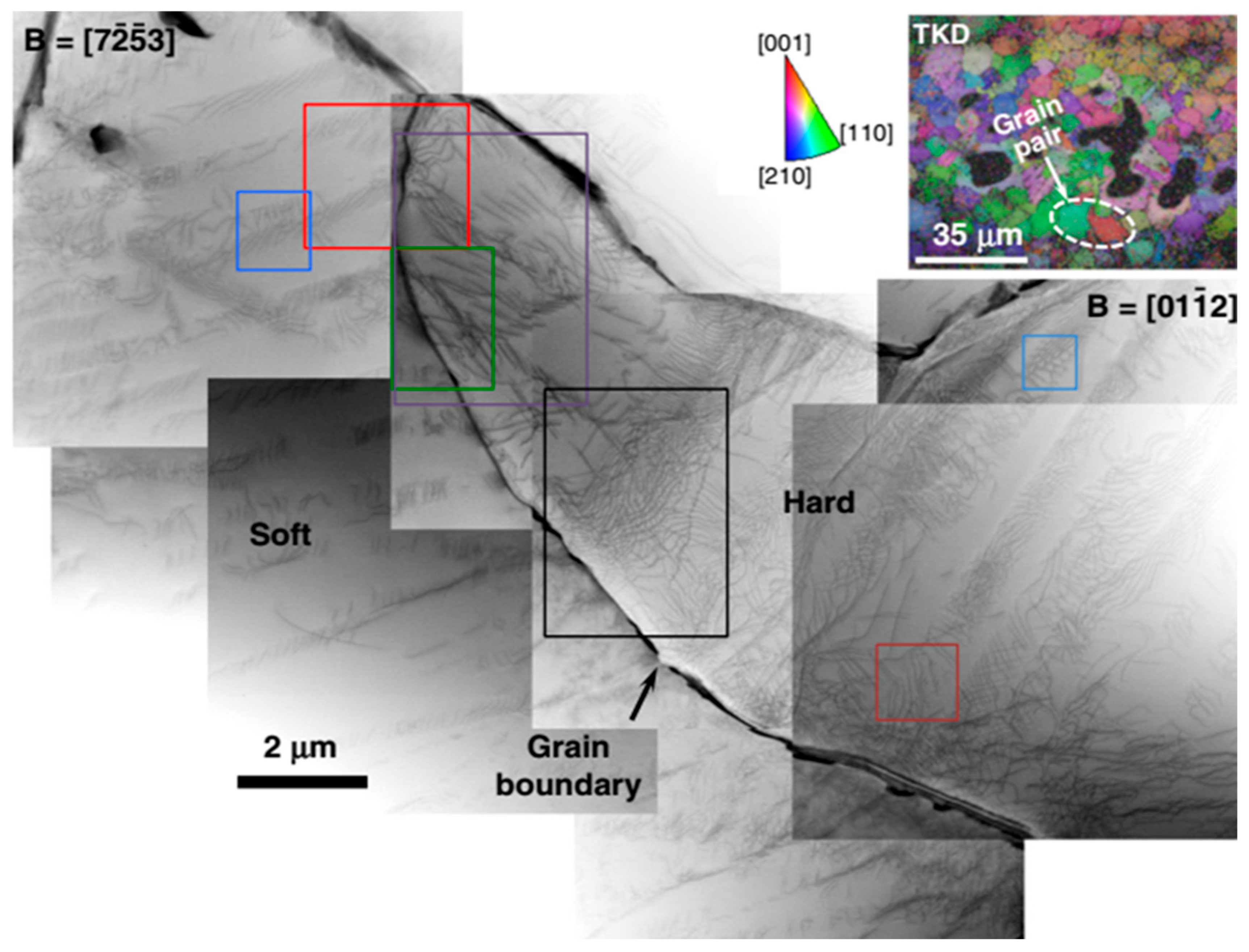
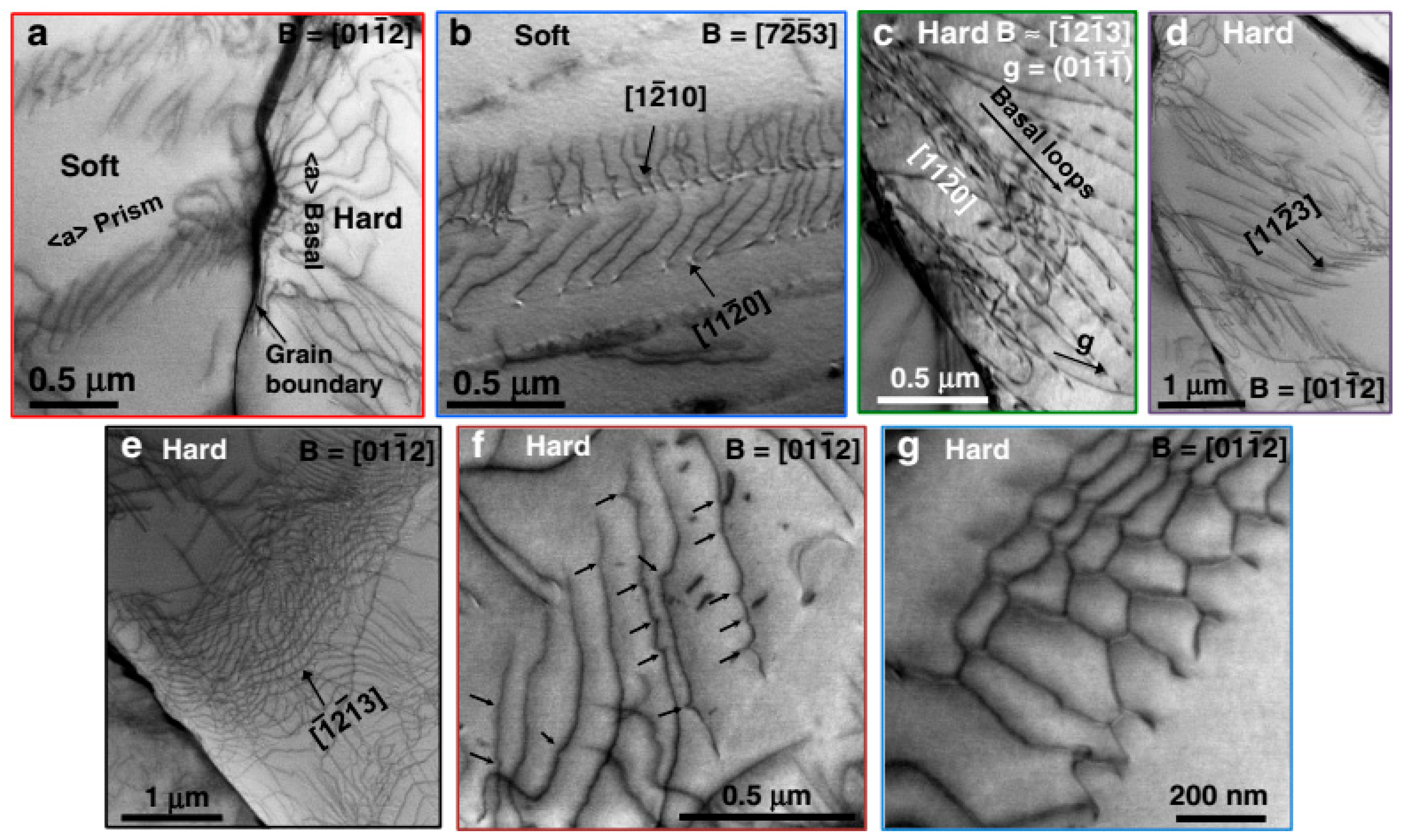
Yilun et al. [99] reported that stress transfer and concertation occur when prismatic dislocation pile-ups in a soft grain impinge on a hard grain. This interaction nucleates the basal dislocations within the hard grain. The study identified two distinct types of prismatic pile-ups responsible for this process, which also leads to the nucleation of basal dislocation loops from the GB. Furthermore, a 〈c + a〉 dislocation within a hard grain that undergoes cross-slip ultimately contributes to the formation of a complex 〈c + a〉 dislocation network. Figure 4 provides a detailed examination of the dislocation activity in this grain pair. Figure 4a reveals that dislocation pile-ups from the soft grain nucleate new dislocations in the hard grain upon boundary impingement. This involves prismatic pile-ups initiating basal dislocations. Two prism pile-up systems are active in the soft grain: the primary 11 2 ¯ 0   ( 1 1 ¯ 00 ) and the secondary 11 2 ¯ 0   ( 1 ¯ 010 ) (Figure 4b). In the hard grain, the nucleated [ 11 2 ¯ 0 ] basal dislocations form as boundary loops, while the 〈c + a〉 activity consists of pile-ups 1 1 ¯ 23   ( 1 ¯ 011 ) and long [ 1 ¯ 2 1 ¯ 3 ] dislocations (Figure 4c). Cross-slip of 〈c + a〉 is also detected, generating loop debris. Finally, residual 〈c + a〉 dislocation networks from annealing, capable of acting as sources, are observed in the hard grain (Figure 4d–g). Ismaeel et al. [30] investigated the stress distributions at different levels of strain. At lower strains, the stress distributions were quite homogeneous due to multiple 〈a〉-type slips tangling with each other [100]. At higher deformations, the microstructure stress distributions exhibited softening due to the interactions between 〈a〉 and 〈c + a〉 slip [69]. The activation of 〈c + a〉 slip plays a vital role in grain refinement [71] and accommodates the stress in hard α grains [101,102,103], which modifies the stress distributions and concentrations [104].

3.3. Role of β Phase in Accommodating Plasticity and Delaying Crack Initiation

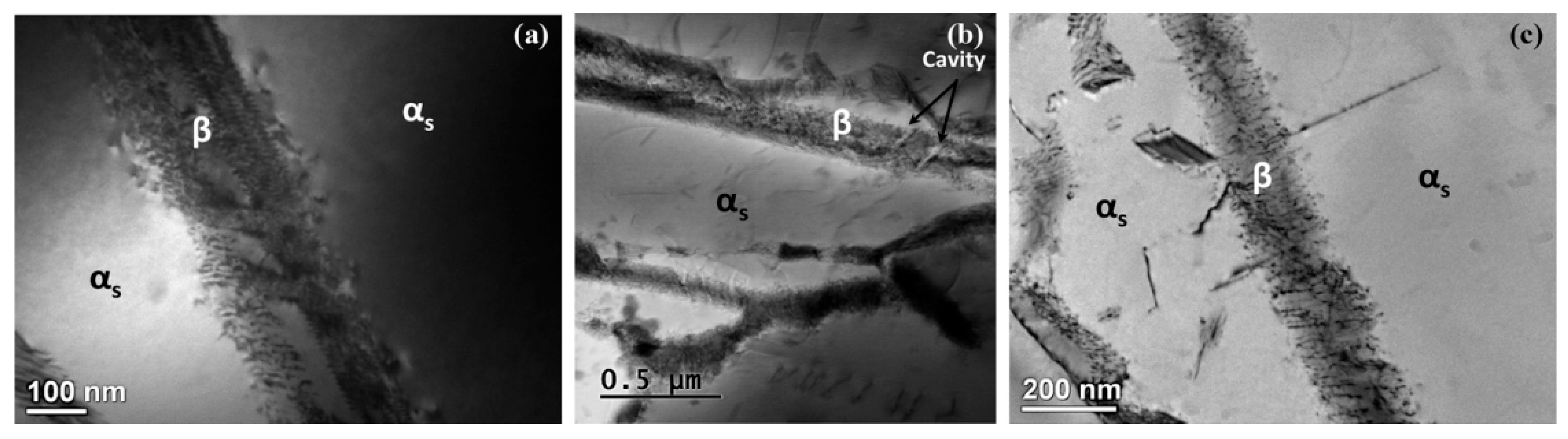
Sudha et al. [85] investigated dislocation bands in the β phase, as shown in Figure 5. The results show that dislocation-like cavities in the β phase were observed and dislocation interactions between the secondary α and β phases [85] enhanced the mechanical properties [52]. Figure 5a,b present the dislocation bands and cavities within the β phase, respectively. The formation of these cavities is attributed to load transfer from the secondary α to the β plates. Similar cavities have been documented in Ti-6242 at the intersections of secondary α slip bands and are considered potentially important for fatigue performance. Figure 5c illustrates the interaction between dislocations in the α and β phases. A high density of dislocations is also noted at the secondary α/β interface in Figure 5a,c. These were identified as misfit dislocations, which formed during the precipitation of the α phase as a result of the inherent lattice mismatch between the two phases; their presence was also confirmed in a sample analyzed prior to LCF testing. The β phase in α + β titanium alloys plays a critical role in enhancing plasticity and delaying crack initiation by mitigating the strain localization and stress concentrations that arise from the anisotropic deformation behavior of the α phase [105]. Due to its BCC crystal structure, the β phase possesses more slip systems and greater inherent ductility compared to the α phase [52], enabling it to accommodate plastic strain more effectively, particularly at α/β interfaces and GBs [3]. The β phase can act as a ductile buffer between differently oriented α grains, redistributing the stresses generated by dislocation pile-ups in hard-oriented α regions and preventing localized strain accumulation [67]. The BOR between the α and β phases facilitates slip transmission across interfaces, allowing for dislocations to propagate from the α phase into the β phase rather than forming damaging pile-ups [95]. This reduces the stress concentrations at the phase boundaries, a common site for void nucleation and fatigue crack initiation [67,82]. Additionally, the β phase can undergo stress-induced martensitic transformation in some alloys, further dissipating energy and delaying fatigue crack propagation [94]. In lamellar microstructures, the β phase layers between α colonies provide continuous pathways for slip, promoting more homogeneous deformation and reducing the likelihood of fatigue crack formation [67]. In equiaxed microstructures, the distribution and connectivity of the β phase determine its effectiveness in blunting cracks or deflecting their paths [94]. Generally, the β phase plays a dual role: it can either mitigate crack initiation by accommodating plasticity and dispersing slip, or exacerbate it when brittle or poorly bonded to the α phase [37].
The critical factor that controls the dual role of the β phase in fatigue behavior [26] is the content of β-stabilizing elements like V, Mo, and Cr. A stable β phase acts as a ductile barrier that is resistant to phase transformation. When dislocations from the α phase encounter this stable β phase, they are blocked, leading to dislocation pile-ups. This process distributes the strain more evenly and hardens the material. Furthermore, the chemically stable β phase can trap and absorb dislocations, affecting slip irreversibility in a more homogeneous manner and thereby delaying the nucleation of cracks [3]. When the β phase is ductile and tough, it forces a crack to deviate or branch during fatigue crack growth. This consumes more energy and increases a crack’s surface area, resulting in a tortuous crack path. Therefore, alloys with sufficient V, Mo, and Cr ensure that the β phase exhibits excellent fatigue resistance [46]. This is due to the stable β phase’s role in promoting slip band dispersion, blunting crack tips, and forcing crack deflection and branching, which collectively increase the energy required for crack propagation. In contrast, a metastable β phase is susceptible to stress-induced martensitic transformation (α’). The newly formed martensite (α’) is often hard and brittle. The stress concentration from dislocation pile-ups can trigger this transformation [43,106], and the resulting transformed zone, along with its interface with the matrix, provides an easy, brittle path for fatigue crack propagation. Cracks can propagate directly through these regions, leading to a relatively long crack path and reduced fatigue life.

4. Fatigue Crack Initiation and Early Growth

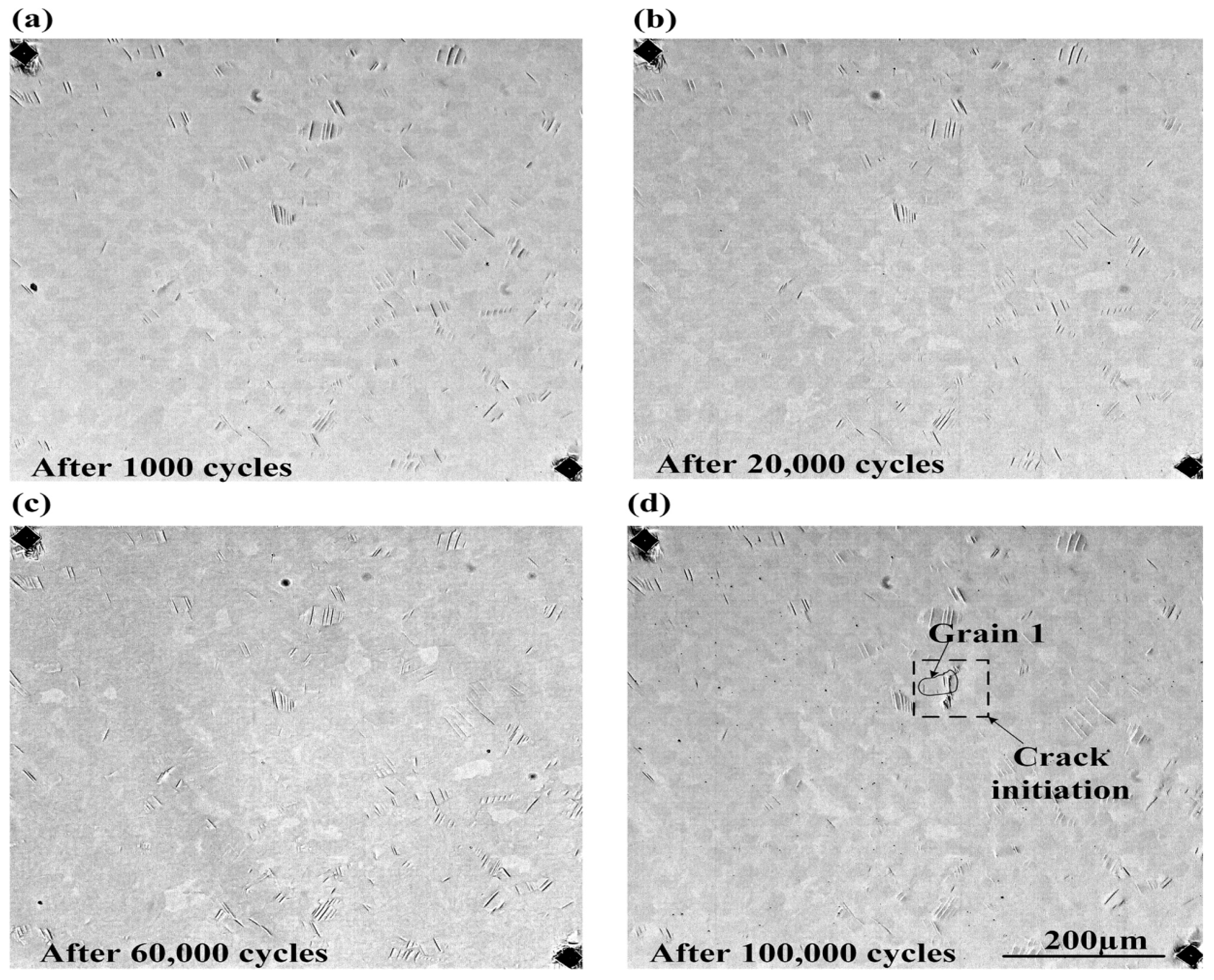
Liu et al. [7] investigated the slip traces process and fatigue cracking under different cyclic loadings, as shown in Figure 6. Their analysis of the fatigued sample revealed that under the applied test conditions, slip activity was confined solely to the primary α grains. Within the observed area of approximately 246 grains, 52 primary α grains exhibited slip traces after 1000 cycles (Figure 6a). This number saw only a minimal increase to 53 and 56 grains after 20,000 and 60,000 cycles, respectively (Figure 6b,c). By 100,000 cycles, no new slip traces had formed; instead, the onset of cracking was observed (Figure 6d). Therefore, fatigue cracks typically initiate at sites of intense plastic deformation, often associated with soft-oriented α grains favorably aligned for basal or prismatic slip [37], where PSBs form and create surface intrusions/extrusions [1,97]. In textured microstructures, clusters of similarly oriented α grains promote planar slip band formation [69,107], accelerating crack nucleation at GBs where dislocation pile-ups generate stress concentrations [95]. In lamellar microstructures, crack initiation often occurs at α colony boundaries or at interfaces with hard-oriented α grains [37], while in equiaxed microstructures, cracks tend to nucleate at α/β interfaces or within α grain clusters [105]. Kishan et al. [108] investigated crack growth at different stress amplitudes and numbers of cycles. Their findings showed that early crack growth follows crystallographic planes, with the growth rates influenced by the local texture and the resistance of the β phase to fatigue crack propagation [37], for a crack initiating within a primary α grain at 2 × 10³ cycles. As noted previously, the fastest growth occurs at crack lengths below 100 μm. Within this regime, the crack propagates transgranularly across multiple grains along a path slightly angled from the loading axis [109]. In contrast, the crack initiates across multiple transformed β grains. Its propagation morphology is relatively straight and oriented at an approximate 45 ° angle to the loading axis. However, different loading conditions can lead to different failure modes [110].
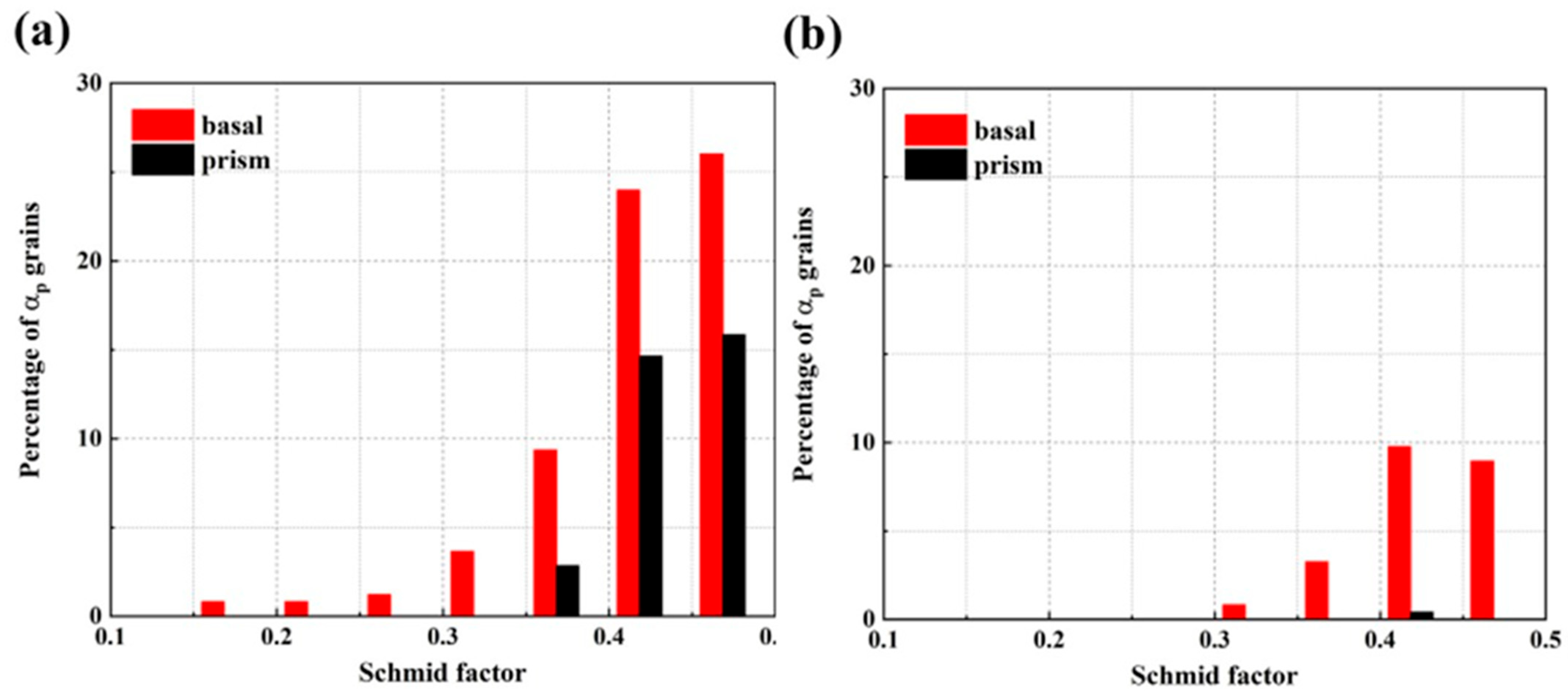
Liu et al. [7] investigated the influence of crystallographic orientation on active slip systems. Figure 7a presents the predicted distribution of basal and prismatic 〈a〉 slip. This prediction is based on assigning the slip system with the highest Schmid factor within each grain, calculated using EBSD-acquired orientations and the known applied stress direction. A comparison can be made with the experimentally observed slip traces after 60,000 cycles, shown in Figure 7b. Given the assumption that the basal and prismatic 〈a〉 slip have nearly identical critical resolved shear stress values, the analysis in Figure 7a indicates a marginal preference for basal slip activation. It is also evident that the grains favorably oriented for basal 〈a〉 slip exhibit a broad range of Schmid factors, whereas those well aligned for prismatic 〈a〉 slip are concentrated within a higher, more restricted Schmid factor range > 0.35. Changsheng et al. [111] investigated the fatigue initiation behavior in BM. The analysis revealed that fatigue cracks initiated at the primary α/β interface and readily coalesced with each other. The formation and growth of fatigue cracks occurred along the lamellar α/β interface. This confirmed that early crack propagation follows a crystallographic path along favorably oriented α grains or α colonies [112], with growth rates modulated by the local β phase distribution and texture [37]. The β phase can either retard crack growth through crack tip blunting by strengthening the alloy [113], or accelerate it when present as a continuous brittle network. This texture-dependent initiation and growth behavior directly impacts the alloy’s fatigue life and damage tolerance [94]. Defect structures (e.g., pores) provide stress concentration points that override the microstructural effects on crack initiation [1]. Therefore, the texture strongly influences fatigue crack initiation and early growth by governing the slip transfer, slip irreversibility, strain localization, and stress concentrations.

4.1. Preferred Crack Initiation Sites

4.1.1. The α/β Interfaces as Crack Initiation Sites

Changsheng et al. [111] investigated fatigue cracking at various sites. The analysis shows that fatigue cracks tend to nucleate preferentially at α/β interfaces and within slip bands in the lamellar α phase. These microcracks readily coalesce and propagate through the thin β phase. Subsequently, they grow along the equiaxed α/β interface to form a larger crack. This propensity for easy crack nucleation, which results from stress inhomogeneity at the interfaces in the BM, shortens the fatigue crack initiation life compared to the LM [111]. Furthermore, the mismatch in slip systems and elastic properties between the α and β phases leads to dislocation pile-ups and stress concentrations at the interfaces, which accelerates fatigue cracking [114]. While the β phase can accommodate some plasticity, poorly bonded or misoriented α/β interfaces act as preferential sites for void formation and microcrack nucleation [61,83]. The BOR may facilitate slip transmission in some cases, but deviations from this relationship promote interfacial cracking [114]. In transformed β regions, these high-angle boundaries act as strong barriers to slip transmission, causing strain accumulation and early crack formation along the boundary regions [94]. In equiaxed microstructures, groups of soft-oriented primary α grains with favorable prismatic 〈a〉 slip alignment serve as preferential sites for PSB formation and subsequent crack initiation due to localized cyclic plasticity [62]. The α/β interfaces, particularly those with misorientations deviating from the BOR, create stress concentrations from dislocation pile-ups [95], leading to interface decohesion and microcrack nucleation.

4.1.2. GBs as Crack Initiation Sites

Lavogiez et al. [6] investigated the internal cracks formed during cyclic loading. The findings indicate that numerous internal cracks nucleate early and propagate throughout most of the cycling process. Each crack is linked to a fracture along (0001) twist GBs, which initiates at such boundaries but then propagates away from them via transgranular cracking through primary α grains. This transgranular segment deviates from the basal plane trace by approximately 14°. The specimen was bent and examined using SEM to verify that the smooth facets on the fracture surface originated from (0001) twist boundary cracking. Despite the plastic deformation induced by bending, these smooth facets were still identified as cracked (0001) twist boundaries. Strongly textured alloys and clusters of grains with similar orientations favor planar slip bands that impinge on boundaries, accelerating fatigue damage [69,107]. Hard-oriented α grains requiring a pyramidal 〈c + a〉 slip accumulate dislocations at GBs, generating stress concentrations that initiate microcracks in adjacent softer grains [99]. Yilun et al. [99] investigated the dislocation structures in a soft/hard grain pair of a sample under dwell loading (Figure 8). The analysis showed that cracks formed along the soft/hard GBs with respect to the loading direction [99]. Dislocation pile-ups were observed in both the soft and hard grains, with a significantly greater density present in the hard grain. The nucleation of new dislocations within the hard grain was triggered at the boundary, where pile-ups from the soft grain impinged upon it. Prismatic slip planes provided the alloy with easy and multiple types of slip [5], which introduced more obstacles to crack initiation due to the interaction with pyramidal 〈c + a〉 dislocations [7,8]. These actions released the strain accumulation at the GBs.
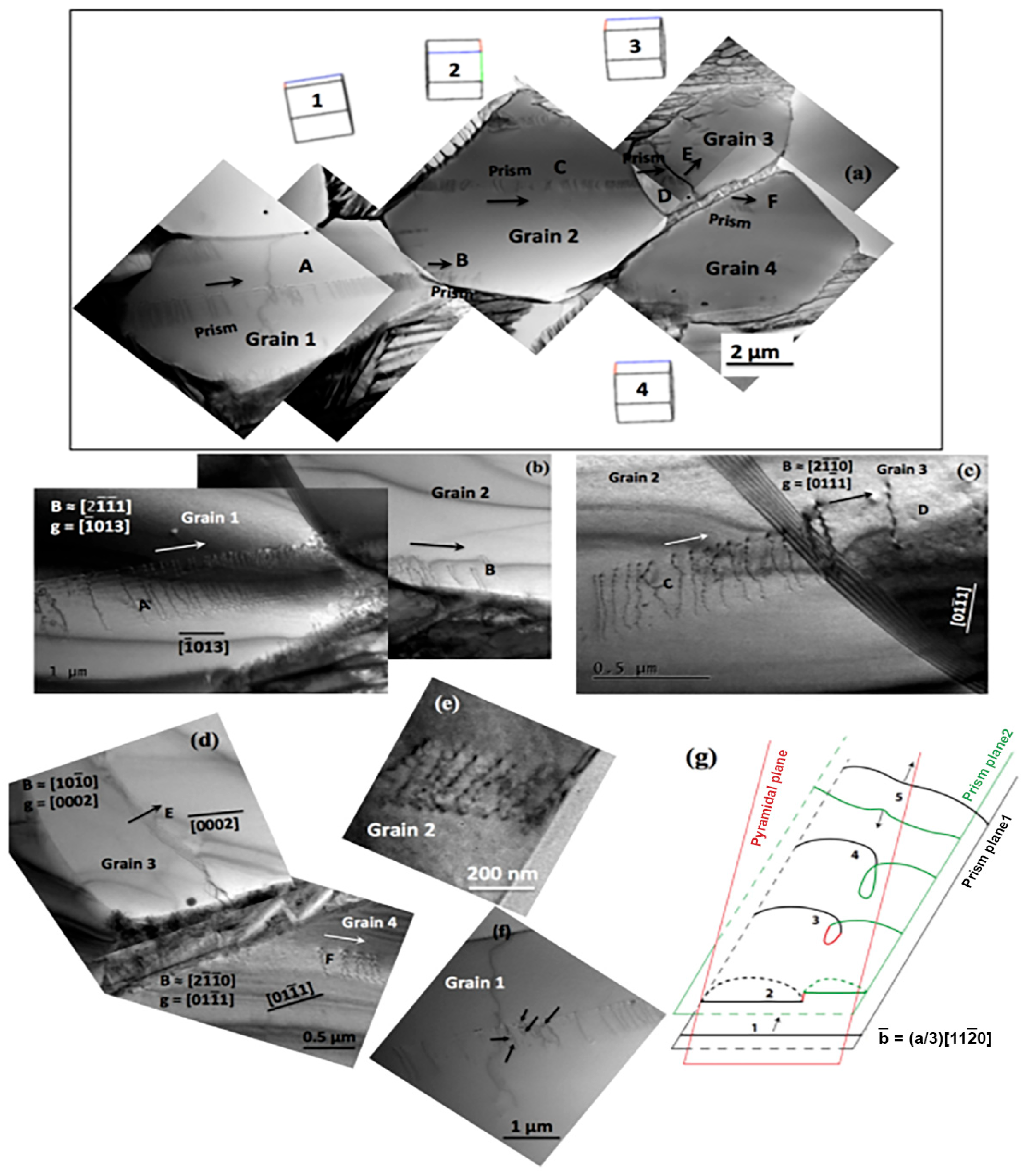
Sudha et al. [85] investigated the slip transfer across primary α grains and the GB (Figure 9). As shown in Figure 9a, slip transfer was observed between two similarly oriented grains within a microtextured region, both with their [ 10 1 ¯ 0 ] direction aligned near the loading axis. The dislocation line directions suggest a screw character. In Grains 1 and 2, the activated a 3 prism slip transferred directly across their shared boundary, which is clearly visible in Figure 9b,c. A different mechanism is illustrated in Figure 9d for the boundary between Grains 3 and 4. Here, the strain was transferred as c + a 2 pyramidal slip from Grain 3 impinging on the boundary, which in turn was activated and ejected as a 3 prismatic slip dislocations in the adjacent Grain 4. An analysis of the slip traces (Figure 9e) indicates that the dislocations within the band were gliding on multiple distinct planes. Furthermore, several cross-slip events were observed at the center of the grain (Figure 9f), a process that generated new dislocations and left behind dislocation debris. These observations, highlighted by arrows in Figure 9f, provide direct evidence supporting the proposed mechanism. In α-Ti, cross-slip was anticipated to occur primarily between the prismatic and pyramidal planes due to the core structure of 〈a〉 screw dislocations being spread across both. The schematic in Figure 9g illustrates the potential mechanism for this form of dislocation multiplication.
The dislocation activities, accompanied by dislocation pile-ups and dislocations generated by multiple cross-slips [85], resulted in crack initiation along the GBs of hard and soft grains. Liu et al. [7,8] reported that with increasing cycle numbers, the grains with basal slip trace shifted away from the region where the Schmidt factor was highest for basal slip towards the [0001] pole [79]; these specific orientations correspond to prismatic slip with a medium Schmidt factor [80]. This observation is similar to the influence of CRSS on basal slip, because the grains develop cracks at a lower CRSS for basal slip [30]; these grains are assumed to have higher dislocation densities at the GBs [108]. However, the prismatic dislocation slip interacts with the pyramidal a and pyramidal 〈c + a〉 dislocations and GBs, leading to GB strengthening [71] and delayed fatigue cracking [5].

4.1.3. Slip Irreversibility as Crack Initiation Mechanism

Crack formation during fatigue loading is a direct result of damage accumulation at the microstructural level, primarily caused by irreversible slip [115,116,117,118]. Since dislocation slip is the principal mode of plastic deformation for most metals, this irreversibility means that not all deformation is recovered at the end of each load cycle. Over many cycles, this accumulated, unreversed damage, which is highly sensitive to the material’s microstructure, eventually manifests as a fatigue crack [1,116]. In addition, crack initiation under low-cycle fatigue stems from irreversible deformation at the atomic scale, specifically the movement of dislocations [119]. This motion occurs through slip or twinning within the crystal lattices, with slip being the dominant process in most Ti alloys. Under cyclic loading, the progressive accumulation of slip leads to strain localization, which ultimately results in crack formation [116,117]. The specific nature of this process is governed by the material’s unique microstructure and its strengthening mechanisms. In their investigation of crack initiation, Changsheng et al. [111] calculated the cyclic slip irreversibility parameter, denoted as (p) [111,116,118], to investigate the crack initiation behavior of BM and LM [111]. An according to [111], the calculated p value for the LM was significantly lower than for the BM. This result indicates that a greater proportion of dislocation slip is irreversible during each cycle in the BM compared to the LM under similar applied stress conditions.
Fatigue crack initiation and early growth are strongly influenced by the microstructural features, such as regions exhibiting high slip irreversibility [1], all of which are modulated by the texture [120]. Crack initiation typically occurs at sites of strain localization, where cyclic slip becomes irreversible due to microstructural barriers, such as GBs and α/β interfaces [120]. Regions with high slip irreversibility, where dislocations cannot fully reverse during cyclic loading, develop PSBs [1,2,3], leading to surface roughening and crack initiation [121]. This is exacerbated in hard-oriented α grains, where limited slip systems restrict the strain accommodation. When considering slip irreversibility as a crack initiation mechanism due to different textures, it is evident that a basal texture has fewer aligned grains and several grains with their basal planes orientated parallel to the surface [120], and leads to a wider slip distribution due to the contribution of a few soft–hard grain pairs [80]. The slip will be less intense and more spread out in basal planes [72]. In contrast, the mixed nature of a basal/transverse texture leads to mixed characteristics due to the basal plane being normal and the basal plane being transverse [120]. With this texture, the intersection of two texture components might affect the slip activity, resulting in fatigue cracking [7,8]. However, a transverse texture has many grains oriented in a specific direction, resulting in an intense plastic deformation along the GBs of the most oriented grains, which restricts slip activity, resulting in high slip irreversibility and early crack initiation compared to basal and basal/transverse textures [7,8]. Therefore, the total slip was investigated for different textures [72]; the results revealed that a basal texture has the highest total slip due to a few soft/hard grain pairs and basal planes parallel to the surface [72,108,122]. A transverse texture has the lowest total slip due to the restrictions on slip activity; the slip is activated along grains aligned in one direction, resulting in slip irreversibility [65,107]. In contrast, basal/transverse has an intermediate total slip value due to the mixed grain orientations, which enhance fatigue resistance [86]. It might have a lower slip irreversibility compared to a transverse texture and be higher than that for a basal texture. One can conclude that the fatigue behavior of titanium alloys is strongly controlled by the microstructure morphologies (equiaxed, lamellar, bimodal), microstructural features (e.g., various textures), GBs, and α/β interfaces.

4.2. Fatigue Cracking Mechanisms

4.2.1. PSBs in α Grains

Fatigue crack initiation predominantly occurs through the formation of PSBs within α grains, particularly those favorably oriented for prismatic slip [1,2,3], accompanied by slip steps in soft α grains on the specimen’s surface. During cyclic loading, localized plastic deformation accumulates in these soft-oriented α grains, leading to irreversible slip [1] and the formation of PSBs [97]. These bands manifest as highly localized zones of intense slip [73], creating surface intrusions and extrusions that serve as stress concentrators and nucleation sites for fatigue cracking [6,7,8]. The early growth of these cracks follows a crystallographic path along the activated slip planes (prism or basal planes) [7], progressing until they encounter microstructural barriers, such as GBs, α/β interfaces, or hard-oriented α grains [99]. The β phase plays a dual role: it can either hinder crack growth by blunting the crack tip through its plastic deformation [94] or promote further propagation if the crack deflects along brittle α/β interfaces.

4.2.2. Crack Nucleation Due to Dislocation Accumulation

Zhihong et al. [79] investigated the dislocation activities near an internal crack initiation site. A high density of dislocations was evident within some grains, which underwent deformation primarily through localized planar basal slip bands. Additionally, the result showed two adjacent basal slip bands merged or a single band diverged into two, a phenomenon likely caused by cross-slip that could account for the observed facets being slightly inclined from the basal planes [95]. Furthermore, dislocations with 〈a〉-type BVs, reported as ( 1 / 3 )   [ 1 2 ¯ 10 ] and ( 1 / 3 )   [ 2 ¯ 110 ] [79], had tightly packed pile-ups. This study illustrates that fatigue cracking predominantly occurs through microcrack nucleation at sites of dislocation accumulation within α grains, driven by cyclic slip activity [7]. In the α phase, dislocations preferentially glide along prismatic planes in favorably oriented grains, accumulating at microstructural barriers such as GBs and α/β interfaces, and also accumulating due to different 〈a〉 and 〈c + a〉 dislocation tangles with each other [114]. These accumulations create localized stress concentrations that eventually nucleate microcracks [24], which initially propagate along active slip planes, typically prismatic { 10 1 ¯ 0 } or basal {0001} systems [6,7,8], in a crystallographic manner [114]. The process is strongly influenced by the α grain orientation, with soft-oriented grains accumulating dislocations more rapidly and with the slip planarity inherent to the HCP structure [107], which promotes localized slip bands. The interface cohesion and dislocation mobility, affected by the alloying elements and precipitates [98], further modulate fatigue crack initiation resistance. This dislocation-mediated mechanism dominates the early fatigue stages before transitioning to long-crack growth and propagation [108], with microstructural optimization through grain refinement and texture control offering pathways to enhance fatigue life by mitigating fatigue damage accumulation.

4.2.3. Fatigue Failure Due to Microtexture and Microvoid

The microtexture significantly influences fatigue crack initiation and early growth by governing the slip length [123] and crack path deviation through local crystallographic orientation variations [9]. Microcracks preferentially initiate at microstructural stress concentrators, such as α/β interfaces or dislocation accumulations in soft-oriented α grains [124]. As these microcracks begin to propagate, the surrounding microtexture, defined by clusters of similarly oriented α grains or colonies, dictates their growth trajectory [9]. Regions with sharp microtexture gradients cause crack path deviation when the advancing crack encounters abrupt changes in the grain orientation [124]. For example, cracks propagating along prismatic planes in one α grain may deflect upon meeting a neighboring grain with hard-oriented basal planes, forcing the crack to either reorient along a new slip system or bypass the obstacle through interface decohesion [63]. The β phase distribution further modulates this behavior; continuous β networks may channel cracks along α/β interfaces, while isolated β particles can promote crack branching [124]. These microtexture-induced deviations increase a crack’s tortuosity, effectively raising the energy required for propagation and enhancing fatigue resistance [63]. However, in strongly textured alloys with large colonies of similarly oriented grains, cracks may propagate linearly with minimal deviation, accelerating failure [124].
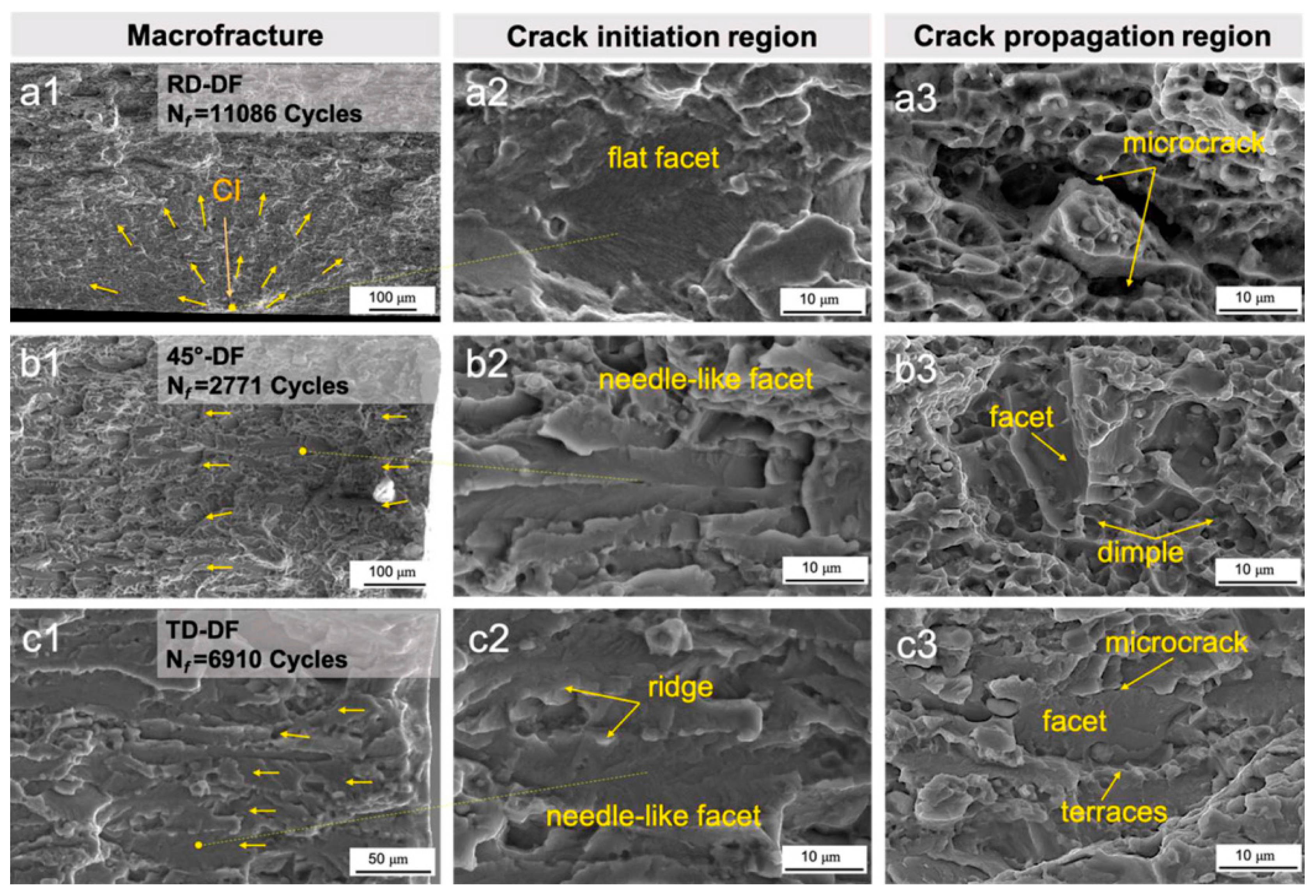
Runchen et al. [65] investigated the fracture surface cracks along the RD, 45 ° , and TD loadings. Their results are shown in Figure 10. The findings revealed that the fracture initiation site for the RD specimen was located near the surface, featuring a polished planar appearance. The primary crack nucleated in this area, where the facets displayed coarse, semi-elliptical characteristics (see Figure 10(a1,a2)). The propagation region revealed tortuous microcracks linked by microvoids (Figure 10(a3)), suggesting a failure mechanism driven by microvoid coalescence [125,126]. Like microvoids, the residual stress strongly influenced the slip activity [127], leading to fatigue cracking and material failure [128]. In contrast, the 45° specimen exhibited a fractured surface with a rugged topography of facets bounded by ridges. The initiation zone contained needle-like, smooth facets that formed steps (Figure 10(b1,b2)). The presence of transgranular fractures and minimal torn ridges implied early crack formation. Conversely, Figure 10(b3) shows the propagation region exhibited smooth facets surrounded by dimples, pointing to substantial plasticity during loading. The TD specimen had a notably flat fracture surface with subsurface initiation sites. These initiation facets were polished and encircled by irregular ridges (Figure 10(c1,c2)). Elongated complementary facets were interconnected in a step-like manner parallel to the RD. The propagation region (Figure 10(c3)) featured elongated, complementary facets aligned with the RD, indicating a quasi-cleavage mechanism.

4.3. Effect of Texture on Fatigue Crack Initiation and Growth Mechanisms

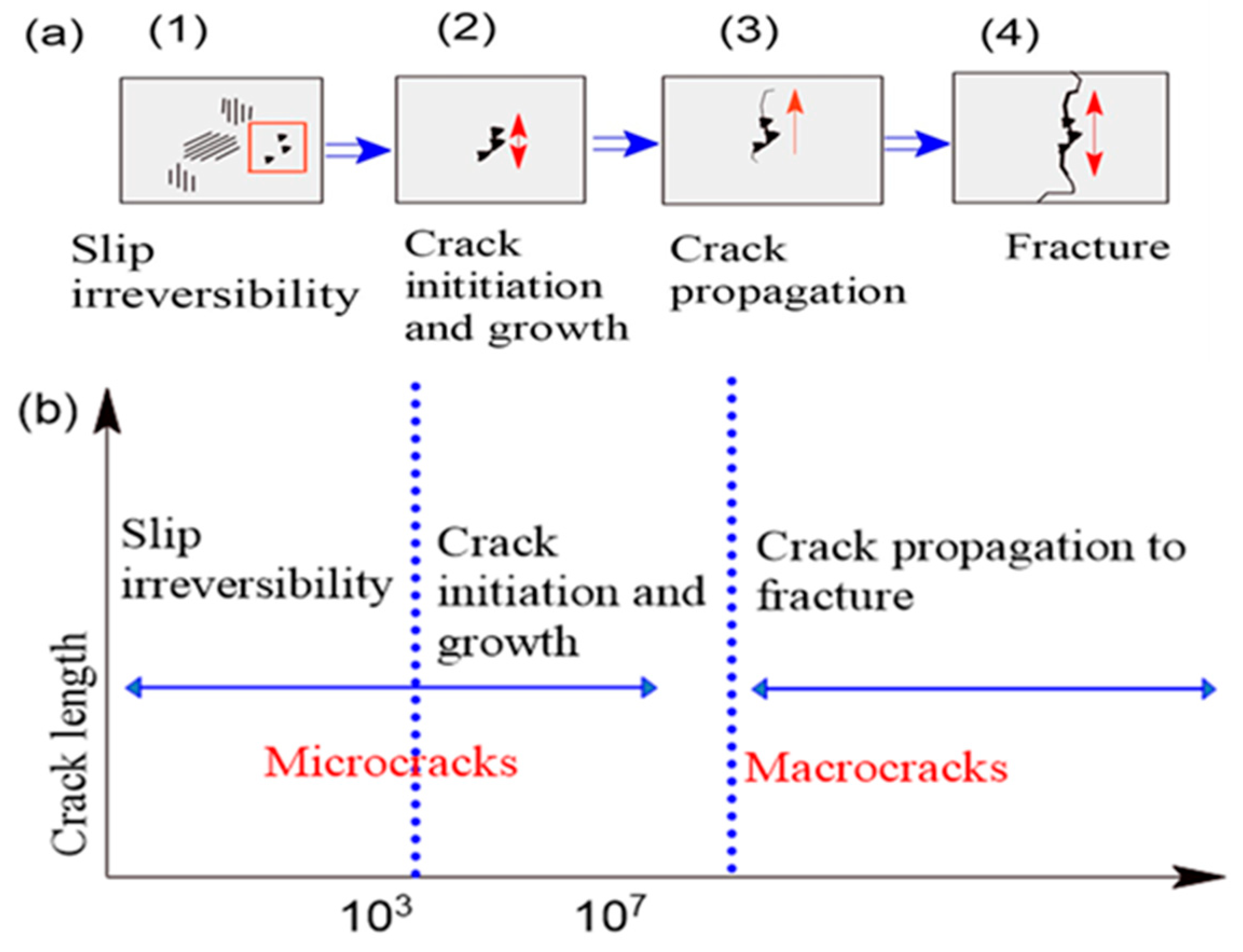
Compared to basal/transverse and transverse textures, a basal texture showed the highest fatigue resistance [120] because it has a few soft–hard grain combinations and promotes slip distribution, thereby relaxing and reducing the stress concentrations [11]. In contrast, basal/transverse and transverse textures have planes of weakness. When these textures are subjected to cyclic loading, the applied stress causes crack initiation and growth along these planes [120,129,130]. Considering the loading directions, the easy activation of 〈a〉 slips systems along the RD, which leads to stress relaxation and uniform stress distribution, results in higher fatigue resistance [120,129,130]. Conversely, the (0001) planes lead to stress heterogeneities along the TD, while no stress acts in the basal planes along the RD. In Ti alloys, crack nucleation rather than crack growth [131,132] occurs because microcracks in fracture surfaces with low propagation rates appear ductile without pronounced crystallographic orientations [120,129]. To better understand the fatigue failure, a schematic diagram illustrating the mechanisms based on crack size (Figure 11a) and crack length (Figure 11b) is presented in Figure 11. This failure mechanism can be divided into three main regimes based on the crack length, with four stages based on the crack size. The first regime is fatigue crack initiation due to slip irreversibility at the α/β interfaces and GBs along the crystallographic slip planes [7,8]; it has limited resistance below 10 3 cycles [120,129,130]. Under this regime, the material tends to develop cracks in regions where concentrated high stress and localized strain [133] have developed. The β phase in Stage 1 acts as a ductile barrier, which strengthens the material and distributes the strain more evenly, mitigating strain localization. The second regime is fatigue initiation and crack growth (between 10 3 and 10 7 cycles); under this regime, the intense plastic slip that accumulated during the first regime will progressively open the microcracks, and their growth in size and length will increase as a ratio [120,129]. The β phase can absorb and trap dislocations, increasing the slip irreversibility in a more homogeneous manner and thereby delaying the nucleation of a crack during Stage 2. During fatigue crack growth, the β phase forces blunt crack tipping by spreading the stress out, making it much harder for a crack to grow. This process significantly slows the crack’s growth. The third regime is fatigue crack propagation to fracture failure (above 10 7 cycles); under this regime, a crack will propagate along the direction of applied loading until fracture failure [132]. The β phase blocks and forces a crack to deviate and branch during its propagation in Stage 3. This increases the crack’s surface area, consumes more energy, and results in a tortuous crack path in Stage 4, which increases fatigue life. In some Ti alloys, fatigue cracks initiate at the metal surface as a result of slip steps [7], the coalescence of defects [134,135,136], and the pre-existence microcracks [137,138,139]. The crack sizes and distributions significantly affect the fatigue behaviors [137,138,139,140,141]. It is well known that the fatigue behaviors of titanium alloys depend on the slip anisotropy; hence, several studies have aimed to improve the strength [142] and fatigue properties [133,143] through self-diffusion to improve the interior and surface crack initiation resistance. Prior aging of precipitate phase regions (e.g., Ti3Al) enhances the early fatigue crack initiation resistance [144].

5. Summary

In this review, the interplay between slip activity, microplasticity, and fatigue cracking mechanisms in near-α and α + β titanium alloys governs their deformation behavior under cyclic loading. This review highlights that fatigue cracking predominantly occurs in soft-oriented α grains, where localized slip leads to PSBs, strain localization, and dislocation pile-ups at microstructural barriers, such as GBs and α/β interfaces. The following conclusions are drawn:
  • The slip irreversibility mechanism involves incomplete dislocation reversal, which forms PSBs in hard grains and localizes strain in soft grains, which initiates fatigue cracks. This is most severe in misoriented–oriented α grains with limited slip systems.
  • Fatigue cracks nucleate as the result of irreversible slip, where each cycle accumulates microplasticity and dislocation pile-ups. Also, this irreversible slip creates a slip step and slip trace on the surface or accumulates damage internally, resulting in materials failure.
  • Favorably oriented α grains initiate early slip and fatigue damage accumulations, and easy slip transfer or transmission leads to stress relaxation and delays fatigue cracking, while the β phase has a dual role: it can mitigate cracking through ductile deformation or exacerbate it through a brittle interface.
  • Strain localization develops in kinematically soft α grains where 〈a〉 slip systems are misoriented, forming intense deformation bands. These bands, manifesting as slip bands, are driven by their microstructure (α grain morphology, β phase distribution, and texture), and directly result in fatigue crack initiation.
  • Cracks initiate preferentially at GBs and at α/β interfaces due to the stress concentrations from slip system mismatch and dislocation pile-ups. These microcracks readily coalesce through soft α grains and the β phase and propagate along the interfaces, forming larger, critical cracks.
  • A bimodal microstructure, with its highly irreversible slip, accumulates fatigue damage much more rapidly at blocked GBs and α/β interfaces, leading to earlier crack initiation compared to a lamellar microstructure, where the slip is more distributed and reversible. A transverse texture is more prone to slip irreversibility than basal/transverse and basal textures.

6. Outlook

Researchers have dedicated extensive work to understanding the underlying physical micromechanisms that link slip events to microplasticity, fatigue crack initiation, and growth. These works have offered valuable insights for alloy design and fatigue prediction in near-α and α + β alloys. However, several key areas still require further advancement to improve fatigue resistance:
  • Future research based on this review should focus on controlling microstructural heterogeneities, texture, and β phase distribution to improve fatigue damage tolerance by resisting crack initiation. Additionally, prior aging to form precipitates like Ti3Al enhances early fatigue resistance.
  • Future research should compare how key interfaces, such as α/α GBs, α/β boundaries, and colony boundaries, control slip transfer, act as dislocation barriers, and dictate cracking. A multi-scale study is needed to quantify their relative effects for integration into predictive fatigue models.
  • Future research should investigate the concept of slip irreversibility as a golden thread linking microplasticity to the nucleation of fatigue cracking, because slip irreversibility is the fundamental driver of the accumulation of microplastic damage that eventually leads to fatigue crack initiation.
  • Future research should focus on a multi-scale modeling framework to quantitatively link slip irreversibility with texture, validated by high-resolution DIC and EBSD. This critical step will move fatigue prediction from qualitative observation to a fundamental physics, mechanics-based model for both conventional and AM microstructures.

Author Contributions

A.I.: Writing—original draft, Writing—review and editing, Funding acquisition, Methodology, Project administration, Supervision, Conceptualization. X.L.: Writing—review and editing, Methodology. X.J.: Writing—review and editing, Methodology. A.J.: Writing—review and editing, Conceptualization. Z.C.: Writing—review and editing, Methodology, Conceptualization. X.F.: Writing—review and editing, Conceptualization. D.X.: Writing—original draft, Methodology, Supervision, Conceptualization. X.C.: Writing—review and editing, Project administration. W.L.: Writing—review and editing, Funding acquisition, Project administration. All authors have read and agreed to the published version of the manuscript.

Funding

This research received no external funding.

Data Availability Statement

No new data were created or analyzed in this study. Data sharing is not applicable to this article.

Acknowledgments

This work was supported by the School of Mechanical and Electrical Engineering, Quanzhou University of Information Engineering.

Conflicts of Interest

The authors declare that they have no known competing financial interests or personal relationships that could have appeared to influence the work reported in this paper.

References

  1. Sangid, M.D. The physics of fatigue crack initiation. Int. J. Fatigue 2013, 57, 58–72. [Google Scholar] [CrossRef]
  2. Bieler, T.; Eisenlohr, P.; Zhang, C.; Phukan, H.; Crimp, M. Grain boundaries and interfaces in slip transfer. Curr. Opin. Solid State Mater. Sci. 2014, 18, 212–226. [Google Scholar] [CrossRef]
  3. Wang, K.; Li, H.; Zhou, Y.; Wang, J.; Xin, R.; Liu, Q. Dislocation slip and crack nucleation mechanism in dual-phase microstructure of titanium alloys: A review. Acta Metall. Sin. 2023, 36, 353–365. [Google Scholar] [CrossRef]
  4. Hémery, S.; Stinville, J.; Wang, F.; Charpagne, M.; Emigh, M.; Pollock, T.; Valle, V. Strain localization and fatigue crack formation at (0001) twist boundaries in titanium alloys. Acta Mater. 2021, 219, 117227. [Google Scholar] [CrossRef]
  5. Hémery, S.; Villechaise, P.; Banerjee, D. Microplasticity at room temperature in α/β titanium alloys. Metall. Mater. Trans. A 2020, 51, 4931–4969. [Google Scholar] [CrossRef]
  6. Lavogiez, C.; Dureau, C.; Nadot, Y.; Villechaise, P.; Hémery, S. Crack initiation mechanisms in Ti-6Al-4V subjected to cold dwell-fatigue, low-cycle fatigue and high-cycle fatigue loadings. Acta Mater. 2023, 244, 118560. [Google Scholar] [CrossRef]
  7. Liu, C.; Thomas, R.; Sun, T.; Donoghue, J.; Zhang, X.; Burnett, T.L.; da Fonsca, J.Q.; Preuss, M. Multi-dimensional study of the effect of early slip activity on fatigue crack initiation in a near-α titanium alloy. Acta Mater. 2022, 233, 117967. [Google Scholar] [CrossRef]
  8. Liu, C.; Xu, X.; Sun, T.; Thomas, R.; da Fonseca, J.Q.; Preuss, M. Microstructural effects on fatigue crack initiation mechanisms in a near-alpha titanium alloy. Acta Mater. 2023, 253, 118957. [Google Scholar] [CrossRef]
  9. Hémery, S.; Truong, D.; Signor, L.; Villechaise, P. Influence of Microtexture on Early Plastic Slip Activity in Ti-6Al-4V Polycrystals. Metall. Mater. Trans. A 2018, 49, 2048–2056. [Google Scholar] [CrossRef]
  10. Hémery, S.; Stinville, J. Microstructural and load hold effects on small fatigue crack growth in α+ β dual phase Ti alloys. Int. J. Fatigue 2022, 156, 106699. [Google Scholar] [CrossRef]
  11. Bridier, F.; Villechaise, P.; Mendez, J. Slip and fatigue crack formation processes in an α/β titanium alloy in relation to crystallographic texture on different scales. Acta Mater. 2008, 56, 3951–3962. [Google Scholar] [CrossRef]
  12. Briffod, F.; Shiraiwa, T.; Enoki, M.; Emura, S. Effect of macrozones on fatigue crack initiation and propagation mechanisms in a forged ti-6Al-4V alloy under fully-reversed condition. Materialia 2022, 22, 101401. [Google Scholar] [CrossRef]
  13. Yapici, G.G.; Karaman, I.; Luo, Z.-P. Mechanical twinning and texture evolution in severely deformed Ti–6Al–4V at high temperatures. Acta Mater. 2006, 54, 3755–3771. [Google Scholar] [CrossRef]
  14. Xue, Q.; Ma, Y.; Lei, J.; Yang, R.; Wang, C. Mechanical properties and deformation mechanisms of Ti-3Al-5Mo-4.5 V alloy with varied β phase stability. J. Mater. Sci. Technol. 2018, 34, 2507–2514. [Google Scholar] [CrossRef]
  15. Huang, S.; Zhang, J.; Ma, Y.; Zhang, S.; Youssef, S.S.; Qi, M.; Wang, H.; Qiu, J.; Xu, D.; Lei, S.; et al. Influence of thermal treatment on element partitioning in α+β titanium alloy. J. Alloys Compd. 2019, 791, 575–585. [Google Scholar] [CrossRef]
  16. Wang, B.; Liu, H.; Zhang, Y.; Zhou, B.; Deng, L.; Wang, C.; Chen, J.; Zhang, Y. Effect of grain size on twinning behavior of pure titanium at room temperature. Mater. Sci. Eng. A 2021, 827, 142060. [Google Scholar] [CrossRef]
  17. Tsuru, T.; Itakura, M.; Yamaguchi, M.; Watanabe, C.; Miura, H. Dislocation core structure and motion in pure titanium and titanium alloys: A first-principles study. Comput. Mater. Sci. 2022, 203, 111081. [Google Scholar] [CrossRef]
  18. Zhu, Z.; Chen, Z.; Wang, R.; Liu, C. Forced shear deformation behaviors of annealed pure titanium under quasi-static and dynamic loading. Mater. Sci. Eng. A 2022, 839, 142872. [Google Scholar] [CrossRef]
  19. Ma, X.; Chen, Z.; Xiao, L.; Luo, S.; Lu, W. Stress-induced martensitic transformation in a β-solution treated Ti–10V–2Fe–3Al alloy during compressive deformation. Mater. Sci. Eng. A 2021, 801, 140404. [Google Scholar] [CrossRef]
  20. Haftlang, F.; Zarei-Hanzaki, A.; Abedi, H.R.; Kalaei, M.A.; Nemecek, J.; Málek, J. Room-temperature micro and macro mechanical properties of the metastable Ti–29Nb–14Ta–4.5 Zr alloy holding nano-sized precipitates. Mater. Sci. Eng. A 2020, 771, 138583. [Google Scholar] [CrossRef]
  21. Wang, J.; Zhao, Y.; Zhou, W.; Zhao, Q.; Huang, S.; Zeng, W. In-situ investigation on tensile deformation and fracture behaviors of a new metastable β titanium alloy. Mater. Sci. Eng. A 2021, 799, 140187. [Google Scholar] [CrossRef]
  22. Anderson, P.M.; Hirth, J.P.; Lothe, J. Theory of Dislocations; Cambridge University Press: Cambridge, UK, 2017. [Google Scholar]
  23. Wei, S.; Zhu, G.; Tasan, C.C. Slip-twinning interdependent activation across phase boundaries: An in-situ investigation of a Ti-Al-V-Fe (α + β) alloy. Acta Mater. 2021, 206, 116520. [Google Scholar] [CrossRef]
  24. Wei, S.; Kim, J.; Tasan, C.C. In-situ investigation of plasticity in a Ti-Al-V-Fe (α + β) alloy: Slip mechanisms, strain localization, and partitioning. Int. J. Plast. 2022, 148, 103131. [Google Scholar] [CrossRef]
  25. Htwe, Y.; Kwak, K.; Kishi, D.; Mine, Y.; Ding, R.; Bowen, P.; Takashima, K. Anisotropy of <a> slip behaviour in single-colony lamellar structures of Ti–6Al–4V. Mater. Sci. Eng. A 2018, 715, 315–319. [Google Scholar] [CrossRef]
  26. Williams, J.; Baggerly, R.; Paton, N. Deformation behavior of HCP Ti-Al alloy single crystals. Metall. Mater. Trans. A 2002, 33, 837–850. [Google Scholar] [CrossRef]
  27. Zhou, Y.; Wang, K.; Yan, Z.; Xin, R.; Wei, S.; Wang, X.; Liu, Q. Ex-situ study on mechanical properties and deformation mechanism of three typical microstructures in TA19 titanium alloy. Mater. Charact. 2020, 167, 110521. [Google Scholar] [CrossRef]
  28. Zhao, J.; Lv, L.; Wang, K.; Liu, G. Effects of strain state and slip mode on the texture evolution of a near-α TA15 titanium alloy during hot deformation based on crystal plasticity method. J. Mater. Sci. Technol. 2020, 38, 125–134. [Google Scholar] [CrossRef]
  29. Yan, Z.; Wang, K.; Zhou, Y.; Zhu, X.; Xin, R.; Liu, Q. Crystallographic orientation dependent crack nucleation during the compression of a widmannstätten-structure α/β titanium alloy. Scr. Mater. 2018, 156, 110–114. [Google Scholar] [CrossRef]
  30. Ismaeel, A.; Xu, D.; Li, X.; Zhang, J.; Yang, R. Effect of texture on the mechanical and micromechanical properties of a dual-phase titanium alloy. J. Mater. Res. Technol. 2023, 27, 6833–6846. [Google Scholar] [CrossRef]
  31. Romero, C.; Yang, F.; Bolzoni, L. Fatigue and fracture properties of Ti alloys from powder-based processes–A review. Int. J. Fatigue 2018, 117, 407–419. [Google Scholar] [CrossRef]
  32. Liu, X.; Sun, C.; Hong, Y. Faceted crack initiation characteristics for high-cycle and very-high-cycle fatigue of a titanium alloy under different stress ratios. Int. J. Fatigue 2016, 92, 434–441. [Google Scholar] [CrossRef]
  33. Jiang, R.; Pierron, F.; Octaviani, S.; Reed, P. Characterisation of strain localisation processes during fatigue crack initiation and early crack propagation by SEM-DIC in an advanced disc alloy. Mater. Sci. Eng. A 2017, 699, 128–144. [Google Scholar] [CrossRef]
  34. Cai, S.; Dai, L. Suppression of repeated adiabatic shear banding by dynamic large strain extrusion machining. J. Mech. Phys. Solids 2014, 73, 84–102. [Google Scholar] [CrossRef]
  35. Liao, S.-C.; Duffy, J. Adiabatic shear bands in a Ti-6Al-4V titanium alloy. J. Mech. Phys. Solids 1998, 46, 2201–2231. [Google Scholar] [CrossRef]
  36. Kad, B.K.; Schoenfeld, S.E.; Burkins, M.S. Through thickness dynamic impact response in textured Ti–6Al–4V plates. Mater. Sci. Eng. A 2002, 322, 241–251. [Google Scholar] [CrossRef]
  37. Briffod, F.; Bleuset, A.; Shiraiwa, T.; Enoki, M. Effect of crystallographic orientation and geometrical compatibility on fatigue crack initiation and propagation in rolled Ti-6Al-4V alloy. Acta Mater. 2019, 177, 56–67. [Google Scholar] [CrossRef]
  38. Xu, Z.; Liu, A.; Wang, X. Influence of macrozones on the fatigue cracking behavior and fracture mechanisms of rolled Ti–6Al–4V alloy. Mater. Sci. Eng. A 2021, 824, 141824. [Google Scholar] [CrossRef]
  39. Wang, L.; Barabash, R.; Yang, Y.; Bieler, T.; Crimp, M.; Eisenlohr, P.; Liu, W.; Ice, G.E. Experimental characterization and crystal plasticity modeling of heterogeneous deformation in polycrystalline α-Ti. Metall. Mater. Trans. A 2011, 42, 626–635. [Google Scholar] [CrossRef]
  40. Bieler, T.R.; Wang, L.; Beaudoin, A.J.; Kenesei, P.; Lienert, U. In situ characterization of twin nucleation in pure Ti using 3D-XRD. Metall. Mater. Trans. A 2014, 45, 109–122. [Google Scholar] [CrossRef]
  41. Kacher, J.; Robertson, I.M. In situ TEM characterisation of dislocation interactions in α-titanium. Philos. Mag. 2016, 96, 1437–1447. [Google Scholar] [CrossRef]
  42. Zhang, X.; Zhang, S.; Zhao, Q.; Zhao, Y.; Li, R.; Zeng, W. In-situ observations of the tensile deformation and fracture behavior of a fine-grained titanium alloy sheet. J. Alloys Compd. 2018, 740, 660–668. [Google Scholar] [CrossRef]
  43. Qian, B.; Zhang, J.; Fu, Y.; Sun, F.; Wu, Y.; Cheng, J.; Vermaut, P.; Prima, F. In-situ microstructural investigations of the TRIP-to-TWIP evolution in Ti-Mo-Zr alloys as a function of Zr concentration. J. Mater. Sci. Technol. 2021, 65, 228–237. [Google Scholar] [CrossRef]
  44. Huang, S.; Zhao, Q.; Lin, C.; Wu, C.; Zhao, Y.; Jia, W.; Mao, C. In-situ investigation of tensile behaviors of Ti–6Al alloy with extra low interstitial. Mater. Sci. Eng. A 2021, 809, 140958. [Google Scholar] [CrossRef]
  45. Tan, C.; Sun, Q.; Xiao, L.; Zhao, Y.; Sun, J. Characterization of deformation in primary α phase and crack initiation and propagation of TC21 alloy using in-situ SEM experiments. Mater. Sci. Eng. A 2018, 725, 33–42. [Google Scholar] [CrossRef]
  46. Lütjering, G.; Williams, J. Gysler, Microstructure and mechanical properties of titanium alloys. Microstruct. Prop. Mater. 2000, 2, 1–77. [Google Scholar]
  47. Mayeur, J.; McDowell, D. A three-dimensional crystal plasticity model for duplex Ti–6Al–4V. Int. J. Plast. 2007, 23, 1457–1485. [Google Scholar] [CrossRef]
  48. Lütjering, G.; Williams, J.C. Titanium; Springer: Berlin/Heidelberg, Germany, 2007. [Google Scholar]
  49. Pagan, D.C.; Nygren, K.E.; Miller, M.P. Analysis of a three-dimensional slip field in a hexagonal Ti alloy from in-situ high-energy X-ray diffraction microscopy data. Acta Mater. 2021, 221, 117372. [Google Scholar] [CrossRef]
  50. Wang, Y.; Huang, J. Texture analysis in hexagonal materials. Mater. Chem. Phys. 2003, 81, 11–26. [Google Scholar] [CrossRef]
  51. Yoo, M.; Morris, J.; Ho, K.; Agnew, S. Nonbasal deformation modes of HCP metals and alloys: Role of dislocation source and mobility. Metall. Mater. Trans. A 2002, 33, 813–822. [Google Scholar] [CrossRef]
  52. Banerjee, D.; Williams, J. Perspectives on titanium science and technology. Acta Mater. 2013, 61, 844–879. [Google Scholar] [CrossRef]
  53. Paton, N.E.; Williams, J.C.; Rauscher, G.P. The Deformation of α-Phase Titanium; North American Rockwell Science Center: Thousand Oaks, CA, USA, 1973. [Google Scholar]
  54. Benmessaoud, F.; Cheikh, M.; Velay, V.; Vidal, V.; Matsumoto, H. Role of grain size and crystallographic texture on tensile behavior induced by sliding mechanism in Ti-6Al-4V alloy. Mater. Sci. Eng. A 2020, 774, 138835. [Google Scholar] [CrossRef]
  55. Ma, X.; Xiang, Z.; Ma, M.; Cui, Y.; Ren, W.; Wang, Z.; Huang, J.; Chen, Z. Investigation of microstructures, textures, mechanical properties and fracture behaviors of a newly developed near α titanium alloy. Mater. Sci. Eng. A 2020, 775, 138996. [Google Scholar] [CrossRef]
  56. Dhiman, S.; Chinthapenta, V.; Brandt, M.; Fabijanic, D.; Xu, W. Microstructure control in additively manufactured Ti-6Al-4V during high-power laser powder bed fusion. Addit. Manuf. 2024, 96, 104573. [Google Scholar] [CrossRef]
  57. Gou, J.; Gao, J.; Feng, Y.; Bai, X.; Zhang, D.; Wang, Y.; Liu, Z. Prior-β grain refinement of additive-manufactured Ti–6Al–4 V alloys via trace Si addition. Mater. Sci. Technol. 2023, 39, 2938–2944. [Google Scholar] [CrossRef]
  58. Fu, S.; Han, Y.; Sun, J.; Qiu, F.; Zu, G.; Zhu, W.; Ran, X. Study on the microstructure and mechanical properties of selective laser melted TiB/Ti6Al4V composites incorporating trace amounts of TiB2 nanoparticles. J. Alloys Compd. 2025, 1013, 178485. [Google Scholar] [CrossRef]
  59. Lee, M.-S.; Lee, J.-R.; Jeon, J.B.; Won, J.W.; Hyun, Y.-T.; Jun, T.-S. In-situ study of anisotropic strain-hardening and grain boundary mediated deformation in commercially pure titanium. J. Mater. Res. Technol. 2023, 24, 5389–5403. [Google Scholar] [CrossRef]
  60. Hémery, S.; Villechaise, P. In situ EBSD investigation of deformation processes and strain partitioning in bi-modal Ti-6Al-4V using lattice rotations. Acta Mater. 2019, 171, 261–274. [Google Scholar] [CrossRef]
  61. Lei, L.; Zhao, Y.; Zhao, Q.; Wu, C.; Huang, S.; Jia, W.; Zeng, W. Impact toughness and deformation modes of Ti–6Al–4V alloy with different microstructures. Mater. Sci. Eng. A 2021, 801, 140411. [Google Scholar] [CrossRef]
  62. Kasemer, M.; Echlin, M.P.; Stinville, J.C.; Pollock, T.M.; Dawson, P. On slip initiation in equiaxed α/β Ti-6Al-4V. Acta Mater. 2017, 136, 288–302. [Google Scholar] [CrossRef]
  63. Hémery, S.; Naït-Ali, A.; Guéguen, M.; Wendorf, J.; Polonsky, A.T.; Echlin, M.P.; Stinville, J.C.; Pollock, T.M.; Villechaise, P. A 3D analysis of the onset of slip activity in relation to the degree of micro-texture in Ti–6Al–4V. Acta Mater. 2019, 181, 36–48. [Google Scholar] [CrossRef]
  64. Zheng, Z.; Waheed, S.; Balint, D.S.; Dunne, F.P. Slip transfer across phase boundaries in dual phase titanium alloys and the effect on strain rate sensitivity. Int. J. Plast. 2018, 104, 23–38. [Google Scholar] [CrossRef]
  65. Jia, R.; Zeng, W.; Zhao, Z.; Wang, B.; Chen, H.; Xu, J.; Wang, Q. Crack nucleation and dislocation activities in titanium alloys with the strong transverse texture: Insights for enhancing dwell fatigue resistance. Int. J. Plast. 2024, 175, 103938. [Google Scholar] [CrossRef]
  66. Hua, K.; Wan, Q.; Zhang, Y.; Kou, H.; Zhang, F.; Li, J. Crystallography and microstructure of the deformation bands formed in a metastable β titanium alloy during isothermal compression. Mater. Charact. 2021, 176, 111119. [Google Scholar] [CrossRef]
  67. Moridi, A.; Demir, A.G.; Caprio, L.; Hart, A.J.; Previtali, B.; Colosimo, B.M. Deformation and failure mechanisms of Ti–6Al–4V as built by selective laser melting. Mater. Sci. Eng. A 2019, 768, 138456. [Google Scholar] [CrossRef]
  68. Jia, R.; Zeng, W.; Zhao, Z.; Wang, B.; Xu, J.; Wang, Q. In situ EBSD/HR-DIC-based investigation on anisotropy mechanism of a near α titanium plate with strong transverse texture. Mater. Sci. Eng. A 2023, 867, 144743. [Google Scholar] [CrossRef]
  69. Cizek, P.; Kada, S.R.; Armstrong, N.; Antoniou, R.A.; Slater, S.; Lynch, P.A. Dislocation structures in a Ti–6Al–4V alloy subjected to cyclic tensile deformation. Mater. Sci. Eng. A 2022, 836, 142700. [Google Scholar] [CrossRef]
  70. Echlin, M.P.; Stinville, J.C.; Miller, V.M.; Lenthe, W.C.; Pollock, T.M. Incipient slip and long range plastic strain localization in microtextured Ti-6Al-4V titanium. Acta Mater. 2016, 114, 164–175. [Google Scholar] [CrossRef]
  71. Wang, C.; Yu, D.; Niu, Z.; Zhou, W.; Chen, G.; Li, Z.; Fu, X. The role of pyramidal <c + a> dislocations in the grain refinement mechanism in Ti-6Al-4V alloy processed by severe plastic deformation. Acta Mater. 2020, 200, 101–115. [Google Scholar] [CrossRef]
  72. Ismaeel, A.; Li, X.; Xu, D.; Zhang, J.; Yang, R. Effect of texture on the fatigue crack initiation of a Dual-Phase Titanium alloy. J. Mater. Res. Technol. 2024, 33, 6319–6327. [Google Scholar] [CrossRef]
  73. Ahmadikia, B.; Wang, L.; Kumar, M.A.; Beyerlein, I.J. Grain boundary slip–twin transmission in titanium. Acta Mater. 2023, 244, 118556. [Google Scholar] [CrossRef]
  74. Liu, Z.; Ni, X.; Sun, W.; Miao, K.; Xia, Y.; Wu, H.; Wang, Z. Interfacial-constraint-mediated pyramidal slip of hexagonal titanium at room temperature. Scr. Mater. 2022, 221, 114974. [Google Scholar] [CrossRef]
  75. Jun, T.-S.; Bhowmik, A.; Maeder, X.; Sernicola, G.; Giovannini, T.; Dolbnya, I.; Michler, J.; Giuliani, F.; Britton, B. In-situ diffraction based observations of slip near phase boundaries in titanium through micropillar compression. Mater. Charact. 2022, 184, 111695. [Google Scholar] [CrossRef]
  76. Tasan, C.C.; Diehl, M.; Yan, D.; Zambaldi, C.; Shanthraj, P.; Roters, F.; Raabe, D. Integrated experimental–simulation analysis of stress and strain partitioning in multiphase alloys. Acta Mater. 2014, 81, 386–400. [Google Scholar] [CrossRef]
  77. Raabe, D.; Sachtleber, M.; Weiland, H.; Scheele, G.; Zhao, Z. Grain-scale micromechanics of polycrystal surfaces during plastic straining. Acta Mater. 2003, 51, 1539–1560. [Google Scholar] [CrossRef]
  78. Wang, F.; Sandlöbes, S.; Diehl, M.; Sharma, L.; Roters, F.; Raabe, D. In situ observation of collective grain-scale mechanics in Mg and Mg–rare earth alloys. Acta Mater. 2014, 80, 77–93. [Google Scholar] [CrossRef]
  79. Wu, Z.; Kou, H.; Li, J.; Hémery, S.; Chen, N.; Tang, J.; Qiang, F.; Sun, F.; Prima, F. High-strength and low-dwell-sensitivity titanium alloy showing high tolerance to microcracking under dwell fatigue condition. Int. J. Plast. 2022, 159, 103449. [Google Scholar] [CrossRef]
  80. Hu, H.; Briffod, F.; Yin, W.; Shiraiwa, T.; Enoki, M. Quantitative investigation of slip band activities in a bimodal titanium alloy under pure fatigue and dwell-fatigue loadings. Int. J. Fatigue 2024, 182, 108203. [Google Scholar] [CrossRef]
  81. Wang, M.; Guo, F.; He, Q.; Su, W.; Ran, H.; Cheng, Q.; Wang, Q.; Huang, C. Superior strength-ductility synergy by microstructural heterogeneities in pure titanium. Mater. Sci. Eng. A 2023, 883, 145513. [Google Scholar] [CrossRef]
  82. Ao, D.-W.; Chu, X.-R.; Lin, S.-X.; Yang, Y.; Gao, J. Hot tensile behaviors and microstructure evolution of Ti-6Al-4V titanium alloy under electropulsing. Acta Metall. Sin. 2018, 31, 1287–1296. [Google Scholar] [CrossRef]
  83. Feng, R.; Chen, M.; Xie, L. Unified thermomechanical model of Ti-6Al-4V titanium alloy considering microstructure evolution and damage fracture under different stress state. Int. J. Mater. Form. 2024, 17, 1. [Google Scholar] [CrossRef]
  84. Qi, L.; Hou, X.; Huang, X.; Zhang, H.; Liu, Z.; Huang, X. The role of residual stress in anisotropic mechanical properties of titanium alloy after rolling. J. Mater. Eng. Perform. 2025, 34, 2755–2762. [Google Scholar] [CrossRef]
  85. Joseph, S.; Bantounas, I.; Lindley, T.C.; Dye, D. Slip transfer and deformation structures resulting from the low cycle fatigue of near-alpha titanium alloy Ti-6242Si. Int. J. Plast. 2018, 100, 90–103. [Google Scholar] [CrossRef]
  86. Meng, F.; Zhang, R.; Wang, S.; Sun, F.; Chen, R.; Huang, L. Fatigue Crack Initiation and Propagation Dominated by Crystallographic Factors in TiB/near α-Ti Composite. Acta Metall. Sin. 2024, 37, 763–776. [Google Scholar] [CrossRef]
  87. Bache, M. A review of dwell sensitive fatigue in titanium alloys: The role of microstructure, texture and operating conditions. Int. J. Fatigue 2003, 25, 1079–1087. [Google Scholar] [CrossRef]
  88. Stroh, A.N. The formation of cracks as a result of plastic flow. Proc. R. Soc. Lond. A 1954, 223, 404–414. [Google Scholar] [CrossRef]
  89. Boehlert, C.; Cowen, C.; Tamirisakandala, S.; McEldowney, D.; Miracle, D. In situ scanning electron microscopy observations of tensile deformation in a boron-modified Ti–6Al–4V alloy. Scr. Mater. 2006, 55, 465–468. [Google Scholar] [CrossRef]
  90. Zhao, Q.; Sun, Q.; Xin, S.; Chen, Y.; Wu, C.; Wang, H.; Xu, J.; Wan, M.; Zeng, W.; Zhao, Y. High-strength titanium alloys for aerospace engineering applications: A review on melting-forging process. Mater. Sci. Eng. A 2022, 845, 143260. [Google Scholar] [CrossRef]
  91. Tan, C.; Sun, Q.; Xiao, L.; Zhao, Y.; Sun, J. Cyclic deformation and microcrack initiation during stress controlled high cycle fatigue of a titanium alloy. Mater. Sci. Eng. A 2018, 711, 212–222. [Google Scholar] [CrossRef]
  92. Zhang, M.; Qiu, J.; Fang, C.; Zhang, M.; Ma, Y.; Yang, Z.; Lei, J.; Yang, R. Room temperature creep mechanisms of Ti–6Al–4V ELI alloy with equiaxed microstructure under different applied stresses. J. Mater. Res. Technol. 2023, 27, 1579–1592. [Google Scholar] [CrossRef]
  93. Larrouy, B.; Villechaise, P.; Cormier, J.; Berteaux, O. Grain boundary–slip bands interactions: Impact on the fatigue crack initiation in a polycrystalline forged Ni-based superalloy. Acta Mater. 2015, 99, 325–336. [Google Scholar] [CrossRef]
  94. Da Silva, L.; Sivaswamy, G.; Sun, L.; Rahimi, S. Effect of texture and mechanical anisotropy on flow behaviour in Ti–6Al–4V alloy under superplastic forming conditions. Mater. Sci. Eng. A 2021, 819, 141367. [Google Scholar] [CrossRef]
  95. Huo, Y.; Lu, Z.; Cheng, M.; Fan, J.; Qiao, J.; Xu, L.; Guo, R.; Yang, R.; Liu, P.K. Understanding the dwell-fatigue-damage mechanism of powder metallurgy Ti-6Al-4V alloys fabricated by hot isostatic pressing. Mater. Sci. Eng. A 2023, 883, 145503. [Google Scholar] [CrossRef]
  96. Stopka, K.S.; McDowell, D.L. Microstructure-sensitive computational multiaxial fatigue of Al 7075-T6 and duplex Ti-6Al-4V. Int. J. Fatigue 2020, 133, 105460. [Google Scholar] [CrossRef]
  97. Muth, A.; John, R.; Pilchak, A.; Kalidindi, S.R.; McDowell, D.L. Analysis of Fatigue Indicator Parameters for Ti-6Al-4V microstructures using extreme value statistics in the HCF regime. Int. J. Fatigue 2021, 145, 106096. [Google Scholar] [CrossRef]
  98. Worsnop, F.F.; Lim, R.E.; Bernier, J.V.; Pagan, D.C.; Xu, Y.; McAuliffe, T.P.; Rugg, D.; Dye, D. The influence of alloying on slip intermittency and the implications for dwell fatigue in titanium. Nat. Commun. 2022, 13, 5949. [Google Scholar] [CrossRef] [PubMed]
  99. Xu, Y.; Joseph, S.; Karamched, P.; Fox, K.; Rugg, D.; Dunne, F.P.; Dye, D. Predicting dwell fatigue life in titanium alloys using modelling and experiment. Nat. Commun. 2020, 11, 5868. [Google Scholar] [CrossRef]
  100. Huang, Z.; Yong, P.; Liang, N.; Li, Y. Slip, twinning and twin-twin interaction in a gradient structured titanium. Mater. Charact. 2019, 149, 52–62. [Google Scholar] [CrossRef]
  101. Zhao, B.; Huang, P.; Zhang, L.; Li, S.; Zhang, Z.; Yu, Q. Temperature effect on stacking fault energy and deformation mechanisms in titanium and titanium-aluminium alloy. Sci. Rep. 2020, 10, 3086. [Google Scholar] [CrossRef]
  102. Vinjamuri, R.; Bishoyi, B.; Sabat, R.; Kumar, M.; Sahoo, S. Microstructure, texture, and mechanical properties of Ti6Al4V alloy during uniaxial tension at elevated temperatures. J. Mater. Eng. Perform. 2023, 32, 5097–5108. [Google Scholar] [CrossRef]
  103. Héripré, E.; Caldemaison, D.; Roos, A.; Crépin, J. Microstrain analysis of titanium aluminides. Mater. Sci. Forum 2010, 638–642, 1330–1335. [Google Scholar] [CrossRef]
  104. Ismaeel, A.; Li, X.; Xu, D.; Zhang, J.; Weining, L.; Wang, C.; Yang, R. Effect of slip and twinning on texture evolution mechanisms in dual-phase titanium alloys. J. Mater. Res. Technol. 2025, 35, 4882–4894. [Google Scholar] [CrossRef]
  105. Szczepanski, C.; Jha, S.; Larsen, J.; Jones, J. Microstructural influences on very-high-cycle fatigue-crack initiation in Ti-6246. Metall. Mater. Trans. A 2008, 39, 2841–2851. [Google Scholar] [CrossRef]
  106. Zhao, G.; Li, X.; Petrinic, N. Materials information and mechanical response of TRIP/TWIP Ti alloys. npj Comput. Mater. 2021, 7, 91. [Google Scholar] [CrossRef]
  107. Chang, L.; Lv, C.; Kitamura, T.; Zhang, W.; Zhou, C.-Y. Slip dominated planar anisotropy of low cycle fatigue behavior of commercially pure titanium. Mater. Sci. Eng. A 2022, 854, 143807. [Google Scholar] [CrossRef]
  108. Habib, K.; Nishikawa, H.; Furuya, Y.; Emura, S. The role of crystallographic texture and basal plane slip on microstructurally short fatigue crack initiation and propagation in forged billet and rolled bar Ti-6Al-4V alloy. Metall. Mater. Trans. A 2021, 52, 3821–3838. [Google Scholar] [CrossRef]
  109. Koko, A.; Salim, D.; Leung, N.; Spetsieris, N.; Smith, S.; England, D.; Sui, T.; Fry, T. Exploring Short Crack Behaviour and Fracture Transition in 5052 Aluminium Alloy. Results Eng. 2025, 26, 105303. [Google Scholar] [CrossRef]
  110. Xu, F.; Ding, N.; Li, N.; Liu, L.; Hou, N.; Xu, N.; Guo, W.; Tian, L.; Xu, H.; Wu, C.-M.L.; et al. A review of bearing failure Modes, mechanisms and causes. Eng. Fail. Anal. 2023, 152, 107518. [Google Scholar] [CrossRef]
  111. Tan, C.; Sun, Q.; Zhang, G.; Zhao, Y. High-cycle fatigue of a titanium alloy: The role of microstructure in slip irreversibility and crack initiation. J. Mater. Sci. 2020, 55, 12476–12487. [Google Scholar] [CrossRef]
  112. Sinha, V.; Pilchak, A.; Jha, S.; Porter, W., III; John, R.; Larsen, J. Correlating scatter in fatigue life with fracture mechanisms in forged Ti-6242Si alloy. Metall. Mater. Trans. A 2018, 49, 1061–1078. [Google Scholar] [CrossRef]
  113. Yu, F.; Zhang, Y.; Kong, C.; Yu, H. Microstructure and mechanical properties of Ti–6Al–4V alloy sheets via room-temperature rolling and cryorolling. Mater. Sci. Eng. A 2022, 834, 142600. [Google Scholar] [CrossRef]
  114. Huang, C.; Zhao, Y.; Xin, S.; Zhou, W.; Li, Q.; Zeng, W.; Tan, C. High cycle fatigue behavior of Ti–5Al–5Mo–5V–3Cr–1Zr titanium alloy with bimodal microstructure. J. Alloys Compd. 2017, 695, 1966–1975. [Google Scholar] [CrossRef]
  115. Mughrabi, H. Microstructural mechanisms of cyclic deformation, fatigue crack initiation and early crack growth. Philos. Trans. R. Soc. A 2015, 373, 20140132. [Google Scholar] [CrossRef] [PubMed]
  116. Mughrabi, H. Cyclic slip irreversibility and fatigue life: A microstructure-based analysis. Acta Mater. 2013, 61, 1197–1203. [Google Scholar] [CrossRef]
  117. Mughrabi, H. Cyclic slip irreversibilities and the evolution of fatigue damage. Metall. Mater. Trans. B 2009, 40, 431–453. [Google Scholar] [CrossRef]
  118. Mughrabi, H. Microstructural fatigue mechanisms: Cyclic slip irreversibility, crack initiation, non-linear elastic damage analysis. Int. J. Fatigue 2013, 57, 2–8. [Google Scholar] [CrossRef]
  119. Li, L.; Zhang, Z.; Zhang, P.; Li, C.; Zhang, Z. Dislocation arrangements within slip bands during fatigue cracking. Mater. Charact. 2018, 145, 96–100. [Google Scholar] [CrossRef]
  120. Peters, M.; Gysler, A.; Lütjering, G. Influence of texture on fatigue properties of Ti-6Al-4V. Metall. Mater. Trans. A 1984, 15, 1597–1605. [Google Scholar] [CrossRef]
  121. Liu, Y.; Zhang, X.; Oskay, C. A comparative study on fatigue indicator parameters for near-α titanium alloys. Fatigue Fract. Eng. Mater. Struct. 2023, 46, 271–294. [Google Scholar] [CrossRef]
  122. Sasaoka, S.; Arakawa, J.; Akebono, H.; Sugeta, A.; Shirai, Y.; Nakayama, E.; Kimura, Y. The effects of crystallographic orientation on fatigue crack initiation behavior in Ti-6Al-4V. Int. J. Fatigue 2018, 117, 371–383. [Google Scholar] [CrossRef]
  123. Harr, M.; Daly, S.; Pilchak, A. The effect of temperature on slip in microtextured Ti-6Al-2Sn-4Zr-2Mo under dwell fatigue. Int. J. Fatigue 2021, 147, 106173. [Google Scholar] [CrossRef]
  124. Hémery, S.; Bertheau, D.; Hamon, F. Microtexture effects on fatigue and dwell-fatigue lifetimes of Ti-6Al-4V. Int. J. Fatigue 2024, 179, 108068. [Google Scholar] [CrossRef]
  125. Gao, B.; Huang, W.; Wang, S.; Liu, Z.; Chen, X.; Su, S. In-situ X-ray investigation of ductile failure in additively manufactured Ti-6Al-4V alloy under different stress triaxiality. Eng. Fail. Anal. 2025, 182, 110042. [Google Scholar] [CrossRef]
  126. Mostahsan, A.J.; Farahmand, F.; Silvayeh, Z.; Domitner, J. Influence of process interruption on microstructure and mechanical properties of Ti6Al4V processed by laser powder bed fusion without preheating. Results Eng. 2025, 26, 104908. [Google Scholar] [CrossRef]
  127. Raghuraman, V.; Kumar, T.S. The impact of different heat treatments on the surface characteristics, residual stresses, and tensile strength of maraging steel 1.2709 samples produced by LPBF. Results Eng. 2025, 26, 105509. [Google Scholar] [CrossRef]
  128. Xiao, G.; Chen, B.; Li, S.; Zhuo, X. Fatigue life analysis of aero-engine blades for abrasive belt grinding considering residual stress. Eng. Fail. Anal. 2022, 131, 105846. [Google Scholar] [CrossRef]
  129. Lütjering, G. Influence of processing on microstructure and mechanical properties of (α + β) titanium alloys. Mater. Sci. Eng. A 1998, 243, 32–45. [Google Scholar] [CrossRef]
  130. Bache, M.; Evans, W. Impact of texture on mechanical properties in an advanced titanium alloy. Mater. Sci. Eng. A 2001, 319, 409–414. [Google Scholar] [CrossRef]
  131. Zuo, J.; Wang, Z.; Han, E. Effect of microstructure on ultra-high cycle fatigue behavior of Ti–6Al–4V. Mater. Sci. Eng. A 2008, 473, 147–152. [Google Scholar] [CrossRef]
  132. Chandran, K.R.; Jha, S.K. Duality of the S–N fatigue curve caused by competing failure modes in a titanium alloy and the role of Poisson defect statistics. Acta Mater. 2005, 53, 1867–1881. [Google Scholar] [CrossRef]
  133. Kumar, P.; Chandran, K.R. Enhancement of fatigue resistance using the accelerated diffusion/sintering phenomenon near beta transus temperature in Ti-6Al-4V powder metallurgy alloy. Scr. Mater. 2019, 165, 1–5. [Google Scholar] [CrossRef]
  134. Lin, X.; Smith, R. Stress intensity factors for corner cracks emanating from fastener holes under tension. Eng. Fract. Mech. 1999, 62, 535–553. [Google Scholar] [CrossRef]
  135. Lin, X.; Smith, R. A numerical simulation of fatigue growth of multiple surface initially semicircular defects under tension. Int. J. Press. Vessel. Pip. 1995, 62, 281–289. [Google Scholar] [CrossRef]
  136. Branco, R.; Antunes, F.; Costa, J.D. A review on 3D-FE adaptive remeshing techniques for crack growth modelling. Eng. Fract. Mech. 2015, 141, 170–195. [Google Scholar] [CrossRef]
  137. Pang, K.; Yuan, H. Assessment of three-dimensional multi-crack propagation for fatigue life Prediction. Int. J. Press. Vessel. Pip. 2022, 198, 104660. [Google Scholar] [CrossRef]
  138. Ananthasayanam, B.; Loghin, A.; Subramaniyan, A.K. An efficient framework for rapid life assessment in industrial applications: Fatigue crack growth. Eng. Fract. Mech. 2017, 181, 7–28. [Google Scholar] [CrossRef]
  139. Golden, P.; Grandt, A., Jr. Fracture mechanics based fretting fatigue life predictions in Ti–6Al–4V. Eng. Fract. Mech. 2004, 71, 2229–2243. [Google Scholar] [CrossRef]
  140. Kamaya, M. Growth evaluation of multiple interacting surface cracks. Part I: Experiments and simulation of coalesced crack. Eng. Fract. Mech. 2008, 75, 1336–1349. [Google Scholar] [CrossRef]
  141. Kamaya, M. Growth evaluation of multiple interacting surface cracks. Part II: Growth evaluation of parallel cracks. Eng. Fract. Mech. 2008, 75, 1350–1366. [Google Scholar] [CrossRef]
  142. Calvo, F.; de Salazar, J.G.; Urena, A.; Carrion, J.; Perosanz, F. Diffusion bonding of Ti-6Al-4V alloy at low temperature: Metallurgical aspects. J. Mater. Sci. 1992, 27, 391–398. [Google Scholar] [CrossRef]
  143. Sarma, B.; Chandran, K.R. Accelerated kinetics of surface hardening by diffusion near phase transition temperature: Mechanism of growth of boride layers on titanium. Acta Mater. 2011, 59, 4216–4228. [Google Scholar] [CrossRef]
  144. Suave, L.M.; Cormier, J.; Bertheau, D.; Villechaise, P.; Soula, A.; Hervier, Z.; Hamon, F. High temperature low cycle fatigue properties of alloy 625. Mater. Sci. Eng. A 2016, 650, 161–170. [Google Scholar] [CrossRef]
Figure 1. Schematic drawing illustrating the mechanism and phenomenon driving fatigue crack initiation.
Metals 16 00144 g001
Figure 3. Schematic illustration of dislocation slip transmission across interface (a) Incoming dislocation, (b) New dipole dislocation generated from interface, and (c) Residual dislocation at interface with dislocation emitted from interface. Adapted from Ref. [64].
Metals 16 00144 g003
Figure 4. BF-TEM images for basal, prism, and pyramidal dislocations and pile-ups in soft/hard grain combinations. (a) Nucleation of basal dislocation, (b) prism pile-ups dislocation, (c) nucleation of basal loops, (d,e) 〈c + a〉 dislocation in hard grain, (f) 〈c + a〉 dislocation cross-slip, and (g) 〈c + a〉 dislocation network. Adapted from Ref. [99].
Metals 16 00144 g004
Figure 5. (a) Dislocation bands in the β phase, (b) cavities in the β phase, and (c) dislocation interaction between secondary α and β. Adapted from Ref. [85].
Metals 16 00144 g005
Figure 6. Optical images showing the slip activities in primary α grains after different numbers of cycles at the same magnification: (a) slip activation after 1000 cycles; (b) slip activation after 20,000 cycles; (c) slip activation after 60,000 cycles; (d) slip activation after 100,000 cycles. Adapted from Ref. [7].
Metals 16 00144 g006
Figure 7. (a) Predicted activation of slip systems in α p grains, based on Schmid factor analysis for region in Figure 6, and (b) corresponding observed slip systems after 60,000 cycles, plotted as function of Schmid factor. Adapted from Ref. [7].
Metals 16 00144 g007
Figure 8. STEM micrograph showing the soft/hard GBs and dislocation structures. Adapted from Ref. [99].
Metals 16 00144 g008
Figure 9. (a) BF-STEM image showing slip transfer across primary α, (bd) BF-TEM images showing slip transfer across GB, (e) piled-up dislocations, (f) dislocation activities, and (g) schematic illustration of dislocation generated by multiple cross-slips. Adapted from Ref. [85].
Metals 16 00144 g009
Figure 10. Overview of initiation sites of RD, 45°, and TD specimens of fatigue (a1) slip activity, (a2) crack initiation, (a3) crack propagation, (b1) rugged terrain, (b2) facets, (b3) facets surrounded with dimples, (c1) flat facets, (c2) ridges, (c3) terraces. Adapted from Ref. [65].
Metals 16 00144 g010
Figure 11. Schematic drawing illustrates fatigue crack initiation, growth, and propagation to material failure mechanism (a) based on crack size and (b) based on crack length.
Metals 16 00144 g011
Table 1. Slip systems in Ti alloys.
PhaseSlip SystemShear PlaneShear DirectionNo. of Slip Systems
Basal 〈a〉 { 0001 } 11 2 ¯ 0 3
Prism 〈a〉 { 10 1 ¯ 0 } 11 2 ¯ 0 3
α -TiPyramidal 〈a〉 { 10 1 ¯ 1 } 11 2 ¯ 0 6
First Pyramidal 〈c + a〉 { 10 1 ¯ 1 } 11 2 ¯ 3 12
Second Pyramidal 〈c + a〉 { 11 2 ¯ 2 } 11 2 ¯ 3 6
{ 110 } 1 1 ¯ 1 12
β -Ti { 112 } 1 1 ¯ 1 12
{ 123 } 1 1 ¯ 1 24
Disclaimer/Publisher’s Note: The statements, opinions and data contained in all publications are solely those of the individual author(s) and contributor(s) and not of MDPI and/or the editor(s). MDPI and/or the editor(s) disclaim responsibility for any injury to people or property resulting from any ideas, methods, instructions or products referred to in the content.