2. Halogen-Based Leaching Systems
Chlorine-based hydrometallurgical technologies for processing refractory gold-bearing materials have been known for a long time and were already applied in the nineteenth century. Subsequently, in 1849, the first facility for the hydrometallurgical recovery of gold using chlorination was constructed [
11].
Initially, the facility consisted of a wooden tank with a false bottom, in which the ore was contacted with chlorine for 12–36 h. The tanks were subsequently replaced with barrels, which improved treatment efficiency through additional agitation and attrition of the ore material. Chlorine was generated according to the following reaction:
At the early stages of chlorine technology development, the main drawbacks were the high consumption of chlorine-containing reagents, the high toxicity of the process, and the insufficient efficiency of the equipment and process apparatus design.
As understanding of the chlorination mechanism improved and equipment and process configurations were optimized, this technology underwent further development and was successfully applied to the processing of various types of gold-bearing materials.
Studies of chlorine leaching have shown that gold dissolution in chlorine-containing solutions proceeds considerably faster than in cyanide systems, while increasing the chloride-ion concentration substantially enhances the reaction rate [
11]. Another advantage of chloride leaching is the formation of concentrated hydrochloric acid solutions containing dissolved gold, from which gold can subsequently be recovered by electrowinning. Chlorination technology is also effective for processing various types of refractory feedstocks, including antimony-, arsenic-, and tellurium-bearing concentrates [
12].
A further development of chlorine technology involved the use of chlorine generated directly by electrolysis of sodium chloride solutions. In this case, the process becomes integrated, combining hydrometallurgical and electrochemical stages. Its efficiency is determined by a combination of technological parameters, including anodic current density, sodium chloride concentration, temperature, electrolysis time, electrode material, and other operating conditions.
The next stage in technological development was the integration of chlorine generation and dissolution of gold-bearing material within a single reactor. Conducting electrochlorination within a common reaction volume increased process intensity compared with the separate implementation of electrochemical chlorine generation followed by hydrometallurgical leaching.
Vostrikov et al. [
13] investigated the characteristics of electrochlorination leaching of refractory gold-bearing ores and concentrates. They demonstrated that the behavior of gold during chlorination is determined by particle size and the mode of occurrence of gold within the mineral matrix and, in general, follows trends similar to those observed during cyanidation. At the same time, a major advantage of electrochlorination is the substantially higher rate of gold dissolution compared with cyanide leaching. Various process configurations were investigated, including diaphragm-free electrolytic cells, mercury-cathode systems, diaphragm electrolyzers, and sealed electrolysis systems. The results confirmed the potential of electrochlorination technology; however, the limited availability of chemically resistant materials capable of long-term operation in aggressive chlorine-containing media adversely affected the techno-economic performance of the process.
The emergence of new polymeric construction materials and protective coatings with enhanced resistance to aggressive reaction media renewed interest in chlorine technologies during the 1990s. Significant contributions to their development were made by companies in Japan, Canada, and Finland. The further development of chlorination processes has continued to the present day [
11]. Particular attention has been given to their application for processing carbonaceous ores and concentrates that are refractory to cyanidation, as well as to the potential use of chlorine-based systems for in situ gold leaching.
At present, hydrochlorination is applied at refining plants and in primary gold metallurgy. Examples include the CARLIN operation in the United States, where it is used for the pretreatment of carbonaceous ores prior to cyanidation; Empire Gold & Silver in Fiji, where it is applied to the leaching of telluride ores, zinc precipitates, and gravity concentrates; and operations in South Africa and Australia, where chlorine-based technologies are used for the detoxification of cyanide-containing effluents [
14].
The Hydrocopper chloride process is known for the treatment of refractory gold-bearing concentrates containing chalcopyrite (CuFeS
2), arsenopyrite (FeAsS), and pyrite (FeS
2). A distinctive feature of this chloride leaching process is the sequential dissolution of copper followed by gold. In the first stage, the copper–gold concentrate is leached with copper(II) chloride in the presence of NaCl (250–300 g/L) in agitated reactors at 85–95 °C. Gold is subsequently leached from the solid residue as a gold chloride complex. During the second leaching stage, gaseous chlorine (40–60 g/L Cl
2) is introduced at 90–100 °C [
14].
In Kazakhstan, research on chlorine leaching of domestic gold-bearing materials has been conducted since the late twentieth century. A substantial body of research has focused on the development and investigation of hydrochlorination methods. In particular, relevant studies have been reported by A.R. Kosmukhambetov and co-workers [
11,
15,
16].
Despite the aforementioned advantages, hydrochlorination has several significant limitations. These include the need to operate with highly aggressive chemical media, which imposes stringent requirements on the corrosion resistance of construction materials, as well as the substantial consumption of chlorine within the hydrometallurgical cycle.
An additional challenge is the high reactivity of acidic chlorine-containing solutions toward a broad range of mineral components. During ore leaching, this results in intensive dissolution of gangue and associated minerals and, consequently, in the formation of pregnant solutions with high dissolved-salt concentrations. Such a high ionic background considerably complicates subsequent solution treatment and recovery of the target components.
In terms of their interaction mechanism with gold, halogen-containing systems share similarities with cyanide processes: metallic gold is initially oxidized, followed by the formation of soluble complexes. However, because halide complexes are generally less stable, effective complex formation requires maintaining a higher redox potential and/or increasing the concentration of the complexing reagent. The stability of gold halide and cyanide complexes differs substantially. A fundamental advantage of halide technologies is their potential operation predominantly under acidic or neutral conditions.
One of the early developers of technologies for adapting chlorine-containing leaching to the treatment of complex gold-bearing materials was JSC Irgiredmet. During 1986–1990, specialists from the institute conducted pilot-scale and industrial trials of in situ gold leaching using chlorine–chloride solutions containing Cl2 + NaCl + HCl at the Marjanbulak mine operated by Uzbekzoloto in Uzbekistan.
In subsequent studies, institute specialists established criteria for the applicability of in situ leaching to precious-metal deposits and proposed oxychloride leaching systems. Unlike the use of elemental chlorine, balanced oxychloride systems provide more stable retention of gold in soluble complex forms directly within the ore body and help reduce the corrosive impact on process equipment. Pilot-scale and industrial trials of the developed technology were conducted at the Gagarinskoye and Maminskoye deposits in the Sverdlovsk Region, Russia [
17].
It should be emphasized that the development of these technologies was preceded by extensive research into the application of heap leaching (HL) for the processing of gold-bearing materials.
In particular, percolation leaching of gold from oxidized and carbonaceous ores using hypochlorite solutions was investigated at the University of Nevada in the United States. The ores contained 7.8–12.4 g/t Au. The studies evaluated the effects of temperature, leaching-reagent concentration, and solution filtration rate on gold recovery, as well as on the deactivation of the carbonaceous component of the ore. The results demonstrated the feasibility of achieving gold recoveries under hypochlorite heap-leaching conditions comparable to those obtained by cyanidation.
Of particular interest are studies of sodium hypochlorite heap leaching of carbonaceous gold ores characterized by pronounced sorption activity. When cyanide solutions were used, no more than 15% of the cyanide-accessible gold could be recovered from such materials. In contrast, sodium hypochlorite heap leaching increased gold recovery to 60–80%. For example, a sample containing 4.9% total carbon and 2.5% organic carbon yielded approximately 60% gold recovery, whereas a sample containing 2.6% total carbon and 1.5% organic carbon achieved approximately 80% recovery [
9].
In recent years, a number of technological approaches have been proposed to improve the oxidative treatment of gold-bearing materials using chlorine-containing reagents. These include the use of bleaching powder, stabilized chlorine dioxide (ClO
2) solutions, and combined systems based on hydrochloric acid and sodium or potassium hypochlorites. In the latter case, hypochlorite is introduced directly into hydrochloric acid as the acid is contacted with the ore material. The use of hydrochloric acid in combination with sodium chloride solutions previously subjected to electrolysis under ultrasonic irradiation has also been investigated [
18,
19,
20,
21].
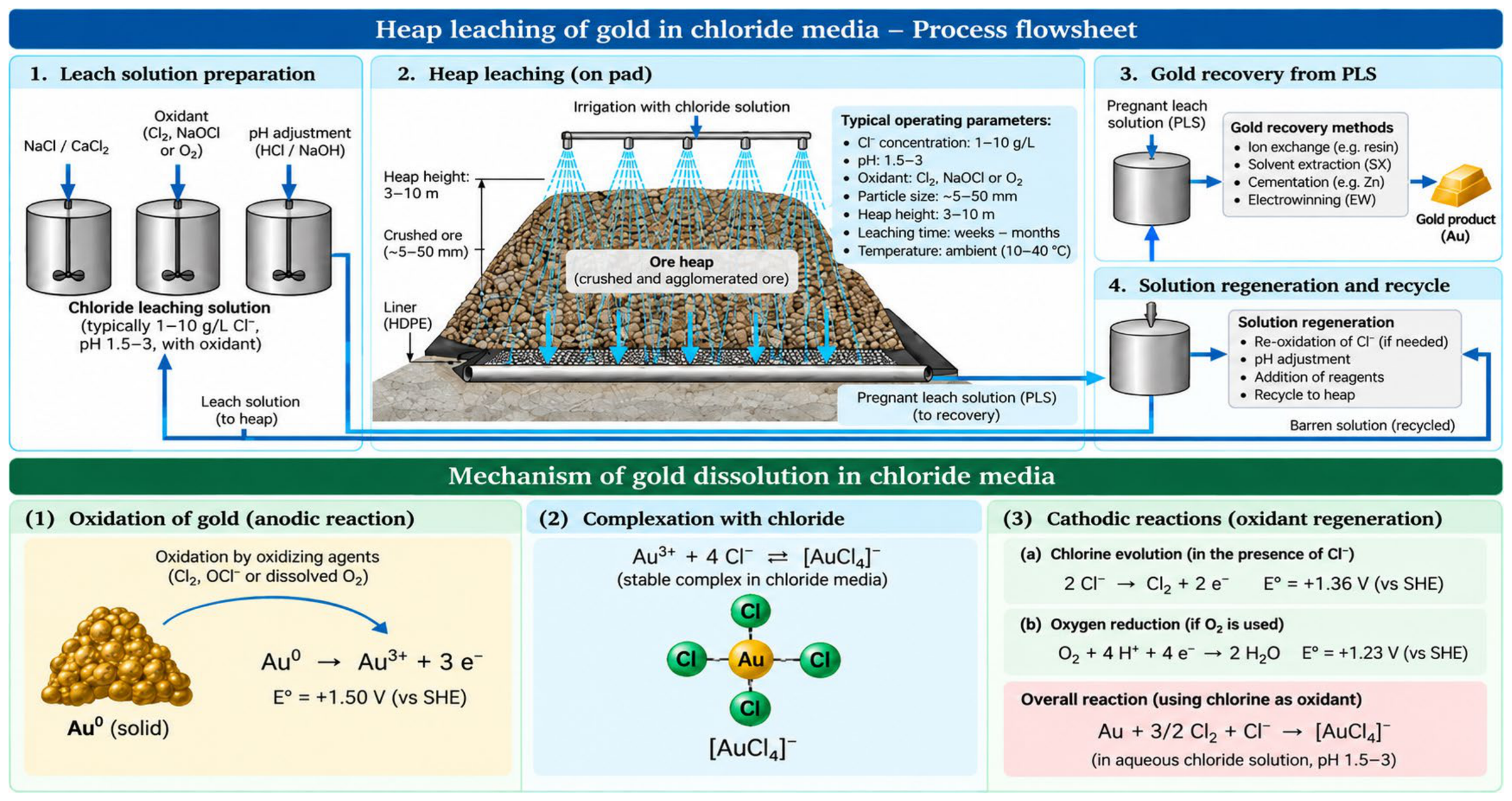
The electrochemical production of chlorine and the leaching of gold using chlorine-containing reagents are based on the following reactions:
Sodium hypochlorite and hypochlorous acid formed through the interaction of chlorine with water and alkali:
Oxidize gold according to the following reaction: Au
0 → Au
3+ + 3e
−The gold complexes are subsequently formed:
The process of chloride leaching of gold is illustrated in
Figure 1.
Alongside chloride-based leaching systems, considerable attention has been devoted to iodide- and bromide-based reagents. In iodine–iodide systems, molecular iodine acts as the oxidizing agent, whereas iodide ions participate in complex formation, promoting the formation of stable soluble gold species. The advantages of this system include comparatively low toxicity, high stability of the resulting complexes, and a lower redox potential compared with a number of chlorine-containing systems.
Bromine-based technologies have also been investigated. In 1987, Great Lakes Chemical Corporation obtained a U.S. patent for a precious-metal recovery technology using a bromine-containing compound known as hydantion. Hydantion, either used alone or in combination with bromide ions, is capable of oxidizing metallic gold to form soluble compounds. According to the literature, iodine–iodide and bromide systems are considered promising alternative reagent media for gold leaching [
22].
The principles of combined halide systems have been practically implemented in technologies developed by Intec (Australia) [
23] and Outokumpu (Finland) [
24] for the recovery of copper and associated gold from chalcopyrite concentrates. These process flowsheets employ bromides in addition to chlorine-containing compounds.
A characteristic feature of the Intec Copper process is the use of a mixed halide medium rather than an individual chloride system. The leaching solution contains NaCl, NaBr, and CuCl2 at elevated concentrations. Leaching is carried out at atmospheric pressure in the presence of air at 80–85 °C.
The main advantages of iodide- and bromide-based leaching systems include the high rate of gold dissolution, which may increase further under acidic conditions, and the potential to achieve high precious-metal recoveries. Another favorable factor is the relatively low toxicity of the leaching solutions at the reagent concentrations used in the process.
However, these systems also have certain limitations. These include the high corrosivity of the solutions during leaching under acidic conditions, substantial reagent consumption resulting from reactions with gangue minerals, and the relatively high cost of the leaching reagents.
Thus, hydrochlorination technology for gold recovery by in situ borehole leaching is of considerable interest in terms of its potential industrial application. The accumulated research results indicate that this approach is promising; however, further technological development requires optimization of operating conditions and the selection of effective leaching systems taking into account the mineralogical composition and properties of both the ore and host rock, as well as geological constraints.
The replacement of chlorine-containing reagents with bromide-based systems is also a promising direction for in situ leaching. One potential advantage is the possibility of operating at higher pH values than those typically used in hydrochlorination systems. This is particularly important for ores containing significant amounts of carbonate minerals, as such conditions may reduce undesirable reagent consumption caused by reactions with the host rock.
In recent years, bromine-containing systems have been actively investigated as alternative reagents for gold leaching. The principal interest in these systems is associated with their high rate of gold dissolution and their potential effectiveness toward other precious metals, including silver, platinum, and palladium [
25].
Nevertheless, despite decades of research into in situ gold leaching and the substantial body of scientific, methodological, and applied knowledge accumulated to date, the technology has not yet achieved widespread industrial application and remains predominantly at the pilot- and demonstration-scale stage. The results of previous trials have not always been positive.
The limited industrial application of in situ gold leaching is attributable to a combination of factors. These include the characteristics of gold-bearing materials, particularly their low metal grades, the considerable diversity in the particle-size and morphological characteristics of gold-bearing minerals, and the different modes of association of gold with ore and gangue components. Another major unresolved issue is the selection of a leaching reagent capable of providing efficient gold dissolution directly within the underground ore body while ensuring the technological, environmental, and economic feasibility of the process.
3. Thiosulfate- and Thiourea-Based Leaching Systems
Thiourea was first mentioned as a gold leaching reagent by Moir [
26], who published a paper entitled Thiourea—A New Solvent for Gold in 1906 [
27]. He demonstrated that an oxidizing agent was necessary for the reaction to proceed. However, cyanide had already been recognized as the preferred reagent for gold ore processing at that time, and Moir’s discovery therefore received little attention. Later, this subject was investigated by the Soviet scientists Plaksin and Kozhukhova [
28,
29], who are regarded in a number of sources [
30,
31,
32] as pioneers in this field. Thiourea began to be seriously considered as an alternative to cyanide only during the last two decades [
28]. In particular, the authors of [
33] investigated the kinetics of gold leaching with sulfuric acid in the presence of ferric iron and demonstrated that the leaching rate depends on the thiourea and oxidant concentrations as well as the pH of the solution. Ferric ions were also shown to form complexes with thiourea.
This issue was investigated in greater detail by Gonen et al. [
34], who studied the effects of thiourea consumption, oxidant type, solution pH, mixing time, and particle size on gold recovery from Gumushane-Mastra ore in Turkey. The authors found that at short leaching times and low pH values, both the amount of oxidant and thiourea consumption could be reduced. A gold recovery of 75% was achieved using 150-mesh particles and a mixing time of 5 h. The extensive studies conducted by Gonen [
34] demonstrated that the addition of sulfur dioxide during leaching suppresses thiourea decomposition and reduces its consumption [
35,
36]. Similar results were subsequently confirmed by studies using different types of gold-bearing feedstocks [
37,
38,
39].
Compared with cyanide, thiourea offers several advantages, including lower sensitivity to base metals (Pb, Cu, Zn, and As), high gold recovery from pyrite and chalcopyrite concentrates, and satisfactory recovery from carbonaceous refractory ores [
40]. Thiourea also poses a lower environmental risk and has lower toxicity and a higher rate of gold and silver dissolution than cyanide [
41]. However, its widespread implementation is hindered by several factors: thiourea is more expensive than cyanide, its consumption during gold processing is relatively high, and the downstream recovery stage requires further development [
42]. At the same time, thiourea is classified as a carcinogenic substance and should therefore be handled with caution [
43].
According to Lacoste-Bourge et al. [
44], the high consumption of thiourea and the relatively low dissolution rate can be attributed to the formation of an inhibiting sulfur layer on the surface of gold particles as a result of thiourea decomposition. As demonstrated by the researchers [
34], the adverse effect of this phenomenon on leaching can be reduced by adding sulfur dioxide.
One of the most significant commercial developments involving thiourea was its implementation for gold recovery at the New England Antimony Mines (NEAM) processing plant, located in the New England region of New South Wales, Australia, which was officially commissioned in March 1982 [
45]. The principal gold-bearing mineral at the mine was stibnite. Conventional cyanidation was ineffective for this type of ore for several reasons. Antimony minerals readily dissolve in the alkaline medium required for cyanidation, consume oxygen, and form passivating films on the gold surface, thereby inhibiting gold recovery. In contrast, under acidic conditions (pH 1.4), established using sulfuric acid in the thiourea process, antimony and arsenic sulfides are practically insoluble and remain largely inert. This enabled selective recovery of the precious metal [
46].
It should be noted that the process implemented at the Australian operation had unique characteristics for its time. The initial stibnite concentrate contained approximately 68% Sb and 30–40 g/t Au. Thiourea leaching provided 50–60% gold recovery within only 10–15 min directly from the flotation concentrate after gravity separation of free gold. Overall gold recovery reached approximately 80%.
Despite its successful commissioning, this project, along with parallel developments in France and Canada, did not result in the widespread replacement of cyanide and remained a localized technological achievement. The principal limitation was the chemical instability of thiourea. It is readily oxidized by ferric iron to formamidine disulfide and subsequently undergoes irreversible decomposition. Reagent consumption proved economically excessive compared with inexpensive cyanide [
47,
48]. Stable gold dissolution required the redox potential (Eh) and acidity to be maintained within very narrow operating ranges. Even minor deviations from the optimum conditions could lead either to thiourea decomposition or to the cessation of gold dissolution [
46,
47,
48,
49].
Thus, the commissioning of the New South Wales plant in 1982 demonstrated that thiourea could operate effectively on an industrial scale and could outperform cyanide in terms of leaching kinetics for specific antimony concentrates that are difficult to treat by cyanidation. However, because of the stringent requirements for process control and high reagent consumption, the technology remained limited to a relatively narrow niche and was subsequently superseded by pretreatment processes such as pressure oxidation and biooxidation followed by conventional cyanidation [
50,
51].
Sodium thiosulfate is another important sulfur-containing reagent for the leaching of precious metals.
The use of thiosulfate as a leaching reagent for gold recovery was first proposed in the early 1900s. According to [
52], in the process known as the Von Patera Process, gold- and silver-bearing ores were first subjected to chlorinating roasting and subsequently leached with thiosulfate [
52,
53]. The combination of hydrochlorination and thiosulfate leaching provided an integrated approach to raw-material processing and was therefore considered economically viable. Later, Russell proposed the addition of sodium sulfite to thiosulfate during precious-metal leaching to suppress the rapid decomposition and oxidation of thiosulfate by atmospheric oxygen to tetrathionate and sulfate, as well as to reduce the precipitation of secondary sulfides [
52]. He also found that the addition of copper sulfate to sodium thiosulfate, known as the “Russell solution,” dramatically accelerated the leaching of refractory silver sulfide minerals and associated gold.
The presence of sulfite suppresses thiosulfate decomposition. An equilibrium is established in the thiosulfate solution:
Sulfite is considered to inhibit the formation of free sulfide ions and the precipitation of gold or silver from solution. However, sulfite addition decreases the Eh of the solution and reduces the concentration of Cu(II). It has also been established that sulfite can be oxidized by Cu(II) ions to sulfate and dithionite, with the product distribution depending on the reaction conditions [
52].
The introduction of copper into the thiosulfate–sulfite system improved process performance. A major breakthrough in the development of thiosulfate-based precious-metal recovery occurred in 1979, when Berezovski and Sefton demonstrated the necessity of adding ammonia to the thiosulfate–copper system. Acceptable gold leaching rates with thiosulfate can be achieved in the presence of both ammonia and copper [
54].
Ammonia provided a critical component of the system by stabilizing copper ions as the tetraamminecopper(II) complex, [Cu(NH
3)
4]
2+. This facilitates the copper-mediated redox cycle involved in gold dissolution, while oxygen can regenerate Cu(II) from Cu(I), and gold is stabilized in soluble thiosulfate complexes. The resulting reagent system was therefore extensively investigated as a potential alternative to cyanide because it generally has a lower environmental impact [
55,
56,
57].
At the same time, extensive research has broadened the range of applications of thiosulfate- and thiourea-based technologies for precious-metal recovery. Researchers at Irgiredmet systematically investigated the fundamental characteristics and optimized the conditions for thiourea leaching of gold and silver, their alloys, minerals, and chemical compounds. Ore types for which thiourea technology could provide superior techno-economic performance compared with cyanidation were identified. These included, primarily, complex ores and concentrates containing both gold and copper or gold and antimony; silver ores in which silver occurs predominantly in sulfide forms; and certain other materials, including hydrometallurgical products from the processing of non-ferrous metals such as copper, zinc, and uranium, containing Au and Ag as valuable by-products [
36,
46,
47,
48,
49].
Pilot-scale and industrial-scale tests of the technology were conducted. Process design specifications were developed for plants intended to process gold–antimony concentrates from the Sarylakh deposit and silver concentrates from the Dukat deposit. In particular, the overall gold recovery from a representative sample of gold–antimony concentrate from the Sarylakh processing plant, including recovery from the antimony circuit, reached 95–97% [
36,
46,
47,
48,
49].
The effectiveness of thiourea leaching was also demonstrated for the treatment of gold–silver bismuth-bearing concentrates. Recovery of precious metals and bismuth from a concentrate containing 70.8 g/t Au, 35.6 g/t Ag, and 0.8% Bi reached 90–95%. In comparison, cyanidation of this concentrate resulted in substantially lower gold and silver recoveries, while bismuth was almost completely lost with the waste tailings [
49].
The thiourea leaching process has been studied in detail by Li and Miller [
40], with particular emphasis on the kinetics of the process in the presence of various oxidizing agents.
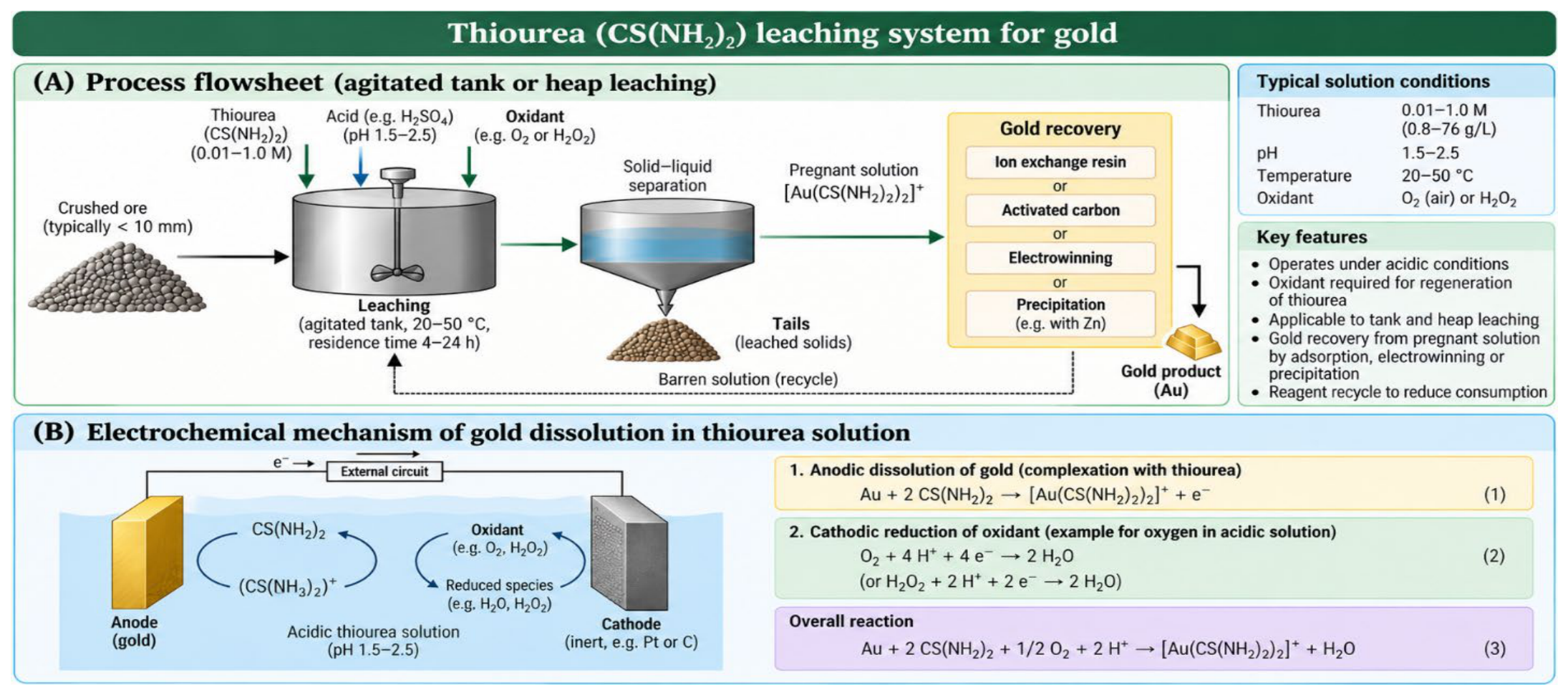
In an aqueous solution, thiourea can react with Au(I) to form a stable cationic complex:
The Au(III) ion is unstable in a thiourea solution. It oxidizes thiourea while itself being reduced to Au(I), followed by the formation of the complex described above.
In the presence of oxidizing agents, thiourea is capable of dissolving metallic gold. The anodic half-reaction for gold dissolution in an acidic medium can be represented as follows:
A range of oxidizing agents has been investigated for gold dissolution, including sodium peroxide, hydrogen peroxide, iron(III), oxygen (pure oxygen or air), ozone, manganese dioxide, manganate, dichromate, and other compounds. Kinetic studies of gold leaching using these oxidants in different media have shown that iron(III) ions are the most effective, while the rate of gold dissolution in acidic sulfate solutions is higher than that in chloride or nitrate solutions. However, thiourea itself is unstable under oxidative conditions and may undergo oxidation. The primary oxidation products depend mainly on the oxidizing agent used and the composition of the solution.
When strong oxidizing agents, such as manganate and dichromate, are used, sulfate and ammonium are the immediate products.
When more moderate oxidizing agents, such as hydrogen peroxide, iron(III) ions, or oxygen, are used, the initial product may be formamidine disulfide (FDS), while the final products are elemental sulfur and urea.
Formamidine disulfide decomposes to form thiourea and a sulfinic compound:
FDS → thiourea + sulfinic compound\mathrm{FDS\rightarrow thiourea + sulfinic\compound}
The sulfinic compound subsequently decomposes to form cyanamide and elemental sulfur. Elemental sulfur is initially present in a colloidal state and is eventually oxidized to sulfate, while cyanamide undergoes hydrolysis in an acidic medium to form urea.
Based on an analysis of the majority of published studies and fundamental research, thiourea has been established as an effective alternative to cyanide for gold leaching. Ferric sulfate is considered the preferred oxidizing agent and is commonly used in combination with thiourea.
However, in most cases, thiourea consumption is relatively high compared with cyanidation. In general, the gold leaching rate is initially higher and subsequently decreases with increasing process duration. The mechanism of gold leaching in the thiourea–ferric sulfate system has not yet been fully established.
The rate of thiourea oxidation by Fe3+ in acidic solutions, as well as in the presence of oxides (quartz and hematite), is relatively low. However, certain sulfide minerals, particularly pyrite and chalcopyrite, significantly accelerate the oxidation process. The presence of copper has an adverse effect on thiourea decomposition and the kinetics of gold leaching. Cu2+ ions not only oxidize thiourea but also catalyze its oxidation by Fe3+. In addition, Cu2+ and/or Cu+ significantly accelerate thiourea decomposition with the formation of elemental sulfur, which causes passivation of the gold surface, resulting in a decrease in the leaching rate and low gold recovery.
Among the factors responsible for thiourea consumption—adsorption onto mineral particles, thermal decomposition, complex formation with non-ferrous metals, and oxidation by ferric sulfate and atmospheric oxygen—the most important factor in actual thiourea–ferric sulfate systems containing sulfide minerals is the oxidation of thiourea by ferric sulfate under conditions of oxidant excess.
Comparison of gold leaching by cyanidation and thiourea
Comparing the results of gold leaching by cyanidation and thiourea, the authors [
40] concluded that the gold–thiourea system exhibits a higher leaching rate due to the use of non-gaseous oxidizing agents. Gold leaching requires both a complexing reagent and an oxidizing agent. In cyanidation, atmospheric oxygen is used as the oxidizing agent. In thiourea systems, in contrast, various non-gaseous oxidizing agents, such as hydrogen peroxide, Fe
3+, manganese dioxide, and others, are employed. Their concentrations can be relatively easily controlled or increased to values substantially higher than the oxygen concentration available during cyanidation. Therefore, the rate of gold dissolution in thiourea systems is considerably higher than that in cyanidation, as demonstrated by the data presented in
Table 1.
The technological flowsheet for the recovery of precious metals by the thiourea method is presented in
Figure 2.
Thiourea leaching also appears promising for gold and silver recovery from certain zinc-bearing products, as well as for the two-stage thiourea leaching of tin-bearing gravity concentrates with a wide range of precious-metal grades (Au 4–40 g/t; Ag 6–75 g/t) [
49].
Thus, thiourea leaching can be considered an effective hydrometallurgical method for producing gold and silver from selected categories of complex ores for which cyanidation cannot provide acceptable economic performance. Moreover, several researchers [
49] have suggested that modified thiourea-based processes may be among the leading candidates for application as leaching systems in in situ borehole leaching.
With respect to thiosulfate, early studies showed that satisfactory gold and silver recoveries into thiosulfate solutions could be achieved only at elevated temperatures (80 °C and above). Under these conditions, the dissolution rates of gold and, particularly, silver were several times higher than those obtained under conventional cyanidation [
58]. However, studies reported in [
49] demonstrated that thiosulfate leaching can also be conducted at lower temperatures provided that the pulp is sufficiently diluted (up to a liquid-to-solid ratio of 8–10:1). At room temperature, a substantial improvement was achieved, as noted above, using the copper–ammonia–thiosulfate system for gold leaching. This effect is particularly pronounced in the treatment of antimony-bearing, copper-bearing, and other refractory gold- and silver-containing ores, including ores containing fine gold associated with sulfides such as arsenopyrite or with carbonaceous matter capable of adsorbing dissolved gold. Such refractory ores are generally poorly amenable to cyanidation. The approach has subsequently been developed in both research and industrial practice [
58,
59,
60,
61].
In Kazakhstan, as worldwide, sodium cyanide remains the principal reagent used for gold recovery from ores and concentrates. At the same time, depletion of readily processable, high-grade and oxidized ores is gradually increasing the proportion of refractory ores in which gold is closely associated with iron, arsenic, copper, and other non-ferrous metal sulfide minerals.
A significant proportion of Kazakhstan’s explored gold reserves is associated with refractory ores for which cyanidation is relatively ineffective. Research on thiosulfate-based gold recovery from refractory ores in Kazakhstan was first conducted in 1995–1996. Comprehensive studies enabled the development and testing of thiosulfate leaching technologies for high-arsenic gold-bearing concentrates, carbonaceous-sulfide and carbonaceous-sulfide-arsenical gold-bearing ores, as well as the application of thiosulfate leaching to heap processing of oxidized gold-bearing ores from the Zherek and Kumysty deposits [
62,
63,
64,
65].
Subsequent research was continued, and the results were summarized in a monograph [
66]. The authors investigated the problem in considerable detail for Kazakhstan’s raw materials and proposed thiosulfate leaching variants adapted to different ore compositions.
The principal limitation of thiosulfate leaching is its high reagent consumption. The thiosulfate ion is unstable and readily oxidized to tetrathionate and sulfate, increasing process costs. Moreover, the system requires careful control of copper, ammonia, and thiosulfate concentrations, as well as pH and oxygen availability. Even relatively small deviations from the optimum conditions can adversely affect the process. Excessive ammonia concentrations may inhibit gold leaching. Under unfavorable operating conditions, copper sulfide films may form on gold particles and completely block further gold dissolution, resulting in gold passivation. The kinetics of the process were studied in detail by the authors [
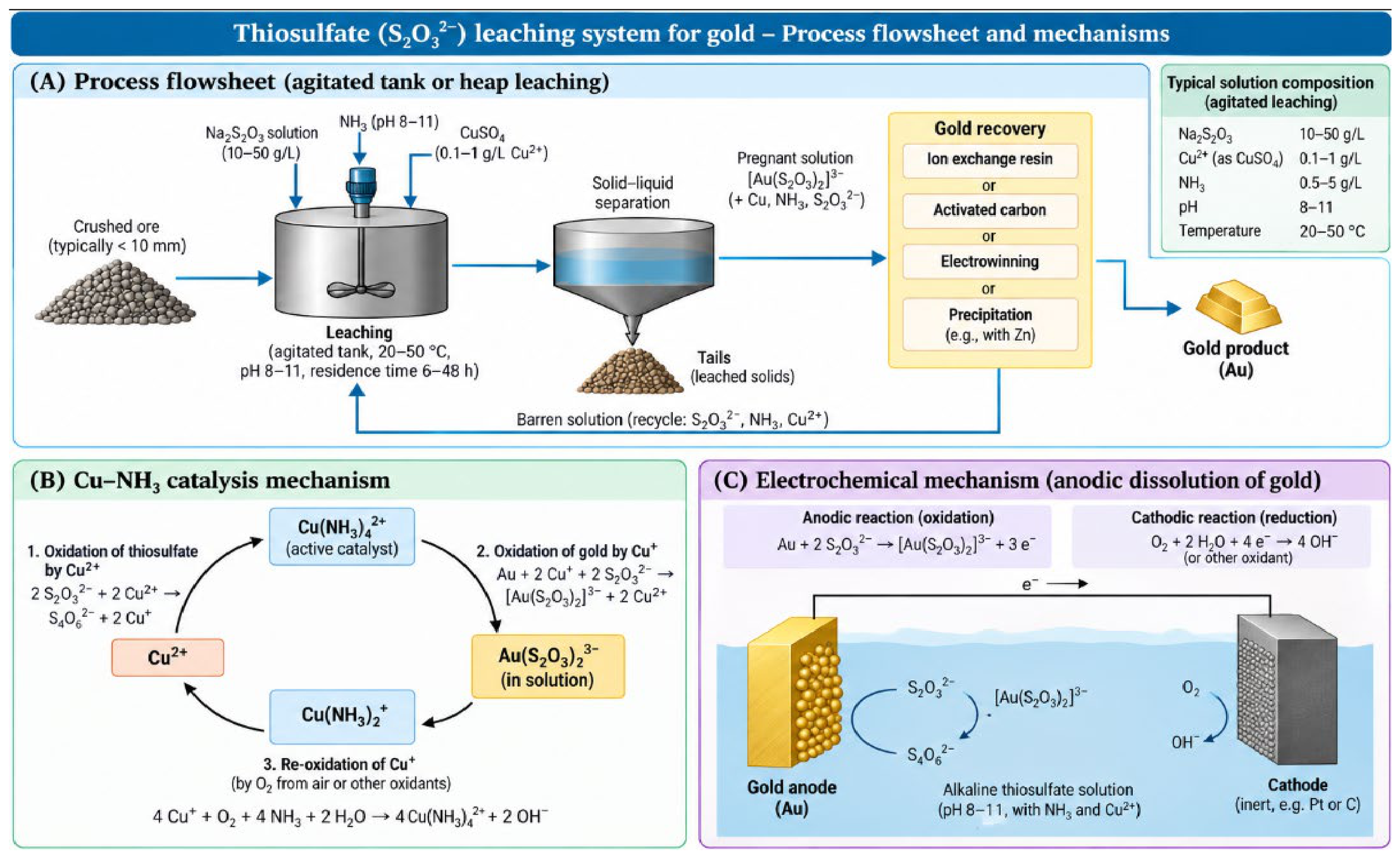
67], who reported that gold leaching in thiosulfate solutions is an electrochemical reaction. It involves two half-reactions: the oxidation of gold to form a gold–thiosulfate complex and the reduction of the copper(II) ammine complex to a copper(I)–thiosulfate complex. These half-reactions are described by Equations (1) and (2):
The thiosulfate leaching system is complicated by the homogeneous reduction of copper(II) by thiosulfate according to the following simplified overall reaction:
The authors [
67] established that gold leaching in solutions containing copper(II), ammonia, and thiosulfate is controlled by a chemical reaction under all investigated conditions, while the reaction rate decreases with decreasing copper(II) concentration. However, this decrease in rate is not directly caused by the lower copper(II) concentration, but rather by passivation of the gold surface by products of the homogeneous reaction between copper(II) and thiosulfate. At the same time, the leaching rate is determined simultaneously by the heterogeneous reduction of copper(II), i.e., the cathodic half-reaction, and the oxidation of gold, i.e., the anodic half-reaction. The process flowsheet incorporating the cathodic and anodic half-reactions is presented in
Figure 3.
Thus, to ensure a stable and acceptable leaching rate while simultaneously controlling thiosulfate consumption, an optimal balance of process conditions must be established.
The method also has several advantages:
Applicability to refractory feedstocks;
Unlike cyanide, which can be strongly consumed through interactions with copper, thiosulfate can operate in the presence of copper without excessive copper dissolution;
Sodium thiosulfate is relatively non-toxic and environmentally benign and does not require costly neutralization of wastewater;
Thiosulfate is biodegradable, making it potentially suitable for geotechnological applications, including heap and in situ leaching;
The process can mitigate preg-robbing, in which natural carbonaceous matter irreversibly adsorbs dissolved gold;
Although the process is generally relatively slow, gold dissolution can be faster than in conventional cyanide solutions when the copper-to-ammonia ratio is appropriately controlled [
55,
56,
57,
58,
59,
60,
61].
At present, one of the key issues requiring further research is the prevention of gold passivation. It has been proposed that elemental sulfur may form on the gold surface, hindering thiosulfate diffusion toward the metal and thereby slowing gold dissolution. The sulfur layer may form as a result of:
Three principal approaches are used to control the process and mitigate gold passivation: strict regulation of reagent concentrations, the introduction of specific additives, and appropriate pretreatment of the feedstock.
Strict control of the NH3/S2O32− ratio is required because ammonia stabilizes copper in the soluble Cu(NH3)42+ complex and prevents copper deposition on the gold surface. An appropriate ratio also helps suppress thiosulfate decomposition and the formation of sulfide species.
The addition of sodium sulfite (Na2SO3) as a reducing agent stabilizes thiosulfate and suppresses its oxidation and decomposition into elemental sulfur and sulfides. This is one of the most widely investigated chemical approaches for preventing the formation of passivating films.
Controlled oxygen addition maintains the redox potential of the solution within a moderate range. Excess oxygen promotes thiosulfate degradation and may enhance passivation, whereas insufficient oxygen can inhibit gold dissolution. Accordingly, moderate air aeration is often used instead of pure oxygen [
47,
58,
68,
69,
70,
71].
In addition, organic and inorganic stabilizing additives can be introduced to suppress rapid sodium thiosulfate decomposition and reduce copper consumption [
72,
73,
74]. Among the organic additives investigated, ethylenediamine, ethylenediaminetetraacetic acid (EDTA), and glycerol are of particular interest. EDTA is a widely used complexing agent capable of forming complexes with Cu(II) and generating a more stable coordination environment [
72].
The authors of [
72], investigating the copper–ammonia–thiosulfate system, found that the addition of a small amount of EDTA can decrease the redox potential of the Cu(II)/Cu(I) couple, thereby lowering the mixed-potential of the solution and, consequently, reducing thiosulfate consumption.
In [
73], gold recovery using a copper–ethylenediamine–thiosulfate solution reached 80.3%, substantially exceeding the recovery of 63.0% obtained from the same type of feedstock using the conventional copper–ammonia–thiosulfate system.
The addition of glycerol represents another actively investigated approach to process intensification. Glycerol acts as a stabilizer of the liquid phase by reducing the thermodynamic activity of water molecules involved in the hydrolytic cleavage of thiosulfate. It significantly slows secondary oxidation reactions and inhibits the aggregation and precipitation of colloidal sulfur particles on gold surfaces [
74].
A relatively recent development involves the use of lignosulfonates, which are inexpensive by-products of the pulp and paper industry. These polymeric surfactants preferentially adsorb onto hydrophobic fine particles and associated minerals. Lignosulfonates can inhibit the release of undesirable ions from the gangue and prevent the adhesion of passivating sulfide precipitates to gold surfaces, thereby increasing overall metal recovery [
75].
Investigating the effect of inorganic anions on gold recovery with thiosulfate, Senanayake [
76] concluded that the effectiveness of anionic additives in reducing thiosulfate consumption followed the order phosphate > sulfate > chloride > nitrate > sulfite > sulfide, corresponding to the ability of these anions to coordinate with Cu(II) and stabilize it. The use of phosphate additives, particularly ammonium dihydrogen phosphate, showed favorable results in the treatment of high-sulfide concentrates. Phosphate ions act as buffering agents and mild inhibitors. They stabilize pulp pH within a specified alkaline range and passivate associated iron minerals such as pyrite and marcasite, thereby limiting the transfer of reactive sulfur into solution. Ammonium dihydrogen phosphate also suppresses the rapid decomposition of thiosulfate promoted by iron salts present in the ore. The authors of [
77] confirmed that both metaphosphate and orthophosphate can reduce thiosulfate consumption and enhance gold leaching, with hexametaphosphate producing the stronger effect. This may be attributed to its ability not only to stabilize Cu(II) through complexation in the axial coordination position but also to disperse the leaching suspension and improve its rheological properties.
The third approach to controlling gold passivation during thiosulfate leaching is feedstock pretreatment. If the ore contains sulfide minerals such as pyrite or arsenopyrite, these minerals can be oxidized prior to leaching using pressure oxidation or biohydrometallurgical treatment. This prevents reactive sulfur from entering the leaching solution. The pretreated material can subsequently be leached using mixtures of sodium/ammonium hydrosulfite and thiosulfate, or with thiosulfate-based systems and their modifications.
Biohydrometallurgy has recently developed rapidly; however, its application has been more extensively investigated for heap leaching than for in situ leaching, although application under ISL conditions cannot be ruled out.
From the perspective of in situ borehole leaching of precious metals, it is important to consider the interactions between minerals, host rocks, and thiosulfate [
78,
79,
80,
81,
82,
83].
Senanayake [
80] found that the presence of carbonate ions significantly decreases the rate of gold leaching with thiosulfate. Some studies suggest that carbonate ions (CO
32−) can react with Ca
2+ ions to form an insoluble calcium carbonate precipitate that coats the gold surface during leaching, thereby substantially reducing the leaching rate.
Sulfide minerals such as arsenopyrite can accelerate thiosulfate decomposition and inhibit gold dissolution during thiosulfate leaching [
81,
82]. The effect of sulfide minerals on thiosulfate decomposition follows the order pyrite > arsenopyrite > chalcopyrite > galena > sphalerite. The corresponding order of gold dissolution rates in the presence of different sulfide minerals is sphalerite > arsenopyrite > pyrite > galena > chalcopyrite. However, electrochemical studies have also shown that the presence of sulfide minerals may increase the rate of gold leaching in thiosulfate solutions because oxygen reduction can be enhanced by the lower overpotential at sulfide-mineral surfaces.
The presence of hematite can significantly decrease gold dissolution in copper–ammonia–thiosulfate solutions, with the gold leaching rate gradually decreasing as the hematite content increases [
83].
To date, the copper–ammonia–thiosulfate system and its modifications have been extensively investigated from both theoretical and technological perspectives. Numerous studies have been published in this field. Nevertheless, successful commercial implementation of thiosulfate leaching remains extremely limited, with one notable example being its use by Barrick Gold Corporation at the Goldstrike operation in Elko, Nevada, USA. Barrick Gold developed a process combining pressure oxidation pretreatment with an alkaline solution and oxidant, followed by ammonia-free thiosulfate leaching. Goldstrike ores characterized by “double refractory” behavior (sulfides + carbonaceous matter) yielded no more than 15% gold recovery by cyanidation, whereas the developed process achieved more than 80% recovery [
58].
The process involves autoclave treatment of a gold-bearing thickened pulp in the presence of limestone and air. The subsequent processing stage employs a resin-in-pulp approach, in which the pulp interacts with thiosulfate and resin in large tanks.
The main difficulties encountered during the implementation of the process included the following. Optimization proved more complicated than for cyanidation because numerous parallel reactions, including oxidation and disproportionation, occur in the system; consequently, precise control of pH and redox potential (Eh) is critical. High thiosulfate losses of up to 50% were reported. In addition, substantial pulp dilution was required, together with considerable energy consumption for heating to the required temperatures.
According to expert assessments, because of its numerous limitations and unresolved technological issues, thiosulfate is unlikely to replace cyanide on a universal basis. Nevertheless, its industrial implementation remains possible in regions and projects where cyanide use is considered impractical or unacceptable for specific technical or environmental reasons.
Thus, both methods—thiourea and thiosulfate leaching—address the same fundamental challenge: the recovery of gold from complex refractory feedstocks that are poorly amenable to cyanidation. Thiourea leaching has demonstrated high efficiency in a number of specific applications but is constrained by reagent cost and consumption. Thiosulfate is more versatile for refractory ores but requires more precise control of process parameters. Nevertheless, both technologies, particularly in their modified forms, show potential for application to the in situ leaching of precious metals, as indicated by recent research developments.
For clarity, the authors of the study presented the results of investigations into the kinetics of gold leaching in different systems in
Table 2, which allows the mechanism of the respective reactions to be evaluated and the results to be compared.
One current research direction in thiosulfate leaching is the replacement of ammonia with amino acids. Ammonia is a conventional copper ligand in thiosulfate solutions and reduces the reactivity of copper ions toward thiosulfate; however, its use at commercial scale is less attractive. Ammonia is volatile and may contaminate the working environment and pose risks to occupational and public safety. It is also toxic and can contribute to environmental contamination through the discharge of ammonium- and nitrogen-containing wastewater or processing residues. In natural environments, ammonia can be relatively persistent because biological oxidation may proceed slowly under certain conditions. Furthermore, nitrate, a product of ammonia oxidation, can contribute to algal growth, eutrophication, and subsequent groundwater contamination. The use of ammonia in leaching systems also generates wastewater and residues containing ammonia or ammonium [
68,
84,
85]. The operating costs and economic challenges associated with treating ammonia-containing wastewater and residues represent important barriers to the large-scale implementation of copper–ammonia–thiosulfate systems for gold recovery [
56,
70]. Consequently, several ammonia-free alternatives have been proposed to address the potential environmental hazards associated with ammonia and to develop more environmentally compatible and economically viable thiosulfate leaching systems.
Amino acids are capable of forming complexes with heavy metals such as copper and can act as stabilizers of thiosulfate during gold leaching in thiosulfate solutions [
86,
87,
88]. Glycine is among the most promising components of hybrid systems. It can replace ammonia while eliminating ammonia volatilization and associated emissions. Glycine forms stable complexes with copper ions, thereby reducing the catalytic degradation of thiosulfate and inhibiting copper deposition on gold surfaces in the form of passivating films. An additional advantage is its low cost relative to other amino acids [
89,
90,
91,
92].
The thiosulfate–glycine–copper system has therefore emerged as a promising alternative for gold recovery, offering potential advantages over both cyanidation and ammonia-containing thiosulfate leaching. The authors of [
92] investigated the effect of leaching parameters on gold recovery from an ore containing 10 g/t Au using the thiosulfate–glycine–copper reagent system. Potassium permanganate was used as the oxidant. The ore consisted predominantly of aluminosilicate minerals, including grossular (64%) and clinochlore (12%). Thiosulfate concentration was varied within 0.5–1 M, glycine within 0.3–1.75 M, copper sulfate within 2–10 mM, and potassium permanganate within 0.004–0.04 M. The pH range was 9.3–10.5, the temperature was varied from 20 to 60 °C, and the leaching time was 6 h. Reagent addition intervals were also optimized. The optimum conditions were determined to be 0.7 M thiosulfate, 1.75 M glycine, 5 mM copper sulfate, pH 9.3, a temperature of 60 °C, and potassium permanganate addition every 2 h. Under these conditions, gold recovery reached 89.3% after only 6 h, compared with 89.8% after 24 h by cyanidation and 58% after 6 h using ammonia-containing thiosulfate leaching. A mechanism of gold dissolution was also proposed, emphasizing the role of glycine in stabilizing copper ions and enhancing thiosulfate performance. These results demonstrate the potential of the thiosulfate–glycine–copper system as an effective gold leaching technology.
The authors of [
93] proposed malic acid as an alternative to glycine in thiosulfate leaching, while citric acid was investigated in [
94].
Investigation of the copper–malic acid–thiosulfate system for gold leaching demonstrated reduced thiosulfate consumption in the presence of malate due to its strong chelating interaction with copper ions.
The resulting gold concentrate was comparable in quality to concentrates obtained by cyanidation and conventional copper–ammonia–thiosulfate leaching. In addition, the copper–malic acid–thiosulfate system demonstrated substantially improved leaching kinetics, making it a promising option for the treatment of refractory gold-bearing concentrates.
With respect to citrate, copper–citrate–thiosulfate systems for gold leaching have been investigated and described in [
95,
96]. Experimental results showed that gold recovery from finely ground ore could reach 96.1% after 9 h of leaching, substantially faster than under typical cyanidation conditions. Increasing the temperature from 30 to 90 °C and the thiosulfate concentration from 0.01 to 0.20 mol/L increased the gold recovery rate. Moderate increases in copper and citrate concentrations could enhance gold dissolution, whereas excessive additions resulted in a slight decrease in the leaching rate.
Feng and van Deventer [
86] summarized the effects of four common amino acids—L-valine, glycine, DL-α-alanine, and L-histidine—on the leaching of gold-bearing pyrite concentrates in copper–ammonia–thiosulfate solutions. The results showed that amino acids possess stronger complexing abilities toward copper ions than ammonia, and that copper–amino acid complexes are more stable in the leaching solution. Moreover, amino acids can significantly increase the gold leaching rate, while thiosulfate consumption gradually decreases with increasing amino acid concentration. Among the four amino acids investigated, L-histidine exhibited the most favorable performance in thiosulfate-based gold leaching.
Thus, amino acids can reduce thiosulfate consumption by decreasing the reactivity of copper–amino acid complexes toward thiosulfate.
For large-scale metallurgical applications, the purchase of chemically or pharmaceutically pure amino acids is economically unattractive. Consequently, researchers are actively developing methods for recovering amino acids—particularly glycine, glutamic acid, and alanine—from inexpensive, renewable, and often waste biomass sources. Biomass is subjected to acid or enzymatic hydrolysis to break down protein structures and produce a concentrated amino-acid solution (hydrolysate), which can potentially be used for gold leaching without extensive purification [
97,
98].
Biomass may be of either animal or plant origin. Animal husbandry and poultry-processing wastes containing keratin and collagen represent rich sources of simple amino acids, as fibrillar animal proteins contain substantial proportions of these amino acids. Food-processing wastes and plant-derived meals, generated as residues from oil extraction and grain processing, contain significant amounts of glutamic acid and asparagine [
97,
98].
A relatively new direction in thiosulfate technology is the use of cobalt and nickel ions as oxidants in ammonia–thiosulfate systems instead of copper. Leaching of a silicate gold-bearing ore containing 16 g/t Au with a nickel–thiosulfate–ammonia reagent system achieved 95% gold recovery after 24 h. Ammonium thiosulfate consumption was only 1.2 kg/t, compared with 3.0 kg/t for the analogous copper-containing system and 1.5 kg/t of sodium cyanide in conventional cyanidation [
69].
The authors of [
99,
100] performed a thermodynamic investigation of the cobalt–ammonia–thiosulfate system and examined the mechanism of gold leaching in this solution. Compared with the copper–ammonia–thiosulfate catalytic system, the cobalt–ammonia–thiosulfate system demonstrated several potential advantages, including lower thiosulfate consumption and higher catalytic activity for gold leaching.
In [
100], Chandra and Jeffrey investigated iron as an alternative oxidant and modified the composition of the leaching system. They employed an iron–oxalate–thiosulfate system and conducted a series of gold leaching experiments. The results showed that gold dissolution could remain stable for more than 24 h at a molar oxalic acid-to-iron ratio of 3:1.
The authors of [
101] subsequently confirmed that iron–EDTA and iron–oxalate complexes can act as effective oxidants for gold leaching in thiosulfate solutions. The pH of the medium also plays an important role. At pH values below 5, thiosulfate stability decreases. At excessively high pH, the oxidizing ability of iron–EDTA complexes decreases, while iron ions readily form iron oxalate precipitates. Therefore, the iron–EDTA/oxalate–thiosulfate system requires a pH range of approximately 6–7.
Thiourea has also been shown to act as a catalyst in this process. Iron(III)–EDTA/oxalate–thiosulfate systems containing thiourea exhibit faster gold leaching kinetics and lower thiosulfate consumption [
102] and retain the ability to recover gold from gold-bearing ores even after seven days of leaching in the absence of oxygen. Gold recovery can exceed 80% after 6 h of leaching. These systems and their modifications may therefore have potential for application in in situ borehole gold leaching.
In some cases, thiourea leaching can be implemented as a two-stage process. One example involves acidification of the feedstock with hydrochloric acid during the first stage, followed by selective gold recovery using a thiourea–Fe
3+ system over 6 h [
103].
One of the more recently proposed and particularly interesting leaching systems for gold recovery is a mixture of thiosulfate and thiourea. The binary system consists of 0.2 mol/L thiosulfate and 0.12 mol/L thiourea. The combined use of these reagents reduced the leaching time to 2 h, compared with approximately 24 h for cyanidation, presumably due to the simultaneous formation of gold complexes with both ligands. The researchers suggested that a synergistic effect may occur during leaching. Such systems, together with sequential multistage leaching approaches, may represent promising candidates for future application in the in situ borehole leaching of precious metals [
104].
Bioleaching and polysulfide leaching should also be considered. Polysulfides [
105] are being actively investigated and tested as a non-toxic and environmentally friendly alternative. They exhibit optimal characteristics at neutral pH and elevated temperatures (approximately 75–150 °C), at which they are more stable. Polysulfides can be produced at relatively low cost from beneficiation tailings or acid rock drainage (ARD). In the United States, a pilot project at the Barite Hill Superfund site is planned for the recovery of precious metals from beneficiation tailings and abandoned mine sites, with simultaneous site remediation. Au–polysulfide complexes are more effective than some competing systems and may be environmentally acceptable in conditions where cyanide use is prohibited.
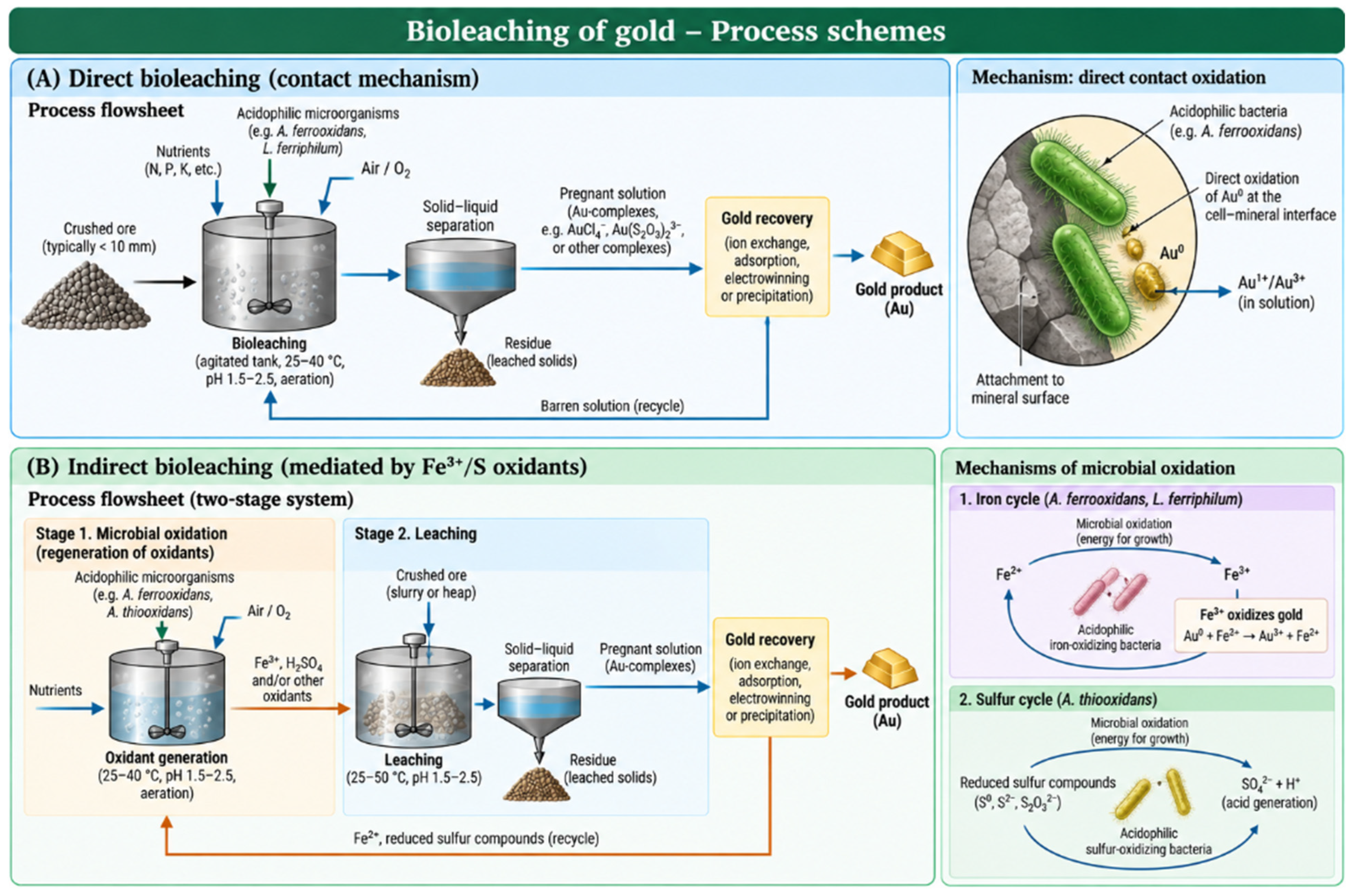
With regard to bioleaching, this method is becoming increasingly important for the recovery of gold from low-grade and refractory raw materials containing sulfide minerals such as pyrite, arsenopyrite, and chalcopyrite.
Intensive research in the field of biohydrometallurgy makes it possible to process substantial reserves of non-commercial and spent ores, as well as intermediate products and wastes generated by mineral-processing plants. This method is economically attractive, reduces environmental pollution, and enables the comprehensive utilization of mineral resources. Iron-oxidizing bacteria, as the most commonly used group of Ferrovum- and Ferrooxidans-related microorganisms, comprise numerous strains that differ in their genetic and metabolic characteristics. Therefore, no single bacterial strain can serve as a universal oxidizing agent. Consequently, in the development of biochemical processing technologies, it is necessary to accurately isolate and test strains of iron-oxidizing bacteria adapted to the mineralogical conditions of the host rocks, as well as to the composition of the hydrosphere and lithosphere of a particular deposit. This factor should be taken into account when applying the method under in situ leaching (ISL) conditions. The prospects and effectiveness of bacterial leaching have been investigated by researchers in different countries.
In general, the leaching of the initial raw material consists of two stages. In the first stage, the raw material undergoes biooxidation, followed by leaching with the reagent most effective under the given conditions (cyanide, thiourea, thiosulfate, etc.). This approach was used by the authors [
106] to process high-arsenic raw material (more than 15% As), represented by refractory sorption residues from a gold-processing plant. The gold content of the raw material ranged from 4.7 to 5.8%, while the contents of pyrite and arsenopyrite were 6.7–16.5% and 11.2–29.2%, respectively.
Laboratory studies showed that conventional cyanidation recovered only 26.4% of the gold into solution. Experiments on preliminary biooxidation of the initial raw material demonstrated poor adaptation of the commonly used Ferrooxidans strain to the high arsenic content of the material. Efforts were therefore undertaken to isolate and cultivate a viable microorganism strain, after which the sorption residues were subjected to bacterial acidification for 10 days, followed by gold leaching with a thiourea solution. The gold recovery reached 79.5%, whereas cyanidation after biooxidation resulted in a recovery of 69.5%.
At present, the introduction of biological additives into the leaching process, along with bioleaching, is becoming increasingly widespread in the processing of complex raw materials. This research area has attracted considerable attention, and the results obtained may be applied not only to vat and heap leaching but, in the future, also to in situ borehole leaching.
Figure 4. Flowsheet for Gold Recovery by Bioleaching.
The authors [
107,
108] investigated and demonstrated the positive effect of biological additives in the form of amino acids on the leaching of copper and gold. The chemical properties of amino acids are primarily determined by the presence of carboxyl and amino groups. Differences in reactivity and the individual behavior of each amino acid are also determined by the specific characteristics of its side chain. The studies focused on the effect of side-chain structure on bioleaching and cyanidation processes.
A relationship was established between the structure of the side chain and the recovery of gold and copper during bioleaching and cyanidation. It was shown that the greater the contribution of the covalent bonding of the amino group to the formation of gold–amino acid complexes, the greater the positive effect of the amino acid on gold recovery during cyanide leaching. In bioleaching, an inverse relationship was observed: the more complex the structure of the side chain, the lower its positive effect on the process. The contribution of covalent and ionic bonds can be evaluated based on FTIR spectroscopic studies of gold–amino acid systems at the corresponding pH values. By comparing the intensities of the bands at a wavenumber of 1419 cm−1 for different systems, the effect of a particular amino acid on the cyanidation or bioleaching of gold and copper can be indirectly predicted.
Overall, the studies reviewed demonstrate the considerable diversity of halogen-, thiosulfate-, and thiourea-based systems for precious-metal leaching, with particular attention to their potential application in in situ borehole leaching. The principal advantages and limitations of these reagent systems have been identified, while recent developments in reagent modification and process intensification indicate several promising research directions.
The substantial body of research in this field reflects the continuing interest in replacing cyanide with less hazardous leaching reagents. Further development of these systems may contribute to the identification of economically and technologically viable reagents for the in situ borehole leaching of precious metals.