Article

Pressure Dependence of Pure Zirconium Liquid–Solid Phase Transition

Key Laboratory of Hunan Province on Information Photonics and Freespace Optical Communications, School of Physics and Electronic Science, Hunan Institute of Science and Technology, Yueyang 414006, China
*
Author to whom correspondence should be addressed.
Metals 2026, 16(1), 78; https://doi.org/10.3390/met16010078
Submission received: 9 December 2025 / Revised: 27 December 2025 / Accepted: 8 January 2026 / Published: 10 January 2026
(This article belongs to the Special Issue Phase Transformations in Metals and Alloys)

Abstract

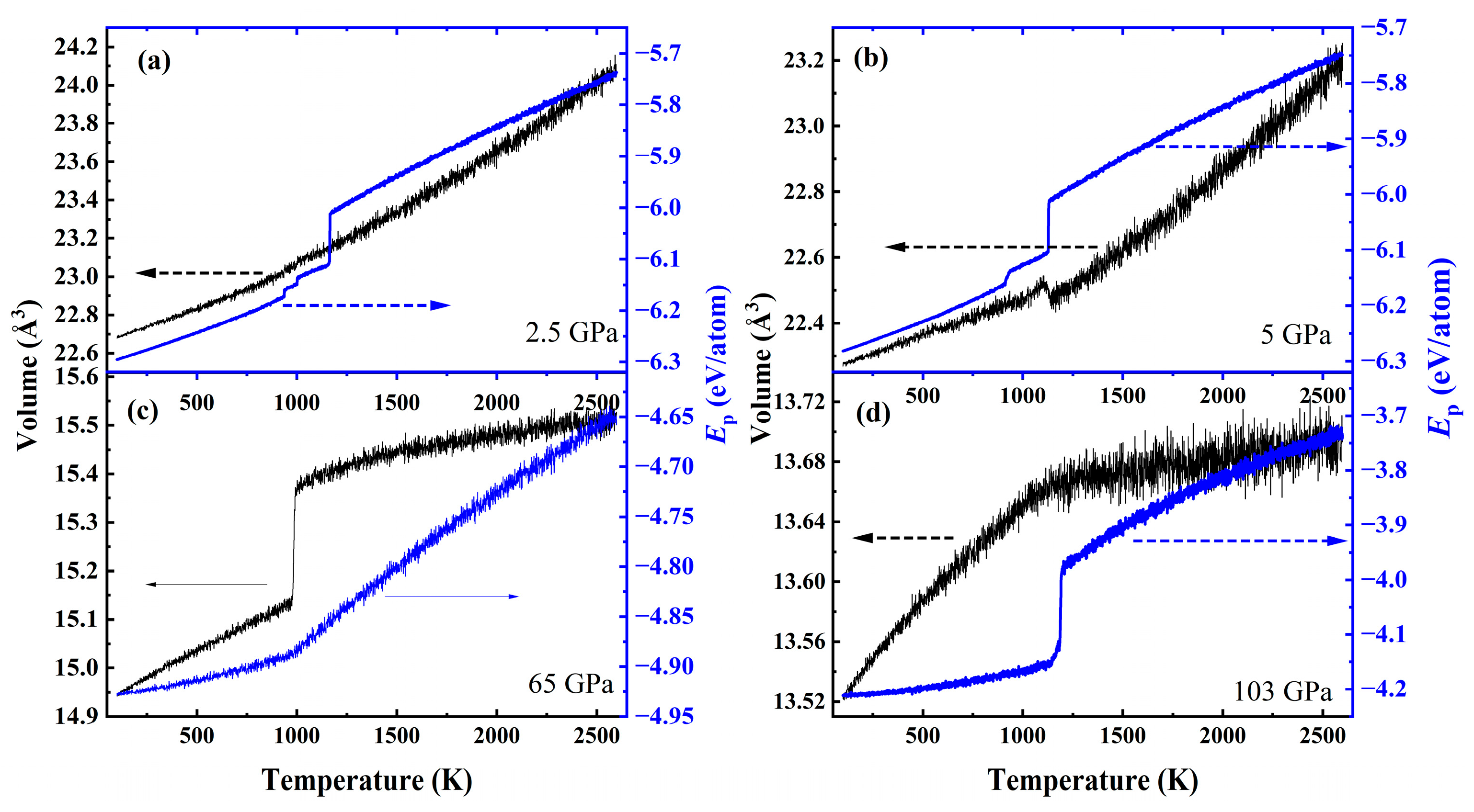
Molecular dynamics simulations were conducted at a cooling rate of 1.0 × 10¹¹ K/s to investigate the solidification mechanism of zirconium (Zr) under high pressure. Three distinct pressure-dependent regimes are identified: crystallization into a body-centered cubic (BCC) phase below 27.5 GPa, vitrification between 27.5 and 65 GPa, and crystallization into an A15 phase above 65 GPa. The volume change during crystallization is found to reverse at critical pressures of 5 and 103 GPa, and anomalous behavior is observed at the phase boundaries: at 27.5 and 65 GPa, the volume varies continuously despite a sharp drop in potential energy, whereas at 65 GPa, the volume decreases abruptly while the energy changes smoothly. Structural analysis indicates that evolution in the low-pressure regime is governed by atomic configurations extending to the second-neighbor shell, while at high pressures, nearest-neighbor interactions become dominant. This work clarifies the microstructure–pressure relationship during metallic solidification, providing insights into controlling phase transitions under extreme conditions.

1. Introduction

High-pressure environments, which vary immensely across the universe, are fundamental to materials research. Pressures range from approximately 360 GPa at Earth’s core to extremes of 107 GPa in the Sun and 1023 GPa in neutron stars. Studying matter under such conditions is essential for advancing fundamental physics and chemistry [1,2,3,4,5,6], as compression reduces atomic volume and increases electron density, often triggering novel reaction pathways. Recent decades have seen rapid progress in high-pressure science, propelled by advances in devices such as the diamond anvil cell [7,8], Raman spectroscopy [9], and synchrotron radiation X-ray diffraction [10]. These tools have revealed rich pressure-induced phase transformations. For instance, tantalum undergoes a transition from the complex β-phase to the body-centered cubic (BCC) phase (α-Ta) and then to the hexagonal close-packed (HCP) phase [11] under pressure, while magnesium (Mg) transforms from an ambient HCP structure (α-Mg) to a BCC structure between 50 and 70 GPa [12]. Our previous work demonstrated that the ambient BCC phase of tungsten (W) becomes metastable at high pressure and temperature, eventually transforming to HCP via intermediate stages influenced by kinetics [13]. Similarly, the first-order BCC-to-HCP transition can proceed through multiple intermediate stages, analogous to the solidification of lead (Pb) [14]. These stepwise pathways follow Ostwald’s rule of stages, which governs phase transformations under high pressure.
Rapid cooling represents a pivotal technique for synthesizing novel materials. Under such non-equilibrium conditions, a system may access metastable or alternative stable states. Theoretically, any metallic melt can be vitrified if the cooling rate is sufficiently high to bypass crystallization [15]. However, experimentally achieving cooling rates exceeding 108 K/s remains a significant challenge, which has historically limited the formation of bulk metallic glasses primarily to multi-component and select binary systems such as Cu-Zr [16,17] and Pd–Si [18,19]. Recent advances have enabled experimental cooling rates of approximately 1.0 × 10¹⁴ K/s, allowing for the vitrification of monatomic metals such as Ta, W, Mo, and V [20]. Novel phases such as quenched-in carbon (Q-carbon) have also been produced using nanosecond laser processing [21]. Simulation studies indicate that a novel crystalline phase (CNC) and a three-stage crystallization pathway are universal for SiGe alloys across compositions at cooling rates ranging from 109 and 1010 K/s [22]. Furthermore, Tian and Zhou observed that during the rapid cooling of liquid Ag [23] and Pb [24,25], a metastable BCC phase forms initially, subsequently crystallizing into HCP and FCC structures.
The combined application of pressure and controlled cooling rates significantly expands the range of accessible thermodynamic pathways and material states, providing critical insights into fundamental processes such as vitrification [26,27], crystallization [4,28], and liquid–liquid phase transitions [29,30]. Experimentally, Zr possesses an HCP structure (α-Zr) under ambient conditions, which transforms to a BCC phase (β-Zr) above 1135 K. At room temperature and pressures of 2–7 GPa [31,32,33], the α phase transforms into the more open ω phase. A subsequent ω→β phase transition occurs upon further compression to 30–35 GPa [31,34,35,36,37]. Under rapid cooling, novel structural states have been observed. Mo et al. have demonstrated that at ambient pressure, the critical cooling rate (Rc) required for vitrifying Zr is ~5.0 × 10¹³ K/s, with crystallization following Ostwald’s step rule; however, retaining the high-temperature BCC phase (β-Zr) to room temperature remains difficult [38]. High pressure enhances kinetic effects during quenching, increasing configurational randomness and facilitating local structural rearrangements in the supercooled metallic melts. For instance, multiple-intermediate-stage crystallization (MisC) is readily observed in Zr within the pressure range of 2.5–28.75 GPa. At a cooling rate of 1.0 × 10¹¹ K/s, a mixed BCC-HCP phase can be obtained at 300 K when the pressure ranges between 28.75 and 50 GPa. The rapidly supercooled Zr melt undergoes vitrification to form a metallic glass; outside this pressure range (i.e., [28.75, 50] GPa), crystallization dominates. Notably, the first phase nucleated from the supercooled liquid is consistently an HCP structure that predominates over the BCC structure, and this is also the final solid product [39]. At higher pressures (30–60 GPa), pure Zr vitrifies at a rate of 1.0 × 10¹¹ K/s, while in the 60–125 GPa range, it crystallizes into a new A15 phase [40].
Nevertheless, several important questions remain unresolved and merit further investigation. For instance, at a constant cooling rate of 1.0 × 10¹¹ K/s, the onset of crystallization (Ts) generally decreases with increasing pressure within the intervals [0, 5] GPa and [7, 27.5] GPa. However, it exhibits a counterintuitive increase from 1129 K at 5 GPa to 1181 K at 7 GPa [39]. Whether this anomaly is a genuine physical phenomenon or a methodological artifact requires clarification. Another unresolved issue concerns the pressure dependence of volumetric changes during first-order phase transitions. While crystallization at ambient pressure leads to a volume reduction, it results in volume expansion at pressures of 10 GPa and 20 GPa, followed again by contraction at pressures of 70 GPa and 80 GPa [40]. The underlying mechanism responsible for these divergent trends in the liquid-to-BCC transition across the 0–20 GPa range is unclear. Furthermore, the formation of MG from elemental Zr under high static pressure and low temperatures has been previously reported [40]. However, key questions regarding Zr’s solidification behavior under high-pressure rapid cooling remain unresolved: What solidification pathway does liquid Zr follow under such extreme non-equilibrium conditions? Does the phase-selection principle proposed by Smirnova (which states that the first nucleated phase is determined by the lowest nucleation barrier rather than thermodynamic stability) [41] still hold for these processes? Given that numerous studies have demonstrated that the metastable bcc phase is typically the first to nucleate from the supercooled liquid for hcp metals, and considering β-Zr (bcc) is thermodynamically stable at ambient pressure and high temperatures, a critical follow-up question arises: Can β-Zr still be the primary nucleated phase from liquid Zr under high pressure, and if so, does this metastable bcc phase persist over a specific temperature range? A systematic investigation is therefore essential to address these compelling scientific questions, which are critical for advancing our understanding of pressure-modulated phase selection in non-equilibrium solidification.
In this paper, we investigate the evolution of system volume during rapid solidification under varying pressure, revealing distinct regimes across different pressure intervals. During crystallization, three characteristic volume evolution patterns are identified: an abrupt volume reduction occurs at pressures below 2.5 GPa and within [65, 100] GPa with each transition between intermediate stages; conversely, a sharp volume increase accompanies intermediate-stage transitions within [5, 27.5] GPa and [105, 125] GPa. In contrast, vitrification within [27.5, 50] GPa results in a gradual, monotonic decrease in system volume.

2. Methods

2.1. Potential Choice

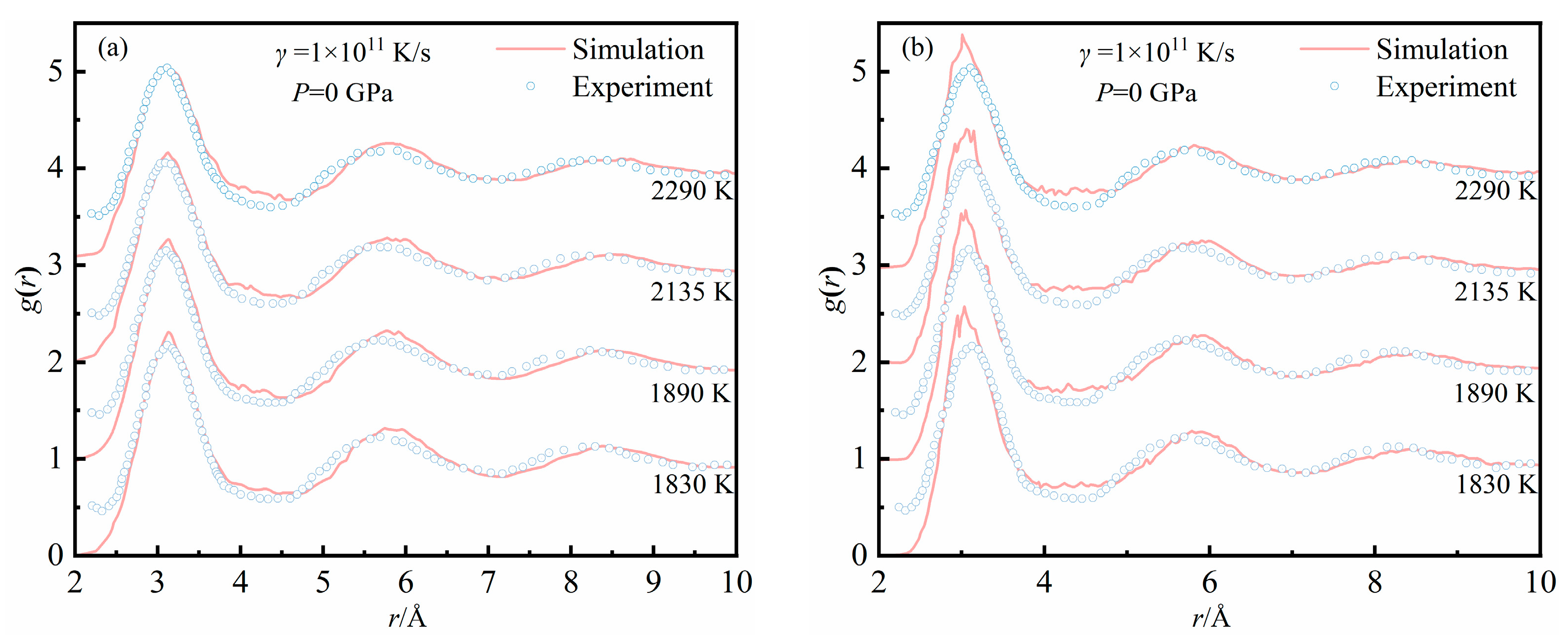
The outcomes of molecular dynamics (MD) simulations are intrinsically dependent on the chosen interatomic potentials, making the selection of an appropriate potential a critical aspect of classical MD. In this study, several existing potentials were evaluated, including the EAM potential proposed by Mendelev et al. [42]. The S-EAM potential developed by Sheng et al. [43] was found to most accurately reproduce the high-temperature BCC phase and low-temperature HCP phase of Zr. Moreover, the radial distribution function g(r) of liquid Zr calculated with this potential shows excellent agreement with experimental data [44]. As shown in Figure 1, the g(r) obtained using our selected potential aligns significantly better with experimental results than that generated by another widely used potential [42].
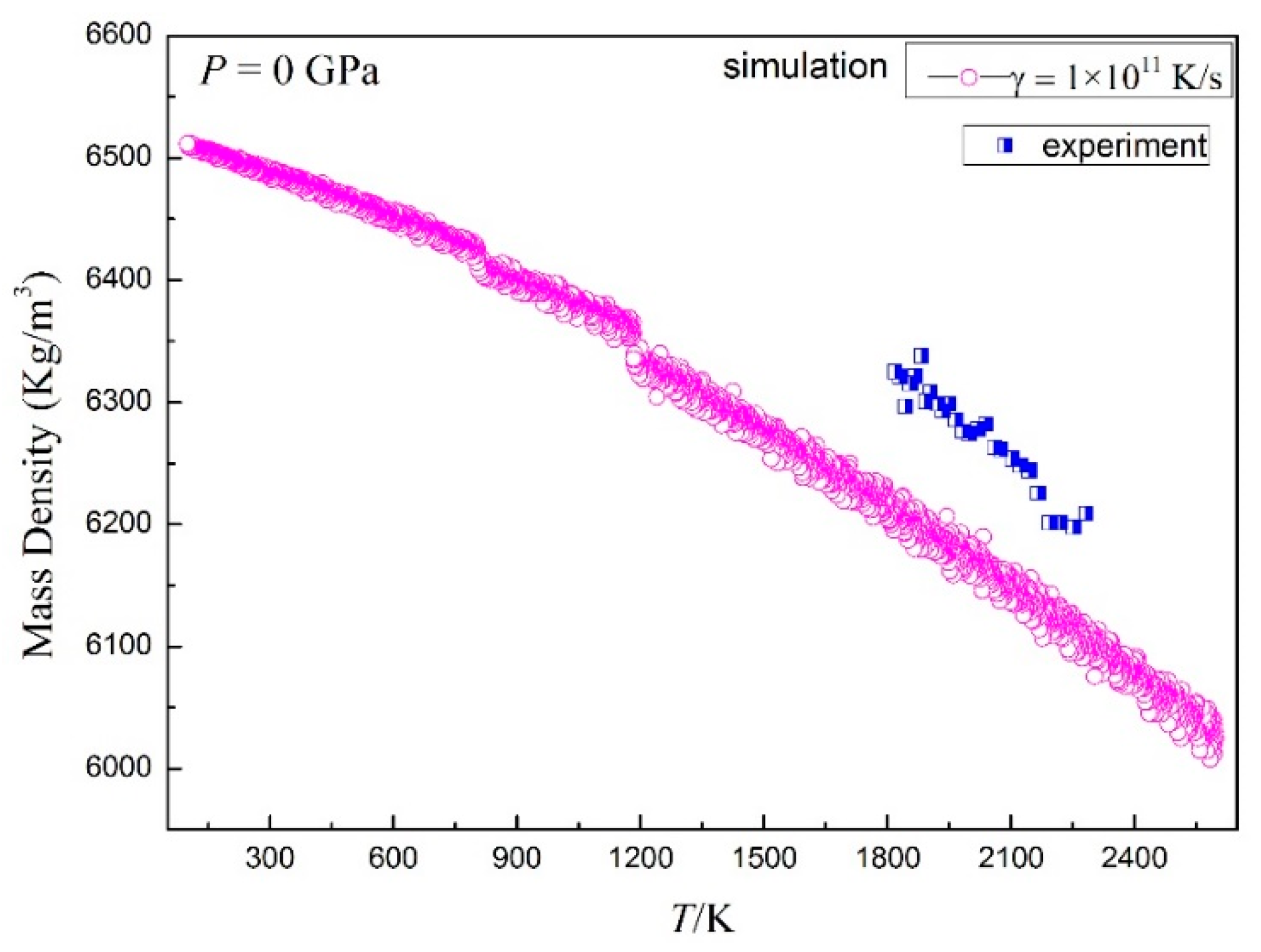
Figure 2 illustrates the quantitative agreement between the present simulations and experimental data. The mass density obtained at 0 GPa using the S-EAM potential is slightly lower than the experimental ambient value, which is consistent with the expected positive dependence of density on pressure. The reliability of the S-EAM potential for high-pressure studies was confirmed by the work of Mo et al. [27], which demonstrated that the calculated pressure-volume (P-V) curve of Zr showed excellent agreement with first-principles DFT results from Wang et al. [45] and experimental data from Zhao et al. [33]. These combined validations confirm that the selected potential is reliable for simulations across the studied pressure range. Consequently, the S-EAM potential was employed to investigate the solidification of Zr under various pressures.
Based on the above analysis, the S-EAM potential has been employed to investigate the solidification process of Zr under different pressures.

2.2. Simulation Details

All MD simulations were performed using the Large-scale Atomic/Molecular Massively Parallel Simulator (LAMMPS) package version 23 June 2022 [47] within the isothermal–isobaric (NPT) ensemble [48]. A constant cooling rate of 1.0 × 10¹¹ K/s was applied. The system consisted of 10,000 Zr atoms, with initial positions and velocities randomly assigned within a cubic simulation cell under three-dimensional periodic boundary conditions. A timestep of 1.0 fs was used. Initial liquid configurations were prepared by equilibrating the system at 2600 K (well above the experimental melting point of ~2127 K [44,46,49]) for 1.0 ns at the target pressure. Subsequently, the system was quenched from 2600 K to 100 K at the same fixed hydrostatic pressure, which varied from 0 to 125 GPa across the simulation set. Atomic trajectories (positions, velocities) and energetic data were recorded for subsequent analysis.

3. Results and Discussion

3.1. The Stability of the A15 Phase

Validating the interatomic potential under high pressure is crucial for the reliability of our simulations. Given the scarcity of experimental data at such extremes, we assessed the suitability of the EAM potential by examining the correlation between the peaks in the g(r) of an unrelaxed sample at 100 K and the underlying pair-wise potential, which is central to the EAM formulation. For analysis, atoms in an A15 crystal (comprising 3× Z12 and Z14 coordination) are denoted as A15 atoms.
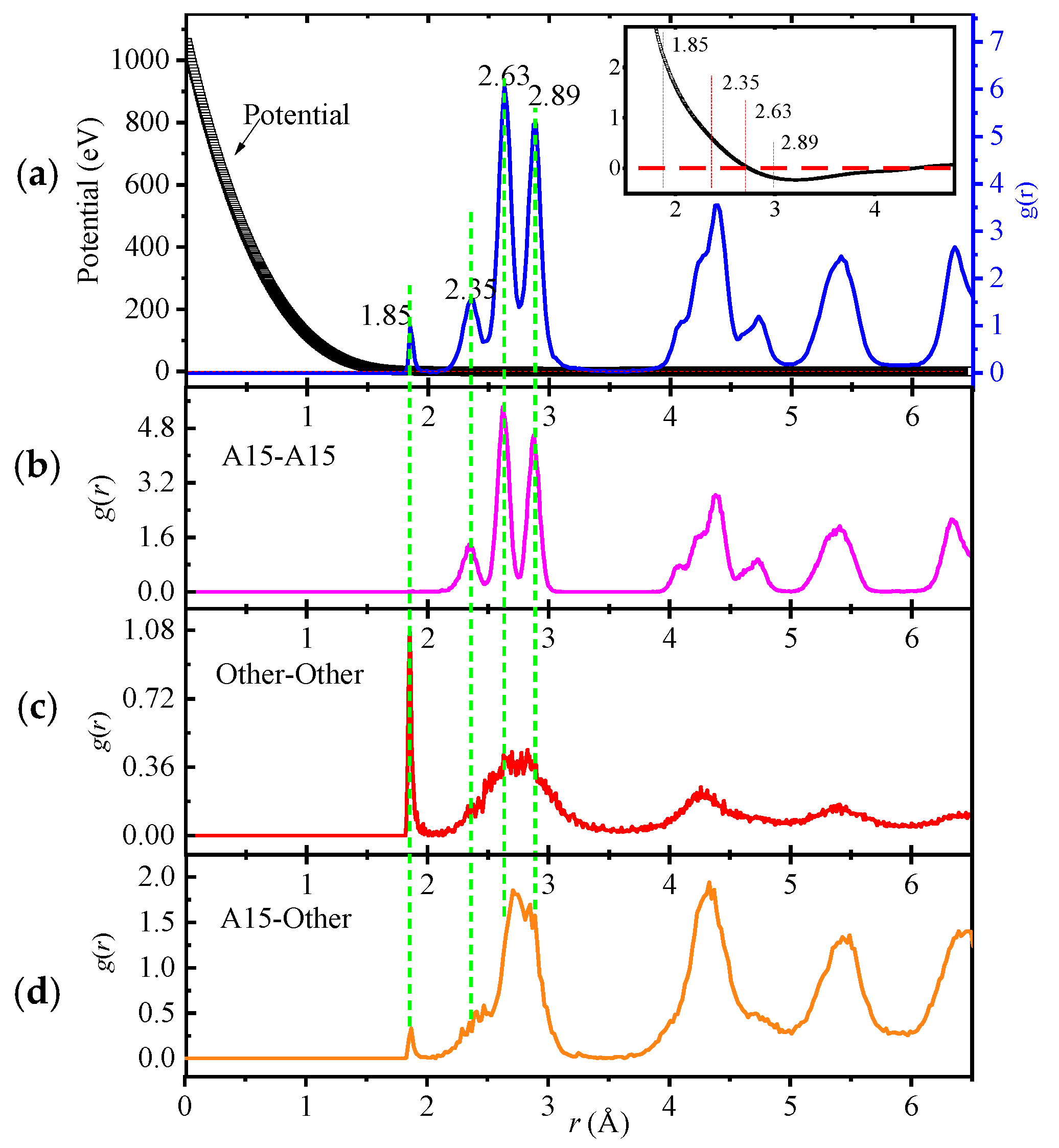
As shown in Figure 3, the g(r) curve of the unrelaxed A15 structure exhibits its first four peaks at 1.85, 2.35, 2.63, and 2.89 Å under 125 GPa. In contrast, the shortest interatomic distance at ambient pressure is approximately 3.01 Å [39]. At 125 GPa, the first peak (1.85 Å) corresponds to the shortest atomic separation. The second peak (2.35 Å) lies to the left of the zero point on the pair-potential curve but remains outside the strong repulsive region. The major peaks at 2.63 and 2.89 Å align closely with the zero and equilibrium points of the pair potential, respectively. This analysis confirms that the characteristic atomic distances under high pressure are consistent with the functional form of the potential, and the nearest-neighbor distance has contracted appropriately for the high-pressure environment. Therefore, the employed EAM potential remains valid, and the simulation results for pressures up to 125 GPa are considered reliable.
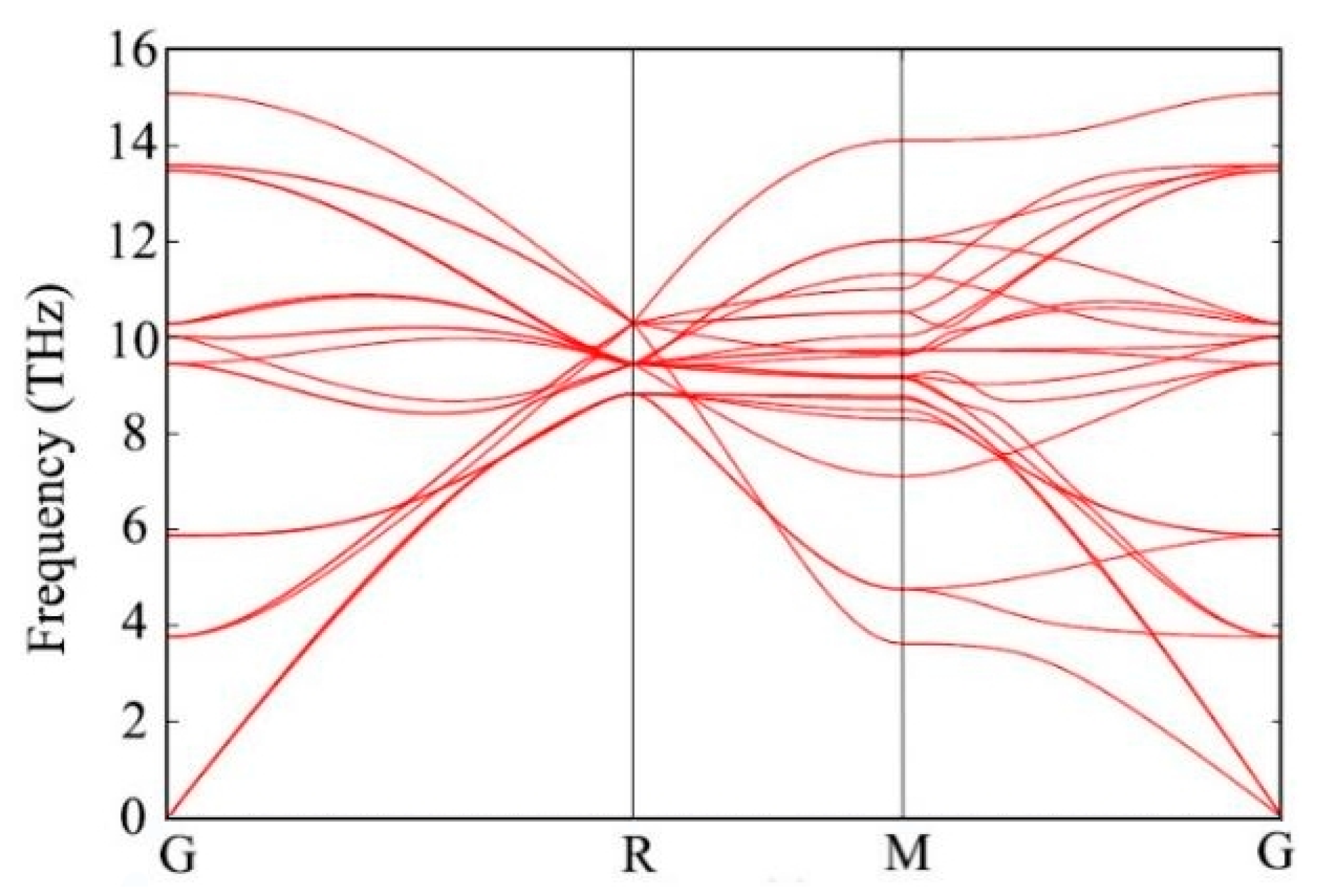
The dynamic stability of the A15 crystal phase was evaluated to confirm its structural viability further. Figure 4 presents the calculated phonon dispersion spectrum. The absence of imaginary frequencies across the entire spectrum confirms the dynamical stability of this phase.

3.2. The System Energy and Solidification Pathway

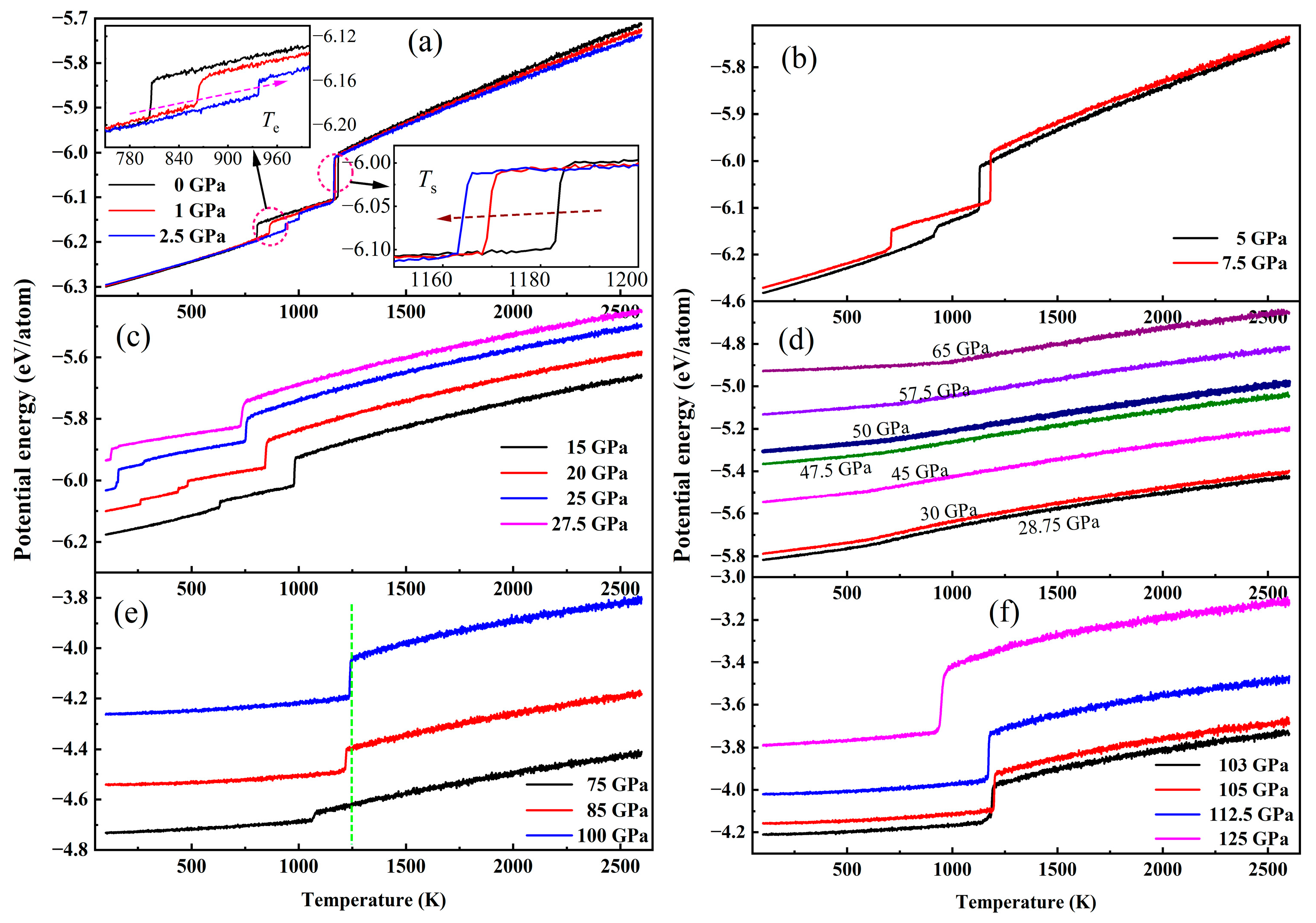
As anticipated, the system’s potential energy decreases monotonically with decreasing temperature at constant pressure and increases with pressure under isothermal conditions. At a fixed cooling rate, the solidification pathway depends on the applied pressure, as illustrated in Figure 5. Assuming that a discontinuous change in potential energy corresponds to a first-order phase transition (e.g., crystallization), while a continuous change in the slope of the energy-temperature curve signals a continuous transition (e.g., vitrification); the following pressure-dependent behavior is observed: Below 27.5 GPa, crystallization occurs (Figure 5a–c), initially forming a BCC phase that ultimately results in a mixture dominated by HCP structures [39]. Between 27.5 and 65 GPa (Figure 5d), the system undergoes vitrification. At pressures from 75 to 125 GPa (Figure 5e,f), crystallization recurs, yielding the A15 phase.
In-depth analysis of the onset temperature of initial crystallization (Tc) and the end temperature of final crystallization (Te, if any) reveals further notable details. Based on their evolution patterns, all crystallization pathways under different pressures can be classified into five distinct types: three below 28.75 GPa and two within the pressure range of [75, 125] GPa. At relatively low pressures, Tc decreases while Te increases across the interval [0, 2.5] GPa (Figure 5a). With further pressure increase, Tc rises as Te decreases in the range of [5, 7.5] GPa (Figure 5b). In contrast, both Tc and Te decrease throughout the interval [10, 27.5] GPa (Figure 5c). At higher pressures, Tc increases in the range of [75, 100] GPa (Figure 5e), but subsequently decreases in the range of 103 to 125 GPa (Figure 5f). The time interval between Tc and Te in Figure 5 is governed by pressure-dependent nucleation frequency and grain growth rate: in the low-pressure regime (0–27.5 GPa), increasing pressure raises the nucleation barrier (ΔV > 0) and reduces atomic mobility, leading to lower nucleation frequency and slower grain growth; in the high-pressure regime (65–125 GPa), nucleation frequency and growth rate first increase with pressure (facilitated by ΔV < 0) then decrease as ΔV reverses to positive; while in the intermediate regime (27.5–65 GPa), vitrification suppresses both nucleation and grain growth entirely.
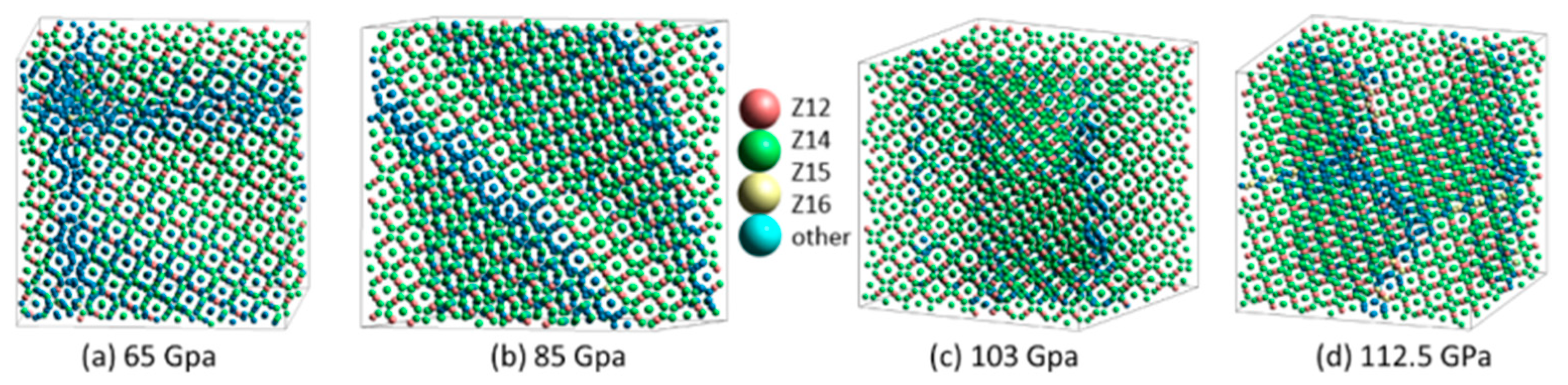
Our previous work [39] investigated the crystallization pathway at pressures below 27.5 GPa. We demonstrated that stable crystal nuclei distribution characteristics determine whether single or multiple intermediate stages occur before the final HCP crystal forms. Visual inspection reveals that at pressures above 65 GPa, rapid cooling consistently produces the same crystal structure, albeit with varying defect densities, as shown in Figure 6. Further structural analysis indicates a Z12 to Z14 coordination number ratio of approximately 1:3. With two atoms per repeating unit, this configuration is identified as the A15 phase-a topologically close-packed structure also known as β-tungsten (β-W) [50], a topologically close-packed crystal.

3.3. The Volume Evolution and No-Equilibrium Phase Diagram

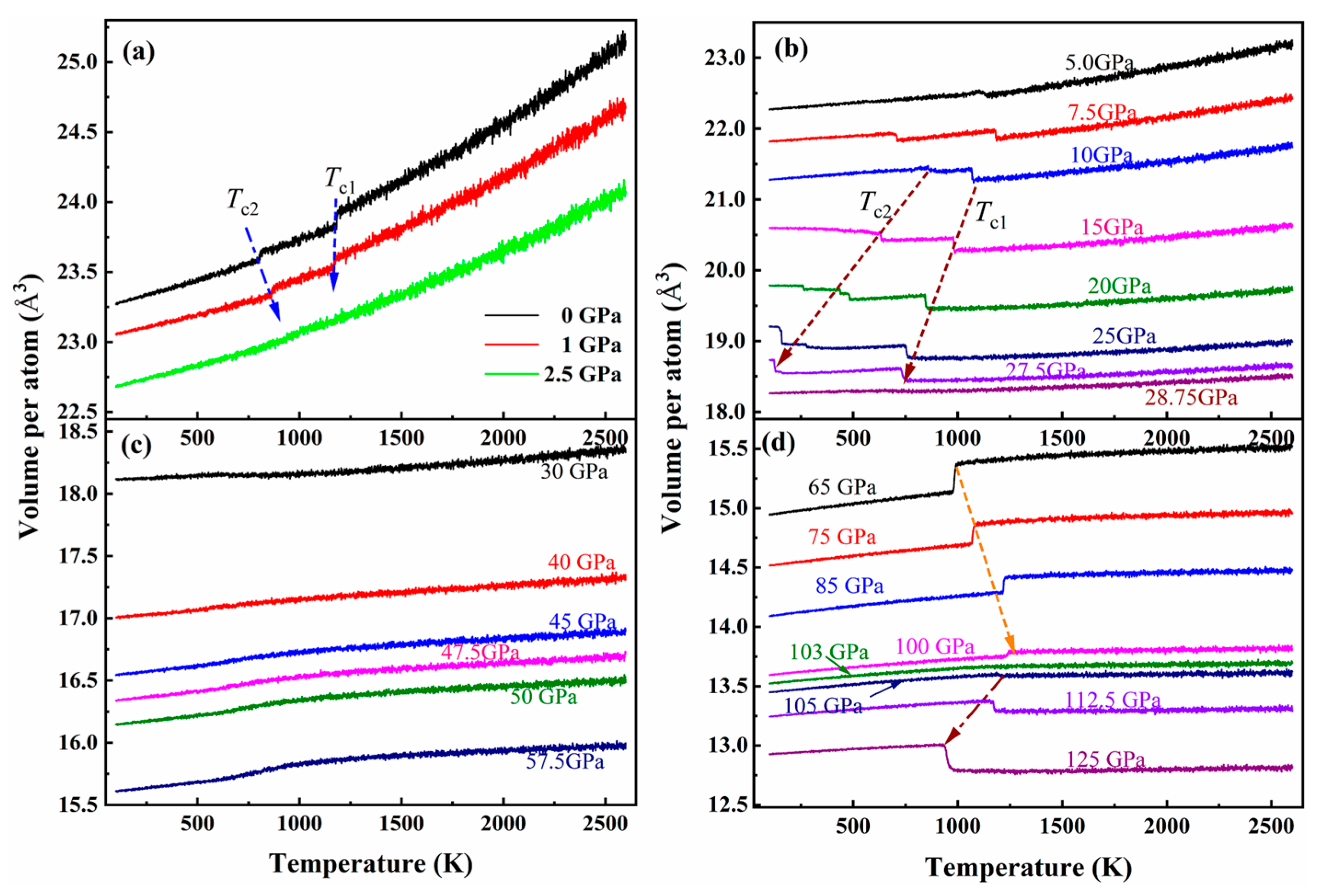
High hydrostatic pressure typically favors phase transformations that entail a significant reduction in volume, rendering volumetric evolution during rapid solidification a key focus of this investigation. As illustrated in Figure 7, the system volume decreases with decreasing temperature at constant pressure and with increasing pressure at constant temperature, in accordance with thermodynamic principles. Analogous to the evolution of the system potential, the volume change during crystallization under pressure can be categorized into five distinct types. At relatively low pressures, the volume first undergoes an abrupt reduction in the range of 0–2.5 GPa (Figure 7a), transitions to a continuous variation at 2.5 GPa (Figure 7c), and then exhibits a discontinuous increase between 5 and 27.5 GPa (Figure 7b). At higher pressures, a discontinuous volume drop is observed from 75 to 100 GPa, followed by a stepwise increase from 112.5 to 125 GPa.
During the rapid quenching of Zr across the entire investigated pressure range (up to 125 GPa), the system’s energy decreases continuously. A sudden volume reduction in both pressure regimes (below 28.75 GPa and above 65 GPa) indicates the occurrence of all first-order phase transitions. From Figure 7, we can see that a phase transition associated with a positive volume change (ΔV > 0) results in a decrease in the critical temperature Tc as pressure increases. Conversely, if the transition involves a negative volume change (ΔV < 0), Tc is expected to rise with pressure. In other words, an increase in pressure raises Tc when a decrease in volume accompanies the phase transition.
As shown in Figure 7a,d, ΔV is negative in the pressure intervals of [0, 2.5) GPa and [65, 100] GPa. Accordingly, within these ranges, the critical temperature Tc1 should increase with pressure. The trend of Tc2 follows this expectation, while that of Tc1 displays the opposite tendency (see Figure 7a). Considering the inherent uncertainties associated with rapid cooling and the relatively modest variation in Tc1 over its corresponding pressure range, it suggests that a first-order phase transition occurs in this regime (liquid→BCC (β phase) transition). Conversely, Figure 7b,d indicate that ΔV > 0 in the intervals [10, 27.5] GPa and [112.5, 125] GPa; consequently, Tc would be expected to decrease with rising pressure. However, the observed Tc exhibits a counterintuitive increasing trend with pressure. Furthermore, within [30, 57.5] GPa, the absence of any abrupt change in atomic volume throughout solidification (Figure 7c) suggests that no first-order phase transition occurs in this regime.
The abovementioned scenario is just the micro mechanism of the Clausius–Clapeyron relation, which can be written as
Δ P = L T Δ V Δ T
where ΔPT is the slope of the tangent to the coexistence curve, L is the specific latent heat, T is the absolute temperature, and ΔV is the specific volume change accompanying the phase transition. For an exothermic transition (L < 0), if the phase transition involves a volume contraction (ΔV < 0), the Clausius–Clapeyron relation dictates that increasing pressure (ΔP > 0) raises the transition temperature (ΔT > 0). Conversely, if the transition is accompanied by a volume expansion (ΔV > 0), an increase in pressure lowers the transition temperature (ΔT < 0). The Clausius–Clapeyron relation is generally applied to equilibrium thermodynamic processes. It is an issue worth discussing whether and to what degree the Clausius–Clapeyron relation can be applied to non-equilibrium thermodynamic processes, such as rapid cooling.
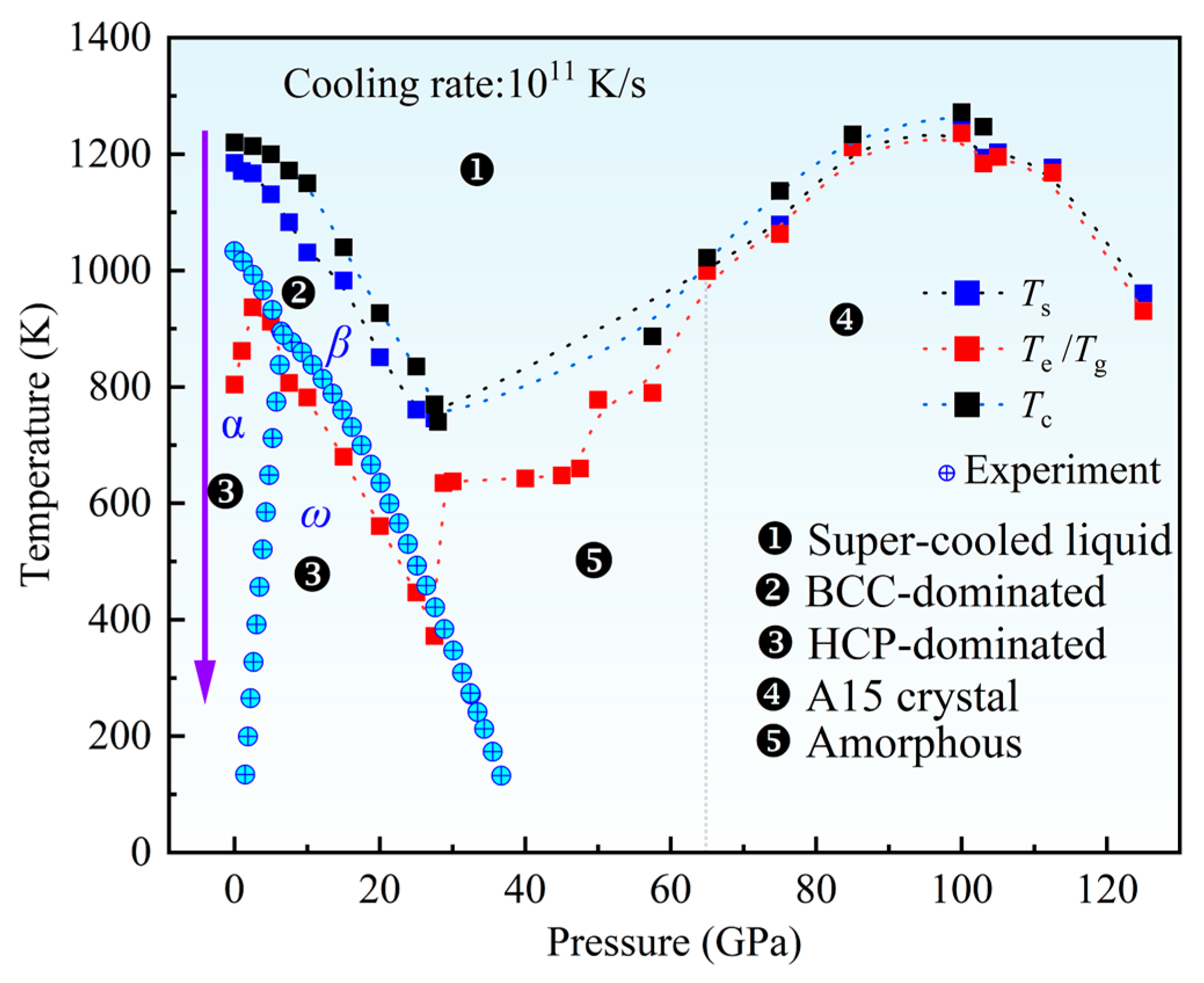
Through the systematic correlation of thermodynamic parameters with structural evolution, our analysis establishes a direct correspondence between the critical temperatures, marked by abrupt changes in the E-T profile, and key structural transformations. Based on this correspondence and the identified phase boundaries among α, ω, β, and A15 phases, we summarize the results in the P-T phase diagram shown in Figure 8. For comparison, corresponding experimental data from Refs. [48,50] are also included. Here, Ts and Te denote the onset and completion temperatures of a phase transition, respectively. The phases labeled α, ω, and β in Figure 8 correspond to those in the phase diagram calculated by Greeff et al. [51], where both α and ω adopt an HCP structure and β corresponds to the BCC structure.
It should be noted that the phase boundaries in Figure 8 correspond to dynamic, non-equilibrium transitions rather than equilibrium coexistence curves. They indicate the pressure-dependent onset (Ts) and completion (Te) temperatures of solidification under a fixed rapid cooling rate. Plotted as discrete curves, these boundaries reflect the statistical trend of transition temperatures across the studied pressure range. Unlike sharp equilibrium phase lines, the present non-equilibrium transitions show moderate pressure-dependent broadening, which stems from the interplay between pressure-induced atomic packing and kinetic delays during nucleation and growth. Physically, these curves demarcate the P-T regions where a specific phase-amorphous, BCC/HCP, or A15 prevails after rapid cooling, in consistency with our structural and energetic data (e.g., ΔV and potential energy variation).
As shown in Figure 8, at pressures below 27.5 GPa, Zr solidifies sequentially via the pathway of undercooled liquid→β→α with a negative phase boundary slope (dP/dT < 0). Between 27.5 and 65 GPa, the undercooled liquid vitrifies directly into an amorphous state. In the pressure intervals of [65, 100] GPa (dP/dT > 0) and [105, 125] GPa (dP/dT < 0), the undercooled liquid crystallizes directly into the A15 phase.
To quantitatively verify the stability of α, ω, β, and A15 phases of Zr under different pressures, we performed density functional theory (DFT) calculations to determine their relative energy differences, using the thermodynamically most stable α phase as the reference. The results are summarized in Table 1:
As presented in Table 1, at 0 GPa, the stability order of Zr phases follows α > ω > β > A15. The ω phase is only slightly less stable than the α phase (ΔE = 0.019 eV/atom), which is consistent with its equilibrium stability at moderate pressures. In contrast, the A15 phase exhibits the lowest stability at 0 GPa (ΔE = 0.136 eV/atom), which explains its absence in ambient or low-pressure phase behavior. At 75 GPa, the ω phase becomes structurally unstable, and the stability order shifts to α > A15 > β. Notably, the A15 phase (ΔE = 0.597 eV/atom) is significantly more stable than the β phase (ΔE = 1.021 eV/atom) at this pressure. This thermodynamic preference confirms that under high pressure, the A15 phase is favored over the β phase during solidification, which aligns with the phase transition pathways observed in our simulations and further validates the reliability of our results.
We note that the influence of the cooling rate on the pressure-dependent shift in phase boundaries remains an open question in this study, as all simulations were performed at a fixed cooling rate of 1.0 × 10¹¹ K/s. This aspect is crucial for a complete understanding of Zr phase behavior under extreme non-equilibrium conditions and warrants future systematic investigation using simulations across a range of cooling rates.

3.4. The Critical Pressures for Crystallization

Comparing the evolution patterns of volume and potential of the simulated system with temperature under different pressures, one can find that the critical changes are not always consistent with each other as shown in Figure 9. In particular, at P = 2.5 GPa there are three drop-offs on the energy curve, while no distinct discontinuous changes can be found on the volume curve; at P = 5 GPa there is only one jump-up on the volume curve while there are two drop-offs on the energy curves; and at 65 GPa the energy evolution seems like a continuous phase transition (similar to a typical vitrification) while the volume drops off at the temperature where the slope of the energy curve decreases.
Structural analysis via LaSCA confirms the occurrence of three and two phase transitions at 2.5 GPa (Figure 9a) and 5.0 GPa (Figure 9b), respectively, along the MISC pathway from the supercooled liquid to the stable HCP phase of Zr (for details, see Ref. [39]). Regarding solidification at 65 GPa, LaSCA confirms that crystallization does take place, resulting in an A15 phase composed of Z12 and Z14 LSCs in a 1:3 ratio. As shown in Figure 6, the system at 100 K is highly ordered and clearly corresponds to a complex crystalline phase. Details about the spacious configuration of atoms in the A15 phase and the structural evolution resulting from rapid cooling at 65 GPa will be presented elsewhere.
Therefore, neither the evolution pattern of energy nor that of volume can be solely relied upon to determine whether solidification leads to crystallization or vitrification. In other words, a smooth evolution in energy or volume does not necessarily indicate a continuous phase transition; it may correspond to a discontinuous (first-order) transition, as signaled by an abrupt drop or jump in the corresponding curve. In fact, the pressures at which this anomaly occurs are such that continuous changes in energy or volume mask a discontinuous phase transition critical for the trend of volume change at the transition temperature Tc. Specifically, around 2.5 GPa, ΔV changes from negative to positive; near 5 GPa, and at approximately 65 GPa, vitrification is superseded by crystallization. Following this pattern, another critical pressure is expected between 100 and 112.5 GPa, where a second reversal in the sign of ΔV (from negative to positive) should occur.

4. Conclusions

This study employs molecular dynamics simulations at a rapid cooling rate of 1.0 × 10¹¹ K/s to systematically investigate the solidification behavior and phase-transition mechanisms of Zr over a broad pressure range of 0–125 GPa. The primary objectives were to identify the pressure-dependent solidification pathways, verify the applicability of fundamental thermodynamic relations under non-equilibrium conditions, and elucidate the microstructural origins of anomalous volume and energy changes during crystallization. The main findings are summarized as follows:
(1)
Within the investigated pressure range of 0–125 GPa, Zr exhibits two distinct crystalline regions and one amorphous (vitrified) region upon solidification.
(2)
The solidification pathway is pressure-dependent: at lower pressures, the sequence is liquid→β→α, while at higher pressures, the system crystallizes directly into the A15 phase (liquid→A15).
(3)
Within both crystalline pressure regions, zones of crystallization expansion (ΔV > 0) and contraction (ΔV < 0) are identified. Consequently, the crystallization temperature may either increase or decrease with rising pressure, depending on the specific pressure regime.
(4)
For a first-order crystallization transition, the thermodynamic state variables need not all change discontinuously; however, at least one must exhibit an abrupt change to satisfy the criteria of a first-order phase transition.
These findings provide novel insights into the microscopic mechanisms underlying the “anomalous” phenomena revealed by universal thermodynamic theories.

Author Contributions

Conceptualization, L.L. and Z.X.; validation, Z.X. and C.L.; formal analysis, L.L. and K.Q.; investigation, L.L. and Z.X.; resources, Z.Y. and C.L.; data curation, L.L. and Z.Y.; writing—original draft preparation, L.L. and C.L.; writing—review and editing, L.L. and K.Q.; visualization, Z.Y.; supervision, Z.Y.; project administration, Z.Y.; funding acquisition, L.L. and K.Q. All authors have read and agreed to the published version of the manuscript.

Funding

This work was funded by the Scientific Research Fund of Hunan Provincial Education Department (Grant Nos. 23A0492 and 23B0638) and the Natural Science Foundation of Hunan Province (2023JJ30282).

Data Availability Statement

The raw data supporting the conclusions of this article will be made available by the authors on request.

Conflicts of Interest

The authors declare no conflict of interest.

References

  1. Zeng, Q.; Ding, Y.; Mao, W.L.; Yang, W.; Sinogeikin, S.V.; Shu, J.; Mao, H.; Jiang, J.Z. Origin of Pressure-Induced Polyamorphism in Ce75Al25 Metallic Glass. Phys. Rev. Lett. 2010, 104, 105702. [Google Scholar] [CrossRef]
  2. Zeng, Q.; Sheng, H.; Ding, Y.; Wang, L.; Yang, W.; Jiang, J.-Z.; Mao, W.L.; Mao, H.-K. Long-Range Topological Order in Metallic Glass. Science 2011, 332, 1404–1406. [Google Scholar] [CrossRef]
  3. Lou, H.B.; Fang, Y.K.; Zeng, Q.S.; Lu, Y.H.; Wang, X.D.; Cao, Q.P.; Yang, K.; Yu, X.H.; Zheng, L.; Zhao, Y.D.; et al. Pressure-Induced Amorphous-to-Amorphous Configuration Change in Ca-Al Metallic Glasses. Sci. Rep. 2012, 2, 376. [Google Scholar] [CrossRef] [PubMed]
  4. Wu, M.; Tse, J.S.; Wang, S.Y.; Wang, C.Z.; Jiang, J.Z. Origin of Pressure-Induced Crystallization of Ce75Al25 Metallic Glass. Nat. Commun. 2015, 6, 6493. [Google Scholar] [CrossRef] [PubMed]
  5. Irifune, T.; Kawakami, K.; Arimoto, T.; Ohfuji, H.; Kunimoto, T.; Shinmei, T. Pressure-Induced Nano-Crystallization of Silicate Garnets from Glass. Nat. Commun. 2016, 7, 13753. [Google Scholar] [CrossRef] [PubMed]
  6. Sun, L.; Kikegawa, T.; Wu, Q.; Zhai, Z.; Wang, W. Unusual Transition Phenomenon in Zr-Based Bulk Metallic Glass upon Heating at High Pressure. Appl. Phys. Lett. 2002, 80, 3087–3089. [Google Scholar] [CrossRef]
  7. Dubrovinsky, L.; Dubrovinskaia, N.; Prakapenka, V.B.; Abakumov, A.M. Implementation of Micro-Ball Nanodiamond Anvils for High-Pressure Studies above 6 Mbar. Nat. Commun. 2012, 3, 1163. [Google Scholar] [CrossRef]
  8. Dubrovinsky, L.; Dubrovinskaia, N.; Bykova, E.; Bykov, M.; Prakapenka, V.; Prescher, C.; Glazyrin, K.; Liermann, H.-P.; Hanfland, M.; Ekholm, M.; et al. The Most Incompressible Metal Osmium at Static Pressures above 750 Gigapascals. Nature 2015, 525, 226–229. [Google Scholar] [CrossRef]
  9. Das, R.S.; Agrawal, Y.K. Raman Spectroscopy: Recent Advancements, Techniques and Applications. Vib. Spectrosc. 2011, 57, 163–176. [Google Scholar] [CrossRef]
  10. Klug, H.P.; Alexander, L.E. X-Ray Diffraction Procedures: For Polycrystalline and Amorphous Materials, 2nd ed.; Wiley: New York, NY, USA, 1974; ISBN 0-471-49369-4. [Google Scholar]
  11. Wu, Z.; Mo, Y.; Lang, L.; Yu, A.; Xie, Q.; Liu, R.; Tian, Z. Topologically Close-Packed Characteristic of Amorphous Tantalum. Phys. Chem. Chem. Phys. 2018, 20, 28088–28104. [Google Scholar] [CrossRef]
  12. Olijnyk, H.; Sikka, S.K.; Holzapfel, W.B. Structural Phase Transitions in Si and Ge under Pressures up to 50 GPa. Phys. Lett. A 1984, 103, 137–140. [Google Scholar] [CrossRef]
  13. Deng, X.; Lang, L.; Mo, Y.; Dong, K.; Tian, Z.; Hu, W. Solid−solid Phase Transition of Tungsten Induced by High Pressure: A Molecular Dynamics Simulation. Trans. Nonferrous Met. Soc. China 2020, 30, 2980–2993. [Google Scholar] [CrossRef]
  14. Cui, S.; Cai, L.; Feng, W.; Hu, H.; Wang, C.; Wang, Y. First-principles Study of Phase Transition of Tin and Lead under High Pressure. Phys. Status Solidi (b) 2008, 245, 53–57. [Google Scholar] [CrossRef]
  15. Turnbull, D. Under What Conditions Can a Glass Be Formed? Contemp. Phys. 1969, 10, 473–488. [Google Scholar] [CrossRef]
  16. Kelton, K.F.; Lee, G.W.; Gangopadhyay, A.K.; Hyers, R.W.; Rathz, T.J.; Rogers, J.R.; Robinson, M.B.; Robinson, D.S. First X-Ray Scattering Studies on Electrostatically Levitated Metallic Liquids: Demonstrated Influence of Local Icosahedral Order on the Nucleation Barrier. Phys. Rev. Lett. 2003, 90, 195504. [Google Scholar] [CrossRef] [PubMed]
  17. Zhang, Y.; Mattern, N.; Eckert, J. Study of Direct Relationship between Atomic Structures and Glass Forming Abilities of Cu100−x Zrx (0 ≤ x ≤ 10) Liquids by Molecular Dynamics Simulations. J. Appl. Phys. 2012, 111, 053520. [Google Scholar] [CrossRef]
  18. Yao, K.; Chen, N. Pd-Si Binary Bulk Metallic Glass. Sci. China Ser. G Phys. Mech. Astron. 2008, 51, 414–420. [Google Scholar] [CrossRef]
  19. Lou, H.B.; Xiong, L.H.; Ahmad, A.S.; Li, A.G.; Yang, K.; Glazyrin, K.; Liermann, H.P.; Franz, H.; Wang, X.D.; Cao, Q.P.; et al. Atomic Structure of Pd81Si19 Glassy Alloy under High Pressure. Acta Mater. 2014, 81, 420–427. [Google Scholar] [CrossRef]
  20. Zhang, J.; Zhao, Y.; Pantea, C.; Qian, J.; Daemen, L.L.; Rigg, P.A.; Hixson, R.S.; Greeff, C.W.; Gray, G.T.; Yang, Y.; et al. Experimental Constraints on the Phase Diagram of Elemental Zirconium. J. Phys. Chem. Solids 2005, 66, 1213–1219. [Google Scholar] [CrossRef]
  21. Narayan, J.; Bhaumik, A. Novel Phase of Carbon, Ferromagnetism, and Conversion into Diamond. J. Appl. Phys. 2015, 118, 215303. [Google Scholar] [CrossRef]
  22. Guo, X.; Tian, Z.; Gao, T.; Xie, Q.; Liang, Y.; Mo, Y.; Yan, W. A Novel Crystallization Pathway for SiGe Alloy Rapid Cooling. Phys. Chem. Chem. Phys. 2017, 19, 4695–4700. [Google Scholar] [CrossRef]
  23. Tian, Z.-A.; Liu, R.-S.; Zheng, C.-X.; Liu, H.-R.; Hou, Z.-Y.; Peng, P. Formation and Evolution of Metastable Bcc Phase during Solidification of Liquid Ag: A Molecular Dynamics Simulation Study. J. Phys. Chem. A 2008, 112, 12326–12336. [Google Scholar] [CrossRef]
  24. Zhou, L.; Liu, R.; Tian, Z.; Liu, H.; Hou, Z.; Zhu, X.; Liu, Q. Formation and Evolution Characteristics of Bcc Phase during Isothermal Relaxation Processes of Supercooled Liquid and Amorphous Metal Pb. Trans. Nonferrous Met. Soc. China 2011, 21, 588–597. [Google Scholar] [CrossRef]
  25. Zhou, L.L.; Liu, R.S.; Hou, Z.Y.; Tian, Z.A.; Lin, Y.; Liu, Q.H. Simulation study of effects of cooling rate on evolution of micro-cluster structures during solidification of liquid Pb. Acta Phys. Sin. 2008, 57, 3653–3660. [Google Scholar] [CrossRef]
  26. Wu, M.; Lou, H.; Tse, J.S.; Liu, H.; Pan, Y.; Takahama, K.; Matsuoka, T.; Shimizu, K.; Jiang, J. Pressure-Induced Polyamorphism in a Main-Group Metallic Glass. Phys. Rev. B 2016, 94, 054201. [Google Scholar] [CrossRef]
  27. Mo, Y.; Tian, Z.; Lang, L.; Liu, R.; Zhou, L.; Hou, Z.; Peng, P.; Zhang, T. The Short-Range Order in Liquid and A15 Crystal of Zirconium. J. Non-Cryst. Solids 2019, 513, 111–119. [Google Scholar] [CrossRef]
  28. Mo, Y.; Tian, Z.; Lang, L.; Zhou, L.; Liang, Y.; Zhang, H.; Liu, R.; Peng, P.; Wen, D. Different Structural Transitions of Rapidly Supercooled Tantalum Melt under Pressure. Phys. Chem. Chem. Phys. 2020, 22, 18078–18090. [Google Scholar] [CrossRef]
  29. Zhai, X.; Li, X.; Wang, Z.; Hu, L.; Song, K.; Tian, Z.; Yue, Y. The Connection between the Fragile-to-Strong Transition and the Liquid-Liquid Transition in a Binary Alloy System. Acta Mater. 2022, 239, 118246. [Google Scholar] [CrossRef]
  30. Zhao, X.; Wang, C.; Zheng, H.; Tian, Z.; Hu, L. The Role of Liquid–Liquid Transition in Glass Formation of CuZr Alloys. Phys. Chem. Chem. Phys. 2017, 19, 15962–15972. [Google Scholar] [CrossRef]
  31. Xia, H.; Duclos, S.J.; Ruoff, A.L.; Vohra, Y.K. New High-Pressure Phase Transition in Zirconium Metal. Phys. Rev. Lett. 1990, 64, 204–207. [Google Scholar] [CrossRef]
  32. Sikka, S.K.; Vohra, Y.K.; Chidambaram, R. Omega Phase in Materials. Prog. Mater. Sci. 1982, 27, 245–310. [Google Scholar] [CrossRef]
  33. Zhao, Y.; Zhang, J.; Pantea, C.; Qian, J.; Daemen, L.L.; Rigg, P.A.; Hixson, R.S.; Gray, G.T.; Yang, Y.; Wang, L.; et al. Thermal Equations of State of the α, β, and ω Phases of Zirconium. Phys. Rev. B 2005, 71, 184119. [Google Scholar] [CrossRef]
  34. Xia, H.; Ruoff, A.L.; Vohra, Y.K. Temperature Dependence of the ω-Bcc Phase Transition in Zirconium Metal. Phys. Rev. B 1991, 44, 10374–10376. [Google Scholar] [CrossRef]
  35. Akahama, Y.; Kobayashi, M.; Kawamura, H. High-Pressure X-Ray Diffraction Study on Electronics-d Transition in Zirconium. J. Phys. Soc. Jpn. 1991, 60, 3211–3214. [Google Scholar] [CrossRef]
  36. Akahama, Y.; Kobayashi, M.; Kawamura, H. Structural Studies of Pressure-Induced Phase Transitions in Selenium up to 150 GPa. Phys. Rev. B 1993, 47, 20–26. [Google Scholar] [CrossRef] [PubMed]
  37. Zhao, Y.; Zhang, J. Enhancement of Yield Strength in Zirconium Metal through High-Pressure Induced Structural Phase Transition. Appl. Phys. Lett. 2007, 91, 201907. [Google Scholar] [CrossRef]
  38. Mo, Y.; Tian, Z.; Liu, R.; Hou, Z.; Zhou, L.; Peng, P.; Zhang, H.; Liang, Y. Molecular Dynamics Study on Microstructural Evolution during Crystallization of Rapidly Supercooled Zirconium Melts. J. Alloys Compd. 2016, 688, 654–665. [Google Scholar] [CrossRef]
  39. Zhang, H.; Mo, Y.; Tian, Z.; Liu, R.; Zhou, L.; Hou, Z. The Effect of Pressure on the Crystallization of Rapidly Supercooled Zirconium Melts. Phys. Chem. Chem. Phys. 2017, 19, 12310–12320. [Google Scholar] [CrossRef]
  40. Wen, D.; Deng, Y.; Liu, J.; Tian, Z.; Peng, P. Effect of High Pressure on the Formation and Evolution of Clusters during the Rapid Solidification of Zirconium Melts. Comput. Mater. Sci. 2017, 140, 275–283. [Google Scholar] [CrossRef]
  41. Smirnova, D.E.; Starikov, S.V.; Gordeev, I.S. Evaluation of the Structure and Properties for the High-Temperature Phase of Zirconium from the Atomistic Simulations. Comput. Mater. Sci. 2018, 152, 51–59. [Google Scholar] [CrossRef]
  42. Mendelev, M.I.; Ackland, G.J. Development of an Interatomic Potential for the Simulation of Phase Transformations in Zirconium. Philos. Mag. Lett. 2007, 87, 349–359. [Google Scholar] [CrossRef]
  43. The Potential File Is Available on the Website. Available online: https://sites.google.com/site/eampotentials/table/zr (accessed on 7 January 2026).
  44. Schenk, T.; Holland-Moritz, D.; Simonet, V.; Bellissent, R.; Herlach, D.M. Icosahedral Short-Range Order in Deeply Undercooled Metallic Melts. Phys. Rev. Lett. 2002, 89, 075507. [Google Scholar] [CrossRef]
  45. Wang, B.-T.; Zhang, P.; Liu, H.-Y.; Li, W.-D.; Zhang, P. First-Principles Calculations of Phase Transition, Elastic Modulus, and Superconductivity under Pressure for Zirconium. J. Appl. Phys. 2011, 109, 063514. [Google Scholar] [CrossRef]
  46. Paradis, P.-F.; Rhim, W.-K. Thermophysical Properties of Zirconium at High Temperature. J. Mater. Res. 1999, 14, 3713–3719. [Google Scholar] [CrossRef]
  47. Plimpton, S. Fast Parallel Algorithms for Short-Range Molecular Dynamics. J. Comput. Phys. 1995, 117, 1–19. [Google Scholar] [CrossRef]
  48. Martyna, G.J.; Tobias, D.J.; Klein, M.L. Constant Pressure Molecular Dynamics Algorithms. J. Chem. Phys. 1994, 101, 4177–4189. [Google Scholar] [CrossRef]
  49. Jakse, N.; Pasturel, A. Local Order of Liquid and Supercooled Zirconium by Ab. Initio Molecular Dynamics. Phys. Rev. Lett. 2003, 91, 195501. [Google Scholar] [CrossRef]
  50. Chen, S.; Wang, J.; Wu, R.; Wang, Z.; Li, Y.; Lu, Y.; Zhou, W.; Hu, P.; Li, H. Insights into the Nucleation, Grain Growth and Phase Transformation Behaviours of Sputtered Metastable β-W Films. J. Mater. Sci. Technol. 2021, 90, 66–75. [Google Scholar] [CrossRef]
  51. Greeff, C.W. Phase Changes and the Equation of State of Zr. Model. Simul. Mater. Sci. Eng. 2005, 13, 1015–1027. [Google Scholar] [CrossRef]
Figure 1. Comparisons of g(r) data at several temperatures from the experiment (open circles) (Adapted from Ref. [44]) and MD simulations (solid lines) with different potentials developed by (a) Sheng et al. (Adapted from Ref. [42]) and (b) Mendelev et al. (Adapted from Ref. [43]).
Metals 16 00078 g001
Figure 2. Comparisons of mass density between experiment and MD simulation under 0 GPa (Adapted from Ref. [46]).
Metals 16 00078 g002
Figure 3. The comparison of pair potential and total PDF (a) and partial PDFs (bd) for the sample at 100 K obtained by rapid cooling under 125 GPa.
Metals 16 00078 g003
Figure 4. The phonon spectrum of the A15-type Zr crystal.
Metals 16 00078 g004
Figure 5. The average potential energy per atom as a function of temperature across selected pressure ranges: (a) [0, 2.5] GPa, (b) [5, 7.5] GPa, (c) [15, 27.5] GPa, (d) [28.75, 65] GPa, (e) [75, 100] GPa, and (f) [103, 125] GPa.
Metals 16 00078 g005
Figure 6. The 3D snapshot of the atoms in the solids at 100 K was obtained by rapid cooling at four pressures.
Metals 16 00078 g006
Figure 7. The temperature dependence of the average volume per atom during rapid cooling under the pressures of (a) 0~2.5 GPa, (b) 5~27.5 GPa, (c) 28.75~50 GPa, and (d) 65–125 GPa.
Metals 16 00078 g007
Figure 8. The non-equilibrium phase diagram of Zr under rapid cooling at constant pressures and compared with the experimental data (Adapted from Refs. [48,50]), where Ts and Te are, respectively, the onset and end temperatures of the (first and last, if any) phase transition.
Metals 16 00078 g008
Figure 9. The evolution of average energy and volume per atom during rapid cooling at the pressures of 2.5 GPa (a), 5 GPa (b), 65 GPa (c), and 103 GPa (d).
Metals 16 00078 g009
Table 1. Structural energy differences between different Zr structures.
ΔE (eV/atom)0 GPa75 GPa
ΔEα-α00
ΔEω-α0.019/
ΔEβ-α0.0791.021
ΔEA15-α0.1360.597
Disclaimer/Publisher’s Note: The statements, opinions and data contained in all publications are solely those of the individual author(s) and contributor(s) and not of MDPI and/or the editor(s). MDPI and/or the editor(s) disclaim responsibility for any injury to people or property resulting from any ideas, methods, instructions or products referred to in the content.