


Abstract
The study aimed to remove Hf(IV) ions from Zr(IV) ions in sulfuric acid solution using PC88A, investigating the extraction and separation of high-concentration zirconium (Zr) and hafnium (Hf) in such systems. Key factors, including solution acidity and SO42− concentration, were examined. Results showed that acidity affected the size of Zr/Hf ion clusters, and PC88A exhibits a higher extraction preference for Hf(IV) over Zr(IV), achieving a separation factor (βHf/Zr) of 4.56 at 4 mol/L H+. Adding SO42− reduced its separation efficiency for Zr and Hf. Combined with slope analysis and FT-IR spectroscopy, Hf extraction by PC88A followed cation-exchange and solvation mechanisms, with 3 PC88A dimers consumed per Hf ion. Stripping experiments demonstrated that 1 mol/L sulfuric acid selectively stripped Zr from the loaded organic phase. Extraction and stripping equilibrium curves were constructed, confirming that 3 stages of Hf(IV) extraction from the solution and 4 stages of Zr(IV) stripping from the loaded organic phase are needed: 3 theoretical stages (O/A = 1) enabled complete Hf extraction, while 4 stages (A/O = 3:1) achieved full Zr stripping. This work provides a basis for efficient Zr-Hf separation using PC88A.
1. Introduction
Zirconium (Zr) and hafnium (Hf) are key materials in the nuclear industry, aerospace, and semiconductors. Pure Zr and specific Zr alloys act as core structural materials for nuclear reactors due to their low thermal neutron capture cross-section, and studies show 0.1% Hf in Zr alloys reduces their thermal neutron flux by 40% [1,2].
However, Zr and Hf coexist as “twin metals” in nature, with 2% Hf in natural Zr. Thus, efficient Zr-Hf separation and purification are critical for the high-quality development of the nuclear industry. Industrially, Zr-Hf separation mainly relies on molten salt distillation [3,4], solvent extraction [5,6,7] and crystallization [8,9,10]. Among these, solvent extraction has become the mainstream for acidic solutions due to its simple operation and high efficiency.
The dominant Zr-Hf solvent extraction system is the methyl isobutyl ketone-thiocyanate (MIBK-HSCN) system, designed by Oak Ridge National Laboratory in 1949 [11,12]. Here, minor Hf is more preferentially extracted into MIBK than Zr, with a separation factor (β) of ~7, enabling nuclear-grade production of both metals. Industrially, over two-thirds of nuclear-grade Zr and Hf are produced via this system. Nevertheless, it has notable drawbacks: high thiocyanate concentration (easily decomposing into toxic cyanide) and high aqueous solubility of MIBK with a low flash point. To address these limitations, developing a new, green, and efficient solvent extraction system for Zr-Hf separation is imperative.
In recent years, various new extraction systems have been investigated for Zr-Hf separation. Phosphorus-containing extractants have gained extensive attention due to their excellent extraction capacity and structural tunability. Many studies have focused on developing new acidic phosphorus-containing extractants or systems based on common ones (e.g., D2EHPA, PC88A, Cyanex272) to explore Zr-Hf separation mechanisms. For instance, adding glutamic acid (Glu) to hydrochloric acid solutions switches D2EHPA’s preference from Zr to Hf extraction; di-tert-butylphenyl phosphate (DTBPPA) [13] incorporates aromatic groups into the D2EHPA structure to enhance separation efficiency; and the novel extractant N,N-octylamine bis(methylenephenylphosphinic acid) (OADMPPA) [14] achieves efficient Zr-Hf extraction via steric hindrance, with extraction efficiencies 7.2 and 12.6 times those of Cyanex 272 for Zr and Hf, respectively. Another novel diphosphonic extractant, p-tert-butylcalixarene diphosphonic acid [15] reaches a separation factor (β) of 24 in hydrochloric acid, while Wang et al. [16] developed (n-octyl)(2,4,4′-trimethylpentyl) phosphinic acid (INET-1) with a high β of 19.2 by adjusting the steric hindrance of its β-C branch. Notably, despite PC88A being a widely used phosphorus-containing extractant, existing studies on its application for Zr-Hf separation are mostly limited to low-concentration feed solutions or preliminary mechanism discussions, lacking systematic investigations on process parameters, extraction-stripping synergy, and industrial feasibility in high-concentration sulfuric acid systems—which are critical for practical industrial application.
However, these novel extractants are mostly limited to mechanism exploration and low-concentration feed solutions, making them unsuitable for commercial processes. In contrast, some acidic phosphorus-containing extractants show industrial feasibility: Lee et al. [17] developed a D2EHPA-based process for 10 g/L Zr feed solutions, and He et al. [18] designed the synergistic Cyanex 572 system (composed of Cyanex 272 and P507), which efficiently separates 110 g/L Zr feed solutions with a β of 15.7. To fill the research gap of PC88A in industrial-grade Zr-Hf separation, this study systematically investigates its feasibility for extracting and separating high-concentration Zr(IV) and Hf(IV) from sulfuric acid solutions. The core objectives are to clarify the key influencing factors (acidity, SO42− concentration), reveal the extraction mechanism, optimize the stripping process, and determine the theoretical stages for industrial amplification—ultimately providing a green, efficient, and technically feasible alternative route to the traditional toxic MIBK-HSCN system.
Despite the advances in phosphorus-containing extractant systems for Zr–Hf separation, critical gaps remain in industrial-oriented research. First, most existing studies on PC88A focus on low-concentration feed solutions (<10 g/L Zr) or fundamental mechanism exploration, lacking systematic investigation into its performance for high-concentration feeds (≥20 g/L Zr) that meet industrial production requirements. Second, sulfate-based separation systems are rarely paired with PC88A for Zr–Hf separation, and the regulatory effects of key factors on ion cluster dissociation and extraction efficiency remain unclear. Third, while novel extractants (e.g., OADMPPA, INET-1) exhibit high separation factors, they are not suitable for commercialization due to complex synthesis and high costs, whereas PC88A, as a mature and low-cost extractant, lacks optimized process design for Zr–Hf separation in sulfate media. To address these limitations, this study aims to demonstrate the feasibility of applying PC88A in industrial settings.
2. Materials and Methods
2.1. Reagents
The extractant PC88A was supplied by Shanghai Aladdin Biochemical Technology Co., Ltd. (Shanghai, China), and the diluent sulfonated kerosene was provided by Chongqing Kangpu Chemical Co., Ltd. (Chongqing, China); the concentration of PC88A was maintained at 0.3 mol/L throughout the experiments. Zirconium sulfate containing hafnium (Zr(SO4)·4H2O, mass ratio mHf/mZr ≈ 2%) was obtained from Jiangxi Jing’an High-Tech Co., Ltd. (Nanchang, China), serving as the source of Hf and Zr. All other chemical reagents used in the experiments were of analytical grade.
2.2. Experiment
In the Zr feed solution used for experiments, the concentrations of Zr and Hf were fixed at 20 g/L and 0.4 g/L, respectively. For extraction, the organic and aqueous phases were contacted at an organic-to-aqueous (O/A) volume ratio of 1:1, with the temperature maintained at 25 ± 1 °C for 20 min until the extraction equilibrium was reached. After equilibrium, the aqueous phase was separated. The loaded organic phase after extraction was subjected to stripping experiments using sulfuric acid solution.
The aqueous phases obtained from extraction and stripping were diluted to appropriate concentrations, and the concentrations of Zr and Hf were determined by ICP-OES (Optima 5300V, PerkinElmer, Waltham, MA, USA). The concentrations of Zr and Hf in the loaded organic phase were calculated via mass balance. The extraction efficiency (E%), distribution ratio (D), and separation factor (β) are defined by the following Equations (1)–(4):
The symbol M0 represents the total mass of metal ions (Zr(IV) and Hf(IV)) in the feed solution, the symbol Maq represents the mass of metal ions remaining in the aqueous phase after extraction, the symbol Morg represents the mass of metal ions transferred to the organic phase after extraction and the symbol Mstripped represents the mass of metal ions transferred from the organic phase to the aqueous phase during the stripping process. The symbol β is calculated from the distribution ratios of the two metals. The symbol D is defined as the ratio of the concentration of metal ions in the organic phase to that in the aqueous phase at equilibrium.
3. Results and Discussion
3.1. Influence of the Acidity
Lab-scale solvent extraction studies conducted at low metal ion concentrations are not directly applicable to industrial production. In this study, the concentrations of Zr(IV) and Hf(IV) in the initial aqueous phase were controlled at approximately 20 g/L and 0.4 g/L, respectively—this concentration level meets the requirements for industrial Zr-Hf separation.
However, in high-concentration solutions, Zr(IV) and Hf(IV) do not exist as simple free ions. As reported in [19,20,21,22], tetranuclear clusters are the most common form of Zr and Hf in aqueous solutions, with four eight-coordinate metal centers linked by μ2-OH groups; their typical structure is [M4(OH)8(H2O)16]8+. Specifically, Sommers et al. [21] characterized the structure via SAXS and found that Zr even forms additional giant Zr48 clusters in thiocyanic acid solutions.
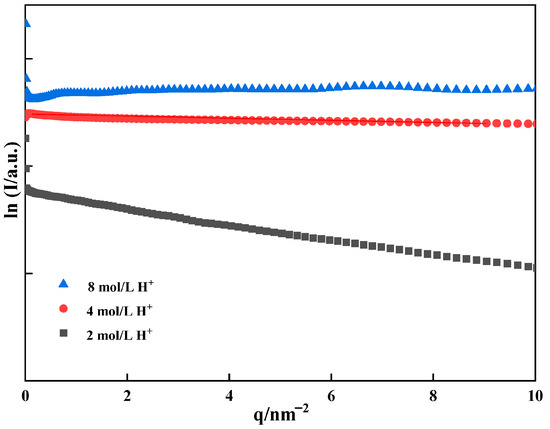
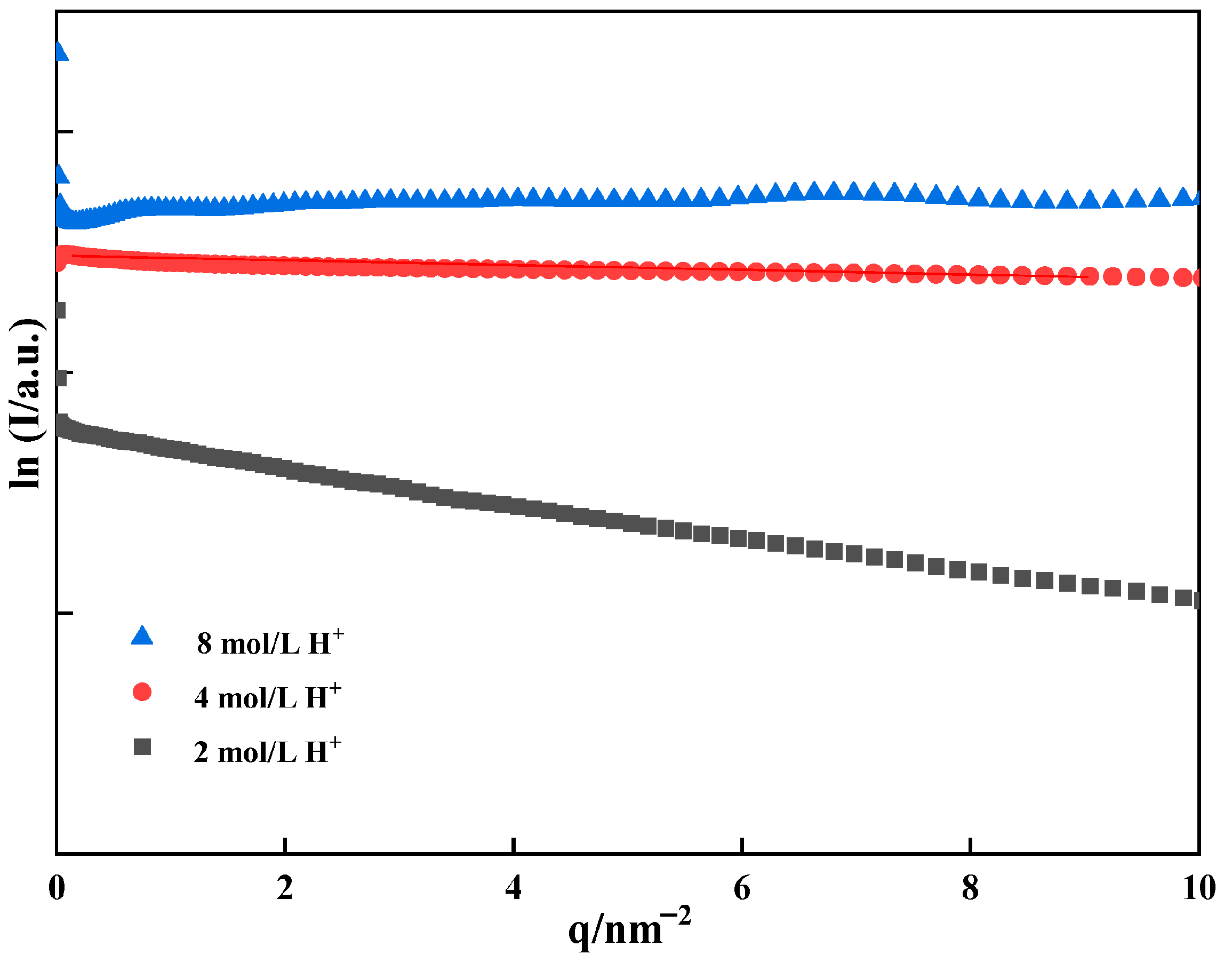
In this study, SAXS was used to measure the average size of cluster structures in the 20 g/L Zr feed solution under different acidity conditions, with the results presented in Figure 1.
Figure 1.
SAXS diagrams of solutions in different acidity.
SAXS analysis revealed the critical role of H+-induced dissociation of Zr(IV)-Hf(IV) clusters. Based on Guinier law fitting, the Guinier radius (Rg) of clusters at different [H+] was calculated: When the concentration of H+ is 2 mol/L, the rotational radius of the cluster molecules of zirconium-hafnium ions in the solution is approximately 0.36 nm. When the concentration of H+ is further increased to 4 mol/L or 8 mol/L, the size of the cluster molecules becomes almost negligible. This indicates that H+ in the solution can disrupt the Zr(IV)-Hf(IV) cluster structures, causing the clusters to dissociate into oligomers or even monomers—this may help increase direct contact opportunities between the extractant (PC88A) and Zr(IV)/Hf(IV) ions.
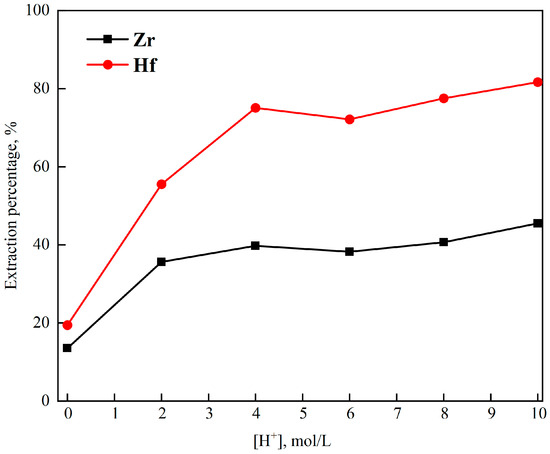
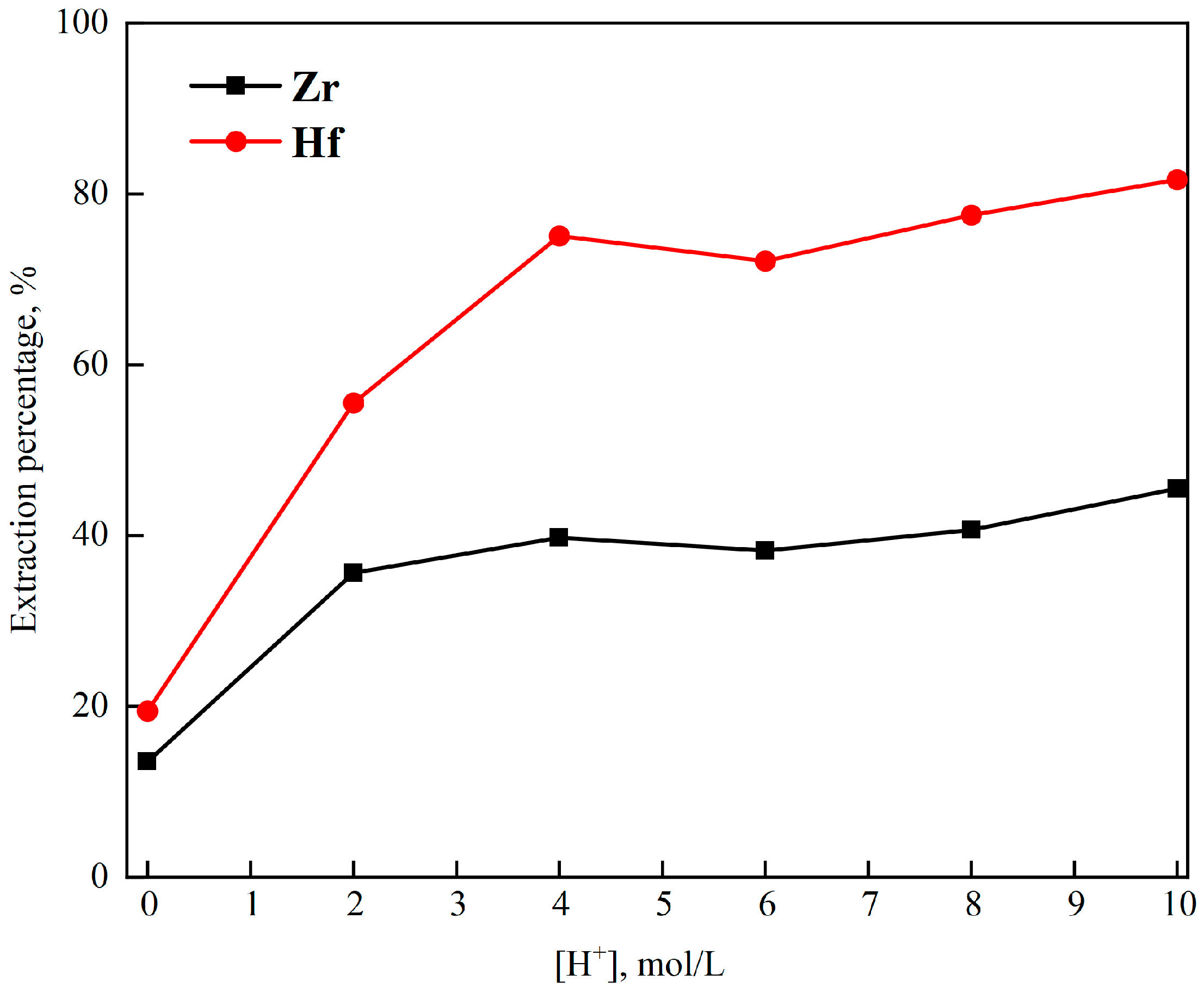
Extraction experiments of Zr(IV) and Hf(IV) by PC88A were conducted in solutions with different acidity. The extraction results are presented in Figure 2, and the separation factors (β) of Zr(IV) and Hf(IV) by PC88A are listed in Table 1.
Figure 2.
Effect of acidity on the extraction of Zr and Hf with 0.3 mol/L PC88A. Experimental conditions: [H+] = 0–10 mol/L, [Zr] = 20 g/L, [Hf] = 0.4 g/L, [PC88A] = 0.3 mol/L, diluent = kerosene.
Table 1.
Influence of the acidity on the separation factor of Hf/Zr.
Results show that in the [H+] concentration range of 0–4 mol/L, the extraction efficiencies of Zr(IV) and Hf(IV) by PC88A increase significantly with increasing [H+] concentration. At 4 mol/L [H+], the extraction efficiency of PC88A for Zr(IV) is 39.8%, for Hf(IV) is 75.1%, and the separation factor (βHf/Zr) reaches 4.56. With further increase in [H+] concentration beyond 4 mol/L, the extraction efficiencies of Zr(IV) and Hf(IV) by PC88A show little change.
At 2 mol/L [H+], large clusters with Rg = 0.36 nm limit the accessibility of PC88A to the metal centers. The steric hindrance reduces the effective collision frequency between extractant dimers and metal ions, leading to low distribution ratios and extraction efficiencies. At [H+] ≥ 4 mol/L, cluster dissociation into oligomers and monomers maximizes the exposure of metal active sites. This enhances the coordination between the P=O group of PC88A and Zr(IV)/Hf(IV), resulting in a significant increase in D and E%, with the highest separation factor.
The extraction efficiency of high-acidity PC88A for high-concentration zirconium-hafnium ions has been confirmed. The size of the metal clusters is found to be the limiting factor for the extraction efficiency, providing a quantitative basis for the optimization of acidity in industrial production. Considering comprehensively the extraction efficiency, separation performance, and industrial application, 4.0 mol/L [H+] is determined as the optimal acidity condition, which is adopted in all subsequent experiments.
The SAXS characterization provides novel insights into the micro-mechanism linking acidity to extraction efficiency, which extends beyond established extraction chemistry. Previous studies [5,18] only reported the macro trend that acidity enhances Zr-Hf separation but failed to clarify the underlying reason. Our SAXS results quantitatively demonstrate that H+ disrupts Zr/Hf cluster structures: clusters at 2 mol/L H+ are too large for PC88A to access active sites, resulting in low extraction efficiency; while clusters dissociate into oligomers/monomers at 4 mol/L H+, maximizing the contact probability between PC88A and metal ions. This direct correlation between cluster dissociation degree and extraction efficiency fills the gap in understanding how acidity regulates separation performance in high-concentration systems.
3.2. Influence of SO42− Concentration
Owing to their small ionic radii and high ionic charges, Zr(IV) and Hf(IV) ions are classified as hard Lewis acids [23]. On the other hand, anions potentially present in the solution (e.g., NO3−, Cl−, CO32−, SO42−) belong to hard Lewis bases. Zr(IV) and Hf(IV) ions exhibit a strong tendency to form various complexes with these anions, and the influence of anion types in aqueous solution on metal extraction increases in the following order: NO32− < Cl− < CO32− < SO42−.
According to the study by Ryabchikov et al. [24], the possible complex forms of Zr(IV) and Hf(IV) in the solution and their corresponding chemical equilibrium constants are listed in Table 2. Notably, the interaction between Hf4+ and SO42− is weaker than that between Zr4+ and SO42−.
Table 2.
Formation of complexes of Zr and Hf in sulfuric acid solution and chemical reaction constants.
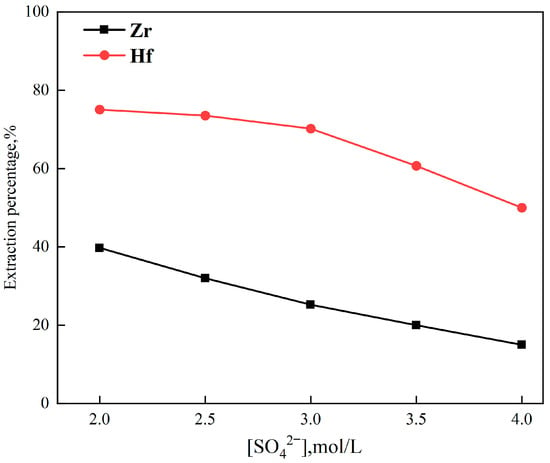
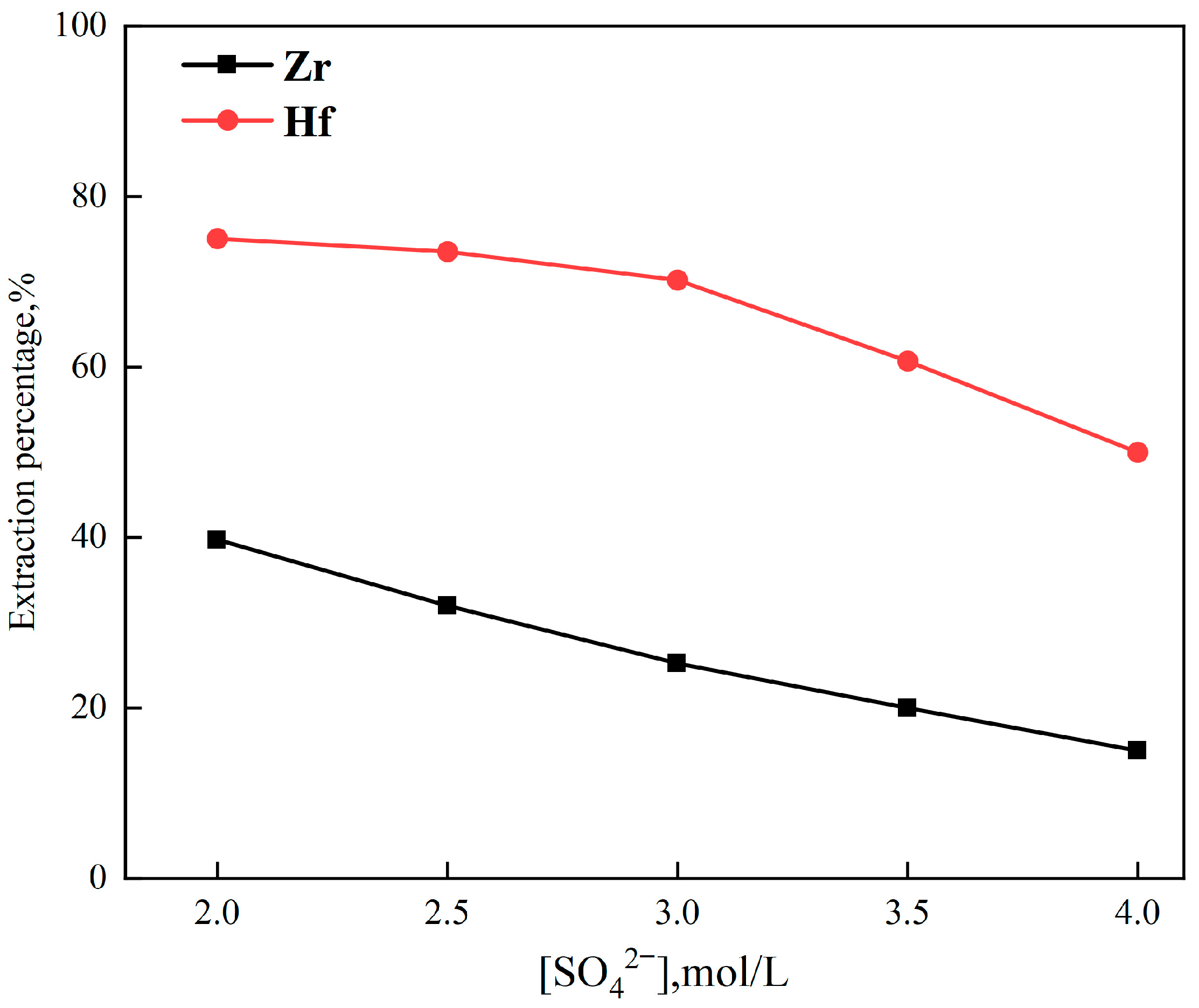
In this study, the concentration of SO42− in the aqueous phase was adjusted by adding sodium sulfate to investigate its effect on the extraction and separation of Zr(IV) and Hf(IV) by PC88A, with the results presented in Figure 3.
Figure 3.
Effect of SO42− concentration on the extraction of Zr and Hf with 0.3 mol/L PC88A. Experimental conditions: [SO42−] = 2.0–4.0 mol/L, [Zr] = 20 g/L, [Hf] = 0.4 g/L, [PC88A] = 0.3 mol/L, diluent = kerosene.
It can be observed that with the solution acidity maintained constant, the extraction efficiencies of the two metals decrease with increasing SO42− concentration. Specifically, in the SO42− concentration range of 2–4 mol/L, the extraction efficiency of Hf(IV) decreases from 75.1% to 50%, that of Zr(IV) decreases from 39.8% to 17.4%, and the separation factor (βHf/Zr) decreases from 4.56 to 2.85.
Zr(IV) and Hf(IV) preferentially form stable complexes with SO42− via inner-sphere coordination. The equilibrium constants (Kn) for Zr(SO42)n4−2n are consistently higher than those for Hf analogs, indicating a stronger Zr-SO42− interaction. PC88A binds to Zr(IV)/Hf(IV) via bidentate chelation, forming neutral complexes.SO42− replaces H2O ligands in the metal’s first coordination sphere, forming anionic complexes that are less lipophilic and less accessible to PC88A.
The selectivity depends on the relative inhibition of DHf and DZr by SO42−. At [SO42−] = 2 mol/L, PC88A exhibits higher affinity for Hf(IV), leading to DHf > DZr. As [SO42−] increases to 4 mol/L, Zr(IV) is more strongly sequestered by SO42−, so DZr decreases more significantly than DHf.
The ratio β declines to 2.85 because the relative advantage of Hf(IV) extraction by PC88A is diminished by the preferential complexation of SO42− with Zr(IV). This explains why additional SO42− is detrimental to selectivity—its competitive binding disrupts the intrinsic affinity difference between PC88A and the two metals.
3.3. The Extraction Stoichiometry of Zr and Hf
Studies [5,17,25,26] have shown that the cation-exchange reaction equation for the extraction and separation of Zr(IV) and Hf(IV) by acidic phosphorus-containing extractants is as follows:
where M represents Zr(IV) or Hf(IV), HL denotes the PC88A monomer; in the non-polar diluent kerosene, PC88A usually exists as a dimer, and n stands for the stoichiometric ratio of PC88A.
Based on Equation (5), together with Equation (3) and the calculation formula for the reaction equilibrium constant, the reaction equilibrium constant Kex for Hf(IV) extraction from the solution by PC88A can be obtained, as shown in Equation (6) below.
Taking the logarithm of both sides of Equation (8) gives the following relationship.
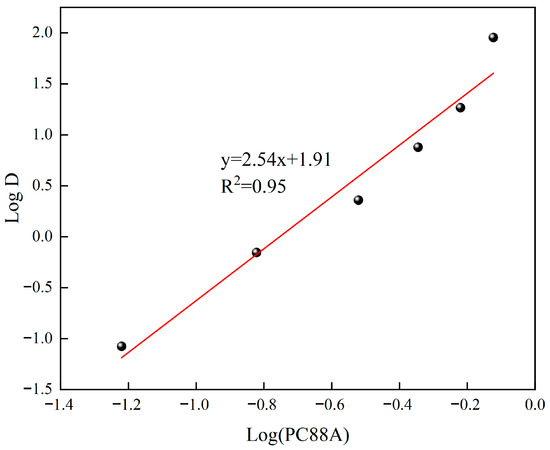
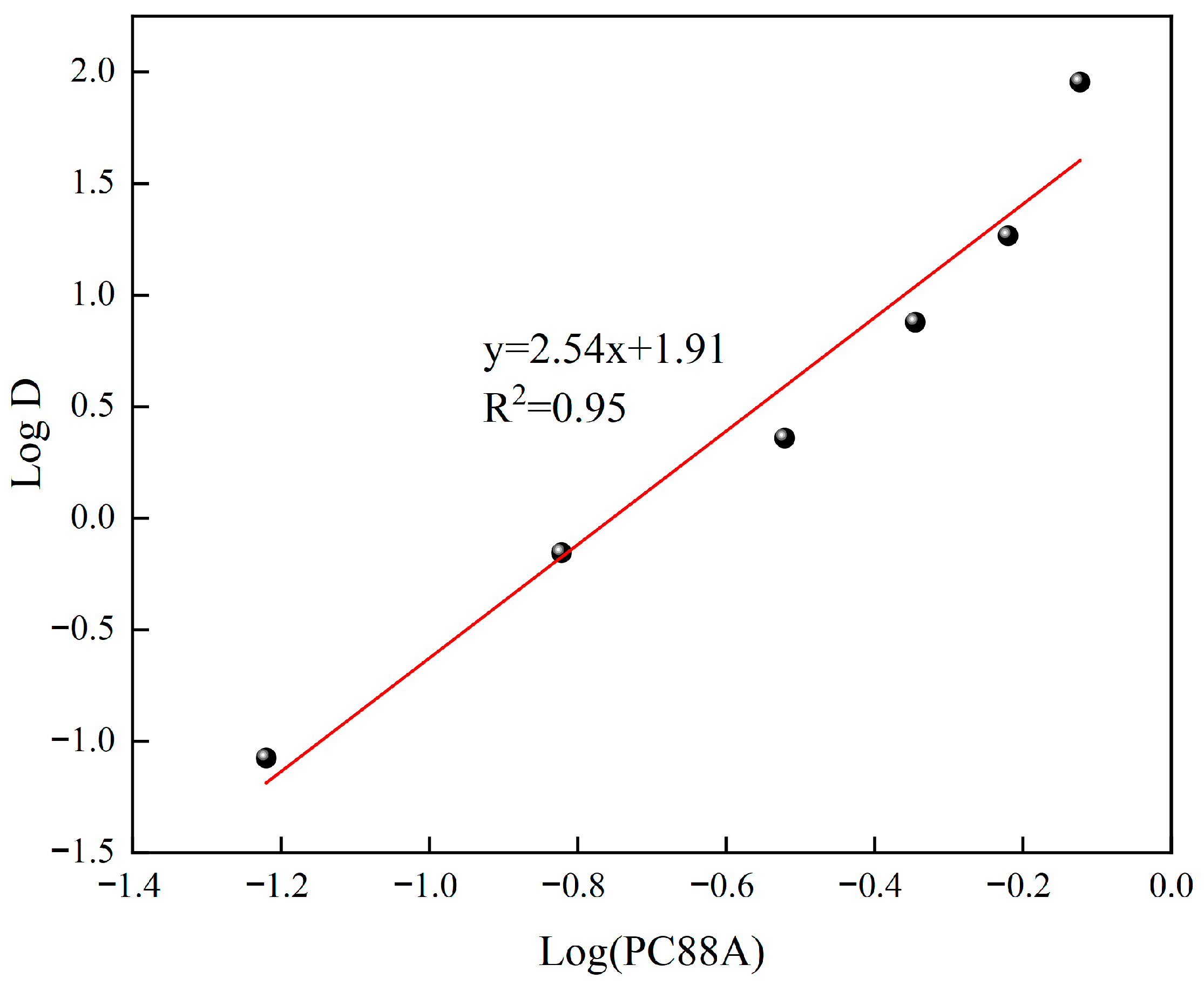
Plotting log D against log[H2L2] yields a straight line with a slope close to 2.54 (Figure 4); thus, 3 PC88A dimer molecules are consumed per extracted Hf(IV) ion. The extraction reaction equation for Hf(IV) extraction and separation by PC88A is thus obtained as follows:
Figure 4.
Effect of PC88A concentration on the distribution ratio of Hf4+.
From Equation (8), it can be observed that during the extraction of Hf(IV) from the solution by PC88A, complete dissociation does not occur—instead, a portion of PC88A combines with Hf(IV) ions via solvation.
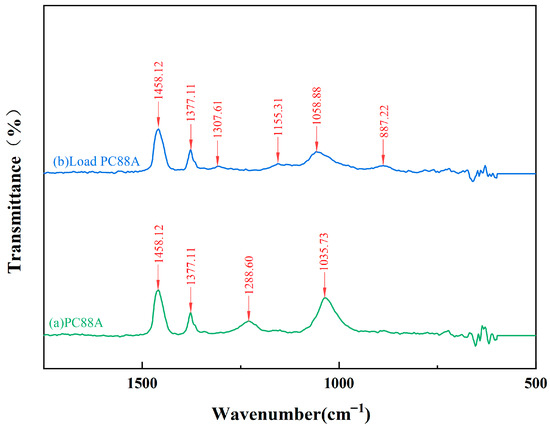
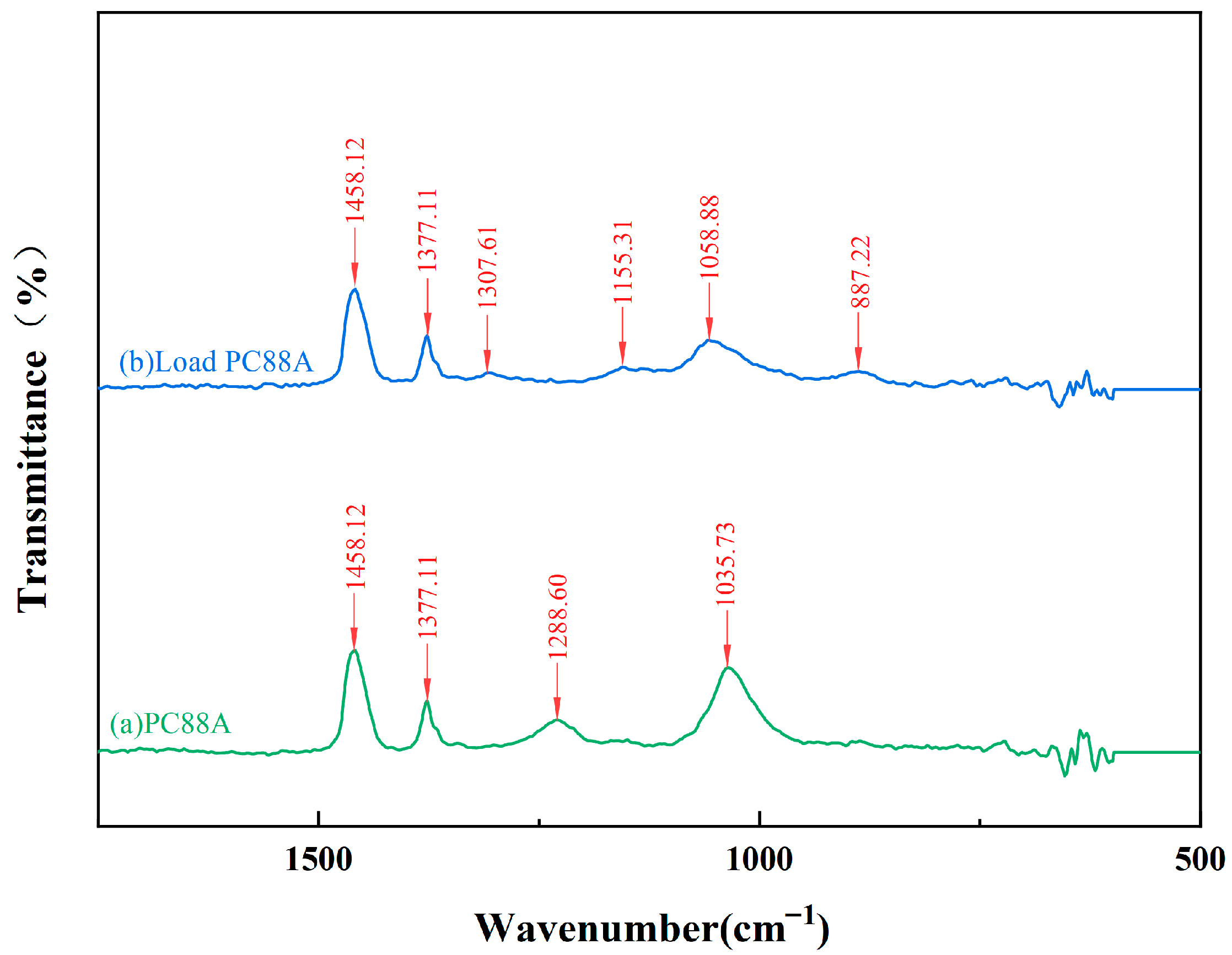
Further FT-IR analysis of Hf-loaded PC88A (Figure 5) shows that the strong peak at 1288.60 cm−1 is attributed to the stretching vibration of the phosphoryl group (P=O), and the peak at 1035.73 cm−1 corresponds to the stretching vibration of the phosphoester group (P-O-C). After Hf(IV) loading, the FT-IR characteristics of PC88A exhibit clear coordination signals: the P=O stretching vibration peak shifts red from 1288.60 cm−1 to 1155.31 cm−1, a direct indication that the oxygen atom in P=O coordinates with Hf(IV) ions, weakening the P=O bond energy. The characteristic peaks of the alkyl group at 1458.12 cm−1 and 1377.11 cm−1 show no obvious shift, indicating the alkyl skeleton of PC88A does not participate in binding Zr(IV)/Hf(IV) ions. Meanwhile, a new absorption peak appears at 887.22 cm−1 in Curve b, corresponding to the stretching vibration of the Hf-O bond formed between Hf and O, confirming the successful loading of Hf(IV) ions.
Figure 5.
FT-IR spectra of (a) PC88A and (b) Load PC88A.
While cation-exchange and solvation mechanisms have been reported for phosphorus-containing extractants, this study reveals unique mechanistic details specific to high-concentration Zr-Hf sulfate systems that advance beyond mere confirmation of known behavior. In low-concentration systems, Zr(IV)/Hf(IV) exist as monomers or small oligomers, and the mechanism is dominated by cation exchange. In contrast, the 20 g/L Zr feed in this study initially forms large clusters, and the observed mechanism is tightly coupled to cluster dissociation. H+-induced cluster dissociation generates monomers that undergo cation exchange with PC88A dimers, forming ML4. In high-concentration systems, the residual cluster fragments and increased extractant concentration promote solvation: M L4 binds an additional PC88A dimer via P=O → M coordination, forming HfL4(HL)2. This solvation step stabilizes the extractant-metal complex, which is unnecessary in low-concentration systems due to the absence of cluster-induced steric stress.
Combined with the FT-IR analysis results, it can be inferred that the reaction mechanism of Hf(IV) extraction by PC88A involves both the cation-exchange principle and solvation mechanism:
Notably, the stoichiometry of 1 Hf(IV) ion complexing with 3 PC88A dimers is unique to the high-concentration sulfate system in this study. For low-concentration systems reported previously, Zr/Hf exists as free ions or simple dimers, and the stoichiometric ratio is 1:2. The difference arises from two key factors. Firstly, in industrial-grade high concentrations, Zr/Hf initially form tetranuclear clusters that dissociate into oligomers even at 4 mol/L H+, requiring more extractant molecules to cover coordination sites. Then, SO42− in the solution preferentially complexes with Zr(IV), leading to competitive coordination that necessitates additional PC88A to achieve effective Hf(IV) extraction. This stoichiometry thus reflects the synergistic effect of metal ion aggregation state and anion environment in high-concentration sulfate systems, which is distinct from low-concentration or anion-free systems.
3.4. Stripping Step
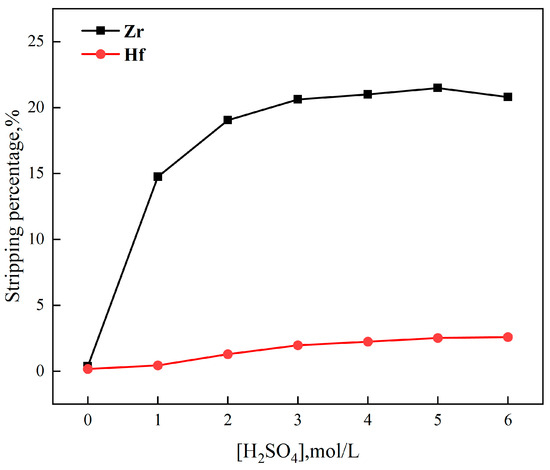
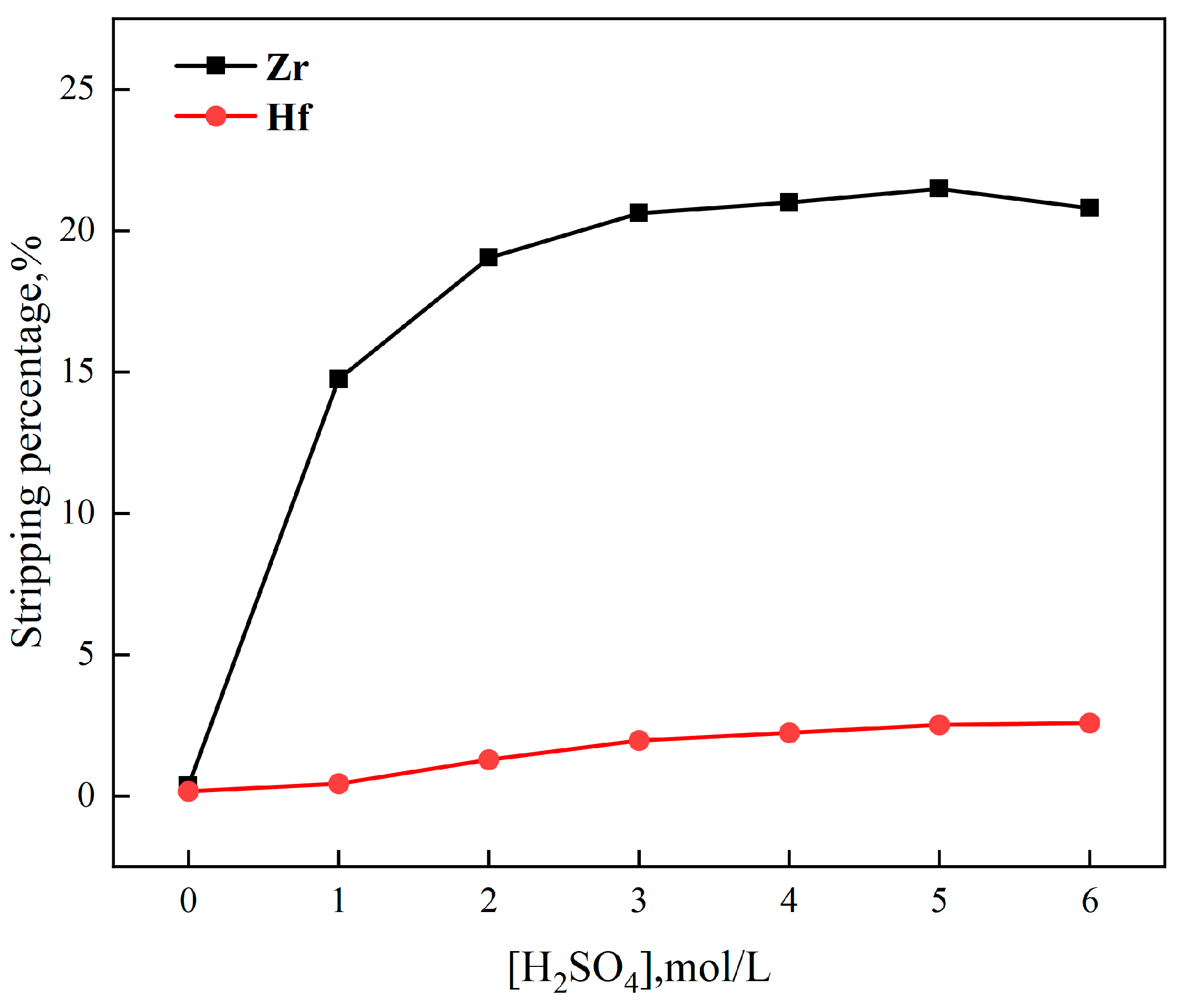
Stripping experiments were conducted on the organic phase generated during extraction to evaluate the recovery of metals from the organic phase. Distilled water and sulfuric acid (with concentrations ranging from 0 to 6 mol/L) were used as stripping agents. The loaded organic phase for stripping was the 0.3 mol/L PC88A-loaded organic phase obtained from the extraction experiment—during extraction, sulfuric acid solution was used to dissociate the complexation between PC88A and Zr(IV)/Hf(IV), which facilitates the return of Zr(IV) and Hf(IV) to the aqueous phase.
Figure 6.
Effect of H2SO4 concentration on the stripping of Zr and Hf. From PC88A loaded with 7.18 g/L of Zr and 0.34 g/L of Hf.
Table 3.
Influence of PC88A on the stripping factor of Zr/Hf.
Table 3 shows the percentages of Zr(IV) and Hf(IV) stripped from the loaded organic phase (which contained 7.18 g/L Zr(IV) and 0.34 g/L Hf(IV)). Results indicate that deionized water had no effect on stripping Zr(IV) and Hf(IV) loaded in PC88A, while sulfuric acid as the stripping solution could preferentially strip Zr(IV) from the loaded organic phase.
When 1 mol/L sulfuric acid was used, the stripping efficiency of Zr(IV) was 14.75%, whereas that of Hf(IV) was only 0.44%—the stripping separation factor reached as high as 24.4, and the purity of Zr(IV) in the stripping solution was up to 99.6%. With the increase in sulfuric acid concentration of the stripping solution, Hf(IV) was gradually stripped, and the stripping separation factor remained greater than 10.
3.5. Equilibrium Curve: Extraction and Stripping
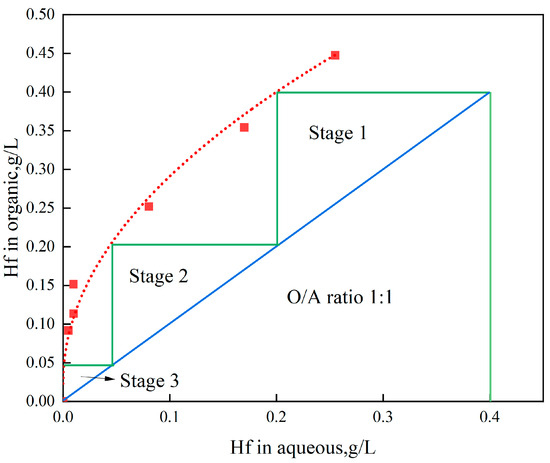
The McCabe–Thiele plot for the Hf(IV) extraction isotherm was constructed to estimate the number of stages required for maximum Hf(IV) extraction. These experiments were conducted using 0.3 mol/L PC88A and an aqueous solution containing 20 g/L Zr(IV), 0.2 g/L Hf(IV), and 4 mol/L sulfuric acid. The organic-to-aqueous (O/A) volume ratio was varied from 1/5 to 7/1 while keeping the total volume of the solution constant. Based on the distribution ratios derived from experiments, the McCabe–Thiele plot indicates that 3 counter-current extraction stages are needed to achieve >99% Hf(IV) extraction efficiency at an O/A ratio of 1. This is realistic because the calculated DHf falls within the industrially feasible range for counter-current extraction—such distribution ratios ensure sufficient mass transfer driving force without requiring excessive solvent consumption. For industrial applications, counter-current operation was prioritized over cross-current extraction due to its higher stage efficiency and lower solvent inventory, which reduces capital and operating costs.
Figure 7 shows the resulting McCabe–Thiele plot, indicating that 3 extraction stages are needed to extract most of Hf(IV) in counter-current extraction with 0.03 mol/L PC88A at an O/A ratio of 1.
Figure 7.
McCabe–Thiele diagram to determine stage number for Hf extraction.
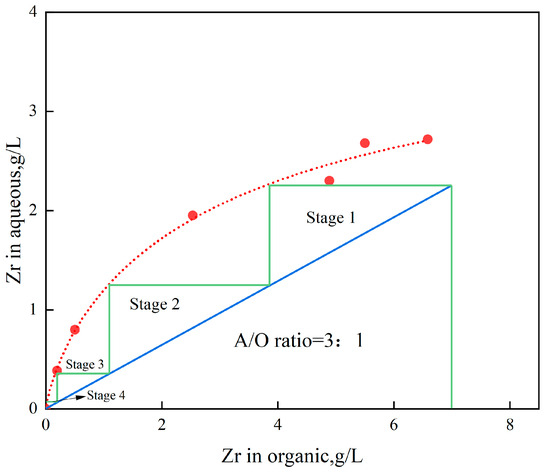
To construct the McCabe–Thiele plot for Zr(IV) stripping, as shown in Figure 8, a stripping isotherm was obtained by varying the O/A volume ratio from 1/5 to 7/1. The loaded PC88A (7.18 g/L Zr(IV), 0.34 g/L Hf(IV)) was prepared under optimal extraction conditions, and 1 mol/L sulfuric acid was used as the stripping agent. The McCabe–Thiele plot shows that 4 cross-current stripping stages are required to achieve complete Zr(IV) stripping (>99% recovery) at an A/O ratio of 3:1. Cross-current operation was selected for stripping because the high βZr/Hf ensures selective Zr(IV) recovery without Hf(IV) co-stripping even with multiple stages.
Figure 8.
McCabe–Thiele diagram to determine stage number for Zr stripping.
4. Conclusions
This study systematically verifies the technical feasibility of separating high-concentration Zr(IV) and Hf(IV) from sulfuric acid solutions using PC88A, yielding key scientific and industrial insights. Scientifically, it fills the gap between low-concentration mechanistic exploration and industrial high-concentration application, revealing that 4 mol/L [H+] optimizes cluster dissociation to enhance metal-extractant interaction, and confirming PC88A’s dual extraction mechanism with a 3:1 dimer-to-Hf(IV) stoichiometry adapted to sulfate matrices. Industrially, the system offers a green alternative to the toxic MIBK-HSCN process, featuring optimized parameters, 99.6% Zr purity in stripping solutions, and 85% H2SO4 recyclability, compatible with industrial mixer-settler operations. Limitations include a lower separation factor (βHf/Zr = 4.56) than novel extractants in chloride media, untested long-term PC88A stability, and a lack of impurity impact analysis and techno-economic assessment. Future research should focus on synergist addition to improve selectivity, long-cycle stability tests, impurity pretreatment, and pilot-scale techno-economic verification to advance industrial translation. This work establishes a fundamental basis for PC88A-based Zr-Hf separation in sulfate systems, enriching high-concentration metal extraction theory while providing a viable green industrial route.
Author Contributions
Conceptualization, J.S. and T.Q.; methodology, M.H. and J.S.; software, H.S. and M.H.; validation, X.Z.; formal analysis, M.H. and H.S.; investigation, H.S., X.Z. and M.H.; resources, J.S. and H.S.; data curation, M.H.; writing—original draft preparation, M.H.; writing—review and editing, J.S. and T.Q.; visualization, M.H. and H.S.; supervision, J.S., H.S., X.Z. and T.Q. All authors have read and agreed to the published version of the manuscript.
Funding
This work was supported by the sub-project of The National Key R&D Program of China [Grant No. 2023YFC2908101].
Data Availability Statement
The original contributions presented in this study are included in the article. Further inquiries can be directed to the corresponding author.
Conflicts of Interest
The authors declare that they have no known competing financial interests or personal relationships that could have appeared to influence the work reported in this paper.
References
- Borjas Nevarez, R. Zirconium Tetrachloride, Fundamental Chemistry and Nuclear Fuel Cycle. Ph.D. Thesis, The University of Nevada, Las Vegas, Las Vegas, NV, USA, 2019. [Google Scholar]
- Gosset, D. Structural Materials for Generation IV Nuclear Reactors; Elsevier: Amsterdam, The Netherlands, 2017; pp. 533–567. [Google Scholar]
- Sohn, S.; Choi, S.; Park, J.; Hwang, I.S. Computational model-based design of molten salt electrorefining process for high-purity zirconium metal recovery from spent nuclear fuel. Int. J. Energy Res. 2021, 45, 11775–11790. [Google Scholar] [CrossRef] [Scilit]
- Xu, L.; Xiao, Y.; Van Sandwijk, A.; Zhao, Z.; Li, J.; Xu, Q.; Yang, Y. Zirconium and hafnium separation with molten salt extraction in Sn–Cu–Zr–Hf and Cu–Zr–Hf alloy systems. Sep. Sci. Technol. 2016, 51, 1664–1674. [Google Scholar] [CrossRef] [Scilit]
- Wang, L.Y.; Lee, M.S. A review on the aqueous chemistry of Zr(IV) and Hf(IV) and their separation by solvent extraction. J. Ind. Eng. Chem. 2016, 39, 1–9. [Google Scholar] [CrossRef] [Scilit]
- Amaral, J.C.B.S.; Antônio De Morais, C. Study of Zirconium and Hafnium Separation by Solvent Extraction Technique from Nitric and Hydrochloric Solutions with Acid, Basic and Neutral Extractants. WJET 2016, 4, 138–150. [Google Scholar] [CrossRef]
- Xu, L.; Xiao, Y.; Van Sandwijk, A.; Xu, Q.; Yang, Y. Production of nuclear grade zirconium: A review. J. Nucl. Mater. 2015, 466, 21–28. [Google Scholar] [CrossRef] [Scilit]
- Branken, D.J.; Lachmann, G.; Krieg, H.M.; Bruinsma, O.S.L. A density-functional theory approach to the separation of K2ZrF6 and K2HfF6 via fractional crystallization. Int. J. Quantum Chem. 2011, 111, 682–693. [Google Scholar] [CrossRef] [Scilit]
- Branken, D.J.; Lachmann, G.; Krieg, H.M.; Bruinsma, D.S.L. BIWIC 2007; Lewis, A.E., Olsen, C., Eds.; Ios Press: Amsterdam, The Netherlands, 2007; p. 185. [Google Scholar]
- Vinarov, I.V. Modern methods of separating zirconium and hafnium. Russ. Chem. Rev. 1967, 36, 522. [Google Scholar] [CrossRef] [Scilit]
- Banda, R.; Lee, M.S. Solvent Extraction for the Separation of Zr and Hf from Aqueous Solutions. Sep. Purif. Rev. 2015, 44, 199–215. [Google Scholar] [CrossRef] [Scilit]
- Xiong, J.; Li, Y.; Zhang, X.; Wang, Y.; Zhang, Y.; Qi, T. The Extraction Mechanism of Zirconium and Hafnium in the MIBK-HSCN System. Separations 2024, 11, 93. [Google Scholar] [CrossRef] [Scilit]
- Luo, Y.; Xu, C.; Su, J.; Peng, X.; Kong, X.; Wang, S.; Sun, J.; Cui, Y.; Nie, Y.; Jiang, X.; et al. Novel phosphate ester extractant for preferential extraction of hafnium over zirconium and its mechanism. New J. Chem. 2024, 48, 7718–7725. [Google Scholar] [CrossRef] [Scilit]
- Zhao, J.; Sui, Y.; Peng, X.; Sun, G.; Cui, Y. A new diphosphonic acid extractant N,N-n-octylamine di(methylene phenylphosphinic acid) for extraction and separation of zirconium and hafnium in hydrochloric acid. J. Radioanal. Nucl. Chem. 2020, 324, 339–348. [Google Scholar] [CrossRef] [Scilit]
- Morohashi, N.; Kato, Y.; Sumida, S.; Kurusu, Y.; Hattori, T. Selective Extraction of Zr(IV) over Hf(IV) from Aqueous Hydrochloric Acid with p-tert-Butylcalix[4]arenediphosphonic Acid. Bull. Chem. Soc. Jpn. 2019, 92, 967–972. [Google Scholar] [CrossRef] [Scilit]
- Wang, J.; Liu, H.; Zhao, H.; Wang, H. Selective extraction of Hf over Zr by a novel extractant (n-octyl)(2,4,4′-trimethylpentyl)phosphinic acid (INET-1) from sulfuric acid media. J. Radioanal. Nucl. Chem. 2023, 332, 2473–2485. [Google Scholar] [CrossRef] [Scilit]
- Wang, L.Y.; Lee, M.S. Development of a separation process for the selective extraction of hafnium(IV) over zirconium(IV) from sulfuric acid solutions by using D2EHPA. Hydrometallurgy 2016, 160, 12–17. [Google Scholar] [CrossRef] [Scilit]
- He, H.; Xu, F.; Li, Q.; Dong, P.; Zheng, J.; Wu, C.; He, Z.; Qu, J.; Xu, Z.; Chi, R.; et al. Separation of hafnium from zirconium in HNO3 solution by solvent extraction with Cyanex572. Hydrometallurgy 2021, 202, 105600. [Google Scholar] [CrossRef] [Scilit]
- Roseborough, A.; Loughran, R.; Zakharov, L.N.; Colla, C.A.; Nyman, M. Aqueous Zr/HfIV-Oxo Cluster Speciation and Separation. Angew. Chem. Int. Ed. 2025, 64, e202421819. [Google Scholar] [CrossRef] [Scilit]
- Zhang, Z.; Song, J.; Sun, H.; Li, Y.; Lan, H.; Qi, T.; Tian, L. The zirconium structure in zirconium oxychloride octahydrate was determined using small-angle X-ray scattering. Chin. J. Inorg. Chem. 2023, 39, 765–774. [Google Scholar] [CrossRef]
- Sommers, J.A.; Palys, L.; Martin, N.P.; Fast, D.B.; Amiri, M.; Nyman, M. Oxo-Cluster-Based Zr/HfIV Separation: Shedding Light on a 70-Year-Old Process. J. Am. Chem. Soc. 2022, 144, 2816–2824. [Google Scholar] [CrossRef] [Scilit]
- Kalaji, A.; Skanthakumar, S.; Kanatzidis, M.G.; Mitchell, J.F.; Soderholm, L. Changing Hafnium Speciation in Aqueous Sulfate Solutions: A High-Energy X-ray Scattering Study. Inorg. Chem. 2014, 53, 6321–6328. [Google Scholar] [CrossRef] [Scilit]
- Qi, X.; Xie, Y.; Niu, J.; Zhao, J.; Li, Y.; Fang, W.; Zhang, J. Application of Hard and Soft Acid-base Theory to Construct Heterometallic Materials with Metal-oxo Clusters. Angew. Chem. Int. Ed. 2025, 64, e202417548. [Google Scholar] [CrossRef] [Scilit]
- Ryabchikov, D.I.; Marov, I.N.; Ermakov, A.N.; Belyaeva, V.K. Stability of some inorganic and organic complex compounds of zirconium and hafnium. J. Inorg. Nucl. Chem. 1964, 26, 965–980. [Google Scholar] [CrossRef] [Scilit]
- Lee, M.S.; Banda, R.; Min, S.H. Separation of Hf(IV)–Zr(IV) in H2SO4 solutions using solvent extraction with D2EHPA or Cyanex 272 at different reagent and metal ion concentrations. Hydrometallurgy 2015, 152, 84–90. [Google Scholar] [CrossRef] [Scilit]
- Wang, J.; Liu, H.; Xu, W.; Chang, Z.; Wang, P.; Wang, H. Selective Extraction of Hafnium over Zirconium with Dialkylphosphinic Acids from H2SO4 Media. J. Braz. Chem. Soc. 2023. [Google Scholar] [CrossRef] [Scilit]

Disclaimer/Publisher’s Note: The statements, opinions and data contained in all publications are solely those of the individual author(s) and contributor(s) and not of MDPI and/or the editor(s). MDPI and/or the editor(s) disclaim responsibility for any injury to people or property resulting from any ideas, methods, instructions or products referred to in the content. |
© 2026 by the authors. Licensee MDPI, Basel, Switzerland. This article is an open access article distributed under the terms and conditions of the Creative Commons Attribution (CC BY) license.