Review

Joining Technologies and Extended Producer Responsibility: A Review on Sustainability and End-of-Life Management of Metal Structures

Department of Engineering, University of Messina, Contrada di Dio, 98166 Messina, Italy
*
Author to whom correspondence should be addressed.
Metals 2026, 16(1), 49; https://doi.org/10.3390/met16010049
Submission received: 9 December 2025 / Revised: 24 December 2025 / Accepted: 26 December 2025 / Published: 30 December 2025
(This article belongs to the Section Welding and Joining)

Abstract

Joining technologies play a decisive role in the sustainability, circularity, and end-of-life performance of metal structures. Despite the increasing emphasis on low-impact manufacturing and Extended Producer Responsibility (EPR), the connection between joining methods and producers’ environmental obligations remains underexplored. This review provides a comprehensive assessment of conventional and emerging techniques, including fusion welding, solid-state welding, mechanical fastening, adhesive bonding, and hybrid and AM-assisted processes, examining how each technology influences material efficiency, durability, repairability, disassembly, and recyclability. Particular attention is devoted to the effects of joint characteristics on life-cycle impacts, waste generation, and the technical and economic feasibility of high-quality material recovery, using recent LCA evidence and industrial case studies from automotive, shipbuilding, aerospace, and consumer products. Building on this analysis, the review proposes qualitative checklists and semi-quantitative scoring schemes to compare joining options under EPR-relevant criteria and to identify best- and worst-case design scenarios. Finally, promising research directions are outlined, including reversible and debond-on-demand solutions, low-energy solid-state routes, joining strategies for multi-material yet recyclable structures, and the integration of digital twins and LCA-informed design tools, offering a roadmap for metal structures that align technical performance with EPR-driven end-of-life management.

1. Introduction

1.1. Background: Circular Economy and Metal Structures

The circular economy (CE) has emerged over the last decade as a key framework for decoupling economic growth from resource consumption and environmental degradation. Rather than following the traditional “take–make–dispose” linear model, CE strategies aim to keep products, components and materials in use for as long as possible through reduction, reuse, repair, remanufacturing and high-quality recycling [1,2,3]. In parallel, Extended Producer Responsibility (EPR) policies increasingly link market access and compliance to demonstrable end-of-life performance, pushing manufacturers—especially in metal-intensive sectors—towards designs that enable durability, repairability, disassembly and high-quality material recovery.
In metal-intensive sectors, circularity is operationalised through strategies that keep components and alloys in use at the highest value for as long as possible (maintenance, repair, refurbishment and reuse). When end-of-life is reached, circularity depends on efficient dismantling and high-quality recycling. In these contexts, the feasibility and economics of circular pathways depend strongly on design choices that govern accessibility, separability and contamination of recovered streams. This is particularly relevant for long-lived metal structures (e.g., construction and infrastructure), where connection design can either enable selective deconstruction and component reuse or lock value into mixed and downgraded scrap flows. Joining technologies are therefore treated here as a key design lever at the interface between circular-economy intent and measurable end-of-life outcomes—an aspect that becomes even more consequential once producer obligations and costs are internalised through EPR-type instruments.
This review builds on these insights by focusing specifically on how joining technologies condition the circularity of metal structures, and on how extended producer responsibility (EPR) schemes can incentivise or constrain circular design and end-of-life management.

1.2. Role of Joining Technologies in Product Sustainability

Joining technologies are a crucial but often underestimated lever for improving the sustainability performance of metal products and structures over their life cycle. In environmental impact terms, the choice between fusion welding, solid-state welding, mechanical fastening, adhesive bonding and hybrid solutions affects not only the energy and resource demand in manufacturing, but also the feasibility of lightweight multi-material designs, the possibility of repair and upgrading, and the quality of material recovery at end-of-life. Recent work on the sustainability evaluation of joining methods for engineering materials has shown that environmental impacts can vary by more than an order of magnitude between joining options for the same functional requirement, once process energy, consumables, auxiliary materials and scrap are consistently accounted for over the life cycle [4].
At the manufacturing stage, joining steps can account for a significant share of the energy consumption and greenhouse-gas emissions of metal-product assembly, especially in highly welded structures such as ship hulls, frames or automotive bodies. Comparative life-cycle studies show that unit impacts depend strongly on process parameters (current, voltage, travel speed, shielding-gas flow) and on the level of automation. As a result, apparently similar welds can exhibit markedly different impact profiles when realistic duty cycles and consumable use are modelled [5,6]. Recent assessments also highlight the role of mechanical joining. A cradle-to-gate LCA of screw joints with thread inserts shows that fasteners and their installation can contribute appreciably to embodied impacts when a lightweight structure contains thousands of joints, and that optimisation and data-driven parameter selection can substantially reduce these burdens [7].
Beyond manufacturing, joining technologies can shape sustainability indirectly through structural efficiency and mass. High-performance welded or adhesively bonded joints enable lightweight designs and multi-material concepts that reduce operational energy use (for example in transport applications) and can outweigh additional impacts incurred during production. Joining therefore enables load-path-oriented structures, optimised stiffening and the integration of dissimilar materials (e.g., aluminium–steel or metal–composite hybrids), supporting lower life-cycle energy demand and emissions in sectors such as automotive, rail and shipbuilding. Multi-criteria decision frameworks for joining-process selection increasingly balance mechanical performance, manufacturability, cost and environmental indicators, although most existing methods still give limited attention to end-of-life aspects and circular-economy requirements [8,9].
End-of-life management is the stage where the role of joining technologies becomes most visible. Non-reversible joints such as conventional welds or structural adhesive bonds may maximise stiffness and fatigue resistance, but they typically hinder economically viable disassembly and component reuse, and can contaminate secondary metal scrap or degrade its properties. By contrast, mechanical fasteners (bolts, screws, rivets) and demountable mechanical-forming joints (e.g., clinching, self-piercing riveting) generally facilitate selective disassembly and material sorting, at the expense of additional mass, potential stress concentrations and more complex inspection requirements. Recent LCA-based comparisons across clinching, self-piercing riveting, stud welding, ultrasonic spot welding and screw joints confirm that no joining family is universally optimal. Low-energy assembly processes may still underperform when reparability or recyclability is considered, while easily separable joints can have higher production impacts due to additional elements and processing steps [7].
Adhesive bonding illustrates this trade-off particularly well. Over the full life cycle, adhesive joints often support lightweight design and multi-material integration and can reduce local stress concentrations, leading to longer product lifetimes and lower operational impacts. At the same time, conventional thermoset adhesives typically create non-detachable joints that complicate repair, refurbishment and high-quality recycling of metal substrates. Recent life-cycle engineering studies on bonded polymer and metal assemblies show that environmental benefits depend strongly on surface activation (mechanical, chemical, plasma or laser), adhesive selection and joint geometry, and that optimised process chains can achieve good structural performance with reduced environmental loads [10]. Parallel work from the Fraunhofer IFAM “Circular Economy and Adhesive Bonding Technology” programme frames adhesive bonding as a lever for circular-economy capability, emphasising its role in enabling lightweight design, repair and long-term durability, while highlighting the need for concepts that reconcile strong joints with disassembly and recycling requirements [11].
In response to these challenges, a rapidly growing body of research focuses on reversible and “debond-on-demand” joining solutions. For adhesive bonding, this includes thermally, chemically, magnetically or electrically debondable systems, as well as dynamically cross-linked polymers and functional interlayers that allow selective separation of metal and composite substrates at end-of-life without excessive damage. A comprehensive review of debondable adhesives for recycling underscores that such systems can facilitate the recovery of technology-critical metals and improve the economics of high-value product take-back, provided that trigger conditions (temperature, radiation, chemicals) are compatible with service and dismantling environments [12]. Analogous trends exist for mechanical joints, where research on reversible locking mechanisms, smart fasteners and joining elements designed for repeated disassembly aims to align structural performance with circular-economy strategies such as reuse, remanufacturing and component harvesting.
Overall, the evidence indicates that joining technologies influence product sustainability on three levels. They directly affect the environmental and economic performance of manufacturing, indirectly govern the feasibility of lightweight designs and long service lives, and ultimately determine whether metal components and structures can be efficiently repaired, upgraded and recovered within circular supply chains. In the context of extended producer responsibility, these aspects transform joining from a purely structural or manufacturing choice into a strategic design variable that conditions producers’ ability to meet regulatory obligations on durability, reparability and end-of-life management.

1.3. Extended Producer Responsibility: Principles and Obligations

Extended Producer Responsibility (EPR) has emerged as a cornerstone of circular economy policies, framing how environmental and economic burdens associated with products are allocated along the value chain. In the most recent OECD synthesis, EPR is defined as a policy approach that makes producers responsible for their products along the entire life cycle, including at the post-consumer stage, with the aim of improving resource efficiency and supporting circular material flows [13]. Earlier OECD guidance stressed that EPR operationalises the polluter-pays principle at product level by shifting the financial and organisational burden of end-of-life management from municipalities and taxpayers to producers and, indirectly, to consumers [14]. In industrial-ecology terms, EPR is thus conceived as a strategy to internalise full product life-cycle costs into production and consumption decisions and to create upstream incentives for eco-design, rather than treating waste management as a purely downstream issue [15,16].
Across jurisdictions, EPR schemes share recurrent design principles—clear allocation of responsibilities (individually or collectively), incentive compatibility, cost internalisation, transparency, and robust governance and enforcement—yet they should not be interpreted as a single uniform policy instrument [13,14]. In the European Union, work under the Green Deal frames EPR as an “interface” policy connecting circular economy, chemicals regulation and waste law, and highlights the need for schemes that not only finance end-of-life operations but also drive prevention, reuse and high-quality recycling through life-cycle-based criteria [17,18]. Within this evolution, modulated producer fees—differentiated according to durability, reparability, recyclability, toxicity and the presence of secondary raw materials—are increasingly promoted to align economic signals with circularity objectives [19]. In practice, EPR refers to a family of sector- and jurisdiction-specific schemes that differ in scope, cost coverage, performance targets, enforcement intensity and, crucially, in how eco-modulation is operationalised. Evidence from mature streams (e.g., packaging and WEEE) indicates that many programmes effectively finance collection and treatment, whereas upstream influence on product and joint design depends on the precision of modulation criteria, the availability of dismantling/recycling data, and the interaction with complementary product policies such as eco-design requirements and digital product passports [16,17,19,20,21,22,23,24]. Accordingly, when this review refers to “EPR implications” for joining, it does so in terms of transferable policy levers—end-of-life cost internalisation, eco-modulated fees, design and information obligations, and compliance exposure linked to hazardous substances and scrap quality—whose strength and relevance depend on the specific product stream and jurisdiction.
For metal-intensive value chains such as packaging, electrical and electronic equipment, vehicles and, increasingly, construction products, these levers translate into concrete technical and organisational requirements along end-of-life chains. They include reporting and traceability duties, treatment-quality standards, and—where applicable—design-related expectations such as removability, ease of disassembly, material separability and reduced hazardous substances [13,20,21]. EPR schemes for packaging and WEEE, for instance, have stabilised collection and recycling systems for steel and aluminium, but their influence on design choices (e.g., alloy selection, compatibility of coatings and sealants with recycling, and the use of reversible mechanical fasteners versus permanent joining such as welding or structural adhesives) remains uneven [20,25]. Evidence from EU Member States and emerging economies shows that EPR can improve downstream performance (higher collection and recovery rates, better treatment infrastructure). However, upstream effects on product design—including design for disassembly and material recovery in complex metal structures—depend on how responsibilities are defined, how strongly eco-modulated fees are applied, and how EPR interacts with other regulatory and market instruments [26,27]. More circular-economy-oriented EPR reforms increasingly emphasise eco-design obligations to address the limited upstream effectiveness observed in several mature schemes, particularly in WEEE [16,22].
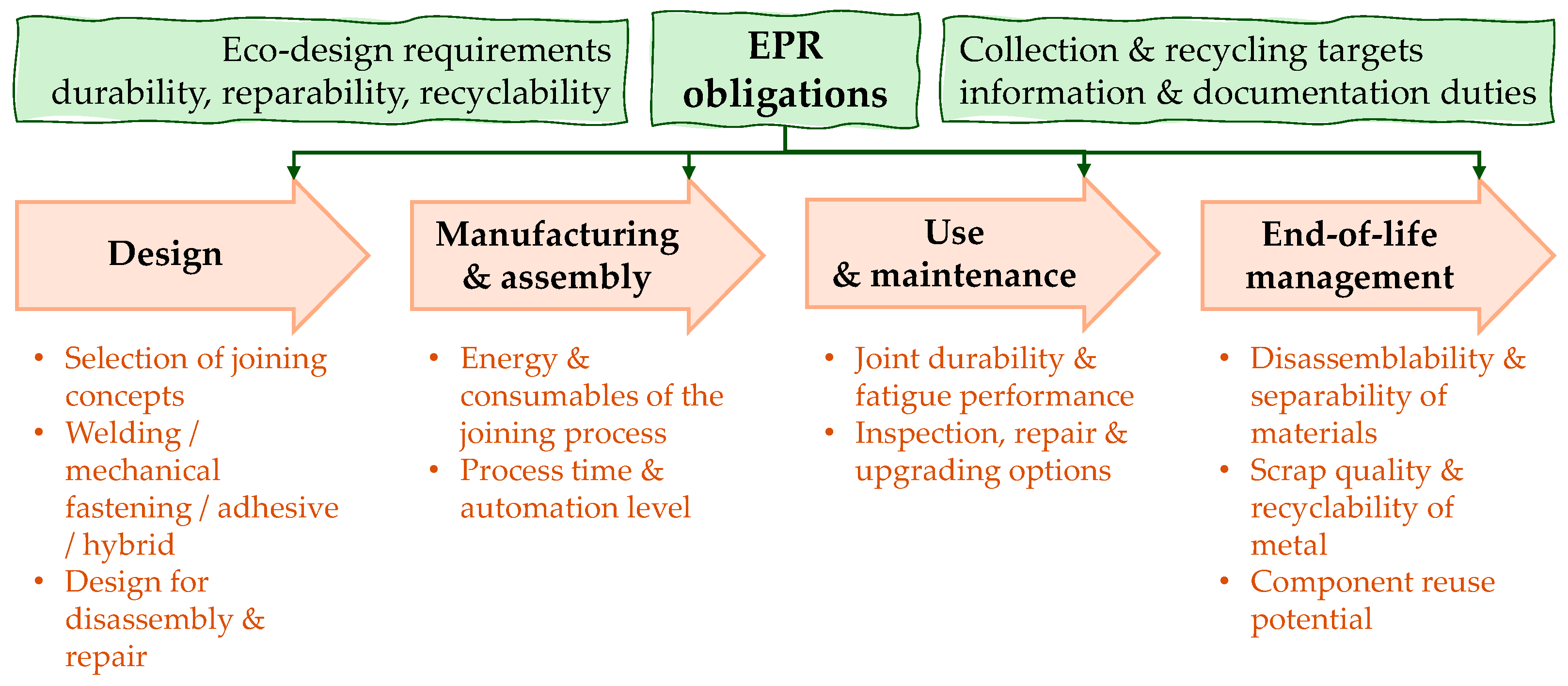
These interactions between EPR obligations, the life-cycle of metal-intensive products and joining-related design choices are schematically summarised in Figure 1.

1.4. Gap: Lack of Integrated Reviews Joining EPR and Joining Technologies

Despite the rapid growth of research on both sustainable joining processes and Extended Producer Responsibility (EPR), these strands of literature have largely evolved in parallel. Sustainability-oriented studies quantify energy demand, emissions and resource use along joining process chains, comparing welding routes and showing how process choice and production context can shift life-cycle impacts for representative metal structures [6,28]. In parallel, EPR research examines how policy design, eco-modulated fees and regulatory targets shape product eco-design strategies, including incentives for recyclability, reparability and durability, and how these levers are implemented (or constrained) in practice [23,24,29]. Complementary work on design for disassembly and remanufacturing highlights the role of fastening and joining in enabling circular strategies, but typically treats joining from a product-architecture angle rather than as a systematic comparison of joining technologies (Hybel et al. [30]). To the best of current knowledge, no review has integrated these domains by explicitly analysing how the choice among mechanical fastening, welding, adhesive bonding and hybrid joining for metal structures interacts with EPR obligations, fee structures and circular-economy targets. In particular, consolidated frameworks are still missing to link joining technologies to EPR-relevant performance metrics such as recyclability of material combinations, disassemblability at end-of-life, repair feasibility and the distribution of end-of-life costs along the value chain. This gap limits the ability of both policymakers and designers to use joining decisions proactively as levers to comply with, and benefit from, evolving EPR schemes.

1.5. Objectives and Scope of the Review

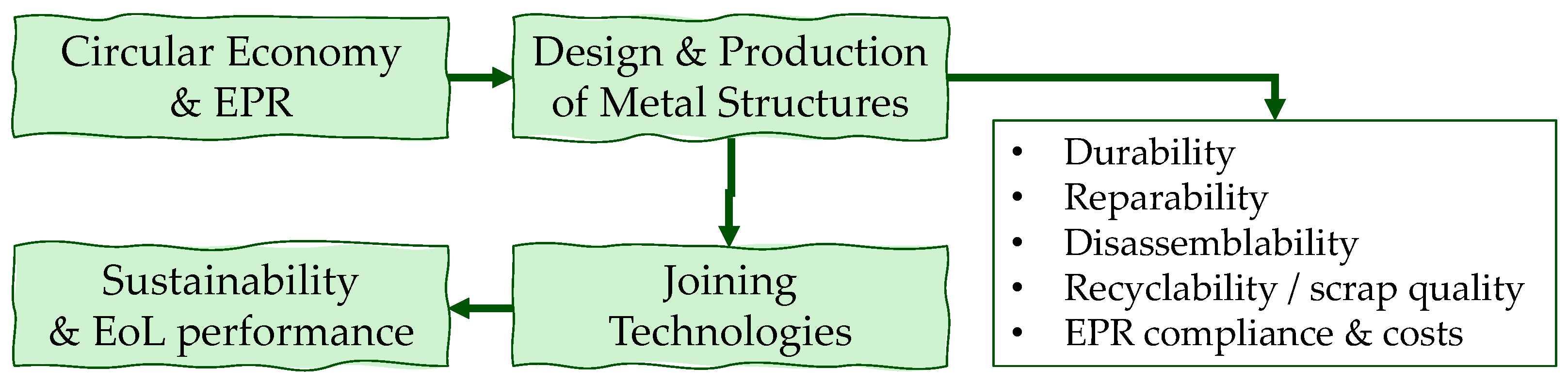
The novelty and added value of this review lie in explicitly coupling joining-technology selection for metal structures with the regulatory and economic logic of Extended Producer Responsibility (EPR). Whereas previous contributions have typically addressed either the sustainability/eco-efficiency of joining processes or the design of EPR schemes and circular-economy incentives, the present work bridges both streams and translates them into an operational lens for decision-making. The conceptual frameworks in Figure 1 and Figure 2 and the evidence-informed comparison and scoring approach developed in Section 6 provide a structured way to anticipate EPR-relevant trade-offs (durability, repairability, disassembly and scrap quality) and to reduce the risk of circularity lock-ins during early design and process selection.
Recent work has consolidated circular-economy definitions and metrics [1,31], while EPR schemes have matured into key instruments for product-level environmental governance [23]. This evolution strengthens the case for analyses that connect joining decisions to regulatory drivers and circular-economy outcomes. At the same time, detailed life-cycle assessments of welding and related joining technologies (such as [6] and [32]) and analytical approaches to design for disassembly and remanufacturing [30] provide a rich but still fragmented evidence base.
The primary objective of this review is therefore to synthesise and structure current knowledge at the intersection between joining technologies for metal structures and Extended Producer Responsibility, with explicit reference to circular-economy requirements on durability, reparability, disassemblability and recyclability.
Specifically, the review pursues four aims. First, it maps how major joining families used in metal structures—fusion and solid-state welding, mechanical fastening, adhesive bonding, and hybrid solutions—shape durability, reparability, disassembly feasibility, and recyclability. Second, it synthesises sustainability evidence across life-cycle scales, from process-level inventories to product-level LCA/LCC and multi-criteria assessments, with emphasis on indicators relevant for EPR decisions (e.g., disassembly time/cost, scrap quality, and compliance exposure) [6]. Third, it analyses how EPR principles and instruments (including eco-modulated fees and emerging traceability requirements) translate into constraints and opportunities at the joint level [23]. Finally, it proposes a decision-support perspective linking joining-technology selection to circular-economy performance and EPR implementation.
In terms of scope, the review focuses on metallic load-bearing and semi-structural applications in sectors where both joining operations and EPR-type instruments are salient, including building and infrastructure steelwork, automotive bodies and chassis, railway and rolling stock, shipbuilding and heavy machinery. The analysis concentrates on joining technologies that create permanent or semi-permanent joints in ferrous and aluminium alloys (including welded, mechanically fastened, adhesively bonded and hybrid joints), and on their role in enabling or constraining circular strategies such as modular design, design for disassembly and remanufacturing (as discussed, for instance, in [30]). Products dominated by micro-scale interconnects (e.g., semiconductor packaging) or polymer-only assemblies fall outside the core scope and are considered only when they provide transferable insights for metal structures. Geographically, the review emphasises jurisdictions with mature EPR frameworks and ambitious circular-economy agendas, while also drawing selectively on emerging economies where EPR for metal-intensive product categories is being established or reformed.
The overall conceptual framework is summarised in Figure 2.
The paper is organised to progressively connect joining-technology choices to sustainability assessment and to the regulatory logic of Extended Producer Responsibility. Section 2 reviews the main joining families adopted in metal structures—fusion and solid-state welding, mechanical fastening, adhesive bonding, and hybrid solutions—highlighting their key features in relation to durability, reparability, disassembly and recyclability. Section 3 synthesises approaches used to assess the sustainability of joining technologies, with emphasis on life-cycle thinking and commonly adopted metrics. Section 4 and Section 5 move from technical performance to governance and end-of-life management by discussing EPR principles, obligations and implementation mechanisms, and by analysing how end-of-life strategies (repair, remanufacturing, dismantling and recycling) are enabled or constrained by joining and joint design. Building on these elements, Section 6 proposes a multi-criteria assessment perspective to compare joining options under EPR-relevant dimensions and to support informed design choices. Finally, Section 7 summarises the main outcomes and outlines future trends and research needs for aligning joining innovation with circular-economy requirements and EPR-driven obligations.

1.6. Methodology (Scoping Review, Database, Selection Criteria)

Given the breadth and multidisciplinarity of the topic, this work adopts a scoping review following Arksey and O’Malley’s original framework [33]. The methodological approach is further informed by subsequent methodological refinements by Levac et al. [34], Munn et al. [35] and the JBI guidance for scoping reviews [36]. A scoping review is particularly appropriate where the objective is to map key concepts, characterise the extent and nature of available evidence and identify gaps across diverse bodies of literature, rather than to answer a narrowly defined clinical or engineering question through quantitative synthesis [35]. Reporting is informed by the PRISMA extension for scoping reviews (PRISMA-ScR) checklist [37], with adaptations to the specificities of engineering and policy-oriented sources.
The review follows the canonical stages proposed for scoping studies: (i) identifying the research questions; (ii) identifying relevant studies; (iii) selecting studies; (iv) charting the data; and (v) collating, summarising and reporting the results [33,34,36]. Two overarching questions guided the search: (1) how do joining technologies for metal structures influence life-cycle performance indicators that are relevant under Extended Producer Responsibility (EPR) and circular-economy policies? (2) how do existing EPR schemes and related regulatory instruments address design choices related to joining, disassembly and material recovery in metal-intensive products and structures?
To identify the relevant literature, electronic searches were carried out in major bibliographic databases covering engineering, materials science and environmental policy, including Scopus, Web of Science Core Collection and Engineering Village/Compendex. These searches were complemented by targeted searches in ScienceDirect and SpringerLink for full-text access to key journals. Grey literature and policy documents were retrieved from institutional repositories of the European Commission, OECD and selected national agencies. Search strings combined three main concept clusters: (i) circular economy and EPR (e.g., “extended producer responsibility”, “product stewardship”, “eco-modulation”, “circular economy”); (ii) metals and metal structures (e.g., “steel structure*”, “aluminium structure*”, “metal* component*”, “welded structure*”); and (iii) joining and end-of-life aspects (e.g., “weld*”, “adhesive bond*”, “mechanical fastening”, “clinching”, “self-piercing riveting”, “design for disassembly”, “remanufactur*”, “recycl*”). Searches covered publications from 2000 up to the final search date (December 2025), reflecting the period in which both circular-economy and EPR debates, as well as sustainability-oriented assessments of joining technologies, became prominent in the literature.
Study selection proceeded in two screening stages. First, titles and abstracts were screened to exclude clearly irrelevant records (for example, studies on micro-joining in semiconductor packaging, purely polymeric assemblies, or EPR schemes unrelated to material products). In a second stage, full texts were assessed against predefined inclusion criteria. Studies were included if they: (i) addressed joining technologies applied to metallic structures or metal-intensive components; (ii) reported quantitative or qualitative information on environmental performance, circular-economy aspects (such as durability, reparability, disassemblability, recyclability) or end-of-life management; and/or (iii) analysed EPR or closely related product-oriented policy instruments with explicit implications for product design, material choice or end-of-life handling. Only documents in English and published in peer-reviewed journals, edited books, conference proceedings or authoritative institutional reports were retained.
Data from included sources were charted using a structured extraction template capturing, inter alia, product sector and application, metal and joining technology, methodological approach (e.g., LCA, techno-economic analysis, policy analysis), reported environmental and circular-economy indicators, and any explicit reference to EPR obligations, fee modulation or design requirements. Consistent with best practice guidance for scoping reviews [34,36,37], the emphasis of the analysis is on mapping and synthesising patterns and gaps across heterogeneous evidence, rather than on formal quality appraisal or meta-analysis. This approach allows the review to integrate engineering, environmental and policy perspectives and to develop an overarching framework linking joining technologies, circular-economy performance and EPR-driven obligations for metal structures.
In addition to mapping the breadth of contributions, the synthesis is deliberately presented through a critical lens, as the reviewed evidence is highly heterogeneous in terms of scope, maturity level and methodological assumptions. In particular, process-level studies often rely on laboratory or idealised operating conditions, whereas product-level assessments depend strongly on modelling choices (functional unit, system boundaries, allocation rules, use-phase and end-of-life scenarios). Policy-oriented sources, in turn, frequently provide limited engineering detail on joint architectures and dismantling operations. To make this distinction explicit, the reviewed sources are interpreted according to three evidence contexts: laboratory-scale studies (controlled material/process/joint tests), industrial-scale implementations (production-oriented data including cycle times, auxiliaries, rework and realistic scrap streams), and conceptual/policy-oriented contributions (regulatory analyses and eco-design guidance). Accordingly, laboratory evidence is discussed primarily as mechanism-level insight and technical potential, whereas implications for EPR compliance, fee modulation and end-of-life performance are drawn preferentially from industrial and regulatory sources, or stated explicitly as conditional on scale-up and validated end-of-life routes. For this reason, results are discussed by making underlying assumptions explicit, by distinguishing between empirical evidence and model-based extrapolations, and by highlighting recurring sources of uncertainty and comparability limits (e.g., inconsistent boundary conditions, incomplete end-of-life modelling, scarce data on dismantling time/cost and scrap-quality degradation). This critical reading is used to identify robust patterns, but also to define the main methodological and data gaps that currently prevent direct transfer of published findings into EPR-oriented design rules.

2. Overview of Joining Technologies for Metal Structures

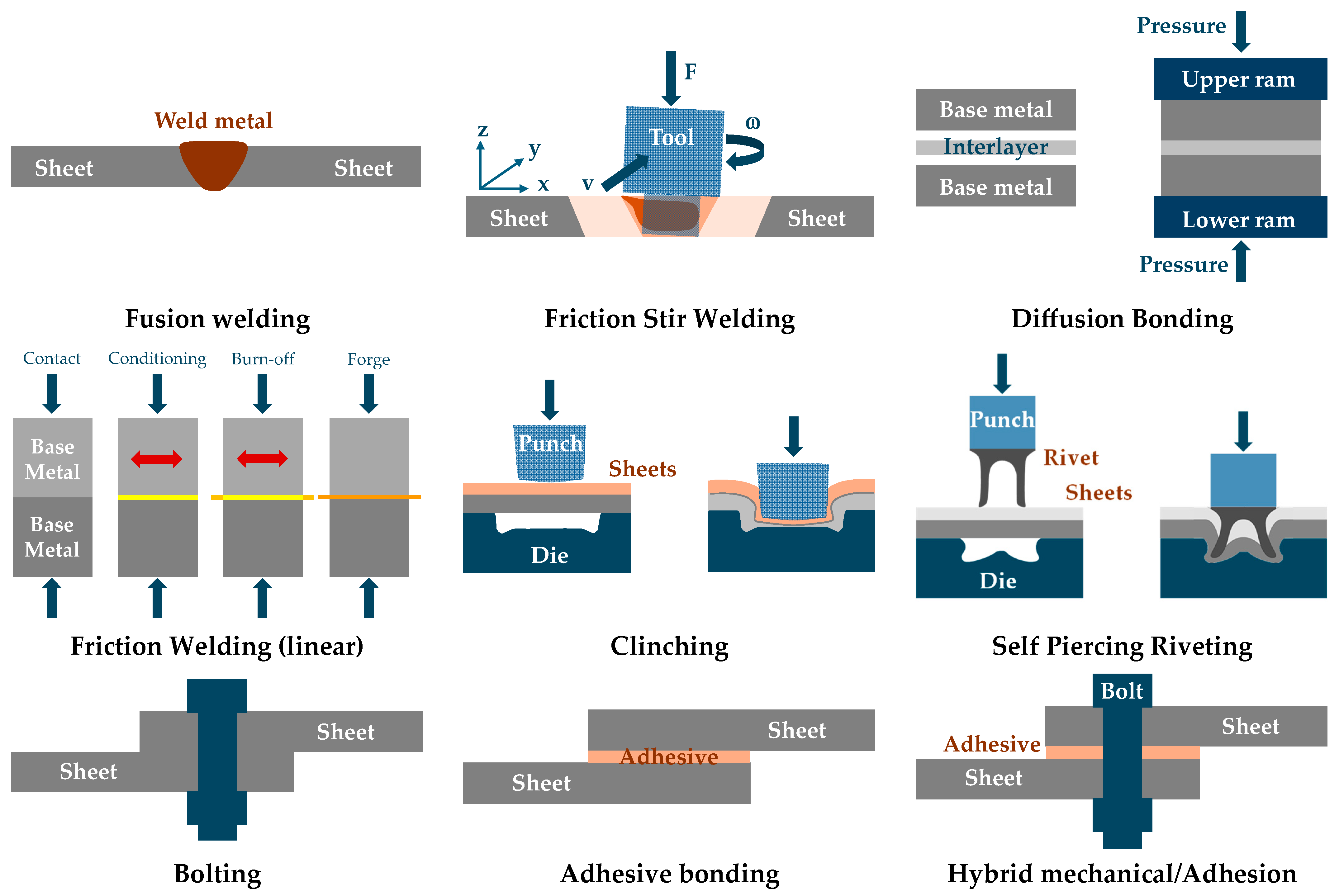
Figure 3 provides a set of pictograms summarising the main joining technologies reviewed in this section.
To improve consistency across technologies, each technology-specific subsection below follows a uniform analytical template: (i) Process description, (ii) Life-cycle and sustainability implications, (iii) Repairability and disassembly, and (iv) EPR-relevant end-of-life consequences. Where evidence is predominantly laboratory-scale or model-based, EPR implications are stated explicitly as conditional on industrial deployment and realistic end-of-life routes.

2.1. Fusion Welding

Process description. Fusion welding processes—primarily arc welding (MIG/MAG and TIG), laser beam welding (LBW) and resistance spot welding (RSW)—remain the dominant joining routes for metallic structures in the automotive, construction, shipbuilding and energy sectors. These technologies rely on local melting of the base material (often with filler metal) to form a metallurgical joint, typically protected by shielding gases or fluxes. In structural steels and aluminium alloys, gas metal arc welding (GMAW, commonly referred to as MIG/MAG) and gas tungsten arc welding (GTAW, or TIG) are widely used for beams, frames, ship panels and pipework, with laser and RSW increasingly adopted in high-volume body-in-white and lightweight structures [38].
GMAW/MIG–MAG uses a consumable wire electrode and a shielding gas (inert or active), enabling relatively high deposition rates and good automation potential, making it attractive for large steel and aluminium structures [39]. GTAW/TIG instead uses a non-consumable tungsten electrode with inert gas shielding, optionally with separate filler wire, and is typically chosen where weld quality, precision and control of heat input override productivity (e.g., thin sections, root passes, piping for pressure vessels) [38]. Both processes generate a fusion zone (FZ) and a heat-affected zone (HAZ) where microstructure is modified; grain coarsening, phase transformations and residual stresses can strongly affect fatigue, fracture and corrosion performance. Microstructural studies on carbon steels and advanced alloys show typical mixtures of ferrite, pearlite, bainite and martensite in the HAZ, with hardness gradients that can either soften or locally embrittle the joint depending on heat input and cooling rate [39,40,41].
Life-cycle and sustainability implications. Life-cycle and sustainability implications. Arc welding can be a non-negligible contributor to the life-cycle energy use and CO2 footprint of metal products, particularly when long weld seams or thousands of joints are involved. Comparative LCA studies on TIG, MIG, MAG and SMAW show that process selection changes cumulative energy demand and global warming potential per metre of weld. González-González et al. [42] found that TIG with filler has the highest environmental impact because of long arc-on times and intensive shielding-gas use, whereas SMAW and, in many cases, MIG/MAG can achieve lower CO2 emissions per unit weld length. Favi et al. [43] reported that, for similar joints, GMAW generally exhibits a lower global warming potential than GTAW because higher deposition rates shorten welding time despite comparable instantaneous power levels. Additional LCAs and carbon-footprint studies confirm that electrical energy during arc time, filler-wire production and shielding gases (Ar, CO2, He) are the main contributors, and that efficiency and parameter optimisation (current, voltage, travel speed) can substantially mitigate impacts [44,45].
Laser beam welding (LBW) is a high-energy-density fusion process that produces narrow, deep welds with a small HAZ and limited distortion, and is therefore attractive for high-strength steels, aluminium alloys and precision structures. High power density and fast travel speeds reduce overall heat input per unit length relative to conventional arc welding and can improve dimensional control [46]. LBW may reduce specific energy consumption per metre of weld, but system-level impacts depend on how the equipment is used. Dahmen et al. [47] showed that the total environmental burden depends strongly on laser efficiency, utilisation rate, auxiliary systems (cooling, beam delivery) and the electricity mix. Hybrid laser–arc configurations can further improve weld quality and energy efficiency, but add complexity and remain highly context-dependent in life-cycle terms [46,48].
Resistance spot welding is the reference fusion-based process for sheet-metal assemblies in automotive manufacturing, where a single body-in-white may require several thousand spot welds. The resulting microstructure is highly heterogeneous, with martensitic or bainitic nuggets in advanced high-strength steels (AHSS) and possible HAZ softening or hardening depending on alloy and thermal cycle [49]. Pouranvari and Marashi’s critical review emphasises that nugget size, HAZ hardness gradients and electrode indentation govern static, fatigue and impact performance of automotive RSW joints [49,50]. Because of the high number of welds, cumulative electricity use is not negligible, even though each weld is very short. Optimised schedules can significantly reduce energy per weld. LCA comparisons between RSW and LBW for representative automotive components show that process-specific CO2 emissions depend on the balance between instantaneous power, cycle time, auxiliary consumption and scrap rates [32,51,52].
Repairability and disassembly. Repairability and disassembly. All fusion processes impose solidification structures and thermal cycles that can complicate in-service performance and later interventions. Arc and spot welds may suffer from solidification cracking, HAZ softening in AHSS, sensitisation of stainless steels or hydrogen-assisted cracking in high-strength steels, affecting durability and inspection intervals [49]. Laser welds typically show narrower HAZ and lower bulk distortion, but are characterised by steep thermal gradients and high cooling rates that can promote hard microstructures and residual stresses if not properly controlled [46,53]. These effects matter for EPR because they influence inspection burden, feasible repair strategies and realistic service-life extension.
Repairability of fusion-welded joints is a critical issue in an EPR framework, where producers may be incentivised to extend service life via maintenance and repair rather than replacement. In practice, weld repair typically requires removing the defective weld by grinding or gouging and then re-welding, adding further thermal cycles to the same region. Studies on repeated weld repairs in steels such as AISI 304L and CA6NM martensitic stainless steel show progressive microstructural degradation, grain coarsening, δ-ferrite formation and tempering of martensite, together with changes in impact toughness and corrosion behaviour after multiple repair cycles [54,55]. Accordingly, beyond a certain number of repairs, joints may no longer meet the original requirements, limiting practical life extension.
EPR-relevant end-of-life consequences. EPR-relevant end-of-life consequences. At end-of-life, continuous fusion welds hinder disassembly. Welded sub-assemblies are often separated by cutting or shredding, which is energy-intensive and can mix different alloys and filler metals, reducing the quality and value of recovered scrap. Fusion welding therefore remains highly effective for structural integrity in service, but intrinsically challenging for easy disassembly, component reuse and high-grade recycling under EPR schemes.
A comparative overview of the main fusion welding processes, with specific emphasis on energy use, metallurgical effects and EPR-relevant implications, is reported in Table 1.

2.2. Solid-State Welding

Solid-state welding processes join metallic components without bulk melting of the base materials. Heat is generated by friction, plastic deformation, or externally applied heating under pressure, so bonding takes place through diffusion and microstructural evolution in the solid state. Typical technologies include friction stir welding (FSW), diffusion bonding, and friction welding in rotary or linear configurations. Compared with fusion welding, solid-state processes generally operate at lower peak temperatures, exhibit narrower heat-affected zones (HAZ), reduce solidification-related defects, and often do not require filler metals, fluxes, or shielding gases [56,57,58].
These characteristics are particularly relevant under Extended Producer Responsibility (EPR) frameworks, because they can reduce process-related energy demand and emissions while limiting the introduction of additional alloying elements that may complicate recycling.

2.2.1. Friction Stir Welding (FSW)

Process description. FSW is one of the most widely adopted solid-state welding technologies for aluminium alloys and is increasingly applied to magnesium, copper, titanium, and mixed aluminium–steel joints. A non-consumable rotating tool, consisting of a shoulder and a profiled pin, is plunged into the joint line and traversed along it. Severe plastic deformation and frictional heating below the melting point promote dynamic recrystallisation, producing a fine-grained nugget and avoiding solidification defects such as porosity and hot cracking [58].
Life-cycle and sustainability implications. Several studies have quantified the energy and environmental advantages of FSW over arc-based fusion welding [59]. Shrivastava et al. [60] compared FSW with gas metal arc welding (GMAW) for aluminium and reported that, when modelled as a unit process in a life-cycle inventory framework, FSW consumed about 42% less electrical energy and generated roughly 30% lower greenhouse gas emissions per unit weld length. Buffa et al. [61] analysed the electrical energy demand of FSW and showed that, even considering different machine architectures and process parameters, specific energy consumption remains significantly below that of typical arc welding processes for comparable joint configurations. Multi-criteria sustainability assessments that include energy use, emissions, costs, and occupational health often rank FSW among the most sustainable welding options for aluminium alloys, ahead of GMAW and gas tungsten arc welding (GTAW) and comparable or superior to laser beam welding depending on joint geometry [62].
LCA applied directly to FSW of dissimilar aluminium/steel single-lap joints confirms these trends. Di Bella et al. [63] reported low energy input, the absence of filler metals and shielding gases, minimal consumables, and therefore a relatively small contribution to the overall environmental impact of shipbuilding components.
Repairability and disassembly. FSW joints generally exhibit a narrow, well-confined stir zone and limited distortion, which supports dimensional stability and can contribute to consistent in-service performance. These features can be favourable for service-life extension strategies because reduced distortion and the absence of typical fusion-related defects may reduce the likelihood of early repair needs, especially in thin aluminium panels and extrusions. However, as a metallurgical joint, FSW remains intrinsically non-demountable: repairs, when required, typically involve local removal and re-stirring or re-welding, whereas disassembly of joined sub-assemblies generally requires cutting operations.
EPR-relevant end-of-life consequences. FSW avoids the addition of filler wires and fluxes that could contaminate scrap streams, and it reduces auxiliary consumables compared with many fusion processes—features that are favourable when fee modulation or compliance exposure depends on recyclability and treatment quality. For dissimilar joints (e.g., aluminium–steel), the metallurgical bond still creates a local bimetallic region that must be considered at end-of-life; however, the bonded length is typically small relative to the component size, so selective cropping or dedicated remelting strategies can preserve high-quality recycling of the bulk materials. Overall, FSW combines low manufacturing burdens with favourable scrap-quality characteristics for similar-alloy joints, while requiring explicit end-of-life handling strategies when permanent multi-material interfaces are introduced [63].

2.2.2. Diffusion Bonding

Process description. Diffusion bonding relies on intimate contact between carefully prepared faying surfaces, usually under controlled pressure and at temperatures typically between about 0.6 and 0.8 of the absolute melting temperature of the lower-melting constituent. Under these conditions, plastic deformation of asperities, creep, and lattice diffusion progressively close voids, while atomic interdiffusion across the interface creates a metallurgical joint [64,65]. The process can be performed in vacuum furnaces, hot isostatic pressing (HIP) units, or under uniaxial loading, and is widely used for titanium alloys, nickel-based superalloys, stainless steels, and advanced multi-layer structures such as compact heat exchangers and titanium sandwich panels [64].
Mo et al. [65] reviewed diffusion bonding between titanium alloys and stainless steels. They reported that sound joints can be obtained at 800–950 °C for 60–120 min, but intermetallic phases such as FeTi and Fe–Cr–Ti may form at the interface when no interlayer is used. Cooke and Atieh [64] summarised diffusion bonding of titanium to aluminium and magnesium, emphasising the role of time–temperature–pressure combinations and tailored interlayers (Cu, Ni, Ag, multi-layer systems) to control intermetallic growth and maximise joint strength.
Life-cycle and sustainability implications. Life-cycle and sustainability implications. Diffusion bonding presents a characteristic trade-off between “high-burden processing” and potential “system-level gains”. On the one hand, diffusion bonding cycles can be energy-intensive due to long holding times at high temperature and the operation of vacuum or HIP equipment; therefore, the environmental footprint is strongly influenced by furnace/HIP efficiency, batch utilisation, and the electricity mix. On the other hand, the extremely low distortion and high dimensional accuracy enable near-net-shape fabrication of complex components (e.g., diffusion-bonded heat exchangers or multi-layer aerospace parts). This can reduce material waste and downstream machining requirements and may also support performance gains during service, depending on the application [64]. Accordingly, comparative conclusions are highly boundary-dependent and should be interpreted in relation to the functional benefit delivered by the bonded architecture (e.g., compactness, thermal efficiency, weight reduction) rather than as a process-only ranking.
Repairability and disassembly. Diffusion-bonded joints behave as permanent metallurgical interfaces; in-field repair is generally impractical because recreating the joint typically requires controlled pressure and high-temperature equipment (vacuum furnace/HIP). As a result, maintenance strategies usually involve component replacement or local mechanical interventions that do not restore the original bonded interface. From a disassembly standpoint, the joint is intrinsically non-demountable and separation typically requires cutting or destructive operations.
EPR-relevant end-of-life consequences. EPR-relevant end-of-life consequences. Diffusion bonding offers both opportunities and trade-offs. On the positive side, joints are filler-free and free of flux residues; in many titanium and nickel alloy systems, no shielding gas is needed during the furnace cycle, minimising auxiliary materials. The absence of dissimilar filler compositions avoids additional contamination of recycled melt and simplifies chemical analysis of scrap. These characteristics are favourable under EPR schemes when fee modulation or compliance exposure is sensitive to scrap quality and treatment compatibility.
On the other hand, at end-of-life, the metallurgical bond is not reversible: disassembly typically requires cutting, and dissimilar diffusion-bonded couples (e.g., Ti–steel) still yield mixed-metal scrap, even if limited to the interface region. Where the bonded interface includes intermetallic layers or persistent multi-material regions, traceability and end-of-life routing become more important: selective cropping of the joint region or dedicated remelting strategies may be required to preserve high-quality recycling of the bulk materials. Therefore, diffusion bonding can be EPR-favourable in terms of low auxiliary/contaminant inputs, but EPR-challenging when it creates permanent multi-material architectures that hinder selective separation and high-grade recycling.

2.2.3. Friction Welding (Rotary and Linear)

Process description. In rotary friction welding (RFW), at least one of the components (usually a bar or tube) is rotated at high speed against a stationary counterpart under axial pressure. Frictional heating rapidly softens the interface; rotation is then stopped and an upset force is applied to consolidate the joint. Linear friction welding (LFW) uses oscillatory motion instead of rotation, allowing the joining of non-axisymmetric sections such as blades to discs. In both cases, joining occurs in the solid state with very short cycle times (typically seconds) and without filler metals, fluxes, or shielding gases [66,67,68,69].
Life-cycle and sustainability implications. Wang et al. [70] quantified the effect of energy input on the mechanical properties of rotary friction-welded 304 stainless steel joints and developed empirical models linking welding parameters, energy input, and joint strength. Other studies on both metals and polymers consistently report that friction welding reaches the required joint strength at significantly lower heat input and energy consumption than equivalent arc welding processes, while generating minimal fumes and spatter [60,71]. The short cycle time and absence of filler/flux inventories further reduce auxiliary material burdens in typical implementations. At the same time, the upset material and narrow thermo-mechanically affected zone lead to low distortion and residual stresses, which is beneficial for dimensional stability and service life.
Repairability and disassembly. As a permanent metallurgical joint, friction welding is intrinsically non-demountable; separation typically requires cutting, and repair strategies generally rely on local removal and re-joining rather than reversible interventions. However, the low distortion and reduced residual-stress fields can be beneficial for in-service reliability, potentially lowering the frequency of repair events in highly loaded rotating components.
EPR-relevant end-of-life consequences. Friction welding combines very short processing times, absence of filler and shielding gas, and narrow, well-localised joints. The lack of additional alloying elements at the interface simplifies scrap characterisation, and the axisymmetric nature of many friction-welded components (shafts, rods, tubes) allows end-of-life cropping of a short joint region if dissimilar materials are used, preserving relatively pure scrap for remelting. This “cropping-friendly” geometry can reduce scrap-quality penalties compared with extended multi-material interfaces. As with other permanent joining methods, however, disassembly is destructive, and diffusion layers at dissimilar-metal interfaces can still introduce local chemical heterogeneity in recycling streams. Accordingly, where dissimilar couples are adopted, end-of-life routing and traceability remain important to avoid inadvertent alloy mixing.
In summary, friction welding complements other solid-state options (FSW and diffusion bonding) by combining short cycle times, limited process emissions and low auxiliary-material use, while sharing the core limitation of irreversible disassembly. A comparative overview of the main solid-state welding processes, with specific emphasis on energy use, metallurgical behaviour and EPR-relevant implications, is reported in Table 2.

2.3. Mechanical Fastening

Process description. Mechanical fastening remains one of the most widely used joining strategies for metal structures in transport, construction and energy applications. Bolts, screws, rivets and clinched joints transfer load through local bearing, friction and mechanical interlocking, without melting the base materials. Compared with fusion and solid-state welding, these joints provide well-defined load paths but may introduce stress concentrations around holes or plastically deformed zones, which can govern fatigue behaviour and failure modes. Recent reviews highlight that 70–80% of structural failures in aerospace structures originate in joints, underscoring the need for robust design methodologies and accurate fatigue assessment for mechanically fastened connections [72].
Life-cycle and sustainability implications. Life-cycle and sustainability implications. Mechanical fastening typically avoids the direct thermal energy demand, fumes and shielding-gas/filler inventories associated with welding. However, its life-cycle profile depends on auxiliary operations and materials, including drilling or punching, surface protection, and the production of fasteners (often in high-grade steels). Accordingly, process-level advantages should be interpreted together with the intended circular strategy (reuse versus recycling), because disassembly and remanufacturing can shift impacts away from primary material production and toward repeated use cycles. Recent “design for recycle” work explicitly recommends favouring physical connectors over structural adhesives when high-purity recycling streams or short-loop recycling routes are required, and calls for reversible connections that minimise the need for destructive shredding [73].
Repairability and disassembly. A key advantage of mechanical fastening under extended producer responsibility schemes is its inherent reversibility. Bolted and screwed joints can be repeatedly assembled and disassembled using simple tools, enabling replacement of damaged components, upgrading of sub-systems and selective harvesting of high-value parts at end-of-life. In circular-economy strategies, these joints support design-for-disassembly approaches that aim to maximise part reuse and maintain material purity, in contrast to continuous welds or permanent bonding.
Bolted joints represent the archetypal mechanical fastening solution for metal structures. Their load-carrying capacity and fatigue behaviour depend on bolt preload, joint geometry, clamping length and the stiffness ratio between fastener and adherends. Detailed experimental–numerical studies on aluminium bolted joints show how plate width and edge distance govern the transition between bearing, net-tension and shear-out failure modes. They also show that multiple-bolt configurations can increase load capacity while reducing the likelihood of catastrophic failures [74]. In composite–metal stacked joints, the situation is even more critical. A recent review on aeronautical composite/metal bolted joints shows that drilling quality, hole geometry and assembly tolerances drive static and fatigue performance. It further indicates that progressive-damage models are required to capture the interaction between composite degradation and metal plasticity [75]. Despite these complexities, bolted joints remain attractive for EPR-oriented design because they allow non-destructive separation of dissimilar materials (e.g., aluminium–steel–composite stacks) and straightforward replacement of individual components.
EPR-relevant end-of-life consequences. EPR-relevant end-of-life consequences. Riveted joints provide a more permanent form of mechanical fastening, with solid or blind rivets widely used in aerospace and transport structures. Traditional riveting requires pre-drilled holes and separate fasteners, increasing assembly time and local stress concentration. Removal at end-of-life is typically destructive and labour-intensive, because rivets must be drilled out before component separation. Nonetheless, the rivet and structural materials remain chemically compatible, so shredding after removal can still yield relatively clean metal scrap streams. Fatigue behaviour, fretting and corrosion at faying surfaces remain critical issues in long-life structures and are addressed in recent mechanical-joint fatigue reviews comparing welded, bolted, riveted and bonded solutions [72].
Self-piercing riveting (SPR) has emerged as a key technology for multi-material automotive body structures, allowing the joining of stacked sheets without pre-drilling and with access from one side only. In SPR, a semi-tubular rivet pierces the top sheets and mechanically interlocks in the bottom sheet under the action of a die, forming a localised joint with limited thermal input. A comprehensive review shows that SPR is now a dominant joining method for aluminium and mixed-material lightweight car bodies, owing to its ability to join multi-layer stacks, its high static and fatigue strength, and its compatibility with automation [76]. More recent developments extend SPR to polymer–metal hybrid structures, where parameters and rivet design are optimised to control local polymer deformation and mitigate creep or relaxation in service [77]. From an end-of-life viewpoint, SPR joints are not intended for repeated disassembly: rivets are generally removed by drilling, and steel rivets in aluminium or magnesium scrap streams must be managed in downstream recycling. However, the process still enables efficient separation of sub-assemblies (e.g., body-in-white modules), which can be dismantled into larger structural units before final material recovery.
Clinching represents a different class of mechanical fastening based on local plastic deformation without additional fasteners. In a conventional clinch joint, a punch and die deform the sheet stack to create a button-like interlock, resulting in a purely mechanical connection. A state-of-the-art review on clinching dissimilar materials emphasises advantages over resistance spot welding: no consumables, low equipment cost, suitability for coated or pre-painted sheets, and good performance across a wide range of thickness combinations [78]. More recent work has extended clinching to high-strength steels by combining local pre-heating with forming to reduce cracking and improve neck thickness and undercut, thereby increasing joint strength [79]. For EPR and recyclability, clinching offers two benefits: the absence of foreign fasteners avoids contamination of metal scrap, and the mechanical interlock allows assemblies to be separated either by localised shearing (for material recovery) or by cutting out joint regions (for component reuse).
When mechanical fastening is considered in relation to extended producer responsibility, two complementary aspects emerge. First, reversible fasteners such as bolts and screws increase the rate at which products can be disassembled into functional sub-assemblies, enabling repair, refurbishment and component harvesting. Their use supports service-oriented business models and multi-life product strategies, in line with design-for-disassembly guidance and recent “design for recycle” recommendations advocating detachable mechanical connectors over permanent bonds wherever feasible [73]. Second, semi-permanent mechanical joints such as SPR and clinching can be designed to avoid incompatible materials and facilitate clean scrap streams, even when disassembly remains destructive. This is particularly relevant for high-volume steel and aluminium structures where material recycling, rather than component reuse, is the dominant end-of-life route.
Overall, mechanical fastening provides a versatile toolkit for joining similar and dissimilar metal structures, with intrinsic advantages for disassembly, modularity and multi-material compatibility. The choice among bolting, conventional riveting, SPR and clinching involves trade-offs between structural performance, manufacturing cost, automation potential and end-of-life scenarios. When joint design is aligned with EPR-driven requirements on accessibility, standardisation and material purity, mechanical fastening can support both reuse-oriented strategies (high disassembly rates) and recycling-oriented pathways (high material-recovery efficiency).
A comparative overview of the main mechanical fastening processes, with emphasis on energy use, mechanical effects and EPR-relevant implications, is reported in Table 3.

2.4. Adhesive Bonding

Process description. Adhesive bonding relies on a thin polymer layer to transfer loads between metallic adherends and is a key enabling technology for lightweight, multi-material structures in automotive, rail, aerospace and construction. Structural adhesives provide continuous load transfer, good fatigue performance and inherent sealing, while avoiding local stress concentrations and galvanic couples that are common in mechanical fastening and some fusion-welding configurations. Recent reviews emphasise that modern structural adhesives, combined with appropriate surface treatments, have become mainstream for both metal–metal and metal–composite joints and are increasingly assessed through sustainability-oriented lenses [4,80].
From a chemical standpoint, structural adhesives for metal structures are predominantly based on thermosetting epoxies, polyurethanes and acrylics, with phenolic and polyimide systems used in specific high-temperature environments. Epoxy systems remain the reference solution for high-stiffness joints and crash-resistant applications, thanks to high cohesive strength and good adhesion to properly pre-treated aluminium and steel substrates [80]. Polyurethanes and toughened acrylics are increasingly selected when higher toughness, peel resistance or faster curing are required, for example, in body-in-white applications, structural glazing and transport interiors. Because adhesives are polymeric, their mechanical response is strongly temperature- and rate-dependent; this viscoelastic behaviour must be captured in design to avoid excessive creep or loss of stiffness in service. A detailed overview of adhesive-joint performance at low and high temperature shows that joint strength and fracture toughness may degrade sharply when the glass transition temperature is exceeded, and that joint design and adhesive grading can partly mitigate these effects [81].
Life-cycle and sustainability implications. The sustainability profile of adhesive bonding depends on the adhesive system itself (including primers and surface treatments), curing requirements and process yield. System-level benefits may arise when bonding enables lightweighting, improves sealing/corrosion protection, or reduces the need for additional hardware. Comparative conclusions are therefore strongly boundary-dependent: process-focused inventories may emphasise polymer/chemical inputs and auxiliary operations, whereas product-level assessments may capture downstream benefits (e.g., durability and mass-driven savings) when relevant for the specific application context [4,80].
Repairability and disassembly. In repair contexts, bonded joints can sometimes be restored locally (e.g., by removing damaged material and re-bonding), but performance is highly sensitive to surface preparation quality and to the ability to reproduce controlled curing conditions. In most applications, however, structural bonding is effectively non-demountable. Separation typically requires thermal, chemical or mechanical removal methods that are time-consuming and can damage substrates. Design-for-disassembly therefore remains limited unless reversible or “debond-on-demand” concepts are adopted and validated for the intended end-of-life route.
EPR-relevant end-of-life consequences. Under EPR-driven end-of-life scenarios, adhesive bonding is particularly sensitive to (i) disassembly time/cost and (ii) scrap-quality preservation. Permanent polymer layers, primers and surface-treatment residues can hinder selective separation and may contribute to contamination or downgrading of metal recycling streams if not adequately managed. This increases the value of traceability and “as-built” information (e.g., adhesive family, presence of primers/coatings, bonded areas), so that downstream operators can select appropriate dismantling or pre-treatment routes and avoid unintended mixing of incompatible material fractions [4,80].

2.4.1. Structural Tapes and Thin-Film Bonding Solutions

Process description. In addition to liquid or paste adhesives, structural pressure-sensitive tapes, typically based on highly cross-linked acrylic foams, are widely adopted for bonding thin metal panels and stiffeners in building-envelope applications. These tapes provide immediate handling strength and accommodate differential thermal expansion between dissimilar adherends and damp vibrations, which is attractive for lightweight metal assemblies. Experimental characterisation of acrylic foam tapes for structural glazing, for instance, has demonstrated significant load-bearing capacity and good long-term creep resistance when properly designed and tested under realistic environmental loads [82].
Life-cycle and sustainability implications. Compared with many liquid/paste adhesive systems, tapes can simplify assembly logistics and reduce curing-related energy demand (e.g., avoiding or limiting oven cycles). However, the overall footprint remains sensitive to tape chemistry, required bond area and surface-preparation steps.
Repairability and disassembly. In some panel applications, tapes can enable relatively straightforward separation (e.g., by cutting or peeling). Nonetheless, residue removal and surface reconditioning may still be required to restore substrates for re-bonding or recycling.
EPR-relevant end-of-life consequences. Under EPR schemes, tapes can simplify assembly (reduced curing times and less energy-intensive ovens) but, like conventional structural adhesives, they can complicate end-of-life separation when metallic frames and panels must be dismantled and cleaned before recycling.

2.4.2. Hybrid Adhesive–Mechanical Joints

Process description. Adhesive bonding is frequently combined with mechanical fastening or welding to create hybrid joints such as weld-bonding (spot weld + adhesive), riv-bonding (rivet + adhesive) or bolt-bonding. In these solutions, the adhesive layer contributes to increased stiffness, improved fatigue performance and corrosion sealing, while discrete fasteners provide fail-safe behaviour, control of joint gap and robustness against local damage. A recent comprehensive review shows that hybrid joints are used across most industrial sectors (automotive, aerospace, naval, construction) for both metal–metal and metal–composite structures, and that their performance depends critically on stacking sequence, fastener spacing and adhesive properties [83].
Life-cycle and sustainability implications. Hybridisation can improve structural efficiency (e.g., enabling thinner gauges and reducing local reinforcements) and reduce rework/scrap by increasing joint robustness. However, it also increases material and processing complexity by combining polymer layers with metallic connectors and/or weld nuggets.
Repairability and disassembly. The presence of a mechanical “fail-safe” can support damage tolerance and service interventions; nevertheless, restoring the joint often requires addressing both the fastener/weld and the adhesive layer, which typically makes repairs more involved than in purely mechanical joints.
EPR-relevant end-of-life consequences. Hybrid joints are double-edged: they can enable thinner gauges and multi-material designs (reducing mass and in-service CO2 emissions), but they make de-joining operations more complex because both fasteners and adhesive must be managed in dismantling and recycling lines.

2.4.3. Durability and Ageing of Adhesive Joints

The durability of adhesive-bonded metal joints is largely governed by environmental ageing mechanisms, including moisture uptake, temperature cycling and UV exposure and, for metallic substrates, corrosion at the interface. Moisture and elevated temperature can plasticise the adhesive, reduce its glass transition temperature and promote hydrolysis or chain scission, leading to stiffness and strength loss over time [81]. At the same time, aggressive environments (salt spray, acidic condensates, cathodic protection currents) can induce interfacial degradation, such as filiform corrosion or cathodic disbonding, which progressively reduces the effective bonded area. Modern design practice therefore combines:
  • Robust adhesion promotion and corrosion-resistant surface treatments for aluminium and steel;
  • Joint geometries that minimise peel stresses and stress concentrations; and
  • Durability testing protocols (e.g., hot–wet ageing, thermal shock, salt-spray and cyclic mechanical loads) to qualify adhesive systems for long-term service in transport and offshore structures [80].
These measures improve service life but also lock functionality into highly cross-linked polymer networks that remain intrinsically difficult to recycle.

2.4.4. Implications for Recyclability and End-of-Life Management

From the perspective of extended producer responsibility, adhesive bonding poses specific challenges at the end of life of metal structures. Adhesive layers strongly adhere to metallic substrates and are usually thermoset materials, which cannot be remelted. In shredding-based recycling streams, residual adhesive contaminates metal scrap and can contribute to emissions and slag formation during remelting. In reuse-oriented scenarios, adhesive joints also complicate disassembly compared with bolted or riveted solutions [4]. Mechanical or thermal delamination processes, such as scraping, induction heating or controlled flaming, are often required to remove adhesives from metal parts. However, these routes add cost and energy demand and may generate volatile organic compounds (VOCs).
To address these issues, several strategies are emerging that are directly relevant to EPR frameworks. One route is the development of “debonding-on-demand” or debondable adhesives, designed to maintain high strength in service but to lose adhesion when triggered by an external stimulus such as heat, electric current, magnetic field, light, pH change or a specific solvent. A critical review by Mulcahy et al. summarises chemistries—reversible covalent bonds, dynamic networks and gas-releasing additives—that can enable controlled debonding, with the explicit objective of facilitating repair, remanufacturing and material recovery in multi-material products [12]. In parallel, reversible or vitrimer-based structural adhesives and smart joints are being explored for fibre-reinforced composites, with similar principles that could be transferred to metal–adhesive systems [84].
Finally, the sustainability of adhesive bonding cannot be assessed solely at end of life. Life-cycle-oriented studies on joining technologies show that adhesive joints may reduce joining energy, enable thinner sections and lower in-service emissions, but at the cost of more complex disassembly and potential impacts of petrochemical-based formulations during production and disposal [4,80]. In the context of metal structures, aligning adhesive bonding with EPR therefore requires:
  • Early integration of eco-designed adhesive systems (bio-based formulations, debondable or reversible networks);
  • Surface treatments and joint designs compatible with later cleaning and recycling steps; and
  • Standardised durability and debonding protocols that allow designers and recyclers to predict both in-service behaviour and end-of-life disassembly paths.
These aspects make adhesive bonding a highly attractive yet challenging joining technology when viewed through the combined lenses of structural performance, durability and circularity.
To support design choices in EPR-oriented applications, Table 4 summarises the main classes of adhesive-based joining solutions for metal structures, highlighting typical applications, process conditions, durability issues and their implications for repairability and end-of-life management.

2.5. Hybrid and Emerging Techniques

Hybrid and emerging joining techniques combine two or more processes—fusion welding, mechanical fastening, adhesive bonding and, more recently, additive manufacturing (AM)—to exploit complementary advantages in strength, distortion control and multi-material compatibility. Beyond pure performance, these technologies are increasingly framed as enablers for lightweight design and extended service life, with relevant implications for disassembly, repair and recycling under Extended Producer Responsibility (EPR) schemes [88].

2.5.1. Laser-Riveting and Laser-Assisted Rivet Welding

Process description. Laser-riveting (often called laser rivet welding or rivet plug oscillating laser welding, RPOLW) combines a mechanical rivet or plug with local laser fusion of the surrounding metal. In a typical configuration, a metallic rivet or pre-formed plug bridges dissimilar sheets (e.g., DP590 dual-phase steel and AZ31B magnesium alloy). The laser beam then scans over the rivet head and partially melts the plug and adjacent substrates, creating an interlocking metallurgical key around a mechanically constrained core. He et al. [89] demonstrated this concept with RPOLW, achieving defect-free DP590/AZ31B joints with asymmetric double molten pools and tensile shear strengths comparable to or higher than conventional laser-welded configurations.
More recently, Zhou et al. [90] extended laser rivet welding to hybrid joints between carbon-fibre-reinforced polymer (CFRP) and high-strength steel, exploiting pre-drilled holes and tailored rivet geometry to localise the laser-induced heat flux and limit thermal damage in the polymer. Optimised parameters (laser power, spot diameter, and dwell time) gave maximum drawing loads around 2.5 kN with limited matrix degradation, highlighting the potential of laser-riveting for multi-material automotive and aerospace stacks. Related resistance-based hybrids (e.g., resistance element weld-bonding/resistance rivet welding) follow a similar concept: a metallic insert is mechanically placed and then spot-welded to one or both sheets to create a robust load path and tolerate coated surfaces. Manladan et al. [91] showed that resistance element weld-bonding of Mg sheets to austenitic stainless steel can deliver high static and fatigue strength with acceptable distortion.
Life-cycle and sustainability implications. Laser-riveting shares with other high-energy-density processes the potential to reduce heat-affected volume and distortion, which can lower rework needs and support dimensional control. However, the overall environmental profile remains highly context-dependent and is influenced by laser utilisation, auxiliary systems, and the added material inventory associated with rivets/inserts and any required coatings or sealants.
Repairability and disassembly. Laser-riveted joints can offer advantages over fully welded solutions. First, the mechanical rivet can sometimes be drilled out or pushed through during repair, enabling partial replacement of panels without extensive cutting. Second, compact weld zones and high process efficiency reduce overall heat input, helping to minimise distortion and residual stress and to maintain dimensional tolerances over multiple repair cycles. Nevertheless, these joints are not conceived for fully non-destructive disassembly, and separation typically requires drilling/cutting and local substrate removal.
EPR-relevant end-of-life consequences. The combination of mechanical interlocks and localised fusion creates heterogeneous interface regions where steel, Mg (or other alloys) and intermetallic phases may coexist. This heterogeneity can compromise alloy-specific scrap streams and may require high-temperature refining routes at end-of-life. In addition, the use of dissimilar rivet materials (e.g., steel rivets in Mg alloys) can introduce galvanic couples that must be mitigated through coatings or sealants to avoid corrosion-driven premature failure during service [89]. Accordingly, while laser-riveting can support repair-oriented strategies by enabling partial panel replacement, its end-of-life performance under EPR is sensitive to multi-material interface management, rivet composition and downstream routing to prevent scrap downgrading.

2.5.2. Weld-Bonding and Other Adhesive–Weld Hybrids

Process description. Weld-bonding combines structural adhesives with spot or seam welds within the same overlap region. Adhesive provides continuous load transfer, gap-filling capability and galvanic insulation, while welds ensure stiffness, peel resistance and fail-safe behaviour. Meschut et al. [92] systematically reviewed innovative joining technologies for multi-material structures and highlighted weld-bonding as a key approach to combine stiffness, crash performance and corrosion resistance in lightweight steel and aluminium body-in-white designs. Lambiase et al. [93] further classified weld-bonding and related hybrid processes as central elements of advanced joining strategies for thin-walled structures, emphasising their role in exploiting high-strength steels while controlling local stress concentrations and distortion.
Life-cycle and sustainability implications. Adhesive layers can reduce the number of required welds and enable down-gauging of metallic sheets, thereby cutting mass and potentially lowering use-phase emissions. They also improve durability by sealing lap joints and buffering local stress peaks, supporting service-life extension. These benefits must be balanced against the added polymer/chemical inventory of the adhesive system and any auxiliary curing requirements; therefore, product-level conclusions remain boundary-dependent and sensitive to whether lightweighting and durability gains are realised in the target application.
Repairability and disassembly. In repair contexts, weld-bonding can provide damage tolerance because the adhesive contributes to load transfer even with local weld damage. However, repairs are typically complex, because both the weld and the adhesive layer must be addressed to restore joint integrity. Clean disassembly is also difficult due to the coexistence of spot welds and tough structural adhesives.
EPR-relevant end-of-life consequences. In practice, end-of-life management often relies on shredding whole sub-assemblies; the polymer fraction is then partially burned or separated as mixed plastic waste, while steel or aluminium scrap may carry residual adhesive contamination that complicates remelting. Emerging work on “debond-on-demand” adhesives and tailored heating strategies (induction heating of weld nuggets or resistive heating of conductive interlayers) points to future weld-bonding solutions that could be selectively released at moderate temperatures, enabling automated disassembly and reuse of metal panels. These approaches remain at low TRL and require careful integration with EPR-oriented regulations, particularly regarding compatibility of adhesive chemistries with established metallurgical recycling routes [94].

2.5.3. AM-Assisted Joining and AM Interlayers

Process description. A rapidly growing class of hybrid techniques exploits metal additive manufacturing, especially directed energy deposition (DED), wire-arc AM and laser powder bed fusion, to create tailored interlayers or local reinforcements that facilitate joining of otherwise incompatible metals. Razzaq et al. [95] reviewed multi-material AM and highlighted how compositionally graded interlayers fabricated by DED or wire-arc processes can bridge large differences in thermal expansion, melting point and solubility, enabling sound metallurgical bonding between alloys such as stainless steel and Ni-based superalloys, or titanium and steels.
In parallel, Farias et al. [96] analysed hybrid systems that combine DED with interlayer mechanical deformation (rolling, peening, forging) between deposited layers. These DED + mechanical approaches refine grain size, homogenise the microstructure and mitigate the strong columnar texture typical of as-deposited DED materials, thereby improving fatigue performance and post-processing heat-treatment response. While primarily conceived for bulk AM parts, the same concept can be applied to AM-assisted joining: a DED interlayer can be built onto a conventional forged or rolled substrate, mechanically conditioned in-process, and then used as a graded bridge to another alloy or as a local interface for subsequent welding.
A more explicit combination of fusion-based and solid-state AM has been demonstrated by Kallien et al. [97], who deposited friction-surfaced aluminium interlayers onto an AA2050 substrate and then deposited AA5087 structures by wire-and-arc AM on top. Friction surfacing provides a solid-state, low-defect interlayer with good bonding to the substrate and limited heat input, while the WAAM stage adds material efficiently. Interlayer rolling further improved bonding and homogenised properties across interfaces. Such AM-on-AM or AM-on-wrought hybrids are promising for repair, local reinforcement and complex nodes in steel or aluminium frameworks, because they allow material to be added only where necessary, potentially reducing overall mass and simplifying logistics for replacement parts.
Hybrid manufacturing chains that combine AM with forming or machining, for example, AM-built features on sheet metal subsequently formed in sheet-bulk metal forming operations, expand the design space further. Merklein et al. [88] reported an innovative process chain in which functional features are additively built onto steel sheet and then formed, enabling locally reinforced “tailored blanks”. A closely related concept is Tailored Forming, which combines a joining step (typically deposition-based cladding) with subsequent bulk forming to create hybrid components in which high-performance material is placed only where functionally required. For large rolling bearings, hybrid thrust bearing washers can be manufactured by cladding a low-alloy steel substrate with bearing steel (AISI 52100/100Cr6) via plasma transferred arc (PTA) deposition welding, followed by upsetting/forming and heat treatment to obtain a functional raceway while refining the bonded zone [98]. Beyond new-part manufacturing, Tailored Forming-type routes are also being explored for repair and remanufacturing of bearing and machine elements through restoration of damaged functional surfaces and subsequent finishing operations, enabling life extension of high-value components [99].
Life-cycle and sustainability implications. AM-assisted joining can support resource efficiency by confining high-grade material to critical regions, reducing primary alloy demand and machining waste, and enabling “material where needed” strategies. In EPR-relevant terms, this can lower material-related burdens and support component life extension, but permanent multi-material architectures may increase traceability needs and complicate separation at end-of-life.
Repairability and disassembly. These hybrid routes are particularly relevant for repair and remanufacturing, because they enable controlled deposition of replacement material onto worn or damaged areas and can reduce lead times for refurbishment of high-value parts [88,99]. Overall, AM-assisted joining offers substantial potential to:
  • Enable dissimilar metal joints without extensive use of fillers or mechanical fasteners;
  • Tailor local stiffness, strength and corrosion resistance via graded or multi-material interlayers;
  • Support repair and remanufacturing by enabling “digital” deposition of replacement material onto worn or damaged areas;
  • Enable on-demand production of spare parts and local functional inserts, supporting life extension and EPR-aligned right-to-repair strategies.
EPR-relevant end-of-life consequences. The main trade-off is that graded or multi-material interlayers deliberately blur alloy boundaries and can be difficult to separate at end-of-life, potentially downgrading scrap quality or requiring dedicated metallurgical routing. Accordingly, while these concepts may improve resource efficiency by concentrating high-performance alloys only where needed, they also create locally graded microstructures and thickness transitions that are challenging to manage in conventional recycling streams. Their adoption in EPR-sensitive sectors will therefore require: (i) robust digital product passports that document local compositions and joining strategies, and (ii) explicit alignment with metallurgical recycling pathways capable of handling compositional gradients [88,95]. The broader AM-related implications for EPR compliance, including spare-part availability and traceability needs at end-of-life, are further discussed in Section 7.5.

2.5.4. Outlook Within an EPR Framework

Hybrid joining and AM-assisted techniques extend the palette of options for lightweight, high-performance metal structures. They can improve joint performance, reduce local stresses and expand multi-material design freedom. At the same time, they often increase interface complexity and introduce additional material classes that are difficult to separate, which can shift end-of-life management away from straightforward remelting toward more complex combinations of reuse, remanufacturing and advanced recycling. In particular, these technologies tend to:
  • Increase local material and microstructural complexity at joints;
  • Introduce additional material classes (adhesives, interlayers, coatings) that are difficult to separate;
  • Increase the importance of traceability and controlled routing to avoid scrap downgrading.
Consequently, hybrid and emerging joining techniques should be deployed where their benefits in service-life extension, weight reduction or repairability clearly outweigh end-of-life penalties. Future work—both in research and standardisation—will need to integrate design-for-disassembly concepts, debond-on-demand mechanisms and digital traceability so that the advantages of hybrid joining can be harnessed without compromising the circularity targets imposed by EPR policies [95]. A comparative overview of the main hybrid and emerging joining techniques discussed in this section, with emphasis on metallurgical features and EPR-relevant implications, is reported in Table 5. This summary highlights how laser-based hybrids, weld-bonding solutions and AM-assisted joints differ in energy demand, repairability and end-of-life scenarios, providing a basis for technology selection in EPR-oriented design.

2.6. Cross-Family Synthesis: Comparing Joining Families Against EPR Criteria

To avoid dispersing comparative insights across multiple technology-specific subsections, this section provides an explicit synthesis of how the main reviewed joining families typically perform with respect to EPR-relevant design levers. The comparison is intentionally evidence-informed but indicative, as outcomes depend on product architecture, access conditions, material combinations, and end-of-life routes (reuse, repair, dismantling, shredding and remelting). The purpose is to make the dominant trade-offs transparent and to provide a direct bridge to the formal multi-criteria framework introduced in Section 6.
Across joining families, four EPR sensitivities recur. These concern: (i) the feasibility and cost of non-destructive disassembly (including accessibility and connector standardisation); (ii) repairability and the extent to which joints enable component replacement or refurbishment; (iii) recyclability, especially scrap-quality preservation and contaminant avoidance; and (iv) compliance exposure linked to hazardous substances, multi-material architectures and traceability requirements. Based on these recurring patterns, Table 6 summarises typical tendencies for fusion welding, solid-state welding, mechanical fastening, adhesive bonding (including tapes), and hybrid/AM-assisted solutions.
Overall, mechanical fastening is generally the most favourable route for design-for-disassembly and repair-oriented strategies, whereas continuous metallurgical joints (fusion and solid-state welding) typically prioritise structural integrity but require destructive separation and dedicated routing to preserve scrap quality—particularly for dissimilar couples. Adhesive bonding and hybrid solutions can deliver major in-service benefits, including improved fatigue performance, sealing and lightweighting. However, they can increase end-of-life complexity because polymeric phases and multi-material interfaces persist. In these cases, EPR-aligned deployment depends on the feasibility of debonding/cleaning and on traceability information that helps recyclers select appropriate downstream routes.

3. Sustainability Assessment of Joining Technologies

Although joints account for a relatively small fraction of the mass and volume of metal structures, they exert a disproportionate influence on resource consumption, durability and end-of-life options. Joining operations require energy, consumables, auxiliary gases and surface treatments, and they may emit fumes, particulates or volatile organic compounds. At the same time, joint type and layout largely determine whether components can be repaired, upgraded, disassembled and reused, or whether they are effectively locked into recycling—and ultimately down-cycling—routes. For these reasons, the sustainability performance of metal products cannot be evaluated without an explicit consideration of the joining technologies adopted, in alignment with circular-economy strategies and with the increasing role of extended producer responsibility (EPR) schemes in pushing producers to account for impacts over the whole life cycle [14,17].
Over the last decade, several methodological frameworks have been proposed to quantify the sustainability of joining processes at different scales. At the process level, life cycle assessment (LCA) has been applied to fusion welding operations, comparing, for instance, resistance spot welding with laser beam welding and other arc-based processes in terms of energy demand and midpoint impact categories per unit weld length [6,51]. Environmental and social life cycle assessment has also been used to extend the analysis to occupational health and working conditions of welders, highlighting trade-offs between productivity, exposure to fumes and broader social indicators [32,45]. For multi-material and hybrid structures, comparative LCAs have evaluated mechanical, thermal and chemical joining processes, such as riveting, welding and adhesive bonding, using a common functional basis and showing that energy consumption and CO2 emissions can differ significantly depending on whether joints are removable or permanent [101,102]. More recently, multi-criteria decision-making approaches have combined environmental, economic, social and technical indicators to rank alternative joining methods, for example, when comparing friction stir welding, self-piercing riveting and adhesive bonding in metal-to-polymer joints [59,103].
Beyond isolated processes, the sustainability of joining technologies manifests at the structural and system level. In building and infrastructure applications, demountable and reconfigurable steel connections have been shown to reduce cumulative life cycle costs and carbon footprint when structures are designed for multiple use cycles, despite higher initial material and fabrication costs [104]. Similar trends are emerging in the assessment of clamp-based or modular steel connections, where reusability and ease of disassembly can offset the higher environmental burden of more complex connectors through repeated redeployment [105]. These findings align with broader design-for-disassembly and EPR-oriented strategies, where producers are incentivised to minimise the number of irreversibly welded joints, limit the mixing of incompatible materials and favour joining solutions that support repair, upgrade and high-quality material recovery [14].
In this context, the present section provides a structured overview of how the sustainability of joining technologies for metal structures can be assessed. First, the main methodological approaches and indicators used to characterise environmental, economic and social performance at process and product level are summarised. Then, available comparative studies on welding, mechanical fastening, adhesive bonding and hybrid joining routes are synthesised, with particular attention to energy use, greenhouse gas emissions and resource efficiency. Finally, the implications of design-for-disassembly, reuse and recycling are discussed in connection with EPR frameworks and end-of-life management strategies, identifying current gaps and priorities for future research on sustainable joining.
A critical caveat emerging from the reviewed sustainability literature is that published comparisons across joining options are often not directly commensurable. Many LCAs are cradle-to-gate or gate-to-gate and therefore capture manufacturing energy and consumables in detail, while treating use-phase benefits (e.g., mass-driven operational savings) and end-of-life outcomes (e.g., dismantling effort, material sorting, scrap-quality losses) with simplified or generic assumptions. In addition, reported impacts depend strongly on modelling choices such as duty cycles, auxiliary material inventories (shielding gases, surface treatments), rework rates, electricity mixes and the assumed fate of joining-related contaminants. Comparability is further reduced by differences in functional units (e.g., per metre of weld, per joint/spot, per equal load-bearing function, or per component), which can shift rankings when mechanical performance, durability or rework rates differ. Moreover, differences in system boundaries (gate-to-gate vs. cradle-to-gate vs. cradle-to-grave) and in end-of-life modelling (dismantling vs. shredding, recycling rates/credits and scrap-quality degradation due to coatings/adhesives) may lead to divergent conclusions even for the same joining technology. Similar limitations affect techno-economic and multi-criteria studies, which frequently adopt case-specific weighting schemes or omit uncertainty/sensitivity analysis. Accordingly, the discussion below distinguishes between (i) results that appear robust across multiple contexts and methods and (ii) conclusions that remain conditional on boundary choices or on scarce dismantling/recycling datasets—particularly when EPR-relevant indicators (disassemblability, repairability, recyclability/scrap quality and compliance exposure) are involved.

3.1. Energy and Resource Consumption During Joining

Energy and resource requirements during joining are a first, direct contribution of a joint to the overall environmental burden of a metal structure. For the processes reviewed in Section 2, these requirements can be decomposed into: (i) electricity or other energy carriers needed to generate heat and motion; (ii) consumables such as filler metals, shielding and auxiliary gases, electrodes, adhesives and primers; and (iii) ancillary materials for edge preparation, clamping and post-weld finishing. Life Cycle Assessment (LCA) studies consistently show that, for fusion welding processes, electricity and filler metals dominate, whereas for adhesive bonding and mechanical fastening the embodied impacts of adhesives, primers, fasteners and surface treatments are often more relevant than the electricity used in the joining step itself [32,102].

3.1.1. Fusion Welding and High-Energy-Density Processes

For thick steel plates representative of shipbuilding and heavy structures, Chang et al. [32] applied LCA and social LCA to manual metal arc welding (MMAW), manual and automatic gas metal arc welding (GMAW), and laser–arc hybrid welding (LAHW), using a functional unit of 1 m of 20 mm thick weld. The inventory shows that MMAW requires about 4.6 kWh of electricity per metre of weld, together with roughly 1.38 kg of filler and 0.38 kg of rutile coating. Manual GMAW already halves the electricity demand to 2.4 kWh/m, with similar filler consumption and about 240 L of shielding gas, while automatic GMAW further reduces electricity to 1.9 kWh/m and filler to 0.88 kg/m through higher deposition rates. LAHW, thanks to its higher energy density and reduced weld cross-section, requires only 0.9 kWh/m and about 0.16 kg of filler, with the lowest shielding gas consumption among the options. In this comparison, moving from manual GMAW to LAHW reduces the electricity demand by roughly 60%, while replacing MMAW with LAHW for the same weld geometry cuts electricity use by about 80%. These values should be interpreted within the reported gate-to-gate boundaries and the assumed electricity mix. They are primarily intended to highlight process hotspots rather than provide universal product-level rankings.
Beyond electricity, fusion welding consumes substantial amounts of auxiliary materials that must be considered in a resource-based comparison. For example, in the same case study, the slag and electrode butts generated by MMAW exceed 1 kg per metre of weld, whereas automatic GMAW and LAHW almost eliminate these waste streams. However, they require more sophisticated equipment and, in the case of LAHW, tighter tolerances and potentially additional edge-preparation steps, which themselves require energy and tooling [32,43].
For sheet-metal assemblies in automotive and appliance applications, resistance spot welding (RSW) is a key benchmark. Detailed power measurements and energy-efficiency studies report effective electrical energy on the order of a few watt-hours per spot weld, and demonstrate that optimised parameter sets (current waveform, squeeze and hold times) can reduce energy use per weld by approximately one-third compared with conventional practice, without compromising quality [51,106]. While the energy per individual spot weld is modest, the sheer number of welds per vehicle makes RSW a significant contributor to the manufacturing-phase energy balance; copper electrode wear and replacement also add to resource consumption.
Recent welding-specific LCA frameworks for fusion processes confirm that electricity use, filler-wire mass and shielding-gas flow rate are the main drivers of climate-change and resource-depletion indicators, and that process optimisation (higher travel speed, reduced groove volume, fewer passes) can cut impact per metre of weld by 20–40% without changing the joining technology [43,51].

3.1.2. Solid-State Welding

Solid-state processes, particularly friction stir welding (FSW), are often presented as more sustainable alternatives to fusion welding because they join metals below the melting point and do not require consumable electrodes or shielding gases. Comparative LCA of FSW and GMAW for aluminium plate shows that, for a butt joint with equivalent static performance, FSW reduces overall energy consumption by about 42%, lowers total material inputs (filler and shielding gas) by roughly 10%, and decreases the associated greenhouse-gas emissions by approximately 31% [60]. In addition to lower electricity demand per metre of weld, the absence of fluxes, spatter and extensive post-weld grinding reduces both material losses and the need for rework.
When the comparison is extended to include multi-criteria sustainability metrics, FSW maintains its advantage. For aluminium components in railway door systems and electric-vehicle battery trays, Hoyos et al. [107] reported sustainability scores of 0.78 for FSW versus 0.69 for gas tungsten arc welding (GTAW) in one application, and 0.68 versus 0.43 in another, corresponding to improvements of 11% and 36%, respectively. These gains derive from lower electrical energy, the elimination of shielding-gas and filler-wire consumption, and reduced emission of fumes and UV radiation, at the expense of higher axial forces and more robust fixturing.

3.1.3. Mechanical Fastening and Self-Piercing Riveting

Mechanical fasteners replace thermal energy and molten material with manufactured components (bolts, nuts, rivets) and local plastic deformation. A comprehensive LCA on hybrid composite–metal structures found that, for a given bearing strength, bolted joints had the lowest combined energy consumption and CO2 emissions among the joining solutions considered, mainly because they avoid both adhesives and high-energy thermal cycles [102]. However, this advantage must be balanced against the material and manufacturing impacts of the fasteners themselves and the need for drilled holes, which locally weaken the structure and may require thicker sections or larger overlap lengths.
Self-piercing riveting (SPR) is widely used in automotive body-in-white as an alternative to RSW. In a recent quantitative comparison of FSW, SPR and structural adhesive bonding for aluminium alloys, Barakat et al. [103] reported that the energy consumption associated with the joining step was approximately 0.714 kWh per component for FSW, 0.12 kWh for SPR and 0.87 kWh for adhesive bonding, for a common case study and functional unit. For the same case, the specific energy per SPR joint was of the order of 0.003 kWh, confirming that the electrical energy required to drive the riveting press is relatively modest. The environmental burden of SPR is therefore dominated by the embodied impacts of the steel rivets and any required sealants or coatings, while FSW is dominated by spindle power and fixture rigidity. In terms of resource conservation, mechanical fasteners offer the advantage of being physically separable and, at least in principle, reusable or easily recyclable at end-of-life.

3.1.4. Adhesive Bonding and Tapes

In adhesive bonding, the direct process energy (for surface preparation, mixing, dispensing and curing) is typically low compared with the embodied energy and emissions associated with the adhesive, primers and solvents. A life-cycle analysis of engineering polymer joints bonded with a polyurethane adhesive and activated by different surface treatments (abrasion, primer, plasma and laser) showed that the contribution of electrical energy for plasma and laser pre-treatment amounted to only about 5% and 13%, respectively, of the manufacturing-phase global warming potential. The total energy-related impact of these treatments was roughly one order of magnitude lower than that of the adhesive itself for laser activation and up to two orders of magnitude lower for plasma activation [108].
These results indicate that, for adhesive joints, the main levers on energy and resource consumption are the formulation and quantity of adhesive and primer, not the kWh consumed by curing equipment. Nonetheless, for structural bonding of large metal panels, curing ovens and infrared lamps can require several kilowatt-hours per square metre of bonded area, especially when elevated temperatures and long dwell times are needed. From a resource perspective, the adhesive layer and associated surface treatments introduce additional organic material fractions that are difficult to separate from metals during recycling, which shifts part of the environmental burden toward end-of-life rather than the joining step itself.
Comparative LCA of joining aluminium-based hybrid structures confirms this picture: when only the production phase is considered, mechanical fastening by bolts or SPR often performs better than adhesive bonding and ultrasonic spot welding in terms of energy consumption and CO2 emissions per unit load carried. However, when disassembly and recycling scenarios are explicitly modelled, the differences between adhesive and thermal joining shrink, and in some configurations adhesive bonding becomes competitive due to lighter structures and reduced use-phase energy [102].

3.1.5. Hybrid and Process-Chain Considerations

Hybrid concepts such as weld-bonding (GMAW + adhesive), laser-riveting or AM-assisted joining combine several of the above mechanisms; as a result, their energy and resource profiles are the sum of multiple contributions. Studies that evaluate whole process chains, rather than isolated joining steps, highlight that there is no universally “best” technology: for a functional unit defined in terms of structural performance (e.g., kN of joint strength) and service life, a low-energy joining step can be offset by heavier designs or more complex end-of-life processing, and vice versa [102,106].
In an EPR-oriented reading, indicators such as “kWh per metre of joint” or “kg of filler per kN of load-bearing capacity” should be interpreted together with recyclability and disassembly metrics. Processes like LAHW and FSW minimise electricity and filler consumption for a given weld, while mechanical fastening and some SPR solutions minimise process energy at the cost of additional metallic hardware. Adhesive bonding, especially when combined with lightweight designs, can shift the environmental balance toward lower energy use during the service life of the structure, even if the joining step itself relies on energy-intensive curing and introduces polymeric materials. A robust sustainability assessment therefore needs to compare joining technologies on a functional basis and over the full life cycle, integrating process-level energy and resource flows with design-for-disassembly and end-of-life strategies that are central to EPR schemes.

3.2. Emissions and Environmental Footprint

Emissions associated with joining operations arise both directly from the process (fumes, gaseous by-products, volatile organics) and indirectly from the generation of electricity, production of filler materials, shielding gases, fasteners, primers and adhesives. Life-cycle assessments (LCA) typically quantify these effects through indicators such as global warming potential (GWP), acidification potential, eutrophication, photochemical ozone formation and various toxicity categories.
For the purposes of this review, comparisons are reported per functional unit (e.g., 1 m of weld in a given plate thickness, or one joint providing a specified static load capacity), to remain consistent with the process families outlined in Section 2.

3.2.1. Fusion-Based Welding Processes

LCA studies of arc and laser-based welding consistently show that manual metal arc welding (MMAW) tends to exhibit the highest environmental burden among common fusion processes, while laser-arc hybrid welding (LAHW) and other high-energy-density techniques are generally the most favourable options [6,32,51].
For example, in a comparative LCA of MMAW, gas metal arc welding (GMAW), submerged arc welding (SAW) and laser-based processes for thick steel plates, Chang et al. [32] identified filler wire and electricity consumption as the dominant contributors to GWP, acidification and eutrophication—reaching up to ~80% of the total impact in some categories. MMAW systematically showed the highest impact per metre of weld due to low deposition efficiency, high current and significant electrode waste, whereas LAHW and laser beam welding (LBW) were lowest thanks to narrow grooves, high travel speed and reduced filler requirements.
More recent analyses on industrial case studies confirm this trend. Pittner et al. [51] reported that, for multi-pass welds in structural steel, switching from conventional GMAW to optimised LAHW reduced GWP and cumulative energy demand of the joining step by around one third, mainly by lowering arc time and filler usage. Other work shows that parameter optimisation (current, voltage, travel speed, groove angle) can substantially shift environmental hotspots within the same process, with filler consumption and shielding gas flow often outweighing the direct electricity use of the power source [61].
In addition to climate-related indicators, fusion welding generates process-specific air pollutants. Welding fumes contain metal oxides and particulate matter; ozone and nitrogen oxides (NOX) are formed in the arc plasma, and the use of CO2-based shielding gases increases the direct CO2 release at the torch. While these contributions are usually overshadowed by upstream electricity emissions in standard LCA inventories, they are critical in terms of worker exposure and local environmental quality, and should be considered alongside GWP and energy use [32].
Overall, for the fusion processes considered in Section 2, the literature indicates the following qualitative ranking per unit weld length and load-bearing capability:
  • MMAW ≫ GMAW/SAW > LBW/LAHW in most impact categories, driven primarily by filler and electricity demand and secondarily by shielding gas consumption [6,51].

3.2.2. Solid-State Welding

Solid-state joining methods, especially friction stir welding (FSW), have been shown to significantly reduce both energy demand and associated emissions compared with fusion welding for similar mechanical performance.
A widely cited comparative study by Shrivastava et al. quantitatively evaluated FSW and GMAW for AA6061-T6 aluminium plates, including pre- and post-processing steps. For welds designed to carry the same maximum tensile load, FSW consumed 42% less total energy and reduced greenhouse gas emissions by about 31% relative to GMAW (functional unit: 152 mm full-penetration weld) [60].
The lower energy intensity of FSW is complemented by reduced filler use (no consumable electrode) and the avoidance of shielding gases, thereby lowering contributions to GWP, acidification and photochemical ozone formation.
Bevilacqua et al. [62] extended this comparison to FSW, GMAW and LBW for aluminium alloy sheets and demonstrated that FSW consistently exhibited the lowest impact in GWP and other midpoint categories for a 170 mm weld, provided that process parameters were optimised. Fusion processes could approach FSW performance only under aggressive parameter optimisation and with high-efficiency power sources.
For dissimilar material joints, such as aluminium–steel bars, FSW can still offer competitive environmental performance, although the absolute emissions per joint may increase due to higher required torque, longer weld times and more demanding fixtures. A recent application to explosion-welded Al–steel bars joined by FSW reported that the welding step remained dominated by electricity consumption and tool wear, with GWP values comparable to or lower than those of alternative fusion-based joining strategies for an equivalent static capacity [63].
In summary, for joining configurations comparable to those in Section 2, solid-state processes generally:
  • Reduce GWP and cumulative energy demand by roughly one third or more compared with GMAW, at equal joint strength.
  • Eliminate fume-rich arc emissions and shielding gas consumption, mitigating both global and local environmental burdens.

3.2.3. Mechanical Fastening and Riveting

Mechanical joining processes, bolting, screwing, clinching and self-piercing riveting (SPR), produce negligible direct process emissions, as no fusion or chemical curing is involved. Their environmental footprint is therefore dominated by:
  • Cradle-to-gate impacts of the fasteners (steel or aluminium production, heat treatment, coatings), and
  • Electricity demand of pressing and handling equipment.
Gagliardi et al. [102] conducted a comparative LCA of joining processes for hybrid polymer–metal structures, grouping them into mechanical, thermal and chemical categories. Under a functional unit defined as equal load-bearing capacity, bolted joints exhibited the lowest CO2 emissions and energy consumption, outperforming both resistance spot welding and structural adhesive bonding [109]. The main advantage arises from the absence of high-current welding cycles and solvent-based surface treatments; the additional mass of bolts and nuts was more than offset by the reduced process energy and the possibility of disassembly.
More recent work focusing on mechanical fastening elements shows that, for a typical M8–M10 carbon steel bolt, steel production and hot forming account for most of the GWP, while the joining operation itself contributes only a minor share. Improving material efficiency (shorter bolts, optimised geometry) and switching to low-carbon steel or recycled content therefore provides a direct lever to reduce the footprint of mechanically fastened assemblies [7].
In terms of emissions beyond GWP, mechanical fastening tends to perform favourably: acidification and eutrophication impacts are largely inherited from steel production, while photochemical ozone formation, particulate matter and toxicity impacts during the joining operation are minimal compared with welding and adhesive bonding [109].

3.2.4. Adhesive Bonding and Structural Tapes

The environmental profile of adhesive bonding is more complex. Process-level emissions are dominated by:
  • Volatile organic compounds (VOCs) emitted during application and curing, especially for solvent-borne and certain reactive systems.
  • Upstream impacts of resin, hardener and solvent production, which are often petrochemical-based.
  • Surface pre-treatments (solvent cleaning, primers, chemical etching), which can be as impactful as the adhesive itself [110,111].
A systematic review by Eisen et al. on environmental assessments of bio-based versus petrochemical adhesives concluded that adhesives are frequently treated as “auxiliary materials” in product LCAs, yet they may account for a non-negligible share of GWP, toxicity and resource depletion, depending on formulation and dosage [111]. Several case studies reported adhesive-related contributions in the range of 5–20% of total manufacturing-phase GWP for wood panels, interior doors and automotive components, despite the adhesive mass fraction being only a few percent.
In terms of emissions, VOC release is a key differentiator. Kozicki and Guzik [112] performed chamber tests on 25 construction adhesives, showing that solvent-based products exhibited the highest total VOC emission rates, while water-dispersed and some reactive polyurethane adhesives were markedly lower, although still variable. Their results highlight that the choice of chemical base (solvent-borne, dispersion, reactive) directly affects indoor air quality and occupational exposure, even when the final joint is mechanically equivalent.
On the process side, Favi et al. [110] assessed the LCA of four surface activation methods for adhesive bonding of engineering polymers, mechanical abrasion, chemical primer, plasma and laser activation, using a functional unit of 1400 N static shear strength. Mechanical abrasion had the lowest environmental impact, chemical priming the highest (due to primer production and VOC emissions), while plasma and laser activation performed in between but with better scalability for industrial automation [110].
A subsequent study by the same group compared adhesively bonded joints with bolted joints for polymer components, including fatigue performance and environmental implications. While adhesive bonding could reduce component mass (and thus use-phase impacts) relative to bolts, the manufacturing-phase GWP per joint remained higher for primer-based adhesive solutions than for mechanically fastened alternatives, unless low-impact, primer-free activation (e.g., laser, plasma) was adopted [108].
For the joining solutions considered in Section 2, the main conclusions are:
  • Adhesive bonding can significantly increase VOC emissions and toxicity-related indicators relative to welding and mechanical fastening, especially with solvent and primer use [111,112].
  • In terms of GWP, adhesives may contribute substantially at the manufacturing stage, but this can be offset at product level if adhesive bonding enables lighter designs and reduced use-phase energy consumption.

3.2.5. Hybrid and Emerging Joining Processes

Hybrid processes, such as weld-bonding, laser-riveting, adhesive-assisted mechanical fastening, and AM-assisted interlayers, combine the burdens of each constituent technology but also offer opportunities for impact reduction by lowering the number or intensity of individual joining operations.
For instance, weld-bonding reduces the number of spot welds required for a given stiffness and fatigue life, potentially decreasing the cumulative welding energy and associated emissions, while adding an adhesive layer whose environmental profile depends heavily on its chemistry and surface preparation. LCA work on hybrid aluminium and steel structures indicates that, under equal stiffness and fatigue performance, weld-bonded configurations can show similar or slightly lower GWP than purely welded alternatives because of reduced weld count and improved load distribution, even when adhesive production and VOC emissions are included [108].
Laser-assisted mechanical fastening (e.g., laser-riveting or laser-assisted clinching) has been proposed to reduce required joining forces and to improve joint quality in high-strength steels and aluminium alloys. While detailed LCAs remain scarce, the combination of localised laser heating with mechanical deformation typically adds a moderate amount of electricity to an otherwise low-emission mechanical process, and can still remain environmentally competitive with spot welding, particularly when fasteners enable disassembly and material separation at end-of-life [102].
AM-assisted joining (e.g., printed metallic interlayers, graded lattice inserts for dissimilar materials) is even less covered in the LCA literature. Early studies suggest that the additional material and energy required for additive manufacturing of interlayers can be justified if they enable the replacement of heavy mechanical fasteners, the elimination of wide weld grooves, or a substantial extension of component life by mitigating stress concentrations. However, robust comparative data for specific joint geometries are still limited, and this remains an open research area in the context of EPR.

3.2.6. Comparative Insights and Implications for Joining Selection

When the above findings are organised according to the joining families discussed in Section 2, a few general patterns emerge for process-stage emissions and environmental footprint, at comparable joint strength and geometry:
  • Among fusion welding processes, MMAW is consistently the most impactful, while LAHW/LBW are the least impactful due to reduced filler and higher efficiency [6,51].
  • Solid-state processes such as FSW reduce total energy consumption by ~40% and GHG emissions by ~30% compared with GMAW for aluminium, and show favourable performance also against LBW and GMAW in multi-indicator LCAs [60,62,63].
  • Mechanical fastening generally exhibits the lowest GWP and cumulative energy demand per unit bearing strength, with impacts concentrated in fastener manufacturing rather than in the joining operation itself [7,109].
  • Adhesive bonding often performs well in terms of weight reduction but can have a higher manufacturing-phase footprint—especially regarding VOC emissions and toxicity—unless low-solvent formulations and primer-free surface activation (plasma, laser) are adopted [108,110,111,112].
  • Hybrid solutions (weld-bonding, laser-riveting, AM-assisted joining) may balance these effects by reducing weld count or fastener mass, but more detailed LCAs are needed before general conclusions can be drawn [102,108].
Importantly, several studies report apparently conflicting conclusions not because the evidence is inconsistent, but because outcomes are highly sensitive to modelling choices (functional unit, included life-cycle stages, and end-of-life assumptions). For example, joint- or process-level analyses often identify mechanical fastening as low-impact because burdens are concentrated in fastener manufacturing rather than in the joining operation; however, at assembly level the same option can lose its advantage when thousands of fasteners are required (raising embodied impacts) and when selective disassembly is not performed in practice, which may reduce the expected benefit in terms of material separation and scrap quality [7,109]. Similarly, adhesive bonding is frequently reported as more impactful in the manufacturing phase—especially when primers, solvents and high-VOC formulations are involved—yet it can become competitive or even favourable at product level in studies where bonding enables weight reduction and use-phase savings; conversely, this “reversal” may disappear when the use phase is excluded or when end-of-life penalties due to contamination, dismantling effort and scrap-quality losses are explicitly modelled [108,110,111,112]. Hybrid solutions show the same context dependence: some assessments find weld-bonding comparable or slightly better than purely welded alternatives because reduced weld count compensates for adhesive-related burdens, whereas other configurations remain worse if curing/auxiliaries dominate the inventory or if the adhesive layer hinders high-value recycling routes [108]. Taken together, these contradictions indicate that joining selection cannot be robustly expressed as a single universal ranking; rather, results should be interpreted as scenario-dependent trade-offs, which motivates the EPR-oriented multi-criteria framework developed in Section 6.
In an EPR context, these results imply that producers should not only compare joining technologies in terms of energy consumption (Section 3.1), but also in terms of emission profiles across multiple impact categories. Technologies that minimise direct process emissions (fumes, VOCs), reduce dependence on high-impact consumables (filler metals, primers, solvents) and enable lightweight, long-life and disassemblable products will generally be better aligned with EPR targets and with emerging low-carbon product policies.

3.3. Influence on Material Usage and Design Efficiency

Beyond energy use and direct emissions, joining technologies govern how much material is required to achieve a given structural performance, the number of parts and fasteners in an assembly, and the feasibility of designing for reuse or remanufacturing. Under an Extended Producer Responsibility (EPR) perspective, these aspects translate into material efficiency: less “dead” material in overlaps and local reinforcements, fewer auxiliary components, and a higher likelihood that sub-assemblies can be recovered and reused at end-of-life.
The following paragraphs compare the main families of joining technologies discussed in Section 2, focusing on quantitative indicators such as external material usage (fasteners, filler, adhesive), connection mass relative to the structure, and their effect on structural efficiency and design freedom.

3.3.1. Fusion and Solid-State Welding

Fusion welding processes (e.g., GMAW, laser–arc hybrid welding) typically require little additional material beyond the filler metal and, in some cases, backing strips. As a result, the mass of the joint itself is usually a small fraction of the total component mass. In steel building frames, connection plates and weld metal generally represent less than 5–10% of the frame weight, even though they account for a much larger fraction of fabrication cost. From a material-efficiency viewpoint, the main advantage of welded connections is that they do not require large lap lengths or overlapping flanges and do not introduce through-thickness holes, thereby avoiding the need for local thickness increases or doubler plates to restore net-section strength.
Laser–arc hybrid welding (LAHW) further reduces bead width and filler consumption compared with conventional GMAW or submerged arc welding, enabling narrower flange widths and smaller weld preparations. Quantitative comparisons on structural steel butt joints indicate that hybrid laser welding can reduce weld seam volume by roughly 30–50% relative to conventional arc welding for similar joint strength, due to narrower grooves and smaller reinforcement [103,113]. This reduction in weld metal volume is modest in terms of the total mass of a large structure, but it becomes material-relevant when multiplied over thousands of metres of welds in ship hulls or bridges.
Solid-state welding processes such as friction stir welding (FSW) are particularly advantageous because they eliminate external material usage. FSW does not require filler metals, shielding gases or fasteners, and typically produces joints in extruded aluminium profiles that remain at constant thickness across the weld. Industrial case studies in aerospace and shipbuilding describe FSW replacing long rows of rivets, thereby reducing part count and improving “buy-to-fly” ratios in aircraft components and prefabricated marine panels [114,115]. For example, replacing a line of 2000 steel rivets (5 mm diameter, 12 mm length) with a continuous FSW seam removes on the order of 3–4 kg of fastener steel (each rivet ≈ 1.8 g by simple volume–density estimation), while also eliminating the need for local reinforcements around hole patterns.
FSW also enables more efficient section geometries. By friction-stir welding longitudinal aluminium extrusions into bridge decks or ship panels, designers can integrate stiffening ribs into the extrusion rather than adding separate stiffeners with mechanical fasteners. Optimisation studies of FSW-assembled aluminium bridge decks show that the combination of extruded profiles and FSW joints allows for thinner deck plates for the same stiffness, improving the material efficiency of the system [116,117].
However, the main constraint of welded solutions is not local material usage but end-of-life reversibility. Welded studs, spot welds or seam welds severely limit the reuse of members and panels, often forcing cutting or shredding at end-of-life. In practice, this shifts “material efficiency” from re-use to re-melting, rather than enabling direct component reuse.

3.3.2. Mechanical Fastening and Forming-Based Joining

Mechanical fastening (bolts, nuts, screws, rivets) inherently introduces additional mass in the form of hardware and often requires overlapping material at the joint. Design office rules of thumb suggest that fasteners and connection plates add on the order of 2–5% to the total steel weight of a building frame, depending on connection type and structural system. While this percentage may appear modest, it becomes significant in highly optimised lightweight structures or in products manufactured in very large volumes.
For multi-material automotive structures, self-piercing riveting (SPR) avoids pre-drilling but still requires the rivet itself, with typical rivet masses around 1–2 g per joint and thousands of joints per vehicle. A body-in-white with 2000–3000 SPR joints therefore embeds several kilograms of additional steel solely as fasteners, on top of the overlapping flanges needed to accommodate the rivet legs [76,118]. SPR joints also constrain the minimum sheet thickness and flange geometries to avoid cracking, which may limit gauge reduction strategies in highly lightweighted designs.
Clinching, by contrast, uses plastic deformation to create a local interlock without additional hardware. As a result, clinched joints avoid the fastener mass penalty and do not require pre-drilled holes, which can streamline design and reduce both weight and part count. However, clinching still requires overlapping flanges and sufficient ductility in the sheets, and the local thickening and indentation around the clinch point can impose minimum sheet thicknesses to maintain fatigue performance [119,120].
Bolted shear connectors in steel–concrete composite joints provide a useful example of the trade-off between local material usage and system-level material efficiency. Demountable shear connectors based on high-strength bolts add more steel per connector than welded headed studs, and often result in slightly reduced initial stiffness and ultimate capacity [121,122]. Yet, they unlock reuse. By permitting composite beams and slabs to be demounted and reused, these systems can dramatically reduce the demand for new steel and concrete across multiple service cycles. Push-out tests on demountable shear connectors show that the bolts are typically the only sacrificial elements, while steel beams and concrete slabs can be reused without visible damage [123]. In other words, a small connector-mass penalty can yield large system-level material savings.

3.3.3. Adhesive Bonding and Structural Tapes

Adhesive bonding and structural tapes influence material usage differently. Adhesives add a relatively small mass of polymer (typically tens of grams per metre of joint) but, crucially, do not require holes or mechanical protrusions. This avoids the need for local thickness increases or doubler plates to restore net-section strength and reduces stress concentrations, enabling thinner adherends for the same load capacity. A recent review on single-lap adhesive joints in metals highlights that adhesively bonded joints can achieve comparable or higher load-carrying capacity than mechanically fastened joints while offering lower structural weight and improved stress distribution [124].
In automotive and rail applications, the replacement of mechanical fasteners by structural adhesives has been reported to reduce joint-related mass by 10–15% in specific assemblies, because overlaps can be shortened and local reinforcements around fastener lines are no longer required [125,126]. Furthermore, continuous adhesive seams facilitate more slender stiffeners and beams by avoiding abrupt stiffness changes and local stress raisers. This is particularly important in thin-walled structures, where drilling holes would otherwise force designers to increase sheet thickness or add local patches to prevent buckling and fatigue.
The main resource penalty of adhesive bonding is therefore rarely the adhesive mass itself; it is end-of-life separability. Adhesives can lock together dissimilar materials (e.g., aluminium and CFRP skin bonded to a steel frame) so tightly that disassembly becomes impractical without destructive processes, potentially downgrading high-value materials to mixed scrap. Studies on bonded façade panels and automotive body assemblies stress that, without dedicated debonding strategies (thermal, chemical, or trigger-controlled), the benefits in weight reduction must be balanced against the risk of reduced recyclability.
Pressure-sensitive tapes, especially foam-acrylic structural tapes, further reduce the need for overlapping flanges by enabling continuous load transfer over narrow, well-controlled bond lines. Their compressible core can accommodate differential thermal expansions, which may allow designers to use thinner stiffeners or avoid complex slip joints in lightweight façade and body panels [127]. However, as with liquid adhesives, the end-of-life separation of taped joints remains an open issue unless compatible debonding protocols are integrated into the design.

3.3.4. Hybrid and Demountable Joining Concepts

Hybrid joints, such as weld-bonding or bonded-bolted configurations, are often introduced to improve damage tolerance and fatigue performance while maintaining or even reducing material usage. Comparative tests on hybrid adhesive–mechanical joints show that combining a thin adhesive layer with a reduced number of bolts or rivets can achieve the same or higher static and fatigue strength as fully bolted joints, while using fewer and/or smaller fasteners [83]. For a given design load, this allows some reduction in local plate thickness or overlap length, meaning that the total mass of the connection (adhesive + hardware + reinforcement) can be comparable or even lower than that of a purely mechanically fastened solution.
In steel–concrete composite construction, demountable composite beams with bolted shear connectors illustrate the shift from local to system-level material efficiency. Experimental and numerical studies show that demountable composite beams with reusable shear connectors can achieve moment capacities comparable to beams with welded studs, although often with slightly reduced stiffness [121,128]. Although more steel is used in the connectors themselves, demountability enables the reuse of entire beams and slabs in new structures, which can reduce the production of new steel and concrete over several building cycles and thus significantly lower cumulative material demand and associated emissions.
From a circular-design standpoint, these concepts deliberately trade a small, local increase in joint material for large downstream savings via reuse. This trade-off is particularly relevant under EPR frameworks, where the producer’s responsibility extends beyond manufacturing to include end-of-life management and the promotion of reuse and remanufacturing.
Overall, the choice of joining technology exerts a dual influence on material usage and design efficiency. At the component scale, welding and adhesive bonding often minimise external material and allow thinner sections or shorter overlaps, whereas mechanical fastening typically increases mass through hardware and overlap requirements. At the system and life-cycle scales, however, demountable mechanical connections and hybrid concepts may yield superior material efficiency by enabling reuse and modularity, even if their local material usage is slightly higher. An EPR-oriented assessment should therefore quantify not only grams of filler/fasteners/adhesive per joint, but also the reuse potential that the joint architecture enables or forecloses.

3.4. Impact on Durability and Service Life

Durability and service life of joints determine how long a product can safely remain in operation before components must be repaired, reinforced or replaced. This directly affects EPR outcomes, because it governs replacement rates, maintenance burdens and the feasibility of reuse. From a sustainability and EPR standpoint, this has a double effect:
  • Longer-lasting joints spread the embodied energy and emissions of materials and manufacturing over more years of service;
  • Poor durability accelerates replacement of high-impact materials (steel, aluminium), increasing cumulative energy and resource demand over the product’s lifetime.
Typical embodied energy values are on the order of ~28 MJ/kg and 2.2 kg CO2-eq/kg for structural steel, and ~150–200 MJ/kg and 8–12 kg CO2-eq/kg for primary aluminium [129,130]. Any joining solution that doubles fatigue life of a critical component, or enables reuse instead of remelting, potentially saves tens of gigajoules of energy and several tonnes of CO2 across a large structure.
Below, the main joining families discussed in Section 2 are compared in terms of fatigue resistance, corrosion/ageing behaviour and their consequences for service life and resource use.

3.4.1. Fusion vs. Solid-State Welding

Fusion welding (e.g., MMAW, GMAW, laser/arc hybrid) locally melts the material, creating cast microstructures and tensile residual stresses that typically reduce fatigue performance relative to the base metal. Solid-state processes such as friction stir welding (FSW) avoid melting and refine the microstructure, which often translates into markedly longer fatigue lives.
A comprehensive review of friction stir welded aluminium joints reports that, for optimised parameters, FSW butt joints can reach 80–100% of the base-material fatigue strength, and systematically outperform MIG/TIG welds at a given stress range. In classic comparisons on AA5083 and AA6082, Ericsson and Sandström found that FSW joints exhibited fatigue lives up to a factor 2–3 higher than MIG/TIG joints under identical loading levels [131]. Similar trends are confirmed by probabilistic analyses of FSW aluminium joints in structural applications.
These fatigue differences propagate to life-cycle impacts through two mechanisms.
  • Extended service life for a given design—If welds govern the life of a lightweight aluminium structure (e.g., ship superstructures, rail cars), a factor-of-2 increase in fatigue life of joints can roughly halve the number of major repairs or component replacements over the planned service period. For a 1-t aluminium subassembly, avoiding a single replacement prevents on the order of 150–200 GJ of primary energy and ~8–12 t CO2-eq associated with remelting and re-manufacturing [130].
  • Material savings through reduced safety factors—Design codes often assign lower FAT classes to fusion welds than to FSW or post-treated welds. Experimental data show that post-weld treatments such as deep rolling or high-frequency mechanical impact (HFMI) can increase the fatigue class of welded joints by several categories, leading to 50–100% higher allowable stress ranges at 2 × 10⁶ cycles [132]. In practice, this can enable thinner sections or fewer reinforcing elements for the same target life, directly reducing steel mass and its embodied impacts.
In addition to fatigue, corrosion-fatigue and stress-corrosion cracking in welded joints (e.g., in marine atmospheres or corrosive process fluids) often govern inspection intervals and retirement criteria. Studies on aluminium and high-strength steel show that solid-state welds with refined grains and reduced segregation exhibit slower corrosion-fatigue crack growth rates than fusion welds, extending time to crack initiation and growth [133,134]. As a result, they can reduce heavy repair frequency (gouging, re-welding, local reinforcements), with corresponding downstream savings in consumables, energy and downtime.

3.4.2. Mechanical Fastening: Bolting, SPR and Clinching

Mechanical joints (bolts, self-piercing rivets, clinching) avoid thermal cycles and microstructural degradation, but introduce geometric stress concentrations and, for multi-material assemblies, galvanic couples that can limit fatigue and corrosion life if not properly designed.
A recent review of mechanical joints (bolted, riveted, clinched and adhesive) concludes that fatigue strength is strongly joint-type-dependent: in steel and aluminium sheet structures, self-piercing rivets (SPR) and optimised clinched joints often exhibit higher fatigue lives than resistance spot welds (RSW) at equal static strength levels [72,135]. In automotive multi-material body structures, fatigue tests on dissimilar Al–steel SPR joints report up to 2–3× longer life than RSW joints at the same load, primarily due to more favourable stress distributions and absence of local melting [136,137].
These durability gains matter because they can reduce joint count and repair work.
  • Higher fatigue life of SPR or clinched joints allows reducing the number of joint points (e.g., rivets instead of dense spot-weld patterns) while meeting durability targets, which cuts process energy and consumables per assembled metre.
  • For thick or high-strength steel components, studies on demountable bolted shear connectors show that properly designed bolted joints can achieve fatigue resistance comparable to traditional welded studs, while enabling straightforward replacement of damaged connectors without torch cutting and re-welding [138,139]. This shifts maintenance from energy-intensive hot work to small, replaceable elements.
Corrosion behaviour is equally important for service life. Gavan et al. and Pan et al. show that SPR joints in Al–steel assemblies are less sensitive to crevice corrosion and exhibit slower mechanical degradation than RSW joints in cyclic salt-spray exposure [136,140]. For marine or offshore structures, this can extend inspection intervals and delay major refurbishments, reducing both material consumption (replacement plates, fasteners) and the energy associated with heavy maintenance campaigns.

3.4.3. Adhesive Bonding and Hybrid Joints

Adhesive joints and structural tapes introduce a continuous stress transfer path, eliminating many of the stress concentrations typical of welds and spot fasteners. Numerous experimental campaigns and reviews show that under tensile–shear or peel loading, adhesively bonded joints can exhibit fatigue strengths comparable to or higher than mechanically fastened joints, provided that environmental ageing (temperature, moisture, chemicals) is controlled [141,142].
For example, Antelo et al. compared welded, adhesively bonded and hybrid welded–bonded joints in a structural steel application and found that purely adhesively bonded joints showed the highest fatigue strength, followed by hybrid joints, with welded joints performing worst at equivalent static strength [143]. Classic weld-bonding studies on steel sheets report roughly twofold increases in fatigue strength of weld-bonded joints compared with spot-welded joints, particularly at high cycle counts where adhesive carries a substantial portion of the load [83]. Similarly, for automotive advanced high-strength steels, weld-bonded joints show significantly higher fatigue lives than spot-welded joints at the same load range [135].
The durability advantage translates into resource effects through crack control and down-gauging.
  • Crack-bridging and damage tolerance—Continuous adhesive layers can bridge microcracks in metal substrates, slowing crack propagation and delaying unstable failure. This can extend inspection intervals and postpones replacement of entire panels, especially in automotive bodies and rail car shells [141,142].
  • Down-gauging and material savings—Design studies show that switching from discrete spot welds to continuous weld-bonded or pure adhesive joints can allow down-gauging of steel sheets by 10–20% while maintaining crash and fatigue performance [83]. For an automotive body-in-white, such down-gauging directly reduces steel tonnage and its embodied energy and emissions.
However, adhesive joints introduce their own durability risks. Hydrothermal ageing, UV exposure and chemical attack can reduce stiffness and strength over time. Reviews on fatigue and environmental durability of bonded joints emphasise that poor surface preparation or inadequate environmental qualification can cause significant drops in strength (often >30–40% after long-term exposure), potentially shortening service life [141]. Accordingly, the net benefit depends on qualification rigour (surface preparation, durability testing, and service-environment envelopes).
Hybrid joints (e.g., spot weld + adhesive, SPR + adhesive) combine the damage tolerance of mechanical fasteners with the fatigue benefits of adhesive layers. Modelling and experimental work on hybrid spot-weld/adhesive and ultrasonic-spot/adhesive joints shows markedly improved fatigue lives—often several times that of pure welded or pure bonded joints at the same load level [83,144]. This can justify the additional adhesive material and curing energy, because the extended service life reduces the frequency of large-scale component replacements.

3.4.4. Demountability, Repair and Extension of Service Life

Beyond intrinsic fatigue and corrosion performance, the repairability and demountability of joints critically influence the effective service life of metal structures and the associated resource flows.
Demountable composite floor systems and steel beams with bolted shear connectors have been shown to retain most of their structural capacity after deconstruction, enabling reuse of main steel members in subsequent buildings [128,139]. When such beams are joined by welds or welded studs, demolition typically results in down-cycling (e.g., scrap for remelting), whereas bolted or otherwise reversible joints make direct reuse feasible. Considering that each kilogram of re-rolled structural steel embodies ~ 28 MJ and ~2.2 kg CO2-eq, reusing a 10-tonne composite beam instead of remelting it can avoid hundreds of gigajoules of energy and tens of tonnes of CO2-eq over multiple building life cycles [129].
Similar arguments apply in shipbuilding and offshore structures, where long-span girders, stiffeners and modules are increasingly considered for reuse. Welded joints still dominate for strength and watertightness, but introducing strategic bolted or hybrid connections in non-critical interfaces can drastically reduce cutting and re-welding during major refits, extending the practical service life of large subassemblies.
For welded structures that cannot be demounted, post-weld improvement techniques (HFMI, burr grinding, TIG dressing, deep rolling) are powerful tools to extend service life in a resource-efficient way. IIW guidelines report that HFMI treatments can raise the fatigue class of welded details by several categories, enabling existing structures (bridges, cranes, offshore platforms) to safely carry higher loads or to operate for additional years without replacing large welded components [132]. Compared with replacing entire joints or members, such treatments require only local surface reworking and modest energy input, but can postpone the scrapping of many tonnes of steel.
In summary, the choice of joining technology has a first-order effect on durability and service life, which in turn controls how effectively the embodied energy and resources of metal structures are utilised. Solid-state welds, mechanically fastened or demountable joints, and well-designed adhesive or hybrid solutions can all extend service life or enable reuse, but their net sustainability advantage depends on robust durability data, adequate environmental qualification and design choices that align with EPR principles (repairability, upgradeability, reuse at end-of-first-life).

3.5. Joining for Lightweighting (with Implications for LCA)

Joining technologies are a cornerstone of lightweight design because they enable material combinations, constrain geometry (flanges/overlaps), and add or avoid “parasitic” mass (fasteners, overlaps, reinforcements) along the load path. LCA-based studies show that the key question is whether the additional complexity and manufacturing burden of advanced joints is compensated by use-phase savings due to mass reduction.
Several life-cycle studies express this trade-off through the fuel reduction value (FRV), i.e., the fuel or energy saving per 100 kg of mass reduction over vehicle lifetime. Delogu et al. and subsequent work report typical FRVs of about 0.3–0.4 L/100 km per 100 kg for conventional ICE passenger cars over standard drive cycles, corresponding to roughly 27 GJ of primary energy saved per 100 kg over 200,000 km [145,146]. For battery electric vehicles, recent life-cycle engineering studies report savings around 1.2 kWh/100 km per 100 kg, still corresponding to several tens of gigajoules over lifetime [146]. These use-phase savings typically exceed the manufacturing energy of typical joining operations per vehicle body, which is generally in the range of tens to a few hundred megajoules [106]. Therefore, when a joining strategy unlocks sizeable mass reduction, it usually dominates the life-cycle balance—provided durability and end-of-life constraints are not severely degraded.
A large part of the available quantitative evidence comes from multi-material automotive bodies and closures, because they combine strong regulatory pressure on CO2 emissions with a high level of process monitoring. Naito and Suzuki, for example, designed four multi-material body-in-white (BIW) concepts for an E-segment SUV by combining ultra-high-strength steel (UHSS) with aluminium sheets, extrusions and castings, joined by a mix of resistance spot welding (RSW), self-piercing riveting (SPR), element arc spot welding (EASW) and structural adhesives. Depending on the fraction of aluminium, they report mass reductions between 12% and 33% compared with an all-steel baseline body [147]. A more recent study on multi-material closure parts (doors, tailgates), which account for roughly 15% of BIW mass, shows that by combining tailored blanks, aluminium castings and high-strength steels through mechanical and adhesive joining, it is possible to achieve double-digit percentage weight reductions while maintaining or improving corrosion performance and dimensional stability. In these cases, LCA indicates that use-phase CO2 savings can outweigh the higher manufacturing impacts of advanced joining and coatings [146,147].
Importantly, lightweighting is often governed by flange and overlap design, not by the kWh of the joining machine. Life-cycle studies of different welding processes for car bodies indicate that the additional sheet material in overlaps and flanges can contribute up to 50–60% of the global warming potential (GWP) associated with a given joint line, whereas the direct electricity use of the joining process contributes only a few percent [106,148]. High-energy-density processes such as laser beam welding or laser-arc hybrid welding are attractive for lightweighting because they allow much narrower flanges than RSW or traditional arc welding. An industrial case reported for the Mercedes C-Class door shows that switching to laser welding allowed engineers to reduce the flange width in high-strength steel sheets from 16 mm to 8 mm, effectively halving the flange mass for that joint and contributing directly to BIW mass reduction [149,150]. In structural applications outside automotive (e.g., ship structures), similar arguments hold: narrow-gap laser or hybrid welds allow designers to reduce plate width and stiffener dimensions, which translates into lower steel tonnage per unit stiffness or load capacity [151].
Adhesive bonding and hybrid joints (weld-bonding, riv-bonding) play a particularly important role in lightweight designs based on high-strength steels and multi-material concepts. Because structural adhesives do not locally melt the substrate, they preserve the high base-material strength and distribute stresses over a larger bonded area, enabling down-gauging of sheet thickness without sacrificing crash performance. A well-documented case synthesised by FEICA, based on the LCA work of Stephan, considers a 350 kg steel body joined either by RSW or by structural adhesives. Exploiting the better stress distribution of bonded joints, a 15% reduction in body steel mass (≈52.5 kg) is claimed to be feasible while maintaining stiffness and crashworthiness. This reduction saves about 912 MJ of energy in steel production and, using an FRV of 27 GJ per 100 kg, about 14.2 GJ of energy in the vehicle use phase for a gasoline car over 200,000 km [146]. The adhesives themselves amount to only about 800 g, with an estimated production energy of roughly 120 MJ, so that the net life-cycle energy saving exceeds 15 GJ, i.e., more than two orders of magnitude larger than the adhesive manufacturing burden.
Some studies quantify the process energy demand of different point and line joining methods for equivalent shear strength. For a joint providing 5.5 kN shear capacity, one RSW point consumes about 0.0055 kWh, three clinch points about 0.011 kWh, a 13 mm Nd:YAG weld about 0.0107 kWh, whereas an equivalent adhesive bond of 0.05 cm3 requires only 0.00072 kWh. Extrapolated to a full BIW with 4500 joints over 135 m of seam, this corresponds to 81 MJ of electricity for spot welding versus 11.6 MJ for adhesive bonding, a reduction of approximately 85% in process electricity consumption. Even when this process-stage gain is modest relative to use-phase savings, it reinforces the same causal point: joining strategies that enable mass reduction tend to dominate LCA outcomes, provided that end-of-life penalties do not negate these gains.
Mechanical fastening and mechanical interlocking processes (bolting, riveting, flow-drilling screws, clinching, SPR) are often the only option when welding is prohibited by metallurgical incompatibilities, coatings or thermal distortion issues. However, they usually introduce additional mass in the form of fasteners and may require larger flange areas to provide adequate edge distances and bearing capacity. A typical steel BIW uses on the order of 3000–5000 spot welds; an aluminium-intensive body such as the Jaguar XJ employs roughly 3200 self-piercing rivets and ~120 yards of structural adhesive in place of many of those welds, achieving a body that is about 40% lighter and 60% stiffer than its steel predecessor, with an overall vehicle mass reduction of approximately 250 kg [76]. While detailed mass accounting of individual rivets is rarely reported, reviews of SPR technology explicitly list “additional cost and weight from the rivets” as a key disadvantage compared with welding or pure adhesive bonding [76,152,153]. This implies that the LCA role of mechanical fastening is often “enabling”: it may be neutral or slightly unfavourable at joint level, but it makes multi-material lightweighting feasible where welding cannot.
Solid-state and plastic-deformation-based joining processes provide an interesting bridge between material efficiency and joining energy. Friction stir welding (FSW) and its spot variants, ultrasonic spot welding and friction-based self-piercing riveting (F-SPR) are designed specifically for joining lightweight alloys (Al, Mg) and even Al–steel or CFRP–metal stacks under lower heat input and without filler. A recent comparative study on 6082-T6 aluminium butt joints reports joint efficiencies of about 97% for FSW, compared with 54–55% for MIG and TIG welds, with similar plate thickness [154]. For 7xxx aluminium alloys, FSW butt joints with efficiencies in the 75–85% range are commonly reported, versus significantly lower values for fusion welds of the same alloys [155,156,157]. Although design codes do not allow a direct one-to-one translation of these efficiencies into plate-thickness reductions, they clearly indicate that solid-state joints can carry a higher fraction of base-metal strength. In lightweight design, this can reduce compensatory over-dimensioning that is otherwise required to offset softened fusion welds. In terms of LCA, the process electricity of FSW (typically a few hundred watts to a few kilowatts over seconds) remains small compared with the energy embodied in the saved aluminium mass and the subsequent use-phase energy savings [158,159].
For mechanical interlocking processes such as clinching and SPR applied to multi-layer stacks (e.g., Al/steel/Al), recent experimental work shows that three-sheet configurations combining thin aluminium and ultra-high-strength steels can be joined without fractures, achieving joint strengths that make them attractive for roof and reinforcement structures in lightweight bodies [152,160]. However, the same studies point out that a larger local sheet thickness or local reinforcements are often required to accommodate the plastic flow of the rivet or punch, which again increases local mass. As a result, the net lightweighting effect is highly dependent on the global design of the part: where SPR or clinching are the only means to join a critical multi-material load path, they can be considered as a necessary enabler whose added mass is offset by the ability to use aluminium or CFRP in the rest of the structure; where high-strength steels can be welded or bonded, the additional mass of mechanical fasteners tends to worsen the LCA balance.
Overall, the available quantitative evidence suggests that for typical metal structures the hierarchy of effects on life-cycle performance is dominated by mass reduction, not by differences in joining process energy. Lightweighting strategies that rely on advanced joining—laser or hybrid welding, structural adhesives, weld-bonding, solid-state welding and mechanical interlocking—can reduce BIW or structural mass by 10–30%, translating into tens of gigajoules of lifetime energy savings and substantial reductions in GWP [146,147,161]. Within this context, the role of the joining process is twofold: first, to enable the use of higher-performance materials and more efficient geometries (narrower flanges, less over-lap, die-cast or additively manufactured nodes); second, to avoid excessive penalties in terms of added material (fasteners, reinforcements) and process-stage impacts. For a comprehensive sustainability assessment, the comparison of joining technologies must therefore be embedded in a full LCA of the lightweight structure, where material usage, achievable mass reduction and use-phase performance are quantified alongside the electricity and consumables of the joining process itself.

4. End-of-Life Management of Joined Metal Structures

The previous sections have shown how joining technologies are selected and optimised primarily to meet structural performance, manufacturability and in-service durability requirements. Section 4 shifts the focus to a different—but closely related—dimension: how those same joining decisions shape what can realistically be done with metal structures at the end of their service life. In a circular-economy and Extended Producer Responsibility (EPR) context, end-of-life (EoL) is not a purely “waste-management” problem; it becomes a design outcome, driven by the architecture of joints, the mix of materials being connected and the level of information available on the assembled system [162,163].
For metal-intensive products and structures, the most desirable EoL pathways are typically the preservation of component integrity through direct reuse or remanufacturing, followed by high-quality closed-loop recycling of metallic streams. The type and distribution of joints determine which of these options remain open. Demountable mechanical connections, modular layouts and documented connection schemes enable selective dismantling and the recovery of beams, profiles or sub-assemblies, as increasingly demonstrated in the construction sector where reusable steel elements can reduce embodied environmental impacts by more than 50% compared with conventional “design-for-demolition” solutions [164]. Conversely, monolithic welds, hybrid joints and hidden or inaccessible connectors tend to lock materials into assemblies that are economically impractical to disassemble, thereby pushing EoL strategies toward bulk shredding and mixed-scrap processing. This shift not only reduces the potential for reuse but often downgrades the quality of recycled metals.
The importance of joining for EoL performance is particularly evident in transport applications. Studies on end-of-life vehicles (ELVs) have shown that the liberation of metals during shredding and post-shredder sorting is strongly constrained by the geometry, strength and material composition of joints. In detailed trials on automotive doors, mechanical fasteners such as screws, bolts and rivets were identified as major contributors to residual impurities in aluminium and steel fractions, reducing their suitability for high-grade recycling [165]. Consistent with these results, a broader analysis of aluminium recycling from EoL products has demonstrated that joining-related contaminants and multi-material interfaces are now a primary barrier to achieving the full energy-saving potential of secondary aluminium—estimated at around 95% compared with primary production—because they force downcycling into lower-value alloy families [166]. These findings underline that lightweight, multi-material designs only deliver net environmental benefits if joint architectures are compatible with clean separation at EoL.
A complementary line of research has formalised the role of fasteners and joint typologies in “design for recycling” metrics. Recent work on plate connections, comparing multi-bolted and multi-riveted alternatives, has quantified how fastener number, type and accessibility affect both dismantling effort and recyclability indicators, while also modifying stiffness and load-carrying capacity [167]. Within such frameworks, indices like the Quantity of Fasteners Index, Type of Fastener Index or End-of-Life Contamination Index explicitly link joint design to disassembly time, separation quality and recycling profitability. These models show that joints are not merely local mechanical features but system-level levers that can be tuned simultaneously for mechanical performance and EoL outcomes.
At the scale of buildings and infrastructure, similar considerations have long been embedded in the concepts of design for disassembly and design for reuse. Pioneering work in building science has highlighted how the reversibility of connections—ranging from mortars and welds to bolted or dry mechanical joints—largely determines whether components can be recovered intact, remanufactured or only recycled as low-grade aggregates. More recent guidance on reusable steel structures and demountable connections confirms that joint detailing, tolerances and access conditions are key to scaling structural reuse and to integrating stock-based design strategies, in which new structures are conceived starting from available reclaimed elements [164]. For metal structures, this implies that joint typologies adopted today will govern tomorrow’s feasibility and cost of deconstruction, testing and recertification.
These technical insights increasingly interact with policy frameworks. EPR schemes in many sectors were originally designed to finance collection and treatment, but are progressively evolving toward fee structures that reward higher recyclability, reparability and reuse potential through eco-modulation of producer contributions [162,163]. In construction, recent proposals for EPR-type instruments explicitly discuss how product-specific criteria—such as the ease of separating metals from coatings, composites or other materials—could be integrated into modulation rules, creating incentives for joints that facilitate disassembly and high-purity recycling [168]. For joined metal structures, this trend suggests a forthcoming alignment between technical best practice (demountable, well-documented, material-compatible connections) and economic signals (reduced fees or higher residual value at EoL) under EPR and circular-economy policies.
Within this context, Section 4 will examine how different joining technologies influence the practical management of metal structures at the end of life, addressing three tightly coupled dimensions: (i) the technical feasibility of disassembly, reuse and remanufacturing at component or sub-assembly level; (ii) the quality and circularity of metallic scrap streams obtained through current dismantling and shredding routes; and (iii) the emerging role of EPR-driven criteria, recyclability indices and design guidelines that explicitly incorporate joint architectures into EoL decision-making.

4.1. Design for Disassembly and Material Separation

Design for disassembly (DfD) has evolved from a generic eco-design guideline into a structured design discipline that explicitly targets end-of-life scenarios in which products and structures are opened, joints are undone, and materials are separated into high-purity streams. Recent scoping reviews emphasise that DfD is no longer limited to “making things easy to take apart”, but must be interpreted as a systemic strategy that links product architecture, joining technologies and information management with reuse, remanufacturing and high-quality recycling pathways [169,170]. In joined metal structures, this implies designing joints, interfaces and layer sequences such that steel, aluminium or other alloys can be detached from coatings, fasteners and hybrid sub-components without excessive damage, contamination or labour, thereby directly supporting extended producer responsibility (EPR) obligations.
A first strand of work has focused on formalising DfD methods and indicators. Formentini and Ramanujan [170] analyse more than 60 design-for-disassembly methods and note that most tools still concentrate on local geometric or connector-level criteria (number of fasteners, accessibility, tool changes), while only a minority explicitly relate disassemblability to circular strategies such as component reuse and closed-loop recycling. In parallel, Ostapska et al. [169] propose a research agenda in which DfD is framed along three complementary dimensions: reversibility (the capability of joints to be undone without damage), traceability (the availability of reliable information on joint locations and material composition), and separability (the possibility of obtaining sufficiently pure material fractions after disassembly and pre-treatment). This three-dimensional view is particularly relevant for metals, where small amounts of tramp elements or adhesive residues can substantially downgrade the quality of secondary alloys.
Quantitative evaluation of disassemblability is essential if DfD guidelines are to be prioritised in engineering practice and in EPR schemes. Vanegas et al. [171] introduced the “eDiM” (ease of Disassembly Metric), which computes disassembly time for a given sequence of operations using MOST (Maynard Operation Sequence Technique) work measurement, and aggregates results into six categories of tasks (searching, grasping, positioning, releasing, unscrewing, etc.). The method, originally demonstrated on an LCD monitor, is directly applicable to metal sub-assemblies and allows designers to identify which connectors or access constraints dominate labour time and cost at end-of-life. Graph-based methods push this further: Hu et al. [172] model the product as a disassembly graph and automatically estimate complete or selective disassembly time from early CAD models, providing immediate feedback on how changes in joint type or layout affect EoL performance [173,174,175,176,177,178,179]. Multi-criteria optimisation approaches integrate environmental metrics: Igarashi et al. [180] formulate a disassembly system design problem that simultaneously optimises cost, recycling rate and CO2 savings, showing that moderate increases in disassembly time may be justified if they enable cleaner separation of high-value materials.
In the built environment, DfD has become a central concept for steel and composite structures that are expected to be modified, extended or dismantled over several decades. O’Grady et al. [181] catalogue disassemblable building connection systems and show how clamp-based, bolted and slotted connections can replace welded joints in beams, columns and secondary steelwork, thereby enabling repeated assembly–disassembly cycles without significant loss of capacity [182]. Detailed mechanical models of such reversible joints confirm that clamps and demountable T-stub connections can satisfy current structural codes while maintaining adequate stiffness and ductility, thus addressing a traditional objection to non-welded steel joints in primary load-bearing paths [104].
The environmental consequences of these design choices have been quantified through several life-cycle assessment (LCA) studies. Densley Tingley and Davison [183] developed an LCA methodology tailored to buildings designed for deconstruction, in which reused structural components are treated as carriers of “embedded environmental credit” into subsequent building projects. Using this framework, Eckelman et al. [184] compared conventional composite steel–concrete floors with a design-for-deconstruction system based on precast planks and clamped shear connectors. They report that, although the DfD system entails slightly higher impacts in the first construction due to additional steel and connector mass, reusing flooring planks three times reduces cumulative life-cycle energy use and emissions by around 60–70% compared to a traditional, cast-in-place reference. Subsequent work by Wang et al. [185] on deconstructable composite beams confirms that such clamped systems can be dimensioned according to standard design codes and integrated into practical design rules for reusable steel structures [186]. Recent assessments of demountable or modular steel systems further show that, when reusable components are combined with optimised logistics and BIM-based planning, material savings and embodied-carbon reductions can be realised without compromising construction schedule or cost [104,187].
Digital tools play a crucial role in turning DfD principles into concrete design requirements for joined metal structures. Denis et al. [101] use network analysis on BIM models to quantify how different connection strategies (e.g., welded versus bolted nodes in steel frames) affect the complexity of disassembly paths and the number of operations required to free specific components. Atta et al. [188] propose digital “material passports” embedded in BIM that record, for each structural element, alloy type, joining method, coatings and expected EoL routes, enabling future owners or producers subject to EPR schemes to plan selective removal and material separation decades after construction [104]. More recent frameworks for reusable steel design combine such digital information with decision tools that balance structural safety, inspection requirements, logistics and circularity indicators, effectively embedding DfD into design codes and procurement criteria [186].
At product level, DfD and material separation are increasingly addressed together. The eDiM method demonstrates that connectors, accessibility and product architecture often matter more than the sheer number of parts: even modest design interventions—such as reducing the diversity of fasteners or aligning access directions—can significantly decrease disassembly time and improve the economic feasibility of reuse and remanufacturing [171]. Cooper and Allwood [189] analyse component-level strategies for metal-intensive products and show that reusing steel and aluminium components at end of life can yield substantial material and energy savings compared with recycling, provided that components have been designed so that they can be decoupled from surrounding assemblies without unacceptable damage or contamination [186]. This reinforces the need to consider mechanical, thermal and chemical compatibility of joining processes with future EoL dismantling and separation technologies.
The automotive sector offers a particularly illustrative example of how DfD requirements reshape joining design under an EPR regime. Analysing dismantling and recycling of end-of-life vehicles (ELVs), Tian and Chen [190] show that fastener accessibility, modular sub-assemblies and standardised connection schemes directly influence both recovery rates of metals and the economics of dismantling. Anthony and Cheung [191] couple these aspects with cost models and demonstrate that design decisions taken in early development, such as the selection of permanent versus reversible joining methods for key sub-assemblies, can significantly alter end-of-life costs borne by manufacturers or producer responsibility organisations. More recently, Ortego et al. [192] analysed actual automotive waste streams and highlight recurring disassembly bottlenecks linked to hybrid joints (e.g., spot-welded and adhesively bonded aluminium/steel combinations), underscoring that poor disassemblability results not only in higher labour time but also in downgraded metal scrap due to cross-contamination.
Beyond ease of physical separation, DfD for metal structures increasingly targets scrap quality as a performance metric. Cooper and Allwood’s work on component reuse and high-quality recycling shows that the benefits of circular strategies are highly sensitive to whether secondary metals enter “clean” loops (e.g., structural steels staying within construction) or mixed, lower-grade applications [186,189]. Recent steel-reuse frameworks therefore propose design guidelines that explicitly limit the number of dissimilar materials coupled in critical joints, avoid combinations that create problematic alloying additions in scrap, and prioritise reversible mechanical connectors in locations where future separation is likely. At the same time, cross-sector reviews on circular metals emphasise that DfD must be coordinated with sector-specific quality requirements and standards for secondary steels and aluminium, so that the separability engineered at component level actually translates into high-value recycling or reuse options at system level [170,186].
In synthesis, contemporary DfD research provides a rich toolbox—methods, indicators, digital models and case studies—that allows designers of joined metal structures to anticipate end-of-life scenarios and engineer separability from the outset. The literature converges on three key messages relevant to this review: (i) disassemblability can be measured and optimised already in early design, using time- and graph-based metrics; (ii) reversible joints and modular architectures in steel and aluminium structures can achieve substantial life-cycle energy and emission savings when components are reused; and (iii) design rules must explicitly target material separation and scrap purity, not only access and labour time, if EPR schemes are to deliver meaningful improvements in circularity of metal structures. These insights provide the conceptual and quantitative foundation for the subsequent sections, which examine how specific joining technologies and joint architectures can be configured to support design for disassembly and high-quality material separation.

4.2. Repairability and Reuse Potential

Repair and reuse strategies occupy a higher position than recycling in the waste hierarchy and are increasingly recognised as central levers for decarbonising metal-intensive sectors. For structural steels in particular, extending service life through in situ repair, component replacement or direct reuse preserves the embodied energy and alloying effort associated with both base material production and the original joining operations, rather than “resetting” the system via remelting. Recent overviews on steel reuse in construction argue that shifting from recycling to reuse can substantially reduce resource demand and emissions, but only if structures are designed and documented so that individual members and joints can be safely inspected, repaired and re-certified [164,193]. Within an EPR framework, this means that joining solutions must be evaluated not only for their performance in the first life, but also for how they enable or constrain economically viable repair and multiple life cycles.
Policy and standardisation work around the EU Ecodesign framework provide a useful conceptual bridge. Analyses of Ecodesign implementing measures show a progressive integration of “material efficiency” requirements—durability, reparability, upgradability—alongside energy efficiency, with explicit attention to aspects such as access to joints, non-destructive disassembly of priority parts and availability of spare parts [194,195]. Parallel work on repairability indices, such as those developed for electrical and electronic equipment in France, translates these high-level objectives into quantitative scores based on five main criteria: quality of documentation, ease of disassembly (including type and accessibility of fasteners), availability and price of spare parts, and product-specific aspects [196]. Although developed for different product categories, these frameworks are fundamentally joint-centric: they reward designs where critical subassemblies can be accessed without damaging surrounding material, where fasteners can be operated with standard tools, and where joining solutions avoid irreversible or hidden connections in areas that are likely to need repair. Applied to metal structures, this logic implies that the choice between welding, bolting, clamping or hybrid joints directly governs future repair options.
On the structural side, recent research on demountable steel systems provides quantitative evidence that joints explicitly engineered for re-assembly can deliver both high structural performance and enhanced repairability over multiple life cycles. Fan et al. [197] introduced a “demountable reusability performance parameter” for steel members, showing how connection detailing (e.g., bearing lengths, slip-critical interfaces, preloaded bolts) controls the residual performance of members after repeated assembly–disassembly cycles and repair operations. Building on this, experimental and numerical studies on clamp-based and side-plate beam-to-column joints have demonstrated that damage can be concentrated in replaceable components (plates, clamps, friction interfaces), allowing the main beams and columns to be preserved and re-used after seismic or fatigue loading by substituting only the sacrificial parts [104]. These systems explicitly decouple the “load path” from the “wear path”: the joint is designed so that the elements most exposed to inelastic deformation, slip or fretting are also the easiest to inspect and replace, thereby maximising repairability at the joint level.
The implications for reuse potential at structure scale emerge clearly from recent life-cycle studies. A systematic review on reclaimed structural steel components highlights that, where joints and documentation allow requalification, direct reuse of beams and columns in new projects can displace large volumes of primary steel, with case studies reporting savings on the order of several tonnes of CO2 per tonne of reused steel compared to conventional rolling and fabrication [164,193]. A more detailed bottom-up LCA of heavy-section steel reuse in buildings quantified greenhouse gas reductions of roughly 60–83% when reuse replaces recycling, depending on member type, transport distances and electricity mix, and showed that the availability of standardised, reversible connection details is a precondition for scaling such practices [198]. Complementary work on demountable and reconfigurable steel frames reports that, when joints are explicitly designed for repeated disassembly and reconfiguration, cost savings up to about 75% and carbon-footprint reductions close to 50% can be achieved over three life cycles compared with conventional welded or monolithic solutions, because major structural members can be reused while only secondary components and connectors are replaced or upgraded [104]. In all these studies, joining technologies are not a neutral background choice: the extent to which connections can be opened, inspected and re-closed without degrading performance is the main technical determinant of whether reuse is feasible, and thus of the magnitude of achievable environmental benefits.
Repairability and reuse potential also depend critically on the ability to restore or upgrade the performance of damaged metallic members so that they can safely remain in service or be redeployed. In this context, condition assessment and surface reconditioning act as “enablers” of reuse. Kanyilmaz et al. [164] emphasise that non-destructive testing, reliability analysis and digital documentation are essential to evaluate the remaining life of steel elements recovered from deconstructed buildings, and report that integrating detailed material passports and inspection histories can cut reconditioning and fabrication costs for reused steel by hundreds of pounds per tonne. At the material level, recent work in high-strength steels shows that targeted surface treatments, such as mechanical surface reconditioning or advanced coatings, can extend fatigue life significantly, thereby increasing the number of safe load cycles that a member can sustain across successive uses and making reuse a technically robust option rather than a residual choice [199]. For joined assemblies, this suggests that joints should be designed not only for easy disassembly, but also for periodic reconditioning: accessibility for shot-peening, grinding, re-coating or local reinforcement of welded or mechanically fastened areas becomes a repairability attribute in its own right.
In EPR terms, these technical insights reinforce the argument that producer responsibility schemes should move beyond “end-of-pipe” recycling targets and explicitly reward repairable and reusable structures. Conceptual work on EPR and reuse has shown that traditional schemes, designed around financing collection and recycling, provide only weak incentives for design changes that facilitate repair and direct reuse, whereas eco-modulated fees or repair funds could preferentially reward products and structures with demonstrably higher reuse potential [200]. In a metal-structures context, integrating repairability and reuse metrics into EPR means, for example, differentiating contributions based on whether key joints can be opened without destroying main members, whether standardised and widely available fasteners are used, and whether sufficient information is provided to allow third parties to assess and restore the capacity of welded or hybrid joints. Aligning these policy instruments with the emerging engineering metrics for demountable and reconfigurable systems would make repair and reuse of joined metal structures not only technically achievable, but also economically and regulatorily attractive for producers.
Overall, the literature indicates that repairability and reuse potential of joined metal structures are governed by three tightly coupled dimensions: (i) the local behaviour of joints under repeated assembly, loading, damage and reconditioning; (ii) the system-level design of structures to concentrate damage in replaceable components while preserving primary members; and (iii) the availability of assessment and policy frameworks that recognise and reward these design choices throughout the life cycle. Joining technologies sit at the centre of this triptych. They determine whether a damaged area can be isolated and repaired, whether a component can be safely transferred to a new application, and whether producers can credibly claim repair and reuse performance under tightening EPR regimes.

4.3. Influence of Joint Type on Recyclability

The recyclability of metal structures depends not only on the alloy or product form, but also on how components are joined. Joining technologies shape (i) how easily parts can be separated before recycling, (ii) the degree of alloy “mixing” at the scrap level, and (iii) the amount and type of contaminants carried into the melt. Recent work on metal circularity and resource efficiency shows that scrap quality—especially compositional purity—has become a more critical bottleneck than scrap quantity. It also shows that upstream design and joining decisions largely determine whether metals can circulate in closed, high-value loops or are systematically downcycled [201,202,203]. The subsections below compare welding, adhesive bonding, and mechanical fastening with respect to their end-of-life behaviour and their implications for secondary metal production.

4.3.1. Welding: Contamination, Alloy Mixing, Scrap Downgrading

In terms of recycling, fusion welding is problematic because it creates local “micro-alloys” whose composition differs from both parent materials and standard scrap classes. In aluminium and steel structures, weld metal typically consists of a mixture of base alloys plus filler wire, often with deliberately modified levels of Cu, Si, Mn, Mg or Ni to optimise weldability and strength. When such components are shredded, the welded zones fragment into scrap pieces whose composition lies outside the specification window of the original wrought alloys and cannot be reliably sorted with optical or sensor-based technologies. These pieces tend to be routed into mixed or cast-alloy scrap streams, effectively downgrading high-value sheet or extrusion scrap into lower-value foundry alloys [201,204].
Life cycle and resource-efficiency analyses for aluminium highlight how small increases in tramp elements (e.g., Fe, Cu, Zn) can force scrap into lower classes and trigger significant additional primary production to keep average compositions within specification [201,202]. For example, Ingarao et al. [201] show that the environmental performance of aluminium components is highly sensitive to the fraction of scrap that can be re-used as wrought-quality feedstock, and explicitly link manufacturing and joining routes to the type of scrap generated. Reuter and co-workers [205], in a broader circular-economy perspective, emphasise that product and joining design that promotes alloy mixing at dismantling or shredding stage leads to thermodynamic “lock-in” and systematic downcycling, because separation of minor alloying additions from a molten bulk is either technically impossible or economically prohibitive [202]. In practice, this means that once alloying additions are dispersed in the scrap stream, recycling routes are constrained to lower-value loops.
These mechanisms are exacerbated in dissimilar welded joints (e.g., Al–steel or multi-grade steel welds), where the joined region may contain steep composition gradients and intermetallic compounds. During shredding, such joints generate scrap fragments that contain both high-alloy and low-alloy regions, again undermining the possibility of closed-loop recycling into demanding applications. Recent analyses of secondary aluminium systems and scrap circulation underline how lack of compositional control—including that induced by welded multi-alloy structures—remains major barrier to achieving high circularity targets [204].
Solid-state techniques such as friction stir welding (FSW) mitigate some of these issues by avoiding filler metals and limiting dilution, but they do not eliminate alloy mixing: the stir zone still represents a region with different microstructure and sometimes modified composition, and cannot be “un-mixed” at the scrap stage [7,202]. Accordingly, emerging process chains that combine near-net-shape forming or tailoring with minimal welding are therefore receiving attention as a way to preserve scrap quality. Allwood et al. [203] show that, in highly optimised metal product systems, most remaining losses are associated with yield losses and scrap downgrading rather than absolute scrap availability, explicitly calling for design and joining rules that prioritise recyclability over small in-use performance gains.
Overall, welded joints tend to reduce recyclability by: (i) creating compositionally heterogeneous scrap; (ii) introducing filler-related tramp elements; and (iii) making it impossible to segregate high-purity material without extensive disassembly. Design strategies that constrain welding to mono-alloy structures, that harmonise filler and base compositions, or that confine welded sub-assemblies to dedicated, homogeneous scrap streams can partially mitigate these effects, but cannot fully restore the recyclability of mechanically separable joints.

4.3.2. Adhesives: Challenges in Separation, Chemical Debonding

Adhesive bonding is even more challenging from a recyclability standpoint, especially when used to assemble multi-material laminates or hybrid metal–polymer structures. Conventional structural epoxies or acrylic foams form continuous, often thick organic layers that are intimately anchored to the adherends. When such products are shredded, the cured polymer fragments are distributed across the metal scrap, forming coatings and inclusions that act as contaminants during remelting [202,204].
From a metallurgical point of view, organic contamination consumes oxygen and generates complex off-gases and slags, increasing flux consumption, reducing metal yield and potentially affecting melt cleanliness. Reuter’s metallurgical modelling work shows that organic and polymeric layers bonded to metals tend either to report to slag or to be oxidised with concomitant loss of metal, and that their presence complicates furnace operation and emissions control [202,205]. In practice, adhesive-rich scrap is often diverted to thermal pre-treatment (pyrolysis, incineration, cement kilns) to remove organics before remelting, adding cost and energy demand and sometimes degrading the underlying metal surface. As a result, adhesive use can shift recycling from a straightforward remelting route to a multi-step treatment chain.
A second, equally important mechanism is loss of access to high-quality metal scrap because components cannot be separated. Structural adhesive joints typically lack obvious parting lines, and disassembly by brute force tends to deform or fracture the metal adherends. As a result, many multi-material adhesive-bonded products (e.g., metal–polymer–metal sandwiches, fibre-metal laminates) are treated as “composite scrap” and downcycled or landfilled rather than recovered as clean metal fractions. This is increasingly recognised as a design flaw in the circular-economy literature on multi-material products [202,203].
In response, a rapidly growing research field focuses on debonding-on-demand (DoD) adhesives: structural systems that behave conventionally in service, but can be selectively weakened or depolymerised under a specific trigger at end-of-life. Mulcahy et al. [12] review chemistries that incorporate cleavable linkages or latent catalysts into adhesive formulations, enabling disassembly via modest temperature increases, pH changes or chemical agents, and show how such materials can facilitate separation and recycling of high-value adherends [206]. Recent work in polyurethane and poly(urethane-urea) systems demonstrates adhesives that can be chemically or thermally switched from a cross-linked network to a depolymerised state, allowing engineered wood or metal–polymer laminates to be taken apart with limited damage to the substrates [207]. Other studies explore CO2-switchable adhesion or embedded catalysts that trigger debonding only when a specific fluid, temperature window or electromagnetic stimulus is applied, explicitly targeting end-of-life delamination of metal–polymer composites [206,208].
Although these concepts are technically promising, their industrial deployment is still limited. Many DoD systems remain at laboratory scale, and their long-term durability, cost and compatibility with existing surface treatments are not yet fully validated in demanding sectors such as automotive or aerospace. Nonetheless, the direction is clear: without a shift from “permanent” to “programmably reversible” adhesive joints, fully closed-loop recycling of adhesively bonded metal structures will remain elusive.

4.3.3. Mechanical Fastening: Best for Recyclability

Mechanical fastening—bolts, screws, rivets and demountable shear connectors—generally offers the most favourable profile for recyclability, provided that design explicitly considers end-of-life. Unlike welding, mechanical fasteners do not alter the bulk composition of the joined components; unlike adhesives, they create discrete interfaces that can be reversed without damaging the base material. Where bolted or screwed joints are accessible, components can be separated into single-material parts or clearly defined sub-assemblies, which can then be either re-used or directed to high-quality, mono-alloy scrap streams.
Not all mechanical fasteners, however, are equally compatible with end-of-life disassembly. In safety-critical or anti-tamper contexts, specialised locking and security hardware (e.g., prevailing-torque locknuts, break-off/shear nuts, keyed heads, or proprietary “anti-theft” nuts) is sometimes adopted to prevent loosening or unauthorised removal during service. While these solutions can increase operational reliability and protect high-value components, they may reduce dismantlability if removal requires non-standard tools, if the interface is intentionally sacrificial, or if access to the fastener is constrained by surrounding design features. The recyclability advantage of mechanical fastening is therefore maximised when the fastening interface is standardised across the product, reversible removal is preserved wherever feasible, and authorised repairers/recyclers are provided with tool/interface information (e.g., via technical documentation or product passports), so that protective fasteners do not become an unintended barrier to disassembly and high-quality material recovery [30,209,210].
Recent structural engineering research on demountable composite beams and floors illustrates this potential. Fang [211] reports that composite steel–UHPC beams equipped with high-strength bolted shear connectors can be dismantled and their steel and concrete components re-used, achieving significant reductions in life-cycle embodied carbon compared to conventional welded stud connections. Similarly, studies on demountable steel–concrete composite floors and reusable steel frames show that bolted, standardised connections are a key enabler for multi-cycle use of structural elements, with corresponding reductions in both material demand and CO2 emissions [198].
Mechanical fasteners have two advantages. First, even if no organised disassembly is performed, bolts and screws remain discrete, often ferromagnetic items that can be at least partially removed by magnetic separation or eddy-current sorting during scrap processing. Second, the scrap fragments generated from mechanically fastened assemblies tend to be compositionally homogeneous, as the joint does not create mixed-alloy fusion zones. This contrasts with welded and adhesively bonded joints, where impurity elements are distributed throughout the scrap matrix and are much harder to remove. These characteristics are reflected in recent process-level LCAs of mechanical fastening elements, which conclude that—despite their relatively low mass share—such elements can be produced and used with low incremental GWP, and that their contribution to end-of-life burdens is small compared with the benefits they enable in terms of reusability and high-grade recycling [7].
It is important to note, however, that mechanical fastening is “best for recyclability” only if used in combination with appropriate design rules: fasteners must be accessible, standardised, and used in ways that do not require destructive operations for disassembly (e.g., grinding off welded end plates that block bolted connections). Current guidance for reusable steel structures and circular building components stresses the need for straightforward bolted joints, clear separation between primary and secondary elements, and documentation that allows future dismantling without excessive labour [198,212]. Where these conditions are met, mechanical joints support not only high-quality recycling but also direct re-use of entire components, which is typically the most resource-efficient end-of-life scenario.
In summary, the ranking of joining methods is context-dependent, but a consistent pattern emerges: conventional structural adhesives tend to be the least favourable option, welded joints often cause alloy mixing and scrap downgrading, while well-designed mechanical fasteners—especially demountable, standardised systems—offer the most robust pathway towards closed-loop metal cycles and extended producer responsibility objectives.

4.4. Cost of Disassembly and Material Recovery

Economically, end-of-life strategies for joined metal structures are governed by a simple balance: the value of recovered components and materials must outweigh the costs of dismantling, separation, processing and logistics. In practice, this balance is often unfavourable, which explains why many metal-intensive products still follow low-selectivity routes (shredding, bulk demolition) despite the higher environmental performance of repair, reuse or high-quality recycling. Duflou et al. showed, in a widely cited case-based study on WEEE, that disassembly productivity would need to increase by roughly an order of magnitude for disassembly-oriented scenarios to become economically competitive with prevailing end-of-life options in large take-back streams [213]. Although that study focused on electronic products, the underlying message is directly applicable to metal structures: unless disassembly time per joint and per component is drastically reduced, the cost of labour dominates and erodes the potential economic benefit of material recovery.
To make this cost–value trade-off more tangible, the following discussion combines three representative, literature-based cases in which end-of-life economics are quantified and explicitly linked to separation effort: WEEE take-back streams (disassembly productivity constraints), end-of-life vehicles (profitability limits of selective dismantling versus shredding), and deconstruction of steel buildings for component reuse (cost drivers beyond the connections themselves). Together, these cases show that labour time—strongly affected by joint accessibility, standardisation, and modular interfaces—often sets the economic ceiling for selective recovery, making joining design a key lever for EPR cost internalisation.
A first group of contributions has formalised the link between product/joint design, disassembly time and cost. Favi et al. [214] developed the LeanDfD methodology and software tool, which starts from CAD and bill-of-materials data and computes disassembly sequences, times and cost-related indices for mechatronic products [215]. The approach explicitly considers connection types (welded, glued, mechanically fastened), accessibility and precedence constraints; the outcome is a set of indicators that can be used to compare design variants in terms of expected disassembly effort per recovered kilogram or per euro of residual value. Boix Rodríguez and Favi [216] extended this reasoning to household appliances, extracting eco-design guidelines for repairability and ease of disassembly of electric ovens and showing how small changes in fastener selection and joint accessibility can significantly reduce disassembly time for target components. Although these studies are not limited to metal structures, they are highly relevant for joined metal sub-assemblies in vehicles, machinery or building systems, where the same trade-offs between joint reliability in service and disassembly effort at end-of-life apply.
Beyond component-level tools, several authors have proposed system-level economic models for incorporating disassembly into production and recovery systems. Sergio et al. analysed the integration of manual disassembly lines in traditional manufacturing processes, developing a model that compares scenarios with and without a dedicated disassembly stage and identifies break-even conditions in terms of throughput, unit disassembly time and recovered value [217]. The results highlight that introducing disassembly can be economically justified when: (i) the fraction of high-value components is sufficient; (ii) products are designed to minimise the number of operations per component; and (iii) information on joint locations and disassembly sequences is readily available. These conditions effectively translate into design requirements. They are rarely met in conventional welded or adhesively bonded metal structures, which suggests that joining strategies must be reconsidered if disassembly costs are to remain compatible with producer-funded end-of-life schemes under EPR.
The automation of disassembly alters this cost structure but introduces its own economic constraints. Ramírez et al. [218] proposed a detailed economic model for robotic disassembly in remanufacturing, quantifying how capital cost, cycle time, line balancing and product mix influence the viability of robotic cells. Building on this, Hartono et al. [219] developed a multi-objective optimisation framework for sequence-dependent robotic disassembly, simultaneously maximising profit, energy savings and emission reductions while minimising line imbalance. These works converge on a key point: automation can make high-selectivity recovery economically attractive, but only if products are designed with consistent joint types, predictable disassembly trajectories and low variability in component geometry—conditions that again depend heavily on joining choices and their standardisation across product families.
Case studies in the automotive sector provide quantitative insight into how disassembly costs interact with material recovery value. Arnold et al. [220] evaluated the economic viability of extracting high-value metals from end-of-life vehicles (ELVs), considering both manual dismantling and direct shredding routes. At typical European labour costs, the study found that manual disassembly is profitable only for a subset of components (catalytic converters, certain electronic units, aluminium wheels), while the recovery of lower-value metal parts via selective dismantling is rarely cost-effective unless disassembly times are very short and material prices are high. This implies that the economic window for component-level metal recovery is narrow, and widening it requires either labour-saving design (e.g., quick-release mechanical fasteners, modular sub-frames) or process innovation (e.g., semi-automated dismantling of standardised modules). This perspective is directly relevant for joined metal structures in vehicles and machinery, where welded and adhesively bonded joints often prevent the selective removal of high-value metal components without resorting to destructive cutting or shredding.
In the building and infrastructure sector, the cost of disassembly manifests mainly through deconstruction versus demolition decisions. The PROGRESS D5.2 report on the economic potential of steel reuse [221] emphasises that the cost of deconstructing single-storey steel buildings for component reuse is generally higher than both conventional demolition and the original assembly cost. The main cost driver is not the unbolting of steelwork itself, but the selective removal of non-structural layers (cladding, finishes, services) that obstruct access to connections and must be treated as separate waste streams. Basta et al. [222] formalised this issue by proposing a BIM-based Deconstructability Assessment Scoring (DAS) method for steel structures, which links connection type, accessibility and complexity to the expected effort and cost of deconstruction. Their results show that design decisions such as standardised, exposed bolted connections and clear separation between structural and non-structural elements can substantially improve the economic feasibility of steel reuse, by reducing the number of preparatory operations and enabling faster dismantling of large structural modules.
At a more strategic level, O’Grady et al. [223] introduced a circular economy index for the built environment that explicitly incorporates design for disassembly, deconstruction and resilience (3DR) into an integrated metric for building circularity. While the index is not a cost model per se, its application reveals that buildings with high 3DR scores typically exhibit higher potential for value retention at the end of life, because they allow for reuse of steel elements and cleaner segregation of metal fractions. However, achieving such scores requires systematic changes in joint selection (favouring reversible, standardised mechanical connections), layout (modularity and clear load-paths) and documentation (digital models linked to deconstruction plans), all of which have cost implications during design and construction. The economic implication is straightforward: upfront investments in DfD-oriented joining solutions can be justified when downstream cost savings in deconstruction and increased recovery value of structural metals are considered over multiple building life cycles.
Across these sectors, a common feature of the most advanced methods is the explicit treatment of disassembly cost as a function of joint-level variables (type, number, accessibility, heterogeneity) and of the target recovery route (reuse, recycling, remanufacturing). Favi’s LeanDfD tool [214], for example, calculates time- and cost-based indices for each component and joint, allowing designers to quantify how replacing welds with bolts or reducing the number of different fastener types impacts the overall disassembly budget. Similarly, Boix Rodríguez and Favi [216] use repairability and disassembly metrics to identify specific joints whose redesign yields the highest reduction in disassembly effort for ovens, a logic that can be directly transferred to metal sub-assemblies in larger products. Taken together, these approaches suggest that, for joined metal structures, granular joint-level modelling of disassembly cost is indispensable if economic signals are to be fed back into joining design and process selection.
In the context of Extended Producer Responsibility, the allocation of disassembly and recovery costs to producers rather than municipalities or scrap operators further increases the relevance of these models. If producers are required to finance high-quality metal recovery, the marginal cost associated with each additional weld, adhesive bond or inaccessible fastener becomes an internal design variable rather than an externality. The literature on robotic and manual disassembly, building deconstructability and product repairability indicates that cost-optimal end-of-life strategies for metal structures will emerge only when joint design, structural layout and information management are co-optimised with disassembly operations. Under this view, the “cost of disassembly and material recovery” is no longer an unavoidable burden at the end of life, but a design performance indicator that can be traded against structural efficiency, manufacturing cost and in-use durability already at the joining-process selection stage.

5. Integration of Joining Choice with Extended Producer Responsibility

Section 5 shifts the perspective from how different joining technologies perform over the life cycle to how they are framed and steered by Extended Producer Responsibility (EPR) schemes. Over the last decade, EPR has been progressively reframed from a purely end-of-life waste management tool to an “interface policy” connecting product design, material circularity and waste law within the EU Green Deal and similar frameworks worldwide. Recent conceptual and policy analyses underline that EPR is increasingly expected not only to finance collection and treatment, but also to steer upstream design decisions along the value chain, by embedding life-cycle thinking into producer obligations and fee structures [17,224]. In this context, the architecture of joints in metal products, whether welded, bonded or mechanically fastened, becomes a design variable with direct consequences for compliance costs, liability allocation and the feasibility of circular strategies such as reuse, remanufacturing and high-quality recycling.
Empirical and modelling studies show, however, that the eco-design incentives generated by existing EPR schemes remain ambiguous and often weak. Economic analyses of packaging and other mass-market products indicate that EPR fees, even when differentiated by material or recyclability, have so far produced only modest changes in design, with limited evidence of systematic substitution towards more circular solutions [29,225]. At the same time, policy reviews and stakeholder surveys highlight that the environmental performance of EPR systems depends strongly on how responsibilities and costs are distributed among producers, Producer Responsibility Organisations (PROs), municipalities and recyclers [224]. Yet, design choices that affect dismantling effort, material purity and the residual value of end-of-life products—such as joint type, joint accessibility and the possibility of non-destructive separation—are still rarely treated explicitly, despite their clear relevance for the operational efficiency of take-back and recycling systems for complex metal products (vehicles, machinery, building components, ship structures).
A major development has been the introduction of eco-modulation of EPR fees, where contributions paid by producers are adjusted according to product characteristics that influence environmental outcomes. Recent work stresses that eco-modulation is intended precisely to reconnect EPR and eco-design by rewarding easier-to-recycle and easier-to-disassemble products and penalising those that lock materials into non-recoverable configurations [23]. Yet the translation of this principle into robust, measurable criteria remains challenging. Current implementations tend to focus on readily quantifiable aspects (mass of packaging, presence of specific polymers or additives, use of recycled content), whereas more structural features such as joining strategies, modularity and interface design are seldom captured in fee schedules or reporting templates. As a result, a gap persists between the detailed process-level assessments in Section 2, Section 3 and Section 4 and the simplified indicators used in most EPR schemes.
In parallel, design-for-disassembly (DfD) and design-for-recycling (DfR) methods have matured to the point where disassembly time, sequence complexity and resulting material purity can be estimated already in the design phase. Time-based disassembly models and big-data analyses of dismantling operations now provide quantitative relationships between the type and number of joining elements, tool accessibility and the effort required to reach target components or material fractions [226,227]. These approaches, though developed mainly for consumer products and battery systems, are directly applicable to metal structures assembled by welding, adhesive bonding or mechanical fastening. They can bridge micro-level design decisions (choice and layout of joints) and macro-level EPR instruments (eco-modulated fees, minimum recovery targets, incentives for reuse and remanufacturing). At the same time, end-of-life studies in automotive and other durable goods sectors show that EPR-driven recovery strategies are highly sensitive to dismantling costs and to the trade-off between manual disassembly and bulk shredding—a trade-off that is strongly conditioned by the joining concept adopted at the design stage [224].
Against this background, the integration of joining choice with EPR can be interpreted as the alignment of three layers: (i) policy objectives and regulatory design (what EPR is supposed to deliver in terms of circularity and resource efficiency), (ii) economic and organisational arrangements (how costs, fees and responsibilities are shared across producers, PROs and downstream actors), and (iii) engineering decisions at component and joint level (how metal parts are connected, separated and documented over the product life cycle). This Section 5 builds on the technical and sustainability insights developed in Section 2, Section 3 and Section 4 to examine how these layers can be coupled more explicitly. Specifically, it discusses how joint design could be reflected in EPR criteria, how disassembly and recovery metrics related to joining might feed into eco-modulation, and which research gaps currently prevent joining technologies from being fully leveraged as levers for Extended Producer Responsibility.

5.1. How Joining Technologies Affect EPR Indicators

The influence of joining technologies on Extended Producer Responsibility (EPR) indicators becomes visible as soon as product-level metrics are unpacked into their underlying design variables. Current eco-modulation and material-efficiency frameworks explicitly refer to durability, reparability, recyclability, re-usability and the presence of hazardous substances as criteria for modulating producer fees and for setting minimum ecodesign requirements [228]. However, these indicators are ultimately governed by a limited set of architectural choices, among which the type, distribution, and accessibility of joints are among the most critical. Design-for-disassembly (DfD), design-for-repair and design-for-remanufacturing studies already provide quantitative tools (disassembly maps, recyclability rate models, disassembly time predictions) in which welding, adhesive bonding and mechanical fastening are treated as distinct “connection entities” with different scores [214,229]. Linking these tools to EPR indicators makes it possible to read joining technologies directly through the lens of reparability scores, recyclability rates, lifetime extension, waste prevention and hazardous substance management.

5.1.1. Reparability Score

Existing repairability scoring systems—from iFixit scores and the French Repairability Index to the EN/ETSI guidance and recent academic proposals—converge on a similar set of disassembly-related parameters: number of steps, diversity of tools, accessibility of critical components and the presence of irreversible joints [230,231]. Dangal et al. [231] compared several scoring schemes and showed that many of them implicitly penalise glued and welded joints, while rewarding screw-based or snap-fit connections that allow non-destructive access to targeted components. In parallel, Hermelingmeier et al. [232] reviewed methods for evaluating repairability of mechatronic systems and highlighted that connection types (reversible vs. irreversible, standardised vs. proprietary) strongly shape quantitative repairability outcomes.
De Fazio et al. [229] went one step further by introducing the “Disassembly Map”, a method that represents products as graphs where edges correspond to specific joining technologies (screws, snap-fits, welding, adhesives). Each edge is associated with a disassembly time, required tools and risk of damage, enabling the calculation of a repairability-oriented disassembly index. In this framework, replacing welded seams or continuous adhesive beads with localised mechanical fasteners reduces disassembly depth and time, thereby raising the modelled repairability score without altering the primary load path.
Empirical work on consumer electronics repairability reinforces this perspective. Smartphone and appliance studies show that the use of screws instead of perimeter adhesives for display or housing attachment can reduce disassembly time for critical repairs by 30–60%, which translates into significantly better scores in both academic and commercial repairability schemes [233]. While these case studies are not metal-structure-specific, the underlying metrics—“time to access component X”, “number of destructive steps”, “share of irreversible joints along the repair path”—are directly transferable to welded, adhesively bonded or bolted substructures in vehicles, machinery or building components. Accordingly, reparability scores under EPR could be linked to joining via simple descriptors such as the fraction of reversible joints on access paths, the maximum allowed weld length on access panels, or the use of debond-on-demand adhesives in repair-critical interfaces.

5.1.2. Recyclability Rate

Recyclability rate, typically defined as the mass fraction of a product that can be recovered under economically and technically viable end-of-life scenarios, is equally sensitive to joint design. ETSI TR 103 476 and related guidance emphasise that mass-based recyclability indicators must be complemented by information on material compatibility, ease of separation and the presence of non-recyclable auxiliaries [234]. Favi et al. [214] operationalised this idea in the LeanDfD tool, which calculates component-level and product-level recyclability rates by combining material data with information on connection type and disassembly sequence; irreversible joints such as welding and structural adhesives generally reduce the recyclability score because they force shredding or thermal treatments that induce cross-contamination between material streams.
Recent applications of such tools to electro-mechanical products show that moving from non-reversible fasteners and adhesive encapsulation to screw-based or clip-based connections can increase the calculated recyclability rate from about 60% to over 80%, mainly by making high-value components accessible for selective removal without damage [235]. In large metal structures, analogous effects are observed at building scale. Broniewicz and Dec compared three demolition scenarios for a steel structure and showed that a design explicitly prepared for disassembly—with bolted connections enabling reuse of members—reduced global warming potential and primary energy use compared to conventional welded solutions that rely predominantly on bulk recycling [236]. Although their work did not isolate weld length or bolt density in the recyclability formula, it demonstrated that joint design governs the share of mass that can be reused or recycled without energy-intensive remelting.
In joining-design, battery recycling offers a further illustration of how joining technologies affect recyclability indicators. A systematic review of Li-ion battery disassembly processes reports that screw-fastened modules and cell holders are compatible with automated unscrewing and deep disassembly, enabling recovery efficiencies above 90% for active materials, whereas adhesive bonding and potting drastically increase disassembly time and limit achievable purity of output fractions. Recyclability rate for these systems could be expressed as a function of (i) the mass fraction connected by reversible fasteners, (ii) the extent of adhesive or welded joints that must be destroyed, and (iii) the resulting need for shredding-based treatments with associated losses of alloy quality.

5.1.3. Lifetime Extension

Lifetime extension is a central target of circular economy strategies and is increasingly recognised as an EPR-relevant performance metric [237,238]. Design-for-remanufacturing studies show that modular architectures, combined with joints that allow repeated non-destructive disassembly and reassembly, are key enablers for multiple use cycles of mechanical equipment. Paul et al. [239] compiled guidelines for remanufacturing-ready products, highlighting accessibility, standardised fasteners and controlled disassembly forces as prerequisites for economically viable remanufacturing loops. In these guidelines, joining technologies are treated as levers that determine whether components can be replaced, upgraded or remanufactured without compromising structural integrity.
For metal structures, there is an intrinsic trade-off between “open” joints that favour repair and “closed” joints that maximise initial durability. Welded connections can drastically improve stiffness, fatigue resistance and sealing performance, which may reduce early failures and thus extend functional life, but they simultaneously constrain the feasibility of partial replacement and modular upgrades. By contrast, bolted or riveted joints facilitate the replacement of damaged members and upgrades of sub-systems, at the price of a potential increase in inspection and maintenance needs. Design-for-assembly/disassembly methodologies for remanufacturing explicitly try to balance these effects by recommending welded joints only where they generate significant lifetime or safety gains, while favouring reversible fasteners in positions where replacement, upgrading or inspection is expected [240].
Lifetime extension indicators within EPR schemes can therefore be parameterised in terms of joint-related variables: the proportion of high-value components mounted with reversible joints; the number of re-assembly cycles that connections can tolerate without loss of performance; and the compatibility of joints with standard maintenance operations. In this sense, debondable adhesive systems—designed to switch from “closed” to “open” behaviour under external stimuli—offer an interesting compromise by providing long-term integrity while preserving the option of non-destructive disassembly at end-of-life or at major overhaul [12].

5.1.4. Waste Prevention

Waste prevention, as an EPR objective, is primarily addressed through design strategies that enable reuse, refurbishment and remanufacturing before recycling or disposal [171,241]. Design-for-disassembly and design-for-adaptability in the construction sector show how joint design can shift entire building structures from a single-lifetime demolition pathway to multi-cycle reuse scenarios. ISO 20887 [242] and subsequent work on disassembly metrics for buildings define disassembly potential indicators based on connection types, accessibility and the extent of wet (cast-in-place, bonded) versus dry (bolted, screwed, clamped) joints [236,243,244]. Studies of design-for-disassembly applications in steel and timber buildings consistently report that increasing the share of dry, reversible joints reduces demolition waste and increases the fraction of components that can be directly reused without reprocessing [245].
At the product scale, Vanegas et al. [171] showed that ease-of-disassembly metrics—including the number and type of fasteners—are strong predictors of whether components are routed to reuse, remanufacturing or recycling. The presence of welded or adhesively bonded joints along the disassembly path often forces destructive removal, downgrading otherwise reusable components into mixed scrap. When EPR indicators explicitly include waste prevention, joining technologies can thus be captured through variables such as the percentage of mass accessible through non-destructive disassembly, or the number of components that remain dimensionally intact after reversal of joints.
In metal-intensive sectors (shipbuilding, rail, heavy machinery), these concepts can be transferred by treating modules (e.g., decks, stiffened panels, battery racks, HVAC units) as “components” in the sense of DfD. Using bolted or clamped interfaces between modules and primary structures enables reuse or upgrade of modules while maintaining the core structure in service, directly contributing to waste prevention and improving EPR performance.

5.1.5. Hazardous Substances Management

Finally, joining technologies are strongly implicated in the management of hazardous substances, both during use and at end-of-life. EPR eco-modulation guidance explicitly lists the “presence of hazardous substances” as a criterion alongside reparability and recyclability [228]. Adhesives, sealants, fluxes and coatings used at joints are common carriers of substances of concern, such as bisphenol-A–based epoxies, brominated flame retardants, and heavy-metal pigments or corrosion inhibitors. A critical review of debondable adhesives notes that conventional structural epoxies not only complicate recycling by contaminating metal scrap and requiring aggressive thermal or chemical treatments, but also emit toxic gases during incineration; it therefore argues that adhesive choices should be aligned with end-of-life strategies and material recovery goals [12].
Keal et al. [73] discuss design-for-recycling strategies for devices containing technology-critical metals and show that potting compounds, encapsulating adhesives and soldered joints significantly limit the fraction of high-value metals that can be recovered in clean streams. They propose design rules such as minimising the volume of adhesives in contact with recoverable metals, using reversible or thermally switchable adhesives, and segregating hazardous components (e.g., boards with brominated flame retardants) through dedicated, easily separable joints. In DfD tools such as LeanDfD, hazardous-substance flags are already integrated into end-of-life modules, which associate each connection with information on whether dismantling exposes workers to hazardous substances or disperses them into mixed waste streams [214].
For metallic structures, similar logic applies to joints involving chromium-containing primers, lead-based solders or sealants with substances of very high concern. Mechanical fastening that allows removal of hazardous subassemblies as intact units, prior to shredding or melting, improves hazardous-substance management indicators compared with welded or fully bonded configurations where hazardous coatings and sealants are commingled with bulk metal scrap. In an EPR framework, hazardous-substance indicators can thus be made sensitive to joint design by accounting for (i) the mass of hazardous substances confined in joints, (ii) the feasibility of selective removal via reversible connections, and (iii) the extent to which joining methods disperse or concentrate hazardous constituents in end-of-life flows.
Overall, the existing literature on repairability scoring, DfD tools, remanufacturing design and hazardous-substance-aware recycling provides a ready-made toolbox for translating joining choices into EPR indicators. Reparability scores, recyclability rates, lifetime extension, waste prevention and hazardous-substance management can all be expressed as explicit functions of joint type, distribution and accessibility. This enables future work in which selection of welding, adhesive bonding, mechanical fastening or hybrid solutions is optimised not only for structural and manufacturing performance, but also for quantified contribution to producer obligations under EPR schemes.

5.2. EPR Legislation in the EU and Its Relevance to Metallic Products

Before reviewing EU instruments, it is important to stress that EPR implementation is structurally heterogeneous. Even within the EU, sectoral directives and regulations define different producer obligations, targets, and treatment standards (e.g., ELV vs. WEEE vs. batteries). In addition, Member-State transposition and Producer Responsibility Organisation (PRO) practices introduce further variability in eco-modulation criteria, fee levels, and enforcement approaches [17,18,20,21,22]. Accordingly, the discussion below uses EU-level legal texts as a harmonised reference point, while the assessment logic proposed in Section 6 is explicitly scenario-based and adjustable. This allows criteria and weights to be tuned to the compliance levers and fee-modulation rules applicable to a given product stream.
The link between joining strategies and Extended Producer Responsibility (EPR) is ultimately mediated by the EU’s legal framework. Over the last decade, EPR has evolved from a waste-policy instrument for a few streams (packaging, WEEE, ELV) into a cross-cutting tool that connects waste law, product law and chemicals regulation under the Circular Economy and Green Deal agenda [17,18]. The revised Waste Framework Directive (WFD), the new Eco-design for Sustainable Products Regulation (ESPR), the recast Battery Regulation, and sectoral directives on vehicles and electrical/electronic equipment all embed EPR principles and increasingly translate them into design-related requirements such as durability, repairability, dismantlability and the presence of hazardous substances [18,22].
For metallic products, this shift is crucial: welded, adhesively bonded or mechanically fastened assemblies are no longer neutral technical choices, but design levers that can shape EPR fees, market access, and compliance with durability and recyclability requirements. To make this link explicit, the main EU instruments are briefly outlined with a focus on their implications for metal-intensive products and the way joints are designed and documented.
In interpreting these legal instruments, it is useful to differentiate between evidence types. Policy and legal analyses define the compliance levers (e.g., removability, traceability, hazardous-substance restrictions, eco-modulated fees). Engineering studies, instead, span a wide maturity range—from laboratory demonstrations of reversible joints or low-energy processes to industrial implementations with documented dismantling practices and material-recovery outcomes. Therefore, when the text associates joining choices with EPR compliance, it distinguishes between: (i) requirements that are already enforceable under current regulations and treatment infrastructures and (ii) technology opportunities that remain contingent on industrial-scale deployment, standardisation (e.g., DPP data fields), and validated end-of-life process routes.
Moreover, EPR is implemented through sector-specific architectures that create different “design signals”, so joining implications cannot be inferred from a single generic EPR model. In the automotive domain (ELV-type schemes), compliance is anchored to quantified reuse/recovery targets and to a relatively standardised end-of-life pipeline (authorised treatment facilities, depollution and dismantling followed by shredding and metal sorting). As a result, EPR-relevant levers are strongly tied to dismantling productivity, removability of regulated components, and preservation of scrap quality—which favours joining solutions that enable fast, tool-accessible disassembly and minimise contamination of metal streams [165,168]. In construction, the compliance logic is different: product lifetimes span decades, end-of-life is often project-based (deconstruction/demolition) rather than managed through centralised treatment plants, and responsibilities are distributed across fragmented actors. Consequently, construction-oriented schemes and policy instruments increasingly emphasise traceability and documentation (e.g., material inventories and passports), design-for-deconstruction, and selective recoverability of components. This shifts attention to connection accessibility, reversibility and information continuity over time, in addition to recyclability per se [169]. This sectoral contrast is explicitly accounted for in Section 6 by using scenario-based weights that can reflect ELV-like dismantling/scrap-quality priorities versus construction-like traceability and component-reuse priorities when translating joining choices into EPR-relevant indicators and potential fee exposure.
In practical terms, this translates into the following sector-specific compliance levers and joining design priorities:
  • Automotive (ELV-type schemes): shorter lifetimes → standardised ATF pipeline (depollution + dismantling → shredding/sorting) → compliance levers focus on dismantling throughput, removability of regulated parts, and scrap-quality preservation → joining should prioritise tool-accessible reversibility and minimise stream contamination.
  • Construction: multi-decade lifetimes → project-based deconstruction/demolition → compliance levers increasingly tied to traceability/documentation (material inventories/passports), design-for-deconstruction and component reuse → joining should prioritise demountability, accessibility and information continuity over time.
In design-policy terms, three EPR features are particularly sensitive to joining technology choices. Eco-modulated fees are most affected when modulation criteria include indicators such as dismantling effort/time, recyclability/scrap quality, hazardous substances, and traceability/documentation. Joining influences these directly by enabling or constraining selective disassembly, by introducing cross-contamination or permanent multi-material interfaces that downgrade metal streams, and by affecting the feasibility and cost of providing reliable “as-built” information (e.g., fastener types, adhesive systems, coatings). Mandatory disassembly or removability requirements (typically applied to regulated or safety-critical components such as batteries, electronics, fluids/depollution items) are highly sensitive to joint accessibility and reversibility: non-standard security fasteners, inaccessible welds, or permanent bonding can increase removal time or force destructive operations, whereas demountable interfaces and validated debond-on-demand concepts can support compliance. Finally, recycling and recovery targets depend on maintaining clean material fractions and enabling selective separation at reasonable cost; in this sense, joining can push end-of-life practice from “shred-and-sort” toward dismantle-and-separate strategies where economically feasible. These sensitivities are operationalised in Section 6 through criteria C_2–C_6 and the scenario-based weighting templates.

5.2.1. Waste Framework Directive

The Waste Framework Directive 2008/98/EC, as amended by Directive 2018/851/EU, provides the horizontal legal basis for EPR in the EU. It defines EPR schemes, establishes minimum requirements (Art. 8a) and explicitly encourages fee modulation according to product durability, reparability, reusability, recyclability and hazardous substance content. Pouikli’s legal analysis shows how the revised WFD positions EPR as a dynamic policy tool at the interface between product and waste law, intended to internalise end-of-life costs and steer eco-design decisions upstream [18].
Recent work on EPR under the EU Circular Economy package confirms that the WFD is pushing Member States towards more sophisticated, “eco-modulated” fee structures and stronger performance obligations for producers [17,22]. For metallic products, this opens a direct regulatory channel whereby joining choices can affect the cost of compliance:
  • Recyclability and contamination—Assemblies that are difficult to separate or that lead to alloy downgrading (e.g., mixed Al–steel systems held together by welds or structural adhesives) increase treatment costs and may justify higher EPR fees under WFD-based schemes.
  • Repairability and lifetime extension—Joints that enable selective replacement of damaged metallic components (bolted joints, reversible clips, interference fits) contribute to durability and may be rewarded via lower fees or eco-modulation criteria.
  • Hazardous substances management—Where joints rely on adhesives, sealants or surface treatments containing restricted substances, the WFD framework encourages Member States to factor these risks into EPR conditions, strengthening the case for cleaner joining chemistries and easily separable layers [18].
Thus, the WFD transforms joining from a purely mechanical design issue into one of the levers through which producers can respond to EPR-driven economic incentives.

5.2.2. Eco-Design for Sustainable Products Regulation (ESPR)

The Eco-design for Sustainable Products Regulation (ESPR, Regulation (EU) 2024/1781) [18,22] replaces and extends the former Ecodesign Directive, applying horizontal sustainability requirements to a broad range of products, including many metal-intensive categories (industrial equipment, building products, machinery, electronic devices). It operationalises “safe and sustainable by design” principles by mandating that implementing measures address durability, reparability, remanufacturability, recyclability, and recycled content, in addition to energy efficiency [246,247].
A key innovation of ESPR is the Digital Product Passport (DPP), a mandatory data carrier and database interface that will record product-specific sustainability information throughout the life cycle [248]. Early analyses show that the DPP is expected to contain information on material composition, repairability, disassembly instructions, hazardous substances and EPR-related identifiers [249,250].
For metallic products and their joints, ESPR and the DPP architecture have several implications:
  • Documentation of joining solutions—DPP schemas proposed for manufacturing and construction sectors already include data fields for connection types, accessibility of fasteners, and expected disassembly times [251,252,253]. This pushes designers to make explicit, machine-readable choices about welding, adhesive bonding or mechanical fastening.
  • Disassembly and repair requirements—ESPR’s future implementing acts can specify quantitative indicators (maximum disassembly time, number of tools, non-destructive access paths) that will directly constrain the use of permanent joints for components that must be replaceable (e.g., metallic housings, structural sub-modules) [246,254].
  • Feedback into EPR schemes—Because DPPs link design attributes to EPR obligations, data on joining-induced recyclability or repairability can be used to refine eco-modulated fees under WFD-based EPR programmes. Walden et al. and related work point to DPP-enabled differentiation between “high-value recyclable” and “difficult-to-recycle” products, with fee modulation reflecting the predicted disassembly effort [251,255].
In summary, ESPR places joining strategies at the core of compliance: a welded or adhesively bonded metal assembly that cannot be feasibly disassembled may be penalised not only at EOL, but ex ante through eco-design requirements and DPP-based transparency obligations.

5.2.3. Battery Regulation (Battery-System Context and Joining Implications)

Regulation (EU) 2023/1542 on batteries and waste batteries is the first EU instrument to fully implement the EPR concept across an entire value chain, from raw material sourcing to end-of-life. It introduces mandatory recycled content targets, robust collection and material recovery obligations, and—crucially—requirements on removability and replaceability of portable batteries and batteries incorporated in equipment and vehicles [256,257].
In this review, the term “battery system” refers to the mechanical and structural assembly integrating cells into modules and packs (e.g., housing, busbars, cooling plates and structural frames), rather than to cell chemistry or electrochemical performance. This distinction is introduced to keep the discussion focused on design and joining aspects that affect disassembly, repair and recycling under EPR-related obligations.
In terms of joining implications, studies of the new Regulation emphasise that the design of battery packs, modules and cells, including how metallic casings, current collectors and busbars are joined, will directly shape compliance costs and the feasibility of closed-loop recycling [251,258]. In particular:
  • Replaceability requirements limit the use of permanent joints that prevent safe battery removal. Designs that rely on accessible fasteners or controlled reversible joining (e.g., laser-welded tabs with standardised separation features) fit better within the regulation than encapsulated packs bonded with structural adhesives [257].
  • The battery passport, a sector-specific DPP, must contain detailed information on battery chemistry, mass of key metals, and likely EOL treatment routes. Early case studies show that this also entails documenting pack/module architecture and joining concepts, with implications for recyclers’ process selection (pyro- vs. hydro-metallurgy vs. direct recycling) [251,259].
  • EPR fee modulation is expected to consider not only material composition but also the recoverable metal yield per unit of pack, making design choices that avoid alloy contamination and facilitate mechanical separation particularly attractive [255,257].
For metallic joints, the Battery Regulation therefore makes high-integrity yet separable connections (e.g., laser welding with designed separation lines, hybrid bolted–welded concepts that preserve cell integrity at dismantling) a strategic enabler of regulatory compliance and EPR optimisation.

5.2.4. Automotive and ELV

The End-of-Life Vehicles Directive 2000/53/EC is a mature EPR framework that has long shaped the design of metallic vehicle structures. It sets a 95% recovery and 85% reuse/recycling target by mass and bans or restricts several heavy metals in vehicles. Comprehensive reviews show how this directive has driven the development of high-performance recycling routes for ferrous and non-ferrous metals while encouraging design-for-dismantling of critical components [177].
A detailed multi-criteria assessment of alternative ELV dismantling scenarios highlights the trade-off between extensive manual dismantling and direct shredding with downstream sorting. The “medium dismantling” scenario, focusing on easily accessible components, often yields the best compromise between environmental performance, cost and worker safety [260]. This has three practical consequences.
  • Front-loaded dismantling is only economically viable when key metallic components (e.g., subframes, crash structures, suspension parts) can be detached using standard tools without destructive operations. Extensive spot welding or structural bonding between dissimilar metals can push dismantlers towards less selective, shredding-centric strategies [260,261].
  • The ELV Directive’s EPR obligations have encouraged OEM collaborations and take-back schemes that rely on platform standardisation of joints (e.g., common fastener families, modular bolt-on front ends), facilitating training and tooling for authorised treatment facilities [262].
  • The growing use of multi-material lightweight structures (Al–steel, Al–Mg, CFRP–metal) raises new challenges for ELV compliance, as some joining configurations lead to mixed scrap streams and alloy downgrading. Recent ELV-oriented literature explicitly calls for eco-design guidelines that integrate joint selection with scrap segregation and metallurgical compatibility [177].
Even though the directive itself does not prescribe specific joining methods, the combination of quantitative recovery targets, heavy-metal restrictions and producer responsibility has already influenced how metallic vehicle structures are partitioned into detachable modules, which in turn narrows the design space for joints at module interfaces.

5.2.5. Electrical and Electronic (WEEE)

The WEEE Directive 2012/19/EU [16,17,19,20,21,22,23,24] is another cornerstone of EU EPR policy and is particularly relevant to the vast stock of metal-containing electronic products (steel and aluminium housings, heat sinks, copper wiring, ferrous frames). Article 4 explicitly requires producers to design EEE in such a way as to facilitate dismantling, recovery and, in particular, the removal of hazardous components and materials.
Econometric analyses of WEEE schemes show that fee structures and producer responsibility organisations (PROs) strongly influence both collection performance and the economic viability of metal recovery. Sousa et al. (2018) demonstrate that EEE fee design can be used to reward products that generate higher net incomes for WEEE schemes, thereby implicitly favouring designs that yield clean, high-value metal fractions [263]. Material flow analysis and LCA at full-scale facilities confirm that design choices affecting manual dismantling time and separability of components have a measurable impact on energy use and environmental performance of WEEE treatment chains [264].
With respect to metallic joints, WEEE-oriented studies highlight several patterns:
  • Ease of opening and depollution—Products with mechanically fastened metal housings (screws, clips) are more amenable to selective removal of hazardous components (PCBs, batteries, capacitors) than devices sealed by unbroken welds or structural adhesives, reducing both EPR compliance costs and operator risk [264].
  • Metal recovery quality—Adhesively bonded or riveted multi-material subassemblies can hinder separation of metals from plastics, lowering recovered metal purity and increasing the share of mixed shredder residue. Andersen et al. show that improving design for disassembly in WEEE can significantly raise the circularity performance of metals within the sector [265].
  • EPR fee modulation potential—Because WEEE schemes already differentiate fees by product category and, increasingly, by eco-design criteria, there is a clear path for integrating measurable indicators related to joining (e.g., disassembly time, number of destructive operations required to access key metal components) into fee algorithms [263,266].
Overall, WEEE EPR requirements have transformed the design of metallic electronic enclosures and frames from a purely structural problem into a three-way optimisation between structural integrity, manufacturability and end-of-life disassembly.
Across all these instruments, the trend is consistent: EU EPR and eco-design legislation is moving from generic recycling targets towards design-linked obligations that can be quantified, monitored and, in many cases, monetised through eco-modulated fees and DPP-enabled transparency. For metallic products, this evolution places joining technologies squarely within the regulatory spotlight, making welds, bonds and fasteners one of the key interfaces between engineering design and the EPR indicators discussed in Section 5.1.

5.3. Case Studies from Industry

The interaction between joining technologies and Extended Producer Responsibility becomes particularly tangible when real products, real recycling lines and real EPR fees are considered. In the following, four emblematic industrial domains are examined. Each illustrates how specific combinations of metals and joints translate into measurable outcomes in recyclability, reparability, lifetime extension and compliance with EPR-based targets and fees.

5.3.1. Automotive Body Structures

In automotive body-in-white (BIW) applications, the transition from monomaterial steel bodies to multi-material architectures (advanced high-strength steels, aluminium alloys, magnesium, locally composites) has dramatically increased the variety of joining methods, and with it the complexity of end-of-life treatment. A system dynamics analysis by Soo et al. explicitly links joining configurations to the performance of vehicle recycling systems under ELV-type regulatory constraints. The study shows that the widespread use of multi-material joints (e.g., steel–aluminium spot welds combined with structural adhesives) can generate classical “fixes that fail” dynamics: while lightweighting improves use-phase CO2 performance, the same joints introduce impurities and material losses in shredder-based recycling, lowering both recovery rates and scrap quality in the long term.
Soo et al. [267] attribute this effect in part to adhesive-intensive interfaces—particularly aluminium closures bonded to steel structures—which can downgrade scrap because organic residues and entrapped multi-material fragments reduce the ability of recyclers to supply high-grade secondary alloys. Their modelling suggests that, without corrective measures, such joining strategies gradually erode the economic viability of ELV recycling schemes that are fundamental for meeting EPR-driven recovery targets.
At the vehicle design stage, recent work by Papa et al. [268] proposes a technology-selection framework where joining processes (laser welding, friction stir welding, self-piercing riveting, clinching, adhesive bonding) are ranked not only for static strength and production rate, but also for compatibility with disassembly and closed-loop recycling of lightweight metals. The authors show that mechanical fastening and certain solid-state welding routes are more easily integrated into design-for-disassembly strategies than fully adhesive-bonded interfaces, due to the possibility of selective joint opening, reduced contamination and simpler separation of aluminium and steel streams.
On the manufacturing side, Meschut et al. [161] demonstrate that innovative processes such as resistance element welding and hybrid steel–aluminium laser-based concepts can deliver high-strength multi-material T-joints with reduced flange overlaps and controlled intermetallic formation. This supports weight reduction but also preserves the possibility of targeted cutting or mechanical separation at end-of-life, thereby improving the purity of recovered metallic fractions and enabling compliance with increasingly stringent ELV recyclability quotas.
Taken together, these automotive case studies show that, under EPR schemes, joining selection is progressively moving from a purely structural and cost-based decision to a multi-criteria compromise in which repairability (access to joints, reversibility), recyclability (contamination, separability of metals) and long-term scrap value are explicitly optimised alongside crash performance and cycle time.

5.3.2. Shipbuilding and Offshore Structures

For ships and offshore platforms, the dominant joining paradigm remains welding of thick steel plates and stiffeners, often in combination with bolted or clamped connections for outfitting and modular sub-assemblies. Historically, design has been driven by strength and fabrication productivity, while recycling was addressed almost exclusively through “beaching” and manual cutting. Systematic reviews of ship recycling practices, however, underline how this paradigm is no longer compatible with emerging circular-economy and EPR-inspired expectations on traceability, recovered steel quality and safe dismantling [269].
Sivaprasad and Nandakumar [270] proposed one of the earliest structured “design for ship recycling” approaches, framing ship structure as a set of modules whose connections can either facilitate or hinder dismantling and material recovery. They argue that welded monolithic blocks maximise integrity in service but lock in high cutting effort and elevated risk during scrapping. By contrast, a more modular architecture—with strategically placed bolted or mechanically locked joints—can decrease torch-cutting, improve segregation of coated or contaminated elements and ultimately enhance the recyclability of steel and non-ferrous components.
Recent analyses along the offshore–onshore interface show similar patterns: when steel members from decommissioned platforms are re-used in building or civil structures, the feasibility of direct re-use depends strongly on how they are joined to the existing topside. Welded attachments, secondary brackets and corrosion-prone weld details often have to be removed by cutting, reducing the effective re-use yield, whereas bolted or clamped connections can be opened with limited damage, preserving cross-sections for direct re-use with minimal re-machining [271].
Although ship structures are not yet subject to product-level EPR obligations comparable to those in automotive and electronics, these case studies anticipate the logic of EPR: joining strategies that lock structural steels into welded monoliths transfer a large “deconstruction cost” to the end-of-life phase, whereas designs that reserve welding for critical load paths and use mechanical joining at module interfaces are more compatible with future producer responsibility for recycling and re-use.

5.3.3. Aerospace Maintenance

In aerospace, stringent safety requirements and very long service lives have made maintenance and repair the primary arena where joining intersects with EPR-type objectives such as lifetime extension and waste prevention. For metallic and composite airframes, bonded and bolted repairs are now mature technologies that allow local restoration of strength without resorting to full component replacement.
Katnam et al. [272] review bonded repair of composite aircraft structures and show how adhesively bonded patches can restore or even enhance residual strength and fatigue life of damaged skins and stiffeners, often for the remainder of the aircraft’s design life. By using carefully designed surface preparation and toughened structural adhesives, maintenance engineers can avoid large-scale replacement of panels, thereby preventing waste and deferring the environmental burdens associated with manufacturing new primary structures [273].
At the other end of the life cycle, the dismantling of retired aircraft illustrates how legacy joining choices affect the effort required to recover high-grade aluminium and titanium alloys. Keivanpour et al. [274] analyse end-of-life aircraft treatment regarding lean and sustainability aspects and show that the prevalence of permanent mechanical fasteners in primary structures leads to labour-intensive disassembly, with thousands of rivets and bolts having to be removed before major sub-assemblies can be separated and materials effectively sorted.
To address this, Yang et al. [275] propose an integrated framework combining X-reality (AR/VR) with lean principles for planning disassembly sequences of end-of-life aircraft parts. In their case study on flap-track beams, they highlight how detailed mapping of fastener types, access paths and joint configurations enables more efficient disassembly routes, reducing time and error and improving recovery of high-value metallic components.
These aerospace experiences demonstrate that: (i) reparable, damage-tolerant joints (especially bonded repairs) are a powerful lever for lifetime extension and waste prevention, while (ii) a legacy of millions of permanent fasteners significantly increases disassembly effort and cost, and would need to be explicitly accounted for were producer responsibility to be extended to aircraft and large aero-structures.

5.3.4. Consumer Products with High EPR Obligations

The most direct interaction between joining choices and EPR is observed in consumer products already subject to detailed take-back and eco-design requirements, particularly electrical and electronic equipment (WEEE), large household appliances and—increasingly—battery-containing devices. Here, the way metals and other components are joined has immediate consequences for reparability scores, disassembly time and the economics of producer responsibility schemes.
A recent case study on smartphone recycling by Ueda et al. [276] presents a fully automatic high-speed disassembly system, capable of processing around 600 units per hour with an average success rate of 88.3%. A key technical challenge is the removal of lithium-ion batteries that are typically secured with double-sided pressure-sensitive adhesives rather than screws; the system overcomes this by freezing phones to disable adhesives and using X-ray plus deep learning to locate screws and batteries before selective mechanical breakage. The authors explicitly note that adhesive-bonded batteries are the main bottleneck for automation, implying that future EPR-aligned design should prioritise screw-mounted or otherwise reversibly fastened batteries to reduce disassembly costs and safety risks.
On the design-for-repair side, Barros and Dimla [233] analyse smartphone repairability indices in practice and correlate them with specific industrial design features such as the proportion of glued versus screwed joints, accessibility of key modules and availability of documentation. They find that products with higher scores tend to use joining solutions that minimise hidden snap-fits and structural adhesives, and instead rely on standardised screws and modular sub-assemblies that can be repeatedly opened without damage—an aspect directly translatable into EPR fee modulation based on reparability.
Large household appliances offer a complementary perspective. Johnson et al. [277] report on a large-scale preparation-for-reuse trial for washing machines in Ireland, analysing over 23,000 units collected through WEEE schemes. Only 1.5% could be successfully prepared for reuse, with common failures including corroded drums, sealed tubs and inaccessible components. The study notes that certain joining solutions—such as non-serviceable welded tubs or plastic–metal assemblies permanently clipped and heat-staked together—structurally limit repair options and drive appliances prematurely into recycling streams, despite the presence of EPR-driven incentives for re-use.
At system level, Li et al. [278] examine China’s WEEE sector under an EPR fund-based scheme, using the recycling company GEM as a case study. They show how investments in dismantling technology, selective shredding and traceability can significantly upgrade recycling performance and material quality, but also emphasise that design-for-disassembly of incoming products—particularly reduced use of unreleasable adhesives and mixed-material joints—would further enhance the economic viability of EPR systems. Dalhammar et al. [200] reach similar conclusions for white goods in Europe: EPR schemes that explicitly reward repair and re-use are far more effective when products are designed with accessible, reversible joints that enable component-level substitution instead of whole-product replacement.
These case studies collectively underline that, in EPR-regulated product categories, joining configuration has become a de facto policy variable. Adhesives and inaccessible snap-fits tend to increase disassembly time, safety risks and residual waste, pushing up the implicit “EPR cost” of a product. Conversely, modular mechanical fastening and other reversible joints support higher reparability scores, greater preparation-for-re-use rates and cleaner metal fractions at end-of-life—attributes that can be directly monetised through differentiated EPR fees, eco-modulated contributions and green public procurement criteria.

6. Comparative Table and Multi-Criteria Assessment

The preceding sections have examined how different joining technologies influence resources, emissions, reparability, and compliance with extended producer responsibility (EPR) schemes across the life cycle of metallic products. In practice, however, designers, production engineers, and EPR managers rarely optimise one dimension at a time. Instead, they face inherently multi-criteria trade-offs: a joining solution that minimises energy demand during fabrication may complicate disassembly, another that maximises structural performance may downgrade scrap quality, and a third may be neutral in environmental terms but trigger higher EPR-related fees or take-back obligations. These coupled effects call for decision-aiding tools that synthesise heterogeneous evidence into transparent comparisons.
Multi-criteria decision analysis (MCDA) has emerged as a robust family of methods for sustainability assessment precisely because it can organise quantitative and qualitative information, manage uncertainty, and formalise value-based trade-offs between conflicting objectives. Cinelli et al. [279] showed that MCDA is well suited to sustainability assessment due to its flexibility in handling diverse criteria sets and its ability to support dialogue among analysts, decision-makers and stakeholders [280].
Recent methodological work has further clarified how different MCDA families (value-based, goal-based, outranking, hybrid approaches) can be selected and configured to control criteria compensation. This point is crucial when strong sustainability constraints limit the possibility of trading environmental and social impacts against economic benefits [281]. Within manufacturing, MCDA has already been applied to evaluate process sustainability, either by ranking alternative unit processes or by supporting decisions on system reuse and refurbishment options [282,283]. These applications provide a solid basis for extending MCDA to joining technologies under EPR and circular-economy constraints.
In parallel, a rich body of work has been developed around circular economy (CE) metrics and product-level indicators that explicitly target circularity, resource duration and end-of-life value recovery. At the micro scale, indicators have been proposed to capture how design choices influence reuse, remanufacturing, recyclability and material recirculation for specific product families [284]. For instance, Cayzer et al. [285] developed a questionnaire-based indicator system to measure product performance against CE principles, aggregating different aspects into a bounded score while explicitly addressing the trade-off between simplicity and loss of information. Other contributions have catalogued and critically reviewed tens of circularity indicators, highlighting both their potential and their limitations when used in isolation, especially for complex industrial systems and multi-material products [284]. In the specific case of engineered assets such as high-voltage transformers, Bracquené et al. [286] demonstrated that tailored indicators can discriminate subtle design differences that significantly affect circularity performance and value retention at end-of-life. Together, these studies indicate that product- and system-level circularity metrics can be embedded within broader multi-criteria assessments.
More recently, multi-criteria assessment frameworks have started to integrate eco-design principles, life cycle inventory data and social or hazard-related dimensions into unified hotspot matrices, where each process route is scored along criticality, material efficiency, energy demand, toxicity and broader ESG aspects [287]. Such approaches are particularly relevant for joining technologies in metallic structures, because they translate the translation of disparate evidence—from laboratory-scale LCA results to qualitative insights on disassembly effort or contamination of scrap—into colour-coded matrices that immediately highlight where a given joining solution is structurally misaligned with EPR and circular economy objectives. Moreover, when scoring is anchored to life-cycle evidence and regulatory benchmarks (rather than solely to preferences), the comparison remains transparent and reduces the risk of hiding severe impacts through excessive compensation.
Building on these methodological advances, the present section proposes a comparative framework in which joining technologies are systematically evaluated against a coherent set of EPR- and circularity-oriented criteria. The core of this framework is a comparison matrix (Section 6.1) where alternative joining families (fusion welding, solid-state welding, brazing and soldering, structural adhesives, mechanical fastening, and hybrid or AM-assisted solutions) are positioned against criteria clusters that reflect key levers of EPR performance: design for disassembly and repair, scrap quality and contamination, compatibility with high-value recycling routes, energy and resource demand during joining, presence of hazardous substances or restricted materials, and exposure to EPR-related financial and organisational obligations. Each cell reports a synthesised judgement based on the evidence in Section 2, Section 3, Section 4 and Section 5, expressed in a standardised format to enable direct comparison.
Section 6.2 formalises this into a qualitative or semi-quantitative scoring model, drawing inspiration from MCDA applications in sustainable manufacturing [282,283,287].
The model is intentionally lightweight: scores are expressed on a discrete scale with a limited number of levels, and criteria are grouped into a small number of pillars (e.g., environmental and resource efficiency, circularity and end-of-life performance, EPR and regulatory exposure, and operational feasibility). This design makes the tables usable for screening and communication, while still allowing alternative weighting schemes and non-compensatory readings, consistent with strong-sustainability approaches [279,281]. The scoring is not intended to produce a single universal ranking of joining options. Rather, it is used to reveal recurring patterns: technologies that consistently perform well across pillars, others that perform strongly in one dimension while creating lock-ins in another, and those that are structurally misaligned with circularity requirements.
Section 6.3 then explores best- and worst-case scenarios for circularity by combining the scoring model with context-specific assumptions on product architecture, alloy selection, service conditions and applicable EPR schemes. This scenario lens shifts the focus from technologies in isolation to design–process–policy configurations that can amplify or mitigate their strengths and weaknesses. Finally, Section 6.4 uses the comparative tables as a basis for identifying optimisation opportunities: criteria where incremental process improvements (e.g., switching to lower-temperature joining routes, adopting reversible mechanical interlocks, or integrating debonding-on-demand chemistries) could shift a joining solution from a “problematic” to an “acceptable” EPR profile, and domains where only a change in joining concept is likely to unlock high-circularity outcomes.
Overall, the comparative tables and multi-criteria assessment presented in this section are conceived not as prescriptive tools that declare a universally “best” joining technology, but as structured lenses to make explicit the trade-offs that EPR legislation and circular economy objectives impose on the design of metallic structures. By aligning joining options with EPR-relevant criteria in a transparent, evidence-informed and reproducible way, the framework seeks to transform the qualitative insights developed in earlier sections into a decision-support scaffold that can be adapted, refined and populated with more granular data in future work.

6.1. Comparison Matrix: Joining Technology vs. EPR Criteria

To move from a largely qualitative discussion of joining technologies to an EPR-oriented assessment, this subsection introduces a comparison matrix that maps each class of joint to criteria already used in eco-modulated EPR schemes and circular design guidelines. Rather than ranking processes only on conventional technical metrics, the matrix focuses on how different joints shape recyclability, enable or hinder selective disassembly, support repair and reuse options, and affect exposure to EPR fees or design requirements.
Accordingly, in this review the evaluative framework is formalised as a joining-centred MCDA scaffold composed of: (i) an explicit set of EPR-relevant criteria C 1 C 7 with associated indicators (Table 7); (ii) a qualitative comparison matrix that positions the main joining families against these criteria (Table 8); (iii) an explicit ordinal scoring scale (1–5) with qualitative anchors and typical evidence sources (Table 9); and (iv) a semi-quantitative aggregation model (Section 6.2) that supports scenario-dependent prioritisation consistent with eco-modulated EPR schemes (Table 10). For clarity, the EPR-relevant “performance indicators” are operationalised through the criteria as follows: disassemblability is captured primarily by C 3 (ease of selective disassembly) and completed by C 6 (availability of joint information for dismantlers); recyclability and material recovery quality are represented by C 2 (impact on scrap quality) and bounded by C 5 (hazardous substances/residues affecting treatment and acceptance); repairability/upgradeability is captured by C 4 ; and fee-modulation and compliance exposure is represented by the subset of criteria that typically drive tariff differentiation in EPR practice— C 2 , C 3 , C 5 and C 6 —explicitly reflected in the “EPR fees & compliance” weighting scenario (Table 10).
Recent work on sustainability evaluation of joining methods shows that joint selection can shift life-cycle impacts to an extent comparable with that of the base material, especially when multi-material structures and high joining densities are involved. Ravichandran and Balasubramanian [4] proposed a structured framework where joining routes are scored against environmental, economic and social indicators, highlighting the need for joint-specific metrics such as process energy per unit joint, reworkability and recyclability of hybrid structures. In parallel, Gagliardi et al. [102] quantified energy consumption and CO2 emissions for thermal, mechanical and chemical joining processes in hybrid metal–composite structures, showing that the choice between bolting, welding and bonding can shift the global warming potential of the assembly by tens of percent at equal load-bearing capacity.
On the regulatory side, EPR schemes are progressively incorporating eco-modulation of fees, rewarding products that are easier to disassemble, free from hazardous substances at joints, and compatible with high-quality recycling streams. OECD guidance on modulated fees explicitly lists recyclability, separability of components and use of hazardous additives as key criteria for differentiating producer contributions [19]. For construction products and other durable goods, sector-specific initiatives propose to modulate fees based on design for disassembly, recyclate content and availability of mature recycling routes, which directly depend on joint design choices in metallic structures [288].
In the field of product and disassembly design, several authors have proposed quantitative indicators for “ease of disassembly”, such as time per component, number of tools, and destructiveness of operations, together with indices that estimate how joint type affects the purity and economic value of recovered fractions. Vanegas et al. [171] introduced an ease-of-disassembly metric suited to circular economy strategies, which already distinguishes between reversible (bolted, clipped) and irreversible (welded, adhesively bonded) joints. More recent work on circular disassembly by Formentini and co-authors [289] embeds such indicators in product-level circularity scores, linking them to design decisions on joint type, access and modularity. Angelakoglou and Gaidajis [290], in a broader review of environmental sustainability assessment methods, emphasised the importance of indicator-based matrices that allow comparing alternative process chains under a consistent set of criteria, typically followed by multi-criteria decision making.
Building on these contributions, the present review defines a set of EPR-relevant criteria (Table 7) that will be used to compare the main joining families considered in Section 2. The criteria are deliberately chosen to “speak the language” of EPR and circularity: they mirror the levers that can reduce fees or compliance risks (recyclability of scrap, ease of selective disassembly, absence of problematic substances, compatibility with repair and reuse business models), while still retaining a connection with classic process indicators such as energy demand and process emissions. For the purposes of this review, higher performance in C1, C2, C3, C4, C6 and C7 is considered favourable with respect to EPR and circularity (lower energy and emissions, better recycling and disassembly, more data-rich products, better lightweighting trade-offs), whereas lower values of C5 (fewer hazardous substances and problematic residues) are preferable.
Table 7. EPR-relevant criteria adopted for the comparison of joining technologies.
CodeCriterion (EPR Perspective)Brief Description and Examples of Indicators
C1Process energy and direct GHG per unit jointElectrical/thermal energy and associated CO2-eq emissions per metre of weld, per fastener, or per bonded area (kWh·m−1, kg CO2-eq·m−1). Relevant to climate-related eco-modulation metrics and corporate GHG reporting [102].
C2Impact on scrap quality and recyclabilityEffect of the joint on purity, downgraded use or outright loss of metal scrap at end-of-life. Indicators: share of scrap remaining in a high-grade stream, presence of non-metallic contaminants (adhesives, sealants, inserts), mixing of incompatible alloys.
C3Ease of selective disassemblyTime, tool complexity and destructiveness required to separate components, in line with design-for-disassembly metrics. Indicators: seconds per joint, number of tool changes, fraction of components removable without destructive cutting [171,289].
C4Repairability and upgradeabilityAbility to open, re-tighten or locally rework joints without extensive scrapping of surrounding components. Indicators: fraction of reversible joints, number of feasible repair cycles, share of components replaceable without sacrificing main structural elements.
C5Hazardous substances and EHS profile of joining materialsPresence of regulated or problematic substances in fillers, adhesives, coatings or fastener platings (e.g., Cr(VI), isocyanates, SVHC monomers), and generation of hazardous residues during removal. Relevant for eco-modulated EPR fees and treatment costs [10,19].
C6Data traceability and compatibility with EPR reportingPossibility to identify joint type, density and material composition in digital BoMs or digital product passports, and to associate them with specific EPR categories. Indicators: share of joints parameterised in product models, availability of process data for LCA/EPR declarations [17].
C7Contribution to circular lightweightingNet effect of the joint on material demand and use-phase impacts, considering extra mass of fasteners/adhesives vs. enabling of lightweight multi-material architectures. Indicators: mass difference vs. baseline, impact on use-phase energy and lifetime [10,102].
A second table (Table 8) then maps each joining family against these criteria using a qualitative scale (from very favourable to very unfavourable in EPR terms), providing a compact visual synthesis that will be further formalised into a scoring model in Section 6.2 and explored through best/worst circularity scenarios in Section 6.3 and Section 6.4.
The comparison matrix in Table 8 uses a simple ordinal scale to express how each joining family typically performs with respect to the criteria in Table 7, for metallic and metal-dominated structures:
  • ++ very favourable in terms of EPR and circularity;
  • + favourable;
  • 0 neutral or highly context-dependent;
  • − unfavourable;
  • − − very unfavourable.
These values represent “baseline” industrial practice (standard consumables, conventional removal strategies) rather than optimised niche solutions (e.g., debond-on-demand adhesives, fully reversible hybrid joints).
This matrix is not intended to provide a definitive ranking valid for all applications; rather, it offers a transparent structure that can be adapted to specific sectors (automotive, shipbuilding, construction, WEEE) by re-calibrating the criteria and adjusting the qualitative scores. In Section 6.2, the same criteria and matrix will be translated into a semi-quantitative scoring model, allowing joining options to be compared under different sets of EPR priorities (e.g., fee minimisation vs. maximum lightweighting benefit), while Section 6.3 and Section 6.4 will use the matrix to construct best- and worst-case circularity scenarios and identify optimisation opportunities at the level of joint design, process selection and product architecture.
Table 8. Qualitative comparison matrix: joining technologies vs. EPR criteria.
CriterionFusion Welding (Arc, Resistance, Laser)Solid-State Welding (e.g., FSW, Refill FSSW)Brazing/SolderingStructural Adhesive BondingMechanical Fastening (Bolts, Screws and Other Reversible Fasteners)Hybrid and AM-Assisted Joints (Weld-Bonding, Rivet-Bonding, AM Interlayers)
C1—Process energy and direct GHG per unit joint− (moderate to high process energy per unit joint)0/+ (often lower heat input and energy than fusion welding)0 (moderate energy demand, context dependent)0/+ (low process energy but adhesive production and curing impacts)0 (low joining energy, but embodied energy in fasteners and tooling)− (multiple process steps and consumables increase overall energy demand)
C2—Impact on scrap quality and recyclability0 (good for similar alloys, poorer for multi-material welds)+ (no filler metals, reduced contamination of scrap)0/− (filler metal and flux residues may affect scrap quality)− − (polymeric contamination, charring, difficult separation of clean scrap) [108,291]++ (fasteners can be removed, enabling clean metal streams) [167,171]− − (combination of metallic and adhesive contaminants in scrap)
C3—Ease of selective disassembly− − (requires cutting or intensive machining for separation)− (limited local rework; joints essentially irreversible)− (requires heating and local melting; risk of damaging components)− − (time-consuming, often destructive chemical or thermal debonding) [291]++ (rapid, tool-based disassembly; joints fundamentally reversible) [171,289]− − (multiple irreversible mechanisms must be addressed during disassembly)
C4—Repairability and upgradeability−/0 (repair welds possible but may penalise recyclability and fatigue performance) [10]0 (good structural performance; local repair feasible but complex)0 (rebrazing possible in some applications)− (repair usually implies adding material and increasing complexity)++ (joints can be re-tightened, replaced or upgraded with minimal scrap)− (hybrid joints are difficult to restore to an ‘as-new’ condition)
C5—Hazardous substances and EHS profile0 (fumes and shielding gases, but limited persistent residues in scrap)+ (no consumable filler, typically lower fume generation)0/− (fluxes, plated filler metals, potential heavy metals)− (solvents, isocyanates, reactive hardeners; hazardous residues when burnt) [10]0 (possible hazardous substances in coatings, generally small mass fraction)− (combination of adhesive hazards and welding emissions)
C6—Data traceability and compatibility with EPR reporting0/+ (parameters often recorded in welding procedure specifications and quality records)+ (process windows tightly controlled and logged in automated cells)0 (less systematically monitored except in safety-critical sectors)0 (adhesive type and location often under-documented in BoMs) [10]+ (fastener type and count usually codified, enabling DPP parameterisation) [17]0 (complex joint definitions; data often fragmented across process steps)
C7—Contribution to circular lightweighting+ (enables high-strength metallic structures with reduced gauge)+ (benefits of fusion welding with lower distortion and defects)0 (limited direct effect on lightweighting vs. other joining options)++ (favourable stiffness-to-weight, enabling multi-material concepts that reduce use-phase impacts) [10,108]− (added mass of fasteners and local reinforcements; may constrain lightweight topologies)+ (can unlock aggressive lightweighting through multi-material and topology-optimised designs, at the expense of more complex EoL management) [10,102]
Table 9. Proposed qualitative–semi-quantitative scoring scale for EPR-oriented criteria.
ScoreQualitative LabelGeneric Meaning (EPR Perspective)Typical Evidence Sources
1Very unfavourableClearly misaligned with EPR and circularity; generates structural barriers (e.g., highly contaminated scrap, non-reversible joints, hazardous residues).Measured worst-in-class performance; EoL trials showing severe losses; non-compliance or corrective actions from EPR schemes.
2UnfavourableSignificant drawbacks; improvements possible but require major redesign or process change.Quantitative data below sector median; LCA/CE indicators showing clear trade-offs; expert consensus on weaknesses.
3Neutral/current practiceComparable to typical industry practice; does not strongly hinder or enable EPR-driven circularity.Performance around benchmark or median; mixed evidence from case studies; absence of strong EPR incentives or penalties.
4FavourableContributes positively to at least one key EPR objective (e.g., recyclability, disassembly, data traceability) with manageable trade-offs.Better-than-average indicators; documented benefits in pilots; positive feedback from producer responsibility organisations.
5Very favourable/best-in-classStrongly supports multiple EPR objectives; demonstrably enables higher circularity at system level.Top-quartile or best performer in comparative studies; robust LCA/circularity analyses; recognised good practice in EPR guidance.
Table 10. Example weighting schemes for EPR-oriented assessment of joining technologies.
Criterion (Ck)SymbolScenario A—Climate and Resource EfficiencyScenario B—Circularity and EoL PerformanceScenario C—EPR Fees and Compliance
C1—Process energy and direct GHG per unit jointC10.250.10.1
C2—Impact on scrap quality and recyclabilityC20.150.20.2
C3—Ease of selective disassemblyC30.10.20.2
C4—Repairability and upgradeabilityC40.10.150.1
C5—Hazardous substances and EHS profile of joining materialsC50.10.150.15
C6—Data traceability and compatibility with EPR reportingC60.10.10.15
C7—Contribution to circular lightweightingC70.20.10.1

6.2. Scoring Model (Qualitative or Semi-Quantitative)

The comparison matrix developed in Section 6.1 lends itself naturally to a multi-criteria decision analysis (MCDA) scheme, in which each joining technology is scored against the EPR-oriented criteria C1–C7 and then aggregated into a synthetic “EPR circularity score”. The scenario weights are intentionally illustrative and can be re-parameterised to reflect product-stream-specific eco-modulation criteria, national EPR scorecards, and PRO implementation practices. MCDA has been widely adopted to compare manufacturing options and end-of-life (EoL) strategies under multiple, often conflicting sustainability criteria, combining qualitative judgements with quantitative indicators [292,293]. In the circular-economy domain, similar scoring frameworks have been proposed to evaluate product-level circularity strategies [293,294] and to select EoL scenarios by combining environmental, economic and technical criteria [293].
Recent reviews of circularity assessment methods distinguish three main classes of indicators—quantitative, semi-quantitative and qualitative—and emphasise the usefulness of semi-quantitative scoring when data are incomplete or heterogeneous [295,296].
Product circularity indicators and eco-design tools likewise rely on ordinal scales and expert panels to translate complex design features into tractable scores for early-stage decisions [297]. These insights justify a deliberately “lightweight” scoring model for joining technologies, where hard data (e.g., kWh·m−1 of weld, fraction of high-grade scrap, share of reversible joints) are used whenever available, but are ultimately mapped onto discrete classes on a 1–5 scale.

6.2.1. Qualitative–Semi-Quantitative Scale

For each criterion Ck, the performance of joining technology i is expressed as an integer score Sik ∈ {1, 2, 3, 4, 5}, where higher values correspond to better alignment with EPR and circularity goals. The five levels in Table 9 generalise the “--/-/0/+/++” qualitative notation used in Section 6.1, and can be linked to either measured indicators (e.g., energy per joint) or structured expert judgement, as common in MCDA applications to sustainable manufacturing [292,298]. For transparency, the correspondence can be read as: “--” → 1, “-” → 2, “0” → 3, “+” → 4, and “++” → 5.
The mapping between underlying indicators and the discrete scores is criterion-specific and should be calibrated using sectoral benchmarks or relative comparisons across the set of joining options. This approach mirrors product-level circularity evaluation methods that discretise continuous metrics (e.g., residual value, environmental burden, ease of disassembly) into ordinal classes before aggregation [294].

6.2.2. Weighting and Aggregation

To obtain an overall EPR-oriented score for each joining technology, the criterion-level scores are aggregated using a weighted sum model, which is standard in MCDA for sustainability and circular-economy applications [292,299]:
E P R i s = k = 1 7 w k s S i k 5 k = 1 7 w k s       ϵ 0 ,   1 ,
where wk(s) is the weight assigned to criterion k under a given scenario s (e.g., climate-centric, EoL-centric, EPR-fee-centric). All scores are normalised to the interval [0, 1] by dividing by the maximum value 5. Within each scenario, weights are assumed to be normalised such that k w k s = 1 . If stakeholder elicitation is not available, equal weights can be used as a neutral starting point and then refined through sensitivity checks, while Table 10 provides three illustrative sets reflecting distinct EPR-oriented priorities. Weights can be elicited through direct rating, analytical hierarchy process (AHP) or other MCDA techniques involving EPR stakeholders, as routinely done in sustainable manufacturing and circular building assessments [292,300]. Table 10 illustrates three exemplary weighting schemes aligned with different EPR policy priorities; they are intended as templates rather than prescriptive values.
To make the assessment operational, the proposed MCDA scheme can be applied through a simple stepwise procedure: (i) define the product context and the EPR “decision situation” (e.g., fee-modulation driven design screening vs. end-of-life strategy selection); (ii) select or elicit a scenario-specific weighting set w k s reflecting the priorities of the relevant scheme and stakeholders; (iii) assign criterion scores S i k using the 1–5 classes in Table 9, supported by available measurements, benchmarks, or structured expert judgement; (iv) compute the aggregate score E P R i s via Equation (1); and (v) test robustness by applying non-compensatory “red-line” thresholds for critical criteria and by performing sensitivity checks on weights and class boundaries, as discussed in Section 6.2.3.
Scenario A reflects climate and resource-efficiency priorities, giving more weight to C1 and C7, in line with MCDA studies that link energy, emissions and material circularity at product level [301,302]. Scenario B emphasises EoL performance and circularity (C2–C4, C5), consistent with frameworks that treat EoL option selection as a multi-criteria problem [293,303]. Scenario C mirrors the structure of eco-modulated EPR fees, where recyclability, disassemblability, hazardous substances and data availability are the main levers in tariff differentiation [17,304].
To illustrate how the proposed scoring model can be applied in practice, two worked examples are provided in Appendix A. For each case, alternative joining options are scored against criteria C1–C7 using the 1–5 scale and qualitative anchors in Table 9, and then aggregated under the three weighting templates in Table 10. The examples also show how the non-compensatory “red-line” logic discussed in Section 6.2.3 can be used to flag joining solutions that fall below minimum recyclability or EHS thresholds.

6.2.3. Non-Compensatory Rules and Robustness

Purely additive models implicitly permit compensation: an excellent score on lightweighting (C7) could offset very poor recyclability (C2). In the EPR context, such trade-offs may be undesirable, because some criteria (e.g., hazardous substances, minimum recyclability thresholds) act as regulatory “red lines”. MCDA work that couples LCA and circularity indicators for product evaluation therefore advocates non-compensatory methods (e.g., ELECTRE-type outranking) and robustness analysis to avoid masking poor performance on critical dimensions [301,305].
The scoring model can incorporate simple non-compensatory rules while remaining semi-quantitative, for example:
  • Define minimum acceptable scores (e.g., Si,C2 ≥ 3, Si,C5 ≥ 3) below which a joining option is automatically flagged as “non-compliant” regardless of its aggregate EPRi(s);
  • Perform sensitivity analysis on the weights wk(s) and on the class boundaries used to map quantitative indicators to the 1–5 scale, as recommended in MCDA guidelines for sustainability assessment [306,307].
These elements make the scoring model more robust for EPR fee modulation and design-for-circularity decisions, while remaining transparent and tractable for industrial practitioners.

6.2.4. Alignment with Circularity and EPR Indicator Practice

From a methodological standpoint, the proposed scoring model positions the comparison matrix of Section 6.1 as a semi-quantitative “meta-indicator” of joining-related circularity, consistent with recent circularity assessment literature and emerging standards (e.g., ISO 59020) [295,299]. The structure mirrors product-level circularity evaluation methods that assess multiple circular strategies (reuse, remanufacturing, recycling) against economic, environmental and technical criteria by combining discrete scores and stakeholder-defined weights [294,303].
At the same time, the explicit inclusion of criteria C2–C6 ties the scoring model to EPR system architecture: recyclability-related scores can be operationalised as eco-modulation factors, hazardous-substance scores into surcharge coefficients, and data-traceability scores into compliance-readiness indicators, in line with recent frameworks for designing and operationalising EPR under the EU Green Deal [17]. By construction, the model therefore links engineering-level choices on joining technologies and policy-level instruments such as modulated EPR fees, minimum performance standards or bonus–malus schemes.
While the structure is consistent with established eco-design and design-for-disassembly (DfD) approaches, the proposed framework extends them in three EPR-specific ways. First, it isolates joining technology as the primary decision variable and makes its implications explicit through a criterion set that includes not only disassembly effort (DfD-type metrics, C 3 ) but also scrap quality and recyclability ( C 2 ), hazardous substances and treatment compatibility ( C 5 ), and data traceability for EPR reporting and digital product passports ( C 6 ), which are typically treated only indirectly in generic DfD checklists. Second, it introduces scenario-dependent weighting (Table 10) to reflect how EPR schemes prioritise different levers (e.g., fee modulation and compliance exposure vs. climate/resource efficiency), rather than assuming a single universal eco-design priority structure. Third, it incorporates non-compensatory “red-line” logic (Section 6.2.3) to represent regulatory thresholds (e.g., minimum recyclability or restricted substances) that cannot be offset by strengths in other dimensions. In this sense, the framework is intended to complement broader eco-design toolkits by providing a transparent operational bridge from joint design choices to EPR-relevant performance and obligations.

6.3. Best and Worst Scenarios for Circularity

Building on the comparison matrix and the scoring model, the next step is to translate abstract scores into concrete “future pictures” of metal products under EPR regimes. Scenario analysis is widely used in circular economy research to explore how design choices, business models and policy instruments combine to enable or to block inner loops such as reuse, repair and remanufacturing [308,309]. In this section, “best” and “worst” scenarios are not meant as predictions. Instead, they serve as bounding archetypes that clarify how joining technologies can push a product system towards high-circularity trajectories or lock it into essentially linear end-of-life pathways.
A first insight from circular design literature is that product circularity does not depend on a single design feature, but on bundles of decisions: material palette, modularity, accessibility of joints, business model and available reverse logistics [309,310]. Joining technologies are one of the few levers that simultaneously affect all three key dimensions of circularity: technical recoverability of components and alloys, economic viability of high-value strategies (reuse, remanufacturing) and regulatory performance under EPR schemes (eco-modulated fees, take-back targets, recyclability thresholds). The scenarios below therefore combine typical joining configurations with plausible design and policy contexts, using the qualitative scores from Section 6.2 as a narrative backbone.

6.3.1. Best-Case Circularity Scenario: Reversible, Documented and Modular Joints

In the best-case archetype, the product is designed for long life, multiple upgrade cycles and high-value recovery of both components and alloys. Design-for-circularity frameworks emphasise modular architecture, standardised interfaces and explicit rules for disassembly sequencing, fastener minimisation and accessibility [310]. Within such a framework, joining technologies are selected and engineered to be conditionally reversible:
  • Load-bearing substructures rely on mechanical fastening systems designed for repeated assembly–disassembly (e.g., bolted or clinched joints with protected heads and controlled torque ranges);
  • Permanent welding is restricted to mono-material submodules, where it does not hinder alloy clean-loop recycling;
  • Structural bonding is implemented through debond-on-demand adhesives that maintain in-service performance but can be selectively weakened at end-of-life by heat, chemical triggers or other stimuli [311,312].
Emerging adhesive systems based on covalent adaptable networks, imine chemistry or supramolecular interactions illustrate the technical feasibility of this scenario: several recent studies show polyurethane or acrylic adhesives that achieve conventional lap-shear strengths while enabling controlled debonding under specific triggers, leaving substrates essentially clean for reuse or high-quality recycling [311,312]. When such joining strategies are combined with product passports and explicit design rules for remanufacturing, the multi-criteria model introduced in Section 6.2 predicts higher performance in disassembly effort, recyclability and component reusability.
Best-case scenarios mirror the eco-design options tested in comparative LCA studies of circular products. For instance, in a recent LCA of full-scale automotive prototypes, eco-designed scenarios that maximised reuse of existing structures reduced virgin material demand by up to 90% relative to conventional one-shot designs [309]. Although that study does not focus on joining, it quantifies the scale of savings achievable when assemblies are conceived from the outset to be “re-opened” and re-configured. Transposed to metallic products under EPR, a similar logic would favour joining configurations that keep modules intact and disassemblable, so that producers can demonstrably meet higher tiers of EPR performance (reuse and remanufacturing targets) rather than relying on down-cycling.

6.3.2. Worst-Case Circularity Scenario: Irreversible, Opaque and Mixed-Alloy Joints

At the opposite end of the spectrum lies a worst-case archetype in which joining choices systematically undermine circularity, even if apparent recycling rates remain high on paper. End-of-life vehicle studies provide a good analogue: despite the existence of ambitious targets, a large share of metal flows from ELVs is still recovered through shredding of highly integrated, multi-material assemblies, followed by mixed-grade metal recycling and considerable losses to shredder residue [177,313]. In such systems, a combination of dense weld patterns, pervasive structural adhesives with no debond-on-demand functionality and poor documentation of joint locations makes selective dismantling economically unattractive.
In the scoring model, this scenario corresponds to low values for disassembly time, component recoverability and alloy purity, with only moderate scores for mass-based recycling performance. Permanent fusion welding across dissimilar alloys (e.g., high-strength steels to cast components) and continuous adhesive beads used as “structural fillers” across material interfaces create what thermodynamic assessments of automotive recycling call downcycling traps: materials are technically recycled, but only into lower-grade applications, with a net loss of exergy and value [177,309]. The rapid expansion of advanced adhesives in transport and electronics, without concurrent adoption of debondable formulations, risks magnifying this pattern by increasing the proportion of products that are only treatable through shredding and bulk separation [12,311].
Critically, worst-case scenarios also feature a misalignment between joining design and EPR signals. If EPR fee modulation is based mainly on overall recycling rates or mass, irreversible joints may still appear acceptable, because high overall metal recovery masks the loss of functional components and alloy quality. In such a context, product developers see no economic incentive to adopt reversible joining solutions, and joining is optimised for assembly speed and structural performance alone. The result is a system that satisfies minimum compliance metrics while drifting further away from the high-value loops envisioned by circular economy strategies.

6.3.3. Intermediate and Transitional Scenarios

Between these two extremes, a range of transitional configurations can be envisaged: products in which mechanical fasteners are already optimised for disassembly, but adhesive joints and welds are still largely irreversible; or systems where debondable adhesives are used only for non-critical subassemblies. Evidence from recent reviews on debondable bonding technologies and circular design methodologies suggests that such hybrid situations are likely to dominate in the medium term, as companies pilot reversible joints in selected applications while maintaining legacy solutions elsewhere [12,310]. From a circularity standpoint, these intermediate scenarios will often exhibit highly heterogeneous scores across criteria and components: some modules will approach best-case behaviour, while others will remain essentially locked into worst-case end-of-life routes.
Framing joining choices through “best/worst” circularity scenarios therefore serves a dual role. It exposes the magnitude of improvement that could be unlocked by aligning joining design with EPR-driven circularity metrics, and it makes clear where current practice still anchors metal products to linear destruction-and-downcycling pathways. The following Section 6.4 builds on this scenario logic to identify concrete opportunities for optimisation of joining technologies, EPR schemes and product architectures [308,309].

6.4. Opportunities for Optimisation

The comparison matrix and scoring model developed in Section 6.1 and Section 6.2, together with the best/worst circularity scenarios in Section 6.3, suggest that the environmental “fate” of metal structures is not dictated by the joining technology alone, but by how it is embedded in a broader design–process–policy system. Accordingly, optimisation opportunities arise not in a single lever, but along four interlinked directions: (i) innovation in joint materials and architectures, (ii) design-for-disassembly and circular product architectures, (iii) upgraded end-of-life operations and decision-support tools, and (iv) better alignment between EPR instruments, eco-modulation and product data infrastructures.
A first family of opportunities concerns reversible and debondable joint systems. Recent advances in covalent adaptable networks and dynamic covalent chemistry have delivered polyurethane and epoxy adhesives capable of controlled debonding through thermal or chemical triggers, enabling clean separation of substrates without significant damage. Carbonell-Blasco et al. demonstrated a polyurethane adhesive functionalised with Diels–Alder adducts that maintains high peel strength in service, yet allows near-complete separation of leather–rubber joints after a moderate thermal stimulus, effectively transforming a permanent bond into a reversible connection with minimal performance penalty [314]. Broader reviews on debondable adhesives show that combining such chemistries with appropriate joint design (bondline geometry, access for heating or reagent injection, local stiffeners) can drastically reduce disassembly time and contamination of recovered metals, particularly in multi-material laminates [315]. Within the scoring framework of Section 6.2, these systems create a new design space where adhesive bonding can move from the lower end of recyclability scores toward the “best-case” quadrant of high durability and high separability, especially if eco-modulated EPR schemes provide clear incentives for their adoption.
The second cluster of opportunities lies in design for disassembly and circular product architectures. Methodological work in design for disassembly (DfD) and design for end-of-life increasingly enables the quantification of disassembly effort (time, number of steps, tool changes, access constraints) and its integration into early-stage design decisions. Favi et al. proposed a DfD tool for mechatronic products that couples disassembly sequence planning with recycling and re-use options, explicitly including indicators for energy, time and material recovery; this enables designers to compare alternative joining layouts (e.g., all-welded vs. hybrid welded–bolted vs. adhesive–mechanical combinations) based on both performance and end-of-life efficiency [316]. More recent optimisation models for disassembly plans, including multi-objective formulations that simultaneously minimise energy consumption, disassembly time and maximise recyclability, show that even modest changes in the distribution and type of joints (for example, concentrating irreversible joints in “sacrificial” modules and using reversible joints elsewhere) can shift the optimum toward substantially higher recovery rates at lower cost [317]. When mapped onto the scoring model of Section 6.2, these methods identify “high-leverage” joints whose substitution (e.g., from weld to mechanical fastener, or to debondable adhesive) yields the largest improvement in circularity with the smallest impact on structural performance.
A third set of opportunities emerges at the level of end-of-life operations and digital decision support. Multi-objective optimisation of robotic or hybrid human–robot disassembly demonstrates that circularity gains are not limited to design choices: optimising tool paths, disassembly sequences and target components (e.g., selectively removing elements that block access to high-value alloys) can significantly reduce energy use and labour per recovered kilogram of metal. Hartono et al. [317] showed that a multi-objective decision-making framework applied to robotic disassembly cells can simultaneously improve economic performance, cut energy consumption and increase the share of components routed to reuse or remanufacturing, rather than bulk shredding. When such models incorporate joint-specific data (strength, accessibility, trigger conditions for debonding-on-demand adhesives), they become powerful tools to close the loop between design-time scoring and real end-of-life performance, enabling continuous refinement of the comparison matrix introduced in Section 6.1 based on operational feedback.
The fourth and perhaps most systemic opportunity concerns the alignment of EPR, eco-modulation and digital product information. Recent analyses of EPR schemes point out that current fee structures often generate weak incentives for eco-design and circularity, because fee differentials are too small and only loosely connected to actual environmental outcomes. Lifset et al. [23] argue that eco-modulation can only become an effective driver of design change if fees are explicitly calibrated against robust environmental indicators, ideally informed by life-cycle assessment and disassembly metrics. In parallel, econometric work on EPR for durable products shows that when producers face differentiated obligations based on design attributes—such as ease of disassembly or material separability—measurable shifts toward more recyclable designs can be induced, especially in sectors with high compliance costs and long product lifetimes [29].
Digital product passports (DPPs) are increasingly seen as the missing infrastructural link between these policy instruments and the technical reality of joining choices. Case studies on DPPs for mechatronic and industrial products show that including data fields for joint type, disassembly procedures, trigger conditions for debonding and expected disassembly time allows recyclers and remanufacturers to plan processes more efficiently and to document the actual costs and benefits associated with different joining designs [249,252]. In turn, this data can feed back into EPR fee modulation, creating a data-driven incentive loop where producers that adopt high-scoring joining strategies (according to the MCDA model of Section 6.2) pay systematically lower fees, while designs associated with worst-case scenarios in Section 6.3 incur higher charges.
Overall, the comparison matrix and scoring approach developed in Section 6 transform joining technologies from a static constraint into an active lever for circularity under EPR. By combining (i) reversible and debondable joint chemistries, (ii) DfD-oriented product architectures, (iii) optimised disassembly operations and (iv) DPP-enabled, eco-modulated EPR schemes, producers can systematically migrate from worst-case to best-case circularity scenarios. The main opportunity, therefore, is not only to choose a joining technology, but to co-design joints, product architecture, data availability and policy incentives so that each element reinforces the others in delivering higher metal recovery, lower life-cycle impacts and more credible EPR compliance trajectories.

7. Future Trends and Research Directions

The previous sections have shown that joining technologies are no longer a purely “process-level” choice, but a structural determinant of how metallic products enter, circulate within, and eventually exit the economy under EPR schemes. In the coming decade, the evolution of joints will be driven less by incremental gains in strength or productivity and more by their ability to communicate, reconfigure and disappear on demand—while being modelled and assessed in real time through digital tools and dynamic life-cycle metrics.
A first line of development concerns “smart joints”, where the interface between parts is endowed with additional functionalities: sensing, self-reporting, and controlled debonding. Recent work on stimuli-responsive and supramolecular adhesive networks has shown strong, durable bonds that can be switched between bonded and debonded states via light, heat, electrical stimuli or chemical triggers. Several systems also enable partial or full reusability of the adhesive layer. Tan et al. [318] propose a design framework for “adhesion evolution” in smart polymeric systems with on-demand reversible switchability, pointing towards joints that can be reconfigured multiple times without sacrificing performance. Inada et al. [319] and Rong et al. [320] similarly show debond-on-demand concepts, respectively, based on photo-reversible cycloaddition and detachable nanogel adhesives—which combine structural-level strengths with the possibility of rapid, selective release. These advances anticipate metallic assemblies where joints become programmable “valves” for material flows, enabling high-quality reuse, remanufacturing and material recovery in line with EPR obligations.
In parallel, solid-state and low-energy joining routes are being reframed through a sustainability lens rather than merely as alternatives to fusion welding. A recent comprehensive review by Habba et al. [59] positions friction stir-based technologies as part of a sustainable manufacturing toolkit, highlighting opportunities to reduce energy demand, shielding gas consumption and post-weld rework while enabling the joining of difficult alloys and dissimilar combinations. At the same time, methodological work by Gilich et al. [7] on life-cycle assessment of fastening process chains demonstrates that the environmental burden of joining must be allocated across the entire production and service life, including tooling, auxiliary materials and disassembly operations, to support meaningful comparisons for EPR-oriented design. Future research will have to couple process innovation in solid-state joining with more rigorous, standardised sustainability metrics and with explicit integration of EPR-related indicators (e.g., recyclate quality, repairability indices).
A third trend is the move from “permanent” multi-material assemblies to deliberately separable architectures. Emerging work on delamination and selective foaming of metal–polymer composites shows that interfaces once considered unrecoverable can be opened through tailored physical-chemical stimuli. Sharma et al. [207,321] demonstrate that CO2-expanded media can delaminate metal–polymer laminates with controlled damage, while a follow-up study exploits foaming as a route to recycle metal–polymer composites without extensive mechanical comminution. In parallel, Wen et al. [322] introduce a computational design and dissolution-based disassembly strategy for multi-material 3D-printed objects, explicitly targeting the recovery of individual material streams. These approaches suggest that future joints for multi-material metallic structures will be designed from the outset with engineered weak planes, triggerable debonding chemistries and solvent-compatible interfaces that allow selective separation under EoL scenarios defined by EPR schemes.
The digitalisation of joining and end-of-life management is a fourth cross-cutting theme. Digital-twin (DT) concepts are shifting from real-time process control towards full integration with life-cycle assessment (LCA) frameworks. Madarkar et al. [323] outline how DTs can provide the data backbone for dynamic LCA in smart manufacturing, enabling environmental indicators to be updated as process parameters, energy mixes and operating profiles evolve. Resman et al. [324] extend this perspective by demonstrating how DT-enabled manufacturing systems can simultaneously optimise operational performance and sustainability-oriented KPIs. When applied to joining, these approaches foreshadow design tools where joint geometries, process parameters and inspection/maintenance strategies are co-optimised under constraints such as carbon budgets, recycled content targets and design-for-disassembly scores. In parallel, the information needed for EPR compliance (e.g., digital product passports) is generated “by design” rather than reconstructed ex-post.
Finally, hybridisation between additive manufacturing (AM) and joining is emerging as a powerful lever to reconcile structural performance with circularity. Recent reviews on AM and the circular economy emphasise that the greatest sustainability benefits arise not from one-to-one substitution of processes, but from redesign of products and supply chains. Zhao et al. [325] highlight how AM can be used to engineer topology, lattices and functionally graded zones that reduce mass and material diversity while facilitating disassembly. Nyamekye et al. [326] similarly stress the role of design optimisation and lattice architectures in leveraging resource efficiency in laser powder-bed fusion. On the polymer side, Naveed et al. [327] show how multi-material AM combining virgin and recycled PLA can be tailored to balance performance and recyclability. When such strategies are combined with advanced joining—e.g., AM-printed interlayers, repair patches or disassembly-friendly features—the result is a new design space in which joints are no longer a constraint but an active enabler of EPR-compatible business models (repair, remanufacturing, component harvesting).
Against this background, Section 7 does not simply list “promising techniques”, but structures the discussion around five interlinked research directions: smart and reversible joints (Section 7.1), solid-state and low-energy joining (Section 7.2), joining strategies for recyclable multi-material structures (Section 7.3), digital-twin and LCA-informed design tools (Section 7.4), and the impact of AM–joining hybridisation on EPR implementation (Section 7.5). The two tables below summarise these trends and highlight the main gaps that future work needs to address.
To translate these prospects into a structured research and innovation agenda, the emerging directions for joining technologies under EPR are synthesised in Table 11 The table groups future trends according to their technical focus—from smart, reversible joints and solid-state/low-energy processes to joining strategies for recyclable multi-material structures, digital-twin and LCA-informed design tools, and AM–joining hybridisation—and indicates their expected contribution to circularity, indicative maturity level and representative references. Complementarily, Table 12 distils the main scientific, methodological and data gaps that currently limit large-scale deployment of these solutions in EPR-regulated value chains, and formulates exemplary research questions and KPIs to guide future work.
Taken together, Table 11 and Table 12 provide a roadmap that links technological advances in joining to quantifiable EPR-relevant outcomes, thereby framing the discussion in Section 7.1, Section 7.2, Section 7.3, Section 7.4 and Section 7.5 not merely as an outlook on promising techniques, but as a set of concrete pathways towards more circular and regulation-ready metal structures.

7.1. Smart Joints: Sensors, Reversible Bonding, Debond-on-Demand

Smart joints are progressively evolving from passive connectors into functional subsystems that can sense, communicate and reconfigure themselves over the product life cycle. In metallic structures, this evolution is driven by three converging lines of research: (i) self-sensing joints for structural health monitoring, (ii) reversible and recyclable adhesives, and (iii) debond-on-demand (DoD) concepts that enable non-destructive disassembly in line with circularity and EPR requirements.
A first trajectory concerns self-sensing interfaces. Adhesive layers and sealants are being engineered as multifunctional media embedding carbon-based fillers (CNTs, graphene), piezoresistive networks, optical fibres or micro-sensors, enabling in situ monitoring of local deformation, damage and environmental exposure. Recent work on graphene/CNT-modified adhesives and coatings has demonstrated gauge factors and damage sensitivity sufficient for crack initiation and fatigue monitoring in metallic joints [328,329]. Polymer optical fibres and fibre Bragg gratings embedded directly into the bondline have been shown to track strain fields and crack growth in real time, with minimal impact on ultimate joint strength [330,331]. Comprehensive reviews of SHM techniques for adhesively bonded joints highlight how electromechanical impedance, guided waves and distributed fibre-optic sensing can be combined into “digital nervous systems” for critical aluminium and steel structures [331,332]. Future research needs include robust sensor–adhesive compatibility, long-term stability under corrosion and fatigue, and standardised metrics for integrating joint-level data into asset-level digital twins.
The second trajectory focuses on reversible and recyclable adhesives. Stimuli-responsive systems based on dynamic covalent chemistries (e.g., Diels–Alder adducts, imine bonds) or supramolecular interactions are emerging that combine structural-level lap-shear strengths (10–15 MPa on metals) with thermal or optical switchability of the network [333,334]. Bio-based supramolecular adhesives have recently achieved high room-temperature strengths while retaining more than 80% of their capacity after multiple debonding–rebonding cycles, suggesting realistic prospects for closed-loop reuse of metal components. Parallel efforts are exploring dismantlable metal–organic framework (MOF)/coordination-polymer adhesives that can be disassembled in mild aqueous conditions, providing high initial strength on copper substrates yet enabling metal recovery without aggressive solvents [335]. These material platforms offer a chemistry toolbox that can be tuned to specific triggers (heat, moisture, pH, light, electric field), but systematic studies on long-term durability under marine, automotive or aerospace environments are still scarce.
A third and rapidly growing line of work explicitly targets debond-on-demand for multi-material joints. Recent studies have shown that modifying structural epoxies with expandable graphite or thermally expandable particles allows controlled internal damage once a critical temperature is reached, enabling clean separation of metal–metal or metal–composite overlaps with limited strength penalty in service [94,336]. Other concepts include meltable interlayers (e.g., MOF-based) [335], electrically triggered pulsed-discharge debonding of epoxy-bonded metal plates [337], and fluoride-responsive or chemically activated primers for fast detachment of battery pack components [338,339]. In parallel, “recyclable epoxy” systems are being developed that retain the performance envelope of aerospace-grade adhesives while enabling depolymerisation and recovery of metals and polymer networks under controlled conditions [340].
In an EPR context, smart joints create both opportunities and obligations. On the one hand, embedded sensing can provide producers with high-resolution usage and degradation data, enabling condition-based maintenance and life extension strategies that are explicitly encouraged in emerging EPR frameworks for durable goods [29,341]. On the other hand, DoD adhesives and dismantlable joints have become a central research topic in EV battery packs, where adhesive bonds currently represent a major barrier to module disassembly and cell reuse [338,339]. As EPR schemes are progressively reformed to shift focus from mere waste management towards repair, refurbishment and reuse, the presence of traceable smart joints and documented debonding triggers could be rewarded through eco-modulated fees or dedicated repair funds [342,343]. This calls for future work on quantifying the economic and environmental benefits of smart joints at the product-system level, as well as on codifying joint “smartness” in digital product passports that EPR regulators can audit.

7.2. Solid-State and Low-Energy Joining for Circularity

Solid-state and low-energy joining technologies are central to future circular metal structures because they can intrinsically reduce consumables, distortions and alloy contamination while enabling repair and re-manufacturing strategies. Compared with fusion welding and adhesive bonding, friction-based processes and other solid-state approaches offer lower specific energy consumption, simpler fume management and reduced scrap downgrading—features that align directly with EPR goals of reducing lifecycle environmental burdens.
Recent comparative assessments of welding and joining methods have quantified how process selection influences primary energy demand and greenhouse gas emissions per metre of joint. A sustainability-oriented review of metal joining operations has shown that, for aluminium and steel, solid-state processes such as friction stir welding (FSW) and friction stir spot welding generally exhibit lower CO2-equivalent emissions than conventional arc processes when normalised per joint strength and thickness, particularly in high-volume production where tool life can be amortised [4]. Life cycle and energy analyses of friction surfacing and related friction-based deposition techniques further highlight that the absence of filler wire and shielding gas, coupled with high material utilisation, can translate into significantly reduced resource consumption compared to overlay welding [344].
At a more detailed level, process-specific studies are beginning to reveal the energy signatures of solid-state joining. For example, recent work on FSW has correlated spindle torque, traverse speed and tool wear to real-time power demand, enabling the definition of energy-per-unit-length and energy-per-unit-volume metrics that can be directly used as eco-design parameters [345]. In parallel, decision-support tools for friction stir additive manufacturing (FSAM) have demonstrated how energy-aware process windows can be optimised under quality constraints, providing a blueprint for integrating energy data into industrial planning of layered sheet-stack structures [346]. Life cycle assessment of dissimilar FSW joints (e.g., aluminium-steel) indicates that, despite the embedded impacts of tool production and machine operation, the long-term benefits in terms of weight reduction and durability can offset initial process energy, particularly when compared to mechanically fastened or fusion-welded solutions requiring heavier flanges and reinforcements [63].
Looking ahead, several research directions appear critical for exploiting solid-state processes in the context of circularity and EPR. First, there is a need for standardised, process-agnostic indicators (e.g., kWh per kN·m of static strength, or kg CO2-eq per unit stiffness increase) that allow technology-neutral comparison across welding, mechanical fastening and bonding. Second, dynamic LCA approaches—already explored at plant level, for instance in steelmaking operations optimised via real-time algorithms—could be adapted to joining cells to capture the interplay between joint selection, production scheduling, energy mix and maintenance strategies [347]. Third, future solid-state technologies should be explicitly designed for re-weldability and repair, enabling producers under EPR obligations to restore joints with minimal additional footprint. This includes modular tooling, easily replaceable shoulders and pins, and parameter envelopes that tolerate welding over residual defects or old stir zones without unacceptable property degradation.
From a policy standpoint, low-energy joining has the potential to become a lever in eco-modulated EPR fee structures: producers opting for joining routes with documented lower specific energy and higher recyclability could benefit from reduced contributions, provided that harmonised data models and verification methods are in place. This makes the integration of solid-state process data into digital twins and product passports (Section 7.4) a priority for both industrial and regulatory research agendas.

7.3. Joining for Multi-Material Recyclable Structures

Multi-material architectures—metal–polymer hybrids, metal–composite subassemblies, battery packs and sandwich panels with metallic skins—are indispensable for lightweighting and functional integration, but they represent a major bottleneck for end-of-life management and EPR compliance. Their recyclability is dominated not only by the constituent materials but also by the design of joints and interfaces, which determines whether high-purity metal streams can be recovered or whether structures become “monstrous hybrids” that are landfilled or down-cycled.
In energy storage systems, the challenge is particularly evident. Recent reviews of adhesive bonding in automotive battery packs have documented the widespread use of high-performance sealants and structural adhesives to bond covers, cooling plates and cells, while also noting that most existing designs do not allow simple, low-damage disassembly [338]. Experimental studies on pouch-cell modules confirm that adhesive joints can drastically increase disassembly time and energy, and that current dismantling strategies often rely on mechanical destruction rather than selective separation [339]. In response, research is shifting towards detachable interfaces that can be triggered thermally, chemically or mechanically to release components with minimal substrate damage, in line with reuse, remanufacturing and recycling targets.
A rich portfolio of dismantlable adhesives is emerging for multi-material joints. As discussed in Section 7.1, MOF-based adhesives, dynamic covalent networks and thermally expandable particle (TEP)-modified epoxies are being tailored to offer structural-level performance in service and controllable debonding under stimuli [335,336,338]. Complementary strategies use inductive heating of metallic adherends in conjunction with expandable fillers to generate internal stresses and cohesive failure exactly where desired, enabling clean separation of steel–aluminium–CFRP joints [348]. Another promising pathway exploits surface modification and metal–ion interactions to create joints that can both form and debond on demand, as shown in recent work on polymer–metal interfaces where mild chemical triggers drive reversible coordination bonds [349]. Together with controlled pulsed electrical discharge debonding of epoxy joints [337], these developments suggest that multi-material structures can be designed for “programmable disassembly” rather than permanent bonding.
Beyond chemistry, geometric and computational design are becoming crucial for enabling recyclable multi-material structures. Additively manufactured joints with integrated conductive paths, resistive heaters or sacrificial layers can be engineered so that electrical or thermal triggers selectively weaken the interface [350,351]. Recent work on computational design of dissolvable interfaces in multi-material 3D-printed objects has demonstrated that water-soluble interlayers can be inserted without compromising in-use performance, allowing nearly 90% of the object mass to be recovered as segregated material streams at end-of-life [322]. Transferring such principles to metallic structures (e.g., through removable inserts, sacrificial metallic foils, or water-soluble metallic compounds in niche applications) could radically change the recyclability profile of multi-material joints.
Within EPR schemes, these advances point to the need for explicit design metrics capturing how easily multi-material joints can be separated and how pure the recovered metal fraction is. Potential indicators include a “disassembly energy per kg of recovered metal”, a “selective separation index” quantifying contamination levels, and a “joint reversibility class” linked to standardised tests. Policy analyses already argue that next-generation EPR should reward designs that facilitate repair, reuse and component harvesting rather than focusing solely on post-consumer waste treatment [342]. Integrating joint-level design rules for disassembly into these schemes would both incentivise multi-material innovation and mitigate the risk that complex hybrids undermine recyclability targets.

7.4. Digital Twins and LCA-Informed Design Tools

Digital twins (DTs) are increasingly recognised as a key enabler for coupling physical joining processes with virtual models that capture structural performance, maintenance history and environmental impacts over time. For metallic structures, the convergence of DTs with dynamic LCA and LCC methods offers a route to embed EPR-relevant metrics directly into design and operational decision-making, rather than treating them as ex-post assessments.
In the built environment, DT-based frameworks have been proposed that integrate IoT data, machine learning and semantic models to provide high-resolution, time-dependent LCAs of buildings and infrastructure. For example, a Building Life-cycle Digital Twin (BLDT) concept has been demonstrated in which real-time monitoring of operational conditions feeds continuously updated environmental performance indicators [352]. A complementary line of work couples BIM-based digital twins with embodied-carbon estimation to track how design variants and maintenance actions affect lifetime emissions of bridges and other civil assets [353]. Although these studies focus on construction, they provide methodological blueprints for joint-intensive systems such as ships, aircraft and rolling stock.
In manufacturing, several frameworks explicitly propose real-time integration of LCA/LCC with production data streams. Recent work has introduced architectures where RFID-enabled tracking of parts and operations feeds into continuous LCA and cost calculations, enabling rapid reconfiguration of process plans as environmental or economic conditions change [354]. Conceptual studies on DT-enabled dynamic LCA emphasise the need to couple process simulators, sensor data and optimisation algorithms, as illustrated by applications in steel plants where operational optimisation is evaluated through time-resolved environmental indicators rather than static averages [347,355]. At a more generic level, systematic reviews of digital twin adoption stress that data interoperability, model validation and cybersecurity remain significant barriers to full-scale implementation [356].
Translating these ideas to joining in metallic structures suggests several research priorities. First, there is the opportunity to develop joint-centric digital twins, in which the state of welds, adhesive bonds and mechanical fasteners (including defects, repairs and replacements) is explicitly modelled over the product life cycle. This would allow linking local events—such as a repair weld or the activation of a debond-on-demand adhesive—to updated LCA/LCC metrics at component and system level. Second, integrating process-level energy and consumable data from welding, bonding and fastening (as discussed in Section 7.2) into DT platforms would enable designers to explore trade-offs between structural performance, energy demand and recyclability early in the design phase. Third, DTs could serve as the backbone for digital product passports where joining choices, debonding triggers and recycling pathways are codified in forms accessible to recyclers and EPR compliance schemes.
From a regulatory standpoint, the coupling of DTs with LCA-informed design tools could make EPR schemes evidence-driven and dynamic. Policy work on EPR ecomodulation and repair-oriented reforms suggests that future systems may reward verifiable improvements in repairability and lifetime impact reduction, rather than relying solely on static design scores [342,343]. Digital twins capable of generating auditable environmental and functional histories for joints and subassemblies could therefore become a central element in demonstrating compliance and in supporting reduced fees for high-performing designs. This, however, requires standardisation of data formats, agreement on impact indicators relevant to joining (e.g., disassembly energy, recovered metal purity), and governance frameworks ensuring data access for regulators, recyclers and third-party auditors.

7.5. Impact of AM + Joining Hybridisation on EPR

Hybridisation between additive manufacturing (AM) and conventional joining is reshaping how metallic structures are designed, produced and maintained. Metal AM can be used to build functionally graded interlayers, repair worn joints, or locally modify geometries to facilitate subsequent welding, fastening or bonding. Conversely, joining processes can be integrated with AM equipment to create hybrid manufacturing systems where deposition, forming and joining are combined in a single workflow. These trends have profound implications for EPR, as they directly influence product longevity, reparability and the feasibility of component upgrades.
On the technological side, hybrid AM/joining strategies have been extensively reviewed for similar and dissimilar metals. Laser-based multiple-material AM and bimetallic structures rely on intermediate compositions or dedicated interlayers to mitigate brittle intermetallics, enabling sound joints between alloys with otherwise incompatible properties [357,358].
Recent surveys of hybrid AM of maraging steels and other high-performance alloys classify process routes into direct joining, gradient path joining and intermediate-section joining, highlighting the potential for tailored interfaces that can later be cut, remelted or re-deposited [359,360]. Parallel work on hybrid manufacturing—combining AM with forming—shows how near-net-shape AM features can be integrated into forged or rolled plates to host joints, stiffeners or functional inserts [361].
In sustainability terms, AM is increasingly seen as an enabler of product life extension and closed-loop resource flows. Early studies have argued that AM can support maintenance, repair and overhaul (MRO) by enabling on-demand production of spare parts, localised reinforcement and in situ repair, thereby reducing downtime and material consumption [362,363]. Recent work on sustainable AM has quantified life-cycle impacts of laser powder bed fusion, demonstrating that, despite high electricity use, careful design for lightweighting and part consolidation can offset environmental burdens through reduced material use and improved operational efficiency [326,364]. Comprehensive reviews on AM and circular economy further underscore that recyclable material design, AM-assisted remanufacturing and repair, and digital inventory strategies are critical levers for closing resource loops [325,365].
Hybrid AM + joining opens up new design spaces for EPR-compliant products. For instance, multi-material AM with recyclable or recycled polymers (vPLA/rPLA) can be used to manufacture sacrificial inserts, debonding layers or smart spacers that facilitate later disassembly of metallic joints [327,366,367]. Multi-material AM has also been proposed to create joints that can be disassembled and repaired multiple times, by integrating conductive paths for localised heating and replaceable adhesive pockets [351,368]. In metallic systems, additive overlays can restore damaged weld toes, rebuild worn flanges or add new attachment features without replacing entire components, thereby supporting business models where producers retain ownership and responsibility for products over longer periods, in line with EPR-driven servitization strategies [29,341].
For EPR frameworks, the key question is how to translate hybridisation into measurable benefits. On the one hand, hybrid AM + joining can increase design complexity and introduce additional material heterogeneity, which could complicate recycling if not carefully controlled. On the other hand, it offers unmatched flexibility for modular upgrades, targeted reinforcements and repair, all of which reduce the frequency of full product replacement. Emerging analytical work on EPR and servitization suggests that producers offering long-term service, repair and upgrade options can comply with EPR at lower overall cost, provided that transaction and monitoring costs remain manageable [341,369]. Hybrid AM systems, especially when coupled with digital twins and localised LCA models (Section 7.2 and Section 7.4), could provide the technical backbone for such models, enabling on-site regeneration of joints and components with documented environmental performance.
Future research should therefore aim at: (i) quantifying the net effect of hybrid AM + joining on life-cycle impacts and EPR fees for representative metal products; (ii) developing design guidelines for hybrid joints that are not only structurally efficient but also easily inspectable, repairable and disassemblable; and (iii) exploring new regulatory instruments—such as differentiated EPR contributions or bonus–malus schemes—that explicitly recognise the circular potential of hybrid manufacturing strategies. Only by aligning these technical and policy dimensions can hybrid AM + joining fulfill its promise as a cornerstone of circular metal structures in an EPR-dominated regulatory landscape.

8. Conclusions

This review has examined how the often “invisible” choices made at joint level—process, geometry, consumables, and disassembly strategy—become decisive levers for Extended Producer Responsibility (EPR) and circularity in metallic products and structures. By connecting process-scale phenomena (microstructure, durability, repairability) with system-level outcomes (recyclability, material downgrading, cost of take-back schemes), joining technologies emerge as a central design variable rather than a mere manufacturing detail.
To improve clarity and to make the practical implications of this review immediately accessible, the core contributions are distilled below into a small set of non-overlapping take-home messages that anticipate—and are then substantiated by—the detailed discussion that follows.
(1)
Joining is a first-order EPR lever: joint design decisions (process, consumables, geometry and accessibility) largely pre-determine end-of-life costs, feasible disassembly routes, and scrap-value retention.
(2)
No universal “best” joining option exists under EPR: the preferred solution depends on the dominant loop targeted (repair/reuse vs. material recycling) and on sector constraints; therefore, joining must be selected against explicit EPR criteria rather than generic performance metrics.
(3)
Disassembly and scrap quality are the two most discriminating criteria: reversible access (fasteners/modularity) and preservation of clean, homogeneous alloy streams often dominate EPR outcomes more than marginal differences in manufacturing energy.
(4)
Permanent bonds can be EPR-compatible only if end-of-life routing is designed-in: welding, adhesives and hybrids require planned separation strategies (e.g., selective cropping, debonding concepts, controlled dismantling) and documented interfaces to avoid downgrading and compliance exposure.
(5)
Life-cycle conclusions are boundary-sensitive: process-level energy/cost comparisons can be misleading unless use-phase benefits, repair cycles, dismantling effort and scrap-quality losses are explicitly modelled.
(6)
Decision-support is essential: criteria-based matrices and multi-criteria models, coupled with traceability tools (PLM/DPP/digital twins), are needed to translate EPR obligations into actionable joining choices during early design.
Across the different families of joining processes, no universally “best” solution for EPR can be identified. Instead, a consistent pattern of trade-offs becomes evident:
  • Fusion welding delivers robust, mature, and cost-effective solutions for high-volume sectors, but tends to promote alloy mixing and residual stresses, which complicate high-quality recycling and may drive scrap into downgraded routes.
  • Mechanical fastening is intrinsically aligned with design-for-disassembly and material segregation, at the cost of additional weight, stress concentrations, and potential galvanic corrosion when dissimilar fasteners and substrates are combined.
  • Adhesive bonding and structural tapes enable lightweight multi-material designs and improved fatigue performance, but currently pose the most severe challenges at end-of-life, where separating adherends without contamination or damage remains expensive and technologically demanding.
  • Solid-state welding and low-energy processes (e.g., friction stir-based solutions, certain resistance-based variants) tend to reduce energy input, distortion, and metallurgical degradation, and can better preserve the recyclability of base alloys, particularly in aluminium and selected steel grades.
  • Hybrid and AM-assisted joining solutions (weld-bonding, laser-riveting, additive interlayers or repair) are beginning to decouple structural performance from end-of-life constraints, but their circularity performance is strongly dependent on how interfaces and material combinations are designed and documented.
The most robust message is that design-for-disassembly and design-for-high-quality-recycling must be embedded at the very beginning of product development. Once a structure is welded or permanently bonded, the available options for efficient take-back, remanufacturing, or closed-loop recycling are largely predetermined. Decisions that favour modular architectures, homogeneous alloy families, accessible joints, and standardised fasteners significantly reduce downstream costs for sorting, dismantling, and material requalification, and make it easier to comply with EPR obligations.
The analysis of sustainability metrics confirms that focusing exclusively on energy consumption or cost during manufacturing provides a partial and sometimes misleading picture. In many cases, small increases in joining energy or joint complexity can be offset by:
  • Extended service life through improved fatigue and corrosion resistance,
  • Reduced mass and fuel consumption over the use phase,
  • More efficient disassembly and higher-grade recycling routes at end-of-life.
Conversely, seemingly “cheap” joining solutions may impose substantial hidden costs in terms of manual dismantling, contamination of scrap, or early replacement of components. This observation reinforces the need for integrated LCA/LCC frameworks explicitly parameterised by joining technology, including the quality of recovered materials and not only the recycling rate in mass terms.
On the regulatory side, EPR schemes and sectoral regulations are progressively moving from generic recycling targets to more nuanced requirements: minimum recycled content, design-for-remanufacturing, traceability of materials, and obligations to support effective take-back systems. For metallic structures in automotive, machinery, shipbuilding, and construction, this implies that joining strategies must satisfy not only structural codes and production constraints, but also:
  • Compatibility with sector-specific EPR schemes and eco-design regulations;
  • Demonstrable contributions to reuse, refurbishment, and material recovery;
  • Transparent documentation of joints, materials, and interfaces throughout the product’s life.
A key outcome of this review is the importance of decision-support tools for joining selection under EPR constraints. Qualitative matrices, semi-quantitative scoring systems, and more rigorous multi-criteria decision-making approaches offer a structured way to balance:
  • Structural performance and durability;
  • Manufacturing cost and energy demand;
  • Ease of disassembly and repair;
  • Recyclability of base materials and contamination risks;
  • Regulatory compliance and EPR-related liabilities.
When these tools are informed by LCA data and integrated into digital design environments (e.g., PLM, digital twins, product passports), joint selection evolves from a local manufacturing choice into a strategic design decision, visible and auditable across the product’s value chain.
Looking ahead, future work can be prioritised by considering both expected impact on EPR outcomes and near-term feasibility. Based on the evidence reviewed, the following ranking is proposed.
High impact/high feasibility (near term).
  • Process-aware LCA/LCC datasets and harmonised modelling rules for joining: harmonising functional units, system boundaries and end-of-life assumptions, and generating comparable data on dismantling effort and scrap-quality losses, would immediately improve the reliability of design decisions under EPR.
  • Digital traceability that explicitly encodes joint information (DPP/PLM-ready fields): standardising how joining technologies, materials/interfaces and relevant parameters are documented in machine-readable formats would directly support compliance, dismantling routing and higher-value recycling loops.
High impact/medium feasibility (mid term).
  • Joining for multi-material but recyclable architectures: developing design rules that limit material families, localise complexity in accessible areas, and align coatings/interlayers with recycling constraints can materially improve circularity while preserving functional integration.
  • Solid-state and low-distortion joining for high-value alloys: scaling robust industrial windows and demonstrators explicitly designed around EPR indicators (repair cycles, dismantling strategy, scrap-quality retention) can underpin circular business models for critical alloys.
Potentially transformative/lower feasibility (longer term).
  • Reversible and debond-on-demand solutions for structural metals: while highly promising for disassembly and refurbishment, these concepts require validated trigger mechanisms, durability evidence in harsh environments and standardised qualification protocols before large-scale deployment.
  • AM–joining hybridisation for repair, upgrade and life extension: systematic process-chain qualification, environmental quantification and design guidelines are needed to translate the strong potential of “upgrade-by-design” concepts into scalable EPR-aligned practices.
Taken together, this prioritisation clarifies which directions can deliver immediate gains for EPR implementation, and which require longer-term research and standardisation to become deployable at scale.
Joining engineers, material scientists, designers, LCA practitioners, and policy-makers are all implicated in this shift. In practice, progress will depend on:
  • Interdisciplinary collaboration between joining specialists and sustainability experts;
  • Standardisation of metrics and test methods that capture recyclability and reusability at the joint level;
  • Closer dialogue between regulators and industry to align EPR targets with technologically realistic pathways;
  • Educational initiatives that embed EPR and circular design principles into the training of future engineers.
Ultimately, the message of this review is that joining is not only about making structures robust during service, but also about keeping materials and components in high-value loops after service. When joining technologies are selected and designed with EPR and circularity in mind, metallic structures can deliver not only mechanical performance, but also long-term environmental and economic resilience.


Author Contributions

Conceptualisation, M.P. and G.D.B.; methodology, M.P. and G.D.B.; software, M.P. and G.D.B.; investigation, M.P. and G.D.B.; data curation, M.P. and G.D.B.; writing—original draft preparation, M.P. and G.D.B.; writing—review and editing, M.P. and G.D.B.; visualisation, M.P. and G.D.B.; supervision, G.D.B. All authors have read and agreed to the published version of the manuscript.

Funding

This research received no external funding.

Data Availability Statement

No new data were created or analyzed in this study. Data sharing is not applicable to this article.

Conflicts of Interest

The authors declare no conflicts of interest.

Appendix A. Worked Examples of the EPR-Oriented Scoring Model

Appendix A.1. Worked Example 1—Automotive Aluminium Subassembly (Illustrative)

  • Case definition (illustrative): an aluminium subassembly (e.g., extrusion-to-sheet or extrusion-to-node joint) where three joining alternatives are technically feasible: (i) GMAW/MIG (fusion welding), (ii) friction stir welding (FSW), (iii) self-piercing riveting + structural adhesive (SPR + adhesive).
Scores are assigned using the qualitative anchors in Table 9 and represent illustrative but technically consistent assumptions (not a sector benchmark).
Table A1. Illustrative criterion scores (Sik) for an automotive aluminium subassembly.
OptionC1C2C3C4C5C6C7
GMAW/MIG3413333
FSW4412443
SPR + Structural adhesive3223234
Using Equation (1), scores are normalised by 5 and aggregated with the weighting templates of Table 10.
Table A2. Aggregated scores EPR_i (s) for the automotive example (0–1).
OptionScenario AScenario BScenario C
GMAW/MIG0.590.560.56
FSW0.660.600.62
SPR + Structural adhesive0.570.51051
  • Example calculation (illustrative, Scenario C, FSW): EPR_FSW (C) = 0.1·(4/5) + 0.2·(4/5) + 0.2·(1/5) + 0.1·(2/5) + 0.15·(4/5) + 0.15·(4/5) + 0.1·(3/5) = 0.62.
  • Non-compensatory flag (Section 6.2.3): if minimum thresholds are set at (C2 ≥ 3) and (C5 ≥ 3), the SPR + adhesive alternative would be flagged as “non-compliant” in spite of its aggregate score, due to low scrap-quality and EHS-related performance.

Appendix A.2. Worked Example 2—Steel Structural Joint (Illustrative)

  • Case definition (illustrative): a steel beam-to-column joint where three alternatives are compared: (i) fully welded connection, (ii) bolted end-plate connection, (iii) hybrid solution (welded submodule + bolted interfaces).
Again, the scores are illustrative and assigned using Table 9 anchors.
Table A3. Illustrative criterion scores (Sik) for a steel structural joint.
OptionC1C2C3C4C5C6C7
Fully welded2513434
Bolted end-plate4454443
Hybrid (welded submodule + bolts)3544443
Table A4. Aggregated scores EPR_i (s) for the steel joint example (0–1).
OptionScenario AScenario BScenario C
Fully welded0.630.630.63
Bolted end-plate0.780.820.82
Hybrid (welded submodule + bolts)0.740.800.80
  • Interpretation (what the example demonstrates): under EPR scenarios prioritising disassembly, traceability and compliance exposure (B and C), reversible solutions rank highest; under climate/resource-centric weighting (A), the ranking remains favourable to bolted/hybrid solutions in this illustrative case, while still showing that welding can score well on scrap quality but poorly on disassembly.

References

  1. Kirchherr, J.; Reike, D.; Hekkert, M. Conceptualizing the Circular Economy: An Analysis of 114 Definitions. Resour. Conserv. Recycl. 2017, 127, 221–232. [Google Scholar] [CrossRef]
  2. Ghisellini, P.; Cialani, C.; Ulgiati, S. A Review on Circular Economy: The Expected Transition to a Balanced Interplay of Environmental and Economic Systems. J. Clean. Prod. 2016, 114, 11–32. [Google Scholar] [CrossRef]
  3. Geissdoerfer, M.; Savaget, P.; Bocken, N.M.P.; Hultink, E.J. The Circular Economy—A New Sustainability Paradigm? J. Clean. Prod. 2017, 143, 757–768. [Google Scholar] [CrossRef]
  4. Ravichandran, B.; Balasubramanian, M. A Comprehensive Review on Sustainability Evaluation of Joining Methods for Engineering Materials. Mater. Today Sustain. 2025, 31, 101151. [Google Scholar] [CrossRef]
  5. Sangwan, K.S.; Herrmann, C.; Egede, P.; Bhakar, V.; Singer, J. Life Cycle Assessment of Arc Welding and Gas Welding Processes. Procedia CIRP 2016, 48, 62–67. [Google Scholar] [CrossRef]
  6. Sproesser, G.; Chang, Y.-J.; Pittner, A.; Finkbeiner, M.; Rethmeier, M. Life Cycle Assessment of Welding Technologies for Thick Metal Plate Welds. J. Clean. Prod. 2015, 108, 46–53. [Google Scholar] [CrossRef]
  7. Gilich, J.; Meschut, G.; Schiemann, T.; Purrio, M. Towards an Efficient Life Cycle Assessment of Production Processes for Mechanical Fastening Elements. Int. J. Life Cycle Assess. 2025. [Google Scholar] [CrossRef]
  8. Chien, J.M.; McKinstry, K.C.; Baek, C.; Horvath, A.; Dornfeld, D. Multi-Objective Analysis on Joining Technologies. In Leveraging Technology for a Sustainable World; Springer: Berlin/Heidelberg, Germany, 2012; pp. 287–292. [Google Scholar]
  9. Soltan, H.; Omar, M. A Roadmap for Selection of Metal Welding Process: A Review and Proposals. Weld. World 2022, 66, 2639–2675. [Google Scholar] [CrossRef]
  10. Boix Rodríguez, N.; Moroni, F.; Lutey, A.H.A.; Favi, C. Sustainable Design and Life Cycle Engineering of Adhesive Joints for Polymeric Products: Assessment of Surface Activation Technologies. Int. J. Adv. Manuf. Technol. 2024, 130, 1279–1306. [Google Scholar] [CrossRef]
  11. Groß, A.; Mayer, B.; Haag, K. Circular Economy and Adhesive Bonding Technology, Part 1. Adh. Adh. Seal. 2021, 18, 14–17. [Google Scholar] [CrossRef]
  12. Mulcahy, K.R.; Kilpatrick, A.F.R.; Harper, G.D.J.; Walton, A.; Abbott, A.P. Debondable Adhesives and Their Use in Recycling. Green Chem. 2022, 24, 36–61. [Google Scholar] [CrossRef]
  13. OECD. Extended Producer Responsibility: Basic Facts and Key Principles; OECD Publishing: Paris, France, 2024. [Google Scholar] [CrossRef]
  14. OECD. Extended Producer Responsibility: Updated Guidance for Efficient Waste Management; OECD Publishing: Paris, France, 2016. [Google Scholar] [CrossRef]
  15. Lifset, R.; Lindhqvist, T. Producer Responsibility at a Turning Point? J. Ind. Ecol. 2008, 12, 144–147. [Google Scholar] [CrossRef]
  16. Compagnoni, M. Is Extended Producer Responsibility Living up to Expectations? A Systematic Literature Review Focusing on Electronic Waste. J. Clean. Prod. 2022, 367, 133101. [Google Scholar] [CrossRef]
  17. Mallick, P.K.; Salling, K.B.; Pigosso, D.C.A.; McAloone, T.C. Designing and Operationalising Extended Producer Responsibility under the EU Green Deal. Environ. Chall. 2024, 16, 100977. [Google Scholar] [CrossRef]
  18. Pouikli, K. Concretising the Role of Extended Producer Responsibility in European Union Waste Law and Policy through the Lens of the Circular Economy. ERA Forum 2020, 20, 491–508. [Google Scholar] [CrossRef]
  19. OECD. Modulated Fees for Extended Producer Responsibility Schemes (EPR); OECD Publishing: Paris, France, 2021. [Google Scholar]
  20. Cahill, R.; Grimes, S.M.; Wilson, D.C. Review Article: Extended Producer Responsibility for Packaging Wastes and WEEE—A Comparison of Implementation and the Role of Local Authorities across Europe. Waste Manag. Res. J. A Sustain. Circ. Econ. 2011, 29, 455–479. [Google Scholar] [CrossRef] [PubMed]
  21. Rubio, S.; Ramos, T.R.P.; Leitão, M.M.R.; Barbosa-Povoa, A.P. Effectiveness of Extended Producer Responsibility Policies Implementation: The Case of Portuguese and Spanish Packaging Waste Systems. J. Clean. Prod. 2019, 210, 217–230. [Google Scholar] [CrossRef]
  22. Campbell-Johnston, K.; de Munck, M.; Vermeulen, W.J.V.; Backes, C. Future Perspectives on the Role of Extended Producer Responsibility within a Circular Economy: A Delphi Study Using the Case of the Netherlands. Bus. Strategy Environ. 2021, 30, 4054–4067. [Google Scholar] [CrossRef]
  23. Lifset, R.; Kalimo, H.; Jukka, A.; Kautto, P.; Miettinen, M. Restoring the Incentives for Eco-Design in Extended Producer Responsibility: The Challenges for Eco-Modulation. Waste Manag. 2023, 168, 189–201. [Google Scholar] [CrossRef]
  24. Micheaux, H.; Aggeri, F. Eco-Modulation as a Driver for Eco-Design: A Dynamic View of the French Collective EPR Scheme. J. Clean. Prod. 2021, 289, 125714. [Google Scholar] [CrossRef]
  25. Lorang, S.; Yang, Z.; Zhang, H.; Lü, F.; He, P. Achievements and Policy Trends of Extended Producer Responsibility for Plastic Packaging Waste in Europe. Waste Dispos. Sustain. Energy 2022, 4, 91–103. [Google Scholar] [CrossRef]
  26. Pinzone, M.; Guerci, M.; Lettieri, E.; Huisingh, D. Effects of ‘Green’ Training on pro-Environmental Behaviors and Job Satisfaction: Evidence from the Italian Healthcare Sector. J. Clean. Prod. 2019, 226, 221–232. [Google Scholar] [CrossRef]
  27. Faibil, D.; Asante, R.; Agyemang, M.; Addaney, M.; Baah, C. Extended Producer Responsibility in Developing Economies: Assessment of Promoting Factors through Retail Electronic Firms for Sustainable e-Waste Management. Waste Manag. Res. J. A Sustain. Circ. Econ. 2023, 41, 117–142. [Google Scholar] [CrossRef] [PubMed]
  28. Sproesser, G.; Chang, Y.-J.; Pittner, A.; Finkbeiner, M.; Rethmeier, M. Sustainable Technologies for Thick Metal Plate Welding; Springer: Berlin/Heidelberg, Germany, 2017; pp. 71–84. [Google Scholar]
  29. Huang, X.; Atasu, A.; Toktay, L.B. Design Implications of Extended Producer Responsibility for Durable Products. Manag. Sci. 2019, 65, 2573–2590. [Google Scholar] [CrossRef]
  30. Hybel, S.B.; Folkmann, E.; Ricard, L.M. Design for Disassembly: An Analytical Method for Assessing Target Components for Remanufacturing. Clean. Prod. Lett. 2025, 9, 100113. [Google Scholar] [CrossRef]
  31. Kirchherr, J.; Yang, N.-H.N.; Schulze-Spüntrup, F.; Heerink, M.J.; Hartley, K. Conceptualizing the Circular Economy (Revisited): An Analysis of 221 Definitions. Resour. Conserv. Recycl. 2023, 194, 107001. [Google Scholar] [CrossRef]
  32. Chang, Y.-J.; Sproesser, G.; Neugebauer, S.; Wolf, K.; Scheumann, R.; Pittner, A.; Rethmeier, M.; Finkbeiner, M. Environmental and Social Life Cycle Assessment of Welding Technologies. Procedia CIRP 2015, 26, 293–298. [Google Scholar] [CrossRef]
  33. Arksey, H.; O’Malley, L. Scoping Studies: Towards a Methodological Framework. Int. J. Soc. Res. Methodol. 2005, 8, 19–32. [Google Scholar] [CrossRef]
  34. Levac, D.; Colquhoun, H.; O’Brien, K.K. Scoping Studies: Advancing the Methodology. Implement. Sci. 2010, 5, 69. [Google Scholar] [CrossRef]
  35. Munn, Z.; Peters, M.D.J.; Stern, C.; Tufanaru, C.; McArthur, A.; Aromataris, E. Systematic Review or Scoping Review? Guidance for Authors When Choosing between a Systematic or Scoping Review Approach. BMC Med. Res. Methodol. 2018, 18, 143. [Google Scholar] [CrossRef]
  36. Peters, M.D.J.; Marnie, C.; Tricco, A.C.; Pollock, D.; Munn, Z.; Alexander, L.; McInerney, P.; Godfrey, C.M.; Khalil, H. Updated Methodological Guidance for the Conduct of Scoping Reviews. JBI Evid. Synth. 2020, 18, 2119–2126. [Google Scholar] [CrossRef]
  37. Tricco, A.C.; Lillie, E.; Zarin, W.; O’Brien, K.K.; Colquhoun, H.; Levac, D.; Moher, D.; Peters, M.D.J.; Horsley, T.; Weeks, L.; et al. PRISMA Extension for Scoping Reviews (PRISMA-ScR): Checklist and Explanation. Ann. Intern. Med. 2018, 169, 467–473. [Google Scholar] [CrossRef]
  38. Ogbonna, O.S.; Akinlabi, S.A.; Madushele, N.; Mashinini, P.M.; Abioye, A.A. Application of MIG and TIG Welding in Automobile Industry. J. Phys. Conf. Ser. 2019, 1378, 042065. [Google Scholar] [CrossRef]
  39. Zhang, H.; Li, R.; Yang, S.; Zhan, L.; Xiong, M.; Wang, B.; Zhang, J. Experimental and Simulation Study on Welding Characteristics and Parameters of Gas Metal Arc Welding for Q345qD Thick-Plate Steel. Materials 2023, 16, 5944. [Google Scholar] [CrossRef] [PubMed]
  40. Bourlet, C.; Zimmer-Chevret, S.; Pesci, R.; Bigot, R.; Robineau, A.; Scandella, F. Microstructure and Mechanical Properties of High Strength Steel Deposits Obtained by Wire-Arc Additive Manufacturing. J. Mater. Process. Technol. 2020, 285, 116759. [Google Scholar] [CrossRef]
  41. Dauod, D.S.; Wade, K.J.; Mohammed, M.S.; Majdi, H.S. Analysis of Shielding Gases Influences 304 Gas Metal Arc Welding Microstructure, Weld Geometry, and Mechanical Properties. Rev. Compos. Mater. Av. 2024, 34, 435–446. [Google Scholar] [CrossRef]
  42. González-González, C.; Los Santos-Ortega, J.; Fraile-García, E.; Ferreiro-Cabello, J. Environmental and Economic Analyses of TIG, MIG, MAG and SMAW Welding Processes. Metals 2023, 13, 1094. [Google Scholar] [CrossRef]
  43. Favi, C.; Campi, F.; Germani, M. Comparative Life Cycle Assessment of Metal Arc Welding Technologies by Using Engineering Design Documentation. Int. J. Life Cycle Assess. 2019, 24, 2140–2172. [Google Scholar] [CrossRef]
  44. Lawal, S.L.; Afolalu, S.A. Environmental Impact of TIG and MIG Welding: A Sustainability Perspective. In Proceedings of the 2024 International Conference on Science, Engineering and Business for Driving Sustainable Development Goals (SEB4SDG), Omu-Aran, Nigeria, 2–4 April 2024; pp. 1–6. [Google Scholar]
  45. Sarkar, S.; Ahmed, M.; Chowdhury, M.A.H.; Melton, G. Life Cycle Assessment (LCA) Results of MIG and TIG Welding Technologies Using the IMPACT 2002+ Methodology. Int. J. Mech. Eng. Robot. Res. 2022, 11, 564–568. [Google Scholar] [CrossRef]
  46. Klimpel, A. Review and Analysis of Modern Laser Beam Welding Processes. Materials 2024, 17, 4657. [Google Scholar] [CrossRef]
  47. Dahmen, M.; Güdükkurt, O.; Kaierle, S. The Ecological Footprint of Laser Beam Welding. Phys. Procedia 2010, 5, 19–28. [Google Scholar] [CrossRef]
  48. Kasprowski, P.; Klimpel, A.; Bismor, D.; Wyżgolik, R. Harnessing AI Deep Learning Model in the Monitoring of Welding Quality. Procedia Comput. Sci. 2025, 270, 4758–4764. [Google Scholar] [CrossRef]
  49. Pouranvari, M.; Marashi, S.P.H. Critical Review of Automotive Steels Spot Welding: Process, Structure and Properties. Sci. Technol. Weld. Join. 2013, 18, 361–403. [Google Scholar] [CrossRef]
  50. Hamzah, M.M.; Barrak, O.S.; Abdullah, I.T.; Hussein, S.K. Process Parameters Influence the Mechanical Properties and Nugget Diameter of AISI 316 Stainless Steel During Resistance Spot Welding. Int. J. Appl. Mech. Eng. 2024, 29, 79–89. [Google Scholar] [CrossRef]
  51. Pittner, A.; Rethmeier, M. Life Cycle Assessment of Fusion Welding Processes—A Case Study of Resistance Spot Welding Versus Laser Beam Welding. Adv. Eng. Mater. 2022, 24, 2101343. [Google Scholar] [CrossRef]
  52. Doncheva, E.; Avramov, N.; Krstevska, A.; Petreski, M.; Djokikj, J.; Djidrov, M. Sustainability and Environmental Life Cycle Analysis of Welding Processes. Int. J. Struct. Integr. 2025, 16, 553–569. [Google Scholar] [CrossRef]
  53. Wei, H.; Zhang, Y.; Tan, L.; Zhong, Z. Energy Efficiency Evaluation of Hot-Wire Laser Welding Based on Process Characteristic and Power Consumption. J. Clean. Prod. 2015, 87, 255–262. [Google Scholar] [CrossRef]
  54. Lin, C.-M.; Tsai, H.-L.; Cheng, C.-D.; Yang, C. Effect of Repeated Weld-Repairs on Microstructure, Texture, Impact Properties and Corrosion Properties of AISI 304L Stainless Steel. Eng. Fail. Anal. 2012, 21, 9–20. [Google Scholar] [CrossRef]
  55. Liu, P.; Ma, J.; Fang, Y.; Xu, B.; Qiu, L. Effect of Repeated Weld Repairs on Microstructure and Mechanical Properties of Heat-Affected Zone in CA6NM Stainless Steel. Adv. Mater. Sci. Eng. 2022, 2022, 1–11. [Google Scholar] [CrossRef]
  56. Mishra, R.S.; Ma, Z.Y. Friction Stir Welding and Processing. Mater. Sci. Eng. R Rep. 2005, 50, 1–78. [Google Scholar] [CrossRef]
  57. Khedr, M.; Hamada, A.; Järvenpää, A.; Elkatatny, S.; Abd-Elaziem, W. Review on the Solid-State Welding of Steels: Diffusion Bonding and Friction Stir Welding Processes. Metals 2022, 13, 54. [Google Scholar] [CrossRef]
  58. Akinlabi, E.T.; Mahamood, R.M. Solid-State Welding: Friction and Friction Stir Welding Processes; Springer International Publishing: Cham, Switzerland, 2020; ISBN 978-3-030-37014-5. [Google Scholar]
  59. Habba, M.I.A.; Ahmed, M.M.Z. Friction Stir Welding-Based Technologies: A Comprehensive Review from the Sustainable Manufacturing Perspectives. J. Mater. Res. Technol. 2025, 38, 1–29. [Google Scholar] [CrossRef]
  60. Shrivastava, A.; Krones, M.; Pfefferkorn, F.E. Comparison of Energy Consumption and Environmental Impact of Friction Stir Welding and Gas Metal Arc Welding for Aluminum. CIRP J. Manuf. Sci. Technol. 2015, 9, 159–168. [Google Scholar] [CrossRef]
  61. Buffa, G.; Ingarao, G.; Campanella, D.; Di Lorenzo, R.; Micari, F.; Fratini, L. An Insight into the Electrical Energy Demand of Friction Stir Welding Processes: The Role of Process Parameters, Material and Machine Tool Architecture. Int. J. Adv. Manuf. Technol. 2019, 100, 3013–3024. [Google Scholar] [CrossRef]
  62. Bevilacqua, M.; Ciarapica, F.; Forcellese, A.; Simoncini, M. Comparison among the Environmental Impact of Solid State and Fusion Welding Processes in Joining an Aluminium Alloy. Proc. Inst. Mech. Eng. B J. Eng. Manuf. 2020, 234, 140–156. [Google Scholar] [CrossRef]
  63. Di Bella, G.; Alderucci, T.; Salmeri, F.; Cucinotta, F. Integrating the Sustainability Aspects into the Risk Analysis for the Manufacturing of Dissimilar Aluminium/Steel Friction Stir Welded Single Lap Joints Used in Marine Applications through a Life Cycle Assessment. Sustain. Future 2022, 4, 100101. [Google Scholar] [CrossRef]
  64. Cooke, K.O.; Atieh, A.M. Current Trends in Dissimilar Diffusion Bonding of Titanium Alloys to Stainless Steels, Aluminium and Magnesium. J. Manuf. Mater. Process. 2020, 4, 39. [Google Scholar] [CrossRef]
  65. Mo, D.; Song, T.; Fang, Y.; Jiang, X.; Luo, C.Q.; Simpson, M.D.; Luo, Z. A Review on Diffusion Bonding between Titanium Alloys and Stainless Steels. Adv. Mater. Sci. Eng. 2018, 2018, 8701890. [Google Scholar] [CrossRef]
  66. Dixit, U.S.; Yadav, V.; Pandey, P.M.; Roy, A.; Silberschmidt, V.V. Modeling of Friction in Manufacturing Processes. In Mechanics of Materials in Modern Manufacturing Methods and Processing Techniques; Elsevier: Amsterdam, The Netherlands, 2020; pp. 415–444. [Google Scholar]
  67. Lathabai, S. Joining of Aluminium and Its Alloys. In Fundamentals of Aluminium Metallurgy; Elsevier: Amsterdam, The Netherlands, 2011; pp. 607–654. [Google Scholar]
  68. Pfeifer, M. Manufacturing Process Considerations. In Materials Enabled Designs; Elsevier: Amsterdam, The Netherlands, 2009; pp. 115–160. [Google Scholar]
  69. Vural, M. Welding Processes and Technologies. In Comprehensive Materials Processing; Elsevier: Amsterdam, The Netherlands, 2014; pp. 3–48. [Google Scholar]
  70. Wang, G.; Li, J.; Wang, W.; Xiong, J.; Zhang, F. Study on the Effect of Energy-Input on the Joint Mechanical Properties of Rotary Friction-Welding. Metals 2018, 8, 908. [Google Scholar] [CrossRef]
  71. Kuo, C.-C.; Gurumurthy, N.; Hunag, S.-H. Fatigue Behavior of Rotary Friction Welding of Acrylonitrile Butadiene Styrene and Polycarbonate Dissimilar Materials. Polymers 2023, 15, 3424. [Google Scholar] [CrossRef]
  72. Basak, A.K.; Bajwa, D.S.; Pramanik, A. Fatigue Behaviour of Mechanical Joints: A Review. Metals 2024, 15, 25. [Google Scholar] [CrossRef]
  73. Keal, M.E.; Scott, S.; Alsulami, B.N.N.; Kettle, J.; Feeney, A.; Edge, J.S.; Anderson, P.A.; Harper, G.D.J.; Walton, A.; Zante, G.; et al. Design for Recycle of Devices to Ensure Efficient Recovery of Technology Critical Metals. RSC Sustain. 2025, 3, 2455–2471. [Google Scholar] [CrossRef]
  74. Fallahnezhad, K.; Steele, A.; Oskouei, R. Failure Mode Analysis of Aluminium Alloy 2024-T3 in Double-Lap Bolted Joints with Single and Double Fasteners; A Numerical and Experimental Study. Materials 2015, 8, 3195–3209. [Google Scholar] [CrossRef]
  75. An, Q.; Wang, C.; Ma, T.; Zou, F.; Fan, Z.; Zhou, E.; Ge, E.; Chen, M. Aeronautical Composite/Metal Bolted Joint and Its Mechanical Properties: A Review. J. Intell. Manuf. Spec. Equip. 2024, 5, 70–91. [Google Scholar] [CrossRef]
  76. Li, D.; Chrysanthou, A.; Patel, I.; Williams, G. Self-Piercing Riveting-a Review. Int. J. Adv. Manuf. Technol. 2017, 92, 1777–1824. [Google Scholar] [CrossRef]
  77. Sankaranarayanan, R.; Hynes, N.R.J.; Nikolova, M.P.; Królczyk, J.B. Self-Pierce Riveting: Development and Assessment for Joining Polymer—Metal Hybrid Structures in Lightweight Automotive Applications. Polymers 2023, 15, 4053. [Google Scholar] [CrossRef]
  78. Eshtayeh, M.M.; Hrairi, M.; Mohiuddin, A.K.M. Clinching Process for Joining Dissimilar Materials: State of the Art. Int. J. Adv. Manuf. Technol. 2016, 82, 179–195. [Google Scholar] [CrossRef]
  79. Džupon, M.; Kaščák, Ľ.; Cmorej, D.; Čiripová, L.; Mucha, J.; Spišák, E. Clinching of High-Strength Steel Sheets with Local Preheating. Appl. Sci. 2023, 13, 7790. [Google Scholar] [CrossRef]
  80. Marques, A.; Mocanu, A.; Tomić, N.; Balos, S.; Stammen, E.; Lundevall, A.; Abrahami, S.; Günther, R.; de Kok, J.; Teixeira de Freitas, S. Review on Adhesives and Surface Treatments for Structural Applications: Recent Developments on Sustainability and Implementation for Metal and Composite Substrates. Materials 2020, 13, 5590. [Google Scholar] [CrossRef] [PubMed]
  81. Marques, E.A.S.; da Silva, L.F.M.; Banea, M.D.; Carbas, R.J.C. Adhesive Joints for Low- and High-Temperature Use: An Overview. J. Adhes. 2015, 91, 556–585. [Google Scholar] [CrossRef]
  82. Townsend, B.W.; Ohanehi, D.C.; Dillard, D.A.; Austin, S.R.; Salmon, F.; Gagnon, D.R. Characterizing Acrylic Foam Pressure Sensitive Adhesive Tapes for Structural Glazing Applications—Part I: DMA and Ramp-to-Fail Results. Int. J. Adhes. Adhes. 2011, 31, 639–649. [Google Scholar] [CrossRef]
  83. Maggiore, S.; Banea, M.D.; Stagnaro, P.; Luciano, G. A Review of Structural Adhesive Joints in Hybrid Joining Processes. Polymers 2021, 13, 3961. [Google Scholar] [CrossRef]
  84. Goodenough, J.; Fitzgerald, A.; Bean, K.; Hatcliffe, J.; Slark, A.; Hamerton, I.; Bond, I. Reversible Adhesives and Debondable Joints for Fibre-Reinforced Plastics: Characteristics, Capabilities, and Opportunities. Mater. Chem. Phys. 2023, 299, 127464. [Google Scholar] [CrossRef]
  85. Pethrick, R.A. Design and Ageing of Adhesives for Structural Adhesive Bonding—A Review. Proc. Inst. Mech. Eng. Part L J. Mater. Des. Appl. 2015, 229, 349–379. [Google Scholar] [CrossRef]
  86. Budzik, M.K.; Wolfahrt, M.; Reis, P.; Kozłowski, M.; Sena-Cruz, J.; Papadakis, L.; Nasr Saleh, M.; Machalicka, K.V.; Teixeira de Freitas, S.; Vassilopoulos, A.P. Testing Mechanical Performance of Adhesively Bonded Composite Joints in Engineering Applications: An Overview. J. Adhes. 2022, 98, 2133–2209. [Google Scholar] [CrossRef]
  87. Heshmati, M.; Haghani, R.; Al-Emrani, M. Environmental Durability of Adhesively Bonded FRP/Steel Joints in Civil Engineering Applications: State of the Art. Compos. B Eng. 2015, 81, 259–275. [Google Scholar] [CrossRef]
  88. Merklein, M.; Schulte, R.; Papke, T. An Innovative Process Combination of Additive Manufacturing and Sheet Bulk Metal Forming for Manufacturing a Functional Hybrid Part. J. Mater. Process. Technol. 2021, 291, 117032. [Google Scholar] [CrossRef]
  89. He, Z.; Zhou, D.; Du, X.; Tao, T.; Wang, X.; Li, H.; Liu, J. Hybrid Joining Mechanism of Rivet Plug Oscillating Laser Welding for Dual-Phase Steel and Magnesium Alloy. J. Manuf. Process. 2022, 77, 652–664. [Google Scholar] [CrossRef]
  90. Zhou, S.; Zhou, D.; He, Z.; Liu, A.; Liu, J. Research on Laser Rivet Welding to Achieve Hybrid Joining of CFRP and High-Strength Steel. Opt. Laser Technol. 2024, 176, 110992. [Google Scholar] [CrossRef]
  91. Manladan, S.M.; Zhang, Y.; Ramesh, S.; Cai, Y.; Luo, Z.; Ao, S.; Arslan, A. Resistance Element Weld-Bonding and Resistance Spot Weld-Bonding of Mg Alloy/Austenitic Stainless Steel. J. Manuf. Process. 2019, 48, 12–30. [Google Scholar] [CrossRef]
  92. Meschut, G.; Hahn, O.; Janzen, V.; Olfermann, T. Innovative Joining Technologies for Multi-Material Structures. Weld. World 2014, 58, 65–75. [Google Scholar] [CrossRef]
  93. Lambiase, F.; Scipioni, S.I.; Lee, C.-J.; Ko, D.-C.; Liu, F. A State-of-the-Art Review on Advanced Joining Processes for Metal-Composite and Metal-Polymer Hybrid Structures. Materials 2021, 14, 1890. [Google Scholar] [CrossRef]
  94. Kachouri, O.; Bardon, J.; Ruch, D.; Laachachi, A. Controlling Debond on Demand Performance in Adhesive Systems Using Structurally Tuned Expandable Graphite Fillers. J. Adv. Join. Process. 2025, 11, 100309. [Google Scholar] [CrossRef]
  95. Razzaq, S.; Pan, Z.X.; Li, H.J.; Ringer, S.P.; Liao, X.Z. Joining Dissimilar Metals by Additive Manufacturing: A Review. J. Mater. Res. Technol. 2024, 31, 2820–2845. [Google Scholar] [CrossRef]
  96. Farias, F.W.C.; dos Santos, T.J.G.; Oliveira, J.P. Directed Energy Deposition + Mechanical Interlayer Deformation Additive Manufacturing: A State-of-the-Art Literature Review. Int. J. Adv. Manuf. Technol. 2024, 131, 999–1038. [Google Scholar] [CrossRef]
  97. Kallien, Z.; Eimer, E.; Roos, A.; Ortolland, V.; Rath, L.; Williams, S.; Klusemann, B. Combining Fusion-Based and Solid-State Additive Manufacturing: Investigation of Additive DED Structures with Friction Surfacing Interlayer. Addit. Manuf. Lett. 2025, 14, 100302. [Google Scholar] [CrossRef]
  98. Coors, T.; Mildebrath, M.; Büdenbender, C.; Saure, F.; Faqiri, M.Y.; Kahra, C.; Prasanthan, V.; Chugreeva, A.; Matthias, T.; Budde, L.; et al. Investigations on Tailored Forming of AISI 52100 as Rolling Bearing Raceway. Metals 2020, 10, 1363. [Google Scholar] [CrossRef]
  99. Saure, F.; Pape, F.; Poll, G.; Marian, M. From Damage to Functionality: Remanufacturing of Thrust Roller Bearings by Tailored Forming. Adv. Eng. Mater. 2025, 27, 2401393. [Google Scholar] [CrossRef]
  100. Sealy, M.P.; Madireddy, G.; Williams, R.E.; Rao, P.; Toursangsaraki, M. Hybrid Processes in Additive Manufacturing. J. Manuf. Sci. Eng. 2018, 140, 060801. [Google Scholar] [CrossRef]
  101. Denis, F.; Vandervaeren, C.; De Temmerman, N. Using Network Analysis and BIM to Quantify the Impact of Design for Disassembly. Buildings 2018, 8, 113. [Google Scholar] [CrossRef]
  102. Gagliardi, F.; Palaia, D.; Ambrogio, G. Energy Consumption and CO2 Emissions of Joining Processes for Manufacturing Hybrid Structures. J. Clean. Prod. 2019, 228, 425–436. [Google Scholar] [CrossRef]
  103. Barakat, A.A.; Ahmed, A.A.; Darras, B.M.; Nazzal, M.A. Towards Sustainable Metal-to-Polymer Joining: A Comparative Study on Friction Stir Welding, Self-Piercing Riveting, and Adhesive Bonding. Sustainability 2024, 16, 3664. [Google Scholar] [CrossRef]
  104. Ouro Miguélez, A.; Fernández Abalde, F.; Cabaleiro Núñez, M.; Cavalheiro, F.N. Sustainability Assessment of Demountable and Reconfigurable Steel Structures. Buildings 2025, 15, 3651. [Google Scholar] [CrossRef]
  105. Cabaleiro, M.; Conde, B.; González-Gaya, C.; Barros, B. Removable, Reconfigurable, and Sustainable Steel Structures: A State-of-the-Art Review of Clamp-Based Steel Connections. Sustainability 2023, 15, 7808. [Google Scholar] [CrossRef]
  106. Brunner-Schwer, C.; Lemke, J.; Biegler, M.; Schmolke, T.; Spohr, S.; Meschut, G.; Eckstein, L.; Rethmeier, M. A Life Cycle Assessment of Joining Processes in the Automotive Industry, Illustrated by the Example of an EV Battery Case. In Proceedings of the Lasers in Manufacturing Conference 2023, Munich, Germany, 26–29 June 2023. [Google Scholar]
  107. Hoyos, E.; Serna, M.C.; De Backer, J.; Martin, J. Sustainability Score Comparison of Welding Strategies for the Manufacturing of Electric Transportation Components. Sustainability 2023, 15, 8650. [Google Scholar] [CrossRef]
  108. Favi, C.; Moroni, F.; Lutey, A.H.A.; Rodríguez, N.B. Life Cycle Analysis of Engineering Polymer Joining Methods Using Adhesive Bonding: Fatigue Performance and Environmental Implications. Procedia CIRP 2022, 105, 565–570. [Google Scholar] [CrossRef]
  109. Ingarao, G.; Deng, Y.; Marino, R.; Di Lorenzo, R.; Lo Franco, A. Energy and CO2 Life Cycle Inventory Issues for Aluminum Based Components: The Case Study of a High Speed Train Window Panel. J. Clean. Prod. 2016, 126, 493–503. [Google Scholar] [CrossRef]
  110. Favi, C.; Moroni, F.; Lutey, A.H.A.; Rodríguez, N.B. LCA of Laser Surface Activation and Traditional Pre-Treatments for Adhesive Bonding of Engineering Polymers. Procedia CIRP 2021, 98, 541–546. [Google Scholar] [CrossRef]
  111. Eisen, A.; Bussa, M.; Röder, H. A Review of Environmental Assessments of Biobased against Petrochemical Adhesives. J. Clean. Prod. 2020, 277, 124277. [Google Scholar] [CrossRef]
  112. Kozicki, M.; Guzik, K. Comparison of VOC Emissions Produced by Different Types of Adhesives Based on Test Chambers. Materials 2021, 14, 1924. [Google Scholar] [CrossRef]
  113. Li, D.; Uy, B.; Aslani, F.; Patel, V. Analysis and Design of Demountable Steel Column-Baseplate Connections. Steel Compos. Struct. 2016, 22, 753–775. [Google Scholar] [CrossRef]
  114. Feddal, I.; Chairi, M.; Di Bella, G. Analysis of Friction Stir Welding of Aluminum Alloys. Metals 2025, 15, 532. [Google Scholar] [CrossRef]
  115. Vijayakumar, R.; Kannan, V.; Natarajan, A. Friction Stir Welding of Aluminium Alloys. In Aluminium Alloys—Recent Trends in Processing, Characterization, Mechanical Behavior and Applications; InTech: London, UK, 2017. [Google Scholar]
  116. Djedid, A.; Oudjene, M.; Fafard, M. Optimal Extrusion Shape for Fabricating Aluminium Bridge Deck Using Assembly-Based Friction Stir Welding with Bobbin Tool. In Proceedings of the INALCO 2023, Québec City, QC, Canada, 11–13 October 2023; MDPI: Basel, Switzerland, 2023; p. 36. [Google Scholar]
  117. Saleem, M.A.; Zafar, M.N.; Saleem, M.M.; Xia, J. Recent Developments in the Prefabricated Bridge Deck Systems. Case Stud. Constr. Mater. 2021, 15, e00750. [Google Scholar] [CrossRef]
  118. Han, L.; Thornton, M.; Shergold, M. A Comparison of the Mechanical Behaviour of Self-Piercing Riveted and Resistance Spot Welded Aluminium Sheets for the Automotive Industry. Mater. Des. 2010, 31, 1457–1467. [Google Scholar] [CrossRef]
  119. Borsellino, C.; Di Bella, G.; Ruisi, V.F. Study of New Joining Technique: Flat Clinching. Key Eng. Mater. 2007, 344, 685–692. [Google Scholar] [CrossRef]
  120. Calabrese, L.; Galtieri, G.; Borsellino, C.; Di Bella, G.; Proverbio, E. Durability of Hybrid Clinch-Bonded Steel/Aluminum Joints in Salt Spray Environment. Int. J. Adv. Manuf. Technol. 2016, 87, 3137–3147. [Google Scholar] [CrossRef]
  121. Lam, D.; Dai, X.; Ashour, A.; Rehman, N. Recent Research on Composite Beams with Demountable Shear Connectors. Steel Constr. 2017, 10, 125–134. [Google Scholar] [CrossRef]
  122. Feidaki, E.; Vasdravellis, G.; He, J.; Wang, S. Steel-Yielding Demountable Shear Connector for Composite Floors with Precast Hollow-Core Slab Units. J. Struct. Eng. 2019, 145, 04019076. [Google Scholar] [CrossRef]
  123. Kozma, A.; Odenbreit, C.; Braun, M.V.; Veljkovic, M.; Nijgh, M.P. Push-out Tests on Demountable Shear Connectors of Steel-Concrete Composite Structures. Structures 2019, 21, 45–54. [Google Scholar] [CrossRef]
  124. Bodjona, K.; Fielding, S.; Heidari-Rarani, M.; Lessard, L. Effect of Adhesive Layer Compliance on Strength of Single-Lap Hybrid Bonded-Bolted Joints. Compos. Struct. 2021, 261, 113324. [Google Scholar] [CrossRef]
  125. Wei, Y.; Jin, X.; Luo, Q.; Li, Q.; Sun, G. Adhesively Bonded Joints—A Review on Design, Manufacturing, Experiments, Modeling and Challenges. Compos. B Eng. 2024, 276, 111225. [Google Scholar] [CrossRef]
  126. Dada, M.; Popoola, P. Recent Advances in Joining Technologies of Aluminum Alloys: A Review. Discov. Mater. 2024, 4, 86. [Google Scholar] [CrossRef]
  127. Deng, P.; Niu, Z.-W.; Shi, Y.-H.; Liu, Y.; Wang, W.-L. Shear Performance of Demountable High-Strength Bolted Connectors: An Experimental and Numerical Study Based on Reverse Push-Out Tests. Buildings 2024, 14, 1052. [Google Scholar] [CrossRef]
  128. Moynihan, M.C.; Allwood, J.M. Viability and Performance of Demountable Composite Connectors. J. Constr. Steel Res. 2014, 99, 47–56. [Google Scholar] [CrossRef]
  129. Minunno, R.; O’Grady, T.; Morrison, G.M.; Gruner, R.L. Investigating the Embodied Energy and Carbon of Buildings: A Systematic Literature Review and Meta-Analysis of Life Cycle Assessments. Renew. Sustain. Energy Rev. 2021, 143, 110935. [Google Scholar] [CrossRef]
  130. Balomenos, E.; Panias, D.; Paspaliaris, I. Energy and Exergy Analysis of the Primary Aluminum Production Processes: A Review on Current and Future Sustainability. Miner. Process. Extr. Metall. Rev. 2011, 32, 69–89. [Google Scholar] [CrossRef]
  131. Schubnell, J.; Müller, A.; Boywitt, R.; Maiß, O.; Farajian, M. Fatigue Life Improvement of Similar and Dissimilar Aluminum Friction Stir Welds by Deep Rolling. Weld. World 2023, 67, 721–732. [Google Scholar] [CrossRef]
  132. Haagensen, P.J.; Maddox, S.J. IIW Recommendations on Methods for Improving the Fatigue Strength of Welded Joints; Woodhead Publishing Limited: Cambridge, UK, 2013; ISBN 978-1-78242-064-4. [Google Scholar]
  133. Li, H.; Gao, J.; Li, Q. Fatigue of Friction Stir Welded Aluminum Alloy Joints: A Review. Appl. Sci. 2018, 8, 2626. [Google Scholar] [CrossRef]
  134. Dobrin, E.; Boțilă, L.-N.; Mnerie, G.-V.; Sîrbu, L.-I. Technical Considerations on Friction Stir Processing of Dissimilar Aluminum Alloy Welded Joints. In Proceedings of the 4th Conference with International Participation Advanced Technologies in Education and Industry, Vrnjačka Banja, Serbia, 22–23 September 2025; pp. 137–145. [Google Scholar]
  135. Long, X.; Khanna, S.K. Fatigue Performance of Spot Welded and Weld Bonded Advanced High Strength Steel Sheets. Sci. Technol. Weld. Join. 2008, 13, 241–247. [Google Scholar] [CrossRef]
  136. Franco, G.D.; Fratini, L.; Pasta, A. Fatigue Behaviour of Self-Piercing Riveting of Aluminium Blanks and Carbon Fibre Composite Panels. Proc. Inst. Mech. Eng. Part L J. Mater. Des. Appl. 2012, 226, 230–241. [Google Scholar] [CrossRef]
  137. Nikolić, R.R.; Djoković, J.M.; Hadzima, B.; Ulewicz, R. Spot-Weld Service Life Estimate Based on Application of the Interfacial Crack Concept. Materials 2020, 13, 2976. [Google Scholar] [CrossRef]
  138. Li, X.; He, J.; Zhou, Y.; Xu, F.; Okazaki, T.; Fang, H. A Comprehensive Review of Shear Connectors in Demountable Composite Beams. J. Constr. Steel Res. 2024, 218, 108723. [Google Scholar] [CrossRef]
  139. Hosseini, S.M.; Mashiri, F.; Mirza, O. Research and Developments on Strength and Durability Prediction of Composite Beams Utilising Bolted Shear Connectors (Review). Eng. Fail. Anal. 2020, 117, 104790. [Google Scholar] [CrossRef]
  140. Heidrich, D.; Zhang, F.; Fang, X. Fatigue Strength of Rivet Resistance Spot Welding Technique in Comparison with Self-Piercing Riveting for Multi-Material Body-in-White Structure. J. Mater. Eng. Perform. 2021, 30, 3806–3821. [Google Scholar] [CrossRef]
  141. Jeandrau, J.-P.; Peyrac, C.; Lefebvre, F.; Renard, J.; Gantchenko, V.; Patamaprohm, B.; Guinault, C. Fatigue Behaviour of Adhesive Joints. Procedia Eng. 2015, 133, 508–517. [Google Scholar] [CrossRef]
  142. Abdel Wahab, M.M. Fatigue in Adhesively Bonded Joints: A Review. ISRN Mater. Sci. 2012, 2012, 746308. [Google Scholar] [CrossRef]
  143. Antelo, J.; Akhavan-Safar, A.; Carbas, R.J.C.; Marques, E.A.S.; Goyal, R.; da Silva, L.F.M. Fatigue Life Evaluation of Adhesive Joints in a Real Structural Component. Int. J. Fatigue 2021, 153, 106504. [Google Scholar] [CrossRef]
  144. Safaei, S.; Martulli, L.M.; Bernasconi, A.; Carboni, M. Modelling the Static and Fatigue Behavior of Hybrid Spot Welded-Adhesively Bonded Single Lap Joints. Int. J. Adhes. Adhes. 2024, 130, 103619. [Google Scholar] [CrossRef]
  145. Delogu, M.; Del Pero, F.; Pierini, M. Lightweight Design Solutions in the Automotive Field: Environmental Modelling Based on Fuel Reduction Value Applied to Diesel Turbocharged Vehicles. Sustainability 2016, 8, 1167. [Google Scholar] [CrossRef]
  146. Ostermann, M.; Grenz, J.; Triebus, M.; Cerdas, F.; Marten, T.; Tröster, T.; Herrmann, C. Integrating Prospective Scenarios in Life Cycle Engineering: Case Study of Lightweight Structures. Energies 2023, 16, 3371. [Google Scholar] [CrossRef]
  147. Ahn, K.; Chung, K.; Seo, M.H.; Chung, G.; Kang, Y. Application of Automotive Closure Parts with Multi-Material Design Concept. Corros. Sci. Technol. 2024, 23, 402–409. [Google Scholar] [CrossRef]
  148. Koffler, C.; Rohde-Brandenburger, K. On the Calculation of Fuel Savings through Lightweight Design in Automotive Life Cycle Assessments. Int. J. Life Cycle Assess. 2010, 15, 128–135. [Google Scholar] [CrossRef]
  149. Restrepo Garcés, G.; Verrier, P.; Glaise, O.; Boidin, S. Laser Welding of Ultra High Strength Steels. Rev. Métall. 2003, 100, 1015–1022. [Google Scholar] [CrossRef]
  150. Shi, S.; Westgate, S. Laser Welding of Ultra-High Strength Steels for Automotive Applications. In Proceedings of the PICALO 2008: 3rd Pacific International Conference on Laser Materials Processing, Micro, Nano and Ultrafast Fabrication, Beijing, China, 16–18 April 2018; pp. 134–139. [Google Scholar]
  151. Rethmeier, M.; Gumenyuk, A.; Bachmann, M. High-Power Laser Beam Welding for Thick Section Steels-New Perspectives Using Electromagnetic Systems. Sci. Technol. Weld. Join. 2022, 27, 43–51. [Google Scholar] [CrossRef]
  152. Abe, Y.; Maeda, T.; Yoshioka, D.; Mori, K. Mechanical Clinching and Self-Pierce Riveting of Thin Three Sheets of 5000 Series Aluminium Alloy and 980 MPa Grade Cold Rolled Ultra-High Strength Steel. Materials 2020, 13, 4741. [Google Scholar] [CrossRef]
  153. Kasaei, M.M.; Beygi, R.; Carbas, R.J.C.; Marques, E.A.S.; da Silva, L.F.M. A Review on Mechanical and Metallurgical Joining by Plastic Deformation. Discov. Mech. Eng. 2023, 2, 5. [Google Scholar] [CrossRef]
  154. Milčić, M.; Klobčar, D.; Milčić, D.; Zdravković, N.; Đurić, A.; Vuherer, T. Comparison between Mechanical Properties and Joint Performance of AA 2024-T351 Aluminum Alloy Welded by Friction Stir Welding, Metal Inert Gas and Tungsten Inert Gas Processes. Materials 2024, 17, 3336. [Google Scholar] [CrossRef]
  155. Rajakumar, S.; Muralidharan, C.; Balasubramanian, V. Influence of Friction Stir Welding Process and Tool Parameters on Strength Properties of AA7075-T6 Aluminium Alloy Joints. Mater. Des. 2011, 32, 535–549. [Google Scholar] [CrossRef]
  156. Fratini, L.; Buffa, G.; Shivpuri, R. Mechanical and Metallurgical Effects of in Process Cooling during Friction Stir Welding of AA7075-T6 Butt Joints. Acta Mater. 2010, 58, 2056–2067. [Google Scholar] [CrossRef]
  157. Bala Chennaiah, M.; Nanda Kumar, P.; Prahlada Rao, K. Effect of Welding Parameters on Tensile Strength of AA7075-T6 Friction Stir Welded Joints; Springer: Berlin/Heidelberg, Germany, 2020; pp. 641–649. [Google Scholar]
  158. Ismael, Q.; Fathi, M.; Abid, Z. Effect of Friction Stir Welding Parameters on Welding Joint Characteristics: A Review. SVU-Int. J. Eng. Sci. Appl. 2023, 4, 90–97. [Google Scholar] [CrossRef]
  159. Fratini, L.; Buffa, G.; Palmeri, D.; Hua, J.; Shivpuri, R. Material Flow in FSW of AA7075–T6 Butt Joints: Numerical Simulations and Experimental Verifications. Sci. Technol. Weld. Join. 2006, 11, 412–421. [Google Scholar] [CrossRef]
  160. Huang, H.; Lim, Y.C.; Wang, Y.; Li, Y.; Feng, Z. Crack-Free Joining of High-Strength AA7055 Sheets by Friction Based Self-Piercing Riveting with the Aid of Numerical Design. J. Manuf. Mater. Process. 2023, 7, 216. [Google Scholar] [CrossRef]
  161. Meschut, G.; Janzen, V.; Olfermann, T. Innovative and Highly Productive Joining Technologies for Multi-Material Lightweight Car Body Structures. J. Mater. Eng. Perform. 2014, 23, 1515–1523. [Google Scholar] [CrossRef]
  162. Walls, M. Extended Producer Responsibility and Product Design Economic Theory and Selected Case Studies. RFF Discuss. 2006, 6–8. [Google Scholar] [CrossRef]
  163. Monier, V.; Hestin, M.; Cavé, J.; Laureysens, I.; Watkins, E.; Reisinger, H.; Porsch, L. Development of Guidance on Extended Producer Responsibility (EPR). In European Commission-DG Environment 2014; Final Report; European Commission: Brussels, Belgium, 2014. [Google Scholar]
  164. Kanyilmaz, A.; Birhane, M.; Fishwick, R.; del Castillo, C. Reuse of Steel in the Construction Industry: Challenges and Opportunities. Int. J. Steel Struct. 2023, 23, 1399–1416. [Google Scholar] [CrossRef]
  165. Soo, V.K.; Compston, P.; Doolan, M. The Influence of Joint Technologies on ELV Recyclability. Waste Manag. 2017, 68, 421–433. [Google Scholar] [CrossRef] [PubMed]
  166. Soo, V.K.; Peeters, J.; Paraskevas, D.; Compston, P.; Doolan, M.; Duflou, J.R. Sustainable Aluminium Recycling of End-of-Life Products: A Joining Techniques Perspective. J. Clean. Prod. 2018, 178, 119–132. [Google Scholar] [CrossRef]
  167. Diakun, J.; Grzejda, R. Product Design Analysis with Regard to Recycling and Selected Mechanical Properties. Appl. Sci. 2025, 15, 512. [Google Scholar] [CrossRef]
  168. Graaf, L.; Toth, Z.; Broer, R.; Oriol, J. Extended Producer Responsibility In-Construction; Buildings Performance Institute Europe: Brussels, Belgium, 2024. [Google Scholar]
  169. Ostapska, K.; Rüther, P.; Loli, A.; Gradeci, K. Design for Disassembly: A Systematic Scoping Review and Analysis of Built Structures Designed for Disassembly. Sustain. Prod. Consum. 2024, 48, 377–395. [Google Scholar] [CrossRef]
  170. Formentini, G.; Ramanujan, D. Examining the role and future potential of design for disassembly methods to support circular product design. Proc. Des. Soc. 2023, 3, 1735–1744. [Google Scholar] [CrossRef]
  171. Vanegas, P.; Peeters, J.R.; Cattrysse, D.; Tecchio, P.; Ardente, F.; Mathieux, F.; Dewulf, W.; Duflou, J.R. Ease of Disassembly of Products to Support Circular Economy Strategies. Resour. Conserv. Recycl. 2018, 135, 323–334. [Google Scholar] [CrossRef]
  172. Hu, Y.; Srinivasan, R.; Spoll, J.; Ameta, G. Graph Based Method and Tool for Complete and Selective Disassembly Time Estimation in Early Design. J. Comput. Inf. Sci. Eng. 2015, 15, 031005. [Google Scholar] [CrossRef]
  173. Parsa, S.; Saadat, M. Intelligent Selective Disassembly Planning Based on Disassemblability Characteristics of Product Components. Int. J. Adv. Manuf. Technol. 2019, 104, 1769–1783. [Google Scholar] [CrossRef]
  174. Germani, M.; Mandolini, M.; Marconi, M.; Rossi, M. An Approach to Analytically Evaluate the Product Disassemblability during the Design Process. Procedia CIRP 2014, 21, 336–341. [Google Scholar] [CrossRef][Green Version]
  175. Go, T.F.; Wahab, D.A.; Rahman, M.N.A.; Ramli, R.; Azhari, C.H. Disassemblability of End-of-Life Vehicle: A Critical Review of Evaluation Methods. J. Clean. Prod. 2011, 19, 1536–1546. [Google Scholar] [CrossRef]
  176. Zhu, W.; Fan, X.; He, Q. A Hierarchical and Process-Oriented Framework for Disassemblability Evaluation in Product Maintainability Design. Int. J. Adv. Manuf. Technol. 2020, 110, 777–795. [Google Scholar] [CrossRef]
  177. Karagoz, S.; Aydin, N.; Simic, V. End-of-Life Vehicle Management: A Comprehensive Review. J. Mater. Cycles Waste Manag. 2020, 22, 416–442. [Google Scholar] [CrossRef]
  178. Emadi, J. An Assembly Approach for Determining the Maintainability Index for Engineered Products. J. Mach. Comput. 2021, 1, 39–47. [Google Scholar] [CrossRef]
  179. Mesa, J.A.; González-Quiroga, A. Development of a Diagnostic Tool for Product Circularity: A Redesign Approach. Res. Eng. Des. 2023, 34, 401–420. [Google Scholar] [CrossRef]
  180. Igarashi, K.; Yamada, T.; Gupta, S.M.; Inoue, M.; Itsubo, N. Disassembly System Modeling and Design with Parts Selection for Cost, Recycling and CO2 Saving Rates Using Multi Criteria Optimization. J. Manuf. Syst. 2016, 38, 151–164. [Google Scholar] [CrossRef]
  181. O’Grady, T.M.; Minunno, R.; Chong, H.-Y.; Morrison, G.M. Interconnections: An Analysis of Disassemblable Building Connection Systems towards a Circular Economy. Buildings 2021, 11, 535. [Google Scholar] [CrossRef]
  182. Ali-Gombe, B.; Tokbolat, S.; Mckechnie, J. A Transition to Sustainable Built Environment: A Framework for Modular Building Construction Designed for Disassembly. In Proceedings of the 1st International Conference on Net Zero Carbon Built Environment: Innovations in Materials, Structures, and Management Practices, Oslo, Norway, 19–21 June 2024; pp. 1585–1596. [Google Scholar]
  183. Densley Tingley, D.; Davison, B. Developing an LCA Methodology to Account for the Environmental Benefits of Design for Deconstruction. Build. Environ. 2012, 57, 387–395. [Google Scholar] [CrossRef]
  184. Eckelman, M.J.; Brown, C.; Troup, L.N.; Wang, L.; Webster, M.D.; Hajjar, J.F. Life Cycle Energy and Environmental Benefits of Novel Design-for-Deconstruction Structural Systems in Steel Buildings. Build. Environ. 2018, 143, 421–430. [Google Scholar] [CrossRef]
  185. Wang, L.; Webster, M.D.; Hajjar, J.F. Design for Deconstruction Using Sustainable Composite Beams with Precast Concrete Planks and Clamping Connectors. J. Struct. Eng. 2020, 146, 04020158. [Google Scholar] [CrossRef]
  186. Gharib, S.; Moselhi, O. A Conceptual Framework for Enabling Structural Steel Reuse Utilizing Circular Economy in Modular Construction. Sustainability 2025, 17, 8945. [Google Scholar] [CrossRef]
  187. Habib, A.; Al Houri, A.; Alibrahim, B.; Habib, M. Behavior and Sustainability Benefits of Modular Steel Buildings. Int. J. Sustain. Eng. 2025, 18, 2459715. [Google Scholar] [CrossRef]
  188. Atta, I.; Bakhoum, E.S.; Marzouk, M.M. Digitizing Material Passport for Sustainable Construction Projects Using BIM. J. Build. Eng. 2021, 43, 103233. [Google Scholar] [CrossRef]
  189. Cooper, D.R.; Allwood, J.M. Reusing Steel and Aluminum Components at End of Product Life. Environ. Sci. Technol. 2012, 46, 10334–10340. [Google Scholar] [CrossRef]
  190. Tian, J.; Chen, M. Sustainable Design for Automotive Products: Dismantling and Recycling of End-of-Life Vehicles. Waste Manag. 2014, 34, 458–467. [Google Scholar] [CrossRef]
  191. Anthony, C.; Cheung, W.M. Cost Evaluation in Design for End-of-Life of Automotive Components. J. Remanuf. 2017, 7, 97–111. [Google Scholar] [CrossRef]
  192. Ortega, A.; Iglesias-Émbil, M.; Valero, A.; Gimeno-Fabra, M.; Monné, C.; Moreno, F. Disassemblability Assessment of Car Parts: Lessons Learned from an Ecodesign Perspective. Sustainability 2024, 16, 2311. [Google Scholar] [CrossRef]
  193. Bartsch, H. Reuse of Reclaimed Steel Components in Construction: A Systematic Review of Potential, Challenges and Future Directions. Structures 2025, 80, 110057. [Google Scholar] [CrossRef]
  194. Barkhausen, R.; Durand, A.; Fick, K. Review and Analysis of Ecodesign Directive Implementing Measures: Product Regulations Shifting from Energy Efficiency towards a Circular Economy. Sustainability 2022, 14, 10318. [Google Scholar] [CrossRef]
  195. Ritthoff, M.; Müller, A.; Hopfensack, L. Methods and Standards for Assessing the Repairability of Electrical and Electronic Devices Strengthening Material Efficiency under the Ecodesign Directive; Final Report; German Environment Agency: Dessau-Roßlau Germany, 2022. [Google Scholar]
  196. Saidani, M.; Kim, A.; Kim, M. The Right-to-Repair Movement and Sustainable Design Implications: A Focus on Three Industrial Sectors. Proc. Des. Soc. 2023, 3, 3463–3472. [Google Scholar] [CrossRef]
  197. Fan, J.; Yang, L.; Liu, M. Design Fundamentals of Demountable Steel Structures: From Materials to Members. ce/papers 2023, 6, 407–412. [Google Scholar] [CrossRef]
  198. Berglund-Brown, J.; Ochsendorf, J. Reusing Heavy-Section Steel in Buildings: Carbon Reduction Potential and Material Availability. J. Archit. Eng. 2025, 31, 04025020. [Google Scholar] [CrossRef]
  199. Shrivastava, A.; Gulbay, O.; Raghuraman, S.R.; Kreins, M.; Weber, F.; Starke, P.; Gramlich, A.; Krupp, U. Increasing the Reuse Potential of High-Strength Steels by Extending the Fatigue Life through Surface Treatments. Steel Res. Int. 2025, 2500483. [Google Scholar] [CrossRef]
  200. Dalhammar, C.; Wihlborg, E.; Milios, L.; Richter, J.L.; Svensson-Höglund, S.; Russell, J.; Thidell, Å. Enabling Reuse in Extended Producer Responsibility Schemes for White Goods: Legal and Organisational Conditions for Connecting Resource Flows and Actors. Circ. Econ. Sustain. 2021, 1, 671–695. [Google Scholar] [CrossRef]
  201. Ingarao, G.; Priarone, P.C.; Deng, Y.; Paraskevas, D. Environmental Modelling of Aluminium Based Components Manufacturing Routes: Additive Manufacturing versus Machining versus Forming. J. Clean. Prod. 2018, 176, 261–275. [Google Scholar] [CrossRef]
  202. Grafström, J.; Poelzer, G.; Pettersson, J. Barriers to Circularity in the Metals Industry: An Analytical Framework of Feedback and Lock-in Effects. Mineral Econ. 2025. [Google Scholar] [CrossRef]
  203. Allwood, J.M.; Music, O.; Loukaides, E.G.; Bambach, M. Cut the Scrap: Making More Use of Less Metal. CIRP Ann. 2025, 74, 895–919. [Google Scholar] [CrossRef]
  204. Fernström, F.; Karpe, E.; Thellenberg, P. Circularity of Aluminium: Mapping Difficulties in Scrap Circulation A Literature Study and Interviews with Actors with Focus on Aluminium Circulation in Sweden. 2022. Available online: https://urn.kb.se/resolve?urn=urn:nbn:se:kth:diva-314946 (accessed on 25 December 2025).
  205. Reuter, M.A.; van Schaik, A.; Gutzmer, J.; Bartie, N.; Abadías-Llamas, A. Challenges of the Circular Economy: A Material, Metallurgical, and Product Design Perspective. Annu. Rev. Mater. Res. 2019, 49, 253–274. [Google Scholar] [CrossRef]
  206. Boekhoff, S.; Zetzener, H.; Kwade, A. Effect of Joining Mechanism on the Mechanical Recycling of Polymer–Metal Composite Parts. Recycling 2024, 9, 106. [Google Scholar] [CrossRef]
  207. Sharma, R.K.; Mori, Y.; Kishimoto, S.; Okuda, R.; Ito, H.; Taki, K. Delaminating Metal–Polymer Composites through CO2 Bubble Nucleation and Crystallization for Material Recycle in Electric Vehicles. ACS Appl. Polym. Mater. 2024, 6, 9627–9634. [Google Scholar] [CrossRef]
  208. Srinivasan, D.V.; Idapalapati, S. Review of Debonding Techniques in Adhesively Bonded Composite Structures for Sustainability. Sustain. Mater. Technol. 2021, 30, e00345. [Google Scholar] [CrossRef]
  209. Frizziero, L.; Liverani, A.; Caligiana, G.; Donnici, G.; Chinaglia, L. Design for Disassembly (DfD) and Augmented Reality (AR): Case Study Applied to a Gearbox. Machines 2019, 7, 29. [Google Scholar] [CrossRef]
  210. Talens Peiró, L.; Ardente, F.; Mathieux, F. Design for Disassembly Criteria in EU Product Policies for a More Circular Economy: A Method for Analyzing Battery Packs in PC-Tablets and Subnotebooks. J. Ind. Ecol. 2017, 21, 731–741. [Google Scholar] [CrossRef]
  211. Fang, H. Behavior of Bolted Shear Connectors for Demountable and Reusable UHPC-Formed Composite Beams. In Life-Cycle of Structures and Infrastructure Systems; CRC Press: London, UK, 2023; pp. 195–202. [Google Scholar]
  212. Hradil, P.; Fülöp, L.; Paukku, E.; Vainio-Kaila, T.; Dehan, V.; Grogna, F.; del Castillo, C.; Gervasio, H.; Silva, L.; Ungureanu, V.; et al. 2 (100) Deliverable: D2.1 Report on the Circular Economy of Steel-Based Components Confidentiality: Public. In PROGRESS Project (Research Fund by European Union for Coal and Steel Grant agreement No: 101112269). 2024. Available online: https://www.steelconstruct.com/wp-content/uploads/ADVANCE-D2.1-Circular-Economy-of-Steel-Based-Components.pdf (accessed on 25 December 2025).
  213. Duflou, J.R.; Seliger, G.; Kara, S.; Umeda, Y.; Ometto, A.; Willems, B. Efficiency and Feasibility of Product Disassembly: A Case-Based Study. CIRP Ann. 2008, 57, 583–600. [Google Scholar] [CrossRef]
  214. Favi, C.; Marconi, M.; Germani, M.; Mandolini, M. A Design for Disassembly Tool Oriented to Mechatronic Product De-Manufacturing and Recycling. Adv. Eng. Inf. 2019, 39, 62–79. [Google Scholar] [CrossRef]
  215. Mehdi, I.; Boudi, E.M.; Mehdi, M.A. Shaping Design Decisions for Mechatronic Systems by Integrating Environmental Considerations Using Simplified Life Cycle Assessment and Colored Petri Nets. Designs 2025, 9, 36. [Google Scholar] [CrossRef]
  216. Rodríguez, N.B.; Favi, C. Eco-Design Guidelines Takeaways from the Analysis of Product Repairability and Ease of Disassembly: A Case Study for Electric Ovens. Procedia CIRP 2022, 105, 595–600. [Google Scholar] [CrossRef]
  217. Sergio, M.; Franciosi, C.; Iannone, R. A Model for the Economic Assessment of Disassembly-Line Integration in Traditional Manufacturing Processes. Procedia Comput. Sci. 2021, 180, 308–317. [Google Scholar] [CrossRef]
  218. Ramírez, F.J.; Aledo, J.A.; Gamez, J.A.; Pham, D.T. Economic Modelling of Robotic Disassembly in End-of-Life Product Recovery for Remanufacturing. Comput. Ind. Eng. 2020, 142, 106339. [Google Scholar] [CrossRef]
  219. Hartono, N.; Ramírez, F.J.; Pham, D.T. Optimisation of Product Recovery Options in End-of-Life Product Disassembly by Robots. Automation 2023, 4, 359–377. [Google Scholar] [CrossRef]
  220. Arnold, M.; Pohjalainen, E.; Steger, S.; Kaerger, W.; Welink, J.-H. Economic Viability of Extracting High Value Metals from End of Life Vehicles. Sustainability 2021, 13, 1902. [Google Scholar] [CrossRef]
  221. Vares, S.; Hradil, P.; Sansom, M.; Ungureanu, V.; Kamrath, P.; Kamrath Ingenieurrückbau, P. 2 (42) Deliverable: D5.2 Report on the Economic Assessment of Reusing Steel-Based Elements Confidentiality: Public. In ADVANCE Project (Research Fund by European Union for Coal and Steel Grant agreement No: 747847). 2019. Available online: https://www.steelconstruct.com/wp-content/uploads/PROGRESS-D5.2-Economic-potential.pdf (accessed on 25 December 2025).
  222. Basta, A.; Serror, M.H.; Marzouk, M. A BIM-Based Framework for Quantitative Assessment of Steel Structure Deconstructability. Autom. Constr. 2020, 111, 103064. [Google Scholar] [CrossRef]
  223. O’Grady, T.; Minunno, R.; Chong, H.-Y.; Morrison, G.M. Design for Disassembly, Deconstruction and Resilience: A Circular Economy Index for the Built Environment. Resour. Conserv. Recycl. 2021, 175, 105847. [Google Scholar] [CrossRef]
  224. Castrillon-Ocampo, J.; Jaén, S.; Maya-Duque, P. A System Dynamics Prospective Analysis of Extended Producer Responsibility Policies: A Business for a Few. Circ. Econ. Sustain. 2025, 5, 3317–3342. [Google Scholar] [CrossRef]
  225. Joltreau, E. Extended Producer Responsibility, Packaging Waste Reduction and Eco-Design. Environ. Resour. Econ. 2022, 83, 527–578. [Google Scholar] [CrossRef]
  226. Mandolini, M.; Favi, C.; Germani, M.; Marconi, M. Time-Based Disassembly Method: How to Assess the Best Disassembly Sequence and Time of Target Components in Complex Products. Int. J. Adv. Manuf. Technol. 2018, 95, 409–430. [Google Scholar] [CrossRef]
  227. Favi, C.; Marconi, M.; Mandolini, M.; Germani, M. Big Data Analysis for the Estimation of Disassembly Time and De-Manufacturing Activity. Procedia CIRP 2020, 90, 617–622. [Google Scholar] [CrossRef]
  228. WEEE Forum. Eco-Modulation of Fees for “Greener” Products Concerns and Challenges; WEEE Forum: Brussels, Belgium, 2021. [Google Scholar]
  229. De Fazio, F.; Bakker, C.; Flipsen, B.; Balkenende, R. The Disassembly Map: A New Method to Enhance Design for Product Repairability. J. Clean. Prod. 2021, 320, 128552. [Google Scholar] [CrossRef]
  230. Dangal, S.; Sandez, S.; Bolaños Arriola, J.; Faludi, J.; Balkenende, R. Empirical Evaluation of Reparability Scoring Systems for Validity and Reliability. Resour. Conserv. Recycl. 2025, 218, 108211. [Google Scholar] [CrossRef]
  231. Dangal, S.; Faludi, J.; Balkenende, R. Design Aspects in Repairability Scoring Systems: Comparing Their Objectivity and Completeness. Sustainability 2022, 14, 8634. [Google Scholar] [CrossRef]
  232. Hermelingmeier, D.; Pape, F.; Bunselmeyer, L.; Pfeifer, S.; Dumitrescu, R. Methods and Approaches for Evaluating the Repairability of Mechatronic Systems: A Systematic Literature Review. In Proceedings of the NordDesign 2024, Reykjavik, Iceland, 12–14 August 2024. [Google Scholar]
  233. Barros, M.; Dimla, E. Smartphone Repairability Indexes in Practice: Linking Repair Scores to Industrial Design Features. J. Ind. Ecol. 2023, 27, 923–936. [Google Scholar] [CrossRef]
  234. Ee TR 103 476 V1.1.2 Environmental Engineering (EE); Circular Economy (CE) in Information and Communication Technology (ICT). Definition of Approaches, Concepts and Metrics; ETSI: Valbonne, France, 2018.
  235. Rodríguez, N.B.; Janisch, L.; Dirksen, M.-O.; Pulikottil, T.; Abdelbaky, M.; Cassignol, C.; Peeters, J.R. Assessment of Recyclability with Philips’ Tool and Ease of (Robotic) Disassembly of a Siemens Soft Starter. Procedia CIRP 2025, 135, 83–88. [Google Scholar] [CrossRef]
  236. Broniewicz, E.; Dec, K. Environmental Impact of Demolishing a Steel Structure Design for Disassembly. Energies 2022, 15, 7358. [Google Scholar] [CrossRef]
  237. Bakker, C.A.; Mugge, R.; Boks, C.; Oguchi, M. Understanding and Managing Product Lifetimes in Support of a Circular Economy. J. Clean. Prod. 2021, 279, 123764. [Google Scholar] [CrossRef]
  238. Fontana, A.; Barni, A.; Leone, D.; Spirito, M.; Tringale, A.; Ferraris, M.; Reis, J.; Goncalves, G. Circular Economy Strategies for Equipment Lifetime Extension: A Systematic Review. Sustainability 2021, 13, 1117. [Google Scholar] [CrossRef]
  239. Paul, M.; Gong, S.Q.-C.; Löffler, J.; Reinhart, G. Enhancing Product Design for Remanufacturing: Guidelines and Their Implementation in Integrated Remanufacturing Systems. Prod. Manuf. Res. 2024, 12, 2396363. [Google Scholar] [CrossRef]
  240. Soh, S.; Ong, S.K.; Nee, A.Y.C. Design for Assembly and Disassembly for Remanufacturing. Assem. Autom. 2016, 36, 12–24. [Google Scholar] [CrossRef]
  241. Fontana, A.; Leone, D.; Rossi, L.; Barni, A. D4.1 Circular Economy-Driven Lifetime-Extension Strategies. In RECLAIM Project (Research Fund by European Union on Horizon 2020 Grant No: 869884). 2021. Available online: https://ec.europa.eu/research/participants/documents/downloadPublic?documentIds=080166e5db5b6032&appId=PPGMS (accessed on 25 December 2025).
  242. ISO 20887; Sustainability in Buildings and Civil Engineering Works-Design for Disassembly and Adaptability-Principles, Requirements and Guidance. International Organization for Standardization: Geneva, Switzerland, 2020.
  243. Järvelä, H.; Lehto, A.; Pirilä, T.; Kuittinen, M. Metrics for Building Component Disassembly Potential: A Practical Framework. Build. Cities 2025, 6, 634–653. [Google Scholar] [CrossRef]
  244. Ottenhaus, L.-M.; Hernández-Aldaz, M.; Davies, A.; Cabrero, J.M. Evaluating the Disassembly Potential of Timber Buildings: Development of Calculation Tool and Proof of Concept. Wood Mater. Sci. Eng. 2025, 20, 881–909. [Google Scholar] [CrossRef]
  245. Heisel, F.; Ciobanu, A.; McGranahan, J. Design for Disassembly (DfD) Applications in the United States: Gaps and Drivers towards a Circular Industrialized Construction Economy. J. Circ. Econ. 2025, 3, 296–321. [Google Scholar] [CrossRef]
  246. Apel, C.; Kümmerer, K.; Sudheshwar, A.; Nowack, B.; Som, C.; Colin, C.; Walter, L.; Breukelaar, J.; Meeus, M.; Ildefonso, B.; et al. Safe-and-Sustainable-by-Design: State of the Art Approaches and Lessons Learned from Value Chain Perspectives. Curr. Opin. Green Sustain. Chem. 2024, 45, 100876. [Google Scholar] [CrossRef]
  247. Reins, L.; Wijns, J. The “Safe and Sustainable by Design” Concept—A Regulatory Approach for a More Sustainable Circular Economy in the European Union? Eur. J. Risk Regul. 2025, 16, 96–113. [Google Scholar] [CrossRef]
  248. Wagner, E. Circular Data Value Creation; World Economic Forum: Geneva, Switzerland, 2025. [Google Scholar]
  249. Jensen, S.F.; Kristensen, J.H.; Adamsen, S.; Christensen, A.; Waehrens, B.V. Digital Product Passports for a Circular Economy: Data Needs for Product Life Cycle Decision-Making. Sustain. Prod. Consum. 2023, 37, 242–255. [Google Scholar] [CrossRef]
  250. Mittwoch, A.-C. The Digital Product Passport of the Ecodesign Regulation—Passport to a Successful Twin Transformation in Product Law? Bus. Law Rev. 2024, 45, 62–67. [Google Scholar] [CrossRef]
  251. Baumgartner, R.J.; Berger, K.; Schöggl, J.-P. Digital Technologies for Sustainable Product Management in the Circular Economy; Springer: Cham, Switzerland, 2024; pp. 121–143. [Google Scholar]
  252. Kühn, M.; Baumann, M.; Volz, F.; Stojanovic, L. Digital Product Passport Design Supporting the Circular Economy Based on the Asset Administration Shell. Sustainability 2025, 17, 969. [Google Scholar] [CrossRef]
  253. Jensen, S.F.; Kristensen, J.H.; Christensen, A.; Waehrens, B.V. An Ecosystem Orchestration Framework for the Design of Digital Product Passports in a Circular Economy. Bus. Strategy Environ. 2024, 33, 7100–7117. [Google Scholar] [CrossRef]
  254. Gulati, B.; Dillenseger, L.; Cresci, I.; Luzzati, T. Does the EU Eco-Design for Sustainable Product Regulation Address Premature Obsolescence? In Proceedings of the 6th Product Lifetimes and the Environment Conference (PLATE2025), Aalborg, Denmark, 2–4 July 2025. [Google Scholar] [CrossRef]
  255. Alcayaga, A.; Berg, H.; Hoffmann, N.; Brüggmann, H.; Fabian, M. The Digital Product Passport (DPP) for the Circular Economy: Recommendations for Policy, Business and IT. Zenodo 2024. [Google Scholar] [CrossRef]
  256. Melin, H.E.; Rajaeifar, M.A.; Ku, A.Y.; Kendall, A.; Harper, G.; Heidrich, O. Global Implications of the EU Battery Regulation. Science 2021, 373, 384–387. [Google Scholar] [CrossRef]
  257. Ginster, R.; Blömeke, S.; Popien, J.; Scheller, C.; Cerdas, F.; Herrmann, C.; Spengler, T.S. Circular Battery Production in the EU: Insights from Integrating Life Cycle Assessment into System Dynamics Modeling on Recycled Content and Environmental Impacts. J. Ind. Ecol. 2024, 28, 1165–1182. [Google Scholar] [CrossRef]
  258. Lotz, M.T.; Barkhausen, R.; Herbst, A.; Pfaff, M.; Durand, A.; Rehfeldt, M. Potentials and Prerequisites on the Way to a Circular Economy: A Value Chain Perspective on Batteries and Buildings. Sustainability 2022, 14, 956. [Google Scholar] [CrossRef]
  259. Gieß, A.; Möller, F. Exploring the Value Ecosystem of Digital Product Passports. J. Ind. Ecol. 2025, 29, 561–573. [Google Scholar] [CrossRef]
  260. Schmid, A.; Batton-Hubert, M.; Naquin, P.; Gourdon, R. Multi-Criteria Evaluation of End-of-Life Vehicles’ Dismantling Scenarios with Respect to Technical Performance and Sustainability Issues. Resources 2016, 5, 42. [Google Scholar] [CrossRef]
  261. Yuik, C.J.; Mat Saman, M.Z.; Ngadiman, N.H.A.; Hamzah, H.S. Supply Chain Optimisation for Recycling and Remanufacturing Sustainable Management in End-of-Life Vehicles: A Mini-Review and Classification. Waste Manag. Res. J. A Sustain. Circ. Econ. 2023, 41, 554–565. [Google Scholar] [CrossRef]
  262. Lenort, R.; Staš, D.; Wicher, P.; Straka, M. State of the Art in the End-of-Life Vehicle Recycling. Rocznik Ochrona Środowiska 2021, 23, 902–913. [Google Scholar] [CrossRef]
  263. Sousa, R.; Agante, E.; Cerejeira, J.; Portela, M. EEE Fees and the WEEE System—A Model of Efficiency and Income in European Countries. Waste Manag. 2018, 79, 770–780. [Google Scholar] [CrossRef] [PubMed]
  264. Fiore, S.; Ibanescu, D.; Teodosiu, C.; Ronco, A. Improving Waste Electric and Electronic Equipment Management at Full-Scale by Using Material Flow Analysis and Life Cycle Assessment. Sci. Total Environ. 2019, 659, 928–939. [Google Scholar] [CrossRef]
  265. Andersen, T.; Jæger, B.; Mishra, A. Circularity in Waste Electrical and Electronic Equipment (WEEE) Directive. Comparison of a Manufacturer’s Danish and Norwegian Operations. Sustainability 2020, 12, 5236. [Google Scholar] [CrossRef]
  266. Lacang, F.R.; Medina, A.I.; Tria, L.D.; Aberilla, J.M. Environmental Impacts of Extended Producer Responsibility Programs for Plastic Sachets. Procedia CIRP 2025, 135, 1–7. [Google Scholar] [CrossRef]
  267. Soo, V.K.; Compston, P.; Doolan, M. The Impact of Joining Choices on Vehicle Recycling Systems. Procedia CIRP 2018, 69, 843–848. [Google Scholar] [CrossRef]
  268. Papa, I.; Panico, M.; Carandente, M.; Lopresto, V. Innovative Joining Technologies for Lightweight Material Vehicles. Proc. Inst. Mech. Eng. C J. Mech. Eng. Sci. 2024, 238, 5674–5684. [Google Scholar] [CrossRef]
  269. Moussa, A.A.; Farag, Y.B.A.; Gunbeyaz, S.A.; Fahim, N.S.; Kurt, R.E. Development and Research Directions in Ship Recycling: A Systematic Literature Review with Bibliometric Analysis. Mar. Pollut. Bull. 2024, 201, 116247. [Google Scholar] [CrossRef]
  270. Sivaprasad, K.; Nandakumar, C.G. Design for Ship Recycling. Ships Offshore Struct. 2013, 8, 214–223. [Google Scholar] [CrossRef]
  271. Valen, L.V.; Siriwardane, S.C.; Bjørheim, F.; Røland, S. Reuse of Decommissioned Offshore Steel Components for New Buildings: A Case Study. IOP Conf. Ser. Mater. Sci. Eng. 2023, 1294, 012027. [Google Scholar] [CrossRef]
  272. Katnam, K.B.; Da Silva, L.F.M.; Young, T.M. Bonded Repair of Composite Aircraft Structures: A Review of Scientific Challenges and Opportunities. Prog. Aerosp. Sci. 2013, 61, 26–42. [Google Scholar] [CrossRef]
  273. Bing, Q.; Wang, X.; Zhang, L. Evaluating Effectiveness in Bonded Repair Techniques for Aircraft Structures Using Finite Element Simulations. Authorea 2020. [Google Scholar] [CrossRef]
  274. Keivanpour, S.; Ait Kadi, D.; Mascle, C. End-of-Life Aircraft Treatment in the Context of Sustainable Development, Lean Management, and Global Business. Int. J. Sustain. Transp. 2017, 11, 357–380. [Google Scholar] [CrossRef]
  275. Yang, Y.; Keivanpour, S.; Imbeau, D. Integrating X-Reality and Lean into End-of-Life Aircraft Parts Disassembly Sequence Planning: A Critical Review and Research Agenda. Int. J. Adv. Manuf. Technol. 2023, 127, 2181–2210. [Google Scholar] [CrossRef] [PubMed]
  276. Ueda, T.; Fukusawa, H.; Nakagawa, Y.; Nagano, K.; Sunahara, N.; Yamada, H.; Fujisawa, J.; Yamada, M.; Koyanaka, S.; Oki, T. Automatic High-Speed Smartphone Disassembly System. J. Clean. Prod. 2024, 434, 139928. [Google Scholar] [CrossRef]
  277. Johnson, M.; McMahon, K.; Fitzpatrick, C. A Preparation for Reuse Trial of Washing Machines in Ireland. Sustainability 2020, 12, 1175. [Google Scholar] [CrossRef]
  278. Li, K.; Qin, Y.; Zhu, D.; Zhang, S. Upgrading Waste Electrical and Electronic Equipment Recycling through Extended Producer Responsibility: A Case Study. Circ. Econ. 2023, 2, 100025. [Google Scholar] [CrossRef]
  279. Cinelli, M.; Coles, S.R.; Kirwan, K. Analysis of the Potentials of Multi Criteria Decision Analysis Methods to Conduct Sustainability Assessment. Ecol. Indic. 2014, 46, 138–148. [Google Scholar] [CrossRef]
  280. Ziemba, P. Application Framework of Multi-Criteria Methods in Sustainability Assessment. Energies 2022, 15, 9201. [Google Scholar] [CrossRef]
  281. Ziemba, P. Towards Strong Sustainability Management—A Generalized PROSA Method. Sustainability 2019, 11, 1555. [Google Scholar] [CrossRef]
  282. Kluczek, A. Application of Multi-Criteria Approach for Sustainability Assessment of Manufacturing Processes. Manag. Prod. Eng. Rev. 2016, 7, 62–78. [Google Scholar] [CrossRef]
  283. Ziout, A.; Azab, A.; Altarazi, S.; ElMaraghy, W.H. Multi-Criteria Decision Support for Sustainability Assessment of Manufacturing System Reuse. CIRP J. Manuf. Sci. Technol. 2013, 6, 59–69. [Google Scholar] [CrossRef]
  284. Yobe, C.L. Examining the Dimensionality of Circular Economy Metrics Using Hierarchical Clustering on Principal Components. Eur. J. Soc. Impact Circ. Econ. 2024, 5, 20–43. [Google Scholar] [CrossRef]
  285. Cayzer, S.; Griffiths, P.; Beghetto, V. Design of Indicators for Measuring Product Performance in the Circular Economy. Int. J. Sustain. Eng. 2017, 10, 289–298. [Google Scholar] [CrossRef]
  286. Bracquené, E.; Dewulf, W.; Duflou, J.R. Measuring the Performance of More Circular Complex Product Supply Chains. Resour. Conserv. Recycl. 2020, 154, 104608. [Google Scholar] [CrossRef]
  287. Sarquah, K.; Walls, C.; Revello, M.; Jelić, M.; Beck, G. Multi-Criteria Assessment: A Case Study Integrating Eco-Design Principles in Sustainable Manufacturing. Information 2025, 16, 925. [Google Scholar] [CrossRef]
  288. Sakao, T.; Bocken, N.; Nasr, N.; Umeda, Y. Implementing Circular Economy Activities in Manufacturing for Environmental Sustainability. CIRP Ann. 2024, 73, 457–481. [Google Scholar] [CrossRef]
  289. Formentini, G.; Prioli, J.P.J.; Ko, J.; Hapuwatte, B.; Ferrero, V.; Badurdeen, F.; Rickli, J.L.; Ramanujan, D. A Review of Disassembly Systems for Circular Product Design. J. Clean. Prod. 2025, 506, 145459. [Google Scholar] [CrossRef]
  290. Angelakoglou, K.; Gaidajis, G. A Review of Methods Contributing to the Assessment of the Environmental Sustainability of Industrial Systems. J. Clean. Prod. 2015, 108, 725–747. [Google Scholar] [CrossRef]
  291. Favi, C.; Moroni, F.; Lutey, A.H.A.; Rodríguez, N.B. Disassembly Analysis of Hot-Melt Adhesive in Mechanical Joints. Procedia CIRP 2024, 122, 611–616. [Google Scholar] [CrossRef]
  292. Stoycheva, S.; Marchese, D.; Paul, C.; Padoan, S.; Juhmani, A.; Linkov, I. Multi-Criteria Decision Analysis Framework for Sustainable Manufacturing in Automotive Industry. J. Clean. Prod. 2018, 187, 257–272. [Google Scholar] [CrossRef]
  293. Bufardi, A.; Gheorghe, R.; Kiritsis, D.; Xirouchakis, P. Multicriteria Decision-Aid Approach for Product End-of-Life Alternative Selection. Int. J. Prod. Res. 2004, 42, 3139–3157. [Google Scholar] [CrossRef]
  294. Alamerew, Y.A.; Kambanou, M.L.; Sakao, T.; Brissaud, D. A Multi-Criteria Evaluation Method of Product-Level Circularity Strategies. Sustainability 2020, 12, 5129. [Google Scholar] [CrossRef]
  295. Li, Q.; Saelens, D.; Kayaçetin, N.C.; Aslanoğlu, R.; van Hoof, J.; Piccardo, C. A Systematic Literature Review on Circularity Assessment Indicators and Frameworks in the Built Environment. Sustain. Prod. Consum. 2025, 58, 412–431. [Google Scholar] [CrossRef]
  296. Vola, P.; Cantino, G.; Gelmini, L. Micro-Level Measurement of the Circularity of Organizations: The Italian Innovative Standardized Approach Applied to a Public Sector Case Study. Eur. J. Soc. Impact Circ. Econ. 2023, 4, 1–18. [Google Scholar] [CrossRef]
  297. Saidani, M.; Kim, H.; Cluzel, F.; Leroy, Y.; Yannou, B. Product circularity indicators: What contributions in designing for a circular economy? Proc. Des. Soc. Des. Conf. 2020, 1, 2129–2138. [Google Scholar] [CrossRef]
  298. Fattoruso, G. Multi-Criteria Decision Making in Production Fields: A Structured Content Analysis and Implications for Practice. J. Risk Financ. Manag. 2022, 15, 431. [Google Scholar] [CrossRef]
  299. Moraga, G.; Huysveld, S.; Mathieux, F.; Blengini, G.A.; Alaerts, L.; Van Acker, K.; de Meester, S.; Dewulf, J. Circular Economy Indicators: What Do They Measure? Resour. Conserv. Recycl. 2019, 146, 452–461. [Google Scholar] [CrossRef]
  300. Raut, J.M.; Pande, P.B.; Madurwar, K.V.; Bhagat, R.M.; Uparkar, S.S.; Shelke, N.; Isleem, H.F.; Arpita; Vairagade, V.S. Life Cycle Assessment and Multicriteria Decision Making Analysis of Additive Manufacturing Processes towards Optimal Performance and Sustainability. Sci. Rep. 2025, 15, 25167. [Google Scholar] [CrossRef]
  301. Barrak, E.; Rodrigues, C.; Antunes, C.H.; Freire, F.; Dias, L.C. Applying Multi-Criteria Decision Analysis to Combine Life Cycle Assessment with Circularity Indicators. J. Clean. Prod. 2024, 451, 141872. [Google Scholar] [CrossRef]
  302. Luthin, A.; Traverso, M.; Crawford, R.H. Circular Life Cycle Sustainability Assessment: An Integrated Framework. J. Ind. Ecol. 2024, 28, 41–58. [Google Scholar] [CrossRef]
  303. Alamerew, Y.A.; Brissaud, D. Circular Economy Assessment Tool for End of Life Product Recovery Strategies. J. Remanuf. 2019, 9, 169–185. [Google Scholar] [CrossRef]
  304. Ahlers, J.; Hemkhaus, M.; Hibler, S.; Hannak, J. Analysis of Extended Producer Responsibility Schemes Assessing the Performance of Selected Schemes in European and EU Countries with a Focus on WEEE, Waste Packaging and Waste Batteries; Adelphi Consult GmbH: Berlin, Germany, 2021. [Google Scholar]
  305. Schuh, G.; Schauss, M.N.; Mikosch, M. Novel Methodology for Assessing Second Life Potentials of Industrial Products. In Proceedings of the ISPIM Connects Osaka–Connecting and Empowering Society 2024: “Innovation’s Role in Connecting and Empowering Society”, Osaka, Japan, 2–4 December 2024; pp. 1–24. [Google Scholar]
  306. Jamwal, A.; Agrawal, R.; Sharma, M.; Kumar, V. Review on Multi-Criteria Decision Analysis in Sustainable Manufacturing Decision Making. Int. J. Sustain. Eng. 2021, 14, 202–225. [Google Scholar] [CrossRef]
  307. Munda, G. Multiple Criteria Decision Analysis and Sustainable Development. In Multiple Criteria Decision Analysis: State of the Art Surveys; Springer: New York, NY, UK, 2005; pp. 953–986. [Google Scholar]
  308. Bocken, N.M.P.; de Pauw, I.; Bakker, C.; van der Grinten, B. Product Design and Business Model Strategies for a Circular Economy. J. Ind. Prod. Eng. 2016, 33, 308–320. [Google Scholar] [CrossRef]
  309. Gentric, G.; Cluzel, F.; Boudaoud, H.; Boccara, V.; Gonzalo, J. Evaluating Circular Economy Scenarios for Automobile Polystyrene Prototypes Using a Comparative Life Cycle Assessment. Mater. Circ. Econ. 2025, 7, 23. [Google Scholar] [CrossRef]
  310. Mesa, J.A. Design for Circularity and Durability: An Integrated Approach from DFX Guidelines. Res. Eng. Des. 2023, 34, 443–460. [Google Scholar] [CrossRef]
  311. Türel, T.; Cristadoro, A.M.; Linnenbrink, M.; Tomović, Ž. Harnessing Imine Chemistry for the Debonding-on-Demand of Polyurethane Adhesives. ACS Appl. Mater. Interfaces 2025, 17, 2656–2665. [Google Scholar] [CrossRef]
  312. Hyder, M.J.; Godleman, J.; Kyriacou, A.; Reynolds, S.W.; Hallett, J.E.; Zinn, T.; Harries, J.L.; Hayes, W. Recyclable Base-Triggered “Debond-on-Demand” Aliphatic Polyurethane Adhesives: Engineering Adhesion for Use in Inkjet Formulations. ACS Appl. Eng. Mater. 2025, 3, 2550–2563. [Google Scholar] [CrossRef]
  313. He, M.; Lin, T.; Wu, X.; Luo, J.; Peng, Y. A Systematic Literature Review of Reverse Logistics of End-of-Life Vehicles: Bibliometric Analysis and Research Trend. Energies 2020, 13, 5586. [Google Scholar] [CrossRef]
  314. Carbonell-Blasco, M.P.; Moyano, M.A.; Hernández-Fernández, C.; Sierra-Molero, F.J.; Pastor, I.M.; Alonso, D.A.; Arán-Aís, F.; Orgilés-Calpena, E. Polyurethane Adhesives with Chemically Debondable Properties via Diels–Alder Bonds. Polymers 2023, 16, 21. [Google Scholar] [CrossRef] [PubMed]
  315. Guo, J. Diels-Alder Chemistry: An Old Workhorse for New Self-Healing Nanocomposites and Adhesives. Ph.D. Thesis, University of Groningen, Groningen, The Netherlands, 2025. [Google Scholar]
  316. Belhadj, I.; Ben Abdallah, M.A.; Tlija, M.; Aifaoui, N. A Mathematical Formulation for Assessing Disassembly Plans Based on Energy Consumption, Disassembly Time and Recyclability for a Sustainable Design. Int. J. Interact. Des. Manuf. 2025, 19, 6901–6917. [Google Scholar] [CrossRef]
  317. Hartono, N.; Ramírez, F.J.; Pham, D.T. A Multiobjective Decision-Making Approach for Modelling and Planning Economically and Environmentally Sustainable Robotic Disassembly for Remanufacturing. Comput. Ind. Eng. 2023, 184, 109535. [Google Scholar] [CrossRef]
  318. Tan, Y.L.; Wong, Y.J.; Ong, N.W.X.; Leow, Y.; Wong, J.H.M.; Boo, Y.J.; Goh, R.; Loh, X.J. Adhesion Evolution: Designing Smart Polymeric Adhesive Systems with On-Demand Reversible Switchability. ACS Nano 2024, 18, 24682–24704. [Google Scholar] [CrossRef]
  319. Inada, M.; Horii, T.; Fujie, T.; Nakanishi, T.; Asahi, T.; Saito, K. Debonding-on-Demand Adhesives Based on Photo-Reversible Cycloaddition Reactions. Mater. Adv. 2023, 4, 1289–1296. [Google Scholar] [CrossRef]
  320. Rong, H.; Zhao, P.; Lu, M.; Deng, L.; Li, S.; Fan, X.; Ye, Z.; Zhang, J.; Dong, A. On-Demand Detachable and Re-useable Adhesives Assembled by Organic-Silicon Nanogels with Wide Applicability and Excellent Harsh-Environment Resistance. Chem. Eng. J. 2024, 498, 155566. [Google Scholar] [CrossRef]
  321. Sharma, R.K.; Mori, Y.; Kishimoto, S.; Kida, T.; Tokumitsu, K.; Sato, T.; Yoshimoto, K.; Taki, K. Sustainable Approach for Recycling Metal–Polymer Composites Using Foaming Technology. Chem. Eng. J. 2025, 512, 162349. [Google Scholar] [CrossRef]
  322. Wen, X.; Bae, S.S.; Rivera, M.L. Enabling Recycling of Multi-Material 3D Printed Objects through Computational Design and Disassembly by Dissolution. In Proceedings of the 2025 CHI Conference on Human Factors in Computing Systems, Yokohama, Japan, 26 April–1 May 2025; ACM: New York, NY, USA, 2025; pp. 1–21. [Google Scholar]
  323. Madarkar, R.; Luo, X.; Walker, C.; Puthanveettil Madathil, A.; Liu, Q. Prospects of Digital Twin for Dynamic Life Cycle Assessment of Smart Manufacturing Systems. MATEC Web Conf. 2024, 401, 13006. [Google Scholar] [CrossRef]
  324. Resman, M.; Herakovič, N.; Debevec, M. Integrating Digital Twin Technology to Achieve Higher Operational Efficiency and Sustainability in Manufacturing Systems. Systems 2025, 13, 180. [Google Scholar] [CrossRef]
  325. Zhao, J.; Yang, Y.; Kobir, M.H.; Faludi, J.; Zhao, F. Driving Additive Manufacturing towards Circular Economy: State-of-the-Art and Future Research Directions. J. Manuf. Process. 2024, 124, 621–637. [Google Scholar] [CrossRef]
  326. Nyamekye, P.; Lakshmanan, R.; Tepponen, V.; Westman, S. Sustainability Aspects of Additive Manufacturing: Leveraging Resource Efficiency via Product Design Optimization and Laser Powder Bed Fusion. Heliyon 2024, 10, e23152. [Google Scholar] [CrossRef] [PubMed]
  327. Naveed, N.; Anwar, M.N.; Armstrong, M.; Ahmad, F.; Irfan Ul Haq, M.; Ridley, G. Enhancing Sustainability and Functionality with Recycled Materials in Multi-Material Additive Manufacturing. Sustainability 2025, 17, 6105. [Google Scholar] [CrossRef]
  328. Doshi, S.M.; Lyness, T.B.; Thostenson, E.T. Damage Monitoring of Adhesively Bonded Composite-Metal Hybrid Joints Using Carbon Nanotube-Based Sensing Layer. Nanocomposites 2020, 6, 12–21. [Google Scholar] [CrossRef]
  329. Sam-Daliri, O.; Faller, L.-M.; Farahani, M.; Zangl, H. Structural Health Monitoring of Adhesive Joints under Pure Mode I Loading Using the Electrical Impedance Measurement. Eng. Fract. Mech. 2021, 245, 107585. [Google Scholar] [CrossRef]
  330. Weiland, J.; Luber, M.; Seewald, R.; Schiebahn, A.; Engelbrecht, R.; Reisgen, U. Structural Health Monitoring of Adhesively Bonded Joints: Proposing a New Method by Use of Polymer Optical Fibers. Procedia Struct. Integr. 2020, 28, 1249–1257. [Google Scholar] [CrossRef]
  331. Shin, C.-S.; Chen, L.-W. Damage Monitoring of Composite Adhesive Joint Integrity Using Conductivity and Fiber Bragg Grating. Polymers 2023, 15, 1575. [Google Scholar] [CrossRef]
  332. Tenreiro, A.F.G.; Lopes, A.M.; da Silva, L.F. A Review of Structural Health Monitoring of Bonded Structures Using Electromechanical Impedance Spectroscopy. Struct. Health Monit. 2022, 21, 228–249. [Google Scholar] [CrossRef]
  333. Türel, T.; Schara, P.; Cristadoro, A.M.; Linnenbrink, M.; Tomović, Ž. Acetal-Functionalized Polyurethane Adhesives: A Path to Debonding-on-Demand. Eur. Polym. J. 2025, 228, 113807. [Google Scholar] [CrossRef]
  334. Knight, S.J.; McCoy, J.D.; Chowdhury, S.; Lee, Y. Debonding-on-Demand Reversible Adhesives via Heat or Light with Competitive Adhesion Strength to Conventional Epoxy Adhesives. Polym. Test. 2025, 146, 108776. [Google Scholar] [CrossRef]
  335. Umehara, M.; Miyazaki, I.; Suzumura, A.; Moribe, S.; Masuoka, Y. Dismantlable Adhesive Using Coordination Polymer/Metal Organic Framework. Sci. Rep. 2025, 15, 38405. [Google Scholar] [CrossRef] [PubMed]
  336. Aparecida Silva, L.; Espinosa, C.; Chieragatti, R.; Paroissien, E.; Lachaud, F.; da Silva, L.F.M. Functionalization of Adhesive Bonding to Control On-Demand Disassembly of Composite Aeronautical Structures. Aerospace 2025, 12, 269. [Google Scholar] [CrossRef]
  337. Matsuo, K.; Inutsuka, M.; Ota, K.; Honda, T.; Ogawa, R.; Namihira, T.; Sasamoto, R.; Tokoro, C. Controlled Pulsed Discharge Debonding of Epoxy Adhesives with Conductive Spots for Enhanced Recyclability. J. Adv. Join. Process. 2025, 12, 100364. [Google Scholar] [CrossRef]
  338. Rodrigues, V.C.M.B.; Kasaei, M.M.; Marques, E.A.S.; Carbas, R.J.C.; da Silva, L.F.M. Adhesive Bonding in Automotive Battery Pack Manufacturing and Dismantling: A Review. Discov. Mech. Eng. 2025, 4, 25. [Google Scholar] [CrossRef]
  339. Goes, D.; Gerlitz, E.; Kagon, M.; Möllers, H.; Kößler, F.; Fleischer, J. Separation of Adhesive Joints of Pouch Cells in the Context of Battery Module Disassembly. Sustain. Mater. Technol. 2024, 42, e01174. [Google Scholar] [CrossRef]
  340. Sun, Y.; Chen, J.; Zhao, R.; Zheng, Y.; Guo, Y.; Chen, S. Recyclable Epoxy Adhesives from Metals to Polyolefins Enabled by Dynamic Graft-Linear Architectures. ACS Appl. Polym. Mater. 2025, 7, 15454–15465. [Google Scholar] [CrossRef]
  341. Jin, M.; Li, B.; Chen, X.; Feng, L. The Bright and Dark Sides of Servitization under Extended Producer Responsibility. Int. J. Prod. Econ. 2024, 278, 109416. [Google Scholar] [CrossRef]
  342. Meyer, K.; Denter, L.; Leyvraz, S. Reforming Extended Producer to Promote Repair. Discussion Paper. 2024. Available online: https://www.germanwatch.org/en/node/91283 (accessed on 25 December 2025).
  343. Sachdeva, A.; Araujo, A.; Hirschnitz-Garbers, M. Extended Producer Responsibility and Ecomodulation of Fees Opportunity: Ecomodulation of Fees as a Way Forward for Waste Prevention Extended Producer Responsibility and Ecomodulation of Fees-Report; Ecologic Institute: Berlin, Germany, 2021. [Google Scholar]
  344. Amantia, S.; Kalashnikov, K.; Campatelli, G.; Fratini, L.; Ingarao, G. Life Cycle Assessment and Energy Characterization of Friction Surfacing Deposition of Aluminum Alloys. J. Manuf. Syst. 2025, 80, 356–365. [Google Scholar] [CrossRef]
  345. Silvestri, A.T.; El Hassanin, A.; de Alteriis, G.; Astarita, A. Energy Consumption and Tool Condition in Friction Stir Processing of Aluminum Alloys. Int. J. Precis. Eng. Manuf.-Green Technol. 2025, 12, 1–18. [Google Scholar] [CrossRef]
  346. Buffa, G.; Amantia, S.; Campanella, D.; Ingarao, G.; Fratini, L. Energy-Driven Decision Support Tool for Friction Stir Additive Manufacturing Operations. J. Clean. Prod. 2025, 509, 145601. [Google Scholar] [CrossRef]
  347. Astudillo, M.F.; Krämer, K.; Arteaga, A. Using Dynamic Life Cycle Assessment to Evaluate the Effects of Industry Digitalization: A Steel Case Study. J. Ind. Ecol. 2024, 28, 942–952. [Google Scholar] [CrossRef]
  348. Banea, M.D.; da Silva, L.F.M.; Carbas, R.J.C.; de Barros, S. Debonding on Command of Multi-Material Adhesive Joints. J. Adhes. 2017, 93, 756–770. [Google Scholar] [CrossRef]
  349. Günther, R. Direct Joining and Debonding On-Demand of Polymers Through Surface Modification and Metal Ion Interaction; ETH Zurich: Zürich, Switzerland, 2023. [Google Scholar]
  350. Nagengast, N.; Neuber, C.; Brendel, J.C.; Usma-Mansfield, C.; Fuss, F.K. Debonding on Demand of Additively Manufactured Sandwich Structures—A Multi-Domain Index Calculation for a Robust Circular Design Innovation. Resour. Conserv. Recycl. Adv. 2025, 28, 200296. [Google Scholar] [CrossRef]
  351. Frascio, M.; Morchio, S.; Musiari, F.; Muhammad Usman, K.; Dittamo, F.; Minuto, M.; Avalle, M. Investigating Multi-Material Additive Manufacturing for Disassembly and Reparability of Adhesive Joints by Precision Heating. Adhesives 2025, 1, 4. [Google Scholar] [CrossRef]
  352. Petri, I.; Amin, A.; Ghoroghi, A.; Hodorog, A.; Rezgui, Y. Digital Twins for Dynamic Life Cycle Assessment in the Built Environment. Sci. Total Environ. 2025, 993, 179930. [Google Scholar] [CrossRef]
  353. Zou, T.; Li, C.; Lei, H.; Zhang, G. Dynamic BIM-Based Digital Twin for Lifecycle Estimation of Infrastructure Embodied Carbon. In Life-Cycle Performance of Structures and Infrastructure Systems in Diverse Environments; CRC Press: London, UK, 2025; pp. 439–445. [Google Scholar]
  354. Trofimenko, I.; Chen, Y.; Müller, A.-K.; Liebau, U.; Flore, A. Real-Time LCA/LCC Integration: A Framework of Agile Sustainability and Cost Management. Sustainability 2025, 17, 9433. [Google Scholar] [CrossRef]
  355. Luo, Y.; Madarkar, R.; Luo, X.; Ball, P. Leveraging Digital Twins and Dynamic Life Cycle Assessment for Sustainable Manufacturing: A Conceptual Framework; Springer: Berlin/Heidelberg, Germany, 2025; pp. 285–293. [Google Scholar]
  356. Hasan, S.K.K.; Crawford, C.W. A New Era for Digital Twins: Progress and Industry Adoption. Digital Twin 2025. [Google Scholar] [CrossRef]
  357. Bandyopadhyay, A.; Zhang, Y.; Onuike, B. Additive Manufacturing of Bimetallic Structures. Virtual Phys. Prototyp. 2022, 17, 256–294. [Google Scholar] [CrossRef]
  358. Wei, C.; Zhang, Z.; Cheng, D.; Sun, Z.; Zhu, M.; Li, L. An Overview of Laser-Based Multiple Metallic Material Additive Manufacturing: From Macro- to Micro-Scales. Int. J. Extrem. Manuf. 2021, 3, 012003. [Google Scholar] [CrossRef]
  359. Nyamuchiwa, K.; Palad, R.; Panlican, J.; Tian, Y.; Aranas, C. Recent Progress in Hybrid Additive Manufacturing of Metallic Materials. Appl. Sci. 2023, 13, 8383. [Google Scholar] [CrossRef]
  360. ZainElabdeen, I.H.; Ismail, L.; Mohamed, O.F.; Khan, K.A.; Schiffer, A. Recent Advancements in Hybrid Additive Manufacturing of Similar and Dissimilar Metals via Laser Powder Bed Fusion. Mater. Sci. Eng. A 2024, 909, 146833. [Google Scholar] [CrossRef]
  361. Hasan, A.; Akhtar, S.S. Hybrid Manufacturing: A Critical Review on the Integration of Metal Additive Manufacturing and Forming. Arab. J. Sci. Eng. 2025. [Google Scholar] [CrossRef]
  362. Rahito; Wahab, D.; Azman, A. Additive Manufacturing for Repair and Restoration in Remanufacturing: An Overview from Object Design and Systems Perspectives. Processes 2019, 7, 802. [Google Scholar] [CrossRef]
  363. Wits, W.W.; García, J.R.R.; Becker, J.M.J. How Additive Manufacturing Enables More Sustainable End-User Maintenance, Repair and Overhaul (MRO) Strategies. Procedia CIRP 2016, 40, 693–698. [Google Scholar] [CrossRef]
  364. Rahmani, R.; Bashiri, B.; Lopes, S.I.; Hussain, A.; Maurya, H.S.; Vilu, R. Sustainable Additive Manufacturing: An Overview on Life Cycle Impacts and Cost Efficiency of Laser Powder Bed Fusion. J. Manuf. Mater. Process. 2025, 9, 18. [Google Scholar] [CrossRef]
  365. Su, J.; Ng, W.L.; An, J.; Yeong, W.Y.; Chua, C.K.; Sing, S.L. Achieving Sustainability by Additive Manufacturing: A State-of-the-Art Review and Perspectives. Virtual Phys. Prototyp. 2024, 19, e2438899. [Google Scholar] [CrossRef]
  366. Singh, J.; Kumar, R.; Chaurasiya, S. Sustainable Additive Manufacturing through Recycled and Reinforced Thermoplastic Composites: State of the Art. Nanoscale 2025, 17, 21913–21937. [Google Scholar] [CrossRef] [PubMed]
  367. Gonzalez, C.S.; Basdeo, A.; Cruz Sanchez, F.A.; Nouvel, C.; Pearce, J.M.; Boudaoud, H. Strategies for Recycling Multi-Material Polymer Blends for Additive Manufacturing. Sustain. Mater. Technol. 2025, 44, e01430. [Google Scholar] [CrossRef]
  368. Naveed, N.; Anwar, M.N. Sustainable Manufacturing through Digital Multi-Material 3D Printing. In Proceedings of the 2024 29th International Conference on Automation and Computing (ICAC), Sunderland, UK, 28–30 August 2024; pp. 1–5. [Google Scholar]
  369. Cao, J.; Wu, S.; Kumar, S. Recovering and Remanufacturing to Fulfill EPR Regulation in the Presence of Secondary Market. Int. J. Prod. Econ. 2023, 263, 108933. [Google Scholar] [CrossRef]
Figure 1. Three-layer schematic representation of the interaction between extended producer responsibility (EPR) obligations (top layer), life-cycle stages of metal structures (middle layer) and joining-related decisions and outcomes (bottom layer). The figure highlights how joining technology choices at design, manufacturing, use and end-of-life stages condition durability, reparability, disassemblability, recyclability and compliance with EPR requirements.
Metals 16 00049 g001
Figure 2. Conceptual framework linking circular economy and extended producer responsibility (EPR) policies to the design and production of metal structures, highlighting the central role of joining technologies and their influence on life-cycle performance indicators relevant for circular strategies (durability, reparability, disassemblability, recyclability/scrap quality) and EPR compliance and costs.
Metals 16 00049 g002
Figure 3. Pictograms illustrating the main joining technologies reviewed in Section 2.
Metals 16 00049 g003
Table 1. Key features of main fusion welding processes for metal structures from a sustainability and EPR perspective.
ProcessTypical Applications in Metal StructuresHeat Input and Energy UseKey Metallurgical FeaturesMain Sustainability/CO2 DriversRepairability and End-of-Life ImplicationsRefs.
MIG/MAG (GMAW)Ship panels, frames, beams, tubular structures, automotive partsMedium–high heat input; high deposition rates; significant arc time for long weld seamsWide FZ and HAZ; grain coarsening; possible mixed ferrite–pearlite–bainite–martensite in steels; porosity and lack of fusion if mis-setElectricity for arc time; production of filler wire; shielding gas (Ar/CO2); consumables consumption; spatter and fume extractionMultiple repair cycles possible but cumulative HAZ over-tempering and residual-stress accumulation; continuous seams hinder disassembly; cutting/shredding at EoL[38,39,42,43,45,54,55]
TIG (GTAW)High-quality welds, thin sections, pressure vessels, pipingGenerally higher specific energy per metre due to low productivity and long welding timesNarrow but highly refined FZ; relatively wide HAZ in thick sections; good control of dilution; risk of solidification cracking in some alloysLong welding times (low productivity); intensive use of high-purity inert gases; electricity demand per metre of weld higher than GMAW in many casesHigh weld quality facilitates safe operation and fewer early replacements, but repair still requires grinding and re-welding; repeated repairs can degrade toughness[38,42,43,45,54,55]
Laser beam welding (LBW)Automotive body-in-white, tailored blanks, precision structures (AHSS, aluminium), tailored panelsVery high power density; low overall heat input per metre; short process timesDeep, narrow FZ; very small HAZ; steep thermal gradients; fine microstructures; potential for hard, brittle phases if parameters are not optimisedHigh instantaneous power but short interaction time; overall lower heat input per metre; electricity for laser and cooling systems; capital-intensive equipment; utilisation rate strongly affects environmental paybackLimited distortion and small HAZ ease dimensional control during repair, but access and fit-up can be critical; continuous welds still prevent easy disassembly; cutting operations at EoL; filler-less joints may simplify alloy recycling[46,47,51]
Resistance spot welding (RSW)Automotive sheet assemblies (body-in-white), thin-gauge structuresVery high current in very short cycles; localised heat input; cumulative energy relevant for thousands of weldsLocal fusion nugget; heterogeneous microstructure (e.g., martensitic nugget with softened or hardened HAZ in AHSS); risk of expulsion, shrinkage cavities and surface indentationLarge number of welds per product; electricity demand per weld is low but cumulative energy and electrode wear are relevant; electrode production and conditioning; process robustness affects scrap rateIndividual spots are not designed for disassembly; high number of welds prevents component-level reuse; panels often separated by cutting or shredding; mixed materials and coatings in weld area can reduce scrap quality for high-grade recycling[49,51]
Table 2. Key features of main solid-state welding processes for metal structures from a sustainability and EPR perspective.
ProcessTypical Applications in Metal StructuresHeat Input and Energy UseKey Metallurgical FeaturesMain Sustainability/CO2 DriversRepairability and End-of-Life ImplicationsRefs.
Friction stir welding (FSW)Longitudinal and circumferential welds in Al and Mg alloys; panels, extrusions, stiffeners; dissimilar Al–steel joints (transport, shipbuilding, rail)Moderate heat input; peak temperature below solidus; relatively low specific electrical energy per metre compared to arc weldingFine, equiaxed nugget due to dynamic recrystallisation; narrow thermo-mechanically affected zone; absence of solidification defects (porosity, hot cracking); controlled intermetallic layer in dissimilar jointsNo filler wire, no flux; often limited or no shielding gas; lower electrical energy consumption than GMAW/GTAW for comparable joints; reduced fumes and spatter; good buy-to-fly ratio for extrusions and panelsPermanent joint (destructive disassembly); narrow and well-localised stir zone simplifies cropping at EoL; absence of filler limits chemical contamination of scrap; in Al–steel joints, thin bimetallic layer must be managed but bulk materials remain largely recyclable[56,57,58,60,61,62,63]
Diffusion bondingHigh-integrity joints in Ti and Ni-based alloys; multi-layer structures, sandwich panels, compact heat exchangers, aerospace and energy componentsHigh temperature (≈0.6–0.8 Tm) and long hold times; energy-intensive furnace or HIP cycles but no local meltingAtomically bonded interface formed by diffusion and creep; very low distortion; potential formation of intermetallic layers in dissimilar systems (e.g., Ti–steel, Ti–Al) if not controlledNo filler metals or flux residues; vacuum or inert atmospheres without continuous gas flow; excellent dimensional accuracy reduces downstream machining and in-service losses; but long high-T cycles raise energy demandJoints are metallurgically permanent; components typically separated by cutting at EoL; dissimilar couples (Ti–steel, Ti–Al, Ti–Mg) create local mixed-metal regions but without additional filler-metal chemistries; bulk of the component can still be directed to appropriate recycling streams[64,65]
Rotary/linear friction weldingAxisymmetric bars, tubes, shafts, rods (RFW); non-axisymmetric parts such as blades to discs (LFW) in aero-engines, power generation, automotiveVery short cycle times (seconds); high power but extremely localised heat; overall low specific energy consumptionNarrow thermo-mechanically affected zone; upset flash around joint; refined microstructure with limited residual stresses; no solidification defectsNo filler metals, no flux; no shielding gases in most cases; minimal fumes and spatter; low cumulative energy per joint compared with equivalent arc welds; high process efficiencyJoints are irreversible; disassembly requires cropping of a short joint region, which is feasible for bars/shafts; absence of filler reduces compositional complexity of scrap; for dissimilar joints, diffusion layer is confined to a small volume that can be removed prior to remelting[58,62,70]
Table 3. Key features of main mechanical fastening processes for metal structures from a sustainability and EPR perspective.
ProcessTypical Applications in Metal StructuresHeat Input and Energy UseKey Metallurgical FeaturesMain Sustainability/CO2 DriversRepairability and End-of-Life ImplicationsRefs.
BoltingSteel and aluminium structural frames, bridges, machinery and equipment; composite–metal stacks in aerospace and transport; removable joints in platforms and support structuresNo process heat; energy mainly for drilling and tightening operations (torque/power tools); relatively low specific energy per joint once holes are preparedNo metallurgical transformation in base materials apart from possible machining-affected layer around holes; stress concentrations at holes; behaviour governed by bolt preload, friction and bearingReusability of bolts and re-tightening enable long service life; standardised hardware simplifies logistics; extra material for fasteners and drilling operations adds embodied energy; risk of galvanic couples if dissimilar fastener/base metals are usedHigh disassembly rate and full reversibility by unbolting; facilitates repair, component replacement and module upgrading; allows separation of dissimilar materials into clean streams, improving reuse and recycling options[72,73,74,75]
Conventional rivetingAircraft skins and stringers, railway vehicles, metal panels in transport and construction, legacy bridges and structural rehabilitationsCold forming process; local plastic deformation of rivet and sheets; energy required for drilling and riveting tools but no thermal cycle in the structureNo phase transformations in base materials; holes introduce stress concentrations; plastic deformation of rivet shank and local sheet deformation; possible fretting and corrosion at faying surfacesAdditional material for rivets and drilling operations; no welding fumes or shielding gases; labour-intensive assembly; at EoL, rivets and sheets are chemically compatible and can be recycled together after size reductionJoints are essentially permanent; disassembly requires drilling out rivets, which is labour-intensive; after removal, components can be separated and recycled; rivet alloy slightly modifies scrap composition but remains within metallic system[72]
Self-piercing riveting (SPR)Automotive body-in-white modules, lightweight aluminium and mixed-material car bodies, multi-layer sheet stacks, metal–polymer hybrid structuresLocal plastic deformation of sheets and rivet under press load; no pre-drilling; no melting; moderate press energy per joint and energy for rivet manufacturingNo melting; localised plastic deformation and work hardening around rivet flare; stress concentration near rivet legs; in hybrid stacks, potential local damage in polymers or compositesNo consumable gases or fluxes; suitable for multi-material lightweight structures; energy associated with rivet manufacturing and press operation; enables thinner gauges and mass reduction at vehicle level, improving use-phase emissionsNot designed for repeated disassembly; components are typically separated by drilling or milling out rivets; facilitates dismantling into larger modules before shredding; presence of steel rivets in aluminium scrap must be considered in downstream recycling[72,76,77]
ClinchingSheet metal assemblies in automotive closures, white goods, HVAC and lightweight frames; joining of coated or pre-painted and dissimilar metal sheetsPurely mechanical forming; no external heat input; low press energy per joint; no consumables and no additional thermal cycles in the structureLocal thinning and button-like interlock formed by plastic deformation; no additional material; residual stresses in neck region; mechanical performance governed by neck thickness and undercutNo added fasteners or filler; no fumes or spatter; low energy consumption per joint; good compatibility with coated and dissimilar sheets; clean scrap streams because only base metals are presentJoints are non-reversible but can be separated by localised shearing or cutting; absence of additional fasteners avoids contamination of scrap; suitable when component reuse is less critical than clean material recovery at EoL[72,78,79]
Table 4. Comparison of adhesive bonding solutions for metal structures, with implications for energy demand, durability and end-of-life management.
Joining TechniqueTypical Use in Metal StructuresEnergy Demand/Process TemperatureInterface Characteristics and PerformanceRepairability and EoL ImplicationsRefs.
Structural adhesive bonding (epoxy, polyurethane, acrylic)Bonding of aluminium and steel panels, stiffeners and stringers in automotive BIW, rail and aerospace structures; FRP-to-steel strengthening plates in civil engineering.Room or moderate cure temperature (≈20–180 °C); no metal melting; energy mainly from surface preparation and oven curing.Thin polymer layer (≈50–300 μm) with tailored stiffness; load transfer by shear through the adhesive; very sensitive to surface preparation, moisture and temperature; good fatigue and vibration damping.Difficult to separate without damaging adherends; strong chemical bonding hampers mechanical disassembly; removal usually needs heat, chemicals or machining; residual adhesive contaminates scrap and may reduce recyclate quality.[80,85,86]
Structural tapes (acrylic foam and high-performance PSA tapes)Acrylic foam tapes and structural PSA tapes for façade glazing, automotive trim, roof panels and battery pack covers; often used instead of spot welds or rivets.Cold-bonding at room temperature; energy limited to surface cleaning and possible post-curing; no localised melting of the metal.Viscoelastic foam core accommodates differential thermal expansion and peel; high dynamic fatigue resistance; stress redistribution around notches and holes; requires relatively large overlap area.Better removability than rigid structural epoxies if designed for peel debonding, but adhesive residues remain on metal surfaces and usually require solvents or abrasives; in battery packs tapes can severely limit automated disassembly.[82,86]
Hybrid adhesive–mechanical joints (bonded–bolted, weld-bonded, rivet-bonded)Hybrid bonded–bolted joints, weld-bonded and rivet-bonded joints in automotive body structures, truck cabins, ship superstructures and FRP–metal connections.Energy demand combines adhesive curing (room to ≈180 °C) with that of mechanical fastening or welding; number of welds/fasteners can be reduced, lowering total heat input and CO2 per joint.Adhesive layer distributes load over a larger area; point connectors (rivets/spot welds) carry peak loads and arrest cracks; improved static and fatigue strength and stiffness for the same sheet thickness.Mechanical fasteners or weld nuggets usually govern the disassembly strategy; adhesive layer still complicates detachment and cleaning; design-for-disassembly hybrid concepts are mostly at demonstrator stage.[83,87]
Debond-on-demand and reversible structural adhesivesStimuli-responsive structural or semi-structural adhesives designed to debond on heating, magnetic or electric fields, chemicals or light; currently niche (electronics, optics), but highly relevant for future EoL management of multi-material metal structures.Additional energy at EoL to trigger debonding (heat, electricity, laser or chemical treatment); manufacturing energy similar to conventional structural adhesives.Formulations incorporate dynamic covalent or supramolecular bonds, foaming agents or magnetically responsive fillers; need to balance initial mechanical strength with controlled loss of adhesion under the selected stimulus.Potential step-change for EPR: adhesive layer can be selectively removed, enabling disassembly and high-quality recycling or remanufacturing of metal components; industrial qualification for large structural applications is still limited.[12,80]
Table 5. Key features of hybrid and emerging joining techniques for metal structures from a sustainability and EPR perspective.
ProcessTypical Applications in Metal StructuresHeat Input and Energy UseKey Metallurgical FeaturesMain Sustainability/CO2 DriversRepairability and End-of-Life ImplicationsRefs.
Laser-riveting and resistance element weld-bondingJoining of multi-material stacks such as dual-phase steels to magnesium alloys, CFRP to high-strength steels, and Mg to austenitic stainless steel in automotive body structures and transportation components.High local power density from laser or resistance source but very short interaction time; heat is concentrated around rivet/insert region, reducing global distortion compared with conventional welding.Mechanical rivet or insert provides a core load path; localised fusion of plug and surrounding sheets forms asymmetric molten pools and metallurgical keying; complex microstructure with intermetallics in dissimilar joints.Enables joining of material combinations that are difficult or impossible to weld directly; can reduce number of welds and overall distortion; however, introduces additional alloy types (rivets/inserts) and complex interfacial regions that complicate recycling.In some configurations rivets or inserts can be drilled out to replace panels, improving reparability compared with fully welded joints; at EoL, heterogeneous fusion zones containing multiple alloys and intermetallics reduce the purity of recovered scrap.[89,90,91,92,93]
Weld-bonding and related adhesive–weld hybridsSteel and aluminium body-in-white structures, truck cabins, ship superstructures, thin-walled frames and FRP–metal connections where high stiffness, crash performance and corrosion resistance are required.Combination of adhesive curing energy (room to ≈180 °C) with energy for resistance spot welding or seam welding; reduced number of welds can decrease overall heat input and associated CO2 emissions.Continuous adhesive layer shares load with discrete weld nuggets; adhesive improves stiffness and fatigue life and seals joints, while welds provide local strength and fail-safe behaviour; strong property gradients in overlap region.Allows down-gauging of sheets and reduction in weld count, improving mass efficiency and use-phase emissions; enhanced durability extends service life; polymeric adhesive fraction and welded spots make clean separation and recycling more difficult.Local repairs may be possible by adding spot welds or partial re-bonding, but full disassembly is difficult because welds and adhesive must be removed; industrial EoL practice often relies on shredding with adhesive residues carried into metal scrap streams.[92,93]
AM-assisted joining with graded metal interlayers (DED/WAAM)Dissimilar metal joints and transition pieces (e.g., stainless steel to Ni-based superalloys, Ti to steels), local reinforcement and repair of high-value components in energy, aerospace and heavy machinery.Layer-wise deposition by DED or WAAM with concentrated energy input along the bead; process energy depends on deposition rate and alloy but can be offset by reduced need for machining and large forgings.Compositionally graded or multi-material interlayers tailored to bridge differences in CTE, melting point and solubility; in-process mechanical deformation (rolling/peening) can refine grains and reduce columnar texture typical of DED/WAAM.Facilitates repair and remanufacturing by adding material only where needed and joining dissimilar alloys without extensive filler; reduces buy-to-fly ratio for high-value metals; graded compositions and multi-material beads are challenging for scrap sorting and remelting.AM-built interlayers can be machined away or re-deposited for repair, but disassembly of multi-material transition pieces is generally destructive; documentation of local compositions is essential for routing parts to appropriate recycling processes.[95,96,100]
Hybrid AM + solid-state/forming interlayersLocally reinforced sheet and profile structures, hybrid sheet–bulk components, repair or upgrading of welded metal frameworks using friction-surfaced interlayers and additively built features.Fusion-based AM (e.g., WAAM) combined with solid-state or forming steps (friction surfacing, rolling, sheet bulk metal forming); additional passes for mechanical deformation increase process time but can refine microstructure and reduce subsequent heat-treatment requirements.Solid-state interlayers (e.g., friction-surfaced bands) provide low-defect, well-bonded interfaces for subsequent AM deposition; AM features on sheet or profiles create locally thickened, functionally reinforced regions with strong geometry and microstructure gradients.Improves material efficiency by concentrating reinforcement only in critical regions; supports refurbishment and functional upgrades of existing metal structures; hybrid microstructures and locally varying thicknesses make conventional recycling and re-use pathways less straightforward.Hybrid parts are typically repaired by additional AM deposition or local machining; permanent bonding of stacked alloys and graded regions means that end-of-life treatment will favour remelting over component re-use, with careful control of melt chemistry required.[88,97,100]
Table 6. Indicative cross-family comparison of joining families against EPR-relevant criteria. Qualifiers: High = generally favourable under EPR (enables/lowers burden); Medium = context-dependent; Low = generally unfavourable or increases burden. Outcomes depend on architecture, access, materials and end-of-life routes.
Joining FamilyDisassemblabilityRepairability/ServiceabilityRecyclability and Scrap-Quality PreservationContamination/Hazardous-Substance SensitivityTraceability Need (DPP/Disclosure)
Fusion weldingLowMediumMedium-LowMediumMedium
Solid-state welding LowMediumMedium-High (similar alloys); Medium-Low (dissimilar)MediumMedium
Mechanical fasteningHigh (bolts/screws); Medium-Low (permanent)High (bolts/screws); Medium (others)High (if material mixing managed); Medium (SPR with dissimilar rivets)MediumLow-Medium
Adhesive bonding LowMediumLow-MediumHighHigh
Hybrid and AM-assisted interlayersMedium-LowMedium-High (case-dependent)Low-MediumHighHigh
Table 11. Emerging trends in joining technologies for EPR-compliant metallic products.
Future Trend (Section)Key Technical Concepts for JointsExpected Benefits for EPR and CircularityIndicative Maturity/Time HorizonReferences
Smart, reversible joints (7.1)Stimuli-responsive polymer networks; supramolecular and vitrimers; photo- or thermo-activated debonding; self-sensing adhesive layers integrated with SHM systems.On-demand disassembly without destructive operations; improved reparability indices; higher quality of recovered metals and substrates; possibility to reuse adhesive or joint components.TRL 3–6 for structural metallic applications; broader deployment expected in medium term (5–10 years) once durability and scale-up issues are solved.[318]
Solid-state and low-energy joining (7.2)Advanced friction stir variants (FSSW, refill FSSW, FSW processing); solid-state spot and linear techniques for dissimilar metals; integration with robotics and AI-based process control; low-heat-input mechanical fastening routes.Reduced energy demand and auxiliary consumables; lower distortion and rework; improved compatibility with high-strength and recycled alloys; reduced metallurgical contamination at interfaces, facilitating high-grade recycling and reuse.Many processes at TRL 7–9 in automotive/aerospace; sustainability-optimised variants and EPR-oriented design rules still at TRL 4–6.[59]
Joining for recyclable multi-material structures (7.3)Interfaces engineered for selective delamination (CO2-expanded media, foaming, solvent-triggered dissolution); layered metal–polymer and metal–metal architectures with sacrificial or weak interfaces; design rules for solvent-compatible joining and coatings.Increased recovery of high-purity metal fractions from hybrid structures; reduction in mixed-waste streams; enabling closed-loop recycling pathways demanded by EPR (e.g., for vehicles, electronics, construction products).Current case studies at TRL 3–5; industrial piloting expected in medium term, especially for batteries, automotive body panels and façade systems.[207,321,322]
Digital twins and LCA-informed design tools (7.4)Digital twin models of joining processes and joint behaviour; integration of process–structure–performance models with dynamic LCA; real-time data acquisition for environmental indicators; linkage with digital product passports and EPR reporting.Ability to evaluate environmental impacts of joining options at design stage; dynamic updating of EPR-relevant metrics along the life cycle (e.g., repair events, replacements); stronger traceability and transparency throughout the supply chain.Foundational methods at TRL 2–4; first industrial demonstrators in machining and assembly; application to joining and EPR-driven design mostly at conceptual stage.[323,324]
AM–joining hybridisation and EPR (7.5)AM-printed interlayers and repair patches; functionally graded or lattice-like joint regions; multi-material AM enabling tailored stiffness and disassembly paths; hybrid AM–subtractive–joining cells.Mass reduction and material efficiency; design of joints that reconcile mechanical performance with ease of separation; improved repair, refurbishment and component harvesting strategies under EPR; new business models based on on-site or distributed remanufacturing.AM and hybrid manufacturing itself at TRL 6–9 in many sectors; explicit integration with joining design and EPR metrics still emerging (TRL 3–5).[325,326,327]
Table 12. Key research gaps and open questions for joining technologies under EPR.
Thematic AreaMain Scientific/Technical GapsMethodological and Data Gaps (EPR-Relevant)Examples of Future Research Questions and KPIs
Smart, reversible jointsLong-term durability of stimuli-responsive and debond-on-demand systems under realistic service environments (humidity, corrosion, fatigue, thermal cycling); scaling from lab coupons to large-area metallic joints; integration of sensing without compromising reversibility.Lack of standardised test protocols for “reversibility performance” (number of cycles, residual strength, ageing); limited data on how reversible joints affect recyclate quality and contamination levels; absence of harmonised indicators for reparability and reusability at joint level.How many bond/debond cycles can structurally loaded joints undergo before mechanical performance falls below design thresholds? KPIs: number of reversible cycles at ≥80% residual strength; fraction of recovered metal meeting primary-grade specifications; percentage of joints with integrated self-diagnostics.
Solid-state and low-energy joiningQuantitative understanding of trade-offs between energy input, joint performance and recyclability; extension of solid-state routes to high-alloy steels, cast alloys and mixed-metal stacks relevant for EPR-regulated sectors (automotive, shipbuilding, electronics).Few consistent LCA datasets for comparing solid-state, fusion and mechanical joining across full production chains; limited inclusion of disassembly and scrap sorting steps in existing LCAs; absence of joint-level EPR indicators (e.g., “joint CO2 intensity per kN of load capacity”).Under which conditions do solid-state processes deliver net GHG savings over the full product life for typical metallic structures? KPIs: kWh and kg CO2-eq per metre of joint; percentage reduction in rework and scrap; fraction of scrap downgraded due to joint-induced contamination.
Joining for recyclable multi-material structuresDesigning interfaces that are mechanically robust in service yet can be selectively weakened during EoL; ensuring that delamination or foaming processes do not introduce new contaminants or degrade metal properties.Scarcity of datasets linking specific joint chemistries and architectures to downstream recycling yields; no widely accepted metrics for “separability” of multi-material joints; limited modelling of how different EPR collection and treatment schemes interact with separable joint designs.How do different trigger mechanisms (thermal, chemical, CO2-based, solvent dissolution) compare in terms of separation efficiency, metal quality and worker safety? KPIs: separation energy per kg of recovered metal; purity of recovered fractions; share of components reused vs. recycled.
Digital twins and LCA-informed toolsCoupling high-fidelity models of joining (thermal–mechanical behaviour, defect formation, degradation) with system-level DTs of production lines and products in service; integration of inspection and SHM data into DT-based LCA.Need for dynamic, time-resolved LCA and EPR models that can ingest DT data (e.g., repair events, parameter drifts); lack of interoperable data structures linking DTs, product passports and EPR reporting platforms; uncertainty quantification for environmental indicators derived from DTs.Can DT-enabled design tools rank joining options not only by cost and strength, but by projected EPR fees and circularity scores over time? KPIs: deviation between ex-ante and DT-updated impact estimates; percentage of EPR-relevant data fields automatically populated by DT outputs; reduction in compliance reporting effort.
AM–joining hybridisationReliable fabrication of AM-based interlayers and graded joint regions in structural metals; control of defect population at AM/joint interfaces; behaviour of hybrid joints under fatigue, corrosion and thermal shocks relevant to transport and energy sectors.Lack of joined AM–conventional benchmark components with fully characterised environmental and end-of-life profiles; insufficient guidance on how to allocate EPR responsibilities across distributed manufacturing and repair networks that use AM plus local joining.How can AM be used to design joints that are both mechanically efficient and easy to separate into clean material streams? KPIs: reduction in joint mass vs. baseline; number of components recoverable by non-destructive separation; EPR-relevant metrics such as recycled content, material circularity indicator or component reuse rate for AM-enabled joints.
Disclaimer/Publisher’s Note: The statements, opinions and data contained in all publications are solely those of the individual author(s) and contributor(s) and not of MDPI and/or the editor(s). MDPI and/or the editor(s) disclaim responsibility for any injury to people or property resulting from any ideas, methods, instructions or products referred to in the content.