1. Introduction
1.2. Role of Joining Technologies in Product Sustainability
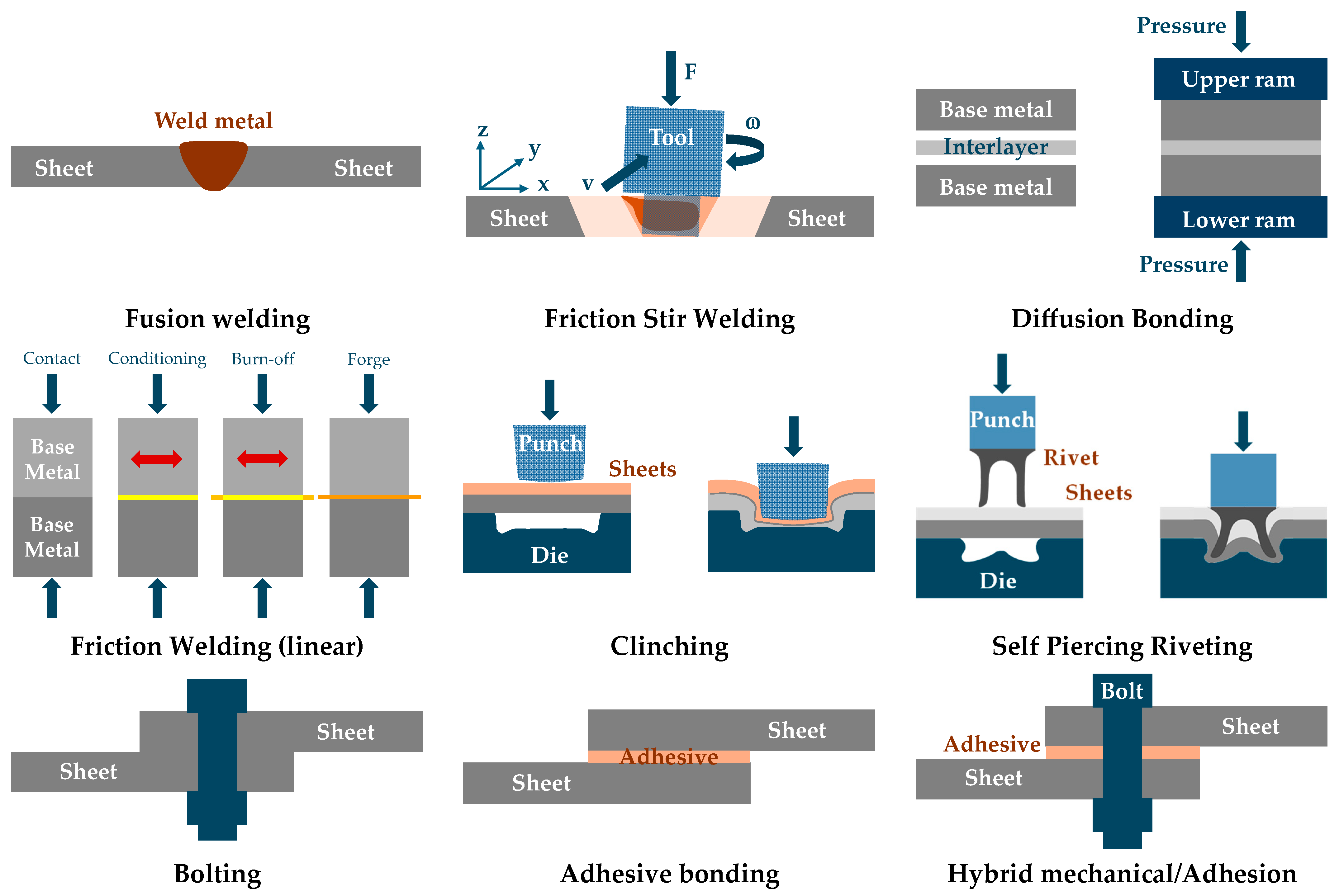
Joining technologies are a crucial but often underestimated lever for improving the sustainability performance of metal products and structures over their life cycle. In environmental impact terms, the choice between fusion welding, solid-state welding, mechanical fastening, adhesive bonding and hybrid solutions affects not only the energy and resource demand in manufacturing, but also the feasibility of lightweight multi-material designs, the possibility of repair and upgrading, and the quality of material recovery at end-of-life. Recent work on the sustainability evaluation of joining methods for engineering materials has shown that environmental impacts can vary by more than an order of magnitude between joining options for the same functional requirement, once process energy, consumables, auxiliary materials and scrap are consistently accounted for over the life cycle [
4].
At the manufacturing stage, joining steps can account for a significant share of the energy consumption and greenhouse-gas emissions of metal-product assembly, especially in highly welded structures such as ship hulls, frames or automotive bodies. Comparative life-cycle studies show that unit impacts depend strongly on process parameters (current, voltage, travel speed, shielding-gas flow) and on the level of automation. As a result, apparently similar welds can exhibit markedly different impact profiles when realistic duty cycles and consumable use are modelled [
5,
6]. Recent assessments also highlight the role of mechanical joining. A cradle-to-gate LCA of screw joints with thread inserts shows that fasteners and their installation can contribute appreciably to embodied impacts when a lightweight structure contains thousands of joints, and that optimisation and data-driven parameter selection can substantially reduce these burdens [
7].
Beyond manufacturing, joining technologies can shape sustainability indirectly through structural efficiency and mass. High-performance welded or adhesively bonded joints enable lightweight designs and multi-material concepts that reduce operational energy use (for example in transport applications) and can outweigh additional impacts incurred during production. Joining therefore enables load-path-oriented structures, optimised stiffening and the integration of dissimilar materials (e.g., aluminium–steel or metal–composite hybrids), supporting lower life-cycle energy demand and emissions in sectors such as automotive, rail and shipbuilding. Multi-criteria decision frameworks for joining-process selection increasingly balance mechanical performance, manufacturability, cost and environmental indicators, although most existing methods still give limited attention to end-of-life aspects and circular-economy requirements [
8,
9].
End-of-life management is the stage where the role of joining technologies becomes most visible. Non-reversible joints such as conventional welds or structural adhesive bonds may maximise stiffness and fatigue resistance, but they typically hinder economically viable disassembly and component reuse, and can contaminate secondary metal scrap or degrade its properties. By contrast, mechanical fasteners (bolts, screws, rivets) and demountable mechanical-forming joints (e.g., clinching, self-piercing riveting) generally facilitate selective disassembly and material sorting, at the expense of additional mass, potential stress concentrations and more complex inspection requirements. Recent LCA-based comparisons across clinching, self-piercing riveting, stud welding, ultrasonic spot welding and screw joints confirm that no joining family is universally optimal. Low-energy assembly processes may still underperform when reparability or recyclability is considered, while easily separable joints can have higher production impacts due to additional elements and processing steps [
7].
Adhesive bonding illustrates this trade-off particularly well. Over the full life cycle, adhesive joints often support lightweight design and multi-material integration and can reduce local stress concentrations, leading to longer product lifetimes and lower operational impacts. At the same time, conventional thermoset adhesives typically create non-detachable joints that complicate repair, refurbishment and high-quality recycling of metal substrates. Recent life-cycle engineering studies on bonded polymer and metal assemblies show that environmental benefits depend strongly on surface activation (mechanical, chemical, plasma or laser), adhesive selection and joint geometry, and that optimised process chains can achieve good structural performance with reduced environmental loads [
10]. Parallel work from the Fraunhofer IFAM “Circular Economy and Adhesive Bonding Technology” programme frames adhesive bonding as a lever for circular-economy capability, emphasising its role in enabling lightweight design, repair and long-term durability, while highlighting the need for concepts that reconcile strong joints with disassembly and recycling requirements [
11].
In response to these challenges, a rapidly growing body of research focuses on reversible and “debond-on-demand” joining solutions. For adhesive bonding, this includes thermally, chemically, magnetically or electrically debondable systems, as well as dynamically cross-linked polymers and functional interlayers that allow selective separation of metal and composite substrates at end-of-life without excessive damage. A comprehensive review of debondable adhesives for recycling underscores that such systems can facilitate the recovery of technology-critical metals and improve the economics of high-value product take-back, provided that trigger conditions (temperature, radiation, chemicals) are compatible with service and dismantling environments [
12]. Analogous trends exist for mechanical joints, where research on reversible locking mechanisms, smart fasteners and joining elements designed for repeated disassembly aims to align structural performance with circular-economy strategies such as reuse, remanufacturing and component harvesting.
Overall, the evidence indicates that joining technologies influence product sustainability on three levels. They directly affect the environmental and economic performance of manufacturing, indirectly govern the feasibility of lightweight designs and long service lives, and ultimately determine whether metal components and structures can be efficiently repaired, upgraded and recovered within circular supply chains. In the context of extended producer responsibility, these aspects transform joining from a purely structural or manufacturing choice into a strategic design variable that conditions producers’ ability to meet regulatory obligations on durability, reparability and end-of-life management.
1.3. Extended Producer Responsibility: Principles and Obligations
Extended Producer Responsibility (EPR) has emerged as a cornerstone of circular economy policies, framing how environmental and economic burdens associated with products are allocated along the value chain. In the most recent OECD synthesis, EPR is defined as a policy approach that makes producers responsible for their products along the entire life cycle, including at the post-consumer stage, with the aim of improving resource efficiency and supporting circular material flows [
13]. Earlier OECD guidance stressed that EPR operationalises the polluter-pays principle at product level by shifting the financial and organisational burden of end-of-life management from municipalities and taxpayers to producers and, indirectly, to consumers [
14]. In industrial-ecology terms, EPR is thus conceived as a strategy to internalise full product life-cycle costs into production and consumption decisions and to create upstream incentives for eco-design, rather than treating waste management as a purely downstream issue [
15,
16].
Across jurisdictions, EPR schemes share recurrent design principles—clear allocation of responsibilities (individually or collectively), incentive compatibility, cost internalisation, transparency, and robust governance and enforcement—yet they should not be interpreted as a single uniform policy instrument [
13,
14]. In the European Union, work under the Green Deal frames EPR as an “interface” policy connecting circular economy, chemicals regulation and waste law, and highlights the need for schemes that not only finance end-of-life operations but also drive prevention, reuse and high-quality recycling through life-cycle-based criteria [
17,
18]. Within this evolution, modulated producer fees—differentiated according to durability, reparability, recyclability, toxicity and the presence of secondary raw materials—are increasingly promoted to align economic signals with circularity objectives [
19]. In practice, EPR refers to a family of sector- and jurisdiction-specific schemes that differ in scope, cost coverage, performance targets, enforcement intensity and, crucially, in how eco-modulation is operationalised. Evidence from mature streams (e.g., packaging and WEEE) indicates that many programmes effectively finance collection and treatment, whereas upstream influence on product and joint design depends on the precision of modulation criteria, the availability of dismantling/recycling data, and the interaction with complementary product policies such as eco-design requirements and digital product passports [
16,
17,
19,
20,
21,
22,
23,
24]. Accordingly, when this review refers to “EPR implications” for joining, it does so in terms of transferable policy levers—end-of-life cost internalisation, eco-modulated fees, design and information obligations, and compliance exposure linked to hazardous substances and scrap quality—whose strength and relevance depend on the specific product stream and jurisdiction.
For metal-intensive value chains such as packaging, electrical and electronic equipment, vehicles and, increasingly, construction products, these levers translate into concrete technical and organisational requirements along end-of-life chains. They include reporting and traceability duties, treatment-quality standards, and—where applicable—design-related expectations such as removability, ease of disassembly, material separability and reduced hazardous substances [
13,
20,
21]. EPR schemes for packaging and WEEE, for instance, have stabilised collection and recycling systems for steel and aluminium, but their influence on design choices (e.g., alloy selection, compatibility of coatings and sealants with recycling, and the use of reversible mechanical fasteners versus permanent joining such as welding or structural adhesives) remains uneven [
20,
25]. Evidence from EU Member States and emerging economies shows that EPR can improve downstream performance (higher collection and recovery rates, better treatment infrastructure). However, upstream effects on product design—including design for disassembly and material recovery in complex metal structures—depend on how responsibilities are defined, how strongly eco-modulated fees are applied, and how EPR interacts with other regulatory and market instruments [
26,
27]. More circular-economy-oriented EPR reforms increasingly emphasise eco-design obligations to address the limited upstream effectiveness observed in several mature schemes, particularly in WEEE [
16,
22].
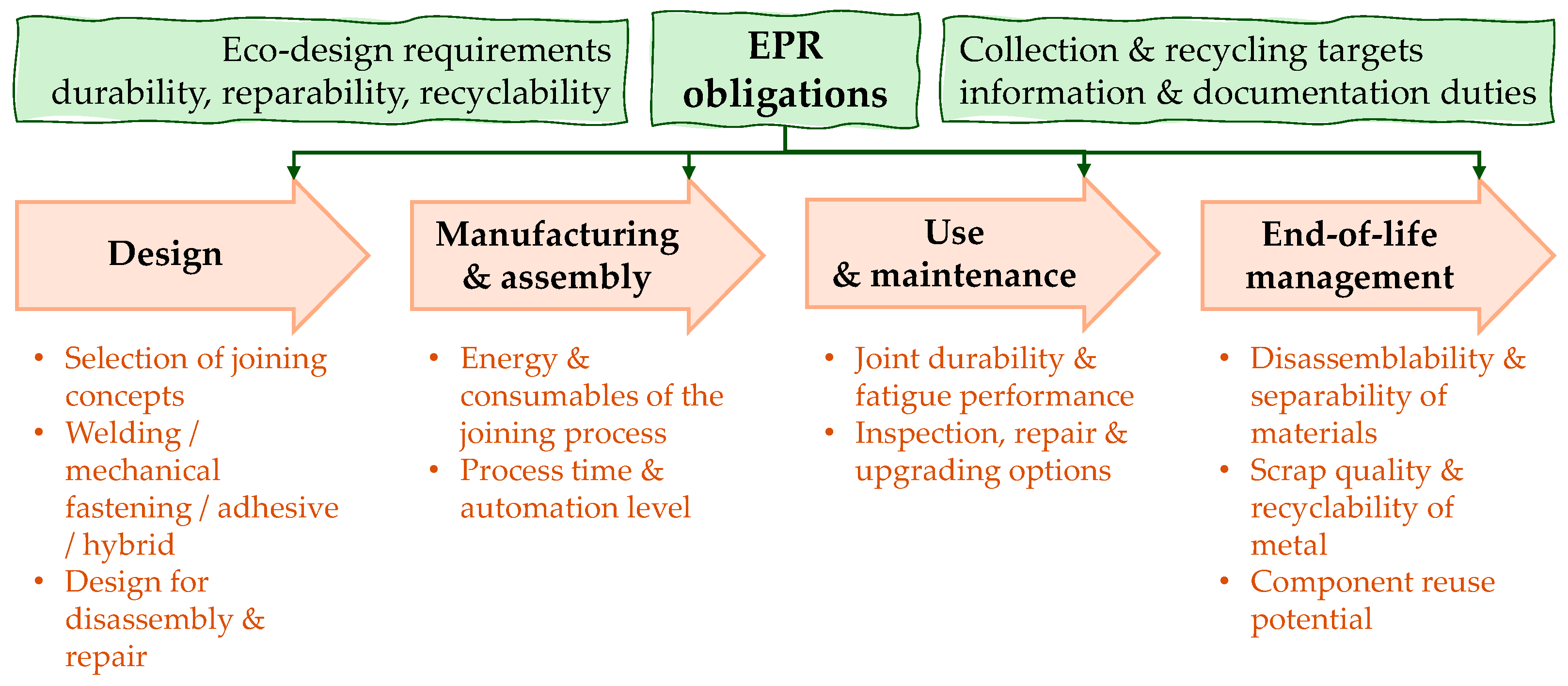
These interactions between EPR obligations, the life-cycle of metal-intensive products and joining-related design choices are schematically summarised in
Figure 1.
1.5. Objectives and Scope of the Review
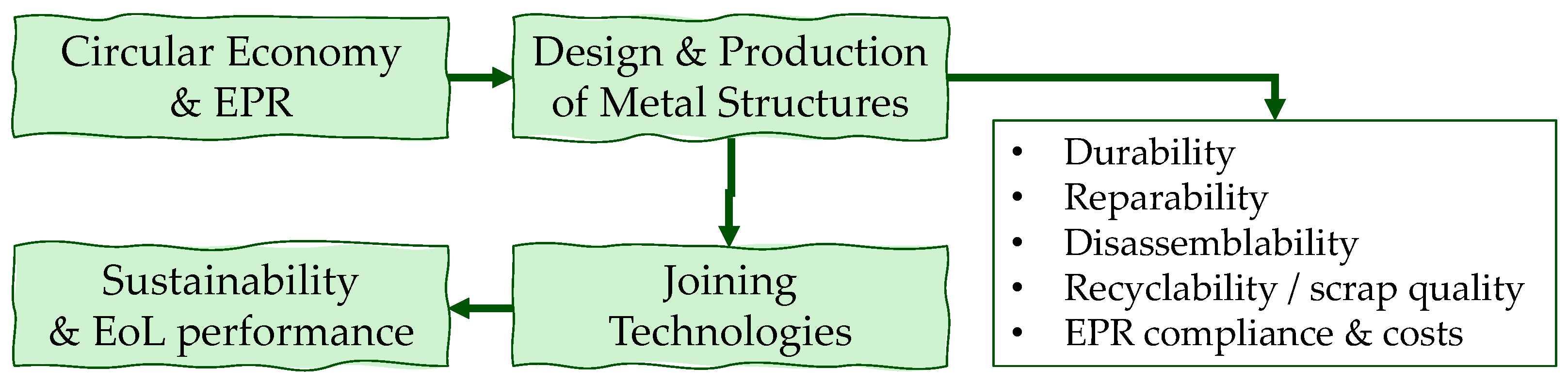
The novelty and added value of this review lie in explicitly coupling joining-technology selection for metal structures with the regulatory and economic logic of Extended Producer Responsibility (EPR). Whereas previous contributions have typically addressed either the sustainability/eco-efficiency of joining processes or the design of EPR schemes and circular-economy incentives, the present work bridges both streams and translates them into an operational lens for decision-making. The conceptual frameworks in
Figure 1 and
Figure 2 and the evidence-informed comparison and scoring approach developed in
Section 6 provide a structured way to anticipate EPR-relevant trade-offs (durability, repairability, disassembly and scrap quality) and to reduce the risk of circularity lock-ins during early design and process selection.
Recent work has consolidated circular-economy definitions and metrics [
1,
31], while EPR schemes have matured into key instruments for product-level environmental governance [
23]. This evolution strengthens the case for analyses that connect joining decisions to regulatory drivers and circular-economy outcomes. At the same time, detailed life-cycle assessments of welding and related joining technologies (such as [
6] and [
32]) and analytical approaches to design for disassembly and remanufacturing [
30] provide a rich but still fragmented evidence base.
The primary objective of this review is therefore to synthesise and structure current knowledge at the intersection between joining technologies for metal structures and Extended Producer Responsibility, with explicit reference to circular-economy requirements on durability, reparability, disassemblability and recyclability.
Specifically, the review pursues four aims. First, it maps how major joining families used in metal structures—fusion and solid-state welding, mechanical fastening, adhesive bonding, and hybrid solutions—shape durability, reparability, disassembly feasibility, and recyclability. Second, it synthesises sustainability evidence across life-cycle scales, from process-level inventories to product-level LCA/LCC and multi-criteria assessments, with emphasis on indicators relevant for EPR decisions (e.g., disassembly time/cost, scrap quality, and compliance exposure) [
6]. Third, it analyses how EPR principles and instruments (including eco-modulated fees and emerging traceability requirements) translate into constraints and opportunities at the joint level [
23]. Finally, it proposes a decision-support perspective linking joining-technology selection to circular-economy performance and EPR implementation.
In terms of scope, the review focuses on metallic load-bearing and semi-structural applications in sectors where both joining operations and EPR-type instruments are salient, including building and infrastructure steelwork, automotive bodies and chassis, railway and rolling stock, shipbuilding and heavy machinery. The analysis concentrates on joining technologies that create permanent or semi-permanent joints in ferrous and aluminium alloys (including welded, mechanically fastened, adhesively bonded and hybrid joints), and on their role in enabling or constraining circular strategies such as modular design, design for disassembly and remanufacturing (as discussed, for instance, in [
30]). Products dominated by micro-scale interconnects (e.g., semiconductor packaging) or polymer-only assemblies fall outside the core scope and are considered only when they provide transferable insights for metal structures. Geographically, the review emphasises jurisdictions with mature EPR frameworks and ambitious circular-economy agendas, while also drawing selectively on emerging economies where EPR for metal-intensive product categories is being established or reformed.
The overall conceptual framework is summarised in
Figure 2.
The paper is organised to progressively connect joining-technology choices to sustainability assessment and to the regulatory logic of Extended Producer Responsibility.
Section 2 reviews the main joining families adopted in metal structures—fusion and solid-state welding, mechanical fastening, adhesive bonding, and hybrid solutions—highlighting their key features in relation to durability, reparability, disassembly and recyclability.
Section 3 synthesises approaches used to assess the sustainability of joining technologies, with emphasis on life-cycle thinking and commonly adopted metrics.
Section 4 and
Section 5 move from technical performance to governance and end-of-life management by discussing EPR principles, obligations and implementation mechanisms, and by analysing how end-of-life strategies (repair, remanufacturing, dismantling and recycling) are enabled or constrained by joining and joint design. Building on these elements,
Section 6 proposes a multi-criteria assessment perspective to compare joining options under EPR-relevant dimensions and to support informed design choices. Finally,
Section 7 summarises the main outcomes and outlines future trends and research needs for aligning joining innovation with circular-economy requirements and EPR-driven obligations.
1.6. Methodology (Scoping Review, Database, Selection Criteria)
Given the breadth and multidisciplinarity of the topic, this work adopts a scoping review following Arksey and O’Malley’s original framework [
33]. The methodological approach is further informed by subsequent methodological refinements by Levac et al. [
34], Munn et al. [
35] and the JBI guidance for scoping reviews [
36]. A scoping review is particularly appropriate where the objective is to map key concepts, characterise the extent and nature of available evidence and identify gaps across diverse bodies of literature, rather than to answer a narrowly defined clinical or engineering question through quantitative synthesis [
35]. Reporting is informed by the PRISMA extension for scoping reviews (PRISMA-ScR) checklist [
37], with adaptations to the specificities of engineering and policy-oriented sources.
The review follows the canonical stages proposed for scoping studies: (i) identifying the research questions; (ii) identifying relevant studies; (iii) selecting studies; (iv) charting the data; and (v) collating, summarising and reporting the results [
33,
34,
36]. Two overarching questions guided the search: (1) how do joining technologies for metal structures influence life-cycle performance indicators that are relevant under Extended Producer Responsibility (EPR) and circular-economy policies? (2) how do existing EPR schemes and related regulatory instruments address design choices related to joining, disassembly and material recovery in metal-intensive products and structures?
To identify the relevant literature, electronic searches were carried out in major bibliographic databases covering engineering, materials science and environmental policy, including Scopus, Web of Science Core Collection and Engineering Village/Compendex. These searches were complemented by targeted searches in ScienceDirect and SpringerLink for full-text access to key journals. Grey literature and policy documents were retrieved from institutional repositories of the European Commission, OECD and selected national agencies. Search strings combined three main concept clusters: (i) circular economy and EPR (e.g., “extended producer responsibility”, “product stewardship”, “eco-modulation”, “circular economy”); (ii) metals and metal structures (e.g., “steel structure*”, “aluminium structure*”, “metal* component*”, “welded structure*”); and (iii) joining and end-of-life aspects (e.g., “weld*”, “adhesive bond*”, “mechanical fastening”, “clinching”, “self-piercing riveting”, “design for disassembly”, “remanufactur*”, “recycl*”). Searches covered publications from 2000 up to the final search date (December 2025), reflecting the period in which both circular-economy and EPR debates, as well as sustainability-oriented assessments of joining technologies, became prominent in the literature.
Study selection proceeded in two screening stages. First, titles and abstracts were screened to exclude clearly irrelevant records (for example, studies on micro-joining in semiconductor packaging, purely polymeric assemblies, or EPR schemes unrelated to material products). In a second stage, full texts were assessed against predefined inclusion criteria. Studies were included if they: (i) addressed joining technologies applied to metallic structures or metal-intensive components; (ii) reported quantitative or qualitative information on environmental performance, circular-economy aspects (such as durability, reparability, disassemblability, recyclability) or end-of-life management; and/or (iii) analysed EPR or closely related product-oriented policy instruments with explicit implications for product design, material choice or end-of-life handling. Only documents in English and published in peer-reviewed journals, edited books, conference proceedings or authoritative institutional reports were retained.
Data from included sources were charted using a structured extraction template capturing, inter alia, product sector and application, metal and joining technology, methodological approach (e.g., LCA, techno-economic analysis, policy analysis), reported environmental and circular-economy indicators, and any explicit reference to EPR obligations, fee modulation or design requirements. Consistent with best practice guidance for scoping reviews [
34,
36,
37], the emphasis of the analysis is on mapping and synthesising patterns and gaps across heterogeneous evidence, rather than on formal quality appraisal or meta-analysis. This approach allows the review to integrate engineering, environmental and policy perspectives and to develop an overarching framework linking joining technologies, circular-economy performance and EPR-driven obligations for metal structures.
In addition to mapping the breadth of contributions, the synthesis is deliberately presented through a critical lens, as the reviewed evidence is highly heterogeneous in terms of scope, maturity level and methodological assumptions. In particular, process-level studies often rely on laboratory or idealised operating conditions, whereas product-level assessments depend strongly on modelling choices (functional unit, system boundaries, allocation rules, use-phase and end-of-life scenarios). Policy-oriented sources, in turn, frequently provide limited engineering detail on joint architectures and dismantling operations. To make this distinction explicit, the reviewed sources are interpreted according to three evidence contexts: laboratory-scale studies (controlled material/process/joint tests), industrial-scale implementations (production-oriented data including cycle times, auxiliaries, rework and realistic scrap streams), and conceptual/policy-oriented contributions (regulatory analyses and eco-design guidance). Accordingly, laboratory evidence is discussed primarily as mechanism-level insight and technical potential, whereas implications for EPR compliance, fee modulation and end-of-life performance are drawn preferentially from industrial and regulatory sources, or stated explicitly as conditional on scale-up and validated end-of-life routes. For this reason, results are discussed by making underlying assumptions explicit, by distinguishing between empirical evidence and model-based extrapolations, and by highlighting recurring sources of uncertainty and comparability limits (e.g., inconsistent boundary conditions, incomplete end-of-life modelling, scarce data on dismantling time/cost and scrap-quality degradation). This critical reading is used to identify robust patterns, but also to define the main methodological and data gaps that currently prevent direct transfer of published findings into EPR-oriented design rules.
3. Sustainability Assessment of Joining Technologies
Although joints account for a relatively small fraction of the mass and volume of metal structures, they exert a disproportionate influence on resource consumption, durability and end-of-life options. Joining operations require energy, consumables, auxiliary gases and surface treatments, and they may emit fumes, particulates or volatile organic compounds. At the same time, joint type and layout largely determine whether components can be repaired, upgraded, disassembled and reused, or whether they are effectively locked into recycling—and ultimately down-cycling—routes. For these reasons, the sustainability performance of metal products cannot be evaluated without an explicit consideration of the joining technologies adopted, in alignment with circular-economy strategies and with the increasing role of extended producer responsibility (EPR) schemes in pushing producers to account for impacts over the whole life cycle [
14,
17].
Over the last decade, several methodological frameworks have been proposed to quantify the sustainability of joining processes at different scales. At the process level, life cycle assessment (LCA) has been applied to fusion welding operations, comparing, for instance, resistance spot welding with laser beam welding and other arc-based processes in terms of energy demand and midpoint impact categories per unit weld length [
6,
51]. Environmental and social life cycle assessment has also been used to extend the analysis to occupational health and working conditions of welders, highlighting trade-offs between productivity, exposure to fumes and broader social indicators [
32,
45]. For multi-material and hybrid structures, comparative LCAs have evaluated mechanical, thermal and chemical joining processes, such as riveting, welding and adhesive bonding, using a common functional basis and showing that energy consumption and CO
2 emissions can differ significantly depending on whether joints are removable or permanent [
101,
102]. More recently, multi-criteria decision-making approaches have combined environmental, economic, social and technical indicators to rank alternative joining methods, for example, when comparing friction stir welding, self-piercing riveting and adhesive bonding in metal-to-polymer joints [
59,
103].
Beyond isolated processes, the sustainability of joining technologies manifests at the structural and system level. In building and infrastructure applications, demountable and reconfigurable steel connections have been shown to reduce cumulative life cycle costs and carbon footprint when structures are designed for multiple use cycles, despite higher initial material and fabrication costs [
104]. Similar trends are emerging in the assessment of clamp-based or modular steel connections, where reusability and ease of disassembly can offset the higher environmental burden of more complex connectors through repeated redeployment [
105]. These findings align with broader design-for-disassembly and EPR-oriented strategies, where producers are incentivised to minimise the number of irreversibly welded joints, limit the mixing of incompatible materials and favour joining solutions that support repair, upgrade and high-quality material recovery [
14].
In this context, the present section provides a structured overview of how the sustainability of joining technologies for metal structures can be assessed. First, the main methodological approaches and indicators used to characterise environmental, economic and social performance at process and product level are summarised. Then, available comparative studies on welding, mechanical fastening, adhesive bonding and hybrid joining routes are synthesised, with particular attention to energy use, greenhouse gas emissions and resource efficiency. Finally, the implications of design-for-disassembly, reuse and recycling are discussed in connection with EPR frameworks and end-of-life management strategies, identifying current gaps and priorities for future research on sustainable joining.
A critical caveat emerging from the reviewed sustainability literature is that published comparisons across joining options are often not directly commensurable. Many LCAs are cradle-to-gate or gate-to-gate and therefore capture manufacturing energy and consumables in detail, while treating use-phase benefits (e.g., mass-driven operational savings) and end-of-life outcomes (e.g., dismantling effort, material sorting, scrap-quality losses) with simplified or generic assumptions. In addition, reported impacts depend strongly on modelling choices such as duty cycles, auxiliary material inventories (shielding gases, surface treatments), rework rates, electricity mixes and the assumed fate of joining-related contaminants. Comparability is further reduced by differences in functional units (e.g., per metre of weld, per joint/spot, per equal load-bearing function, or per component), which can shift rankings when mechanical performance, durability or rework rates differ. Moreover, differences in system boundaries (gate-to-gate vs. cradle-to-gate vs. cradle-to-grave) and in end-of-life modelling (dismantling vs. shredding, recycling rates/credits and scrap-quality degradation due to coatings/adhesives) may lead to divergent conclusions even for the same joining technology. Similar limitations affect techno-economic and multi-criteria studies, which frequently adopt case-specific weighting schemes or omit uncertainty/sensitivity analysis. Accordingly, the discussion below distinguishes between (i) results that appear robust across multiple contexts and methods and (ii) conclusions that remain conditional on boundary choices or on scarce dismantling/recycling datasets—particularly when EPR-relevant indicators (disassemblability, repairability, recyclability/scrap quality and compliance exposure) are involved.
3.5. Joining for Lightweighting (with Implications for LCA)
Joining technologies are a cornerstone of lightweight design because they enable material combinations, constrain geometry (flanges/overlaps), and add or avoid “parasitic” mass (fasteners, overlaps, reinforcements) along the load path. LCA-based studies show that the key question is whether the additional complexity and manufacturing burden of advanced joints is compensated by use-phase savings due to mass reduction.
Several life-cycle studies express this trade-off through the fuel reduction value (FRV), i.e., the fuel or energy saving per 100 kg of mass reduction over vehicle lifetime. Delogu et al. and subsequent work report typical FRVs of about 0.3–0.4 L/100 km per 100 kg for conventional ICE passenger cars over standard drive cycles, corresponding to roughly 27 GJ of primary energy saved per 100 kg over 200,000 km [
145,
146]. For battery electric vehicles, recent life-cycle engineering studies report savings around 1.2 kWh/100 km per 100 kg, still corresponding to several tens of gigajoules over lifetime [
146]. These use-phase savings typically exceed the manufacturing energy of typical joining operations per vehicle body, which is generally in the range of tens to a few hundred megajoules [
106]. Therefore, when a joining strategy unlocks sizeable mass reduction, it usually dominates the life-cycle balance—provided durability and end-of-life constraints are not severely degraded.
A large part of the available quantitative evidence comes from multi-material automotive bodies and closures, because they combine strong regulatory pressure on CO
2 emissions with a high level of process monitoring. Naito and Suzuki, for example, designed four multi-material body-in-white (BIW) concepts for an E-segment SUV by combining ultra-high-strength steel (UHSS) with aluminium sheets, extrusions and castings, joined by a mix of resistance spot welding (RSW), self-piercing riveting (SPR), element arc spot welding (EASW) and structural adhesives. Depending on the fraction of aluminium, they report mass reductions between 12% and 33% compared with an all-steel baseline body [
147]. A more recent study on multi-material closure parts (doors, tailgates), which account for roughly 15% of BIW mass, shows that by combining tailored blanks, aluminium castings and high-strength steels through mechanical and adhesive joining, it is possible to achieve double-digit percentage weight reductions while maintaining or improving corrosion performance and dimensional stability. In these cases, LCA indicates that use-phase CO
2 savings can outweigh the higher manufacturing impacts of advanced joining and coatings [
146,
147].
Importantly, lightweighting is often governed by flange and overlap design, not by the kWh of the joining machine. Life-cycle studies of different welding processes for car bodies indicate that the additional sheet material in overlaps and flanges can contribute up to 50–60% of the global warming potential (GWP) associated with a given joint line, whereas the direct electricity use of the joining process contributes only a few percent [
106,
148]. High-energy-density processes such as laser beam welding or laser-arc hybrid welding are attractive for lightweighting because they allow much narrower flanges than RSW or traditional arc welding. An industrial case reported for the Mercedes C-Class door shows that switching to laser welding allowed engineers to reduce the flange width in high-strength steel sheets from 16 mm to 8 mm, effectively halving the flange mass for that joint and contributing directly to BIW mass reduction [
149,
150]. In structural applications outside automotive (e.g., ship structures), similar arguments hold: narrow-gap laser or hybrid welds allow designers to reduce plate width and stiffener dimensions, which translates into lower steel tonnage per unit stiffness or load capacity [
151].
Adhesive bonding and hybrid joints (weld-bonding, riv-bonding) play a particularly important role in lightweight designs based on high-strength steels and multi-material concepts. Because structural adhesives do not locally melt the substrate, they preserve the high base-material strength and distribute stresses over a larger bonded area, enabling down-gauging of sheet thickness without sacrificing crash performance. A well-documented case synthesised by FEICA, based on the LCA work of Stephan, considers a 350 kg steel body joined either by RSW or by structural adhesives. Exploiting the better stress distribution of bonded joints, a 15% reduction in body steel mass (≈52.5 kg) is claimed to be feasible while maintaining stiffness and crashworthiness. This reduction saves about 912 MJ of energy in steel production and, using an FRV of 27 GJ per 100 kg, about 14.2 GJ of energy in the vehicle use phase for a gasoline car over 200,000 km [
146]. The adhesives themselves amount to only about 800 g, with an estimated production energy of roughly 120 MJ, so that the net life-cycle energy saving exceeds 15 GJ, i.e., more than two orders of magnitude larger than the adhesive manufacturing burden.
Some studies quantify the process energy demand of different point and line joining methods for equivalent shear strength. For a joint providing 5.5 kN shear capacity, one RSW point consumes about 0.0055 kWh, three clinch points about 0.011 kWh, a 13 mm Nd:YAG weld about 0.0107 kWh, whereas an equivalent adhesive bond of 0.05 cm3 requires only 0.00072 kWh. Extrapolated to a full BIW with 4500 joints over 135 m of seam, this corresponds to 81 MJ of electricity for spot welding versus 11.6 MJ for adhesive bonding, a reduction of approximately 85% in process electricity consumption. Even when this process-stage gain is modest relative to use-phase savings, it reinforces the same causal point: joining strategies that enable mass reduction tend to dominate LCA outcomes, provided that end-of-life penalties do not negate these gains.
Mechanical fastening and mechanical interlocking processes (bolting, riveting, flow-drilling screws, clinching, SPR) are often the only option when welding is prohibited by metallurgical incompatibilities, coatings or thermal distortion issues. However, they usually introduce additional mass in the form of fasteners and may require larger flange areas to provide adequate edge distances and bearing capacity. A typical steel BIW uses on the order of 3000–5000 spot welds; an aluminium-intensive body such as the Jaguar XJ employs roughly 3200 self-piercing rivets and ~120 yards of structural adhesive in place of many of those welds, achieving a body that is about 40% lighter and 60% stiffer than its steel predecessor, with an overall vehicle mass reduction of approximately 250 kg [
76]. While detailed mass accounting of individual rivets is rarely reported, reviews of SPR technology explicitly list “additional cost and weight from the rivets” as a key disadvantage compared with welding or pure adhesive bonding [
76,
152,
153]. This implies that the LCA role of mechanical fastening is often “enabling”: it may be neutral or slightly unfavourable at joint level, but it makes multi-material lightweighting feasible where welding cannot.
Solid-state and plastic-deformation-based joining processes provide an interesting bridge between material efficiency and joining energy. Friction stir welding (FSW) and its spot variants, ultrasonic spot welding and friction-based self-piercing riveting (F-SPR) are designed specifically for joining lightweight alloys (Al, Mg) and even Al–steel or CFRP–metal stacks under lower heat input and without filler. A recent comparative study on 6082-T6 aluminium butt joints reports joint efficiencies of about 97% for FSW, compared with 54–55% for MIG and TIG welds, with similar plate thickness [
154]. For 7xxx aluminium alloys, FSW butt joints with efficiencies in the 75–85% range are commonly reported, versus significantly lower values for fusion welds of the same alloys [
155,
156,
157]. Although design codes do not allow a direct one-to-one translation of these efficiencies into plate-thickness reductions, they clearly indicate that solid-state joints can carry a higher fraction of base-metal strength. In lightweight design, this can reduce compensatory over-dimensioning that is otherwise required to offset softened fusion welds. In terms of LCA, the process electricity of FSW (typically a few hundred watts to a few kilowatts over seconds) remains small compared with the energy embodied in the saved aluminium mass and the subsequent use-phase energy savings [
158,
159].
For mechanical interlocking processes such as clinching and SPR applied to multi-layer stacks (e.g., Al/steel/Al), recent experimental work shows that three-sheet configurations combining thin aluminium and ultra-high-strength steels can be joined without fractures, achieving joint strengths that make them attractive for roof and reinforcement structures in lightweight bodies [
152,
160]. However, the same studies point out that a larger local sheet thickness or local reinforcements are often required to accommodate the plastic flow of the rivet or punch, which again increases local mass. As a result, the net lightweighting effect is highly dependent on the global design of the part: where SPR or clinching are the only means to join a critical multi-material load path, they can be considered as a necessary enabler whose added mass is offset by the ability to use aluminium or CFRP in the rest of the structure; where high-strength steels can be welded or bonded, the additional mass of mechanical fasteners tends to worsen the LCA balance.
Overall, the available quantitative evidence suggests that for typical metal structures the hierarchy of effects on life-cycle performance is dominated by mass reduction, not by differences in joining process energy. Lightweighting strategies that rely on advanced joining—laser or hybrid welding, structural adhesives, weld-bonding, solid-state welding and mechanical interlocking—can reduce BIW or structural mass by 10–30%, translating into tens of gigajoules of lifetime energy savings and substantial reductions in GWP [
146,
147,
161]. Within this context, the role of the joining process is twofold: first, to enable the use of higher-performance materials and more efficient geometries (narrower flanges, less over-lap, die-cast or additively manufactured nodes); second, to avoid excessive penalties in terms of added material (fasteners, reinforcements) and process-stage impacts. For a comprehensive sustainability assessment, the comparison of joining technologies must therefore be embedded in a full LCA of the lightweight structure, where material usage, achievable mass reduction and use-phase performance are quantified alongside the electricity and consumables of the joining process itself.
4. End-of-Life Management of Joined Metal Structures
The previous sections have shown how joining technologies are selected and optimised primarily to meet structural performance, manufacturability and in-service durability requirements.
Section 4 shifts the focus to a different—but closely related—dimension: how those same joining decisions shape what can realistically be done with metal structures at the end of their service life. In a circular-economy and Extended Producer Responsibility (EPR) context, end-of-life (EoL) is not a purely “waste-management” problem; it becomes a design outcome, driven by the architecture of joints, the mix of materials being connected and the level of information available on the assembled system [
162,
163].
For metal-intensive products and structures, the most desirable EoL pathways are typically the preservation of component integrity through direct reuse or remanufacturing, followed by high-quality closed-loop recycling of metallic streams. The type and distribution of joints determine which of these options remain open. Demountable mechanical connections, modular layouts and documented connection schemes enable selective dismantling and the recovery of beams, profiles or sub-assemblies, as increasingly demonstrated in the construction sector where reusable steel elements can reduce embodied environmental impacts by more than 50% compared with conventional “design-for-demolition” solutions [
164]. Conversely, monolithic welds, hybrid joints and hidden or inaccessible connectors tend to lock materials into assemblies that are economically impractical to disassemble, thereby pushing EoL strategies toward bulk shredding and mixed-scrap processing. This shift not only reduces the potential for reuse but often downgrades the quality of recycled metals.
The importance of joining for EoL performance is particularly evident in transport applications. Studies on end-of-life vehicles (ELVs) have shown that the liberation of metals during shredding and post-shredder sorting is strongly constrained by the geometry, strength and material composition of joints. In detailed trials on automotive doors, mechanical fasteners such as screws, bolts and rivets were identified as major contributors to residual impurities in aluminium and steel fractions, reducing their suitability for high-grade recycling [
165]. Consistent with these results, a broader analysis of aluminium recycling from EoL products has demonstrated that joining-related contaminants and multi-material interfaces are now a primary barrier to achieving the full energy-saving potential of secondary aluminium—estimated at around 95% compared with primary production—because they force downcycling into lower-value alloy families [
166]. These findings underline that lightweight, multi-material designs only deliver net environmental benefits if joint architectures are compatible with clean separation at EoL.
A complementary line of research has formalised the role of fasteners and joint typologies in “design for recycling” metrics. Recent work on plate connections, comparing multi-bolted and multi-riveted alternatives, has quantified how fastener number, type and accessibility affect both dismantling effort and recyclability indicators, while also modifying stiffness and load-carrying capacity [
167]. Within such frameworks, indices like the Quantity of Fasteners Index, Type of Fastener Index or End-of-Life Contamination Index explicitly link joint design to disassembly time, separation quality and recycling profitability. These models show that joints are not merely local mechanical features but system-level levers that can be tuned simultaneously for mechanical performance and EoL outcomes.
At the scale of buildings and infrastructure, similar considerations have long been embedded in the concepts of design for disassembly and design for reuse. Pioneering work in building science has highlighted how the reversibility of connections—ranging from mortars and welds to bolted or dry mechanical joints—largely determines whether components can be recovered intact, remanufactured or only recycled as low-grade aggregates. More recent guidance on reusable steel structures and demountable connections confirms that joint detailing, tolerances and access conditions are key to scaling structural reuse and to integrating stock-based design strategies, in which new structures are conceived starting from available reclaimed elements [
164]. For metal structures, this implies that joint typologies adopted today will govern tomorrow’s feasibility and cost of deconstruction, testing and recertification.
These technical insights increasingly interact with policy frameworks. EPR schemes in many sectors were originally designed to finance collection and treatment, but are progressively evolving toward fee structures that reward higher recyclability, reparability and reuse potential through eco-modulation of producer contributions [
162,
163]. In construction, recent proposals for EPR-type instruments explicitly discuss how product-specific criteria—such as the ease of separating metals from coatings, composites or other materials—could be integrated into modulation rules, creating incentives for joints that facilitate disassembly and high-purity recycling [
168]. For joined metal structures, this trend suggests a forthcoming alignment between technical best practice (demountable, well-documented, material-compatible connections) and economic signals (reduced fees or higher residual value at EoL) under EPR and circular-economy policies.
Within this context,
Section 4 will examine how different joining technologies influence the practical management of metal structures at the end of life, addressing three tightly coupled dimensions: (i) the technical feasibility of disassembly, reuse and remanufacturing at component or sub-assembly level; (ii) the quality and circularity of metallic scrap streams obtained through current dismantling and shredding routes; and (iii) the emerging role of EPR-driven criteria, recyclability indices and design guidelines that explicitly incorporate joint architectures into EoL decision-making.
4.1. Design for Disassembly and Material Separation
Design for disassembly (DfD) has evolved from a generic eco-design guideline into a structured design discipline that explicitly targets end-of-life scenarios in which products and structures are opened, joints are undone, and materials are separated into high-purity streams. Recent scoping reviews emphasise that DfD is no longer limited to “making things easy to take apart”, but must be interpreted as a systemic strategy that links product architecture, joining technologies and information management with reuse, remanufacturing and high-quality recycling pathways [
169,
170]. In joined metal structures, this implies designing joints, interfaces and layer sequences such that steel, aluminium or other alloys can be detached from coatings, fasteners and hybrid sub-components without excessive damage, contamination or labour, thereby directly supporting extended producer responsibility (EPR) obligations.
A first strand of work has focused on formalising DfD methods and indicators. Formentini and Ramanujan [
170] analyse more than 60 design-for-disassembly methods and note that most tools still concentrate on local geometric or connector-level criteria (number of fasteners, accessibility, tool changes), while only a minority explicitly relate disassemblability to circular strategies such as component reuse and closed-loop recycling. In parallel, Ostapska et al. [
169] propose a research agenda in which DfD is framed along three complementary dimensions: reversibility (the capability of joints to be undone without damage), traceability (the availability of reliable information on joint locations and material composition), and separability (the possibility of obtaining sufficiently pure material fractions after disassembly and pre-treatment). This three-dimensional view is particularly relevant for metals, where small amounts of tramp elements or adhesive residues can substantially downgrade the quality of secondary alloys.
Quantitative evaluation of disassemblability is essential if DfD guidelines are to be prioritised in engineering practice and in EPR schemes. Vanegas et al. [
171] introduced the “eDiM” (ease of Disassembly Metric), which computes disassembly time for a given sequence of operations using MOST (Maynard Operation Sequence Technique) work measurement, and aggregates results into six categories of tasks (searching, grasping, positioning, releasing, unscrewing, etc.). The method, originally demonstrated on an LCD monitor, is directly applicable to metal sub-assemblies and allows designers to identify which connectors or access constraints dominate labour time and cost at end-of-life. Graph-based methods push this further: Hu et al. [
172] model the product as a disassembly graph and automatically estimate complete or selective disassembly time from early CAD models, providing immediate feedback on how changes in joint type or layout affect EoL performance [
173,
174,
175,
176,
177,
178,
179]. Multi-criteria optimisation approaches integrate environmental metrics: Igarashi et al. [
180] formulate a disassembly system design problem that simultaneously optimises cost, recycling rate and CO
2 savings, showing that moderate increases in disassembly time may be justified if they enable cleaner separation of high-value materials.
In the built environment, DfD has become a central concept for steel and composite structures that are expected to be modified, extended or dismantled over several decades. O’Grady et al. [
181] catalogue disassemblable building connection systems and show how clamp-based, bolted and slotted connections can replace welded joints in beams, columns and secondary steelwork, thereby enabling repeated assembly–disassembly cycles without significant loss of capacity [
182]. Detailed mechanical models of such reversible joints confirm that clamps and demountable T-stub connections can satisfy current structural codes while maintaining adequate stiffness and ductility, thus addressing a traditional objection to non-welded steel joints in primary load-bearing paths [
104].
The environmental consequences of these design choices have been quantified through several life-cycle assessment (LCA) studies. Densley Tingley and Davison [
183] developed an LCA methodology tailored to buildings designed for deconstruction, in which reused structural components are treated as carriers of “embedded environmental credit” into subsequent building projects. Using this framework, Eckelman et al. [
184] compared conventional composite steel–concrete floors with a design-for-deconstruction system based on precast planks and clamped shear connectors. They report that, although the DfD system entails slightly higher impacts in the first construction due to additional steel and connector mass, reusing flooring planks three times reduces cumulative life-cycle energy use and emissions by around 60–70% compared to a traditional, cast-in-place reference. Subsequent work by Wang et al. [
185] on deconstructable composite beams confirms that such clamped systems can be dimensioned according to standard design codes and integrated into practical design rules for reusable steel structures [
186]. Recent assessments of demountable or modular steel systems further show that, when reusable components are combined with optimised logistics and BIM-based planning, material savings and embodied-carbon reductions can be realised without compromising construction schedule or cost [
104,
187].
Digital tools play a crucial role in turning DfD principles into concrete design requirements for joined metal structures. Denis et al. [
101] use network analysis on BIM models to quantify how different connection strategies (e.g., welded versus bolted nodes in steel frames) affect the complexity of disassembly paths and the number of operations required to free specific components. Atta et al. [
188] propose digital “material passports” embedded in BIM that record, for each structural element, alloy type, joining method, coatings and expected EoL routes, enabling future owners or producers subject to EPR schemes to plan selective removal and material separation decades after construction [
104]. More recent frameworks for reusable steel design combine such digital information with decision tools that balance structural safety, inspection requirements, logistics and circularity indicators, effectively embedding DfD into design codes and procurement criteria [
186].
At product level, DfD and material separation are increasingly addressed together. The eDiM method demonstrates that connectors, accessibility and product architecture often matter more than the sheer number of parts: even modest design interventions—such as reducing the diversity of fasteners or aligning access directions—can significantly decrease disassembly time and improve the economic feasibility of reuse and remanufacturing [
171]. Cooper and Allwood [
189] analyse component-level strategies for metal-intensive products and show that reusing steel and aluminium components at end of life can yield substantial material and energy savings compared with recycling, provided that components have been designed so that they can be decoupled from surrounding assemblies without unacceptable damage or contamination [
186]. This reinforces the need to consider mechanical, thermal and chemical compatibility of joining processes with future EoL dismantling and separation technologies.
The automotive sector offers a particularly illustrative example of how DfD requirements reshape joining design under an EPR regime. Analysing dismantling and recycling of end-of-life vehicles (ELVs), Tian and Chen [
190] show that fastener accessibility, modular sub-assemblies and standardised connection schemes directly influence both recovery rates of metals and the economics of dismantling. Anthony and Cheung [
191] couple these aspects with cost models and demonstrate that design decisions taken in early development, such as the selection of permanent versus reversible joining methods for key sub-assemblies, can significantly alter end-of-life costs borne by manufacturers or producer responsibility organisations. More recently, Ortego et al. [
192] analysed actual automotive waste streams and highlight recurring disassembly bottlenecks linked to hybrid joints (e.g., spot-welded and adhesively bonded aluminium/steel combinations), underscoring that poor disassemblability results not only in higher labour time but also in downgraded metal scrap due to cross-contamination.
Beyond ease of physical separation, DfD for metal structures increasingly targets scrap quality as a performance metric. Cooper and Allwood’s work on component reuse and high-quality recycling shows that the benefits of circular strategies are highly sensitive to whether secondary metals enter “clean” loops (e.g., structural steels staying within construction) or mixed, lower-grade applications [
186,
189]. Recent steel-reuse frameworks therefore propose design guidelines that explicitly limit the number of dissimilar materials coupled in critical joints, avoid combinations that create problematic alloying additions in scrap, and prioritise reversible mechanical connectors in locations where future separation is likely. At the same time, cross-sector reviews on circular metals emphasise that DfD must be coordinated with sector-specific quality requirements and standards for secondary steels and aluminium, so that the separability engineered at component level actually translates into high-value recycling or reuse options at system level [
170,
186].
In synthesis, contemporary DfD research provides a rich toolbox—methods, indicators, digital models and case studies—that allows designers of joined metal structures to anticipate end-of-life scenarios and engineer separability from the outset. The literature converges on three key messages relevant to this review: (i) disassemblability can be measured and optimised already in early design, using time- and graph-based metrics; (ii) reversible joints and modular architectures in steel and aluminium structures can achieve substantial life-cycle energy and emission savings when components are reused; and (iii) design rules must explicitly target material separation and scrap purity, not only access and labour time, if EPR schemes are to deliver meaningful improvements in circularity of metal structures. These insights provide the conceptual and quantitative foundation for the subsequent sections, which examine how specific joining technologies and joint architectures can be configured to support design for disassembly and high-quality material separation.
4.2. Repairability and Reuse Potential
Repair and reuse strategies occupy a higher position than recycling in the waste hierarchy and are increasingly recognised as central levers for decarbonising metal-intensive sectors. For structural steels in particular, extending service life through in situ repair, component replacement or direct reuse preserves the embodied energy and alloying effort associated with both base material production and the original joining operations, rather than “resetting” the system via remelting. Recent overviews on steel reuse in construction argue that shifting from recycling to reuse can substantially reduce resource demand and emissions, but only if structures are designed and documented so that individual members and joints can be safely inspected, repaired and re-certified [
164,
193]. Within an EPR framework, this means that joining solutions must be evaluated not only for their performance in the first life, but also for how they enable or constrain economically viable repair and multiple life cycles.
Policy and standardisation work around the EU Ecodesign framework provide a useful conceptual bridge. Analyses of Ecodesign implementing measures show a progressive integration of “material efficiency” requirements—durability, reparability, upgradability—alongside energy efficiency, with explicit attention to aspects such as access to joints, non-destructive disassembly of priority parts and availability of spare parts [
194,
195]. Parallel work on repairability indices, such as those developed for electrical and electronic equipment in France, translates these high-level objectives into quantitative scores based on five main criteria: quality of documentation, ease of disassembly (including type and accessibility of fasteners), availability and price of spare parts, and product-specific aspects [
196]. Although developed for different product categories, these frameworks are fundamentally joint-centric: they reward designs where critical subassemblies can be accessed without damaging surrounding material, where fasteners can be operated with standard tools, and where joining solutions avoid irreversible or hidden connections in areas that are likely to need repair. Applied to metal structures, this logic implies that the choice between welding, bolting, clamping or hybrid joints directly governs future repair options.
On the structural side, recent research on demountable steel systems provides quantitative evidence that joints explicitly engineered for re-assembly can deliver both high structural performance and enhanced repairability over multiple life cycles. Fan et al. [
197] introduced a “demountable reusability performance parameter” for steel members, showing how connection detailing (e.g., bearing lengths, slip-critical interfaces, preloaded bolts) controls the residual performance of members after repeated assembly–disassembly cycles and repair operations. Building on this, experimental and numerical studies on clamp-based and side-plate beam-to-column joints have demonstrated that damage can be concentrated in replaceable components (plates, clamps, friction interfaces), allowing the main beams and columns to be preserved and re-used after seismic or fatigue loading by substituting only the sacrificial parts [
104]. These systems explicitly decouple the “load path” from the “wear path”: the joint is designed so that the elements most exposed to inelastic deformation, slip or fretting are also the easiest to inspect and replace, thereby maximising repairability at the joint level.
The implications for reuse potential at structure scale emerge clearly from recent life-cycle studies. A systematic review on reclaimed structural steel components highlights that, where joints and documentation allow requalification, direct reuse of beams and columns in new projects can displace large volumes of primary steel, with case studies reporting savings on the order of several tonnes of CO
2 per tonne of reused steel compared to conventional rolling and fabrication [
164,
193]. A more detailed bottom-up LCA of heavy-section steel reuse in buildings quantified greenhouse gas reductions of roughly 60–83% when reuse replaces recycling, depending on member type, transport distances and electricity mix, and showed that the availability of standardised, reversible connection details is a precondition for scaling such practices [
198]. Complementary work on demountable and reconfigurable steel frames reports that, when joints are explicitly designed for repeated disassembly and reconfiguration, cost savings up to about 75% and carbon-footprint reductions close to 50% can be achieved over three life cycles compared with conventional welded or monolithic solutions, because major structural members can be reused while only secondary components and connectors are replaced or upgraded [
104]. In all these studies, joining technologies are not a neutral background choice: the extent to which connections can be opened, inspected and re-closed without degrading performance is the main technical determinant of whether reuse is feasible, and thus of the magnitude of achievable environmental benefits.
Repairability and reuse potential also depend critically on the ability to restore or upgrade the performance of damaged metallic members so that they can safely remain in service or be redeployed. In this context, condition assessment and surface reconditioning act as “enablers” of reuse. Kanyilmaz et al. [
164] emphasise that non-destructive testing, reliability analysis and digital documentation are essential to evaluate the remaining life of steel elements recovered from deconstructed buildings, and report that integrating detailed material passports and inspection histories can cut reconditioning and fabrication costs for reused steel by hundreds of pounds per tonne. At the material level, recent work in high-strength steels shows that targeted surface treatments, such as mechanical surface reconditioning or advanced coatings, can extend fatigue life significantly, thereby increasing the number of safe load cycles that a member can sustain across successive uses and making reuse a technically robust option rather than a residual choice [
199]. For joined assemblies, this suggests that joints should be designed not only for easy disassembly, but also for periodic reconditioning: accessibility for shot-peening, grinding, re-coating or local reinforcement of welded or mechanically fastened areas becomes a repairability attribute in its own right.
In EPR terms, these technical insights reinforce the argument that producer responsibility schemes should move beyond “end-of-pipe” recycling targets and explicitly reward repairable and reusable structures. Conceptual work on EPR and reuse has shown that traditional schemes, designed around financing collection and recycling, provide only weak incentives for design changes that facilitate repair and direct reuse, whereas eco-modulated fees or repair funds could preferentially reward products and structures with demonstrably higher reuse potential [
200]. In a metal-structures context, integrating repairability and reuse metrics into EPR means, for example, differentiating contributions based on whether key joints can be opened without destroying main members, whether standardised and widely available fasteners are used, and whether sufficient information is provided to allow third parties to assess and restore the capacity of welded or hybrid joints. Aligning these policy instruments with the emerging engineering metrics for demountable and reconfigurable systems would make repair and reuse of joined metal structures not only technically achievable, but also economically and regulatorily attractive for producers.
Overall, the literature indicates that repairability and reuse potential of joined metal structures are governed by three tightly coupled dimensions: (i) the local behaviour of joints under repeated assembly, loading, damage and reconditioning; (ii) the system-level design of structures to concentrate damage in replaceable components while preserving primary members; and (iii) the availability of assessment and policy frameworks that recognise and reward these design choices throughout the life cycle. Joining technologies sit at the centre of this triptych. They determine whether a damaged area can be isolated and repaired, whether a component can be safely transferred to a new application, and whether producers can credibly claim repair and reuse performance under tightening EPR regimes.
4.4. Cost of Disassembly and Material Recovery
Economically, end-of-life strategies for joined metal structures are governed by a simple balance: the value of recovered components and materials must outweigh the costs of dismantling, separation, processing and logistics. In practice, this balance is often unfavourable, which explains why many metal-intensive products still follow low-selectivity routes (shredding, bulk demolition) despite the higher environmental performance of repair, reuse or high-quality recycling. Duflou et al. showed, in a widely cited case-based study on WEEE, that disassembly productivity would need to increase by roughly an order of magnitude for disassembly-oriented scenarios to become economically competitive with prevailing end-of-life options in large take-back streams [
213]. Although that study focused on electronic products, the underlying message is directly applicable to metal structures: unless disassembly time per joint and per component is drastically reduced, the cost of labour dominates and erodes the potential economic benefit of material recovery.
To make this cost–value trade-off more tangible, the following discussion combines three representative, literature-based cases in which end-of-life economics are quantified and explicitly linked to separation effort: WEEE take-back streams (disassembly productivity constraints), end-of-life vehicles (profitability limits of selective dismantling versus shredding), and deconstruction of steel buildings for component reuse (cost drivers beyond the connections themselves). Together, these cases show that labour time—strongly affected by joint accessibility, standardisation, and modular interfaces—often sets the economic ceiling for selective recovery, making joining design a key lever for EPR cost internalisation.
A first group of contributions has formalised the link between product/joint design, disassembly time and cost. Favi et al. [
214] developed the LeanDfD methodology and software tool, which starts from CAD and bill-of-materials data and computes disassembly sequences, times and cost-related indices for mechatronic products [
215]. The approach explicitly considers connection types (welded, glued, mechanically fastened), accessibility and precedence constraints; the outcome is a set of indicators that can be used to compare design variants in terms of expected disassembly effort per recovered kilogram or per euro of residual value. Boix Rodríguez and Favi [
216] extended this reasoning to household appliances, extracting eco-design guidelines for repairability and ease of disassembly of electric ovens and showing how small changes in fastener selection and joint accessibility can significantly reduce disassembly time for target components. Although these studies are not limited to metal structures, they are highly relevant for joined metal sub-assemblies in vehicles, machinery or building systems, where the same trade-offs between joint reliability in service and disassembly effort at end-of-life apply.
Beyond component-level tools, several authors have proposed system-level economic models for incorporating disassembly into production and recovery systems. Sergio et al. analysed the integration of manual disassembly lines in traditional manufacturing processes, developing a model that compares scenarios with and without a dedicated disassembly stage and identifies break-even conditions in terms of throughput, unit disassembly time and recovered value [
217]. The results highlight that introducing disassembly can be economically justified when: (i) the fraction of high-value components is sufficient; (ii) products are designed to minimise the number of operations per component; and (iii) information on joint locations and disassembly sequences is readily available. These conditions effectively translate into design requirements. They are rarely met in conventional welded or adhesively bonded metal structures, which suggests that joining strategies must be reconsidered if disassembly costs are to remain compatible with producer-funded end-of-life schemes under EPR.
The automation of disassembly alters this cost structure but introduces its own economic constraints. Ramírez et al. [
218] proposed a detailed economic model for robotic disassembly in remanufacturing, quantifying how capital cost, cycle time, line balancing and product mix influence the viability of robotic cells. Building on this, Hartono et al. [
219] developed a multi-objective optimisation framework for sequence-dependent robotic disassembly, simultaneously maximising profit, energy savings and emission reductions while minimising line imbalance. These works converge on a key point: automation can make high-selectivity recovery economically attractive, but only if products are designed with consistent joint types, predictable disassembly trajectories and low variability in component geometry—conditions that again depend heavily on joining choices and their standardisation across product families.
Case studies in the automotive sector provide quantitative insight into how disassembly costs interact with material recovery value. Arnold et al. [
220] evaluated the economic viability of extracting high-value metals from end-of-life vehicles (ELVs), considering both manual dismantling and direct shredding routes. At typical European labour costs, the study found that manual disassembly is profitable only for a subset of components (catalytic converters, certain electronic units, aluminium wheels), while the recovery of lower-value metal parts via selective dismantling is rarely cost-effective unless disassembly times are very short and material prices are high. This implies that the economic window for component-level metal recovery is narrow, and widening it requires either labour-saving design (e.g., quick-release mechanical fasteners, modular sub-frames) or process innovation (e.g., semi-automated dismantling of standardised modules). This perspective is directly relevant for joined metal structures in vehicles and machinery, where welded and adhesively bonded joints often prevent the selective removal of high-value metal components without resorting to destructive cutting or shredding.
In the building and infrastructure sector, the cost of disassembly manifests mainly through deconstruction versus demolition decisions. The PROGRESS D5.2 report on the economic potential of steel reuse [
221] emphasises that the cost of deconstructing single-storey steel buildings for component reuse is generally higher than both conventional demolition and the original assembly cost. The main cost driver is not the unbolting of steelwork itself, but the selective removal of non-structural layers (cladding, finishes, services) that obstruct access to connections and must be treated as separate waste streams. Basta et al. [
222] formalised this issue by proposing a BIM-based Deconstructability Assessment Scoring (DAS) method for steel structures, which links connection type, accessibility and complexity to the expected effort and cost of deconstruction. Their results show that design decisions such as standardised, exposed bolted connections and clear separation between structural and non-structural elements can substantially improve the economic feasibility of steel reuse, by reducing the number of preparatory operations and enabling faster dismantling of large structural modules.
At a more strategic level, O’Grady et al. [
223] introduced a circular economy index for the built environment that explicitly incorporates design for disassembly, deconstruction and resilience (3DR) into an integrated metric for building circularity. While the index is not a cost model per se, its application reveals that buildings with high 3DR scores typically exhibit higher potential for value retention at the end of life, because they allow for reuse of steel elements and cleaner segregation of metal fractions. However, achieving such scores requires systematic changes in joint selection (favouring reversible, standardised mechanical connections), layout (modularity and clear load-paths) and documentation (digital models linked to deconstruction plans), all of which have cost implications during design and construction. The economic implication is straightforward: upfront investments in DfD-oriented joining solutions can be justified when downstream cost savings in deconstruction and increased recovery value of structural metals are considered over multiple building life cycles.
Across these sectors, a common feature of the most advanced methods is the explicit treatment of disassembly cost as a function of joint-level variables (type, number, accessibility, heterogeneity) and of the target recovery route (reuse, recycling, remanufacturing). Favi’s LeanDfD tool [
214], for example, calculates time- and cost-based indices for each component and joint, allowing designers to quantify how replacing welds with bolts or reducing the number of different fastener types impacts the overall disassembly budget. Similarly, Boix Rodríguez and Favi [
216] use repairability and disassembly metrics to identify specific joints whose redesign yields the highest reduction in disassembly effort for ovens, a logic that can be directly transferred to metal sub-assemblies in larger products. Taken together, these approaches suggest that, for joined metal structures, granular joint-level modelling of disassembly cost is indispensable if economic signals are to be fed back into joining design and process selection.
In the context of Extended Producer Responsibility, the allocation of disassembly and recovery costs to producers rather than municipalities or scrap operators further increases the relevance of these models. If producers are required to finance high-quality metal recovery, the marginal cost associated with each additional weld, adhesive bond or inaccessible fastener becomes an internal design variable rather than an externality. The literature on robotic and manual disassembly, building deconstructability and product repairability indicates that cost-optimal end-of-life strategies for metal structures will emerge only when joint design, structural layout and information management are co-optimised with disassembly operations. Under this view, the “cost of disassembly and material recovery” is no longer an unavoidable burden at the end of life, but a design performance indicator that can be traded against structural efficiency, manufacturing cost and in-use durability already at the joining-process selection stage.
5. Integration of Joining Choice with Extended Producer Responsibility
Section 5 shifts the perspective from how different joining technologies perform over the life cycle to how they are framed and steered by Extended Producer Responsibility (EPR) schemes. Over the last decade, EPR has been progressively reframed from a purely end-of-life waste management tool to an “interface policy” connecting product design, material circularity and waste law within the EU Green Deal and similar frameworks worldwide. Recent conceptual and policy analyses underline that EPR is increasingly expected not only to finance collection and treatment, but also to steer upstream design decisions along the value chain, by embedding life-cycle thinking into producer obligations and fee structures [
17,
224]. In this context, the architecture of joints in metal products, whether welded, bonded or mechanically fastened, becomes a design variable with direct consequences for compliance costs, liability allocation and the feasibility of circular strategies such as reuse, remanufacturing and high-quality recycling.
Empirical and modelling studies show, however, that the eco-design incentives generated by existing EPR schemes remain ambiguous and often weak. Economic analyses of packaging and other mass-market products indicate that EPR fees, even when differentiated by material or recyclability, have so far produced only modest changes in design, with limited evidence of systematic substitution towards more circular solutions [
29,
225]. At the same time, policy reviews and stakeholder surveys highlight that the environmental performance of EPR systems depends strongly on how responsibilities and costs are distributed among producers, Producer Responsibility Organisations (PROs), municipalities and recyclers [
224]. Yet, design choices that affect dismantling effort, material purity and the residual value of end-of-life products—such as joint type, joint accessibility and the possibility of non-destructive separation—are still rarely treated explicitly, despite their clear relevance for the operational efficiency of take-back and recycling systems for complex metal products (vehicles, machinery, building components, ship structures).
A major development has been the introduction of eco-modulation of EPR fees, where contributions paid by producers are adjusted according to product characteristics that influence environmental outcomes. Recent work stresses that eco-modulation is intended precisely to reconnect EPR and eco-design by rewarding easier-to-recycle and easier-to-disassemble products and penalising those that lock materials into non-recoverable configurations [
23]. Yet the translation of this principle into robust, measurable criteria remains challenging. Current implementations tend to focus on readily quantifiable aspects (mass of packaging, presence of specific polymers or additives, use of recycled content), whereas more structural features such as joining strategies, modularity and interface design are seldom captured in fee schedules or reporting templates. As a result, a gap persists between the detailed process-level assessments in
Section 2,
Section 3 and
Section 4 and the simplified indicators used in most EPR schemes.
In parallel, design-for-disassembly (DfD) and design-for-recycling (DfR) methods have matured to the point where disassembly time, sequence complexity and resulting material purity can be estimated already in the design phase. Time-based disassembly models and big-data analyses of dismantling operations now provide quantitative relationships between the type and number of joining elements, tool accessibility and the effort required to reach target components or material fractions [
226,
227]. These approaches, though developed mainly for consumer products and battery systems, are directly applicable to metal structures assembled by welding, adhesive bonding or mechanical fastening. They can bridge micro-level design decisions (choice and layout of joints) and macro-level EPR instruments (eco-modulated fees, minimum recovery targets, incentives for reuse and remanufacturing). At the same time, end-of-life studies in automotive and other durable goods sectors show that EPR-driven recovery strategies are highly sensitive to dismantling costs and to the trade-off between manual disassembly and bulk shredding—a trade-off that is strongly conditioned by the joining concept adopted at the design stage [
224].
Against this background, the integration of joining choice with EPR can be interpreted as the alignment of three layers: (i) policy objectives and regulatory design (what EPR is supposed to deliver in terms of circularity and resource efficiency), (ii) economic and organisational arrangements (how costs, fees and responsibilities are shared across producers, PROs and downstream actors), and (iii) engineering decisions at component and joint level (how metal parts are connected, separated and documented over the product life cycle). This
Section 5 builds on the technical and sustainability insights developed in
Section 2,
Section 3 and
Section 4 to examine how these layers can be coupled more explicitly. Specifically, it discusses how joint design could be reflected in EPR criteria, how disassembly and recovery metrics related to joining might feed into eco-modulation, and which research gaps currently prevent joining technologies from being fully leveraged as levers for Extended Producer Responsibility.
5.2. EPR Legislation in the EU and Its Relevance to Metallic Products
Before reviewing EU instruments, it is important to stress that EPR implementation is structurally heterogeneous. Even within the EU, sectoral directives and regulations define different producer obligations, targets, and treatment standards (e.g., ELV vs. WEEE vs. batteries). In addition, Member-State transposition and Producer Responsibility Organisation (PRO) practices introduce further variability in eco-modulation criteria, fee levels, and enforcement approaches [
17,
18,
20,
21,
22]. Accordingly, the discussion below uses EU-level legal texts as a harmonised reference point, while the assessment logic proposed in
Section 6 is explicitly scenario-based and adjustable. This allows criteria and weights to be tuned to the compliance levers and fee-modulation rules applicable to a given product stream.
The link between joining strategies and Extended Producer Responsibility (EPR) is ultimately mediated by the EU’s legal framework. Over the last decade, EPR has evolved from a waste-policy instrument for a few streams (packaging, WEEE, ELV) into a cross-cutting tool that connects waste law, product law and chemicals regulation under the Circular Economy and Green Deal agenda [
17,
18]. The revised Waste Framework Directive (WFD), the new Eco-design for Sustainable Products Regulation (ESPR), the recast Battery Regulation, and sectoral directives on vehicles and electrical/electronic equipment all embed EPR principles and increasingly translate them into design-related requirements such as durability, repairability, dismantlability and the presence of hazardous substances [
18,
22].
For metallic products, this shift is crucial: welded, adhesively bonded or mechanically fastened assemblies are no longer neutral technical choices, but design levers that can shape EPR fees, market access, and compliance with durability and recyclability requirements. To make this link explicit, the main EU instruments are briefly outlined with a focus on their implications for metal-intensive products and the way joints are designed and documented.
In interpreting these legal instruments, it is useful to differentiate between evidence types. Policy and legal analyses define the compliance levers (e.g., removability, traceability, hazardous-substance restrictions, eco-modulated fees). Engineering studies, instead, span a wide maturity range—from laboratory demonstrations of reversible joints or low-energy processes to industrial implementations with documented dismantling practices and material-recovery outcomes. Therefore, when the text associates joining choices with EPR compliance, it distinguishes between: (i) requirements that are already enforceable under current regulations and treatment infrastructures and (ii) technology opportunities that remain contingent on industrial-scale deployment, standardisation (e.g., DPP data fields), and validated end-of-life process routes.
Moreover, EPR is implemented through sector-specific architectures that create different “design signals”, so joining implications cannot be inferred from a single generic EPR model. In the automotive domain (ELV-type schemes), compliance is anchored to quantified reuse/recovery targets and to a relatively standardised end-of-life pipeline (authorised treatment facilities, depollution and dismantling followed by shredding and metal sorting). As a result, EPR-relevant levers are strongly tied to dismantling productivity, removability of regulated components, and preservation of scrap quality—which favours joining solutions that enable fast, tool-accessible disassembly and minimise contamination of metal streams [
165,
168]. In construction, the compliance logic is different: product lifetimes span decades, end-of-life is often project-based (deconstruction/demolition) rather than managed through centralised treatment plants, and responsibilities are distributed across fragmented actors. Consequently, construction-oriented schemes and policy instruments increasingly emphasise traceability and documentation (e.g., material inventories and passports), design-for-deconstruction, and selective recoverability of components. This shifts attention to connection accessibility, reversibility and information continuity over time, in addition to recyclability per se [
169]. This sectoral contrast is explicitly accounted for in
Section 6 by using scenario-based weights that can reflect ELV-like dismantling/scrap-quality priorities versus construction-like traceability and component-reuse priorities when translating joining choices into EPR-relevant indicators and potential fee exposure.
In practical terms, this translates into the following sector-specific compliance levers and joining design priorities:
Automotive (ELV-type schemes): shorter lifetimes → standardised ATF pipeline (depollution + dismantling → shredding/sorting) → compliance levers focus on dismantling throughput, removability of regulated parts, and scrap-quality preservation → joining should prioritise tool-accessible reversibility and minimise stream contamination.
Construction: multi-decade lifetimes → project-based deconstruction/demolition → compliance levers increasingly tied to traceability/documentation (material inventories/passports), design-for-deconstruction and component reuse → joining should prioritise demountability, accessibility and information continuity over time.
In design-policy terms, three EPR features are particularly sensitive to joining technology choices. Eco-modulated fees are most affected when modulation criteria include indicators such as dismantling effort/time, recyclability/scrap quality, hazardous substances, and traceability/documentation. Joining influences these directly by enabling or constraining selective disassembly, by introducing cross-contamination or permanent multi-material interfaces that downgrade metal streams, and by affecting the feasibility and cost of providing reliable “as-built” information (e.g., fastener types, adhesive systems, coatings). Mandatory disassembly or removability requirements (typically applied to regulated or safety-critical components such as batteries, electronics, fluids/depollution items) are highly sensitive to joint accessibility and reversibility: non-standard security fasteners, inaccessible welds, or permanent bonding can increase removal time or force destructive operations, whereas demountable interfaces and validated debond-on-demand concepts can support compliance. Finally, recycling and recovery targets depend on maintaining clean material fractions and enabling selective separation at reasonable cost; in this sense, joining can push end-of-life practice from “shred-and-sort” toward dismantle-and-separate strategies where economically feasible. These sensitivities are operationalised in
Section 6 through criteria C_2–C_6 and the scenario-based weighting templates.
6. Comparative Table and Multi-Criteria Assessment
The preceding sections have examined how different joining technologies influence resources, emissions, reparability, and compliance with extended producer responsibility (EPR) schemes across the life cycle of metallic products. In practice, however, designers, production engineers, and EPR managers rarely optimise one dimension at a time. Instead, they face inherently multi-criteria trade-offs: a joining solution that minimises energy demand during fabrication may complicate disassembly, another that maximises structural performance may downgrade scrap quality, and a third may be neutral in environmental terms but trigger higher EPR-related fees or take-back obligations. These coupled effects call for decision-aiding tools that synthesise heterogeneous evidence into transparent comparisons.
Multi-criteria decision analysis (MCDA) has emerged as a robust family of methods for sustainability assessment precisely because it can organise quantitative and qualitative information, manage uncertainty, and formalise value-based trade-offs between conflicting objectives. Cinelli et al. [
279] showed that MCDA is well suited to sustainability assessment due to its flexibility in handling diverse criteria sets and its ability to support dialogue among analysts, decision-makers and stakeholders [
280].
Recent methodological work has further clarified how different MCDA families (value-based, goal-based, outranking, hybrid approaches) can be selected and configured to control criteria compensation. This point is crucial when strong sustainability constraints limit the possibility of trading environmental and social impacts against economic benefits [
281]. Within manufacturing, MCDA has already been applied to evaluate process sustainability, either by ranking alternative unit processes or by supporting decisions on system reuse and refurbishment options [
282,
283]. These applications provide a solid basis for extending MCDA to joining technologies under EPR and circular-economy constraints.
In parallel, a rich body of work has been developed around circular economy (CE) metrics and product-level indicators that explicitly target circularity, resource duration and end-of-life value recovery. At the micro scale, indicators have been proposed to capture how design choices influence reuse, remanufacturing, recyclability and material recirculation for specific product families [
284]. For instance, Cayzer et al. [
285] developed a questionnaire-based indicator system to measure product performance against CE principles, aggregating different aspects into a bounded score while explicitly addressing the trade-off between simplicity and loss of information. Other contributions have catalogued and critically reviewed tens of circularity indicators, highlighting both their potential and their limitations when used in isolation, especially for complex industrial systems and multi-material products [
284]. In the specific case of engineered assets such as high-voltage transformers, Bracquené et al. [
286] demonstrated that tailored indicators can discriminate subtle design differences that significantly affect circularity performance and value retention at end-of-life. Together, these studies indicate that product- and system-level circularity metrics can be embedded within broader multi-criteria assessments.
More recently, multi-criteria assessment frameworks have started to integrate eco-design principles, life cycle inventory data and social or hazard-related dimensions into unified hotspot matrices, where each process route is scored along criticality, material efficiency, energy demand, toxicity and broader ESG aspects [
287]. Such approaches are particularly relevant for joining technologies in metallic structures, because they translate the translation of disparate evidence—from laboratory-scale LCA results to qualitative insights on disassembly effort or contamination of scrap—into colour-coded matrices that immediately highlight where a given joining solution is structurally misaligned with EPR and circular economy objectives. Moreover, when scoring is anchored to life-cycle evidence and regulatory benchmarks (rather than solely to preferences), the comparison remains transparent and reduces the risk of hiding severe impacts through excessive compensation.
Building on these methodological advances, the present section proposes a comparative framework in which joining technologies are systematically evaluated against a coherent set of EPR- and circularity-oriented criteria. The core of this framework is a comparison matrix (
Section 6.1) where alternative joining families (fusion welding, solid-state welding, brazing and soldering, structural adhesives, mechanical fastening, and hybrid or AM-assisted solutions) are positioned against criteria clusters that reflect key levers of EPR performance: design for disassembly and repair, scrap quality and contamination, compatibility with high-value recycling routes, energy and resource demand during joining, presence of hazardous substances or restricted materials, and exposure to EPR-related financial and organisational obligations. Each cell reports a synthesised judgement based on the evidence in
Section 2,
Section 3,
Section 4 and
Section 5, expressed in a standardised format to enable direct comparison.
Section 6.2 formalises this into a qualitative or semi-quantitative scoring model, drawing inspiration from MCDA applications in sustainable manufacturing [
282,
283,
287].
The model is intentionally lightweight: scores are expressed on a discrete scale with a limited number of levels, and criteria are grouped into a small number of pillars (e.g., environmental and resource efficiency, circularity and end-of-life performance, EPR and regulatory exposure, and operational feasibility). This design makes the tables usable for screening and communication, while still allowing alternative weighting schemes and non-compensatory readings, consistent with strong-sustainability approaches [
279,
281]. The scoring is not intended to produce a single universal ranking of joining options. Rather, it is used to reveal recurring patterns: technologies that consistently perform well across pillars, others that perform strongly in one dimension while creating lock-ins in another, and those that are structurally misaligned with circularity requirements.
Section 6.3 then explores best- and worst-case scenarios for circularity by combining the scoring model with context-specific assumptions on product architecture, alloy selection, service conditions and applicable EPR schemes. This scenario lens shifts the focus from technologies in isolation to design–process–policy configurations that can amplify or mitigate their strengths and weaknesses. Finally,
Section 6.4 uses the comparative tables as a basis for identifying optimisation opportunities: criteria where incremental process improvements (e.g., switching to lower-temperature joining routes, adopting reversible mechanical interlocks, or integrating debonding-on-demand chemistries) could shift a joining solution from a “problematic” to an “acceptable” EPR profile, and domains where only a change in joining concept is likely to unlock high-circularity outcomes.
Overall, the comparative tables and multi-criteria assessment presented in this section are conceived not as prescriptive tools that declare a universally “best” joining technology, but as structured lenses to make explicit the trade-offs that EPR legislation and circular economy objectives impose on the design of metallic structures. By aligning joining options with EPR-relevant criteria in a transparent, evidence-informed and reproducible way, the framework seeks to transform the qualitative insights developed in earlier sections into a decision-support scaffold that can be adapted, refined and populated with more granular data in future work.
6.1. Comparison Matrix: Joining Technology vs. EPR Criteria
To move from a largely qualitative discussion of joining technologies to an EPR-oriented assessment, this subsection introduces a comparison matrix that maps each class of joint to criteria already used in eco-modulated EPR schemes and circular design guidelines. Rather than ranking processes only on conventional technical metrics, the matrix focuses on how different joints shape recyclability, enable or hinder selective disassembly, support repair and reuse options, and affect exposure to EPR fees or design requirements.
Accordingly, in this review the evaluative framework is formalised as a joining-centred MCDA scaffold composed of: (i) an explicit set of EPR-relevant criteria
–
with associated indicators (
Table 7); (ii) a qualitative comparison matrix that positions the main joining families against these criteria (
Table 8); (iii) an explicit ordinal scoring scale (1–5) with qualitative anchors and typical evidence sources (
Table 9); and (iv) a semi-quantitative aggregation model (
Section 6.2) that supports scenario-dependent prioritisation consistent with eco-modulated EPR schemes (
Table 10). For clarity, the EPR-relevant “performance indicators” are operationalised through the criteria as follows: disassemblability is captured primarily by
(ease of selective disassembly) and completed by
(availability of joint information for dismantlers); recyclability and material recovery quality are represented by
(impact on scrap quality) and bounded by
(hazardous substances/residues affecting treatment and acceptance); repairability/upgradeability is captured by
; and fee-modulation and compliance exposure is represented by the subset of criteria that typically drive tariff differentiation in EPR practice—
,
,
and
—explicitly reflected in the “EPR fees & compliance” weighting scenario (
Table 10).
Recent work on sustainability evaluation of joining methods shows that joint selection can shift life-cycle impacts to an extent comparable with that of the base material, especially when multi-material structures and high joining densities are involved. Ravichandran and Balasubramanian [
4] proposed a structured framework where joining routes are scored against environmental, economic and social indicators, highlighting the need for joint-specific metrics such as process energy per unit joint, reworkability and recyclability of hybrid structures. In parallel, Gagliardi et al. [
102] quantified energy consumption and CO
2 emissions for thermal, mechanical and chemical joining processes in hybrid metal–composite structures, showing that the choice between bolting, welding and bonding can shift the global warming potential of the assembly by tens of percent at equal load-bearing capacity.
On the regulatory side, EPR schemes are progressively incorporating eco-modulation of fees, rewarding products that are easier to disassemble, free from hazardous substances at joints, and compatible with high-quality recycling streams. OECD guidance on modulated fees explicitly lists recyclability, separability of components and use of hazardous additives as key criteria for differentiating producer contributions [
19]. For construction products and other durable goods, sector-specific initiatives propose to modulate fees based on design for disassembly, recyclate content and availability of mature recycling routes, which directly depend on joint design choices in metallic structures [
288].
In the field of product and disassembly design, several authors have proposed quantitative indicators for “ease of disassembly”, such as time per component, number of tools, and destructiveness of operations, together with indices that estimate how joint type affects the purity and economic value of recovered fractions. Vanegas et al. [
171] introduced an ease-of-disassembly metric suited to circular economy strategies, which already distinguishes between reversible (bolted, clipped) and irreversible (welded, adhesively bonded) joints. More recent work on circular disassembly by Formentini and co-authors [
289] embeds such indicators in product-level circularity scores, linking them to design decisions on joint type, access and modularity. Angelakoglou and Gaidajis [
290], in a broader review of environmental sustainability assessment methods, emphasised the importance of indicator-based matrices that allow comparing alternative process chains under a consistent set of criteria, typically followed by multi-criteria decision making.
Building on these contributions, the present review defines a set of EPR-relevant criteria (
Table 7) that will be used to compare the main joining families considered in
Section 2. The criteria are deliberately chosen to “speak the language” of EPR and circularity: they mirror the levers that can reduce fees or compliance risks (recyclability of scrap, ease of selective disassembly, absence of problematic substances, compatibility with repair and reuse business models), while still retaining a connection with classic process indicators such as energy demand and process emissions. For the purposes of this review, higher performance in C1, C2, C3, C4, C6 and C7 is considered favourable with respect to EPR and circularity (lower energy and emissions, better recycling and disassembly, more data-rich products, better lightweighting trade-offs), whereas lower values of C5 (fewer hazardous substances and problematic residues) are preferable.
Table 7.
EPR-relevant criteria adopted for the comparison of joining technologies.
| Code | Criterion (EPR Perspective) | Brief Description and Examples of Indicators |
|---|
| C1 | Process energy and direct GHG per unit joint | Electrical/thermal energy and associated CO2-eq emissions per metre of weld, per fastener, or per bonded area (kWh·m−1, kg CO2-eq·m−1). Relevant to climate-related eco-modulation metrics and corporate GHG reporting [102]. |
| C2 | Impact on scrap quality and recyclability | Effect of the joint on purity, downgraded use or outright loss of metal scrap at end-of-life. Indicators: share of scrap remaining in a high-grade stream, presence of non-metallic contaminants (adhesives, sealants, inserts), mixing of incompatible alloys. |
| C3 | Ease of selective disassembly | Time, tool complexity and destructiveness required to separate components, in line with design-for-disassembly metrics. Indicators: seconds per joint, number of tool changes, fraction of components removable without destructive cutting [171,289]. |
| C4 | Repairability and upgradeability | Ability to open, re-tighten or locally rework joints without extensive scrapping of surrounding components. Indicators: fraction of reversible joints, number of feasible repair cycles, share of components replaceable without sacrificing main structural elements. |
| C5 | Hazardous substances and EHS profile of joining materials | Presence of regulated or problematic substances in fillers, adhesives, coatings or fastener platings (e.g., Cr(VI), isocyanates, SVHC monomers), and generation of hazardous residues during removal. Relevant for eco-modulated EPR fees and treatment costs [10,19]. |
| C6 | Data traceability and compatibility with EPR reporting | Possibility to identify joint type, density and material composition in digital BoMs or digital product passports, and to associate them with specific EPR categories. Indicators: share of joints parameterised in product models, availability of process data for LCA/EPR declarations [17]. |
| C7 | Contribution to circular lightweighting | Net effect of the joint on material demand and use-phase impacts, considering extra mass of fasteners/adhesives vs. enabling of lightweight multi-material architectures. Indicators: mass difference vs. baseline, impact on use-phase energy and lifetime [10,102]. |
A second table (
Table 8) then maps each joining family against these criteria using a qualitative scale (from very favourable to very unfavourable in EPR terms), providing a compact visual synthesis that will be further formalised into a scoring model in
Section 6.2 and explored through best/worst circularity scenarios in
Section 6.3 and
Section 6.4.
The comparison matrix in
Table 8 uses a simple ordinal scale to express how each joining family typically performs with respect to the criteria in
Table 7, for metallic and metal-dominated structures:
These values represent “baseline” industrial practice (standard consumables, conventional removal strategies) rather than optimised niche solutions (e.g., debond-on-demand adhesives, fully reversible hybrid joints).
This matrix is not intended to provide a definitive ranking valid for all applications; rather, it offers a transparent structure that can be adapted to specific sectors (automotive, shipbuilding, construction, WEEE) by re-calibrating the criteria and adjusting the qualitative scores. In
Section 6.2, the same criteria and matrix will be translated into a semi-quantitative scoring model, allowing joining options to be compared under different sets of EPR priorities (e.g., fee minimisation vs. maximum lightweighting benefit), while
Section 6.3 and
Section 6.4 will use the matrix to construct best- and worst-case circularity scenarios and identify optimisation opportunities at the level of joint design, process selection and product architecture.
Table 8.
Qualitative comparison matrix: joining technologies vs. EPR criteria.
| Criterion | Fusion Welding (Arc, Resistance, Laser) | Solid-State Welding (e.g., FSW, Refill FSSW) | Brazing/Soldering | Structural Adhesive Bonding | Mechanical Fastening (Bolts, Screws and Other Reversible Fasteners) | Hybrid and AM-Assisted Joints (Weld-Bonding, Rivet-Bonding, AM Interlayers) |
|---|
| C1—Process energy and direct GHG per unit joint | − (moderate to high process energy per unit joint) | 0/+ (often lower heat input and energy than fusion welding) | 0 (moderate energy demand, context dependent) | 0/+ (low process energy but adhesive production and curing impacts) | 0 (low joining energy, but embodied energy in fasteners and tooling) | − (multiple process steps and consumables increase overall energy demand) |
| C2—Impact on scrap quality and recyclability | 0 (good for similar alloys, poorer for multi-material welds) | + (no filler metals, reduced contamination of scrap) | 0/− (filler metal and flux residues may affect scrap quality) | − − (polymeric contamination, charring, difficult separation of clean scrap) [108,291] | ++ (fasteners can be removed, enabling clean metal streams) [167,171] | − − (combination of metallic and adhesive contaminants in scrap) |
| C3—Ease of selective disassembly | − − (requires cutting or intensive machining for separation) | − (limited local rework; joints essentially irreversible) | − (requires heating and local melting; risk of damaging components) | − − (time-consuming, often destructive chemical or thermal debonding) [291] | ++ (rapid, tool-based disassembly; joints fundamentally reversible) [171,289] | − − (multiple irreversible mechanisms must be addressed during disassembly) |
| C4—Repairability and upgradeability | −/0 (repair welds possible but may penalise recyclability and fatigue performance) [10] | 0 (good structural performance; local repair feasible but complex) | 0 (rebrazing possible in some applications) | − (repair usually implies adding material and increasing complexity) | ++ (joints can be re-tightened, replaced or upgraded with minimal scrap) | − (hybrid joints are difficult to restore to an ‘as-new’ condition) |
| C5—Hazardous substances and EHS profile | 0 (fumes and shielding gases, but limited persistent residues in scrap) | + (no consumable filler, typically lower fume generation) | 0/− (fluxes, plated filler metals, potential heavy metals) | − (solvents, isocyanates, reactive hardeners; hazardous residues when burnt) [10] | 0 (possible hazardous substances in coatings, generally small mass fraction) | − (combination of adhesive hazards and welding emissions) |
| C6—Data traceability and compatibility with EPR reporting | 0/+ (parameters often recorded in welding procedure specifications and quality records) | + (process windows tightly controlled and logged in automated cells) | 0 (less systematically monitored except in safety-critical sectors) | 0 (adhesive type and location often under-documented in BoMs) [10] | + (fastener type and count usually codified, enabling DPP parameterisation) [17] | 0 (complex joint definitions; data often fragmented across process steps) |
| C7—Contribution to circular lightweighting | + (enables high-strength metallic structures with reduced gauge) | + (benefits of fusion welding with lower distortion and defects) | 0 (limited direct effect on lightweighting vs. other joining options) | ++ (favourable stiffness-to-weight, enabling multi-material concepts that reduce use-phase impacts) [10,108] | − (added mass of fasteners and local reinforcements; may constrain lightweight topologies) | + (can unlock aggressive lightweighting through multi-material and topology-optimised designs, at the expense of more complex EoL management) [10,102] |
Table 9.
Proposed qualitative–semi-quantitative scoring scale for EPR-oriented criteria.
| Score | Qualitative Label | Generic Meaning (EPR Perspective) | Typical Evidence Sources |
|---|
| 1 | Very unfavourable | Clearly misaligned with EPR and circularity; generates structural barriers (e.g., highly contaminated scrap, non-reversible joints, hazardous residues). | Measured worst-in-class performance; EoL trials showing severe losses; non-compliance or corrective actions from EPR schemes. |
| 2 | Unfavourable | Significant drawbacks; improvements possible but require major redesign or process change. | Quantitative data below sector median; LCA/CE indicators showing clear trade-offs; expert consensus on weaknesses. |
| 3 | Neutral/current practice | Comparable to typical industry practice; does not strongly hinder or enable EPR-driven circularity. | Performance around benchmark or median; mixed evidence from case studies; absence of strong EPR incentives or penalties. |
| 4 | Favourable | Contributes positively to at least one key EPR objective (e.g., recyclability, disassembly, data traceability) with manageable trade-offs. | Better-than-average indicators; documented benefits in pilots; positive feedback from producer responsibility organisations. |
| 5 | Very favourable/best-in-class | Strongly supports multiple EPR objectives; demonstrably enables higher circularity at system level. | Top-quartile or best performer in comparative studies; robust LCA/circularity analyses; recognised good practice in EPR guidance. |
Table 10.
Example weighting schemes for EPR-oriented assessment of joining technologies.
| Criterion (Ck) | Symbol | Scenario A—Climate and Resource Efficiency | Scenario B—Circularity and EoL Performance | Scenario C—EPR Fees and Compliance |
|---|
| C1—Process energy and direct GHG per unit joint | C1 | 0.25 | 0.1 | 0.1 |
| C2—Impact on scrap quality and recyclability | C2 | 0.15 | 0.2 | 0.2 |
| C3—Ease of selective disassembly | C3 | 0.1 | 0.2 | 0.2 |
| C4—Repairability and upgradeability | C4 | 0.1 | 0.15 | 0.1 |
| C5—Hazardous substances and EHS profile of joining materials | C5 | 0.1 | 0.15 | 0.15 |
| C6—Data traceability and compatibility with EPR reporting | C6 | 0.1 | 0.1 | 0.15 |
| C7—Contribution to circular lightweighting | C7 | 0.2 | 0.1 | 0.1 |
6.4. Opportunities for Optimisation
The comparison matrix and scoring model developed in
Section 6.1 and
Section 6.2, together with the best/worst circularity scenarios in
Section 6.3, suggest that the environmental “fate” of metal structures is not dictated by the joining technology alone, but by how it is embedded in a broader design–process–policy system. Accordingly, optimisation opportunities arise not in a single lever, but along four interlinked directions: (i) innovation in joint materials and architectures, (ii) design-for-disassembly and circular product architectures, (iii) upgraded end-of-life operations and decision-support tools, and (iv) better alignment between EPR instruments, eco-modulation and product data infrastructures.
A first family of opportunities concerns reversible and debondable joint systems. Recent advances in covalent adaptable networks and dynamic covalent chemistry have delivered polyurethane and epoxy adhesives capable of controlled debonding through thermal or chemical triggers, enabling clean separation of substrates without significant damage. Carbonell-Blasco et al. demonstrated a polyurethane adhesive functionalised with Diels–Alder adducts that maintains high peel strength in service, yet allows near-complete separation of leather–rubber joints after a moderate thermal stimulus, effectively transforming a permanent bond into a reversible connection with minimal performance penalty [
314]. Broader reviews on debondable adhesives show that combining such chemistries with appropriate joint design (bondline geometry, access for heating or reagent injection, local stiffeners) can drastically reduce disassembly time and contamination of recovered metals, particularly in multi-material laminates [
315]. Within the scoring framework of
Section 6.2, these systems create a new design space where adhesive bonding can move from the lower end of recyclability scores toward the “best-case” quadrant of high durability and high separability, especially if eco-modulated EPR schemes provide clear incentives for their adoption.
The second cluster of opportunities lies in design for disassembly and circular product architectures. Methodological work in design for disassembly (DfD) and design for end-of-life increasingly enables the quantification of disassembly effort (time, number of steps, tool changes, access constraints) and its integration into early-stage design decisions. Favi et al. proposed a DfD tool for mechatronic products that couples disassembly sequence planning with recycling and re-use options, explicitly including indicators for energy, time and material recovery; this enables designers to compare alternative joining layouts (e.g., all-welded vs. hybrid welded–bolted vs. adhesive–mechanical combinations) based on both performance and end-of-life efficiency [
316]. More recent optimisation models for disassembly plans, including multi-objective formulations that simultaneously minimise energy consumption, disassembly time and maximise recyclability, show that even modest changes in the distribution and type of joints (for example, concentrating irreversible joints in “sacrificial” modules and using reversible joints elsewhere) can shift the optimum toward substantially higher recovery rates at lower cost [
317]. When mapped onto the scoring model of
Section 6.2, these methods identify “high-leverage” joints whose substitution (e.g., from weld to mechanical fastener, or to debondable adhesive) yields the largest improvement in circularity with the smallest impact on structural performance.
A third set of opportunities emerges at the level of end-of-life operations and digital decision support. Multi-objective optimisation of robotic or hybrid human–robot disassembly demonstrates that circularity gains are not limited to design choices: optimising tool paths, disassembly sequences and target components (e.g., selectively removing elements that block access to high-value alloys) can significantly reduce energy use and labour per recovered kilogram of metal. Hartono et al. [
317] showed that a multi-objective decision-making framework applied to robotic disassembly cells can simultaneously improve economic performance, cut energy consumption and increase the share of components routed to reuse or remanufacturing, rather than bulk shredding. When such models incorporate joint-specific data (strength, accessibility, trigger conditions for debonding-on-demand adhesives), they become powerful tools to close the loop between design-time scoring and real end-of-life performance, enabling continuous refinement of the comparison matrix introduced in
Section 6.1 based on operational feedback.
The fourth and perhaps most systemic opportunity concerns the alignment of EPR, eco-modulation and digital product information. Recent analyses of EPR schemes point out that current fee structures often generate weak incentives for eco-design and circularity, because fee differentials are too small and only loosely connected to actual environmental outcomes. Lifset et al. [
23] argue that eco-modulation can only become an effective driver of design change if fees are explicitly calibrated against robust environmental indicators, ideally informed by life-cycle assessment and disassembly metrics. In parallel, econometric work on EPR for durable products shows that when producers face differentiated obligations based on design attributes—such as ease of disassembly or material separability—measurable shifts toward more recyclable designs can be induced, especially in sectors with high compliance costs and long product lifetimes [
29].
Digital product passports (DPPs) are increasingly seen as the missing infrastructural link between these policy instruments and the technical reality of joining choices. Case studies on DPPs for mechatronic and industrial products show that including data fields for joint type, disassembly procedures, trigger conditions for debonding and expected disassembly time allows recyclers and remanufacturers to plan processes more efficiently and to document the actual costs and benefits associated with different joining designs [
249,
252]. In turn, this data can feed back into EPR fee modulation, creating a data-driven incentive loop where producers that adopt high-scoring joining strategies (according to the MCDA model of
Section 6.2) pay systematically lower fees, while designs associated with worst-case scenarios in
Section 6.3 incur higher charges.
Overall, the comparison matrix and scoring approach developed in
Section 6 transform joining technologies from a static constraint into an active lever for circularity under EPR. By combining (i) reversible and debondable joint chemistries, (ii) DfD-oriented product architectures, (iii) optimised disassembly operations and (iv) DPP-enabled, eco-modulated EPR schemes, producers can systematically migrate from worst-case to best-case circularity scenarios. The main opportunity, therefore, is not only to choose a joining technology, but to co-design joints, product architecture, data availability and policy incentives so that each element reinforces the others in delivering higher metal recovery, lower life-cycle impacts and more credible EPR compliance trajectories.
7. Future Trends and Research Directions
The previous sections have shown that joining technologies are no longer a purely “process-level” choice, but a structural determinant of how metallic products enter, circulate within, and eventually exit the economy under EPR schemes. In the coming decade, the evolution of joints will be driven less by incremental gains in strength or productivity and more by their ability to communicate, reconfigure and disappear on demand—while being modelled and assessed in real time through digital tools and dynamic life-cycle metrics.
A first line of development concerns “smart joints”, where the interface between parts is endowed with additional functionalities: sensing, self-reporting, and controlled debonding. Recent work on stimuli-responsive and supramolecular adhesive networks has shown strong, durable bonds that can be switched between bonded and debonded states via light, heat, electrical stimuli or chemical triggers. Several systems also enable partial or full reusability of the adhesive layer. Tan et al. [
318] propose a design framework for “adhesion evolution” in smart polymeric systems with on-demand reversible switchability, pointing towards joints that can be reconfigured multiple times without sacrificing performance. Inada et al. [
319] and Rong et al. [
320] similarly show debond-on-demand concepts, respectively, based on photo-reversible cycloaddition and detachable nanogel adhesives—which combine structural-level strengths with the possibility of rapid, selective release. These advances anticipate metallic assemblies where joints become programmable “valves” for material flows, enabling high-quality reuse, remanufacturing and material recovery in line with EPR obligations.
In parallel, solid-state and low-energy joining routes are being reframed through a sustainability lens rather than merely as alternatives to fusion welding. A recent comprehensive review by Habba et al. [
59] positions friction stir-based technologies as part of a sustainable manufacturing toolkit, highlighting opportunities to reduce energy demand, shielding gas consumption and post-weld rework while enabling the joining of difficult alloys and dissimilar combinations. At the same time, methodological work by Gilich et al. [
7] on life-cycle assessment of fastening process chains demonstrates that the environmental burden of joining must be allocated across the entire production and service life, including tooling, auxiliary materials and disassembly operations, to support meaningful comparisons for EPR-oriented design. Future research will have to couple process innovation in solid-state joining with more rigorous, standardised sustainability metrics and with explicit integration of EPR-related indicators (e.g., recyclate quality, repairability indices).
A third trend is the move from “permanent” multi-material assemblies to deliberately separable architectures. Emerging work on delamination and selective foaming of metal–polymer composites shows that interfaces once considered unrecoverable can be opened through tailored physical-chemical stimuli. Sharma et al. [
207,
321] demonstrate that CO
2-expanded media can delaminate metal–polymer laminates with controlled damage, while a follow-up study exploits foaming as a route to recycle metal–polymer composites without extensive mechanical comminution. In parallel, Wen et al. [
322] introduce a computational design and dissolution-based disassembly strategy for multi-material 3D-printed objects, explicitly targeting the recovery of individual material streams. These approaches suggest that future joints for multi-material metallic structures will be designed from the outset with engineered weak planes, triggerable debonding chemistries and solvent-compatible interfaces that allow selective separation under EoL scenarios defined by EPR schemes.
The digitalisation of joining and end-of-life management is a fourth cross-cutting theme. Digital-twin (DT) concepts are shifting from real-time process control towards full integration with life-cycle assessment (LCA) frameworks. Madarkar et al. [
323] outline how DTs can provide the data backbone for dynamic LCA in smart manufacturing, enabling environmental indicators to be updated as process parameters, energy mixes and operating profiles evolve. Resman et al. [
324] extend this perspective by demonstrating how DT-enabled manufacturing systems can simultaneously optimise operational performance and sustainability-oriented KPIs. When applied to joining, these approaches foreshadow design tools where joint geometries, process parameters and inspection/maintenance strategies are co-optimised under constraints such as carbon budgets, recycled content targets and design-for-disassembly scores. In parallel, the information needed for EPR compliance (e.g., digital product passports) is generated “by design” rather than reconstructed ex-post.
Finally, hybridisation between additive manufacturing (AM) and joining is emerging as a powerful lever to reconcile structural performance with circularity. Recent reviews on AM and the circular economy emphasise that the greatest sustainability benefits arise not from one-to-one substitution of processes, but from redesign of products and supply chains. Zhao et al. [
325] highlight how AM can be used to engineer topology, lattices and functionally graded zones that reduce mass and material diversity while facilitating disassembly. Nyamekye et al. [
326] similarly stress the role of design optimisation and lattice architectures in leveraging resource efficiency in laser powder-bed fusion. On the polymer side, Naveed et al. [
327] show how multi-material AM combining virgin and recycled PLA can be tailored to balance performance and recyclability. When such strategies are combined with advanced joining—e.g., AM-printed interlayers, repair patches or disassembly-friendly features—the result is a new design space in which joints are no longer a constraint but an active enabler of EPR-compatible business models (repair, remanufacturing, component harvesting).
Against this background,
Section 7 does not simply list “promising techniques”, but structures the discussion around five interlinked research directions: smart and reversible joints (
Section 7.1), solid-state and low-energy joining (
Section 7.2), joining strategies for recyclable multi-material structures (
Section 7.3), digital-twin and LCA-informed design tools (
Section 7.4), and the impact of AM–joining hybridisation on EPR implementation (
Section 7.5). The two tables below summarise these trends and highlight the main gaps that future work needs to address.
To translate these prospects into a structured research and innovation agenda, the emerging directions for joining technologies under EPR are synthesised in
Table 11 The table groups future trends according to their technical focus—from smart, reversible joints and solid-state/low-energy processes to joining strategies for recyclable multi-material structures, digital-twin and LCA-informed design tools, and AM–joining hybridisation—and indicates their expected contribution to circularity, indicative maturity level and representative references. Complementarily,
Table 12 distils the main scientific, methodological and data gaps that currently limit large-scale deployment of these solutions in EPR-regulated value chains, and formulates exemplary research questions and KPIs to guide future work.
Taken together,
Table 11 and
Table 12 provide a roadmap that links technological advances in joining to quantifiable EPR-relevant outcomes, thereby framing the discussion in
Section 7.1,
Section 7.2,
Section 7.3,
Section 7.4 and
Section 7.5 not merely as an outlook on promising techniques, but as a set of concrete pathways towards more circular and regulation-ready metal structures.
7.1. Smart Joints: Sensors, Reversible Bonding, Debond-on-Demand
Smart joints are progressively evolving from passive connectors into functional subsystems that can sense, communicate and reconfigure themselves over the product life cycle. In metallic structures, this evolution is driven by three converging lines of research: (i) self-sensing joints for structural health monitoring, (ii) reversible and recyclable adhesives, and (iii) debond-on-demand (DoD) concepts that enable non-destructive disassembly in line with circularity and EPR requirements.
A first trajectory concerns self-sensing interfaces. Adhesive layers and sealants are being engineered as multifunctional media embedding carbon-based fillers (CNTs, graphene), piezoresistive networks, optical fibres or micro-sensors, enabling in situ monitoring of local deformation, damage and environmental exposure. Recent work on graphene/CNT-modified adhesives and coatings has demonstrated gauge factors and damage sensitivity sufficient for crack initiation and fatigue monitoring in metallic joints [
328,
329]. Polymer optical fibres and fibre Bragg gratings embedded directly into the bondline have been shown to track strain fields and crack growth in real time, with minimal impact on ultimate joint strength [
330,
331]. Comprehensive reviews of SHM techniques for adhesively bonded joints highlight how electromechanical impedance, guided waves and distributed fibre-optic sensing can be combined into “digital nervous systems” for critical aluminium and steel structures [
331,
332]. Future research needs include robust sensor–adhesive compatibility, long-term stability under corrosion and fatigue, and standardised metrics for integrating joint-level data into asset-level digital twins.
The second trajectory focuses on reversible and recyclable adhesives. Stimuli-responsive systems based on dynamic covalent chemistries (e.g., Diels–Alder adducts, imine bonds) or supramolecular interactions are emerging that combine structural-level lap-shear strengths (10–15 MPa on metals) with thermal or optical switchability of the network [
333,
334]. Bio-based supramolecular adhesives have recently achieved high room-temperature strengths while retaining more than 80% of their capacity after multiple debonding–rebonding cycles, suggesting realistic prospects for closed-loop reuse of metal components. Parallel efforts are exploring dismantlable metal–organic framework (MOF)/coordination-polymer adhesives that can be disassembled in mild aqueous conditions, providing high initial strength on copper substrates yet enabling metal recovery without aggressive solvents [
335]. These material platforms offer a chemistry toolbox that can be tuned to specific triggers (heat, moisture, pH, light, electric field), but systematic studies on long-term durability under marine, automotive or aerospace environments are still scarce.
A third and rapidly growing line of work explicitly targets debond-on-demand for multi-material joints. Recent studies have shown that modifying structural epoxies with expandable graphite or thermally expandable particles allows controlled internal damage once a critical temperature is reached, enabling clean separation of metal–metal or metal–composite overlaps with limited strength penalty in service [
94,
336]. Other concepts include meltable interlayers (e.g., MOF-based) [
335], electrically triggered pulsed-discharge debonding of epoxy-bonded metal plates [
337], and fluoride-responsive or chemically activated primers for fast detachment of battery pack components [
338,
339]. In parallel, “recyclable epoxy” systems are being developed that retain the performance envelope of aerospace-grade adhesives while enabling depolymerisation and recovery of metals and polymer networks under controlled conditions [
340].
In an EPR context, smart joints create both opportunities and obligations. On the one hand, embedded sensing can provide producers with high-resolution usage and degradation data, enabling condition-based maintenance and life extension strategies that are explicitly encouraged in emerging EPR frameworks for durable goods [
29,
341]. On the other hand, DoD adhesives and dismantlable joints have become a central research topic in EV battery packs, where adhesive bonds currently represent a major barrier to module disassembly and cell reuse [
338,
339]. As EPR schemes are progressively reformed to shift focus from mere waste management towards repair, refurbishment and reuse, the presence of traceable smart joints and documented debonding triggers could be rewarded through eco-modulated fees or dedicated repair funds [
342,
343]. This calls for future work on quantifying the economic and environmental benefits of smart joints at the product-system level, as well as on codifying joint “smartness” in digital product passports that EPR regulators can audit.
7.3. Joining for Multi-Material Recyclable Structures
Multi-material architectures—metal–polymer hybrids, metal–composite subassemblies, battery packs and sandwich panels with metallic skins—are indispensable for lightweighting and functional integration, but they represent a major bottleneck for end-of-life management and EPR compliance. Their recyclability is dominated not only by the constituent materials but also by the design of joints and interfaces, which determines whether high-purity metal streams can be recovered or whether structures become “monstrous hybrids” that are landfilled or down-cycled.
In energy storage systems, the challenge is particularly evident. Recent reviews of adhesive bonding in automotive battery packs have documented the widespread use of high-performance sealants and structural adhesives to bond covers, cooling plates and cells, while also noting that most existing designs do not allow simple, low-damage disassembly [
338]. Experimental studies on pouch-cell modules confirm that adhesive joints can drastically increase disassembly time and energy, and that current dismantling strategies often rely on mechanical destruction rather than selective separation [
339]. In response, research is shifting towards detachable interfaces that can be triggered thermally, chemically or mechanically to release components with minimal substrate damage, in line with reuse, remanufacturing and recycling targets.
A rich portfolio of dismantlable adhesives is emerging for multi-material joints. As discussed in
Section 7.1, MOF-based adhesives, dynamic covalent networks and thermally expandable particle (TEP)-modified epoxies are being tailored to offer structural-level performance in service and controllable debonding under stimuli [
335,
336,
338]. Complementary strategies use inductive heating of metallic adherends in conjunction with expandable fillers to generate internal stresses and cohesive failure exactly where desired, enabling clean separation of steel–aluminium–CFRP joints [
348]. Another promising pathway exploits surface modification and metal–ion interactions to create joints that can both form and debond on demand, as shown in recent work on polymer–metal interfaces where mild chemical triggers drive reversible coordination bonds [
349]. Together with controlled pulsed electrical discharge debonding of epoxy joints [
337], these developments suggest that multi-material structures can be designed for “programmable disassembly” rather than permanent bonding.
Beyond chemistry, geometric and computational design are becoming crucial for enabling recyclable multi-material structures. Additively manufactured joints with integrated conductive paths, resistive heaters or sacrificial layers can be engineered so that electrical or thermal triggers selectively weaken the interface [
350,
351]. Recent work on computational design of dissolvable interfaces in multi-material 3D-printed objects has demonstrated that water-soluble interlayers can be inserted without compromising in-use performance, allowing nearly 90% of the object mass to be recovered as segregated material streams at end-of-life [
322]. Transferring such principles to metallic structures (e.g., through removable inserts, sacrificial metallic foils, or water-soluble metallic compounds in niche applications) could radically change the recyclability profile of multi-material joints.
Within EPR schemes, these advances point to the need for explicit design metrics capturing how easily multi-material joints can be separated and how pure the recovered metal fraction is. Potential indicators include a “disassembly energy per kg of recovered metal”, a “selective separation index” quantifying contamination levels, and a “joint reversibility class” linked to standardised tests. Policy analyses already argue that next-generation EPR should reward designs that facilitate repair, reuse and component harvesting rather than focusing solely on post-consumer waste treatment [
342]. Integrating joint-level design rules for disassembly into these schemes would both incentivise multi-material innovation and mitigate the risk that complex hybrids undermine recyclability targets.
7.5. Impact of AM + Joining Hybridisation on EPR
Hybridisation between additive manufacturing (AM) and conventional joining is reshaping how metallic structures are designed, produced and maintained. Metal AM can be used to build functionally graded interlayers, repair worn joints, or locally modify geometries to facilitate subsequent welding, fastening or bonding. Conversely, joining processes can be integrated with AM equipment to create hybrid manufacturing systems where deposition, forming and joining are combined in a single workflow. These trends have profound implications for EPR, as they directly influence product longevity, reparability and the feasibility of component upgrades.
On the technological side, hybrid AM/joining strategies have been extensively reviewed for similar and dissimilar metals. Laser-based multiple-material AM and bimetallic structures rely on intermediate compositions or dedicated interlayers to mitigate brittle intermetallics, enabling sound joints between alloys with otherwise incompatible properties [
357,
358].
Recent surveys of hybrid AM of maraging steels and other high-performance alloys classify process routes into direct joining, gradient path joining and intermediate-section joining, highlighting the potential for tailored interfaces that can later be cut, remelted or re-deposited [
359,
360]. Parallel work on hybrid manufacturing—combining AM with forming—shows how near-net-shape AM features can be integrated into forged or rolled plates to host joints, stiffeners or functional inserts [
361].
In sustainability terms, AM is increasingly seen as an enabler of product life extension and closed-loop resource flows. Early studies have argued that AM can support maintenance, repair and overhaul (MRO) by enabling on-demand production of spare parts, localised reinforcement and in situ repair, thereby reducing downtime and material consumption [
362,
363]. Recent work on sustainable AM has quantified life-cycle impacts of laser powder bed fusion, demonstrating that, despite high electricity use, careful design for lightweighting and part consolidation can offset environmental burdens through reduced material use and improved operational efficiency [
326,
364]. Comprehensive reviews on AM and circular economy further underscore that recyclable material design, AM-assisted remanufacturing and repair, and digital inventory strategies are critical levers for closing resource loops [
325,
365].
Hybrid AM + joining opens up new design spaces for EPR-compliant products. For instance, multi-material AM with recyclable or recycled polymers (vPLA/rPLA) can be used to manufacture sacrificial inserts, debonding layers or smart spacers that facilitate later disassembly of metallic joints [
327,
366,
367]. Multi-material AM has also been proposed to create joints that can be disassembled and repaired multiple times, by integrating conductive paths for localised heating and replaceable adhesive pockets [
351,
368]. In metallic systems, additive overlays can restore damaged weld toes, rebuild worn flanges or add new attachment features without replacing entire components, thereby supporting business models where producers retain ownership and responsibility for products over longer periods, in line with EPR-driven servitization strategies [
29,
341].
For EPR frameworks, the key question is how to translate hybridisation into measurable benefits. On the one hand, hybrid AM + joining can increase design complexity and introduce additional material heterogeneity, which could complicate recycling if not carefully controlled. On the other hand, it offers unmatched flexibility for modular upgrades, targeted reinforcements and repair, all of which reduce the frequency of full product replacement. Emerging analytical work on EPR and servitization suggests that producers offering long-term service, repair and upgrade options can comply with EPR at lower overall cost, provided that transaction and monitoring costs remain manageable [
341,
369]. Hybrid AM systems, especially when coupled with digital twins and localised LCA models (
Section 7.2 and
Section 7.4), could provide the technical backbone for such models, enabling on-site regeneration of joints and components with documented environmental performance.
Future research should therefore aim at: (i) quantifying the net effect of hybrid AM + joining on life-cycle impacts and EPR fees for representative metal products; (ii) developing design guidelines for hybrid joints that are not only structurally efficient but also easily inspectable, repairable and disassemblable; and (iii) exploring new regulatory instruments—such as differentiated EPR contributions or bonus–malus schemes—that explicitly recognise the circular potential of hybrid manufacturing strategies. Only by aligning these technical and policy dimensions can hybrid AM + joining fulfill its promise as a cornerstone of circular metal structures in an EPR-dominated regulatory landscape.
8. Conclusions
This review has examined how the often “invisible” choices made at joint level—process, geometry, consumables, and disassembly strategy—become decisive levers for Extended Producer Responsibility (EPR) and circularity in metallic products and structures. By connecting process-scale phenomena (microstructure, durability, repairability) with system-level outcomes (recyclability, material downgrading, cost of take-back schemes), joining technologies emerge as a central design variable rather than a mere manufacturing detail.
To improve clarity and to make the practical implications of this review immediately accessible, the core contributions are distilled below into a small set of non-overlapping take-home messages that anticipate—and are then substantiated by—the detailed discussion that follows.
- (1)
Joining is a first-order EPR lever: joint design decisions (process, consumables, geometry and accessibility) largely pre-determine end-of-life costs, feasible disassembly routes, and scrap-value retention.
- (2)
No universal “best” joining option exists under EPR: the preferred solution depends on the dominant loop targeted (repair/reuse vs. material recycling) and on sector constraints; therefore, joining must be selected against explicit EPR criteria rather than generic performance metrics.
- (3)
Disassembly and scrap quality are the two most discriminating criteria: reversible access (fasteners/modularity) and preservation of clean, homogeneous alloy streams often dominate EPR outcomes more than marginal differences in manufacturing energy.
- (4)
Permanent bonds can be EPR-compatible only if end-of-life routing is designed-in: welding, adhesives and hybrids require planned separation strategies (e.g., selective cropping, debonding concepts, controlled dismantling) and documented interfaces to avoid downgrading and compliance exposure.
- (5)
Life-cycle conclusions are boundary-sensitive: process-level energy/cost comparisons can be misleading unless use-phase benefits, repair cycles, dismantling effort and scrap-quality losses are explicitly modelled.
- (6)
Decision-support is essential: criteria-based matrices and multi-criteria models, coupled with traceability tools (PLM/DPP/digital twins), are needed to translate EPR obligations into actionable joining choices during early design.
Across the different families of joining processes, no universally “best” solution for EPR can be identified. Instead, a consistent pattern of trade-offs becomes evident:
Fusion welding delivers robust, mature, and cost-effective solutions for high-volume sectors, but tends to promote alloy mixing and residual stresses, which complicate high-quality recycling and may drive scrap into downgraded routes.
Mechanical fastening is intrinsically aligned with design-for-disassembly and material segregation, at the cost of additional weight, stress concentrations, and potential galvanic corrosion when dissimilar fasteners and substrates are combined.
Adhesive bonding and structural tapes enable lightweight multi-material designs and improved fatigue performance, but currently pose the most severe challenges at end-of-life, where separating adherends without contamination or damage remains expensive and technologically demanding.
Solid-state welding and low-energy processes (e.g., friction stir-based solutions, certain resistance-based variants) tend to reduce energy input, distortion, and metallurgical degradation, and can better preserve the recyclability of base alloys, particularly in aluminium and selected steel grades.
Hybrid and AM-assisted joining solutions (weld-bonding, laser-riveting, additive interlayers or repair) are beginning to decouple structural performance from end-of-life constraints, but their circularity performance is strongly dependent on how interfaces and material combinations are designed and documented.
The most robust message is that design-for-disassembly and design-for-high-quality-recycling must be embedded at the very beginning of product development. Once a structure is welded or permanently bonded, the available options for efficient take-back, remanufacturing, or closed-loop recycling are largely predetermined. Decisions that favour modular architectures, homogeneous alloy families, accessible joints, and standardised fasteners significantly reduce downstream costs for sorting, dismantling, and material requalification, and make it easier to comply with EPR obligations.
The analysis of sustainability metrics confirms that focusing exclusively on energy consumption or cost during manufacturing provides a partial and sometimes misleading picture. In many cases, small increases in joining energy or joint complexity can be offset by:
Extended service life through improved fatigue and corrosion resistance,
Reduced mass and fuel consumption over the use phase,
More efficient disassembly and higher-grade recycling routes at end-of-life.
Conversely, seemingly “cheap” joining solutions may impose substantial hidden costs in terms of manual dismantling, contamination of scrap, or early replacement of components. This observation reinforces the need for integrated LCA/LCC frameworks explicitly parameterised by joining technology, including the quality of recovered materials and not only the recycling rate in mass terms.
On the regulatory side, EPR schemes and sectoral regulations are progressively moving from generic recycling targets to more nuanced requirements: minimum recycled content, design-for-remanufacturing, traceability of materials, and obligations to support effective take-back systems. For metallic structures in automotive, machinery, shipbuilding, and construction, this implies that joining strategies must satisfy not only structural codes and production constraints, but also:
Compatibility with sector-specific EPR schemes and eco-design regulations;
Demonstrable contributions to reuse, refurbishment, and material recovery;
Transparent documentation of joints, materials, and interfaces throughout the product’s life.
A key outcome of this review is the importance of decision-support tools for joining selection under EPR constraints. Qualitative matrices, semi-quantitative scoring systems, and more rigorous multi-criteria decision-making approaches offer a structured way to balance:
Structural performance and durability;
Manufacturing cost and energy demand;
Ease of disassembly and repair;
Recyclability of base materials and contamination risks;
Regulatory compliance and EPR-related liabilities.
When these tools are informed by LCA data and integrated into digital design environments (e.g., PLM, digital twins, product passports), joint selection evolves from a local manufacturing choice into a strategic design decision, visible and auditable across the product’s value chain.
Looking ahead, future work can be prioritised by considering both expected impact on EPR outcomes and near-term feasibility. Based on the evidence reviewed, the following ranking is proposed.
High impact/high feasibility (near term).
Process-aware LCA/LCC datasets and harmonised modelling rules for joining: harmonising functional units, system boundaries and end-of-life assumptions, and generating comparable data on dismantling effort and scrap-quality losses, would immediately improve the reliability of design decisions under EPR.
Digital traceability that explicitly encodes joint information (DPP/PLM-ready fields): standardising how joining technologies, materials/interfaces and relevant parameters are documented in machine-readable formats would directly support compliance, dismantling routing and higher-value recycling loops.
High impact/medium feasibility (mid term).
Joining for multi-material but recyclable architectures: developing design rules that limit material families, localise complexity in accessible areas, and align coatings/interlayers with recycling constraints can materially improve circularity while preserving functional integration.
Solid-state and low-distortion joining for high-value alloys: scaling robust industrial windows and demonstrators explicitly designed around EPR indicators (repair cycles, dismantling strategy, scrap-quality retention) can underpin circular business models for critical alloys.
Potentially transformative/lower feasibility (longer term).
Reversible and debond-on-demand solutions for structural metals: while highly promising for disassembly and refurbishment, these concepts require validated trigger mechanisms, durability evidence in harsh environments and standardised qualification protocols before large-scale deployment.
AM–joining hybridisation for repair, upgrade and life extension: systematic process-chain qualification, environmental quantification and design guidelines are needed to translate the strong potential of “upgrade-by-design” concepts into scalable EPR-aligned practices.
Taken together, this prioritisation clarifies which directions can deliver immediate gains for EPR implementation, and which require longer-term research and standardisation to become deployable at scale.
Joining engineers, material scientists, designers, LCA practitioners, and policy-makers are all implicated in this shift. In practice, progress will depend on:
Interdisciplinary collaboration between joining specialists and sustainability experts;
Standardisation of metrics and test methods that capture recyclability and reusability at the joint level;
Closer dialogue between regulators and industry to align EPR targets with technologically realistic pathways;
Educational initiatives that embed EPR and circular design principles into the training of future engineers.
Ultimately, the message of this review is that joining is not only about making structures robust during service, but also about keeping materials and components in high-value loops after service. When joining technologies are selected and designed with EPR and circularity in mind, metallic structures can deliver not only mechanical performance, but also long-term environmental and economic resilience.