Article

Electrochemical Study of the Influence of H2S on Atmospheric Corrosion of Zinc in Sargassum-Affected Tropical Environments

Laboratoire des Matériaux et Molécules en Milieu Agressif, L3MA UR4_1, Campus de Schœlcher, Université des Antilles, 97233 Schœlcher, Martinique, France
*
Author to whom correspondence should be addressed.
Metals 2026, 16(1), 31; https://doi.org/10.3390/met16010031 (registering DOI)
Submission received: 12 November 2025 / Revised: 19 December 2025 / Accepted: 24 December 2025 / Published: 27 December 2025

Abstract

This study investigates the atmospheric corrosion behavior of zinc in tropical marine environments affected by hydrogen sulfide (H2S), particularly from the decomposition of stranded Sargassum algae. Four exposure sites in Martinique with varying levels of H2S and marine chlorides were selected. Gravimetric analysis showed that zinc thickness loss reached up to 45 µm after one year at the most impacted site (Frégate Est), compared to only 3–10 µm at less contaminated locations. This degradation level classifies the site as “extremely corrosive” according to ISO 9223. Electrochemical impedance spectroscopy (EIS) and linear polarization measurements revealed distinct corrosion behaviors. After 12 months of exposure, the polarization resistance and corrosion current density reached Rp = 916 Ω·cm2 and Icorr = 28 µA·cm2 at the Frégate Est site and Rp = 1835 Ω·cm2 and Icorr = 6 µA·cm2 at the Vauclin site. In H2S-poor environments (Diamant, Vert-Pré, Vauclin), corrosion resistance increased over time due to the formation of protective layers such as hydrozincite and simonkolleite. In contrast, H2S-rich environments favored the formation of sulfur-based compounds like elemental sulfur and zinc sulfide (ZnS), which exhibit poor protective properties and result in lower polarization resistance and higher corrosion current densities. Polarization curves confirmed a general decrease in anodic and cathodic currents over time, with less significant improvements in passivation at H2S-impacted sites. The corrosion mechanism is influenced by both pollutant type and exposure duration. Overall, this study highlights the synergistic effect of H2S and chlorides on accelerating zinc corrosion and underscores the need for adapted protection strategies in tropical coastal zones affected by Sargassum proliferation.

1. Introduction

Zinc is one of the most widely used materials for protecting steel components against corrosion, particularly through hot-dip galvanization. Its long-term performance is strongly influenced by environmental conditions, which determine both the corrosion rate and the nature of the corrosion products formed [1,2,3,4,5,6,7,8,9,10]. In humid atmospheres, corrosion typically begins with the formation of a thin water film on the zinc surface, promoting the development of zinc oxides and hydroxides [6]. Over time, hydrozincite often becomes the predominant product, followed by secondary compounds such as simonkolleite, gordaite, zinc hydroxysulfate, and chlorohydroxysulfate, depending on the presence of chloride- and sulfate-rich aerosols [7,11,12]. In tropical marine environments, such as the French West Indies, zinc corrosion is intensified by harsh climatic conditions, including high and constant temperatures, elevated humidity, and strong salinity. Over the last decade, large quantities of Sargassum seaweed have washed ashore throughout the Caribbean, introducing a new and significant environmental factor. Once stranded, Sargassum undergoes rapid decomposition, releasing hydrogen sulfide (H2S), a gas well known for its corrosive nature [13,14,15]. The effect of H2S released from decomposing Sargassum algae on zinc corrosion under real tropical marine conditions has been studied in detail [16]. The exposure sites in Martinique show highly variable annual average concentrations of H2S and chloride ions, reflecting distinct environmental severity: Diamant, H2S ≈ 7 ppb and Cl ≈ 481 mg·m−2·day−1; Vert-Pré, H2S ≈ 1.5 ppb and Cl ≈ 46 mg·m−2·day−1; Frégate Est, H2S ≈ 2995 ppb and Cl ≈ 60.5 mg·m−2·day−1; Vauclin, H2S ≈ 223 ppb and Cl not measured. In areas with low H2S exposure, corrosion rates remain comparable to those typically observed in tropical marine environments, with the formation of conventional products such as hydrozincite, simonkolleite, gordaite, and hydroxysulfates. Conversely, in H2S-rich atmospheres, corrosion rates are markedly higher, and the corrosion layers are dominated by sulfur-based compounds, including elemental sulfur and zinc sulfide.
The aim of the present study is to further investigate the electrochemical behavior and protective performance of corrosion layers formed on zinc surfaces exposed to tropical marine atmospheres. To this end, electrochemical techniques (EIS and potentiodynamic polarization) were employed on samples subjected to varying levels of H2S pollution associated with Sargassum decomposition.

2. Materials and Methods

2.1. Selection of Exposure Sites and Analytical Techniques for H2S and Chloride Ions

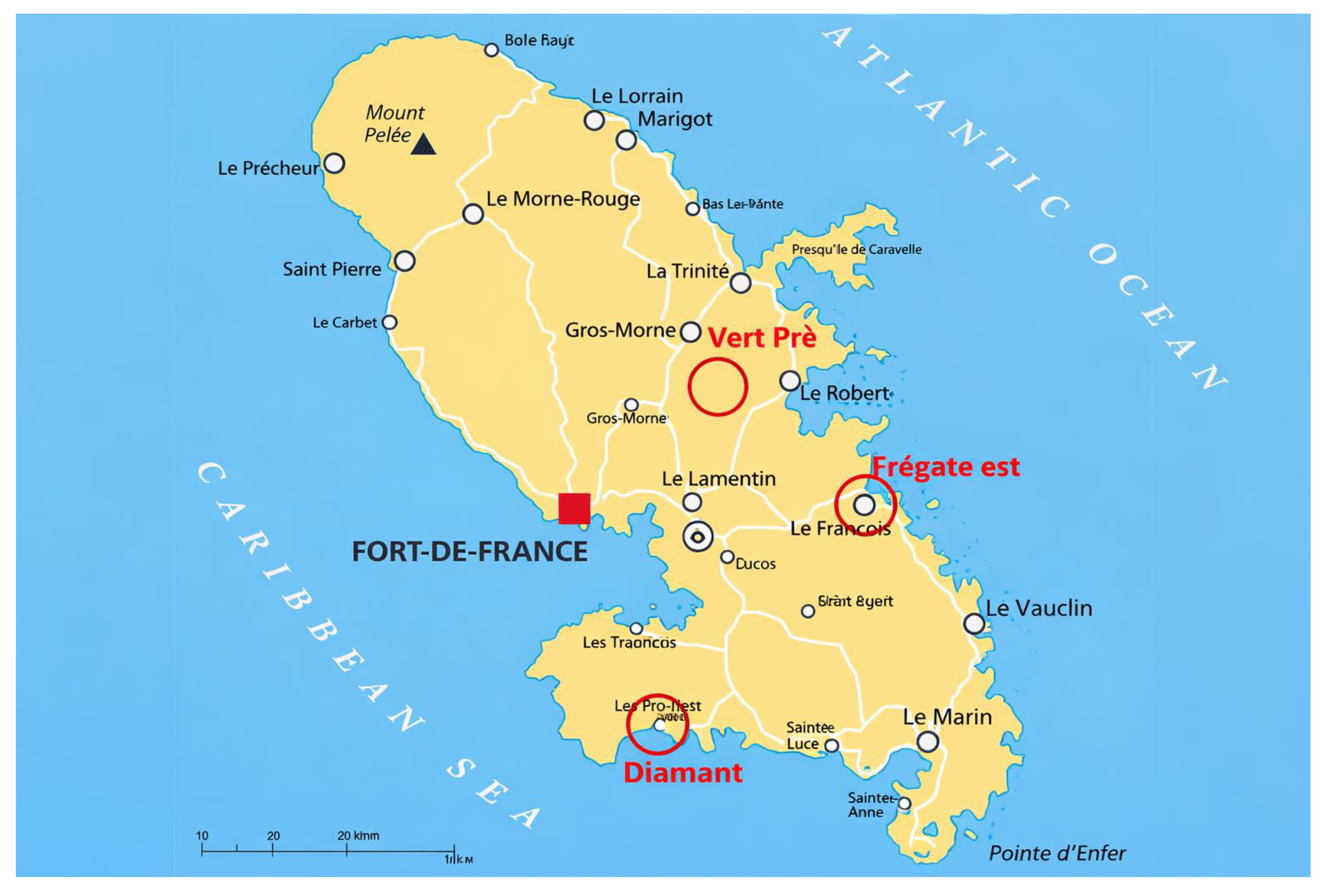
This study was conducted at four selected locations in Martinique: Vert-Pré, Diamant, Vauclin, and Frégate Est. Their geographical positions are shown in Figure 1. All sites are characterized by a predominantly marine atmosphere with elevated chloride ion concentrations, though they differ in their distance from the coastline. Due to Martinique’s tropical climate, temperature and relative humidity remained consistently high across all sites—ranging between 25 °C and 35 °C, with a relative humidity around 75%. As a result, the time of wetness (TOW), a key factor influencing zinc corrosion, was relatively uniform across the four locations. Taking into account both the distance from the shore and the amount of Sargassum seaweed stranded on the coastline, the sites were ranked according to their expected exposure to hydrogen sulfide (H2S) emissions from Sargassum decomposition. Frégate Est was the most affected, followed by Vauclin, Diamant, and finally Vert-Pré, which was the least impacted.

2.2. Sample Preparation

The zinc samples used in this study were of high purity (≥99.99%) and had dimensions of 2 cm × 2.5 cm × 1 mm. Prior to exposure, all zinc specimens were mechanically polished using 1200-grit silicon carbide (SiC) paper to ensure a uniform surface. The surface roughness after polishing was controlled to guarantee experimental reproducibility. The samples were then rinsed with distilled water, dehydrated with ethanol, and air-dried. Exposure durations were set at 3, 6, and 12 months, allowing for a detailed assessment of zinc corrosion behavior under outdoor atmospheric conditions over time.

2.3. Electrochemical Tests

The degradation of the material was assessed through two main electrochemical techniques. First, anodic and cathodic polarization curves were produced in a 3% sodium chloride solution at 25 °C under aerated conditions. These curves were obtained using a VMP3 potentiostat (Bio-Logic, Claix, France) from Bio-Logic, employing a sweep rate of 10 mV/s. The experimental setup included a saturated calomel reference electrode, a platinum wire counter electrode, and zinc specimen working electrodes. The second method involved electrochemical impedance spectroscopy measurements conducted in a Bio-Logic cell with three electrodes. The working electrodes consisted of zinc specimens embedded in epoxy resin, leaving an exposed surface area of approximately 5 cm2, and were submerged in a 3% sodium chloride electrolyte under aerated conditions. The counter electrode was made of high-purity (99.99%) platinum, and a saturated calomel electrode served as the reference electrode. In both approaches, the open circuit potential (OCP) was continuously recorded until a steady state was achieved. Impedance plots were recorded in a frequency range from 200 kHz to 1 mHz, employing five points per decade and using a sinusoidal amplitude of 5 mV peak-to-peak at E = OCP. These tests were systematically repeated on three samples for each site and exposure period, ensuring the reliability and consistency of the obtained electrochemical data. The electrochemical tests were performed three times on three electrodes.
The electrochemical measurements were performed in a 3 wt.% NaCl solution, selected as a standardized electrolyte representative of marine atmospheric surface electrolytes rather than bulk seawater conditions. In atmospheric corrosion, zinc surfaces are exposed to thin electrolyte films formed by condensation, rain deposition, and deliquescence of marine aerosols, where chloride concentrations are highly variable and do not correspond to permanent immersion in seawater (3.5 wt.% NaCl). The use of 3 wt.% NaCl provides a suitable compromise between experimental reproducibility, sufficient electrolyte conductivity, and relevance to marine atmospheric corrosion processes. The objective of these tests was to compare the intrinsic protective properties of corrosion layers formed during outdoor exposure under identical and controlled laboratory conditions.

3. Results

3.1. Evaluation of Zinc Thickness Loss and Corrosion Dynamics

Previous studies [16] have shown that atmospheric corrosion of zinc is strongly accelerated in tropical marine environments contaminated with hydrogen sulfide (H2S), released during the decomposition of stranded Sargassum algae. At our study sites in Martinique (Figure 1), exposed to varying levels of H2S and marine chlorides, zinc thickness loss reached up to 45 µm after one year, compared to only 3–10 µm in less affected areas, classifying the most impacted environments as “extremely corrosive” (ISO 9223) [17].
Monitoring zinc thickness every three months (Figure 2) revealed a nearly linear corrosion rate at Frégate Est, indicating that the corrosion products formed in high-H2S conditions offer little protection. Thickness measurements over 12 months confirmed that corrosion is most severe at this site. Morphological and structural analyses (SEM/EDS, XRD) (S-800, Hitachi, Tokyo, Japan) highlighted clear differences in corrosion products. Low-exposure zones showed typical marine compounds (hydrozincite, simonkolleite, gordaite, zinc hydroxysulfate), whereas the H2S-rich site contained elemental sulfur and ZnS (sphalerite), demonstrating a direct impact of H2S on corrosion mechanisms.
These findings underscore the key role of H2S in accelerating zinc corrosion. The presence of sulfur-rich compounds and the nearly linear corrosion kinetics indicate ineffective protective layers, resulting in continuous material degradation. This has important implications for the durability of zinc-coated materials in tropical coastal regions affected by Sargassum strandings, where elevated H2S levels pose significant corrosion risks.

3.2. Electrochemical Impedance Spectroscopy

Electrochemical impedance spectroscopy was performed on zinc samples exposed at tropical marine sites (Diamant, Vert-Pré, Frégate Est, and Vauclin) for 3–12 months.
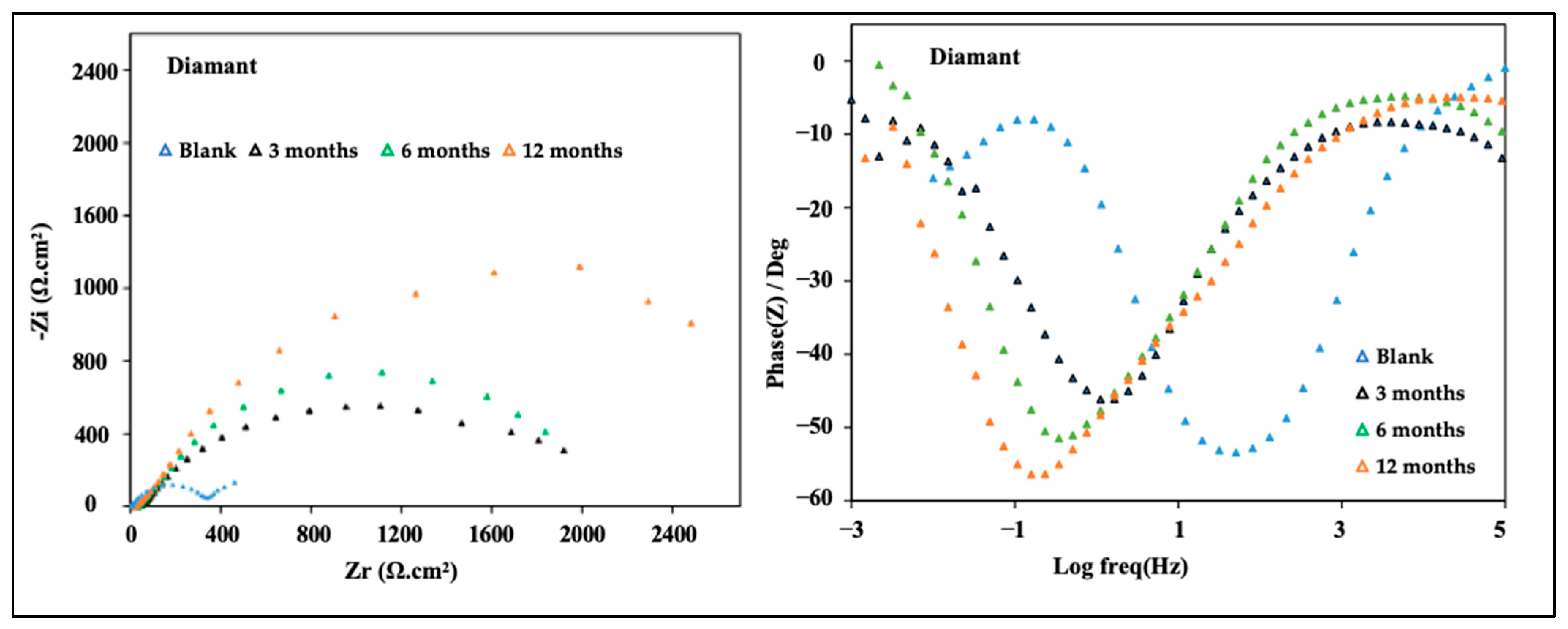
Nyquist and Bode diagrams for zinc samples exposed in the Diamant atmosphere for 3, 6, and 12 months are shown in Figure 3. Measurements were performed after 3 h of immersion under open-circuit conditions in 3% NaCl at 25 °C. The Nyquist diagram of unexposed zinc displays two capacitive loops: the first corresponds to the behavior of the corrosion layer, while the second, less pronounced, is associated with charge transfer. Two-time constants are observable in the Bode plot. After 3 months of exposure, the second half-loop disappears due to thickening of the corrosion layer, and the Bode plots exhibit a single, broad time constant associated with the corrosion products. Overall, increasing exposure time leads to a widening of the first capacitive loop, reflecting growth of the protective layer.
Nyquist and Bode diagrams for zinc samples exposed at Vert-Pré are shown in Figure 4. These diagrams also display two capacitive loops in Nyquist plots and two distinct phenomena in Bode plots. The first half-loop is visible at 3 months, shifts to lower frequencies at 6 months, and becomes less pronounced at 12 months due to thickening of the corrosion layer. The size and amplitude of the second capacitive loop, associated with corrosion products, increase with exposure time, confirming the enhancement of surface protection.
For the 6-month samples exposed at the Frégate Est site, the double capacitive loops observed in the EIS diagrams are attributed to a bilayer corrosion structure, consisting of an inner compact sulfide layer (ZnS) and an outer porous oxide film. This interpretation is supported by SEM/EDS results and the EIS fitting.
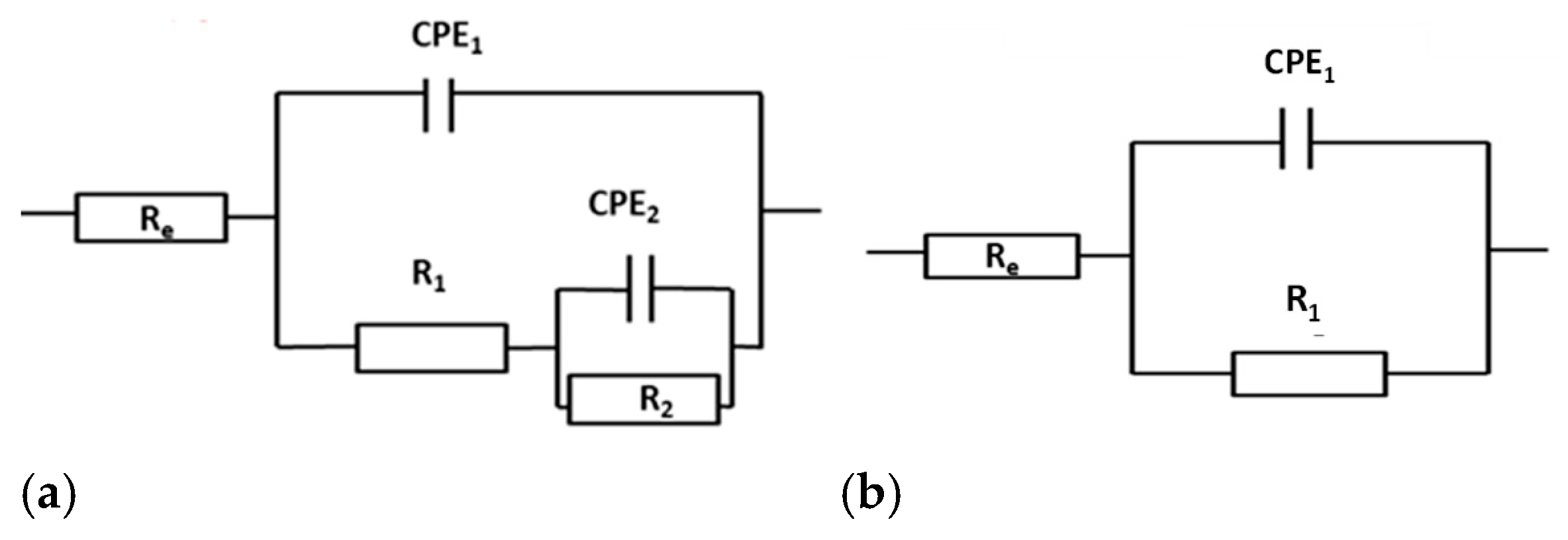
The electrochemical impedance spectroscopy parameters were determined by fitting the impedance spectra to the equivalent circuit model shown in Figure 5a. In this model, the capacitive element is replaced by a constant phase element (CPE). The first element, corresponding to the behavior of the corrosion layer, is characterized by (R1, CPE1), while the second, associated with charge transfer, is characterized by (R2, CPE2). The CPE was used as a substitute for the capacitive element to account for the frequency dispersion observed in the plots, which is characteristic of solid electrodes and attributed to surface heterogeneity [18,19,20].
The impedance of the CPE is defined by two parameters, Q and n, and is described by the equation [21,22]:
ZCPE = Q−1 ()n
where A is the CPE constant, measured in Ω−1 sn cm−2, i denotes the imaginary number, ω stands for the angular frequency, measured in radians per second (rads−1), and n represents the CPE exponent, which can serve as a gauge for surface inhomogeneity.
The assignment of R1 and R2 (and CPE1 and CPE2) to the corrosion layer and charge transfer processes, respectively, is supported by the evolution of the EIS diagrams with exposure time. The growth of the first capacitive loop reflects thickening of the corrosion layer, while changes in the second loop correspond to charge transfer kinetics. SEM/EDS analyses confirm the presence and development of corrosion products, consistent with the impedance behavior, despite surface heterogeneity preventing a strict one-to-one correlation. The increasing values of R1 and R2 with exposure time further support this interpretation, consistent with the expected growth of protective corrosion products. Such assignment follows standard EIS analysis conventions for metals in marine environments.
Electrochemical parameters obtained from fitting the spectra for Diamant and Vert-Pré samples are summarized in Table 1. Rtotal increases with exposure time at both sites, indicating that the corrosion products confer anticorrosive properties to the surface. In the long term, Rtotal is higher at Vert-Pré than at Diamant, likely due to the abundant formation of hydrozincite, a well-known protective compound [16]. The n values increase slightly but remain low, indicating surface heterogeneity.
Nyquist and Bode diagrams for Frégate Est and Vauclin are shown in Figure 6 and Figure 7. At Frégate Est, the diagrams exhibit capacitive behavior similar to Diamant, except for the 6-month sample, which displays two clearly separated capacitive loops at mid-frequencies. These loops are confirmed by the Bode plots, showing two distinct time constants: the first and second half-loops, corresponding to the corrosion layer and charge transfer processes, respectively. Spectra with a single capacitive loop were fitted using the equivalent circuit in Figure 5a, while spectra with two loops were fitted using the circuit in Figure 5b, with excellent agreement (χ2 ≈ 10−3).
At Vauclin, the impedance diagrams show capacitive behavior with two-time constants that vary depending on exposure duration, due to surface leaching. The growth of the capacitive loops with time reflects increasing anticorrosive properties, similar to those observed at Vert-Pré and Diamant, and is consistent with morphological and gravimetric observations. Electrochemical parameters for Frégate Est and Vauclin are presented in Table 2.
Analysis of the data shows that Rtotal is higher at Vauclin than at Diamant, particularly for R2, which represents the resistance of the corrosion product layer, indicating its protective effect related to layer thickness and nature. The n values show a similar trend as mentioned previously; they increase slightly but remain low, indicating the presence of surface heterogeneity. The predominance of a single capacitive loop in most tests reflects the rapidly limiting effect of this protective layer. In contrast, Frégate Est exhibits the lowest resistances, consistent with the high sulfur content and ZnS in the corrosion products, which are poorly protective. Variations in phase angle over time further confirm significant surface degradation.

3.3. The Polarization Curves

The polarization curves of zinc exposed to Diamant and Vert-Pré for different exposure periods are presented in Figure 8. These curves were obtained after three hours of immersion in 3% NaCl at 25 °C. For unexposed zinc, the anodic branch exhibits a very rapid rise in current with polarization, which can be explained by the desorption potential around −1.1 V, located near the corrosion potential.
In the cathodic domain, the polarization curves exhibit two distinct current plateaus, which are characteristic of a two-step oxygen reduction reaction (ORR) mechanism on zinc surfaces in neutral or slightly alkaline aerated electrolytes. The first plateau is attributed to the direct four-electron reduction in dissolved oxygen to hydroxide ions:
O 2 +   2 H 2 O +   2 e     H 2 O 2 +   2 O H ( Plateau   1 )
The second plateau corresponds to a peroxide-mediated pathway involving the formation of hydroperoxide species, followed by their subsequent reduction:
H 2 O 2 +   2 e     2 O H ( Plateau   2 )
Such oxygen reduction behavior has been widely reported for zinc and zinc-based materials in aerated chloride-containing electrolytes and atmospheric corrosion conditions. The appearance and evolution of these cathodic plateaus are strongly influenced by the surface state of zinc, the nature and thickness of corrosion products, and mass-transport limitations for dissolved oxygen through the corrosion layer. The progressive coverage of cathodic active sites and the modification of oxygen diffusion pathways lead to a decrease in cathodic current densities with increasing exposure time, as observed in the present study [11,12,23,24].
The polarization curves of zinc after exposure show a similar overall shape, indicating that the corrosion mechanisms remain comparable despite environmental differences. The polarization parameters (Eoc, Rp, Icorr) evolve quantitatively over time at all sites (Table 3):
-
Diamant: Eoc shifts from −1100 mV (3 months) to −599 mV (12 months), Rp increases from 125 Ω·cm2 to 1084 Ω·cm2, and Icorr decreases from 409 µA·cm−2 to 13 µA·cm−2, reflecting progressive surface passivation.
-
Frégate Est: Rp remains relatively low (96 Ω·cm2 at 3 months, 916 Ω·cm2 at 12 months), while Icorr decreases from 302 µA·cm−2 to 28 µA·cm−2. the formation of sulfur-containing corrosion products such as ZnS and elemental sulfur does not lead to effective passivation. These species may partially modify cathodic kinetics through surface coverage and adsorption effects, which can locally inhibit oxygen reduction. Simultaneously, sulfur species promote localized anodic dissolution and the continuous renewal of poorly adherent corrosion layers, explaining the persistence of relatively low polarization resistance values despite an apparent decrease in current density.
-
Vert-Pré: Rp increases from 23 Ω·cm2 (3 months) to 1069 Ω·cm2 (12 months), and Icorr decreases from 815 µA·cm−2 to 24 µA·cm−2, indicating more effective passivation.
-
Vauclin: Shows the highest Rp (1835 Ω·cm2) and lowest Icorr (6 µA·cm−2) after 12 months, demonstrating very effective passivation in a less aggressive environment.
Over time, a general decrease in both cathodic and anodic current densities is observed, indicating a progressive reduction in the electrochemical activity. This decrease is quantitatively supported by the evolution of Rp and Icorr values; however, it should not be attributed solely to surface passivation. It may also result from diffusion limitations within the corrosion layer, changes in porosity and surface coverage effects, particularly in the presence of sulfur-containing corrosion products. The evolution of the cathodic branches with exposure time is mainly associated with modifications of the oxygen reduction reaction, caused by surface coverage, blockage of cathodic active sites, and diffusion limitations for dissolved oxygen through the corrosion layer.
The curves obtained for the other two sites, Frégate Est and Vauclin (Figure 9), demonstrate similar trends, with a clear time-dependent decrease in both anodic and cathodic currents. This decrease is particularly pronounced at the Vauclin site, in agreement with gravimetric measurements, indicating more effective surface passivation.
After six months of exposure in the H2S-rich atmosphere at Frégate Est, the current density remains significantly higher compared to the other sites. This reflects less effective passivation and correlates with the presence of sulfide compounds (ZnS, S2−) on the surface, which catalyze anodic reactions. These observations correlate with the presence of non-adherent corrosion products on the metal surface, which continuously dissociate and renew, thereby maintaining a higher current density. This behavior is supported by literature [25], which reports that non-adherent corrosion products can continuously reform and sustain elevated current densities.
The observed decrease in anodic current over time can largely be attributed to the formation of a protective corrosion product layer on the zinc surface, which modifies the reaction kinetics. While this layer reduces the overall current flow, the anodic slopes remain largely unchanged. At low polarization, a sharp increase in anodic current is observed, characteristic of an anodically unpolarizable electrochemical system, as described by Lorenz and Mansfeld [24]. The early stage of corrosion for exposed zinc is typically rapid and reversible, whereas the second stage, associated with oxygen reduction, is slower and plays a more critical role in the overall process. When corrosion products accumulate on the surface, the initial stage may be inhibited, causing the rate-limiting step to shift toward the first reduction stage.
In our experiments, polarization resistance values increase with exposure time, reflecting enhanced surface passivation, but less significantly at Frégate Est due to the formation of less protective sulfide products. Correspondingly, Icorr decreases over time, and a positive shift in Eoc is observed at all sites, indicating the development of thicker and more stable corrosion layers. These findings are in line with previous observations obtained through impedance spectroscopy analyses.
The polarization curves are now analyzed in detail: H2S promotes anodic zinc dissolution through sulfide formation, chloride ions destabilize protective films and facilitate localized breakdown. Their combined action explains the observed synergistic acceleration.
Overall, these results indicate that zinc exhibits a combination of initial rapid corrosion followed by progressive passivation over time. The effectiveness of the passive layer strongly depends on environmental conditions, with more aggressive, H2S-rich atmospheres leading to less protective corrosion products and higher sustained current densities, whereas low-H2S environments (Diamant, Vauclin) favor the formation of stable, adherent layers. This detailed understanding of the evolution of zinc corrosion under different exposure conditions provides valuable insights into the mechanisms controlling long-term material performance and surface passivation.
The results quantitatively show that at low-H2S sites, hydrozincite and simonkolleite dominate, providing effective protection, while at H2S-rich sites, less protective sulfide compounds form, maintaining higher current densities. Polarization analysis confirms that H2S promotes anodic dissolution and chloride ions destabilize protective films, with their combined action explaining the observed synergistic acceleration. It should be noted that laboratory experiments using 3% NaCl under constant temperature and humidity do not fully replicate the complexity of real marine aerosols and environmental fluctuations. These limitations must be considered when interpreting the results and their applicability to natural conditions.

4. Conclusions

This study evaluated atmospheric corrosion of zinc at four sites in Martinique, exposed to varying levels of H2S from Sargassum algae decomposition. Gravimetric and electrochemical analyses demonstrated that H2S strongly influences corrosion kinetics and the nature of surface corrosion products.
In H2S-poor atmospheres (Diamant, Vert-Pré, Vauclin), corrosion slowed over time due to the formation of stable, adherent passive layers, with increasing polarization resistance and decreasing corrosion current. Conversely, in the H2S-rich atmosphere at Frégate Est, non-protective sulfide compounds and elemental sulfur maintained high current densities, leading to severe corrosion.
These results confirm that environmental composition, particularly H2S concentration, governs the effectiveness of passive layers and the corrosion rate of zinc, providing essential insights for predicting long-term performance in tropical coastal environments.

Author Contributions

Conceptualization, M.L.; methodology, M.S.A. and M.L.; software, M.S.A.; validation, M.L.; formal analysis, M.S.A. and M.L.; investigation, M.S.A. and M.L.; resources, M.S.A. and M.L.; data curation, M.S.A. and M.L.; writing—original draft preparation, M.S.A. and M.L.; writing—review and editing, M.S.A. and M.L.; visualization, M.S.A. and M.L.; supervision, M.L.; project administration, M.L.; funding acquisition. All authors have read and agreed to the published version of the manuscript.

Funding

This research was funded by the Territorial Authority of Martinique (CTM) within the framework of Ms. Said Ahmed’s thesis funding.

Data Availability Statement

The original contributions presented in this study are included in the article. Further inquiries can be directed to the corresponding author.

Conflicts of Interest

The authors declare no conflicts of interest.

References

  1. Liu, Y.; Tianzhen, T.; Wang, Z.; Wang, C. Corrosion behaviour of zinc exposed to an extreme tropical marine atmospheric environment for 3 years. Corros. Eng. Sci. Technol. 2022, 57, 397–407. [Google Scholar] [CrossRef]
  2. Babutzka, M.; Lehmann, J.; Burkert, A. Field exposure study under sheltered and open exposure conditions at different test sites in Germany: First-year corrosion rate and atmospheric corrosivity. Mater. Corros. 2023, 74, 694–703. [Google Scholar] [CrossRef]
  3. de la Fuente, D.; Castaño, J.G.; Morcillo, M. Long term atmospheric corrosion of zinc. Corros. Sci. 2007, 49, 1420–1436. [Google Scholar] [CrossRef]
  4. De Kerf, T.; Zahiri, Z.; Scheunders, P.; Vanlanduit, S. Corrosion monitoring on zinc electroplated steel using shortwave infrared hyperspectral imaging. arXiv 2022. [Google Scholar] [CrossRef]
  5. Hageman, T.; Andrade, C.; Martínez-Pañeda, E. Corrosion rates under charge-conservation conditions. arXiv 2023. [Google Scholar] [CrossRef]
  6. Fuentes, M.; de la Fuente, D.; Chico, B.; Llorente, I.; Jiménez, J.A.; Morcillo, M. Atmospheric corrosion of zinc in coastal atmospheres. Mater. Corros. 2019, 70, 1005–1015. [Google Scholar] [CrossRef]
  7. Odnevall Wallinder, I.; Leygraf, C. A Critical Review on Corrosion and Runoff from Zinc and Zinc-Based Alloys in Atmospheric Environments. Corrosion 2017, 73, 1060–1077. [Google Scholar] [CrossRef]
  8. Thierry, D.; Persson, D.; Luckeneder, G.; Stellnberger, K.-H. Atmospheric corrosion of ZnAlMg coated steel during long-term atmospheric weathering at different worldwide exposure sites. Corros. Sci. 2019, 148, 338–354. [Google Scholar] [CrossRef]
  9. Haruna, S.; Ogawa, Y.; Sakata, T.; Shiozawa, D.; Sakagami, T.; Yokoi, Y.; Sugiyama, T. Deterioration detection of heavy-duty anticorrosion coating using near-infrared hyperspectral imaging. Eng. Proc. 2023, 51, 13. [Google Scholar]
  10. Keane, A.; Murray, P.; Zabalza, J.; Di Buono, A.; Cockbain, N.; Bernard, R. Hyperspectral imaging analysis of corrosion products on metals in the UV-VIS-NIR range. SPIE Proc. 2023, 12338, 44–53. [Google Scholar] [CrossRef]
  11. Odnevall, I.; Leygraf, C. Atmospheric corrosion of zinc in urban and industrial environments. Corros. Sci. 1993, 34, 1213–1228. [Google Scholar] [CrossRef]
  12. Odnevall, I.; Leygraf, C. Atmospheric corrosion of zinc in marine and industrial atmospheres. Corros. Sci. 1994, 36, 1077–1090. [Google Scholar] [CrossRef]
  13. Ahmed, M.S.; Lebrini, M.; Lescop, B.; Pellé, J.; Rioual, S.; Amintas, O.; Boullanger, C.; Roos, C. Corrosion behaviour of zinc-based materials in atmospheric environments. Metals 2023, 13, 982. [Google Scholar] [CrossRef]
  14. Salas, B.V.; Wiener, M.S.; Badilla, G.L.; Beltran, M.C.; Zlatev, R.; Stoycheva, M.; Gaynor, J.T. H2S pollution and its effect on corrosion of electronic components. In Corrosion in Electronics; IntechOpen: London, UK, 2012; pp. 263–278. [Google Scholar]
  15. Lambert, P.; Said-Ahmed, M.; Lescop, B.; Rioual, S.; Lebrini, M. Protection against atmospheric corrosion of zinc in marine environment rich in H2S using self-assembled monolayers based on Sargassum fluitans III extract. Coatings 2024, 14, 988. [Google Scholar] [CrossRef]
  16. Ahmed, M.S.; Lebrini, M.; Pellé, J.; Rioual, S.; Amintas, O.; Boulanger, C.; Lescop, B.; Roos, C. Study of atmospheric corrosion of zinc in a tropical marine environment rich in H2S, resulting from the decomposition of Sargassum algae. Mater. Corros. 2024, 75, 1133–1141. [Google Scholar] [CrossRef]
  17. ISO 9223:2012; Corrosion of Metals and Alloys—Corrosivity of Atmospheres—Classification, Determination and Estimation. International Organization for Standardization: Geneva, Switzerland, 2012.
  18. Growcock, F.B.; Jasinski, R.J. Time-resolved impedance spectroscopy of mild steel in concentrated hydrochloric acid. J. Electrochem. Soc. 1989, 136, 2310–2314. [Google Scholar] [CrossRef]
  19. Li, P.; Lin, J.Y.; Tan, K.L.; Lee, J.Y. Electrochemical impedance and X-ray photoelectron spectroscopic studies of the inhibition of mild steel corrosion in acids by cyclohexylamine. Electrochim. Acta 1997, 42, 605–615. [Google Scholar] [CrossRef]
  20. Lopez, D.A.; Simison, S.N.; de Sanchez, S.R. The influence of steel microstructure on CO2 corrosion. EIS studies on the inhibition efficiency of benzimidazole. Electrochim. Acta 2003, 48, 845–854. [Google Scholar] [CrossRef]
  21. Stoynov, Z. Impedance modelling and data processing: Structural and parametrical estimation. Electrochim. Acta 1990, 35, 1493–1499. [Google Scholar] [CrossRef]
  22. Macdonald, J.R. Impedance spectroscopy and its use in analyzing the steady-state AC response of solid and liquid electrolytes. J. Electroanal. Chem. 1987, 223, 25–50. [Google Scholar] [CrossRef]
  23. Perry, S.; Denuault, G. The oxygen reduction reaction (ORR) on reduced metals: Evidence for a unique relationship between the coverage of adsorbed oxygen species and adsorption energy. Phys. Chem. Chem. Phys. 2016, 18, 10218–10223. [Google Scholar] [CrossRef] [PubMed]
  24. Lorenz, W.J.; Mansfeld, F. Determination of corrosion rates by electrochemical DC and AC methods. Corros. Sci. 1981, 21, 647–672. [Google Scholar] [CrossRef]
  25. Ebrahimi, S.; Bordbar-Khiabani, A.; Yarmand, B. Immobilization of rGO/ZnO hybrid composites on the Zn substrate for enhanced photocatalytic activity and corrosion stability. J. Alloys Compd. 2020, 845, 156219. [Google Scholar] [CrossRef]
Figure 1. Location of Exposure Sites in Martinique.
Metals 16 00031 g001
Figure 2. Evolution of Zinc Thickness Loss Over Time.
Metals 16 00031 g002
Figure 3. Nyquist and Bode diagrams in 3% NaCl for zinc samples exposed at Diamant for different exposure periods.
Metals 16 00031 g003
Figure 4. Nyquist and Bode diagrams in 3% NaCl for zinc samples exposed at Vert-Pré for different exposure periods.
Metals 16 00031 g004
Figure 5. Equivalent electrical circuits used for fitting the EIS impedance diagrams: (a) model corresponding to spectra with two capacitive loops; (b) model corresponding to spectra with one capacitive loop.
Metals 16 00031 g005
Figure 6. Nyquist and Bode diagrams in 3% NaCl for zinc samples exposed at Frégate Est for different exposure periods.
Metals 16 00031 g006
Figure 7. Nyquist and Bode diagrams in 3% NaCl for zinc samples exposed at Vauclin for different exposure periods.
Metals 16 00031 g007
Figure 8. Polarization curves of zinc after exposure to (a) Diamant and (b) Vert-Pré in 3% NaCl solution.
Metals 16 00031 g008
Figure 9. Polarization curves of zinc after exposure to (a) Frégate Est and (b) Vauclin in 3% NaCl solution.
Metals 16 00031 g009
Table 1. Electrochemical parameters of zinc samples exposed at Diamant and Vert-Pré for different exposure durations.
ParametersBlankDiamantVert-Pré
3 months6 months12 months3 months6 months12 months
Re (Ω·cm2)67579522217195
R1 (Ω·cm2)48822562109328944518987202
n10.58260.62470.76290.79120.44790.46340.6649
Q1 10−4−1cm−2sn1)5.26.32.51.551165
R2 (Ω·cm2)49 121732339543
n20.6469 0.55700.67410.8230
Q2 10−4−1cm−2sn2)5.15 2.531.351.3
Rtotal (R1 + R2) (Ω·cm2)5372256210932891662513116,745
Table 2. Electrochemical parameters of zinc samples exposed at Frégate Est and Vauclin for different exposure durations.
ParametersBlankFrégate EstVauclin
3 months6 months12 months3 months6 months12 months
Re (Ω·cm2)620202554160208
R1 (Ω·cm2)4889230281235153721375
n10.58260.69480.67230.77810.72980.75230.5831
Q1 10−4−1cm−2sn1)5.23.812.52.151.81.68.3
R2 (Ω·cm2)49 178 6433
n20.6469 0.7305 0.7802
Q2 10−4−1cm−2sn2)5.15 2.9 1.1
Rtotal (Ω·cm2)53792480812351537216808
Table 3. Electrochemical parameters obtained from linear polarization measurements for zinc samples exposed at different sites.
ParametersTime ExposureEcorr (mV/ECS)Rp (Ω·cm2)Icorr (µA.cm−2)
Blank −11271041 ± 1225 ± 1
Diamant3 months−1100125 ± 11409 ± 4
6 months−728923 ± 2128 ± 0.7
12 months−5991084± 0413 ± 0.2
Frégate Est3 months−99096 ± 0.2302 ± 12
6 months−1099213 ± 10122 ± 8
12 months−542916 ± 1728 ± 0.4
Vert-Pré3 months−107223 ± 0.8815 ± 21
6 months−5001356 ± 3120 ± 0.3
12 months−4041069 ± 1024 ± 0.2
Vauclin3 months−1081420 ± 8595 ± 14
6 months−6241444 ± 4110 ± 0.1
12 months−3911835 ± 146 ± 0.9
Disclaimer/Publisher’s Note: The statements, opinions and data contained in all publications are solely those of the individual author(s) and contributor(s) and not of MDPI and/or the editor(s). MDPI and/or the editor(s) disclaim responsibility for any injury to people or property resulting from any ideas, methods, instructions or products referred to in the content.