Therapeutic Potential of 3D-Printed Alloys as Drug-Eluting Implants: Current Progress



Abstract
1. Introduction
2. Review Methodology
2.1. Bibliometric Search Strategy and Mapping Settings
2.2. Data Extraction Approach for Drug-Eluting Implants
3. Additive-Manufacturing Routes and Design Handles
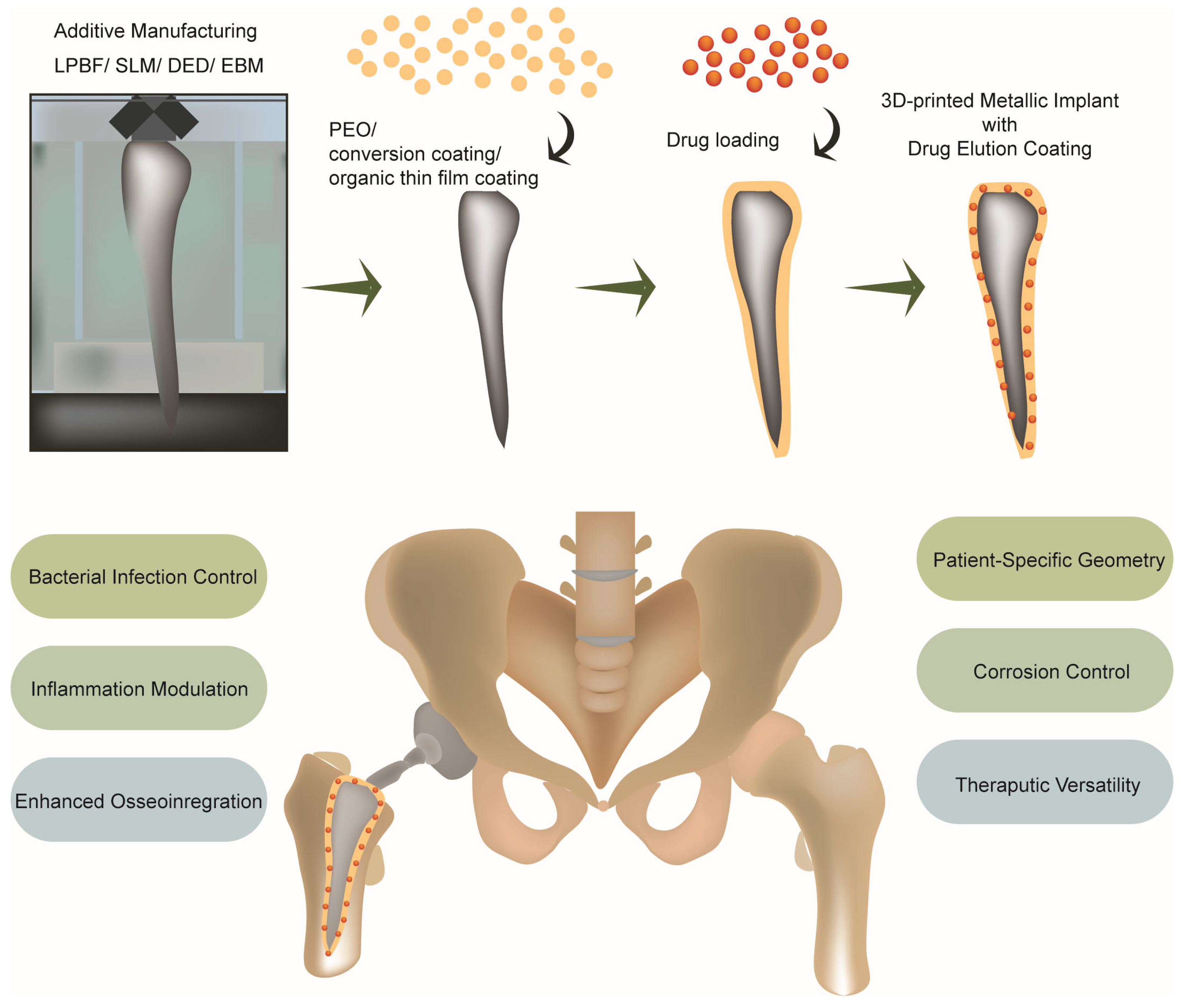
- Selective laser melting (SLM) or laser powder bed fusion (LPBF) utilizes a powerful laser to melt metallic powders one layer at a time. This makes components that are very thick and have exceptionally good resolution. The dimensional accuracy and elastic modulus of lattice structures are directly impacted by process factors such as laser power and scan speed, highlighting the need for parameter optimization for biomedical alloys [70].
- Electron beam melting (EBM) works in a vacuum and speeds up the building of materials like Ti-6Al-4V while reducing oxidation. The cooling-rate changes in EBM-built Ti-6Al-4V cause graded microstructures, which make it possible to tune the mechanical properties of the material based on where it is located [17].
- Directed-energy deposition (DED) and Wire-Arc Additive Manufacturing (WAAM) utilize directed energy to melt wire or powder material together. This is great for big or repairable implants. WAAM can successfully deposit NiTiTa shape-memory alloys, which makes them more resistant to corrosion and easier to see with X-rays for use in medicine [24].
- For ceramics and hybrid systems, Binder Jetting and Digital Light Processing (DLP) are becoming more popular. Piezoelectric BT/HA scaffolds were made using DLP printing. This opens new possibilities for hip devices that can have more than one use [71].
4. Drug-Loading Reservoirs on AM-Based Alloy System
4.1. Titanium Alloy Based
4.2. Stainless-Steel-Based Alloys
4.3. Magnesium-Based Alloys
5. Release-Rate Kinetics of Drug-Eluting AM Implants
Interval-Averaged Release Rate (Δ%/Δt)
6. In Vivo Performance of 3D-Printed Metallic Drug-Eluting Implants
7. Discussion
7.1. Design Principles Linking AM Architecture to Release Behavior
7.2. Translational Interpretation by Material Platform
7.3. Translational Interpretation by Therapeutic Application
7.4. Local Safety and Toxicity as a Design Constraint
7.5. Limitations of Current Evidence and of This Review
8. Conclusions
Author Contributions
Funding
Data Availability Statement
Acknowledgments
Conflicts of Interest
Abbreviations
| AM | Additive manufacturing |
| Ti | Titanium |
| Mg | Magnesium |
| Zn | Zinc |
| Fe | Iron |
| LPBF | Laser powder bed fusion |
| EBM | Electron beam melting |
| DED | Directed-energy deposition |
| PEO | Plasma electrolytic oxidation |
| MAO | Micro-arc oxidation |
| PLGA | Poly (lactic-co-glycolic acid) |
| MIC | Minimum inhibitory concentration |
| VEGF | Vascular endothelial growth factor |
| BMP-2 | Bone morphogenetic protein-2 |
| Ag | Silver |
| Cu | Copper |
| SS | Stainless steel |
| PC | Polycaprolactone |
| PLA | Polylactic acid |
| SLM | Selective laser melting |
| DLP | Digital Light Processing |
| BT/HA | Barium titanate/Hydroxyapatite (composite) |
| TNTs | TiO2 nanotubes |
| LbL | Layer-by-layer |
| PEG | Poly (ethylene glycol) |
| MC3T3-E1 | Mouse calvaria-derived pre-osteoblast cell line |
| ALP | Alkaline phosphatase |
| PBS | Phosphate-buffered saline |
| PHB | Poly(3-hydroxybutyrate) |
| OCN/OPN | Osteocalcin/Osteopontin |
| BC | Bacterial cellulose |
| SEM | Scanning electron microscopy |
| PSS/PAH | Poly (styrene sulfonate)/Poly (allylamine hydrochloride) |
| MH | Magnesium hydroxide |
| MgO | Magnesium oxide |
| HNT | Halloysite nanotubes |
| RSV | Rosuvastatin |
| ASP | Aspirin (acetylsalicylic acid) |
| EPD | Electrophoretic deposition |
| HUVEC | Human umbilical vein endothelial cell |
| nSiHA | nano-sized silicon-substituted hydroxyapatite |
| ELISA | Enzyme-linked immunosorbent assay |
| rhBMP | recombinant human BMP-2 |
| OPN | Osteopontin |
| ELI | Extra-Low Interstitial (grade of Ti-6Al-4V) |
| CaP | Calcium phosphate |
| ICP | Inductively coupled plasma |
| PDGF-BB | Platelet-derived growth factor-BB |
| BV/TV | Bone volume/tissue volume |
| BMMSC | Bone marrow-derived mesenchymal stem cells |
| AgNPs | Silver nanoparticles |
| MBG | Mesoporous bioactive glass |
| Sr | Strontium |
| AMK | Amikacin |
| Zr | Zirconium |
| TCP | Tricalcium phosphate |
| mPEG | Methoxy-poly (ethylene glycol) |
| PDA | Polydopamine |
| PMCP | poly[2-(methacryloyloxy)ethyl choline phosphate] |
| MOF/PVA | Metal–organic framework/Poly (vinyl alcohol) |
| PSC | pH-neutral bioactive glass coating |
| µCT | Micro-computed tomography |
| GA | Glutaraldehyde |
| BIC | Bone–implant contact |
| Wnt | Wingless/integrated signaling pathway |
| VG/TB | Van Gieson/Toluidine Blue staining |
References
- Abraham, A.M.; Venkatesan, S. A Review on Application of Biomaterials for Medical and Dental Implants. Proc. Inst. Mech. Eng. Part J. Mater. Des. Appl. 2023, 237, 249–273. [Google Scholar] [CrossRef]
- Amirtharaj Mosas, K.K.; Chandrasekar, A.R.; Dasan, A.; Pakseresht, A.; Galusek, D. Recent Advancements in Materials and Coatings for Biomedical Implants. Gels 2022, 8, 323. [Google Scholar] [CrossRef] [PubMed]
- Phull, S.S.; Yazdi, A.R.; Ghert, M.; Towler, M.R. Bone Cement as a Local Chemotherapeutic Drug Delivery Carrier in Orthopedic Oncology: A Review. J. Bone Oncol. 2020, 26, 100345. [Google Scholar] [CrossRef]
- Steadman, W.; Chapman, P.R.; Schuetz, M.; Schmutz, B.; Trampuz, A.; Tetsworth, K. Local Antibiotic Delivery Options in Prosthetic Joint Infection. Antibiotics 2023, 12, 752. [Google Scholar] [CrossRef] [PubMed]
- Zhang, H.; Qiao, W.; Liu, Y.; Yao, X.; Zhai, Y.; Du, L. Addressing the Challenges of Infectious Bone Defects: A Review of Recent Advances in Bifunctional Biomaterials. J. Nanobiotechnol. 2025, 23, 257. [Google Scholar] [CrossRef]
- Bartolomeu, F.; Buciumeanu, M.; Pinto, E.; Alves, N.; Carvalho, O.; Silva, F.; Miranda, G. 316L Stainless Steel Mechanical and Tribological Behavior-A Comparison between Selective Laser Melting, Hot Pressing and Conventional Casting. Addit. Manuf. 2017, 16, 81–89. [Google Scholar] [CrossRef]
- Luo, A.A. Magnesium Casting Technology for Structural Applications. J. Magnes. Alloy. 2013, 1, 2–22. [Google Scholar] [CrossRef]
- Xu, Y.; Jiang, W.; Li, Q.; Niu, Y.; Yu, L.; Li, G.; Fan, Z. Significantly Improved Bonding Strength of Al/Mg Bimetallic Interface by Compound Casting via FeCoNiCrCu High Entropy Alloy Coating. J. Mater. Res. Technol. 2024, 30, 6870–6876. [Google Scholar] [CrossRef]
- Alam, M.S.; Campbell, S.R.; Spivey, S.R.; Dutta, G.; Pal, N.; Karan, A.; Xie, J.; DeCoster, M.A.; Murray, E.P. Additively Manufactured 316L Stainless Steel as a Potential Alternative Implant Material. J. Mater. Res. Technol. 2025, 34, 2358–2373. [Google Scholar]
- Bai, L.; Gong, C.; Chen, X.; Sun, Y.; Zhang, J.; Cai, L.; Zhu, S.; Xie, S.Q. Additive Manufacturing of Customized Metallic Orthopedic Implants: Materials, Structures, and Surface Modifications. Metals 2019, 9, 1004. [Google Scholar] [CrossRef]
- Croes, M.; Bakhshandeh, S.; van Hengel, L.; Lietaert, K.; van Kessel, K.; Pouran, B.; van der Wal, B.; Vogely, H.; Van Hecke, W.; Fluit, A.; et al. Antibacterial and Immunogenic Behavior of Silver Coatings on Additively Manufactured Porous Titanium. ACTA Biomater. 2018, 81, 315–327. [Google Scholar] [CrossRef]
- Davoodi, E.; Montazerian, H.; Mirhakimi, A.; Zhianmanesh, M.; Ibhadode, O.; Shahabad, S.; Esmaeilizadeh, R.; Sarikhani, E.; Toorandaz, S.; Sarabi, S.; et al. Additively Manufactured Metallic Biomaterials. Bioact. Mater. 2022, 15, 214–249. [Google Scholar] [CrossRef]
- Booth, M.A.; Pope, L.; Sherrell, P.C.; Stacey, A.; Tran, P.A.; Fox, K.E. Polycrystalline Diamond Coating on 3D Printed Titanium Scaffolds: Surface Characterisation and Foreign Body Response. Mater. Sci. Eng. C 2021, 130, 112467. [Google Scholar] [CrossRef] [PubMed]
- Chen, Z.; Wang, B.; Yang, C.; Lv, Z.; Wei, Y.; Pan, T.; Xuan, F.; Zhou, X.; Shen, H.; Wang, L.; et al. 3D Printed Pedicle Screws with Microarc Oxidation Ceramic Interfaces Enhance Osteointegration and Orthopedic Fixation Feasibility. ACS Appl. Mater. Interfaces 2024, 16, 31983–31996. [Google Scholar] [CrossRef]
- Aufa, A.N.; Hassan, M.Z.; Ismail, Z. Recent Advances in Ti-6Al-4V Additively Manufactured by Selective Laser Melting for Biomedical Implants: Prospect Development. J. Alloys Compd. 2022, 896, 163072. [Google Scholar] [CrossRef]
- Kumar, A.; Singh, G. Surface Modification of Ti6Al4V Alloy via Advanced Coatings: Mechanical, Tribological, Corrosion, Wetting, and Biocompatibility Studies. J. Alloys Compd. 2024, 989, 174418. [Google Scholar] [CrossRef]
- Tan, X.; Kok, Y.; Tan, Y.; Descoins, M.; Mangelinck, D.; Tor, S.; Leong, K.; Chua, C. Graded Microstructure and Mechanical Properties of Additive Manufactured Ti-6Al-4V via Electron Beam Melting. ACTA Mater. 2015, 97, 1–16. [Google Scholar] [CrossRef]
- Aguilar, L.; Lee, J.; Park, C.; Kim, C. Biomedical Grade Stainless Steel Coating of Polycaffeic Acid via Combined Oxidative and Ultraviolet Light-Assisted Polymerization Process for Bioactive Implant Application. Polymers 2019, 11, 584. [Google Scholar] [CrossRef]
- Bayram, C.; Mizrak, A.; Aktürk, S.; Kursaklioglu, H.; Iyisoy, A.; Ifran, A.; Denkbas, E. In Vitro Biocompatibility of Plasma-Aided Surface-Modified 316L Stainless Steel for Intracoronary Stents. Biomed. Mater. 2010, 5, 055007. [Google Scholar] [CrossRef]
- Chen, S.; Kuo, C.; Su, Y.; Huang, J.; Wu, Y.; Lin, Y.; Chung, Y.; Ng, C. Microstructure and Fracture Properties of Open-Cell Porous Ti-6Al-4V with High Porosity Fabricated by Electron Beam Melting. Mater. Charact. 2018, 138, 255–262. [Google Scholar] [CrossRef]
- Daniel, S.A.; Suya Prem Anand, P. A Review on the Utilization of SS 316L Lattice Structures for Orthopaedics Developed by the Laser Powder Bed Fusion Process. Proc. Inst. Mech. Eng. Part E J. Process Mech. Eng. 2025, 09544089251317120. [Google Scholar] [CrossRef]
- Grüger, L.; Jensch, F.; Dittrich, F.; Härtel, S. On the Creation of a Material Bond between L-PBF-Manufactured AZ91 and Ti-6Al-4V Components in the Context of Medical Applications. Materials 2024, 17, 4667. [Google Scholar] [CrossRef] [PubMed]
- Zhai, C.; Wang, W.; Ma, A.; Liu, H.; Zhu, T.; Zhang, Y.; Yu, T.; Yang, Z.; Lan, J.; Wang, Z. Laser Powder Bed Fusion (LPBF) WE43 Magnesium Scaffold with EGCG/PDA-Functionalized Silk Fibroin Membrane for Antibacterial Osteoinductive Guided Bone Regeneration. ACS Appl. Mater. Interfaces 2025, 17, 51691–51706. [Google Scholar]
- Zuo, X.; Zhang, W.; Chen, Y.; Oliveira, J.; Zeng, Z.; Li, Y.; Luo, Z.; Ao, S. Wire-Based Directed Energy Deposition of NiTiTa Shape Memory Alloys: Microstructure, Phase Transformation, Electrochemistry, X-Ray Visibility and Mechanical Properties. Addit. Manuf. 2022, 59, 103115. [Google Scholar]
- Snow, Z.; Nassar, A.R.; Reutzel, E.W. Invited Review Article: Review of the Formation and Impact of Flaws in Powder Bed Fusion Additive Manufacturing. Addit. Manuf. 2020, 36, 101457. [Google Scholar] [CrossRef]
- Wang, L.; Zhang, Y.; Chia, H.Y.; Yan, W. Mechanism of Keyhole Pore Formation in Metal Additive Manufacturing. Npj Comput. Mater. 2022, 8, 22. [Google Scholar]
- Barberi, J.; Spriano, S. Titanium and Protein Adsorption: An Overview of Mechanisms and Effects of Surface Features. Materials 2021, 14, 1590. [Google Scholar] [CrossRef]
- Cardoso, G.C.; Grandini, C.R.; Rau, J.V. Comprehensive Review of PEO Coatings on Titanium Alloys for Biomedical Implants. J. Mater. Res. Technol. 2024, 31, 311–328. [Google Scholar] [CrossRef]
- Chatpaiboonwat, V.; Trachoo, V.; Promoppatum, P.; Chobaomsup, V.; Saengkiettiyut, K.; Srimaneepong, V.; Wattanasirmkit, K. Optimizing the Surface Quality of L-PBF Ti6Al4V ELI Alloy via Electropolishing and Its Effect on Corrosion Resistance for Dental Applications. Eur. J. Dent. 2025, 19, 1146–1152. [Google Scholar]
- Haribaskar, R.; Kumar, T.S. Defects in Metal Additive Manufacturing: Formation, Process Parameters, Postprocessing, Challenges, Economic Aspects, and Future Research Directions. 3D Print. Addit. Manuf. 2024, 11, e1629–e1655. [Google Scholar] [CrossRef] [PubMed]
- Jamshidi, P.; Aristizabal, M.; Kong, W.; Villapun, V.; Cox, S.C.; Grover, L.M.; Attallah, M.M. Selective Laser Melting of Ti-6Al-4V: The Impact of Post-Processing on the Tensile, Fatigue and Biological Properties for Medical Implant Applications. Materials 2020, 13, 2813. [Google Scholar] [CrossRef]
- Jemat, A.; Ghazali, M.J.; Razali, M.; Otsuka, Y. Surface Modifications and Their Effects on Titanium Dental Implants. BioMed Res. Int. 2015, 2015, 791725. [Google Scholar] [CrossRef]
- Pegues, J.W.; Shao, S.; Shamsaei, N.; Sanaei, N.; Fatemi, A.; Warner, D.H.; Li, P.; Phan, N. Fatigue of Additive Manufactured Ti-6Al-4V, Part I: The Effects of Powder Feedstock, Manufacturing, and Post-Process Conditions on the Resulting Microstructure and Defects. Int. J. Fatigue 2020, 132, 105358. [Google Scholar] [CrossRef]
- Tjandra, J.; Alabort, E.; Barba, D.; Pedrazzini, S. Corrosion, Fatigue and Wear of Additively Manufactured Ti Alloys for Orthopaedic Implants. Mater. Sci. Technol. 2023, 39, 2951–2965. [Google Scholar] [CrossRef]
- Wang, W.; Liu, H.; Guo, Z.; Hu, Z.; Wang, K.; Leng, Y.; Yuan, C.; Li, Z.; Ge, X. Various Antibacterial Strategies Utilizing Titanium Dioxide Nanotubes Prepared via Electrochemical Anodization Biofabrication Method. Biomimetics 2024, 9, 408. [Google Scholar] [CrossRef] [PubMed]
- Ahmad, K.; Manzur, J.; Tahir, M.; Hussain, R.; Khan, M.; Wadood, A.; Avcu, E.; Rehman, M. Electrophoretic Deposition, Microstructure and Selected Properties of Zein/Cloves Coatings on 316L Stainless Steel. Prog. Org. Coat. 2023, 176, 107407. [Google Scholar] [CrossRef]
- Ahmed, I.; Ahmad, A.; Abdul-Rani, A.M.; Tasnim, N.; Al-Amin, M. A Comparative Review of Surface Modification Technique Between Physical Vapor Deposition (PVD) and Plasma Electrolytic Oxidation (PEO) for Biomedical Applications. In ICPER 2020, Proceedings of the 7th International Conference on Production, Energy and Reliability, Kuchig, Malaysia, 14–16 July 2020; Lecture Notes in Mechanical Engineering; Ahmad, F., Al-Kayiem, H.H., King Soon, W.P., Eds.; Springer: Singapore, 2023; pp. 813–829. [Google Scholar]
- Amaravathy, P.; Sampath Kumar, T.S. Novel Strontium Doped Zinc Calcium Phosphate Conversion Coating on Az31 Magnesium Alloy for Biomedical Applications. J. Biomim. Biomater. Biomed. Eng. 2017, 34, 57–67. [Google Scholar]
- Arunadevi, N.; Kirubavathy, S.J. Metal Oxides: Advanced Inorganic Materials. In Inorganic Anticorrosive Materials: Past, Present and Future Perspectives; Elsevier: Amsterdam, The Netherlands, 2021; pp. 21–54. ISBN 978-032390410-0. [Google Scholar]
- Baldin, E.; de Castro, V.; Santos, P.; Aguzzoli, C.; Bernardi, F.; Medeiros, T.; Maurmann, N.; Pranke, P.; Frassini, R.; Roesh, M.; et al. Copper Incorporation by Low-Energy Ion Implantation in PEO-Coated Additively Manufactured Ti6Al4V ELI: Surface Microstructure, Cytotoxicity and Antibacterial Behavior. J. Alloys Compd. 2023, 940, 168735. [Google Scholar] [CrossRef]
- Dabalà, M.; Brunelli, K.; Napolitani, E.; Magrini, M. Cerium-Based Chemical Conversion Coating on AZ63 Magnesium Alloy. Surf. Coat. Technol. 2003, 172, 227–232. [Google Scholar] [CrossRef]
- Ren, J.; Jiang, Z.; He, J.; Wang, X.; Jin, W.; Yu, Z. Current Status and Perspectives on Design, Fabrication, Surface Modification, and Clinical Applications of Biodegradable Magnesium Alloys. J. Magnes. Alloy. 2025, 13, 3564–3595. [Google Scholar] [CrossRef]
- Fan, X.; Du, J.; Li, Y.; Duan, K.; Liu, G. Electrophoretic Deposition of Magnesium Oxide Coating on Micro-Arc Oxidized Titanium for Antibacterial Activity and Biocompatibility. J. Orthop. Surg. 2023, 18, 901. [Google Scholar]
- Liu, Z.; Xu, Z.; Wang, X.; Zhang, Y.; Wu, Y.; Jiang, D.; Jia, R. Construction and Osteogenic Effects of 3D-Printed Porous Titanium Alloy Loaded with VEGF/BMP-2 Shell-Core Microspheres in a Sustained-Release System. Front. Bioeng. Biotechnol. 2022, 10, 1028278. [Google Scholar] [CrossRef]
- Ma, W.H.; Liu, Y.J.; Wang, W.; Zhang, Y.Z. Improved Biological Performance of Magnesium by Micro-Arc Oxidation. Braz. J. Med. Biol. Res. 2014, 48, 214–225. [Google Scholar] [CrossRef] [PubMed]
- Wang, T.; Weng, Z.; Liu, X.; Yeung, K.W.K.; Pan, H.; Wu, S. Controlled Release and Biocompatibility of Polymer/Titania Nanotube Array System on Titanium Implants. Bioact. Mater. 2017, 2, 44–50. [Google Scholar] [CrossRef]
- Zhang, H.; Sun, Y.; Tian, A.; Xue, X.X.; Wang, L.; Alquhali, A.; Bai, X. Improved Antibacterial Activity and Biocompatibility on Vancomycin-Loaded TiO2 Nanotubes: In Vivo and in Vitro Studies. Int. J. Nanomed. 2013, 8, 4379–4389. [Google Scholar] [CrossRef] [PubMed]
- Xu, W.; Zhao, J.; Li, C.; Qi, M.; Li, X.; Wang, L.; Zhou, Y. Surface Functionalization of TiO2 Nanotubes with Minocycline and Its in Vitro Biological Effects on Schwann Cells. Biomed. Eng. OnLine 2018, 17, 88. [Google Scholar]
- Helms, S.; O’Neill, L.; Behbahani, S.; Tzeng, J.; Jeray, K.; Kennedy, M.; Cross, A.; Tanner, S.; DesJardins, J. Efficacy of a Plasma-Deposited, Vancomycin/Chitosan Antibiotic Coating for Orthopaedic Devices in a Bacterially Challenged Rabbit Model. Materialia 2021, 17, 101122. [Google Scholar] [CrossRef]
- Swanson, T.E.; Cheng, X.; Friedrich, C. Development of Chitosan-Vancomycin Antimicrobial Coatings on Titanium Implants. J. Biomed. Mater. Res. A 2011, 97, 167–176. [Google Scholar] [CrossRef] [PubMed]
- Wongsuwan, N.; Dwivedi, A.; Tancharoen, S.; Nasongkla, N. Development of Dental Implant Coating with Minocycline-Loaded Niosome for Antibacterial Application. J. Drug Deliv. Sci. Technol. 2020, 56, 101555. [Google Scholar] [CrossRef]
- Xue, K.; Liang, L.-X.; Cheng, S.-C.; Liu, H.-P.; Cui, L.-Y.; Zeng, R.-C.; Li, S.-Q.; Wang, Z.-L. Corrosion Resistance, Antibacterial Activity and Drug Release of Ciprofloxacin-Loaded Micro-Arc Oxidation/Silane Coating on Magnesium Alloy AZ31. Prog. Org. Coat. 2021, 158, 106357. [Google Scholar] [CrossRef]
- Alotaibi, H.F.; Perni, S.; Prokopovich, P. Nanoparticle-Based Model of Anti-Inflammatory Drug Releasing LbL Coatings for Uncemented Prosthesis Aseptic Loosening Prevention. Int. J. Nanomed. 2019, 14, 7309–7322. [Google Scholar] [CrossRef] [PubMed]
- Shen, K.; Tang, Q.; Fang, X.; Zhang, C.; Zhu, Z.; Hou, Y.; Lai, M. The Sustained Release of Dexamethasone from TiO2 Nanotubes Reinforced by Chitosan to Enhance Osteoblast Function and Anti-Inflammation Activity. Mater. Sci. Eng. C Mater. Biol. Appl. 2020, 116, 111241. [Google Scholar] [CrossRef]
- Huang, B.; Yao, Q.; Huang, Y.; Zhang, L.; Yao, Y.; Gong, P.; Tang, H. Combination Use of BMP2 and VEGF165 Promotes Osseointegration and Stability of Titanium Implants in Irradiated Bone. BioMed Res. Int. 2018, 2018, 8139424. [Google Scholar] [CrossRef]
- Ramazanoglu, M.; Lutz, R.; Rusche, P.; Trabzon, L.; Kose, G.T.; Prechtl, C.; Schlegel, K.A. Bone Response to Biomimetic Implants Delivering BMP-2 and VEGF: An Immunohistochemical Study. J. Cranio-Maxillofac. Surg. 2013, 41, 826–835. [Google Scholar] [CrossRef]
- Haugen, H.J.; Makhtari, S.; Ahmadi, S.; Hussain, B. The Antibacterial and Cytotoxic Effects of Silver Nanoparticles Coated Titanium Implants: A Narrative Review. Materials 2022, 15, 5025. [Google Scholar] [CrossRef]
- osman, H.; Wang, F.; Zou, G.; Zhang, D.; Bai, X.; Jiang, T.; Wang, Y. Antibacterial and Osteogenic Gain Strategy on Titanium Surfaces for Preventing Implant-Related Infections. Colloids Surf. B Biointerfaces 2025, 249, 114489. [Google Scholar] [CrossRef]
- Soma, T.; Iwasaki, R.; Sato, Y.; Kobayashi, T.; Ito, E.; Matsumoto, T.; Kimura, A.; Homma, F.; Saiki, K.; Takahashi, Y.; et al. An Ionic Silver Coating Prevents Implant-Associated Infection by Anaerobic Bacteria in Vitro and in Vivo in Mice. Sci. Rep. 2022, 12, 18387. [Google Scholar] [CrossRef]
- Li, F.; Zhang, W.; Kooi, B.J.; Pei, Y. Eutectic Aluminum Alloys Fabricated by Additive Manufacturing: A Comprehensive Review. J. Mater. Sci. Technol. 2026, 250, 123–164. [Google Scholar] [CrossRef]
- Godoy-Gallardo, M.; Eckhard, U.; Delgado, L.M.; de Roo Puente, Y.J.D.; Hoyos-Nogués, M.; Gil, F.J.; Perez, R.A. Antibacterial Approaches in Tissue Engineering Using Metal Ions and Nanoparticles: From Mechanisms to Applications. Bioact. Mater. 2021, 6, 4470–4490. [Google Scholar] [CrossRef]
- Sczesny, N.F.; Wiggers, H.J.; Bueno, C.Z.; Chevallier, P.; Copes, F.; Mantovani, D. From Burst to Sustained Release: The Effect of Antibiotic Structure Incorporated into Chitosan-Based Films. Antibiotics 2024, 13, 1055. [Google Scholar] [CrossRef] [PubMed]
- Wassif, R.K.; Elkayal, M.; Shamma, R.N.; Elkheshen, S.A. Recent Advances in the Local Antibiotics Delivery Systems for Management of Osteomyelitis. Drug Deliv. 2021, 28, 2392–2414. [Google Scholar] [CrossRef]
- Giacchi, J.V.; Morando, C.N.; Fornaro, O.; Palacio, H.A. Microstructural Characterization of As-Cast Biocompatible Co-Cr-Mo Alloys. Mater. Charact. 2011, 62, 53–61. [Google Scholar]
- Kishchik, M.S.; Mikhaylovskaya, A.V.; Kotov, A.D.; Mosleh, A.O.; AbuShanab, W.S.; Portnoy, V.K. Effect of Multidirectional Forging on the Grain Structure and Mechanical Properties of the Al-Mg-Mn Alloy. Materials 2018, 11, 2166. [Google Scholar] [CrossRef]
- Dawood, A.; Marti, B.; Sauret-Jackson, V.; Darwood, A. 3D Printing in Dentistry. Br. Dent. J. 2015, 219, 521–529. [Google Scholar] [CrossRef]
- Arabnejad, S.; Johnston, B.; Tanzer, M.; Pasini, D. Fully Porous 3D Printed Titanium Femoral Stem to Reduce Stress-Shielding Following Total Hip Arthroplasty. J. Orthop. Res. 2017, 35, 1774–1783. [Google Scholar] [CrossRef] [PubMed]
- Taniguchi, N.; Fujibayashi, S.; Takemoto, M.; Sasaki, K.; Otsuki, B.; Nakamura, T.; Matsushita, T.; Kokubo, T.; Matsuda, S. Effect of Pore Size on Bone Ingrowth into Porous Titanium Implants Fabricated by Additive Manufacturing: An in Vivo Experiment. Mater. Sci. Eng. C Mater. Biol. Appl. 2016, 59, 690–701. [Google Scholar] [CrossRef]
- Yan, C.; Hao, L.; Hussein, A.; Young, P. Ti-6Al-4V Triply Periodic Minimal Surface Structures for Bone Implants Fabricated via Selective Laser Melting. J. Mech. Behav. Biomed. Mater. 2015, 51, 61–73. [Google Scholar] [PubMed]
- Sing, S.; Wiria, F.; Yeong, W. Selective Laser Melting of Lattice Structures: A Statistical Approach to Manufacturability and Mechanical Behavior. Robot. Comput. Integr. Manuf. 2018, 49, 170–180. [Google Scholar] [CrossRef]
- Xue, R.; Yuan, P.; Zhao, B.; Jing, F.; Kou, X.; Yue, W.; Wang, Y.; Wang, D.; Sewvandi, G.; Hu, D. DLP Printing of BT/HA Nanocomposite Ceramic Scaffolds Using Low Refractive Index BT Crystals. J. Mater. 2024, 10, 1036–1048. [Google Scholar]
- Bocchetta, P.; Chen, L.-Y.; Tardelli, J.D.C.; dos Reis, A.C.; Almeraya-Calderón, F.; Leo, P. Passive Layers and Corrosion Resistance of Biomedical Ti-6Al-4V and β-Ti Alloys. Coatings 2021, 11, 487. [Google Scholar] [CrossRef]
- Quinn, J.; McFadden, R.; Chan, C.-W.; Carson, L. Titanium for Orthopedic Applications: An Overview of Surface Modification to Improve Biocompatibility and Prevent Bacterial Biofilm Formation. iScience 2020, 23, 101745. [Google Scholar] [CrossRef]
- Calazans Neto, J.V.; dos Reis, A.C.; da Costa Valente, M.L. Osseointegration in Additive-Manufactured Titanium Implants: A Systematic Review of Animal Studies on the Need for Surface Treatment. Heliyon 2023, 9, e17105. [Google Scholar] [CrossRef]
- Distefano, F.; Pasta, S.; Epasto, G. Titanium Lattice Structures Produced via Additive Manufacturing for a Bone Scaffold: A Review. J. Funct. Biomater. 2023, 14, 125. [Google Scholar] [CrossRef]
- Kunrath, M.F.; Farina, G.; Sturmer, L.B.S.; Teixeira, E.R. TiO2 Nanotubes as an Antibacterial Nanotextured Surface for Dental Implants: Systematic Review and Meta-Analysis. Dent. Mater. 2024, 40, 907–920. [Google Scholar] [CrossRef]
- Jahanmard, F.; Dijkmans, F.; Majed, A.; Vogely, H.; van der Wal, B.; Stapels, D.; Ahmadi, S.; Vermonden, T.; Yavari, S. Toward Antibacterial Coatings for Personalized Implants. ACS Biomater. Sci. Eng. 2020, 6, 5486–5492. [Google Scholar] [CrossRef] [PubMed]
- Chudinova, E.; Koptyug, A.; Mukhortova, Y.; Pryadko, A.; Volkova, A.; Ivanov, A.; Plotnikov, E.; Khan, Y.; Epple, M.; Sokolova, V.; et al. Functionalization of Additive-Manufactured Ti6Al4V Scaffolds with Poly (Allylamine Hydrochloride)/Poly(Styrene Sulfonate) Bilayer Microcapsule System Containing Dexamethasone. Mater. Chem. Phys. 2021, 27, 125099. [Google Scholar] [CrossRef]
- Li, Y.; Liu, Y.; Bai, H.; Li, R.; Shang, J.; Zhu, Z.; Zhu, L.; Zhu, C.; Che, Z.; Wang, J.; et al. Sustained Release of VEGF to Promote Angiogenesis and Osteointegration of Three-Dimensional Printed Biomimetic Titanium Alloy Implants. Front. Bioeng. Biotechnol. 2021, 9, 757767. [Google Scholar] [CrossRef]
- Diez-Escudero, A.; Carlsson, E.; Andersson, B.; Järhult, J.; Hailer, N. Trabecular Titanium for Orthopedic Applications: Balancing Antimicrobial with Osteoconductive Properties by Varying Silver Contents. ACS Appl. Mater. Interfaces 2022, 37, 41751–41763. [Google Scholar] [CrossRef]
- Karaji, Z.; Jahanmard, F.; Mirzaei, A.; van der Wal, B.; Yavari, S. A Multifunctional Silk Coating on Additively Manufactured Porous Titanium to Prevent Implant-Associated Infection and Stimulate Bone Regeneration. Biomed. Mater. 2020, 15, 065016. [Google Scholar] [CrossRef] [PubMed]
- Hai, J.; Zhang, X.; Lei, Y.; Shan, C.; Ma, X.; Jing, L.; Shi, W.; Yang, Q.; Li, Y.; Xu, Q.; et al. 3D Printed TC4 Titanium Alloy Bone Scaffolds with TNTs-VA-PLGA Composite Coating on the Surface: Improved Infection Resistance and Biocompatibility. J. Drug Deliv. Sci. Technol. 2024, 102, 106386. [Google Scholar]
- Ma, Z.; Zhao, Y.; Xu, Z.; Zhang, Y.; Han, Y.; Jiang, H.; Sun, P.; Feng, W. 3D-Printed Porous Titanium Rods Equipped with Vancomycin-Loaded Hydrogels and Polycaprolactone Membranes for Intelligent Antibacterial Drug Release. Sci. Rep. 2024, 14, 21749. [Google Scholar] [CrossRef]
- Bakhshandeh, S.; Karaji, Z.; Lietaert, K.; Fluit, A.; Boel, C.; Vogely, H.; Vermonden, T.; Hennink, W.; Weinans, H.; Zadpoor, A.; et al. Simultaneous Delivery of Multiple Antibacterial Agents from Additively Manufactured Porous Biomaterials to Fully Eradicate Planktonic and Adherent Staphylococcus Aureus. ACS Appl. Mater. Interfaces 2017, 9, 25691–25699. [Google Scholar] [CrossRef]
- Jahanmard, F.; Croes, M.; Castilho, M.; Majed, A.; Steenbergen, M.; Lietaert, K.; Vogely, H.; van der Wal, B.; Stapels, D.; Malda, J.; et al. Bactericidal Coating to Prevent Early and Delayed Implant-Related Infections. J. Control. Release 2020, 326, 38–52. [Google Scholar] [CrossRef] [PubMed]
- Fan, S.; Tan, Z.; Peng, Z.; Li, S.; Lei, H.; Qin, Y.; Fan, H.; Lin, Y.; Zhou, C. Customized 3D Printed Porous Titanium Scaffolds with Nanotubes Loading Antibacterial Drugs for Bone Tissue Engineering. Rev. Adv. Mater. Sci. 2024, 63, 20240030. [Google Scholar] [CrossRef]
- Burger, L.; Conzelmann, A.; Ulrich, S.; Mozaffari-Jovein, H. Process Development of a Generative Method for Partial and Controlled Integration of Active Substances into Open-Porous Matrix Structures. Materials 2023, 16, 6985. [Google Scholar] [CrossRef] [PubMed]
- Micheletti, C.; Suriano, R.; Grandfield, K.; Turri, S. Drug Release from Polymer-Coated TiO2 Nanotubes on Additively Manufactured Ti-6Al-4V Bone Implants: A Feasibility Study. Nano Express 2021, 2, 010018. [Google Scholar] [CrossRef]
- Im, S.; Kim, K.; Kwon, J. Antibacterial and Osteogenic Activity of Titania Nanotubes Modified with Electrospray-Deposited Tetracycline Nanoparticles. Nanomaterials 2020, 10, 1093. [Google Scholar] [CrossRef]
- Dydak, K.; Junka, A.; Szymczyk, P.; Chodaczek, G.; Toporkiewicz, M.; Fijalkowski, K.; Dudek, B.; Bartoszewicz, M. Development and Biological Evaluation of Ti6Al7Nb Scaffold Implants Coated with Gentamycin-Saturated Bacterial Cellulose Biomaterial. PLoS ONE 2018, 13, e0205205. [Google Scholar] [CrossRef]
- You, Y.; Wang, W.; Li, Y.; Song, Y.; Jiao, J.; Wang, Y.; Chen, B.; Liu, J.; Qi, H.; Liang, Y. Aspirin/PLGA Coated 3D-Printed Ti-6Al-4V Alloy Modulate Macrophage Polarization to Enhance Osteoblast Differentiation and Osseointegration. J. Mater. Sci.-Mater. Med. 2022, 33, 73. [Google Scholar] [CrossRef]
- Yuan, B.; Liu, P.; Zhao, R.; Yang, X.; Xiao, Z.; Zhang, K.; Zhu, X.; Zhang, X. Functionalize d 3D-Printe d Porous Titanium Scaffold Induces in Situ Vascularized Bone Regeneration by Orchestrating Bone Microenvironment. J. Mater. Sci. Technol. 2023, 153, 92–105. [Google Scholar] [CrossRef]
- Zhu, Z.; Li, X.; Li, Y.; Zhu, L.; Zhu, C.; Che, Z.; Huang, L. Three-Dimensionally Printed Porous Biomimetic Composite for Sustained Release of Recombinant Human Bone Morphogenetic Protein 9 to Promote Osteointegration. Mater. Des. 2021, 208, 109882. [Google Scholar] [CrossRef]
- Izquierdo-Barba, I.; Santos-Ruiz, L.; Becerra, J.; Feito, M.; Fernández-Villa, D.; Serrano, M.; Díaz-Güemes, I.; Fernández-Tomé, B.; Enciso, S.; Sánchez-Margallo, F.; et al. Synergistic Effect of Si-Hydroxyapatite Coating and VEGF Adsorption on Ti6Al4V-ELI Scaffolds for Bone Regeneration in an Osteoporotic Bone Environment. Acta Biomater. 2019, 83, 456–466. [Google Scholar] [CrossRef] [PubMed]
- Zhang, X.; Zhang, X.; Zhou, W.; Tang, M.; Wang, T.; Le, K.; Xi, W. Modified Multilayered Porous Titanium Scaffolds with Silicon-Doped Coating Surface-Loaded BMP-2 Prepared by Microarc Oxidation for Bone Defect Repair. Surf. Coat. Technol. 2025, 495, 131570. [Google Scholar] [CrossRef]
- Jiang, C.; Gong, G.; Xiao, S.; Zhang, S.; Chen, D.; Song, S.; Dai, H.; Wu, C.; Zou, Q.; Li, J.; et al. Mechanical and Biological Properties of 3D-Printed Porous Titanium Scaffolds Coated with Composite Growth Factors. BMC Oral Health 2025, 25, 808. [Google Scholar] [CrossRef]
- Zhang, J.; Bai, H.; Liu, H.; Wang, X.; Xu, M.; Zhang, G.; Di, Z.; Zhao, X.; Wang, J.; Ren, L. Augmenting Osteoporotic Osseointegration through a Temporal Release Nanocoating-Based Reversing Dysregulated Osteogenic Microenvironment. J. Orthop. Transl. 2025, 51, 360–378. [Google Scholar] [CrossRef]
- Xing, H.; Li, R.; Wei, Y.; Ying, B.; Li, D.; Qin, Y. Improved Osteogenesis of Selective-Laser-Melted Titanium Alloy by Coating Strontium-Doped Phosphate with High-Efficiency Air-Plasma Treatment. Front. Bioeng. Biotechnol. 2020, 8, 367. [Google Scholar] [CrossRef]
- Qing, Y.; Li, K.; Li, D.; Qin, Y. Antibacterial Effects of Silver Incorporated Zeolite Coatings on 3D Printed Porous Stainless Steels. Mater. Sci. Eng. C Mater. Biol. Appl. 2020, 108, 110430. [Google Scholar] [CrossRef]
- Zhang, C.; Poudel, I.; Mita, N.; Kang, X.; Annaji, M.; Lee, S.; Panizzi, P.; Shamsaei, N.; Fasina, O.; Babu, R.; et al. Amikacin Coated 3D-Printed Metal Devices for Prevention of Postsurgical Infections (PSIs). Pharmaceutics 2025, 17, 911. [Google Scholar] [CrossRef] [PubMed]
- Poudel, I.; Annaji, M.; Arnold, R.; Kaddoumi, A.; Shamsaei, N.; Lee, S.; Pegues, J.; Ahmadi, Z.; Samani, M.; Corriveau, K.; et al. Dexamethasone Eluting 3D Printed Metal Devices for Bone Injuries. Ther. Deliv. 2020, 11, 373–386. [Google Scholar] [CrossRef] [PubMed]
- Amukarimi, S.; Mozafari, M. Biodegradable Magnesium-Based Biomaterials: An Overview of Challenges and Opportunities. MedComm 2021, 2, 123–144. [Google Scholar] [CrossRef]
- Díaz-Tocados, J.M.; Herencia, C.; Martínez-Moreno, J.M.; Montes de Oca, A.; Rodríguez-Ortiz, M.E.; Vergara, N.; Blanco, A.; Steppan, S.; Almadén, Y.; Rodríguez, M.; et al. Magnesium Chloride Promotes Osteogenesis through Notch Signaling Activation and Expansion of Mesenchymal Stem Cells. Sci. Rep. 2017, 7, 7839. [Google Scholar] [CrossRef] [PubMed]
- Lin, S.; Yin, S.; Shi, J.; Yang, G.; Wen, X.; Zhang, W.; Zhou, M.; Jiang, X. Orchestration of Energy Metabolism and Osteogenesis by Mg2+ Facilitates Low-Dose BMP-2-Driven Regeneration. Bioact. Mater. 2022, 18, 116–127. [Google Scholar]
- Tsakiris, V.; Tardei, C.; Clicinschi, F.M. Biodegradable Mg Alloys for Orthopedic Implants—A Review. J. Magnes. Alloy. 2021, 9, 1884–1905. [Google Scholar]
- Wang, Z.; Liu, B.; Yin, B.; Zheng, Y.; Tian, Y.; Wen, P. Comprehensive Review of Additively Manufactured Biodegradable Magnesium Implants for Repairing Bone Defects from Biomechanical and Biodegradable Perspectives. Front. Chem. 2022, 10, 1066103. [Google Scholar] [CrossRef]
- Bennett, J.; Wlodarczak, A.; Montorsi, P.; Torzewski, J.; Starmer, G.; Buck, T.; Haude, M.; Moccetti, M.; Kang-Yin Lee, M.; Verheye, S. TCT-61 Safety and Efficacy of the Resorbable Magnesium Scaffold Magmaris in a Real-World Setting—24-Month Follow-up of the Full Cohort (2,066 Subjects) of the BIOSOLVE-IV Registry. J. Am. Coll. Cardiol. 2022, 80, B25. [Google Scholar] [CrossRef]
- Bossard, M.; Madanchi, M.; Avdijaj, D.; Attinger-Toller, A.; Cioffi, G.M.; Seiler, T.; Tersalvi, G.; Kobza, R.; Schüpfer, G.; Cuculi, F. Long-Term Outcomes After Implantation of Magnesium-Based Bioresorbable Scaffolds—Insights from an All-Comer Registry. Front. Cardiovasc. Med. 2022, 9, 856930. [Google Scholar] [CrossRef]
- Wlodarczak, A.; Montorsi, P.; Torzewski, J.; Bennett, J.; Starmer, G.; Buck, T.; Haude, M.; Moccetti, M.; Wiemer, M.; Lee, M.-K.-Y.; et al. One- and Two-Year Clinical Outcomes of Treatment with Resorbable Magnesium Scaffolds for Coronary Artery Disease: The Prospective, International, Multicentre BIOSOLVE-IV Registry. EuroIntervention 2023, 19, 232–239. [Google Scholar]
- Liu, C.; Ren, Z.; Xu, Y.; Pang, S.; Zhao, X.; Zhao, Y. Biodegradable Magnesium Alloys Developed as Bone Repair Materials: A Review. Scanning 2018, 2018, 9216314. [Google Scholar] [CrossRef]
- Çam, G.; Günen, A. Challenges and Opportunities in the Production of Magnesium Parts by Directed Energy Deposition Processes. J. Magnes. Alloy. 2024, 12, 1663–1686. [Google Scholar] [CrossRef]
- Chen, J.; Chen, B. Progress in Additive Manufacturing of Magnesium Alloys: A Review. Materials 2024, 17, 3851. [Google Scholar] [CrossRef] [PubMed]
- Lin, Z.; Wang, T.; Yu, X.; Sun, X.; Yang, H. Functionalization Treatment of Micro-Arc Oxidation Coatings on Magnesium Alloys: A Review. J. Alloys Compd. 2021, 879, 160453. [Google Scholar] [CrossRef]
- Yue, X.; Xu, K.; Wang, S.; Liu, H.; Guo, S.; Zhao, R.; Xu, G.; Wang, H.; Yue, X. SLM Magnesium Alloy Micro-Arc Oxidation Coating. Materials 2024, 17, 4988. [Google Scholar] [CrossRef] [PubMed]
- Zhao, Y.; Bai, J.; Xue, F.; Zeng, R.; Wang, G.; Chu, P.K.; Chu, C. Smart Self-Healing Coatings on Biomedical Magnesium Alloys: A Review. Smart Mater. Manuf. 2023, 1, 100022. [Google Scholar] [CrossRef]
- Ran, Z.; Wang, Y.; Li, J.; Xu, W.; Tan, J.; Cao, B.; Luo, D.; Ding, Y.; Wu, J.; Wang, L.; et al. 3D-Printed Biodegradable Magnesium Alloy Scaffolds with Zoledronic Acid-Loaded Ceramic Composite Coating Promote Osteoporotic Bone Defect Repair. Int. J. Bioprint. 2023, 9, 401–417. [Google Scholar] [CrossRef]
- Zhang, Y.; Lin, T.; Meng, H.; Wang, X.; Peng, H.; Liu, G.; Wei, S.; Lu, Q.; Wang, Y.; Wang, A.; et al. 3D Gel-Printed Porous Magnesium Scaffold Coated with Dibasic Calcium Phosphate Dihydrate for Bone Repair in Vivo. J. Orthop. Transl. 2022, 33, 13–23. [Google Scholar] [CrossRef]
- ASTM D3359-23; Standard Test Methods for Rating Adhesion by Tape Test. ASTM International: West Conshohocken, PA, USA, 2023.
- Khoshnood, N.; Yarmand, B.; Badri, A.; Jahanpanah, M.; Zamanian, A. Improvement of Biological and Corrosion Behavior of Plasma Electrolytic Oxidized Mg Implant by 3D Printed Scaffold of Amine-Terminated PEG/PCL Loaded with Dexamethasone. Prog. Org. Coat. 2024, 196, 108705. [Google Scholar] [CrossRef]
- Zhang, Z.; Liu, A.; Fan, J.; Wang, M.; Dai, J.; Jin, X.; Deng, H.; Wang, X.; Liang, Y.; Li, H.; et al. A Drug-Loaded Composite Coating to Improve Osteogenic and Antibacterial Properties of Zn-1Mg Porous Scaffolds as Biodegradable Bone Implants. Bioact. Mater. 2023, 27, 488–504. [Google Scholar] [CrossRef]
- Alakija, F.; Mills, D. Fabrication of Biodegradable Silicon Nitride 3D Printed Nanocomposite with Enhanced Mechanical and Antimicrobial Properties for Bone Tissue Repair. J. Sci. Adv. Mater. Devices 2025, 10, 100890. [Google Scholar] [CrossRef]
- Gharibshahian, M.; Salehi, M.; Kamalabadi-Farahani, M.; Alizadeh, M. Magnesium-Oxide-Enhanced Bone Regeneration: 3D-Printing of Gelatin-Coated Composite Scaffolds with Sustained Rosuvastatin Release. Int. J. Biol. Macromol. 2024, 266, 130995. [Google Scholar] [CrossRef]
- Li, G.; Wang, L.; Pan, W.; Yang, F.; Jiang, W.; Wu, X.; Kong, X.; Dai, K.; Hao, Y. In Vitro and in Vivo Study of Additive Manufactured Porous Ti6Al4V Scaffolds for Repairing Bone Defects. Sci. Rep. 2016, 6, 34072. [Google Scholar] [CrossRef] [PubMed]
- van Hengel, I.A.J.; van Dijk, B.; Modaresifar, K.; Hooning van Duyvenbode, J.F.F.; Nurmohamed, F.R.H.A.; Leeflang, M.A.; Fluit, A.C.; Fratila-Apachitei, L.E.; Apachitei, I.; Weinans, H.; et al. In Vivo Prevention of Implant-Associated Infections Caused by Antibiotic-Resistant Bacteria through Biofunctionalization of Additively Manufactured Porous Titanium. J. Funct. Biomater. 2023, 14, 520. [Google Scholar]
- Li, X.; Hu, J.; Yu, Z.; Liu, M.; Xiao, X.; Qin, G.; Yang, L.; Zhang, E. A Study on the in Vitro and in Vivo Degradation Behaviour and Biocompatibility of a Mg-Mn-Zn Alloy with PLLA and Micro Arc Oxidation Composite Coating. Surf. Coat. Technol. 2023, 471, 129894. [Google Scholar]
- Ni, R.; Jing, Z.; Xiong, C.; Meng, D.; Wei, C.; Cai, H. Effect of Micro-Arc Oxidation Surface Modification of 3D-Printed Porous Titanium Alloys on Biological Properties. Ann. Transl. Med. 2022, 10, 710. [Google Scholar] [CrossRef] [PubMed]
- Lin, Y.; Balbaa, M.; Zeng, W.; Yang, Y.; Mahmoud, D.; Elbestawi, M.; Deng, F.; Chen, J. Osteogenic Properties of Titanium Alloy Ti6Al4V-Hydroxyapatite Composites Fabricated by Selective Laser Melting. J. Mater. Eng. Perform. 2024, 33, 9664–9675. [Google Scholar] [CrossRef]
- Cui, X.; Li, J.; Wang, Y.; Sun, T.; Weng, J.; Li, Z.; Li, J.; Chen, X. Choline Phosphate Surface-Activated 3D-Printed Porous Titanium Scaffold Combined with Stem Cell Exosomes for Enhancing Bone Defects Repair. ACS Appl. Mater. Interfaces 2025, 17, 27788–27805. [Google Scholar] [CrossRef]
- Ciliveri, S.; Bandyopadhyay, A. Additively Manufactured SiO2 and Cu-Added Ti Implants for Synergistic Enhancement of Bone Formation and Antibacterial Efficacy. ACS Appl. Mater. Interfaces 2024, 16, 3106–3115. [Google Scholar] [CrossRef]
- Xu, H.; Li, S.; Guo, S.; Guo, Y.; Xu, P.; Wang, L.; Ding, Y.; Feng, D. Preparation of Cu2+/TA/HAP Composite Coating with Anti-Bacterial and Osteogenic Potential on 3D-Printed Porous Ti Alloy Scaffolds for Orthopedic Applications. Open Life Sci. 2024, 19, 590–600. [Google Scholar]
- Li, Y.; Yang, W.; Li, X.; Zhang, X.; Wang, C.; Meng, X.; Pei, Y.; Fan, X.; Lan, P.; Wang, C.; et al. Improving Osteointegration and Osteogenesis of Three-Dimensional Porous Ti6AI4V Scaffolds by Polydopamine-Assisted Biomimetic Hydroxyapatite Coating. ACS Appl. Mater. Interfaces 2015, 7, 5715–5724. [Google Scholar] [CrossRef]
- Wang, X.; Guo, Q.; He, Y.; Geng, X.; Wang, C.; Li, Y.; Li, Z.; Wang, C.; Qiu, D.; Tian, H. A pH-Neutral Bioactive Glass Coated 3D-Printed Porous Ti6Al4V Scaffold with Enhanced Osseointegration. J. Mater. Chem. B 2023, 11, 1203–1212. [Google Scholar] [CrossRef]
- Tan, J.; Ren, L.; Xie, K.; Wang, L.; Jiang, W.; Guo, Y.; Hao, Y. Functionalized TiCu/TiCuN Coating Promotes Osteoporotic Fracture Healing by Upregulating the Wnt/β-Catenin Pathway. Regen. Biomater. 2023, 10, rbac092. [Google Scholar] [CrossRef]
- Fan, S.; Zhong, J.; Xiong, J.; Ai, F.; Yu, H.; Liu, Z.; Tan, W.; Wu, Q.; Zhou, Z.; Yang, J.; et al. Loofah-Inspired Biomimetic Scaffold with Triaxial Anisotropy for Spatiotemporally Guided Cortical-Cancellous Bone Reconstruction. Chem. Eng. J. 2025, 523, 168180. [Google Scholar] [CrossRef]
- Ma, L.; Cheng, S.; Ji, X.; Zhou, Y.; Zhang, Y.; Li, Q.; Tan, C.; Peng, F.; Zhang, Y.; Huang, W. Immobilizing Magnesium Ions on 3D Printed Porous Tantalum Scaffolds with Polydopamine for Improved Vascularization and Osteogenesis. Mater. Sci. Eng. C Mater. Biol. Appl. 2020, 117, 111303. [Google Scholar] [CrossRef] [PubMed]
- Xu, J.; Wu, D.; Ge, B.; Li, M.; Yu, H.; Cao, F.; Wang, W.; Zhang, Q.; Yi, P.; Wang, H.; et al. Selective Laser Melting of the Porous Ta Scaffold with Mg-Doped Calcium Phosphate Coating for Orthopedic Applications. ACS Biomater. Sci. Eng. 2024, 10, 1435–1447. [Google Scholar] [CrossRef] [PubMed]
- Luo, X.; Xiong, Z.; Wang, D.; Zhao, R.; Deng, X.; Duan, A.; Zhang, C.; Liu, W.; Ge, Z.; Zhang, Z.; et al. Highly Biologically Functional Magnesium Silicate-Coated 3D Printed Round Pore-Shaped Titanium Scaffold Alters Exosomal miRNA Expression to Promote Osteogenic Differentiation for Bone Defect Repair. Chem. Eng. J. 2024, 489, 151372. [Google Scholar] [CrossRef]
- Du, Z.; Yu, X.; Nie, B.; Zhu, Z.; Ibrahim, M.; Yang, K.; Tan, L.; Wang, Y. Effects of Magnesium Coating on Bone-Implant Interfaces with and without Polyether-Ether-Ketone Particle Interference: A Rabbit Model Based on Porous Ti6Al4V Implants. J. Biomed. Mater. Res. Part B Appl. Biomater. 2019, 107, 2388–2396. [Google Scholar] [CrossRef] [PubMed]



| AM Substrate | Coating/Reservoir | Loaded Drug(s) | Release Window | Key In Vitro Outcomes | Ref. |
|---|---|---|---|---|---|
| Porous Ti (lattice) | Silk fibroin (EPD) + TCP particles | Vancomycin | Controlled release (kinetics profiled) | Up to a 4-log reduction against S. aureus (6 h to 1 day) and increased osteogenic differentiation (ALP activity). | [81] |
| 3D-printed TC4 Ti scaffolds (TPMS) | TiO2 nanotubes (TNTs) + PLGA cap | Vancomycin | Maintained > 1.5 μg/mL for 11 days, best fit Korsmeyer–Peppas | Increased MC3T3-E1 proliferation and infection control via sustained release. | [82] |
| 3D-printed porous Ti rods | mPEG-b-PCL thermogel loaded with vancomycin, sealed by PCL membrane (lipase-degradable, infection-responsive) | Vancomycin | Stable retention in PBS, but rapid membrane degradation with lipase (0.2 mg/mL), thereby triggering release, the inner gel provides sustained delivery | In vitro—biofilm inhibition; In vivo—prevents S. aureus implant infection with good safety | [83] |
| Highly porous Ti (lattice) | Chitosan–gelatin (EPD) hydrogel | Vancomycin and/or Ag+ | Both agents released ≥21 days, combination improved each other’s profiles | Full eradication of planktonic and adherent S. aureus up to 21 d with dual loading | [84] |
| Ti lattices (2 designs) | Electrospun nanofiber bilayer-inner PCL/Van, outer PLGA/Rif | Vancomycin + rifampicin | Tunable dual-drug release, bactericidal activity maintained 6 weeks, synergistic killing after week 6 | Marked killing of planktonic and adherent S. aureus, durable coating | [85] |
| Customized 3D-printed Ti scaffold | TNTs ± PLGA cap | Minocycline | PLGA suppressed burst, ~1 week sustained release | Anti-infection activity retained while keeping micro/nano-hierarchy | [86] |
| β-Ti lattice (SLM, Nb-containing) | Direct in-pore dosing of Ag-alginate hydrogel | Silver (as Ag solution) | Spatially programmable filling (≤95% pore volume) | Controlled positioning/volume, wetting optimized for capillary infiltration | [87] |
| Ti-6Al-4V (dual-scale-SLM micro-roughness + anodised TNTs) | TNTs loaded with penicillin–streptomycin, spin-coated polymer caps (chitosan, PCL, PHB, 10-2 layers) | Penicillin–streptomycin | Polymer caps reduced burst and extended release (~+17% with one layer, ~+33% with two layers), data fitted with a power-law model | Demonstrated feasibility of drug loading on AM + TNTs while preserving micro/nano-hierarchy | [88] |
| Anodised TNTs on Ti (platform applicable to AM TNTs) | Electrosprayed PLGA nanoparticles bearing tetracycline onto TNTs | Tetracycline | Controlled by spray parameters (particle size, coating time), bactericidal surface while maintaining TNT osteogenic features | Antibacterial vs. S. aureus, biocompatible with MC3T3-E1, osteogenic gene expression (OCN/OPN), and mineralization preserved | [89] |
| SLM Ti-6Al-7Nb customized lattice scaffold | Bacterial cellulose (BC) grown in situ by Komagataeibacter xylinus (~7-day coating) | Gentamicin | Antibiotic-saturated BC depot, in vitro inhibition of S. aureus (no quantitative release curve reported) | Lower cytotoxicity vs. non-coated Ti for osteoblasts/fibroblasts, confocal shows viable cell layer on BC microstructure, SEM confirms conformal BC coverage, coating/cleansing did not alter scaffold integrity | [90] |
| AM Substrate | Coating/Reservoir | Loaded Drug (s) | Release Window | Key In Vitro Outcomes | Ref. |
|---|---|---|---|---|---|
| EBM Ti-6Al-4V porous scaffold | PAH/PSS layer-by-layer polyelectrolyte microcapsules on CaCO3 cores | Dexamethasone | ~40% loading feasible, ~80% released in 24 h (3-bilayer capsules), super-hydrophilic (θ < 5°) | No cytotoxicity, cells attach/spread, platform for acute post-op inflammation control | [78] |
| 3D-printed Ti-6Al-4V (uniform micro-topography) | Aspirin/PLGA thin film on printed surface | Aspirin | Sustained ASP release (surface becomes more hydrophilic) | Enhanced osteoblast proliferation/mineralization, osseointegration improved in rat femur | [91] |
| AM Substrate | Coating/Reservoir | Loaded Factors | Release Window | Key In Vitro Outcomes | Ref. |
|---|---|---|---|---|---|
| EBM porous Ti alloy | Thermosensitive collagen hydrogel on Ti, loaded with VEGF | VEGF | 53.5 ± 2.2% released Day 1, 89.8 ± 3.4% by Day 15 (sampling-1 h, 3 h, 8 h, 1, 3, 7, 10, 15 d) | Increased HUVEC proliferation, migration, tube formation, and in rabbits, greater angiogenesis and osseointegration compared with hydrogel-only or bare Ti. | [79] |
| 3D-printed porous Ti scaffold | nSiHA/TiO2 hierarchical coating with immobilized VEGF | VEGF | Cumulative release ~57.9% at 60 days, ~28% within 10 days (ELISA) | Improved osteogenic/angiogenic milieu reported for VEGF-functionalized composite vs. control coatings | [92] |
| 3D-printed porous Ti alloy | Gelatin coating carrying shell–core microspheres for sequential delivery | VEGF + BMP-2 (dual) | Sequential, sampled at Days 1, 2, 4, 6, 8, 11, 14, 18, 22, 27 (27-day window, ELISA) | Dual-factor system designed for staged angiogenic/osteogenic cues, in vitro biocompatibility on MC3T3-E1 | [44] |
| EBM porous Ti alloy | Thermosensitive collagen delivering rhBMP-9 | rhBMP-9 | ~51.0 ± 2.3% released by 1–24 h, sustained slow release to Day 15 (same time grid as above) | Increased BMSC osteogenic markers (ALP, Runx2, OPN, BMP-2) with good biocompatibility | [93] |
| EBM Ti-6Al-4V-ELI scaffold | Si-substituted hydroxyapatite (SiHA) coat + VEGF adsorption | BMP-2 + VEGF | Minimal desorption measured at 0, 0.5, 24 h (ELISA, “minimal” loss) leads to effective immobilization within first 24 h | Enhanced endothelial (EC2) and MC3T3-E1 responses on VEGF-functionalized Si-HA vs. controls | [94] |
| SLM porous Ti (multilayered/MAO-modified) | Si-doped CaP coating surface-loaded with BMP-2 | BMP-2 | Quantified at Days 1, 2, 3, 5, 7, 14 (ELISA, 14-day window reported) | Increased MC3T3-E1 and HUVEC viability/proliferation, Si-ion release also characterized (1–21 d ICP) | [95] |
| 3D-printed porous Ti (radial-gradient lattice best) | Chitosan microspheres loaded with BMP-2 and/or PDGF-BB on Ti lattice | BMP-2, PDGF-BB (alone or together) | Burst of BMP-2 in vivo noted, exact in vitro release numbers not reported | In vitro—Increased rBMMSC proliferation/ALP; in vivo—BV/TV increased at 4–12 w, B + P (dual) ≥ single factor, synergy suggested | [96] |
| AM Substrate | Coating/Reservoir | Loaded Elements | Release Window | Key In Vitro Outcomes | Ref. |
|---|---|---|---|---|---|
| AM porous Ti (EBM/LPBF) | Silver coating (sputter/thin films) | Ag+ | Cumulative ~3.5 ppm up to 28 d (example), dose–response studied across 7–18 at% Ag | Decreased adhesion and biofilm (esp. S. epidermidis), preserved osteoblast functions, dosing needs balancing vs. S. aureus | [80] |
| AM Ti-6Al-4V (SLM) | PEO oxide, then Cu by ion implantation/grafted AgNPs into TNTs | Cu+/2+, Ag+ | Slowed Ag+ release via covalent tethering to TNTs, Cu as CuO/Cu2O | Antibacterial behavior with maintained cytocompatibility (Cu), 100% kill with covalently anchored AgNPs on TNTs | [40] |
| 3D-printed Ti scaffold | Mesoporous bioactive glass (MBG) doped with Zn or Ag (dip-pull) | Zn2+, Ag+ | Specific surface 378 leads to175 m2/g as dopant increased, small Ag (~0.5%) achieved 100% antibacterial rate | Improved hydrophilicity/mineralization (low dopant), strong antibacterial at low Ag | [97] |
| SLM Ti-6Al-4V | Sr-doped CaP coating (MAO + air-plasma treatment) | Sr2+, CaP ions | Air-plasma boosts surface energy, Sr-CaP improves wettability and BMSC response | Biocompatibility and osteogenic differentiation increased (drug-free ionic cue) | [98] |
| AM Substrate | Coating/Reservoir | Loaded Elements | Release Window | Key In Vitro Outcomes | Ref. |
|---|---|---|---|---|---|
| 3D-printed SS316L implants (roughened surface) | Gelatin–chondroitin sulfate film (airbrush deposited), glutaraldehyde cross-linked | Dexamethasone | Biphasic—initial burst then sustained up to 3 days, coating thickness ~410 ± 5.2 µm | In vitro drug content uniformity (~100 ± 5%), study proposes to use to dampen post-surgical inflammation, suggests large-animal testing | [101] |
| SLM porous SS scaffold | Silver-incorporated zeolite coating via in situ hydrothermal crystallization | Ag+ (silver) | Antibacterial activity assessed after 24 h incubation | Inhibits E. coli and S. aureus, BMSC spreading improved with scaffold extracts (days 1–5), indicating biocompatibility/osteointegration potential | [99] |
| 3D-printed 316L devices | Chitosan and PLGA polymer coatings loaded with aminoglycoside | Amikacin (AMK) | Controlled release up to ~1 month, antimicrobial effectiveness ~1 week noted in tests | Concentration-dependent antibacterial effect, coated substrates significantly inhibit bacterial growth vs. uncoated controls | [100] |
| AM Substrate | Coating/Reservoir | Loaded Elements | Release Window | Key In Vitro Outcomes | Ref. |
|---|---|---|---|---|---|
| 3D-printed Mg-Nd-Zn-Zr alloy scaffolds (porous) | Ceramic composite coating (drug-loaded) | Zoledronic acid (bisphosphonate) | Sustained, slow release, coating also reduced degradation rate of AM Mg scaffold | Degradation products + drug promoted BMSC osteogenesis, inhibited osteoclast formation/resorption, greater bone ingrowth, and better healing of osteoporotic defects vs. uncoated | [116] |
| 3D gel-printed pure Mg scaffold (porous) | DCPD (CaHPO4·2H2O) conversion coating | No external drug | Slow degradation, ~52% scaffold volume remained at 12 weeks, resorption by 24 weeks | Corrosion resistance increased, cytocompatibility, and new bone formation in 6 weeks, no systemic Mg toxicity observed | [117] |
| Pure Mg with 3D-printed grid scaffold (~10 × 10 × 1 mm on PEO-treated Mg) | PEO interlayer + 3D-printed PCL/amine-PEG scaffold (PG-NH) | Dexamethasone | Burst 6.06% by 96 h, max 9.1% at 168 h, early phase fits first-order (R2 = 0.962), later phase zero-order (R2 = 1) | Strong adhesion (ASTM D3359 5B [118]), higher hydrophilicity, and faster degradation with PEG, icorr decreased from 3.732 leads to 0.105 μA cm−2, osteogenic markers increased (MC3T3-E1) | [119] |
| L-PBF Zn-1Mg porous scaffold (pore size 600 µm, porosity ~63.6%) | PDA (drug anchor) + HA composite, Van anchored to PDA, BMP2 in HA | BMP2 + Vancomycin | BMP2 = ~60% on Day 1, cumulative measured to Day 21 (burst leads to slow uptick Day 14–21). Van = 0.5 h–24 d, 40–50% by 16 h, 56–70% by Day 6, rapid release Days 6–12, slow thereafter | Coating improved corrosion resistance (Rp = 0.245 leads to 7.6 leads to 37 kΩ·cm2), enhanced cytocompatibility and osteogenesis (BMP2 + low Zn2+ synergy), strong antibacterial activity from sustained Van, improved osseointegration in rats | [120] |
| Drug/Category | Platform | Early Burst (1 h/24 h%) | Total Release/Duration | Structural/Coating Details | Ref. |
|---|---|---|---|---|---|
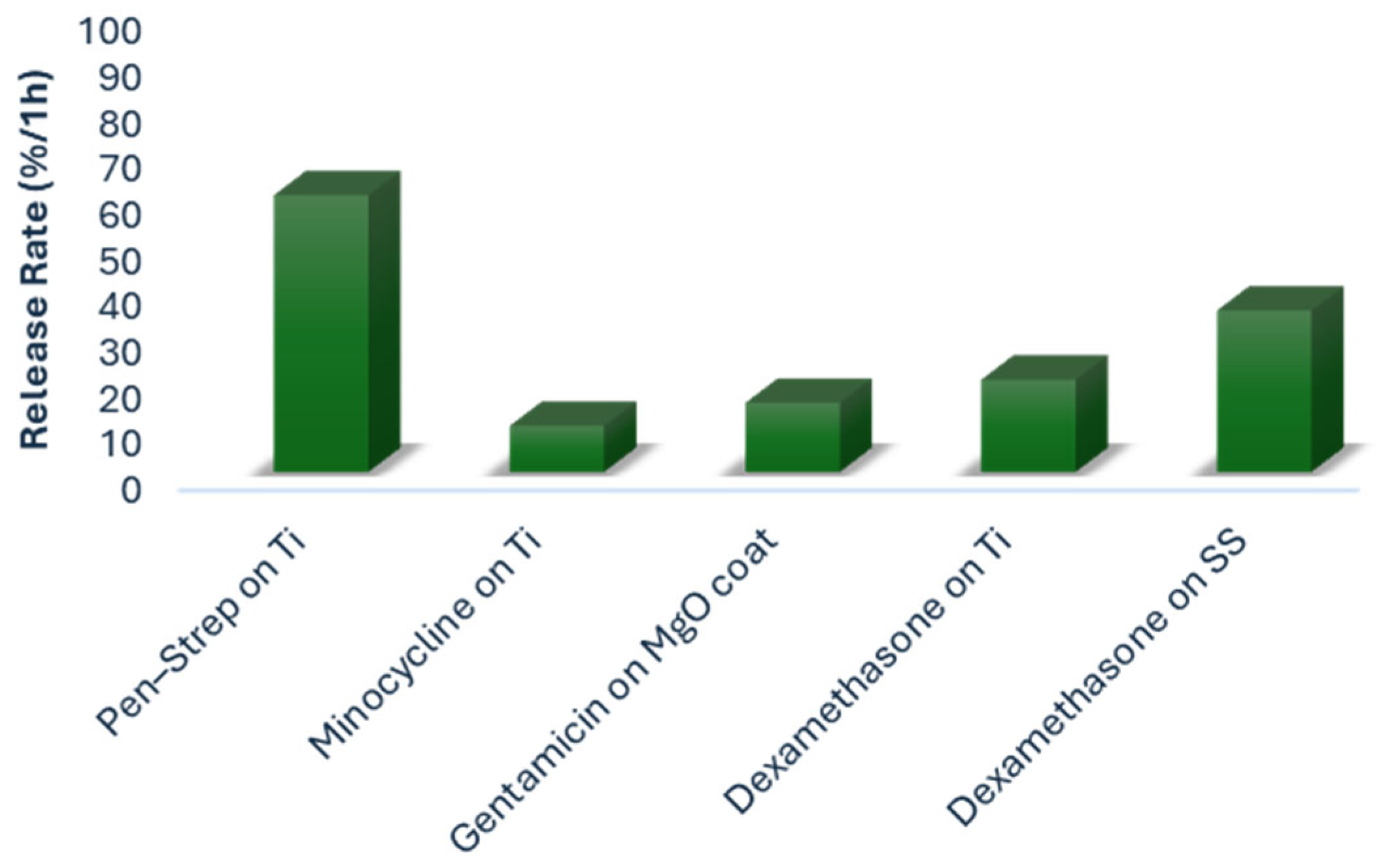
| Penicillin–Streptomycin (antibiotic) | SLM Ti-6Al-4V with TiO2 nanotubes, optional chitosan/PCL/PHB top coat | ~60% (1 h), 90% (2 h), 100% (4 h), burst decreased 28% at 60 min with caps | ~4–5 h total, +17% (1 layer)/+33% (2 layers) duration vs. uncoated | Anodization 60 V at 30 min, dual-scale surface retained after coating | [88] |
| Minocycline (antibiotic) | 3D Ti 6Al 4V scaffold with TiO2 nanotubes sealed by PLGA | <10% (1 h), ~25% (5 h), ~48% (24 h) of uncoated at same timepoint | Sustained ~7 days, PLGA reduces 24 h release by >2× vs. uncoated | Anodization 60 V 1 h, MH 1 mg mL−1 load (2 h soak), PBS refresh q5 h | [86] |
| Gentamicin (antibiotic) | Halloysite nanotubes (MgO-coated) embedded in Si3N4 matrix | 15% (1 h), 40% (6 h), 65% (24 h) | ~4 days to ~95% | HNT diameter ~50 nm, MgO shell thickness of few nm | [121] |
| Amikacin (antibiotic) | 3D-printed 316L steel lattice coated with chitosan ± PLGA | LMW: ≤12 h burst leads to 74–90% (96 h), with PLGA: ~50% burst | Extended ~1 month with PLGA overcoat, >97% total | PLGA 10% w/w, MMW chitosan extends to ~10 days | [100] |
| Dexamethasone (anti-inflammatory) | PSS/PAH LbL capsules (3 bilayers) on Ti surface | 20% (1 h), 50% (4 h), 80% (24 h) | ~48 h to complete elution | Capsule diameter 2.3 ± 0.2 µm, 3 bilayers optimized | [78] |
| Dexamethasone (anti inflammatory) | 3D-printed stainless steel with gelatin CS film | 35% (1 h), 80% (12 h) | ~3 days total | Film thickness ~410 µm, cross-linked gel | [101] |
| VEGF (growth factor) | EBM Ti 6Al 4V pores (500 µm) filled with thermosensitive collagen | 53.5 ± 2.2% (Day 1) | 89.8 ± 3.4% (Day 15) | Scaffold porosity 70%, hydrogel porosity 40%, swelling 110% at 10 h | [79] |
| VEGF and BMP 2 (growth factors) | Ti rods with gelatin microspheres | VEGF = 20% (4 h) leads to 75% (72 h), BMP 2 = 5% (4 h) leads to 55% (72 h) | Sequential: VEGF 1st week, BMP2 2nd week | Shell/core thickness ~20 µm/80 µm | [44] |
| BMP 9 (growth factor) | Same EBM Ti framework with thermosensitive collagen carrying rhBMP 9 | - | Tracked 1 h leads to 15 days (ELISA), profile gradual | rhBMP9 100 ng mL−1 (in vitro), 10 mg mL−1 (in vivo) | [93] |
| Rosuvastatin (statin + ion donor) | 3D-printed composite scaffold with gelatin coating and MgO | - | 30-day sustained release of Mg2+ and RSV | Composite porosity ~ 60%, gelatin layer modulates wettability | [122] |
| Vancomycin (antibiotic) | EPD silk–fibroin + TCP coating on AM porous Ti | Burst on day 1, higher burst with higher vancomycin load | Continued release to Day 14 | Silk/TCP/vancomycin composite, coatings uniformly cover inner pore surfaces | [81] |
| Vancomycin (antibiotic) | Porous 3D Ti rods filled with mPEG PCL hydrogel + outer PCL membrane | <10% (4 h), 25% (no lipase) vs. 55% (+ lipase) at 24 h | ~10 days, enzyme rate increased by ~2.2-fold | PCL membrane 40–80 µm thick, hydrogel viscosity tuned by ratio | [83] |
| Vancomycin + Ag (antibacterial) | AM highly porous Ti lattice, chitosan–gelatin EPD hydrogel coating | Burst of each agent lowered when combined (e.g., Ag decreased ~5× at 6 h vs. Ag alone) | Both agents released ≥21 days, maintained ≥5-log kill to Day 21 | EPD of chitosan/gelatin, simultaneous loading of Ag+ and vancomycin, synergistic killing | [84] |
| Vancomycin + BMP-2 (antibiotic + growth factor) | L-PBF Zn-1Mg porous scaffold with PDA/HA bilayer, BMP-2 adsorbed, vancomycin embedded | Vancomycin ~40–50% first 16 h, BMP-2 ~60% day 1 | Vancomycin to ~24 days, BMP-2 to ~21 days | PDA adhesive layer + HA, dual-factor release with antibacterial + osteogenic effects | [120] |
| Implant and Loaded Agent | In Vivo Model and Duration | Key In Vivo Outcomes | Drug/Ion Kinetics Reported | Ref. |
|---|---|---|---|---|
| AM porous Ti rods, chitosan EPD coatings loaded with silver NPs (1–100 mM AgNO3) or vancomycin | Rat tibia (intramedullary), 28 days | Vancomycin coating decreased infection rate (~80%) vs. chitosan, Ag-NP coating failed to reduce infection and increased osteoclast activity on μCT and histology. | No release curves, antibacterial efficacy only qualitative. | [11] |
| 3D-printed porous Ti6Al4V with micro-arc oxidation (MAO) bioactive layer | Rabbit femoral condyle, 4 and 8 weeks | μCT and Masson-Goldner staining: BV/TV increased ~60%, higher ALP and cell proliferation vs. untreated Ti. | No drug release | [126] |
| Ti6Al4V-HA functionally graded composite (FGM) made by SLM | Rabbit tibia, 4 and 8 weeks | BV/TV increased ~2.1× and BIC% increased vs. Ti64 control, mechanical strength increased ~20%. | No drug release | [127] |
| 3D-printed porous Ti with choline-phosphate (PMCP) surface capturing BMSC exosomes | Rabbit femoral defects, 4 and 12 weeks | μCT and histology: bone volume increased 2.3× (4 w), trabecular thickness increased 25% (12 w) vs. bare Ti. | Exosome release qualitative only (no μg or t½ values). | [128] |
| cpTi + 1 wt% SiO2 + 3 wt% Cu (AM alloy, no separate drug) | Rat distal femur, 8 weeks | 4.5× higher bone formation at the bone–implant interface vs. cpTi, ~85% antibacterial efficacy against S. aureus reported (in vitro). | Cu/Si release not quantified | [129] |
| Si-doped MAO Ti + BMP-2 loading | Rabbit femoral defect, 8 weeks | Faster bone bridging and osseointegration, bone-fill increased ~80% vs. control. | BMP-2 release t½ ~10 days, sustained over 4 weeks (ELISA). | [95] |
| 3D-printed porous Ti with Cu2+/TA/HAP composite coating (EPD) | Rabbit femoral condyle, 4 and 12 weeks | μCT/histology: BV/TV increased ~60%, ALP increased 1.7×, bacteria decreased ~85% vs. control. | Cu2+ release (qualitative, ppm not stated). | [130] |
| EBM Ti6Al4V + polydopamine-assisted HA coating | Rabbit femoral condyle, 4 and 12 weeks | BIC increased ~2×, mineralized bone increased ~1.6× vs. bare Ti, excellent osteointegration. | No drug release | [131] |
| 3D-printed porous Ti6Al4V + pH-neutral bioactive glass (PSC) coating | Rabbit femoral defect, 12 weeks | Push-out strength increased ~38%, BIC increased ~45% vs. bare Ti, enhanced osseointegration. | No drug, HA induction confirmed within 3 days in SBF. | [132] |
| TiCu/TiCuN coating (arc-ion plating, Cu-ion-eluting) | Rat femur osteoporotic fracture model, 8 weeks | Callus volume increased ~2×, bone quality improved vs. Ti control, Wnt/β-catenin genes up-regulated. | Cu2+ release ~0.25 ppm day−1 for 28 days. | [133] |
| 3D-printed PCL/β-TCP/nHA/MgO scaffold, gelatin coat + rosuvastatin (RSV) | Rat calvarial critical-size defect, 12 weeks | More bone fill and maturation vs. control in µCT/histology, RSV + MgO combo gave the best osteogenesis | RSV release sustained ~30 days (duration stated, no µg/day), MgO acted as pro-angiogenic cue | [122] |
| Loofah-inspired scaffold with HAp coating + Mg-MOF/PVA hydrogel (Mg supplies ions, GA co-ligand provides antioxidant effect) | Rabbit femoral-condyle critical-size defect, 4 and 12 weeks | Cortical coverage and cortical-cancellous reconstruction by 12 weeks, highest new bone volume among groups on µCT/histology | pH maintained 7.1–7.4 in extracts, Mg-MOFs sustained Mg2+/GA release (profile reported, values not tabulated) | [134] |
| PDA-Mg ion-loaded 3D-printed porous Ta (Ta-PDA-Mg2 best dose) | Rat femoral condyle, 12 weeks | Greater vascularized bone formation and stronger pull-out than Ta/Ta-PDA | Mg2+ release ranked (Mg2 > others), but no absolute concentrations in paper text | [135] |
| SLM Ta scaffold with Mg-doped CaP coating (Mg-CaP) | Rabbit femoral-condyle defects, 4 and 12 weeks | Denser new bone (VG/TB), shorter fluorochrome label distances vs. CaP or bare Ta | In vitro ion release reached steady state: Ca2+ ~80–130 ppm, Mg2+ ~35–55 ppm (stable from day 2) | [136] |
| Mg-silicate (MgSiO3)-coated 3D-printed Ti scaffold | Rabbit femoral condyle, 6 and 12 weeks | Increased bone ingrowth and volume vs. pore-shape controls (µCT, histology) | No ion-release curve (coating chemistry described) | [137] |
| Mg-coating on porous Ti (micro-arc oxide Mg layer) | Rabbit distal femur, 2 months | Suppressed osteoclastogenesis and peri-implant osteolysis, improved bone–implant interface | Mg-related alkalization noted, no quantitative release reported | [138] |
Disclaimer/Publisher’s Note: The statements, opinions and data contained in all publications are solely those of the individual author(s) and contributor(s) and not of MDPI and/or the editor(s). MDPI and/or the editor(s) disclaim responsibility for any injury to people or property resulting from any ideas, methods, instructions or products referred to in the content. |
© 2025 by the authors. Licensee MDPI, Basel, Switzerland. This article is an open access article distributed under the terms and conditions of the Creative Commons Attribution (CC BY) license.
Share and Cite
Das, S.; Carson, L.; Chan, C.-W. Therapeutic Potential of 3D-Printed Alloys as Drug-Eluting Implants: Current Progress. Metals 2026, 16, 17. https://doi.org/10.3390/met16010017
Das S, Carson L, Chan C-W. Therapeutic Potential of 3D-Printed Alloys as Drug-Eluting Implants: Current Progress. Metals. 2026; 16(1):17. https://doi.org/10.3390/met16010017
Chicago/Turabian StyleDas, Shubhangi, Louise Carson, and Chi-Wai Chan. 2026. "Therapeutic Potential of 3D-Printed Alloys as Drug-Eluting Implants: Current Progress" Metals 16, no. 1: 17. https://doi.org/10.3390/met16010017
APA StyleDas, S., Carson, L., & Chan, C.-W. (2026). Therapeutic Potential of 3D-Printed Alloys as Drug-Eluting Implants: Current Progress. Metals, 16(1), 17. https://doi.org/10.3390/met16010017