
Article

From √A to Elliptical Defects: Refining Murakami’s Model for Fatigue Prediction in Sintered Steels

1
SIMUMECAMAT Research Group, University of Oviedo, West Building. 7.1.10. University Campus, 33203 Gijón, Asturias, Spain
2
PMG Powertrain R&D Center, S.L.U. Pol. Ind. Vega de Baíña s/n, 33682 Mieres, Asturias, Spain
*
Author to whom correspondence should be addressed.
Metals 2026, 16(1), 100; https://doi.org/10.3390/met16010100
Submission received: 23 December 2025 / Revised: 9 January 2026 / Accepted: 14 January 2026 / Published: 16 January 2026

Abstract

The use of powder metallurgy in the manufacturing of automotive components requires understanding the influence of porosity on fatigue behaviour. The most widely accepted explanation for the impact of porosity on the fatigue limit is Murakami’s “√Area = √A” theory. However, the presence of elongated or irregular pores in sintered steels challenges this simplification. This study analyses the fatigue behaviour of three sintered steels and performs a statistical and geometrical assessment of porosity. Results demonstrate that replacing the √A parameter with the ellipse-fitted major axis (dmax) reduces the average prediction error from nearly 50% to below 6%, markedly improving the predictive accuracy of defect-based fatigue models.

1. Introduction

Powder metallurgy (PM) is widely employed in the automotive industry to manufacture components with complex geometries, tight dimensional tolerances and competitive production costs. Among these components, synchronizer hubs for manual gearboxes represent a particularly demanding application, as they must withstand millions of loading cycles under severe contact and bending stresses. For such critical parts, the mechanical performance, and especially fatigue resistance, depends strongly on the quality of the sintered microstructure, where residual porosity remains an inherent feature of the process despite advances in powder design, compaction strategies and sintering technologies [1,2,3,4,5,6,7,8].
Porosity is universally recognised as the dominant factor controlling the fatigue behaviour of PM steels. Numerous studies have shown that fatigue cracks almost invariably initiate at pores, with the largest pores in the most highly stressed region acting as the critical defects that govern the fatigue limit [6,9,10,11,12,13,14]. Despite this consensus, however, there is still no agreement on how to characterise porosity in a way that quantitatively captures its influence on fatigue performance. Approaches range from simple global descriptors based on total porosity or density to local descriptions based on pore geometry, but these methods often fail to correlate consistently with fatigue strength across different materials, processing routes and component geometries [8,15].
A common assumption is to treat pores as small defects or micro-notches. From this perspective, several frameworks have been applied to quantify their influence, including notch-based stress concentration models [16,17], but the most widely adopted approach relies on linear elastic fracture mechanics (LEFM). Under this framework, the fatigue limit, Sf, is defined as the stress amplitude at which a small crack can begin to propagate from an existing defect and is therefore related to the threshold stress intensity factor range, ΔKth, and to a representative defect size, a, through classical LEFM relations [16,18,19]. A critical challenge, however, is the definition of this characteristic defect size, especially when pores present highly irregular three-dimensional shapes.
To address this issue, Murakami proposed the well-known A r e a method, in which the effective defect size is equated to the square root of the projected area of the pore on a plane perpendicular to the applied stress [20]. The approach has been extensively used because of its simplicity and its ability to provide reasonable predictions when pores are approximately equiaxed or compact. Nevertheless, real sintered steels often contain elongated, tortuous or interconnected pores, for which the a = A r e a metric does not necessarily capture the relevant geometry. In these situations, Murakami’s assumption of a square-like defect may lead to significant deviations between predicted and experimental fatigue limits.
Recent research has highlighted that this geometric discrepancy remains a significant challenge in fatigue life estimation. To address this, current literature has increasingly integrated Artificial Intelligence and Machine Learning (ML) algorithms to automate the classification of complex pore features and identify non-trivial patterns in defect morphology [21,22,23]. Furthermore, phase-field modelling has emerged as a robust computational tool to simulate how fatigue cracks initiate and propagate through these intricate porous networks, offering a level of spatial detail and path-prediction accuracy that traditional analytical models cannot capture [24,25,26].
This inherent limitation of the classic √Area theory has motivated the exploration of alternative geometrical descriptors that can more faithfully represent the real morphology of pores. Various parameters, including the Feret diameter (FD), pore aspect ratio (AR), and the major and minor axes of an equivalent ellipse (dmax and dmin) fitted to the pore boundary, have been investigated. However, despite these efforts, a definitive consensus on which parameter yields the best correlation with fatigue performance remains elusive. This lack of standardisation stems from the high stochasticity of pore shapes in PM materials, further compounded by the influence of powder characteristics, compaction strategies, and sintering conditions, all of which dictate the final pore size distribution and morphology.
A second challenge concerns the statistical nature of pore populations. Because fatigue cracks typically initiate at the largest defects, the fatigue limit is governed not by the average pore geometry but by the extreme values of the distribution. For this reason, extreme value statistics (EVS) have become a powerful tool to estimate the maximum defect size in each component volume. Among the possible EVS approaches, the two-parameter Gumbel distribution is the most widely adopted for PM materials, as it adequately captures the distribution of maximum pore sizes in planar sections and allows scaling between different observation volumes [27,28,29,30]. Combined with LEFM-based models, EVS provides a rigorous framework to estimate fatigue-critical defects, but the accuracy of the predictions still depends on the choice of the underlying geometrical parameter.
Beyond pore morphology, the geometry of the component itself plays an additional and often overlooked role. Real PM components exhibit heterogeneous density distributions due to varying compaction pressures, die-wall friction, and non-uniform cooling during sintering. As a result, two materials produced from the same powder and the same nominal process can exhibit markedly different porosity characteristics, and consequently different fatigue behaviour, simply due to changes in geometry. This underscores the importance of studying porosity directly in specimens extracted from the final component rather than relying solely on standardised test pieces with simplified geometries.
Considering all these factors, a comprehensive analysis of the relationship between pore characteristics and fatigue behaviour must therefore integrate four points: (i) the influence of powder composition and processing route, (ii) a precise quantification of pore morphology using different geometric descriptors, (iii) extreme value statistics to determine fatigue-critical defects, and (iv) direct fatigue testing of specimens extracted from real PM components.
In view of these considerations, the present study aims to clarify how defect morphology, powder composition, processing route and component geometry jointly influence the fatigue behaviour of PM steels. To this end, three materials manufactured by powder metallurgy are analysed: two synchronizer hubs (SH1 and SH2) produced using different powder blends and compaction-sintering strategies, and a parallelepiped block (PP2) manufactured using the same powder and process as SH2 but with a different geometry. This experimental design enables the independent assessment of powder-related effects, processing effects, and geometry-induced density gradients. A comprehensive characterisation is performed combining microstructural analysis, detailed quantification of porosity, extreme value statistics of the largest defects, and rotating–bending fatigue testing on specimens extracted directly from the components.
Special attention is devoted to evaluating whether Murakami’s √Area approach sufficiently captures the influence of the largest pores, or whether alternative geometric descriptors, such as Feret diameter or ellipse-based parameters, provide a more accurate correlation with the measured fatigue limits. To establish the analytical basis for this evaluation, the following section introduces the theoretical framework adopted in this work.

2. Theoretical Framework

Fatigue failure in powder metallurgy (PM) steels is strongly influenced by the presence, size and morphology of pores, which act as intrinsic defects promoting early crack initiation. To quantitatively assess their effect on the fatigue limit, different analytical models have been developed. Most of these approaches fall into two complementary categories: (i) models based on linear elastic fracture mechanics (LEFM), in which the pore is treated as a crack-like defect, and (ii) statistical models describing the distribution of pore sizes in terms of extreme value statistics (EVS). This section summarises the theoretical basis of both approaches, as well as the geometrical descriptors considered in this work.

2.1. Fatigue Crack Initiation from Pores: LEFM Approach

Under the LEFM framework, the fatigue limit, Sf, of a material containing a defect of characteristic size (a) corresponds to the stress amplitude for which a crack emanating from that defect reaches the threshold stress intensity factor range, Δ K t h . This relationship is given by [19]
Δ K t h = Y ( a W ) · S f π a
where Y(a/W) is a geometrical factor that depends on the relative defect size and specimen geometry.
Equation (1) highlights that accurate prediction of the fatigue limit requires (i) knowledge of the threshold Δ K t h , and (ii) correct characterisation of the effective defect size and shape.

2.2. Murakami’s A Approach

To overcome the difficulty of defining a characteristic defect dimension for irregular pores, Murakami proposed the widely adopted A method [29], in which the effective defect size (a) is related to the projected pore area (A):
a = A
Using this definition and an extensive experimental database, Murakami established an empirical expression for the threshold stress intensity factor range, Δ K t h , as a function of the Vickers hardness (HV) and the projected area of the defect [19,29]:
Δ K t h = 3.3 · 10 3 · H V + 120 · A 1 / 6
where HV is measured in kg/mm2 and A in µm2.
Combining Equations (1)–(3), Murakami derived the following expression for the fatigue limit:
S f = β ( H V + 120 ) A 3
where β = 1.43 for surface defects and β = 1.56 for internal defects.
Equation (4) has been successfully applied to a wide range of metallic materials containing small, relatively equiaxed defects. However, when pores are elongated, irregular or formed by coalescence of neighbouring cavities, as frequently occurs in PM steels, the assumption that a = A may lead to inaccurate predictions of the fatigue limit.

2.3. Extreme Value Statistics for Maximum Pore Size Estimation

Since fatigue cracks preferentially initiate at the largest pores within the highly stressed region of a component, a proper estimation of the maximum defect size is essential. When porosity is quantified from planar images, the maximum pore size in each analysed subarea may be modelled using extreme value statistics. The distribution of maximum values in each dataset is adequately described by the two-parameter Gumbel distribution [30]:
F 0 x = exp e x p x λ δ
where λ and δ are respectively the location and scale parameters of the distribution.
Because the maximum pore size depends on the volume of material analysed, the cumulative distribution function can be scaled from a reference volume (V0) to a specimen volume (V) as
F x = F 0 x V V 0
Since porosity measurements are typically based on planar images, only the pore area values in the measurement plane, Ai, are available. Consequently, to estimate the volume V0, the third dimension is commonly approximated by the square root of the mean area of the maximum pores (Ai) according to Equation (7) [29]:
V 0 = S 0 1 N i A i
For a specified probability of occurrence (α), the expected maximum pore size within a component volume (V) is
x α = λ + δ l n V V 0 l n l n α
Equation (8) provides the critical defect size used later in the LEFM-based fatigue assessment.

2.4. Alternative Geometrical Descriptors of Pore Morphology

While Murakami’s model assumes that the projected area (A) adequately represents pore size, real pores in PM steels often exhibit elongated or irregular shapes. To better capture their morphology, several additional geometrical parameters were analysed in this work: Feret diameter (FD = maximum calliper distance across the pore), major and minor axis (dmax and dmin) of an ellipse fitted to the pore boundary, aspect ratio (AR = dmax/dmin) and bounding-ellipse approximation (pore represented as an ellipse of axes dmax and dmin, allowing direct use of a = dmax in Equation (1)).
These descriptors provide alternative definitions of the effective defect dimension (a), enabling a comparative analysis of their predictive capability when combined with LEFM and EVS.

3. Materials and Methods

3.1. Materials and Specimen Extraction

Three powder metallurgy materials were analysed in this study: two synchronizer hubs (SH1 and SH2) manufactured using different powder blends and compaction–sintering routes, and a parallelepiped block (PP2) produced using the same powder and double pressing–double sintering process as SH2 but with a simplified geometry. This experimental design enables separating the effects of (i) powder composition, (ii) processing route and (iii) component geometry on porosity and fatigue behaviour.
Chemical compositions of the powders used to produce SH1, SH2 and PP2 are shown in Table 1. The SH1 hub was manufactured from a Cr–Mo pre-alloyed steel using a single pressing–single sintering route, whereas SH2 and PP2 were produced from a Ni–Cu–Mo diffusion-alloyed powder using a double pressing–double sintering process. Note: Detailed parameters of the compaction and sintering routes are confidential due to industrial restrictions established by PMG Powertrain R&D Center S.L.U. Only general process characteristics (single vs. double pressing/sintering) are disclosed to preserve proprietary information.
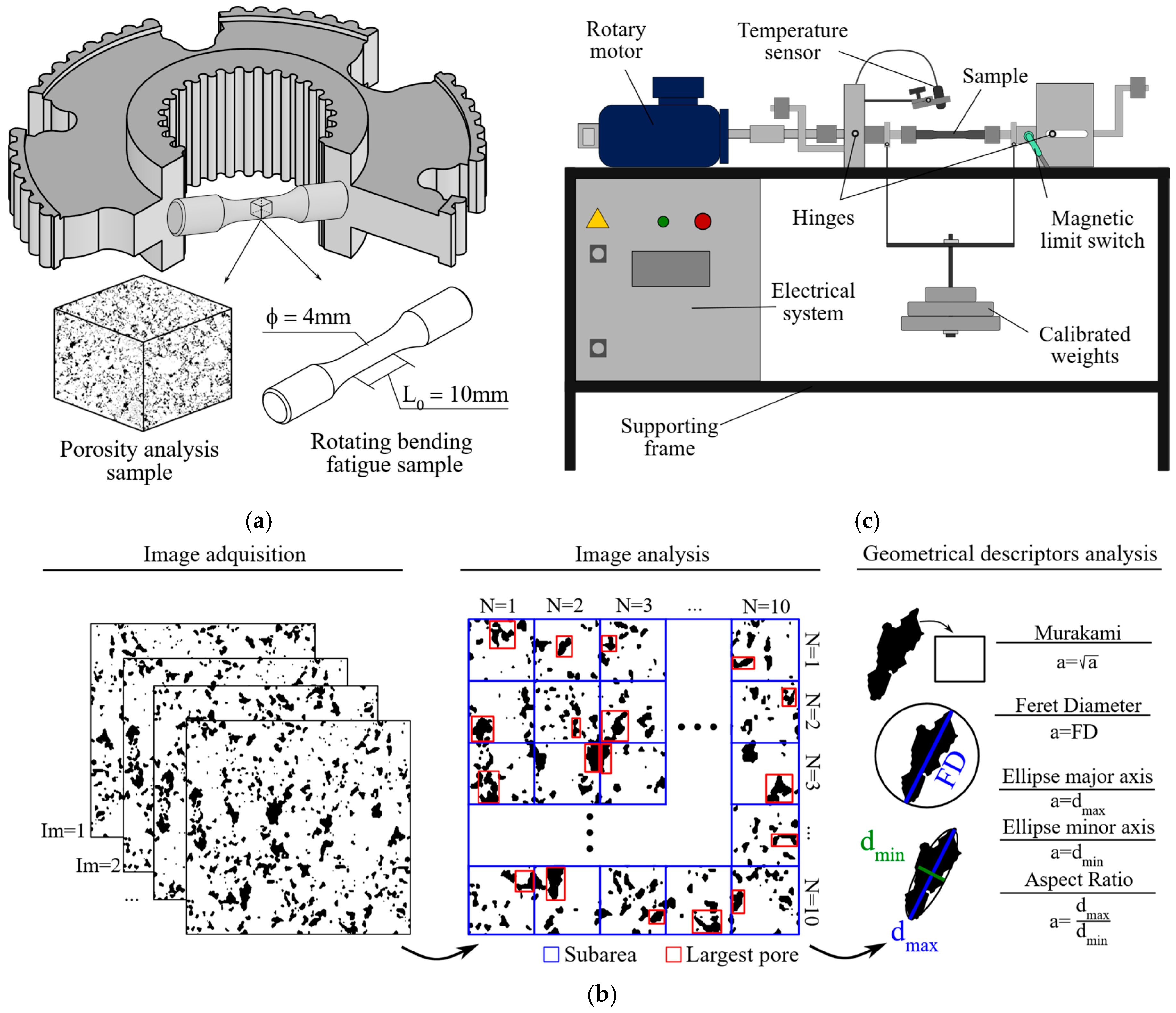
To ensure a direct correlation between porosity and fatigue behaviour, all specimens (tensile, porosity sections and fatigue specimens) were extracted from regions corresponding to the shaft of the rotating–bending fatigue specimens. Figure 1a shows the sample extraction locations for the hubs. For PP2, one specimen was obtained per component due to its smaller size.

3.2. Microstructural and Basic Characterisation

Microstructural characterisation was performed on polished cross-sections using standard metallographic preparation procedures. Samples were ground down to 1 μm diamond suspension and etched with 2% Nital to reveal microstructural features.
Vickers hardness was measured using a load of 300 N (HV30), averaging ten indentations per material. Specimen density was determined according to UNE-EN ISO 2738 [31]. Retained austenite was quantified by X-ray diffraction using a Stresstech Xstress 3000 G3R diffractometer (Stresstech Oy, Jyväskylä, Finland) operating at 30 kV and 6.7 mA, with a vanadium filter and 5 mm collimator. Austenite and ferrite peaks were acquired at detector angles of 130–80° and 156.4–106.1°, respectively, with an exposure time of 45 s per scan.

3.3. Porosity Analysis

3.3.1. Image Acquisition and Segmentation

Porosity was quantified on polished, unetched cross-sections to avoid artefacts caused by chemical attack. For each material, at least three samples were analysed, and five optical micrographs per sample were acquired using a Nikon ECLIPSE MA200 microscope (Nikon Corporation, Tokyo, Japan) at a resolution of 0.25–0.35 μm/pixel. As schematically represented in Figure 1b, each image was divided into subareas of 0.02 mm2, following procedures commonly adopted in EVS analyses of PM steels, to provide a sufficiently large number of extreme values while maintaining statistical independence among subareas. Pores intersecting the image border were excluded to avoid truncation effects. Images were thresholded using ImageJ (v1.54) with manual verification to ensure correct segmentation of elongated and interconnected pores. For each subarea, the largest pore was identified and its geometrical parameters extracted.

3.3.2. Geometrical Descriptors

For every maximum pore in each subarea, the following descriptors were measured: projected area (A), Feret diameter (FD), ellipse-fitted major axis (dmax), ellipse-fitted minor axis (dmin) and aspect ratio (AR = dmax/dmin). The ellipse fitting was performed using a least-squares method implemented in ImageJ. These parameters allowed evaluating several alternative definitions of defect size, a, including a = √A, a = FD, and a = dmax, to assess their predictive capability when combined with the LEFM-EVS framework. All of these geometrical descriptors are graphically summarised in Figure 1b.

3.3.3. Extreme Value Statistics

The ordered set of maximum pore measurements from all subareas was used to determine the Gumbel distribution parameters λ and δ for each descriptor, following the methodology described in Section 2. The reference volume V0 for each material was estimated using the square root of the mean maximum pore area. The expected maximum pore size in the gauge volume of the fatigue specimens (125.66 mm3) was then calculated for a 50% probability level. These extreme values were subsequently used as input defect sizes in the fatigue analysis.

3.4. Tensile Testing

Tensile tests were performed on square cross-section specimens (5 mm × 5 mm) machined from the same extraction regions used for porosity analysis. Tests were conducted at room temperature according to UNE-EN ISO 6892-1 [32] on a 100 kN MTS servo-hydraulic machine, using a test rate of 0.5 mm/min. Longitudinal strain was measured with an MTS axial extensometer (10 mm gauge length). At least three specimens per material were tested.

3.5. Fatigue Testing

3.5.1. Specimen Geometry and Preparation

Rotating–bending fatigue specimens were machined to the geometry shown in Figure 1a, with a gauge diameter of 4 ± 0.02 mm. Dimensions were scaled down from ISO 3928 [33] recommendations to accommodate the limited size of the synchronizer hubs, while ensuring compliance with ISO 1143 [34] regarding stress gradients and surface quality.
All specimens were ground and polished to a surface roughness below 0.2 μm (Ra), measured by stylus profilometry. Although it is recognised that actual PM components may contain surface discontinuities or machining defects that promote crack initiation, the specimens in this study were polished to isolate the influence of their intrinsic porosity.

3.5.2. Fatigue Test Procedure

Fatigue tests were carried out using a Microtest EFFR4P-100 rotating–bending machine (Microtest S.A., Madrid, Spain) (Figure 1c) at room temperature (22 ± 1 °C). Tests were performed under fully reversed loading conditions (stress ratio R = −1, mean stress = 0). A total of 17 specimens per material were tested. Figure 1c shows a scheme of the fatigue test configuration.
The fatigue limit was determined using the staircase method. If a specimen survived 5 × 10⁶ cycles (run-out), the next test was conducted at a stress 10% higher; if the specimen failed, the next stress was reduced by 5%. Failure was defined as complete fracture of the specimen.

3.5.3. Fractographic Analysis

After testing, fracture surfaces were examined using a TESCAN VEGA XMH scanning electron microscope (TESCAN, Brno, Czech Republic) equipped with a tungsten filament. Fatigue crack initiation sites, crack growth features and final fracture regions were identified to correlate fractographic observations with porosity characteristics.

4. Results

4.1. Microstructure, Density, and Static Mechanical Properties

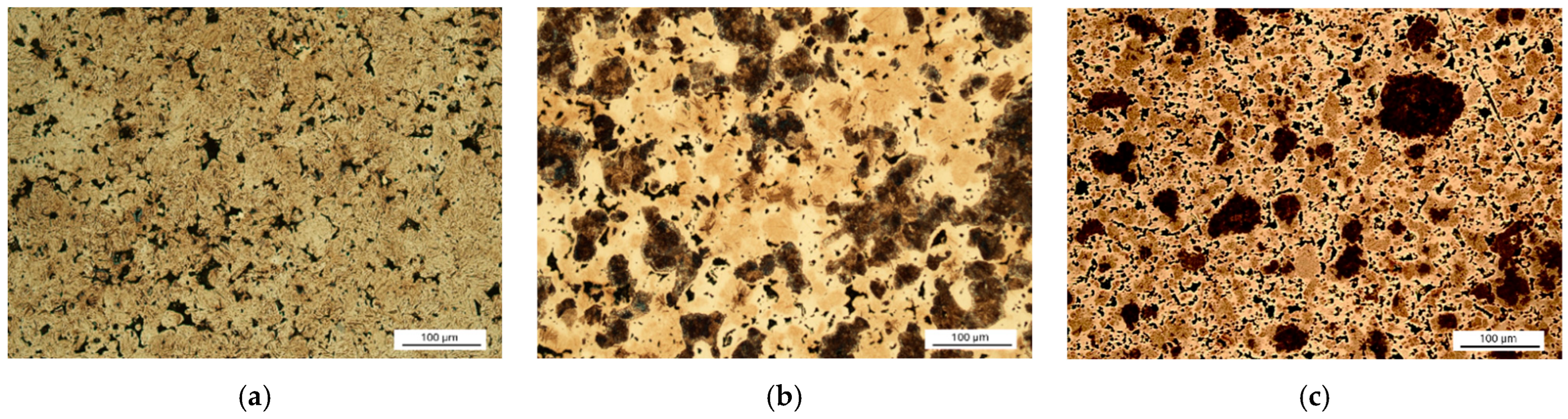
Representative microstructures of the three materials are shown in Figure 2. The SH1 synchronizer hub exhibits a predominantly martensitic microstructure (Figure 2a), with a retained austenite content of 6.5 ± 2.5%. In contrast, SH2 and PP2 (Figure 2b,c) present a mixed pearlite–martensite microstructure typical of diffusion-alloyed Ni–Cu–Mo steels, with retained austenite contents of 12.5 ± 2.0% and 14.4 ± 0.6%, respectively. These differences in microstructure arise from the distinct powder chemistries and processing routes employed and influence both hardness and fatigue performance. The martensitic matrix of SH1, though strong, provides limited local ductility, restricting plastic accommodation around pores. In contrast, the pearlitic–martensitic microstructures in SH2 and PP2 enable localised stress relaxation and slightly improved crack blunting capability. Retained austenite in SH2 and PP2 likely contributes to stress redistribution at the crack tip, delaying early propagation.
Table 2 summarises the tensile properties (elastic modulus, E, Poisson’s ratio, ν, yield stress, σys, ultimate tensile strength, σut, and elongation at break, εu), hardness and densities of the three materials. SH1 exhibits the highest hardness (356 ± 13 HV30) and tensile strength, consistent with its martensitic structure. However, its density (6.6205 g/cm3) is the lowest among the three materials, reflecting the limitations of the single-press/single-sinter route. SH2 and PP2, manufactured with double pressing and double sintering, reach higher densities (6.8126 and 7.0885 g/cm3, respectively), although PP2 exhibits superior density and mechanical performance despite sharing the same powder and process as SH2. This confirms the significant influence of component geometry on densification and final material properties.
These results highlight two key aspects: (i) the intrinsic role of powder composition and processing route in the microstructure and hardness of the materials, and (ii) the critical effect of component geometry on density, a factor strongly linked to porosity and, consequently, fatigue performance.

4.2. Extreme Value Statistics of Porosity

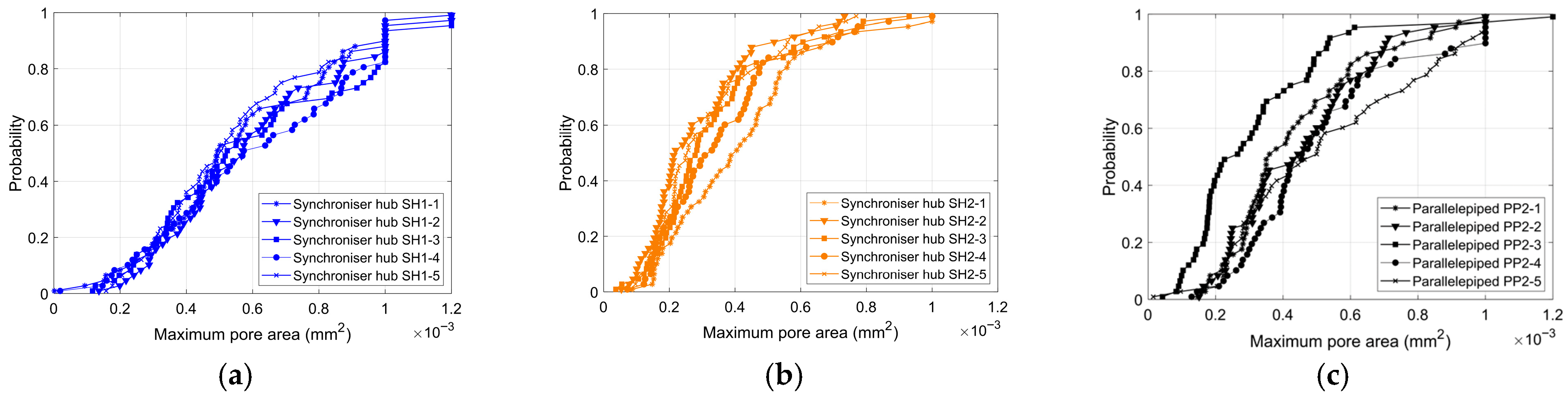
The Gumbel distributions obtained for the maximum pore area, A, in SH1, SH2 and PP2 are shown in Figure 3. Five samples per material were analysed, and the fitted distribution parameters (location parameter, λ, and scale parameter, δ) are reported in Table 3. The reference volumes used for each material, determined from Equation (7), were V0 = 4.49 × 10⁻⁴ mm3 for SH1, 3.4 × 10⁻⁴ mm3 for SH2 and 3.91 × 10⁻⁴ mm3 for PP2. Using these parameters and the gauge volume of the fatigue specimens (125.66 mm3), the maximum pore area at a 50% probability level, Aα = 0.5, was estimated for each material (Table 3).
SH1 shows the highest λ and δ values, indicating both larger maximum pores and greater dispersion in pore size distribution. This behaviour stems from single-step compaction and non-uniform densification. SH2 and PP2, processed through double pressing and sintering, display narrower distributions and lower δ, reflecting higher structural uniformity and compactness. The corresponding threshold stress intensity factor ranges, ΔKth, calculated using Murakami’s expression (Equation (3)), reflect the combined effects of hardness and pore size. SH1 achieves the highest ΔKth due to its higher hardness, despite having larger pores.
Comparing λ and δ across the materials demonstrates that SH1’s heterogeneous porosity produces a wider scatter, which translates into a higher probability of finding fatigue-critical defects. The correlation between these statistical parameters and the fatigue results confirms that EVS adequately captures the defect population governing crack initiation.
In addition to the analysis of maximum pore area, other geometric descriptors were evaluated (Table 4) to better capture the morphology of critical pores. The Feret diameter (FD) and ellipse-fitted major axis (dmax) show trends consistent with the projected area: SH1 exhibits the largest values, confirming the presence of highly elongated defects, while SH2 and PP2 present smaller, more equiaxed pores. The minor axis (dmin) remains nearly constant among materials, indicating that the pore width is less sensitive to processing route than its elongation. Consequently, the aspect ratio (AR = dmax/dmin) is markedly higher in SH1 (≈13) than in SH2 or PP2 (≈10), revealing greater anisotropy of the pore structure. This anisotropy could influence the local stress concentration factor and, therefore, the conditions for the initiation of fatigue cracks.

4.3. S–N Curves and Fatigue Limits

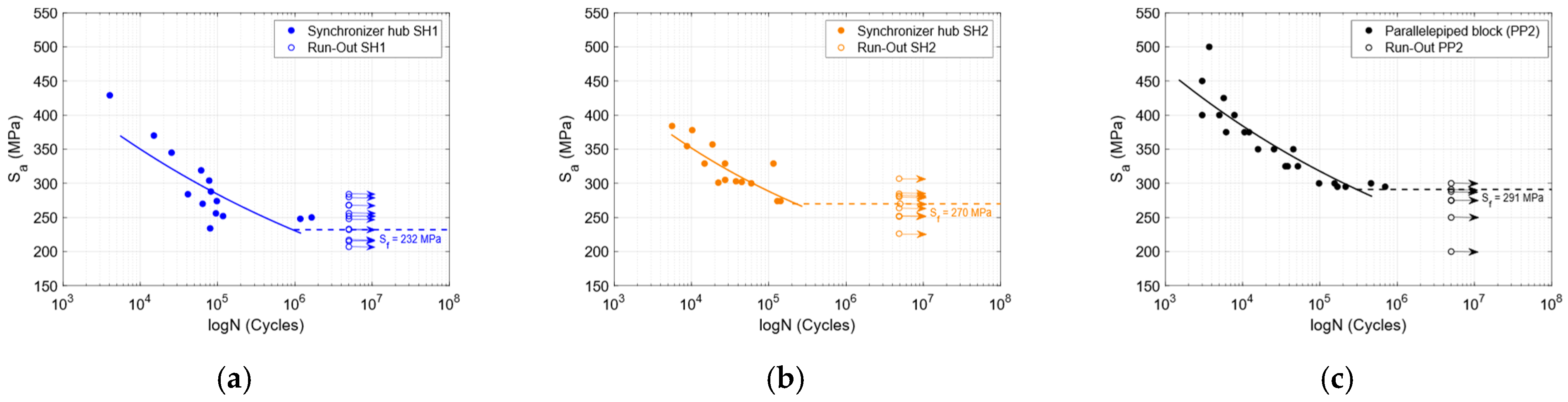
Seventeen specimens per material were tested under fully reversed rotating–bending fatigue conditions. The resulting S–N curves for SH1, SH2 and PP2 are shown in Figure 4, where open symbols denote run-out specimens (>5 × 10⁶ cycles) and solid symbols indicate failures. As expected for PM steels, a large scatter is observed, reflecting the heterogeneous distribution of pores.
The coefficients σ f and b (listed in Table 5) were obtained by fitting the experimental points to Basquin’s law (Equation (9)). This table also shows the corresponding fatigue limit value for each component.
S a = σ f ( 2 N ) b
As can be seen, the fatigue limit for SH1 is approximately 30% of its yield strength (which coincided with its tensile strength in this case), whereas for SH2 and PP2, it is nearly 50%. Considering that the ratio of these parameters is typically greater than 50% for dense materials (Sf = 50% σ u t for steels with a tensile strength below 1400 MPa [35,36,37]), the low values obtained are attributed to the porosity of the materials. Furthermore, the significant difference in porosity means that, while SH2 and PP2 exhibit behaviours similar to that reported by other researchers [38,39], SH1 performs worse.
The superior fatigue behaviour of PP2 compared to SH2, despite identical powder and process, is attributed to its geometry-induced densification, which results in fewer and smaller pores. This finding underlines the importance of analysing porosity directly in specimens extracted from real components.
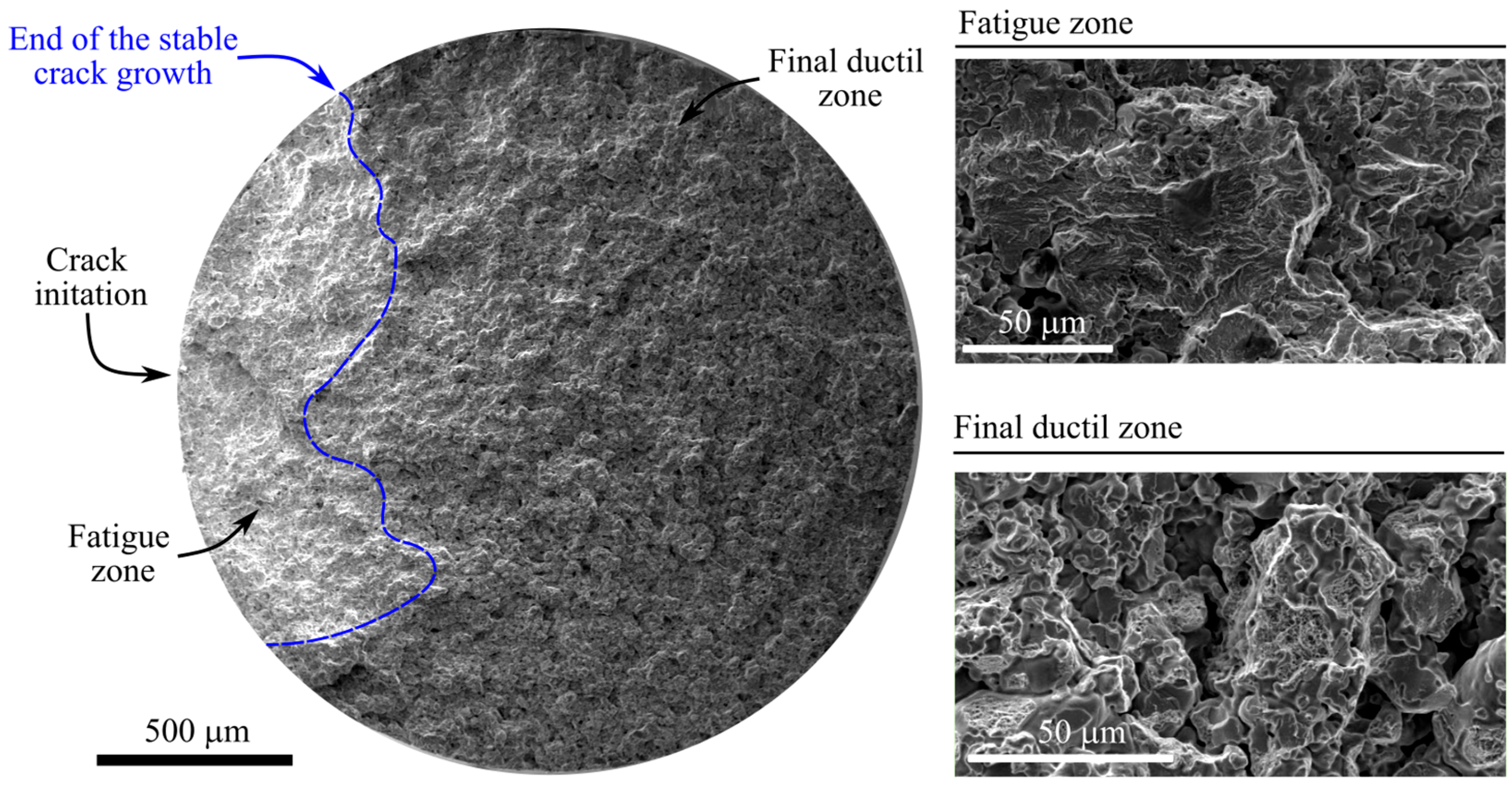
Fractographic analyses confirmed that all materials failed by fatigue mechanisms typical of porous PM steels: crack initiation at surface pores, stable crack growth exhibiting beach marks, and final ductile overload characterised by microvoid coalescence (Figure 5) [40]. No evidence of brittle fracture was observed. Specimens surviving more cycles generally exhibited wider fatigue crack growth regions.

5. Discussion

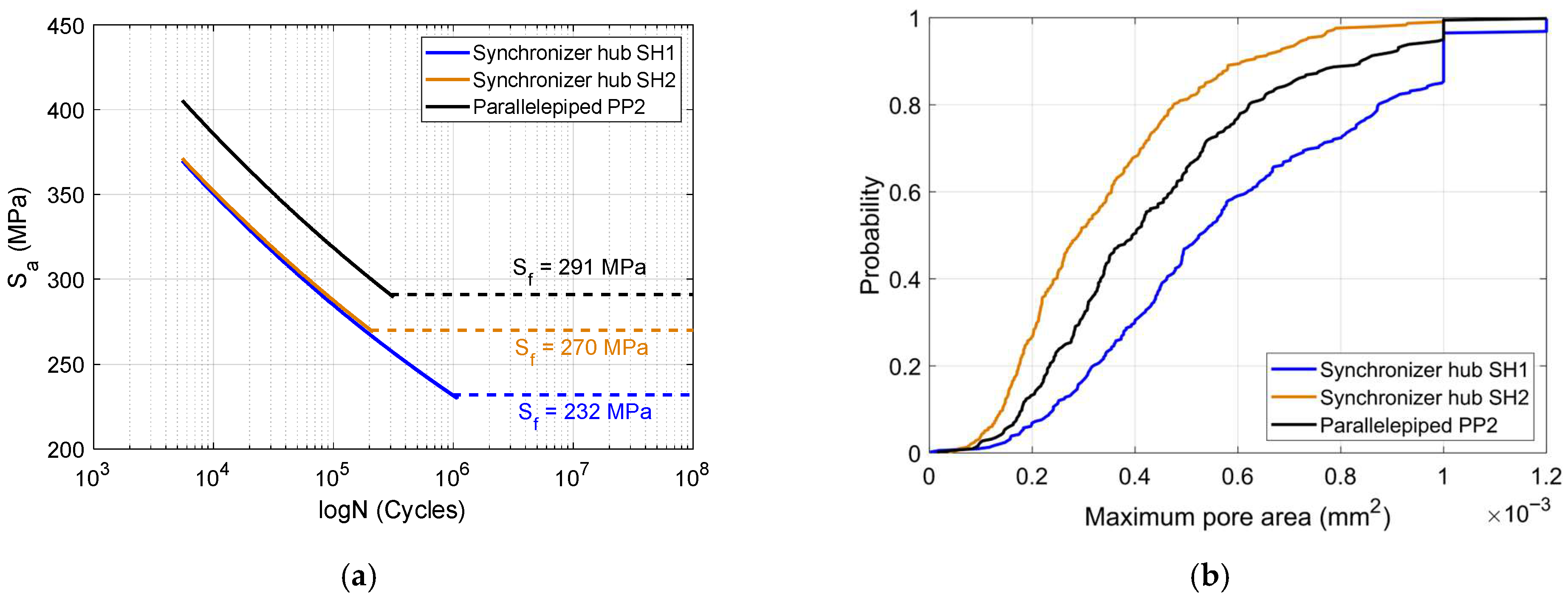
The mechanical and fatigue behaviour of the materials examined in this study is governed by the interplay between powder composition, processing route, component geometry and the resulting porosity characteristics. Figure 6 summarises the comparison between the three materials in terms of S–N curves, fatigue limits and Gumbel distributions of maximum pore size, providing a coherent basis for interpreting the results.

5.1. Influence of Powder Composition, Processing Route and Density on Fatigue Performance

Although SH1 exhibits the highest hardness and tensile strength due to its fully martensitic microstructure, its fatigue performance is the poorest among the three materials. This apparent contradiction reflects the dominant role of porosity over matrix strength in PM steels. SH1’s single pressing–sintering route results in larger and more interconnected pores. The high hardness and brittleness of the martensitic matrix limit the capacity to blunt microcracks at these pores, accelerating crack initiation. The presence of these defects offsets the intrinsic strength of the martensitic matrix, reducing the fatigue limit to only 232 MPa.
In contrast, SH2 and PP2, manufactured via double pressing and double sintering, show higher densities and smaller pores, reflecting the improved densification associated with this route. Despite having lower hardness than SH1, both SH2 and PP2 achieve significantly higher fatigue limits. Moreover, PP2 outperforms SH2 despite sharing the same powder and process, demonstrating the strong effect of component geometry on local density distribution and pore morphology. These results highlight that geometric effects cannot be ignored when evaluating PM fatigue behaviour and that specimens extracted from real components are essential to accurately capture performance differences.
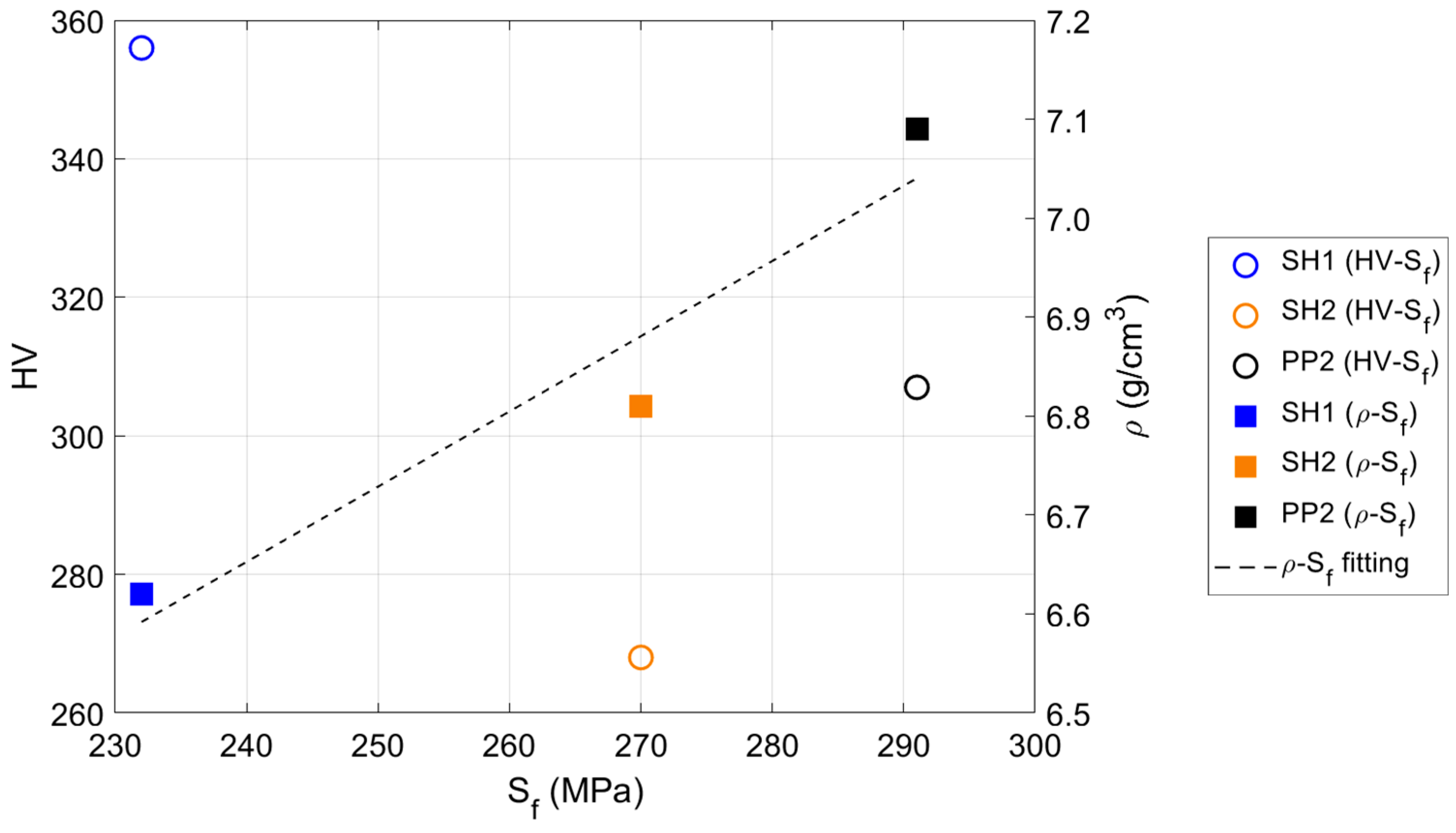
A linear trend is observed between density and fatigue limit (Figure 7), confirming that porosity, and not the hardness, is the governing parameter for fatigue resistance in PM steels.

5.2. Interpretation of Porosity Through Extreme Value Statistics

The Gumbel distributions obtained for the maximum pore areas reveal clear distinctions between the three materials. SH1 exhibits higher location (λ) and scale (δ) parameters, implying not only larger average maximum pores but also a broader scatter. This behaviour is typical of parts produced under lower compaction pressure and single-step sintering. SH2 and PP2, in contrast, display similar λ and δ values, consistent with their shared processing route. The slightly better densification of PP2 is reflected in its lower pore sizes and narrower pore population.
When extrapolated to the gauge volume of the fatigue specimens, SH1 yields the largest expected maximum pore area, followed by PP2 and SH2. These differences align precisely with the trends observed in fatigue behaviour, providing strong evidence that extreme value statistics (EVS) effectively capture the governing defects responsible for crack initiation. The method’s predictive consistency with fatigue behaviour aligns with previous findings by Andersson and Tan et al. [16,18,38,41], who demonstrated that EVS reliably links pore population extremes to fatigue thresholds in PM steels.

5.3. Applicability and Limitations of Murakami’s A Model

Using Equation (4) with the hardness values (Table 2) and the pore area Aα (Table 3) for each material, the estimated fatigue limits according to Murakami’s theory were obtained, as shown in Table 6. In addition, Table 6 shows the error of the fatigue limit based on the experimental value.
Murakami’s approach provides reasonable predictions for SH2 and PP2, where pore morphology is relatively equiaxed and well approximated by the A metric. For these materials, the fatigue limit prediction based on Equation (4) deviates by less than 9% from the experimental values.
In contrast, the prediction for SH1 exhibits a substantial deviation (48.9%). These discrepancies arise because the A method assumes isotropic pore geometry, i.e., pores behaving like square or circular defects. SH1, however, exhibits highly elongated pores and significant pore–pore interaction and coalescence. These features cause the projected area, A, to underestimate the defect dimension relevant for crack initiation.
It must be stressed that Murakami’s formulation is not universally valid. Recent investigations in AM steels have demonstrated large defects (>10 mm3) associated with very low fatigue thresholds (~0.1 MPa√m) [42]. These findings, in accordance with ASTM E647 [43], indicate that a universal threshold for naturally occurring cracks cannot always be defined. Therefore, Murakami’s approach is applicable primarily when defects are compact and equiaxed, as in many fine-particle or high-density PM steels.

5.4. Improved Fatigue Prediction Using Elongation-Based Defect Descriptors

To address the limitations of the A method, the pore geometry was reanalysed using the Feret diameter (FD) and the dmax ellipse-fitted parameters, which would provide a more realistic representation of elongated pores. By redefining the defect size as a = FD or a = dmax and recalculating the geometric factor Y(a/W) according to BS 7910 [44], the corresponding fatigue limits were estimated (Equation (1)). The values obtained together with the estimation errors with respect to the experimental results are shown in Table 7.
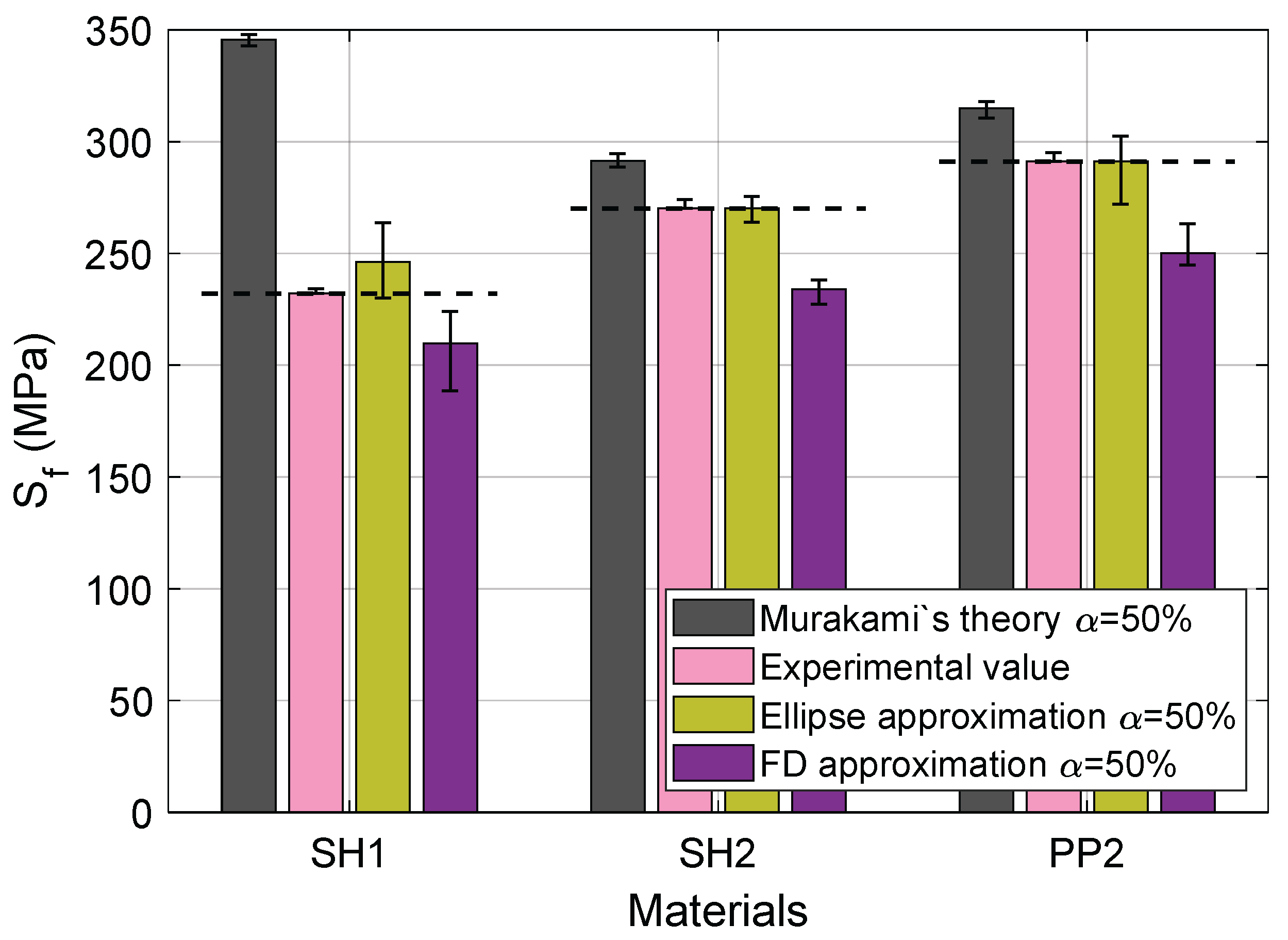
Re-evaluation of pore morphology using Feret diameter (FD) and ellipse-fitted major axis (dmax) significantly enhances predictive accuracy, especially for the SH1 material. However, the parameter that generates the best prediction is a = dmax, which reduces the mean prediction error from nearly 50% to less than 6%, demonstrating the superior representativeness of elongated-pore geometry. For SH2 and PP2, predictions match experimental fatigue limits almost exactly, validating the robustness of this geometrical correction.
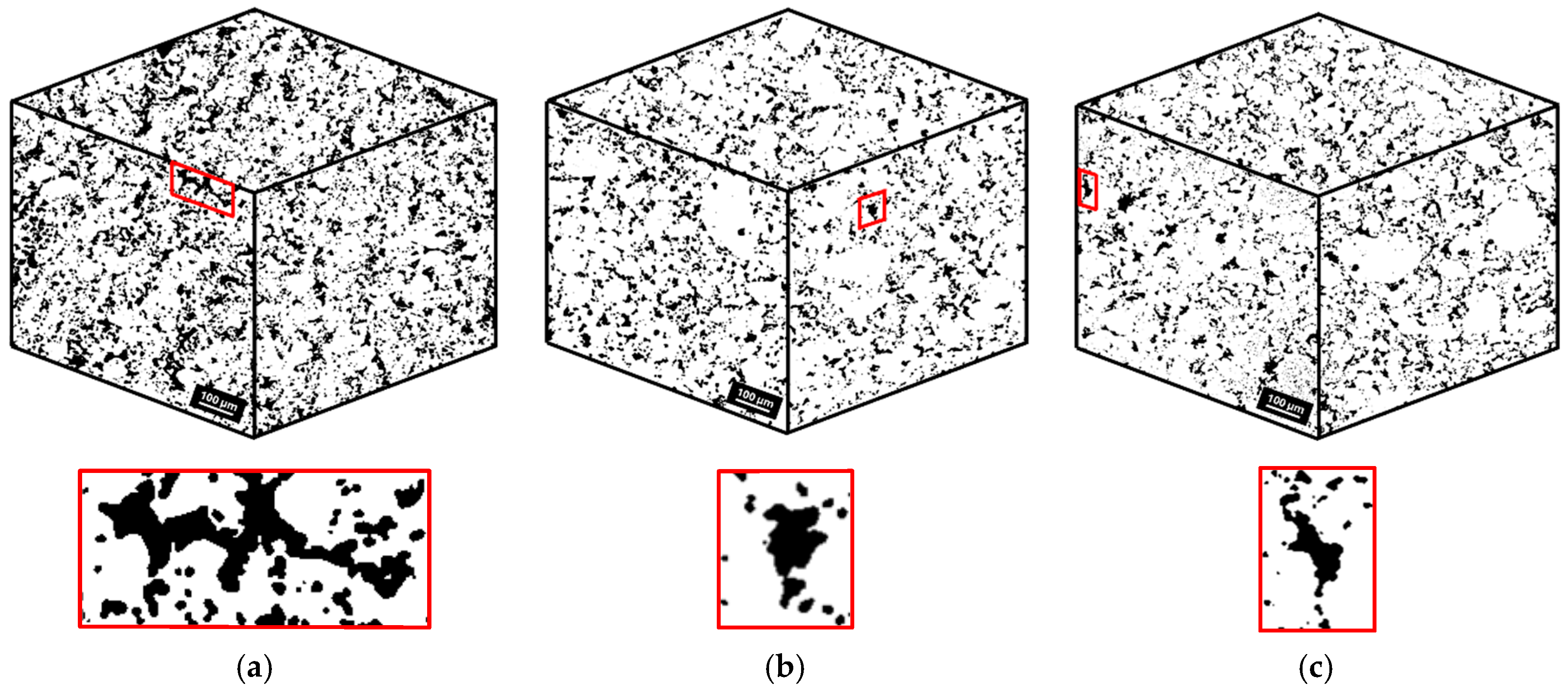
Figure 8 compares the predictions obtained from Murakami’s original model, the FD and dmax approaches, and the experimental data. This last value is also represented by a horizontal dashed reference line, allowing easy comparison with the other results and indicating the safe and unsafe fatigue regimes. The superior correlation achieved with the ellipse-fitted major axis reflects that this parameter better captures both the effective crack-front length and the stress amplification effect around elongated defects. The residual deviation observed for SH1 arises from pore clustering and coalescence phenomena (Figure 9a), which create effective defects larger than those represented by single-pore ellipses. In such cases, the superposition of local stress fields along neighbouring pores increases the effective ΔK, promoting premature crack initiation [45].
From a mechanistic perspective, the dominance of dmax can be interpreted as the consequence of a directional stress intensity amplification. Finite element studies [16,38] have shown that the maximum principal stress ahead of elongated or surface-connected pores scales with their aspect ratio (AR = dmax/dmin), confirming that pore elongation increases the effective crack-like behaviour of the defect. In this sense, the present findings experimentally support those theoretical predictions.
For materials like SH1, where pore anisotropy and clustering are significant, further accuracy might be obtained by integrating aspect ratio or connectivity parameters into the defect definition. Cluster-based or percolation-type models could thus extend the approach to extremely heterogeneous porosity networks.
The use of the elliptical descriptor therefore provides a physically grounded refinement of defect-based fatigue models. By linking measurable geometrical features of pores with their stress-intensity amplification effect, this approach enhances both the predictive accuracy and the transferability of Murakami-type formulations to materials containing irregular or anisotropic defects, such as porous PM steels or additively manufactured alloys.

6. Conclusions

This work studies the influence of porosity on the fatigue behaviour of three materials. After an extensive analysis of porosity and fatigue characterisation through rotating beam fatigue tests, the main conclusions are as follows:
  • Specimens extracted directly from real synchronizer hubs accurately replicate component fatigue behaviour, validating their representativeness for analysis.
  • Although SH1 exhibits higher hardness (356 HV30) and tensile strength (714 MPa), its greater porosity (Aα_50% = 3430 µm2) results in the lowest fatigue resistance (Sf = 232 MPa), confirming porosity as the dominant controlling factor.
  • Murakami’s √A model remains reliable only when pores are compact and equiaxed. Its accuracy deteriorates significantly with elongated or interconnected pores.
  • Defining defect size through the major axis of the ellipse enclosing the pore (a = dmax) improves fatigue limit prediction accuracy from 49% to under 6% for all materials.
  • The proposed elliptical-defect framework offers a robust, transferable method for defect-sensitive fatigue assessment in porous and additively manufactured metallic materials.
  • This refined geometrical approach enhances the reliability of fatigue design for real powder-metallurgy components, supporting defect-informed durability assessment in industrial applications.

Author Contributions

Conceptualization, S.O., G.Á. and C.R.; Methodology, S.O., G.Á., J.S., C.S. and C.R.; Software, S.O.; Validation, S.O., J.S., C.S. and C.R.; Formal analysis, S.O.; Investigation, S.O., G.Á. and C.R.; Resources, C.R.; Data curation, S.O. and G.Á.; Writing—original draft, S.O. and C.R.; Writing—review & editing, S.O., G.Á. and C.R.; Supervision, G.Á., J.S., C.S. and C.R.; Project administration, J.S. and C.R.; Funding acquisition, C.R. All authors have read and agreed to the published version of the manuscript.

Funding

S. Otero thanks the Spanish Ministry of Universities for the FPI Predoctoral Fellowship (PID2021-124768OB-C22 (PRE2022-103206)) and the Principality of Asturias for the funding received through grants AYUD-2021-57532 and the project SEK-25-GRU-GIC-24-016. Our thanks also to PMG Powertrain R&D Center S.L.U. for the use of the TESCAN VEGA XMH scanning electron microscope.

Data Availability Statement

The data presented in this study are available on request from the corresponding author.

Conflicts of Interest

Author J. Sicre and C. Soto were employed by the company PMG Powertrain R&D Center S.L.U. Pol. The remaining authors declare that the research was conducted in the absence of any commercial or financial relationships that could be construed as a potential conflict of interest.

Nomenclature

A = AiAverage area of maximum pore sizes
dmaxMaximum pore length after adjustment with ellipses
PMPowder metallurgy
LEFMLinear Elastic Fracture Mechanics
∆KthThreshold stress intensity factor range
aDefect size
MLMachine Learning
FDFeret Diameter
ARAspect Ratio
dminMinimum pore length after adjustment with ellipses
EVSExtreme Value Statistics
SH1Synchronizer hub 1
SH2Synchronizer hub 2
PP2Parallelepiped block
SfFatigue limit
Y(a/W)Geometric factor for the calculation of the threshold stress intensity factor amplitude
HVVickers hardness
βParameter used for calculating the fatigue limit when considering the average maximum pore size and the Vickers hardness of the material
F0Two-parameter Gumbel distribution
λLocation parameter of the Gumbel distribution
δScale parameter of the Gumbel distribution
V0Volume of material used in the calculation of the parameters λ and δ
VVolume of the analysed element (shaft of the rotating–bending fatigue specimen)
F(x)Distribution function of the largest pores in each volume
αProbability of failure
IDMaterial identification
RaSurface roughness
RStress ratio
EElastic modulus
νPoisson’s ratio
σysYield strength
σutTensile strength
εuStrain at failure
ρDensity of the materials
AαAverage area of maximum pore size for a certain probability
σ’fBasquin law coefficient
bBasquin law exponent
SaApplied stress
NNumber of cycles

References

  1. Lawcock, R.; Buckley-Golder, K.; Sarafinchan, D. Testing of High Endurance PM Steels for Automotive Transmission Gearing Component; SAE Technical Paper 1999-01-0293; Stackpole Ltd.: Ancaster, ON, Canada, 1999. [Google Scholar]
  2. Fang, Z.Z. (Ed.) Sintering of Advanced Materials; Elsevier: Amsterdam, The Netherlands, 2010. [Google Scholar]
  3. Danninger, H.; de Oro Calderon, R.; Gierl-Mayer, C. Powder Metallurgy and Sintered Materials. In Ullmann’s Encyclopedia of Industrial Chemistry; Wiley: Hoboken, NJ, USA, 2017; pp. 1–57. [Google Scholar] [CrossRef]
  4. Kruth, J.; Van der Schueren, B.; Bonse, J.; Morren, B. Basic Powder Metallurgical Aspects in Selective Metal Powder Sintering. CIRP Ann. 1996, 45, 183–186. [Google Scholar] [CrossRef]
  5. German, R.M. Powder Metallurgy Science, 2nd ed.; Metal Powder Industries Federation: Princeton, NJ, USA, 1994. [Google Scholar]
  6. Hadrboletz, A.; Weiss, B. Fatigue behaviour of iron based sintered material: A review. Int. Mater. Rev. 1997, 42, 1–44. [Google Scholar] [CrossRef]
  7. Sudhakar, K.V. Fatigue behavior of a high density powder metallurgy steel. Int. J. Fatigue 2000, 22, 729–734. [Google Scholar] [CrossRef]
  8. Samal, P.J.; Newkirk, J. ASM Handbook Powder Metallurgy Vol. 7; ASM International: Almere, The Netherlands, 2015. [Google Scholar]
  9. Bergmark Höganäs, A.A. Influence of maximum pore size on the fatigue performance of PM steel. Powder Metall. Prog. 2005, 5, 131. [Google Scholar]
  10. Bris, J.; Calero, J.A.; Llanes, L. Small and long fatigue cracks growth in PM steels. In Proceedings of the 2010 International Conference on Powder Metallurgy, Washington DC, USA, 10 June 2010. [Google Scholar]
  11. Danninger, H.; Leitner, G.; Gierl-Mayer, C. Studying the Progress of Sintering in Ferrous Powder Compacts by In-Situ Measuring the Thermal Conductivity. Powder Metall. Prog. 2018, 18, 80–95. [Google Scholar] [CrossRef]
  12. Polasik, S.J.; Williams, J.J.; Chawla, N. Fatigue crack initiation and propagation of binder-treated powder metallurgy steels. Met. Mater. Trans. A 2002, 33, 73–81. [Google Scholar] [CrossRef]
  13. Danninger, H.; Weiss, B.; Betzwar-Kotas, A.; Khatibi, G.; Sohar, C.; Dlapka, M.; Gierl-Mayer, C. Fatigue response and fractography of sintered materials. Powder Metall. Prog. 2015, 15, 218–233. [Google Scholar]
  14. Ternero, F.; Rosa, L.G.; Urban, P.; Montes, J.M.; Cuevas, F.G. Influence of the total porosity on the properties of sintered materials—A review. Metals 2021, 11, 730. [Google Scholar] [CrossRef]
  15. German, R.M.; Queeney, R.A. Queeney, Fatigue and Fracture Control for Powder Metallurgy Components. In Fatigue and Fracture; Volume 19, ASM Handbook, by ASM Handbook Committee; ASM International: Almere, The Netherlands, 1996; pp. 337–344. [Google Scholar] [CrossRef]
  16. Andersson, M. The influence of notches on fatigue of heat treated sintered steel. In Proceedings of the International Powder Metallurgy Congress and Exhibition, Gothenburg, Sweden, 15–18 September 2013. [Google Scholar]
  17. Taylor, D. Geometrical effects in fatigue: A unifying theoretical model. Int. J. Fatigue 1999, 21, 413–420. [Google Scholar] [CrossRef]
  18. Andersson, M.; Ab, H. The Role of Porosity in Fatigue of PM Materials. Powder Metall. Prog. 2011, 11, 21–31. [Google Scholar]
  19. ASTM E466-21; Standard Practice for Conducting Force Controlled Constant Amplitude Axial Fatigue Tests of Metallic Materials. ASM International: Almere, The Netherlands, 2021.
  20. Murakami, Y.; Beretta, S. Small Defects and Inhomogeneities in Fatigue Strength: Experiments, Models and Statistical Implications. Extremes 1999, 2, 123–147. [Google Scholar] [CrossRef]
  21. Yi, M.; Xue, M.; Cong, P.; Song, Y.; Zhang, H.; Wang, L.; Zhou, L.; Li, Y.; Guo, W. Machine learning for predicting fatigue properties of additively manufactured materials. Chin. J. Aeronaut. 2024, 37, 1–22. [Google Scholar] [CrossRef]
  22. Papia, E.-M.; Kondi, A.; Constantoudis, V. Machine learning applications in SEM-based pore analysis: A review. Microporous Mesoporous Mater. 2025, 394, 113675. [Google Scholar] [CrossRef]
  23. Khan, I.; Khanal, A. Machine Learning Assisted Prediction of Porosity and Related Properties Using Digital Rock Images. ACS Omega 2024, 9, 30205–30223. [Google Scholar] [CrossRef] [PubMed]
  24. Tomić, Z.; Jarak, T.; Lesičar, T.; Gubeljak, N.; Tonković, Z. Modelling of Fatigue Microfracture in Porous Sintered Steel Using a Phase-Field Method. Materials 2023, 16, 4174. [Google Scholar] [CrossRef] [PubMed]
  25. Castro, L.; Navidtehrani, Y.; Betegón, C.; Martínez-Pañeda, E. Coupled thermo-chemo-mechanical phase field-based modelling of hydrogen-assisted cracking in girth welds. Int. J. Mech. Sci. 2026, 311, 111172. [Google Scholar] [CrossRef]
  26. Tang, W.; Wang, L.; Sun, S.; Zhou, L.; Yi, M. Macroscopically modeling fatigue life of additively manufactured metals: Pore-defect informed phase-field model. J. Mech. Phys. Solids 2025, 196, 106008. [Google Scholar] [CrossRef]
  27. Nicodemi, M. Extreme Value Statistics. In Encyclopedia of Complexity and Systems Science; Meyers, R., Ed.; Springer: New York, NY, USA, 2009. [Google Scholar] [CrossRef]
  28. de Haan, L. Extreme Value Statistics. In Extreme Value Theory and Applications; Galambos, J., Lechner, J., Simiu, E., Eds.; Springer: Boston, MA, USA, 1994. [Google Scholar] [CrossRef]
  29. Murakami, Y. Metal Fatigue: Effects of Small Defects and Nonmetallic Inclusions; Academic Press: Cambridge, MA, USA, 2019. [Google Scholar]
  30. Gumbel, E.J. Statistics of Extremes, New York Chichester; Columbia University Press: West Sussex, UK, 1958. [Google Scholar] [CrossRef]
  31. ISO 2738:2000; Sintered Metal Materials, Excluding Hardmetals. Permeable Sintered Metal Materials. Determination of Density, oil Content and Open Porosity. ISO: Geneva, Switzerland, 2000.
  32. UNE-EN ISO 6892-1; Metallic Materials—Tensile Testing—Part 1: Method of Test at Room Temperature (ISO 6892-1:2019) 2020. State Administration for Market Regulation. Standardization Administration of the People’s Republic of China: Beijing, China, 2020.
  33. ISO 3928:2016; Sintered Metal Materials, Excluding Hardmetals-Fatigue Test Pieces. ISO: Geneva, Switzerland, 2016.
  34. ISO 1143:2021; Rotating Bar Bending Fatigue Testing. ISO International: Geneva, Switzerland, 2010.
  35. Zahavi, E. Fatigue Design: Life Expectancy of Machine Parts, 1st ed.; CRC Press: Boca Raton, FL, USA, 1996. [Google Scholar] [CrossRef]
  36. Atkinson, R.J. Designing Against Fatigue.R. B. Heywood. Chapman & Hall, London. 1962. 436 pp. Illustrated.84S. J. R. Aeronaut. Soc. 1963, 67, 195-195. [Google Scholar] [CrossRef]
  37. Otero, S.; Álvarez, G.; Llera, M.; Rodríguez, C. Fatigue characterisation of structural steel by means of the small punch test: Development of a methodology. Theor. Appl. Fract. Mech. 2025, 135, 104772. [Google Scholar] [CrossRef]
  38. Tan, Z.; Liu, Y.; Huang, X.; Li, S. Fatigue Behavior of Alloy Steels Sintered from Pre-Alloyed and Diffusion-Bonding Alloyed Powders. Metals 2022, 12, 659. [Google Scholar] [CrossRef]
  39. Engström, U.; Ab, H.; Lipp, S.K. Influence of Notches on Fatigue Strength of High Performance PM Materials. In Proceedings of the International Conference on Powder Metallurgy & Particulate Materials (PM2TEC), New Orleans, LA, USA, 13–17 May 2001. [Google Scholar]
  40. Dudrová, E.; Kabátová, M. Fractography of sintered steels. Proc. PM World Congr. 2004, 3, 27–32. [Google Scholar]
  41. Andersson, M.; Larsson, M.; Ab, H. Linking pore size and structure to the fatigue performance of sintered steels. In Proceedings of the PM2010 World Congress, Florence, Italy, 13 October 2010. [Google Scholar]
  42. Peng, D.; Champagne, V.K.; Ang, A.S.M.; Birt, A.; Michelson, A.; Pinches, S.; Jones, R. Computing the Durability of WAAM 18Ni-250 Maraging Steel Specimens with Surface Breaking Porosity. Crystals 2023, 13, 443. [Google Scholar] [CrossRef]
  43. ASTM E647; Standard Test Method for Measurement of Fatigue Crack Growth Rates. ASTM International: West Conshohocken, PA, USA, 1978.
  44. BS 7910:2019; Guide to Methods for Assessing the Acceptability of Flaws in Metallic Structures. British Standards Institution: London, UK, 2019.
  45. Murakami, Y.; Endo, M. Effects of hardness and crack geometry on delta Kth of small cracks. J. Soc. Mater. Sci. JPN 1986, 35, 911–917. [Google Scholar] [CrossRef]
Figure 1. Experimental methodology: (a) specimen extraction zone, (b) porosity analysis and (c) rotating–bending fatigue testing machine.
Metals 16 00100 g001
Figure 2. Microstructure of synchronizer hubs: (a) SH1, (b) SH2 and (c) PP2.
Metals 16 00100 g002
Figure 3. Gumbel distribution: (a) SH1, (b) SH2 and (c) PP2.
Metals 16 00100 g003
Figure 4. Sa-N curves of synchronizer hubs: (a) SH1, (b) SH2 and (c) PP2.
Metals 16 00100 g004
Figure 5. Fracture surface of specimen 11 from SH2: general view and details of the fatigue and final ductile zones.
Metals 16 00100 g005
Figure 6. Comparison the results of SH1, SH2 and PP2: (a) Sa-N curves and (b) Gumbel distribution.
Metals 16 00100 g006
Figure 7. Comparison the results of SH1, SH2 and PP2: HV − Sf and ρ − Sf.
Metals 16 00100 g007
Figure 8. Fatigue limit values obtained using Murakami’s theory, the ellipse approximation, and the Feret diameter approach for α = 0.5, compared with the experimental results.
Metals 16 00100 g008
Figure 9. Porosity comparison: (a) pore interaction in SH1, (b) porosity of SH2, (c) porosity of PP2.
Metals 16 00100 g009
Table 1. Chemical composition (in wt%) of the starting powder.
IDCrMoCCuNiFe
SH13.00.50.4--Bal.
SH2, PP2-0.50.61.54.0Bal.
Table 2. Tensile properties, hardness and density values of SH1, SH2 and PP2.
IDE (MPa)νσys (MPa)σut (MPa)εu (%)HV30ρ
(g/cm3)
SH1130,500 0.267147140.65356 ± 136.6205
SH2125,0000.265486220.87268 ± 146.8126
PP2140,0000.275957951.5307 ± 197.0885
Table 3. Parameters δ, λ, Aα_50% and Δ K t h α _ 50 % for SH1, SH2 and PP2.
IDδ
(µm2)
λ
(µm2)
Aα_50% (µm2) Δ K t h α _ 50 % (MPa √m)
SH123145034306.10
SH215452422814.65
PP219233528435.30
Table 4. FDα_50%, dmax α_50%x, dmin α_50% and ARα_50% for SH1, SH2 and PP2.
IDFDα_50% (µm)dmax α_50% (µm)dmin α_50%
(µm)
ARα_50%
SH10.23090.16770.013012.88
SH2 0.15870.11890.01229.74
PP2 0.18080.13310.01369.79
Table 5. Basquin’s coefficients and fatigue limits.
ID σ f (MPa)b S f (MPa)
SH1843−0.094232 ± 2
SH2770−0.086270 ± 4
PP2829−0.083291 ± 4
Table 6. Fatigue limits estimated according to Murakami’s theory compared to experimental values.
ID S f α = 50 % (MPa) e r r o r α = 50 % (%)
SH1 (a = A ) 345.41+48.9
SH2 (a = A ) 291.29+7.9
PP2 (a = A ) 314.74+8.2
Table 7. Fatigue limits estimated for a = FD and a = dmax compared to experimental values.
ID S f α = 50 % (MPa) e r r o r α = 50 % (%) S f α = 50 % (MPa) e r r o r α = 50 % (%)
(a = FD)(a = dmax)
SH1 209.73−9.6246.05+6.06
SH2233.78−14.05270.06−0.02
PP2250.06−14.07291.17−0.16
Disclaimer/Publisher’s Note: The statements, opinions and data contained in all publications are solely those of the individual author(s) and contributor(s) and not of MDPI and/or the editor(s). MDPI and/or the editor(s) disclaim responsibility for any injury to people or property resulting from any ideas, methods, instructions or products referred to in the content.