Article

Additive Manufacturing of Layered Nb-Al2O3 Composite Granules Based on Paste Extrusion

Institute of Ceramics, Refractories and Composite Materials, TU Bergakademie Freiberg, Agricolastr. 17, 09599 Freiberg, Germany
*
Author to whom correspondence should be addressed.
Metals 2026, 16(1), 101; https://doi.org/10.3390/met16010101
Submission received: 10 November 2025 / Revised: 8 January 2026 / Accepted: 13 January 2026 / Published: 16 January 2026

Abstract

How would it be possible to functionalize ceramic aggregates for use in refractories? In this work, we demonstrate how paste extrusion can be used to fabricate layered and porous Nb-Al2O3-based composite refractories for adjusting thermal and electrical conductivity. Additive manufacturing is used to generate a specific sequence of alumina and composite layers. After drying, the samples were sintered at 1600 °C, crushed, and sieved into particle sizes up to 3150 µm. The rheology of the paste revealed the intended shear-thinning behavior with microcrack formation between the yield and flow strain. The sintered material showed promising thermal-shock characteristics reaching plateau values after the third cycle without signs of further structural damage up to the fifth thermal shock. The layered microstructure was retained after crushing the composites, establishing functionalization of the refractory granules for all particle sizes.

1. Introduction

The 3D-printing of ceramics has become increasingly popular in recent years [1]. Among different technologies, paste extrusion with computer-aided deposition, which is known as direct ink writing (DIW) or robocasting, is the cheapest and most scalable one. Suspensions for DIW are mostly water-based [2,3,4], with polymeric binders such as PVP [5], guar gum [6], methyl-cellulose [7], PVA [8], among others, and they are usually developed to obtain sintered parts with very low values of porosity (>98% theoretical density). To achieve this, the particle sizes are in the range of 0.3 µm [5,7,9] up to maximal 30 µm [8]. These fine-grained suspensions are usually printed using nozzle diameters up to 1 mm.
A second field of interest is the synthesis of porous ceramic materials based on fine-grained solid fractions. Porous alumina were produced by DIW or robo-casting using polymeric hollow microspheres [10], cellulose [11], oil [12] or even paper fibers, wooden sawpowder and lignite [13] as pore formers during debinding and sintering.
The pastes for 3D-printing should behave as yield-pseudoplastic, which means that they are shear thinning after applying a certain yield stress [5,14]. This makes it possible for the material to retain its shape after deposition (shape fidelity) in combination with a small elastic storage modulus. Therefore, the rheological parameters of the paste are the most crucial influencing factor of the printing itself. However, the final properties of the ceramic part also depends on the post-processing after printing, such as drying, debinding and sintering. Of course, these post-processing steps are always important in ceramic manufacturing, and the material’s properties are also influenced by the selection of the raw materials (particle size distribution and chemistry), additives, mixing, etc.
For paste extrusion, additional important influences are as follows. Increasing particle sizes of the ceramic powder leads to a higher pressure necessary for extrusion [15] (higher viscosity) due to the increase in inner friction. It is stated that high-viscosity inks are not suitable for dense ceramics as they generate inter-filament voids, which reduce density [4]. In addition, the printing parameters and the infill pattern influence the mechanical properties of the printed ceramic parts as well [16].
Coarse-grained refractory composites [17] are a promising class of ceramic–metal composites for high-temperature applications, e.g., electrical heaters for steel metallurgy due to their electrical conductivity and their inherent refractoriness. Highly porous, extrusion-based Nb-Al2O3 materials showed strain rates above 25% at temperatures of 1300 °C and 1500 °C [18], which was also achieved for casted composites depending on the choice of the alumina raw material [19]. The ability of large components to withstand strain without fracture is beneficial for applications where thermal-shock resistance is important.
The prospective aim of our work is to build large, functionalized refractory components where functional parts (e.g., electrical heaters) are based on (Nb, Ta)-Al2O3 composite materials  [20], which are thermal-shock-resistant, creep-resistant and show limited shrinkage on sintering. Fine-grained electrical heaters were directly printed, as reported in the literature, on the basis of MoSi2 [21,22] and barium titanite [23]. However, such approach limits the possible component size due to shrinkage-related crack formation on sintering. The demanded properties can be achieved using castable technology by spanning a range of particle sizes from microns up to several milimeters—a standard method in the refractory world. Pre-sintered alumina-niobium aggregates were previously synthesized using a casting, sintering and crushing approach [24,25]. It was found that the homogeneous phase distribution of the casted bar was partially lost during crushing as it seems that crack formation was not evenly distributed among the different interfaces of the phases of the composite material. The consequence is, for example, an enrichment of α-Al2O3 in the finest sieve fraction (up to 45 µm) in comparison to the larger ones.
In this study, we to synthesize porous aggregates with functional properties (thermal and electrical conductivity) that have the ability to withstand large strain rates under mechanical load at high temperatures. These aggregates should be used later for castings of coarse-grained electrodes or electrical heaters. Multimaterial printing is used here to create a layered material where one layer is pure alumina and the succeeding one, the Nb-Al2O3 composite, which is repeated several times. Aggregates are formed after sintering by crushing and are sieved to particle sizes < 3150 µ m . The resulting porosity of these materials is responsible for their light weight and, in addition to the layered structure, for the overall reduced metal content in comparison to casted or pressed composites.
We report here a method to produce such aggregates based on multimaterial paste extrusion with raw material particle sizes up to 150 µm. The results on granule fabrication are compared with our previous ones, as an open question is if the phase separation during crushing can be found or is pronounced also in highly porous materials. As the metal content of the finest powder fractions mainly determines the functional properties of a casted matrix produced thereof, we aim to have a homogeneous chemical composition in all aggregate classes from micron to millimeter sizes. Another question is the thermal-shock performance of such material. A defined distribution of microcracks helps to survive thermal-shocks, but a large porosity decreases the strength of the material. In [20] we found that niobium and tantalum show a strong diffusion along the surface of alumina grains during sintering at 1600 °C, which was not expected for the bulk diffusion of these metals. These effects help to lower the metal content that is needed for electrical conductivity, but it seems to be present only in dense (pressed) materials [26]. However, if such surface diffusion is hindered in porous materials, it can be used to fabricate stable (at application temperature) electrical conductors via paste extrusion, which is finally the main objective of our work.
To our knowledge, the idea of adjusting thermo-physical properties of refractory aggregates using 3D-printing was not reported before. Paste extrusion is used here to fabricate a porous material that is believed to resist large strain at high temperature without fracture. The macroscopic layered microstructure of alternating alumina and the alumina-niobium composite demonstrates the principal possibility to adjust thermal and electrical conductivity and, at the same time, minimizing the amount of metal in the volume in comparison to homogeneous materials.

2. Materials and Methods

The material development of this work can be divided into the following steps.
1.
Powder mixing and resting
2.
Three-dimensional printing
3.
Drying and sintering
4.
Crushing and sieving
Prior to 3D printing, the rheology of the mixed material was studied in detail to understand and to develop the extrusion process. Mechanical properties and microstructure investigations were performed on the as-sintered and crushed material to describe the general material’s properties. The influence of crushing on the chemical homogeneity and the particle morphology was determined to evaluate possible obstacles in future raw material production.
It should be pointed out that the developed and printable paste (alumina and the composite material) can itself be seen as a major result on the way to produce layered refractory aggregates. The presented characterizations reflect the importance of these findings and the results section is, therefore, focused on the material after mixing, after sintering and after the final crushing and sieving step.

2.1. Rheological Characterisation

Flow curves of a viscous material can be described using the Herschel–Bulkley model [27], which is given by
τ = k · ( γ ˙ ) n
with the shear stress τ , the consistency index k, the applied shear rate γ ˙ and the flow index n. Shear-thinning is reached when 0 < n < 1 is fulfilled [5]. The apparent viscosity η can be described by
η = k · ( γ ˙ ) n 1 ,
which can be used to obtain k and n from fitting at intermediate shear rates where the paste is in steady state without the occurrence of slippage [28].
Printability can be quantified by the yield figure of merit [29] with
Φ y = G eq τ y ,
where G eq is the storage modulus at rest and τ y the yield stress.
Chan et al. (2020) [12] hypothesize that the product of storage modulus G and the yield stress must exceed a critical value to avoid slumping. This relationship was expressed as
G = C 1 τ y ,
with the constant C 1 5 × 10 6 Pa 2 . They propose a second criterion based on the recovery of G with time as
G recovered = C 2 G · τ y ,
with C 2 6 × 10 6 Pa 3 [12]. Besides printability, the shape fidelity after printing is equally important [30]. For paste extrusion, gravitational slumping is the main factor influencing a printed part [9,31]. Following the considerations in [31], the weight-induced stress on the printed material should not exceed the yield stress to retain a printed shape. Therefore, a maximal printable height h max of a given paste is estimated here by
h max = τ y ϱ · g ,
where ϱ is the density and g the gravitational constant.

2.2. Materials

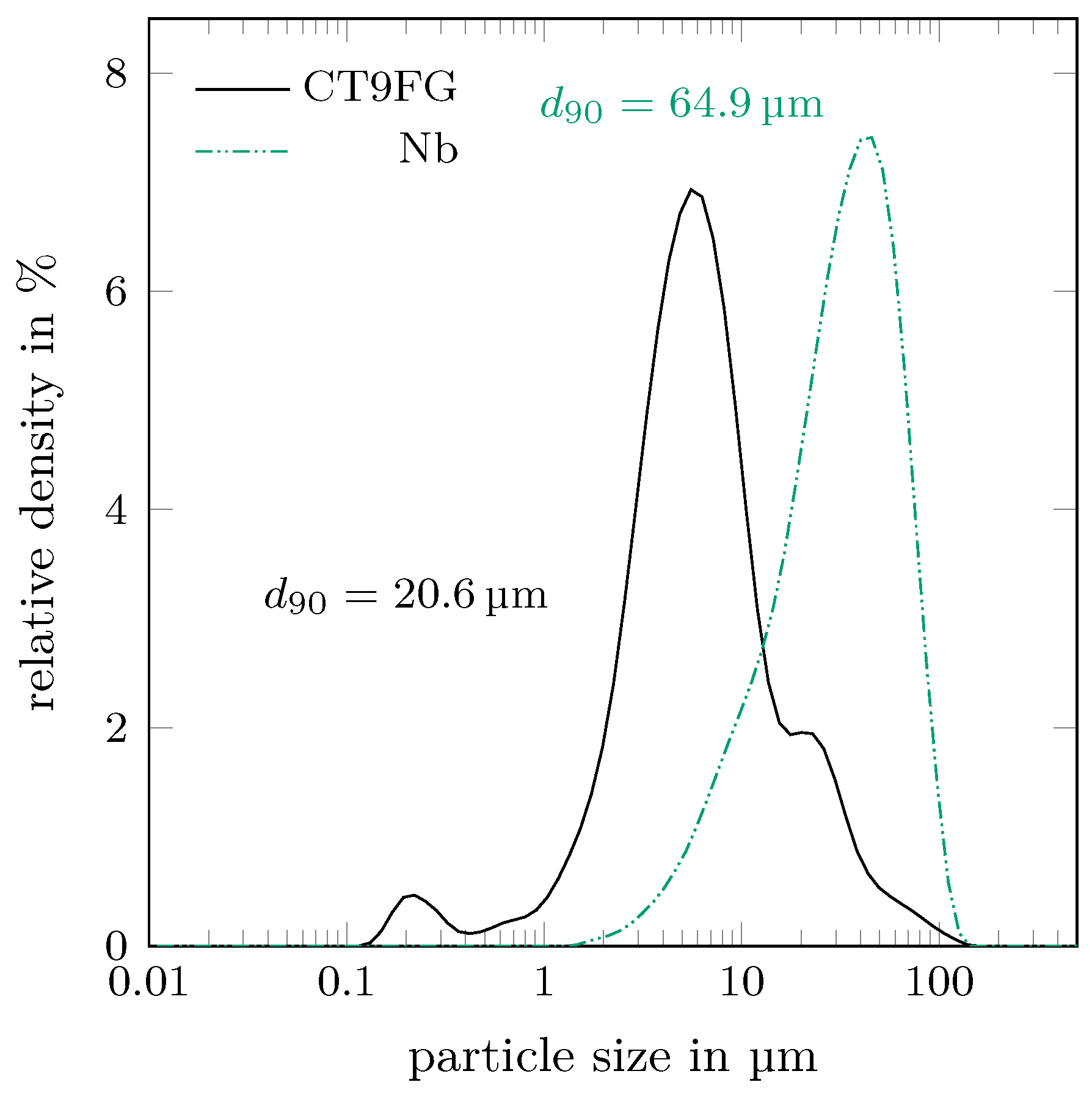
The sample mixtures consisted of the industrial grade alumina powder CT9FG (Almatis, Frankfurt am Main, Germany) and niobium (EWG—E. Wagener GmbH, Heimsheim, Germany) both with irregularly shaped particle morphologies. The alumina powder has characteristic particle sizes of d 10 = 2.0 µ m , d 50 = 5.5 µ m and d 90 = 20.6 µ m ; a chemical purity of 99.5 wt.% and a density of 3.94 g/cm3, whereas the niobium material is characterized by d 10 = 9.1 µ m , d 50 = 30.8 µ m and d 90 = 64.9 µ m ; a chemical purity of 99.95 wt.% and a density of 8.46 g/cm3. A comparison of their particle size distributions is shown in Figure 1.
The organics cellulose (KP3039, Zschimmer & Schwarz GmbH & Co., KG, Lahnstein, Germany), Xanthan (Carl Roth GmbH + Co., KG, Karlsruhe, Germany) and oelic acid (Sigma-Aldrich Chemie GmbH, Taufkirchen, Germany) were used as binder, dwelling agent and as lubricant, respectively. The organic content for 1000 g alumina, which is a volume of 253.81 cm3, was 10 g KP3039, 4 g Xanthan and 2 g oelic acid. For the alumina-niobium composite, 30 vol.% of the ceramic powder content was exchanged by niobium resulting in a mixture of 700 g CT9FG and 644.2 g niobium powder with the same organic content as the alumina mixture. The amount of water was 228.8 g for the alumina mixture and 215 g for the alumina-niobium composite one.

2.3. Sample Preparation

The respective powders of alumina and the alumina-niobium composite where mixed with water using a concrete laboratory mixer (ToniMAX, Toni Baustoffprüfsysteme GmbH, Berlin, Germany) for approximately 7 min. The obtained masses where than sealed in a plastic bag and rested for 48 h to have constant rheological behavior during 3D-printing (see Section 3.1 for details).
A modified clay printer (StoneFlower 3.1, www.stoneflower3d.com) with two nozzles ( d = 2.5 mm ) was used for printing the samples. The formal sample shape was a bar with the dimensions of 150 mm × 25 mm × 25 mm . The CAD model was sliced with the UltiMaker Cura software (version 4.7.1, www.ultimaker.com) with a line width of 2.5 mm, a layer height of 1 mm and an extrusion rate of 30 mm/s. The composite bars were printed with alternating layers of pure alumina and the composite mixture, starting and ending with alumina as the base and top layer.
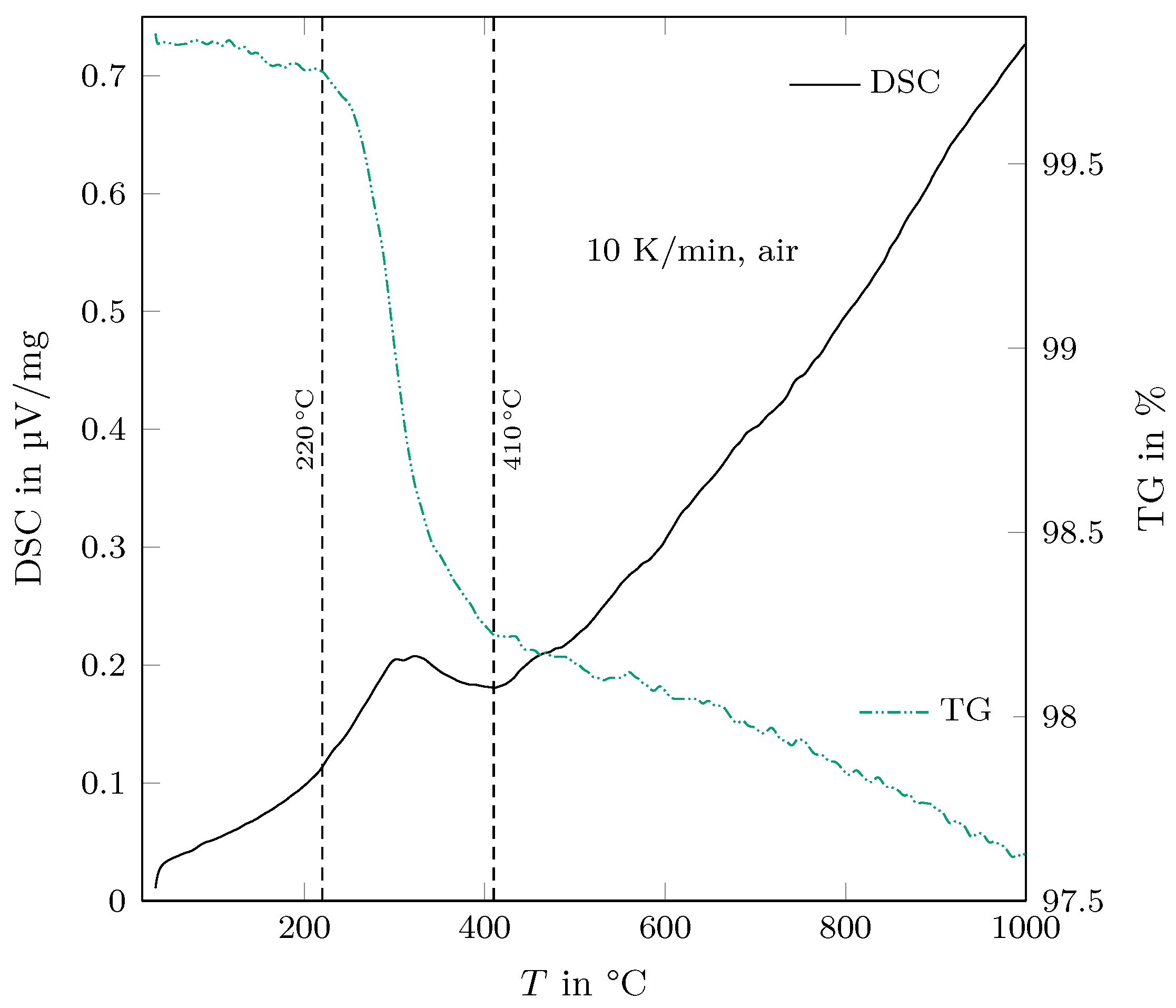
The as-printed material was than dried in a two-step program: 24 h at a temperature of 60 °C and for 24 h at 110 °C with a heating rate of 1 K/min in between. After drying, the samples were debinded under flowing air (10 L/min at 300 °C, which was determined as the debinding temperature from the DSC-TG measurement (see Figure 2) and which is below the oxidation temperature of niobium (around 460 °C [20]), for 24 h, followed by a sintering under flowing Ar atmosphere (10 L/min) at a temperature of 1600 °C for 2 h with a heating rate of 5 K/min using a graphite tools-based furnace (Debinding and sinter furnace XGraphit, XERION BERLIN LABORATORIES GmbH, Berlin, Germany).
The sintered composites were crushed using a jaw crusher (BB50, Retsch GmbH, Haan, Germany) with jaws made from Co/WC hard metal. For this the jaw gap was varied from 5 mm to 3, 2 and 1 mm. After each crushing step, the received material was sieved into the aggregate classes of 0–45 µm, 45–500 µm, 500–1000 µm and 1000–3150 µm. The latter class was further sieved into the sub-classes 1000–2000 µm, 2000–2240 µm, 2240–2360 µm, 2360–2500 µm, 2500–2800 µm and 2800–3150 µm following our previously described procedure [25].

2.4. Sample Characterization

2.4.1. Rheology of the Alumina Paste

The rheologcial behavior of the alumina paste was studied using the rheometer Haake Mars 60 (Thermo Scientific, Karlsruhe, Germany). As we needed to analyze a paste with a rather large viscosity, the usual measurement approach would be a cone/plate setup of the rheometer. With a maximum particle size of 150 µm, the minimal gap distance would be 1.5 mm, which was almost the limit of our device. We did some test measurements using cone/plate with a gap of 1.6 mm, but we were not able to achieve satisfying results. Therefore, all rheological measurements of this work were done using a cup/cylinder setup instead with a sample volume of 1 cm3.

2.4.2. Characterization of the Sintered Material

For the alumina-based bars, the following properties were determined. Envelope density and open porosity by the water-based Archimedes principle according to DIN EN 993-1:2019-03 [32]. The elastic constants were determined using the ultrasonic procedure (UKS-D device, GEOTRON-ELEKTRONIK, Pirna, Germany) according to DIN EN 843-2:2007-03 [33].
In addition, thermal shock experiments were conducted in the following way on a batch of 10 samples each. One batch was heated always within the furnace from room temperature up to T = 950 ° C , equilibrated for at least 15 min and were than cooled with compressed air for a time period of 2 min (refered here to as only cooling thermal shock, cTS). The second batch was placed into the hot furnace at a temperature of 950 °C and were equilibrated and cooled as the first batch (referred here to as heating + cooling thermal shock, hcTS). The second procedure is the usual standard method for the characterization of refractories according to DIN-EN-993-11:2008-03 [34] variant B.
After each cooling cycle, the elastic constants were determined to evaluate the influence of thermal shock on the mechanical properties of the material. For the as-sintered material and after five thermal shocks, the flexural strength (CMOR—cold modulus of rupture) was measured on the basis of DIN EN 993-6:2019-03 [35] using an universal testing machine TIRAtest 28100 (TIRA GmbH, Schalkau, Germany). In order to achieve a uniform distribution of bending moment, four point bending setup with a support span of 125 mm, a load span of 62.5 mm, a pre-load of 20 N and a loading-rate of 150 N/s was applied.

2.4.3. Particle Characterization

The particle size distribution of the synthesized aggregate classes 0–45 µm, 45–500 µm and 500–1000 µm were determined using laser granulometry (Bettersizer S3 plus, 3P Instruments GmbH & Co. KG, Odelzhausen, Germany) and for the aggregate class 1000–3150 µm, it was determined by sieve analysis.
Particle morphology characterization is based on obtaining the contours from a minimum of 80 particles from photographs using a laser-scanning microscope (VK-X 1000, Keyence GmbH, Neu-Isenburg, Germany). These were then described using the following equation applied in polar coordinates (radius r and angle φ ).
r φ = r 0 · 1 + h p · cos φ · n p + o · cos 2 φ ,
with the base radius r 0 , the height h p of the first order peaks as fraction of r 0 , the number of peaks n p and the ovality o as fraction of r 0 . Details of the used model can be found in [36]. The mathematical descriptions allows one to use the fitting parameters r 0 , h p and o for statistically analyzing the morphology of the obtained particles as we demonstrated previously [25].

3. Results

3.1. Rheology

In order to evaluate the rheological behavior of the extrusion mass under shear stress, the shear rate during printing with our 3D-printer must be estimated. Under constant fluidity, the shear rate γ ˙ at the nozzle with radius r during extrusion can be estimated according to [37] by
γ ˙ = 4 · E φ π · r 3 ,
where E ϕ is the efflux due to fluidity. To obtain a measure for E ϕ , the extruded mass of the material was determined by priming several extrusion lengths E (in mm) with the 3D-printer using the G-code
G1 E20 F1800
with the feeding rate F of 1800 mm / min = 30 mm / s . The extrusion lengths of 20 mm, 30 mm, 40 mm, 100 mm and 200 mm were studied with 20, 15, 10, 5 and 5 times extrusion, respectively. In total, 5 to 10 such runs were performed to calculate the mean mass of extruded material for one G-code command. In addition, the time of extrusion was measured for each extrusion run to calculate experimentally the extrusion rate.
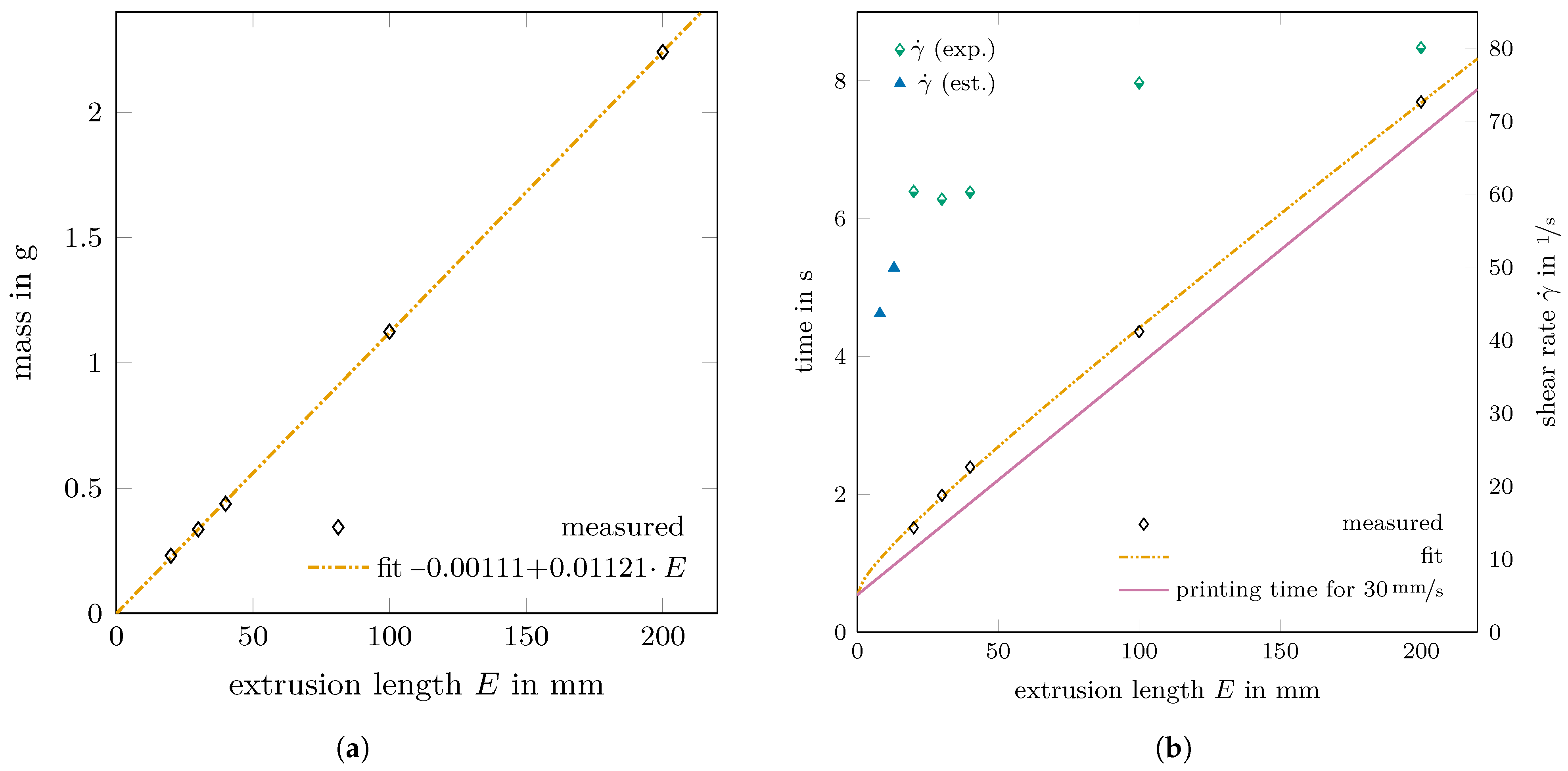
Figure 3a shows the dependency of the extruded masses ( m e ) from the given value of extrusion length. An almost perfect linear relation was found ( m e = 0.00111 + 0.01121 · E ), which means that the fluidity of our material is constant over the applied extrusion times for E values up to 200 mm. However, the determined extrusion times were not following such linearity. Instead, the relation
t ( E ) = 0.54 + 0.0284 · E + 0.103 · E
was found (see Figure 3b). After execution of the printing programm, it took 0.54 s before the printer actually started the extrusion. Therefore, this time span must be substracted from the determined extrusion times. It addition, it must be mentioned that the modification of the extrusion rate related to the observed square-root behavior is performed by the software of the printer itself and must be considered by calculating the efflux values of the extrusion process. The latter was estimated from the determined mass of the extruded material considering a solid content of 52.7 vol.% and a binder/water content of 47.3 vol.%, which gives an estimated density of ϱ = 2.549 g / cm 3 . The efflux was than calculated by
E φ = m e ϱ t e ,
with the time of extrusion t e . The experimentally determined and calculated extrusion parameters are listed in Table 1. A maximum shear rate of approximately 80/s was obtained for E = 200 mm . After slicing of the CAD model, the extrusion lengths were in the range 8–13 mm, which resulted in an estimated shear rate between 43.65/s to 49.91/s. This means that the rheological behavior of our extrusion mass must be optimized for such range of shear rates to fulfill the requirements for 3D printing as highlighted in the introduction.
To obtain a constant printing quality, the rheological behavior of the paste should not change dramatically within the time of printing. A more technical criterion is the change of the rheology with resting time, as it opens (or closes) possible preparation and handling times for application. Resting times of 1, 2 and 3 days were studied.
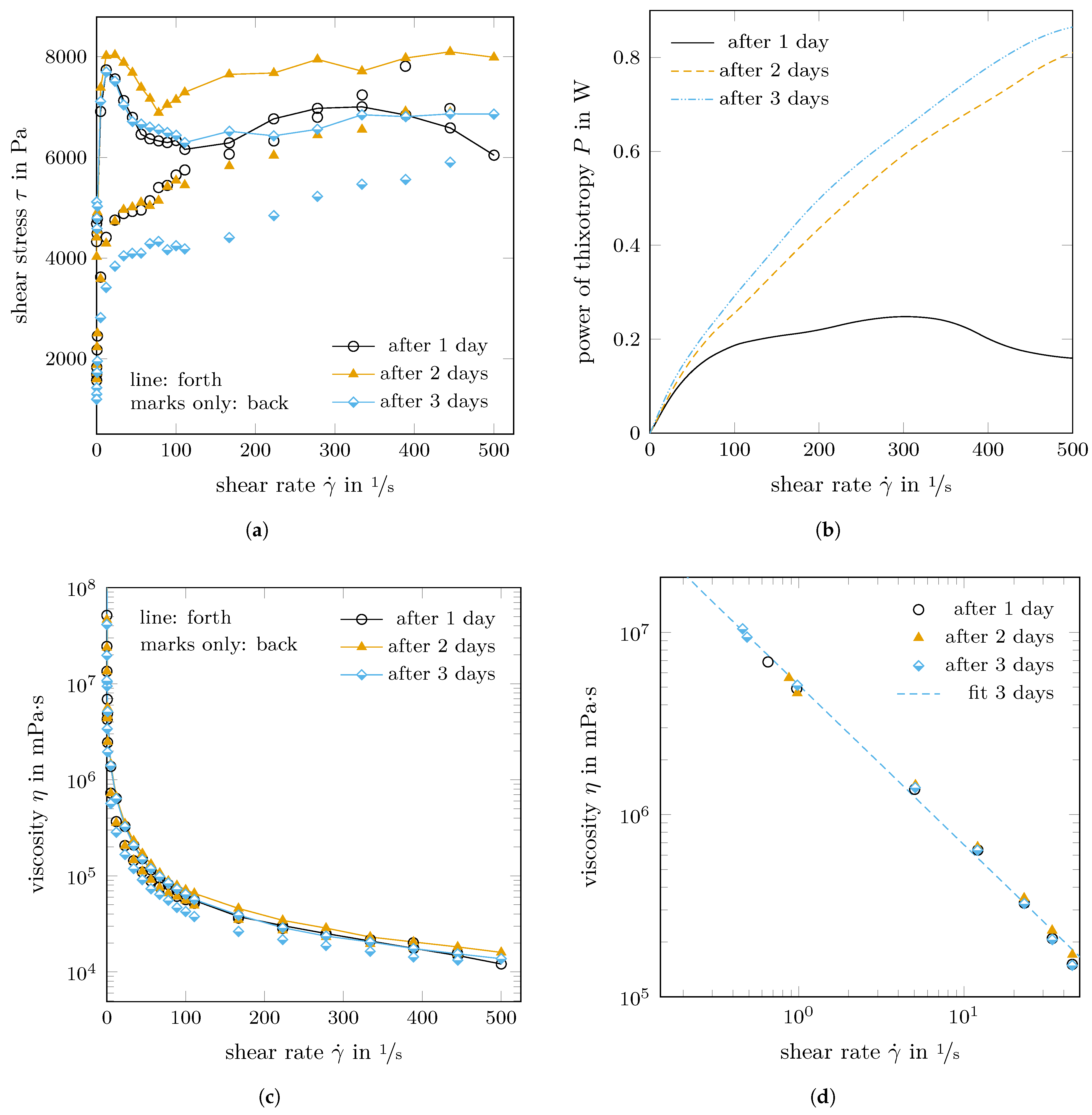
A general rheological characterization was performed via deformation-controlled flow ramp measurements by applying a stepwise increasing shear rate up to 500/s (within 120 s) and reducing the shear rate to zero in the same manner as the increase without applying a resting time at the maximum shear rate. The obtained shear stress curves for the forth and back run can be seen in Figure 4a. These data were used to calculate the power of thixotropy P [38] (pp. 404–406), which is a measure of energy consumption to break and restore the inner structure of the paste upon shear thinning. It was calculated numerically using Python (version 3.12.11, www.python.org) in combination with NumPy’s (version 2.3.1, https://numpy.org) quad-function by
P = V · 0 γ ˙ max τ forth τ back d γ ˙ ,
where V is the sample volume, which was 1 cm3 in our case. The respective trends of P for the alumina paste after resting are shown in Figure 4b. The distinct difference of the trend after 1 day resting in comparison to the ones after 2 and 3 days can be clearly seen. At higher shear rates, the power of thixotropy of the paste after 1 day resting is much below the continuously increasing two other ones. In addition, the power of thixotropy even decreases at shear rates above 300/s. Although the trends after 2 and 3 days of resting are very similar, it needs more energy to break the internal structure of the paste after 3 days of resting. The analysis of the power of thixotropy reveals that the inner structure of the paste evolves still 3 days after it has been mixed.
Shear thinning behavior of the paste is reflected by the trend of viscosity, as shown in Figure 4c. Shear rates up to γ ˙ = 50 / s were used to evaluate the viscosity parameter k and the shear-thinning coefficient n according to Equation (2) (see Figure 4d and Table 2). The shear-thinning coefficient were with n = 0.18 and n = 0.20 very similar to each other for resting times of 1 and 2 days, respectively. n dropped to 0.12 after 3 days resting, showing an even more pronounced shear-thinning effect, which is given for 0 < n < 1 .
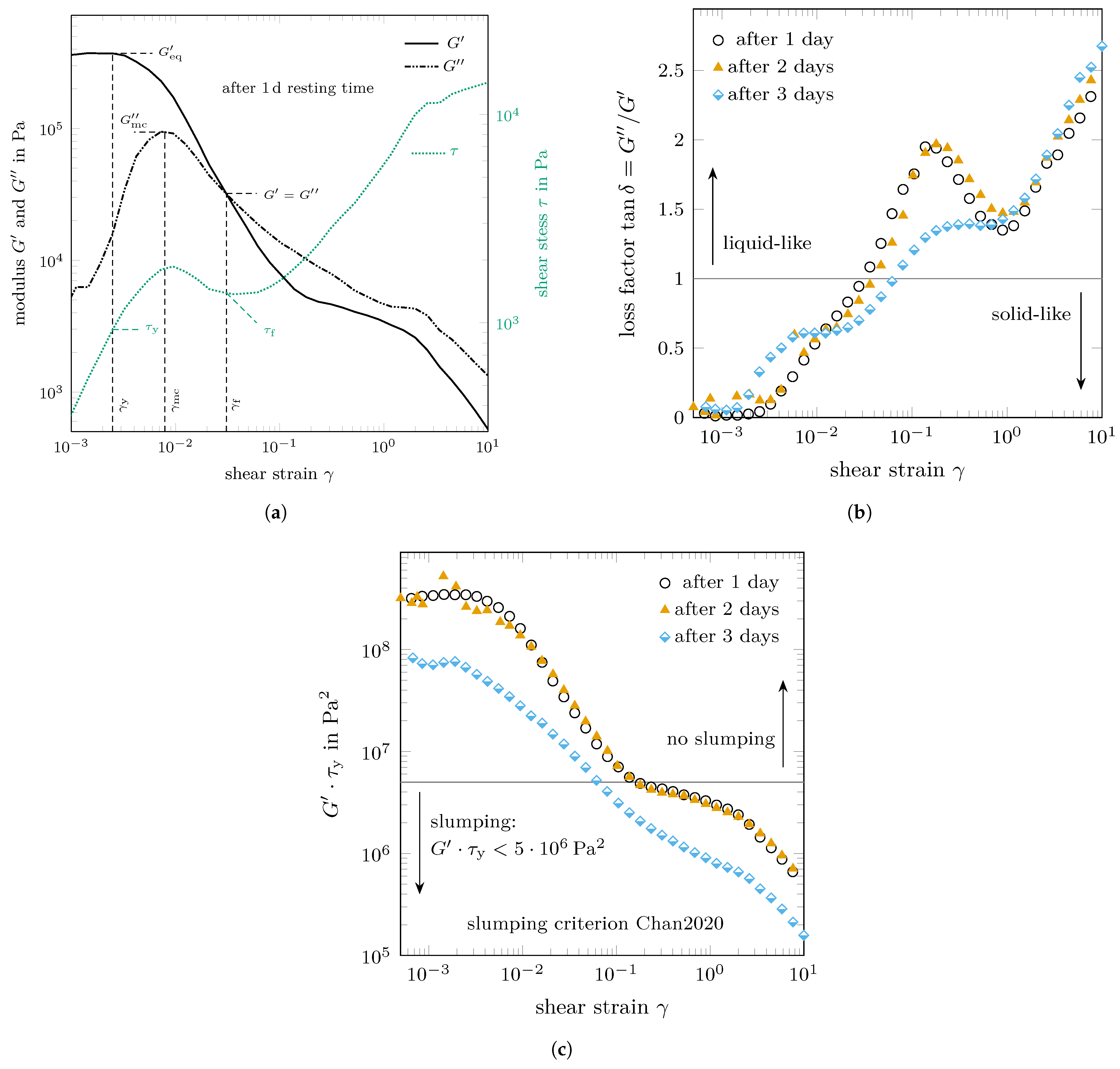
Figure 5 presents the results of the amplitude sweep test (with f = 1 Hz ). In Figure 5a all characteristic parameters that were used for analyses (see Table 2 for details) are marked on the sample after 1 day resting. For all three samples a maximum in the loss modulus was observed in the range between the yield strain γ y and the flow strain γ f , which is typically related to microcrack formation. Its value is marked here as G mc at the maximum microcrack formation strain γ mc . Comparing these values for the three resting times, it was found that G mc decreases after each day of resting (approximately by 1/3 in total), but γ mc is more or less constant after the first two resting days and drops than from 0.0077 to 0.004 after the third day. Interestingly, the loss factor
tan δ = G G
reflects another common behavior for the pastes rested up to two days in comparison to the other one as it is shown in Figure 5b. The loss factor is constantly increasing above γ 2 × 10 3 for all samples. However, up to 2 days resting, this increase is more rapid in comparison to 3 days resting and a maximum ( tan δ 2 ) is reached at γ = 0.2 before the values decreased to tan δ = 1.4 at γ = 1 . For larger strain values all three trends are practically the same. A decreasing loss factor means that the mass behaves more solid-like, although it is still in the liquid-like or flowing region ( tan δ > 1 ). Also the yield stress τ y and the flow stress τ f were found to be almost the same after the first two days resting with ≈1000 Pa and 1380 Pa, respectively. These values decreased to τ y = 384 Pa and τ f = 1186 Pa after 3 days resting.
The equilibrium storage modulus G eq decreased from 372 kPa to 199 kPa from one to three days of resting. The derived yield strains γ y were 0.0025, 0.0042 and 0.0019 for 1, 2 and 3 days resting, respectively, whereas the flow strain γ f increased from 0.031 after one day resting to 0.065 after three.
The influence of resting on the rheological properties of the alumina paste can be summed up as follows. The equilibrium storage modulus lowers as well as the yield strain, which can be problematic for the sample stability after extrusion during printing—especially in combination with the sharp drop of the yield stress. However, the flow strain value doubled from one day resting to three ones, which can be counted as positive related to the printing process. The changes in microcrack formation and the changes in the loss factor reflecting both the evolving of the inner structure during resting, plateau values were not reached after 3 days resting time.
The theoretical printability and shape fidelity were evaluated based on the literature criteria (see Table 3). The principal printability was given for all resting times as the calculated Φ y values (Equation (3)) were with 234–518 always ≥20 [29]. The slumping criterion after Chan et al. (2020) [12] was met for all resting times at a certain strain γ s as it can be seen in Figure 5c. Also here, the values of G · τ y for the paste with 1 and 2 days resting are practically the same. With 3 days resting, the strain at which the slumping criterion is reached and droped from ≈0.165 to 0.064. With that, the window for extrusion without slumping is theoretically closed for our extrusion mass after resting of three days and (most probably) above as the slumping strain is the same as the flow strain. The estimated maximal height without gravitational slumping (Equation (6)) is with 40.8 mm after 2 days resting the largest one. It decreases to 15.4 mm after 3 days resting. Based on these characteristics, the best printing results should be expected for the paste after a resting time of 2 days.
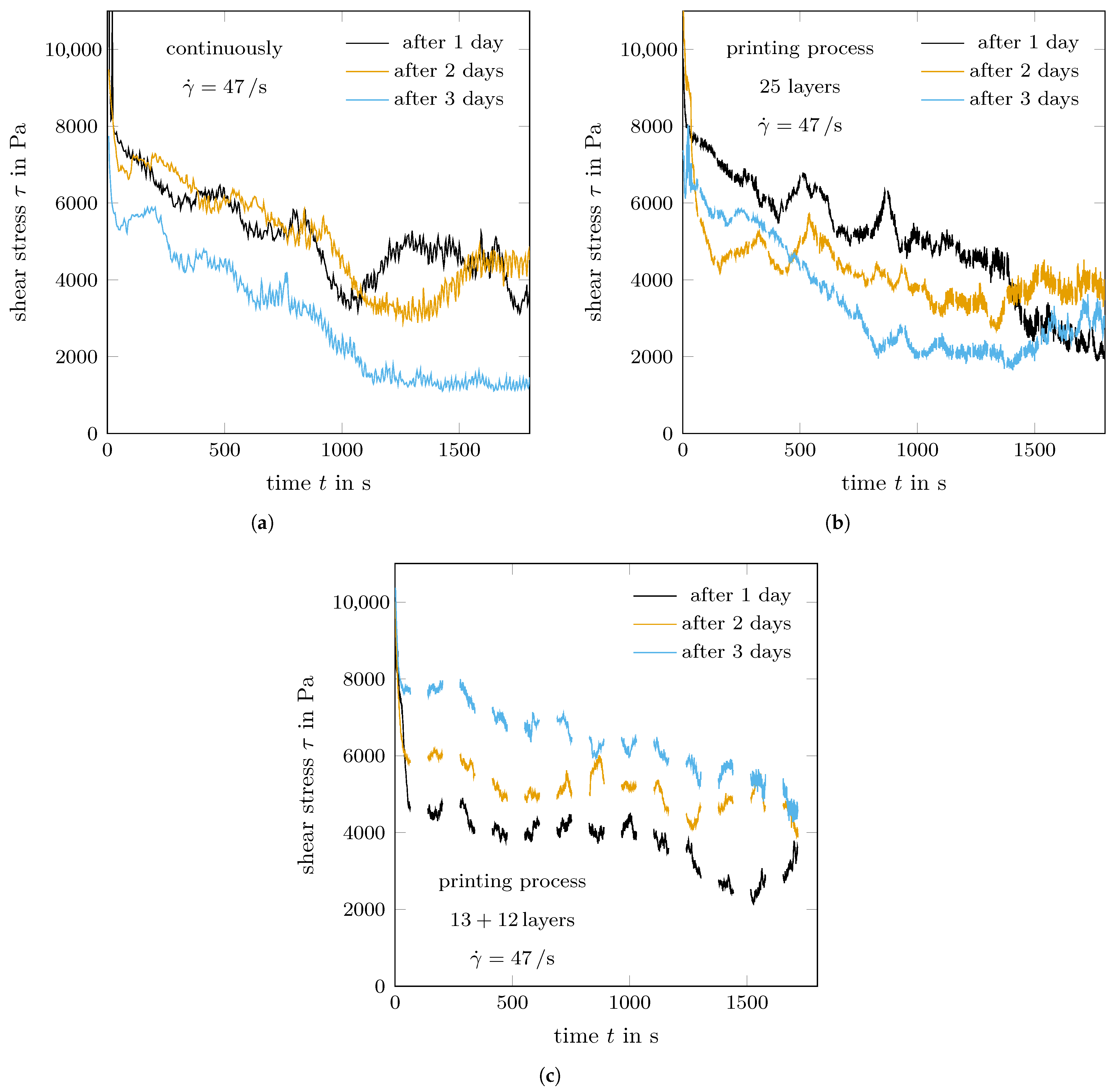
The time-dependent rheological behavior of the paste was studied by simulating the real 3D-printing process within the rheometer as follows. The printing of one bar took approximately a time of 1800 s. First of all, a continuously extrusion was studied as a reference for the printing process. Figure 6a shows the determined shear stress for shearing the extrusion mass for 1800 s with 47/s.
The 3D-printing process can be divided into two steps per layer. The material is continuously extruded with γ ˙ = 44 50 / s (see Table 1) during the printing of one layer for 65 s followed by a pause of 6 s. During this pause, the nozzle is moving to the next starting position without any extrusion. Such printing process was simulated within the rheometer by applying a shear rate of 47/s for 65 s followed by a pause of 6 s. This sequence was than repeated 25 times to simulate the printing of one homogeneous bar. The results for simulating such printing are presented in Figure 6b.
With the last simulation, the dual extrusion process was studied from the perspective of one nozzle. Here the printing of one layer was performed with γ ˙ = 47 / s for 65 s and than paused for 72 s without extrusion, which is the time for printing and moving the second nozzle. This sequence was repeated 13 times as it would be the case for the alumina material in the layered composite bars. The corresponding results are shown in Figure 6c.
The first sequence in all these experiments showed the same trend. With starting the extrusion process, the viscosity drops as it is mirrored by the shear stress. The latter started always at values larger than 10,000 Pa and decreased to values between 4500 Pa and 8000 Pa within the first 60 s, depending on resting times. The value of the shear stress after this first 60 s extrusion times will be referred here to as τ 0 . Its value should be the same for each resting times in all three kinds of experiments as it is the same material and the three experiments were run on the same day. However, the τ 0 values for {continuously, one material extrusion, dual extrusion} are different: τ 0 , 1 d {8000 Pa, 8000 Pa, 4500 Pa}, τ 0 , 2 d {7000 Pa, 4300 Pa, 6000 Pa} and τ 0 , 3 d {5800 Pa, 6300 Pa, 7900 Pa}. We did not analyze the τ 0 distribution statistically. Therefore, no statement can be given about the spread of these values. The progress with extrusion time seems, however, independently of the starting value.
For the continuous shearing, the shear stress decreased approximately linearly until 1000 s of the experiment and remained more or less constant for times above. A similar trend can be seen for the extrusion of 25 layers with the 6 s pause in between. Here, the plateau values were already reached after ≈800 s, for the sample with resting time of 2 days even much below. Beside the discussed differences of the absolute shear stress values, the trends were for all resting times in these two experiments the same but the tendency for reaching a plateau was more pronounced for resting times of two and three days. In comparison, the simulation of the dual extrusion process revealed a varying behavior. A plateau was already reached after 500 s (which is from the 4th sequence on) for the materials with resting times of 1 and 2 days, but a linear decreasing trend was found for the material after 3 days resting.
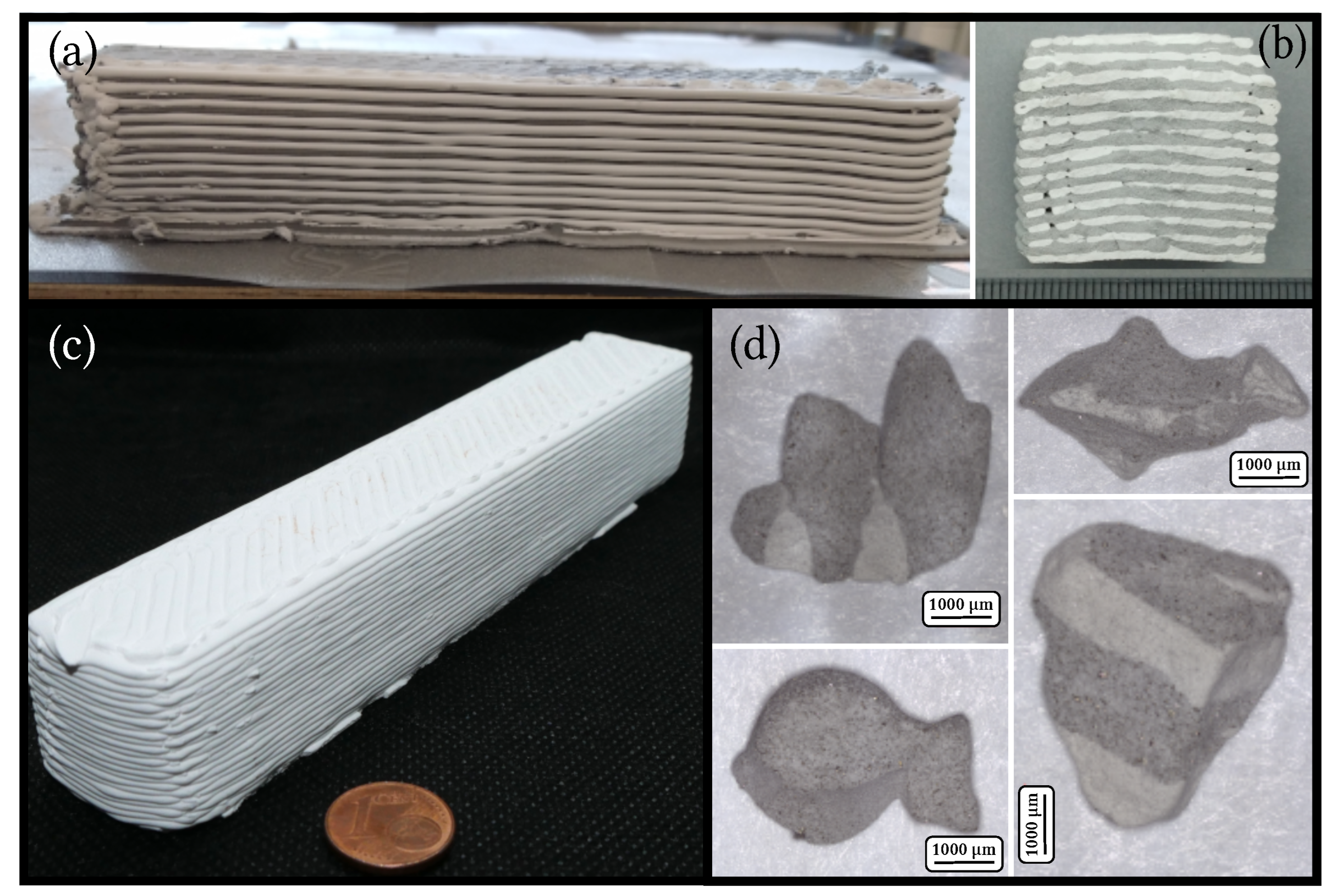
It can be said that in terms of printing quality, the material should be used for printing after 1 or 2 days of resting. The most constant extrusion behavior can be expected using the material after two days resting, which had always the shortest time to reach a plateau in necessary shear stress. Until reaching the plateau value, an underextrusion was always detected during printing that often resulted in large macro-porosity as the material was not well connected within the first two layers. In most cases, the print was more homogeneous from layer 4 on (compare with the side view of the sample in Figure 7b). The reason for underextrusion is that the printer parameters were found/optimized for good visual printing results within the plateau values of the shear stress, which were lower than the ones at the beginning of the print. The printing parameters could not be adjusted depending on the layer sequence within the slicing software and were also not adjusted manually within the G-code file.

3.2. Micrographs

Examples of printed bars are shown in Figure 7a–c. A cross view of the composite one is presented in Figure 7b. It can be seen that the layer thickness became relatively constant in the upper half section of the print. The bottom part shows more variation in layer thickness, which is related to the viscosity change of the paste within the first 500 s of printing (see Figure 6c). In addition, the layer position in space becomes more parallel to the ground when going from the bottom to the highest level. The reason is that the printed material slightly flew due to exposure to the vibrations originating from the nozzle movement. Consequently, the width of the printed bars were always slightly larger than the intended 25 mm, only the last printed layer was at ideal position.
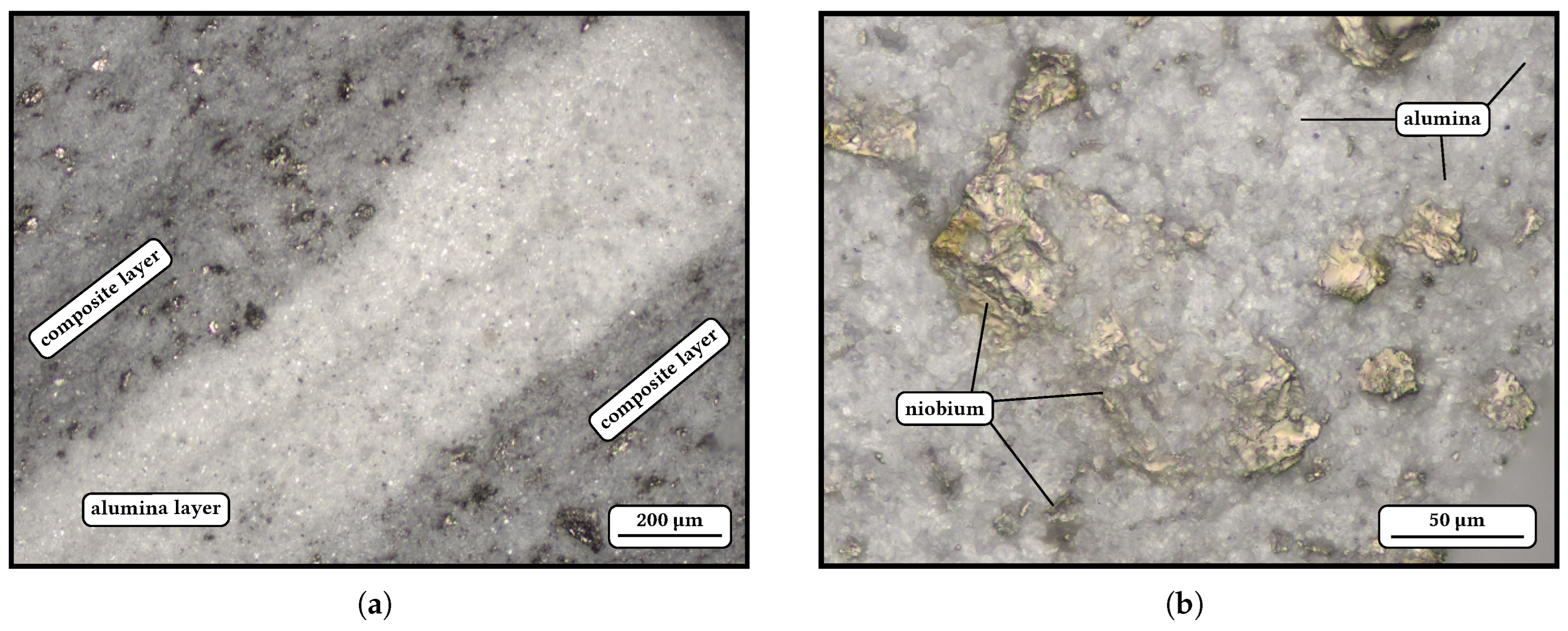
A selection of typical granule morphologies are shown in Figure 7d. It can be seen that the composite material did not fracture along the alumina–composite interfaces. Neither fractured niobium nor alumina particles were observed (Figure 8b) meaning that in general, the material was broken along particle surfaces. The layered nature of the composite material is still visible in the produced aggregates. The general morphology can be described as either compact particles as it appears in the bottom right particle or as more irregular with some amount of waviness of the contour line as illustrated by the other three particles of Figure 7d.
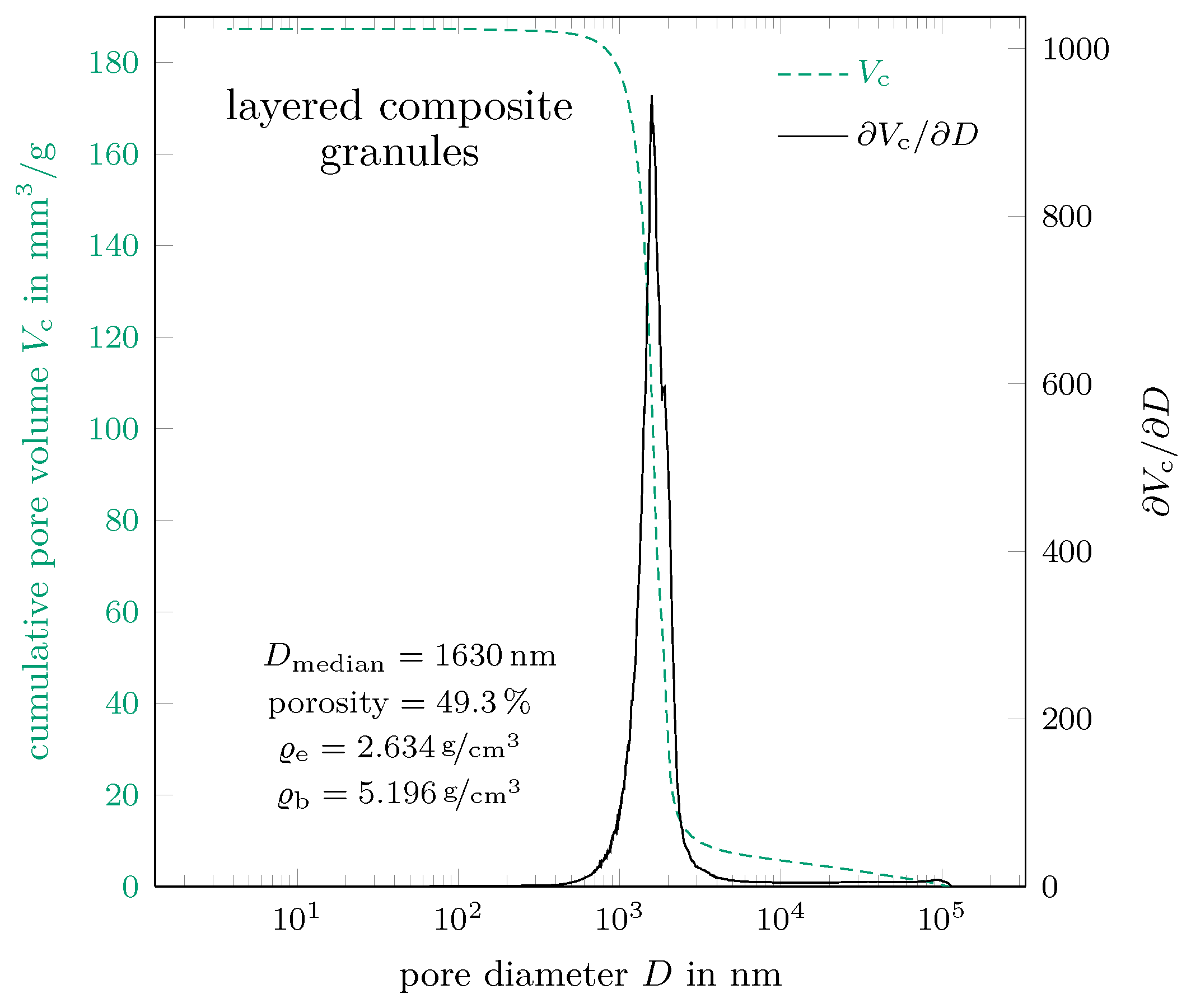
The density of the printed bars were ϱ b = 2.33 g / cm 3 with an open porosity of π a = 39.7 % as determined from the Archimedes measurement. A median pore size of 1630 nm and a porosity of 49.3% were determined by the mercury intrusion porosity measurement for a portion of granules from the largest aggregate size (2800–3150 µm). The pore sizes are distributed monomodally, as can be seen in Figure 9.
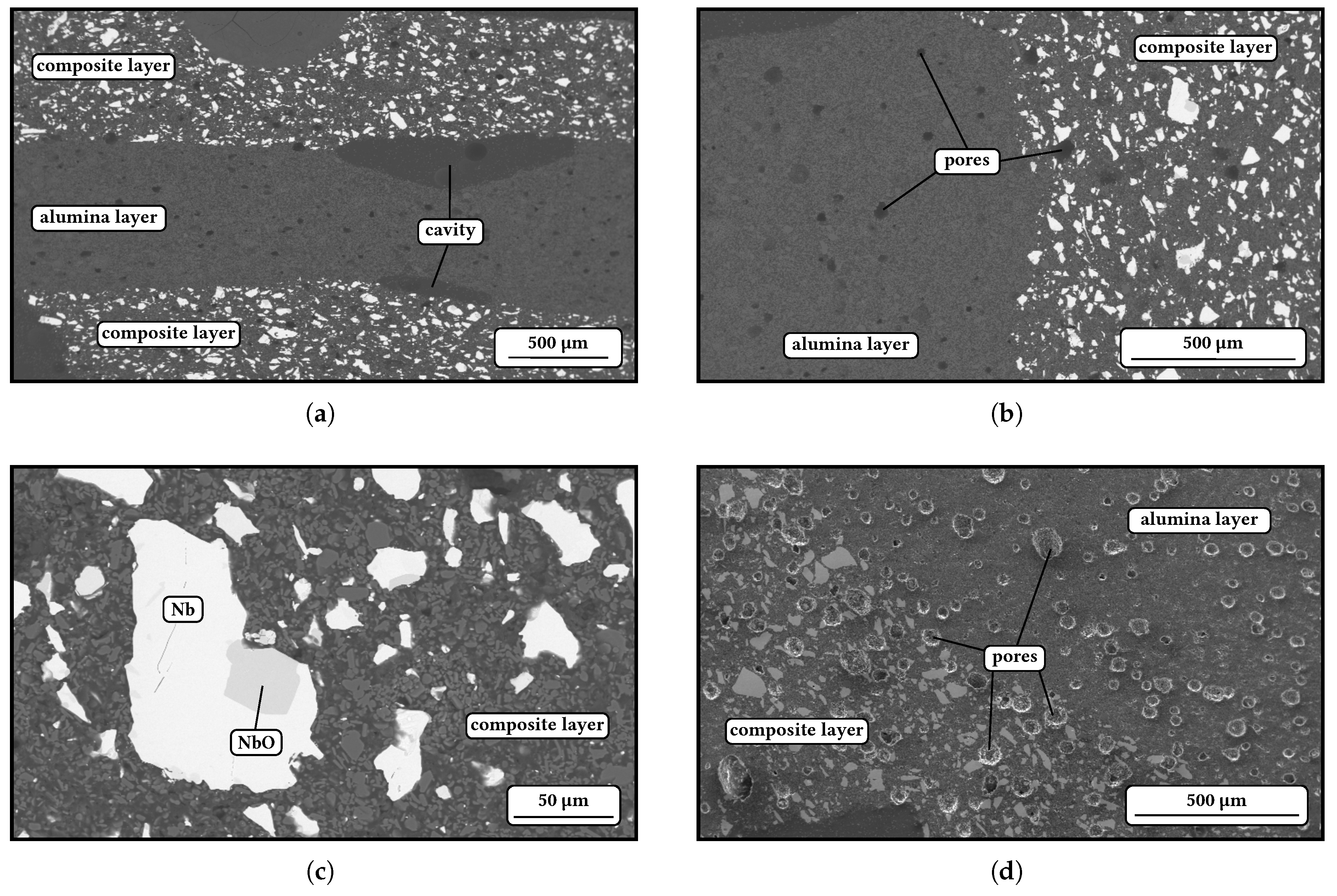
Optical impressions of the fracture surface of the composite material are presented in Figure 8. The homogeneous distribution of the niobium particles in the composite layers and the sharp, but strongly bounded, interface to the alumina layer can be seen in Figure 8a. The diffusion of niobium along alumina’s surface during heat treatment (see [20]) seems to be suppressed in the printed material by the large amount of porosity (see Section 3.3), which is also evident from the more detailed view on the layer interface of the SEM micrographs (Figure 10a,b). Also a closer look at the larger niobium particles (Figure 8b) shows only the sintering of the finer alumina particles around the niobium ones.
The presence of niobium oxide in mostly the larger niobium particles was observed (see Figure 10c) in agreement with our former studies [17]. NbO was already present in this configuration in the raw material. Beyond that, no phase formation was seen at the fringe of the particles by SEM/EDS investigation, which could be expected if enough niobium reacted on the free surfaces within the pores [25]. The distribution of macropores with a diameter larger than 10 µm can be estimated from the SEM micrograph (in SE contrast) in Figure 10d.

3.3. Mechanical Properties and Density

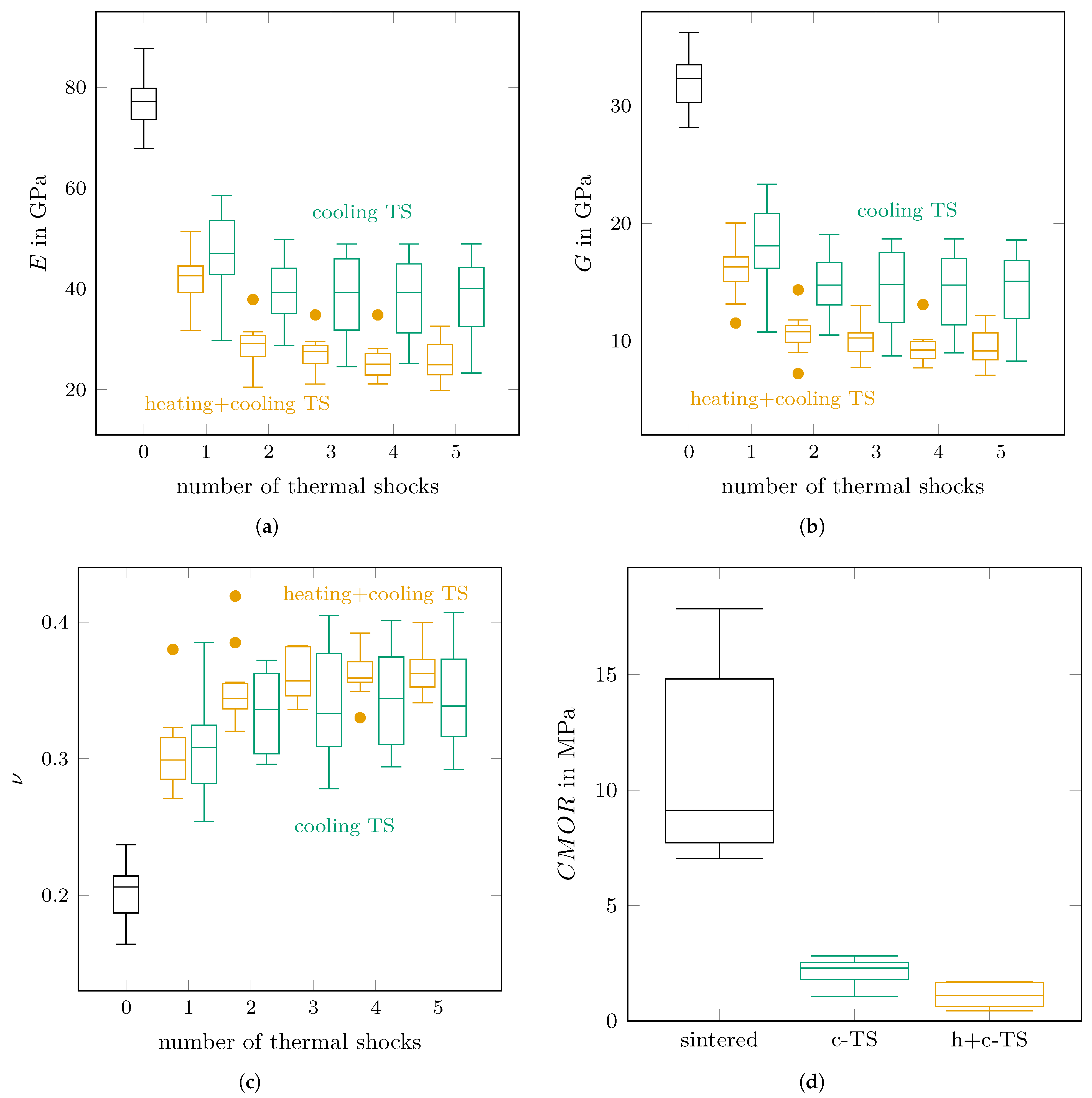
The as-sintered alumina bars had a Young’s modulus of E = 77.1 GPa , a shear modulus of G = 32.3 GPa and a Poisson’s ratio of ν = 0.206 (all median values). Interestingly, even with its high porosity, the Poisson’s ratio of the as-sintered material is close to the value of dense corundum ( ν = 0.227 , [39]). For both thermal shock series, the same trend of the elastic constants was observed. After the first and second thermal shock, E and G were further reducing and ν was increasing. After the 3rd thermal shock, the values remained more or less constant. However, there are differences in the absolute values as the only-cooling thermal shock introduces fewer microcracks as the heating and cooling–thermal-shock (see Figure 11a–c). The median plateau values after the fourth thermal-shock are E = 39.3 GPa , G = 14.8 GPa and ν = 0.344 for cTS and E = 22.7 GPa , G = 8.3 GPa and ν = 0.352 for the hcTS case.
The determined median values of flexural strength (Figure 11d) are 9.1 MPa, 2.3 MPa and 1.1 MPa for the as-sintered, cTS and hcTS state of the material, respectively. These values result in a remaining strength of 25.1% and 12.1% for the cTS and hcTS materials, respectively, after five thermal shock cycles.

3.4. Particle Size Distribution

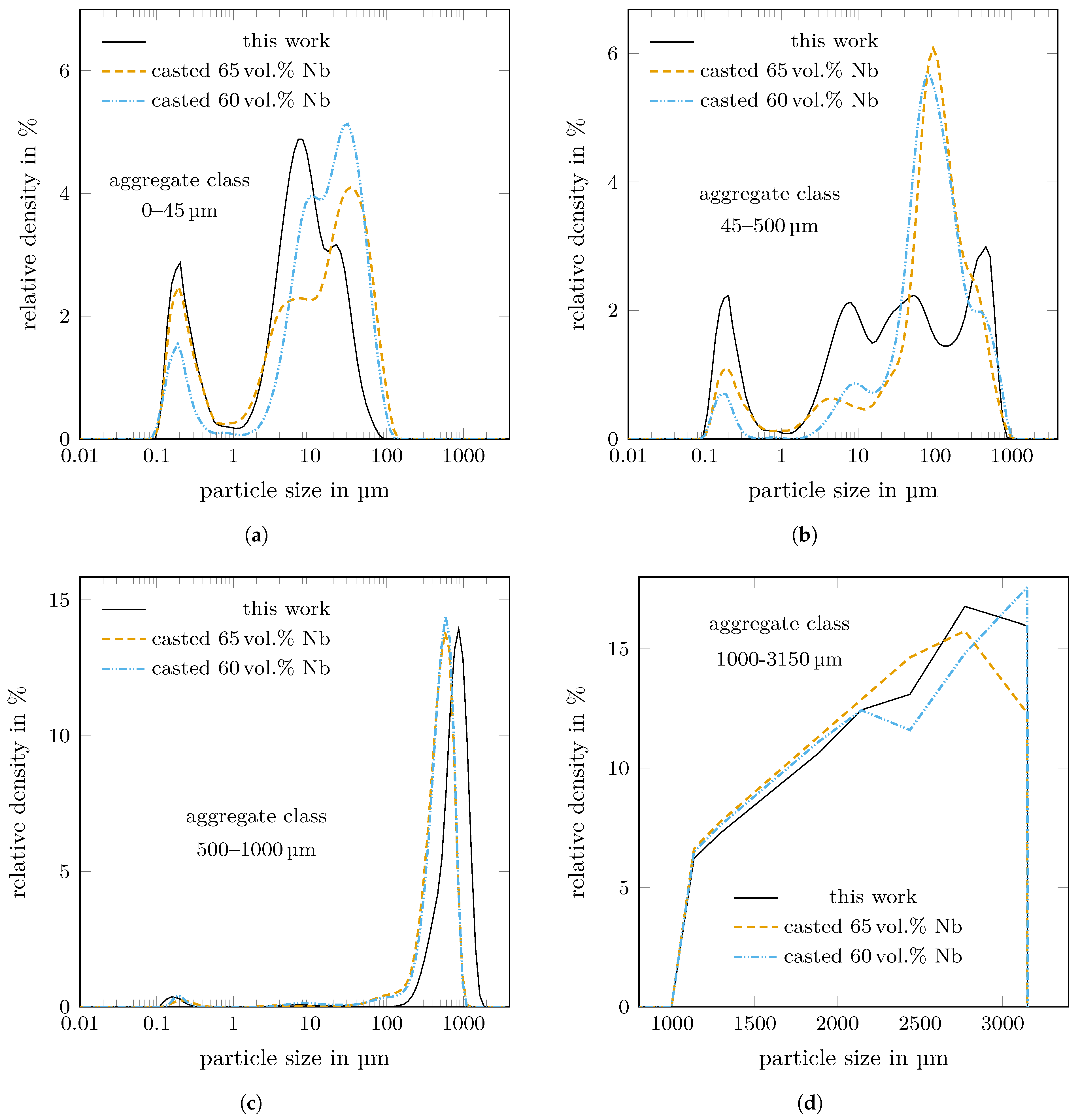
The determined particle size distributions (PSD) of the crushed composite for the four aggregate classes 0–45 µm, 45–500 µm, 500–1000 µm and 1000–3150 µm are shown in Figure 12 in comparison to the values determined for casting-based Nb-Al2O3 material containing 60 vol.% Nb [25] and 65 vol.% Nb [24]. All PSDs up to a particle size of 1000 µm have a certain amount of particles in the diameter range of 0.1–1 µm. Above, they show a bi-modal, tri- to tetra-modal and a mainly monomodal distribution for the aggregate classes 0–45 µm, 45–500 µm and 500–1000 µm, respectively. The 3D-printed material shows distinct differences compared to the casted material for the particle sizes above 1 µm. The overall particle sizes are shifted to lower values for the class 0–45 µm with a maximum of the first peak around 10 µm instead of the second one around 50–80 µm. The casted materials showed a strong maximum around 100 µm in the aggregate class 45–500 µm, whereas the three peaks for the 3D-printed material are more evenly distributed lowering its d 50 value (see Table 4). Interestingly the d 90 value of the extruded material in the aggregate class 500–1000 µm is strongly shifted from around 700 µm of the casted materials to approximately 1100 µm. No distinct difference of the particle size distributions for particle size larger than 1000 µm were observed.

3.5. Phase Assemblage

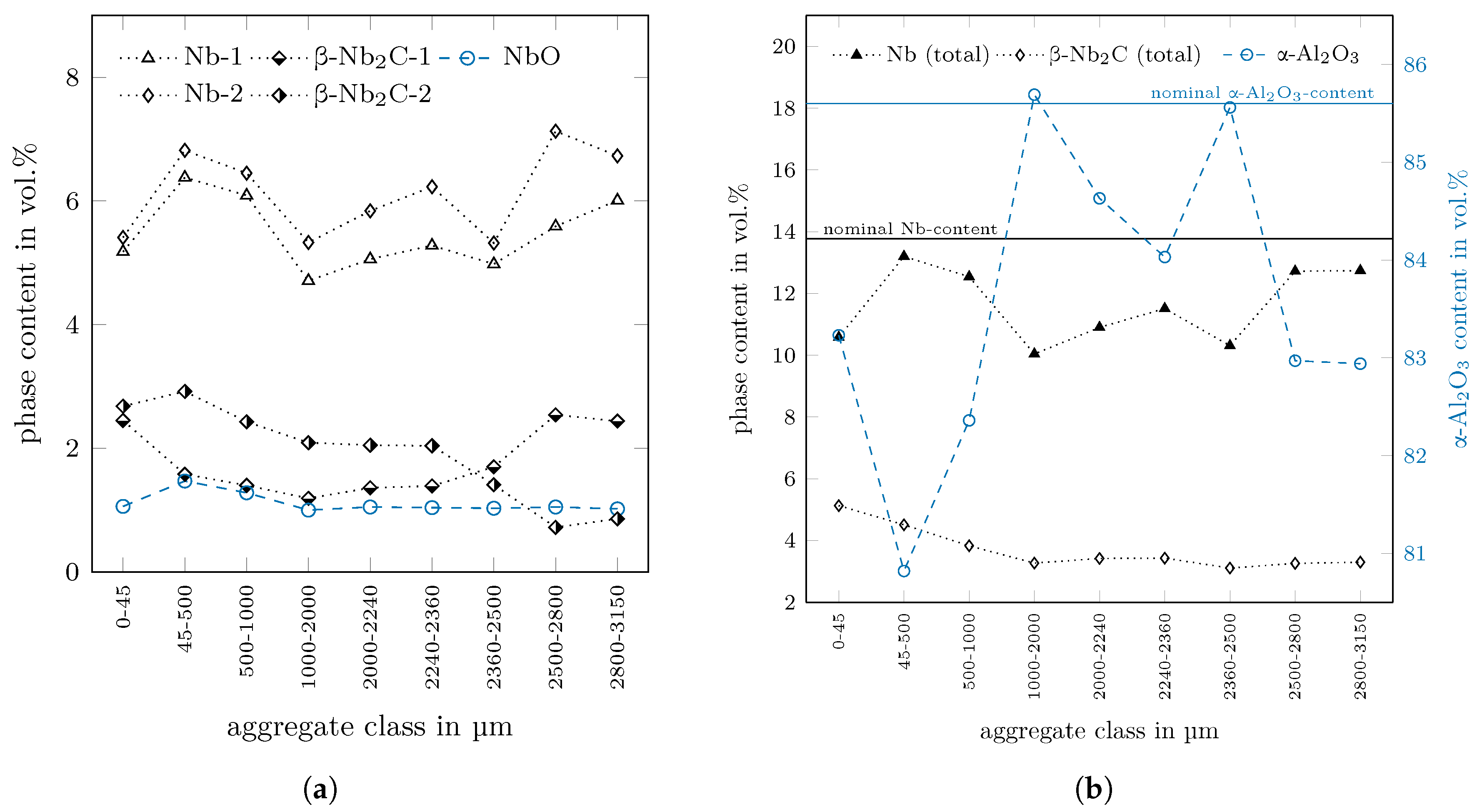
The main impurity phases of our niobium raw material are β-Nb2C (2.5 vol.%, ϵ-Fe2N type [40]) and NbO (1.8 vol.%, #ICSD-14338 [41]) that sum up with Nb (95.2 vol.%, #ICSD-76416 [42]) to 99.5 vol.% of all phases [17]. Ignoring the remaining 0.5 vol.% of carbides and nidrides, the nominal niobium content of the composite bars (13 layers Al2O3 and 12 layers 30 vol.% Nb-70 vol.% Al2O3) is estimated to 13.78 vol.% with 0.36 vol.% β-Nb2C and 0.26 vol.% NbO as impurities, which results in a nominal α-Al2O3 content of 85.6 vol.% (#ICSD-73725 [43]).
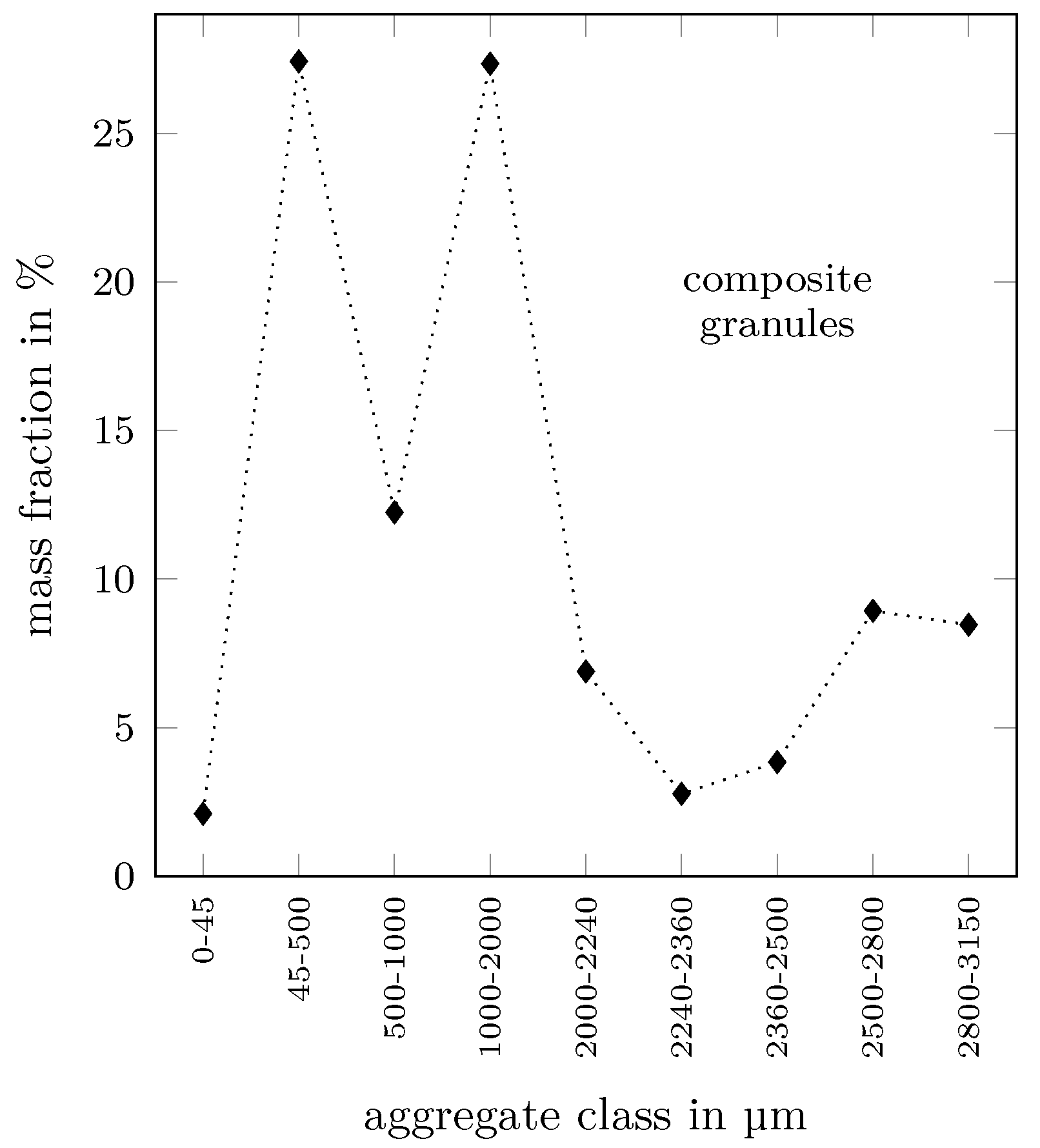
The determined phase contents based on XRD and Rietveld analysis are shown in Figure 13. First of all, it must be stated that the impurity content increased to a minimum of ≈4 vol.% (3 vol.% β-Nb2C and 1 vol.% NbO) during heat treatment. For the aggregate classes below 1000 µm, the niobium carbide content is constantly increasing up to ≈5 vol.% for the 0–45 µm size fraction. Despite the impurity contents, the ratio of niobium to corundum is also not constant. Similar to our crushed casting-based material [25], phase separation occurred during crushing, which is expressed by the phase inhomogeneities within the sieved aggregate classes. The lowest corundum content of ≈81 vol.% was detected for the 45–500 µm aggregate class and the largest content with close to the nominal content was observed for the 1000–2000 µm and the 2360–2500 µm ones. The results of the sieve analysis of the crushed composite material can be seen in Figure 14. The largest single portion with around 27 mass-% were obtained for the classes 45–500 µm and 1000–2000 µm.
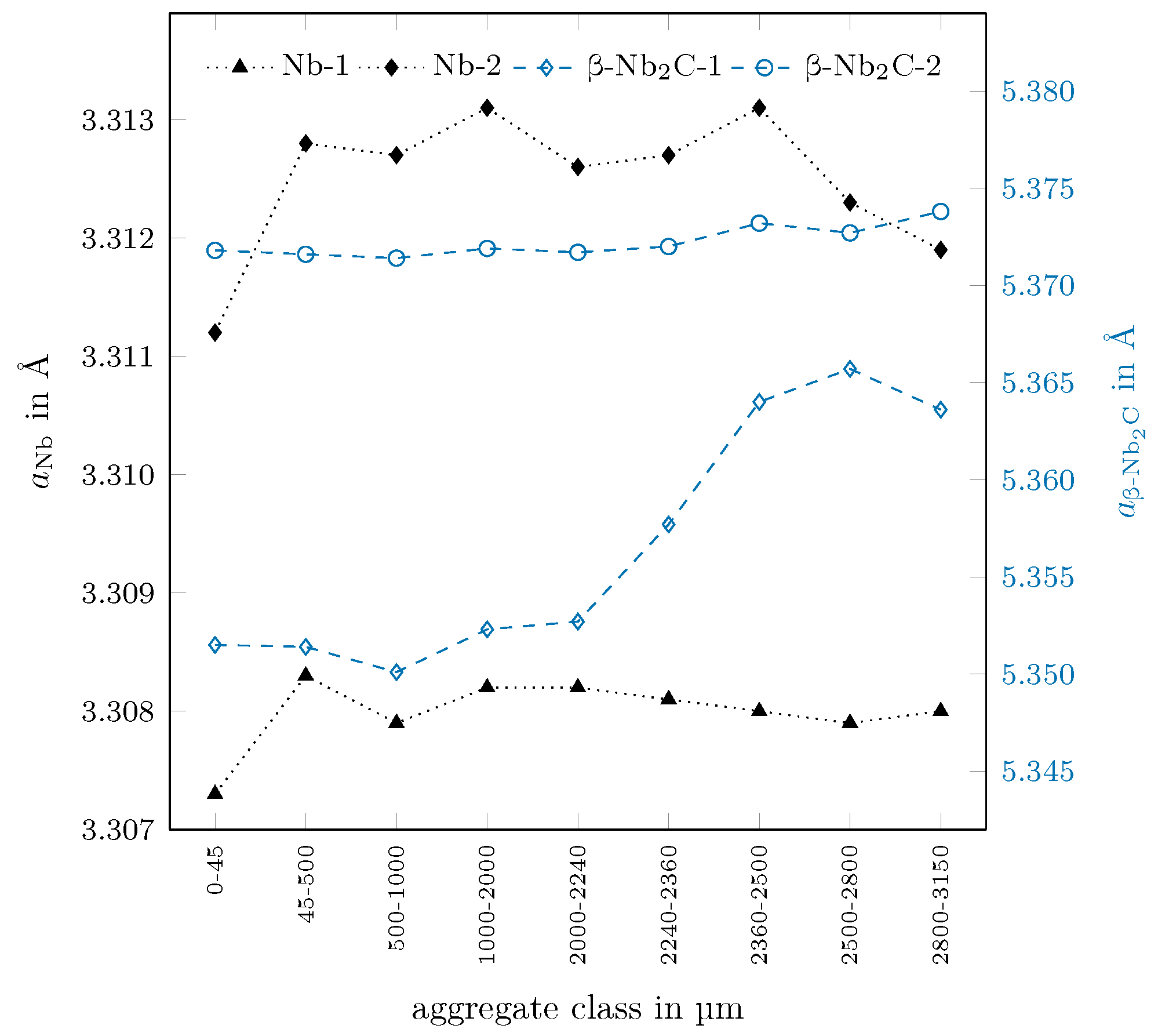
The Rietveld analysis revealed the existence of two distinct niobium and β-Nb2C phases, which was also reported for the casted material before [25]. The respective trends of the lattice parameters can be seen in Figure 15. The two niobium phases had almost constant lattice dimensions around 3.308 Å and between 3.312 and 3.313 Å, respectively. In case of β-Nb2C, the situation is slightly different as one phase had an almost constant value of a 5.373 Å , whereas the other increased from a value of 5.352 Å for the smallest aggregate sizes to a 5.365 Å for the largest ones. Interestingly, the c-parameter was for both niobium carbide phases with 4.958–4.962 Å more or less the same independently of the aggregate class.

3.6. Particle Morphology

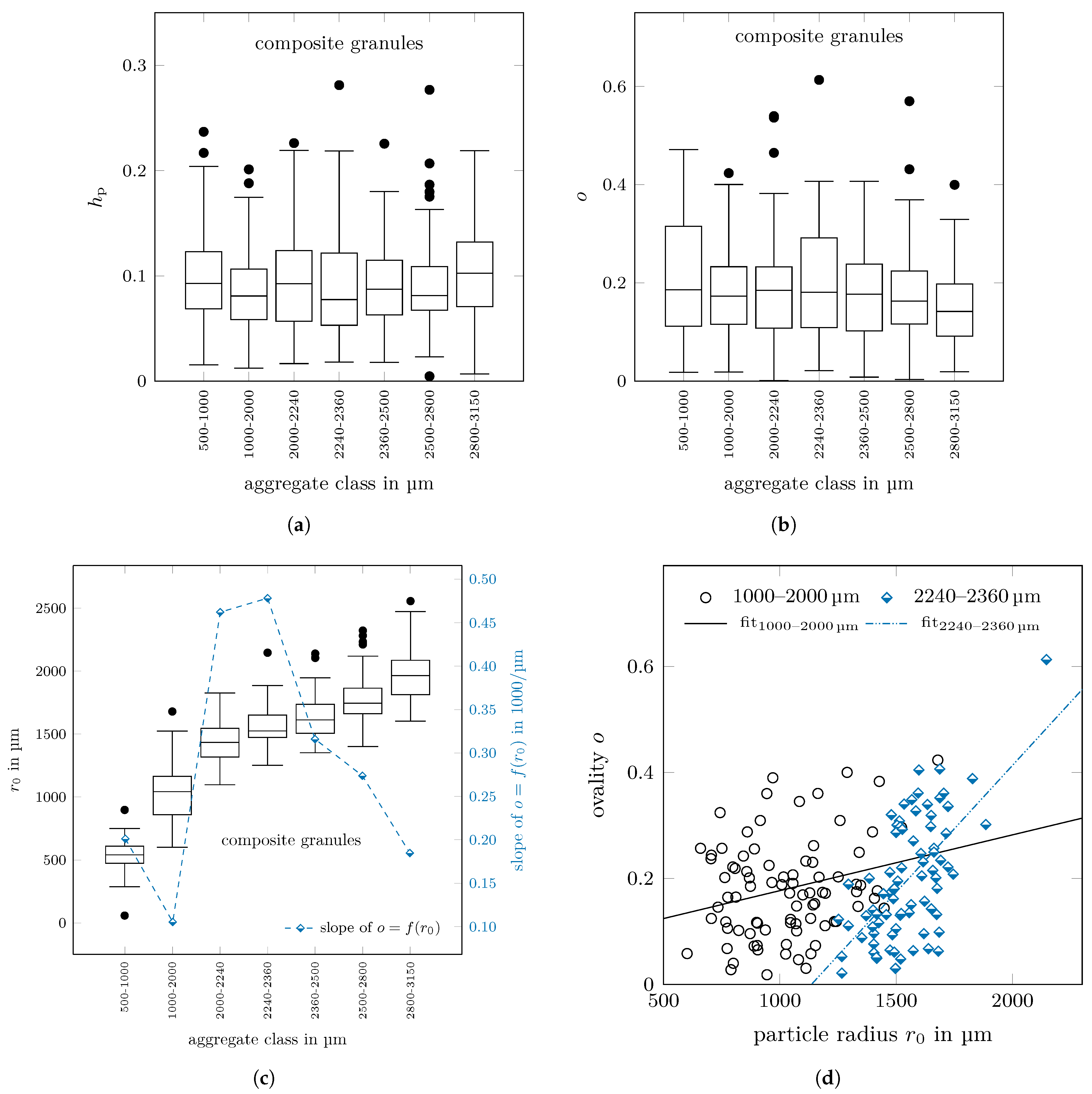
The statistics of the evaluated morphology parameters according to Equation (7) are shown for each aggregate class in Figure 16. Independently of the aggregate class, the median values for the height of the first order peaks h p is around 0.9 and the one for ovality o is approximately 0.18. The determined radii are in general larger than the half of the nominal sieve diameter, which could be a sign for anisotropic particle dimensions.
This view is supported by the relation between the ovality and the radius r 0 of the particle as it can be seen in Figure 16d. All aggregate classes show a tendency for an increase in o with increasing r 0 , which was the weakest for the 1000–2000 µm class and the strongest for the 2240–2360 µm one. The data was fitted by a linear equation ( o = f ( r 0 ) = o 0 + m · r 0 ) and the obtained slopes are shown in Figure 16c alongside with the determined radii. If the ovalities would be equally distributed for each particle size, the slope of f ( r 0 ) would be zero. However, it can be seen that they are all positive and reach a maximum for the two aggregate classes with particle sizes of 2000–2360 µm. Increasing ovalities with increasing radii (within one aggregate class) show a tendency for increasing anisotropic particle dimensions with increasing particle size.
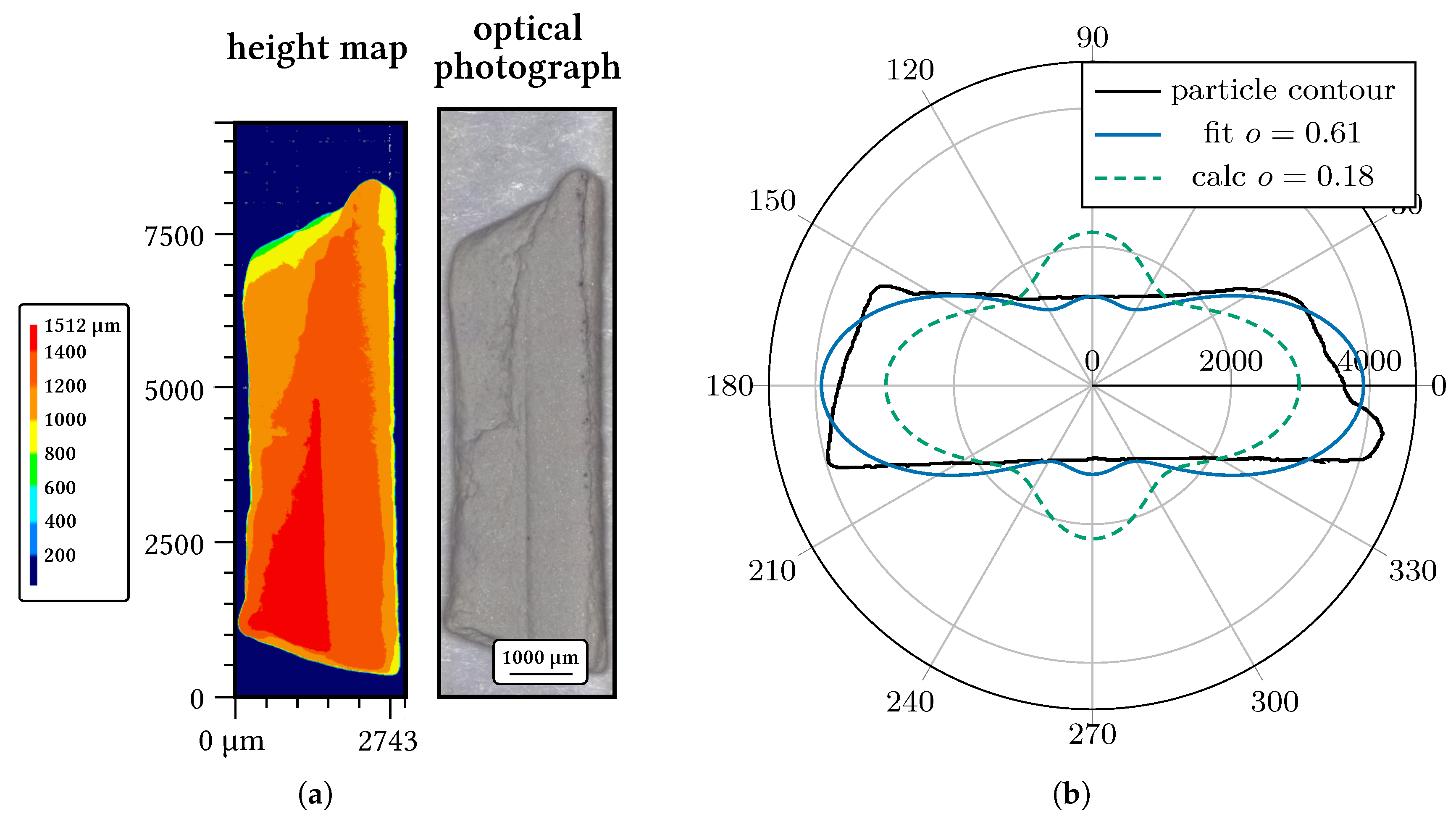
The reason for this feature is that the morphology model (Equation (7) describes particle contours with a more rectangular shape by n p = 4 and a larger value of the ovality o. Increasing o leads to a shortening of the dimension along one axis and to an increasing of the particle dimension along the respective perpendicular axis (with a constant r 0 ). This behavior is demonstrated in Figure 17.

4. Discussion

The rheological studies revealed that the internal structure of the paste was still evolving 3 days after mixing. From the trends of the loss factor tan δ and from G · τ y , a distinct structural change was evidently happening between 48 and 72 h after mixing. When the paste matured three days, the yield stress is dramatically lowered, which decreases the estimated maximal printable height without gravitational slumping and closes the window between the beginning of flow ( γ f ) and extrusion with risk of slumping ( γ s ). Therefore, a maximum resting time of 2 days were chosen in this work to print the samples. The determined flow stresses were with ≈1000 Pa larger than recommended in the literature for robocasting [30]. However, our 3D printer was not at the limit of its installed maximal applicable forces. Differences in printing quality can be related to the time-dependent viscosity change, which is not easy to predict using rheological measurements as our experiments on simulating the printing process showed. Influencing the time-dependent rheology of the paste is a topic for further studies. It should stay constant after a certain resting time, and it would be beneficial to reduce the flow stress without shrinking the window for printing without slumping.
The first printing experiments revealed practically no differences in the printing behavior and printing quality between the alumina and the composite paste. It was, therefore, concluded that the rheology of these pastes must be very similar and that the key parameters are more related to the binder as to the differences in particle size distribution and particle morphologies. As a consequence, no additional rheological studies were performed for the composite paste.
The sintered alumina bodies showed promising thermal-shock behavior. During thermal-shock, microcracks were formed in the material, which are the reason for the observed trends of the effective Young’s and shear modulus. Reaching plateau values indicates that the applied Δ T of ≈930 K is not enough to promote further crack propagation after the third thermal shock cycle. It seems that the original porosity, with its fine-distributed pore structure (1.6 µm in diameter), in combination with the formation of microcracks during thermal stress promotes the thermal stress resistance (increasing the Δ T that is necessary to initiate critical crack propagation [44]). Such porous material can be used in metallurgical applications as light-weight insulating blocks and/or as refractory in contact with slag and steel melts.
For the layered composite material, we did not detect an increase in niobium oxide or niobium carbide phases after sintering as we did in processing alginate-gelated Nb-Al2O3 and Ta-Al2O3 composites [45,46], which had a very similar porosity. Carbide and oxide formation was found in that works on the metal surfaces in the inner pores caused by the CO/CO2-containing atmosphere within the graphite-based furnace during sintering.
The layered composite material was used to produce granules up to 3150 µm particle sizes. We did not achieve electrical conductivity due to resulting porosity of almost 50% and a metal content of 30 vol.%. However, the general feasibility of our approach was demonstrated. It will be a task for further works to find the necessary metal content for a desired electrical conductivity. In contrast, the hypotheses about the hindered niobium diffusion within the layered composite–alumina structure was satisfied. According to the investigated SEM micrographs, the intermediate alumina layers were niobium free after sintering for 2 h at 1600 °C. As the used alumina raw material (CT9FG) revealed only limited sintering effects after the heat treatment, the mechanical properties of the alumina matrix can be optimized, especially the strength after thermal shock, by using additional powders. Further recipes should include a more densely packed alumina particle structure, which can enhance the rheology of the paste as well if the particle size distribution goes into a direction of self-flowability.
The fabricated granules retained their macroscopic layered microstructure during the crushing process. We demonstrated with our approach how it can be possible to functionalize granules intended for refractory castables. The thermal and electrical conductivity can be altered by changing the metal content of the paste. In addition, the layered structure can be changed as well, as for example, the overall metal content can be further reduced by printing 2, 3, … layers of alumina before an intermediate composite layer is deposited. The morphology of the granules is important for the design of a castable, especially for its flowability and the related mechanical properties. The analysis of the particle shape revealed a tendency for anisotropical particle size depending on the general particle size (sieve fraction). It is at the moment more an observation that needs to be compared further in detail with the crushing results from material that was casted or pressed (cold isostatic or by field-assisted/sparc plasma sintering). It might be related to porosity and can be used to further tailor the properties of composite granules. However, phase separation during crushing was less pronounced in this work comparing the porous 3D-printed material with the casted one that had a porosity of 20–30%. It might be interesting to see how phase separation can be influenced using a mechanically stronger alumina matrix in combination with porosities of 40–50% by adjusting the particle size distribution of the matrix.
Using paste extrusion for 3D printing is one of the cheapest methods for the additive manufacturing of ceramic materials. In addition, it is easy to scale up the printing process by increasing printing speed and nozzle diameter (maximal standards in our printer are a nozzle size of 10 mm and a printing speed of 60 mm/s). The organic binders of our paste recipe are cheap natural materials and the refractory powders showing particle sizes and particle morphologies commonly used in refractory industry. Therefore, a layered printing process for adjusting refractory aggregate’s properties should be straightforwardly applicable in industry.

5. Conclusions

The proof of concept for producing refractory aggregates and adjusting their properties using a layered 3D-printing approach based on paste extrusion was successfully demonstrated. The developed pastes are broader applicable, for example in terms of producing integrated heating elements in refractory compounds using dual-extrusion. The printing process as well as the final aggregate properties are strongly related to the paste rheology. From the rheological evaluation, it can be concluded that
  • The efflux of the printer should be evaluated experimentally. We observed that for our 3D printer, a large difference between the specified values (according to the G-code from the slicing software) and the actual measured extruded volume. As this value directly influences the applied shear rate (and the rheological optimization for that), we recommend to experimentally determine the volumetric flow (and rate) for a new printer or a newly developed paste.
  • Our alumina paste shows the tendency for microcrack formation before flowing based on the evaluation of a pronounced maximum in shear stress below γ y .
  • The inner structure still evolves after three days resting, which must be kept in mind for printing larger parts were several batches of the paste must be produced.
  • The best resting time in terms of printing quality (reaching plateau values for shear stress or viscosity as fast as possible) was 2 days, which was used also in this study to print the samples.
  • The time-dependent rheological properties for a non-continuous print (dual extrusion) are strongly influencing the extrusion result. The printing process should be simulated within the rheometer and, if necessary, the printing parameter should be adjusted depending on progress of the printed the layer sequence. We planned to study such an approach in a future work.
The final sample properties are not only connected to the production process but they are also linked to the derived microstructure:
  • The MIP-derived median pore size (monomodally distributed) was 1.6 µm, which is much below the value that is necessary for the wetting (and, therefore, filling of the pores) with steel/slag (30 µm). Therefore, the (alumina) material can be used as light-weight crucible or lining material in metallurgical applications.
  • The sintered material showed a promising thermal-shock performance regarding its trend of the elastic constants. The shear and the Young’s modulus reached plateau values after the third shock, which is related to the formation of microcracks increasing the resistance against thermal stress.
  • The selection of the alumina raw material in combination the high porosity (49 vol.%) prevents diffusion of niobium into the alumina layers during sintering at 1600 °C in case of the composite samples. This is a very positive feature, as it means that a printed heating element, e.g., within a crucible, will not change its resistivity during application and can be constantly used without adjusting the electrical parameters.
We plan to demonstrate the perspective properties of a castable with porous composite granules in a further work.

Author Contributions

Conceptualization, T.Z. and C.G.A.; methodology, T.Z. and D.E.; software, T.Z.; validation, D.K.G., T.Z., and C.G.A.; formal analysis, D.K.G., T.Z., D.E., and C.F.; investigation, D.K.G. and T.Z.; resources, C.G.A.; data curation, T.Z.; writing—original draft preparation, T.Z.; writing—review and editing, T.Z. and C.G.A.; visualization, T.Z.; supervision, C.G.A.; project administration, C.G.A.; funding acquisition, C.G.A. All authors have read and agreed to the published version of the manuscript.

Funding

This research was funded by the German Research Foundation (DFG) within the Research Unit FOR 3010 (Project number: 416817512). The X-ray diffractometer was acquired through the “Major Research Instrumentation” funding programme of the German Research Foundation (DFG), reference number: INST 267/157-1 FUGG (Project number: 395259190).

Data Availability Statement

The original contributions presented in this study are included in the article. Further inquiries can be directed to the corresponding author.

Conflicts of Interest

The authors declare no conflicts of interest.

Abbreviations

The following abbreviations are used in this manuscript:
DIWdirect ink writing
ICSDInorganic Crystal Structure Database
MIPmercury intrusion porosity
PSDparticle size distribution

References

  1. Romanczuk-ruszuk, E.; Sztorch, B.; Pakuła, D.; Gabriel, E.; Nowak, K.; Przekop, R.E. 3D Printing Ceramics-Materials for Direct Extrusion Process. Ceramics 2023, 6, 364–385. [Google Scholar] [CrossRef]
  2. Peng, E.; Zhang, D.; Ding, J. Ceramic Robocasting: Recent Achievements, Potential, and Future Developments. Adv. Mater. 2018, 30, 1802404. [Google Scholar] [CrossRef] [PubMed]
  3. Lamnini, S.; Elsayed, H.; Lakhdar, Y.; Baino, F.; Smeacetto, F.; Bernardo, E. Robocasting of advanced ceramics: Ink optimization and protocol to predict the printing parameters—A review. Heliyon 2022, 8, e10651. [Google Scholar] [CrossRef]
  4. Hossain, S.S.; Lu, K. Recent progress of alumina ceramics by direct ink writing: Ink design, printing and post-processing. Ceram. Int. 2023, 49, 10199–10212. [Google Scholar] [CrossRef]
  5. Rueschhoff, L.; Costakis, W.; Michie, M.; Youngblood, J.; Trice, R. Additive Manufacturing of Dense Ceramic Parts via Direct Ink Writing of Aqueous Alumina Suspensions. Int. J. Appl. Ceram. Technol. 2016, 13, 821–830. [Google Scholar] [CrossRef]
  6. Elbadawi, M.; Mosalagae, M.; Reaney, I.; Meredith, J. Guar gum: A novel binder for ceramic extrusion. Ceram. Int. 2017, 43, 16727–16735. [Google Scholar] [CrossRef]
  7. Mamatha, S.; Biswas, P.; Ramavath, P.; Das, D.; Johnson, R. 3D printing of complex shaped alumina parts. Ceram. Int. 2018, 44, 19278–19281. [Google Scholar] [CrossRef]
  8. Mahboubizadeh, S.; Kazemi, A.; Khodaei, M. Optimizing the Printability of 3D Printed Alumina Parts Fabricated by Direct Ink Writing. Adv. J. Chem. Sect. A 2025, 8, 1776–1788. [Google Scholar] [CrossRef]
  9. Schlordt, T.; Schwanke, S.; Keppner, F.; Fey, T.; Travitzky, N.; Greil, P. Robocasting of alumina hollow filament lattice structures. J. Eur. Ceram. Soc. 2013, 33, 3243–3248. [Google Scholar] [CrossRef]
  10. Hossain, S.S.; Akhtar, F. Development of tunable porous alumina monolith using hollow microspheres via extrusion-based 3D printing. J. Eur. Ceram. Soc. 2024, 44, 6620–6628. [Google Scholar] [CrossRef]
  11. Weichelt, M.; Wahl, L.; Travitzky, N.; Fey, T. Co-extrusion of alumina core-shell structures fabricated by robocasting. Open Ceram. 2025, 23, 100805. [Google Scholar] [CrossRef]
  12. Chan, S.S.L.; Sesso, M.L.; Franks, G.V. Direct ink writing of hierarchical porous alumina-stabilized emulsions: Rheology and printability. J. Am. Ceram. Soc. 2020, 103, 5554–5566. [Google Scholar] [CrossRef]
  13. Jauk, J.; Vašatko, H.; Gosch, L.; Ristoski, K.; Füssl, J.; Stavric, M. Coextrusion of Clay-Based Composites: Using a Multi-Material Approach to Achieve Gradient Porosity in 3D-Printed Ceramics. Ceramics 2023, 6, 2243–2255. [Google Scholar] [CrossRef]
  14. del Mazo-Barbara, L.; Ginebra, M.P. Rheological characterisation of ceramic inks for 3D direct ink writing: A review. J. Eur. Ceram. Soc. 2021, 41, 18–33. [Google Scholar] [CrossRef]
  15. Przybyła, S.; Kwiatkowski, M.; Kwiatkowski, M.; Hebda, M. Optimization of Ceramic Paste Composition for 3D Printing via Robocasting. Materials 2024, 17, 4560. [Google Scholar] [CrossRef] [PubMed]
  16. Gourdonnaud, D.; Pateloup, V.; Junger, A.; Bourret, J.; Chartier, T.; Geffroy, P.M. Correlation between filament deposition path, microstructural and mechanical properties of dense alumina parts printed by robocasting. J. Eur. Ceram. Soc. 2024, 44, 1027–1035. [Google Scholar] [CrossRef]
  17. Zienert, T.; Endler, D.; Hubálková, J.; Eusterholz, M.; Boll, T.; Heilmaier, M.; Günay, G.; Weidner, A.; Biermann, H.; Kraft, B.; et al. Coarse-grained refractory composite castables based on alumina and niobium. Adv. Eng. Mater. 2022, 24, 2200296. [Google Scholar] [CrossRef]
  18. Günay, G.; Zienert, T.; Endler, D.; Aneziris, C.G.; Biermann, H.; Weidner, A. High-temperature compressive behavior of refractory alumina-niobium composite material. Adv. Eng. Mater. 2022, 24, 2200292. [Google Scholar] [CrossRef]
  19. Günay, G.; Zienert, T.; Endler, D.; Aneziris, C.G.; Biermann, H.; Weidner, A. Influence of particle size and fabrication method on mechanical properties of Nb-Al2O3 refractory composites under compressive loads at high temperatures. Ceram. Int. 2025, 51, 9619–9629. [Google Scholar] [CrossRef]
  20. Zienert, T.; Farhani, M.; Dudczig, S.; Aneziris, C.G. Coarse-grained refractory composites based on Nb-Al2O3 and Ta-Al2O3 castables. Ceram. Int. 2018, 44, 16809–16818. [Google Scholar] [CrossRef]
  21. Wick-Joliat, R.; Schroffenegger, M.; Penner, D. Multi-material ceramic material extrusion 3D printing with granulated injection molding feedstocks. Ceram. Int. 2023, 49, 6361–6367. [Google Scholar] [CrossRef]
  22. Naumenko, V.; Zyatkevich, D.; Vedel, D.; Derevyanko, O.; Myslyvchenko, O.; Lytvyn, R.; Zgalat-lozynskyy, O. 3D Printing of MoSi2-Based Ceramic Heaters Using the Robocasting Method. Powder Metall. Met. Ceram. 2024, 63, 343–351. [Google Scholar] [CrossRef]
  23. Rowlands, W.; Vaidhyanathan, B. Additive manufacturing of barium titanate based ceramic heaters with positive temperature coefficient of resistance (PTCR). J. Eur. Ceram. Soc. 2019, 39, 3475–3483. [Google Scholar] [CrossRef]
  24. Zienert, T.; Endler, D.; Hubálková, J.; Günay, G.; Weidner, A.; Biermann, H.; Kraft, B.; Wagner, S.; Aneziris, C.G. Synthesis of Niobium-Alumina Composite Aggregates and Their Application in Coarse-Grained Refractory Ceramic-Metal Castables. Materials 2021, 14, 6453. [Google Scholar] [CrossRef]
  25. Zienert, T.; Endler, D.; Brachhold, N.; Weiner, M.; Schmidtchen, M.; Prahl, U.; Aneziris, C.G. Characterization of niobium-alumina refractory aggregates synthesized by castable technology. Adv. Eng. Mater. 2022, 24, 2200407. [Google Scholar]
  26. Kraft, B.; Wagner, S.; Hoffmann, M.J. Field Assisted Sintering of Nb-Al2O3 Composite Materials and Investigation of Electrical Conductivity. Adv. Eng. Mater. 2022, 24, 2200063. [Google Scholar] [CrossRef]
  27. Herschel, W.H.; Bulkley, R. Konsistenzmessungen von Gummi-Benzollösungen. Kolloid-Zeitschrift 1926, 39, 291–300. [Google Scholar] [CrossRef]
  28. Zhou, S.; Cai, Q.; Tirichenko, I.S.; Vilchez, V.; Gavalda-Diaz, O.; Bouville, F.; Saiz, E. Additive manufacturing of Al2O3 with engineered interlayers and high toughness through multi-material co-extrusion. Acta Mater. 2023, 246, 118704. [Google Scholar] [CrossRef]
  29. Feilden, E. Additive Manufacturing of Ceramics and Ceramic Composites via Robocasting. Ph.D. Thesis, Imperial College London, Department of Materials, London, UK, 2017. [Google Scholar] [CrossRef]
  30. Maillard, M.; Chevalier, J.; Gremillard, L.; Baeza, G.P.; Courtial, E.J.; Marion, S.; Garnier, V. Optimization of mechanical properties of robocast alumina parts through control of the paste rheology. J. Eur. Ceram. Soc. 2023, 43, 2805–2817. [Google Scholar] [CrossRef]
  31. M’barki, A.; Bocquet, L.; Stevenson, A. Linking Rheology and Printability for Dense and Strong Ceramics by Direct Ink Writing. Sci. Rep. 2017, 7, 6017. [Google Scholar] [CrossRef]
  32. DIN EN 993-1:2019-03; Methods of Test for Dense Shaped Refractory Products—Part 1: Determination of Bulk Density, Apparent Porosity and True Porosity; German Version EN 993-1:2018. DIN Media GmbH: Berlin, Germany, 2019.
  33. DIN EN 843-2:2007-03; Advanced Technical Ceramics—Mechanical Properties of Mnolithic Ceramics at Room Temperature—Part 2: Determination of Young’s Modulus, Shear Modulus and Poisson’s Ratio; German Version EN 84-2:2006. DIN Media GmbH: Berlin, Germany, 2007.
  34. DIN EN 993-11:2008-03; Methods of Test for Dense Shaped Refractory Products—Part 11: Determination If Resistance to Thermal Shock; German Version EN 993-11:2007. DIN Media GmbH: Berlin, Germany, 2008.
  35. DIN EN 993-6:2019-03; Methods of Test for (Dense) Shaped Refractory Products—Part 6: Determination of Modulus of Rupture at Ambient Temperature; German Version EN 993-6:2018. DIN Media GmbH: Berlin, Germany, 2019.
  36. Weiner, M.; Schmidtchen, M.; Prahl, U. A New Approach for Sintering Simulation of Irregularly Shaped Powder Particles—Part I: Model Development and Case Studies. Adv. Eng. Mater. 2022, 24, 2101513. [Google Scholar] [CrossRef]
  37. Mooney, M. Explicit formulas for slip and fluidity. J. Rheol. 1931, 2, 210–222. [Google Scholar] [CrossRef]
  38. Izak, P. Fundamentals of Rheology in Ceramic Processing; AGH University Press: Krakow, Poland, 2025. [Google Scholar]
  39. Wern, H. Single Crystal Elastic Constants and Calculated Bulk Properties—A Handbook; Logos Verlag: Berlin, Germany, 2004; ISBN 3-8325-0533-4. [Google Scholar]
  40. Terao, N. Structure des Carbures de Niobium. Jpn. J. Appl. Phys. 1964, 3, 104–111. [Google Scholar] [CrossRef]
  41. Bowman, A.; Wallace, T.; Yarnell, J.; Wenzel, R. The crystal structure of niobium monoxide. Acta Crystallogr. 1966, 21, 843. [Google Scholar] [CrossRef]
  42. Edwards, J.W.; Speiser, R.; Johnston, H.L. High Temperature Structure and Thermal Expansion of Some Metals as Determined by X-Ray Diffraction Data. I. Platinum, Tantalum, Niobium, and Molybdenum. J. Appl. Phys. 1951, 22, 424–428. [Google Scholar] [CrossRef]
  43. Maslen, E.; Streltsov, V.; Streltsova, N.; Ishizawa, N.; Satow, Y. Synchrotron X-ray study of the electron density in α-Al2O3. Acta Crystallogr. Sect. B 1993, 49, 973–980. [Google Scholar] [CrossRef]
  44. Hasselman, D. Microcracking as a mechanism for improving thermal shock resistance and thermal insulating properties of ceramic materials. High Temp.-High Press. 1976, 8, 237–239. [Google Scholar]
  45. Storti, E.; Neumann, M.; Zienert, T.; Hubálková, J.; Aneziris, C.G. Metal-Ceramic Beads Based on Niobium and Alumina Produced by Alginate Gelation. Materials 2021, 14, 5483. [Google Scholar] [CrossRef]
  46. Storti, E.; Neumann, M.; Zienert, T.; Hubálková, J.; Aneziris, C.G. Full and hollow metal-ceramic beads based on tantalum and tantalum-alumina produced by alginate gelation. Adv. Eng. Mater. 2022, 24, 2200381. [Google Scholar] [CrossRef]
Figure 1. Determined particle size distributions of the alumina (CT9FG) and the niobium powder.
Metals 16 00101 g001
Figure 2. DSC and TG signals of the dried extrusion mass heated under air atmosphere.
Metals 16 00101 g002
Figure 3. Determined values of (a) the mass of the extruded material and (b) the corresponding extrusion times and calculated shear rates for a given extrusion length E.
Metals 16 00101 g003
Figure 4. Determined results of the flow ramp measurements of the alumina extrusion mass rested for 1, 2 and 3 days. (a) Shear stress, (b) calculated power of thixotropy, (c) trend of viscosity and (d) viscosity values used for determining the viscosity parameter k and the shear-thinning coefficient n according to Equation (2).
Metals 16 00101 g004
Figure 5. Results of the amplitude sweep test for the alumina paste (a) after 1 day resting with marking the characteristic parameters used for analysis, (b) trend of the loss factor tan δ = G / G for all three states of resting and (c) plot for evaluating the slumping criterion G · τ y < 5 × 10 6 Pa 2 adapted from Chan et al. (2020) [12].
Metals 16 00101 g005
Figure 6. Determined shear stresses for simulating (a) a continuously extrusion, (b) printing of 25 layers and (c) printing of 13 + 12 layers of the alumina paste applying a shear rate of γ ˙ = 47 / s after resting times of 1–3 days.
Metals 16 00101 g006
Figure 7. Composite bar (a) as printed, (b) as sintered and broken (side view), and (d) selection of granules after crushing and sieving of the sintered composite, and (c) alumina bar (as sintered).
Metals 16 00101 g007
Figure 8. Typical macroscopic microstructure of the fracture surfaces (granules’ surface) obtained by optical laser-scanning microscopy (a) interfaces of the printed alumina and composite layers and (b) larger niobium particle embedded in fine-grained alumina.
Metals 16 00101 g008
Figure 9. Pore size distribution of the layered composite material determined by mercury intrusion porosity, including derived data (envelope density ϱ e , bulk density ϱ b ).
Metals 16 00101 g009
Figure 10. SEM micrographs ((ac) in BSE contrast) of the sintered composite material showing (a,b) the interface of the alumina and the Nb-Al2O3 layers, (c) phase assemblage of the niobium particles and (d) distribution of macropores (SE contrast).
Metals 16 00101 g010
Figure 11. Determined mechanical properties (a) Young’s modulus, (b) shear modulus, (c) Poisson’s ratio and (d) flexural strength for the as-sintered alumina material and after thermal-shock presented as box plot.
Metals 16 00101 g011
Figure 12. Particle size distributions of this work in comparison with the ones obtained from casted material (containing 65 vol.% Nb adapted from Ref. [24] and 60 vol.% Nb adapted from Ref. [25]) for the aggregate classes (a) 0–45 µm, (b) 45–500 µm, (c) 500–1000 µm and (d) 1000–3150 µm.
Metals 16 00101 g012
Figure 13. Determined phase contents by XRD using Rietveld analysis (a) for the single phases and (b) total contents for Nb and β-Nb2C.
Metals 16 00101 g013
Figure 14. Sieve analysis of the produced composite granules.
Metals 16 00101 g014
Figure 15. Determined lattice parameters of the niobium and niobium carbide phases.
Metals 16 00101 g015
Figure 16. Box plot statistics of the determined morphology parameters (a) height of the first-order waves h p , (b) ovality o, (c) the particle radius r 0 and (d) the observed correlation between o and r 0 for the aggregate classes 1000–2000 µm and 2240–2360 µm.
Metals 16 00101 g016
Figure 17. Example of a rectangular-shaped particle of the aggregate class 2800–3150 µm. (a) The optical photograph and the corresponding height map obtained by laser-scanning-microscopy. (b) The derived contour line of the particle together with the fitted curve (see Equation (7)) and the calculated one using the obtained median values of the aggregate class.
Metals 16 00101 g017
Table 1. Estimated and experimentally determined extrusion parameters and their corresponding calculated efflux and shear rate values.
E
in mm
m e
in g
t e
in s
E φ
in cm3/s
γ ˙
in 1/s
estimated
80.0890.5190.06743.65
130.1450.7410.07749.91
experimentally determined
200.2300.9740.09360.38
300.3351.4440.09159.33
400.4371.8540.09260.28
1001.1243.8200.11575.25
2002.2407.1540.12380.08
Table 2. Characteristic parameters of the alumina paste for different resting times derived with Equation (2) (viscosity parameter k, shear-tinning coefficient n) and the amplitude sweep test (equilibrium storage modulus G eq , yield strain γ y , flow strain γ f , yield stress τ y , flow stress τ f , the strain at maximum microcrack formation γ mc , loss modulus G mc at γ mc ).
Timekn G eq γ y γ mc γ f τ y τ f G mc
in Daysin mPa·s2 in kPa in Pain Pain kPa
1 4.839 × 10 6 0.18372.10.00250.00790.0308926.6139294.16
2 4.844 × 10 6 0.20238.00.00420.00770.03911019.2137277.37
3 5.141 × 10 6 0.12198.90.00190.00400.0645384.0118664.27
Table 3. Calculated figure of merits and evaluation parameters for printability (the yield figure of merit Φ y , the derived extrusion window γ s γ f ) and shape fidelity (strain γ s at which the criterion for slumping is fulfilled as adapted from Chan et al. (2020) [12], estimated maximum height without gravitational slumping h max according to Equation (6)) based on the derived characteristic rheological parameters (see Table 2).
Time
in Days
Φ y γ s γ s γ f h max
in mm
≥20 [29] G · τ y = 5 × 10 6 Pa 2
1401.60.17050.139737.1
2233.50.16340.124340.8
3518.00.0643−0.000215.4
Table 4. Characteristic values of the particle size distribution of the crushed composite material of this work compared with the ones from casted material.
Aggregate Class d 10
in µm
d 50
in µm
d 90
in µm
Comment
0–45 µm0.26.525.2this work
45–500 µm0.229.8392.2
500–1000 µm354.5729.01094.6
0–45 µm0.211.750.4casted
45–500 µm1.583.6324.665 vol.% Nb [24]
500–1000 µm199.7461.2701.4
0–45 µm0.515.847.4casted
45–500 µm9.682.4338.160 vol.% Nb [25]
500–1000 µm228.3483.0712.7
Disclaimer/Publisher’s Note: The statements, opinions and data contained in all publications are solely those of the individual author(s) and contributor(s) and not of MDPI and/or the editor(s). MDPI and/or the editor(s) disclaim responsibility for any injury to people or property resulting from any ideas, methods, instructions or products referred to in the content.