


Abstract
The Finite Element Method is an indispensable tool for analyzing the transient thermal phenomena in welding processes. This study aims to simulate the temperature field during Gas Metal Arc Welding of an AISI 304L V-groove butt joint, employing a volumetric heat source model. The numerical simulations were conducted using ABAQUS SIMULIA® (version 6.11-3) on a plate measuring 200 mm × 50 mm × 9.5 mm. For validation, the numerical results were compared against experimental data obtained at the Welding Engineering Research Laboratory of Federal University of Rio Grande. A parametric study was performed by varying the geometric parameter b (controlling the volumetric heat distribution depth) to enhance the model’s accuracy and achieve the closest approximation to experimental observations. The calibrated volumetric source demonstrated high accuracy, yielding low percentage differences between predicted and experimental peak temperatures: 1.02%, 2.50%, and 4.44% at the 4 mm, 8 mm, and 12 mm thermocouple positions, respectively.
1. Introduction
Numerical simulation has become an essential tool for predicting the behavior of welded joints. The Finite Element Method (FEM) is the predominant technique employed for the analysis of welding processes, which involve complex metallurgical, mechanical, and thermal phenomena. Consequently, FEM enables reliable predictions concerning the effects of welding [1,2].
Despite the extensive literature on welding modeling, significant challenges persist regarding the accurate representation of arc heat input, particularly in processes like Gas Metal Arc Welding (GMAW) applied to austenitic stainless steels such as AISI 304L. The correct characterization of the heat source plays a crucial role in accurately determining temperature gradients, the resulting fusion zone geometry, and subsequent distortions [2].
Various aspects of welding simulation and modeling have been addressed in the literature [1,2,3,4,5,6,7,8,9]. Research in this field primarily focuses on several key areas. Some works examine thermo-mechanical analysis and distortion prediction, particularly in welded joints utilizing different heat input strategies [1,3,7,8,10,11,12,13]. Other contributions investigate the accuracy and effect of heat source representations, especially the double-ellipsoidal model applied to AISI 304 and 304L stainless steels [14,15,16]. Within these investigations, the influence of heat source parameters and thermal properties on temperature distribution and fusion zone geometry has been consistently highlighted as critical [11,16]. Furthermore, the literature emphasizes the prediction of residual stresses and microstructural changes, noting that heat source characterization plays a key role in simulating transformations in the Heat-Affected Zone (HAZ) and assessing overall weld quality [17,18,19,20]. Finally, a segment of the research addresses the influence of thermal process parameters, such as welding current and power input, which directly affect peak temperature, weld pool behavior, and the resulting stress distribution [12,21,22].
The most common types of heat sources used in welding simulations are point, line, surface (Gaussian), and volumetric (Goldak’s double-ellipsoid) [3]. In most previous studies involving 304L stainless steel, surface-based heat sources (particularly Gaussian models) have been widely employed due to their simplicity and low computational cost. However, a known limitation is that surface sources tend to overpredict peak temperatures and fail to adequately reproduce heat penetration through the plate thickness [2]. As demonstrated in recent investigations, volumetric sources, such as the Goldak double-ellipsoid model, provide a more realistic distribution of heat, especially for processes with significant energy density and deeper penetration, such as GMAW [23,24]. Research has already delved into the accuracy and effect of these volumetric representations applied to AISI 304 and 304L stainless steels [14,15,16], highlighting the influence of heat source parameters as critical [11,16]. Nonetheless, a notable gap remains: while the existing literature addresses volumetric modeling, a clear need exists for systematic studies evaluating the influence of geometric parameters of the double-ellipsoid, specifically the depth parameter b, on the thermal field in 304L plates welded by GMAW.
This gap is particularly relevant because the parameter b controls the decay of the heat flux through the thickness and is directly linked to weld penetration and subsurface thermal gradients [7]. Although Goldak’s original formulation provides general guidelines, a critical knowledge gap persists regarding the optimal and verifiable parameterization for GMAW applied to AISI 304L, particularly concerning the detailed sensitivity of the resulting temperature field to systematic variations in b.
In this context, the objective of this study is to implement, validate, and improve a volumetric heat source for the numerical simulation of a GMAW root pass in AISI 304L plates using ABAQUS and the DFLUX user subroutine. The GMAW process was modeled using Goldak’s approach, implemented in the ABAQUS Simulia® FEM software (version 6.11-3). The proposed computational model is validated against experimental thermocouple measurements obtained at the Welding Engineering Research Laboratory of the Federal University of Rio Grande—LAPES/FURG [2]. A systematic parametric analysis is performed on the depth parameter b to enhance model accuracy.
The main scientific contribution of this work lies in the field of thermal modeling and calibration of a volumetric heat source, achieving improved accuracy over traditional Gaussian surface models on 304L GMAW. The core novelty resides in the systematic methodology for adjusting the depth parameter b against experimental thermocouple data, which demonstrated superior thermal field accuracy with relative deviations below 5% in the predicted peak temperatures. This research provides a practical and validated methodology for tuning Goldak parameters when macrographic data are unavailable, addressing a common industrial and research limitation. Furthermore, the full source code for the Goldak volumetric heat source implemented via the DFLUX user subroutine is included, providing a fully reproducible computational tool. This validated parametrization is essential as a robust thermal foundation for future thermo-mechanical and metallurgical studies.
2. Thermal Analysis of the Welding Process
Most fusion welding processes employ a highly localized and high-intensity heat source. This concentrated energy induces extremely high temperatures within confined regions, thereby resulting in steep thermal gradients and abrupt temperature variations. Consequently, significant alterations in the material’s microstructure and properties may occur within a relatively small volume [4].
The solidification rate and the material’s chemical composition directly govern the weld bead’s structural properties. Enhanced mechanical properties are typically achieved with an increased solidification rate, owing primarily to the formation of a finer microstructure. The solidification rate is inversely proportional to the heat input, which, in turn, directly affects the welding speed. Consequently, higher welding speeds lead to a reduced heat input into the weld, thus resulting in a smaller weld bead [25]. The foremost objective of thermal analysis is to determine the temperature distribution across the welded component. Analytical and computational numerical methods are the most prevalent techniques employed for estimating these temperature fields. In thermal models, heat sources can be represented based on conduction or convection principles, with conduction-based modeling currently being the widely adopted approach [5].
To facilitate the analytical calculation of the temperature distribution in welding processes, several simplifying assumptions are required. Given that temperature significantly affects the properties of metals, this analysis is inherently nonlinear. The temperature field during welding is governed by the three-dimensional heat conduction equation, which can be represented as [26,27,28]:
where ρ(T) represents the material density, c(T) is the specific heat, T is the temperature, t is the time, Kx,y,z(T) are the thermal conductivities along each coordinate axis, and q is the heat flux generated per unit volume.
Given that all arc welding processes involve significant heating, accurate modeling of the heat source is essential for achieving consistent results in numerical simulations. For electric arc welding processes, the heat source is typically modeled directly as a thermal load [6]. According to Goldak and Akhlaghi [7], Fourier developed the fundamental theory of heat flow, which Rosenthal [29] and Rykalin [30] subsequently applied to welding heat sources in the late 1950s. This foundational theory remains prevalent in analytical methods used for calculating temperature fields in welding.
The earliest heat source, introduced by Rosenthal [29], was based on point and line sources. However, this analytical solution exhibited significant inaccuracy in predicting temperatures near the fusion zone and the HAZ, thereby limiting its applicability [7]. Currently, the two most widely adopted approaches for representing the heat input are the Gaussian distribution, introduced by Pavelic et al. [8], and the double-ellipsoidal model, proposed by Goldak et al. [31]. Both models consider the heat flux generated by the welding arc as the primary input for thermal analysis.
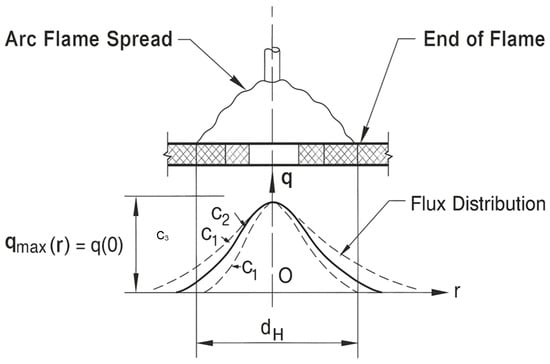
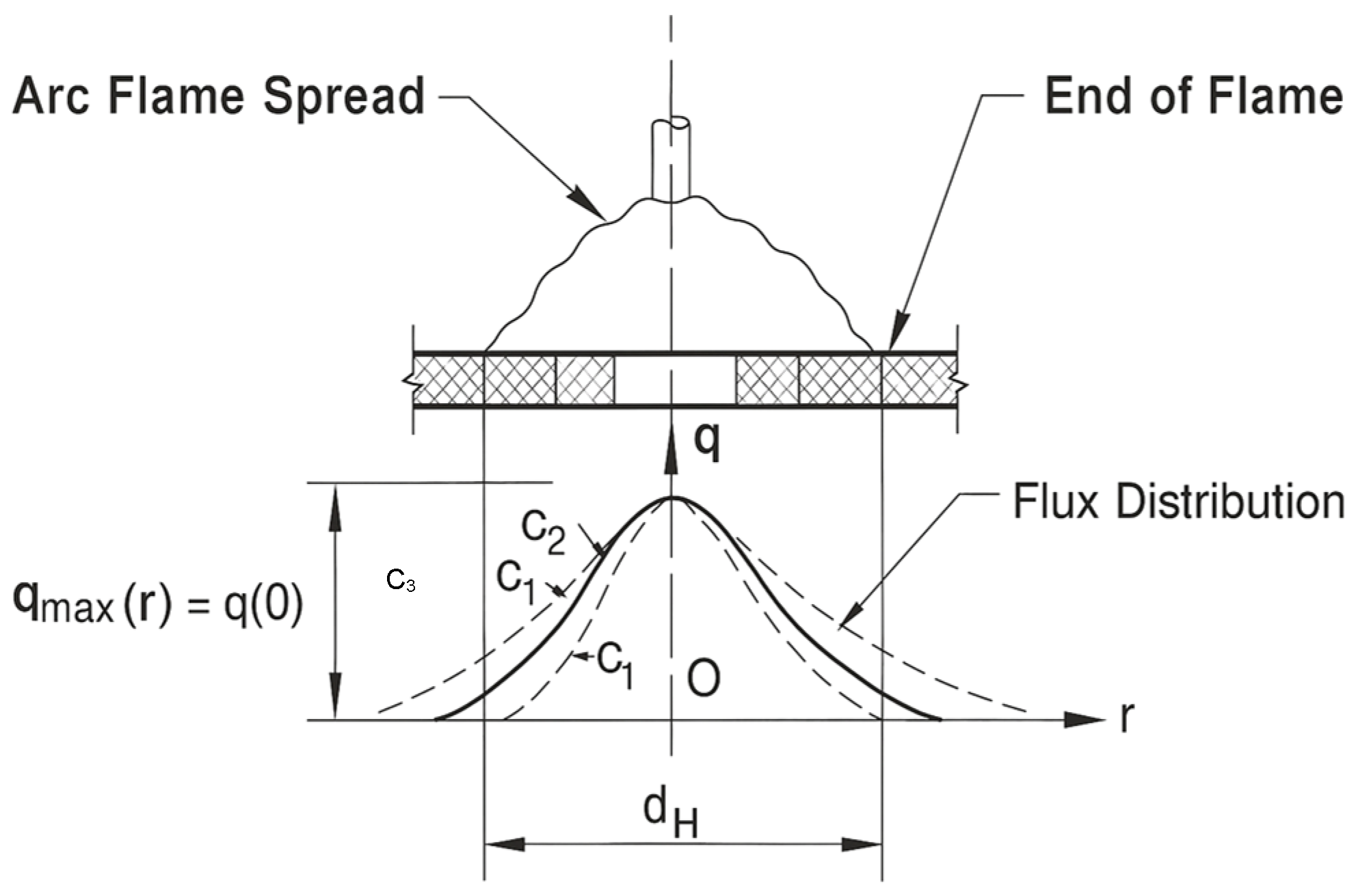
The surface heat source with a Gaussian distribution, as presented by [8], is a common model. In this formulation, the thermal flux follows a Normal or Gaussian distribution in the plane (Figure 1), and is described by:
where the heat flux at a surface with radius r is denoted by qr, q(0) represents the maximum heat flux at the center of the source, C is the distribution coefficient, and r is the radial distance from the center of the heat source.
Figure 1.
Representation of the Gaussian heat source.
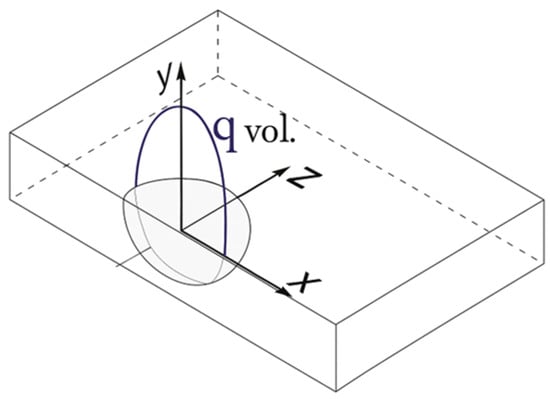
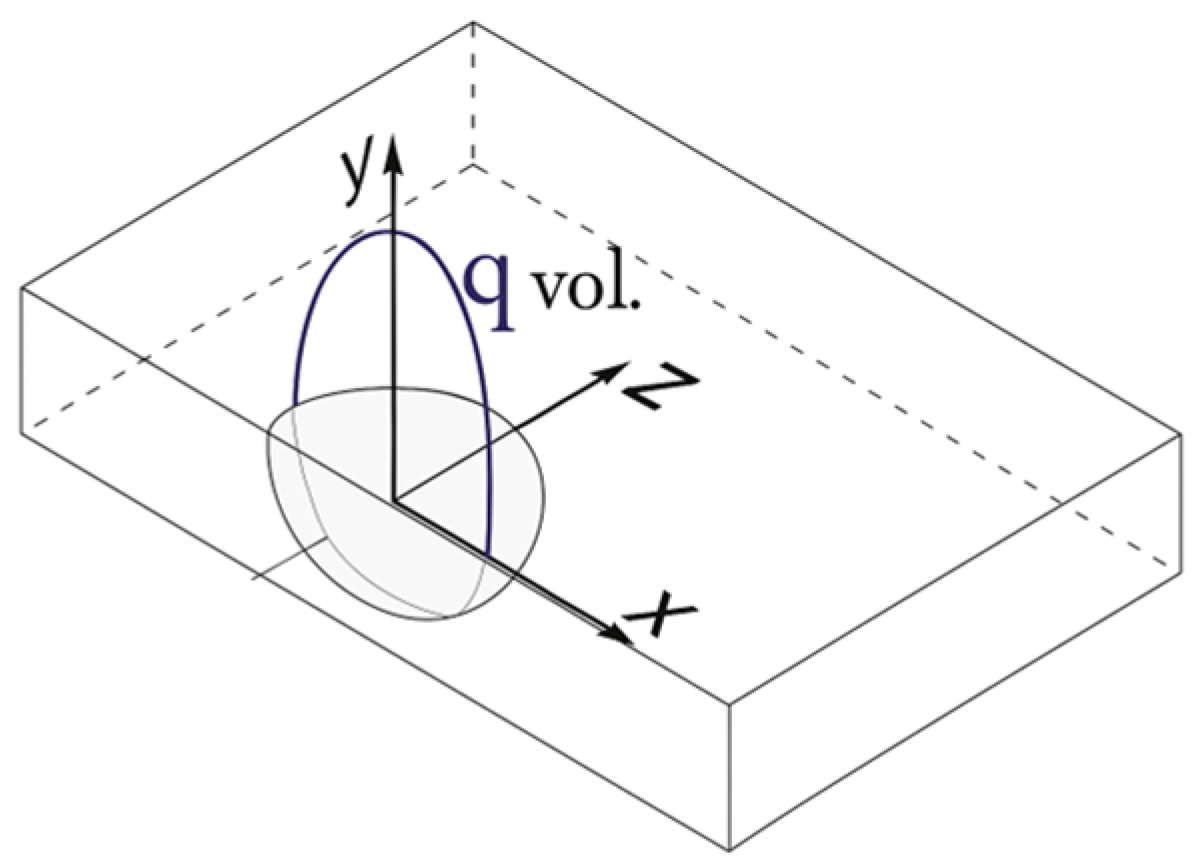
Friedman [9] presented an alternative to the [8] by proposing a coordinate system that moves with the thermal source. This heat source, known as the hemispherical Gaussian distribution (Figure 2), can be described as:
in which q(x,y,ξ) is the heat flux per unit volume.
Figure 2.
Representation of the hemispherical Gaussian heat source model.
The Gaussian distribution can also be represented as an ellipsoid centered at (0,0,0) with semi-axes A, B, and C parallel, respectively, to the x, y, and ξ coordinates, defined by [9]:
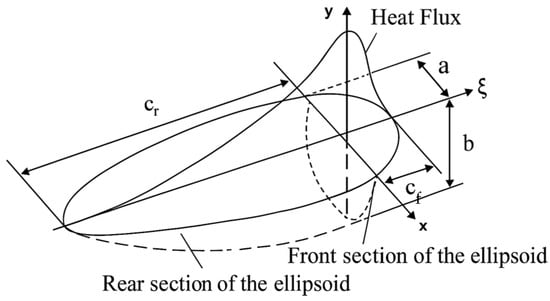
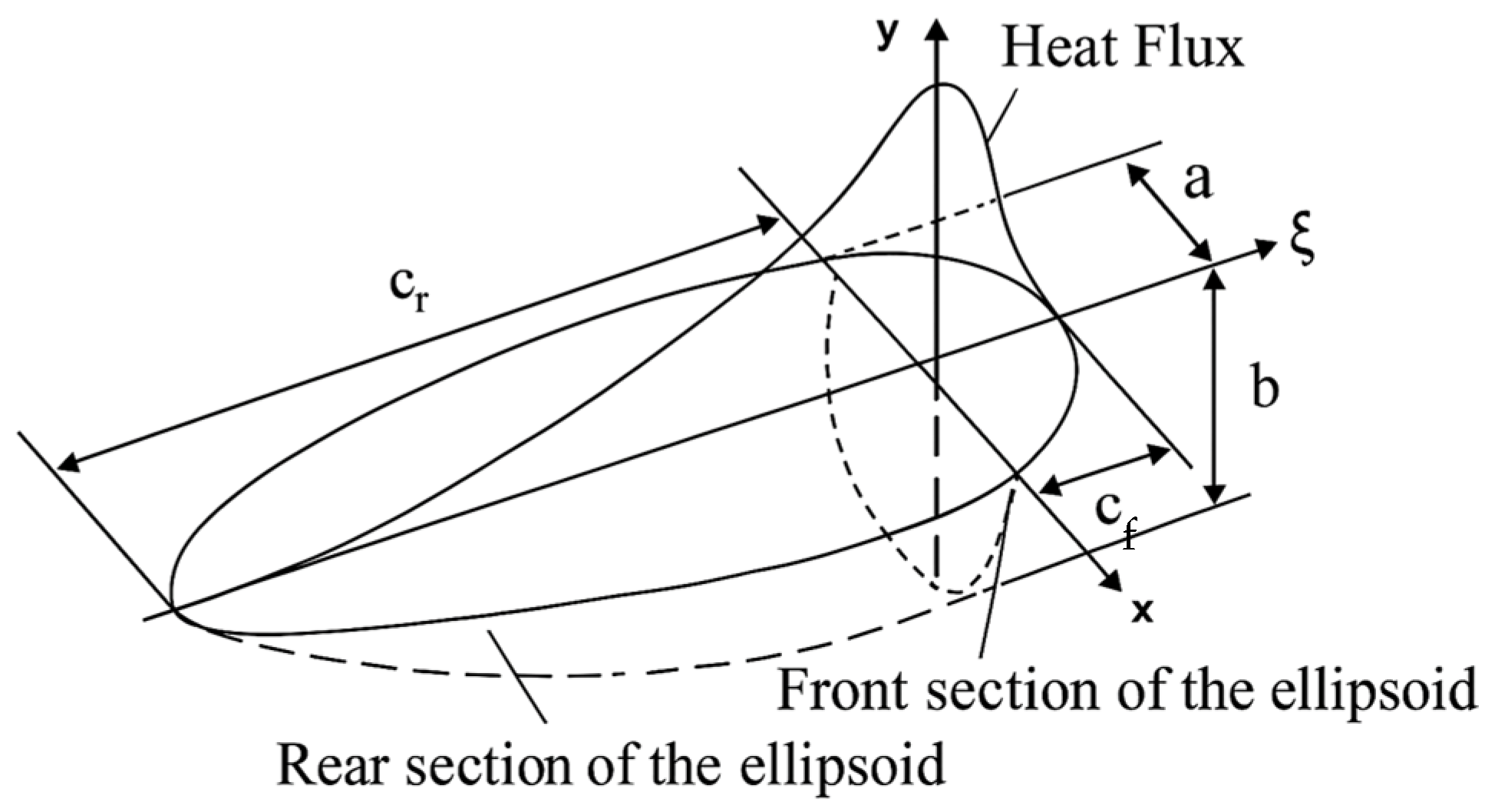
Due to the limitations of the single ellipsoidal heat source, a more comprehensive solution for representing thermal input in welding was proposed in Goldak et al. [31]. This model, which relies on two ellipsoids, is among the most widely adopted and is referred to as the Goldak double-ellipsoid volumetric heat source. In this heat source, a combination of two ellipsoidal sources is used: one in the front part relative to the center of the source and the other in the rear part, as shown in Figure 3.
Figure 3.
Goldak double ellipsoid heat source.
The heat flux in the front quadrant along the ξ axis can be described by [31]:
In the same way, the heat flux for the rear quadrant can be calculated using [31]:
being q the heat flux; x, y, z the global reference coordinates; f the fraction of heat deposited in each ellipsoid; Q the heat input; a, b, and c the semi-axes of the ellipsoids; t the time for the source to advance to the next check; v the welding speed; cf and cr the lengths of the frontal and rear ellipsoids, respectively; and τ the delay for positioning the welding arc.
The a, b, and c are geometric parameters of the heat source, used to describe the size of the melt pool with the highest possible accuracy. These parameters may have different values in the front and rear quadrants and are thus independent. They can be obtained experimentally by measuring the limits of the molten zone through a macrographic test [17]. The heat input Q is given by [31]:
in which n is the welding process efficiency, V is the voltage, and I is the welding current.
In this model, the fractions ff and fr, which represents the heat deposited in the front and rear quadrants of the source, must satisfy the condition ff + fr = 2 [29]. To ensure the continuity of Q between Equations (5) and (6), the following conditions must be fulfilled:
According to Deng and Murakawa [10], characteristic values for the fractions providing good convergence between numerical and experimental results were obtained experimentally: 0.6 for the heat deposited in the frontal ellipsoid (ff) and 1.4 for the heat deposited in the rear ellipsoid (fr). The sum of the z coordinate with the time for the source to advance to the next check corresponds to the ξ coordinate, so ξ = z + vt. For applications where the heat source begins at the system’s origin (ξ = z).
In this context, Locatelli [1] conducted a thermo-mechanical analysis using FEM to examine the distortions in a T-joint welded by the GMAW process. The Goldak double ellipsoid heat source was utilized to apply the heat flux to the piece. In his study, the author investigated the effect of distortions based on variations in three process parameters: welding speed, welding sequence, and cooling time between passes. From the cases studied, it was concluded that the lowest level of distortions was observed with higher welding speeds, a back-and-forth sequence, and a cooling interval.
Barban [3] applied the Goldak double ellipsoid model to verify the temperature field in the joint of two AISI 304 stainless steel plates welded by the GTAW process. The study used the values of ff and fr proposed by Goldak and Akhlaghi [7], 0.6 for ff (front part of the source) and 1.4 for fr (rear part of the heat source). It was also considered thermal properties such as specific heat, density, and thermal conductivity as temperature-dependent.
In addition, the weld bead section can be determined through practical experiments, and this information can be used to define the parameters of the double ellipsoid. However, without such data, the values can be obtained by trial and error. If not available, the longitudinal dimension of the weld pool can be approximated as half the width of the weld bead for the front fraction and one and a half times the width for the rear fraction [10].
Zhang et al. [14] addressed the complexity of dissimilar material welding (AISI 304L and Q235) using two different heat sources: asymmetric double ellipsoid and cylindrical. This methodology proved crucial to capture the effect of the different thermal properties of the materials on the weld geometry. Kumar et al. [15] directly compared a double ellipsoidal heat source with the Rosenthal model in AISI 304L GTAW, finding a maximum temperature deviation of 10% relative to the experimental data, compared to 34% for the Rosenthal model.
Singh et al. [32] also employed the double ellipsoidal heat source in AISI 304L GTAW, validating their results against the thermal field and penetration depth. In a parametric study, Velaga and Ravisankar [16] showed that, for AISI 304L, small variations in the geometrical parameters of the heat source have only a marginal impact on the fusion pool, but not on the residual stresses. They proposed that the initial characterization of the welding heat source is more critical than minor adjustments.
A robust thermal analysis is the basis for predicting mechanical and microstructural phenomena. Venkatkumar et al. [11] conducted thermo-mechanical analyses coupled to predict distortion in AISI 304 steel plates. The researchers compared volumetric and Gaussian heat sources, concluding that the volumetric model, combined with large displacement theory, provided more accurate distortion predictions.
Nuchim et al. [18] modeled stresses and distortions in TMCP EH-36 steel welds and validated their ellipsoidal heat source model with experimental data, demonstrating the accuracy of the method. The analysis was further advanced by Caruso and Imbrogno [19], who developed an innovative FEM model for GMAW of AISI 441 steel, capable of predicting grain growth and hardness reduction in the HAZ. This work highlights the level of detail that FEM can achieve, going beyond temperature fields to directly predict material properties. Phase transformation was also addressed by Chamim et al. [12], who investigated δ-ferrite evolution in 308L steels, demonstrating how the thermal cycle governs microstructural transformation.
Singh et al. [32] observed that increasing the TIG welding current in 304L raises the peak temperature, directly affecting both microstructure and residual stresses. Complementing this perspective, Bensada et al. [21] employed Computational Fluid Dynamics (CFD) to demonstrate that Marangoni convection is the primary driver of weld pool geometry, while also warning that higher power input can lead to elevated residual stresses. These studies emphasize that modeling not only enables prediction but also provides insight into the underlying physical mechanisms of the welding process.
Moslemi et al. [33] proposed a novel systematic numerical approach for the accurate and efficient determination of Goldak’s volumetric heat source parameters for Gas Tungsten Arc Welding (GTAW) simulations. The authors performed a three-dimensional finite element analysis to generate thirty datasets of normalized inputs (weld pool characteristics) and outputs (Goldak’s parameters). The relationships between these variables were established using two regression models and an Artificial Neural Network (ANN) computing system. Analysis showed that the ANN slightly outperformed both regression models, successfully predicting the necessary Goldak’s parameters.
Dadkhah et al. [34] assessed the effect of heat input on residual stress and distortion during GMAW of A516 Gr70 steel plates, utilizing integrated simulation and experimental validation. Recognizing that residual stresses adversely affect fatigue life and component stability, the authors used varying heat inputs and included scenarios with and without back welding. Experimentally, they quantified residual stresses using the hole-drilling method after characterizing the microstructure and mechanical properties (e.g., lowest heat input resulted in a microhardness of approximately 198 HV). Numerically, the simulation was performed in ABAQUS using the Goldak double-ellipsoid heat source model along with the element birth-and-death technique. Simulation results consistently placed peak residual stresses in the HAZ and the weld center. The study found that reducing heat input and applying back welding minimized tensile residual stresses and slightly increased compressive stresses away from the HAZ.
Kumar and Begum [35] focused on the Hybrid Laser-TIG welding process as an advancement for higher productivity, combining the benefits of both arc and laser welding to produce robust joints with high welding depth, fast speed, and good gap bridging capability. The study aimed to analyze the effect of various process parameters. A three-dimensional transient thermal analysis was performed using ANSYS 6.11-3. The computed results for the width and depth of the fusion zone indicated the weld pool shapes, and a good agreement was achieved between these computed results and experimental weld bead dimensions.
Xavier et al. [36] addressed the challenge of predicting transformations during welding to control weldment properties. The authors present a Thermo-Mechanical-Metallurgical (TMM) model to numerically predict the thermal history, solid-state phase transformations, solidification microstructure, and hardness distribution during and after the welding of high strength low-alloy steels (HSLA). The TMM model was implemented using an in-house computational code based on the Finite Volume Method (FVM). This approach allowed the dynamic tracking and calculation of volume fractions for ferrite, pearlite, bainite, and martensite within the Heat-Affected Zone (HAZ), as well as determining the dendrite arm spacing in the Fusion Zone.
Xu et al. [37] investigated the heterogeneous and spatially non-uniform grain structure observed in Selective Laser Melting (SLM) parts, a phenomenon difficult to fully analyze through experiments alone. The authors presented a high-fidelity three-dimensional numerical model to investigate grain growth mechanisms during the SLM of 316L stainless steel, incorporating both conduction and keyhole melting modes. The numerical approach involved simulating powder-scale thermo-fluid dynamics using the FVM coupled with the Volume of Fluid (VOF) method. Sequentially, the grain structure evolution was predicted using the Cellular Automaton (CA) method, taking the calculated temperature field and the melted powder bed configuration as input. The numerical simulation results demonstrated good agreement with experimental data from the literature. The findings detail the influence of process parameters and the effect of the keyhole and keyhole-induced voids on grain structure formation, supporting the optimization of parameters for tailoring the microstructure and mechanical properties of fabricated parts.
In turn, Wang et al. [38] focused on the longitudinal welding of pipeline steel, where the accurate prediction of the HAZ temperature field is crucial for controlling the microstructure and mechanical properties. The authors developed a FEM computational model to simulate the thermal process, focusing on the HAZ region. They employed a specific double-ellipsoidal heat source model to represent the energy input and calibrated its parameters to achieve high fidelity with experimental data. The research highlights the importance of the heat source model in establishing a robust foundation for subsequent analyses, such as predicting residual stresses and controlling performance. The validated FEM model provides an efficient numerical tool for optimizing welding parameters and ensuring the quality and structural integrity of pipeline steel welds.
3. Materials and Methods
As previously mentioned, the objective of this work is to simulate the welding of a butt joint in AISI 304L stainless steel using the GMAW process. To validate the simulation, the numerical results were compared with experimental data obtained at the LAPES/FURG [2].
While a complete assessment of the welded joint quality requires determining the final stress and strain state, the computational approach adopted in this study focuses exclusively on the thermal analysis. This methodology is based on the weakly coupled (or sequential) thermo-mechanical analysis widely used in welding simulations [39]. In this approach, the thermal analysis is the prerequisite first step, where the temperature field is calculated independently of the mechanical response. The resulting temperature history is then applied as a thermal load to the subsequent mechanical analysis. Therefore, the accurate characterization and calibration of the heat source (the focus of the present work) is essential, as the thermal field serves as the fundamental input governing all subsequent mechanical and microstructural phenomena. By ensuring the high fidelity of the thermal field, the foundation for any future comprehensive thermo-mechanical prediction is established [38].
The experimental validation was conducted on specimens consisting of butt joints between two AISI 304L stainless steel plates welded using the GMAW process [2]. The complete weld bead required three passes: one root pass and two filler passes. In this study, only the root pass was simulated. This choice was made because the root pass is considered the most relevant stage for evaluating the volumetric heat source due to its inherently greater penetration depth. Consequently, the validation of the numerical model was restricted to the experimental results corresponding to the root pass.
3.1. Plates Geometry
Three-dimensional modeling provides detailed information about the temperature field in arc welding processes, as noted by Deng and Murakawa [10]. However, this approach demands considerable computation time, primarily due to the inherent nonlinearity of the transient thermo-mechanical phenomena involved in welding. Conversely, two-dimensional solutions offer significant advantages in reducing computation time; yet, as reported by [2], they cannot capture all the details necessary for a comprehensive analysis of the welding process.
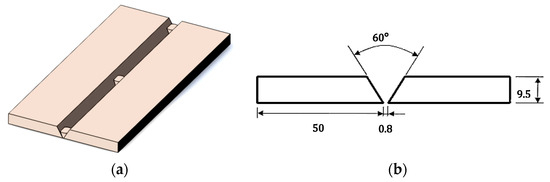
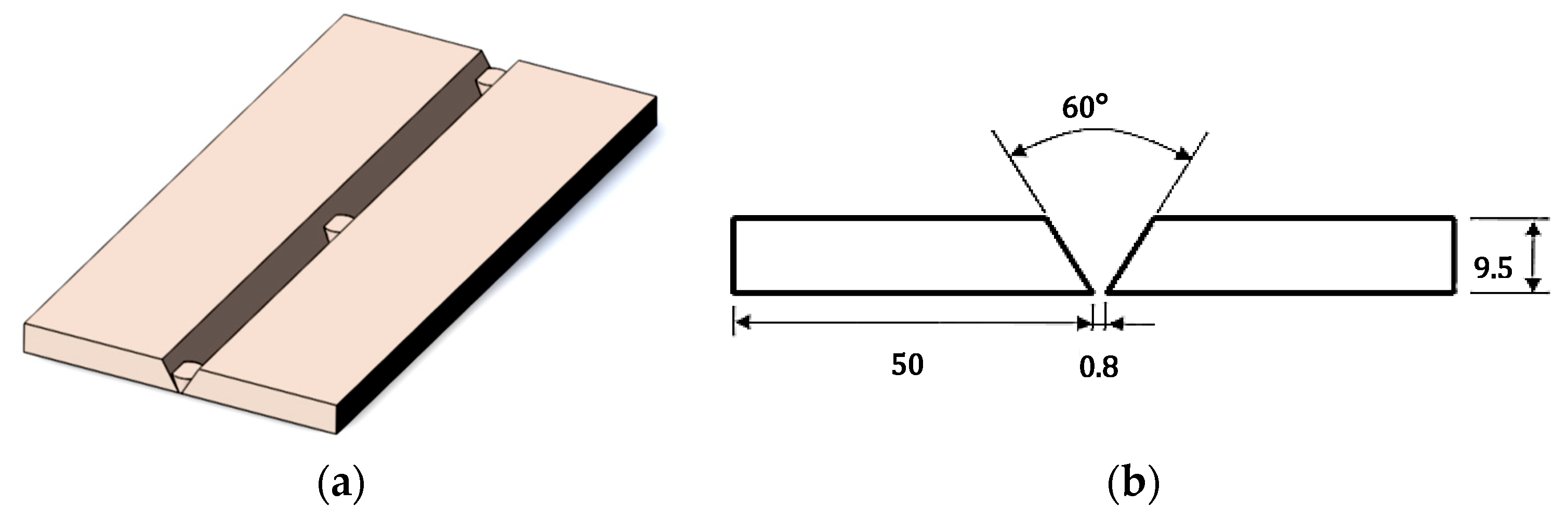
Figure 4 presents the geometry of the AISI 304L stainless steel plates used in the simulation. In Figure 4a, an isometric view illustrates the two test plates, each measuring 200 mm in length, 50 mm in width, and 9.5 mm in nominal thickness. In Figure 4b, the cross-section of the welded joint is shown, featuring a V-groove with a bevel angle of 60° and a 0.8 mm gap between the plates.
Figure 4.
AISI 304L stainless steel plates: (a) isometric view, and (b) cross-section (in mm).
To reduce computational simulation time, a common and valuable practice is applying the concept of symmetry, which involves modeling the effects of welding on only half of the domain, using the weld bead centerline as the plane of reference [40]. The application of this concept was possible in this study [41] due to the nature of the welding conditions and the boundary conditions of the test piece (i.e., the absence of mechanical restraints, allowing free deformation).
3.2. Dimensions of the Passes
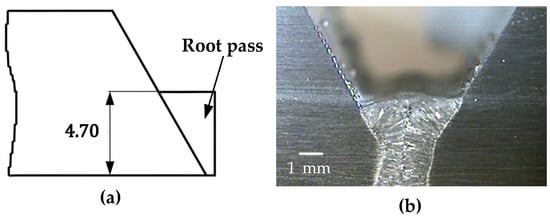
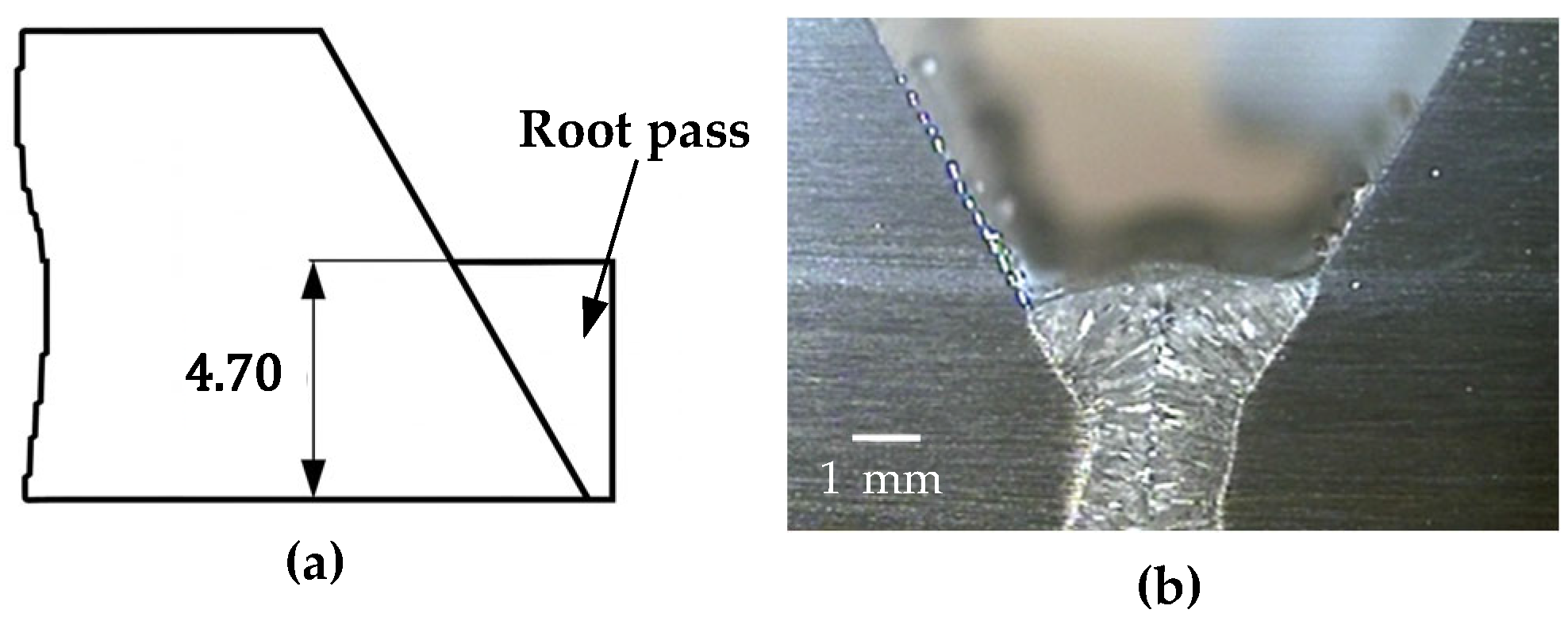
Determining the exact dimensions of each weld pass post-welding is inherently complicated, primarily due to unavoidable variations occurring between individual welded test pieces. Applying principles of mass conservation and utilizing process data (such as wire feed rate, weld bead length, and wire diameter), the volume of material deposited specifically in the root pass, and its corresponding thicknesses, were determined [2], as illustrated in Figure 5a. Figure 5b shows the root pass weld bead macrograph. As this work focuses exclusively on this initial pass, the derived weld bead thickness of 4.7 mm was adopted for the computational model.
Figure 5.
(a) Thicknesses of the root pass (in mm) and (b) the root pass weld bead macrograph.
No root face was applied; consequently, the groove extends fully from the top surface to the bottom of the plate. No backing (strip) was employed during the welding process. This geometric configuration precisely matches the experimental setup from which the thermocouple data were obtained, and it has been reproduced exactly in the FEM model.
3.3. Base Metal and Electrode
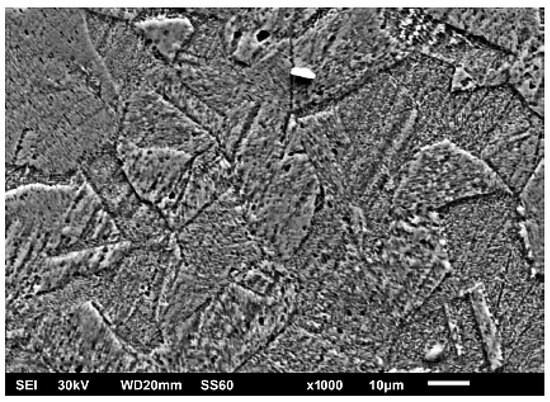
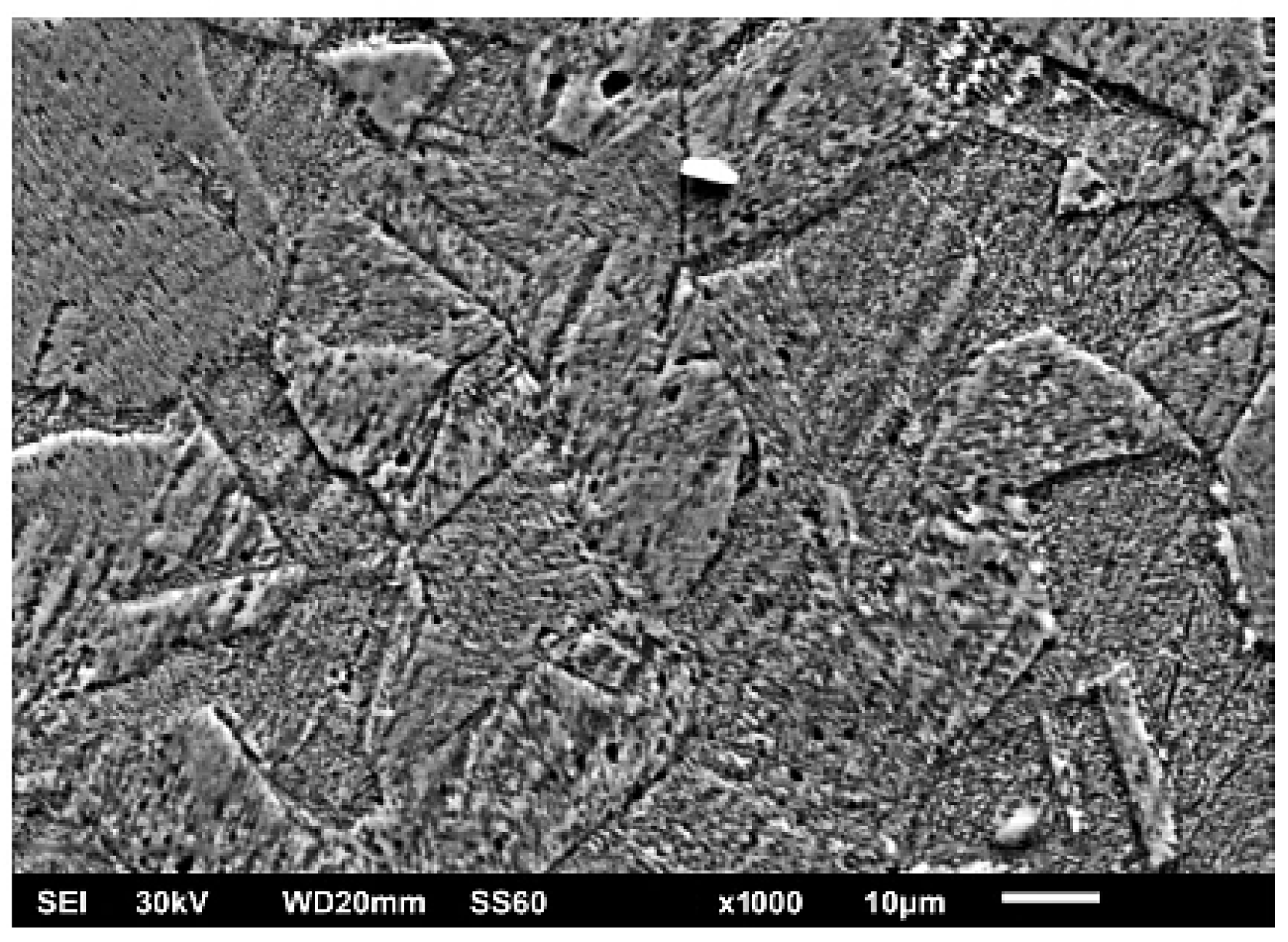
The base metal utilized was AISI 304L stainless steel. The electrode employed was AWS ER308L with a diameter of 1 mm. Table 1 presents the chemical composition of both materials, and Table 2 summarizes their mechanical properties. Additionally, Figure 6 illustrates the microstructure analysis performed on the test samples, with the image acquired using a Scanning Electron Microscope (SEM).
Table 1.
Chemical composition of base metal AISI 304L and electrode AWS ER308L [% mass].
Table 2.
Mechanical Properties of AISI 304L stainless steel and electrode AWS ER308L.
Figure 6.
SEM AISI 304L stainless steel.
3.4. Welding of the Samples
The test samples were welded using the GMAW process (constant voltage). Welding was conducted using a Motoman HP20D 6-axis weld robot (Yaskawa Electric Corporation, Kitakyushu, Fukuoka, Japan, repeatability = ±0.06 mm) and the Power Wave 455 M/STT Advanced Process Welder (Lincoln Electric, Cleveland, OH, USA). The shielding gas employed was a mixture of argon and 2% O2, with a flow rate of 16 L/min. Table 3 presents specific welding parameters utilized in the root pass. The wire feed rate and the distance from the contact tip to the workpiece (CTWD) were pre-adjusted before the welding operations.
Table 3.
Welding parameter for the root pass [2].
3.5. Thermal Analysis
The heat source model utilized for the welding process simulation is the Goldak double ellipsoid, which considers the power density in the frontal and rear domains with respect to the center of the arc. This model is the most realistic and flexible, as the size and shape of the heat source can be easily modified, allowing it to interact at both surface and depth levels within the solid during the welding process [20].
The geometric parameters of the double ellipsoid (a, b, cf, cr) were estimated based on weld bead dimensions and the macrograph analysis reported in the experimental study used for validation [2]. The parameters a, cf, and cr were kept fixed to represent lateral and longitudinal heat distribution, while the depth parameter b was selected as the primary calibration variable due to its strong influence on the subsurface temperature field [42].
Equations (5) and (6), which describe, respectively, the heat flux distribution in the front and rear regions of the heat source, were employed for heat modeling. The geometric parameters of the molten zone were set according to the specifications of the weld bead geometry and the root pass macrograph (see Figure 5), with values of a = 2.71 mm, b = 4.00 mm, cf = 2.71 mm, and cr = 8.14 mm. The fraction values were set to the characteristic values proposed by Deng and Murakawa [10], as these values facilitate convergence between the numerical and experimental results. The heat deposited in the frontal ellipsoid was set to 0.6, while the heat deposited in the rear ellipsoid was set to 1.4. It was assumed that the welding process would have a thermal efficiency between 85% and 87%, which is typical for the GMAW process.
This approach aligns with recent works in which calibration of double-ellipsoid parameters is performed numerically when experimental bead geometry is unavailable [40,43]. The systematic adjustment of b was conducted by comparing numerical peak temperatures at the thermocouple locations with experimental measurements [2]. This strategy allows a physically consistent and reproducible way to refine the depth heat distribution while maintaining coherence with Goldak’s formulation.
3.6. Boundary Conditions
In the thermal analysis, a constant convection coefficient was assumed for the free surfaces of the plates. The value employed throughout the analysis was set to hc = 10 W/m2·K. The ambient temperature was assumed to be 20 °C. Additionally, the material’s emissivity of ε = 0.75 was assumed during the thermal analysis. These values are consistent with typical ranges reported in the literature for natural convection and radiation heat transfer in metals [26].
The simulation focused exclusively on the root pass as a strategic methodological choice. This focused simulation approach is necessary for the precise calibration and validation of the volumetric heat flux distribution. The root pass is the most suitable scenario for isolating the heat source’s behavior, as it minimizes interference from pre-heating and the cumulative effect of residual stresses and strains from subsequent passes. The successful validation of the heat source under these single-pass conditions is the fundamental prerequisite for extending the model to more complex multi-pass welding simulations.
3.7. Thermophysical Properties
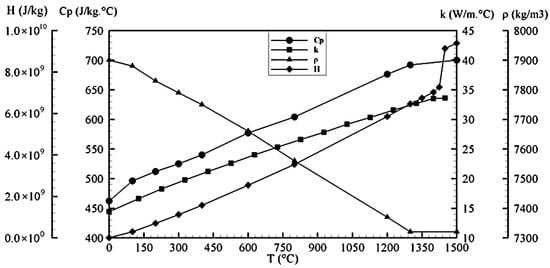
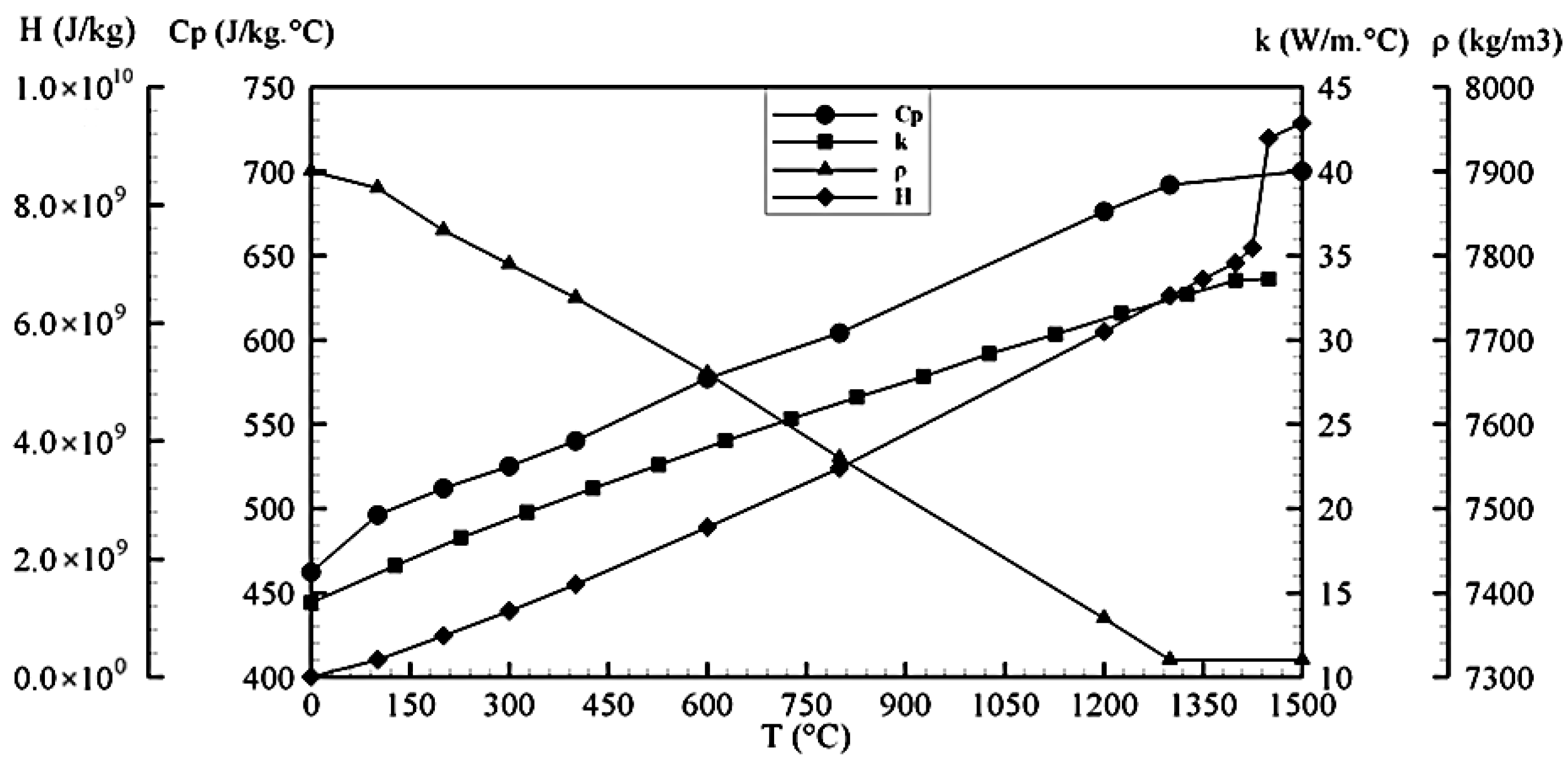
Accurate numerical modeling of welding processes necessitates the consideration of the temperature-dependent thermophysical properties of the material under investigation. Figure 7 illustrates the thermophysical properties utilized for AISI 304L stainless steel, specifically enthalpy, specific heat, density, and thermal conductivity [2]. It is important to note that these properties are defined for temperatures up to the material’s melting point and are subsequently held constant for all temperatures exceeding this value.
Figure 7.
Thermophysical properties of AISI 304L stainless steel.
3.8. Finite Element Model and Mesh Configuration
As earlier mentioned, the software used for the welding process simulation was ABAQUS SIMULIA® FEM software (version 6.11-3) developed by Dassault Systèmes (3DS), Providence, RI, US. To accurately represent the desired welding conditions, the Goldak volumetric heat source geometry was implemented via the DFLUX user subroutine coded in the Fortran environment for ABAQUS (available in Appendix A). The DFLUX subroutine is utilized to define non-uniform heat flux distributions as a function of position, time, and temperature [44].
Regarding the spatial discretization, Nobrega [13] suggested that refining the mesh in the x-direction near the weld bead could enhance the results. Based on this concept, the mesh was refined near the weld bead, the region of greatest interest in welding simulations, with element sizes varying from 1.0 mm to 0.7 mm. The thermal analysis employed the DC3D8 hexahedral element, an eight-node finite element with a single degree of freedom per node (temperature) [4].
For the purpose of pure thermal analysis (weakly coupled), the simulation domain was discretized to include the final volume of the deposited weld metal (the weld bead) as part of the initial mesh. This is an established practice in FEM thermal modeling, as it ensures the heat conduction model accurately accounts for the correct mass and geometry absorbing the energy, which aligns with the study’s focus on heat source calibration. Therefore, complex deposition techniques such as Element Birth and Death (EBD) were purposefully omitted, as they pertain to the subsequent thermo-mechanical refinement of the model.
3.9. Computational Model Validation
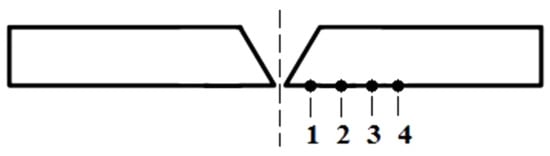
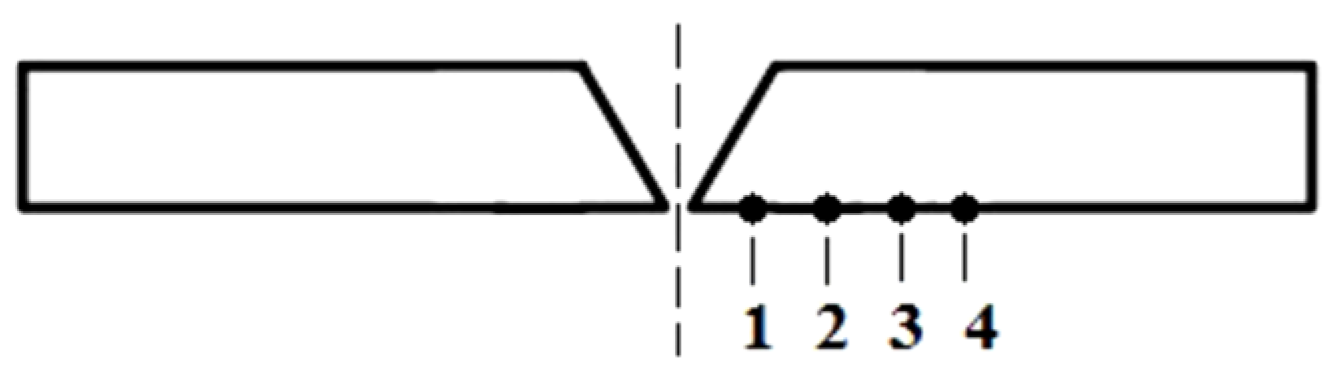
The experimental results reported by [2] were utilized to validate the proposed computational model. In that study, four thermocouples were mounted on the plate during the experimental tests (Figure 8). However, only points 1 through 3 were analyzed in the numerical study. This decision was made to focus on the regions closest to the weld center, where the thermal gradients are most significant, thus providing a more sensitive basis for model calibration.
Figure 8.
Arrangement of the thermocouples installed for the experimental test.
4. Results and Discussion
4.1. Incremental Convergence Test
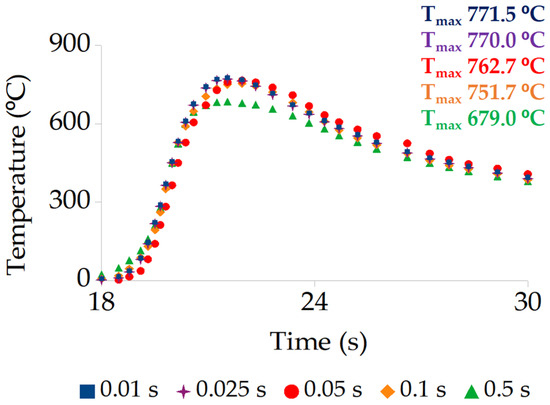
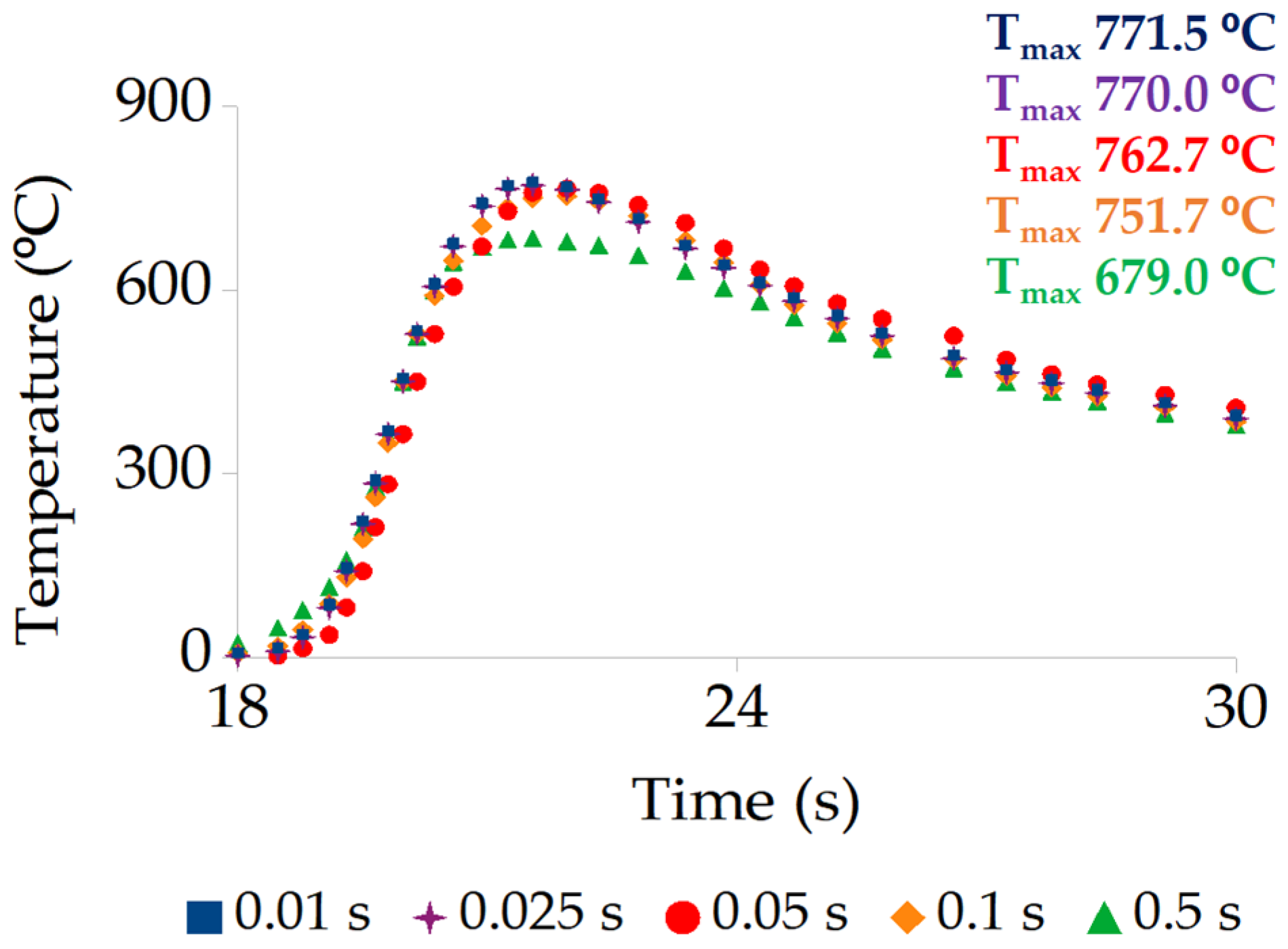
An incremental convergence test was initially performed to ensure the numerical stability and accuracy of the obtained results. This test was conducted with the geometric parameters of the volumetric heat source kept constant. A mesh with a uniform element size of 1.0 mm was used, and the time between each increment in the computational simulation was varied.
Table 4 presents the geometric parameters of the heat source used in the incremental convergence test, the times between increments, the number of increments, and the total duration of each test. The temperature values refer to a point at the bottom of the plate located 4 mm in the x-direction (the position of the first thermocouple used in the experiment, see Figure 8). Figure 9 shows the results obtained for each increment.
Table 4.
Parameters for the incremental convergence test.
Figure 9.
Results from the incremental convergence test.
As can be seen in Figure 9, the temperature difference between the 0.025 s and 0.01 s increments was 0.5 °C (relative difference of 0.06%). This value is relatively low for a convergence test; therefore, it was decided to use the 0.025 s increment for the analyses, as the numerical simulation duration is considerably shorter (time reduction of 40%). This leads to a time saving of 8 h, while maintaining minimal temperature variation.
4.2. Mesh Convergence Test
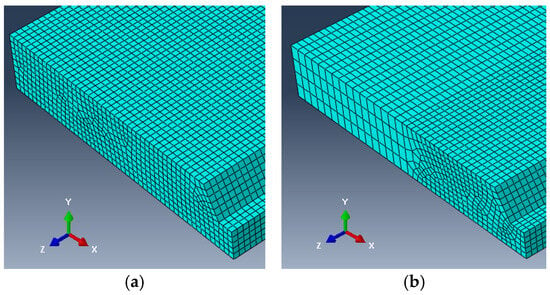
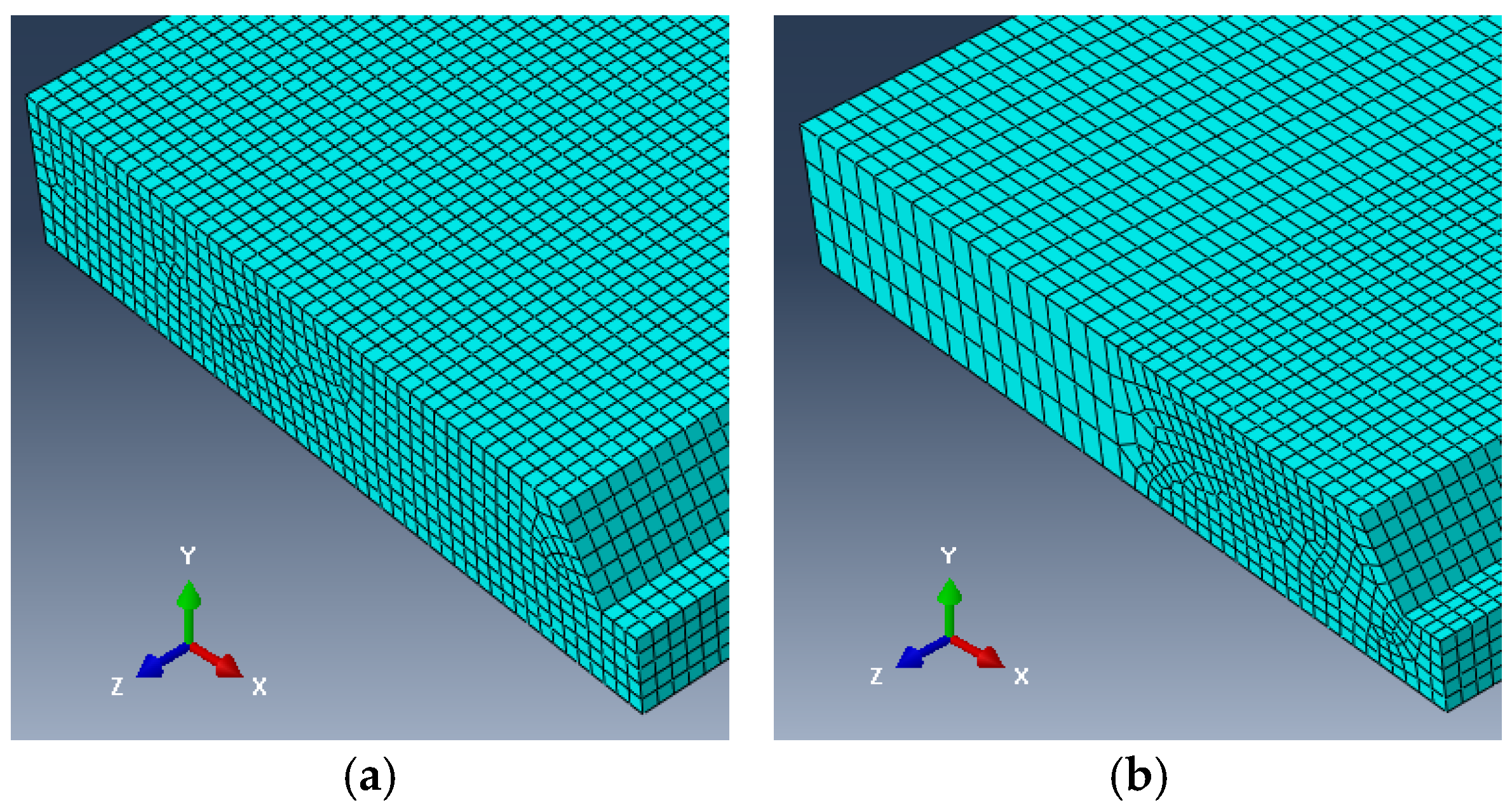
The previous section noted that the initial analysis employed a uniform mesh with fixed-size elements measuring 1.0 mm throughout the entire model (Figure 10a), an approach consistent with that used by Farias et al. [2] in a similar numerical simulation. Subsequently, an enhanced spatial discretization scheme was proposed to improve computational efficiency: a non-uniform mesh featuring a coarser region (2.0 mm elements) and a refined region (1.0 mm elements) around the weld zone (Figure 10b). The uniform mesh contained approximately 99,000 finite elements, whereas the refined, non-uniform mesh included 64,988 elements, representing a significant reduction of 34.35% in the total element count.
Figure 10.
Spatial discretization: (a) mesh with uniform 1.0 mm elements, and (b) mesh with coarser 2.0 mm elements and a refined region near the weld bead using 1.0 mm elements.
The mesh convergence assessment was primarily performed at the thermocouple located 4 mm from the weld centerline (point 1 in Figure 8). This specific location was chosen because it experiences the steepest thermal gradients, thereby ensuring that the mesh adequately captured the most sensitive region of the thermal field.
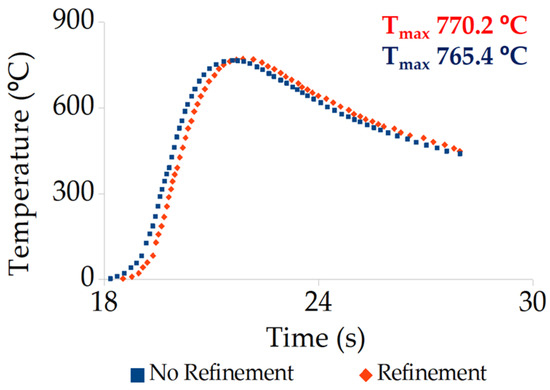
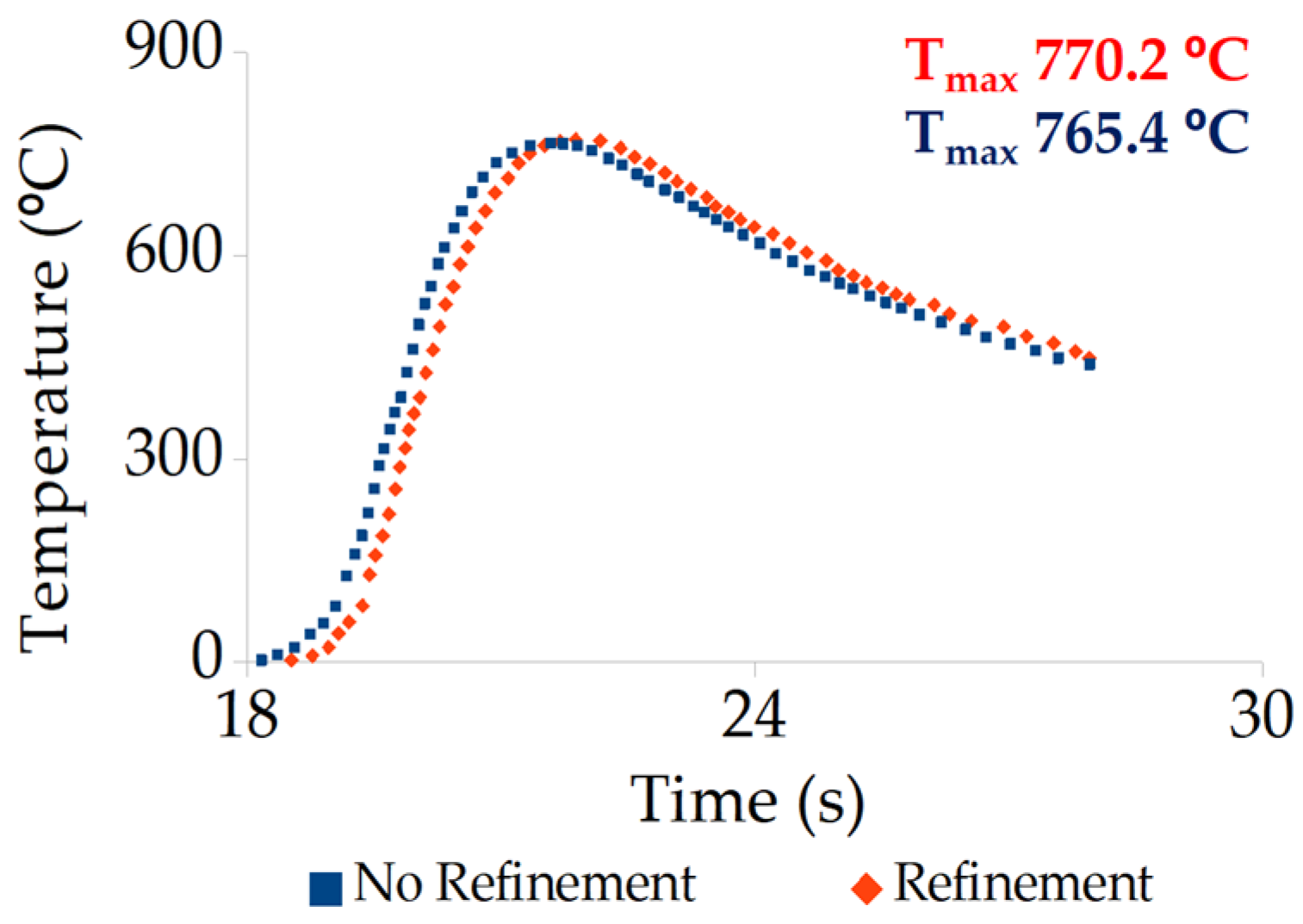
The temperature histories obtained at the 8 mm and 12 mm thermocouples (points 2 and 3 in Figure 8) also exhibited smooth, physically consistent behavior and demonstrated excellent agreement with the experimental data. This correlation confirms that the adopted mesh resolution remained adequate throughout the entire computational domain. Figure 11 presents the result of this initial convergence analysis, specifically focusing on the bottom point of the plate located 4 mm from the center of the bead in the x-direction.
Figure 11.
Result of the spatial discretization investigation.
The test showed an absolute relative difference of 0.63% between the maximum temperature values obtained in each analysis, as illustrated in Figure 11.
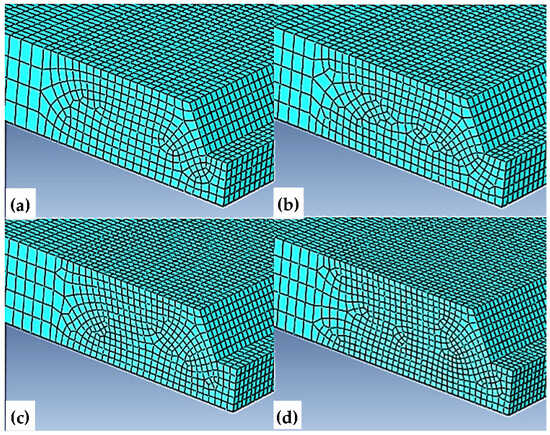
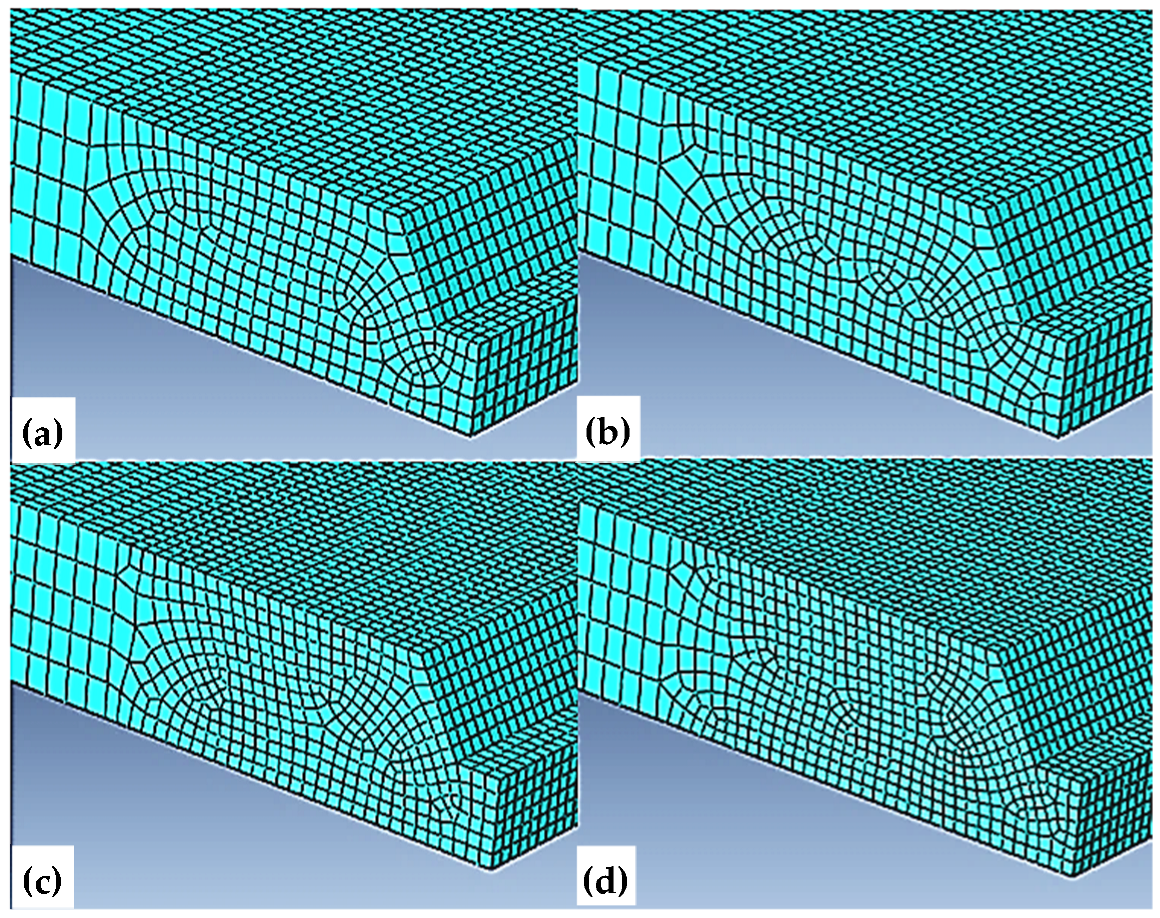
Based on that, the decision was made to use a two-region mesh: one coarser (farther from the weld bead) and one refined. A mesh convergence test was subsequently conducted to assess the influence of the element size on the numerical results. Four meshes were evaluated until the required convergence criteria were achieved. Table 5 presents the finite element sizes utilized for the refined region, as well as the total number of finite elements in each mesh. For this test, the geometric characteristics of the volumetric heat source were kept constant (as adopted in the incremental convergence analysis, Table 4), and the increment rate was also maintained. The finite element size in the coarser region of all meshes was kept at 2 mm. Although the initial element size for the refined region was 1 mm, the convergence test was necessary due to uncertainty regarding whether this size would be sufficient for accurately simulating the volumetric heat source.
Table 5.
Parameters for the mesh convergence test.
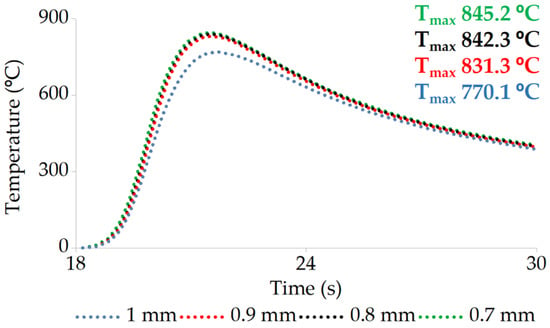
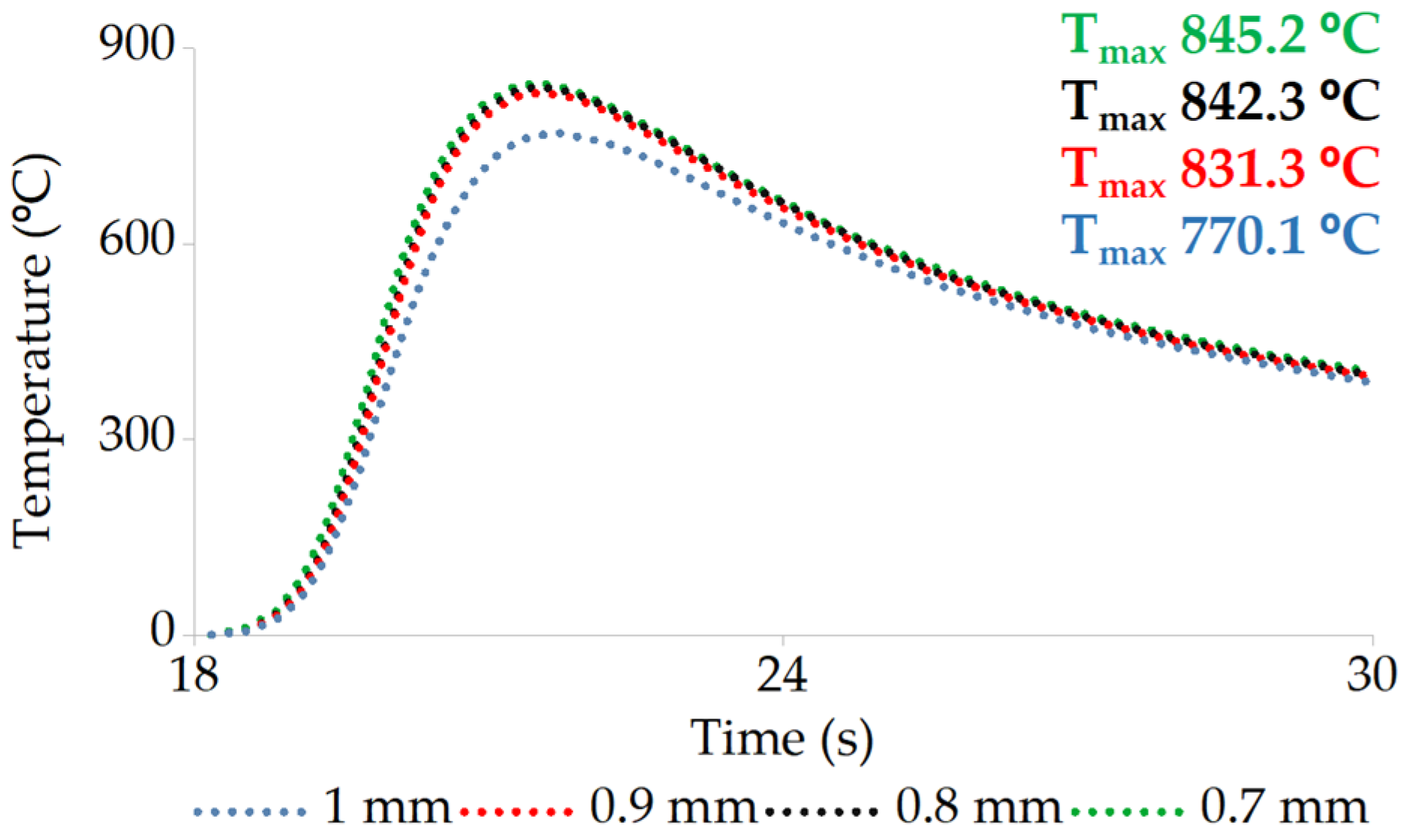
Figure 12 shows the four meshes proposed in Table 5 for the mesh convergence test, and Figure 13 presents the results of the mesh convergence test.
Figure 12.
Spatial discretizations of the mesh convergence test: (a) 1 mm, (b) 0.9 mm, (c) 0.8 mm, and (d) 0.7 mm.
Figure 13.
Results of the mesh convergence test.
After the mesh convergence test presented in Figure 13, it was observed that the 1.0 mm element size for the refined region does not meet the convergence requirements for simulating the volumetric heat source. It is worth noting that the temperature values presented in the mesh convergence test also refer to a point at the bottom of the plate located 4 mm from the center of the bead in the x-direction (the first thermocouple used in the experiment, see Figure 8). The difference in maximum temperatures obtained for the 0.8 mm and 0.7 mm meshes was only 2.9 °C (an absolute relative difference of around 0.3%). Given the higher number of finite elements in the 0.7 mm mesh, the 0.8 mm mesh was chosen for the refined region as a more suitable choice.
4.3. Thermal Results for Volumetric Heat Source
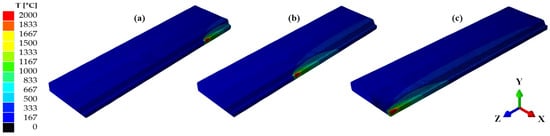
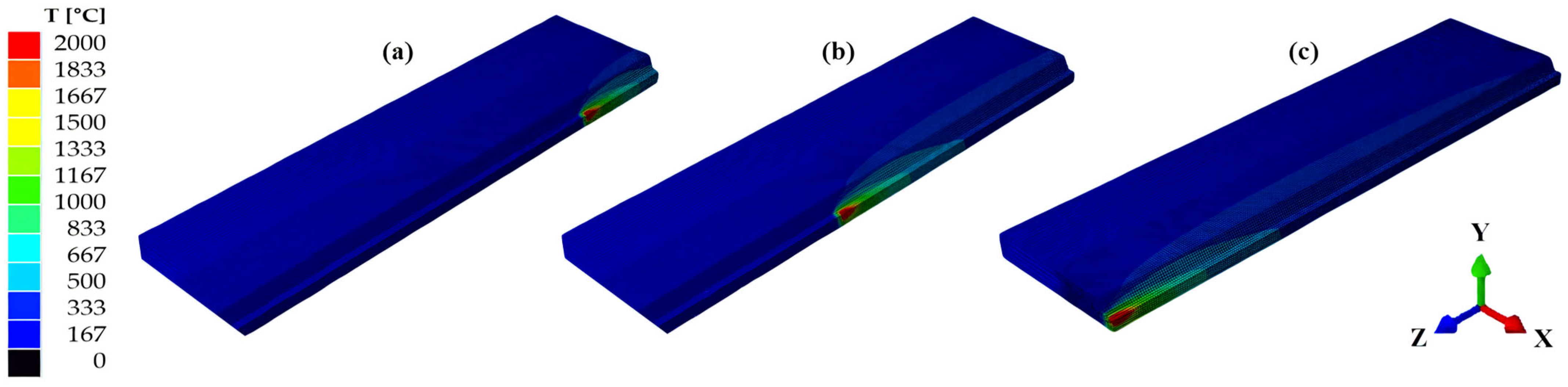
Initially, the thermal analysis is conducted, where the heat source travels a distance of 200 mm along the length of the workpiece, maintaining a constant welding speed of approximately 4.16 mm/s, taking about 50 s to complete the welding from start to finish of the arc. Figure 14 shows the movement of the volumetric heat source, Goldak’s double ellipsoid, over the plate at time instants of 10 s, 30 s, and 47.5 s. It is also possible to observe the heterogeneity in temperature distribution, where varying temperature gradients are obtained in different regions of the welded plate. Goldak’s double ellipsoid is applied according to the red-colored region, representing the molten zone, as this volume is above the liquidus temperature of the material [3].
Figure 14.
Volumetric heat source movement after an interval of: (a) 10 s, (b) 30 s, and (c) 47.5 s.
From Figure 14 it is possible to observe that the maximum temperature at the center of the weld pool ranges from approximately 1833 °C to 2000 °C, which is consistent with values reported for GMAW processes in the literature [45].
As previously noted, all thermal results presented so far were obtained using fixed geometric parameters for the volumetric heat source. In particular, the depth parameter b of the double-ellipsoidal model was kept constant at 4 mm in all simulations to ensure a consistent basis for comparing the thermal response. In Section 4.5, the influence of this parameter will be examined to enhance the accuracy of the computational model and achieve a closer agreement with the experimental data.
4.4. Comparison of Simulation Results
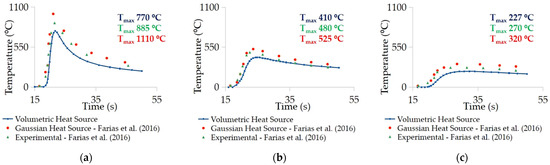
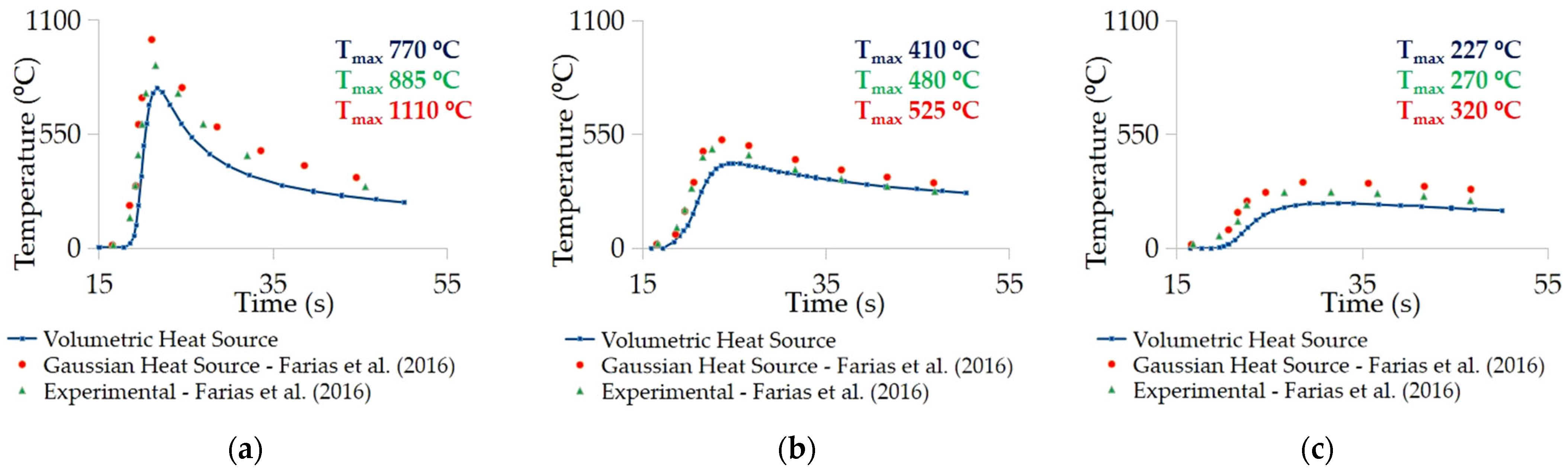
The results presented in this section were obtained using the same geometric parameters for the volumetric heat source employed in the convergence tests and with welding conditions similar to those obtained experimentally. These heat source parameters were derived from the geometry of the weld bead and explicit values provided by Goldak and Akhlaghi [7]. As mentioned, the results were analyzed case by case. Since only the results from Farias et al. [2] corresponding to thermocouples located 4, 8, and 12 mm of the weld bead center (points 1, 2, and 3 in Figure 8) were available, the comparative analysis was restricted to these three positions. Figure 15a–c present the numerical results obtained with the proposed model compared to the experimental and numerical data reported by [2] at the respective thermocouple locations. The discussion focuses on temperature peaks and the behavior of the heat sources during the root pass.
Figure 15.
Comparison of results for the thermocouple located from the center of the weld bead at: (a) 4 mm data from [2], (b) 8 mm data from [2], and (c) 12 mm data from [2].
At the first evaluation point, located 4 mm from the weld center (Figure 15a), the results highlight the criticality of this position due to its proximity to the fusion zone, where the highest thermal gradients are observed. In this region, the volumetric heat source exhibits good agreement with the experimental measurements, confirming its effectiveness in representing the welding thermal field, as the heat propagation is distributed throughout the material volume. For the second thermocouple, positioned 8 mm from the weld center (Figure 15b), the agreement between the numerical predictions and the experimental data obtained with the volumetric heat source also remains satisfactory.
Finally, Figure 15c presents the comparison at 12 mm from the weld center. Here, Goldak’s double ellipsoid slightly underestimates the experimental and numerical results but still falls within acceptable tolerance limits for welding simulations. One can also note that across all three evaluation points of Figure 15, the numerical results from the proposed computational model exhibited the same overall trend as the reference data [2]. Moreover, a closer convergence is observed between the experimental data and the Gaussian heat source used in [2]. Despite only superficially penetrating the weld seam, the Gaussian heat source performs reasonably well for thin material simulations [9].
The percentage differences between the peak temperatures in comparing the ellipsoidal double volumetric heat source with the experimental results [2] for the three thermocouple positions (4 mm, 8 mm, and 12 mm) are 12.99%, 14.58%, and 15.93% lower, respectively, than the experimental values. The Gaussian heat source results reported in [2] predict higher peak temperatures than the experimental data. The percentage differences between the volumetric and Gaussian heat source models are 23.76%, 21.90%, and 29.06%, indicating that the ellipsoidal volumetric approach predicts lower temperature peaks than the Gaussian model, while maintaining a consistent correlation with the experimental behavior. These results are presented in summary in Table 6.
Table 6.
Peak temperatures and relative deviations between experimental and Gaussian [2] vs. volumetric heat source (Present Work).
As previously established, the Gaussian heat source, which was utilized in the previous studies [2], tends to overpredict peak temperatures because its formulation concentrates heat flux primarily at the surface and does not account for deeper volumetric energy dissipation. This concentration leads to an artificially higher surface temperature and potentially pronounced lateral heat spreading in the simulation [25]. In contrast, the volumetric model distributes the supplied energy throughout the solid domain, naturally resulting in lower surface peaks but more accurate subsurface temperatures [46].
Although volumetric heat sources are generally more accurate for processes with significant penetration, Gaussian models remain advantageous in specific circumstances. Their low computational cost and analytical simplicity make them suitable for preliminary thermal analyses, sensitivity studies, or for modeling welding processes in thin plates or those characterized by extremely shallow heat input [47]. However, for GMAW of stainless steel in plates of moderate thickness, the volumetric source provides greater physical fidelity, as demonstrated by the present study.
The present study employs a pure thermal finite element model and, therefore, does not incorporate fluid-flow phenomena known to influence weld pool formation, such as Marangoni convection, surface tension gradients, buoyancy forces, or free-surface deformation, like [21]. These complex effects are typically captured only through CFD simulations based on the Navier–Stokes equations coupled with heat transfer. As such, the predicted weld pool geometry should be interpreted as an equivalent thermal field rather than an exact representation of fluid behavior. Despite these limitations, the thermal approach remains widely used in the literature due to its robustness, significantly reduced computational expense, and its ability to produce consistent temperature histories for subsequent thermo-mechanical analyses.
4.5. Improvement of the Volumetric Heat Source
In this part of the comparative study, the focus was primarily on validating the numerical results against the experimental values from Farias et al. [2]. For comparison, it is noted that the numerical simulations previously executed by [2], which utilized a Gaussian heat source, consistently yielded temperature values higher than the experimental measurements across all measurement points (see Table 6).
However, the initial Goldak simulations using b = 4.0 mm underestimated the peak temperatures at all measurement points. This behavior is expected when the depth parameter is small, as the deposited energy becomes highly concentrated near the surface, consequently reducing the thermal penetration through the plate thickness. As a result, heat dissipates rapidly before effectively reaching the thermocouples located deeper within the plate, leading to lower temperature predictions compared to the experimental data.
To improve the volumetric heat source and achieve temperature values that align more closely with the experimental results, a parametric study was conducted by systematically varying the depth parameter b. This adjustment was performed within the bounds of the observed root pass geometry to ensure physical consistency (see Figure 5). All previously established conditions were maintained; however, new simulations were performed by adjusting this parameter to 4.3 mm, 4.5 mm, and 4.7 mm. Table 7 summarizes all the conditions utilized for this heat source improvement.
Table 7.
Parameters for improving the volumetric heat source.
Increasing the b parameter effectively enlarges the ellipsoid in the through-thickness direction, resulting in a deeper and more volumetric heat deposition. From a physical standpoint, a larger b correlates with greater thermal penetration and a wider molten region (wider pool of molten metal). This effect is highly consistent with the known energy distribution behavior observed experimentally in GMAW root pass.
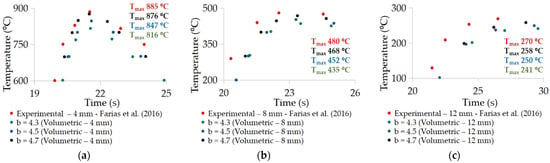
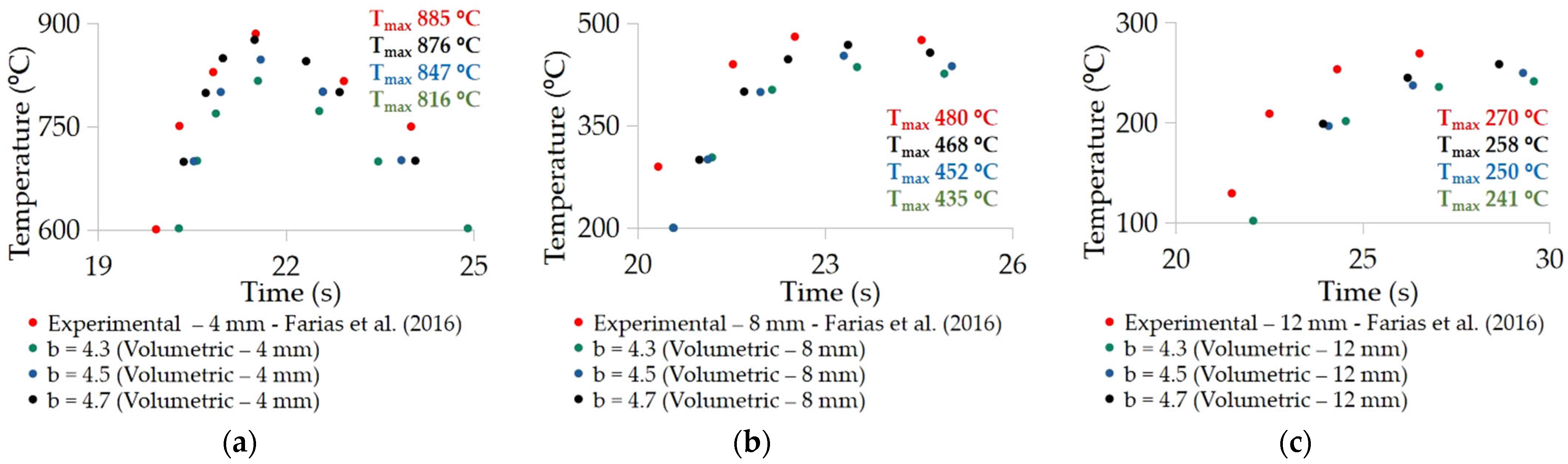
Figure 16 presents a detailed view of the temperature evolution obtained from the improved volumetric heat source, in comparison with the experimental results of [2]. In contrast to the previous figures, which covered the entire heat source displacement, and the full temperature range, Figure 16 is dedicated exclusively to the region encompassing the maximum temperature for each analyzed case. This approach was adopted to highlight the differences in the thermal behavior near the peak temperatures and to illustrate how variations in the parameter b affect the predicted temperature field.
Figure 16.
Results of the improvement of the heat source for the thermocouple located from the center of the weld bead at: (a) 4 mm data from [2], (b) 8 mm data from [2], and (c) 12 mm data from [2].
Figure 16 shows that the improvement of the volumetric heat source resulted in a markedly closer agreement with the experimental results reported by [2]. A clear improvement is observed when the parameter b is increased to 4.3 mm and 4.5 mm, particularly when compared with the initial configuration (b = 4.0 mm). However, the best agreement with the experimental data was achieved when b reached 4.7 mm. Under this setup, the percentage differences between numerical and experimental results were reduced to 1.02%, 2.50%, and 4.44% for the thermocouple positions located 4 mm, 8 mm, and 12 mm from the weld bead, respectively. Considering that the results under this condition were very close to the experimental measurements, and the relative error was below 5%, which is considered acceptable for this study, b = 4.7 mm was adopted as the improved configuration for the volumetric heat source. The overall results obtained with the improved parameters are summarized in Table 8.
Table 8.
Temperature peaks obtained from both experimental and numerical results.
It is crucial to interpret the experimental validation values presented in Table 8 by distinguishing them from the predicted weld pool peak temperatures. As previously discussed in Section 4.3, the weld pool temperature reaches high-temperature ranges consistent with GMAW literature, while the experimental values (885 °C, 480 °C, and 270 °C) were obtained by thermocouples positioned at 4 mm, 8 mm, and 12 mm away from the weld centerline, respectively (see Figure 8). These points are located in the base metal, and their measurement serves to validate the accuracy of the transient heat diffusion through the plate thickness. The low relative deviation obtained (below 5%) confirms the high fidelity of the calibrated heat source model and the thermophysical parameters employed.
5. Conclusions
This study focused on the implementation, verification and validation of a double ellipsoid-type volumetric heat source for simulating the thermal analysis of a welding process. The main conclusions are summarized as follows:
- →
- The FORTRAN-based DFLUX user subroutine, responsible for applying the heat load and controlling the movement of the heat source during the simulation, was demonstrated to be satisfactory and robust.
- →
- In the initial comparative evaluation against the experimental and numerical results reported by Farias et al. [2], the volumetric heat source demonstrated an accuracy within the expected tolerance limits for welding process simulations. According to Goldak and Akhlaghi [7], these simulations typically exhibit an accuracy within a 25% margin of error.
- →
- To further enhance the predictive capability, the geometric parameter b of the Goldak heat source was increased by 0.7 mm, moving from 4.0 mm to 4.7 mm. This calibration adjustment proved highly effective, significantly reducing the discrepancies between the peak temperature values for all three measurement points evaluated in the comparative study.
- →
- Following this improvement, the relative deviation between the obtained numerical results and the experimental data [2] remained below 5% for all measurement points, indicating a strong and reliable agreement between the volumetric heat source model and the reference values.
- →
- The software utilized for the simulations was ABAQUS SIMULIA® by 3DS, proved to be an effective tool for simulating welding processes, delivery satisfactory computational performance.
- →
- The Goldak double ellipsoid volumetric heat source model has been validated as one of the most effective and accurate options currently available for the thermal analysis of GMAW of AISI 304L stainless steel.
- →
- When both heat sources (the Gaussian and the volumetric) were compared, the volumetric model demonstrated superior accuracy in the thermal analysis of GMAW of AISI 304L using an AWS ER308L electrode.
The work establishes a high-precision thermal foundation for the GMAW of 304L. The focus on pure thermal analysis is justified by the principle of sequential (or weakly coupled) thermo-mechanical analysis, where the validated thermal field serves as the fundamental load governing all subsequent stress and strain analyses. The publication of this calibrated heat source, with a deviation of less than 5%, is an indispensable prerequisite for the development of high-fidelity thermo-mechanical and metallurgical simulations that will constitute future work.
Future work may focus on extending the current study in several directions:
- →
- Complex scenarios: Extending the present approach to multipass welding simulations and completing thermo-mechanical and metallurgical (TMM) analyses of the process.
- →
- Modeling techniques: The application of the Element Birth and Death (EBD) technique could be explored for simulating volumetric heat sources, offering an alternative approach to model material deposition.
- →
- Material versatility: Finally, investigating the thermal behavior of materials other than AISI 304L stainless steel could provide further insights into the versatility and applicability of this modeling approach.
Author Contributions
Conceptualization, T.d.S.M.; methodology, T.d.S.M. and L.A.B.d.C.; software, T.d.S.M. and L.A.B.d.C.; validation, T.d.S.M., L.A.I. and L.A.B.d.C.; formal analysis, T.d.S.M. and L.A.I.; investigation, T.d.S.M.; resources, T.d.S., L.A.I. and L.A.B.d.C.; data curation, T.d.S.M.; writing—original draft preparation, T.d.S.M. and L.A.I.; writing—review and editing, T.d.S.M., T.d.S., L.A.I. and L.A.B.d.C.; visualization, T.d.S.; supervision, L.A.I.; project administration, T.d.S.M.; funding acquisition, L.A.I. All authors have read and agreed to the published version of the manuscript.
Funding
The author L.A. Isoldi thanks National Council for Scientific and Technological Development (CNPq) for the research grant (Process: 309648/2021-1).
Data Availability Statement
The original contributions presented in this study are included in the article. Further inquiries can be directed to the corresponding author.
Acknowledgments
The authors acknowledge the institutional support provided by the Federal Institute of Education, Science and Technology of Rio Grande do Sul (IFRS) and the Federal University of Rio Grande (FURG).
Conflicts of Interest
The authors declare no conflicts of interest.
Appendix A
DFLUX User Subroutine Source Code
This appendix provides the complete Fortran source code of the DFLUX user subroutine employed in the ABAQUS finite element simulations [44]. The subroutine implements the Goldak double-ellipsoid volumetric heat source model, which defines the transient thermal loading applied during the GMAW process. The inclusion of the full source code ensures methodological transparency and supports reproducibility, enabling researchers to replicate the numerical procedure and adapt the heat-source calibration strategy used in this study.
- C SUBROUTINE DFLUX(FLUX, SOL, KSTEP, KINC, TIME, NOEL, NPT, COORDS,
- & JLTYP, TEMP, PRESS, SNAME)
- C Goldak Double-Ellipsoid Volumetric Heat Source
- C SI units, double precision
- INCLUDE ‘ABA_PARAM.INC’
- IMPLICIT NONE
- REAL*8 FLUX(2), TIME(2), COORDS(3)
- REAL*8 SOL, TEMP, PRESS
- INTEGER KSTEP, KINC, NOEL, NPT, JLTYP
- CHARACTER*80 SNAME
- REAL*8 t, x, y, z
- REAL*8 a, b, cf, cr, rf, rr
- REAL*8 x0, y0, z0, xrel, yrel, zrel
- REAL*8 z0_vel, Q, r2, cutoff, arg
- C Goldak geometric parameters
- a = 2.71d-3
- b = 4.70d-3
- cf = 2.71d-3
- cr = 8.14d-3
- C Heat input
- Q = 1100.1125d0
- C Initial source coordinates
- x0 = 0.050d0
- y0 = 0.0047d0
- C Welding speed (m/s)
- z0_vel = 0.00416d0
- C Current time
- t = TIME(1)
- C Integration point coordinates
- x = COORDS(1)
- y = COORDS(2)
- z = COORDS(3)
- C Source position
- z0 = z0_vel * t
- C Relative coordinates
- xrel = x − x0
- yrel = y − y0
- zrel = z − z0
- C Goldak denominators
- rf = a * b * cf
- rr = a * b * cr
- C Cutoff criterion
- r2 = (xrel/a)**2 + (yrel/b)**2 + (zrel/MAX(cf,cr))**2
- cutoff = 25.0d0
- IF (r2 .GT. cutoff) THEN
- FLUX(1) = 0d0
- FLUX(2) = 0d0
- RETURN
- END IF
- C Body flux only
- IF (JLTYP .NE. 1) THEN
- FLUX(1) = 0d0
- FLUX(2) = 0d0
- RETURN
- END IF
- C Goldak heat source
- IF (zrel .GE. 0d0) THEN
- arg = -3d0 * ((xrel/a)**2 + (yrel/b)**2 + (zrel/cf)**2)
- FLUX(1) = (2.6148d0 * Q/rf) * EXP(arg)
- ELSE
- arg = -3d0 * ((xrel/a)**2 + (yrel/b)**2 + (zrel/cr)**2)
- FLUX(1) = (1.1206d0 * Q/rr) * EXP(arg)
- END IF
- FLUX(2) = 0d0
- RETURN
- END
References
- Locatelli, F.R. Modeling of the temperature field and distortions in a T-joint welded by the GMAW process. In Proceedings of the 14th Pan-American Congress of Applied Mechanics (PACAM14), Santiago, Chile, 24–28 March 2014. [Google Scholar]
- Farias, R.M.; Teixeira, P.R.F.; Bezerra, A.B. Thermo-mechanical analysis of the MIG/MAG multi-pass welding process on AISI 304L stainless steel plates. J. Braz. Soc. Mech. Sci. Eng. 2016, 38, 1245–1258. [Google Scholar] [CrossRef] [Scilit]
- Barban, L.M.S. Numerical-computational analysis of the thermal stress field induced by welding in structural steel. In Proceedings of the CONEM 2014—Brazilian Congress of Mechanical Engineering, Uberlândia, Brazil, 10–15 August 2014. [Google Scholar]
- Wentz, A. Welding Simulations by Arc and Electrical Resistance Using the Finite Element Method. Master’s Thesis, Federal University of Rio Grande do Sul, Porto Alegre, Brazil, 2008. [Google Scholar]
- Lidam, R.; Yupiter, H.P.M.; Redza, M.R.; Rahim, M.R.; Sulaiman, M.S.; Zakaria, M.Y.; Tham, G.; Abasa, S.K.; Haruman, E.; Chau, C.Y. Simulation study on multipassed welding distortion of combined joint types using thermo-elastic-plastic FEM. J. Eng. Res. 2012, 9, 1–16. [Google Scholar] [CrossRef] [Scilit]
- Deng, D.; Murakawa, H.; Liang, W. Numerical and experimental investigations on welding residual stress in multi-pass butt-welded austenitic stainless pipe. Comput. Mater. Sci. 2008, 42, 234–244. [Google Scholar] [CrossRef] [Scilit]
- Goldak, J.; Akhlaghi, M. Computational Welding Mechanics; Springer Science + Business Media: New York, NY, USA, 2005. [Google Scholar]
- Pavelic, V.; Tanbakuchi, R.; Uyehara, O.A.; Hardt, A.P. Experimental and computed temperature histories in gas tungsten arc welding of thin plates. Weld. J. 1969, 48, 295s–305s. [Google Scholar]
- Friedman, E. Thermomechanical analysis of the welding process using the finite element method. J. Press. Vessel Technol. 1975, 97, 206–213. [Google Scholar] [CrossRef] [Scilit]
- Deng, D.; Murakawa, H. Numerical simulation of temperature field and residual stress in multi-pass welds in stainless steel pipe and comparison with experimental measurements. Comput. Mater. Sci. 2006, 37, 269–277. [Google Scholar] [CrossRef] [Scilit]
- Venkatkumar, D.; Ravindran, D. 3D finite element simulation of temperature distribution, residual stress and distortion on 304 stainless steel plates using GTA welding. J. Mech. Sci. Technol. 2016, 30, 67–76. [Google Scholar] [CrossRef] [Scilit]
- Chamim, M.; Darmadi, D.B.; Widodo, T.D.; Ismail, Z.; Purnowidodo, A. Influence of the welding thermal cycle on δ-ferrite evolution in the first layer of austenitic stainless steel (ASS) 308L produced by WAAM-GTAW. Case Stud. Therm. Eng. 2024, 64, 105489. [Google Scholar] [CrossRef] [Scilit]
- Nóbrega, J.A.; Diniz, D.D.S.; Silva, A.A.; Maciel, T.M.; De Albuquerque, V.H.C.; Tavares, J.M.R.S. Numerical evaluation of temperature field and residual stresses in an API 5L X80 steel welded joint using the finite element method. Metals 2016, 6, 28. [Google Scholar] [CrossRef] [Scilit]
- Zhang, Y.; Gao, X.; You, D.; Jiang, X.; Ge, W. Investigation of laser butt welding of AISI 304L and Q235 steels based on numerical and experimental analyses. Metals 2022, 12, 803. [Google Scholar] [CrossRef] [Scilit]
- Kumar, P.; Kumar, R.; Arif, A.; Veerababua, M. Investigation of numerical modelling of TIG welding of austenitic stainless steel (304L). Mater. Today Proc. 2020, 27, 1636–1640. [Google Scholar] [CrossRef] [Scilit]
- Velaga, S.K.; Ravisankar, A. Finite element based parametric study on the characterization of weld process moving heat source parameters in austenitic stainless steel. Int. J. Press. Vessels Pip. 2017, 157, 63–73. [Google Scholar] [CrossRef] [Scilit]
- Heinze, C.; Schwenk, C.; Rethmeier, M. Numerical calculation of residual stress development of multi-pass gas metal arc welding. J. Constr. Steel Res. 2012, 72, 12–19. [Google Scholar] [CrossRef] [Scilit]
- Nuchim, S.; Bunyawanichakul, P.; Angsuseranee, N.; Boonmag, V. Residual stress and distortion analysis for TMCP steel grade EH36 butt welding parts in GTAW-SMAW hybrid welding process using finite element method. Eng. Technol. Appl. Sci. Res. 2025, 15, 20077–20084. [Google Scholar] [CrossRef] [Scilit]
- Caruso, S.; Imbrogno, S. Finite element modeling and experimental validation of microstructural changes and hardness variation during gas metal arc welding of AISI 441 ferritic stainless steel. Int. J. Adv. Manuf. Technol. 2022, 119, 2629–2637. [Google Scholar] [CrossRef] [Scilit]
- Barata, J.F.R.; da Silva, A.C.A.M.; Marques, A.M.S.; Neves, J.A.O.C.P.B.; Almeida, D.F.F. An integrated approach for the determination of the residual stresses in a butt weld joint. In Proceedings of the 14th International Conference on Experimental Mechanics (ICEM 14), Poitiers, France, 4–9 July 2010. [Google Scholar]
- Bensada, M.; Laazizi, A.; Fri, K.; Ouzouhou, I. Numerical investigation of the effect of driving forces on the weld pool convection and thermal stress in a GTAW process. Int. J. Adv. Manuf. Technol. 2023, 125, 5185–5196. [Google Scholar] [CrossRef] [Scilit]
- Teixeira, P.; Araújo, D.; Cunda, L. Applicability of the Gaussian distribution heat source model to the thermal simulation of welding processes. In Proceedings of the 22nd International Congress of Mechanical Engineering (COBEM 2013), Ribeirão Preto, Brazil, 3–7 November 2013. [Google Scholar]
- Kik, T.; Garašić, I.; Perić, M.; Landek, D.; Jurica, M.; Tonković, Z. Modifications of the heat source model in numerical analyses of the metal-cored arc welding process. Energy 2024, 302, 131811. [Google Scholar] [CrossRef] [Scilit]
- Saib, C.; Amroune, S.; Chebbah, M.-S.; Belaadi, A.; Zergane, S.; Mohamad, B. Thermal, Metallurgical, and Mechanical Analysis of Single-Pass INC 738 Welded Parts. Metals 2025, 15, 679. [Google Scholar] [CrossRef] [Scilit]
- Kik, T. Calibration of Heat Source Models in Numerical Simulations of Welding Processes. Metals 2024, 14, 1213. [Google Scholar] [CrossRef] [Scilit]
- Incropera, F.P.; DeWitt, D.P.; Bergman, T.L.; Lavine, A.S. Fundamentals of Heat and Mass Transfer, 6th ed.; John Wiley & Sons: Hoboken, NJ, USA, 2007; pp. 1–997. [Google Scholar]
- Lienhard, J.H.; Lienhard, J.H.V. A Heat Transfer Textbook, 5th ed.; Dover Publications: Mineola, NY, USA, 2019. [Google Scholar]
- Modest, M.F. Radiative Heat Transfer, 2nd ed.; Academic Press: San Diego, CA, USA, 2003. [Google Scholar]
- Rosenthal, D. The theory of moving source of heat and its application to metal transfer. ASME Trans. 1946, 68, 849–866. [Google Scholar]
- Rykalin, N.N. Calculation of Heat Flow in Welding; Mashgiz: Moscow, Russia, 1951. [Google Scholar]
- Goldak, J.A.; Chacravarti, A.; Bibby, M.J. A new finite element model for welding heat sources. Metall. Trans. B 1984, 15, 299–305. [Google Scholar] [CrossRef] [Scilit]
- Singh, B.; Singhal, P.; Saxena, K.K. Investigation of thermal efficiency and depth of penetration during GTAW process. Mater. Today Proc. 2019, 18, 2962–2969. [Google Scholar] [CrossRef] [Scilit]
- Moslemi, N.; Gohery, S.; Abdi, B.; Sudin, I.; Ghandvar, H.; Redzuan, N.; Hassan, S.; Ayob, A.; Rhee, S. A novel systematic numerical approach on determination of heat source parameters in welding process. J. Mater. Res. Technol. 2022, 18, 4427–4444. [Google Scholar] [CrossRef] [Scilit]
- Dadkhah, A.; Sarkari Khorrami, M.; Kashani-Bozorg, S.F.; Miresmaeili, R. The effect of heat input on the residual stress distribution in gas-metal arc welding of carbon steel: Simulation and experimental methods. J. Adv. Join. Process. 2025, 12, 100333. [Google Scholar] [CrossRef] [Scilit]
- Kumar, M.S.; Begum, S.R. Simulation of hybrid (LASER-TIG) welding of stainless steel plates using design of experiments. Mater. Today Proc. 2021, 37, 3755–3758. [Google Scholar] [CrossRef] [Scilit]
- Xavier, C.R.; Delgado Junior, H.G.; Marcelo, C.J.; Silva, F.R.F.; Freitas, G.C.L.D.; Castro, J.A. A coupled thermo-mechanical-metallurgical model capturing essential transformations in the welding of high strength low-alloy steels. Soldag. Insp. 2021, 26, e2617. [Google Scholar] [CrossRef] [Scilit]
- Xu, F.; Xiong, F.; Li, M.-J.; Lian, Y. Three-Dimensional Numerical Simulation of Grain Growth during Selective Laser Melting of 316L Stainless Steel. Materials 2022, 15, 6800. [Google Scholar] [CrossRef] [Scilit]
- Wang, Z.; Shang, C.; Wang, X. Development of a Finite Element Model for the HAZ Temperature Field in Longitudinal Welding of Pipeline Steel. Metals 2025, 15, 91. [Google Scholar] [CrossRef] [Scilit]
- Turner, R.; Ward, R.M. On the Impact of the Frequency of Saved Thermal Time-Steps in a Weakly-Coupled FE Weld Simulation Model. World J. Eng. Technol. 2016, 4, 528–537. [Google Scholar] [CrossRef]
- Farias, R.M.; Teixeira, P.R.F.; Vilarinho, L.O. Variable profile heat source models for numerical simulations of arc welding processes. Int. J. Therm. Sci. 2022, 179, 107593. [Google Scholar] [CrossRef] [Scilit]
- Farias, R.M.; Teixeira, P.R.F.; Vilarinho, L.O. An efficient computational approach for heat source optimization in numerical simulations of arc welding processes. J. Manuf. Process. 2020, 55, 215–229. [Google Scholar] [CrossRef] [Scilit]
- Chujutalli, J.H.; Lourenço, M.I.; Estefen, S.F. Experimental-based methodology for the double ellipsoidal heat source parameters in welding simulations. Mar. Syst. Ocean Technol. 2020, 15, 110–123. [Google Scholar] [CrossRef] [Scilit]
- Fu, G. Parameter determination of double-ellipsoidal heat source model and its application in the multi-pass welding process. Ships Offshore Struct. 2014, 9, 598–612. [Google Scholar] [CrossRef] [Scilit]
- Hibbit, K. Abaqus User Subroutines Reference Manual—Version 6.7, DFLUX Section 1.1.3; Dassault Systèmes Simulia Corp.: Providence, RI, USA, 2007. [Google Scholar]
- Kozakov, R.; Schöpp, H.; Ott, G.; Sperl, A.; Wilhelm, G.; Uhrlandt, D. Weld pool temperatures of steel S235 while applying a controlled short-circuit gas metal arc welding process and various shielding gases. J. Phys. D Appl. Phys. 2013, 46, 475501. [Google Scholar] [CrossRef] [Scilit]
- Sert, S.; Nart, E. Enhancing Precision in Arc Welding Simulations: A Comprehensive Study of the Ellipsoidal Heat Source Model. Machines 2025, 13, 337. [Google Scholar] [CrossRef] [Scilit]
- Ramos, H.M.E.; Tavares, S.M.O.; de Castro, P.M.S.T. Numerical modelling of welded T-joint configurations using SYSWELD. Sci. Technol. Mater. 2018, 30, 6–15. [Google Scholar] [CrossRef] [Scilit]

Disclaimer/Publisher’s Note: The statements, opinions and data contained in all publications are solely those of the individual author(s) and contributor(s) and not of MDPI and/or the editor(s). MDPI and/or the editor(s) disclaim responsibility for any injury to people or property resulting from any ideas, methods, instructions or products referred to in the content. |
© 2025 by the authors. Licensee MDPI, Basel, Switzerland. This article is an open access article distributed under the terms and conditions of the Creative Commons Attribution (CC BY) license (https://creativecommons.org/licenses/by/4.0/).