Article

The Influence of Long-Period Stacking Ordered Structures on Heat Resistance of Mg-12Y-0.6Mn-xZn (x = 0, 4, 6 wt.%) Alloys

1
College of Materials Science and Engineering, Chongqing University of Technology, Chongqing 400054, China
2
Chongqing New Energy Storage Materials and Equipment Research Institute, Chongqing 401135, China
3
Lanxi Magnesium Materials Research Institute, Lanxi 321100, China
4
College of Materials Science and Engineering, Chongqing University, Chongqing 400044, China
5
The First Research Institute of China, Nuclear Power Research and Design Institute, Chengdu 610005, China
*
Authors to whom correspondence should be addressed.
Metals 2025, 15(12), 1335; https://doi.org/10.3390/met15121335
Submission received: 30 September 2025 / Revised: 7 November 2025 / Accepted: 11 November 2025 / Published: 4 December 2025

Abstract

Magnesium alloys, noted for their exceptional characteristics such as low density, remarkable specific strength at room temperature, and superior damping capabilities, are progressively emerging as vital engineering structural materials in the aerospace, automotive, and 3C industries. Despite their commendable room-temperature properties, including consistently high strengths and ductility, the relatively poor mechanical performance of magnesium alloys under elevated-temperature conditions limits their applicability in such environments. In this research, we prepared a series of extruded Mg-12Y-0.6Mn-xZn (x = 0, 4, 6 wt.%) alloys enriched with a large volume fraction of long-period stacking ordered (LPSO) structures. We conducted a thorough investigation into the elevated-temperature structural stability of these alloys, exploring the impact of volume fraction on their microstructures, properties, and strengthening mechanisms. Intriguingly, our findings revealed a positive effect of Mn particles on enhancing the elevated-temperature stability of the LPSO phase. Notably, the Mg-12Y-6Zn-0.6Mn (wt.%) alloy demonstrated exceptional ultimate tensile strength (UTS) and tensile yield strength (TYS) of 388 MPa and 258 MPa, respectively, at room temperature, while maintaining UTS and TYS values of 270 MPa and 225 MPa, respectively, at 300 °C. This study provides theoretical support for the application of magnesium alloys in elevated-temperature environments.

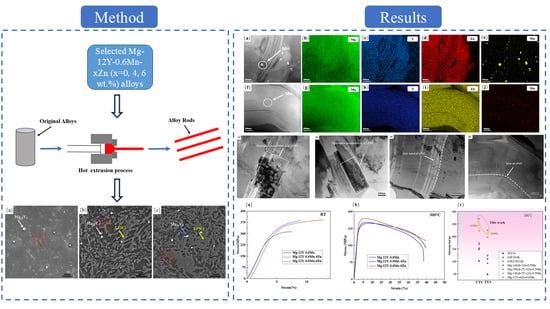
Graphical Abstract

1. Introduction

Mg alloys, with advantages such as low density, good shock absorption performance, and excellent electromagnetic shielding performance, have been widely researched. Their application fields include aerospace, the automotive industry, electronic equipment, sports equipment, and biomedicine [1,2]. However, the mechanical properties of common magnesium alloys at elevated temperatures are relatively poor compared to other metal materials, seriously limiting their use under extreme conditions. On the sunny side of space, the temperature is around 100 °C and, for civil aviation, the maximum temperature that lightweight internal components need to withstand is 300 °C. For aerospace, the high temperature application is between 100 and 300 °C. Therefore, developing new heat-resistant magnesium alloy systems to expand the application range of magnesium alloys is of great and far-reaching significance.
At present, the unique physical and chemical properties of rare earth (RE) elements exhibit excellent solid solution strengthening and precipitation strengthening in magnesium alloys. Consequently, rare earth elements stand as the most effective and direct alloying elements for raising the strength of Mg alloys at elevated temperature. With continuous exploration, it has been discovered that Zn exerts an influence on the microstructure and properties of Mg-RE. Specifically, the LPSO (Long Period Stacking Ordered) phase in Mg-RE-Zn alloys has demonstrated significant potential for achieving outstanding performance at room temperature and elevated-temperatures [3,4,5,6,7]. In 2001, Kawamura et al. [8] utilized the rapid solidification powder metallurgy (RS/PM) method to fabricate an Mg97Y2Zn1 (at.%) alloy, achieving a tensile yield strength (TYS) of up to 610 MPa. Since then, Mg alloys with the LPSO phase have garnered widespread attention from researchers. For instance, an extruded Mg-Y alloy [9], comprising a 74.8% LPSO phase, exhibits a tensile yield strength exceeding 500 MPa.
The commonly utilized commercial magnesium alloy AZ91 softens at about 120–150 °C owing to the poor thermal stability of the Mg17Al12 phase [10]. In contrast, the LPSO phase has excellent thermal stability due to its high melting point (530 °C~550 °C) [11]. In addition, due to the high melting point and excellent thermal stability of the LPSO phase, it can effectively hinder grain boundary sliding and migration, inhibit grain growth, and thereby strengthen the alloy at elevated temperatures. Xu et al. [12] studied the rolled Mg-Gd-Y-Zn-Zr alloy; the ultimate tensile strengths (UTS) of the alloy at 25 °C, 200 °C, and 300 °C were 393 MPa, 360 MPa, and 301 MPa. It is evident that the strength of the alloy gradually decreases as the temperature increases, indicating that the alloy exhibits good elevated-temperature retention. Hagihara et al. [13] studied the microstructure and thermal stability of extruded Mg97Y2Zn1 with a grain size of 2.6 μm. After long-term annealing below 300 °C, the alloy structure remained almost stable. In the Mg-Y-Zn alloy system, the 14H-LPSO phase and 18R-LPSO phase are relatively common. Some views suggest that the 18R-LPSO phase is thermodynamically unstable [14], 18R-LPSO will gradually transform into 14H-LPSO during long term heat treatment or traditional plastic processing, including hot extrusion, hot rolling and so on. However, with the intensified research on the LPSO phase in recent years, it has been revealed that there is no absolute correlation between the type of LPSO phase and its stability. Liu et al. [15] discovered that the transformation of 18R-LPSO into the 14H-LPSO still depends on the volume fraction of the 18R-LPSO and the state of the alloy. As the volume fraction of the 18R-LPSO in the alloy increases, this leads to higher thermal stability of the alloy and less 14H-LPSO formed. Although the superior strengthening effect of LPSO on Mg alloys is undeniable, the strengthening mechanism of Mg alloys containing LPSO phases at elevated temperatures remains unclear. Additionally, the impact of the morphology, distribution, and quantity of LPSO phases on the alloys also requires further clarification.
In recent years, researchers have proposed enhancement of the properties of Mg alloys through the introduction of metal particles. This uses elements with low solid solubility and high thermal stability to cause the strengthening effects, such as manganese (Mn) [16]. Wang et al. [17] reported that a small amount of Mn particles in alloy effectively improves the growth of the LPSO structure through increasing the stacking fault probability of α-Mg matrix, which enhances the tensile properties of the alloy at room temperature. However, the mechanism of the interaction between Mn and LPSO phases is not clear, and there are relatively few cases of Mn and LPSO phases interacting together at elevated temperatures.
In this work, in order to provide magnesium alloys with more application scenarios in high-temperature environments, especially in the aerospace industry, extruded Mg-Y-Zn-Mn alloys with varied content of the LPSO phase were successfully synthesized through precise control of the Zn content. Subsequently, a thorough investigation was conducted into the microstructure and properties of these wrought magnesium alloys, which inherently contain both the LPSO phase and Mn particles. Through tensile tests at room temperature and 300 °C, the strengthening mechanism of LPSO phase and the influence of Mn particles on the LPSO of the alloys were analyzed and discussed. Despite numerous studies having demonstrated the enhancing effect of LPSO in Mg alloys at 150 °C to 200 °C, there remains a scarcity of research dedicated to the strength-enhancing role of abundant blocky 18R-LPSO in Mg alloys at 300 °C due to the 18R-LPSO transforming into 14H-LPSO during heat treatment in numerous studies. This work reports that the different content of LPSO after extrusion effectively enhances the mechanical properties and microstructure of Mg-Y-Zn-Mn alloys at room temperature (RT) and 300 °C. Mn particles promote the nucleation and growth of the LPSO phase by reducing the stacking fault energy, while also enhancing the stability of the LPSO phase, thus the 18R-LPSO phase will not transform into the 14H-LPSO phase at elevated temperatures. These results can provide a reference for the preparation of high-strength and heat-resistant Mg alloys.

2. Experimental Procedure

Mg-12Y-0.6Mn-xZn (x = 0, 4, 6 wt.%) alloys, which were simplified as YZ0, YZ4 and YZ6, were prepared with commercially available pure Mg (99.9%), pure Zn (99.9%), Mg-30Y (wt.%), and Mg-8Mn (wt.%) master alloys. The raw materials were melted at 700 °C in a resistance furnace equipped with a mild crucible under a protective gas atmosphere consisting of 99% CO2 and 1% SF6. The ingot was cut into cylindrical shapes with a diameter of 80 mm and homogenized at 500 °C for 12 h. Then, using the XJ-500 horizontal extruder (Wuxi Yuanchang Machinery Co., Ltd., Wuxi, China) to perform hot extrusion at a speed of 1.5 mm/s at 450 °C, extruded rods were produced with a diameter of 20 mm.
Samples were specifically prepared for microstructure characterization, in that the surfaces were perpendicular to the extrusion direction, and progressively ground by 400, 600, 2000, and 3000 grit SiC grinding papers. Subsequently, etching treatment was performed using a 3% nitric acid alcohol solution. The microstructure and composition were identified through optical microscopy (OM), scanning electron microscopy (SEM), X-ray diffraction (XRD) and transmission electron microscopy (TEM).
Both OM and SEM samples used cylindrical specimens with a diameter of 14 mm and a thickness of 10 mm. The etching time of the sample in OM is controlled at between 5 and 10 s, while the etching time of the sample in SEM is between 15 and 20 s. OM and SEM were performed on an inverted optical microscope (model: XJP-6A) (Shanghai Optical Instrument Sixth Factory, Shanghai, China) and a scanning electron microscope (model: TESCAN VEGA Ⅲ LMU) (TESCAN ORSAY HOLDING, Brno, Czech Republic). The XRD samples are the same as the OM samples. The scanning speed is set to 2θ = 4°/min, and the scanning angle range is 20° to 80°. In addition, a Cu target was selected as the target material, and the acceleration voltage was set to 40 KV, with a filament current of 250 mA. TEM samples were prepared using an electrochemical dual spray apparatus, model: StruersTenuPoI-3 (StruersTenuPoI-3:Struers ApS, Copenhagen, Denmark). The composition ratio of the dual spray solution was 10:90 V high atmosphere acid:V ethanol, with a voltage of 20 V and a temperature of −30 °C. After dual spray electrolysis treatment, ion thinning was performed to obtain thin regions. In the initial thinning stage, the ion gun voltage was set to 5 KeV and the angles of the two ion guns to +8 degrees and −8 degrees (one positive and one negative). After thinning to a small hole, the ion gun voltage was reduced to 3.5 KeV, and the angles of the two ion guns were +3 degrees and −3 degrees, respectively. After further thinning for 30 min, TEM samples that met the requirements for machine testing were obtained. The samples were photographed using a transmission electron microscope (model: FEI TalsoF200X) (Thermo Fisher Scientific, Waltham, MA, USA).
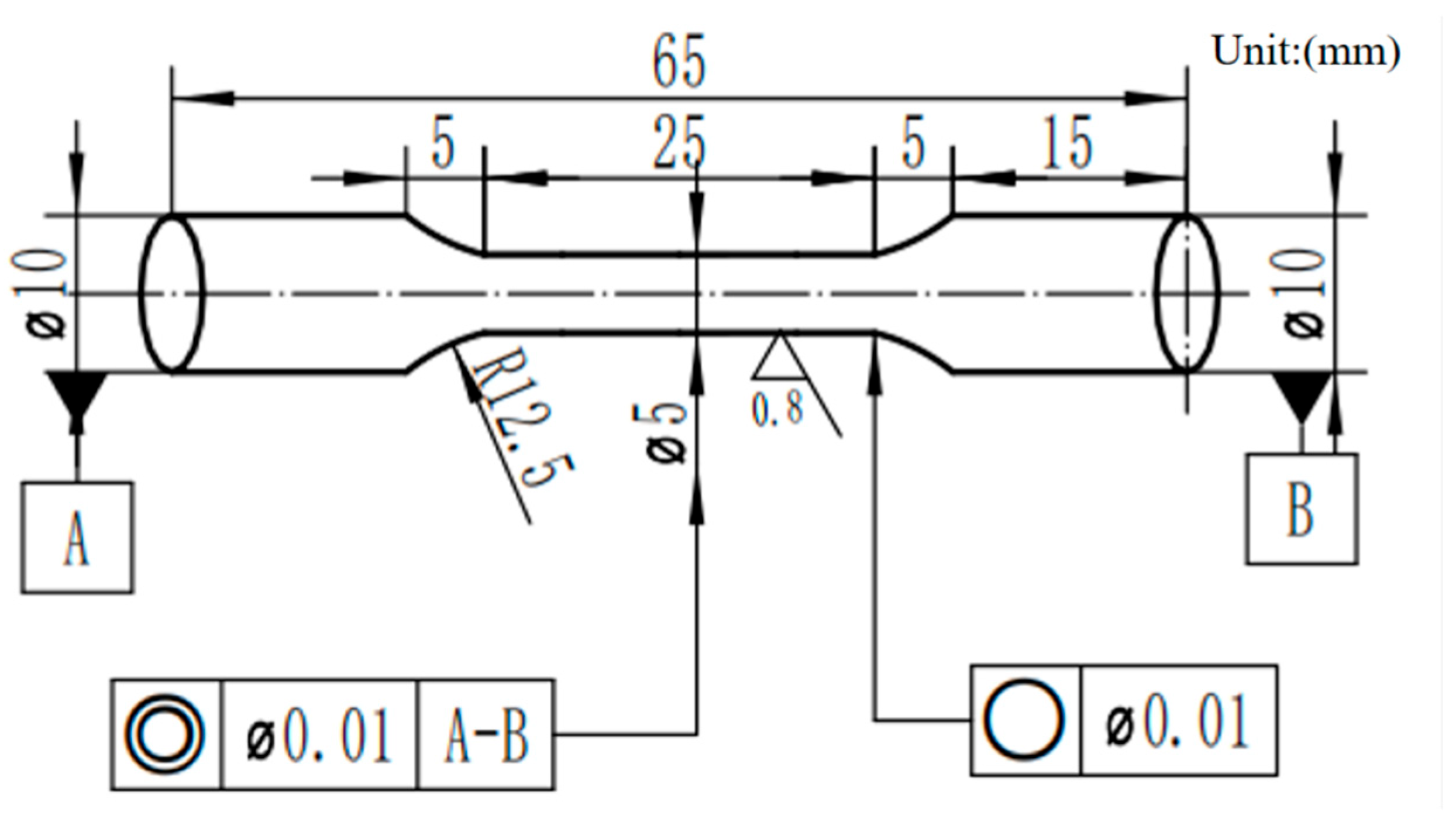
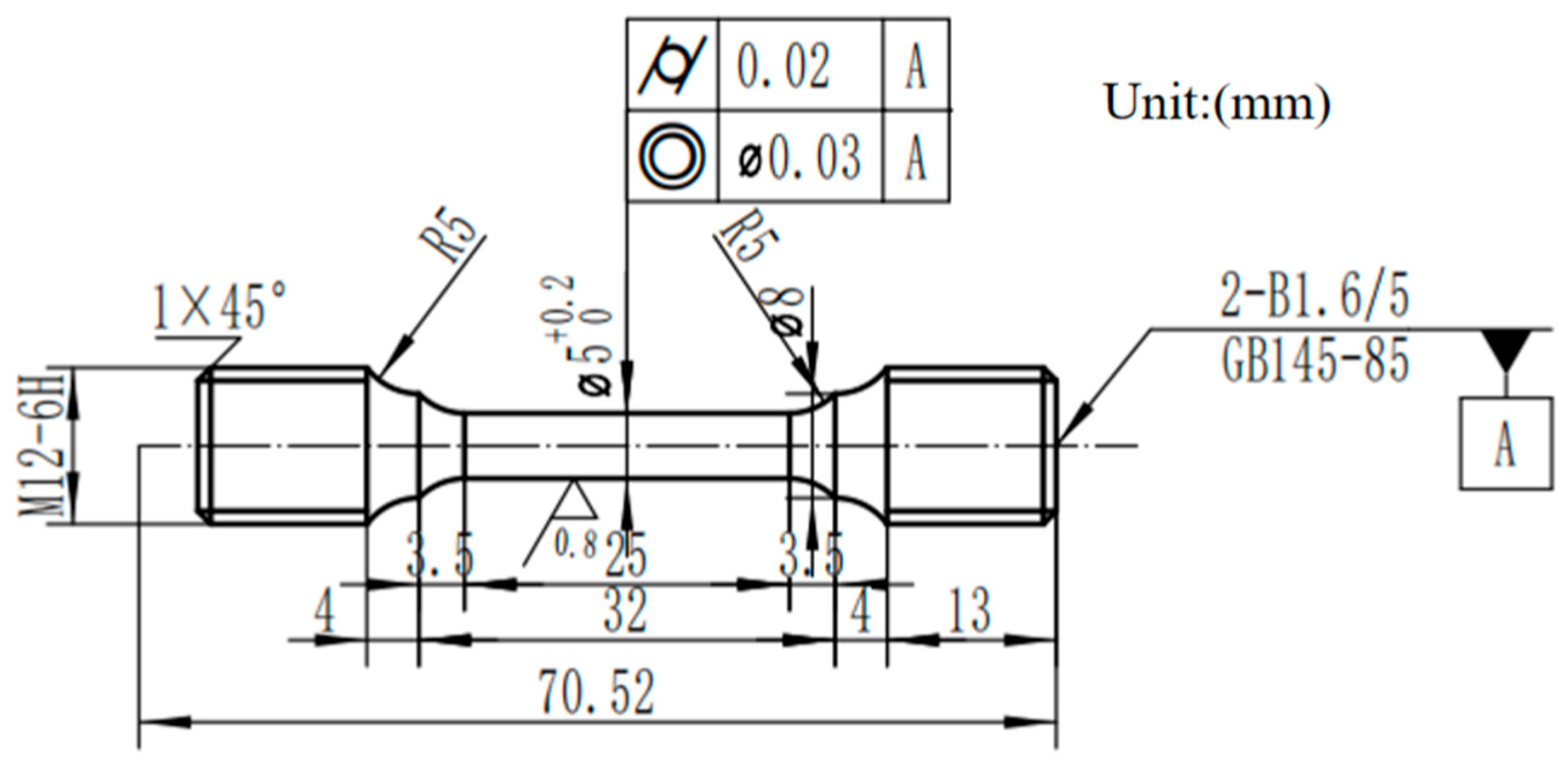
The room temperature tensile test was carried out on a TSE105D microelectronic universal testing machine (Shenzhen Wance Testing Equipment Co., Ltd., Shenzhen, China) with a tensile rate of 1 mm/min, and each mechanical test was repeated three times. The samples were processed according to GB 228-2002 [18] standard, and the schematic map for room temperature is shown in Figure 1.
The high-temperature tensile test was performed on a CMT-5105 testing machine (Shenzhen Sans Testing Machine, Shenzhen, China) at 300 °C with a tensile rate of 1 mm/min, the samples were first insulated at 300 °C for 20 min, and each mechanical test was repeated three times. The schematic map of the tensile sample for high temperature is shown in Figure 2.

3. Result

3.1. Microstructure

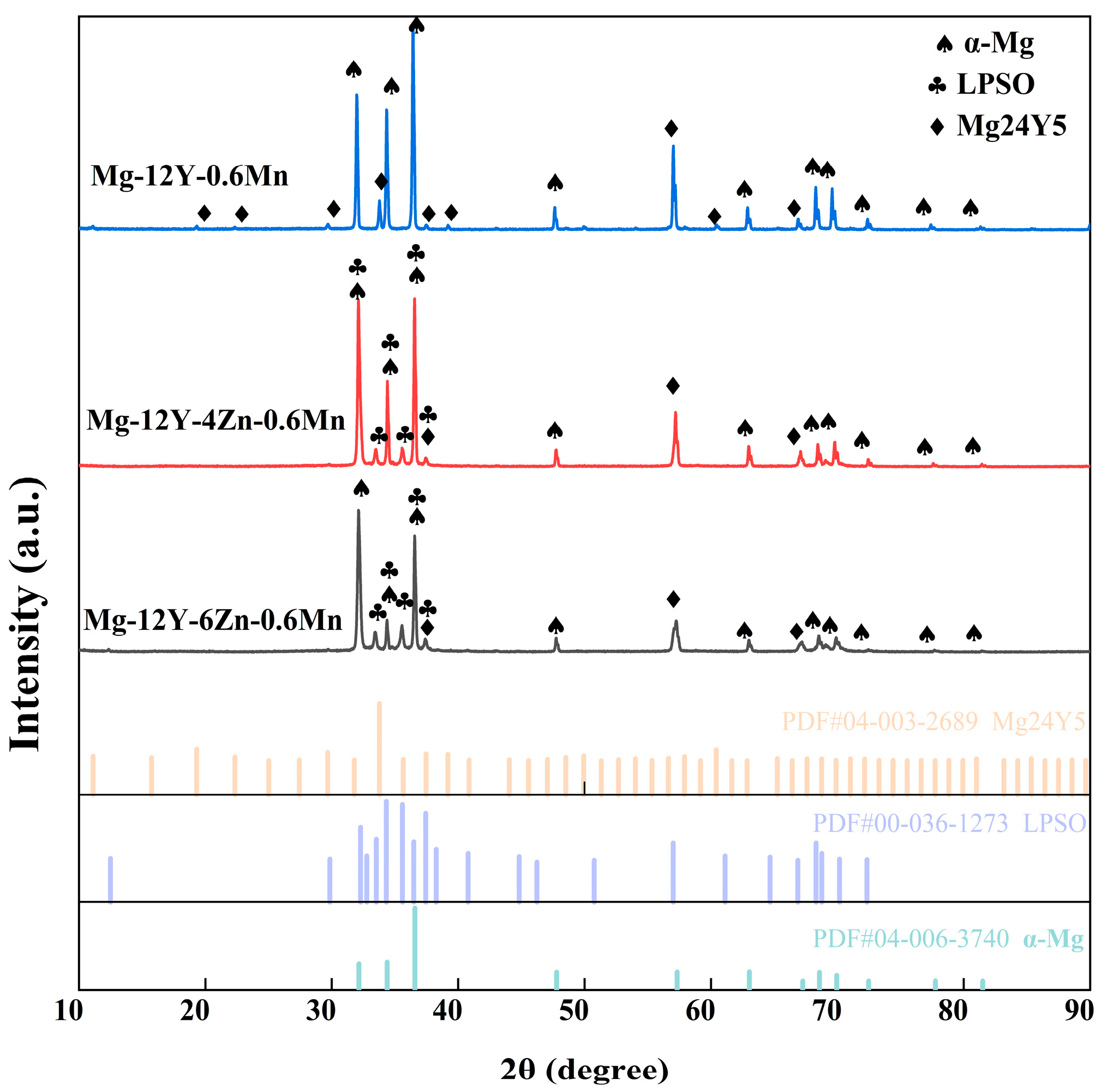
Figure 3 displays the XRD image of Mg-12Y-0.6Mn-xZn (x = 0, 4, 6 wt.%) alloys containing varying amounts of Zn. Three primary phases are identified: the α-Mg, Mg24Y5, and LPSO phases. YZ0 exhibits only the α-Mg and Mg24Y5 phases. YZ4 and YZ6 both contain both α-Mg, Mg24Y5 phase and LPSO phase. Different contents of LPSO phases are found in YZ4 and YZ6, depending on the different addition of Zn. Previous studies have indicated that the LPSO may be present in the Mg-Y-Zn series alloys with a change in the Y/Zn ratio [4,20,21,22,23]. The LPSO is regarded as the greatest strengthening phase in Mg-Y-Zn alloys [24,25].
OM images of the samples are shown in Figure 4, there are many small particulate phases in the YZ0 alloy (as marked by the red arrow), most of which are distributed at the grain boundary. The XRD result shows that this kind of phase is the Mg24Y5 phase. Except for alloy YZ0, gray phases (as marked by the yellow arrow) of different sizes and irregular shapes are formed in the YZ4 and YZ6, resembling closely the X phase characteristics of the extensively studied LPSO structure. It is also observed that the volume of block phases increases. The distribution of the phase is more continuous and denser with the increasing addition of Zn.
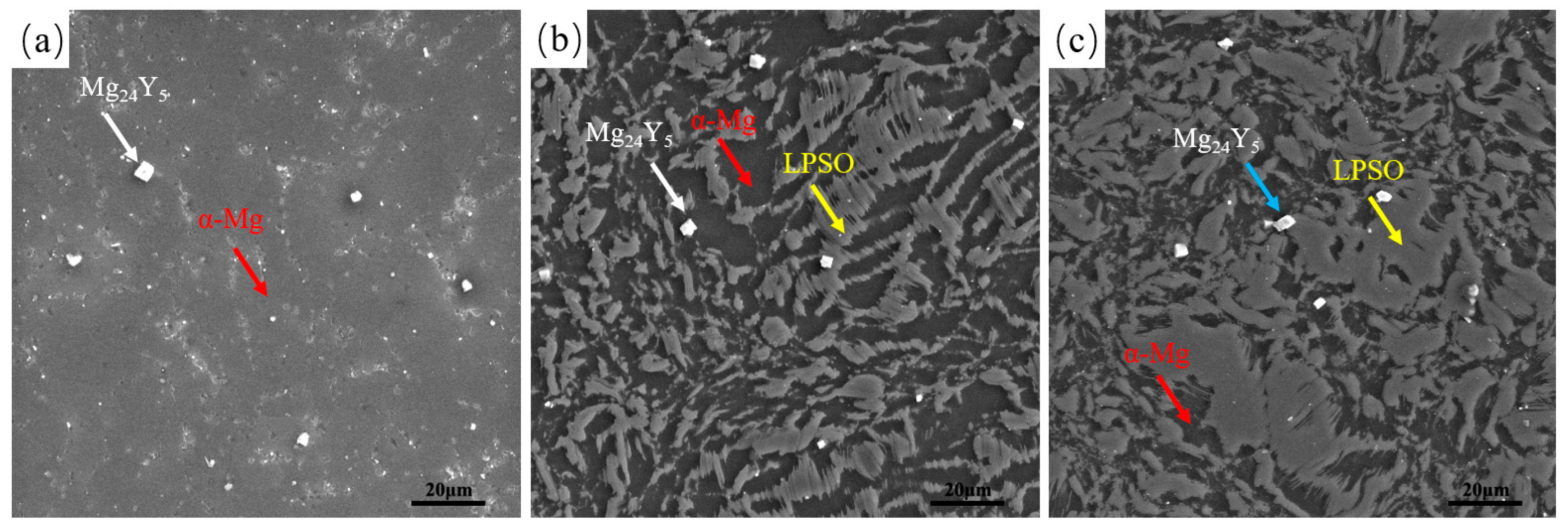
SEM images of the samples are shown in Figure 5, some particulate phases can be seen (as marked by the blue arrow) in YZ0, YZ4 and YZ6, which are not obvious in OM. By XRD analysis, they can be identified as Mg24Y5 phase. The continuous irregular grey massive phase can be identified as LPSO phase by combining OM and XRD. The volume fraction of LPSO in YZ4 and YZ6 is measured, which gradually increases with the increasing of Zn. Moreover, Mg-Zn-Y alloys usually have a Y/Zn ratio of 2 to form more LPSO phases [26,27,28], which matches the result for YZ6 alloy in this work.
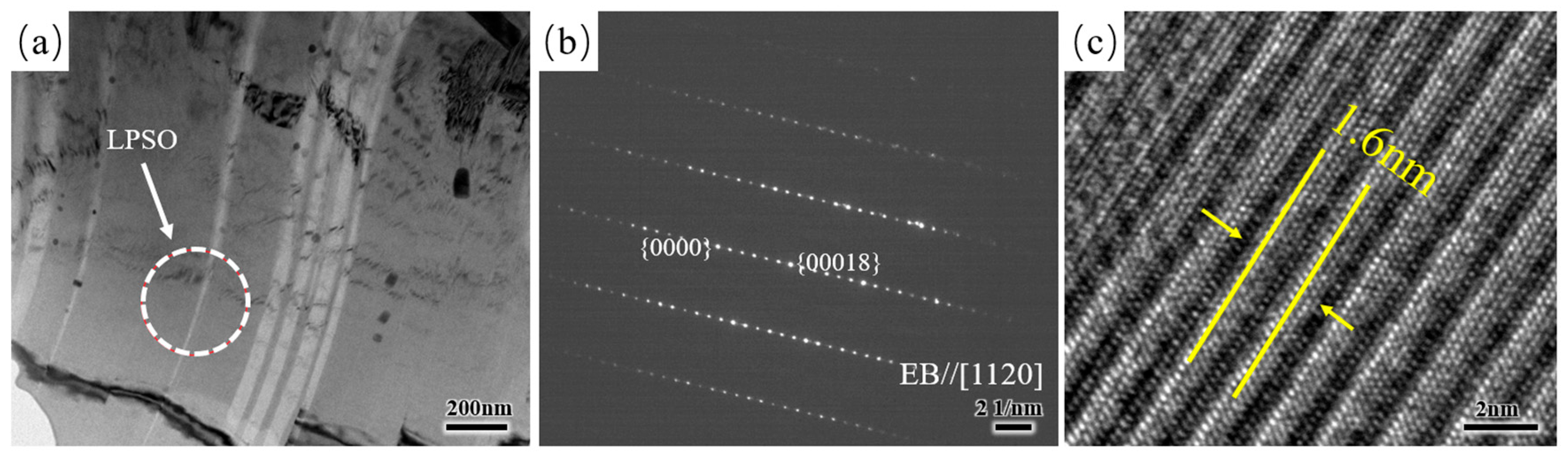
Figure 6 and Figure 7 show the bright-field images, high-resolution images, and corresponding selected-area electron diffraction (SAED) patterns of YZ4 and YZ6 alloys. Figure 4b and Figure 5b exhibit the SAED pattern of block LPSO. When the direction is aligned parallel to [1 −1 −2 0], five additional diffraction spots are observed at the location of the n/6 (0002) α-spot (n is an interval). The diffraction spot of the (000,18) LPSO coincides with the diffraction spot of (0002)α-Mg and (000,18)LPSO||(0002)α-Mg, indicating the presence of an 18R-LPSO structure [29]. The spacing between uniformly distributed lamellae is about 1.6 nm (Figure 4c and Figure 5c) measured by Digital Micrograph software, and this also meets the characteristics of 18R-LPSO [30]. The stacking sequence of 18R-LPSO close-packed planes is ABABCACACABCBCBCAB [31].

3.2. Mechanical Properties

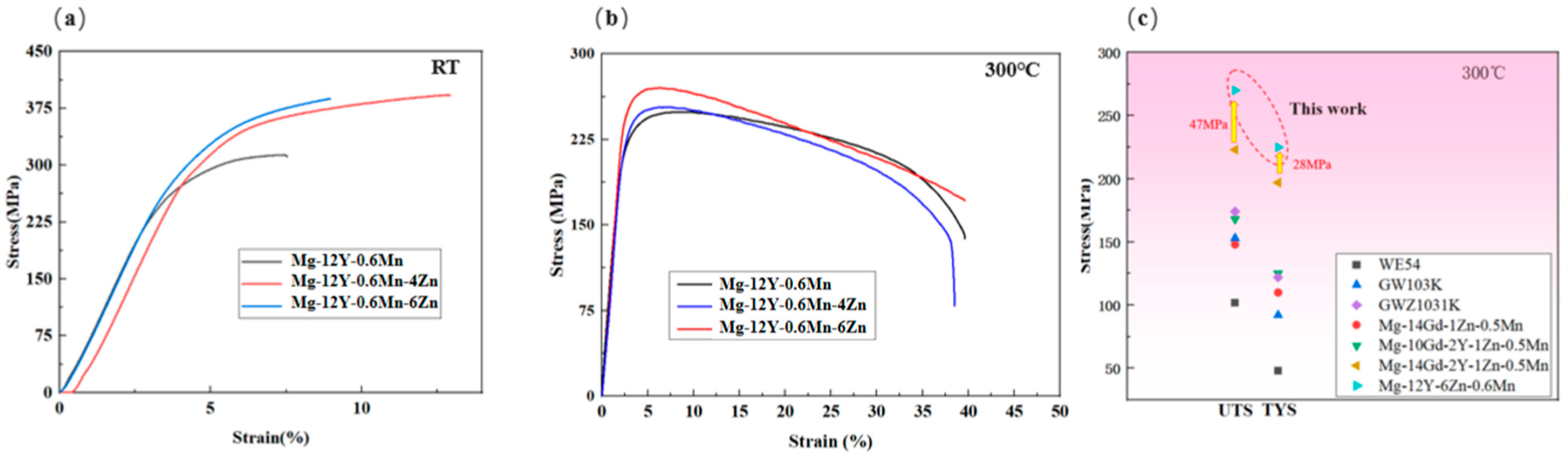
Figure 8 depicts the engineering tensile stress–strain curves for extruded YZ0, YZ4, and YZ6 at room temperature and 300 °C. Table 1 lists the tensile yield strength (TYS), ultimate tensile strength (UTS), and elongation (EL) of the samples at RT and 300 °C. As shown in Figure 8a, the mechanical properties of YZ4 and YZ6 are higher than those of YZ0, indicating that the strength of the YZ4 and YZ6 alloys has been notably enhanced at room temperature owing to the formation of the LPSO phase. Simultaneously, the EL of YZ4 and YZ6 surpasses that of YZ0, suggesting that the formation of LPSO can enhance the ductility of the alloy at RT. However, the elongation (EL) of YZ4 is significantly greater than that of YZ6, indicating superior ductility of YZ4 at room temperature compared to YZ6. With increasing content of the LPSO phase, the TYS of the alloy also rises. However, the UTSs of YZ4 and YZ6 alloys are basically the same. The primary reason is that, while the increase of LPSO effectively improves the strength, an excessively large volume fraction of the LPSO can negatively impact the alloy’s ductility, thereby mitigating the strengthening effect of the LPSO and preventing further enhancement of the UTS of YZ6 at room temperature. As shown in Figure 8b, as the amount of LPSO increases, the tensile properties of the alloys gradually improve at 300 °C. Although a larger amount of LPSO phase can reduce the ductility of the Mg-Y-Zn system [32], LPSO can play a positive role in enhancing the tensile properties of the alloys at elevated temperatures. The general trend of strength degradation accompanied by an increase in elongation is similar to that observed in most other metal materials, in that YZ0, YZ4 and YZ6 suffer an apparent loss of UTS at 300 °C. However, the remarkable mechanical properties exhibited at elevated temperature stand in sharp contrast to those of most other magnesium alloys. The UTS of the YZ4 and YZ6 can exceed 250 MPa, which indicates the excellent heat-resistance of the LPSO phase. Moreover, it exhibits superior mechanical properties compared to other Mg-Gd-Y-Zn alloys, with performance at 300 °C [33,34,35,36] (Figure 8c). Its UTS and TYS are, respectively, 47 MPa and 28 MPa higher than the highest strength reported in the existing literature, although other alloys contain more rare earth content. This suggests that the developed YZ6 alloy has outstanding high-temperature mechanical properties and at a much lower price than that of other heat-resistant alloys.
In summary, the LPSO phase effectively promotes the strength of alloys at RT and elevated temperature. At RT, a suitable amount of LPSO phase in YZ4 synergistically improves the ductility and strength. However, excessive LPSO content in YZ6 will decrease the ductility, thereby reducing its overall performance. Conversely, the impact of LPSO on plasticity is insignificant at 300 °C, so YZ6 alloys with higher LPSO content exhibit superior performance.

4. Discussion

4.1. The Strengthening Effect of 18R-LPSO on Mechanical Properties at Room Temperature

The excellent room temperature and high temperature properties of magnesium alloys containing high volume fraction LPSO phase are mainly attributed to solid solution strengthening (ΔσS) and precipitation strengthening (ΔσP). The yield strength of magnesium alloys can be calculated using the model of short fiber reinforced composites in the plastic deformation of composite materials when the volume fraction of LPSO phase is high [37]. The yield stress (σ) can be calculated using the following formula:
δ = σ s + σ P
where σ s = δ s 1 V f ,   Δ σ P = δ P V f , V f denotes the volume fraction of the strengthening phase. The LPSO phase in YZ4 and YZ6 alloys was statistically analyzed using Nano Measure software. The volume fraction of the LPSO phase in YZ4 alloy was 42%, and in YZ6 alloy this was 63%. The calculation of solid solution strengthening (ΔσS) in this model can be estimated using the following equation [38]:
δ s = δ u + 3.1 ε G C 1 2 700  
where δu is the yield strength of pure Mg at room temperature (21 MPa), ε is the experimental constant (ε ≈ 0.74), and G is the shear modulus (1.66 × 10⁴ MPa). C represents the concentration of solute Y and Zn, measured in at.%. In the Mg-Y-Zn-Mn alloy system, the maximum solid solubility of Y in magnesium alloy is 12.6 wt.%, and all Zn elements participate in the formation of the LPSO phase. Therefore, the additional atomic percentages of Y element in YZ4 and YZ6 alloys can be calculated as 2.0 at.% and 1.2 at.%, respectively. The influence of solid solution atoms on TYS of YZ4 and YZ6 alloys was calculated at 97.84 MPa and 80.52 MPa, respectively.
By using the yield strength model of composite materials, the contribution of LPSO to the yield strength of the alloy can be calculated using the following formula [37]:
δ p = δ f 1 l c 2 l , l c = δ f d / δ M y  
δf is the yield stress of Mg97Zn1Y2 alloy, which contains 99% LPSO phase and was found to be 480 MPa in early studies [39]. δMy is the yield stress generated by the matrix phase in the composite material, and δMy = δs in this study. l is the length of the LPSO phase; d is the diameter of the LPSO phase. The length and diameter of the LPSO phase in YZ4 and YZ6 alloys were measured multiple times using Nano Measure software, and the average value was obtained as shown in Table 2.
The calculation shows that the δP in YZ4 alloy is 266.80 MPa, and the δP in YZ6 alloy is 269.68 MPa. The ΔσS and ΔσP of YZ4 alloy were calculated at 56.75 MPa and 112.06 MPa, respectively, while the ΔσS and ΔσP of YZ6 alloy were 29.79 MPa and 169.90 MPa, respectively.
The contribution of solid solution strengthening and LPSO phase strengthening to alloy strength was quantitatively analyzed through the above formula. Due to the high -volume fraction of LPSO phase in the alloys, the calculation of alloy strength should be based on the strength superposition of composite materials. Figure 9 shows the contribution of each strengthening mechanism to yield strength in YZ4 and YZ6 alloys. As the volume fraction of LPSO phase gradually increases, the strengthening effect of precipitation strengthening also gradually strengthens. In YZ6 alloy, the volume fraction of LPSO phase increased by 21% compared to that of YZ4 alloy, and the corresponding precipitation strengthening contribution of LPSO phase increased by 57.8 MPa. Comparison shows that its strengthening increment is much greater than grain refinement and texture strengthening.
Owing to the remarkable advantages exhibited by the LPSO phase, including higher microhardness (particularly after deformation and bending [40,41]), ductility (it can bend during material deformation in contrast to ordinary intermetallic compounds), and elastic modulus (66.7 GPa significantly exceeding 40 GPa for pure Mg [42]), these advantages result in effective strengthening of the YZ4 and YZ6 at RT with an increasing content of LPSO phase as shown in Figure 8a. As illustrated in Figure 10, the dislocations are accumulated in the LPSO phase both in YZ4 and YZ6 alloys. The combination of LPSO phase and matrix improves the strength of the alloy, LPSO serving as a barrier to impede the movement of dislocations, limiting the accumulation of dislocations inside the LPSO structure without expanding into the α-Mg matrix. Moreover, the bulk LPSO phases are mostly distributed at the grain boundaries in YZ4 and YZ6; the superior stability of the LPSO can cause pinning effects on the grain boundaries, hindering their movement and thus improving the alloy’s strength. As shown in Figure 5, some of the large bulk LPSO phases transform into fragmented LPSO phases after extrusion both in YZ4 and YZ6, which effectively reduces stress concentration due to the large area of the bulk LPSO phase, thus increasing the ability of plastic deformation at RT. However, there are still many continuous large size LPSO phases that could not be fragmented during hot extrusion in YZ6. While large-sized LPSO phases possess greater strength, they exhibit greater difficulty in deformation, serving as the main reason for the poor ductility of YZ6. Although YZ6 alloy has poor ductility, it still has excellent strength because the load can be quickly transferred to the large volume fraction of the bulk LPSO phase, making the UTS and YTS of YZ6 superior. When considering the effective toughening mechanism, it is also necessary to consider improving the ductility of the alloy, which should be borne in mind during designing alloy compositions.
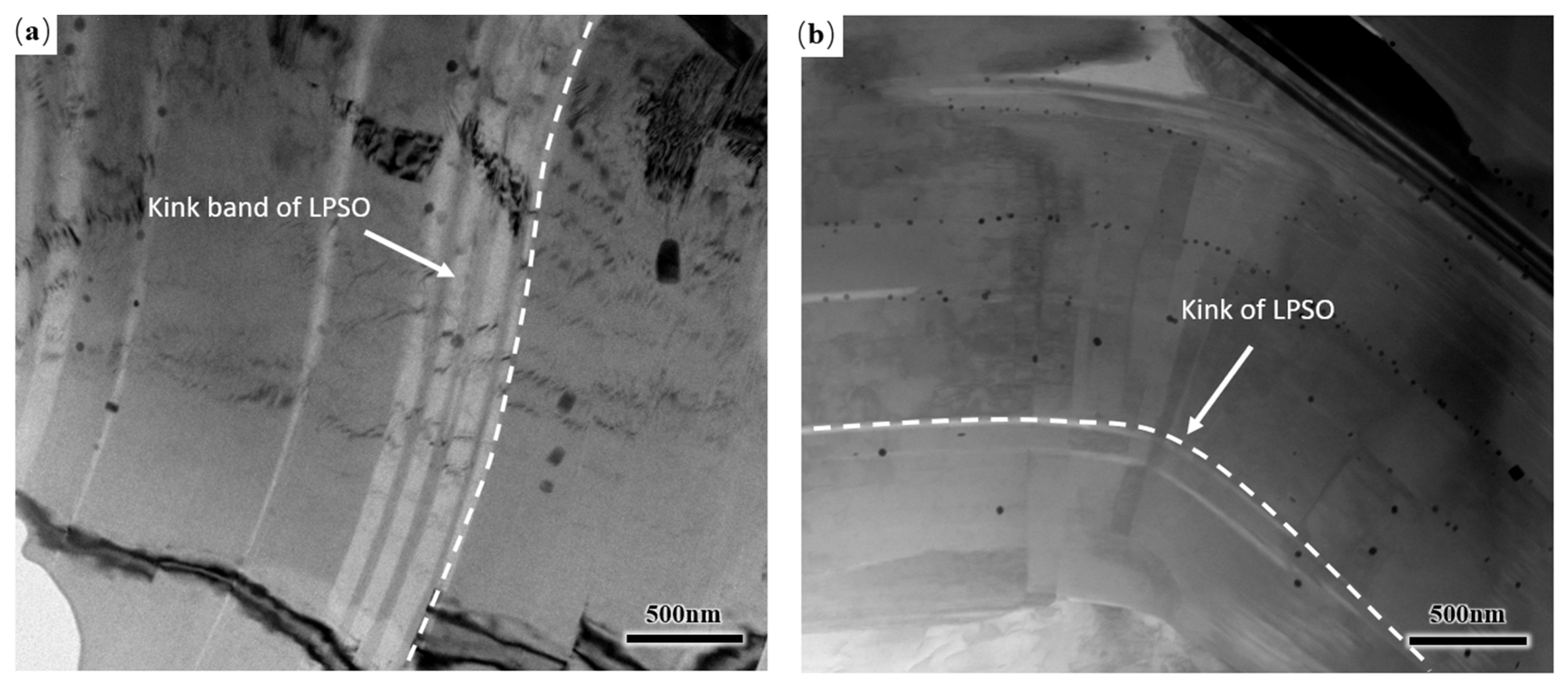
At the same time, some kinks were formed in YZ4 and YZ6 alloys after extrusion, as shown in Figure 11. The LPSO phase can accommodate kinks at different angles and does not produce intergranular cracking, which is also a strong advantage compared to other precipitates in Mg alloys. Kinking is a unique deformation mode of the LPSO phase, which occurs when the basal slip of this phase is hindered and cannot be initiated [43]. The LPSO in YZ4 is more prone to kink formation compared to YZ6 due to the lower density of LPSO in YZ4, which is the reason why the YZ4 has better ductility. The LPSO in YZ4 is found to have a continuous kink at multiple angles, as shown in Figure 11a, while there is only a single angle kink in the LPSO of YZ6 (shown in Figure 11b). After the formation of the kink in LPSO, it can further accommodate the dislocations generated during deformation and improve the strength of the alloy [44,45]. At the same time, the kink can effectively release stress and delay the initiation and propagation of microcracks at the interface between the LPSO phase and α-Mg, improving the plasticity of alloys [46,47,48,49]. In addition, Shao et al. [40] also found that kinking effectively hardens the LPSO phase, which further strengthens the alloy. In conclusion, unlike common brittle intermetallic compounds, the advantages of the LPSO itself and the kinking of the LPSO is significant in overcoming the contradiction between ductility and strength, which is the main reason why the YZ4 and YZ6 alloy have excellent strength at RT.

4.2. The Strengthening Effect of 18R-LPSO Phase on Mechanical Properties at Elevated Temperature

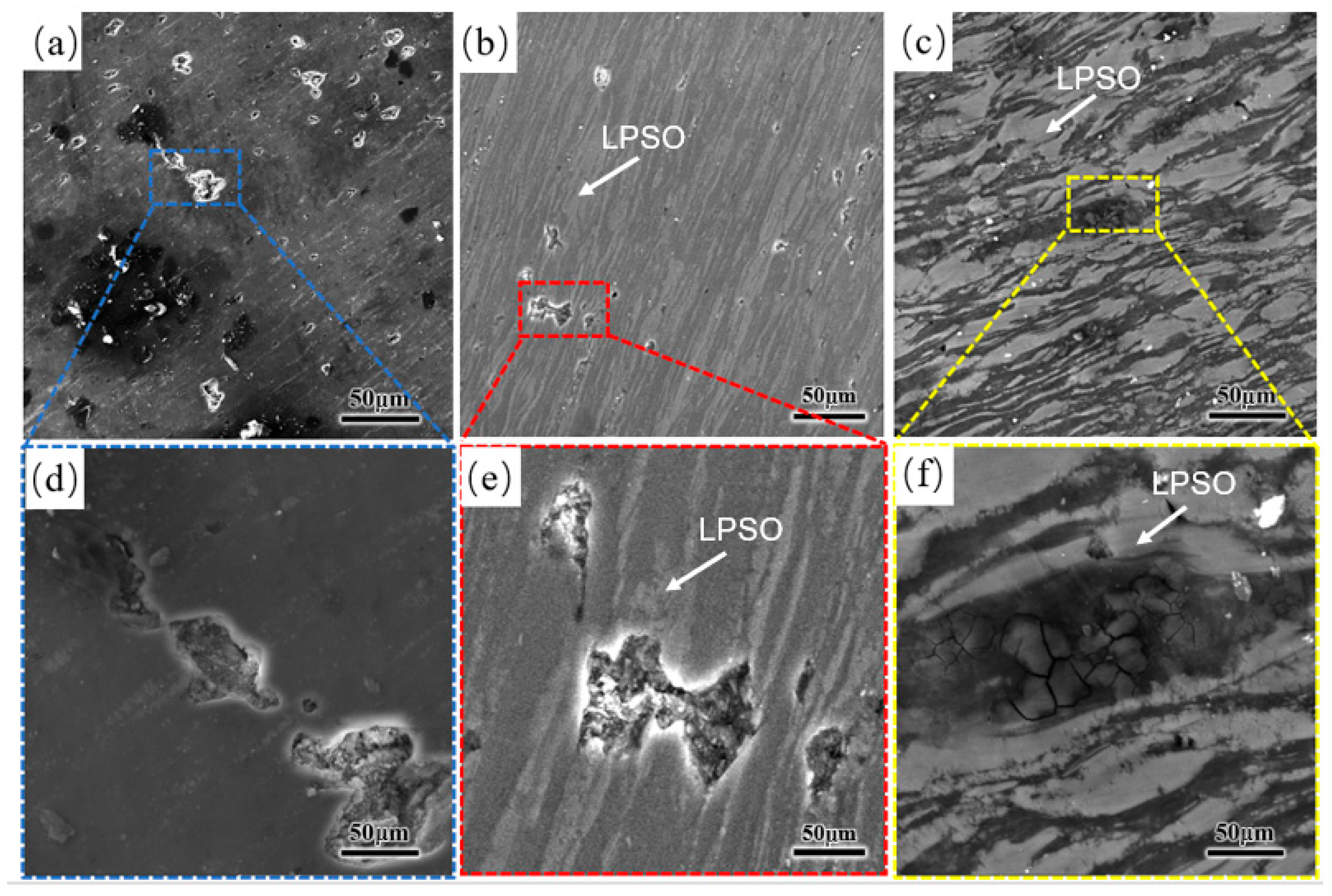
As shown in Figure 3 and Figure 5, YZ0, YZ4 and YZ6 all contain small amounts of the Mg24Y5 phase, and the YZ4, and YZ6 alloys contain varying contents of the LPSO, the volume fraction of LPSO increasing with the increasing Zn addition. Diffuse distribution of Mg24Y5 can effectively prevent the deformation of the alloy, and improve the tensile strength at high temperatures [50,51]. However, due to the low content, Mg24Y5 would dissolve during long-time homogenization [52]. Thus, the Mg24Y5 has little effect on the performance of the alloys and the LPSO phase plays a key role in improving the elevated temperature performance of the alloys. Many excellent characteristics of LPSO at elevated temperatures have been found in previous and present studies, and high microhardness and thermal stability allow the alloy to have a good mechanical property at 300 °C [53,54]. The SEM images near the fracture surface along the tensile direction of YZ0, YZ4 and YZ6 after the tensile test at 300 °C are shown in Figure 8b; there are varying degrees of cracks appearing on the surface of the organization.
As shown in Figure 12a, there are large areas of crack on the α-matrix. An enlarged view of the crack is shown in Figure 12d; the crack has propagated and formed different depths of cavities, which indicates that the microstructure of YZ0 alloy is seriously damaged after the tensile test at 300 °C. Without the addition of Zn, the YZ0 alloy relies on the large solid solubility of Y element to strengthen the alloy. However, the diffusion of solute atoms is accelerated at elevated temperatures, resulting in less lattice distortion and reduced resistance to dislocation movement, weakening the strengthening effect of the solid solution. Despite the presence of a small amount of Mg24Y5 phase in the YZ0 alloy, the amount of Mg24Y5 phase and the thermal stability are not sufficient to prevent the propagation of cracks in the matrix.
As shown in Figure 12b, representing the microstructure along the tensile direction of the YZ4 alloy after the 300 °C tensile test, the LPSO in YZ4 gradually changes from an irregular block to a lath along the tensile direction. In addition, although some lath LPSO phases are formed in YZ4, there are still cavities formed after crack propagation. Compared with YZ0, the number of cavities is reduced, but it also indicates that some cracks can pass through the lath LPSO phase and destroy the LPSO and the α-matrix. On the contrary, the microstructure along the tensile direction of YZ6 alloy after 300 °C tensile test is shown in Figure 12c; with the increase in LPSO, the volume fraction of the LPSO phase in YZ6 exceeds that of the matrix, and the shape of LPSO in YZ6 is different from that in YZ4 along the tensile direction, but remains an irregular large block. An enlarged view of the crack in YZ6 is shown in Figure 12f. Unlike YZ0 and YZ4 alloys, YZ6 alloy does not have a cavity caused by crack propagation, but only cracks appear. It can be seen that cracks only appear in the matrix or in areas with relatively small LPSO phase and no apparent cracks pass through the large block LPSO phase, which suggests that the large volume fraction of block LPSO phase in YZ6 can more effectively prevent the propagation of cracks compared with the lath LPSO phase in YZ4 at elevated temperature, thus improving the strength of the alloy at elevated temperature. For the crack initiation of the hot extruded alloys, grain boundary microcracks are the dominant mechanism [55]. More grain boundaries are exposed to elevated temperature because of the smaller volume of LPSO phase and the lath shape of LPSO phase in YZ4, resulting in more grain boundary microcracks. Compared with the lath LPSO phase in YZ4, the blocky LPSO phase in YZ6 can more effectively act as the grain boundary ‘protection barrier’ at elevated temperatures.
The LPSO phase structure has a good capacity for accommodating and coordinating deformation, reducing the generation and propagation of cracks. In addition, the LPSO phase is a stable strengthening phase at elevated temperatures, which can effectively prevent the grain boundary sliding and dislocation movement at elevated temperatures. Both the lath LPSO phase in YZ4 and the block LPSO phase in YZ6 can improve the heat resistance of the alloy. In contrast, the heat resistance of the block LPSO phase is superior.

4.3. The Effect of Mn on LPSO

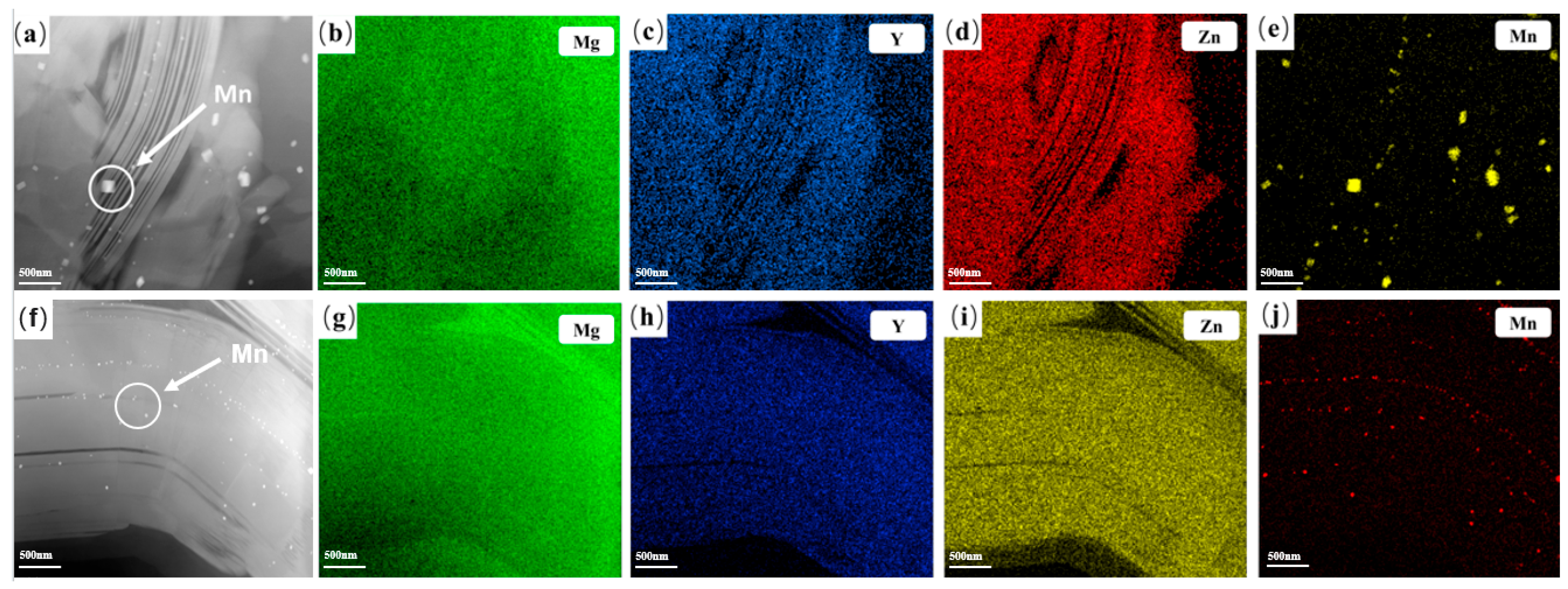
As shown in Figure 6 and Figure 7, the bulk LPSO phase in this experimental alloy is 18R-LPSO after homogenization at 500 °C for 12 h. Gröbner J., et al. [56] discovered that 18R-LPSO is unstable under elevated temperature, which will gradually be replaced by 14H-LPSO with an increase in heat treatment temperature (350 °C–500 °C) and prolongation of heat treatment time. However, after homogenization treatment at 500 °C for 12 h, the 18R-LPSO phase remains stable in YZ4 and YZ6, indicating that there are factors affecting the stability of the 18R-LPSO that keep it from transitioning to 14H-LPSO, even at 500 °C. The stacking fault energy of 14H-LPSO and 18R-LPSO structures are 33.06 and 94.02 mJ/m2, respectively [57]. During the homogenization annealing process, the transition from 18R-LPSO to 14H-LPSO reduces the total energy and maintains the stability of the entire system. By mapping results of Mg, Y, Zn and Mn elements in YZ4 and YZ6 as shown in Figure 13, it is obvious that there are many fine Mn particles in the 18R-LPSO. Adding Mn to Mg-Gd and Mg-Y alloys does not form compounds with other elements and often results in the formation of Mn particles in the alloys [58]. These fine Mn particles have excellent thermal stability, which inhibits dislocation movement as the temperature increases [33]. The Mn particles pinned in the 18R-LPSO phase as an obstacle to dislocation may reduce the stacking fault energy of the system and make it more stable, which enhances the thermal stability of the 18R-LPSO phase, thereby enhancing the stability of the alloy at elevated temperature.

5. Conclusions

In this work, the microstructures and mechanical properties of YZ0, YZ4 and YZ6 extruded alloys have been investigated. Mg-12Y-6Zn-0.6Mn(wt.%) has excellent tensile strength at room temperature and 300 °C, with UTS of 388 MPa and YTS of 258 MPa at room temperature. At 300 °C, UTS is 270 MPa and YTS is 220 MPa, and the elongation is 9.0% at RT and 38.5% at 300 °C. Compared to recently developed magnesium alloys, Mg-12y-6Zn-0.6Mn has superior UTS and YTS at 300 °C, which is beneficial for the application of magnesium alloys in high-temperature environments (aerospace, automotive, electronics). The following conclusions are obtained:
(1)
At room temperature, the large volume fraction 18R-LPSO phase after extrusion effectively improves the strength of the alloy, but the continuous and complete blocky 18R-LPSO phase greatly reduces the ductility of the alloy.
(2)
Due to the high -volume fraction of LPSO phase in the alloys, the calculation of alloy strength should be based on the strength superposition of composite materials. The strengthening effect of precipitation gradually increases with the volume fraction of the LPSO phase, which in YZ4 alloy is 266.80 MPa, and in YZ6 alloy is 269.68 MPa. The volume fraction of the LPSO phase in YZ6 increased by 21% compared to YZ4 alloy, and the corresponding precipitation strengthening contribution of the LPSO phase increased by 57.8 MPa.
(3)
The dislocations are accumulated in the LPSO phase both in YZ4 and YZ6 alloys, LPSO serving as a barrier to impede the movement of dislocations, limiting the accumulation of dislocations inside the LPSO structure without expanding into the α-Mg matrix. The superior stability of the LPSO can cause pinning effects on the grain boundaries, hindering their movement and improving the alloy’s strength.
(4)
Some kinks formed in YZ4 and YZ6 alloys after extrusion, which can further accommodate the dislocations generated during deformation and improve the strength of the alloy after the formation of the kink in LPSO. As the volume fraction of the LPSO phase increases, the kink of LPSO changes from multi-angle to single angle, which is the reason why the YZ4 has better ductility.
(5)
At elevated temperatures, due to the excellent thermal stability of the 18R-LPSO phase, the large volume fraction of blocky 18R-LPSO effectively prevents crack propagation at elevated temperature, thereby improving the elevated-temperature performance of the alloy.
(6)
The Mn particles pinned in the 18R-LPSO phase as an obstacle to dislocation may reduce the stacking fault energy of the system and make it more stable, which enhances the thermal stability of the 18R-LPSO phase, thereby enhancing the stability of the alloy at elevated temperature.

Author Contributions

Conceptualization, Y.X., R.C. and J.S.; methodology, R.C. and L.W.; software, W.Z. and X.J.; validation, R.C., W.Z. and J.S.; formal analysis, A.T. and B.J.; investigation, X.J. and A.T.; resources, L.W., B.J. and A.T.; data curation, W.Z. and B.J.; writing—original draft preparation, Y.X.; writing—review and editing, R.C., X.J. and A.T.; visualization, W.Z. and A.T.; supervision, R.C. and X.J.; project administration, W.Z. and A.T.; funding acquisition, J.S. All authors have read and agreed to the published version of the manuscript.

Funding

This research was funded by the Academician in Key Research and Development Plan of Sichuan Province (2024YFHZ0118) and the Chongqing Leaded Guidance Project of Science, Technology Innovation (CSTB2023YSZX-JCX000).

Data Availability Statement

The original contributions presented in this study are included in the article. Further inquiries can be directed to the corresponding authors.

Conflicts of Interest

Author Jia She was employed by the company Lanxi Magnesium Materials Research Institute. Authors Lu Wu and Wei Zhang were employed by the company Nuclear Power Research and Design Institute. The remaining authors declare that the research was conducted in the absence of any commercial or financial relationships that could be construed as a potential conflict of interest.

References

  1. Akbarzadeh, F.Z.; Sarraf, M.; Ghomi, E.R.; Kumar, V.V.; Salehi, M.; Ramakrishna, S.; Bae, S. A state-of-the-art review on recent advances in the fabrication and characteristics of magnesium-based alloys in biomedical applications. J. Magnes. Alloys 2024, 12, 2569–2594. [Google Scholar] [CrossRef]
  2. Wang, S.; Du, C.; Shen, X.; Wu, X.; Ouyang, S.; Tan, J.; She, J.; Tang, A.; Chen, X.; Pan, F. Rational design, synthesis and prospect of biodegradable magnesium alloy vascular stents. J. Magnes. Alloys 2023, 11, 3012–3037. [Google Scholar] [CrossRef]
  3. Qin, X.; Liu, H.; Chen, Y.; Sun, C.; Yan, K.; Ju, J.; Jiang, J.; Bai, J.; Xue, F. Significant refinement of 18R-LPSO phase and enhancement of mechanical properties in Mg97Y2Zn1 alloy through an industrially viable processing method. J. Alloys Compd. 2025, 1024, 180211. [Google Scholar] [CrossRef]
  4. Hu, J.; Wu, J.; Liu, X.; Zhao, D.; Liang, L.; Peng, J. Influence of Y/Zn Ratio on Secondary Phase Strengthening of Mg-Y-Zn Alloy. Metals 2025, 15, 359. [Google Scholar] [CrossRef]
  5. He, J.; Chen, W.Z.; Zhang, Z.J.; Chen, X.M. Extrusion techniques on microstructure optimization and quantitative analysis of texture influence on ductility improvement for heat-resistant Mg–Nd–Zn–Zr magnesium alloy. J. Mater. Sci. 2022, 57, 4334–4353. [Google Scholar] [CrossRef]
  6. Jin, Q.; Shao, X.; Li, J.; Peng, Z.; Lv, M.; Zhang, B.; Li, Y.; Ma, X. The Role of Melt Cooling Rate on the Interface between 18R and Mg Matrix in Mg97Zn1Y2 Alloys. J. Magnes. Alloys 2023, 11, 2883–2890. [Google Scholar] [CrossRef]
  7. Wang, G.; Mao, P.; Wang, Z.; Zhou, L.; Wang, F.; Liu, Z. High strain rates deformation behavior of an as-extruded Mge2.5Zne4Ymagnesium alloy containing LPSO phase at high temperatures. J. Mater. Res. Technol. 2022, 21, 35–50. [Google Scholar]
  8. Oñorbe, E.; Garcés, G.; Pérez, P.; Cabezas, S.; Klaus, M.; Genzel, C.; Frutos, E.; Adeva, P. The evolution of internal strain in Mg–Y–Zn alloys with a long period stacking ordered structure. Scr. Mater. 2011, 65, 719–722. [Google Scholar] [CrossRef]
  9. Wu, S.Z.; Qiao, X.G.; Qin, S.H.; Chi, Y.Q.; Zheng, M.Y. Improved strength in wrought Mg–Y–Ni alloys by adjusting the block-shaped LPSO phase and plate-shaped γ’ phase. Mater. Sci. Eng. 2022, 831, 142–198. [Google Scholar] [CrossRef]
  10. Luo, A.A. Recent magnesium alloy development for elevated temperature applications. Int. Mater. Rev. 2004, 49, 13–30. [Google Scholar] [CrossRef]
  11. Ding, W.J.; Wu, Y.J.; Peng, L.M.; Zeng, X.Q.; Yuan, G.Y.; Lin, D.L. Formation of 14H-type long period stacking ordered structure in the as-cast and solid solution treated Mg-Gd-Zn-Zr alloys. J. Mater. Res. 2009, 24, 1842–1854. [Google Scholar] [CrossRef]
  12. Xu, C.; Zheng, M.Y.; Wu, K.; Wang, E.D.; Fan, G.H.; Xu, S.W.; Kamado, S.; Liu, X.D.; Wang, G.J.; Lv, X.Y. Effect of cooling rate on the microstructure evolution and mechanical properties of homogenized Mg–Gd–Y–Zn–Zr alloy. Mater. Sci. Eng. A 2013, 559, 364–370. [Google Scholar] [CrossRef]
  13. Hagihara, K.; Kinoshita, A.; Fukusumi, Y.; Yamasaki, M.; Kawamura, Y. High-temperature compressive deformation behavior of Mg97Zn1Y2 extruded alloy containing a long-period stacking ordered (LPSO) phase. Mater. Sci. Eng. A 2013, 560, 71–79. [Google Scholar] [CrossRef]
  14. Zhu, Y.M.; Morton, A.J.; Nie, J.F. The 18R and 14H long-period stacking ordered structures in Mg–Y–Zn alloys. Acta Mater. 2010, 58, 2936–2947. [Google Scholar] [CrossRef]
  15. Liu, H.; Bai, J.; Yan, K.; Yan, J.; Ma, A.; Jiang, J. Comparative studies on evolution behaviors of 14H LPSO precipitates in as-cast and as-extruded Mg–Y–Zn alloys during annealing at 773 K. Mater. Des. 2016, 93, 9–18. [Google Scholar] [CrossRef]
  16. Xu, C.; Nakata, T.; Fan, G.H.; Li, X.W.; Tang, G.Z.; Geng, L.; Kamado, S. Microstructure and mechanical properties of extruded Mg–Gd–Y–Zn alloy with Mn or Zr addition. J. Mater. Sci. 2019, 54, 10473–10488. [Google Scholar] [CrossRef]
  17. Wang, Y.; Rong, W.; Wu, Y.J.; Peng, L.M.; Chen, J.; Ding, W.J. Effects of Mn addition on the microstructures and mechanical properties of the Mg-15Gd-1 Zn alloy. J. Alloys Compd. 2016, 698, 1066–1076. [Google Scholar] [CrossRef]
  18. GB/T 228-2002; Code for Metallic materials—Tensile Testing at Ambient Temperature. China Standard Press: Beijing, China, 2022.
  19. GB 145-85; Code for Center Holes. China Standard Press: Beijing, China, 1985.
  20. Hao, J.; Zhang, J.; Wang, H.; Cheng, W.; Bai, Y. Microstructure and mechanical properties of Mg-Zn-Y-Mn magnesium alloys with different Zn/Y atomic ratio. J. Mater. Res. Technol. 2022, 19, 1645–1650. [Google Scholar] [CrossRef]
  21. Zhao, D.; Hu, J.; Wang, R.; Yan, G.; Song, W.; Liang, L.; Peng, J. The Effect of Y Content on the Strength and Toughness of Mg-Y-Zn Alloys. Metals 2025, 10, 1134. [Google Scholar] [CrossRef]
  22. Bai, Y.; Teng, X.; Ye, B.; Wang, G.; Zhao, D.; Cheng, W. Thermophysical Properties for Mg–Y–Zn Alloys with Various Phase Types: Microstructural Role and Numerical Prediction. Metall. Mater. Trans. A 2025, 56, 2976–2988. [Google Scholar] [CrossRef]
  23. Singh, A.; Watanabe, M.; Kato, A.; Tsai, A.P. Microstructure and strength of quasicrystal containing extruded Mg–Zn–Y alloys for elevated temperature application. Mater. Sci. Eng. A 2004, 385, 382–396. [Google Scholar] [CrossRef]
  24. Jeong, H.T.; Kim, W.J. The hot compressive deformation behavior of cast Mg-Gd-Y-Zn-Zr alloys with and without LPSO phase in their initial microstructures. J. Magnes. Alloys 2022, 10, 2901–2917. [Google Scholar] [CrossRef]
  25. Garcés, G.; Requena, G.; Tolnai, D.; Pérez, P.; Adeva, P.; Stark, A.; Schell, N. Influence of rare-earth addition on the long-period stacking ordered phase in cast Mg–Y–Zn alloys. J. Mater. Sci. 2014, 49, 2714–2722. [Google Scholar] [CrossRef]
  26. Itoi, T.; Inazawa, T.; Yamasaki, M.; Kawamura, Y.; Hirohashi, M. Microstructure and mechanical properties of Mg-Zn-Y alloy sheet prepared by hot-rolling. Mater. Sci. Eng. A 2013, 560, 216–223. [Google Scholar] [CrossRef]
  27. Yan, B.; Dong, X.; Ma, R.; Chen, S.; Pan, Z.; Ling, H. Effects of heat treatment on microstructure, mechanical properties and damping capacity of Mg-Zn-Y-Zr alloy. Mater. Sci. Eng. A 2014, 594, 168–177. [Google Scholar] [CrossRef]
  28. Oñorbe, E.; Garcés, G.; Pérez, P.; Adeva, P. Effect of the LPSO volume fraction on the microstructure and mechanical properties of Mg-Y2x-Znx alloys. J. Mater. Sci. 2012, 47, 1085–1093. [Google Scholar] [CrossRef]
  29. Meng, M.; Lei, G.X.; Zhang, H.L.; Zhang, X.H.; Yu, J.M. Precipitate characteristics and precipitation-strengthening mechanism of Mg-13Gd-4Y-2Zn-0.6Zr alloy. J. Mater. Res. Technol. 2023, 23, 5783–5795. [Google Scholar] [CrossRef]
  30. Zhu, Y.M.; Morton, A.J.; Nie, J.F. Growth and transformation mechanisms of 18R and 14H in Mg–Y–Zn alloys. Acta Mater. 2012, 60, 6562–6572. [Google Scholar] [CrossRef]
  31. Nie, J.F.; Zhu, Y.M.; Morton, A.J. On the structure, transformation and deformation of long-period stacking ordered phases in Mg-Y-Zn alloys. Metall. Mater. Trans. A 2014, 45, 3338–3348. [Google Scholar] [CrossRef]
  32. Li, C.Q.; Xu, D.K.; Zeng, Z.R.; Wang, B.J.; Sheng, L.Y.; Chen, X.B.; Han, E.H. Effect of volume fraction of LPSO phases on corrosion and mechanical properties of Mg-Zn-Y alloys. Mater. Des. 2017, 121, 430–441. [Google Scholar] [CrossRef]
  33. Xu, C.; Nakata, T.; Fan, G.H.; Li, X.W.; Tang, G.Z.; Kamado, S. Enhancing strength and creep resistance of Mg–Gd–Y–Zn–Zr alloy by substituting Mn for Zr. J. Magnes. Alloys 2019, 7, 388–399. [Google Scholar] [CrossRef]
  34. Anyanwu, I.A.; Kamado, S.; Kojima, Y. Aging characteristics and high temperature tensile properties of Mg-Gd-Y-Zr alloys. Mater. Trans. 2001, 42, 1206–1211. [Google Scholar] [CrossRef]
  35. Chen, D.J.; Wang, Q.; Zhang, L.; Li, T.; Yuan, J.W.; Shi, G.L. Comparison of Thermal Deformation Behavior and Characteristics of Mg-Gd-Y-Zn Alloys with and without Bulk LPSO Phase. Materials 2023, 16, 5943. [Google Scholar] [CrossRef]
  36. Su, N.; Wu, Y.; Deng, Q.; Chang, Z.; Wu, Q.; Xue, Y.; Yang, K.; Chen, Q.; Peng, L. Synergic effects of Gd and Y contents on the age-hardening response and elevated-temperature mechanical properties of extruded Mg-Gd (-Y)-Zn-Mn alloys. Mater. Sci. Eng. A 2021, 810, 141019. [Google Scholar] [CrossRef]
  37. Xiao, G.Y.; Yang, H.; Qin, J.Q.; Ma, W.Q. Microstructure evolution and quench sensitivity characterizations of Mg-9.5 Gd-0.9 Zn-0.5 Zr alloy. Vacuum 2020, 181, 109651. [Google Scholar] [CrossRef]
  38. Xia, X.; Zhang, K.; Ma, M.; Li, T. Microstructures and strengthening mechanisms of Mg-8.2 Gd-4.6 Y-1.5 Zn-0.4 Zr alloy containing LPSO, β′ and γ type phases. J. Rare Earths 2020, 38, 1119–1125. [Google Scholar] [CrossRef]
  39. Hagihara, K.; Kinoshita, A.; Sugino, Y.; Yamasaki, M.; Kawamura, Y.; Yasuda, H.Y.; Umakoshi, Y. Effect of long-period stacking ordered phase on mechanical properties of Mg97Zn1Y2 extruded alloy. Acta Mater. 2010, 19, 6282–6293. [Google Scholar] [CrossRef]
  40. Shao, X.H.; Yang, Z.Q.; Ma, X.L. Strengthening and toughening mechanisms in Mg–Zn–Y alloy with a long period stacking ordered structure. Acta Mater. 2010, 58, 4760–4771. [Google Scholar] [CrossRef]
  41. Leng, Z.; Zhang, J.; Zhang, M.; Liu, X.; Zhan, H.; Wu, R. Microstructure and high mechanical properties of Mg–9RY–4Zn (RY: Y-rich misch metal) alloy with long period stacking ordered phase. Mater. Sci. Eng. A 2012, 540, 38–45. [Google Scholar] [CrossRef]
  42. Chino, Y.; Mabuchi, M.; Hagiwara, S.; Iwasaki, H.; Yamamoto, A.; Tsubakino, H. Novel equilibrium two phase Mg alloy with the long-period ordered structure. Scr. Mater. 2004, 51, 711–714. [Google Scholar] [CrossRef]
  43. Gao, H.; Ikeda, K.; Morikawa, T.; Higashida, K. Analysis of kink boundaries in deformed synchronized long-period stacking ordered magnesium alloys. Mater. Lett. 2015, 146, 30–33. [Google Scholar] [CrossRef]
  44. Liu, F.; Xie, H.J.; Li, Y. Partial Substitution of Gd with Y on the Lattice Parameter, Microstructure, and Mechanical Properties of the As-Cast Mg-4Gd-2Zn Alloy. J. Mater. Eng. Perform. 2022, 32, 3542–3549. [Google Scholar] [CrossRef]
  45. Wang, J.; Yuan, Y.; Cheng, X.; Li, Y.; Jiang, S.; Chen, T.; Tang, A.; Wu, L.; Wang, J.; Pan, F. First-principle study of the basal-plane stacking fault energies of ternary Mg alloys. J. Mater. Sci. 2022, 57, 18417–18436. [Google Scholar] [CrossRef]
  46. Hagihara, K.; Yokotani, N.; Umakoshi, Y. Plastic deformation behavior of Mg12YZn with 18R long-period stacking ordered structure. Intermetallics 2010, 18, 267–276. [Google Scholar] [CrossRef]
  47. Tong, L.B.; Li, X.H.; Zhang, H.J. Effect of long period stacking ordered phase on the microstructure, texture and mechanical properties of extruded Mg–Y–Zn alloy. Mater. Sci. Eng. A 2013, 563, 177–183. [Google Scholar] [CrossRef]
  48. Zhang, Z.; Liu, X.; Hu, W.; Li, J.; Le, Q.; Bao, L.; Zhu, Z.; Cui, J. Microstructures, mechanical properties and corrosion behaviors of Mg-Y-Zn-Zr alloys with specific Y/Zn mole ratios. J. Alloys Compd. 2015, 624, 116–125. [Google Scholar] [CrossRef]
  49. Li, Y.; Xiao, W.; Wang, F.; Hu, T.; Ma, C. The roles of long period stacking ordered structure and Zn solute in the hot deformation behavior of Mg-Gd-Zn alloys. J. Alloys Compd. 2018, 745, 33–43. [Google Scholar] [CrossRef]
  50. Chen, B.; Lin, D.L.; Zeng, X.Q.; Lu, C. Elevated temperature mechanical behavior of Mg-Y-Zn alloys. Mater. Sci. Forum 2007, 546, 237–240. [Google Scholar] [CrossRef]
  51. Inoue, A.; Kawamura, Y.; Matsushita, M.; Hayashi, K. High strength nanocrystalline Mg-based alloys. J. Metastable Nanocrystalline Mater. 2002, 13, 509–518. [Google Scholar] [CrossRef]
  52. Liu, X.; Hu, W.; Le, Q.; Zhang, Z.; Bao, L.; Cui, J. Microstructures and mechanical properties of high performance Mg–6Gd–3Y–2Nd–0.4 Zr alloy by indirect extrusion and aging treatment. Mater. Sci. Eng. A 2014, 612, 380–386. [Google Scholar] [CrossRef]
  53. Ren, Q.; Yuan, S.; Wang, J.; Ma, D.; Li, W.; Wang, L. Microstructure and High-Temperature Mechanical Properties of Mg-1Al-12Y Alloy Containing LPSO Phase. Metals 2023, 13, 158. [Google Scholar] [CrossRef]
  54. Zhu, Q.; Li, Y.; Zhang, H.; Wang, J.; Jiang, H.; Zhao, J. Revealing the Interaction between Dislocations and LPSO–Precipitates Structure in a Mg-Y-Al Alloy at Different Temperatures. Crystals 2024, 14, 1018. [Google Scholar] [CrossRef]
  55. Su, N.; Xue, X.; Zhou, H.; Wu, Y.; Deng, Q.; Yang, K.; Chen, Q.; Chen, B.; Peng, L. Effects of nanoprecipitates and LPSO structure on deformation and fracture behaviour of high-strength Mg-Gd-Y-Zn-Mn alloys. Mater. Charact. 2020, 165, 110396. [Google Scholar] [CrossRef]
  56. Gröbner, J.; Kozlov, A.; Fang, X.Y.; Geng, J.; Nie, J.F.; Schmid-Fetzer, R. Phase equilibria and transformations in ternary Mg-rich Mg–Y–Zn alloys. Acta Mater. 2012, 60, 5948–5962. [Google Scholar] [CrossRef]
  57. Fan, T.W.; Tang, B.Y.; Peng, L.M.; Ding, W.J. First-principles study of long-period stacking ordered-like multi-stacking fault structures in pure magnesium. Scripta Mater. 2011, 64, 942–945. [Google Scholar] [CrossRef]
  58. Yang, H.; Chen, X.; Huang, G.; Song, J.; She, J.; Tan, J.; Zheng, K.; Jin, Y.; Jiang, B.; Pan, F. Microstructures and mechanical properties of titanium-reinforced magnesium matrix composites: Review and perspective. J. Magnes. Alloys 2022, 10, 2311–2333. [Google Scholar] [CrossRef]
Figure 1. Schematic map of tensile sample for room temperature.
Metals 15 01335 g001
Figure 2. Schematic map of tensile sample for high temperature (Reprinted from ref. [19]).
Metals 15 01335 g002
Figure 3. XRD patterns of alloys YZ0, YZ4, YZ6.
Metals 15 01335 g003
Figure 4. Optical micrographs (OM) of the samples. (a) YZ0; (b) YZ4; (c) YZ6.
Metals 15 01335 g004
Figure 5. Scanning Electron Microscope (SEM) of the samples. (a) YZ0; (b) YZ4; (c) YZ6.
Metals 15 01335 g005
Figure 6. Transmission Electron Microscope (TEM) image of the YZ4 alloy: (a) bright-field images; (b) corresponding diffraction pattern with the beam direction of [1 1 −2 0]; (c) HRTEM pattern of the LPSO in YZ4 alloy.
Metals 15 01335 g006
Figure 7. Transmission Electron Microscope (TEM) image of the YZ6 alloy: (a) bright-field images; (b) corresponding diffraction pattern with beam direction of [1 1 −2 0]; (c) HRTEM pattern of the LPSO in YZ6 alloy.
Metals 15 01335 g007
Figure 8. Tensile stress–strain curves of the alloys at different temperatures: (a) room temperature; (b) 300 °C; (c) comparison map of UTS and YS between YZ6 and other reported alloys at 300 °C (Adapted from Refs. [12,13,14,15]).
Metals 15 01335 g008
Figure 9. The contribution of each strengthening mechanism to the yield strength in YZ4 and YZ6 alloys.
Metals 15 01335 g009
Figure 10. BF-TEM images show dislocation accumulation in LPSO. (a) YZ4; (b) YZ6.
Metals 15 01335 g010
Figure 11. BF-TEM images show the kink in the LPSO. (a) YZ4; (b) YZ6.
Metals 15 01335 g011
Figure 12. SEM images and magnified images near the fracture surface along the tensile direction after 300 °C tensile test: (a,d) YZ0; (b,e) YZ4; (c,f) YZ6.
Metals 15 01335 g012
Figure 13. STEM images show that Mn plays a pinning role in the LPSO phase in improving the stability of LPSO and mapping results of Mg, Y, Zn and Mn elements in alloys. (ae) YZ4; (fj) YZ6.
Metals 15 01335 g013
Table 1. Tensile mechanical properties of YZ0, YZ4 and YZ6 alloys.
SampleTemperatureUTS (MPa)TYS (MPa)δ (%)
YZ0RT313 ± 2210 ± 17.5
300 °C249 ± 2186 ± 139.6
YZ4RT392 ± 3241 ± 212.9
300 °C253 ± 2195 ± 139.6
YZ6RT388 ± 3258 ± 29.0
300 °C270 ± 2225 ± 138.5
Table 2. Volume fraction, length, and diameter of the bulk LPSO phase in YZ4 and YZ6 alloys.
SampleVf (%)l (μm)d (μm)
YZ44285.6 ± 4.215.5 ± 1.3
YZ66393.9 ± 5.513.8 ± 1.7
Disclaimer/Publisher’s Note: The statements, opinions and data contained in all publications are solely those of the individual author(s) and contributor(s) and not of MDPI and/or the editor(s). MDPI and/or the editor(s) disclaim responsibility for any injury to people or property resulting from any ideas, methods, instructions or products referred to in the content.