Metallic Mechanical Metamaterials Produced by LPBF for Energy Absorption Systems

 ,
,  , , ,
, , ,  ,
,  and
and 
Abstract
1. Introduction
- Aerospace: Manufacture of metal sandwich panels, nozzle channels, CubeSats, and multipurpose structures is one of the main research fields in aerospace. It is important to acknowledge that, in this field, the constant and crucial goal is to achieve lightweighting and performance optimization [11,12,13]. In this regard, metamaterials and compliant mechanisms have emerged as highly effective solutions, enabling designers to achieve optimum performance.
2. Alloy Behavior Related to Conventional and Additive Manufactured Processes: Microstructural and Mechanical Coupled Characteristics
- The formation of coherency strains is a consequence of steep solute concentration gradients at the boundary of the cellular structure. This strain energy can be dissipated by forming dislocations.
- High thermal stress may act as a nucleation source for dislocation motion, which could then dissipate strain energy.
- It is feasible that the misorientation of neighboring cells could result in the formation of interfacial dislocations upon their mutual interactions.

| As-Built LPBF Material Properties | ||||||
|---|---|---|---|---|---|---|
| Heat Treatment | Microstructure | Alloy | σy (MPa) | UTS (MPa) | εR (%) | Reference |
| / | Elongated β-grain microstructure. | Ti5553 (AB) | 903 ± 8 | 915 ± 10 | 15 ± 1 | [70] |
| / | α’ lamellar. | Ti6Al4V (AB) | 1040 ± 11 | 1201 ± 10 | 9.5 ± 0.2 | [71] |
| / | Austenitic columnar grain and fine sub-grains structures. | AISI 316L SS (AB) | 500 | 600 ± 2.2 | 55 ± 2.5 | [72] |
| / | Columnar grains and equiaxed grain of supersatured α-Al solid solution in a network of fine Si phase. | AlSi10Mg (AB) | 293.5 ± 4.7 | 456.3 ± 5.9 | 13.4 ± 0.51 | [73] |
| / | Acicular α’ martensite due to the high cooling below the β-transus temperature. | CPTi (AB) | 521 ± 13.1 | 607 ± 16.5 | 10.4 ± 2.6 | [74] |
| / | Columnar grains + γ and Laves phases. | Inconel 718 (AB) | 800 ± 8 | 997 ± 10 | 29.7 ± 0.8 | [75] |
| / | Columnar grains with a large size distribution + columnar and cellular dendritic substructures + Nb,Ti-rich MC carbides. | Inconel 625 (AB) | 783 ± 23 | 1041 ± 36 | 33 ± 1 | [76] |
| Solution annealing (SA) 1150 °C × 2 h | Recrystallization + coarse Nb,Ti-rich MC carbides dispersed on intra- and inter-grains. | Inconel 625 (HT) | 396 ± 9 | 883 ± 15 | 55 ± 1 | |
| / | Mainly ferrite with a small amount of austenite, small grains in meltpool boundary, with increased dimension towards the center of meltpool. | Duplex SS2205 (AB) | 897 | 1035 | 15.3 | [77] |
| Conventional manufacturing material properties | ||||||
| Heat treatment | Microstructure | Alloy | σy (MPa) | UTS (MPa) | εR (%) | Reference |
| / | As-cast: columnar grains in the outer region of the part. Directional growth of columnar grain takes place as the thermal gradient is maximum near the mold. | Ti5553 | 670 ± 53 | 716 ± 10 | 1.2 ± 0.2 | [78] |
| / | As-cast: Widmannstetter structure with alternate lamellas of (hcp) α and (bcc) β oriented along particular directions within individual colonies (within the prior-β grains). | Ti6Al4V | 837 ± 14 | 1022 ± 22 | 9.0 ± 0.6 | [79] |
| / | As-cast: austenite and delta ferrite. | AISI 316L | 311.62 | 643.82 | 62.72 | [80,81] |
| / | As-cast: α-Al phase surrounded by the acicular eutectic Si particles. | AlSi10Mg | 237.4 ± 3.4 | 305.8 ± 7.2 | 11 | [82] |
| Annealing | Cold rolled and annealed: equiaxed Ti structures. | CPTi | 307 | 443 | / | [83] |
| / | As-cast: coarse dendritic microstructure along transverse and vertical cross sections. | Inconel 718 | [84] | |||
| Homogenization treatment (1080 °C, 1.5 h/air cooling) + solution treatment (980 °C, 1 h/air cooling) + double aging (720 °C, 8 h/furnace cooling at 55 °C/h to 620 °C, 8 h/air cooling) | Heat treated from casting: segregation is difficult to be completely eliminated. Some coarse acicular δ precipitates and globular carbides can also be observed in the inter dendritic zones. | Inconel 718 (HT) | 1046 | 1371 | 12.3 | |
| Direct artificial aging (DAH) 10 °C/min-720 °C × 8 h-0.9 °C/min-620 °C × 8 h-5 °C/min until RT (furnace cooling) | Columnar grains + γ, γ′, γ″ and Laves phases. | Inconel 718 (HT) | 1341 ± 2 | [75] | ||
| / | As-cast: coarse dendritic microstructure along transverse and vertical cross sections. | Inconel 625 | [85] | |||
| Solution annealed 1050° × 1 h | Heat treated from casting: primary MC carbides remain intact after solution treatment, redissolution of partial γ/Laves. eutectics occurs and their shapes are transformed from mesh-like to block-like. | Inconel 625 (HT) | 375 | 1225 | 60.8 | |
| / | Cold rolled: ferrite and austenite content depending on cooling rate, thank to mold high heat transfer the transformation of δ-ferrite into austenite is suppressed and much supercooled δ-ferrite, which can transform into the Widmanstätten austenite. | Duplex SS2205 | 450 | 655 | 25 | [86] |
| Built Plate Orientation | Microstructure | Heat Treatment | Alloy | σy (MPa) | UTS (MPa) | εR (%) | Ref. |
|---|---|---|---|---|---|---|---|
| / | Elongated β-grain microstructure | / | Ti5553 (AB) | 903 ± 8 | 915 ± 10 | 15 ± 1 | [70] |
| / | β-grain microstructure + isothermal ω nanoprecipitates + needle-shaped α nanoprecipitates | Stress relief (300 °C for 1 h) | Ti5553 (HT) | 848 ± 11 | 849 ± 11 | 19 ± 2 | |
| / | β-grain microstructure + α-phase precipitation both within β grains and along the β grain boundaries | Stress relief (300 °C for 1 h) + 600 °C-1 h | Ti5553 (HT) | 1332 ± 32 | 1371 ± 21 | 3.5 ±0.6 | [87] |
| / | β + 25% α | Stress relief (300 °C for 1 h) + 800 °C-1 h | Ti5553 (HT) | 895 ± 39 | 951 ± 23 | 15.6 ± 4.5 | |
| H | α’ lamellar | / | Ti6Al4V (AB) | 1040 ± 11 | 1201 ± 10 | 9.5 ± 0.2 | [71] |
| V | α’ lamellar | / | Ti6Al4V (AB) | 1008 | 1080 | 1.6 | |
| H | Partially decomposed α’ lamellar | 700 °C/2 h/furnace cooling | Ti6Al4V (HT) | 1012 ± 9 | 1109 ± 10 | 9.5 ± 0.2 | |
| H | α + β lamellar | 800 °C/6 h/furnace cooling | Ti6Al4V (HT) | 937 ± 4 | 1041 ± 5 | 19 ± 1 | |
| V | α + β lamellar | 1050 °C/2 h/furnace cooling | Ti6Al4V (HT) | 798 | 956 | 11.6 | |
| V | Austenitic columnar grain and fine sub-grains structures | / | AISI 316L SS (AB) | 500 | 600 ± 2.2 | 55 ± 2.5 | [72] |
| V | Mostly similar to the as-built condition | SLM + stress relief 650 °C × 2 h | AISI 316L SS (HT) | 475 | 617.9 ± 1.4 | 54.1 ± 1.6 | |
| H | Austenitic columnar grain and fine sub-grains structures | / | AISI 316L SS (AB) | 517 ± 7 | 634 ± 7 | 33 ± 0.6 | [88] |
| H | Mostly similar to as built condition | SLM + stress relief 388 °C × 4 h | AISI 316L SS (HT) | 496 | 717 | 28 | [89] |
| / | Austenitic grains with dispersed dislocation cells | SLM + solution annealing 1095 °C × 1 h | AISI 316L SS (HT) | 375 ± 11 | 635 ± 17 | 51 ± 3 | [90] |
| / | Columnar grains and equiaxed grain of supersatured α-Al solid solution in a network of fine Si phase | / | AlSi10Mg (AB) | 293.5 ± 4.7 | 456.3 ± 5.9 | 13.4 ± 0.51 | [73] |
| / | Segregated structure destroyed, coarsening of Si and precipitation (residual stress near to zero) | T6 | AlSi10Mg (HT) | 248.7 ± 3.6 | 326.8 ± 4.4 | 14.5 ± 0.5 | |
| / | Maintain the original as-built microstructure and increase internal precipitation | Direct aging 200° × 1 h (peak aging) | AlSi10Mg (HT) | 306.3 ± 5.7 | 461.4 ± 3.6 | 7.6 ± 0.2 | |
| H | Acicular α’ martensite due to the high cooling below the β-transus temperature | / | CPTi (AB) | 521 ± 13.1 | 607 ± 16.5 | 10.4 ± 2.6 | [74] |
| V | Acicular α’ martensite due to the high cooling below the β-transus temperature | / | CPTi (AB) | 630 ± 20.6 | 720 ± 22.5 | 8.3 ± 1.6 | |
| H | (HIP below beta-transus temperature) microstructure fully converted to α phase | HIP 730 °C × 60 min + furnace cooling | CPTi (HT) | 512 ± 14.3 | 587 ± 21.6 | 7.3 ± 1.3 | |
| V | (HIP below beta-transus temperature) microstructure fully converted to α phase | HIP 730 °C × 60 min + furnace cooling | CPTi (HT) | 622 ± 10.1 | 716 ± 12.6 | 15.1 ± 3.1 | |
| H | (HIP above beta-transus temperature) coarse α phase elongated and equiaxed grains | HIP 950 °C × 60 min + furnace cooling | CPTi (HT) | 482 ± 12.7 | 573 ± 26.6 | 6.3 ± 1.3 | |
| V | (HIP above beta-transus temperature) coarse α phase elongated and equiaxed grains | HIP 950 °C × 60 min + furnace cooling | CPTi (HT) | 573 ± 33.3 | 662 ± 38.8 | 7.4 ± 2.2 | |
| / | Meltpool + columnar grain preferentially oriented in the build direction | / | CuCrZr (AB) | 185.6 ± 4.1 | 247.2 ± 5.3 | 23.8 ± 1.5 | [91] |
| / | Recrystallization and precipitation of coarse Cr rich particles at the grain boundaries | Solution annealing + aging hardening (950 °C × 0.5 h + water quenching + 450 × 2 h + furnace cooling) | CuCrZr (HT) | 141.7 ± 6.8 | 252.1 ± 8.4 | 24.4 ± 1.1 | |
| / | Maintain the original as-built microstructure, inhibits Cr coarse particles formation at grain boundaries, uniform precipitation of nano Cr phases in the grains, change in the orientation of the grains | Direct aging hardening (450 °C/2 h + Furnace Cooling) | CuCrZr (HT) | 320.4 ± 5.1 | 415.6 ± 4.5 | 10.4 ± 0.7 | |
| / | Maintain the original as-built microstructure, inhibits Cr coarse particles formation at grain boundaries, uniform precipitation of nano Cr phases in the grains, change in the orientation of the grains (Peak aging) | Direct aging hardening (450 °C/4 h + Furnace Cooling) | CuCrZr (HT) | 405.8 ± 3.7 | 481.7 ± 7.6 | 9.6 ± 0.9 | |
| / | Fine grains microstructure at meltpool boundaries + columnar grain inside the meltpool | / | Al-4Mg-Sc-Zr (AB) Sc 0.7 wt.% | 345 | 362 | >10 | [92] |
| / | Fine grains microstructure at meltpool boundaries + columnar grain inside the meltpool + non uniform precipitation of primary fine intergranular Al3Sc precipitate and primary coarse intragranular Al3Sc | Direct aging 350° × 2 h | Al-4Mg-Sc-Zr (HT) Sc 0.7 wt.% | 520 | 525 | >1.6 | |
| / | Fine grains microstructure at meltpool boundaries + columnar grain inside the meltpool | / | Al-3.4Mg-Sc-Zr (AB) Sc 1.08 wt.% | >275 | >300 | >5 | [93] |
| / | Fine grains microstructure at meltpool boundaries + columnar grain inside the meltpool + non uniform precipitation of primary fine intergranular Al3Sc precipitate and primary coarse intragranular Al3Sc | Direct aging 300° × 12 h | Al-3.4Mg-Sc-Zr (HT) Sc 1.08 wt.% | 460 | 480 | >1.5 | |
| / | Fine grains microstructure at meltpool boundaries + columnar grain inside the meltpool | / | Al-5Mn-Sc (AB) Sc 0.6 wt.% | 266 | 349 | 10.35 | [67] |
| / | Fine grains microstructure + primary Al3Sc type and Alx(Mn, Fe)-type precipitates | Direct Aging 300° × 4 h | Al-5Mn-Sc (HT) Sc 0.6 wt.% | 397 | 430 | 4.89 | |
| / | Fine grains microstructure at meltpool boundaries + columnar grain inside the meltpool | / | Al-4.52Mn-Sc-Zr (AB) Sc 0.79 wt.% | 438 | 460 | 19 | [68] |
| / | Fine grains microstructure + primary Al3Sc type and Alx(Mn, Fe)-type precipitates | Direct aging 300° × 5 h | Al-4.52Mn-Sc-Zr (HT) Sc 0.79 wt.% | 556 | 570 | 18 | |
| / | Fine grains microstructure at meltpool boundaries + columnar grain inside the meltpool | / | Al-4.58Mn-Sc-Zr (AB) Sc 0.91 wt.% | 430–438 | 446–451 | 17.8–20 | [69] |
| / | Fine grains microstructure + primary Al3Sc type and Alx(Mn, Fe)-type precipitates | Direct aging 300° × 6 h | Al-4.58Mn-Sc-Zr (HT) Sc 0.91 wt.% | 559 | 572 | 10 | |
| / | Fine grains microstructure at meltpool boundaries + columnar grain inside the meltpool | / | Al-5.5Mn-2.69Mg-Sc-Zr (AB) Sc 1.03 wt.% | 520 | 700 | 8 | [94] |
| / | Fine grains microstructure + primary Al3Sc type and Alx(Mn, Fe)-type precipitates | Direct aging 300° × 6 h | Al-5.5Mn-2.69Mg-Sc-Zr (HT) Sc 1.03 wt.% | 621 | 712 | 4.5 | |
| / | Columnar grains + γ and Laves phases | / | Inconel 718 (AB) | 800 ± 8 | 997 ± 10 | 29.7 ± 0.8 | [75] |
| / | Microstructural homogenization, recrystallization, grain growth + γ, γ′, γ″ and δ | Homogenization annealing (HA) 10 °C/min–1100 °C × 1 h–35 °C/min until reaching room temperature + Solution annealing (SA) 10 °C/min–980 °C × 1 h–35 °C/min until reaching room temperature (furnace cooling) + artificial aging (AH) 10 °C/min–720 °C × 8 h-0.9 °C/min–620 °C × 8 h–5 °C/min + furnace cooling | Inconel 718 (HT) | 1279 ± 14 | 1406 ± 4 | 13.9 ± 1 | |
| / | Microstructural homogenization, partial recrystallization + γ, γ′, γ″ and Leaves phases | Solution annealing (SA) 10 °C/min–980 °C × 1 h–35 °C/min until reaching room temperature (furnace cooling) + artificial aging (AH) 10 °C/min–720 °C × 8 h–0.9 °C/min–620 °C × 8 h–5 °C/min until reaching room temperature (furnace cooling) | Inconel 718 (HT) | 1291 ± 10 | 1440 ± 1 | 13 ± 0.7 | |
| / | Columnar grains + γ, γ′, γ″ and Leaves phases | Direct artificial aging (DAH) 10 °C/min–720 °C × 8 h–0.9 °C/min–620 °C × 8 h–5 °C/min + until reaching room temperature (furnace cooling) | Inconel 718 (HT) | 1341 ± 2 | 1478 ± 4 | 10 ± 1.5 | |
| / | Columnar grains with a large size distribution + columnar and cellular dendritic substructures + Nb,Ti-rich MC carbides | / | Inconel 625 (AB) | 783 ± 23 | 1041 ± 36 | 33 ± 1 | [76] |
| / | Mostly like as-built condition + Cr-rich M23C6 carbides precipitates in grains boundary + inhomogeneous precipitation of fine γ″ | Direct artificial aging (DAH) 700 °C × 24 h | Inconel 625 (HT) | 1012 ± 54 | 1222 ± 56 | 23 ± 1 | |
| / | Recrystallization (development of equiaxed grains with numerous twin boundary) + coarse Nb,Ti-rich MC carbides dispersed on intra- and inter-grains | Solution annealing (SA) 1150 °C × 2 h | Inconel 625 (HT) | 396 ± 9 | 883 ± 15 | 55 ± 1 | |
| / | Equiaxed grains + Cr-rich M23C6 carbides at grain boundary + homogeneous precipitation of ellipsoidal γ″ precipitates | Solution annealing (SA) 1150 °C × 2 h + artificial aging (AH) 700 °C × 24 h | Inconel 625 (HT) | 722 ± 7 | 1116 ± 6 | 35 ± 5 | |
| / | Nearly vertical columnar grain growth | / | GRCop42 (AB) | 173 | 355 | 33.6 | [95] |
| / | Fine grain formation compared to classical powder metallurgy | / | Tantalum (AB) | 450 | 739 | 2 | [96] |
| / | Columnar grains grow along the building direction (BD) across multiple layers, showing a pronounced epitaxial characteristic | / | Ta10W (AB) | 663 | 765 | 28 | [97] |
| / | Mainly ferrite with a small amount of austenite, small grains in meltpool boundary that increase their dimension toward the center of meltpool | / | Duplex 2205 (AB) | 897 | 1035 | 15.3 | [77] |
| / | Mainly ferrite with a small amount of austenite, small grains in meltpool boundary that increase their dimension toward the center of meltpool | / | Duplex 2507 (AB) | 1196 | 1276 | 15 | [98] |
3. Analysis of Mechanical Metamaterial for Energy Absorption Systems
3.1. Mechanical Metamaterials for Energy Absorption Systems: Definition and Conceptualization
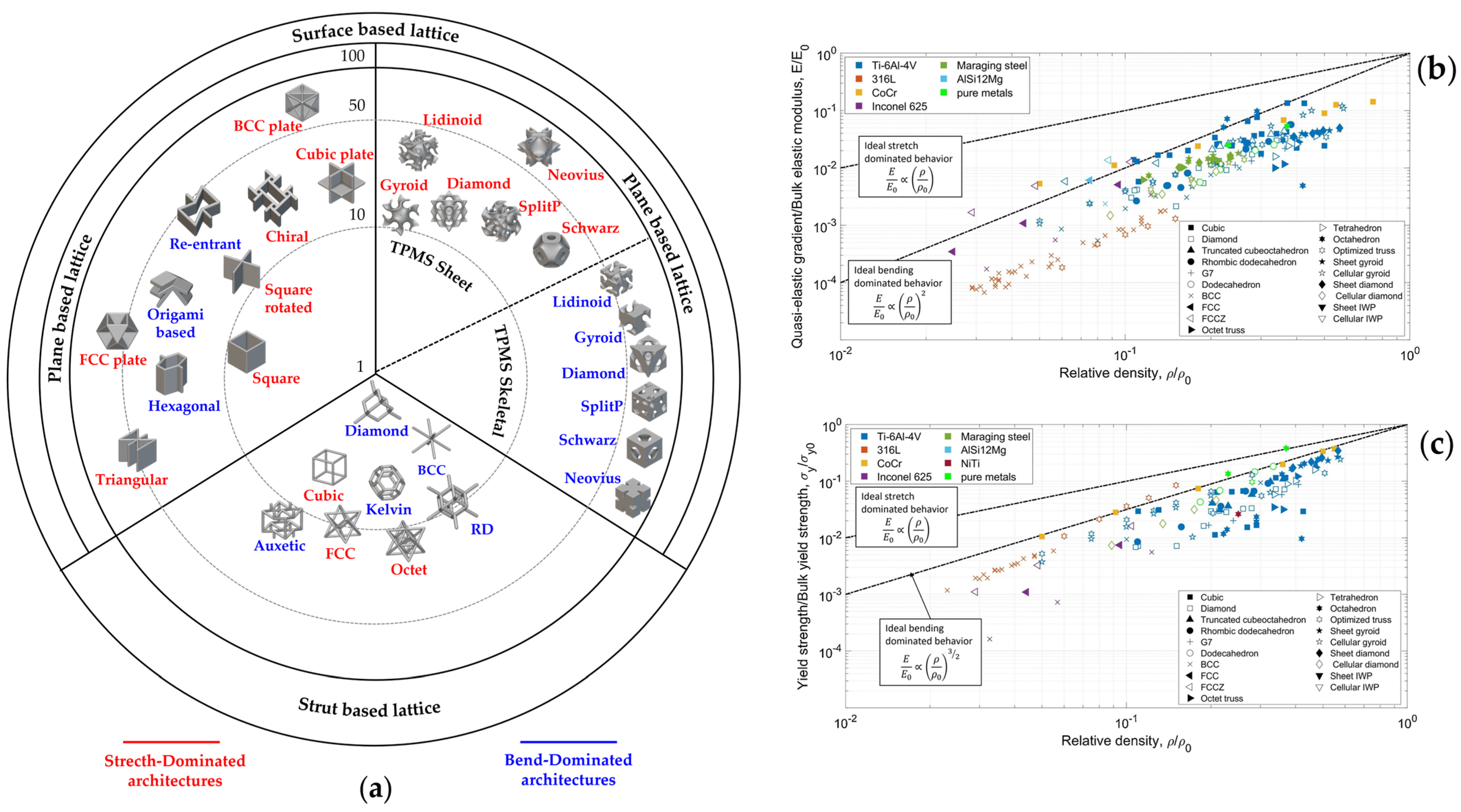
- Stretch-dominated (SD) behavior: Structural elements of the mechanical metamaterial carry loads through axial stretching or compression. This type of behavior is structurally efficient and offers higher stiffness-to-weight ratios [107,108]. By a first approximation, SD-metamaterial elastic modulus ( and yield stress ( can be expressed as shown in Equations (1) and (9) [135,136]:where is the Young’s modulus of the bulk, is the density of the bulk, is the density of the metamaterial, and C is a constant defined experimentally depending on base cell geometry and its topology arrangement.
- Bend-dominated (BD) behavior: Structural elements of the base cell primarily deform through bending. This type of behavior is less efficient in terms of the stiffness-to-weight ratio compared to stretch-dominated structures [135,136,137,138]. By a first approximation, the BD-metamaterial elastic modulus ( and yield stress ( can be expressed as shown in Equations (3) and (11) [135,136]:Again, is the Young modulus of the bulk, is the density of the bulk, is the density of the metamaterial, and C is a constant defined experimentally depending on the base cell geometry and its topology arrangement.
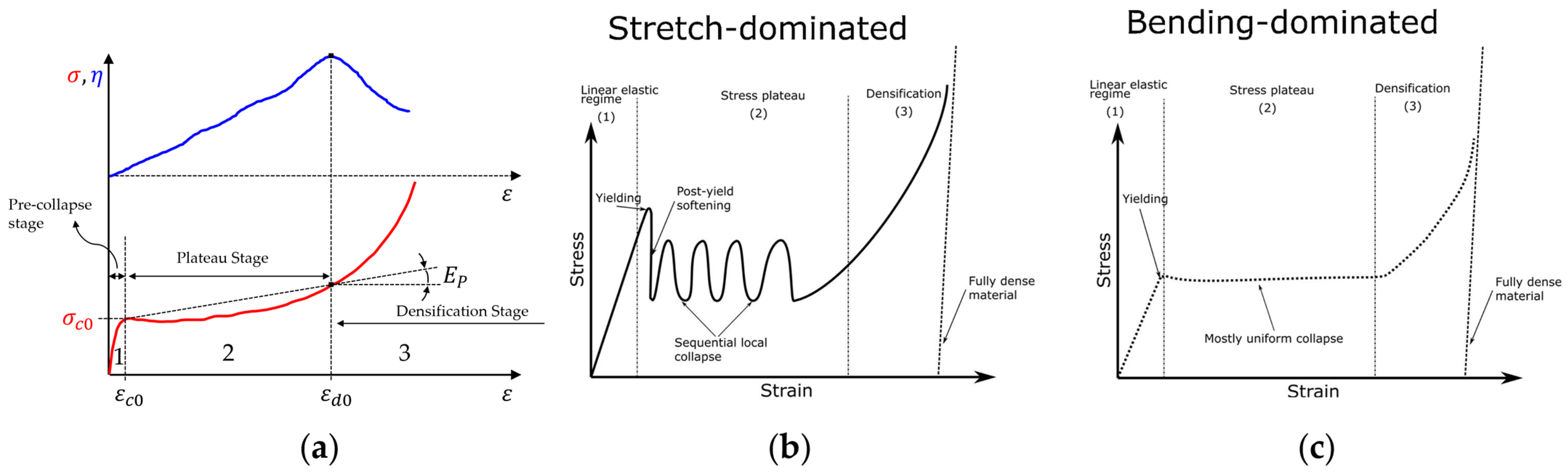
- Initial stage: This stage corresponds to the base material elastic stress–strain region and can be termed as pre-collapsing. It shows a linear stress–strain relation in which, at the end, a local maximum is reached. The local maximum stress is called collapse-initiation stress (σc0) and can be assumed as the yield point of a mechanical metamaterial. The strain level related to σc0 takes the name of collapse initiation strain (εc0).
- Plateau stage: In this deformation phase, stress is relatively constant. This behavior is due to mechanisms by which base cells deform and collapse. This region extends from the collapse initiation strain (εc0) to the onset densification strain (εd0) that represent the point in which the effectiveness of cellular structure to accommodate deformation is lowered. In the context of metamaterial design for energy absorption systems, this region of the stress–strain curve assumes paramount importance. Indeed, the energy absorbed by the metamaterial in this phase is directly proportional to the effective useful performance of the architected structure itself and can be calculated as in Equation (5):where and are the nominal compressive stress and strain, respectively.
- Densification stage: This phase of the stress strain curve has been defined by Gibson and Ashby [17] as a stage in which stress rapidly increases since cell walls, which start impacting each other, leading the metamaterial to a complete and inevitable full compression. The most important thing related to this region is the identification of onset densification strain (εd0). Many mathematical definitions have been proposed for this term. The authors decided to present the workhorse formulation proposed by Li et al. [139], which states that the onset densification strain () is reached when the energy efficiency () attains its maximum, as shown in Equations (6) and (7):where and are the nominal compressive stress and strain, respectively. The condition expressed by Equations (6) and (7) are qualitatively represented in the smaller graph of Figure 4a. The key information that readers must extract is that the onset densification strain () occurs when the ratio between the sum of energy absorbed and the stress reaches its maximum. Subsequently, the rise in stress due to structure collapse, structural element collision, and the strengthening mechanisms related to these aspects caused the metamaterial to become ineffective in absorbing energy without significant stress transfer.Figure 5. (a) Mechanical metamaterial stress–strain characteristics (red) and energy efficiency characteristics (blue) (adapted from Ref. [50] with permission of Elsevier). (b) SD metamaterial typical stress–strain behavior. (c) BD metamaterial typical stress–strain behavior (adapted from Ref. [137]).Figure 5. (a) Mechanical metamaterial stress–strain characteristics (red) and energy efficiency characteristics (blue) (adapted from Ref. [50] with permission of Elsevier). (b) SD metamaterial typical stress–strain behavior. (c) BD metamaterial typical stress–strain behavior (adapted from Ref. [137]).


- Stretch-dominated (SD) behavior: Stress–strain curves of stretching-dominated lattices are generally defined by higher initial stiffness and yield strength compared to bending-dominated lattices of the same relative density. Additionally, post-yield softening is evident due to sudden failure by buckling or brittle crush of a layer of cells. This results in a plateau region characterized by peaks and valleys (see Figure 5b), indicating progressive layer failure. This explains why stretching-dominated structures, despite being more structurally efficient, are vulnerable to sudden failure and ineffective at dissipating deformation energy [50].
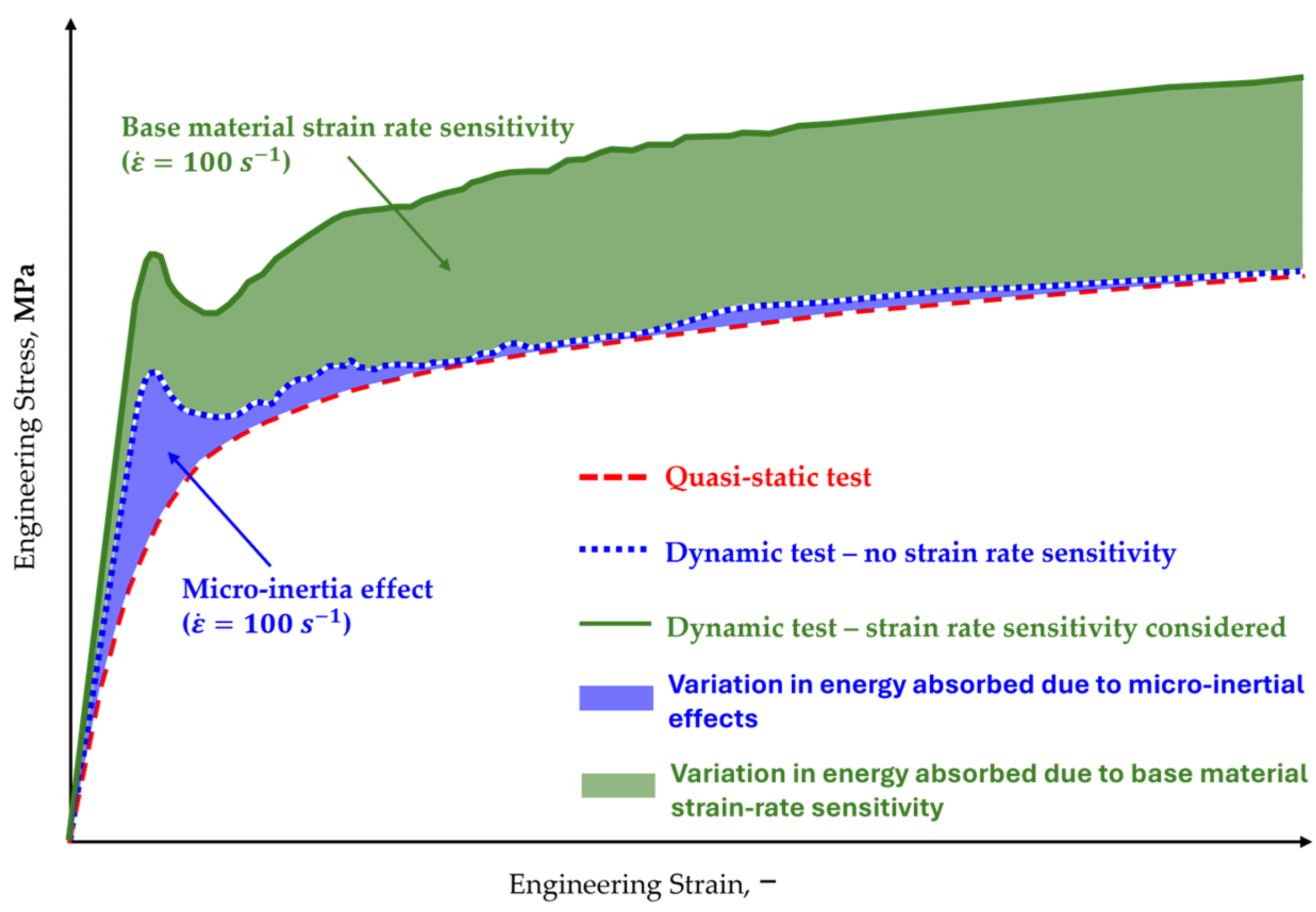
- Microscopic strain rate: The effect of the microscopic strain rate refers to local phenomena occurring at the base material level on single points of structural elements, where deformation is highly localized. The macroscopic strain rate generates a microscopic strain rate locally that can be higher or lower than the macroscopic strain rate, depending on the characteristic behavior of the cellular structure of the analyzed sample [50]. According to Calladine and English [138], stretch-dominated structures (SD) are more sensitive to strain rate, given the localization of stresses during deformation, while bend-dominated (BD) architectures exhibit lower local strain rates due to their inherently lower stress concentration.
- Microinertia phenomena: These arise from the sudden acceleration of material points in the structural elements of individual cells and can generate a hardening effect [50]. According to the work of Calladine and English [138], bend-dominated structures seem to be insensitive to microinertia. On the other hand, microinertia promotes two major hardening effects in stretch dominated structures. In particular, the main effect on microinertia is related to the initial stage of stress–strain curve (Figure 5a): the higher the impact velocity, the higher is the increment in stress needed to deform the metamaterial, since the base cell structural element buckling is retarded (Figure 5b). This is why it is believed that the microinertial effect disappears after the initial stage of deformation. However, Karagiozova [141] has demonstrated that the initial microinertial effect can influence the plateau stage. Indeed, microinertial buckling delay under impact loading increases the strain experienced by the base cell’s structural elements. Consequently, the crushing force required to deform the metamaterials further increases.
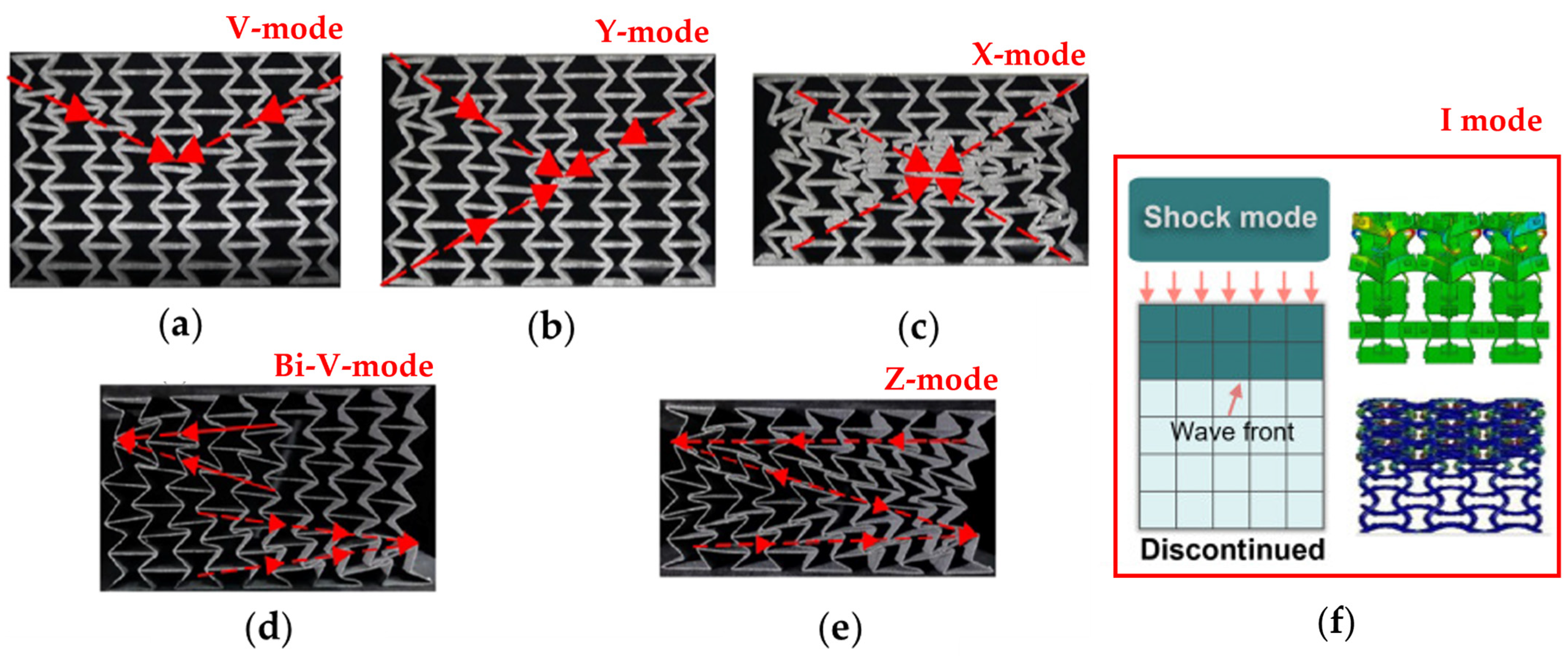
- Microscopic strain rate: In shock compression, the deformation process involves progressive cell crushing. Experiments show that, since the deformation is highly localized during shock loading, a significant local increase in microscopic strain rate occurs in the base material. The microscopic strain rate is much larger than the macroscopic strain rate (much more so than in dynamic analysis). This phenomenon is characterized by both stretch-dominated and bend-dominated structures, and varies for different architectures, but gives rise to the same effect [50]. This is also related to the fact that, under shock loading, intensive localization of stress and strain produces more local buckling in stretch-dominated architecture, thus resulting in more plastic deformation at the base cell level [156].
- Microinertia phenomena: Although macroinertia plays the main role, microinertia phenomena still exert some influence, since material points on individual base cell structural elements accelerate during row-by-row collapse.
3.2. Metallic Metamaterials for Energy Absorption: Influence of Parametrization on Mechanical Performance
| Base Cell | Parameters Influence on Energy Absorption | References to Stress–Strain Curve |
|---|---|---|
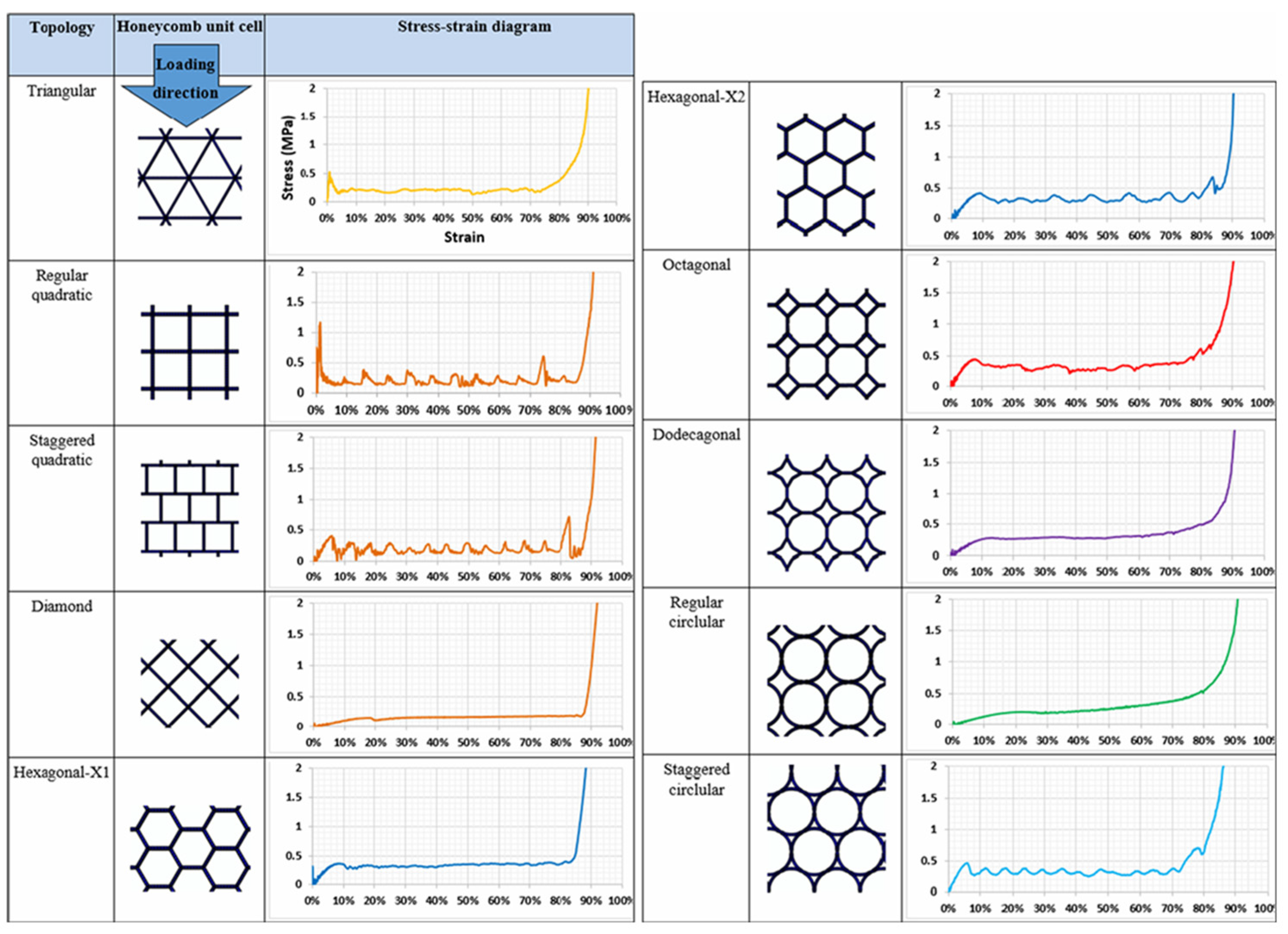
 Hexagonal honeycomb [174] | h: In out-of-plane compression the energy needed to buckle the structure increases with thickness. However, the frequency of ripples in buckled walls becomes lower. This means the structure is less efficient in absorbing energy [175,176]. | [17,177] |
| l: Lower base cell size allows us to increase the energy needed to deform the honeycomb structure during out-of-plane compression since the bearing ability of the metamaterial increases [178]. The size of the base cell has a significant impact on energy absorption capabilities of in-plane loading of honeycomb [179,180]: by maintaining constant both the thickness (h) and the cell wall angle (), the energy absorption capability decreases as more oscillations starts to occur in the plateau region of stress–strain curve. | ||
| : Has a significant impact on honeycomb energy absorption capabilities. In particular, considering out-of-plane compression and the same relative density, an increment in crushing force and the overall energy absorbed can be noted if decreases [175]. Considering in-plane compression along x-axis and the same relative density, experiments showed that densification strain remains the same, but the crushing strength decreases as increases [177]. However, this effect is significantly reduced as the impact velocity increases since inertia effects start to play a predominant role [177]. When loaded in the in-plane y-direction, experiments [177,181,182] show that the energy absorption increases as increases until it reachs the value of 45°. After this point an increase in will result in a decrease in the energy absorbed [177]. | ||
 In-plane re-entrant Honeycomb [183] | h: An increment of this parameter affects mainly the deformation modes and loading condition when load is applied in the x-direction, increasing the onset densification strain [184]. | Load in y direction [153]. Load in x direction [185]. The literature has examined the re-entrant honeycomb properties, focusing primarily on the in-plane direction (even if the out-of-plane direction exhibit some unique properties such as synclastic [186] and anti-penetration behavior [187]). This direction exhibits distinctive properties, including a negative Poisson ratio that can expressed as [182,188]: |
| l: An increase in this factor will produce, in the in-plane loading direction, a decrease in the mean plateau stress, while the other parameters remain constant. This behavior can be explained by the higher flexural momentum that appears on nodes [189] | ||
| t: Thick-wall cells are characterized by a more stable and symmetrical auxetic behavior related to thin-walls structures which exhibit a less stable and effective once [153]. Moreover, an increase in thickness will produce a decrease in the densification strain (, but an increase in the mean plateau stress [153]. | ||
| : Zhang and Yang focused on how the wall angle influences the re-entrant honeycomb response in the in-plane compression [188] by having a constant h/l ratio (=2) and t to assess specifically how mechanical properties are affected by . They found that the maximum stress of the re-entrant honeycomb decreases non-linearly with θ when the structure is loaded in y direction [188]. Similar behavior can be observed when they are loaded in the x-direction [186,189,190]; hence, an increase in θ lead to a more compliant behavior of the structures leading to lower peak and plateau stresses. | ||
 BCC(Z) lattice structure [191] | l: Lower strut length is responsible for the higher yield/plateau stress of the metamaterial, but does not affect the elastic modulus of the structure [192,193]. | [193] |
| d: Experiments found that the strut diameter significantly influences the Elastic modulus of the metamaterial generated by BCC base cells [194]. Moreover, a higher strut diameter is always related to a higher local yield stress since the structure is able to withstand higher forces [195]; hence, plateau stress will be higher and more energy can be absorbed in absolute terms (an optimum should be searched related to the weight). | ||
| Z struts: BCC structure exhibits high structural compliance. This means that they are characterized by lower bearing capacity and deformation/stress that are more concentrated at nodes [196]. The use of Z struts allows them to have a higher bearing capacity, since the introduction of structural elements aligned to the load (it also introduces a certain level of anisotropy). Moreover, this introduces a different strut connection from which the material tends to respond more like a stretch-dominated structure than a bend dominated once. Z-struts can be implemented with different thickness [193]: this allows us to tune the bearing response and the switch to stretch-dominated allowing for the final architecture to absorb the highest amount of energy. | ||
 FCC(Z) lattice structure [191,192,193] | l: A higher cell dimension is associated with an increase in bending moment to which nodes are subjected [197]. | |
| d: Similar BCC structures [197,198]. | ||
| Z struts: FCC structure exhibits higher structural stiffness than BCC once. Otherwise, they are still under-stiff to create an isostatic structure and hence they are characterized by a bend-dominated behavior from which deformation/stress concentration at nodes arises [196]. The use of Z struts, as for BCC, allows them to have a higher bearing and energy absorption capabilities [193]. | ||
 Octet-truss [199] | l: A shorter length always determines an increase in the capacity of the structures to absorb more energy [199]. This phenomenon is related to the lower distance between nodes that postpones the insurgence of buckling phenomena on struts [200]. | Macro-oscillations in the stress–strain response are related to the collapse of individual layers of unit cells, while micro-oscillations are related to local buckling and collapse at struts level [199] |
| d: Gilchrist et al. [201] highlighted that a small strut diameter is responsible for a sudden drop in compressive stress after the failure initiation with the initial buckling of the rods. This drop is less evident when the diameter increases. Moreover, a lower strut diameter causes a certain peakiness in the plateau region, since buckling is highly localized, resulting in considerable stress oscillation. This behavior is less pronounced with a higher strut diameter, as rod buckling is more evenly distributed. As for BCC(Z) and FCC(Z), an increase in diameter is always associated with increased stiffness and higher rigidity [202]. | ||
 Rhombic Dodecahedron [203] Rhombic Dodecahedron [203] | l: By leaving the other parameters constant and changing only the strut length, it was observed [204] that a higher yield strength but a similar plateau was obtained [205,206]. | [206] |
| d: As seen for BCC(Z), FCC(Z), and Octet-truss, the plateau stress and the energy absorption capability of the structure increase as the strut diameter increases [207]. | ||
| : The analysis of the angle will be conducted only for parameter , since the others can be simply obtained by constraining strut length. Experiments [203,205,206] revealed that a low value of α results in the loads applied to the strut being distributed in such a way as to increase the bending component of the load while decreasing the compressive component when an external load is applied in the z direction. For a value of higher than 45° or for loading in the X direction (and lower than 45°), the stress distribution is characterized by a more prominent axial compression; this means that struts are more likely to buckle than to bend around node giving the structure a higher bearing capacity [203,206]. | ||
 Miura-ori base cell [208,209]  SeG Miura-ori base cell [210] | Loading curve in x,y,z [210]. The following assumption are related to multiple literature references and must be declined to the Miura-ori. Studies [208,209,210,211,212,213,214] demonstrate the following:
| |
| t increasing thickness will increase the force needed to deform the structure and will decrease the on-set densification strain. | ||
| Base Cell | Equation and Peculiar Properties | References to Stress–Strain Curve |
|---|---|---|
 TPMS Gyroid Sheet | where is the unit cell length (cubic bounding box length of the unit cell). If the structures are more prone to distribute load by stressing the structural elements by tension-compression giving rise to a certain oscillation of the plateau region. Contrarily, if structural elements of the base cell deform by folding [213,214,215,216,217]. is the cell iso-value. In particular, when the plateau region is characterized by a certain amount of oscillation since gyroid base cells are more prone to buckling during load application. Contrarily, if the buckling phenomena is less effective, and the structure is more compliant giving rise to a more distended plateau more similar to the one of bend dominated architectures [213,218]. | Stress–strain curves reported in [213,219]. The architecture shows practically isotropic properties. |
 TPMS Gyroid Skeletal |
where is the unit cell length (cubic bounding box length of the unit cell). If so is the densification strain (), however the plateau stress is higher [220]. T is the cell iso-value. Samples characterized by a higher T are subjected to a significant stress fluctuation in the plateau region, which is related to the stress enhancement caused by the walls crushing against each other and the deformation restarting in a more favorable zone. This behavior is less pronounced when the iso-value is reduced [221]. Furthermore, an increase in T is associated with an increase in the elastic modulus of the metamaterial and the mean plateau stress [221,222]. | Stress–strain curves [220]. As can be clearly seen, the skeletal gyroid architecture exhibits practically isotropic properties. |
 TPMS Diamond Sheet |
where is the unit cell length. A decrease in the unit cell length means generally an increase in the energy absorbed since the enhancement related to the increase the plateau strength is generally higher than the lowering effect correlated with a lower densification strain [220,223,224]. T is the cell iso-value. An increase in T will result in an intensification in the rigidity of the architected structure and compressive properties [197]. Thes iso-value effect starts to be more pronounced as the unit base cell length increases [223]. | Stress–strain curves [220]. |
 TPMS Diamond Skeletal |
where is the unit cell length. Same consideration valid for the sheet TPMS Diamond. In the case of Skeletal diamond, bigger cells are characterized by the appearance of a certain fluctuation in the initial stage of the plateau region since structural elements of the base cell are more prone to collapse instability [220]. T is the cell iso-value. Some issues already discussed for TPMS Diamond Sheet. | |
 TPMS Primitive Sheet |
where is the unit cell length. Unlike the other architectures, it has been demonstrated that smaller cells show more compliance and tend to collapse before larger cells [225]. T is the cell iso-value. An increase in the cell iso-value will result in an increase in metamaterial stiffness, yield stress and plateau stress and a lowering in the densification strain [226]. Designers should always aim to the right trade off to obtain the best performance given a certain circumstance. | Stress–strain curves [226]. |
 TPMS Primitive Skeletal |
where is the unit cell length. An increase in base cell dimension will produce an increase in elastic modulus, yield stress and plateau stress of the metamaterial [227]. T is the cell iso-value. No data has been found in the literature discussing this topic. Surely, researchers around the world will fix this gap in the next years. | Stress–strain curves [228]. |
- RD (relative density): Relative density is defined as the density of the cellular specimen on the density of its bulk counterpart (as expressed in Equation (9)) and it is a measure of the level of porosity of the metamaterial investigated [50,133,223]:where is the metamaterial density, is the base material density, is the metamaterial mass, is the base material bulk volume mass, and is the volume of the equivalent bulk related to the metamaterial.
- EMM (mechanical metamaterial elastic modulus): Elastic modulus can be calculated by first approximation, as shown in Equations (1) and (3), but the use of these formula needs the determination of C constant. For new structures, most of the time, EMM is determined experimentally by identifying the linear relation characterizing the pre-collapse stage of the metamaterial stress strain curve (Figure 5).
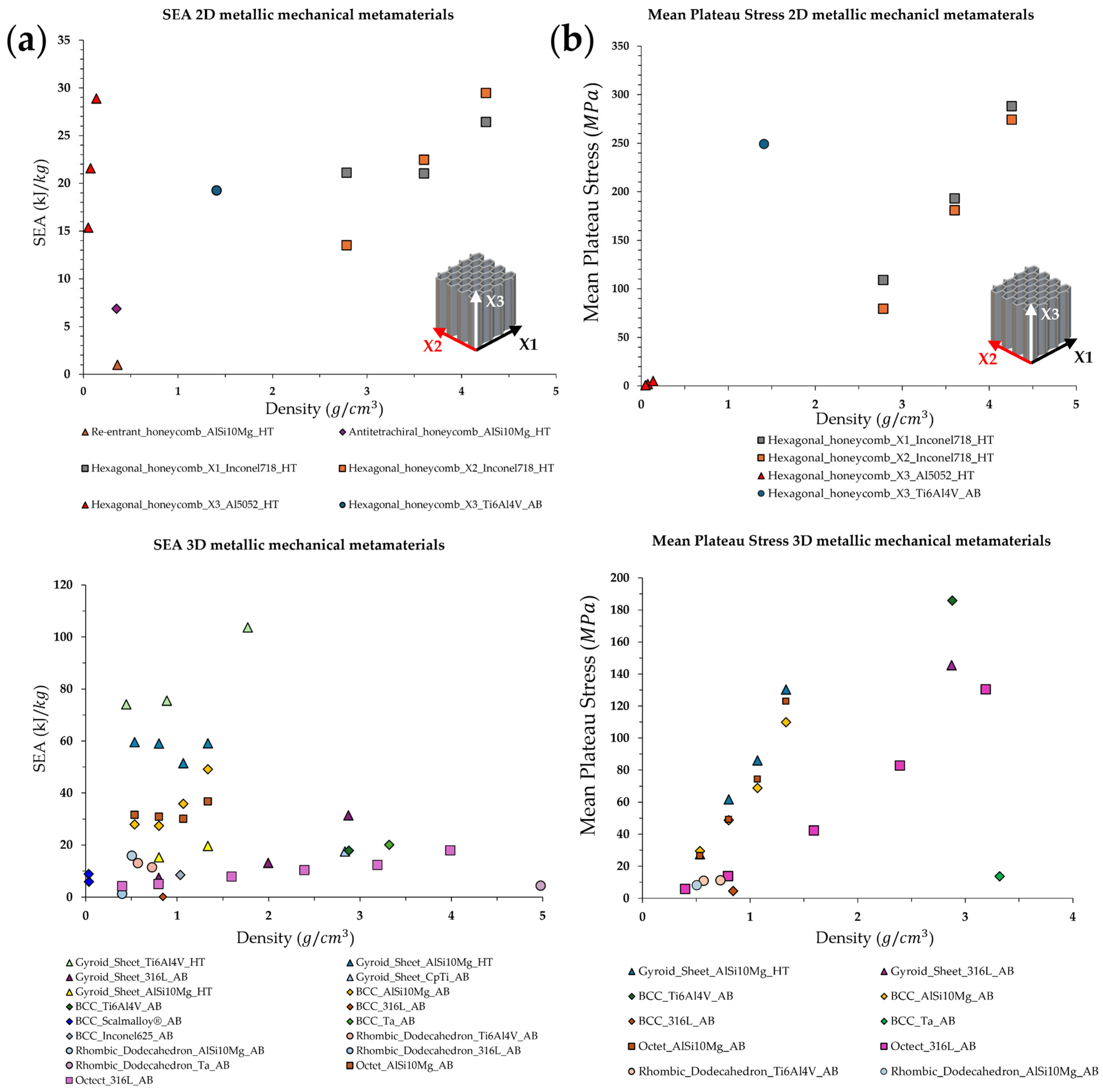
- (mechanical metamaterial mean plateau stress): The mean plateau stress can be considered to be a measure of the metamaterial capacity to absorb large amount of energy. Indeed, it is evident that an increase in plateau stress invariably leads to an increase in energy absorption if the deformation remains constant; hence, a high mean plateau stress is a good quantitative indicator of a good capacity to absorb energy, and can be calculated as shown in Equation (10) [50]:where is the plastic energy absorbed by the sample in the plateau stage (presented in Equation (5)), while εd0 and εc0 correspond to the onset densification strain and the collapse initiation strain, respectively (Figure 5a).
- SEA (Specific Energy Absorption) is a criterion used to measure the energy absorbed () by each unit of mass. It is an essential indicator of the ability of structures to absorb energy and determine the efficiency of a certain architecture. This factor has a significant influence on the performance-to-weight ratio and is the main parameter considered for applications in which weight reduction is essential, such as the aerospace sector, defense, and motorsports. SEA can be calculated using the mathematical equation expressed in Equation (11) [17,233]:where is the plastic energy absorbed by the sample in the plateau stage (presented in Equation (5)) and is the metamaterial density.
| Base Material | Base Material HT | Base Cell | Base Cell Relative Density (RD) | EMM (GPa) | (MPa) | (MPa) | Strain Rate | Ref. | |
|---|---|---|---|---|---|---|---|---|---|
| β-Ti5553 | Stress relieve annealing in tube vacuumed furnace backfilled with Argon (300 °C-1 h) | Octet truss | 6.64% | / | / | 17.5 | 32 | 0.001 | [70] |
| Ti6Al4V | as-built state | Rhombic Dodecahedron | 12.9% | 0.346 | 15.87 | 10.7 | 12.96 | 0.001 | [235] |
| Rhombic Dodecahedron | 16.4% | 0.247 | 13.27 | 11.1 | 11.34 | ||||
| as-built state | Octet truss | 1.4% | / | / | / | 10.27 | 1000 | [236] | |
| Octet truss | 5.7% | / | / | / | 3.47 | ||||
| Octet truss | 12.7% | / | / | / | 3.23 | ||||
| as-built state | Gyroid sheet | 65% | 7.6 ± 0.6 | / | 375.3 ± 7.7 | 33.12 | 0.001 | [237] | |
| Primitive sheet | 65% | 6.4 ± 0.2 | / | 260.9 ± 3.3 | 23.71 | ||||
| BCC | 65% | 4.7 ± 0.1 | / | 185.9 ± 8.4 | 17.85 | ||||
| Heat treated at 950 °C × 2 h + furnace cooling | Gyroid sheet | 65% | 7.5 ± 0.4 | / | 389.3 ± 2.8 | 51.02 | |||
| Primitive sheet | 65% | 6.7 ± 0.3 | / | 250.7 ± 6.5 | 41.53 | ||||
| BCC | 65% | 4.8 ± 0.1 | / | 222.4 ± 4.1 | 28.97 | ||||
| as-built state | BCC | 11.9% | 0.924 | / | / | 5 | 1000 | [238] | |
| FCC | 26.2% | 6.779 | / | / | 11 | ||||
| as-built state | FCCZ | 12.4% | / | / | / | 22.1 | 0.001 | [239] | |
| Heat treated at 950 °C × 2 h + furnace cooling | FCCZ | 12.4% | / | / | / | 16.9 | 0.001 | ||
| FCCZ | 12.4% | / | / | / | 18.84 | 1 | |||
| FCCZ | 12.4% | / | / | / | 24.6 | 312.5 | |||
| Stress relieve annealing (820 °C × 2 h air environment + air cooling) | Gyroid sheet | 54% | 8.46 ± 0.43 | 181 ± 3 | / | / | 0.001 | [240] | |
| Gyroid sheet | 62% | 6.81 | 108 | / | / | ||||
| Gyroid sheet | 67% | 5.69 | 94 | / | / | ||||
| Diamond Sheet | 52.7% | 10.22 ± 0.31 | 199 ± 3 | / | / | ||||
| Diamond Sheet | 56.4% | 9.37 | 159 | / | / | ||||
| Diamond Sheet | 62.2% | 7.59 | 134 | / | / | ||||
| Heat treated 800 °C × 2 h in vacuum furnace | Gyroid sheet | 10% | 2.015 ± 0.1 | 49.689 ± 0.2 | / | 74.11 | 0.001 | [241] | |
| Gyroid sheet | 20% | 4.146 ± 0.02 | 117.940 ± 4.0 | / | 75.49 | ||||
| Gyroid sheet | 30% | 5.301 ± 0.1 | 222.411 ± 3.4 | / | 62.87 | ||||
| Gyroid sheet | 40% | 6.083 ± 0.02 | 335.597 ± 2.9 | / | 103.68 | ||||
| Gyroid sheet | 50% | 6.471 ± 0.004 | 494.397 ± 2.9 | / | 28.94 | ||||
| AlSi10Mg | as-built state | FCC | 27.25% | / | 37.4 | / | 3.26 | 750 | [242] |
| FCC | 27.25% | / | 37.59 | / | 3.43 | 1100 | |||
| as-built state | Rhombic Dodecahedron | 19% | / | / | 7.97 | 15.79 | 0.001 | [243] | |
| Rhombic Dodecahedron | 19% | / | / | 10.49 | 13.40 | 806 | |||
| as-built state | Octet truss | 20% | 1.2 ± 0.02 | / | 26.55 ± 2.65 | 31.59 | 0.001 | [244] | |
| Octet truss | 30% | 1.6 ± 0.02 | / | 49.07 ± 2.76 | 30.89 | ||||
| Octet truss | 40% | 2.79 ± 0.04 | / | 74.31 ± 12.89 | 30.03 | ||||
| Octet truss | 50% | 3.26 ± 0.01 | / | 122.91 ± 2.44 | 36.78 | ||||
| as-built state | BCC | 20% | 1.23 ± 0.04 | / | 29.49 ± 0.38 | 27.96 | |||
| BCC | 30% | 1.58 ± 0.02 | / | 48.67 ± 5.5 | 27.37 | ||||
| BCC | 40% | 2.76 ± 0.03 | / | 68.79 ± 13.6 | 35.86 | ||||
| BCC | 50% | 3.24 ± 0.04 | / | 109.84 ± 2.35 | 49.17 | ||||
| as-built state | Gyroid Sheet | 20% | 1.22 ± 0.01 | / | 27.38 ± 0.99 | 59.57 | |||
| Gyroid Sheet | 30% | 1.52 ± 0.04 | / | 61.77 ± 6.26 | 59.05 | ||||
| Gyroid Sheet | 40% | 2.47 ± 0.02 | / | 86.03 ± 0.61 | 51.44 | ||||
| Gyroid Sheet | 50% | 3.00 ± 0.03 | / | 130.31 ± 2.2 | 59.12 | ||||
| Solution heat treatment (525 °C × 2 h) + water cooling + artificial aging (175 °C × 8 h) + water cooling | Gyroid Sheet | 35% | / | / | 64.27 | 32.91 | 0.001 | [245] | |
| Gyroid Skeletal | 35% | / | / | 36.27 | 18.55 | ||||
| Diamond Sheet | 35% | / | / | 73.44 | 37.54 | ||||
| Diamond Skeletal | 35% | / | / | 44.55 | 22.82 | ||||
| as-built state | Gyroid sheet | 14.3% | / | / | / | 11.89 | 140 | [215] | |
| as-built state | BCCZ | 15.4% | 0.389 | 20.22 | / | 3.01 | 0.001 | [246] | |
| Solution heat treatment (460 × 2 h) + water quenching | BCCZ | 15.4% | 0.208 | 11.93 | / | 14.67 | |||
| Solution heat treatment (500 × 2 h) + water quenching | BCCZ | 15.4% | 0.225 | 14.30 | / | 17.15 | |||
| Solution heat treatment (540 × 2 h) + water quenching | BCCZ | 15.4% | 0.239 | 14.59 | / | 16.87 | |||
| Solution heat treatment (460 × 2 h) + water quenching + artificial aging (180 °C × 6 h) + water quenching | BCCZ | 15.4% | 0.225 | 12.46 | / | 15.59 | |||
| Solution heat treatment (500 × 2 h) + water quenching + artificial aging (180 °C × 6 h) + water quenching | BCCZ | 15.4% | 0.351 | 17.11 | / | 12.37 | |||
| Solution heat treatment (540 × 2 h) + water quenching + artificial aging (180 °C × 6 h) + water quenching | BCCZ | 15.4% | 0.339 | 17.57 | / | 11.26 | |||
| Stress relieve annealing (300 °C × 2 h in vacuumed furnace) | Gyroid Sheet | 30% | 0.997 | 58.75 | / | 15.22 | 0.001 | [247] | |
| Gyroid Sheet | 50% | 1.189 | 77.78 | / | 19.63 | ||||
| Diamond Sheet | 30% | 1.046 | 64.69 | / | 16.74 | ||||
| Diamond Sheet | 50% | 1.431 | 84.58 | / | 23.42 | ||||
| Primitive Sheet | 30% | 0.832 | 54.63 | / | 7.33 | ||||
| Primitive sheet | 50% | 1.302 | 79.49 | / | 14.5 | ||||
| AISI 316L | Heat treated at 900 °C × 2–4 h in a vacuumed furnace filled with Ar+ furnace cooling | Rhombic Dodecahedron | 5% | 0.045 | 0.92 | / | 1.15 | 0.001 | [248] |
| Octet truss | 5% | 0.121 | 1.98 | / | 1.93 | ||||
| as-built state | Octet truss | 20.2% | 7.43 | 29.09 | / | 6.24 | 0.001 | [249] | |
| Octet truss | 31.8% | 13.57 | 47.10 | / | 8.06 | ||||
| Octet truss | 5% | 0.747 | / | 5.68 | 4.08 | 0.001 (+25% at 1000 ) | [200] | ||
| Octet truss | 10% | 2.01 | / | 13.68 | 4.94 | ||||
| Octet truss | 20% | 12.52 | / | 42.19 | 7.82 | ||||
| Octet truss | 30% | 13.50 | / | 82.67 | 10.26 | ||||
| Octet truss | 40% | 18.36 | / | 130.28 | 12.22 | ||||
| Octet truss | 50% | 23.00 | / | 192.20 | 17.84 | ||||
| BCC | 10.57% | 0.132 | 3.86 ± 0.75 | 4.61 ± 0.57 | 0.14 | 220 | [250] | ||
| BCCZ | 11.93% | 0.562 | 11.36 ± 0.36 | 11.08 ± 0.31 | 0.26 | ||||
| FCC | 8.71% | 0.319 | 7.02 ± 0.31 | 7.31 ± 0.46 | 0.30 | ||||
| FCCZ | 9.93% | 0.776 | 16.64 ± 1.02 | 15.44 ± 1.11 | 0.49 | ||||
| FCCZ | 12.4% | / | / | / | 15.4 | 0.001 | [239] | ||
| SeG Miura (y) | 30.7% | / | / | 32.7 | 2.83 | 0.001 | [210] | ||
| SeG Miura (y) | 18.9% | / | / | 6.2 | 1.13 | ||||
| as-built state | Octet truss | 10% | 0.982 | 29.54 | / | 4.78 | 0.001 | [251] | |
| Octet truss | 25% | 3.019 | 98.62 | / | 9.86 | ||||
| Gyroid Sheet | 10% | 1.104 | 32.92 | / | 7.44 | ||||
| Gyroid Sheet | 25% | 3.365 | 122.01 | / | 13.15 | ||||
| Gyroid Skeletal | 10% | 0.508 | 16.46 | / | 4.09 | ||||
| Gyroid Skeletal | 25% | 2.373 | 98.14 | / | 9.40 | ||||
| Diamond Sheet | 10% | 2.026 | 38.04 | / | 8.94 | ||||
| Diamond Sheet | 25% | 3.261 | 136.10 | / | 14.43 | ||||
| Diamond Skeletal | 10% | 0.373 | 8.23 | / | 0.70 | ||||
| Diamond Skeletal | 25% | 2.867 | 100.47 | / | 6.41 | ||||
| Primitive Sheet | 10% | 0.961 | 24.10 | / | 5.48 | ||||
| Primitive Sheet | 25% | 3.185 | 122.26 | / | 13.14 | ||||
| as-built state | Gyroid Sheet | 36% | / | 88.71 | 145.46 | 31.41 | 0.001 | [252] | |
| Gyroid Sheet | 36% | / | 161.66 | 176.41 | 37.65 | 2000 | |||
| Gyroid Sheet | 36% | / | 190.37 | 203.56 | 41.31 | 3000 | |||
| Gyroid Sheet | 36% | / | 216.68 | 248.82 | 47.05 | 4000 | |||
| CpTi | as-built state | Gyroid Sheet | 35.52% | / | 79.73 ± 2.7 | / | 17.5 ± 2.3 | 0.001 | [253] |
| Scalmalloy® | as-built state | BCC | 1.26% | / | 4.43 | / | 5.87 | 75 | [254] |
| BCC | 1.20% | / | 4.7 | / | 8.85 | 1393 | |||
| BCC | 0.924% | / | 3.44 | / | 7.04 | 3000 | |||
| BCCZ | 0.905% | / | 4.19 | / | 7.78 | 1393 | |||
| Ta | as-built state | BCC | 20% | 0.59 | 9.83 | 13.67 | 20.08 | 0.001 | [255] |
| Gyroid Skeletal | 15% | 1.114 | 18.8 ± 0.6 | 25.7 ± 0.7 | 6.29 | 0.001 | [256] | ||
| Rhombic dodecahedron | 30% | 1.78 ± 0.11 | 44.4 ± 2.53 | / | 4.33 | 0.001 | [257] | ||
| Inconel 625 | as-built state | BCC | 12.3% | 0.493 | 7.28 | / | 8.48 | 0.001 | [258] |
| 5.7% | 0.056 | 1.64 | / | 3.09 | |||||
| 3.3% | 0.026 | 0.50 | / | 1.85 | |||||
| BCCZ | 13.8% | 0.836 | 16.94 | / | 17.1 | ||||
| 6.4% | 0.640 | 4.07 | / | 5.66 | |||||
| 3.6% | 0.393 | 1.85 | / | 3.14 | |||||
| FCC | 9.5% | 0.702 | 8.89 | / | 12.2 | ||||
| 4.4% | 0.156 | 2.15 | / | 4.97 | |||||
| 2.5% | 0.052 | 0.86 | / | 3.01 | |||||
| FCCZ | 10.4% | 1.130 | 16.97 | / | 17.8 | ||||
| 4.8% | 0.719 | 4.83 | / | 7.37 | |||||
| 2.9% | 0.498 | 2.15 | / | 4.17 |
4. Advanced Lattice Configuration to Enhance Energy Absorption
4.1. Enhancement of Energy Absorption Through Optimization of Structural Elements
4.1.1. Structural Grading
4.1.2. Structural Hybridization
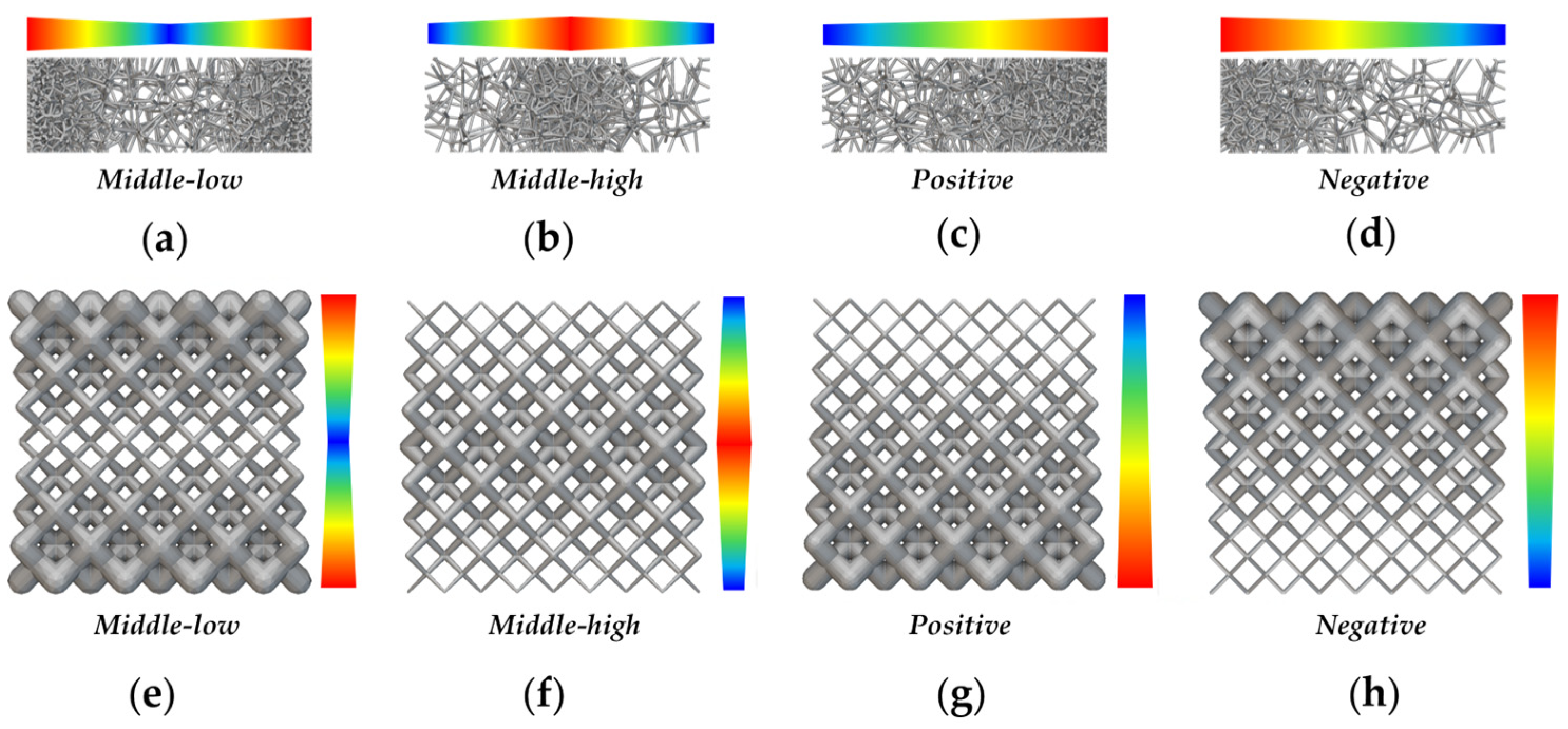
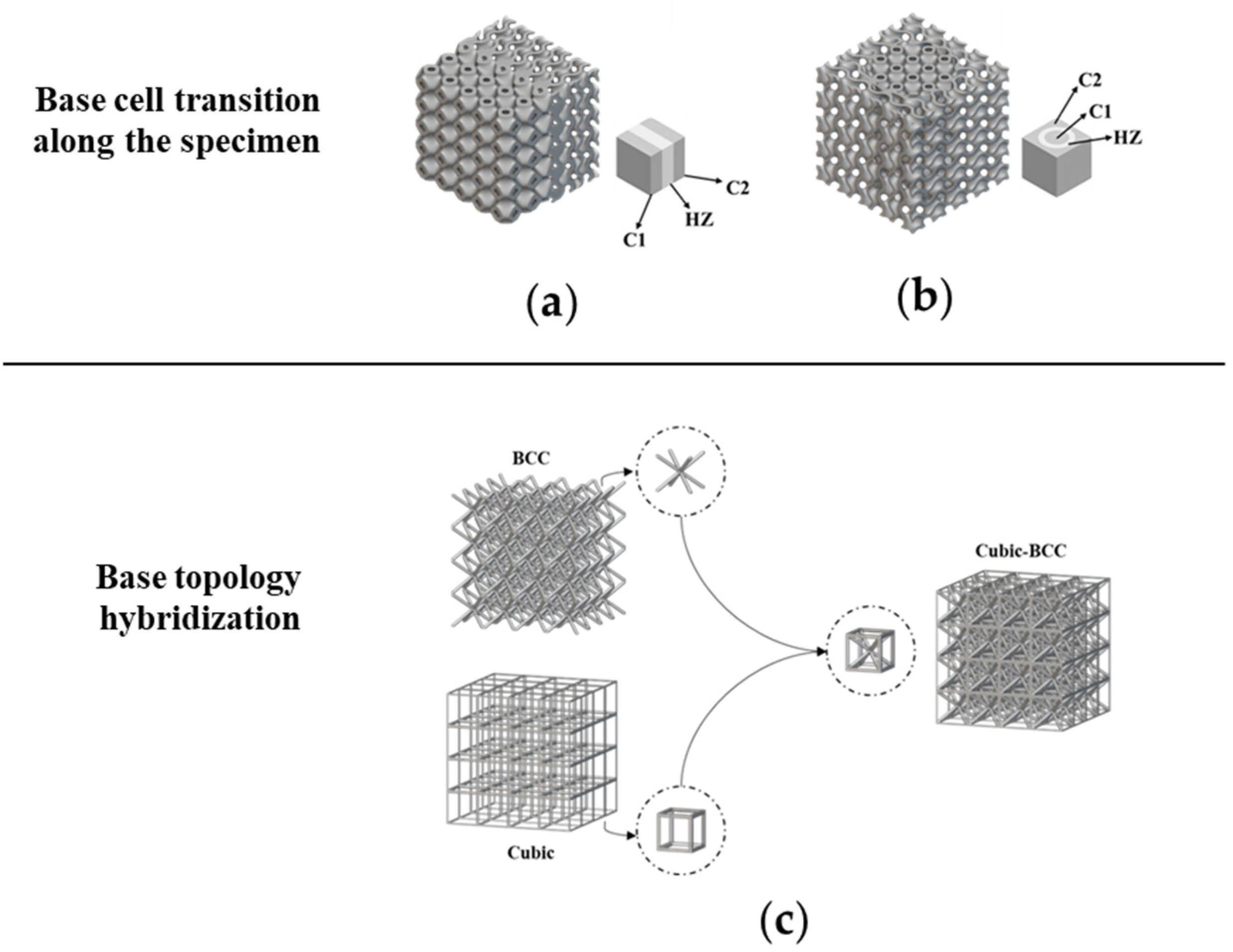
- Base cell transition along the specimen: This approach is generated by describing a transition function between different base cell geometries [229,281,282]. Figure 11a,b shows two typical transitions in a hybrid mechanical metamaterial consisting of longitudinal-linear and radial hybridization functions. It has been demonstrated that, by selecting the appropriate cell arrangement and parametrization [278], a stable plateau can be achieved without stress jumps occurring, thereby enhancing the energy absorption capabilities. As demonstrated by Novak et al. [283], this behavior is related to the fact that deformation starts from the less stiff topology and then gradually propagates to the more rigid one, leading to greater energy absorption capacity related to un-hybridized structures. Lattice parameters during hybridization of different base cells along a certain direction must be properly tuned to avoid sudden failure in the transition-hybridization zone (HZ) [266,281,284,285,286]. One efficient way to overcome this issue is to tune the mass distribution using a sufficiently high relative density. Cell mismatch can be reduced by adjusting the shape and dimensions of the base cells [254,259,260] or by using a stochastic geometry generalization approach [127,287,288,289].
- Base cell topology hybridization: This approach involves combining two different topologies in a single architecture, as shown in Figure 11c [250]. It should be noted that cell topology hybridization affects the elastic modulus and stress wave dissipation and decreases base cell anisotropy. In particular, combining stretch- and bend-dominated architectures increases impact time and delays failure, enabling more energy to be absorbed during plastic deformation [130,290,291].
4.2. Optimizing the Properties of the Base Material by Fine-Tuning and Controlling the LPBF Process

4.3. Metal Porous Structures Saturated with Polymeric/Metallic Matrix: The Rise of Interpenetrating Phase Composites

5. Summary and Future Outlook
- Different metals and heat treatments can have a significant impact on the performance of metamaterials. A necessary compromise between strength and toughness is required to achieve a high level of energy absorption in the plateau region. LPBF allows for the laser shape, process parameters, and heat treatments to be tuned in order to adjust the microstructural topology and generate microstructural features that maximize energy absorption.
- The selection and parametrization of the base cell determine the geometric response of the designed absorption systems. The review defines three classes of metamaterial: beam-based, curved-surface lattice, and plane-surface lattice. These can be further differentiated by their inherent response to an applied load in bend- and stretch-dominated architectures. Bend-dominated architectures are particularly prone to deformation, but are characterized by lower crushing stress. In contrast, stretch-dominated architecture can bear a higher load, offering higher resistance at the expense of lower plasticity. This means that the plateau stage for these different topologies is completely different and can be optimized based on the application. All cell configurations can be improved further by applying advanced design strategies. Base cell grading and hybridization, as well as the generation of composite structures in which metallic mechanical metamaterials act as reinforcement, have been shown to effectively reduce peak load transfer and/or increase energy absorption effectively. Since its implementation in industrial contexts is relatively straightforward, IPC has been identified as the most robust option. However, it is important to note that its functionality can degrade at elevated temperatures. This is attributed to the delicate balance between the elastic moduli of the constituent components and the metals and polymers involved in the process. This balance can be disrupted, potentially leading to instability and material degradation at high temperatures. The processes of dislocation tuning and laser manipulation are of particular interest, as they facilitate the generation of microstructural features that can be directly obtained in as-built samples. The efficacy of the aforementioned structures has been demonstrated through their ability to enhance energy absorption and isotropy in specific structures, achieved by generating a tuned texture. Furthermore, the capacity to generate tuned textures in different regions of the metamaterial could, in the near future, result in a variety of mechanical responses depending on stress localization (fine tuning). Without adequate control, however, the process may be difficult to regulate and may not be fully developed or characterized. It is important to recognize that there is no superior methodology, as they are all inherently dependent on the materials used, the material base cell, and the applied load. Therefore, it is essential to thoroughly understand the environment in which metamaterials will be employed in order to achieve the desired performance. It is also possible to apply all of the methods simultaneously to achieve perfect, optimized performance.
Author Contributions
Funding
Data Availability Statement
Conflicts of Interest
Abbreviations
| AB | As Built |
| AM | Additive Manufacturing |
| GND | Geometrically Necessary Dislocations |
| HT | Heat Treated |
| HZ | Hybridization Zone |
| KPI | Key Performance Indexes |
| IPC | Interpenetrating Phase Composite |
| LPBF | Laser Powder Bed Fusion |
| LP-DED | Laser Powder Direct Energy Deposition |
| MMD | Molten Metal Deposition |
| MM-IPC | Metal-Metal Interpenetrating Phase Composite |
| MP-IPC | Metal-Polymer Interpenetrating Phase Composite |
| RD | Relative Density |
| RT | Room Temperature |
| SEA | Specific Energy Absorption |
| TPMS | Triply Periodic Minimal Surface |
| VED | Volumetric Energy Density |
| WAAM | Wire Arc Additive Manufacturing |
Appendix A
Appendix A.1. Basics of Base Material Behavior During Plastic Deformation

Appendix A.2. Basics of Base Material Behavior During Plastic Deformation—Principles and Effects of Strain
| Micro-Mechanism | Macro-Effect | ||||
|---|---|---|---|---|---|
| Dislocation Interaction with Different Type of Strengthening Mechanisms | Crystal Lattice in Which Phenomena Originate | Phenomena Overview | Effect on Strain Hardening | Stress–Strain Response | |
| Solid solution strengthening | Solute interstitial atoms | FCC | Interstitial atoms are known to impede mobile dislocation during deformation, acting as physical obstacles that hinder their movement; moreover, by increasing the stacking fault energy, they allow us to enhance the resistance and the plasticity of the base material [335,336]. | Dynamic strain aging: During the time a dislocation is held up at some obstacle, it collects, by the process of diffusion, an atmosphere or cloud of solute atoms around it. This atmosphere exerts a pinning force on dislocation opposing to its movement with a magnitude depending on the interaction of the solute atoms with the main lattice and their concentration. If the diffusion process of solute atoms is not sufficiently rapid, new dislocation will be generated from another source for plastic flow to continue [337,338]. | Higher stress needed to move dislocations due to lattice distortion generated by the solute atom and serrated stress–strain curve due to pinning–unpinning of clouds of solute atoms [337,339]. |
| BCC | This type of crystal structure is usually not suitable for high interstitial solid solutions. Interstitial sites are usually small, and since those atoms that can be hosted should be even smaller, it is difficult to create a solid solution [340]. | ||||
| HCP | Interstitial atoms create a change in the elastic strain energy related to the distortion of the lattice and the difference in the elastic module of the solute atom [337]. | ||||
| Solute substitutional atoms | FCC | The atomic volume of solute atoms is frequently found to be disparate from that of the solvent. This disparity gives rise to the solute atoms’ interaction with the pressure field surrounding the dislocation incrementing the energy needed to move the dislocation [341]. | |||
| BCC | Solute atoms strongly strengthen the body-centered cubic lattice. In particular, at low solute concentration and low temperature, double-kink nucleation is governing plastic deformation, while at high solute concentration and high temperature, deformation is controlled by kink migration, respectively related to hardening and softening [342]. | ||||
| HCP | Solute addition both increases the stress required for slip on the basal plane and enables cross-slip to prismatic and pyramidal planes; both of these effects have the potential to increase the ductility due to the blunting of basal plane dislocation pileups that are linked to fracture [343]. | ||||
| Precipitation strengthening | Coherent precipitate | All crystal structures | Resistance to deformation is influenced greatly by the loss of coherency. Coherent precipitates are so zones of high strength and low plasticity compared to the main matrix [344]. | Stacking fault defects coming from the shear of coherent particle determines an increase in the energy needed to deform coherent precipitates by shearing in contrast to the matrix [319]. | Additional stress required to deform the alloy [345]. |
| Non-coherent precipitate | All crystal structures | Non-shearable precipitates are characterized by bypassing mechanism [346]. | Dislocations constraining the gliding of dislocation and dislocation multiplication generated by Orowan hardening [347]. | Increase in stress needed to deform the alloy and induce the generation of new dislocation and their interaction [347]. | |
| Dislocation interaction | Lomer–Cottrell lock | FCC | When two perfect dislocations on intersecting slip plane meet, they react to form a sessile Lomer–Cottrell dislocation, which Burger’s vector is not on a slip plane [348]. | The immobility of Lomer–Cottrell dislocations creates a strong barrier to the motion of other dislocation contributing to the work hardening of the material [348,349]. | Increase in material strength under stress generated a more resistant material [348,349]. |
| Dislocation pile-up | All crystal structures | Dislocation pile-ups occur when multiple dislocations accumulate along a slip plane, typically at barriers [350]. | Pile-ups exert a collective force on the barrier, increasing the local stress concentration. This can lead to the initiation of cracks or further dislocation movement. The dislocations in a pile-up interact strongly with each other, leading to a high local stress field responsible for strain hardening [350,351]. | Pile-ups can lead to localized stress concentrations, which may result in the initiation of cracks and ultimately affect the material’s toughness and ductility. Moreover, they play a significant role in the early stages of plastic deformation, particularly in polycrystalline materials where grain boundaries act as barriers [350,351]. | |
| Dislocation forest | All crystal structures | Dislocations moving on the glide plane and intersecting each other generates jog or offsets in dislocation line. These jogs and offset result in the formation of an edge dislocation perpendicular to the original dislocation line [352,353,354]. | Any further movement of the original dislocation requires the edge dislocation formed to move out of the original glide plane impeding the motion of the dislocation [355]. | The sessile condition formed increases the stress needed to move dislocation. When the stress exceeds a certain amount, dislocation will move in a non-conservative way, generating defects such as vacancy and interstitial [355]. | |
| Crystal Structure | Base Material | Slip Planes | Slip Directions | Twin Plane | Twin Direction |
|---|---|---|---|---|---|
| BCC | α-Fe, Ta, β-Ti alloys | {110}, {221}, {321} | <111> | (112) | [111] |
| FCC | Al-alloys, Cu-alloys, γ-Fe, Inconel 625, Inconel 718 | {111} | <110> | (111) | [112] |
| HCP | Mg alloys, α-Ti alloys | {0001}, {1010}, {1120} | <1020> | (102) | [011] |
Appendix A.3. Basics of Base Material Behavior During Plastic Deformation—Principles and Effect of Strain Rate
- Stacking fault energy: Regarding FCC metals, as the stacking fault energy decreases, the incidence of twinning increases. That means that every alloying element that decreases the stacking fault energy has a certain effect on the incidence of twin rather than slip [359].
- FCC HCP at low strain rates (): This is the case of Fe34Co34Cr20Mn6Ni6 high-entropy alloy (HEA) in which the strain rate phase transformation induced plasticity from FCC to HCP create a substantial hardening effect of the base material [370].
- Tetragonal martensitic structure BCC at low strain rates (): This is the case of Tantalum, which undergoes a negative strain rate hardening due to the phase transformation from a tetragonal martensitic structure to a BCC structure as the loading rate increases [371].
| Creep and stress relaxation: The base material response is basically visco-plastic [340]. | Quasi-static test: Tests are conducted with the same velocity throughout the whole specimen length. | Dynamic–low-velocity test: Elastic wave traveling in the sample; force equilibrium conserved. | Dynamic–high-velocity test: Plastic wave propagation; force equilibrium still acceptable. | High-impact velocity test: Shock waves propagation [51]. |
| Micro-Mechanism | Macro-Effect | |||||
|---|---|---|---|---|---|---|
| Crystal Lattice in Which Phenomena Originate | Phenomena Overview | Effect on Strain Rate Sensitivity | Stress–Strain Response | Strain Rate | ||
| Solid solution strengthening | Interstitial atoms | All crystal structures | At high strain rates, the arrest time of dislocation in front of an obstacle is considered short. Hence, for a certain range of temperature, diffusion phenomena involving the formation of solute atom clouds near dislocation does not produce an effective enhancement of the shear stress needed to move the dislocation [341,378,379,380] | Softening | Less stress needed to deform the base material and less serration of the stress–strain curve due to the reduction in pinning and unpinning phenomena between solute and dislocations. | |
| Substitutional atoms | ||||||
| Precipitation strengthening | Coherent precipitates | FCC | They increase yield strength and plastic stress, as shown in Table 3, without affecting strain rate hardening [347,381]. | / | / | |
| Incoherent precipitates | FCC | The interaction with high-speed dislocations depends on the pressure of the load input and the size of the precipitates. In particular, the Orowan bypass mechanism is favored for larger precipitates, while radiating dislocation emission is favored for nanoprecipitates. By originating new dislocation, this second behavior will promote the hardening of the alloy [347]. | Hardening | Depending on precipitate size and pressure level of the load. Nano-sized precipitates exhibit hardening mechanisms at low stresses and toughening mechanisms at high stresses. In contrast, larger precipitates exhibit hardening phenomena both at low and high stresses [347]. | ||
| Dislocation interaction | Dislocation drag | All crystal structures | Metals act as viscous Newtonian solids. Hence, under the application of external stress, dislocations responsible of plastic deformation will accelerate until the reaching of a certain steady state velocity. In particular, metal viscosity can be analyzed as a parameter that correlate linearly dislocation velocity and stress [382,383]. | Hardening effect that can be evaluated as: where is the strain rate, the Burgers vector, M the orientation factor, and dislocation density | Higher stress needed to deform the base material. | |
| Relativistic effect | All crystal structures | Deformation of the stress field of dislocation and increase in dislocation self-energy [51]. | Hardening | By enhancing the dislocation self-energy, the local stress field created by the dislocation will be enhanced and will create a hardening mechanism while interacting with other dislocations and defects [374,375,376,377,378,379,380,381,382,383,384]. | ||
| Dislocation forest | All crystal structures, but primarily in FCC | As the pressure and pulse duration of the load increase, the dislocation density. Higher pulse duration means that dislocations have more time to nucleate and, rearrange, interact and create more defined substructures [51]. | Hardening | Higher dislocation density means more dislocation interaction and, consequently, a hardening effect on the base material that will be translated in more stress needed to continue to deform or sudden failure [51]. | ||
| Jogs drags and point defects generation | All crystal structures | Jogs effectiveness to constrain dislocation motion is less as the impact velocity rises. Non conservative motion of jogs creates a large amount of point defects [51,52,53,54,55,56,57,58,59,60,61,62,63,64,65,66,67,68,69,70,71,72,73,74,75,76,77,78,79,80,81,82,83,84,85,86,87,88,89,90,91,92,93,94,95,96,97,98,99,100,101,102,103,104,105,106,107,108,109,110,111,112,113,114,115,116,117,118,119,120,121,122,123,124,125,126,127,128,129,130,131,132,133,134,135,136,137,138,139,140,141,142,143,144,145,146,147,148,149,150,151,152,153,154,155,156,157,158,159,160,161,162,163,164,165,166,167,168,169,170,171,172,173,174,175,176,177,178,179,180,181,182,183,184,185,186,187,188,189,190,191,192,193,194,195,196,197,198,199,200,201,202,203,204,205,206,207,208,209,210,211,212,213,214,215,216,217,218,219,220,221,222,223,224,225,226,227,228,229,230,231,232,233,234,235,236,237,238,239,240,241,242,243,244,245,246,247,248,249,250,251,252,253,254,255,256,257,258,259,260,261,262,263,264,265,266,267,268,269,270,271,272,273,274,275,276,277,278,279,280,281,282,283,284,285,286,287,288,289,290,291,292,293,294,295,296,297,298,299,300,301,302,303,304,305,306,307,308,309,310,311,312,313,314,315,316,317,318,319,320,321,322,323,324,325,326,327,328,329,330,331,332,333,334,335,336,337,338,339,340,341,342,343,344,345,346,347,348,349,350,351,352,353,354,355,356,357,358,359,360,361,362,363,364,365,366,367,368,369,370,371,372,373,374,375,376,377,378,379,380,381,382,383,384,385,386,387,388,389]. | Softening | Jogs are less effective than in quasi-static tests. This means their hardening effect is less effective. | ||
Appendix A.4. Basics of Base Material Behavior During Plastic Deformation—Principles and Effect of Thermal Load
- Dynamic recovery: Due to the adiabatic effects that develop at high strain rates during shock conditions, the sample experiences a temperature rise, since there is insufficient time for heat to be dissipated. Consequently, the material softens due to the high temperature rise that cancels out the strain hardening effect related to plastic deformation [51,394].
| Thermally Activated Phenomena | Crystal Structures in Which Phenomena Originate | Effect of Low Temperature | Effect of High Temperature |
|---|---|---|---|
| Dynamic strain aging | All crystal structures | Low temperature hindered the effect of dynamic strain aging, since diffusion phenomena are less effective at lower temperature. Smoother stress–strain curve (less serration) [397]. | / |
| Dislocation cross-slip, dislocation climb and Lomer–Cottrel dislocation lock | FCC and HCP | These mechanisms are hindered at lower temperatures; hence, the flow stress increases [398]. | These mechanisms are favored at higher temperatures; hence, the flow stress decreases [398]. |
| Peierls–Nabarro obstacles | Mostly related to BCC crystal structures | Peierls–Nabarro stresses increase by decreasing temperature; hence, a hardening effect is usually associated with a decrease in temperature [51]. | Peierls–Nabarro stresses decreased by increasing temperature; hence, a softening effect is usually associated with a decrease in temperature [51]. |
Appendix A.5. Modeling of Base Material Behavior During Plastic Deformation Under Dynamic Loading
| Base Material | Constitutive Model | Model Parameters | Error (%) | ||||||
|---|---|---|---|---|---|---|---|---|---|
| AISI 316L (AB) [414] | Johnson–Cook model | A | B | n | C | m | / | ||
| 558 ± 44.27 | 4698.5 ± 324.92 | 1.30 ± 0.04 | 0.0184 ± 0.0004 | 0.7 ± 0.07 | |||||
| AISI 316L (HT) [415] | Johnson–Cook model | A | B | n | C | m | 17% | ||
| 304 | 1097 | 0.492 | 0.014 | / | |||||
| AISI 316L (HT) [416] | Zerilli–Armstrong modified model | C1 | C2 | C3 | C4 | C5 | C6 | n | 5.3% |
| 120 | 478.8 | 0.00296 | 0.00142 | 0.0524 | 0.000345 | 0.2732 | |||
| AlSi10Mg (AB) [408] | Johnson–Cook model | A | B | n | C | m | 23.8% | ||
| 227.8 | 69.4 | 0.153 | 0.0463 | 0.801 | |||||
| AlSi10Mg (HT) [417] | Johnson–Cook model | A | B | n | C | m | / | ||
| 200 | 428 | 0.6 | 0.185 | / | |||||
| AlSi10Mg (AB) [408] | Zerilli–Armstrong modified model | C1 | C2 | C3 | C4 | C5 | C6 | n | 8.2% |
| 227.8 | 62.65 | 0.0052 | 0.000728 | 0.0341 | 0.000244 | −0.110 | |||
| Ti6Al4V (AB) [418] | Johnson–Cook model | A | B | n | C | m | / | ||
| 1040 | 1167.24 | 1.64 | 0.0364 | / | |||||
| Ti6Al4V (HT) [419,420] | Johnson–Cook model | A | B | n | C | m | 20.27% | ||
| 1199 | 680 | 0.55 | 0.0157 | / | |||||
| Ti6Al4V (HT) [420] | Zerilli–Armstrong modified model | C1 | C2 | C3 | C4 | C5 | C6 | n | 8.91% |
| 869.4 | 640.5 | 0.0013 | −9.578 × 10⁻⁴ | 0.0095 | 6.94 × 10⁻⁶ | 0.3867 | |||
| CuCrZr (AB) [421] | Johnson–Cook model | A | B | n | C | m | / | ||
| 100 | 325 | 0.462 | 1.34 | 0.642 | |||||
| CuCrZr (HT) [421] | Johnson–Cook model | A | B | n | C | m | / | ||
| 150 | 355 | 0.367 | 0.044 | 0.587 | |||||
| AlScMg (AB) [422] | Johnson–Cook model | A | B | n | C | m | / | ||
| 198 | 400 | 0.332 | −0.001 | / | |||||
| AlScMg (HT) [422] | Johnson–Cook model | A | B | n | C | m | / | ||
| 399 | 362 | 0.345 | −0.0021 | / | |||||
| Inconel 625 (AB) [411] | Johnson–Cook model | A | B | n | C | m | 3.04% | ||
| 223 | 3414 | 0.660803 | 0.0000742 | 1.21665 | |||||
| Inconel 625 (HT) [411] | Johnson–Cook model | A | B | n | C | m | 4.68% | ||
| 309 | 3532 | 0.665168 | −0.03825 | 1.341691 | |||||
| Inconel 625 (AB) [411] | Zerilli–Armstrong modified model | C1 | C2 | C3 | C4 | C5 | C6 | n | 2.88% |
| 223 | 3932.503 | 0.000679 | 0.001381 | 0.009768 | 0.0000739 | 0.710097 | |||
| Inconel 625 (HT) [411] | Zerilli–Armstrong modified model | C1 | C2 | C3 | C4 | C5 | C6 | n | 2.71% |
| 309 | 4263.263 | 0.000476 | 0.00159 | −0.02622 | 0.0000679 | 0.746348 | |||
References
- Wegst, U.; Bai, H.; Saiz, E.; Tomsia, A.P.; Ritchie, R.O. Bioinspired structural materials. Nat. Mater. 2015, 14, 23–36. [Google Scholar] [CrossRef] [PubMed]
- Wegst, U.G.K. Bending efficiency through property gradients in bamboo, palm, and wood-based composites. J. Mech. Behav. Biomed. Mater. 2011, 4, 744–755. [Google Scholar] [CrossRef] [PubMed]
- Pelanconi, M.A.A.O.; Ortona, A.; Mazza, E. Nature-inspired, ultra-lightweight structures with gyroid cores produced by additive manufacturing and reinforced by unidirectional carbon fiber ribs. Materials 2019, 12, 4134. [Google Scholar] [CrossRef] [PubMed]
- Liu, L.; Liu, L.; Gao, C.; Yang, G.; Chen, Y.; Zhang, L. The design of a biomimetic hierarchical thin-walled structure inspired by a lotus leaf and its mechanical performance analysis. Materials 2023, 16, 4116. [Google Scholar] [CrossRef]
- Mahajan, A.S.G.; D’Souza, D. Additive manufacturing of metallic biomaterials: A concise review. Arch. Civ. Mech. Eng. 2023, 23, 187. [Google Scholar] [CrossRef]
- Thara Tom, S.P.; Sudevan, D.B.; Prabhakaran, J.; Jayaraj, P.; Kumar, B.J.; Mathew, S.T. Additive manufacturing in the bio-medical field—Recent research developments. Results Eng. 2022, 16, 100661. [Google Scholar]
- Zhang, X.; Liu, S.; Li, Y.; Guo, H.; Sun, W. Titanium alloy fabricated by additive manufacturing for medical applications: Obtaining, characterization and application—Review. Metals 2023, 13, 462. [Google Scholar] [CrossRef]
- Sarzyński, B.; Świątoniowski, Ł.; Grzelak, K. Metal additive manufacturing (MAM) applications in production of vehicle parts and components—A review. Metals 2024, 14, 195. [Google Scholar] [CrossRef]
- Li, N.; Zhu, M.; Peng, S.; Du, C.; Kang, M.; Zhao, H.; Wang, W. Direct additive manufacturing of metal parts for automotive applications. J. Manuf. Syst. 2023, 68, 368–375. [Google Scholar] [CrossRef]
- Vasco, J.C. Additive manufacturing for the automotive industry. In Additive Manufacturing; Pou, J., Riveiro, A., Davim, J.P., Eds.; Elsevier: Amsterdam, The Netherlands, 2021; pp. 505–530. [Google Scholar]
- Lu, P.; Li, X.; Xu, Y.; Wang, H.; Wu, M. Additive manufactured high-performance topology-optimized lattice structure: Compressive behavior and flow heat transfer characteristics. Case Stud. Therm. Eng. 2024, 61, 105097. [Google Scholar] [CrossRef]
- Blakey-Milner, B.; Gradl, P.; Snedden, G.; Brooks, M.; Pitot, J.; Lopez, E.; Leary, M.; Berto, F.; du Plessis, A. Metal additive manufacturing in aerospace: A review. Mater. Des. 2021, 209, 110008. [Google Scholar] [CrossRef]
- Khan, N.; Riccio, A.; Sorrentino, L. A systematic review of design for additive manufacturing of aerospace lattice structures: Current trends and future directions. Prog. Aerosp. Sci. 2024, 149, 101021. [Google Scholar] [CrossRef]
- Zhang, Z.; Oren, E.; Hou, N.; Askes, H. Energy absorption in lattice structures in dynamics: Experiments. Int. J. Impact Eng. 2016, 89, 49–61. [Google Scholar] [CrossRef]
- Theobald, S.M.; Smith, Y.; Brown, W.; Carter, S.; White, C.; Green, L.; Nichols, G. The quasi-static and blast loading response of lattice structures. Int. J. Impact Eng. 2008, 35, 795–810. [Google Scholar] [CrossRef]
- Hasan, R.; Mian, M.R.; Smith, E.; Taylor, S.; Cole, W.J.; Brown, W.; Scott, C.J. Comparison of the drop weight impact performance of sandwich panels with aluminium honeycomb and titanium alloy micro lattice cores. Appl. Mech. Mater. 2010, 224–225, 413–418. [Google Scholar] [CrossRef]
- Gibson, L.J.; Ashby, M.F. Cellular Solids: Structure and Properties; Cambridge University Press: Cambridge, UK, 1997. [Google Scholar]
- Ndou, N.; Mokoena, F.M.; Mthembu, M. A review on mechanical metamaterials: Exploring negative Poisson’s ratio, energy absorption, failure mechanisms, and current research frontiers. Proc. Inst. Mech. Eng. Part L J. Mater. Des. Appl. 2025, 53, 14644207251359307. [Google Scholar]
- Jiao, P.; Mueller, J.; Raney, J.R.; Zheng, X.; Alavi, A.H. Mechanical metamaterials and beyond. Nat. Commun. 2023, 14, 6004. [Google Scholar] [CrossRef]
- Wu, X.Y.; Zhao, J.; Li, H.; Zhou, Z.J.; Liu, L. Mechanical metamaterials associated with stiffness, rigidity and compressibility: A brief review. Prog. Mater. Sci. 2018, 94, 114–173. [Google Scholar] [CrossRef]
- Gibson, L.D.; Wadley, H.N.G. Mechanical response of Ti–6Al–4V octet-truss lattice structures. Int. J. Solids Struct. 2015, 60–61, 107–124. [Google Scholar]
- Feng, L.-J.; Xu, J.; Yang, L.-H.; Yu, G.-C.; Wu, W.Y.; Wu, L.-Z. Shear and bending performance of new type enhanced lattice truss structures. Int. J. Mech. Sci. 2017, 134, 589–598. [Google Scholar] [CrossRef]
- Banhart, J. Manufacturing routes for metallic foams. JOM 2000, 52, 22–27. [Google Scholar] [CrossRef]
- Banhart, J.; Baumeister, J. Production methods for metallic foams. MRS Proc. 1998, 521, 121–132. [Google Scholar] [CrossRef]
- Al-Ketan, N.; Karathanasopoulos, N. Hybrid manufacturing of AlSi10Mg metamaterials: Process, static and impact response attributes. J. Mater. Res. Technol. 2023, 27, 7457–7469. [Google Scholar]
- Al-Ketan, O. Additive manufacturing-assisted casting of 3D micro-architected heat sinks. Mater. Lett. 2025, 379, 137641. [Google Scholar] [CrossRef]
- Wei, D.; Qiang, T.; Ji, K.; Zhao, L.; Guo, L. Quasi-static energy absorption of Miura-ori metamaterials. JOM 2021, 73, 4177–4187. [Google Scholar]
- Wohlers Associates. Wohlers Report 2024; Wohlers Associates: Fort Collins, CO, USA, 2024. [Google Scholar]
- Vafadar, A.; Guzzomi, F.; Rassau, A.; Hayward, K. Advances in Metal Additive Manufacturing: A Review of Common Processes, Industrial Applications, and Current Challenges. Appl. Sci. 2021, 11, 1213. [Google Scholar] [CrossRef]
- Schmidt, M.; Merklein, M.; Bourell, D.; Dimitrov, D.; Hausotte, T.; Wegener, K.; Overmeyer, L.; Vollertsen, F.; Levy, G.N. Laser-based additive manufacturing in industry and academia. CIRP Ann. Manuf. Technol. 2017, 66, 561–583. [Google Scholar] [CrossRef]
- Kumar, M.B.; Sathiya, P. Methods and materials for additive manufacturing: A critical review on advancements and challenges. Thin-Walled Struct. 2021, 159, 107228. [Google Scholar] [CrossRef]
- Song, Y.; Sun, Q.; Guo, K.; Wang, X.; Liu, J.; Sun, J. Effect of scanning strategies on the microstructure and mechanical behavior of 316L stainless steel fabricated by selective laser melting. Mater Sci. Eng. A. 2020, 793, 139879. [Google Scholar] [CrossRef]
- Salman, O.O.; Brenne, F.; Niendorf, T.; Eckert, J.; Prashanth, K.G.; He, T.; Scudino, S. Impact of the scanning strategy on the mechanical behavior of 316L steel synthesized by selective laser melting. J. Manuf. Process. 2019, 45, 255–261. [Google Scholar] [CrossRef]
- Wang, D.; Wu, S.; Yang, Y.; Dou, W.; Deng, S.; Wang, Z.; Li, S. The effect of a scanning strategy on the residual stress of 316L steel parts fabricated by selective laser melting (SLM). Materials 2018, 11, 1821. [Google Scholar] [CrossRef] [PubMed]
- Santecchia, E.; Mengucci, P.; Gatto, A.; Bassoli, E.; Denti, L.; Rutkowski, B.; Barucca, G. Laser powder bed fusion: Tailoring the microstructure of alloys for biomedical applications. Mater. Today Proc. 2019, 19, 24–32. [Google Scholar] [CrossRef]
- Chowdhury, S.; Yadaiah, N.; Prakash, C.; Ramakrishna, S.; Dixit, S.; Gupta, L.R.; Buddhi, D. Laser powder bed fusion: A state-of-the-art review of the technology, materials, properties & defects, and numerical modelling. J. Mater. Res. Technol. 2022, 20, 2109–2172. [Google Scholar]
- Nabavi, S.F.; Dalir, H.; Farshidianfar, A. A comprehensive review of recent advances in laser powder bed fusion characteristics modeling: Metallurgical and defects. Int. J. Adv. Manuf. Technol. 2024, 132, 2233–2269. [Google Scholar] [CrossRef]
- Patel, S.; Liu, Y.; Siddique, Z.; Ghamarian, I. Metal additive manufacturing: Principles and applications. J. Manuf. Process. 2024, 131, 1179–1201. [Google Scholar] [CrossRef]
- Ferro, P.; Meneghello, R.; Savio, G.; Berto, F. A modified volumetric energy density–based approach for porosity assessment in additive manufacturing process design. Int. J. Adv. Manuf. Technol. 2020, 110, 1911–1921. [Google Scholar] [CrossRef]
- Zhao, R.; Li, H.; Zhang, Y.; Liu, Y.; Hao, Y. On the role of volumetric energy density in the microstructure and mechanical properties of laser powder bed fusion Ti–6Al–4V alloy. Addit. Manuf. 2022, 51, 102605. [Google Scholar] [CrossRef]
- Patil, S.N.; Mulay, A.V.; Ahuja, B.B. Development of experimental setup of metal rapid prototyping machine using selective laser sintering technique. J. Inst. Eng. India Ser. C 2018, 99, 159–167. [Google Scholar] [CrossRef]
- Zhou, H.; Yang, Y.; Trofimov, V.; Li, H.; Liu, Z.; Xiao, Y.; Chen, T.; Song, C. In-Situ Quality Monitoring in LPBF via Melt-Pool Radiation: Compressive Sampling and Deep Feature Extraction. Addit. Manuf. Front. 2025, 200269. [Google Scholar] [CrossRef]
- Le, T.-N.; Lee, M.-H.; Lin, Z.-H.; Tran, H.-C.; Lo, Y.-L. Vision-Based In-Situ Monitoring System for Melt-Pool Detection in Laser Powder Bed Fusion Process. J. Manuf. Process. 2021, 68, 1735–1745. [Google Scholar] [CrossRef]
- Wang, R.; Garcia, D.; Kamath, R.R.; Dou, C.; Ma, X.; Shen, B.; Choo, H.; Fezzaa, K.; Yu, H.Z.; Kong, Z. In Situ Melt Pool Measurements for Laser Powder Bed Fusion Using Multi-Sensing and Correlation Analysis. Sci. Rep. 2022, 12, 13716. [Google Scholar] [CrossRef] [PubMed]
- Schwerz, C.; Nyborg, L. Linking In Situ Melt Pool Monitoring to Melt Pool Size Distributions and Internal Flaws in Laser Powder Bed Fusion. Metals 2021, 11, 1856. [Google Scholar] [CrossRef]
- Colosimo, B.M.; Grasso, M. In-Situ Monitoring in L-PBF: Opportunities and Challenges. Procedia CIRP 2020, 94, 388–391. [Google Scholar] [CrossRef]
- Wang, J.; Zhu, R.; Liu, Y.; Zhang, L. Understanding Melt Pool Characteristics in Laser Powder Bed Fusion: An Overview of Single- and Multi-Track Melt Pools for Process Optimization. Adv. Powder Mater. 2023, 2, 100137. [Google Scholar] [CrossRef]
- Li, X.; Li, H.; Chen, X.; Shen, S.; Zhang, G.; Wei, H.; Hu, Y.; Li, Z.; Dai, L. In-Situ Multi-Eye Monitoring of Melt Pool Temperature Field in Laser Additive Manufacturing by Light Field Camera. Addit. Manuf. 2025, 102, 104747. [Google Scholar] [CrossRef]
- Cronau, J.; Engstler, F. Simulation of lattice structures with Johnson–Cook material and damage model. In Lecture Notes on Advanced Structured Materials 2: Advanced Structured Materials; Altenbach, H., Hitzler, L., Johlitz, M., Merkel, M., Öchsner, A., Eds.; Springer: Cham, Switzerland, 2024; Volume 203, pp. 253–273. [Google Scholar]
- Sun, Y.; Li, Q.M. Dynamic compressive behaviour of cellular materials: A review of phenomenon, mechanism and modelling. Int. J. Impact Eng. 2018, 112, 74–115. [Google Scholar] [CrossRef]
- Meyers, M.A. Dynamic Behavior of Materials; John Wiley & Sons: New York, NY, USA, 1994. [Google Scholar]
- Cabrera, T.M.; Hernández, M.; Long, J.M. A simple Zerilli–Armstrong constitutive equation for modeling and prediction of hot deformation flow stress of steels. Mech. Mater. 2016, 94, 38–45. [Google Scholar] [CrossRef]
- Rocha, I.B.C.M.; Kerfriden, P.; Van Der Meer, F.P. Machine learning of evolving physics-based material models for multiscale solid mechanics. Mech. Mater. 2023, 184, 104707. [Google Scholar] [CrossRef]
- Sfyris, D.; Demetrios, M.; Papadopoulos, T.R. Mechanical models and numerical simulations in nanomechanics: A review across the scales. Eng. Anal. Bound. Elem. 2021, 128, 149–170. [Google Scholar]
- Busso, E.P. From single crystal to polycrystal plasticity: Overview of main approaches. In Handbook of Damage Mechanics: Nano to Macro Scale for Materials and Structures; Springer: Cham, Switzerland, 2022; pp. 1251–1276. [Google Scholar]
- Fedelich, B. Crystal plasticity models: Dislocation based. In Nickel-Base Single Crystals Across Length Scales; Elsevier: Amsterdam, The Netherlands, 2022; pp. 401–427. [Google Scholar]
- Promoppatum, P.; Rollett, A.D. Physics-based and phenomenological plasticity models for thermomechanical simulation in laser powder bed fusion additive manufacturing: A comprehensive numerical comparison. Mater. Des. 2021, 204, 109658. [Google Scholar] [CrossRef]
- Loukadakis, V.; Novak, R.Z. Advancements in and applications of crystal plasticity modelling of metallic materials. Crystals 2024, 14, 883. [Google Scholar] [CrossRef]
- Zhao, M.; Li, X.; Zhang, D.Z.; Zhai, W. Design, mechanical properties and optimization of lattice structures with hollow prismatic struts. Int. J. Mech. Sci. 2023, 238, 107842. [Google Scholar] [CrossRef]
- Almesmari, A.; Barsoum, I.; Abu Al-Rub, R.K. Modelling, optimization, and testing of novel cuboidal spherical plate lattice structures. Virtual Phys. Prototyp. 2024, 19, e2308514. [Google Scholar] [CrossRef]
- Dowling, L.; Kennedy, J.; O’Shaughnessy, S.; Trimble, D. A review of critical repeatability and reproducibility issues in powder bed fusion. Mater. Des. 2020, 186, 108377. [Google Scholar] [CrossRef]
- Kawalkar, R.; Lam, C.X.; Atwood, R.C.; Ma, Z.; Leach, R.K.; Smith, P.J. A review for advancements in standardization for additive manufacturing. Addit. Manuf. 2022, 53, 101448. [Google Scholar] [CrossRef]
- Nabavi, S.F.; Farshidianfar, A.; Dalir, H. Comprehensive review: Advancements in modeling geometrical and mechanical characteristics of laser powder bed fusion process. Opt. Laser Technol. 2025, 180, 111480. [Google Scholar] [CrossRef]
- Jiang, H.-Z.; Li, Z.-Y.; Feng, T.; Wu, P.-Y.; Chen, Q.-S.; Feng, Y.-L.; Chen, L.-F.; Hou, J.-Y.; Xu, H.-J. Effect of process parameters on defects, melt pool shape, microstructure, and tensile behavior of 316L stainless steel produced by selective laser melting. Acta Metall. Sin. (Engl. Lett.) 2021, 34, 495–510. [Google Scholar] [CrossRef]
- Honarmandi, P.; Seede, R.; Xue, L.; Shoukr, D.; Morcos, P.; Zhang, B.; Zhang, C.; Elwany, A.; Karaman, I.; Arroyave, R. A rigorous test and improvement of the Eagar–Tsai model for melt pool characteristics in laser powder bed fusion additive manufacturing. Addit. Manuf. 2021, 47, 102300. [Google Scholar] [CrossRef]
- Shamsujjoha, M.; Agnew, S.R.; Fitz-Gerald, J.M.; Moore, W.R.; Newman, T.A. High strength and ductility of additively manufactured 316L stainless steel explained. Metall. Mater. Trans. A 2018, 49, 3011–3027. [Google Scholar] [CrossRef]
- Liu, J.; Li, X.; Ning, K.; Huang, W. Characterizations of micro–nano structure and tensile properties of a Sc-modified Al–Mn alloy fabricated by selective laser melting. Mater. Charact. 2021, 178, 111305. [Google Scholar] [CrossRef]
- Qiu, J.; Rometsch, P.; Kremer, P.; Chen, Q.; Huang, A.; Wu, X. Selective laser melting of a high-strength Al–Mn–Sc alloy: Alloy design and strengthening mechanisms. Acta Mater. 2019, 171, 108–118. [Google Scholar]
- Bao, D.; Kim, K.; Tan, T.; Shen, D.; Sun, D.; Huang, J.; Yu, J.; Kang, T.; Wu, X.; Zhang, Y.; et al. Origin of non-uniform plasticity in a high-strength Al–Mn–Sc-based alloy produced by laser powder bed fusion. J. Mater. Sci. Technol. 2022, 103, 121–133. [Google Scholar]
- Plessis, A.; Beretta, S.; Ghidini, T.; Bici, M.; Lopez, E.; Leary, M.; Mutua, J.; Easton, M.; Berto, F. Additively manufactured β-Ti5553 with laser powder bed fusion: Microstructures and mechanical properties of bulk and lattice parts. J. Mater. Process. Technol. 2024, 327, 118354. [Google Scholar]
- Cao, S.; Chu, R.; Zhou, X.; Yang, K.; Jia, Q.; Lim, C.V.S.; Huang, A.; Wu, X. Role of martensite decomposition in tensile properties of selective laser melted Ti-6Al-4V. J. Alloys Compd. 2018, 744, 357–363. [Google Scholar] [CrossRef]
- Leuders, S.; Lieneke, T.; Lammers, S.; Tröster, T.; Niendorf, T. On the fatigue properties of metals manufactured by selective laser melting—The role of ductility. J. Mater. Res. 2014, 29, 1911–1919. [Google Scholar] [CrossRef]
- Tang, H.; Gao, C.; Zhang, Y.; Zhang, N.; Lei, C.; Bi, Y.; Tang, P.; Rao, J.H. Effects of direct aging treatment on microstructure, mechanical properties and residual stress of selective laser melted AlSi10Mg alloy. J. Mater. Sci. Technol. 2023, 139, 198–209. [Google Scholar] [CrossRef]
- Hasib, M.T.; Ostergaard, H.E.; Liu, Q.; Li, X.; Kruzic, J.J. Tensile and fatigue crack growth behavior of commercially pure titanium produced by laser powder bed fusion additive manufacturing. Addit. Manuf. 2021, 45, 102027. [Google Scholar] [CrossRef]
- Emanuelli, L.; Deirmina, F.; Pellizzari, M. Heat treatment behaviour of IN718 superalloy fabricated by laser powder bed fusion. Mater. Charact. 2023, 199, 112788. [Google Scholar] [CrossRef]
- Marchese, G.; Lorusso, M.; Parizia, S.; Bassini, E.; Lee, J.-W.; Calignano, F.; Manfredi, D.; Ugues, D.; Lombardi, M.; Biamino, S. Influence of heat treatments on microstructure evolution and mechanical properties of Inconel 625 processed by laser powder bed fusion. Mater. Sci. Eng. A 2018, 729, 64–75. [Google Scholar] [CrossRef]
- Wang, W.; Xu, H.; Cheng, C.; Huang, Y.; Lu, Y. Tuning hatch distance to optimize microstructure and mechanical properties of 2205 duplex stainless steel produced by laser powder bed fusion. Opt. Laser Technol. 2024, 172, 110536. [Google Scholar] [CrossRef]
- Sen, A.; Aggarwal, S.; Abhishek, I. Effect of thermomechanical processing on microstructure evolution and mechanical properties of metastable β Ti–5Al–5V–5Mo–3Cr alloy. Mater. Chem. Phys. 2024, 314, 128809. [Google Scholar]
- Luan, J.H.; Jiao, Z.B.; Chen, G.; Liu, C.T. Improved ductility and oxidation resistance of cast Ti–6Al–4V alloys by micro-alloying. J. Alloys Compd. 2014, 602, 235–240. [Google Scholar] [CrossRef]
- Kračun, A.; Torkar, M.; Burja, J.; Podgornik, B. Microscopic characterization and particle distribution in a cast steel matrix composite. Mater. Technol. 2016, 50, 451–454. [Google Scholar] [CrossRef]
- Desu, R.K.; Kambakeel, F.A.; Jinki, G. Mechanical properties of austenitic stainless steel 304L and 316L at elevated temperatures. J. Mater. Res. Technol. 2016, 5, 13–20. [Google Scholar] [CrossRef]
- Anyalebechi, P.N. Effect of process route on the structure, tensile, and fatigue properties of aluminum alloy automotive steering knuckles. Int. Foundry Res. 2011, 63, 32–43. [Google Scholar]
- Chang, L.; Zhou, C.-Y.; He, X.-H. The effects of prestrain and subsequent annealing on tensile properties of CP-Ti. Metals 2017, 7, 99. [Google Scholar] [CrossRef]
- Zhang, D.; Huang, Y.; Wang, Z.; Zeng, X.; Tan, Y. Comparison of microstructures and mechanical properties of Inconel 718 manufactured by selective laser melting and casting. J. Mater. Process. Technol. 2018, 255, 553–564. [Google Scholar]
- Yang, F.; Hou, J.; Wang, C.; Zhou, L. Effects of solution treatment on microstructure and tensile properties of as-cast alloy 625. Trans. Nonferrous Met. Soc. China 2021, 31, 426–437. [Google Scholar] [CrossRef]
- Li, S.; Liu, Y.; Chen, X.; Hou, L.; Sun, B.; Zhao, K. Experimental study of the mechanical properties of a new duplex stainless steel exposed to elevated temperatures. Constr. Build. Mater. 2022, 359, 129353. [Google Scholar] [CrossRef]
- Carlton, H.D.; Klein, K.D.; Elmer, J.W. Evolution of microstructure and mechanical properties of selective laser melted Ti–5Al–5V–5Mo–3Cr after heat treatments. Sci. Technol. Weld. Join. 2019, 24, 361–369. [Google Scholar] [CrossRef]
- Hitzler, L.; Hirsch, J.; Heine, B.; Merkel, M.; Hall, W.; Öchsner, A. On the anisotropic mechanical properties of selective laser-melted stainless steel. Materials 2017, 10, 1136. [Google Scholar] [CrossRef]
- Mower, T.M.; Long, M.J. Mechanical behavior of additive manufactured, powder-bed laser-fused materials. Mater. Sci. Eng. A 2016, 651, 198–213. [Google Scholar] [CrossRef]
- Carlton, H.D.; Haboub, A.; Gallegos, G.F.; Parkinson, D.Y.; MacDowell, A.A. Damage evolution and failure mechanisms in additively manufactured stainless steel. Mater. Sci. Eng. A 2016, 651, 406–414. [Google Scholar] [CrossRef]
- Chen, X.; Zhang, Y.; Li, Z.; Liu, H.; Wang, Y.; Zhao, L. Effect of heat treatment on the microstructure and mechanical behaviour of CuCrZr alloys fabricated via laser powder bed fusion. Mater. Sci. Eng. A 2024, 845, 145746. [Google Scholar]
- Ma, R.; Peng, C.; Cai, Z.; Wang, R.; Zhou, Z.; Li, X.; Cao, X. Manipulating the microstructure and tensile properties of selective laser melted Al–Mg–Sc–Zr alloy through heat treatment. J. Alloys Compd. 2020, 831, 154773. [Google Scholar] [CrossRef]
- Yao, S.; Kang, Y.; Kim, K.; Feng, P.; Xu, W.; Rometsch, P.A. Effect of platform temperature on the porosity, microstructure and mechanical properties of an Al–Mg–Sc–Zr alloy fabricated by selective laser melting. Mater. Sci. Eng. A 2018, 732, 41–52. [Google Scholar]
- Tang, H.; Geng, Y.; Bian, S.; Xu, J.; Zhang, Z. An ultra-high strength over 700 MPa in Al–Mn–Mg–Sc–Zr alloy fabricated by selective laser melting. Acta Metall. Sin. (Engl. Lett.) 2022, 35, 466–474. [Google Scholar] [CrossRef]
- Gradl, P.R.; Protz, C.S.; Cooper, K.; Ellis, D.; Evans, L.J.; Garcia, C. GRCop-42 development and hot-fire testing using additive manufacturing powder bed fusion for channel-cooled combustion chambers. In AIAA Propulsion and Energy Forum and Exposition; American Institute of Aeronautics and Astronautics: Indianapolis, IN, USA, 2019. [Google Scholar]
- Zhang, L.; Tan, Y.; Ren, L.; Tang, J.; Guo, K. Selective laser melting of pure tantalum: Densification, microstructure and mechanical behaviors. Mater. Sci. Eng. A 2017, 707, 443–451. [Google Scholar] [CrossRef] [PubMed]
- Wang, X.; Dong, W.; Zhang, Y.; Peng, L.; Yu, T.; Liu, C.; Liu, B. Characterization of microstructure and mechanical properties of Ta–10W alloy manufactured by laser powder bed fusion. Int. J. Refract. Met. Hard Mater. 2024, 122, 106728. [Google Scholar] [CrossRef]
- Zhang, X.-X.; Li, D.; Gao, L.; Li, X.-G. Laser powder bed fusion of 2507 duplex stainless steel: Microstructure, mechanical properties, and corrosion performance. Mater. Sci. Eng. A 2024, 913, 147084. [Google Scholar] [CrossRef]
- Li, W.; Meng, L.; Niu, X.; Zhou, W. Microstructure, mechanical properties, and deformation behaviour of LPBF 316L via post-heat treatment. Virtual Phys. Prototyp. 2024, 19, 1. [Google Scholar] [CrossRef]
- Huang, Q.; Liu, X.; Yang, X.; Zhang, R.; Shen, Z.; Feng, Q. Specific heat treatment of selective laser melted Ti–6Al–4V for biomedical applications. Front. Mater. Sci. 2015, 9, 373–381. [Google Scholar] [CrossRef]
- Usha Rani, S.; Kesavan, D.; Kamaraj, M. Evaluation of influence of microstructural features of LPBF Ti-6Al-4V on mechanical properties for an optimal strength and ductility. J. Alloys Compd. 2023, 960, 170575. [Google Scholar] [CrossRef]
- Mampuya, M.B.; Umba, M.C.; Mutombo, K.; Olubambi, P.A. Effect of heat treatment on the microstructure of duplex stainless steel 2205. Mater. Today Proc. 2021, 38, 1107–1112. [Google Scholar] [CrossRef]
- Gargalis, L.; Karavias, L.; Graff, J.S.; Diplas, S.; Koumoulos, E.P.; Karaxi, E.K. A Comparative Investigation of Duplex and Super Duplex Stainless Steels Processed through Laser Powder Bed Fusion. Metals 2023, 13, 1897. [Google Scholar] [CrossRef]
- Haghdadi, N.; Breen, A.J.; Chen, H.; Theska, F.; Davids, W.J.; Liao, X.Z.; Rohrer, G.S.; Ringer, S.P.; Primig, S. New insights into the character of austenite-ferrite boundaries in an additively manufactured duplex stainless steel. Scr. Mater. 2024, 245, 116049. [Google Scholar] [CrossRef]
- Li, F.; Zhang, W.; Kooi, B.J.; Pei, Y. Eutectic aluminum alloys fabricated by additive manufacturing: A comprehensive review. J. Mater. Sci. Technol. 2026, 250, 123–164. [Google Scholar] [CrossRef]
- Shakil, S.I.; Hadadzadeh, A.; Shalchi Amirkhiz, B.; Pirgazi, H.; Mohammadi, M.; Haghshenas, M. Additive manufactured versus cast AlSi10Mg alloy: Microstructure and micromechanics. Results Mater. 2021, 10, 100178. [Google Scholar] [CrossRef]
- Wang, H.; Wang, X.; Zou, J.; Zhou, H.; Zheng, Q.; Bi, J.; Starostenkov, M.D.; Dong, G.; Tan, C. Recent progress on the control strategies of microstructure and mechanical properties of LPBF-printed aluminum alloys. Int. J. Adv. Manuf. Technol. 2024, 134, 4015–4039. [Google Scholar] [CrossRef]
- Spierings, A.B.; Dawson, K.; Heeling, T.; Uggowitzer, P.J.; Schäublin, R.; Palm, F.; Wegener, K. Microstructural features of Sc- and Zr-modified Al-Mg alloys processed by selective laser melting. Mater. Des. 2017, 115, 52–63. [Google Scholar] [CrossRef]
- Santoni, A.; Cabibbo, M.; Mandolini, M.; Palladino, M.; Spigarelli, S.; Santecchia, E. Laser Powder Bed Fusion Inconel 718 lattice structures: From process simulation to microstructural and mechanical characterizations. Met. Mater. Int. 2025, 31, 3521–3543. [Google Scholar] [CrossRef]
- Guo, C.; Lu, J.; Cheng, X.; Huang, S.; Wang, T.; Zhang, Y.; Zhang, Z. Effect of recrystallization on strength and plasticity of LPBF Inconel 718 superalloy. Mater. Today Commun. 2025, 46, 112775. [Google Scholar] [CrossRef]
- Balan, A.; Perez, M.; Chaise, T.; Cazottes, S.; Bardel, D.; Corpace, F.; Pichot, F.; Deschamps, A.; De Geuser, F.; Nelias, D. Precipitation of γ″ in Inconel 718 alloy from microstructure to mechanical properties. Materialia 2021, 20, 101187. [Google Scholar] [CrossRef]
- Lee, G.H.; Park, M.; Kim, B.; Jeon, J.B.; Noh, S.; Kim, B.J. Evaluation of precipitation phase and mechanical properties according to aging heat treatment temperature of Inconel 718. J. Mater. Res. Technol. 2023, 27, 4157–4168. [Google Scholar] [CrossRef]
- Santoni, A.; Cabibbo, M.; Virgili, G.; Santecchia, E.; Sleem, K.; Grima, G. Beam Based and Triply Periodic Minimal Surface Lattice Structures in Inconel 718: An In-Depth Comparative Analysis of Manufacturability Through L-Pbf and Metallographic Characterization. Compounds 2025, 5, 52. [Google Scholar] [CrossRef]
- Mohammadpour, P.; Yuan, H.; Li, Z.; Phillion, A.B. Evaluation of microstructure heterogeneity in INCONEL 625 thin-wall fabricated by Laser Powder Bed Fusion additive manufacturing. Materialia 2024, 35, 102126. [Google Scholar] [CrossRef]
- Liu, X.; Fan, J.; Zhang, P.; Cao, K.; Wang, Z.; Chen, F.; Liu, D.; Tang, B.; Kou, H.; Li, J. Influence of heat treatment on Inconel 625 superalloy sheet: Carbides, γ″, δ phase precipitation and tensile deformation behavior. J. Alloys Compd. 2023, 930, 167522. [Google Scholar] [CrossRef]
- Jeyaprakash, N.; Alnaser, I.A.; Cheng, Y.; Karuppasamy, S.S. Effect of heat treatment on microstructure and mechanical characteristics of laser powder bed fusion (LPBF) produced CuCrZr alloy. Tribol. Int. 2024, 197, 109826. [Google Scholar] [CrossRef]
- Krasnikov, V.S.; Mayer, A.E.; Pogorelko, V.V.; Latypov, F.T.; Ebel, A.A. Interaction of dislocation with GP zones or θ″ phase precipitates in aluminum: Atomistic simulations and dislocation dynamics. Int. J. Plast. 2020, 125, 169–190. [Google Scholar] [CrossRef]
- Wu, Z.; Wu, S.; Gao, X.; Lin, Y.; Xue, Y.; Withers, P.J. The role of internal defects on anisotropic tensile failure of L-PBF AlSi10Mg alloys. Sci. Rep. 2023, 13, 14681. [Google Scholar] [CrossRef] [PubMed]
- Giovagnoli, M.; Tocci, M.; Fortini, A.; Merlin, M.; Ferroni, M.; Pola, A. On the anisotropic impact behavior of an additively manufactured AlSi10Mg alloy in different heat treatment conditions. J. Mater. Eng. Perform. 2022, 31, 6806–6818. [Google Scholar] [CrossRef]
- Vazquez-Martinez, D.; Yadollahi, A.; Childs, T.H.C.; Paro-Bermúdez, C.; Dao, L. Effect of build orientation on anisotropy in tensile behavior of laser powder bed fusion fabricated SS316L. J. Mater. Eng. Perform. 2024, 33, 1129–1140. [Google Scholar]
- Yin, T.; Nassar, A.; Deneu, D.; Boutin, D.; Chabrol, P.; Vannes, L.; Hémery, S. Tensile properties of Ti–6Al–4V as-built by laser metal deposition: The relationship between heat affected zone bands, strain localization and anisotropy in ductility. Addit. Manuf. 2022, 55, 102830. [Google Scholar]
- Pitrmuc, Z.; Šimota, J.; Beránek, L.; Mikeš, P.; Andronov, V.; Sommer, J.; Holešovský, F. Mechanical and microstructural anisotropy of laser powder bed fusion 316L stainless steel. Materials 2022, 15, 551. [Google Scholar] [CrossRef]
- Liu, R.; Wang, C.; Zhang, J. A review on factors affecting the mechanical properties of additively-manufactured lattice structures. J. Mater. Eng. Perform. 2024, 33, 4685–4711. [Google Scholar] [CrossRef]
- Portemont, M.V.; Doremus, D.C.; Lemaire, B.; Vaucher, M. Cellular materials made of stacked tubes: Influence of the manufacturing process on the dynamic behaviour of the constitutive material. In Proceedings of the ODAS, Cologne, Germany, 26 September 2014. [Google Scholar]
- Novak, N.; Ramesh, Z.; Vesenjak, M. High strain rate hardening of metallic cellular metamaterials. J. Dyn. Behav. Mater. 2024, 10, 363–377. [Google Scholar] [CrossRef]
- Langdon, T.G.; Kumar, M.; Furukawa, M.; Ramesh, K.T. The role of grain size in achieving excellent properties in structural materials. J. Mater. Res. Technol. 2024, 30, 3448–3462. [Google Scholar] [CrossRef]
- Zhao, C.; Zhang, M.; Li, G.; Wang, D. Stress wave propagation and energy absorption properties of heterogeneous lattice materials under impact load. Adv. Mater. Sci. Eng. 2021, 2021, 1766952. [Google Scholar] [CrossRef]
- Park, J.; Nam, J.; Song, S.; Gu, X.; Ryu, J. Investigating static and dynamic behaviors in 3D chiral mechanical metamaterials by disentangled generative models. Adv. Funct. Mater. 2025, 35, 2412901. [Google Scholar] [CrossRef]
- Kadic, M.; Bückmann, T.; Schittny, R.; Wegener, M. Metamaterials beyond electromagnetism. Rep. Prog. Phys. 2013, 76, 126501. [Google Scholar] [CrossRef] [PubMed]
- Lee, S.; Zhang, Z.; Gu, G.X. Deep learning accelerated design of mechanically efficient architected materials. ACS Appl. Mater. Interfaces 2023, 15, 22543–22552. [Google Scholar] [CrossRef]
- nTop, Release 4.1, nTop Inc. Available online: https://ntop.com (accessed on 20 September 2025).
- Li, Y.; Jiang, D.; Zhao, R.; Wang, X.; Wang, L.; Zhang, L.-C. High mechanical performance of lattice structures fabricated by additive manufacturing. Metals 2024, 14, 1165. [Google Scholar] [CrossRef]
- Zheng, X.; Lee, H.; Weisgraber, T.H.; Shusteff, M.; DeOtte, J.; Duoss, E.B.; Kuntz, J.D.; Biener, M.M.; Ge, Q.; Jackson, J.A.; et al. Ultralight, ultrastiff mechanical metamaterials. Science 2014, 344, 1373–1377. [Google Scholar] [CrossRef] [PubMed]
- Ashby, M.F. The properties of foams and lattices. Philos. Trans. R. Soc. A 2006, 364, 15–30. [Google Scholar] [CrossRef] [PubMed]
- Hössinger-Kalteis, A.; Reiter, M.; Jerabek, M.; Major, Z. Overview and comparison of modelling methods for foams. J. Cell. Plast. 2021, 57, 951–1001. [Google Scholar] [CrossRef]
- Deshpande, V.S.; Fleck, N.A.; Ashby, M.F. Foam topology: Bending versus stretching dominated architectures. Acta Mater. 2001, 49, 1035–1040. [Google Scholar] [CrossRef]
- Benedetti, M.; du Plessis, A.; Ritchie, R.O.; Dallago, M.; Razavi, S.M.J.; Berto, F. Architected cellular materials: A review on their mechanical properties towards fatigue-tolerant design and fabrication. Mater. Sci. Eng. R 2021, 144, 100606. [Google Scholar] [CrossRef]
- Calladine, C.R. Strain-Rate and Inertia Effects in the Collapse of Two Types of Structure. Int. J. Impact Eng. 1984, 2, 215–238. [Google Scholar]
- Li, Q.M.; Magkiriadis, I.; Harrigan, J.J. Compressive strain at the onset of the densification of cellular solids. J. Cell. Plast. 2006, 42, 371–392. [Google Scholar] [CrossRef]
- Alkhader, M.; Nazzal, M.; Louca, K. Design of bending dominated lattice architectures with improved stiffness using hierarchy. Proc. IMechE Part B J. Eng. Manuf. 2019, 233, 1928–1935. [Google Scholar] [CrossRef]
- Karagiozova, D.; Jones, N. Dynamic buckling of elastic–plastic square tubes under axial impact—I: Stress wave propagation phenomenon. Int. J. Impact Eng. 2004, 30, 143–166. [Google Scholar] [CrossRef]
- Vesenjak, M.; Veyhl, C.; Fiedler, T. Analysis of anisotropy and strain-rate sensitivity of open-cell metal foam. Mater. Sci. Eng. A 2012, 512, 105–109. [Google Scholar] [CrossRef]
- Shen, J.; Lu, G.; Ruan, D. Compressive Behaviour of Closed-Cell Aluminium Foams at High Strain Rates. Compos. Part B Eng. 2010, 41, 678–685. [Google Scholar] [CrossRef]
- Sun, Y.; Li, Q.M. Effect of entrapped gas on the dynamic compressive behaviour of cellular solids. Int. J. Solids Struct. 2015, 63, 50–67. [Google Scholar] [CrossRef]
- Xu, S.; Ruan, D.; Lu, G. Strength Enhancement of Aluminium Foams and Honeycombs by Entrapped Air under Dynamic Loadings. Int. J. Impact Eng. 2014, 74, 120–125. [Google Scholar] [CrossRef]
- Tan, P.J.; Reid, S.R.; Harrigan, J.J. On the dynamic mechanical properties of open-cell metal foams—A re-assessment of the ‘simple-shock theory’. Int. J. Solids Struct. 2012, 49, 2744–2753. [Google Scholar] [CrossRef]
- Xu, S.; Beynon, J.H.; Ruan, D.; Yu, T.X. Strength Enhancement of Aluminium Honeycombs Caused by Entrapped Air Under Dynamic Out-of-Plane Compression. Int. J. Impact Eng. 2012, 47, 1–13. [Google Scholar] [CrossRef]
- Lindholm, U.; Andersson, A.N.; Karamchedu, W. Mechanical Behavior of Foamed Materials Under Dynamic Compression. J. Cell. Plast. 1974, 10, 127–134. [Google Scholar] [CrossRef]
- Gümrük, R.; Mines, R.A.W.; Karadeniz, S. Static mechanical behaviours of stainless steel micro-lattice structures under different loading conditions. Mater. Sci. Eng. A 2013, 586, 392–406. [Google Scholar] [CrossRef]
- Gümrük, R.; Mines, R.A.W.; Karadeniz, S. Determination of strain rate sensitivity of micro-struts manufactured using the selective laser melting method. J. Mater. Eng. Perform. 2018, 27, 1016–1032. [Google Scholar] [CrossRef]
- Sola, A.; Ulbricht, V.; Weirather, S.; Promoppatum, P. Multiscale investigation of geometrical imperfections, porosity, and size-dependent features on the mechanical behavior of additively manufactured Ti-6Al-4V lattice struts. Mater. Des. 2021, 209, 109985. [Google Scholar]
- Eshraghi, I.; Babaee, D.; Kleiven, R.K.; Piano, S. Finite element modelling of defects in additively manufactured strut-based lattice structures. Addit. Manuf. 2021, 47, 102301. [Google Scholar] [CrossRef]
- Tan, P.J.; Reid, S.R.; Harrigan, J.J.; Zou, Z.; Li, S. Dynamic compressive strength properties of aluminium foams. Part I—Experimental data and observations. J. Mech. Phys. Solids 2005, 53, 2174–2205. [Google Scholar] [CrossRef]
- Zhou, D.; Li, Y.; Tang, Z.; Wang, W.; Du, X.; Liang, J. Experimental and numerical studies on the compressive mechanical properties of metallic auxetic re-entrant honeycombs. Mater. Des. 2019, 182, 108036. [Google Scholar]
- Tan, P.J.; Reid, S.R.; Harrigan, J.J.; Zou, Z.; Li, S. Dynamic compressive strength properties of aluminium foams. Part II—‘Shock’ theory and comparison with experimental data and numerical models. J. Mech. Phys. Solids 2005, 53, 2206–2230. [Google Scholar] [CrossRef]
- Sun, Y.; Li, Q.M.; McDonald, S.; Withers, P.J. Determination of the constitutive relation and critical condition for the shock compression of cellular solids. Mech. Mater. 2016, 99, 26–36. [Google Scholar] [CrossRef]
- Chen, C.; He, Y.; Chen, Y.; Lu, G.; Lu, M.-H.; Li, X. Impact Dynamics of Mechanical Metamaterials: A Short Review and Perspective. Forces Mech. 2025, 21, 100335. [Google Scholar] [CrossRef]
- Zhang, F.; Zhang, J.; Zhao, Z.; Li, L.; Zhang, L. Shock enhancement of cellular materials subjected to intensive pulse loading. Shock Waves 2018, 28, 175–189. [Google Scholar] [CrossRef]
- Cooper, G.J.; Dalrymple, T.; Stone, C.; Pearce, B. The role of stress waves in thoracic visceral injury from blast loading: Modification of stress transmission by foams and high-density materials. J. Biomech. 1991, 24, 273–285. [Google Scholar] [CrossRef]
- Elnashai, I.E.; Piano, S.; Huang, Z.; Tian, H.; Hild, F.; Girard, Y. Shock enhancement of cellular structures under impact loading: Part I Experiments. J. Mech. Phys. Solids 2007, 55, 2652–2671. [Google Scholar] [CrossRef]
- Habib, J.; Reid, S.R.; Yaghoubi, A.S. The correct analysis of shocks in a cellular material. Int. J. Impact Eng. 2010, 37, 918–927. [Google Scholar] [CrossRef]
- García-Pérez, A.; Sánchez-Pérez, F.; Álvarez, G.; Ravanbakhsh, A. Overview and application of FEM methods for shock analysis in space instruments. Aerosp. Sci. Technol. 2018, 80, 572–586. [Google Scholar] [CrossRef]
- Zhang, Z.; Ding, Y.; Zhang, C.; Yang, Y.; Wang, S. Dynamic crushing of cellular materials: A particle velocity-based analytical method and its application. Acta Mech. Sin. 2019, 35, 839–851. [Google Scholar] [CrossRef]
- Xiang, X.M.; Liu, Y.L.; Sun, T.S.; Huang, B.; Xiang, H. Shock enhancement of aluminum foam under impact loading using FEM simulations. In Materials Science and Engineering Applications; Trans Tech Publications: Zurich, Switzerland, 2011; Volume 160, pp. 1077–1082. [Google Scholar]
- Simpson, T.W.; Burnett, B.H.; Fuchs, M.; Williams, T.; Brandt, M. Mechanical properties of additively manufactured metal lattice structures: Data review and design interface. Addit. Manuf. 2020, 35, 101301. [Google Scholar] [CrossRef]
- Chen, L.-Y.; Liu, S.-X.; Li, Y.; Zhang, L.-C. Additive manufacturing of metallic lattice structures: Unconstrained design, accurate fabrication, fascinated performances, and challenges. Mater. Sci. Eng. R Rep. 2021, 146, 100648. [Google Scholar] [CrossRef]
- Askari, A.; Askari, J.M. A review of structural diversity design and optimization for lattice metamaterials. AIP Adv. 2024, 14, 100702. [Google Scholar] [CrossRef]
- Deng, Y.; Li, X.; Liang, L.; Xie, S.; Chen, Z.; Bai, B. Experimental study on dynamic response of micron aluminum powder. Granul. Matter. 2022, 24, 81. [Google Scholar] [CrossRef]
- Tang, M.; Liu, M.; Brandt, M.; Zhang, X.; Qian, M.; Ooi, F.; Brandt, M. SLM lattice structures: Properties, performance, applications and challenges. Mater. Des. 2019, 183, 108137. [Google Scholar] [CrossRef]
- Namazi, N.; Alitavoli, M.; Babaei, H. Effects of Loading Rate Range on Mechanical and Microstructural Properties of Dynamically Compacted Iron Powder. Met. Mater. Int. 2021, 27, 4097–4109. [Google Scholar] [CrossRef]
- Jain, J.J.; Singh, J.S.; Upadhyay, J.U.; Vashishta, R.; Gupta, N.K.; Kumar, S. Energy absorption characteristics of additively manufactured plate-lattices under low-velocity impact loading. Int. J. Impact Eng. 2021, 149, 103768. [Google Scholar]
- Bracken, J.; Pomorski, T.; Armstrong, C.; Prabhu, R.; Simpson, T.W.; Jablokow, K.; Cleary, W.; Meisel, N.A. Design for metal powder bed fusion: The geometry for additive part selection (GAPS) worksheet. Addit. Manuf. 2020, 35, 101163. [Google Scholar] [CrossRef]
- Jiang, C.-P.; Masrurotin; Wibisono, A.T.; Macek, W.; Ramezani, M. Enhancing Internal Cooling Channel Design in Inconel 718 Turbine Blades via Laser Powder Bed Fusion: A Comprehensive Review of Surface Topography Enhancements. Int. J. Precis. Eng. Manuf. 2024, 26, 487–511. [Google Scholar]
- Hu, L.; You, F.; Yu, T. Analyses on the dynamic strength of honeycombs under the y-directional crushing. Mater. Des. 2014, 53, 293–301. [Google Scholar] [CrossRef]
- Yamashita, M.; Gotoh, M. Impact behavior of honeycomb structures with various cell specifications—Numerical simulation and experiment. Int. J. Impact Eng. 2005, 32, 618–630. [Google Scholar] [CrossRef]
- Zhang, J.; Ashby, M.F. The out-of-plane properties of honeycombs. Int. J. Mech. Sci. 1992, 34, 475–489. [Google Scholar] [CrossRef]
- Hu, L.; You, F.; Yu, T. Effect of cell-wall angle on the in-plane crushing behaviour of hexagonal honeycombs. Mater. Des. 2013, 46, 511–523. [Google Scholar] [CrossRef]
- Sahu, S.; Badgayan, N.; Samanta, S.; Sahu, D.; Sreekanth, P.S.R. Influence of cell size on out-of-plane stiffness and in-plane compliance character of the sandwich beam made with tunable PCTPE nylon honeycomb core and hybrid polymer nanocomposite skin. Int. J. Mech. Sci. 2018, 148, 284–292. [Google Scholar] [CrossRef]
- Baranowski, P.; Płatek, P.; Antolak-Dudka, A.; Sarzyński, M.; Kucewicz, M.; Durejko, T.; Małachowski, J.; Janiszewski, J.; Czujko, T. Deformation of honeycomb cellular structures manufactured with Laser Engineered Net Shaping (LENS) technology under quasi-static loading: Experimental testing and simulation. Addit. Manuf. 2019, 25, 307–316. [Google Scholar] [CrossRef]
- Antolak-Dudka, A.; Płatek, P.; Durejko, T.; Baranowski, P.; Małachowski, J.; Sarzyński, M.; Czujko, T. Static and Dynamic Loading Behavior of Ti6Al4V Honeycomb Structures Manufactured by Laser Engineered Net Shaping (LENS™) Technology. Materials 2019, 12, 1225. [Google Scholar] [CrossRef] [PubMed]
- Obadimu, S.O.; Kourousis, K.I. In-plane compression performance of additively manufactured honeycomb structures: A review of influencing factors and optimisation techniques. Int. J. Struct. Integr. 2023, 14, 337–353. [Google Scholar] [CrossRef]
- Afkhami, S.; Amraei, M.; Gardner, L.; Piili, H.; Wadee, M.A.; Salminen, A.; Björk, T. Mechanical performance and design optimisation of metal honeycombs fabricated by laser powder bed fusion. Thin-Walled Struct. 2022, 180, 109864. [Google Scholar] [CrossRef]
- Smith, C.W.; Grima, J.N.; Evans, K.E. A novel mechanism for generating auxetic behaviour in reticulated foams: Missing rib foam model. Acta Mater. 2000, 48, 4349–4356. [Google Scholar] [CrossRef]
- García-Domínguez, A.; Rodríguez-Prieto, Á.; Ayllón, J.; Claver, J.; Rodríguez-Hernández, J.; Camacho, A.M. The Effect of Design and Fabrication Parameters on the Mechanical Properties of 3D Re-Entrant Honeycomb Auxetic Structures. Key Eng. Mater. 2023, 958, 131–138. [Google Scholar] [CrossRef]
- Zhang, X.C.; Ding, H.M.; An, L.Q.; Wang, X.L. Numerical Investigation on Dynamic Crushing Behavior of Auxetic Honeycombs with Various Cell-Wall Angles. Adv. Mech. Eng. 2015, 7, 679678. [Google Scholar] [CrossRef]
- Jiang, W.; Zhang, Y.; Zhang, X.G.; Han, D.; Chen, W.Q.; Xie, Y.M.; Evans, K.E.; Ren, X. Synclastic behavior of auxetic metamaterials. Eng. Struct. 2025, 326, 119607. [Google Scholar] [CrossRef]
- Lakes, R.S.; Elms, K. Indentability of Conventional and Negative Poisson’s Ratio Foams. J. Compos. Mater. 1993, 27, 1193–1202. [Google Scholar] [CrossRef]
- Zhang, X.; Yang, D. Mechanical properties of auxetic cellular material consisting of re-entrant hexagonal honeycombs. Materials 2016, 9, 900. [Google Scholar] [CrossRef]
- Hou, X.; Deng, Z.; Zhang, K. Dynamic crushing strength analysis of auxetic honeycombs. Acta Mech. Solida Sin. 2016, 29, 490–501. [Google Scholar] [CrossRef]
- Wei, Y.; Tian, M.; Huang, C.; Yuan, M. Topological study about failure behavior and energy absorption of honeycomb structures under various strain rates. Def. Technol. 2023, 24, 214–227. [Google Scholar] [CrossRef]
- Ren, Y.; Zhang, J.; Liu, Z.; Cai, S.; Chen, W. Mechanical properties and deformation behaviors of layered-hybrid lattice structure fabricated by selective laser melting. Adv. Eng. Mater. 2024, 26, 2301040. [Google Scholar] [CrossRef]
- Kokil-Shah, S.; Sur, A.; Shah, M.; Darvekar, S.K. Performance prediction of different BCC lattice structures under static loading: An experimental approach. J. Braz. Soc. Mech. Sci. Eng. 2023, 45, 581. [Google Scholar] [CrossRef]
- Ye, J.; Sun, Z.; Ding, Y.; Zheng, Y.; Zhou, F. The deformation mechanism, energy absorption behavior and optimal design of vertical-reinforced lattices. Thin-Walled Struct. 2023, 190, 110988. [Google Scholar] [CrossRef]
- Bai, Y.; Li, K.; Zhou, H.; Wang, X.; Zhang, P.; Chen, Y. Mechanical properties and energy absorption of integrated AlSi10Mg shell structures with BCC lattice infill. Chin. J. Mech. Eng. 2023, 36, 143. [Google Scholar] [CrossRef]
- Raja, R.; Taha, A.; Kumar, S.; Prakash, C.; Singh, R. Mechanical behavior of 3D printed micro lattice material structure. Mater. Today Proc. 2022, 52, 944–949. [Google Scholar] [CrossRef]
- Leary, M.; Mazur, M.; McMillan, M.; Elambasseril, J.; Brandt, M. Selective laser melting (SLM) of AlSi12Mg lattice structures. Mater. Des. 2016, 98, 344–357. [Google Scholar] [CrossRef]
- Xia, H.; Wang, Q.; Li, X.; Zhang, Y.; Liu, C.; Zhao, G. Evaluation of the equivalent mechanical properties of lattice structures based on the finite element method. Materials 2022, 15, 2993. [Google Scholar] [CrossRef]
- Yang, Y.; Wang, S.; Yan, S.; Zhao, Y.; Zhang, Y. Enhancing the mechanical performance of additively manufactured lattice structure via locally reinforcing struts: Coupled influence of structure and microstructure. Mater. Sci. Eng. A 2025, 927, 147989. [Google Scholar] [CrossRef]
- Bolan, M.; Dean, M.; Bardelcik, A. The energy absorption behavior of 3D-printed polymeric octet-truss lattice structures of varying strut length and radius. Polymers 2023, 15, 713. [Google Scholar] [CrossRef]
- Tancogne-Dejean, T.; Spierings, A.B.; Mohr, D. Additively-manufactured metallic micro-lattice materials for high specific energy absorption under static and dynamic loading. Acta Mater. 2016, 116, 14–28. [Google Scholar] [CrossRef]
- Ling, C.; Cernicchi, A.; Gilchrist, M.D.; Cardiff, P. Mechanical behaviour of additively-manufactured polymeric octet-truss lattice structures under quasi-static and dynamic compressive loading. Mater. Des. 2019, 162, 106–118. [Google Scholar] [CrossRef]
- Di Caprio, F.; Franchitti, S.; Borrelli, R.; Bellini, C.; Di Cocco, V.; Sorrentino, L. Ti-6Al-4V octet-truss lattice structures under bending load conditions: Numerical and experimental results. Metals 2022, 12, 410. [Google Scholar] [CrossRef]
- Babaee, S.; Jahromi, B.H.; Ajdari, A.; Nayeb-Hashemi, H.; Vaziri, A. Mechanical properties of open-cell rhombic dodecahedron cellular structures. Acta Mater. 2012, 60, 2873–2885. [Google Scholar] [CrossRef]
- Xiao, L.; Song, W.; Wang, C.; Tang, H.; Fan, Q.; Liu, N.; Wang, J. Mechanical properties of open-cell rhombic dodecahedron titanium alloy lattice structure manufactured using electron beam melting under dynamic loading. Int. J. Impact Eng. 2017, 100, 75–89. [Google Scholar] [CrossRef]
- Epasto, G.; Palomba, G.; D’Andrea, D.; Guglielmino, E.; Di Bella, S.; Traina, F. Ti-6Al-4V ELI microlattice structures manufactured by electron beam melting: Effect of unit cell dimensions and morphology on mechanical behaviour. Mater. Sci. Eng. A 2019, 753, 31–41. [Google Scholar] [CrossRef]
- Li, S.; Xu, Q.S.; Wang, Z.; Hou, W.T.; Hao, Y.L.; Yang, R. Influence of cell shape on mechanical properties of Ti–6Al–4V meshes fabricated by electron beam melting method. Acta Biomater. 2014, 10, 4537–4547. [Google Scholar] [CrossRef]
- Cao, X.; Duan, S.; Liang, J.; Wen, W.; Fang, D. Mechanical properties of an improved 3D-printed rhombic dodecahedron stainless steel lattice structure of variable cross section. Int. J. Mech. Sci. 2018, 145, 53–63. [Google Scholar] [CrossRef]
- Schenk, M.; Guest, S.D. Geometry of Miura-folded metamaterials. Proc. Natl. Acad. Sci. USA 2013, 110, 3276–3281. [Google Scholar] [CrossRef] [PubMed]
- Zhang, J.; Karagiozova, D.; You, Z.; Chen, Y.; Lu, G. Quasi-static large deformation compressive behaviour of origami-based metamaterials. Int. J. Mech. Sci. 2019, 153–154, 194–207. [Google Scholar] [CrossRef]
- Harris, J.A.; McShane, G.J. Metallic stacked origami cellular materials: Additive manufacturing, properties, and modelling. Int. J. Solids Struct. 2020, 185–186, 448–466. [Google Scholar] [CrossRef]
- Du, Y.; Keller, T.; Song, C.; Xiao, Z.; Wu, L.; Xiong, J. Design and foldability of Miura-based cylindrical origami structures. Thin-Walled Struct. 2021, 159, 107311. [Google Scholar] [CrossRef]
- Liu, S.; Lu, G.; Chen, Y.; Leong, Y.W. Deformation of the Miura-ori patterned sheet. Int. J. Mech. Sci. 2015, 99, 130–142. [Google Scholar] [CrossRef]
- Harris, J.A.; McShane, G.J. Impact response of metallic stacked origami cellular materials. Int. J. Impact Eng. 2021, 147, 103730. [Google Scholar] [CrossRef]
- Karagiozova, D.; Zhang, J.; Lu, G.; You, Z. Dynamic in-plane compression of Miura-ori patterned metamaterials. Int. J. Impact Eng. 2019, 129, 80–100. [Google Scholar] [CrossRef]
- Szatkiewicz, T.; Laskowska, D.; Bałasz, B.; Mitura, K. The influence of the structure parameters on the mechanical properties of cylindrically mapped gyroid TPMS fabricated by selective laser melting with 316L stainless steel powder. Materials 2022, 15, 4352. [Google Scholar] [CrossRef]
- Zhang, C.; Ma, S.; Tang, Q.; Han, X.; Feng, Q.; Song, J.; Setchi, R.; Liu, Y.; Liu, Y.; Goulas, A.; et al. Mechanical responses of sheet-based gyroid-type triply periodic minimal surface lattice structures fabricated using selective laser melting. Mater. Des. 2022, 214, 110407. [Google Scholar] [CrossRef]
- Ramos, H.; Santiago, R.; Soe, S.; Theobald, P.; Alves, M. Response of gyroid lattice structures to impact loads. Int. J. Impact Eng. 2022, 164, 104202. [Google Scholar] [CrossRef]
- Wang, Z.; Liao, B.; Liu, Y.; Liao, Y.; Zhou, Y.; Li, W. Influence of structural parameters of 3D-printed triply periodic minimal surface gyroid porous scaffolds on compression performance, cell response, and bone regeneration. J. Biomed. Mater. Res. Part B 2024, 112, e35337. [Google Scholar] [CrossRef] [PubMed]
- Li, X.; Xiao, L.; Song, W. Compressive behavior of selective laser melting printed Gyroid structures under dynamic loading. Addit. Manuf. 2021, 46, 102054. [Google Scholar] [CrossRef]
- Haugou, G.; Morvan, H.; Guérin, J.D. Evaluation of compression behaviour of 316L SS Gyroid and Diamond structures using SLM process—Experimental programme under static and dynamic compression loadings. Int. J. Impact Eng. 2025, 195, 105147. [Google Scholar] [CrossRef]
- Suryawanshi, C.M.; Sagar, S.; Bhallamudi, R.; Mishra, S. Effective design and mechanical response of Gyroid lattice scaffold for orthopedic implants. Manuf. Lett. 2023, 35, 493–501. [Google Scholar] [CrossRef]
- Hao, B.; Zhu, Z.; Zhang, L. Network-based and sheet-based Gyroid lattice structures with different gradient directions: Manufacture, mechanical response and energy absorption. Meccanica 2024, 59, 1911–1926. [Google Scholar] [CrossRef]
- Zeng, C.; Hu, J.; Liu, L.; Zhao, W.; Xin, X.; Song, X.; Liu, Y.; Leng, J. Mechanical properties of diamond-type triply periodic minimal surface structures fabricated by photo-curing 3D printing. Compos. Struct. 2025, 352, 118695. [Google Scholar] [CrossRef]
- AlMahri, S.; Santiago, R.; Lee, D.W.; Ramos, H.; Alabdouli, H.; Alteneiji, M.; Guan, Z.; Cantwell, W.; Alves, M. Evaluation of the dynamic response of triply periodic minimal surfaces subjected to high strain-rate compression. Addit. Manuf. 2021, 46, 102220. [Google Scholar] [CrossRef]
- Yılmaz, Y.E.; Novak, N.; Al-Ketan, O.; Erten, H.I.; Yaman, U.; Mauko, A.; Borovinšek, M.; Ulbin, M.; Vesenjak, M.; Ren, Z. Mechanical Behaviour of Photopolymer Cell-Size Graded Triply Periodic Minimal Surface Structures at Different Deformation Rates. Materials 2024, 17, 2318. [Google Scholar] [CrossRef] [PubMed]
- Qiu, N.; Wan, Y.; Shen, Y.; Fang, J. Experimental and numerical studies on mechanical properties of TPMS structures. Int. J. Mech. Sci. 2024, 261, 108657. [Google Scholar] [CrossRef]
- D’Andrea, L.; Yang, T.; Dao, M.; Vena, P. Nature-inspired orientation-dependent toughening mechanism for TPMS ceramic architectures. MRS Bull. 2025, 50, 374–383. [Google Scholar] [CrossRef]
- Guo, X.; Zheng, X.; Yang, Y.; Yang, X.; Yi, Y. Mechanical behavior of TPMS-based scaffolds: A comparison between minimal surfaces and their lattice structures. Appl. Sci. 2019, 1, 1145. [Google Scholar] [CrossRef]
- Al-Ketan, O.; Abu Al-Rub, R.K. MSLattice: A free software for generating uniform and graded lattices based on triply periodic minimal surfaces. Mater. Des. Process Commun. 2021, 3, e205. [Google Scholar] [CrossRef]
- Habib, F.N.; Iovenitti, P.; Masood, S.H.; Nikzad, M. Cell geometry effect on in-plane energy absorption of periodic honeycomb structures. Int. J. Adv. Manuf. Technol. 2018, 94, 2369–2380. [Google Scholar] [CrossRef]
- Ghouse, S.; Babu, S.; Nai, K.; Hooper, P.A.; Jeffers, J.R.T. The influence of laser parameters and scanning strategies on the mechanical properties of a stochastic porous material. Mater. Des. 2017, 131, 498–508. [Google Scholar] [CrossRef]
- Yin, H.; Zhang, W.; Zhu, L.; Meng, F.; Liu, J.; Wen, G. Review on lattice structures for energy absorption properties. Compos. Struct. 2023, 304, 116397. [Google Scholar] [CrossRef]
- Ghouse, S.; Babu, S.; Nai, K.; Hooper, P.A.; Jeffers, J.R.T. The influence of laser parameters, scanning strategies and material on the fatigue strength of a stochastic porous structure. Addit. Manuf. 2018, 22, 290–301. [Google Scholar] [CrossRef]
- Xiao, L.; Song, W.; Wang, C.; Liu, H.; Tang, H.; Wang, J. Mechanical behavior of open-cell rhombic dodecahedron Ti–6Al–4V lattice structure. Mater. Sci. Eng. A 2015, 640, 375–384. [Google Scholar] [CrossRef]
- Gangireddy, S.; Faierson, E.J.; Mishra, R.S. High strain rate mechanical behavior of Ti–6Al–4V octet lattice structures additively manufactured by selective laser melting (SLM). Mater. Sci. Eng. A 2019, 745, 231–239. [Google Scholar] [CrossRef]
- Wang, G.; Li, Z.; Lu, S.; Zhang, Q.; Huang, Y.; Li, H.; Zhang, X.; Du, D.T. The select of internal architecture for porous Ti alloy scaffold: A compromise between mechanical properties and permeability. Mater. Des. 2020, 192, 108754. [Google Scholar] [CrossRef]
- Zhang, N.; Wu, F.; Wang, Y.; Zhou, B.; Chen, H.; Zhang, H. Failure and energy absorption characteristics of four lattice structures under dynamic loading. Mater. Des. 2019, 169, 107655. [Google Scholar] [CrossRef]
- Merkt, S.; Chou, H.; Jägle, B.; Ma, X.; Yao, M. Mechanical response of TiAl6V4 lattice structures manufactured by selective laser melting in quasi-static and dynamic compression tests. J. Laser Appl. 2014, 27 (Suppl. 1), S17006. [Google Scholar] [CrossRef]
- Naghavi, S.A.; Tamaddon, M.; Marghoub, A.; Wang, K.; Babamiri, B.B.; Hazeli, K.; Xu, W.; Lu, X.; Sun, C.; Wang, L.; et al. Mechanical Characterisation and Numerical Modelling of TPMS-Based Gyroid and Diamond Ti6Al4V Scaffolds for Bone Implants: An Integrated Approach for Translational Consideration. Bioengineering 2022, 9, 504. [Google Scholar] [CrossRef] [PubMed]
- Araya, M.; Jaskari, M.; Rautio, T.; Guillén, T.; Järvenpää, A. Assessing the compressive and tensile properties of TPMS-Gyroid and stochastic Ti64 lattice structures: A study on laser powder bed fusion manufacturing for biomedical implants. J. Sci. Adv. Mater. Devices 2024, 9, 100663. [Google Scholar] [CrossRef]
- Caliskan, M.; Hafizoglu, H.; Babacan, N. Dynamic mechanical properties of selective laser-melted AlSi10Mg lattice structures: Experimental and numerical analysis with emphasis on Johnson-Cook model parameters. Int. J. Adv. Manuf. Technol. 2024, 132, 3861–3875. [Google Scholar] [CrossRef]
- Pawlowski, P.K.; Stanczak, M.; Broniszewska-Wojdat, P.; Blanc, L.; Fras, T.; Rusinek, A. Energy-absorption capacity of additively manufactured AlSi10Mg cellular structures subjected to a blast-induced dynamic compression—Experimental and numerical study. Int. J. Impact Eng. 2025, 198, 105216. [Google Scholar] [CrossRef]
- Gao, C.; Shi, J.; Tang, H.; Tang, H.; Xiao, Z.; Bi, Y.; Liu, Z.; Rao, J. Mechanical properties and energy absorption capabilities of plate-based AlSi10Mg metamaterials produced by laser powder bed fusion. J. Mater. Res. Technol. 2024, 30, 3851–3862. [Google Scholar] [CrossRef]
- Song, J.; Wang, M.; Li, D.; Zhang, J. Deformation and Energy Absorption Performance of Functionally Graded TPMS Structures Fabricated by Selective Laser Melting. Appl. Sci. 2024, 14, 2064. [Google Scholar] [CrossRef]
- Syrlybayev, D.; Perveen, A.; Talamona, D. Controlling mechanical properties and energy absorption in AlSi10Mg lattice structures through solution and aging heat treatments. Mater. Sci. Eng. A 2024, 889, 145843. [Google Scholar] [CrossRef]
- Khanna, P.; Sood, S.; Mishra, P.; Bharadwaj, V.; Aggarwal, A.; Singh, S. Analysis of compression and energy absorption behaviour of SLM printed AlSi10Mg triply periodic minimal surface lattice structures. Structures 2024, 64, 106580. [Google Scholar] [CrossRef]
- Xiao, L.; Xu, X.; Feng, G.; Li, S.; Song, W.; Jiang, Z. Compressive performance and energy absorption of additively manufactured metallic hybrid lattice structures. Int. J. Mech. Sci. 2022, 219, 107093. [Google Scholar] [CrossRef]
- Zhang, P.; Yu, P.; Zhang, R.; Chen, X.; Tan, H. Grid octet truss lattice materials for energy absorption. Int. J. Mech. Sci. 2023, 259, 108616. [Google Scholar] [CrossRef]
- Červinek, O.; Pettermann, H.; Todt, M.; Koutný, D.; Vaverka, O. Non-linear dynamic finite element analysis of micro-strut lattice structures made by laser powder bed fusion. J. Mater. Res. Technol. 2022, 18, 3684–3699. [Google Scholar] [CrossRef]
- Al-Ketan, O.; Rowshan, R.; Abu Al-Rub, R.K. Topology-mechanical property relationship of 3D printed strut, skeletal, and sheet based periodic metallic cellular materials. Addit. Manuf. 2018, 19, 167–183. [Google Scholar] [CrossRef]
- Li, Z.; Li, S.; Liu, J.; Tian, Z.; Wang, Z. Response mechanisms and energy absorption properties of hybrid sheet TPMS lattices under static and dynamic loading. Thin-Walled Struct. 2025, 210, 112980. [Google Scholar] [CrossRef]
- Zhang, J.; Liu, Y.; Babamiri, B.; Zhou, Y.; Zhang, M.-X. Enhancing specific energy absorption of additively manufactured titanium lattice structures through simultaneous manipulation of architecture and constituent material. Addit. Manuf. 2022, 55, 102887. [Google Scholar] [CrossRef]
- Kappe, K.; Hoschke, K.; Riedel, W.; Hiermaier, S. Multi-objective optimization of additive manufactured functionally graded lattice structures under impact. Int. J. Impact Eng. 2024, 183, 104789. [Google Scholar] [CrossRef]
- Zhang, Y.; Aiyiti, W.; Du, S.; Jia, R.; Jiang, H. Design and mechanical behaviours of a novel tantalum lattice structure fabricated by SLM. Virtual Phys. Prototyp. 2023, 18, e2192702. [Google Scholar] [CrossRef]
- Chen, W.; Yang, J.; Kong, H.; Helou, M.; Zhang, D.; Zhao, J.; Jia, W.; Liu, Q.; He, P.; Li, X. Fatigue behaviour and biocompatibility of additively manufactured bioactive tantalum graded lattice structures for load-bearing orthopaedic applications. Mater. Sci. Eng. C 2021, 130, 112461. [Google Scholar] [CrossRef]
- Huang, G.; Pan, S.-T.; Qiu, J.-X. The osteogenic effects of porous tantalum and titanium alloy scaffolds with different unit cell structure. Colloids Surf. B Biointerfaces 2022, 210, 112229. [Google Scholar] [CrossRef] [PubMed]
- Leary, M.; Mazur, M.; Williams, H.; Yang, E.; Alghamdi, A.; Lozanovski, B.; Zhang, X.-Z.; Shidid, D.; Farahbod-Sternahl, L.; Witt, G.; et al. Inconel 625 lattice structures manufactured by selective laser melting (SLM): Mechanical properties, deformation and failure modes. Mater. Des. 2018, 157, 179–199. [Google Scholar] [CrossRef]
- Karagiozova, D.; Alves, M. Propagation of compaction waves in cellular materials with continuously varying density. Int. J. Solids Struct. 2015, 71, 323–337. [Google Scholar] [CrossRef]
- Singh, M.; Arjunan, A.; Baroutaji, A.; Wanniarachchi, C.T.; Praveen, A.S.; Robinson, J.; Vance, A.; Appiah, M.; Arafat, A. Targeted mechanical and energy absorption properties of 3D printed aluminium metamaterials. Next Mater. 2025, 7, 100356. [Google Scholar] [CrossRef]
- Voyiadjis, G.Z.; Abo Znemah, R.; Wood, P. Microstructure and geometry effects on the compressive behavior of LPBF-manufactured Inconel 718 honeycomb structures. J. Mater. Res. Technol. 2023, 24, 1562–1578. [Google Scholar] [CrossRef]
- Xu, S.; Beynon, J.H.; Ruan, D.; Lu, G. Experimental Study of the Out-of-Plane Dynamic Compression of Hexagonal Honeycombs. Compos. Struct. 2012, 94, 2326–2336. [Google Scholar] [CrossRef]
- Lin, K.; Li, G.; Li, L.; Ren, C.; Du, Q.; Li, M.; Zhan, Q.; Liu, X.; Shi, Y.; Huang, W.; et al. Laser Powder Bed Fusion of Bio-Inspired Honeycomb Structures with Twisted Feature. Int. J. Mech. Sci. 2021, 205, 106627. [Google Scholar]
- Zheng, J.; Qin, Q.; Wang, T.-J. Impact plastic crushing and design of density-graded cellular materials. Mech. Mater. 2016, 94, 66–78. [Google Scholar] [CrossRef]
- He, S.; Zheng, H.; Li, H.; Li, J.; Li, X.; Zhu, B. Preparation of density-graded aluminum foam. Mater. Sci. Eng. A 2014, 618, 496–499. [Google Scholar] [CrossRef]
- Zhang, X.; Fu, J.; Li, D.; Li, S.; Li, Q.; Wang, W.; Li, D.; Xu, S. Functionally graded porous scaffolds in multiple patterns: New design method, physical and mechanical properties. Mater. Des. 2018, 160, 849–860. [Google Scholar] [CrossRef]
- Xiao, L.; Song, W.; Wang, C.; Gao, L.; Feng, Q.; Fan, Y.; Li, D.; Liu, H. Additively-manufactured functionally graded Ti-6Al-4V lattice structures with high strength under static and dynamic loading: Experiments. Int. J. Impact Eng. 2018, 111, 255–272. [Google Scholar] [CrossRef]
- Luo, J.; Li, Y.; Pan, Z.; Xia, M.; Zhao, H.; Li, D.; Liu, W.; Tang, H. Quasi-static compressive responses and fatigue behaviour of Ti-6Al-4V graded lattice structures fabricated by laser powder bed fusion. Mater. Des. 2021, 210, 110110. [Google Scholar]
- Maskery, I.; Aboulkhair, N.T.; Aremu, A.O.; Tuck, C.J.; Ashcroft, I.A.; Wildman, R.D.; Hague, R.J.M. Effect of density and unit cell size grading on the stiffness and energy absorption of short fibre-reinforced functionally graded lattice structures. Addit. Manuf. 2020, 33, 101171. [Google Scholar] [CrossRef]
- Yang, L.; Mertens, R.; Ferrucci, M.; Yan, C.; Shi, Y.; Yang, S. Continuous graded Gyroid cellular structures fabricated by selective laser melting: Design, manufacturing and mechanical properties. Mater. Des. 2019, 162, 394–404. [Google Scholar] [CrossRef]
- Rodrigo, C.; Xu, S.; Durandet, Y.; Fraser, D. Quasi-static and dynamic compression of additively manufactured functionally graded lattices: Experiments and simulations. Eng. Struct. 2023, 284, 115909. [Google Scholar] [CrossRef]
- Li, D.; Liao, W.; Dai, N.; Xie, Y.M. Comparison of Mechanical Properties and Energy Absorption of Sheet-Based and Strut-Based Gyroid Cellular Structures with Graded Densities. Materials 2019, 12, 2183. [Google Scholar] [CrossRef]
- Waqar, S.; Hussain, S.; Ren, C.; Wang, M.; Nazir, A.; Dan, X.; Wang, C.; Chen, Z. Superior strength and energy absorption capability of LPBF metallic functionally graded lattice structures. Thin-Walled Struct. 2024, 205, 112471. [Google Scholar] [CrossRef]
- Sun, G.; Li, G.; Hou, S.; Zhou, S.; Li, W.; Li, Q. Crashworthiness design for functionally graded foam-filled thin-walled structures. Mater. Sci. Eng. A 2010, 527, 1911–1919. [Google Scholar] [CrossRef]
- Zhao, M.; Zhang, D.Z.; Li, Z.; Zhang, T.; Zhou, H.; Ren, Z. Design, mechanical properties, and optimization of BCC lattice structures with taper struts. Compos. Struct. 2022, 295, 115830. [Google Scholar] [CrossRef]
- Zhou, J.; Qin, R.; Chen, B. Energy absorption properties of multi-cell thin-walled tubes with a double surface gradient. Thin-Walled Struct. 2019, 145, 106386. [Google Scholar] [CrossRef]
- Cao, X.; Xiao, D.; Li, Y.; Wen, W.; Zhao, T.; Chen, Z.; Jiang, Y.; Fang, D. Dynamic compressive behavior of a modified additively manufactured rhombic dodecahedron 316L stainless steel lattice structure. Thin-Walled Struct. 2020, 148, 106586. [Google Scholar] [CrossRef]
- Ramos, H.; Pickering, E.; AlMahri, S.; Krishnan, K.; Oyebanji, J.; Guan, Z.; Langdon, G.; Santiago, R. Experimental evaluation of hybrid lattice structures subjected to blast loading. Addit. Manuf. 2023, 76, 103751. [Google Scholar] [CrossRef]
- Syrlybayev, D.; Perveen, A.; Talamona, D. Experimental investigation of mechanical properties and energy absorption capabilities of hybrid lattice structures manufactured using fused filament fabrication. Int. J. Adv. Manuf. Technol. 2023, 125, 2833–2850. [Google Scholar] [CrossRef]
- Li, N.; Pang, S.; Chen, S.; Liu, Y.; Aiyiti, W.; Chen, Z. Design and application of hybrid lattice metamaterial structures with high energy absorption and compressive resistance. J. Mater. Res. Technol. 2024, 33, 7100–7112. [Google Scholar] [CrossRef]
- Al-Ketan, O.; Lee, D.-W.; Rowshan, R.; Abu Al-Rub, R.K. Functionally graded and multi-morphology sheet TPMS lattices: Design, manufacturing, and mechanical properties. J. Mech. Behav. Biomed. Mater. 2020, 102, 103520. [Google Scholar] [CrossRef]
- Vafaeefar, M.; Moerman, K.M.; Vaughan, T.J. LatticeWorks: An open-source MATLAB toolbox for nonuniform, gradient and multi-morphology lattice generation, and analysis. Mater. Des. 2025, 250, 113564. [Google Scholar] [CrossRef]
- Novak, N.; Al-Ketan, O.; Borovinšek, M.; Krstulović-Opara, L.; Rowshan, R.; Vesenjak, M.; Ren, Z. Development of novel hybrid TPMS cellular lattices and their mechanical characterisation. J. Mater. Res. Technol. 2021, 15, 1318–1329. [Google Scholar] [CrossRef]
- Maskery, I.; Aremu, A.O.; Parry, L.; Wildman, R.D.; Tuck, C.J.; Ashcroft, I.A. Effective design and simulation of surface-based lattice structures featuring volume fraction and cell type grading. Mater. Des. 2018, 155, 220–232. [Google Scholar] [CrossRef]
- Yoo, D.-J.; Kim, K.-H. An advanced multi-morphology porous scaffold design method using volumetric distance field and beta growth function. Int. J. Precis. Eng. Manuf. 2015, 16, 2021–2032. [Google Scholar] [CrossRef]
- Leong, K.F.; Chua, C.K.; Sudarmadji, N.; Yeong, W.Y. Engineering functionally graded tissue engineering scaffolds. J. Mech. Behav. Biomed. Mater. 2008, 1, 140–152. [Google Scholar] [CrossRef]
- Yang, N.; Song, Y.; Huang, J.; Chen, Y.; Maskery, I. Combinational design of heterogeneous lattices with hybrid region stiffness tuning for additive manufacturing. Mater. Des. 2021, 209, 109955. [Google Scholar] [CrossRef]
- Novak, N.; Al-Ketan, O.; Mauko, A.; Yılmaz, Y.E.; Krstulović-Opara, L.; Tanaka, S.; Hokamoto, K.; Rowshan, R.; Abu Al-Rub, R.K.; Vesenjak, M.; et al. Impact loading of additively manufactured metallic stochastic sheet-based cellular material. Int. J. Impact Eng. 2023, 174, 104527. [Google Scholar] [CrossRef]
- Hsieh, M.-T.; Endo, B.; Zhang, Y.; Bauer, J.; Valdevit, L. The mechanical response of cellular materials with spinodal topologies. J. Mech. Phys. Solids 2019, 125, 401–419. [Google Scholar] [CrossRef]
- Güell Izard, A.; Bauer, J.; Crook, C.; Turlo, V.; Valdevit, L. Ultrahigh Energy Absorption Multifunctional Spinodal Nanoarchitectures. Small 2019, 15, 1903834. [Google Scholar] [CrossRef]
- Babamiri, B.B.; Barnes, B.; Soltani-Tehrani, A.; Shamsaei, N.; Hazeli, K. Designing Additively Manufactured Lattice Structures Based on Deformation Mechanisms. Addit. Manuf. 2021, 46, 102143. [Google Scholar] [CrossRef]
- Zeng, Q.; Xu, M.; Wang, M.; Song, W.; Du, Z.; Luo, R.; Wang, J.; Ma, H.; Yang, M. Mechanical properties of additively manufactured AlSi10Mg alloy gradient honeycomb with rib reinforcement at different strain rates. Thin-Walled Struct. 2025, 208, 112821. [Google Scholar] [CrossRef]
- Huang, S.; Zhao, G.; Pan, Y.; Dong, Y.; Zheng, W. Thickness effect on the microstructures, mechanical properties, and anisotropy of laser-powder bed fusion processed 316L stainless steel. J. Mater. Sci. 2022, 57, 18101–18117. [Google Scholar] [CrossRef]
- Li, X.; Wang, Y.; Calta, N.P.; Deb Roy, T.; De, R.; Momand, J.; Palmer, T.A. Effects of microstructure and internal defects on mechanical anisotropy and asymmetry of selective laser-melted 316L austenitic stainless steel. Mater. Sci. Eng. A 2019, 763, 138152. [Google Scholar] [CrossRef]
- Meyers, M.A.; Chawla, K. Strengthening Mechanisms in Crystal Plasticity; Oxford University Press: Oxford, UK, 2007. [Google Scholar]
- Sleem, K.; Grima, G.; Cabibbo, M. A Nanoindentation Approach to Investigating Dislocation Density in Additive-Manufactured SS316L-Graded Lattice Structures. J. Manuf. Mater. Process. 2025, 9, 59. [Google Scholar] [CrossRef]
- Lupi, G.; Poulin, M.; Gobber, F.; Actis Grande, M.; Casati, R. Improving laser powder bed fusion processability of pure Cu through powder functionalization with Ag. Powder Technol. 2024, 444, 120044. [Google Scholar] [CrossRef]
- Pérez-Ruiz, J.D.; Galbusera, F.; Caprio, L.; Previtali, B.; López de Lacalle, L.N.; Lamikiz, A.; Demir, A.G. Laser beam shaping facilitates tailoring the mechanical properties of IN718 during powder bed fusion. J. Mater. Process. Technol. 2024, 328, 118393. [Google Scholar] [CrossRef]
- Tumkur, T.U.; Guss, G.; Roehling, J.D.; Khairallah, S.A.; Matthews, M.J. Metal Additive Manufacturing using complex beam shaping. Procedia CIRP 2022, 111, 71–74. [Google Scholar] [CrossRef]
- Tumkur, T.U.; Voisin, T.; Shi, R.; DePond, P.; Roehling, J.; Wu, S.; Crumb, M.; Guss, G. Nondiffractive beam shaping for enhanced optothermal control in metal additive manufacturing. Sci. Adv. 2021, 7, eabg9358. [Google Scholar] [CrossRef]
- Holla, V.; Grünewald, J.; Kollmannsberger, S. Validity of Thermal Simulation Models for Different Laser Beam Shapes in Bead-on-Plate Melting. Integr. Mater. Manuf. Innov. 2024, 13, 969–985. [Google Scholar] [CrossRef]
- Wischeropp, T.M.; Tarhini, H.; Emmelmann, C. Influence of laser beam profile on the selective laser melting process of AlSi10Mg. J. Laser Appl. 2020, 32, 022059. [Google Scholar] [CrossRef]
- Grünewald, J.; Gehringer, F.; Schmöller, M.; Wudy, K. Influence of Ring-Shaped Beam Profiles on Process Stability and Productivity in Laser-Based Powder Bed Fusion of AISI 316L. Metals 2021, 11, 1989. [Google Scholar] [CrossRef]
- Li, Z.; Huang, Y.; Wang, X.; Li, Q.; Wang, Z.; Zhang, H.; Lang, Z.; Wang, T. Controlling grain nucleation and morphology by laser beam shaping in metal additive manufacturing. Mater. Des. 2020, 195, 109071. [Google Scholar] [CrossRef]
- Roehling, T.T.; Wu, S.S.Q.; Khairallah, S.A.; Roehling, J.D.; Soezeri, S.S.; Crumb, M.F.; Matthews, M.J. Modulating laser intensity profile ellipticity for microstructural control during metal additive manufacturing. Acta Mater. 2017, 128, 197–206. [Google Scholar] [CrossRef]
- Shi, R.; Khairallah, S.A.; Roehling, T.T.; Heo, T.W.; McKeown, J.T.; Matthews, M.J. Microstructural control in metal laser powder bed fusion additive manufacturing using laser beam shaping strategy. Acta Mater. 2020, 184, 284–305. [Google Scholar] [CrossRef]
- Cloots, M.; Uggowitzer, P.J.; Wegener, K. Investigations on the microstructure and crack formation of IN738LC samples processed by selective laser melting using Gaussian and doughnut profiles. Mater. Des. 2016, 89, 770–784. [Google Scholar] [CrossRef]
- Loh, L.E.; Liu, Z.H.; Zhang, D.Q.; Mapar, M.; Sing, S.L.; Chua, C.K.; Yeong, W.Y. Selective laser melting of aluminium alloy using a uniform beam profile. Virtual Phys. Prototyp. 2014, 9, 11–16. [Google Scholar] [CrossRef]
- Gao, S.; Li, Z.; Van Petegem, S.; Ge, J.; Goel, S.; Vas, J.V.; Luzin, V.; Hu, Z.; Seet, H.L.; Ferreira Sanchez, D.; et al. Additive manufacturing of alloys with programmable microstructure and properties. Nat. Commun. 2023, 14, 6752. [Google Scholar] [CrossRef]
- Hazeli, K.; Babamiri, B.B.; Indeck, J.; Minor, A.; Askari, H. Microstructure-topology relationship effects on the quasi-static and dynamic behavior of additively manufactured lattice structures. Mater. Des. 2019, 176, 107826. [Google Scholar] [CrossRef]
- Babamiri, B.B.; Mayeur, J.R.; Hazeli, K. Synchronous involvement of topology and microstructure to design additively manufactured lattice structures. Add. Manuf. 2022, 52, 102618. [Google Scholar] [CrossRef]
- Asar, A.; Zaki, W. A comprehensive review of the mechanisms and structure of interpenetrating phase composites with emphasis on metal–metal and polymer–metal variants. Comp. B Eng. 2024, 275, 111314. [Google Scholar] [CrossRef]
- Asadkandi, H.M.; Holmedal, B.; Hopperstad, O.S.; Mánik, T. Study of lattice structure anisotropy by crystal elasticity and plasticity FE simulations. Mech. Adv. Mater. Struct. 2025, 1–13. [Google Scholar] [CrossRef]
- Chen, X.; Wu, Y.; Liu, H.; Wang, Y.; Zhao, G.; Zhang, Q.; Wang, F.; Liu, Y. Mechanical performance of PEEK–Ti6Al4V interpenetrating phase composites fabricated by powder bed fusion and vacuum infiltration targeting large and load-bearing implants. Mater. Des. 2022, 215, 110531. [Google Scholar] [CrossRef]
- Boland, F.; Colin, C.; Delannay, F. Control of interfacial reactions during liquid phase processing of aluminum matrix composites reinforced with INCONEL 601 fibers. Metall. Mater. Trans. A 1998, 29, 1727–1739. [Google Scholar] [CrossRef]
- Wu, S.; Wang, S.; Wen, D.; Wang, G.; Wang, Y. Microstructure and Mechanical Properties of Magnesium Matrix Composites Interpenetrated by Different Reinforcement. Appl. Sci. 2018, 8, 2012. [Google Scholar] [CrossRef]
- Li, Z.; Zhang, M.; Li, N.; Liu, L. Metal frame reinforced bulk metallic glass composites. Mater. Res. Lett. 2020, 8, 60–67. [Google Scholar] [CrossRef]
- Pawlowski, A.E.; Cordero, Z.C.; French, M.R.; Muth, T.R.; Carver, J.K.; Dinwiddie, R.B.; Elliott, A.M.; Shyam, A.; Splitter, D.A. Damage-tolerant metallic composites via melt infiltration of additively manufactured preforms. Mater. Des. 2017, 127, 346–351. [Google Scholar] [CrossRef]
- Poole, L.L.; Gonzales, M.; French, M.R.; Yarberry, W.A.; Moustafa, A.R.; Cordero, Z.C. Hypervelocity impact of PrintCast 316L/A356 composites. Int. J. Impact Eng. 2020, 136, 103407. [Google Scholar] [CrossRef]
- Chernyshikhin, S.V.; Zhevnenko, S.N.; Suvorova, V.A.; Pelevin, I.D.; Zheltov, M.A.; Tsay, C.; Khmelevskaya, A.I.; Terletsky, V.S. Mechanical and thermal properties of Gyroid-based WCu composites produced via laser powder bed fusion assisted by infiltration. Int. J. Refract. Met. Hard Mater. 2024, 122, 106699. [Google Scholar] [CrossRef]
- Han, Y.; Li, S.; Cao, Y.; Li, S.; Yang, G.; Yu, B.; Song, Z.; Wang, J. Mechanical Properties of Cu–W Interpenetrating-Phase Composites with Different W-Skeleton. Metals 2022, 12, 903. [Google Scholar] [CrossRef]
- Sun, X.; Jiang, F.; Yuan, D.; Wang, G.; Tong, Y.; Wang, J. High damping capacity of AlSi10Mg–NiTi lattice structure interpenetrating phase composites prepared by additive manufacturing and pressureless infiltration. J. Alloys Compd. 2022, 905, 164075. [Google Scholar] [CrossRef]
- Li, X.; Tan, Y.H.; Wang, P.; Su, X.; Willy, H.J.; Herng, T.S.; Ding, J. Metallic microlattice and epoxy interpenetrating phase composites: Experimental and simulation studies on superior mechanical properties and their mechanisms. Compos. Part A Appl. Sci. Manuf. 2020, 135, 105934. [Google Scholar] [CrossRef]
- Novak, N.; Krstulović-Opara, L.; Ren, Z.; Vesenjak, M. Mechanical properties of hybrid metamaterial with auxetic chiral cellular structure and silicon filler. Comp. Struct. 2020, 234, 111718. [Google Scholar] [CrossRef]
- Novak, N.; Al-Ketan, O.; Mauko, A.; Krstulović-Opara, L.; Tanaka, S.; Borovinšek, M.; Vihar, B.; Maver, U.; Hokamoto, K.; Vesenjak, M.; et al. Quasi-static and impact behaviour of polymer-metal interpenetrating phase TPMS composites. Comp. Struct. 2025, 366, 119225. [Google Scholar] [CrossRef]
- Kocks, U.F.; Argon, A.S.; Ashby, M.F. 17—Plastic Deformation of Metals and Alloys. In Physical Metallurgy, 5th ed.; Laughlin, D.E., Hono, K., Eds.; Elsevier: Oxford, UK, 2014; pp. 1681–1764. [Google Scholar]
- Chen, B.; Wu, W.-P.; Chen, M.-X. Orientation dependence of microstructure deformation mechanism and tensile mechanical properties of nickel-based single crystal superalloys: A molecular dynamics simulation. Comput. Mater. Sci. 2022, 202, 111015. [Google Scholar] [CrossRef]
- Choi, W.S.; Pang, E.L.; Ko, W.S.; Jun, H.; Bong, H.J.; Kirchlechner, C.; Raabe, D.; Choi, P.P. Orientation-dependent plastic deformation mechanisms and competition with stress-induced phase transformation in microscale NiTi. Acta Mater. 2021, 208, 116731. [Google Scholar] [CrossRef]
- Anderson, P.M.; Hirth, J.P.; Lothe, J. Theory of Dislocations, 3rd ed.; Cambridge University Press: Cambridge, UK, 2017. [Google Scholar]
- Beyerlein, I.J.; Capolungo, L.; Marshall, P.E.; McCabe, R.J.; Tomé, C.N. Statistical analyses of deformation twinning in magnesium. Phil. Mag. 2010, 90, 2161–2190. [Google Scholar] [CrossRef]
- Sedaghat, O.; Abdolvand, H. A non-local crystal plasticity constitutive model for hexagonal close-packed polycrystals. Int. J. Plast. 2021, 136, 102883. [Google Scholar] [CrossRef]
- Xu, B.; Capolungo, L.; Rodney, D. On the importance of prismatic/basal interfaces in the growth of (10¯12) twins in hexagonal close-packed crystals. Scr. Mater. 2013, 68, 901–904. [Google Scholar] [CrossRef]
- Ostapovets, A.; Serra, A. Review of non-classical features of deformation twinning in hcp metals and their description by disconnection mechanisms. Metals 2020, 10, 1134. [Google Scholar] [CrossRef]
- Wu, M.; Wang, S.; Xiao, F.; Zhu, G.; Yang, C.; Shu, D.; Sun, B. Dislocation glide and mechanical twinning in a ductile VNbTi medium entropy alloy. J. Mater. Sci. Technol. 2022, 110, 210–215. [Google Scholar] [CrossRef]
- Choi, W.S.; Sandlöbes, S.; Malyar, N.V.; Kirchlechner, C.; Korte-Kerzel, S.; Dehm, G.; de Cooman, B.C.; Raabe, D. Dislocation interaction and twinning-induced plasticity in face-centered cubic Fe–Mn–C micro-pillars. Acta Mater. 2017, 132, 162–173. [Google Scholar] [CrossRef]
- Gan, K.; Yan, D.; Zhu, S.; Li, Z. Interstitial effects on the incipient plasticity and dislocation behavior of a metastable high-entropy alloy: Nanoindentation experiments and statistical modeling. Acta Mater. 2021, 206, 116633. [Google Scholar] [CrossRef]
- Moravčík, I.; Zelený, M.; Dlouhý, A.; Hadraba, H.; Moravčíková de Almeida Gouvea, L.; Papež, P.; Fikar, O.; Dlouhý, I.; Raabe, D.; Li, Z. Impact of interstitial elements on the stacking fault energy of an equiatomic CoCrNi medium entropy alloy: Theory and experiments. Sci. Technol. Adv. Mater. 2022, 23, 376–392. [Google Scholar] [CrossRef]
- Conrad, H. Effect of interstitial solutes on the strength and ductility of titanium. Prog. Mater. Sci. 1981, 26, 123–403. [Google Scholar] [CrossRef]
- Kubin, L.P.; Estrin, Y.; Lepinoux, J. Dynamic strain aging: A coupled dislocation–solute dynamic model. Mater. Sci. Eng. A 2005, 400–401, 226–230. [Google Scholar]
- Robinson, J.M.; Shaw, M.P. Microstructural and mechanical influences on dynamic strain aging phenomena. Int. Mater. Rev. 1994, 39, 113–122. [Google Scholar] [CrossRef]
- Dieter, G.E. Mechanical Metallurgy; McGraw-Hill: New York, NY, USA, 1961. [Google Scholar]
- Curtin, W.A.; Olmsted, D.L.; Hector, L.G., Jr. A predictive mechanism for dynamic strain ageing in aluminium–magnesium alloys. Nat. Mater. 2006, 5, 875–880. [Google Scholar] [CrossRef] [PubMed]
- Rao, S.I.; Woodward, C.; Akdim, B. Solid solution softening and hardening in binary BCC alloys. Acta Mater. 2023, 243, 118440. [Google Scholar] [CrossRef]
- Tsuru, T.; Chrzan, D.C. Effect of solute atoms on dislocation motion in Mg: An electronic-structure perspective. Sci. Rep. 2015, 5, 8793. [Google Scholar] [CrossRef]
- Zain-ul-Abdein, M.; Nélias, D. Effect of coherent and incoherent precipitates upon the stress and strain fields of 6xxx aluminium alloys: A numerical analysis. Int. J. Mech. Mater. Des. 2016, 12, 255–271. [Google Scholar] [CrossRef]
- Yuan, J.; Zhang, H.; Wang, Z.; Han, P.; Qiao, J. Contribution of coherent precipitates on mechanical properties of CoCrFeNiTi0.2 high-entropy alloy at room and cryogenic temperatures. Intermetallics 2023, 154, 107820. [Google Scholar] [CrossRef]
- Szajewski, B.A.; Crone, J.C.; Knap, J. Analytic model for the Orowan dislocation-precipitate bypass mechanism. Materialia 2020, 11, 100671. [Google Scholar] [CrossRef]
- Peng, S.; Wang, Z.; Li, J.; Fang, Q.; Wei, Y. Beyond Orowan hardening: Mapping the four distinct mechanisms associated with dislocation-precipitate interaction. Int. J. Plast. 2023, 169, 103710. [Google Scholar] [CrossRef]
- Abu-Odeh, A.; Allaparti, T.; Asta, M. Structure and glide of Lomer and Lomer-Cottrell dislocations: Atomistic simulations for model concentrated alloy solid solutions. Phys. Rev. Mater. 2022, 6, 103603. [Google Scholar] [CrossRef]
- Lee, J.H.; Holland, T.B.; Mukherjee, A.K.; Zhang, X.; Wang, H. Direct observation of Lomer-Cottrell locks during strain hardening in nanocrystalline nickel by in situ TEM. Sci. Rep. 2013, 3, 1061. [Google Scholar] [CrossRef]
- Hull, D.; Bacon, D.J. Introduction to Dislocations; Butterworth-Heinemann: Oxford, UK, 2011. [Google Scholar]
- Cahn, R.W.; Haasen, P. Physical Metallurgy, 4th ed.; North-Holland: Amsterdam, The Netherlands, 1996. [Google Scholar]
- Kubin, L.P.; Madec, R.; Devincre, B. Dislocation Intersections and Reactions in FCC and BCC Crystals. MRS Online Proc. Libr. 2004, 779, 16. [Google Scholar] [CrossRef]
- Madec, R.; Devincre, B.; Kubin, L.P. On the nature of attractive dislocation crossed states. Comp. Mater. Sci. 2002, 23, 219–224. [Google Scholar] [CrossRef]
- Capolungo, L. Dislocation Junction Formation and Strength in Magnesium. Acta Mater. 2011, 59, 2909–2917. [Google Scholar] [CrossRef]
- Wickham, L.K.; Madec, R.; Devincre, B.; Kubin, L.P. Rules for Forest Interactions between Dislocations. Phys. Rev. Lett. 1999, 83, 4574–4577. [Google Scholar] [CrossRef]
- Meyers, M.A. Mechanical Metallurgy: Principles and Applications; Prentice-Hall: Upper Saddle River, NJ, USA, 1984; ISBN 978-0-13-572736-8. [Google Scholar]
- Yan, N.; Li, Z.; Xu, Y.; Meyers, M.A. Shear localization in metallic materials at high strain rates. Prog. Mater. Sci. 2021, 119, 100755. [Google Scholar] [CrossRef]
- Yuan, D.; Liu, B.; Jian, Z.; Guo, L.; Li, X.; Wang, K.; Deng, H.; Hu, W.; Xiao, S.; Yuan, D. Effect of Crystallographic Orientations on Shock-Induced Plasticity for CoCrFeMnNi High-Entropy Alloy. Int. J. Mech. Sci. 2022, 226, 107373. [Google Scholar]
- Shang, S.L.; Zacherl, C.L.; Wang, Y.; Kim, D.E.; Liu, Z.K. Effects of alloying element and temperature on the stacking fault energies of dilute Ni-base superalloys. J. Phys. Condens. Matter 2012, 24, 505403. [Google Scholar] [CrossRef]
- Flanagan, R.M.; Fensin, S.J.; Meyers, M.A. The role of pre-existing heterogeneities in materials under shock and spall. Appl. Phys. Rev. 2022, 9, 011305. [Google Scholar] [CrossRef]
- Li, Z.; Ren, Y.; Zhang, Z.; Nie, Z.; Ning, X.; Tan, C.; Chen, P. Influence of phase stability on postshock mechanical properties and microstructure evolution in Ti-17 alloy. J. Appl. Phys. 2024, 136, 145101. [Google Scholar] [CrossRef]
- Gray, G.T., III; Follansbee, P.S.; Frantz, C. Effect of residual strain on the substructure development and mechanical response of shock-loaded copper. Mater. Sci. Eng. A 1989, 111, 9–16. [Google Scholar] [CrossRef]
- Zhu, C.; Chen, Y.; Xu, J.; Yu, H.; Shan, D.; Guo, B. Grain size and specimen thickness effects on twinning behaviors in high strain rate deformation of ultra-thin pure titanium sheet. Mater. Sci. Eng. A 2022, 832, 142417. [Google Scholar] [CrossRef]
- Wagner, C.; Laplanche, G. Effect of grain size on critical twinning stress and work hardening behavior in the equiatomic CrMnFeCoNi high-entropy alloy. Int. J. Plast. 2023, 166, 103651. [Google Scholar] [CrossRef]
- Duvall, G.E.; Graham, R.A. Phase transitions under shock-wave loading. Rev. Mod. Phys. 1977, 49, 523–541. [Google Scholar] [CrossRef]
- Atroshenko, S.A. Martensite transformation in metals induced shock loading. Mater. Sci. Eng. A 2004, 378, 293–298. [Google Scholar] [CrossRef]
- Wang, M.; Jiang, S.; Zhang, Y. Phase Transformation, Twinning, and Detwinning of NiTi Shape-Memory Alloy Subject to a Shock Wave Based on Molecular-Dynamics Simulation. Materials 2018, 11, 2334. [Google Scholar] [CrossRef]
- Kim, H.; Lee, J.; Smith, A. Martensitic-transformation-driven strain-softening in the cryogenic deformation of austenitic stainless steel. Mater. Sci. Eng. A 2025, 923, 147681. [Google Scholar] [CrossRef]
- Moyer, J.M.; Ansell, G.S. The volume expansion accompanying the martensite transformation in iron-carbon alloys. Metal. Trans. A 1975, 6, 1785–1791. [Google Scholar] [CrossRef]
- Tian, C.; Ouyang, D.; Wang, P.; Zhang, L.; Cai, C.; Zhou, K.; Shi, Y. Strength-ductility synergy of an additively manufactured metastable high-entropy alloy achieved by transformation-induced plasticity strengthening. Int. J. Plast. 2024, 172, 103823. [Google Scholar] [CrossRef]
- Wang, Y.M.; Hodge, A.M.; Bythrow, P.M.; Barbee, T.W., Jr.; Hamza, A.V. Negative strain rate sensitivity in ultrahigh-strength nanocrystalline tantalum. Appl. Phys. Lett. 2006, 89, 081903. [Google Scholar] [CrossRef]
- Soleimani, M.; Kalhor, A.; Mirzadeh, H. Transformation-induced plasticity (TRIP) in advanced steels: A review. Mater. Sci. Eng. A 2020, 795, 140023. [Google Scholar] [CrossRef]
- Cios, G.; Tokarski, T.; Żywczak, A.; Dziurka, R.; Stępień, M.; Gondek, Ł.; Marciszko, M.; Pawłowski, B.; Wieczerzak, K.; Bała, P. The investigation of strain-induced martensite reverse transformation in AISI 304 austenitic stainless steel. Metall. Mater. Trans. A 2017, 48, 4999–5008. [Google Scholar] [CrossRef]
- Stebner, A.P.; Young, M.L.; Patterson, E.A.; Clausen, B.; Brown, D.W.; Vogel, S.C.; Noebe, R.D.; Brinson, L.C. Micromechanical quantification of elastic, twinning, and slip strain partitioning exhibited by polycrystalline, monoclinic nickel–titanium during large uniaxial deformations measured via in-situ neutron diffraction. J. Mech. Phys. Solids 2013, 61, 2302–2330. [Google Scholar] [CrossRef]
- Shi, P.; Wang, S.; Zhao, H.; Zhao, Y.; Liu, X.; Chen, C. Quantitative analysis of multiple deformation mechanisms in NiCrCoFe high-entropy alloy. Comp. Mater. Sci. 2024, 238, 112926. [Google Scholar]
- Liu, Y.; Zhang, H.; Lu, C.; Wang, H.; Li, T.; Zhang, X. Deformation-induced ω phase transition in polycrystalline tungsten under extreme shock loading. Scr. Mater. 2025, 256, 116432. [Google Scholar]
- Lu, L.; Chen, X.; Huang, X.; Lu, K. Grain boundary stability governs hardening and softening in extremely fine nanograined metals. Science 2017, 355, 1292–1296. [Google Scholar] [CrossRef] [PubMed]
- Maniatty, A.M.; Sham, T.L.; Yoon, J.W.; Agnew, S.R.; Stoughton, T.B.; Stout, M.G. Strain rate sensitivity of the commercial aluminum alloy AA5182-O. Mater. Sci. Eng. A 2005, 390, 334–343. [Google Scholar] [CrossRef]
- Khedr, M.; Li, W.; Min, N.; Liu, W.; Jin, X. Effects of increasing the strain rate on mechanical twinning and dynamic strain aging in Fe-12.5Mn-1.1C and Fe–24Mn-0.45C–2Al austenitic steels. Mater. Sci. Eng. A 2022, 842, 143024. [Google Scholar] [CrossRef]
- Takata, N.; Liu, M.; Suzuki, A.; Kobashi, M.; Kato, M. Negative strain rate sensitivity of yield strength of Al-Si alloy additive-manufactured using laser powder bed fusion. Scr. Mater. 2022, 213, 114635. [Google Scholar] [CrossRef]
- Gwalani, B.; Gangireddy, S.; Zheng, Y.; Soni, V.; Mishra, R.S.; Banerjee, R. Influence of ordered L12 precipitation on strain-rate dependent mechanical behavior in a eutectic high-entropy alloy. Sci. Rep. 2019, 9, 6371. [Google Scholar] [CrossRef]
- Gilman, J.J. Micromechanics of Flow in Solids; McGraw-Hill: New York, NY, USA, 1969. [Google Scholar]
- Mohles, V. Fundamental dislocation theory and 3D dislocation mechanics. In Multiscale Modelling of Plasticity and Fracture by Means of Dislocation Mechanics; Pippan, R., Gumbsch, P., Eds.; Springer: Vienna, Austria, 2010; pp. 59–148. [Google Scholar]
- Le, K.C. Self-energy of dislocations and dislocation pileups. Int. J. Eng. Sci. 2016, 100, 1–7. [Google Scholar] [CrossRef][Green Version]
- Liu, Y.; Shi, J. Epitaxial Growth and Stray Grain Control toward Single-Crystal Metallic Materials by Additive Manufacturing: A Review. Adv. Eng. Mater. 2023, 25, 2201917. [Google Scholar] [CrossRef]
- Liu, J.; To, A.C. Quantitative texture prediction of epitaxial columnar grains in additive manufacturing using selective laser melting. Addit. Manuf. 2017, 16, 58–64. [Google Scholar] [CrossRef]
- ValCUN. Molten Metal Deposition (MMD) for Aluminium—ValCUN’s Proprietary Single-Step Metal Additive Manufacturing Technology. ValCUN. Available online: https://www.valcun.be/molten-metal-deposition-is-the-best-am-technology-for-aluminium/ (accessed on 22 July 2025).
- Zhang, W.-X.; Chen, Y.-Z.; Zhou, L.; Zhao, T.-T.; Wang, W.-Y.; Liu, F.; Huang, X. Simultaneous increase of tensile strength and ductility of Al–Si solid solution alloys: The effect of solute Si on work hardening and dislocation behaviors. Mater. Sci. Eng. A 2023, 869, 144792. [Google Scholar] [CrossRef]
- Strunk, H.; Frydman, R. Jog dragging in edge dislocations with application to plastic deformation and internal friction. Mater. Sci. Eng. 1975, 18, 143–148. [Google Scholar] [CrossRef]
- Li, L.; Chen, H.; Fang, Q.; Li, J.; Liu, F.; Liu, Y.; Liaw, P.K. Effects of temperature and strain rate on plastic deformation mechanisms of nanocrystalline high-entropy alloys. Intermetallics 2020, 120, 106741. [Google Scholar] [CrossRef]
- Guan, X.R.; Chen, Q.; Qu, S.J.; Cao, G.J.; Wang, H.; Ran, X.D.; Feng, A.H.; Chen, D.L. High-strain-rate deformation: Stress-induced phase transformation and nanostructures in a titanium alloy. Int. J. Plast. 2023, 169, 103707. [Google Scholar] [CrossRef]
- Peroni, L.; Scapin, M.; Song, B. Dynamic behavior of metals and alloys designed for high-temperature applications. In Dynamic Behavior of Materials; Elsevier: Amsterdam, The Netherlands, 2024; pp. 339–372. [Google Scholar]
- Wang, Z.; Zhao, C.; Zhang, Y.; Zhao, L.; Liu, J.; Zhang, Y.; Xue, Y.; Zhang, Z.; Lu, Y. Coupling effects of temperature and strain rate on the mechanical behavior and microstructure evolution of a powder–plasma–arc additive manufactured high-entropy alloy with multi-heterogeneous microstructures. Acta Mater. 2024, 276, 120147. [Google Scholar] [CrossRef]
- Bragov, A.M.; Lomunov, A.K.; Sergeichev, I.V.; Konstantinov, A.Y.; Filippov, A.N. Effects of high strain rate and self-heating on plastic deformation of metal materials under fast compression loading. J. Dyn. Behav. Mater. 2019, 5, 309–319. [Google Scholar] [CrossRef]
- Kosiba, K.; Palán, J.; Kunz, L.; Kuběna, I.; Fintová, S. Impact behaviors of additively manufactured metals and structures: A review. Int. J. Impact Eng. 2024, 191, 104992. [Google Scholar] [CrossRef]
- Li, H.; Liu, Y.; Zhou, J.; Liu, Z.; Jiang, X.; Sun, J.; Fang, J. Effect of microstructures and defects on dynamic compression and shear performance of laser metal–deposited GH4169 superalloy. J. Aerosp. Eng. 2020, 33, 04020008. [Google Scholar]
- Gruber, B.; Weißensteiner, I.; Kremmer, T.; Grabner, F.; Falkinger, G.; Schökel, A.; Spieckermann, F.; Schäublin, R.; Uggowitzer, P.J.; Pogatscher, S. Mechanism of low temperature deformation in aluminium alloys. Mater. Sci. Eng. A 2020, 795, 139935. [Google Scholar] [CrossRef]
- Langer, J.S. Thermal effects in dislocation theory. Phys. Rev. E 2016, 94, 063004. [Google Scholar] [CrossRef] [PubMed]
- Sirigiri, V.K.R.; Gudiga, V.Y.; Gattu, U.S.; Suneesh, G.; Buddaraju, K.M. A review on Johnson-Cook material model. Mater. Today Proceed. 2022, 62, 3450–3456. [Google Scholar] [CrossRef]
- Lin, Y.-C.; Chen, X.-M.; Liu, G. A modified Johnson–Cook model for tensile behaviors of typical high-strength alloy steel. Mater. Sci. Eng. A 2010, 527, 6980–6986. [Google Scholar] [CrossRef]
- Langer, J.S.; Bouchbinder, E.; Lookman, T. Thermodynamic theory of dislocation-mediated plasticity. Acta Mater. 2010, 58, 3718–3732. [Google Scholar] [CrossRef]
- Yuan, M.; Paradiso, S.; Meredig, B.; Niezgoda, S.R. Machine Learning–Based Reduced Order Crystal Plasticity Modeling for ICME Applications. Integ. Mater. Manuf. Inn. 2018, 7, 214–230. [Google Scholar] [CrossRef]
- Bishara, D.; Li, S.; Pan, J.; Zhang, Z.; Liaw, P.K. A machine-learning aided multiscale homogenization model for crystal plasticity: Application for face-centered cubic single crystals. Comp. Mech. 2023, 72, 77–93. [Google Scholar] [CrossRef]
- Sim, K.H.; Ri, Y.C.; Jo, C.H.; Kim, O.J.; Kim, R.S.; Pak, H. Modified Zerilli–Armstrong and Khan–Huang–Liang constitutive models to predict hot deformation behavior in a powder metallurgy Ti–22Al–25Nb alloy. Vacuum 2023, 210, 111749. [Google Scholar] [CrossRef]
- Li, F.; Zhu, C.; Li, S.; Jiang, H.; Zhang, P.; Yang, R.; Zhao, S. A comparative study on modified and optimized Zerilli-Armstrong and Arrhenius-type constitutive models to predict the hot deformation behavior in 30Si2MnCrMoVE steel. J. Mater. Res. Technol. 2022, 20, 3918–3929. [Google Scholar] [CrossRef]
- Rajapakse, Y.D.S.; Vinson, J.R. (Eds.) High Strain Rate Effects on Polymer, Metal and Ceramic Matrix Composites and Other Advanced Materials. In Proceedings of the ASME International Mechanical Engineering Congress and Exposition, San Francisco, CA, USA, 12–17 November 1995; American Society of Mechanical Engineers: San Francisco, CA, USA, 1995; Volume 48. [Google Scholar]
- Gao, C.Y.; Zhang, L.C.; Yan, H.X. A new constitutive model for HCP metals. Mater. Sci. Eng. A 2011, 528, 4445–4452. [Google Scholar] [CrossRef]
- Gairola, S.; Singh, G.; Jayaganthan, R. On the prediction of flow stress behavior of additively manufactured AlSi10Mg for high temperature applications. J. Mater. Eng. Perf. 2024, 33, 5785–5801. [Google Scholar] [CrossRef]
- Jia, X.; Hao, K.; Luo, Z.; Fan, Z. Plastic deformation behavior of metal materials: A review of constitutive models. Metals 2022, 12, 2077. [Google Scholar] [CrossRef]
- Abed, F.H.; Voyiadjis, G.Z. A consistent modified Zerilli–Armstrong flow stress model for BCC and FCC metals for elevated temperatures. Acta Mech. 2005, 175, 1–18. [Google Scholar] [CrossRef]
- Lewis, J.; Pasco, J.; McCarthy, T.; Chadha, K.; Aranas, C., Jr. High strain rate and high temperature mechanical response of additively manufactured alloy 625. J. Manuf. Process. 2022, 81, 922–944. [Google Scholar] [CrossRef]
- Haridas, R.S.; Cho, B.J.; Lee, S.; Shukla, J.; Kumar, A.; Lee, J.; Lee, W. Strain rate sensitive microstructural evolution in a TRIP assisted high entropy alloy: Experiments, microstructure and modeling. Mech. Mater. 2021, 156, 103798. [Google Scholar] [CrossRef]
- Gümrük, R.; Mines, R.A.W. Compressive behaviour of stainless steel micro-lattice structures. Int. J. Mech. Sci. 2013, 68, 125–139. [Google Scholar] [CrossRef]
- Li, Y.; Ge, Y.; Lei, J.; Bai, W. Mechanical properties and constitutive model of selective laser melting 316L stainless steel at different scanning speeds. Adv. Mater. Sci. Eng. 2022, 2022, 2905843. [Google Scholar] [CrossRef]
- Płatek, P.; Sienkiewicz, J.; Janiszewski, J.; Jiang, F. Investigations on mechanical properties of lattice structures with different values of relative density made from 316L by selective laser melting (SLM). Materials 2020, 13, 2204. [Google Scholar] [CrossRef]
- Samantaray, D.; Mandal, S.; Borah, U.; Bhaduri, A.K.; Sivaprasad, P.V. A thermo-viscoplastic constitutive model to predict elevated-temperature flow behaviour in a titanium-modified austenitic stainless steel. Mater. Sci. Eng. A 2009, 526, 1–6. [Google Scholar] [CrossRef]
- Alkhatib, S.E.; Xu, S.; Lu, G.; Karrech, A.; Sercombe, T.B. Dynamic constitutive behavior of LPBFed metal alloys. J. Mater. Res. Technol. 2023, 25, 581–592. [Google Scholar] [CrossRef]
- Galindo-Fernández, M.A.; Mumtaz, K.A.; Rivera-Díaz-del-Castillo, P.E.J.; Galindo-Nava, E.I.; Ghadbeigi, H. A microstructure-sensitive model for deformation of Ti-6Al-4V describing cast-and-wrought and additive manufacturing morphologies. Mater. Des. 2018, 160, 350–362. [Google Scholar] [CrossRef]
- Gangireddy, S.; Mates, S.P. High temperature dynamic response of a Ti-6Al-4V alloy: A modified constitutive model for gradual phase transformation. J. Dyn. Behav. Mater. 2017, 3, 557–574. [Google Scholar] [CrossRef]
- Che, J.; Zhou, T.; Liang, Z.; Wu, J.; Wang, X. An integrated Johnson–Cook and Zerilli–Armstrong model for material flow behavior of Ti–6Al–4V at high strain rate and elevated temperature. J. Braz. Soc. Mech. Sci. Eng. 2018, 40, 253. [Google Scholar] [CrossRef]
- Cortis, D.; Mancini, E.; Nisi, S.; Orlandi, D.; Di Stefano, P.; Utzeri, M.; Sasso, M. Compression tests at high strain rate on 3D-printed CuCrZr alloy specimens—Material model calibration. J. Phys. Conf. Ser. 2023, 2444, 012001. [Google Scholar] [CrossRef]
- Jakkula, P.; Ganzenmüller, G.; Gutmann, F.; Pfaff, A.; Mermagen, J.; Hiermaier, S. Strain rate sensitivity of the additive manufacturing material Scalmalloy®. J. Dyn. Behav. Mater. 2021, 7, 518–525. [Google Scholar] [CrossRef]


| General Question | Area | |
|---|---|---|
| GQ1 | What are the mechanical metamaterials for energy absorption? | Innovation field |
| GQ2 | Which is the workflow involved in designing mechanical metamaterials? | Design stage |
| GQ3 | How can metallic mechanical metamaterials be manufactured? | Technology and manufacturing |
| Focused Question | Technical aspect | |
| FQ1 | What are the main microstructural features governing deformation of base metal materials at different strain rates? | Mechanical behavior correlation to metallurgical properties |
| FQ2 | What are the main structural behavior governing deformation of metallic metamaterials at different strain rates? | Structural response of different type of metamaterials |
| FQ4 | How base cell parameters affect the overall mechanical properties? | Base cell parametrization and effects |
| FQ5 | How can mechanical metamaterials behavior be optimized? | Future challenges and early-stage innovations |
| Strain Rate | Ref. | |||
|---|---|---|---|---|
| Phenomena during deformation | Quasi-static test: tests are conducted with the same velocity throughout the whole specimen length. Force balance is guaranteed. | Dynamic test: strain rate effect starts to arise on the samples that are still under a force equilibrium condition. Deformation modes can change from quasi-static test since metamaterial can find a different internal equilibrium state depending on strain rate phenomena involved at base material and base cell level. These phenomena are related to microinertial response that arise from acceleration of materials points. | Shock loading test: discontinuity front formed in which cell row collapsed subsequently. Macro-inertia effect appears in the samples since the acceleration of a macroscopic region is no longer zero (no force equilibrium). | [50] |
Disclaimer/Publisher’s Note: The statements, opinions and data contained in all publications are solely those of the individual author(s) and contributor(s) and not of MDPI and/or the editor(s). MDPI and/or the editor(s) disclaim responsibility for any injury to people or property resulting from any ideas, methods, instructions or products referred to in the content. |
© 2025 by the authors. Licensee MDPI, Basel, Switzerland. This article is an open access article distributed under the terms and conditions of the Creative Commons Attribution (CC BY) license (https://creativecommons.org/licenses/by/4.0/).
Share and Cite
Grima, G.; Sleem, K.; Virgili, G.; Santoni, A.; Gatto, M.L.; Spigarelli, S.; Cabibbo, M.; Santecchia, E. Metallic Mechanical Metamaterials Produced by LPBF for Energy Absorption Systems. Metals 2025, 15, 1315. https://doi.org/10.3390/met15121315
Grima G, Sleem K, Virgili G, Santoni A, Gatto ML, Spigarelli S, Cabibbo M, Santecchia E. Metallic Mechanical Metamaterials Produced by LPBF for Energy Absorption Systems. Metals. 2025; 15(12):1315. https://doi.org/10.3390/met15121315
Chicago/Turabian StyleGrima, Gabriele, Kamal Sleem, Gianni Virgili, Alberto Santoni, Maria Laura Gatto, Stefano Spigarelli, Marcello Cabibbo, and Eleonora Santecchia. 2025. "Metallic Mechanical Metamaterials Produced by LPBF for Energy Absorption Systems" Metals 15, no. 12: 1315. https://doi.org/10.3390/met15121315
APA StyleGrima, G., Sleem, K., Virgili, G., Santoni, A., Gatto, M. L., Spigarelli, S., Cabibbo, M., & Santecchia, E. (2025). Metallic Mechanical Metamaterials Produced by LPBF for Energy Absorption Systems. Metals, 15(12), 1315. https://doi.org/10.3390/met15121315