1. Introduction
The global development of titanium alloys has been closely tied to the evolving demands of the aerospace industry. Their high strength-to-weight ratio across ambient to intermediate temperatures has enabled their widespread use in aeroengine components, including compressors, containment structures, and fan assemblies [
1]. More recently, titanium alloys have also been employed in the manufacture of integrally bladed discs (blisks) [
2]. In such applications, alpha–beta (α/β) titanium alloys are typically used, as their dual-phase microstructures can be tailored through thermo-mechanical processing to meet specific performance requirements. The resulting microstructure, together with the crystallographic texture, has a critical influence on the mechanical behavior [
3,
4,
5].
Among these alloys, Ti-6Al-4V (Ti-6-4) remains a cornerstone of aeroengine design, owing to its balance of strength, fatigue resistance, and formability. Specific microstructures can be manipulated through various processing routes, making it highly adaptable for different applications. However, as performance requirements in modern engines increase, the mechanical capabilities of existing alloys, including Ti-6-4, must also evolve, particularly in relation to fatigue resistance under complex loading conditions.
One persistent concern for titanium alloy components is their susceptibility to cold dwell fatigue, particularly when operating under high mean stress conditions in rotating parts such as compressor discs [
6]. This issue first emerged in the 1970s following failures involving near-α alloys such as Ti–6Al–5Zr–0.5Mo–0.25Si (IMI 685), prompting the shift towards the α/β alloy Ti-6-4 [
6]. The relatively finer grain size of Ti-6-4, when compared to near-α alloys such as Ti-5.5Al-3.5Sn-3Zr-1Nb-0.25Mo-0.3Si (Ti-829) and Ti-6Al-5Zr-0.5-Mo-0.25Si (Ti-685), was thought to alleviate the extent of planar slip [
7,
8]. However, selected studies from the late 1980s onwards revealed that Ti-6-4 could also exhibit dwell sensitivity, particularly when coarse lamellar microstructures were present [
9].
More recently, comprehensive research investigations [
10,
11] have demonstrated that Ti-6-4 is also dwell-sensitive when processed into a bimodal microstructure subject to the presence of micro-textured regions (MTRs), clusters of α-phase grains with a common crystallographic orientation. Identified through the early adoption of electron backscattered diffraction (EBSD) techniques [
12], MTRs act as single, effective structural units (ESUs) during fatigue loading [
13], increasing continuous slip plane lengths, promoting crack initiation, and facilitating accelerated crack growth [
14]. The role of the transformed β phase is also important in bimodal microstructures, since the finer scaled, secondary α phase evolved within may inherit orientations that align with the primary α phase due to Burgers orientation relationships (BORs) [
15]. The presence, size, and intensity of MTRs are highly dependent on the thermo-mechanical processing route [
16].
The dwell fatigue mechanism, involving a sequence of dislocation pile-up at barriers such as grain or phase boundaries, followed by stress redistribution (commonly referred to as load shedding), is time-dependent and exacerbated by extended periods of loading at relatively high stress. This phenomenon causes “weak” grains (those where the c-axis of the hexagonal α phase is inclined to the applied stress) to transfer stress to neighboring “strong” grains, which would normally be considered less favorably oriented for slip on the basal plane (i.e., their c-axis is parallel to the applied stress) [
17]. As a result, slip and crack initiation can occur in the strong grain, on or close to the basal {0001} plane [
18] and oriented nearly perpendicular to the principal applied tensile stress axis. These effects are particularly pronounced in bimodal α/β microstructures, where the dislocation activity is only partially hindered by phase boundaries [
16]. Fractography demonstrates that dwell-related fatigue failures are often associated with the presence of quasi-cleavage facets, which initiate on the basal plane of individual primary α grains [
18]. It must be emphasized, however, that dwell failure and faceting are not an exclusive relationship. Facets are a naturally occurring feature of all near-α and α/β titanium alloys subjected to fatigue conditions, irrespective of the loading waveform. They are even formed under static, time-dependent creep loading at ambient temperatures.
Beyond Ti-6-4, other well-established alloys, such as Ti-5.8Al-4.0Sn-3.5Zr-0.7Nb-0.5Mo-0.35Si (Ti-834) [
19] and Ti-6Al-2Sn-4Zr-2Mo (Ti-6242) [
20], have also shown dwell sensitivity when employed in specific microstructural states. Conversely, more recent alloys, like Ti-6Al-2Sn-4Zr-6Mo (Ti-6246) [
21], Ti-3.9V-0.85Al-0.25Si-0.25Fe (Ti-407) [
22,
23], and Ti-5.3Al-7.7V-0.5Si-0.25Fe-0.18O (Ti-575) [
24,
25,
26], have demonstrated greater resistance to dwell fatigue through precise thermo-mechanical processing, chemistry, and microstructure control. The formation of MTRs and their effect on fatigue performance remain strongly influenced by factors such as β-stabilizing elements, billet processing, forging steps, and final heat treatment [
16].
Our recent interest has focused upon a range of α/β titanium alloys that offer various processing and/or mechanical property improvements relative to Ti-6-4. One line of investigation has been to evaluate the effect of increased β-phase stabilization, improving the hot working characteristics via a reduction in the β transus temperature and ultimately eliminating the formation of MTRs where possible.
One outcome of this research has been the development of a novel proprietary alloy (designated as RR11), currently under patent application [
27]. The present paper will specifically demonstrate the fatigue capability of RR11 under low-cycle fatigue (LCF) and dwell waveform conditions. Data will be compared to two relatively new, cast and wrought α/β alloys that also offer greater β stabilization. Subject to commercial sensitivity, these alloys are simply referred to as Alloy A and Alloy B, however, both were melted and processed on an industrial scale. In addition, comparisons will also be made to alloy Ti–5.5Al–4.5V–2.5Mo–1.5Cr. (S23) [
28], a contemporary developmental alloy that was processed via a powder route, i.e., Field-Assisted Sintering Technology (FAST). The current findings should provide a basis for further forms of experimentation and potential alloy down-selection in the future.
4. Discussion
When considering the relative mechanical performance displayed by the four different alloys, it should be recognized that two of the variants (namely, Alloy A and Alloy B) are established commercial materials that are produced on an industrial scale. Therefore, their alloy chemistry is fixed, and various thermo-mechanical processing routes are assessed whilst aiming towards specific mechanical attributes. In contrast, the two novel alternatives (S23 and, in particular, RR11) remain in their early stages of development, and the materials supplied for this study were experimental in scale.
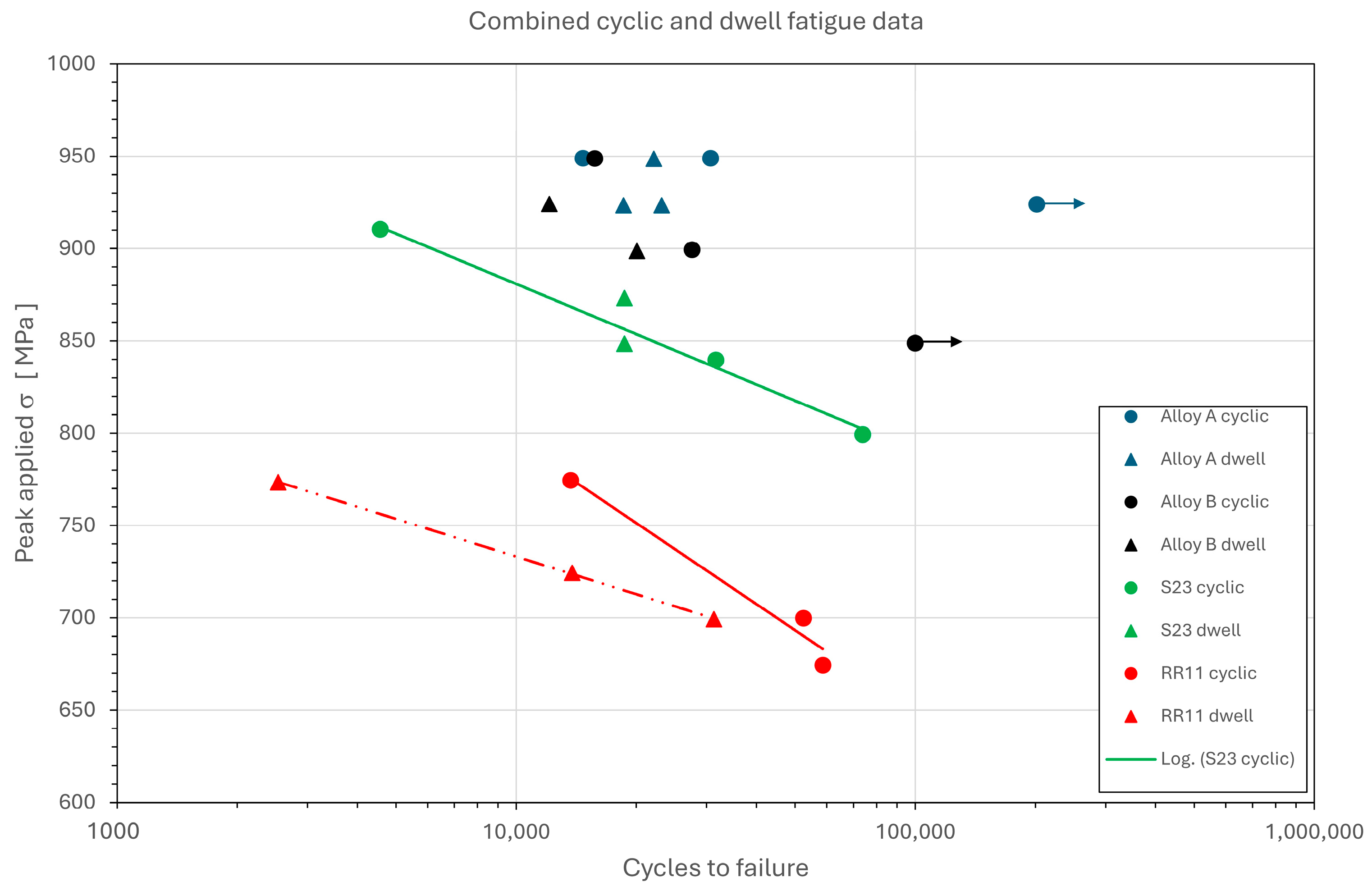
Based on absolute fatigue performance alone (
Figure 6), the two commercial products provided the greatest strengths, with Alloy A offering superior performance. This is consistent with their respective static properties, whether represented by monotonic yield or ultimate strength (
Table 2). Indeed, an identical order of ranking for monotonic and fatigue strength was established across the four alloys evaluated, in the following order:
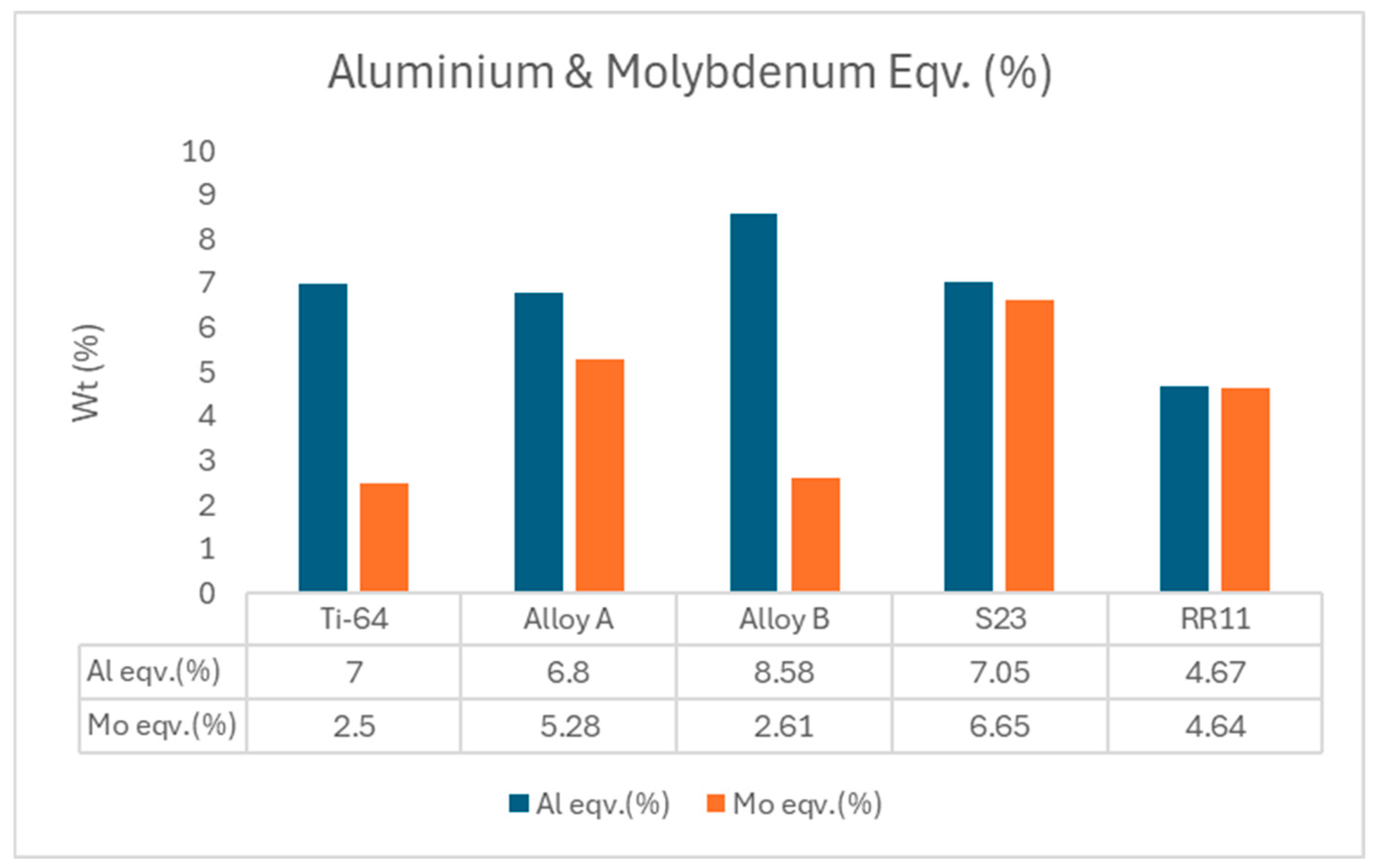
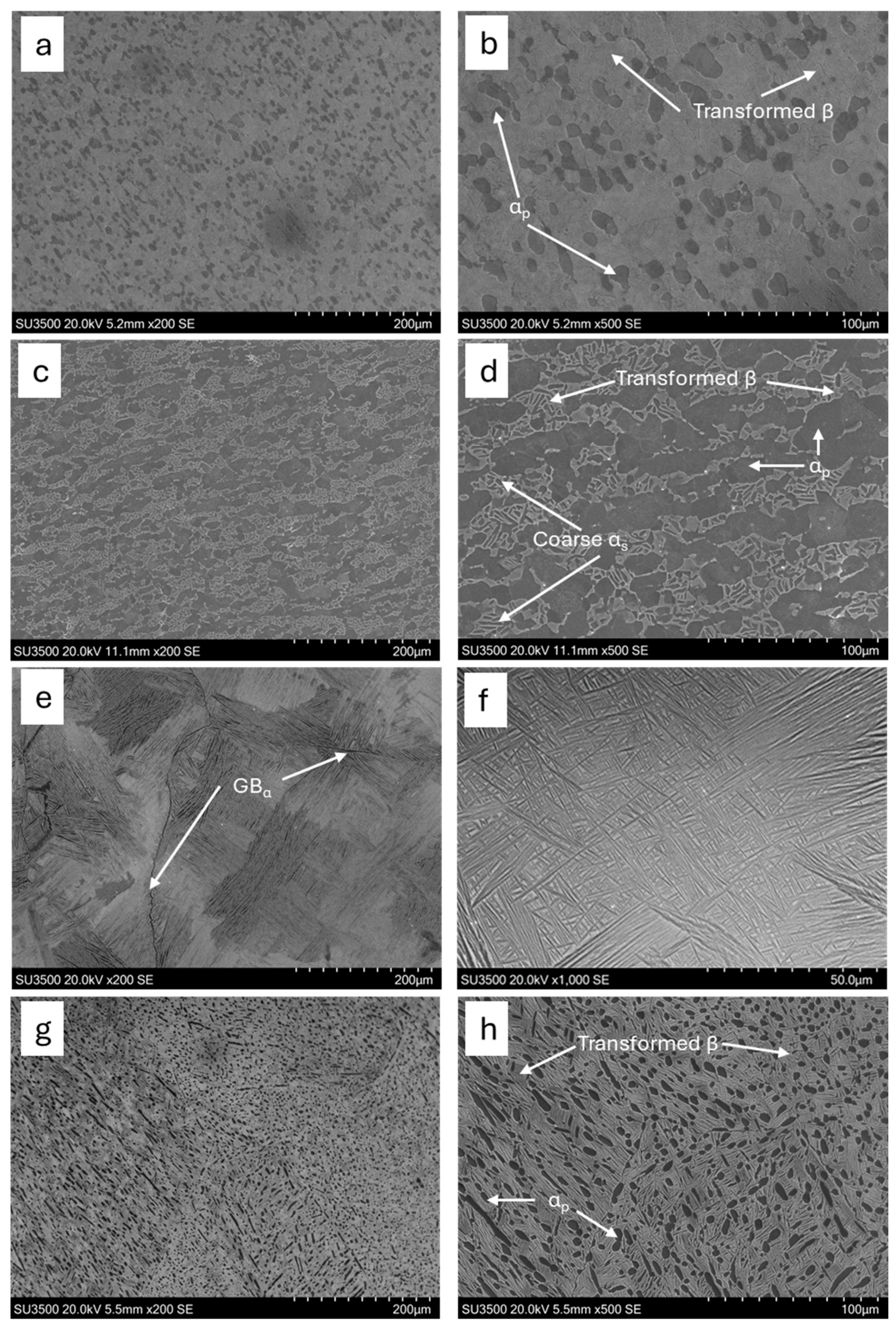
Both Alloy A and Alloy B were processed into a bimodal microstructure with a similar refined primary α grain size, approximating 13 µm in diameter. However, there was a notable difference between the stabilization fractions; with Alloy B containing a high level of aluminum equivalent species, leading to almost double the primary α volume compared to Alloy A. In addition, the secondary α grains in the Alloy B microstructure were coarser. In contrast, Alloy A contained significantly higher volumes of transformed β due to a significantly greater β-stabilized chemistry, with a molybdenum equivalent of 5.28 compared to 2.61 in Alloy B. The β matrix ultimately gives Alloy A its strength and LCF improvement over Alloy B.
A similar knockdown in fatigue performance due to the imposition of dwell loading was measured in both Alloy A and Alloy B, although, admittedly, defining clear best-fit trend lines through the specific cyclic and dwell datasets was made difficult by the limited number of available specimens and inherent scatter in performance. Increasing the amount of data for these two alloys is an essential requirement during future testing campaigns. Even though greater volume fractions of primary α have previously been shown to make titanium alloys more susceptible to dwell debit [
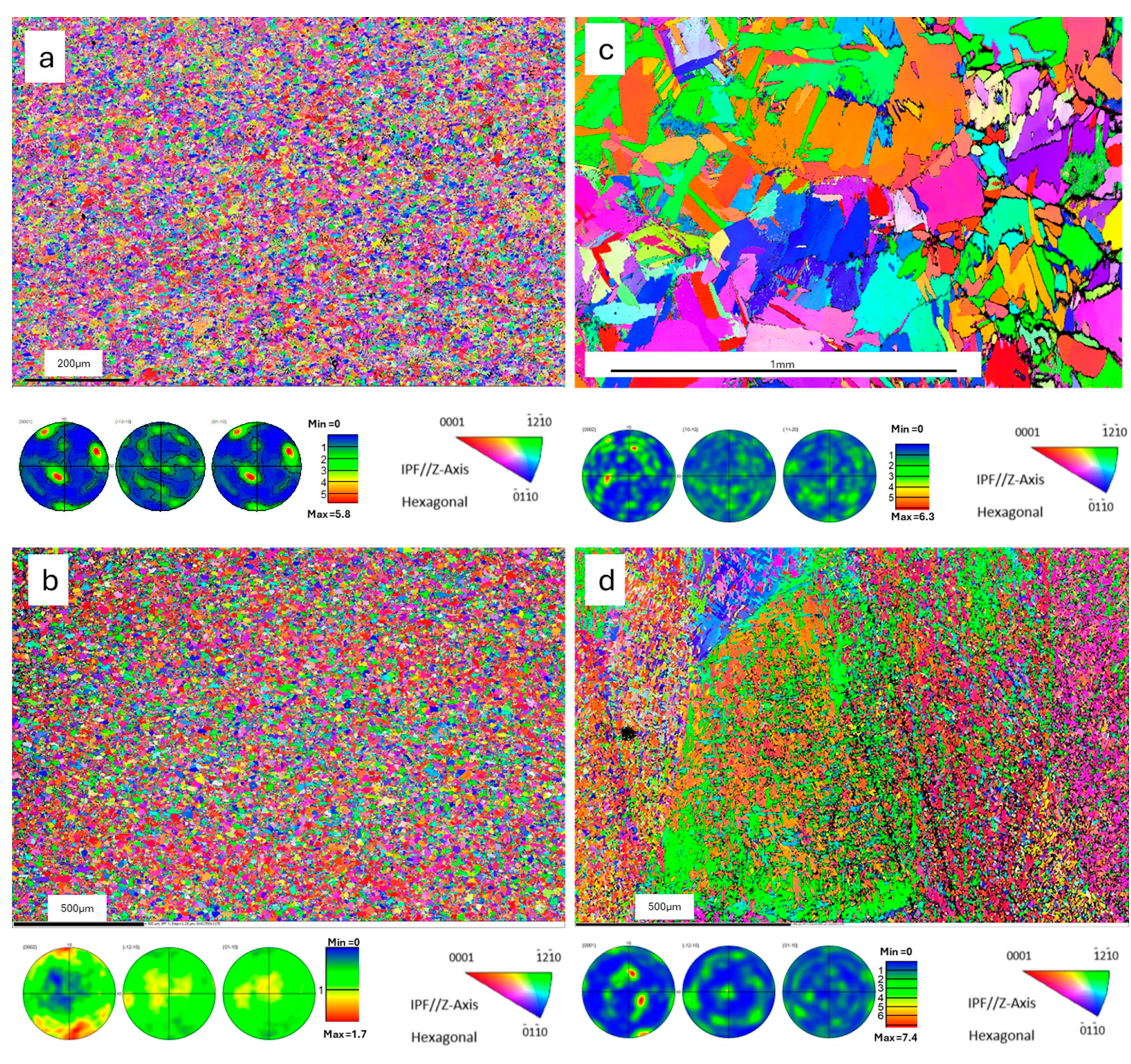
14], on this occasion, it did not appear to adversely affect Alloy B, possibly aided by the relatively low texture intensity of 1.7 times random.
Although dwell sensitivity was detected in both alloys under fatigue regimes previously described as being “relevant to engineering applications” (i.e., N
f > 10
4 cycles) [
33], the levels of applied peak stress necessary to induce the effect were relatively high, exceeding 85% of the UTS alloy in each case. Similar findings have been reported by this laboratory in relation to the more established metastable β alloy Ti-6246 when processed in various forms [
21]. Three different Ti-6246 microstructures were evaluated, considered to represent extreme exemplars resulting from typical forging operations. Each variant required peak stress levels to exceed 90% of static UTS before any indications of dwell sensitivity were detected. This offers reassurance that any consequences of dwell sensitivity could be averted in the current high-strength α/β alloys or metastable β alloys in general through careful component design and the setting of safe stress operating limits and duty cycles.
Compared to the combined fatigue data representing Alloy A and Alloy B, RR11 illustrates a reduction in fatigue strength by approximately 200 MPa. The latter also appears to demonstrate a similar degree of dwell sensitivity (with the effect perhaps over-emphasized in this case by the dwell test performed at 775 MPa, which achieved ~2500 cycles prior to failure). Despite also containing a bimodal microstructure, RR11 notably demonstrated the highest degree of micro-texture at 7.4 times random. Although measurement of the prior β grain size in RR11 was difficult, grains exceeding 500 µm in diameter were sometimes indicated (
Figure 5d). In addition,
Figure 5d illustrates that packets of primary and secondary α-phase material occasionally congregated at prior β grain boundaries, which themselves formed relatively large MTRs. Together, these two microstructural factors may account for the weaker response from RR11 under both monotonic and fatigue loading.
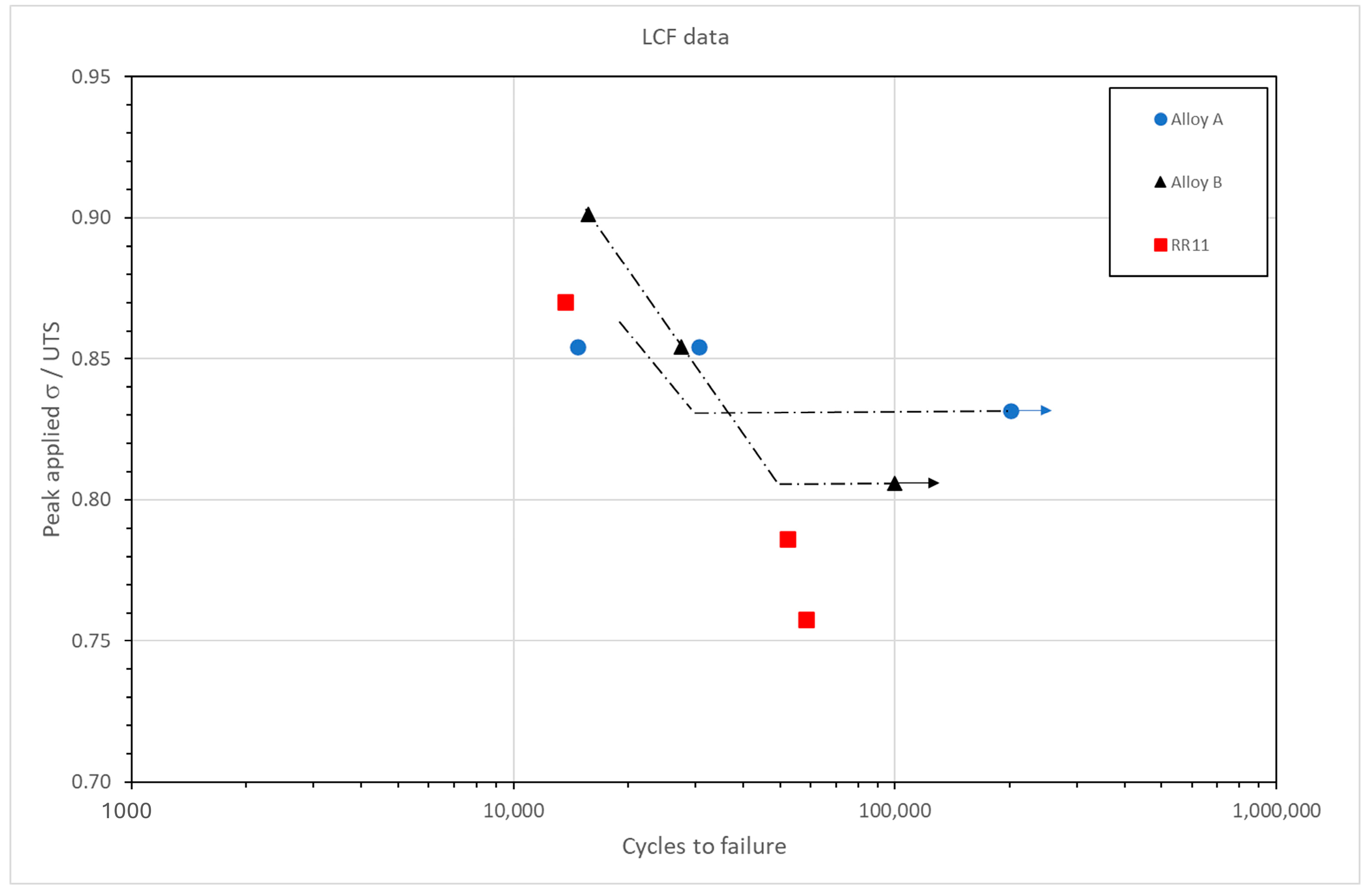
It is interesting to note that when the fatigue data for Alloy A, Alloy B, and RR11 are replotted employing a normalized criterion (i.e., applied peak stress expressed as a % of UTS for the respective alloy), the performance of the three alloys illustrates a closer correlation, especially towards the short-life end of the SN curve (
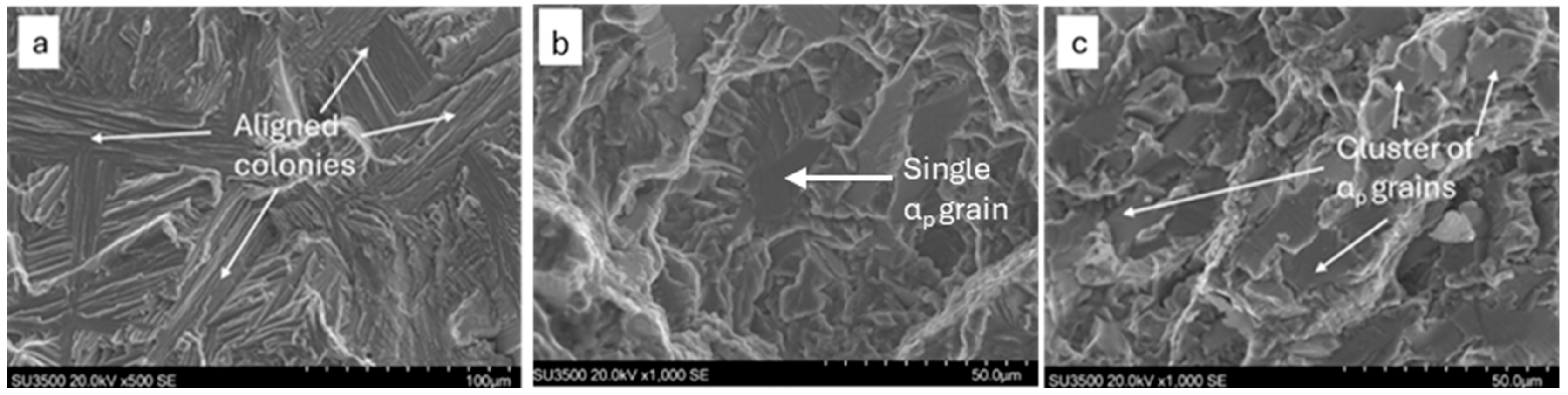
Figure 8). All three alloys initiated fatigue cracking via the same mechanism, i.e., stress redistribution acting upon primary α grains leading to quasi-cleavage facet formation. Since the primary α grain size was the greatest in the Alloy B material, this alloy illustrated the clearest forms of faceting (
Figure 7b), with localized facet clusters corresponding to juxtaposed primary α grains resulting from the elevated α volume fraction (
Figure 7c). It has been previously demonstrated that fracture morphology is influenced by micro-texture [
34]. MTRs that have their c-axis texture component parallel to the applied stress have been found responsible for highly faceted fracture morphologies, where early-stage crack growth is believed to occur with less resistance [
35].
In many ways, the S23 alloy should be considered in isolation. This was the only alloy to be processed via a powder/sinter technique. Although this specific blend composition remains within the α/β classification, at 6.65% molybdenum equivalence, S23 had the closest composition to a metastable β material under the current characterization. The microstructure comprised a relatively large grain size, containing a distribution of basketweave or aligned α laths rather than equiaxed primary α sub-grains. Together with the increased β-phase material, this would encourage multiple slip systems to operate across extensive slip lengths. This would circumvent the planar, basal slip-dominated mechanisms that control LCF fracture in α/β and near-α alloys [
36]. This was evidenced by a lack of quasi-cleavage facets when inspecting S23 fractures. Instead, crack initiation zones were characterized by rough, trans-granular regions exposing the traces of the underlying, radiating lath structures (
Figure 7a).
Regardless, the S23 alloy displayed relatively good fatigue strength and, most notably, appeared to be insensitive to dwell loading. Despite this promising performance, further development of this alloy can now be considered, including minor changes to the elemental powder blend or thermo-mechanical process, with the latter focused on evolving a bimodal, rather than lath, microstructure.
While the present paper focused on static and LCF properties, it is emphasized that other attributes must be considered before potential selection for engineering applications. For example, the ability to forge and weld all of these alloys of interest has also been central to alloy design. Other pertinent characteristics of fatigue performance are currently under investigation, including high-cycle fatigue (HCF) performance and the influence of mean stress (i.e., Goodman/Haigh relationships). Although HCF research is still at an early stage, RR11 has demonstrated relatively good properties under such circumstances [
37]. Further modifications to the RR11 composition and/or associated thermo-mechanical processing could also be considered to improve the fundamental static and fatigue strength of this alloy.
Author Contributions
Conceptualization, P.D., H.D., C.C., N.M., K.F. and R.S.; methodology, P.D., C.C., N.M., K.F. and R.S.; validation, P.D., S.J. and H.D.; formal analysis, P.D., S.J. and M.B.; investigation, P.D. and S.J.; data curation, P.D.; writing—original draft preparation, P.D.; writing—review and editing, P.D., H.D., C.C., N.M., K.F., R.S. and M.B.; resources, C.C., N.M., K.F. and R.S.; project administration, H.D.; funding acquisition, H.D. All authors have read and agreed to the published version of the manuscript.
Funding
This research was funded by the Aerospace Technology Institute (ATI) BETA project—application number: 10052028.
Data Availability Statement
The original contributions presented in this study are included in the article. Further inquiries can be directed to the corresponding author.
Acknowledgments
The provision of materials from Rolls-Royce plc is gratefully acknowledged. Fatigue tests were performed at Swansea Materials Research and Testing Ltd. (SMaRT).
Conflicts of Interest
Authors Kate Fox, Christopher Collins, Nigel Martin and Rebecca Sandala were employed by the company Rolls-Royce plc at the time of writing. The remaining authors declare that the research was conducted in the absence of any commercial or financial relationships that could be construed as a potential conflict of interest.
References
- Peters, M.; Kumpfert, J.; Ward, C.H.; Leyens, C. Titanium alloys for aerospace applications. Adv. Eng. Mater. 2003, 5, 419–427. [Google Scholar] [CrossRef] [Scilit]
- García, A.M.M. BLISK Fabrication by Linear Friction Welding. In Advances in Gas Turbine Technology; IntechOpen: Rijeka, Croatia, 2011; pp. 411–435. [Google Scholar] [CrossRef] [Scilit]
- Lütjering, G. Influence of processing on microstructure and mechanical properties of (α + β) titanium alloys. Mater. Sci. Eng. A 1998, 243, 32–45. [Google Scholar] [CrossRef] [Scilit]
- Whittaker, M.T.; Evans, W.J.; Lancaster, R.; Harrison, W.; Webster, P.S. The effect of microstructure and texture on mechanical properties of Ti6-4. Int. J. Fatigue 2009, 31, 2022–2030. [Google Scholar] [CrossRef] [Scilit]
- Peters, G.L.M.; Gysler, A. Influence of texture on fatigue properties of Ti-6Al-4V. Metall. Mater. Trans. A 1984, 15, 1597–1605. [Google Scholar] [CrossRef] [Scilit]
- Bache, M. A review of dwell sensitive fatigue in titanium alloys: The role of microstructure, texture and operating conditions. Int. J. Fatigue 2003, 25, 1079–1087. [Google Scholar] [CrossRef] [Scilit]
- Song, D.W.H.Z. Size effect on the fatigue behaviour of IMI 829 titanium alloy under dwell conditions. Int. J. Fatigue 1989, 11, 85–90. [Google Scholar] [CrossRef] [Scilit]
- Wojcik, C.C.; Chan, K.S.; Koss, D.A. Stage I fatigue crack propagation in a titanium alloy. Acta Metall. 1988, 36, 1261–1270. [Google Scholar] [CrossRef] [Scilit]
- Evans, W.J. Creep-fatigue Interactions in Ti-6Al-4V at ambient temperatures. In Proceedings of the Third International Conference on Creep and Fracture of Eng Materials and Structures, Swansea, UK, 5–10 April 1987; Evans, W.J., Ed.; pp. 603–613. [Google Scholar]
- Venkatesh, V.; Noraas, R.; Pilchak, A.; Tamirisa, S.; Calvert, K.; Salem, A.; Broderick, T.; Glavicic, M.G.; Saraf, V. Data Driven Tools and Methods for Microtexture Classification and Dwell Fatigue Life Prediction in Dual Phase Titanium Alloys. MATEC Web Conf. 2020, 321, 11091. [Google Scholar] [CrossRef] [Scilit]
- Li, J.; Davies, H.M.; Fox, K.; Mulyadi, M.; Glavicic, M.G.; Bache, M.R. An appraisal of dwell sensitive fatigue in Ti-6Al-4V and the governing role of inhomogeneous micro-texture. Int. J. Fatigue 2023, 171, 107589. [Google Scholar] [CrossRef] [Scilit]
- Woodfield, A.P.; Gorman, M.D.; Sutliff, J.A.; Corderman, R.R. Effect of microstructure on dwell fatigue behavior of Ti-6242. In Ti’ 95 Science and Technology, Proceedings of the Eighth World Conference on Titanium, Birmingham, UK, 22–26 October 1995; Blenkinsop, P.A., Evans, W.J., Flower, H.M., Eds.; IOM: Birmingham, UK, 1996. [Google Scholar]
- Rugg, D.; Dixon, M.; Dunne, F.P.E. Effective structural unit size in titanium alloys. J. Strain Anal. Eng. Des. 2007, 42, 269–279. [Google Scholar] [CrossRef] [Scilit]
- Pilchak, A.L.; Shank, J.; Tucker, J.C.; Srivatsa, S.; Fagin, P.N.; Semiatin, S.L. A dataset for the development, verification, and validation of microstructure-sensitive process models for near-alpha titanium alloys. Integr. Mater. Manuf. Innov. 2016, 5, 259–276. [Google Scholar] [CrossRef] [Scilit]
- Germain, L.; Gey, N.; Humbert, M.; Vo, P.; Jahazi, M.; Bocher, P. Texture heterogeneities induced by subtransus processing of near α titanium alloys. Acta Mater. 2008, 56, 4298–4308. [Google Scholar] [CrossRef] [Scilit]
- Pilchak, A.; Fox, K.; Payton, E.; Wiedemann, M.; Broderick, T.; Delaleau, P.; Michael, G.; Nigel, J.; Jean-Manuel, R.; Brian, S.; et al. Cold Dwell Fatigue of Titanium Alloys: History, Current State, and Aviation Industry Perspective; United States Department of Transportation: Washington, DC, USA; Federal Aviation Administration: Washington, DC, USA; William J. Hughes Technical Center: Atlantic City, NJ, USA, 2024. [Google Scholar]
- Dunne, F.P.E.; Rugg, D.; Walker, A. Lengthscale-dependent, elastically anisotropic, physically-based hcp crystal plasticity: Application to cold-dwell fatigue in Ti alloys. Int. J. Plast. 2007, 23, 1061–1083. [Google Scholar] [CrossRef] [Scilit]
- Bache, M.R.; Davies, H.M.; Evans, W.J. A Model for Fatigue Crack Initiation in Titanium Alloys. In Proceedings of the Eighth World Conference on Titanium, Birmingham, UK, 22–26 October 1995; Blenkinsop, P.A., Evans, W.J., Flower, H.M., Eds.; IOM: Birmingham, UK, 1996; pp. 1347–1354. [Google Scholar]
- Bache, M.R.; Cope, M.; Davies, H.M.; Evans, W.J.; Harrison, G. Dwell sensitive fatigue in a near alpha titanium alloy at ambient temperature. Int. J. Fatigue 1997, 19, 83–88. [Google Scholar] [CrossRef] [Scilit]
- Kassner, M.E.; Kosaka, Y.; Hall, J.A. Low-Cycle Dwell-Time Fatigue in Ti-6242. Metall. Mater. Trans. A 1999, 30, 2383–2389. [Google Scholar] [CrossRef] [Scilit]
- Bache, M.; Germain, L.; Jackson, T.; Walker, A.R.M. Mechanical and Texture Evaluations of Ti 6246 as a Dwell Fatigue Tolerant Alloy. In Proceedings of the 11th World Conference on Titanium, Kyoto, Japan, 3–7 June 2007. [Google Scholar]
- Davey, W.; Bache, M.R.; Davies, H.M.; Thomas, M.; Bermant-Parr, I. Fatigue Performance of the Novel Titanium Alloy TIMETAL® 407. MATEC Web Conf. 2020, 321, 11044. [Google Scholar] [CrossRef] [Scilit]
- Bache, M.; Davies, H.; Davey, W.; Thomas, M.; Berment-Parr, I. Microstructural control of fatigue behaviour in a novel α + β titanium alloy. Metals 2019, 9, 1200. [Google Scholar] [CrossRef] [Scilit]
- Thomas, M.; Hewitt, J.; Bache, M.; Thomas, R.; Garratt, P.; Kosaka, Y. Determination and Analysis of the Cyclic and Dwell Fatigue Performance of Timetal® 575. In Proceedings of the 13th World Conference on Titanium; John Wiley & Sons: Hoboken, NJ, USA, 2016; pp. 979–984. [Google Scholar]
- Hewitt, J.S.; Davies, P.D.; Thomas, M.J.; Garratt, P.; Bache, M.R. Titanium alloy developments for aeroengine fan systems. Mater. Sci. Technol. 2014, 30, 1919–1924. [Google Scholar] [CrossRef] [Scilit]
- Wu, Z.; Kou, H.; Chen, N.; Xi, Z.; Fan, J.; Tang, B.; Li, J. Recent developments in cold dwell fatigue of titanium alloys for aero-engine applications: A review. J. Mater. Res. Technol. 2022, 20, 469–484. [Google Scholar] [CrossRef] [Scilit]
- Rolls-Royce plc. TITANIUM ALLOY AND METHOD OF MANUFACTURE. European Patent EP4640859A1, 29 October 2025. Available online: https://eur03.safelinks.protection.outlook.com/?url=https%3A%2F%2Fworldwide.espacenet.com%2Fpatent%2Fsearch%2Ffamily%2F091275161%2Fpublication%2FEP4640859A1%3Fq%3DEP4640859A1&data=05%7C02%7CP.D.Davies%40swansea.ac.uk%7C24826e24e8be41b9fa8208de27726605%7Cbbcab52e9fbe43d6a2f39f66c43df268%7C0%7C0%7C638991569452551717%7CUnknown%7CTWFpbGZsb3d8eyJFbXB0eU1hcGkiOnRydWUsIlYiOiIwLjAuMDAwMCIsIlAiOiJXaW4zMiIsIkFOIjoiTWFpbCIsIldUIjoyfQ%3D%3D%7C0%7C%7C%7C&sdata=sgJsg4%2BSZWcHYW6As3fJnWYEIRCDYYC8OBERNxBzHJE%3D&reserved=0 (accessed on 1 August 2025).
- Lister, S.; Baxter, G.J.; Jackson, M. Titanium-S23: A New Alloy with Ultra-High Tensile Toughness Directly from the Solid-State Processing of Recycled Ti–6Al–4V and Ti–5Al–5Mo–5V–3Cr Powders using Field Assisted Sintering Technology. Adv. Eng. Mater. 2025, 27, 2500572. [Google Scholar] [CrossRef] [Scilit]
- Wagner, V.; Baili, M.; Dessein, G. The relationship between the cutting speed, tool wear, and chip formation during Ti-5553 dry cutting. Int. J. Adv. Manuf. Technol. 2015, 76, 893–912. [Google Scholar] [CrossRef] [Scilit]
- BS EN 2002-1:2005; Aerospace Series. Metallic Materials. Test Methods—Tensile Testing at Room Temperature. British Standards Institution (BSI): London, UK, 2005.
- ISO 1099:2017; Metallic Materials—Fatigue Testing—Axial force—Controlled Method. International Organization for Standardization: Geneva, Switzerland, 2017.
- Properties and Processing of TIMETAL 6-4, TIMET Brochure. Available online: https://www.timet.com/assets/local/documents/technicalmanuals/TIMETAL_6-4_Properties.pdf (accessed on 1 August 2025).
- Bache, M.R.; Li, J.; Davies, H.M. A re-assessment of Ti-685 as a dwell sensitive titanium alloy and a definition for engineering relevant dwell behaviour. Int. J. Fatigue 2024, 178, 108008. [Google Scholar] [CrossRef] [Scilit]
- Bantounas, I.; Dye, D.; Lindley, T.C. The role of microtexture on the faceted fracture morphology in Ti-6Al-4V subjected to high-cycle fatigue. Acta Mater. 2010, 58, 3908–3918. [Google Scholar] [CrossRef] [Scilit]
- Pilchak, A.L.; Hutson, A.; Porter, W.J.; Buchanan, D.; John, R. On the Cyclic Fatigue and Dwell Fatigue Crack Growth Response of Ti-6Al-4V. In Proceedings of the 13th World Conference on Titanium; Wiley: Hoboken, NJ, USA, 2016; pp. 993–998. [Google Scholar] [CrossRef] [Scilit]
- Lavogiez, C.; Dureau, C.; Nadot, Y.; Villechaise, P.; Hémery, S. Crack initiation mechanisms in Ti-6Al-4V subjected to cold dwell-fatigue, low-cycle fatigue and high-cycle fatigue loadings. Acta Mater. 2023, 244, 118560. [Google Scholar] [CrossRef] [Scilit]
- Rolls-Royce/ISM Swansea unpublished data. 2025.
| Disclaimer/Publisher’s Note: The statements, opinions and data contained in all publications are solely those of the individual author(s) and contributor(s) and not of MDPI and/or the editor(s). MDPI and/or the editor(s) disclaim responsibility for any injury to people or property resulting from any ideas, methods, instructions or products referred to in the content. |
© 2025 by the authors. Licensee MDPI, Basel, Switzerland. This article is an open access article distributed under the terms and conditions of the Creative Commons Attribution (CC BY) license (https://creativecommons.org/licenses/by/4.0/).




 ,
,