


Abstract
This paper aims to study the deflection phenomenon of the neutral layer in the cross-section of profiles during the 3D stretch-bending process. By establishing the displacement field for both the stretching and bending processes of a profile with elastoplastic constitutive characteristics, and combining the deformation processes, the geometric description of the profile deformation is constructed, and then linearized. Subsequently, by integrating the material’s constitutive properties and model boundary conditions, the analytical model parameters for profiles with regular cross-sections are solved. The analytical model effectively captures the behavior of the neutral layer and its deflection phenomenon. To further investigate, the finite element model was developed to simulate the deformation process. The distribution of the neutral layer in the simulation results matched the analytical predictions. To generalize the analytical results to profiles with arbitrary cross-sections, an L-shaped profile was analyzed, and a roller-based 3D flexible stretch-bending device with roller dies was used. By measuring the springback direction, the neutral layer deflection observed in both the analytical and finite element model results was validated. The results demonstrate that, under small deformation conditions, the neutral layer deflection during the 3D stretch-bending process was successfully predicted.
1. Introduction
Stretch-bending forming is a common metal plastic forming process known for its high dimensional accuracy. It is widely used in the manufacturing of bent metal components [1]. By applying loads, blanks such as sheets, tubes, and profiles undergo plastic deformation to achieve the desired shape [2,3]. Traditionally, stretch bending has been limited to two-dimensional forming. However, as product demands have grown, there has been substantial progress in three-dimensional stretch-bending processes [4,5].
Welo et al. [6] developed a flexible device with a two-piece mold for forming three-dimensional profiles. The two-piece mold of this device can provide three degrees of freedom. The flexible 3D multi-point stretch-bending process [7,8] disperses the traditional integral surface in order to achieve rapid prototyping [9,10]. The main advantage of this process is that it can quickly create new mold surfaces, enabling the blank to efficiently achieve the desired bending deformation [11,12]. Liang et al. [13] proposed the flexible stretch-bending process using roller-based multi-point dies (FSBRD) for 3D stretch bending of profiles. This process replaces the flat dies used in traditional forming processes. Therefore, FSBRD can achieve the single forming of complex three-dimensional bent parts with fewer degrees of freedom [14]. This greatly simplifies the operation of traditional craftsmanship.
In the study of blank deformation, it is necessary to analyze the constitutive characteristics of the material. In the bending research on hyperelastic beams, Luca et al. [15] and Falope et al. [16] proposed a 3D kinematic model. By describing longitudinal bending accompanied by transverse deformation of the cross-section, they investigated the distribution of Cauchy stress. The result shows that the solutions obtained were quite accurate across a wide range of constitutive parameters. Zhan et al. [17] developed an elastoplastic springback analytical model based on static equilibrium conditions, analyzing the effects of multiple factors on the springback of Ti-3Al-2.5V tubes. Ma et al. [18] established an analysis model in their study of springback models for two-die stretch-bending processes, and introduced transition zones between sections of different curvature. They considered the springback contribution of plastic moments outside the theoretical bending region, accurately assessing the springback in the process. The team further studied the springback analysis model of three-dimensional deformation under this device [19].
Zhang et al. [20] used a semi-analytical method to predict the springback behavior of tubes, discretizing and approximating the tube axis to obtain deformation parameters. A theoretical model is proposed to calculate stress distribution and residual deformation. Mohammad et al. [21] investigated the bending behavior of metal sheets when there is compressive stress throughout the thickness on the surface. Research shows that by controlling the thickness compressive stress on the surface of the sheet, the springback is minimized. Liu et al. [22] studied the energy analysis model for the stretching, bending, wrinkling, and instability of hollow aluminum profiles. The influences of different dependent variables, construction sites, and materials on the analysis results are analyzed. In the research on free-bent pipes, Xu et al. [23] combine the analytical method with the finite element simulation method for solution, and the prediction accuracy of the springback angle is improved by 11.08%.
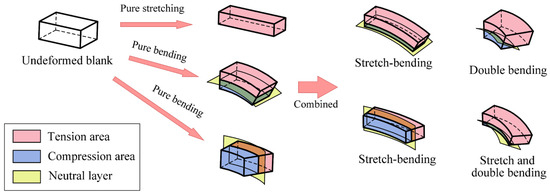
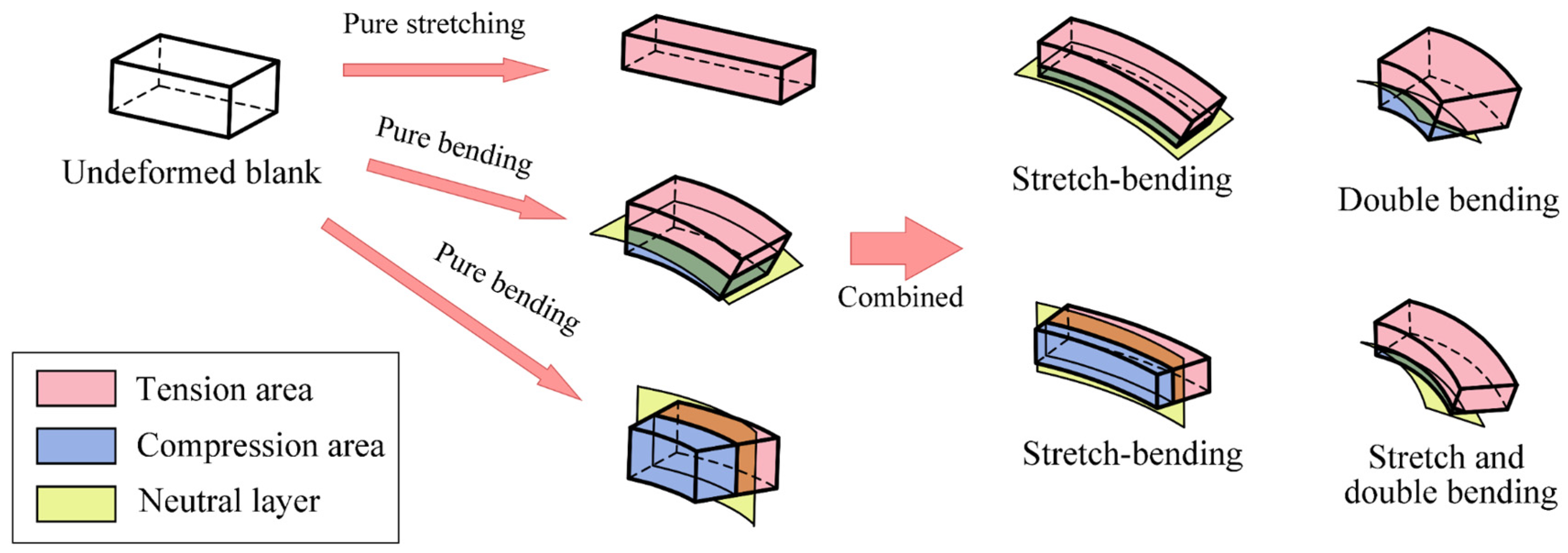
The neutral layer refers to the theoretical layer where strain is zero during the bending process, as shown in Figure 1. When the blank undergoes bending deformation, a strain-free region forms between the tensile and compressive zones. Combining the stretching and bending processes, the neutral layer moves towards the bending center. If the tensile strain applied is large enough, the neutral layer can theoretically move outside the cross-section, causing the entire section to be under tension. Compared to pure bending, tensile bending significantly reduces springback, which is why this method is commonly used in industrial stretch-bending processes. Studying the behavior of the neutral layer is crucial for accurately predicting springback in actual production.
Figure 1.
Schematic diagram of neutral layer.
With the increasing demand for products and advancements in technology, significant progress has been made in three-dimensional stretch-bending processes. Traditional springback models are typically based on two-dimensional bending scenarios. When the theory of the neutral layer is applied to three-dimensional deformation, it becomes evident that, following multidimensional bending, the neutral layer will undergo deflection, as shown in Figure 1. For elastoplastic materials, an elastic deformation zone will always exist near the neutral layer. The purpose of this study is to establish an analytical model for the deformation of elastoplastic profiles during bending, to explore the characteristics of neutral layer deflection. Using aluminum alloy profiles with regular cross-sections and elastoplastic constitutive properties as examples, analytical calculations are performed. FE models are established for verification, and then the characteristic laws are extended to profiles with arbitrary cross-sections, using an L-shaped profile as an example. Finally, experimental validation is carried out using L-shaped profiles to verify the analytical results. In this study, the springback direction during the deformation process is used to characterize the direction of neutral layer. And the FSBRD process is employed to flexibly implement 3D forming.
2. Neutral Layer Deflection Model
2.1. Establishment of the Basic Model
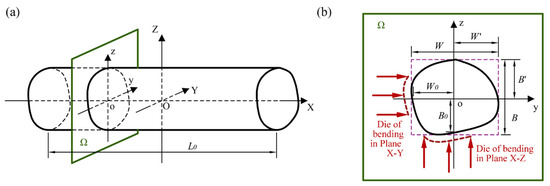
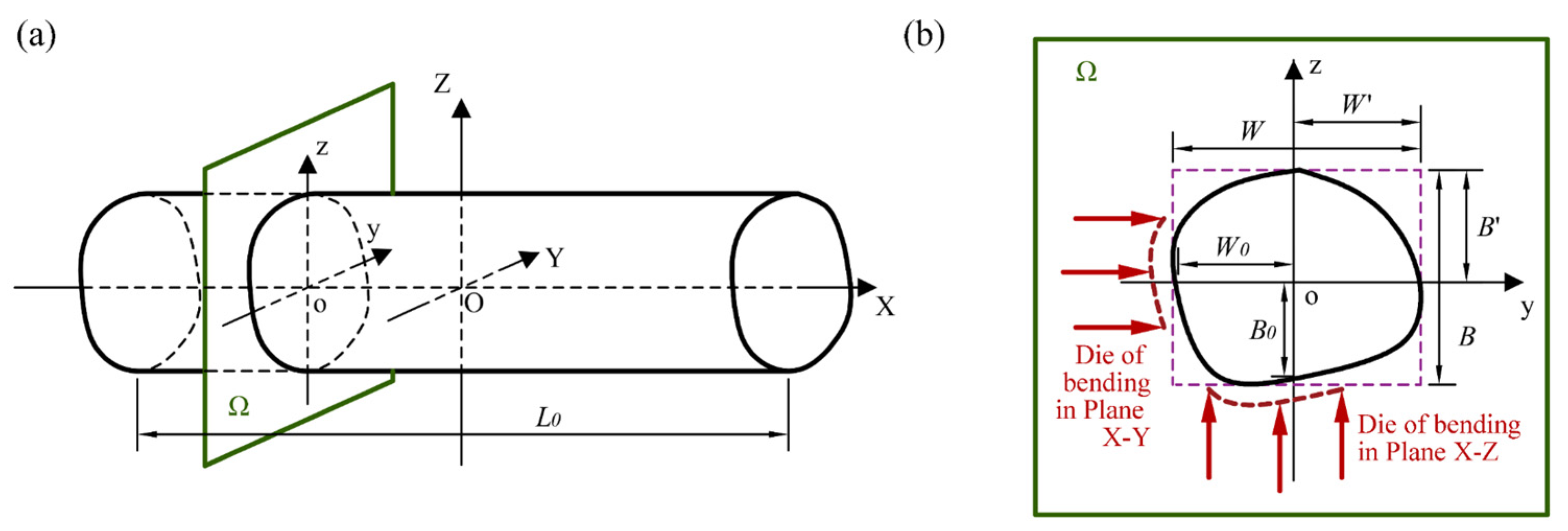
In any deformation process, the neutral layer is the region that theoretically experiences no strain in the current configuration. To study the neutral layer deflection in a profile with an arbitrary cross-section during the bending process, this study assumes an elastoplastic profile of homogeneous, isotropic, and compressible material, with its length denoted by L, as shown in Figure 2. A spatial coordinate system [O, X, Y, Z] is established, where the origin O is located at the centroid of the object, and the X-axis represents the axial direction of the profile. Given that the profile has the same characteristics for any cross-section perpendicular to the X-axis, the cross-section in any plane Ω shown in Figure 2b is the same. A plane system [o, y, z] is purposed on the cross-section, where the origin point o is at the centroid of the blank’s cross-section. And the coordinate system is Lagrangian. To facilitate the study of deformation mechanisms of cross-section, a bounding rectangle is constructed to describe, with the width W and the height B. The distances from the centroid to the positive directions of the coordinate axes are denoted as W′ and B′, while W0 and B0 represent the distances from the centroid to the points of contact on the die in the bending direction. (For simplicity, the bending direction in this paper is always considered as the negative direction of the corresponding coordinate axis.)
Figure 2.
(a) The shape of the blank. (b) The cross-section of the blank.
To simplify the deformation process, it is assumed that the elastic stage adopts linear Hooke’s law and the displacement gradient is small. Therefore, any deformation of the profile during the bending process is regarded as the superposition of pure tension and pure bending. By calculating the deformation modes, process parameters, and material properties, the strain field of the blank after deformation can be quantitatively characterized. Consequently, the region where the strain is zero, known as the neutral layer, is identified. In the specific calculation process, the maximum principal strain theory is employed, which involves solving the strain state characteristic equation with εn as the unknown quantity:
where I1, I2, and I3 are the first, second, and third invariants of the strain tensor, respectively, and are calculated as follows:
where εij represents the components of the strain tensor. And the strain is a small strain, so as the deformation increases, the corresponding error also increases. The corresponding theory is only applicable when the strain is much less than 1.
The characteristic Equation (1) yields three real roots, which correspond to the principal strains. Among these three principal strains, the one with the maximum absolute value is taken as the maximum principal strain (LEP,Max). It is used to assess local deformation in this study. And the sign of this value indicates whether the local region is under tension or compression.
Additionally, the following assumptions are made:
- In the development of the fundamental analytical model, the effects of constraints and contact introduced by clamping, dies, or other components are not considered.
- During the stretching and bending processes, any cross-section remains planar and perpendicular to the central axis of the profile, i.e., the cross-section does not warp.
2.2. Basic Analytical Model for Bending Deformation
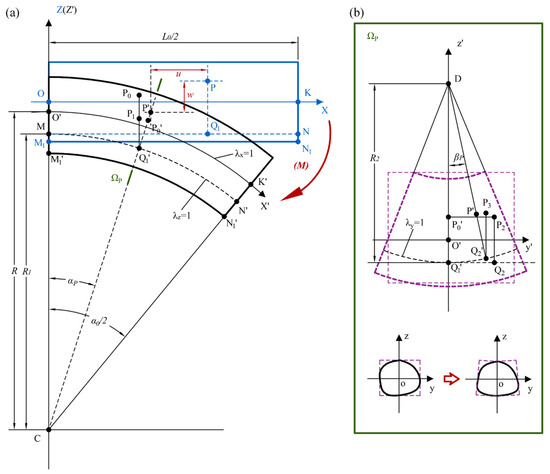
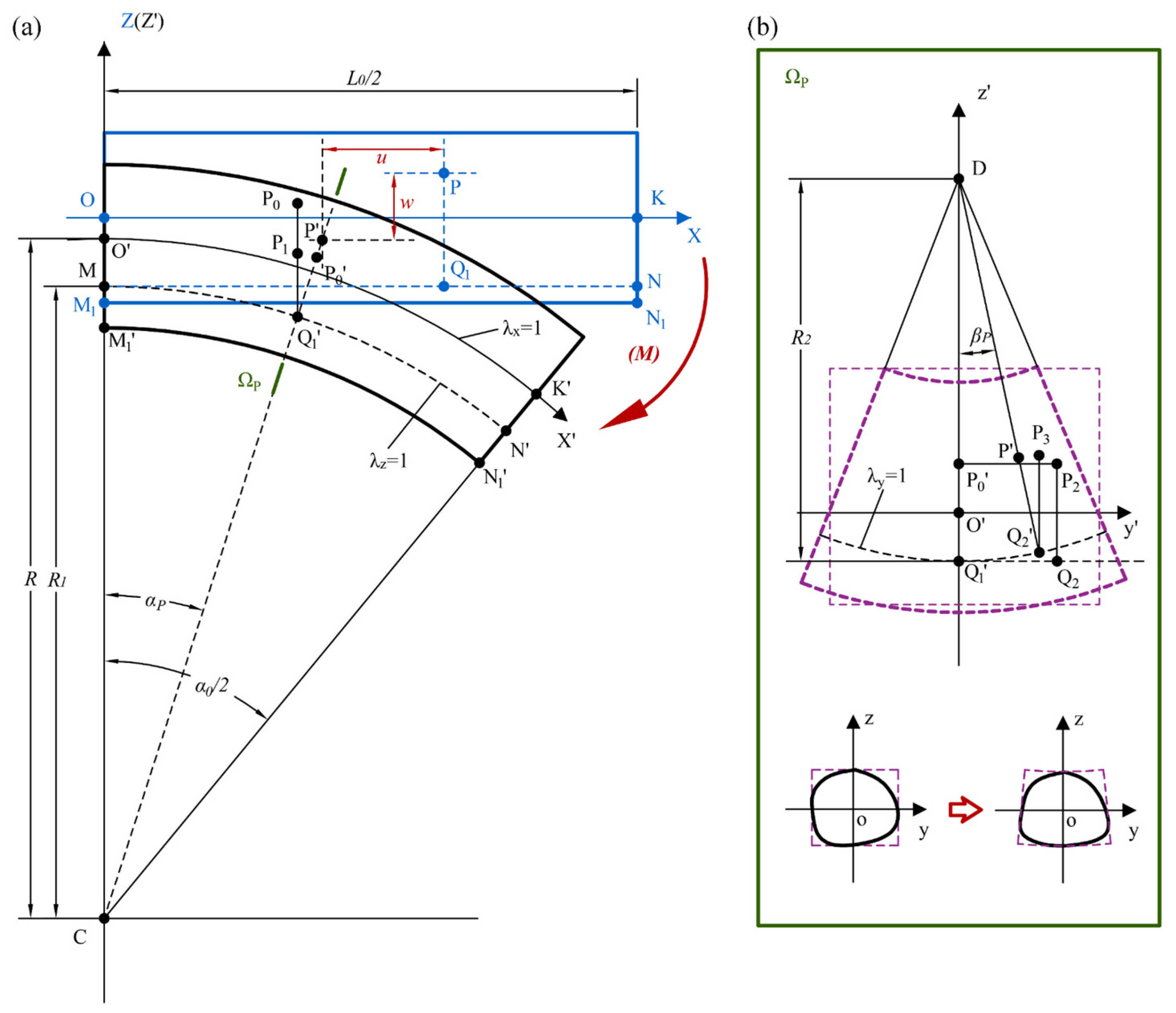
The displacement of the point P(XP,YP,ZP) to P′(XP′,YP′,ZP′) after bending is decomposed into u, v, and w. The profile of length L0 bends in the X–Z plane with the bending angle α0. It is assumed that the profile has the characteristic of equal cross-section and is symmetrically bent along the Y–Z plane. Therefore, only the half of the model with a length of L0/2 and a bending angle of α0/2 is analyzed, with its curvature center located at point C, as shown in Figure 3. To simplify the expression of the deformation, a virtual coordinate system [O′, X′, Y′, Z′] is used to describe the current configuration after bending. Therefore, any cross-section Ω remains locally perpendicular to the profile’s central axis. Within the Ω plane at any X′ = X, the coordinate system [o′, y′, z′] is used to indicate the difference. It is important to note that this coordinate system is used only for convenience in expression. Unless otherwise specified, all coordinates described in this paper are referenced to the global coordinate system [O, X, Y, Z].
Figure 3.
The basic model of bending. (a) Bending in X-Z plane. (b) Bending in cross-section.
The basic analytical model for bending strain analysis in this paper is based on the geometric model of hyperelastic beam deformation proposed by Luca et al. [15] and applied to an elastoplastic model. As shown in Figure 3, the profile blank undergoes pure bending deformation, where bending occurs with an in-plane moment M and no other external forces. After deformation, the region of blank close to the center of curvature is compressed, while that farther from the center is stretched. Consequently, Figure 3b shows that the cross-section of the blank experiences distortion, which significantly impacts the solution of displacement field. Therefore, in the deformed current configuration, there are three regions: none axial deformation region, none transverse deformation region, and none longitudinal deformation region. These regions represent areas where the blank elements do not experience relative flow in the axial and two perpendicular directions. That is, the ratios of the deformed to undeformed lengths are λx = 1, λy = 1, and λz = 1. A load is applied at point K, as shown in Figure 3a. And the arc means the area λx = 1. The point O changes to O′ during deformation. Additionally, the arc satisfies λz = 1. The bending radii are R and R1, where R = L0/α0.
The change in the position of point P is composed of two parts. Firstly, the X–Z plane changes. And then changes happen in the cross-section Ω. It can also be decomposed into rigid body movement and pure shape change, with the rigid body movement further divided into rigid translation and rigid rotation. For the changes in Plane X–Z, it is described in three parts. A line PQ1 is drawn perpendicular to the X-axis from point P, intersecting line segment MN at point Q1. During the bending process, line PQ1 undergoes a rigid translation to become line P0Q1′, where point Q1′ is located on the arc . Subsequently, the change in the position of point P in Plane X–Z is decomposed into pure deformation from P0Q1′ to P1Q1′, and a rigid rotation αP around the rotation center point Q1, which transforms the line from P1Q1′ to P0′Q1′.
Since the arc represents the λZ = 1 region, meaning that the relative position of point Q1′ within the cross-section remains unchanged before and after deformation, the spatial position of point Q1′ in the X-Z plane can be determined as
where αP is the angle between the position change of point P′ and the Z-axis, satisfying αP = XP/R. The notation |OO′| represents the length of the line OO′. Since the length of line PQ1 is |PQ1| = ZP + |OO′| + R − R1, the length of line P0Q1′ after rigid translation is equal to that of PQ1.
For the pure deformation process, due to the isotropic nature of the material, the elongation rates in the non-axial directions are the same, i.e., λy = λz. Thus, the point Q1′ is simultaneously on both λy = 1 and λz = 1. Using the function f to represent the rate of pure deformation change, i.e., |P1Q1′| = f(|P0Q1′|), after the rigid rotation by an angle αP, the point P1 turns into P0′, and the position can be expressed as
The deformation process within the cross-section Ω is illustrated in Figure 3b. Due to bending in Plane X–Z, distortion occurs, involving a relative rotation around a center D with an angle β. The radius corresponding to the none deformation region λy = 1 is R2. For the actual process point P2 corresponding to P0′ after pure deformation, construct P2Q2 parallel to the z′-axis, ensuring |P2Q2| = |P0′Q1′|. Similar to the rigid deformation decomposition in the X–Z plane, the line P2Q2 undergoes rigid translation to P3Q2′, followed by rigid rotation to P’Q2′, completing the entire deformation process. After deformation within the Ω plane, the y and z coordinates of point P′ are
where βP is the angle between the section point P′ and the Z axis, and it satisfies βP = YP/R2.
To convert this into the global coordinate system, the coordinates of point P′ can be obtained as
By superimposing Equations (3)–(6), the displacement components of the deformation process for any point P to point P′ are given by
2.3. Solution of the Basic Analytical Equations for Bending Deformation
In the previous derivation of the analytical model, the section deformation was unknown, and assumptions were made for the unknown function f and the unknown variables R1, R2, and |OO′|. Given the assumption of isotropy in material during deformation, the equilibrium equation λy = λz is established. Since the diagonal values of the Right Cauchy-Green tensor C represent λx2, λy2, and λz2, and it can be calculated by the deformation gradient tensor F, the equilibrium equation is established as follows:
Substitute the displacement gradient components from Equation (7) into the equation, and solve as
Since there is a point M in Figure 3 (XM = 0, YM = 0, ZM = −|OO′| − R + R1), where λz = 1 is satisfied, substituting into Equation (9) yields . Therefore, the function f is
Then, the remaining unknown parameters to be determined are only R1, R2, and |OO′|. For the point of X = 0, Y = 0, Z = 0, the displacement is given by w = −|OO′|. Therefore, the equation satisfies
By substituting Equations (10) and (11) into the displacement Equation (7), it can be obtained that
2.4. Solution of Basic Analytical Parameters for Bending Deformation
In the previous discussion on displacement equations, the unknown R1 and R2 values are requiring to be solved. So, the balance equations are constructed by obtaining the deformation gradient tensor F and the strain gradient tensor E with unknown parameters from displacement Equation (12).
For pure bending deformation, within any cross-sectional deformation region, there will always be a zone where stretching and compression meet and do not undergo deformation. Due to the continuity of deformation, an elastic deformation zone must exist near the neutral layer where there is no deformation. Since this paper studies elastoplastic materials, when the stress in the deformation region is less than the yield stress σy, both the tension and compression regions are entirely in the pure elastic deformation stage. Otherwise, if the stress in some parts of the deformation region exceeds the yield stress, both elastic and plastic deformation zones will be present within the cross-section. In the elastic stage, this paper adopts a linear elastic model and applies Hooke’s law for solution. The Plastic Total Strain Theory is applied in the plastic stage, and the Mises criterion is used to determine the yield.
For the equilibrium state after bending deformation, there must be microelements that are completely elastic and satisfy local mechanical equilibrium. To construct the equilibrium equations in the reference configuration, the First Piola–Kirchhoff stress Te corresponding to the stress gradient tensor σe denotes
where J represents the deformation Jacobian matrix, i.e., J = det(F). The symbol T denotes the transpose. And the stress gradient tensor σe under elastic conditions is calculated from the strain gradient tensor E by Hooke’s law. Construct the local equilibrium equation using Te as follows:
To solve for R1 and R2, additional equilibrium conditions are required. Construct the First Piola–Kirchhoff stress vector te in any direction, where n represents the corresponding local outward unit vector:
Since the cross-section is assumed to be non-warped in the previous text, the normal stress in the cross-section Ω of the blank is zero under the equilibrium state. There are boundary conditions such that there is stress equilibrium on the side surface of the blank. Therefore, for any cross-section Ω, the following holds:
Here, dl represents the differential of the boundary path of the cross-section, and the subscript i represents different components of the vector.
When solving for the plastic deformation region, Plastic Total Strain Theory is adopted to calculate the stress gradient tensor σp by the strain gradient tensor E. Similar to Equations (13) and (15), the First Piola–Kirchhoff stress vector tp in any direction corresponding to the normal vector n is given by
Therefore, the line integral over the boundary curve of the cross-sectional area is transformed into
Here, Ω(e) and Ω(p) correspond to the elastic and plastic portions of the cross-section, respectively. These regions are divided based on the Mises criterion. By simultaneously solving the equilibrium Equation (14) and the boundary conditions (18), the unknown parameter R1 and R2, under elastoplastic deformation conditions can be determined.
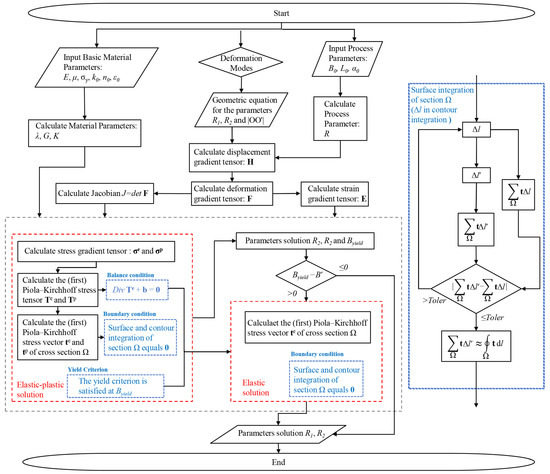
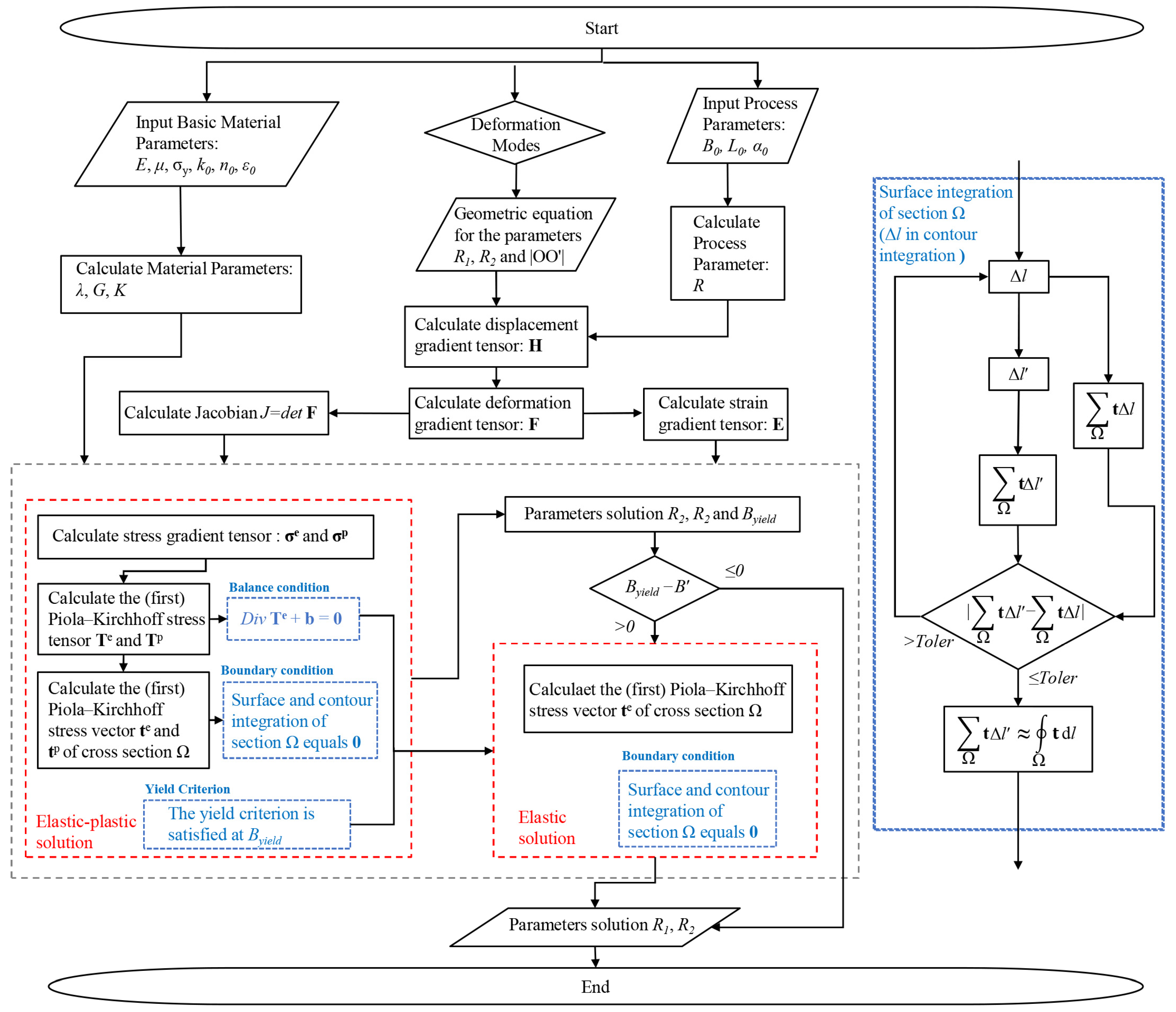
The final cross-sectional deformation parameters are calculated through the program flow shown in Figure 4. When calculating the integrals, division is made according to the yield criterion. Assume that the height of the elastic deformation region is Byield. The pure-elastic solution and the plastic solution are respectively used for the elastic and plastic deformation part to calculate te and tp.
Figure 4.
Flowchart for an iterative method to determine deformation parameters R1 and R2.
Due to the continuity of the material, the blank deforms as a whole. The deformation parameters R1 and R2 are independent of the material properties, and the same set of parameter values are shared in both the elastic region and the plastic region. Three equations are established by combining the equilibrium conditions, boundary conditions, and yield criterion. And there are three unknowns to be solved, namely the deformation parameters R1, R2, and Byield. Therefore, this problem has a definite solution.
Among them, if the calculated height of the elastic region Byield is greater than the side length of the blank cross-section, it can be known that the blank cross-section is in a state of pure elastic deformation, and the boundary condition is used to calculate the pure-elastic solution using Equation (16).
2.5. Establishment and Simplification of a Linearized Model
When the deformation is small, the small deformation theory is adopted to solve the linearization model. This process requires the application of the Taylor expansion of Equation (19).
where x is the independent variable, a is the function being expanded, and ο(a−b) is the b-th order infinitesimal of a, and it satisfies a→∞. Therefore, for the displacement field of any cross-sectional profile of the material under bending, the linearization of the model in Equation (12) can be approximated as the small deformation displacement field. For slender beams undergoing small deformations, |OO′| is much smaller than R. Therefore, the second and higher order infinitesimals of the parameters are neglected, and setting R1 = R, the linearized displacement field is approximated as follows:
Furthermore, the blank’s cross-sectional dimensions are significantly smaller than bending radius. Therefore, the higher-order terms in the denominators of R and R2 are neglected. This leads to the simplified linearized displacement field:
2.6. Establishment of the Tension Model
During the bending forming process, in addition to the bending process, the tensile process also occurs, specifically involving pre-stretching and post-stretching. Pre-stretching refers to the stretching of the material along the axial direction before bending, while post-stretching refers to stretching along the tangential direction after bending, with elongations as δpre and δpost, respectively. During the tensile process, the axial strain εx′ of any point within the material along X′ is δ.
In the elastic process, the strain εΩ within section Ω perpendicular to the theoretical axial direction X′ is given by εΩ = μεx′, where μ is the Poisson’s ratio. When transitioning to the plastic stage, due to the principle of constant volume, εΩ = −0.5εx′. Then, μ0 is defined as follows: μ0 = μ during the elastic stage and μ0 = 0.5 during the plastic stage.
For the stretching process, the displacement within the material is as follows:
3. Stretch-Bending Process
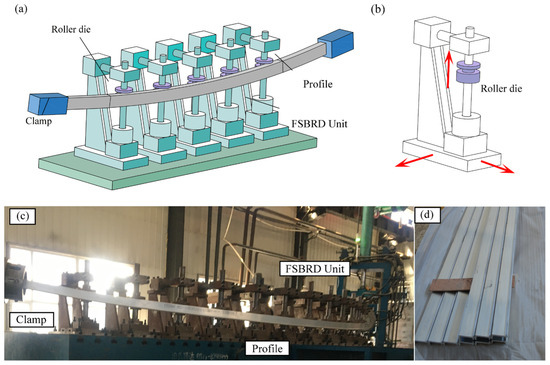
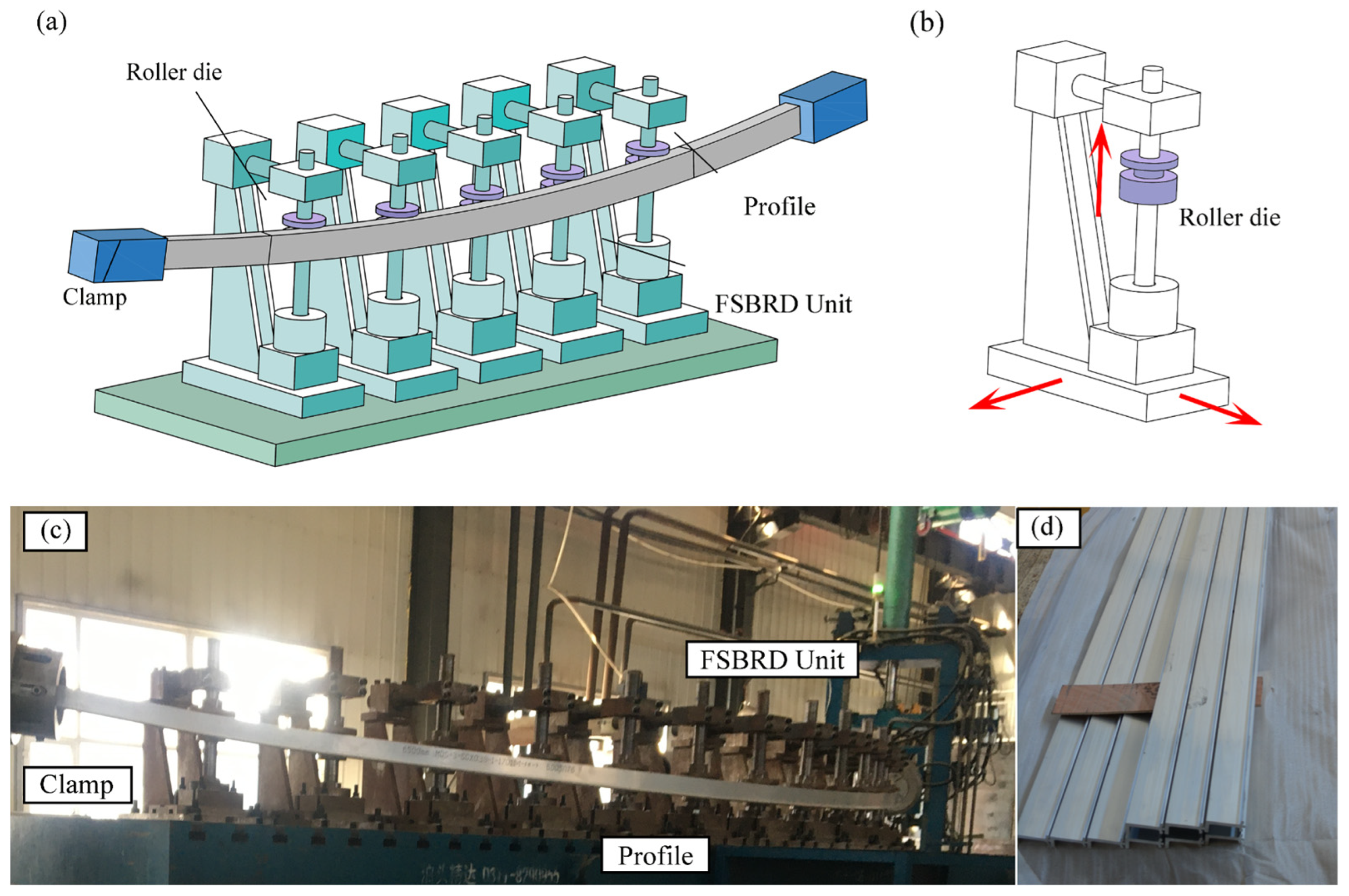
A flexible multi-point stretch-bending forming with roller dies (FSBRD) [13] device is used for producing 3D stretch-bending products. Figure 5a shows the equipment. It consists of forming units and clamps. The unit bodies have roller-type dies with adjustable vertical positions on their guide columns. Axial stretching of the profile blank is achieved by clamping the material with the clamps. Figure 5b illustrates that each unit body has degrees of freedom in three directions. The position of the process unit on the workbench can be adjusted to form the desired discrete shape in the horizontal plane for two-dimensional bending. Following this, by synchronously controlling the clamps and dies, and adjusting the position of the dies on the guide columns, the profile blank can achieve bending in the third dimension. Based on this principle, a full-size FSBRD device was produced. Figure 5c shows the equipment in operation. Figure 5d shows the blank of the L-shaped cross-section.
Figure 5.
(a) Model of FSBRD equipment, (b) FSBRD unit, (c) FSBRD equipment, (d) L-shaped profile.
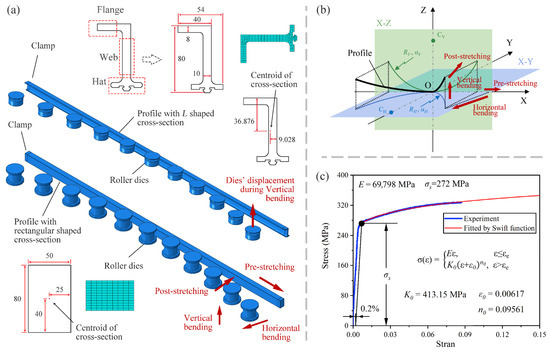
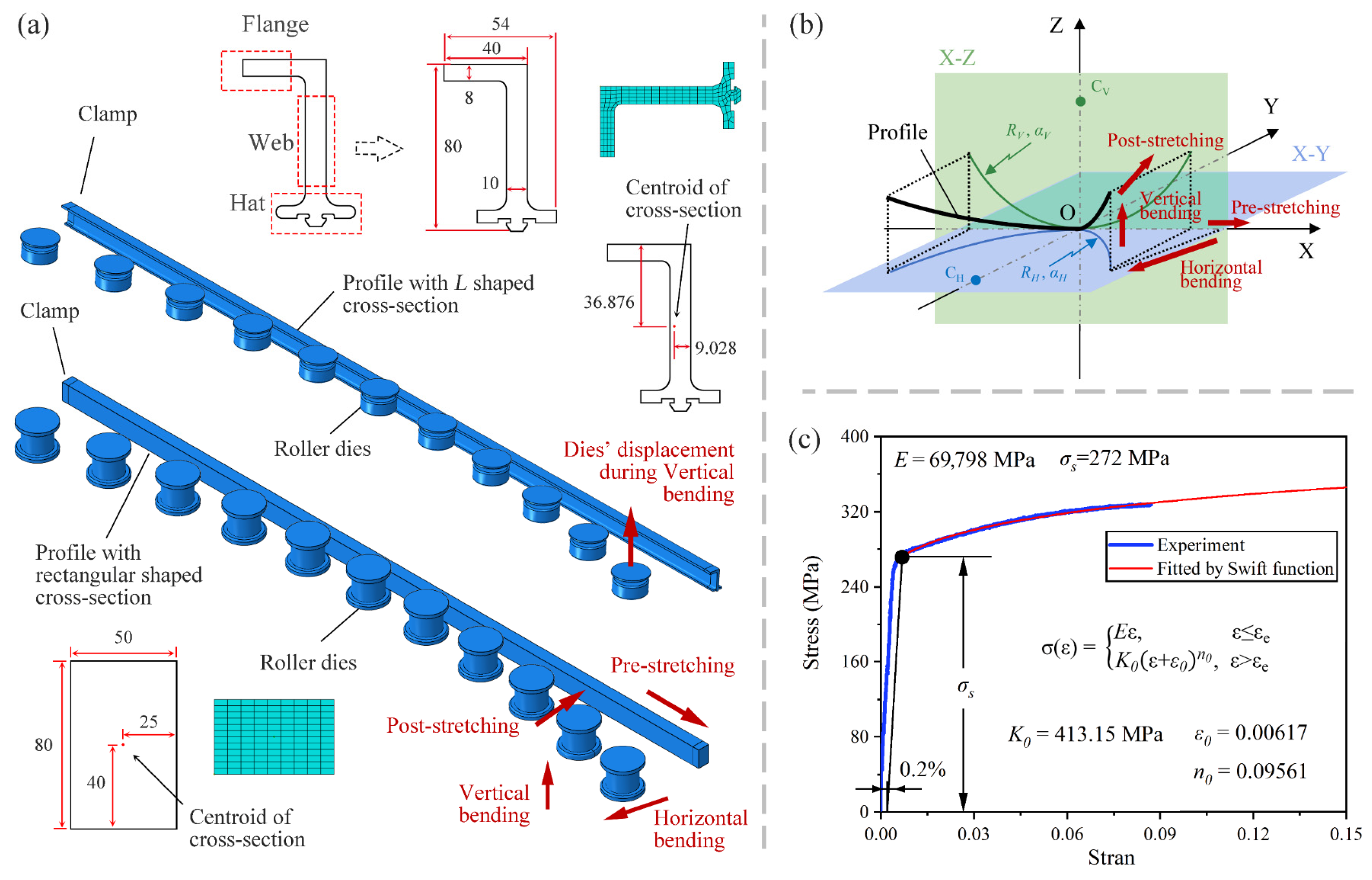
In this study, the FE method is employed to analyze and determine specific parameter values for the stretch-bending forming process. Figure 6a shows the forming model established by FE software Abaqus 2017. This model includes both rectangular cross-section profiles and L-shaped cross-section profiles, representing regular and complex sections, respectively, to quantitatively characterize the previously described results. The smaller rounded corners of the L-shaped cross-section profile (with radii less than 2 mm) are neglected to expedite the computation process. The deformation process was simulated and analyzed using Abaqus/Explicit (Version: Abaqus 2017), with the deformation results imported into Abaqus/Standard for springback analysis. All loads were released, and fixed constraints were added to the middle plane of symmetry for springback result analysis. During the explicit analysis, a friction coefficient of 0.15 and a mass scaling factor of 300 were used to simulate the process.
Figure 6.
(a) Schematic diagram of FSBRD process FE model establishment, (b) illustration of the three-dimensional stretch-bending process for profiles, (c) stress–strain curve.
The specific process of FSBRD mainly includes four steps: pre-stretching, horizontal bending, vertical bending, and post-stretching, as shown in Figure 6a,b. Firstly, under the action of the clamps, the profile blank of length L0 is stretched axially with a stretch ratio of δpre. Then, the blank bends separately in the horizontal plane with an angle of αH, and a vertical plane of αV, and bending radii of RH and RV, respectively, with bending centers at CH and CV. Afterward, the blank is post-stretched along the tangential direction with a stretch ratio of δpost. The process parameters are shown in Table 1.
Table 1.
Stretch-bending parameters for stretch-bending process.
In order to study the deformation characteristics of elastic–plastic materials under three-dimensional stretch bending at room temperature, this paper uses Al6005A-T6 aluminum alloy as the material basis. The stress–strain curve is shown in Figure 6c. The elastic modulus E is taken as 69,798 MPa, and the Poisson’s ratio μ is taken as 0.33. The yield point is determined at a strain rate of 0.2%, with a yield strength σs of 272 MPa. After fitting the plastic phase curve by Swift function, the strength coefficient K0 is 413.15 MPa, the strain hardening exponent n0 is 0.09561, and the hardening equation coefficient ε0 is 0.00617.
Due to the fact that the neutral layer of the blank cannot be directly observed in the stretch-bending experiment, this study characterizes it by measuring springback. Specifically, the springback in both directions within the vertical axis plane is measured. The vector sum of the two quantities is computed. The angle between this resultant vector and the Z-axis is defined as the springback direction angle. And it is equal to the neutral layer deviation.
4. Results and Discussion
4.1. Results of the Neutral Layer
Drawing on the analytical method, the FE simulation method, and experimental method discussed earlier, this study examines the changes in the neutral layer during stretch bending of profiles with regular cross-sections, represented by rectangular sections. The analysis is then extended to complex profiles, taking L-shaped cross-sections as an example. To verify the basic pure bending model presented in Equation (12), the calculation methods outlined in Section 2 are employed to solve the horizontal pure bending deformation processes at 15°, 30°, and 45° and the vertical pure bending deformation processes at 5°, 15°, and 25° for rectangular profiles. The maximum principal strain (LEP,Max) is calculated using Equation (1).
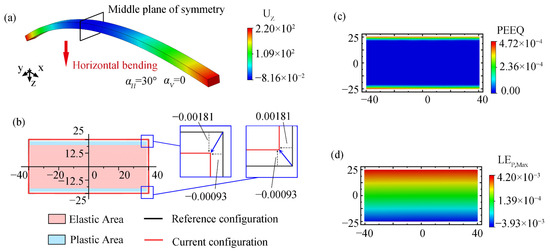
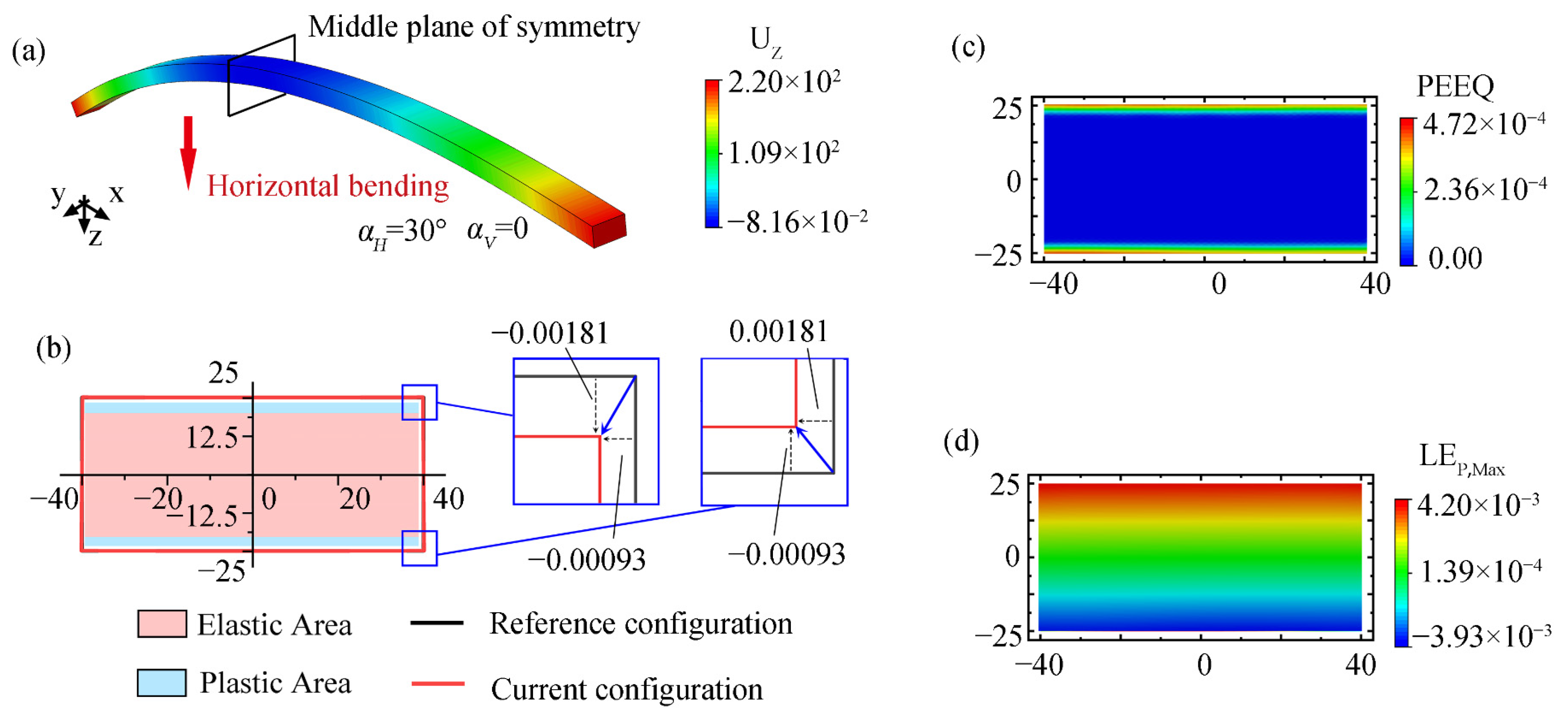
This study uses the horizontal pure bending of a rectangular cross-section profile at 30° as an example to solve and verify the previously proposed calculation and simplification methods. To facilitate interpretation, the results are presented with a rotation for clarity, while the actual horizontal and vertical bending directions follow the markings as shown in Figure 7a. Figure 7b shows the analytical results taking the central symmetric plane (X = 0) as the reference plane. In comparison, Figure 7c shows the equivalent plastic strain (PEEQ) results from the FE simulation of the same profile model after bending. The PEEQ = 0 regions in the contour plot represent areas without plastic strain, while the remaining areas represent regions with plastic strain, corresponding to the elastic and plastic regions in Figure 7b, respectively. The boundary changes between the instantaneous and reference configurations of the central symmetric plane indicate that both the horizontal displacement v and vertical displacement w are on the order of 10−3 to 10−4. Compared to the cross-sectional side length of 50 mm, this change is significantly smaller than this cross-sectional dimension. Thus, during the deformation process discussed in this paper, the cross-sectional deformation is minimal and can be neglected.
Figure 7.
(a) FE simulation results; (b) distribution of elastic and plastic regions and configuration changes in analytical result; (c) contour map of PEEQ from FE results; (d) contour map of LEP,Max from FE results; of pure horizontal bending at 30° for a rectangular cross-sectional profile blank.
Figure 7d displays the LEP,Max (maximum principal strain) contour plot from the FE simulation. Among all LEP,Max parameters, the one with the largest absolute value represents the maximum principal strain, where a negative value indicates compressive strain. By comparing Figure 7c,d, it is evident that during the deformation process, both the stress and strain contour plots in the middle symmetric plane exhibit an approximately horizontal banded pattern, with the bands oriented perpendicular to the bending direction. This phenomenon arises because, within any cross-section Ω, regions with identical geometric parameters experience similar local strain states.
Under uniaxial pure bending, the deformation radius R2 (farthest from the bending center) is relatively large, causing the material in this region to deform in a strip-like manner. Additionally, in both Figure 7c,d, the regions with zero strain are located near the centerline, corresponding to the neutral layer where deformation is minimal.
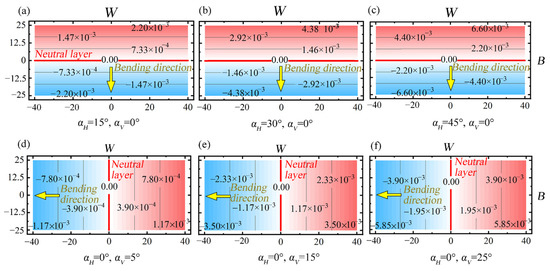
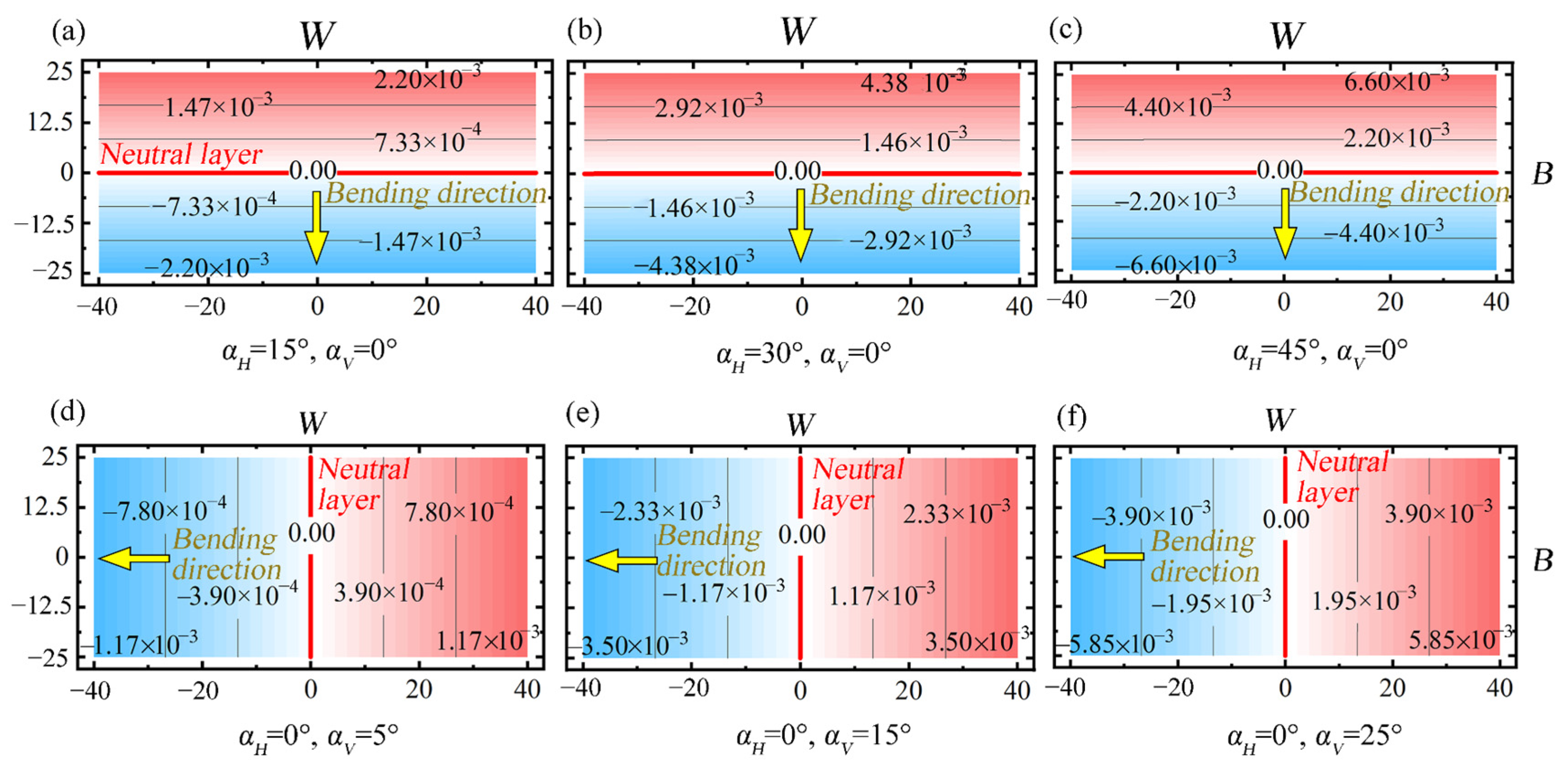
Figure 8 analyzes the maximum principal strain results on the symmetrical midplane of a rectangular cross-section blank during pure bending. Table 2 lists the deformation parameters. As shown in the figure, the neutral layer is roughly perpendicular to the bending direction and located near the center of the cross-section in the bending direction. Among them, on the side far from the bending center, with the neutral layer as the boundary, LEP,Max is greater than zero, indicating tension in that area. (i.e., B > 0 for horizontal bending and W > 0 for vertical bending in Figure 8.) Conversely, on the other side, LEP,Max is less than zero, indicating compression. As the region moves further from the neutral layer along the bending direction, the absolute value of LEP,Max gradually increases, indicating stronger tensile or compressive forces. For example, in Figure 8a during pure horizontal bending, as the region approaches the boundary at B = 25 mm and B = −25 mm, the absolute value of LEP,Max increases from zero to 2.20 × 10⁻³, showing a continuous increase, meaning the tensile or compressive forces grow stronger near the boundary. This behavior aligns with the characteristics of actual bending deformation processes.
Figure 8.
Calculated results of LEP,Max on the cross-section at X = 0 for the rectangular cross-sectional profile under pure horizontal and vertical bending. (a) Horizontal bending of 15°; (b) Horizontal bending of 30°; (c) Horizontal bending of 45°; (d) Vertical bending of 5°; (e) Vertical bending of 15°; (f) Vertical bending of 25°.
Table 2.
Deformation parameter value.
Additionally, the neutral layer appears as an approximately horizontal straight line in the figures. This is because the bending deformation parameter R2 is much larger than the cross-sectional size, meaning that bending deformation of the section can be approximately neglected, and the neutral layer remains a thin layer near the centroid, perpendicular to the bending direction. For instance, in Figure 8b, the bending deformation parameter R2 = 16,308.44 mm, which is much larger than the cross-sectional width of 40 mm. The minimal difference between the reference and instantaneous configurations in Figure 7b also aligns with the characteristics of the neutral layer described above.
By comparing the process parameter R and the deformation parameters R1, R2, and |OO′| under different bending process conditions, it occurs that the difference between R and R1 is small, approximately 1 mm, which is significantly smaller than the process parameter R, indicating that it can be neglected during the deformation of the material. And the parameter |OO′| is also small, much smaller than the cross-sectional dimensions of the material. Therefore, during the deformation process, the deformation parameters mentioned above can be considered negligible. In other words, during pure bending deformation, the displacement of the cross-sectional neutral layer of the material can be ignored. As a result, the simplifications made in Equation (21) for small deformation derivations, including those related to R1 and |OO′|, introduce minimal differences, and the errors caused by using a simplified model in subsequent analyses can be ignored.
Additionally, the deformation parameter R2 is large, greater than the bending deformation parameter of the material, and significantly larger than the cross-sectional dimensions. Therefore, although in practical situations the neutral layer of the cross-section should theoretically form an arc with a radius R2, they are shown as almost straight lines in Figure 8 due to the large size of R2.
4.2. Deflection of the Neutral Layer
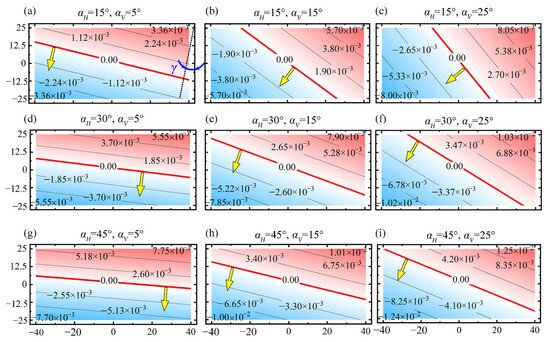
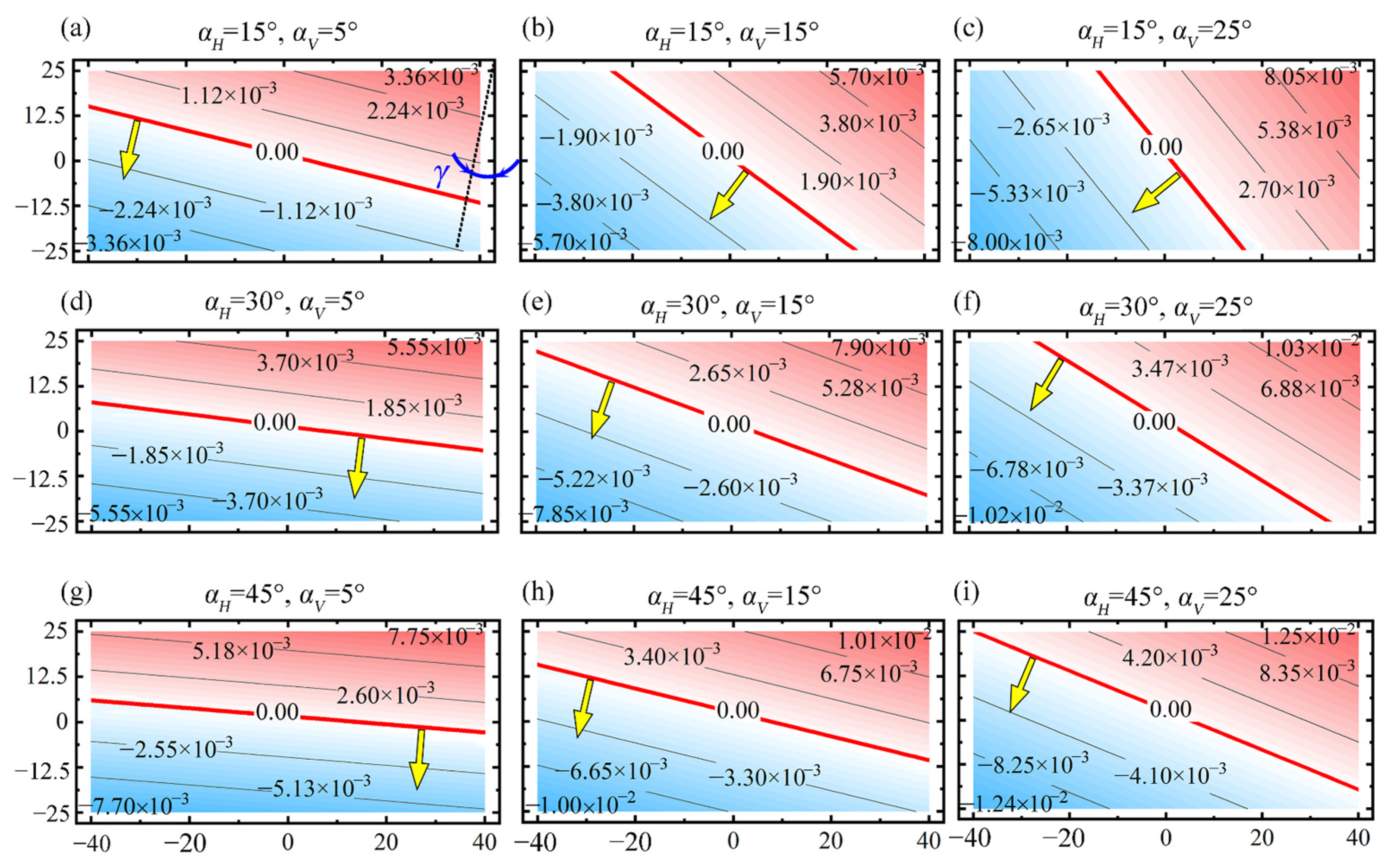
Similarly, in the composite bending analytical results shown in Figure 9, where bending occurs in two perpendicular directions, the neutral layers are also approximately straight lines. Additionally, in the strain contour plots of Figure 8 and Figure 9, the iso-strain lines appear approximately straight. This is because, in theory, these lines represent arcs with a radius of R2 plus or minus a certain value. Since the radius is much larger than the cross-sectional dimensions, the arcs are displayed as nearly straight lines.
Figure 9.
The calculated results for LEP,Max at the cross-section X = 0 in the combined horizontal and vertical bending analysis of the rectangular section. (a) αH = 15°, αV = 5°; (b) αH = 15°, αV = 15°; (c) αH = 15°, αV = 25°; (d) αH = 30°, αV = 5°; (e) αH = 30°, αV = 15°; (f) αH = 30°, αV = 25°; (g) αH = 45°, αV = 5°; (h) αH = 45°, αV = 15°; (i) αH = 45°, αV = 25°.
Figure 9 shows the contour plots of LEP,Max results for the cross-section at X = 0 in the combined bending analysis model for the rectangular cross-section. The combined bending process was solved for horizontal bending angles of 15°, 30°, and 45°, and vertical bending angles of 5°, 15°, and 25°. Compared to the pure bending results in Figure 8, the strain contour plots for the combined bending still exhibit a symmetric distribution along the neutral layer, which corresponds to a certain degree of rotation of the vertical distribution diagram in Figure 8. The rotation angle γ in Figure 9a represents the angle between the bending direction and the vertical axis of the coordinate system, which is equal to the deflection angle of the neutral layer. Table 3 shows the corresponding neutral layer deflection angles. These values were obtained by fitting the points on the nearly straight neutral layer line.
Table 3.
Deflection angle of neutral layer.
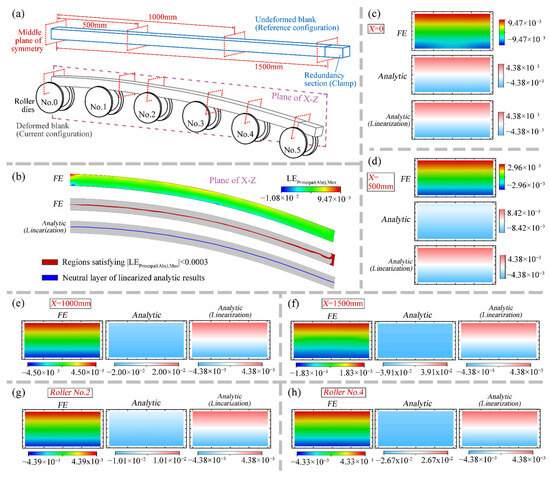
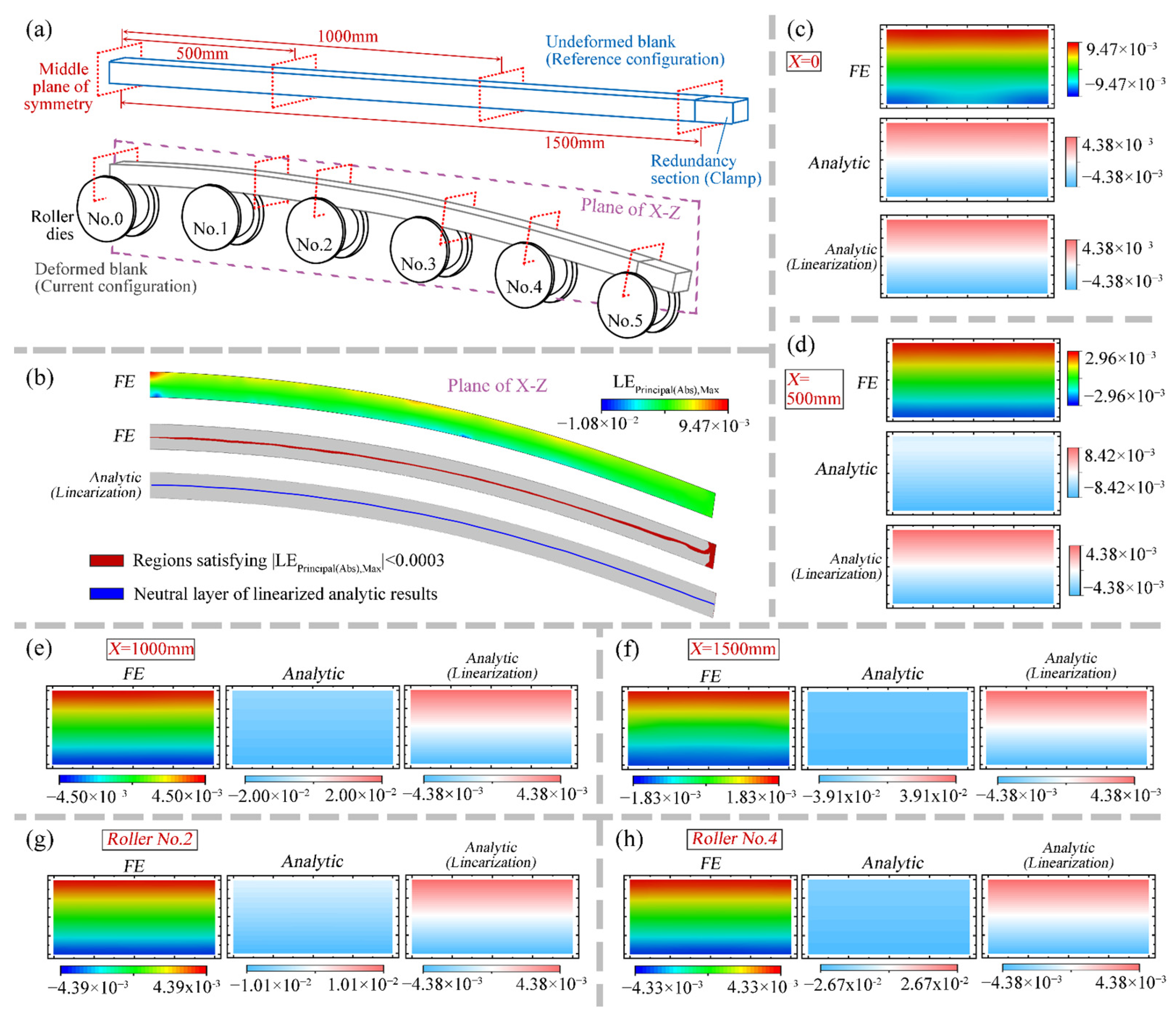
The analyses in Figure 7, Figure 8 and Figure 9 focus on the deformation within the middle plane of symmetry at X = 0. However, in other sections, significant differences arise between the analytical and simulation results. This is because the actual stretch-bending deformation process and the FE simulation can be viewed as an accumulation of small deformations in the material. To accurately describe the bending deformation process, the deformation equations must be linearized, which leads to Equation (21). As shown in Figure 10, for a horizontal pure bending angle αH = 30°, cross-sections at X = 0, 500, 1000, and 1500 mm and sections at the contact points of the second and fourth rollers during the finite element (FE) simulation were analyzed. A comparison was made between the displacement equation’s analytical results, the linearized displacement analytical results, and the FE simulation results.
Figure 10.
(a) Deformation and reference plane selection diagram; (b) distribution contour plot of LEP,Max in the X–Z plane, and the distribution of neutral layers from both the simulation and analytical results; The FE simulation results, analytical results, and linearized analytical results of the LEP,Max at (c) X = 0, (d) X = 500, (e) X = 1000, (f) X = 1500, (g) cross-section at the contact point of the 2nd roller, (h) cross-section at the contact point of the 4th roller; for the rectangular section profile under 30° horizontal bending.
Figure 10c–h show the distribution results of LEP,Max for different cross-sectional positions of the blank, including the FE simulation results, analytical results, and linearized analytical results. Comparing the LEP,Max results at different positions, it can be observed that at the X = 0 position, the linearized analytical results are the same as the non-linear analytical results. This is because, at this point, the variables sinX and cosX in Equation (12) remain the original values after a series expansion. In contrast, for positions where X ≠ 0, the differences caused by non-linearity accumulate as X increases, and therefore, in Figure 10c–h, the maximum value of LEP,Max in the analytical results also increases as X increases.
In the linearized displacement field, as X increases, the LEP,Max distribution in the corresponding cross-sections of the blank does not change, remaining symmetrically distributed along the central neutral layer. This is shown in Figure 10b, where the linearized analytical results in the X–Z plane show that the neutral layer is located in the middle of the material cross-section, matching the region of small strain in the FE simulation results. The small strain area at the right end of the FE results corresponds to the clamped region, as indicated in Figure 10a, where the extra length of the blank reserved by the clamps is not included in the scope of this study.
It is worth noting that due to the constraints applied to the middle plane of symmetry during the FE simulation, there are certain differences compared to the actual bending process. As a result, a significant strain peak appears in the middle plane of symmetry in Figure 10b. In Figure 10c, the analytical results show that the maximum value of LEP,Max is 4.38 × 10⁻³, while the FE simulation shows a maximum strain value of 9.47 × 10⁻³. Additionally, the strain distribution of the blank is affected by the discretization of the die, specifically in that the strain distribution near the contact regions is closer to the theoretical results, while the strain distribution farther from the contact areas shows greater deviation from the theoretical results.
As shown in Figure 10c–h, the maximum values of LEP,Max at different X positions in the analytical results are all 4.38 × 10⁻³, while the corresponding values from the FE simulation exhibit significant variation. In the LEP,Max contour plot in Figure 10b, wave-like uneven strain areas can be observed along the length of the blank. Figure 10d,e show the results for positions at X = 500 mm and X = 1000 mm, respectively. As shown in Figure 10a, both locations are at a certain distance from the die’s contact region. The corresponding maximum values from the FE simulation are 2.96 × 10⁻³ and 4.50 × 10⁻³, differing from the analytical result of 4.38 × 10⁻³. The greater distance of the 500 mm location from the nearby roller contact region compared to the 1000 mm location results in a larger difference in LEP,Max. Figure 10g,h correspond to the second and fourth roller contact areas, with respective values of 4.39 × 10⁻³ and 4.33 × 10⁻³, which show minimal differences from the theoretical analytical value of 4.38 × 10⁻³. However, the position at X = 1500 mm in Figure 10f, while located in the fifth die contact region, is close to the clamps and is significantly influenced by the applied load. As a result, the corresponding value of 1.83 × 10⁻³ does not follow the previously observed trend.
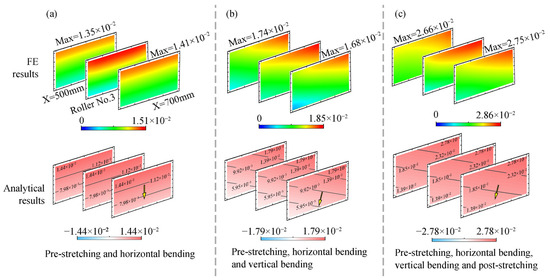
The complete bending forming process includes four steps as shown in Figure 6. Figure 11 analyzes a process with αH = 30°, αV = 15°, and δpre = δpost = 1%. From previous theoretical and numerical analyses, it is evident that during the horizontal bending process, discretized molds cause uneven strain distribution in the blank. This non-uniformity persists in the three-dimensional bending process, as shown in the FE results in Figure 11. This is due to the introduction of the discretized die, which alters the contact between the blank and the die. Therefore, in theoretical analyses, the strain distribution across the blank section does not change with position, while significant differences are observed in the FE model. Consequently, this section focuses on analyzing the cross-sections at the third die contact position (X = 600 mm) and at a neighboring distance of 100 mm.
Figure 11.
FE and analytical results after different steps for the process of a rectangular cross-section profile subjected to αH = 30°, αV = 15°, and δpre = δpost = 1%. (a) After pre-stretching and horizontal bending; (b) After pre-stretching, horizontal bending and vertical bending; (c) After pre-stretching, horizontal bending, vertical bending and post-stretching.
By comparing the FE results in Figure 11, it is evident that prior to the introduction of vertical bending, the strain distribution across the section is approximately uniform along the longitudinal axis. However, after the vertical bending is introduced, the strain distribution in the section undergoes a significant deflection, and the direction of the deflection aligns with the theoretical prediction. Additionally, when comparing Figure 11 with Figure 10 from the previous analysis, it is clear that after pre-stretching is introduced, the overall strain in the section increases uniformly. In this case, the 1% pre-stretching ensures that the strain across the entire section is greater than zero, indicating a tensile state, which is consistent with the theoretical results. Similarly, when comparing Figure 11b,c, the post-stretching also causes an overall increase in the strain values within the section. By comparing the strain distributions on the cross-section under different contact conditions, it is evident that the maximum strain in the contact areas is significantly greater than that in the non-contact areas. After the third processes, the maximum value of the theoretical analytical result of LEP,Max is 2.78 × 10⁻². And the corresponding results of the three cross-sectional positions are 2.66 × 10⁻², 2.75 × 10⁻², and 2.86 × 10⁻². The error rates compared with the theoretical analytical result are 4.3%, 1%, and 3.6%, respectively, all of which are far less than 15%. Therefore, it is considered that the multi-point stretch-bending process adopted in this paper has practical significance for the study of strain results.
4.3. Results of Neutral Layer Deflection in L-Shaped Profile
To introduce the neutral layer deflection theory to arbitrary cross-sectional profiles, an L-shaped profile is analyzed, with preliminary results shown in Table 4. Comparison of bending deformation parameters for rectangular cross-section profiles (Table 2) reveals significant changes in the bending parameters for L-shaped sections. This is due to differences in the boundary integration paths during parameter calculation. Additionally, these parameters exhibit similar numerical characteristics as previously discussed: the difference between R and R1 is much smaller than the value of R itself, and the parameter |OO′| is extremely small, far smaller than the material’s cross-sectional dimensions. Therefore, the linearization simplification introduced in Equation (21) has negligible impact on this asymmetric section.
Table 4.
Deformation parameter value.
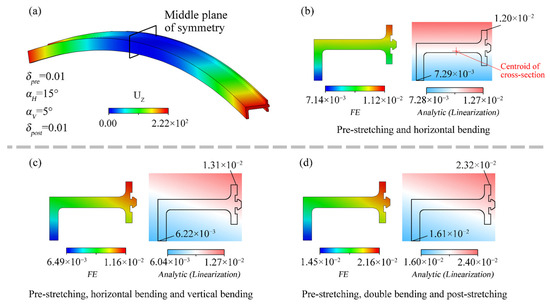
Figure 12a illustrates the deformation of the blank under pure horizontal bending at 30°. When calculating the linearized analytical results for LEP,Max, the parameters used in Equation (21) are non-specific and similar to those used for rectangular sections. Thus, a rectangle with the same centroid distance dimensions is used as the basis for calculating LEP,Max. The centroid is then moved to the centroid of the L-shaped section, as depicted. Comparing the LEP,Max contour map shows that, similar to the deformation patterns observed in rectangular sections, the L-shaped section also exhibits non-uniform strain distribution due to contact effects.
Figure 12.
Deformation of the L-shaped section profile under αH = 15°, αV = 5°, and δpre = δpost = 1%. (a) Springback result; (b) FE and analytical results after pre-stretching and horizontal bending; (c) FE and analytical results after pre-stretching, horizontal bending and vertical bending; (d) FE and analytical results after pre-stretching, horizontal bending, vertical bending and post-stretching.
In Figure 12a, the maximum LEP,Max value at the central symmetrical plane reaches up to 1.36 × 10⁻², whereas it drops to 4.79 × 10⁻³ near the third roller contact area, which is approximately equal to the linearized analytical result of 4.63 × 10⁻³. Despite the variation in strain distribution due to discrete contact areas, the neutral layer of the profile at different positions during bending remains consistent with the analytical calculations, being located near the centroid, as indicated by the green areas in the contour map.
Figure 12 illustrates the deformation results of the L-shaped cross-section profile after undergoing 1% pre-stretching, 15° horizontal bending, 5° vertical bending, and 1% post-stretching. Specifically, Figure 12a shows the overall deformation condition, while Figure 12b–d depict the LEP,Max conditions in the non-contact area after different deformation analysis steps. The strain field from the linearized analytical solution is derived using the parameters listed in Table 4, which are obtained through boundary integration of the corresponding L-shaped cross-section. The rectangular area shown in the figure is solely for illustrating the overall in-plane strain field and does not imply the same results as those for the rectangular cross-section discussed earlier.
Figure 12b–d show the contour maps of LEP,Max in the FE simulation results effectively validate the analytical solutions presented in this study. After the horizontal bending analysis step in Figure 12b, the horizontal strip-like distribution observed in the section contour map closely matches the analytical solution. The maximum and minimum LEP,Max values from the FE results are 7.14 × 10⁻³ and 1.12 × 10⁻², respectively, while the corresponding analytical values are 7.29 × 10⁻³ and 1.20 × 10⁻². The differences between these values are relatively small. When vertical bending is introduced in Figure 12c,d, the FE maps exhibit distinct deflection, which aligns with the analytical results. The extreme values are also close, confirming that the analytical solution effectively predicts the deformation behavior of the section during three-dimensional bending of the profile.
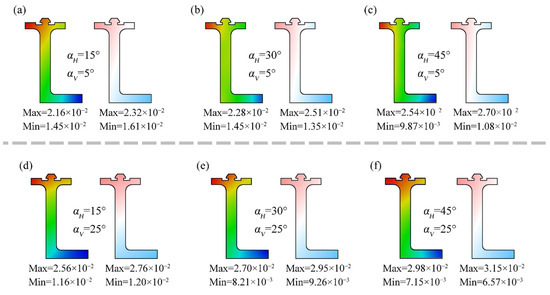
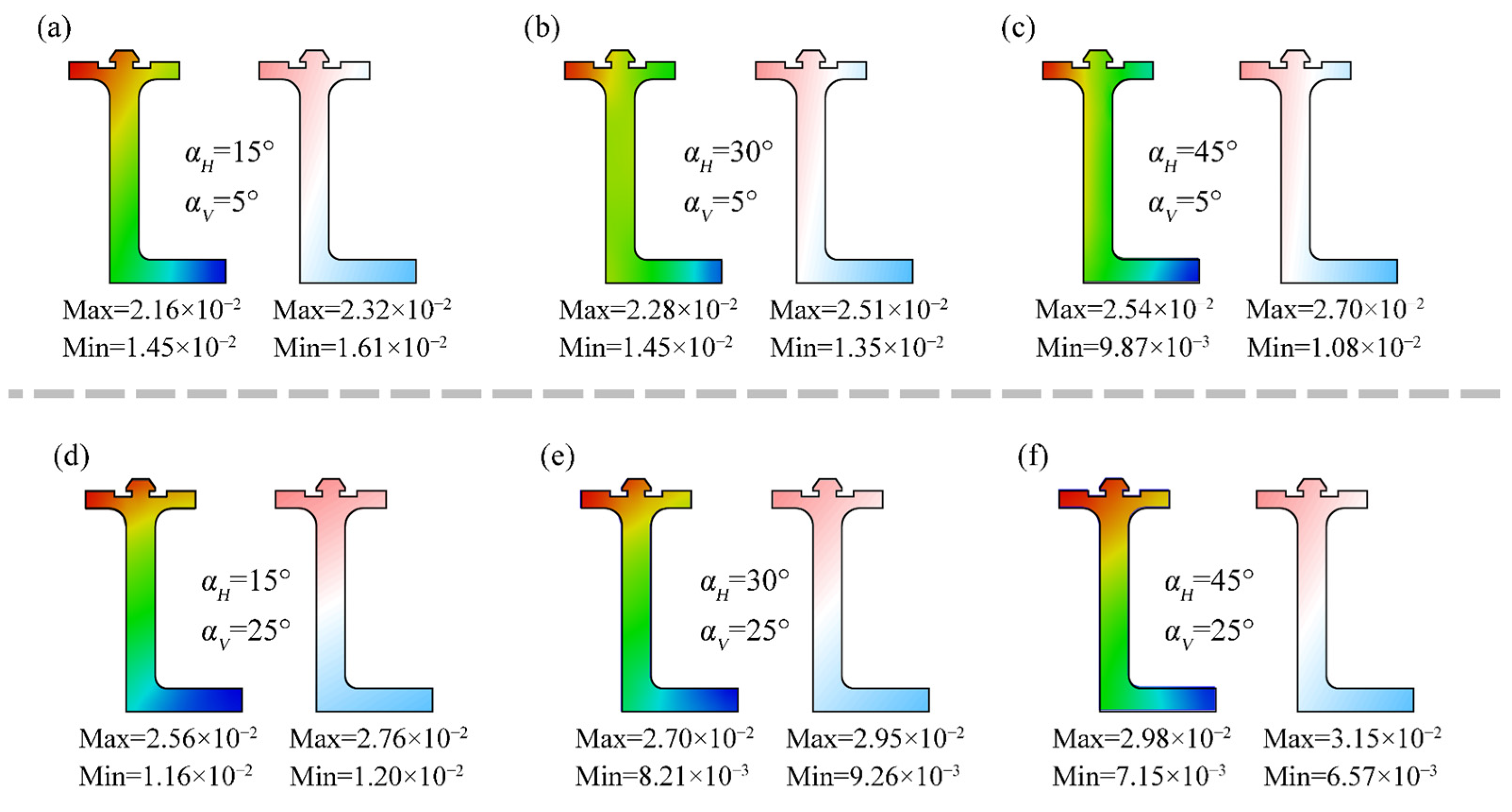
Figure 13 compares the FE simulation results with the analytical solutions under different process parameters. To reduce the impact of discretized contact on the results, the analyzed cross-sections were chosen exclusively from areas where the blank did not come into contact with the die. The comparison of deformation results under various process parameters reveals that the LEP,Max values of the cross-section clearly exhibit the neutral layer deflection phenomenon derived earlier. However, discrepancies still exist between the FE and analytical results for different parameters. For example, at αH = 30° and αV = 15°, the FE results show peak LEP,Max values of 2.16 × 10⁻² and 1.45 × 10⁻², respectively, while the analytical solutions yield 2.32 × 10⁻² and 1.61 × 10⁻², corresponding to errors of approximately 7% and 11%.
Figure 13.
FE and analytic deformation results of the L-shaped section profile under different bending parameters. (a) αH = 15°, αV = 5°; (b) αH = 30°, αV = 5°; (c) αH = 45°, αV = 5°; (d) αH = 15°, αV = 25°; (e) αH = 30°, αV = 25°; (f) αH = 45°, αV = 25°.
This discrepancy arises from differences in localized contact conditions due to die discretization, which propagates into non-contact regions, leading to deviations in deformation results. The error accumulates with increasing process parameters. As a result, in Figure 13a,d, the FE-predicted cross-section deflection closely matches the analytical solution, whereas other parameter combinations exhibit noticeable deviations.
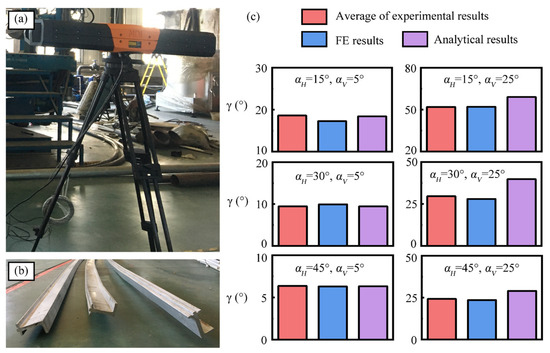
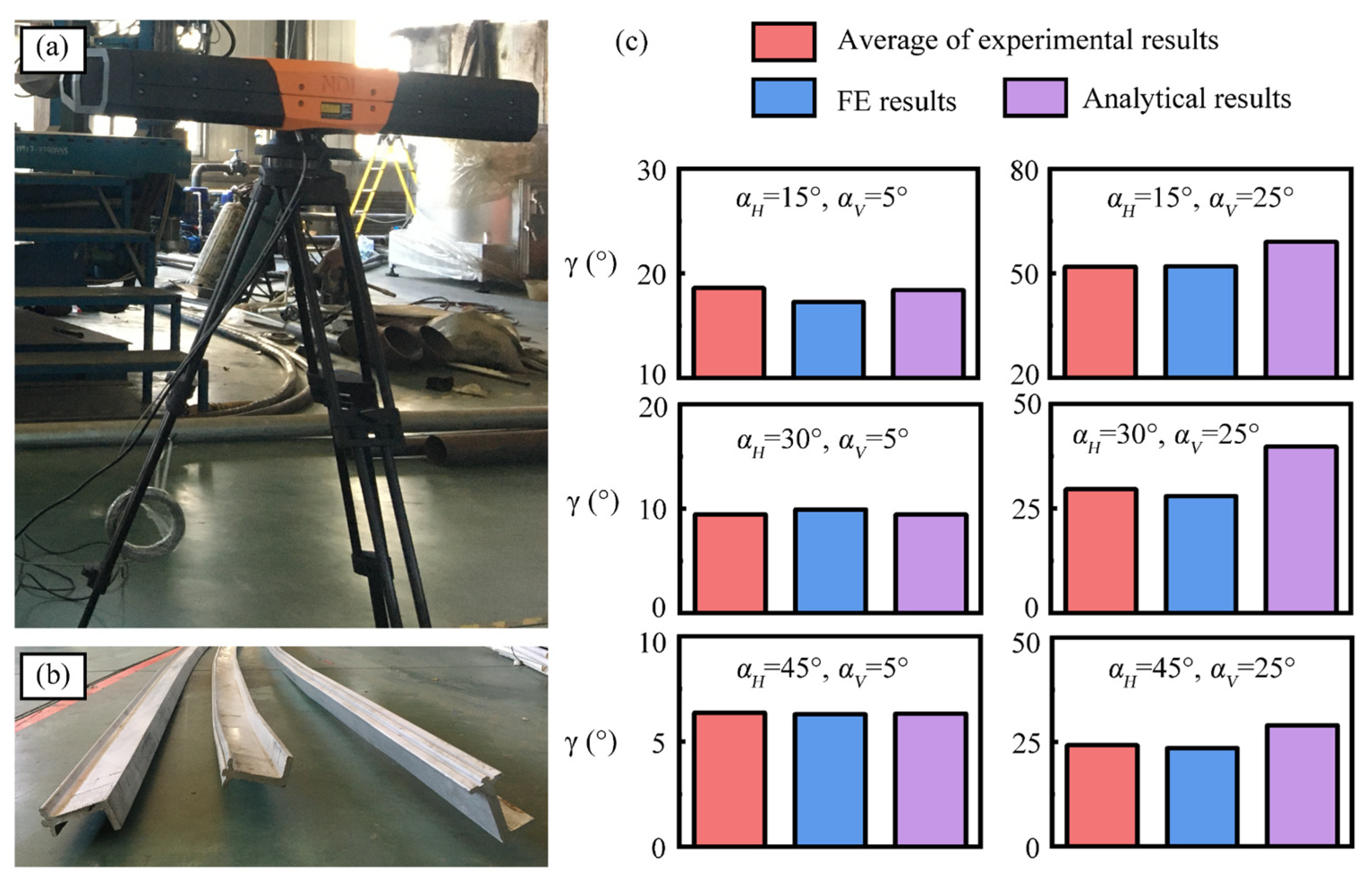
To experimentally validate the analytical and FE simulation results presented above, this study measured and analyzed springback under various process parameters to determine the springback deflection angle. Relevant experiments are conducted as shown in Figure 14. A comparison is made between the analytical prediction results of the measured springback deflection angle and the neutral layer deflection angle. The results indicate that the observed deflection of the springback angle can verify the prediction of neutral layer deflection. Since non-contact measurement may introduce certain errors, and calculating the deflection angle by measuring springback values in two directions may amplify this error, a multi-trial average method was employed for error correction.
Figure 14.
(a) Non-contact measuring equipment; (b) L-shaped profiles after springback; (c) experimental data and FE simulation results of springback deflection angle, along with analytical results of neutral layer deflection.
This study selected three sets of process parameters representing small, moderate, and large deformation levels, as illustrated in the figure. Comparing the average experimental results with the finite element simulation results, it can be seen that the two are very close, indicating a good match. The analysis result of the small deformation test with αH = 15° and αV = 5° is 17.72°, which has little difference from the experimental and simulation results. However, as the deformation level increases, the analytical results (26.28° and 28.84°) increasingly deviate from both the experimental and simulation outcomes, showing a trend of growing disparity. This discrepancy arises because, with increased deformation, the small-deformation assumption becomes less applicable, leading to cumulative errors between analytical and actual deformation results. Thus, it is concluded that the neutral layer deflection model proposed in this study is reasonable for cases of small deformation.
5. Conclusions
This study investigates the deflection phenomenon of the neutral layer during three-dimensional deformation in the profile stretch-bending process. An ideal uniform elastoplastic deformation blank is assumed, and both an analytical model and a simplified linear model are established to describe the deformation process. Al6005A-T6 is used as the base material, and its constitutive properties and model boundary conditions are incorporated to solve for the parameters of the analytical model. Process parameters are then applied to predict the deformation process.
In the pure bending process, both the analytical and finite element (FE) analysis results reveal a distinct neutral layer. Based on this, a compound deformation is studied by bending the rectangular section in two orthogonal directions. The analytical solution for the compound model shows an evident deflection of the neutral layer, with minimal deviation from theoretical predictions, thus proving the validity of the analytical model and its simplified linear form.
To experimentally validate the theoretical analytical model, this study utilized a roller-type flexible three-dimensional stretch-bending forming device with shape-adjustment capabilities. Finite element (FE) modeling was applied to this device for analytical analysis. The results show that while sectional strain distribution varies with contact conditions, it generally fluctuates around the analytical values and the clear deflection phenomenon remains in the neutral layer. Simulation outcomes indicate that, for smaller deformation levels, the linear analytical model aligns closely with the FE simulation results. However, as deformation increases, notable differences arise, rendering the linear analytical model unsuitable for larger deformations. Experiments and FE analysis using an L-section profile yielded similar conclusions, confirming that the analytical model’s predictions of neutral layer deflection are valid under small deformation conditions, though not applicable when deformation levels are high.
Author Contributions
Conceptualization, S.Y.; data curation, S.Y., Y.W., H.S. and C.L.; writing—original draft preparation, S.Y. investigation, Y.L. software, S.Y. and Y.W.; visualization, Y.W. and H.S.; project administration, Y.L.; supervision, Y.L.; methodology, C.L.; writing—review and editing, C.L.; funding acquisition, C.L. All authors have read and agreed to the published version of the manuscript.
Funding
This work was financially supported by the National Natural Science Foundation of China (No. 52505378) and Jilin Provincial Scientific and Technological Department (20220201048GX).
Data Availability Statement
All information, figures, and tables are in the manuscript. It will not be necessary to provide other data and materials.
Conflicts of Interest
The authors declare no conflicts of interest.
References
- Chen, M.H.; Gao, L.; Mao, H.H.; Zuo, D.W.; Wang, M. Numerical simulation of stretch bending process and springback for T section aluminum extrusions. Key Eng. Mater. 2006, 315, 416–420. [Google Scholar] [CrossRef] [Scilit]
- Dang, X.B.; He, K.; Zhang, F.F.; Zuo, Q.Y.; Du, R.X. Multi-stage incremental bending to form doubly curved metal plates based on bending limit diagram. Int. J. Mech. Sci. 2019, 155, 19–30. [Google Scholar] [CrossRef] [Scilit]
- Fu, Z.M.; Tian, X.L.; Chen, W.; Hu, B.K.; Yao, X.Y. Analytical modeling and numerical simulation for three-roll bending forming of sheet metal. Int. J. Adv. Manuf. Technol. 2013, 69, 1639–1647. [Google Scholar] [CrossRef] [Scilit]
- Ma, L.D.; Ma, H.X.; Liu, Z.J.; Chen, S. Theoretical Analysis of Five-Point Bending and Springback for Preforming Process of ERW Pipe FFX Forming. Math. Probl. Eng. 2019, 2019, 1703739. [Google Scholar] [CrossRef] [Scilit]
- Nazari, E.; Staupendahl, D.; Löbbe, C.; Tekkaya, A.E. Bending moment in incremental tube forming. Int. J. Mater. Form. 2019, 12, 113–122. [Google Scholar] [CrossRef] [Scilit]
- Welo, T.; Ma, J.; Blindheim, J.; Ha, T.; Ringen, G. Flexible 3D stretch bending of aluminium alloy profiles: An experimental and numerical study. Procedia Manuf. 2020, 50, 37–44. [Google Scholar] [CrossRef] [Scilit]
- Yu, J.Q.; Li, Y.; Teng, F.; Liang, J.C.; Lin, X.F.; Liang, C.; Chen, G.Y.; Sun, G.P. Research on the cross section forming quality of three-dimensional multipoint stretch forming parts. Adv. Mater. Sci. Eng. 2018, 2018, 4265617. [Google Scholar] [CrossRef] [Scilit]
- Liang, J.C.; Gao, S.; Teng, F.; Yu, P.Z.; Song, X.J. Flexible 3D stretch-bending technology for aluminum profile. Int. J. Adv. Manuf. Technol. 2014, 71, 1939–1947. [Google Scholar] [CrossRef] [Scilit]
- Li, M.Z.; Liu, Y.H.; Su, S.Z.; Li, G.Q. Multi-point forming: A flexible manufacturing method for a 3-d surface sheet. J. Mater. Process. Technol. 1999, 87, 277–280. [Google Scholar] [CrossRef] [Scilit]
- Li, M.Z.; Cai, Z.Y.; Sui, Z.; Yan, Q.G. Multi-point forming technology for sheet metal. J. Mater. Process. Technol. 2002, 129, 333–338. [Google Scholar] [CrossRef] [Scilit]
- Liang, C.; Luo, Y.D.; Liang, J.C.; Li, Y. Analytical springback assessment and compensation in 3D multi-point flexible stretch bending forming. Int. J. Adv. Manuf. Technol. 2023, 129, 197–206. [Google Scholar] [CrossRef] [Scilit]
- Wen, Y.; Liang, J.C.; Li, Y.; Liang, C. Springback Control of Profile by Multi-Point Stretch-Bending and Torsion Automatic Forming Based on FE-BPNN. Metals 2025, 15, 544. [Google Scholar] [CrossRef] [Scilit]
- Liang, J.; Chen, C.; Li, Y.; Liang, C. Effect of roller dies on springback law of profile for flexible 3D multi-point stretch bending. Int. J. Adv. Manuf. Technol. 2020, 108, 3765–3777. [Google Scholar] [CrossRef] [Scilit]
- Liang, C.; Gao, B.L.; Yang, S.Y.; Wen, Y.; Li, Y. Research on magnetorheological elastomer assisted flexible multi-point stretch-bending technology. Int. J. Mater. Form. 2025, 18, 8. [Google Scholar] [CrossRef] [Scilit]
- Lanzoni, L.; Tarantino, A.M. Finite Anticlastic Bending of Hyperelastic Solids and Beams. J. Elast. 2018, 131, 137–170. [Google Scholar] [CrossRef] [Scilit]
- Falope, F.O.; Lanzoni, L.; Tarantino, A.M. The bending of fully nonlinear beams. Theoretical, numerical and experimental analyses. Int. J. Eng. Sci. 2019, 145, 103167. [Google Scholar] [CrossRef] [Scilit]
- Zhan, M.; Wang, Y.; Yang, H.; Long, H. An analytic model for tube bending springback considering different parameter variations of Ti-alloy tubes. J. Mater. Process. Technol. 2016, 236, 123–137. [Google Scholar] [CrossRef] [Scilit]
- Ma, J.; Welo, T. Analytical springback assessment in flexible stretch bending of complex shapes. Int. J. Mach. Tools Manuf. 2021, 160, 103653. [Google Scholar] [CrossRef] [Scilit]
- Ha, T.; Welo, T.; Ringen, G.; Wang, J. On kinematics in sequential three-dimensional stretch bending: Analytical springback model. J. Manuf. Sci. Eng. 2023, 145, 071009. [Google Scholar] [CrossRef] [Scilit]
- Zhang, Z.; Wu, J.; Guo, R.; Wang, M.; Li, F.; Guo, S.; Wang, Y.; Liu, W. A semi-analytical method for the springback prediction of thick-walled 3D tubes. Mater. Des. 2016, 99, 57–67. [Google Scholar] [CrossRef] [Scilit]
- Mohammad, R.M.; Mahdi, G. Analytical approach to investigate the effects of through-thickness stress on springback in bending of isotropic sheet metal. Int. J. Adv. Manuf. Technol. 2025, 136, 57–68. [Google Scholar] [CrossRef] [Scilit]
- Liu, Z.; Jiang, H.; Lei, C.; Sun, K.; Liu, X.; Wang, G.; Xu, C.; Li, L. Analytical prediction on plastic wrinkling characteristics of thin-walled hollow profile in stretch-bending. J. Manuf. Process. 2025, 136, 324–343. [Google Scholar] [CrossRef] [Scilit]
- Xu, Z.; Wang, H.; Hong, R.; Hu, Y.; Liu, L. Springback prediction of the tube bending based on free bending technology. Comput. Integr. Manuf. Syst. 2023, 29, 2685–2695. [Google Scholar] [CrossRef]

Disclaimer/Publisher’s Note: The statements, opinions and data contained in all publications are solely those of the individual author(s) and contributor(s) and not of MDPI and/or the editor(s). MDPI and/or the editor(s) disclaim responsibility for any injury to people or property resulting from any ideas, methods, instructions or products referred to in the content. |
© 2025 by the authors. Licensee MDPI, Basel, Switzerland. This article is an open access article distributed under the terms and conditions of the Creative Commons Attribution (CC BY) license (https://creativecommons.org/licenses/by/4.0/).