Article

A Quick Thickness Measurement Method for Ti-Alloy Sheets Based on a Novel Low-Frequency Phase Feature Model in Eddy Current Testing

1
Faculty of Civil Aviation and Aeronautics, Kunming University of Science and Technology, Kunming 650500, China
2
Yunnan International Joint Laboratory for Intelligent Control and Application of Advanced Equipment, Kunming 650500, China
3
Yunnan Dahongshan Pipeline Co., Ltd., Yuxi 653405, China
*
Authors to whom correspondence should be addressed.
Metals 2025, 15(11), 1210; https://doi.org/10.3390/met15111210
Submission received: 29 September 2025 / Revised: 27 October 2025 / Accepted: 28 October 2025 / Published: 30 October 2025

Abstract

Titanium (Ti) alloy sheets are important mechanical and structural components. However, thickness deviations may occur during the production of Ti-alloy sheets, significantly compromising product quality and structural safety. Eddy current testing (ECT) is a common method for measuring the thickness deviation of metal sheets. Nevertheless, conventional ECT methods often rely on complex calibration procedures or iterative inversion algorithms, thereby limiting their applicability. It was found that when low-frequency ECT excitation is used, such that the eddy current penetration depth exceeds three times the maximum target thickness of the Ti-alloy sheet, the tangent of the ECT coil impedance phase exhibits a linear relationship with the thickness. Based on this observation, by analyzing the low-frequency ECT response of Ti-alloys and separating the real and imaginary parts of the impedance under approximate conditions, a phase feature model was developed. The model effectively describes the linear dependence of the phase tangent on the thickness of the Ti-alloy sheet, offering a succinct characterization. The measurement method based on this model thereby allows for direct thickness calculation from the measured coil impedance without requiring master-curve calibration or iterative computation. Experiments were conducted using a custom-designed ECT coil and impedance analyzer to measure different Ti-alloy specimens. The results indicate that the measurement error was less than 3.5%. This research provides a theoretical foundation as well as a straightforward engineering solution for online, high-speed thickness measurement of Ti-alloy sheets.

1. Introduction

Titanium (Ti) alloy is an excellent mechanical material due to its high strength, low density, and corrosion resistance [1]. Ti-alloy sheets constitute over 50% of the total output of processed Ti products and are the most widely utilized form, finding extensive applications in aerospace, petrochemical engineering, advanced construction, and biomedical industries [2,3]. For example, Ti-alloy sheets are used for aircraft fuselage panels or skins, which require strict thickness tolerances to ensure structural integrity and optimal weight. In such cases, the thickness typically must be between 0.5 and 2 mm [4,5]. Similarly, in the petrochemical industry, Ti-alloy sheets are used in heat exchanger linings and reactor vessels. They must have sufficient thickness to meet design pressure requirements and prevent premature failure [6]. However, thickness deviations are common during sheet production [7]. This deviation directly affects the mechanical properties of the sheets and also impacts their assembly in equipment and structures. For instance, during subsequent service or processing, it may lead to fatigue fracture, accelerated equipment wear, and other related problems [8]. Therefore, it is essential to adjust process parameters according to thickness deviation during the production process, which depends on timely and accurate thickness measurement.
At present, the common non-destructive testing techniques for evaluating metal sheet thickness include ultrasonic testing (UT) [9], radiographic testing (RT) [10] and eddy current testing (ECT) [11,12]. These non-destructive testing techniques each possess their own advantages and suitable scenarios. In recent years, UT has evolved beyond conventional pulse-echo approaches to include high-frequency and broadband methods for enhanced resolution, and multi-echo strategies for measuring through coatings. RT has similarly advanced with digital radiography and computed tomography, providing high-resolution thickness distribution. UT and RT are powerful but come with practical constraints in field or production environments. UT requires couplant and is sensitive to surface conditions, which is problematic for automated measurements on moving or coating materials. RT provides excellent accuracy, but it involves high equipment costs, radiation safety concerns, and the need for two-sided access. However, UT often requires couplants and is sensitive to surface conditions, while RT involves high equipment costs, radiation safety concerns, and complex operation procedures. In contrast, ECT offers unique advantages, including non-contact measurement, high sensitivity to subtle thickness variations, and robustness against surface contaminants. It also enables fast, real-time, and automated thickness monitoring, especially for conductive, non-ferromagnetic thin sheets [13]. The ECT exploits the variation in coil impedance caused by the measured material to evaluate the thickness and is therefore classified as an inverse electromagnetic problem. Conventional inversion typically involves constructing a master curve through extensive calibration experiments, which correlates a selected eddy current (EC) signal feature with material thickness. The unknown thickness is then estimated by interpolating the measured signal against this curve [14]. There were many practical examples of such methods in the early days. Representative implementations are as follows: C. S. Angani et al. [15] employed peak amplitude, peak time, and zero-crossing point in pulsed ECT signals as thickness indicators; H. Wang and W. Li et al. [16] pointed out that the slope of the lift-off curve (LOC) in the RL impedance plane is a good feature for characterizing target thickness; H. Nebair et al. [17] developed a dual-probe automated scanning system that evaluates thickness through the impedance magnitude ratio of two coils. These methods are simple and practical and have certain advantages in situations where high measurement accuracy is not essential. However, these methods have limitations: the master curve may contain errors due to the discrete thickness intervals of calibration specimens, and the preliminary calibration experiments are often laborious.
In pursuit of higher measurement accuracy, some researchers have turned to model-based approaches. These methods construct a continuous master curve by establishing and solving a forward analytical model. For instance, M. Lu et al. [18,19] proposed an analytical model that utilizes the phase response of high-frequency ECT to estimate the thickness of metal sheets; C. Li et al. [20,21] developed a transformer-equivalent model of ECT that improves measurement performance; A. Sardellitti et al. [22] introduced a thickness measurement method based on both phase and magnitude, which achieved high accuracy in estimating the thickness of single-layer metal sheets; Z. Xia et al. [23] proposed a tri-frequency ECT model to determine the thickness and permeability of metal sheets, later combining it with low-frequency sweep techniques to enable simultaneous evaluation of thickness and defect depth [24]. In summary, while these ECT methods have laid a solid theoretical and experimental groundwork for metal sheet thickness measurement, several challenges persist. Existing models are often highly complex, and most studies focus on forward modeling, which does not directly calculate the measured parameters, thereby limiting their suitability for rapid online applications.
To address the above limitations, this paper proposes a novel low-frequency EC phase feature model and a measurement method based on this model. It is found that, when using low-frequency ECT excitation to make the EC penetration depth more than three times the maximum target thickness of the Ti-alloy sheet, the phase tangent of the ECT coil impedance variation (phase feature) exhibits a linear relationship with the thickness. Building on this observation, and considering the Ti-alloy’s low conductivity, non-ferromagnetic nature, and certain low-frequency approximations, an explicit separation of the real and imaginary parts of the coil impedance variation at a specific integration point was achieved within the classical electromagnetic analytical framework. Thus, an analytical model was developed to correlate the phase feature with the thickness of the Ti-alloy sheet. The proposed model can be expressed as a monotonic and identifiable explicit inversion formula, allowing thickness to be calculated directly from measured impedance in a one-step manner. Experiments were conducted using a self-made ECT coil and an impedance analyzer on Ti-alloy specimens of varying thicknesses. The results showed a strong agreement between the model calculations and experimental values, with an overall absolute error of less than 0.065 mm and a relative error below 3.5%. This validated the effectiveness of the proposed model and the practicality of the model-based measurement method. Therefore, this work establishes an engineering-feasible theoretical foundation for high-speed, high-precision thickness measurement of Ti-alloy sheets in manufacturing and in-service components.

2. Low-Frequency ECT Response of Ti-Alloy Sheets

2.1. ECT Principle and Traditional Analytical Model

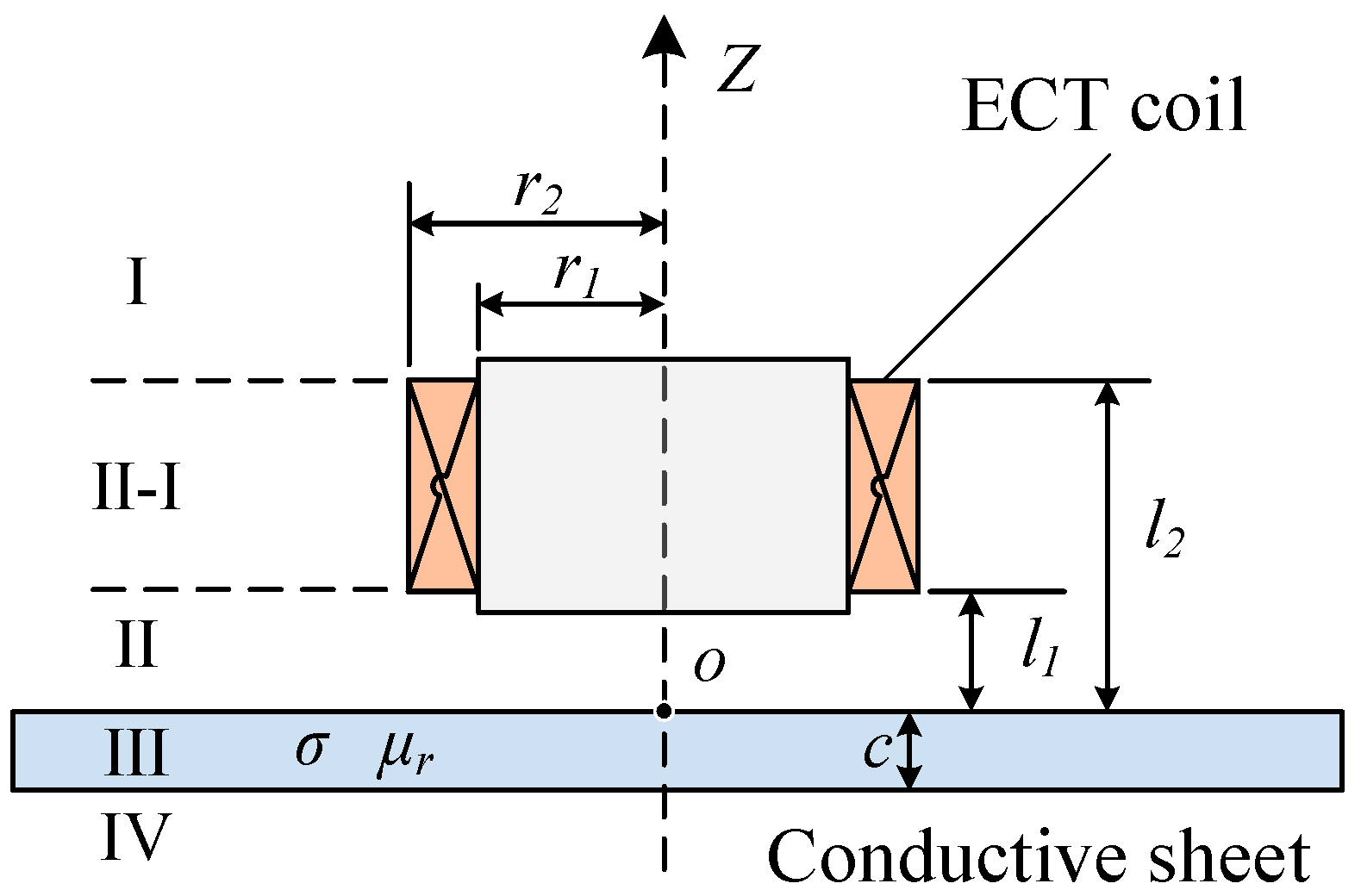
As shown in Figure 1, the ECT setup can be represented as a hollow cylindrical coil placed above a conductive sheet, where the impedance of the AC coil is used to indirectly measure changes in the sheet properties, such as conductivity or thickness.
According to Dodd and Deeds [26,27], the magnetic vector potential is defined in four regions (I, II, III, and IV). The magnetic vector potential in regions II-I determines the induced voltage of the coil, which can be obtained by combining the magnetic vector potentials of regions I and II, and its expression is defined as follows:
A ( r , z ) = 1 2 μ 0 i 0 0 1 α 3 I n t ( α ) J 1 ( α r ) × 2 e α ( z l 2 ) e α ( z l 1 ) + e α z ( e α l 1 e α l 2 ) ( α 1 2 α 2 ) ( 1 e 2 α 1 c ) ( α 1 α ) 2 + ( α 1 + α ) 2 e 2 α 1 c d α
If the coil has only one loop, its voltage is V = j ω 2 π r A ( r , z ) . Therefore, the voltage of the coil with n turns can be regarded as the integral of the above equation over the cross-sectional area of the coil:
V = l 1 l 2 r 1 r 2 j ω 2 π r A ( r p , z ) n ( l 2 l 1 ) ( r 2 r 1 ) d r d z
The coil impedance can be calculated as Z = V / I , where n I = i 0 ( l 2 l 1 ) ( r 2 r 1 ) . Therefore, the variation in coil impedance can be expressed by the following equation [27]:
Δ Z = Z Z a i r = K 0 I n t 2 ( α ) α 6 A ( α ) ϕ ( α ) d α
where Z is the impedance measured above the conductive sheet, and Zair is the coil impedance in air domain:
K = j ω π μ 0 n 2 ( l 2 l 1 ) 2 ( r 2 r 1 ) 2
ϕ ( α ) = ( α 1 + μ r α ) ( α 1 μ r α ) ( α 1 + μ r α ) ( α 1 μ r α ) e 2 α 1 c ( α 1 μ r α ) ( α 1 μ r α ) + ( α 1 + μ r α ) ( α 1 + μ r α ) e 2 α 1 c
α 1 = α 2 + j ω μ r μ 0 σ
A ( α ) = ( e α l 2 e α l 1 ) 2
I n t ( α ) = α r 1 α r 2 x J 1 ( x ) d x
c is the sheet thickness; α is the integration variable; ω denotes the angular frequency of the excitation current; σ and μr denote the conductivity and relative permeability of the sheet; J1(x) is the Bessel function of the first kind of order one.

2.2. Observation of Linear Change in the Phase of Coil Impedance Variation

If the conductivity and relative permeability of the measured material are known, the standard EC penetration depth in ECT is determined by the excitation frequency, as given by the following equation [28]:
δ = 2 ω μ 0 μ r σ
Ti-alloys have a conductivity typically below 1.0 MS/m (approximately 1/60th of copper’s) and a relative permeability of 1. According to Equations (9) and (3), these electromagnetic characteristics enable Ti-alloys to achieve greater penetration depth under the same excitation frequency compared with other metals, or to maintain a higher excitation frequency at a given penetration depth to ensure sufficient signal strength of impedance.
In addition, thickness measurement using ECT requires that the penetration depth exceeds the maximum thickness of the measured material [28,29]. For common Ti-alloy sheets, the maximum thickness is typically not more than 5.0 mm. Using TC4 Ti-alloy as an example, to achieve penetration depths of 1.5, 2.0, 2.5, and 3.0 times the maximum target thickness, the corresponding frequencies are 6.9, 3.8, 2.4, and 1.7 kHz, respectively. Based on the above information, the coil impedance response across varying thicknesses was calculated using Equations (3)–(8), with the specific calculation parameters detailed in Table 1.
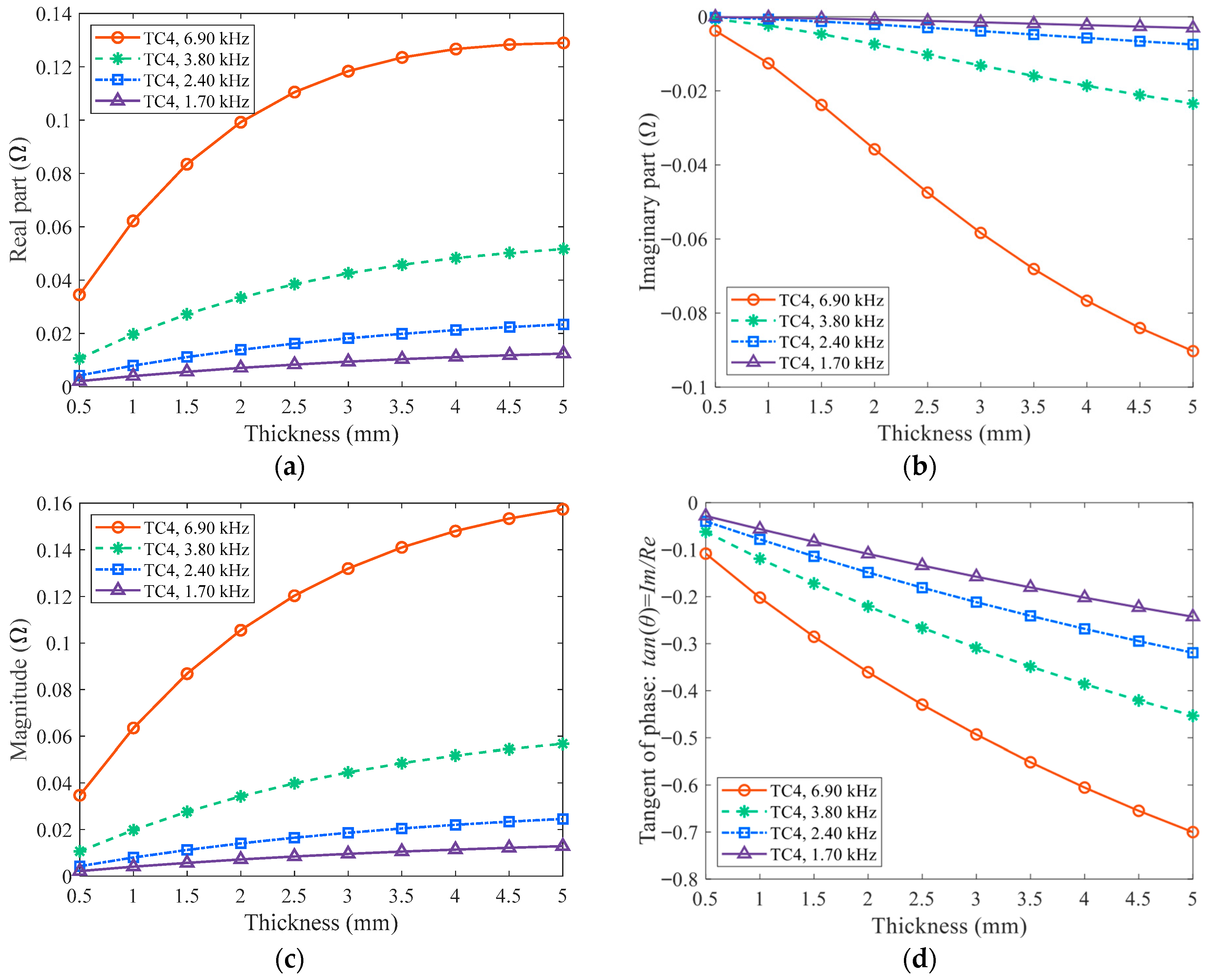
After calculation, the variations in coil impedance with different thicknesses of Ti-alloy sheets under various excitation frequencies are illustrated in Figure 2.
Figure 2a,b show that, with increasing thickness, the real part of the coil impedance variation gradually increases while the imaginary part decreases; both changes are more pronounced at higher excitation frequencies. Regardless of frequency, the variations are nonlinear, which is unfavorable for the inversion of measured results. The impedance magnitude shown in Figure 2c follows a trend similar to that of the real part, indicating that the magnitude is dominated by the real component. As shown in Figure 2d, when the EC penetration depth is more than three times the maximum target thickness, the tangent of the phase of the coil-impedance variation (imaginary part/real part) changes approximately linearly with thickness. This is because the EC penetration depth (δ) is the depth at which the EC density induced inside the conductor decays to 1/e (≈ 36%) of its surface value along the normal direction of the surface. When δ is more than three times the maximum target thickness, approximately 95% of the electromagnetic field has already decayed, indicating that the field has effectively penetrated the entire thickness of the sheet. By contrast, if δ is only one or two times the thickness, a significant portion of the sheet would lie outside the effective penetration region, leading to more complex (nonlinear) impedance responses that would require calibration or iterative inversion. Our goal was to avoid those complexities. The observed linear phenomena and their corresponding variation patterns provide a basis for more directly inverting the measured thickness. Therefore, the tangent of the impedance phase angle is defined as the phase feature.

2.3. The Performance of Linear Relationship on Different Grades of Ti-Alloys

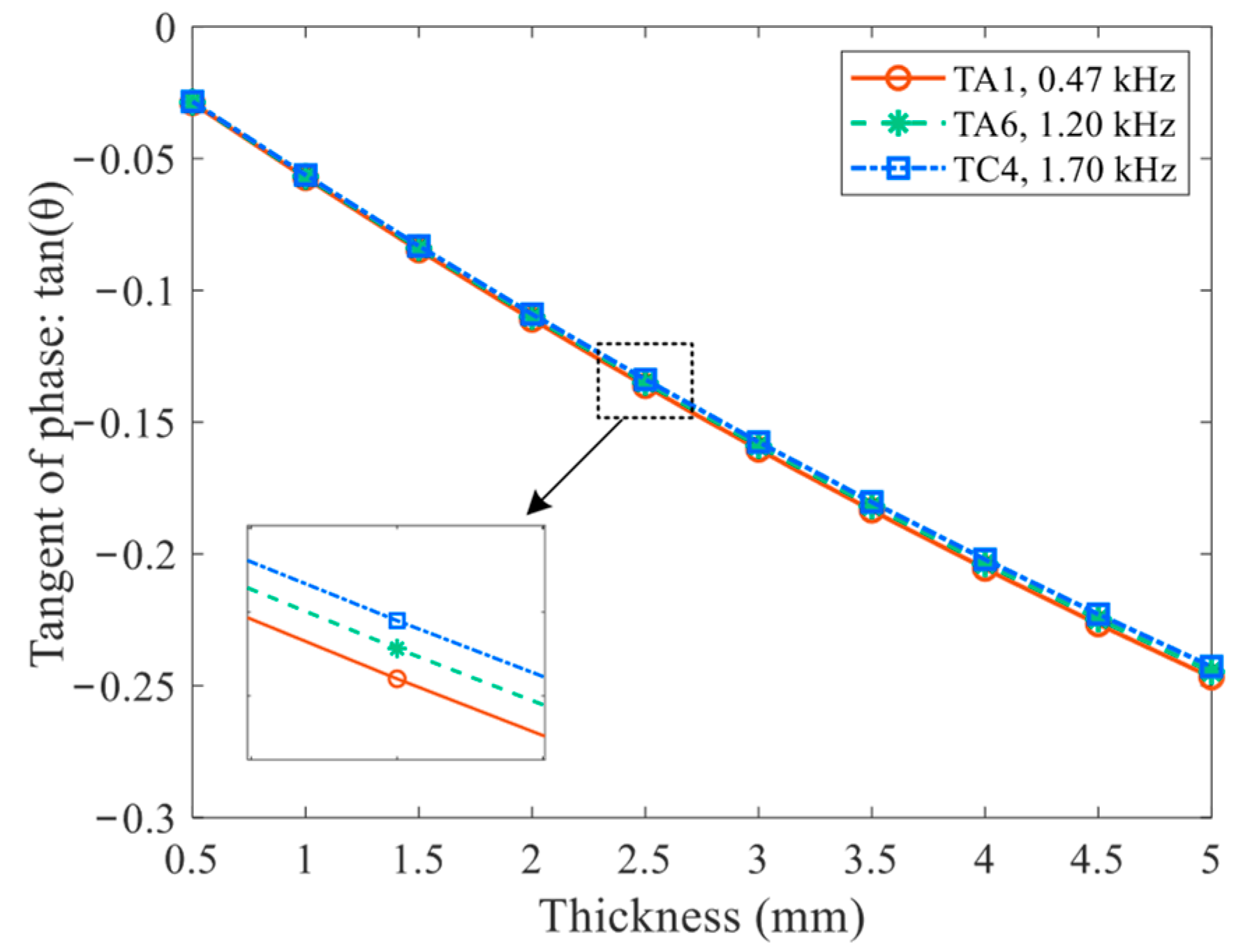
To further verify the universality of the above phenomena and variation patterns, an analysis is conducted on different grades of Ti-alloys. Specifically, TA1 (industrial pure titanium), TA6 (Ti-5Al), and TC4 (Ti-6Al-4V) alloy sheets were selected as examples, with conductivities of 2.4, 0.93, and 0.65 MS/m, respectively. These Ti-alloys represent three typical cases with high, medium, and low electrical conductivity among commonly used Ti-alloys. According to Equation (9), the corresponding excitation frequencies in the calculations were 0.47, 1.2, and 1.7 kHz, respectively. The calculated results are displayed in Figure 3.
As shown in Figure 3, the coil phase feature exhibits a linear relationship with the sheet thickness for all three Ti-alloy grades. Furthermore, the slopes of the variation curves are identical, indicating that this linear relationship is determined solely by the penetration depth, and therefore applies universally to different grades of Ti-alloys.

3. Linear Relationship Analysis and Analytical Modeling

Building on the observed phenomenon, an explicit description is pursued of the linear relationship, which can be used to directly and simply calculate the thickness by substituting the measured coil impedance in practical applications. However, existing analytical models are not sufficient to clearly and directly describe this phenomenon, and they are generally complex integral expressions, making it difficult to solve. Therefore, it is necessary to derive a novel simplified analytical model from the phenomenon.

3.1. Coil Impedance Variation Model for Low-Frequency ECT of Ti-Alloy Sheets

The relative permeability of Ti-alloys is 1. The impedance variation in an ECT coil above a Ti-alloy sheet can be quantified using the analytical solution derived from the Dodd-Deeds model, as shown in the following equation:
Δ Z = ω π μ 0 n 2 ( l 2 l 1 ) 2 ( r 2 r 1 ) 2 0 I n t 2 ( α ) α 6 ( e α l 2 e α l 1 ) 2 × ω μ 0 σ ( e 2 α 1 c 1 ) ( α 1 α ) 2 + ( α 1 + α ) 2 e 2 α 1 c d α
where
α 1 = α 2 + j ω μ 0 σ
Substituting the penetration depth formula into Equation (11), we can obtain:
α 1 c = ( α c ) 2 + j 2 ( c δ ) 2
According to Equation (12), assuming that the maximum target thickness (cmax) does not exceed 5 mm, when the EC penetration depth (δ) is greater than three times the maximum target thickness, the imaginary part of α1c becomes much smaller than 1. Moreover, within the relatively small range of the integration variable α (α ≤ 200), the real part is also much smaller than 1. Therefore, e 2 α 1 c can be approximated as:
e 2 α 1 c 2 α 1 c + 1
This approximate relationship holds only for small values of α1c, its accuracy degrades with the α increases. However, the factor α6 in Equation (10) serves to suppress the error [30,31]. To verify this point, we define the following integrand function:
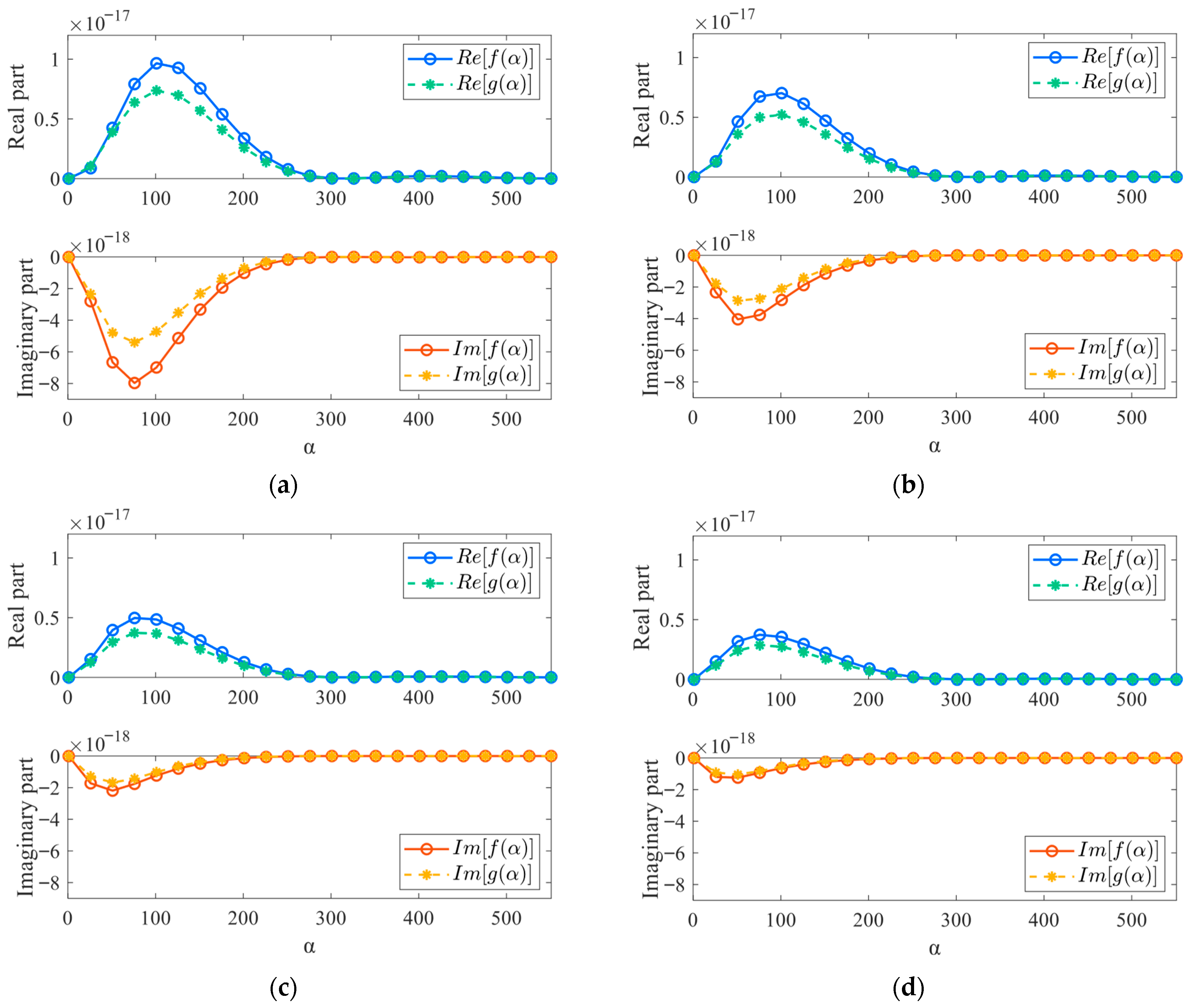
f ( α ) = I n t 2 ( α ) α 6 ( e α l 2 e α l 1 ) 2 ω μ 0 σ ( e 2 α 1 c 1 ) ( α 1 α ) 2 + ( α 1 + α ) 2 e 2 α 1 c g ( α ) = I n t 2 ( α ) α 6 ( e α l 2 e α l 1 ) 2 ω μ 0 σ ( 2 α 1 c ) ( α 1 α ) 2 + ( α 1 + α ) 2 ( 2 α 1 c + 1 )
where f(α) is the original integrand in Equation (10), g(α) the approximate one obtained by substituting Equation (13) into f(α). These two complex-valued integrands are plotted over the same integration interval under different excitation frequencies, as shown in Figure 4.
From Figure 4, the approximate integrand g(α) exhibits the same trend as the original integrand f(α). Moreover, as the penetration depth increases, the error introduced by the approximation further decreases. When δ ≥ 3cmax, the error of the approximate integrand becomes negligible, and its integral with respect to α is virtually unaffected. This analysis confirms the validity of the approximate relationship expressed in Equation (13). Therefore, by substituting g(α) into Equation (10), we obtain:
Δ Z ω π μ 0 n 2 ( l 2 l 1 ) 2 ( r 2 r 1 ) 2 0 I n t 2 ( α ) α 6 ( e α l 2 e α l 1 ) 2 × ω μ 0 σ × 2 α 1 c ( α 1 α ) 2 + ( α 1 + α ) 2 ( 2 α 1 c + 1 ) d α

3.2. Modeling Phase Feature Through Coil Impedance Component Separation

Under low-frequency conditions, it can be observed that the real part of the integrand is an order of magnitude larger than its imaginary part. Since the imaginary part variations in the integrand originate from α1, it can be inferred that complex α1 is primarily dominated by its real part. Moreover, the real and imaginary parts of α1 increase and decrease with α, respectively. Therefore, α1 can be approximated using a binomial expansion:
α 1 α + j ω μ 0 σ 2 α
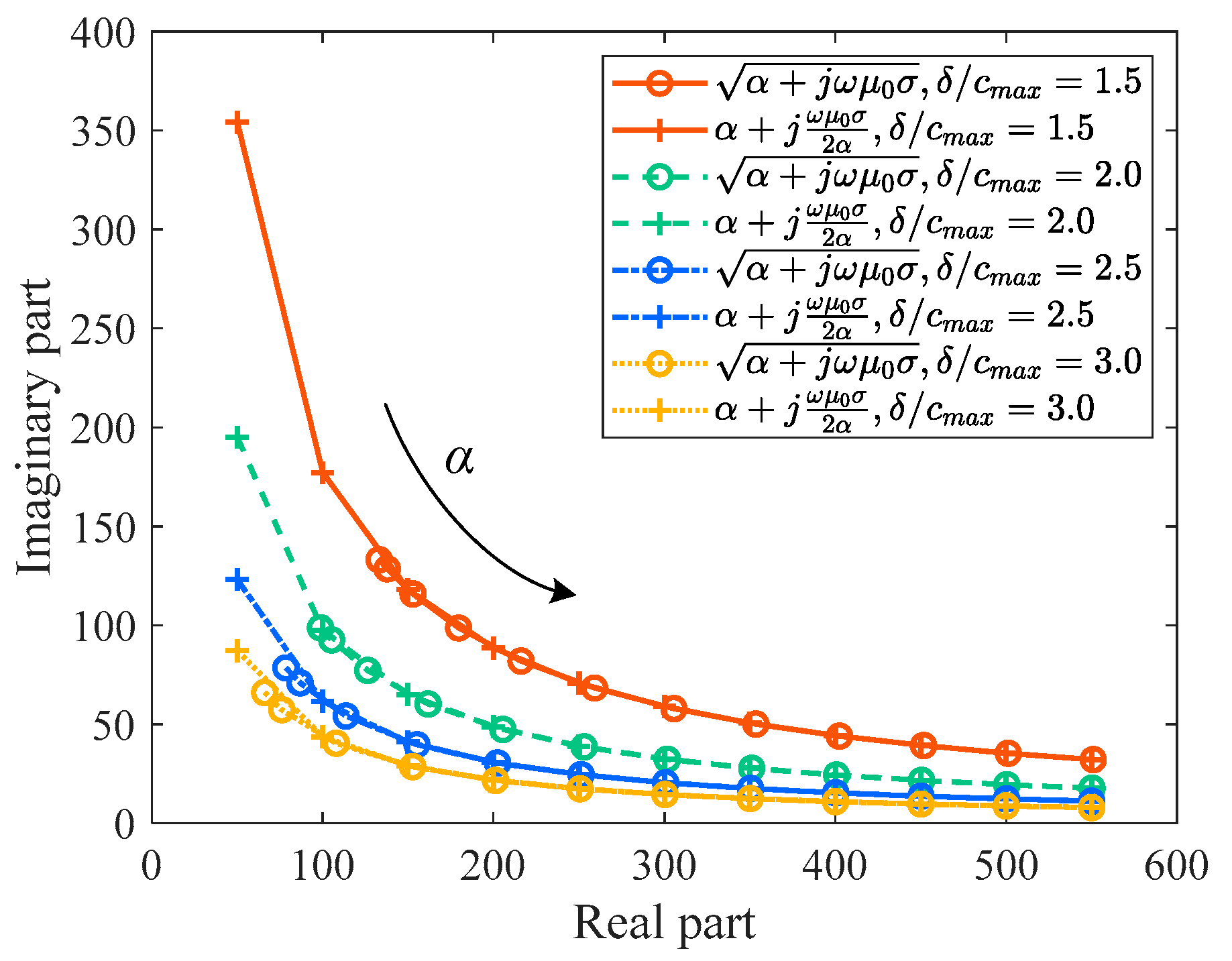
To assess the validity of this approximation within the coil impedance variation model, the complex functions defined by Equations (16) and (11) are plotted in the complex plane under different penetration depths, as shown in Figure 5.
From Figure 5, when δ ≥ 3cmax, the complex function curves represented by Equations (16) and (11) not only exhibit similar trends in the complex plane but also have closely aligned endpoints. The above analysis confirms the validity of the approximation in Equation (16) under low-frequency conditions. By substituting the approximate relation into Equation (15) and neglecting higher-order terms:
Δ Z ω π μ 0 n 2 ( l 2 l 1 ) 2 ( r 2 r 1 ) 2 0 I n t 2 ( α ) α 6 ( e α l 2 e α l 1 ) 2 × [ ω μ 0 σ c 2 ( 2 α c + 1 ) j ( ω μ 0 σ ) 2 c 2 2 α 2 ( 2 α c + 1 ) 2 ] d α
Separating the real and imaginary parts of Equation (17):
Re ( Δ Z ) ω π μ 0 n 2 ( l 2 l 1 ) 2 ( r 2 r 1 ) 2 0 I n t 2 ( α ) α 6 ( e α l 2 e α l 1 ) 2 × ω μ 0 σ c 2 ( 2 α c + 1 ) d α Im ( Δ Z ) ω π μ 0 n 2 ( l 2 l 1 ) 2 ( r 2 r 1 ) 2 0 I n t 2 ( α ) α 6 ( e α l 2 e α l 1 ) 2 × ( ω μ 0 σ ) 2 c 2 2 α 2 ( 2 α c + 1 ) 2 d α
It should be noted that all terms of the integrand in the real part of Equation (18) are continuous and strictly positive on the interval [ 0 , ] . According to the generalized form of the mean value theorem for integrals, there exists a point ξ [ 0 , ] such that the following relation holds:
Re ( Δ Z ) ω π μ 0 n 2 ( l 2 l 1 ) 2 ( r 2 r 1 ) 2 × ω μ 0 σ c 2 ( 2 ξ c + 1 ) × 0 I n t 2 ( α ) α 6 ( e α l 2 e α l 1 ) 2 d α
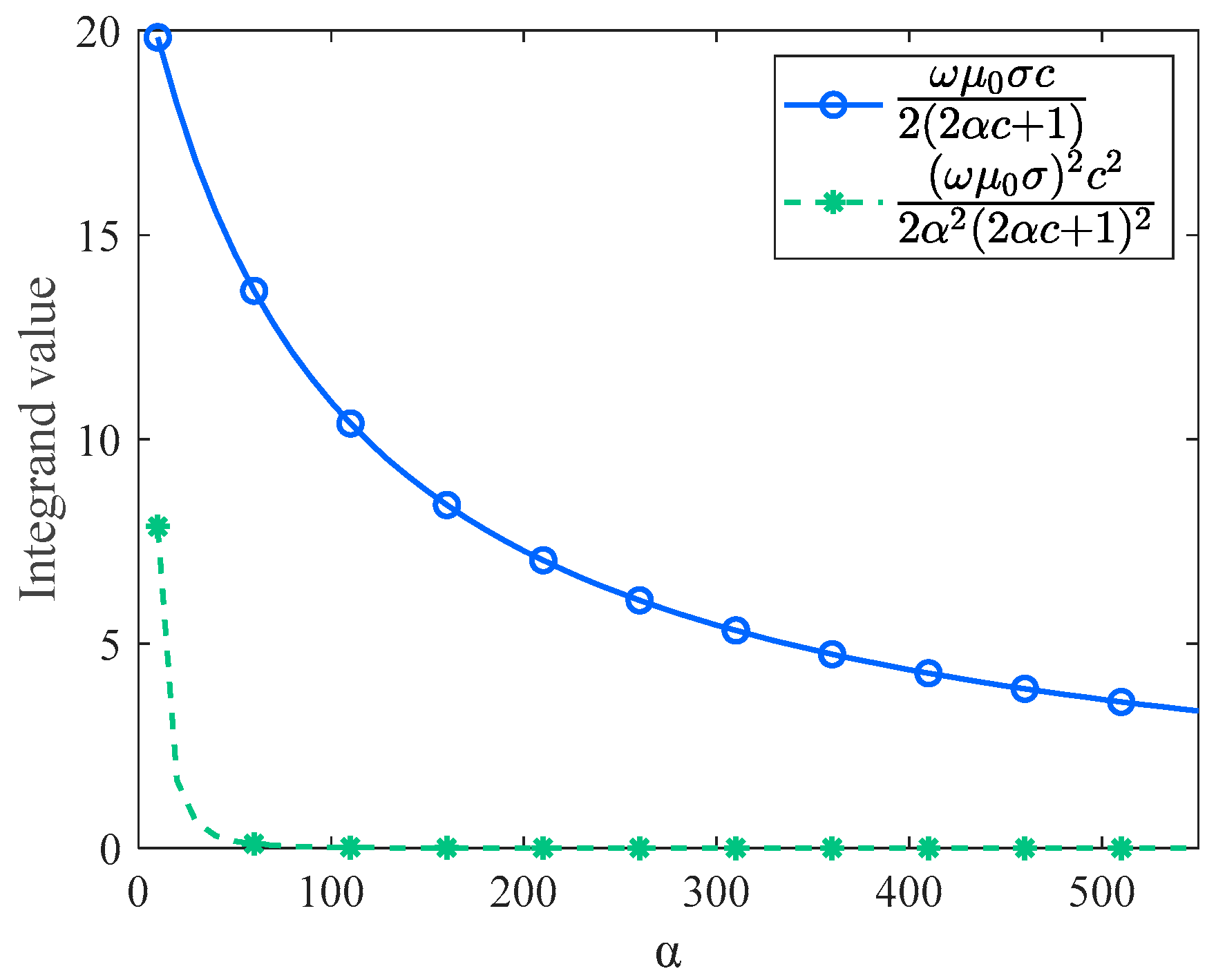
In addition, as shown in Figure 6, the imaginary term ( ω μ 0 σ ) 2 c 2 / 2 α 2 ( 2 α c + 1 ) 2 in Equation (18) exhibits a much slower variation than the real term ω μ 0 σ c / 2 ( 2 α c + 1 ) , and possesses a considerably smaller amplitude.
Therefore, compared with the real term, the imaginary term can be regarded as a constant. It can thus be evaluated at the same point ξ and taken out of the integral, as expressed in Equation (20).
Im ( Δ Z ) ω π μ 0 n 2 ( l 2 l 1 ) 2 ( r 2 r 1 ) 2 × ( ω μ 0 σ ) 2 c 2 2 ξ 2 ( 2 ξ c + 1 ) 2 × 0 I n t 2 ( α ) α 6 ( e α l 2 e α l 1 ) 2 d α
Therefore, under low-frequency excitation for which the penetration depth exceeds three times the maximum target thickness, the tangent of the phase of the coil impedance variation (phase feature) is approximately expressed by:
tan ( θ ) = Im ( Δ Z ) Re ( Δ Z ) = ω μ 0 σ c 2 ξ 3 c + ξ 2
Equation (21) describes a nonlinear relationship between the phase feature tan(θ) and the thickness of the Ti-alloy sheet, which exhibits an approximately linear increase in the initial stage and gradually approaches saturation at larger thicknesses. ξ is a quantity related to the geometric dimensions of the ECT coil, which will be elaborated later. Generally, 2ξ3c is much smaller than ξ2, so we can obtain:
tan ( θ ) = Im ( Δ Z ) Re ( Δ Z ) = ω μ 0 σ c ξ 2
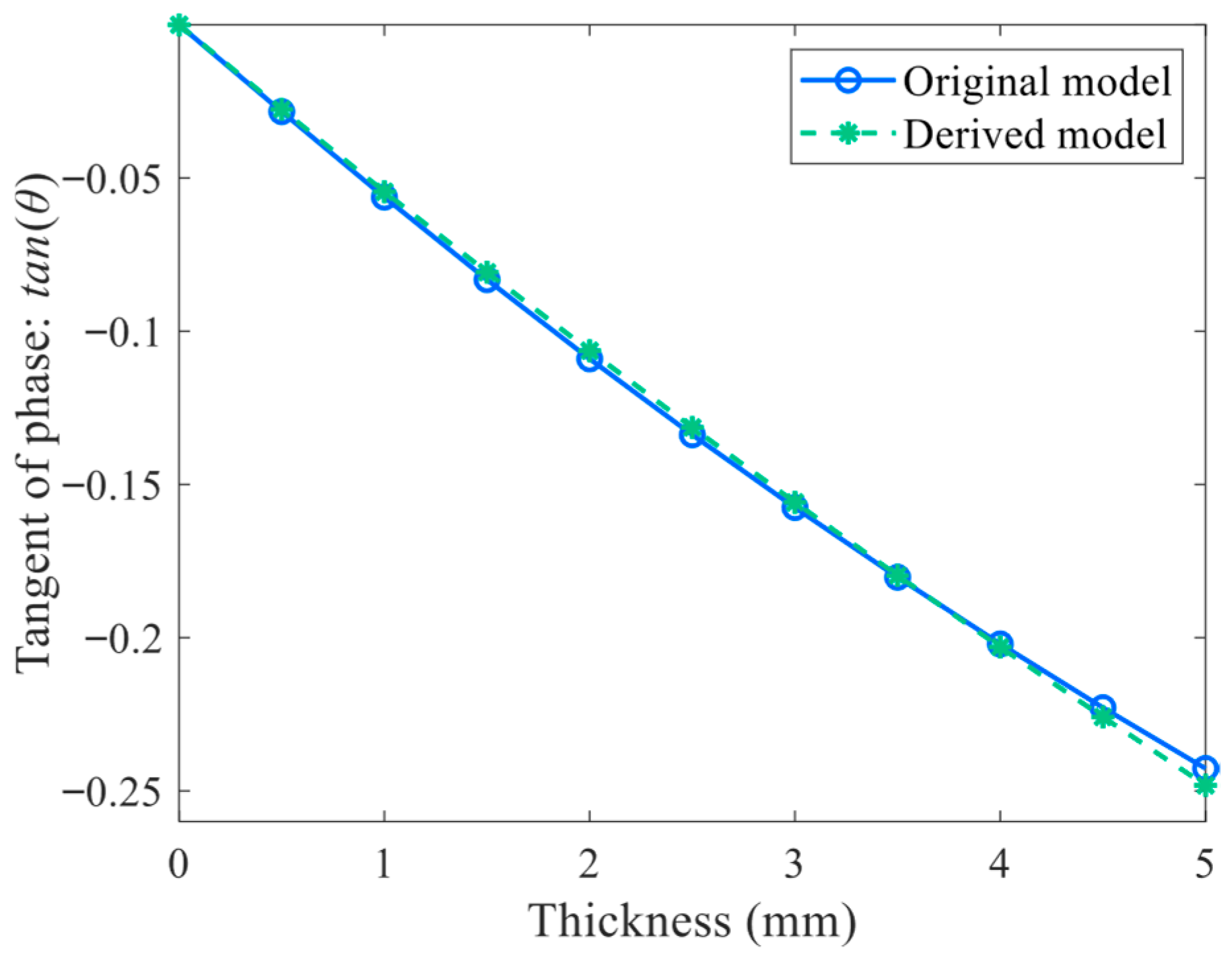
Therefore, the relationship can be regarded as approximately linear within the range of maximum target thickness, which theoretically explains the phenomenon observed previously. To preliminarily validate the derived model, the phase features calculated using Equations (3) and (21) are shown in Figure 7.
From Figure 7, the phase feature decreases with increasing Ti-alloy sheet thickness and exhibits an approximately linear relationship. Moreover, the derived model demonstrates high concordance with the original model. This confirms that the derived phase feature model can effectively replace the original model within the measurement range. In addition, it provides a linear characterization of thickness variation while achieving substantial computational simplification compared with the original model.

3.3. Analysis of Coil Geometry in the Model

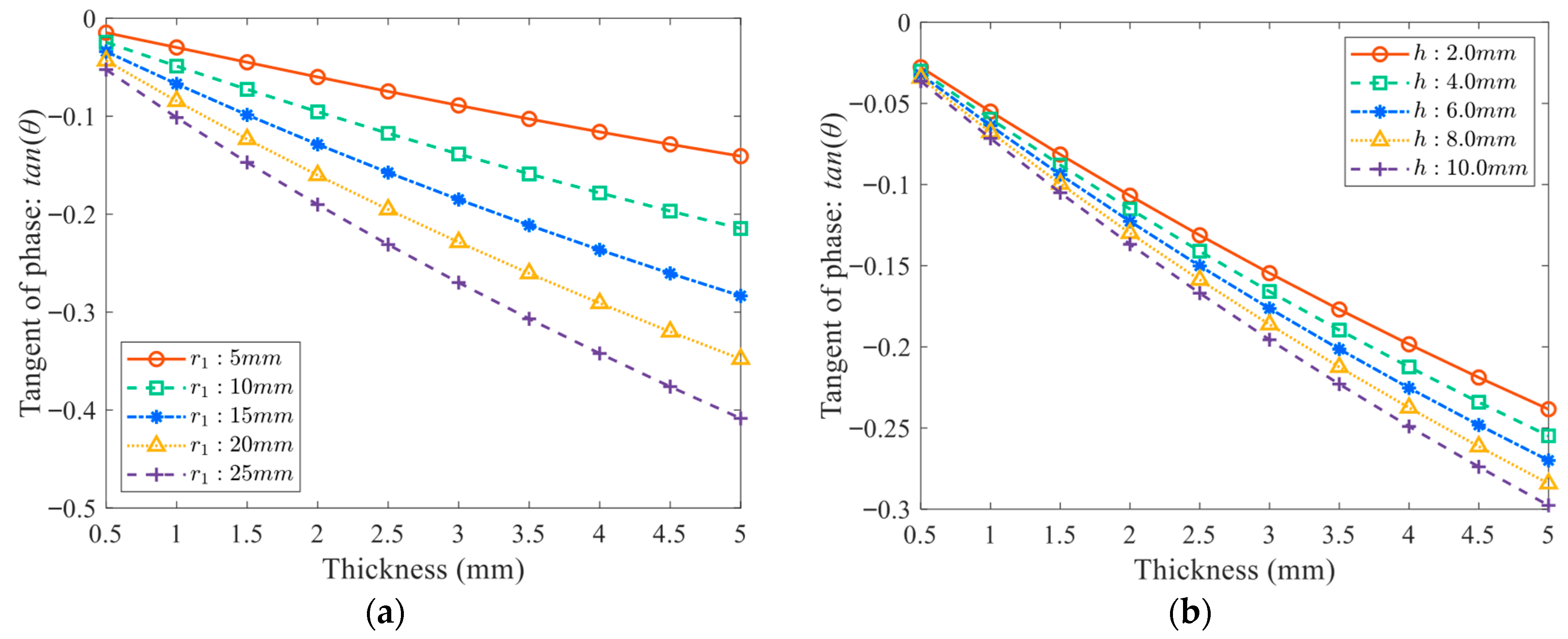
In Equation (21), besides material parameters, the phase feature depends solely on the excitation frequency and ξ. In fact, the phase is also influenced by the coil geometry [30], and it can be inferred that ξ acts as an integrated factor reflecting coil geometry. The coil is typically placed directly on the measured material surface, allowing the lift-off l1 to be considered zero and constant. Moreover, to avoid interlayer capacitive effects, the coil thickness is usually small, so that r1r2. Consequently, ξ is mainly determined by the coil inner radius r1 and height h = l2l1. Figure 8 illustrates the influence of coil radius and height on the phase feature.
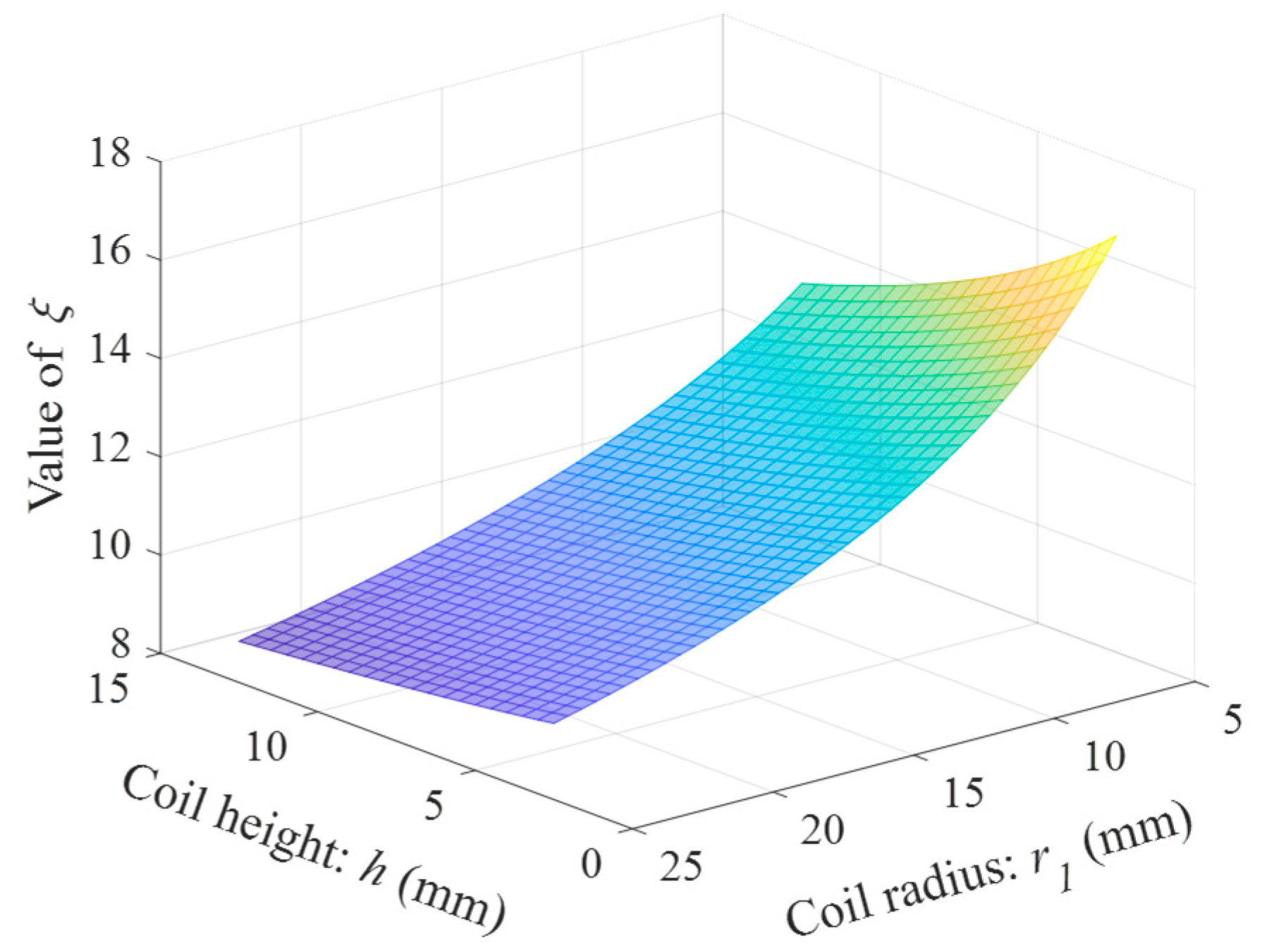
From Figure 8a, with increasing coil radius, the slope of the phase feature response curve increases in the negative direction, and the magnitude of this increase scales approximately linearly. Figure 8b indicates that the influence of the coil height on the phase feature is less significant than that of the radius. Different slopes correspond to different values of ξ, the coil radius and height may exhibit coupled effects, Figure 9 illustrates the ξ under the combined influence of these two parameters. Where the phases are calculated by Equation (3), and the values ξ are obtained by substituting the phase into Equation (21) and solving the equation.
Figure 9 reveals that ξ exhibits a coupled, nonlinear dependence on coil radius and height, with the radius exerting the dominant influence. Based on the data distribution, an expression can be obtained through polynomial fitting:
ξ ( h , r 1 ) = 10.827 0.414 h 1.439 r 1 + 0.157 h r 1 + 0.311 r 1 2
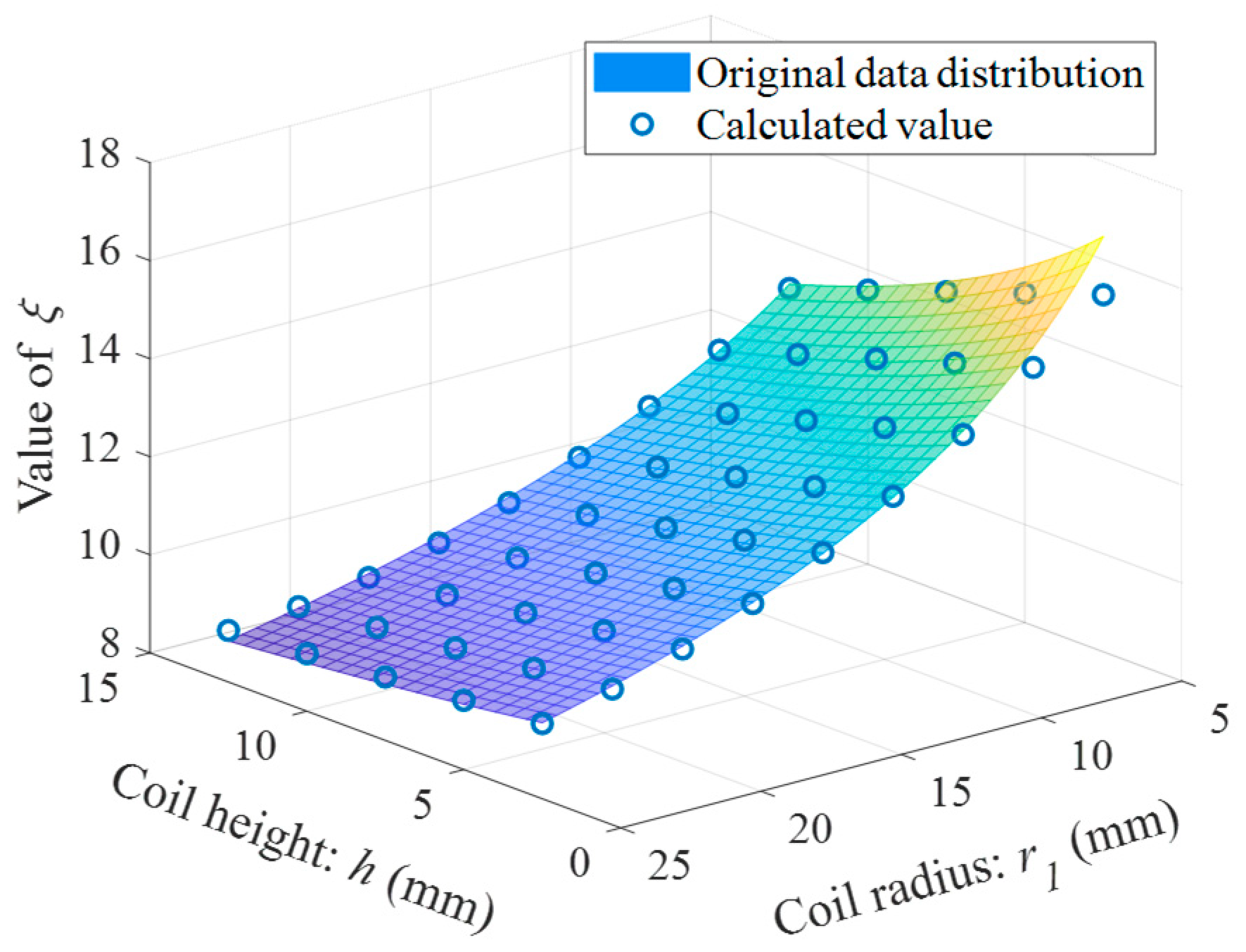
Using Equation (23), the calculated ξ values were compared with the original data distribution, as illustrated in Figure 10. The calculated values accurately reflect the original data distribution, thereby validating the effectiveness of Equation (23).
In addition, as indicated by Figure 8, the inner radius of the coil has the most significant effect on the slope phase feature (sensitivity), while the height of the coil has a smaller influence. The radius and height are potentially included in ξ, and Equation (21) indicates the value of ξ can adjust sensitivity. Therefore, Equation (23) provides a practical design tool: given a target thickness range, one can choose preliminary coil dimensions (radius and height) and use the equation to estimate the resulting ξ, then adjust the design to optimize the sensitivity (phase slope) while keeping the measurement within the linear range. The preliminary selection of coil parameters can be carried out in the following manner: existing literature [32] indicates that maximum sensitivity can be achieved when the coil radius is approximately 2.5~5 times target thickness, while the height of the coil should be less than its radius.
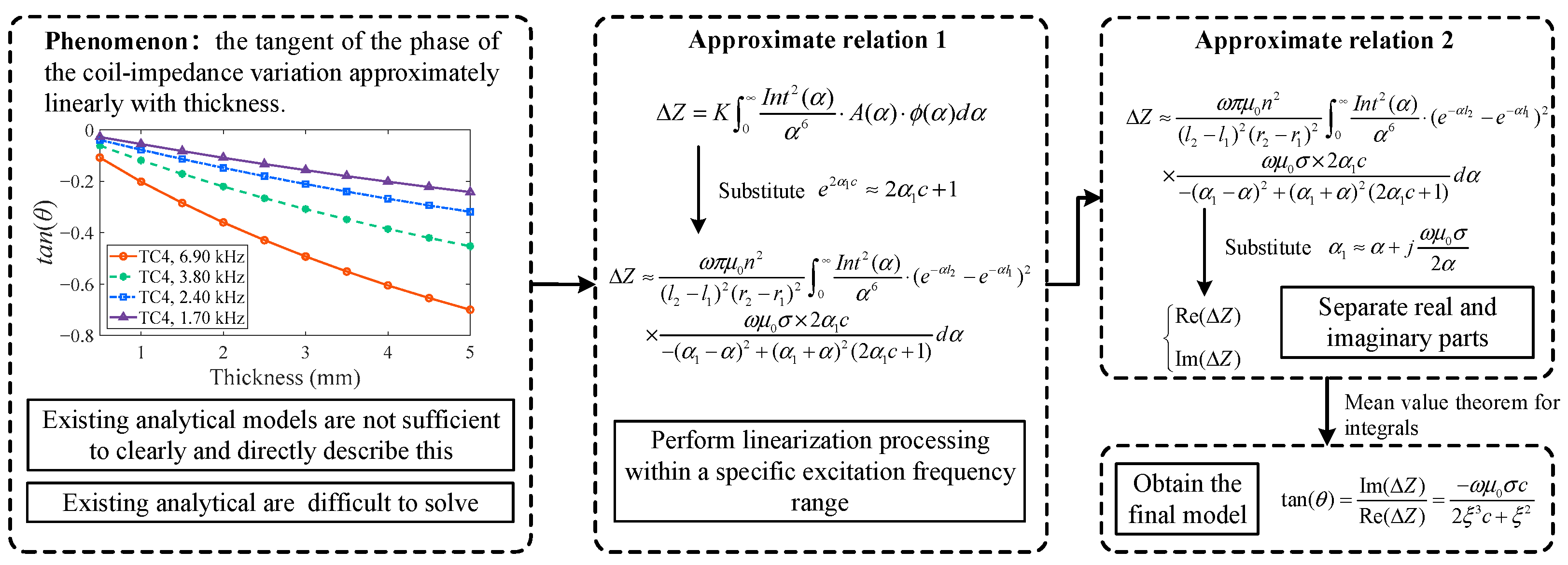
The derivation of the above model has been completed. To clearly demonstrate and summarize the reasoning process, Figure 11 illustrates the reasoning logic of the entire process. In summary, in practical EC measurement, once the coil parameters and measurement conditions are determined, the thickness of Ti-alloy sheet can be quickly and directly calculated from the acquired coil impedance variation by using Equations (21) and (23) without the need for complex iterative computation or experimental calibration to obtain a reference master curve.

4. Experiments and Discussion

4.1. Experimental Setup

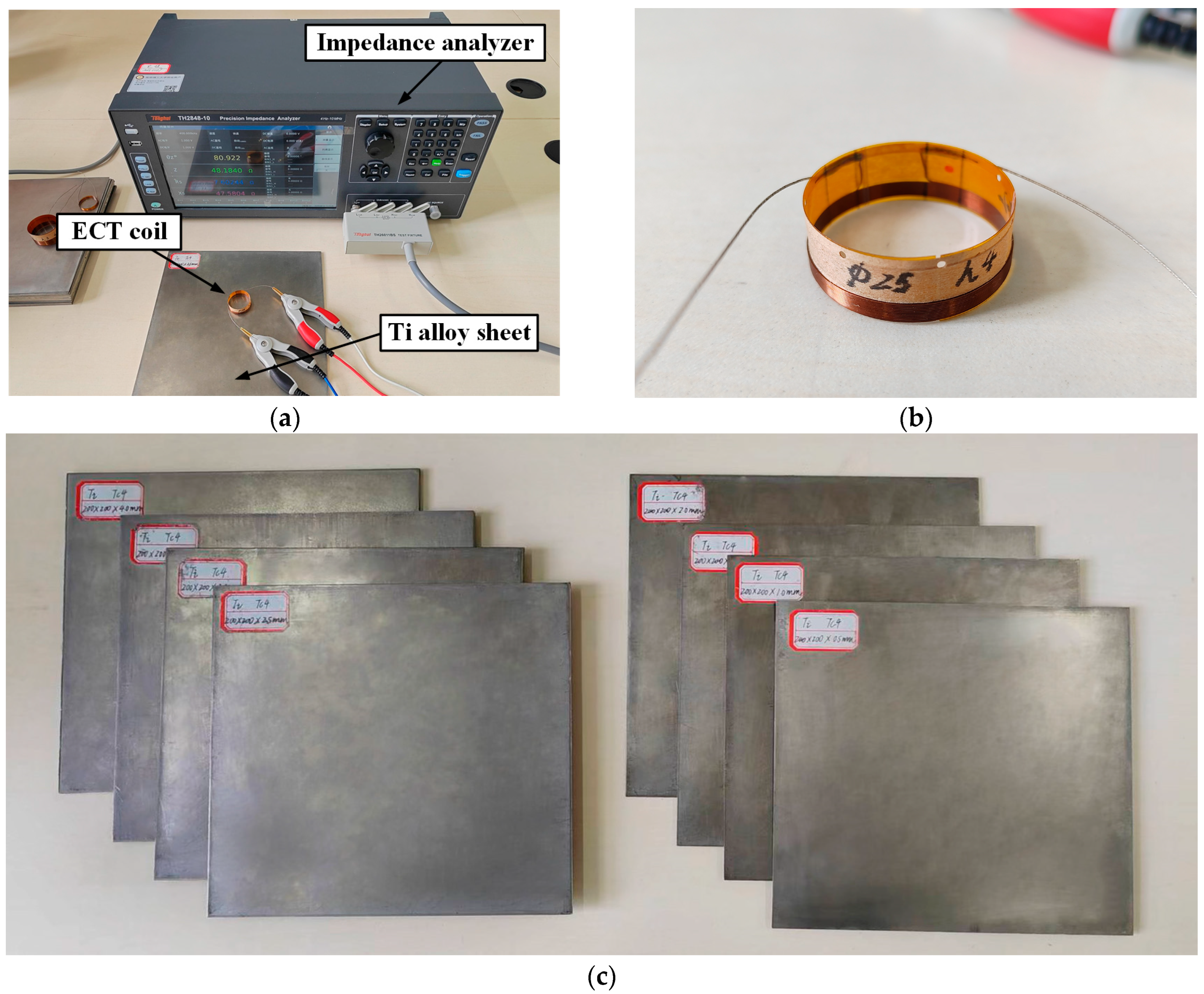
To further validate the proposed model and measurement method based on this model, a series of experimental measurements were conducted using an experimental setup equipped with a precision impedance analyzer (TH2848-10, Tonghui Electronic Co., Ltd, Changzhou, China). The composition of the experimental setup is shown in Figure 12.
From Figure 12a, the experimental setup primarily comprises a precision impedance analyzer, a custom-designed ECT coil, and Ti-alloy sheet specimens. The TH2848-10 impedance analyzer employs a sine wave as the test signal, with a frequency range from 4 Hz to 10 MHz and a basic accuracy of 0.01%. The ECT coil shown in Figure 12b was fabricated by winding enameled copper wire around an insulated cylinder, and its detailed specifications are provided in Table 2. It should be noted that most analytical models, such as the Dood-Deeds model, neglect the capacitive effect of coil, so the validity of this approximation must always be assessed in practice. The used coil can be represented by an equivalent circuit consisting of a series R–L branch (R ≈ 2.2 Ω, L ≈ 30 µH) in parallel with a small capacitance (C ≈ 15 pF). When the excitation frequency ranges from 1 to 10 kHz, the inductive reactance XL varies from 0.19 to 1.89 Ω, and the capacitive reactance XC varies from 10.6 to 1.06 MΩ. The large XC in the parallel circuit results in very little current flowing through the capacitive branch (which can be regarded as an open circuit), with almost all of the total current flowing through the inductive branch. Therefore, the coil primarily exhibits inductive behavior, and the capacitive effect can be neglected.
As shown in Figure 12c, the specimens include 8 TC4 Ti-alloy sheets, their thicknesses ranging from 0.5 mm to 4.0 mm, with a conductivity of 0.61 MS/m, and dimensions of 200 mm × 200 mm. It should be noted that the conductivity of the specimens refers to the effective conductivity. Ti-alloys are known for their pronounced anisotropy, particularly in their mechanical properties. However, available data indicate that the anisotropy of Ti-alloys in conductivity is relatively weak [33], and they are even treated as an isotropic material in ECT [34]. For example, Reference [33] reports that in rolled Ti-alloy sheets, conductivity anisotropy is mainly manifested as a difference between the rolling direction (RD) and the transverse direction (TD), with a relative difference of approximately 3%. Such weak anisotropy is typically not a primary concern in practical engineering applications of ECT. Furthermore, since ECs form circular paths that flow in multiple directions, the actual measurement is predominantly influenced by the effective conductivity. Therefore, the use of effective conductivity in both the modeling derivation and the experimental validation represents a widely accepted and practical approach.
During the experimental measurements, the test frequency of the impedance analyzer was set to 1.85 kHz, as determined by Equation (9). Before the measurement, a standard open-circuit/short-circuit calibration of the impedance analyzer should be performed to compensate for the instrument’s inherent impedance, thereby ensuring more accurate results. The ECT coil was vertically attached to the specimen surface, and thirty measurements were conducted for each specimen to calculate the mean value. It should be noted that if the coil is not properly aligned, a slight lift-off or tilt effectively reduces the coupling between the coil and the metal, thus affecting the variation in coil impedance. Fortunately, the phase-based feature is somewhat less sensitive to lift-off than absolute impedance magnitude [35], but significant misalignment will still degrade the linear relationship and the accuracy of measurement. In practice, the coil should be held parallel and centered on the surface for optimal results. If necessary, simple clamps or fixtures can be used to maintain consistency in coil placement, which can greatly enhance the reliability of measurements.

4.2. Experimental Results

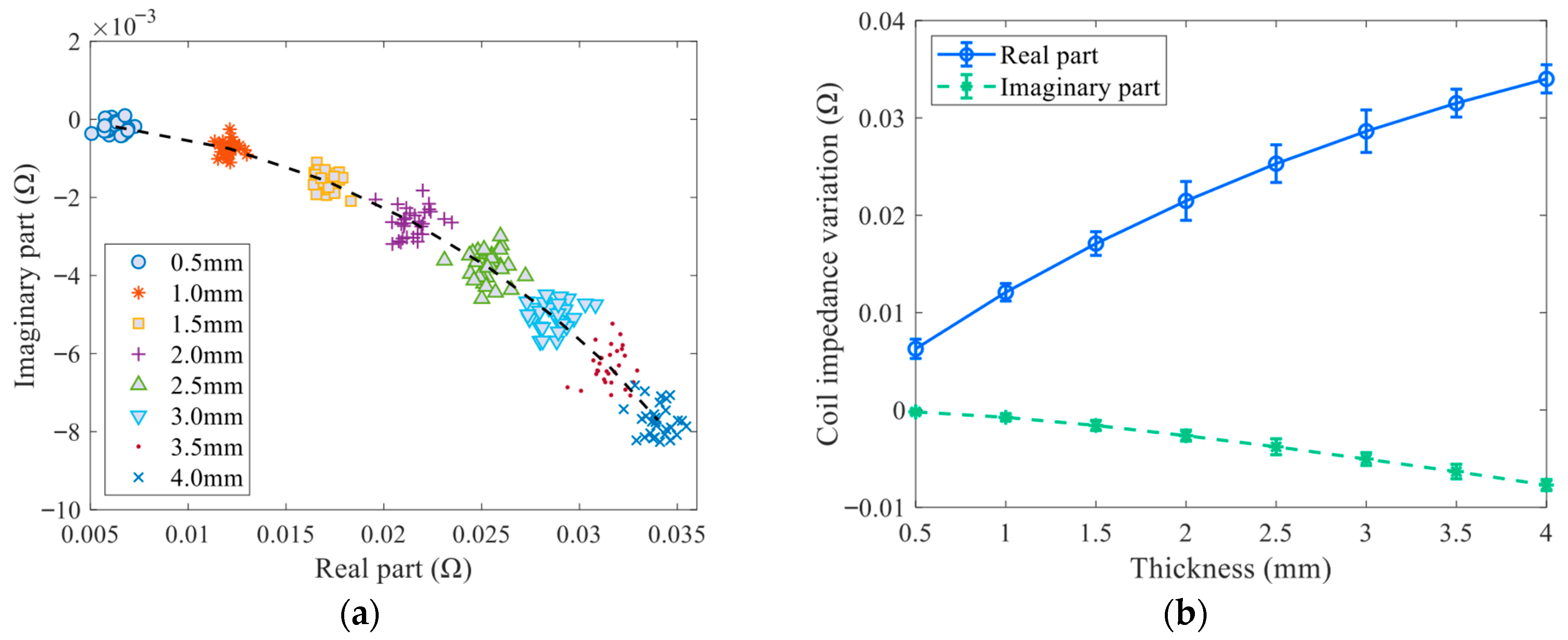
First, after completing the measurements, the distribution and trend of the raw data were examined. Figure 13a shows the characteristics of the coil impedance variation with Ti-alloy specimen thicknesses ranging from 0.5 mm to 4.0 mm under ECT, each thickness with thirty measured values. As the specimen thickness increases, the impedance points shift monotonically in a counterclockwise direction. The observed variation originates from the limited penetration depth. This, in turn, extends the path of the ECs, resulting in an increase in the coil equivalent resistance and a reduction in leakage inductance.
The relationship between the average measured impedance and the sheet thickness is illustrated in Figure 13b. As the thickness increases, the real and imaginary parts of the coil impedance variation gradually increase and decrease, respectively. The impedance variation curves are non-intersecting, indicating that thickness can be monotonically distinguished, providing a one-to-one mapping basis for subsequent inversion.
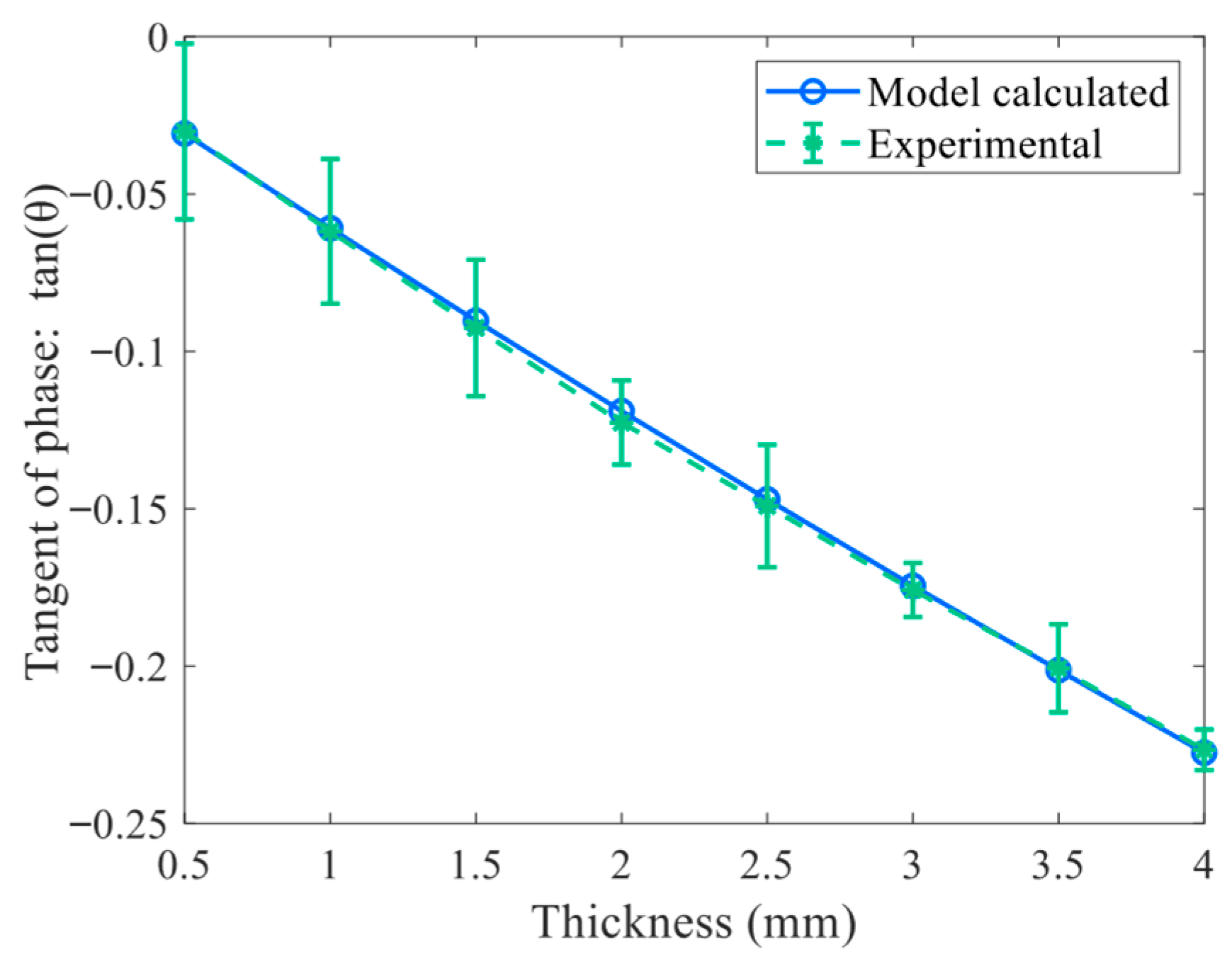
Next, phase features were computed from the measured coil-impedance variations and compared with the proposed model. Figure 14 presents a comparison between the experimental phase feature and the model-calculated values from Equation (21), where the parameter ξ is calculated as 11.958 by applying Equation (23) with the coil geometry parameters.
From Figure 14, with the thickness increasing from 0.5 to 4 mm, the phase feature tan(θ) shows an approximately linear trend of monotonically decreasing, verifying the physical phenomenon previously mentioned. Moreover, the model-calculated values show excellent agreement with the experimental values, demonstrating that the proposed model can effectively characterize the thickness variation. The data of the above experiments are listed in Table 3.
Finally, using the explicit formula of the model, the measured phase features (tan(θ)) were converted into thickness values to verify the effectiveness of the theory and the performance of the method. Based on Equation (21), the measurement thickness of Ti-alloy sheet can be calculated by:
c = tan ( θ ) ξ 2 tan ( θ ) 2 ξ 3 + ω μ 0 σ
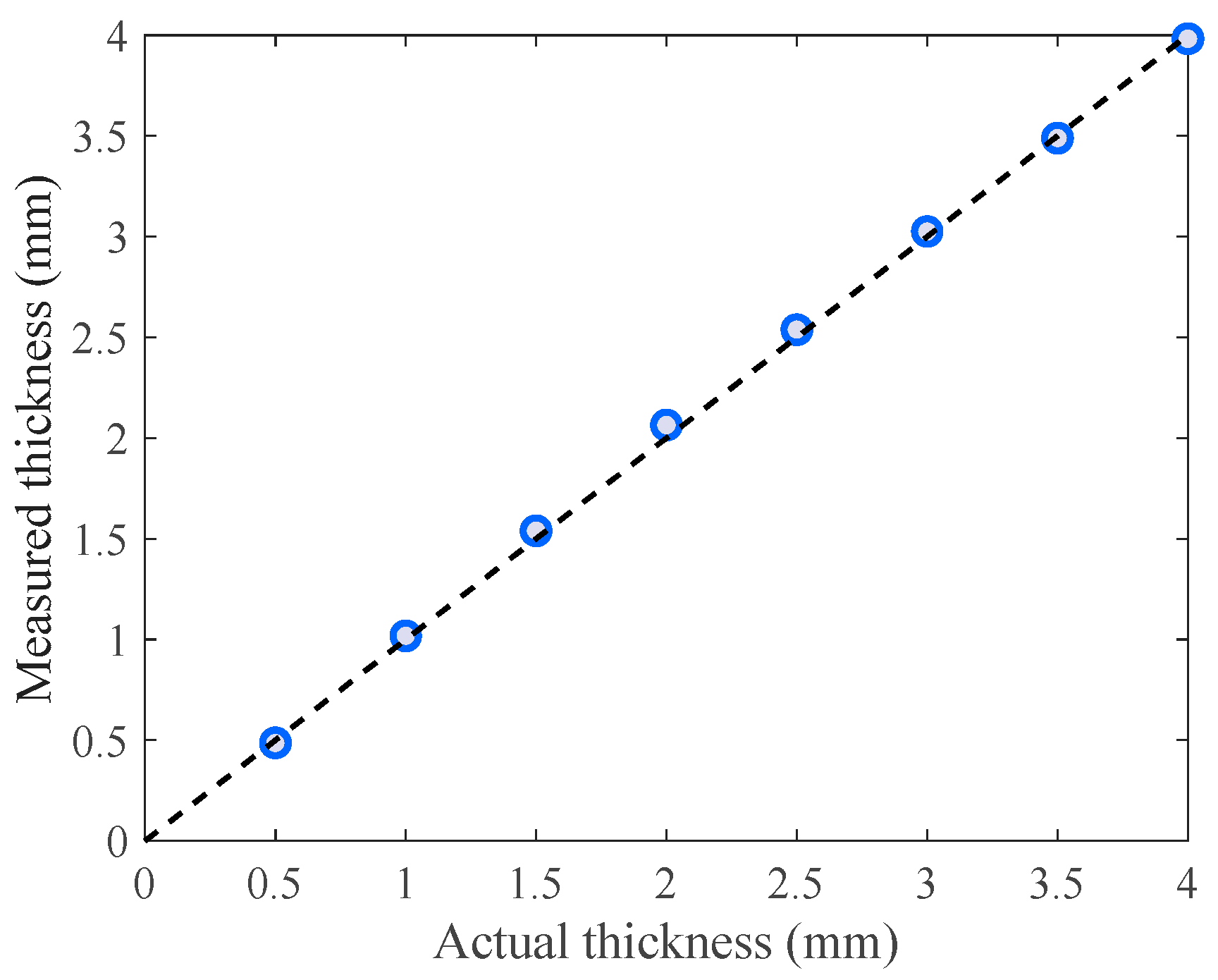
Figure 15 compares the measurement thickness with the true thickness. It can be observed that the data points corresponding to thicknesses are evenly distributed on both sides of the 1:1 reference line, with a maximum error of less than 0.1 mm.
These results confirm that the proposed phase feature model and measurement method based on this model exhibit strong linearity and high accuracy within this interval. Detailed experimental results and corresponding errors are provided in Table 4.
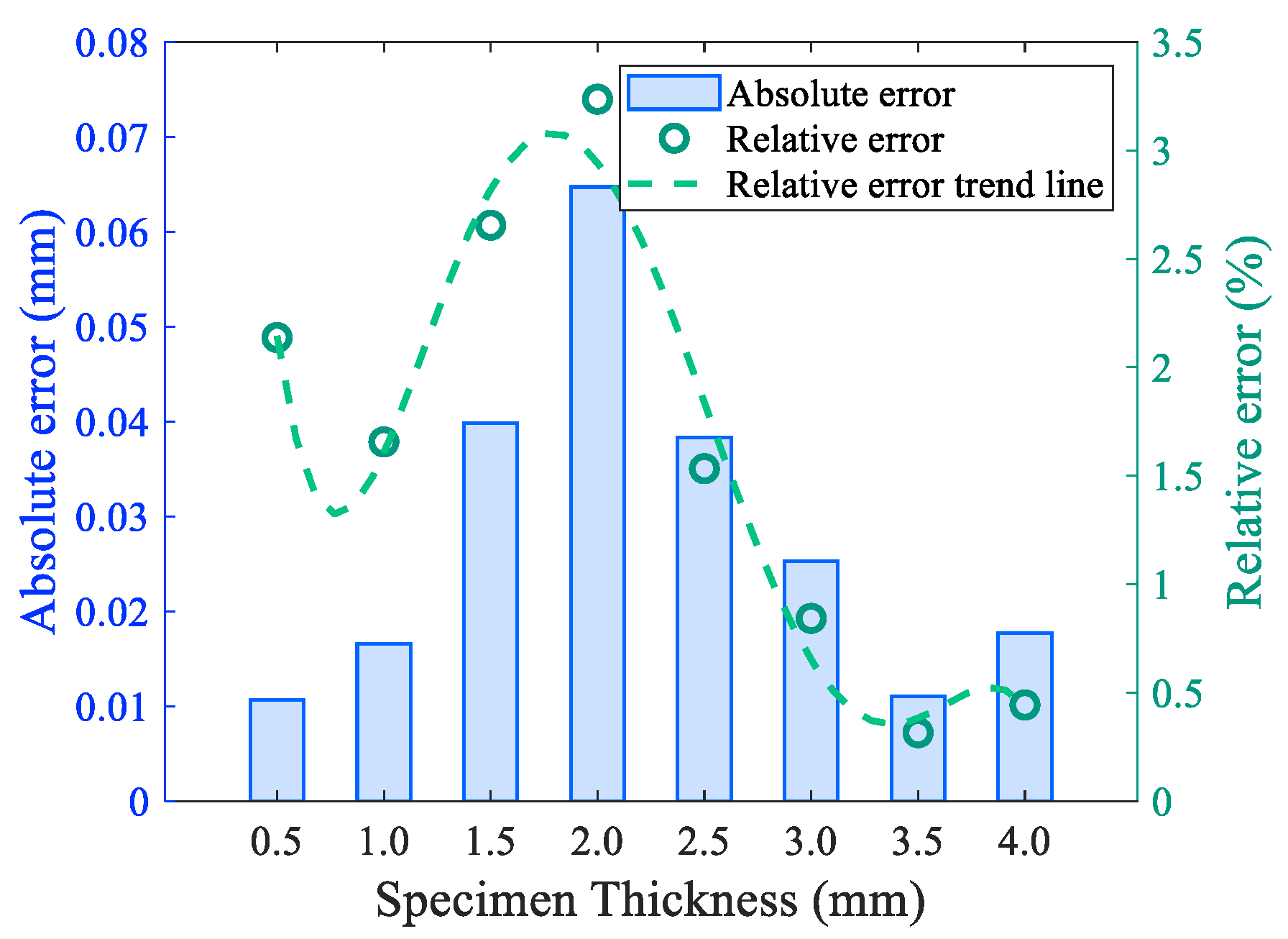
As shown in Table 4, the absolute measurement error ranges from 0.0110 to 0.0647 mm, with an average of 0.0286 mm, while the relative error varies between 0.314% and 3.235%, with a mean value of 1.696%. These error values remain within a narrow and reasonable range, once again demonstrating the high accuracy of the proposed model and method in practical measurements. It is noteworthy that the standard deviation is an order of magnitude larger than the average measurement error, and the values are similar for each specimen. This indicates that there is some fluctuation in multiple measurements, but this effect has been eliminated through averaging over multiple measurements. In addition, the 95% confidence intervals for the thickness measurements are likewise narrow, further demonstrating the reliability and repeatability of proposed model and measurement method. Furthermore, the error distribution across the measurement interval is illustrated in Figure 16 to provide a clearer performance evaluation.
As shown in Figure 16, the absolute measurement error follows a normal-like distribution with respect to thickness, being smaller at both ends of the measurement interval and reaching its maximum at 2 mm. The relative error exhibits a sinusoidal-like fluctuation when the thickness is below 2.5 mm. This phenomenon arises because the ECT coil impedance signal becomes weaker at smaller specimen thicknesses, making it more susceptible to random noise, which is ultimately reflected in the observed error fluctuations. With increasing thickness, the overall error decreases and converges, primarily because the excitation frequency was set such that the penetration depth was three times the maximum target thickness, ensuring the approximately linear response described earlier. However, as the measured thickness deviates from the maximum target value, the error of this approximation increases, leading to larger deviations in the measurement results. The observed error distribution can serve as a reference for error compensation in practical engineering applications.
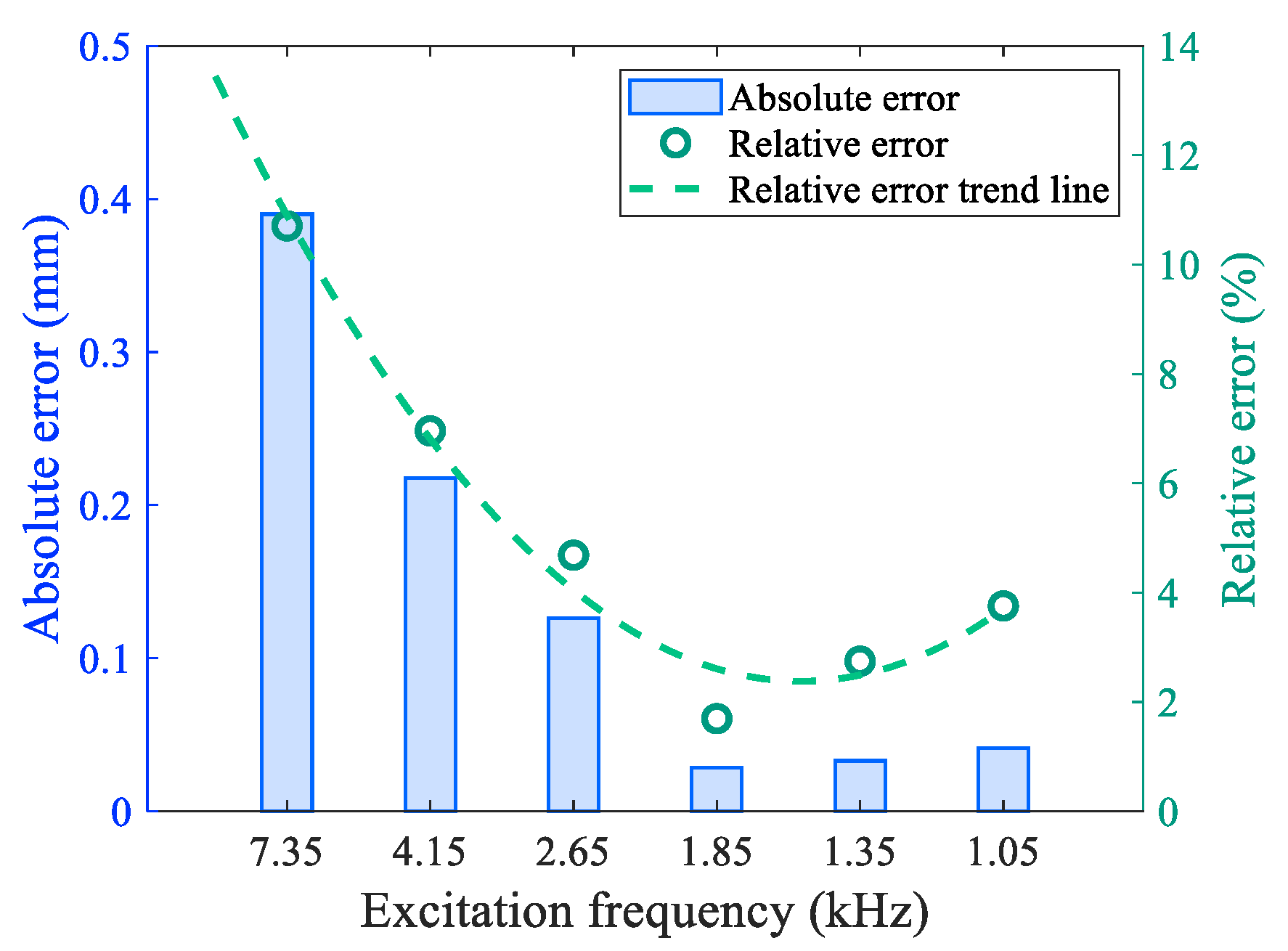
To further investigate the influence of excitation frequency on measurement performance, additional experiments were conducted under different excitation frequencies ranging from 6.9 kHz to 1.0 kHz. The experimental steps are the same as before; Figure 17 illustrates the corresponding absolute and relative measurement errors.
It can be observed that both absolute and relative errors exhibit a decreasing trend with decreasing frequency. At higher frequencies (e.g., 7.35 kHz and 4.15 kHz), the EC penetration depth is relatively shallow, resulting in a nonlinear relationship between the phase feature and thickness and consequently larger measurement errors. As the frequency decreases and the penetration depth greater than approximately three times the maximum sheet thickness, the linear relationship between the phase tangent and thickness holds true, and the measurement accuracy remains high within a certain frequency range. The minimum error occurs near 1.85 kHz. However, when the frequency is further reduced (e.g., below 1.35 kHz), the signal-to-noise ratio decreases, causing a slight increase in errors. In particular, for a given maximum thickness, we recommend choosing the highest excitation frequency that still satisfies the penetration depth greater than about three times the maximum thickness. This ensures a linear response while maintaining a strong signal. Based on the above analysis, a highly accurate selected value of excitation frequency is not required. It suffices to calculate using Equation (9) based on the nominal conductivity of the measured sheet, as the proposed model and method is effective within a certain frequency range.

4.3. Practical Application and Comparative Analysis

The proposed model and ECT thickness measurement method have significant real-world applications in various industries, and they offer distinct advantages over conventional techniques. For instance, in aerospace manufacturing, thin-walled Ti-alloy components (such as aircraft skin panels or turbine blades) require precise thickness control and inspection. The one-sided inspection of ECT allows rapid scanning of such components without disassembly. In addition, the in-service inspection of these aerospace components is generally carried out using portable small-sized instruments. For portable instruments with limited hardware resources, the proposed lightweight model is particularly advantageous. In pressure vessel inspection and maintenance, wall thinning caused by corrosion can be measured using the model and method proposed in this paper. The proposed model explicitly describes the relationship between measured thickness and ECT phase feature in a continuous manner. Theoretically, as long as the acquisition hardware has sufficient resolution, it can monitor even minor thinning, which will facilitate the accurate evaluation of the service life of pressure vessels. A particularly compelling application is online thickness monitoring during Ti-alloy sheet rolling in manufacturing. During the rolling process, maintaining uniform thickness is crucial to product quality. The ECT sensor can be mounted above a moving Ti-alloy sheet to provide continuous, real-time thickness measurements. Because the method is single-sided and tolerates a variable lift-off gap, it can measure moving targets without physical contact. Moreover, the proposed model is simple and fast to calculate, making it ideal for integration into a high-speed production line, ensuring timely feedback for process control.
To highlight the advantages of the proposed model and method, Table 5 compares some representative ECT methods. Different methods exhibit distinct advantages and limitations regarding excitation frequency requirements, calibration needs, and measurement accuracy.
Early approaches (e.g., [15,16,17]) relied primarily on experimental calibration to construct a master curve that correlates thickness with an ECT signal feature; the unknown thickness was then obtained by interpolating the measured signal on this curve. However, such relationships often lack rigorous theoretical underpinning and clear physical interpretation. In addition, master curves can introduce error due to the discrete thickness intervals of calibration specimens, and the preliminary calibration itself is labor-intensive. Model-based methods (e.g., [18,19,20,21,22,23]) generally avoid reference calibration and iterative fitting. Nevertheless, multi-frequency schemes require sampling at several frequencies, imposing higher demands on signal processing and system integration, which is not conducive to rapid inversion or deployment on portable instruments with limited hardware resources. Single-frequency methods are easier to implement, but the use of fewer signal features can limit accuracy and places greater reliance on precise modeling.
In contrast, the method proposed here is derived through rigorous mathematical analysis and uses the phase of the impedance variation as a direct measurement feature. Thickness is estimated at a single excitation frequency, without master-curve calibration or iterative computation. Despite its simplicity and low computational cost, the method achieves high accuracy, with a relative error below 3.5%, comparable to or better than most related techniques. In summary, the proposed method demonstrates both theoretical soundness and practical utility, offering a favorable combination of speed, accuracy, and portability for targeted applications. It is therefore a promising solution for non-destructive thickness evaluation of Ti-alloy sheets.

5. Conclusions

This study has revealed that a linear relationship exists between the Ti-alloy sheet thickness and the tangent of the phase of the ECT coil impedance variation when the EC penetration depth exceeds three times the maximum target thickness. A theoretical explanation for this phenomenon is also provided. Motivated by this finding and the demand of rapid thickness measurement, this paper analyzes the low-frequency ECT response of Ti-alloy and achieves explicit separation of the real and imaginary parts of the coil impedance variation at a specific integration point. An analytical model is thereby developed with the objective of quantifying the correlation between the phase feature and the thickness of the Ti-alloy sheet. The model can be expressed as an explicit inversion formula that directly calculates thickness from measured impedance. Consequently, the model-based measurement method avoids the need for master-curve calibration or iterative calculations. The experimental results show that the measurement error of the proposed model-based measurement method is less than 3.5%, which can fully meet the actual monitoring and re-inspection requirements of the Ti industry and Ti-alloy products. By transforming thickness measurement from a black-box calibration process into a white-box analytical method, this study significantly improves computational efficiency, offering a rapid and high-accuracy solution for measuring Ti-alloy sheet thickness in manufacturing and in-service applications. Furthermore, it introduces a new “lightweight modeling, high applicability” paradigm for the non-destructive testing of other low-conductivity metal materials. However, the study still has room for improvement regarding the generalization of its application objects. Future work will extend validation to thicker and non-uniform Ti-alloy specimens and evaluate the method on other conductive, non-magnetic metals to establish generality. We will also improve the signal-to-noise ratio at low frequencies via averaging, coil redesign, or multi-frequency operation.

Author Contributions

Conceptualization, J.B. and H.L.; methodology, J.B.; validation, X.Z.; formal analysis, X.Z.; investigation, J.B. and X.Z.; resources, J.B.; data curation, H.L.; writing—original draft preparation, J.B.; writing—review and editing, T.X. and Y.L.; visualization, T.X. and Y.L.; supervision, H.L.; project administration, Y.L.; funding acquisition, J.B. All authors have read and agreed to the published version of the manuscript.

Funding

This work was supported in part by the National Natural Science Foundation of China under Grant 62203195, in part by the Yunnan Xingdian Talents Support Plan Project under Grant XDYC-QNRC-2023-0030.

Data Availability Statement

The original contributions presented in this study are included in the article. Further inquiries can be directed to the corresponding authors.

Conflicts of Interest

Authors Hongwei Liu, Tianhua Xie and Yan Li were employed by the company Yunnan Dahongshan Pipeline Co., Ltd. The remaining authors declare that the research was conducted in the absence of any commercial or financial relationships that could be construed as a potential conflict of interest.

References

  1. Fang, X.; Liu, L.; Lu, J.; Gao, Y. Optimization of Forging Process Parameters and Prediction Model of Residual Stress of Ti-6Al-4V Alloy. Adv. Mater. Sci. Eng. 2021, 2021, 3105470. [Google Scholar] [CrossRef]
  2. Najafizadeh, M.; Yazdi, S.; Bozorg, M.; Ghasempour-Mouziraji, M.; Hosseinzadeh, M.; Zarrabian, M.; Cavaliere, P. Classification and applications of titanium and its alloys: A review. J. Alloys Compd. Commun. 2024, 3, 100019. [Google Scholar] [CrossRef]
  3. Williams, J.C.; Boyer, R.R. Opportunities and Issues in the Application of Titanium Alloys for Aerospace Components. Metals 2020, 10, 705. [Google Scholar] [CrossRef]
  4. Bran, D.; Elefterie, C.; Ghiban, B. Aeronautical Industry Requirements for Titanium Alloys. IOP Conf. Ser. Mater. Sci. Eng. 2017, 209, 012059. [Google Scholar] [CrossRef]
  5. Zhao, H.; Zhou, Z.; Zhang, D.; Wang, D. Inspection of disbonds in titanium alloy honeycomb sandwich structures with different skin thicknesses using linear frequency-modulated thermography. Appl. Opt. 2020, 59, 7186–7194. [Google Scholar] [CrossRef]
  6. Ogawa, K.; Harada, Y. Effect of Heat Treatment on Mechanical Properties of Heavily Cold Rolled Pure Titanium. In Proceedings of the Mechanical Engineering Congress, Toyama, Japan, 11–14 September 2022. [Google Scholar]
  7. Satoh, J.; Gotoh, M.; Maeda, Y. Stretch-drawing of titanium sheets. J. Mater. Process. Technol. 2003, 139, 201–207. [Google Scholar] [CrossRef]
  8. Saidi, B.; Moreau, L.G.; Cherouat, A.; Nasri, R. Accuracy and Sheet Thinning Improvement of Deep Titanium Alloy Part with Warm Incremental Sheet-Forming Process. J. Manuf. Mater. Process. 2021, 5, 122. [Google Scholar] [CrossRef]
  9. Honarvar, F.; Varvani-Farahani, A. A review of ultrasonic testing applications in additive manufacturing: Defect evaluation, material characterization, and process control. Ultrasonics 2020, 108, 106227. [Google Scholar] [CrossRef]
  10. Yanqin, L.; Huaili, Q.; Aifeng, L.; Shan, K.; Guang, Y.; Qiang, W.; Jingjing, L. Mass thickness detection and verification for radiation processing products based on X-ray detection technology. J. Radiat. Res. Radiat. Process. 2021, 39, 63–71. [Google Scholar]
  11. Repelianto, A.S.; Kasai, N.; Sekino, K.; Matsunaga, M. A Uniform Eddy Current Probe with a Double-Excitation Coil for Flaw Detection on Aluminium Plates. Metals 2019, 9, 1116. [Google Scholar] [CrossRef]
  12. Gao, P.; Yan, X.; He, J.; Yang, H.; Chen, X.; Gao, X. Processing of Eddy Current Infrared Thermography and Magneto-Optical Imaging for Detecting Laser Welding Defects. Metals 2025, 15, 119. [Google Scholar] [CrossRef]
  13. Lee, K.; Hao, B.; Li, M.; Bai, K. Multiparameter Eddy-Current Sensor Design for Conductivity Estimation and Simultaneous Distance and Thickness Measurements. IEEE Trans. Ind. Inf. 2019, 15, 1647–1657. [Google Scholar] [CrossRef]
  14. Ulapane, N.; Nguyen, L. Review of Pulsed-Eddy-Current Signal Feature-Extraction Methods for Conductive Ferromagnetic Material-Thickness Quantification. Electronics 2019, 8, 470. [Google Scholar] [CrossRef]
  15. Angani, C.S.; Park, D.G.; Kim, G.D.; Kim, C.G.; Cheong, Y.M. Differential pulsed eddy current sensor for the detection of wall thinning in an insulated stainless steel pipe. J. Appl. Phys. 2010, 107, 09E720. [Google Scholar] [CrossRef]
  16. Wang, H.; Li, W.; Feng, Z. Noncontact Thickness Measurement of Metal Films Using Eddy-Current Sensors Immune to Distance Variation. IEEE Trans. Instrum. Meas. 2015, 64, 2557–2564. [Google Scholar] [CrossRef]
  17. Nebair, H.; Cheriet, A.; Ghoul, I.E.; Helifa, B.; Bensaid, S.; Lefkaier, I. Bi-eddy current sensor based automated scanning system for thickness measurement of thick metallic plates. Int. J. Adv. Manuf. Technol. 2018, 96, 2867–2873. [Google Scholar] [CrossRef]
  18. Lu, M.; Meng, X.; Huang, R.; Chen, L.; Peyton, A.; Yin, W.; Qu, Z. Thickness measurement of circular metallic film using single-frequency eddy current sensor. NDT E Int. 2021, 119, 102420. [Google Scholar] [CrossRef]
  19. Lu, M.; Chen, L.; Meng, X.; Huang, R.; Peyton, A.; Yin, W. Thickness Measurement of Metallic Film Based on a High-Frequency Feature of Triple-Coil Electromagnetic Eddy Current Sensor. IEEE Trans. Instrum. Meas. 2021, 70, 6001208. [Google Scholar] [CrossRef]
  20. Li, C.; Fan, M.; Cao, B.; Wang, Q. Accurate Thickness Measurement Using Eddy Current System Based on Novel Transformer Model. IEEE Trans. Instrum. Meas. 2022, 71, 6007712. [Google Scholar] [CrossRef]
  21. Li, C.; Fan, M.; Cao, B.; Ye, B.; Wang, Q.; Jiang, J. Thickness Measurement of Thermal Barrier Coating Based on Mutual Inductance of Eddy Current System. IEEE Trans. Ind. Electron. 2024, 71, 8099–8109. [Google Scholar] [CrossRef]
  22. Sardellitti, A.; Milano, F.; Laracca, M.; Ventre, S.; Ferrigno, L.; Tamburrino, A. An Eddy-Current Testing Method for Measuring the Thickness of Metallic Plates. IEEE Trans. Instrum. Meas. 2023, 72, 6004610. [Google Scholar] [CrossRef]
  23. Xia, Z.; Huang, R.; Lu, M.; Yin, W. Thickness and Permeability Estimation of Metallic Plates by Triple-Frequency Eddy-Current Testing with Probe Lift-Off. IEEE Trans. Instrum. Meas. 2024, 73, 6000208. [Google Scholar] [CrossRef]
  24. She, S.; Xia, Z.; Zheng, X.; Yin, W. Simultaneous measurements of metal thickness and defect depth using low frequency sweeping eddy current testing. In Proceedings of the 2024 IEEE International Instrumentation and Measurement Technology Conference (I2MTC), Glasgow, UK, 20–23 May 2024; pp. 1–5. [Google Scholar]
  25. Yan, C.; Bao, J.; Zheng, X. Conductivity Measurement for Non-Magnetic Materials Using Eddy Current Method with a Novel Simplified Model. Sensors 2025, 25, 3900. [Google Scholar] [CrossRef]
  26. Zhang, J.; Yuan, M.; Xu, Z.; Kim, H.-J.; Song, S.-J. Analytical approaches to eddy current nondestructive evaluation for stratified conductive structures. J. Mech. Sci. Technol. 2015, 29, 4159–4165. [Google Scholar] [CrossRef]
  27. Dodd, C.V.; Deeds, W.E. Analytical solutions to eddy current probe coil problems. J. Appl. Phys. 1968, 39, 2829–2838. [Google Scholar] [CrossRef]
  28. Li, W.; Ye, Y.; Zhang, K.; Feng, Z. A Thickness Measurement System for Metal Films Based on Eddy-Current Method With Phase Detection. IEEE Trans. Ind. Electron. 2017, 64, 3940–3949. [Google Scholar] [CrossRef]
  29. Angani, C.S.; Ramos, H.G.; Ribeiro, A.L.; Rocha, T.J. Evaluation of transient eddy current oscillations response for thickness measurement of stainless steel plate. Measurement 2016, 90, 59–63. [Google Scholar] [CrossRef]
  30. Yin, W.; Peyton, A.J. Thickness measurement of non-magnetic plates using multi-frequency eddy current sensors. NDT E Int. 2007, 40, 43–48. [Google Scholar] [CrossRef]
  31. Yin, W.; Peyton, A.J. Thickness Measurement of Metallic Plates with an Electromagnetic Sensor Using Phase Signature Analysis. IEEE Trans. Instrum. Meas. 2008, 57, 1803–1807. [Google Scholar] [CrossRef]
  32. Dodd, C.V. Thickness measurements using eddy current techniques. Mater. Eval. 1973, 31, 73. [Google Scholar]
  33. Zhang, S.; Ma, Y.; Wang, Q.; Qi, M.; Huang, S.; Lei, J.; Yang, R. Mechanical Properties and Electrical Conductivity of α + β Titanium Alloy Sheet Regulated by Heat Treatment. Acta Met. Sin 2023, 60, 1622–1636. [Google Scholar]
  34. Wang, S.; Zeng, Z.; Liao, Y.; Cao, Z. The roles of conductivity in eddy current distributions in nondestructive testing of isotropic and anisotropic materials. Nondestr. Test. Eval. 2025, 1–16. [Google Scholar] [CrossRef]
  35. Huang, P.; Li, Z.; Pu, H.; Jia, J.; Liu, K.; Xu, L.; Xie, Y. Conductivity Measurement of Non-magnetic Material Using the Phase Feature of Eddy Current Testing. J. Nondestr. Eval. 2023, 42, 50. [Google Scholar] [CrossRef]
Figure 1. Schematic of the ECT physical model. (Reprinted from Ref. [25]).
Metals 15 01210 g001
Figure 2. The response of coil impedance variations to Ti-alloy sheet thickness at various frequencies: (a) Real part; (b) Imaginary part; (c) Magnitude; (d) Tangent of phase.
Metals 15 01210 g002
Figure 3. Phase feature response of different Ti-alloy grades.
Metals 15 01210 g003
Figure 4. Comparison between original and approximate integrand function: (a) 6.9 kHz, δ = 1.5 cmax; (b) 3.8 kHz, δ = 2.0 cmax; (c) 2.4 kHz, δ = 2.5 cmax; (d) 1.7 kHz, δ = 3.0 cmax.
Metals 15 01210 g004
Figure 5. Comparison between original and approximate α1 in the complex plane.
Metals 15 01210 g005
Figure 6. The trend of Real and imaginary terms.
Metals 15 01210 g006
Figure 7. Validation of the phase feature model.
Metals 15 01210 g007
Figure 8. Influence of coil parameters on phase feature: (a) coil radius; (b) coil height.
Metals 15 01210 g008
Figure 9. The ξ under the combined influence of coil radius and height.
Metals 15 01210 g009
Figure 10. The calculation result of the value of ξ.
Metals 15 01210 g010
Figure 11. Model reasoning logic diagram.
Metals 15 01210 g011
Figure 12. Experimental setup: (a) Impedance analyzer; (b) ECT coil; (c) TC4 Ti-alloy specimen.
Metals 15 01210 g012
Figure 13. Coil impedance variation measured on different specimens: (a) Impedance variations in the complex plane; (b) Average impedance variation with specimen thickness.
Metals 15 01210 g013
Figure 14. Experimental and model-calculated phase features.
Metals 15 01210 g014
Figure 15. Results of thickness measurement.
Metals 15 01210 g015
Figure 16. Distribution of measurement error with thickness.
Metals 15 01210 g016
Figure 17. Distribution of measurement error with excitation frequency.
Metals 15 01210 g017
Table 1. Simulation calculation parameters.
ParameterValue
Inner and outer radius of the coil (r1/r2)12.0/12.4 mm
Lift-off and height of the coil (l1/l2)0.0/2.5 mm
Turns of the coils (n)24
Thickness range (c)0.1:0.1:5.0 mm
Conductivity (σ)0.65 MS/m
Excitation frequency (f)6.9, 3.8, 2.4 and 1.7 kHz
Table 2. Parameters of the ECT coil.
ParameterValue
Inner and outer radius of the coil (r1/r2)12.5/13.0 mm
Lift-off and height of the coil (l1/l2)0.0/4.0 mm
Turns of the coils (n)40
Diameter of enameled copper wire0.2 mm
Table 3. Detailed data of experimental results.
No.Specimen
Thickness (mm)
Impedance Variation Real Part (Ω)Impedance Variation
Imaginary Part (Ω)
Experimental tan(θ)Model Calculated tan(θ)
10.50.006288−0.000189−0.029977−0.030790
21.00.012097−0.000750−0.061955−0.0608610
31.50.017098−0.001583−0.092572−0.0902380
42.00.021481−0.002634−0.122612−0.1189440
52.50.025308−0.003774−0.149127−0.1470020
63.00.028637−0.005035−0.175806−0.1744350
73.50.031523−0.006326−0.200675−0.2012610
84.00.034012−0.007707−0.226581−0.2275030
Table 4. Measurement results and errors.
No.Actual Thickness (mm)Measured
Thickness (mm)
Absolute Error (mm)Relative Error (%)Standard
Deviation (mm)
95% Confidence
Interval (mm)
10.50.48660.01342.6800.109(0.409, 0.563)
21.01.01840.01841.8400.249(0.921, 1.115)
31.51.54020.04022.6800.226(1.452, 1.627)
42.02.06470.06473.2350.288(1.953, 2.176)
52.52.53830.03831.5320.307(2.419, 2.657)
63.03.02530.02530.8430.233(2.934, 3.115)
73.53.48900.01100.3140.286(3.378, 3.599)
84.03.98230.01770.4430.251(3.885, 4.079)
Table 5. Comparison of other available methods.
MethodExcitationSignal FeatureMathematical ModelCalibration
Requirement
RangeError
[15]PulsedPeak amplitude and timeModel-freeMaster curvemm-levelNot specified
[16]Single-frequencySlope of lift-off curveModel-freeMaster curveμm-level≤2.4%
[17]Single-frequencyImaginary partModel-freeMaster curvemm-level≤2%
[18]Single-frequencyPhaseModel-basedNot requiredμm-level≤5%
[20]Single-frequencyPhaseModel-basedIterationmm-level≤9%
[22]Multi-frequencyMagnitude and phaseModel-basedIterationmm-level≤2.5%
[23]Multi-frequencyMagnitude and phaseModel-basedNot requiredmm-level≤8%
This paperSingle-frequencyPhaseModel-basedNot requiredmm-level≤3.5%
Disclaimer/Publisher’s Note: The statements, opinions and data contained in all publications are solely those of the individual author(s) and contributor(s) and not of MDPI and/or the editor(s). MDPI and/or the editor(s) disclaim responsibility for any injury to people or property resulting from any ideas, methods, instructions or products referred to in the content.