Article

Martensitic Transformation Induced by B2 Phase Precipitation in an Fe-20 Ni-4.5 Al-1.0 C Alloy Steel Following Solution Treatment and Subsequent Isothermal Holding


by
Rosemary Chemeli Korir
*,
Yen-Ting Huang
and
Wei-Chun Cheng
*
Department of Mechanical Engineering, National Taiwan University of Science and Technology, 43 Keelung Road, Section 4, Taipei 106, Taiwan
*
Authors to whom correspondence should be addressed.
Metals 2025, 15(10), 1135; https://doi.org/10.3390/met15101135
Submission received: 29 August 2025 / Revised: 3 October 2025 / Accepted: 9 October 2025 / Published: 12 October 2025

Abstract

Phase transformations significantly influence the mechanical properties of Fe-based alloys, making their understanding essential for the design of high-performance alloy materials. This study investigates microstructural evolution and martensitic transformations induced by B2 phase precipitation in an Fe-20Ni-4.5Al-1.0C (wt.%) alloy. The alloy was solution-treated at 1100 °C, followed by isothermal holding between 750 °C and 1000 °C, and water quenching. Microstructural analysis revealed that the as-quenched alloy consisted of a single-phase austenite (γ). Isothermal holding led to the precipitation of a (Ni,Al)-rich B2 phase within the grains and along grain boundaries. An α′-martensitic phase was also observed within γ-grains adjacent to the B2 precipitates in the isothermally held samples. Martensitic transformation is attributed to localized nickel depletion in the matrix surrounding B2, which reduced γ-phase stability and raised the martensite start temperature (Ms), promoting γ-to-α′ transformation during cooling. The co-existence of B2 and α′ phases significantly increased the hardness of the alloy, with a maximum observed at an 850 °C holding temperature. At higher temperatures, coarsening and partial dissolution of B2, as well reduced martensite formation, led to a decline in hardness. These findings highlight the role of B2 precipitation in promoting martensitic transformation and optimizing mechanical properties through controlled heat treatment.

1. Introduction

Fe-based alloys containing Ni and Al exhibit a range of unique properties that make them suitable for various applications, particularly in fields requiring specific mechanical properties and thermal characteristics. These alloys are considered potential alternatives to superalloys due to their exceptional combination of high strength, low specific weight, thermal stability, and resistance to oxidation and corrosion at elevated temperatures [1,2]. The unique properties of these alloys are attributed to their complex microstructures and related phase transformations [3,4,5]. The characteristic microstructures in these alloys are significantly influenced by both alloy composition and thermal treatment conditions. These factors determine the phases present and their crystal structures, which directly affect the mechanical properties. Therefore, understanding the microstructural evolution and phase transformation in these alloys is important for effective alloy design and processing tailored to specific performance characteristics.
The phase transformations in an Fe-Ni-Al-C quaternary alloy steel result in a variety of microstructural phase constituents. Ferrite (α), which has a BCC crystal structure, and austenite (γ), which adopts a face-centered cubic (FCC) crystal structure, are the two most commonly observed high-temperature equilibrium phases in these steels [6,7]. Under specific thermal or mechanical treatment conditions, these phases may transition to other low-temperature stable or metastable phases which include L12 [8,9,10], B2 [5,11,12], martensite phases [11,13] and carbides [14]. The carbides can either be κ-carbides, M3C, M23C6, or L12-ordered carbides. The phase transformations leading to the formation of these phases upon heating and cooling include precipitation reactions [5,11] spinodal decomposition [15], and/or martensitic transformation [11,12,13,16].
In austenitic Fe-Ni-Al-C alloys, B2 (ordered BCC, CsCl type; space group Pm- 3 ¯ m) precipitates form during post-solution isothermal holding once the γ matrix is supersaturated in Ni and Al [5,11]. The precipitation kinetics and the final volume fraction are governed mainly by the degree of (Ni + Al) supersaturation, the holding temperature and time, and the availability of heterogeneous nucleation sites (dislocations and grain boundaries) [11,17]. When B2 remains coherent with γ, the precipitates are typically nanoscale and adopt cuboidal or spheroidal morphologies determined by coherency strain and elastic anisotropy. With longer or higher-temperature aging, they coarsen, lowering the number density and increasing inter-particle spacing [18,19]. In these alloys, thermomechanical processing allows for the tuning of B2 precipitate size and volume fraction and, consequently, hardness and strength. Composition further shapes morphology, and increasing Ni and Al can drive a transition from spherical to cuboidal to plate-like or even interconnected B2 precipitates after solution treatment and isothermal holding [20].
Martensitic transformation especially in Fe-based alloys significantly influences their mechanical properties, processing, and potential applications [21,22,23,24]. This transformation involves the diffusionless conversion of metastable austenite to martensite through a coordinated lattice rearrangement, which leads to a substantial increase in strength compared to the parent austenitic phase. Martensitic transformation is considered a spontaneous plastic deformation mainly influenced by a chemical driving force. This force primarily comprises the Gibbs free energy difference between the parent austenite and product martensite phases and is majorly influenced by both the alloy’s chemical composition and temperature. Other factors include the grain size and morphology of the parent austenite phase [25,26,27]. The martensite phase is metastable at ambient temperature and may transform into more stable phases either over time or upon subsequent heating, thereby affecting the alloy’s thermal stability.
The formation of martensite is associated with a characteristic phase transformation temperature known as the martensitic start (Ms) temperature. A higher Ms temperature facilitates the formation of martensite at or above room temperature, making the transformation more readily observable. Since the main driving force for martensitic transformation relies on the alloy chemical composition of austenite and temperature, the addition of alloying elements and subsequent application of various heat treatment conditions significantly influences the Ms temperature. In regard to the chemical composition, for example of steel, the Ms temperature increases with decreasing carbon content, allowing martensite to form upon cooling to room temperature. In Fe-Ni alloys, it has been reported that reducing Ni content raises the Ms temperature [28]. Numerous empirical models have been developed to predict the Ms temperature of an alloy based on its chemical composition [29,30,31]. For instance, according to Liu’s model [29], various alloying elements exhibit distinct effects on Ms: elements such as Al, Ti, V, Nb, and Co tend to increase the Ms temperature, while Si, Cu, Cr, Ni, Mn, and C decrease it. More recently, advanced computational approaches have also been developed to predict the Ms temperature with greater precision by incorporating complex compositional dependencies [32,33,34]. For example, Wang et al. [32] utilized artificial neural networks to estimate the Ms temperature in medium-carbon steels based on their chemical compositions. They demonstrated that C and Ni substantially lower the Ms temperature, while elements like V and Al contribute to its increase. Collectively, these studies underscore the strong dependence of martensitic transformation on alloy chemistry, providing a critical foundation for tailoring Ms temperature through compositional design.
Furthermore, the role of precipitation in influencing martensitic transformation has been studied on various alloys like Fe-Mn-Al-Ni [35,36,37], Ni-Ti [19,38,39], Fe-Ni-Al-C [2,11], and Fe-Ni-Co-Ti [40] alloys. In these studies, the precipitates are formed when an alloy is subjected to specific thermomechanical treatment conditions and have been reported to influence martensitic transformation by affecting the stability of the austenite phase. In Fe-Mn-Al-Ni shape memory alloys, the introduction of coherent B2 precipitates through aging treatments has been shown to promote thermoelastic martensitic transformations, thereby enhancing the super-elastic properties of the alloy [36]. Zhu and co-workers [39] investigated the influence of Ni4Ti3 precipitates on the martensitic transformation in Ni-Ti shape memory alloys using phase field simulation. Their study revealed that the presence of these precipitates creates a nickel concentration gradient in the B2 matrix, which significantly alters the local Ms temperature and the overall transformation behavior. Similarly, in Fe-Ni-Co-Ti alloys, the precipitation of coherent γ′ (L12) phases has been reported to influence the transformation temperatures and improve the reversibility of martensitic transformation [40]. Ma et al.[11], demonstrated that in an Fe-24.86Ni-5.8Al-0.38C (mass %) alloy, the formation of B2 precipitates significantly reduced the stability of austenite and promoted deformation-induced martensitic transformation during tensile deformation. This behavior was attributed to the creation of local internal stress fields around the hard, shear-resistant B2 precipitates. Together, these studies highlight the complex interplay between alloy composition, precipitation behavior, and martensitic transformation mechanisms in various alloy systems. Although prior studies have demonstrated that precipitates influence the martensitic transformation in related alloy systems, the role of B2 precipitation in Fe–Ni–Al–C alloys during isothermal holding and cooling has remained insufficiently understood. The present study provides new evidence clarifying this relationship
This study investigates the microstructural evolution and the formation of the martensitic phase induced by B2 precipitation in an Fe-20 Ni-4.5 Al-1.0 C (wt.%) alloy after solution treatment, subsequent isothermal holding, and quenching to room temperature. The main focus is on the role of B2 precipitates in modifying the local chemistry of austenite, thereby destabilizing it, increasing the martensitic transformation temperature and enabling the γ-to-α′ transformation during cooling. This work seeks to clarify how B2 precipitation influences the martensitic transformation in this alloy system.

2. Materials and Methods

The alloy system used in this study was formulated to a nominal composition as shown in Table 1.
All subsequent references to alloy composition are in weight percent (wt.%). The alloy composition was measured using energy dispersive x-ray spectroscope (EDS) attached to scanning electron microscope (SEM) (JSM-7900F, Joel Ltd., Tokyo, Japan) together with glow discharge spectroscopy (GDS) to accurately determine the carbon content. The alloying constituents were selected according to the following criteria: a high Fe content to reduce cost; sufficient Ni addition to stabilize the austenite phase and ensure the microstructure was composed of the B2 phase; Al to reduce density and promote precipitation hardening through ordered phases; and C to provide additional strengthening via carbide formation.
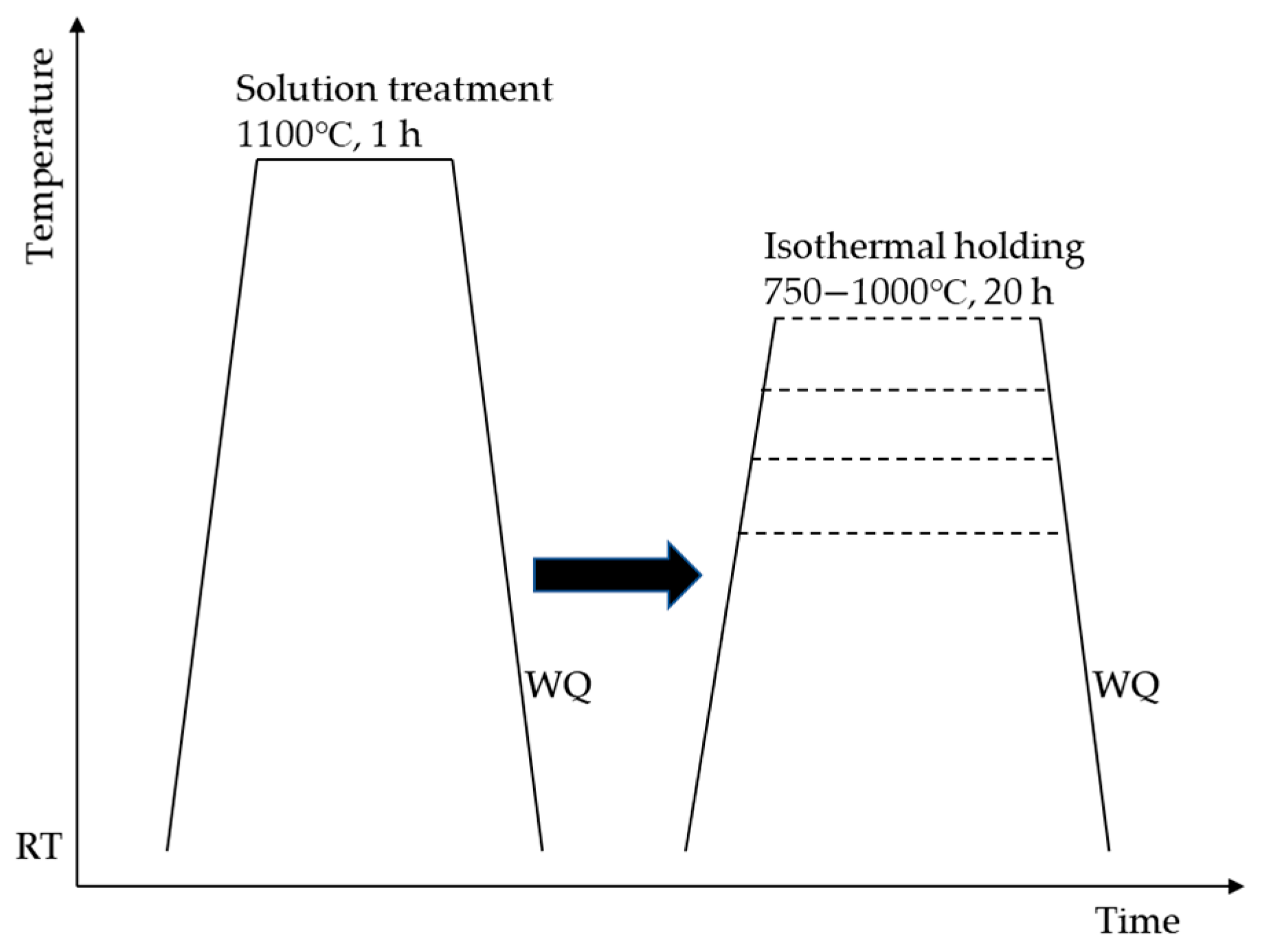
The alloy was prepared via vacuum induction melting, employing commercial 1008 plain carbon steel, together with carbon and high-purity nickel and aluminum. The molten alloy was cast in shell molds to produce ingots weighing approximately 10 kg. These ingots were homogenized at 1200 °C for 4 h to eliminate segregation. After homogenization, the ingots were cut into billets, hot-forged into slabs, and air-cooled to room temperature. The hot-forged slabs were then cold-rolled into 2 mm thick plates. Rectangular specimens measuring 15 mm × 10 mm were sectioned from these plates for subsequent thermal treatments and microstructural analysis. The specimens were sealed in quarts tubes under vacuum, solution-treated at 1100 °C for 1 h, and quenched in water at room temperature. In the following sections, the solution-treated sample will be referred to as the as-quenched sample Following solution treatment, isothermal holding treatments were conducted at temperatures ranging from 750 °C to 1000 °C for 20 h, after which the samples were quenched in water. A holding time of 20 h was selected as a practical compromise that allowed for observable phase transformations. The temperature range was selected to favor predominant B2 precipitation within the γ matrix. The heat treatment schedule is shown schematically in Figure 1.
Hardness in engineering materials has been reported to correlate positively with strength [41,42]. Accordingly, the effect of heat treatment on alloy hardness was evaluated to assess the mechanical performance in relation to the phase transformations. Prior to testing, specimens were metallographically prepared via grinding with silicon carbide abrasive papers up to 1500 grit to obtain a smooth, flat surface. Hardness measurements were conducted using a Mitutoyo Rockwell hardness testing machine (Model HR-400, Mitutoyo Corp., Kanagawa, Japan) on the B-scale (HRB), under a 100 N load with a dwell time of 5 s. For each specimen, five indentations were made at randomly selected surface locations, and the mean value was reported as the representative hardness. Data scatter is expressed as ± one standard deviation.
The heat-treated alloy samples were further prepared for various material analyses and microstructural characterization by mechanical grounding and polishing. The alloy samples for scanning electron microscopy were etched in a 5% nital solution to reveal microstructural features. Morphological and compositional analyses were conducted using a JEOL JXA-7900SX (Joel Ltd., Tokyo, Japan) high-resolution field-emission SEM equipped with energy dispersive X-ray spectroscopy (EDS). The crystal structure of the existent phases was identified by X-ray diffraction (XRD), using a Bruker G2 PHASER X-ray diffractometer (Bruker AXS GmbH, Karlsruhe, Germany) diffractometer, operated at 30 kV and 10mA, with a Cu anode and a wavelength of 1.5406 Å. For higher-resolution microstructural and crystallographic analysis, a Talos F200X G2 transmission electron microscope (TEM) (Thermo Fisher Scientific, Waltham, MA, USA) operated at 200 kV acceleration voltage was utilized. TEM-STEM imaging was performed in high-angle annular dark-field (HAADF) mode to provide both structural and compositional contrast, with HAADF enabling z-contrast imaging for atomic number-based differentiation of elements. The EDX analysis was conducted using a Super-X EDX detector integrated with the TEM system, ensuring high-resolution elemental mapping. The collected EDX data were processed and quantified using Velox software. Selected area diffraction patterns (SADPs) were indexed by measuring interplanar spacings and comparing them with the standard zone axis patterns reported by Williams and Carte [43]. TEM specimens were prepared by mechanically grinding the alloy samples to a thickness of approximately 80 μm, followed by punching out 3 mm diameter discs. These discs were then thinned to electron transparency using a twin-jet electro-polisher in a solution of 5% perchloric acid and 95% ethanol at −15 °C.

3. Results

3.1. Microstructure of As-Quenched Alloy

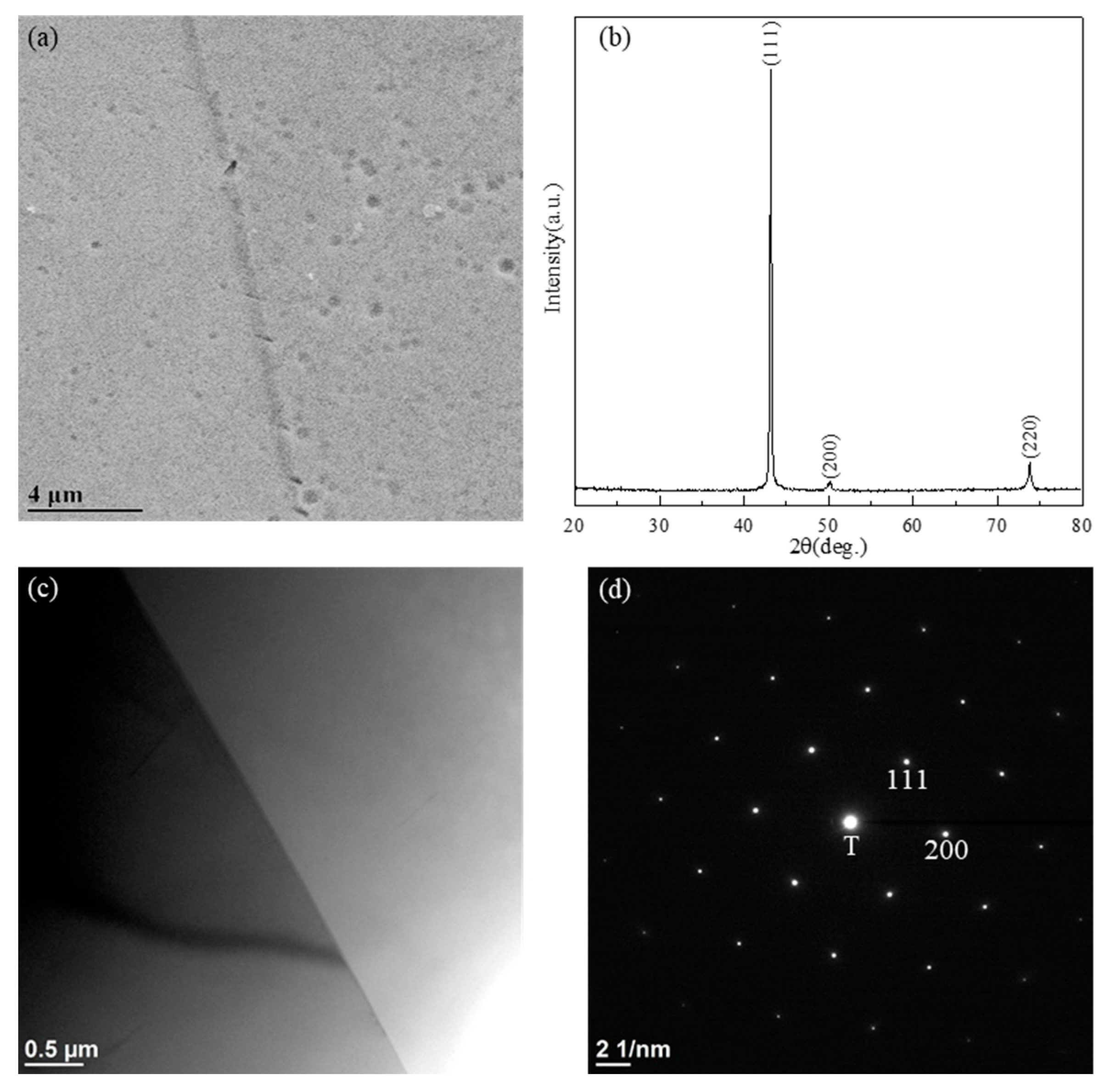
Figure 2 presents the results of the microstructural characterization of the as-quenched alloy. The SEM secondary electron image (SEI) in Figure 2a reveals a homogeneous microstructure with no evidence of secondary phases, indicating that the alloy is single-phase. The SEM-EDS analysis confirms a homogenous composition across the matrix, measured as Fe-19.6 Ni-4.7 Al. The XRD pattern shown in Figure 2b displays diffraction peaks corresponding exclusively to the FCC structure, signifying the presence of a single austenitic phase in the as-quenched condition.
TEM analysis further corroborates these observations. The TEM bright-field (BF) image in Figure 2c shows two adjacent grains with smooth contrast and no observable precipitates or defects. The corresponding selected area diffraction pattern (SADP) in Figure 2d, obtained from the left grain in Figure 2c along the FCC [01 1 ¯ ] zone axis, exhibits well-defined diffraction spot characteristic of the FCC structure, with no superlattice reflections observed. Together, these results confirm that the as-quenched alloy sample consists entirely of a single FCC austenite (γ) structure, free from secondary or ordered phases.

3.2. Formation of B2 Phase During Isothermal Holding

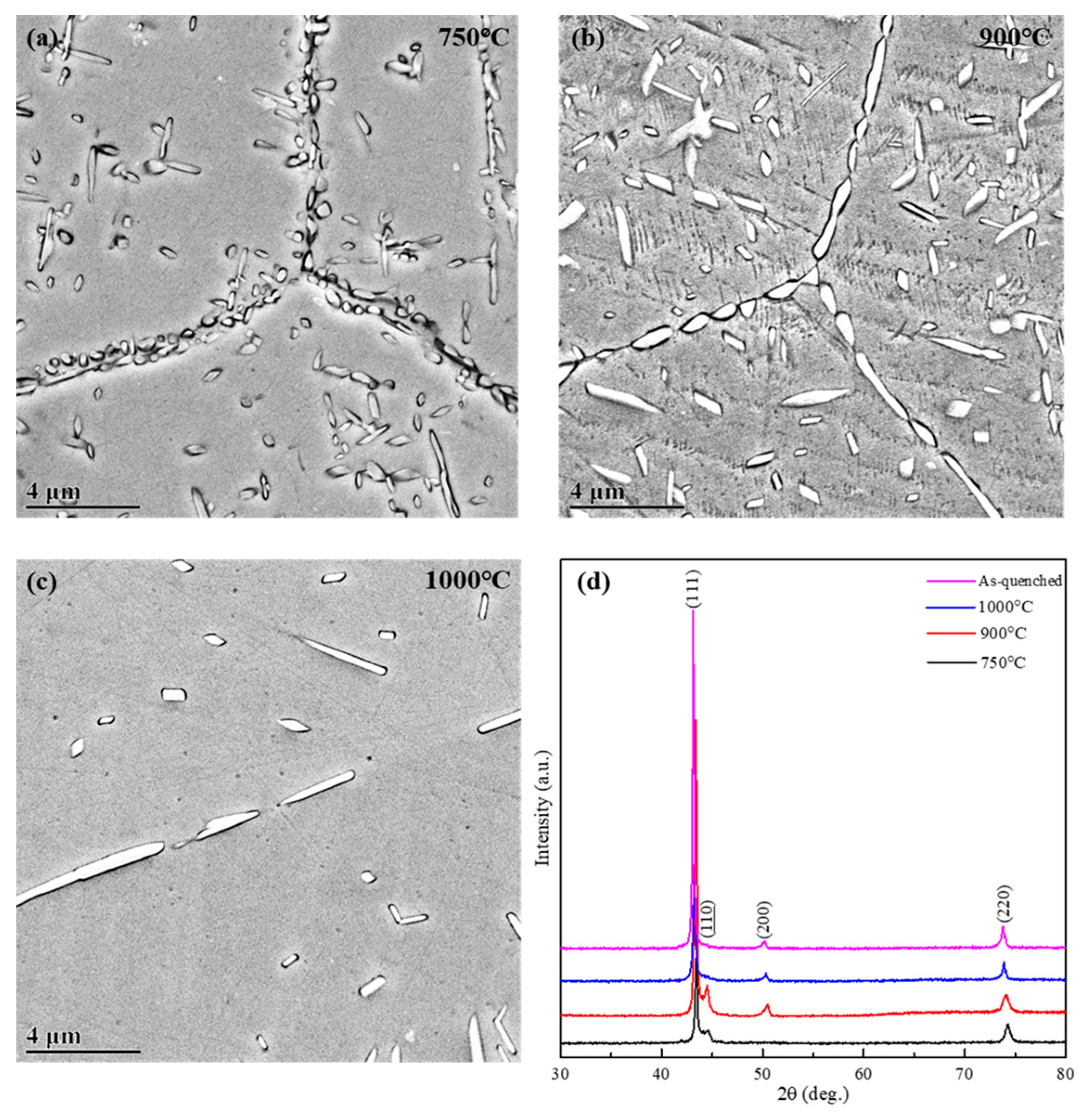
To investigate microstructural evolution in the alloy, isothermal holding was subsequently performed on the as-quenched alloy samples at temperatures between 750 °C and 1000 °C. Across this temperature range, microstructural analyses revealed the presence of second-phase precipitates within the grains and along the grain boundaries, as shown in Figure 3. Representative SEM-SEI micrographs captured from samples held at 750 °C, 900 °C, and 1000 °C are presented in Figure 3a–c, respectively. At 750 °C, the microstructure contains fine and densely distributed plate-shaped precipitates both in the matrix and along the grain boundaries, as shown Figure 3a. Increasing the holding temperature to 900 °C results in coarser and more prominent precipitates, as shown in Figure 3b, indicating a temperature-dependent coarsening behavior. This observation is consistent with diffusion-controlled growth and coarsening of the precipitates, as previously reported in Fe-Ni-Al-based alloy systems [44,45]. At temperatures exceeding 900 °C, partial dissolution of the precipitates into the matrix phase occurred, leading to a lower precipitate volume fraction relative to the matrix, as observed in the sample held at 1000 °C shown in Figure 3c. This precipitate dissolution behavior suggests that the γ phase becomes increasingly thermodynamically stable at higher temperatures, thereby suppressing the persistence of second-phase precipitates. Elemental analysis using SEM EDS reveals that the precipitates are enriched in Ni and Al and depleted in Fe relative to the surrounding matrix. This preferential elemental partitioning, combined with the observed morphology, supports the identification of the precipitates as ordered B2 phases [11,16,44]. Therefore, the isothermally held alloys exhibit a two-phase microstructure consisting of a γ-matrix phase and B2 precipitates.
The XRD patterns in Figure 3d further support the observations from SEM analysis. While the solution-treated sample exhibits only FCC peaks, confirming a single-phase γ structure, the isothermally held samples display additional peaks corresponding to BCC/B2 phases, indicating the coexistence of γ and B2 structures. The peak near the 44.6° 2θ-position arises from an overlap of the BCC(110) fundamental reflection and the B2(110) superlattice diffraction peaks [45], with the latter being associated with the B2 phase. Therefore, the B2(110) peak is believed to be associated with the B2 precipitates. The intensity of the (110) peak is higher for the sample held at 900 °C than for the sample held at 750 °C, reflecting a greater volume fraction of B2. This temperature-dependent increase in volume fraction is consistent with the SEM results in Figure 3a,b and can be attributed to enhanced atomic diffusivity and a stronger thermodynamic driving force for B2 precipitation and growth at higher temperatures [5,36]. In contrast, the sample held at 1000 °C exhibits a significantly weaker B2(110) peak intensity, reflecting a lower volume fraction of B2 precipitates due to their partial dissolution into the matrix, consistent with the SEM results in Figure 3c. Overall, these results demonstrate that isothermal holding between 750 °C and 1000 °C promotes the formation and growth of B2 precipitates in γ grains and grain boundaries, whereas higher temperatures lead to their dissolution, resulting in a microstructure dominated by the γ phase.
Although some additional microstructural contrast features potentially related to a martensitic phase is observed in Figure 3b, definitive conclusions regarding its presence or nature cannot be drawn solely from the SEM data at this stage. A more detailed investigation of possible martensitic transformation is therefore deferred to later sections, where TEM analysis provides more detailed insights.
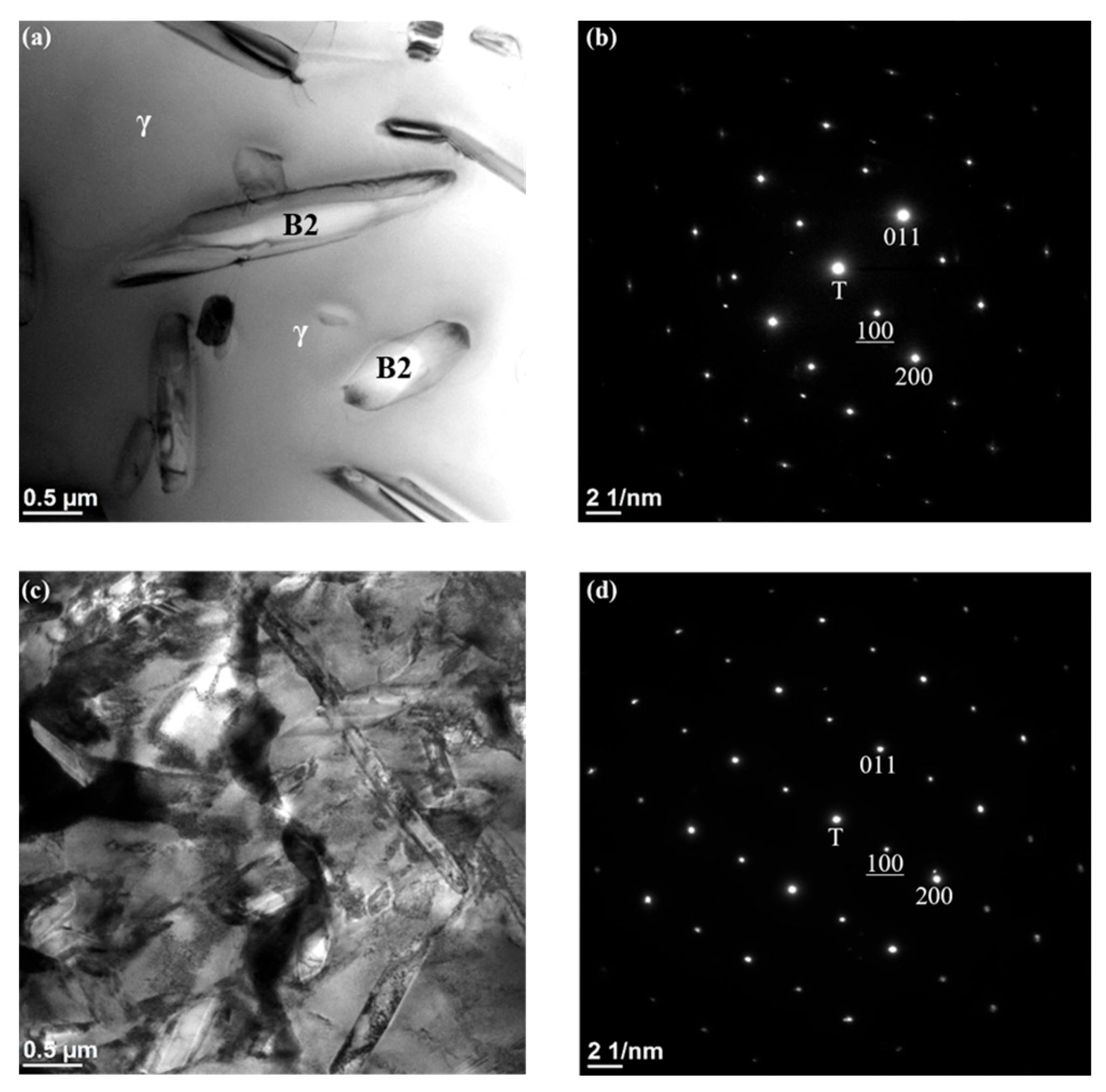
TEM analyses were performed to further confirm the presence and structural nature of B2 precipitates in the alloy following isothermal holding. The results presented are based on samples held at 900 °C (Figure 4a,b) and 800 °C (Figure 4c,d). The BF images in Figure 4a,c reveal B2 precipitates embedded within the γ matrix, with size and distribution varying with holding temperature. The 800 °C sample contains finer, densely distributed precipitates, while the 900 °C sample displays larger, more distinct precipitates. These precipitates exhibit plate-shaped morphologies consistent with partially coherent to semi-coherent interfaces with the matrix. The corresponding SADPs in Figure 4b,d, both captured along the BCC 01 1 ¯ zone axes, show distinct superlattice reflections attributable to the B2 phase, with underlined indices to distinguish them from fundamental BCC reflections. Unlike the XRD results, the TEM analyses unambiguously reveal reflections from the B2 (100) planes, allowing B2 to be clearly distinguished from BCC. Furthermore, the SADPs confirm a cube-on-cube orientation relationship between the B2 and BCC phases: (011)B2//(011)BCC and 01 1 ¯ B2// 01 1 ¯ BCC. Together, these TEM observations confirm the presence of an ordered B2 phase within the γ matrix.
These TEM results agree with the SEM and XRD results presented in Figure 3, providing direct crystallographic evidence for B2 phase formation and its coarsening behavior upon isothermal holding at intermediate temperatures. They also underscore the influence of thermal treatment on the precipitation and ordering characteristics. Previous studies have similarly reported B2 precipitation in Fe-Ni-Al-based alloys under various heat treatment conditions [5,11,16,44,45]. Some of these studies have shown that the shape and distribution of B2 precipitates are highly sensitive to both alloy composition and thermal treatment history. An increase in Ni and Al has been shown to typically promote morphological transitions from spherical and cuboidal to plate-shaped or interconnected irregularly structured precipitates [44]. In the present study, the B2 precipitates predominantly exhibit a plate-shaped morphology, likely attributed to its specific composition and thermal treatments. Collectively, these findings confirm that isothermal holding between 750 °C and 1000 °C promotes the precipitation of plate-shaped, ordered B2 phases within the γ matrix, with increasing temperature enhancing both structural order and precipitate coarsening.

3.3. Elemental Distribution in Alloy After Isothermal Holding

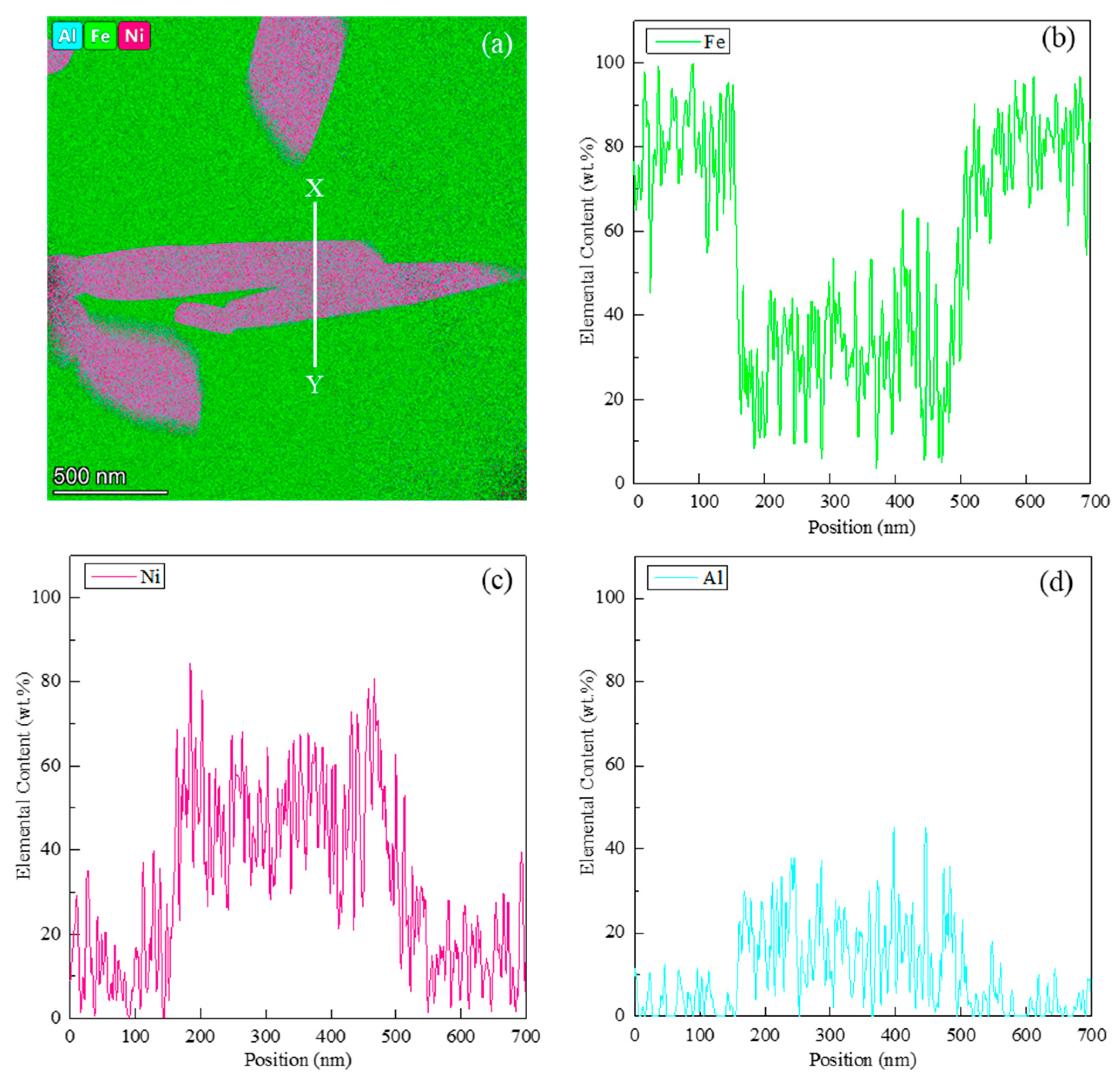
Elemental partitioning between the B2 precipitates and the surrounding matrix in the alloy was investigated using scanning transmission electron microscopy coupled with energy-dispersive X-ray spectroscopy (STEM-EDS). The results for the sample held isothermally at 900 °C are shown in Figure 5. The color-coded elemental map in Figure 5a overlays Fe (green), Ni (pink), and Al (light blue) distributions, while Figure 5b–d present the corresponding line scan profiles acquired along the X Y path indicated by the white line in Figure 5a. The elemental map reveals pronounced compositional contrast, where Ni and Al are more concentrated in the B2 precipitates, while Fe is predominantly enriched in the surrounding matrix. Carbon was excluded from the analysis due to carbon contamination and quantification limitations inherent to the STEM-EDS system. The line scan profiles quantitatively confirm this elemental partitioning behavior within the alloy following isothermal holding. As shown in Figure 5b, Fe content decreases drastically within B2 precipitates, while Ni and Al concentrations increase significantly, as depicted in Figure 5c,d. The opposite trend is observed in the matrix region. The average composition of the matrix was measured as Fe-15.8 Ni-2.8 Al, whereas the B2 precipitates contained Fe-56.0 Ni-17.1 Al. This demonstrates a substantial reduction in Ni and Al content within the matrix relative to the precipitates, consistent with the compositional contrast observed in Figure 5a. This pronounced elemental segregation highlights the inhomogeneous distribution of alloying elements that occurs during isothermal holding and subsequent cooling, in contrast to the chemically uniform composition of the as-quenched state. The observed partitioning behavior is driven by thermally activated diffusion and agrees with prior reports on Fe-Ni-Al-C alloys, where Ni and Al preferentially segregate into B2 precipitates [5,11,16]. Such preferential elemental partitioning is a defining characteristic of B2 precipitation and provides strong evidence for the formation of an ordered B2 phase within the γ matrix of the alloy during isothermal heat treatment at intermediate temperatures.

3.4. Formation of Martensite Phase

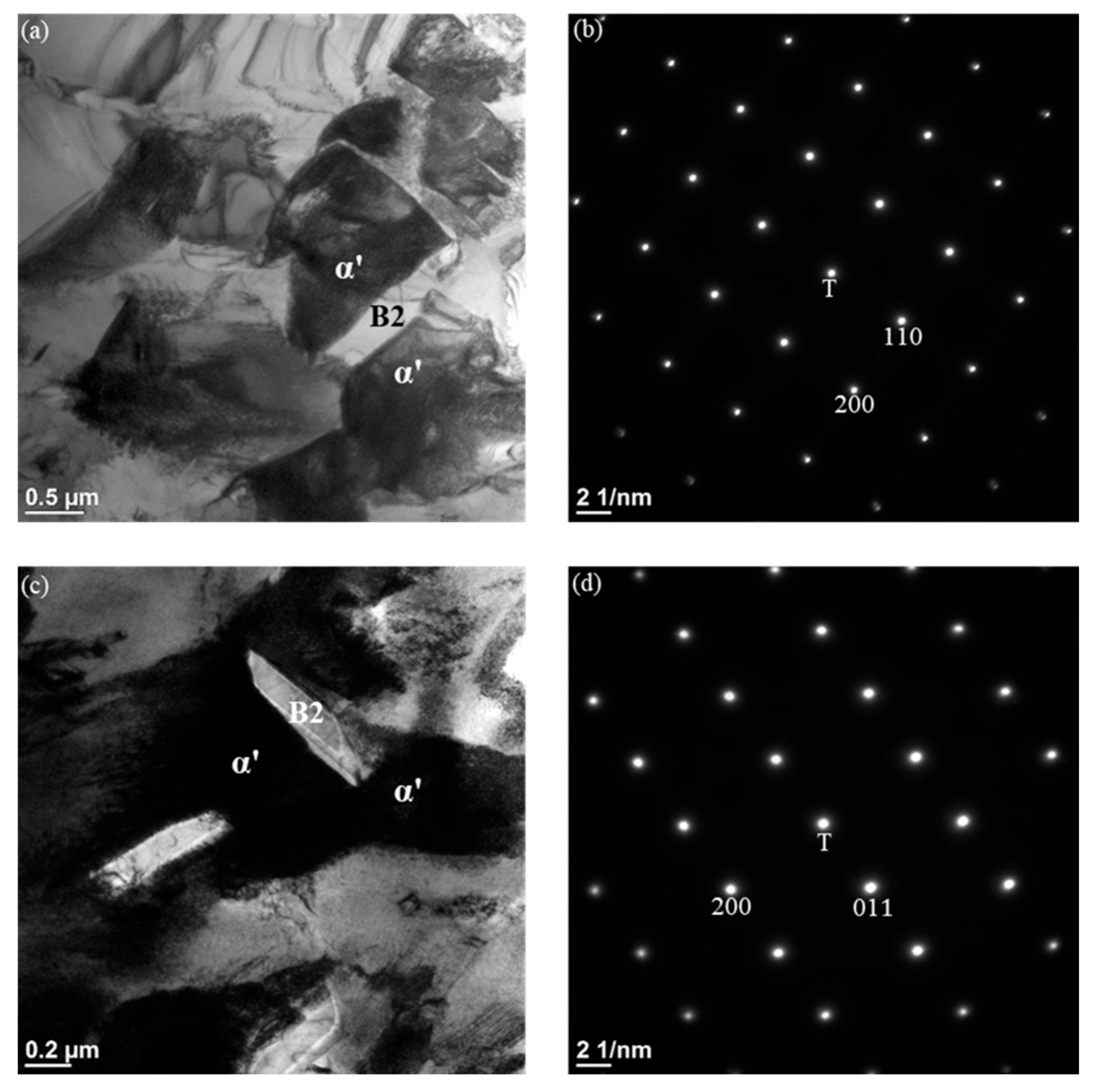
In addition to the martensitic features observed in the SEM-SEI image in Figure 3a, TEM analyses reveal the presence of the martensite phase in alloys held isothermally between 900 °C and 750 °C, whereas no martensite was detected in the samples held above 900 °C. Representative results are shown in Figure 6, where Figure 6a,b present the BF images and SADPs taken from the sample held at 900 °C, while Figure 6c,d correspond to those from the sample held at 800 °C. In the BF images in Figure 6a,c, martensite plates, marked as α′, appear adjacent to B2 precipitates exhibiting a characteristic lath morphology distinct from the surrounding γ matrix. This spatial association suggests that martensite preferentially forms in the original γ-phase regions surrounding B2 precipitates
The corresponding SADPs shown in Figure 6b,d, acquired from the α′-martensite phase along the BCC [001] and [ 01 1 ¯ ] zone axes, respectively, reveal diffraction spots consistent with a BCC structure. Notably, no superlattice reflections are observed in either diffraction pattern, indicating the absence of long-range atomic ordering. Based on these SADPs, we conclude that the crystal structure of observed martensite belongs to BCC ferrite, commonly referred to as α′-martensite. A similar type of martensite has been previously observed in Fe-Mn-Al alloys [46] as well as in Fe-Ni-Al-C alloys, where martensite formed in the austenite grains due to localized stress fields caused by the presence of the B2 phase [2,5,11]. In those studies, martensitic transformation was typically deformation-induced during tensile testing. In contrast, the present study reveals that α′ martensite formed during cooling after isothermal holding, without applied mechanical stress. The absence of martensite in both the as-quenched alloy and samples held above 900 °C, conditions characterized by either no B2 precipitates or significantly reduced precipitate volume fraction, points to a critical role of the B2 phase in modulating the thermal stability of the γ phase. Furthermore, the SADPs taken along B2 [001] and that from α′ [001] in Figure 6b reveal that the B2 phase exhibits a cube-on-cube orientation relationship with the α′ matrix, defined by (011)B2//(011)α′ and [100]B2//[100]α′.

3.5. Hardness Evolution and Its Correlation with Phase Transformations

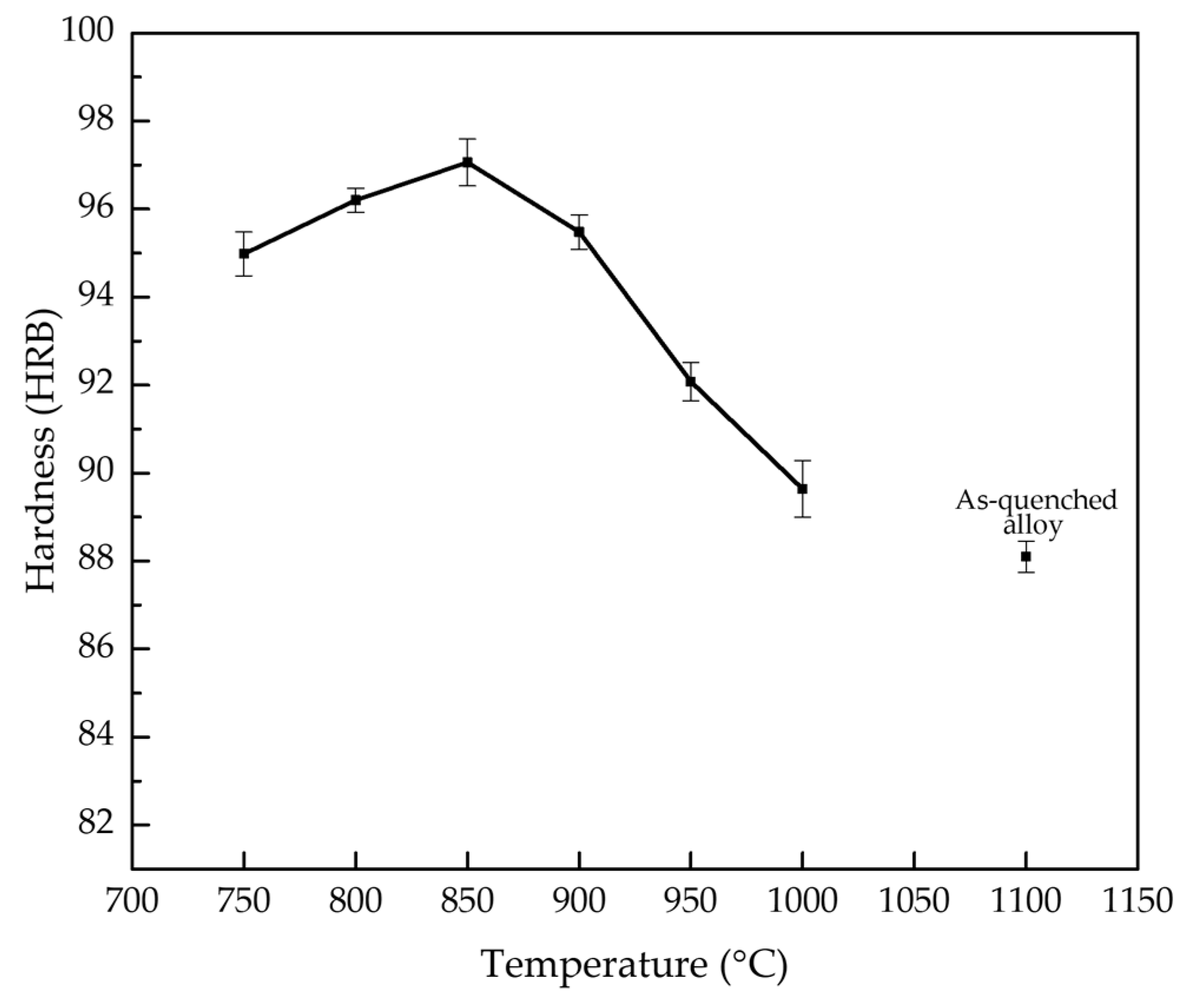
Hardness testing was carried out after solution treatment and isothermal holding to correlate phase evolution with mechanical response. The variation in mean hardness with temperature is presented in Figure 7, which summarizes the average hardness values under different heat treatment conditions. Error bars represent ±1 standard deviation from five indentations. For reference, the average hardness value of the as-quenched alloy is also included, as marked in the graph.
The as-quenched alloy exhibits the lowest hardness value of 88.1 HRB, consistent with a soft, fully austenitic microstructure lacking secondary-phase strengthening. Upon isothermal holding, the mean hardness increases with temperature, reaching a maximum of 97.1 HRB at approximately 850 °C. This increase is attributed to the combined effects of B2 phase precipitation and the formation of α′ martensite, which contribute to precipitation hardening and transformation-induced strengthening, respectively [5,13,24]. Above 850 °C, the hardness decreases significantly, reaching a value of 89.6 HRB at 1000 °C which is close to that of the as-quenched condition. This decline is associated with precipitate coarsening and increases in inter-precipitate spacing [19], partial dissolution of B2 precipitates, and the suppression of martensitic transformation, all of which reduce the alloy’s strengthening capacity. Overall, these results highlight that the hardness of the alloy is strongly governed by its thermal treatment history and corresponding microstructural evolution, particularly the formation and stability of hardening phases such as B2 and α′ martensite.

4. Discussion

The experimental results demonstrate that the as-quenched alloy exhibits a single-γ-phase microstructure with a low hardness of 88.1 HRB, as shown in Figure 2 and Figure 7, agreeing with the soft nature of the γ phase and the absence of secondary strengthening phases. Conversely, samples subjected to isothermal holding at intermediate temperatures followed by cooling develop both B2 precipitates (Figure 3, Figure 4 and Figure 5) and α′ martensite (Figure 6). The combined effects of precipitation hardening and transformation-induced strengthening due to the presence of B2 and α′ phases, respectively, lead to a significant increase in hardness, which peaks at 97.1 HRB at ~850 °C as illustrated in Figure 7. At higher temperatures, however, the hardness decreases sharply as a result of precipitate coarsening, partial dissolution, and the suppression of martensitic transformation, with the 1000 °C sample showing hardness close to that of the as-quenched condition.
The ability of the austenite phase to transform to martensite during cooling after thermal heat treatment is governed by its thermal stability. When the thermodynamic driving force is sufficient, this transformation occurs at a specific temperature referred to as Ms. This driving force depends primarily on temperature and chemical composition, with microstructural factors (such as austenite morphology and grain size) also contributing. As the temperature decreases, the thermal stability of austenite declines, while the martensite volume fraction increases [27,47]. Chemical composition is particularly influential, and both single-element effects and multicomponent interactions have been studied [27,29,30,31,48,49]. For example, Ohtsuka and Kajiwara [49] examined the effect of carbon on Ms in Fe-Ni-Al-Co alloys; Ishida [31] proposed an empirical expression to calculate the effect of alloying elements on the Ms temperature in steels; and Ingber [30] modeled Ms in high-carbon steels, showing an exponential dependence on carbon content. Collectively, these studies showed that the majority of the elements lower Ms, whereas Al and Co generally raise it
During cooling after isothermal holding, the α′ phase formed as a result of temperature- and composition-dependent variations in γ-phase stability. In the as-quenched condition, no α′ phase appeared because the martensite start (Ms) temperature is likely below room temperature, suppressing transformation. Owing to the high carbon content of the alloy investigated in this study, the Ms temperature was estimated using Ingber’s model [30] based on the nominal composition, yielding an Ms of approximately −118 °C. This suggests that the Ms of the as-quenched alloy, whose measured composition closely matches that of the nominal composition, is also way below room temperature and therefore impractical to measure directly. In contrast, in isothermally held samples, the Ms temperature appears to have increased to or above room temperature, allowing martensite to form during cooling. Consistent with this interpretation, martensite was absent in both as-quenched alloy and samples held above 900 °C, conditions containing either no B2 precipitates or only a very low volume fraction, as observed in Figure 2a,c and Figure 3c,d. This indicates that martensitic transformation is closely associated with the presence of B2 precipitates.
Based on Ingber’s model [30], the calculated elemental contributions for this alloy indicate that Ni provides the largest negative term (−344 °C) to Ms, followed by C (−46.3 °C), whereas Al contributes a positive term (+31.95 °C). Consequently, chemical composition plays a dominant role in governing the tendency of γ to transform to α′, with Ni being the highest contributor. The link between B2 precipitation and martensite formation can be rationalized by compositional partitioning: as B2 precipitate forms within γ grains and along grain boundaries (Figure 5), Ni and Al partition into the precipitates, locally depleting the surrounding matrix. Ni depletion, in particular, destabilizes γ and raises Ms, promoting martensite formation adjacent to B2 precipitate [2,29,48]. Thus, B2 precipitation not only provides direct strengthening but also indirectly destabilizes γ, creating favorable conditions for the γ → α′ transformation during cooling. This interpretation aligns with prior observations. Kuramoto et al. [2] showed that Al additions in Fe–Ni–Al–C increase the B2 volume fraction, reduce Ni content in the matrix, and destabilize γ, thereby accelerating the γ → α′ transformation. Similarly, Stroz and Chrobak [26] demonstrated that both chemical composition and precipitate-induced stresses strongly influence martensitic transformation in NiTi alloys. In the present work, the diffusion of Ni into B2 precipitates is considered as the main factor elevating the Ms temperature, thus enabling the nucleation and growth of α′ martensite to occur during cooling.
The martensite phase observed in this study exhibits a disordered BCC structure (Figure 6b,d) and co-exists with the B2 phase within γ grains. Its association with B2 precipitates indicates that B2 not only strengthens the alloy through precipitation hardening but also promotes martensitic transformation by destabilizing the γ phase. Thus, the results from this study provide clear evidence that B2 precipitation destabilizes the γ phase and induces a γ → α′ martensitic transformation during thermal treatment in Fe–Ni–Al–C alloys, in contrast to earlier studies where martensite was mainly reported as deformation-induced.

5. Conclusions

The phase evolution and formation of α′ martensite in quaternary Fe-20 Ni-4.5 Al-1.0 C alloy steel have been investigated through solution treatment, followed by isothermal holding at intermediate temperatures and water quenching. The key findings are summarized as follows:
  • In the as-quenched condition, the alloy exhibits a single-phase austenite (γ) microstructure with a low hardness of 88.1 HRB, consistent with the absence of secondary strengthening phases.
  • Isothermal holding at intermediate temperatures between 750 °C and 900 °C promotes B2 precipitation accompanied by α′-martensite formation during cooling. These microstructural changes result in a significant hardness increase, with a maximum of 97.1 HRB at about 850 °C.
  • No martensite was observed in the as-quenched alloy or in samples held above 900 °C, conditions characterized by either no B2 or only a low precipitate volume fraction. The Ms temperature for these alloys is predicted to be much below room temperature. This highlights the critical role of B2 precipitation in promoting martensitic transformation.
  • Hardness increases in the 750–850 °C range due to combined B2 precipitation and martensitic transformation, but declines at higher temperatures because of precipitate coarsening, partial dissolution, and suppressed martensite formation.
  • B2 phases exhibit a cube-on-cube orientation relationship with the α′ matrix, defined by (011)B2//(011)α′ and [100]B2//[100]α′.
Unlike earlier studies that reported deformation-induced martensite, this work demonstrates that B2 precipitation destabilizes the γ phase and induces the γ → α′ transformation by decreasing the Ni-content in the surrounding matrix. These results provide new insights into the coupled role of precipitation and transformation strengthening and show that specific thermal treatment can be used to tailor phase constitution and mechanical performance in Fe-Ni-Al-C alloys.

Author Contributions

Conceptualization, W.-C.C.; methodology, R.C.K. and Y.-T.H.; formal analysis, R.C.K. and Y.-T.H.; investigation, W.-C.C., R.C.K., and Y.-T.H.; resources, W.-C.C.; writing—original draft preparation, W.-C.C. and R.C.K.; writing—review and editing, W.-C.C. and R.C.K.; visualization, W.-C.C.; supervision, W.-C.C.; project administration, W.-C.C.; All authors have read and agreed to the published version of the manuscript.

Funding

This research received no external funding.

Data Availability Statement

The raw data supporting the conclusions of this article will be made available by the authors on request.

Conflicts of Interest

The authors declare that they have no conflicts of interest.

References

  1. Furuta, T.; Kuramoto, S.; Ohsuna, T.; Oh-Ishi, K.; Horibuchi, K. Die-hard plastic deformation behavior in an ultrahigh-strength Fe-Ni-Al-C alloy. Scr. Mater. 2015, 101, 87–90. [Google Scholar] [CrossRef]
  2. Kuramoto, S.; Kawano, Y.; Mori, Y.; Kobayashi, J.; Emura, S.; Sawaguchi, T. Mechanical Properties and Deformation Behavior in Severely Cold-Rolled Fe-Ni-Al-C Alloys with Lüders Deformation-Overview with Recent Experimental Results. Mater. Trans. 2023, 64, 1410–1418. [Google Scholar] [CrossRef]
  3. Sun, L.; Simm, T.; Martin, T.; McAdam, S.; Galvin, D.; Perkins, K.; Bagot, P.; Moody, M.; Ooi, S.; Hill, P. A novel ultra-high strength maraging steel with balanced ductility and creep resistance achieved by nanoscale β-NiAl and Laves phase precipitates. Acta Mater. 2018, 149, 285–301. [Google Scholar] [CrossRef]
  4. Muñoz-Morris, M.A.; Morris, D.G. Microstructure and mechanical behaviour of a Fe-Ni-Al alloy. Mater. Sci. Eng. A 2007, 444, 236–241. [Google Scholar] [CrossRef]
  5. Gao, S.; Bai, Y.; Shibata, A.; Tsuji, N. Microstructures and mechanical property of a Fe-Ni-Al-C alloy containing B2 intermetallic compounds. In Proceedings of the IOP Conference Series: Materials Science and Engineering, Roskilde, Denmark, 4–8 September 2017; p. 012020. [Google Scholar]
  6. Eleno, L.; Frisk, K.; Schneider, A. Assessment of the Fe-Ni-Al system. Intermetallics 2006, 14, 1276–1290. [Google Scholar] [CrossRef]
  7. Chumak, I.; Richter, K.W.; Ipser, H. Isothermal sections in the (Fe, Ni)-rich part of the Fe-Ni-Al phase diagram. JPED 2008, 29, 300–304. [Google Scholar] [CrossRef]
  8. Myers, S.; Koch, C. The effect of composition and cooling rate on the structure of rapidly solidified (Fe,Ni)3Al-C alloys. J. Mater. Res. 1989, 4, 44–49. [Google Scholar] [CrossRef]
  9. Khaple, S.; Baligidad, R.; Rao, S. Effect of alloying additions on the structure and mechanical properties of Fe3Al-1C intermetallic alloy. Trans. Indian Inst. Met. 2009, 62, 153–157. [Google Scholar] [CrossRef]
  10. Sanders, W.; Sauthoff, G. Deformation behaviour of perovskite-type phases in the system Fe-Ni-Al-C. I: Strength and ductility of Ni3AlCx and Fe3AlCx alloys with various microstructures. Intermetallics 1997, 5, 361–375. [Google Scholar] [CrossRef]
  11. Ma, Y.; Zhou, L.; Yang, M.; Yuan, F.; Wu, X. Ultra-high tensile strength via precipitates and enhanced martensite transformation in a FeNiAlC alloy. Mater. Sci. Eng. A 2021, 803, 140498. [Google Scholar] [CrossRef]
  12. Hwang, C.; Liu, T. Grain boundary precipitation reactions in a wrought Fe-8Al-5Ni-2C alloy prepared by the conventional ingot process. Metall. Mater. Trans. A 1998, 29, 693–696. [Google Scholar] [CrossRef]
  13. Ma, Y.; Yang, M.; Jiang, P.; Yuan, F.; Wu, X. Plastic deformation mechanisms in a severely deformed Fe-Ni-Al-C alloy with superior tensile properties. Sci. Rep. 2017, 7, 15619. [Google Scholar] [CrossRef]
  14. Sarreal, J.; Koch, C. Metastable microstructures of rapidly solidified and undercooled Fe-Al-C and Fe-(Ni,Mn)-Al-C alloys. Mater. Sci. Eng. A 1991, 136, 141–149. [Google Scholar] [CrossRef]
  15. Wu, Z.Q.; Ding, H.; An, X.H.; Han, D.; Liao, X.Z. Influence of Al content on the strain-hardening behavior of aged low density Fe-Mn-Al-C steels with high Al content. Mater. Sci. Eng. A 2015, 639, 187–191. [Google Scholar] [CrossRef]
  16. Perez Badillo, E.; Dorantes Rosales, H.J.; Saucedo Muñoz, M.L.; Lopez Hirata, V.M. Analysis of Phase Transformations in Fe-Ni-Al Alloys Using Diffusion Couples of Fe/Fe-33at.% Ni-33at.% Al Alloy/Ni. Metals 2023, 13, 1221. [Google Scholar] [CrossRef]
  17. Harwarth, M.; Chen, G.; Rahimi, R.; Biermann, H.; Zargaran, A.; Duffy, M.; Zupan, M.; Mola, J. Aluminum-alloyed lightweight stainless steels strengthened by B2-(Ni, Fe) Al precipitates. Mater. Des. 2021, 206, 109813. [Google Scholar] [CrossRef]
  18. Wang, Z.; Wang, Q.; Niu, B.; Dong, C.; Zhang, H.; Zhang, H.; Liaw, P.K. Coherent precipitation and stability of cuboidal B2 nanoparticles in a ferritic Fe-Cr-Ni-Al superalloy. Mater. Res. Lett. 2021, 9, 458–466. [Google Scholar] [CrossRef]
  19. Kaya, I.; Karaca, H.E.; Nagasako, M.; Kainuma, R. Effects of aging temperature and aging time on the mechanism of martensitic transformation in nickel-rich NiTi shape memory alloys. Mater. Charact. 2020, 159, 110034. [Google Scholar] [CrossRef]
  20. Ferreira-Palma, C.; Contreras-Piedras, E.; Cayetano-Castro, N.; Saucedo-Muñoz, M.; Lopez-Hirata, V.; Gonzalez-Velazquez, J.; Dorantes-Rosales, H. Effect of temperature and composition on NiAl precipitation and morphology in Fe-Ni-Al alloys. Metall. Mater. Trans. A 2017, 48, 5285–5293. [Google Scholar] [CrossRef]
  21. Fahr, D. Stress-and strain-induced formation of martensite and its effects on strength and ductility of metastable austenitic stainless steels. Metall. Trans. A 1971, 2, 1883–1892. [Google Scholar] [CrossRef]
  22. Sahoo, B.K.; Srivastava, V.C.; Mahato, B.; Chowdhury, S.G. Microstructure-mechanical property evaluation and deformation mechanism in Al added medium Mn steel processed through intercritical rolling and annealing. Mater. Sci. Eng. A 2021, 799, 140100. [Google Scholar] [CrossRef]
  23. Gao, B.; Chen, X.; Pan, Z.; Li, J.; Ma, Y.; Cao, Y.; Liu, M.; Lai, Q.; Xiao, L.; Zhou, H. A high-strength heterogeneous structural dual-phase steel. J. Mater. Sci. 2019, 54, 12898–12910. [Google Scholar] [CrossRef]
  24. Gao, S.; Yoshimura, T.; Mao, W.; Bai, Y.; Gong, W.; Park, M.-h.; Shibata, A.; Adachi, H.; Sato, M.; Tsuji, N. Tensile deformation of ultrafine-grained Fe-Mn-Al-Ni-C alloy studied by in situ synchrotron radiation X-ray diffraction. Crystals 2020, 10, 1115. [Google Scholar] [CrossRef]
  25. Wang, J.; van der Wolk, P.J.; van der Zwaag, S. Determination of martensite start temperature for engineering steels part II. Correlation between critical driving force and Ms temperature. Mater. Trans. 2000, 41, 769–776. [Google Scholar] [CrossRef]
  26. Stroz, D.; Chrobak, D. Effect of internal strain on martensitic transformations in NiTi shape memory alloys. Mater. Trans. 2011, 52, 358–363. [Google Scholar] [CrossRef][Green Version]
  27. Li, Y.; San Martín, D.; Wang, J.; Wang, C.; Xu, W. A review of the thermal stability of metastable austenite in steels: Martensite formation. J. Mater. Sci. Technol. 2021, 91, 200–214. [Google Scholar] [CrossRef]
  28. Tsuzaki, K.; Fukiage, T.; Maki, T.; Tamura, I. The effect of Ni content on the isothermal character of lath martensitic transformation in Fe-Ni alloys. In Proceedings of the Materials Science Forum, Millersville, PA, USA, 1990; pp. 229–234. [Google Scholar]
  29. Liu, C.; Zhao, Z.; Northwood, D.O.; Liu, Y. A new empirical formula for the calculation of MS temperatures in pure iron and super-low carbon alloy steels. J. Mater. Process. Technol. 2001, 113, 556–562. [Google Scholar] [CrossRef]
  30. Ingber, J.; Kunert, M. Prediction of the Martensite Start Temperature in High-Carbon Steels. Steel Res. Int. 2022, 93, 2100576. [Google Scholar] [CrossRef]
  31. Ishida, K. Calculation of the effect of alloying elements on the Ms temperature in steels. J. Alloys Compd. 1995, 220, 126–131. [Google Scholar] [CrossRef]
  32. Wang, X.S.; Maurya, A.K.; Ishtiaq, M.; Kang, S.G.; Reddy, N.G.S. Knowledge Discovery in Predicting Martensite Start Temperature of Medium-Carbon Steels by Artificial Neural Networks. Algorithms 2025, 18, 116. [Google Scholar] [CrossRef]
  33. Lee, S.J.; Jung, M. Prediction of martensite start temperatures of highly alloyed steels. Arch. Metall. Mater. 2021, 66. [Google Scholar] [CrossRef]
  34. Wang, X.S.; Narayana, P.; Maurya, A.; Kim, H.I.; Hur, B.Y.; Reddy, N. Modeling the quantitative effect of alloying elements on the Ms temperature of high carbon steel by artificial neural networks. Mater. Lett. 2021, 291, 129573. [Google Scholar] [CrossRef]
  35. la Roca, P.M.; Medina, J.; Sobrero, C.E.; Avalos, M.C.; Malarria, J.A.; Baruj, A.L.; Sade, M. Effects of B2 nanoprecipitates on the phase stability and pseudoelastic behavior of Fe-Mn-Al-Ni shape memory alloys. MATEC Web Conf. 2015, 33, 1–6. [Google Scholar] [CrossRef]
  36. Zhang, R.; Sun, D.; Ji, C.; Chen, Y.; Zhang, X.; Dong, Z. Shape memory effect and martensitic transformation in Fe-Mn-Al-Ni Alloy. Metals 2022, 12, 247. [Google Scholar] [CrossRef]
  37. Vallejos, J.M.; Giordana, M.F.; Sobrero, C.E.; Malarría, J. Phase stability of three Fe-Mn-Al-Ni superelastic alloys with different Al: Ni ratios. SMJ 2021, 7, 362–372. [Google Scholar] [CrossRef]
  38. Frenzel, J.; George, E.P.; Dlouhy, A.; Somsen, C.; Wagner, M.-X.; Eggeler, G. Influence of Ni on martensitic phase transformations in NiTi shape memory alloys. Acta Mater. 2010, 58, 3444–3458. [Google Scholar] [CrossRef]
  39. Zhu, J.; Wu, H.H.; Wu, Y.; Wang, H.; Zhang, T.; Xiao, H.; Wang, Y.; Shi, S.-Q. Influence of Ni4Ti3 precipitation on martensitic transformations in NiTi shape memory alloy: R phase transformation. Acta Mater. 2021, 207, 116665. [Google Scholar] [CrossRef]
  40. Jin, M.; Geng, Y.; Zuo, S.; Jin, X. Precipitation and its effects on martensitic transformation in Fe-Ni-Co-Ti alloys. Mater. Today Proc. 2015, 2, S837–S840. [Google Scholar] [CrossRef]
  41. Umemoto, M.; Liu, Z.; Tsuchiya, K.; Sugimoto, S.; Bepari, M. Relationship between hardness and tensile properties in various single structured steels. J. Mater. Sci. Technol. 2001, 17, 505–511. [Google Scholar] [CrossRef]
  42. Pavlina, E.; Van Tyne, C. Correlation of yield strength and tensile strength with hardness for steels. J. Mater. Eng. Perform. 2008, 17, 888–893. [Google Scholar] [CrossRef]
  43. Williams, D.B.; Carter, C.B. Obtaining and Indexing Parallel-Beam Diffraction Patterns. In Transmission Electron Microscopy: A Textbook for Materials Science; Springer: New York, USA, 2009; pp. 283–309. [Google Scholar]
  44. Ferreira, P.C.; Rosas, B.J.A.; López, H.V.M.; Rivas, L.D.I.; J, D.R.H. Phase separation and coarsening of NiAl (β′) intermetallic in quench-aged Fe-Ni-Al alloys. J. Iron Steel Res. Int. 2020, 27, 1331–1338. [Google Scholar] [CrossRef]
  45. Soriano, V.O.; Saucedo, M.M.L.; Lopez, H.V.M.; Paniagua, M.A.M. Coarsening of β′ precipitates in an isothermally-aged Fe75-Ni10-Al15 alloy. Mater. Trans. 2010, 51, 442–446. [Google Scholar] [CrossRef]
  46. Cheng, W.C.; Lee, K.H.; Lin, S.M.; Chien, S.Y. The observation of austenite to ferrite martensitic transformation in an Fe-Mn-Al austenitic steel after cooling from high temperature. MSF 2017, 879, 335–338. [Google Scholar] [CrossRef]
  47. Cao, K.; Wang, Z.; Liu, P.; Zhao, A. Effect of austenitizing temperature and cooling rate on Ms temperature of Fe-Ni-Cr cast iron. J. Mater. Res. Technol. 2023, 26, 796–806. [Google Scholar] [CrossRef]
  48. Frenzel, J.; Wieczorek, A.; Opahle, I.; Maaß, B.; Drautz, R.; Eggeler, G. On the effect of alloy composition on martensite start temperatures and latent heats in Ni-Ti-based shape memory alloys. Acta Mater. 2015, 90, 213–231. [Google Scholar] [CrossRef]
  49. Ohtsuka, H.; Kajiwara, S. Effects of carbon content and ausaging on γ ↔ α′ transformation behavior and reverse-transformed structure in Fe-Ni-Co-Al-C alloys. Metall. Mater. Trans. A 1994, 25, 63–71. [Google Scholar] [CrossRef]
Figure 1. A schematic diagram showing the heat treatment schedule.
Metals 15 01135 g001
Figure 2. Microstructural characterization of the as-quenched alloy. (a) SEM-SEI shows a homogeneous microstructure; (b) the XRD pattern displays only FCC reflections; (c) the TEM-BF image reveals smooth contrast with no precipitates; and (d) SADP along the FCC [01 1 ¯ ] zone axis confirms a single-phase FCC microstructure.
Metals 15 01135 g002
Figure 3. SEM and XRD analyses of isothermally held alloys. (ac) SEM-SEI micrographs at 750 °C, 900 °C, and 1000 °C show B2 precipitates that coarsen with temperature and partially dissolve at 1000 °C. (d) XRD patterns confirm γ + B2/BCC phases in isothermally held alloys, in contrast to the single γ phase in the as-quenched alloy.
Metals 15 01135 g003
Figure 4. TEM analyses of the alloy after isothermal holding: (a,c) BF images of the samples held at 900 °C and 800 °C, respectively, and (b,d) corresponding SADPs from B2 precipitates along the BCC 01 1 ¯ zone axes, showing superlattice reflections that confirm the ordered B2 structure.
Metals 15 01135 g004
Figure 5. STEM-EDS analyses of the sample held at 900 °C showing Ni–Al enrichment in B2 precipitates and Fe enrichment in the γ matrix. (a) Color-coded elemental maps of Fe (green), Ni (pink), and Al (light blue). (bd) The line scan profiles along the X–Y path in (a) confirm this elemental partitioning.
Metals 15 01135 g005
Figure 6. TEM analysis of the samples held at 900 °C and 800 °C showing the martensite phase adjacent to B2 precipitates within the matrix: (a,c) BF images and (b,d) corresponding SADPs from martensite along BCC [001] and [01 1 ¯ ] zone axes, displaying BCC reflections without superlattice spots, confirming the absence of long-range ordering.
Metals 15 01135 g006
Figure 7. Hardness versus temperature for samples held at various temperatures compared with the as-quenched condition. Data points show the mean hardness values and error bars represent ±1 standard deviation (n = 5).
Metals 15 01135 g007
Table 1. Nominal composition of alloy.
ElementFeNiAlC
Wt.%74.5204.51
Disclaimer/Publisher’s Note: The statements, opinions and data contained in all publications are solely those of the individual author(s) and contributor(s) and not of MDPI and/or the editor(s). MDPI and/or the editor(s) disclaim responsibility for any injury to people or property resulting from any ideas, methods, instructions or products referred to in the content.