Review of Metal Screw Extrusion: State of the Art and Beyond

 , ,
, ,
Abstract
1. Introduction to Metal Screw Extrusion
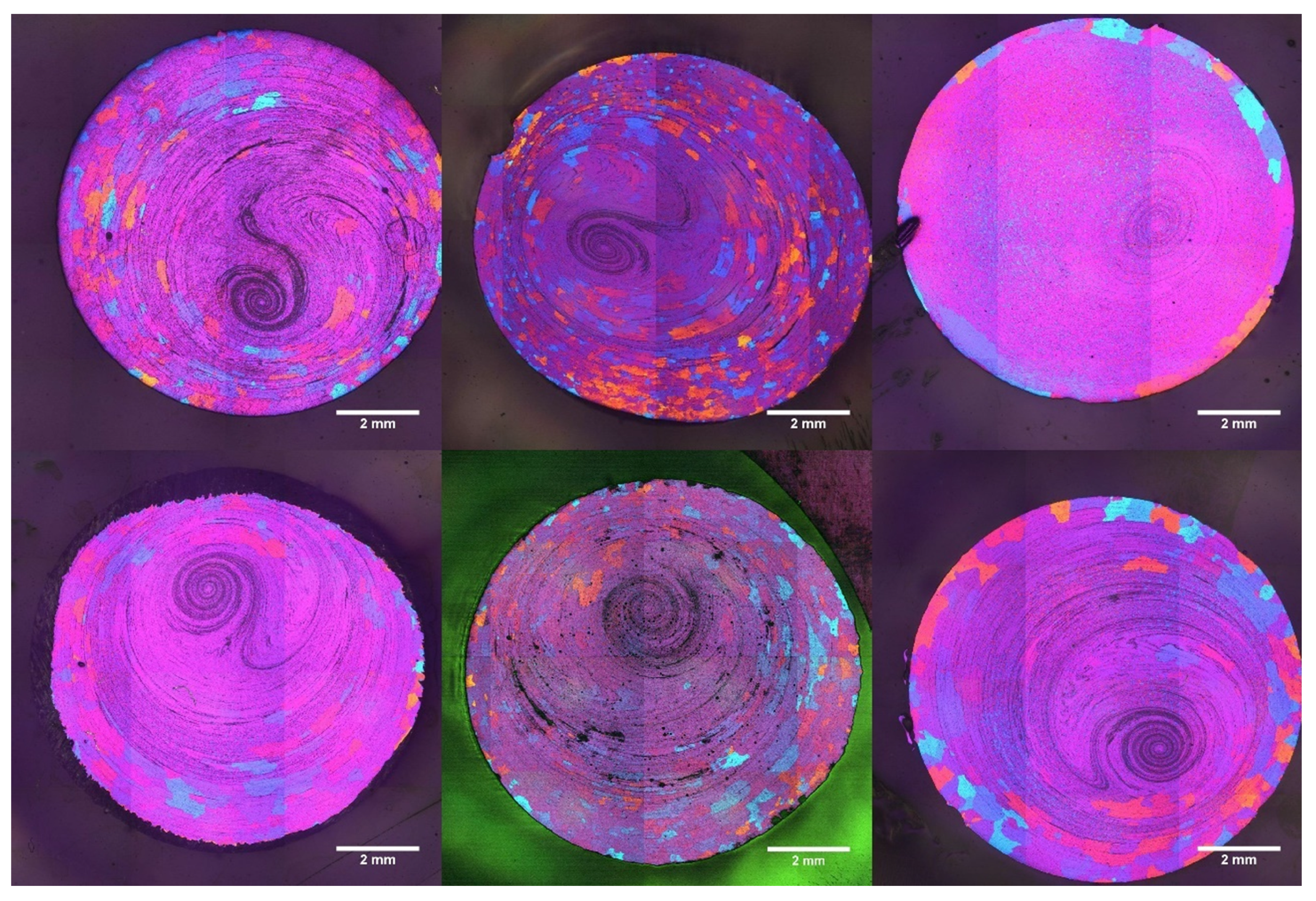
2. Material Flow in MSE
3. Pressure and Strain-Driving Mechanism
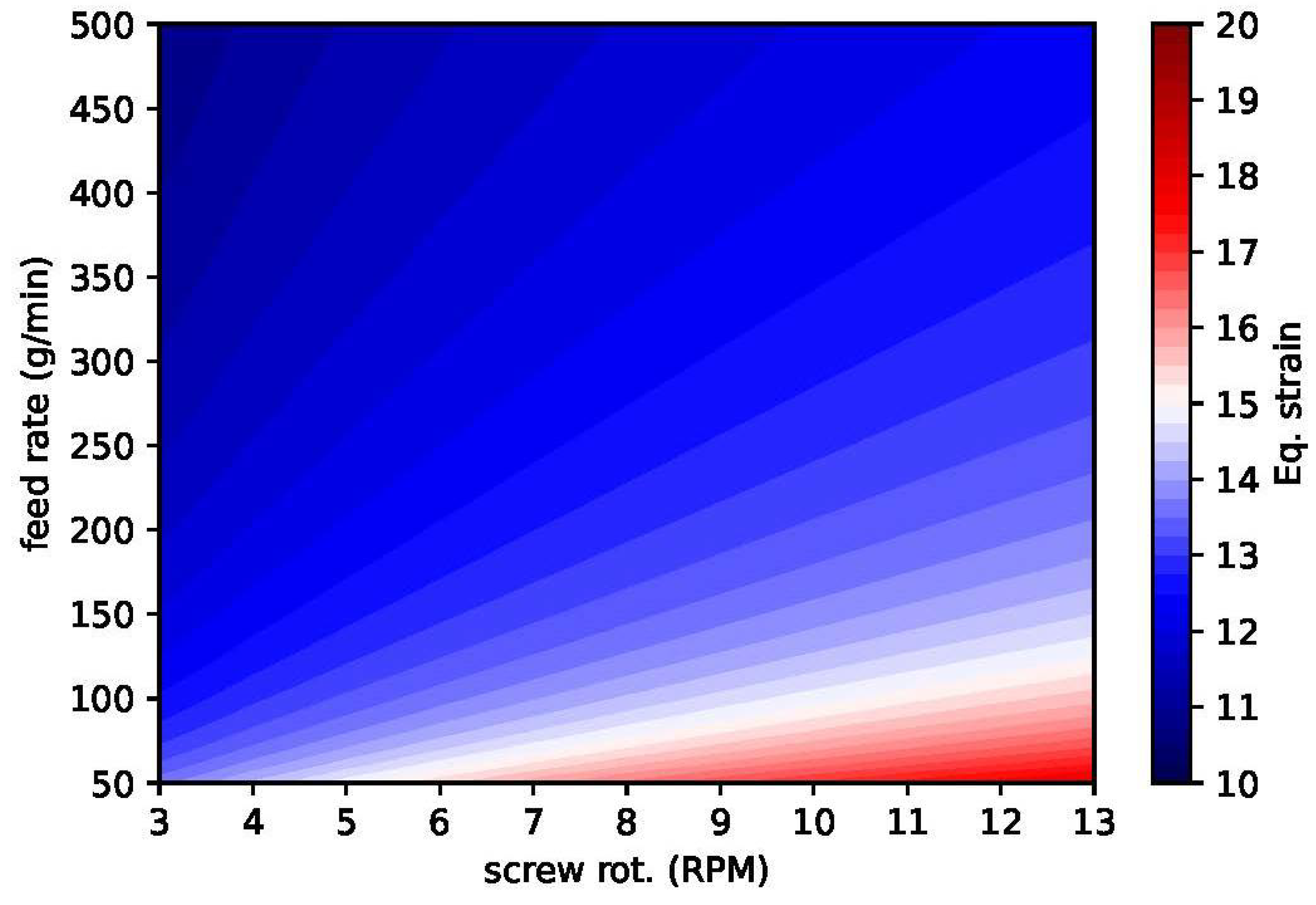
4. Accumulation of Strain
5. Materials and Applications
6. Emerging Solid-State Manufacturing Technologies
7. Future Development of MSE
8. Concluding Remarks
Author Contributions
Funding
Acknowledgments
Conflicts of Interest
References
- Mays, L.W. Water Technology in Ancient Egypt; Springer: Cham, Switzerland, 2010; ISBN 90-481-8631-5. [Google Scholar]
- Abeykoon, C. Single screw extrusion control: A comprehensive review and directions for improvements. Control. Eng. Pract. 2016, 51, 69–80. [Google Scholar] [CrossRef] [Scilit]
- Harper, J.M.; Clark, J.P. Food extrusion. Crit. Rev. Food Sci. Nutr. 1979, 11, 155–215. [Google Scholar] [CrossRef] [Scilit] [PubMed]
- Werenskiold, J.C.; Auran, L.; Roven, H.J.; Ruym, N.; Reiso, O. Screw Extruder for Continuous Extrusion of Materials with High Viscosity. Worldwide Patent WO 2008/063076, EP 2086 697 B1, 2008. [Google Scholar]
- Widerøe, F.; Welo, T. Conditions for sticking friction between aluminium alloy AA6060 and tool steel in hot forming. Key Eng. Mater. 2012, 491, 121–128. [Google Scholar] [CrossRef] [Scilit]
- Wang, L.; Yang, H. Friction in aluminium extrusion—Part 2: A review of friction models for aluminium extrusion. Tribol. Int. 2012, 56, 99–106. [Google Scholar] [CrossRef] [Scilit]
- Oberhausen, G.; Zhu, Y.; Cooper, D.R. Reducing the environmental impacts of aluminum extrusion. Resour. Conserv. Recycl. 2022, 179, 106120. [Google Scholar] [CrossRef] [Scilit]
- Duflou, J.R.; Tekkaya, A.E.; Haase, M.; Welo, T.; Vanmeensel, K.; Kellens, K.; Dewulf, W.; Paraskevas, D. Environmental assessment of solid state recycling routes for aluminium alloys: Can solid state processes significantly reduce the environmental impact of aluminium recycling? CIRP Ann. 2015, 64, 37–40. [Google Scholar] [CrossRef] [Scilit]
- Widerøe, F.; Welo, T. Using contrast material techniques to determine metal flow in screw extrusion of aluminium. J. Mater. Process. Technol. 2013, 213, 1007–1018. [Google Scholar] [CrossRef] [Scilit]
- Lefstad, M.; Reiso, O.; Johnsen, V. Flow of the billet surface in aluminium extrusion. In Proceedings of the International Aluminium Eextrusion Technology Seminar. Aluminium Association INC & Aluminium Extruders Council, Chicago, IL, USA, 19–22 May 1992; Volume 2. [Google Scholar]
- Uyyuru, R.K.; Valberg, H. Physical and numerical analysis of the metal flow over the punch head in backward cup extrusion of aluminium. J. Mater. Process. Technol. 2006, 172, 312–318. [Google Scholar] [CrossRef] [Scilit]
- Widerøe, F. Material Flow in Screw Extrusion of Aluminium. Ph.D. Thesis, NTNU Norwegian University of Science and Technology, Trondheim, Norway, 2012. Available online: http://hdl.handle.net/11250/241707 (accessed on 19 January 2023).
- Rauwendaal, C. Polymer Extrusion; Carl Hanser Verlag: Munich, Germany, 2014; ISBN 1-56990-516-9. [Google Scholar]
- Skorpen, K.G.; Roven, H.J.; Reiso, O. A physical based empirical model for the accumulated strain in novel Metal Continuous Screw Extrusion (MCSE). J. Mater. Process. Technol. 2020, 282, 116670. [Google Scholar] [CrossRef] [Scilit]
- Ivanisenko, Y.; Kulagin, R.; Fedorov, V.; Mazilkin, A.; Scherer, T.; Baretzky, B.; Hahn, H. High pressure torsion extrusion as a new severe plastic deformation process. Mater. Sci. Eng. A 2016, 664, 247–256. [Google Scholar] [CrossRef] [Scilit]
- Ravi Shankar, M.; Verma, R.; Rao, B.C.; Chandrasekar, S.; Compton, W.D.; King, A.H.; Trumble, K.P. Severe plastic deformation of difficult-to-deform materials at near-ambient temperatures. Metall. Mater. Trans. 2007, 38, 1899–1905. [Google Scholar] [CrossRef] [Scilit]
- Furukawa, M.; Horita, Z.; Nemoto, M.; Langdon, T. Processing of metals by equal-channel angular pressing. J. Mater. Sci. 2001, 36, 2835–2843. [Google Scholar] [CrossRef] [Scilit]
- Iwahashi, Y.; Horita, Z.; Nemoto, M.; Langdon, T.G. An investigation of microstructural evolution during equal-channel angular pressing. Acta Mater. 1997, 45, 4733–4741. [Google Scholar] [CrossRef] [Scilit]
- Kristiansen, K.H. Characterization of Extruded Aluminium Alloys from Ram Extrusion and Screw Extrusion. Master’s Thesis, NTNU Norwegian University of Science and Technology, Trondheim, Norway, 2020. Available online: https://hdl.handle.net/11250/2785293 (accessed on 4 June 2024).
- Sveen, O. Characterization of the Microstructural Development through Screw Extrusion of AA6060 and AA6082. Master’s Thesis, NTNU Norwegian University of Science and Technology, Trondheim, Norway, 2021. Available online: https://hdl.handle.net/11250/2787936 (accessed on 4 June 2024).
- Humphreys, F.; Ardakani, M. Grain boundary migration and Zener pinning in particle-containing copper crystals. Acta Mater. 1996, 44, 2717–2727. [Google Scholar] [CrossRef] [Scilit]
- Skorpen, K.G. Characterization of Extruded Aluminium. Master’s Thesis, NTNU Norwegian University of Science and Technology, Trondheim, Norway, 2011. Available online: http://hdl.handle.net/11250/247996 (accessed on 19 January 2023).
- Langelandsvik, G.; Furu, T.; Reiso, O.; Roven, H.J. Effects of iron precipitation and novel metal screw extrusion on electrical conductivity and properties of AA1370 aluminium. Mater. Sci. Eng. B 2020, 254, 114505. [Google Scholar] [CrossRef] [Scilit]
- Værnes, M.S. Applications of Screw Extrusion for Pure Aluminium and Aluminium Foils. Master’s Thesis, NTNU Norwegian University of Science and Technology, Trondheim, Norway, 2018. Available online: http://hdl.handle.net/11250/2576488 (accessed on 8 July 2018).
- Langelandsvik, G.; Grandcolas, M.; Skorpen, K.G.; Furu, T.; Akselsen, O.M.; Roven, H.J. Development of Al-TiC wire feedstock for additive manufacturing by metal screw extrusion. Metals 2020, 10, 1485. [Google Scholar] [CrossRef] [Scilit]
- Amundsen, H.S. The Applicability of Aluminium Alloys as Reinforcement Material in Concrete Constructions. Master’s Thesis, NTNU Norwegian University of Science and Technology, Trondheim, Norway, 2018. Available online: https://hdl.handle.net/11250/2576509 (accessed on 19 March 2023).
- Kolberg, E.M.; Eide, A.T.; Østbye, E.M. The Possibility of Using Reinforcement Bars of Aluminium in Concrete Structures. Master’s Thesis, NTNU Norwegian University of Science and Technology, Trondheim, Norway, 2018. Available online: http://hdl.handle.net/11250/2562319 (accessed on 19 January 2023).
- Samuelsen, S. Effect of TiC Nanoparticle Addition in Metal Screw Extruded AA7108 Filler Wire. Master’s Thesis, NTNU Norwegian University of Science and Technology, Trondheim, Norway, 2023. Available online: https://hdl.handle.net/11250/3091186 (accessed on 18 September 2023).
- Pedersen, B.D. Preliminary Investigations on the Manufacture of Al-AZ31 Bimetallic Composites by the Screw Extrusion Process. Master’s Thesis, Institutt for Materialteknologi, Trondheim, Norway, 2013. Available online: http://hdl.handle.net/11250/249283 (accessed on 19 January 2023).
- Berulfsen, T. Screw Extrusion from Various Binary Al-XMg Feed Materials-Effects of Heat Treatment on Microstructure. Master’s Thesis, NTNU Norwegian University of Science and Technology, Trondheim, Norway, 2016. Available online: http://hdl.handle.net/11250/2409945 (accessed on 19 January 2023).
- Wu, K.; Chang, H.; Maawad, E.; Gan, W.M.; Brokmeier, H.G.; Zheng, M.Y. Microstructure and mechanical properties of the Mg/Al laminated composite fabricated by accumulative roll bonding (ARB). Mater. Sci. Eng. A 2010, 527, 3073–3078. [Google Scholar] [CrossRef] [Scilit]
- Paramsothy, M.; Gupta, M.; Srikanth, N. Processing, microstructure, and properties of a Mg/Al bimetal macrocomposite. J. Compos. Mater. 2008, 42, 2567–2584. [Google Scholar] [CrossRef] [Scilit]
- Skorpen, K.G.; Mauland, E.; Reiso, O.; Roven, H.J. Novel method of screw extrusion for fabricating Al/Mg (macro-) composites from aluminum alloy 6063 and magnesium granules. Trans. Nonferrous Met. Soc. China 2014, 24, 3886–3893. [Google Scholar] [CrossRef] [Scilit]
- Surappa, M.K. Aluminium matrix composites: Challenges and opportunities. Sadhana 2003, 28, 319–334. [Google Scholar] [CrossRef] [Scilit]
- Ragnvaldsen, O. Characterisation of an Aluminium Matrix Nanocomposite Wire Manufactured by Screw Extrusion. Master’s Thesis, NTNU Norwegian University of Science and Technology, Trondheim, Norway, 2019. Available online: http://hdl.handle.net/11250/2624249 (accessed on 16 June 2019).
- Kirkbakk, K.M. Aluminum Weld Metal Inoculation by Ti/TiB2/TiC Additions to Screw Extruded Filler Wires. Master’s Thesis, NTNU Norwegian University of Science and Technology, Trondheim, Norway, 2022. Available online: https://hdl.handle.net/11250/3026009 (accessed on 28 June 2022).
- Kirkbakk, K.M.; Marhaug, N.; Kvam-Langelandsvik, G.; Werenskiold, J.C. Grain refinement of aluminium welds by Ti, TiB2, and TiC filler wire inoculation. Int. J. Adv. Manuf. Technol. 2023, 128, 5117–5127. [Google Scholar] [CrossRef] [Scilit]
- Edvardsen, M.H. Optimization of Electrical Conductivity in Screw Extruded Wires: The Effect of Aluminium Oxide Particles on Screw Extruded Wires of Pure Aluminium. Master’s Thesis, NTNU Norwegian University of Science and Technology, Trondheim, Norway, 2021. Available online: https://hdl.handle.net/11250/2785336 (accessed on 23 September 2021).
- Meling, J.I.H. Characterisation of Feed and Produced Material in Screw Extrusion of Titanium. Master’s Thesis, NTNU Norwegian University of Science and Technology, Trondheim, Norway, 2016. Available online: http://hdl.handle.net/11250/2409570 (accessed on 19 January 2023).
- Bertram, M.; Ramkumar, S.; Rechberger, H.; Rombach, G.; Bayliss, C.; Martchek, K.J.; Müller, D.B.; Liu, G. A regionally-linked, dynamic material flow modelling tool for rolled, extruded and cast aluminium products. Resour. Conserv. Recycl. 2017, 125, 48–69. [Google Scholar] [CrossRef] [Scilit]
- Drouet, M.G.; Handfield, M.; Meunier, J.; Laflamme, C.B. Dross treatment in a rotary arc furnace with graphite electrodes. JOM 1994, 46, 26–27. [Google Scholar] [CrossRef] [Scilit]
- Cui, J. Solid State Recycling of Aluminium Scrap and Dross Characterization. Ph.D. Thesis, NTNU Norwegian University of Science and Technology, Trondheim, Norway, 2011. Available online: http://hdl.handle.net/11250/249018 (accessed on 19 January 2023).
- Philipson, H. The Effect of Thickness and Compaction on the Recovery of Aluminium in Recycling of Foils in Salt Flux. Master’s Thesis, KTH, Stockholm, Sweden, 2020. Available online: https://hdl.handle.net/11250/2785300 (accessed on 19 January 2023).
- Breivik, S.L. Recycling of Al from Incinerator Bottom Ash with Screw Extruder. Master’s Thesis, NTNU Norwegian University of Science and Technology, Trondheim, Norway, 2021. Available online: https://hdl.handle.net/11250/2824266 (accessed on 19 January 2023).
- Hydro.com. Groundbreaking Recycling Technology in Pilot Phase. 2021. Available online: https://www.hydro.com/en/media/news/2021/groundbreaking-recycling-technology-in-pilot-phase/ (accessed on 29 March 2024).
- Business Norway. Nuvosil Recycles Silicon from Solar Cell Production. Available online: https://businessnorway.com/solutions/nuvosil-recycles-silicon-from-solar-cell-production (accessed on 18 February 2024).
- Raabe, D.; Ponge, D.; Uggowitzer, P.J.; Roscher, M.; Paolantonio, M.; Liu, C.; Antrekowitsch, H.; Kozeschnik, E.; Seidmann, D.; Gault, B. Making sustainable aluminum by recycling scrap: The science of “dirty” alloys. Prog. Mater. Sci. 2022, 128, 100947. [Google Scholar] [CrossRef] [Scilit]
- Haugland, B. Sparer Store Summer på å Bruke Skrap i Produksjonen: –Betyr en Halv Million Kroner Ekstra Rett på Bunnlinja. 2022. Available online: https://www.h-avis.no/sparer-store-summer-pa-a-bruke-skrap-i-produksjonen-betyr-en-halv-million-kroner-ekstra-rett-pa-bunnlinja/s/5-62-1428370 (accessed on 6 June 2023).
- Boin, U.; Reuter, M.A.; Probst, T. Understanding the Aluminium Scrap Melting Processes Inside a Rotary Furnace. World Metall. ERZMETALL 2004, 57, 1–6. [Google Scholar]
- Migler, K.B. Sharkskin Instability in Extrusion. In Polymer Processing Instabilities, 1st ed.; CRC Press: Boca Raton, FL, USA, 2014. [Google Scholar] [CrossRef] [Scilit]
- Ebbesen, L.H. Elektriske Ledere av Skrueekstrudert Aluminium-Effekt av Kjemisk Sammensetning, Termo-Mekanisk Bearbeiding og Deformasjon. Master’s Thesis, NTNU Norwegian University of Science and Technology, Trondheim, Norway, 2016. Available online: http://hdl.handle.net/11250/2615744 (accessed on 19 January 2023).
- Bilsbak, A. Mikrostruktur og Mekaniske Egenskaper for Skrueekstrudert Aluminium: Karakterisering av Skrueekstrudert Aluminium Etter Ulike Rensmetoder av Råmaterialet. Master’s Thesis, NTNU Norwegian University of Science and Technology, Trondheim, Norway, 2012. Available online: http://hdl.handle.net/11250/249096 (accessed on 19 January 2023).
- Cui, J.; Kvithyld, A.; Roven, H.J. Degreasing of aluminium turnings and implications for solid-state recycling. Miner. Met. Mater. Soc. AIME 2010, 420, 675–678. [Google Scholar]
- Skorpen, K.G. Screw Extrusion of Light Metals: Development of Materials, Characterization and Process Analysis. Ph.D. Thesis, NTNU Norwegian University of Science and Technology, Trondheim, Norway, 2018. Available online: http://hdl.handle.net/11250/2565656 (accessed on 13 February 2023).
- Smith, N.; Gleeson, B.; Saidi, W.A.; Kvithyld, A.; Tranell, G. Mechanism behind the inhibiting effect of CO2 on the oxidation of Al–Mg alloys. Ind. Eng. Chem. Res. 2018, 58, 1434–1442. [Google Scholar] [CrossRef] [Scilit]
- Langelandsvik, G.; Eriksson, M.; Akselsen, O.M.; Roven, H.J. Wire arc additive manufacturing of AA5183 with TiC nanoparticles. Int. J. Adv. Manuf. Technol. 2021, 119, 1047–1058. [Google Scholar] [CrossRef] [Scilit]
- Bridgman, P.W. Effects of high shearing stress combined with high hydrostatic pressure. Phys. Rev. 1935, 48, 825. [Google Scholar] [CrossRef] [Scilit]
- Segal, V. The Method of Material Preparation for Subsequent Working. U.S. Patent 575,892, 1977. [Google Scholar]
- Segal, V. Materials processing by simple shear. Mater. Sci. Eng. A 1995, 197, 157–164. [Google Scholar] [CrossRef] [Scilit]
- Valiev, R.Z.; Alexandrov, I.V.; Zhu, Y.T.; Lowe, T.C. Paradox of strength and ductility in metals processed bysevere plastic deformation. J. Mater. Res. 2002, 17, 5–8. [Google Scholar] [CrossRef] [Scilit]
- Segal, V.M. Engineering and commercialization of equal channel angular extrusion (ECAE). Mater. Sci. Eng. A 2004, 386, 269–276. [Google Scholar] [CrossRef]
- Sakai, G.; Horita, Z.; Langdon, T.G. Grain refinement and superplasticity in an aluminum alloy processed by high-pressure torsion. Mater. Sci. Eng. A 2005, 393, 344–351. [Google Scholar] [CrossRef] [Scilit]
- Valiev, R.Z.; Zehetbauer, M.J.; Estrin, Y.; Höppel, H.W.; Ivanisenko, Y.; Hahn, H.; Wilde, G.; Roven, H.J.; Sauvage, X.; Langdon, T.G. The innovation potential of bulk nanostructured materials. Adv. Eng. Mater. 2007, 9, 527–533. [Google Scholar] [CrossRef] [Scilit]
- Kulagin, R.; Beygelzimer, Y.; Estrin, Y.; Ivanisenko, Y.; Baretzky, B.; Hahn, H. A mathematical model of deformation under high pressure torsion extrusion. Metals 2019, 9, 306. [Google Scholar] [CrossRef] [Scilit]
- Nugmanov, D.; Kulagin, R.; Perroud, O.; Mail, M.; Hahn, H.; Ivanisenko, Y. Equivalent strain distribution at high pressure torsion extrusion of pure copper: Finite element modeling and experimental validation. J. Mater. Process. Technol. 2023, 315, 117932. [Google Scholar] [CrossRef] [Scilit]
- Xu, R.; Lu, Y.; Dai, Y.; Brognara, A.; Hahn, H.; Ivanisenko, Y. Processing of high-strength thermal-resistant Al-2.2% cerium-1.3% lanthanum alloy rods with high electric conductivity by High Pressure Torsion Extrusion. J. Mater. Sci. 2024, 59, 9075–9090. [Google Scholar] [CrossRef] [Scilit]
- Hu, J.; Kulagin, R.; Ivanisenko, Y.; Baretzky, B.; Zhang, H. Finite element modeling of Conform-HPTE process for a continuous severe plastic deformation path. J. Manuf. Process. 2020, 55, 373–380. [Google Scholar] [CrossRef] [Scilit]
- Ivanisenko, Y. Perspectives of scaling up of severe plastic deformation: A case of High Pressure Torsion Extrusion. Mater. Trans. 2023, 64, 1489–1496. [Google Scholar] [CrossRef] [Scilit]
- Etherington, C. CONFORM—A new concept for the continuous extrusion forming of metals. J. Eng. Ind. 1974, 96, 893–900. [Google Scholar] [CrossRef] [Scilit]
- Etherington, C. Conform and the recycling of non-ferrous scrap metals. Conserv. Recycl. 1978, 2, 19–29. [Google Scholar] [CrossRef] [Scilit]
- Smythe, S.A.; Thomas, B.M.; Jackson, M. Recycling of titanium alloy powders and swarf through continuous extrusion (Conform™) into affordable wire for additive manufacturing. Metals 2020, 10, 843. [Google Scholar] [CrossRef] [Scilit]
- Borgert, T.; Homberg, W. Friction-Induced Recycling Process for User-Specific Semi-Finished Product Production. Metals 2021, 11, 663. [Google Scholar] [CrossRef] [Scilit]
- Lightmetalage.com. Atomic13 to Commercialize Shape Technology Developed by PNNL. 2024. Available online: https://www.lightmetalage.com/news/industry-news/recycling-remelt/atomic13-to-commercialize-shape-technology-developed-by-pnnl/ (accessed on 29 May 2024).
- Taysom, B.S.; Overman, N.; Olszta, M.; Reza-E-Rabby, M.; Skszek, T.; DiCiano, M.; Whalen, S. Shear assisted processing and extrusion of enhanced strength aluminum alloy tubing. Int. J. Mach. Tools Manuf. 2021, 169, 103798. [Google Scholar] [CrossRef] [Scilit]
- Baffari, D.; Reynolds, A.P.; Masnata, A.; Fratini, L.; Ingarao, G. Friction stir extrusion to recycle aluminum alloys scraps: Energy efficiency characterization. J. Manuf. Process. 2019, 43, 63–69. [Google Scholar] [CrossRef] [Scilit]
- Buffa, G.; Campanella, D.; Micari, F.; Fratini, L. Design and development of a new machine tool for continuous friction stir extrusion. CIRP J. Manuf. Sci. Technol. 2023, 41, 391–400. [Google Scholar] [CrossRef] [Scilit]
- Gumaste, A.; Haridas, R.S.; Gupta, S.; Gaddam, S.; Kandasamy, K.; McWilliams, B.A.; Cho, K.C.; Mishra, R.S. Solid Stir Extrusion: Innovating friction stir technology for continuous extrusion process. J. Mater. Process. Technol. 2023, 316, 117952. [Google Scholar] [CrossRef] [Scilit]
- Sharma, A.; Haridas, R.S.; Agrawal, P.; Gumaste, A.; Scharf, T.; Kandasamy, K.; Mishra, R.S. Novel SolidStir extrusion technology for enhanced conductivity cable manufacturing via in-situ exfoliation of graphite to graphene. Mater. Des. 2024, 238, 112643. [Google Scholar] [CrossRef] [Scilit]
- Warrings, R.; Fellner, J. Current status of circularity for aluminum from household waste in Austria. Waste Manag. 2018, 76, 217–224. [Google Scholar] [CrossRef] [Scilit]
- Asadikiya, M.; Yang, S.; Zhang, Y.; Lemay, C.; Apelian, D.; Zhong, Y. A review of the design of high-entropy aluminum alloys: A pathway for novel Al alloys. J. Mater. Sci. 2021, 56, 12093–12110. [Google Scholar] [CrossRef] [Scilit]





| Alloy | 6082 | 6005 | 6060 | |||||||||
|---|---|---|---|---|---|---|---|---|---|---|---|---|
| Extrusion | Screw | Ram | Screw | Ram | Screw | Ram | ||||||
| Cooling media | Air | Water | Air | Water | Air | Water | Air | Water | Air | Water | Air | Water |
| Rp0.2 [MPa] | 345 | 330 | 380 | 355 | 310 | 310 | 305 | 310 | 225 | 220 | 230 | 225 |
| UTS [MPa] | 360 | 355 | 390 | 365 | 345 | 340 | 338 | 315 | 250 | 250 | 248 | 245 |
| Elongation at break [%] | 15 | 17 | 13 | 15 | 13 | 12 | 18 | 18 | 16 | 17 | 17 | 17 |
Disclaimer/Publisher’s Note: The statements, opinions and data contained in all publications are solely those of the individual author(s) and contributor(s) and not of MDPI and/or the editor(s). MDPI and/or the editor(s) disclaim responsibility for any injury to people or property resulting from any ideas, methods, instructions or products referred to in the content. |
© 2024 by the authors. Licensee MDPI, Basel, Switzerland. This article is an open access article distributed under the terms and conditions of the Creative Commons Attribution (CC BY) license (https://creativecommons.org/licenses/by/4.0/).
Share and Cite
Kvam-Langelandsvik, G.; Skorpen, K.G.; Werenskiold, J.C.; Roven, H.J. Review of Metal Screw Extrusion: State of the Art and Beyond. Metals 2024, 14, 1117. https://doi.org/10.3390/met14101117
Kvam-Langelandsvik G, Skorpen KG, Werenskiold JC, Roven HJ. Review of Metal Screw Extrusion: State of the Art and Beyond. Metals. 2024; 14(10):1117. https://doi.org/10.3390/met14101117
Chicago/Turabian StyleKvam-Langelandsvik, Geir, Kristian Grøtta Skorpen, Jens Christofer Werenskiold, and Hans Jørgen Roven. 2024. "Review of Metal Screw Extrusion: State of the Art and Beyond" Metals 14, no. 10: 1117. https://doi.org/10.3390/met14101117
APA StyleKvam-Langelandsvik, G., Skorpen, K. G., Werenskiold, J. C., & Roven, H. J. (2024). Review of Metal Screw Extrusion: State of the Art and Beyond. Metals, 14(10), 1117. https://doi.org/10.3390/met14101117