


Developing a Conceptual Framework for Investigating Communication Supporting Community Resilience
Abstract
1. Introduction
2. Theoretical Background
2.1. Integral Approach to Communication Supporting Crisis Management
2.2. Process Approach of Crisis and Emergency Risk Communication
2.3. Communication as an Interface Function in a Multi-Actor Network
3. Research Design
4. Core Concepts
4.1. Empowerment
4.2. Awareness and Preparedness
4.3. Community Resilience and Citizen Response
5. Strengthening the Role of Communication in a Community Approach
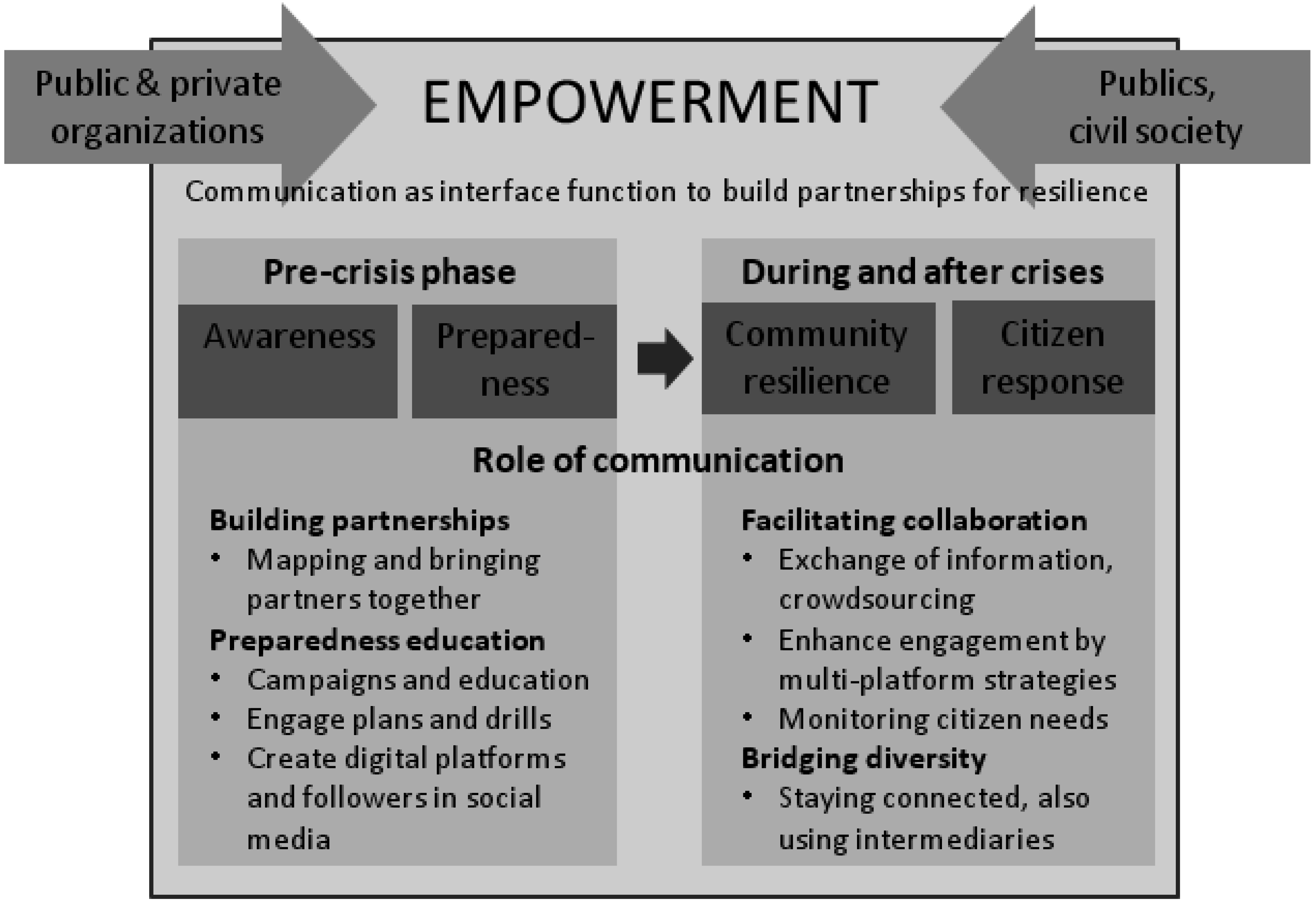
6. Investigating the Role of Communication in Enhancing Community Resilience
6.1. Building Partnerships in the Pre-Crisis Phase
6.2. Preparedness Education
6.3. Facilitating Collaboration During and After Crises
6.4. Bridging Diversity in the Broad Response Network
7. Conclusions
Acknowledgments
Conflicts of Interest
References
- Burnside-Lawry, J.; Akama, Y.; Rogers, P. Communication research needs for building societal disaster resilience. Aust. J. Emerg. Manag. 2013, 28, 30–35. [Google Scholar]
- United Nations Office for the Coordination of Humanitarian Affairs. OCHA on Message: Communications with Communities; United Nations Office for the Coordination of Humanitarian Affairs: New York, NY, USA, 2013; Available online: http://www.unocha.org/about-us/publications/other/%251/80 (accessed on 2 April 2015).
- Palttala, L.; Vos, M. Quality indicators for crisis communication to support emergency management by public authorities. J. Conting. Crisis Manag. 2012, 20, 39–51. [Google Scholar] [CrossRef]
- Eiser, R.J.; Bostrom, A.; Burton, I.; Johnston, D.M.; McClure, J.; Paton, D.; van der Plight, J.; White, M.P. Risk interpretation and action: A conceptual framework for responses to natural hazards. Int. J. Disaster Risk Reduct. 2012, 1, 5–16. [Google Scholar] [CrossRef]
- Aldoory, L. The Ecological Perspective and Other Ways to (Re)Consider Cultural Factors in Risk Communication. In Handbook of Risk and Crisis Communication; Heath, R.L., O’Hair, H.D., Eds.; Routledge Taylor & Francis: New York, NY, USA, 2009; pp. 227–245. [Google Scholar]
- Reynolds, B.; Seeger, M. Crisis and emergency risk communication as an integrative model. J. Health Commun. 2005, 10, 43–55. [Google Scholar] [CrossRef] [PubMed]
- Chess, C. Organizational theory and the stages of risk communication. Risk Anal. 2001, 21, 179–188. [Google Scholar] [CrossRef] [PubMed]
- Veil, B.; Reynolds, B.; Sellnow, T.; Seeger, M. CERC as a theoretical framework for research and practice. Health Promot. Pract. 2008, 9, 26S–34S. [Google Scholar] [CrossRef] [PubMed]
- Coombs, W.T. Crisis Communication and Its Allied Fields. In The Handbook of Crisis Communication; Coombs, W.T., Holladay, S.J., Eds.; Wiley-Blackwell: Oxford, UK, 2012; pp. 54–64. [Google Scholar]
- Cornelissen, J.; van Bekkum, T.; Van Ruler, B. Corporate communications: A practice-based theoretical conceptualization. Corp. Reput. Rev. 2006, 9, 114–133. [Google Scholar] [CrossRef]
- Vos, M.; Schoemaker, H. Integrated Communication: Concern, Internal and Marketing Communication; Boom Lemma: The Hague, The Netherlands, 2011. [Google Scholar]
- Granovetter, M. Economic action and social structure: The problem of embeddedness. Am. J. Sociol. 1985, 91, 481–510. [Google Scholar] [CrossRef]
- Borgatti, S.P.; Foster, P.C. The network paradigm in organizational research: A review and typology. J. Manag. 2003, 29, 991–1013. [Google Scholar]
- Roloff, J. Learning from multi-stakeholder networks: Issue-focused stakeholder management. J. Bus. Ethics 2008, 82, 233–250. [Google Scholar] [CrossRef]
- Austrom, D.; Ladd, L. Issues management alliances: New responses, new values, and new logics. In Research in Corporate Social Performance and Policy; Post, J.E., Ed.; JAI Press: Greenwich, CT, USA, 1998; Volume 15, pp. 233–255. [Google Scholar]
- Calton, J.M.; Kurland, N.B. A Theory of Stakeholder Enabling: Giving Voice to an Emerging Postmodern Praxis of Organizational Discourse. In Postmodern Management and Organization Theory; Boje, D.M., Gephart, R.P., Jr., Thatchenkery, T.J., Eds.; SAGE: Thousand Oaks, CA, USA, 1996; pp. 154–177. [Google Scholar]
- Weick, K. Making Sense of the Organization; Blackwell: Malden, MA, USA, 2001. [Google Scholar]
- Falkheimer, J.; Heide, M. Crisis Communicators in Change: From Plans to Improvisations. In The Handbook of Crisis Communication; Coombs, W.T., Holladay, S.J., Eds.; Wiley-Blackwell: Malden, MA, USA, 2010; pp. 511–526. [Google Scholar]
- Topper, B.; Lagadec, B. Fractal Crises—A new path for crisis theory and management. J. Contingen. Crisis Manag. 2013, 21, 4–16. [Google Scholar] [CrossRef]
- Vos, M.; Schoemaker, H.; Luoma-aho, V. Setting the agenda for research on issue arenas. Corp. Commun.: Int. J. 2014, 19, 200–215. [Google Scholar] [CrossRef]
- Hyvärinen, J.; Vos, M. Communication Concerning Disasters and Pandemics: Co-Producing Community Resilience and Crisis Response. In Handbook of International Crisis Communication Research; Schwarz, A., Seeger, M., Auer, C., Eds.; Wiley-Blackwell: Hoboken, NJ, USA, 2015; forthcoming. [Google Scholar]
- Sadan, E. Empowerment and Community Planning: Theory and Practice; Hakibutz Hameuchad: Tel Aviv, Israel, 2004; Available online: http://www.mpow.org/ (accessed on 11 August 2014).
- Kasmel, A.; Tanggaard, P. Conceptualizing organizational domains of community empowerment through empowerment evaluation in Estonian communities. Societies 2011, 1, 3–29. [Google Scholar] [CrossRef]
- Palenchar, M.J.; Heath, R.L. Strategic risk communication: Adding value to society. Public Relat. Rev. 2007, 33, 120–129. [Google Scholar] [CrossRef]
- Wilbanks, T.J.; Kates, R.W. Beyond adapting to climate change: Embedding adaptation in responses to multiple threats and stresses. Ann. Assoc. Am. Geogr. 2010, 100, 719–728. [Google Scholar] [CrossRef]
- International Federation of Red Cross and Red Crescent Societies. Public Awareness and Public Education for Disaster Risk Reduction: A Guide; International Federation of Red Cross and Red Crescent Societies: Geneva, Switzerland, 2011; Available online: http://www.ifrc.org/Global/Publications/disasters/reducing_risks/302200-Public-awareness-DDR-guide-EN.pdf (accessed on 2 April 2015).
- Paton, D.; Parkes, B.; Daly, M.; Smith, L. Fighting the flu: Developing sustained community resilience and preparedness. Health Promot. Pract. 2008, 9, 45S–53S. [Google Scholar] [CrossRef] [PubMed]
- United Nations International Strategy for Disaster Reduction. UNISDR Terminology on Disaster Risk Reduction; United Nations ISDR: Geneva, Switzerland, 2009; Available online: http://www.unisdr.org/we/inform/publications/7817 (accessed on 2 April 2015).
- Norris, F.H.; Stevens, S.P.; Pfefferbaum, B.; Wyche, K.F.; Pfefferbaum, R.L. Community resilience as a metaphor, theory, set of capacities, and strategy for disaster readiness. Am. J. Commun. Psychol. 2008, 41, 127–150. [Google Scholar] [CrossRef] [PubMed]
- Heath, R.L.; Palenchar, M.; O’Hair, H.D. Community building through risk communication infrastructures. In Handbook of Risk and Crisis Communication; Heath, R.L., O’Hair, H.H., Eds.; Routledge: New York, NY, USA, 2009; pp. 471–487. [Google Scholar]
- Bajayo, R. Building community resilience to climate change through public health planning. Health Promot. J. Aust. 2012, 23, 30–36. [Google Scholar]
- Boon, H.J.; Cottrell, A.; King, D.; Stevenson, R.B.; Millar, J. Bronfenbrenner’s bioecological theory for modelling community resilience to natural disasters. Nat. Hazards 2012, 60, 381–408. [Google Scholar] [CrossRef]
- Helsloot, I.; Ruitenberg, A. Citizen response to disasters: A survey of literature and some practical implications. J. Conting. Crisis Manag. 2004, 12, 98–111. [Google Scholar] [CrossRef]
- McGee, T.K. Public engagement in neighbourhood level wildfire mitigation and preparedness: Case studies from Canada, the US and Australia. J. Environ. Manag. 2011, 92, 2524–2532. [Google Scholar] [CrossRef] [PubMed]
- Vihalemm, T.; Kiisel, M.; Harro-Loit, H. Citizens’ response patterns to warning messages. J. Conting. Crisis Manag. 2012, 20, 13–25. [Google Scholar] [CrossRef]
- Kirchenbaum, A. Generic sources of disaster communities: A social network approach. Int. J. Sociol. Soc. Policy 2004, 24, 94–129. [Google Scholar] [CrossRef]
- Rowel, R.; Sheikhattari, P.; Barber, T.M.; Evens-Holland, M. Introduction of a guide to enhance risk communication among low-income and minority populations: A grassroots community engagement approach. Health Promot. Pract. 2012, 13, 124–132. [Google Scholar] [CrossRef] [PubMed]
- Boin, A.; McConnell, A. Preparing for critical infrastructure breakdowns: The limits of crisis management and the need for resilience. J. Contingen. Crisis Manag. 2007, 15, 50–59. [Google Scholar] [CrossRef]
- Sellnow, T.L.; Ulmer, R.R.; Seeger, M.W.; Littlefield, R.S. Effective Risk Communication: A Message-Centered Approach; Springer Science+Business Media: New York, NY, USA, 2009. [Google Scholar]
- Ulmer, R.; Sellnow, T.; Seeger, M. Effective Crisis Communication: Moving from Crisis to Opportunity; SAGE: Thousand Oaks, CA, USA, 2011. [Google Scholar]
- Kapucu, N. Interagency communication networks during emergencies: Boundary spanners in multiagency coordination. Am. Rev. Public Adm. 2006, 36, 207–225. [Google Scholar] [CrossRef]
- Patterson, O.; Weil, F.; Patel, K. The role of community in disaster response: Conceptual models. Popul. Res. Policy Rev. 2010, 29, 127–141. [Google Scholar] [CrossRef]
- Linnell, M. Citizen response in crisis: Individual and collective efforts to enhance community resilience. Hum. Technol. Interdiscip. J. Hum. ICT Environ. 2014, 10, 68–94. [Google Scholar] [CrossRef]
- Kendra, J.M.; Wachtendorf, T. Elements of resilience after the World Trade Center disaster: Reconstituting New York city’s emergency operations centre. Disasters 2003, 27, 37–53. [Google Scholar] [CrossRef] [PubMed]
- Stevens, G.; Agho, K.; Taylor, M.; Barr, M.; Raphael, B.; Jorm, L. Terrorism in Australia: Factors associated with perceived threat and incident-critical behaviours. BMC Public Health 2009, 9, 1–9. [Google Scholar] [CrossRef] [PubMed]
- Veil, B.; Mitchell, K. Terror management theory: Promoting tolerance in campus safety campaigns. Int. J. Strateg. Commun. 2010, 4, 207–224. [Google Scholar] [CrossRef]
- Maskrey, A. Revisiting community-based disaster risk management. Environ. Hazards 2011, 10, 42–52. [Google Scholar] [CrossRef]
- Federal Emergency Management Agency. A Whole Community Approach to Emergency Management: Principles, Themes, and Pathways for Action; Federal Emergency Management Agency: New York, NY, USA, 2011. Available online: http://www.fema.gov/library/viewRecord.do?id=4941 (accessed on 2 April 2015).
- Colten, C.E.; Kates, R.W.; Laska, S.B. Three years after Katrina: Lessons for community resilience. Environment 2008, 50, 36–47. [Google Scholar] [CrossRef]
- Sellnow, T.; Seeger, M.W. Theorizing Crisis Communication; Wiley-Blackwell: Oxford, UK, 2013. [Google Scholar]
- Dynes, R.R. Community emergency planning: False assumptions and inappropriate analogies. Int. J. Mass Emerg. Disasters 1994, 12, 141–158. [Google Scholar]
- Lundberg, J.; Törnqvist, E.; Nadjm-Tehrani, S. Resilience in sensemaking and control of emergency response. Int. J. Emerg. Manag. 2012, 8, 99–122. [Google Scholar] [CrossRef]
- United Nations International Strategy for Disaster Reduction. 2011 Global Assessment Report on Disaster Risk Reduction: Revealing Risk, Redefining Development; United Nations Terminology on Disaster Risk Reduction; United Nations International Strategy for Disaster Reduction: Geneva, Switzerland, 2011; Available online: http://www.unisdr.org/we/inform/publications/19846 (accessed on 2 January 2015).
- Perry, R.W.; Lindell, M.K. Understanding citizen response to disasters with implications for terrorism. J. Conting. Crisis Manag. 2003, 11, 49–60. [Google Scholar] [CrossRef]
- United Nations Office for the Coordination of Humanitarian Affairs. Humanitarianism in the Network Age: Including World Humanitarian Data and Trends 2012; United Nations Office for the Coordination of Humanitarian Affairs: New York, NY, USA, 2013; Available online: http://www.unocha.org/hina (accessed on 2 April 2015).
© 2015 by the authors; licensee MDPI, Basel, Switzerland. This article is an open access article distributed under the terms and conditions of the Creative Commons Attribution license (http://creativecommons.org/licenses/by/4.0/).
Share and Cite
Hyvärinen, J.; Vos, M. Developing a Conceptual Framework for Investigating Communication Supporting Community Resilience. Societies 2015, 5, 583-597. https://doi.org/10.3390/soc5030583
Hyvärinen J, Vos M. Developing a Conceptual Framework for Investigating Communication Supporting Community Resilience. Societies. 2015; 5(3):583-597. https://doi.org/10.3390/soc5030583
Chicago/Turabian StyleHyvärinen, Jenni, and Marita Vos. 2015. "Developing a Conceptual Framework for Investigating Communication Supporting Community Resilience" Societies 5, no. 3: 583-597. https://doi.org/10.3390/soc5030583
APA StyleHyvärinen, J., & Vos, M. (2015). Developing a Conceptual Framework for Investigating Communication Supporting Community Resilience. Societies, 5(3), 583-597. https://doi.org/10.3390/soc5030583

