1. Introduction
Across many settings, youth sport has been increasingly shaped by commercialization [
1,
2,
3,
4], professionalization [
5], early specialization [
3,
6], and more structured, performance-oriented development pathways [
3,
5,
6]. These changes can profoundly reshape young people’s experiences of sport, moving sport away from play, while also displacing friendship, enjoyment, the athlete’s own flourishing and broader developmental concerns [
7,
8,
9,
10]. These unfavorable shifts matter because they affect not only the organization of youth sport but also the emotional, relational, and developmental conditions of participation. Matthews et al. (2026) argue that the problem is not simply a matter of isolated bad practices but the wider dominance of a performance model that increasingly makes youth sport resemble work rather than play and can undermine youth rights, well-being, and development [
11]. In response to these pressures, scholars have called for youth sport to be remodeled around a values-based sustainable sport approach centered on inclusivity, dignity, children’s rights, personal growth, play, quality of experience, and long-term athlete well-being, e.g., [
3,
10,
11,
12]. Bjørndal and Espedalen (2026) similarly argue that youth sport needs to be rethought beyond logics of optimization, standardization, and control, and instead oriented toward relational, affective, and embodied forms of engagement [
7].
One sport setting that appears to resist some of the unfavorable shifts in youth sport is the Arctic Winter Games (AWG). The Arctic Winter Games are a circumpolar multi-sport event that brings together youth from northern regions and nations and, crucially, combines athletic competition with cultural and artistic programming that foregrounds Indigenous practices such as Arctic sports and Dene games [
13]. As a youth-focused event, they have been described as intentionally oriented toward socialization, cultural exchanges, and unity among northerners alongside their sporting dimension [
14]. Because they insist on going beyond producing elite youth athletes, measurable outputs, or competitive success, the AWG set themselves apart as a community youth sport event, grounded in a developmental and educational orientation rather than being organized solely around elite performance or commercial visibility [
13,
15]. This matters because community sport event settings can place participation, local involvement, volunteering, inclusion, and shared experience closer to the center of the event, creating more opportunities for social interaction, sense of community, and relationship building among the variety of participants, e.g., [
16,
17,
18].
Because young participants are still in a developmental and educational stage, sport events can function as relational spaces in which they encounter others, experience belonging, learn and exchange cultures, negotiate identity, and build relationships beyond the immediate performance context, see, e.g., [
10,
13,
19,
20]. In this context, event time can operate as a relational intensifier: by concentrating people, shared routines, and social spaces, events can facilitate networking, friendship, and bonding and bridging social capital, e.g., [
21,
22,
23]. They may also create opportunities to produce a sense of community and belonging [
24], building social ties across community boundaries [
25], and to express and negotiate collective identities and cultural attachments through ceremonies, symbols, and everyday interaction [
14,
26]. These relational effects may extend beyond the event, as event-generated social ties can continue through sustained friendships, ongoing socialization, volunteering, and broader community involvement [
23,
27].
Prior scholarship on the Arctic Winter Games has also shown that the event is relationally significant, particularly through friendship formation, networking, community, and identity, e.g., [
13,
28,
29]. However, less attention has been paid to the broader individual, collective, and longer-term forms of relationality that athletes experience within and beyond the event. This research therefore examines how current and former athletes describe relational experiences at and beyond the AWG. It addresses four questions: (1) What conditions within the AWG support relational experiences? (2) How do athletes describe individual relational experiences during the Games? (3) How do athletes describe collective relational experiences during the Games? and (4) What relational experiences endure beyond the event?
2. Theoretical Framework
Turner’s [
30] concept of the liminoid constitutes the primary theoretical lens of this study. Attending the AWG can be read as a “pause” from the pressures of modern life shaped by social acceleration—that is, intensifying rates of change and rhythms of everyday life that generate time pressure and a persistent need to keep up [
31]. The AWG’s week-long format, marked by travel away from ordinary routines and immersion in a dense social-cultural setting, creates conditions in which young athletes can momentarily step outside daily life. Turner’s work on rites of passage, particularly his account of liminality as a condition of being “betwixt and between” ordinary social positions [
32], provides a useful lens for interpreting the AWG as a threshold-like event time-space in which youth participants’ relations to places, people, and practices become especially salient. Indeed, at the Games, youths are set apart from the everyday social order, inhabit a zone that is neither fully inside nor outside its structures, and later re-enter the world of roles and positions [
32,
33]. Turner [
30] distinguishes liminal experiences, associated with obligatory ritual transitions, from liminoid experiences, which are more characteristic of modernity and linked to voluntary leisure, play, cultural performance, and sport. Rowe [
34] challenges this distinction, arguing that modern sport may retain liminal qualities because of its ritual character, cyclical rhythms, collective significance, and integration into social life. Nevertheless, sport-event spaces are often understood as liminoid in contemporary society, see, e.g., [
35,
36]. We therefore understand the AWG as liminoid because it is a voluntary, selective, and modern sport-cultural event rather than a socially required passage in status. This framing does not deny the Games’ ritual and festive qualities; rather, it provides a useful way to examine relational experiences within the event.
In a liminoid time-space, ordinary hierarchies can be loosened, and social life can take on an anti-structural quality—less a simple inversion of structure than a temporary suspension of the usual constraints of rank and role that can open space for intensified togetherness [
32,
33]. Turner [
32] describes this intensified sense of togetherness as communitas. Prior research on liminality/liminoid and communitas shows that sport events can create bounded, set-apart spaces in which ordinary distinctions are loosened, interaction becomes more fluid, and participants experience heightened togetherness, celebration, and collective feeling, e.g., [
21,
37,
38]. This has been demonstrated across varied contexts, from intercultural and anti-racist sport festivals, where liminal design can unsettle hierarchies and foster open, heterogeneous communitas [
39], to spectator settings, where ritualized fan practices and atmospheres strengthen belonging, attachment, and identification [
38,
40]. Related work further suggests that these dynamics are not merely spontaneous by-products of sport events but can be deliberately fostered through event design strategies centered on sociability, celebration, theming, ancillary activities, and other symbolic or sensory features that intensify immersion and interaction [
21,
35]. Moreover, research suggests that sporting events can cultivate communitas, e.g., [
37], although this sense of togetherness is often described as temporary and contingent rather than enduring or stable [
36,
41]. Research also indicates that communitas may enhance bonding and bridging social capital [
42] and may contribute to enjoyment and intentions to return; however, such effects are not guaranteed and may not persist beyond the event without deliberate support or favorable conditions [
41]. The framework also extends beyond the bounded event time-space. Although communitas is often understood as temporary, e.g., [
36,
41], relational experiences formed during an event may leave traces after participants return to ordinary life. Turner’s account of postliminal reincorporation [
32] and Garlick and Ali’s notion of the continuing “liminal bubble” [
35] therefore provide useful concepts for understanding such post-liminoid relational legacies.
Although communitas helps explain collective experiences of togetherness, it does not fully capture the deeper forms of relationship that participants may experience with people, cultures, practices, and communities. Hartmut Rosa’s [
43] theory of resonance therefore provides a complementary relational lens. Rosa [
43] understands resonance as a responsive mode of relating in which a person is affected or addressed by another person, practice, object, or dimension of the world; responds through their own voice or with self-efficacy; and may be transformed through the encounter. Resonance also remains uncontrollable and cannot be deliberately produced or guaranteed. Rosa [
43] also distinguishes four axes of resonance: a social axis concerning relationships between people; a material axis concerning relationships with objects, practices, and materialities; an existential axis concerning relationships with broader sources of meaning, such as nature, history, and spirituality; and a self-axis concerning relationships among the body and psyche of the subject.
Taken together, these concepts perform distinct but connected analytical functions. The liminoid provides the primary lens for understanding the AWG as a bounded time-space set apart from everyday routines; communitas sensitizes the analysis to collective forms of togetherness; resonance helps interpret deeper affective and responsive relational experiences; and the post-liminoid perspective directs attention to what may endure after the event. These concepts initially guided the analysis deductively. However, they were not treated as an exhaustive classification of relationality, and we remained open to other relational experiences that emerged inductively from participants’ accounts. Related concepts were subsequently used where they provided the most appropriate interpretation of particular findings. Although these concepts may intersect in participants’ experiences, they are used to illuminate distinct dimensions and intensities of relationality rather than as interchangeable terms.
4. Results and Discussion
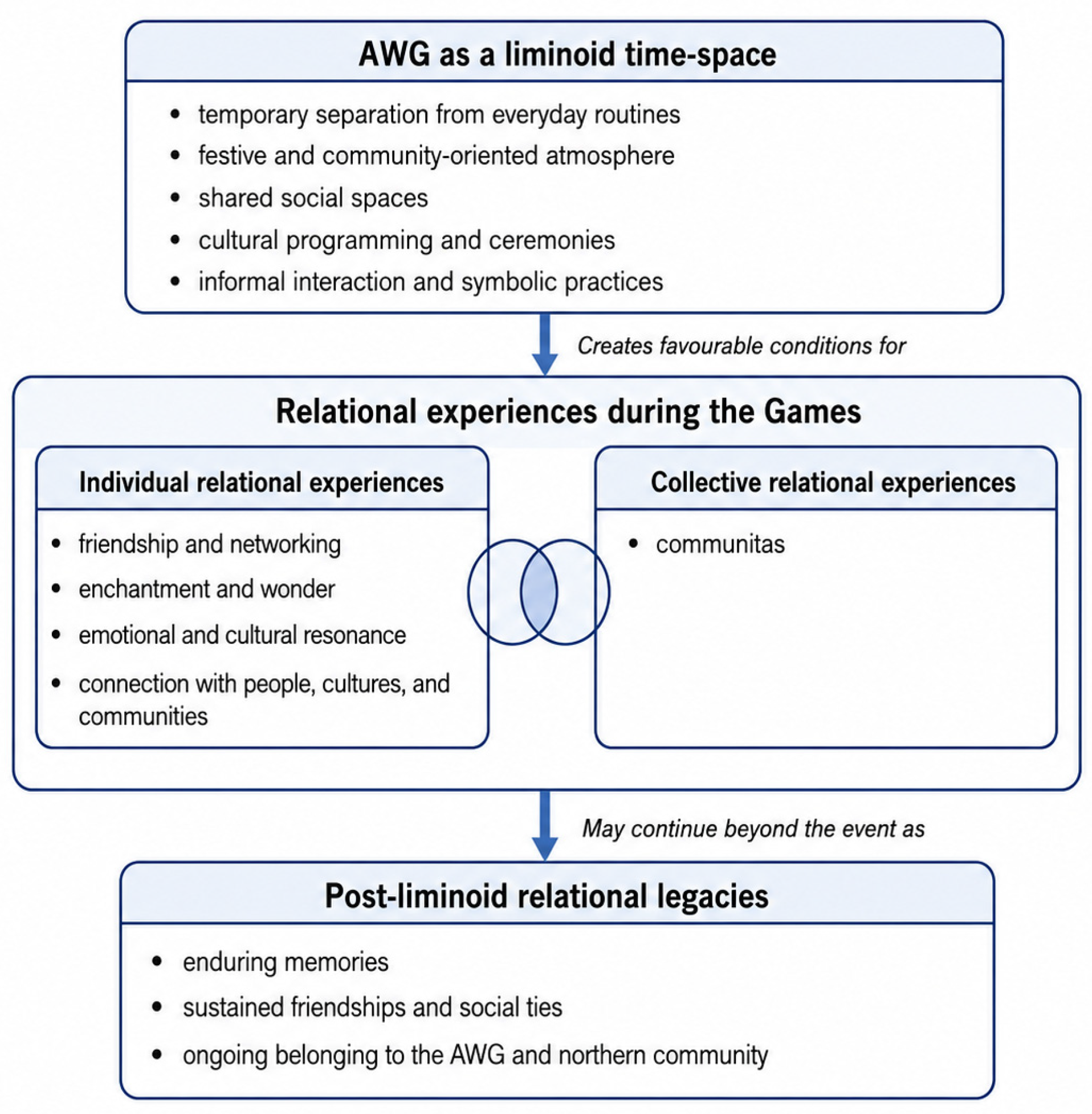
The analysis generated four interconnected themes. First, participants described the AWG as a liminoid time-space that created favorable social, spatial, material, and cultural conditions for relational experiences. Second, they reported individual forms of relationality, ranging from friendship and networking to enchantment, wonder, and resonance. Third, participants described collective relational experiences characterized by communitas, togetherness, and belonging. Finally, former athletes’ accounts pointed to post-liminoid relational legacies, including enduring memories, sustained social ties, and ongoing forms of belonging beyond the event.
4.1. The AWG as a Liminoid Time-Space for Relationality
The Arctic Winter Games emerged in participants’ accounts as a space of connections—a setting in which everyday routines receded and it became easier to meet others, build friendships, and encounter different northern cultures. Rather than simply travelling to “do their sport,” youths described entering a special time and place to seek connections. This orientation becomes clear in athletes’ accounts of why they chose to attend the event. Some athletes emphasized that their motivation to attend the Games went well beyond the pursuit of medals or performance, as they came hoping to experience new social and cultural connections. For instance, an athlete highlighted that what drew her to the event was precisely its emphasis on togetherness and cultural encounter:
I really like the togetherness attitude about it [AWG]… It’s very encouraging of cultural and social interaction, and you don’t really find that with any other tournament. So, I was very excited about this one in particular because then I got to meet people from all around the world, and that’s one of my major reasons as well because it’s very interesting to see different cultures (Interview, 2023 female athlete, 17 years old, Alberta North, wrestling).
Similarly, a futsal player from Nunavut described the Games as a rare chance to expand his social world beyond everyday contacts and online interactions: “It’s a great experience that, for some people, [is] once in a lifetime. You get to meet so many people that you wouldn’t regularly meet unless it was online or something and seeing people in person” (Interview, 2023 male athlete, 15 years old, Nunavut, futsal, A). These accounts show that participants understand the AWG as an occasion for connection-seeking, not merely athletic competition. In Turner’s [
30] sense, this orientation matters because the Games are entered as a voluntary, bounded special time and place that suspends ordinary routines and amplifies social and cultural availability. In this liminoid interval, participants anticipate new relationships and cultural contact that would be less likely in everyday life. This resonates with research on sport events, where social motivations—such as taking part with friends and family, meeting new people, and reconnecting with others—are identified as motivations for participation, e.g., [
47], and with research on festivals and cultural events, where family togetherness, socialization and cultural exploration are likewise highlighted as key motives for attendance, e.g., [
48,
49].
The Games were also distinguished from other events by an atmosphere that seemed to invite social interactions. Several athletes contrasted the AWG with previous multisport or championship competitions where the focus remained narrowly on sport. One participant remarked on the distinction:
It’s very different. I find the people here are way more friendly. They want to talk to you. They want to meet you. I found at the Alberta Winter Games, the people were obviously still nice, but no one was really there to get to know you. They were kind of like ‘we’re here for a sport. Like you’re on my team.’ They weren’t like, ‘oh, you’re an actual teammate of mine. Let me get to know you so we feel comfortable together’ (Interview, 2023 female athlete, 15 years old, Alberta North, wrestling).
By contrast, the AWG environment was described as actively lowering social barriers and making it easy—even expected—to approach others. A 2023 athlete pointed to specific features of the event design that encourage spontaneous encounters:
The pins really allow interactions… you just walk down the hallway… I can just walk up and take a look and say, ‘hey, you want to trade?’ … The uniforms, trading those and then the housing… The cafeteria, we’re all together and the environment is you could just sit down at any table and just randomly talk to somebody. So, I feel like it’s not awkward. There’s no barriers. People are very accepting of someone coming up and just sitting next to you or giving you a high five. I think Arctic Winter Games has that atmosphere (Interview, 2023 male athlete, Arctic Sports/Inuit Games).
Here, the liminoid character of the event is not only temporal (a week away from home) but also material and spatial: the village, housing, cafeteria, and delegation attire and pin-trading practices all work together to create spaces where interaction is expected and easy. These accounts echo recent analyses of the AWG that emphasize how the event intentionally combines competition with social exchange and cultural celebration, foregrounding symbolic unity and a shared northern “we” rather than results alone [
13,
14]. Similar patterns have been observed in other community sporting events such as different Francophone youth games across Canada and the North American Indigenous Games, where sport is explicitly mobilized as a vehicle for social interaction, cultural expression, identity affirmation, and community building, e.g., [
50,
51].
The AWG also opens possibilities for cultural understanding and connection, particularly critical for youths who had limited prior exposure to the diversity of northern peoples. For instance, a futsal player emphasized how the AWG brought together multiple Indigenous and northern cultures in ways he had not encountered before:
When I first came to Nunavut, I didn’t really know about the Inuit people… But then when I came to the Arctic Winter Games I learned about the Métis, the Cree… The Dene, yeah. I learned about them, their language in the opening ceremony. So, I think it’s important because bringing them together can connect us and have a connection in differences and similarities between the cultures (Interview, 2023 male athlete, 15 years old, Nunavut, futsal, B).
For the participant, the Games function as a setting where learning about other northern cultures becomes a routine part of everyday life for a week, offering multiple entry points for cultural curiosity and connection. These accounts resonate with research on the AWG that portrays the event as deliberately promoting northern cultures, e.g., [
13,
28] and with studies of the North American Indigenous Games and Canadian Francophone youth games, where sport provides a platform for cultural understanding, e.g., [
50,
51,
52].
4.2. “It Meant Something to Me”—Relational Experiences at the Individual Level
Within this liminoid week participants described moments of being personally touched and moved through encounters with other entities, as relationships were made and felt with people, cultures, stories, and a wider northern world that becomes accessible through encounter. In this context, one of the most immediate and recurring relational encounters at the AWG was networking and friendship-building through everyday interactions. For instance, a 2023 Arctic Sports athlete from Alberta North emphasized in his survey response that being with other contingents meant “making new friends and meeting new people,” while also exchanging narratives: “you get to learn their stories… I loved going to other teams… to hear all the stories… and I loved learning new cultural stories from others.” A figure skater from Alberta North similarly highlighted the relational tone of the Games in her survey comments: “How friendly they are and how much we can relate… It was easier making friends than I thought it would be.” These comments point to the AWG as a socially open and welcoming environment in which friendships could emerge with relative ease. Viewed more broadly through Putnam’s [
53] distinction between bonding and bridging social capital, however, the data suggest a more differentiated pattern. Although the Games created opportunities for bridging ties across contingents, participants often appeared to spend more time with, and build closer friendships, among members of their own contingent, thereby reinforcing bonding ties rooted in familiarity, proximity, and shared experience. This tension between bonding and bridging is illustrated in one former athlete’s reflection: “For me, with my personality, I just stayed with the NWT people, but I know a few, like a few of the boys, I know that they for sure like mingled a lot. They would often like trade their jackets with the friends they made, but I was content staying with my little group of friends” (Interview, coach, 24 years old, cross-country skiing, Northwest Territories). This former athlete’s account captures both dynamics at once: the tendency for some participants to remain within the comfort of their own contingent and the possibility for others to form bridging friendships across delegations. This pattern qualifies the assumption that entering a liminoid event space necessarily dissolves existing social boundaries. Although the AWG created favourable conditions for interaction across contingents, athletes engaged with these opportunities differently, and familiarity, personal disposition, and comfort within their own groups continued to shape their relationships. The findings therefore suggest that liminoid conditions can expand opportunities for bridging social capital without displacing bonding ties or guaranteeing connections across groups. This relational pattern echoes research suggesting that events can operate as infrastructures for network-building and social capital, particularly when they foster sociability, informal social interaction, and opportunities for community engagement, e.g., [
21,
22]. In addition, Welty Peachey et al. [
42] show that the Street Soccer USA Cup cultivated liminality and communitas, which were leveraged to foster bonding and bridging social capital, pointing to the capacity of event encounters to support connections beyond mere co-presence.
While these accounts emphasize the AWG’s everyday sociability, some athletes described more intense moments of being emotionally moved. For instance, an athlete describes the opening ceremony less as a “nice show” and more as a deeply affecting encounter—a moment where she feels seized by what she sees and hears. Asked to describe the sensory experience, she responds, “Oh my god. It was so beautiful. I even dreamt about it…” and later adds that “some of them were emotional somehow, for me” (Interview, 2023 female athlete, 18 years old, badminton, Nunavik). Her account contains traces of resonance [
43]: the ceremony appeared to affect and address her, she responded emotionally, and the experience exceeded her ability to fully explain or control it. Opening the interpretation to related concepts, her emphasis on beauty, emotion, and the continuation of the experience in a dream also reflects Bennett’s (2001) concept of enchantment [
54] and Fisher’s (1998) notion of wonder [
55], both of which describe being unexpectedly struck by an extraordinary experience that interrupts ordinary perception. Such intense relational experiences suggest that the relational possibilities of a liminoid time-space extend beyond communitas. In addition to collective togetherness, liminoid events may open possibilities for deeper affective and responsive relationships, through encounters with people, artifacts, ceremonies, cultural performances, and other dimensions of the event. Although event design and atmosphere may facilitate these possibilities, they cannot produce or guarantee them, as these encounters remain inherently unpredictable and uncontrollable [
43].
For some athletes, the most memorable moments of connection unfolded in the cultural spaces of the Games, where encounters became emotionally and spiritually significant. For instance, reflecting on the AWG cultural feast, one athlete from Alaska recalled, “Meeting other native people… it was beautiful. Very spiritually fulfilling… I will never forget the night of the cultural feast. My whole group cried from happiness. Everyone was so receptive and eager to learn about our culture…”. Her account points to several interconnected dimensions of the experience: meeting other Indigenous participants, feeling spiritually fulfilled, sharing intense happiness with her group, and encountering others who were open to learning about their culture. The cultural feast was therefore remembered not simply as an event activity, but as a meaningful space of cultural recognition, exchange, and emotional connection. This account first suggests a form of emotional resonance in Schrock et al.’s [
56] sense, as the cultural encounter appears to have aligned with participants’ emotional lives. Through Rosa’s [
43] framework, it can also be interpreted as collective resonance: the participants were touched by the encounter and responded together, most visibly when the athlete recalled that “my whole group cried from happiness.” This shared response also reflects collective emotion, understood as emotion experienced and expressed with others in a socially coordinated way [
43]. This finding extends the idea of collective resonance by showing that intense relational experiences within a liminoid event may be experienced and expressed collectively, as participants are affected by a shared encounter and respond together. Opening the interpretation to a related concept, the intensity and contagious character of this shared happiness resembles Durkheim’s [
57] collective effervescence, in which people gathered around a meaningful collective occasion experience heightened emotion, mutual responsiveness, and a sense of unity. The final part of the athlete’s account draws attention to another important dimension of the encounter: the openness of others to cultural exchange. Her description of participants as “receptive and eager to learn about our culture” points to openness and receptivity as important preconditions for resonance [
43], helping the encounter become responsive and meaningful rather than indifferent or instrumental. Similar expressions of mutual curiosity appeared in other athletes’ accounts. A Dene Games athlete from the Northwest Territories explained, “They wanted to learn about my culture and I wanted to learn about theirs,” while a volleyball player from Greenland valued meeting other teams because they were “interested in their culture [and] the way they live.” These accounts echo our previous resonance-based analysis of the AWG, which identified openness, curiosity, and vulnerability as conditions that support affection and self-efficacious response [
58]. These findings suggest that although event initiatives designed to leverage liminoid conditions—such as cultural programming and opportunities for exchange—can make intense relational experiences more possible, they cannot guarantee them. Such experiences are also shaped by participants’ curiosity, openness, and willingness to be touched and addressed by other people, cultures, and practices [
43].
Beyond these emotionally intense moments, athletes also described cultural connections grounded in ancestry, everyday life, and the perceived authenticity of the Indigenous games practiced at the AWG. In a survey response, a Dene Games athlete from Yukon explained that participation “gives us a sense of what our ancestors went through.” Similarly, a snowshoeing athlete valued the Games because “they were based off of things people would do in real life.” These accounts suggest that the practices were meaningful not simply because they were enjoyable, but because athletes understood them as connected to ancestral experiences and familiar ways of life. Miller’s [
59] concept of cultural resonance helps interpret this connection: cultural practices resonate when they draw on recognizable cultural repertoires and align with participants’ values and lived experiences, making them both salient and credible in relation to their life histories. From this perspective, Arctic Sports and Dene Games may become especially meaningful because participants experience them as continuous with ancestral memory and everyday life, creating possibilities for being moved by and responding to the encounter. These findings refine understandings of relationality within liminoid events by showing that meaningful encounters do not arise only through novelty or separation from ordinary life. At the AWG, the liminoid time-space also became relationally significant by reconnecting participants with familiar cultural practices, ancestral histories, and everyday life. Cultural continuity can therefore coexist with temporary separation and contribute to the possibility of resonance.
4.3. “We’re All in It Together”—Communitas as Collective Relationship
Beyond individual experience of connections, many participants described the Games as generating a strong sense of being part of a larger “we,” where they felt bound together in a shared experience. This echoes Turner’s [
32] notion of communitas as an extra-structural mode of social relationship that emerges in liminal (or liminoid) moments, when ordinary hierarchies and social distinctions are temporarily suspended, and participants experience a direct sense of equality, togetherness, and shared humanity. Several athletes emphasized that, although the event is framed around competition, what stands out is “everyone… coming together” for something more than results. As an athlete explained, “there is a sense of community and a sense of everyone is coming together to do sports. So, there is a sense of understanding between everyone” (Interview, 2023 female athlete, 17 years old, Yukon, cross-country skiing). Another athlete similarly described the AWG as “a really big event that is initially meant for sports and competition. But in the end, even though it still has competition, it also encourages community and culture, and it just really brings people together” (Interview, 2023 female athlete, 16 years old, Alberta North, wrestling). A former athlete likewise recalled that participating in the Games with a core group who “had all experienced the same thing” “just kind of brings you together,” as participants “get to hang out with those guys and form some of those bonds and friendships.” He added that he still knew “one or two guys” from the 1998 Games years later (Interview, coach, 40 years old, hockey, Northwest Territories). His account points to a sense of togetherness and camaraderie forged through shared participation in the AWG, one that extended beyond the event itself. In their accounts, competition is not erased but is re-situated within a broader atmosphere of community, mutual understanding, and togetherness, resonating with research on sport events that can foster a heightened sense of community and communitas, e.g., [
21,
60].
Survey responses from 2023 athletes reinforced this picture of the Games as a site of intense togetherness, frequently articulated through metaphors of family. An Arctic Sports athlete noted that what they liked most about the AWG was “how the other teams supported one another and how close you can get with teammates, as if they become one or family.” Similarly, a Dene Games athlete wrote that “the people that attend, it was like we were all one big family.” When asked specifically about Arctic Sports and Dene Games, athletes again emphasized this family-like atmosphere: one Arctic Sports participant highlighted “the spirit and the competing like family,” while a Dene Games athlete remarked, “I liked how everyone is so friendly and family like.” For some athletes, communitas was expressed more in terms of celebration and community. For instance, one cross-country skier contrasted the AWG with other events by noting that “it is more of a celebration than a competition. Even though we are competing with athletes from other countries, we created a community between all athletes in the sport,” and another cross-country skier wrote that what they liked most was “the sense of community and the variety of cultures.” Across these survey responses, athletes not only describe positive interactions but also portray the Games as a community in which they feel emotionally close, supported, and “as one.” Similar to findings from endurance running, where participants experience a shared emotional bond and being in it together [
61], these accounts suggest that the AWG enables participants to step into a collectively shared, celebratory social world.
For some athletes, this collective bonding deepened into what they themselves described using the language of home. One wrestler explained that, after only a few days,
I kind of feel like this is my home now… You kind of develop a sense of family with people. I feel like that’s the most important thing I do. I feel like I do belong here… everyone just makes everyone feel so welcome. Like you’re here. This is your home for the next week. It’s really nice (Interview, 2023 female athlete, 17 years old, Alberta North, wrestling).
Here, the Games are experienced as a temporary but intense “home” where usual boundaries of region and status fade and are replaced by a sense of belonging. The stress on being “welcome” and “belong[ing] here” illustrates how the event can temporarily suspend everyday social distances and foster a feeling of being part of an inclusive collective—what Turner [
32] describes as communitas as an anti-structural mode of relating and togetherness, in which individuals encounter each other more as equals than as role-bearers. Studies of sport-for-development and festival-like sport events similarly show how organizers can cultivate liminal spaces and community celebration that allow communitas to materialize and be leveraged for social capital, e.g., [
42,
60]. In addition, these experiences of feeling “togetherness,” “like a family,” or “at home” echo previous work on the AWG suggesting that the event is designed as an alternative to conventional international sport events by prioritizing friendship and cultivating a sense of Arctic community [
13], while also contributing to the construction of a shared “We are the Arctic” identity that transcends regional and national boundaries [
14].
4.4. The AWG’s Post-Liminoid Legacies: What Endures Beyond Event Time
Although the AWG unfolds within a bounded, week-long liminoid time-place, former athletes’ accounts suggest that its significance is not confined to the event itself. In this respect, Garlick and Ali’s [
35] (p. 61) notion of a “liminal bubble” is useful, as it captures how the liminal experience of sport may continue beyond the live event across the wider event cycle, rather than ending neatly at closure. This focus on what endures resonates with the argument that liminal event-time matters most when the connections and solidarities it generates are taken home and put to use beyond the event, rather than remaining sealed within the event-world [
42]. This resembles a postliminal moment: a movement out of the in-between interval and back into ordinary life through a process of reincorporation or reaggregation, as participants resume relatively stable social roles beyond the event [
32]. In former athletes’ accounts, what is experienced during this concentrated episode of connection does not simply dissipate at the closing ceremonies; instead, it leaves an enduring trace that continues to shape how they relate to the AWG in the months and years that follow, through lasting memories, sustained social ties, and an expanded sense of community and belonging.
In several accounts, the AWG is remembered not as a discrete competition that ends when athletes leave the village, but as a formative episode that continues to structure how participants narrate their sporting lives and what they consider the event to be “about.” When asked what she liked most about the Games as an athlete, a former athlete responded, “The friendships that were created. I mean, I remember the competitions but it’s the friendships, [and] the fun that we had.” (Interview, Official, 53 years old, Arctic sports, Alaska). Importantly, participants’ memories are not limited to sporting outcomes. They carry forward vivid recollections of the AWG as an inclusive social and cultural gathering—one that exposes youth to other sports, languages, and northern/Indigenous cultures, and offers informal interaction rituals that make connection easy. As a former athlete put it, the Games are “so much more inclusive to the northern teams and northern athletes,” recalling how the village social texture extends into “just meeting a lot of people,” and practices like “the clothes trading and the pin trading” as “such a great avenue to meet people from other jurisdictions.” (Interview, mission team member, 51 years old, volleyball, Yukon). In the same interview, she emphasized that “the exposure culturally… is really neat to see too and different languages and all of that.” Taken together, these accounts suggest that what endures beyond the liminoid week is a durable constellation of memories—of inclusivity, cultural encounter, and relational connections—that continues to orient how participants remember the Games and what they believe the Games are for. This pattern aligns with sport event and festival scholarship showing that emotionally intense, socially dense gatherings generate memorable experiences that remain salient through nostalgic recollection, storytelling, and ongoing social reaffirmation, e.g., [
62,
63,
64,
65].
Former athletes also described forms of social connection that persist beyond event time as ongoing ties rather than recollections alone. One former athlete identified the highlight of her athlete experience as “making friends along the way” and explained that “I definitely am still friends with them on like Facebook and Instagram, and so we still see what each other are up to” (Interview, coach, 22 years old, speed skating, Alberta). Read through the liminoid framing developed above, this continuation of contact suggests a post-liminoid “afterglow” that is not only remembered but sustained through everyday channels of communication, allowing relationships initiated in the intense temporal-spatial concentration of the Games to be carried into ordinary life. In this way, the AWG’s relational impacts can persist as durable networks and ongoing attachments that continue to shape how former athletes relate to the Games long after participation ends. A similar pattern has been identified in related sport-event and sport-tourism research, where participants’ connections extend beyond the bounded event as ongoing social ties and a desire to reconnect with the event’s social world, e.g., [
62,
66]. Similarly, Lev [
61] shows how sport-based ties can be sustained beyond the official activity through third-place sociability (e.g., post-session café gatherings) and everyday talk that links participants across group boundaries, helping relationships carry into ordinary life.
Beyond enduring memories and social ties, former athletes’ accounts also point to post-liminoid incorporation in the form of belonging and identification—attachments that persist after participation ends and help explain why the AWG remains meaningful over time. For some, the Games contributed to a broader sense of belonging to the North itself. A former volleyball player reflected that the AWG “did help” her sense of belonging because she was new to the North and the Games offered “a way broader understanding… understanding the North a little bit better,” including recognition of similarities across northern and rural contexts (“the Scandinavian countries and rural Québec”) (Interview, mission team member, 51 years old, volleyball, Yukon). Others described the AWG as a community-making institution operating at multiple scales, simultaneously gathering host communities, and creating new intra-delegation networks across vast distances. A former hockey player suggested it was “a little bit of both,” noting that “wherever Arctic Winter Games is, like the community comes together,” while also connecting athletes from “Anchorage, Fairbanks… Kodiak” who “never would have even met,” thereby creating community within a team through relationships that can become “life-long friends.” (Interview, coach, 27 years old, hockey, Alaska). In the same interview, she also distinguished between pride in representing Alaska and a deeper identification with the Games as an institution: “so much of it is about the Games as a whole—why you’re going, who you’re meeting, what you’re doing… not just ‘oh, I’m here to represent Alaska.’” These accounts suggest that a key post-liminoid legacy of the AWG lies in the formation of durable belongings—to northern life, to new social networks, and to the Games as a meaningful community—that continue to orient how participants relate to the AWG beyond the week of competition. These post-liminoid belongings echo the prior AWG research that positions the Games as a social-cultural gathering where northern identity, community-making, and symbolic unity are central to participants’ experiences [
14]. More broadly, participatory sport-event research suggests that interaction can generate lasting social belonging, with some event-formed ties and attachments persisting beyond the event itself, e.g., [
23]. These findings refine understandings of the temporary character of liminoid experiences and communitas by distinguishing the duration of the event from the duration of its relational consequences. Although the AWG’s week-long liminoid time-space and the intensified togetherness it may foster are temporary, the memories, social ties, and forms of belonging developed within this concentrated period may be carried into ordinary life and endure beyond the event. Post-liminoid legacies should therefore not be understood as communitas continuing unchanged, but as relational traces of a temporary event experience.
Figure 1 summarizes the relationships identified in the analysis, illustrating how the AWG’s liminoid conditions support individual and collective relational experiences, some of which may continue beyond the event as post-liminoid relational legacies.
5. Concluding Thoughts
Our results showed that the AWG is a favorable setting for youth relational experiences, as both current and former athletes reported individual and collective forms of connection, some of which endured beyond the event. This raises an important question: what is it about the AWG that helps generate these outcomes? One explanation is that young northern athletes step out of school and family routines and everyday responsibilities into a bounded event world that feels set apart from ordinary life, a quality consistent with liminoid experience [
30]. This temporary displacement from routine can also be understood through Oldenburg’s [
67] notion of the third place: a social setting beyond the dominant spheres of home and school where youths can gather, interact, and form new relationships. In a similar vein, Lev [
61] shows that leisure-based sport settings may function as such third places by opening space for sociability and connection. Yet, as Chalip [
21] argues, what matters is not only that sport events provide a break from routine, but also how they are organized to generate sociability, create event-related social occasions, facilitate informal opportunities for interaction, produce ancillary activities, and extend event theming more widely. Through these strategies, sport events can leverage liminality and communitas toward desirable social outcomes by fostering celebration, shared meanings, and positive affect. Read in this way, the AWG appears to embody many of these conditions in both its structure and atmosphere. Its ceremonies, cultural programming, Indigenous sports, shared celebrations, informal gathering spaces, ancillary activities, and broader northern and Indigenous theming do not merely accompany the competition; they help create a space that is relationally fertile. In this respect, Bertet et al. [
28] are especially useful in showing that the AWG is experienced primarily as a festive event, where socialization, celebration, and symbolic unity are central and where ordinary status distinctions are softened in ways that enable more spontaneous and informal relationships. This community youth sport event may also be read more broadly through Ehrenreich’s [
68] notion of the carnivalization of sport [
68], insofar as its collective celebrations, embodied participation, rhythmic gatherings, and shared joy give the Games a carnival-like quality that exceeds the instrumental logic of competition. In this way, the AWG appears to provide conditions that make meaningful youth relational experiences more feasible. This interpretation can also be connected to Rosa’s [
69] concept of spaces of resonance, which suggests that resonance becomes more likely under favorable temporal, spatial, social, physical, and psychological conditions. Building on this broader theoretical insight, our previous research found that the AWG provides such conditions through its organizational objectives and favorable spatial, temporal, and psychological states that support the likelihood of resonance [
58].
Taken together, these conditions are not incidental; rather, they reflect the AWG’s broader orientation as a community youth sport event. We argue that the AWG is best understood in these terms and that this orientation makes its design and atmosphere especially conducive to relational experiences. Community sport events such as the AWG tend to emphasize participation, socialization, cultural exchange, education, and shared experience, rather than reducing the event to performance alone [
13,
70]. By contrast, more professionalized and competition-driven events are typically organized around performance, results, and visibility [
71], shaped by processes of institutionalization and standardization [
72], and often tied to commercial imperatives [
73]. This distinction helps clarify the significance of the AWG as a youth-based sport event: rather than subordinating all activity to competition, it embeds sport within a broader community and cultural celebration [
14]. In this respect, Welty Peachey et al. [
42] show that an overemphasis on competition can weaken inclusion and community, whereas Sterchele and Saint-Blancat [
39] found that situating sport within a broader intercultural festival and softening competitive intensity can better sustain the conditions for social mixing and connection. Read in this way, the AWG’s community-event orientation helps explain why young athletes experienced the Games not simply as a competition to be performed, but as a meaningful social world in which relationships could emerge, intensify, and, in some cases, endure beyond event time.
The findings offer four theoretical contributions to understanding relational experiences in community youth sport events. First, the AWG case suggests that the relational potential of a liminoid event depends not only on temporary separation from everyday routines but also on its spatial, material, social, cultural, and organizational configuration. Second, participants’ differing patterns of interaction indicate that liminoid conditions may soften social boundaries and create opportunities for bridging relationships without dissolving familiar group attachments or guaranteeing connection across contingents. Third, the findings show that communitas is not the only form of relationality that may emerge within a liminoid event; participants also described distinct affective and culturally meaningful experiences, such as emotional and cultural resonance. Fourth, although the liminoid time-space and the communitas it may foster are temporary, the relationships and attachments formed during the event can leave post-liminoid traces through enduring memories, sustained social ties, and ongoing belonging. The findings also offer practical implications for organizers of community youth sport events. Relational experiences should not be treated as automatic outcomes of bringing young people together but as possibilities that can be supported through event design. Organizers can create favorable conditions by providing shared and informal social spaces, cultural and ancillary activities, ceremonies, symbolic practices, and opportunities for participants from different delegations to interact beyond competition. They may also avoid allowing competitive performance to dominate the event by embedding sport within broader social, cultural, educational, and community-oriented objectives.
The contribution of this secondary analysis lies not simply in applying new theoretical concepts to previously collected data, but in bringing together current and former athletes’ accounts to address relational questions that were not systematically examined in the original studies. This integration enabled us to consider relational experiences across different moments of involvement in the AWG: experiences described during the Games, as well as retrospective accounts of what remained meaningful after participation. The study’s originality therefore lies both in its theoretical interpretation of existing evidence through liminoid experience, communitas, resonance, and other relationality concepts and in the new empirical-analytic insights generated by integrating accounts across these different temporal stages. The analysis extends beyond previously documented forms of friendship and networking by identifying deeper forms of relationality, including enchantment and resonance, alongside communitas and enduring relationships. In doing so, the study provides new insight into both the immediate and longer-term relational significance of community youth sport events. At the same time, this study has limitations related to its use of secondary qualitative analysis. Because the original interviews and survey questions were not specifically designed around liminoid experience, communitas, resonance and other relational concepts, the datasets did not allow us to ask targeted follow-up questions or explore these concepts directly and systematically. Although participants provided rich accounts that could be interpreted through these theoretical lenses, the findings remain shaped by the focus and scope of the original studies and should be understood as a theoretically situated interpretation rather than an exhaustive account of their experiences. Future primary research designed explicitly around these concepts could examine more closely how relational encounters develop during and after community youth sport events and enable a more rigorous analysis of their interrelationships and support further theoretical development. Comparative research across different community youth sport events could identify which organizational, structural, cultural, and social conditions are most conducive to liminoid experiences, communitas, and other forms of relationality. Longitudinal research could also examine whether these relational legacies continue over longer periods of participants’ lives and whether they influence current athletes’ event satisfaction and intentions to return, as well as former athletes’ actual return in participatory, supportive, or leadership roles. The original studies also focused primarily on positive relational experiences and did not systematically probe moments of alienation, exclusion, disconnection, or disenchantment, which may partly explain the predominantly positive character of the findings. Future research should therefore examine both positive and negative forms of relational experience to provide a more comprehensive account of participation in community youth sport events.