
Article

Exploring the Self-Perception of Complex Thinking Among International Master’s Students at a Japanese University


by
José Carlos Vázquez-Parra
1,*,
Chris Blakely
2,
Jenny Paola Lis-Gutiérrez
3,
Arantxa Lucero Ramos-Huerta
2 and
Sergio Palomino-Gámez
4
1
Institute for the Future of Education, Tecnológico de Monterrey, Guadalajara 45138, Mexico
2
School of Applied Information Technology, The Kyoto College of Graduate Studies for Informatics, Kyoto 606-8225, Japan
3
Escuela de Negocios, Fundación Universitaria Konrad Lorenz, Bogotá 111321, Colombia
4
School of Architecture, Art and Design, Tecnológico de Monterrey, Guadalajara 45138, Mexico
*
Author to whom correspondence should be addressed.
Societies 2026, 16(6), 195; https://doi.org/10.3390/soc16060195 (registering DOI)
Submission received: 17 February 2026 / Revised: 9 June 2026 / Accepted: 18 June 2026 / Published: 20 June 2026

Abstract

This study examines complex thinking as a higher-order cognitive competence in international graduate education. Drawing on Edgar Morin’s theoretical perspective, it analyzes how master’s students perceive this competence through four interrelated dimensions: systemic, scientific, critical, and innovative thinking. A total of 491 international students from a graduate university in Japan participated in the study. Using a quantitative, cross-sectional design, data were collected with the validated eComplexity instrument and analyzed through PERMANOVA with 999 permutations. The analysis examined differences in self-perceived complex thinking by sex, academic field, nationality, and academic semester. Results showed moderately high levels of self-perceived complex thinking across the sample, with systemic and critical thinking emerging as the strongest dimensions. Significant differences were found by nationality and academic semester, while no significant differences were observed by sex or academic field. These findings suggest that students’ perceptions of complex thinking are associated with cultural and academic trajectories, although the cross-sectional and self-report design requires cautious interpretation. The study contributes to competence-based graduate education by showing that complex thinking can be examined as a multidimensional and context-sensitive form of perceived cognitive development. Educational implications are discussed in relation to curriculum design, intercultural learning, global citizenship, and inclusion in international master’s programs.

1. Introduction

International graduate programs increasingly bring together students trained in different academic traditions, languages, and ways of reasoning. In these settings, learning depends not only on disciplinary knowledge but also on students’ ability to interpret unfamiliar perspectives, connect evidence, and address problems that cannot be reduced to a single cultural or methodological frame. This raises an important educational question: How do international master’s students perceive the cognitive abilities needed to work with complexity in multicultural academic settings?
Graduate education has become a strategic space for developing advanced cognitive competencies beyond disciplinary specialization. Complex thinking is especially relevant at this level because it enables students to relate different forms of knowledge and approach problems from integrative, critical, and reflective perspectives. Following Morin [1], complex thinking involves recognizing the interdependence among phenomena and articulating systemic, scientific, critical, and innovative dimensions in processes of understanding and action. This perspective is particularly important in master’s education, where students are expected not only to acquire specialized knowledge but also to question, connect, and transform it [2].
Japan offers a meaningful context for examining this issue. Its international master’s programs bring together students from diverse cultural and educational backgrounds within an academic environment marked by systematization, methodological precision, and technological innovation. Japanese graduate education has also been described as a space where scientific rigor is combined with academic self-reflection and culturally situated understandings of thought [3,4].
Although complex thinking has been widely discussed as a desirable competence in higher education, its study in international graduate education remains limited. Master’s programs are expected to promote advanced reasoning through research training, interdisciplinary work, and exposure to diverse academic communities [5,6,7]. However, much of the available empirical discussion has focused on broader higher education contexts. Less is known about how international master’s students perceive this competence within multicultural graduate environments [8,9]. This gap matters because graduate programs cannot intentionally support complex thinking without understanding whether students experience its development in similar or differentiated ways across academic trajectories and national groups.
Within this framework, the present study examines self-perceived complex thinking among international master’s students at a Japanese university. Rather than assuming that complex thinking develops uniformly, the study analyzes whether students’ perceptions differ according to academic progression and cultural background, considering that complex thinking is shaped by learning experiences and cultural frames of interpretation [10].
A quantitative analysis was conducted with 491 international students from thirteen nationalities. The eComplexity instrument was used to assess four dimensions of self-perceived complex thinking: systemic, scientific, critical, and innovative thinking. Given the characteristics of the data, nonparametric multivariate analyses using PERMANOVA were conducted to identify group differences. This approach is appropriate for heterogeneous educational samples when assumptions of normality and homoscedasticity are not met [11,12].
The study addresses two research questions: How do international master’s students perceive themselves regarding the different dimensions of complex thinking? What variations can be identified in students’ self-perceived complex thinking according to sex, nationality, academic field, and academic semester within the context of a Japanese graduate university?
The contribution of this research lies in examining complex thinking as a multidimensional and self-perceived competence within an international master’s context. By combining a validated instrument with a multivariate statistical approach, the study offers empirical evidence on how students perceive systemic, scientific, critical, and innovative thinking in a culturally diverse graduate environment. Its relevance also extends to curriculum design, since understanding these perceptions can help international programs support complex thinking more intentionally.
Finally, while global citizenship and inclusion are not measured variables in this study, they provide a broader educational horizon for interpreting the findings. Complex thinking is closely related to the cognitive conditions that support intercultural dialog, ethical judgment, and participation in diverse academic communities. For this reason, the findings are discussed in terms of their implications for competence-based curriculum design and more inclusive forms of international graduate education.

2. Theoretical Framework

This study is grounded in the idea that complex thinking in graduate education is neither developed nor perceived in isolation. It emerges from the interaction between advanced academic training, students’ prior cultural and educational trajectories, and the institutional context in which learning takes place. In international master’s programs, this interaction is especially relevant because students work across different epistemic traditions, forms of reasoning, and expectations about knowledge production. The theoretical framework therefore brings together three complementary perspectives. Complex thinking is understood as an integrative cognitive competence; master’s education is approached as a formative space where this competence can be strengthened through research, reflection, and interdisciplinary work; and the Japanese international graduate context is considered as a cultural and institutional environment that may shape how students perceive their own cognitive development. This view is consistent with approaches that define complex thinking as a situated competence shaped by cognitive, educational, and cultural conditions [1,7,9,10].

2.1. Complex Thinking as an Advanced Cognitive Skill in Postgraduate Education

In this study, complex thinking is understood as an integrative mode of reasoning that allows students to connect different forms of knowledge, recognize interdependence among phenomena, and approach problems without reducing them to a single disciplinary or methodological logic. This perspective is grounded in Morin’s view of complexity as a way of thinking that articulates multiplicity, uncertainty, and relationality in the construction of knowledge [13]. In master’s education, this competence is especially relevant because students are expected not only to acquire specialized knowledge but also to question, connect, and transform it in response to complex academic and social problems [2].
At this level, complex thinking requires more than technical mastery. It involves connecting knowledge, action, and reflection while bringing together argumentation, creativity, and metacognition in academic problem-solving. For this reason, it can be understood as a transversal competence that supports a more holistic and situated understanding of knowledge [7,14].
Complex thinking also has an ethical and epistemological dimension. It involves recognizing the limits of one’s own knowledge and considering the social implications of intellectual work. This is especially important in educational innovation environments, where students are expected to reflect critically on the impact of knowledge and understand the relationship between rationality, consciousness, and responsibility [6,15].
Recent studies have linked complex thinking with self-regulation and students’ self-perception of their own cognitive competence. From this perspective, self-perception can be understood as an indicator of perceived cognitive achievement, since it reflects how students evaluate their ways of learning, reasoning, and responding to complex problems [16,17].
In graduate education, complex thinking can therefore be located at the intersection of disciplinary knowledge, critical judgment, and meaning-making. Studying it at the master’s level makes it possible to examine how students perceive their reflective autonomy, interdisciplinary articulation, and capacity to situate knowledge within diverse cultural and academic contexts [5,9,18].
In this study, self-perceived complex thinking is also approached as a process of interpretation. Students do not simply report whether they possess certain cognitive abilities; they evaluate those abilities through the academic, cultural, and linguistic frames that shape their learning experience. This is especially relevant in international graduate education, where reflection, argumentation, evidence, creativity, and problem-solving may be understood in different ways. For this reason, self-perception is not treated merely as a subjective score but as an indicator of how students make sense of their cognitive development within a multicultural educational environment [19].
This understanding becomes particularly relevant in master’s education, where students are expected to move from the use of disciplinary knowledge toward its critical integration, contextualization, and transformation. The next section situates this competence within the formative logic of graduate education.

2.2. Master’s Education as a Space for Developing Complex Thinking

Master’s education offers a relevant setting for studying complex thinking because students are expected to examine, connect, and apply disciplinary knowledge to problems that are not fully predictable. At this level, learning moves beyond technical specialization and requires greater autonomy, reflexivity, and intellectual synthesis. Graduate education can therefore be understood as a formative space where students strengthen their ability to interpret problems through multiple perspectives and produce situated knowledge [20,21].
This process is especially important in international contexts, where students engage with different traditions of knowledge and ways of reasoning. In master’s programs, students are often asked to question the assumptions of their discipline, integrate diverse perspectives, and respond to complex academic or professional problems. In Japan, critical thinking has been described as a relational process rather than a purely analytical one. Broader comparisons between Western and Asian systems of thought also suggest that students may understand complexity and abstraction in culturally situated ways [22,23,24].
Master’s education can also support cognitive autonomy and metacognition. Collaborative and digital environments, for example, may encourage self-reflection and critical thinking by exposing students to argumentative exchanges across perspectives. At the same time, East Asian educational models have often been associated with holistic forms of cognition, where interdependence and harmony shape how students approach knowledge and learning [25].
The collaborative and interdisciplinary character of graduate education is also relevant to complex thinking. When students face problems that require the convergence of different forms of knowledge, they are encouraged to connect systemic analysis with innovative responses. In Japan, graduate programs have been described as combining applied research, academic cooperation, and contextual decision-making, all of which are closely related to the practice of complex thinking [26,27].
Even so, complex thinking in master’s education should not be understood as a simple or automatic progression. It is better approached as a recursive process shaped by experience, reflection, and dialog across knowledge contexts. Studies on Japanese graduate education suggest that academic formation can involve cognitive reorganization, while the development of critical and creative thinking may be mediated by cultural norms related to modesty, consensus, and participation [28,29].
From this perspective, analyzing students’ self-perceived complex thinking makes it possible to examine how they interpret their own cognitive and epistemological development. Their perception of their ability to think systemically, scientifically, critically, and innovatively offers insight into how they understand their learning within graduate education. However, it should not be equated with direct cognitive performance. This distinction is especially relevant in international programs, where self-evaluation may also be shaped by cultural and institutional expectations [3,30].
For this reason, the development and self-perception of complex thinking cannot be explained only by academic level. They are also shaped by the cultural and institutional environment in which graduate education takes place. This is especially important in Japan, where international students encounter a learning context marked by methodological rigor, relational forms of learning, and expectations of collective academic engagement.

2.3. The Japanese Context of Graduate Education: Cognitive Culture and Complexity

Japanese graduate education offers a relevant context for examining complex thinking because it combines methodological rigor, sustained academic effort, and relational forms of learning. In this setting, knowledge is often approached not only as an individual achievement but also as a process shaped by interaction, discipline, and collective engagement. This orientation resonates with Morin’s understanding of complexity as the articulation of multiple dimensions of knowledge and with perspectives on Asian holistic thinking that emphasize the interdependence of reason, emotion, and context [10,13].
In Japanese master’s programs, international students encounter an academic environment that values careful observation, guided practice, and structured collaboration. These conditions can support self-regulation, analytical precision, and methodical reflection while also requiring sensitivity to collective work and different ways of participating in academic life. Previous studies have described Japanese graduate education as a space where methodological rigor coexists with cooperation and where critical thinking is often negotiated in relation to group harmony and local communicative norms [23,31].
This context is also shaped by a broader educational tradition in which learning is understood as both an intellectual and formative process. Academic development involves not only the acquisition of technical skills but also attitudes linked to effort, discipline, self-criticism, and continuous improvement. Studies of postgraduate education and professional training in Japan have identified reflection and sustained improvement as central elements of academic formation [27,29].
The internationalization of Japanese universities adds another layer of complexity. In master’s programs with culturally diverse populations, students bring different epistemological traditions, communication styles, and expectations about learning. The classroom therefore becomes a space where ways of reasoning, values, and academic practices are negotiated. This is relevant for complex thinking because international students may need to adapt their critical reasoning to local communicative conventions while engaging in more dialogical and contextualized forms of reflection [25,32].
This context is important for interpreting the present study. Self-perceived complex thinking cannot be separated from the educational environment in which students evaluate their own cognitive development. Prior comparisons of graduate education have shown that Japanese models tend to emphasize the integration of practical experience, academic discipline, and social cohesion, which may influence how students understand knowledge, collaboration, and reflection [3,26].
In this research, complex thinking is approached through its self-perceived dimension. The study does not examine cognitive performance directly but rather how students interpret their capacity to think systemically, scientifically, critically, and innovatively within a specific academic context. This distinction is important because critical thinking and seminar-based learning in Japan have been described as processes shaped by reflection, collective knowledge construction, and contextual forms of academic participation [4,33].
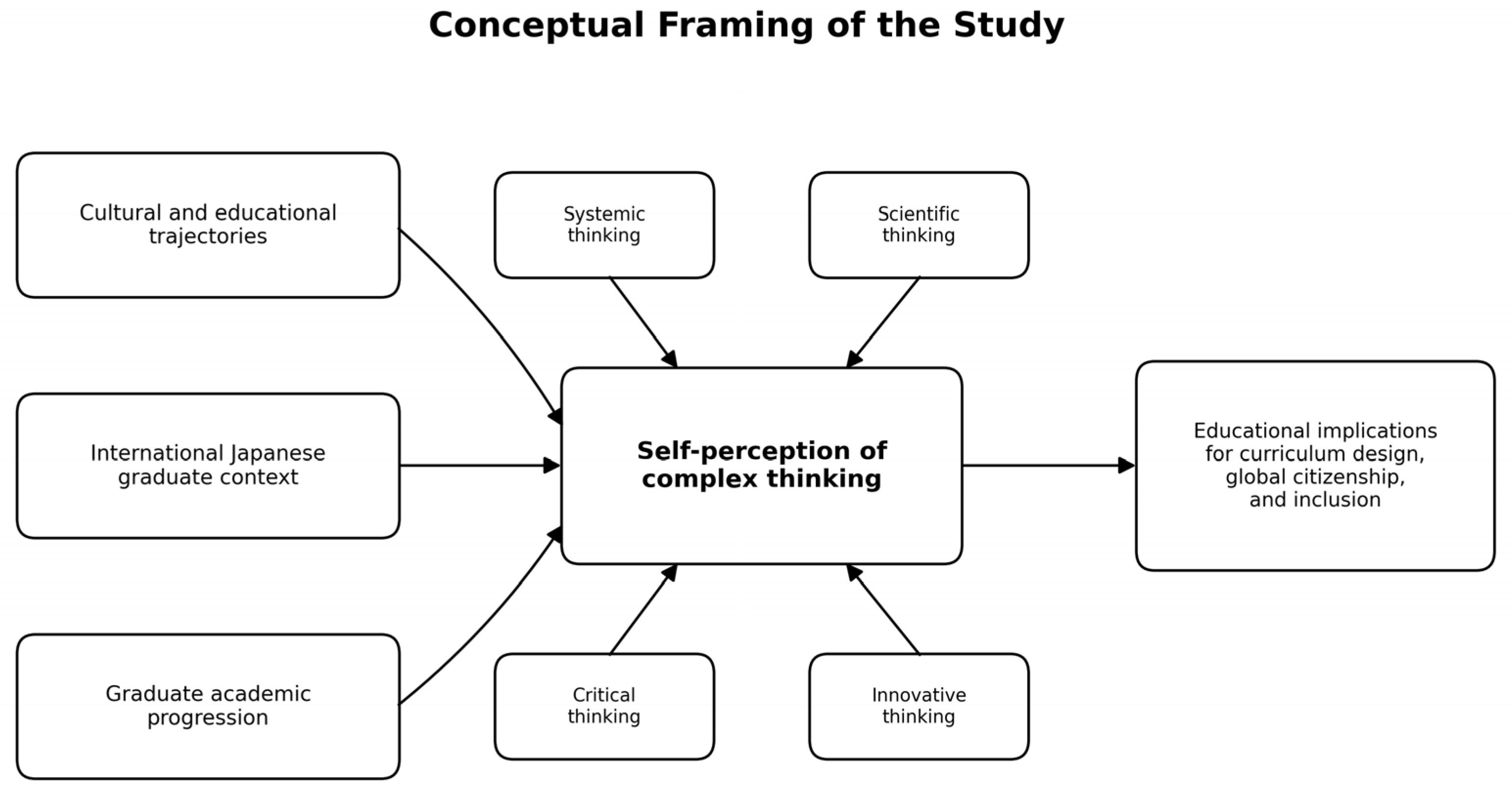
For this reason, the Japanese international graduate context is not treated as a neutral background. It is understood as a formative environment that may influence how students make sense of their own cognitive development. Its combination of methodological rigor, relational learning expectations, and multicultural interaction provides a meaningful setting for examining whether self-perceived complex thinking varies across academic progression and national trajectories. This connection between context, trajectory, and perceived cognitive competence is summarized in Figure 1.
Based on this conceptual framing, the study examines whether students’ self-perception of systemic, scientific, critical, and innovative thinking differs according to semester and nationality within an international graduate program in Japan.

3. Methods

The present study adopted a quantitative, cross-sectional, and analytical design to examine self-perceived complex thinking among international master’s students enrolled at a Japanese university. The analysis focused on differential patterns in the systemic, scientific, critical, and innovative dimensions of complex thinking according to sex, academic field, academic semester, and nationality. Given the heterogeneous nature of the sample and the characteristics of the data, a nonparametric multivariate analysis based on permutations, PERMANOVA, was used to evaluate group differences without relying on strict assumptions of normality or homoscedasticity. This approach allowed for a robust analysis of self-perceived complex thinking in a culturally diverse graduate context.

3.1. Population

The study population consisted of 491 international students enrolled in master’s programs at a Japanese technology university. All participants were full-time students from different academic fields within the same graduate institution, which provided a diverse sample in terms of discipline, culture, and language. The university was selected because it offers international master’s programs with a highly multicultural student body and a strong orientation toward technology-based graduate education. This context was suitable for examining complex thinking in an environment where students from different academic, linguistic, and cultural backgrounds share the same institutional setting.
Participants were recruited through institutional communication channels coordinated with the graduate programs. The invitation explained the academic purpose of the study, the voluntary nature of participation, and the anonymous treatment of responses. Data were collected at a single point during the fall semester of 2025. No incentives, grades, or institutional benefits were offered. A total of 618 students were invited to participate, and 491 valid responses were obtained, resulting in an approximate response rate of 79.45%. The sex distribution was 71.69% male (n = 352) and 28.31% female (n = 139) (Table 1).
In terms of country of origin, most students came from China (58.04%) and Nepal (18.13%), followed by Sri Lanka (7.33%), Bangladesh (7.13%), and India (4.48%). Smaller groups came from Japan, Taiwan, the Philippines, Vietnam, Mongolia, Myanmar, Pakistan, and the United States. This distribution reflects the multicultural profile of international graduate programs in Japan, where students from East and South Asia are represented within a shared educational setting (Table 2).
The inclusion criterion was enrollment in a master’s program at the participating Japanese university, which ensured that all participants had experience within the same academic environment. Participation was voluntary and anonymous and required prior acceptance of an informed consent form. The cultural and geographic diversity of the sample allowed group comparisons and supported the study’s analysis of self-perceived complex thinking in an international graduate context.

3.2. Instrument

Data were collected using the eComplexity instrument, developed and validated by Vázquez-Parra et al. [34] to assess complex thinking in higher education. The instrument is based on the theoretical model of complex thinking competence proposed by Ramírez-Montoya et al. [6] and has undergone additional validation processes in Latin American educational contexts.
The questionnaire measures self-perceived complex thinking through four interrelated dimensions: systemic, scientific, critical, and innovative thinking. Together, these dimensions reflect students’ perceived ability to integrate reasoning, analysis, creativity, and judgment in problem-solving [9].
The instrument includes 25 items distributed across the four dimensions, following the validated structure reported by Vázquez-Parra et al. [34]. Systemic thinking includes six items and refers to the ability to recognize relationships among components of a problem and interpret phenomena as part of broader systems. Scientific thinking includes seven items and addresses the use of evidence, inquiry, and methodological reasoning. Critical thinking includes six items and refers to the capacity to evaluate arguments, question assumptions, and make reasoned judgments. Innovative thinking includes six items and addresses the ability to generate alternative solutions and propose new ways of approaching problems. Sample items refer to identifying associations between variables, formulating research questions or hypotheses, analyzing problems from different perspectives, and applying innovative solutions. All items were answered on a five-point Likert scale ranging from 1, strongly disagree, to 5, strongly agree.
In the present sample, internal consistency was estimated for each dimension before conducting the multivariate analyses. Reliability coefficients were acceptable to high for systemic thinking, α = 0.848; scientific thinking, α = 0.881; critical thinking, α = 0.801; and innovative thinking, α = 0.850. The full 25-item scale also showed high internal consistency, α = 0.950. These results supported the use of the four dimensions as indicators of students’ self-perceived complex thinking in this sample.
Previous validation studies have reported an adequate confirmatory factor structure for the instrument, with satisfactory model fit, CFI = 0.962, TLI = 0.956, RMSEA = 0.045, and high internal consistency across subscales, α ranging from 0.82 to 0.89. These results support the convergent validity and reliability of the instrument for measuring self-perceived complex thinking in higher education contexts [35].
The instrument was administered in English, Chinese, and Japanese. The English version followed the validated structure of the original instrument, while the Chinese and Japanese versions were reviewed by bilingual academic specialists to ensure semantic equivalence. No items were added, removed, or structurally modified. Only minor wording clarifications were introduced in the instructions to facilitate comprehension across languages.
To support cross-language consistency, a linguistic verification procedure was conducted. This included expert item review by a bilingual panel with experience in Asian higher education and minor adjustments to the instructions without altering the latent content of the items. This procedure was intended to preserve the theoretical coherence of the construct and reduce potential bias arising from culturally differentiated interpretations [36,37].

3.3. Procedure

The instrument was administered during the fall semester of 2025 in coordination with the master’s programs at the participating Japanese university. Data were collected digitally through an online form hosted on a secure platform. Students were invited to participate voluntarily after receiving information about the academic purpose of the study, the scope of the questionnaire, and the anonymous treatment of their responses.
Before completing the questionnaire, participants reviewed and accepted an informed consent form. The form specified that the data would be used exclusively for academic purposes and that participation would have no effect on institutional evaluation. The average response time was ten minutes. No relevant item omissions were recorded, so missing-value imputation was not required. Duplicate or incomplete responses were removed according to the institution’s data quality criteria.
The procedure followed the terms and conditions of the Research for Challenges privacy notice and was approved by the Institutional Ethics Committee of Tecnológico de Monterrey under file number P-IFE-202506-002.

3.4. Data Analysis

Data analysis was conducted in R using the MVN package [38], HH package [39,40], and vegan package [41]. First, normality and homogeneity of variance were assessed for the four dimensions of complex thinking: systemic, scientific, critical, and innovative thinking. The multivariate Henze–Zirkler test and the univariate Anderson–Darling tests indicated non-normality in the data, p < 0.001 in all dimensions. The Brown–Forsythe test also indicated heteroscedasticity among the compared groups [42,43].
Given these results, PERMANOVA was applied using the adonis2 function from the vegan package [44,45,46]. This nonparametric method evaluates multivariate group differences based on a distance matrix and random permutations. In this study, Euclidean distance and 999 permutations were used. This approach was appropriate because the data did not meet the assumptions of normality and homoscedasticity.
A general model was first constructed to compare the complex thinking dimensions according to academic semester and nationality. Additional segmented contrasts were then performed by sex and academic field to examine possible group effects. The pseudo-F statistic was used to estimate group differences, and statistical significance was assessed through permutation-based p-values. When significant effects were identified, post hoc pairwise comparisons were conducted to determine where the differences were concentrated.
Given the unequal distribution of participants across nationalities, an a priori decision rule was established for post hoc nationality comparisons. Pairwise comparisons were conducted only for nationality groups with at least eight participants. This threshold was used to reduce the instability of estimates in very small cells and avoid overinterpreting contrasts based on one to three cases. Nationalities below this threshold were retained in the descriptive characterization of the sample but were not used for pairwise post hoc interpretation.
Formally, the PERMANOVA model used in this study is based on the partitioning of the sum of squares of distances between and within the compared groups. The general structure of the model is expressed as:
S S T = S S B + S S W
where SST represents the total sum of squared distances (total variance among all observations), SSB the variation between groups, and SSW the variation within groups. The test statistic (pseudo-F) is calculated as follows:
F = S S B / ( k 1 ) S S W / ( N k )
where (k − 1) corresponds to the degrees of freedom between groups and (N-k) to the degrees of freedom within groups. To calculate the statistics, we start with a distance matrix D = [d_ij], where d_ij is the distance between observations i and j.
The distance matrix d_ij [44]:
S S T = 1 N i = 1 N 1 j = i + 1 N d i j 2
S S W = g = 1 k 1 n g i < j g d i j 2
S S B = S S T S S W
where
  • d_ij is the distance between observations i and j,
  • N is the total number of observations,
  • k is the number of groups,
  • n_g is the number of observations in group g,
  • SS_T: total variance (total sum of squares),
  • SS_W: variance within groups,
  • SS_B: variance between groups (differences explained by the factor).
Now, the null and alternative hypotheses correspond to:
H0. 
There are no significant differences in the multivariate structure between groups; that is, the centroids of the groups in the distance space are statistically equal. In other words, the average distances between groups do not differ more than expected by chance.
H0. 
μ 1 = μ 2 =… = μ k (where k is the number of groups)
Ha. 
There are significant differences in the multivariate structure between at least two groups; that is, the centroids of the groups differ in the distance space. In other words, at least one group has a different center.
Ha. 
∃(i, j) such that μi≠ μj
Overall, the methodological design allowed for a consistent empirical analysis of self-perceived complex thinking as an advanced cognitive competence in graduate education. The use of a validated instrument, the multicultural composition of the sample, and the application of nonparametric multivariate analyses supported the identification of perceived complex thinking patterns across nationalities and academic semesters. The results presented below therefore examine how students in an international master’s program in Japan perceive the systemic, scientific, critical, and innovative dimensions of complex thinking.

3.5. Methodological Considerations on Self-Report and Common Method Bias

This study measures students’ self-perceived complex thinking rather than direct performance in complex thinking tasks. This distinction is important because self-perception may be influenced by cultural norms of self-presentation, modesty, confidence, and response style, particularly in international samples. For this reason, the results are interpreted as perceived cognitive development, not as objective evidence of students’ actual complex thinking performance.
Several procedural decisions were taken to reduce potential common method bias. Participation was anonymous, no incentives or academic consequences were associated with the responses, and students were informed that there were no right or wrong answers. The instrument also included items from four differentiated dimensions, which helped reduce the likelihood that responses reflected a single undifferentiated perception of competence. Even so, because all data were collected through self-report at one point in time, common method variance cannot be fully ruled out. This limitation is acknowledged in the interpretation of the findings and in the discussion of future research.

4. Results

4.1. Descriptive Analyses and Tests of Normality and Homoscedasticity

Table 3 presents the mean and standard deviation scores for self-perceived complex thinking and its four component dimensions, grouped by country of origin. Participants from China, India, Nepal, and Sri Lanka showed averages close to 4 points, indicating a relatively high self-perceived profile across the four dimensions. In contrast, Bangladesh and Japan showed lower mean scores, especially in scientific and innovative thinking, where the averages were below 3.6. Overall, the results suggest moderately high levels of self-perceived complex thinking, with a slight predominance of systemic and critical thinking (Table 3).
To address the first research question, the descriptive analysis examined how students perceived themselves across the four dimensions of complex thinking. The inclusion of standard deviations in Table 3 provides a clearer view of score dispersion across national groups and supports the subsequent multivariate analyses, which examine whether these perceived profiles differ according to nationality, semester, sex, and academic program.
Table 4 shows the results of the multivariate and univariate normality tests, along with descriptive statistics for the four dimensions of complex thinking. In the multivariate normality test, the Henze–Zirkler test yielded a statistic of 14.34 with a p-value < 0.001, indicating that the data do not follow a multivariate normal distribution. In the univariate normality test, all variables, Systemic Thinking, Scientific Thinking, Critical Thinking, and Innovative Thinking, were evaluated using the Anderson–Darling test, with p-values < 0.001 in all cases. Therefore, none of the variables exhibit univariate normality.
Table 5 presents the results of the homoscedasticity test. Since there are statistically significant differences in the IT variance between the different semesters, the data should be treated as heteroscedastic.

4.2. PERMANOVA

Since the variables are neither normally distributed nor homoscedastic, a PERMANOVA test (using the adonis2 function in R) was chosen. This nonparametric statistical method is used to assess whether significant differences exist between groups, based on a distance matrix. In this case, Euclidean distance was used, and 999 permutations were performed to estimate the statistical significance of the results. The formula used was thinking_vars~group_var, indicating that the study evaluated whether the thinking variables (thinking_vars) differed between the groups defined by the group_var variable.
The model yielded an F-value of 1.99 (pseudo-F) and a p-value of 0.003. This implies that there is sufficient statistical evidence to reject the null hypothesis; that is, the observed differences between the groups are not due to chance. In other words, the groups differ significantly in the analyzed variables. Significance was determined using permutations, which strengthens the robustness of the result by not relying on parametric assumptions (Table 6).
This finding responds to the second research question by showing that the multivariate profile of self-perceived complex thinking was not entirely homogeneous across the grouping variables considered in the study. The overall model explained 10.4% of the variance in the multivariate space, which suggests a statistically significant but moderate association between the grouping structure and the set of complex thinking dimensions. For this reason, the interpretation of the following models considers both statistical significance and effect size, avoiding an overstatement of differences that may be statistically detectable but limited in practical magnitude.
Given that significant differences were found, it is necessary to evaluate each group (according to sex, academic field, semester, and nationality). In the case of sex, the p-value is 0.559, well above 0.05, which means that there is no statistical evidence to suggest that men and women have different profiles in the types of thinking (Table 7).
The same applies when comparing academic field (Table 8), as there was insufficient statistical evidence to conclude that academic field was associated with significant differences in the multivariate profile of the thinking dimensions analyzed (ST, SCT, CT, IT, and CoT).
The non-significant results for sex and academic program help delimit the scope of the findings. In relation to the research questions, these variables did not provide evidence of differentiated profiles of self-perceived complex thinking in this sample. This suggests that the main variations observed in the study are not primarily associated with sex or disciplinary affiliation but with nationality and academic semester. This interpretation should be understood within the limits of a self-report, cross-sectional design.
When comparing nationality, it was identified that the groups defined by nationality did present statistically significant multivariate differences (Table 9). Therefore, a pairwise comparison of nationality was performed (78 pairs evaluated), and it was found that there were differences only between the countries listed in Table 10.
Nationality was associated with statistically significant differences in the multivariate profile of self-perceived complex thinking, explaining 5.48% of the variance. Although this effect is modest, it is relevant for the study because it suggests that students’ cultural and educational trajectories may be associated with how they evaluate their own systemic, scientific, critical, and innovative thinking. This result directly addresses the second research question by showing that self-perception of complex thinking does vary across some national groups within the same international graduate environment.
In order to quantify the magnitude of these differences, effect sizes were calculated and are reported as R2 coefficients in the PERMANOVA tables. In the pairwise nationality comparisons (Table 10 and Table 11), the R2 column indicates the proportion of variance in the multivariate thinking profile explained by each contrast, complementing the interpretation of the p-values.
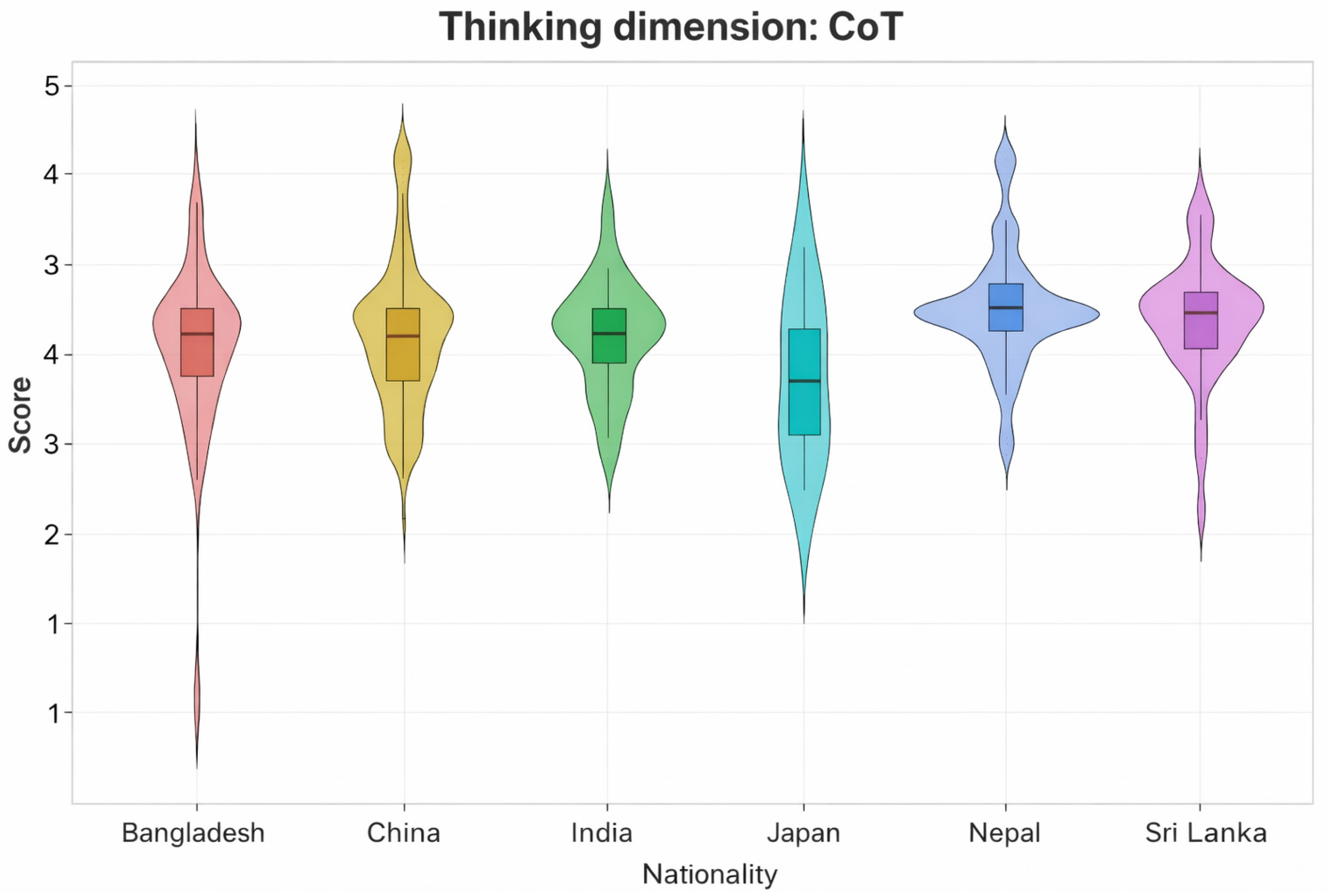
Post hoc analysis of paired comparisons using PERMANOVA showed that the greatest differences were concentrated in Nepal, which differed significantly from Bangladesh (p = 0.001), China (p = 0.001), India (p = 0.038), and Japan (p = 0.001). A significant difference was also observed between Bangladesh and Sri Lanka (p = 0.031), and between Japan and Sri Lanka (p = 0.018) (Table 11). No significant differences were observed among the other nationalities (p > 0.05) (Figure 2), although the comparison was only made with countries that had a sample size of 8 or more individuals.
Although these comparisons yielded statistically significant differences, they should be interpreted as exploratory due to the unequal group sizes and the limited number of participants in several nationalities. To mitigate this issue, post hoc analyses were restricted to nationalities with at least eight participants, and the most robust contrasts correspond to the two largest groups in the sample (Japan and Nepal). These constraints reflect the natural enrollment distribution of the program and do not alter the central purpose of the analysis, which is to provide preliminary evidence about how intercultural trajectories shape students’ perceived development of complex thinking.
In the Nepal–Bangladesh, Nepal–China, and Nepal–Japan comparisons, significant differences were observed in all dimensions of thinking (ST, SCT, CT, IT, and CoT), suggesting that the self-perceived complex thinking profile of Nepali students differed consistently from those of students from these three national groups. In the Nepal–India comparison, the differences were partially consistent and concentrated mainly in systems thinking (ST), critical thinking (CT), and complex/total thinking (CoT). Sri Lanka, on the other hand, showed differences only with Bangladesh and Japan, and these differences were specifically located in ST, SCT, and CoT, indicating that the contrast with Sri Lanka is more localized in the systemic and complex dimensions of thinking, while the CT and IT dimensions did not show robust statistical effects.
The Nepal findings should be interpreted with caution, but they show a consistent descriptive pattern. Nepali students reported higher self-perception scores across the four dimensions of complex thinking, especially in comparison with students from Bangladesh, China, India, and Japan. This does not indicate superior objective performance in complex thinking, since the instrument measures perceived competence rather than direct cognitive performance. Rather, the pattern suggests that, within this graduate context, Nepali students expressed a more affirmative perception of their ability to connect information, use evidence, evaluate perspectives, and propose alternative solutions. These differences may be related to prior educational experiences, adaptation to the academic environment, or cultural response styles and should be examined in future studies with more balanced samples.
Finally, when comparing the semester, the p-value obtained was 0.008. Therefore, there is statistically significant evidence to suggest that students from different semesters show differences in their multivariate profile of the types of thinking assessed (ST, SCT, CT, IT, and CoT). In other words, the academic semester is associated with differences in the complete set of variables analyzed (Table 12).
Semester was also associated with statistically significant differences in the multivariate profile of self-perceived complex thinking, explaining 2.75% of the variance. This effect is small, but it suggests that academic progression may be related to how students perceive their development of complex thinking. In relation to the research questions, this finding indicates that self-perception is differentiated not only by some national trajectories but also by students’ position within the graduate program. Because the study is cross-sectional, this pattern should not be interpreted as direct evidence of individual development over time but as an association between semester and perceived cognitive competence.
Pairwise comparisons between semesters show that the previously observed multivariate differences are specifically located between the first and fourth semesters, and between the fourth and second semesters. In both cases, these differences encompass the types of thinking (Systemic Thinking, Scientific Thinking, Critical Thinking, Innovative Thinking, and Complex Thinking), as all show p-values < 0.05 in these pairs.
Conversely, between the first and second semesters, a significant difference was found only in Critical Thinking. And between the first and third semesters, the fourth and third semesters, and the second and third semesters, no significant differences were observed in any of the types of thinking; that is, the differences between adjacent semesters (1st vs. 2nd, 2nd vs. 3rd, 3rd vs. 4th) are minimal or nonexistent, except in the case of Critical Thinking between the first and second semesters (Table 13).
Taken together, the results answer the research questions by showing that international master’s students reported moderately high levels of self-perceived complex thinking, with systemic and critical thinking standing out slightly across the sample. The multivariate analyses further indicate that these perceptions differed significantly by nationality and semester but not by sex or academic program. The magnitude of these effects was modest, which suggests that cultural and academic trajectories may shape students’ self-perception of complex thinking without fully determining it. These findings provide the empirical basis for the following discussion, where the results are interpreted in relation to graduate education, intercultural learning, and competence-based curriculum design.

5. Discussion

The results offer a more nuanced reading of complex thinking in international graduate education. Overall, students reported moderately high levels of self-perceived complex thinking, with systemic and critical thinking scoring slightly higher than the scientific and innovative dimensions. One possible interpretation is that students more readily recognize abilities related to connecting elements of a problem, identifying relationships, and evaluating perspectives, while methodological reasoning and the generation of alternative solutions appear somewhat less pronounced. This supports the understanding of complex thinking as an integrative competence that brings together knowledge, action, and reflection while also showing that its dimensions are not perceived with the same intensity by graduate students [7,47].
This pattern is meaningful for master’s education. Graduate programs are expected to move students beyond technical specialization and toward broader forms of intellectual autonomy, interdisciplinary articulation, and reflective judgment. The scores observed here are consistent with that expectation, particularly for systemic and critical thinking. However, they should not be read as evidence that graduate education produces complex thinking in a linear or automatic way. The finding is more limited but still relevant: students in this international graduate context recognize elements of complex thinking as part of their academic experience. This is consistent with perspectives that understand graduate learning as a process of cognitive integration, situated reasoning, and progressive epistemological awareness [48,49,50].
The differences by nationality require careful interpretation. Some national groups showed significant differences in their self-perceived complex thinking profiles, suggesting that these perceptions are not entirely homogeneous within the same graduate environment. This finding is compatible with the idea that complex competence is shaped by the interaction between learning experiences and cultural frames of interpretation [51,52]. However, the instrument measures self-perception rather than objective cognitive performance. Responses may therefore be influenced by confidence, modesty norms, language familiarity, academic socialization, or culturally shaped response styles. For this reason, differences by nationality should be understood as variations in perceived cognitive competence within this sample, not as evidence that one national group performs better than another in complex thinking.
The Nepal-related results are especially relevant in this regard. Nepali students reported higher self-perception scores across the four dimensions, particularly compared with students from Bangladesh, China, India, and Japan. This may indicate that, within this academic setting, they expressed greater confidence in their ability to connect information, use evidence, evaluate perspectives, and propose alternative solutions. At the same time, the study does not provide direct evidence about the previous educational experiences that may have shaped these perceptions. Any explanation related to prior schooling, cooperative learning traditions, or adaptation to the Japanese academic environment should therefore be treated as a hypothesis for future research rather than as a conclusion of the present study. This caution is important because cultural comparisons in international education can easily become overgeneralized when they are not supported by direct evidence on students’ educational trajectories [8,23,25].
The differences by academic semester also need measured interpretation. Fourth-semester students reported higher self-perception scores than students in earlier semesters, which is consistent with the possibility that sustained participation in graduate education is associated with greater metacognitive awareness and stronger integration of research, reflection, and problem-solving. This reading aligns with approaches that describe complex learning as a recursive process between theory and practice, where knowledge becomes progressively situated through academic experience [2,9]. Even so, the cross-sectional design does not allow us to demonstrate individual development over time. The observed semester differences may be related to academic progression, but they may also reflect cohort composition, persistence in the program, or other unmeasured factors. Longitudinal research is needed to determine whether students’ self-perceived complex thinking changes as they move through the program.
The absence of significant differences by sex and academic field helps define the scope of the findings. In this sample, self-perceived complex thinking did not vary meaningfully according to these variables. This does not mean that sex or academic field are irrelevant in all contexts, but it does indicate that they did not explain the main differences observed here. The results point instead to a situated interpretation, where self-perception appears to emerge from the interaction between individual trajectories, academic experience, and the shared international graduate environment. Even for nationality and academic semester, the effects were modest, reinforcing the need to avoid deterministic interpretations.
Taken together, these findings refine the theoretical discussion on complex thinking. They suggest that complex thinking should not be treated only as an abstract cognitive ideal or as a homogeneous competence. In an international graduate context, it appears as a multidimensional and context-sensitive form of self-perceived competence. This reading extends Morin’s broader understanding of complexity as relational and integrative by showing how students perceive its dimensions differently within a culturally diverse academic environment [1,13]. It also contributes to the literature on international education by suggesting that multicultural graduate programs are not only spaces where students from different national backgrounds coexist. They are also environments where students’ perceptions of their own cognitive abilities may be shaped by academic progression, cultural trajectories, and institutional expectations [3,31].
There is also a broader educational reading of these results, although it must remain cautious. Since the study did not measure global citizenship, intercultural integration, participation, or equity, it cannot conclude that complex thinking directly mediates these processes. What the results suggest is more limited: self-perceived complex thinking may be relevant for designing graduate learning environments where students learn to work across diverse perspectives, evaluate complex problems, and participate more reflectively in multicultural academic settings. In this sense, complex thinking may support some of the cognitive conditions associated with global citizenship, such as perspective-taking, ethical judgment, and the interpretation of social and cultural complexity. Future research should examine these links directly by including specific measures of global citizenship, inclusion, and intercultural participation [50,51,52].

Implications

From a theoretical standpoint, the study contributes to the understanding of complex thinking as a context-sensitive competence in graduate education. The results do not suggest that complex thinking develops in the same way for all students or that its dimensions are perceived with equal intensity. Instead, they show that students’ self-perception of systemic, scientific, critical, and innovative thinking may vary according to academic progression and national trajectories. This adds an intercultural layer to the discussion of complex thinking, complementing Morin’s view of complexity as an integrative way of articulating knowledge and Tobón’s approach to complex competence as a relationship between knowledge, action, and reflection [1,7].
For international master’s programs, the findings point to the importance of making complex thinking an explicit part of curriculum design. Students in multicultural graduate environments are not only learning disciplinary content. They are also learning how to interpret unfamiliar perspectives, evaluate evidence across different academic traditions, and participate in shared intellectual work with peers from diverse backgrounds. In this sense, complex thinking can be supported through learning experiences that combine research practice, interdisciplinary dialog, metacognitive reflection, and opportunities for students to test ideas in collaborative settings.
At a practical level, the results suggest several areas for curricular attention. Since systemic and critical thinking appeared as relatively stronger dimensions, graduate programs could use these strengths as a basis for more demanding integrative tasks. At the same time, the comparatively lower scores in scientific and innovative thinking indicate the value of reinforcing methodological reasoning and solution-oriented work. This could be addressed through short research seminars, guided metacognitive journals, interdisciplinary micro-projects, and structured activities where students move from problem analysis to evidence-based proposal design. These actions do not require a major redesign of the curriculum, but they can help make complex thinking more visible and intentional within graduate training.
The differences by nationality also have implications for the management of international classrooms. They suggest the need to avoid assuming that all students enter the program with the same expectations about participation, argumentation, creativity, or self-evaluation. Faculty can support more equitable academic participation by making discussion norms explicit, rotating roles in collaborative work, and creating spaces where different ways of reasoning can be recognized without turning cultural difference into a deficit. Used carefully, periodic feedback on the four dimensions of complex thinking could also help programs identify areas where students feel more or less confident and adjust academic support accordingly.
The semester-related findings offer another useful implication, although they should be interpreted cautiously. Since the study is cross-sectional, the observed differences cannot be taken as proof of individual development over time. Even so, they suggest that programs may benefit from monitoring how students perceive their cognitive development across the graduate trajectory. Mid-program and end-program feedback could help identify whether students feel increasingly able to integrate evidence, evaluate complex problems, and generate alternative solutions. This kind of monitoring would be especially useful if combined with performance-based evidence in future evaluations.
The findings also have broader implications for international graduate education as a space for citizenship formation. Although global citizenship, equity, and inclusion were not measured as study variables, the results suggest that complex thinking may support some of the cognitive conditions needed for intercultural dialog, ethical judgment, and meaningful participation in diverse academic communities. In this sense, strengthening complex thinking can contribute to educational environments where diversity is not treated as a deficit but as a formative resource for democratic and globally oriented learning [48,50,52].

6. Conclusions

This study examined self-perceived complex thinking among international master’s students at a Japanese university, with attention to differences associated with nationality and academic semester. The results showed moderately high levels of self-perceived complex thinking, although the four dimensions were not perceived with the same intensity. Systemic and critical thinking appeared as relatively stronger dimensions, while scientific and innovative thinking showed slightly lower scores. Differences by nationality and academic semester suggest that students’ perceptions of complex thinking are associated with cultural and academic trajectories. However, these associations should be interpreted cautiously due to the cross-sectional and self-report nature of the study.
The main contribution of this research lies in showing that complex thinking in international graduate education should not be approached as a uniform or purely abstract competence. It can also be examined as a multidimensional and context-sensitive form of perceived cognitive development. This is especially relevant for multicultural graduate programs, where students bring different educational backgrounds, academic expectations, and ways of interpreting their own learning. By using the eComplexity instrument and a nonparametric multivariate approach, the study provides a basis for examining how systemic, scientific, critical, and innovative thinking are perceived across academic progression and cultural trajectories in international graduate programs.
Several limitations should be considered. The cross-sectional design does not allow the study to establish individual development over time. The use of self-report data means that the findings refer to perceived competence rather than objective performance, and responses may be influenced by cultural norms of self-presentation, confidence, modesty, language familiarity, or response style. In addition, although the quantitative design allowed the study to identify patterns across a large and culturally diverse sample, it did not capture the textual, visual, or narrative forms through which students may express the meaning of complex thinking in their academic experience.
The unequal distribution of national groups also limits the interpretation of some comparisons, even though post hoc analyses were restricted to groups with a minimum number of participants. Future research should incorporate longitudinal designs, more balanced samples, and performance-based measures of complex thinking. It would also be valuable to include mixed or qualitative approaches to examine how students make sense of complex thinking in culturally diverse learning environments. Finally, future studies could directly analyze the relationship between complex thinking, global citizenship, inclusion, and intercultural participation, since these links were discussed here as educational implications rather than measured outcomes.
In conclusion, international graduate education offers a valuable setting for understanding how students perceive complex thinking in culturally diverse academic environments. This study contributes to that discussion by showing that self-perceived complex thinking varies across dimensions and is associated with students’ academic and cultural trajectories. These findings can support more intentional approaches to graduate education, where complex thinking is not assumed as an automatic result of advanced study but cultivated through deliberate pedagogical and institutional practices.

Author Contributions

Conceptualization, J.C.V.-P.; methodology, J.P.L.-G.; software, J.P.L.-G.; validation, C.B. and A.L.R.-H.; formal analysis, S.P.-G.; investigation, C.B. and A.L.R.-H.; resources, C.B. and A.L.R.-H.; data curation, J.C.V.-P.; writing—original draft preparation, J.C.V.-P.; writing—review and editing, C.B. and A.L.R.-H.; visualization, S.P.-G.; supervision, J.C.V.-P.; project administration, J.C.V.-P. All authors have read and agreed to the published version of the manuscript.

Funding

This research received no external funding.

Institutional Review Board Statement

The study was conducted in accordance with the Declaration of Helsinki and approved by the Institutional Review Board of the Tecnológico de Monterrey (protocol code P-IFE-202506-002, approved in June 2025).

Informed Consent Statement

Informed consent was obtained from all subjects involved in the study. Participation was voluntary and data were collected anonymously.

Data Availability Statement

Data available on reasonable requests due to privacy and ethical restrictions.

Acknowledgments

We express our sincere appreciation to The Kyoto College of Graduate Studies for Informatics (Kyoto, Japan) for its valuable support in granting access to the data and for its collaboration throughout the research process. We thank the Fundación Universitaria Konrad Lorenz (Bogotá, Colombia) for the support received in the preparation of this article.

Conflicts of Interest

The authors declare no conflicts of interest. The funders had no role in the design of the study; in the collection, analyses, or interpretation of data; in the writing of the manuscript; or in the decision to publish the results.

References

  1. Morin, E. Introducción al Pensamiento Complejo; Gedisa: Barcelona, Spain, 1990. [Google Scholar]
  2. Silva, C.; Iturra, C. A conceptual proposal and operational definitions of the cognitive processes of complex thinking. Think. Ski. Creat. 2021, 39, 100794. [Google Scholar] [CrossRef]
  3. Morikawa, M. Postgraduate education and labor market outcomes: An empirical analysis using micro data from Japan. Ind. Relat. A J. Econ. Soc. 2015, 54, 499–520. [Google Scholar] [CrossRef]
  4. Nomura, K. Exploring the emic understanding of “critical thinking” in Japanese education: An analysis of teachers’ voices. Educ. Philos. Theory 2023, 55, 1501–1512. [Google Scholar] [CrossRef]
  5. Horn, A.; Scheffelaar, A.; Urias, E.; Zweekhorst, M. Training students for complex sustainability issues: A literature review on the design of inter- and transdisciplinary higher education. Int. J. Sustain. High. Educ. 2022, 24, 1–27. [Google Scholar] [CrossRef]
  6. Ramírez-Montoya, M.S.; Castillo-Martínez, I.M.; Sanabria, J.; Miranda, J. Complex thinking in the framework of Education 4.0 and open innovation: A systematic literature review. J. Open Innov. Technol. Mark. Complex. 2022, 8, 4. [Google Scholar] [CrossRef]
  7. Tobón, S.; Luna, J. Complex thinking and sustainable social development: Validity and reliability of the COMPLEX-21 scale. Sustainability 2021, 13, 6591. [Google Scholar] [CrossRef]
  8. Cruz-Sandoval, M.; Vázquez-Parra, J.C.; Alonso-Galicia, P.E.; Carlos-Arroyo, M. Perceived achievement of social entrepreneurship competency: The influence of age, discipline, and gender among women in higher education. Sustainability 2023, 15, 9956. [Google Scholar] [CrossRef]
  9. Silva, C.; Iturra, C. Development and validation of the Complex Thinking Assessment. Think. Ski. Creat. 2023, 48, 101305. [Google Scholar] [CrossRef]
  10. Wang, Z.; Wang, Y.-M.; Guo, H.; Zhang, Q. Unity of heaven and humanity: Mediating role of the relational-interdependent self in the relationship between Confucian values and holistic thinking. Front. Psychol. 2022, 13, 958088. [Google Scholar] [CrossRef] [PubMed]
  11. Bakker, J.D. Permanova. In Applied Multivariate Statistics in R; University of Washington: Seattle, WA, USA, 2024; Available online: https://uw.pressbooks.pub/appliedmultivariatestatistics/chapter/permanova/ (accessed on 18 November 2025).
  12. Souza, T. PERMANOVA. In Advanced Statistical Analysis for Soil Scientists; Springer Nature: Cham, Switzerland, 2025; pp. 1–13. [Google Scholar] [CrossRef]
  13. Morin, E. Los Siete Saberes Necesarios Para la Educación del Futuro; UNESCO: Paris, France, 2001. [Google Scholar]
  14. Baena-Rojas, J.J.; Ramírez-Montoya, M.S.; Mazo-Cuervo, D.M.; López-Caudana, E.O. Traits of complex thinking: A bibliometric review of a disruptive construct in education. J. Intell. 2022, 10, 37. [Google Scholar] [CrossRef] [PubMed]
  15. Sherblom, S.A. Complexity-thinking and social science: Self-organization involving human consciousness. New Ideas Psychol. 2017, 47, 10–15. [Google Scholar] [CrossRef]
  16. Carlos-Arroyo, M.; Vázquez-Parra, J.C.; Cruz-Sandoval, M.; Echaniz-Barrondo, A. Male chauvinism and complex thinking: A study of Mexican university students. Societies 2023, 13, 104. [Google Scholar] [CrossRef]
  17. Vázquez-Parra, J.C.; García-González, A.; Ramírez-Montoya, M.S. Ethical education and its impact on the perceived development of social entrepreneurship competency. High. Educ. Ski. Work-Based Learn. 2022, 2, 369–383. [Google Scholar] [CrossRef]
  18. González Navarrete, E. La investigación científica desde el pensamiento complejo en el nivel de postgrado. Rev. Holón 2025, 2, 32–44. [Google Scholar] [CrossRef]
  19. Cruz-Sandoval, M.; Vázquez-Parra, J.C.; Carlos-Arroyo, M. Complex thinking and social entrepreneurship. An approach from the methodology of compositional data analysis. Heliyon 2023, 9, e13415. [Google Scholar] [CrossRef] [PubMed]
  20. Gyenes, A. Definitions of critical thinking in context. Bull. Grad. Sch. Hum. Sci. Osaka Univ. 2015, 20, 17–25. [Google Scholar] [CrossRef]
  21. Sari, D.R.; Rahardjo, S.B.; Prayitno, B.A. Educating for Complexity: A Bibliometric Analysis of Systems Thinking in 21st-Century Science Education. F1000Research 2025, 14, 937. [Google Scholar] [CrossRef]
  22. Davidson, B.W. Obstacles and Opportunities for Critical Thinking in Japan (ERIC Document Reproduction Service No. ED377216). 1994. Available online: https://files.eric.ed.gov/fulltext/ED377216.pdf (accessed on 18 November 2025).
  23. Davidson, B.C. What kind of critical thinking best suits Japan. Int. J. Creat. Probl. Solving 2002, 12, 39–45. [Google Scholar]
  24. Duttle, K.; Inukai, K. Complexity aversion: Influences of cognitive abilities, culture and system of thought. Econ. Bull. 2015, 35, 846–855. [Google Scholar]
  25. Chiu, Y.-C.J. Facilitating Asian students’ critical thinking in online discussions. Br. J. Educ. Technol. 2009, 40, 42–57. [Google Scholar] [CrossRef]
  26. Pang, Q.; Li, L. A contrastive study of postgraduate education development route in Britain and Japan. J. Comp. Educ. Res. 2005, 4, 14–22. [Google Scholar] [CrossRef]
  27. Tokuda, Y.; Soshi, M.; Okubo, T.; Nishizaki, Y. Postgraduate medical education in Japan: Missed opportunity for learning clinical reasoning. J. General. Fam. Med. 2018, 19, 152–153. [Google Scholar] [CrossRef] [PubMed]
  28. Okada, R. Conflict between critical thinking and cultural values: Difficulty asking questions and expressing opinions in Japan. Adv. Eng. Educ. 2016, 2, 91–98. [Google Scholar]
  29. Suga, F. The Returns to Postgraduate Education; Economic and Social Research Institute Discussion Paper Series; Economic and Social Research Institute: Tokyo, Japan, 2017; p. 336. [Google Scholar]
  30. Buchtel, E.E.; Norenzayan, A. Thinking across cultures: Implications for dual processes. In Cultural and Cognitive Psychology; Smith, K., Ed.; University of British Columbia: Vancouver, BC, Canada, 2009; pp. 217–238. [Google Scholar]
  31. Okazaki-Ward, L.I. MBA education in Japan: Its current state and future direction. J. Manag. Dev. 2001, 20, 197–235. [Google Scholar] [CrossRef]
  32. McKinley, J. Displaying critical thinking in EFL academic writing: A discussion of Japanese to English contrastive rhetoric. RELC J. 2013, 44, 195–208. [Google Scholar] [CrossRef]
  33. Cheng, A. The application of seminar in the education of postgraduate in Japan. J. Mod. Educ. Res. 2011, 6, 24–30. [Google Scholar] [CrossRef]
  34. Vázquez-Parra, J.C.; Henao-Rodríguez, L.C.; Lis-Gutiérrez, J.P.; Castillo-Martínez, I.M.; Suárez-Brito, P. eComplexity: Validation of a complex thinking instrument from a structural equation model. Front. Educ. 2024, 9, 1334834. [Google Scholar] [CrossRef]
  35. Castillo-Martínez, I.M.; Ramírez-Montoya, M.S.; Velarde-Camaqui, D.; Sanabria-Z, J. Psychometric properties of eComplexity scale. J. Soc. Stud. Educ. Res. 2024, 15, 213–228. [Google Scholar]
  36. Cui, L.; Zhu, Y.; Qu, J.; Tie, L.; Wang, Z.; Qu, B. Psychometric properties of the Critical Thinking Disposition Assessment Test amongst medical students in China: A cross-sectional study. BMC Med. Educ. 2021, 21, 10. [Google Scholar] [CrossRef] [PubMed]
  37. Norambuena, I.; Quintano, F.; Riquelme, L.; Sepúlveda, J.; Tavera, C.; Pérez, S.; Crisóforo, Á.; López, R. Estudio psicométrico del cuestionario de intenciones emprendedoras en jóvenes mexicanos. Suma De Neg. 2025, 16, 44–54. [Google Scholar] [CrossRef]
  38. Korkmaz, S.; Göksülük, D.; Zararsız, G. MVN: An R Package for Assessing Multivariate Normality. 2022. Available online: https://cran.r-project.org/web/packages/MVN/MVN.pdf (accessed on 18 November 2025).
  39. Heiberger, R.M.; Holland, B. Statistical Analysis and Data Display: An Intermediate Course with Examples in R, 2nd ed.; Springer: Berlin/Heidelberg, Germany, 2015. [Google Scholar]
  40. Heiberger, R.M. HH: Statistical Analysis and Data Display: Heiberger and Holland. 2022. Available online: https://cran.r-project.org/web/packages/HH/HH.pdf (accessed on 18 November 2025).
  41. Oksanen, J.; Simpson, G.L.; Blanchet, F.G.; Kindt, R.; Legendre, P.; Minchin, P.R.; O’Hara, R.B.; Solymos, P.; Stevens, M.H.H.; Szoecs, E.; et al. Vegan: Community Ecology Package, version 2.7-5; R Foundation for Statistical Computing: Vienna, Austria, 2025; Available online: https://cran.r-project.org/web/packages/vegan/vegan.pdf (accessed on 18 November 2025).
  42. Brown, M.B.; Forsythe, A.B. Robust tests for the equality of variances. J. Am. Stat. Assoc. 1974, 69, 364–367. [Google Scholar] [CrossRef]
  43. Ocakoğlu, G.; Macunluoğlu, A.C. Comparison of the performances of parametric k-sample test procedures as an alternative to one-way analysis of variance. Eur. Res. J. 2023, 9, 39–48. [Google Scholar] [CrossRef]
  44. Anderson, M.J. A new method for non-parametric multivariate analysis of variance. Austral Ecol. 2001, 26, 32–46. [Google Scholar] [CrossRef]
  45. Anderson, M.J. PERMANOVA: A Fortran Computer Program for Permutational Multivariate Analysis of Variance; Department of Statistics, University of Auckland: Auckland, New Zealand, 2005. [Google Scholar]
  46. Vicente-González, L.; Vicente-Villardón, J.L. PERMANOVA: Multivariate Analysis of Variance Based on Distances and Permutations, version 0.2.0; R Foundation for Statistical Computing: Vienna, Austria, 2025; Available online: https://github.com/cran/PERMANOVA (accessed on 18 November 2025).
  47. Liu, H.; Wang, F.; Yang, X. More dialectical thinking, less creativity? The relationship between dialectical thinking style and creative personality: The case of China. PLoS ONE 2015, 10, e0122926. [Google Scholar] [CrossRef] [PubMed]
  48. Fraser, N. Scales of Justice: Reimagining Political Space in a Globalizing World; Polity Press: Cambridge, UK, 2008. [Google Scholar]
  49. Lipman, M. Pensamiento Complejo y Educación; Ediciones de la Torre: Madrid, Spain, 1997. [Google Scholar]
  50. UNESCO. Global Citizenship Education: Topics and Learning Objectives; UNESCO Publishing: Paris, France, 2015. [Google Scholar]
  51. Banks, J.A. Diversity and Citizenship Education: Global Perspectives, 2nd ed.; Wiley: Hoboken, NJ, USA, 2017. [Google Scholar]
  52. Giroux, H.A. On Critical Pedagogy; Bloomsbury Academic: New York, NY, USA, 2011. [Google Scholar]
Figure 1. Conceptual framing of the study.
Societies 16 00195 g001
Figure 2. Distribution of CoT by nationality (violin + boxplot). Source: Authors’ own elaboration.
Societies 16 00195 g002
Table 1. Distribution by sex.
SexFreqPercent
Male35271.69%
Female13928.31%
Total 491100.00%
Source: Authors’ own elaboration.
Table 2. Distribution of participants according to their country of origin.
CountryFreqPercent
Bangladesh357.13%
China28558.04%
India224.48%
Japan81.63%
Mongolia10.20%
Myanmar20.41%
Nepal8918.13%
Pakistan20.41%
Philippines30.61%
Sri Lanka367.33%
Taiwan40.81%
USA10.20%
Vietnam30.61%
Total491100.00%
Source: Authors’ own elaboration.
Table 3. Average self-perception scores by type of thinking.
CountrySystemic ThinkingScientific ThinkingCritical ThinkingInnovative ThinkingComplex Thinking
Bangladesh3.65 (0.67)3.52 (0.71)3.77 (0.71)3.65 (0.68)3.66 (0.64)
China3.90 (0.55)3.67 (0.60)3.91 (0.50)3.73 (0.58)3.80 (0.50)
India3.92 (0.36)3.68 (0.47)3.91 (0.34)3.75 (0.56)3.81 (0.35)
Japan3.44 (0.54)3.34 (0.71)3.73 (0.45)3.42 (0.71)3.48 (0.56)
Mongolia3.33 (—)3.43 (—)4.00 (—)3.83 (—)3.65 (—)
Myanmar4.50 (0.71)4.14 (0.20)4.25 (0.35)4.42 (0.59)4.33 (0.46)
Nepal4.07 (0.36)3.91 (0.47)4.04 (0.38)4.02 (0.42)4.01 (0.36)
Pakistan4.25 (0.59)4.29 (0.81)4.17 (0.47)4.33 (0.94)4.26 (0.70)
Philippines4.22 (0.25)3.90 (0.16)4.17 (0.00)4.11 (0.19)4.10 (0.13)
Sri Lanka4.00 (0.44)3.94 (0.44)3.89 (0.37)3.94 (0.53)3.94 (0.40)
Taiwan3.67 (0.36)3.43 (0.67)3.71 (0.48)3.71 (0.34)3.63 (0.43)
USA3.83 (—)3.57 (—)3.83 (—)3.83 (—)3.77 (—)
Vietnam3.72 (0.79)3.43 (0.38)3.72 (0.63)3.67 (0.76)3.63 (0.62)
Total3.92 (0.53)3.72 (0.58)3.92 (0.48)3.79 (0.57)3.84 (0.49)
Source: Authors’ own elaboration. Note. Values are reported as mean (standard deviation). SD is not reported for nationalities represented by a single participant.
Table 4. Normality test.
(A) Multivariate normality
TestStatisticp-valueMethodConclusion
Henze–Zirkler14.34<0.001AsymptoticNot normal
(B) Univariate normality (by dimension)
TestVariableStatisticp-valueConclusion
Anderson–DarlingSystemic thinking9.458<0.001Not normal
Anderson–DarlingScientific thinking8.349<0.001Not normal
Anderson–DarlingCritical thinking11.242<0.001Not normal
Anderson–DarlingInnovative thinking12.002<0.001Not normal
(C) Descriptive statistics by dimension
VariablenMeanSDMedianMinMax25th75thSkewnessKurtosis
Systemic thinking4913.8660.5284.000153.6254.125−0.5165.045
Scientific thinking4913.7550.5603.833153.5004.000−0.3774.338
Critical thinking4913.8750.4944.000153.5714.000−0.4765.666
Innovative thinking4913.8210.6004.000153.5004.000−0.2683.820
Source: Authors’ own elaboration.
Table 5. Summary of the Brown–Forsythe test for difference in variances.
V1V2F Statisticgl (num)gl (den)p-ValueResultInterpretation
STSex0.144861.00353.180.7037Not significantThere is no evidence of differences in ST variance between sexes.
SCTSex0.0662291.00331.870.7971Not significantSCT variances between sexes appear to be homogeneous.
CTSex0.0877751.00366.030.7672Not significantNo significant differences in CT variance between sexes were detected.
ITSex1.72521.00293.80.1900Not significantHomogeneity of variances by sex is assumed.
STSemester2.07673.0012.9520.1530Not significantThere is no evidence of differences in ST variance between semesters.
SCTSemester3.00853.009.11390.08645Not significantThere is a possible trend toward differences in SCT variance by semester, although not significant at 5%.
CTSemester2.57973.007.73580.1286Not significantCT variance between semesters does not differ significantly.
ITSemester4.07533.0013.8530.02858SignificantThere are statistically significant differences in IT variance between semesters.
Source: Authors’ own elaboration.
Table 6. General PERMANOVA Result.
SourcedfSum of SquaresR2Fp-Value
Model2773.450.1041.99030.003
Residual463632.820.896
Total490706.271.000
Source: Authors’ own elaboration. The overall model is statistically significant (p = 0.003), explaining 10.4% of the variance (R2 = 0.104) in the multivariate space defined by the thinking variables.
Table 7. PERMANOVA result segmented by sex. Model: Euclidean distance on the set of thinking variables~Sex; Permutation scheme: Free; Number of permutations: 999.
SourcedfSum of SquaresR2Fp-Value
Model (Sex)10.690.000970.47670.559
Residual489705.580.99903
Total490706.271.00000
Source: Authors’ own elaboration. Sex was not associated with statistically significant differences in multivariate profiles of the thinking variables (p = 0.559), and the effect size was negligible (R2 = 0.00097).
Table 8. PERMANOVA results segmented by academic field. Model: Euclidean distance on the set of thinking variables~Program; Permutation scheme: Free; Number of permutations: 999.
SourcedfSum of SquaresR2Fp-Value
Model (Program)1124.810.035131.58530.096
Residual479681.460.96487
Total490706.271.00000
Source: Authors’ own elaboration. Program showed no statistically significant differences in the multivariate profiles of the thinking variables at the 0.05 level (p = 0.096), although the effect size was small (R2 = 0.035).
Table 9. PERMANOVA results segmented by nationality. Model: Euclidean distance on the set of thinking variables~Nationality; Permutation scheme: Free; Number of permutations: 999.
SourcedfSum of SquaresR2Fp-Value
Model (Nationality)1238.680.054772.30810.013
Residual478667.590.94523
Total490706.271.00000
Source: Authors’ own elaboration. Nationality was associated with statistically significant differences in the multivariate profiles of the thinking variables (p = 0.013), with a small-to-moderate effect size (R2 = 0.0548).
Table 10. Significant differences between nationalities.
N1N2FR2p Value
BangladeshNepal12.24304660.09120060170.001
BangladeshSri Lanka4.60865750.06261026410.031
ChinaNepal12.65298610.03289454790.001
IndiaNepal4.10999510.03633626760.038
JapanNepal10.97562200.10356742270.001
JapanSri Lanka6.26988440.12989226120.018
Source: Authors’ own elaboration.
Table 11. Differences between nationalities by type of thinking.
N1N2ThinkingFR2p ValueSig. 5%
BangladeshNepalST17.2780270.124054220.001Yes
BangladeshNepalSCT11.0790810.083251860.002Yes
BangladeshNepalCT10.1834640.077040380.002Yes
BangladeshNepalIT9.8261500.074538700.003Yes
BangladeshNepalCoT14.4092340.105632390.001Yes
BangladeshSri LankaST6.7674310.089318470.012Yes
BangladeshSri LankaSCT6.5181690.086312590.010Yes
BangladeshSri LankaCT1.3591230.019316940.262No
BangladeshSri LankaIT3.5459290.048878400.067No
BangladeshSri LankaCoT4.9924270.067472130.025Yes
ChinaNepalST10.7744430.028148280.002Yes
ChinaNepalSCT9.3679650.024564110.002Yes
ChinaNepalCT8.3523850.021959600.010Yes
ChinaNepalIT18.9658210.048510180.001Yes
ChinaNepalCoT14.3734780.037201000.001Yes
IndiaNepalST5.3667630.046925900.032Yes
IndiaNepalSCT2.6142540.023422220.116No
IndiaNepalCT5.8684180.051088180.018Yes
IndiaNepalIT3.3444070.029769240.070No
IndiaNepalCoT5.2232800.045728680.022Yes
JapanNepalST20.3595780.176487970.001Yes
JapanNepalSCT6.5978850.064941170.023Yes
JapanNepalCT11.3195740.106467450.006Yes
JapanNepalIT8.1226070.078766510.010Yes
JapanNepalCoT13.2293970.122234780.002Yes
JapanSri LankaST11.0630720.208489100.003Yes
JapanSri LankaSCT6.3889870.132033900.014Yes
JapanSri LankaCT3.3126120.073105730.079No
JapanSri LankaIT4.3766370.094371600.055No
JapanSri LankaCoT7.0734690.144140390.013Yes
Source: Authors’ own elaboration.
Table 12. PERMANOVA results segmented by semester. Model: Euclidean distance on the set of thinking variables~Semester; Permutation scheme: Free; Number of permutations: 999.
SourcedfSum of SquaresR2Fp-Value
Model (Semester)319.390.027454.58210.008
Residual487686.880.97255
Total490706.271.00000
Source: Authors’ own elaboration. Semester was associated with statistically significant differences in the multivariate profiles of the thinking variables (p = 0.008), with a small effect size (R2 = 0.0275).
Table 13. Differences between semesters by type of thinking.
S1S2ThinkingFR2p ValueSig. 5%
First semesterFourth semesterST5.39298760.22108762200.038Yes
First semesterFourth semesterSCT14.80892410.43801820020.001Yes
First semesterFourth semesterCT18.31022290.49075619100.001Yes
First semesterFourth semesterIT10.21250400.34959358520.008Yes
First semesterFourth semesterCoT13.67108100.41844593430.002Yes
First semesterSecond semesterST0.04825360.00010072810.824No
First semesterSecond semesterSCT1.39427550.00290235660.271No
First semesterSecond semesterCT5.17173520.01068161310.027Yes
First semesterSecond semesterIT0.25404130.00053007660.619No
First semesterSecond semesterCoT1.22750840.00255609770.246No
First semesterThird semesterST1.24707140.06159268150.272No
First semesterThird semesterSCT2.52373060.11725339840.122No
First semesterThird semesterCT1.76940220.08519273640.209No
First semesterThird semesterIT2.50453920.11646560570.131No
First semesterThird semesterCoT2.39023880.11174437030.126No
Fourth semesterSecond semesterST7.53020370.01583538460.010Yes
Fourth semesterSecond semesterSCT9.95621880.02083081760.005Yes
Fourth semesterSecond semesterCT12.22753340.02546195820.003Yes
Fourth semesterSecond semesterIT11.21121240.02339513790.004Yes
Fourth semesterSecond semesterCoT12.32585570.02566144530.001Yes
Fourth semesterThird semesterST0.57482990.06703689010.440No
Fourth semesterThird semesterSCT0.98000000.10913140310.383No
Fourth semesterThird semesterCT1.26000000.13606911450.423No
Fourth semesterThird semesterIT1.18248180.12877583470.389No
Fourth semesterThird semesterCoT1.09183730.12008983720.381No
Second semesterThird semesterST1.82696850.00388859860.170No
Second semesterThird semesterSCT1.60901630.00342628930.214No
Second semesterThird semesterCT0.49412450.00105470800.503No
Second semesterThird semesterIT2.72092700.00578034000.125No
Second semesterThird semesterCoT1.94636860.00414168250.152No
Source: Authors’ own elaboration.
Disclaimer/Publisher’s Note: The statements, opinions and data contained in all publications are solely those of the individual author(s) and contributor(s) and not of MDPI and/or the editor(s). MDPI and/or the editor(s) disclaim responsibility for any injury to people or property resulting from any ideas, methods, instructions or products referred to in the content.