
The Feasibility of Upgrading Cultural Resource Tourism Routes in Betong District, Yala Province, Thailand, Under the Limitations of Border Areas

 ,
,  and
and
Abstract
1. Introduction
2. Literature Review
2.1. Cultural Route Management by Community
2.2. Tourism Potential and Feasibility Concept
3. Materials and Methods
3.1. The Target Groups
3.2. Data Collection
3.3. Research Instruments
3.4. Analysis
3.5. Data Validation
3.6. Protection of the Rights of the Main Informant
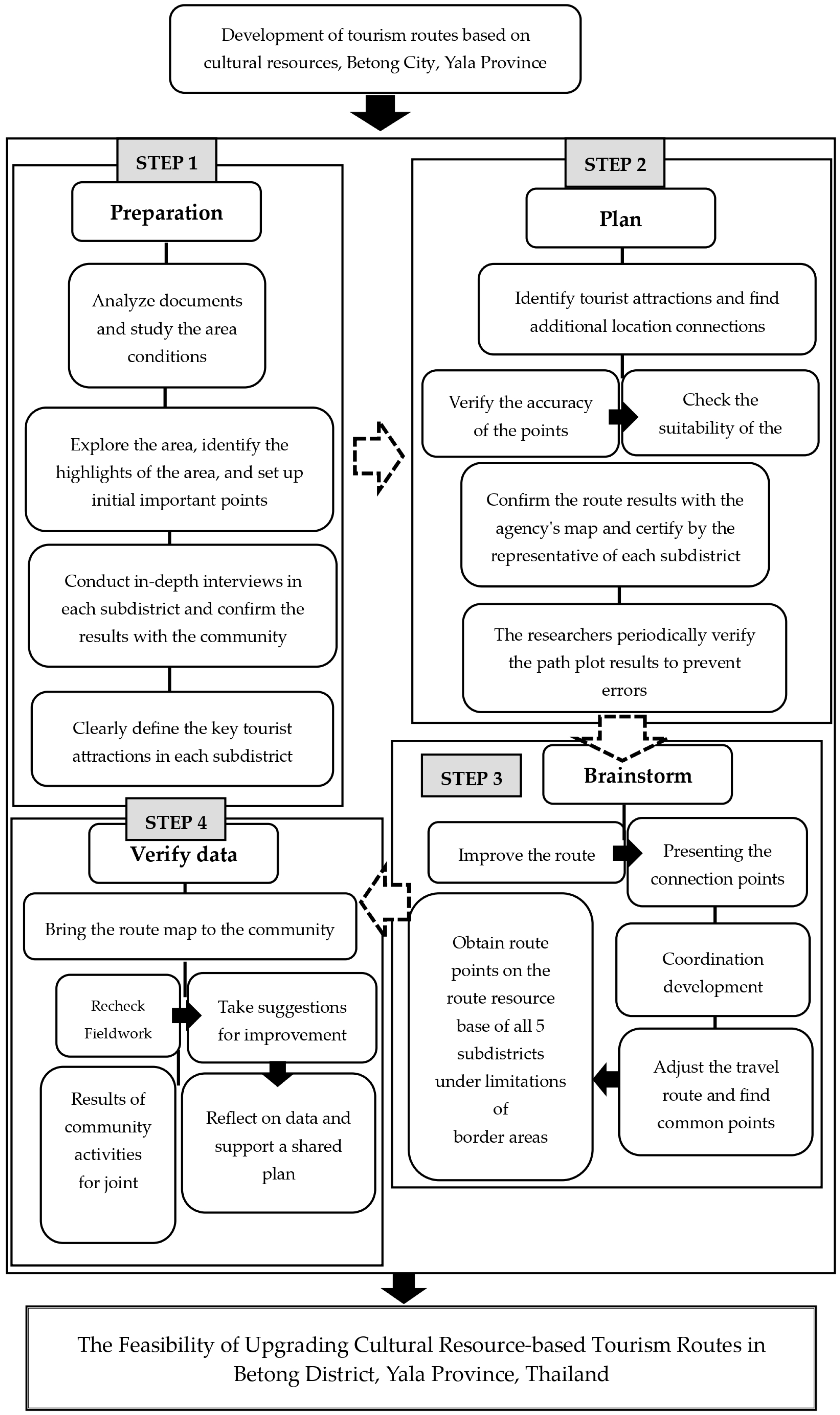
3.7. The Process of Reflecting on and Confirming the Feasibility of the Information
4. Results
4.1. The Model Maps and the Points Assigned to Resource Bases
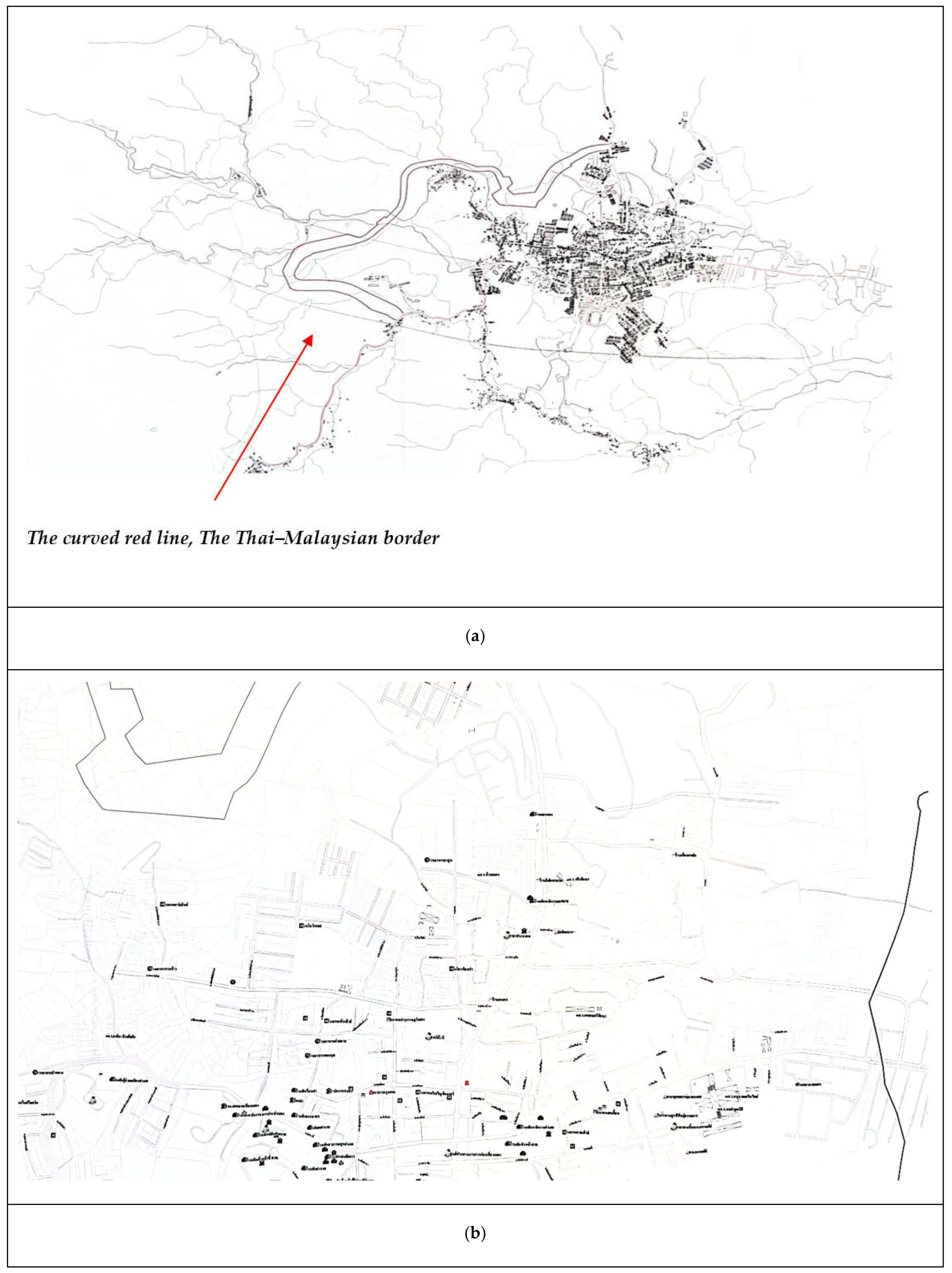
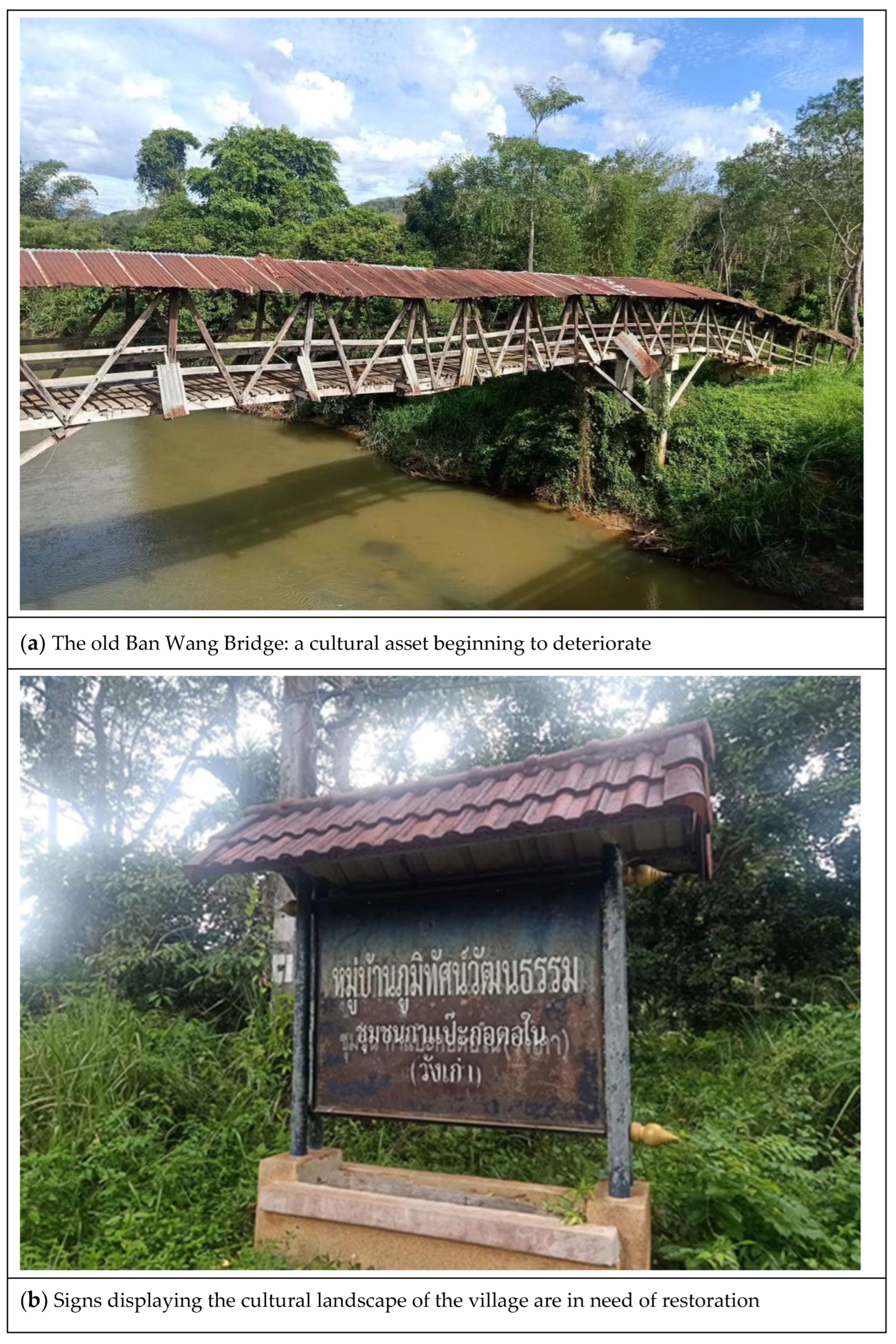
4.1.1. The Original Map Base as a Guide and the Exploration of Abandoned Areas
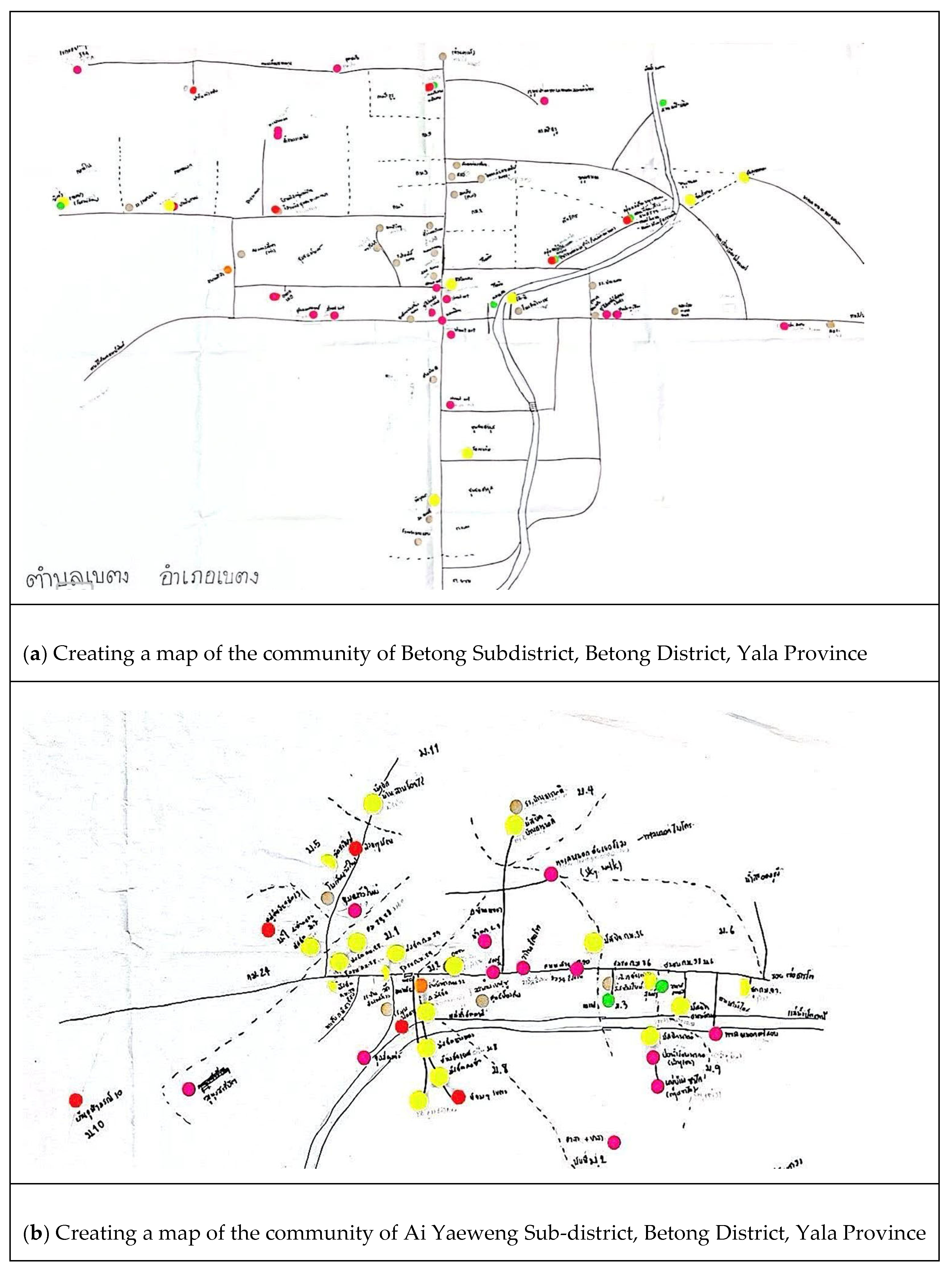
4.1.2. Community Maps and Conclusion for Tourism Route Development
4.2. City in the Mist: The Feasibility of Tourism Route Development
- Hybrid Cultural Route—Featuring diverse groups of people in the area, suitable for locations with low investment costs
- Border History Route—“Betong as a Border Town” between Thailand and Malaysia, learning about trade methods and special cross-border areas that overcome political constraints
- Community Food and Culture Route—Utilizing local ingredients that are disappearing or difficult to find elsewhere for tourism purposes
- Fruit Orchard Tourism Route—Experiencing the abundant agricultural practices of southern Thailand in Betong, suitable for trail tourism due to its mountainous geography
- Cultural + Nature Hybrid Route—Learning about both natural resources and culture, a hybrid reflecting the spirit and livelihood of the community
- Community Identity Learning Route—Betong’s multiculturalism and local history, including remnants from the Communist era. The seven routes are a product of feasibility studies conducted in five areas to explore the limitations of developing cultural resource-based routes.
5. Discussion
6. Conclusions and Recommendations
Author Contributions
Funding
Institutional Review Board Statement
Informed Consent Statement
Data Availability Statement
Conflicts of Interest
References
- Maldonado-Erazo, C.P.; del Río-Rama, M.d.l.C.; Álvarez-García, J.; Flores-Mancheno, A.C. Use of natural and cultural resources by tourism. Land 2022, 11, 1162. [Google Scholar] [CrossRef]
- Mteti, S.H.; Mpambije, C.J.; Manyerere, D.J. Unlocking cultural tourism: Local community awareness and perceptions of cultural heritage resources in Katavi Region in southern circuit of Tanzania. Soc. Sci. Humanit. Open 2025, 11, 101295. [Google Scholar] [CrossRef]
- Seamon, D.; Sowleeers, J. Place and Placelessness; Sage Publishing: Thousand Oaks, CA, USA, 2008. [Google Scholar]
- Betong Town Municipality. Local Development Plan (B.E. 2566–2570); Betong Town Municipality: Betong, Thailand, 2023; Available online: https://files.betongcity.go.th/com_strategy/2025-03_968e200848d839e.pdf (accessed on 1 March 2026).
- Jaiboon, D.; Yamyim, W.; Sirikanjanaporn, P.; Kiatsongcha, S. The development of a community-based tourism activity prototype based on local wisdom. Dhammathas Acad. J. 2023, 23, 221–234. [Google Scholar]
- Lin, X.; Shen, Z.; Teng, X.; Mao, Q. Cultural routes as cultural tourism products for heritage conservation and regional development: A systematic review. Heritage 2024, 7, 2399–2425. [Google Scholar] [CrossRef]
- Lukoseviciute, G.; Henriques, C.N.; Pereira, L.N.; Panagopoulos, T. Participatory development and management of eco-cultural trails in sustainable tourism destinations. J. Outdoor Recreat. Tour. 2024, 47, 100779. [Google Scholar] [CrossRef]
- Costa, M.; Valença, G.; Adorean, C.; Moura, F. The relation between circuity and mobility cultures: A study of 41 European cities. Cities 2025, 166, 106087. [Google Scholar] [CrossRef]
- Zouridaki, M.; Apostolakis, A.; Kourgiantakis, M. Cultural routes through the perspective of sustainable mobility: A Critical Literature Review. Int. J. Tour. Res. 2024, 26, e2756. [Google Scholar] [CrossRef]
- Bassani, M.; Bergamo, M.; González Soutelo, S. Archaeology & pilgrimage: Studies around the RurAl-Lure European project. Riv. Engramma 2023, 204, 7–10. [Google Scholar] [CrossRef]
- Mandić, A.; Petrić, L.; Pivčević, S. Harmonizing sustainability and resilience in post-crisis cultural tourism: Stakeholder insights from the Split metropolitan area living lab. Tour. Manag. Perspect. 2025, 55, 101331. [Google Scholar] [CrossRef]
- Dundon, E. The Seeds of Innovation: Cultivating the Synergy That Fosters New Ideas; AMACOM: New York, NY, USA, 2002. [Google Scholar]
- Meyer, D. Tourism Routes and Gateways. Ph.D. Thesis, Overseas Development Institute, London, UK, 2004. [Google Scholar]
- Reindrawati, D.Y. Challenges of community participation in tourism planning in developing countries. Cogent Soc. Sci. 2023, 9, 2164240. [Google Scholar] [CrossRef]
- Blasco, D.; Guia, J.; Prats, L. Heritage tourism clusters along the borders of Mexico. J. Herit. Tour. 2014, 9, 51–67. [Google Scholar] [CrossRef]
- Lan, F.; Liu, J.; Sun, Z. Data-driven information resource optimization for cultural tourism. Inf. Resour. Manag. J. 2026, 39, 1–25. [Google Scholar] [CrossRef]
- Prakaisak, I.; Iamtrakul, P.; Suvarnakuta, P.; Chayphong, S.; Kantavat, P.; Kijsirikul, B.; Achariyaviriya, W.; Raungratanaamporn, I.-S.; Prakayaphun, T.; Iwahori, Y.; et al. AI-based quality-of-life-aware route planning: A Phuket case study. Transp. Res. Interdiscip. Perspect. 2026, 36, 101918. [Google Scholar] [CrossRef]
- Saunders, B.; Sim, J.; Kingstone, T.; Baker, S.; Waterfield, J.; Bartlam, B.; Burroughs, H.; Jinks, C. Saturation in qualitative research: Exploring its conceptualization and operationalization. Qual. Quant. 2018, 52, 1893–1907. [Google Scholar] [CrossRef]
- Shummadtayar, U.; Iamtrakul, P.; Kazunori, H. Community-based tourism mechanism: A factor for sustainable tourism at the world heritage corridor in Thailand. JATI J. Southeast Asian Stud. 2024, 29, 27–45. [Google Scholar] [CrossRef]
- Pancioli, A.M.; Broderick, J.; Kothari, R.; Brott, T.; Tuchfarber, A.; Miller, R.; Khoury, J.; Jauch, E. Public perception of stroke warning signs and knowledge of potential risk factors. JAMA 1998, 279, 1288–1292. [Google Scholar] [CrossRef]
- Lees, L.; Herkül, K.; Aps, R.; Barboza, F.R.; Karro, K.; Roio, M.; Szava-Kovats, R.; Kotta, J. Integrating cultural and natural assets in marine spatial planning: A new approach for joint management of cultural and natural assets. J. Nat. Conserv. 2024, 81, 126701. [Google Scholar] [CrossRef]
- Liao, Z.; Xu, J.; Zhang, W. Glocalization: Cross-cultural communication of tourism research. Tour. Manag. 2025, 108, 105129. [Google Scholar] [CrossRef]
- Yılmaz, E.M.; Aksakal, E. Evaluation of alternative travel routes concerning environmental considerations, individual expectations, and requirements. J. Eng. Res. 2026, in press. [Google Scholar] [CrossRef]
- Lian, J.; Nijhuis, S.; Bracken, G.; Bai, N.; Zhang, H. Introducing a perceptual–spatial landscape planning model (PSLPM) for cultural landscapes’ route optimization: The case of Chengde Mountain Resort. Front. Archit. Res. 2025, in press. [Google Scholar] [CrossRef]
- Božić, S.; Tomić, N. Developing the cultural route evaluation model (CREM) and its application on the Trail of Roman Emperors, Serbia. Tour. Manag. Perspect. 2016, 17, 26–35. [Google Scholar] [CrossRef]
- Della Spina, L. A Prefeasibility study for the adaptive reuse of cultural historical landscapes as drivers and enablers of sustainable development. Sustainability 2023, 15, 12019. [Google Scholar] [CrossRef]
- Balcan, C.; Aydın, E.Ö.; Ünsal, Ö. Value-based optimization model for cultural route design: Ancient water supply heritage of Istanbul (Türkiye). J. Cult. Herit. 2024, 70, 97–110. [Google Scholar] [CrossRef]
- Cheung, S.C.H.; Wong, A.W.H. Feasibility and challenges of cultural landscape and countryside conservation: A case study of the Ngong Ping Tea Factory. J. Chin. Archit. Urban. 2025, 7, 4501. [Google Scholar] [CrossRef]
- Fafouti, A.E.; Kizos, T.; Chalkias, C. Designing cultural routes as a tool of responsible tourism and sustainable local development in isolated and less developed islands: The case of Symi Island in Greece. Land 2023, 12, 1590. [Google Scholar] [CrossRef]
- Iakovaki, E.; Konstantakis, M.; Teneketzis, A.; Konstantakis, G. Analyzing cultural routes and their role in advancing cultural heritage management within tourism: A systematic review with a focus on the integration of digital technologies. Encyclopedia 2023, 3, 1509–1522. [Google Scholar] [CrossRef]
- Parrinello, S.; Picchio, F. Digital strategies to enhance cultural heritage routes: From integrated survey to digital twins of different European architectural scenarios. Drones 2023, 7, 576. [Google Scholar] [CrossRef]
- Torrieri, F.; Crisopulli, A.; Rossitti, M. Assessing the feasibility of PPPs for cultural heritage enhancement in UNESCO sites: The case of Matera (Italy). Land 2025, 14, 898. [Google Scholar] [CrossRef]
- Malmqvist, J.; Hellberg, K.; Möllås, G.; Rose, R.; Shevlin, M. Conducting the pilot study: A Neglected Part of the Research Process? Methodological Findings Supporting the Importance of Piloting in Qualitative Research Studies. Int. J. Qual. Methods 2019, 18, 1–11. [Google Scholar] [CrossRef]
- Hall, P.; Tewdwr-Jones, M. Urban and Regional Planning, 5th ed.; Routledge: London, UK, 2010. [Google Scholar]
- Goodnough, K. Professional learning of K-6 teachers in science through collaborative action research: An Activity Theory Analysis. J. Sci. Teach. Educ. 2016, 27, 747–767. [Google Scholar] [CrossRef]
- Richey, R.C.; Klein, J.D. Design and Development Research: Methods, Strategies, and Issues; Lawrence Erlbaum Associates: Mahwah, NJ, USA, 2007. [Google Scholar]
- Alnaim, M.M. Cultural tourism as a driver for sustainable urban development in Hail City, Saudi Arabia. Environ. Sustain. Indic. 2026, 30, 101135. [Google Scholar] [CrossRef]
- Pramezwary, A.; Juliana, J.; Yuliantoro, N.; Hulu, M.; Teguh, F.X. Sacred service, cultural transformation, and sustainable religious tourism in Labuan Bajo. Societies 2026, 16, 97. [Google Scholar] [CrossRef]
- Gou, S.; Shibata, S. Using visitor-employed photography to study the visitor experience on a pilgrimage route—A case study of the Nakahechi Route on the Kumano Kodo pilgrimage network in Japan. J. Outdoor Recreat. Tour. 2017, 18, 22–33. [Google Scholar] [CrossRef]
- Zhang, J.; Inbakaran, R.J.; Jackson, M.S. Understanding community attitudes towards tourism and Host—Guest Interaction in the Urban—Rural Border Region. Tour. Geogr. 2006, 8, 182–204. [Google Scholar] [CrossRef]
- Pokawin, J. Feasibility study of agro-tourism management of BorkaeBorthong Village, Loengfaek Sub-district, Kut Rang District, Maha Sarakham Province. J. Politics Gov. 2018, 8, 110–131. Available online: https://so03.tci-thaijo.org/index.php/jopag/article/view/162246/117026 (accessed on 1 March 2026).
- Karataş, E.; Özköse, A.; Heyik, M.A. Sustainable heritage planning for urban mass tourism and rural abandonment: An integrated approach to the Safranbolu–Amasra eco-cultural route. Sustainability 2025, 17, 3157. [Google Scholar] [CrossRef]
- Valagussa, A.; Frattini, P.; Valbuzzi, E.; Crosta, G.B. Role of landslides on the Nepal 2015 earthquake sequence. Sci. Rep. 2021, 11, 3434. [Google Scholar] [CrossRef] [PubMed]
- Wojtanowska, E.; Góral, A.; Bugdol, M. The role of trust in sustainable heritage management networks. Case study of selected cultural routes in Poland. Sustainability 2019, 11, 2844. [Google Scholar] [CrossRef]
- Zhou, Z.; Zheng, X. A Cultural Route Perspective on Rural Revitalization of Traditional Villages: A Case Study from Chishui, China. Sustainability 2022, 14, 2468. [Google Scholar] [CrossRef]
- Karapan, R. Prototype development of a creative living space in Lampang, Northern Thailand. JATI J. Southeast Asian Stud. 2022, 27, 1–21. [Google Scholar] [CrossRef]
- Hernández Ramírez, J. Los caminos del patrimonio: Rutas turísticas e itinerarios culturales. PASOS Rev. Tur. Patrim. Cult. 2011, 9, 225–236. [Google Scholar] [CrossRef]
- Pongsakornrungsilp, S.; Pusaksrikit, T.; Pongsakornrungsilp, P. Developing a Green Brand through Co-Creation Process of Krabi, Thailand. Int. J. Innov. Creat. Change 2021, 15, 135–158. [Google Scholar]
- Pramono, R.; Juliana, J.; Hulu, M.; Djakasaputra, A.; Jie, F. Overtourism in Bali and Lombok: A governance and community perspective on challenges and strategies for sustainable development. Societies 2026, 16, 65. [Google Scholar] [CrossRef]
- Serrano, O.; Miranda Gonzalez, F.; Mourato, J. Impact of Quality Assurance on Higher Education Institution Performance: Differences Between Public and Private Institutions. Societies 2026, 16, 76. [Google Scholar] [CrossRef]
- Su, D.N.; Truong, T.M.; Luu, T.T.; Huynh, H.M.T.; O’Mahony, B. Career resilience of the tourism and hospitality workforce in the COVID-19: The protection motivation theory perspective. Tour. Manag. Perspect. 2022, 44, 101039. [Google Scholar] [CrossRef]
- Boonwanno, S.; Laeheem, K.; Hunt, B. Takua Pa old town: Potential for resource development of community-based cultural tourism management. Kasetsart J. Soc. Sci. 2022, 43, 88–93. [Google Scholar] [CrossRef]
- Ramírez-Guerrero, G.; García-Onetti, J.; Arcila-Garrido, M.; Chica-Ruiz, J.A. A tourism potential index for cultural heritage management through the ecosystem services approach. Sustainability 2021, 13, 6415. [Google Scholar] [CrossRef]
- Oikonomopoulou, E.; Delegou, E.T.; Sayas, J.; Moropoulou, A. An innovative approach to the protection of cultural heritage: The case of cultural routes in Chios Island, Greece. J. Archaeol. Sci. Rep. 2017, 14, 742–751. [Google Scholar] [CrossRef]
- Rudan, E.; Madžar, D.; Zubović, V. New challenges to managing cultural routes: The visitor perspective. Sustainability 2024, 16, 7164. [Google Scholar] [CrossRef]
- Vaishar, A.; Šťastná, M.; Zapletalová, J. From industry to cultural tourism: Structural transformation of the second-order city. Case Brno. Cities 2025, 158, 105685. [Google Scholar] [CrossRef]
- Gaonkar, S.; Sukthankar, S.V. Measuring and evaluating the influence of cultural sustainability indicators on sustainable cultural tourism development: Scale development and validation. Heliyon 2025, 11, e42514. [Google Scholar] [CrossRef]
- Jimber del Río, J.A.; Orgaz Agüera, F.; Moral Cuadra, S.; Cañero Morales, P. Satisfaction in border tourism: An analysis with structural equations. Eur. Res. Manag. Bus. Econ. 2017, 23, 103–112. [Google Scholar] [CrossRef]
- Kotler, P. Marketing Management; Prentice Hall: Upper Saddle River, NJ, USA, 2003. [Google Scholar]
- Arnstein, S.R. A ladder of citizen participation. J. Am. Inst. Plan. 1969, 35, 216–224. [Google Scholar] [CrossRef]
- O’Connor, K.; Carmichael, P. The craft of public administration in Eurasia. Public Policy Adm. 2019, 35, 465–484. [Google Scholar] [CrossRef]
- Lewandowska, A.; Chodkowska-Miszczuk, J.M. Sustainable development, just transition and rural resilience: Tailor-made solutions for global challenges. View from Poland. Eur. Plan. Stud. 2026, 34, 107–127. [Google Scholar] [CrossRef]
- Li, J.; Wu, N.; Xiong, S. Sustainable innovation in the context of organizational cultural diversity: The role of cultural intelligence and knowledge sharing. PLoS ONE 2021, 16, e0250878. [Google Scholar] [CrossRef]
- Rosser, P.; Soler, S. Enhancing educational and tourism strategies at heritage sites: Visitor Flow Prediction Using ARIMA and Autoregressive Models. In Safeguarding the World Culture Heritage—Advances and New Perspectives; IntechOpen: London, UK, 2024. [Google Scholar] [CrossRef]



| Topic | Year | Concept | Apply | No. Reference |
|---|---|---|---|---|
| Value-based optimization model for cultural route design: Ancient water supply heritage of Istanbul (Türkiye) | 2024 | Route simulation design creates an experience through an optimization model. It uses area selection criteria based on historical periods to provide data dimensions and conditions for route planning. It employs quantitative calculations combined with heritage value assessments. |
| [27] |
| Developing the cultural route evaluation model (CREM) and its application on the Trail of Roman Emperors, Serbia | 2016 | Employed a simulation-based approach through narrative-based experience, developing models for evaluating main values and tourism-specific values, analyzing routes, and directly testing them at cultural sites. |
| [25] |
| Feasibility and challenges of cultural landscape and countryside conservation: A case study of the Ngong Ping Tea Factory | 2025 | Examines rural areas under pressure to develop appropriate tourist attractions through local participation, utilizing historical methodology, in-depth field landscape surveys, and experimental processes by the research team. |
| [28] |
| Designing cultural routes as a tool of responsible tourism and sustainable local development in isolated and less developed islands: The case of Symi Island in Greece | 2023 | Examines routes in remote areas using a mass tourism development process and the potential impacts of tourist attractions by utilizing multi-sectoral data, including networks, integration, and integrated planning methods to identify key points in the area. |
| [29] |
| Analyzing cultural routes and their role in advancing cultural heritage management within tourism | 2023 | Examines activities that combine entertainment and learning through pathways connecting with history, utilizing heritage sites, learning experiences, and user-centered management based on the PRISMA methodology. |
| [30] |
| Digital strategies to enhance cultural heritage routes | 2023 | Cultural heritage routes promotes historical learning by using drones to record historical data, including surveying, collecting, and analyzing heritage sites, reducing steps and enabling the projection of 3D data and GIS systems. |
| [31] |
| Assessing the feasibility of PPPs for cultural heritage enhancement in UNESCO sites: The case of Matera (Italy) | 2025 | Managing the education of World Heritage sites in limited areas requires collaboration between the public and private sectors in historical cities. This includes analyzing internal and external factors, as well as using data and create a tourism foundation, in order to reduce long-term conflicts regarding budgets. |
| [32] |
| Evaluation of alternative travel routes concerning environmental considerations, individual expectations, and requirements | 2026 | Developing environmentally alternative routes in border areas must reflect user needs and travel limitations. Analysis of factors affecting the effectiveness of various approaches is crucial for spatial resilience |
| [23] |
| Categorization | Aiyoeweng Subdistrict | Tano Maero Subdistrict | Betong Subdistrict | Than Nam Thip Subdistrict | Yarom Subdistrict |
|---|---|---|---|---|---|
| Tangible Cultural Heritage Plays an Important Role in Tourism Routes Development | |||||
| Local Culinary Specialties | Ancient Coffee/Pizza with Pla Nin Sai Nam Lai Topping/Halal Soup/Dorae Soup | Chue Wu Watercress Garden/Betong Grass Jelly (Two places) | Betong Noodles/Betong Chicken | - | - |
| Sources of Learning | Chulabhorn Phatthana Village 10/Chulabhorn Phatthana Village 10 Community Museum/the 1000-year tree (Chulabhorn Phatthana Village 10) | Fish farming: Raising Pla Nin (Nile Tilapias) in water from a flowing river, Pla Chin (carps) in ponds, and Pla Phluang Chomphu (Cyprinidae) in ponds | Betong Municipal Old Community Cultural Learning Center | Homestay Camping Site | |
| Tourism Assets | Aiyoeweng Sea of Mist/Tae Pusuchu Hanging Bridge/Gunung Silipat Viewpoint/King Rama 9 | Betong Winter Flower Garden/the 1000-Year-Old Tree/Piyamit Tunnel/Inthason | The 54 A Sign (Siam Southernmost Border)/Mongkhonrit Tunnel/Street Art 1–5/the Original | Pae Kong Shrine/the Modeled Siam Southernmost Milestone 53A/Siam Southernmost Curves 54 A (Two | Naho Community (Ancient community) 2 sides/Chantharattanaram Monastery (Pae Kong Mai)/Betong |
| Waterfalls/Aiyoeweng Rafting Point/Na Ko Hot Springs/Sakai Village/Hala Bala Forest | Waterfall/Betong Mu 2 Hot Springs/100-Year-Old Houses Mu 1/the 150-Year-Old Hakka Village | Mailbox/the Modeled Mailbox/the Clock Tower/Gunung Palong Sea of Mist/the City Gate/OK Betong Sign (Check-in point)/Sud Siam Park/Betong Customs House/Wat Phuttha Thiwat/Wat Phothisatto Chaomae Kuan Im/Betong Central Mosque/Charo Ganga Sea of Mist/Charo, Ayam Cave/Cjharo Ganga Viewpoint/Toni Shrine (Betong Wira Ratprasan School) Betong City Municipal Stadium | Curves)/Chap Yi Lui Sign (12 Satang Sign)/Ban Daeng Mu 4(the Red House)/Tai Tong Sea of Mist/Than Nam Thip Waterfalls (7 levels)/Bua Daeng (Red Lotus) Pond | International Airport/Ban Suan Mai 100-Year Bridge | |
| Leisure Activities | 32 Km. Tea Shop | Taiguns Shooting Range, Betong | - | - | |
| Community Service Facilities | Ban Wang Mai/Tono Maero Subdistrict Administrative Organization School/Ban Than Mali School/Ban Mai School/Ban Aiyoeweng School/Betong Disaster Prevention and Mitigation Office | Thairath Witthaya 94 School/Tano Maero Subdistrict Administrative Organization/Betong Yala International Meditation Center | Betong Post Office/Betong District Office/Betong City Municipality/Betong Hospital/Betong Immigration Checkpoint/Jongfa Foundation School | Than Nam Thip Subdistrict Administrative Organization/Border Checkpoint 4406 | Yarom Subdistrict Administrative Organization/Rubber Authority of Thailand, Betong Branch/Betong Hospital |
Disclaimer/Publisher’s Note: The statements, opinions and data contained in all publications are solely those of the individual author(s) and contributor(s) and not of MDPI and/or the editor(s). MDPI and/or the editor(s) disclaim responsibility for any injury to people or property resulting from any ideas, methods, instructions or products referred to in the content. |
© 2026 by the authors. Licensee MDPI, Basel, Switzerland. This article is an open access article distributed under the terms and conditions of the Creative Commons Attribution (CC BY) license.
Share and Cite
Boonwanno, S.; Laeheem, K.; Tepsing, P.; Chitwiboon, P.; Yeetin, P. The Feasibility of Upgrading Cultural Resource Tourism Routes in Betong District, Yala Province, Thailand, Under the Limitations of Border Areas. Societies 2026, 16, 187. https://doi.org/10.3390/soc16060187
Boonwanno S, Laeheem K, Tepsing P, Chitwiboon P, Yeetin P. The Feasibility of Upgrading Cultural Resource Tourism Routes in Betong District, Yala Province, Thailand, Under the Limitations of Border Areas. Societies. 2026; 16(6):187. https://doi.org/10.3390/soc16060187
Chicago/Turabian StyleBoonwanno, Sakawrat, Kasetchai Laeheem, Punya Tepsing, Pongtach Chitwiboon, and Poranee Yeetin. 2026. "The Feasibility of Upgrading Cultural Resource Tourism Routes in Betong District, Yala Province, Thailand, Under the Limitations of Border Areas" Societies 16, no. 6: 187. https://doi.org/10.3390/soc16060187
APA StyleBoonwanno, S., Laeheem, K., Tepsing, P., Chitwiboon, P., & Yeetin, P. (2026). The Feasibility of Upgrading Cultural Resource Tourism Routes in Betong District, Yala Province, Thailand, Under the Limitations of Border Areas. Societies, 16(6), 187. https://doi.org/10.3390/soc16060187