

Organizational Arrangements in Evidence2Success Communities: Enabling Sustainable Community Transformation for Youth Well-Being

 ,
,  ,
,
Abstract
1. Introduction
1.1. Conceptual Foundations
1.1.1. Asset-Based Community Development (ABCD) Framework
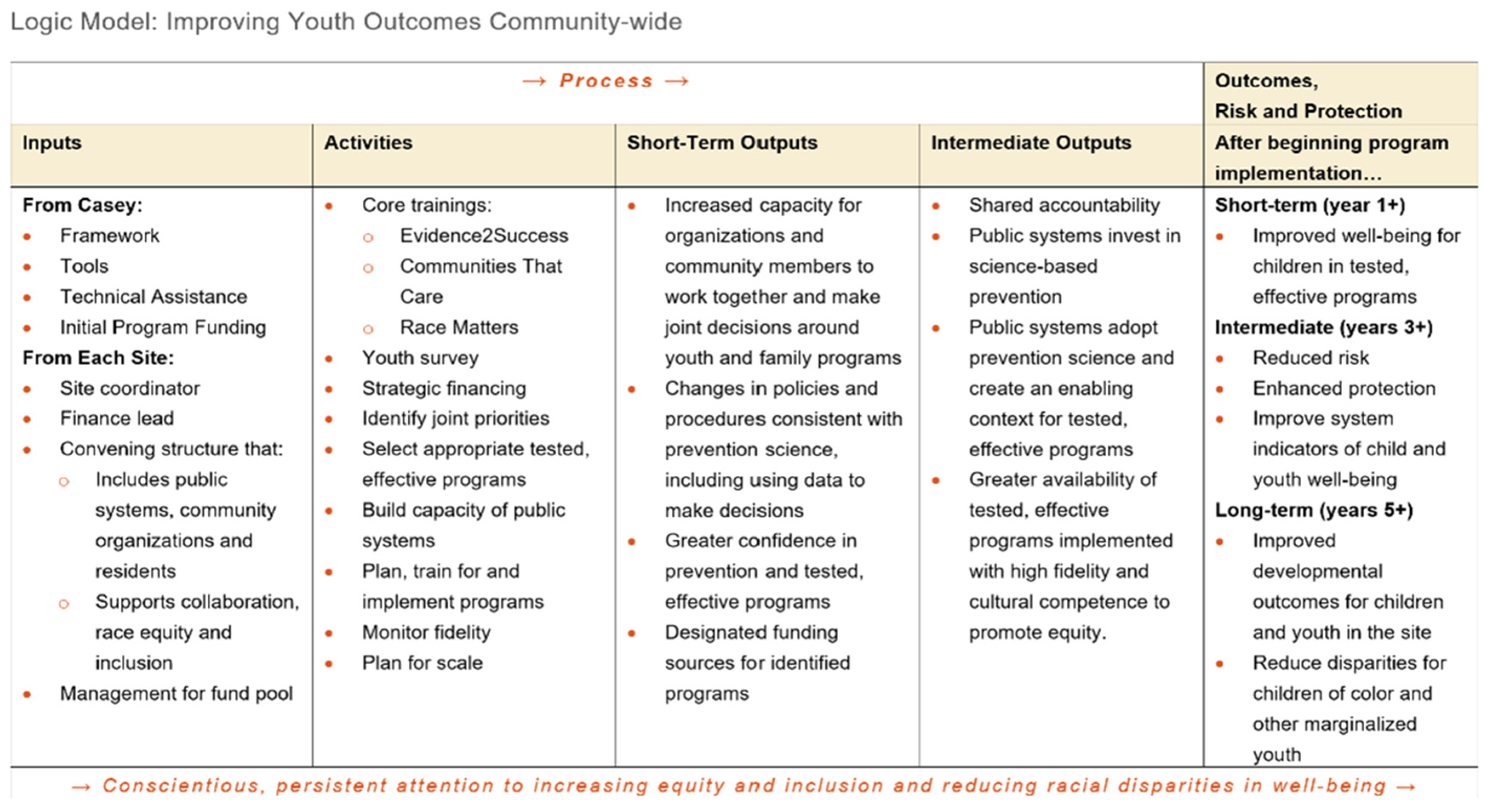
1.1.2. Evidence2Success Framework
1.1.3. Alignment Between Evidence2Success and ABCD
1.2. Current Study
- How do citizen-driven asset-mapping activities within Evidence2Success shape local prevention priorities?
- In what ways do coalition processes build horizontal and vertical social capital and foster inclusive governance?
- How are institutional and economic resources re-allocated to sustain resident-identified initiatives?
- How does resident knowledge inform program adaptation while preserving fidelity to evidence?
2. Materials and Methods
2.1. Sample
2.2. Study Procedures
2.3. Measures
2.3.1. Case Study
2.3.2. Interview
2.3.3. Strengths and Concerns Reports
2.3.4. Implementation Progress Interviews
2.3.5. Milestones and Benchmarks Ratings
3. Results
3.1. Community Context
3.1.1. Kearns, Salt Lake County
3.1.2. Mobile, Alabama
3.1.3. Memphis, Tennessee
3.2. Study Fundings
3.2.1. RQ 1: How Do Citizen-Driven Asset-Mapping Activities Within Evidence2Success Shape Local Prevention Priorities?
3.2.2. RQ 2: In What Ways Do Coalition Processes Build Horizontal and Vertical Social Capital and Foster Inclusive Governance?
3.2.3. RQ 3: How Are Institutional and Economic Resources Re-Allocated to Sustain Resident-Identified Initiatives?
3.2.4. RQ 4: How Does Resident Knowledge Inform Program Adaptation While Preserving Fidelity to Evidence?
4. Discussion
4.1. Synthesis of Findings Vis-À-Vis ABCD Theory
4.2. Implications for Community Prevention Practice and Policy
4.3. Limitations and Future Research
5. Conclusions
Author Contributions
Funding
Institutional Review Board Statement
Informed Consent Statement
Data Availability Statement
Acknowledgments
Conflicts of Interest
Abbreviations
| ABCD | Asset-Based Community Development |
| CBITS | Cognitive Behavioral Intervention for Trauma in Schools |
| CTC | Communities That Care |
| LDIPN | Lower Dauphin Island Parkway Neighborhood |
| MLKN | Martin Luther King Neighborhood |
| MSA | Metropolitan Statistical Area |
| REEI | Racial and Ethnic Equity and Inclusion |
| SAAF | Strong African American Families |
| TA | Technical Assistance |
| YES | Youth Experience Survey |
| 1 | “Resident” refers to community members who live in the focus neighborhoods and hold formal or informal leadership roles (e.g., parents, youth, faith leaders, neighborhood association members), as distinct from staff of public agencies or external organizations. |
| 2 | These case studies focus on three Evidence2Success communities (Kearns, Mobile, and Memphis) that had at least two years of framework implementation and sufficient evaluation data; the findings may not represent the full range of experiences in other Evidence2Success sites or in communities using different prevention frameworks. |
| 3 | Asset-mapping in these sites combined structured activities (e.g., facilitated walks, mapping workshops, data walks) with informal conversations; examples in the text are illustrative rather than exhaustive of all activities undertaken in each community. |
| 4 | Quotations from community members and partners are drawn from evaluation interviews, Strengths and Concerns reports, and Action Guides; minor edits were made to improve readability while preserving the substantive meaning of participants’ statements. |
| 5 | Descriptions of coalition structures and decision-making processes reflect the period covered by the process evaluation; some communities may have further adapted their governance arrangements after the timeframe of this study. |
| 6 | The term “fundmapping” is used to describe local analyses of existing public and private funding streams that could be realigned to support community-prioritized outcomes; these exercises were conducted collaboratively by community boards, coordinators, and technical assistance providers. |
References
- Christens, B.D.; Inzeo, P.T. Widening the View: Situating Collective Impact among Frameworks for Community-Led Change. Community Dev. 2015, 46, 420–435. [Google Scholar] [CrossRef]
- Woodward, J.; South, J.; Coan, S.; Bagnall, A.-M.; Rippon, S. Asset-Based Community Development: A Review of Current Evidence; Leeds Beckett University: Leeds, UK, 2021. [Google Scholar]
- Chilenski, S.M.; Gayles, J.; Luneke, A.; Lew, D.; Villarruel, F.; Penilla, M.L.; Henderson, C.; Wilson, H.; Gary, L. Understanding Community- and System-Capacity Change over Time: A Close Look at Changing Social Capital in Evidence2Success Communities. J. Community Psychol. 2023, 51, 2989–3011. [Google Scholar] [CrossRef]
- Chilenski, S.M.; Penilla, M.L.; Gayles, J.G.; Lew, D.; Galinsky, M.; Lin, S.; Schmidt, D.; Luneke, A.; Villarruel, F. How Youth Surveys Guide Collective Community Investment and Planning: Benefits of Using Youth Data (Evidence2Success Action Guide 1); Edna Bennett Pierce Prevention Research Center, Pennsylvania State University: University Park, PA, USA, 2023; Available online: https://prevention.psu.edu/publication/how-youth-surveys-guide-collective-community-investment-and-planning-benefits-of-using-youth-data/ (accessed on 15 August 2025).
- Chilenski, S.M.; Penilla, M.L.; Gayles, J.G.; Lew, D.; Galinsky, M.; Lin, S.; Schmidt, D.; Luneke, A.; Villarruel, F. Taking the Guesswork out of Funding Youth Programs: The Evidence2Success Approach (Evidence2Success Action Guide 2); Edna Bennett Pierce Prevention Research Center, Pennsylvania State University: University Park, PA, USA, 2024; Available online: https://prevention.psu.edu/Evidence2Success/strategic-financing/ (accessed on 15 August 2025).
- Kretzmann, J.P.; McKnight, J.L. Building Communities from the Inside out: A Path Toward Finding and Mobilizing a Community’s Assets; ACTA Publications: Evanston, IL, USA, 1993. [Google Scholar]
- Mathie, A.; Cunningham, G. From Clients to Citizens: Asset-Based Community Development as a Strategy for Community-Driven Development. Dev. Pract. 2003, 13, 474–486. Available online: http://www.jstor.org/stable/4029934 (accessed on 15 August 2025). [CrossRef]
- Mathie, A.; Cameron, J.; Gibson, K. Asset-Based and Citizen-Led Development: Using a Diffracted Power Lens to Analyze the Possibilities and Challenges. Prog. Dev. Stud. 2017, 17, 54–66. [Google Scholar] [CrossRef]
- Chilenski, S.M.; Penilla, M.L.; Gayles, J.G.; Lew, D.; Galinsky, M.; Lin, S.; Schmidt, D.; Luneke, A.; Villarruel, F. Finding Unity in Community: How Building Consensus Can Shift the Dynamics of Support (Evidence2Success Action Guide 3); Edna Bennett Pierce Prevention Research Center, Pennsylvania State University: University Park, PA, USA, 2025; Available online: https://prevention.psu.edu/Evidence2Success/engaging-community/ (accessed on 15 August 2025).
- McKnight, J.; Block, P. The Abundant Community: Awakening the Power of Families and Neighborhoods; Berrett-Koehler: San Francisco, CA, USA, 2010. [Google Scholar]
- Green, G.P.; Haines, A. Asset Building and Community Development, 4th ed.; SAGE Publications: Thousand Oaks, CA, USA, 2015. [Google Scholar]
- Ward, S. Using Theory-Based Evaluation to Understand What Works in Asset-Based Community Development. Community Dev. J. 2023, 58, 206–224. [Google Scholar] [CrossRef]
- Mathie, A.; Cunningham, G. From Clients to Citizens: Communities Changing the Course of Their Own Development; Practical Action Publishing: Rugby, UK, 2008. [Google Scholar]
- Fonchingong, C.C. Who Is Driving Development? Reflections on the Transformative Potential of Asset-Based Community Development. Community Dev. J. 2018, 53, 732–748. [Google Scholar] [CrossRef]
- Stoltenberg Bruursema, C. Asset-Based Community Development: A Path Toward Authentic Community Development Practice. SPNHA Rev. 2015, 11, 7. Available online: https://scholarworks.gvsu.edu/spnhareview/vol11/iss1/7 (accessed on 15 August 2025).
- Nel, H. Community Leadership: A Comparison between Asset-Based Community-Led Development (ABCD) and Traditional Approaches to Community Development. Dev. S. Afr. 2018, 35, 839–851. [Google Scholar] [CrossRef]
- Russell, C.; Hopkins, T. Asset-Based Community Development: Looking Back to Look Forward; ABCD Institute/Nurture Development: Sheffield, UK, 2016. [Google Scholar]
- Parker, C.J.; Eisenberg, N.; Chilenski, S.M.; Haggerty, K.P.; Henderson, C.; Johnson, P.; Steel, B. Introduction to Evidence2Success: An Enhanced Prevention Framework. Manuscript under review.
- Gayles, J.G.; Lin, S.; Villarruel, F.; Penilla, M.L.; Galinsky, M.; Luneke, A.; Chilenski, S.M. From People to Place and Power: Coalitions That Succeed by Grounding Efforts in Community Context (Evidence2Success Action Guide 4); Edna Bennett Pierce Prevention Research Center, Pennsylvania State University: University Park, PA, USA, 2025; Available online: https://prevention.psu.edu/Evidence2Success/from-people-to-place-and-power-coalitions-that-succeed-by-grounding-efforts-in-community-context/ (accessed on 15 August 2025).
- Chilenski, S.M.; Gayles, J.G.; Luneke, A.; Schmidt, D.; Penilla, M.L.; Lin, S.; Lew, D. Evidence2Success: 2018 Cross-Site Project Progress Report (Revised); Report Submitted to the Annie E. Casey Foundation’s Evidence2Success Project Team; Edna Bennett Pierce Prevention Research Center, Pennsylvania State University: University Park, PA, USA, 2019. [Google Scholar]
- Hawkins, J.D.; Catalano, R.F.; Arthur, M.W.; Egan, E.; Brown, E.C.; Abbott, R.D.; Murray, D.M. Testing communities that care: The rationale, design and behavioral baseline equivalence of the community youth development study. Prev. Sci. 2008, 9, 178–190. [Google Scholar] [CrossRef]
- Gayles, J.G.; Chilenski, S.M.; Penilla, M.L.; Lin, S.; Schmidt, D.; Villarruel, F.; Luneke, A. Evidence2Success®: Racial and Ethnic Equity and Inclusion: Reflections on Framework Design, Implementation, and Memphis’s Community Experience; Report Submitted to the Annie E. Casey Foundation’s Evidence2Success Project Team; Edna Bennett Pierce Prevention Research Center, Pennsylvania State University: University Park, PA, USA, 2021. [Google Scholar]
- Crowe, S.; Cresswell, K.; Robertson, A.; Huby, G.; Avery, A.; Sheikh, A. The Case Study Approach. BMC Med. Res. Methodol. 2011, 11, 100. [Google Scholar] [CrossRef]
- Yin, R.K. Case Study Research: Design and Methods, 5th ed.; SAGE Publications: Thousand Oaks, CA, USA, 2014. [Google Scholar]
- Chilenski, S.M.; Luneke, A.; Gayles, J.G.; Schmidt, D.; Penilla, M.L. Evidence2Success Cross-Site Comparison Report: Fidelity of Tested Effective Programs; Report Submitted to the Annie E. Casey Foundation’s Evidence2Success Project Team; Edna Bennett Pierce Prevention Research Center, Pennsylvania State University: University Park, PA, USA, 2019. [Google Scholar]
- Chilenski, S.M.; Schmidt, D.; Gayles, J.G.; Villarruel, F.; Penilla, M.L.; Luneke, A. Implementation Evaluation Strengths & Concerns Review: Memphis (March); Report Submitted to Local Site Partners and the Annie E. Casey Foundation’s Evidence2Success Project Team; Edna Bennett Pierce Prevention Research Center, Pennsylvania State University: University Park, PA, USA, 2020. [Google Scholar]
- Chilenski, S.M.; Schmidt, D.; Brown, M.; Villarruel, F.; Gayles, J.G. Implementation Evaluation Strengths & Concerns Review: Mobile, AL, 1st Quarter; Report Submitted to the Annie E. Casey Foundation’s Evidence2Success Project Team; Edna Bennett Pierce Prevention Research Center, Pennsylvania State University: University Park, PA, USA, 2018. [Google Scholar]
- U.S. Census Bureau. QuickFacts: Kearns Metro Township, Utah. 2025. Available online: https://www.census.gov/quickfacts/fact/table/kearnsmetrotownshiputah (accessed on 23 June 2025).
- Census Reporter. Kearns, UT—Profile (ACS 5 Year). 2025. Available online: https://censusreporter.org/profiles/16000US4940470-kearns-ut/ (accessed on 23 June 2025).
- U.S. Census Bureau. QuickFacts: Mobile City, Alabama. 2025. Available online: https://www.census.gov/quickfacts/fact/table/mobilecityalabama (accessed on 23 June 2025).
- City of Memphis, Division of Housing and Community Development. Five-Year Consolidated Plan (PY24–29/FY25–29): Annual Action Plan (PY24/FY25); City of Memphis, Division of Housing and Community Development: Memphis, TN, USA, 2024. Available online: https://www.memphistn.gov/wp-content/uploads/2024/07/Consolidated-Plan-FY25-29.pdf (accessed on 23 June 2025).
- U.S. Department of Housing and Urban Development. Choice Neighborhoods—South City (Memphis) Profile. Available online: www.hud.gov/choice_neighborhoods (accessed on 23 June 2025).
- University of Memphis, School of Social Work. Memphis Poverty Fact Sheet 2024; University of Memphis, School of Social Work: Memphis, TN, USA, 2024. [Google Scholar]
- Ward, S.; Bynner, C.; Bianchi, V. Building a capabilities framework with learners from high-poverty neighborhoods. In Educational Equity: Pathways to Success; Chapman, C., Ainscow, M., Eds.; Routledge: Abingdon, UK; New York, NY, USA, 2021; pp. 134–156. [Google Scholar] [CrossRef]
- Harrison, R.; Blickem, C.; Lamb, J.; Kirk, S.; Vassilev, I. Asset-Based Community Development: Narratives, Practice, and Conditions of Possibility—A Qualitative Study with Community Practitioners. SAGE Open 2019, 9, 2158244018823081. [Google Scholar] [CrossRef]
- Chupp, M.; Hirsch, J.; Malone, M. Integrating Asset-Based Community Development and Community-Based Research for Social Change: A Beginning. Gatew. Int. J. Community Res. Engagem. 2023, 16, 1–12. [Google Scholar] [CrossRef]
- Nel, H. Stakeholder Engagement: Asset-Based Community-Led Development (ABCD) versus the Traditional Needs-Based Approach to Community Development. Soc. Work/Maatskaplike Werk 2020, 56, 264–278. [Google Scholar] [CrossRef]
- Roy, M.J. The Assets-Based Approach: Furthering a Neoliberal Agenda or Rediscovering the Old Public Health? A Critical Examination of Practitioner Discourses. Crit. Public Health 2017, 27, 455–464. [Google Scholar] [CrossRef] [PubMed]
- South, J.; Coan, S.; Woodward, J.; Bagnall, A.-M.; Rippon, S. Asset Based Community Development: Co-Designing an Asset-Based Evaluation Study for Community Research. SAGE Open 2024, 14, 21582440241240836. [Google Scholar] [CrossRef]
- Flynn-Khan, M.; Tiede, L.; Gaughen, K. Funding Prevention in Communities: Lessons from Evidence2Success; The Annie E. Casey Foundation: Baltimore, MD, USA, 2021; Available online: https://www.aecf.org/resources/funding-prevention-in-communities (accessed on 15 August 2025).
- Trompette, P.; Vinck, D. Revisiting the Notion of Boundary Object. Rev. D’Anthropol. Connaiss. 2009, 3, 3–25. [Google Scholar] [CrossRef]
- Clark, J.K.; Kaiser, M.L.; Hicks, R.; Hoy, C.; Rogers, C.; Spees, C.K. Community–University Engagement via a Boundary Object: The Case of Food Mapping in Columbus, Ohio. In J. Public Scholarsh. High. Educ.; 2015; 5, pp. 126–142. Available online: https://files.eric.ed.gov/fulltext/EJ1120323.pdf (accessed on 15 August 2025).
- Grueber, L.; Mello, E. Collaborative Governance and Community Trust: Municipal Models for Earning the Trust of Marginalized Communities; Ash Center, Harvard Kennedy School: Cambridge, MA, USA, 2022; Available online: https://ash.harvard.edu/wp-content/uploads/2024/02/grueber_mello_collaborative_governance_and_trust_pae_final_04222022.pdf (accessed on 15 August 2025).
- Roussos, S.T.; Fawcett, S.B. A Review of Collaborative Partnerships as a Strategy for Improving Community Health. Annu. Rev. Public Health 2000, 21, 369–402. [Google Scholar] [CrossRef] [PubMed]
- Zakocs, R.C.; Edwards, E.M. What Explains Community Coalition Effectiveness? A Review of the Literature. Am. J. Prev. Med. 2006, 30, 351–361. [Google Scholar] [CrossRef]
- Butterfoss, F.D.; Kegler, M.C. A Coalition Model for Community Action. In Community Organizing and Community Building for Health and Welfare, 3rd ed.; Minkler, M., Ed.; Rutgers University Press: New Brunswick, NJ, USA, 2012; pp. 309–328. [Google Scholar]
- Congdon, W.; Simms, M.; De Vita, C. Assessing the Impact of Community-Level Initiatives: A Literature Review, OPRE Report #2021-4; Office of Planning, Research, and Evaluation, Administration for Children and Families, U.S. Department of Health and Human Services: Washington, DC, USA, 2020. Available online: https://acf.gov/opre/report/assessing-impact-community-level-initiatives-literature-review (accessed on 15 August 2025).
- U.S. Department of Health and Human Services, Office of the Assistant Secretary for Planning and Evaluation. Engaging People with Lived Experience to Improve Federal Research, Policy, and Practice; U.S. Department of Health and Human Services: Washington, DC, USA, 2023. Available online: https://aspe.hhs.gov/lived-experience (accessed on 15 August 2025).
- Sprague Martinez, L.; Rapkin, B.D.; Young, A.; Freisthler, B.; Glasgow, L.; Hunt, T.; Salsberry, P.J.; Oga, E.A.; Bennet-Fallin, A.; Plouck, T.J.; et al. Community Engagement to Implement Evidence-Based Practices in the HEALing Communities Study. Drug Alcohol Depend. 2020, 217, 108326. [Google Scholar] [CrossRef]
- Scheirer, M.A.; Dearing, J.W. An Agenda for Research on the Sustainability of Public Health Programs. Am. J. Public Health 2011, 101, 2059–2067. [Google Scholar] [CrossRef]
- The Annie E. Casey Foundation. Creating Resident-Led Governance Structures; The Annie E. Casey Foundation: Baltimore, MD, USA, 2004; Available online: https://assets.aecf.org/m/resourcedoc/aecf-creatingresidentledgovernance-2003.pdf (accessed on 15 August 2025).
- Fund for Shared Insight. Community Listening Sessions: A Guide for Funders; Fund for Shared Insight: New York, NY, USA, 2025; Available online: https://fundforsharedinsight.org/wp-content/uploads/2025/02/Community-Listening-Sessions-A-Guide-for-Funders-02242025.pdf (accessed on 15 August 2025).
- Schell, S.F.; Luke, D.A.; Schooley, M.W.; Elliott, M.B.; Herbers, S.H.; Mueller, N.B.; Bunger, A.C. Public Health Program Capacity for Sustainability: A New Framework. Implement. Sci. 2013, 8, 15. [Google Scholar] [CrossRef]
- Cooper, B.; O’Sullivan, K.; Jones, S.; PTTC Network. Balancing Fidelity and Adaptation: A Guide for Evidence-Based Program Implementation (FS328E); Prevention Technology Transfer Center Network: Portland, OR, USA, 2019; Available online: https://pttcnetwork.org/wp-content/uploads/2021/12/Cooper-et-al.-2019-Balancing-Fidelity-Adaptation.pdf (accessed on 15 August 2025).
- Wreford, A.; Birt, L.; Whitty, J.A.; Hanson, S.; Conquer, S.; Wagner, A.P. Cost and Economic Evidence for Asset-Based Approaches to Health Improvement and Their Evaluation Methods: A Systematic Review. BMC Public Health 2024, 24, 814. [Google Scholar] [CrossRef]
- Sampson, R.J.; Raudenbush, S.W.; Earls, F. Neighborhoods and Violent Crime: A Multilevel Study of Collective Efficacy. Science 1997, 277, 918–924. [Google Scholar] [CrossRef] [PubMed]
- Perkins, D.D.; Long, D.A. Neighborhood Sense of Community and Social Capital: A Multi-Level Analysis. In Psychological Sense of Community: Research, Applications, and Implications; Fisher, A., Sonn, C., Bishop, B., Eds.; The Plenum Series in Social/Clinical Psychology; Springer: Boston, MA, USA, 2002; pp. 291–318. [Google Scholar] [CrossRef]
- Kawachi, I.; Berkman, L.F. Social Capital, Social Cohesion, and Health. In Social Epidemiology, 2nd ed.; Berkman, L.F., Kawachi, I., Glymour, M.M., Eds.; Oxford University Press: New York, NY, USA, 2014; pp. 290–319. [Google Scholar]
- Cassetti, V.; Powell, K.; Barnes, A.; Sanders, T. A Systematic Scoping Review of Asset-Based Approaches to Promote Health in Communities: Development of a Framework. Glob. Health Promot. 2020, 27, 15–23. [Google Scholar] [CrossRef]
- Martin-Kerry, J.; McLean, J.; Hopkins, T.; Morgan, A.; Dunn, L.; Walton, R.; Golder, S.; Allison, T.; Cooper, D.; Wohland, P. Characterizing Asset-Based Studies in Public Health: Development of a Framework. Health Promot. Int. 2023, 38, daad015. [Google Scholar] [CrossRef] [PubMed]
- NACCHO (National Association of County and City Health Officials). Photovoice: Manual and Resource Kit; NACCHO: Washington, DC, USA, 2007; Available online: https://www.naccho.org/uploads/downloadable-resources/Programs/Public-Health-Infrastructure/Photovoice-Manual.pdf (accessed on 15 August 2025).
- Yang, Y.; Liller, K.D.; Coulter, M.L. Photovoice and Youth: A Systematic Review of Violence and Related Topics. Inj. Prev. 2018, 24, A116–A117. [Google Scholar] [CrossRef]
- Lee, J.P.; Pagano, A.; Kirkpatrick, S.; Le, N.; Ercia, A.; Lipperman-Kreda, S. Using Photovoice to Develop Critical Awareness of Tobacco Environments for Marginalized Youth in California. Action Res. 2019, 17, 510–527. [Google Scholar] [CrossRef]
- World Vision International. Guidelines for Photovoice Projects and Research: Learnings from Participants; World Vision International: Monrovia, CA, USA, 2024; Available online: https://www.wvi.org/sites/default/files/2024-08/WV%20Photovoice%20Guidelines_Final.pdf (accessed on 15 August 2025).
- Katz, C.C.; Banya, M.; Augsberger, A.; Collins, D.; Kilgore, L.; Moles, K.; Deopersaud, C.; Munson, M.R. Trauma-Informed Photovoice for Adolescents and Young Adults with Child Welfare Involvement. Societies 2024, 14, 196. [Google Scholar] [CrossRef]


| ABCD Principle | Evidence2Success Component | Illustrative Manifestation in Practice |
|---|---|---|
| Citizen leadership and inclusive governance | Resident–agency Community Board | Residents hold voting power in setting priorities and selecting programs |
| Systematic asset mapping | Youth Experience Survey + community asset scans | Data walks surface informal mentoring groups, faith-based tutoring, and local associations as implementation partners |
| Social-capital weaving | Cross-sector Board and neighborhood teams | New resident–agency ties secure donated after-school space; horizontal networks connect parent groups |
| Resource re-orientation | Pooled financing strategy | Parks department budget redirected to resident-prioritized sports league; braided funding from multiple agencies |
| Inside-out development | Technical assistance engages with the board after local goals are set | External funders and consultants are invited only after residents’ priorities are endorsed by the Community Board |
| Continuous learning | Quarterly feedback memos and wave interviews | Boards review fidelity data and adjust program supports while maintaining evidence-based core components |
| Theme | Community | Illustrative Quotation |
|---|---|---|
| Existing place-based coalitions and early vision | Memphis | “The Women’s Foundation for Greater Memphis was fortunate that there was already a structure of people coming together in the South City community… It was our Vision 2020 strategic plan… we were going to invest all of our grant making into one zip code that had high rates of poverty… we pulled together… not-for-profit organizations, faith community representatives, local government, the health department.” |
| Mobile | “When I think about how we pitch the community board… we basically said… this is an opportunity for us to take the work that we were already doing around youth outcomes… to the next level… to select things that are evidence-based and not just do things we think are good… and position us for additional resources… to collaborate on grants and partnerships.” | |
| Kearns | “There was kind of a grassroots effort… around 2008, 2009… community members getting together and saying, okay, we need to figure out something better… the local police department wanted to police us out of some of the challenges… the schools… relegated those kids to more of a remedial track… the kids didn’t get the help they needed.” | |
| Using data and assessment to sharpen priorities | Memphis | “There was a needs assessment done with the subset of residents that resided in concentrated public housing… that gave us a really good glimpse into what the needs of that community… they told us things that they needed for their children and some of their challenges with mental health… that really did inform our strategies.” |
| Mobile | “After the data came back from the YES survey and folks began to see what young people were saying about their shared experiences, it got real again… we’ve got to put things in place to help respond to it… the initial pitch and the reality began to sync up… folks began to have a shared vision for action.” |
| Theme | Community | Illustrative Quotation |
|---|---|---|
| Backbone and collective-impact governance | Memphis | “We were really already implementing a collective impact model that had that shared vision and… the interdependence of the different players and their roles in accomplishing the shared goal.” |
| Mobile | “When I think about how we pitch the community board… this is an opportunity for us to take the work that we were already doing around youth outcomes… to the next level… and select things that are evidence-based… and position us for additional resources… to collaborate on grants and partnerships.” | |
| Kearns | “We had [name removed] as our initial chair… he was told because he was a county employee… it was a conflict of interest… so I took over as chair… we wanted to make sure that people understood that any ideas that came forward… we were going to respect where it was coming from… we created an environment that was safe… with ground rules on how we’re going to conduct ourselves as a coalition.” | |
| Inclusive processes, voice, and power | Memphis | “Being intentional about the community board… including those from underrepresented communities and giving them a true equitable voice… not just a meeting where you… listen the whole time, but allowing them to bring whatever gifts and value they had and really… using their input.” |
| Mobile | “The first level was… people understanding that we’re all in this together and that this [E2S] is going to give us tools… But that didn’t mean that people felt like they had equal power… it took a lot longer for folks to trust that they could push back on systems or that their voice would carry equal weight.” | |
| Kearns | “The boards that I’ve served on in the past had a prescribed approach… making sure that people understood that we’re going to respect opinions… we’re not going to disrespect anybody… we wanted the folks to be able to come forward with what they felt… voices got heard… I didn’t turn anybody off, even though sometimes it may have been a little painful to hear some of the folks sharing.” |
| Funding Source | Amount (USD) | Purpose |
|---|---|---|
| Memphis Shelby County Schools | $262,517 | Supporting implementation of Cognitive Behavioral Intervention for Trauma in Schools (CBITS) |
| Kresge Foundation | $300,000 | Evidence2Success infrastructure and coordinator support |
| Women’s Foundation for a Greater Memphis | $141,067 | Strong African American Families (SAAF) implementation ($68,567); Evidence2Success infrastructure ($72,500) |
| Anonymous donor | $75,000 | Evidence2Success infrastructure |
| Total leveraged | $778,584 |
| Theme | Community | Illustrative Quotation |
|---|---|---|
| Using Evidence2Success tools to see and realign existing funds | Memphis | “We use… outcome data from surveys and things that Seeding Success had provided… to put into proposals to our local City of Memphis Housing and Community Development… they did award a grant for us to deliver Safe programming… that’s how we were able to support some of those eight cohorts.” |
| Mobile | “The fundmapping process actually helped us see where we were already spending money that could be aligned with what young people said they needed, instead of always looking for a brand-new grant… it meant asking, ‘Are we willing to move money from things we’ve always done to things the community is saying we should do?’” | |
| Kearns | “We had to sit down with our partners and say, okay, what are we already funding in Kearns and how does that line up with what the YES survey and the community are telling us?… we realized there were some things that we were funding that weren’t necessarily tied to those priorities, and other things we wanted to do but didn’t have a line item for yet.” | |
| Limits and burdens of braided financing and sustainability | Memphis | “Even when braiding funding from CDBG… or County funds—some of those sources are not as sustainable… a labor-intensive way to fund the program… one thing I learned… certain types of funding may not work as well as intended.” |
| Mobile | “You can braid money to get something started, but if the underlying budgets don’t change, you’re always going to be… trying to hold together a patchwork. That’s exhausting for staff and for community members who are trying to lead from the front.” | |
| Kearns | “Some of the funding that we’ve relied on has been year-to-year… we can’t always guarantee that the programs we start will still be there three years from now… It’s hard to ask families to trust in something that feels temporary… and hard to ask board members to champion something when they don’t know if the money is going to be there.” |
| Theme | Community | Illustrative Quotation |
|---|---|---|
| Feedback loops and adaptation decisions | Memphis | “The people who are implementing your program need to be at the table letting you know what’s going well, what’s not… us having a teachable and a growth mindset, like, okay, is there room to pivot? Is there room to grow?… that’s how we’ve been able to do it and how we will continue to do things.” |
| Memphis | “At the Safe reunion, we listened to our community members… facilitators… implementers, and we were like, okay, we need to collect more information… the retention portion of this program.” | |
| Mobile | “In our organizing work, we’re constantly in conversation with young people and parents about what’s actually happening in schools and neighborhoods… that feedback doesn’t just sit in a notebook; it shapes what we bring back to the board and to system leaders when we’re talking about what needs to change.” | |
| Limits and gaps in resident engagement | Memphis | “We’re still trying to figure out how to keep youth at the center of the conversation, not just as a data point but as people who are shaping what we do… We’ve had moments of that, but I wouldn’t say we’ve cracked the code yet.” |
| Kearns | “The lack of community engagement… we are not getting the traction with the community because we just have never executed the plan… Right now, we don’t have [a board that] looks like everybody in the community… we have not done what we said we’re going to do as far as sharing who we are as a coalition, what we’re doing and why, how they could benefit, and how they can contribute.” |
Disclaimer/Publisher’s Note: The statements, opinions and data contained in all publications are solely those of the individual author(s) and contributor(s) and not of MDPI and/or the editor(s). MDPI and/or the editor(s) disclaim responsibility for any injury to people or property resulting from any ideas, methods, instructions or products referred to in the content. |
© 2026 by the authors. Licensee MDPI, Basel, Switzerland. This article is an open access article distributed under the terms and conditions of the Creative Commons Attribution (CC BY) license.
Share and Cite
Gayles, J.G.; Chilenski, S.M.; Penilla, M.L.; Lin, S.; Galinsky, M.; Villarruel, F.; Johnson, P.; Henderson, C.; Newell, J. Organizational Arrangements in Evidence2Success Communities: Enabling Sustainable Community Transformation for Youth Well-Being. Societies 2026, 16, 169. https://doi.org/10.3390/soc16060169
Gayles JG, Chilenski SM, Penilla ML, Lin S, Galinsky M, Villarruel F, Johnson P, Henderson C, Newell J. Organizational Arrangements in Evidence2Success Communities: Enabling Sustainable Community Transformation for Youth Well-Being. Societies. 2026; 16(6):169. https://doi.org/10.3390/soc16060169
Chicago/Turabian StyleGayles, Jochebed G., Sarah Meyer Chilenski, Mary Lisa Penilla, Sylvia Lin, Megan Galinsky, Francisco Villarruel, Patria Johnson, Charles Henderson, and Jeremiah Newell. 2026. "Organizational Arrangements in Evidence2Success Communities: Enabling Sustainable Community Transformation for Youth Well-Being" Societies 16, no. 6: 169. https://doi.org/10.3390/soc16060169
APA StyleGayles, J. G., Chilenski, S. M., Penilla, M. L., Lin, S., Galinsky, M., Villarruel, F., Johnson, P., Henderson, C., & Newell, J. (2026). Organizational Arrangements in Evidence2Success Communities: Enabling Sustainable Community Transformation for Youth Well-Being. Societies, 16(6), 169. https://doi.org/10.3390/soc16060169