



Mapping InMeDiT Capital: A Conceptual Framework for Post-Digital Families in a Gaseous Society
 ,
,  and
and
Abstract
1. Introduction
2. Ecosystem 5.0: Impact of Globalisation and the Internet on Citizenship
3. The Family: Field of Action and Shield in the Gaseous Era
The Unified paradigm, a synthesis of Open and Synchronous, is oriented to the emergent objective of comprehension through the continuous evolution of a unifying worldview congruent with reality. It relies heavily on self-reflection, critical examination, and verification to build and validate its collective approaches and perspectives. Unified-paradigm systems value authenticity, self-awareness, and mutual exploration. It is difficult to find examples of this family style in the literature, in part because it can superficially resemble an Open Paradigm family. However, the heavy reliance on discussion and consensus building is not so much aimed at solving problems but at building a shared understanding of themselves and why something might be a problem. Resolution of any problem is secondary to building deeper understanding, which may have payoffs in the future.
4. Conceptual Mapping of a New Capital for Society 5.0
4.1. Informational Capital (IC)
4.2. Media Capital (MC)
4.3. Digital Capital (DC)
4.4. Technological Capital (TC)
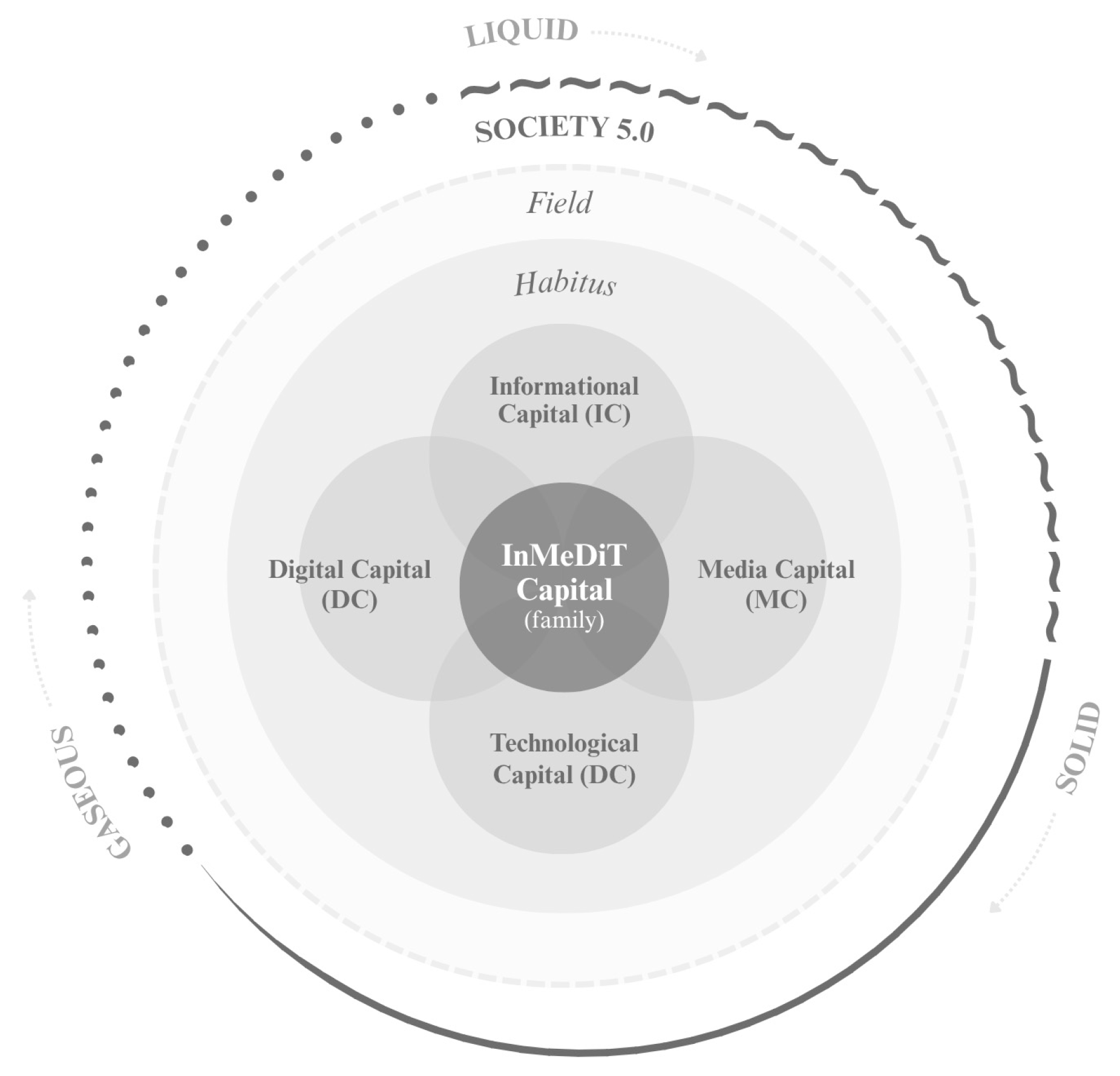
4.5. InMeDiT Capital
5. Hybridisation and Perspectives of InMeDiT Capital
5.1. InMeDiT: The Hybridisation of the Capitals That Constitute It
5.2. InMeDiT: Individual and Collective Perspectives
6. Dimensions and Indicators of InMeDiT Capital: Mobilisation from the Family
7. Conclusions
Author Contributions
Funding
Institutional Review Board Statement
Informed Consent Statement
Data Availability Statement
Acknowledgments
Conflicts of Interest
Abbreviations
| InMeDiT Capital | Informational, Media, Digital and Technological Capital |
| IC | Informational Capital |
| MC | Media Capital |
| DC | Digital Capital |
| TC | Technological Capital |
| CC | Cultural Capital |
| SC | Social Capital |
| ICT | Information and Communication Technologies |
| LKT | Learning and Knowledge Technologies |
| EPT | Empowerment and Participation Technologies |
| RICT | Relationship, Information, and Communication Technologies |
| SCOT | Social Construction of Technology |
References
- Bourdieu, P. What makes a social class? On the theoretical and practical existence of groups. Berkeley J. Sociol. 1987, 32, 1–17. [Google Scholar]
- Bourdieu, P. Other Words: Essays Towards a Reflexive Sociology; Stanford University Press: Stanford, CA, USA, 1990. [Google Scholar]
- Bourdieu, P. The Logic of Practice; Stanford University Press: Stanford, CA, USA, 1990. [Google Scholar]
- Couldry, N. Media meta-capital: Extending the range of Bourdieu’s field theory. In After Bourdieu; Swartz, D.L., Zolberg, V.L., Eds.; Springer: New York, NY, USA, 2004; pp. 31–52. [Google Scholar] [CrossRef]
- Husserl, E. Ideas: General Introduction to Pure Phenomenology; Boyce Gibson, W.R., Translator; Macmillan: New York, NY, USA, 1962. [Google Scholar]
- Ponce-Gómez, J.; Zych, I.; Rodríguez-Ruiz, J. Problematic Internet use by children and adolescents from the parental perspective before and after the lockdown due to COVID-19. Psychol. Soc. Educ. 2023, 15, 11–19. [Google Scholar] [CrossRef]
- Gobierno de España. Carta de Derechos Digitales; Ministerio de Asuntos Económicos y Transformación Digital: Madrid, Spain, 2021. Available online: https://bit.ly/3Nmss0M (accessed on 15 January 2026).
- Ermoshina, K.; Musiani, F. The Telegram ban: How censorship “made in Russia” faces a global Internet. First Monday 2021, 26, 1–22. [Google Scholar] [CrossRef]
- Australian Parliament. Online Safety Amendment (Social Media Minimum Age) Bill 2024; Australian Parliament: Canberra, Australia, 2024; Available online: https://acortar.link/d1PfmH (accessed on 22 September 2025).
- Mendivil-Caldentey, J.; Sanz-Urquijo, B.; Gutiérrez-Almazor, M. Competency-based cybersecurity training and awareness: A systematic literature review. Pixel-Bit 2022, 63, 197–225. [Google Scholar] [CrossRef]
- Han, B.C. Infocracy: Digitalization and the Crisis of Democracy; Taurus: Madrid, Spain, 2022. [Google Scholar]
- Bauman, Z. Modernidad Líquida; Fondo de Cultura Económica: México City, Mexico, 2003. [Google Scholar]
- Ritzer, G.; Dean, P. Globalization: A Basic Text, 2nd ed.; Wiley Blackwell: Oxford, UK, 2015. [Google Scholar]
- Ramonet, I. Guerras del Siglo XXI. Nuevos Miedos, Nuevas Amenazas; Mondadori: Barcelona, Spain, 2002. [Google Scholar]
- Beck, U. La Sociedad del Riesgo Global; Siglo XXI Editores: Madrid, Spain, 2002. [Google Scholar]
- Mishra, P. La Era de la Ira. Una Historia del Presente; Gutemberg: Barcelona, Spain, 2017. [Google Scholar]
- Hidalgo, D. Anestesiados: La Humanidad Bajo el Imperio de la Tecnología; Catarata: Madrid, Spain, 2021. [Google Scholar]
- Salemink, K.; Strijker, D.; Bosworth, G. Rural development in the digital age: A systematic literature review on unequal ICT availability, adoption, and use in rural areas. J. Rural Stud. 2017, 54, 360–371. [Google Scholar] [CrossRef]
- European Union. Strategic Compass; European Union: Brussels, Belgium, 2023; Available online: https://acortar.link/cJuIlD (accessed on 18 January 2026).
- Lesaca, J. Armas de Seducción Masiva: La Factoría Audiovisual con la que Estado Islámico ha Fascinado a la Generación Millennial; Ediciones Península: Barcelona, Spain, 2017. [Google Scholar]
- García-Vázquez, B. International law in the face of new media and spaces in which to wage war: Cyberwarfare. Rev. Chil. Derecho Tecnol. 2021, 10, 43–68. [Google Scholar] [CrossRef]
- Taylor, P.M. Munitions of the Mind: A History of Propaganda from the Ancient World to the Present Era, 3rd ed.; Manchester University Press: Manchester, UK, 2003. [Google Scholar]
- Council of the European Union. Una Brújula Estratégica para Reforzar la Seguridad y la Defensa de la UE en el Próximo Decenio; Council of the European Union: Brussels, Belgium, 2022; Available online: https://acortar.link/KWATt4 (accessed on 23 September 2025).
- von der Leyen, U. Europe’s Choice. Political Guidelines for the Next European Commission, 2024–2029; European Union: Brussels, Belgium, 2024; Available online: https://acortar.link/HSnhi6 (accessed on 23 September 2025).
- Feisel, F.M. El escudo Europeo de la Democracia y su Enfoque Integral que Abarca a Toda la Sociedad; Verfassungsblog on Matters Constitutional: Berlin, Germany, 2025. Available online: https://verfassungsblog.de/the-european-democracy-shield-whole-of-society/ (accessed on 15 December 2025).
- European Parliament; Council; European Commission. Declaración Europea Sobre los Derechos y Principios Digitales para la Década Digital; Diario Oficial de la Unión Europea: Brussels, Belgium, 2023; Available online: https://acortar.link/KOGvlb (accessed on 23 September 2025).
- Bourdieu, P. The forms of capital. In Handbook of Theory and Research for the Sociology of Education; Richardson, J., Ed.; Greenwood: New York, NY, USA, 1986; pp. 241–258. [Google Scholar]
- Del Moral, C.; Burriel, C. Derechos sin Connexion; Save the Children: Madrid, Spain, 2024. [Google Scholar]
- Meza, R.M.; Mogoș, A.A.; Prundaru, G. Idols of promotion and authenticity on TikTok. Media Commun. 2023, 11, 187–202. [Google Scholar] [CrossRef]
- NewsGuard. Misinformation Monitor: November 2022; NewsGuard Technologies: New York, NY, USA, 2022; Available online: https://acortar.link/AKEAtN (accessed on 18 September 2025).
- Hickey, D.; Schmitz, M.; Fessler, D.W.; Smaldino, P.E.; Muric, G.; Burghardt, K.A. Auditing Elon Musk’s impact on hate speech and bots. In Proceedings of the Seventeenth International AAAI Conference on Web and Social Media, Limassol, Cyprus, 5–8 June 2023; pp. 1–12. Available online: https://n9.cl/au5d6s (accessed on 5 September 2025).
- NATO. Defence Expenditure of NATO Countries 2024; NATO: Brussels, Belgium, 2024. Available online: http://bit.ly/46OBPwR (accessed on 5 September 2025).
- Presidency of the Government. Informe Anual de Seguridad Nacional 2023; Gobierno de España: Madrid, Spain, 2023. Available online: https://acortar.link/iOggTF (accessed on 7 September 2025).
- Romero, J.; Louzao, M.; Macías, D. Populism and critical social science teaching. Con-Cienc. Soc. 2024, 7, 51–86. [Google Scholar] [CrossRef]
- Bourdieu, P. Poder, Derecho y Clases Sociales; Editorial Desclée de Brouwer: Bilbao, Spain, 2001. [Google Scholar]
- Durkheim, E. La División del Trabajo Social; Akal: Madrid, Spain, 1982. [Google Scholar]
- Bourdieu, P.; Passeron, J.C. La Reproducción. Elementos para una Teoría del Sistema de Enseñanza; Fontamara: México City, México, 1996. [Google Scholar]
- Jæger, M.M.; Breen, R. A dynamic model of cultural reproduction. Am. Sociol. Rev. 2016, 81, 1079–1115. [Google Scholar] [CrossRef]
- Lareau, A.; Weininger, E.B. Cultural capital in educational research: A critical assessment. In After Bourdieu; Swartz, D.L., Zolberg, V.L., Eds.; Springer: Dordrecht, The Netherlands, 2004; pp. 105–144. [Google Scholar] [CrossRef]
- Constantine, L.L. On fundamental limits of variation in family systems: Logical extensions to the theory of family paradigms. Fam. Sci. Rev. 1988, 1, 283–298. [Google Scholar] [CrossRef]
- Constantine, L.L. Family types and the family dimensions: The paradigmatic framework and the circumplex model. J. Fam. Theory Rev. 2025, 17, 171–188. [Google Scholar] [CrossRef]
- Bell, D. Types, dimensions, and limitations. J. Fam. Theory Rev. 2025, 17, 201–206. [Google Scholar] [CrossRef]
- Olson, D.H. Circumplex model of marital and family systems. J. Fam. Ther. 2000, 22, 144–167. [Google Scholar] [CrossRef]
- Baumrind, D. Child Maltreatment and Optimal Caregiving in Social Context; Garland: New York, NY, USA, 1995. [Google Scholar]
- Reiss, D. The Family’s Construction of Reality; Harvard University Press: Cambridge, MA, USA, 1981. [Google Scholar]
- Reiss, D.; Oliveri, M.E. Family paradigm and family coping: A proposal for linking the family’s intrinsic adaptive capacities to its responses to stress. Fam. Relat. 1980, 29, 431–444. [Google Scholar] [CrossRef]
- CEOE. Plan Digital 2025. La Digitalización de la Sociedad Española; CEOE: Madrid, Spain, 2021; Available online: https://bit.ly/3vIfDSa (accessed on 6 September 2025).
- Polo, A. Information society, digital society, control society. Inguruak 2020, 68, 35–77. [Google Scholar] [CrossRef]
- Mayer-Schönberger, V.; Cukier, K. Big Data. La Revolución de los Datos Masivos; Turner: Madrid, Spain, 2013. [Google Scholar]
- Bauman, Z. Vida de Consumo; Polity Press: Cambridge, UK, 2007. [Google Scholar]
- Lévy, P. Ciberculturas. La Cultura de la Sociedad Digital; Anthropos: Barcelona, Spain, 2007. [Google Scholar]
- Camas, L.; Valero, A.; Vendrell, M. Redes sociales: ¿Un asalto al corazón de la democracia? In Condiciones del Pensamiento Crítico en el Contexto Educativo de Inicio del Siglo XXI; González, M.R., Zaldívar, J.I., Jover, G., Eds.; FahrenHouse: Madrid, Spain, 2021; pp. 93–103. [Google Scholar]
- Calderón-Gómez, D. The third digital divide and Bourdieu: Bidirectional conversion of economic, cultural and social capital to (and from) digital capital among young people in Madrid. New Media Soc. 2021, 23, 2534–2553. [Google Scholar] [CrossRef]
- Lluna, S.; Pedreira, J. Los Nativos Digitales No Existen. Cómo Educar a tus Hijos para un Mundo Digital; Deusto: Barcelona, Spain, 2017. [Google Scholar]
- Lázaro, M. Redes Sociales y Menores. Guía Práctica; Anaya: Madrid, Spain, 2020. [Google Scholar]
- González-Heras, A. The perspectives of social capital, part I. Cinta Moebio 2022, 74, 121–131. [Google Scholar] [CrossRef]
- Del-Rey, A.; Sánchez-Parga, J. Crítica de la educación por competencias. Universitas 2011, 15, 233–246. [Google Scholar] [CrossRef]
- Lareau, A.; Weininger, E.B. Cultural capital in educational research: A critical assessment. Theory Soc. 2003, 32, 567–606. [Google Scholar] [CrossRef]
- Shannon, C.E. A mathematical theory of communication. Bell Syst. Tech. J. 1948, 27, 379–423. [Google Scholar] [CrossRef]
- Currás, E. Information science—Information as a dialectic interactive system. Int. Forum Inf. Doc. 1995, 20, 31–42. [Google Scholar]
- Angulo, N. Información: Una propuesta conceptual. Cienc. Inf. 1996, 27, 190–195. [Google Scholar]
- González-Suárez, E. Conocimiento científico e información científica: Observaciones preliminares. Acimed 2006, 14, 1–10. [Google Scholar]
- Hoffmann, E. Defining information: An analysis of the information content of documents. Inf. Process. Manag. 1980, 16, 291–340. [Google Scholar] [CrossRef]
- Hamelink, C. The Ethics of Cyberspace; Sage: London, UK, 2001. [Google Scholar]
- Espina, P.; Gilbert, J. Informational capital as a condition of the digital inclusion: An exploratory analysis. Psicol. Conoc. Soc. 2017, 7, 35–63. [Google Scholar] [CrossRef]
- Van Dijk, J. The Deepening Divide: Inequality in the Information Society; Sage Publications: Thousand Oaks, CA, USA, 2005. [Google Scholar]
- Marí, V.M.; Sierra, F. Information capital and social applications of ICT: Criticism of local “empowerment” in Europe’s information society. Telos 2008, 74, 126–133. [Google Scholar]
- Ampuja, M.; Koivisto, J.; Väliverronen, E. Strong and weak forms of mediatization theory. Nord. Rev. 2014, 35, 111–123. [Google Scholar] [CrossRef]
- Ferrier, M.; Sinha, G.; Outrich, M. Media deserts: Monitoring the changing media ecosystem. In The Communication Crisis in America, and How to Fix It; Lloyd, M., Friedland, L.A., Eds.; Palgrave Macmillan: New York, NY, USA, 2016; pp. 215–232. [Google Scholar] [CrossRef]
- Jacobs, R.N. Virality, algorithms, and illiberal attacks on the press: Legitimation strategies for a new world. Sociologica 2020, 14, 217–233. [Google Scholar] [CrossRef]
- McLuhan, M. Understanding Media: The Extensions of Man; Gingko Press: Berkeley, CA, USA, 2013. [Google Scholar]
- Champagne, P. Faire L’opinion. Le Nouveau jeu Politique; Minuit: Paris, France, 1990. [Google Scholar]
- Fölsche, L. Capital mediático: Una aproximación a la mediatización desde la teoría de los campos sociales. deSignis 2022, 37, 57–74. [Google Scholar] [CrossRef]
- De Certeau, M. La Práctica de la Vida Cotidiana; University of California Press: Berkeley, CA, USA, 1984. [Google Scholar]
- Jiménez-Iglesias, E.; Elorriaga-Illera, A.; Monge-Benito, S.; Olabarri-Fernández, E. Children’s exposure on Instagram: Instamoms, brand presence and legal loophole. Rev. Mediterr. Comun. 2022, 13, 51–63. [Google Scholar] [CrossRef]
- Barr, R.; Linebarger, D.L. Media Exposure During Infancy and Early Childhood: The Effects of Content and Context on Learning and Development; Springer: Cham, Switzerland, 2017. [Google Scholar] [CrossRef]
- Barr, R. Growing up in the digital age: Early learning and family media ecology. Curr. Dir. Psychol. Sci. 2019, 28, 341–346. [Google Scholar] [CrossRef]
- Knuth, D.E. The Art of Computer Programming, Volume 1: Fundamental Algorithms; Addison-Wesley: Reading, MA, USA, 1968. [Google Scholar]
- Bush, V. As we may think. Interactions 1996, 3, 35–46. [Google Scholar] [CrossRef]
- Harvey, D. The Condition of Postmodernity: An Enquiry into the Origins of Cultural Change; Blackwell: Oxford, UK, 1989. [Google Scholar]
- Jenkins, H. Convergence Culture: Where Old and New Media Collide; New York University Press: New York, NY, USA, 2006. [Google Scholar]
- Toffler, A. The Third Wave; William Morrow: New York, NY, USA, 1980. [Google Scholar]
- Pitzalis, M.; Porcu, M. Digital capital and cultural capital in education: Unravelling intersections and distinctions that shape social differentiation. Br. Educ. Res. J. 2024, 50, 2753–2776. [Google Scholar] [CrossRef]
- Matamala, C. Capital digital en educación superior: Fortalezas y carencias digitales para enfrentar la educación a distancia. Int. J. Sociol. Educ. 2021, 10, 115–142. [Google Scholar] [CrossRef]
- Paino, M.; Renzulli, L. Digital dimension of cultural capital: The (in)visible advantages for students who exhibit computer skills. Sociol. Educ. 2012, 86, 124–138. [Google Scholar] [CrossRef]
- Ragnedda, M. Conceptualizing digital capital. Telemat. Inform. 2018, 35, 2366–2375. [Google Scholar] [CrossRef]
- Verwiebe, R.; Hagemann, S. Bourdieu revisited: New forms of digital capital—Emergence, reproduction, inequality of distribution. Inf. Commun. Soc. 2024, 28, 1861–1883. [Google Scholar] [CrossRef]
- Merisalo, M.; Makkonen, T. Bourdieusian e-capital perspective enhancing digital capital discussion in the realm of third-level digital divide. Inf. Technol. People 2022, 35, 231–252. [Google Scholar] [CrossRef]
- Leguina, A.; Downey, J. Getting things done: Inequalities, Internet use and everyday life. New Media Soc. 2021, 23, 1824–1849. [Google Scholar] [CrossRef]
- Bourdieu, P.; Wacquant, L. Una Invitación a la Sociología Reflexiva; Siglo XXI: Buenos Aires, Argentina, 2005. [Google Scholar]
- Ragnedda, M.; Addeo, F.; Ruiu, M.L. How offline backgrounds interact with digital capital. New Media Soc. 2022, 26, 2023–2045. [Google Scholar] [CrossRef]
- Addi-Raccah, A. The role of digital capital in parental engagement. Educ. Inf. Technol. 2024, 29, 16901–16928. [Google Scholar] [CrossRef]
- Bijker, W.E. Why and how technology matters? Redes 2005, 11, 19–53. [Google Scholar] [CrossRef]
- Bijker, W.E.; Law, J. Shaping Technology/Building Society. Studies in Sociotechnical Change; MIT Press: Cambridge, MA, USA, 1992. [Google Scholar]
- Collins, H.M. Changing Order: Replication and Induction in Scientific Practice; Sage: London, UK, 1985. [Google Scholar]
- Grotto, G.; Buja, A. Association between digital technology use and social capital among older adults: A systematic review. Digit. Health 2025, 11. [Google Scholar] [CrossRef]
- Spottswood, E.L.; Wohn, D.Y. Online social capital: Recent trends in research. Curr. Opin. Psychol. 2020, 36, 147–152. [Google Scholar] [CrossRef] [PubMed]
- Bijker, W.E. Social construction of technology. Int. Encycl. Soc. Behav. Sci. 2001, 15522–15527. [Google Scholar] [CrossRef]
- Hecht, G. The Radiance of France: Nuclear Power and National Identity After World War II; MIT Press: Cambridge, MA, USA, 1998. [Google Scholar]
- Beckman, K.; Apps, T.; Bennett, S.; Lockyer, L. Conceptualising technology practice in education using Bourdieu’s sociology. Learn. Media Technol. 2018, 43, 197–210. [Google Scholar] [CrossRef]
- Ignatow, G.; Robinson, L. Pierre Bourdieu: Theorizing the digital. Inf. Commun. Soc. 2017, 20, 950–966. [Google Scholar] [CrossRef]
- Lybeck, R.; Koiranen, I.; Koivula, A. From digital divide to digital capital: The role of education and digital skills in social media participation. Univers. Access Inf. Soc. 2024, 23, 1657–1669. [Google Scholar] [CrossRef]
- Arbuet-Osuna, C. Capitalismo y globalización: El capital en la era del capital tecnológico. Desafíos 2014, 26, 97–124. [Google Scholar] [CrossRef][Green Version]
- Pizzi, A.; Pecourt, J.; Rius-Ulldemolins, J. From “digital divide” to Internet control: Uses, attitudes and digital participation in Spain. Rev. Esp. Sociol. 2023, 32, a178. [Google Scholar] [CrossRef]
- Carlson, A.; Isaacs, A.M. Technological capital: An alternative to the digital divide. J. Appl. Commun. Res. 2018, 46, 243–265. [Google Scholar] [CrossRef]
- Casillas, M.; Ramírez, A. Saberes Digitales en la Educación. Una Investigación Sobre el Capital Tecnológico Incorporado de los Agentes de la Educación; Editorial Brujas: Córdoba, Argentina, 2021. [Google Scholar]
- Ben Zammel, I.; Najar, T. Nexus between technological capital, organizational structure and knowledge sharing in organizational restructuring initiatives. VINE J. Inf. Knowl. Manag. Syst. 2024, 54, 896–915. [Google Scholar] [CrossRef]
- Romele, A. Digital Hermeneutics: Philosophical Investigations in New Media and Technologies; Routledge: London, UK, 2020. [Google Scholar]
- Hertlein, K.M. Digital dwelling: Technology in couple and family relationships. Fam. Relat. 2012, 61, 374–387. [Google Scholar] [CrossRef]
- Hertlein, K.M.; Stevenson, A. The seven “As” contributing to Internet-related intimacy problems: A literature review. Cyberpsychology 2010, 4, 3. [Google Scholar]
- Tadpatrikar, A.; Sharma, M.K.; Viswanath, S.S. Influence of technology usage on family communication patterns and functioning: A systematic review. Asian J. Psychiatry 2021, 58, 102595. [Google Scholar] [CrossRef]
- Ragnedda, M.; Ruiu, M.L. Digital Capital. A Bourdieusian Perspective on the Digital Divide; Emerald Publishing: Bingle, UK, 2020. [Google Scholar]
- Banda-Castro, A.L.; Flores-Varela, R.; Morales-Zamorano, M.A. The social capital of human beings, family and communities as a joint product for human development. Aletheia 2016, 8, 32–43. [Google Scholar] [CrossRef]
- Livingstone, S.; Ólafsson, K.; Helsper, E.J.; Lupiáñez-Villanueva, F.; Vetri, G.A.; Folkvord, F. Maximizing opportunities and minimizing risks for children online: The role of digital skills in emerging strategies of parental mediation. J. Commun. 2017, 67, 82–105. [Google Scholar] [CrossRef]
- Erstad, O. Learning lives across educational boundaries: Continuity and discontinuity in learning trajectories. Int. J. Res. Ext. Educ. 2015, 3, 9–22. [Google Scholar] [CrossRef][Green Version]
- European Commission. DigComp 2.2: The Digital Competence Framework for Citizens. With New Examples of Knowledge, Skills and Attitudes; Publications Office of the European Union: Luxembourg, 2022; Available online: https://bit.ly/3vCIGGy (accessed on 23 September 2025).
- UNESCO. The Futures We Build: Abilities and Competencies for the Future of Education and Work; UNESCO: Paris, France, 2023; Available online: https://lc.cx/cpIId2 (accessed on 23 September 2025).
- Guzmán-Martínez, G.; Pujal, M.; Mora, E.; García, D. Feminist precursors of mutual support groups in the mad movement: A historical-critical analysis. Salud Colect. 2021, 17, e3274. [Google Scholar] [CrossRef]
- Granovetter, M. The strength of weak ties. Am. J. Sociol. 1973, 78, 1360–1380. [Google Scholar] [CrossRef]
- Lin, N. Social resources theory. In Encyclopedia of Sociology; Borgatta, E.F., Montgomery, R.J.V., Eds.; Macmillan: New York, NY, USA, 2000; pp. 2790–2795. [Google Scholar]
- Van Der Gaag, M.; Snijders, T. Proposals for the measurement of individual social capital. In Creation and Returns of Social Capital: A New Research Program; Flap, H., Völker, B., Eds.; Routledge: London, UK, 2004; pp. 154–169. [Google Scholar]
- Lin, N. Social Capital: A Theory of Structure and Action; Cambridge University Press: Cambridge, UK, 2001. [Google Scholar] [CrossRef]
- McLuhan, M.; Nevitt, B. Take Today: The Executive as Dropout; Harcourt Brace Jovanovich: New York, NY, USA, 1972. [Google Scholar]
- Ford, A. La Marca de la Bestia. Identificación, Desigualdades e Infoentretenimiento en la Sociedad Contemporánea; Grupo Editorial Norma: Bogotá, Colombia, 2002. [Google Scholar]
- We Are Social; Hootsuite. Digital 2025: Global Overview Report; We Are Social: London, UK, 2025; Available online: https://wearesocial.com (accessed on 6 September 2025).
- García-Sáiz, M. Una revisión constructiva de la gestión por competencias. An. Psicol. 2011, 27, 473–497. [Google Scholar]
- Ferrés, J.; Piscitelli, A. Media competence: Articulated proposal of dimensions and indicators. Comunicar 2012, 38, 75–82. [Google Scholar] [CrossRef]
- Cosgrove, J.; Cachia, R. DigComp 3.0—European Digital Competence Framework, 5th ed.; Publications Office of the European Union: Luxembourg, 2025; Available online: https://data.europa.eu/doi/10.2760/0001149 (accessed on 16 September 2025).
- Domínguez-Aroca, M.I.; Toro-Flores, R.; Gómez-González, J.L. Evaluación de las competencias informacionales al inicio y al final del Grado en Ciencias y Ciencias de la Salud de la Universidad de Alcalá. An. Doc. 2023, 26, 1–15. [Google Scholar] [CrossRef]
- García-Ruiz, R.; Gozálvez-Pérez, V.; Aguaded, I. Media competence as a challenge for educommunication: Evaluation tools. Cuad. Inf. 2014, 35, 15–27. [Google Scholar] [CrossRef][Green Version]
- Bastarrachea, P.C.; Domínguez, L.G.; Vega, J.I.; Ortega, A. Design and validation of an instrument to measure digital competence in elementary school students. Publicaciones 2023, 53, 225–245. [Google Scholar] [CrossRef]
- Henríquez, P.M.; Gisbert, M.; Fernández, I.M. La evaluación de la competencia digital de los estudiantes: Una revisión al caso latinoamericano. Chasqui 2018, 137, 93–112. [Google Scholar]
- Notten, N.; Peter, J.; Kraaykamp, G.; Valkenburg, P.M. Digital divide across borders: A cross-national study of adolescents’ use of digital technologies. Eur. Sociol. Rev. 2009, 25, 551–560. [Google Scholar] [CrossRef]
- Hatlevik, O.E.; Björk-Guomundsdóttir, G.; Loi, M. Examining factors predicting students’ digital competence. J. Inf. Technol. Educ. Res. 2015, 14, 123–137. [Google Scholar] [CrossRef] [PubMed]
- Helsper, E.J.; van Deursen, A.J.A. Do the rich get digitally richer? Quantity and quality of support for digital engagement. Inf. Commun. Soc. 2017, 20, 700–714. [Google Scholar] [CrossRef]
- Putnam, R. Bowling Alone: The Collapse and Revival of American Community; Simon & Schuster: New York, NY, USA, 2000. [Google Scholar]
- Kurczyn, P. Cohesión social. Derecho Soc. 2008, 30, 69–73. [Google Scholar]
- Wong, B.Y.M.; Ho, S.Y.; Sit, S.M.M.; Gong, W.J.; Kwan-Lai, A.Y.; Wang, M.P.; Hing-Lam, T. Association of family wellbeing with forwarding and verifying COVID-19-related information, and mediation of family communication quality. Front. Public Health 2022, 10, 948955. [Google Scholar] [CrossRef]
- Lissitsa, S. Generations X, Y, Z: The effects of personal and positional inequalities on critical thinking digital skills. Online Inf. Rev. 2025, 49, 35–54. [Google Scholar] [CrossRef]
- Jeffery, C.P. Parenting in a Digital World: Beyond Media Panics Towards a New Theory of Parental Mediation; Routledge: London, UK, 2025. [Google Scholar]
- Humphry, J.; Hutchinson, J.; Boichak, O. Social digital dilemmas: Young people’s and parents’ negotiation of emerging online safety issues. New Media Soc. 2025, 28, 1274–1294. [Google Scholar] [CrossRef]
- Bernet, W. Parental alienation and misinformation proliferation. Fam. Court Rev. 2020, 58, 293–307. [Google Scholar] [CrossRef]
- Pariser, E. What the Internet Is Hiding from You? Penguin Books: London, UK, 2011. [Google Scholar]
- Luhmann, N. Vertrauen: Ein Mechanismus der Reduktion Sozialer Komplexität; UTB: Stuttgart, Germany, 1968. [Google Scholar]
- Simmel, G. Sociología. 1. Estudios Sobre las Formas de Socialización; Alianza Editorial: Madrid, Spain, 1987. [Google Scholar]
- Garusi, D.; Splendore, S. Advancing a qualitative turn in news media trust research. Sociol. Compass 2023, 17, e13075. [Google Scholar] [CrossRef]
- Edelman. Edelman Trust Barometer. Global Report; Edelman: New York, NY, USA, 2023. [Google Scholar]
- Moran, R.E.; Nechushtai, E. Before reception: Trust in the news as infrastructure. Journalism 2022, 24, 457–474. [Google Scholar] [CrossRef]
- Fletcher, R.; Park, S. The impact of trust in the news media on online news consumption and participation. Digit. J. 2017, 5, 1281–1299. [Google Scholar] [CrossRef]
- Serrano-Puche, J.; Rodríguez-Salcedo, N.; Martínez-Costa, M.P. Trust, disinformation, and digital media: Perceptions and expectations about news in a polarized environment. Prof. Inf. 2023, 32, e320518. [Google Scholar] [CrossRef]
- Williams, J. The use of online social networking sites to nurture and cultivate bonding social capital: A systematic review (1997–2018). New Media Soc. 2019, 21, 2710–2729. [Google Scholar] [CrossRef]
- Leoncio, S.; Mesquita, Z.; Silva-Rabelo, R. The use of WhatsApp as a communication source in schools and family interaction in child education during COVID-19. Rev. Ibero-Am. Estud. Educ. 2023, 18, e023055. [Google Scholar] [CrossRef]
- Boyd, D. It’s Complicated: The Social Lives of Networked Teens; Yale University Press: New Haven, CT, USA, 2014. [Google Scholar]
- Ramírez-Muñoz, M.; Rabadán-Perez, F.; Berumen, S. Dimensiones del Capital Social: Análisis de Componentes Principales Sobre la Encuesta Mundial de Valores WVS. Serie Documentos de Trabajo; IAES, Instituto Universitario de Análisis Económico y Social: Alcalá de Henares, Spain, 2023. [Google Scholar] [CrossRef]
- Catts, R.; Lau, J. Towards Information Literacy Indicators; UNESCO: Paris, France, 2008; Available online: https://bit.ly/42nViCB (accessed on 2 September 2025).
- Scolari, C.A.; Masanet, M.J.; Guerrero-Pico, M.; Establés, M.J. Transmedia literacy in the new media ecology: Teens’ transmedia skills and informal learning strategies. Prof. Inf. 2018, 27, 801–812. [Google Scholar] [CrossRef]
- Franck, G. Vanity Fairs: Another View of the Economy of Attention; Springer: Cham, Switzerland, 2020. [Google Scholar] [CrossRef]
- Li, J.; Jiang, Y.; Xiao, B.; Wang, J.; Zhang, Q.; Zhang, W.; Li, Y. Validation of a revised Parental Phubbing Scale for parents of young children in China. Early Child Dev. Care 2024, 194, 167–182. [Google Scholar] [CrossRef]
- Orchard, L.J.; Fullwood, C.; Galbraith, N.; Morris, N. Individual differences as predictors of social networking. J. Comput. Mediat. Commun. 2014, 19, 388–402. [Google Scholar] [CrossRef]
- Altheide, D.L. Media logic. In The International Encyclopedia of Political Communication; Mazzoleni, G., Ed.; Wiley: Hoboken, NJ, USA, 2015; pp. 1–6. [Google Scholar] [CrossRef]
- Gómez-Vallarta, A.C.; Rivera-Magos, S.; García-Rojas, A.D.; Hernando-Gómez, Á. Inteligencia emocional digital: Construcción y validación de un instrumento para su medición. Alteridad 2025, 20, 234–245. [Google Scholar] [CrossRef]
- Witowska, J.; Ogden, R.; Schoetensack, C.; Goncikowska, K.; Wittmann, M.; Černohorská, V.; Codina, N.; Martin-Soelch, C.; Fernández-Boente, M.; Giner, G.; et al. New measurements of digital technology use: The Immersion in Digital Life and Quality of Digital Experience scales. Front. Psychiatry 2025, 16, 1595536. [Google Scholar] [CrossRef] [PubMed]
- Creswell, J.W. Qualitative Inquiry and Research Design: Choosing Among Five Approaches; SAGE Publications: Thousand Oaks, CA, USA, 2013. [Google Scholar]

| Criteria | Informational & Media Capital | Informational & Digital Capital | Informational & Technological Capital | Media & Digital Capital | Media & Technological Capital | Digital & Technological Capital |
|---|---|---|---|---|---|---|
| Main aspects Support Impact | Communication ecosystem is in constant transformation. | Accurate and reliable data storage, processing, and transmission. | Multichannel data flow. | Interactivity allows audiences to become powerful actors who create content and influence the narratives. | Permanent temporary connection to the media through technology. | Overcoming physical and geographical barriers to access. |
| Competencies (knowledge, skills, and attitudes) Main aspects | Access to information through different media languages | Availability and use of data individually as raw materials of the 21st century | Availability of financial resources to obtain a device and connection | Social media profile ownership | Device ownership and media access | Availability of differential resources |
| Support Impact | The emergence of prosumers | Transformation of the interaction between people and information | Fragmentation of the information system: individual broadcasters and mass media | Reconfiguration of power structures and social relationships | The theory of social understanding of technology emerges andInternet cultures emerge | Changes in the perception of space, time, and understanding of the world |
| Competencies (knowledge, skills, and attitudes) | Ability to evaluate, filter, and apply information | Ability to manage connections | Ability to use technology to access information, and vice versa | Ability to mobilize digital and media literacy | Ability to construct meaning through diverse media practices is mediated by technology | Ability to use technology through digital devices |
Disclaimer/Publisher’s Note: The statements, opinions and data contained in all publications are solely those of the individual author(s) and contributor(s) and not of MDPI and/or the editor(s). MDPI and/or the editor(s) disclaim responsibility for any injury to people or property resulting from any ideas, methods, instructions or products referred to in the content. |
© 2026 by the authors. Licensee MDPI, Basel, Switzerland. This article is an open access article distributed under the terms and conditions of the Creative Commons Attribution (CC BY) license.
Share and Cite
Ramírez-García, A.; Macías-Fernández, D.; Salcines-Talledo, I.; Vizcaíno-Verdú, A.; Gutiérrez-Arenas, M.P. Mapping InMeDiT Capital: A Conceptual Framework for Post-Digital Families in a Gaseous Society. Societies 2026, 16, 164. https://doi.org/10.3390/soc16050164
Ramírez-García A, Macías-Fernández D, Salcines-Talledo I, Vizcaíno-Verdú A, Gutiérrez-Arenas MP. Mapping InMeDiT Capital: A Conceptual Framework for Post-Digital Families in a Gaseous Society. Societies. 2026; 16(5):164. https://doi.org/10.3390/soc16050164
Chicago/Turabian StyleRamírez-García, Antonia, Daniel Macías-Fernández, Irina Salcines-Talledo, Arantxa Vizcaíno-Verdú, and M. Pilar Gutiérrez-Arenas. 2026. "Mapping InMeDiT Capital: A Conceptual Framework for Post-Digital Families in a Gaseous Society" Societies 16, no. 5: 164. https://doi.org/10.3390/soc16050164
APA StyleRamírez-García, A., Macías-Fernández, D., Salcines-Talledo, I., Vizcaíno-Verdú, A., & Gutiérrez-Arenas, M. P. (2026). Mapping InMeDiT Capital: A Conceptual Framework for Post-Digital Families in a Gaseous Society. Societies, 16(5), 164. https://doi.org/10.3390/soc16050164

