Article

Meta-Identity and Algorithmic Mediation on Digital Platforms: A Comparative Analysis of AI–Human Content Categorization


by
Allan Herison Ferreira
1,2,*,
Ana Carolina Trevisan
3,
Carla Maria Baptista
1,
Rubén Ramos-Antón
4,
Álvaro Augusto Comin
2,
Henrique F. Carvalho
5,
Silvestre Vendrell
6 and
Valéria Oliveira Sá
7
1
NOVA Institute of Communication (ICNOVA), NOVA School of Social Sciences and Humanities (NOVA FCSH), NOVA University Lisbon, Av. de Berna, 26 C, 1069-061 Lisbon, Portugal
2
Sociology Department, University of São Paulo (USP), Av. Prof. Luciano Gualberto, 315, Cidade Universitária, São Paulo 05508-010, Brazil
3
NOVA Institute of Philosophy (IFILNOVA), NOVA University Lisbon, Av. de Berna, 26 C, 1069-061 Lisbon, Portugal
4
Faculty of Communication, University of Castilla-La Mancha (UCLM), Calle de Sta. Teresa Jornet, 16002 Cuenca, Spain
5
DXSpark—Data Science and Analytics, R. Sousa Martins 10, 1050-218 Lisbon, Portugal
6
Independent Researcher, Av. de Berna, 26C, 1069-061 Lisbon, Portugal
7
Independent Researcher, Av. Prof. Luciano Gualberto, 315, Cidade Universitária, São Paulo 05508-010, Brazil
*
Author to whom correspondence should be addressed.
Societies 2026, 16(4), 132; https://doi.org/10.3390/soc16040132
Submission received: 8 February 2026 / Revised: 8 March 2026 / Accepted: 14 April 2026 / Published: 20 April 2026
(This article belongs to the Special Issue Algorithm Awareness: Opportunities, Challenges and Impacts on Society)

Abstract

This article examines how algorithmic classification systems participate in the production of meta-identities, understood as operational classificatory constructs that mediate the visibility, circulation, and interpretation of digital content and its authors. The study employs a mixed-methods design combining controlled analytical simulation with qualitative interpretive analysis, systematic thematic coding, and comparative statistical procedures. Empirical data are derived from the analysis of 150 audiovisual works produced in formative workshops and interpreted by four types of agents: authors, peers, specialized human analysts, and two Large Language Model-based AI systems (ChatGPT and Gemini). Interpretations were analyzed across micro, meso, and macro levels, using a consolidated system of thematic categories with hierarchical weighting and normalization procedures to ensure inter-agent comparability. The results demonstrate a systematic and structural divergence between human and algorithmic classifications. While human agents preserve semantic plurality and contextual anchoring, AI systems tend to reorganize thematic hierarchies through semantic aggregation and stabilization, thereby privileging broad, reusable categories. This process produces recurring, opaque classificatory patterns that serve as infrastructural references for subsequent algorithmic decisions. The article contributes methodologically by offering a replicable framework for comparing human and algorithmic regimes of meaning production in digital environments.

1. Introduction: Research Problem and Contextualization

The expansion of digital platforms has structurally transformed the mediation of social life—encompassing economic, labor, and cultural spheres [1]. In this context, classificatory decisions driven by artificial intelligence (AI) and machine learning (ML) are central to organizing content visibility and thematic association. Unlike previous regimes, where meaning was defined by identifiable human interactions (authors, audiences, editors, or institutions), digital platforms operate through algorithmic layers that, while serving management interests, often remain shielded from social scrutiny [2]. This “myth of algorithmic complexity” may exempt essentially human parameterization processes from adequate auditing, challenging social scientists to engage deeply with the technical dimensions that impact social life.
The literature on platforms and algorithmic governance has shown that these systems do not operate merely as technical tools for indexing or recommendation, but as active devices of symbolic ordering, capable of producing operative models that guide subsequent automated decisions [1,3,4,5,6,7,8,9,10]. However, an empirical gap persists regarding how algorithmic classifications relate to concrete human interpretations—especially those of the authors. This study addresses this gap: to what extent do algorithmic classifications diverge from human interpretations, and how does this divergence consolidate into a model that shapes the symbolic circulation of authors’ meta-identities and their creative works?
This study employs the concept of meta-identity as an analytical construct to address the systematic dissonance between (i) authors’ self-descriptions of their works, (ii) interpretations by human peers and analysts, and (iii) algorithmic classifications. In this context, “authors” refers to creators of audiovisual content (specifically, filmmakers and workshop participants); “peers” refers to other creators from the same formative context who analyzed works they did not produce; and “works” refers to the short films produced and published on digital platforms. Meta-identity is understood as an inferred classificatory construct that operates as a decisional reference in algorithmic systems of recommendation, visibility, and association, potentially diverging from authorial intent and operating without requiring subject acknowledgment. AI and algorithmic systems can be more than indexing tools; they are active classificatory devices that produce additional layers of identity for both content and authors. These layers serve as references for subsequent automated decisions, influencing recommendations, groupings, and circulation trajectories, with significant social and material consequences [2].

1.1. Transparency and Analytical Framework

It is necessary to clarify the analytical status of transparency in this study. In AI debates, transparency is typically divided into interpretability—the direct apprehension of a model’s internal logic—and explainability—post hoc accounts that rationalize outputs [11,12]. This study, however, does not pursue these as technical objectives, nor does it presume access to proprietary architectures. Instead, transparency is addressed as a sociotechnical condition of classification: the degree to which outcomes are intelligible, traceable, and contestable for affected actors.
Rather than dissecting internal mechanics, the analysis prioritizes how stabilized classifications function as infrastructural references that reorganize meaning and visibility. Consequently, formal Explainable AI (XAI) techniques such as LIME or SHAP [13]—which isolate feature relevance through input perturbation—are set aside in favor of examining the comparative effects of stabilized outputs across human and algorithmic regimes. Within this framework, interpretive divergence is approached not as an anomaly but as a recurring empirical phenomenon worthy of description and understanding.
Building on existing research regarding the cultural, social, and technical dimensions of algorithmic classification [14,15,16], the article introduces a complementary analytical layer. It investigates how classificatory structures emerge and operate as infrastructural references across digital platforms, constituting an additional mediation layer in contemporary algorithmic environments that generates what we conceptualize as meta-identity and its dynamics.
Given the structural impossibility of directly auditing YouTube’s proprietary and opaque internal categorization, this study adopts a controlled analytical simulation conducted by an international consortium (Brazil, Portugal, and Spain). To navigate these limitations, we utilize two widely disseminated AI systems as proxies: Gemini 2.5 Flash, selected for its progressive integration into the YouTube ecosystem and shared architectural models [17,18,19,20], and ChatGPT Plus (GPT-5.0), representing the most prominent general-purpose platform during the research period [21,22,23]. This strategy enables benchmark testing of classification patterns under controlled conditions, serving as a methodological alternative to direct access to platform architectures.

1.2. Research Hypotheses

Based on this framework, the study examines nine hypotheses regarding the divergence, stabilization, and governance effects of algorithmic classification:
H1 (Interpretive Divergence).
Algorithmic classifications systematically diverge from human interpretations (authors’ and peers’ interpretations), reflecting distinct classificatory logics and reading regimes.
H2 (Thematic Concentration).
To ensure operational predictability, algorithmic systems privilege broad, generic categories with high semantic aggregation over specific, situated classifications.
H3 (Impact on Sensitive Themes).
Socially sensitive or normatively complex themes experience greater divergence, as their interpretation relies heavily on contextual and historical framing.
H4 (Temporal Consolidation).
Certain algorithmic categories demonstrate consistency across different algorithmic systems and recur as central markers across diverse content, suggesting a capacity for stabilization as dominant references consistent with the concept of meta-identity.
H5 (Structural Influence).
Algorithmic classification acts as a structural mechanism influencing visibility and symbolic circulation, even without direct platform-specific measurement.
H6 (Opacity).
The opacity of algorithmic categorization criteria imposes epistemic limits on authors, hindering their capacity to interpret or cognitively map the classifications attributed to their works.
H7 (Power Asymmetry).
The absence of formal, institutionalized mechanisms for contestation at the structural level reinforces the structural power asymmetry between platforms and content producers.
H8 (Infrastructural Governance).
Technical parameterization operates as an indirect governance mechanism, modulating visibility and audience expectations in a distributed, cumulative manner.
H9 (Systemic Variation).
The coexistence of multiple AI systems with distinct training regimes may reduce interpretive homogenization, introducing degrees of classificatory plurality within algorithmic regimes.
The selection is strategically grounded: ChatGPT represents widely disseminated automated classification patterns, while Gemini enables examination of logics aligned with YouTube’s institutional environment. The goal is not to reproduce YouTube’s internal code, but rather to analyze plausible classification patterns under controlled conditions.
Rather than a technical audit, this study investigates the sociological effects of algorithmic classification, centering on divergence, recurrence, and opacity. Within this framework, meta-identity emerges as a mediating concept to describe how inferred classificatory models function as pragmatic identities for authors and content in the digital ecosystem.

2. Meta-Identity, Classification, and Algorithmic Mediation

This section develops the theoretical framework underlying the concept of meta-identity and its relationship to algorithmic classification systems. Whereas the Introduction presented meta-identity as an analytical construct to address the systematic dissonance between human and algorithmic interpretations, this section examines its theoretical foundations and operational characteristics in greater depth.

2.1. Limits of Classical Approaches

Sociological and communication theories of identity offer fundamental tools for understanding processes of attribution, recognition, and performativity. In Goffman [24], identity results from situated performances and the management of impressions may have a real or virtual character; in Hall [25,26], it is constituted as an unstable discursive positioning influenced by a hierarchy of values that are impacted by circulation and power relations; in Dubar [27,28], it emerges from the tension between biographical trajectories and institutional attributions, which may articulate, respectively, identities for oneself and for others, with impacts on the identity strategies of individuals and groups; in Jung and Hecht [29], identity is understood as a communicative process negotiated across personal, enacted, relational, and communal layers; and in Castells [30], it is articulated with power relations in communication networks impacted by new technologies. In general, these approaches focus on a regime of reading in which identity is constructed and operates across personal, social, and institutional human and material relations, independent of digital platforms, though potentially shaped by them [29,30].
However, the environment of digital platforms introduces a new regime of reading that does not entirely fit within these matrices: an automated, statistical, and cumulative regime, in which categories are assigned through large-scale pattern correlation. In this regime, identity is not only interpreted intersubjectively or negotiated; it is parameterized in blocks by the decision-makers of these platforms, with social impacts of potentially massive symbolic and material character. This parameterization, which platform managers define to meet commercial, economic, or political objectives, may be misinterpreted as purely statistical or even random, attributed solely to the algorithmic dynamics of these platforms.
The problem we discuss here considers that parameterization does not necessarily eliminate human interpretive regimes—authors continue to interpret their own creative works; peers, researchers, and critics continue to attribute meanings to and contextualize content. At the same time, algorithms and parameterization may overlap them, operating as an infrastructural layer that conditions which interpretations gain scale, recurrence, and predominance. Classical models remain fundamental for understanding the respective phenomena they aim to analyze. However, they may be insufficient to describe the phenomenon observed in the material–digital relationship in which new forms of categorization—or of producing, reinforcing, and inhibiting identities—emerge, insofar as they do not encompass the mediation exercised by automated classificatory systems in the production of meta-identities.
It is necessary to distinguish meta-identity also from classical notions of authorship and identity. While authorship refers to the recognized creative agency over a work, and identity theories (Goffman, Hall, Dubar) focus on processes of intersubjective recognition and negotiation among social actors, these approaches do not conceptualize cultural products themselves as entities endowed with autonomous classificatory identities. Even sociological perspectives that emphasize the relational agency of objects within sociotechnical networks, such as Actor–Network Theory [31] do not specifically account for the emergence of stabilized classificatory identities generated through opaque, large-scale algorithmic infrastructures that operate independently of network negotiation. Meta-identity, by contrast, operates as an inferred classificatory construct attributed to both subjects and their cultural outputs, and may diverge from authorial intent. It emerges from automated aggregation processes that do not require subject acknowledgment. This distinction is central to understanding how algorithmic classification produces durable identity effects independently of human recognition or contestation.

2.2. Algorithmic Classification as the Production of Operational Identity

In digital ecosystems, algorithmic classification functions as an active process of producing operational identity. Each assigned category serves as a technical marker, linking objects to recommendation networks, presumed audiences, and semantically proximate clusters. Unlike human interpretation, which preserves ambiguity and context, algorithmic logic relies on pattern simplification, often resulting in semantic reduction or hyper-generalization to comply with platform rules. This logic produces a cumulative effect: initial classifications inform future ones, consolidating stable thematic profiles [2]. For instance, a film on racism or political movements may be “softened” by platform categories, rendering the topic’s specificity invisible and forcing future searches to adapt to this diluted model. Conversely, themes may be hyper-specialized, leading to overly narrow classifications that disregard authors’, peers’, and audiences’ interpretations.
Consequently, meta-identity emerges not as a static attribute, but as the cumulative result of this classificatory stabilization. By transforming probabilistic outputs into durable operational references, these processes can effectively bypass authorial intent and human negotiation. The resulting construct functions as a pragmatic identity within the ecosystem, shaping circulation and association patterns often beyond the reach of sociotechnical scrutiny or effective contestation by the subjects involved.

2.3. Meta-Identity: Operative Definition

Building on the operational definition presented in the Introduction, this section elaborates on the main theoretical characteristics that distinguish meta-identity from classical identity constructs. This definition emphasizes four central characteristics: (i) inference, whereby meta-identity is not necessarily declared but deduced from patterns and analytical parameters based on large volumes of data collected from individuals and groups, which can be systematically cross-referenced and tested; (ii) aggregation, meaning it results from the combination of multiple sources, including users’ interactions, biometric data, behavior, and commercial transactions, as well as internal platform decisions (such as manager or data scientist parameterizations) and external institutional entities (such as legal norms, census data, and specialist research); (iii) opacity, given that its criteria and mechanisms of classification are not fully accessible to subjects, nor fully subject to contestation or comprehensive audit, thereby creating structural conditions that limit understanding and intervention; and (iv) operationality, as it produces concrete effects on circulation, access, and recognition that are not restricted to the digital environment, interfering with interpretations, behaviors, actions, and symbolic and material transactions across diverse dimensions of social life.
These four characteristics emerge from the interaction of eight constitutive dynamics (executive, interactional, analytical, normative, somatic, performative, transactional, and algorithmic) and manifest across four temporal states (operational, archival, referential, and documental). While a detailed taxonomy is provided in Table A1 (Appendix A), their theoretical relevance lies in their role in stabilizing classifications into infrastructural references. This stabilization process transforms probabilistic outputs into durable sociotechnical constructs that guide visibility and association (see Table A1 in Appendix A, detailing the dynamics and states of meta-identity).
Unlike notions such as “user profile” or “segmentation,” meta-identity also includes the classification of cultural outputs, thereby linking personal identity to the identity of works. This expansion is fundamental to understanding how platforms modulate not only who subjects “are” but also what their content comes to mean within and beyond the digital ecosystem [2].

2.4. From Theory to Method: Operationalizing Meta-Identity

Meta-identity formation is not driven by a single variable; rather, it emerges from the convergence of multiple constitutive dynamics that function as input vectors for classification. In the context of audiovisual platforms, Executive dynamics establish strategic priorities of the digital platform decision makers regarding visibility, monetization, and risk, shaping the classificatory agenda before algorithmic processing begins. Normative dynamics impose legal and policy constraints, conditioning how sensitive themes—such as violence, politics, or sexuality—are framed (e.g., as educational, controversial, or restricted). Interactional and Performative dynamics provide behavioral signals—comments, shares, retention rates, and engagement patterns—that retroactively inform how content is read and categorized. Finally, Transactional, Somatic, and Analytical dynamics contribute economic, biometric, and taxonomic data that further refine the classificatory schema.
While this study does not directly measure the full spectrum of meta-identity dynamics nor access proprietary platform parameters, the controlled simulation design provides an analytical approximation of how classificatory processes operate in practice. By comparing how different AI systems behave when categorizing the same set of films, the analysis reveals patterned tendencies in the stabilization and prioritization of categories. These patterns offer indirect indications of how certain dynamics—particularly analytical dynamics and those associated with visibility and audience response, such as interactional and performative dynamics—may be conditioned by the classificatory logics embedded in AI-supported platform infrastructures. Rather than treating these outputs as direct measurements of the dynamics themselves, the study interprets them as empirical signals of how heterogeneous inputs are weighted and integrated within algorithmic regimes. In this sense, algorithmic categorization of films becomes a heuristic lens for understanding how platform classification systems may influence the circulation, visibility, and interpretive positioning of audiovisual works, with downstream consequences for authors and the identities associated with their productions.

3. Methodological Design and Analytical Procedures

3.1. Research Design, Corpus, and Simulation Strategy

This study employs a mixed-methods research design, integrating qualitative interpretive analysis with category systematization and inter-agent comparison. Qualitative and quantitative dimensions are treated as analytically complementary, capturing both meaning-making processes and algorithmic operations [32,33,34]. The strategy is based on the premise that algorithmic classifications must be analyzed relationally, comparing multiple evaluating agents—authors, peers, human analysts, and AI systems—treated as distinct regimes of meaning production. The central analytical unit is the relational configuration between the work, its author, human interpretations, and algorithmic classifications.
The empirical corpus comprises 150 films produced in formative audiovisual workshops (2020–2025) in partnership with NUPEPA [35], the Social Research Laboratory of the Department of Sociology at the University of São Paulo, and the Institute of Communication of NOVA University of Lisbon, involving 542 registered participants. While this setting differs from the heterogeneity of spontaneous online content, this controlled environment is methodologically necessary. Access to authorial interpretation—central to the comparative design—would not be possible in large-scale platform data where authors’ intentions and self-classification of their works remain inaccessible. This controlled corpus thus enables triangulation between authors, peers, analysts, and AI systems, establishing an empirical baseline that may be extended to other contexts in future research.
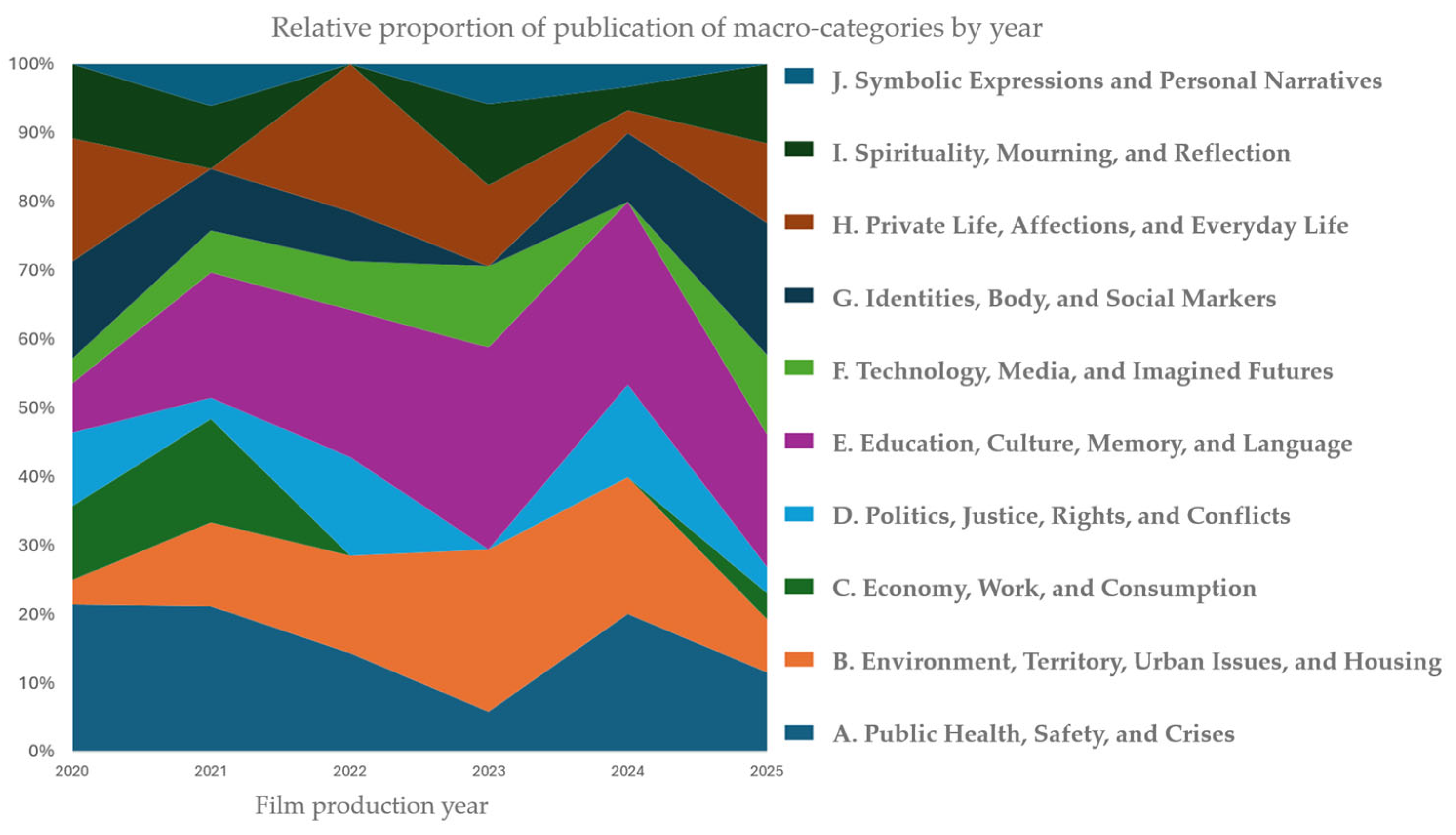
The workshops were conceived as spaces for audiovisual experimentation, in which participants with varying levels of experience produced short works on free themes, often identified by the authors as addressing social, cultural, and autobiographical topics. The short films produced during the workshops were published on the NUPEPA YouTube channel immediately after production [35]. The process of planning, operationalization, execution, and data collection was described in specific materials addressing NUPEPA’s activities [35,36,37]. Figure 1 shows the relative proportions of themes, aggregated by macrocategories, for the workshop production period.

3.2. Analytical Agents, Workshop Context, and Data Gap

Each film was subjected to multiple layers of analysis carried out by distinct analytical agents. Workshop participants analyzed films assuming different roles depending on the object of analysis: when analyzing their own productions, they were classified as authors; when analyzing films produced by colleagues, they acted as peers. This rotational structure reinforced the analytical distinction between authorial intention and peer reception while preserving a shared formative context. In quantitative terms, each film received, on average, analyses from 3.51 authors and 11.32 peers.
In addition, two independent human analysts and two AI systems analyzed the entire corpus. Each human analyst analyzed the complete set of films, and each AI system likewise processed the entire corpus. The majority of participants acting as authors and peers were not professional filmmakers. Approximately three-quarters (N = 397) reported no prior experience with audiovisual production. The films were produced in a formative context designed to foster creative exploration rather than technical specialization.
Regarding ethical treatment, human participants were not treated as experimental subjects in the behavioral sense, but as interpretive agents whose textual comments constitute the primary empirical material for the analysis. The study, therefore, examines patterns of interpretation rather than individual cognitive processes. All human participants provided informed consent at enrollment, with explicit information about the formative and analytical objectives of the workshops, data anonymization procedures, and the right to withdraw at any stage. The data collection and treatment project was submitted to the research institution’s Ethics Committee for review.
The two human independent analysts were selected to match the age range and educational backgrounds of the majority of workshop participants: one female (Brazilian) and one male (Portuguese), both aged 22–25, with undergraduate degrees in communications and arts. Although distinct from authors and peers, human analysts should not be understood as senior experts or professional film critics. Their analytical role represents a position of methodological mediation rather than expert authority. This role combines reflexive distance from the production context with analytical proximity to the participants’ cultural background. They acted as coders of written comments, assigning thematic categories according to standardized guidelines without access to identifying information. Complementary procedures were adopted to monitor potential operator- and agent-related biases (see Appendix B and Appendix C).
A methodological asymmetry should be acknowledged between human and AI analyses. While authors, peers, and human analysts had access to the audiovisual works themselves, AI systems processed only structured textual representations (titles, synopses, transcripts, and limited metadata). This design choice mirrors real-world platform constraints, where algorithmic categorization often relies heavily on textual metadata despite the availability of audiovisual content. It is important to note that this methodological asymmetry has direct implications for the interpretation of results. However, the observed divergences reflect primarily distinct interpretive regimes, compounded by differential access to informational layers. Human agents had access to audiovisual, narrative, and contextual dimensions that AI systems could not process. Consequently, results should be understood as comparing classification patterns under distinct but methodologically controlled conditions, rather than as measures of algorithmic ‘accuracy’ or ‘error’.

3.3. AI Systems and Operational Conditions

The two large-scale generative AI systems were employed during the analysis period (15 September to 20 October 2025): ChatGPT Plus (GPT-5.0), operated by analyst SV, and Gemini Flash 2.5, operated by analyst VS. Both systems were accessed through their official interfaces under equivalent operational conditions and standardized prompts. The selection was guided by analytical considerations rather than performance benchmarking. Gemini’s development within the same corporate ecosystem as YouTube constituted a relevant contextual condition for examining potential infrastructural convergences.
To ensure comparability and analytical stability, the study adopted a non-multimodal design. Preliminary exercises indicated substantial inconsistency in multimodal outputs; consequently, AI systems analyzed exclusively textual metadata. All AI outputs were recorded as produced, without additional intervention. Given the probabilistic nature of AI systems, individual outputs were treated as inherently variable. The analysis, therefore, focused on recurring patterns and categorical stabilization across multiple runs conducted within a documented temporal window.
Two films required a second processing cycle in each AI system due to initial execution failures. In these cases, the most recent outputs were retained to complement missing information from the first execution. Detailed procedures regarding operator-dependent bias control and prompt standardization are described in Section 3.6.

3.4. Production of Interpretive and Classificatory Data

The qualitative operationalization of the study approximates what the literature describes as interpretive thematic analysis, understood as a systematic procedure for identifying, coding, and organizing patterns of meaning in heterogeneous textual datasets. In this respect, the study dialogues with the framework proposed by Braun and Clarke [38,39], who conceptualize thematic analysis as a flexible analytical method rather than a fixed theoretical approach.
The present analysis prioritizes identifying thematic patterns over strictly linguistic or discursive features. It accommodates both inductive movements, through the emergence of themes from the data, and deductive movements, through the progressive consolidation of categories, while explicitly recognizing the analyst’s active role in constructing themes. Unlike more exploratory applications, however, this study articulates interpretive thematic analysis with a progressively stabilized categorical system to enable systematic comparison and analysis of convergence and divergence across human and algorithmic classificatory regimes. Thus, the analytical procedure combines inductive thematic emergence with deductive categorical consolidation, allowing the study to balance empirical sensitivity with cross-agent comparability.
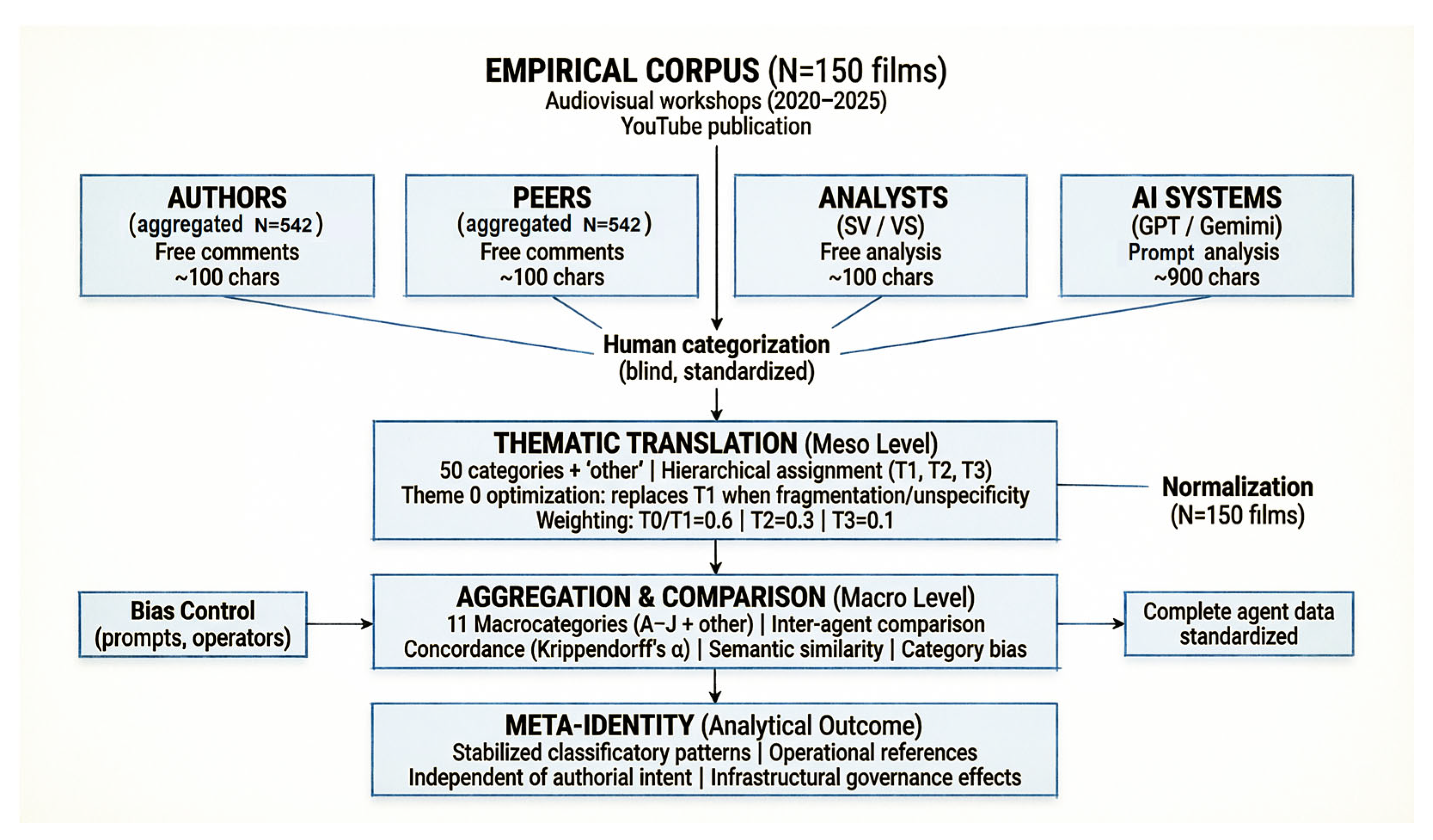
The study operationalizes interpretive thematic analysis as a systematic procedure for identifying and organizing patterns of meaning across heterogeneous textual datasets [38,39]. Data were produced by four agent types (see Scheme 1): authors, peers, human analysts, and AI systems. Authors and peers contributed exclusively at the micro level, providing free textual comments without access to predefined categories. These interpretations were collected via structured prompts (e.g., “In one or two words, this is a film about…”) upon workshop completion, ensuring that human interpretations stemmed from authorship and reception experiences rather than anchoring effects.
Categorization at the meso and macro levels was carried out through the interpretive mediation of human analysts and supervisors. Analysts followed a standardized sequence: viewing each film on YouTube with access to publication metadata, recording observations, and answering guiding questions about content and themes. An initial set of over 20 thematic categories emerged from author and peer responses prior to the project; analysts expanded this repertoire to 44 categories, which supervisors subsequently consolidated into a final list of 50 categories plus one (“other”). This expanded set was used to recode analysts’ original film-level classifications and later to categorize authorial and peer comments. During comment categorization, analysts accessed only individual and reordered entries to prevent film identification, adhering strictly to textual content and selecting categories from an ordered list designed to balance overgeneralization and fragmentation. Each analyst categorized 2225 comments (526 authorial, 1699 peer) and assigned three hierarchical themes (Themes 1, 2, and 3) in order of importance.
This design translated free interpretations into comparable analytical units without eliminating interpretive richness, preserving traceability between original comments and assigned categories. Crucially, this process maintained a clear analytical distinction between the production of meaning (authors and peers), the classificatory translation (human analysts), and the algorithmic inference (AI systems), allowing for controlled comparison across distinct regimes of meaning production (see Table 1).
Categorical attribution was subsequently performed by human analysts, who mapped the meanings expressed in free comments onto a structured set of thematic categories. This process translated semantic recurrences into comparable units without reducing interpretive richness, ensuring traceability between the original comments and their assigned categories.
This design enabled analytical preservation of a clear distinction between the production of meaning by authors and peers, the process of classificatory translation carried out by human analysts, and the layer of algorithmic inference generated by AI systems.

3.5. Categorial System, Analytical Levels, and Thematic Consolidation

The study utilized a system of over 50 thematic categories, consolidated from previous analyses and organized into 10 higher-level macrocategories. Each comment or analysis was associated with up to three themes, hierarchized by relevance (Theme 1, Theme 2, and Theme 3). To address cases of excessive fragmentation or unspecificity, a consolidation procedure established a Theme 0: when present, Theme 0 (derived from critical review) replaced Theme 1; otherwise, Theme 1 was considered Theme 0. This hierarchy captured both the thematic presence and the relative centrality of each interpretation. A Theme 0 was created to address identified cases of excessive fragmentation (fewer than 20 cases) or unspecificity.
The hierarchization of Themes 1, 2, and 3 was based on the semantic centrality attributed by the evaluating agent to the analyzed content, taking into account discursive emphasis, internal recurrence, and the theme’s structuring role within the interpretation.
In addition, a weighting system was applied for complementary analysis:
  • Main theme (0 or 1): weight 0.6.
  • Secondary theme (2): weight 0.3.
  • Tertiary theme (3): weight 0.1.
This procedure enabled the analysis of relative distributions of meaning rather than only the absolute frequencies of categories.
In summary, the analytical flow of the study comprises: (i) the production of free interpretations at the micro level by authors, peers, analysts, and AI systems; (ii) the translation of these interpretations into standardized categories at the meso level through human and algorithmic analytical mediation; (iii) thematic consolidation and aggregation at the macro level, enabling comparative, weighted, and longitudinally observable analyses.

3.6. AI Processing and Methodological Rigor

The automated analyses were conducted using the two generative AI systems described above and operated under equivalent methodological conditions. AI analyses were conducted in two distinct methodological stages:
  • Production of analysis based on standardized prompts. The systems analyzed the films using standardized prompts applied to complete textual materials, without access to predefined categories, producing extensive discursive interpretations not constrained by a fixed categorial structure.
  • Categorial framing. The AI-generated responses were subsequently mapped onto the same thematic categories used in the human analyses through a complementary use of the two AI systems.
This separation distinguished the systems’ discursive interpretive production from their operational classification into units comparable to human outputs. The coding process was informed by grounded theory principles, particularly Strauss and Corbin’s [40] notion of constant comparison, ensuring sensitivity to empirical variation while supporting systematic thematic consolidation.
However, the study does not adopt grounded theory as a complete methodological framework. Unlike that tradition, the objective is not to incrementally generate a substantive theory about film categorization, but to construct an analytical device for mapping how interpretive meanings translate into operational classifications. Coding, therefore, aims for sufficient analytical stabilization to enable comparison across agents and mediations, rather than theoretical saturation.
To mitigate the bias introduced by human mediation in interactions with artificial intelligence systems, the prompts used in the analyses were rigorously standardized and applied identically by both analysts, regardless of the AI model employed. There was no incremental adaptation, contextual reformulation, or differentiated guidance of instructions throughout the analytical process. This procedure aims to reduce as much as possible the main known vector of operator-dependent bias induction—that is, variations resulting from the formulation, adjustment, or subjective interpretation of prompts—while preserving substantive differences between distinct interpretive regimes, which are examined empirically in the results and supplementary analyses in Appendix D and Appendix E.
This methodological decision is particularly relevant in comparative contexts, in which the aim is to distinguish structural interpretive divergences between human and algorithmic agents from artifacts produced by operational interaction.
Since the data consist of discrete frequencies from interpretive categorization and thematic ranking, the study prioritized Spearman correlations to identify ordinal correspondence and interpretive convergence between human agents and AI systems. Pearson correlations were used in complement to examine linear association patterns and assess the robustness of the results.
This procedure was necessary because the study compares outputs produced by distinct interpretive regimes. Without normalization, differences in sample sizes across agents could artificially inflate or deflate measures of convergence and divergence.

3.7. Normalization and Data Comparability

Not all films were analyzed by all agents at every stage. To ensure comparability, a normalization attribute distinguished fully comparable cases (analyzed by all agents) from partially comparable cases (analyzed by only some agents). The most sensitive analyses were conducted exclusively on this normalized subset, ensuring sample balance and preventing distortions resulting from missing observations.
Consequently, correlation analyses and inter-agent comparisons were conducted primarily on the normalized dataset, while descriptive analyses of the broader corpus were preserved for contextual interpretation.

3.8. Analytical Strategies and the Construction of the Concept of Meta-Identity

The articulation between interpretive thematic analysis, categorical systematization, and inter-agent comparison provides the methodological basis for the concept of meta-identity. In line with Becker’s [41,42] methodological approach, this concept is not treated as a directly observable empirical category, but as an analytical outcome inferred from the recurrence of classificatory patterns and their stabilization across algorithmic mediations. Thus, the methodological procedure does not rigidly separate qualitative analysis from conceptual construction. Instead, it articulates them within a single analytical movement, in which categories, comparisons, and concepts emerge relationally, situatedly, and empirically grounded.
The analysis combined different strategies:
  • Inter-agent comparison, based on the systematic contrast among authors, peers, human analysts, and AI systems;
  • Thematic convergence/divergence analysis;
  • Analysis of categorial stabilization across algorithmic mediations;
  • Relational reading, articulating the classification of works and inferences about authorial profiles.
The comparisons were operationalized through different analytical regimes (intersection, correlational combination, and sample aggregation) and applied according to the type of agent being compared and the analytical objective. At this stage, the study situates the methodological procedure through which the concept of meta-identity is empirically operationalized, drawing on the observation of recurring classificatory patterns:
  • Consolidation of categories independent of authorial intent;
  • Recurrence of thematic profiles attributed through algorithmic mediations;
  • Displacement of interpretive meaning toward operational parameters;
  • Extension of content classifications to inferences about authors.
Meta-identity is thus articulated as a transversal analytical outcome, resulting from the combined use of empirical data, comparative procedures, and an established theoretical framework [2]. More information regarding the methodological synthesis and ethical considerations are available at Appendix F.

4. Architectures of Classification, Interpretation, and Algorithmic Mediation

4.1. Regimes of Meaning and the Infrastructural Turn

Empirical analysis indicates distinct regimes of meaning production. Authors interpret works based on expressive intentions and biographical trajectories; peers produce readings anchored in shared repertoires; and human analysts mobilize technical frameworks while retaining sensitivity to contextual nuance. Unlike these human regimes, which tolerate ambiguity and dissent, the algorithmic regime operates through reduction and stabilization, producing categories that must be reusable and compatible with systems of recommendation, ranking, and segmentation. In this article, the term “algorithmic interpretation” is used strictly in an operational sense, referring to the stabilization of classificatory outputs under standardized analytical conditions, without implying cognitive understanding or semantic comprehension on the part of AI systems. This structural difference is central to understanding why certain interpretations—even those divergent from authorial intent—can acquire operational centrality. The transition from interpreted to classified meaning entails a change in status: while interpretation remains situated, algorithmic classification acquires an infrastructural character, integrated into systems that automate decisions. As studies on algorithmic curation indicate [4,8], classification does not merely describe content; it orders relations, connecting works to audiences and circuits of visibility. Once assigned, a category serves as a vector that influences future associations and audience expectations, technically activating meaning and producing cumulative effects.

4.2. Meta-Identity Formation and Structural Asymmetry

In practice, algorithmic classification may extend beyond isolated content; creative works can act as identity vectors, transferring their categories to authors. Such dynamics establish a circular logic: content is classified based on patterns, authors are inferred from content, and future classifications incorporate this aggregated profile. Through this relational aggregation, personal and work identities become inseparable within algorithmic frameworks. Unlike classical institutional identity attribution [27,28], this dynamic occurs without explicit negotiation, mutual recognition, or straightforward contestation. Meta-identity thus results from a distributed, cumulative process where successive technical decisions produce durable identity effects. Crucially, the process is characterized by the structural opacity of its criteria. As Pasquale [7] and Amoore [43] discuss, the models guiding decisions are largely inaccessible to subjects. Such opacity creates a fundamental asymmetry between the classified and the classifiers. While authors may adjust their self-definition strategies, they lack direct access to the inferential models consolidating their meta-identities. Consequently, contestation remains indirect, fragmentary, and often ineffective. From an analytical standpoint, this underscores the need to distinguish identity as a recognizable social construction from meta-identity as a non-transparent infrastructural model that functions independently of subject recognition. Understanding this dynamic requires articulating identity theories, platform studies, and empirical analysis, providing a foundation for the following section on the study’s results.

5. Results: Convergences, Divergences, and the Formation of Classificatory Models

5.1. Overview of the Results: Beyond Interpretive Plurality

Systematic comparison among authors, peers, human analysts, and AI systems confirms the study’s empirical basis and sociological implications. Results reveal more than “natural” cultural plurality; they show distinct regimes of meaning organization. These differences become asymmetric when certain classifications function as infrastructural references for mediation, visibility, recommendation, and thematic association.
The central result, therefore, is not to identify “who is right,” but to understand how different regimes of reading produce, hierarchize, and stabilize distinct classificatory layers, and how this stabilization gives rise to an operative model that functions, in practice, as a pragmatic identity of the content and, by extension, of its authors within the digital ecosystem [4,7,8,15,24,25,26,27,28,30,44].
Methodologically, the quantitative indicators in this section are analytical descriptors of patterns emerging from qualitatively coded data, rather than explanatory or inferential measures. This aligns with mixed-methods approaches [33] that use quantification [32] to compare and visualize regularities in complex objects without adopting a positivist status of proof or causal validation.
The results are coherently organized across three articulated analytical planes:
  • Micro level—structural differences in regimes of textual and semantic production;
  • Meso level—patterns of thematic hierarchization, categorial bias, and agreement;
  • Macro level—processes of categorial stabilization with operational and governance effects.
This articulation makes it possible to empirically observe how algorithmic classifications cease to be mere descriptions and become active symbolic infrastructures that produce durable effects on cultural circulation.

5.2. Micro Level: Textual Richness and Semantic Similarity

This section examines structural differences in regimes of textual and semantic production across agents. Three analytical dimensions are integrated: (i) lexical and semantic richness patterns, (ii) semantic similarity distributions across agent pairs, and (iii) interpretive space mappings. Together, these establish the baseline divergence between human and algorithmic meaning-making regimes.
Despite the diversity of interpretive positions, the data reveal consistent patterns of convergence among human agents, especially between authors and peers, with analysts occupying an intermediate and mediating position.
Even when authors and peers emphasize different aspects—narrative, affective, aesthetic, or political—recurrence is observed in the identification of macro-themes and interpretive “centers of gravity.” This convergence does not imply homogeneity, but points to the existence of shared social and cultural references through which meanings are collectively negotiated and recognized [25,26,27,28].
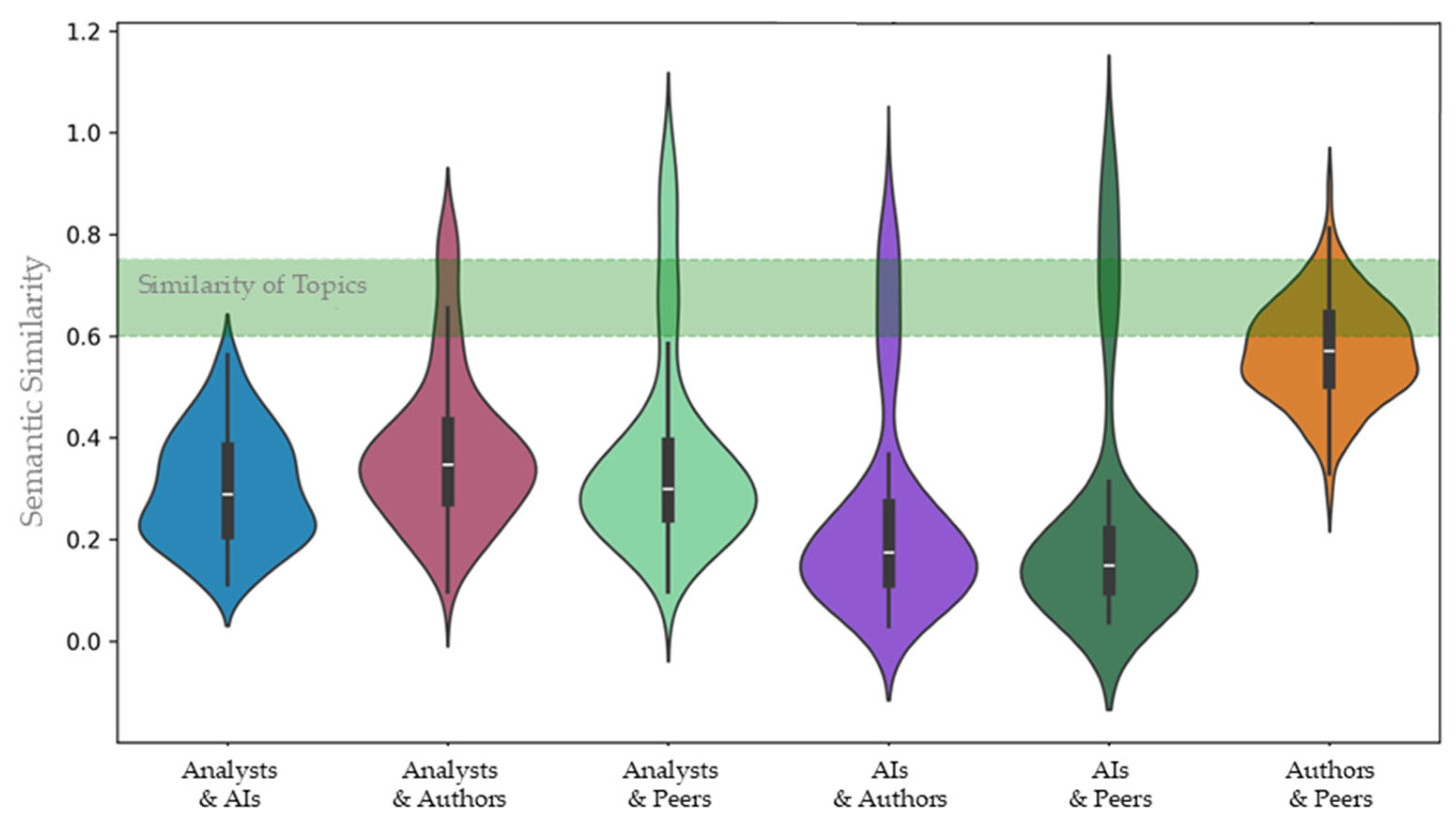
Figure 2 presents semantic similarity distributions across six agent pair combinations, with a green band (~0.6–0.75) indicating the zone of meaningful topic convergence. Three patterns emerge clearly. The Authors & Peers pair displays the highest semantic similarity, confirming that experiential proximity favors alignment. AI–human combinations show the lowest similarity levels, concentrated well below 0.4, indicating that AI systems do not operate within the same interpretive space as human agents, confirming H1 and H5. Analysts occupy an intermediate position; Analysts & Peers reach moderate similarity, while Analysts & AIs remain below it, supporting H3 by suggesting analytical mediation introduces abstraction without fully detaching from situated interpretation.
Human readings are characterized by ambivalence and contradiction, including social critique coexisting with an autobiographical register, typical of situated interpretive regimes that echo Goffman’s notion that meaning is constructed through the definition of the situation. This capacity to sustain multiple layers of meaning contributes to lower formal stabilization among authors and peers, as well as greater fidelity to semantic complexity. Results indicate that both analysts and AI systems perform semantic reconfiguration. The central difference lies in the fact that, for analysts, this is reflexive and contestable, whereas in AI systems, it occurs automatically in a stabilized, opaque manner guided by inaccessible parameters.
Although AI systems generate semantically dense descriptions, this density does not correspond to higher interpretive alignment. The distribution shows that authors and peers cluster more closely, whereas combinations involving AI systems consistently fall within lower similarity ranges, indicating that semantic density and interpretive convergence are not equivalent dimensions. Human agents exhibit greater internal variability, whereas AI systems concentrate outputs in narrower, stable regions. Rather than producing convergence, semantic expansion in AI systems operates through regularization and reuse, consistent with a regime of semantic compression. These results reinforce that humans and algorithmic systems operate under distinct regimes of meaning organization: one situated, plural, and reflexively negotiable; the other automated, stabilized, and oriented toward classificatory consistency.
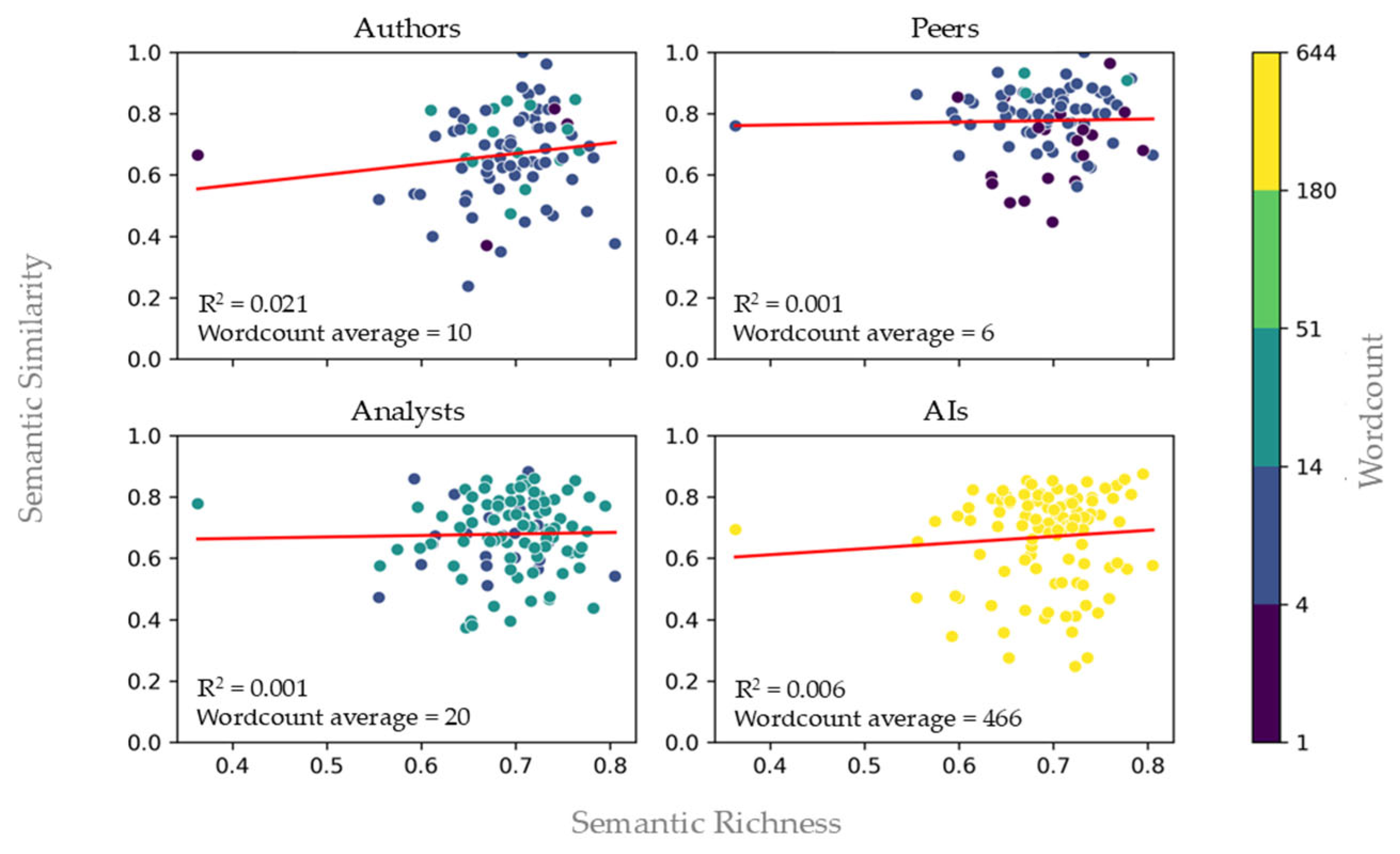
Lexical and semantic richness data show that AI systems produce lengthy, semantically dense texts with low internal variability. This indicates a regime of semantic compression and regularization, in which multiple meanings aggregate into broad, reusable categories. At the micro level, ChatGPT Plus shows significantly higher lexical richness and length than human agents, whereas Gemini shows a more restrained pattern. In contrast, humans produce shorter texts with greater interindividual variability, highlighting structural differences between discursive regimes. For a detailed examination of the relationship between semantic richness, semantic similarity, and textual volume across agents, see Appendix G.
In operational terms, “semantic compression” designates the co-occurrence of high lexical or semantic density with low internal variability across outputs, indicating the reuse of stabilized interpretive structures rather than the expansion of distinct thematic orientations.
Regarding semantic richness, authors and analysts show high density with greater variance, indicating interpretive plasticity and reflexive openness. Peers occupy an intermediate position with consistent density but less dispersion. Conversely, AI systems combined high semantic richness with low internal variability, concentrating outputs in dense but narrow regions. This pattern reflects a regime of “semantic compression” characterized by stability and containment. Thus, AI’s high density does not signify greater interpretive alignment with humans, but rather an autonomous mode of automatic content reconfiguration.
While humans display ambiguity in their descriptions, algorithmic logic privileges consistency and reusability, utilizing categories as markers. This mode of operation aligns with literature on classification as power and governance [4,7,10,15,43,45] and reinforces the dynamics of meta-identity. These dynamics categorize, rank, and prioritize content based on parameters defined by platform interests—be they commercial, political, or legal. Conversely, from a human perspective [24,25,27,29], categorization depends on the analytical problem chosen. This may involve “virtual identities” (Goffman) or “identity for the other” [28], which compose the conscious or unconscious identity strategies of individuals or groups.

5.3. Meso Level: Thematic Hierarchization and Agreement

Building from micro-level patterns, this section analyzes how interpretations are translated into standardized categories. Four dimensions are examined: (i) relative frequency and thematic centrality across agents, (ii) categorical bias distributions, (iii) interrater agreement coefficients, and (iv) illustrative case analyses. This level reveals where divergence becomes operationally consequential for classification.
Within the meta-identity framework, the algorithmic dynamic operates as the structural mechanism that integrates and processes heterogeneous signals into operational classifications. In the context of this study, AI systems (ChatGPT and Gemini) function as proxies for this dynamic, demonstrating how textual metadata, thematic signals, and structured prompts are harmonized into stable thematic profiles. The empirical observation of semantic compression—where diverse human interpretations are aggregated into broad, reusable categories like ‘Art’ or ‘Reflection’—illustrates the integrative capacity of the algorithmic dynamic. It does not simply sum the inputs; it selects patterns that maximize operational predictability and systemic consistency. This process mirrors the theoretical definition of meta-identity formation, where probabilistic outputs are transformed into durable sociotechnical constructs. Thus, the divergence observed between human and algorithmic classifications is not a measurement error, but evidence of the algorithmic dynamic prioritizing categorical stabilization over contextual nuance, effectively acting as the engine that converts interpretive plurality into infrastructural references. This operationalization aligns with the theoretical framework established in Section 2.4, where the algorithmic dynamic is defined as the integrative mechanism that transforms heterogeneous inputs into stabilized classificatory outputs.
AI systems frequently capture topics that are indeed present in the analyzed works; however, they tend to reorganize the thematic hierarchy by redefining what is treated as central and what becomes peripheral. This reordering occurs according to classificatory criteria that remain neither transparent nor negotiable for the authors or other human agents involved in the interpretive process. The central theme established through this process is not a neutral descriptive element: once stabilized, it tends to guide subsequent associations, shape presumed audiences, and influence networks of similarity and recommendation within the classificatory environment.
A related phenomenon concerns the recurrence of categories induced by cumulative correlation. In many cases, categorial assignments appear to be influenced by easily correlatable textual signals such as titles, synopses, transcripts, and metadata. These assignments do not necessarily indicate interpretive error. Rather, they reflect the operation of a distinct interpretive regime in which classification emerges from cumulative statistical associations rather than from dense contextual interpretation of the audiovisual work as a whole.
Analyses conducted at the micro and meso levels reinforce this distinction between interpretive regimes. Semantic similarity measurements indicate that authors and peers share the largest common interpretive space, reflecting the proximity between production and reception within the same formative context. Human analysts occupy an intermediate position, combining interpretive distance with methodological mediation. Comparisons involving AI systems exhibit the lowest levels of cross-similarity with human agents, suggesting that algorithmic classifications operate according to partially distinct semantic logics. The presence of multiple AI systems reduces the likelihood of absolute homogenization of classificatory outcomes; however, it does not eliminate the structural asymmetry between human and algorithmic interpretive regimes, a pattern consistent with hypotheses H1 and H9.
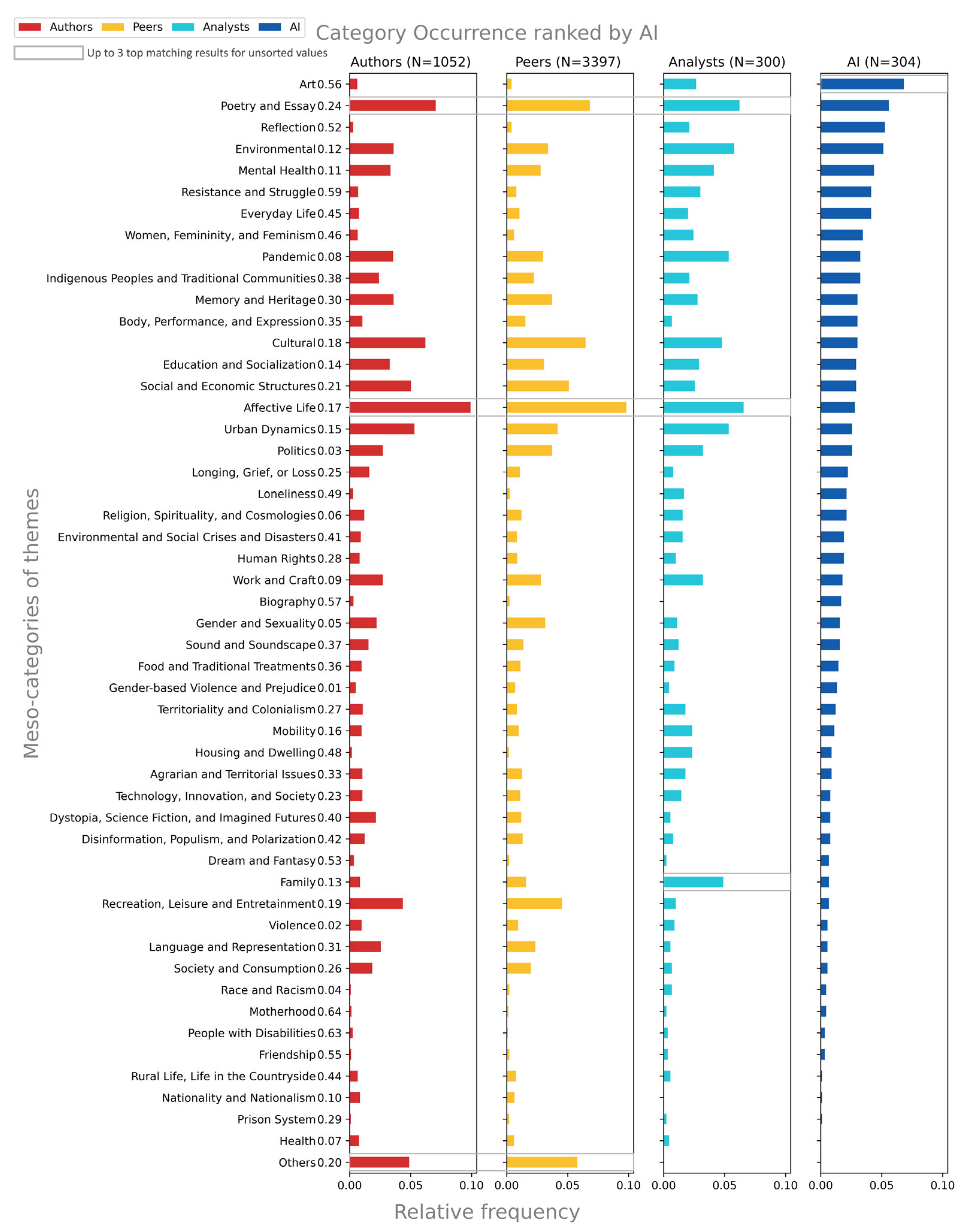
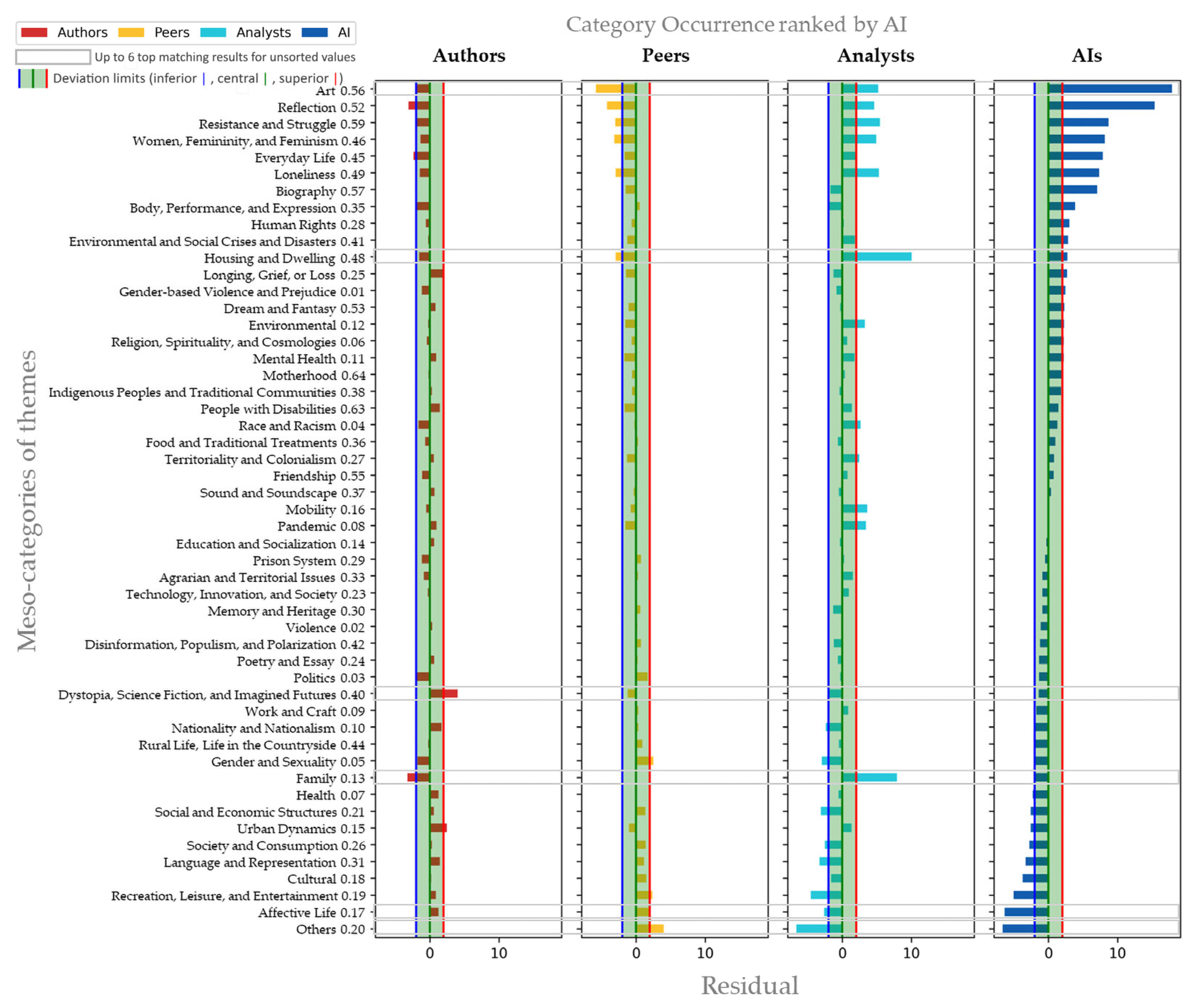
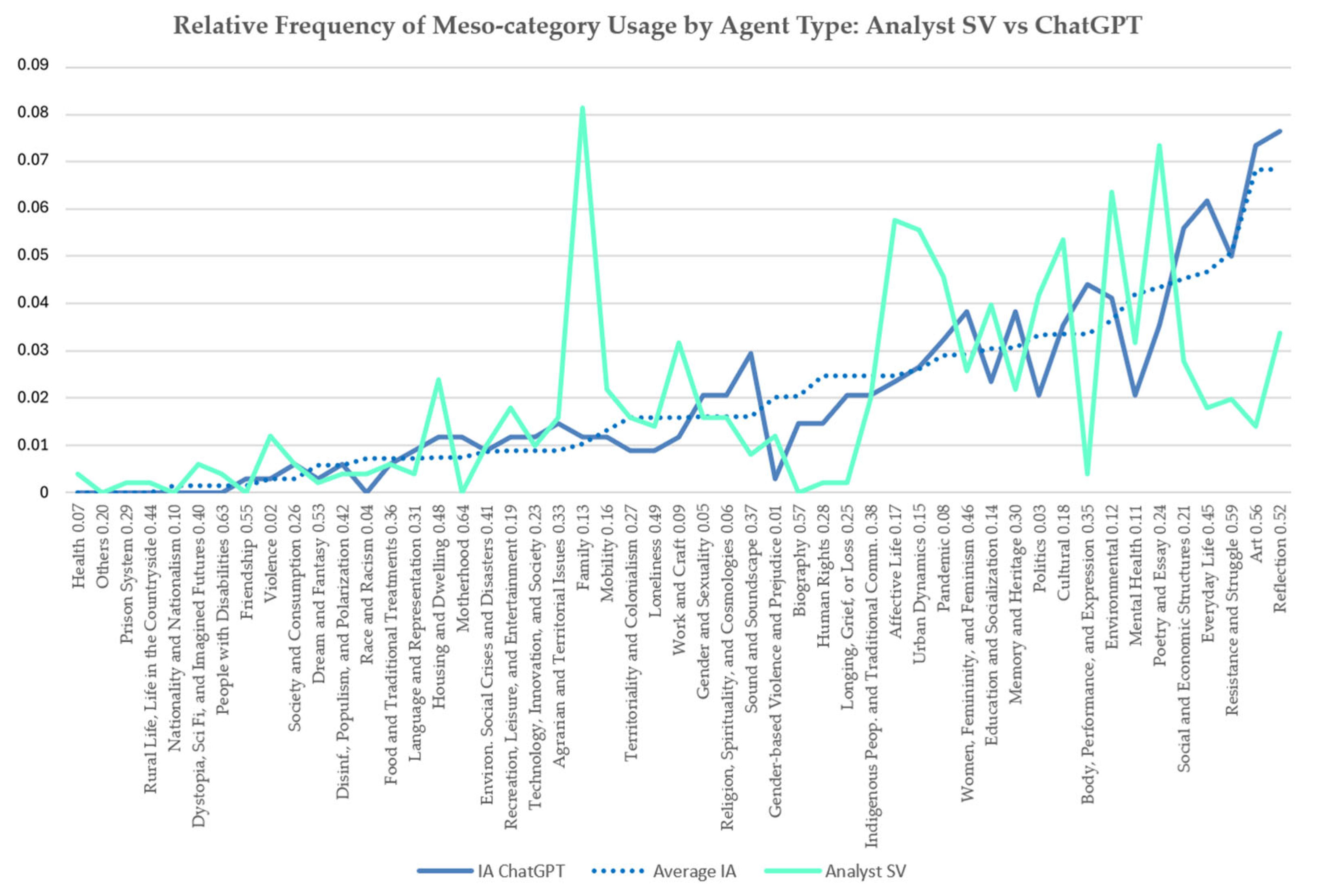
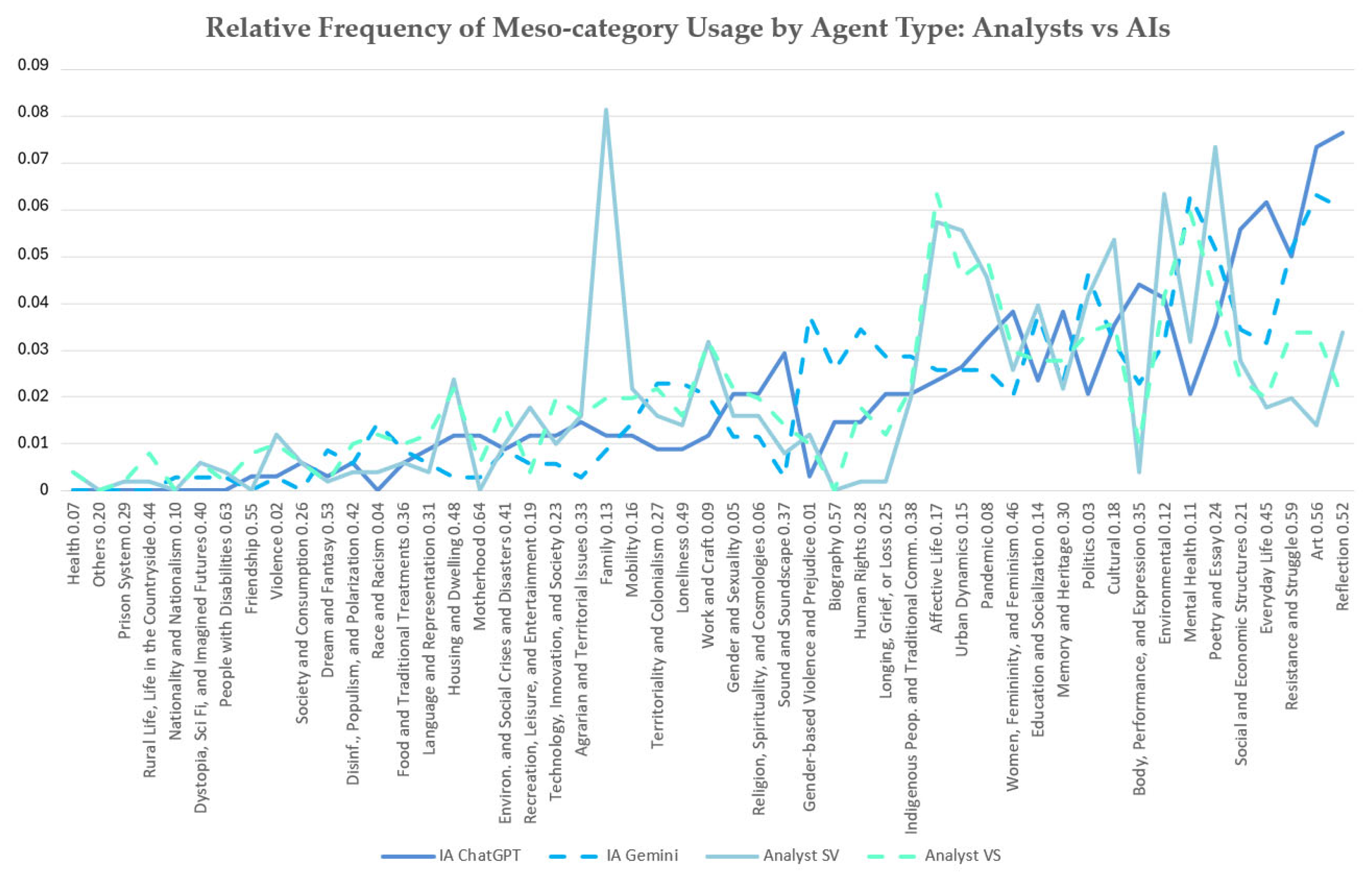
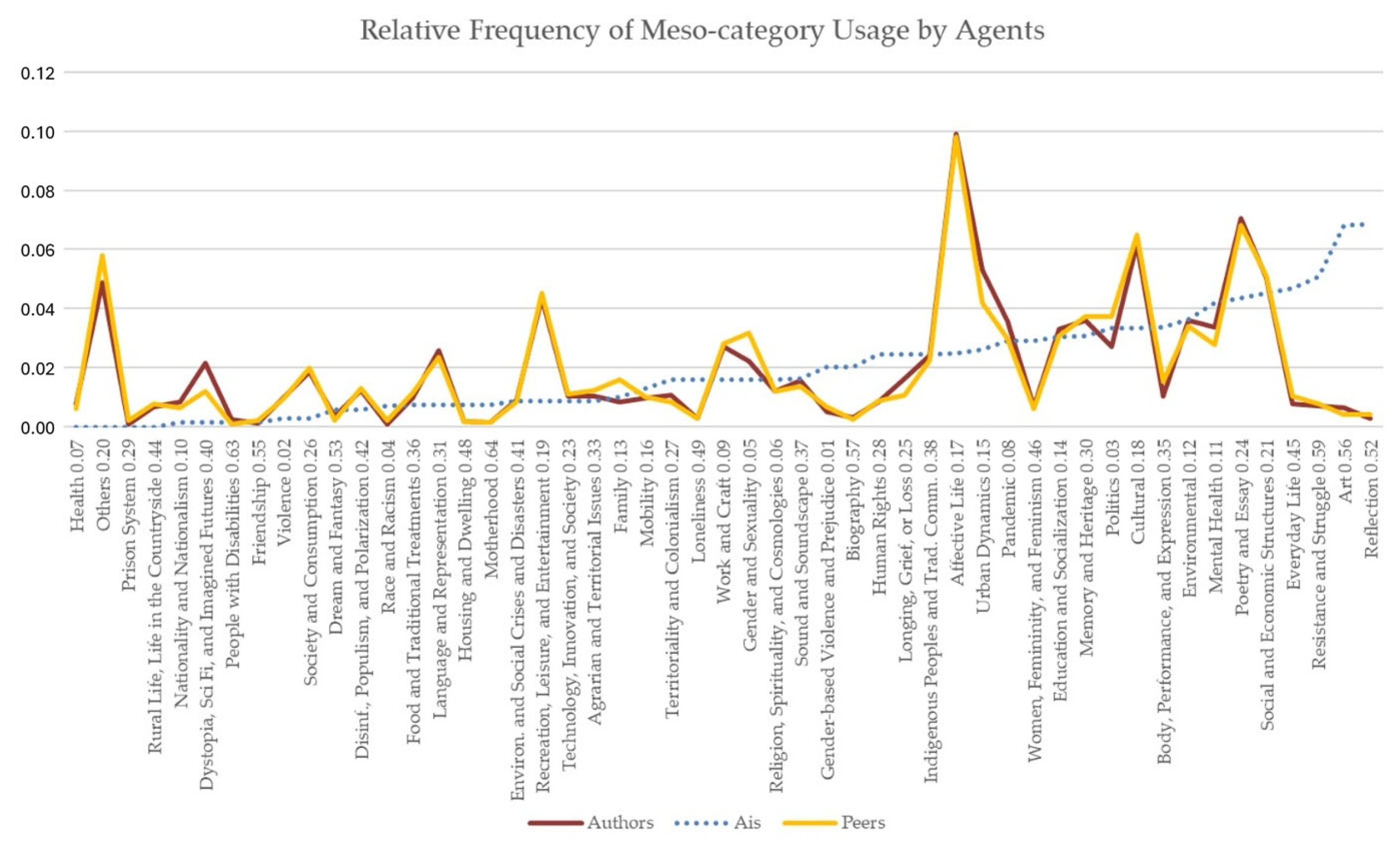
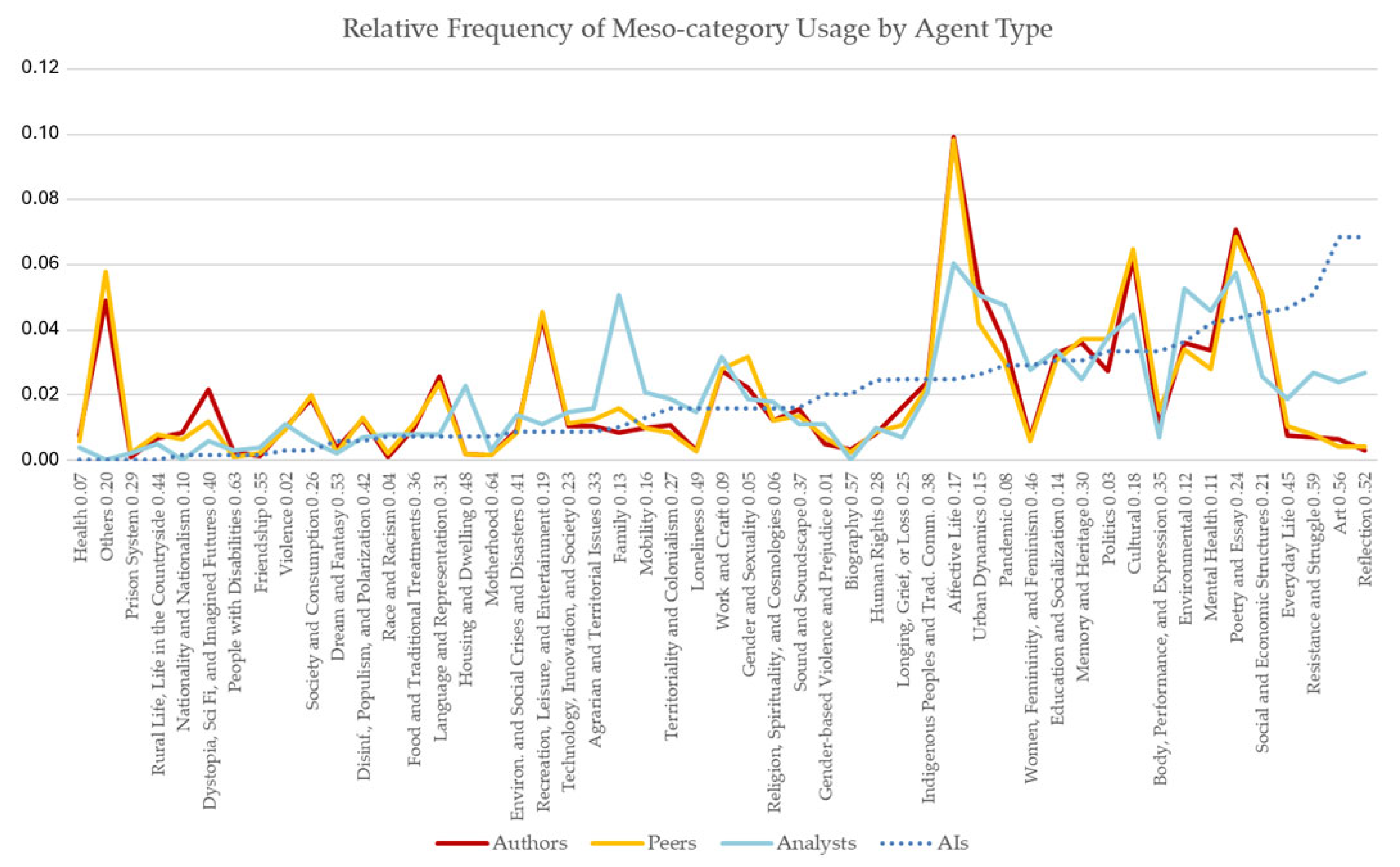
Humans and AI systems mobilize similar sets of thematic categories but hierarchize them differently, confirming that the central difference does not lie in the availability of categories but in how they are stabilized and rendered operational. Authors, peers, and analysts privileged situated and socially anchored categories, while AI systems concentrated classifications into broader, more transversal macrocategories, such as art, reflection, biography, and everyday life.
Figure 3 presents the relative distribution of thematic categories mobilized by different agents in film classification. Although all groups draw on a shared categorical repertoire, the centrality of themes varies across interpretive regimes. AI systems tend to assign greater centrality to broad and aggregative categories—such as art, reflection, biography, resistance and struggle, and everyday life—which function as transversal axes capable of absorbing multiple meanings. In contrast, authors, peers, and analysts exhibit profiles that are closer to one another, with greater emphasis on situated and experientially anchored categories, albeit with differences in intensity and focus related to their roles in the evaluative process.
The relative alignment among human agents is expressed primarily through the recurrence of the same dominant thematic axes, indicating a shared interpretive space. The difference between human and AI classifications is therefore not expressed in the exclusion of themes, but in the distinct hierarchization of what is considered central. This result confirms H2 and is consistent with the tendencies later formalized in H3: AI systems do not eliminate themes, but reduce specificity through aggregation, displacing thematic centrality. See Appendix B and Appendix C for a supplementary analysis of category bias across agents.
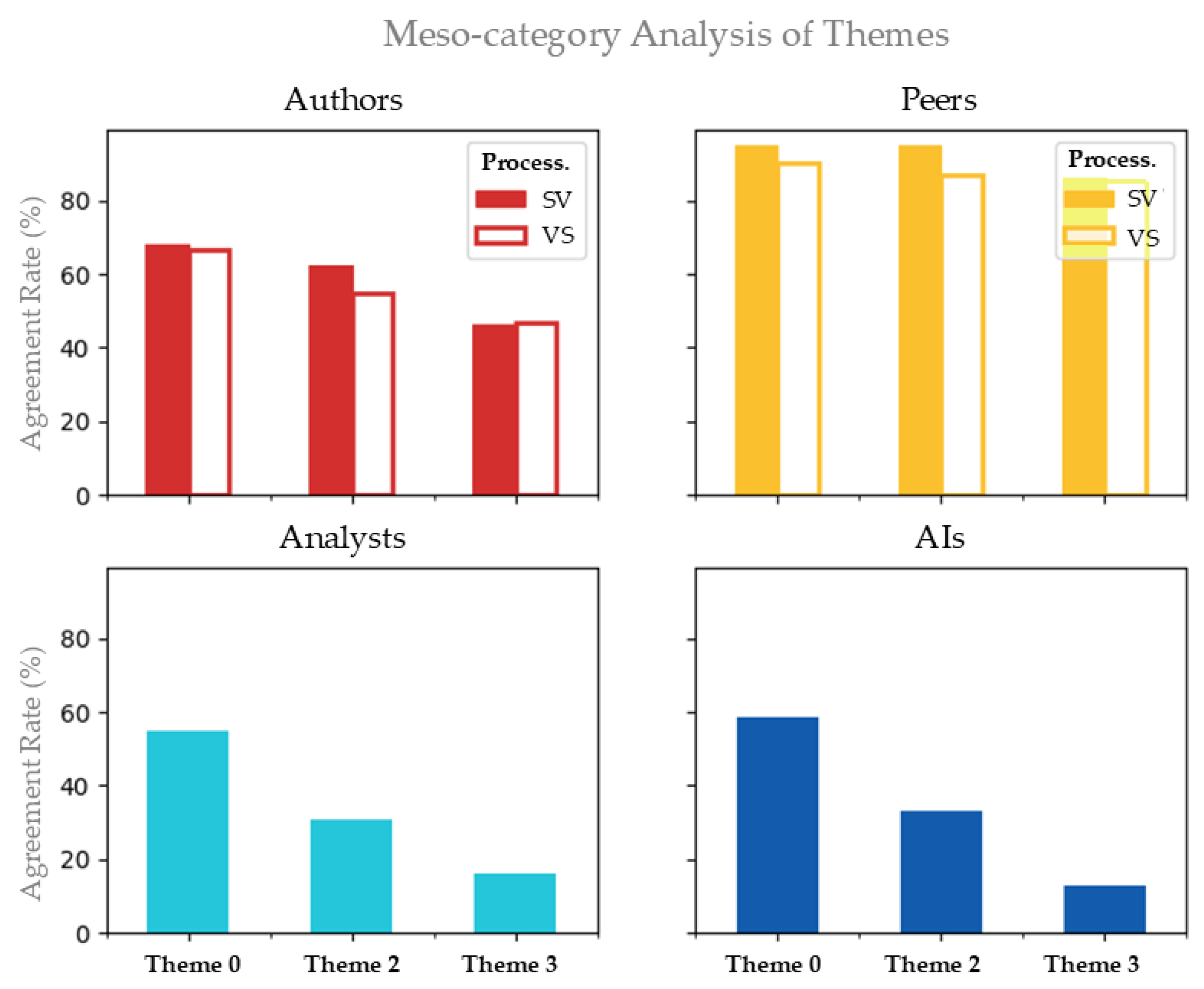
Agreement data complement this picture by showing greater stability at Theme 0 and a progressive decline across secondary themes, indicating structural limits to fine-grained categorization. Krippendorff’s alpha values reinforce that the observed stabilization between analysts and AI systems stems from procedural regularization rather than social consensus.
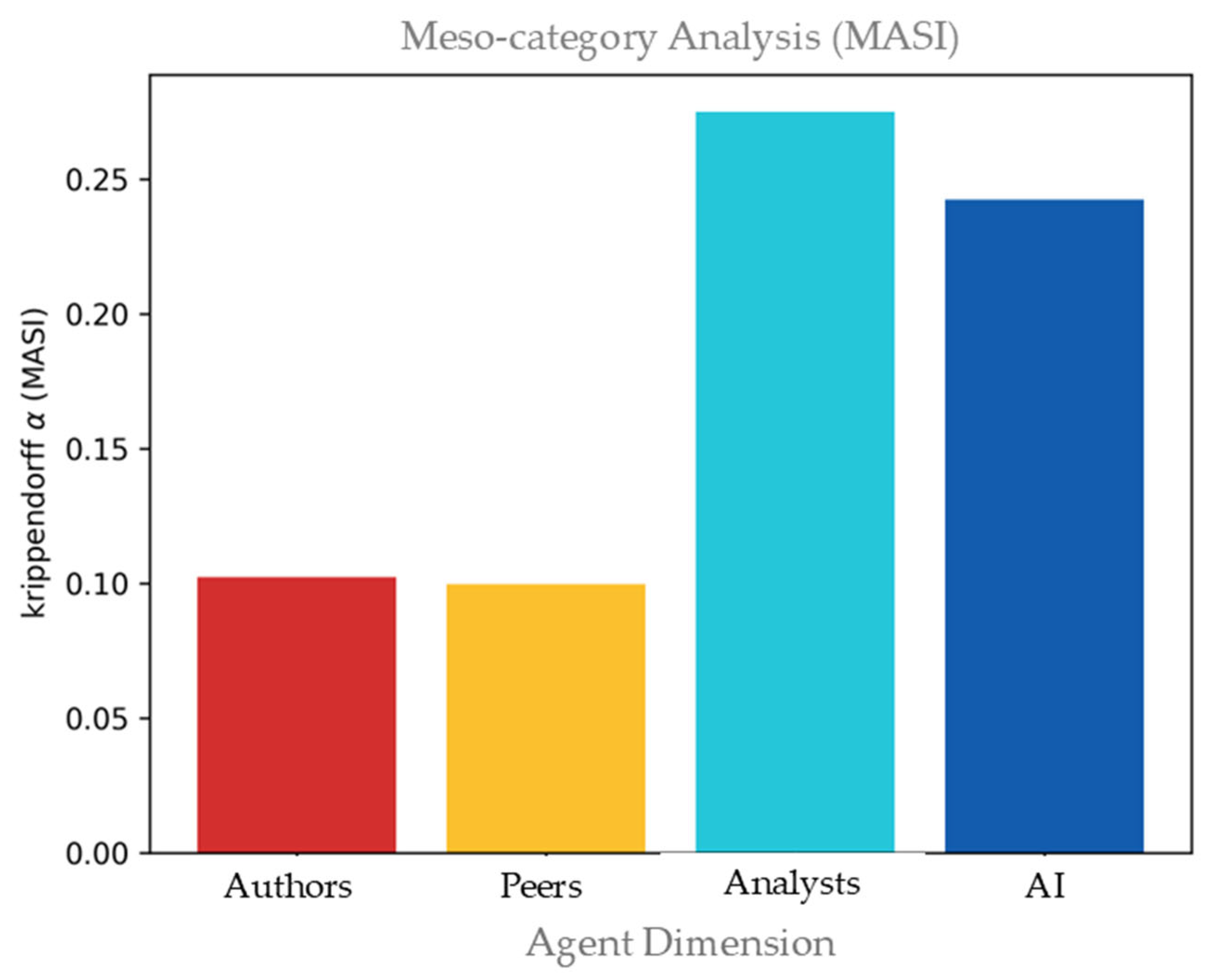
Figure 4 presents Krippendorff’s alpha (MASI) as a synthetic measure of interrater reliability within each group of agents—authors, peers, human analysts, and AI systems. Across all groups, absolute agreement remains low, with coefficients below 0.30, indicating substantial interpretive variability in thematic categorization. Relative differences among groups are nonetheless observable. Human analysts and AI systems display higher α values than authors and peers, suggesting more stabilized classificatory patterns. Authors and peers exhibit the lowest coefficients, reflecting greater internal dispersion in their categorizations.
These differences must be interpreted in light of the unequal epistemic roles and data volumes across agent groups. Authors (N = 542 individuals; 1052 comments) and peers (N = 542 individuals; 3397 comments) produced a large and heterogeneous set of interpretations grounded in situated and experiential readings. In contrast, human analysts conducted a fixed number of independent analyses (SV analyst: N = 150 films; VS analyst: N = 150 films), following reflective and methodologically oriented procedures. AI systems generated a comparable number of outputs (ChatGPT Plus 5.0: N = 152; Gemini Flash 2.5: N = 152).
Accordingly, the relative proximity observed between analysts and AI systems should not be interpreted as analytical or cognitive equivalence. For analysts, higher agreement reflects methodological calibration and shared analytical criteria; for AI systems, it results from automated processes of categorical regularization and semantic compression. The lower reliability observed among authors and peers reflects the plurality of readings associated with diverse experiential positions, rather than error or analytical insufficiency (see Appendix H for more detailed results about agreement rates by theme and Appendix I for Table A4. Mesocategories Grouped into Thematic Macrocategories).

5.4. Macro Level: Categorical Stabilization and Meta-Identity Signs

Even the project’s supervisory team, when revisiting the works for analytical purposes to verify results, convergences, and divergences among different agents, did not always agree with them. For example, one could reasonably argue that the film Circo-Teatro Teleco could be well accommodated within category 57, Biography, insofar as it concerns the life of a character who speaks about his work, art, and circus culture. Nevertheless, the Biography category was not mobilized by any of the authors or analysts. Likewise, the use of category 52, Reflection, would also be defensible for the film Restos de Intimidade, which was unanimously categorized by all agents as 17, Affective Life (See Appendix D for a detailed analysis of illustrative cases for the agreement test and Appendix E for a case-by-case qualitative analysis).
This observation regarding some instances that are dissonant with one or more agents analytically complements the complexity of the process of thematic categorization and impacts meso- and macrocategories, with implications for how content is parameterized and circulates as meta-identities within digital platforms.
The complementary qualitative data help to better understand the divergences observed in three of the four films, which should not be read as a simple “AI vs. humans” confrontation, but rather as a divergence between two ways of stabilizing meaning. On the one hand, human interpretations tend to be anchored in situated experiences (affects, work, lived environments, memory), preserving ambivalence and context. On the other hand, AI systems, as previously observed, tend to resolve ambiguity through semantic compression, prioritizing transversal, reusable categories—most notably Art—which serve as aggregative labels or categorical wildcards.
At the same time, the data show that, in the divergent films, there is internal human plurality: authors, peers, and analysts do not necessarily select the same dominant axis—an epistemically expected outcome, given that each agent operates from a distinct position in the process (author/participant, peer observer, analytical observer). The distinguishing feature of AI systems is that they act as a kind of closure mechanism, collapsing plurality into a more stable, or “pasteurized,” classificatory identity. This is the point at which meta-identity becomes empirically visible: not as “error,” but as a hierarchical reordering of meaning, with effects of symbolic governance (what comes to “count” as the film’s identity for purposes of association, grouping, and operational reading), and through which specificities—whether attributed by the authors themselves or identified by peers, analysts, or audiences—may be synthesized, homogenized, or lost in the categorization process.
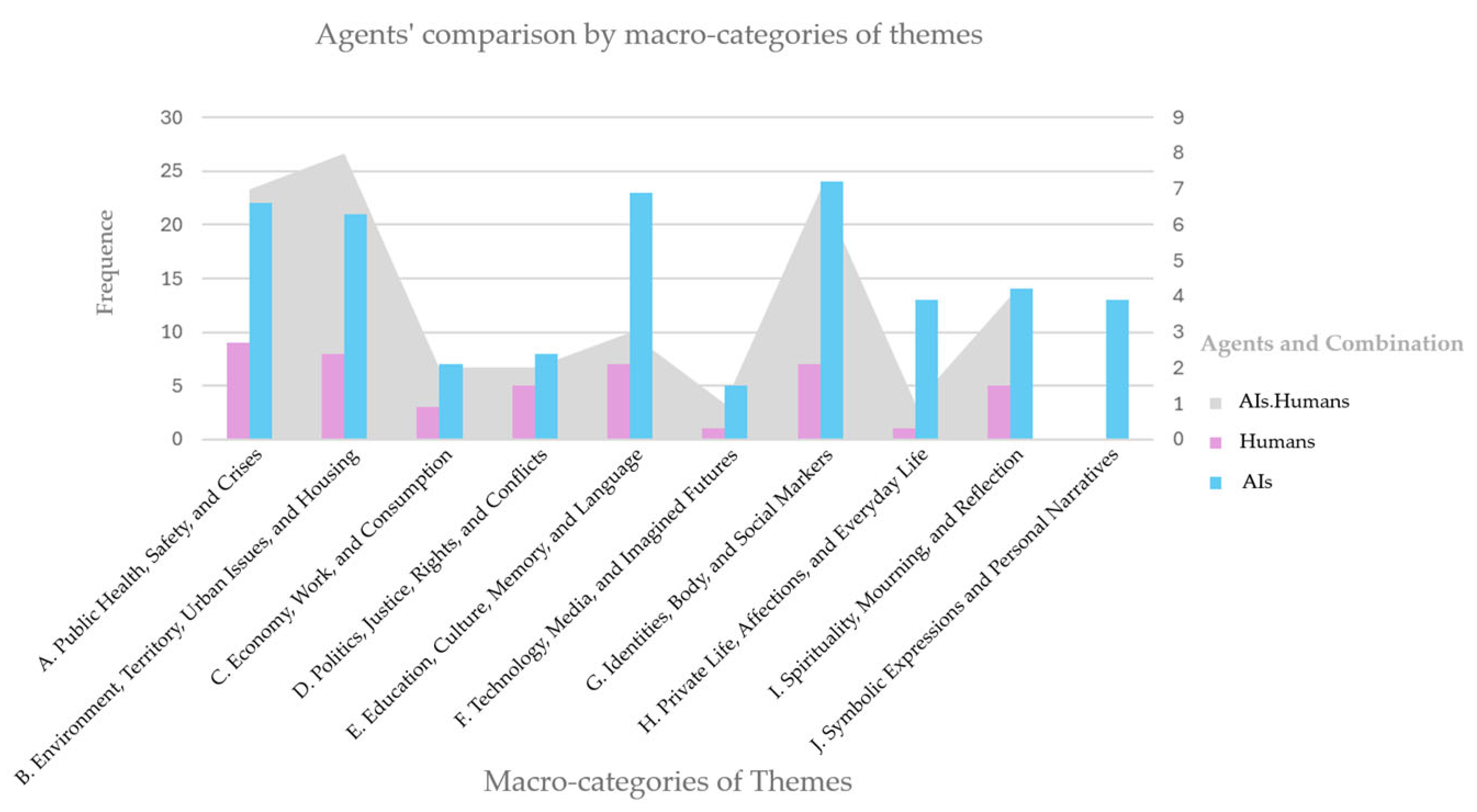
Figure 5 below shows that the largest areas of intersection between AI systems and humans in the thematic classification of the analyzed films are concentrated in the macrocategories Identities, body, and social markers; Public health, security, and crises; and Environment, territory, urban issues, and housing. The smallest area of intersection is found in the macrocategory Symbolic expressions and personal narratives, followed by two other macrocategories: Private life, affects, and everyday life, and Technology, media, and imagined futures.
The macrocategory analysis indicates that AI systems tend to privilege axes of greater symbolic abstraction, while humans maintain greater thematic differentiation. This classificatory tendency does not necessarily constitute censorship, but rather a reorganization of the symbolic landscape, with direct implications for circulation, visibility, and audience association (H4).
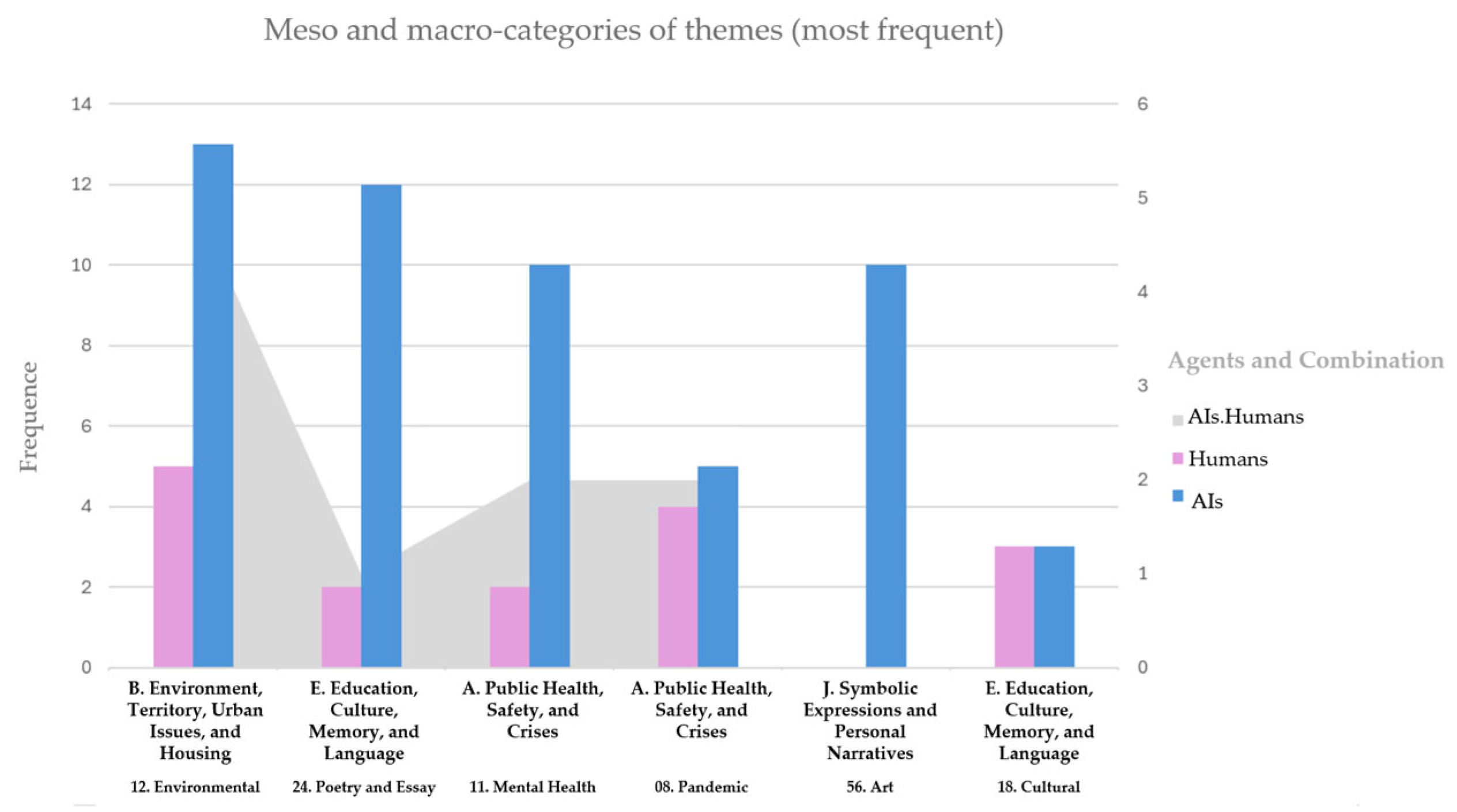
Figure 5 and Figure 6 present, at complementary levels of aggregation, the distribution of themes classified into macrocategories, allowing comparison of the categorization patterns mobilized by human agents and AI systems. While the first highlights the relative frequency of thematic combinations, the second specifies which macrocategories and specific themes concentrate the highest incidence within each interpretive regime.
The largest areas of intersection between human and AI classifications occur in categories such as Environmental, Mental Health, Pandemic, and Poetry and Essay. In contrast, Art and Cultural display the smallest overlaps. In some cases, asymmetries in category frequency correspond to low intersection, as observed with Art, which is heavily overused by AI systems and underused by human agents. In other cases, low intersection results not from frequency imbalance but from divergent attribution, as in the Cultural category, which is used with similar frequency by humans and AI systems but applied to different films.
Taken together, the analysis of these figures indicates that categories associated with more objective or explicit themes—such as Environmental issues, Pandemic, and Mental Health—are more likely to be identified in the same works by both humans and AI systems. By contrast, more abstract or interpretive categories—such as Poetry and Essay, Art, and Cultural—are more asymmetrically mobilized and more strongly favored by AI systems.
These differences do not stem from the absence of shared categories but from distinct patterns of hierarchization and the combination of thematic axes. Human agents—authors, peers, and analysts—tend to concentrate their classifications in macrocategories linked to situated and socially anchored experiences, including Public health, security, and crises; Environment, territory, and housing; Economy, labor, and consumption; and Politics, justice, rights, and conflicts. The recurrence of these macrocategories among human agents, despite variations in intensity, points to a shared interpretive space shaped by social, institutional, and experiential reference frames.
AI systems, in turn, display a higher relative incidence of thematic combinations within macrocategories of a more symbolic, meta-interpretive, and transversal nature, such as Education, culture, memory, and language; Identities, body, and social markers; and, most notably, Symbolic expressions and personal narratives. Even under normalized conditions, these macrocategories carry greater weight in algorithmic classifications than in human interpretations, reinforcing the distinction between human and algorithmic regimes of meaning organization.
Taken together, these patterns indicate that AI systems tend to concentrate thematic attribution in more abstract and aggregative categories, while human agents distribute their classifications across more differentiated and context-sensitive domains. This contrast is visible in the relative frequency and intersection patterns observed across macrocategories, where AI classifications display higher concentration in transversal axes, whereas human agents maintain greater dispersion across socially and experientially grounded themes. Rather than indicating the absence of shared categories, these results highlight distinct modes of thematic organization, in which similar categorical repertoires are hierarchized differently across agents. At the macro level, this divergence becomes observable through the uneven distribution of thematic centrality and the varying degrees of overlap between human and algorithmic classifications.
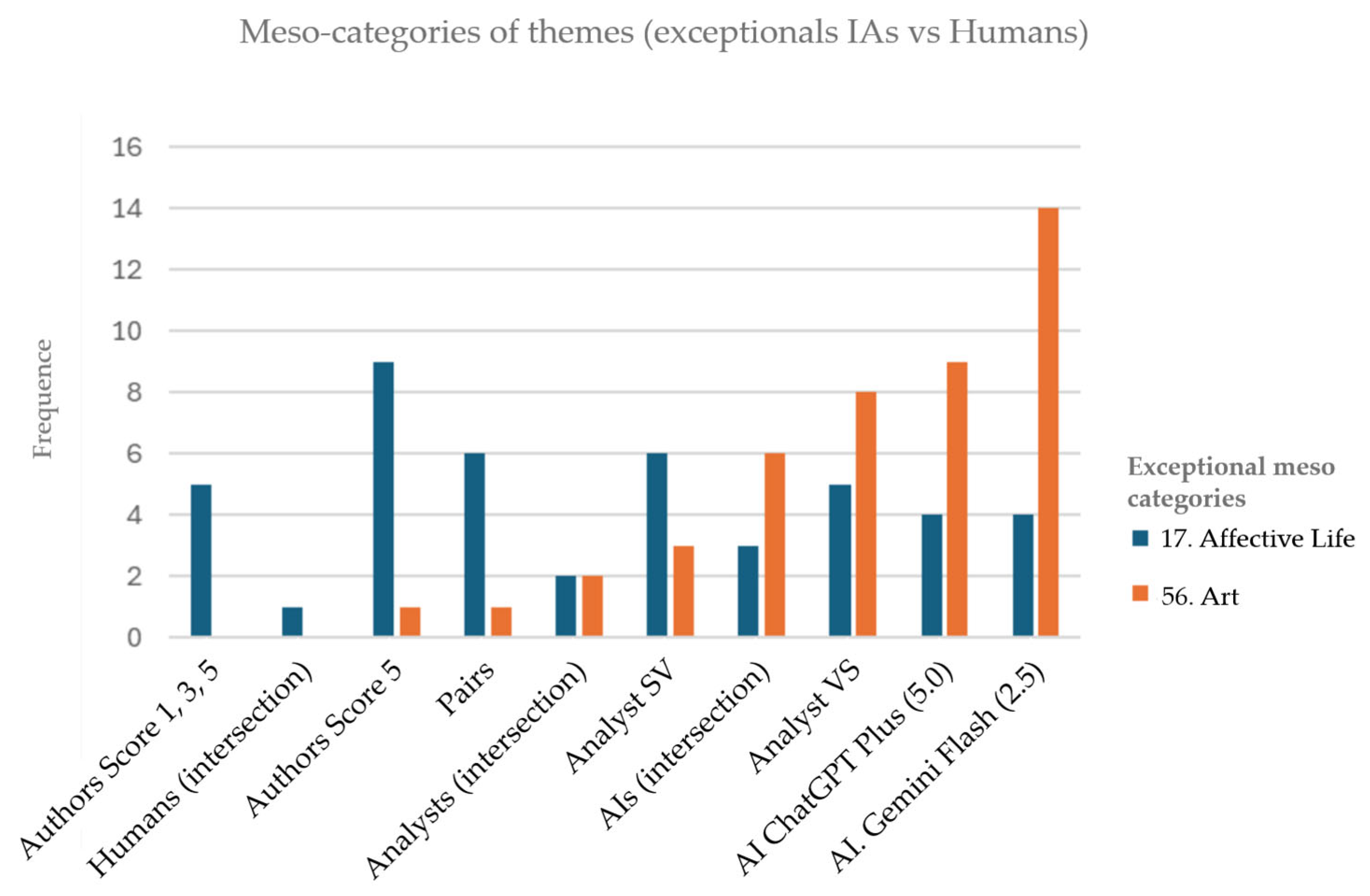
Figure 7 focuses on the frequency of use of the categories Affective Life and Art by different evaluating agents, including authors (by level of involvement), peers, human analysts, and AI systems, as well as the intersections between human and algorithmic classifications. The two categories were selected because they rank among the most frequent in the overall dataset, allowing for the observation of contrasts in their hierarchization across different classification regimes.
In AI systems, the highest volume of thematic attribution is observed for the Art category, which appears significantly more frequently than Affective Life in both ChatGPT and Gemini. Although Affective Life is not absent, it consistently occupies a secondary position in the classificatory hierarchy. The intersections between the two AI systems confirm this internal distribution, indicating a higher degree of convergence around the category Art.
These results do not allow for the isolated inference of underlying interpretive criteria. However, they indicate that Affective Life and Art function as differentiating poles within the categorical organization of agents, revealing the coexistence of multiple classification regimes within the analytical process.
Based on the observed micro- and meso-level patterns, the data indicate the empirical conditions under which meta-identity begins to take shape. These conditions are associated with the recurrence of specific classificatory categories across different agents, their relative stabilization in algorithmic outputs, and their increasing centrality in organizing thematic attribution. Rather than remaining descriptive, certain classifications acquire a structuring role within the dataset, guiding associations between works and influencing how thematic profiles are organized. At the macro level, these patterns suggest the emergence of stable classificatory references that begin to function as operational anchors within the broader system of categorization.

6. Results and Discussion

The systematic comparison among authors, peers, human analysts, and AI systems confirms the study’s empirical basis and sociological implications. Results reveal more than “natural” cultural plurality; they show distinct regimes of meaning organization. These differences become asymmetric when certain classifications function as infrastructural references for mediation, visibility, recommendation, and thematic association. The central result, therefore, is not to identify “who is right,” but to understand how different regimes of reading produce, hierarchize, and stabilize distinct classificatory layers, and how this stabilization gives rise to an operative model that functions, in practice, as a pragmatic identity of the content and, by extension, of its authors within the digital ecosystem [4,7,8,15,24,25,26,27,28,30,44].
Methodologically, the quantitative indicators in this section are analytical descriptors of patterns emerging from qualitatively coded data, rather than explanatory or inferential measures. This aligns with mixed-methods approaches [33] that use quantification to compare and visualize regularities in complex objects without adopting a positivist status of proof or causal validation. The discussion is organized across three articulated analytical planes: micro level (structural differences in regimes of textual and semantic production), meso level (patterns of thematic hierarchization, categorial bias, and agreement), and macro level (processes of categorial stabilization with operational and governance effects). This articulation makes it possible to interpret how algorithmic classifications cease to be mere descriptions and become active symbolic infrastructures that produce durable effects on cultural circulation.

6.1. Structural Divergence and Semantic Regimes (H1, H2, H9)

The data consistently confirm the hypothesis of systematic divergence between human and algorithmic classifications (H1). This divergence manifests across multiple analytical levels: in the low semantic similarity between texts produced by humans and AI systems; in the recurrent reorganization of thematic hierarchies; and in the formation of distinct semantic spaces. Authors and peers share the largest common interpretive space, whereas AI systems produce internally coherent interpretations that remain misaligned with situated human readings. This divergence is neither episodic nor random but structural, resulting from distinct reading regimes: contextual, relational, and experiential in the human case; correlational, cumulative, and operational in the algorithmic case. Thus, H1 serves as the article’s structuring hypothesis.
Semantic similarity analyses reveal that authors and peers share the largest common semantic space, analysts occupy an intermediate interpretive position, and AI–human comparisons exhibit the lowest levels of cross-similarity. This indicates that AI systems do not fully operate within the same interpretive space mobilized by human agents. The coexistence of multiple algorithmic systems reduces absolute homogenization, but does not eliminate the structural asymmetry between human and algorithmic regimes (H9). Accordingly, H9 should be interpreted as a partially supported hypothesis: differences observed among analyzed systems indicate classificatory variation, but they do not eliminate structural asymmetry between human and algorithmic regimes.
It is important to acknowledge a methodological asymmetry in the informational layers available to different agents. While differential access contributes to variance, the structural pattern of divergence—characterized by semantic compression and categorical stabilization in AI outputs—indicates a distinct operational regime rather than a mere informational deficit. Human agents had access to audiovisual, narrative, and contextual dimensions that AI systems could not process, as they operated exclusively on textual metadata. Consequently, the results should be interpreted as comparisons of classification patterns under distinct but methodologically controlled conditions, rather than as measures of algorithmic ‘accuracy’ or ‘error’. The persistence of systematic divergence despite controlled inputs reinforces H1: the gap is not just in data access, but in the logic of meaning organization.
This informational asymmetry raises an interpretive question: whether the observed divergences result primarily from unequal access to informational layers or from distinct interpretive regimes. Both mechanisms are likely present, but their effects appear uneven. Human agents accessed audiovisual cues—tone, rhythm, montage, and visual metaphor—that were unavailable to AI systems operating solely on textual metadata, which may explain lower convergence in categories that depend on experiential interpretation. However, divergence persists even when informational conditions are partially controlled: AI systems processing identical textual materials still produced systematically different thematic hierarchies. This pattern suggests that informational asymmetry amplifies variance but does not fully explain it, as algorithmic classification remains structurally oriented toward semantic compression and categorical stabilization.
The analysis of relative category frequency and thematic hierarchization confirms the hypothesis of algorithmic concentration in broad, generic categories (H2). Although humans and AI systems mobilize similar sets of categories, algorithmic systems tend to group classifications into highly aggregative macrocategories such as art, reflection, biography, and everyday life. This concentration is closely associated with semantic compression: texts produced by AI systems exhibit high semantic density but low internal variability, indicating interpretive regularization oriented toward reuse and operational predictability. Analytically, H2 addresses the general structural mechanism of classificatory aggregation. Lexical and semantic richness data show that AI systems produce lengthy, semantically dense texts with low internal variability. This indicates a regime of semantic compression and regularization, in which multiple meanings aggregate into broad, reusable categories. At the micro level, ChatGPT Plus displays significantly higher lexical richness and length than human agents, while Gemini exhibits a more restrained pattern. In contrast, humans produce shorter texts with greater interindividual variability, highlighting structural differences between discursive regimes.

6.2. Thematic Displacement and Sensitive Themes (H3)

The data also support the hypothesis of relative underrepresentation of socially sensitive or normatively complex themes (H3), understood not as exclusion but as a displacement of centrality. Themes associated with social conflicts, inequalities, political disputes, or marginalized experiences remain present in algorithmic classifications, but tend to occupy less central positions when compared to human classifications. This result confirms the formulation of H3: algorithmic classification reorganizes the symbolic landscape through aggregation, favoring transversal and abstract categories, which reduces the relative visibility of themes that depend on dense contextualization. It is therefore a structural effect of hierarchization, not of censorship or explicit normative filtering.
This phenomenon aligns with the operational logic articulated by contemporary large language models, which describe their own classificatory behavior as structurally oriented toward abstraction and semantic stabilization [23,46]. In practice, this architectural preference tends to privilege transversal categories, thereby indirectly minimizing socially or institutionally tensioned framings in favor of lower-friction interpretations. Within this framework, the tendency of AI systems to synthesize or dilute socially sensitive themes becomes particularly visible when content mobilizes the categorization of social or institutional groups. In such cases, AI systems recurrently rely on broader-resolution categories—such as Art—which function as devices of interpretive compression. This shift does not eliminate human meanings but displaces them to secondary positions, weakening dimensions such as labor, social conflict, territory, or memory.
The macro-category analysis indicates that AI systems tend to privilege axes of greater symbolic abstraction, while humans maintain greater thematic differentiation. This classificatory tendency does not necessarily constitute censorship, but rather a reorganization of the symbolic landscape, with direct implications for circulation, visibility, and audience association (H4). The largest areas of intersection between human and AI classifications occur in categories such as Environmental, Mental Health, Pandemic, and Poetry and Essay. In contrast, Art and Cultural display the smallest overlaps. In some cases, asymmetries in category frequency correspond to low intersection, as observed with Art, which is heavily overused by AI systems and underused by human agents. In other cases, low intersection results not from frequency imbalance but from divergent attribution, as in the Cultural category, which is used with similar frequency by humans and AI systems but applied to different films.
Taken together, these patterns indicate that AI systems actively privilege more abstract and aggregative interpretive axes, operating through processes of semantic regularization and compression rather than simply redistributing themes already mobilized by human agents. Human agents, by contrast, tend to differentiate closely related thematic domains—such as affective, cultural, political, and social dimensions—producing more fragmented but situated classifications rooted in experiential and social reference frames.
This distinction does not reflect an analytical limitation on the part of human agents, but the operation of different interpretive regimes. In this sense, the combined evidence reinforces H3, suggesting that algorithmic systems contribute to the reorganization of thematic centrality, with direct implications for how socially sensitive or context-dependent themes are positioned within classificatory hierarchies and, consequently, for how content is rendered visible in algorithmically mediated environments.

6.3. Categorical Stabilization and Infrastructural Governance (H4, H5, H8)

The hypothesis of categorical stabilization as a dominant reference (H4) finds strong empirical support. The data show that certain categories assigned by AI systems tend to persist over time, maintain consistency across different algorithmic systems, and reappear as central markers in subsequent classifications. This stabilization does not stem from interpretive consensus, but from procedural regularization. The relatively higher levels of formal agreement between analysts and AI systems, when compared to authors and peers, indicate that stability is produced by mechanisms of abstraction and standardization. This finding constitutes the sociological turning point of the study, as it demonstrates how classification ceases to be a mode of reading and comes to operate as a symbolic infrastructure.
Agreement data complement this picture by showing greater stability at Theme 0 and a progressive decline across secondary themes, indicating structural limits to fine-grained categorization. Krippendorff’s alpha values reinforce that the stabilization observed between analysts and AI systems derives from procedural regularization rather than from social consensus. Across all groups, absolute agreement remains low, with coefficients below 0.30, indicating substantial interpretive variability in thematic categorization. Relative differences among groups are nonetheless observable. Human analysts and AI systems display higher α values than authors and peers, suggesting more stabilized classificatory patterns. Authors and peers exhibit the lowest coefficients, reflecting greater internal dispersion in their categorizations. These differences must be interpreted in light of the unequal epistemic roles and data volumes across agent groups. Accordingly, the relative proximity observed between analysts and AI systems should not be interpreted as analytical or cognitive equivalence. For analysts, higher agreement reflects methodological calibration and shared analytical criteria; for AI systems, it results from automated processes of categorical regularization and semantic compression.
The results confirm the hypothesis that technical parameterization operates as an indirect mechanism of symbolic governance (H8). Algorithmic classification, by guiding future associations, presumed audiences, and networks of similarity, produces effects equivalent to editorial decisions, without such decisions being explicitly articulated as such. This finding reinforces the interpretation of algorithmic governance as an infrastructural phenomenon: the regulation of symbolic circulation occurs through cumulative technical parameters rather than through discrete normative interventions. The implications of these classificatory processes extend beyond the initial act of categorization; the output actively reshapes the dynamics that produced it. Although this study does not measure real-time engagement metrics, the stabilization of categories observed across AI systems suggests a capacity for retroaction inherent to platform environments. Once stabilized, algorithmic classifications modulate performative dynamics by influencing visibility and retention through recommendation clusters; they reshape interactional dynamics by determining which audiences encounter the content; and they inform executive dynamics by signaling which thematic profiles are systematically reinforced. This cyclical relationship underscores the infrastructural nature of meta-identity: classifications function not only as descriptive labels but as regulatory mechanisms that modulate symbolic circulation over time.
The hypothesis concerning the structural influence of classifications on visibility and circulation (H5), in turn, remains at the inferential level. The study demonstrates the structural capacity of algorithmic classification to modulate symbolic circulation but does not directly measure effects on reach, engagement, or recommendation within proprietary platforms. This limitation is explicitly acknowledged and preserves the analytical integrity of the work. The findings provide structural evidence supporting H5’s theoretical premises, although direct behavioral effects on platforms fall outside the current scope.

6.4. Opacity, Asymmetry, and Contestability (H6, H7)

The hypotheses concerning opacity (H6) and the amplification of power asymmetries (H7) are confirmed at the structural level. Although the study does not empirically observe individual attempts at contestation, the data and the methodological design demonstrate that the criteria of algorithmic categorization remain inaccessible to the classified subjects. Categorization criteria remain inaccessible, establishing interpretive barriers that prevent subjects from decoding algorithmic logic. This restricts cognitive autonomy, as subjects cannot understand how their content is being translated into data.
The practical impossibility, under current platform conditions, of editing or correcting the classificatory models that stabilize as operational references entails a persistent asymmetry between platforms and content producers. The lack of accessible tools for inspection or correction converts technical opacity into a permanent institutional disadvantage. This sustains a persistent asymmetry in which the platform’s ‘right to classify’ overrides the producer’s ‘right to contest’, confirming a structural imbalance of power. From a transparency perspective, these findings highlight risks—such as misrepresentation and asymmetrical power—while offering analytical opportunities to trace how infrastructures govern cultural visibility at scale. Under these conditions, the opaque stabilization of probabilistic interpretations transforms into meta-identities that materially affect audiences, peers, and authors. The lack of contestation mechanisms limits authors’ capacity to intervene in the categories that define them, corroborating H6 (opacity imposes epistemic limits on understanding classifications) and H7 (the absence of contestation mechanisms amplifies structural power asymmetry between platforms and producers).
Transparency in algorithmic mediation is now a consolidated regulatory requirement. In Europe, the GDPR establishes rights to information and accountability in automated decisions [47]. The Digital Markets Act ensures fairness by addressing the power of platform gatekeepers [48]. More recently, the AI Act introduced a governance framework that requires transparency by design and imposes risk-based obligations [49]. These regulatory developments are aligned with broader strategic frameworks of the European Union, which explicitly link digital governance, security, and the protection of democratic values in algorithmically mediated environments [50]. Specifically, Article 50 mandates transparency of origin, requiring that users be informed when interacting with AI or synthetic content [49]. This obligation preserves “contextual awareness,” mitigating risks of deception. By distinguishing process transparency from origin transparency, regulation reinforces the idea that democratic accountability depends on recognizing the nature of the agent involved. However, our findings suggest that regulatory frameworks focused solely on transparency of origin remain insufficient: the central sociological problem lies not in knowing that AI-classified content, but in understanding how stabilized classificatory outputs acquire infrastructural power independent of human recognition or contestation. See Appendix J for the consolidated overview of the hypotheses mobilized in the study and the empirical observations supporting them.

6.5. Meta-Identity as an Empirically Observable Outcome

Based on the combined micro- and meso-level patterns, this study identifies the conditions under which meta-identity becomes empirically observable. It emerges when classificatory categories are: (i) repeatedly mobilized over time; (ii) stabilized across different algorithmic systems; (iii) operationalized to guide decisions independently of authorial intent; and (iv) embedded in opaque infrastructures that limit contestability. Under these conditions, classifications shift from descriptive representations to prescriptive roles within digital platforms. They inform governance mechanisms that modulate access, reputation, and visibility within platformed environments, transforming probabilistic outputs into durable sociotechnical constructs.
The production of meta-identity through algorithmic classification is not a neutral process but a sociotechnical form of mediation with implications for how meaning, visibility, and social positioning are organized within digital environments. Opaque classificatory regimes limit the possibility of scrutiny and contestation, as the categories through which content and actors are interpreted remain largely inaccessible to those affected by them. In this sense, transparency functions not merely as enlightenment, but as a condition of digital sovereignty, safeguarding human agency against infrastructural processes that operate below the threshold of awareness to organize and stabilize meaning.
Simultaneously, this research reveals analytical and political opportunities. Systematic comparison of human and algorithmic regimes reveals patterns of symbolic governance that are often naturalized or mystified as “hermetic” structures. By showing that algorithmic mediation reconfigures human interpretation infrastructurally, the study shifts the debate from a “human versus machine” dichotomy toward an analysis of how meaning stabilizes. In this context, responsibility cannot be displaced onto technical systems alone, but must be situated at the level of executive and institutional decision-making. The classificatory logics that structure platform environments are the result of strategic choices and, as such, should be increasingly subject to normative frameworks and public accountability, rather than being driven exclusively by economic imperatives or by ideological orientations confined to private interests. This reinforces the need for public debate on sociotechnical transparency and platform regulation.
Finally, the study demonstrates that interpretive divergences are central sociological data when tested systematically across multiple agents and layers. By articulating theories of classification, identity, and governance through a comparative design, the research provides methodological tools for understanding how AI reorganizes contemporary symbolic space. It reveals that AI produces durable social effects even without direct access to the internal architectures of digital platforms. This finding has implications beyond the specific empirical context examined here: if algorithmic classification produces stabilizing effects on meaning and visibility through controlled simulation, then the effects within actual platform environments—where classifications directly determine recommendation, monetization, and circulation—may be substantially more consequential for authors, audiences, and the broader cultural ecosystem.

Author Contributions

Conceptualization, A.H.F., A.C.T. and C.M.B.; methodology, A.H.F.; software, A.H.F. and H.F.C.; validation, C.M.B., R.R.-A., Á.A.C. and H.F.C.; formal analysis, A.H.F. and H.F.C.; investigation, A.H.F. and A.C.T.; resources, A.H.F., A.C.T. and C.M.B.; data curation, A.H.F., A.C.T., S.V. and V.O.S.; writing—original draft preparation, A.H.F. and A.C.T.; writing—review and editing, A.H.F., A.C.T., C.M.B., R.R.-A. and Á.A.C.; visualization, A.H.F., A.C.T. and H.F.C.; supervision, C.M.B., A.H.F., R.R.-A. and Á.A.C.; project administration, C.M.B. and A.H.F.; funding acquisition, C.M.B. and A.H.F. All authors have read and agreed to the published version of the manuscript.

Funding

This research was funded by Fundação para a Ciência e a Tecnologia (FCT), I.P., through national funds, within the scope of the PRR project, grant number 2024.07707.IACDC. The publication fee (APC) was co-funded by National Funds through FCT—Fundação para a Ciência e a Tecnologia, under the project UID (5021/2025).

Institutional Review Board Statement

The original data collection from which this study derives was reviewed and approved by the Ethics Committee of NOVA FCSH (Project identification code CE-NOVA_FCSH_2025/059) on 22 December 2025. The approved protocol covered the collection, processing, anonymization, and research use of participant-generated data within the context of audiovisual workshops. The present study constitutes a secondary, non-interventional analysis based exclusively on anonymized and aggregated data from this approved project. As such, it did not involve direct interaction with human participants or new data collection procedures. The study was conducted in accordance with applicable national and international ethical guidelines for social sciences research, including the principles of the Declaration of Helsinki.

Informed Consent Statement

Not applicable. The present study is based exclusively on a secondary analysis of previously collected anonymous and aggregated data from an approved project. It did not involve direct human participation, recruitment, contact with participants, or new data collection. Accordingly, no informed consent procedures were required for this specific study. The original data collection from which this study derives was reviewed and approved by the Ethics Committee of NOVA FCSH (CE-NOVA_FCSH_2025/059) on 22 December 2025.

Data Availability Statement

The data presented are available on request from the corresponding author upon reasonable request.

Acknowledgments

During the preparation of this manuscript, all the authors and acknowledged analysts agreed to used large language models, including ChatGPT Plus (ChatGPT-5.0) for text revision and language refinement, and Qwen3.5-Plus for analytical support and controlled simulations, as well as Grammarly Pro for language enhancement. All AI-generated outputs were critically reviewed, contextualized, and edited by the authors, who take full responsibility for the content and scholarly integrity of this publication.

Conflicts of Interest

The authors declare no conflicts of interest. The use of commercial software tools (including ChatGPT Plus (GPT-5.0), Qwen3.5-Plus, and Grammarly Pro) was limited to research support and manuscript preparation and does not constitute a financial or commercial relationship that could be construed as a potential conflict of interest.

Abbreviations

AcronymDefinition
AIArtificial Intelligence
DNAIDigital Narratives and Algorithmic Identities
GDPRGeneral Data Protection Regulation
LLMLarge Language Model
MASIMeasurement of Agreement on Set-Valued Items
MLMachine Learning
NUPEPANúcleo de Pesquisa em Produção Audiovisual (Brazil)
USPUniversidade de São Paulo
ICNOVAInstituto de Comunicação da Nova
FCTFundação para a Ciência e a Tecnologia
UCLMUniversity of Castilla-La Mancha
SVAnalyst SV (human analyst identifier)
VSAnalyst VS (human analyst identifier)
H1–H9Research Hypotheses 1 to 9
Theme 0 (T0)Consolidated the main theme after thematic optimization
Theme 1 (T1)Primary theme
Theme 2 (T2)Secondary theme
Theme 3 (T3)Tertiary theme
Micro levelLevel of free textual interpretation
Meso levelLevel of standardized thematic categorization
Macro levelLevel of aggregated thematic macrocategories

Appendix A

Table A1. Dynamics and States of Meta-Identity: A Synthetic Framework.
DimensionCategoryDefinitionSource/OriginOperational Effect
DYNAMICS
(Input Vectors)
ExecutiveStrategic decisions by platform managers that define classificatory priorities and objectives.Platform governance/Corporate strategySets agenda for visibility, monetization, and content amplification or suppression.
InteractionalAccumulation of user-to-user interactions (likes, comments, shares, reports, follows).Social exchanges between usersShapes reputational standing and legitimacy within platform ecosystems.
AnalyticalConceptual models, typifications, and interpretive frameworks developed by researchers, analysts, or data scientists.Academic research/Professional categorizationProvides epistemic structures that inform algorithmic parameters and classification schemas.
NormativeLegal, regulatory, and ethical frameworks that constrain or enable classificatory operations.Legislation/Regulatory bodiesImposes procedural obligations (transparency, non-discrimination, contestability).
SomaticBiometric and bodily data (facial recognition, voice patterns, gaze, posture, medical records).Sensor pipelines/Biometric captureEnables identification and behavioral inference based on physical attributes.
PerformativeObservable attention and engagement metrics (watch time, retention, click-through rates).Behavioral signals/Attention metricsModulates visibility based on measurable performance indicators.
TransactionalEconomic and material exchanges (purchases, subscriptions, ad revenue, tipping).Financial flows/Market transactionsEmbeds economic hierarchies into classificatory infrastructure (e.g., “premium” vs. “standard” users).
AlgorithmicAutomated calculations, inferences, and pattern correlations executed by AI/ML systems.Computational processing/Model inferenceIntegrates and harmonizes all other dynamics into operational classificatory outputs.
STATES
(Temporal Modes)
OperationalActive, real-time instantiation of classificatory profiles that produce immediate effects on users and content.Live system processingDetermines current ranking, access, visibility, and recommendation outcomes.
ArchivalPreserved historical configurations of classificatory profiles stored for compliance, retargeting, or backtesting.Data storage/Log retentionEnables longitudinal comparison and potential reactivation of past classifications.
ReferentialProjective, teleological templates that define desired future user behaviors or profiles.Strategic modeling/Goal-settingGuides nudging mechanisms and behavioral induction toward platform objectives.
DocumentalFormalized, portable records generated upon request for auditing, reporting, or institutional communication.On-demand generationProvides a structured representation for scrutiny without converting probability into certainty.
Note: Adapted by the authors from [2], licensed under CC BY 4.0 (https://creativecommons.org/licenses/by/4.0/). Modifications: expansion of thematic categories, reorganization of classification structure, and inclusion of additional analytical dimensions. Original source: https://doi.org/10.1590/SciELOPreprints.13161.

Appendix B

This supplementary section presents additional analyses of interrater agreement in thematic categorization, providing empirical detail to support the results discussed in the main text.

Supplementary Analysis of Category Bias Across Agents

This supplementary figure presents the distribution of categorical bias across different groups of agents, measured as relative deviations in the use of thematic categories. The analysis complements the patterns of thematic centrality discussed in the main text (Figure 3. Relative Frequency of Film Classification by Different Agents) by examining how agents diverge from overall distributions when prioritizing specific themes.
Figure A1. Occurrence of Category Bias Across Different Groups of Agents.
Societies 16 00132 g0a1
The results reveal a non-random organizational structure in these deviations, which tends to configure two main interpretive clusters. On one side, authors and peers display similar bias profiles, characterized by convergent shifts within the same categories. On the other hand, analysts and AI systems exhibit patterns that are also close to one another, albeit with different magnitudes.
In the case of authors and peers, deviations concentrate in more situated, experiential, and narrative categories, such as those associated with affective life, culture, language, and representation, as well as lived everyday experience. When authors are compared more specifically with other agents, two additional tendencies become visible: the underutilization of family-related categories and the relative emphasis on dystopia, science fiction, and imagined futures. This configuration suggests an interpretive regime anchored in direct experience and proximity to the meanings produced by the works, in which thematic hierarchization reflects involvement, recognition, and identification with the analyzed content.
In contrast, analysts and AI systems tend to present positive deviations in more structural and transversal categories, such as art, reflection, biography, resistance and struggle, and everyday life, understood here as broad aggregative axes. Despite the formal similarity in the configuration of these profiles, this proximity should not be interpreted as semantic or cognitive equivalence between human analysts and algorithmic systems. In the case of analysts, such variations result from reflective, methodologically oriented, and potentially contestable procedures; in the case of AI systems, they derive from automatic processes of categorical regularization and stabilization.
The primary cleavage in categorical bias is therefore not simply between humans and AI, but between interpretive regimes oriented by lived experience (authors and peers) and those oriented by abstraction and systematization (analysts and AI systems). These supplementary results reinforce the interpretation advanced in the main text: differences between human and algorithmic classifications do not arise from the absence of shared categories, but from distinct modes of thematic hierarchization and stabilization.

Appendix C

Analysis of Extraordinary Values in the Classifications of Analysts and AI Systems

Below, we analyze the frequency of meso-category usage by each human analyst in comparison with the AI tool operated by that analyst.
Figure A2 highlights divergences in the frequency of meso-category usage—especially in extraordinary values—between the analyst who operated ChatGPT and ChatGPT’s own interpretation. This finding distances the hypothesis that the operator’s profile may have influenced the AI that he used.
Figure A2. Relative frequency of meso-category usage by agent type comparing Analyst SV vs. ChatGPT.
Societies 16 00132 g0a2
The same pattern can be observed in the following figure, which compares the frequency of meso-category usage by Analyst VS and Gemini, the tool she operated.
Figure A3. Relative frequency of meso-category usage by agent type comparing Analyst VS vs. Gemini.
Societies 16 00132 g0a3
The next figure presents a comparison between the two AI systems and the two human analysts, allowing observation of divergences between the human analysts and the AI systems, particularly at points with more discrepant values.
Figure A4. Relative frequency of meso-category usage by agent type comparing both analysts versus both AI systems.
Societies 16 00132 g0a4
The comparative analysis of meso-category usage frequencies shows that analysts’ values are closer to one another and diverge more significantly from those of the AI systems. This pattern is evident from the positive and negative peaks shown in the figure.
Table A2 presents the combinations of interpretations with extraordinary values (in the first and second positions), indicating the total number of occurrences in which classifications produced by different agents registered extraordinary values in these ranks. Of the nine occurrences of extraordinary interpretations produced by Analyst SV, six coincided with VS’s analyses, two with Gemini, and only one with ChatGPT, which he operated. Similarly, of the nine occurrences of extraordinary-frequency values of meso-category usage produced by Analyst VS, six coincided with her fellow analyst’s analyses and three with ChatGPT, which she did not operate.
Of the ten extraordinary frequency values for meso-category usage produced by ChatGPT, five matched those of the analyst who operated Gemini, and five matched Gemini’s own occurrences. Among the eleven occurrences of extraordinary values generated by Gemini, two coincided with those of Analyst SV, five with Analyst VS, and four with ChatGPT.
Table A2. Combinations of interpretations with extraordinary values.
1st Ext. Frequency Value2nd Ext. Frequency ValueOccur.
AI.AN < 1%AI.AN < 1%12
SV AnalystVS Analyst6
AI ChatGPT Plus (GPT-5.0) 1
AI Gemini 2.5 Flash2
VS AnalystSV Analyst6
AI ChatGPT Plus (GPT-5.0) 3
AI ChatGPT Plus (GPT-5.0) VS Analyst5
AI Gemini 2.5 Flash5
AI Gemini 2.5 FlashSV Analyst2
VS Analyst5
AI ChatGPT Plus (GPT-5.0) 4
51
Note. Elaborated by the authors.
This result indicates the existence of a shared human interpretive field that is stronger than any direct alignment between analysts and AI systems. Such convergence suggests that, despite individual differences, the analysts operate within the same reading regime, shaped by common theoretical, educational, and methodological reference points.
In contrast to this human interpretive pattern, co-occurrences between analysts and the AI systems each of them operated are residual. When analysts appear as the primary pole, direct co-occurrence with AI systems is infrequent (one to three occurrences), failing to establish a dominant pattern.
When AI systems occupy the leading positions in interpretation with extraordinary values, proximity to analysts occurs crosswise: both ChatGPT Plus (GPT-5.0), operated by Analyst SV, and AI Gemini 2.5 Flash, operated by Analyst VS, appear more frequently associated with the analyst who did not directly operate them. This pattern is incompatible with the hypothesis of a simple operator–AI mirroring bias.
These results allow for the empirical rejection of the control hypothesis that the extrapolations observed in algorithmic classifications derive from direct human steering, even when standardized procedures and prompts are used. This test reinforces the interpretation that such extrapolations are intrinsic to the systems themselves and to their internal algorithmic, analytical, and executive dynamics.
The cluster that was identified as IA.AN < 1% aggregates cases in which all agents—human and algorithmic—presented very similar values, ranging between 0% and 1% of relative frequency. It therefore constitutes a zone of low analytical differentiation, characterized not by substantive extrapolation but by the absence of thematic prominence for one or more agents. It thus functions as a regime of analytical indeterminacy rather than as a sociological outlier. For this reason, it does not interfere with the analysis of relational biases between analysts and AI systems and should be treated separately from the core interpretive dynamics.
The graph in Figure A5 presents data aggregated by agent type (Authors, Peers, and AIs). The first aspect that stands out is the high degree of proximity between authors and peers. Despite having analyzed different films (each workshop produces an average of 20 films, while each participant analyzes only three films produced by other groups in addition to the film produced by their own group), both groups participated in the same workshops, shared similar formative experiences, and produced substantially larger volumes of textual comments than analysts and AI systems. This combination of shared experience and high discursive density contributes to the stabilization of relative frequencies and to the convergence observed in their thematic distributions.
Figure A5. Relative frequency of meso-category usage by agent type comparing authors, peers, and AI systems.
Societies 16 00132 g0a5
AI systems, in turn, maintain a clearly distinct pattern even after aggregation. A consistent shift in thematic centrality can be observed toward more abstract, reflexive, and symbolically generalizing meso-categories, such as Art, Reflection, Everyday Life, and Resistance and Struggle. This behavior suggests that the divergence does not result from error or statistical instability, but rather from a systematic re-hierarchization of meaning produced by algorithmic processing.
Figure A6 extends previous analyses by introducing analysts as a distinct agent type, enabling a more fine-grained comparison among experiential interpretation, analytical mediation, and algorithmic classification. Positioned after the agent-level and aggregated comparisons, this visualization clarifies how analytical expertise reshapes, rather than overrides, the interpretative regimes identified earlier.
Figure A6. Relative frequency of meso-category usage by agent type comparing authors, peers, analysts, and AI systems.
Societies 16 00132 g0a6
The inclusion of analysts, however, reveals an intermediate interpretative profile. In categories strongly associated with experiential, cultural, and expressive dimensions, analysts remain closer to authors and peers, suggesting continued sensitivity to the films’ contextual and affective content. At the same time, analysts display partial convergence with AI systems in more abstract, reflexive, and normatively oriented meso-categories, such as Reflection, Art, Resistance and Struggle, Everyday Life, and Human Rights. This dual alignment indicates that analytical work introduces layers of abstraction and systematic framing while remaining anchored in human interpretative practices.
A possible explanation for this intermediate profile lies in the asymmetric access to interpretative resources and experiential contexts available to analysts. On the one hand, analysts had direct access to layers of audiovisual language—such as montage, framing, rhythm, sound effects, and narrative construction—that the AI systems used in this study, operating without multimodal inputs, could not directly process. This access likely anchors analysts closer to authors and peers in categories related to experiential, cultural, and expressive dimensions. On the other hand, analysts did not share the same formative and collaborative experiences as authors and peers within the workshops, nor did they engage with the films primarily as a space for peer feedback. Instead, they operated as specialists tasked with coding the full corpus of films as a coherent analytical set, aiming to produce research results. In this respect, their role partially aligns with that of AI systems, which also process the corpus as a whole under predefined analytical objectives rather than as situated participants in a shared creative process.
Importantly, even with the inclusion of analysts, AI systems retain a clearly differentiated pattern. Their distributions emphasize categories associated with semantic generalization, reflexivity, and symbolic abstraction, reinforcing the interpretation that algorithmic outputs are characterized by a re-hierarchization of meaning rather than by misclassification or statistical noise. The fact that analysts—despite their formal analytical role—do not fully align with AI patterns further supports the claim that algorithmic classification operates within a distinct interpretative regime.
Taken together, graphs from Figure A7 and Figure A8 make explicit a gradient of interpretation across agent types: from the experiential and densely grounded readings of authors and peers, through the mediating and systematizing role of analysts, to the abstracting and reordering logic of AI systems. In doing so, it strengthens the overall argument that the observed divergences across agents reflect structurally distinct modes of sense-making, rather than differences in competence, data quality, or analytical rigor.

Appendix D

Detailed Analysis of Illustrative Cases for the Agreement Test

This section qualitatively deepens a subset of films from the corpus in order to make observable, at the micro scale, the mechanisms that the quantitative results had already indicated at the meso scale: (i) the existence of a shared human interpretive field, albeit internally plural; (ii) the presence of systematic differences in AI systems; and (iii) the tendency of AI systems to reorder thematic hierarchies when converting discursive readings into operational classifications. The choice of a situated reading makes explicit how, in concrete cases, meta-identity forms precisely at the point where meaning ceases to operate as interpreted experience (human) and begins to operate as stabilized classificatory identity (algorithmic).
The selection of films followed an empirical-relational criterion, derived directly from the crossing of agents and combinations. Table A3 highlights two poles of high recurrence in the analyzed set: “56. Art,” as the theme with the highest occurrence in AI classifications, and “17. Affective Life,” as the most recurrent theme among humans (authors, peers, and analysts).
Table A3. Films with Divergent Classification Poles: Humans vs. AI Systems.
Movie NameThemeAIs. HumansAIsAnalystsAuthorsAuthors. PeersPeersHumansTotal
aCASA56. Art 1 1
30. Mem. and Heritage 1 1
12. Environmental 1 1
24. Poetry and Essay 1 1
Circo-Teatro Teleco: a coragem de resistir, insistir e prosseguir.09. Work and Craft 1 1 2
56. Art 1 1
18. Cultural 1 1
Restos de Intimidade17. Affective Life11111117
Ver(de) fora da natureza12. Environmental 111 3
56. Art 1
15. Urban Dynamics 11 1
Total 144424120
Note. Elaborated by the authors.
We therefore selected films that occupy a representative position among the illustrative cases of the different analytical levels observed thus far in the structure of the dataset: cases in which (a) there is a density of records distributed across multiple agents/combinations and (b) it is possible to clearly observe both human convergence and algorithmic reordering toward aggregative categories—especially Art. Accordingly, Restos de Intimidade, Circo-Teatro Teleco, Ver[de] Fora da Natureza, and aCASA were treated as points of analytical condensation, suitable for examining discrepancies between interpretive regimes and their effects on the production of an operational identity of the content.

Appendix E

Case-by-Case Analysis

  • Restos de Intimidade: Full Convergence When the Theme Is Directly Relational: In Restos de Intimidade, convergence is robust: humans and AI systems alike classify the film as Affective Life. Detailed qualitative analysis reveals a narrative device centered on reunion and dialogue between former partners, permeated by everyday memory, the processing of a breakup, insecurities, and an ending that reconfigures the symbolic continuity of the bond (the idea of “not being erased” from the other’s life). The most relevant explanation here is not that the AI “got it right,” but that the film offers a directly relational thematic axis, explicitly articulated through speech and interactional dynamics, with low metaphorical mediation. The centrality of affect is difficult to displace without a loss of descriptive coherence. Comparatively, this case functions as a control: when a film’s semantics are strongly anchored in explicit interaction, the likelihood of algorithmic reordering decreases and convergence increases.
  • Circo-Teatro Teleco: Human Plurality and Algorithmic Displacement Toward “Art”: In Circo-Teatro Teleco, complementary data reveal both internal human divergence and a clearer divergence from AI systems. Authors tend to classify the film as Cultural, while peers and analysts privilege Work and Craft; AI systems, in turn, shift the axis toward Art. Detailed analysis supports all three human readings as plausible: there is biography and tradition (cultural), the materiality of itinerant labor (assembly/disassembly, costs, precarity), and the performative dimension of artistic practice. What the data reveal is that AI systems tend to stabilize meaning along the path of least categorical friction. The Art category absorbs tradition, biography, and performance, but weakens the socioeconomic and labor dimensions emphasized by peers and analysts. Thus, the divergence here is less about “what the film is about” and more about “what comes to operate as its core”: the algorithmic regime downgrades the materiality of craft and elevates an aggregative symbolic form.
  • Ver[de] Fora da Natureza: From Human Environmental/Urban Readings to Algorithmic Formal-Essayistic Interpretation: In the short film Ver[de] Fora da Natureza, authors and peers converge on the Environmental category, while analysts emphasize Urban Dynamics; AI systems, in contrast, prioritize Art. Detailed analysis indicates that the film is constructed as a sensory observation of the residual presence of nature within the built environment, focusing on textural contrasts and inviting viewers to “see” green as a perceptual and political problem of urban space. Once again, human readings appear as variations within the same interpretive field: the environment is approached as “environmental within the urban”, and the urban is approached as “urban reconfiguring the natural”. The AI, by contrast, tends to stabilize the film through formal abstraction—poetic language, contemplation, and visual inquiry—thereby reordering the interpretive core around Art. What the algorithm gains is generalization capacity; what it loses is the contextual anchoring (environmental and territorial) that human readings preserve as central.
  • aCASA: Maximum Divergence and “Art” as Algorithmic Resolution: The film aCASA presents the greatest degree of human dispersion. Authors classify it as Poetry and Essay; peers emphasize the Environmental category; analysts privilege Memory and Heritage; and AI systems assign it to Art. Detailed qualitative analysis helps explain why human divergence is legitimate: the film operates through metaphors (house-as-body), poetic narration, and musical performance, organizing the home as a sensitive archive of histories, secrets, and temporality. The authorial reading (poetry/essay) captures form; the peers’ reading (environmental) may arise from how space is filmed and signified as “dwelling”; and the analytical reading (memory/heritage) identifies the house as a device for archiving and inscribing lived experience. Faced with this plurality, the AI selects the most stable label: Art. This case most clearly reveals the mechanism observed across the dataset: the greater the symbolic mediation and polysemy, the stronger the tendency for the algorithmic system to collapse semantic layers into an aggregative category.

Appendix F

Appendix F.1. Methodological Synthesis

The methodology presented enables empirical observation of how diverse human interpretations are translated, aggregated, and stabilized into operational classifications. By articulating multiple agents, levels of analysis, and normalization procedures, the methodological design provides a solid basis for investigating the production of meta-identities as a sociotechnical phenomenon.
It is important to distinguish the categorial system, analytically mobilized in this study—as a methodological instrument for describing and comparing the meanings attributed to the films—from the concept of meta-identity developed in previous works. The categorization employed here operates within the research process itself, based on explicit, traceable, and open-to-analytical-revision interpretive procedures, functioning as a device for translating and comparing human interpretations with automated inferences.
Meta-identity, in turn, refers to an infrastructural model of classification produced outside the context of empirical investigation, embedded in platform environments and operationalized through algorithmic systems of mediation. While its formation draws on multiple interacting dynamics—performative, interactional, normative, analytical, and others—the consolidation of meta-identity ultimately depends on executive decisions that define the parameters under which classificatory systems operate. These decisions, taken by platform decision-makers, determine which forms of content, associations, and behaviors may be amplified or suppressed in recommendation and visibility regimes as well as which patterns are reinforced or discouraged as desirable within the platform environment. Rather than arising solely from cumulative aggregation, meta-identity is constituted through the recurrent activation, stabilization, and systemic integration of classificatory decisions that acquire prescriptive force under conditions of decisional opacity and limited contestability, producing durable effects on visibility, association, and behavioral modulation without the possibility of direct negotiation by the classified subjects.

Appendix F.2. Ethical Considerations and Limitations

All participants were informed of the formative and analytical objectives of the activities at the time of their enrollment in the workshops, as well as of the commitment to treat data in an anonymized manner and to prioritize aggregated patterns over individual evaluations.
Among the limitations are the corpus’s situated nature, the impossibility of direct access to proprietary platform models, and the reliance on algorithmic classifications inferred from controlled analytical simulations.
Independent empirical studies of algorithmic classification on proprietary platforms inevitably face the dilemma between total opacity and controlled analytical simulation; this work explicitly opts for the latter, acknowledging its limits and the heuristic gains. These limitations, however, do not compromise the study’s central objective: to analyze the sociological effects of algorithmic classification rather than to audit specific platforms’ technical operations.

Appendix G

Relationship Between Semantic Richness, Semantic Similarity, and Textual Volume

This appendix provides a detailed examination of the relationships among semantic richness, semantic similarity, and textual volume in descriptions produced by authors, peers, analysts, and AI systems. The figure plots semantic richness against semantic similarity while simultaneously incorporating the length of the texts generated by each agent, enabling a comparative assessment of discursive patterns across human and algorithmic regimes.
Figure A7. Relationship between semantic richness and semantic similarity at the micro level. Elaborated by the authors.
Societies 16 00132 g0a7
Across all groups, the association between semantic richness and semantic similarity is weak, as indicated by consistently low coefficients of determination (R2). This suggests that increases in semantic richness do not correspond to higher levels of interpretive convergence. In other words, producing more lexically and semantically dense descriptions does not imply greater alignment in meaning across agents.
Authors and peers are characterized by shorter textual outputs combined with greater dispersion across both semantic dimensions. Authors display a marginally positive slope between richness and similarity, but the relationship remains weak and statistically insignificant. Peers show a similar pattern, reinforcing the interpretation that human-produced descriptions tend to privilege situated, plural, and heterogeneous meaning-making rather than convergence.
Analysts generate longer texts than authors and peers, with descriptions clustering around medium-to-high values of semantic richness and similarity. Despite this concentration, no strong relationship emerges between these dimensions, indicating that extended analytical elaboration does not necessarily translate into increased semantic alignment.
AI systems stand out for their substantially higher textual volume and consistently elevated levels of semantic richness. However, this semantic expansion is not accompanied by a proportional increase in semantic similarity. Instead, AI-generated texts exhibit patterns of internal stabilization, in which semantically dense outputs are organized around broad, reusable categories rather than convergent interpretations.
Taken together, these distributions show that semantic richness and semantic similarity operate as analytically distinct dimensions. Human agents exhibit higher interindividual variability and context-dependent interpretation, whereas AI systems combine high semantic density with internal regularization. This supports the interpretation that humans and AI systems operate under different regimes of meaning production: the former privileging plural and situated variation, and the latter favoring semantic compression and classificatory stabilization.

Appendix H

Agreement Rates by Theme

Additional analyses examine agreement rates across hierarchical levels of thematic attribution (Theme 0, Theme 2, and Theme 3). Across all agent groups, Theme 0—the central thematic axis of the films—shows the highest agreement, followed by a progressive decline in agreement for secondary and peripheral themes. This gradient demonstrates that interpretive stability diminishes as categorization moves away from the core semantic structure of the works, suggesting structural limits to fine-grained thematic differentiation.
Figure A8. Agreement Rates by Theme (0, 2, 3).
Societies 16 00132 g0a8
Although peers and authors show higher agreement at the Theme 0 level, analysts and AI systems exhibit more pronounced reductions in agreement for secondary themes. This behavior suggests that, while there is broad consensus on identifying the films’ main thematic orientation, the attribution of secondary themes involves greater interpretive indeterminacy, regardless of the evaluator.
Taken together, these results indicate that agreement in thematic categorization is shaped by both thematic centrality and the infrastructural constraints of classification systems. As argued by Bowker and Star [45], categories acquire social power through repetition, standardization, and reuse, producing durable classificatory effects that operate independently of the semantic richness of individual interpretations.

Appendix I

Table A4. Mesocategories Grouped into Thematic Macrocategories.
MacrocategoryMesocategory
A. Public Health, Safety, and Crises02. Violence
07. Health
08. Pandemic
11. Mental Health
41. Environmental and Social Crises and Disasters
B. Environment, Territory, Urban Issues, and Housing12. Environmental
15. Urban Dynamics
16. Mobility
33. Agrarian and Territorial Issues
44. Rural Life, Life in the Countryside
48. Housing and Dwelling
C. Economy, Work, and Consumption09. Work and Craft
21. Social and Economic Structures
26. Society and Consumption
D. Politics, Justice, Rights, and Conflicts03. Politics
10. Nationality and Nationalism
27. Territoriality and Colonialism
28. Human Rights
29. Prison System
42. Disinformation, Populism, and Polarization
59. Resistance and Struggle
E. Education, Culture, Memory, and Language14. Education and Socialization
18. Cultural
24. Poetry and Essay
30. Memory and Heritage
31. Language and Representation
F. Technology, Media, and Imagined Futures23. Technology, Innovation, and Society
37. Sound and Soundscape
40. Dystopia, Science Fiction, and Imagined Futures
G. Identities, Body, and Social Markers01. Gender-based Violence and Prejudice
04. Race and Racism
05. Gender and Sexuality
35. Body, Performance, and Expression
38. Indigenous Peoples and Traditional Communities
46. Women, Femininity, and Feminism
63. People with Disabilities
H. Private Life, Affections, and Everyday Life13. Family
17. Affective Life
19. Recreation, Leisure, and Entertainment
45. Everyday Life
49. Loneliness
55. Friendship
64. Motherhood
I. Spirituality, Mourning, and Reflection06. Religion, Spirituality, and Cosmologies
25. Longing, Grief, or Loss
36. Food and Traditional Treatments
52. Reflection
53. Dream and Fantasy
56. Art
57. Biography
Note. Elaborated by the authors.

Appendix J

Table A5 provides a consolidated overview of the hypotheses mobilized in the study and the empirical observations supporting them, highlighting the differentiated analytical status of confirmed, partially supported, and inferential hypotheses.
Table A5. Overview of hypotheses and empirical observations.
Hypoth.Hypothesis (Synthetic Formulation)What the Article Observed
H1Algorithmic classifications tend to diverge systematically from classifications produced by human authors and peers.A structural and recurrent divergence was observed between human interpretations and algorithmic classifications, manifested in low semantic similarity, recurrent reordering of thematic hierarchies, and the operation of distinct interpretive regimes.
H2This divergence is associated with algorithmic concentration in broader, more generic categories, to the detriment of more specific, situated classifications.Algorithmic systems tend to concentrate classifications in highly aggregated macrocategories, reducing internal variability and displacing thematic centrality, without excluding specific categories.
H3Socially sensitive or normatively complex themes tend to occupy less central positions in algorithmic classifications.Themes related to social conflict, inequality, political dispute, and marginalized experiences remain present but occupy less central positions, as a structural effect of aggregation and hierarchical reorganization rather than exclusion or censorship.
H4Algorithmic categories tend to stabilize over time and across systems, operating as dominant classificatory references.Certain categories maintain consistency across different AI systems and recur as central markers throughout the 2020–2025 corpus, indicating procedural regularization rather than interpretive consensus.
H5Algorithmic classification operates as a structural mechanism capable of influencing visibility and symbolic circulation, even in the absence of direct measurement of platform effects.The study demonstrates the structural capacity of classification to modulate symbolic circulation but does not directly measure effects on reach, engagement, or recommendation within proprietary platforms. The findings provide structural evidence supporting H5, although direct behavioral effects within platform environments fall outside the current scope.
H6The opacity of algorithmic categorization criteria imposes epistemic limits on authors, hindering their capacity to interpret or cognitively map the classifications attributed to their works.Categorization criteria remain inaccessible, establishing interpretive barriers that prevent subjects from decoding the algorithmic logic. This restricts their cognitive autonomy, as they cannot understand how their content is being translated into data.
H7The absence of formal, institutionalized mechanisms for contestation at the structural level reinforces the structural power asymmetry between platforms and content producers.The lack of accessible tools for inspection or correction converts technical opacity into a permanent institutional disadvantage. This sustains a persistent asymmetry in which the platform’s ‘right to classify’ overrides the producer’s ‘right to contest’, thereby confirming a structural power imbalance.
H8The observed technical parameterization of algorithmic systems operates as an indirect mechanism of governance of symbolic circulation, manifest through the consistency of their classificatory outputs.The research shows that the technical logic of these models—evidenced through the recurrence of specific patterns—functions as a form of latent parameterization. Even without direct access to internal weights, the stability of the outputs indicates a technical orientation that effectively governs visibility and thematic associations, acting as an indirect editorial mechanism.
H9The coexistence of multiple AI systems may reduce interpretive homogenization, without eliminating structural asymmetry between human and algorithmic regimes.Differences among AI systems indicate classificatory variation and a reduction in absolute homogenization, but structural asymmetries between human and algorithmic regimes persist; the hypothesis is partially supported.
Note. Elaborated by the authors.

References

  1. Gillespie, T. The Politics of “Platforms”. New Media Soc. 2010, 12, 347–364. [Google Scholar] [CrossRef]
  2. Ferreira, A.H.; Trevisan, A.C. Meta-Identidade e Plataformas Digitais: Disputas por Transparência e Controle na Criação Algorítmica das Identidades pelos Sistemas de IA. SciELO Preprints 2025. [Google Scholar] [CrossRef]
  3. Covington, P.; Adams, J.; Sargin, E. Deep Neural Networks for YouTube Recommendations. In Proceedings of the 10th ACM Conference on Recommender Systems, Boston, MA, USA, 15–19 September 2016; ACM: New York, NY, USA, 2016; pp. 191–198. [Google Scholar] [CrossRef]
  4. Gillespie, T. The Relevance of Algorithms. In Media Technologies: Essays on Communication, Materiality, and Society; Gillespie, T., Boczkowski, P.J., Foot, K.A., Eds.; MIT Press: Cambridge, MA, USA, 2014; pp. 167–194. [Google Scholar] [CrossRef]
  5. Hill, R.K. What an Algorithm Is. Philos. Technol. 2016, 29, 35–59. [Google Scholar] [CrossRef]
  6. Noble, S.U. Algorithms of Oppression: How Search Engines Reinforce Racism; New York University Press: New York, NY, USA, 2018. [Google Scholar]
  7. Pasquale, F. The Black Box Society: The Secret Algorithms That Control Money and Information; Harvard University Press: Cambridge, MA, USA, 2015. [Google Scholar]
  8. van Dijck, J. The Culture of Connectivity: A Critical History of Social Media; Oxford University Press: Oxford, UK, 2013. [Google Scholar]
  9. Yeung, K.; Lodge, M. (Eds.) Algorithmic Regulation; Oxford University Press: Oxford, UK, 2019. [Google Scholar]
  10. Zuboff, S. The Age of Surveillance Capitalism: The Fight for a Human Future at the New Frontier of Power; PublicAffairs: New York, NY, USA, 2019. [Google Scholar]
  11. Guidotti, R.; Monreale, A.; Ruggieri, S.; Turini, F.; Giannotti, F.; Pedreschi, D. A Survey of Methods for Explaining Black Box Models. ACM Comput. Surv. 2018, 51, 93. [Google Scholar] [CrossRef]
  12. Lipton, Z.C. The Mythos of Model Interpretability. Commun. ACM 2018, 61, 36–43. [Google Scholar] [CrossRef]
  13. Yang, W.; Wei, Y.; Wei, H.; Chen, Y.; Huang, G.; Li, X.; Li, R.; Yao, N.; Wang, X.; Gu, X.; et al. Survey on Explainable AI: From Approaches, Limitations, and Application Aspects. Hum. Cent. Intell. Syst. 2023, 3, 161–188. [Google Scholar] [CrossRef]
  14. Aragona, B.; Felaco, C. Understanding Algorithms: Spaces, Expert Communities, and Cultural Artifacts. Etnogr. E Ric. Qual. 2020, 13, 423–439. [Google Scholar] [CrossRef]
  15. Cheney-Lippold, J. A New Algorithmic Identity: Soft Biopolitics and the Modulation of Control. Theory Cult. Soc. 2011, 28, 164–181. [Google Scholar] [CrossRef]
  16. Lavi, G.; Rosenblatt, J.; Gilead, M. A Prediction-Focused Approach to Personality Modeling. Sci. Rep. 2022, 12, 12650. [Google Scholar] [CrossRef] [PubMed]
  17. AI Engineer. Teaching Gemini to Speak YouTube: Adapting LLMs for Video Recommendations. YouTube 2024. Available online: https://www.youtube.com/watch?v=LxQsQ3vZDqo (accessed on 10 July 2024).
  18. Goodrow, C. On YouTube’s Recommendation System. YouTube Official Blog–Inside YouTube 2021. Available online: https://blog.youtube/inside-youtube/on-youtubes-recommendation-system/ (accessed on 15 January 2026).
  19. Google. Video Understanding. Gemini API—Google for Developers n.d. Available online: https://ai.google.dev/gemini-api/docs/video-understanding (accessed on 15 December 2025).
  20. Zheng, B.; Hou, Y.; Lu, H.; Chen, Y.; Zhao, W.X.; Wen, J. Adapting Large Language Models by Integrating Collaborative Semantics for Recommendation. In Proceedings of the 40th IEEE International Conference on Data Engineering (ICDE); IEEE: Piscataway, NJ, USA, 2024; pp. 1435–1448. [Google Scholar] [CrossRef]
  21. Baron, P. Are AI Detection and Plagiarism Similarity Scores Worthwhile in the Age of ChatGPT and Other Generative AI? Scholarsh. Teach. Learn. South 2024, 8, 119–133. [Google Scholar] [CrossRef]
  22. He, R.; Heldt, L.; Hong, L.; Keshavan, R.; Mao, S.; Mehta, N.; Su, Z.; Tsai, A.; Wang, Y.; Wang, S.-C.; et al. PLUM: Adapting Pre-Trained Language Models for Industrial-Scale Generative Recommendations. arXiv 2025, arXiv:2510.07784. [Google Scholar] [CrossRef]
  23. OpenAI. (n.d.). ChatGPT Plus (GPT-5.0) [Large Language Model]. Available online: https://platform.openai.com/docs (accessed on 20 October 2025).
  24. Goffman, E. The Presentation of the Self in Everyday Life; Doubleday: New York, NY, USA, 1959. [Google Scholar]
  25. Hall, S. Cultural Identity and Diaspora. In Colonial Discourse and Post-Colonial Theory; Ashcroft, B., Griffiths, G., Tiffin, H., Eds.; Routledge: London, UK, 2015; pp. 392–403. [Google Scholar]
  26. Hall, S. The Work of Representation. In The Applied Theatre Reader; Prentki, T., Preston, S., Eds.; Routledge: London, UK, 2020; pp. 74–76. [Google Scholar]
  27. Dubar, C. A Socialização: Construção das Identidades Profissionais; Porto Editora: Porto, Portugal, 1997. [Google Scholar]
  28. Dubar, C. A Crise das Identidades: A Interpretação de uma Mutação; Afrontamento: Porto, Portugal, 2006. [Google Scholar]
  29. Jung, E.; Hecht, M.L. Elaborating the Communication Theory of Identity: Identity Gaps and Communication Outcomes. Commun. Q. 2009, 52, 265–283. [Google Scholar] [CrossRef]
  30. Castells, M.; Cardoso, G. (Eds.) The Network Society: From Knowledge to Policy; Johns Hopkins Center for Transatlantic Relations: Washington, DC, USA, 2006. [Google Scholar]
  31. Latour, B. On actor-network theory: A few clarifications. Soziale Welt 1996, 47, 369–381. [Google Scholar]
  32. Babbie, E.R. The Practice of Social Research, 15th ed.; Cengage Learning: Boston, MA, USA, 2021. [Google Scholar]
  33. Bryman, A. Quantity and Quality in Social Research; Routledge: London, UK, 2003. [Google Scholar]
  34. Creswell, J.W. Research Design: Qualitative, Quantitative, and Mixed Methods Approaches, 4th ed.; SAGE Publications: Thousand Oaks, CA, USA, 2014. [Google Scholar]
  35. NUPEPA-ImaRgens ICNOVA LAPS. NUPEPA-ImaRgens ICNOVA LAPS [YouTube Channel]. YouTube n.d. Available online: https://www.youtube.com/@nupepa-imargens-icnova-laps (accessed on 10 January 2026).
  36. Ferreira, A.H.; Trevisan, A.C. Extensão e Ensino em Ciências Sociais com IA e Audiovisual: Uma Década de Oficinas Colaborativas. SciELO Preprints 2025. [Google Scholar] [CrossRef]
  37. Ferreira, A.H.; Trevisan, A.C. Audiovisual Laboratories, Digital Literacy, and Artificial Intelligence: Effective Educational Communication Strategies in Virtual Environments. In Effects of Education Communication in Digital Learning Environments; Duarte, A., Andrade, J.G., Dias, P., Eds.; IGI Global Scientific Publishing: Hershey, PA, USA, 2026; pp. 335–384. [Google Scholar]
  38. Braun, V.; Clarke, V. Using Thematic Analysis in Psychology. Qual. Res. Psychol. 2006, 3, 77–101. [Google Scholar] [CrossRef]
  39. Braun, V.; Clarke, V. Thematic Analysis: A Practical Guide; SAGE: London, UK, 2021. [Google Scholar]
  40. Strauss, A.; Corbin, J. Basics of Qualitative Research: Techniques and Procedures for Developing Grounded Theory, 2nd ed.; SAGE: Thousand Oaks, CA, USA, 1998. [Google Scholar]
  41. Becker, H.S. Field Work Evidence. In Sociological Work; Becker, H.S., Ed.; Routledge: London, UK, 2017; pp. 39–62. [Google Scholar]
  42. Becker, H.S. Tricks of the Trade: How to Think About Your Research While You’re Doing It; University of Chicago Press: Chicago, IL, USA, 2024. [Google Scholar]
  43. Amoore, L. Cloud Ethics: Algorithms and the Attributes of Ourselves and Others; Duke University Press: Durham, NC, USA, 2020. [Google Scholar]
  44. Cheney-Lippold, J. We Are Data: Algorithms and the Making of Our Digital Selves; New York University Press: New York, NY, USA, 2017. [Google Scholar]
  45. Bowker, G.C.; Star, S.L. Sorting Things Out: Classification and Its Consequences; MIT Press: Cambridge, MA, USA, 2000. [Google Scholar]
  46. Google. (n.d.). Gemini 3 Flash [Large Language Model]. Available online: https://gemini.google.com/ (accessed on 20 October 2025).
  47. European Union. Regulation (EU) 2016/679 of the European Parliament and of the Council of 27 April 2016 (General Data Protection Regulation). Off. J. Eur. Union 2016, L119, 1–88. Available online: http://data.europa.eu/eli/reg/2016/679/oj (accessed on 10 January 2026).
  48. European Union. Regulation (EU) 2022/1925 of the European Parliament and of the Council of 14 September 2022 (Digital Markets Act). Off. J. Eur. Union 2022, L265, 1–92. Available online: http://data.europa.eu/eli/reg/2022/1925/oj (accessed on 10 January 2026).
  49. European Union. Regulation (EU) 2024/1689 of the European Parliament and of the Council of 13 June 2024 (Artificial Intelligence Act). Off. J. Eur. Union 2024, L2024/1689. Available online: http://data.europa.eu/eli/reg/2024/1689/oj (accessed on 10 January 2026).
  50. Council of the European Union. A Strategic Compass for Security and Defence: For a European Union That Protects Its Citizens, Values and Interests and Contributes to International Peace and Security; Publications Office of the European Union: Luxembourg, 2022. Available online: https://data.consilium.europa.eu/doc/document/ST-7371-2022-INIT/en/pdf (accessed on 15 March 2025).
Figure 1. Relative proportion of film themes by macrocategory and production year (2020–2025). Elaborated by the authors.
Societies 16 00132 g001
Scheme 1. Methodological flowchart illustrating the multi-agent comparative design and thematic consolidation procedures. The empirical corpus (N = 150 films) was interpreted by four distinct agent types at the micro level (free textual interpretations). Elaborated by the authors.
Societies 16 00132 sch001
Figure 2. Semantic similarity distributions across agent pairs (micro level). The green band (~0.6–0.75) indicates the zone of meaningful topic convergence. Elaborated by the authors.
Societies 16 00132 g002
Figure 3. Relative Frequency of Thematic Categories by Agent Type (Meso Level).
Societies 16 00132 g003
Figure 4. Krippendorff’s alpha (MASI) Interrater Reliability Coefficient.
Societies 16 00132 g004
Figure 5. Frequency and intersection of macrocategories of themes between AI systems and human agents.
Societies 16 00132 g005
Figure 6. Comparison Between the Categories Most Frequently Used by AI Systems and the Area of Intersection with Human Usage.
Societies 16 00132 g006
Figure 7. Use of the Categories “Affective Life” and “Art” by Different Agents.
Societies 16 00132 g007
Table 1. Agents’ epistemic roles.
AgentEpistemic RoleDescription
Authors (N = 542 individuals)
(1052 comments)
Creation and interpretation of their own workFree interpretive comments and reflections on their own works, produced without access to predefined categories. Participants are considered authors when they analyze their own works.
Peers (N = 542 individuals)
(3397 comments)
Interpretation of the work of colleagues in the same lab experienceFree interpretive comments on works produced by other colleagues with the same workshop experience, based on reception and individual choice regarding the work to be analyzed, without access to predefined categories. Participants are peers when analyzing other groups’ works.
Human analysts
-
SV Analyst (N = 150 films)
-
VS Analyst (N = 150 films)
* Each analyst missed two analyses
-
Independent analysis of the works
-
Operation of the IA tool
Production of free analyses and subsequent translation of human interpretations into a standardized thematic system through hierarchical coding (Categorized Themes) and thematic consolidation (Theme 0). They also process IA prompts.
AI systems
-
ChatGPT Plus (5.0) (N = 152)
-
Gemini Flash (2.5) (N = 152)
** 2 reprocessing cycles of film data registered by AI
Algorithmic inference is defined by prompts and operated by analystsGeneration of discursive analyses from structured textual materials and subsequent inference of thematic categories through controlled reprocessing, enabling comparison with human classifications.
Note. Elaborated by the authors—* Analysts missed two analyses of movies with similar names; ** The AI processing cycles had to be reprocessed for two films regarding movie ID disambiguation.
Disclaimer/Publisher’s Note: The statements, opinions and data contained in all publications are solely those of the individual author(s) and contributor(s) and not of MDPI and/or the editor(s). MDPI and/or the editor(s) disclaim responsibility for any injury to people or property resulting from any ideas, methods, instructions or products referred to in the content.