1. Introduction
This article presents a methodologically constrained speculative study rather than an empirical investigation of future media behaviour.
The study does not aim to predict the likelihood or concrete consequences of a global internet collapse, but to explore how journalistic practices and media infrastructures are imagined, normatively organised, and narratively structured when digital connectivity is assumed to be unavailable. The analysis is therefore exploratory and heuristic: simulated materials are treated as epistemic artefacts generated through a controlled imaginative procedure, not as observations of real-world behaviour.
AI-generated materials are treated neither as illustrations nor as observations, but as epistemic scenarios: analytical artefacts used to make visible normative and infrastructural assumptions about journalism.
The global digital infrastructure has evolved from a basic communication tool into an integral component of contemporary society, vital for the economy, governance, and citizens’ daily lives. The internet is now a critical infrastructure that, if absent, can have systemic effects on society, economic flows, and collective security.
In this context, a digital blackout is a true sociotechnical disaster: an event in which the technical fragility of networks and information systems is intertwined with social, cultural and political vulnerabilities.
The literature on internet shutdowns documents the increasing frequency and significance of such events. In 2023, there were 283 cases globally, rising to 296 in 2024. Causes range from political motivations and infrastructure failures to natural disasters [
1,
2].
These blackouts dramatically reveal society’s dependence on digital connectivity and the limited ability of information systems to operate without the internet. These research questions are not designed for empirical testing, but to guide a systematic interrogation of sociotechnical imaginaries through speculative simulation.
Guided by this speculative and methodological orientation, the study addresses the following RQ:
RQ1: How do AI-mediated speculative scenarios reconfigure journalistic priorities and professional norms in the absence of digital infrastructures?
RQ2: What infrastructural, narrative, and ethical functions are attributed to legacy media within simulated scenarios of global internet collapse?
RQ3: What sociotechnical imaginaries of journalism and crisis communication are embedded in AI-generated simulations?
This analysis interrogates how traditional media, particularly radio, print and analogue television, can narrate a global internet collapse by analysing imagined Italian scenarios through a qualitative and creative approach. Italy was selected as the focal context due to its historically strong legacy media ecosystem, the central role of public service broadcasting, and its exposure to infrastructural vulnerabilities related to natural hazards and territorial fragmentation. The case is not intended to be representative of global media systems, but analytically generative for examining how offline journalism is culturally and institutionally imagined under conditions of infrastructural breakdown.
The paper aims to develop a theoretical and analytical framework integrating tools from the sociology of technology and science and technology studies (STS).
This framework will reflect on the social nature of digital infrastructures, journalistic practices in blackout contexts and the ethical and narrative implications of offline communication. Thus, the analysis considers digital networks as social and cultural devices whose disruption causes a crisis in information flows and modes of collective coordination [
3,
4]. This article presents a methodologically disciplined speculative simulation rather than an empirical investigation of future events.
2. Digital Blackouts and the Coverage of Technological Disasters
The academic literature on the management of digital blackouts tends to focus on two main aspects: the technical analysis of failures and the immediate economic impact. Studies by CAIDA and Access Now have mapped dozens of outages worldwide, documenting their duration, geographical scope and causes.
These range from hardware and software failures to deliberate outages by state authorities and blackouts caused by natural events [
5,
6].
However, while this approach is crucial for understanding infrastructure dynamics, it overlooks the social dimension of blackouts; i.e., how communities, citizens and the media respond to disrupted information flows. From an STS perspective, digital networks are not neutral entities, but sociotechnical constructs that reflect relations of power, vulnerability and social priorities.
Their disruption therefore provides a unique opportunity to study the co-construction of technology and society [
7,
8,
9,
10].
Historical examples confirm this. During the 2011 Arab Spring in Egypt, for example, the government’s near-total internet shutdown forced journalists and activists to rely on local radio, fax, and telephone messaging networks.
Studies of media coverage during those days show how traditional media played a crucial role in maintaining essential information flows by serving as an alternative, verified communication network. Meanwhile, social media, typically the primary tools for circulating information, were blocked [
6,
9,
11].
Similarly, the 2011 earthquake and tsunami in Japan emphasised the importance of AM/FM radio and cable systems in transmitting real-time information. Meanwhile, print media acted as archives and practical guides for the population, offering maps, emergency numbers and directions to drop-off points. Even short-term blackouts in industrialised settings have demonstrated the vulnerability of digital systems, emphasising how dependent modern society is on online services for access to essential goods, health communications and urban mobility [
1,
2,
12].
The literature review highlights several limitations.
Most studies tend to isolate technical analysis from the social context, underestimating the ways in which communities and traditional media organise alternative information flows in the absence of the internet. Furthermore, offline journalistic production is rarely considered in terms of narrative strategies, information priorities and ethical implications.
A further gap is the lack of imaginative future scenarios: although the literature documents historical events, it rarely explores credible simulations of global internet blackouts.
This limits our ability to understand the potential social and communication dynamics in contexts of total digital collapse.
This research aims to address these gaps by integrating theoretical perspectives from the sociology of technology and science and technology studies (STS) with a critical approach to emergency communication.
Specifically, the research considers how digital infrastructures are invisible yet central to everyday life and social functioning, and how their disruption can generate an information crisis requiring alternative strategies for disseminating vital news and information.
Combining critical literature analysis with historical cases and imagined simulations enables the development of an original theoretical and methodological framework that can inform both journalistic practice and sociological reflection on the risks and vulnerabilities of digital society.
2.1. Offline Media and the Coverage of Technological Disasters
The literature on digital blackout events highlights an important aspect of contemporary society: communication is not neutral, but closely linked to the technological infrastructures that support it. During blackouts, digital networks fail, highlighting the vital role of traditional media such as radio, print and analogue television in providing essential information to the public. From a sociological and Science and Technology Studies (STS) perspective, these technologies are not merely tools for transmission; they are social devices that structure collective practices, expectations, and behaviours [
3,
7].
Empirical studies of historical events confirm this dynamic.
For instance, during the blackout imposed by the Egyptian government in 2011, traditional media outlets adapted their practices: local radio stations operated as real-time broadcasting systems; print outlets took on the roles of archives and practical guides; and telephone hotlines were used for verification and coordination purposes.
A critical analysis of such cases reveals that, in the absence of digital tools for gathering and verifying information, newsrooms had to reconfigure their hierarchies, priorities and operational routines [
7,
11,
13].
Even during natural disasters such as the 2011 Japanese earthquake and tsunami, digital networks experienced significant disruption. In this context, community radio played a pivotal role in disseminating vital survival information, while analogue television broadcasts enabled the distribution of verified images and updates, helping to stabilise the population’s perception of risk [
12,
13].
Although limited in speed compared to electronic media, printed media provided detailed instructions and emergency numbers, demonstrating how different media can perform complementary functions during technological crises.
From a sociological perspective, these examples highlight two significant phenomena.
Firstly, the dependence on digital technology is often underestimated until network failure reveals the fragility of social systems that rely on continuous connectivity. Secondly, traditional media’s ability to operate during a blackout is not innate; rather, it is socially constructed through established editorial practices, collaborative networks and emergency protocols.
These constitute a technological social fabric capable of sustaining communication even in the absence of digital infrastructure [
4,
10,
14].
The literature on emergency communication also emphasises the importance of adaptive narrative strategies. Without the internet, journalism must prioritise verifiable, security-relevant information to reduce the risk of panic and misinformation.
The language adopted tends to become pragmatic and survival-oriented, and the newsroom assumes the role of critical mediator between institutional sources, local witnesses, and vulnerable communities [
12,
15].
This requires rethinking traditional journalistic practices, balancing speed and accuracy while avoiding reliance on usual digital platforms for real-time verification.
Despite growing attention in the technical literature to digital blackouts and emergency communications following natural disasters, few studies have systematically analysed how traditional media can function in scenarios of global network collapse.
A thorough understanding of the journalistic strategies required to maintain reliable information flows and news selection priorities, as well as the organisational practices of offline newsrooms, is lacking in particular.
This is where the STS and sociological perspectives become crucial, as they allow us to understand the media not only as transmission tools, but also as social and cultural devices capable of adapting to extreme conditions and supporting society’s informational resilience.
A critical analysis of historical cases also highlights a frequently overlooked fact: offline news coverage is neither socially nor politically neutral.
Decisions about what information to convey, how to organise it and which communities to prioritise reflect power relations, expert knowledge and organisational structures within newsrooms. In scenarios of a global blackout, these dynamics become even more evident, demonstrating that emergency communication is a socially constructed practice dependent on networks of trust, institutional protocols and professional expertise.
In conclusion, the relationship between journalism and technological disasters can only be understood through an integrated approach that considers technology as a social construction and journalism as an adaptive practice.
While the existing literature is limited to historical cases and the technical dimension of blackouts, it provides fundamental elements for developing credible scenarios of network collapse.
These scenarios form the starting point for our creative–qualitative study, which aims to explore journalistic strategies, information priorities, and narrative practices of offline media in contexts of global digital emergency.
2.2. The Role of Journalism in Offline Coverage
The collapse of digital networks poses profound challenges to journalism that extend beyond the mere technical disruption of information flows.
During blackouts, traditional journalistic practices are called into question, forcing newsrooms, reporters and operators to find new ways of gathering, verifying and transmitting information.
Analysis of historical cases, alongside the STS literature, indicates that journalism in situations of technological disaster is never neutral; rather, it serves as a pivotal intersection of ethical, strategic, and social considerations, exerting direct influence on the community’s capacity to respond and adapt [
3,
16].
During blackouts, newsrooms prioritise ensuring access to vital, verifiable and useful information for survival and local coordination over producing real-time, up-to-date content. Radio, in particular, emerges as an immediate reference tool capable of reaching dispersed populations and transmitting operational instructions.
Similarly, print media reconfigures itself as an essential communication vehicle by providing maps, emergency numbers and practical guides. Meanwhile, analogue television combines visual appeal with the ability to transmit structured updates, even in the absence of digital feeds [
3,
6,
8,
17].
These media perform an information resilience function, preserving critical communication flows when digital networks collapse.
From a sociological perspective, a digital blackout highlights that technological infrastructures are social constructs, incorporating norms, professional protocols, and relationships of trust.
Newsrooms that manage to maintain operational information flows without the internet rely not only on available tools, but also on internal collaboration networks, established processes and the specialist knowledge of reporters in the field [
17,
18,
19]. Offline communication is therefore a sociotechnical phenomenon, in which technology, social organisation and journalistic culture interact to ensure access to crucial information.
The narrative strategies adopted by journalists in blackout scenarios reflect this complexity.
Language tends to be pragmatic and oriented towards clarity, safety and resilience within the population, with unverifiable or speculative data being used as little as possible.
In this context, the news hierarchy is restructured, with absolute priority given to security warnings, reporting of immediate risks and provision of essential services.
Secondary or analytical news is postponed until networks are restored [
2,
12]. As information verification typically occurs through digital sources and social media, it must be replaced by traditional cross-checking procedures such as telephone calls, networks of local correspondents and direct field observations.
Another crucial aspect concerns the ethical dimension of offline journalism coverage. The selection of information to convey, the tone adopted and the frequency of updates are choices that carry significant social consequences.
Managing technological crises requires striking a balance between the need to inform the population and the risk of generating panic or spreading misinformation.
In this sense, journalism becomes a form of social mediation: reporters actively contribute to building a communication safety net that supports collective resilience in times of emergency, rather than simply recording events.
Ultimately, the critical analysis suggests that studying digital blackouts provides a unique insight into the role of journalism as a social infrastructure. In the event of an internet collapse, traditional media are not merely a temporary substitute for digital tools; they are a central element of a communications ecosystem that integrates technology, professional organisation and social practices.
This approach enables us to view journalism as not only an information tool, but also as a stakeholder in crisis management, capable of influencing behaviours, perceptions, and collective responses to technological disasters.
3. Methodology
Simulation is not treated as observation, nor are AI-generated materials considered representations of real behaviour.
This study adopts a creative qualitative methodology grounded in sociological imagination and Science and Technology Studies (STS). The research design is speculative but methodologically constrained: imagination is not used as free fiction, but as a regulated analytical device for constructing epistemic scenarios capable of rendering visible the normative assumptions, professional logics, and infrastructural dependencies that shape journalistic practice in extreme conditions that cannot be ethically or empirically observed.
Simulated materials were generated using a large language model (LLM) as a constrained generative device. The model was prompted through structured scenario-based and persona-based instructions designed to elicit plausible journalistic responses to a hypothetical global internet collapse. Prompts specified media format (radio, print, analogue television), professional role, geographic scope, and informational constraints. For each prompt, multiple outputs were generated; the researchers curated and selected materials based on internal coherence, consistency with historical literature on media blackouts, and analytical relevance.
In addition to simulated media content, the study employed so-called “synthetic interviews.” These do not represent simulated individuals nor substitute for human subjectivity. Rather, they function as discursive probes into the normative and professional imaginaries embedded in the training data of large language models. By prompting the model to adopt recognisable journalistic archetypes, the analysis explores how crisis journalism is culturally encoded and reproduced within algorithmic systems.
A reflexive thematic analysis was conducted on the curated corpus of simulated texts, images, and interview excerpts. The analysis focused on identifying recurrent patterns across media formats concerning journalistic priorities, temporal organisation, verification practices, and ethical framing. Themes were iteratively refined through close reading and theoretical engagement with STS and journalism studies.
The researchers actively shaped the simulation through prompt design, selection of outputs, and interpretive framing. The findings therefore emerge from the interaction between theoretical assumptions, AI-generated material, and qualitative analysis. The study does not claim empirical generalisability; its contribution lies in heuristic insight and conceptual clarification rather than prediction or verification.
The primary analytical focus is on Italy, selected as an analytically generative context due to its strong legacy media ecosystem, the centrality of public service broadcasting, and its exposure to infrastructural vulnerabilities.
The case study examines how hypothetical Italian media outlets are imagined to organise information flows, define journalistic priorities, and adopt narrative strategies under conditions of complete digital inaccessibility.
4. Legacy Media During the Digital Collapse
This section presents analytically organised results derived from thematic analysis.
In the constructed empirical fiction, internet disruption triggers a redefinition of professional practices and media formats. This demonstrates the resilience of radio, print and analogue television as tools for disseminating information and fostering social cohesion.
The imagined media products are conceived as cognitive artefacts and are not mere creative exercises, but rather extensions of real historical situations, ranging from the digital outages in Egypt in 2011 to the partial blackouts in Japan and Iceland.
They suggest that traditional media regain a primary, almost infrastructural function in the digital communication vacuum.
Radio, for instance, emerges in the reconstructed material as the initial and most vital emergency medium.
In one imagined broadcast, a presenter from ‘Radio Centrofrequenza 101.4’ reports live from a generator-lit studio (
Figure 1).
We would like to remind residents that the collection centres on Via Lodovico and Via Piave are operational.
Phone lines are working intermittently; please only use them for emergencies.
The message is repeated every half hour and alternates with short news bulletins, which are read by correspondents and describe the situation in different neighbourhoods.
The radio thus becomes a rhythmic organism and a social pulse, keeping alive the perception of shared time.
Without connections or notifications, the human voice regains its presence: news becomes an act of connection rather than a flow of data. In this simulation, the listener does not ‘consume’ information, but participates in a collective ritual of reassurance.
The radio journalist adds:
‘We’ve activated an emergency plan involving generators, landlines and a limited number of field personnel. Communications are being conducted via radio and a direct line to the Civil Protection Department. We have suspended social media and the internet because we can no longer verify online sources. We’re relying on locally verified eyewitnesses.’
Even print takes on a new yet ancient function. The emergency edition of the Giornale di Roma, produced by a small team of technicians and volunteers in a print shop, demonstrates the reinvention of paper as an operational and mnemonic space.
Rather than opening with a dramatic headline, the front page begins with a list of locations and times: “Network collapse. Food Collection Centres and Distribution Points”.
A hand-drawn map alongside it indicates neighbourhoods, bus routes and safe zones. The articles are concise and utilitarian rather than sensationalist, offering pragmatic journalism designed to endure.
This marks a return to the physicality of news and its ability to survive the instantaneous cycle of digital information.
Paper once again becomes the physical medium for storing social memory, which the digital era had made ephemeral (see
Figure 2). Consequently, traditional journalistic practices linked to news-making are being reinstated:
‘The priority was to change the criteria for selecting news. No longer “What’s the top story?” but “What does the community need right now?” We provided information on operations centres, food distribution schedules and paper maps, and chose to avoid speculation until connections were restored.’
Figure 2.
Printing during the digital collapse (produced by AI).
Figure 2.
Printing during the digital collapse (produced by AI).
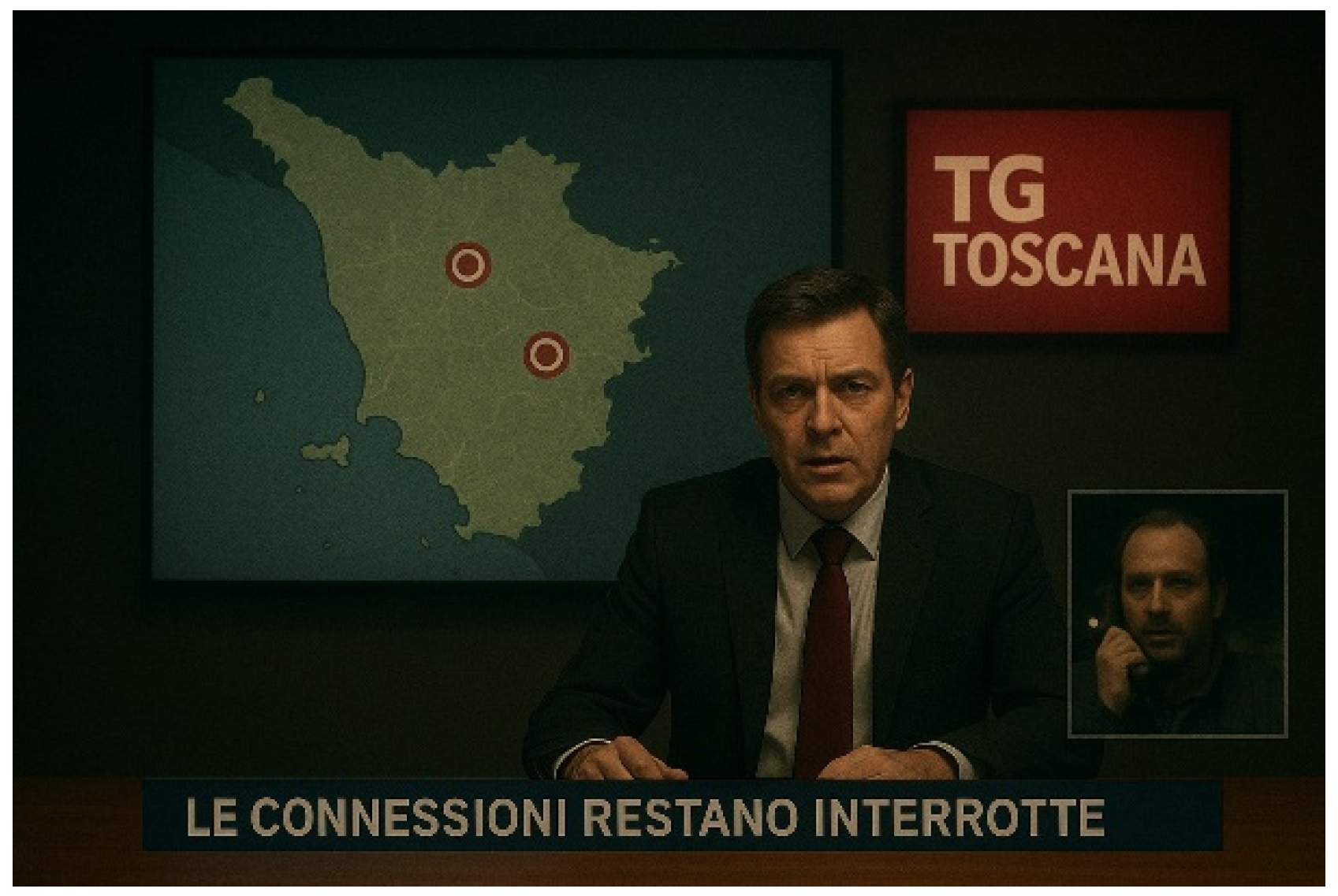
However, in the simulated corpus, analogue television presents itself as a medium of visibility and solidarity. In a special edition of TG Toscana, the anchor sits in a bare, dimly lit studio and announces in a grave tone:
‘The connections remain down. We’re showing you updated maps of safe zones.’
A static image of the province appears on the screen, with red circles marking hospitals and reception centres.
A correspondent reports live via telephone, his voice intermittent and distorted by background noise. There are no graphics or real-time video feeds, just faces, maps and words. Stripped of its spectacular aesthetic, television recomposes itself as a basic, everyday, continuous narrative form (
Figure 3).
The television image reverts to its original function as a document and a testimony, as in the medium’s origins.
This is a role that the crisis restores to journalism as a public service, rather than as an industry that merely exploits emotion.
The times and spaces of live information on screen must be recalibrated.
Verification is slower, involving phone calls, on-site visits and collaboration with local authorities. The language has changed, being reduced to the bare minimum of technical information with no complex graphics or links. The message must be clear and accessible, even to those who only have access to radio or print media.
Interviews with simulated journalists confirm this tendency towards reinvention. A radio editor describes reorganising the newsroom ‘based on the memory of old paper protocols’: schedules are handwritten, news is verified with the Civil Protection Department and broadcasts are scheduled to maintain a sense of regularity.
A newspaper journalist states that ‘news is no longer what’s new, but what’s necessary’: editorial selection is geared towards the practical needs of the population. A television host emphasises that ‘images lose aesthetic value but gain moral value’: visual simplicity becomes a guarantee of truth.
Though the product of methodical imagination, these constructed testimonies reveal coherent patterns: the emergence of a professionalism based on slowness, accuracy, proximity and presence.
Through these materials, the simulation demonstrates that, in the absence of the internet, journalism does not disappear but transforms into a community infrastructure.
The technological crisis becomes a catalyst for resilient practices: returning to voice, paper and stable images restores journalism to its original value as human mediation between reality and interpretation. Rather than marking an end, the collapse of the digital internet becomes an epistemic laboratory for understanding the relational nature of communication.
The collapse of the global network is not only a technological dystopia, but also a sociological experiment testing the limits of contemporary journalism.
As C. Wright Mills [
14] argued, the sociological imagination enables us to connect individual experiences and systemic changes, as well as biographies and structures.
Simulating ‘journalism without a network’ enables us to examine the extent to which media practices depend on digital infrastructures, and to consider how alternative forms of communicative creativity might emerge in their absence.
From a media perspective, this experiment demonstrates that all communication technologies are also technologies of the imagination.
Radio, print and analogue television survive not merely as tools, but as sensory and social worlds. Radio listening creates an acoustic community, print reconstructs a tactile geography of memory, and television restores the visible to its status as testimony. It is not only the medium that changes, but also the very perception of communication.
The digital crisis opens up a new symbolic space in which journalism becomes an art of survival and a collective reimagining of reality.
From a sociological perspective, the absence of the internet reveals the relational and material dimensions of journalistic work that are usually obscured by technological automation.
As Bowker [
7] and Star [
4] suggest, infrastructures only become visible when they break down. In our simulation, the digital blackout has this epistemic function, making the intertwining of technology, culture, and power that sustains contemporary communication tangible.
Deprived of their digital tools, journalists return to being physical beings with voices and a presence in the real world. This de-virtualisation reconfigures professional identity, bringing the ethical and affective dimensions of communication back to the centre.
Finally, from a creative perspective, the simulation shows that imagination is not just a literary exercise, but a scientific method of exploration.
Here, sociological imagination becomes a critical tool for investigating the possible, offering a way of making the implicit futures of communication visible.
Constructing alternative media scenarios enables us to consider the resilience of information systems as an experimentation with new balances between the human and the technological, rather than a nostalgic return to the past. In this sense, creativity is a form of knowledge that produces sociological evidence, inventing not to escape, but to understand.
This experiment has produced a radically human form of journalism that is renegotiating its media boundaries through crisis.
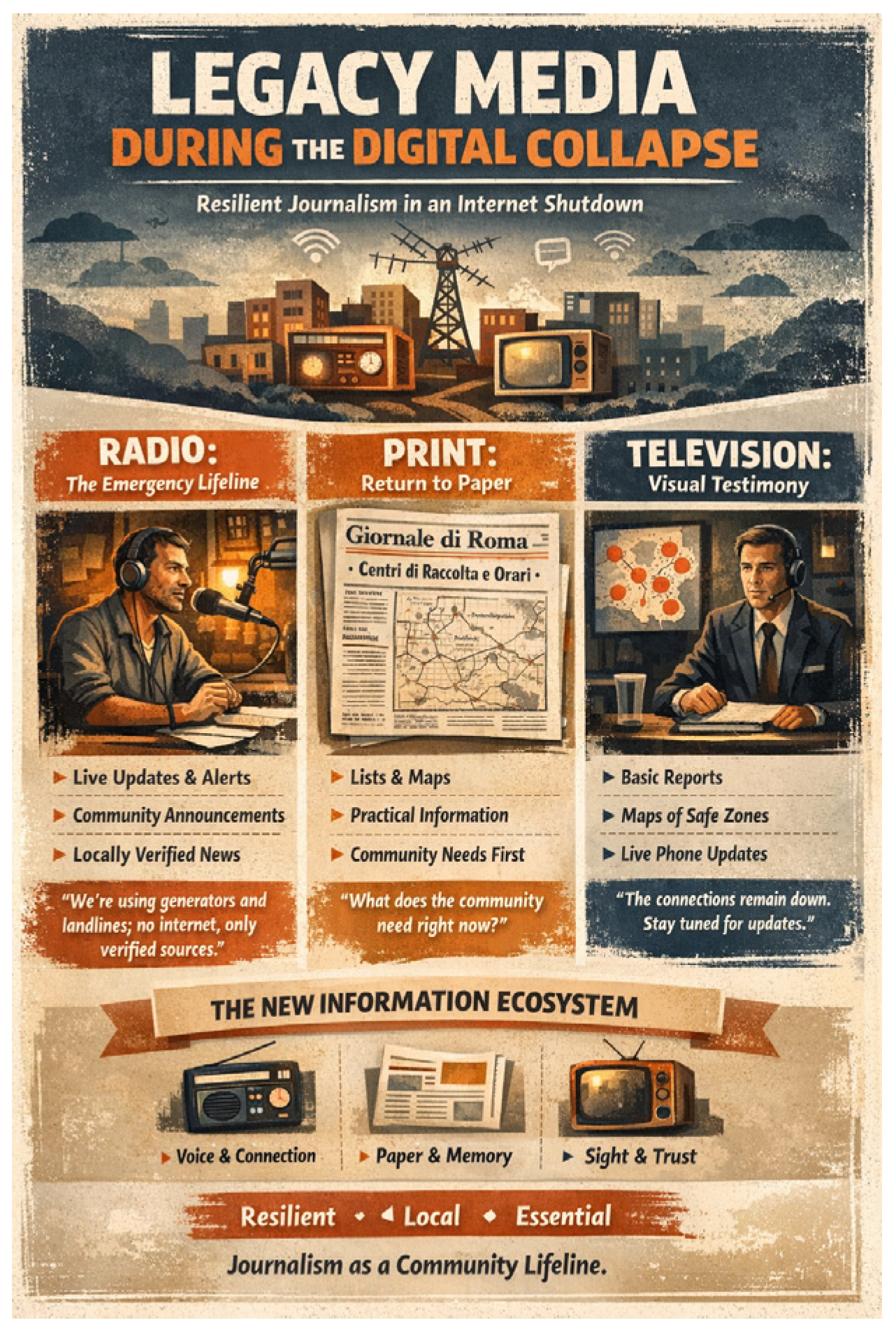
The loss of the internet does not mean a loss of meaning; rather, it is an opportunity to redefine social bonds and narrative forms. The radio announcing collection centre opening hours, the printed page featuring a hand-drawn map and the television illuminating a face in the dark are all symbolic elements that construct an imaginary of communicative continuity.
In the absence of connectivity, the media rediscover their primary function of maintaining relationships between people. It is this capacity to imagine and reinvent that manifests journalism’s deepest sociological truth, rather than technical persistence (
Figure 4).
5. Conclusions
This study explored how legacy media practices are imaginatively reorganised in a hypothetical scenario of global internet collapse through an AI-mediated speculative methodology. Rather than producing empirical claims about future events, the analysis generated heuristic insights into how journalism is culturally and normatively understood when digital infrastructures are absent.
Across the simulated materials, legacy media are consistently framed as emergency infrastructures oriented toward continuity, verification, and social coordination. These findings should be read as reflections of sociotechnical imaginaries embedded in contemporary media culture rather than as predictions of actual behaviour.
Methodologically, the study contributes to STS and journalism studies by demonstrating how constrained AI-based simulation can function as an epistemic tool for exploring scenarios that resist empirical observation.
Future research may empirically test specific assumptions surfaced by these simulations, such as the prioritisation of slowness or the moral valuation of analogue presence, while further developing speculative methods as complements, not substitutes, to empirical inquiry.