
Operationalizing Symbolic Violence to Advance Gender Equality: Women’s Mobility and Everyday Injustices in Public Transport in Mexico
 ,
,  , and
, and 
Abstract
1. Introduction
- Proposing a methodological structure grounded in empirical evidence to identify symbolic violence in mobility practices.
- Developing a set of empirical indicators linked to embodied responses.
- Determining the implications of symbolic violence for women’s mobility.
2. Background
2.1. Mobility and Sexual Violence Against Women
2.2. International and Local Responses to Sexual Violence in Public Spaces
2.3. Related Works
2.4. Symbolic Violence as an Analytical Category
2.5. Case Study: Querétaro, México
3. Materials and Methods
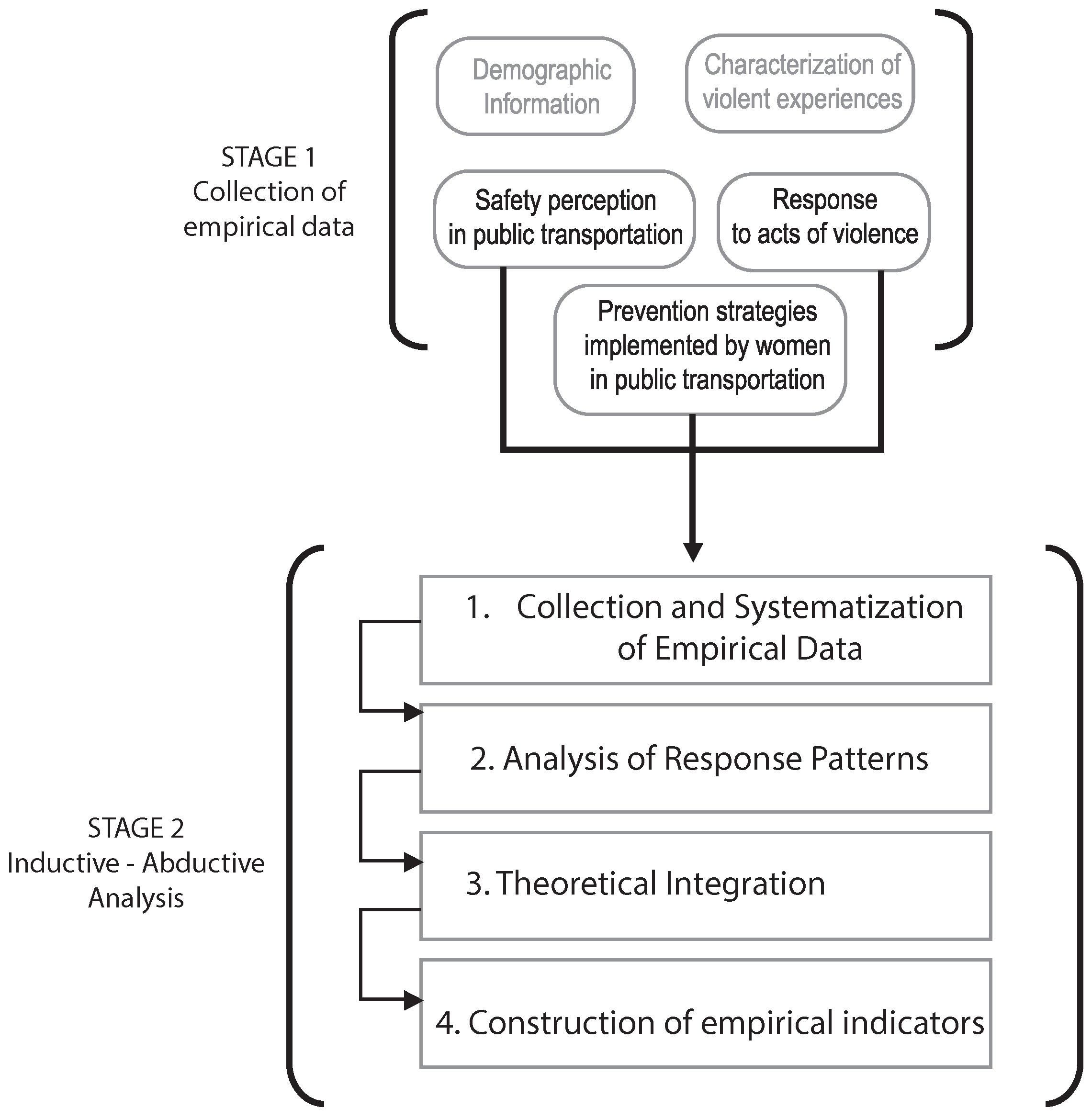
3.1. Stage 1. Collection of Empirical Data
3.2. Stage 2. Inductive–Abductive Analysis
3.2.1. Collection and Systematization of Empirical Data
3.2.2. Analysis of Response Patterns
3.2.3. Theoretical Integration
3.2.4. Construction of Indicators
4. Results
4.1. Stage 1: Collection of Empirical Data
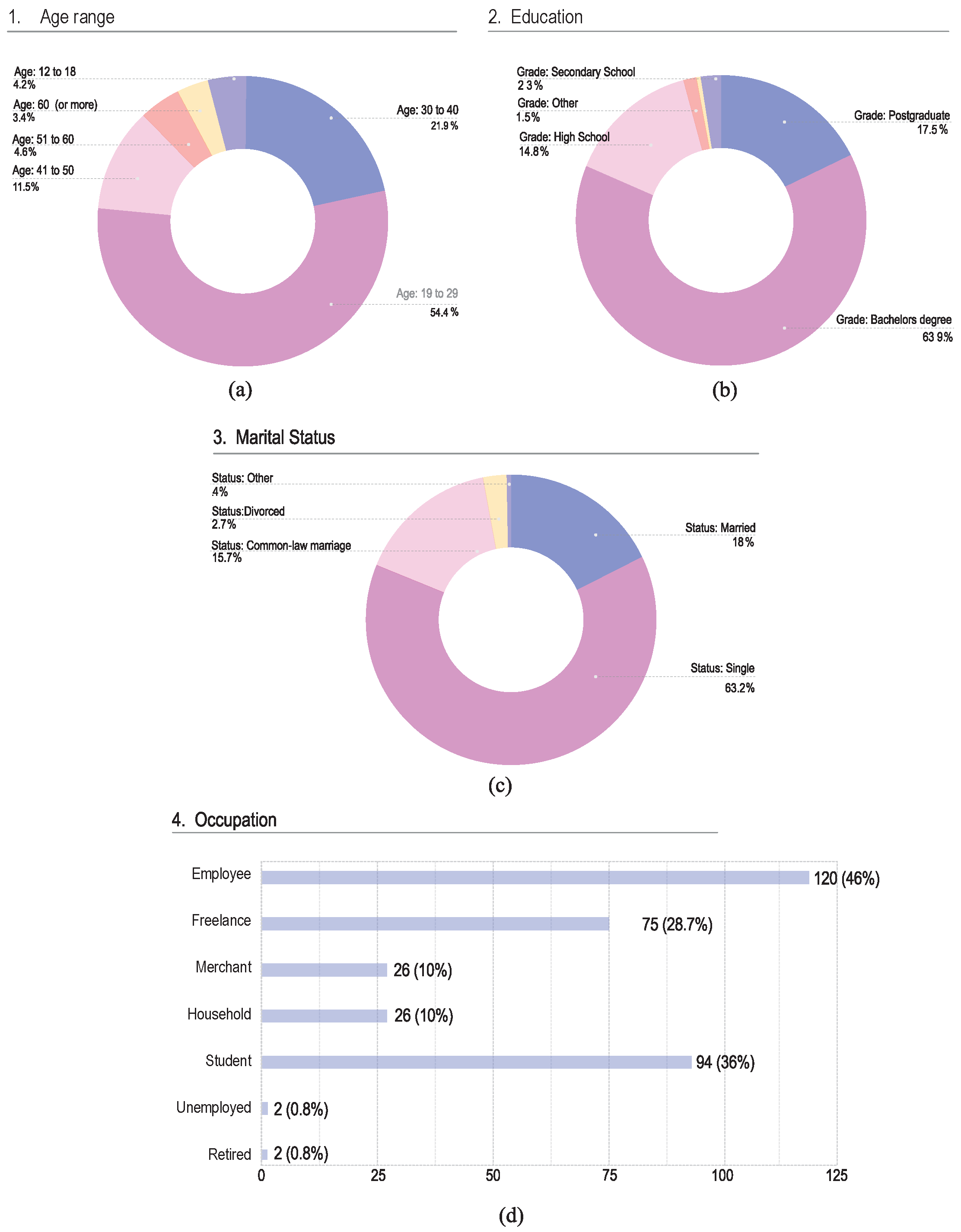
4.1.1. Demographic Information
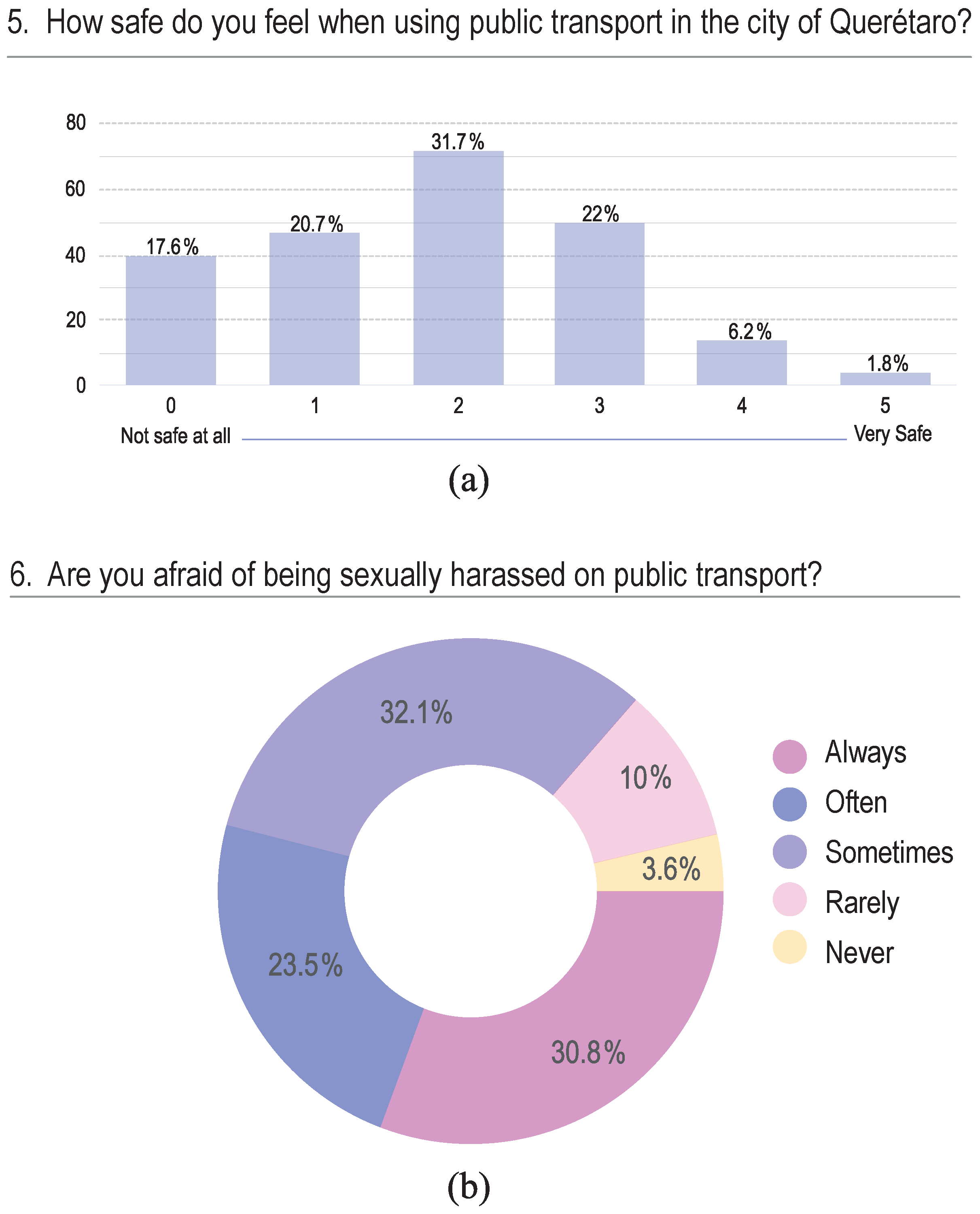
4.1.2. Safety Perceptions in Public Transportation
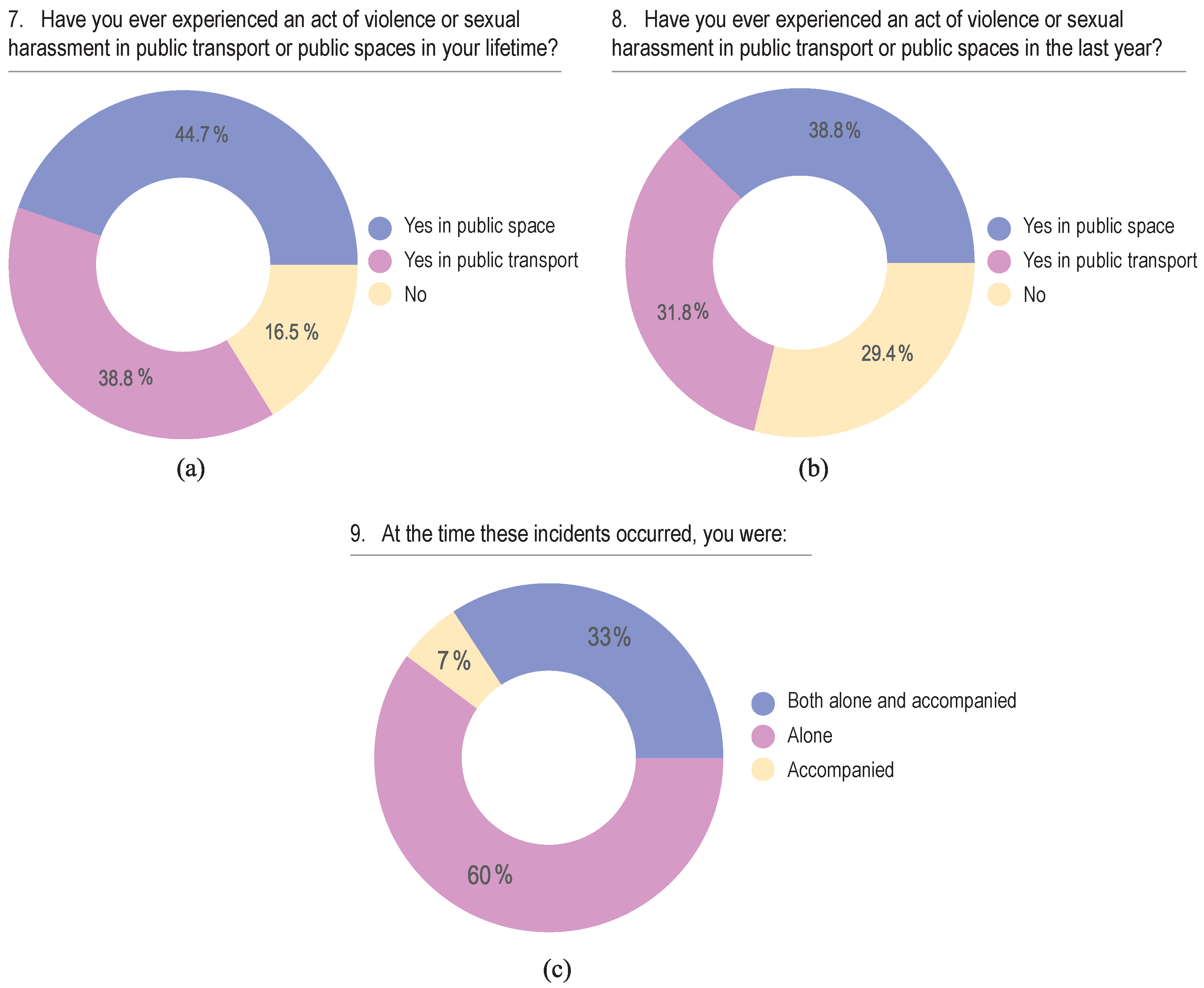
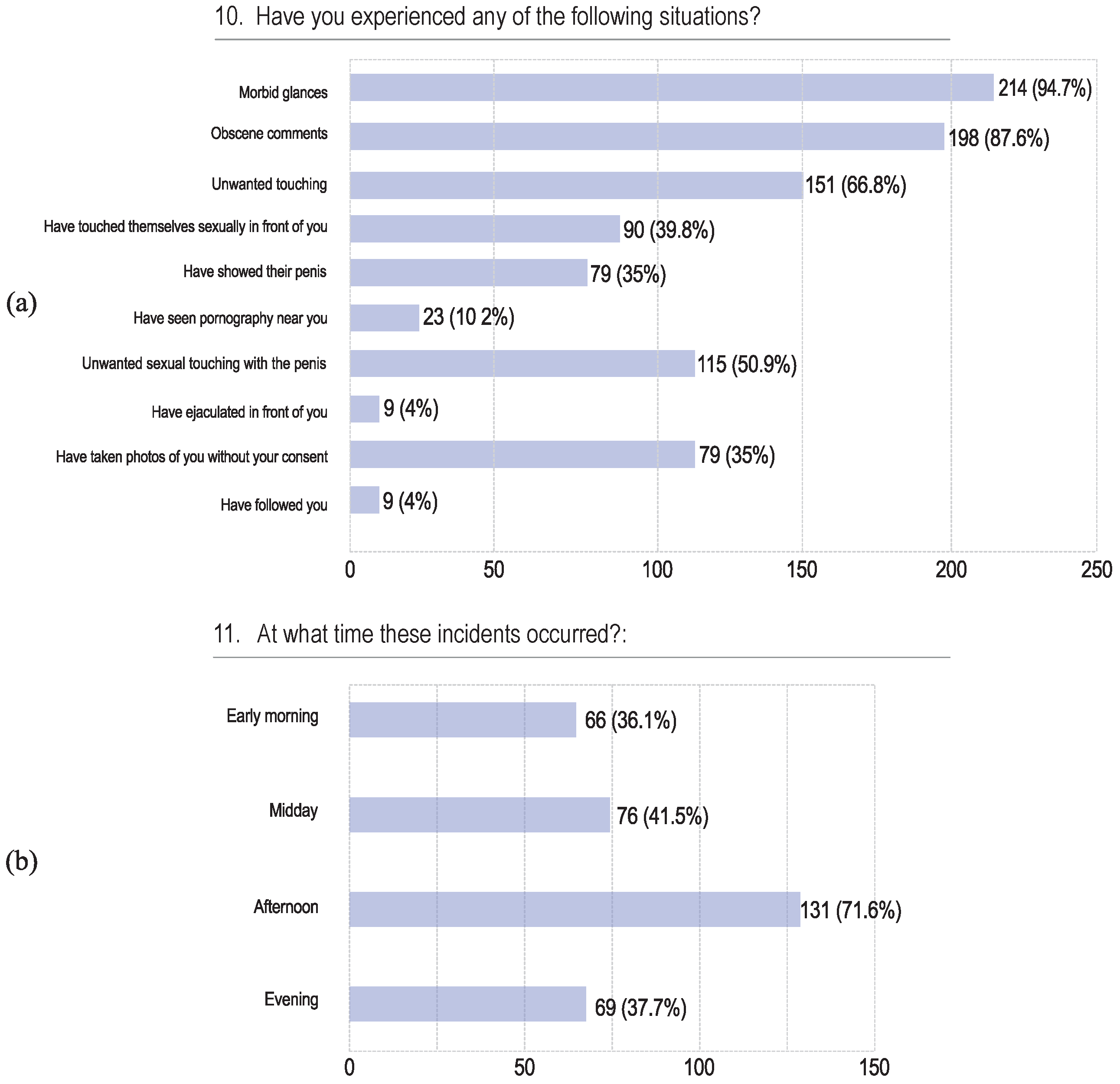
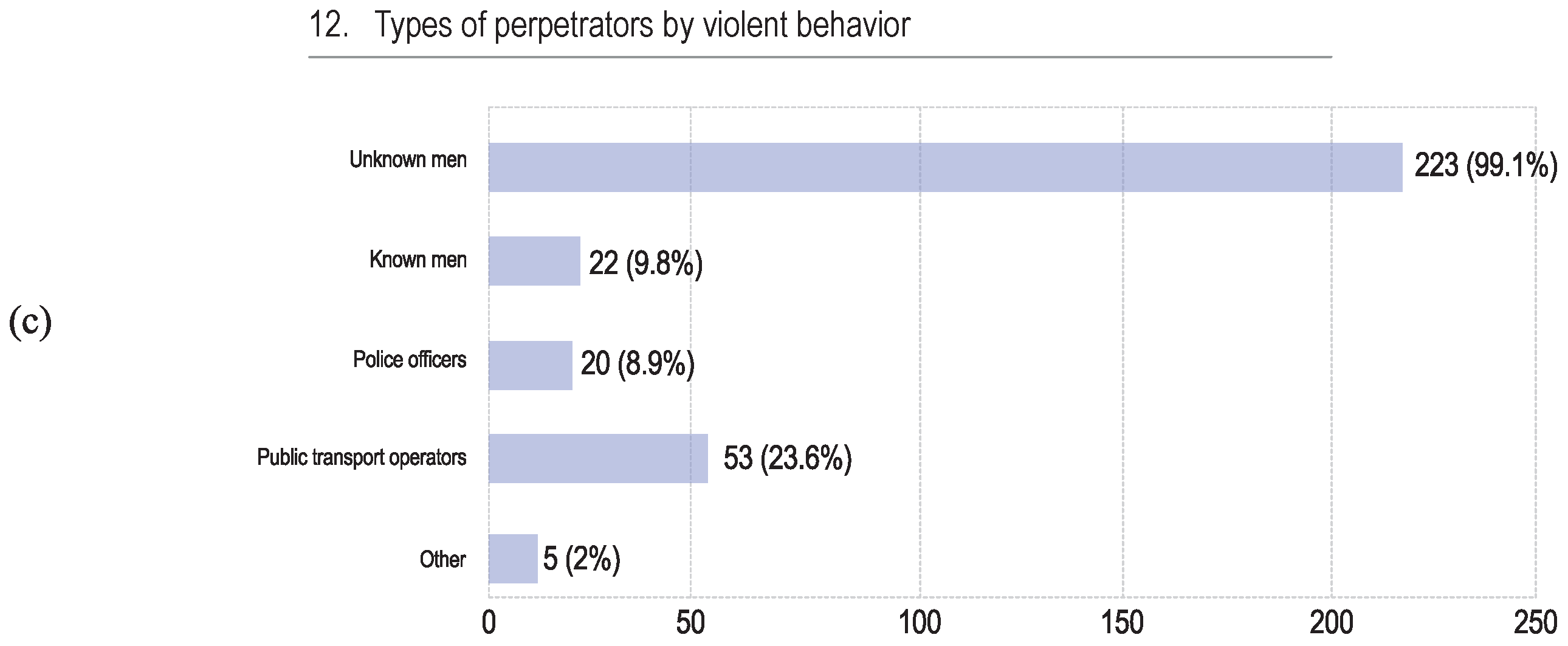
4.1.3. Characterization of Violent Experiences
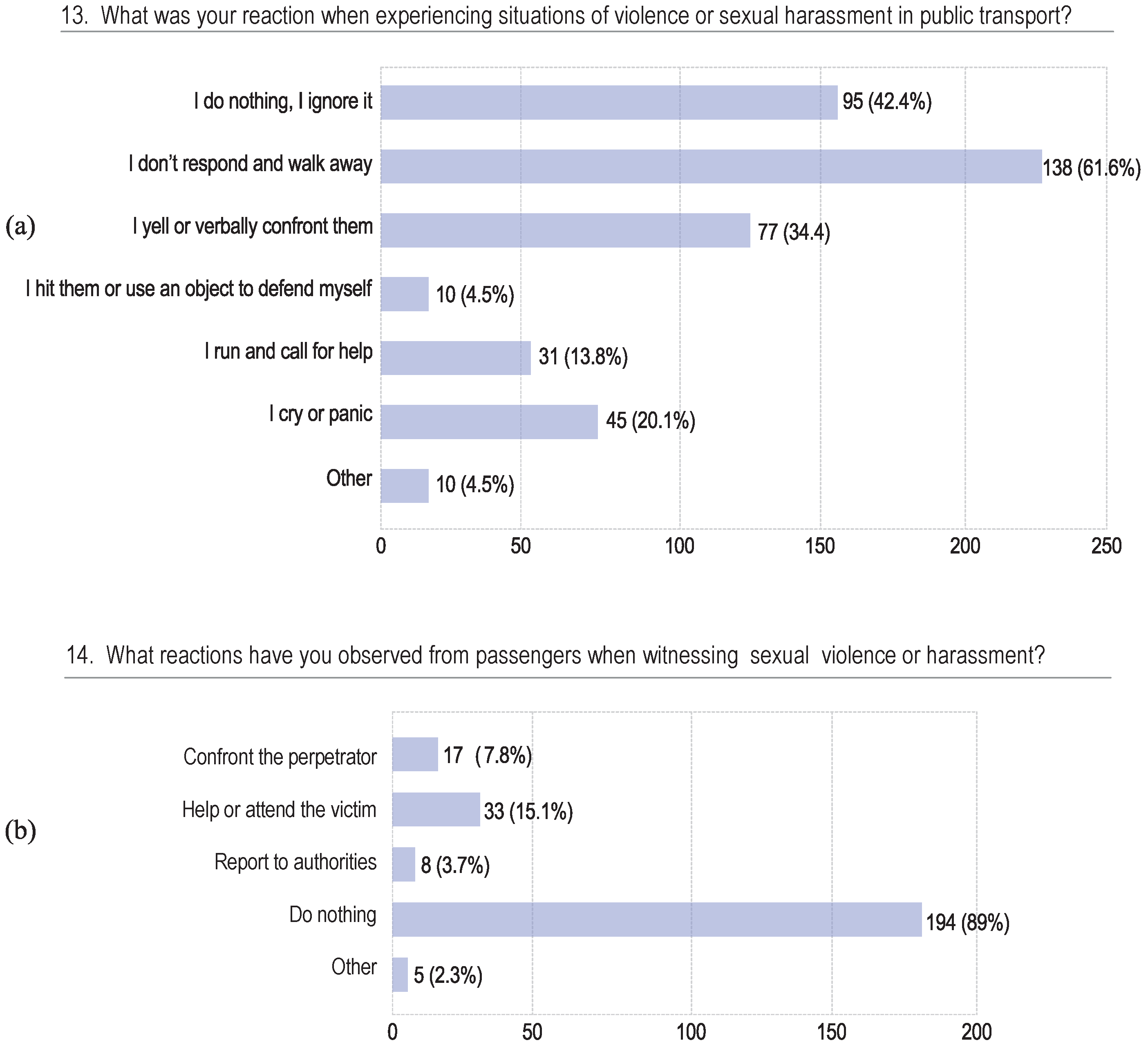
4.1.4. Responses to Acts of Violence
4.1.5. Response to Acts of Violence
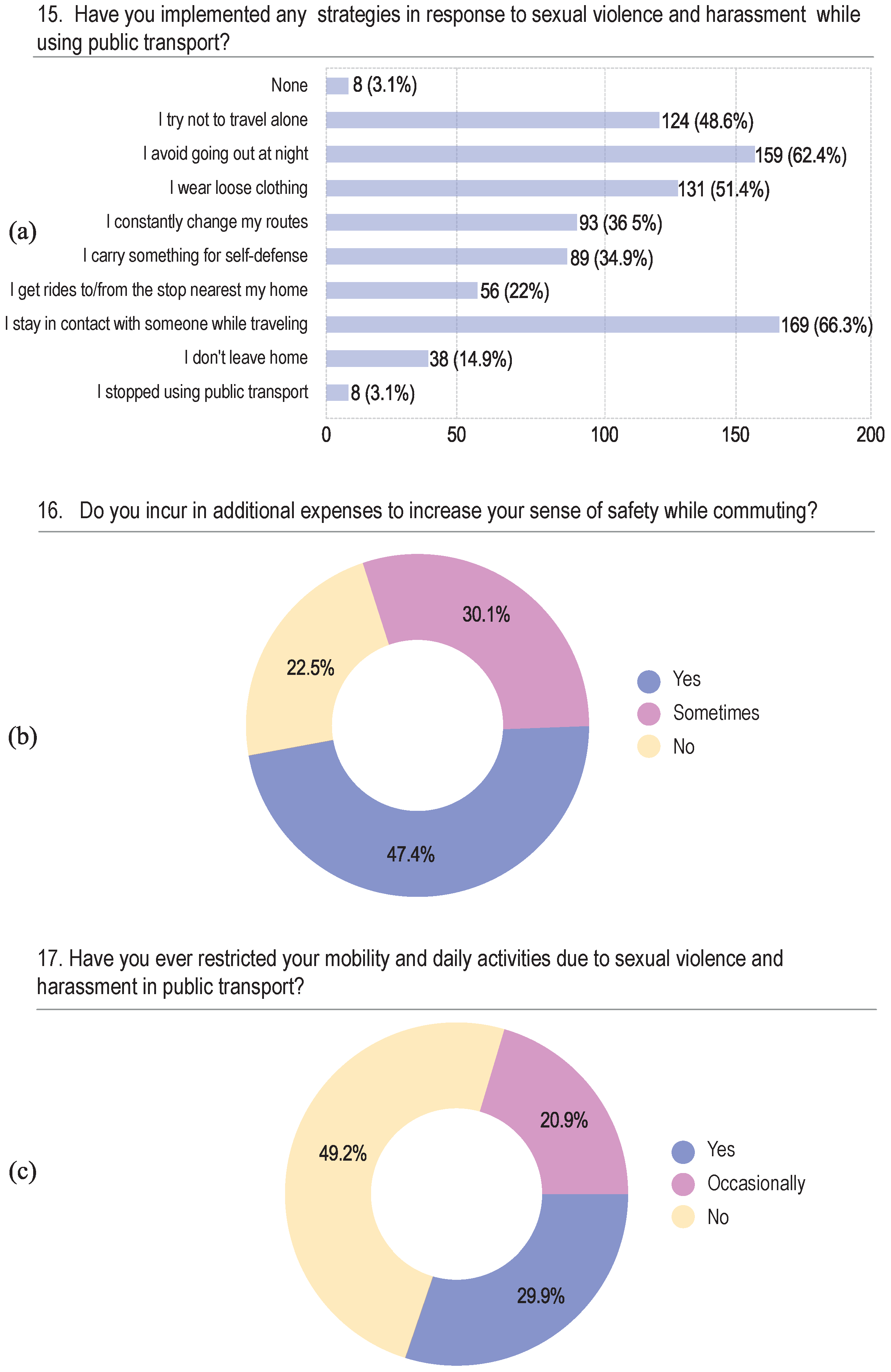
4.1.6. Prevention Strategies Implemented Against VAW in Public Transportation
4.2. Stage 2: Inductive–Abductive Analysis
4.2.1. Collection and Systematization of Empirical Data
4.2.2. Analysis of Response Patterns
4.2.3. Theoretical Integration of Patterns
4.2.4. Construction of Empirical Indicators
Step 4: Construction of Empirical Indicators
5. Discussion and Conclusions
Author Contributions
Funding
Institutional Review Board Statement
Informed Consent Statement
Data Availability Statement
Conflicts of Interest
References
- UN Women. VAW-RGA Report. 2021. Available online: https://data.unwomen.org/publications/vaw-rga (accessed on 2 April 2025).
- Stöckl, H.; Sorenson, S.B. Violence against women as a global public health issue. Annu. Rev. Public Health 2024, 45, 277–294. [Google Scholar] [CrossRef]
- Cardoso, M.; Santos, T.; Tessarolo, L.G.A.; Aprigliano, V.; Rodrigues da Silva, A.N.; da Silva, M.A.V. Exploring the resilience of public transport trips in the face of urban violence from a gender perspective. Sustainability 2023, 15, 16960. [Google Scholar] [CrossRef]
- ONU-Habitat. La Nueva Agenda Urbana; Programa de Naciones Unidas para los Asentamientos Humanos (ONU-Habitat): Nairobi, Kenya, 2020. [Google Scholar]
- Lefebvre, H. La Producción del Espacio; Capitán Swing Libros: Madrid, Spain, 2020. [Google Scholar]
- Park, R. La Ciudad: Sugerencias para la investigación de la conducta humana en un ambiente urbano. Rev. Colomb. Educ. 1998, 36–37. [Google Scholar] [CrossRef]
- Mumford, L. La Ciudad en la Historia: Sus Orígenes, Tranformaciones y Perspectivas; Infinito: Buenos Aires, Argentina, 1966. [Google Scholar]
- Sabino, L.; Tini, B.; Sato, B.; Farias, D.; Pitombo, F.; Beaujon, A.; Calero, L.M.; Carvajal, V.B.; Hobbs, J.; Guerrero, P. Metodología para Calcular el Índice técnico de Caminabilidad Sensible al Género; Banco Interamericano de Desarrollo: Washington, DC, USA, 2022. [Google Scholar]
- Hoffman, K.; Centeno, M.A. The lopsided continent: Inequality in Latin America. Annu. Rev. Sociol. 2003, 29, 363–390. [Google Scholar] [CrossRef]
- McIlwaine, C. Urbanization and gender-based violence: Exploring the paradoxes in the global South. Environ. Urban. 2013, 25, 65–79. [Google Scholar] [CrossRef]
- Freeman, M.A.; Rudolf, B.; Chinkin, C. The UN Convention on the Elimination of All Forms of Discrimination Against Women: A Commentary; Oxford University Press: New York, NY, USA, 2012. [Google Scholar]
- World Health Organization. Violence Against Women Prevalence Estimates, 2018: Global, Regional and National Prevalence Estimates for Intimate Partner Violence Against Women and Global and Regional Prevalence Estimates for Non-Partner Sexual Violence Against Women; World Health Organization: Geneva, Switzerland, 2021. [Google Scholar]
- Cepeda, I.; Lacalle-Calderon, M.; Torralba, M. Measuring violence against women: A global index. J. Interpers. Violence 2022, 37, NP18614–NP18638. [Google Scholar] [CrossRef]
- Resolution, G.A. Declaration on the Elimination of Violence Against Women; United Nations: New York, NY, USA, 1993. [Google Scholar]
- Marín, O.E.S. ¿ Quién cuida en la ciudad? Aportes para políticas urbanas de igualdad. Hábitat Soc. 2018, 41–69. [Google Scholar] [CrossRef]
- Rabotnikof, N. Público-privado. Debate Fem. 1998, 18, 3–13. [Google Scholar] [CrossRef]
- Segato, R. Flores en el Asfalto. Causas e Impactos de las Violencias Machistas en las Vidas de Mujeres Víctimas y Sobrevivientes; Mugarik Gabe: Vitoria-Gasteiz, Spain, 2017. [Google Scholar]
- Garfias Royo, M.; Parikh, P.; Belur, J. Using heat maps to identify areas prone to violence against women in the public sphere. Crime Sci. 2020, 9, 15. [Google Scholar] [CrossRef]
- Aryal, D.; Joshi, G.; Regmi, N.; Kaphle, M. Harassment and Psychological Distress among Young Women Traveling in Public Vehicles: Descriptive Cross-sectional Study in a Metropolitan City, Nepal. Arch. Psychiatry 2024, 2, 40–48. [Google Scholar] [CrossRef]
- Kamau, A.; Wright, T. Tackling gender-based violence and sexual harassment in the public transport sector: The role of key actors. In Women, Work and Transport; Emerald Publishing Limited: Leeds, UK, 2022; Volume 16, pp. 37–51. [Google Scholar]
- UNHCR, The UN Refugee Agency. Gender-Based Violence Safety Audit Toolkit; United Nations (UN): Geneva, Switzerland, 2020. [Google Scholar]
- Thapar-Björkert, S.; Samelius, L.; Sanghera, G.S. Exploring symbolic violence in the everyday: Misrecognition, condescension, consent and complicity. Fem. Rev. 2016, 112, 144–162. [Google Scholar] [CrossRef]
- Bardall, G. Symbolic violence as a form of violence against women in politics: A critical examination. Rev. Mex. Cienc. Políticas Soc. 2020, 65, 379–389. [Google Scholar] [CrossRef]
- Salehin, M.M. Gender, Violence, and Vulnerabilities in Forced Migration: A Multi-dimensional Approach. In Gendered Vulnerabilities and Violence in Forced Migration: The Rohingya from Myanmar; Springer: Cham, Switzerland, 2024; pp. 11–26. [Google Scholar]
- Leache, P.A. Género, poder y violencia. Un enfoque intersubjetivo. Política Soc. 2022, 59, e72354. [Google Scholar]
- Silvestre Cabrera, M.; Aristegui Fradua, I.; Royo Prieto, R. An Analysis of Responses to Sexual Assault against Women in Public Space: Practical Gender Needs or Strategic Gender Interests? Soc. Sci. 2023, 12, 101. [Google Scholar] [CrossRef]
- Instituto Nacional de Estadística y Geografía (INEGI). Encuesta Nacional de Victimización y Percepción Sobre Seguridad Pública 2022. 2022. Available online: https://www.inegi.org.mx/contenidos/programas/envipe/2022/doc/envipe2022_presentacion_nacional.pdf (accessed on 18 January 2025).
- World Health Organization. The World Health Report 2002: Reducing Risks, Promoting Healthy Life; World Health Organization: Geneva, Switzerland, 2002. [Google Scholar]
- INMUJERES. Gobierno de México. 2022. Available online: https://www.gob.mx/cms/uploads/attachment/file/730472/COMUNICADO_DE_PRENSA____Inmujeres_y_Sedatu_Lineamientos.pdf (accessed on 25 September 2025).
- Larsen, J.; Urry, J. Mobilities, Networks, Geographies; Routledge: London, UK, 2016. [Google Scholar]
- Pérez, G. Políticas de Movilidad y Consideraciones de Género en América Latina; Naciones Unidas: Santiago, Chile, 2019. [Google Scholar]
- Maldonado Valera, C. Inclusión y Movilidad Urbana con un Enfoque de Derechos Humanos e Igualdad de Género: Marco de Análisis e Identificación de Instrumentos de Política para el Desarrollo de Sistemas Sostenibles de Movilidad Urbana en América Latina; Naciones Unidas: Santiago, Chile, 2022. [Google Scholar]
- Jirón, P.; Singh, D.Z. Dossier. Movilidad urbana y género: Experiencias latinoamericanas. Rev. Transp. Territ. 2017, 16, 1–8. [Google Scholar]
- Punt, C. Urbanismo Feminista: Por una Transformación Radical de los Espacios de Vida; Virus: Barcelona, Spain, 2019. [Google Scholar]
- Urry, J. Moving on the mobility turn. In Tracing Mobilities; Routledge: London, UK, 2016; pp. 13–23. [Google Scholar]
- Jiron Martínez, P.; Imilan Ojeda, W. Moviendo los estudios urbanos. La movilidad como objeto de estudio o como enfoque para comprender la ciudad contemporánea. Rev. Área Estud. Urbanos 2018, 10, 1–15. [Google Scholar]
- Weltbankgruppe. Violence Against Women and Girls in Public Transport: Policy Recommendations for Mexico City; World Bank: Washington, DC, USA, 2020. [Google Scholar]
- Safety, I.W. Security—A Public Transport Priority; ITF: London, UK, 2018. [Google Scholar]
- Bermúdez Figueroa, E.; Dabetić, V.; Yuste, R.P.; Saeidzadeh, Z. Gender and structural inequalities from a socio-legal perspective. In Gender-Competent Legal Education; Springer International Publishing: Cham, Switzerland, 2023; pp. 95–142. [Google Scholar]
- Jirón, P.; Mansilla, P. Atravesando la espesura de la ciudad: Vida cotidiana y barreras de accesibilidad de los habitantes de la periferia urbana de Santiago de Chile. Rev. Geogr. Norte Gd. 2013, 56, 53–74. [Google Scholar] [CrossRef]
- ONU MUJERES. Un Marco de Apoyo a la Prevención de la Violencia Contra la Mujer. 2015. Available online: https://www.unwomen.org/sites/default/files/Headquarters/Attachments/Sections/Library/Publications/2015/A-framework-to-underpin-action-to-prevent-violence-against-women-es.pdf (accessed on 31 December 2025).
- Noor, S.; Iamtrakul, P. Women’s access to urban public transport: Toward addressing policy constraints in combating sexual harassment. Transp. Policy 2023, 137, 14–22. [Google Scholar] [CrossRef]
- ONU Mujeres. Programa Insignia. Ciudades y Espacios PúBlicos Seguros para Mujeres y Niñas. 2016. Available online: https://mexico.unwomen.org/sites/default/files/Field%20Office%20Mexico/Documentos/Noticias/ciudades%20seguras18feb.pdf (accessed on 2 March 2025).
- UN Women. Fourth World Conference on Women; UN Women: New York, NY, USA, 1995. [Google Scholar]
- UN Women. Commission on the Status of Women; Fiftieth Session, 27; UN Women: New York, NY, USA, 2020. [Google Scholar]
- Economic and Social Commission for Asia and the Pacific. Recovered from SDG 11: Sustainable Cities and Communities: Make Cities and Human Settlements Inclusive, Safe, Resilient and Sustainable. 2018. Available online: https://www.unescap.org/resources/sdg11-goal-profile (accessed on 1 September 2025).
- UN Women. Safe Cities and Safe Public Spaces: Global Results Report; UN Women: New York, NY, USA, 2017. [Google Scholar]
- Mujeres, O.; Silva, A. Programa Ciudades y Espacios Públicos Seguros para Mujeres y Niñas en México. México. ONU Mujeres. 2019. Available online: https://mexico.unwomen.org/sites/default/files/Field%20Office%20Mexico/Documentos/Publicaciones/2018/Safe%20Cities/FS%20CDMX%20final.pdf (accessed on 1 December 2025).
- ONU Mujeres. Improving Women’s Safety in Mexico City. 28 November 2016. Available online: https://www.unwomen.org/es/news/stories/2016/11/improving-womens-safety-in-mexico-city (accessed on 31 December 2025).
- García Vega, A.G. Viajemos Seguras. Propuesta de Intervención al Programa de Transporte de la Ciudad de México. Master’s Thesis, UNAM, Mexico City, Mexico, 2021. [Google Scholar]
- El Universal Querétaro. Instalarán Botones de Pánico en el Transporte. 2019. Available online: https://www.eluniversalqueretaro.mx/metropoli/instalaran-botones-de-panico-en-el-transporte/ (accessed on 29 April 2025).
- Defensoría de los Derechos Humanos de Querétaro. Informe de Actividades. 2022. Available online: https://agol.es/wp-content/uploads/2023/06/Informe-DDHQ-2022.pdf (accessed on 29 April 2025).
- Useche, S.A.; Colomer, N.; Alonso, F.; Faus, M. Invasion of privacy or structural violence? Harassment against women in public transport environments: A systematic review. PLoS ONE 2024, 19, e0296830. [Google Scholar] [CrossRef]
- Tiznado-Aitken, I.; Guerrero, B.T.E.; Sagaris, L. Uncovering gender-based violence and harassment in public transport: Lessons for spatial and transport justice. J. Transp. Geogr. 2024, 114, 103766. [Google Scholar] [CrossRef]
- Ison, J.; Forsdike, K.; Henry, N.; Hooker, L.; Taft, A. “I’ll try and make myself as small as possible”: Women and gender-diverse people’s safety work on public transport. Violence Against Women 2025, 31, 2830–2852. [Google Scholar] [CrossRef]
- Newton, A.; Loukaitou-Sideris, A.; de Jubainville, H.d.; Huang, D.; Norgaard, J.K.; Solymosi, R. Precautions and responses. In Transit Crime and Sexual Violence in Cities; Routledge: London, UK, 2020; pp. 276–294. [Google Scholar]
- Vera-Gray, F. Men’s Intrusion, Women’s Embodiment: A Critical Analysis of Street Harassment; Routledge: London, UK, 2016. [Google Scholar]
- Quinones, L.M. Sexual harassment in public transport in Bogotá. Transp. Res. Part Policy Pract. 2020, 139, 54–69. [Google Scholar] [CrossRef]
- Bourdieu, P. La dominación masculina. Rev. Estud. Género Ventana 1996, 3, 1–95. [Google Scholar] [CrossRef]
- Bourdieu, P.; Wacquant, L.J.; Lacombe, D. An invitation to reflexive sociology//Review. Can. J. Sociol. 1993, 18, 86. [Google Scholar]
- Bourdieu, P. Outline of a Theory of Practice. In The New Social Theory Reader; Routledge: London, UK, 2020; pp. 80–86. [Google Scholar]
- Bourdieu, P. The Logic of Practice; Stanford University Press: Redwood City, CA, USA, 1990. [Google Scholar]
- Bordieu, P. A social critique of the judgement of taste. In Distinction: A Social Critique of the Judgment of Taste; Harvard University Press: Cambridge, MA, USA, 1984; pp. 1–96. [Google Scholar]
- Instituto Nacional de Estadística y Geografía (INEGI). Violencia Contra las Mujeres en México. 2021. Available online: https://www.inegi.org.mx/tablerosestadisticos/vcmm/ (accessed on 19 January 2025).
- CONAPO. Reconstrucción y Proyecciones de la Población de los Municipios 1990–2040. 2020. Available online: https://www.gob.mx/cms/uploads/attachment/file/918028/BD_municipales_portada_regiones_FINAL.pdf (accessed on 29 April 2025).
- Ayuntamiento de Querétaro. Plan Municipal de Desarrollo 2021–2024. 2021. Available online: https://municipiodequeretaro.gob.mx/wp-content/uploads/2022/03/PLAN-MUNICIPAL-DE-DESARROLLO-2021-2024.pdf (accessed on 23 April 2025).
- Poder Ejecutivo del Estado de Querétaro. Programa Estatal de Transporte 2021–2027. 2021. Available online: https://www.iqt.gob.mx/wp-content/uploads/2022/09/PET-17-c.pdf (accessed on 2 April 2025).
- Cano, F. Los Problemas del Transporte Público de Querétaro; Technical Report; Poder Ejecutivo del Estado de Querétaro: Santiago de Querétaro, Mexico, 2023. [Google Scholar]
- Mujeres, O. Encuesta Sobre la Violencia Sexual en el Transporte y Otros Espacios Públicos en la Ciudad de México. 2018. Available online: https://mexico.unwomen.org/es/digiteca/publicaciones/2018/dec-2018/encuesta-violencia-sexual-transporte-cdmx (accessed on 9 October 2025).
- Villagrán, P.S.; Crotte, A.; Montes, L. Análisis de la Movilidad, Accesibilidad y Seguridad de las Mujeres en tres Centros de Transferencia Modal (CETRAM) de la Ciudad de México; Banco Interamericano de Desarrollo: Washington, DC, USA, 2019. [Google Scholar]
- Blaikie, N. Approaches to Social Enquiry: Advancing Knowledge; Polity: Milton, Queensland, Australia, 2007. [Google Scholar]
- Glaser, B.; Strauss, A. Discovery of Grounded Theory: Strategies for Qualitative Research; Routledge: London, UK, 2017. [Google Scholar]
- Tavory, I.; Timmermans, S. Abductive Analysis: Theorizing Qualitative Research; University of Chicago Press: Chicago, IL, USA, 2022. [Google Scholar]
- Heaton, J. Reworking Qualitative Data; Sage Publications: Thousand Oaks, CA, USA, 2013. [Google Scholar]



| Criteria | Description |
|---|---|
| Repetition of behaviors or beliefs across questions. | It detects normalized patterns, even without conscious reflection. |
| Convergence of meaning. | It groups different responses that share the same symbolic logic. |
| Presence of passive or resigned attitudes. | It reveals the acceptance of the violent order as inevitable. |
| Preventive strategies that reflect adaptation to violent social order. | They show how patterns of domination are reproduced without active resistance. |
| Dimension | Description |
|---|---|
| Actions. | Observable behaviors, strategies, practical responses. |
| Perceptions. | Feelings of safety, fear, and environmental assessment. |
| Thoughts. | Beliefs, justifications, cognitive evaluations of the situation. |
| Dimension | Question | Description |
|---|---|---|
| Perception of safety in public transportation | 5 | Perception of safety in public transportation |
| 6 | Fear of sexual harassment in public transportation | |
| Responses to violence | 13 | Personal responses to situations of violence or harassment |
| 14 | Observed reactions from other passengers | |
| Prevention strategies | 15 | Personal self-protection strategies against harassment |
| 16 | Additional expenses to increase sense of safety | |
| 17 | Mobility restrictions due to harassment |
| Analytical Criterion | Items | Key Findings |
|---|---|---|
| 1. Repetition | 5 | 70% reported feeling unsafe in public transportation |
| 6 | 86.4% frequently fear sexual harassment | |
| 2. Convergence of Meaning | 13 | 61.6% walk away; 42.4% ignore the aggression |
| 13, 15 | Emotional (crying, panicking) and spatial (changing routes, not going out) adaptations reflect symbolic logic | |
| 15 | Strategies to avoid exposure reflect belief that safety is women’s personal responsibility | |
| 3. Passive or Resigned Attitudes | 13 | Avoidance behaviors reflect internalized resignation to violence |
| 14 | 89% observed no intervention from bystanders | |
| 4. Preventive Strategies (Adaptation) | 15 | Most common strategies: staying in contact (66.3%), avoiding night travel (62.4%), loose clothing (51.4%) |
| 16 | 47.4% incur additional financial costs to feel safer | |
| 17 | More than 50% have restricted mobility due to harassment |
| Item | Highlighted Response | % | Applied Analytical Criteria | Habitus Dimension | Preliminary Interpretation |
|---|---|---|---|---|---|
| 5. Perception of safety | 70% feel unsafe (levels 0, 1, 2) | 70.0% | Repetition | Perception | Feeling unsafe is a shared experience. |
| 6. Fear of sexual harassment | Always + Often + Sometimes | 86.4% | Repetition, Convergence | Perception/Thought | Fear is an internalized expectation in the experience of public transport. |
| 13. (a) Walks away without responding | “Don’t respond and walk away” | 61.6% | Passivity, Adaptation | Action/Emotion | Evasive behavior internalized as a norm of self-protection. |
| 13. (b) Ignores the aggression | “Do nothing, ignore it” | 42.4% | Passivity | Thought/Action | Emotional disengagement and resignation toward violence. |
| 13. (c) Cries or panics | “Cry or panic” | 20.1% | Passivity, Convergence | Perception/Emotion | Expression of vulnerability and emotional overwhelm. |
| 13. (e) Yells or confronts | “Yell or verbally confront” | 34.4% | NA | Action | A minority responds actively; reveals exceptions to the passive habitus. |
| 13. (f) Runs/calls for help | “Run and call for help” | 13.8% | Adaptation, Convergence | Action/Thought | Avoidance-based behavior stemming from fear. |
| 13. (g) Hits or defends with object | “Hit/use object” | 4.5% | NA | Action | Very few physically defend themselves; confirms normalization of non-response. |
| 14. (a) Innaction of others | “Do nothing” (bystanders) | 89.0% | Repetition, Passivity | Collective action | Social indifference reinforces the perception of harassment as tolerated. |
| 14. (b) Help the victim | “Help or attend the victim” | 15.1% | NA | Action | A minority responds actively; reveals exceptions to the passive habitus. |
| 14. (c) Confront the perpetrator | “Confrontation” | 7.8% | NA | Action | A minority responds actively; reveals exceptions to the passive habitus. |
| 14. (d) Repot to authorities | “Contact authorities” | 3.7% | NA | Action | A minority responds actively; reveals exceptions to the passive habitus. |
| 15. (a) Stays in contact | “Stay in contact” | 66.3% | Adaptation, Repetition | Action | Self-monitoring practice based on lack of external protection. |
| 15. (b) Avoids going out at night | “Avoid night” | 62.4% | Adaptation, Repetition | Action | Daily routines are reorganized around risk. |
| 15. (c) Wears loose clothing | “Wear loose clothing” | 51.4% | Adaptation, Convergence | Action | The body is regulated as a strategy to avoid violence. |
| 15. (d) Doesn’t travel alone | “Not travel alone” | 48.6% | Adaptation | Action | Self-imposed restriction reflecting internalized danger. |
| 15. (e) Changes routes | “Change routes” | 36.5% | Adaptation | Thought | Continuous spatial vigilance as a defense strategy. |
| 15. (f) Gets rides | “Get rides” | 22.0% | Adaptation | Action | Complements public transport with other mobility practices. |
| 15. (g) Doesn’t leave home | “Don’t leave home” | 14.9% | Resignation, Adaptation | Action/Thought | Self-exclusion as a form of protection. |
| 15. (h) Stop usin public transportation | “Don’t use public transportation” | 3.1% | Resignation, Adaptation | Action | Self-exclusion as a form of protection. |
| 16. Spends extra money | “Yes” + “Sometimes” | 77.5% | Convergence, Adaptation | Action | Reflects economic burden due to systemic insecurity. |
| 17. Mobility restrictions | “Yes” + “Occasionally” | 50.8% | Repetition, Adaptation | Action | Fear limits freedoms and reshapes daily routines. |
| Empirical Indicator | Description | Items Related |
|---|---|---|
| 1. Perceived Insecurity as Normality | Internalization of violence as a routine part of inhabiting urban space. | Item 5: Perception of safety Item 6: Fear of sexual harassment |
| 2. Resignation to Harassment | Passive acceptance of harassment as inevitable, with no expectation of response or justice. | Item 13: Don’t respond and walk away Item 13: Do nothing, ignore it Item 13: Cry or panic |
| 3. Bodily and Emotional Self-Regulation | Control of one’s body, emotions, and public presence to avoid aggression. | Item 15: Stay in contact Item 15: Wear loose clothing |
| 4. Preventive Reorganization of Mobility | Active modifications to schedules, routes, and modes of transport to adapt to perceived risk. | Item 13: Run and call for help Item 15: Avoid going out at night Item 15: Don’t travel alone Item 15: Change routes Item 15: Don’t leave home |
| 5. Personal costs of safety | Economic, emotional, or physical burdens women assume in order to feel protected. | Item 16: Spends extra money Item 17: Limits mobility |
| 6. Collective inaction | Lack of collective support in the face of experienced violence. | Item 14: Bystanders do nothing |
| Study (Year, Author/s) | Inductive Approach | Deductive Approach | Generates New Analytical Categories on Responses to Harassment and Symbolic Violence | Applies Methodological Triangulation | Proposes New Methodological Procedures for Empirical-Interpretative Analysis | Develops Empirical Indicators Linked to Structural Dimensions of Violence |
|---|---|---|---|---|---|---|
| Useche et al. (2024) [53] | x | x | ||||
| Ison et al. (2024) [55] | x | x | ||||
| Tiznado-Aitken et al. (2024) [54] | x | x | ||||
| Quiñones (2020) [58] | x | |||||
| Our work | x | x | x | x | x |
Disclaimer/Publisher’s Note: The statements, opinions and data contained in all publications are solely those of the individual author(s) and contributor(s) and not of MDPI and/or the editor(s). MDPI and/or the editor(s) disclaim responsibility for any injury to people or property resulting from any ideas, methods, instructions or products referred to in the content. |
© 2026 by the authors. Licensee MDPI, Basel, Switzerland. This article is an open access article distributed under the terms and conditions of the Creative Commons Attribution (CC BY) license.
Share and Cite
Alvarez, L.S.; Álvarez-Alvarado, J.M.; Gutiérrez, A.F.; Rodríguez-Reséndiz, J. Operationalizing Symbolic Violence to Advance Gender Equality: Women’s Mobility and Everyday Injustices in Public Transport in Mexico. Societies 2026, 16, 105. https://doi.org/10.3390/soc16040105
Alvarez LS, Álvarez-Alvarado JM, Gutiérrez AF, Rodríguez-Reséndiz J. Operationalizing Symbolic Violence to Advance Gender Equality: Women’s Mobility and Everyday Injustices in Public Transport in Mexico. Societies. 2026; 16(4):105. https://doi.org/10.3390/soc16040105
Chicago/Turabian StyleAlvarez, Lorena Suárez, José M. Álvarez-Alvarado, Avatar Flores Gutiérrez, and Juvenal Rodríguez-Reséndiz. 2026. "Operationalizing Symbolic Violence to Advance Gender Equality: Women’s Mobility and Everyday Injustices in Public Transport in Mexico" Societies 16, no. 4: 105. https://doi.org/10.3390/soc16040105
APA StyleAlvarez, L. S., Álvarez-Alvarado, J. M., Gutiérrez, A. F., & Rodríguez-Reséndiz, J. (2026). Operationalizing Symbolic Violence to Advance Gender Equality: Women’s Mobility and Everyday Injustices in Public Transport in Mexico. Societies, 16(4), 105. https://doi.org/10.3390/soc16040105