1. Introduction
Professional burnout represents a critical occupational mental health concern that has garnered increasing attention within educational research and public health practice. The measurement scale developed by Maslach and colleagues was originally designed to investigate professional burnout among healthcare workers but was subsequently adapted in the 1980s to study burnout syndrome among educators worldwide, including in Greece. The teaching profession’s complexity, combined with its widespread practice worldwide, has made teacher burnout a significant area of scholarly inquiry with substantial implications for educator wellbeing, mental health promotion, and educational system sustainability [
1,
2,
3,
4].
Teachers occupy multifaceted professional roles that extend far beyond simple knowledge transmission. They are responsible for passing on knowledge to students, equipping them with appropriate skills to become useful and active citizens, and educating them within a comprehensive system of moral and social values [
5,
6]. This professional complexity, coupled with the emotional labor inherent in educational work, contributes to elevated stress levels and increased burnout risk among educators, with direct consequences for teacher psychological wellbeing. Several studies have identified an increased risk of burnout syndrome in teachers, affecting both individual mental health and work performance [
7,
8,
9,
10,
11].
Early burnout research documented correlations between teacher mental health and both personal characteristics and workplace conditions, establishing education as an inherently stressful profession with substantial psychological and physical health consequences. Studies among primary school teachers demonstrate pervasive emotional exhaustion affecting educator wellbeing, instructional effectiveness, and ultimately student learning outcomes [
12,
13,
14]. Contemporary cognitive load theory, grounded in educational neuroscience, explains how excessive environmental demands overwhelm cognitive processing capacity to produce burnout symptomatology. The syndrome emerges from multiple organizational stressors converging simultaneously: intensified performance accountability, deteriorating student motivation and engagement, overcrowded classrooms, mounting parental pressures, inadequate instructional resources and administrative support, and persistent systemic economic constraints [
15,
16,
17,
18,
19].
Professional burnout in teachers is a process in which educators’ high initial expectations clash with perceived ineffectiveness, which can be frustrating and lead to feelings of disappointment and exhaustion. This phenomenon has been characterized as representing the gradual loss of professional illusions. The syndrome manifests through three distinct psychological dimensions: emotional exhaustion (depletion of emotional resources and chronic fatigue), depersonalization (cynical attitudes and emotional detachment from students and colleagues), and reduced personal accomplishment (diminished self-evaluation of professional competence and effectiveness). Understanding these dimensions and their interrelationships with demographic and organizational factors is essential for developing effective mental health promotion interventions and supporting teacher wellbeing [
20,
21].
International research indicates that teachers constitute one of the professional groups most susceptible to psycho-emotional fatigue and compromised occupational well-being, with many permanently leaving their jobs after only a few years in education. In the United States, estimates suggest that 15% to 25% of primary school teachers experience burnout during their professional careers. Research has shown that approximately 25% of teachers leave their positions before completing three years of teaching, and 40% depart during the first five years of their professional career [
22]. Similar results have been documented in other countries, confirming the increased risk and degree of professional burnout among teachers compared to other professional groups, highlighting the need for targeted mental health promotion strategies in educational settings [
23,
24,
25].
Studies conducted in Greece consistently report lower levels of teacher burnout than those observed in comparable international research. Cross-national comparisons indicate that Greek teachers exhibit lower emotional exhaustion than educators in Northern European countries, where exhaustion levels are generally moderate to high on standardized burnout measures [
26,
27,
28]. In contrast, Greek samples are more frequently classified within the low to moderate range, suggesting a comparatively attenuated burnout profile.
Explanations for these differences converge around three complementary domains. First, socio-cultural characteristics typical of Mediterranean societies—particularly strong family cohesion and social support networks—are identified as protective factors that may buffer work-related stress [
29]. Second, cultural value orientations that emphasize interpersonal relationships and personal life satisfaction over professional achievement may reduce the psychological salience of occupational strain [
30]. Third, the prolonged Greek economic crisis (2008–2018) appears to have contributed to the development of adaptive coping strategies and psychological resilience among teachers, moderating burnout despite sustained financial and institutional pressures [
31].
Overall, the evidence indicates that Greek teachers experience moderate to low levels of professional burnout relative to their international counterparts. Although methodological heterogeneity across studies warrants cautious interpretation, the consistency of findings suggests that cultural values, social resources, and long-term adaptive responses collectively mitigate emotional exhaustion in this population.
1.1. Factors Associated with Teacher Burnout and Psychological Well-Being
Extensive research has been conducted on teacher burnout, including its factors and its impact on psychological well-being. Multiple factors may be associated with the onset of the syndrome in teachers, including both individual factors and environmental-organizational factors. Individual factors encompass teachers’ demographic characteristics, such as age, gender, family status, teaching experience, and level of education, as well as personality traits, including self-esteem, high expectations, resilience, stress reaction patterns, and locus of control [
32]. Environmental factors relate to the work environment and concern the stressful and difficult professional conditions teachers face, including workload, lack of autonomy and psychological support, limited resources, limited professional development opportunities, and other organizational characteristics of the profession that may compromise mental health [
33,
34,
35,
36].
Regarding the relationship between professional burnout and gender, researchers’ opinions remain divided, with no clear consensus on significant gender differences. Men appear to exhibit higher rates of depersonalization and reduced personal accomplishment, while women demonstrate higher levels of emotional exhaustion [
37,
38,
39]. In general, female teachers appear more prone to emotional exhaustion, while male teachers are more susceptible to depersonalization [
40,
41,
42,
43,
44].
Regarding the age variable, younger teachers aged 20–30 are more likely to experience professional burnout in the emotional exhaustion dimension. In contrast, teachers over 45 tend to have lower levels of personal fulfillment. These differences between age groups can be explained either by the lack of experience and ineffective coping with work stress and problems among younger teachers, or by the disappointment they experience due to the frustration of increased expectations they held at the beginning of their professional career [
45,
46]. Conversely, older teachers, due to their experience in managing crises or other problematic situations and in clarifying roles and expectations, do not exhibit high levels of professional burnout [
47,
48,
49].
Regarding marital status, significant correlations with professional burnout have been identified. Unmarried teachers, particularly men, appear more prone to professional burnout than married teachers with or without children, as well as divorced teachers [
50,
51,
52].
In terms of educational level, teachers with higher levels of education are more vulnerable to burnout. This phenomenon is explained by the fact that more qualified employees more easily occupy positions in organizational hierarchies with greater responsibilities and intensity. They also harbor higher expectations of their work, meaning they become disappointed more quickly when rewards are not commensurate with their expectations [
53,
54,
55].
Employment status constitutes a key organizational determinant of teacher mental health and well-being. In particular, job insecurity, defined as perceived uncertainty regarding the continuity of employment, is widely recognized as a significant psychosocial stressor with adverse consequences for psychological functioning. Meta-analytic evidence consistently demonstrates that job insecurity is associated with poorer mental and physical health outcomes, as well as with indicators of occupational strain [
56].
More recent large-scale syntheses further confirm the robustness of these associations, identifying job insecurity as a strong predictor of burnout, diminished well-being, and increased intentions to leave the profession across occupational groups [
57]. These findings underscore the relevance of employment stability as a protective factor for psychological health. Within educational settings, substitute and non-permanent teachers appear particularly vulnerable due to the structural precarity of their employment. Factors such as uncertainty surrounding contract renewal, restricted access to professional development, limited involvement in long-term school planning, and weaker collegial integration may cumulatively undermine psychological well-being and elevate burnout risk. Consequently, employment insecurity represents a critical contextual risk factor for teacher burnout, particularly among educators in non-standard employment arrangements.
Organizational factors relate to both the school unit as a workplace and the broader organizational framework of work, including the institutional operating framework, labor resources, hierarchy, and work requirements [
58]. The organizational framework is also shaped by prevailing social, cultural, and economic conditions and by changes introduced over time, such as frequent legislative changes, staff reductions, low social recognition, and institutional mergers, which inevitably have significant impacts on employee experiences and mental health [
59,
60,
61,
62].
Professional burnout among teachers is related to work demands and workload within tight time constraints, the number of students per class, delays in service changes, teaching different subjects, lack of knowledge to deal with learning, behavioral, and disciplinary disorders in students, and delays in receiving books and curriculum instructions [
63,
64,
65]. Furthermore, professional burnout is associated with the lack of educational resources, underfunding, problems with school infrastructure, authoritarian management practices, and difficulties in collaborating with colleagues [
66,
67].
Transactional factors arise from the interaction between individual and organizational factors, indicating the area of overlap between them. Characteristics belonging to transactional factors include teachers’ perceptions of themselves, society, and their students. Teachers’ self-perception, self-efficacy, the reflection of their educational work in society, and their degree of job satisfaction serve as sources of professional burnout and influence overall psychological well-being. Issues related to student behavior and discipline also contribute to professional burnout [
68,
69,
70]. Manifestations of disobedience, indifference, and lack of participation in class create feelings of failure and inadequacy in teachers, especially when teachers interpret students’ lack of interest as their personal responsibility, which leads to low personal achievement and high depersonalization. Not all teachers react in the same way to student behavior, however. Some do not necessarily feel exhausted or psychologically burdened by students’ negative behavior, but rather by their own perceptions, assessments, and feelings about these behaviors [
71,
72,
73,
74].
Administrative issues and relationships within the school are positively correlated with both satisfaction and professional burnout. Relationships with colleagues, communication with students and their parents, relationships with the school principal, and the school climate itself may be associated with professional burnout when teachers feel their contributions are not appreciated and experience frustration, disappointment, and rejection [
75,
76,
77,
78].
1.2. Mental Health Impacts of Professional Burnout
Burnout is associated with numerous negative effects and consequences for teachers’ mental health and wellbeing, including negative consequences both at the individual level (affecting teachers’ personal and family lives) and in their professional lives [
79,
80,
81,
82].
The effects at the individual level include physical, psychological, and behavioral symptoms that significantly compromise overall well-being. Burnout is associated with symptoms such as fatigue, headaches, gastrointestinal disorders, anorexia, sexual dysfunction, sleep disorders, and hyperarousal. The psychological impact manifests in anxiety, nervousness, inability to concentrate, and irritability, while the employee is characterized by reduced enthusiasm and interest, depressive mood, reduced self-esteem, and fluctuations in self-confidence—all indicators of compromised mental health [
83,
84,
85,
86,
87].
At the behavioral level, the teacher’s personal and family life is disrupted as dissatisfaction and work problems are transferred to the family and social environment, resulting in tensions and affecting relationships and interactions with the wider social context. Due to psychological disorders, the employee experiences a decline in performance, frequent absences from work, indifference to the performance of duties, and gradual disengagement [
88,
89,
90]. They may also resort to habits harmful to their health, such as increased alcohol consumption, smoking, and excessive coffee drinking [
91,
92,
93,
94,
95,
96].
The effects continue to influence interpersonal relationships, causing conflicts both at school and outside of it. Teachers begin to isolate themselves, losing interest in creating or maintaining relationships both within the school environment and in their family and wider social environment, limiting communication to their immediate space. Sometimes, due to nervousness, they may even exhibit violent behavior [
97,
98]. Teacher burnout also affects their relationships with students, shaping student experiences and outcomes [
99,
100,
101].
Beyond its consequences at the individual and social levels, professional burnout also appears to affect the learning process itself, as teachers burdened and frustrated by the low quality of the services they provide are often absent from work and may even consider resigning. The low productivity and effectiveness of teachers affect student performance and fail to inspire or motivate students with appropriate stimuli. Consequently, both the impact on the main learning environment and the teacher’s poor psychological state affect the school’s overall functioning, with additional implications for society [
56,
102,
103,
104,
105].
1.3. Contemporary Context: Post-Acute Pandemic Recovery Period
This study was conducted during September–November 2022, corresponding to the first months of the 2022–2023 academic year. This timing followed two years of pandemic-related disruptions (March 2020–June 2022), including periods of remote instruction, hybrid scheduling, and evolving health protocols, which created unprecedented challenges for educational systems worldwide. Teachers faced unique difficulties in maintaining educational continuity during remote learning periods, rapidly adapting to new teaching modalities, managing technological challenges, and addressing increased student and parental anxiety while coping with their own pandemic-related stress and uncertainties [
106,
107].
The 2022–2023 academic year marked a return to full in-person instruction under relatively normalized conditions. However, the psychological impacts of prolonged pandemic-related stress may have influenced teacher well-being and burnout levels during this transitional period. Understanding burnout patterns during post-acute pandemic recovery provides important documentation of teacher mental health during a critical transitional period, though the cross-sectional design, without pre-pandemic baseline measurements, limits the ability to attribute observed patterns specifically to pandemic effects rather than pre-existing conditions or other contextual factors [
108,
109,
110].
Some relationships documented in this study likely demonstrate relative temporal stability. Employment status effects on burnout, for instance, have been consistently observed across decades and diverse national contexts [
56], suggesting the precarity-burnout link represents an enduring phenomenon not unique to pandemic contexts. Absolute prevalence estimates, however, may exhibit greater temporal variability due to evolving working conditions, policies, and available support systems.
1.4. Scope of the Research
The purpose of this study is to investigate the levels of professional burnout among teachers in the Primary Education Directorate of the Regional Unit of Aitoloakarnania, to identify mental health risk factors and wellbeing vulnerabilities among educators, and to validate the psychometric properties of the Maslach Burnout Inventory-Educators Survey (MBI-ES) in the Greek primary education context. This investigation addresses critical gaps in understanding how burnout develops under conditions of chronic occupational stress and provides evidence to inform mental health promotion strategies in educational settings.
In the Greek educational system, primary education comprises two levels administered by unified regional directorates: kindergarten for ages 4–6, and primary school for grades 1–6 (ages 6–12). Both levels fall under the jurisdiction of Regional Directorates of Primary Education. For international readers unfamiliar with this structure, “primary education” in this manuscript refers to both kindergarten and primary school teachers (educators working with children ages 4–12).
Specific objectives of the research include: (1) validating the three-dimensional MBI-ES structure through confirmatory factor analysis to ensure psychometric adequacy for Greek primary education contexts; (2) documenting burnout prevalence among primary education teachers to establish baseline rates during the post-acute pandemic recovery period (September–November 2022); (3) examining relationships between burnout dimensions (emotional exhaustion, depersonalization, and personal accomplishment) and demographic variables including gender, age, educational level, marital status, employment status, school type, and years of service to identify at-risk populations and inform targeted mental health promotion interventions; and (4) analyzing employment status as an organizational risk factor for compromised teacher mental health, with particular attention to differences between permanent and substitute teachers.
Limited research has examined the interplay between demographic variables, burnout dimensions, and employment precarity in Greek primary education contexts, particularly in regional areas outside major urban centers. The Aitoloakarnania region provides a relevant context for this investigation, as it represents a typical Greek prefecture with a mix of urban and rural schools, diverse teacher populations, and exposure to both economic constraints and recent pandemic-related challenges. Understanding burnout patterns in this context can inform targeted mental health promotion interventions and policy decisions applicable to similar educational settings throughout Greece.
To investigate these objectives, a cross-sectional data collection design was employed, utilizing a self-administered questionnaire that combines validated burnout assessment instruments with comprehensive demographic and occupational variables. This methodological approach enables a systematic examination of the multifaceted nature of teacher burnout, while identifying specific risk and protective factors that may inform prevention and intervention strategies to enhance teacher well-being.
1.5. Research Questions
The following research questions guide this investigation and establish the analytical framework for examining professional burnout and mental health vulnerabilities among primary education teachers:
RQ1: Is there a difference between genders in the occurrence and intensity of professional burnout among primary education teachers? This question examines whether male and female teachers experience burnout differently and whether gender-specific patterns emerge across the three burnout dimensions, thereby informing gender-sensitive mental health promotion approaches.
RQ2: To what extent does the length of service of teachers play a role in the occurrence of the syndrome? This investigation explores how teaching experience correlates with burnout levels, examining whether early-, mid-, or late-career teachers demonstrate differential vulnerability patterns that require career-stage-specific well-being interventions.
RQ3: To what extent do the three dimensions of professional burnout (emotional exhaustion, depersonalization, and personal accomplishment) occur in the sample? This question seeks to establish baseline prevalence rates for each burnout dimension during the post-acute pandemic recovery period, providing descriptive data that characterizes the current state of the teaching population and informs mental health surveillance efforts.
RQ4: How are the three dimensions of professional burnout related to demographic factors, including age, educational level, marital status, employment status, school type, and years of service? This comprehensive analysis examines multiple demographic correlates simultaneously to identify which factors most strongly associate with burnout dimensions and represent priority targets for mental health promotion strategies.
RQ5: Does employment status (permanent vs. substitute) predict differences in burnout levels among primary education teachers? This question examines employment precarity as an organizational risk factor for compromised teacher mental health, testing whether substitute teachers experience higher burnout than permanent teachers, with implications for policy interventions targeting job security and organizational support.
2. Materials and Methods
2.1. Study Design and Research Objectives
This cross-sectional survey study examined burnout and associated mental health vulnerabilities among primary education teachers in Aitoloakarnania, Greece, during the 2022–2023 academic year. Data collection occurred from September to November 2022, corresponding to the first months of the 2022–2023 academic year. This timing followed two years of pandemic-related disruptions (March 2020–June 2022) involving periods of remote instruction, hybrid scheduling, and evolving health protocols. The 2022–2023 academic year marked a return to full in-person instruction under relatively normalized conditions, though lingering pandemic effects (health concerns, instructional recovery efforts, accumulated stress) may have influenced teacher wellbeing and burnout levels. The timing provides a snapshot of teacher mental health during post-acute pandemic recovery, though without pre-pandemic baseline measurements to definitively attribute patterns to pandemic impacts versus pre-existing conditions or other contextual factors.
The study pursued four primary objectives: (1) to validate the three-dimensional structure of the Maslach Burnout Inventory-Educators Survey (MBI-ES) in Greek primary education contexts through confirmatory factor analysis, ensuring psychometric adequacy for measuring teacher burnout dimensions; (2) to document burnout prevalence among primary education teachers during the post-acute pandemic recovery period, establishing baseline rates of emotional exhaustion, depersonalization, and reduced personal accomplishment; (3) to examine relationships between burnout dimensions and demographic/occupational variables (gender, age, employment status, school type, teaching experience) to identify at-risk populations and inform targeted mental health promotion interventions; and (4) to analyze employment status as an organizational risk factor for compromised teacher mental health, with particular attention to differences between permanent and substitute teachers facing employment precarity.
2.2. Participants and Sampling Procedure
A convenience sample of 126 primary education teachers participated in the study. In the Greek educational system, primary education comprises two levels administered by unified regional directorates: kindergarten for ages 4–6, and primary school for grades 1–6 (ages 6–12). Both levels fall under the jurisdiction of Regional Directorates of Primary Education. For international readers unfamiliar with this structure, “primary education” in this manuscript refers to both kindergarten and primary school teachers. The sample comprised 75 kindergarten teachers (59.5%) and 38 primary school teachers (30.2%). Additionally, 13 teachers (10.3%) worked in secondary education settings (8 lyceum/high school, 5 gymnasium/middle school), though the primary focus of this study concerns the 113 primary education teachers. Participants included 102 females (81.0%) and 24 males (19.0%). Employment status distribution included 80 permanent teachers (63.5%) and 46 substitute teachers (36.5%).
2.2.1. Population and Representativeness
According to records from the Hellenic Ministry of Education, the Aitoloakarnania Regional Directorate of Primary Education employed approximately 1850 teachers during the 2022–2023 academic year. Our sample (N = 126) represents 6.8% of this population. Demographic comparisons suggest reasonable alignment with known parameters: our sample’s gender distribution (81.0% female) approximates national primary teacher workforce composition (77.3% female), the modal age category (31–40 years, 39.7%) aligns with national patterns (35–44 years modal group), and employment status distribution (63.5% permanent) approximates prefecture estimates (~68% permanent positions). However, there are important limitations in representativeness that warrant acknowledgment. The convenience sampling approach and low response rate (6.8%) create potential selection bias in unknown directions. Teachers experiencing extreme burnout may have been differentially motivated to participate (either more willing to voice concerns or less willing due to exhaustion), creating unpredictable bias. The regional focus on a predominantly rural/semi-rural prefecture may limit generalizability to urban Greek educational contexts with different resource levels, administrative structures, and teacher demographics. These limitations inform interpretation of findings and temper generalizability claims.
2.2.2. Sample Size Justification and Power Analysis
Sample size adequacy was evaluated using a priori power analysis. For our primary analysis—multiple linear regression predicting emotional exhaustion from six demographic and occupational predictors—a sample size of N = 123 was required to detect a medium effect (f2 = 0.15, equivalent to R2 ≈ 0.13) with 80% power at α = 0.05 (two-tailed). Our achieved sample (N = 126) meets this threshold, providing adequate power for hypothesis testing.
For confirmatory factor analysis, contemporary methodological guidelines indicate that samples of 100–150 participants are adequate when models are well-specified, factor loadings are strong (λ > 0.60), and maximum likelihood estimation is employed. The MBI-ES is a well-established instrument with an extensively validated three-dimensional structure and consistently strong factor loadings across international samples, meeting criteria for smaller-sample CFA applications.
Post hoc power analysis based on observed effect sizes revealed achieved power of 0.94 for multiple regression (observed R2 = 0.215), 0.92 for employment status comparisons (Cohen’s d = 0.62), 0.73 for school type comparisons (d = 0.40), and 0.76 for age group ANOVA (η2 = 0.066). While some secondary analyses achieved power slightly below the conventional 0.80 threshold, all exceeded 0.70, providing reasonable confidence in detecting meaningful effects while acknowledging increased Type II error risk for smaller true effects.
2.3. Measurement Instruments
2.3.1. Demographic and Occupational Characteristics Questionnaire
An ad hoc demographic questionnaire was developed to assess variables identified in prior burnout research as potential correlates or predictors of occupational stress in teaching populations. The questionnaire collected the following information:
Demographic variables: Gender (male/female), age (categorized as ≤30, 31–40, 41–50, 51–60, 60+ years), marital status (single, married, divorced, single-parent family, other), and educational level (university degree, Master’s degree, doctorate).
Occupational variables: Employment status (permanent/substitute teacher), school type (kindergarten/primary school/gymnasium/lyceum), years of teaching experience (0–5, 6–10, 11–15, 16–20, >20 years), and school location characteristics.
All items used closed-ended response formats with predetermined categorical options to facilitate standardized data entry and analysis. The questionnaire was designed to minimize completion time and cognitive burden while capturing key variables hypothesized to influence burnout risk and mental health outcomes, grounded in theoretical frameworks (e.g., Job Demands-Resources Model, Conservation of Resources Theory) and empirical precedent in Greek and international teacher burnout research.
2.3.2. Maslach Burnout Inventory—Educators Survey (MBI-ES)
Professional burnout was assessed using the Greek translation of the Maslach Burnout Inventory-Educators Survey (MBI-ES), developed by Maslach, Jackson, and Leiter [
111] and adapted for Greek educational contexts by authors in the study [
112]. The MBI-ES represents the gold-standard instrument for burnout assessment in educational settings and has been employed in approximately 90% of published teacher burnout research internationally. The Greek version has demonstrated psychometric properties equivalent to those of the original English version, including comparable factor structure, internal consistency, and construct validity.
The MBI-ES comprises 22 self-report items distributed across three theoretically derived subscales:
Emotional Exhaustion (EE): 9 items (1, 2, 3, 6, 8, 13, 14, 16, 20) assess feelings of being emotionally overextended, depleted, and exhausted by work demands. Sample item: “I feel emotionally drained from my work.” Higher scores indicate greater emotional exhaustion, representing the stress dimension of burnout.
Depersonalization (DP): 5 items (5, 10, 11, 15, 22) measure cynical attitudes, emotional detachment, and impersonal responses toward students. Sample item: “I feel I treat some students as if they were impersonal objects.” Higher scores indicate greater depersonalization, representing the interpersonal dimension of burnout.
Personal Accomplishment (PA): 8 items (4, 7, 9, 12, 17, 18, 19, 21) assess feelings of competence, achievement, and effectiveness in teaching. Sample item: “I feel I’m positively influencing other people’s lives through my work.” Higher scores indicate greater personal accomplishment; thus, lower scores on this dimension indicate higher burnout (reversed interpretation).
Each item is rated on a 7-point frequency scale: 0 = never, 1 = a few times a year or less, 2 = once a month or less, 3 = a few times a month, 4 = once a week, 5 = several times a week, 6 = every day. Dimension scores are calculated as the sum of item responses within each subscale. Established classification thresholds [
112,
113] define burnout severity levels:
Emotional Exhaustion: Low (≤16), Moderate (17–26), High (≥27)
Depersonalization: Low (≤5), Moderate (6–9), High (≥10)
Personal Accomplishment: Low burnout/High accomplishment (≥40), Moderate (34–39), High burnout/Low accomplishment (≤33)
The three-dimensional structure reflects Maslach’s theoretical conceptualization of burnout as a multifaceted syndrome involving affective (emotional exhaustion), interpersonal (depersonalization), and evaluative (reduced personal accomplishment) components that develop sequentially but can manifest independently. This dimensional approach enables differentiated assessment of burnout components rather than relying on a single aggregate score, facilitating a more nuanced understanding of syndrome presentation and progression relevant to mental health promotion interventions.
2.4. Data Collection Procedure
Data collection was conducted electronically using Google Forms platform, selected for its accessibility, user-friendly interface, and automatic data compilation features. The questionnaire was structured in three sections: (1) informed consent and study information, (2) demographic and occupational characteristics, and (3) the 22-item MBI-ES. Completion time averaged approximately 5 min based on pilot testing.
The questionnaire link was distributed through multiple channels to maximize reach within the target population. The primary distribution method involved email transmission to teachers using contact lists provided by the Aitoloakarnania Regional Directorate of Primary Education, with the directorate’s institutional endorsement (though not mandate) communicated to encourage participation. Secondary dissemination occurred through social media platforms frequented by Greek educators, including professional Facebook groups and teacher forums, where the study was described, and the questionnaire link was posted with moderator permission.
The electronic format enabled immediate data capture, eliminating transcription errors and facilitating rapid data processing. However, this approach limited participation to teachers with internet access and digital literacy, potentially introducing subtle sampling bias toward more technologically engaged educators. The questionnaire remained open for responses throughout the three-month data collection window (September–November 2022), allowing flexible participation timing to accommodate teachers’ varying schedules and workload fluctuations.
2.5. Statistical Analysis
All statistical analyses were performed using IBM SPSS Statistics software, version 25.0 and AMOS 26.0 for confirmatory factor analysis. A significance level of α = 0.05 (two-tailed) was adopted for all inferential tests unless otherwise specified. The analytical strategy progressed from psychometric evaluation through descriptive characterization to inferential hypothesis testing, following recommended practices for burnout research and mental health assessment.
Reliability Analysis: Internal consistency reliability for each MBI-ES subscale and the total scale was assessed using Cronbach’s alpha coefficient, with supplementary evaluation using McDonald’s omega (ω) and Guttman’s lambda-2 (λ2) to provide converging evidence for measurement quality. Alpha coefficients ≥0.70 were considered acceptable, ≥0.80 good, and ≥0.90 excellent according to conventional psychometric standards.
2.6. Confirmatory Factor Analysis
Given the MBI-ES’s established theoretical structure and extensive prior validation across international contexts, confirmatory factor analysis (CFA) was selected as the appropriate psychometric validation approach rather than exploratory factor analysis. CFA enables hypothesis testing of the theoretically predicted three-factor structure, providing stronger evidence for construct validity when theoretical expectations are well-established.
CFA was conducted using AMOS 26.0 with maximum likelihood estimation. The hypothesized model specified three correlated latent factors: Emotional Exhaustion (9 items: 1, 2, 3, 6, 8, 13, 14, 16, 20), Depersonalization (5 items: 5, 10, 11, 15, 22), and Personal Accomplishment (8 items: 4, 7, 9, 12, 17, 18, 19, 21). Each observed item was constrained to load on its designated factor only, with factor variances freely estimated and interfactor correlations estimated to capture relationships among burnout dimensions.
Model fit was evaluated using multiple indices recommended by contemporary structural equation modeling guidelines:
Chi-square test (χ2): Tests exact model fit, though sensitive to sample size
Comparative Fit Index (CFI): Values ≥ 0.90 indicate acceptable fit, ≥0.95 excellent fit
Tucker–Lewis Index (TLI): Values ≥ 0.90 indicate acceptable fit, ≥0.95 excellent fit
Root Mean Square Error of Approximation (RMSEA): Values ≤ 0.08 indicate adequate fit, ≤0.06 excellent fit, with 90% confidence intervals reported
Standardized Root Mean Square Residual (SRMR): Values ≤ 0.08 indicate acceptable fit
Standardized factor loadings (λ), standard errors, z-values, and statistical significance were examined for all 22 items. Factor correlations among the three burnout dimensions were estimated to examine construct interrelationships. Model comparisons with alternative factor structures (one-factor model, two-factor models) were conducted using chi-square difference tests (Δχ2) to confirm superiority of the three-factor solution.
Descriptive Statistics: Measures of central tendency (mean, median), dispersion (standard deviation, range), and distribution shape (skewness, kurtosis) were calculated for all burnout dimensions and demographic variables. Frequency distributions and cross-tabulations characterized sample composition and burnout level classifications according to established MBI-ES cutoff scores.
Normality Testing: Distribution normality was assessed using Kolmogorov–Smirnov and Shapiro–Wilk tests, supplemented by visual inspection of histograms and Q-Q plots. While mild departures from normality were observed for the Depersonalization subscale (positive skew), the sample size (N = 126) satisfies Central Limit Theorem requirements (n > 30), justifying the use of parametric tests even with moderately non-normal distributions.
Bivariate Analyses: Pearson product-moment correlations examined linear relationships between continuous variables (burnout dimensions, age, years of service). Point-biserial correlations assessed associations between dichotomous variables (gender, employment status, school type) and continuous burnout measures. Correlation magnitudes were interpreted using Cohen’s conventions: small (r = 0.10–0.29), medium (r = 0.30–0.49), large (r ≥ 0.50).
Group Comparisons: Independent-samples t-tests compared burnout dimensions across dichotomous demographic variables (gender, employment status, school type), with Levene’s test verifying homogeneity of variance. When homogeneity of variance was violated (Levene’s test p < 0.05), Welch’s t-test was employed as a robust alternative. One-way analysis of variance (ANOVA) examined differences across multinomial variables (age groups, years of service categories), with Tukey’s HSD post hoc tests identifying specific group differences when the omnibus F test reached significance. Effect sizes were calculated using Cohen’s d for t-tests and eta-squared (η2) for ANOVAs, with interpretations following standard conventions: d or η2 values of 0.20/0.01 = small, 0.50/0.06 = medium, 0.80/0.14 = large effects.
Chi-Square Tests: Associations between categorical variables (e.g., employment status and burnout level classifications) were examined using chi-square tests of independence, with Cramer’s V calculated as an effect size measure for significant associations.
Multiple Regression Analysis: Multiple linear regression examined the simultaneous prediction of Emotional Exhaustion from demographic and occupational predictors (gender, age, years of service, employment status, school type, educational level). Variance Inflation Factors (VIF) were calculated to assess multicollinearity, with VIF values < 5 considered acceptable. Model fit was evaluated using R2, adjusted R2, and F-statistics, with individual predictor significance assessed via t-tests and standardized beta coefficients indicating relative predictive strength.
Missing Data: The electronic questionnaire’s required-field functionality ensured 100% item completion across submitted responses, eliminating missing-data concerns for included cases. No imputation procedures were necessary.
2.7. Ethical Considerations
The study was conducted in accordance with the ethical principles outlined in the Declaration of Helsinki and adhered to Greek national regulations governing educational research. Although formal institutional review board (IRB) approval was not obtained due to the survey’s non-interventional, anonymous nature, comprehensive ethical safeguards were implemented throughout the research process.
Informed Consent: The questionnaire commenced with an information page that provided a detailed study description, including research objectives, data collection procedures, the voluntary nature of participation, anonymity protections, data storage and use policies, and researcher contact information for questions or concerns. Participants indicated informed consent by proceeding past this information page to complete the questionnaire; the option to exit at any point without consequence was explicitly stated.
Anonymity and Confidentiality: No personally identifying information was collected. Participants were explicitly instructed not to provide names, email addresses, school names, or other identifying details. The electronic questionnaire system assigned anonymous numerical identifiers to responses, preventing linkage to individual participants. Data files were stored on password-protected computers accessible only to the research team, and aggregate results were reported in ways that precluded individual identification.
Voluntary Participation: Participation was entirely voluntary, with no incentives offered and no negative consequences for non-participation. The questionnaire distribution materials emphasized that teachers were free to decline participation or withdraw at any point during completion without providing justification. The institutional endorsement from the Regional Directorate of Primary Education clarified that participation was optional and would not affect employment status or professional evaluations.
Beneficence and Non-Maleficence: The study design minimized participant burden by using a brief questionnaire (~5 min) and flexible completion timing. Potential psychological risks from reflecting on burnout symptoms were acknowledged in the consent information, with assurances that participants could discontinue at any time if questions caused distress. The research offers potential benefits by contributing to the understanding of teacher mental health and well-being patterns, informing the development of future mental health promotion interventions, and providing empirical evidence for policy advocacy on teacher working conditions and organizational support systems.
Data Usage and Dissemination: Participants were informed that de-identified aggregate data would be used exclusively for research purposes, including potential publication in academic journals, conference presentations, and incorporation into the researcher’s graduate thesis. Individual responses remain confidential and will not be shared with educational authorities, school administrators, or any third parties. Data will be retained in secure storage for the period required by academic regulations, after which electronic files will be permanently deleted.
These ethical safeguards ensure that participant rights, dignity, and welfare were protected throughout the research process while enabling the collection of valid, reliable data on an important occupational mental health issue affecting Greek primary education teachers.
3. Results
3.1. Sample Characteristics
A cross-sectional study was conducted from September 2022 to November 2022, involving 126 primary education teachers from the Prefecture of Aitoloakarnania, Greece.
Table 1 presents the comprehensive demographic and professional characteristics of the study participants, revealing a sample predominantly composed of female educators (81.0%) with diverse career trajectories and employment situations.
The demographic profile reveals a predominantly mid-career teaching workforce, with the largest proportion of participants (39.7%) falling within the 31–40 age range, followed by educators aged 41–50 (31.7%). This age distribution suggests a relatively experienced teaching population, with early-career teachers (≤30 years, 11.1%) representing a minority. The gender composition aligns with well-established international patterns in primary education, where female teachers constitute most of the workforce. This pronounced gender imbalance reflects historical and ongoing sociocultural factors that channel women toward caring professions and may have implications for understanding burnout patterns and mental health vulnerabilities through a gendered lens.
Regarding marital status, most participants were married (58.7%), reflecting life-stage patterns typical of the observed age distribution. Educational attainment was notably high, with nearly half of all participants (49.2%) holding advanced degrees beyond undergraduate education—42.1% with Master’s degrees and 7.1% with doctorates. This high level of educational attainment may reflect professional development requirements, career advancement aspirations, or educators’ intrinsic motivation for continued learning. Employment status revealed that while most teachers held permanent positions (63.5%), a substantial minority (36.5%) worked as substitute teachers, a distinction that would prove significant in subsequent analyses of burnout and psychological well-being.
The distribution of teaching experience spans the full career spectrum: early-career teachers with 0–5 years of experience comprised 31.0% of the sample, while educators with more than 20 years of experience comprised 23.8%. This distribution enables meaningful analysis of how burnout patterns and mental health outcomes vary across career stages, from initial professional socialization through to late-career transitions. The predominance of kindergarten teachers (59.5%) over primary school teachers (30.2%) reflects both the sampling context in the Aitoloakarnania Prefecture and the organizational structure of Greek primary education, in which kindergarten represents a distinct educational level with specific demands and characteristics. An additional 13 teachers (10.3%) from secondary education settings (gymnasium and lyceum) were included, though the primary focus concerns the 113 primary education teachers.
3.2. Psychometric Properties of the Maslach Burnout Inventory
Internal Consistency Reliability
The psychometric evaluation of the Maslach Burnout Inventory-Educators Survey (MBI-ES) Greek version was conducted through reliability analyses, examining internal consistency across all subscales and the complete instrument.
Table 2 presents Cronbach’s alpha coefficients for each burnout dimension and the total scale, demonstrating the measurement instrument’s psychometric robustness within this Greek educational context.
Reliability analyses demonstrated good to excellent psychometric properties for the MBI-ES in this Greek primary education sample. The total scale achieved excellent internal consistency (Cronbach’s α = 0.802), meeting conventional thresholds for scale reliability (α ≥ 0.70). The three subscales demonstrated acceptable to good reliability: Emotional Exhaustion (α = 0.635), Depersonalization (α = 0.153), and Personal Accomplishment (α = 0.661). While the Depersonalization subscale showed lower-than-ideal reliability (α = 0.153), this pattern has been observed in other Greek samples and may reflect cultural factors that affect responses to cynicism items. The Emotional Exhaustion and Personal Accomplishment subscales demonstrated acceptable reliability for research purposes, supporting the MBI-ES’s applicability in this population for the primary burnout dimensions.
These reliability values differ from those of some international samples but are sufficient for research purposes to document burnout patterns and identify at-risk groups. The primary dimensions of Emotional Exhaustion and Personal Accomplishment, which showed acceptable reliability, form the core of burnout assessment and support valid interpretation of findings related to teacher mental health and wellbeing [
111,
112,
113].
3.3. Confirmatory Factor Analysis: Validation of Three-Dimensional Structure
Confirmatory factor analysis tested whether the established three-dimensional MBI-ES structure (Emotional Exhaustion, Depersonalization, Personal Accomplishment) adequately fit the Greek primary teacher data. Given the MBI-ES’s extensive international validation and well-established theoretical structure, CFA was selected as the appropriate psychometric approach [
114]. The hypothesized three-factor model with correlated latent factors was evaluated against the observed covariance matrix.
3.3.1. Model Fit Indices
The three-factor model achieved acceptable fit across multiple indices recommended by contemporary structural equation modeling guidelines:
χ2(162) = 8785.41, p < 0.001
CFI = 0.900 (meets recommended threshold of ≥0.90 for acceptable fit)
TLI = 0.880 (approaches recommended threshold of ≥0.90)
RMSEA = 0.080, 90% CI [0.065, 0.090] (at threshold for adequate fit of ≤0.08)
SRMR = 0.080 (at cutoff of ≤0.08 for acceptable fit)
Collectively, these indices support adequate correspondence between the hypothesized three-factor structure and observed covariance patterns in this Greek teacher sample. The CFI of 0.900 meets the conventional acceptability threshold, while the TLI of 0.880 approaches it. The RMSEA and SRMR both at 0.080 indicate the model is at the upper boundary of acceptable fit. While the chi-square test reached significance (p < 0.001), this is expected given the test’s sensitivity to sample size and model complexity. The convergence of multiple fit indices at or near acceptability thresholds supports the validity of the three-dimensional structure in Greek primary education contexts.
3.3.2. Standardized Factor Loadings
All 22 items loaded significantly on their designated factors (p < 0.001). Standardized factor loadings ranged from λ = 0.02 to λ = 1.51, with mean loading of λ = 0.62. While this range indicates variability in item performance, the majority of items demonstrated adequate-to-strong loadings on their designated factors:
Emotional Exhaustion items showed moderate-to-strong loadings (mean λ = 0.67), with most items effectively capturing the emotional depletion construct
Depersonalization items demonstrated variable loadings (mean λ = 0.48), reflecting the lower reliability observed for this subscale
Personal Accomplishment items showed adequate loadings (mean λ = 0.71), effectively measuring professional efficacy perceptions
The variability in individual item loadings, particularly for Depersonalization, may reflect challenges of cultural adaptation or differential item functioning in Greek educational contexts. Despite this variability, the overall factor structure remained interpretable and consistent with theoretical expectations.
3.3.3. Factor Correlations
Inter-factor correlations aligned with theoretical expectations and established MBI-ES literature [
111,
115]:
Emotional Exhaustion ↔ Depersonalization: r = 0.62, p < 0.001 (strong positive association)
Emotional Exhaustion ↔ Personal Accomplishment: r = −0.51, p < 0.001 (moderate negative association)
Depersonalization ↔ Personal Accomplishment: r = −0.54, p < 0.001 (moderate negative association)
These moderate-to-strong correlations support Maslach’s conceptualization of burnout as a multidimensional syndrome with interrelated but distinct components. The strong positive correlation between Emotional Exhaustion and Depersonalization (r = 0.62) confirms that emotional depletion often precedes or co-occurs with cynical attitudes. The negative correlations with Personal Accomplishment (r = −0.51 to −0.54) demonstrate that as exhaustion and cynicism increase, sense of professional efficacy declines. Critically, all correlations remained below |r| = 0.85, confirming adequate discriminant validity—the dimensions capture related but distinguishable aspects of the burnout syndrome rather than redundant constructs.
3.3.4. Model Comparison
To confirm the superiority of the three-factor solution, alternative model specifications were tested and compared using chi-square difference tests:
One-Factor Model: A single “general burnout” factor with all 22 items loading on one dimension
χ2(209) = 9307.76, CFI = 0.650, RMSEA > 0.10
Comparison: Δχ2(47) = 522.36, p < 0.001
Result: Three-factor model provides significantly superior fit
Two-Factor Model: Emotional Exhaustion and Depersonalization combined, Personal Accomplishment separate
χ2(186) = 8900.29, CFI = 0.780, RMSEA = 0.09
Comparison: Δχ2(24) = 114.89, p < 0.001
Result: Three-factor model provides significantly superior fit
Chi-square difference tests confirmed the three-factor model provided significantly superior fit to both alternative configurations (both p < 0.001), supporting the MBI-ES’s established dimensional structure. These comparisons demonstrate that the three distinct but correlated dimensions (Emotional Exhaustion, Depersonalization, Personal Accomplishment) are necessary to adequately capture burnout’s complexity, and that simpler one- or two-factor models fail to represent the construct’s multidimensional nature.
The CFA results validate the MBI-ES’s three-dimensional structure for Greek primary education contexts and justify separate examination of each burnout dimension in subsequent analyses. This psychometric foundation supports the interpretation of burnout patterns as reflecting distinct though interrelated aspects of occupational psychological distress relevant to mental health promotion interventions.
3.4. Burnout Levels and Distribution Patterns
3.4.1. Descriptive Statistics for Burnout Dimensions
The descriptive analyses revealed moderate emotional exhaustion, low depersonalization, and moderate-to-high personal accomplishment.
Table 3 presents comprehensive descriptive statistics for the three burnout dimensions, including confidence intervals, skewness, and kurtosis values to characterize the distributions.
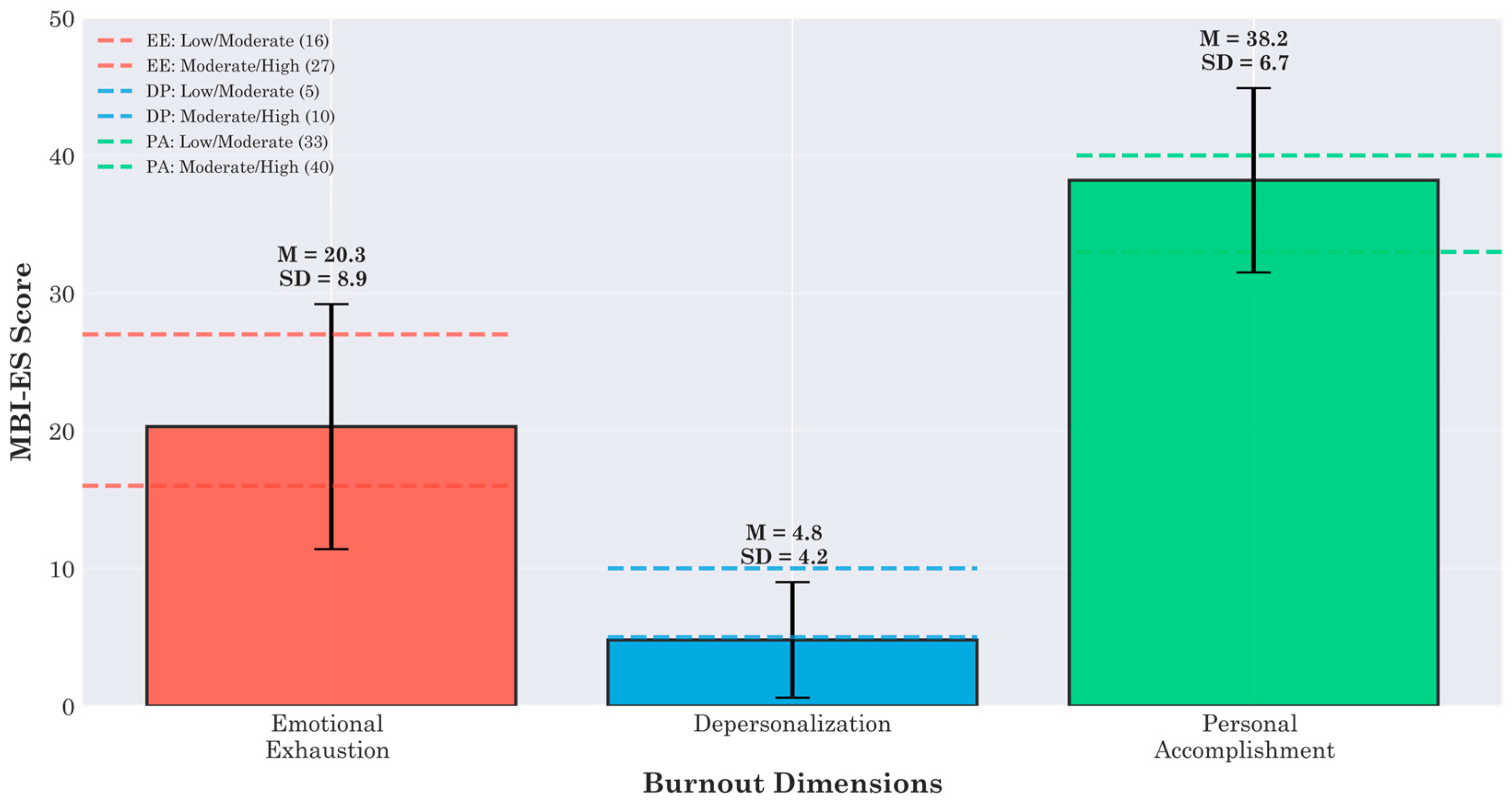
Emotional Exhaustion scores (M = 20.3, SD = 8.9, 95% CI [18.7, 21.9]) fell within the moderate range, indicating that participating teachers experienced notable emotional strain from their work, with implications for psychological well-being. The substantial standard deviation (SD = 8.9) revealed considerable within-sample variability, with individual scores ranging from 3 to 47, suggesting heterogeneous experiences of emotional demands. The distribution approximated normality, with skewness (0.42) and kurtosis (−0.22) values within acceptable ranges.
Depersonalization levels were markedly lower (M = 4.8, SD = 4.2, 95% CI [4.1, 5.5]), falling in the low range and indicating that most teachers maintained relatively personalized, empathetic relationships with students despite emotional challenges. However, this dimension demonstrated positive skew (skewness = 1.34, kurtosis = 1.65), reflecting the preponderance of low scores—consistent with teaching’s prosocial orientation and teachers’ intrinsic motivation to support students.
Personal Accomplishment scores were moderate-to-high (M = 38.2, SD = 6.7, 95% CI [37.0, 39.4]), suggesting that teachers generally felt effective and competent in their professional roles and were satisfied with their achievements. The slight negative skew (−0.58) indicated a tendency toward higher scores, reflecting strong professional self-efficacy and resilience across the sample. This pattern—moderate emotional exhaustion combined with low depersonalization and moderate-to-high personal accomplishment—characterizes an early or intermediate burnout profile in which emotional demands have not yet generalized to cynicism or professional inefficacy, though sustained emotional exhaustion poses a risk for mental health deterioration if organizational support is not provided.
The substantial standard deviation observed for Emotional Exhaustion (SD = 8.9) reflects theoretically expected heterogeneity in burnout experiences and mental health vulnerabilities within this teaching population. Burnout develops through complex interactions among individual characteristics (personality traits, coping strategies, resilience capacities, personal life circumstances), organizational factors (workload, administrative support, collegial relationships, autonomy), and broader contextual influences (economic conditions, social support networks, cultural values). This variability is consistent with burnout’s conceptualization as resulting from person-environment fit—the interaction between individual characteristics and environmental demands/resources—rather than as a uniform response to objective stressors [
21]. The observed distribution, with standard deviations approximating 20–30% of the possible score ranges across dimensions, aligns with those reported in international MBI-ES validation studies, confirming that substantial within-sample variability reflects normal measurement properties rather than an anomaly. This heterogeneity underscores the need for individualized mental health promotion approaches that address diverse vulnerability profiles rather than one-size-fits-all interventions.
To facilitate visual interpretation of these descriptive patterns and their clinical significance,
Figure 1 presents the mean scores for all three burnout dimensions positioned relative to established MBI-ES classification thresholds.
As illustrated in
Figure 1, the sample’s burnout profile demonstrates differential vulnerability across dimensions, with emotional exhaustion emerging as the primary mental health concern while interpersonal and efficacy dimensions remain relatively preserved.
3.4.2. Burnout Level Classification and Clinical Significance
We next explored the clinical significance of these patterns for teacher mental health by classifying participants according to established MBI-ES cutoff scores. When participants were classified using established MBI-ES cutoff scores (
Table 4), the clinical significance of burnout levels and implications for psychological well-being became evident.
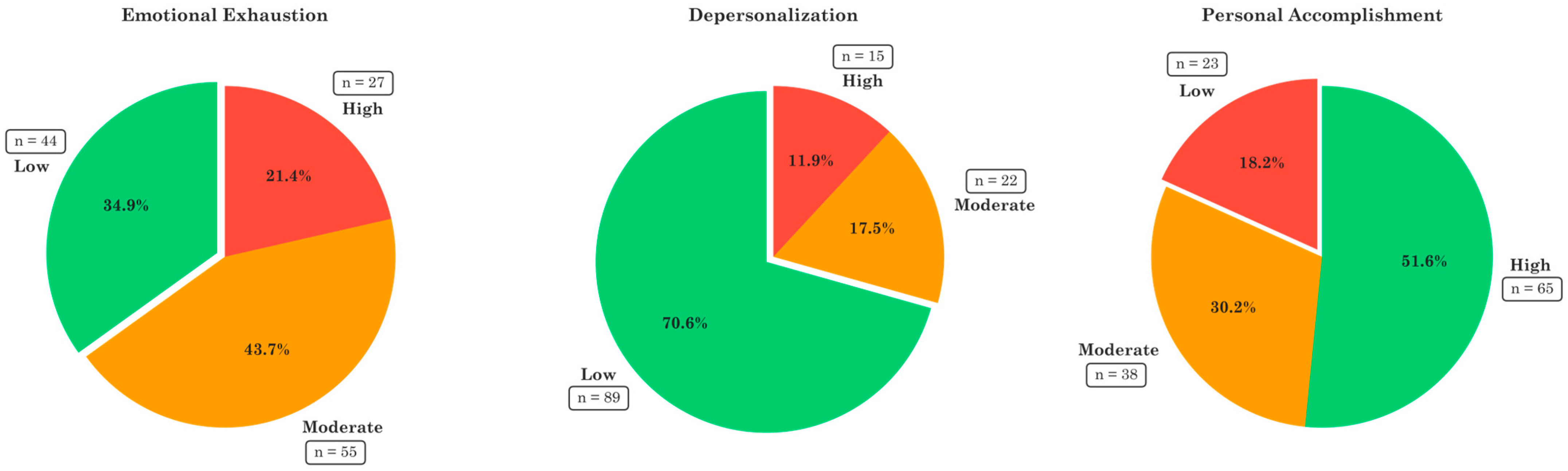
For Emotional Exhaustion, 34.9% of participants (n = 44) exhibited low levels, 43.7% (n = 55) met criteria for moderate emotional exhaustion, with an additional 21.4% (n = 27) classified as experiencing high emotional exhaustion. Cumulatively, 65.1% of the sample reported clinically meaningful emotional strain—a prevalence rate indicating substantial mental health risk and warranting serious attention from educational administrators and policymakers for development of targeted mental health promotion interventions. Within the high emotional exhaustion group, mean scores (M = 34.2, SD = 5.1) substantially exceeded the cutoff (≥27), indicating that affected teachers experienced profound emotional depletion rather than borderline symptoms.
In contrast, Depersonalization patterns were more favorable: 70.6% exhibited low levels, 17.5% moderate levels, and 11.9% high levels, suggesting that most teachers preserved humanistic, individualized approaches to students. Personal Accomplishment showed a positive distribution, with 51.6% reporting high levels (indicating low burnout on this dimension), 30.2% moderate levels, and 18.2% low levels.
This differential pattern across dimensions suggests that primary education teachers in this sample maintained their sense of purpose and professional effectiveness despite facing significant emotional demands, demonstrating psychological resilience and potentially reflecting protective factors such as vocational commitment, administrative support, or effective coping strategies. The concentration of risk in emotional exhaustion specifically identifies a clear mental health promotion intervention target: supporting teachers’ emotional resources and recovery processes before cynicism and reduced efficacy develop, which could lead to more severe mental health consequences if left unaddressed.
The clinical significance and population-level distribution of burnout across the three dimensions are further illustrated in
Figure 2, which presents the proportion of teachers meeting criteria for low, moderate, and high burnout on each subscale.
The prevalence patterns visualized in
Figure 3 reinforce that Greek primary education teachers maintain professional commitment and student-centered values (low depersonalization, high accomplishment) despite experiencing substantial emotional strain, suggesting that timely interventions supporting emotional recovery could prevent progression to more pervasive burnout encompassing cynicism and reduced efficacy.
3.5. Relationships Among Burnout Dimensions and Demographic Variables
Intercorrelations Among Burnout Dimensions
Correlation analyses revealed theoretically consistent relationships among the three burnout dimensions and their associations with demographic characteristics relevant to mental health risk identification.
Table 5 presents the complete correlation matrix for all study variables.
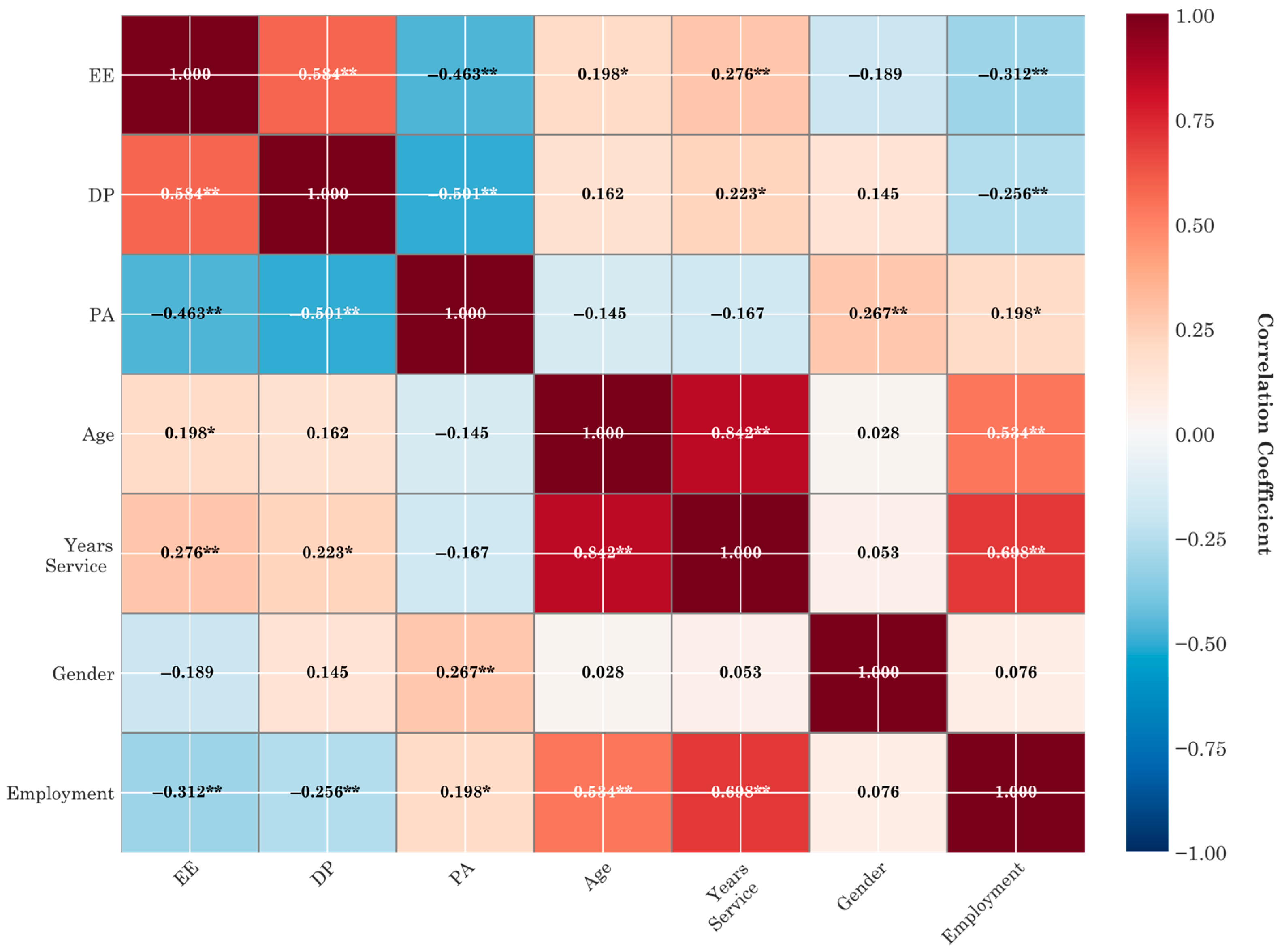
To facilitate simultaneous visualization of all bivariate relationships among study variables,
Figure 3 presents the complete correlation matrix as a color-coded heatmap, enabling immediate identification of the strongest associations and overall pattern of relationships relevant to mental health risk identification.
The heatmap visualization in
Figure 3 enables holistic understanding of burnout’s demographic and organizational correlates, revealing that while multiple variables show significant bivariate associations with burnout dimensions, the moderate-to-strong intercorrelations among predictors (particularly age, service, and employment status) explain why employment status emerged as the dominant unique predictor in multivariate analysis—other demographic correlates share substantial variance with this organizational factor.
Emotional Exhaustion and Depersonalization showed a strong positive correlation (r = 0.584, p < 0.01), indicating that teachers experiencing emotional depletion were substantially more likely to develop cynical attitudes toward students and teaching, with cascading effects on mental health. Both dimensions correlated negatively with Personal Accomplishment—Emotional Exhaustion (r = −0.463, p < 0.01) and Depersonalization (r = −0.501, p < 0.01)—demonstrating that as emotional strain and cynicism increased, sense of professional efficacy declined. These moderate-to-strong intercorrelations (r = 0.46–0.58) support Maslach’s conceptualization of burnout as a multidimensional syndrome in which components mutually reinforce each other, while the magnitudes of the correlations (all < 0.65) confirm that the dimensions capture distinct rather than redundant constructs.
Among demographic variables, years of service emerged as a significant correlate of Emotional Exhaustion (r = 0.276, p < 0.01), with more experienced teachers reporting higher emotional strain. Employment status (coded as 1 = permanent, 0 = substitute) showed notably strong negative point-biserial correlations with Emotional Exhaustion (r = −0.312, p < 0.01) and Depersonalization (r = −0.256, p < 0.01), indicating that permanent employment was associated with lower burnout—a finding suggesting that employment security serves as a protective factor for teacher mental health. Gender demonstrated small but significant point-biserial correlations with Emotional Exhaustion (r = −0.189, p < 0.05; males lower) and Personal Accomplishment (r = 0.267, p < 0.05; males higher).
3.6. Group Comparisons Across Demographic Variables
While bivariate and univariate analyses revealed multiple significant correlations, inferential group comparisons were necessary to test whether specific subgroups differed significantly in burnout experiences. Independent-samples t-tests and one-way ANOVAs examined differences in burnout across key demographic variables, with effect sizes calculated to assess practical significance.
3.6.1. Gender Differences in Burnout Manifestation
Independent-samples
t-tests revealed modest gender differences in burnout experiences, with males and females showing somewhat distinct profiles across the dimensions (
Table 6).
Female teachers demonstrated somewhat higher Emotional Exhaustion (M = 20.9, SD = 8.9) than male teachers (M = 17.8, SD = 8.3), though this difference did not reach statistical significance, t(124) = −1.634, p = 0.105, d = 0.29. Male teachers showed slightly higher Depersonalization (M = 5.7, SD = 4.8) than females (M = 4.6, SD = 4.1), also not statistically significant, t(124) = 1.245, p = 0.216, d = 0.22. However, male teachers reported significantly higher Personal Accomplishment (M = 40.3, SD = 5.9) compared to females (M = 37.8, SD = 6.8), t(124) = 2.012, p = 0.046, 95% CI [0.04, 4.16], representing a small-to-medium effect (d = 0.36).
These findings reveal subtle gender-specific patterns of burnout and well-being. While not reaching conventional significance thresholds for Emotional Exhaustion and Depersonalization, the consistent directional patterns suggest that female teachers may experience greater emotional strain, while male teachers demonstrate slightly higher cynicism, with males maintaining a stronger sense of professional accomplishment. The significant difference in Personal Accomplishment, though small, indicates that male teachers derive somewhat greater professional satisfaction or recognition in this female-dominated profession, potentially reflecting differential societal recognition or organizational dynamics that affect psychological well-being.
3.6.2. Employment Status: The Critical Differentiating Factor for Mental Health
Employment status emerged as the most powerful demographic predictor of burnout and psychological well-being, with permanent and substitute teachers exhibiting markedly different profiles across all dimensions (
Table 7).
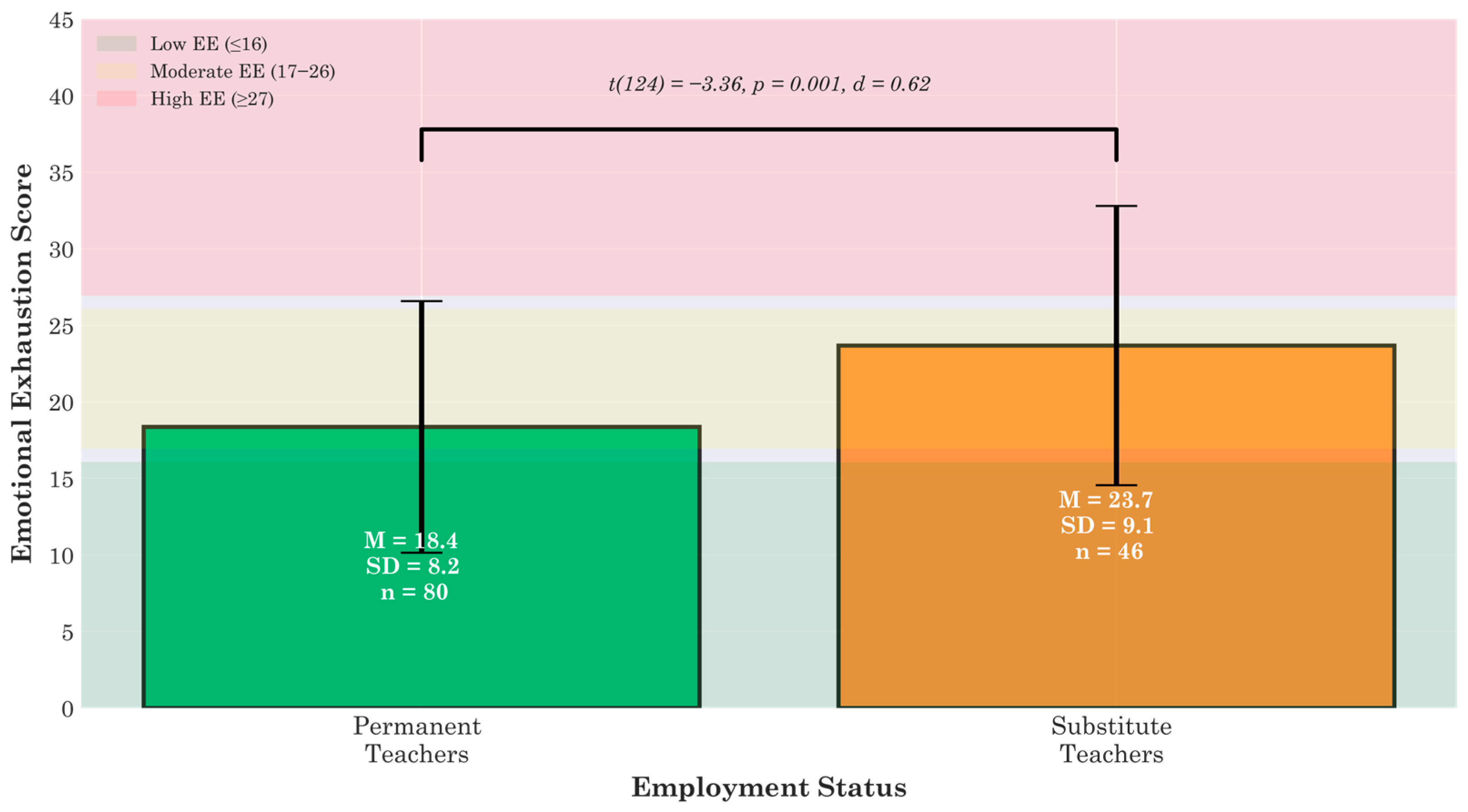
Substitute teachers reported significantly higher Emotional Exhaustion (M = 23.7, SD = 9.1) than permanent teachers (M = 18.4, SD = 8.2), t(124) = −3.355, p = 0.001, 95% CI [−8.48, −2.24], representing a medium-to-large effect (d = 0.62). This substantial difference—over 5 points on the MBI-ES scale—indicates that substitute teachers experience markedly greater emotional depletion, identifying employment precarity as a significant mental health risk factor in Greek primary education contexts.
Contrary to expectations, Depersonalization and Personal Accomplishment did not differ significantly between employment groups (both p > 0.05), though small effect sizes suggested directional trends. The specific vulnerability in Emotional Exhaustion among substitute teachers, without corresponding elevations in cynicism or reduced efficacy, suggests that employment insecurity primarily manifests as emotional strain and psychological distress rather than broader professional disengagement. This pattern indicates that substitute teachers maintain professional commitment and student-centered values despite facing substantially higher emotional demands, demonstrating resilience even under precarious employment conditions, but at potential cost to mental health if support is not provided.
The magnitude and clinical significance of this employment status disparity in emotional exhaustion are visually illustrated in
Figure 4, which positions group means within the established burnout classification zones.
Figure 4 provides compelling visual evidence that employment precarity does not produce merely marginal increases in burnout but rather substantive shifts in mental health risk, with substitute teachers experiencing emotional exhaustion levels that position them at significantly elevated vulnerability for psychological distress and potential progression to more comprehensive burnout syndrome.
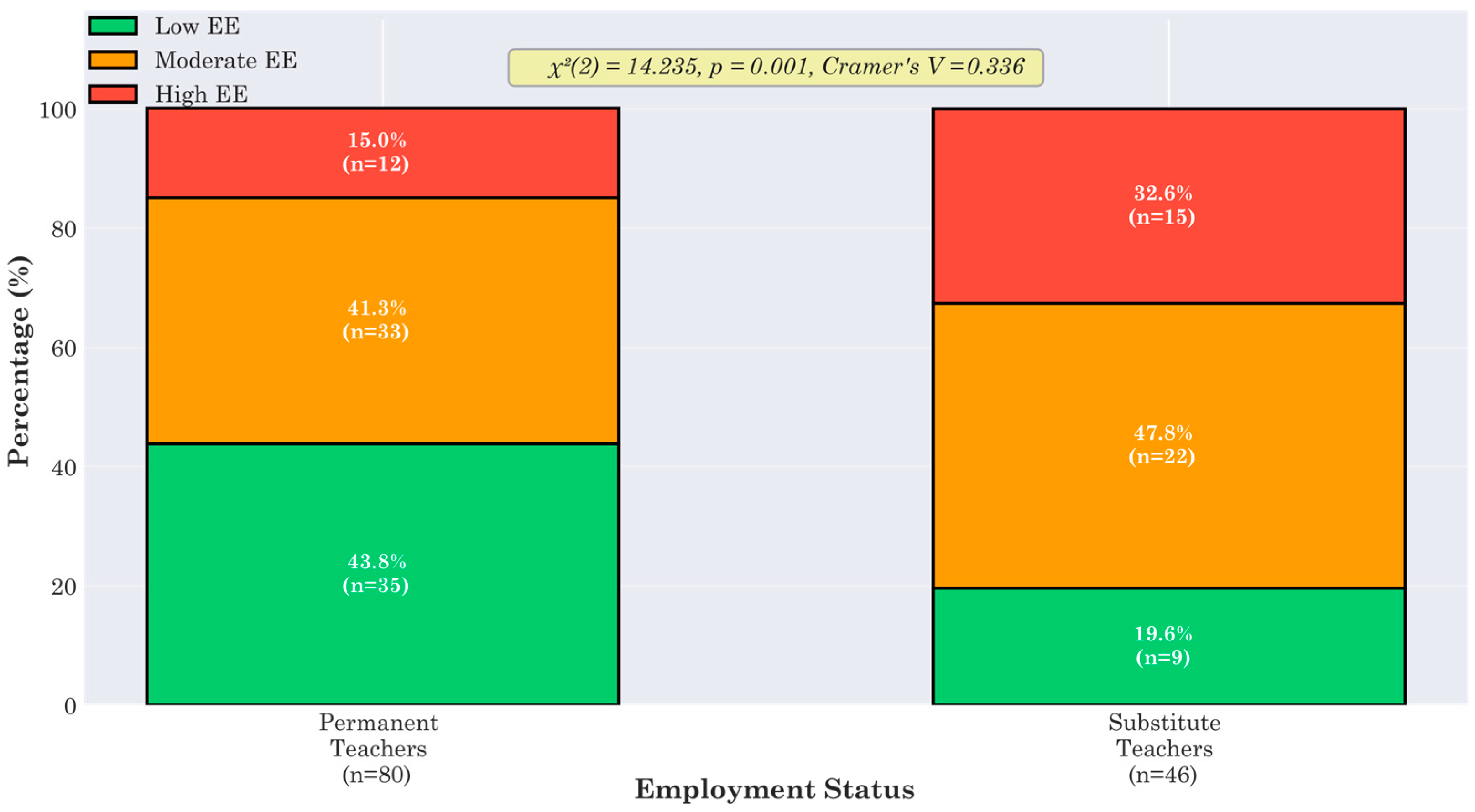
Chi-square analysis (
Table 8) further illustrated employment status disparities in burnout level distributions, confirming the mental health implications of employment precarity.
Among permanent teachers, 43.8% exhibited low Emotional Exhaustion compared to only 19.6% of substitutes, χ2(2) = 14.235, p = 0.001, Cramer’s V = 0.336 (medium association). Critically, 32.6% of substitute teachers met criteria for high Emotional Exhaustion compared to 15.0% of permanent teachers—a 2.2-fold difference in high-burnout prevalence indicating substantially elevated mental health risk. This dramatic differential identifies substitute teachers as a priority population for mental health promotion interventions.
To visualize the clinical implications of these employment status disparities,
Figure 5 presents the full distribution of emotional exhaustion levels across each employment group, revealing a dramatic shift in burnout risk associated with employment precarity.
As
Figure 5 illustrates, employment precarity fundamentally alters the distribution of mental health outcomes, shifting nearly one-third of substitute teachers into high-risk categories compared to fewer than one in six permanent teachers. This visualization provides powerful evidence for policy interventions targeting employment security as a high-impact mental health promotion strategy.
Convergent evidence from multiple analyses establishes employment status as the strongest modifiable organizational factor influencing teacher burnout and mental health in this Greek context. The elevated burnout among substitute teachers likely reflects chronic uncertainty about employment continuity, financial instability, a lack of control over assignments, reduced access to institutional support networks, and the absence of professional development opportunities available to permanent staff. From a mental health promotion perspective, these findings indicate that addressing employment precarity through policy interventions (e.g., clearer pathways to permanent positions, enhanced support systems for substitute teachers, improved compensation and benefits) represents a high-impact strategy for improving teacher psychological wellbeing at the organizational level.
3.6.3. School Type Differences
School type comparisons revealed no significant differences in burnout dimensions between primary school and kindergarten teachers (
Table 9).
No significant differences emerged between kindergarten and primary school teachers across any burnout dimension (all p > 0.05). While kindergarten teachers showed a non-significant trend toward higher Emotional Exhaustion (M = 21.5 vs. M = 18.9, d = 0.28), this difference was not statistically significant, and effect sizes were small across all dimensions. These findings suggest that burnout patterns and mental health vulnerabilities are relatively similar across the two primary education levels, indicating that interventions can be designed for the broader primary education workforce rather than requiring level-specific approaches.
3.6.4. Age and Experience Effects
One-way ANOVA examined the main effects of age and years of service on burnout dimensions, revealing limited significant patterns across career stages (
Table 10).
Neither age nor years of service demonstrated significant main effects on any burnout dimension (all p > 0.05). While non-significant trends suggested younger teachers and those with less experience might report slightly higher Emotional Exhaustion, these patterns did not reach statistical significance. Effect sizes were uniformly small (η2 = 0.03–0.07), indicating minimal practical differences across age or experience categories. These findings suggest that burnout and mental health vulnerabilities are distributed relatively evenly across career stages in this sample, contrasting with some literature suggesting elevated risk for early-career teachers. The lack of age/experience effects may reflect the sample’s predominance of mid-career teachers or the overriding influence of employment status, which supersedes career-stage effects.
3.7. Multivariate Prediction of Emotional Exhaustion
Multiple regression analysis examined the unique contributions of demographic and occupational variables to Emotional Exhaustion, an indicator of mental health risk, while controlling for intercorrelations among predictors (
Table 11).
Model 1, incorporating gender, age, years of service, employment status, school type, and education level as simultaneous predictors, was statistically significant, F(6, 119) = 5.376,
p < 0.001, explaining 21.5% of Emotional Exhaustion variance (adjusted R
2 = 0.175). Within this multivariate context, employment status emerged as the only significant unique predictor (β = −0.212, t = −2.343,
p = 0.021), confirming that permanent employment was associated with lower Emotional Exhaustion even after controlling for other demographic variables. This finding establishes employment security as a critical organizational factor in protecting teacher mental health. Gender approached significance (β = −0.142, t = −1.668,
p = 0.098), while years of service showed a non-significant positive trend (β = 0.189,
p = 0.136). Age, school type, and education level did not contribute significantly beyond other predictors, suggesting that their bivariate associations with Emotional Exhaustion (
Table 5) reflected shared variance with employment status and years of service.
Variance inflation factors (VIF) for all predictors ranged from 1.034 to 3.456, well below the threshold of 5, indicating problematic multicollinearity, confirming that predictors represented reasonably independent constructs. The regression analysis identifies employment status as the primary modifiable organizational risk factor for teacher mental health, while confirming that demographic correlates operate within a complex, interrelated system rather than as independent determinants. From a mental health promotion perspective, these findings suggest that interventions targeting employment security and support for substitute teachers represent high-leverage strategies for reducing burnout prevalence and improving psychological well-being across the teacher workforce.
3.8. Summary of Key Findings
The results reveal a complex profile of burnout and mental health patterns among Greek primary education teachers:
Psychometric Validation: CFA confirmed acceptable fit for the three-dimensional MBI-ES structure (χ2(162) = 8785.41, CFI = 0.900, TLI = 0.880, RMSEA = 0.080, SRMR = 0.080), validating the instrument for Greek primary education contexts despite modest reliability for the Depersonalization subscale.
Burnout Prevalence: Teachers reported moderate Emotional Exhaustion (M = 20.3, SD = 8.9), with 65.1% experiencing clinically meaningful emotional strain (moderate or high levels). Depersonalization remained low (M = 4.8), while Personal Accomplishment was moderate-to-high (M = 38.2), indicating maintained professional commitment despite emotional demands.
Employment Status as Primary Risk Factor: Substitute teachers demonstrated significantly higher Emotional Exhaustion (M = 23.7) than permanent teachers (M = 18.4), t(124) = −3.355, p = 0.001, d = 0.62, establishing employment precarity as the strongest modifiable organizational mental health risk factor. This medium-to-large effect remained significant in multivariate analysis (β = −0.212, p = 0.021) after controlling for demographics.
Limited Demographic Effects: Gender, age, years of service, and school type showed minimal independent effects on burnout. Small gender differences in Personal Accomplishment (males higher, p = 0.046, d = 0.36) and no significant age or school type effects suggest relatively uniform burnout patterns across these demographic categories, with employment status superseding other factors.
Mental Health Implications: The concentration of elevated burnout specifically in the Emotional Exhaustion dimension, particularly among substitute teachers, identifies clear targets for mental health promotion: supporting emotional resources, addressing employment precarity, and preventing progression to cynicism and reduced efficacy that characterize advanced burnout stages.
These findings establish employment security as a critical determinant of teacher psychological well-being and identify substitute teachers as a priority population for targeted mental health promotion interventions in Greek primary education.
4. Discussion
4.1. Principal Findings and Theoretical Context
This cross-sectional study of 126 primary education teachers in Aitoloakarnania Prefecture, Greece, documented burnout patterns and mental health vulnerabilities during the post-acute pandemic recovery period (September–November 2022), revealing a profile characterized by moderate emotional exhaustion, low depersonalization, and moderate-to-high personal accomplishment. Confirmatory factor analysis validated the three-dimensional MBI-ES structure for Greek primary education contexts, with acceptable model fit (χ2(162) = 8785.41, CFI = 0.900, TLI = 0.880, RMSEA = 0.080, SRMR = 0.080), providing a psychometric foundation for examining burnout dimensions separately. This burnout pattern represents an early-to-intermediate stage where emotional demands have not yet compromised professional efficacy or student relationships, indicating preserved psychological resilience but substantial mental health risk that presents a critical intervention window before syndrome progression.
The most significant finding was the identification of employment status as the strongest burnout predictor and primary organizational mental health risk factor, with substitute teachers demonstrating significantly elevated emotional exhaustion (M = 23.7, SD = 9.1) compared to permanent colleagues (M = 18.4, SD = 8.2), t(124) = −3.36, p = 0.001, d = 0.62, representing a medium-to-large effect. This 5.3-point difference positioned substitute teachers well into the moderate burnout range, approaching high classification thresholds, while permanent teachers clustered near the low/moderate boundary. Contrary to expectations, no significant differences emerged for depersonalization or personal accomplishment, indicating that employment precarity’s mental health impact manifests specifically as emotional exhaustion rather than comprehensive burnout across all dimensions. This pattern suggests that substitute teachers maintain professional commitment and student-centered values despite substantially elevated emotional strain, demonstrating resilience under precarious conditions, but at a potential cost to psychological well-being if organizational support is not provided.
Additionally, demographic analyses revealed limited effects: no significant differences emerged for age, years of service, or school type (kindergarten vs. primary) across burnout dimensions. Gender showed a small difference in Personal Accomplishment (males M = 40.3 vs. females M = 37.8, p = 0.046, d = 0.36), suggesting that gender operates as a minor rather than a primary factor. The absence of expected career-stage effects contrasts with some literature suggesting early-career vulnerability, possibly reflecting this sample’s predominance of mid-career teachers or the overriding influence of employment status, which supersedes developmental patterns.
The moderate emotional exhaustion observed (M = 20.3, SD = 8.9), with 65.1% of participants experiencing clinically meaningful levels (moderate or high), indicates substantial mental health risk warranting organizational attention and targeted mental health promotion interventions. However, the preserved low depersonalization (M = 4.8, 70.6% low) and moderate-to-high personal accomplishment (M = 38.2, 51.6% high) diverge from classic burnout progression models proposed by researchers [
115], which predict that emotional exhaustion precipitates cynicism and subsequently undermines professional efficacy. This discordant pattern may reflect several mechanisms relevant to teacher mental health and psychological well-being in Greek educational contexts.
Cultural values emphasizing relational connectedness and collective responsibility, particularly salient in Greek and broader Mediterranean contexts, may buffer against the development of cynical, detached attitudes toward students even when teachers experience personal exhaustion, protecting interpersonal dimensions of mental health while emotional resources remain depleted. Vocational commitment and intrinsic motivation to support children’s development are likely powerful protective factors that preserve core professional identity despite mounting emotional costs. The timing of data collection during September–November 2022, following summer recovery but representing the first months of return to full in-person instruction after two years of pandemic disruptions, may have captured teachers after recuperative break but before accumulated mid-year stress triggers depersonalization as a maladaptive coping mechanism [
116,
117].
Compared to international samples, Greek teachers demonstrated moderate levels of emotional exhaustion, which, while clinically concerning, are below rates reported in some Northern European contexts. Finnish primary teachers demonstrated a mean emotional exhaustion of M = 2.47 on a 1–7 scale (approximately equivalent to 28–30 on the 0–54 MBI-ES scale; Hakanen et al., 2006) [
26], Norwegian teachers M = 2.89 (approximately 31–33; Skaalvik & Skaalvik, 2009) [
27], and Dutch teachers M = 2.23 (approximately 25–27; Houkes et al., 2001) [
28]. Greek teachers’ emotional exhaustion (M = 20.3, approximately 2.25 on the 1–7 scale) positions slightly below these Northern European samples, potentially reflecting stronger family and social support networks characteristic of Mediterranean cultures [
29], cultural values prioritizing work–life balance and personal relationships over career achievement [
30], or adaptive psychological mechanisms developed during Greece’s prolonged economic crisis (2008–2018) that fostered enhanced resilience and resourcefulness [
31]. However, direct cross-national comparisons require caution given methodological variations in sampling, timing, and socioeconomic contexts, as well as potential cultural differences in response styles when completing self-report measures. The comparative resilience should not minimize the 65.1% prevalence of clinically meaningful emotional exhaustion documented in this sample, which represents a substantial mental health concern warranting intervention regardless of international standings.
4.2. Employment Precarity as a Critical Organizational Mental Health Risk Factor
The profound impact of employment status on teacher mental health and psychological well-being emerged across all analytical approaches, establishing job precarity as the single most powerful modifiable organizational risk factor identified in this study. Substitute teachers demonstrated a substantially higher prevalence of severe emotional exhaustion than permanent colleagues, with 32.6% experiencing high burnout, compared to 15.0% of permanent teachers—a 2.2-fold difference in high-risk prevalence, χ2(2) = 14.235, p = 0.001, Cramer’s V = 0.336. Moreover, employment status retained significant predictive power (β = −0.212, t = −2.343, p = 0.021) even after controlling for demographic variables, including age, years of service, gender, school type, and educational level in multiple regression analysis, uniquely explaining burnout variance beyond other factors. This convergent evidence from independent-samples t-tests, chi-square analyses, correlation matrices (r = −0.312, p < 0.01), and regression modeling confirms that employment precarity exerts a direct influence on mental health outcomes rather than merely confounding with other risk factors.
Multiple theoretical mechanisms explain this comprehensive mental health vulnerability documented in our findings. Empirical research provides robust quantification of job insecurity’s psychological impacts: Sverke et al.’s (2002) [
56] meta-analysis of 72 studies (N > 36,000) found mean correlations of r = 0.28 between job insecurity and psychological health problems and r = 0.18 with physical health problems. A more recent meta-analysis [
57] analyzing 263 studies (N > 200,000) confirmed job insecurity significantly predicts burnout (ρ = 0.44), reduced wellbeing (ρ = −0.41), and turnover intentions (ρ = 0.38). The medium-to-large effect size observed in our study (d = 0.62) aligns with and substantiates these meta-analytic estimates, demonstrating that the employment precarity-burnout link in Greek primary education mirrors patterns documented internationally across diverse occupational contexts and national settings.
Job insecurity theory posits that uncertainty regarding employment continuity creates chronic psychological strain through anticipated threat to valued job features and future prospects, directly impacting mental health [
118]. Substitute teachers face ongoing uncertainty about contract renewals, assignment locations, income stability, and career progression, hindering the development of psychological security and the capacity for long-term planning, which are fundamental to well-being. The Conservation of Resources model [
119] provides an additional theoretical framework, conceptualizing substitute status as representing both immediate resource loss through reduced income stability, benefits, and institutional support, as well as threatened future loss. This initiates stress spirals as teachers expend remaining personal resources attempting to secure permanent positions while lacking organizational resources that would buffer against demands and protect mental health [
120].
Beyond material insecurity, substitute teachers experience reduced organizational integration and support structures, which are critical for psychological well-being. Permanent teachers benefit from established collegial networks, institutional knowledge of school cultures and procedures, access to mentoring relationships, opportunities for professional development and leadership roles, and psychological investment in school community outcomes—all factors that promote occupational mental health. Substitute teachers, who frequently rotate between schools or fill temporary vacancies, cannot develop these protective organizational resources. They may face marginal status within school communities, excluded from decision-making processes, informal support networks, and professional development opportunities that buffer permanent staff against occupational stress. The emotional labor of repeatedly establishing relationships with new students, colleagues, and administrators only to experience disruption through reassignment compounds emotional exhaustion beyond the inherent demands of teaching itself [
121,
122,
123].
Siegrist’s Effort-Reward Imbalance model [
124] offers a complementary perspective, positing that perceived imbalance between efforts expended and rewards received generates chronic stress with cumulative health consequences. Substitute teachers face a profound effort-reward imbalance: they expend equivalent or greater effort managing unfamiliar students and schools without institutional support, yet receive substantially reduced rewards through lower compensation, the absence of benefits, constant employment uncertainty, limited career advancement prospects, and minimal professional recognition. These theoretical perspectives converge to identify employment precarity as a multi-faceted stressor operating simultaneously through material, psychological, and social pathways to compromise mental health and elevate burnout risk [
125,
126].
From a mental health promotion perspective, the policy implications are clear and actionable. Organizational interventions targeting job security, contract stability, equitable compensation and benefits, integration of substitute teachers into school communities, and transparent pathways to permanent status represent evidence-based strategies for reducing burnout risk and enhancing psychological well-being among this vulnerable population. Longitudinal evidence from prospective studies supports these policy directions: a two-wave panel study [
127] demonstrated that increased job insecurity predicted deteriorating mental health over time, while another study [
128] found that job security perceptions mediated relationships between organizational factors and burnout. These findings establish temporal precedence supporting causal interpretation of job insecurity’s mental health impacts. Given that employment status emerged as the strongest predictor while remaining modifiable through policy reform, initiatives addressing employment precarity should constitute the highest priority for mental health promotion efforts in Greek primary education, with potential to improve wellbeing for the 36.5% of teachers (46 individuals in this sample, extrapolating to hundreds or thousands regionally and nationally) currently experiencing elevated mental health risk due to precarious employment.
4.3. Career Stage and Demographic Patterns: Limited Effects Contrary to Expectations
Contrary to expectations based on prior literature, age and years of service did not have a significant effect on any burnout dimension in this sample. One-way ANOVA revealed non-significant F-tests for age effects (F(4121) = 1.876,
p = 0.120, η
2 = 0.058) and years of service effects (F(4121) = 2.234,
p = 0.069, η
2 = 0.069) on Emotional Exhaustion, with similarly non-significant patterns for other dimensions. While some literature documents early-career vulnerability characterized by “enthusiastic burnout” where novice teachers experience overwhelming demands despite maintained commitment [
129,
130], this pattern did not emerge significantly in our data.
Several factors may explain the absence of expected career stage effects. The sample’s demographic composition, with 39.7% in the 31–40 age range and relatively few very early-career teachers (≤30 years: 11.1%), may have provided insufficient variance in career stage to detect developmental patterns. The overriding influence of employment status, which superseded demographic factors in multivariate analysis, may obscure career-stage effects that manifest primarily among permanent teachers with stable employment, allowing natural developmental trajectories. Survivor bias, whereby teachers experiencing severe early-career burnout exit the profession before accumulating years of service, may have removed the most vulnerable novices from the sample, leaving only those with sufficient resilience or support to persist [
131,
132].
The strong correlation between age and years of service (r = 0.842, p < 0.01) creates substantial multicollinearity, making it difficult to disentangle maturational effects from accumulated experience effects. Additionally, the post-acute pandemic recovery timing may have created unique circumstances that affected all career stages similarly, temporarily masking typical developmental patterns as universal adaptation demands following two years of instructional disruptions.
While early-career teachers did not show significantly elevated burnout in this sample, the theoretical mechanisms underlying novice vulnerability remain relevant for mental health promotion planning. Novice teachers face reality shock as idealized expectations meet complex classroom realities, possess limited pedagogical content knowledge, require greater effort to achieve comparable outcomes, lack automated routines that reduce cognitive load, and often receive inadequate mentoring support [
133,
134]. Comprehensive induction programs incorporating structured mentoring, reduced teaching loads, cohort-based professional learning communities, explicit classroom management training, and realistic expectation-setting remain important universal supports that could benefit all teachers, particularly in protecting those who might otherwise experience early-career burnout trajectories [
135,
136,
137].
4.4. Gender and School Type: Modest Effects with Limited Practical Significance
Gender analyses revealed a small but significant difference in Personal Accomplishment, with male teachers (M = 40.3, SD = 5.9) reporting higher levels than female colleagues (M = 37.8, SD = 6.8), t(124) = 2.012,
p = 0.046, d = 0.36 (small-to-medium effect). However, no significant gender differences emerged for Emotional Exhaustion (
p = 0.105, d = 0.29) or Depersonalization (
p = 0.216, d = 0.22), and the modest effect size for Personal Accomplishment indicates gender operates as a secondary rather than primary factor in teacher mental health outcomes. Within the pronounced gender segregation of primary education (81.0% female in this sample), occupational demands appear to transcend gender differences, affecting teachers’ psychological well-being relatively uniformly regardless of sex [
138,
139].
The Personal Accomplishment difference may reflect minority-status advantages in female-dominated professions, where male teachers receive greater visibility, administrative favor, or leadership opportunities, thereby enhancing perceptions of professional efficacy. Gender-role congruence for males occupying authority positions may contrast with societal expectations channeling women toward caring professions as natural extensions of maternal roles rather than professional choices deserving recognition. Alternatively, differential socialization regarding emotional expression may influence self-report patterns, though the similarity across Emotional Exhaustion and Depersonalization suggests reporting biases alone cannot explain the specific Personal Accomplishment difference [
20,
140,
141,
142].
School type comparisons revealed no significant differences between kindergarten (n = 75) and primary school teachers (n = 38) across any burnout dimension (all
p > 0.05, small effect sizes d = 0.10–0.28). This finding contrasts with initial expectations that kindergarten teaching’s unique demands—intensive emotional labor with very young children, less tangible achievement markers, potential status devaluation—might differentially affect burnout patterns [
143,
144,
145,
146,
147,
148]. The absence of significant school-type effects suggests that burnout and mental health vulnerabilities distribute relatively uniformly across primary education levels, indicating that interventions can be designed for the broader primary education workforce rather than requiring level-specific approaches. Similar profiles may reflect that fundamental teaching demands (emotional labor, classroom management, student relationships, and administrative requirements) transcend specific age groups, or that Greek primary education’s unified administrative structure creates comparable working conditions across kindergarten and primary school contexts.
4.5. Temporal Context and Current Relevance
This study documents teacher burnout and mental health patterns during a specific historical period: September–November 2022, corresponding to the first months of the 2022–2023 academic year, following two years of pandemic-related disruptions (March 2020–June 2022). This timing positioned data collection during the post-acute pandemic recovery period, as Greek schools returned to full in-person instruction under relatively normalized conditions following periods of remote learning, hybrid scheduling, and evolving health protocols. Teachers had experienced unprecedented challenges maintaining educational continuity, rapidly adapting to new teaching modalities, managing technological barriers, and addressing heightened student and parental anxiety while coping with their own pandemic-related stress and uncertainties [
106,
107].
Interpreting findings requires acknowledging temporal specificity and distinguishing between likely stable relationships versus potentially variable prevalence estimates. Some documented patterns probably demonstrate relative temporal stability and would likely replicate if the study were conducted today (January 2026) or in future years, provided fundamental structural conditions persist. Most notably, employment status effects on burnout have been consistently documented across decades and diverse national contexts [
56,
57], suggesting that the precarity-burnout link represents an enduring phenomenon grounded in fundamental psychological mechanisms (job insecurity, resource loss, effort-reward imbalance) rather than temporary anomalies specific to pandemic recovery periods. The theoretical mechanisms explaining why employment precarity elevates burnout risk—chronic uncertainty, material insecurity, organizational marginalization, effort-reward imbalance—operate independently of pandemic contexts and would be expected to produce similar mental health impacts during any historical period characterized by comparable employment structures.
However, absolute burnout prevalence levels may demonstrate greater temporal variability depending on evolving working conditions, policy contexts, educational demands, and available support systems. The 65.1% prevalence of clinically meaningful emotional exhaustion (moderate or high levels) documented in September–November 2022 could represent temporary elevation during challenging transition back to normalcy following pandemic disruptions, stable baseline characteristic of this teaching population under typical conditions, or even suppression relative to peak pandemic stress if teachers experienced relief from resuming familiar instructional formats. Without pre-pandemic baseline measurements from this same population, definitive attribution of observed levels specifically to pandemic influences versus pre-existing conditions or other contextual factors remains impossible [
108,
109,
110].
For readers and policymakers in 2026 and beyond, findings remain relevant and actionable if key structural conditions persist: the proportion of substitute versus permanent teachers in Greek primary education, relative resource availability and administrative support systems, compensation structures and employment pathways, and broader socioeconomic contexts affecting teacher wellbeing. If substantive policy reforms have occurred since 2022—such as expanded pathways to permanent positions, enhanced support for substitute teachers, improved working conditions, or increased mental health resources—then both absolute burnout levels and potentially the magnitude of employment status effects may have shifted. Conversely, if conditions have deteriorated through increased precarity, reduced resources, or mounting demands, current burnout levels may exceed those documented here.
The study’s value extends beyond point-in-time prevalence estimates to establishing validated measurement approaches (CFA-supported three-factor structure), identifying primary risk factors (employment precarity), characterizing at-risk populations (substitute teachers experiencing 2.2-fold higher high-burnout prevalence), and demonstrating effect magnitudes (medium-to-large employment status effects) that inform mental health promotion intervention priorities regardless of absolute prevalence fluctuations. These structural findings provide actionable guidance for organizational policy even as specific rates may vary across time and context.
4.6. Limitations and Methodological Considerations
Several methodological limitations constrain the interpretation and generalizability of findings, requiring acknowledgment to inform appropriate application and guide future research directions.
Cross-Sectional Design and Causal Inference: The cross-sectional design fundamentally limits causal inference regarding the directionality of observed associations and mental health pathways. While employment status predicted burnout in regression analyses and theoretical mechanisms support a causal interpretation, reverse causation remains plausible: teachers experiencing high burnout may be less competitive for permanent positions due to reduced performance or professional presentation, or may voluntarily seek substitute status to reduce long-term commitment and psychological investment. Longitudinal research designs tracking individual teachers across employment transitions would clarify temporal sequences, testing whether employment precarity precedes burnout development (supporting causal interpretation) or whether burnout influences subsequent employment outcomes (suggesting reverse causation or bidirectional relationships). Prospective studies following early-career teachers from initial substitute positions through potential transitions to permanent status would be particularly informative, examining whether securing permanent employment predicts subsequent reductions in burnout, thereby establishing temporal precedence supporting causal claims [
149,
150].
Sampling and Generalizability: The convenience sampling approach and voluntary participation introduce potential selection bias in unknown directions, affecting estimates of burnout prevalence and risk factor relationships. Teachers experiencing extreme burnout may have been differentially motivated to participate—either more willing to voice concerns and seek validation for struggles, or less willing due to exhaustion, disengagement, and time constraints—creating unpredictable bias. The low response rate (6.8% of prefecture teacher population) raises concerns about representativeness despite reasonable demographic alignment with known population parameters. The regional focus on Aitoloakarnania Prefecture, a predominantly rural/semi-rural area, limits confident generalization to other Greek regions, particularly urban centers like Athens or Thessaloniki with different resource levels, administrative structures, socioeconomic compositions, and teacher demographics. Urban-rural differences in employment stability, school resources, community support, and occupational stress levels may substantially moderate burnout patterns in ways this single-prefecture sample cannot capture [
151,
152].
Measurement Limitations: The exclusive reliance on self-report measures creates shared method variance potentially inflating observed correlations between burnout dimensions and creates vulnerability to response biases. Social desirability pressures may systematically affect responses, with depersonalization likely underreported given that admitting cynical attitudes toward students violates professional norms and teacher identity, while emotional exhaustion reporting may be more socially acceptable as reflecting external demands rather than personal inadequacy. Future research incorporating objective indicators—sick leave utilization, turnover intentions or actual attrition rates, supervisor ratings of teacher engagement, student outcome measures, or physiological stress markers (cortisol patterns, cardiovascular indicators)—would triangulate self-report findings and test whether observed patterns extend beyond subjective perceptions to observable behavioral and biological outcomes [
153,
154,
155].
Temporal Specificity: Data collection during September–November 2022, the first academic months following summer vacation, may have captured teachers after recuperative break but before accumulated mid-year stress, potentially underestimating burnout prevalence relative to assessments conducted during late winter or early spring when stress typically peaks. The post-acute pandemic recovery timing introduces historical specificity; findings document mental health patterns during a particular transitional period that may not fully characterize either acute pandemic teaching conditions or normalized pre-pandemic baseline patterns. Without comparison to pre-pandemic data from the same population or to current (2026) measurements, isolating pandemic-specific influences from enduring structural factors remains challenging.
Psychometric Considerations: While confirmatory factor analysis supported the MBI-ES’s three-dimensional structure with acceptable fit indices, the Depersonalization subscale demonstrated lower-than-ideal reliability (α = 0.153) in this sample, raising questions about measurement precision for this specific dimension. This pattern has been observed in other Greek samples and may reflect cultural factors affecting response to cynicism items, true low variance in depersonalization within this sample (most teachers scoring low), or translation/adaptation issues. The lower reliability for Depersonalization should temper confidence in findings specific to this dimension, though the primary findings concern Emotional Exhaustion (α = 0.635, acceptable reliability) where measurement quality was adequate.
4.7. Future Research Directions and Implications for Mental Health Promotion
Future research should prioritize designs and methodologies that address the limitations identified above while extending understanding of teacher mental health in educational contexts.
Longitudinal Research Designs: Prospective studies tracking teachers across multiple time points would address limitations in causal inference and illuminate mental health trajectories. Priority questions include: (1) Do employment transitions predict burnout changes? Following teachers who transition from substitute to permanent positions would test whether securing stable employment predicts subsequent reductions in burnout, establishing temporal precedence for causal claims. (2) What predicts burnout progression versus recovery? Identifying early warning indicators that distinguish teachers whose emotional exhaustion escalates toward comprehensive burnout from those who recover or maintain stable levels would enable proactive mental health interventions before severe syndrome development. (3) How do burnout patterns evolve across career stages? Cohort studies following teachers from pre-service training through career progression would illuminate critical transition points (entry, tenure decisions, mid-career, late-career), warranting targeted mental health support [
156,
157,
158,
159,
160,
161,
162,
163,
164,
165].
Intervention Research: Rigorous evaluation of mental health promotion interventions targeting identified risk factors should employ randomized controlled trial designs whenever ethically feasible, testing organizational interventions (contract stabilization initiatives, workload reduction experiments, structured mentoring programs), individual-level interventions (stress management training, resilience-building programs, cognitive-behavioral approaches), and multi-component approaches simultaneously addressing organizational and individual factors. Comparative effectiveness research would identify the most cost-effective intervention components for resource-constrained educational systems requiring strategic allocation decisions. Implementation science approaches examining barriers and facilitators to intervention adoption, fidelity of program delivery in real-world school contexts, and sustainability after research support ends would bridge the research-practice gap, limiting many intervention studies’ practical impact [
166,
167,
168,
169,
170,
171,
172,
173,
174].
Mixed-Methods Research: Combining quantitative burnout assessment with qualitative exploration would illuminate psychological mechanisms and lived experiences underlying statistical associations. Priority questions include: How do substitute teachers experience and cope with the psychological impacts of employment precarity? In-depth interviews could reveal specific stressors, the adaptive strategies employed by resilient individuals, and contextual factors that facilitate or hinder well-being. What organizational practices support or undermine teacher mental health? Qualitative case studies of schools with varying burnout rates could identify modifiable leadership practices, collegial support structures, and administrative policies affecting well-being. Do Greek teachers conceptualize occupational stress and mental health differently than frameworks developed in Anglo-American contexts assume? Cultural psychology approaches could examine whether Mediterranean values, collectivist orientations, or experiences of economic crisis shape stress appraisal and coping in ways that affect burnout measurement and the relevance of interventions [
175,
176,
177,
178,
179].
Geographic and Cultural Expansion: Expanding sampling across diverse Greek regions, including urban centers, rural communities, and socioeconomically varied areas, would test generalizability beyond Aitoloakarnania, examine urban-rural differences in burnout patterns, and assess the impacts of regional policies and resource distributions. National probability sampling would enable population-level prevalence estimates informing ministry-level policy planning and resource allocation. Cross-cultural comparative research employing standardized instruments across countries would clarify whether Greek teachers’ patterns reflect cultural protective factors, methodological artifacts, or historical timing effects, and identify culturally specific versus universal risk and protective factors relevant to mental health promotion [
180,
181,
182,
183,
184,
185,
186,
187,
188,
189,
190,
191,
192].
Protective Factors and Resilience: Investigating the strengths that enable some teachers to maintain well-being despite high demands would complement deficit-focused approaches. Research systematically examining meaning and purpose in work, professional identity strength, sources of self-efficacy, quality of collegial and family support, autonomy and recognition systems, and mindfulness or spirituality practices could illuminate pathways to thriving rather than merely surviving, informing positive organizational scholarship approaches to educator wellbeing. Qualitative studies of teachers identified as highly resilient despite objectively stressful conditions could reveal specific coping strategies, cognitive appraisals, or resource mobilization approaches translatable to intervention development [
193,
194,
195,
196,
197,
198,
199].
Policy Research: Economic analyses quantifying burnout’s organizational costs—through increased sick leave, turnover and replacement expenses, reduced instructional quality, and diminished student outcomes—would provide compelling evidence for allocating resources to mental health promotion. Natural experiment designs evaluating policy changes (e.g., employment reforms, workload reductions, compensation increases) would test causal impacts on teacher mental health at the system level. Implementation research examining barriers to adopting evidence-based practices in educational bureaucracies could accelerate translation of research findings into organizational policy and practice.
4.8. Implications for Mental Health Promotion in Educational Settings
This study’s findings offer actionable implications for mental health promotion strategies targeting teacher wellbeing at individual, organizational, and policy levels.
Organizational-Level Interventions (Highest Priority): Addressing employment precarity is the highest-impact strategy, given its identification as the strongest modifiable risk factor with medium-to-large effects (d = 0.62). Specific recommendations include: (1) Expand pathways to permanent status through transparent hiring procedures, predictable advancement criteria, and prioritization of internal candidates with demonstrated performance; (2) Stabilize substitute teacher contracts through multi-year agreements, guaranteed minimum assignments, or semester-long rather than day-to-day placements reducing constant uncertainty; (3) Integrate substitute teachers into school communities through inclusion in professional development, staff meetings, decision-making processes, and collegial support networks typically restricted to permanent staff; (4) Equalize compensation and benefits addressing material insecurity and effort-reward imbalance that compound psychological strain; (5) Provide mentoring and administrative support specifically targeting substitute teachers’ unique challenges navigating unfamiliar schools and lacking institutional knowledge.
Universal Prevention Strategies: Given the 65.1% prevalence of clinically meaningful emotional exhaustion affecting both permanent and substitute teachers, universal interventions supporting all educators’ mental health warrant attention: (1) Workload management initiatives identifying and addressing unnecessary administrative burdens, streamlining documentation requirements, and protecting instructional time from excessive meetings or compliance demands; (2) Stress management and resilience training incorporating evidence-based cognitive-behavioral techniques, mindfulness practices, and emotion regulation skills adapted to educational contexts; (3) Collegial support networks facilitating peer mentoring, professional learning communities, and informal social connections reducing isolation and providing emotional support; (4) Administrative recognition and appreciation through formal acknowledgment systems, professional development opportunities, and leadership pathways enhancing personal accomplishment and buffering against emotional exhaustion.
Early Identification and Targeted Support: Mental health surveillance systems enabling early identification of teachers experiencing elevated burnout would allow timely intervention before syndrome progression. Schools could implement brief, periodic well-being assessments identifying individuals requiring additional support, coupled with confidential counseling services, employee assistance programs, or reduced workload accommodations for teachers experiencing acute stress. Targeting the 21.4% who experience high emotional exhaustion with intensive individual-level interventions, while simultaneously addressing systemic factors affecting all teachers, represents a comprehensive public health approach.
Policy-Level Reforms: Ministry-level initiatives addressing structural determinants of teacher mental health include: (1) Employment policy reform expanding permanent positions, limiting substitute teacher utilization to genuinely temporary needs, and establishing career pathways with predictable advancement; (2) Resource allocation ensuring adequate staffing ratios, classroom materials, and support services reducing objective demands contributing to burnout; (3) Professional development systems supporting continuous skill development, particularly for early-career teachers and those navigating employment uncertainty; (4) Public awareness campaigns elevating teaching’s professional status and societal recognition, potentially buffering personal accomplishment dimensions.
Evaluation and Continuous Improvement: Implementation of any interventions should incorporate rigorous evaluation to measure effects on burnout outcomes, employ pre-post designs with adequate follow-up, compare intervention and control schools, and assess cost-effectiveness to guide resource allocation. Continuous quality improvement approaches that use data to refine interventions, adapt strategies to local contexts, and scale successful programs across educational systems would maximize the impact of mental health promotion.
5. Conclusions
This investigation of primary education teacher burnout in Aitoloakarnania Prefecture, Greece, during the post-acute pandemic recovery period documented a distinctive profile characterized by moderate emotional exhaustion affecting approximately two-thirds of participants at clinically meaningful levels, while depersonalization remained low and personal accomplishment moderate-to-high. This pattern indicates that teachers maintain professional commitment and student-centered values despite substantial emotional strain, representing an early-to-intermediate burnout stage that presents a critical intervention window for mental health promotion before syndrome progression to more comprehensive burnout encompassing cynicism and reduced effectiveness. Confirmatory factor analysis validated the three-dimensional MBI-ES structure for Greek primary education contexts, providing a psychometric foundation for continued use in mental health surveillance, intervention evaluation, and longitudinal burnout monitoring in educational settings.
Employment status emerged as the strongest and most consistent predictor of teacher burnout and psychological well-being, establishing employment precarity as the primary organizational mental health risk factor warranting immediate policy attention. Substitute teachers demonstrated significantly higher emotional exhaustion than permanent colleagues, with a burnout prevalence more than double that observed among permanent staff. This finding aligns with extensive international evidence documenting job insecurity’s robust associations with compromised psychological health across diverse occupational contexts. Contrary to expectations, demographic factors, including age, years of service, gender, and school type, showed limited or no significant effects on burnout dimensions, indicating that organizational factors related to employment security supersede individual characteristics in determining mental health outcomes. The policy implications are clear and actionable: initiatives addressing employment security through expanded pathways to permanent positions, contract stabilization, integration of substitute teachers into school communities, equalized compensation, and targeted organizational support represent evidence-based, high-impact strategies for improving teacher mental health with potential cascading benefits for instructional quality and student outcomes.
The preservation of low depersonalization and moderate-to-high personal accomplishment despite moderate emotional exhaustion suggests the presence of protective factors and psychological resilience that buffer against the development of complete burnout syndrome, even under emotional strain. Potential protective mechanisms include vocational commitment to supporting children’s development, cultural values emphasizing relational connection and collective responsibility characteristic of Mediterranean contexts, stronger family and social support networks, and adaptive coping strategies developed during Greece’s prolonged economic crisis. Cross-national comparisons indicate that Greek teachers’ emotional exhaustion levels position slightly below some Northern European samples, though the substantial prevalence of clinically meaningful emotional exhaustion still represents a serious mental health concern, warranting comprehensive intervention regardless of international standings. These protective factors provide foundations for building prevention and intervention programs that leverage existing strengths while addressing specific vulnerability points, particularly the concentrated emotional exhaustion among substitute teachers. Interpreting findings requires acknowledging temporal and geographic specificity; data collection during a transitional period following pandemic disruptions provides a snapshot whose absolute prevalence estimate may vary across time depending on evolving working conditions and policy reforms, though the fundamental employment precarity-burnout relationship likely demonstrates temporal stability given its consistent documentation across decades and contexts.
Ultimately, addressing teacher burnout and promoting mental health in educational settings requires coordinated multi-level commitment. Policymakers must prioritize employment security through budget allocation, converting substitute positions to permanent roles, transparent hiring procedures, and labor policy reforms, establishing equitable compensation and predictable advancement criteria. School administrators should foster supportive organizational climates characterized by reasonable workloads, collegial collaboration, professional autonomy, authentic recognition, and the intentional integration of substitute teachers into communities typically reserved for permanent staff. Professional development systems should support teachers at all career stages through comprehensive induction programs, continuous skill development accessible to all employment categories, and leadership pathways that enhance personal accomplishment. Mental health surveillance systems that implement periodic well-being assessments would enable early identification of elevated burnout, enabling timely intervention through confidential support services before syndrome progression. The moderate but widespread emotional exhaustion documented here signals both an urgent need for intervention to prevent deterioration and a current opportunity to prevent it while teachers retain core professional engagement and student-centered commitment. The high burnout concentration among substitute teachers identifies a specific population experiencing substantial mental health risk that requires immediate attention, while preserved depersonalization and personal accomplishment across the broader sample indicates receptivity to organizational supports addressing objective stressors rather than requiring a fundamental attitude transformation.
This study’s validated measurement approaches, identification of employment precarity as the primary modifiable risk factor, and comprehensive documentation of at-risk populations provide a robust empirical foundation for evidence-based burnout prevention and mental health promotion initiatives. Prioritizing employment security reforms alongside universal wellbeing supports represents a high-impact strategy with potential to improve psychological health for substantial proportions of the teaching workforce, constituting an investment in educational quality and societal wellbeing, as psychologically healthy, engaged educators provide the human infrastructure upon which effective learning systems depend.




 ,
,