
Diminished Quality of Life and Psychosocial Strain of Women Under the New Taliban Era: A Thematic Analysis
 , , , , , , , , and
Abstract
1. Introduction
- What are key shared hardships concerning the daily lives of Afghan women (ages 18–65) residing under the Taliban’s Islamic Emirate of Afghanistan and the humanitarian crisis?
- How does experiencing these hardships affect their psychosocial stress levels (measured by Likert PSS Scale and emotional sentiment in qualitative statements) related to (a) their political sentiment towards the New Taliban and (b) opposition to its gender discrimination policies (GDP)?
2. Methods
2.1. Ethics Statement
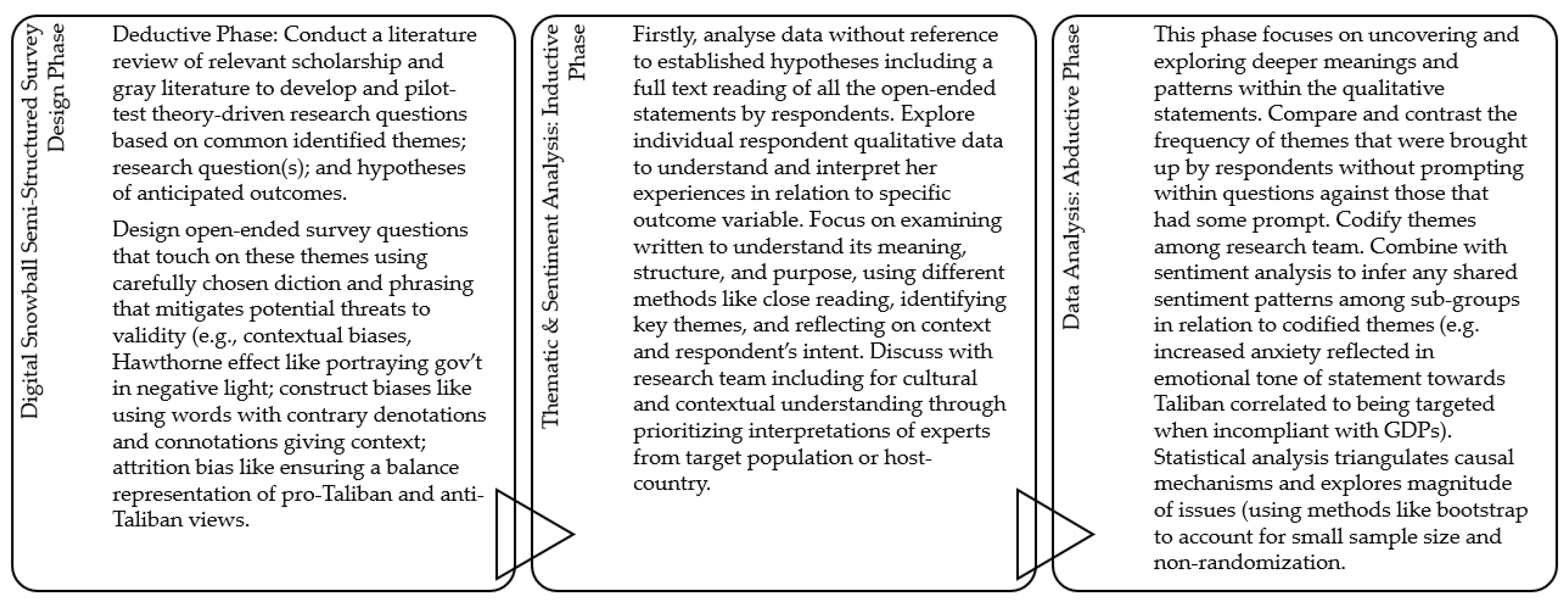
2.2. Theoretical Framework
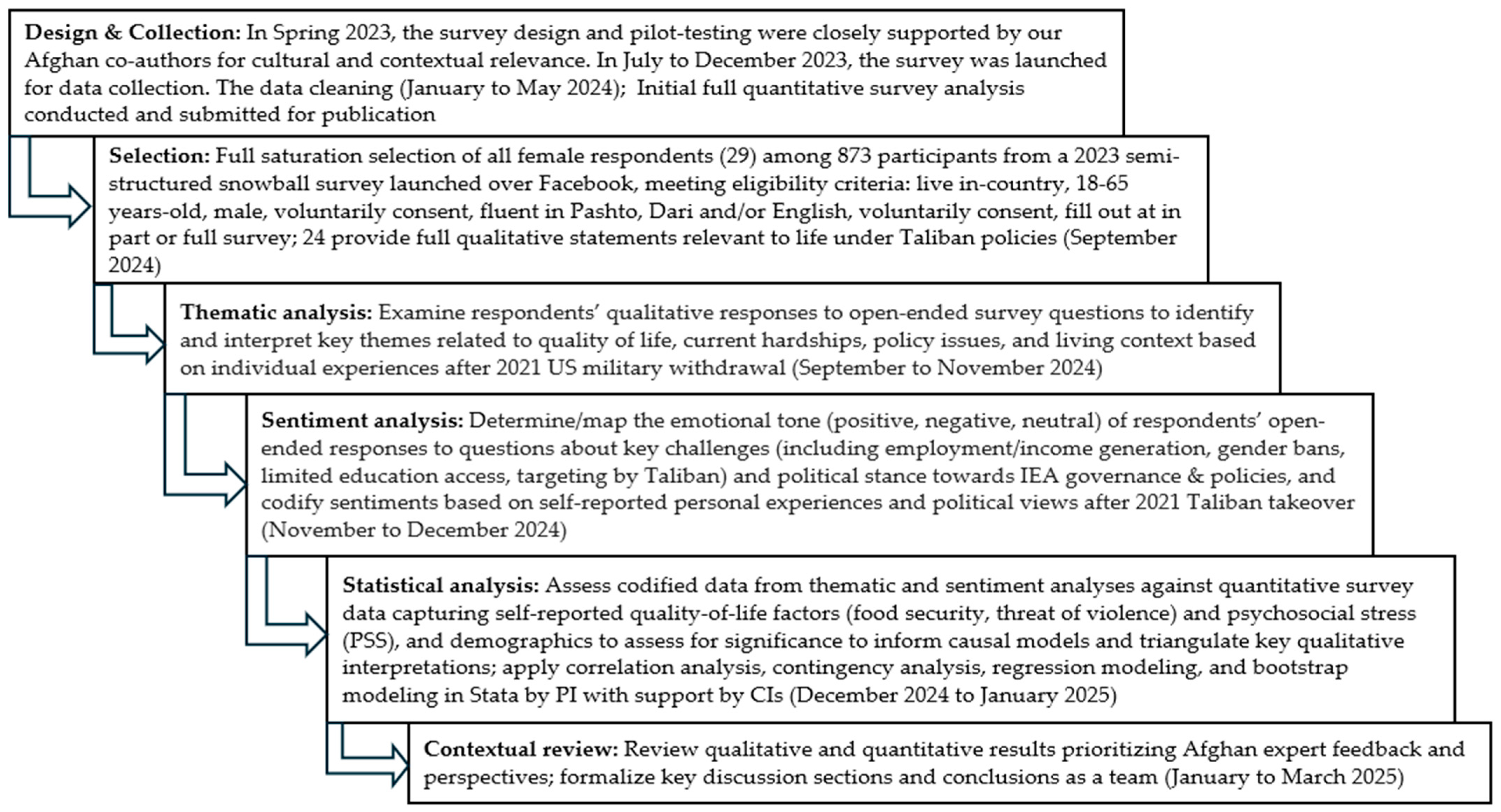
2.3. Study Design and Selection Process
2.4. Data Analysis
3. Results
3.1. High Levels of Psychosocial Stress Among Afghan Women
3.2. When Gender Views Align with Political Culture
3.3. Differences in Political Experiences
3.4. Strain of Unemployment/Income Generation
3.5. Strain from Education Bans
3.6. Statistical Analysis
4. Discussion
4.1. Value Incongruity and Role Conflict
4.2. Stimuli and Identity
4.3. Implications
4.4. Strengths and Limitations
5. Conclusions
Author Contributions
Funding
Institutional Review Board Statement
Informed Consent Statement
Data Availability Statement
Conflicts of Interest
Appendix A

| Variables | 1 | 2 | 3 | 4 | 5 | 6 | 7 | 8 | 9 | 10 | 11 |
|---|---|---|---|---|---|---|---|---|---|---|---|
| PSS level (1) | - | ||||||||||
| DQOL level (2) | 0.56 *** | - | |||||||||
| HH unemployment (3) | 0.46 * | 0.20 | - | ||||||||
| IEA restrictions on citizens’ rights (4) | 0.58 ** | 0.51 * | 0.18 | - | |||||||
| Monitoring of citizen non-compliance (5) | 0.59 ** | 0.55 ** | 0.13 | 0.83 *** | - | ||||||
| Female work restriction (6) | 0.52 * | 0.32 | 0.26 | 0.55 ** | 0.51 * | - | |||||
| Social restrictions for females (7) | 0.80 * | 0.55 ** | 0.18 | 0.87 *** | 0.76 *** | 0.54 ** | - | ||||
| Female edu bans (8) | 0.57 ** | 0.51 ** | 0.16 | 0.70 ** | 0.55 ** | 0.59 ** | 0.81 *** | - | |||
| Monitoring and targeting of female non-compliance (9) | 0.63 ** | 0.60 ** | 0.51 * | 0.71 *** | 0.84 *** | 0.49 * | 0.83 *** | 0.70 *** | - | ||
| Political sentiment towards IEA (10) | 0.78 *** | 0.59 ** | 0.51 * | 0.72 *** | 0.73 *** | 0.51 * | 0.77 *** | 0.68 *** | 0.80 *** | - | |
| Opposition level to gender apartheid (11) | 0.80 *** | 0.67 *** | 0.20 | 0.79 *** | 0.75 *** | 0.64 ** | 0.91 *** | 0.80 *** | 0.82 *** | 0.80 *** | - |
| Total number of coping mechanisms (12) | −0.61 ** | −0.41 | −0.69 * | −0.22 | −0.24 | −0.15 | −0.22 | −0.14 | −0.27 | −0.57 ** | −0.29 |
Appendix B
References
- Associated Press. Afghans Say They Feel Safer But Less Hopeful Under Taliban Rule. NPR, 15 February 2022; pp. 1–5. Available online: https://www.npr.org/2022/02/15/1080771248/afghans-say-they-feel-safer-but-less-hopeful-under-taliban-rule (accessed on 15 July 2025).
- Hassan, T. Afghanistan—Events of 2022. Hum. Rights Watch 2023, 1–8. Available online: https://www.hrw.org/world-report/2023/country-chapters/afghanistan (accessed on 15 July 2025).
- Amnesty International. The Taliban’s War on Women. Amnesty Int. 2023, 1–10. Available online: https://www.amnesty.org/en/latest/news/2023/05/afghanistan-talibans-treatment-of-women-and-girls-should-be-investigated-as-the-crime-against-humanity-of-gender-persecution/ (accessed on 15 August 2025).
- UN News. Afghanistan: Nearly 20 Million Going Hungry. UN News, 9 May 2022; pp. 1–4. Available online: https://news.un.org/en/story/2022/05/1117812 (accessed on 8 August 2025).
- UNHCR. Afghanistan Humanitarian Crisis. UN Refugee 2024. Available online: https://www.unrefugees.org/emergencies/afghanistan/ (accessed on 10 October 2024).
- Yousaf, F.; Jabarkhail, M. Afghanistan’s future under the Taliban regime: Engagement or isolation? J. Polic. Intell. Count. Terror. 2022, 17, 117–134. [Google Scholar] [CrossRef] [Scilit]
- Lutz, J.; Kurtzer, J. What the Taliban Takeover Means for Food Security in Afghanistan. Cent. Stragetic Int. Stud. 2021, 1–11. Available online: https://www.csis.org/analysis/what-taliban-takeover-means-food-security-afghanistan (accessed on 1 August 2024).
- Safi, N.; Anwari, P.; Safi, H. Afghanistan’s Health System Under the Taliban: Key Challenges. Lancet 2022, 400, 1179–1180. Available online: https://www.thelancet.com/journals/lancet/article/PIIS0140-6736(22)01806-2/fulltext (accessed on 17 September 2024). [CrossRef] [Scilit]
- Bjelica, J. Rural Women’s Access to Health in Afghanistan: “Most of the Time, We Just Don’t Go”. Afghan. Peace Campaign. 2025, 1–13. Available online: https://afghanistanpeacecampaign.org/2025/03/26/rural-womens-access-to-health-in-afghanistan-most-of-the-time-we-just-dont-go/ (accessed on 11 October 2025).
- Watson, M. Temporary and Child Marriages: Historical Perspectives and Contemporary Issues in Iran, Iraq, and Afghanistan. In Temporary and Child Marriages in Iran and Afghanistan; Springer: Singapore, 2021. [Google Scholar] [CrossRef] [Scilit]
- BBC. Afghanistan: Who’s Who in the Taliban Leadership. BBC News, 7 September 2021; pp. 1–11. Available online: https://www.bbc.com/news/world-asia-58235639 (accessed on 15 September 2025).
- Murtazashvili, J.B. The Collapse of Afghanistan. J. Democr. 2022, 33, 40–54. [Google Scholar] [CrossRef] [Scilit]
- Hanson-DeFusco, J.; Sobolov, A.; Stanekzai, S.; McMaster, A.; Popalzai, H.; Shah, H.; Shi, M.; Kumar, N. The association of diminished quality of life of Afghan adults’ psychosocial wellbeing, in the era of the Taliban 2.0 government. PLoS Ment. Health 2025, 2, e0000118. [Google Scholar] [CrossRef] [Scilit]
- Snyder, R.S. The Fall of Afghanistan: An American Tragedy. Small Wars Insur. 2023, 34, 747–758. [Google Scholar] [CrossRef] [Scilit]
- Sobat, T. What did the US War and Exit Do for Afghan Women’s Rights? The Gender Policy Report, 5 March 2024; pp. 1–8. Available online: https://genderpolicyreport.umn.edu/what-did-the-us-war-and-exit-do-for-afghan-womens-rights/ (accessed on 15 September 2025).
- Boni, F. Afghanistan 2022: Life Under the Taliban. Asia Maior 2023, 18, 411–415. Available online: https://www.torrossa.com/en/resources/an/5525969#page=437 (accessed on 20 July 2024). [CrossRef] [Scilit]
- Qazi Zada, S.; Qazi Zada, M.Z. The Taliban and women’s human rights in Afghanistan: The way forward. Int. J. Hum. Rights 2024, 28, 1687–1722. [Google Scholar] [CrossRef] [Scilit]
- Shoib, S.; Saeed, F.; Dazhamyar, A.R.; Armiya’u, A.Y.; Badawy, M.M.; Shah, J.; Chandradasa, M. Women in Afghanistan: A call for action. Lancet Psychiatry 2022, 9, 342–343. [Google Scholar] [CrossRef] [Scilit]
- Braun, V.; Clarke, V. Using thematic analysis in psychology. Qual. Res. Psychol. 2006, 3, 77–101. [Google Scholar] [CrossRef] [Scilit]
- Acosta, L.M.; Andrews, A.R.; Acosta Canchila, M.N.; Ramos, A.K. Testing Traditional Machismo and the Gender Role Strain Theory With Mexican Migrant Farmworkers. Hisp. J. Behav. Sci. 2020, 42, 215–234. [Google Scholar] [CrossRef] [Scilit]
- Broidy, L.; Agnew, R. Gender and Crime: A General Strain Theory Perspective. J. Res. Crime Delinq. 1997, 34, 275–306. [Google Scholar] [CrossRef] [Scilit]
- Broidy, L.; Santoro, W.A. General Strain Theory and Racial Insurgency: Assessing the Role of Legitimate Coping. Justice Q. 2018, 35, 162–189. [Google Scholar] [CrossRef] [Scilit]
- Isom Scott, D.A.; Mikell, T. ‘Gender’ and general strain theory: Investigating the impact of gender socialization on young women’s criminal outcomes. J. Crime Justice 2019, 42, 393–413. [Google Scholar] [CrossRef] [Scilit]
- Button, D.M. Contextualizing LGB Youth’s Experiences With Victimization and Risky Behaviors: A Qualitative Approach to General Strain Theory. Fem. Criminol. 2019, 14, 441–465. [Google Scholar] [CrossRef] [Scilit]
- Phillips, D.A. Masculinity, male development, gender identify: Modern meanings. Issues Ment. Health Nurs. 2006, 27, 403–423. [Google Scholar] [CrossRef] [Scilit] [PubMed]
- Tuzi, I.; Carpi, E. A Review of Gender and Refugee Studies in Lebanon, Jordan, and Türkiye. In Oxford Research Encyclopedia of Natural Hazard Science; Oxford University Press: Oxford, UK, 2024; pp. 3–13. [Google Scholar] [CrossRef] [Scilit]
- Gerritsen, A.A.M.; Bramsen, I.; Devillé, W.; van Willigen, L.H.M.; Hovens, J.E.; van der Ploeg, H.M. Physical and mental health of Afghan, Iranian and Somali asylum seekers and refugees living in the Netherlands. Soc. Psychiatry Psychiatr. Epidemiol. 2006, 41, 18–26. [Google Scholar] [CrossRef] [Scilit]
- Manganaro, L.L.; Alozie, N.O. Gender Role Attitudes: Who Supports Expanded Rights for Women in Afghanistan? Sex Roles 2011, 64, 516–529. [Google Scholar] [CrossRef] [Scilit]
- Merizalde, J. Insurgency and the Human Domain: Evaluating General Strain Theory of Terrorism in Afghanistan. Ph.D. Thesis, University of Massachusetts Lowell, Lowell, MA, USA, 2022. Available online: https://www.proquest.com/docview/2724528450?fromopenview=true&pq-origsite=gscholar&sourcetype=Dissertations%20&%20Theses (accessed on 15 August 2025).
- Samar, S.; Aqil, A.; Vogel, J.; Wentzel, L.; Haqmal, S.; Matsunaga, E.; Vuolo, E.; Abaszadeh, N. Towards gender equality in health in Afghanistan. Glob. Public Health 2014, 9, S76–S92. [Google Scholar] [CrossRef] [Scilit] [PubMed]
- Braun, V.; Clarke, V. Thematic Analysis: A Practical Guide; Sage Publications: Thousand Oaks, CA, USA, 2021; pp. 11–90. Available online: https://www.torrossa.com/it/resources/an/5282292 (accessed on 30 October 2024).
- Forbes, M. Thematic analysis: A practical guide. Eval. J. Australas. 2022, 22, 132–135. [Google Scholar] [CrossRef] [Scilit]
- Taylor, P. Number of Mobile Cellular Subscriptions in Afghanistan from 2002 to 2022. Statista, 2024. Available online: https://www.statista.com/statistics/497074/number-of-mobile-cellular-subscriptions-in-afghanistan/ (accessed on 15 September 2025).
- Kim, E.E.; Alemi, Q.; Ortiz, L.; Nichols, M.A. Endorsement of Intimate Partner Violence among Afghan Women: A Cross-Sectional Analysis of 2015 DHS Data. Int. J. Soc. Educ. Sci. 2023, 5, 700–721. Available online: https://eric.ed.gov/?id=EJ1401044 (accessed on 10 October 2025). [CrossRef] [Scilit]
- Foa, E.B.; Street, G.P. Women and traumatic events. J. Clin. Psychiatry 2001, 62, 29–34. Available online: https://www.psychiatrist.com/pdf/women-and-traumatic-events-pdf/ (accessed on 10 October 2025). [PubMed]
- Decosimo, C.A.; Hanson, J.; Quinn, M.; Badu, P.; Smith, E.G. Playing to Live: Outcome evaluation of a community-based psychosocial expressive arts program for children during the Liberian Ebola epidemic. Glob. Ment. Health 2019, 6, e3. [Google Scholar] [CrossRef] [Scilit] [PubMed]
- Bridge, G.; Flint, S.W.; Tench, R. A mixed-method analysis of the #SugarTax debate on Twitter. Public Health Nutr. 2021, 24, 3537–3546. [Google Scholar] [CrossRef] [Scilit]
- Chan, H.K.; Wang, X.; Lacka, E.; Zhang, M. A Mixed-Method Approach to Extracting the Value of Social Media Data. Prod. Oper. Manag. 2016, 25, 568–583. [Google Scholar] [CrossRef] [Scilit]
- Cresswell, J. Research Design Qualitative, Quantitative, and Mixed Methods Approaches; SAGE Publications: Thousand Oaks, CA, USA, 2022; pp. 13–133. [Google Scholar]
- Kim, M. Exploring Students’ Reflective Journals Using Thematic and Sentiment Analysis. Brain Digit. Learn. 2021, 11, 547–560. Available online: http://www.braindigitallearning.org/view/N0230110401.pdf (accessed on 15 September 2025).
- Cheng, Z.; Cai, M.; Tao, H.; He, Z.; Lin, X.; Lin, H.; Zuo, Y. Efficiency and productivity measurement of rural township hospitals in China: A bootstrapping data envelopment analysis. BMJ Open 2016, 6, e011911. [Google Scholar] [CrossRef] [Scilit]
- Dwivedi, A.K.; Mallawaarachchi, I.; Alvarado, L.A. Analysis of small sample size studies using nonparametric bootstrap test with pooled resampling method. Stat. Med. 2017, 36, 2187–2205. [Google Scholar] [CrossRef] [Scilit]
- Huyler, D.; McGill, C.M. Book Review: Research Design: Qualitative, Quantitative and Mixed Methods Approaches, 4th ed.; English Language Teaching; Sage: Thousand Oaks, CA, USA, 2019; Volume 12, p. 40. [Google Scholar]
- Percy, W.; Kostere, K.; Kostere, S. Generic qualitative research in psychology. Qual. Rev. 2015, 20, 76–85. [Google Scholar] [CrossRef] [Scilit]
- Acevedo, G.A.; Shah, S. Sectarian Affiliation and Gender Traditionalism. Sociol. Islam 2015, 3, 1–29. [Google Scholar] [CrossRef] [Scilit]
- Tucker, J. Women, Family, and Gender in Islamic Law; Cambridge University Press: Cambridge, UK, 2012. [Google Scholar]
- Spierings, N. Islamic attitudes and the support for Gender Equality and Democracy in Seven Arab Countries, and the role of anti-Western feelings. Multidiscip. J. Gend. Stud. 2014, 3, 423–456. [Google Scholar] [CrossRef] [Scilit]
- Civicus. Afghanistan: Taliban Continues Its Persecution of Women’s Rights Activists, Journalists and Artists. Civ. Monit. 2024, 1–8. Available online: https://monitor.civicus.org/explore/afghanistan-taliban-continues-its-persecution-of-womens-rights-activists-journalists-and-artists/ (accessed on 1 August 2025).
- Akbari, F.; True, J. One year on from the Taliban takeover of Afghanistan: Re-instituting gender apartheid. Aust. J. Int. Aff. 2022, 76, 624–633. [Google Scholar] [CrossRef] [Scilit]
- Kostenko, V.V.; Kuzmuchev, P.A.; Ponarin, E.D. Attitudes towards gender equality and perception of democracy in the Arab world. Democratization 2016, 23, 862–891. [Google Scholar] [CrossRef] [Scilit]
- Abraham, R. Politics of Ethnicity in Afghanistan: Understanding the Pashtuns and the Minor Ethnic Groups. Def. Dipl. J. 2013, 2, 69–81. Available online: https://www.academia.edu/4234112/The_Politics_of_Ethnicity_in_Afghanistan (accessed on 15 October 2025).
- Foschini, F. Ruling Uncharted Territory: Islamic Emirate Governance in Northeastern Afghanistan. Afghanistan Analysts Network, 22 September 2024. Available online: https://www.afghanistan-analysts.org/en/themed-reports/political-landscape-themed-reports/ruling-uncharted-territory-islamic-emirate-governance-in-northeastern-afghanistan/ (accessed on 15 October 2025).
- Maley, W. The Afghan Wars, 3rd ed.; Red Globe Press: New York, NY, USA, 2021; pp. 3–133. [Google Scholar]
- Sullivan, C.J. Afghanistan in Anarchy: America’s Withdrawal, Taliban Rule and Regional Implications for Central Asia. J. Asian Secur. Int. Aff. 2022, 9, 513–530. [Google Scholar] [CrossRef] [Scilit]
- El-Ouahi, J.; Larivière, V. On the lack of women researchers in the Middle East and North Africa. Scientometrics 2023, 128, 4321–4348. [Google Scholar] [CrossRef] [Scilit]
- Hansen, M.A.; Goenaga, A. Gender and Democratic Attitudes: Do Women and Men Prioritize Different Democratic Institutions? Politics Gend. 2021, 17, 23–52. [Google Scholar] [CrossRef] [Scilit]
- Boutilier, S. Growing Up Malala: Is Today’s Educated Girl Tomorrow’s Neoliberal Woman? J. Int. Dev. 2020, 32, 186–206. [Google Scholar] [CrossRef] [Scilit]
- Ikrama, S.; Qumer, S.M. Malala Yousafzai: Promoting girls’ education in conflict-affected countries. Case Women, 2023; ahead-of-print. [CrossRef] [Scilit]
- Trading Economics. Afghanistan—Secondary Education, Vocational Pupils (% Female). Trading Econ. 2025, 1–4. Available online: https://tradingeconomics.com/afghanistan/secondary-education-vocational-pupils-percent-female-wb-data.html (accessed on 15 September 2025).
- Bahri, J. Western Gender Policies in Afghanistan: Failing Women and Provoking Men. Gend. Technol. Dev. 2014, 18, 163–185. [Google Scholar] [CrossRef] [Scilit]
- Neto, M.L.R.; Lima, N.N.R.; Machado, S.S.F.; Vasconcelos, J.P.M.; de Carvalho, S.M.F.; Junior, J.G.; de Oliveira, C.R.T.; dos Anjos de Paula, J.; Pedro, U.N.S.F. Children are in need of humanitarian aid in Afghanistan. Child Abus. Negl. 2022, 123, 105421. [Google Scholar] [CrossRef] [Scilit]
- OCHA. Afghanistan: Humanitarian Update, December 2023. UN OCHA 2024. Available online: https://www.unocha.org/publications/report/afghanistan/afghanistan-humanitarian-update-december-2023 (accessed on 13 September 2025).
- Rodriguez, L. Afghanistan: 7 Facts About Women’s Rights After 1 Year of Taliban Rule. Global Citizen, 2022. Available online: https://www.globalcitizen.org/en/content/afghanistan-womens-rights-1-year-taliban-rule/ (accessed on 28 August 2025).
- Hadid, D. “The Taliban Took Our Last Hope”: College Education is Banned for Women in Afghanistan. NPR, 20 December 2022. Available online: https://www.npr.org/sections/goatsandsoda/2022/12/20/1144502320/the-taliban-took-our-last-hope-college-education-is-banned-for-women-in-afghanis (accessed on 8 August 2024).
- Wanniarachchi, V.U.; Scogings, C.; Susnjak, T.; Mathrani, A. Hate Speech Patterns in Social Media: A Methodological Framework and Fat Stigma Investigation Incorporating Sentiment Analysis, Topic Modelling and Discourse Analysis. Australas. J. Inf. Syst. 2023, 27, 1–19. [Google Scholar] [CrossRef] [Scilit]
- Hadid, D. The Taliban Orders Women to Wear Head-to-toe Clothing in Public. NPR, 7 May 2022. Available online: https://www.npr.org/2022/05/07/1097382550/taliban-women-burqa-decree (accessed on 15 August 2025).
- Mghir, R.; Raskin, A. The Psychological Effects of the War in Afghanistan On Young Afghan Refugees From Different Ethnic Backgrounds. Int. J. Soc. Psychiatry 1999, 45, 29–36. [Google Scholar] [CrossRef] [Scilit]
- Adeli, Z. The Consequences of Taliban Policies on Human Rights in Afghanistan (August 2021-August 2023). Asia-Pac. Issues 2024, 162, 1–10. Available online: https://www.jstor.org/stable/resrep57923 (accessed on 6 September 2025).
- The Associated Press. Taliban insist Afghan Women’s Rights Are Protected as UN Says Their Bans Cannot Be Ignored. AP News, 2025. Available online: https://apnews.com/article/afghanistan-taliban-women-c597b854d5c3ea4b180e591be773b80d (accessed on 6 September 2025).
- Inter Press Service. Online Education: A Lifeline for Afghan Girls Amid Taliban Restrictions. Global Issues, 7 February 2025. Available online: https://www.globalissues.org/news/2025/02/07/39027 (accessed on 1 October 2024).
- Howard, S.; Krishna, G. How the Taliban are destroying female doctors in Afghanistan. BMJ 2023, 380, 519. [Google Scholar] [CrossRef] [Scilit] [PubMed]
- Price, B. What did billions in aid to Afghanistan accomplish? 5 Questions Answered. Conversation 2021, 1–5. Available online: https://theconversation.com/what-did-billions-in-aid-to-afghanistan-accomplish-5-questions-answered-166804 (accessed on 10 October 2024).
- Akbari, F.; True, J. Bargaining with Patriarchy in Peacemaking: The Failure of Women, Peace, and Security in Afghanistan. Glob. Stud. Q. 2024, 4, ksae004. [Google Scholar] [CrossRef] [Scilit]
- Golesorkhi, L.Z. Migration scenarios for gender apartheid and asylum: When International Criminal Law and International Refugee Law Meet. Data Policy 2024, 6, e77. [Google Scholar] [CrossRef] [Scilit]
- Golesorkhi, L.Z. Gender Apartheid and Asylum: Establishing General Risks of Gender-Based Persecution in International Refugee Law. Politics Gend. 2025, 21, 169–194. [Google Scholar] [CrossRef] [Scilit]
- Keshavarzi, S.; Becker, J.C.; Ruhani, A.; Ebrahimi, F. Responses to the rapid reactionary social change: A social-psychological investigation of young Afghan women’s experiences during the Second-Taliban era. Int. J. Intercult. Relat. 2025, 108, 102250. [Google Scholar] [CrossRef] [Scilit]
- Mohammadi, A.Q.; Neyazi, A.; Habibi, D.; Mehmood, Q.; Neyazi, M.; Griffiths, M. Female education ban by the Taliban: A descriptive survey study on suicidal ideation, mental health, and health-related quality of life among girls in Afghanistan. J. Public Health 2024, 46, e439–e447. [Google Scholar] [CrossRef] [Scilit]
- Nowell, L.S.; Norris, J.M.; White, D.E.; Moules, N.J. Thematic analysis: Striving to meet the trustworthiness criteria. Int. J. Qual. Methods 2017, 16, 1609406917733847. [Google Scholar] [CrossRef] [Scilit]
- Dunn, W.N. Public Policy Analysis; Routledge: Milton Park, UK, 2017; pp. 1–110. [Google Scholar]


| Variable | Description | N | M, SD | Details |
|---|---|---|---|---|
| Demographics | ||||
| Age | Years | 28 | 31.36, 8.96 | CI 95% [27.88–34.83], Range: 20–62 |
| Total household size | Number of people living in home/compound | 9.92, 5.74 | CI 95% [7.70–12.16], Range: 2–20 | |
| Religiosity; level of comfort & devotion to Muslim faith | 0 none; 1 some; 2 a lot | 21 | 1.33, 0.86 | 0 (23.81%); 1 (19.05%); 2 (57.14%) |
| Psychosocial stress (PSS) level | Experience this stress due to the humanitarian crisis/conditions in country after 2021 US-NATO withdrawal, 0 never; 1 some days; 2 most days; 3 a lot/nearly every day | |||
| Sadness (frequent) | 21 | 1.76, 1.33 | 0 (33.33%); 2 (23,81%); 3 (42.86%) | |
| Anxiety/extreme worry | 2.33, 1.11 | 0 (14.29%); 1 (4.76%); 2 (14.29%); 3 66.67%) | ||
| Poor sleeping habits (too much or too little) | 1.95, 1.11 | 0 (14.29%); 1 (19.05%); 2 (23.81%); 3 (42.86%) | ||
| Poor eating habits (too little, too much) | 1.62, 0.97 | 0 (14.29%); 1 (28.57%); 2 (38.10%); 3 (19.05%) | ||
| Nightmares/bad dreams | 1.71, 1.19 | 0 (23.81%); 1 (14.29%); 2 (28.57%); 3 (33.33%) | ||
| Total PSS level | Aggregated stressors score up to potential 21 (Cronbach’s alpha of 0.78) | 13.15, 5.97 | Range 1–20; 0 (5.00%); 1–5 (10.00%); 6–10 (10.00%); 11–15 (30.00%); 16–21 (45.00%) | |
| Quality-of-life Factors (QOL) | ||||
| Cannot access needed healthcare services | 0 Never; 1 Rarely in week; 2 Some days; 3 Most days/week | 23 | 0.83, 0.72 | 0 (34.78%); 1 (47.83%); 2 (17.39%) |
| Bereavement of lost family | 1.08, 0.84 | 0 (30.43%); 1 (30.43%); 2 (39.13%) | ||
| Isolation- inability to visit friends & family | 0.83, 0.71 | 0 (34.78%); 1 (47.83%), 2 (17.39%) | ||
| Cannot afford to buy sufficient food | 0.82, 0.65 | 0 (30.43%); 1 (56.52%); 2 (13.04%) | ||
| Threat of external physical harm or violence | 1.09, 0.85 | 0 (30.43%); 1 (30.43%); 2 (39.13%) | ||
| Total level of diminished quality-of-life (DQOL) factors | Aggregated QOL factors up to potential 10 (alpha of 0.57) | 4.65, 2.26 | Range 1–10; 1–2 (21.74%); 3–4 (30.43%); 5–6 (30.43%); 7–8 (13.05%); 10 (4.35%) | |
| Key Daily Hardship Qualitative Themes | ||||
| Unemployment; income generation for household, including men, due to economy | Expresses concern about or having to worry about- 0 no mention/not worried; 1 some mention/moderate concern; 2 repeated mentions; extreme concern/gravely affecting daily life | 23 | 1.69, 0.56 | 0 (4.35%); 1 (21.74%); 2 (73.91%) |
| Inability for women to work due to bans ^ | 1.48, 0.73 | 0 (13.04%); 1 (26.09%); 2 (60.87%) | ||
| Governmental restrictions on citizens’ rights | 1.00, 0.90 | 0 (39.13%); 1 (21.74%); 2 (39.13%) | ||
| Gender apartheid policies restricting women’s social mobility like burqa ^ | 1.13, 0.87 | 0 (30.43%); 1 (26.09%); 2 (43.48%) | ||
| Less education opportunities for all | 0.74, 0.92 | 0 (56.52%); 1 (13.04%); 2 (30.43%) | ||
| Bans on female education ^ | 0.83, 0.94 | 0 (52.17%); 1 (13.04%); 2 (34.78%) | ||
| Government monitoring of citizens not compliant with policies | 0.91, 0.85 | 0 (39.13%); 1 (30.43%), 2 (20.43%) | ||
| Taliban targeting/attacking women & girls, including herself ^ | 0.96, 0.82 | 0 (34.78%); 1 (34.78%); 2 (30.43%) | ||
| Level of Opposition to IEA’s Gender Apartheid Policies | 0 no mention/compliant; 1 moderately opposed; 2 strongly resentment | 23 | 1.17, 0.89 | 0 (30.43%); 1 (21.74%); 2 (47.83%) |
| Political sentiments towards Taliban 2.0 | ||||
| General support for Taliban as legitimate government stakeholder (level of support and approval compared to former Republic/Western-backed democracy) | 1 strongly pro-IEA; 2 pro-moderate; 3 moderately anti-IEA; 4 strongly anti-IEA | 23 | 3.17, 0.98 | 1 (8.70%); 2 (13.04%); 3 (30.43%); 4 (47.83%) |
| Strongly Pro-Taliban Policy Sentiments & No Expressed Opposition to GDP | Moderate Political Support & Little Opposition to GDP | Strong anti-Taliban Sentiment & Opposition to GDP | |
|---|---|---|---|
| Gender strain themes | Women have religiously equal but separate roles & values within society, government will support proper Shi’a boundaries once sanctions lifted & IEA has time to orient to new governance roles, stress comes from humanitarian crisis affecting all Afghans, concerned that outside world causes hardships for nation | Religious gender norms are equal in principle, but some issues of societal oppression, mainly sexual & reproductive rights, household dynamics can be unfair, uncertain of how the Taliban will uphold women’s rights, concerned mainly about daily survival more than politics | Religion doctrine of gender equality under Shi’a Law is either not upheld by Taliban or a source of discrimination, macro-level concerns with larger policies that restrict women and benefit men, stressed about Taliban’s former views of women dominating gender landscape |
| Common sentiments | Peaceful, contented with government, active, hopeful | Cautious, less expressive, pragmatic, complacent | Resentful, anxious, restless, mournful, disenchanted, defensive, pleading |
| Stress level | Low | Moderate | High |
| Quotes | “As much as Islam has given rights, we also try to protect [women’s] rights, Our Lord has allowed us everything within a boundary and circle, whether it is education or work for men or women…Women can go outside in hijab, go to markets, hospitals, fairs, they have been given the right to do everything.”—Afghan woman, age 21, HH size-10, (translated from Pashto) “Both [sexes] have a basic role in society”—age 33, HH size-20, (translated from Pashto) | “God has given equal rights to men and women, but in Afghanistan, women have no rights at all. They think that women get married and have children only for sexual use”—Afghan woman, 32, HH size-4, (translated from Pashto) “Everyone has value somewhere”—age 62, HH size-16, (translated from Dari) | “Islam is an anti-feminist religion that does not grant any rights to women and women should stay at home, take care of the house and take care of children, they cannot progress and have dreams. And the Taliban are also trying to implement the Islamic religion and there are many restrictions on women”—Afghan woman, age 26, HH size-4, (written in English) “[The Taliban] have no support, especially for women…Like heaven and earth, the role of women and men is different in Afghanistan right now”—age 28, HH size-7 (translated from Pashto) |
| Strongly Pro-Taliban & No Expressed Opposition to GDP | Moderate Political Stance & Little Opposition to GDP | Strongly Anti-Taliban & Strong Opposition to GDP | |
|---|---|---|---|
| Gender strain themes | International imposition on Afghanistan’s political and cultural institutions continues; high unemployment caused by external issues like sanctions makes difficult for HH; joy about security of foreign war ending; distinction in language use of “we” as pro-Taliban Afghans verses “them” as outsiders/infidels | Security provides some relief for society to move on, yet strain comes from economic insecurity; financial concerns are omnipresent; government may not have capacity or willingness to remedy market; uncertainty of future focuses strain to be more inwardly focused on their personal wellbeing and household | Concern that New Taliban will be the same as the Old Taliban of 1990s; political resentment and extreme anger towards new political landscape; blames Taliban as being enemy, invading force, and a threat to country; Strain of feeling disenfranchised as if a new minority with bleak outlook of future if cannot escape as refugee |
| Common sentiments | Hopeful of new government, bitter towards international sanctions and occupation, seeking justice or revenge for injustices, relief that foreign military presence gone | Worried about government’s ability; relief about security being established; frustrated and worried about government capacity and economic remedies | Distraught and angry at new government; longing for past freedoms and daily life before 2021 withdrawal; desperate and disempowered, feelings of isolation |
| Stress level | Low | Moderate | High |
| Quotes | “We have a happy life Alhamdulillah. We want the shame of the infidels; We always want to see him fail, everyone who meets him is cursed…Some international sanctions have created economic difficulties”—age 21, HH size-10, (translated from Pashto) “There is more unemployment and prostitution, more thanks, there is peace, the war is gone”—age 31, HH size-7, (written in English) | “[S]ecurity has improved in Afghanistan now, there is no war or killing like before, but poverty and unemployment have reached their peak…. I can’t work, the markets have collapsed, no one has money here, the people can’t treat their patients, and the field clinics have no medicine… The Herat earthquake affected people are living in a very bad situation. I agree that all the shopkeepers are forced to close their shops due to heavy taxes, licenses and unemployment”—age 30, HH size-6, (Pashto) “There is relative security—there are many economic problems, there is unemployment—things are expensive, and professional people are not given priority in the government”—age 29, HH size-14, (Pashto) | “Life under the leadership of the Taliban terrorist regime is like living in a mountain cave where there is nothing without darkness. Bread, work, natural freedoms, and dozens of other freedoms have been destroyed under the fascist Taliban regime. And the Afghan woman, not the Afghan/Pashtun, is the life of the Stone Age… The biggest challenge of life is not not having bread, but being imprisoned under Afghan/Pashtun Taliban rule, [which] sucks the blood of citizens daily, and they feed the evil bellies of terrorists”—age 30, HH size-20, (English) “Women no longer have any rights. The right to work, the right to education, the right to artistic activity. [It is] political culture”—age 26, HH size-4, (Pashto) |
| Strongly Pro-Taliban & No Expressed Opposition to GDP | Moderate Political Stance & Little Opposition to GDP | Strongly Anti-Taliban & Strong Opposition to GDP | |
|---|---|---|---|
| Gender strain themes | Inability to purchase basic supplies like food and clothing for family members; strain not as apparent for her inability to work but more focused on male household members inability to earn income; places blame on international sanctions and poor winter | Lack of resources and ability to afford basic supplies like food; noted change in policies making it more difficult to work if woman or worked for former Republic; focus on economic plight is more on the effects of their household and inflation; added policy constraints are a needless burden on society | Strain compounded by lack of work, not being able to meet basic needs, alongside feelings of being made political-economic pariahs linked to Taliban retaliation and targeting; resentment at being seen as enemy of state or restrictions on economic participation from former Republic; added strain of having professional skills but not actively using them to provide as ought to under normal conditions; extreme hostility towards gender restrictions on women from workforce and education fields |
| Common sentiments | Concerned about economic hardships; worry for male family unable to work; resentment towards sanctions; hopeful in future change through Taliban and divine intervention; resilient | Anxiety and desperation of high national unemployment exacerbated by feelings of confusion and frustration at GDP and Taliban measures to make it difficult for some skilled populations like women to earn income; fear of deprivation | Distraught and angry at new government; longing for past freedoms and daily life; withdrawal and fear of harm; extreme anxiety linked to feeling hunted or targeted; desperate; verge of hopelessness |
| Stress level | Moderate | High | Extremely high |
| Quotes | “The number of our family members is large and our income has reached zero and the only person who was the breadwinner of our house was my father who is currently unemployed and we are facing many economic problems… Economic problems are one of the biggest challenges, as well as the restrictions imposed on girls”—age 20, HH size-18, (Pashto) “Some international sanctions have created economic difficulties…There are economic problems that we only ask God to correct in our prayers”—age 21, HH size-10, (Pashto) “In the current situation, people are deprived of all facilities due to lack of livelihood and money”—age 30, HH size-6, (Pashto) | “Unemployment and poverty are coming to me right now, I can’t afford to buy charcoal, I don’t have flour or other food items at home, and because I am a former soldier, there are also security problems… I’m living in hell right now…None of the humanitarian aid that comes is given to its own people. I have not received a single kilo of flour in the last two years. For the Taliban, the nation has two different values, one is the people who can help them during the war and the other is the one who can[‘t] help them. He is treated like a stranger to work in the republic… Women do not have the right to do any government or private work, but men can work”—age 30, HH size-6, (English) “It’s too bad, we have lost our job and we are not allowed to work…It has a very bad effect”—age 30, HH size-20, (Dari) “There is relative security—there are many economic problems, there is unemployment—things are expensive, and professional people are not given priority in the government…There are many debts”—age 29, HH size-14, (Pashto) | “At present, my family members have no job or work, I am promoting my online job, every minute I am afraid that Taliban GDI will arrest me and block me, offices, schools, universities, parks, gatherings. And civil activities are closed, nothing is normal, life is very bad here, although there is no war, but the mind is not calm, the bad behavior of the Taliban has made Afghans very uncomfortable and they do not feel safe”—age 25, HH size-4, (Pashto) “[W]e are suffering financially and psychologically, and we are not hopeful for the future …Absence of civil rights, government interference in personal privacy”—age 33, HH size-20, (Pashto) “We lost our parents… Twenty-year-old me, I am the guardian of my three siblings… I weave with my brother and sister and I can’t go out of work because of the fear of Taliban…most of the days I’m out of the house, I’m being chased and questioned by them…life is a prison”—Afghan woman, age 20, HH size-4, (English) “My living situation is bad because I have bachelor’s degree, but no job still. [My biggest challenge is f]inding money for my family. There is much sexism here. I can’t share more because I scared of my life in Afghanistan”—age 27, HH size-12, (Pashto) |
| Strongly Pro-Taliban & No Expressed Opposition to GDP | Moderate Political Stance & Little Opposition to GDP | Strongly Anti-Taliban & Strong OPPOSITION to GDP | |
|---|---|---|---|
| Gender strain themes | Little to no strain expressed related to female education; strain is more on schools for males (e.g., sons); relieved education system returning to Shi’a values; almost no mention of desire for female education on Westernized models | Concerned that education system will not be an immediate priority for government; issues of education are a bigger, less tangible issue compared to other DQOL priorities like economic hardships; secondary worry | Internalized strain of not being able to attend schooling or for female family to pursue same educational opportunities as in past; mix of blame and longing for international community to ensure educational rights; frustrated that have education and skills but cannot utilize them as ought to support family and advance intellectual learning; education is prioritized as important as economic participation and food security |
| Common sentiment | Little concern; hope that issue will be resolved by government; apathy towards school closures for females | Moderate concern; pragmatic view of education in relation to basic needs & survival; somewhat hopeful will improve | Fearful and guilt; longing; angry of international abandonment; pleading and desperate for change from outside; disempowered; fondness for former days as student |
| Stress | Low | Moderate | High |
| Quotes | “[T]he country is moving towards prosperity. Change has happened [but there are] less educated people”—age 33, HH size-20, (translated from Pashto) “[P]rofessional people are not given priority in the government… Only men have equal education—women do not have equal education, but efforts are being made”—age 29, HH size-14, (Pashto) “As much as Islam has given rights, we also try to protect their rights; Our Lord has allowed us everything within a boundary and circle, whether it is education or work for men or women”—age 21, HH size-10, (Pashto) | “The education system in Afghanistan has also been significantly affected by this [humanitarian] crisis. Many schools have been damaged or closed due to the conflict, leaving millions of children without access to quality education. This has long-term consequences for the development of the country and the welfare of its future generations… [A challenge is] the closure of educational opportunities for women”—32, HH size-4, (Pashto) “The lack of education has caused problems for most of the women… Today is very different. Women are completely dependent on men… People’s sentiments especially girls’ education is a victim of politics by the international [community leaving]”—age 25, HH size-10, (Pashto) | “I am a woman in my country, women’s lives do not matter, I am someone who was one year behind in my university and I am deprived of education because of the government’s discrimination against women”—age 28, HH size-9, (Pashto) “I myself am an activist for women’s rights. Since the arrival of the Taliban, I have been unemployed for two years. We have no money. We are facing a hard life… [My sister] was in her second year at the Faculty of Psychology, and my other sister was a computer science student, and my younger sister was in the 8th grade of the school. Now we all stopped studying and working. I am begging you, please help”—age 28, HH size-7 (English) “My living situation is bad because I have bechlor [bachelor’s] degree, but no job still…There is so much racism here. I can’t share more because I scare of my life in Afg[hansitan].”—age 27, HH size-12, (English) “Women, who now have no role at all, during the Talban era, especially I neither study nor work outside the home…I am looking for the United Nations office to help us for the fate of the nation and the human rights we have”—age 20, HH size-4, (Pashto) |
| Restrictions on Women | Bans on Female Education | Political Sentiment | ||||
|---|---|---|---|---|---|---|
| (0-No Effect to 2 High Resentment/Impact on Daily Life) | (1 Strongly Pro-IEA to 4 Strongly Anti) | |||||
| Constant | Coefficient | Constant | Coefficient | Constant | Coefficient | |
| Avg. BS estimate | 5.57 ** | 5.91 *** | 9.72 *** | 3.61 *** | −3.57 | 5.06 *** |
| BS SE | 2.03 | 1.17 | 2.09 | 1.21 | 4.17 | 1.10 |
| Bias | 0.28 | −0.13 | 0.05 | −0.01 | −0.01 | 0.01 |
| Normal CI | (1.49–9.45) | (2.61–8.21) | (5.62–13.82) | (1.23–5.98) | (−11.73–4.58) | (2.91–7.23) |
| Percentile CI | (2.46–10.69) | (3.17–7.20) | (5.67–14.08) | (0.98–5.88) | (−12.02–5.50) | (2.70–7.26) |
| BC CI | (2.48–10.70) | (3.28–7.77) | (5.67–14.07) | (0.97–5.88) | (−11.15–6.37) | (2.27–7.07) |
| Adj. R2 = 0.61 Wald χ2 = 25.42, p = 0.00. | Adj. R2 = 0.29, Wald χ2 = 8.85, p = 0.00. | Adj. R2 = 0.59, Wald χ2 = 21.20, p = 0.00. | ||||
Disclaimer/Publisher’s Note: The statements, opinions and data contained in all publications are solely those of the individual author(s) and contributor(s) and not of MDPI and/or the editor(s). MDPI and/or the editor(s) disclaim responsibility for any injury to people or property resulting from any ideas, methods, instructions or products referred to in the content. |
© 2025 by the authors. Licensee MDPI, Basel, Switzerland. This article is an open access article distributed under the terms and conditions of the Creative Commons Attribution (CC BY) license.
Share and Cite
Shah, H.; Hanson-DeFusco, J.; Popalzai, H.; Kumar, N.; Malik, S.; Sobolev, A.; Shi, M.; Cline, R.R.; Singh, S.; DeFusco, A.; et al. Diminished Quality of Life and Psychosocial Strain of Women Under the New Taliban Era: A Thematic Analysis. Societies 2026, 16, 9. https://doi.org/10.3390/soc16010009
Shah H, Hanson-DeFusco J, Popalzai H, Kumar N, Malik S, Sobolev A, Shi M, Cline RR, Singh S, DeFusco A, et al. Diminished Quality of Life and Psychosocial Strain of Women Under the New Taliban Era: A Thematic Analysis. Societies. 2026; 16(1):9. https://doi.org/10.3390/soc16010009
Chicago/Turabian StyleShah, Heer, Jessi Hanson-DeFusco, Hamid Popalzai, Nandita Kumar, Sakil Malik, Anton Sobolev, Min Shi, Ravin Regina Cline, Sonali Singh, Albert DeFusco, and et al. 2026. "Diminished Quality of Life and Psychosocial Strain of Women Under the New Taliban Era: A Thematic Analysis" Societies 16, no. 1: 9. https://doi.org/10.3390/soc16010009
APA StyleShah, H., Hanson-DeFusco, J., Popalzai, H., Kumar, N., Malik, S., Sobolev, A., Shi, M., Cline, R. R., Singh, S., DeFusco, A., & McMaster, A. (2026). Diminished Quality of Life and Psychosocial Strain of Women Under the New Taliban Era: A Thematic Analysis. Societies, 16(1), 9. https://doi.org/10.3390/soc16010009