
Article

Diminished Quality of Life and Psychosocial Strain of Women Under the New Taliban Era: A Thematic Analysis

by
Heer Shah
1,
Jessi Hanson-DeFusco
2,*,
Hamid Popalzai
3,
Nandita Kumar
1,
Sakil Malik
4,
Anton Sobolev
1,
Min Shi
1,
Ravin Regina Cline
1,5,
Sonali Singh
1,
Albert DeFusco
6 and
Alexis McMaster
7
1
School of Economic, Political, and Policy Sciences (EPPS), The University of Texas at Dallas, Richardson, TX 75080, USA
2
Department of Humanities, Social Sciences, and Communication, Lawrence Technological University, 21000 W 10 Mile Rd., Southfield, MI 48075, USA
3
Afghanistan Technical Vocational Institute (ATVI), AIT Compound-MoHE, Kart-e Char, Kabul, Afghanistan
4
School of Education, Johns Hopkins University, Baltimore, MD 21218, USA
5
Merrilee Alexander Kick College of Business and Entrepreneurship, Texas Woman’s University, Denton, TX 76204, USA
6
Department of Chemistry, University of Pittsburgh, Pittsburgh, PA 15260, USA
7
Graduate School of Public and International Affairs, University of Pittsburgh, Pittsburgh, PA 15260, USA
*
Author to whom correspondence should be addressed.
Societies 2026, 16(1), 9; https://doi.org/10.3390/soc16010009
Submission received: 9 October 2025 / Revised: 5 December 2025 / Accepted: 8 December 2025 / Published: 26 December 2025
(This article belongs to the Section The Social Nature of Health and Well-Being)

Abstract

Background: Life for women drastically altered after the 2021 US-NATO military withdrawal from Afghanistan. Methods: Applying a gendered general strain theory (GGST) model, this paper presents mixed-method findings from a 2023 semi-structured digital survey of 29 Afghan women, identifying key shared hardships concerning the daily lives of Afghan women (ages 18–65) and psychosocial stress. Results: A thematic analysis of their responses indicates that support for the Taliban’s return to power ranges among women; however, respondents experience diminished quality-of-life (DQOL) factors like persistent food insecurity that affect their views of the current government and affect their psychosocial health. Furthermore, most struggle with financial insecurity and growing governmental restrictions, particularly gender discrimination policies (GDP), further increasing their stress as they try to acclimate to the new political environment. Additionally, we triangulate the key qualitative findings with a statistical analysis to help illustrate emerging patterns between DQOL factors, GDP experiences, and psychosocial stress (PSS). Conclusions: This study is one of the first known semi-structured surveys conducted within the country of Afghanistan after the Taliban reseized control, offering crucial insights into life of Afghan women through their own intimate experiences and perspectives.

1. Introduction

For nearly two decades, the Islamic Republic of Afghanistan (IRA) worked closely with Western stakeholders to improve the empowerment of women and girls. Extensive foreign aid and assistance was dedicated to gender-based policies and programming targeting improved access to healthcare, education, and political–economic participation, particularly in regions under US-North Atlantic Treaty Organization (NATO) occupation. Yet, the 2021 US military withdrawal drastically altered the political landscape as the Taliban reseized control of the nation. While there are those Afghans who celebrate a return to traditional ways under the New Taliban, many Afghan women are left to acclimate to life under the new Islamic Emirate of Afghanistan (IEA) [1,2,3,4,5,6]. Since the US withdrawal, most Afghans face increased hardship including an ongoing humanitarian crisis, inter-ethnic conflict, political–economic instability, and international sanctions [2,3,7,8]. Healthcare infrastructure and public service provisions continue to deteriorate, with less than one in three women able to access any health services [9] and millions of Afghans facing food insecurity, with the most vulnerable populations being women and girls [2,8]. Most pressing, numerous human rights agencies fear the new Emirate will increasingly return to the repressive gender discrimination policies of the Old Taliban from the 1990s, including enforcing burqa mandates, gender apartheid, and public stoning [10]. Some experts note changes within the New Taliban government’s willingness to comply with international human rights standards including maintaining some female rights [2,3,6,11,12,13,14]. However, for decades, Afghan women and girls have struggled against different forms of gender inequality and repression [9,10]. Gendered strain theory indicates that women can experience strain differently than men and often at increased levels, especially within a patriarchal society like Afghanistan in which gender norms afford men more freedoms like social mobility and economic participation while at the same time constraining female citizens’ rights [9,14]. Applying this framework to living conditions under the Taliban may reveal how gendered political, social, and economic conditions create unique strains that profoundly shape Afghan women’s daily experience, behavior, mental health outcomes, resiliency, and vulnerability to abuse.
In Afghanistan, gender norms and quality-of-life (QOL) conditions continue to shift with each generation and the resurgence of civil conflict in the country, from staunch Shi’a conservatism under the Taliban to Western-informed liberalization under the former Republic, making it difficult to know where the policy lines are drawn. Women whose lifestyles fall outside of the political gender box risk increased social–political marginalization, isolation, targeting, and even imprisonment for violating national policies. Yet others flourish living within a dominant political culture in which their worldviews align [6,13,15,16,17,18]. After the Taliban reseized control of the country in late 2021, initial reports by international human rights organizations like Amnesty International and Human Rights Watch indicated that women and girls were facing increased hardships under the Emirate’s mounting war on women. Yet, by early 2023, most international organizations, news outlets, and researchers were forced to leave the country as Emirate restrictions grew. Reports on the conditions in Afghanistan after the takeover soon dwindled to a trickle [2,3]. These restrictions make it hard to collect data from in-country, including limited contemporary studies, assessing what daily life is like under the New Taliban’s Emirate including the effects of the humanitarian crisis and newly implemented policies on Afghan citizens.
To address this research gap, a 2023 digital snowball semi-survey was launched over social media examining issues of diminished quality-of-life and health needs among Afghan adults (ages 18–64) in the country. This article presents the results from the qualitative component of this mixed-method study by Hanson et al. [13]. Specifically, we explore data provided by 29 female Afghan respondents offering critical insight into their intimate daily experiences residing under the new Emirate. Building on Braun & Clarke [19], we conduct a thematic analysis of their responses to open-ended questions to identify and intrinsically explore patterns related to DQOL factors, policy interactions, and psychosocial strain. We secondarily conduct a statistical analysis to triangulate key qualitative findings and to inform potential causal mechanisms between female psychosocial stress (PSS), DQOL factors, and personal political experiences in recent years. The aim of the study is to explore more in-depth the shared lived experiences of these women through their own voices as they navigate a new reality. Using a gendered general strain theory approach, this study explores the following questions:
  • What are key shared hardships concerning the daily lives of Afghan women (ages 18–65) residing under the Taliban’s Islamic Emirate of Afghanistan and the humanitarian crisis?
  • How does experiencing these hardships affect their psychosocial stress levels (measured by Likert PSS Scale and emotional sentiment in qualitative statements) related to (a) their political sentiment towards the New Taliban and (b) opposition to its gender discrimination policies (GDP)?
Based on the commonalities within the relevant literature, we test an initial hypothesis that Afghan women who strongly oppose the Taliban’s GDP face significantly higher gender strain (hardship concerns related to value-incongruity stress, diminished quality-of-life factors, and psychosocial stress) than peers who do not. Women who oppose new gender discrimination policies tend to be more critical of the Taliban government than female peers who do not protest gender policies.

2. Methods

2.1. Ethics Statement

This study received ethical approval from the University of Texas-Dallas IRB (ID#22–648) before data collection in June 2023. This study then was launched over Facebook using a snowball approach (detailed below). Additionally, we also present the study design and survey electronically with the Ministry of Higher Education and the Ministry of Public Health (MoPH) of the 2022 Afghan Government to ensure adherence to ethical protocols to responsible practices and safeguard of participants’ privacy and safety given the political climate and strict media regulations. No formal response was received by the Afghan ministries. Formal consent was obtained by participants through an electronic informed consent process. The Institutional Review Board (IRB) informed consent information was offered at the beginning of the survey in three languages (English, Pashto, Dari). The recruitment script, informed consent, and survey were translated with support by our Afghan CI who is a certified research translator residing in the country, pilot-tested before data collection to ensure contextual and cultural relevance, and presented in Pashto, Dari, and English. Participants voluntarily agreed to consent to participating in the study by clicking on the prompt “Yes, I consent to participate” or could click “No, I do not consent.” Data from consenting participants was included only. No identifying information including names was collected to safeguard participant anonymity, and any identifiable data provided (ex. names) particularly in open-ended responses by the participants was modified by the PI and CIs to ensure anonymity and safeguard participants. All investigators analyzing the data were approved by the IRB. Participants were informed of the purpose of the study and that data collected including de-identifiable data would be used for academic research and publication.

2.2. Theoretical Framework

Our analysis considers Agnew’s gendered general strain theory (GGST) which examines how gender influences factors informing strain [20,21,22,23]. Gendered strain theory specifically considers how individuals may experience strain in specific contexts which hinder their ability to (or their feeling of being able to) meet important gender norms and expectations predominant in their culture or society. The strain of not being able to fulfill these gender roles often may increase psychosocial stress and extreme emotional states, including a sense of desperation [17,20,21,22,23]. Patriarchal societies tend to prioritize cis-gender heteronormative expectations, in which men act as the financial provider and protector of the household, and positions of leadership and authority are limited for women [24,25,26]. The effect of patriarchy, especially in societies with strict gender gaps and equities, can affect the mental health of individuals, like depression, when examined through the lens of value-incongruent stressors [20,21,23,24]. In conflict, strain can increase when social structures and political shifts occur, increasing obstacles to performing expected gender roles, particularly in low-income settings with rigid gender norms defining what it is to be male or female [17,27,28,29,30].

2.3. Study Design and Selection Process

This analysis theoretically considers Braun & Clarke’s [19] premise that thematic analysis can be used to identify and interpret patterns in qualitative data. While thematic analysis is more interpretivist by nature, this method may be adapted through systematic coding and theory-informed themes with varied success [19,31,32]. Thematic analysis provides a systematic way to identify patterns across qualitative data. Paired with precise coding procedures, this approach can improve key standards of transparency as well as replicability), including the generation of theoretically informed insights and hypotheses, as well as the illumination of complex patterns embedded in the respondents’ experiences [19]. Mixed-method approaches that use coding of qualitative data can be interpreted differently according to different epistemologies; for instance, the epistemological concern of using qualitative data from a constructivist view in a more positivist way. Inductive research approaches may not fully seek generalizability or pattern assertion. Additionally, thematic analysis also carries limitations from a positivist perspective. Thematic analysis combined with strong coding procedures may improve key standards of transparency and replicability promoted by positivists like King, Keohane, and Verba (KKV) [19]. However, Braun and Clarke contend that qualitative thematic research is scientifically rigorous not for its approximation of a positivist lens, yet instead because this method provides reflexive, theoretically-grounded, and in-depth interpretations of social phenomena [19,31]. Additionally, thematic analysis can also carry limitations from a positivist perspective, including coding decisions that may be subjective and difficult to reproduce, potentially undermining reliability [32], and causal inference may be limited if not accompanied with structured comparison or process tracing. Thus, for thematic analysis to be rigorous, it requires careful methodological planning.
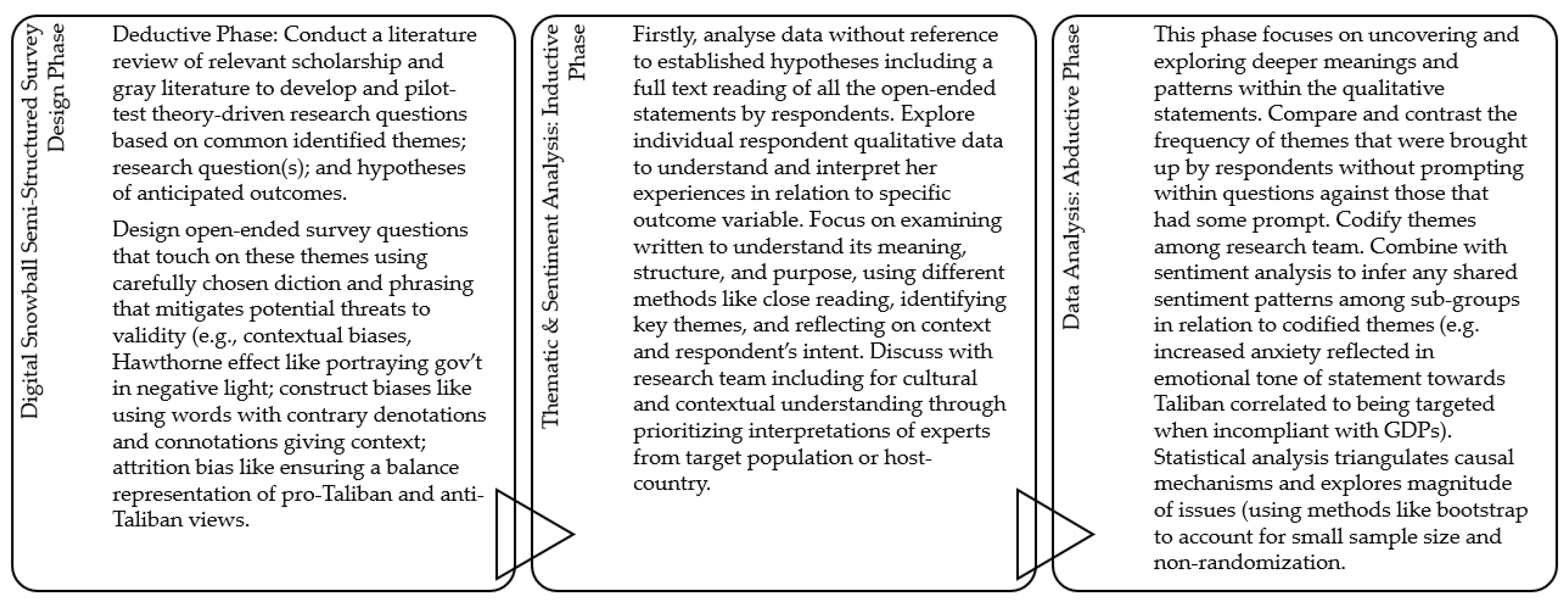
The theoretical approach is presented in Figure 1 in more detail. Our semi-structured survey purposefully incorporates theory-driven research questions based on themes identified in a rigorous literature review of 231 top-cited studies on key QOL variables for the analysis, as well as an in-depth contextual understanding. The literature review was performed before study design on Google Scholar and PubMed, using the search terms of Afghanistan, humanitarian crisis, war, mental health, psychosocial wellbeing, PSS, quality of life, and study. Furthermore, the analysis of collected survey data uses a phased approach by first inductively exploring themes in open-ended statements and then incorporating codes and themes interpreted in relation to our theoretical framework and initial hypotheses.
This research may exemplify a unique framework by applying a thematic analysis to a digital snowball semi-structured survey. As shown in Figure 1, this framework includes first using a deductive approach by assessing trends in relevant literature to frame the research design and theory-driven questions. Secondly, researchers can use a more inductive approach in the major analysis of the qualitative data, allowing the data to elaborate on trends based on what the respondents share mainly without prompting question techniques. Lastly, they can return to the original hypotheses to examine whether a statistical analysis triangulates key inductive findings, and if so, speak to the causal relationship between variables, including possible generalization of if the participants’ experiences reflect a more generalizable trend among the population when addressing issues of sample size and non-randomization. While using a mixed-method approach, the major focus however, is to interpret and understand the experiences of the specific participants in the study through their own words, with the secondary quantitative aspect as a supplemental contribution.
Due to the dire humanitarian crisis, foreign travel restrictions, and growing conflict in-country, we were unable to collect data on the ground. Thus, we apply a digital snowball survey approach using Facebook and social media, which host–national contacts of the research team indicated were still available and regularly used by Afghans throughout much of the country in 2022. Additionally, nearly 68% of Afghans owned mobile phones/iPhones and millions use social media in 2021–2022 [33], indicating that social media may serve as a good medium for recruitment. In Spring 2023, the survey design and pilot testing (pilot test data was excluded from study) were closely supported by our Afghan co-author for cultural and contextual relevance [13]. From July to December 2023, the survey was launched for data collection. A snowball approach can introduce bias toward targeting participants who are more literate, reside in urban areas, and have access to digital technology (see Section 4.4 under Limitations). Yet, we carefully worked with Afghan colleagues including one co-investigator (CI) residing in the country to identify and share the survey over 50 social media sites, including Afghan cultural, educational, community, and political pages with memberships throughout the country to increase saturation. The survey used open-ended and close-ended questions modified from the USAID-DHS survey design applied in a similar Afghan study [34]. The digital survey includes multiple choice questions measuring participants’ self-reported demographics and psychosocial stress (related to Foa’s [35] psychosocial stress scale (PSS) primarily for participant self-reporting stress) [35,36]. Eligibility criteria include the following: aged 18–65; residing in-country; completing the informed consent process; and fluency in Pashto, Dari, or English.
Data analysis for this paper specifically focuses on the information provided by all female respondents. Of the 1798 participants who clicked on the digital survey, 36 self-reported being female. A total of 7 of the 36 were excluded from the data analysis for not meeting eligibility criteria, including 5 for not residing in Afghanistan and 2 not consenting. All 29 women answered the survey in part or in full, with 23 participants providing responses to the open-ended qualitative questions analyzed for the thematic and sentiment analysis.
While the survey design works to ensure anonymity and does not collect identifiable information like birthdays and addresses to ethically protect the participants, the survey was launched in Qualtrics, which collects IP addresses. In the data cleaning process, the PI reviewed the IP addresses and data for possible duplications, which none were found. IP addresses, time stamps, and any identifiable information that a participant may have provided (including some who shared their names, locations) were deleted following IRB guidelines for data analysis, and the Excel file was shared and analyzed by authorized PI and CIs, with the file saved on a locked drive with password encryption.

2.4. Data Analysis

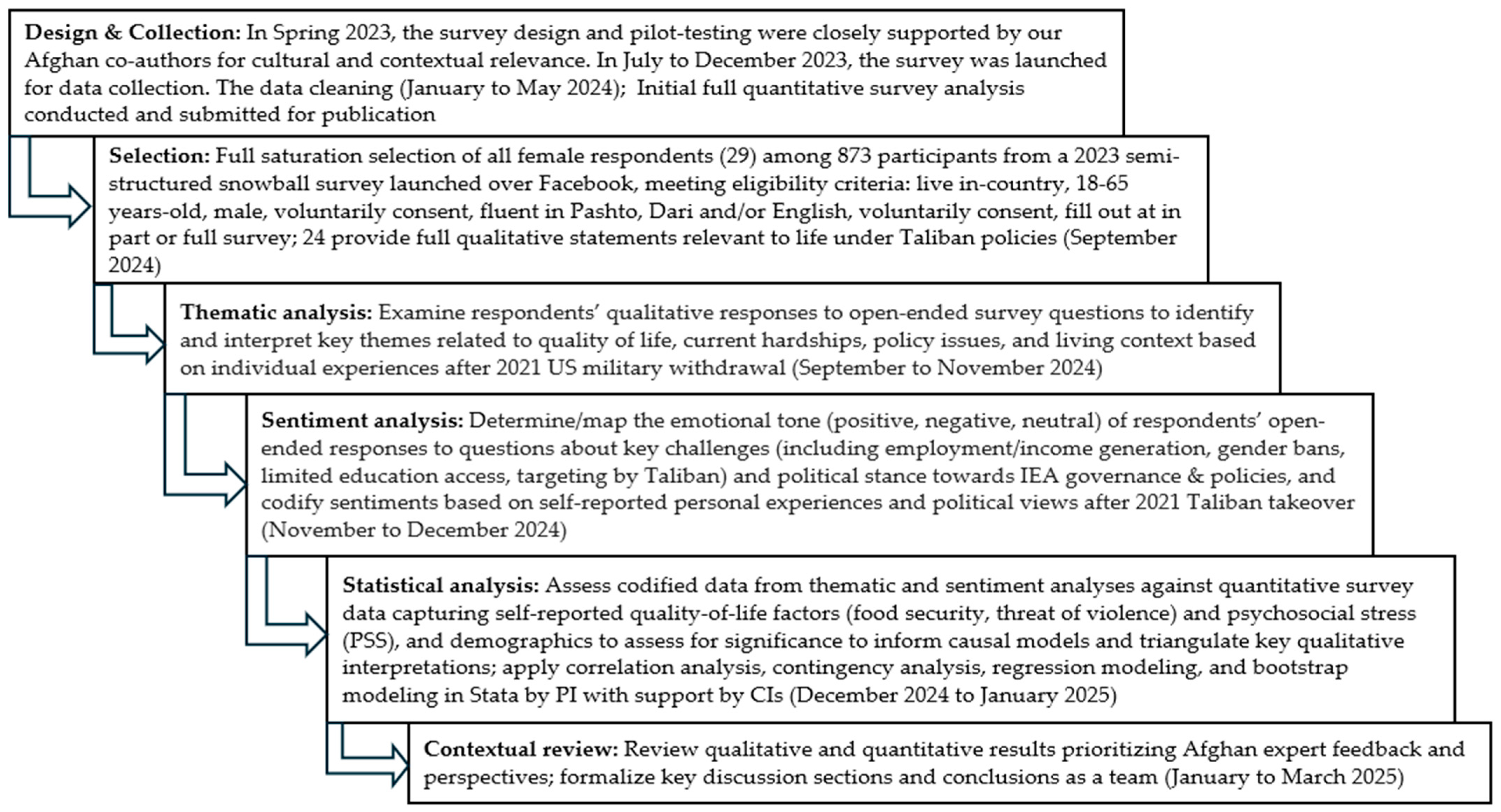
The data cleaning (January–May 2024) was managed by the PI with support from two CIs, including translation verification of qualitative statements by our Afghan CI, who is a certified translator. He has a degree and extensive experience in translating qualitative data in urban and rural areas of Afghanistan. Translations were triangulated by the PI using Google Translate for quality assessment. All female participants’ qualitative data is included in the analysis. This analysis primarily uses a qualitative method supplemented with a secondary quantitative analysis, a methodological approach increasingly used in policy and health research with the growth of social media and digital platforms, for the purpose of both triangulation and causal inference in pattern analysis [37,38,39,40]. Firstly, we conduct a thematic analysis of the female participants’ responses to provide a deeper understanding of the motivations or challenges to develop a more in-depth insight into patterns of daily life and politics that are inductively informed (see Figure 2 for sequential order of method). The thematic analysis provides a list of main themes and their frequency among participant qualitative responses, along with supporting quotes and examples which allow us to explore their experiences and sentiments more in-depth, to better understand their lived experiences of key DQOL, policy changes, and psychosocial wellbeing [19,31,40].
Firstly, we interpret all responses to the following open-ended questions: Can you explain in your own words what your current living and working situation is like; How does the humanitarian crisis affect your daily life, if at all; What are some of your biggest challenges; What support does the government under the Taliban provide to citizens; What are differences between men and women in Afghanistan? The IP first mapped key themes, and then we discussed them as a team. Individually occurring themes are characterized and labeled, including listing and describing all topics found, and then producing initial codes for the data (see Table 1 for specifications). Key thematic elements brought up by the respondents included the following: key daily hardships that they face like unemployment (including for men living in their household (HH)), loss of work due to work bans on women, new governmental social restrictions on movement, less education access, education bans for girls/female college students, and fear of being targeted or abused by the Taliban patrols when out in public. The PI led the process of coding with multiple co-investigators (CIs), validating coding through discussions as well as checking intercoder reliability using Cohen’s Kappa in Stata, which rates above 0.65 (strong).
Next, we explore and interpret the sentiments and attitudes that each woman exhibits towards the daily challenges that they mention facing, the Taliban government and policies, and their current situation. Our team then reviews and considers each woman’s qualitative statements, categorizing their political sentiment towards Taliban and gender norm views. We examined and discussed the diction that they used in each of their qualitative, open-ended statements including adjectives, verbs, emotional expression, similes, and metaphors giving detail. We rated each statement as either positive (for instance using words like “praise be,” “works well,” “happy,” “improved greatly”), neutral/cautious/less expressive in nature (often using comparative statements like including the word “but” or straightforward statements with little emotive expressions), or negative (like “many restrictions,” “suffer,” “fearful,” “threaten”, and “living in a cage”). Section 3 presents the common trends identified through the qualitative analysis of the open-ended statements by the women, paired with example quotes, to explore the intrinsic meaning of shared lived experiences. Lastly, the findings of a statistical analysis are presented to mainly triangulate the qualitative analysis, including considering how the variables interact. The PI and two CIs led the quantitative analysis using Stata (Version 17) to assess the coded variables from the thematic and sentiment analyses against psychosocial stress levels. The coding for the various thematic variables was added in an additional cell (making new categorical variables) next to the qualitative statements for each open-ended question in the Qualtrics Excel spreadsheet, which also held the coding for all quantitative survey questions. The coded variables were then analyzed in Stata against the outcome variable of PSS (aggregate and disaggregate).
Qualitative and quantitative blank responses were left uncoded/blank, and “don’t know/N/A” quantitative responses were numerically coded as outliers. PSS analysis was disaggregated by individual stressors, with respondents selecting how much they are experiencing each symptom (Likert scale of not at all to a lot (detailed in Table 1)), as well as aggregated (totaling the seven symptoms). The PI tests for interrater reliability using Cronbach’s alpha testing, of which the PSS total scale has an alpha of 0.78 (strong). Our statistical analysis controls for confounders by including a variety of other variables including demographic features like age into regression modeling (adjusting for confounders as the model estimates the effect of the independent variable, holding each confounder constant). In Stata, we also incorporate “i.” for categorical variables in the OLS and bootstrapping modeling. The small sample size of the analysis limits generalizability; thus, we use bootstrapping to address the limitations to causal inference modeling [41,42]. The statistical analysis supplements the qualitative analysis by examining how DQOL and political experiences with the Taliban and GDP interact with stress.

3. Results

The 29 female respondents range from ages 20 to 62, with most self-reporting being religiously devout (see Table 1). Most respondents provide qualitative statements in Pashto, with a handful in Dari and English. A first inductive review of the qualitative responses indicates that most respondents share common experiences. Nearly all mention some level of ongoing household financial insecurity because of the lack of stable employment for household members (male and/or female). Over half comment about governmental restrictions on citizens’ rights, with more respondents facing issues around GDP restricting social mobility of women and girls. Other key threads include about half of the participants reporting being affected by less educational opportunities in the country, especially concerning female education bans, as well as monitoring, targeting, and even attacking women who do not comply with these social restrictions.

3.1. High Levels of Psychosocial Stress Among Afghan Women

The first major question posed by this study asks the following: what are key shared hardships concerning the daily lives of Afghan women (ages 18–65) residing under the Taliban’s Islamic Emirate of Afghanistan and the humanitarian crisis? After coding these themes along with the level of sentiment associated with comments, the quantitative data further indicates that the DQOL factors and the qualitative themes of daily hardship significantly correlate to higher PSS levels among Afghan women participants (see Appendix A). As a direct result of daily life under the humanitarian crisis and new government, the women report experiencing high amounts of psychosocial stress on average (62.61% of the highest amount of psychosocial stress possible, or a mean of 13.15 stress points of a potential total of 21 of the 7 stress symptoms; see Table 1). They report most commonly experiencing anxiety, poor sleep, and extreme sadness. These emotional stressors are evident in descriptions in many of the women’s testimonies about daily life. Exploring participant testimonies helps us to better understand their experiences and reactions to stark socio-political change [39,43,44]. We consider how their daily challenges reflect gender strain, resulting in higher stress levels.
Overall, the women’s support for the Taliban’s return to power greatly ranges. We consider how their views may reflect different political sentiments and shared experiences associated with patterns amongst their diverse demographics. The next sub-sections explore key trends that emerged from the qualitative analysis.

3.2. When Gender Views Align with Political Culture

Our second research question examines how experiencing these hardships affect women’s psychosocial stress levels (measured by Likert PSS Scale and emotional sentiment in qualitative statements) related to a) their political sentiment towards the New Taliban and b) opposition to its gender discrimination policies (GDP). The data seems to validate our initial hypothesis that Afghan women who strongly oppose the Taliban’s GDP face significantly higher gender strain (hardship concerns related to value-incongruity stress, diminished quality-of-life factors, and psychosocial stress) than peers who do not. The survey examines their views on gender norms and asks how the roles of women and men differ. The first glaring observation we noted when exploring their responses is the enormous positivity that nearly all the female respondents ascribe towards their sex and their value to Afghan society. When we consider their demographic profile, particularly how they view the Taliban’s governance, GDP, and gender roles, we note distinctions in how they view the role of women.
As Table 2 indicates, female participants who seem favorable to Taliban rule tend to describe women’s rights and their societal values in reference to Shi’a Islamic views (see Appendix B for more detail). Both sexes reflect complementary roles, with some distinct social and legal differences [28,45,46,47]. In fact, the great majority of the women seem to value their faith and find solace and joy in prayer, learning from the Qurʾān, and upholding their faith. The only difference appears among the few women who seemingly love Islam but find it misrepresented and abused by the New Taliban. The qualitative and quantitative analyses both indicate that holding gender views that fall further out of the gender norm boxes imposed by the Taliban’s political culture reflects higher levels of stress, often associated with gender strain of not being able to activate the same social freedoms and governmental consideration common under the former Republic. For instance, in Table 2, we see that a 26-year-old woman who states in English that “Islam is an anti-feminist religion” also demonstrates frustration with the Taliban by stating “the Taliban are also trying to implement the Islamic religion.” Her total stress is very high, reflecting that women who express negative statements about religion and the Taliban demonstrate a sentiment of higher stress, including feelings the team classify as resentful and anxious. We assess their gender strain to be reflective of how they perceive the use of religion by the Taliban to justify gender discriminant policies on women and girls at the national level.
Comparatively, there are some women who express resentful or hostile sentiments towards both the Taliban and the Islamic institution that they have experienced. Their statements reflect an ideal of gender equality in which women and men should be able to have equal freedoms, with little to no divisions or apartheid measures. Only two women express sentiments reflecting negative religious views associated with the Taliban. Their strain reflects feeling a sense of dissatisfaction and even bitterness at the boundaries dividing their gender rights equal to men, and what they feel is an exclusion or rejection of female citizens by the government.

3.3. Differences in Political Experiences

While there are some women who differ in their opinion of religion, all participants express positive views on the role of women. The data analysis indicates that the participants mainly differ along the lines of their political stance towards the Taliban and its new policies. In critiquing the political shift as the IEA took power, there is a subset of women who appear to hold conservative views aligning with Taliban culture that values policymaking rooted in gender separation, patriarchy, and Shi’a Law. As Table 3 indicates, these more pro-Taliban women do not mention gender discrimination, ill treatment, or abuse of women’s rights by the government as indicated by their anti-Taliban peers. When they mention issues, it often is moderate in tone. Instead, their statements imply a shared affiliation with the Taliban, often using the term “we” versus diction of “they” when talking about Afghans and the government. They also imply a trust in the government to work with the people to improve the situation for women in the future after tackling more immediate political–economic hardships. Statements like “there is peace” and “security has improved” reflect a common acknowledgement of the Taliban in improving security since the fall of the Republic. Among pro-Taliban women, issues like reopening the economic market and the famine are also seen as more important compared to reopening schools or finding ways for women to work that follow Shi’a principles (such as gender separation).
Comparatively, women with less positive sentiments towards the Taliban reflect more worry about the economy and less trust in governance improvement. Statements like “I can’t work” and “biggest challenge of life is… being imprisoned under Afghan/Pashtun Taliban rule” reflects a frustration in their inability to generate sufficient income related to new GDPs like female work bans and mandates to be accompanied by male family members in public.
Some of the respondents seem glad for the withdrawal of foreign military entities from their homeland and the end of what they call “the war.” Their support for the return of the Taliban to power is not seen through rose-colored glasses. They appear clearly aware of the challenges that face their household, community, and nation. Pro-Taliban women are concerned about the hardships caused by the poor economy and humanitarian crisis; however, they mainly place the blame on external macro-factors like international sanctions rather than find fault in the New Taliban, who they instead see as valiantly trying to ameliorate national issues. Others who hold moderate GDP opposition tend to view the New Taliban more discerningly, including “there is no war or killing like before, but poverty and unemployment have reached their peak” (see Table 2). They seem more resigned to the new regime with a more pragmatic lens and with less polarization in how they view the Taliban.
However, a comparative subset of women expresses moderate to extremely harsh critiques of the political shifts that have limited women’s rights. They use descriptions reflecting feeling captive, including “being imprisoned” (see Figure 2). These women tend to hold gender equity lenses set in international law, often reflecting universal human rights. They see any restriction on women, or any policy that would separate them from the social and professional sphere of men, as an injustice. Their statements are laden with despair, frustration, and resentment. Living is surviving, and many of their hopes are dashed under the IEA. They lay the blame of their woes almost solely upon the Taliban regime.

3.4. Strain of Unemployment/Income Generation

Every participant in the survey expresses anxiety and deprivation from the economic crisis in the country. Yet, how they experience and interpret unemployment is often shared by their political stance. As depicted in Table 4, among the female participants expressing conservative values more aligned with Taliban policies, we find that their strain appears to mainly arise from the lack of financial sources needed for them to fulfill their domestic duties. “The number of our family members is large and our income has reached zero,” states a 20-year-old. The men (or lack of men) within their household are simply not bringing in enough income. Thus, the women are left unable to adequately care for their loved ones (e.g., feeding children, buying winter clothing, keeping a proper house). They express the pressure on able men to work but that the dire economy makes it nearly impossible.
Comparatively, there are female peers whose stress appears directly linked to their personal inability to earn income. For them, working seems both an internalized desire and a responsibility. Women who express actively wanting to work and/or have worked in the past appear torn between blaming the Taliban’s restrictive work policies and how the economy has devastated their former means of earning a wage, as reflected in another 20-year-old’s statement of “I weave with my brother and sister and I can’t go out of work because of the fear of Taliban.”
Some women continue to try to work despite the restrictions. They mostly try to find work, often because they are the sole breadwinner or they feel a duty to help their parents. Their statements indicate the added strain of being targeted and even physically attacked by the Taliban, including “most days I’m out of the house, I’m being chased” and “I scared of my life,” as shown in Table 4. However, nearly a fourth of the women directly express fearing being harmed by the General Directorate of Intelligence (GDI), an integral part of the Taliban’s security apparatus addressing domestic and international intelligence operations. These testimonies corroborate UN reports, stating “that scores of women and girls in Afghanistan have been arbitrarily detained and subjected to ill-treatment since early January 2024 for allegedly violating the Taliban” and gender policies like female dress codes [48] (p. 3). Among the more liberal participants, their frustration lies not in the country’s high employment rates but more so in the marginalization of women from professional spaces. These women tend to resent the Taliban’s policies and hold onto a longing for the rights that they once had under the defeated democratic Republic.

3.5. Strain from Education Bans

When launching this study, we anticipated that most Afghan participants might be concerned with the decline in governmental educational provisions. However, the results indicate that less than half the women in the survey provide any mention of education in their qualitative responses. Among those who do bring up education, there is the shared belief that women and girls have the innate right to be educated. But the details of what that education should look like and how it might be used appear to differ based on their political values (see Table 5).
As Table 5 indicates, some pro-Taliban women mention that access to schools, in general, grew limited after the 2021 power shift. Most women with pro-Taliban sentiments seem concerned about education being offered for all Afghans. All those concerned about education acknowledge that the IEA prioritizes ensuring schooling for male citizens but are aware that less attention is given to the issue of female education. For example, a 29-year-old pro-Taliban woman states that “[o]nly men have equal education-women do not have equal education, but efforts are being made,” indicating she is aware of the situation but believes the IEA will address the issue. Yet, their comments do not imply an urgency in the hope that female education will be addressed by the government in the near future.
Comparatively, women who express stronger resentment towards the Taliban assertively stress the importance of guaranteeing equal educational opportunities for male and female citizens. However, they exhibit little trust in the IEA to lift the bans, despite back-and-forth public promises by Taliban officials, such as expressing “I am deprived of education because of the government’s discrimination against women.” They seem to emotionally interpret the ban as a sign by the IEA that women are unworthy of the same rights afforded to male citizens. They seemingly associate the policy to eliminate girls attending schools and universities as a direct reflection of how the Taliban values female citizens. The strain on many progressive women to not be able to continue their learning, to apply their knowledge, and watch in fear that their sisters and daughters might suffer a similar fate of those under the Old Taliban is oppressively magnified in their statements, like “we all stopped studying” and “women’s lives do not matter.” Their resentment is amplified in their diction and is a clear source of distrust and fear towards the new government.

3.6. Statistical Analysis

The statistical analysis specifically examines the effect that independent variables including political views of the Taliban, total DQOL, restrictions on women mainly in the work environment and social sphere, and the closure of female schooling have on women’s psychosocial stress level. The purpose is to triangulate the qualitive pattern that these factors cause significantly more stress related to shared experiences involving the Taliban and its gender culture standards reflected in policy. The bootstrap analysis represented in Table 6 is used to account for potential biases from small sampling. This analysis further triangulates the qualitative finding that indicates that all the issues negatively impact women’s psychosocial wellbeing, the effects of which are significant and may speak to a larger pattern among Afghan women like the 29 who participated in the survey.
As the correlation analysis implies (see Appendix A), women’s psychosocial stress is associated with all negative policies implemented by the Taliban on both citizens and, more specifically, on women through what have become known as gender discrimination policies. For instance, a woman who experiences less social mobility due to the growing policies restricting women (e.g., female bans from parks, gyms; closing beauty salons; public male escort for travel; exclusions from public workforce) results in significant increases in PSS (5.91 points higher in a potential total of 21 PSS level). Comparatively, in terms of female education rights, a woman who is strongly pro-Taliban, as the 21-year-old who stated “Our Lord has allowed us everything within a boundary and circle, whether it is education or work for men or women” (see Table 5) faces little to no apparent gender strain from being unable to access female education as previously offered under the Republic. Yet, her peer, a 28-year-old female activist who is strongly anti-Taliban, stating that “Now we all stopped studying and working. I am begging you, please help,” will predictably exhibit significantly more stress (7.22 points higher in total PSS or a 32% increase).

4. Discussion

The mixed-method analysis strongly indicates that Afghan women experience higher rates of stress when holding resentful political views against the Taliban and new gender discrimination policies. We may interpret this finding through strain theory, which posits that people often suffer strain when the environment in which they live restricts access to culturally valued goals and ideals, often propagated in governmental policies or socially dominant norms. When unable to exist in an overlapping culture, they face pressures that can strain or even overwhelm their ability to cope and lead to psychosocial stress, including distress/anxiety, withdrawal, behavioral changes (poor sleep, poor eating habits), and resistance (anger) [17,20,21,22,23,29].

4.1. Value Incongruity and Role Conflict

One aspect of strain theory is value incongruity, or value–goal disjunction. The values that a person holds come into conflict with values that the dominant social environment or political institution imposes [17,20,21]. After the 2021 Taliban reseizure of the Afghan government, democratic policies promoting gender equity and empowerment launched under the former Republic and funded/implemented by Western stakeholders like INGOs were quickly dismantled by the IEA [2,10,15,16,17]. Women who were attracted to such gender-equitable policies (e.g., female income generation, higher education for all, no burqa mandates), as well as those who came to benefit under them, were suddenly living in a society where these values were discouraged, if not fully banned, by the new government. Two decades of a US-NATO-backed democracy had reversed the gender norms imposed by the Old Taliban, in which women and girls suffered. Images of smiling girls going to UNICEF-run schools and women-owned businesses replaced those of young girls marrying older men and women’s faces covered in full burqa while being escorted by a male relative in public [2,3,47,48,49].
Agnew’s gendered general strain theory furthers that people experience strain if unable to fulfill gender roles that they value, especially when societal norms oppose them, resulting in emotional and psychosocial hardships like a sense of desperation [17,20,21,22,23]. Afghan respondents who paint the Taliban in a more positive light tend to share the Taliban’s social values of a return to the past involving gender values that distinguish women’s roles as more domestic, men as income generators, and the implementation of gender separation/segregation. Patriarchal societies tend to prioritize cis-gender heteronormative expectations, in which men act as the financial provider and protector of the household, and positions of leadership and authority are limited for women [24,25,26,50]. Role conflict, or the strain that occurs when personal social role expectations are structurally constrained [17,20,21,22,23] is also demonstrated. If an Afghan woman holds the self-concept of being an activist, student, or income generator, she feels a strain that was not as prominent under the former Republic system. Attitudes towards gender equity can vacillate both at the national level depending the form of government in place as well as the gender politics reflective in the dominant ethnic power structure sustained by culture and religion [47,49,50,51,52,53,54,55,56,57,58]. For decades, the Taliban, which is heavily Pashtun and politically dominates in the northern territories, has fought to establish their rule over the country including how societal policies should reflect its religious values [51,52,53,54]. Neoliberalism and democracy can spread more globalized concepts of gender equity for women and girls, including education, civic participation, and economic activity [55,56,57,58,59,60]. Yet in ethnically-diverse settings, inter-ethnic power struggles can fuel religious extremes that clash with neoliberal gender norms, creating a schism as in Afghanistan [60].
Under the New Taliban regime, famine and economic hardship became a plight, especially for poor and vulnerable like children [61,62]. Many Afghan women contend with policies that suddenly block access to secondary and higher education, work freedom/formal employment, and open social mobility [15,17,63,64]. We sense such as role schism when analyzing the participants’ statements. Their words often reflect feeling caged and dehumanized.

4.2. Stimuli and Identity

Agnew implies that the strain a person experiences can relate to a loss of positive stimuli, when valued roles and activities are suddenly removed [21,22,23]. After the 9/11 attacks and the US-NATO military force helped back the IRA, the opportunity to work became a more accessible opportunity and life ambition for many Afghan women. Women increasingly shared the expectation that once an adult, they too had a responsibility to financially contribute to the household. Like many male peers, women who seek employment but cannot work often exhibit similar distress and shame in their failure to financially provide and protect their family. They are unable to meet this added gender norm associated with holding liberal feminist views, propagated by universalized human rights. Additionally, after the 2021 US military withdrawal from Afghanistan, anti-Taliban women tend to mourn their lives under the former Republic, as if burying their hopes of economic independence, social freedom, and education. They also express fears more frequently than pro-Taliban peers facing negative stimuli, or exposure to harmful conditions, including fear of social surveillance by Taliban soldiers (indicating these women may be incompliant with social mobility bans) and enforcement (like beatings or punishment when caught). Yet, there are some Afghan women whose values and role ideals comparatively align well with the policy norms of the IEA.
In conflict, strain will often increase when social structures and political shifts occur, increasing obstacles to performing expected gender roles, particularly in low-income settings with rigid gender norms [12,17,29,30,60]. Afghanistan’s political shift in 2021 coincided with a huge humanitarian crisis affecting much of the country, including famine and economic crises, compounded by international sanctions by most Western nations [5,61,62]. All Afghan women indicate that the present hardships that they face are experienced by all, men and women alike, especially in terms of insufficient employment opportunities and income generation. Thus, nearly all Afghan women, irrelevant of their political stance, seemingly face negative stimuli from increased forced dependence on male guardians. However, the women who seemingly support the IEA or at least do not make mention of opposing GDP tend to hold less stress.
Over forty years of civil conflict and war in Afghanistan has escalated societal standards for men to meet a strong code of masculinity often tied to honor and duty. These gender norms in which men were expected to provide for their household, to contribute to society, and to remain faithful to Shi’a principles of Islam were prominent in Old Taliban ideology [27,28,29]. The 2001–2021 “War on Terror” under the US-NATO force was one in a series of conflicts that refashioned the political landscape of Afghanistan and, in turn, the dominant gender culture. As the country teetered between autocracy and democracy over the last four generations, each new governmental state upheld its own cultural and religious values that repeatedly altered the legal definitions of gender norms for women and girls in Afghanistan [49,51,52,53,54,56]. Gender norms placed on female citizens, represented in formal policies implemented by the acting government at the time, continually ping-pong between staunchly conservative values under Taliban rule to liberalized ideals of gender equity under the 20-year democratic state backed by Western forces. Yet, with each new generation, there remains a specific subset of women who share similar views on gender norms, thus fitting in with the current political culture, while others are suddenly made vulnerable by holding viewpoints that conflict with new governmental mandates. Sentiment analyses can help identify key changes in how a population perceives societal issues [65]. Current IEA gender discrimination policies (GDPs) after 2021 appear not as strict as under the Old Taliban. Yet by May 2022, the IEA reissued the 1996–2001 decree that women should wear head-to-toe burqa in public and implemented the mahram unescorted travel ban [63,64,66,67,68,69]. By December, the government barred women from attending university, and most women were either forced to stop working or faced constraints on working in public [68].
While progressive views on women’s rights are influencing shifts, they also exist alongside long-established gender views of the roles of women and men, which are still predominantly upheld within the region [47,50,55,56]. Thus, the face of gender equity can vary, often reflecting the concept of “two Afghanistans,” or the ongoing battle between Afghans who support a democratic state such as under the IRA and those supporting life under the IEA, run by the Taliban from 1996 to 2001 and its newer version from 2021 to today. Progress was often limited to urban and semi-urban centers controlled by Western military forces [57,58,59]. Gender equity policies and programs like opening girls’ schools and vocational training for women under the IRA may have seemed too foreign for a predominantly Taliban/Pashtun society, making dismantling its essential structures by the IEA more politically tangible after 2021. As early as the mid-2010s, some critics urged that “efforts of the international community to promote gender equality and improve the conditions of women in Afghanistan have not worked. On the contrary, they have provoked even educated Afghan men into taking up more defensive and conservative positions, instead of convincing them that women deserve equal rights” [60]. A Taliban official tweeted, “In accordance with Islamic law and the culture and traditions of Afghan society, the fundamental rights of Afghan women have been secured. However, it should not be forgotten that the rights of Afghan women are being discussed within an Islamic and Afghan society, which has clear differences from Western societies and their culture” [69] (p. 2). The New Taliban under the IEA seems more lenient towards women compared to the past, but by no means does it show the intent to uphold female empowerment as under the former IRA, most evident in its lack of support for female education.
In 2024, the list of GDPs being supported by the Taliban grew monthly, including the following: the 2024 bans of female students in medical higher education, the “vice and virtue” directive prohibiting women’s voices being publicly heard, barring female teachers from instructing boys, limiting girls’ education beyond the sixth grade, and considering permanently closing all public female secondary schools [48,69]. The Taliban government seems (at least for the time) permissive of female students to learn privately, including through privately funded online education institutions and partnerships to operate digitally in the country [70]. Still evolving its stance towards gender equity, the New Taliban appears to delineate between utilizing public expenditures for female public service provision and permitting women and girls to learn privately using private-sector opportunities. Additionally, the New Taliban may permit some educated women to continue practicing their profession, although this window of opportunity is narrowing with each new decree [2,70,71,72,73,74,75]. Through the lens of strain theory, we may interpret that women who are educated and value girls’ education suffer from the psychological extension concept of identity strain, suffering a sudden gap between self-actualization and a desired reflection of self as a professional woman or student ill-matched with a social–political environment that no longer values female agency as reflected in a globalized lens.

4.3. Implications

The results of our 2023 study contribute to a missing gap in the literature when conducting research on the ground became nearly impossible after the August 2021 US-NATO withdrawal, sanctions, the humanitarian crisis, and growing conflict against ISIS networks. Our study is one of the first known surveys to be conducted in the country under the New Emirate era. When designing and pilot-testing the study, very few studies were identified at the time, and those that were being conducted mainly targeted Afghan refugees who had fled the country. Yet, in the last year more peer-reviewed studies have emerged, showing similar trends as found in our study. A study conducted by Keshavarzi et al. at approximately the same time as our survey data collection assessed 35 interviews with women (aged 19–32) residing in Afghanistan. Findings indicate that “Afghan women experience a pervasive sense of terror and fear in response to the rapid reactionary changes of the Taliban’s second era. The anti-women regulations, along with the dehumanization of women, have severely undermined the basic psychological needs of Afghan women for autonomy, competence, and social bonding” [76] (p. 1). This survey also uses snowball sampling due to the challenges of performing a randomized study in the country. A descriptive survey by Mohammadi et al. [77] of 426 former female students (12–32 years) uses a convenience sampling technique across Herat City, Afghanistan, to assess the effects of being banned from attending secondary schools and higher education by the Taliban. The study implies that female students being prohibited from studying in school have a significantly high prevalence of depression and suicidal ideation [77] (pp. 1–5). Such studies contribute valuable insight to understanding women’s quality of life and strain under the IEA. However, many of these studies focus primarily on the negative effects of undoing democratic policies. They also tend to sample women and girls whose ideologies are anti-Taliban, which may lend some biases. Our analysis of the 2023 survey data indicates that while the policy changes (GDP) have negatively impacted Afghans, there are those Afghan women who hold gender values and ideologies that align with Taliban culture. These more pro-Taliban women often demonstrate less gender strain and psychosocial stress.
An additional theoretical contribution of our research posits that the central factor of gendered strain in conflict does not solely concern the strength of a person’s values but also whether their gender values are either a) mainstreamed by the political climate or instead b) devalued as antiquated, misinformed, or hostile to societal harmony. Political regimes/governmental leadership often uphold a specific creed of gender norms informed by policy decisions. Democratic governments (like the IRA) often promote global norms related to gender rights and gender equality, often supporting policies and programs that close the gender gap between females and males in society. On the other hand, some authoritarian regimes based in patriarchal/extremist religious ideologies conform to strong gaps in gender norms, including gender discrimination in which women and girls are restricted to domestic domains, while being supportive and obedient to male household figures. We theorize that individuals whose values align with the gender norms upheld by the standing government entity tend to thrive more, thus forming positive emotions and coping mechanisms. However, people whose gender values clash with the gendered views of the regime are at increased risk of being marginalized, ostracized, or oppressed. We examine if individuals holding marginalized gender values experience increased negative emotions when confronted with political factors that act as value-incongruent stressors. As people with marginalized worldviews, they may face significantly more hardships than peers with mainstream values, as well as hold more negative opinions and views of political conditions. Thus, they tend to experience higher rates of psychosocial stress and DQOL.
Moreover, punctuated political shifts caused by conflict can disrupt gender dynamic landscapes, in which hardships like increased threat of violence and humanitarian crises act as obstacles to fulfilling once-dominant societal gender norms. This scenario seems as if pulled from the Star Trek narrative of Ferengi society. As civil instability changes gender dynamics and social expectations, how a person feels towards or views new political changes, policies, and institutions may be linked to changes in their ability to perform their gender expectations. When a conflict causes the regime leadership and even the current political establishment to fall, such as in the case of the 2021 ousting of Ashraf Ghani’s government by the Taliban, the gendered landscape may shift so much that roles become reversed. Conservative gender norms sudden become mainstreamed through new policy enforcement, and liberal value structures fall to the margins.

4.4. Strengths and Limitations

A key strength of this study is the inclusion of female Afghans of diverse demographic backgrounds including age, religious, education experience, work, household size, and political views and experiences. This diversity among the participants allows us to intrinsically explore individual psychosocial stress linked to unique patterns of shared experiences living under the IEA, along with interactions and support levels for the New Taliban. The sample size and diversity also allow for an initial quantitative analysis using bootstrapping to address to some extent issues of non-randomization and small N biases. The method also applies a unique mixed methodological framework to identify key patterns from qualitative data to feed the quantitative data analysis and to triangulate key findings and explore their experiences and meanings more intrinsically.
However, there are some key limitations to thematic analyses to ensure that the data analysis is conducted precisely, which can be addressed by applying consistent methods that are rigorously documented and systematized [78]. The 29 women respondents were a marginal sub-population of a larger study. They represent women who are likely literate and have access to internet; thus, our analysis may not adequately capture the lived experiences of women who are not literate in Dari, Pashto, or English and/or live in remote regions with no internet access. Additionally, snowball sampling reflects a non-probability sampling method; thus, the sampling may not be representative of a broader national population [19,31,32,39,43,79].
Likewise, we noted earlier that the response rate included a handful of female participants who started the survey but provided no information. Their data was excluded from the study analysis. Digital surveys with voluntary participation may suffer self-selection bias. Respondents’ decisions to participate or respond to specific questions may systematically contrast with peers who do not respond. The difference may lie in feeling more comfortable, more motivated, more concerned about the survey content, or better digitally connected. In cases where respondents answered open-ended questions in English, we must consider social desirability, responding in a way that they perceive as “appropriate” and avoiding answering in a way that might be negatively received by the researchers. We emphasize that while our bootstrap modeling addresses small-N implications, the findings are not necessarily generalizable but instead illustrative of emerging patterns. This study does not seek to assert generalizations of findings but to explore common themes of shared lived experiences of life for women under the New Taliban. Future studies can address these limitations by finding qualitative analysis methods that capture the testimonies of women with little to no formal education, from other ethnic groups, and/or in rural regions. Additionally, future studies that are in-person ethnographic follow-ups or randomized surveys may help validation.

5. Conclusions

This article may highlight the impactful role that gender strain in conflict-affected regions can have on women, especially when their individual worldviews fall outside of the gender dynamics set by the dominant power structure and its gender-based policies. Our thematic analysis indicates that Afghan women living under the New Taliban hold mixed sentiment towards the IEA’s new policies. Some women celebrate the return of the Taliban to power after the 2021 withdrawal. These pro-Taliban women still report facing diminished quality-of-life factors including economic hardship and less public services like equitable access to healthcare and educational opportunities. But they seemingly favor the IEA, holding faith in its good intentions to ensure equitable rights and freedoms for female citizens, in accordance with more traditional Shi’a tenets. For all the challenges that they face, they seem to thrive better than their sisters who hold more liberalized gender values that were once the norm under the defeated Republic. For the women who wanted gender rights to exist as they had under the former democracy, life has become a minefield. They suffer higher rates of psychosocial stress, often linked to IEA policy bans preventing their ability to learn, work, or participate as equally contributing members of society as men. Their testimonies often depict more extreme negative experiences, including threats by the Taliban for not complying with new gender discrimination policies. For two decades after 2001, the world convinced many Afghans that women would always thrive under a democratic society, living more equal to men. But this globalized ideal was propagated by funding from a foreign occupying force and often clashed with gender prescriptions more commonly held by Afghans, especially in Taliban-occupied regions. When the US-NATO force withdrew, the New Taliban looked to reestablish gender-based policies to reflect more traditional cultural values of women and men. For Afghan women who ascribe to these more traditional values, life under the New Taliban may not be terribly harsh, although they have some concerns about pressing basic rights of female citizens including the right to learn. The real hardship appears to fall upon those Afghan women whose core beliefs no longer align with the transformed political landscape. They are left to feel abandoned and desperate for the former opportunities that they once had.
While the IEA continues to increase gender discrimination policies, there are indications that the New Taliban’s stance on gender equity has evolved at least in tone, if not fully in practice. There may be opportunity to improve the quality of life and to reduce the stress among Afghan women by considering solutions that better speak to the new political reality under the IEA. Moreover, psychosocial stress appears to be a growing public health concern, particularly among Afghan women. Propagated by the humanitarian crisis and economic instability felt through a national unemployment epidemic, women bear an increased strain on being able to properly care for and tend to their families, even among avid Taliban supporters. To what extent the Taliban may be willing to consider addressing these concerns remains uncertain. Its priority mainly focuses on ensuring domestic security and addressing the needs of male Taliban supporters. But the IEA can help ameliorate the strain on its female citizens, lessen political-economic hardships, and improve foreign relations if it were to prioritize finding alternative, culturally-appropriate solutions which more flexibly permit women to contribute to household income generation, receive education, and improve social mobility.

Author Contributions

Conceptualization, H.S., J.H.-D., H.P., N.K. and M.S.; Methodology, H.S., J.H.-D., H.P., N.K., S.M., A.S., M.S., R.R.C., S.S., A.D. and A.M.; Investigation, H.S., J.H.-D., H.P., N.K., S.M., A.S., M.S., R.R.C., S.S., A.D. and A.M.; Resources, H.S., J.H.-D., H.P., N.K., S.M., A.S., M.S., R.R.C., S.S. and A.D.; Data Curation, H.S., J.H.-D., H.P., N.K., S.M., A.S., M.S., R.R.C., S.S., A.D. and A.M.; Writing—Original Draft, H.S., J.H.-D., H.P., N.K., S.M., A.S., M.S., R.R.C., S.S., A.D. and A.M. All authors have read and agreed to the published version of the manuscript.

Funding

NK and HS received the 2023 Hobson Wildenthal Honors College Undergraduate Research Apprenticeship Program (URAP) grant to serve as co-researchers on this project, from the University of Texas at Dallas (https://honors.utdallas.edu/research/undergraduate-research-apprenticeship-program/ accessed on 15 July 2025). The funders had no role in study design, data collection and analysis, decision to publish, or preparation of the manuscript. No other authors received specific funding for this work.

Institutional Review Board Statement

This study was approved by the University of Texas at Dallas Institutional Review Board (protocol code: IRB-23-648, 12 July 2024).

Informed Consent Statement

Informed consent was obtained from all subjects involved in the study. Additionally, while the study was anonymous, the participants of this study were informed that their individual identifiable information would not be shared publicly but instead anonymized. They were informed that the data collected would be used for academic research and publication. The study was conducted digitally and therefore did not obtain written informed consent from participants; but it instead asked participants to voluntarily agree by clicking on “yes, I consent to participate” to begin the survey, or to click on “no, I do not consent.”

Data Availability Statement

There are ethical restrictions on sharing a de-identified data set, as data contain potentially identifying or sensitive participant information, as mandated by the University of Texas Institutional Review Board and Office of Human Subjects Protections (OHSP) (contact information-research@utdallas.edu). Due to the sensitive nature of the research, supporting data is not available.

Conflicts of Interest

M.S., H.S., N.K., and S.S. were supervised by JD at time of data collection and analysis. The authors declare no conflicts of interest.

Appendix A

The details and emotional sentiment within their qualitative statements provide a means for us to gauge their political sentiment towards the New Taliban’s IEA, in which we note a significant relationship between higher PSS and resentment towards new GDP. Only 21.74% of the participants express pro-Taliban sentiments, while most women appear to hold a critical view of the IEA (see Table 1). Limited sample size and the lack of randomized sampling limit the ability to assert causality beyond correlation [79]. To address potential threats to validity, our statistical analysis utilizes bootstrapping (see Table 2), a technique of resampling to approximate the statistical distribution. Bootstrapping is beneficial when datasets are small and the theoretical distribution is unknown [41,42]. The next sub-section explores these causal mechanisms in more detail, triangulating the bootstrap model coefficient effect on individual’s stress alongside a qualitative analysis of the women’s open-ended responses.
Table A1. Pairwise correlation analysis.
Variables1234567891011
PSS level (1)-
DQOL level (2)0.56 ***-
HH unemployment (3)0.46 *0.20-
IEA restrictions on citizens’ rights (4)0.58 **0.51 *0.18-
Monitoring of citizen non-compliance (5)0.59 **0.55 **0.130.83 ***-
Female work restriction (6)0.52 *0.320.260.55 **0.51 *-
Social restrictions for females (7)0.80 *0.55 **0.180.87 ***0.76 ***0.54 **-
Female edu bans (8)0.57 **0.51 **0.160.70 **0.55 **0.59 **0.81 ***-
Monitoring and targeting of female non-compliance (9)0.63 **0.60 **0.51 *0.71 ***0.84 ***0.49 *0.83 ***0.70 ***-
Political sentiment towards IEA (10)0.78 ***0.59 **0.51 *0.72 ***0.73 ***0.51 *0.77 ***0.68 ***0.80 ***-
Opposition level to gender apartheid (11)0.80 ***0.67 ***0.200.79 ***0.75 ***0.64 **0.91 ***0.80 ***0.82 ***0.80 ***-
Total number of coping mechanisms (12)−0.61 **−0.41−0.69 *−0.22−0.24−0.15−0.22−0.14−0.27−0.57 **−0.29
Notes: *** p < 0.001, ** p < 0.01, * p < 0.05.

Appendix B

Quranic verses and religious teachings by Ahl al-Bayt (the Prophet’s family) assert that women and men are spiritually equal in the eyes of God. Each sex contributes equally to the world, yet gender norms are more equitable than equal in nature. Men are often permitted greater mobility in public life, education, and politics (though this varies by country). Men tend to have more extensive self-determination, including the right to initiate divorce unilaterally (ṭalāq), marry outside of the Muslim faith, and act as full guardian to female household members and children (Wilayah) compared to women. Comparatively, women are viewed as nurturers and caretakers, primarily responsible for the home and children. Women are strongly encouraged to maintain modesty, especially in dress and behavior, including an obligatory hijab after puberty. In many instances, women can work, pursue education, and hold positions of influence, within the boundaries of Islamic tenants. Both sexes reflect complementary roles, with some distinct social and legal differences [28,45,46,47].
Table 6 implies that Afghan women tend to experience significantly higher PSS when their political stances against the Taliban increase. Women reported experiencing a certain level of 7 potential stressors (0 none to 3 almost daily), with a potential total psychosocial stress level of 21 points (see Table 1). Referencing this potential stress scale, our bootstrap analysis presented in Table 6 implies that each level higher in negative political sentiment that a woman expresses against the Taliban government predictably equates to her experiencing 5.06 points higher (or 24.09% increase) in psychosocial stress (Wald 2 = 21.20, p = 0.00). Likewise, bans on female education impacting their daily life likely causes significant intensification of their stress. A woman who was attending schooling like university and no longer can pursue her education will likely exhibit a 34.4% increase in overall PSS (Wald 2 = 8.85, p = 0.00). Lastly, we find that having more diverse copying mechanisms like religious prayer, entertainment (TV, social media, etc.), and engaging with loved ones can significantly lower PSS. Each new coping mechanism that a woman practices may potentially result in a 9.3% reduction in psychosocial stress (Wald 2 = 7.60, p = 0.00). Section 4 explores in more depth typical experiences, including hardships that they share, highlighting common patterns in adapting to the new political regime. The statistical analysis only attempts to explore potential causal patterns and their magnitude. Yet, the focus on our analysis is to better understand what life is like for these women through their qualitative statements.

References

  1. Associated Press. Afghans Say They Feel Safer But Less Hopeful Under Taliban Rule. NPR, 15 February 2022; pp. 1–5. Available online: https://www.npr.org/2022/02/15/1080771248/afghans-say-they-feel-safer-but-less-hopeful-under-taliban-rule (accessed on 15 July 2025).
  2. Hassan, T. Afghanistan—Events of 2022. Hum. Rights Watch 2023, 1–8. Available online: https://www.hrw.org/world-report/2023/country-chapters/afghanistan (accessed on 15 July 2025).
  3. Amnesty International. The Taliban’s War on Women. Amnesty Int. 2023, 1–10. Available online: https://www.amnesty.org/en/latest/news/2023/05/afghanistan-talibans-treatment-of-women-and-girls-should-be-investigated-as-the-crime-against-humanity-of-gender-persecution/ (accessed on 15 August 2025).
  4. UN News. Afghanistan: Nearly 20 Million Going Hungry. UN News, 9 May 2022; pp. 1–4. Available online: https://news.un.org/en/story/2022/05/1117812 (accessed on 8 August 2025).
  5. UNHCR. Afghanistan Humanitarian Crisis. UN Refugee 2024. Available online: https://www.unrefugees.org/emergencies/afghanistan/ (accessed on 10 October 2024).
  6. Yousaf, F.; Jabarkhail, M. Afghanistan’s future under the Taliban regime: Engagement or isolation? J. Polic. Intell. Count. Terror. 2022, 17, 117–134. [Google Scholar] [CrossRef]
  7. Lutz, J.; Kurtzer, J. What the Taliban Takeover Means for Food Security in Afghanistan. Cent. Stragetic Int. Stud. 2021, 1–11. Available online: https://www.csis.org/analysis/what-taliban-takeover-means-food-security-afghanistan (accessed on 1 August 2024).
  8. Safi, N.; Anwari, P.; Safi, H. Afghanistan’s Health System Under the Taliban: Key Challenges. Lancet 2022, 400, 1179–1180. Available online: https://www.thelancet.com/journals/lancet/article/PIIS0140-6736(22)01806-2/fulltext (accessed on 17 September 2024). [CrossRef]
  9. Bjelica, J. Rural Women’s Access to Health in Afghanistan: “Most of the Time, We Just Don’t Go”. Afghan. Peace Campaign. 2025, 1–13. Available online: https://afghanistanpeacecampaign.org/2025/03/26/rural-womens-access-to-health-in-afghanistan-most-of-the-time-we-just-dont-go/ (accessed on 11 October 2025).
  10. Watson, M. Temporary and Child Marriages: Historical Perspectives and Contemporary Issues in Iran, Iraq, and Afghanistan. In Temporary and Child Marriages in Iran and Afghanistan; Springer: Singapore, 2021. [Google Scholar] [CrossRef]
  11. BBC. Afghanistan: Who’s Who in the Taliban Leadership. BBC News, 7 September 2021; pp. 1–11. Available online: https://www.bbc.com/news/world-asia-58235639 (accessed on 15 September 2025).
  12. Murtazashvili, J.B. The Collapse of Afghanistan. J. Democr. 2022, 33, 40–54. [Google Scholar] [CrossRef]
  13. Hanson-DeFusco, J.; Sobolov, A.; Stanekzai, S.; McMaster, A.; Popalzai, H.; Shah, H.; Shi, M.; Kumar, N. The association of diminished quality of life of Afghan adults’ psychosocial wellbeing, in the era of the Taliban 2.0 government. PLoS Ment. Health 2025, 2, e0000118. [Google Scholar] [CrossRef]
  14. Snyder, R.S. The Fall of Afghanistan: An American Tragedy. Small Wars Insur. 2023, 34, 747–758. [Google Scholar] [CrossRef]
  15. Sobat, T. What did the US War and Exit Do for Afghan Women’s Rights? The Gender Policy Report, 5 March 2024; pp. 1–8. Available online: https://genderpolicyreport.umn.edu/what-did-the-us-war-and-exit-do-for-afghan-womens-rights/ (accessed on 15 September 2025).
  16. Boni, F. Afghanistan 2022: Life Under the Taliban. Asia Maior 2023, 18, 411–415. Available online: https://www.torrossa.com/en/resources/an/5525969#page=437 (accessed on 20 July 2024). [CrossRef]
  17. Qazi Zada, S.; Qazi Zada, M.Z. The Taliban and women’s human rights in Afghanistan: The way forward. Int. J. Hum. Rights 2024, 28, 1687–1722. [Google Scholar] [CrossRef]
  18. Shoib, S.; Saeed, F.; Dazhamyar, A.R.; Armiya’u, A.Y.; Badawy, M.M.; Shah, J.; Chandradasa, M. Women in Afghanistan: A call for action. Lancet Psychiatry 2022, 9, 342–343. [Google Scholar] [CrossRef]
  19. Braun, V.; Clarke, V. Using thematic analysis in psychology. Qual. Res. Psychol. 2006, 3, 77–101. [Google Scholar] [CrossRef]
  20. Acosta, L.M.; Andrews, A.R.; Acosta Canchila, M.N.; Ramos, A.K. Testing Traditional Machismo and the Gender Role Strain Theory With Mexican Migrant Farmworkers. Hisp. J. Behav. Sci. 2020, 42, 215–234. [Google Scholar] [CrossRef]
  21. Broidy, L.; Agnew, R. Gender and Crime: A General Strain Theory Perspective. J. Res. Crime Delinq. 1997, 34, 275–306. [Google Scholar] [CrossRef]
  22. Broidy, L.; Santoro, W.A. General Strain Theory and Racial Insurgency: Assessing the Role of Legitimate Coping. Justice Q. 2018, 35, 162–189. [Google Scholar] [CrossRef]
  23. Isom Scott, D.A.; Mikell, T. ‘Gender’ and general strain theory: Investigating the impact of gender socialization on young women’s criminal outcomes. J. Crime Justice 2019, 42, 393–413. [Google Scholar] [CrossRef]
  24. Button, D.M. Contextualizing LGB Youth’s Experiences With Victimization and Risky Behaviors: A Qualitative Approach to General Strain Theory. Fem. Criminol. 2019, 14, 441–465. [Google Scholar] [CrossRef]
  25. Phillips, D.A. Masculinity, male development, gender identify: Modern meanings. Issues Ment. Health Nurs. 2006, 27, 403–423. [Google Scholar] [CrossRef] [PubMed]
  26. Tuzi, I.; Carpi, E. A Review of Gender and Refugee Studies in Lebanon, Jordan, and Türkiye. In Oxford Research Encyclopedia of Natural Hazard Science; Oxford University Press: Oxford, UK, 2024; pp. 3–13. [Google Scholar] [CrossRef]
  27. Gerritsen, A.A.M.; Bramsen, I.; Devillé, W.; van Willigen, L.H.M.; Hovens, J.E.; van der Ploeg, H.M. Physical and mental health of Afghan, Iranian and Somali asylum seekers and refugees living in the Netherlands. Soc. Psychiatry Psychiatr. Epidemiol. 2006, 41, 18–26. [Google Scholar] [CrossRef]
  28. Manganaro, L.L.; Alozie, N.O. Gender Role Attitudes: Who Supports Expanded Rights for Women in Afghanistan? Sex Roles 2011, 64, 516–529. [Google Scholar] [CrossRef]
  29. Merizalde, J. Insurgency and the Human Domain: Evaluating General Strain Theory of Terrorism in Afghanistan. Ph.D. Thesis, University of Massachusetts Lowell, Lowell, MA, USA, 2022. Available online: https://www.proquest.com/docview/2724528450?fromopenview=true&pq-origsite=gscholar&sourcetype=Dissertations%20&%20Theses (accessed on 15 August 2025).
  30. Samar, S.; Aqil, A.; Vogel, J.; Wentzel, L.; Haqmal, S.; Matsunaga, E.; Vuolo, E.; Abaszadeh, N. Towards gender equality in health in Afghanistan. Glob. Public Health 2014, 9, S76–S92. [Google Scholar] [CrossRef] [PubMed]
  31. Braun, V.; Clarke, V. Thematic Analysis: A Practical Guide; Sage Publications: Thousand Oaks, CA, USA, 2021; pp. 11–90. Available online: https://www.torrossa.com/it/resources/an/5282292 (accessed on 30 October 2024).
  32. Forbes, M. Thematic analysis: A practical guide. Eval. J. Australas. 2022, 22, 132–135. [Google Scholar] [CrossRef]
  33. Taylor, P. Number of Mobile Cellular Subscriptions in Afghanistan from 2002 to 2022. Statista, 2024. Available online: https://www.statista.com/statistics/497074/number-of-mobile-cellular-subscriptions-in-afghanistan/ (accessed on 15 September 2025).
  34. Kim, E.E.; Alemi, Q.; Ortiz, L.; Nichols, M.A. Endorsement of Intimate Partner Violence among Afghan Women: A Cross-Sectional Analysis of 2015 DHS Data. Int. J. Soc. Educ. Sci. 2023, 5, 700–721. Available online: https://eric.ed.gov/?id=EJ1401044 (accessed on 10 October 2025). [CrossRef]
  35. Foa, E.B.; Street, G.P. Women and traumatic events. J. Clin. Psychiatry 2001, 62, 29–34. Available online: https://www.psychiatrist.com/pdf/women-and-traumatic-events-pdf/ (accessed on 10 October 2025). [PubMed]
  36. Decosimo, C.A.; Hanson, J.; Quinn, M.; Badu, P.; Smith, E.G. Playing to Live: Outcome evaluation of a community-based psychosocial expressive arts program for children during the Liberian Ebola epidemic. Glob. Ment. Health 2019, 6, e3. [Google Scholar] [CrossRef] [PubMed]
  37. Bridge, G.; Flint, S.W.; Tench, R. A mixed-method analysis of the #SugarTax debate on Twitter. Public Health Nutr. 2021, 24, 3537–3546. [Google Scholar] [CrossRef]
  38. Chan, H.K.; Wang, X.; Lacka, E.; Zhang, M. A Mixed-Method Approach to Extracting the Value of Social Media Data. Prod. Oper. Manag. 2016, 25, 568–583. [Google Scholar] [CrossRef]
  39. Cresswell, J. Research Design Qualitative, Quantitative, and Mixed Methods Approaches; SAGE Publications: Thousand Oaks, CA, USA, 2022; pp. 13–133. [Google Scholar]
  40. Kim, M. Exploring Students’ Reflective Journals Using Thematic and Sentiment Analysis. Brain Digit. Learn. 2021, 11, 547–560. Available online: http://www.braindigitallearning.org/view/N0230110401.pdf (accessed on 15 September 2025).
  41. Cheng, Z.; Cai, M.; Tao, H.; He, Z.; Lin, X.; Lin, H.; Zuo, Y. Efficiency and productivity measurement of rural township hospitals in China: A bootstrapping data envelopment analysis. BMJ Open 2016, 6, e011911. [Google Scholar] [CrossRef]
  42. Dwivedi, A.K.; Mallawaarachchi, I.; Alvarado, L.A. Analysis of small sample size studies using nonparametric bootstrap test with pooled resampling method. Stat. Med. 2017, 36, 2187–2205. [Google Scholar] [CrossRef]
  43. Huyler, D.; McGill, C.M. Book Review: Research Design: Qualitative, Quantitative and Mixed Methods Approaches, 4th ed.; English Language Teaching; Sage: Thousand Oaks, CA, USA, 2019; Volume 12, p. 40. [Google Scholar]
  44. Percy, W.; Kostere, K.; Kostere, S. Generic qualitative research in psychology. Qual. Rev. 2015, 20, 76–85. [Google Scholar] [CrossRef]
  45. Acevedo, G.A.; Shah, S. Sectarian Affiliation and Gender Traditionalism. Sociol. Islam 2015, 3, 1–29. [Google Scholar] [CrossRef]
  46. Tucker, J. Women, Family, and Gender in Islamic Law; Cambridge University Press: Cambridge, UK, 2012. [Google Scholar]
  47. Spierings, N. Islamic attitudes and the support for Gender Equality and Democracy in Seven Arab Countries, and the role of anti-Western feelings. Multidiscip. J. Gend. Stud. 2014, 3, 423–456. [Google Scholar] [CrossRef]
  48. Civicus. Afghanistan: Taliban Continues Its Persecution of Women’s Rights Activists, Journalists and Artists. Civ. Monit. 2024, 1–8. Available online: https://monitor.civicus.org/explore/afghanistan-taliban-continues-its-persecution-of-womens-rights-activists-journalists-and-artists/ (accessed on 1 August 2025).
  49. Akbari, F.; True, J. One year on from the Taliban takeover of Afghanistan: Re-instituting gender apartheid. Aust. J. Int. Aff. 2022, 76, 624–633. [Google Scholar] [CrossRef]
  50. Kostenko, V.V.; Kuzmuchev, P.A.; Ponarin, E.D. Attitudes towards gender equality and perception of democracy in the Arab world. Democratization 2016, 23, 862–891. [Google Scholar] [CrossRef]
  51. Abraham, R. Politics of Ethnicity in Afghanistan: Understanding the Pashtuns and the Minor Ethnic Groups. Def. Dipl. J. 2013, 2, 69–81. Available online: https://www.academia.edu/4234112/The_Politics_of_Ethnicity_in_Afghanistan (accessed on 15 October 2025).
  52. Foschini, F. Ruling Uncharted Territory: Islamic Emirate Governance in Northeastern Afghanistan. Afghanistan Analysts Network, 22 September 2024. Available online: https://www.afghanistan-analysts.org/en/themed-reports/political-landscape-themed-reports/ruling-uncharted-territory-islamic-emirate-governance-in-northeastern-afghanistan/ (accessed on 15 October 2025).
  53. Maley, W. The Afghan Wars, 3rd ed.; Red Globe Press: New York, NY, USA, 2021; pp. 3–133. [Google Scholar]
  54. Sullivan, C.J. Afghanistan in Anarchy: America’s Withdrawal, Taliban Rule and Regional Implications for Central Asia. J. Asian Secur. Int. Aff. 2022, 9, 513–530. [Google Scholar] [CrossRef]
  55. El-Ouahi, J.; Larivière, V. On the lack of women researchers in the Middle East and North Africa. Scientometrics 2023, 128, 4321–4348. [Google Scholar] [CrossRef]
  56. Hansen, M.A.; Goenaga, A. Gender and Democratic Attitudes: Do Women and Men Prioritize Different Democratic Institutions? Politics Gend. 2021, 17, 23–52. [Google Scholar] [CrossRef]
  57. Boutilier, S. Growing Up Malala: Is Today’s Educated Girl Tomorrow’s Neoliberal Woman? J. Int. Dev. 2020, 32, 186–206. [Google Scholar] [CrossRef]
  58. Ikrama, S.; Qumer, S.M. Malala Yousafzai: Promoting girls’ education in conflict-affected countries. Case Women, 2023; ahead-of-print. [Google Scholar] [CrossRef]
  59. Trading Economics. Afghanistan—Secondary Education, Vocational Pupils (% Female). Trading Econ. 2025, 1–4. Available online: https://tradingeconomics.com/afghanistan/secondary-education-vocational-pupils-percent-female-wb-data.html (accessed on 15 September 2025).
  60. Bahri, J. Western Gender Policies in Afghanistan: Failing Women and Provoking Men. Gend. Technol. Dev. 2014, 18, 163–185. [Google Scholar] [CrossRef]
  61. Neto, M.L.R.; Lima, N.N.R.; Machado, S.S.F.; Vasconcelos, J.P.M.; de Carvalho, S.M.F.; Junior, J.G.; de Oliveira, C.R.T.; dos Anjos de Paula, J.; Pedro, U.N.S.F. Children are in need of humanitarian aid in Afghanistan. Child Abus. Negl. 2022, 123, 105421. [Google Scholar] [CrossRef]
  62. OCHA. Afghanistan: Humanitarian Update, December 2023. UN OCHA 2024. Available online: https://www.unocha.org/publications/report/afghanistan/afghanistan-humanitarian-update-december-2023 (accessed on 13 September 2025).
  63. Rodriguez, L. Afghanistan: 7 Facts About Women’s Rights After 1 Year of Taliban Rule. Global Citizen, 2022. Available online: https://www.globalcitizen.org/en/content/afghanistan-womens-rights-1-year-taliban-rule/ (accessed on 28 August 2025).
  64. Hadid, D. “The Taliban Took Our Last Hope”: College Education is Banned for Women in Afghanistan. NPR, 20 December 2022. Available online: https://www.npr.org/sections/goatsandsoda/2022/12/20/1144502320/the-taliban-took-our-last-hope-college-education-is-banned-for-women-in-afghanis (accessed on 8 August 2024).
  65. Wanniarachchi, V.U.; Scogings, C.; Susnjak, T.; Mathrani, A. Hate Speech Patterns in Social Media: A Methodological Framework and Fat Stigma Investigation Incorporating Sentiment Analysis, Topic Modelling and Discourse Analysis. Australas. J. Inf. Syst. 2023, 27, 1–19. [Google Scholar] [CrossRef]
  66. Hadid, D. The Taliban Orders Women to Wear Head-to-toe Clothing in Public. NPR, 7 May 2022. Available online: https://www.npr.org/2022/05/07/1097382550/taliban-women-burqa-decree (accessed on 15 August 2025).
  67. Mghir, R.; Raskin, A. The Psychological Effects of the War in Afghanistan On Young Afghan Refugees From Different Ethnic Backgrounds. Int. J. Soc. Psychiatry 1999, 45, 29–36. [Google Scholar] [CrossRef]
  68. Adeli, Z. The Consequences of Taliban Policies on Human Rights in Afghanistan (August 2021-August 2023). Asia-Pac. Issues 2024, 162, 1–10. Available online: https://www.jstor.org/stable/resrep57923 (accessed on 6 September 2025).
  69. The Associated Press. Taliban insist Afghan Women’s Rights Are Protected as UN Says Their Bans Cannot Be Ignored. AP News, 2025. Available online: https://apnews.com/article/afghanistan-taliban-women-c597b854d5c3ea4b180e591be773b80d (accessed on 6 September 2025).
  70. Inter Press Service. Online Education: A Lifeline for Afghan Girls Amid Taliban Restrictions. Global Issues, 7 February 2025. Available online: https://www.globalissues.org/news/2025/02/07/39027 (accessed on 1 October 2024).
  71. Howard, S.; Krishna, G. How the Taliban are destroying female doctors in Afghanistan. BMJ 2023, 380, 519. [Google Scholar] [CrossRef] [PubMed]
  72. Price, B. What did billions in aid to Afghanistan accomplish? 5 Questions Answered. Conversation 2021, 1–5. Available online: https://theconversation.com/what-did-billions-in-aid-to-afghanistan-accomplish-5-questions-answered-166804 (accessed on 10 October 2024).
  73. Akbari, F.; True, J. Bargaining with Patriarchy in Peacemaking: The Failure of Women, Peace, and Security in Afghanistan. Glob. Stud. Q. 2024, 4, ksae004. [Google Scholar] [CrossRef]
  74. Golesorkhi, L.Z. Migration scenarios for gender apartheid and asylum: When International Criminal Law and International Refugee Law Meet. Data Policy 2024, 6, e77. [Google Scholar] [CrossRef]
  75. Golesorkhi, L.Z. Gender Apartheid and Asylum: Establishing General Risks of Gender-Based Persecution in International Refugee Law. Politics Gend. 2025, 21, 169–194. [Google Scholar] [CrossRef]
  76. Keshavarzi, S.; Becker, J.C.; Ruhani, A.; Ebrahimi, F. Responses to the rapid reactionary social change: A social-psychological investigation of young Afghan women’s experiences during the Second-Taliban era. Int. J. Intercult. Relat. 2025, 108, 102250. [Google Scholar] [CrossRef]
  77. Mohammadi, A.Q.; Neyazi, A.; Habibi, D.; Mehmood, Q.; Neyazi, M.; Griffiths, M. Female education ban by the Taliban: A descriptive survey study on suicidal ideation, mental health, and health-related quality of life among girls in Afghanistan. J. Public Health 2024, 46, e439–e447. [Google Scholar] [CrossRef]
  78. Nowell, L.S.; Norris, J.M.; White, D.E.; Moules, N.J. Thematic analysis: Striving to meet the trustworthiness criteria. Int. J. Qual. Methods 2017, 16, 1609406917733847. [Google Scholar] [CrossRef]
  79. Dunn, W.N. Public Policy Analysis; Routledge: Milton Park, UK, 2017; pp. 1–110. [Google Scholar]
Figure 1. Theoretical framework of study.
Societies 16 00009 g001
Figure 2. Methodological approach.
Societies 16 00009 g002
Table 1. Descriptive statistics.
VariableDescriptionNM, SDDetails
Demographics
Age Years2831.36, 8.96CI 95% [27.88–34.83], Range: 20–62
Total household sizeNumber of people living in home/compound 9.92, 5.74CI 95% [7.70–12.16], Range: 2–20
Religiosity; level of comfort & devotion to Muslim faith0 none; 1 some; 2 a lot211.33, 0.860 (23.81%); 1 (19.05%); 2 (57.14%)
Psychosocial stress (PSS) levelExperience this stress due to the humanitarian crisis/conditions in country after 2021 US-NATO withdrawal, 0 never; 1 some days; 2 most days; 3 a lot/nearly every day
Sadness (frequent)211.76, 1.330 (33.33%); 2 (23,81%); 3 (42.86%)
Anxiety/extreme worry 2.33, 1.110 (14.29%); 1 (4.76%); 2 (14.29%); 3 66.67%)
Poor sleeping habits (too much or too little) 1.95, 1.110 (14.29%); 1 (19.05%); 2 (23.81%); 3 (42.86%)
Poor eating habits (too little, too much) 1.62, 0.970 (14.29%); 1 (28.57%); 2 (38.10%); 3 (19.05%)
Nightmares/bad dreams 1.71, 1.190 (23.81%); 1 (14.29%); 2 (28.57%); 3 (33.33%)
Total PSS levelAggregated stressors score up to potential 21 (Cronbach’s alpha of 0.78) 13.15, 5.97Range 1–20; 0 (5.00%); 1–5 (10.00%); 6–10 (10.00%); 11–15 (30.00%); 16–21 (45.00%)
Quality-of-life Factors (QOL)
Cannot access needed healthcare services 0 Never; 1 Rarely in week; 2 Some days; 3 Most days/week230.83, 0.720 (34.78%); 1 (47.83%); 2 (17.39%)
Bereavement of lost family 1.08, 0.840 (30.43%); 1 (30.43%); 2 (39.13%)
Isolation- inability to visit friends & family 0.83, 0.710 (34.78%); 1 (47.83%), 2 (17.39%)
Cannot afford to buy sufficient food 0.82, 0.650 (30.43%); 1 (56.52%); 2 (13.04%)
Threat of external physical harm or violence 1.09, 0.850 (30.43%); 1 (30.43%); 2 (39.13%)
Total level of diminished quality-of-life (DQOL) factorsAggregated QOL factors up to potential 10 (alpha of 0.57) 4.65, 2.26Range 1–10; 1–2 (21.74%); 3–4 (30.43%); 5–6 (30.43%); 7–8 (13.05%); 10 (4.35%)
Key Daily Hardship Qualitative Themes
Unemployment; income generation for household, including men, due to economyExpresses concern about or having to worry about- 0 no mention/not worried; 1 some mention/moderate concern; 2 repeated mentions; extreme concern/gravely affecting daily life231.69, 0.560 (4.35%); 1 (21.74%); 2 (73.91%)
Inability for women to work due to bans ^ 1.48, 0.730 (13.04%); 1 (26.09%); 2 (60.87%)
Governmental restrictions on citizens’ rights 1.00, 0.900 (39.13%); 1 (21.74%); 2 (39.13%)
Gender apartheid policies restricting women’s social mobility like burqa ^ 1.13, 0.870 (30.43%); 1 (26.09%); 2 (43.48%)
Less education opportunities for all 0.74, 0.920 (56.52%); 1 (13.04%); 2 (30.43%)
Bans on female education ^ 0.83, 0.940 (52.17%); 1 (13.04%); 2 (34.78%)
Government monitoring of citizens not compliant with policies 0.91, 0.850 (39.13%); 1 (30.43%), 2 (20.43%)
Taliban targeting/attacking women & girls, including herself ^ 0.96, 0.820 (34.78%); 1 (34.78%); 2 (30.43%)
Level of Opposition to IEA’s Gender Apartheid Policies0 no mention/compliant; 1 moderately opposed; 2 strongly resentment 231.17, 0.890 (30.43%); 1 (21.74%); 2 (47.83%)
Political sentiments towards Taliban 2.0
General support for Taliban as legitimate government stakeholder (level of support and approval compared to former Republic/Western-backed democracy)1 strongly pro-IEA; 2 pro-moderate; 3 moderately anti-IEA; 4 strongly anti-IEA233.17, 0.981 (8.70%); 2 (13.04%); 3 (30.43%); 4 (47.83%)
Notes: Confidence interval (CI). Sample size (N). Mean (M). Standard deviation (SD). ^ Gender discrimination policy (GDP) opposition factor.
Table 2. Gender views of Afghan women under IEA on their gender strain and psychosocial stress.
Strongly Pro-Taliban Policy Sentiments & No Expressed Opposition to GDPModerate Political Support & Little Opposition to GDPStrong anti-Taliban Sentiment & Opposition to GDP
Gender strain themesWomen have religiously equal but separate roles & values within society, government will support proper Shi’a boundaries once sanctions lifted & IEA has time to orient to new governance roles, stress comes from humanitarian crisis affecting all Afghans, concerned that outside world causes hardships for nationReligious gender norms are equal in principle, but some issues of societal oppression, mainly sexual & reproductive rights, household dynamics can be unfair, uncertain of how the Taliban will uphold women’s rights, concerned mainly about daily survival more than politicsReligion doctrine of gender equality under Shi’a Law is either not upheld by Taliban or a source of discrimination, macro-level concerns with larger policies that restrict women and benefit men, stressed about Taliban’s former views of women dominating gender landscape
Common sentimentsPeaceful, contented with government, active, hopefulCautious, less expressive, pragmatic, complacentResentful, anxious, restless, mournful, disenchanted, defensive, pleading
Stress levelLowModerate High
Quotes“As much as Islam has given rights, we also try to protect [women’s] rights, Our Lord has allowed us everything within a boundary and circle, whether it is education or work for men or women…Women can go outside in hijab, go to markets, hospitals, fairs, they have been given the right to do everything.”—Afghan woman, age 21, HH size-10, (translated from Pashto)
“Both [sexes] have a basic role in society”—age 33, HH size-20, (translated from Pashto)
“God has given equal rights to men and women, but in Afghanistan, women have no rights at all. They think that women get married and have children only for sexual use”—Afghan woman, 32, HH size-4, (translated from Pashto)
“Everyone has value somewhere”—age 62, HH size-16, (translated from Dari)
“Islam is an anti-feminist religion that does not grant any rights to women and women should stay at home, take care of the house and take care of children, they cannot progress and have dreams. And the Taliban are also trying to implement the Islamic religion and there are many restrictions on women”—Afghan woman, age 26, HH size-4, (written in English)
“[The Taliban] have no support, especially for women…Like heaven and earth, the role of women and men is different in Afghanistan right now”—age 28, HH size-7 (translated from Pashto)
Table 3. Afghan women’s political views of Taliban on gender strain and psychosocial stress.
Strongly Pro-Taliban & No Expressed Opposition to GDPModerate Political Stance & Little Opposition to GDPStrongly Anti-Taliban & Strong Opposition to GDP
Gender strain themesInternational imposition on Afghanistan’s political and cultural institutions continues; high unemployment caused by external issues like sanctions makes difficult for HH; joy about security of foreign war ending; distinction in language use of “we” as pro-Taliban Afghans verses “them” as outsiders/infidelsSecurity provides some relief for society to move on, yet strain comes from economic insecurity; financial concerns are omnipresent; government may not have capacity or willingness to remedy market; uncertainty of future focuses strain to be more inwardly focused on their personal wellbeing and household Concern that New Taliban will be the same as the Old Taliban of 1990s; political resentment and extreme anger towards new political landscape; blames Taliban as being enemy, invading force, and a threat to country; Strain of feeling disenfranchised as if a new minority with bleak outlook of future if cannot escape as refugee
Common sentimentsHopeful of new government, bitter towards international sanctions and occupation, seeking justice or revenge for injustices, relief that foreign military presence goneWorried about government’s ability; relief about security being established; frustrated and worried about government capacity and economic remediesDistraught and angry at new government; longing for past freedoms and daily life before 2021 withdrawal; desperate and disempowered, feelings of isolation
Stress levelLowModerateHigh
Quotes“We have a happy life Alhamdulillah. We want the shame of the infidels; We always want to see him fail, everyone who meets him is cursed…Some international sanctions have created economic difficulties”—age 21, HH size-10, (translated from Pashto)
“There is more unemployment and prostitution, more thanks, there is peace, the war is gone”—age 31, HH size-7, (written in English)
“[S]ecurity has improved in Afghanistan now, there is no war or killing like before, but poverty and unemployment have reached their peak…. I can’t work, the markets have collapsed, no one has money here, the people can’t treat their patients, and the field clinics have no medicine… The Herat earthquake affected people are living in a very bad situation. I agree that all the shopkeepers are forced to close their shops due to heavy taxes, licenses and unemployment”—age 30, HH size-6, (Pashto)
“There is relative security—there are many economic problems, there is unemployment—things are expensive, and professional people are not given priority in the government”—age 29, HH size-14, (Pashto)
“Life under the leadership of the Taliban terrorist regime is like living in a mountain cave where there is nothing without darkness. Bread, work, natural freedoms, and dozens of other freedoms have been destroyed under the fascist Taliban regime. And the Afghan woman, not the Afghan/Pashtun, is the life of the Stone Age… The biggest challenge of life is not not having bread, but being imprisoned under Afghan/Pashtun Taliban rule, [which] sucks the blood of citizens daily, and they feed the evil bellies of terrorists”—age 30, HH size-20, (English)
“Women no longer have any rights. The right to work, the right to education, the right to artistic activity. [It is] political culture”—age 26, HH size-4, (Pashto)
Table 4. Afghan women’s economic experiences on gender strain and psychosocial stress.
Strongly Pro-Taliban & No Expressed Opposition to GDPModerate Political Stance & Little Opposition to GDPStrongly Anti-Taliban & Strong Opposition to GDP
Gender strain themesInability to purchase basic supplies like food and clothing for family members; strain not as apparent for her inability to work but more focused on male household members inability to earn income; places blame on international sanctions and poor winterLack of resources and ability to afford basic supplies like food; noted change in policies making it more difficult to work if woman or worked for former Republic; focus on economic plight is more on the effects of their household and inflation; added policy constraints are a needless burden on societyStrain compounded by lack of work, not being able to meet basic needs, alongside feelings of being made political-economic pariahs linked to Taliban retaliation and targeting; resentment at being seen as enemy of state or restrictions on economic participation from former Republic; added strain of having professional skills but not actively using them to provide as ought to under normal conditions; extreme hostility towards gender restrictions on women from workforce and education fields
Common sentimentsConcerned about economic hardships; worry for male family unable to work; resentment towards sanctions; hopeful in future change through Taliban and divine intervention; resilientAnxiety and desperation of high national unemployment exacerbated by feelings of confusion and frustration at GDP and Taliban measures to make it difficult for some skilled populations like women to earn income; fear of deprivation Distraught and angry at new government; longing for past freedoms and daily life; withdrawal and fear of harm; extreme anxiety linked to feeling hunted or targeted; desperate; verge of hopelessness
Stress levelModerateHighExtremely high
Quotes“The number of our family members is large and our income has reached zero and the only person who was the breadwinner of our house was my father who is currently unemployed and we are facing many economic problems… Economic problems are one of the biggest challenges, as well as the restrictions imposed on girls”—age 20, HH size-18, (Pashto)
“Some international sanctions have created economic difficulties…There are economic problems that we only ask God to correct in our prayers”—age 21, HH size-10, (Pashto)
“In the current situation, people are deprived of all facilities due to lack of livelihood and money”—age 30, HH size-6, (Pashto)
“Unemployment and poverty are coming to me right now, I can’t afford to buy charcoal, I don’t have flour or other food items at home, and because I am a former soldier, there are also security problems… I’m living in hell right now…None of the humanitarian aid that comes is given to its own people. I have not received a single kilo of flour in the last two years. For the Taliban, the nation has two different values, one is the people who can help them during the war and the other is the one who can[‘t] help them. He is treated like a stranger to work in the republic… Women do not have the right to do any government or private work, but men can work”—age 30, HH size-6, (English)
“It’s too bad, we have lost our job and we are not allowed to work…It has a very bad effect”—age 30, HH size-20, (Dari)
“There is relative security—there are many economic problems, there is unemployment—things are expensive, and professional people are not given priority in the government…There are many debts”—age 29, HH size-14, (Pashto)
“At present, my family members have no job or work, I am promoting my online job, every minute I am afraid that Taliban GDI will arrest me and block me, offices, schools, universities, parks, gatherings. And civil activities are closed, nothing is normal, life is very bad here, although there is no war, but the mind is not calm, the bad behavior of the Taliban has made Afghans very uncomfortable and they do not feel safe”—age 25, HH size-4, (Pashto)
“[W]e are suffering financially and psychologically, and we are not hopeful for the future …Absence of civil rights, government interference in personal privacy”—age 33, HH size-20, (Pashto)
“We lost our parents… Twenty-year-old me, I am the guardian of my three siblings… I weave with my brother and sister and I can’t go out of work because of the fear of Taliban…most of the days I’m out of the house, I’m being chased and questioned by them…life is a prison”—Afghan woman, age 20, HH size-4, (English)
“My living situation is bad because I have bachelor’s degree, but no job still. [My biggest challenge is f]inding money for my family. There is much sexism here. I can’t share more because I scared of my life in Afghanistan”—age 27, HH size-12, (Pashto)
Table 5. Afghan women’s educational experiences on gender strain and psychosocial stress.
Strongly Pro-Taliban & No Expressed Opposition to GDPModerate Political Stance & Little Opposition to GDPStrongly Anti-Taliban & Strong OPPOSITION to GDP
Gender strain themesLittle to no strain expressed related to female education; strain is more on schools for males (e.g., sons); relieved education system returning to Shi’a values; almost no mention of desire for female education on Westernized modelsConcerned that education system will not be an immediate priority for government; issues of education are a bigger, less tangible issue compared to other DQOL priorities like economic hardships; secondary worry Internalized strain of not being able to attend schooling or for female family to pursue same educational opportunities as in past; mix of blame and longing for international community to ensure educational rights; frustrated that have education and skills but cannot utilize them as ought to support family and advance intellectual learning; education is prioritized as important as economic participation and food security
Common sentimentLittle concern; hope that issue will be resolved by government; apathy towards school closures for femalesModerate concern; pragmatic view of education in relation to basic needs & survival; somewhat hopeful will improveFearful and guilt; longing; angry of international abandonment; pleading and desperate for change from outside; disempowered; fondness for former days as student
StressLowModerateHigh
Quotes“[T]he country is moving towards prosperity. Change has happened [but there are] less educated people”—age 33, HH size-20, (translated from Pashto)
“[P]rofessional people are not given priority in the government… Only men have equal education—women do not have equal education, but efforts are being made”—age 29, HH size-14, (Pashto)
“As much as Islam has given rights, we also try to protect their rights; Our Lord has allowed us everything within a boundary and circle, whether it is education or work for men or women”—age 21, HH size-10, (Pashto)
“The education system in Afghanistan has also been significantly affected by this [humanitarian] crisis. Many schools have been damaged or closed due to the conflict, leaving millions of children without access to quality education. This has long-term consequences for the development of the country and the welfare of its future generations… [A challenge is] the closure of educational opportunities for women”—32, HH size-4, (Pashto)
“The lack of education has caused problems for most of the women… Today is very different. Women are completely dependent on men… People’s sentiments especially girls’ education is a victim of politics by the international [community leaving]”—age 25, HH size-10, (Pashto)
“I am a woman in my country, women’s lives do not matter, I am someone who was one year behind in my university and I am deprived of education because of the government’s discrimination against women”—age 28, HH size-9, (Pashto)
“I myself am an activist for women’s rights. Since the arrival of the Taliban, I have been unemployed for two years. We have no money. We are facing a hard life… [My sister] was in her second year at the Faculty of Psychology, and my other sister was a computer science student, and my younger sister was in the 8th grade of the school. Now we all stopped studying and working. I am begging you, please help”—age 28, HH size-7 (English)
“My living situation is bad because I have bechlor [bachelor’s] degree, but no job still…There is so much racism here. I can’t share more because I scare of my life in Afg[hansitan].”—age 27, HH size-12, (English)
“Women, who now have no role at all, during the Talban era, especially I neither study nor work outside the home…I am looking for the United Nations office to help us for the fate of the nation and the human rights we have”—age 20, HH size-4, (Pashto)
Table 6. Statistics for Bootstrapped Regression Modeling of 2023 Afghan women’s hardships and their psychosocial stress (PSS) level.
Restrictions on WomenBans on Female EducationPolitical Sentiment
(0-No Effect to 2 High Resentment/Impact on Daily Life)(1 Strongly Pro-IEA to 4 Strongly Anti)
ConstantCoefficientConstantCoefficientConstantCoefficient
Avg. BS estimate5.57 **5.91 ***9.72 ***3.61 ***−3.575.06 ***
BS SE2.031.172.091.214.171.10
Bias0.28−0.130.05−0.01−0.010.01
Normal CI(1.49–9.45)(2.61–8.21)(5.62–13.82)(1.23–5.98)(−11.73–4.58)(2.91–7.23)
Percentile CI(2.46–10.69)(3.17–7.20)(5.67–14.08)(0.98–5.88)(−12.02–5.50)(2.70–7.26)
BC CI(2.48–10.70)(3.28–7.77)(5.67–14.07)(0.97–5.88)(−11.15–6.37)(2.27–7.07)
Adj. R2 = 0.61 Wald χ2 = 25.42, p = 0.00.Adj. R2 = 0.29, Wald χ2 = 8.85, p = 0.00.Adj. R2 = 0.59, Wald χ2 = 21.20,
p = 0.00.
Notes: Three bootstrap (BS) confidence intervals (CI) are shown for each coefficient. Standard error = SE. *** p < 0.001, ** p < 0.01, * p < 0.05. Number of observations = 20, replications = 1000.
Disclaimer/Publisher’s Note: The statements, opinions and data contained in all publications are solely those of the individual author(s) and contributor(s) and not of MDPI and/or the editor(s). MDPI and/or the editor(s) disclaim responsibility for any injury to people or property resulting from any ideas, methods, instructions or products referred to in the content.