

Movement Economy in Soccer: Current Data and Limitations

 ,
,  , ,
, ,
Abstract
1. Introduction
2. Methods
3. Definition and Concept of Movement Economy in Soccer
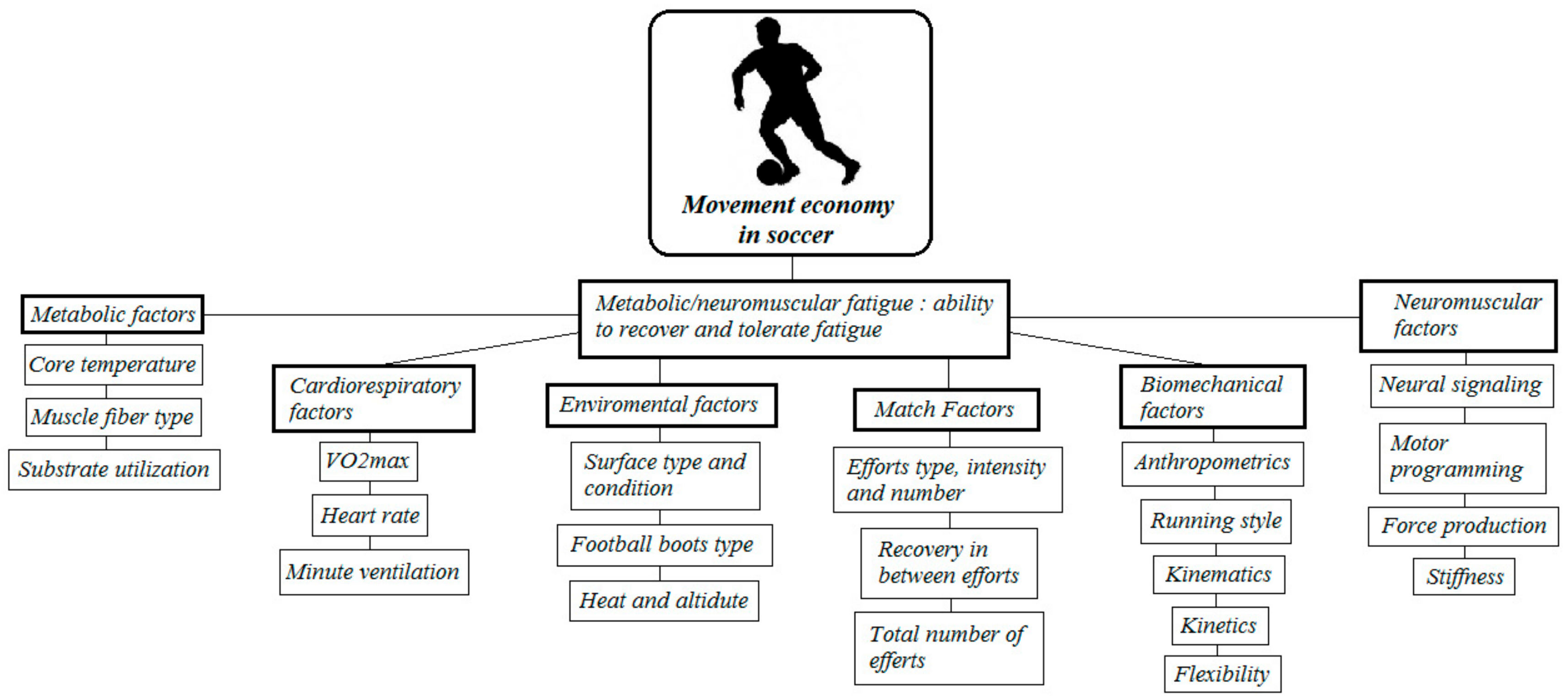
4. Determinants of Movement Economy in Soccer
5. Current Movement Economy Testing Approaches in Soccer
6. Limitations of Current Movement Economy Assessments in Soccer
7. Impact of Movement Economy on Soccer Performance
8. Normative Data in Soccer Players
9. Trainability of Movement Economy in Soccer Players
10. Conclusions
Author Contributions
Funding
Acknowledgments
Conflicts of Interest
References
- Bangsbo, J. Physiological demands of football. Sports Sci. Exch. 2014, 27, 1–6. [Google Scholar]
- Bangsbo, J.; Mohr, M.; Krustrup, P. Physical and metabolic demands of training and match-play in the elite football player. J. Sports Sci. 2006, 24, 665–674. [Google Scholar] [CrossRef] [PubMed]
- Stølen, T.; Chamari, K.; Castagna, C.; Wisløff, U. Physiology of soccer. Sports Med. 2005, 35, 501–536. [Google Scholar] [CrossRef] [PubMed]
- Sarmento, H.; Marcelino, R.; Anguera, M.T.; CampaniÇo, J.; Matos, N.; LeitÃo, J.C. Match analysis in football: A systematic review. J. Sports Sci. 2014, 32, 1831–1843. [Google Scholar] [CrossRef] [PubMed]
- Alexandre, D.; da Silva, C.D.; Hill-Haas, S.; Wong, D.P.; Natali, A.J.; De Lima, J.R.; Bara Filho, M.G.; Marins, J.J.; Garcia, E.S.; Karim, C. Heart rate monitoring in soccer: Interest and limits during competitive match play and training, practical application. J. Strength Cond. Res. 2012, 26, 2890–2906. [Google Scholar] [CrossRef] [PubMed]
- Girard, O.; Mendez-Villanueva, A.; Bishop, D. Repeated-sprint ability—Part I: Factors contributing to fatigue. Sports Med. 2011, 41, 673–694. [Google Scholar] [CrossRef] [PubMed]
- Tomlin, D.L.; Wenger, H.A. The relationship between aerobic fitness and recovery from high intensity intermittent exercise. Sports Med. 2001, 31, 1–11. [Google Scholar] [CrossRef] [PubMed]
- Tønnessen, E.; Hem, E.; Leirstein, S.; Haugen, T.; Seiler, S. Maximal aerobic power characteristics of male professional soccer players, 1989–2012. Int. J. Sports Physiol. Perform. 2013, 8, 323–329. [Google Scholar] [CrossRef] [PubMed]
- Barnes, K.R.; Kilding, A.E. Running economy: Measurement, norms, and determining factors. Sports Med. Open 2015, 1, 8. [Google Scholar] [CrossRef] [PubMed]
- Barnes, K.R.; Kilding, A.E. Strategies to improve running economy. Sports Med. 2015, 45, 37–56. [Google Scholar] [CrossRef] [PubMed]
- Conley, D.L.; Krahenbuhl, G.S. Running economy and distance running performance of highly trained athletes. Med. Sci. Sports Exerc. 1980, 12, 357–360. [Google Scholar] [CrossRef] [PubMed]
- Morgan, D.W.; Baldini, F.D.; Martin, P.E.; Kohrt, W.M. Ten kilometer performance and predicted velocity at VO2max among well-trained male runners. Med. Sci. Sports Exerc. 1989, 21, 78–83. [Google Scholar] [CrossRef] [PubMed]
- Helgerud, J.; Rodas, G.; Kemi, O.; Hoff, J. Strength and endurance in elite football players. Int. J. Sports Med. 2011, 32, 677–682. [Google Scholar] [CrossRef] [PubMed]
- Helgerud, J.; Engen, L.C.; Wisløff, U.; Hoff, J. Aerobic endurance training improves soccer performance. Med. Sci. Sports Exerc. 2001, 33, 1925–1931. [Google Scholar] [CrossRef] [PubMed]
- Impellizzeri, F.M.; Marcora, S.M.; Castagna, C.; Reilly, T.; Sassi, A.; Iaia, F.; Rampinini, E. Physiological and performance effects of generic versus specific aerobic training in soccer players. Int. J. Sports Med. 2006, 27, 483–492. [Google Scholar] [CrossRef] [PubMed]
- Chamari, K.; Moussa-Chamari, I.; Boussaidi, L.; Hachana, Y.; Kaouech, F.; Wisløff, U. Appropriate interpretation of aerobic capacity: Allometric scaling in adult and young soccer players. Br. J. Sports Med. 2005, 39, 97–101. [Google Scholar] [CrossRef] [PubMed]
- Christensen, P.M.; Krustrup, P.; Gunnarsson, T.P.; Kiilerich, K.; Nybo, L.; Bangsbo, J.V. O2 Kinetics and Performance in Soccer Players after Intense Training and Inactivity. Med. Sci. Sports Exerc. 2011, 43, 1716–1724. [Google Scholar] [CrossRef] [PubMed]
- Ziogas, G.G.; Patras, K.N.; Stergiou, N.; Georgoulis, A.D. Velocity at lactate threshold and running economy must also be considered along with maximal oxygen uptake when testing elite soccer players during preseason. J. Strength Cond. Res. 2011, 25, 414–419. [Google Scholar] [CrossRef] [PubMed]
- Nilsson, J.; Cardinale, D. Running economy and blood lactate accumulation in elite football players with high and low maximal aerobic power. LASE J. Sport Sci. 2015, 6, 44–51. [Google Scholar]
- Buchheit, M.; Haydar, B.; Hader, K.; Ufland, P.; Ahmaidi, S. Assessing running economy during field running with changes of direction: Application to 20 m shuttle runs. Int. J. Sports Physiol. Perform. 2011, 6, 380–395. [Google Scholar] [CrossRef] [PubMed]
- Saunders, P.U.; Pyne, D.B.; Telford, R.D.; Hawley, J.A. Factors affecting running economy in trained distance runners. Sports Med. 2004, 34, 465–485. [Google Scholar] [CrossRef] [PubMed]
- Burgess, T.L.; Lambert, M.I. The effects of training, muscle damage and fatigue on running economy. Int. SportMed J. 2010, 11, 363–379. [Google Scholar]
- Fransson, D.; Krustrup, P.; Mohr, M. Running intensity fluctuations indicate temporary performance decrement in top-class football. Sci. Med. Footb. 2017, 1, 10–17. [Google Scholar] [CrossRef]
- Shaw, A.J.; Ingham, S.A.; Folland, J.P. The valid measurement of running economy in runners. Med. Sci. Sports Exerc. 2014, 46, 1968–1973. [Google Scholar] [CrossRef] [PubMed]
- Mohr, M.; Krustrup, P.; Bangsbo, J. Fatigue in soccer: A brief review. J. Sports Sci. 2005, 23, 593–599. [Google Scholar] [CrossRef] [PubMed]
- Milic-Emili, G.; Petit, J.; Deroanne, R. Mechanical work of breathing during exercise in trained and untrained subjects. J. Appl. Physiol. 1962, 17, 43–46. [Google Scholar] [CrossRef] [PubMed]
- Lattier, G.; Millet, G.; Martin, A.; Martin, V. Fatigue and recovery after high-intensity exercise. Part II: Recovery interventions. Int. J. Sports Med. 2004, 25, 509–515. [Google Scholar] [CrossRef] [PubMed]
- Bangsbo, J.; Iaia, F.M.; Krustrup, P. Metabolic response and fatigue in soccer. Int. J. Sports Physiol. Perform. 2007, 2, 111–127. [Google Scholar] [CrossRef] [PubMed]
- Girard, O.; Micallef, J.-P.; Millet, G.P. Changes in spring-mass model characteristics during repeated running sprints. Eur. J. Appl. Physiol. 2011, 111, 125–134. [Google Scholar] [CrossRef] [PubMed]
- Christina, K.A.; White, S.C.; Gilchrist, L.A. Effect of localized muscle fatigue on vertical ground reaction forces and ankle joint motion during running. Hum. Mov. Sci. 2001, 20, 257–276. [Google Scholar] [CrossRef]
- Mizrahi, J.; Verbitsky, O.; Isakov, E.; Daily, D. Effect of fatigue on leg kinematics and impact acceleration in long distance running. Hum. Mov. Sci. 2000, 19, 139–151. [Google Scholar] [CrossRef]
- Grieco, C.R.; Cortes, N.; Greska, E.K.; Lucci, S.; Onate, J.A. Effects of a Combined Resistance-Plyometric Training Program on Muscular Strength, Running Economy, and V [Combining Dot Above] O2peak in Division I Female Soccer Players. J. Strength Cond. Res. 2012, 26, 2570–2576. [Google Scholar] [CrossRef] [PubMed]
- McCormack, W.P.; Stout, J.R.; Wells, A.J.; Gonzalez, A.M.; Mangine, G.T.; Fragala, M.S.; Hoffman, J.R. Predictors of high-intensity running capacity in collegiate women during a soccer game. J. Strength Cond. Res. 2014, 28, 964–970. [Google Scholar] [CrossRef] [PubMed]
- Hoppe, M.W.; Baumgart, C.; Sperlich, B.; Ibrahim, H.; Jansen, C.; Willis, S.J.; Freiwald, J. Comparison between three different endurance tests in professional soccer players. J. Strength Cond. Res. 2013, 27, 31–37. [Google Scholar] [CrossRef] [PubMed]
- Gunnarsson, T.P.; Christensen, P.M.; Holse, K.; Christiansen, D.; Bangsbo, J. Effect of additional speed endurance training on performance and muscle adaptations. Med. Sci. Sports Exerc. 2012, 44, 1942–1948. [Google Scholar] [CrossRef] [PubMed]
- MacDougall, J. The anaerobic threshold: Its significance for the endurance athlete. Can. J. Appl. Sport Sci. 1977, 2, 137–140. [Google Scholar]
- Daniels, J.; Daniels, N. Running economy of elite male and elite female runners. Med. Sci. Sports Exerc. 1992, 24, 483–489. [Google Scholar] [CrossRef] [PubMed]
- Helgerud, J. Maximal oxygen uptake, anaerobic threshold and running economy in women and men with similar performances level in marathons. Eur. J. Appl. Physiol. Occup. Physiol. 1994, 68, 155–161. [Google Scholar] [CrossRef] [PubMed]
- Helgerud, J.; Kemi, O.; Hoff, J. Pre-season concurrent strength and endurance development in elite soccer players. In Football (Soccer): New Developments in Physical Training Research; Hoff, J., Helgerud, J., Eds.; NTNU: Trondheim, Norway, 2003; pp. 55–66. [Google Scholar]
- Chamari, K.; Hachana, Y.; Kaouech, F.; Jeddi, R.; Moussa-Chamari, I.; Wisløff, U. Endurance training and testing with the ball in young elite soccer players. Br. J. Sports Med. 2005, 39, 24–28. [Google Scholar] [CrossRef] [PubMed]
- Segers, V.; De Clercq, D.; Philippaerts, R.; Janssens, M. Running economy in early and late mature youth soccer players. In Topics in Functional and Ecological Vertebrate Morphology; Shaker: Maastricht, The Netherlands, 2002; pp. 125–138. [Google Scholar]
- Fletcher, J.R.; Esau, S.P.; Macintosh, B.R. Economy of running: Beyond the measurement of oxygen uptake. J. Appl. Physiol. 2009, 107, 1918–1922. [Google Scholar] [CrossRef] [PubMed]
- Peronnet, F.; Massicotte, D. Table of nonprotein respiratory quotient: An update. Can. J. Sport Sci. 1991, 16, 23–29. [Google Scholar] [PubMed]
- Divert, C.; Mornieux, G.; Freychat, P.; Baly, L.; Mayer, F.; Belli, A. Barefoot-shod running differences: Shoe or mass effect? Int. J. Sports Med. 2008, 29, 512–518. [Google Scholar] [CrossRef] [PubMed]
- Kerdok, A.E.; Biewener, A.A.; McMahon, T.A.; Weyand, P.G.; Herr, H.M. Energetics and mechanics of human running on surfaces of different stiffnesses. J. Appl. Physiol. 2002, 92, 469–478. [Google Scholar] [CrossRef] [PubMed]
- Hader, K.; Mendez-Villanueva, A.; Palazzi, D.; Ahmaidi, S.; Buchheit, M. Metabolic power requirement of change of direction speed in young soccer players: Not all is what it seems. PLoS ONE 2016, 11, e0149839. [Google Scholar] [CrossRef] [PubMed]
- Zamparo, P.; Pavei, G.; Nardello, F.; Bartolini, D.; Monte, A.; Minetti, A.E. Mechanical work and efficiency of 5 + 5 m shuttle running. Eur. J. Appl. Physiol. 2016, 116, 1911–1919. [Google Scholar] [CrossRef] [PubMed]
- Hatamoto, Y.; Yamada, Y.; Fujii, T.; Higaki, Y.; Kiyonaga, A.; Tanaka, H. A novel method for calculating the energy cost of turning during running. Open Access J. Sports Med. 2013, 4, 117–122. [Google Scholar] [CrossRef] [PubMed]
- Eniseler, N. Heart rate and blood lactate concentrations as predictors of physiological load on elite soccer players during various soccer training activities. J. Strength Cond. Res. 2005, 19, 799–804. [Google Scholar] [PubMed]
- Russell, M.; Sparkes, W.; Northeast, J.; Cook, C.J.; Love, T.D.; Bracken, R.M.; Kilduff, L.P. Changes in acceleration and deceleration capacity throughout professional soccer match-play. J. Strength Cond. Res. 2016, 30, 2839–2844. [Google Scholar] [CrossRef] [PubMed]
- Mendez-Villanueva, A.; Buchheit, M.; Simpson, B.; Bourdon, P. Match play intensity distribution in youth soccer. Int. J. Sports Med. 2013, 34, 101–110. [Google Scholar] [CrossRef] [PubMed]
- O'Donoghue, P.; Boyd, M.; Lawlor, J.; Bleakley, E. Time-motion analysis of elite, semi-professional and amateur soccer competition. J. Hum. Mov. Stud. 2001, 41, 1–12. [Google Scholar]
- Da Silva, J.F.; Guglielmo, L.G.; Bishop, D. Relationship between different measures of aerobic fitness and repeated-sprint ability in elite soccer players. J. Strength Cond. Res. 2010, 24, 2115–2121. [Google Scholar] [CrossRef] [PubMed]
- Buchheit, M. Repeated-sprint performance in team sport players: Associations with measures of aerobic fitness, metabolic control and locomotor function. Int. J. Sports Med. 2012, 33, 230–239. [Google Scholar] [CrossRef] [PubMed]
- Turner, A.N.; Stewart, P.F. Strength and conditioning for soccer players. Strength Cond. J. 2014, 36, 1–13. [Google Scholar] [CrossRef]
- Caldwell, B.P.; Peters, D.M. Seasonal variation in physiological fitness of a semiprofessional soccer team. J. Strength Cond. Res. 2009, 23, 1370–1377. [Google Scholar] [CrossRef] [PubMed]
- MacInnis, M.J.; Gibala, M.J. Physiological adaptations to interval training and the role of exercise intensity. J. Physiol. 2017, 595, 2915–2930. [Google Scholar] [CrossRef] [PubMed]
- Kinnunen, J.-V.; Piitulainen, H.; Piirainen, J.M. Neuromuscular adaptations to short-term high-intensity interval training in female ice hockey players. J. Strength Cond. Res. 2017. [Google Scholar] [CrossRef] [PubMed]

| Study | Player Characteristics (Age) | ME Protocol | Period of Baseline Test | Baseline ME (Protocol Speed) |
|---|---|---|---|---|
| Chamari, et al. [16] | 21 young male soccer players (14 ± 0.4 years) | Running on a treadmill with 5.5% inclination for 4 min at 7 km/h | Second half of the season | 39.2 ± 2.9 mL/lbm/min (7 km/h) 0.34 ± 0.02 mL/lbm/m (7 km/h) 1.65 ± 0.04 mL/lbm−0.60/m (7 km/h) |
| 24 adult elite soccer players from Tunisian national team (24 ± 2 years) | 36.0 ± 3.1 ** mL/lbm/min (7 km/h) 0.30 ± 0.02 ** mL/lbm/m (7 km/h) 1.65 ± 0.08 mL/lbm−0.60/m (7 km/h) | |||
| Ziogas, et al. [18] | 53 Professional soccer players from Greek division A (26.2 ± 4.9 years) | Running on a treadmill with 3% inclination. After the initial speed of 10 km/h was increased by 2 km/h every 3 min until volitional exhaustion. ME calculated at 12 km/h. | Early pre-season | 44.6 ± 2.9 mL/kg/min (12 km/h) |
| 46 Professional soccer players from Greek division B (25.9 ± 5.2 years) | 44.4 ± 2.8 mL/kg/min (12 km/h) | |||
| 30 Semi-professional soccer players from Greek division C (25.6 ± 4.5 years) | 46.4 ± 3.9 ** mL/kg/min (12 km/h) | |||
| Segers, et al. [41] | 6 early mature soccer boys Skeletal age = 16.0 ± 1.1 years (13.2 ± 1.0 years) | Running on treadmill with 1% inclination for three 6 min interval at 8, 9.5 and 11 km/h. Rest 5 min in between. ME calculated for each interval. | Not reported | 32.6 ± 3.0 mL/kg0.98/min (8 km/h) 35.3 ± 3.3 mL/kg0.98/min (9.5 km/h) 39.3 ± 3.3 mL/kg0.98/min (11 km/h) |
| 7 late matures soccer boys Skeletal age = 14.3 ± 0.6 years (14.4 ± 0.5 years) | 30.0 ± 4.4 mL/kg0.98/min (8 km/h) 32.3 ± 5.6 mL/kg0.98/min (9.5 km/h) 35.1 ± 5.7 mL/kg0.98/min (11 km/h) | |||
| Hoppe et al. [34] | 11 professional soccer players from 3rd level in Germany (23.8 ± 3.0 years) | Running on a treadmill with 1% inclination for 4 min at 10 km/h. | Pre-season | 2.8 ± 0.2 L/min (10 km/h) 36.5 ± 1.8 mL/kg/min (10 km/h) 107.8 ± 3.9 mL/kg−75/min (10 km/h) |
| Nilsson and Cardinale [19] | 23 elite male soccer players from the top Swedish league with higher aerobic Power: VO2max = 59.7 ± 2.3 mL/kg/min (22.5 ± 3.3 years) | Running on a treadmill at 0% gradient, 4 min bouts at 10, 12, 14, and 16 km/h. Between the run at each speed level the participants had one min of rest when a blood sample was collected. | End of season | ~39.0 mL/kg/min (12 km/h) ~43.5 mL/kg/min (14 km/h) ~49.5 mL/kg/min (16 km/h) |
| ME calculated for every interval but not reported for the first one (10 km/h). | ||||
| 17 elite male soccer players from the top Swedish league with lower aerobic power: VO2max = 53.2 ± 2.0 mL/kg/min (26.8 ± 4.8 years) | ~37.5 mL/kg/min (12 km/h) ~42.0 mL/kg/min (14 km/h) ~47.5 mL/kg/min (16 km/h) | |||
| McCormack, et al. [33] | 10 National Collegiate Athletic Association Division I women soccer players (19.5 ± 1.0 years) | Running on a treadmill (gradient not reported) for 4 min at 12.0 km/h. | Off-season | 39.8 ± 1.8 mL/kg/min (12 km/h) |
| Study | Player Characteristics (age) | Testing Protocol | Period of Baseline Test | Pre-Intervention ME (Protocol Speed) | Intervention | Post-Intervention ME (Protocol Speed) |
|---|---|---|---|---|---|---|
| Impellizzeri, et al. [15] | 20 male elite soccer players (17.2 ± 0.8 years) | Running on treadmill with 3% inclination for 10 min at 9 km/h then speed increased incrementally 1 km/h every 5 min. ME was calculated at the vLTan. | 4 weeks before in-season | 0.73 ± 0.03 mL/kg0.75/m (vLTan = 11.3 ± 0.7 km/h) | HIIT: 4 × 4 min SSGs at 90–95% of HRmax with 3 min active rest periods. Twice a week × 8 weeks along with regular soccer practice | 0.71 ± 0.03 mL/kg0.75/m (vLTan 12.4 ± 0.5 km/h) 2.74 ± 0%↑ |
| 20 male elite soccer players (17.2 ± 0.8 years) | 0.72 ± 0.03 mL/kg0.75/m (vLTan = 11.2 ± 0.6) | HIIT: 4 × 4 min continuous running at 90–95% of HRmax with 3 min active rest periods. Twice a week × 8 weeks along with regular soccer practice | 0.70 ± 0.04 mL/kg0.75/m (vLTan 12.2 ± 0.4) 2.78 ± 0.33%↑ | |||
| Chamari, et al. [40] | 18 male national level soccer players (14 ± 0.4 years) | Running on a treadmill with 5.5% inclination for 4 min at 7 km/h. | Just after mid-season | 38.8 ± 2.1 mL/kg/min (7 km/h) | HIIT: 4 × 4 min HIIT on the Hoff track, separated by 3 min of active recovery. Twice a week × 8 weeks along with regular soccer practice. | 33.6 ± 2.2 * mL/kg/min (7 km/h) 13. ± 0.4.77%↑ |
| 0.90 ± 0.04 mL/kg0.75/m (7 km/h) | 0.81 ± 0.05 * mL/kg0.75/m (7 km/h) 10 ± 0.25%↑ | |||||
| Helgerud, et al. [14] | 9 male junior elite soccer players (18.1± 0.8 years) | Running on a treadmill with 3% inclination for 5 min stages starting. Starting speed at intensity corresponding to 60% VO2max, and then increased by 1 km/h at every stage (after 20 s recovery for blood samples). ME was calculated at the interval intensity corresponding to LT. | Beginning of the season | 0.75 ± 0.05 mL/kg0.75/m (vLTan = 11.1 ± 0.7) | HIIT: 4 × 4 min continuous running at 90–95% of HRmax, with 3 min active recovery jogging at 50–60% of HRmax, Twice a week × 8 weeks along with soccer practice | 0.70 ± 0.04 * mL/kg0.75/m (vLTan = 13.5 ± 0.4) 6.67 ± 0.2%↑ |
| 10 male junior elite soccer players (18.1 ± 0.8 years) | 0.75 ± 0.04 mL/kg0.75/m (vLTan = 11.7 ± 0.4) | Extra technical training, such as heading drills, practicing free kicks, and exercises related to receiving the ball and changing direction | 0.74 ± 0.04 mL/kg0.75/m (vLTan = 11.5 ± 0.2) 1.33 ± 0%↑ | |||
| Helgerud, et al. [13]/Helgerud, et al. [39] | 21 male elite soccer players (25 ± 2.9 years) | Running on a treadmill with 5.5% inclination at initial speed corresponding to an intensity of 50–60% VO2max, then increased to 11 km/h for 5 min. ME was calculated during this last 5 min. | First pre-season | 0.85 ± 0.3 mL/kg0.75/m (11 km/h) | HIIT+ strength: 4 × 4 min running on a treadmill (5.5% inclination) at 90–95% of HRmax with 3min active rest periods jogging at 50–60% of HRmax. After a 15 min break, 4-repetition maximum of half-squats in 4 series. If 5 repetitions were managed the load was increased. 3 min rest between series. Twice per week per 8 weeks | 0.82 ± 0.3 * mL/kg0.75/m (11 km/h) 3.53 ± 0%↑ |
| Christensen, et al. [17] | 7 male elite soccer players (26.8 ± 4.8 years) | 6 runs over 2 different days. Bouts of 4 min Each bout consisted of 1 min of rest standing on the treadmill followed by 4 min of running at 75% MAS (average speed = 14.1 km·h−1) were calculated during the final 30 s of each 4 min running bout | Off-season just after last match | 197.8 ± 10.2 mL/kg/km (MAS average = 14.1 km/h) | HIIT: 10 training sessions mainly consisting of aerobic high-intensity training (8 × 2 min at 87.7% ± 1.2% with 1 min recovery in between) and speed endurance training (10–12 × 30 s all-out sprints with rest of similar duration) performed over two weeks. | 192.8 ± 7.2 * mL/kg/km (MAS average = 14.1 km/h) 2.53 ± 0.29%↑ |
| 11 male elite soccer players (26.8 ± 4.8 years) | 196.6 ± 7.0 mL/kg/km (MAS average = 14.1 km/h) | No training performed | 195.2 ± 7.2 mL/kg/km (MAS average = 14.1 km/h) 0.71 ± 0.29%↑ | |||
| Grieco, et al. [32] | 15 Division 1A female soccer players (19.0 ± 0.7 years) | Running on a treadmill at 9 km/h for 5 min; then speed increased 1 km/h every 2 min, until the subject was unable to maintain the pace. Movement economy was calculated for the first 5 min run at 9 km/h. | Off-season | Data not shown | 11 weeks off-season combined lower body resistance-plyometric training with a 7-day break during the 7th week. Resistance training 2 days per week on non-consecutive days. 60 min session Consisting of 9–10 exercises of 3 sets each. Plyometric raining conducted on different non-consecutive days. 60 min during the first 4 weeks and approximately 30 min during the final 6 weeks. | Data not shown |
| No significant changes reported | ||||||
| Gunnarsson, et al. [35] | 7 male soccer players from a team in the Danish Second Division (23.3 ± 0.9 years) | Running for 4 min at a 10 km/h on a treadmill, resting 2 min and then running another 4 min at 14 km/h. Movement economy was calculated both at 10 and 14 km/h. | In-season | 35.9 ± 0.9 mL/kg/min (10 km) 47.5 ± 0.7 mL/kg/min (14 km/h) | SET six to nine 30-s intervals per week at an intensity of 90–95% of max intensity, interspersed with 3 min of rest. In the first week of the SET intervention, the players performed five 30-s intervals and one interval was added every week. | 33.8 ± 0.9 * mL/kg/min (10 km/h) ↑6% 46.1 ± 1.0 mL/kg/min (14 km/h) |
© 2018 by the authors. Licensee MDPI, Basel, Switzerland. This article is an open access article distributed under the terms and conditions of the Creative Commons Attribution (CC BY) license (http://creativecommons.org/licenses/by/4.0/).
Share and Cite
Dolci, F.; Hart, N.H.; Kilding, A.; Chivers, P.; Piggott, B.; Spiteri, T. Movement Economy in Soccer: Current Data and Limitations. Sports 2018, 6, 124. https://doi.org/10.3390/sports6040124
Dolci F, Hart NH, Kilding A, Chivers P, Piggott B, Spiteri T. Movement Economy in Soccer: Current Data and Limitations. Sports. 2018; 6(4):124. https://doi.org/10.3390/sports6040124
Chicago/Turabian StyleDolci, Filippo, Nicolas H. Hart, Andrew Kilding, Paola Chivers, Ben Piggott, and Tania Spiteri. 2018. "Movement Economy in Soccer: Current Data and Limitations" Sports 6, no. 4: 124. https://doi.org/10.3390/sports6040124
APA StyleDolci, F., Hart, N. H., Kilding, A., Chivers, P., Piggott, B., & Spiteri, T. (2018). Movement Economy in Soccer: Current Data and Limitations. Sports, 6(4), 124. https://doi.org/10.3390/sports6040124

