

Gradual vs. Maximal Acceleration: Their Influence on the Prescription of Maximal Speed Sprinting in Team Sport Athletes

 , , ,
, , ,
Abstract
1. Introduction
2. Materials and Methods
2.1. Experimental Approach to the Problem
2.2. Subjects
2.3. Procedures
2.4. Statistical Analyses
3. Results
4. Discussion
5. Conclusions
Author Contributions
Funding
Conflicts of Interest
References
- Hoffmann, J.J., Jr.; Reed, J.P.; Leiting, K.; Chiang, C.-Y.; Stone, M.H. Repeated sprints, high-intensity interval training, small-sided games: Theory and application to field sports. Int. J. Sports Physiol. Perform. 2014, 9, 352–357. [Google Scholar] [CrossRef] [Scilit] [PubMed]
- Lockie, R.G.; Murphy, A.J.; Knight, T.J.; Janse de Jonge, X.A. Factors that differentiate acceleration ability in field sport athletes. J. Strength Cond. Res. 2011, 25, 2704–2714. [Google Scholar] [CrossRef] [Scilit] [PubMed]
- Spinks, C.D.; Murphy, A.J.; Spinks, W.L.; Lockie, R.G. The effects of resisted sprint training on acceleration performance and kinematics in soccer, rugby union, and australian football players. J. Strength Cond. Res. 2007, 21, 77–85. [Google Scholar] [CrossRef] [Scilit] [PubMed]
- Sweeting, A.J.; Cormack, S.J.; Morgan, S.; Aughey, R.J. When is a sprint a sprint? A review of the analysis of team-sport athlete activity profile. Front. Physiol. 2017, 8, 432. [Google Scholar] [CrossRef] [Scilit] [PubMed]
- Duthie, G.M.; Pyne, D.B.; Marsh, D.J.; Hooper, S.L. Sprint patterns in rugby union players during competition. J. Strength Cond. Res. 2006, 20, 208–214. [Google Scholar] [PubMed]
- Gabbett, T.J. Sprinting patterns of national rugby league competition. J. Strength Cond. Res. 2012, 26, 121–130. [Google Scholar] [CrossRef] [Scilit] [PubMed]
- Di Salvo, V.; Baron, R.; González-Haro, C.; Gormasz, C.; Pigozzi, F.; Bachl, N. Sprinting analysis of elite soccer players during european champions league and uefa cup matches. J. Sports Sci. 2010, 28, 1489–1494. [Google Scholar] [CrossRef] [Scilit] [PubMed]
- Di Salvo, V.; Gregson, W.; Atkinson, G.; Tordoff, P.; Drust, B. Analysis of high intensity activity in premier league soccer. Int. J. Sports Med. 2009, 30, 205–212. [Google Scholar] [CrossRef] [Scilit] [PubMed]
- Benton, D. An Analysis of Sprint Running Patterns in Australian Rules Football: The Effect of Different Starting Velocities on the Velocity Profile; University of Ballarat: Ballarat, Australia, 2000. [Google Scholar]
- Austin, D.; Gabbett, T.; Jenkins, D. The physical demands of super 14 rugby union. J. Sci. Med. Sport 2011, 14, 259–263. [Google Scholar] [CrossRef] [Scilit] [PubMed]
- Deutsch, M.U.; Kearney, G.A.; Rehrer, N.J. Time–motion analysis of professional rugby union players during match-play. J. Sports Sci. 2007, 25, 461–472. [Google Scholar] [CrossRef] [Scilit] [PubMed]
- Duthie, G.; Pyne, D.; Hooper, S. Time motion analysis of 2001 and 2002 super 12 rugby. J. Sports Sci. 2005, 23, 523–530. [Google Scholar] [CrossRef] [Scilit] [PubMed]
- Ingebrigtsen, J.; Dalen, T.; Hjelde, G.H.; Drust, B.; Wisløff, U. Acceleration and sprint profiles of a professional elite football team in match play. Eur. J. Sport Sci. 2015, 15, 101–110. [Google Scholar] [CrossRef] [Scilit] [PubMed]
- King, T.; Jenkins, D.; Gabbett, T. A time–motion analysis of professional rugby league match-play. J. Sports Sci. 2009, 27, 213–219. [Google Scholar] [CrossRef] [Scilit] [PubMed]
- Malone, S.; Solan, B.; Collins, K.D.; Doran, D.A. Positional match running performance in elite gaelic football. J. Strength Cond. Res. 2016, 30, 2292–2298. [Google Scholar] [CrossRef] [Scilit] [PubMed]
- Wellman, A.D.; Coad, S.C.; Goulet, G.C.; McLellan, C.P. Quantification of competitive game demands of NCAA division I college football players using global positioning systems. J. Strength Cond. Res. 2016, 30, 11–19. [Google Scholar] [CrossRef] [Scilit] [PubMed]
- Jeffreys, I.; Goodwin, J. Developing speed and agility for sports performance. In Strength and Conditioning for Sports Performance; Jeffreys, I., Moody, J., Eds.; Routledge: Abingdon, UK, 2016; pp. 341–371. [Google Scholar]
- Haugen, T.; Buchheit, M. Sprint running performance monitoring: Methodological and practical considerations. Sports Med. 2016, 46, 641–656. [Google Scholar] [CrossRef] [Scilit] [PubMed]
- Hopkins, W.; Marshall, S.; Batterham, A.; Hanin, J. Progressive statistics for studies in sports medicine and exercise science. Med. Sci. Sports Exerc. 2009, 41, 3. [Google Scholar] [CrossRef] [Scilit] [PubMed]
- Hopkins, W. A spreadsheet for deriving a confidence interval, mechanistic inference and clinical inference from a p value. Sports Sci. 2007, 11, 16–20. [Google Scholar]
- Christ, C.B.; Boileau, R.A.; Slaughter, M.H.; Stillman, R.J.; Cameron, J. The effect of test protocol instructions on the measurement of muscle function in adult women. J. Orthop. Sports Phys. Ther. 1993, 18, 502–510. [Google Scholar] [CrossRef] [Scilit] [PubMed]
- Desmedt, J.; Godaux, E. Ballistic contractions in man: Characteristic recruitment pattern of single motor units of the tibialis anterior muscle. J. Physiol. 1977, 264, 673–693. [Google Scholar] [CrossRef] [Scilit] [PubMed]
- Hansen, D. Successfully translating strength into speed. In High-Performance Training for Sports; Joyce, D., Lewindon, D., Eds.; Human Kinetics: Leeds, UK, 2014; pp. 145–166. [Google Scholar]
- Weaving, D.; Whitehead, S.; Till, K.; Jones, B. Validity of real-time data generated by a wearable microtechnology device. J. Strength Cond. Res. 2017, 31, 2876–2879. [Google Scholar] [CrossRef] [Scilit] [PubMed]
- Impellizzeri, F.; Rampinini, E.; Marcora, S. Physiological assessment of aerobic training in soccer. J. Sports Sci. 2005, 23, 583–592. [Google Scholar] [CrossRef] [Scilit] [PubMed]
- Mooney, M.G.; Hunter, J.R.; O’brien, B.J.; Berry, J.T.; Young, W.B. Reliability and validity of a novel intermittent peak running speed test for australian football. J. Strength Cond. Res. 2011, 25, 973–979. [Google Scholar] [CrossRef] [Scilit] [PubMed]
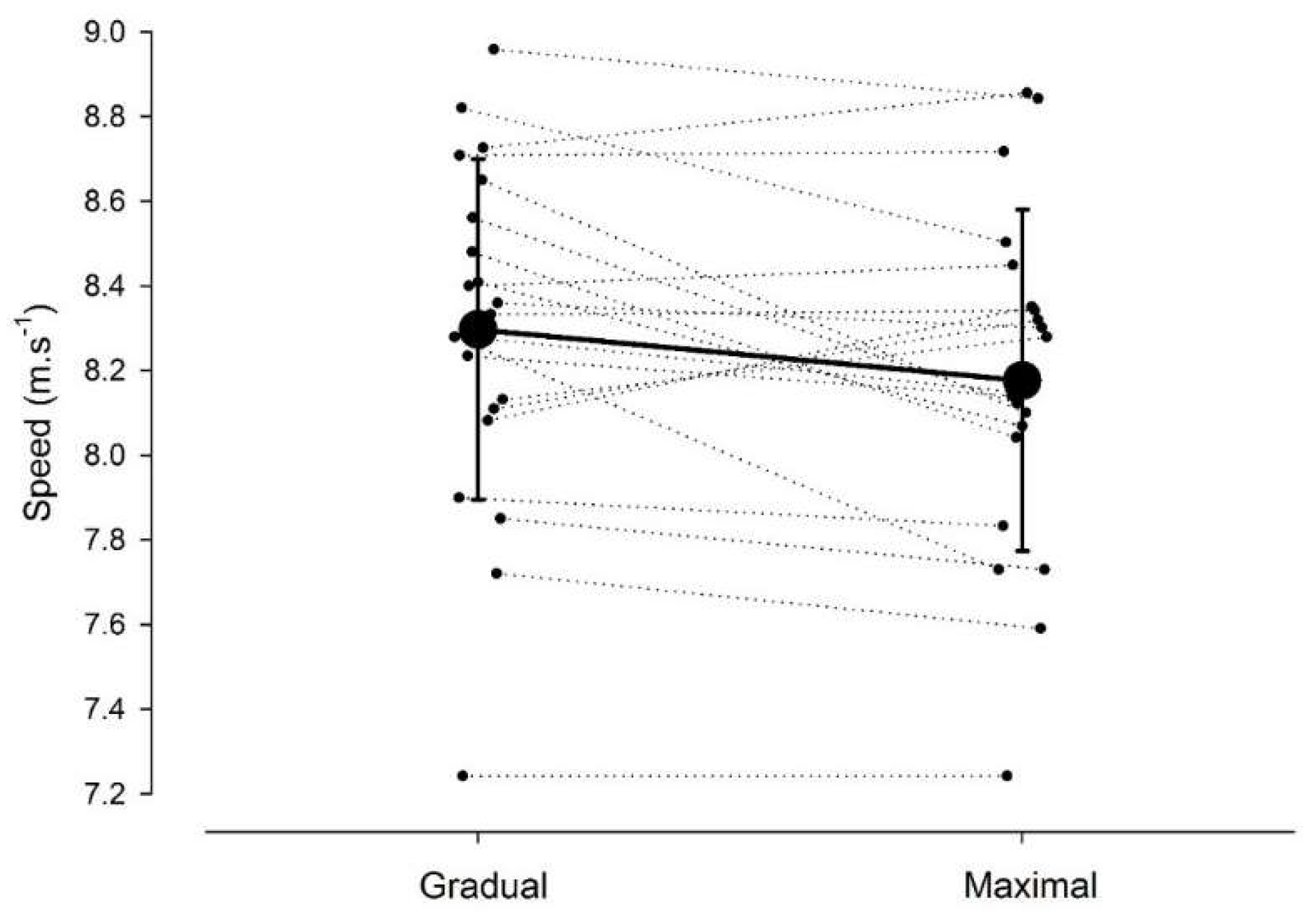
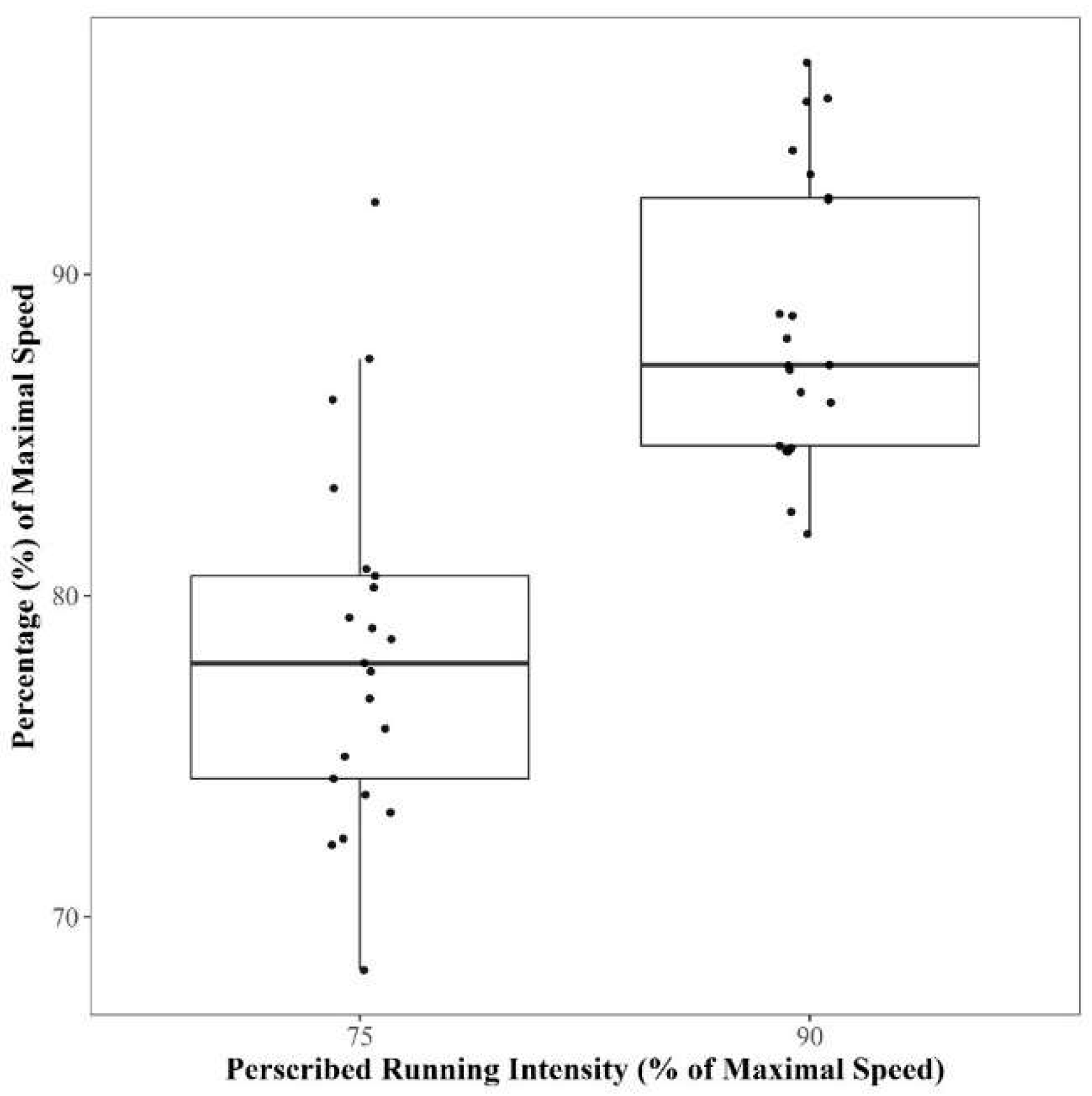
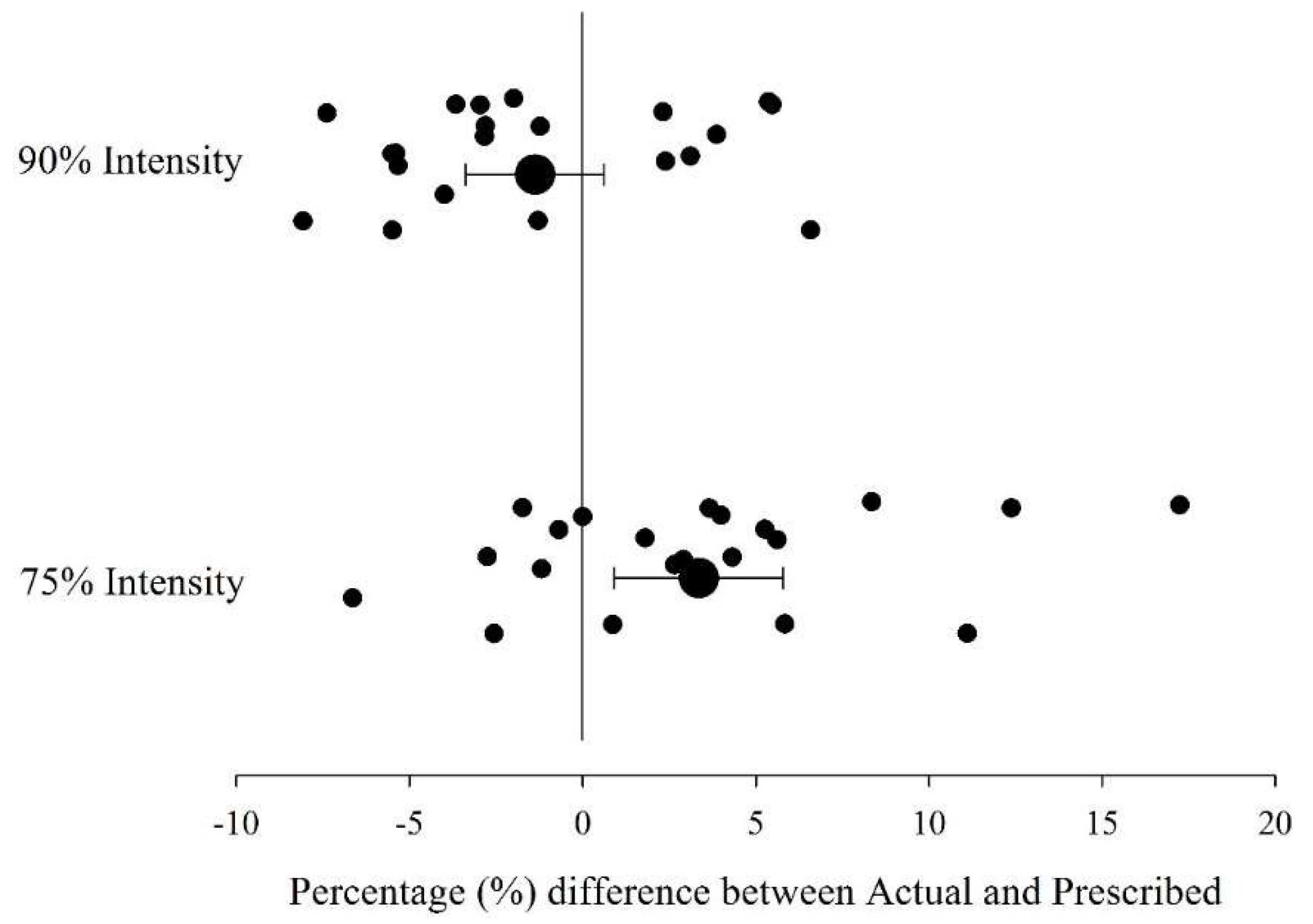
© 2018 by the authors. Licensee MDPI, Basel, Switzerland. This article is an open access article distributed under the terms and conditions of the Creative Commons Attribution (CC BY) license (http://creativecommons.org/licenses/by/4.0/).
Share and Cite
Young, W.B.; Duthie, G.M.; James, L.P.; Talpey, S.W.; Benton, D.T.; Kilfoyle, A. Gradual vs. Maximal Acceleration: Their Influence on the Prescription of Maximal Speed Sprinting in Team Sport Athletes. Sports 2018, 6, 66. https://doi.org/10.3390/sports6030066
Young WB, Duthie GM, James LP, Talpey SW, Benton DT, Kilfoyle A. Gradual vs. Maximal Acceleration: Their Influence on the Prescription of Maximal Speed Sprinting in Team Sport Athletes. Sports. 2018; 6(3):66. https://doi.org/10.3390/sports6030066
Chicago/Turabian StyleYoung, Warren B., Grant M. Duthie, Lachlan P. James, Scott W. Talpey, Dean T. Benton, and Anthony Kilfoyle. 2018. "Gradual vs. Maximal Acceleration: Their Influence on the Prescription of Maximal Speed Sprinting in Team Sport Athletes" Sports 6, no. 3: 66. https://doi.org/10.3390/sports6030066
APA StyleYoung, W. B., Duthie, G. M., James, L. P., Talpey, S. W., Benton, D. T., & Kilfoyle, A. (2018). Gradual vs. Maximal Acceleration: Their Influence on the Prescription of Maximal Speed Sprinting in Team Sport Athletes. Sports, 6(3), 66. https://doi.org/10.3390/sports6030066

