
Article

Core Strength and Side-Hop Interlimb Asymmetries Are Associated with Subsequent Traumatic Knee Injury in Female Football Players

by
Sofia Ryman Augustsson
1,* and
Timmy Gustafsson
2
1
Department of Sport Science, Linnaeus University, 39182 Kalmar, Sweden
2
Unit of Physiotherapy, Department of Health, Medicine and Caring Sciences, Linköping University, 58185 Linköping, Sweden
*
Author to whom correspondence should be addressed.
Sports 2026, 14(9), 410; https://doi.org/10.3390/sports14090410

Submission received: 4 August 2026 / Revised: 12 September 2026 / Accepted: 15 September 2026 / Published: 17 September 2026
(This article belongs to the Special Issue Women's Special Issue Series: Sports)

Abstract

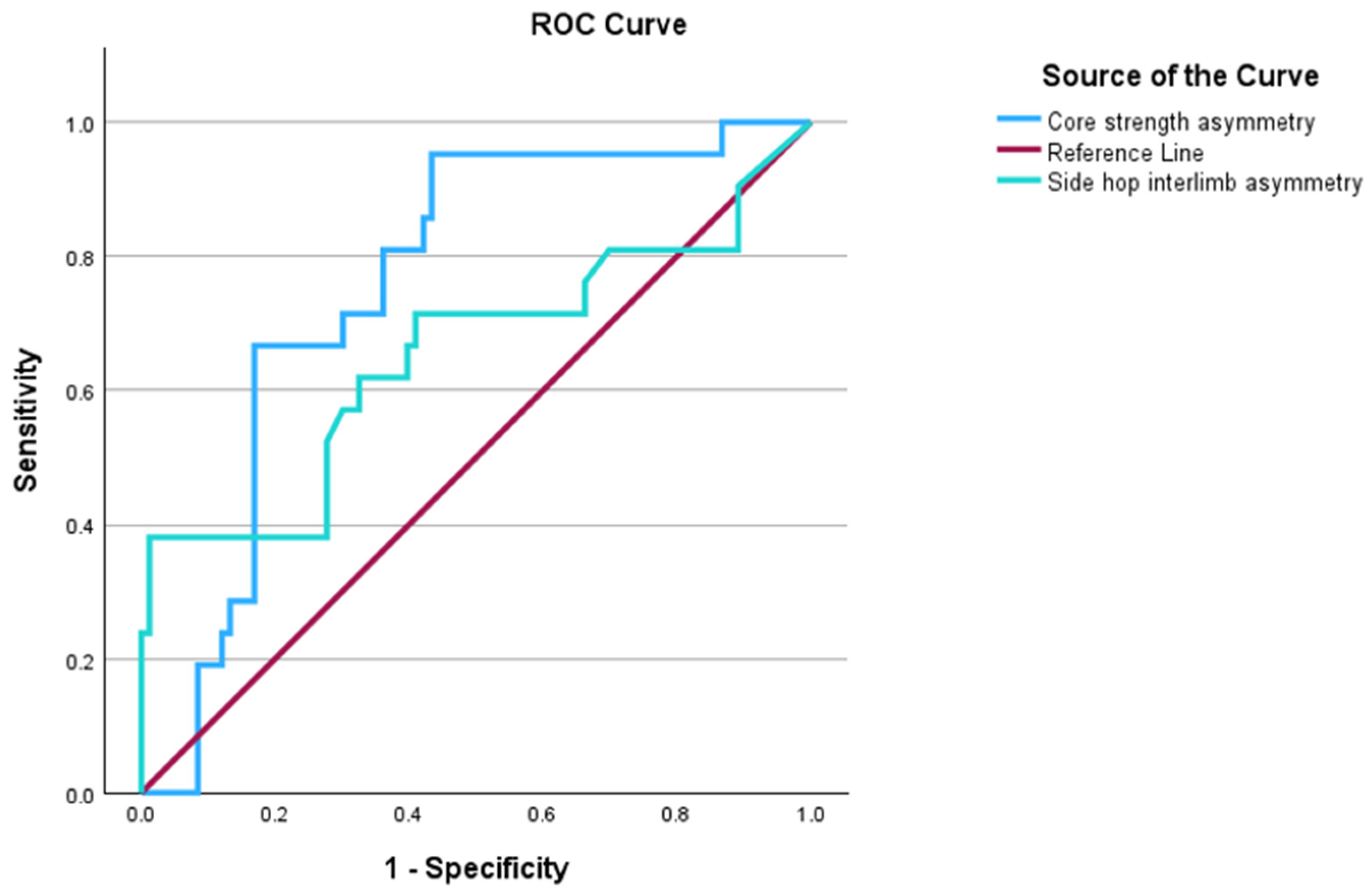
The aim of this prospective cohort study was to examine the associations between muscle strength and functional interlimb asymmetries and the subsequent occurrence of traumatic knee injuries in female football players. A secondary aim was to evaluate the ability of asymmetry measures to discriminate between injured and non-injured athletes. A total of 104 female football players aged 16–26 years, representing elite-level clubs competing in the Swedish Elitettan and football academies, participated in this prospective cohort study. Baseline assessments included tests of muscle strength and functional performance, followed by a one-year prospective monitoring period with systematic registration of traumatic knee injuries (ACL, meniscal, collateral ligament, cartilage, and fracture injuries) and sport exposure. During follow-up, 21 players sustained a traumatic knee injury. Injured players demonstrated significantly greater interlimb asymmetry in quadriceps strength, core lateral flexor strength, side-hop performance, and hamstring-to-quadriceps (H:Q) ratio at baseline than non-injured players (all p ≤ 0.024). No significant differences were found for hamstring strength, hip external rotation strength, or single-leg hop for distance asymmetry. Core lateral flexor strength asymmetry (OR = 1.068, 95% CI: 1.013–1.126, p = 0.015) and side-hop asymmetry (OR = 1.061, 95% CI: 1.014–1.111, p = 0.011) remained statistically associated with subsequent traumatic knee injury in the exploratory multivariable model. Core lateral flexor strength asymmetry demonstrated acceptable discrimination (AUC = 0.756, 95% CI: 0.653–0.860), whereas side-hop asymmetry demonstrated modest discrimination (AUC = 0.652, 95% CI: 0.498–0.806). Exploratory sample-derived threshold values were 9.6% for core lateral flexor asymmetry and 29.9% for side-hop asymmetry. In conclusion, female football players who sustained a traumatic knee injury exhibited greater baseline interlimb asymmetries than uninjured players, particularly in quadriceps strength, core lateral flexor strength, side-hop performance, and H:Q ratio. However, only core lateral flexor strength asymmetry and side-hop asymmetry remained statistically associated in the exploratory multivariable model. These findings should be considered exploratory and require validation in larger independent cohorts.
Keywords: injury discrimination; athletes; soccer; ACL injury; risk assessment; prospective cohort injury discrimination; athletes; soccer; ACL injury; risk assessment; prospective cohort