
Core Strength and Side-Hop Interlimb Asymmetries Are Associated with Subsequent Traumatic Knee Injury in Female Football Players

Abstract
1. Introduction
2. Materials and Methods
2.1. Study Design and Participants
2.2. Procedure
2.3. Measurements
2.3.1. Muscle Strength
2.3.2. Functional Performance
2.3.3. Injury and Exposure Registration
2.4. Statistical Analysis
3. Results
3.1. Baseline Data and Injuries at Follow-Up
3.2. Interlimb Asymmetries and Subsequent Traumatic Knee Injury
3.3. Independent Associations Between Interlimb Asymmetries and Traumatic Knee Injury
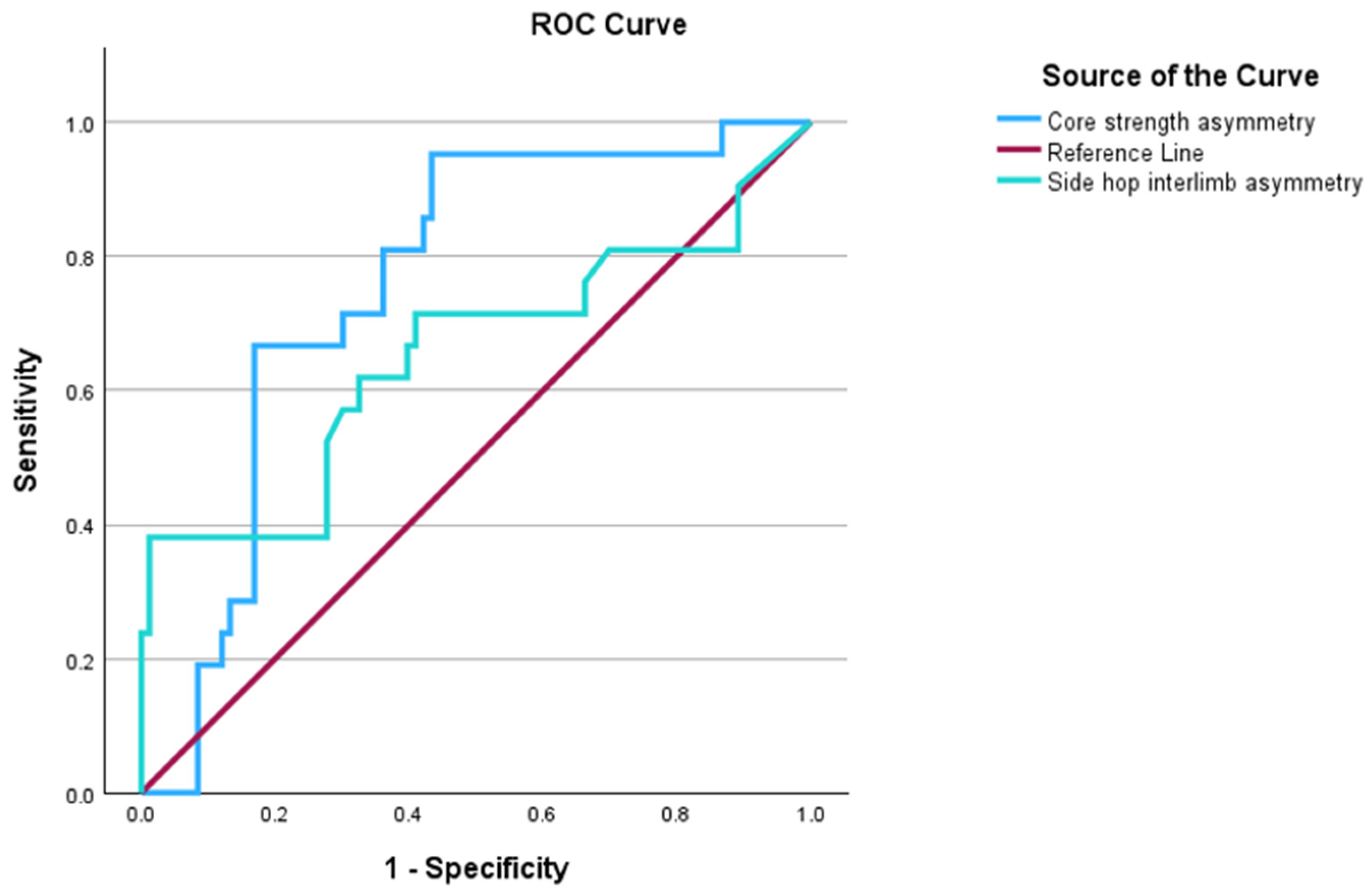
3.4. Discriminative Ability of Interlimb Asymmetries
4. Discussion
4.1. Strengths and Limitations
4.2. Practical Implications
5. Conclusions
Author Contributions
Funding
Institutional Review Board Statement
Informed Consent Statement
Data Availability Statement
Conflicts of Interest
Abbreviations
| ACL | Anterior Cruciate Ligament |
| MCL | Medial Collateral Ligament |
| LCL | Lateral Collateral Ligament |
| N | Newton |
| H:Q | Hamstring-to-Quadriceps |
| OR | Odds ratio |
| ROC | Receiver operating characteristic |
| AUC | Area Under the Curve |
References
- Hewett, T.E.; Myer, G.D.; Ford, K.R.; Heidt, R.S., Jr.; Colosimo, A.J.; McLean, S.G.; van den Bogert, A.J.; Paterno, M.V.; Succop, P. Biomechanical measures of neuromuscular control and valgus loading of the knee predict anterior cruciate ligament injury risk in female athletes: A prospective study. Am. J. Sports Med. 2005, 33, 492–501. [Google Scholar] [CrossRef] [Scilit] [PubMed]
- Alentorn-Geli, E.; Myer, G.D.; Silvers, H.J.; Samitier, G.; Romero, D.; Lázaro-Haro, C.; Cugat, R. Prevention of non-contact anterior cruciate ligament injuries in soccer players. Part 1: Mechanisms of injury and underlying risk factors. Knee Surg. Sports Traumatol. Arthrosc. 2009, 17, 705–729. [Google Scholar] [CrossRef] [Scilit] [PubMed]
- Childers, J.; Eng, E.; Lack, B.; Lin, S.; Knapik, D.M.; Kaplan, D.J.; Jackson, G.R.; Chahla, J. Reported anterior cruciate ligament injury incidence in adolescent athletes is greatest in female soccer players and athletes participating in club sports: A systematic review and meta-analysis. Arthroscopy 2025, 41, 774–784.e2. [Google Scholar] [CrossRef] [Scilit] [PubMed]
- Castellanos Dolk, D.; Hedevik, H.; Stigson, H.; Wretenberg, P.; Kvist, J.; Stålman, A. Nationwide incidence of anterior cruciate ligament reconstruction in higher-level athletes in Sweden: A cohort study from the Swedish National Knee Ligament Registry linked to six sports organisations. Br. J. Sports Med. 2025, 59, 470–479. [Google Scholar] [CrossRef] [Scilit] [PubMed]
- Ardern, C.L.; Taylor, N.F.; Feller, J.A.; Webster, K.E. Fifty-five per cent return to competitive sport following anterior cruciate ligament reconstruction surgery: An updated systematic review and meta-analysis including aspects of physical functioning and contextual factors. Br. J. Sports Med. 2014, 48, 1543–1552. [Google Scholar] [CrossRef] [Scilit] [PubMed]
- Filbay, S.R.; Grindem, H. Evidence-based recommendations for the management of anterior cruciate ligament (ACL) rupture. Best. Pract. Res. Clin. Rheumatol. 2019, 33, 33–47. [Google Scholar] [CrossRef] [Scilit] [PubMed]
- Zazulak, B.T.; Hewett, T.E.; Reeves, N.P.; Goldberg, B.; Cholewicki, J. Deficits in neuromuscular control of the trunk predict knee injury risk: A prospective biomechanical-epidemiologic study. Am. J. Sports Med. 2007, 35, 1123–1130. [Google Scholar] [CrossRef] [Scilit] [PubMed]
- Bishop, C.; Read, P.; Lake, J.; Chavda, S.; Turner, A. Interlimb Asymmetries: Understanding How to Calculate Differences from Bilateral and Unilateral Tests. Strength. Cond. J. 2018, 40, 1–6. [Google Scholar] [CrossRef] [Scilit]
- Croisier, J.L.; Ganteaume, S.; Binet, J.; Genty, M.; Ferret, J.M. Strength imbalances and prevention of hamstring injury in professional soccer players: A prospective study. Am. J. Sports Med. 2008, 36, 1469–1475. [Google Scholar] [CrossRef] [Scilit] [PubMed]
- Fort-Vanmeerhaeghe, A.; Milà-Villarroel, R.; Pujol-Marzo, M.; Arboix-Alió, J.; Bishop, C. Higher Vertical Jumping Asymmetries and Lower Physical Performance are Indicators of Increased Injury Incidence in Youth Team-Sport Athletes. J. Strength. Cond. Res. 2022, 36, 2204–2211. [Google Scholar] [CrossRef] [Scilit] [PubMed]
- Fort-Vanmeerhaeghe, A.; Montalvo, A.M.; Sitjà-Rabert, M.; Kiefer, A.W.; Myer, G.D. Neuromuscular asymmetries in the lower limbs of elite female youth basketball players and the application of the skillful limb model of comparison. Phys. Ther. Sport 2015, 16, 317–323. [Google Scholar] [CrossRef] [Scilit] [PubMed]
- Helme, M.; Tee, J.; Emmonds, S.; Low, C. Does lower-limb asymmetry increase injury risk in sport? A systematic review. Phys. Ther. Sport 2021, 49, 204–213. [Google Scholar] [CrossRef] [Scilit] [PubMed]
- Khayambashi, K.; Ghoddosi, N.; Straub, R.K.; Powers, C.M. Hip Muscle Strength Predicts Noncontact Anterior Cruciate Ligament Injury in Male and Female Athletes: A Prospective Study. Am. J. Sports Med. 2016, 44, 355–361. [Google Scholar] [CrossRef] [Scilit] [PubMed]
- Zazulak, B.T.; Hewett, T.E.; Reeves, N.P.; Goldberg, B.; Cholewicki, J. The effects of core proprioception on knee injury: A prospective biomechanical-epidemiological study. Am. J. Sports Med. 2007, 35, 368–373. [Google Scholar] [CrossRef] [Scilit] [PubMed]
- Alexe, D.I.; Čaušević, D.; Čović, N.; Rani, B.; Tohănean, D.I.; Abazović, E.; Setiawan, E.; Alexe, C.I. The Relationship between Functional Movement Quality and Speed, Agility, and Jump Performance in Elite Female Youth Football Players. Sports 2024, 12, 214. [Google Scholar] [CrossRef] [Scilit] [PubMed]
- Gustavsson, A.; Neeter, C.; Thomee, P.; Silbernagel, K.G.; Augustsson, J.; Thomee, R.; Karlsson, J. A test battery for evaluating hop performance in patients with an ACL injury and patients who have undergone ACL reconstruction. Knee Surg. Sports Traumatol. Arthrosc. 2006, 14, 778–788. [Google Scholar] [CrossRef] [Scilit] [PubMed]
- Bill, K.; Bartsch, J.; Willwacher, S.; Eriksrud, O.; Mausehund, L.; Kersting, U.; Krosshaug, T.; Mai, P. Same Same but Different: Why Both Sport-Specific Cutting Tasks and Generic Change-of-Direction Tasks Might Need to Be Considered to Prevent ACL Injury. JOSPT Open 2025, 3, 162–170. [Google Scholar] [CrossRef] [Scilit]
- Lundblad, M.; Hägglund, M.; Thomeé, C.; Hamrin Senorski, E.; Ekstrand, J.; Karlsson, J.; Waldén, M. Medial collateral ligament injuries of the knee in male professional football players: A prospective three-season study of 130 cases from the UEFA Elite Club Injury Study. Knee Surg. Sports Traumatol. Arthrosc. 2019, 27, 3692–3698. [Google Scholar] [CrossRef] [Scilit] [PubMed]
- Ryman Augustsson, S.; Ageberg, E. Weaker lower extremity muscle strength predicts traumatic knee injury in youth female but not male athletes. BMJ Open Sport Exerc. Med. 2017, 3, e000222. [Google Scholar] [CrossRef] [Scilit] [PubMed]
- Ryman Augustsson, S.; Gustafsson, T.; Ageberg, E. Can tests of physical fitness predict traumatic knee injury in youth female athletes? A prospective cohort study. Phys. Ther. Sport 2024, 69, 15–21. [Google Scholar] [CrossRef] [Scilit] [PubMed]
- Cronström, A. Kissing knees—Factors behind the attraction. Knee abduction in individuals with anterior cruciate ligament injury. Doctoral Dissertation, Lund University, Lund, Sweden, 2017. [Google Scholar]
- Thorborg, K.; Bandholm, T.; Hölmich, P. Hip- and knee-strength assessments using a hand-held dynamometer with external belt-fixation are inter-tester reliable. Knee Surg. Sports Traumatol. Arthrosc. 2013, 21, 550–555. [Google Scholar] [CrossRef] [Scilit] [PubMed]
- Selkowitz, D.M.; Beneck, G.J.; Powers, C.M. Which exercises target the gluteal muscles while minimizing activation of the tensor fascia lata? Electromyographic assessment using fine-wire electrodes. J. Orthop. Sports Phys. Ther. 2013, 43, 54–64. [Google Scholar] [CrossRef] [Scilit] [PubMed]
- Kang, H. The prevention and handling of the missing data. Korean J. Anesthesiol. 2013, 64, 402–406. [Google Scholar] [CrossRef] [Scilit] [PubMed]
- Cohen, J. Statistical Power Analysis for the Behavioral Sciences, 2nd ed.; Routledge: New York, NY, USA, 1988. [Google Scholar]
- Schober, P.; Boer, C.; Schwarte, L.A. Correlation Coefficients: Appropriate Use and Interpretation. Anesth. Analg. 2018, 126, 1763–1768. [Google Scholar] [CrossRef] [Scilit] [PubMed]
- Jeong, J.; Choi, D.H.; Shin, C.S. Core Strength Training Can Alter Neuromuscular and Biomechanical Risk Factors for Anterior Cruciate Ligament Injury. Am. J. Sports Med. 2021, 49, 183–192. [Google Scholar] [CrossRef] [Scilit] [PubMed]
- Hewett, T.E.; Myer, G.D. The mechanistic connection between the trunk, hip, knee, and anterior cruciate ligament injury. Exerc. Sport Sci. Rev. 2011, 39, 161–166. [Google Scholar] [CrossRef] [Scilit] [PubMed]
- Hewett, T.E.; Torg, J.S.; Boden, B.P. Video analysis of trunk and knee motion during non-contact anterior cruciate ligament injury in female athletes: Lateral trunk and knee abduction motion are combined components of the injury mechanism. Br. J. Sports Med. 2009, 43, 417. [Google Scholar] [CrossRef] [Scilit] [PubMed]
- Myer, G.D.; Ford, K.R.; Hewett, T.E. Tuck Jump Assessment for Reducing Anterior Cruciate Ligament Injury Risk. Athl. Ther. Today 2008, 13, 39–44. [Google Scholar] [CrossRef] [Scilit] [PubMed]
- Bittencourt, N.F.N.; Meeuwisse, W.H.; Mendonça, L.D.; Nettel-Aguirre, A.; Ocarino, J.M.; Fonseca, S.T. Complex systems approach for sports injuries: Moving from risk factor identification to injury pattern recognition-narrative review and new concept. Br. J. Sports Med. 2016, 50, 1309–1314. [Google Scholar] [CrossRef] [Scilit] [PubMed]
- Čaušević, D.; Alexe, C.I.; Abazović, E.; Panaet, E.A.; Čović, N.; Alexe, D.I. Relationship between knee isokinetic muscle strength and countermovement jump performance in elite male football players. BMC Sports Sci. Med. Rehabil. 2026, 18, 285. [Google Scholar] [CrossRef] [Scilit] [PubMed]
- Shimozaki, K.; Nakase, J.; Takata, Y.; Shima, Y.; Kitaoka, K.; Tsuchiya, H. Greater body mass index and hip abduction muscle strength predict noncontact anterior cruciate ligament injury in female Japanese high school basketball players. Knee Surg. Sports Traumatol. Arthrosc. 2018, 26, 3004–3011. [Google Scholar] [CrossRef] [Scilit] [PubMed]
- Guan, Y.; Bredin, S.S.D.; Taunton, J.; Jiang, Q.; Wu, N.; Warburton, D.E.R. Association between Inter-Limb Asymmetries in Lower-Limb Functional Performance and Sport Injury: A Systematic Review of Prospective Cohort Studies. J. Clin. Med. 2022, 11, 360. [Google Scholar] [CrossRef] [Scilit] [PubMed]
- Parkinson, A.O.; Apps, C.L.; Morris, J.G.; Barnett, C.T.; Lewis, M.G.C. The Calculation, Thresholds and Reporting of Inter-Limb Strength Asymmetry: A Systematic Review. J. Sports Sci. Med. 2021, 20, 594–617. [Google Scholar] [CrossRef] [Scilit] [PubMed]
- Markovic, G.; Šarabon, N.; Pausic, J.; Hadžić, V. Adductor Muscles Strength and Strength Asymmetry as Risk Factors for Groin Injuries among Professional Soccer Players: A Prospective Study. Int. J. Environ. Res. Public Health 2020, 17, 4946. [Google Scholar] [CrossRef] [Scilit] [PubMed]
- Domínguez-Díez, M.; López-Valenciano, A.; Raya-González, J.; Castillo, D.; Sánchez-Díaz, S.; Berasategui, O.; Gene-Morales, J. An Integrated Approach to Explore Interlimb Asymmetries, Neuromuscular Parameters, and Injuries in Semiprofessional Soccer Players. Appl. Sci. 2024, 14, 10800. [Google Scholar] [CrossRef] [Scilit]
- Johnson, U.; Ivarsson, A. The psychological dimensions of sports injury risk: Models, mechanisms, and interventions. Front. Sports Act. Living 2025, 7, 1690064. [Google Scholar] [CrossRef] [Scilit] [PubMed]
- Bahr, R. Why screening tests to predict injury do not work-and probably never will…: A critical review. Br. J. Sports Med. 2016, 50, 776–780. [Google Scholar] [CrossRef] [Scilit] [PubMed]
- Collings, T.J.; Diamond, L.E.; Barrett, R.S.; Timmins, R.G.; Hickey, J.T.; DU Moulin, W.S.; Williams, M.D.; Beerworth, K.A.; Bourne, M.N. Strength and Biomechanical Risk Factors for Noncontact ACL Injury in Elite Female Footballers: A Prospective Study. Med. Sci. Sports Exerc. 2022, 54, 1242–1251. [Google Scholar] [CrossRef] [Scilit] [PubMed]
- Ekenros, L.; Fridén, C.; von Rosen, P. Previous Injury and Lower Well-being Increase Injury Risk in Female Adolescent Athletes. Int. J. Sports Med. 2023, 44, 919–924. [Google Scholar] [CrossRef] [Scilit] [PubMed]
- Fridén, C.; Ekenros, L.; von Rosen, P. Previous injury, sex and well-being are associated with injury profiles in 422 adolescent elite athletes of age 15-16 years: A 20-week longitudinal study. BMJ Open Sport Exerc. Med. 2023, 9, e001485. [Google Scholar] [CrossRef] [Scilit] [PubMed]
- World Medical Association. World Medical Association Declaration of Helsinki: Ethical Principles for Medical Research Involving Human Participants. JAMA 2025, 333, 71–74. [Google Scholar] [CrossRef] [Scilit] [PubMed]


| Variables | Mean (SD) |
|---|---|
| Age (years) | 17.5 (2.16) |
| Height (cm) | 167.8 (5.3) |
| Weight (kg) | 62.4 (6.8) |
| Experience (years) | 10.3 (2.9) |
| Total training and | 17.5 (5.3) |
| match load (hours/week) | |
| Competitive level | n (%) |
| Elitettan | 28 (27) |
| Academy | 76 (73) |
| Variable | Mean (SD) |
|---|---|
| Quadriceps strength, R (N) | 418.28 (84.14) |
| Quadriceps strength, L (N) | 407.07 (82.13) |
| Hamstrings strength, R (N) | 174.89 (31.91) |
| Hamstrings strength, L (N) | 160.10 (31.41) |
| Hip external rotation strength, R (N) | 219.64 (54.04) |
| Hip external rotation strength, L (N) | 204.99 (57.89) |
| H:Q ratio, R | 0.431 (0.104) |
| H:Q ratio, L | 0.407 (0.112) |
| Core lateral flexor strength, R (N) | 266.48 (65.83) |
| Core lateral flexor strength, L (N) | 261.61 (61.42) |
| SLHD, R (cm) | 132.61 (15.78) |
| SLHD, L (cm) | 131.95 (16.10) |
| Side-hop test, R (repetitions) | 41.79 (10.48) |
| Side-hop test, L (repetitions) | 44.25 (9.96) |
| Relative quadriceps strength, R | 6.77 (1.62) |
| Relative quadriceps strength, L | 6.60 (1.63) |
| Relative hamstrings strength, R | 2.83 (0.66) |
| Relative hamstrings strength, L | 2.59 (0.60) |
| Relative hip external rotation strength, R | 3.55 (0.94) |
| Relative hip external rotation strength, L | 3.28 (0.85) |
| Relative core lateral flexor strength, R | 4.30 (1.06) |
| Relative core lateral flexor strength, L | 4.24 (1.10) |
| Injured | Non-Injured | |||
|---|---|---|---|---|
| Variable | Mean (SD) | Mean (SD) | p-Value | Cohen’s d |
| Quadriceps asymmetry (%) | 14.10 (9.64) | 8.09 (7.14) * | 0.002 | 0.782 |
| Hamstrings asymmetry (%) | 12.36 (9.16) | 11.11 (7.97) | 0.534 | 0.152 |
| H:Q ratio asymmetry (%) | 18.31 (8.30) | 12.73 (10.37) * | 0.024 | 0.558 |
| Hip external rotation asymmetry (%) | 14.75 (12.76) | 15.72 (11.81) | 0.743 | −0.08 |
| Core lateral flexor asymmetry (%) | 18.70 (6.97) | 11.43 (10.22) * | 0.003 | 0.751 |
| Side-hop asymmetry (%) | 22.54 (18.58) | 11.21 (8.78) * | <0.001 | 0.995 |
| SLHD asymmetry (%) | 7.30 (4.59) | 5.53 (5.17) | 0.157 | 0.348 |
| Variable | β | SE | Wald | OR | 95% CI | p-Value |
|---|---|---|---|---|---|---|
| Quadriceps asymmetry (%) | 0.051 | 0.035 | 2.11 | 1.052 | 0.982–1.127 | 0.146 |
| Core lateral flexor strength asymmetry (%) | 0.066 | 0.027 | 5.862 | 1.068 | 1.013–1.126 | 0.015 |
| Side-hop asymmetry (%) | 0.059 | 0.023 | 6.408 | 1.061 | 1.014–1.111 | 0.011 |
| Constant | −3.848 | 0.729 | 27.851 | 0.021 | <0.001 |
Disclaimer/Publisher’s Note: The statements, opinions and data contained in all publications are solely those of the individual author(s) and contributor(s) and not of MDPI and/or the editor(s). MDPI and/or the editor(s) disclaim responsibility for any injury to people or property resulting from any ideas, methods, instructions or products referred to in the content. |
© 2026 by the authors. Licensee MDPI, Basel, Switzerland. This article is an open access article distributed under the terms and conditions of the Creative Commons Attribution (CC BY) license.
Share and Cite
Ryman Augustsson, S.; Gustafsson, T. Core Strength and Side-Hop Interlimb Asymmetries Are Associated with Subsequent Traumatic Knee Injury in Female Football Players. Sports 2026, 14, 410. https://doi.org/10.3390/sports14090410
Ryman Augustsson S, Gustafsson T. Core Strength and Side-Hop Interlimb Asymmetries Are Associated with Subsequent Traumatic Knee Injury in Female Football Players. Sports. 2026; 14(9):410. https://doi.org/10.3390/sports14090410
Chicago/Turabian StyleRyman Augustsson, Sofia, and Timmy Gustafsson. 2026. "Core Strength and Side-Hop Interlimb Asymmetries Are Associated with Subsequent Traumatic Knee Injury in Female Football Players" Sports 14, no. 9: 410. https://doi.org/10.3390/sports14090410
APA StyleRyman Augustsson, S., & Gustafsson, T. (2026). Core Strength and Side-Hop Interlimb Asymmetries Are Associated with Subsequent Traumatic Knee Injury in Female Football Players. Sports, 14(9), 410. https://doi.org/10.3390/sports14090410