Charting the Scientific Landscape of Indirect Estimation Models in Doping Prevalence Research: A Bibliometric Analysis with Narrative Appraisal

 , , , , and
Abstract
1. Introduction
1.1. Estimating the Prevalence of Sensitive Behaviour with Indirect Estimation Models
1.1.1. Behavioural Aspects and Interpretive Risk
1.1.2. Protecting Both Sides: Respondent and Researcher
1.1.3. Limitations of IEMs and Methodological Refinements
1.2. Estimated Doping Prevalence and Its Interpretation
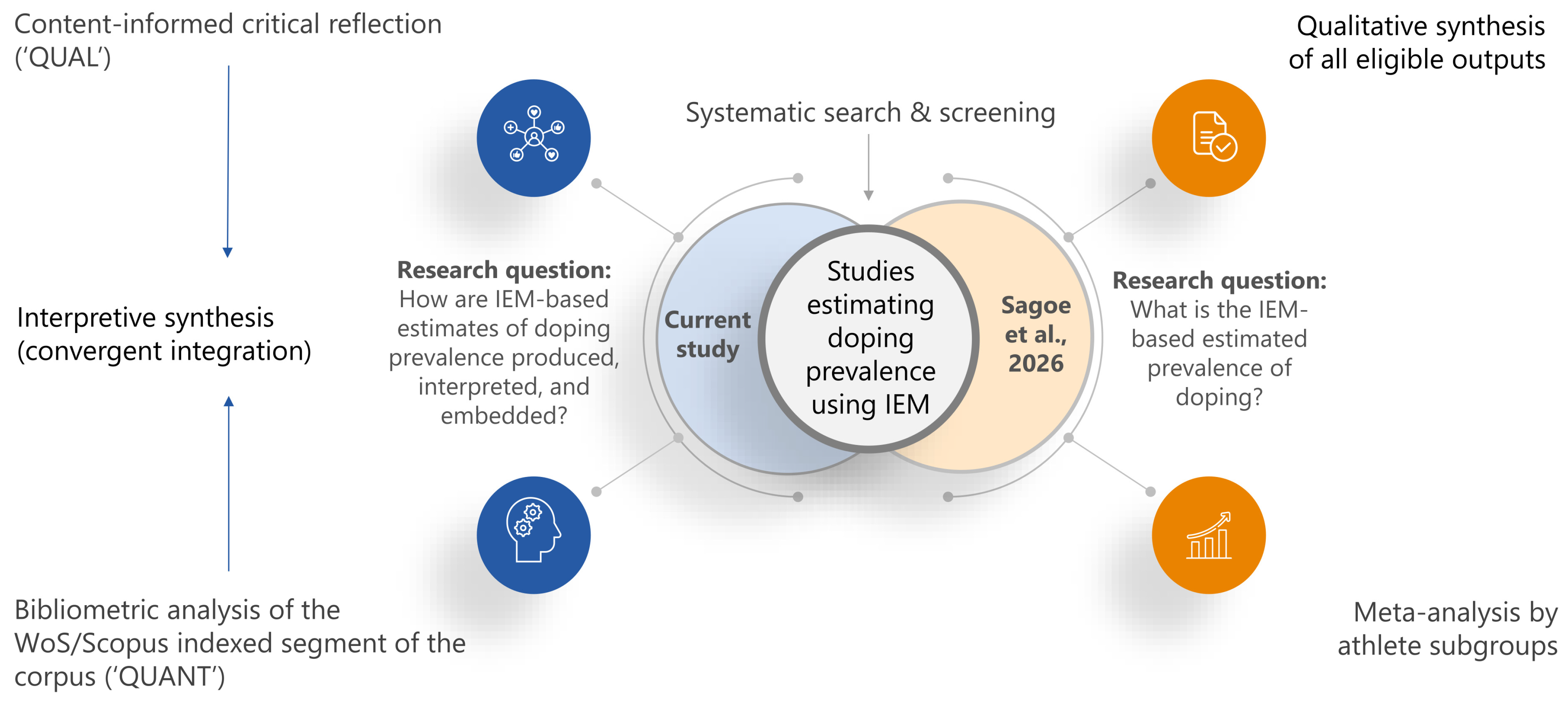
1.3. Research Context and Aims
2. Methods
2.1. Study Design
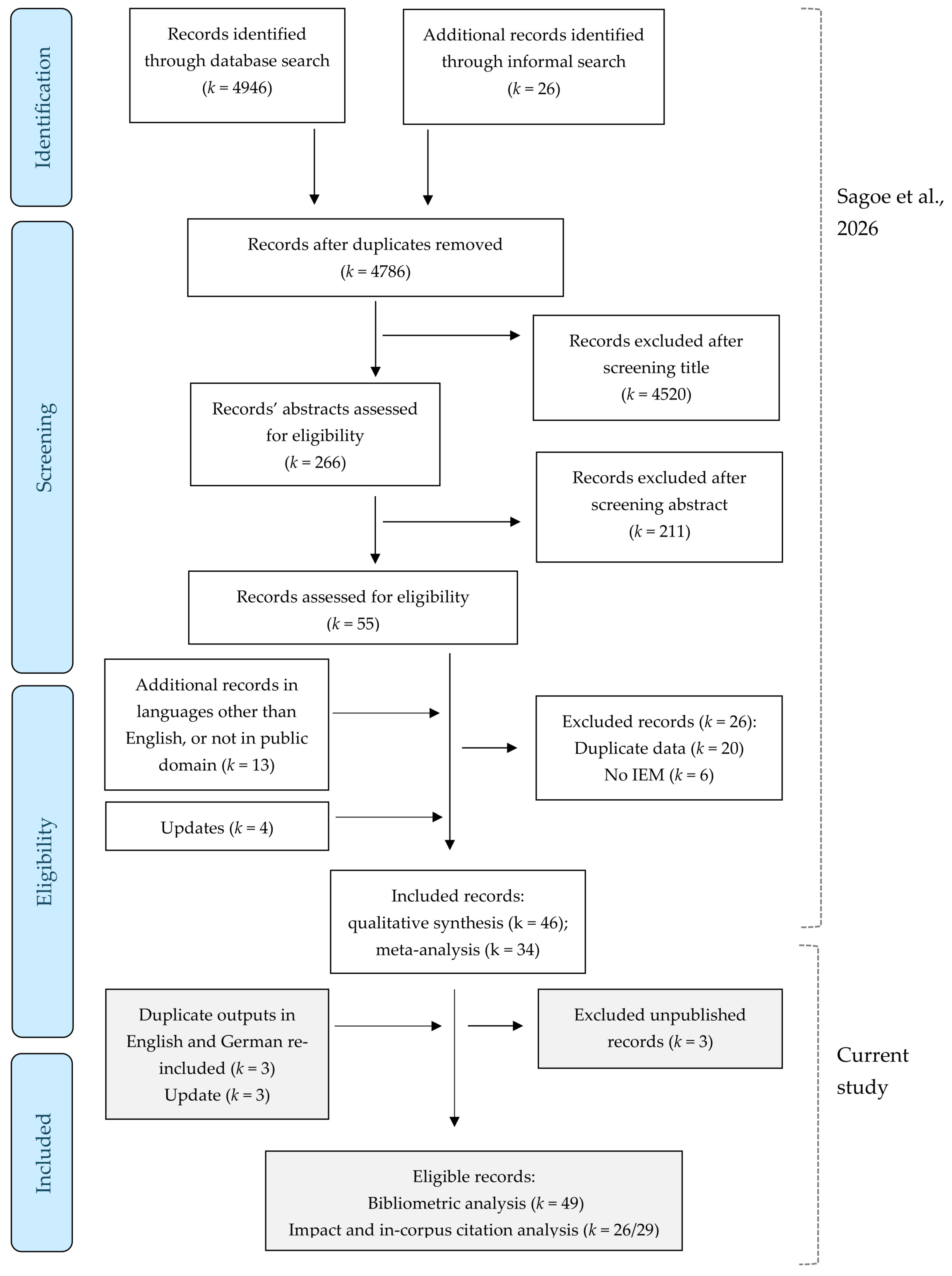
2.2. Literature Search and Study Selection
2.2.1. Protocol and Registration
2.2.2. Information Sources
2.2.3. Eligibility Criteria and Study Selection
2.2.4. Data Extraction
2.2.5. Search Extension and Update
2.3. Data

| References | Year | Publication Language | Type of Output | Primary Focus | WoS | Scopus |
|---|---|---|---|---|---|---|
| Abdulrazzaq and Tareq [58] | 2023 | English | academic journal | applied | no | no |
| Backhouse et al. [59] | 2016 | English | research report | applied | no | no |
| Balk and Dopeide. [60] | 2021 | Dutch | research report | applied | no | no |
| Balk et al. [61] | 2023 | English | academic journal | applied | no | no |
| Boardley et al. [62] | 2019 | English | academic journal | applied | yes | yes |
| Breuer and Hallmann [63] | 2013 | German | monograph | applied | no | no |
| Christiansen et al. [64] | 2023 | English | academic journal | applied | yes | yes |
| Cruyff et al. [65] | 2024 | English | academic journal | method | yes | yes |
| Dietz et al. [66] | 2013 | English | academic journal | applied | yes | yes |
| Dietz et al. [67] | 2016 | English | academic journal | applied | yes | yes |
| Duiven and de Hon [68] | 2015 | Dutch | research report | applied | no | no |
| Elbe and Pitsch [69] | 2018 | English | academic journal | applied | no | yes |
| Fincoeur and Pitsch [70] | 2017 | Dutch | academic journal | applied | no | no |
| Franke et al. [71] | 2017 | German | academic journal | applied | yes | yes |
| Frenger et al. [72] | 2016 | English | academic journal | applied | yes | yes |
| Heller et al. [73] | 2020 | English | academic journal | applied | yes | yes |
| Heyes [74] | 2022 | English | PhD thesis | applied | no | no |
| Hilkens et al. [75] | 2021 | English | academic journal | applied | yes | yes |
| James et al. [76] | 2013 | English | academic journal | method | yes | yes |
| Nakhaee et al. [77] | 2013 | English | academic journal | applied | no | no |
| Nilaweera et al. [78] | 2020 | English | conference abstract | applied | no | no |
| Petróczi et al. [79] | 2022 | English | academic journal | method | yes | yes |
| Pitsch [80] | 2018 | English | book chapter | applied | no | no |
| Pitsch [81] | 2022 | English | academic journal | applied | yes | yes |
| Pitsch and Christiansen [82] | 2026 | English | academic journal | applied | yes | yes |
| Pitsch and Emrich [83] | 2012 | English | academic journal | applied | yes | yes |
| Pitsch et al. [84] | 2005 | German | magazine | applied | no | no |
| Pitsch et al. [85] | 2007 | English | academic journal | applied | no | yes |
| Pitsch et al. [86] | 2009 | German | book chapter | applied | no | no |
| Pitsch et al. [87] | 2009 | German | magazine article | applied | no | no |
| Pitsch et al. [88] | 2009 | English | book chapter | applied | no | no |
| Pitsch et al. [89] | 2013 | German | book chapter | applied | no | no |
| Plessner and Musch [90] | 2002 | German | book chapter | applied | no | no |
| Reiber et al. [91] | 2022 | English | academic journal | method | yes | yes |
| Robach et al. [92] | 2024 | English | academic journal | applied | no | yes |
| Sayed et al. [93] | 2022 | English | academic journal | method | yes | yes |
| Sayed et al. [94] | 2024 | English | academic journal | method | yes | yes |
| Sayed et al. [95] | 2024 | English | academic journal | method | yes | yes |
| Sayed et al. [96] | 2026 | English | academic journal | method | yes | yes |
| Schröter et al. [97] | 2016 | English | academic journal | method | yes | yes |
| Schu and Haller [98] | 2025 | English | academic journal | applied | yes | yes |
| Seifarth et al. [99] | 2019 | English | academic journal | applied | yes | yes |
| Simon et al. [100] | 2006 | English | academic journal | applied | yes | yes |
| Stamm et al. [101] | 2011 | German | academic journal | applied | no | no |
| Striegel [102] | 2012 | German | book chapter | applied | no | no |
| Striegel et al. [103] | 2010 | English | academic journal | applied | yes | yes |
| Stubbe et al. [104] | 2014 | English | academic journal | applied | yes | yes |
| Ulrich et al. [105] | 2018 | English | academic journal | applied | yes | yes |
| Ulrich et al. [34] | 2023 | English | academic journal | method | yes | yes |
2.4. Data Analysis
2.4.1. Critical Assessment
2.4.2. Bibliometric Analysis
2.4.3. Assessment of Overall Evidentiary Strength
2.4.4. Data Integration
3. Results
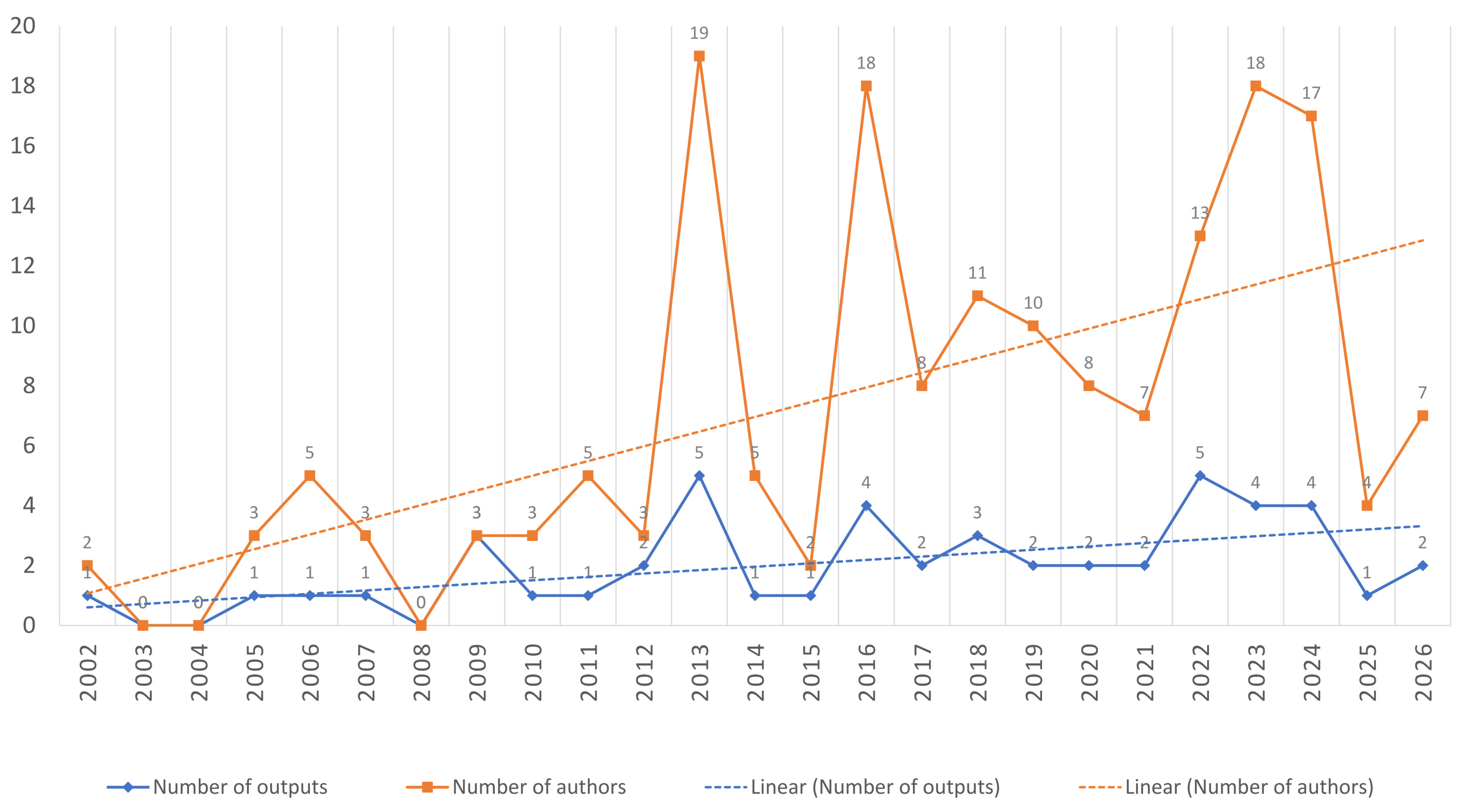
3.1. Publication Patterns
3.2. Publication Channels and Research Fields
3.3. Framing of Doping in Titles and Publication Contexts
3.4. Evidentiary Synthesis
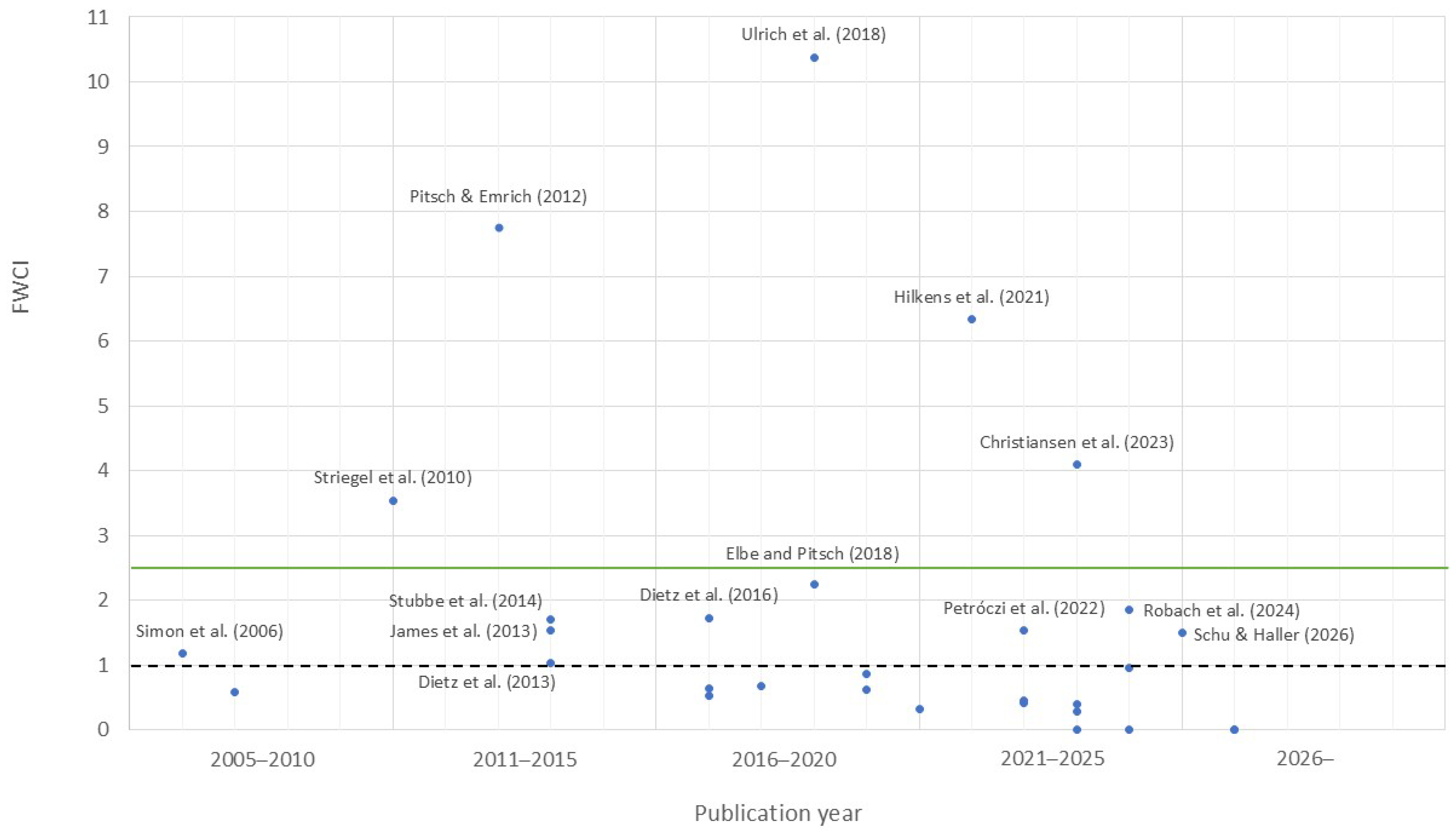
3.5. Scientific Impact
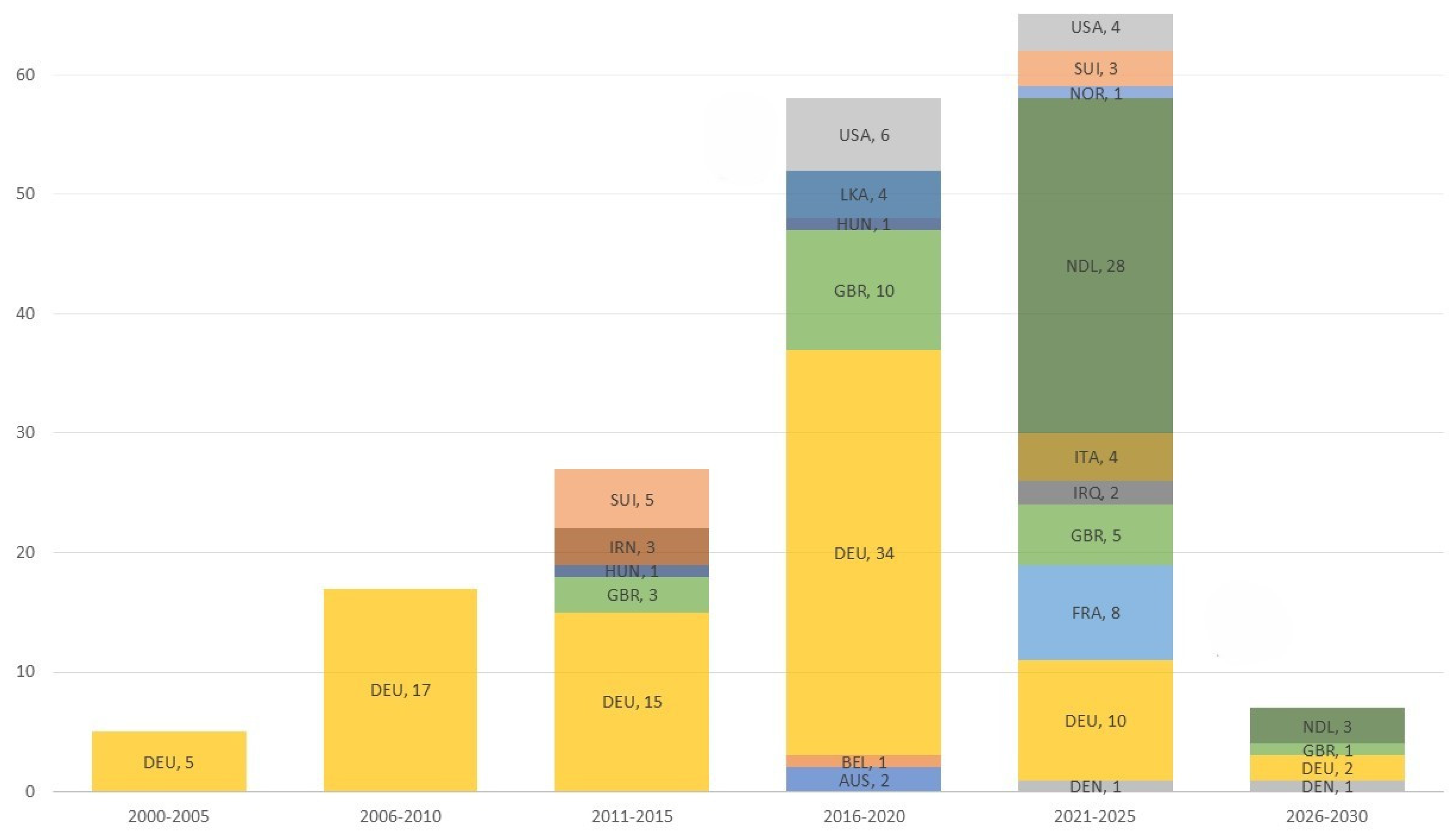
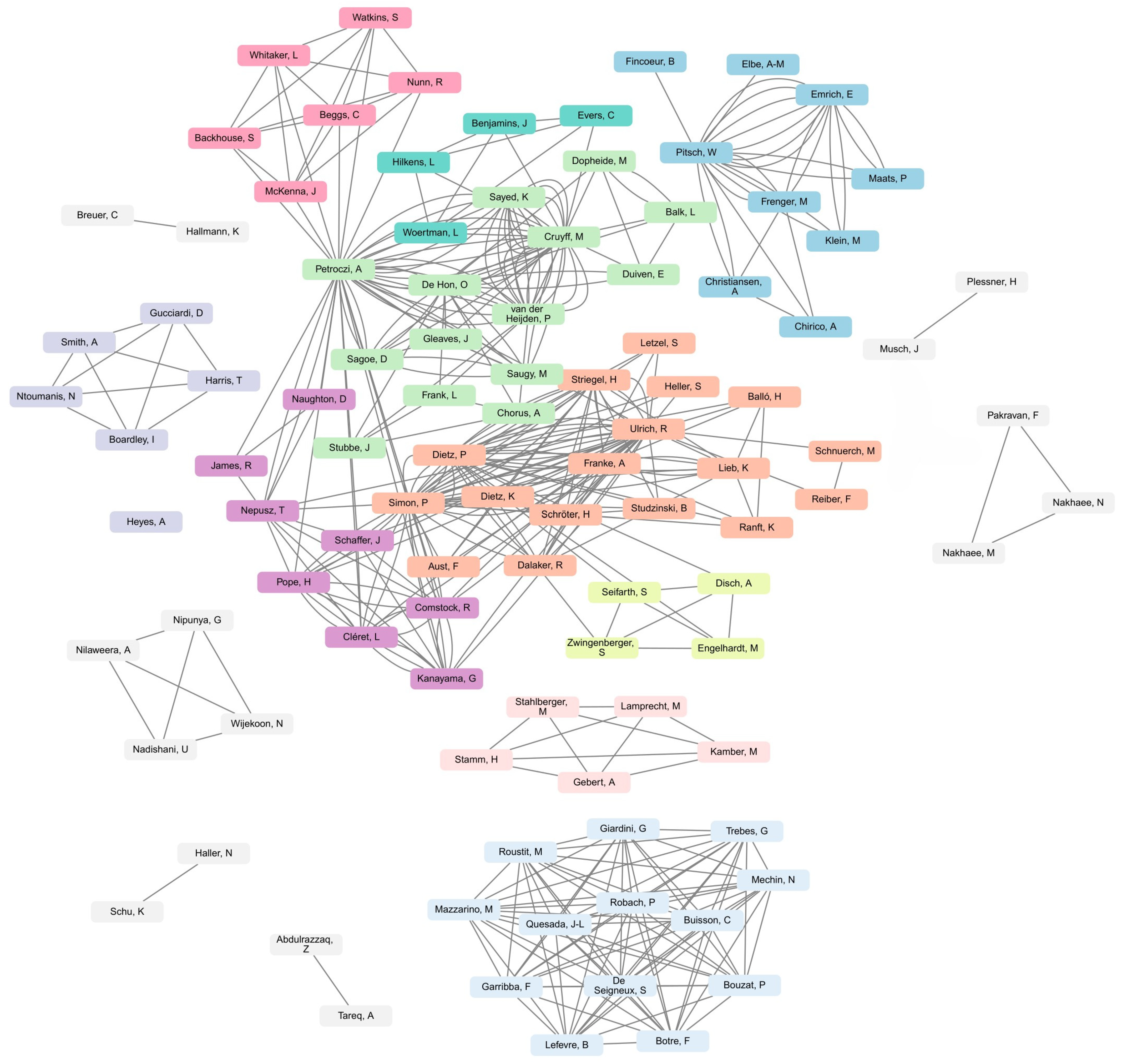
3.6. Authors and Authorship
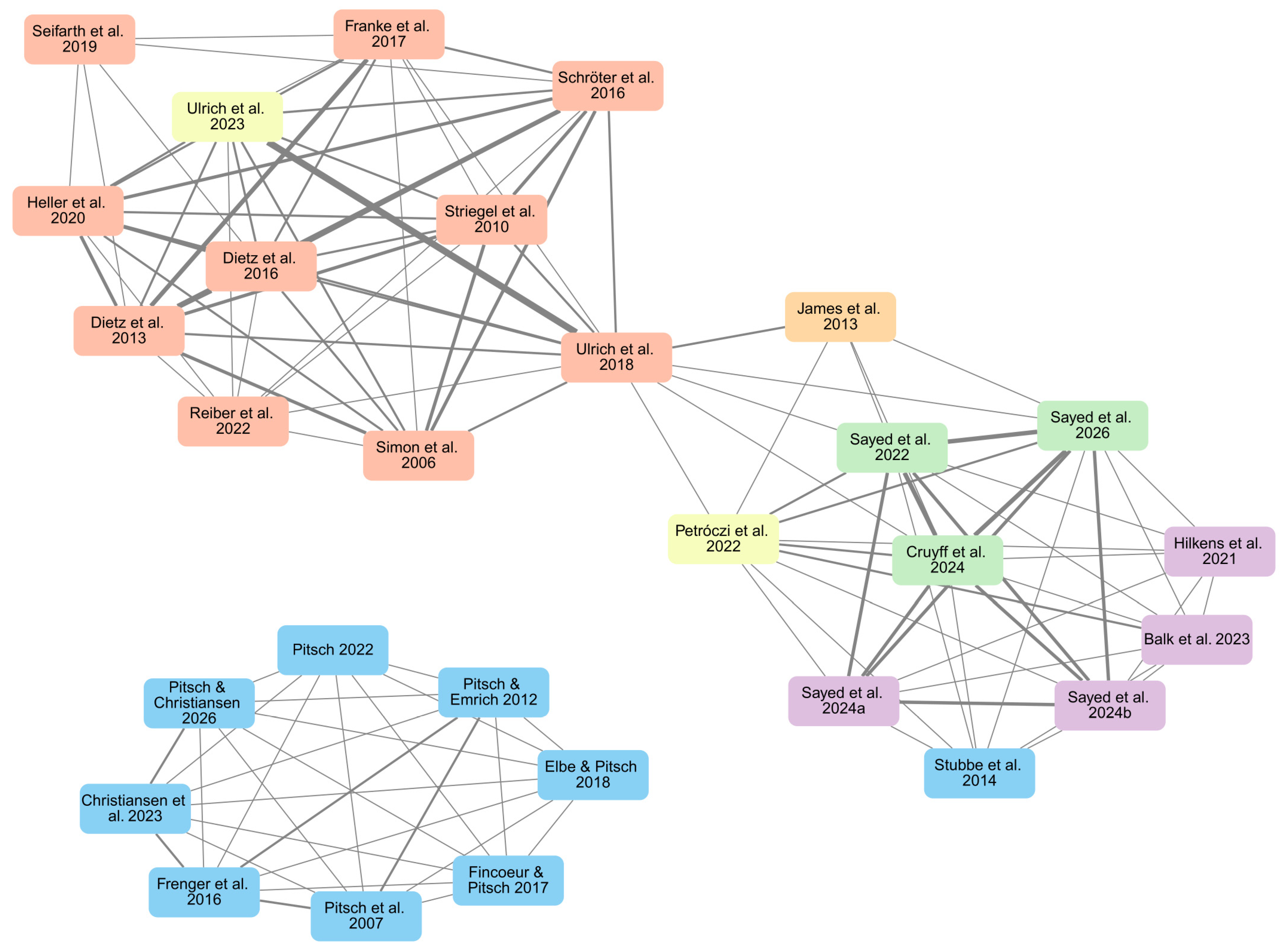
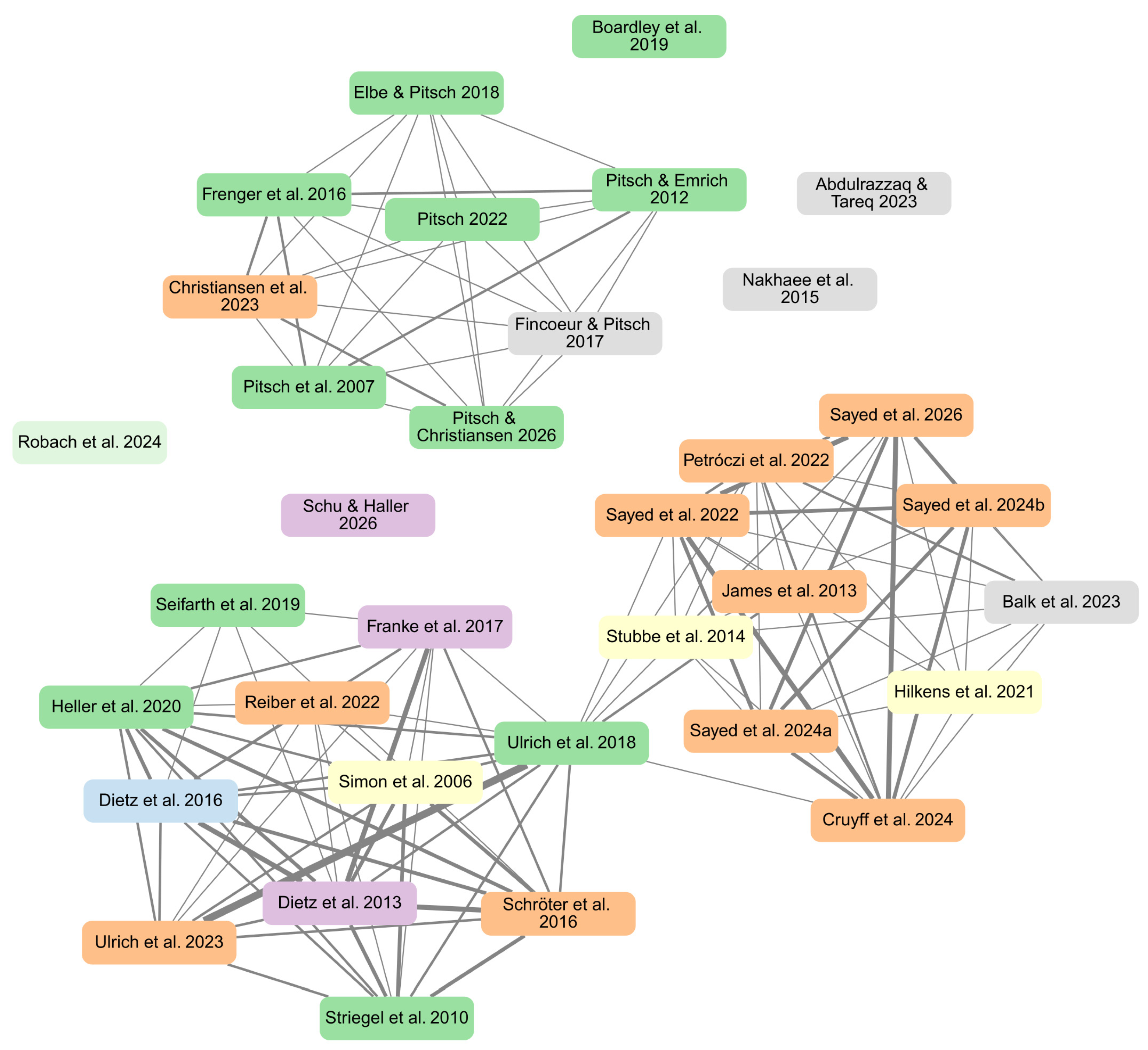
3.7. Research Communities
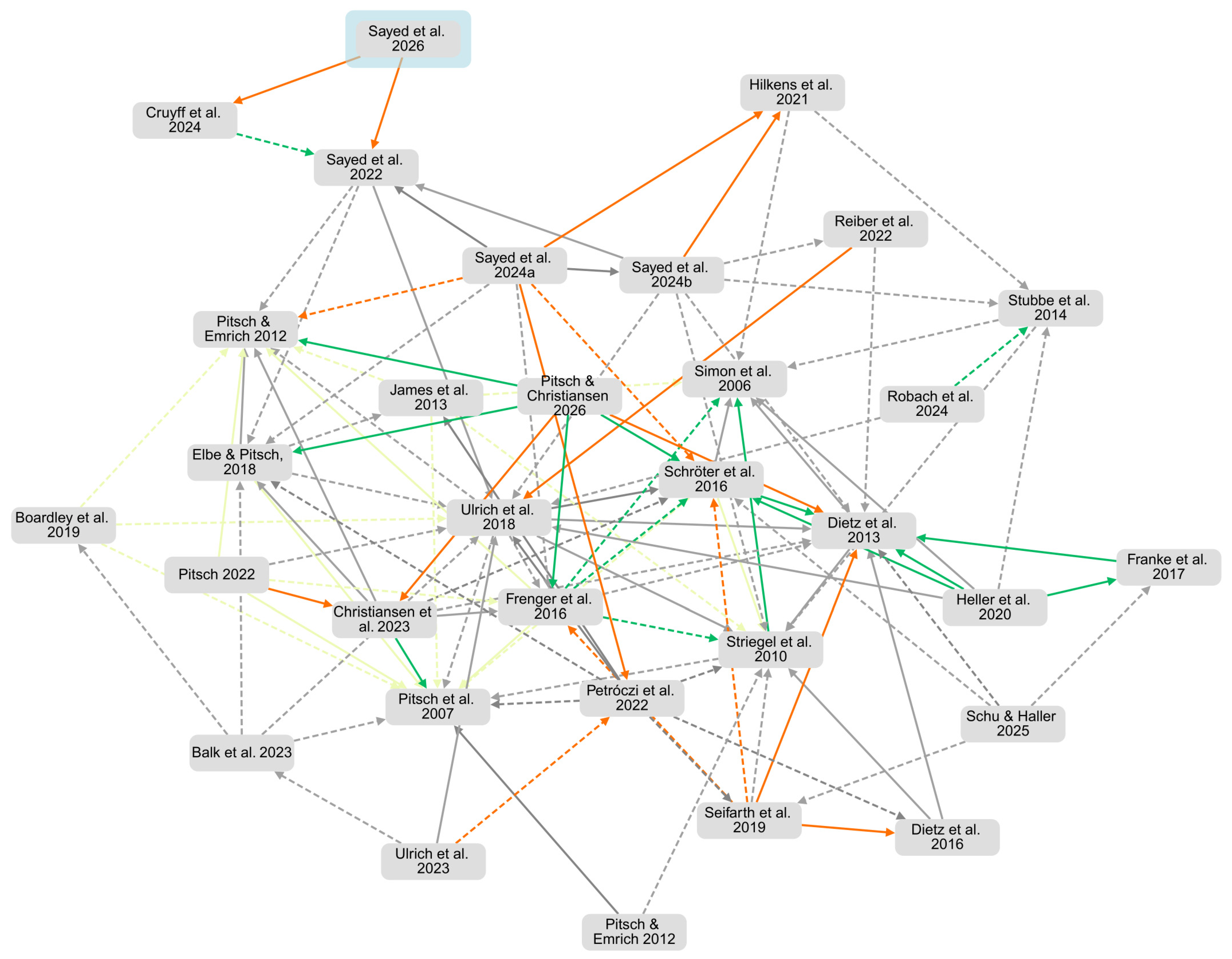
3.8. Local Citation Network
3.9. Network Cohesion, Weak Ties, and Brokerage
4. Integrated Results and Narrative Insights
5. Discussion
5.1. Geographical Concentration
5.2. Authorship Structure and Implications
5.3. The Interpretive Scope and Boundaries of ‘Evidence’
5.4. Duplicate Publications and Re-Analyses
5.5. Practical Implications
5.6. Study Limitations
5.7. Future Directions
6. Conclusions
Supplementary Materials
Author Contributions
Funding
Institutional Review Board Statement
Informed Consent Statement
Data Availability Statement
Conflicts of Interest
Abbreviations
| CHARKing | Cherry-picking significant results |
| CW | Crosswise Model |
| FR | Forced-response model |
| FWCI | Field-Weighted Citation Index |
| IEM | Indirect estimation model |
| RHARKing | Retrieving hypotheses from post hoc literature searches |
| Salami slicing | Fragmenting one study across multiple research outputs |
| SHARKing | Suppressing unsupported a priori hypotheses |
| SSC | Single Sample Count Model |
| UQM | Unrelated Question Model |
Appendix A

| Model Family/Example | How the Question Is Experienced by Respondents | How Respondents’ Answers Are Protected | Face Validity: How It Feels like a Doping Survey | Forced Affirmative Response and Its Implications | Detecting Survey-Instruction Noncompliance |
|---|---|---|---|---|---|
| Combined-response models (e.g., Crosswise Model) | Respondents answer the doping question together with a neutral question, reporting only whether the answers match | Individual answers are concealed by combining responses to the sensitive question and other unrelated non-sensitive questions | High: all respondents perceive that they are answering the doping question | No forced “yes”; protection relies on ambiguity of combined answers | Requires two parallel versions and a randomly split sample |
| Randomised-response models (e.g., forced response, Kuk’s design) | Respondents follow instructions that sometimes require answering the doping question and sometimes require a preset answer | Protection is achieved because, for the researcher, forced and genuine “yes” answers to the sensitive question are indistinguishable | Moderate: not all respondents feel they meaningfully answered the doping question | Yes: some respondents must say “yes” regardless of behaviour, which may reduce comfort and increase noncompliance | Requires two parallel versions and a randomly split sample |
| Question-substitution models (e.g., Unrelated Question Model) | Respondents answer either the doping question or a harmless question, determined by chance | Researchers cannot identify who answered which question (the sensitive or the unrelated question) | Moderate: only part of the sample directly answers the doping question | No forced “yes”; protection depends on question substitution | Requires two parallel versions and a randomly split sample |
| Count-based models (e.g., Single Sample Count) | Respondents report how many statements apply, without specifying which ones | Individual responses remain fully concealed through aggregation of the responses, of which the sensitive question is only one of many | High: respondents feel included, but the doping question is indirect | No forced “yes”; protection comes from lack of item-level disclosure | Does not require two parallel versions if the non-sensitive questions are set to known prevalences (e.g., distribution of birth dates) |
References
- Boardley, I.D.; Zhang, S.; Gunning, S.A.; Adie, J.W. Latent motivation profiles and doping in sport and exercise: An integrative approach based on achievement goal and self-determination theories. Scand. J. Med. Sci. Sport 2025, 35, e70138. [Google Scholar] [CrossRef]
- Garcy, A.M. Theorizing the use of performance enhancing substances and methods in sport as four different types of deviant behavior. Deviant Behav. 2025, 45, 818–835. [Google Scholar] [CrossRef]
- Lauritzen, F.; Holden, G. Intelligence-based doping control planning improves testing effectiveness: Perspectives from a national anti-doping organisation. Drug Test. Anal. 2023, 15, 506–515. [Google Scholar] [CrossRef]
- Hoppen, B.; Sukys, S. Perceived coach-created empowering and disempowering climate effects on athletes’ intentions to use doping: The mediational role of self-regulatory efficacy and attitudes towards doping. Sports 2024, 12, 100. [Google Scholar] [CrossRef]
- Manges, T.; Seidel, K.; Walter, N.; Schüler, T.; Elbe, A.M. Answering the call for values-based anti-doping education—An evidence-informed intervention for elite adolescent athletes in Germany and Austria. Front. Sport Act. Living 2022, 4, 859153. [Google Scholar] [CrossRef]
- Gleaves, J.; Petróczi, A.; Folkerts, D.; De Hon, O.; Macedo, E.; Saugy, M.; Cruyff, M. Doping prevalence in competitive sport: Evidence synthesis with “best practice” recommendations and reporting guidelines from the WADA Working Group on Doping Prevalence. Sports Med. 2021, 51, 1909–1934. [Google Scholar] [CrossRef] [PubMed]
- Tourangeau, R.; Yan, T. Sensitive questions in surveys. Psychol. Bull. 2007, 133, 859–883. [Google Scholar] [CrossRef] [PubMed]
- Krumpal, I. Determinants of social desirability bias in sensitive surveys: A literature review. Qual. Quant. 2013, 47, 2025–2047. [Google Scholar] [CrossRef]
- Dahl, G.B.; Knepper, M. Why Is workplace sexual harassment underreported? The value of outside options amid the threat of retaliation. Am. Econ. Rev. 2026, 116, 897–933. [Google Scholar] [CrossRef]
- Ferdinand Pennock, K.; McKenzie, B.; McClemont Steacy, L.; Mainwaring, L. Under-reporting of sport-related concussions by adolescent athletes: A systematic review. Int. Rev. Sport Exerc. Psychol. 2023, 16, 66–92. [Google Scholar] [CrossRef]
- Fritz, T.; González Cruz, H.; Janke, S.; Daumiller, M. How to best measure academic dishonesty in students: A systematic review of self-report assessment methods and psychometric quality. Eur. J. Psychol. Assess. 2024, 40, 498–514. [Google Scholar] [CrossRef]
- Folk, J.B.; Hirschtritt, M.E.; McCrary, Q.D.; Kalapatapu, R.K. Agreement between youth self-report and biospecimen-confirmed substance use: A systematic review. Subst. Use Misuse 2022, 57, 531–538. [Google Scholar] [CrossRef]
- Fortuna, L.R.; Bagot, K.S. Inconclusive (or “Elusive”): Concordance Between Substance Use Self-report and Toxicology for Diverse Youth Populations. J. Am. Acad. Child Adolesc. Psychiatry 2023, 62, 721–723. [Google Scholar] [CrossRef]
- Zaal, E.; Ongena, Y.; van der Velden, N.; Loughnan, D.; Hoeks, J. Unraveling honest responding: A systematic review on the effectiveness of social desirability bias reduction methods in survey research. Qual. Quant. 2026, 1–33. [Google Scholar] [CrossRef]
- Weerasinghe, T.D. Designing against desirability: A systematic review of alternative response techniques in self-reported social science data. J. Org. Behav. Res. 2025, 10, 130–143. [Google Scholar] [CrossRef]
- Lockett, I.; Blank, C.; Patterson, L.; Westmattelmann, D.; Lux, D.; Petróczi, A. From violation to stigma: A literature review of athletes’ lived experiences following anti-doping sanctions. Front. Sports Act. Living 2026, 8, 1651135. [Google Scholar] [CrossRef]
- Lockett, I.; Exner, J.; Pummell, E.; Petróczi, A. Mapping doping-related criminal legislation together: An informed stakeholder consultation. Perform. Enhanc. Health 2026, 14, 100413. [Google Scholar] [CrossRef]
- Grimes, H.; Cox, L.T.J. Talking dirty: Anti-doping’s stigmatizing rhetoric and its impact on the unintentional doper. Perform. Enhanc. Health 2026, 14, 100412. [Google Scholar] [CrossRef]
- Arnab, R. Randomized Response Techniques: Early Developments. In Indirect Methods of Data Collection and Analysis from Surveys; Indian Statistical Institute Series; Springer: Singapore, 2025. [Google Scholar] [CrossRef]
- Le, T.N.; Lee, S.M.; Tran, P.L.; Li, C.S. Randomized response techniques: A systematic review from the pioneering work of Warner (1965) to the present. Mathematics 2023, 11, 1718. [Google Scholar] [CrossRef]
- Lensvelt-Mulders, G.J.; Hox, J.J.; Van der Heijden, P.G.; Maas, C.J. Meta-analysis of randomized response research: Thirty-five years of validation. Sociol. Methods Res. 2005, 33, 319–348. [Google Scholar] [CrossRef]
- Boruch, R.F. Assuring confidentiality of responses in social research: A note on strategies. Am. Sociol. 1971, 6, 308–311. [Google Scholar]
- Kuk, A.Y. Asking sensitive questions indirectly. Biometrika 1990, 77, 436–438. [Google Scholar] [CrossRef]
- Greenberg, B.G.; Abul-Ela, A.L.; Simmons, W.R.; Horvitz, D.G. The unrelated question randomized response model: Theoretical framework. J. Am. Stat. Assoc. 1969, 64, 520–539. [Google Scholar] [CrossRef]
- Horvitz, D.G.; Shah, B.V.; Simmons, W.R. The unrelated question randomized response model. Soc. Stat. Sect. Proc. Am. Stat. Assoc. 1967, 64, 65–72. [Google Scholar]
- Yu, J.W.; Tian, G.-L.; Tang, M.-L. Two new models for survey sampling with sensitive characteristic: Design and analysis. Metrika 2008, 67, 251–263. [Google Scholar] [CrossRef]
- Petróczi, A.; Nepusz, T.; Cross, P.; Taft, H.; Shah, S.; Deshmukh, N.; Schaffer, J.; Shane, M.; Adesanwo, C.; Barker, J.; et al. New non-randomised model to assess the prevalence of discriminating behaviour: A pilot study on mephedrone. Subst. Abuse Treat. Prev. Policy 2011, 6, 20. [Google Scholar] [CrossRef]
- Nepusz, T.; Petróczi, A.; Naughton, D.P.; Epton, T.; Norman, P. Estimating the prevalence of socially sensitive behaviors: Attributing guilty and innocent noncompliance with the single sample count method. Psychol. Methods 2014, 19, 334–355. [Google Scholar] [CrossRef]
- Boeije, H.; Lensvelt-Mulders, G. Honest by chance: A qualitative interview study to clarify respondents’ (non-) compliance with computer-assisted randomized response. Bull. Sociol. Methodol. 2002, 75, 24–39. [Google Scholar] [CrossRef]
- Lensvelt-Mulders, G.J.; Boeije, H.R. Evaluating compliance with a computer assisted randomized response technique: A qualitative study into the origins of lying and cheating. Comput. Hum. Behav. 2007, 23, 591–608. [Google Scholar] [CrossRef]
- Landsheer, J.A.; Van Der Heijden, P.; Van Gils, G. Trust and understanding, two psychological aspects of randomized response. Qual. Quant. 1999, 33, 1–12. [Google Scholar] [CrossRef]
- Jerke, J.; Johann, D.; Rauhut, H.; Thomas, K. Too sophisticated even for highly educated survey respondents? A qualitative assessment of indirect question formats for sensitive questions. Surv. Res. Methods 2019, 13, 319–351. [Google Scholar] [CrossRef]
- Pielke, R. Assessing doping prevalence is possible. So what are we waiting for? Sports Med. 2018, 48, 207–209. [Google Scholar] [CrossRef]
- Ulrich, R.; Cléret, L.; Comstock, R.D.; Kanayama, G.; Simon, P.; Pope, H.G., Jr. Assessing the prevalence of doping among elite athletes: An analysis of results generated by the Single Sample Count method versus the Unrelated Question Method. Sports Med. Open 2023, 9, 112. [Google Scholar] [CrossRef]
- Ibbett, H.; Dorward, L.J.; Kohi, E.M.; Jones, J.P.; Sankeni, S.; Kaduma, J.; Mchomvu, J.; Mawenya, R.; St. John, F.A. Topic sensitivity still affects honest responding, even when specialized questioning techniques are used. Conserv. Sci. Pract. 2023, 5, e12927. [Google Scholar] [CrossRef]
- Atsusaka, Y.; Stevenson, R.T. A bias-corrected estimator for the crosswise model with inattentive respondents. Pol. Anal. 2023, 31, 134–148. [Google Scholar] [CrossRef]
- Meisters, J.; Hoffmann, A.; Musch, J. More than random responding: Empirical evidence for the validity of the (Extended) Crosswise Model. Behav. Res. 2023, 55, 716–729. [Google Scholar] [CrossRef]
- John, L.K.; Loewenstein, G.; Acquisti, A.; Vosgerau, J. When and why randomized response techniques (fail to) elicit the truth. Organ. Behav. Hum. Decis. Process. 2018, 148, 101–123. [Google Scholar] [CrossRef]
- Böckenholt, U.; Barlas, S.; van der Heijden, P.G.M. Do randomized-response designs eliminate response biases? An empirical study of non-compliance behavior. J. Appl. Econom. 2009, 24, 377–392. [Google Scholar] [CrossRef]
- Walzenbach, S.; Hinz, T. Puzzling answers to crosswise questions: Examining overall prevalence rates, response order effects, and learning effects. Surv. Res. Methods 2023, 17, 1–13. [Google Scholar] [CrossRef]
- Clark, S.J.; Desharnais, R.A. Honest answers to embarrassing questions: Detecting cheating in the randomized response model. Psychol. Methods 1998, 3, 160–168. [Google Scholar] [CrossRef]
- Ostapczuk, M.; Much, J.; Moshagen, M. Improving self-report measures of medication non-adherence using a cheating detection extension of the randomised-response-technique. Stat. Methods Med. Res. 2011, 20, 489–503. [Google Scholar] [CrossRef]
- Meisters, J.; Hoffmann, A.; Musch, J. A new approach to detecting cheating in sensitive surveys: The cheating detection triangular model. Sociol. Methods Res. 2024, 53, 328–368. [Google Scholar] [CrossRef]
- Reiber, F.; Pope, H.; Ulrich, R. Cheater detection using the unrelated question model. Sociol. Methods Res. 2023, 52, 389–411. [Google Scholar] [CrossRef]
- Liu, Y.; Tian, G.L. A variant of the parallel model for sample surveys with sensitive characteristics. Comput. Stat. Data Anal. 2013, 67, 115–135. [Google Scholar] [CrossRef][Green Version]
- Tian, G.L. A new non-randomized response model: The parallel model. Stat. Neerl. 2014, 68, 293–323. [Google Scholar] [CrossRef]
- Heck, D.W.; Hoffmann, A.; Moshagen, M. Detecting nonadherence without loss in efficiency: A simple extension of the crosswise model. Behav. Res. Methods 2018, 50, 1895–1905. [Google Scholar] [CrossRef]
- Lukusa, M.T.; Francesco Perri, P.; Hsieh, S.H. Adjusting self-protective and non-response behaviours in sensitive prevalence estimation by a two-stage multilevel Randomised Response Technique. Int. Stat. Rev. 2026, 94, 202–220. [Google Scholar] [CrossRef]
- Shah, S.F.; Hussain, Z.; Cheema, S.A. Combining answers to direct and indirect questions: An implementation of Kuk’s randomized response model. Commun. Stat. Theory Methods 2020, 49, 3933–3949. [Google Scholar] [CrossRef]
- Sagoe, D.; Cruyff, M.; Chegeni, R.; Veltmaat, A.; Kiss, A.; Soós, S.; De Hon, O.; Van der Heijden, P.; Petróczi, A. Exploring doping prevalence in sport from indirect estimation models: A systematic review and meta-bibliometric analysis. Sport. Med. Open 2024. [Google Scholar] [CrossRef]
- De Schrijver, A. Sample survey on sensitive topics: Investigating respondents’ understanding and trust in alternative versions of the randomized response technique. J. Res. Pract. 2012, 8, M1. [Google Scholar]
- IAAF Accused of Suppressing Athletes’ Doping Study, BBC. 16 August 2015. Available online: https://www.bbc.co.uk/sport/athletics/33948924 (accessed on 24 April 2026).
- Willison, E. One in Five Commonwealth Games Athletes Admitted to Doping; The Telegraph: London, UK, 2025; Available online: https://www.telegraph.co.uk/athletics/2025/10/16/one-in-five-2022-commonwealth-games-athletes-admit-doping/ (accessed on 24 April 2026).
- Anonymous Survey Exposes British Doping by Daniel Soriano. Inside The Games. 24 October 2025. Available online: https://www.insidethegames.biz/articles/anonymous-survey-exposes-british-doping (accessed on 24 April 2026).
- The True Extent of Doping Across Elite Sport, as Admitted by Athletes Themselves by Nick Harris. Sporting Intelligence Investigations. 22 October 2025. Available online: https://sportingintelligence832.substack.com/p/revealed-the-true-extent-of-doping (accessed on 24 April 2026).
- Creswell, J.W.; Clark, V.L.P. Designing and Conducting Mixed Methods Research; Sage: London, UK, 2017. [Google Scholar]
- Page, M.J.; McKenzie, J.E.; Bossuyt, P.M.; Boutron, I.; Hoffmann, T.C.; Mulrow, C.D.; Shamseer, L.; Tetzlaff, J.M.; Akl, E.A.; Brennan, S.E.; et al. The PRISMA 2020 statement: An updated guideline for reporting systematic reviews. Br. Med. J. 2021, 372, n71. [Google Scholar] [CrossRef]
- Abdulrazzaq, Z.; Tareq, A. The Psychosomatic Reflection of AAS (Androgenic Anabolic Steroid) Usage between Bodybuilders in Baghdad Gyms. J. ReAtt. Ther. Dev. Divers. 2023, 6, 224–232. [Google Scholar]
- Backhouse, S.; Whitaker, L.; McKenna, J.; Beggs, C.; Watkins, S.; Nunn, R.; Petroczi, A. Schoolboy Supplement Use Behaviours and Doping Vulnerability. 2016. Available online: https://eprints.leedsbeckett.ac.uk/id/eprint/7554/1/SchoolboySupplementUseBehavioursAndDopingVulnerabilityPV-BACKHOUSE.pdf (accessed on 17 March 2026).
- Balk, L.; Dopheide, M. Dopinggebruik in de Nederlandse Topsport [Doping Use in Dutch Elite Sport]; Mulier Institute: Utretcht, The Netherlands, 2021; Available online: https://www.mulierinstituut.nl/publicaties/25952/doping-in-dutch-elite-sports/ (accessed on 17 March 2026).
- Balk, L.; Dopheide, M.; Cruyff, M.; Erik, D.; De Hon, O. Doping prevalence and attitudes towards doping in Dutch elite sports. Sci. J. Sport. Perform. 2023, 2, 132–143. [Google Scholar] [CrossRef]
- Boardley, I.D.; Smith, A.L.; Ntoumanis, N.; Gucciardi, D.F.; Harris, T.S. Perceptions of coach doping confrontation efficacy and athlete susceptibility to intentional and inadvertent doping. Scand. J. Med. Sci. Sports 2019, 29, 1647–1654. [Google Scholar] [CrossRef]
- Breuer, C.; Hallmann, K. Dysfunktionen des Spitzensports: Doping, Match-Fixing und Gesundheitsgefährdungen aus Sicht von Bevölkerung und Athleten; Bundesinst für Sportwissenschaft: Bonn, Germany, 2013. Available online: https://fis.dshs-koeln.de/en/publications/dysfunktionen-des-spitzensports-doping-match-fixing-und-gesundhei (accessed on 6 February 2026).
- Christiansen, A.V.; Frenger, M.; Chirico, A.; Pitsch, W. Recreational athletes’ use of performance-enhancing substances: Results from the first European Randomized Response Technique Survey. Sports Med.—Open 2023, 9, 1. [Google Scholar] [CrossRef]
- Cruyff, M.J.; Sayed, K.H.; Petróczi, A.; Van der Heijden, P.G. The one-sayers model for the Extended Crosswise design. J. R. Stat. Soc. A 2024, 187, 882–899. [Google Scholar] [CrossRef]
- Dietz, P.; Ulrich, R.; Dalaker, R.; Striegel, H.; Franke, A.G.; Lieb, K.; Simon, P. Associations between physical and cognitive doping—A cross-sectional study in 2997 triathletes. PLoS ONE 2013, 8, 11. [Google Scholar] [CrossRef]
- Dietz, P.; Dalaker, R.; Letzel, S.; Ulrich, R.; Simon, P. Analgesics use in competitive triathletes: Its relationship to doping and on predicting its usage. J. Sports Sci. 2016, 34, 1965–1969. [Google Scholar] [CrossRef]
- Duiven, E.; De Hon, O. De Nederlandse Topsporter en het Anti-Dopingbeleid 2014–2015 [The Dutch Elite Athlete and Anti-Doping Policy 2014–2015]; International summary; Anti-Doping Authority Netherlands: Capelle aan den Ijssel, The Netherlands, 2015; Available online: https://www.dopingautoriteit.nl/media/files/2015/The_Dutch_elite_athlete_and_the_anti-doping_policy_2014-2015_international_summary_DEF.pdf (accessed on 6 February 2026).
- Elbe, A.M.; Pitsch, W. Doping prevalence among Danish elite athletes. Perform. Enhanc. Health 2018, 6, 28–32. [Google Scholar] [CrossRef]
- Fincoeur, B.; Pitsch, W. Omgaan met sociale wenselijkheid: Inschatting van de dopingprevalentie aan de hand van de Randomized Response Technique. Panopticon J. Crim. Law Criminol. Crim. Justice 2017, 38, 376–386. [Google Scholar]
- Franke, A.G.; Dietz, P.; Ranft, K.; Balló, H.; Simon, P.; Lieb, K. The use of pharmacologic cognitive enhancers in competitive chess. Epidemiology 2017, 28, e57–e58. [Google Scholar] [CrossRef]
- Frenger, M.; Pitsch, W.; Emrich, E. Sport-induced substance use—An empirical study to the extent within a German Sports Association. PLoS ONE 2016, 11, 10. [Google Scholar] [CrossRef]
- Heller, S.; Ulrich, R.; Simon, P.; Dietz, P. Refined analysis of a cross-sectional doping survey among recreational triathletes: Support for the nutritional supplement gateway hypothesis. Front. Psychol. 2020, 11, 561013. [Google Scholar] [CrossRef]
- Heyes, A.R. Psychosocial Factors Facilitating Use of Performance and Cognitive Enhancing Drugs in Sport and Education. Doctoral Dissertation, University of Birmingham, Birmingham, UK, 2022. Available online: https://etheses.bham.ac.uk/id/eprint/12515/ (accessed on 22 February 2026).
- Hilkens, L.; Cruyff, M.; Woertman, L.; Benjamins, J.; Evers, C. Social media, body image and resistance training: Creating the perfect ‘Me’ with dietary supplements, anabolic steroids and SARM’s. Sports Med. Open 2021, 7, 81. [Google Scholar] [CrossRef]
- James, R.A.; Nepusz, T.; Naughton, D.P.; Petróczi, A. A potential inflating effect in estimation models: Cautionary evidence from comparing performance enhancing drug and herbal hormonal supplement use estimates. Psychol. Sport Exerc. 2013, 14, 84–96. [Google Scholar] [CrossRef]
- Nakhaee, M.R.; Pakravan, F.; Nakhaee, N. Prevalence of use of anabolic steroids by bodybuilders using three methods in a city of Iran. Addict. Health 2013, 5, 77. [Google Scholar] [PubMed]
- Nilaweera, A.; Nadishani, U.; Nipunya, G.; Wijekoon, N. 369 Knowledge, attitude and usage of doping drugs among national level athletes in Sri Lanka. Br. J. Sports Med. 2020, 54, A150. [Google Scholar] [CrossRef]
- Petróczi, A.; Cruyff, M.; De Hon, O.; Sagoe, D.; Saugy, M.O. Hidden figures: Revisiting doping prevalence estimates reported for two major international sport events in Ulrich et al. (2018) in the context of further empirical evidence and the extant literature. Front. Sports Act. Living 2022, 4, 1017329. [Google Scholar] [CrossRef]
- Pitsch, W. Assessing and explaining the doping prevalence in cycling. In Doping in Cycling: Interdisciplinary Perspectives; Fincoeur, B., Gleaves, J., Ohl, F., Eds.; Routledge: Abingdon, UK, 2018; pp. 13–30. [Google Scholar]
- Pitsch, W. Doping in recreational sport as a risk management strategy. J. Risk Financ. Manag. 2022, 15, 574. [Google Scholar] [CrossRef]
- Pitsch, W.; Christiansen, A.V. Dope stereotypes: When perception runs south and prevalence points north. Perform. Enhanc. Health 2026, 14, 100398. [Google Scholar] [CrossRef]
- Pitsch, W.; Emrich, E. The frequency of doping in elite sport: Results of a replication study. Int. Rev. Sociol. Sport. 2012, 47, 559–580. [Google Scholar] [CrossRef]
- Pitsch, W.; Emrich, E.; Klein, M. Zur Häufigkeit des Dopings im Leistungssport: Ergebnisse eines www-surveys [On the frequency of doping in high-performance sport: Results of a www survey]. Leipz. Sportwiss. Beiträge 2005, 46, 63–77. [Google Scholar]
- Pitsch, W.; Emrich, E.; Klein, M. Doping in elite sports in Germany: Results of a www survey. Eur. J. Sport. Soc. 2007, 4, 89–102. [Google Scholar] [CrossRef]
- Pitsch, W.; Maats, P.; Emrich, E. Zur Häufigkeit des Dopings im Deutschen Spitzensport [On the Frequency of Doping in German Elite Sport]; Magazin Forschung: Bonn, Germany, 2009; pp. 15–19. [Google Scholar]
- Pitsch, W.; Maats, P.; Emrich, E. Zur Häufigkeit des Dopings im deutschen Spitzensport–eine Replikationsstudie [On the frequency of doping in German elite sport–a replication study]. In Sport und Doping: Zur Analyse einer Antagonistischen Symbiose; Emrich, E., Pitsch, W., Eds.; Peter Lang: Frankfurt, Germany, 2009; pp. 19–36. [Google Scholar]
- Pitsch, W.; Maats, P.; Emrich, E. On the frequency of doping in top German sport—A replication study. In Sport and Doping for the Analysis of an Antagonistic Symbiosis; Emrich, E., Pitsch, W., Eds.; Peter Lang: Frankfurt, Germany, 2009; pp. 19–36. [Google Scholar]
- Pitsch, W.; Emrich, E.; Frenger, M. Doping im Breiten- und Freizeitsport. Zur Überprüfung von Hypothesen mittels RRT-gewonnener Daten. In Im Schatten der Sportwirtschaft; Kempf, H., Nagel, S., Dietl, H., Eds.; Hofmann: Rellingen, Germany, 2013. [Google Scholar]
- Plessner, H.; Musch, J. Wie verbreitet ist Doping im Leistungssport? Eine www Umfrage mit Hilfe der Randomized-Response-Technik [How widespread is doping in competitive sports? A www survey using the randomized response technique]. In Expertise im Sport; Strauß, B., Ed.; BPS: Cologne, Germany, 2002; pp. 78–79. [Google Scholar]
- Reiber, F.; Schnuerch, M.; Ulrich, R. Improving the efficiency of surveys with randomized response models: A sequential approach based on curtailed sampling. Psychol. Methods 2022, 27, 198–211. [Google Scholar] [CrossRef] [PubMed]
- Robach, P.; Trebes, G.; Buisson, C.; Mechin, N.; Mazzarino, M.; Garribba, F.; Roustit, M.; Quesada, J.L.; Lefèvre, B.; Giardini, G.; et al. Prevalence of drug use in ultra-endurance athletes. Med. Sci. Sports Exerc. 2024, 56, 828–838. [Google Scholar] [CrossRef]
- Sayed, K.H.; Cruyff, M.J.; Van der Heijden, P.G.; Petróczi, A. Refinement of the extended crosswise model with a number sequence randomizer: Evidence from three different studies in the UK. PLoS ONE 2022, 17, e0279741. [Google Scholar] [CrossRef] [PubMed]
- Sayed, K.H.; Cruyff, M.J.; Van der Heijden, P.G. The analysis of randomized response “ever” and “last year” questions: A non-saturated Multinomial model. Behav. Res. Methods 2024, 56, 1335–1348. [Google Scholar] [CrossRef] [PubMed]
- Sayed, K.H.; Cruyff, M.J.; Van Der Heijden, P.G. Modeling evasive response bias in Randomized Response: Cheater detection versus self-protective no-saying. Psychometrika 2024, 89, 1261–1279. [Google Scholar] [CrossRef]
- Sayed, K.H.; Cruyff, M.J.; Petróczi, A.; Van der Heijden, P.G. The Extended Crosswise Model adjusted for random answering. J. Surv. Stat. Methodol. 2026, smag004. [Google Scholar] [CrossRef]
- Schröter, H.; Studzinski, B.; Dietz, P.; Ulrich, R.; Striegel, H.; Simon, P. A Comparison of the cheater detection and the unrelated question models: A randomized response survey on physical and cognitive doping in recreational triathletes. PLoS ONE 2016, 11, 5. [Google Scholar] [CrossRef]
- Schu, K.; Haller, N. Cheating and doping in chess—A survey among 1,924 German club players using the Randomized Response Technique. Perform. Enhanc. Health 2026, 13, 100344. [Google Scholar] [CrossRef]
- Seifarth, S.; Dietz, P.; Disch, A.C.; Engelhardt, M.; Zwingenberger, S. The prevalence of legal performance-enhancing substance use and potential cognitive and or physical doping in German recreational triathletes, assessed via the Randomised Response Technique. Sports 2019, 7, 241. [Google Scholar] [CrossRef] [PubMed]
- Simon, P.; Striegel, H.; Aust, F.; Dietz, K.; Ulrich, R. Doping in fitness sports: Estimated number of unreported cases and individual probability of doping. Addiction 2006, 101, 1640–1644. [Google Scholar] [CrossRef]
- Stamm, H.; Stahlberger, M.; Gebert, A.; Lamprecht, M.; Kamber, M.; Schweiz, A. Supplemente, Medikamente und Doping im Freizeitsport. Schweiz. Z. Sportmed. Sport. 2011, 59, 122. [Google Scholar]
- Striegel, H. Doping im Breiten- und Freizeitsport. In Akzente des Sportrechts, 1st ed.; Vieweg, K., Ed.; Duncker & Humblot: Berlin, Germany, 2012; pp. 31–42. [Google Scholar]
- Striegel, H.; Ulrich, R.; Simon, P. Randomized response estimates for doping and illicit drug use in elite athletes. Drug Alcohol Depend. 2010, 106, 230–232. [Google Scholar] [CrossRef]
- Stubbe, J.H.; Chorus, A.M.; Frank, L.E.; De Hon, O.; Van der Heijden, P.G. Prevalence of use of performance enhancing drugs by fitness centre members. Drug Test. Anal. 2014, 6, 434–438. [Google Scholar] [CrossRef]
- Ulrich, R.; Pope, H.G.; Cléret, L.; Petróczi, A.; Nepusz, T.; Schaffer, J.; Kanayama, G.; Comstock, R.D.; Simon, P. Doping in two elite athletics competitions assessed by randomized-response surveys. Sports Med. 2018, 48, 211–219. [Google Scholar] [CrossRef]
- Ding, Y.; Zhang, G.; Chambers, T.; Song, M.; Wang, X.; Zhai, C. Content-based citation analysis: The next generation of citation analysis. J. Assoc. Inf. Sci. Technol. 2014, 65, 1820–1833. [Google Scholar] [CrossRef]
- Peroni, S.; Shotton, D. FaBiO and CiTO ontologies for describing bibliographic resources and citations. J. Web Semant. 2012, 17, 33–43. [Google Scholar] [CrossRef]
- Iqbal, S.; Hassan, S.-U.; Aljohani, N.R.; Alelyani, S.; Nawaz, R.; Bornmann, L. A decade of in-text citation analysis based on natural language processing and machine learning techniques: An overview of empirical studies. Scientometrics 2021, 126, 6551–6599. [Google Scholar] [CrossRef]
- Anderson, M.H.; Lemken, R.K. Citation context analysis as a method for conducting rigorous and impactful literature reviews. Org. Res. Methods 2020, 26, 77–106. [Google Scholar] [CrossRef]
- Csardi, G.; Nepusz, T. The igraph software package for complex network research. Int. J. Complex. Syst. 2006, 1695, 1–9. [Google Scholar]
- Blondel, V.D.; Guillaume, J.L.; Lambiotte, R.; Lefebvre, E. Fast unfolding of communities in large networks. J. Stat. Mech. Theory Exp. 2008, P10008. [Google Scholar] [CrossRef]
- Palmateer, N.; Kimber, J.; Hickman, M.; Hutchinson, S.; Rhodes, T.; Goldberg, D. Evidence for the effectiveness of sterile injecting equipment provision in preventing hepatitis C and human immunodeficiency virus transmission among injecting drug users: A review of reviews. Addiction 2010, 105, 844–859. [Google Scholar] [CrossRef]
- Kiss, A.; Lakner, Z.; Soós, S.; Petróczi, A. Women’s footprint in anti-doping sciences: A bibliometric approach to research impact. Front. Sports Act. Living 2022, 4, 866648. [Google Scholar] [CrossRef]
- Crane, D. Invisible Colleges: Diffusion of Knowledge in Scientific Communities; University of Chicago Press: Chicago, IL, USA, 1972. [Google Scholar]
- De Solla Price, D.J. Little Science, Big Science; Columbia University Press: New York, NY, USA, 1963. [Google Scholar]
- Granovetter, M.S. The strength of weak ties. Am. J. Sociol. 1973, 78, 1360–1380. [Google Scholar] [CrossRef] [PubMed]
- Burt, R.S. Structural Holes: The Social Structure of Competition; Harvard University Press: Cambridge, MA, USA, 1992. [Google Scholar]
- Burt, R.S. Structural holes and good ideas. Am. J. Sociol. 2004, 110, 349–399. [Google Scholar] [CrossRef]
- Kretschmer, H. Coauthorship networks of invisible colleges and institutionalized communities. Scientometrics 1994, 30, 363–369. [Google Scholar] [CrossRef]
- Nayak, T.K. A Review of Rigorous Randomized Response Methods for Protecting Respondent’s Privacy and Data Confidentiality; U.S. Census Bureau: Washington, DC, USA, 2021. Available online: https://www.census.gov/content/dam/Census/library/working-papers/2020/adrm/RRS2020-06.pdf (accessed on 17 January 2026).
- Spotlight: WADA’s Work on Prevalence of Doping: Understanding the Effectiveness of Anti-Doping Programs. 3 June 2022. Available online: https://www.wada-ama.org/en/news/wadas-work-prevalence-doping-understanding-effectiveness-anti-doping-programs (accessed on 19 April 2026).
- Sagoe, D.; Cruyff, M.; Spendiff, O.; Chegeni, R.; De Hon, O.; Saugy, M.; Van der Heijden, P.G.; Petróczi, A. Functionality of the Crosswise Model for assessing sensitive or transgressive behavior: A systematic review and meta-analysis. Front. Psychol. 2021, 12, 655592. [Google Scholar] [CrossRef]
- Johnson, T.P.; Shavitt, S.; Holbrook, A.L. Survey response styles across cultures. In Cross-Cultural Research Methods in Psychology; Matsumoto, D., van de Vijver, F.J.R., Eds.; Cambridge University Press: Cambridge, UK, 2011; pp. 130–175. [Google Scholar]
- Näher, A.F.; Krumpal, I. Asking sensitive questions: The impact of forgiving wording and question context on social desirability bias. Qual. Quant. 2012, 46, 1601–1616. [Google Scholar] [CrossRef]
- Mavletova, A.; Couper, M.P. Sensitive topics in PC web and mobile web surveys: Is there a difference? Surv. Res. Methods 2013, 7, 191–205. [Google Scholar] [CrossRef]
- Uskul, A.K.; Oyserman, D. Question comprehension and response: Implications of individualism and collectivism. In National Culture and Groups; Chen, Y.-R., Mannix, E.A., Neale, M.A., Wageman, R., Eds.; Emerald: Leeds, UK, 2006. [Google Scholar] [CrossRef]
- Niu, J.; Xin, Z. Trust discrimination tendency of trust circles in the positive and negative information-sharing/disclosing domains and cultural differences between Canada and China. J. Soc. Evol. Cultur. Psychol. 2012, 6, 233–252. [Google Scholar] [CrossRef]
- Ferrin, D.L.; Gillespie, N. Trust differences across national-societal cultures: Much to do, or much ado about nothing. In Organizational Trust: A Cultural Perspective; Saunders, M.N.K., Skinner, D., Diets, G., Gillespie, N., Lewicki, R.J., Eds.; Cambridge University Press: Cambridge, UK, 2010; pp. 42–86. [Google Scholar]
- Uskul, A.K.; Oyserman, D.; Schwarz, N.; Lee, S.W.; Xu, A.J. How successful you have been in life depends on the response scale used: The role of cultural mindsets in pragmatic inferences drawn from question format. Soc. Cognit. 2013, 31, 222–236. [Google Scholar] [CrossRef]
- Kurman, J. Measured cross-cultural differences in self-enhancement and the sensitivity of the self-enhancement measure to the modesty response. Cross-Cultur. Res. 2002, 36, 73–95. [Google Scholar] [CrossRef]
- Ceylan-Batur, S.; Uskul, A.K. Preferred responses when honour is at stake: The role of cultural background, presence of others, and causality orientation. Asian J. Soc. Psychol. 2022, 25, 336–347. [Google Scholar] [CrossRef]
- Nauright, J.; Ratcliff, L.; Zipp, S. Beyond scapegoats: Doping and the myth of the level playing field. Perform. Enhanc. Health 2025, 13, 100376. [Google Scholar] [CrossRef]
- Ulrich, R.; Cléret, L.; Kanayama, G.; Simon, P.; Pope, H.G., Jr. Clarification regarding doping rates in the article by Nauright, Ratcliff & Zipp (2025). Perform. Enhanc. Health 2026, 14, 100415. [Google Scholar] [CrossRef]
- Nauright, J.; Ratcliff, L.; Zipp, S. Corrigendum to “Beyond scapegoats: Doping and the myth of the level playing field”. Perform. Enhanc. Health 2026, 14, 100414. [Google Scholar] [CrossRef]
- Backhouse, S.H.; Patterson, L.B. Bridging research and practice in the psychology of doping in sport: Reflections and future directions. Psychol. Sport. Exerc. 2026, 83, 103033. [Google Scholar] [CrossRef]
- Höglinger, M.; Jann, B. More is not always better: An experimental individual-level validation of the randomized response technique and the crosswise model. PLoS ONE 2018, 13, e0201770. [Google Scholar] [CrossRef]
- Chaudhuri, A.; Pal, S. Randomized Response and Indirect Survey Techniques. In A Comprehensive Textbook on Sample Surveys; Indian Statistical Institute Series; Springer: Singapore, 2022. [Google Scholar] [CrossRef]
- Bartels, J.M.; Schoenrade, P. The implicit association test in introductory psychology textbooks: Blind spot for controversy. Psychol. Learn. Teach. 2022, 21, 113–125. [Google Scholar] [CrossRef]
- Schimmack, U. The Implicit Association Test: A method in search of a construct. Perspect. Psychol. Sci. 2021, 16, 396–414. [Google Scholar] [CrossRef]
- Tahamata, V.M.; Tseng, P. What does the implicit association test really measure? Insights from the theoretical debate. Psychologia 2024, 66, 137–148. [Google Scholar] [CrossRef]
- Barrada, J.R.; Meule, A. Orthorexia nervosa: Research based on invalid measures is invalid. J. Glob. Health 2024, 14, 03007. [Google Scholar] [CrossRef] [PubMed]
- Ng, Q.X.; Lee, D.Y.; Yau, C.E.; Han, M.X.; Liew, J.J.; Teoh, S.E.; Ong, C.; Yaow, C.Y.; Chee, K.T. On orthorexia nervosa: A systematic review of reviews. Psychopathology 2024, 57, 345–358. [Google Scholar] [CrossRef]
- Zuccala, A. Modeling the invisible college. J. Am. Soc. Inf. Sci. Technol. 2006, 5, 152–168. [Google Scholar] [CrossRef]
- Kiss, A.; Soós, S.; Petróczi, A. Impact as equalizer: The demise of gender-related differences in anti-doping research. Scientometrics 2024, 129, 4071–4108. [Google Scholar] [CrossRef]
- Spitzer, G. Sport and the systematic infliction of pain: A case study of state-sponsored mandatory doping in East Germany. In Pain and Injury in Sport; Loland, S., Skirstad, B., Waddington, I., Eds.; Routledge: Oxfordshire, UK, 2006; pp. 109–125. [Google Scholar] [CrossRef]
- Dimeo, P.; Hunt, T.M.; Horbury, R. The individual and the state: A social historical analysis of the East German ‘doping system’. Sport Hist. 2011, 31, 218–237. [Google Scholar] [CrossRef]
- Ohl, F.; Fincoeur, B.; Schoch, L. Fight against doping as a social performance: The case of the 2015–2016 Russian anti-doping crisis. Cult. Sociol. 2021, 15, 386–408. [Google Scholar] [CrossRef]
- Harris, S.; Dowling, M.; Houlihan, B. An analysis of governance failure and power dynamics in international sport: The Russian doping scandal. Int. J. Sport Policy Politics 2018, 13, 359–378. [Google Scholar] [CrossRef]
- Erickson, K. Blowing the whistle on doping in cycling. In Doping in Cycling; Fincoeur, B., Gleaves, J., Ohl, F., Eds.; Routledge: Oxfordshire, UK, 2018; pp. 140–153. [Google Scholar]
- Moriconi, M.; de Cima, C. To report, or not to report? From code of silence suppositions within sport to public secrecy realities. Crime Law Soc. Change 2020, 74, 55–76. [Google Scholar] [CrossRef]
- Whitaker, L.; Backhouse, S.H.; Long, J. Reporting doping in sport: National level athletes’ perceptions of their role in doping prevention. Scand. J. Med. Sci. Sports 2014, 24, e515–e521. [Google Scholar] [CrossRef]
- Bondarev, D.; Barkoukis, V.; Lazuras, L.; Bochaver, K.; Oudra, D.; Theodorou, N. Behaviours and beliefs related to whistleblowing against doping in sport: A cross-national study. Front. Psychol. 2022, 13, 835721. [Google Scholar] [CrossRef]
- Krumpal, I.; Voss, T. Sensitive questions and trust: Explaining respondents’ behavior in Randomized Response surveys. Sage Open 2020, 10, 21582440209. [Google Scholar] [CrossRef]
- Ward, M.K.; Meade, A.W. Dealing with careless responding in survey data: Prevention, identification, and recommended best practices. Ann. Rev. Psychol. 2023, 74, 577–596. [Google Scholar] [CrossRef]
- Perri, P.F.; Manoli, E.; Christofides, T.C. Assessing the effectiveness of indirect questioning techniques by detecting liars. Stat. Pap. 2023, 64, 1483–1506. [Google Scholar] [CrossRef]
- Gupta, S.; Zhang, J.; Khalil, S.; Sapra, P. Mitigating lack of trust in quantitative randomized response technique models. Commun. Stat. Simul. Comput. 2024, 53, 2624–2632. [Google Scholar] [CrossRef]
- Ding, D.; Nguyen, B.; Gebel, K.; Bauman, A.; Bero, L. Duplicate and salami publication: A prevalence study of journal policies. Int. J. Epidemiol. 2020, 49, 281–288. [Google Scholar] [CrossRef] [PubMed]
- Johnston, M.P. Secondary data analysis: A method of which the time has come. Qual. Quant. Methods Libr. 2014, 3, 619–626. [Google Scholar]
- O’Boyle, E.H.; Götz, M. Questionable research practices. In Research Integrity: Best Practices for the Social and Behavioral Sciences; Jussim, L., Krosnick, J.A., Stevens, S.T., Eds.; Oxford University Press: Oxford, UK, 2022; pp. 260–294. [Google Scholar]
- Tolsgaard, M.G.; Ellaway, R.; Woods, N.; Norman, G. Salami-slicing and plagiarism: How should we respond? Adv. Health Sci. Educ. 2019, 24, 3–14. [Google Scholar] [CrossRef] [PubMed]
- Lishner, D.A. HARKing: Conceptualizations, harms, and two fundamental remedies. J. Theor. Philos. Psychol. 2021, 41, 248. [Google Scholar] [CrossRef]
- Rubin, M. When does HARKing hurt? Identifying when different types of undisclosed post hoc hypothesizing harm scientific progress. Rev. Gen. Psychol. 2017, 21, 308–320. [Google Scholar] [CrossRef]
- Baldwin, J.R.; Pingault, J.B.; Schoeler, T.; Sallis, H.M.; Munafò, M.R. Protecting against researcher bias in secondary data analysis: Challenges and potential solutions. Eur. J. Epidemiol. 2022, 37, 1–10. [Google Scholar] [CrossRef]
- Weston, S.J.; Ritchie, S.J.; Rohrer, J.M.; Przybylski, A.K. Recommendations for increasing the transparency of analysis of preexisting data sets. Adv. Methods Pract. Psychol. Sci. 2019, 2, 214–227. [Google Scholar] [CrossRef] [PubMed]
- Khan, N.; Thelwall, M.; Kousha, K. Data sharing and reuse practices: Disciplinary differences and improvements needed. Online Inf. Rev. 2023, 47, 1036–1064. [Google Scholar] [CrossRef]
- Dunn, S.L.; Arslanian-Engoren, C.; DeKoekkoek, T.; Jadack, R.; Scott, L.D. Secondary data analysis as an efficient and effective approach to nursing research. West. J. Nurs. Res. 2015, 37, 1295–1307. [Google Scholar] [CrossRef]
- Harwell, L.C.; Vivian, D.N.; McLaughlin, M.D.; Hafner, S.F. Scientific data management in the age of big data: An approach supporting a resilience index development effort. Front. Environ. Sci. 2019, 7, 72. [Google Scholar] [CrossRef] [PubMed]
- Nosek, B.A.; Alter, G.; Banks, G.C.; Borsboom, D.; Bowman, S.D.; Breckler, S.J.; Buck, S.; Chambers, C.D.; Chin, G.; Christensen, G.; et al. Promoting an open research culture. Science 2015, 348, 1422–1425. [Google Scholar] [CrossRef]
- Jacobsen, A.; de Miranda Azevedo, R.; Juty, N.; Batista, D.; Coles, S.; Cornet, R.; Courtot, M.; Crosas, M.; Dumontier, M.; Evelo, C.T.; et al. FAIR principles: Interpretations and implementation considerations. Data Intel. 2020, 2, 10–29. [Google Scholar] [CrossRef]
- Gawronski, B.; De Houwer, J.; Sherman, J.W. Twenty-five years of research using implicit measures. Soc. Cogn. 2020, 38, s1–s25. [Google Scholar] [CrossRef]


| 0–5 | 6–10 | 11–15 | 16–20 | 21–25 | 26–30 | 31–35 | 36–40 | 41–45 | 46–50 | 51–55 | 56–60 | 61–65 | 66–70 | 71–75 | 76–80 | 80+ | ||||||||||||||||||
|---|---|---|---|---|---|---|---|---|---|---|---|---|---|---|---|---|---|---|---|---|---|---|---|---|---|---|---|---|---|---|---|---|---|---|
| FR | 14 | 6 | 5 | 1 | 2 | 2 | 1 | |||||||||||||||||||||||||||
| UQM | 3 | 9 | 5 | 1 | 1 | 1 | 1 | 2 | ||||||||||||||||||||||||||
| CM | 1 | 1 | 1 | 3 | 3 | 3 | 2 | 1 | 1 | 1 | 1 | 1 | 1 | |||||||||||||||||||||
| SSC | 7 | 1 | 2 | 1 | 4 | 1 | 4 | 1 | 2 | |||||||||||||||||||||||||
| Kuk’s | 6 | 5 | 3 | 5 | 1 | |||||||||||||||||||||||||||||
Disclaimer/Publisher’s Note: The statements, opinions and data contained in all publications are solely those of the individual author(s) and contributor(s) and not of MDPI and/or the editor(s). MDPI and/or the editor(s) disclaim responsibility for any injury to people or property resulting from any ideas, methods, instructions or products referred to in the content. |
© 2026 by the authors. Licensee MDPI, Basel, Switzerland. This article is an open access article distributed under the terms and conditions of the Creative Commons Attribution (CC BY) license.
Share and Cite
Petróczi, A.; Sagoe, D.; Kiss, A.; Soós, S.; Chegeni, R.; Veltmaat, A.; Cruyff, M.; van der Heijden, P.; de Hon, O. Charting the Scientific Landscape of Indirect Estimation Models in Doping Prevalence Research: A Bibliometric Analysis with Narrative Appraisal. Sports 2026, 14, 229. https://doi.org/10.3390/sports14060229
Petróczi A, Sagoe D, Kiss A, Soós S, Chegeni R, Veltmaat A, Cruyff M, van der Heijden P, de Hon O. Charting the Scientific Landscape of Indirect Estimation Models in Doping Prevalence Research: A Bibliometric Analysis with Narrative Appraisal. Sports. 2026; 14(6):229. https://doi.org/10.3390/sports14060229
Chicago/Turabian StylePetróczi, Andrea, Dominic Sagoe, Anna Kiss, Sándor Soós, Razieh Chegeni, Annalena Veltmaat, Maarten Cruyff, Peter van der Heijden, and Olivier de Hon. 2026. "Charting the Scientific Landscape of Indirect Estimation Models in Doping Prevalence Research: A Bibliometric Analysis with Narrative Appraisal" Sports 14, no. 6: 229. https://doi.org/10.3390/sports14060229
APA StylePetróczi, A., Sagoe, D., Kiss, A., Soós, S., Chegeni, R., Veltmaat, A., Cruyff, M., van der Heijden, P., & de Hon, O. (2026). Charting the Scientific Landscape of Indirect Estimation Models in Doping Prevalence Research: A Bibliometric Analysis with Narrative Appraisal. Sports, 14(6), 229. https://doi.org/10.3390/sports14060229