Closed vs. Open-Skill Contexts in Basketball: Insights into Reactive and Nonreactive Short Distance Sprint Performance More Closely Aligned with Game Demands




Abstract
1. Introduction
2. Materials and Methods
2.1. Participants
2.2. Testing Protocol
2.3. Assessment Procedures
2.3.1. Sprint Testing Overview
2.3.2. Closed-Skill Sprint Test (CST)
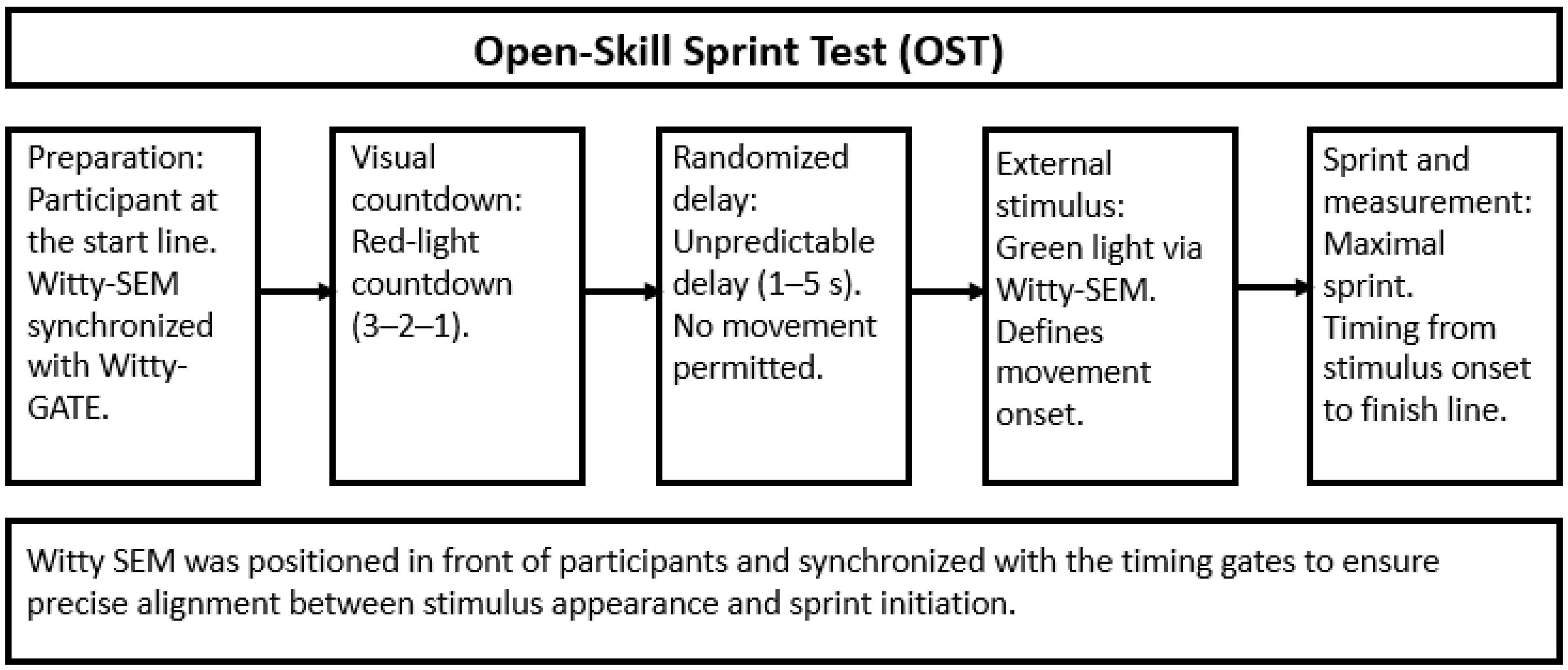
2.3.3. Open-Skill Sprint Test (OST)
2.3.4. Technology and Measurement Reliability
2.4. Statistical Analysis
3. Results
3.1. Descriptive Results
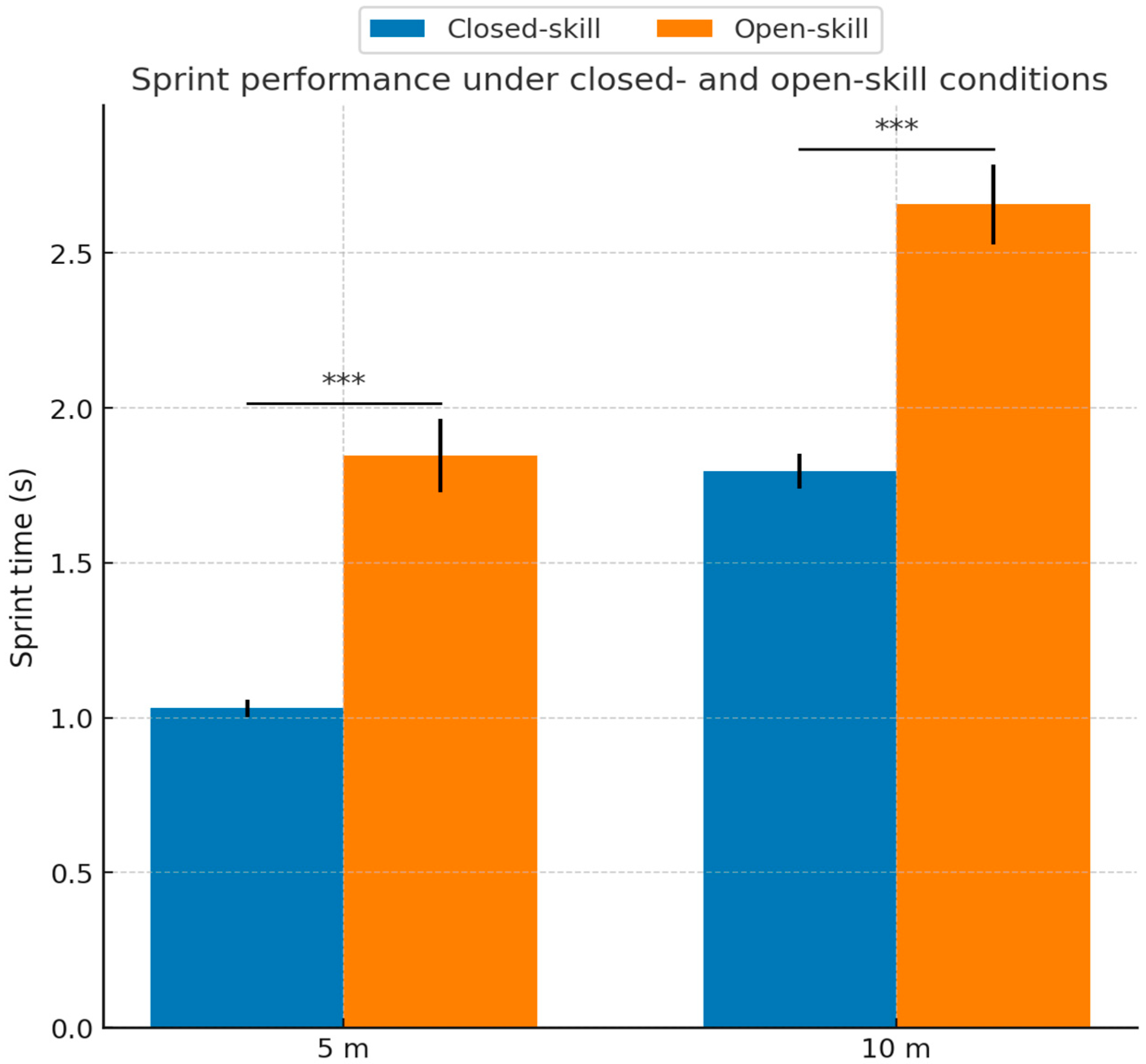
3.2. Differences Between Closed- and Open-Skill Conditions
- The 5 m distance: Open-skill, slower than closed-skill, mean difference = 0.759 s, SD of the differences = 0.121 s, 95% CI [0.719, 0.800] s, t(36) = 38.18, p < 0.001.
- The 10 m distance: Open-skill, slower than closed-skill, mean difference = 0.752 s, SD of the differences = 0.139 s, 95% CI [0.706, 0.799] s, t(36) = 32.86, p < 0.001.
3.3. Ranking Consistency Between Conditions
4. Discussion
4.1. Limitations
4.2. Future Research Directions
5. Conclusions
Author Contributions
Funding
Institutional Review Board Statement
Informed Consent Statement
Data Availability Statement
Acknowledgments
Conflicts of Interest
Abbreviations
| CMDT | Cognitive motor dual task |
| CST | Closed-skill sprint test |
| OST | Open-skill sprint test |
References
- Morrison, M.; Martin, D.T.; Scanlan, A.T.; Halson, S.L. A Systematic Review on Fitness Testing in Adult Male Basketball Players: Tests Adopted, Characteristics Reported and Recommendations for Practice. Sports Med. 2022, 52, 1491–1532. [Google Scholar] [CrossRef] [Scilit]
- Gottlieb, R.; Shalom, A.; Calleja-Gonzalez, J. Physiology of Basketball—Field Tests. Review Article. J. Hum. Kinet. 2021, 77, 159–167. [Google Scholar] [CrossRef] [Scilit] [PubMed]
- Delextrat, A.; Cohen, D. Physiological Testing of Basketball Players: Toward a Standard Evaluation of Anaerobic Fitness. J. Strength Cond. Res. 2008, 22, 1066–1072. [Google Scholar] [CrossRef] [Scilit]
- Gál-Pottyondy, A.; Petró, B.; Czétényi, A.; Négyesi, J.; Nagatomi, R.; Kiss, R.M. Collection and Advice on Basketball Field Tests—A Literature Review. Appl. Sci. 2021, 11, 8855. [Google Scholar] [CrossRef] [Scilit]
- Stojanović, E.; Stojiljković, N.; Scanlan, A.T.; Dalbo, V.J.; Berkelmans, D.M.; Milanović, Z. The Activity Demands and Physiological Responses Encountered During Basketball Match-Play: A Systematic Review. Sports Med. 2018, 48, 111–135. [Google Scholar] [CrossRef] [Scilit] [PubMed]
- Martinho, D.V.; Clemente, F.M.; Gomez, M.; Rebelo, A.; Field, A.; Santos, C.C.; Gouveia, É.R.; Afonso, J.; Sarmento, H. Physical, Physiological, Technical and Tactical Responses According to Playing Position in Male Basketball: A Systematic Scoping Review. J. Hum. Kinet. 2025, 96, 5–35. [Google Scholar] [CrossRef] [Scilit]
- Mancha-Triguero, D.; García-Rubio, J.; Antúnez, A.; Ibáñez, S.J. Physical and Physiological Profiles of Aerobic and Anaerobic Capacities in Young Basketball Players. Int. J. Environ. Res. Public Health 2020, 17, 1409. [Google Scholar] [CrossRef] [Scilit]
- Ziv, G.; Lidor, R. Physical Attributes, Physiological Characteristics, On-Court Performances and Nutritional Strategies of Female and Male Basketball Players. Sports Med. 2009, 39, 547–568. [Google Scholar] [CrossRef] [Scilit]
- Shalom, A.; Levy, A.; Meckel, Y.; Calleja-Gonzalez, J.; Gottlieb, R. Integrating physical and cognitive approaches: A scoping review of advanced training methods in basketball. Acta Gymnica 2025, 55, e2025.012. [Google Scholar] [CrossRef] [Scilit]
- Lucia, S.; Digno, M.; Madinabeitia, I.; Di Russo, F. Testing a Multicomponent Training Designed to Improve Sprint, Agility and Decision-Making in Elite Basketball Players. Brain Sci. 2023, 13, 984. [Google Scholar] [CrossRef] [Scilit]
- Lucia, S.; Aydin, M.; Di Russo, F. Sex Differences in Cognitive-Motor Dual-Task Training Effects and in Brain Processing of Semi-Elite Basketball Players. Brain Sci. 2023, 13, 443. [Google Scholar] [CrossRef] [Scilit] [PubMed]
- Lucia, S.; Bianco, V.; Boccacci, L.; Di Russo, F. Effects of a Cognitive-Motor Training on Anticipatory Brain Functions and Sport Performance in Semi-Elite Basketball Players. Brain Sci. 2021, 12, 68. [Google Scholar] [CrossRef] [Scilit] [PubMed]
- Shalom, A.; Gottlieb, R.; Conte, D.; Calleja-Gonzalez, J. Cognitive Motor Dual Tasking as a game-changer in basketball training programs: A new approach to developing elite basketball players. Front. Psychol. 2025, 16, 1665556. [Google Scholar] [CrossRef] [Scilit] [PubMed]
- Shalom, A.; Gottlieb, R.; Shalom, I.; Gafni, G.; Levy, A.; Calleja-Gonzalez, J. A Pilot Study Exploring the Optimization of Warm-Up Strategies: Modern Cognitive Warm-Up with Open-Skill Demands vs. Traditional Closed-Skill Warm-Up in Basketball. Sensors 2025, 25, 3279. [Google Scholar] [CrossRef] [Scilit]
- Scanlan, A.T.; Tucker, P.S.; Dalbo, V.J. A Comparison of Linear Speed, Closed-Skill Agility, and Open-Skill Agility Qualities Between Backcourt and Frontcourt Adult Semiprofessional Male Basketball Players. J. Strength Cond. Res. 2014, 28, 1319–1327. [Google Scholar] [CrossRef] [Scilit]
- Scanlan, A.T.; Wen, N.; Spiteri, T.; Milanović, Z.; Conte, D.; Guy, J.H.; Delextrat, A.; Dalbo, V.J. Dribble Deficit: A novel method to measure dribbling speed independent of sprinting speed in basketball players. J. Sports Sci. 2018, 36, 2596–2602. [Google Scholar] [CrossRef] [Scilit]
- Santos, E.J.A.M.; Janeira, M.A.A.S. Effects of Complex Training on Explosive Strength in Adolescent Male Basketball Players. J. Strength Cond. Res. 2008, 22, 903–909. [Google Scholar] [CrossRef] [Scilit]
- dos Santos, F.G.; Pacheco, M.M.; Basso, L.; Bastos, F.H.; Tani, G. Development and Validation of a Checklist to Assess Proficient Performance of Basketball Straight Speed Dribbling Skill. J. Hum. Kinet. 2020, 71, 21–31. [Google Scholar] [CrossRef] [Scilit]
- Mujika, I.; Santisteban, J.; Castagna, C. In-season effect of short-term sprint and power training programs on elite junior soccer players. J. Strength Cond. Res. 2009, 23, 2581–2587. [Google Scholar] [CrossRef] [Scilit]
- Wu, J.; Qiu, P.; Lv, S.; Chen, M.; Li, Y. The effects of cognitive-motor dual-task training on athletes’ cognition and motor performance. Front. Psychol. 2024, 15, 1284787. [Google Scholar] [CrossRef] [Scilit]
- Casella, A.; Ventura, E.; Di Russo, F. The Influence of a Specific Cognitive-Motor Training Protocol on Planning Abilities and Visual Search in Young Soccer Players. Brain Sci. 2022, 12, 1624. [Google Scholar] [CrossRef] [Scilit]
- Zhang, M.; Li, F.; Jiao, J.; Liang, W.; Gomez, M.-A.; Scanlan, A.T. Effects of Different Training Methods on Open-Skill and Closed-Skill Agility in Basketball Players: A Systematic Review and Meta-Analysis. Sports Med. Open 2025, 11, 50. [Google Scholar] [CrossRef] [Scilit] [PubMed]
- Cerrillo-Sanchis, J.; Muñoz-Criado, I.; Pérez-Puchades, V.; Palmero-Martín, I.; Galcerán-Ruiz, J.; Portes-Sanchez, R.; Chulvi-Medrano, I.; Domínguez-Navarro, F.; Morales-Hilario, E.; Mur-Gomar, B.; et al. Applying a Specific Warm-Up on Basketball Performance: The Basket-Up Approach. Appl. Sci. 2024, 14, 5969. [Google Scholar] [CrossRef] [Scilit]
- World Medical Association. World Medical Association Declaration of Helsinki. JAMA 2013, 310, 2191. [Google Scholar] [CrossRef] [Scilit] [PubMed]
- Flórez-Gil, E.; Boullosa, D.; Calleja-González, J.; Vaquera, A. A Cross-National Survey of Basketball Strength and Conditioning Coaches’ Warm-Up Practices. Int. J. Sports Physiol. Perform. 2025, 20, 1501–1508. [Google Scholar] [CrossRef] [Scilit]
- McGowan, C.J.; Pyne, D.B.; Thompson, K.G.; Rattray, B. Warm-Up Strategies for Sport and Exercise: Mechanisms and Applications. Sports Med. 2015, 45, 1523–1546. [Google Scholar] [CrossRef] [Scilit]
- Altmann, S.; Hoffmann, M.; Kurz, G.; Neumann, R.; Woll, A.; Haertel, S. Different Starting Distances Affect 5-m Sprint Times. J. Strength Cond. Res. 2015, 29, 2361–2366. [Google Scholar] [CrossRef] [Scilit]
- Condello, G.; Khemtong, C.; Lee, Y.-H.; Chen, C.-H.; Mandorino, M.; Santoro, E.; Liu, C.; Tessitore, A. Validity and Reliability of a Photoelectric Cells System for the Evaluation of Change of Direction and Lateral Jumping Abilities in Collegiate Basketball Athletes. J. Funct. Morphol. Kinesiol. 2020, 5, 55. [Google Scholar] [CrossRef] [Scilit]
- Koch, P.; Krenn, B. Executive functions in elite athletes—Comparing open-skill and closed-skill sports and considering the role of athletes’ past involvement in both sport categories. Psychol. Sport Exerc. 2021, 55, 101925. [Google Scholar] [CrossRef] [Scilit]
- Heilmann, F.; Weinberg, H.; Wollny, R. The Impact of Practicing Open- vs. Closed-Skill Sports on Executive Functions—A Meta-Analytic and Systematic Review with a Focus on Characteristics of Sports. Brain Sci. 2022, 12, 1071. [Google Scholar] [CrossRef] [Scilit]
- Sheppard, J.M.; Young, W.B. Agility literature review: Classifications, training and testing. J. Sports Sci. 2006, 24, 919–932. [Google Scholar] [CrossRef] [Scilit]
- Hülsdünker, T.; Koster, J.; Mierau, A. Active motor-cognitive recovery supports reactive agility performance in trained athletes. Eur. J. Sport Sci. 2025, 25, e12231. [Google Scholar] [CrossRef] [Scilit]
- Hülsdünker, T.; Laporte, M.; Mierau, A.; Büchel, D. Cortical activation and functional connectivity in visual-cognitive-motor networks during motor-cognitive exercise. Behav. Brain Res. 2025, 484, 115491. [Google Scholar] [CrossRef] [Scilit]
- Halperin, I.; Vigotsky, A.D. An Integrated Perspective of Effort and Perception of Effort. Sports Med. 2024, 54, 2019–2032. [Google Scholar] [CrossRef] [Scilit]



| Distance (m) | N | Condition | Mean (s) | SD | CV (%) | Cohen’s dz | ES Magnitude |
|---|---|---|---|---|---|---|---|
| 5 m | 37 | Closed-skill condition | 1.02 | 0.03 | 3.2 | — | |
| 5 m | 37 | Open-skill condition | 1.77 | 0.12 | 6.8 | — | |
| 5 m | 37 | Closed- versus open-skill comparison | — | — | — | 6.28 | Very large |
| 10 m | 37 | Closed-skill condition | 1.81 | 0.07 | 4 | — | |
| 10 m | 37 | Open-skill condition | 2.56 | 0.14 | 5.3 | — | |
| 10 m | 37 | Closed- versus open-skill comparison | — | — | — | 5.4 | Very large |
Disclaimer/Publisher’s Note: The statements, opinions and data contained in all publications are solely those of the individual author(s) and contributor(s) and not of MDPI and/or the editor(s). MDPI and/or the editor(s) disclaim responsibility for any injury to people or property resulting from any ideas, methods, instructions or products referred to in the content. |
© 2026 by the authors. Licensee MDPI, Basel, Switzerland. This article is an open access article distributed under the terms and conditions of the Creative Commons Attribution (CC BY) license.
Share and Cite
Shalom, A.; Gottlieb, R.; Calleja-Gonzalez, J. Closed vs. Open-Skill Contexts in Basketball: Insights into Reactive and Nonreactive Short Distance Sprint Performance More Closely Aligned with Game Demands . Sports 2026, 14, 115. https://doi.org/10.3390/sports14030115
Shalom A, Gottlieb R, Calleja-Gonzalez J. Closed vs. Open-Skill Contexts in Basketball: Insights into Reactive and Nonreactive Short Distance Sprint Performance More Closely Aligned with Game Demands . Sports. 2026; 14(3):115. https://doi.org/10.3390/sports14030115
Chicago/Turabian StyleShalom, Asaf, Roni Gottlieb, and Julio Calleja-Gonzalez. 2026. "Closed vs. Open-Skill Contexts in Basketball: Insights into Reactive and Nonreactive Short Distance Sprint Performance More Closely Aligned with Game Demands " Sports 14, no. 3: 115. https://doi.org/10.3390/sports14030115
APA StyleShalom, A., Gottlieb, R., & Calleja-Gonzalez, J. (2026). Closed vs. Open-Skill Contexts in Basketball: Insights into Reactive and Nonreactive Short Distance Sprint Performance More Closely Aligned with Game Demands . Sports, 14(3), 115. https://doi.org/10.3390/sports14030115