

SOCCERIndex: An Estimate of Recreational Soccer Players’ Physical Ability by Health Status and Lifestyle Habits
 , ,
, ,  and
and 
Abstract
1. Introduction
- The presence of chronic diseases can affect fitness [22];
- Previous injuries can affect a player’s health and fitness profile, increasing possible re-injury [18];
- Early engagement in sport and sustained habitual participation during youth may be linked to higher physical activity levels later in adulthood, while a prolonged sport career may facilitate the maintenance of an active lifestyle through adolescence and beyond [23,24]. Sport career history can thus be considered as a feasible proxy of long-term exposure to structured physical activity [25];
- A high physical activity level has positive effects on physical fitness [27].
2. Materials and Methods
2.1. Study Design
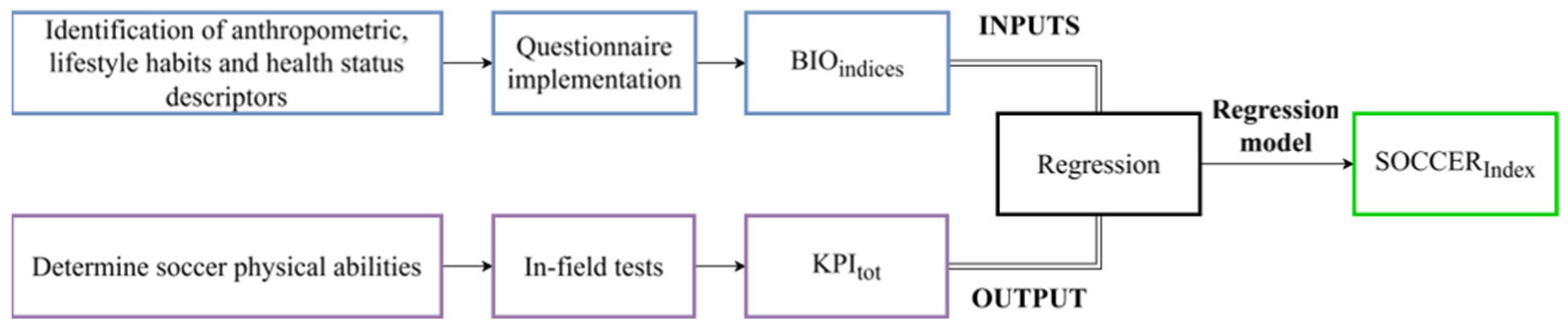
- Biometric quantities were selected to represent lifestyle indicators related to the player’s physical characteristics, and investigated via a closed-form questionnaire, whose results were grouped into BIOIndices, one per quantity.
- The principal aspects affecting players’ performance and their physical fitness were identified, and related in-field tests were performed to obtain specific KPIs, then combined in a single index named KPItot.
- Regression analysis was performed using the questionnaire BIOIndices as inputs and the KPItot as output. Thus, SOCCERIndex is defined following the relation that estimates KPItot starting from the obtained answers.
2.2. Questionnaire Design
- Anthropometrics: subject’s BMI and age.
- Health information: smoking habits, alcohol consumption, medical history, and injuries in the last 12 months.
- Habits: sports career and work-related lifestyle.
- Physical activity level: evaluated through the IPAQ-FS questionnaire [29].
- Age (AgeIndex): it evaluates players’ age by weighting age ranges based on their prevalence in professional soccer as a reference [31] (Table 1), to approximate the age window typically associated with peak physical performance, even if these ranges do not necessarily mirror the age distribution in recreational players.
- Medical history (MedicalIndex): it is assessed as the presence/absence of chronic diseases, referring to current/past pathologies that could affect sports activity. Diseases were characterized according to the Italian Cardiological Guidelines for Competitive Sport Eligibility [34], which allows athletes with a positive ECG evaluation to participate in competitive sports. This sports medical certification was used to divide the participants into three groups (Table 1): “healthy” with no chronic diseases, can play at a competitive level; “controlled chronic disease”, can do non-competitive activity under medical prescription; “severe chronic disease”, can do low-impact sports activity when prescribed.
- Occurring injuries (InjuryIndex): this index was obtained from a single question on recent inactive days due to injury, with percentage scores decreasing with longer absence, reflecting severity (Table 2), considering as reference values the time spent for amateur and recreational players that typically do not follow a structured return-to-sport programme like professional athletes [6]. For this reason, even short rest periods are considered to categorize injury severity. Relapse risks can affect amateurs’ health status at a higher incidence than in athletes (16.6% and 15.4%, respectively), and are considered important also for recreational athletes [35]. The value of the InjuryIndex was developed according to the type of injury, which was defined based on the number of days spent without training. Within these time-loss ranges, it was possible to classify injuries using medical criteria (e.g., rupture, strain). Injury categories were assigned pragmatic weights to obtain a simple, screening-oriented score; this mapping is heuristic and prioritizes feasibility over clinical grading. This represents an exploratory attempt to quantify injury severity with respect to inactivity days.
- Sport career (CareerIndex): this index classified participants according to prior soccer-playing experience (ex-professional, ex-amateur, or none), with scores reported in Table 2.
- Physical activity level (PALIndex): this index was defined to estimate the physical activity level, similar to the 12-item IPAQ-SF questionnaire [29]. Although practical and widely applied to investigate PA volume/intensity, it tends to overestimate activity when compared to devices such as pedometers, actometers, and accelerometers [14] and relies on the interviewer’s interpretation of open responses to compute MET (Metabolic Equivalent of Task); this can lead to potential overestimation/underestimation of PA [29]. To improve accuracy and allow self-administration, two adaptations were applied:
- Open responses were replaced with closed ranges of days/hours, providing options closer to users’ lifestyles.
- MET values were not calculated, reducing overestimation/underestimation risks.

| Body Mass Index Score | ||||||
| BMI Value [kg/m2] | BMI Levels | BMIIndex | Relation | |||
| <15 | Underweight | 45% | Fixed percentage value | |||
| 15–17.9 | Underweight | 46–75% | For every BMI increase of 0.1, BMIIndex increases of 1% BMIIndex = 45% + (BMI − 14.9) × 1% | |||
| 18–22 | Normal | 76–100% | For every BMI increase of 0.1, BMIIndex increases of 1% BMIIndex = 75% + (BMI − 17.9) × 1% | |||
| 22.1–24.9 | Normal | 99–71% | For every BMI increase of 0.1, BMIIndex decreases of 1% BMIIndex = 100% − (BMI − 22) × 1% | |||
| 25–30 | Overweight | 70–20% | For every BMI increase of 0.1, BMIIndex decreases of 1% BMIIndex = 71% − (BMI − 24.9) × 1% | |||
| 30.1 | Obese | 19% | Fixed percentage value | |||
| 30.2–32.6 | Obese | 18–6% | For every BMI increase of 0.2, BMIIndex decreases of 1% BMIIndex = 19% − (BMI − 30) × 1% | |||
| 32.7–33.8 | Obese | 5% | Fixed percentage value | |||
| 34–34.9 | Obese | 0% | Fixed percentage value | |||
| >35 | Extremely obese | 0% | Fixed percentage value | |||
| Age | ||||||
| Age (years) | Age range | AgeIndex | Relation | |||
| 14–17 | Adolescent | 60–80% | For every 1-year increase, there is an increase of 5% AgeIndex = 60% + (age − 13) × 5% | |||
| 18–27 | Young adult | 82–100% | For every 1-year increase, there is an increase of 2% AgeIndex = 80% + (age − 17) × 2% | |||
| 28–36 | Adult | 98–74% | For every 1-year increase, there is a decrease of 2% AgeIndex = 100% − (age − 27) × 2% | |||
| 37–51 | Senior | 72–44% | ||||
| 52–73 | Over | 42–0% | ||||
| Smoking habits | ||||||
| Smoker | SmokeIndex | Relation | ||||
| No | 100% | Fixed value associated with non-smokers’ cardiovascular endurance | ||||
| Yes | 79% | Percentage value associated with smokers’ cardiovascular endurance (decrease of 21%, following Jeon [32]) | ||||
| Alcohol consumption | ||||||
| Frequency of alcohol consumption | Score | Amount of alcohol x day | Score | Total score | AlcoholIndex | Relation |
| Never | 0 | 1–2 | 0 | 0 | 100% | Percentage values associated with the total score obtained by summing the answers to questions related to alcohol consumption |
| Once a month | 1 | 3–4 | 1 | 1–2 | 75% | |
| Two to four times a month | 2 | 5–6 | 2 | 3–4 | 50% | |
| Twice or three times a week | 3 | 7–9 | 3 | 5–6 | 25% | |
| >four times a week | 4 | ≥10 | 4 | 7–8 | 0% | |
| Medical history | ||||||
| Total score | Examples | MedicalIndex | Relation | |||
| No chronic diseases | - | 100% | - | |||
| Controlled chronic diseases | Hypertension, diabetes, and endocrine system problems | 50% | The ones controlled through drugs and that do not expose the athlete to risks for physical activity. | |||
| Severe chronic diseases | Severe problems with the spine or locomotor apparatus or oncological pathologies belong to this category | 0% | Not controlled through pharmacological solutions, or that can limit the subject’s physical capacity. | |||
| Occurring Injuries | ||||||
| Days at rest due to injury | Gravity level | InjuryIndex | Relation | |||
| 0 | No gravity | 100% | Percentage values associated with the days at rest due to the injury. | |||
| 2–4 | Slight gravity | 75% | ||||
| 5–10 | Lower gravity | 55% | ||||
| 11–15 | Middle-lower gravity | 25% | ||||
| 16–30 | Middle gravity | 15% | ||||
| ≥31 | Higher gravity | 0% | ||||
| Sports career | ||||||
| Previous football experience | CareerIndex | |||||
| Ex Pro | 100% | |||||
| Ex Amateur | 50% | |||||
| Work | ||||||
| 1. Type of work | Score | 2. How to go to work | Score | Final score | WorkIndex | Relation |
| Call centre | 0 | Foot or bicycle | 3 | 7 | 100% | The percentage value obtained after summing the scores of the two questions 1 and 2 |
| Employee | ||||||
| Smart worker | ||||||
| Waiter | 1 | |||||
| Student | 5 | 75% | ||||
| Teacher | Public transport | 1 | ||||
| Trader | 4 | 60% | ||||
| Clerk | ||||||
| Rider | 2 | 3 | 45% | |||
| Healthcare personnel | ||||||
| Trainer | Car or scooter | 0 | 2 | 30% | ||
| Police | ||||||
| Agricultural work | 4 | 1 | 15% | |||
| Construction company | ||||||
| Forestry work | 0 | 0% | ||||
| Type of activities | ||||||
| Type of Activity | Examples | |||||
| Vigorous | Weightlifting, high-intensity aerobic activity, and cycling | |||||
| Moderate | Carry light loads, ride a bicycle at a regular pace, exercise, and jog | |||||
| Walk | If the activity results only in walking constantly for 10–15 min during the day | |||||
| Physical Activity Level | ||||||
| Physical Activity Level categories | Description | PALIndex | ||||
| Very active | The subject must engage in vigorous physical activity more than three times a week or must engage in 7 or more days of any combination of walking, moderate intensity, or vigorous intensity activities. | 100% | ||||
| Active | The subject must engage in 3 or more days of vigorous intensity activity and/or walking of at least 30 min per day; or 5 or more days of moderate intensity activity and/or walking of at least 30 min per day; or 5 or more days of any combination of walking, moderate intensity, or vigorous intensity activities. | 50% | ||||
| Inactive | The subject must not engage in vigorous physical activity more than three times a week, must not do vigorous moderate more than 5 days a week. | 0% | ||||
2.3. In-Field Tests: Selection and Protocol
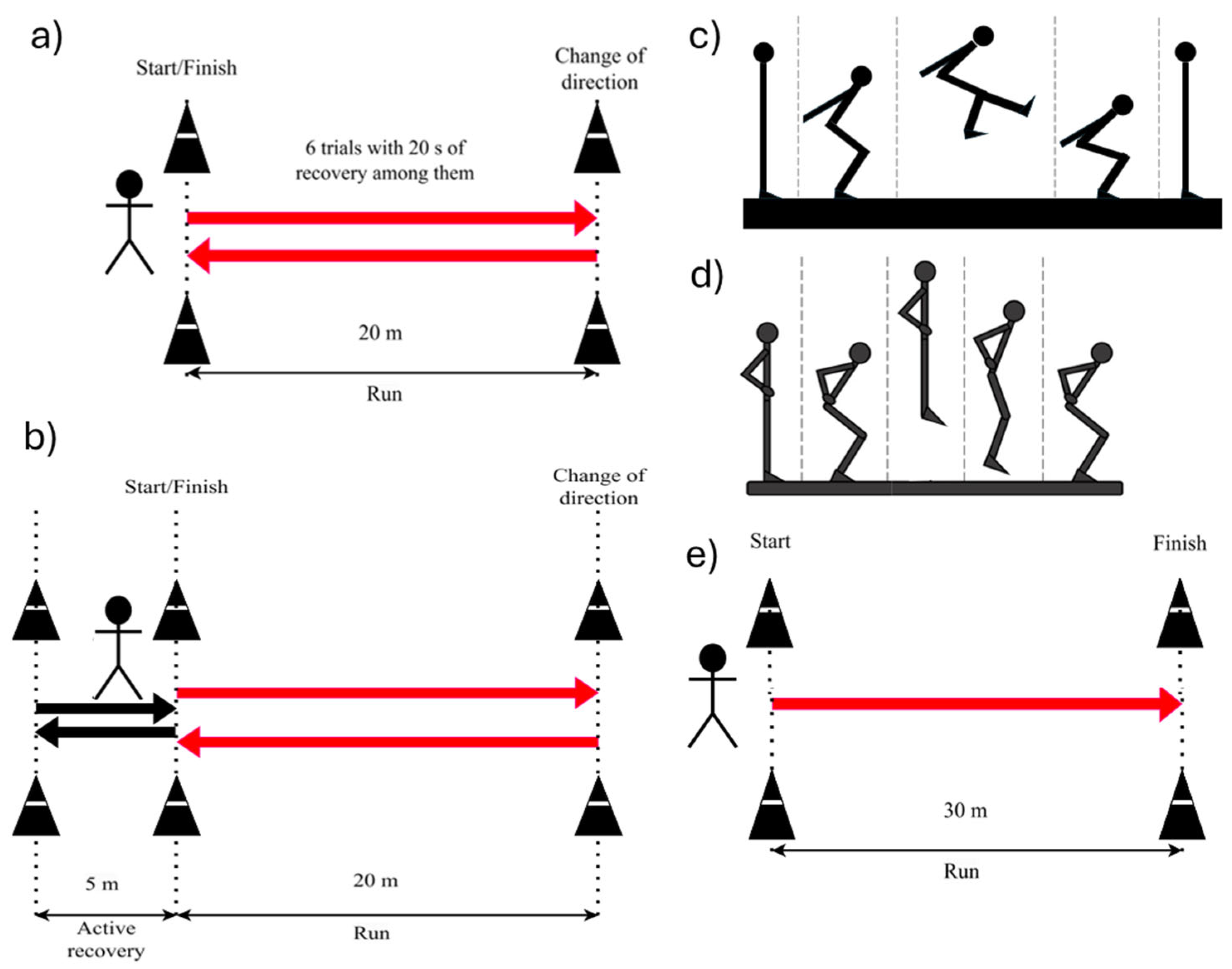
- capacity to recover from repeated high-intensity sprints—Yo-Yo Intermittent Recovery Test Level 1 (Yo-Yo IR1);
- sprint and change directions abilities—repeated sprint ability test (RSA);
- aerobic and recovery capacities—30 m sprint ability test;
- lower limb strength and power—countermovement jump (CMJ) and standing long jump (SLJ).
2.3.1. Yo-Yo Intermittent Recovery Test Level 1 (Yo-Yo IR1)
2.3.2. Repeated Sprint Ability (RSA)
2.3.3. Jumping Assessment
2.3.4. The 30-m Sprint Test
2.3.5. Final KPI (KPItot)
2.4. Participants
2.5. Statistical Analysis and Soccer Index Modelling (SOCCERIndex)
3. Results
4. Discussion
- The BMI score (increasing for BMI values up to 22 and then decreasing for higher BMI values) and age score (increasing up to 27 years and then decreasing) are positively correlated with all KPIs except KPIRSA, which was not well predicted.
- Physical activity level is a recurrent indicator in different tests: being active is associated with higher aerobic/anaerobic capacity (KPIYo-Yo), sprint performance (KPISprint), and lower limb strength, particularly in the horizontal component (KPISLJ).
- Limited alcohol consumption and work-related indicators are positively correlated with aerobic/anaerobic capacity and sprint performance. These indicators do not influence jumping performance.
- The “occurring injuries” indicator is connected to jump performance, but not with sprint performance and aerobic/anaerobic capacity.
- Smoking habits are correlated only with aerobic/anaerobic capacity.
- The sports career is correlated with the aerobic/anaerobic capacity and with vertical jump performance.
- The presence of chronic diseases is correlated with jump performance.
- In the following subsections, the presence/absence of correlation between all BIOIndices and the overall physical fitness is explored in detail, discussing potential explanations.
4.1. SOCCERIndex
4.2. 30-m Test
4.3. Yo-Yo IR1 Test
4.4. SLJ and CMJ Tests
4.5. RSA Test
4.6. Limitations and Future Development
5. Conclusions
Author Contributions
Funding
Institutional Review Board Statement
Informed Consent Statement
Data Availability Statement
Conflicts of Interest
Appendix A
| Model Statistics for KPISprint | BIOindices | ||||||||||||
|---|---|---|---|---|---|---|---|---|---|---|---|---|---|
| Model | R2 | R2adj | SEE | Β | BMIIndex | AgeIndex | AlcoholIndex | WorkIndex | PALIndex | CareerIndex | SmokeIndex | InjuryIndex | MedicalIndex |
| 1 | 0.434 | 0.343 | 9.74 | 18.237 | 0.287 | 0.146 | 0.223 | 0.076 | 0.025 | −0.049 | 0.111 | −0.039 | 0.026 |
| 2 | 0.432 | 0.352 | 9.68 | 20.932 | 0.286 | 0.145 | 0.224 | 0.075 | 0.025 | −0.047 | 0.100 | −0.031 | - |
| 3 | 0.427 | 0.358 | 9.63 | 19.087 | 0.280 | 0.148 | 0.225 | 0.080 | 0.023 | −0.056 | 0.100 | - | - |
| 4 | 0.421 | 0.362 | 9.59 | 28.077 | 0.280 | 0.141 | 0.228 | 0.085 | 0.026 | −0.049 | - | - | - |
| 5 | 0.417 | 0.368 | 9.56 | 26.692 | 0.283 | 0.145 | 0.205 | 0.073 | 0.023 | - | - | - | - |
| 6 | 0.409 | 0.370 | 9.54 | 26.844 | 0.284 | 0.150 | 0.213 | 0.074 | - | - | - | - | - |
| 7 | 0.396 | 0.367 | 9.56 | 28.487 | 0.278 | 0.164 | 0.201 | - | - | - | - | - | - |
| Model Statistics for KPIYoYo | BIOindices | ||||||||||||
|---|---|---|---|---|---|---|---|---|---|---|---|---|---|
| Model | R2 | R2adj | SEE | Β | PALIndex | BMIIndex | AgeIndex | WorkIndex | CareerIndex | AlcoholIndex | SmokeIndex | InjuryIndex | MedicalIndex |
| 1 | 0.559 | 0.488 | 13.47 | −31.676 | 0.163 | 0.447 | 0.191 | 0.139 | −0.173 | 0.176 | 0.202 | −0.046 | −0.041 |
| 2 | 0.556 | 0.494 | 13.39 | −35.983 | 0.164 | 0.450 | 0.192 | 0.142 | −0.176 | 0.175 | 0.219 | −0.058 | - |
| 3 | 0.550 | 0.496 | 13.37 | −39.479 | 0.161 | 0.438 | 0.198 | 0.152 | −0.193 | 0.177 | 0.219 | - | - |
| 4 | 0.539 | 0.492 | 13.43 | −19.773 | 0.167 | 0.438 | 0.182 | 0.162 | −0.176 | 0.185 | - | - | - |
| 5 | 0.524 | 0.484 | 13.53 | −10.477 | 0.170 | 0.442 | 0.196 | 0.137 | - | - | - | - | |
| 6 | 0.509 | 0.476 | 13.63 | −18.205 | 0.162 | 0.449 | 0.204 | 0.110 | - | - | - | - | - |
| 7 | 0.497 | 0.473 | 13.68 | −16.884 | 0.162 | 0.438 | 0.224 | - | - | - | - | - | - |
| Model Statistics for KPISLJ | BIOindices | ||||||||||||
|---|---|---|---|---|---|---|---|---|---|---|---|---|---|
| Model | R2 | R2adj | SEE | β | PALIndex | BMIIndex | AgeIndex | InjuryIndex | CareerIndex | MedicalIndex | SmokeIndex | WorkIndex | AlcoholIndex |
| 1 | 0.383 | 0.283 | 12.41 | 36.733 | 0.066 | 0.211 | 0.245 | −0.099 | 0.148 | −0.089 | 0.083 | −0.028 | 0.002 |
| 2 | 0.383 | 0.296 | 12.29 | 36.823 | 0.066 | 0.211 | 0.245 | −0.099 | 0.148 | −0.089 | 0.083 | −0.028 | - |
| 3 | 0.382 | 0.307 | 12.20 | 36.975 | 0.066 | 0.213 | 0.240 | −0.097 | 0.142 | −0.088 | 0.079 | - | - |
| 4 | 0.379 | 0.316 | 12.12 | 44.637 | 0.069 | 0.213 | 0.235 | −0.096 | 0.150 | −0.093 | - | - | - |
| 5 | 0.356 | 0.302 | 12.24 | 38.323 | 0.072 | 0.217 | 0.237 | −0.125 | 0.148 | - | - | - | - |
| Model Statistics for KPICMJ | BIOindices | ||||||||||||
|---|---|---|---|---|---|---|---|---|---|---|---|---|---|
| Model | R2 | R2adj | SEE | β | BMIIndex | InjuryIndex | MedicalIndex | AgeIndex | CareerIndex | AlcoholIndex | SmokeIndex | PALIndex | WorkIndex |
| 1 | 0.446 | 0.357 | 11.42 | 41.768 | 0.224 | −0.190 | −0.103 | 0.224 | 0.166 | 0.065 | 0.084 | 0.017 | −0.043 |
| 2 | 0.443 | 0.365 | 11.35 | 41.468 | 0.227 | −0.187 | −0.102 | 0.216 | 0.154 | 0.077 | 0.084 | 0.017 | - |
| 3 | 0.440 | 0.373 | 11.28 | 40.370 | 0.227 | −0.183 | −0.103 | 0.220 | 0.158 | 0.080 | 0.094 | - | - |
| 4 | 0.436 | 0.379 | 11.22 | 49.348 | 0.227 | −0.181 | −0.110 | 0.215 | 0.167 | 0.082 | - | - | - |
| 5 | 0.431 | 0.384 | 11.18 | 53.438 | 0.230 | −0.181 | −0.109 | 0.219 | 0.187 | - | - | - | - |
| Model Statistics for KPIRSA | BIOindices | ||||||||||||
|---|---|---|---|---|---|---|---|---|---|---|---|---|---|
| Model | R2 | R2adj | SEE | β | BMIIndex | MedicalIndex | PALIndex | AgeIndex | InjuryIndex | CareerIndex | AlcoholIndex | WorkIndex | SmokIndex |
| 1 | 0.198 | 0.069 | 31.517 | 1.973 | 0.661 | 0.213 | −0.074 | 0.127 | −0.107 | 0.059 | 0.098 | 0.041 | −0.042 |
| 2 | 0.198 | 0.085 | 31.242 | −2.029 | 0.661 | 0.216 | −0.075 | 0.130 | −0.108 | 0.056 | 0.097 | 0.039 | - |
| 3 | 0.197 | 0.100 | 30.981 | −1.210 | 0.659 | 0.214 | −0.075 | 0.137 | −0.111 | 0.067 | 0.086 | - | - |
| 4 | 0.196 | 0.114 | 30.738 | 3.048 | 0.662 | 0.215 | −0.074 | 0.142 | −0.111 | 0.087 | - | - | - |
| 5 | 0.194 | 0.126 | 30.526 | 7.653 | 0.653 | 0.216 | −0.069 | 0.141 | −0.100 | - | - | - | - |
| 6 | 0.188 | 0.135 | 30.379 | 3.328 | 0.635 | 0.183 | −0.077 | 0.152 | - | - | - | - | - |
| 7 | 0.180 | 0.140 | 30.286 | 12.960 | 0.672 | 0.177 | −0.071 | - | - | - | - | - | - |
| 8 | 0.170 | 0.144 | 30.223 | 9.548 | 0.663 | 0.181 | - | - | - | - | - | - | - |
| 9 | 0.150 | 0.137 | 30.338 | 25.391 | 0.662 | - | - | - | - | - | - | - | - |
References
- Bangsbo, J. The Physiology of Soccer—With Special Reference to Intense Intermittent Exercise. Acta Physiol. Scand. Suppl. 1994, 619, 1–155. [Google Scholar]
- Rampinini, E.; Sassi, A.; Morelli, A.; Mazzoni, S.; Fanchini, M.; Coutts, A.J. Repeated-Sprint Ability in Professional and Amateur Soccer Players. Appl. Physiol. Nutr. Metab. 2009, 34, 1048–1054. [Google Scholar] [CrossRef]
- Bangsbo, J.; Mohr, M.; Krustrup, P. Physical and Metabolic Demands of Training and Match-Play in the Elite Football Player. J. Sports Sci. 2006, 24, 665–674. [Google Scholar] [CrossRef]
- Tessitore, A.; Meeusen, R.; Tiberi, M.; Cortis, C.; Pagano, R.; Capranica, L. Aerobic and Anaerobic Profiles, Heart Rate and Match Analysis in Older Soccer Players. Ergonomics 2005, 48, 1365–1377. [Google Scholar] [CrossRef]
- Gebert, A.; Gerber, M.; Pühse, U.; Faude, O.; Stamm, H.; Lamprecht, M. Changes in Injury Incidences and Causes in Swiss Amateur Soccer between the Years 2004 and 2015. Swiss Med. Wkly. 2018, 148, w14690. [Google Scholar] [CrossRef] [PubMed]
- Ekstrand, J.; Hägglund, M.; Waldén, M. Epidemiology of Muscle Injuries in Professional Football (Soccer). Am. J. Sports Med. 2011, 39, 1226–1232. [Google Scholar] [CrossRef] [PubMed]
- Svensson, M.; Drust, B. Testing Soccer Players. J. Sports Sci. 2005, 23, 601–618. [Google Scholar] [CrossRef]
- Schmitz, B.; Pfeifer, C.; Kreitz, K.; Borowski, M.; Faldum, A.; Brand, S.-M. The Yo-Yo Intermittent Tests: A Systematic Review and Structured Compendium of Test Results. Front. Physiol. 2018, 9, 870. [Google Scholar] [CrossRef] [PubMed]
- Rampinini, E.; Bishop, D.; Marcora, S.M.; Bravo, D.F.; Sassi, R.; Impellizzeri, F.M. Validity of Simple Field Tests as Indicators of Match-Related Physical Performance in Top-Level Professional Soccer Players. Int. J. Sports Med. 2006, 28, 228–235. [Google Scholar] [CrossRef]
- Reid, C.; Dolan, M.; DeBeliso, M. The Reliability of the Standing Long Jump in NCAA Track and Field Athletes. Int. J. Sports Sci. 2017, 7, 233–238. [Google Scholar]
- Arslanoğlu, E.; Sever, O.; Arslanoğlu, C.; Şenel, Ö.; Yaman, M. The Comparison of Acceleration and Sprint Features of Soccer Players According to Their Positions. Tojras 2013, 2, 39–42. [Google Scholar]
- Hammami, A.; Randers, M.B.; Kasmi, S.; Razgallah, M.; Tabka, Z.; Chamari, K.; Bouhlel, E. Effects of Soccer Training on Health-Related Physical Fitness Measures in Male Adolescents. J. Sport Health Sci. 2018, 7, 169–175. [Google Scholar] [CrossRef]
- Milanović, Z.; Pantelić, S.; Sporiš, G.; Mohr, M.; Krustrup, P. Health-Related Physical Fitness in Healthy Untrained Men: Effects on VO2max, Jump Performance and Flexibility of Soccer and Moderate-Intensity Continuous Running. PLoS ONE 2015, 10, e0135319. [Google Scholar] [CrossRef] [PubMed]
- Junge, A.; Cheung, K.; Edwards, T.; Dvorak, J. Injuries in Youth Amateur Soccer and Rugby Players—Comparison of Incidence and Characteristics. Br. J. Sports Med. 2004, 38, 168–172. [Google Scholar] [CrossRef]
- Erickson, P. Evaluation of a Population-Based Measure of Quality of Life: The Health and Activity Limitation Index (HALex). Qual. Life Res. 1998, 7, 101–114. [Google Scholar] [CrossRef]
- Nikolaidis, P.T.; Chtourou, H.; Torres-Luque, G.; Rosemann, T.; Knechtle, B. The Relationship of Age and BMI with Physical Fitness in Futsal Players. Sports 2019, 7, 87. [Google Scholar] [CrossRef]
- World Health Organization Department of Mental Health; Abuse, S. Global Status Report on Alcohol 2004; World Health Organization: Geneva, Switzerland, 2004.
- Arnason, A.; Sigurdsson, S.B.; Gudmundsson, A.; Holme, I.; Engebretsen, L.; Bahr, R. Risk Factors for Injuries in Football. Am. J. Sports Med. 2004, 32, 5–16. [Google Scholar] [CrossRef]
- Mutz, M.; Abdel Hadi, S.; Häusser, J.A. Work and Sport: Relationships between Specific Job Stressors and Sports Participation. Ergonomics 2020, 63, 1077–1087. [Google Scholar] [CrossRef] [PubMed]
- Buscemi, J.; Martens, M.P.; Murphy, J.G.; Yurasek, A.M.; Smith, A.E. Moderators of the Relationship between Physical Activity and Alcohol Consumption in College Students. J. Am. Coll. Health 2011, 59, 503–509. [Google Scholar] [CrossRef]
- Bernaards, C.M.; Twisk, J.W.; Van Mechelen, W.; Snel, J.; Kemper, H. A Longitudinal Study on Smoking in Relationship to Fitness and Heart Rate Response. Med. Sci. Sports Exerc. 2003, 35, 793–800. [Google Scholar] [CrossRef] [PubMed]
- Kalyani, R.R.; Corriere, M.; Ferrucci, L. Age-Related and Disease-Related Muscle Loss: The Effect of Diabetes, Obesity, and Other Diseases. Lancet Diabetes Endocrinol. 2014, 2, 819–829. [Google Scholar] [CrossRef]
- Huotari, P.; Nupponen, H.; Mikkelsson, L.; Laakso, L.; Kujala, U. Adolescent Physical Fitness and Activity as Predictors of Adulthood Activity. J. Sports Sci. 2011, 29, 1135–1141. [Google Scholar] [CrossRef]
- Woitas-Ślubowska, D. Influence of Former Professional Sports Career on Participation of Male Ex-Athletes in Physical Recreation Activities. Stud. Phys. Cult. Tour. 2006, 13, 87–95. [Google Scholar]
- Baecke, J.A.; Burema, J.; Frijters, J.E. A Short Questionnaire for the Measurement of Habitual Physical Activity in Epidemiological Studies. Am. J. Clin. Nutr. 1982, 36, 936–942. [Google Scholar] [CrossRef] [PubMed]
- Hammermeister, J.; Page, R.M.; Dolny, D.; Burnham, T.I.M. Occupational Physical Activity as an Indicator of Health and Fitness. Percept. Mot. Ski. 2001, 92, 121–127. [Google Scholar] [CrossRef] [PubMed]
- Lipošek, S.; Planinšec, J.; Leskošek, B.; Pajtler, A. Physical Activity of University Students and Its Relation to Physical Fitness and Academic Success. Ann. Kinesiol. 2018, 9, 89–104. [Google Scholar] [CrossRef]
- Liebherr, M.; Schubert, P.; Antons, S.; Montag, C.; Brand, M. Smartphones and Attention, Curse or Blessing?—A Review on the Effects of Smartphone Usage on Attention, Inhibition, and Working Memory. Comput. Hum. Behav. Rep. 2020, 1, 100005. [Google Scholar] [CrossRef]
- Lee, P.H.; Macfarlane, D.J.; Lam, T.H.; Stewart, S.M. Validity of the International Physical Activity Questionnaire Short Form (IPAQ-SF): A Systematic Review. Int. J. Behav. Nutr. Phys. Act. 2011, 8, 115. [Google Scholar] [CrossRef]
- Bialo, S.R.; Gordon, C.M. Underweight, Overweight, and Pediatric Bone Fragility: Impact and Management. Curr. Osteoporos. Rep. 2014, 12, 319–328. [Google Scholar] [CrossRef]
- Hollenberg, M.; Yang, J.; Haight, T.J.; Tager, I.B. Longitudinal Changes in Aerobic Capacity: Implications for Concepts of Aging. J. Gerontol. Ser. A Biol. Sci. Med. Sci. 2006, 61, 851–858. [Google Scholar] [CrossRef]
- Jeon, H.G.; Kim, G.; Jeong, H.S.; So, W.-Y. Association between Cigarette Smoking and Physical Fitness Level of Korean Adults and the Elderly. Healthcare 2021, 9, 185. [Google Scholar] [CrossRef]
- Saunders, J.B.; Aasland, O.G.; Babor, T.F.; De la Fuente, J.R.; Grant, M. Development of the Alcohol Use Disorders Identification Test (AUDIT): WHO Collaborative Project on Early Detection of Persons with Harmful Alcohol consumption-II. Addiction 1993, 88, 791–804. [Google Scholar] [CrossRef]
- Delise, P.; Mos, L.; Sciarra, L.; Basso, C.; Biffi, A.; Cecchi, F.; Colivicchi, F.; Corrado, D.; D’Andrea, A.; Di Cesare, E. Italian Cardiological Guidelines (COCIS) for Competitive Sport Eligibility in Athletes with Heart Disease: Update 2020. J. Cardiovasc. Med. 2021, 22, 874–891. [Google Scholar] [CrossRef]
- Hägglund, M.; Waldén, M.; Ekstrand, J. Injury Recurrence Is Lower at the Highest Professional Football Level than at National and Amateur Levels: Does Sports Medicine and Sports Physiotherapy Deliver? Br. J. Sports Med. 2016, 50, 751–758. [Google Scholar] [CrossRef]
- Picerno, P.; Camomilla, V.; Capranica, L. Countermovement Jump Performance Assessment Using a Wearable 3D Inertial Measurement Unit. J. Sports Sci. 2011, 29, 139–146. [Google Scholar] [CrossRef] [PubMed]
- Sporis, G.; Jukic, I.; Ostojic, S.M.; Milanovic, D. Fitness Profiling in Soccer: Physical and Physiologic Characteristics of Elite Players. J. Strength Cond. Res. 2009, 23, 1947–1953. [Google Scholar] [CrossRef] [PubMed]
- Chaouachi, A.; Manzi, V.; Wong, D.P.; Chaalali, A.; Laurencelle, L.; Chamari, K.; Castagna, C. Intermittent Endurance and Repeated Sprint Ability in Soccer Players. J. Strength Cond. Res. 2010, 24, 2663–2669. [Google Scholar] [CrossRef]
- Chicco, D.; Warrens, M.J.; Jurman, G. The Coefficient of Determination R-Squared Is More Informative than SMAPE, MAE, MAPE, MSE and RMSE in Regression Analysis Evaluation. PeerJ Comput. Sci. 2021, 7, e623. [Google Scholar] [CrossRef]
- Almulla, J.; Takiddin, A.; Househ, M. The Use of Technology in Tracking Soccer Players’ Health Performance: A Scoping Review. BMC Med. Inform. Decis. Mak. 2020, 20, 184. [Google Scholar] [CrossRef] [PubMed]
- Shirreffs, S.M.; Maughan, R.J. The Effect of Alcohol on Athletic Performance. Curr. Sports Med. Rep. 2006, 5, 192–196. [Google Scholar] [CrossRef]
- Wagner, H.; Finkenzeller, T.; Würth, S.; Von Duvillard, S.P. Individual and Team Performance in Team-Handball: A Review. J. Sports Sci. Med. 2014, 13, 808. [Google Scholar] [PubMed]
- Gottlieb, R.; Shalom, A.; Calleja-Gonzalez, J. Physiology of Basketball–Field Tests. Review Article. J. Hum. Kinet. 2021, 77, 159–167. [Google Scholar] [CrossRef] [PubMed]


| Category | Yo-Yo IR1 [8] | RSA [2] | SLJ [10] | 30 m [11] | CMJ [37] |
|---|---|---|---|---|---|
| No active/no player | <900 m | >10% | <151 cm | >6.5 s | Values referred to the jump of a professional player |
| Active | [900, 1100] m | [7%, 10%] | [151, 181] cm | [5.5, 6.7] s | |
| Recreational | [1100, 1500] m | [6%, 7%] | [181, 201] cm | [4.9, 5.5] s | |
| Amateur | [1500, 2000] m | [5.5%, 6%] | [201, 246] cm | [4.5, 4.9] s | |
| Semi-pro | [2000, 2800] m | [4.5%, 5.5%] | [246, 280] cm | [4, 4.5] s | |
| Professional | ≥2800 m | <4.5% | ≥280 cm [38] | ≤4 s | ≥46 cm |
| Category | Yo-Yo IR1 [8] | RSA [2] | SLJ [10] | 30 m [11] | CMJ [37] | |||||
|---|---|---|---|---|---|---|---|---|---|---|
| Range | N | Range | N | Range | N | Range | N | Range | N | |
| No active/no player | <900 m | 37 | >10% | 10 | <151 cm | 0 | >6.5 s | 0 | Values referred to the jump of a professional player | |
| Active | [900, 1100] m | 8 | (7%, 10%] | 16 | [151, 181] cm | 8 | (5.5, 6.5] s | 3 | ||
| Recreational | [1100, 1500] m | 16 | (6%, 7%] | 7 | [181, 201] cm | 10 | (4.9, 5.5] s | 20 | ||
| Amateur | [1500, 2000] m | 4 | (5.5%, 6%] | 7 | [201, 246] cm | 30 | (4.5, 4.9] s | 23 | ||
| Semi-pro | [2000, 2800] m | 1 | [4.5%, 5.5%] | 10 | [246, 280] cm | 17 | (4, 4.5] s | 19 | ||
| Professional | ≥2800 m | 0 | <4.5% | 16 | ≥280 cm [38] | 1 | ≤4 s | 1 | ≥46 cm | 4 |
| 871 ± 451 m | 6.6 ± 3.3% | 222 ± 34 cm | 4.7 ± 0.4 s | 35 ± 6 cm | ||||||
| RSA shuttle time | First | 8.12 ± 0.93 s | ||||||||
| Second | 8.13 ± 0.82 s | |||||||||
| Third | 8.18 ± 0.80 s | |||||||||
| Fourth | 8.41 ± 0.87 s | |||||||||
| Fifth | 8.44 ± 0.86 s | |||||||||
| Sixth | 8.45 ± 0.83 s | |||||||||
| SOCCERIndex Estimation | |||||||||||||
| SOCCERIndex Model Estimates | BIOIndices | ||||||||||||
| Model | R2 | R2adj | SEE | Β | BMIIndex | AgeIndex | PALIndex | InjuryIndex | AlcoholIndex | WorkIndex | SmokeIndex | MedicalIndex | CareerIndex |
| 1 | 0.548 | 0.475 | 9.68 | 6.946 | 0.403 | 0.174 | 0.039 | −0.084 | 0.133 | 0.055 | 0.089 | 0.025 | −0.002 |
| 2 | 0.548 | 0.484 | 9.59 | 6.954 | 0.403 | 0.175 | 0.039 | −0.084 | 0.132 | 0.055 | 0.089 | 0.025 | - |
| 3 | 0.546 | 0.491 | 9.53 | 9.621 | 0.402 | 0.173 | 0.038 | −0.076 | 0.133 | 0.054 | 0.079 | - | - |
| 4 | 0.543 | 0.496 | 9.48 | 16.805 | 0.401 | 0.168 | 0.041 | −0.075 | 0.139 | 0.059 | - | - | - |
| 5 | 0.536 | 0.497 | 9.47 | 18.327 | 0.396 | 0.178 | 0.042 | −0.079 | 0.130 | - | - | - | - |
| 6 | 0.519 | 0.488 | 9.56 | 26.480 | 0.398 | 0.184 | 0.045 | −0.075 | - | - | - | - | - |
| 7 | 0.498 | 0.474 | 9.69 | 20.979 | 0.384 | 0.194 | 0.040 | - | - | - | - | - | - |
| 8 | 0.481 | 0.464 | 9.78 | 22.145 | 0.387 | 0.203 | - | - | - | - | - | - | - |
| Most meaningful models | |||||||||||||
| KPI | R2 | R2adj | SEE | Β | BMIIndex | AgeIndex | PALIndex | InjuryIndex | AlcoholIndex | WorkIndex | CareerIndex | MedicalIndex | SmokeIndex |
| SOCCERIndex | 0.543 | 0.496 | 9.48 | 16.805 | 0.401 | 0.168 | 0.041 | −0.075 | 0.139 | 0.059 | - | - | - |
| KPISprint | 0.417 | 0.368 | 9.56 | 26.692 | 0.283 | 0.145 | 0.023 | - | 0.205 | 0.073 | - | - | - |
| KPIYo-Yo | 0.550 | 0.496 | 13.37 | −39.479 | 0.438 | 0.152 | 0.161 | - | 0.177 | 0.198 | −0.193 | - | 0.219 |
| KPISLJ | 0.379 | 0.316 | 12.12 | 44.637 | 0.213 | 0.235 | 0.069 | −0.096 | - | - | 0.150 | −0.093 | - |
| KPICMJ | 0.431 | 0.384 | 11.18 | 53.438 | 0.230 | 0.219 | - | −0.181 | - | - | 0.187 | −0.109 | - |
Disclaimer/Publisher’s Note: The statements, opinions and data contained in all publications are solely those of the individual author(s) and contributor(s) and not of MDPI and/or the editor(s). MDPI and/or the editor(s) disclaim responsibility for any injury to people or property resulting from any ideas, methods, instructions or products referred to in the content. |
© 2026 by the authors. Licensee MDPI, Basel, Switzerland. This article is an open access article distributed under the terms and conditions of the Creative Commons Attribution (CC BY) license.
Share and Cite
De Lazzari, B.; Caramia, F.; Lupi, F.; Salvatore, P.; Vannozzi, G.; Camomilla, V. SOCCERIndex: An Estimate of Recreational Soccer Players’ Physical Ability by Health Status and Lifestyle Habits. Sports 2026, 14, 68. https://doi.org/10.3390/sports14020068
De Lazzari B, Caramia F, Lupi F, Salvatore P, Vannozzi G, Camomilla V. SOCCERIndex: An Estimate of Recreational Soccer Players’ Physical Ability by Health Status and Lifestyle Habits. Sports. 2026; 14(2):68. https://doi.org/10.3390/sports14020068
Chicago/Turabian StyleDe Lazzari, Beatrice, Federico Caramia, Filippo Lupi, Paolo Salvatore, Giuseppe Vannozzi, and Valentina Camomilla. 2026. "SOCCERIndex: An Estimate of Recreational Soccer Players’ Physical Ability by Health Status and Lifestyle Habits" Sports 14, no. 2: 68. https://doi.org/10.3390/sports14020068
APA StyleDe Lazzari, B., Caramia, F., Lupi, F., Salvatore, P., Vannozzi, G., & Camomilla, V. (2026). SOCCERIndex: An Estimate of Recreational Soccer Players’ Physical Ability by Health Status and Lifestyle Habits. Sports, 14(2), 68. https://doi.org/10.3390/sports14020068