



Molecular, Systemic, and Physiological Adaptations to High-Intensity Interval Training in Flatwater Kayak Athletes


 , , ,
, , , 

Abstract
1. Introduction
2. Materials and Methods
2.1. Ethical Approval
2.2. Participants
2.3. Experimental Design
2.4. HIIT Protocol
2.5. Somatometric Measurements
2.6. Cardiorespiratory Fitness Assessment
2.7. Physiological Variables
2.8. Blood Sampling and Serum Measurements
2.9. Muscle Biopsies and Tissue Processing
2.10. RNA Extraction and RT-PCR
2.11. Statistical Analysis
3. Results
3.1. Somatometric Characteristics
3.2. Physiological Adaptations and Performance Changes
3.3. Hormonal Responses
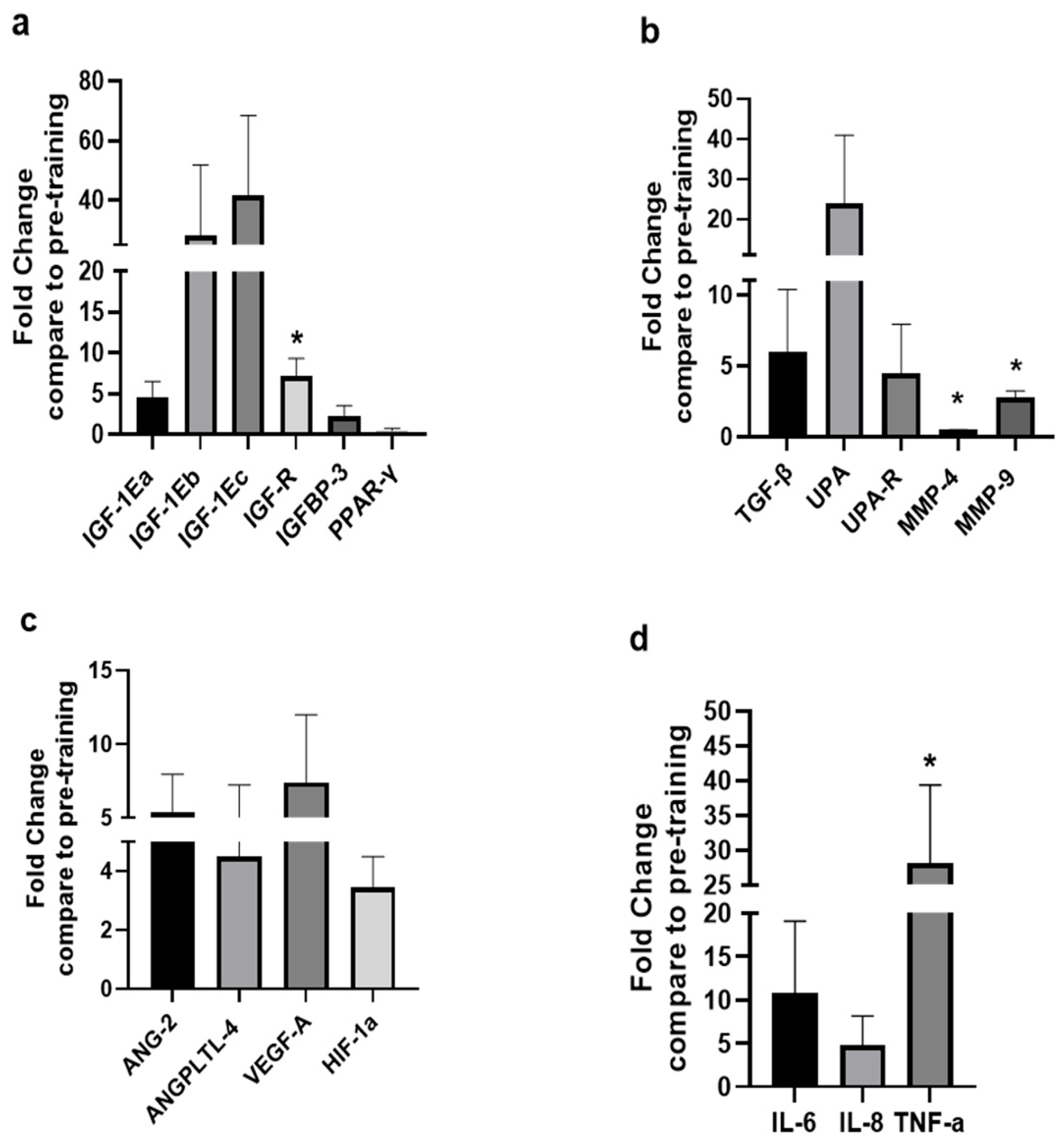
3.4. Molecular Adaptations
4. Discussion
5. Conclusions
Author Contributions
Funding
Institutional Review Board Statement
Informed Consent Statement
Data Availability Statement
Acknowledgments
Conflicts of Interest
Abbreviations
| Testo | Testosterone |
| fT4 | Free Tetraiodothyronine (Thyroxine) |
| HIIT | High-intensity interval training |
| TSH | Thyroid Stimulating Hormone |
| Cort | Cortisol |
| GH | Growth Hormone |
| BF | Body fat |
| BMI | Body mass index |
| BM | Body mass |
| LBM | lean body mass |
| FM | Fat mass |
| HRpeak | Peak heart rate |
| VO2max | Maximal oxygen consumption |
| VT2 | Ventilatory threshold 2 |
| PSVO2max | Paddling speed at maximal oxygen uptake |
| PES | Paddling economy speed |
| PSVT2 | Paddling speed at ventilatory threshold 2 |
| T 1000 m | time needed to cover 1000 m Olympic distance |
| T 200 m | time needed to cover 200 m Olympic distance |
| TGF-β | Transforming growth factor-beta |
| VEGF-A | Vascular endothelial growth factor-a |
| IGF-1Ea | Insulin-like growth factor 1Ea |
| IGF-1Eb | Insulin-like growth factor 1Eb |
| IGF-1Ec | Insulin-like growth factor 1Ec |
| IGF-1R | Insulin-like growth factor-1 receptor |
| IGFBP-3 | Insulin-like growth factor binding protein-3 |
| UPA | Urokinase type plasminogen activator |
| UPA-R | Urokinase type plasminogen activator receptor |
| ANG-2 | Angiopoietin 2 |
| ANGPTL-4 | Angiopoietin-like proteins |
| HIF-1a | Hypoxia inducible factor-1a |
| PPAR-γ | Peroxisome proliferator-activated receptor-γ |
| TNF-a | Tumor necrosis factor-a |
| IL-6 | Interleukin 6 |
| IL-8 | Interleukin 8 |
| MMP-4 | Matrix metalloproteinase-4 |
| MMP-9 | Matrix metalloproteinases-9 |
| GAPDH | Glyceraldehyde 3-phosphate dehydrogenase |
References
- Atakan, M.M.; Guzel, Y.; Shrestha, N.; Kosar, S.N.; Grgic, J.; Astorino, T.A.; Turnagol, H.; Pedisic, Z. Effects of high-intensity interval training and sprint interval training on fat oxidation during exercise: A systematic review and meta-analysis. Br. J. Sports Med. 2022, 56, 988–999. [Google Scholar] [CrossRef]
- Bogdanis, G.C.; Nevill, M.E.; Boobis, L.H.; Lakomy, H.K.; Nevill, A.M. Contribution of phosphocreatine and aerobic metabolism to energy supply during repeated sprint exercise. J. Appl. Physiol. 1996, 80, 876–884. [Google Scholar] [CrossRef] [PubMed]
- Cochran, A.J.; Myslik, F.; MacInnis, M.J.; Percival, M.E.; Bishop, D.; Tarnopolsky, M.A.; Gibala, M.J. Manipulating carbohydrate availability between twice-daily HIIT improves time-trial performance. Int. J. Sport Nutr. Exerc. Metab. 2015, 25, 463–470. [Google Scholar] [CrossRef]
- Coyle, E.F. Biochemical adaptations to exercise: Mitochondrial oxygen uptake and respiratory enzyme activity. J. Biol. Chem. 1984, 242, 2278–2282. [Google Scholar]
- MacDougall, J.D.; Hicks, A.L.; MacDonald, J.R.; McKelvie, R.S.; Green, H.J.; Smith, K.M. Muscle performance and enzymatic adaptations to sprint interval training. J. Appl. Physiol. 1998, 84, 2138–2142. [Google Scholar] [CrossRef] [PubMed]
- Shi, W.; Chen, J.; He, Y.; Su, P.; Wang, M.; Li, X.; Tang, D. Effects of HIIT and MICT on visceral fat and carotid hemodynamics in obese adults. J. Exerc. Sci. Fit. 2022, 20, 355–365. [Google Scholar] [CrossRef]
- Sultana, R.N.; Sabag, A.; Keating, S.E.; Johnson, N.A. Low-volume high-intensity interval training and cardiorespiratory fitness: A systematic review. Sports Med. 2019, 49, 1687–1721. [Google Scholar] [CrossRef]
- Talanian, J.L.; Galloway, S.D.R.; Heigenhauser, G.J.F.; Bonen, A.; Spriet, L.L. High-intensity aerobic interval training increases capacity for fat oxidation in women. J. Appl. Physiol. 2006, 102, 1439–1447. [Google Scholar] [CrossRef]
- Youssef, L.; Granet, J.; Marcangeli, V.; Dulac, M.; Hajj-Boutros, G.; Reynaud, O.; Buckinx, F.; Gaudreau, P.; Morais, J.A.; Mauriège, P.; et al. Adaptations in obese older adults after 12 weeks of HIIT or MICT. Healthcare 2022, 10, 1346. [Google Scholar] [CrossRef]
- Bogdanis, G.C.; Stavrinou, P.; Fatouros, I.G.; Philippou, A.; Chatzinikolaou, A.; Draganidis, D.; Ermidis, G.; Maridaki, M. Short-term HIIT attenuates oxidative stress and improves antioxidant status. Food Chem. Toxicol. 2013, 61, 171–177. [Google Scholar] [CrossRef]
- Buchheit, M.; Laursen, P.B. High-intensity interval training: Solutions to the programming puzzle. Part I: Cardiopulmonary emphasis. Sports Med. 2013, 43, 313–338. [Google Scholar] [CrossRef]
- Burgomaster, K.A.; Howarth, K.R.; Phillips, S.M.; Rakobowchuk, M.; MacDonald, M.J.; McGee, S.L.; Gibala, M.J. Similar metabolic adaptations after sprint interval and endurance training. J. Physiol. 2008, 586, 151–160. [Google Scholar] [CrossRef]
- Gibala, M.J.; McGee, S.L. Metabolic adaptations to short-term HIIT. Exerc. Sport Sci. Rev. 2008, 36, 58–63. [Google Scholar] [CrossRef]
- Fleming, N.; Donne, B.; Fletcher, D.; Mahony, N. Biomechanical assessment of ergometer task specificity in elite flat-water kayakers. J. Sports Sci. Med. 2012, 11, 16–25. [Google Scholar]
- McDonnell, L.K.; Hume, P.A.; Nolte, V. A model for biomechanical assessment of sprint kayaking technique. Sports Biomech. 2012, 11, 507–523. [Google Scholar] [CrossRef]
- Van Someren, K.A.; Palmer, G.S. Prediction of 200 m sprint kayaking performance. Can. J. Appl. Physiol. 2003, 28, 505–517. [Google Scholar] [CrossRef]
- Van Someren, K.; Howatson, G. Prediction of flatwater kayaking performance. Int. J. Sports Physiol. Perform. 2008, 3, 207–218. [Google Scholar] [CrossRef] [PubMed]
- Davidek, P.; Andel, R.; Kobesova, A. Dynamic neuromuscular stabilization and maximum paddling force. J. Hum. Kinet. 2018, 61, 15–27. [Google Scholar] [CrossRef] [PubMed]
- Borges, T.O.; Bullock, N.; Coutts, A.J. Pacing characteristics of elite sprint kayakers. Int. J. Perform. Anal. Sport 2013, 13, 353–364. [Google Scholar] [CrossRef]
- Papandreou, A.; Philippou, A.; Zacharogiannis, E.; Maridaki, M. Physiological adaptations to HIIT and continuous training in kayak athletes. J. Strength Cond. Res. 2020, 34, 2258–2266. [Google Scholar] [CrossRef]
- Billat, V.L.; Renoux, J.C.; Pinoteau, J.; Petit, B.; Koralsztein, J.P. Reproducibility of time to exhaustion at VO2max. Med. Sci. Sports Exerc. 1996, 28, 254–258. [Google Scholar]
- Tesch, P.A. Physiological characteristics of elite kayak paddlers. Can. J. Appl. Sport Sci. 1983, 8, 87–91. [Google Scholar] [PubMed]
- Hahn, A.G.; Pyne, D.B.; Telford, R.D. Relationship between kayak ergometer and on-water performance in elite kayakers. Eur. J. Appl. Physiol. 1988, 57, 534–539. [Google Scholar]
- Lee, H.; Martin, D.T.; Anson, J.M.; Grundy, D.; Hahn, A.G. Physiological characteristics of successful mountain bikers and cyclists. J. Sports Sci. 2002, 20, 1001–1008. [Google Scholar] [CrossRef]
- Lucia, A.; Hoyos, J.; Chicharro, J.L. Physiology of professional road cycling. Sports Med. 1999, 29, 251–267. [Google Scholar] [CrossRef]
- Tesch, P.A.; Piehl, K.; Wilson, G.; Karlsson, J. Oxygen uptake during arm vs. leg exercise. Scand. J. Clin. Lab. Investig. 1976, 36, 691–698. [Google Scholar]
- Zouhal, H.; Jacob, C.; Delamarche, P.; Gratas-Delamarche, A. Catecholamines and hormonal responses to high-intensity interval exercise. Sports Med. 2008, 38, 401–423. [Google Scholar] [CrossRef] [PubMed]
- Coffey, V.G.; Hawley, J.A. Molecular bases of training adaptation. Sports Med. 2007, 37, 737–763. [Google Scholar] [CrossRef]
- Garcia-Pallares, J.; Carrasco, L.; Diaz, A.; Sanchez-Medina, L. Detraining effects in top-level kayakers. J. Sports Sci. Med. 2009, 8, 622–628. [Google Scholar]
- Fletcher, G.F.; Balady, G.J.; Amsterdam, E.A.; Chaitman, B.; Eckel, R.; Fleg, J.; Froelicher, V.F.; Leon, A.S.; Piña, I.L.; Rodney, R.; et al. Exercise standards for testing and training. Circulation 2001, 104, 1694–1740. [Google Scholar] [CrossRef]
- Cintra-Andrade, J.H.; Ripka, W.L.; Heymsfield, S.B. Skinfold calipers: Which instrument to use? J. Nutr. Sci. 2023, 12, e82. [Google Scholar] [CrossRef]
- Jackson, A.S.; Pollock, M.L. Practical assessment of body composition. Phys. Sportsmed. 1985, 13, 76–90. [Google Scholar] [CrossRef]
- Lakomy, H. Power measurement using friction-loaded cycle ergometers. Ergonomics 1986, 29, 509–517. [Google Scholar] [CrossRef] [PubMed]
- Van Someren, K.A.; Phillips, G.R.; Palmer, G.S. Physiological responses during open-water vs ergometer kayaking. Int. J. Sports Med. 2000, 21, 200–204. [Google Scholar] [CrossRef] [PubMed]
- Billat, L.V.; Koralsztein, J.P. Significance of velocity at VO2max and time to exhaustion. Sports. Med. 1996, 22, 90–108. [Google Scholar] [CrossRef]
- Howley, E.T.; Bassett, D.R., Jr.; Welch, H.G. Criteria for maximal oxygen uptake. Med. Sci. Sports Exerc. 1995, 27, 1292–1301. [Google Scholar] [CrossRef] [PubMed]
- Wasserman, K. Anaerobic threshold evaluation. Am. Rev. Respir. Dis. 1984, 129, S35–S40. [Google Scholar] [CrossRef]
- Tanner, R.K.; Fuller, K.L.; Ross, M.L. Evaluation of portable blood lactate analysers. Eur. J. Appl. Physiol. 2007, 109, 551–559. [Google Scholar] [CrossRef]
- Gibala, M. Molecular Responses to High-Intensity Interval Exercise. Appl. Physiol. Nutr. Metab. 2009, 34, 428–432. [Google Scholar] [CrossRef]
- Londeree, B.R. Effect of Training on Lactate/Ventilatory Thresholds: Meta-Analysis. Med. Sci. Sports Exerc. 1997, 29, 837–843. [Google Scholar] [CrossRef]
- Michael, J.S.; Rooney, K.B.; Smith, R. Metabolic Demands of Kayaking: A Review. J. Sports Sci. Med. 2008, 7, 1–7. [Google Scholar]
- Hooper, D.R.; Kraemer, W.J.; Focht, B.C.; Volek, J.S.; DuPont, W.H.; Caldwell, L.K.; Caldwell, L.K. Endocrine Roles of Testosterone in Resistance Exercise. Sports Med. 2017, 47, 1709–1720. [Google Scholar] [CrossRef]
- Sheykhlouvand, M.; Khalili, E.; Agha-Alinejad, H.; Gharaat, M. Hormonal and Physiological Adaptations to HIIT in Canoe Polo Athletes. J. Strength Cond. Res. 2016, 30, 859–866. [Google Scholar] [CrossRef]
- Philippou, A.; Maridaki, M.; Tenta, R.; Koutsilieris, M. Hormonal Responses After Eccentric Exercise in Humans. Hormones 2017, 16, 405–413. [Google Scholar] [CrossRef]
- Bogdanis, G.C.; Philippou, A.; Stavrinou, P.S.; Tenta, R.; Maridaki, M. Hormonal and Blood Cell Responses Before and After Short-Term HIIT. Res. Sports Med. 2022, 30, 400–414. [Google Scholar] [CrossRef]
- Hejazi, S.M. Effects of HIIT on GH and IGF-1. Int. J. Med. Res. Health Sci. 2017, 6, 55–59. [Google Scholar]
- Philippou, A.; Maridaki, M.; Koutsilieris, M. UPA and TGF-β1 in Muscle Regeneration. In Vivo 2008, 22, 735–750. [Google Scholar] [PubMed]
- Tzanis, G.; Philippou, A.; Karatzanos, E.; Dimopoulos, S.; Kaldara, E.; Nana, E.; Pitsolis, T.; Rontogianni, D.; Koutsilieris, M.; Nanas, S. HIIT Improves Skeletal Myopathy in Heart Failure. J. Card. Fail. 2017, 23, 36–46. [Google Scholar] [CrossRef] [PubMed]
- Philippou, A.; Tryfonos, A.; Theos, A.; Nezos, A.; Halapas, A.; Maridaki, M.; Koutsilieris, M. Tissue Remodeling and Inflammation After Eccentric Exercise. Mol. Biol. Rep. 2021, 48, 4047–4054. [Google Scholar] [CrossRef] [PubMed]
- Tryfonos, A.; Tzanis, G.; Pitsolis, T.; Karatzanos, E.; Koutsilieris, M.; Nanas, S.; Philippou, A. HIIT Enhances Angiogenesis-Related Genes in Skeletal Muscle. Cells 2021, 10, 1915. [Google Scholar] [CrossRef]
- Kjaer, M. Role of the Extracellular Matrix in Adaptation of Tendon and Muscle. Physiol. Rev. 2004, 84, 649–698. [Google Scholar] [CrossRef] [PubMed]
- Hellsten, Y.; Hoier, B. Capillary Growth in Human Skeletal Muscle. Biochem. Soc. Trans. 2014, 42, 1616–1622. [Google Scholar] [CrossRef]
- Herbert, P.; Lawrence, H.; Scultorpe, J.; Grace, F. HIIT Increases IGF-1 in Sedentary Aging Men. Aging Male 2017, 20, 54–59. [Google Scholar] [CrossRef] [PubMed][Green Version]
- Firth, S.M.; Baxter, R.C. Cellular Actions of IGF Binding Proteins. Endocr. Rev. 2002, 23, 824–854. [Google Scholar] [CrossRef] [PubMed]


| Target Gene | Primer Sequence |
|---|---|
| TGF-β | F: 5′-CTACTACGCCAAGGAGGTCAC-3′ R: 5′-ATGGAGTCGTTGGCCACGA-3′ |
| VEGF-A | F: 5′-AGGGCAGAATCATCACGAAG-3′ R: 5′-CACACAGGATGGCTTGAAGA-3′ |
| IGF-1 Ea | F: 5′-GTGGAGACAGGGGCTTTTATTTC-3′ R: 5′-CTTGTTTCCTGCACTCCCTCTACT-3′ |
| IGF-1 Eb | F: 5′-ATGTCCTCCTCGCATCTCT-3′ R: 5′-CCTCCT TCTGTTCCCCTC-3′ |
| IGF-1 Ec | F: 5′-CGAAGTCTCAGAGAAGGAAAGG-3′ R: 5′-ACAGGTAACTCGTGCAGAGC-3′ |
| UPA | F: 5′-GTCTACCTGGGTCGCTCAAG-3′ R: 5′-CAGTGGTGGTTTTACGACAC-3′ |
| UPA-R | F: 5′-CATGCAGTGTAAGACCAACGGGGA-3′ R: 5′-TGAGACCGGCCCGACAGTGGTAT-3′ |
| IGF-1R | F: 5′-GGGAATGGAGTGCTGTATG-3′ R: 5′-CACAGAAGCTTTCGTTGAGAA-3′ |
| IGFBP-3 | F: 5′-AGTGAGTCGGAGGAAGACCGCA-3′ R: 5′-TCTCCCAGGCTACACCACCAAGG-3′ |
| ANG-2 | F: 5′-GACGGCTGTGATGATAGAAATAGG-3′ R: 5′-GACTGTAGTTGGATGATGTGCTTG-3′ |
| ANGPTL-4 | F: 5′-GTGGCTCAAACACCTGACCA-3′ R: 5′-GAAAGGGGGCTTCTCCAGTC-3′ |
| HIF-1 | F: 5′-AAACTTGGCAACCTTGGATTGG-3′ R: 5′-TCCGTCCCTCAACCTCTCAG-3′ |
| PPAR-γ | F: 5′-TGCTCAAGTATGGTGTCCATGAG R: 5′-AGTGCATTGAACTTCACAGCAAA |
| TNF-a | F: 5′-AAGAGTTCCCCAGGGACCTCT-3′ R: 5′-ACATGGAGTAGATGAGGGT-3′ |
| IL-6 | F: 5′-CCTGACCCAACCACAAATGC-3′ R: 5′-ATCTGAGGTGCCCATGCTAC-3′ |
| IL-8 | F: 5′-CCACCGGAAGGAACCATCTC-3′ R: 5′-TTCCTTGGGGTCCAGACAGA-3′ |
| MMP-4 | F: 5′-TTTGGACACATCTGGGCAGT-3′ R: 5′-GGGCAGCCATAGAAGGTGT-3′ |
| MMP-9 | F: 5′-CAGGGAATGAGTACTGGGTCTATT-3′ R: 5′-ACTCCAGTTAAAGGCAGCATCTAC-3′ |
| GAPDH | F: 5′-CATCACTGCCACCCAGAAGA-3′ R: 5′-TCCACCACCCTGTTGCTGTA-3′ |
| Variable | HIITpre | HIITpost | t-Test | Cohen’s d | Effect Size |
|---|---|---|---|---|---|
| Body Fat (%) | 11.80 ± 2.94 | 10.59 ± 3.08 | 0.002 ** | −0.39 | Small–medium ↓ |
| BMI (kg·m−2) | 22.78 ± 2.45 | 22.48 ± 2.36 | 0.83 | −0.12 | Negligible |
| Height (cm) | 176.33 ± 4 | 176.33 ± 4 | – | 0.00 | No change |
| Body Mass (kg) | 70.75 ± 7.13 | 69.81 ± 6.81 | – | −0.13 | Negligible |
| LBM (kg) | 62.26 ± 4.80 | 62.26 ± 4.83 | 0.90 | 0.00 | No change |
| Variables | HIITpre | HIITpost | t-Test (p) | Cohen’s d | Effect Size |
|---|---|---|---|---|---|
| VO2max (mL·kg−1·min−1) | 46.96 ± 5.45 | 47.85 ± 3.37 | 0.593 | +0.19 | Small ↑ |
| PSVO2max (km·h−1) | 12.86 ± 1.23 | 13.38 ± 0.80 | 0.062 | +0.49 | Small–medium |
| PSVT2 (km·h−1) | 11.10 ± 0.53 | 11.60 ± 0.10 | 0.050 * | +1.16 | Large |
| [La+2]peak (mmol·L−1) | 13.80 ± 2.78 | 14.74 ± 3.14 | 0.823 | +0.32 | Small |
| PES (–) | 9.27 ± 0.80 | 9.47 ± 0.55 | 0.116 | +0.29 | Small |
| HRpeak (beats·min−1) | 193.0 ± 10.17 | 193.0 ± 10.20 | 0.771 | 0.00 | No change |
| T 1000 m(s) | 247.53 ± 2.68 | 243.35 ± 2.10 | 0.0027 ** | −1.71 | Large |
| T 200 m(s) | 39.76 ± 0.21 | 39.00 ± 0.21 | 0.0004 *** | −3.62 | Very large |
| Variable | HIITPre | HIITpost | t-Test | Cohen’s d | Effect Size |
|---|---|---|---|---|---|
| GH (ng·μL−1) | 1663.68 ± 1455.65 | 771.65 ± 1148.36 | 0.241 | −0.69 | Medium–large ↓ |
| IGF-1 (pg·μL−1) | 312.27 ± 68.71 | 313.92 ± 56.17 | 0.934 | +0.03 | Negligible |
| GH/IGF-1 ratio | 5.18 ± 4.74 | 2.53 ± 3.91 | 0.250 | −0.61 | Medium |
| Testosterone (ng·μL−1) | 4.86 ± 0.43 | 5.63 ± 0.87 | 0.050 * | +1.08 | Large |
| Cortisol (ng·μL−1) | 89.73 ± 55.43 | 88.53 ± 12.52 | 0.964 | −0.03 | Negligible |
| Testo/Cort ratio | 0.054 ± 0.029 | 0.064 ± 0.008 | 0.869 | +0.47 | Small–medium |
| fT4 (nmol·μL−1) | 84.38 ± 11.31 | 85.22 ± 10.25 | 0.779 | +0.08 | Negligible |
| TSH (μIU·μL−1) | 1.87 ± 0.20 | 2.07 ± 0.40 | 0.470 | +0.61 | Medium |
| fT4/TSH ratio | 45.1 ± 21.18 | 41.18 ± 24.85 | 0.741 | −0.17 | Small |
Disclaimer/Publisher’s Note: The statements, opinions and data contained in all publications are solely those of the individual author(s) and contributor(s) and not of MDPI and/or the editor(s). MDPI and/or the editor(s) disclaim responsibility for any injury to people or property resulting from any ideas, methods, instructions or products referred to in the content. |
© 2025 by the authors. Licensee MDPI, Basel, Switzerland. This article is an open access article distributed under the terms and conditions of the Creative Commons Attribution (CC BY) license (https://creativecommons.org/licenses/by/4.0/).
Share and Cite
Papandreou, A.; Tzanis, G.; Moustogiannis, A.; Zevolis, E.; Zacharogiannis, E.; Maridaki, M.; Nanas, S.; Koutsilieris, M.; Philippou, A. Molecular, Systemic, and Physiological Adaptations to High-Intensity Interval Training in Flatwater Kayak Athletes. Sports 2025, 13, 451. https://doi.org/10.3390/sports13120451
Papandreou A, Tzanis G, Moustogiannis A, Zevolis E, Zacharogiannis E, Maridaki M, Nanas S, Koutsilieris M, Philippou A. Molecular, Systemic, and Physiological Adaptations to High-Intensity Interval Training in Flatwater Kayak Athletes. Sports. 2025; 13(12):451. https://doi.org/10.3390/sports13120451
Chicago/Turabian StylePapandreou, Apostolos, Georgios Tzanis, Athanasios Moustogiannis, Evangelos Zevolis, Elias Zacharogiannis, Maria Maridaki, Serafim Nanas, Michael Koutsilieris, and Anastassios Philippou. 2025. "Molecular, Systemic, and Physiological Adaptations to High-Intensity Interval Training in Flatwater Kayak Athletes" Sports 13, no. 12: 451. https://doi.org/10.3390/sports13120451
APA StylePapandreou, A., Tzanis, G., Moustogiannis, A., Zevolis, E., Zacharogiannis, E., Maridaki, M., Nanas, S., Koutsilieris, M., & Philippou, A. (2025). Molecular, Systemic, and Physiological Adaptations to High-Intensity Interval Training in Flatwater Kayak Athletes. Sports, 13(12), 451. https://doi.org/10.3390/sports13120451


