Development of Sparganothis sulfureana (Lepidoptera: Tortricidae) on Cranberry Cultivars

Abstract
1. Introduction
2. Methods and Materials
2.1. Plants
2.2. Insects
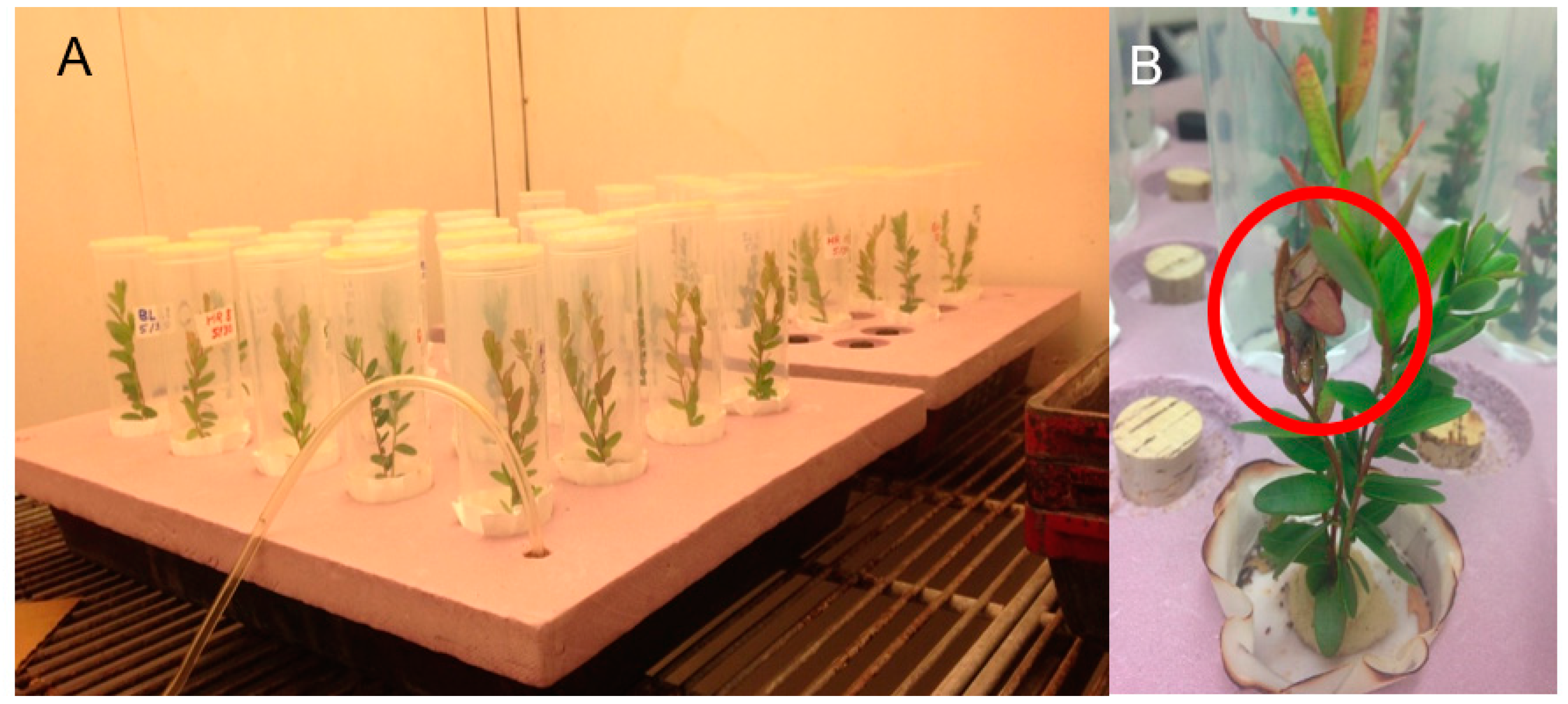
2.3. Hydroponic System
2.4. Developmental Rate Assay
2.5. Statistical Analysis
3. Results
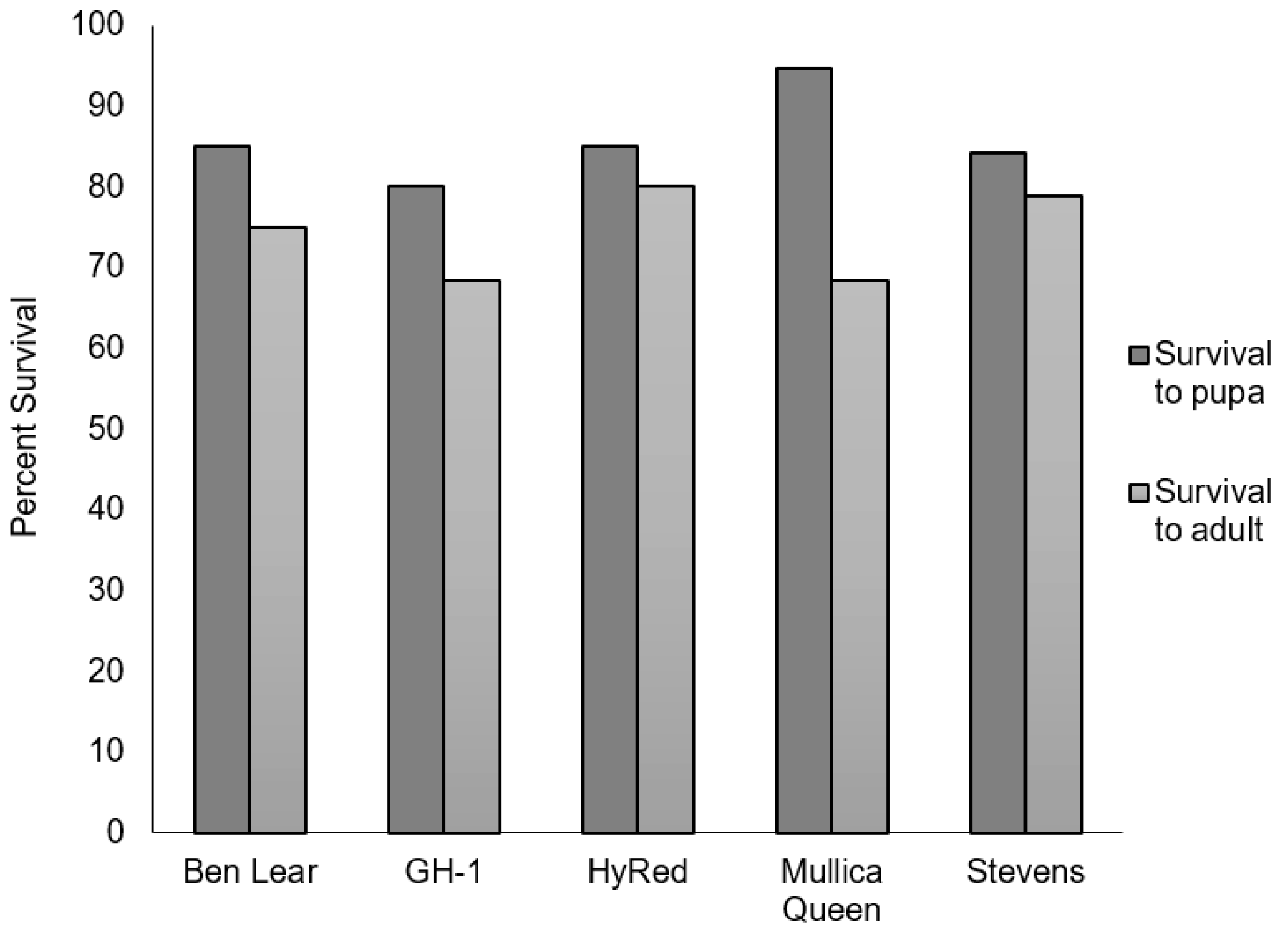
3.1. Survival Rates
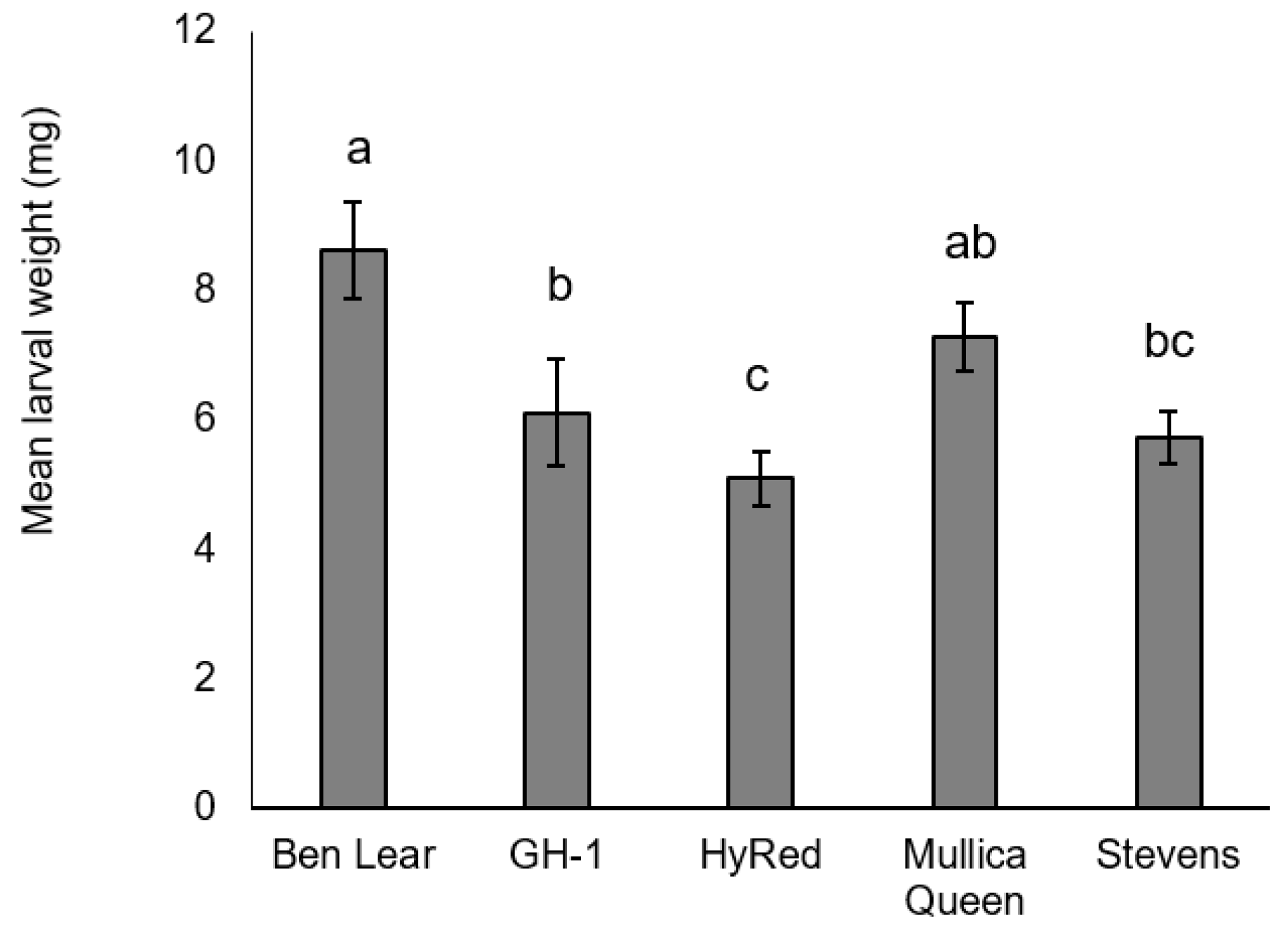
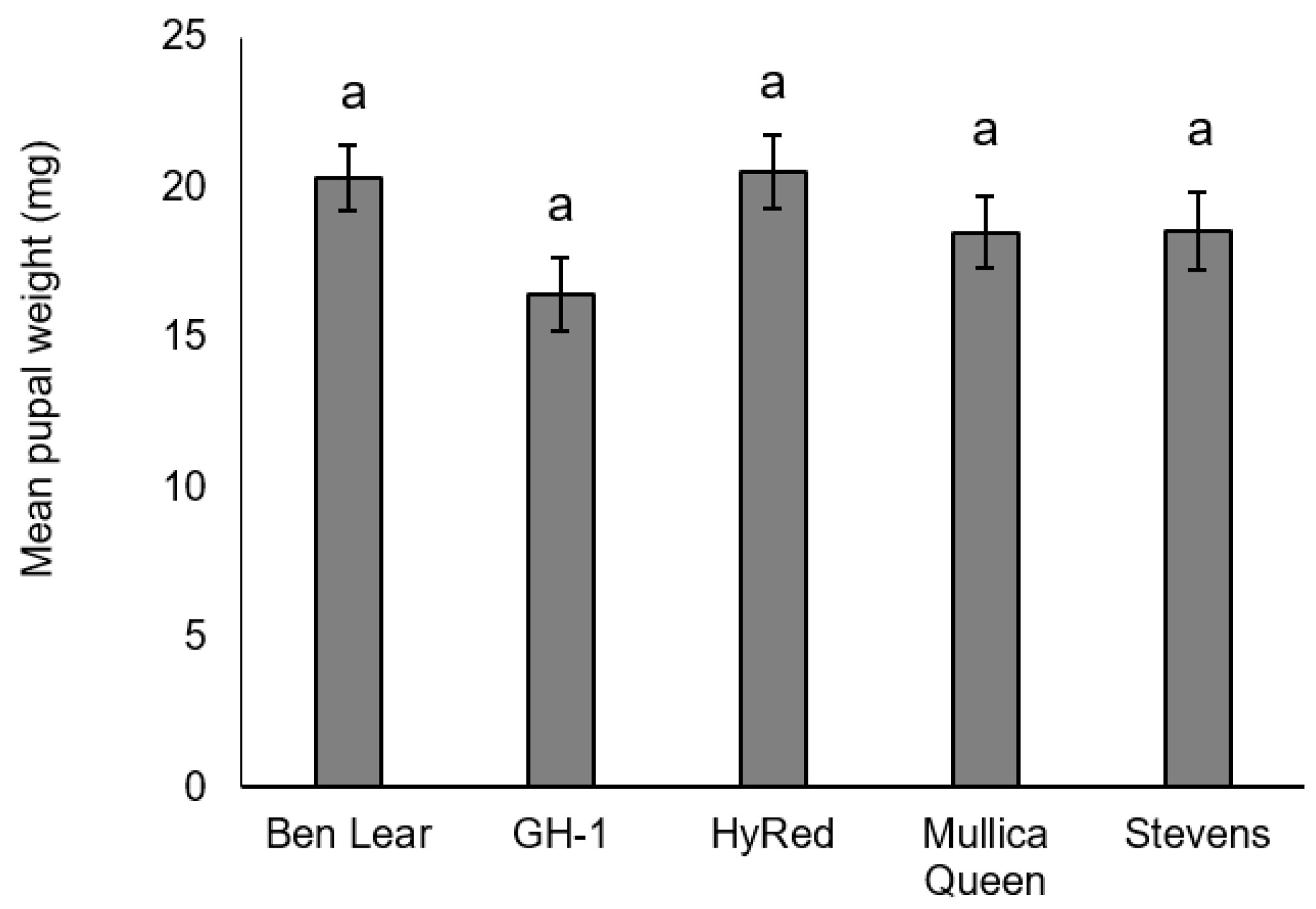
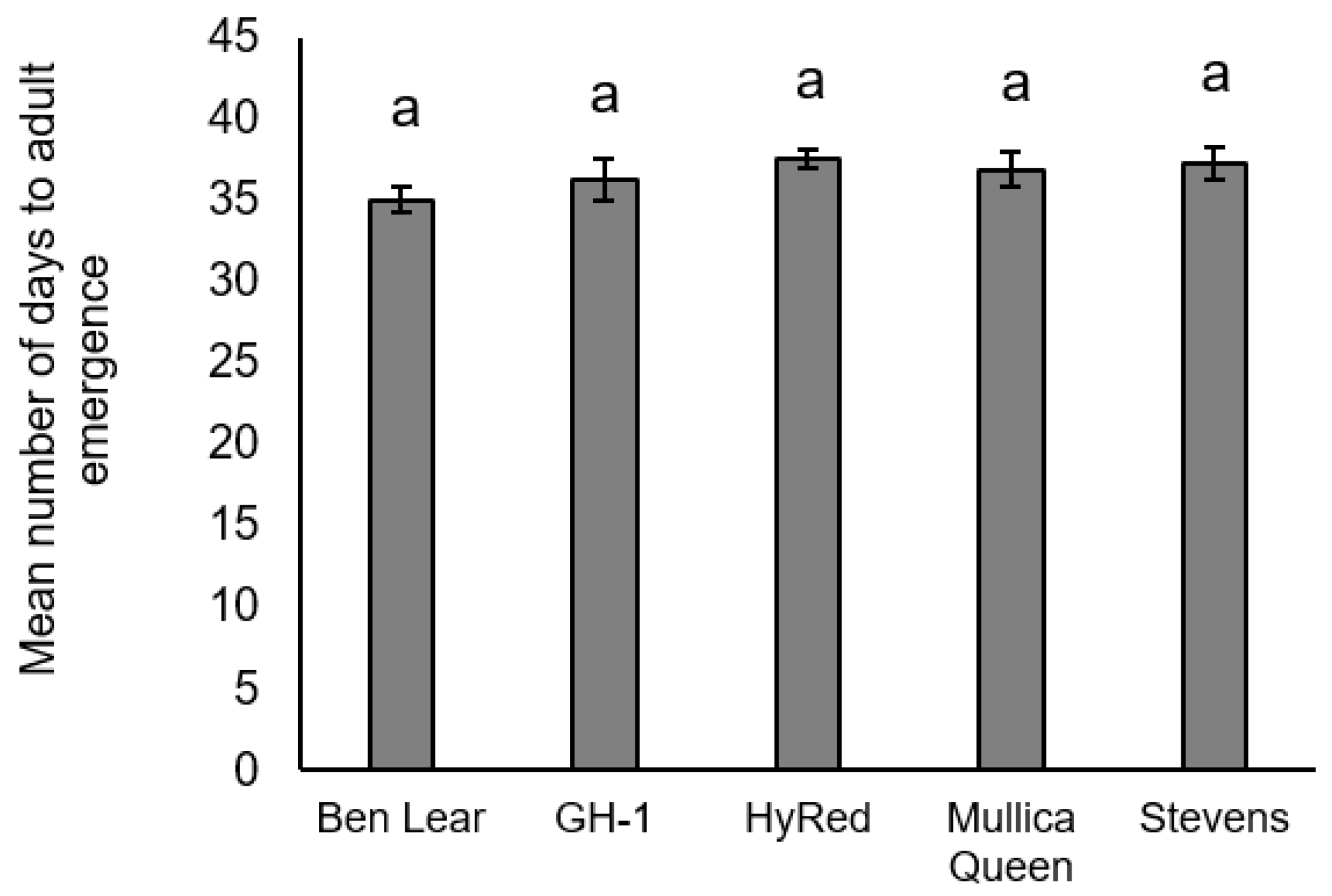
3.2. Growth and Developmental Time
4. Discussion
5. Conclusions
Acknowledgments
Author Contributions
Conflicts of Interest
References
- Painter, R.H. Insect Resistance in Crop Plants; Macmillan: New York, NY, USA, 1951. [Google Scholar]
- Smith, C.M. Plant Resistance to Arthropods: Molecular and Conventional Approaches; Springer: Dordrecht, The Netherlands, 2005. [Google Scholar]
- Parrott, W.L.; Jenkins, N.; McCarthy, J.C.; Lambert, L. A procedure to evaluate for antibiosis in cotton to the tobacco budworm. J. Econ. Entomol. 1978, 71, 310–312. [Google Scholar] [CrossRef] [Scilit]
- Warnock, D.F.; Hutchison, W.D.; Kurtti, T.J.; Davis, D.W. Laboratory bioassays for evaluating sweet corn antibiosis on European corn borer (Lepidoptera: Pyralidae) larval development. J. Entomol. Sci. 1997, 32, 342–357. [Google Scholar] [CrossRef] [Scilit]
- Davis, C.S.; Ni, X.Z.; Quisenberry, S.S.; Foster, J.E. Identification and quantification of hydroxamic acids in maize seedling root tissue and impact on western corn rootworm (Coleoptera: Chrysomelidae) larval development. J. Econ. Entomol. 2000, 93, 989–992. [Google Scholar] [CrossRef] [Scilit] [PubMed]
- Dana, M.N. The American cranberry industry. Acta Hort. 1989, 241, 287–294. [Google Scholar] [CrossRef] [Scilit]
- Eck, P. The American Cranberry; Rutgers University Press: New Brunswick, NJ, USA, 1990. [Google Scholar]
- Colquhoun, J.; Johnson, H. Sustainable Cranberry Production for a Vibrant Future: The Wisconsin Experience; University of Wisconsin-Madison Horticulture Department: Madison, WI, USA, 2010. [Google Scholar]
- Blake, G.; Sandler, H.A.; Coli, W.; Pober, D.M.; Coggins, C. An assessment of grower perceptions and factors influencing adoption of IPM in commercial cranberry production. Renew. Agric. Food Syst. 2007, 22, 134–144. [Google Scholar] [CrossRef] [Scilit]
- Vorsa, N.; Johnson-Cicalese, J. American cranberry. In Fruit Breeding; Badenes, M.L., Byrne, D.H., Eds.; Springer: New York, NY, USA, 2012; pp. 191–223. [Google Scholar]
- Wilcox, R.B.; Beckwith, C.S. A factor in the varietal resistance of cranberries to the false blossom disease. J. Agric. Res. 1933, 47, 583–590. [Google Scholar]
- Neto, C.C.; Dao, C.A.; Salvas, M.R.; Autio, W.R.; Heuvel, J.E.V. Variation in concentration of phenolic acid derivatives and quercetin glycosides in foliage of cranberry that may play a role in pest deterrence. J. Am. Soc. Hortic. Sci. 2010, 135, 494–500. [Google Scholar]
- Rodriguez-Saona, C.; Vorsa, N.; Singh, A.P.; Johnson-Cicalese, J.; Szendrei, Z.; Mescher, M.C.; Frost, C.J. Tracing the history of plant traits under domestication in cranberries: Potential consequences on anti-herbivore defences. J. Exp. Bot. 2011, 62, 2633–2644. [Google Scholar] [CrossRef] [Scilit] [PubMed]
- Beckwith, C.S. Sparganothis sulfureana Clem., a cranberry pest in New Jersey. J. Econ. Entomol. 1938, 31, 253–256. [Google Scholar] [CrossRef] [Scilit]
- Chapman, P.J.; Lienk, S.E. Tortricid fauna of apple in New York (Lepidoptera: Tortricidae). In Including an Account of Apple’s Occurrence in the State, Especially as a Naturalized Plant, Special ed.; New York State Agricultural Experiment Station, Cornell University: Geneva, NY, USA, 1971. [Google Scholar]
- Averill, A.; Sylvia, M. Cranberry Insects of the Northeast; University of Massachusetts: Amherst, MA, USA, 1998. [Google Scholar]
- Cockfield, S.D.; Mahr, D.L. Flooding cranberry beds to control blackheaded fireworm (Lepidoptera: Tortricidae). J. Econ. Entomol. 1992, 85, 2383–2388. [Google Scholar] [CrossRef] [Scilit]
- Van Zoeren, J. Impacts of Spring Flooding on Carnivore and Detritivore Populations in Wisconsin Cranberries: Implications for Biocontrol. Master’s Thesis, University of Wisconsin-Madison, Madison, WI, USA, 2015. [Google Scholar]
- Polavarapu, S.; Lonergan, G.; Peng, H.; Neilsen, K. Potential for mating disruption of Sparganothis sulfureana (Lepidoptera: Tortricidae) in cranberries. J. Econ. Entomol. 2001, 94, 658–665. [Google Scholar] [CrossRef] [Scilit] [PubMed]
- Steffan, S.A.; Chasen, E.M.; Deutsch, A.E.; Mafra-Neto, A. Multi-species mating disruption in cranberries (Ericales: Ericaceae): Early evidence using a flowable emulsion. J. Insect Sci. 2017, 17, 1–6. [Google Scholar] [CrossRef] [Scilit] [PubMed]
- Guédot, C.; McManus, P.; Colquhoun, J.; Nice, G. Cranberry Pest Management in Wisconsin. Extension Publication A3276; University of Wisconsin: Madison, WI, USA, 2016. [Google Scholar]
- Rice-Mahr, S.E.; Moffitt, L.J. Biologic and Economic Assessment of Pesticide Usage on Cranberry; USDA National Agricultural Pesticide Impact Assessment Program Report 2-CA-94; U.S. Department of Agriculture: Washington DC, USA, 1994.
- Sylvia, M.M.; Averill, A.L. Managing Resistant Sparganothis Fruitworm, Sparganothis Sulfureana. Extension Publication; University of Massachusetts: E.Wareham, MA, USA, 2001. [Google Scholar]
- Marucci, P.E.; Moulter, H.J. Biological control of Sparganothis fruitworm on cranberries in New Jersey: Part I. Cranberries Mag. 1992, 56, 14–15. [Google Scholar]
- Schlautman, B.; Fajardo, D.; Bougie, T.; Wiesman, E.; Polashock, J.; Vorsa, N.; Steffan, S.A.; Zalapa, J. Development and Validation of 697 Novel Polymorphic Genomic and EST-SSR Markers in the American Cranberry (Vaccinium macrocarpon Ait.). Molecules 2015, 20, 2001–2013. [Google Scholar] [CrossRef] [Scilit] [PubMed]
- McCown, B.H.; Zeldin, E.L. “HyRed”, an early, high fruit color cranberry hybrid. ResearchGate 2003, 38, 304–305. [Google Scholar]
- Rutgers, New Jersey Agricultural Experiment Station. ‘Mullica Queen’. Available online: http://www.integritypropagation.com/assets/Mullica_Queen_Fact_Sheet%203-07.pdf (accessed on 22 December 2017).
- McMahan, E.E.; Steffan, S.A.; Guédot, C. Population densities of Lepidopteran pests in selected cranberry cultivars in Wisconsin. J. Econ. Entomol. 2017, 110, 1113–1119. [Google Scholar] [CrossRef] [Scilit]
- Deutsch, A.E.; Rodriguez-Saona, C.R.; Kyryczenko-Roth, V.; Sojka, J.; Zalapa, J.E.; Steffan, S.A. Degree-day benchmarks for Sparganothis sulfureana (Lepidoptera: Tortricidae) development in cranberries. J. Econ. Entomol. 2014, 107, 2130–2136. [Google Scholar] [CrossRef] [Scilit] [PubMed]
- Howell, J.F. Reproductive Biology. In Tortricid Pests, Their Biology, Natural Enemies and Control, World Crop Pests; van der Geest, L.P.S., Evenhuis, H.H., Eds.; Elsevier Science Publishers: Amsterdam, The Netherlands, 1991; pp. 157–174. [Google Scholar]
- SAS. SAS, Version 9.4; SAS Institute Inc.: Cary, NC, USA, 2014. [Google Scholar]
- Snedecor, G.W.; Cochran, W.G. Statistical Methods, 7th ed.; The Iowa State University Press: Ames, IA, USA, 1980. [Google Scholar]
- Farrar, R.R.; Kennedy, G.G. Growth inhibitors in host plant resistance to insects: Examples from a wild tomato with Heliothis zea (Lepidoptera: Noctuidae). J. Entomol. Sci. 1990, 25, 46–56. [Google Scholar] [CrossRef] [Scilit]
- Calvo, D.; Molina, J.M. Utilization of blueberry by the lappet moth, Streblote panda Hübner (Lepidoptera: Lasiocampidae): Survival, development, and larval performance. J. Econ. Entomol. 2004, 97, 957–963. [Google Scholar] [CrossRef] [Scilit] [PubMed]
- Beninger, C.W.; Abou-Zaid, M.M. Flavonol glycosides from four pine species that inhibit early instar gypsy moth (Lepidoptera: Lymantriidae) development. Biochem. Syst. Ecol. 1997, 25, 505–512. [Google Scholar] [CrossRef] [Scilit]
- Isman, M.B.; Duffey, S.S. Toxicity of tomato phenolic compounds to the fruitworm, Heliothis zea. Entomol. Exp. Appl. 1982, 31, 370–376. [Google Scholar] [CrossRef] [Scilit]
- Stevenson, P.C.; Anderson, J.C.; Blaney, W.M.; Simmonds, M.S.J. Developmental inhibition of Spodoptera litura (Fab.) larvae by a novel caffeoylquinic acid from the wild groundnut, Arachis paraguariensis (Chod et Hassl.). J. Chem. Ecol. 1993, 19, 2917–2933. [Google Scholar] [CrossRef] [Scilit] [PubMed]
- Coley, P.D. Herbivory and Defensive Characteristics of Tree Species in a Lowland Tropical Forest. Ecol. Monogr. 1983, 53, 209–229. [Google Scholar] [CrossRef] [Scilit]
- Barbosa, P.; Martinat, P.; Waldvogel, M. Development, fecundity and survival of the herbivore Lymantria dispar and the number of plant species in its diet. Ecol. Entomol. 1986, 11, 1–6. [Google Scholar] [CrossRef] [Scilit]
- Meyer, J.R.; Ballington, J.R. Resistance of Vaccinium spp. to the leafhopper Scaphytopius magdalensis (Homoptera: Cicadellidae). Ann. Entomol. Soc. Am. 1990, 83, 515–520. [Google Scholar] [CrossRef] [Scilit]
- Wang, S.Y.; Lin, H.-S. Antioxidant activity in fruits and leaves of blackberry, raspberry, and strawberry varies with cultivar and developmental stage. J. Agric. Food Chem. 2000, 48, 140–146. [Google Scholar] [CrossRef] [Scilit] [PubMed]
- Cockfield, S.D.; Mahr, D.L. Consequences of feeding site selection on growth and survival of young blackheaded fireworm (Lepidotera: Tortricidae). Environ. Entomol. 1993, 22, 607–612. [Google Scholar] [CrossRef] [Scilit]
- Nylin, S.; Wiklund, C.; Wickman, P.; Garciabarros, E. Absence of trade-offs between sexual size dimorphism and early male emergence in a butterfly. Ecology 1993, 74, 1414–1427. [Google Scholar] [CrossRef] [Scilit]
- Tammaru, T. Determination of adult size in a folivorous moth: Constraints at instar level? Ecol. Entomol. 1998, 23, 80–89. [Google Scholar] [CrossRef] [Scilit]
- Leather, S.R. Size, reproductive potential and fecundity in insects: Things aren’t as simple as they seem. Oikos 1988, 51, 386–389. [Google Scholar] [CrossRef] [Scilit]
- Miller, C.A. A technique for estimating the fecundity of natural populations of the spruce budworm. Can. J. Zool. 1957, 35, 1–13. [Google Scholar] [CrossRef] [Scilit]
- McCown, B.H.; Zeldin, E.L. Vaccinium spp. Cranberry. In Biotechnology of Fruit and Nut Crops. (Biotechnology in Agriculture Series No. 29); Litz, R.E., Ed.; CAB International: Wallingford, UK, 2005; pp. 247–261. [Google Scholar]
- Serres, R.; Stang, E.; McCabe, D.; Russell, D.; Mahr, D.; McCown, B. Gene transfer using electric discharge particle bombardment and recovery of transformed cranberry plants. J. Am. Soc. Hortic. Sci. 1992, 117, 174–180. [Google Scholar]

© 2018 by the authors. Licensee MDPI, Basel, Switzerland. This article is an open access article distributed under the terms and conditions of the Creative Commons Attribution (CC BY) license (http://creativecommons.org/licenses/by/4.0/).
Share and Cite
McMahan, E.E.; Guédot, C. Development of Sparganothis sulfureana (Lepidoptera: Tortricidae) on Cranberry Cultivars. Insects 2018, 9, 4. https://doi.org/10.3390/insects9010004
McMahan EE, Guédot C. Development of Sparganothis sulfureana (Lepidoptera: Tortricidae) on Cranberry Cultivars. Insects. 2018; 9(1):4. https://doi.org/10.3390/insects9010004
Chicago/Turabian StyleMcMahan, Erin E., and Christelle Guédot. 2018. "Development of Sparganothis sulfureana (Lepidoptera: Tortricidae) on Cranberry Cultivars" Insects 9, no. 1: 4. https://doi.org/10.3390/insects9010004
APA StyleMcMahan, E. E., & Guédot, C. (2018). Development of Sparganothis sulfureana (Lepidoptera: Tortricidae) on Cranberry Cultivars. Insects, 9(1), 4. https://doi.org/10.3390/insects9010004