Article

Cherry Pollen and Bee Bread Enhance Fitness of Chaetodactylus hirashimai (Acari: Sarcoptiformes): A Two-Sex Life-Table Evaluation of Four Pollen Diets


Shandong Institute of Sericulture, Shandong Academy of Agricultural Sciences, Yantai 265503, China
*
Author to whom correspondence should be addressed.
Insects 2026, 17(8), 797; https://doi.org/10.3390/insects17080797
Submission received: 2 July 2026 / Revised: 28 July 2026 / Accepted: 29 July 2026 / Published: 31 July 2026
(This article belongs to the Section Insect Physiology, Reproduction and Development)

Simple Summary

The mason bee Osmia excavata is a key pollinator of early-spring fruit trees in northern China, but its populations are severely threatened by the mite Chaetodactylus hirashimai. This mite feeds on pollen inside mason bee nests, thus decreasing bee survival and pollination efficiency. Here, using two-sex life tables, we investigated how cherry pollen, cherry bee bread, apple pollen, and apple bee bread affect C. hirashimai development, survival, and reproduction. Cherry pollen strongly promoted mite development and reproduction, whereas bee bread, compared with raw pollen, significantly improved mite fitness. These findings highlight that cherry-dominated orchards might exacerbate mite infestations, thus posing a major risk to mason bee health. Our study provides critical information for developing sustainable pest management strategies that balance pollinator conservation and mite control in orchard ecosystems.

Abstract

The mason bee Osmia excavata Alfken (Hymenoptera: Megachilidae) is an essential pollinator for rosaceous fruit trees in northern China, but its populations are declining because of severe infestations by the mite Chaetodactylus hirashimai Kurosa (Acari: Sarcoptiformes). This mite feeds on pollen within mason bee nest tubes, thereby impairing larval development. However, the effects of different floral resources on the fitness of C. hirashimai remain unclear. Herein, we evaluated the development, survival, and reproduction of C. hirashimai reared on four diets (cherry pollen, cherry bee bread, apple pollen, or apple bee bread), by using an age-stage, two-sex life table. Chaetodactylus hirashimai successfully completed its life cycle on all diets. Cherry pollen supported shorter pre-adult development, longer adult longevity, and higher fecundity than apple pollen. Bee bread diets resulted in significantly lower pre-adult mortality (11.76–14.81%), and higher fecundity (270–278 eggs/female) and net reproductive rate (R0 = 115–120 offspring/individual), than raw pollen (44.64–44.83% mortality; 117–179 eggs/female; R0 = 40–50 offspring/individual). No significant differences in the intrinsic rate of increase (r) and finite rate of increase (λ) were observed among diets. Our findings demonstrated that cherry pollen is a highly favorable resource for C. hirashimai, and bee bread further enhances mite population growth. This study highlights the ecological conflict between cherry pollination and mite infestation, and these life-table results can provide preliminary laboratory support for subsequent research on integrated mite control in fruit orchards.

1. Introduction

The orchard mason bee, Osmia excavata Alfken (Hymenoptera: Megachilidae), is a critical pollinator of rosaceous fruit trees in northern China [1,2,3]. Because of its low developmental threshold temperature, high foraging frequency, and superior pollination efficiency, it has been widely used for the pollination of economically important fruit trees, such as apple, pear, and peach [4,5]. Pollination by O. excavata significantly improves fruit set and quality, and outperforms both honeybee pollination and artificial pollination [6,7]. This species is therefore recognized as an important resource insect in China [8,9,10]. However, wild and artificially reared populations of O. excavata have markedly declined in recent years, and infestation by nest-inhabiting mites has become a key factor limiting population expansion and field application [11,12,13,14,15].
Chaetodactylus hirashimai Kurosa (Acari: Sarcoptiformes) is a major mite pest of Osmia excavata. This species was originally described and native to Japan; it was first discovered and documented in China in 2016, and has since dispersed widely in northern fruit orchards and severely harmed local mason bee populations [16,17]. This mite has two different morphs: the reproductive type and the dispersal type. The reproductive morphs are the primary form colonizing brood cell pollen masses; they feed heavily on stored pollen, reproduce prolifically, and leave abundant brown powdery residues inside nest cavities. This heavy exploitation of pollen deprives mason bee larvae of food resources, leading to larval developmental retardation or mortality [17,18]. Ultimately, survival rates across all mason bee life stages inside nest tubes drop substantially, and adult emergence rates in the subsequent spring are severely reduced [19]. The severe decrease in mason bee reproductive success subsequently impairs pollination services. Studies on the closely related species Osmia cornifrons (Radoszkowski, 1887) (Hymenoptera: Megachilidae) have confirmed that pollen resource exploitation by Chaetodactylus spp. and Tortonia sp. is the main cause of host population decline, and mite abundance is closely associated with nest microclimate and food resources [20,21]. Although artificial mite removal and safety assessments of acaricides have been reported to reduce mite infestation, systematic studies on the effects of plant-derived pollen resources on the reproductive fitness of C. hirashimai remain limited [22,23].
Pollen, the primary nutrient resource within mason bee nests, serves not only as the basis for larval development but also as a key food source for nest-associated symbionts and parasites. Pollen from different plant species substantially differs in nutritional composition, secondary metabolite content, and physical traits, which together can directly affect mite development and reproductive potential [24,25]. Cherry and apple, major early-spring nectar and pollen sources in northern orchards, have distinct pollen quality [26]. Furthermore, bee bread, formed from the fermentation of collected pollen mixed with glandular secretions by mason bees, has markedly different physicochemical properties from raw pollen and may exert divergent ecological effects on mites [27]. Currently, a lack of systematic life-table studies on reproductive C. hirashimai fed different pollen and bee bread diets hinders comprehensive understanding of the tripartite interactions among pollen plants, mason bees, and pest mites.
Herein, we used an age-stage, two-sex life-table to systematically evaluate the effects of four diets (cherry pollen, cherry bee bread, apple pollen, and apple bee bread) on the development, survival, and reproduction of C. hirashimai. This study was aimed at clarifying the regulatory effects of different pollen resources on mite population fitness; elucidating the mechanisms underlying the effects of bee bread versus raw pollen on mite fitness; and revealing the potential ecological conflict between cherry resources and mite outbreaks. Our findings provide a scientific basis for the sustainable conservation of O. excavata and integrated management of pest mites through pollen plant management in orchard ecosystems.

2. Materials and Methods

2.1. Rearing and Feed Treatments

A colony of C. hirashimai was collected from a mason bee house in an orchard (N37.2458°, E121.1743°) in Yantai, Shandong Province, China. The culture was kept under controlled conditions (27 ± 2 °C; 65 ± 5% RH) in the dark with mixed pollen. The mixed pollen sample consisted of three types (apricot, camellia, and oilseed rape), each composing one-third of the total mixture. These pollens were collected with traps placed in honeybee hives in Zhejiang Province, China. Microscopic analysis of the pollen composition revealed that Camellia pollen was dominated by Camellia sp. (89%), with smaller amounts of Brassica sp. (5%), and only traces of Acer sp., Armeniaca sp., and Lactuca sp. In contrast, apricot pollen consisted primarily of Armeniaca sp. (68%), followed by Brassica sp. (31%), plus trace levels of Seriphidium sp. Finally, oilseed rape pollen comprised mostly Brassica sp. (76%), along with Armeniaca sp. (10%) and Salix sp. (9%), and minor contributions from Seriphidium sp. (4%).
Four feed treatments were examined: cherry pollen, cherry bee bread, apple pollen, and apple bee bread. The preparation methods for cherry pollen and apple pollen followed a protocol described by Liu and Li [28]. Briefly, flower buds in the late budding stage, or newly opened cherry and apple flowers, were collected and immediately transported to the laboratory. Anthers were manually dissected and placed in a constant-temperature drying oven at 25 °C. After anther dehiscence and natural pollen release, the collected pollen was immediately transferred to a −18 °C refrigerator for subsequent storage and use. For the preparation of cherry bee bread and apple bee bread, during the cherry and apple flowering period, Osmia excavata were released in cherry and apple orchards, respectively, to forage for pollen and nectar. Sealed nest tubes were then collected and brought back to the laboratory, and bee bread was carefully extracted from the nest tubes. Pollen morphological identification was performed to screen qualified samples. Only cherry bee bread containing >95% cherry pollen and apple bee bread containing >95% apple pollen were selected and stored at −18 °C for subsequent experiments.

2.2. Life-Table Study

After each feed pre-treatment, female C. hirashimai were placed in Petri dishes with ample feed and allowed to lay eggs freely for 24 h. Sufficient eggs were collected (50 ± 10) and placed in a plastic dish (20.0 mm in diameter and 10.0 mm in depth). Newly hatched larvae were transferred individually into plastic dishes (20.0 mm diameter, 10.0 mm depth) and provided with sufficient diet daily. In total, 52 eggs were supplied with cherry pollen; 51 eggs were supplied with cherry bee bread; 52 eggs were supplied with apple pollen; and 54 eggs were supplied with apple bee bread. After the deutonymph had developed into adults, the newly emerged adults were paired in a 1:1 female: male ratio in a new plastic dish. All experimental individual development, survival/longevity, and fecundity were recorded daily until death. All life-table experiments were performed under laboratory conditions at 27 ± 2 °C; 65 ± 5% RH, and a 0:24 h (L:D) photoperiod.

2.3. Life-Table Analysis

The raw life-table data for all C. hirashimai individuals (developmental time, survivorship, and female daily fecundity) were analyzed on the basis of age-stage, two-sex life-table theory [29,30,31,32,33] in the computer program TWOSEX-MSChart (Ver. 5/7/2024) [34].
The age-stage-specific survival rate (sxj, where x = age, and j = stage); age-stage-specific fecundity (fxj); age-specific survival rate (lx); age-specific fecundity (mx); and population parameters including the intrinsic rate of increase (r), finite rate of increase (λ), net reproductive rate (R0), and mean generation time (T), were calculated according to Chi and Liu [29,35]. The bootstrap method was used to estimate the standard errors of the developmental time, fecundity, longevity, and population parameters with 100,000 bootstraps. The results of treatments were compared with the paired bootstrap test according to the confidence interval of the difference [36].

3. Results

3.1. Developmental Time, Longevity, and Fecundity

When provided with the four tested feeds, C. hirashimai was able to complete its life cycle and reproduce successfully. The developmental times of total preadult stages reared on apple bee bread were significantly longer than those reared on cherry bee bread, apple pollen, or cherry pollen (p < 0.05), whereas no significant difference was observed between C. hirashimai reared on apple pollen versus cherry pollen (p = 0.95479) (Table 1).
The preadult mortality of the individuals fed on cherry bee bread (11.76%) was significantly lower than that of the ones fed on cherry pollen (44.83%) (p = 0.00004; Table 2). Similarly, the preadult mortality of C. hirashimai fed on apple bee bread (14.81%) was significantly lower than that of C. hirashimai fed on apple pollen (44.64%) (p = 0.00027). In contrast, no significant difference in preadult mortality was observed between pollen groups (p = 0.95015) or between bee bread groups (p = 0.66639).
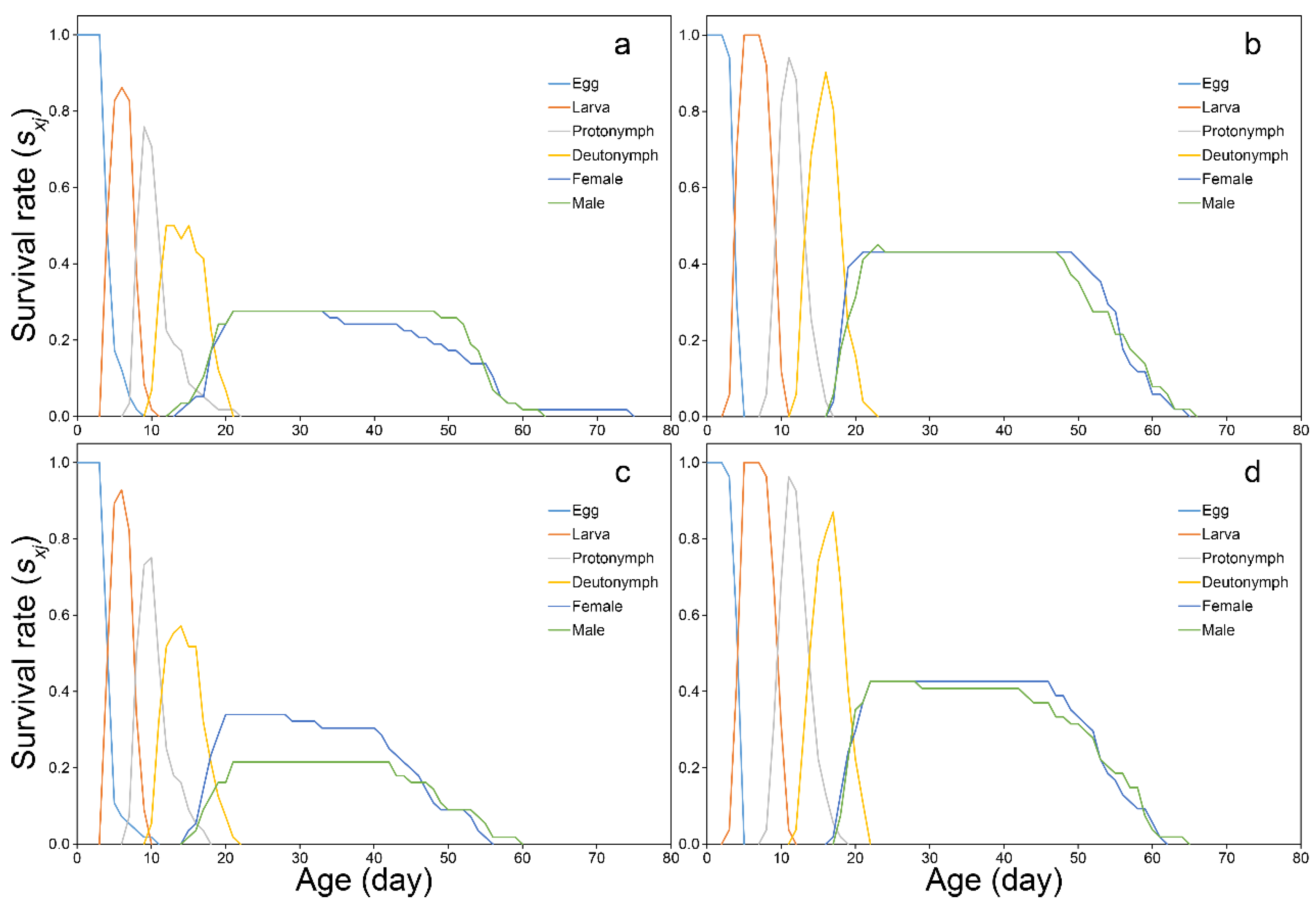
A comparison of the age-stage survival rates (sxj) of C. hirashimai reared on cherry pollen, cherry bee bread, apple pollen, or apple bee bread (Figure 1) indicated clear overlap between the end of each life stage and the start of the next stage.
The average adult longevity of C. hirashimai reared on apple pollen (29.90 days) was significantly shorter than that of C. hirashimai reared on cherry pollen (35.94 days, p = 0.00074), cherry bee bread (36.62 days, p < 0.00001), or apple bee bread (34.28 days, p = 0.00243). The mean fecundity of C. hirashimai reared on cherry bee bread (278.55 eggs/female) or apple bee bread (270.65 eggs/female) was significantly higher than that of C. hirashimai reared on cherry pollen (179.50 eggs/female) or apple pollen (117.05 eggs/female) (p < 0.0001). No significant difference in fecundity was detected between mites fed on cherry bee bread versus apple bee bread (p = 0.62545) (Table 3).
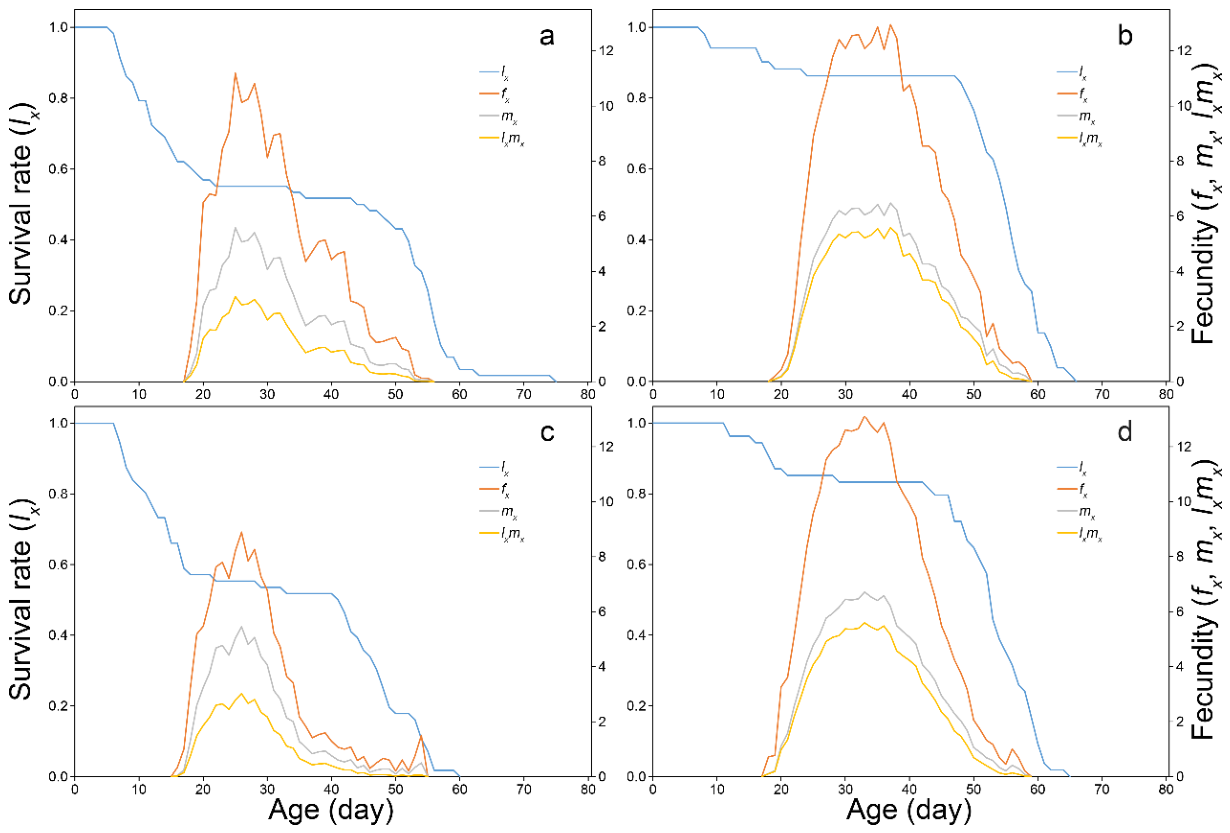
The lx decreased with increasing age, whereas fx, mx, and lxmx initially increased but subsequently decreased with age under each treatment (Figure 2).
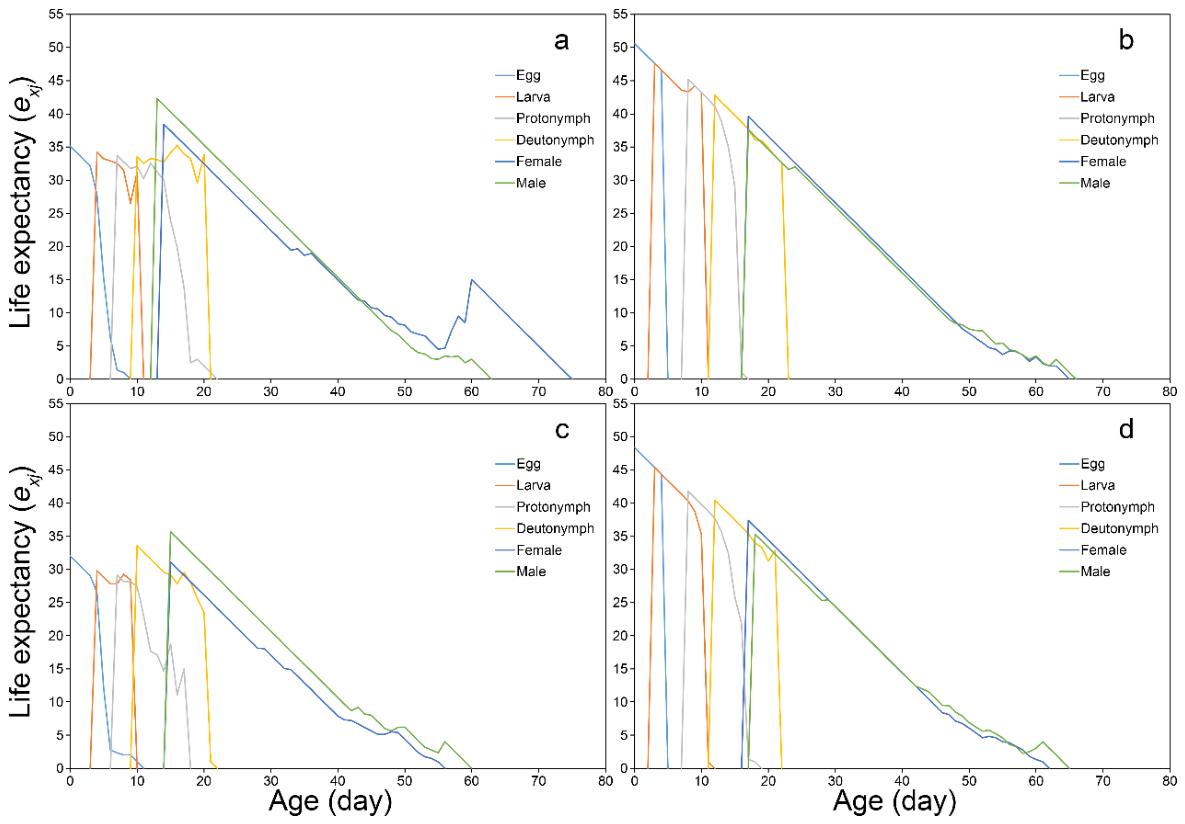
The life expectancy (exj) of C. hirashimai reared on the four diets gradually decreased with increasing age. Males and females fed on the two bee bread diets exhibited greater life expectancy than those reared on the two pollen diets (Figure 3).
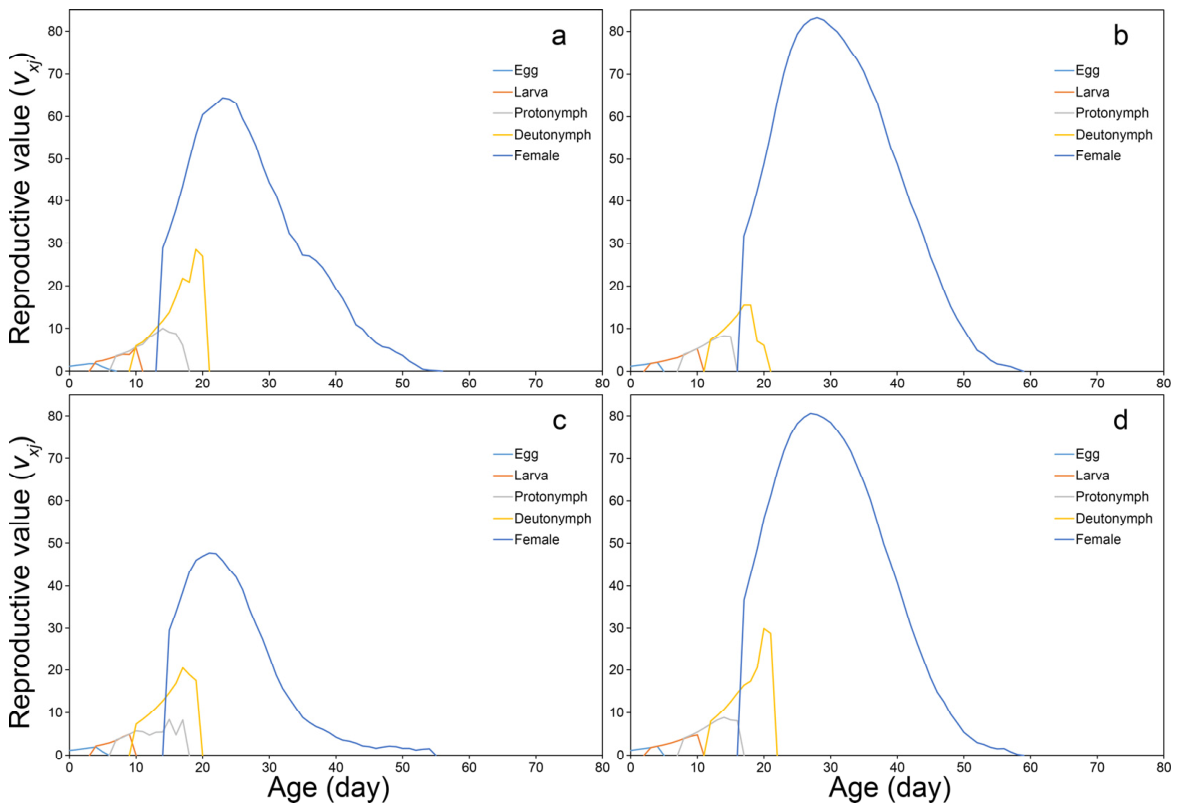
The reproductive value (vxj) of C. hirashimai peaked at different ages depending on the diet: 64.43 at day 23 (cherry pollen), 83.23 at day 28 (cherry bee bread), 47.71 at day 21 (apple pollen), and 80.62 at day 27 (apple bee bread) (Figure 4).

3.2. Life-Table and Population Parameters

No significant differences were observed in r and λ among C. hirashimai reared on the four tested diets (p > 0.1) (Table 4). The R0 of C. hirashimai fed on the two bee bread diets was significantly higher than that of mites reared on the two pollen diets (p < 0.01). The T of C. hirashimai was as follows, in descending order: cherry bee bread > apple bee bread > cherry pollen > apple pollen.

4. Discussion

This study systematically evaluated the effects of cherry pollen, cherry bee bread, apple pollen, and apple bee bread on the fitness of reproductive C. hirashimai, a newly recorded kleptoparasitic mite associated with the orchard mason bee Osmia excavata in northern China. The two-sex life-table results show that C. hirashimai exhibits superior developmental and reproductive performance when fed raw cherry pollen compared with raw apple pollen. Meanwhile, bee bread from both cherry and apple sources substantially improves mite fitness relative to unprocessed raw pollen of the same plant origin. These findings not only reveal the nutritional adaptation of C. hirashimai to rosaceous pollen resources but also highlight a critical ecological conflict between cherry pollination services and mite population outbreaks, with important implications for the sustainable management of mason bees and pest mites in orchard ecosystems.
Pollen quality is a key determinant of the performance of pollen-feeding arthropods, including both pollinators and their natural enemies or kleptoparasites [37]. Moreover, life-table analysis has become a powerful tool to quantify these effects under controlled conditions [38]. Herein, we observed that C. hirashimai exhibited better development and reproduction on cherry pollen than on apple pollen, thus indicating that cherry pollen is a nutritionally superior resource for this mite. However, targeted chemical analyses of pollen nutrients and secondary metabolites were not performed in the present study to verify this inference. This difference might be attributable to variations in nutritional composition between cherry and apple pollen, because host plant quality directly shapes mite developmental trajectories and reproductive potential [39]. Cherry pollen generally contains higher levels of crude protein, essential amino acids, and soluble sugars than apple pollen, and therefore can directly support faster larval growth, longer adult longevity, and higher fecundity in mites [40]. In addition, secondary metabolites such as flavonoids and phenolics in pollen might also influence mite performance and cherry pollen might contain lower levels of defensive compounds that inhibit mite development and therefore might be more suitable for C. hirashimai [41]. As a dominant early-spring floral resource in northern China, cherry pollen is the primary food for O. excavata during its active period. Our findings therefore suggest a critical concern: cherry-dominated orchard landscapes, while supporting mason bee pollination, simultaneously could favor the proliferation of C. hirashimai, thus posing a hidden risk to mason bee populations.
Bee bread, a bee-processed pollen product, is nutritionally richer and more digestible than raw pollen, due to microbial fermentation, the addition of glandular secretions, and partial degradation of complex polysaccharides and proteins [42,43]. Our study confirmed that bee bread diets markedly improved C. hirashimai survival and reproduction, by decreasing pre-adult mortality by ~70% and increasing fecundity by 1.5–2.3 times that observed with raw pollen. The significantly elevated R0 on bee bread further indicated that this high-quality resource strongly drives mite population growth. In mason bee nests, because bee bread is the exclusive food of developing larvae, C. hirashimai can easily access this high-quality resource. This aspect creates a paradox in which the food that nurtures the next generation of mason bees also provides an ideal medium for the reproduction of their kleptoparasitic mites. Mites and mason bee larvae rely on the same pollen food resource and therefore compete intensely for limited nutrition, which poses a major threat to the survival of mason bees.
Notably, although both cherry and apple bee bread significantly enhanced mite fitness, no significant differences in fecundity or R0 were observed between bee bread types. Therefore, the bee-processing effect overrode differences in pollen quality, thereby homogenizing the nutritional value of different pollens into a highly suitable resource for C. hirashimai. Therefore, even if apple pollen is less favorable for mites, it can still support robust mite reproduction after being processed into bee bread by mason bees. Consequently, mite infestation risks may occur in both cherry and apple orchards, yet cherry orchards potentially face higher baseline risk, which could be attributed to the relatively superior nutritional quality of raw cherry pollen.
From an ecological perspective, this study revealed a complex tripartite interaction among pollen plants, mason bees, and kleptoparasitic mites. Cherry trees rely on O. excavata for efficient pollination and fruit production; O. excavata depends on cherry pollen for its own survival and reproduction; and C. hirashimai exploits both raw pollen and bee bread within the nest. This interdependence creates a delicate balance that could easily be disrupted by changes in floral resource composition or mite abundance. In recent decades, the expansion of cherry cultivation in northern China has increased the availability of cherry pollen, which, as shown herein, directly benefits C. hirashimai. This aspect might partially explain the increasing prevalence of mite infestations in commercial mason bee populations in cherry-growing regions.
From an applied perspective, our findings provide actionable insights for the integrated management of C. hirashimai and the conservation of O. excavata. Current mite control methods, such as chemical acaricides and nest disinfection, are either harmful to mason bees or ineffective against mites hidden inside nest tubes [2]. Our results imply that adjusting orchard floral resource composition could serve as a promising ecological control approach worthy of further exploration. For instance, interplanting non-rosaceous flowering plants that are less favorable to C. hirashimai within cherry orchards may dilute the abundance of cherry pollen and thereby lower mite fitness; however, additional follow-up research is required to verify how this mite responds to alternative pollen sources. Additionally, developing mite-resistant pollen varieties or microbial additives that inhibit mite development without affecting mason bee health could be explored.
This study has several limitations that warrant future research. First, because we tested only two common rosaceous pollens, future studies should include a broader range of plant species to better understand the host plant range of C. hirashimai. Second, we focused on the direct effects of pollen and bee bread on mite fitness; however, the underlying molecular and physiological mechanisms, such as nutrient absorption and immune response, remain unclear and require further investigation. Third, because the experiment was conducted under controlled laboratory conditions, field trials are needed to validate the findings in real orchard environments, where factors such as temperature, humidity, and natural enemies might influence mite population dynamics.
In conclusion, this study provides the first systematic evidence, to our knowledge, that cherry pollen and bee bread are key drivers of C. hirashimai population growth in northern China. Our results advance understanding of the nutritional ecology of this newly recorded mite, as well as the tripartite interactions among nectar plants, mason bees, and kleptoparasitic mites. The identified ecological conflict between cherry pollination and mite infestation highlights the urgent need for sustainable management strategies that balance pollinator conservation and mite control in early-spring orchard ecosystems.

5. Conclusions

The mite C. hirashimai can complete its full life cycle when fed cherry pollen, cherry bee bread, apple pollen and apple bee bread, demonstrating that this mite can utilize a wide range of pollen resources derived from Rosaceae plants.
Compared with apple pollen, cherry pollen contributes to improved developmental performance, longer adult longevity and higher fecundity of mites, indicating cherry pollen is a relatively more suitable food resource for C. hirashimai. Across all tested diets, bee bread supports better overall mite fitness than raw pollen, which is reflected in reduced pre-adult mortality, extended adult lifespan, as well as substantially elevated fecundity and net reproductive rate (R0). No significant differences in intrinsic growth rate (r) or finite rate of increase (λ) were observed among the four diet groups, yet bee bread substantially elevates mite population expansion capacity by increasing (R0). Given the superior nutritional suitability of cherry pollen for mites, orchard landscapes dominated by cherry vegetation have the potential to facilitate population growth of C. hirashimai, which may create adverse impacts on the survival and pollination functions of the mason bee O. excavata.
This study systematically characterizes the performance of C. hirashimai fed different rosaceous pollen and bee bread resources, offering fundamental empirical evidence for understanding the nutritional ecology of this pest. Our findings also lay a theoretical foundation for developing targeted integrated pest management solutions, which can coordinate the dual goals of wild pollinator protection and mite population suppression in early-spring fruit orchards.

Author Contributions

Z.L.: Writing—review and editing, writing—original draft, visualization, formal analysis, data curation, investigation. H.S.: Visualization, methodology, investigation. Y.Z.: Visualization, software, data curation. Q.H.: Visualization, formal analysis, data curation. M.S.: Supervision, resources, funding acquisition, conceptualization, software. All authors have read and agreed to the published version of the manuscript.

Funding

This research was funded by the Agricultural Scientific and Technological Innovation project of Shandong Academy of Agricultural Sciences (CXGC2026C25; CXGC2026B33).

Data Availability Statement

The datasets generated during the current study are available from the corresponding author on reasonable request.

Acknowledgments

The authors are grateful to the Agricultural Scientific and Technological Innovation project of Shandong Academy of Agricultural Sciences for financial support.

Conflicts of Interest

The authors declare no conflicts of interest.

References

  1. Zonato, V.; Wang, F.H.; Yang, P. The pollination of mason bees on several fruit trees in China and its application. Chin. Bull. Entomol. 2008, 45, 862–868. [Google Scholar]
  2. Wang, G.; Lin, L.; Xue, X.; Wang, J.; Tao, J. Research and application progress of Osmia pollnation techniques on apple in China. Decid. Fruit. 2018, 50, 25–28. [Google Scholar]
  3. Ou, Y.F.; Wang, L.N.; Yan, Z.; Men, X.Y.; Ge, F. Evaluation of insect pollination and service value in China’s agricultural ecosystems. Acta Ecol. Sin. 2019, 39, 131–145. [Google Scholar] [CrossRef] [Scilit]
  4. Wei, Y.P.; Yuan, F.; Zhang, Y.L. The flower-visiting habit and the necessary amount of beekeeping of the wall bee. J. Northwest A&F Univ. (Nat. Sci. Ed.) 2000, 57, 76–79. [Google Scholar]
  5. Lyu, Z.Y.; Feng, M.; Nie, L.; Zhou, T.; Yu, K.; Li, L.L.; Men, X.Y.; Sun, M.; Yu, Y. Evaluation of the pollination efciency of apple trees by Osmia excavata Alfken (Hymenoptera: Megachilidae). Neotrop. Entomol. 2024, 53, 490–498. [Google Scholar] [CrossRef] [Scilit] [PubMed]
  6. He, Z.W.; Zhou, W.R. Study on the effects of Osmia excavata, Apis mellifera, and artificial pollination on apple pollination. Apic. China 2009, 60, 9–11. [Google Scholar]
  7. Lyu, Z.Y.; Zhou, T.; Sun, M.; Feng, M.; Guo, W.X.; Nei, L.; Song, Y.Y.; Men, X.Y.; Li, L.L.; Yu, Y. Exploratory comparison of flower visiting behavior and pollination ability of mason bees, bumble bees, and honey bees. J. Econ. Entomol. 2023, 116, 1949–1956. [Google Scholar] [CrossRef] [Scilit] [PubMed]
  8. Zhang, F.L.; Yuan, F. Study on pollination efficiency of Osmia excavate. Chin. Agric. Sci. Bull. 1997, 13, 18–20. [Google Scholar]
  9. Dong, X.Y.; Jin, Z.; Xi, J.Y.; Liu, F. Effects of different pollination methods on apple quality. Mod. Agr. Sci. Technol. 2012, 41, 129. [Google Scholar]
  10. Lyu, Z.Y.; Liu, H.G.; Zhou, T.; Feng, M.; Lu, Z.B.; Nie, L.; Wang, G.P.; Wang, G.Z.; Li, L.L.; Men, X.Y.; et al. Comparison of the flight ability of diapausing and post-diapause Osmia excavata Alfken (Hymenoptera: Megachilidae) at different temperatures. J. Asia-Pac. Entomol. 2024, 27, 102205. [Google Scholar] [CrossRef] [Scilit]
  11. Shi, X.Y.; Zou, Y.; Luo, A.R.; Niu, Z.Q.; Zhu, C.D. Issues and prospects of mason bee pollination application. Chin. J. Appl. Entomol. 2022, 59, 1215–1222. [Google Scholar] [CrossRef]
  12. Li, S.Y.; Jiang, S.C.; Lv, Z.M.; Liu, W.H.; Chi, J.F. Common problems and countermeasures of Osmia pollination in apple orchards. North Fruits 2009, 53, 34–35. [Google Scholar]
  13. Li, J.; Wang, Q.Y.; Song, P.; Nan, G.Z.Y.; Cao, K.Q. Major factors influencing nesting rate of Osmia in apple orchard. China Fruits 2011, 55, 51–54. [Google Scholar]
  14. Cao, Y.B.; Zhou, X.H.; Ye, B.H.; Li, L.L.; Lu, Z.B.; Xu, H.; Li, W.Q.; Yu, Y.; Men, X.Y. Factors limiting Osmia excavata Alfken populations. Chin. J. Appl. Entomol. 2017, 54, 652–659. [Google Scholar]
  15. Zhao, J.Y. Preliminary Study on Diapause Research and Investigation of Population Damage Status of Concalyma vulgaris. Master’s Thesis, Yantai University, Yantai, China, 2019. [Google Scholar]
  16. Kurosa, K. Two new Chaetodactylus (Acari, Chaetodactylidae) associated with Osmia (Hymenoptera, Megachilidae) in Japan. Kontyu 1987, 55, 373–381. [Google Scholar]
  17. Wei, Y.; Zhai, H.; Chen, J. Chaetodactylus hirashimai Kurosa, 1987, a newly recorded species and genus of the family Chaetodactylidae (Acari, Sarcoptiformes) from China, which harmful to Osmia bees. Acta Arachnol. Sin. 2016, 25, 1–5. [Google Scholar]
  18. Zhai, H.; Wang, G.P.; Xue, X.M.; Wang, J.Z.; Yu, S.Z.; Tang, Y.H.; Cao, H.J. Preliminary report on mite damage to Osmia bee comb tube nest in apple orchard of Shandong. China Fruits 2015, 57, 82–84. [Google Scholar]
  19. Zhai, H.; Wang, G.P.; Li, X.J.; Xue, X.M.; Wang, J.Z. Preliminary report on mite damage to Osmia bee comb tube nest in apple orchard of Weihai. Shandong Agr. Sci. 2016, 48, 106–108. [Google Scholar]
  20. Qu, D.C.; Qiu, J.Y.; Maeta, Y. Biological character of Tortonia sp. Genom. Appl. Biol. 2010, 29, 495–500. [Google Scholar]
  21. Yamada, M. Control of the chaetodactylus mite, Chaetodactylus nipponicus Kurosa, an important mortality agent of hornfaced osmia bee, Osmia cornifrons Radoszkowski. Bull. Aomori Apple Exp. Stn. 1990, 26, 39–77. [Google Scholar]
  22. Zhou, X.H.; Song, M.J.; Cao, Y.B.; Zhang, A.S.; Li, L.L.; Men, X.Y.; Zhang, S.C.; Zhuang, Q.Y.; Zhai, Y.F.; Yu, Y. Screen safe chemicals for Osmia excavata Alfken against the parasitic mite (Tortonia sp.) in the laboratory. J. Environ. Entomol. 2017, 39, 411–418. [Google Scholar]
  23. Zhai, H.; Wang, J.Z.; Wang, G.P.; Xue, X.M.; Zhang, Y.L.; Li, X.J. Control effects of several acaricides on mites on horned-face bee Osmia cornifrons and the safety evaluation. J. Plant Prot. 2018, 45, 788–794. [Google Scholar]
  24. Ma, M.; Jiao, S.; Liu, Y.; Wang, E.D.; Fan, Q.H. Effects of diets on the growth, development, and reproduction of thepredatory mite Neoseiulus zwoelferi. J. Plant Prot. 2024, 51, 123–131. [Google Scholar]
  25. Rahmani Piyani, A.; Shishehbor, P.; Kocheili, F.; Riddick, E. Comparison of natural prey Tetranychus turkestani, date palm pollen, and bee pollen diets on development, reproduction, and life table parameters of the predator Amblyseius swirskii. Acarologia 2021, 61, 890–900. [Google Scholar] [CrossRef] [Scilit]
  26. Chakrabarti, P.; Morré, J.T.; Lucas, H.M.; Maier, C.S.; Sagili, R.R. The omics approach to bee nutritional landscape. Metabolomics 2019, 15, 127. [Google Scholar] [CrossRef] [Scilit] [PubMed]
  27. Ghosh, S.; Sun, S.; Jang, H.; Jung, C. Amino Acid Dynamics in Bee Feed: Comparative Account of Amino Acid Composition among Pollen, Bee-pollen and Bee Bread. J. Apic. 2024, 39, 127–132. [Google Scholar] [CrossRef] [Scilit]
  28. Zhang, Q.L.; Bao, D.E.; Yan, Z.H.; Yan, W.W.; Liu, Z.C.; Hu, H.L. Study on Storage Characteristics of Three Species of Ornamental Crabapple Pollen. Shandong Agric. Sci. 2016, 48, 54–56+63. [Google Scholar]
  29. Chi, H.; Liu, H. Two new methods for the study of insect popwlation ecology. Bul. Inst. Zool. Acad. Sin. 1985, 24, 225–240. [Google Scholar]
  30. Chi, H. Life-table analysis incorporating both sexes and variable development rate among indviduals. Environ. Entomol. 1988, 17, 26–34. [Google Scholar] [CrossRef] [Scilit]
  31. Chi, H.; Su, H.Y. Age-stage, two-sex life tables of Aphidius gifuensis (Ashmead) (Hymenoptera: Braconidae) and its host Myzus persicae (Sulzer) (Homoptera: Aphididae) with mathematical proof of the relationship between female fecundity and the net reproductive rate. Environ. Entomol. 2006, 35, 10–21. [Google Scholar] [CrossRef] [Scilit]
  32. Tuan, S.J.; Lee, C.C.; Chi, H. Population and damage projection of Spodoptera litura (F.) on peanuts (Arachishypogaea L.) under different conditions using the age-stage, two-sex life table. Pest Manag. Sci. 2014, 70, 805–813. [Google Scholar] [CrossRef] [Scilit]
  33. Chi, H.; You, M.; Atlıhan, R.; Smith, C.L.; Kavousi, A.; Özgökçe, M.S.; Güncan, A.; Tuan, S.J.; Fu, J.W.; Xu, Y.Y.; et al. Age-Stage, two-sex life table: An introduction to theory, data analysis, and application. Entomol. Gen. 2020, 40, 103–124. [Google Scholar] [CrossRef] [Scilit]
  34. Chi, H. TWOSEX-MSChart: A Computer Program for the Age-Stage, Two-Sex Life Table Analysis. 2025. Available online: https://www.faas.cn/datafile/download.shtml?fileId=810659336655220000&siteId=530418521222970001&ticket=anonymous (accessed on 4 October 2025).
  35. Chi, H.; Kavousi, A.; Gharekhani, G.; Atlihan, R.; Salih Özgökçe, M.; Güncan, A.; Gökçe, A.; Smith, C.L.; Benelli, G.; Guedes, R.N.C.; et al. Advances in theory, data analysis, and application of the age-stage, two-sex life table for demographic research, biological control, and pest management. Entomol. Gen. 2023, 43, 705–732. [Google Scholar] [CrossRef] [Scilit]
  36. Zhao, Y.; Zhao, C.L.; Yang, X.B.; Chi, H.; Dai, P.; Desneux, N.; Benelli, G.; Zang, L.S. Yacon as an alternative host plant for Encarsia formosa mass-rearing: Validating a multinomial theorem for bootstrap technique in life table research. Pest Manag. Sci. 2021, 77, 2324–2336. [Google Scholar] [CrossRef] [Scilit] [PubMed]
  37. Morrison, B.; Newburn, L.R.; Fitch, G. Food as Medicine: A Review of Plant Secondary Metabolites from Pollen, Nectar, and Resin with Health Benefits for Bees. Insects 2025, 16, 414. [Google Scholar] [CrossRef] [Scilit] [PubMed]
  38. Mu, M.; Zhu, J.; Xiao, F.; Liu, M.; Zhang, H.; Guo, J.; Liu, J.; Fu, D.; Jin, D.; Wen, L.; et al. Comparison of life tables and mate choice of two Neoseiulus californicus (Acari: Phytoseiidae) strains reared on natural and alternative prey. J. Econ. Entomol. 2025, 118, 1643–1652. [Google Scholar] [CrossRef] [Scilit] [PubMed]
  39. Zhang, Y.N.; Bi, S.J.; Huang, C.Q.; Ran, L.; Yang, L.; Xiao, L.; Tan, Q.M.; Wang, E.D. How do host plants mediate the development and reproduction of Phytoseiulus persimilis (Acari: Phytoseiidae) when fed on Tetranychus evansi or Tetranychus urticae Koch (Acari: Tetranychidae)? Insects 2026, 17, 133. [Google Scholar] [CrossRef] [Scilit] [PubMed]
  40. Kefayat, F.; Hemmati, S.A.; Rasekh, A.; Nasernakhaei, F.; Stelinski, L.L. Suitability of artificial diets containing various types of pollen grains to Helicoverpa armigera (Hübner, 1808): Nutritional performance and digestive enzyme response. Insects 2025, 16, 429. [Google Scholar] [CrossRef] [Scilit] [PubMed]
  41. Xie, J.; Wu, H.; Pang, H.; De Clercq, P. An artificial diet containing plant pollen for the mealybug predator Cryptolaemus montrouzieri. Pest Manag. Sci. 2016, 73, 541–545. [Google Scholar] [CrossRef] [Scilit] [PubMed]
  42. Sampat, G.; Chuleui, J. Changes in nutritional composition from bee pollen to pollen patty used in bumblebee rearing. J. Asia-Pac. Entomol. 2020, 23, 701–708. [Google Scholar] [CrossRef] [Scilit]
  43. Ghosh, S.; Namin, S.M.; Jung, C. Differential bacterial community of bee bread and bee pollen revealed by 16s rRNA High-Throughput Sequencing. Insects 2022, 13, 863. [Google Scholar] [CrossRef] [Scilit] [PubMed]
Figure 1. Age-stage-specific survival rates (sxj) of Chaetodactylus hirashimai. (a) C. hirashimai reared on cherry pollen. (b) C. hirashimai reared on cherry bee bread. (c) C. hirashimai reared on apple pollen. (d) C. hirashimai reared on apple bee bread.
Insects 17 00797 g001
Figure 2. Age-specific survival rate (lx), age-stage-specific fecundity (fx), age-specific fecundity (mx), and maternity (lxmx) of Chaetodactylus hirashimai. (a) C. hirashimai reared on cherry pollen. (b) C. hirashimai reared on cherry bee bread. (c) C. hirashimai reared on apple pollen. (d) C. hirashimai reared on apple bee bread.
Insects 17 00797 g002
Figure 3. Life expectancy (exj) of Chaetodactylus hirashimai. (a) C. hirashimai reared on cherry pollen. (b) C. hirashimai reared on cherry bee bread. (c) C. hirashimai reared on apple pollen. (d) C. hirashimai reared on apple bee bread.
Insects 17 00797 g003
Figure 4. Reproductive value (vxj) of each age-stage of Chaetodactylus hirashimai. (a) C. hirashimai reared on cherry pollen. (b) C. hirashimai reared on cherry bee bread. (c) C. hirashimai reared on apple pollen. (d) C. hirashimai reared on apple bee bread.
Insects 17 00797 g004
Table 1. Development times of Chaetodactylus hirashimai.
Development TimeFeed Treatment
Cherry PollenCherry Bee BreadApple PollenApple Bee Bread
nMean ± SEnMean ± SEnMean ± SEnMean ± SE
Egg duration (day)524.52 ± 0.10 a514.24 ± 0.08 b524.54 ± 0.08 a544.54 ± 0.08 a
Larva duration (day)483.96 ± 0.12 b485.46 ± 0.10 a473.87 ± 0.10 b525.38 ± 0.08 a
Protonymph duration (day)413.85 ± 0.26 ab464.15 ± 0.09 ab363.69 ± 0.25 b484.40 ± 0.11 a
Deutonymph duration (day)325.59 ± 0.37 ab455.13 ± 0.18 b316.10 ± 0.29 a465.26 ± 0.09 b
Preadult duration (day)3217.94 ± 0.36 c4518.96 ± 0.21 b3117.97 ± 0.30 c4619.57 ± 0.20 a
SEs were estimated with 100,000 bootstraps. Different letters in the same row represent significant differences with a paired bootstrap test (p < 0.05).
Table 2. Mortality of Chaetodactylus hirashimai.
Development StageFeed Treatment
Cherry PollenCherry Bee BreadApple PollenApple Bee Bread
Egg10.34 ± 3.99% a0.00 ± 0.00% b7.14 ± 3.45% a0.00 ± 0.00% b
Larva6.90 ± 3.33% a5.88 ± 3.30% a8.93 ± 3.80% a3.70 ± 2.56% a
Protonymph12.07 ± 4.27% ab3.92 ± 2.72% b19.64 ± 5.31% a7.41 ± 3.55% b
Deutonymph15.52 ± 4.75% a1.96 ± 1.95% b8.93 ± 3.79% ab3.70 ± 2.57% b
Preadult44.83 ± 6.53% a11.76 ± 4.50% b44.64 ± 6.63% a14.81 ± 4.83% b
SEs were estimated with 100,000 bootstraps. Different letters in the same row represent significant differences with a paired bootstrap test (p < 0.05).
Table 3. Longevity and fecundity of Chaetodactylus hirashimai.
ParameterFeed Treatment
Cherry PollenCherry Bee BreadApple PollenApple Bee Bread
nMean ± SEnMean ± SEnMean ± SEnMean ± SE
Adult longevity (day)3235.94 ± 1.33 a4536.62 ± 0.99 a3129.90 ± 1.16 b4634.28 ± 0.86 a
Female adult longevity (day)1634.25 ± 2.53 abc2238.05 ± 0.83 a1928.32 ± 1.65 c2334.87 ± 0.84 b
Male adult longevity (day)1637.63 ± 0.78 a2335.26 ± 1.77 ab1232.42 ± 1.24 b2333.70 ± 1.52 b
Adult preoviposition period (APOP) (day)162.06 ± 0.26 b223.86 ± 0.34 a191.32 ± 0.19 c231.35 ± 0.10 c
Total preoviposition period (TPOP) (day)1620.25 ± 0.41 b2222.41 ± 0.44 a1919.11 ± 0.33 c2320.87 ± 0.31 b
Fecundity (F) (eggs/female)16179.50 ± 15.83 b22278.55 ± 10.87 a19117.05 ± 8.66 c23270.65 ± 12.20 a
SEs were estimated with 100,000 bootstraps. Different letters in the same row represent significant differences with a paired bootstrap test (p < 0.05).
Table 4. Population parameters of Chaetodactylus hirashimai.
Population ParameterFeed Treatment
Cherry PollenCherry Bee BreadApple PollenApple Bee Bread
r (day−1) intrinsic rate of increase0.14 ± 0.01 a0.15 ± 0.01 a0.14 ± 0.01 a0.15 ± 0.01 a
λ (day−1) finite rate of increase1.15 ± 0.01 a1.16 ± 0.01 a1.15 ± 0.01 a1.16 ± 0.01 a
R0 (offspring/individual) net reproductive rate49.52 ± 11.40 b120.16 ± 19.87 a39.71 ± 7.93 b115.28 ± 18.90 a
T (day) mean generation time28.68 ± 0.46 c32.96 ± 0.48 a26.32 ± 0.36 d31.57 ± 0.49 b
SEs were estimated with 100,000 bootstraps. Different letters in the same row represent significant differences with a paired bootstrap test (p < 0.05).
Disclaimer/Publisher’s Note: The statements, opinions and data contained in all publications are solely those of the individual author(s) and contributor(s) and not of MDPI and/or the editor(s). MDPI and/or the editor(s) disclaim responsibility for any injury to people or property resulting from any ideas, methods, instructions or products referred to in the content.