Volatile Organic Compounds from an Indoor Pest, Luprops tristis, Collected by a Novel Glass Chamber and Their Implications for Human Health



Simple Summary
Abstract
1. Introduction
2. Materials and Methods
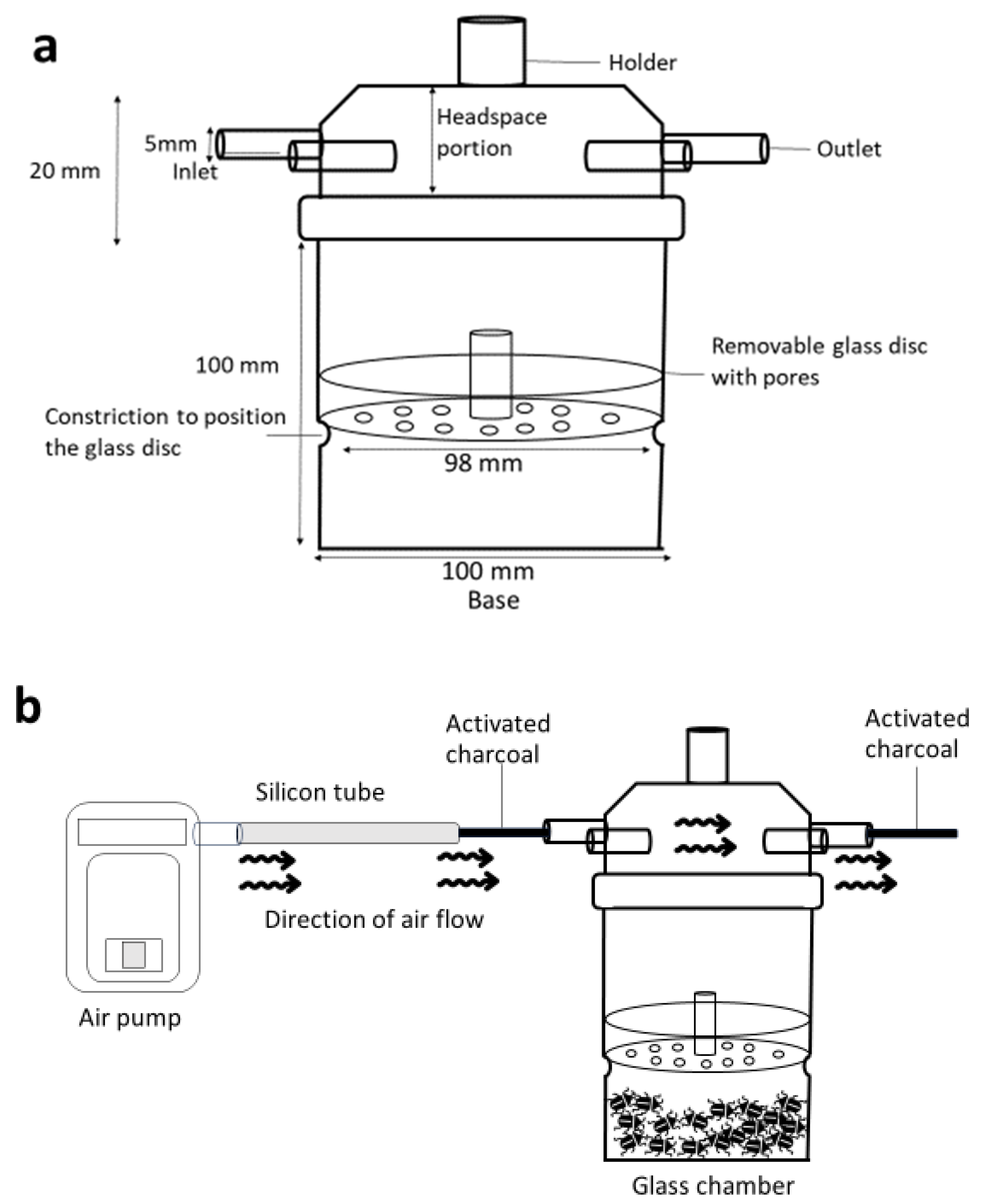
2.1. Design and Fabrication of the Glass Chamber
2.2. Collection of Insects from Sampling Sites for Direct Semiochemical Analysis
2.3. Dynamic Headspace Analysis of Volatiles
2.4. Gas Chromatography–Mass Spectrometry Specifications
2.5. Statistical Analysis
3. Results
3.1. Design and Fabrication of the Glass Chamber
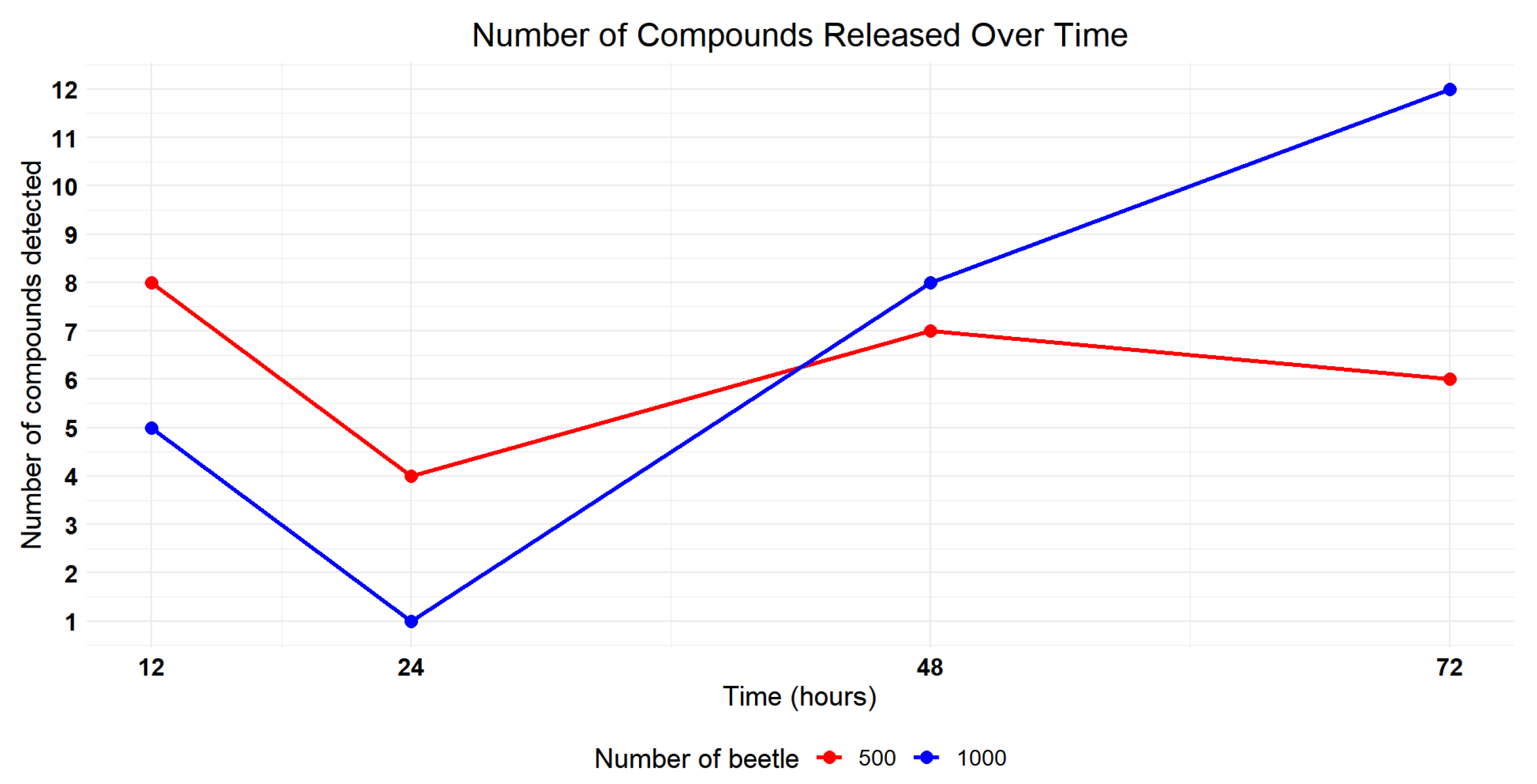
3.2. Dynamic Headspace Analysis of Volatiles
4. Discussion
5. Conclusions
Author Contributions
Funding
Data Availability Statement
Acknowledgments
Conflicts of Interest
References
- Guillet, C.; Martin, O.Y.; Meincke, C.; Joerg, L.; Schmid-Grendelmeier, P. Part II: Insect allergies—Inhalation and ingestion. Allergo J. Int. 2022, 31, 257–265. [Google Scholar] [CrossRef]
- Mathews, K.P. Inhalant Insect-derived Allergens. Immunol. Allergy Clin. N. Am. 1989, 9, 321–338. [Google Scholar] [CrossRef]
- Ifeanyi, O.; Odunayo, O. Microbiology of Cockroaches—A Public Health Concern. Int. J. Sci. Res. 2015, 4, 485–487. [Google Scholar]
- Calderón, M.; Linneberg, A.; Kleine-Tebbe, J.; Blay, F.; Hernández, F.R.D.; Virchow, J.; Demoly, P. Respiratory allergy caused by house dust mites: What do we really know? J. Allergy Clin. Immunol. 2015, 136, 38–48. [Google Scholar] [CrossRef]
- Fukutomi, Y.; Kawakami, Y. Respiratory sensitization to insect allergens: Species, components and clinical symptoms. Allergol. Int. 2021, 70, 303–312. [Google Scholar] [CrossRef]
- Siracusa, A.; Bettini, P.; Bacoccoli, R.; Severini, C.; Verga, A.; Abbritti, G. Asthma caused by live fish bait. J. Allergy Clin. Immunol. 1994, 93, 424–430. [Google Scholar] [CrossRef] [PubMed]
- Linares, T.; Hernandez, D.; Bartolome, B. Occupational rhinitis and asthma due to crickets. Ann. Allergy Asthma Immunol. 2008, 100, 566–569. [Google Scholar] [PubMed]
- Lopata, A.L.; Fenemore, B.; Jeebhay, M.F.; Gäde, G.; Potter, P.C. Occupational allergy in laboratory workers caused by the African migratory grasshopper Locusta migratoria. Allergy 2005, 60, 200–205. [Google Scholar] [CrossRef]
- Moreno, E.M.C.; Zavala, B.B.; Lopez, J.A. Occupational allergy to Ephestia kuehniella in the biological control industry. J. Investig. Allergol. Clin. Immunol. 2014, 24, 459–460. [Google Scholar]
- Jones, M.; Blair, S.; MacNeill, S.; Welch, J.; Hole, A.; Baxter, P.; Cullinan, P. Occupational allergy to fruit flies (Drosophila melanogaster) in laboratory workers. Occup. Environ. Med. 2017, 74, 422–425. [Google Scholar]
- Moghtaderi, M.; Ashraf, M.A.; Teshnizi, S.H.; Nabavizadeh, H.; Farjadian, S.; Fereidouni, M. The level of allergens in dust samples collected from selected schools in Shiraz, Iran and its asthma-risk implications. Allergol. Immunopathol. 2017, 48, 90–94. [Google Scholar]
- Kumar, P.; Kumar, A.; Singh, J.; Mourya, P.; Chauhan, S. Chapter-3 Semiochemicals—An Overview; Elite Publishing House: New Delhi, India, 2024; Available online: https://www.researchgate.net/publication/378714370 (accessed on 17 September 2023).
- Heuskin, S.; Verheggen, F.; Haubruge, E.; Wathelet, J.P.; Lognay, G. The use of semiochemical slow-release devices in integrated pest management strategies. Biotechnol. Agron. Soc. 2011, 15, 459–470. [Google Scholar]
- Yew, J.; Chung, H. Insect pheromones: An overview of function, form, and discovery. Proglipid Res. 2015, 59, 88–105. [Google Scholar] [CrossRef]
- Nusra, M.S.F.; Paranagama, P.A.; Amarasinghe, L.D.; Udukala, D.N. Pheromone baited biopesticide for control of Leucinodes orbonalis Guenee in brinjal plant. Front. Biosci. (Elite Ed.) 2020, 12, 35–47. [Google Scholar] [CrossRef]
- El-Ghany, M.A.N. Pheromones and Chemical Communication in Insects. In Pests, Weeds and Diseases in Agricultural Crop and Animal Husbandry Production; IntechOpen Limited: London, UK, 2020. [Google Scholar] [CrossRef]
- Blight, M.M. Techniques for Isolation and Characterization of Volatile Semiochemicals of Phytophagous Insects. In Chromatographic Society Symposium Series; Springer: Berlin/Heidelberg, Germany, 1990. [Google Scholar]
- Barbosa-Cornelio, R.; Cantor, F.; Coy-Barrera, E.; Rodríguez, D. Tools in the investigation of volatile semiochemicals on insects: From sampling to statistical analysis. Insects 2019, 10, 241. [Google Scholar] [CrossRef]
- Ponzio, C.; Gols, R.; Weldegergis, B.T.; Dicke, M. Caterpillar-induced plant volatiles remain a reliable signal for foraging wasps during dual attack with a plant pathogen or non-host insect herbivore. Plant Cell Environ. 2014, 37, 1924–1935. [Google Scholar] [CrossRef] [PubMed]
- Fürstenau, B.; Adler, C.; Schulz, H.; Hilker, M. Host habitat volatiles enhance the olfactory response of the larval parasitoid Holepyris sylvanidisto specifically host- associated cues. Chem. Senses 2016, 41, 611–621. [Google Scholar] [CrossRef] [PubMed]
- Li, Y.; Mathews, R.A. In vivo real-time monitoring of aphrodisiac pheromone release of small white cabbage butterflies (Pieris rapae). J. Insect Physiol. 2016, 91–92, 107–112. [Google Scholar] [CrossRef]
- Alfonso, D.I.; Hernandez, E.; Velazquez, Y.; Navarro, I.; Primo, J. Identification of the sex pheromone of the mealybug Dysmicoccus grassii Leonardi. J. Agric. Food Chem. 2012, 60, 11959–11964. [Google Scholar] [CrossRef]
- Kunert, G.; Otto, S.; Rose, U.S.R.; Gershenzon, J.; Weisser, W. Alarm pheromone mediates production of winged dispersal morphs in aphids. Ecol. Lett. 2005, 8, 596. [Google Scholar] [CrossRef]
- Raguso, R.A.; Pellmyr, O. Dynamic headspace analysis of floral volatiles: A comparison of methods. Oikos 1998, 81, 238–254. [Google Scholar] [CrossRef]
- Sabu, T.K.; Vinod, K.V. Population dynamics of the rubber plantation litter beetle Luprops tristis, in relation to annual cycle of foliage phenology of its host, the para rubber tree, Hevea brasiliensis. J. Insect Sci. 2009, 9, 56. [Google Scholar] [CrossRef] [PubMed]
- Sabu, T.K.; Vinod, K.V. Food preferences of the rubber plantation litter beetle, Luprops tristis, a nuisance pest in rubber tree plantations. J. Insect Sci. 2009, 9, 72. [Google Scholar] [CrossRef] [PubMed]
- Vinod, K.V.; Sabu, K.T. Dormancy-inducing factors of rubber litter beetle, Luprops tristis (Coleoptera: Tenebrionidae). Insect Sci. 2009, 17, 47–51. [Google Scholar] [CrossRef]
- Raju, A.; Radhika, R. Review study on a home invading pest mupli beetle (Luprops tristis). Uttar Pradesh J. Zool. 2023, 44, 107–114. [Google Scholar] [CrossRef]
- Sabu, T.K.; Vinod, K.V.; Jobi, M.C. Life history, aggregation and dormancy of the rubber plantation litter beetle, Luprops tristis, from the rubber plantations of moist south Western Ghats. J. Insect Sci. 2008, 8, 1. [Google Scholar] [CrossRef]
- Mohammed, S.; Hesselberg, T.; Rafeeq, K.U.M.A. Occurrence of indoor insect pests and illnesses of inhabitants in Malappuram, Kerala, India. Orient Insects 2023, 58, 22–36. [Google Scholar] [CrossRef]
- R Core Team. R: A Language and Environment for Statistical Computing; R. Foundation for Statistical Computing: Vienna, Austria, 2021; Available online: https://www.R-project.org/ (accessed on 17 September 2023).
- Vanícková, L.; Svatoš, A.; Kroiss, J.; Kaltenpoth, M.; Do Nascimento, R.R.; Hoskovec, M.; Brízová, R.; Kalinová, B. Cuticular hydrocarbons of the South American fruit fly Anastrepha fraterculus: Variability with sex and age. J. Chem. Ecol. 2012, 38, 1133–1142. [Google Scholar] [CrossRef]
- Sarkar, N.; Mukherjee, A.; Barik, A. Long-chain alkanes: Allelochemicals for host location by the insect pest, Epilachna dodecastigma (Coleoptera: Coccinellidae). Appl. Entomol. Zool. 2013, 48, 171–179. [Google Scholar]
- Geiselhardt, S.; Schmitt, T.; Peschke, K. Chemical composition and pheromonal function of the defensive secretions in the subtribe Stizopina (Coleoptera, Tenebrionidae, Opatrini). Chemoecology 2009, 19, 1–6. [Google Scholar]
- Moore, B.P. Chemical defense in carabids and its bearing on phylogeny. Carabid Beetles 1979, 2, 193–203. [Google Scholar]
- Bagnères, A.G.; Morgan, E.D.; Clement, J.L. Species-specific secretions of the Dufour glands of three species of formicine ants (Hymenoptera: Formicidae). Biochem. Syst. Ecol. 1991, 19, 25–33. [Google Scholar] [CrossRef]
- Romero-López, A.A.; Reyes-Chilpa, R.; Pérez-Flores, F.J.; Lugo-García, G.A.; Maldonado-Rodríguez, J.I. Chemicals in the genital chamber of two Mexican species of Phyllophaga. Southwest. Entomol. 2019, 44, 457–464. [Google Scholar] [CrossRef]
- Lockey, K.H. Cuticular hydrocarbons of adult Alphitophagus bifasciatus (Say.) and Alphitobius diaperinus (Panz.) (Coleoptera: Tenebrionidae). Comp. Biochem. Physiol. B 1979, 64, 47–56. [Google Scholar]
- Geiselhardt, S.F.; Geiselhardt, S.; Peschke, K. Congruence of epicuticular hydrocarbons and tarsal secretions as a principle in beetles. Chemoecology 2011, 21, 181–186. [Google Scholar] [CrossRef]
- Drilling, K.; Dettner, K. First insights into the chemical defensive system of the erotylid beetle, Tritoma bipustulata. Chemoecology 2010, 20, 243–253. [Google Scholar] [CrossRef]
- Jackson, L.L. Cuticular lipids of insects. II. Hydrocarbons of the cockroaches Periplaneta australasiae, Periplaneta brunnea and Periplaneta fuliginosa. Lipids 1970, 5, 38–41. [Google Scholar] [CrossRef]
- Jackson, L.L. Cuticular lipids of insects. IV. Hydrocarbons of the cockroaches Periplaneta japonica and Periplaneta americana compared to other cockroach hydrocarbons. Comp. Biochem. Physiol. B 1972, 41, 331–336. [Google Scholar]
- Bennett, G.A.; Shotwell, O.L. Cuticular hydrocarbons of healthy and diseased Japanese beetle larvae. Insect Biochem. 1976, 6, 345–346. [Google Scholar] [CrossRef]
- Suwannapong, G.; Benbow, M.E.; Chinokul, C.; Seanbualuang, P.; Sivaram, V. Bioassay of the mandibular gland pheromones of Apis florea on the foraging activity of dwarf honey bees. J. Apic. Res. 2011, 50, 212–217. [Google Scholar] [CrossRef]
- Tanaka, Y.; Honda, H.; Ohsawa, K.; Yamamoto, I. A sex attractant of the yellow mealworm, Tenebrio molitor L., and its role in the mating behavior. J. Pestic. Sci. 1986, 11, 49–55. [Google Scholar] [CrossRef]
- Francke, W.; Schulz, S. Pheromones. In Comprehensive Natural Products Chemistry; Elsevier: Amsterdam, The Netherlands, 1999; Volume 8, pp. 197–261. [Google Scholar] [CrossRef]
- Tsoukatou, M.; Chengb, L.; Vagias, C.; Roussis, V. Chemical composition and behavioral responses of the marine insect Halobates hawaiiensis (Heteroptera: Gerridae). Sex Attractant, Pheromone, Marine Insects, Halobates hawaiiensis. J. Biosci. 2001, 56c, 597–602. [Google Scholar]
- Greenblatt, R.E.; Burkholder, W.E.; Cross, J.H.; Cassidy, R.F.; Silverstein, R.M.; Levinson, A.R.; Levinson, H.Z. Chemical basis for interspecific responses to sex pheromones of Trogoderma species (Coleoptera: Dermestidae). J. Chem. Ecol. 1977, 3, 337–347. [Google Scholar] [CrossRef]
- Prasanna, A.; Nagarajan, K.; Sankarappan, A.; Rameshkumar, N.; Kannan, M.; Krishnan, M. A feeding trait study in headspace of Silkworm Bombyx mori (Lepidoptera: Bombycidae) by GC-MS analysis. J. Entomol. Zool. Stud. 2016, 4, 476–479. [Google Scholar]
- NCBI-National Center for Biotechnology Information. PubChem Compound Summary. 2023. Available online: https://pubchem.ncbi.nlm.nih.gov/ (accessed on 17 September 2023).
- Nirdev, P.M. Identification of Aggregation Pheromones of Luprops tristis Beetles and Analysis of Maternal Host Plant Influence on Reproductive Potential and Longevity. Doctoral Thesis, University of Calicut, Kerala, India, 2016. [Google Scholar]
- Sabu, T.K.; Nirdev, P.M.; Aswathi, P. The reproductive performance of the mupli beetle, Luprops tristis, in relation to leaf age of the para rubber tree, Hevea brasiliensis. J. Insect. Sci. 2014, 14, 12. [Google Scholar] [CrossRef]
- Tumlinson, J.H. Contemporary frontiers in insect semiochemical research. J. Chem. Ecol. 1988, 14, 2109–2130. [Google Scholar] [CrossRef]
- Adnan, M.K. A review on respiratory allergy caused by insects. Bioinformation 2018, 14, 540–553. [Google Scholar] [CrossRef]
- Susan, D.J.; Thomas, A.J.; Thomas, L.; Koottummel, A.S.; Jyothi, K. Luprops keratoconjunctivitis in the rubber plantation area of Pathanamthitta District. J. Ophthalmol. 2010, 22, 37–40. [Google Scholar]
- Hemmer, W. Insekten als Auslöser allergischer Reaktionen. Denisia 2010, 30, 381–409. [Google Scholar]
- Baur, X. Chironomid midge allergy. Arerugi 1992, 41, 81–85. [Google Scholar]
- Hirabayashi, K.; Kubo, K.; Yamaguchi, S.; Fujimoto, K.; Murakami, G.; Nasu, Y. Studies of bronchial asthma induced by chironomid midges (Diptera) around a hypereutrophic lake in Japan. Allergy 1997, 52, 188–195. [Google Scholar] [CrossRef] [PubMed]
- Nakazawa, T.; Satinover, S.M.; Naccara, L.; Goddard, L.; Dragulev, B.P.; Peters, E.; Platts-Mills, T.A. Asian ladybugs (Harmonia axyridis): A new seasonal indoor allergen. J. Allergy. Clin. Immunol. 2017, 119, 421–427. [Google Scholar] [CrossRef] [PubMed]
- Davis, R.S.; Vandewalker, M.L.; Hutcheson, P.S.; Slavin, R.G. Facial angioedema in children due to ladybug (Harmonia axyridis) contact: 2 case reports. Ann. Allergy Asthma Immunol. 2006, 97, 440–442. [Google Scholar] [CrossRef]
- Goetz, D.W. Seasonal inhalant insect allergy: Harmonia axyridis ladybug. Curr. Opin. Allergy Clin. Immunol. 2009, 9, 329–333. [Google Scholar] [CrossRef]
- Milligan, K.L.; Matsui, E.; Sharma, H. Asthma in urban children: Epidemiology, environmental risk factors, and the public health domain. Curr. Allergy Asthma Rep. 2016, 16, 33. [Google Scholar] [CrossRef] [PubMed]
- Pomés, A.; Mueller, G.A.; Randall, T.A.; Chapman, M.D.; Arruda, L.K. New insights into cockroach allergens. Curr. Allergy Asthma Rep. 2017, 17, 25. [Google Scholar] [CrossRef] [PubMed]



| Retention Time (min) | Compound | Class of Compound | Area (%) | Frequency | Function |
|---|---|---|---|---|---|
| 10.43 | Nonadecane, 2-methyl- | Hydrocarbon | 19.17 | 1 | Cuticular Hydrocarbon [32] |
| 21.320 | Eicosane | Hydrocarbon | 3.57 | 2 | Defensive [33] |
| 23.473 | Heptadecane | Hydrocarbon | 9.94 | 1 | Defensive [34] |
| 24.515 | Octane, 3,4,5,6-tetramethyl- | Hydrocarbon | 2.05 | 1 | Defensive [35] |
| 24.520 | Eicosane, 10-methyl- | Hydrocarbon | 13.89 | 1 | Sex Pheromone [36] |
| 25.740 | 2-methyloctacosane | Hydrocarbon | 14.76 | 3 | Cuticular Hydrocarbon [37] |
| 27.024 | Eicosane, 2-methyl- | Hydrocarbon | 10.57 | 2 | Sex Pheromone [38] |
| 27.031 | Heptadecane, 9-octyl- | Hydrocarbon | 4.28 | 2 | Defensive [39,40] |
| 27.067 | Tritetracontane | Hydrocarbon | 11.05 | 2 | Cuticular Hydrocarbon [41,42] |
| 27.087 | Heneicosane | Hydrocarbon | 13.48 | 2 | Sex Pheromone [43] |
| 28.465 | Tetracosane, 11-decyl- | Hydrocarbon | 11.41 | 1 | Cuticular Hydrocarbon [39] |
| 31.320 | Undecane, 2,7-dimethyl | Hydrocarbon | 5.76 | 1 | Defensive [34] |
| 18.969 | 1-Heneicosanol | Alcohol | 5.71 | 1 | Defensive [44] |
| 22.453 | 1-Hexanol, 5-methyl-2-(1-methylethyl)- | Alcohol | 1.36 | 1 | Defensive Allomone [45] |
| 24.531 | 2-Nonen-1-ol, (E) | Alcohol | 2.01 | 1 | Sex Pheromone [46] |
| 25.627 | n-Heptadecanol-1- | Alcohol | 3.11 | 1 | Sex Pheromone [47] |
| 16.449 | E-15-Heptadecenal | Aldehyde | 2.67 | 1 | Sex Pheromone [48] |
| 24.510 | Sulfurous acid, 2-propyl tridecyl ester | Ester | 9.99 | 1 | Defensive Pheromone [49] |
| Retention Time (min) | Compound | Class of Compound | Area (%) | Frequency |
|---|---|---|---|---|
| 18.685 | 1,3-Dioxolane, 2-(2-propenyl)- | Hydrocarbon | 1.01 | 1 |
| 19.656 | 2-Thiophenepropanamine, N, N-dimethyl- | Hydrocarbon | 13.27 | 1 |
| 23.490 | Di-n-decylsulfone | Hydrocarbon | 1.49 | 1 |
| 25.724 | Heptadecane, 2,6,10,15-tetramethyl- | Hydrocarbon | 11.38 | 2 |
| 29.848 | 2-Bromotetradecane | Hydrocarbon | 9.01 | 1 |
| 29.880 | Decane, 1,1′-oxybis- | Hydrocarbon | 4 | 1 |
| 31.341 | Dodecane, 1-fluoro- | Hydrocarbon | 4.46 | 1 |
| 31.357 | Nonadecane, 1-bromo- | Hydrocarbon | 8.87 | 1 |
| 32.130 | 1,1,3,3-Tetraallyl-1,3-disilacyclobutane | Hydrocarbon | 4.35 | 1 |
| 32.540 | 2-Methyl-5-t-butyl-1,3-oxathiane | Hydrocarbon | 4.29 | 1 |
| 33.071 | 1-Octadecanesulphonyl chloride | Hydrocarbon | 6.62 | 1 |
| 33.631 | 2,3-O-Benzal-d-mannosan | Hydrocarbon | 8.05 | 1 |
| 12.607 | Phenol, 2,4-bis(1,1-dimethylethyl)- | Alcohol | 10.18 | 1 |
| 21.370 | Melochinin | Alcohol | 2.06 | 1 |
| 23.384 | n-Nonadecanol-1 | Alcohol | 6.63 | 1 |
| 21.268 | Trifluoroacetic acid, pentadecyl ester | Ester | 7.73 | 1 |
| 22.394 | Oxalic acid, allyl decyl ester | Ester | 2.33 | 1 |
| 22.443 | Oxalic acid, decyl propyl ester | Ester | 6.12 | 1 |
| 25.695 | Oxalic acid, 6-ethyloct-3-yl heptyl ester | Ester | 2.94 | 1 |
| 27.070 | Stearic acid, 3-(octadecyloxy)propyl ester | Ester | 3.27 | 1 |
| 28.427 | Methoxyacetic acid, 3-tetradecyl ester | Ester | 10.43 | 1 |
| 28.436 | Sulfurous acid, decyl 2-propyl ester | Ester | 3.62 | 1 |
| 16.770 | 1-(2-Methoxyethoxy)-2-methyl-2-propanol, methyl ether | Ether | 4.82 | 1 |
| Nature | Compound | Effect |
|---|---|---|
| Hydrocarbon | Heneicosane | Skin & Eye Irritations [50] |
| Hydrocarbon | 1-Octadecanesulphonyl chloride | Skin corrosion/irritation [50] |
| Hydrocarbon | Heptadecane | Aspiration hazard [50] |
| Hydrocarbon | Eicosane | Aspiration hazard [50] |
| Alcohol | 1-Heneicosanol | Slight Hazard to aquatic environment [50] |
| Ester | Sulfurous acid, decyl 2-propyl ester | Long term Hazard to aquatic environment [50] |
| Hydrocarbon | Dodecane, 1-fluoro- | Acute Oral Toxicity [50] |
| Alcohol | 1-Hexanol, 5-methyl-2-(1-methylethyl)- | Acute Allergic Effects [50] |
| Hydrocarbon | Decane, 1,1′-oxybis- | Irritant [50] |
| Alcohol | n-Nonadecanol-1 | Irritant [50] |
| Alcohol | n-Heptadecanol-1 | Irritant [50] |
Disclaimer/Publisher’s Note: The statements, opinions and data contained in all publications are solely those of the individual author(s) and contributor(s) and not of MDPI and/or the editor(s). MDPI and/or the editor(s) disclaim responsibility for any injury to people or property resulting from any ideas, methods, instructions or products referred to in the content. |
© 2026 by the authors. Licensee MDPI, Basel, Switzerland. This article is an open access article distributed under the terms and conditions of the Creative Commons Attribution (CC BY) license.
Share and Cite
Mohammed, S.; Shameer, K.S.; Hesselberg, T.; Rafeeq, K.U.M.A. Volatile Organic Compounds from an Indoor Pest, Luprops tristis, Collected by a Novel Glass Chamber and Their Implications for Human Health. Insects 2026, 17, 617. https://doi.org/10.3390/insects17060617
Mohammed S, Shameer KS, Hesselberg T, Rafeeq KUMA. Volatile Organic Compounds from an Indoor Pest, Luprops tristis, Collected by a Novel Glass Chamber and Their Implications for Human Health. Insects. 2026; 17(6):617. https://doi.org/10.3390/insects17060617
Chicago/Turabian StyleMohammed, Sajidha, K. S. Shameer, Thomas Hesselberg, and K. U. M. A. Rafeeq. 2026. "Volatile Organic Compounds from an Indoor Pest, Luprops tristis, Collected by a Novel Glass Chamber and Their Implications for Human Health" Insects 17, no. 6: 617. https://doi.org/10.3390/insects17060617
APA StyleMohammed, S., Shameer, K. S., Hesselberg, T., & Rafeeq, K. U. M. A. (2026). Volatile Organic Compounds from an Indoor Pest, Luprops tristis, Collected by a Novel Glass Chamber and Their Implications for Human Health. Insects, 17(6), 617. https://doi.org/10.3390/insects17060617