Article

Genome-Wide Identification of Transcriptional Start Sites and Candidate Enhancers Regulating Worker Metamorphosis in Apis mellifera

1
Laboratory of BioDX, PtBio Co-Creation Research Center, Genome Editing Innovation Center, Hiroshima University, 3-10-23 Kagamiyama, Higashi-Hiroshima City 739-0046, Hiroshima, Japan
2
Laboratory of Genome Informatics, Graduate School of Integrated Sciences for Life, Hiroshima University, 3-10-23 Kagamiyama, Higashi-Hiroshima City 739-0046, Hiroshima, Japan
3
Insect Design Technology Group, Division of Insect Advanced Technology, Institute of Agrobiological Sciences, National Agriculture and Food Research Organization (NARO), 1-2 Owashi, Tsukuba 305-8634, Ibaraki, Japan
*
Author to whom correspondence should be addressed.
Insects 2026, 17(5), 516; https://doi.org/10.3390/insects17050516
Submission received: 2 April 2026 / Revised: 14 May 2026 / Accepted: 15 May 2026 / Published: 19 May 2026
(This article belongs to the Section Insect Molecular Biology and Genomics)

Simple Summary

Honeybees produce distinct castes—queens and workers—from genetically identical larvae via differences in gene regulation. Although enhancers have been computationally predicted, their actual activity during bee development has rarely been measured directly, and the cap analysis of gene expression (CAGE) technology has never been applied for this purpose. We identified active enhancers during worker metamorphosis and discovered that the transcription factor ttk may regulate Br-c, a key developmental gene. This study provides the first direct evidence of active enhancers and their regulatory roles in honeybee worker metamorphosis.

Abstract

Comparative genomics in bees has revealed correlations between transcription factor (TF) binding site (TFBS) abundance and social complexity; however, the activity of TFBS within enhancers is not experimentally examined during the caste developmental processes. In this study, we performed cap analysis of gene expression (CAGE) during worker metamorphosis in the honeybee Apis mellifera to identify TFBSs within active enhancers and to decipher the regulatory relationships between these enhancers and their target genes. We identified 17,349 transcription start sites (TSSs) and 842 candidate enhancers. Using CAGE profiles, we classified these elements into five clusters based on their expression patterns. Notably, genes associated with the canonical metamorphic regulators, Broad complex (Br-c) and E93, were found in specific clusters. By integrating correlations between enhancer and TSS activities with motif enrichment analysis, we identified 15 transcription factor–enhancer–TSS regulatory relationships. Among these, tramtrack (ttk) binding sites were identified in five enhancers associated with four target genes, including Br-c. Analysis of sequence conservation revealed that, across all target genes examined, perfect conservation of ttk binding sites was restricted to the genus Apis. These results suggest that gene regulatory relationships during worker metamorphosis are lineage-specific within the Apis genus.

1. Introduction

Understanding of the molecular basis of eusociality, which represents a major evolutionary transition, in bees has been the central goal of sociogenomic studies [1]. Comparative genomic analyses across bee species with different levels of sociality have revealed that the number of transcription factor (TF) binding sites (TFBSs) correlates with the degree of sociality [2,3]. The complexity of eusociality also correlates with the expansion of gene families in bees [3]. Numerous transcriptome comparisons between castes and across developmental stages have led to the identification of candidate genes associated with social phenotypes in bees [4,5,6,7,8,9,10,11]. Collectively, these findings highlight the central role of gene regulation in the evolution of eusociality.
Changes in the expression levels of genes can be readily identified using transcriptomic analysis. However, the regulatory transcription factors driving these changes remain largely unidentified because most TFBSs within enhancers are inferred from sequence-based conservation rather than direct observation of activity [2,3], with the exception of a few [12,13]. Consequently, when and where the predicted TFBSs function in social contexts remains largely unclear.
Enhancer RNAs (eRNAs) are a class of non-coding RNAs that are bidirectionally transcribed from enhancer regions by RNA polymerase II [14,15,16]. As, similarly to mRNAs, eRNAs possess a 5′-cap structure, they can be detected using the cap analysis of gene expression (CAGE), a method originally developed for identifying transcription start sites (TSSs) [17]. In CAGE data, eRNAs appear as bidirectional peaks, the signals of which overlap with those of enhancer-associated histone modifications, such as H3K27ac and H3K4me1 [18]. These features are indicators of enhancer activity. Because CAGE can simultaneously detect eRNAs and TSSs, it is particularly effective in elucidating the relationship between enhancer activity and gene expression.
Although chromatin modifications were compared between queens and workers at the larval stage (96 h after hatching) using H3K4me3, H3K27ac, and H3K36me3 in a previous study [12], the activity of enhancers has not been investigated in sequential developmental stages, such as during worker metamorphosis. Because the worker caste evolved as the first sterile caste in eusocial bees such as Apis mellifera [19], its developmental process is an important target for understanding the molecular basis of caste evolution. During metamorphosis in A. mellifera, dramatic tissue remodeling results in increased cellular diversity and expansion in the number of genes expressed [20]. Thus, worker metamorphosis provides an ideal model for investigating transcriptional regulation in A. mellifera. In holometabolous insects such as A. mellifera, the signaling pathways of juvenile hormone (JH) and ecdysone, mediated by Methoprene-tolerant (Met), Krüppel-homolog 1 (Kr-h1), Broad-complex (Br-c), and E93, play central roles in the progression of metamorphosis [21]. A JH acid methyltransferase (JHAMT) is involved in JH biosynthesis in insects [22,23,24]. Met functions as a JH receptor [25,26,27,28] and mediates the expression of Kr-h1 [29,30]. The active form of ecdysteroid, 20-hydroxyecdysone (20E), binds to the protein encoded by the ecdysone receptor gene (EcR) [31,32] and induces the expression of Br-c, E74, and E75, which serve as ecdysteroid signaling mediators [33]. Expression analysis of these hormone signaling genes can be used to infer the endocrine status of individuals [34]. However, the regulatory relationships between these key metamorphosis genes and their enhancers remain largely unexplored in A. mellifera.
In this study, we used CAGE to identify active enhancers during worker metamorphosis in A. mellifera. Although CAGE has previously been applied to workers (nurses and foragers), its use has been limited to TSS identification, with no attempt having been made to detect enhancers [35]. Using these enhancers, we examined their regulatory relationships with the target genes. Furthermore, we investigated the sequence conservation of TFBSs within the identified enhancers and identified lineage-specific conservation patterns in bees.

2. Materials and Methods

2.1. Honeybee Rearing and Sample Preparation

A. mellifera from an Italian hybrid strain reared at the apiary of the National Agricultural Research Organization (NARO) were used. A. mellifera was reared following standard beekeeping practices [11]. Briefly, the queens were confined to egg-laying boxes for 6 h to obtain age-controlled samples. A. mellifera workers (days 6–58) were collected, with two to three biological replicates per time point. Samples were stored at −80 °C until use. For CAGE, RNA was extracted from larvae (days 9 and 11), prepupae (day 15), and pupae (days 19 and 21). This study involved only invertebrate animals (Apis mellifera), and therefore, ethical approval was not required according to institutional and national guidelines.

2.2. RNA Extraction

Total RNA was extracted from whole-body samples using TRIzol Reagent (Thermo Fisher Scientific, Waltham, MA, USA) and purified with an RNeasy Mini Kit (Qiagen, Hilden, Germany), according to the manufacturer’s protocols. The RNA concentration was measured using a NanoDrop spectrophotometer (Thermo Fisher Scientific). One to five biological replicates per sample category were used for RNA-Seq based on RNA yield and quality. We prepared three biological replicates for day 9, day 11, day 19 and day 21, and two biological replicates for day 15.

2.3. CAGE Sequencing and Data Analysis

CAGE libraries were prepared by DNAFORM (Yokohama, Japan). Raw CAGE-seq reads were filtered using fastp v 1.0.1 [36], and mapped to the A. mellifera genome (Accession ID: GCF_003254395.2) using STAR with default settings. Quality of CAGE sequencing data was assessed using fastp for read quality filtering and STAR for genome alignment. BAM files were converted to bigwig files within CAGEfightR [37], and these bigwig files were loaded into CAGEfightR to identify the CAGE transcriptional start site (CTSS). CTSSs detected in only a single sample were removed. The CTSSs were classified into unidirectional (TSS candidates) and bidirectional (enhancer candidates) clusters. Unidirectional clusters were filtered by >1 TPM for at least two samples. Bidirectional clusters obtained from at least three samples were filtered by a balance threshold score > 0.95. These filtering thresholds were selected according to Thodberg et al. 2019 [37]. To convert HAv3.1 of A. mellifera (GCF_003254395.2 and GCF_003254395.2_Amel_HAv3.1.gff) into the BSgenome data package, BSgenomeForge v 1.74.0 (https://bioconductor.org/packages/release/bioc/html/BSgenomeForge.html, accessed on 8 April 2025) was used. The converted BSgenome was used for gene-level annotations.

2.4. Clustering of Gene Expression

iDEP v 2.01 [38], launched using Docker according to GitHub (https://github.com/gexijin/idepGolem?tab=readme-ov-file, accessed on 23 June 2025), was used for the expression analysis of unidirectional clusters. The count data of unidirectional clusters were loaded into iDEP and normalized using the variance stabilizing transformation (VST) method. Normalized count data were used for k-means clustering. The k-means clustering was performed for the top 2000 genes, and the number of clusters was set to five in the iDEP setting. Principal component analysis was performed using PCAtools v 2.16.0 in iDEP v 2.01. To characterize the gene set, including expression clusters identified by k-means clustering, enrichment analysis was performed using Metascape (https://metascape.org/, accessed on 16 February 2026) [39] with annotations identified previously [40]. VST-normalized count data were used to visualize the expression patterns of individual genes.

2.5. Identification of the TF–Enhancer–Gene Relationship

Correlation analysis between enhancer activity and gene expression was performed using Kendall’s rank correlation coefficient with the findlinks function in CAGEfightR within a distance of 10 kbp. Pairs of enhancer–gene interactions were filtered based on a positive correlation and p-value < 0.05. TF-binding sites were searched using SEA in the MEME Suite 5.5.9, with sequences of binding sites of D. melanogaster from JASPAR [41] (https://jaspar.elixir.no/downloads/, accessed on 22 September 2025). Spearman’s rank correlation coefficient was calculated to evaluate the relationship between transcription factor and target gene expression patterns across developmental stages. Statistical analysis was performed using Python (version 3.12.7) with the SciPy library (version 1.14.1). Correlations with p-value < 0.05 were considered statistically significant. Homologous relationship between A. mellifera and D. melanogaster was referred to the annotation generated by a previous study [40].

2.6. Evaluation for Conservation of Sequences of TF-Binding Sites

Conservation of the identified TF-binding sites was evaluated via DNA sequence alignments using a Threaded Blockset Aligner (TBA) [42]. For this analysis, megablast using enhancer sequences was conducted against the RefSeq Genome Database (refseq_genomes) in Apidae (taxid: 7458), Megachilidae (taxid: 124286), and Halictidae (taxid: 77572) (https://blast.ncbi.nlm.nih.gov/Blast.cgi?PROGRAM=blastn&PAGE_TYPE=BlastSearch&LINK_LOC=blasthome, accessed on 19 January 2026) to preliminarily identify the corresponding chromosome or contigs in other bees. In the TBA analysis, the phylogenetic relationships in bees were based on previous studies [2,43]. Expression peaks obtained from CAGE-seq were visualized using pyGenomeTracks version 3.9 [44].

3. Results

3.1. Landscape of CAGE Results

Firstly, we checked the quality of the CAGE sequencing (Supplementary Table S1). After quality filtering with fastp, the number of reads per sample ranged from 8.0 to 23.1 million, with Q30 rates consistently above 90% across all samples. Reads were aligned to the reference genome using STAR, achieving uniquely mapped rates of 75.5–89.4% (mean: 82.5%) and multi-mapped rates of 10.1–23.3%. The mismatch rate per base was below 1% for all samples. These results indicate that high-quality sequencing data were successfully obtained across all samples, confirming the suitability of these datasets for downstream analyses.
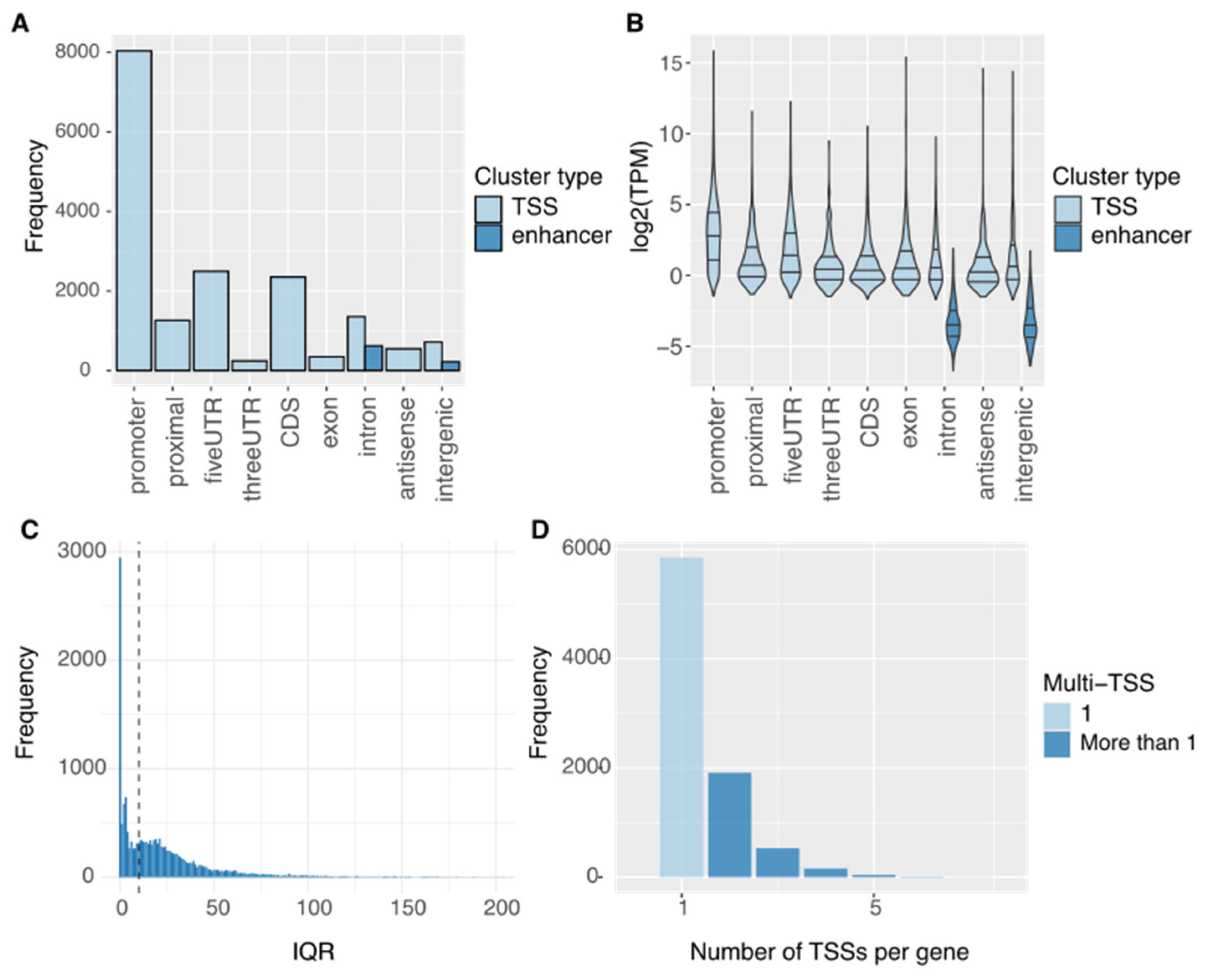
We performed CAGE across the developmental stages in worker metamorphosis, including larval, prepupal, and pupal stages and identified 17,349 unidirectional tag clusters representing candidate transcription start sites (TSSs), which were uniquely assigned to 8535 genes. The unidirectional tag clusters were predominantly located in the promoter regions, consistent with the expected CAGE signal properties (Figure 1A). A total of 842 bidirectional tag clusters were identified. Among these, those located in the intronic or intergenic regions were considered enhancer candidates. This yielded 621 intronic and 221 intergenic enhancer candidates (Figure 1A).
The expression levels of TSSs found in the promoter and 5′-untranslated regions (UTRs) were higher than those found in the proximal regions (Figure 1B). Enhancer candidates consistently showed lower activity than the other regions (Figure 1B). TSSs, defined as collections of CAGE signals, were classified into two types: sharp and broad. The interquartile range (IQR) was used as an indicator of TSS width [37]. The IQR values showed a bimodal distribution, with a dominant peak below 10 bp, indicating the predominance of sharp TSSs during the worker developmental stages (Figure 1C). Next, we examined the number of TSSs per gene and found that 68.7% (5849/8535) of genes had a single TSS (Figure 1D). These results indicated that our CAGE data successfully captured transcriptional initiation and enhancer activity during worker metamorphosis, thereby providing a foundation for analyzing the regulatory relationships between TSSs and enhancers.

3.2. CAGE Patterns During Worker Metamorphosis

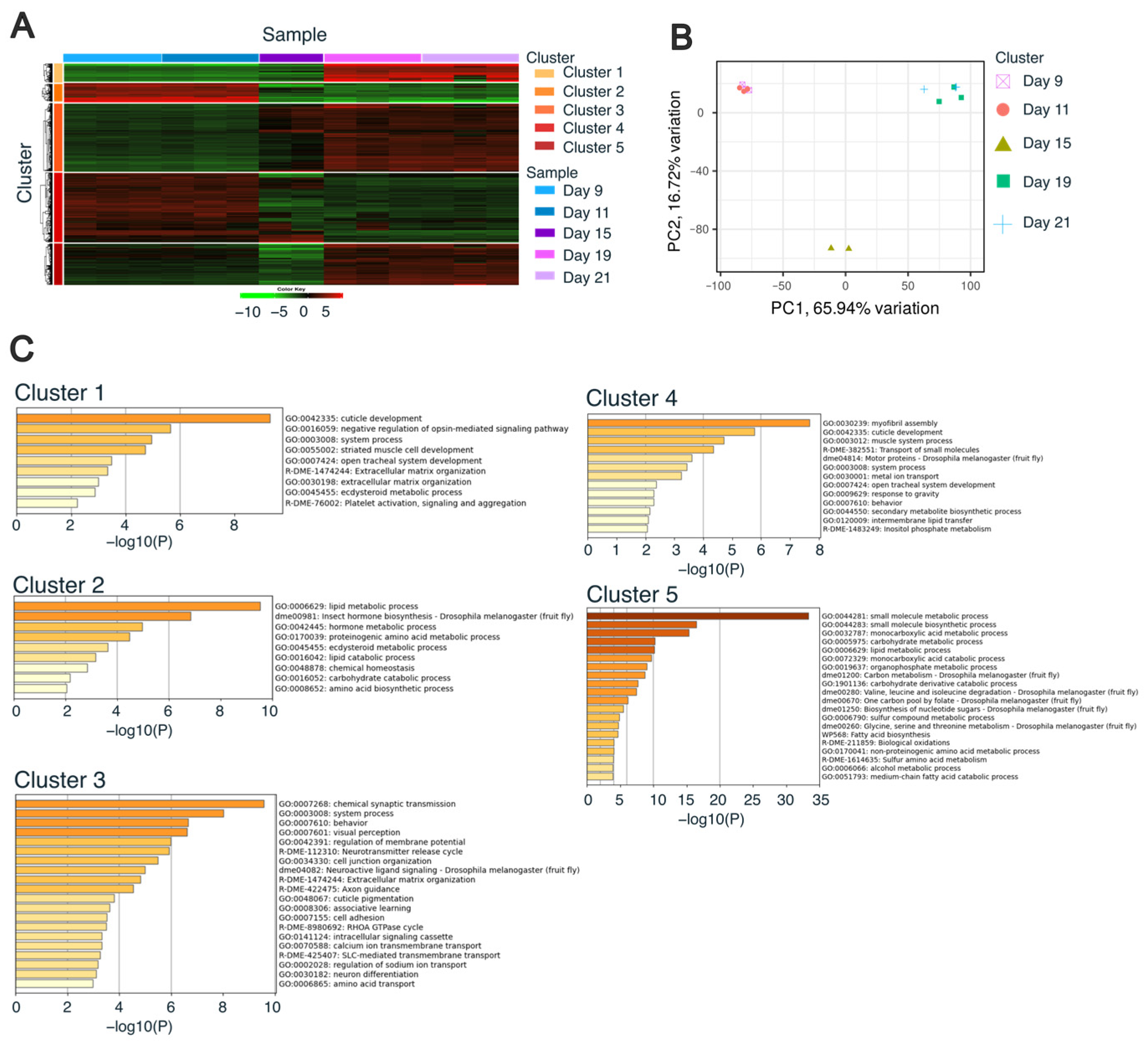
Using the k-means method incorporated into iDEP [38], we examined the expression patterns during worker metamorphosis and identified five distinct clusters (Figure 2A, Supplementary Table S2). These clusters were largely classified into two groups: those with high expression in larvae (days 9 and 11) and those with high expression in pupae (days 19 and 21). Principal component analysis revealed a clear separation by developmental stage, confirming that the identified expression patterns reflected progressive transcriptional changes during worker metamorphosis (Figure 2B).
To characterize the expression patterns of the five clusters, we performed an enrichment analysis using Metascape [39] (Figure 2C and Supplementary Tables S2–S6). Each cluster was enriched for different gene ontology (GO) terms. Cluster 1 showed enrichment of the GO term “cuticle development”, which consisted of many genes encoding cuticle proteins (Supplementary Table S3). Cluster 2 was enriched for the “lipid metabolic process”. Careful examination of the gene list revealed LOC724386 (Npc2a) and LOC102655009 (sit) (Supplementary Table S4), which are involved in cholesterol trafficking and steroidogenesis [45,46]. Cluster 3 was enriched for “chemical synaptic transmission” (Supplementary Table S5), indicating active neural remodeling during metamorphosis. Cluster 4 was enriched for the GO term “myofibril assembly” (Supplementary Table S6). Because the metamorphic process involves tissue remodeling, the enrichment of “myofibril assembly” in our dataset was consistent with expectations. Cluster 5 was enriched for the GO term “small molecule metabolic processes,” including LOC726445 (Gpdh1) and LOC411188 (Ldh) (Supplementary Table S7). These genes promote glycolytic flux that regulates larval growth [47]. Glucose metabolism plays a crucial role in pupal metamorphosis in Drosophila melanogaster [48]. Collectively, the enriched GO terms were consistent with known processes in insect metamorphosis, demonstrating that our CAGE data successfully captured the associated changes in gene expression during worker metamorphosis.
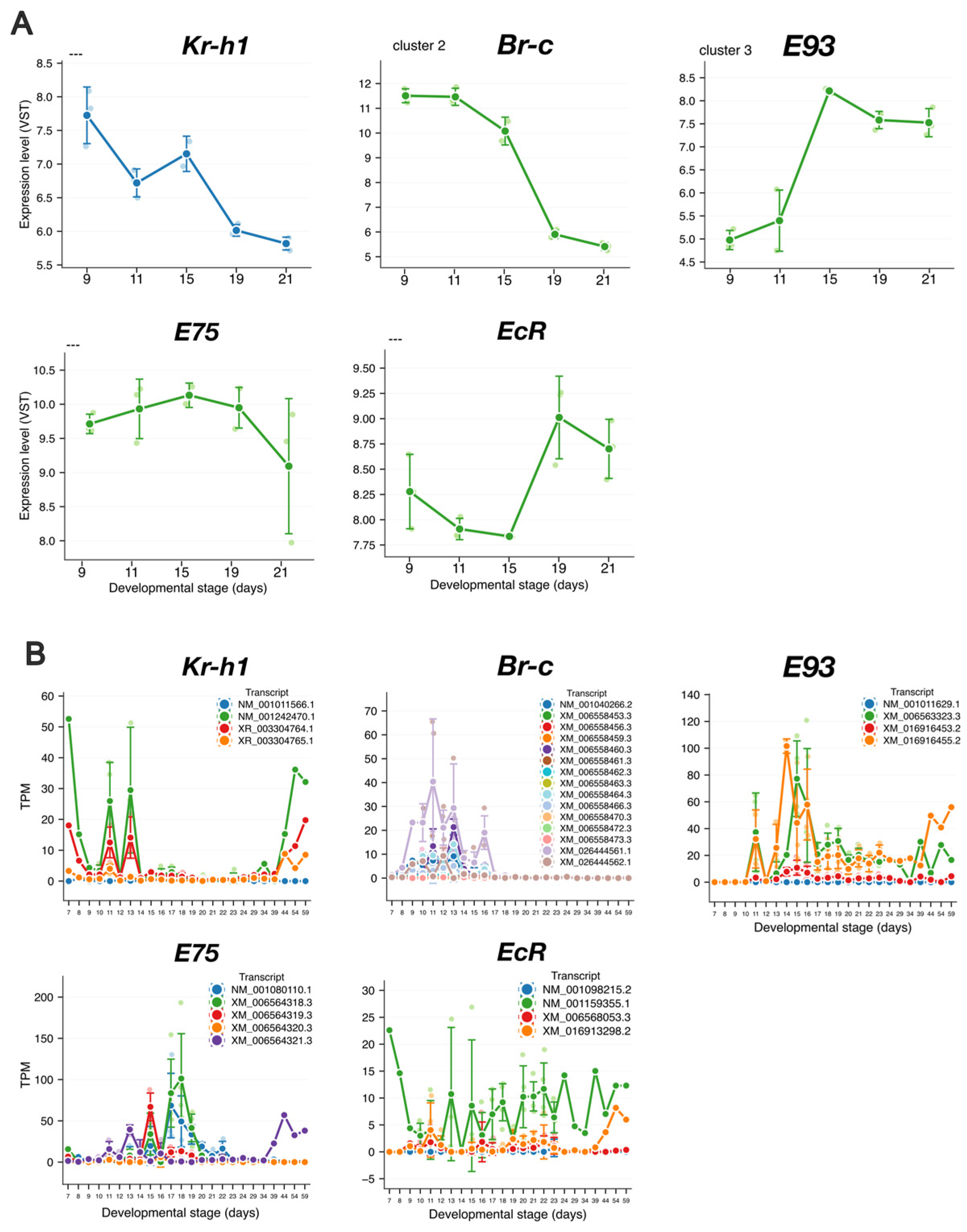
To verify whether the identified clusters captured changes in gene expression during metamorphosis, we selected five genes associated with metamorphic progression in insects (Kr-h1, ecdysone-induced protein 75 (E75), Br-c, E93, and ecdysone receptor (EcR)). We identified the expression clusters containing these genes (Figure 3A). Br-c and E93 were included in Clusters 2 and 3, respectively, whereas Kr-h1, E75, and EcR could not be assigned to any expression clusters. Br-c was upregulated at the onset of prepupal stages (days 9 and 11), as expected for holometabolous insects [49]. E93 expression levels increased at the onset of pupal stages (days 15, 19, and 21), consistent with the expression patterns observed for other insects [21]. The detection of these metamorphic regulators (Br-c and E93) indicated that transcriptional changes during worker metamorphosis were successfully captured in our CAGE data.
To understand why Kr-h1, E75, and EcR were not assigned to any cluster, we compared our data with the published RNA-seq profiles [11,50]. These RNA-seq data used for comparison were generated from the same RNA samples as those used for CAGE analysis. Kr-h1 showed the highest expression level on day 7 (larvae) (Figure 3), which is consistent with its role as an antimetamorphic factor. Although additional expression peaks were observed on days 11 and 13, our CAGE analysis began on day 9 and therefore did not capture the major peak on day 7. Br-c exhibited high expression levels between days 9 and 16, a period covered by our CAGE sampling. Therefore, Br-c was assigned to cluster 2. E93 also showed high expression from day 13 to 19, which was broadly consistent with our CAGE data. In contrast, E75 was not assigned to any expression cluster because RNA-seq data showed that its expression peaked on days 17 and 18, which were outside our CAGE sampling window. EcR was highly expressed on day 7 but did not show a distinct peak thereafter. Collectively, these results indicated that our CAGE data successfully captured key metamorphic regulators, such as Br-c and E93. The absence of Kr-h1 and E75 from the expression clusters can be explained by their expression peaks falling outside the sampling window, whereas EcR was not assigned, probably due to the lack of a distinct expression peak during the sampled stages.

3.3. Identification of the Transcriptional Regulation During Worker Metamorphosis

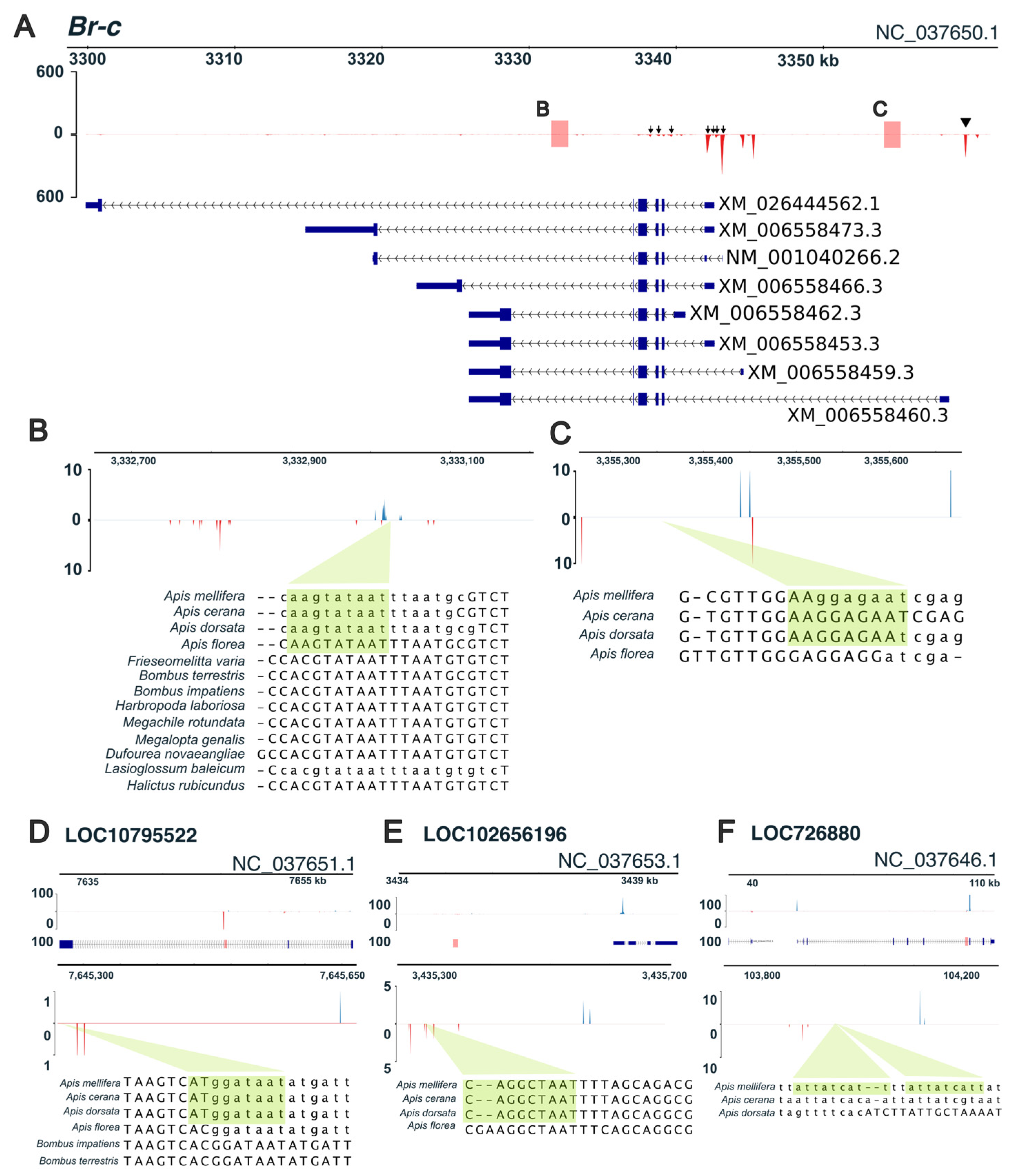
We examined the relationships among transcription factors (TFs), enhancers (E), and TSSs to identify transcriptional regulation during worker metamorphosis. Using the CAGEfightR “findLinks” program, we identified a total of 1505 E-TSS pairs with correlated expression level (r > 0, p < 0.05, Supplementary Table S8). Because genes within the same cluster exhibited similar expression patterns (Figure 2A), we hypothesized that they were regulated by common TFs. To test this hypothesis, we performed motif enrichment analysis to identify common TFBSs within each cluster using simple enrichment analysis (SEA) in the MEME suite (Supplementary Tables S9–S13). Additionally, we examined the correlation of expression levels between the identified TFs and TSSs using our CAGE-seq data (p < 0.05, Spearman’s rank correlation coefficient > 0; Supplementary Table S14). By integrating these results, we identified the TF–E–TSS relationships within each cluster, resulting in 15 sets of these relationships (Table 1). Among these 15 sets, tramtrack (ttk) was the transcription factor associated with the largest number of target genes, including the metamorphic regulator Br-c (Table 1). The predicted enhancers for Br-c were located within introns (Figure 4A,B, Br-c_enhancer_1: NC_037650.1:3332653–3333205; Figure 4A,C, Br-c_enhancer_2: NC_037650.1:3355266–3355678) (Table 1). Br-c_enhancer_1 activity correlated with seven TSS activities observed in the range NC_037650.1:3337344–3342410 (Figure 4A arrows and Supplementary Table S8), whereas Br-c_enhancer_2 activity correlated with a single TSS activity in the range NC_037650.1:3358628–3358852 (Figure 4A arrowhead and Supplementary Table S8).
Next, we examined the sequences of ttk-binding sites in Br-c_enhancer_1 and _2. SEA identified the ttk-binding site to have a consensus sequence: MAGTATAAT (Supplementary Table S10). In Br-c_enhancer_1, we identified the ttk-binding site as AAGTATAAT (Supplementary Table S15). The ttk-binding site in Br-c_enhancer_1 was located near one of the bidirectional tag clusters (Figure 4B, green box). The identified ttk-binding sites (AAGTATAAT) were conserved only within the Apis genus (Figure 4B, green box). All other bee species had the same sequence, ACGTATAAT, in their corresponding region. In Br-c_enhancer_2, the ttk-binding site (AAGGAGAAT, Supplementary Table S15) was located downstream of the Br-c TSS (Figure 4A,C, green box). Because of low sequence conservation, the regions corresponding to the ttk-binding site in Br-c_enhancer_2 could not be identified in non-Apis species. Within the Apis genus, the binding site was conserved across species, except for Apis florea (Figure 4C, green box).
We further investigated the sequence conservation of the ttk-binding sites in other target genes (Table 1), including LOC107965522 (ncRNA), LOC102656196 (ncRNA), and LOC726880 (pancreatic lipase-related protein 2-like) (Figure 4D–F). Unlike LOC107965522 and LOC726880, the enhancer of LOC102656196 was located 3 kb upstream of the TSS (Figure 4E). Sequence conservation of all ttk-binding sites was limited to the Apis genus (Figure 4D,E) and A. mellifera (Figure 4F). As observed for Br-c_enhancer_1, the ttk-binding sites of LOC107965522 and LOC102656196 were located near the enhancer tag clusters (Figure 4D,E, green dashed lines), whereas those of LOC726880 did not overlap with the enhancer tag clusters (Figure 4F, green box).

4. Discussion

4.1. Genome-Wide Detection of TSSs and Enhancers During Worker Metamorphosis

We identified genome-wide TSS activity during worker metamorphosis in A. mellifera. Most CAGE tag clusters were detected as TSSs in the promoter regions of reference gene annotations. Additionally, 842 enhancers were identified, of which intronic enhancers were more prevalent than intergenic enhancers. While previous searches for TFBSs based on sequence alone focused on the 5′ upstream region of genes [2,3], our results revealed numerous intronic enhancers. This finding is consistent with a previous study demonstrating that active intronic enhancers are abundant in worker larvae [12]. In humans, intronic enhancers predominantly regulate tissue-specific expression of genes [51]. As worker metamorphosis involves tissue remodeling toward adult tissue development, the intronic enhancers identified in this study may contribute to tissue-specific expression of genes. Evidence of tissue-specific expression was also reflected in the shape of the TSS clusters, as assessed via the IQR of tag positions. Sharp TSSs (i.e., IQR < 10) occurred more frequently than broad TSSs. Sharp TSSs are predominantly associated with tissue-specific activity in mammals [52]. Collectively, our CAGE data highlighted the importance of tissue-specific gene expression during worker metamorphosis.

4.2. Identification of Active TSS During Worker Metamorphic Process

Five clusters were identified based on the expression patterns. Enrichment analysis revealed that each cluster comprised genes with distinct biological functions. These GO terms were associated with insect metamorphosis, which indicated that the changes in expression detected using CAGE reflect the developmental transition during metamorphosis in A. mellifera workers. This finding is supported by the dynamic changes in the expression of Br-c and E93, which are regulators of metamorphosis. However, some known marker genes (Kr-h1, E75, and EcR) did not show significant changes in their expression. For Kr-h1 and E75, this was probably because of the fact that our sampling covered only a subset of the developmental stages, and their expression peaks occurred outside the stages sampled in this study. EcR is generally involved in metamorphic signaling in insects; however, we did not detect distinct changes in its expression in our dataset. This is consistent with previous findings regarding no distinct expression pattern of EcR in wing disks during A. mellifera metamorphosis [9]. These results suggest that the expression dynamics of EcR may differ between tissues or that its regulatory role in worker metamorphosis is more complex than that in other insects.

4.3. Predicted Regulatory Relationships Among TFs, Enhancers and TSSs

In CLUSTER_1, which showed higher expression during pupal stages than larval stages, cycle and vismay were found as transcription factors binding enhancers identified in this study (Table 1). Both genes are highly expressed during pupal metamorphosis in D. melanogaster [53]. cycle was predicted to regulate XM_393105.7, a homolog of Drosophila juvenile hormone binding protein 14 (CG5867), suggesting a role in downregulating JH signaling during the larval-to-pupal transition. Additionally, vismay was predicted to regulate NM_001174142.1 and XM_026443212.1: a homolog of Vajk2 with chitin binding potential [54] and a homolog of Dusky-like (Dyl), a member of linking the insect cuticle to the plasma membrane of epidermal cells [55,56]. These findings suggest that vismay of A. mellifera may play a role in cuticle formation during worker metamorphosis in A. mellifera.
In CLUSTER_2, ttk was found as a transcription factor with binding potential to enhancers of four genes (XR_408320.3, BR-C, XM_026442630.1 and XR_001705570.2). Two of four were non-coding genes (XR_408320.3 and XR_001705570.2), and their functional role during pupal metamorphosis is unknown. ttk was predicted to regulate XM_026442630.1, a homolog of triacylglycerol lipase in D. melanogaster (CG5966). Triacylglycerol lipolysis plays a critical role in mobilizing lipid reserves during metamorphosis, a period of intensive tissue remodeling that requires substantial energy input [57]. This suggests that ttk may contribute to the regulation of energy metabolism during worker metamorphosis in A. mellifera. In this study, ttk was predicted to bind to the largest number of target genes, including Br-c. ttk is a member of the C2H2 zinc finger transcription factor family. Previous transcriptome analyses have shown that Br-c is more highly expressed in the wing disk during worker metamorphosis than during queen metamorphosis in A. mellifera [9]. This finding supports the potential role of ttk in the upregulation of Br-c expression during worker metamorphosis.
The ttk-binding sites were located predominantly on one side of the enhancers rather than at their center. In humans, TFBSs are not always located at the center of enhancers, but are often found near eRNA TSSs [58]. In addition, the balance of bidirectional eRNA activity is associated with target gene expression in humans [59]. Similarly, ttk-binding sites overlapping eRNA TSSs may modulate the balance of eRNA activity in honeybees.
In CLUSTER_3, ovo and paired were found as transcription factors binding to enhancers of two transcripts belonging to two genes (XM_006559597.3 and XM_397515.7). ovo is expressed in the ovaries of the honeybee queen [60]. XM_006559597.3 (UniProt ID: A0A7M7GDU1·A0A7M7GDU1_APIME) belongs to the Grb2-associated and regulator of Erk/MAPK (GAREM), functioning as a downstream molecule of the epidermal growth factor (EGF). Ovo-regulated XM_006559597.3 may be involved in ovary development in worker honeybees through the EGF signaling, even if workers possess undeveloped ovaries compared to those of queens. Our results suggested that XM_397515.7, a homolog of Testicular haploid expressed gene (Theg), was regulated by ovo and paired because the TFBSs of ovo and paired were found in intronic enhancers of XM_397515.7. Theg of D. melanogaster is essential for spermatogenesis, and its mutation leads to male sterility [61]. However, all workers of A. mellifera are female, and therefore XM_397515.7 may function in other roles except for spermatogenesis.
In CLUSTER_4, GATAe was found as a transcription factor binding to enhancers of three genes (NM_001011582.1, XM_396993.7 and XM_026444740.1). In D. melanogaster, GATAe is expressed in the midgut from embryo to adults [62,63,64]. NM_001011582.1 encodes Apisimin, a component of royal jelly, and this protein forms a complex with major royal jelly protein 1 [65,66]. Although the expression of Apisimin has been confirmed in the heads of nurse and forager honeybees [67], the function in larvae remains unknown. XM_396993.7 encodes a homolog of Dephosphocoenzyme A carrier (DPCoAC) that transports dephosphocoenzyme A from the mitochondrial matrix to the cytosol. However, the function of honeybee metamorphosis is unknown. XM_026444740.1 is predicted to have lysozyme activity (ENZYME entry: EC 3.2.1.17). In the wax moth Galleria mellonella, the expression of lysozyme I appeared in the midgut during larval-pupal molt to prevent infection by the gut microbiome [68].
In CLUSTER_5, daughterless was found as a transcription factor binding to enhancers of NM_001270827.1, which is a homolog of Cpr49Ah in D. melanogaster. Cpr49Ah belongs to the CPR cuticle protein family with chitin-binding type R&R consensus. This gene is not just a cuticle protein, and it functions in controlling prothoracic gland growth [69]. Although the expression of the tissue expressing daughterless of the honeybee is not unknown, daughterless-regulated NM_001270827.1 (Cpr49Ah) expression may be involved in worker metamorphosis of the honeybee.

4.4. Conservation of Ttk-Binding Sites and Eusocial Evolution

The number of TFBSs for a particular TF tends to increase with the correlation of social complexity [2,3], although the types of TFBSs involved differ among eusocial lineages. ttk was classified as a TF related to social complexity, although this classification was based on findings in stingless bees and not in honeybees [2]. We searched for sequence conservation of the ttk-binding site to determine whether common mechanisms regulating Br-c expression are present in bees. However, the conservation of the ttk-binding site did not correlate with eusocial complexity, and sequence conservation was observed only within the genus Apis. Kapheim et al. (2015) [2] noted this inconsistency, showing that eusociality has evolved through different mechanisms across lineages. Our results are consistent with these findings. Nevertheless, ttk is a TTK-type BTB protein that forms hexameric complexes composed of different transcription factors, which is suggestive of diverse binding site compositions [70].
Alternatively, the conservation of ttk-binding sites may reflect differences in metamorphic mode rather. The sequences of the corresponding regions were classified into two types: AAGTATAAT within the Apis genus and ACGTATAAT in all other bee species examined in this study. Although ttk and Br-c expression patterns may differ between these two lineages, detailed gene expression profiles during larval–pupal metamorphosis remain unknown in species other than A. mellifera. Therefore, further gene expression analyses, CAGE, and chromatin immunoprecipitation-sequencing analyses in species other than A. mellifera are required to examine the precise and active ttk-binding sites.

5. Conclusions

In this study, we performed CAGE-seq during worker metamorphosis in A. mellifera to identify the regulatory elements and their interactions that control gene expression. We identified the promoters of 8535 genes and 842 candidate enhancers. Furthermore, we identified ttk as a transcription factor that potentially regulates Br-c expression, with ttk-binding site conservation observed only for the genus Apis. While sequence conservation can provide preliminary evidence for functional relevance, it alone is not sufficient to demonstrate regulatory activity. In addition, the lack of sequence conservation outside the Apis genus may not necessarily indicate the absence of ttk-mediated regulation, because transcription factors can recognize diverse binding sequences. Therefore, integrating assays for transposase-accessible chromatin using sequencing, chromatin immunoprecipitation-sequencing, and chromosome conformation capture across bee species is necessary to fully elucidate enhancer function and validate the identified regulatory interactions. Additionally, the identified enhancers could be candidate targets for genome editing to validate their biological functions.

Supplementary Materials

The following supporting information can be downloaded at: https://www.mdpi.com/article/10.3390/insects17050516/s1, Supplementary Table S1: Summary of CAGE sequencing quality metrics for all samples; Supplementary Table S2: Gene expression clusters identified via k-means analysis; Supplementary Table S3: Gene ontology (GO) enrichment using Metascape for Cluster 1; Supplementary Table S4: Gene ontology (GO) enrichment using Metascape for Cluster 2; Supplementary Table S5: Gene ontology (GO) enrichment using Metascape for Cluster 3; Supplementary Table S6: Gene ontology (GO) enrichment using Metascape for Cluster 4; Supplementary Table S7: Gene ontology (GO) enrichment using Metascape for Cluster 5; Supplementary Table S8: Correlation analysis between enhancer activity and transcription start site (TSS) expression; Supplementary Table S9: Simple enrichment analysis (SEA) motif enrichment for Cluster 1; Supplementary Table S10: Simple enrichment analysis (SEA) motif enrichment for Cluster 2; Supplementary Table S11: Simple enrichment analysis (SEA) motif enrichment for Cluster 3; Supplementary Table S12: Simple enrichment analysis (SEA) motif enrichment for Cluster 4; Supplementary Table S13: Simple enrichment analysis (SEA) motif enrichment for Cluster 5; Supplementary Table S14: Correlation analysis between transcription factor expression and transcription start site (TSS) activity; Supplementary Table S15: ttk-binding site sequences identified in the enhancer regions.

Author Contributions

Conceptualization, K.Y. and H.B.; methodology, K.T. and H.B.; software, K.T.; validation, K.T., K.Y. and H.B.; formal analysis, K.T.; investigation, K.Y.; resources, K.Y. and H.B.; data curation, K.T.; writing—original draft preparation, K.T. and K.Y.; writing—review and editing, K.T., K.Y. and H.B.; visualization, K.T.; supervision, H.B.; project administration, H.B.; funding acquisition, K.Y. and H.B. All authors have read and agreed to the published version of the manuscript.

Funding

This work was supported by the Center of Innovation for Bio-Digital Transformation (BioDX), an open innovation platform for industry-academia co-creation (COI-NEXT) of JST (JPMJPF2010) to K.Y. and H.B. This work was also supported by the RIKEN-Hiroshima University Joint Research Program for Science and Technology Hub to H.B.

Data Availability Statement

The Raw CAGE data underlying this article are available in the DDBJ Sequence Read Archive at [https://www.ddbj.nig.ac.jp/, accessed on 13 May 2026] and can be accessed with the accession numbers DRR893670–DRR893683.

Acknowledgments

We thank all laboratory members at Hiroshima University for their valuable comments. Computations were performed on the computers at the Hiroshima University Genome Editing Innovation Center. Also, we thank Masatsugu Hatakeyama and Kiyoshi Kimura for preparing A. mellifera samples.

Conflicts of Interest

The authors declare no conflicts of interest.

References

  1. Robinson, G.E.; Grozinger, C.M.; Whitfield, C.W. Sociogenomics: Social Life in Molecular Terms. Nat. Rev. Genet. 2005, 6, 257–270. [Google Scholar] [CrossRef]
  2. Kapheim, K.M.; Pan, H.; Li, C.; Salzberg, S.L.; Puiu, D.; Magoc, T.; Robertson, H.M.; Hudson, M.E.; Venkat, A.; Fischman, B.J.; et al. Genomic Signatures of Evolutionary Transitions from Solitary to Group Living. Science 2015, 348, 1139–1143. [Google Scholar] [CrossRef] [PubMed]
  3. Shell, W.A.; Steffen, M.A.; Pare, H.K.; Seetharam, A.S.; Severin, A.J.; Toth, A.L.; Rehan, S.M. Sociality Sculpts Similar Patterns of Molecular Evolution in Two Independently Evolved Lineages of Eusocial Bees. Commun. Biol. 2021, 4, 253. [Google Scholar] [CrossRef] [PubMed]
  4. Evans, J.D.; Wheeler, D.E. Differential Gene Expression between Developing Queens and Workers in the Honey Bee, Apis mellifera. Proc. Natl. Acad. Sci. USA 1999, 96, 5575–5580. [Google Scholar] [CrossRef]
  5. Cameron, R.C.; Duncan, E.J.; Dearden, P.K. Biased Gene Expression in Early Honeybee Larval Development. BMC Genom. 2013, 14, 903. [Google Scholar] [CrossRef]
  6. Warner, M.R.; Qiu, L.; Holmes, M.J.; Mikheyev, A.S.; Linksvayer, T.A. Convergent Eusocial Evolution Is Based on a Shared Reproductive Groundplan plus Lineage-Specific Plastic Genes. Nat. Commun. 2019, 10, 2651. [Google Scholar] [CrossRef]
  7. Sasaki, K.; Yokoi, K.; Toga, K. Bumble Bee Queens Activate Dopamine Production and Gene Expression in Nutritional Signaling Pathways in the Brain. Sci. Rep. 2021, 11, 5526. [Google Scholar] [CrossRef] [PubMed]
  8. Séguret, A.; Stolle, E.; Fleites-Ayil, F.A.; Quezada-Euán, J.J.G.; Hartfelder, K.; Meusemann, K.; Harrison, M.C.; Soro, A.; Paxton, R.J. Transcriptomic Signatures of Ageing Vary in Solitary and Social Forms of an Orchid Bee. Genome Biol. Evol. 2021, 13, evab075. [Google Scholar] [CrossRef]
  9. Soares, M.P.M.; Pinheiro, D.G.; De Paula Freitas, F.C.; Simões, Z.L.P.; Bitondi, M.M.G. Transcriptome Dynamics during Metamorphosis of Imaginal Discs into Wings and Thoracic Dorsum in Apis mellifera Castes. BMC Genom. 2021, 22, 756. [Google Scholar] [CrossRef]
  10. Toga, K.; Bono, H. Meta-Analysis of Public RNA Sequencing Data Revealed Potential Key Genes Associated with Reproductive Division of Labor in Social Hymenoptera and Termites. Int. J. Mol. Sci. 2023, 24, 8353. [Google Scholar] [CrossRef]
  11. Yokoi, K.; Hatakeyama, M.; Kuwazaki, S.; Maeda, T.; Yoshiyama, M.; Horigane-Ogihara, M.; Matsuyama, S.; Jouraku, A.; Bono, H.; Kimura, K. Comprehensive Expression Data for Two Honey Bee Species, Apis mellifera and Apis cerana japonica. Sci. Data 2025, 12, 926. [Google Scholar] [CrossRef]
  12. Wojciechowski, M.; Lowe, R.; Maleszka, J.; Conn, D.; Maleszka, R.; Hurd, P.J. Phenotypically Distinct Female Castes in Honey Bees are Defined by Alternative Chromatin States During Larval Development. Genome Res. 2018, 28, 1532–1542. [Google Scholar] [CrossRef] [PubMed]
  13. Jones, B.M.; Webb, A.E.; Geib, S.M.; Sim, S.; Schweizer, R.M.; Branstetter, M.G.; Evans, J.D.; Kocher, S.D. Repeated Shifts in Sociality Are Associated with Fine-Tuning of Highly Conserved and Lineage-Specific Enhancers in a Socially Flexible Bee. Mol. Biol. Evol. 2024, 41, msae229. [Google Scholar] [CrossRef] [PubMed]
  14. Kim, T.-K.; Hemberg, M.; Gray, J.M.; Costa, A.M.; Bear, D.M.; Wu, J.; Harmin, D.A.; Laptewicz, M.; Barbara-Haley, K.; Kuersten, S.; et al. Widespread Transcription at Neuronal Activity-Regulated Enhancers. Nature 2010, 465, 182–187. [Google Scholar] [CrossRef] [PubMed]
  15. Sartorelli, V.; Lauberth, S.M. Enhancer RNAs Are an Important Regulatory Layer of the Epigenome. Nat. Struct. Mol. Biol. 2020, 27, 521–528. [Google Scholar] [CrossRef]
  16. Li, Q.; Liu, X.; Wen, J.; Chen, X.; Xie, B.; Zhao, Y. Enhancer RNAs: Mechanisms in Transcriptional Regulation and Functions in Diseases. Cell Commun. Signal. 2023, 21, 191. [Google Scholar] [CrossRef]
  17. Kodzius, R.; Kojima, M.; Nishiyori, H.; Nakamura, M.; Fukuda, S.; Tagami, M.; Sasaki, D.; Imamura, K.; Kai, C.; Harbers, M.; et al. CAGE: Cap Analysis of Gene Expression. Nat. Methods 2006, 3, 211–222. [Google Scholar] [CrossRef]
  18. Andersson, R.; Gebhard, C.; Miguel-Escalada, I.; Hoof, I.; Bornholdt, J.; Boyd, M.; Chen, Y.; Zhao, X.; Schmidl, C.; Suzuki, T.; et al. An Atlas of Active Enhancers across Human Cell Types and Tissues. Nature 2014, 507, 455–461. [Google Scholar] [CrossRef]
  19. Tian, L.; Zhou, X. The Soldiers in Societies: Defense, Regulation, and Evolution. Int. J. Biol. Sci. 2014, 10, 296–308. [Google Scholar] [CrossRef]
  20. Patir, A.; Raper, A.; Fleming, R.; Henderson, B.E.P.; Murphy, L.; Henderson, N.C.; Clark, E.L.; Freeman, T.C.; Barnett, M.W. Cellular Heterogeneity of the Developing Worker Honey Bee (Apis mellifera) Pupa: A Single Cell Transcriptomics Analysis. G3 Genes Genomes Genet. 2023, 13, jkad178. [Google Scholar] [CrossRef]
  21. Belles, X.; Santos, C.G. The MEKRE93 (Methoprene Tolerant-Krüppel Homolog 1-E93) Pathway in the Regulation of Insect Metamorphosis, and the Homology of the Pupal Stage. Insect Biochem. Mol. Biol. 2014, 52, 60–68. [Google Scholar] [CrossRef] [PubMed]
  22. Minakuchi, C.; Namiki, T.; Yoshiyama, M.; Shinoda, T. RNAi-mediated Knockdown of Juvenile Hormone Acid O-methyltransferase Gene Causes Precocious Metamorphosis in the Red Flour Beetle Tribolium castaneum. FEBS J. 2008, 275, 2919–2931. [Google Scholar] [CrossRef] [PubMed]
  23. Goodman, W.G.; Cusson, M. The Juvenile Hormones. In Insect Endocrinology; Elsevier: Amsterdam, The Netherlands, 2012; pp. 310–365. ISBN 978-0-12-384749-2. [Google Scholar]
  24. Noriega, F.G. Juvenile Hormone Biosynthesis in Insects: What Is New, What Do We Know, and What Questions Remain? Int. Sch. Res. Not. 2014, 2014, 1–16. [Google Scholar] [CrossRef]
  25. Miura, K.; Oda, M.; Makita, S.; Chinzei, Y. Characterization of the Drosophila Methoprene-Tolerant Gene Product. FEBS J. 2005, 272, 1169–1178. [Google Scholar] [CrossRef]
  26. Konopova, B.; Jindra, M. Juvenile Hormone Resistance Gene Methoprene-Tolerant Controls Entry into Metamorphosis in the Beetle Tribolium castaneum. Proc. Natl. Acad. Sci. USA 2007, 104, 10488–10493. [Google Scholar] [CrossRef]
  27. Charles, J.-P.; Iwema, T.; Epa, V.C.; Takaki, K.; Rynes, J.; Jindra, M. Ligand-Binding Properties of a Juvenile Hormone Receptor, Methoprene-Tolerant. Proc. Natl. Acad. Sci. USA 2011, 108, 21128–21133. [Google Scholar] [CrossRef]
  28. Jindra, M.; Uhlirova, M.; Charles, J.-P.; Smykal, V.; Hill, R.J. Genetic Evidence for Function of the bHLH-PAS Protein Gce/Met as a Juvenile Hormone Receptor. PLoS Genet. 2015, 11, e1005394. [Google Scholar] [CrossRef]
  29. Minakuchi, C.; Namiki, T.; Shinoda, T. Krüppel Homolog 1, an Early Juvenile Hormone-Response Gene Downstream of Methoprene-Tolerant, Mediates Its Anti-Metamorphic Action in the Red Flour Beetle Tribolium Castaneum. Dev. Biol. 2009, 325, 341–350. [Google Scholar] [CrossRef]
  30. Kayukawa, T.; Minakuchi, C.; Namiki, T.; Togawa, T.; Yoshiyama, M.; Kamimura, M.; Mita, K.; Imanishi, S.; Kiuchi, M.; Ishikawa, Y.; et al. Transcriptional Regulation of Juvenile Hormone-Mediated Induction of Krüppel Homolog 1, a Repressor of Insect Metamorphosis. Proc. Natl. Acad. Sci. USA 2012, 109, 11729–11734. [Google Scholar] [CrossRef] [PubMed]
  31. Koelle, M.R.; Talbot, W.S.; Segraves, W.A.; Bender, M.T.; Cherbas, P.; Hogness, D.S. The Drosophila EcR Gene Encodes an Ecdysone Receptor, a New Member of the Steroid Receptor Superfamily. Cell 1991, 67, 59–77. [Google Scholar] [CrossRef]
  32. Yao, T.-P.; Forman, B.M.; Jiang, Z.; Cherbas, L.; Chen, J.-D.; McKeown, M.; Cherbas, P.; Evans, R.M. Functional Ecdysone Receptor Is the Product of EcR and Ultraspiracle Genes. Nature 1993, 366, 476–479. [Google Scholar] [CrossRef]
  33. Dubrovsky, E. Hormonal Cross Talk in Insect Development. Trends Endocrinol. Metab. 2005, 16, 6–11. [Google Scholar] [CrossRef] [PubMed]
  34. Konopova, B.; Smykal, V.; Jindra, M. Common and Distinct Roles of Juvenile Hormone Signaling Genes in Metamorphosis of Holometabolous and Hemimetabolous Insects. PLoS ONE 2011, 6, e28728. [Google Scholar] [CrossRef]
  35. Khamis, A.M.; Hamilton, A.R.; Medvedeva, Y.A.; Alam, T.; Alam, I.; Essack, M.; Umylny, B.; Jankovic, B.R.; Naeger, N.L.; Suzuki, M.; et al. Insights into the Transcriptional Architecture of Behavioral Plasticity in the Honey Bee Apis mellifera. Sci. Rep. 2015, 5, 11136. [Google Scholar] [CrossRef]
  36. Chen, S. Fastp 1.0: An Ultra-fast All-round Tool for FASTQ Data Quality Control and Preprocessing. iMeta 2025, 4, e70078. [Google Scholar] [CrossRef]
  37. Thodberg, M.; Thieffry, A.; Vitting-Seerup, K.; Andersson, R.; Sandelin, A. CAGEfightR: Analysis of 5′-End Data Using R/Bioconductor. BMC Bioinform. 2019, 20, 487. [Google Scholar] [CrossRef]
  38. Ge, S.X.; Son, E.W.; Yao, R. iDEP: An Integrated Web Application for Differential Expression and Pathway Analysis of RNA-Seq Data. BMC Bioinform. 2018, 19, 534. [Google Scholar] [CrossRef] [PubMed]
  39. Zhou, Y.; Zhou, B.; Pache, L.; Chang, M.; Khodabakhshi, A.H.; Tanaseichuk, O.; Benner, C.; Chanda, S.K. Metascape Provides a Biologist-Oriented Resource for the Analysis of Systems-Level Datasets. Nat. Commun. 2019, 10, 1523. [Google Scholar] [CrossRef] [PubMed]
  40. Yokoi, K.; Wakamiya, T.; Bono, H. Meta-Analysis of the Public RNA-Seq Data of the Western Honeybee Apis mellifera to Construct Reference Transcriptome Data. Insects 2022, 13, 931. [Google Scholar] [CrossRef]
  41. Ovek Baydar, D.; Rauluseviciute, I.; Aronsen, D.R.; Blanc-Mathieu, R.; Bonthuis, I.; de Beukelaer, H.; Ferenc, K.; Jegou, A.; Kumar, V.; Lemma, R.B.; et al. JASPAR 2026: Expansion of Transcription Factor Binding Profiles and Integration of Deep Learning Models. Nucleic Acids Res. 2026, 54, D184–D193. [Google Scholar] [CrossRef]
  42. Blanchette, M.; Kent, W.J.; Riemer, C.; Elnitski, L.; Smit, A.F.A.; Roskin, K.M.; Baertsch, R.; Rosenbloom, K.; Clawson, H.; Green, E.D.; et al. Aligning Multiple Genomic Sequences with the Threaded Blockset Aligner. Genome Res. 2004, 14, 708–715. [Google Scholar] [CrossRef]
  43. Da Silva, J. Life History and the Transitions to Eusociality in the Hymenoptera. Front. Ecol. Evol. 2021, 9, 727124. [Google Scholar] [CrossRef]
  44. Lopez-Delisle, L.; Rabbani, L.; Wolff, J.; Bhardwaj, V.; Backofen, R.; Grüning, B.; Ramírez, F.; Manke, T. pyGenomeTracks: Reproducible Plots for Multivariate Genomic Datasets. Bioinformatics 2021, 37, 422–423. [Google Scholar] [CrossRef]
  45. Huang, X.; Warren, J.T.; Buchanan, J.; Gilbert, L.I.; Scott, M.P. Drosophila Niemann-Pick Type C-2 Genes Control Sterol Homeostasis and Steroid Biosynthesis: A Model of Human Neurodegenerative Disease. Development 2007, 134, 3733–3742. [Google Scholar] [CrossRef] [PubMed]
  46. Danielsen, E.T.; Moeller, M.E.; Yamanaka, N.; Ou, Q.; Laursen, J.M.; Soenderholm, C.; Zhuo, R.; Phelps, B.; Tang, K.; Zeng, J.; et al. A Drosophila Genome-Wide Screen Identifies Regulators of Steroid Hormone Production and Developmental Timing. Dev. Cell 2016, 37, 558–570. [Google Scholar] [CrossRef] [PubMed]
  47. Li, H.; Rai, M.; Buddika, K.; Sterrett, M.C.; Luhur, A.; Mahmoudzadeh, N.H.; Julick, C.R.; Pletcher, R.C.; Chawla, G.; Gosney, C.J.; et al. Lactate Dehydrogenase and Glycerol-3-Phosphate Dehydrogenase Cooperatively Regulate Growth and Carbohydrate Metabolism during Drosophila Melanogaster Larval Development. Development 2019, dev.175315. [Google Scholar] [CrossRef] [PubMed]
  48. Nishimura, T. Feedforward Regulation of Glucose Metabolism by Steroid Hormones Drives a Developmental Transition in Drosophila. Curr. Biol. 2020, 30, 3624–3632.e5. [Google Scholar] [CrossRef]
  49. Truman, J.W. The Evolution of Insect Metamorphosis. Curr. Biol. 2019, 29, R1252–R1268. [Google Scholar] [CrossRef]
  50. Yokoi, K. TPM Data of Apis mellifera Queen and Worker. 2024. Available online: https://figshare.com/articles/dataset/TPM_data_of_Apis_mellifera_queen_and_worker_/27157614 (accessed on 6 June 2025).
  51. Borsari, B.; Villegas-Mirón, P.; Pérez-Lluch, S.; Turpin, I.; Laayouni, H.; Segarra-Casas, A.; Bertranpetit, J.; Guigó, R.; Acosta, S. Enhancers with Tissue-Specific Activity Are Enriched in Intronic Regions. Genome Res. 2021, 31, 1325–1336. [Google Scholar] [CrossRef]
  52. Carninci, P.; Sandelin, A.; Lenhard, B.; Katayama, S.; Shimokawa, K.; Ponjavic, J.; Semple, C.A.M.; Taylor, M.S.; Engström, P.G.; Frith, M.C.; et al. Genome-Wide Analysis of Mammalian Promoter Architecture and Evolution. Nat. Genet. 2006, 38, 626–635. [Google Scholar] [CrossRef]
  53. Brown, J.B.; Boley, N.; Eisman, R.; May, G.E.; Stoiber, M.H.; Duff, M.O.; Booth, B.W.; Wen, J.; Park, S.; Suzuki, A.M.; et al. Diversity and Dynamics of the Drosophila Transcriptome. Nature 2014, 512, 393–399. [Google Scholar] [CrossRef]
  54. Cinege, G.; Zsámboki, J.; Vidal-Quadras, M.; Uv, A.; Csordás, G.; Honti, V.; Gábor, E.; Hegedűs, Z.; Varga, G.I.B.; Kovács, A.L.; et al. Genes Encoding Cuticular Proteins Are Components of the Nimrod Gene Cluster in Drosophila. Insect Biochem. Mol. Biol. 2017, 87, 45–54. [Google Scholar] [CrossRef]
  55. Roch, F.; Alonso, C.R.; Akam, M. Drosophila Miniature and Dusky Encode ZP Proteins Required for Cytoskeletal Reorganisation during Wing Morphogenesis. J. Cell Sci. 2003, 116, 1199–1207. [Google Scholar] [CrossRef]
  56. Zhang, Y.; Tan, Q.; Lin, M.; Shen, C.; Jin, L.; Li, G. Dusky-like Is Critical for Morphogenesis of the Cellular Protuberances and Formation of the Cuticle in Henosepilachna vigintioctopunctata. Biology 2023, 12, 866. [Google Scholar] [CrossRef]
  57. Heier, C.; Kühnlein, R.P. Triacylglycerol Metabolism in Drosophila melanogaster. Genetics 2018, 210, 1163–1184. [Google Scholar] [CrossRef]
  58. Grossman, S.R.; Engreitz, J.; Ray, J.P.; Nguyen, T.H.; Hacohen, N.; Lander, E.S. Positional Specificity of Different Transcription Factor Classes within Enhancers. Proc. Natl. Acad. Sci. USA 2018, 115, E7222–E7230. [Google Scholar] [CrossRef] [PubMed]
  59. Kristjánsdóttir, K.; Dziubek, A.; Kang, H.M.; Kwak, H. Population-Scale Study of eRNA Transcription Reveals Bipartite Functional Enhancer Architecture. Nat. Commun. 2020, 11, 5963. [Google Scholar] [CrossRef] [PubMed]
  60. Cullen, G.; Gilligan, J.B.; Guhlin, J.G.; Dearden, P.K. Germline Progenitors and Oocyte Production in the Honeybee Queen Ovary. Genetics 2023, 225, iyad138. [Google Scholar] [CrossRef] [PubMed]
  61. Gärtner, S.M.K.; Hundertmark, T.; Nolte, H.; Theofel, I.; Eren-Ghiani, Z.; Tetzner, C.; Duchow, T.B.; Rathke, C.; Krüger, M.; Renkawitz-Pohl, R. Stage-Specific Testes Proteomics of Drosophila Melanogaster Identifies Essential Proteins for Male Fertility. Eur. J. Cell Biol. 2019, 98, 103–115. [Google Scholar] [CrossRef]
  62. Okumura, T.; Matsumoto, A.; Tanimura, T.; Murakami, R. An Endoderm-Specific GATA Factor Gene, dGATAe, Is Required for the Terminal Differentiation of the Drosophila Endoderm. Dev. Biol. 2005, 278, 576–586. [Google Scholar] [CrossRef]
  63. Murakami, R.; Okumura, T.; Uchiyama, H. GATA Factors as Key Regulatory Molecules in the Development of Drosophila endoderm. Dev. Growth Differ. 2005, 47, 581–589. [Google Scholar] [CrossRef]
  64. Okumura, T.; Takeda, K.; Kuchiki, M.; Akaishi, M.; Taniguchi, K.; Adachi-Yamada, T. GATAe Regulates Intestinal Stem Cell Maintenance and Differentiation in Drosophila Adult Midgut. Dev. Biol. 2016, 410, 24–35. [Google Scholar] [CrossRef]
  65. Mandacaru, S.C.; Do Vale, L.H.F.; Vahidi, S.; Xiao, Y.; Skinner, O.S.; Ricart, C.A.O.; Kelleher, N.L.; De Sousa, M.V.; Konermann, L. Characterizing the Structure and Oligomerization of Major Royal Jelly Protein 1 (MRJP1) by Mass Spectrometry and Complementary Biophysical Tools. Biochemistry 2017, 56, 1645–1655. [Google Scholar] [CrossRef] [PubMed]
  66. Mattei, S.; Ban, A.; Picenoni, A.; Leibundgut, M.; Glockshuber, R.; Boehringer, D. Structure of Native Glycolipoprotein Filaments in Honeybee Royal Jelly. Nat. Commun. 2020, 11, 6267. [Google Scholar] [CrossRef] [PubMed]
  67. Klaudiny, J.; Kulifajová, J.; Crailsheim, K.; Šimúth, J. New Approach to the Study of Division of Labour in the Honeybee Colony (Apis mellifera L.). Apidologie 1994, 25, 596–600. [Google Scholar] [CrossRef][Green Version]
  68. Johnston, P.R.; Paris, V.; Rolff, J. Immune Gene Regulation in the Gut during Metamorphosis in a Holo-versus a Hemimetabolous Insect. Philos. Trans. R. Soc. B Biol. Sci. 2019, 374, 20190073. [Google Scholar] [CrossRef]
  69. Liu, W.; Yan, M.; King-Jones, K. Soul Is a Master Control Gene Governing the Development of the Drosophila Prothoracic Gland. Proc. Natl. Acad. Sci. USA 2024, 121, e2405469121. [Google Scholar] [CrossRef]
  70. Bonchuk, A.N.; Balagurov, K.I.; Baradaran, R.; Boyko, K.M.; Sluchanko, N.N.; Khrustaleva, A.M.; Burtseva, A.D.; Arkova, O.V.; Khalisova, K.K.; Popov, V.O.; et al. The Arthropoda-Specific Tramtrack Group BTB Protein Domains Use Previously Unknown Interface to Form Hexamers. eLife 2024, 13, e96832. [Google Scholar] [CrossRef]
Figure 1. Overview of cap analysis of gene expression-sequencing. (CAGE-seq) results. (A) Annotation of tag clusters using RefSeq. Cluster types (transcription start site (TSS) or enhancer) are shown in different colors. (B) Log2-scaled transcripts per million (TPM) values for each genomic region. Cluster types are indicated in different colors. (C) Histogram of interquartile range (IQR) values for tag clusters. The dashed line marks an IQR value of 10 bp. (D) Number of TSSs per gene. Light blue indicates genes with a single TSS, and dark blue indicates genes with two or more TSSs.
Insects 17 00516 g001
Figure 2. Gene expression dynamics during worker metamorphosis. (A) Heatmap showing expression patterns across developmental stages. Red and green represent high and low expression levels, respectively. (B) Principal component analysis (PCA) based on the top 2000 genes. (C) Metascape enrichment results. Bars represent −log10(p-value), and colors indicate the magnitude of enrichment, with darker colors representing higher enrichment and lighter colors representing lower enrichment. Gene ontology terms are shown on the right.
Insects 17 00516 g002
Figure 3. Expression patterns of metamorphosis-related marker genes. (A) Expression patterns of metamorphic marker genes in our cap analysis of gene expression (CAGE) dataset. Blue and green plots represent genes responsive to juvenile hormone and ecdysone, respectively. Variance stabilizing transformation (VST)-normalized counts are shown. The expression clusters identified in this study are indicated in the top left of each panel; “---” indicates genes not assigned to any cluster. (B) Expression patterns throughout worker development based on published RNA sequencing data [11]. Transcripts per million (TPM) values for all transcripts of each gene are shown. Larvae corresponded to days 6–9 post-oviposition, prepupal and pupal stages to days 10–18, and adults to day 19 and later.
Insects 17 00516 g003
Figure 4. Enhancer regions containing the tramtrack (ttk)-binding sites. In all the figure panels, red and blue peaks indicate signals on the negative and positive strands, respectively. Green boxes indicate predicted ttk-binding sites (from Drosophila melanogaster motifs). Gene models are shown in blue. Corresponding enhancer regions in other bee species are displayed at the bottom of each panel. Lowercase nucleotide sequences represent soft-masked repeat regions in the genome. The y-axis represents the cap analysis of gene expression transcriptional start site (CTSS) count data. (A) Tag clusters and gene structure for Br-c. Arrowheads and arrow indicate each TSS. Red boxes represent enhancer regions identified in this study; regions B and C are magnified in panels (B,C). Arrows and arrowheads indicate transcription start sites. (B) Intronic enhancer region in Br-c (magnified view of region B in panel (A). (C) Additional intronic enhancer region in Br-c (magnified view of region C in panel (A). (D) Intronic enhancer region of LOC107965522. (E) Intergenic enhancer region of LOC102656196. (F) Intronic enhancer region of LOC726880.
Insects 17 00516 g004
Table 1. Summary of transcription factors, enhancer regions, and corresponding target genes identified in this study.
Expression ClusterTranscription Factor (Symbol for Drosophila melanogaster)Transcription Factor Converted to That for Apis melliferaEnhancer RegionTargetTranscript_AccessionHomolog of D. melanogasterGenomic Position of Enhancer
CLUSTER_1cycleLOC725614LOC409602_NC_037646.1:6856142–6856605LOC409602XM_393105.7CG5867Intergenic_5′
CLUSTER_1vismayLOC726999LOC725089_NC_037639.1:9053147–9053570LOC725089NM_001174142.1Vajk2Intergenic_3′
CLUSTER_1vismayLOC726999LOC408277_NC_037647.1:11257009–11257518LOC408277XM_026443212.1dylUTR_5′
CLUSTER_2tramtrackLOC410918LOC102656196_NC_037653.1:3435243–3435704LOC102656196XR_408320.3-Intergenic_5′
CLUSTER_2tramtrackLOC410918Br-c_NC_037650.1:3332653–3333205BR-CBR-CBR-CIntron
CLUSTER_2tramtrackLOC410918LOC726880_NC_037646.1:103712–104273LOC726880XM_026442630.1CG5966Intron
CLUSTER_2tramtrackLOC410918LOC107965522_NC_037651.1:7645265–7645670LOC107965522XR_001705570.2-Intron
CLUSTER_2tramtrackLOC410918Br-c_NC_037650.1:3355266–3355678BR-CBR-CBR-CIntron
CLUSTER_3ovoLOC552100LOC100578051_NC_037645.1:3262281–3262683LOC100578051XM_006559597.3-Intergenic_5′
CLUSTER_3ovoLOC552100LOC408660_NC_037639.1:15290978–15291500LOC408660XM_397515.7ThegIntron
CLUSTER_3pairedLOC410499LOC408660_NC_037639.1:15290978–15291500LOC408660XM_397515.7ThegIntron
CLUSTER_4GATAeLOC725389LOC406093_NC_037643.1:15019468–15019997LOC406093NM_001011582.1-Intergenic_5′
CLUSTER_4GATAeLOC725389LOC413551_NC_037638.1:25241063–25241514LOC413551XM_396993.7DPCoACIntergenic_5′
CLUSTER_4GATAeLOC725389LOC113218576_NC_037650.1:4859686–4860214LOC113218576XM_026444740.1CG11159Intergenic_3′
CLUSTER_5daughterlessLOC113218537CPR17_NC_037639.1:2914897–2915423CPR17NM_001270827.1Cpr49AhIntergenic_5′
Disclaimer/Publisher’s Note: The statements, opinions and data contained in all publications are solely those of the individual author(s) and contributor(s) and not of MDPI and/or the editor(s). MDPI and/or the editor(s) disclaim responsibility for any injury to people or property resulting from any ideas, methods, instructions or products referred to in the content.