Genome-Wide Identification of Transcriptional Start Sites and Candidate Enhancers Regulating Worker Metamorphosis in Apis mellifera


Simple Summary
Abstract
1. Introduction
2. Materials and Methods
2.1. Honeybee Rearing and Sample Preparation
2.2. RNA Extraction
2.3. CAGE Sequencing and Data Analysis
2.4. Clustering of Gene Expression
2.5. Identification of the TF–Enhancer–Gene Relationship
2.6. Evaluation for Conservation of Sequences of TF-Binding Sites
3. Results
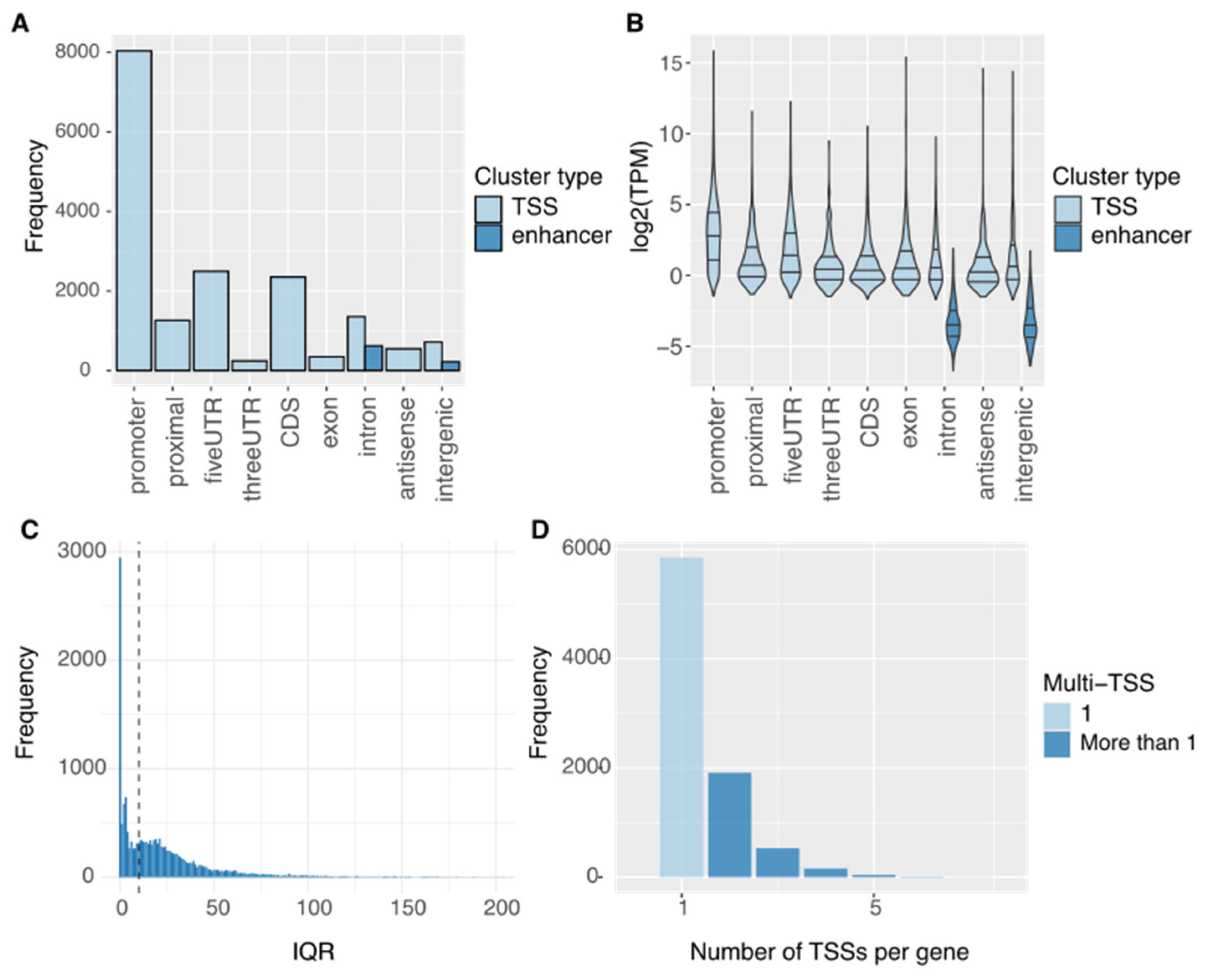
3.1. Landscape of CAGE Results
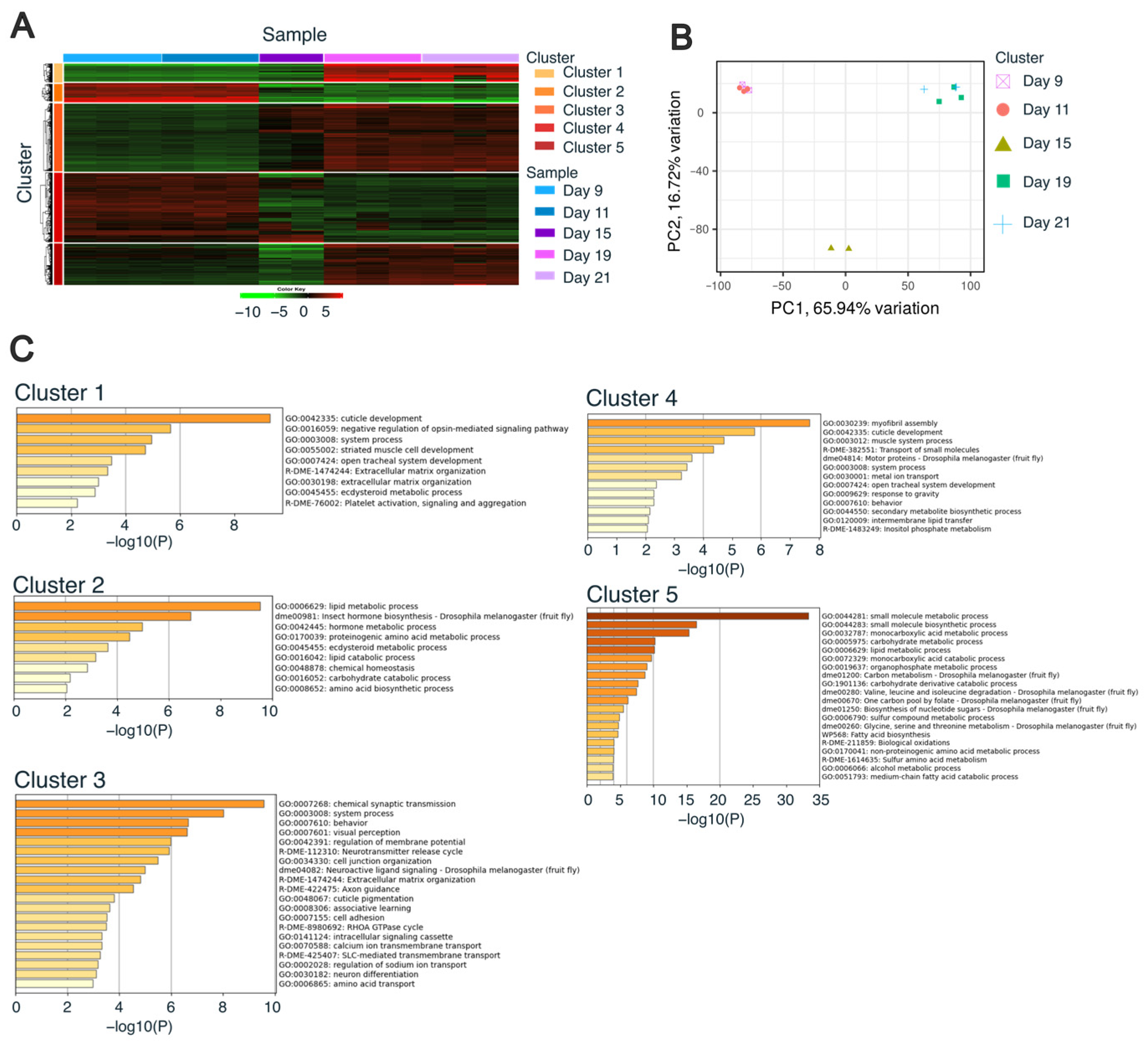
3.2. CAGE Patterns During Worker Metamorphosis
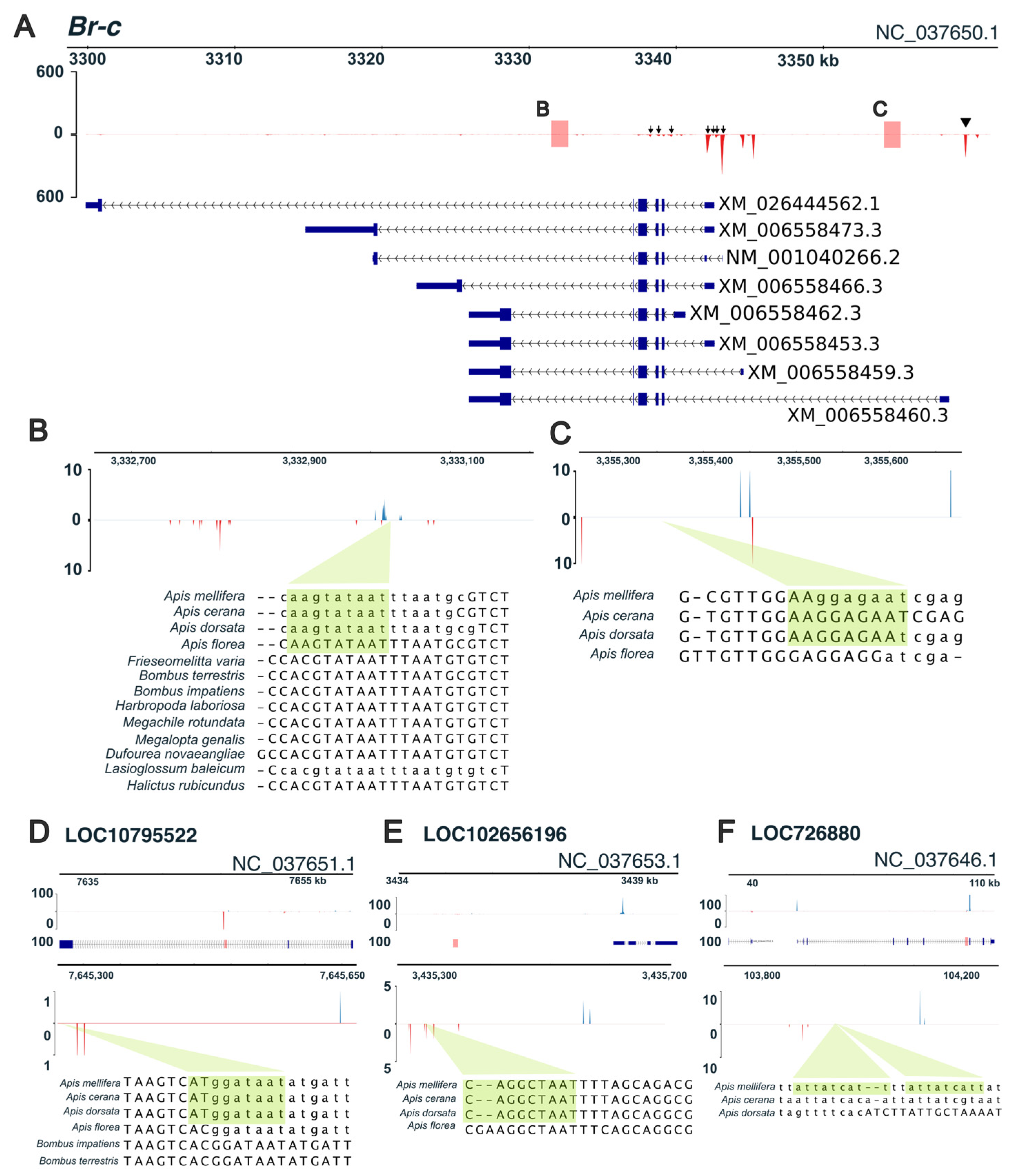
3.3. Identification of the Transcriptional Regulation During Worker Metamorphosis
4. Discussion
4.1. Genome-Wide Detection of TSSs and Enhancers During Worker Metamorphosis
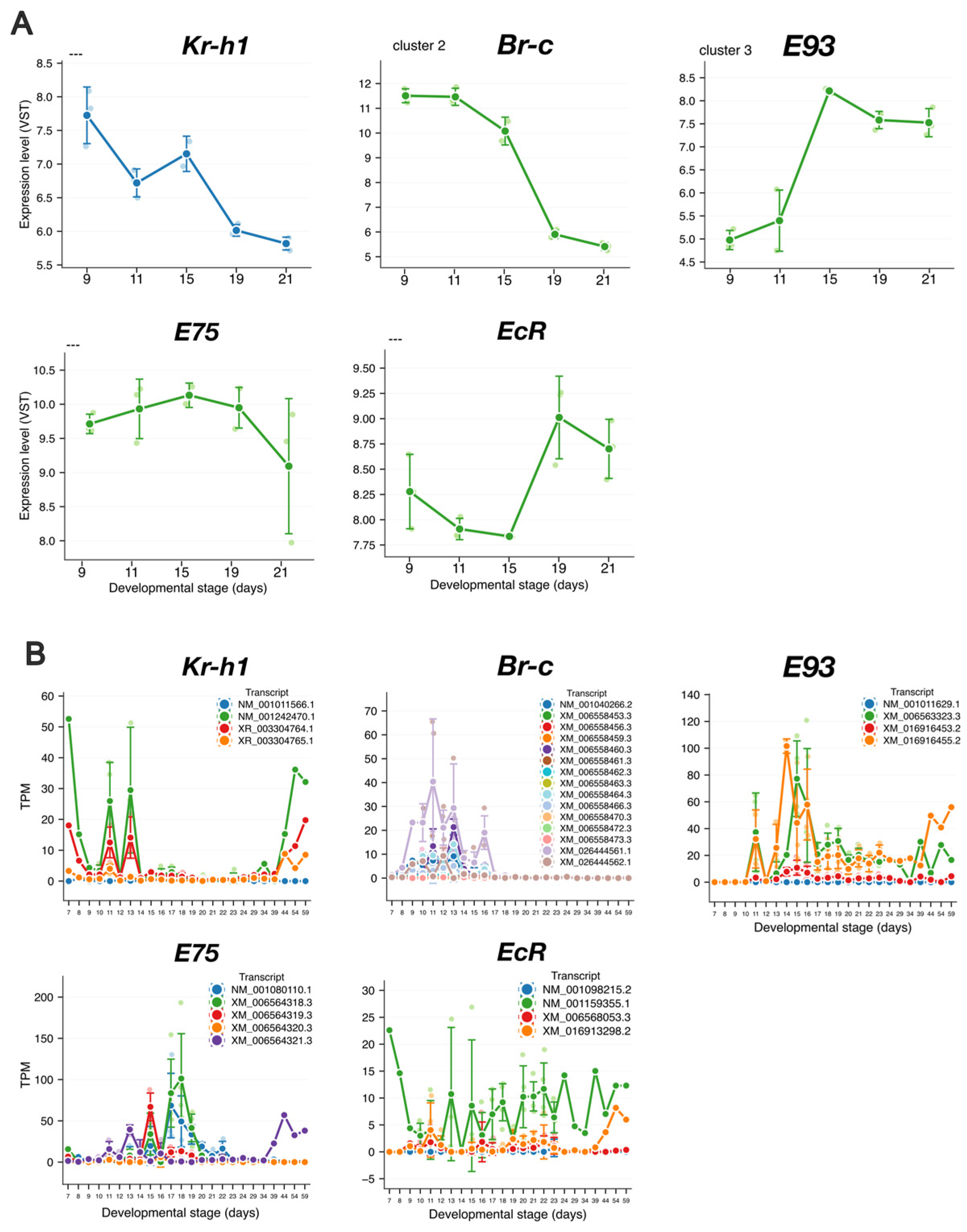
4.2. Identification of Active TSS During Worker Metamorphic Process
4.3. Predicted Regulatory Relationships Among TFs, Enhancers and TSSs
4.4. Conservation of Ttk-Binding Sites and Eusocial Evolution
5. Conclusions
Supplementary Materials
Author Contributions
Funding
Data Availability Statement
Acknowledgments
Conflicts of Interest
References
- Robinson, G.E.; Grozinger, C.M.; Whitfield, C.W. Sociogenomics: Social Life in Molecular Terms. Nat. Rev. Genet. 2005, 6, 257–270. [Google Scholar] [CrossRef]
- Kapheim, K.M.; Pan, H.; Li, C.; Salzberg, S.L.; Puiu, D.; Magoc, T.; Robertson, H.M.; Hudson, M.E.; Venkat, A.; Fischman, B.J.; et al. Genomic Signatures of Evolutionary Transitions from Solitary to Group Living. Science 2015, 348, 1139–1143. [Google Scholar] [CrossRef] [PubMed]
- Shell, W.A.; Steffen, M.A.; Pare, H.K.; Seetharam, A.S.; Severin, A.J.; Toth, A.L.; Rehan, S.M. Sociality Sculpts Similar Patterns of Molecular Evolution in Two Independently Evolved Lineages of Eusocial Bees. Commun. Biol. 2021, 4, 253. [Google Scholar] [CrossRef] [PubMed]
- Evans, J.D.; Wheeler, D.E. Differential Gene Expression between Developing Queens and Workers in the Honey Bee, Apis mellifera. Proc. Natl. Acad. Sci. USA 1999, 96, 5575–5580. [Google Scholar] [CrossRef]
- Cameron, R.C.; Duncan, E.J.; Dearden, P.K. Biased Gene Expression in Early Honeybee Larval Development. BMC Genom. 2013, 14, 903. [Google Scholar] [CrossRef]
- Warner, M.R.; Qiu, L.; Holmes, M.J.; Mikheyev, A.S.; Linksvayer, T.A. Convergent Eusocial Evolution Is Based on a Shared Reproductive Groundplan plus Lineage-Specific Plastic Genes. Nat. Commun. 2019, 10, 2651. [Google Scholar] [CrossRef]
- Sasaki, K.; Yokoi, K.; Toga, K. Bumble Bee Queens Activate Dopamine Production and Gene Expression in Nutritional Signaling Pathways in the Brain. Sci. Rep. 2021, 11, 5526. [Google Scholar] [CrossRef] [PubMed]
- Séguret, A.; Stolle, E.; Fleites-Ayil, F.A.; Quezada-Euán, J.J.G.; Hartfelder, K.; Meusemann, K.; Harrison, M.C.; Soro, A.; Paxton, R.J. Transcriptomic Signatures of Ageing Vary in Solitary and Social Forms of an Orchid Bee. Genome Biol. Evol. 2021, 13, evab075. [Google Scholar] [CrossRef]
- Soares, M.P.M.; Pinheiro, D.G.; De Paula Freitas, F.C.; Simões, Z.L.P.; Bitondi, M.M.G. Transcriptome Dynamics during Metamorphosis of Imaginal Discs into Wings and Thoracic Dorsum in Apis mellifera Castes. BMC Genom. 2021, 22, 756. [Google Scholar] [CrossRef]
- Toga, K.; Bono, H. Meta-Analysis of Public RNA Sequencing Data Revealed Potential Key Genes Associated with Reproductive Division of Labor in Social Hymenoptera and Termites. Int. J. Mol. Sci. 2023, 24, 8353. [Google Scholar] [CrossRef]
- Yokoi, K.; Hatakeyama, M.; Kuwazaki, S.; Maeda, T.; Yoshiyama, M.; Horigane-Ogihara, M.; Matsuyama, S.; Jouraku, A.; Bono, H.; Kimura, K. Comprehensive Expression Data for Two Honey Bee Species, Apis mellifera and Apis cerana japonica. Sci. Data 2025, 12, 926. [Google Scholar] [CrossRef]
- Wojciechowski, M.; Lowe, R.; Maleszka, J.; Conn, D.; Maleszka, R.; Hurd, P.J. Phenotypically Distinct Female Castes in Honey Bees are Defined by Alternative Chromatin States During Larval Development. Genome Res. 2018, 28, 1532–1542. [Google Scholar] [CrossRef] [PubMed]
- Jones, B.M.; Webb, A.E.; Geib, S.M.; Sim, S.; Schweizer, R.M.; Branstetter, M.G.; Evans, J.D.; Kocher, S.D. Repeated Shifts in Sociality Are Associated with Fine-Tuning of Highly Conserved and Lineage-Specific Enhancers in a Socially Flexible Bee. Mol. Biol. Evol. 2024, 41, msae229. [Google Scholar] [CrossRef] [PubMed]
- Kim, T.-K.; Hemberg, M.; Gray, J.M.; Costa, A.M.; Bear, D.M.; Wu, J.; Harmin, D.A.; Laptewicz, M.; Barbara-Haley, K.; Kuersten, S.; et al. Widespread Transcription at Neuronal Activity-Regulated Enhancers. Nature 2010, 465, 182–187. [Google Scholar] [CrossRef] [PubMed]
- Sartorelli, V.; Lauberth, S.M. Enhancer RNAs Are an Important Regulatory Layer of the Epigenome. Nat. Struct. Mol. Biol. 2020, 27, 521–528. [Google Scholar] [CrossRef]
- Li, Q.; Liu, X.; Wen, J.; Chen, X.; Xie, B.; Zhao, Y. Enhancer RNAs: Mechanisms in Transcriptional Regulation and Functions in Diseases. Cell Commun. Signal. 2023, 21, 191. [Google Scholar] [CrossRef]
- Kodzius, R.; Kojima, M.; Nishiyori, H.; Nakamura, M.; Fukuda, S.; Tagami, M.; Sasaki, D.; Imamura, K.; Kai, C.; Harbers, M.; et al. CAGE: Cap Analysis of Gene Expression. Nat. Methods 2006, 3, 211–222. [Google Scholar] [CrossRef]
- Andersson, R.; Gebhard, C.; Miguel-Escalada, I.; Hoof, I.; Bornholdt, J.; Boyd, M.; Chen, Y.; Zhao, X.; Schmidl, C.; Suzuki, T.; et al. An Atlas of Active Enhancers across Human Cell Types and Tissues. Nature 2014, 507, 455–461. [Google Scholar] [CrossRef]
- Tian, L.; Zhou, X. The Soldiers in Societies: Defense, Regulation, and Evolution. Int. J. Biol. Sci. 2014, 10, 296–308. [Google Scholar] [CrossRef]
- Patir, A.; Raper, A.; Fleming, R.; Henderson, B.E.P.; Murphy, L.; Henderson, N.C.; Clark, E.L.; Freeman, T.C.; Barnett, M.W. Cellular Heterogeneity of the Developing Worker Honey Bee (Apis mellifera) Pupa: A Single Cell Transcriptomics Analysis. G3 Genes Genomes Genet. 2023, 13, jkad178. [Google Scholar] [CrossRef]
- Belles, X.; Santos, C.G. The MEKRE93 (Methoprene Tolerant-Krüppel Homolog 1-E93) Pathway in the Regulation of Insect Metamorphosis, and the Homology of the Pupal Stage. Insect Biochem. Mol. Biol. 2014, 52, 60–68. [Google Scholar] [CrossRef] [PubMed]
- Minakuchi, C.; Namiki, T.; Yoshiyama, M.; Shinoda, T. RNAi-mediated Knockdown of Juvenile Hormone Acid O-methyltransferase Gene Causes Precocious Metamorphosis in the Red Flour Beetle Tribolium castaneum. FEBS J. 2008, 275, 2919–2931. [Google Scholar] [CrossRef] [PubMed]
- Goodman, W.G.; Cusson, M. The Juvenile Hormones. In Insect Endocrinology; Elsevier: Amsterdam, The Netherlands, 2012; pp. 310–365. ISBN 978-0-12-384749-2. [Google Scholar]
- Noriega, F.G. Juvenile Hormone Biosynthesis in Insects: What Is New, What Do We Know, and What Questions Remain? Int. Sch. Res. Not. 2014, 2014, 1–16. [Google Scholar] [CrossRef]
- Miura, K.; Oda, M.; Makita, S.; Chinzei, Y. Characterization of the Drosophila Methoprene-Tolerant Gene Product. FEBS J. 2005, 272, 1169–1178. [Google Scholar] [CrossRef]
- Konopova, B.; Jindra, M. Juvenile Hormone Resistance Gene Methoprene-Tolerant Controls Entry into Metamorphosis in the Beetle Tribolium castaneum. Proc. Natl. Acad. Sci. USA 2007, 104, 10488–10493. [Google Scholar] [CrossRef]
- Charles, J.-P.; Iwema, T.; Epa, V.C.; Takaki, K.; Rynes, J.; Jindra, M. Ligand-Binding Properties of a Juvenile Hormone Receptor, Methoprene-Tolerant. Proc. Natl. Acad. Sci. USA 2011, 108, 21128–21133. [Google Scholar] [CrossRef]
- Jindra, M.; Uhlirova, M.; Charles, J.-P.; Smykal, V.; Hill, R.J. Genetic Evidence for Function of the bHLH-PAS Protein Gce/Met as a Juvenile Hormone Receptor. PLoS Genet. 2015, 11, e1005394. [Google Scholar] [CrossRef]
- Minakuchi, C.; Namiki, T.; Shinoda, T. Krüppel Homolog 1, an Early Juvenile Hormone-Response Gene Downstream of Methoprene-Tolerant, Mediates Its Anti-Metamorphic Action in the Red Flour Beetle Tribolium Castaneum. Dev. Biol. 2009, 325, 341–350. [Google Scholar] [CrossRef]
- Kayukawa, T.; Minakuchi, C.; Namiki, T.; Togawa, T.; Yoshiyama, M.; Kamimura, M.; Mita, K.; Imanishi, S.; Kiuchi, M.; Ishikawa, Y.; et al. Transcriptional Regulation of Juvenile Hormone-Mediated Induction of Krüppel Homolog 1, a Repressor of Insect Metamorphosis. Proc. Natl. Acad. Sci. USA 2012, 109, 11729–11734. [Google Scholar] [CrossRef] [PubMed]
- Koelle, M.R.; Talbot, W.S.; Segraves, W.A.; Bender, M.T.; Cherbas, P.; Hogness, D.S. The Drosophila EcR Gene Encodes an Ecdysone Receptor, a New Member of the Steroid Receptor Superfamily. Cell 1991, 67, 59–77. [Google Scholar] [CrossRef]
- Yao, T.-P.; Forman, B.M.; Jiang, Z.; Cherbas, L.; Chen, J.-D.; McKeown, M.; Cherbas, P.; Evans, R.M. Functional Ecdysone Receptor Is the Product of EcR and Ultraspiracle Genes. Nature 1993, 366, 476–479. [Google Scholar] [CrossRef]
- Dubrovsky, E. Hormonal Cross Talk in Insect Development. Trends Endocrinol. Metab. 2005, 16, 6–11. [Google Scholar] [CrossRef] [PubMed]
- Konopova, B.; Smykal, V.; Jindra, M. Common and Distinct Roles of Juvenile Hormone Signaling Genes in Metamorphosis of Holometabolous and Hemimetabolous Insects. PLoS ONE 2011, 6, e28728. [Google Scholar] [CrossRef]
- Khamis, A.M.; Hamilton, A.R.; Medvedeva, Y.A.; Alam, T.; Alam, I.; Essack, M.; Umylny, B.; Jankovic, B.R.; Naeger, N.L.; Suzuki, M.; et al. Insights into the Transcriptional Architecture of Behavioral Plasticity in the Honey Bee Apis mellifera. Sci. Rep. 2015, 5, 11136. [Google Scholar] [CrossRef]
- Chen, S. Fastp 1.0: An Ultra-fast All-round Tool for FASTQ Data Quality Control and Preprocessing. iMeta 2025, 4, e70078. [Google Scholar] [CrossRef]
- Thodberg, M.; Thieffry, A.; Vitting-Seerup, K.; Andersson, R.; Sandelin, A. CAGEfightR: Analysis of 5′-End Data Using R/Bioconductor. BMC Bioinform. 2019, 20, 487. [Google Scholar] [CrossRef]
- Ge, S.X.; Son, E.W.; Yao, R. iDEP: An Integrated Web Application for Differential Expression and Pathway Analysis of RNA-Seq Data. BMC Bioinform. 2018, 19, 534. [Google Scholar] [CrossRef] [PubMed]
- Zhou, Y.; Zhou, B.; Pache, L.; Chang, M.; Khodabakhshi, A.H.; Tanaseichuk, O.; Benner, C.; Chanda, S.K. Metascape Provides a Biologist-Oriented Resource for the Analysis of Systems-Level Datasets. Nat. Commun. 2019, 10, 1523. [Google Scholar] [CrossRef] [PubMed]
- Yokoi, K.; Wakamiya, T.; Bono, H. Meta-Analysis of the Public RNA-Seq Data of the Western Honeybee Apis mellifera to Construct Reference Transcriptome Data. Insects 2022, 13, 931. [Google Scholar] [CrossRef]
- Ovek Baydar, D.; Rauluseviciute, I.; Aronsen, D.R.; Blanc-Mathieu, R.; Bonthuis, I.; de Beukelaer, H.; Ferenc, K.; Jegou, A.; Kumar, V.; Lemma, R.B.; et al. JASPAR 2026: Expansion of Transcription Factor Binding Profiles and Integration of Deep Learning Models. Nucleic Acids Res. 2026, 54, D184–D193. [Google Scholar] [CrossRef]
- Blanchette, M.; Kent, W.J.; Riemer, C.; Elnitski, L.; Smit, A.F.A.; Roskin, K.M.; Baertsch, R.; Rosenbloom, K.; Clawson, H.; Green, E.D.; et al. Aligning Multiple Genomic Sequences with the Threaded Blockset Aligner. Genome Res. 2004, 14, 708–715. [Google Scholar] [CrossRef]
- Da Silva, J. Life History and the Transitions to Eusociality in the Hymenoptera. Front. Ecol. Evol. 2021, 9, 727124. [Google Scholar] [CrossRef]
- Lopez-Delisle, L.; Rabbani, L.; Wolff, J.; Bhardwaj, V.; Backofen, R.; Grüning, B.; Ramírez, F.; Manke, T. pyGenomeTracks: Reproducible Plots for Multivariate Genomic Datasets. Bioinformatics 2021, 37, 422–423. [Google Scholar] [CrossRef]
- Huang, X.; Warren, J.T.; Buchanan, J.; Gilbert, L.I.; Scott, M.P. Drosophila Niemann-Pick Type C-2 Genes Control Sterol Homeostasis and Steroid Biosynthesis: A Model of Human Neurodegenerative Disease. Development 2007, 134, 3733–3742. [Google Scholar] [CrossRef] [PubMed]
- Danielsen, E.T.; Moeller, M.E.; Yamanaka, N.; Ou, Q.; Laursen, J.M.; Soenderholm, C.; Zhuo, R.; Phelps, B.; Tang, K.; Zeng, J.; et al. A Drosophila Genome-Wide Screen Identifies Regulators of Steroid Hormone Production and Developmental Timing. Dev. Cell 2016, 37, 558–570. [Google Scholar] [CrossRef] [PubMed]
- Li, H.; Rai, M.; Buddika, K.; Sterrett, M.C.; Luhur, A.; Mahmoudzadeh, N.H.; Julick, C.R.; Pletcher, R.C.; Chawla, G.; Gosney, C.J.; et al. Lactate Dehydrogenase and Glycerol-3-Phosphate Dehydrogenase Cooperatively Regulate Growth and Carbohydrate Metabolism during Drosophila Melanogaster Larval Development. Development 2019, dev.175315. [Google Scholar] [CrossRef] [PubMed]
- Nishimura, T. Feedforward Regulation of Glucose Metabolism by Steroid Hormones Drives a Developmental Transition in Drosophila. Curr. Biol. 2020, 30, 3624–3632.e5. [Google Scholar] [CrossRef]
- Truman, J.W. The Evolution of Insect Metamorphosis. Curr. Biol. 2019, 29, R1252–R1268. [Google Scholar] [CrossRef]
- Yokoi, K. TPM Data of Apis mellifera Queen and Worker. 2024. Available online: https://figshare.com/articles/dataset/TPM_data_of_Apis_mellifera_queen_and_worker_/27157614 (accessed on 6 June 2025).
- Borsari, B.; Villegas-Mirón, P.; Pérez-Lluch, S.; Turpin, I.; Laayouni, H.; Segarra-Casas, A.; Bertranpetit, J.; Guigó, R.; Acosta, S. Enhancers with Tissue-Specific Activity Are Enriched in Intronic Regions. Genome Res. 2021, 31, 1325–1336. [Google Scholar] [CrossRef]
- Carninci, P.; Sandelin, A.; Lenhard, B.; Katayama, S.; Shimokawa, K.; Ponjavic, J.; Semple, C.A.M.; Taylor, M.S.; Engström, P.G.; Frith, M.C.; et al. Genome-Wide Analysis of Mammalian Promoter Architecture and Evolution. Nat. Genet. 2006, 38, 626–635. [Google Scholar] [CrossRef]
- Brown, J.B.; Boley, N.; Eisman, R.; May, G.E.; Stoiber, M.H.; Duff, M.O.; Booth, B.W.; Wen, J.; Park, S.; Suzuki, A.M.; et al. Diversity and Dynamics of the Drosophila Transcriptome. Nature 2014, 512, 393–399. [Google Scholar] [CrossRef]
- Cinege, G.; Zsámboki, J.; Vidal-Quadras, M.; Uv, A.; Csordás, G.; Honti, V.; Gábor, E.; Hegedűs, Z.; Varga, G.I.B.; Kovács, A.L.; et al. Genes Encoding Cuticular Proteins Are Components of the Nimrod Gene Cluster in Drosophila. Insect Biochem. Mol. Biol. 2017, 87, 45–54. [Google Scholar] [CrossRef]
- Roch, F.; Alonso, C.R.; Akam, M. Drosophila Miniature and Dusky Encode ZP Proteins Required for Cytoskeletal Reorganisation during Wing Morphogenesis. J. Cell Sci. 2003, 116, 1199–1207. [Google Scholar] [CrossRef]
- Zhang, Y.; Tan, Q.; Lin, M.; Shen, C.; Jin, L.; Li, G. Dusky-like Is Critical for Morphogenesis of the Cellular Protuberances and Formation of the Cuticle in Henosepilachna vigintioctopunctata. Biology 2023, 12, 866. [Google Scholar] [CrossRef]
- Heier, C.; Kühnlein, R.P. Triacylglycerol Metabolism in Drosophila melanogaster. Genetics 2018, 210, 1163–1184. [Google Scholar] [CrossRef]
- Grossman, S.R.; Engreitz, J.; Ray, J.P.; Nguyen, T.H.; Hacohen, N.; Lander, E.S. Positional Specificity of Different Transcription Factor Classes within Enhancers. Proc. Natl. Acad. Sci. USA 2018, 115, E7222–E7230. [Google Scholar] [CrossRef] [PubMed]
- Kristjánsdóttir, K.; Dziubek, A.; Kang, H.M.; Kwak, H. Population-Scale Study of eRNA Transcription Reveals Bipartite Functional Enhancer Architecture. Nat. Commun. 2020, 11, 5963. [Google Scholar] [CrossRef] [PubMed]
- Cullen, G.; Gilligan, J.B.; Guhlin, J.G.; Dearden, P.K. Germline Progenitors and Oocyte Production in the Honeybee Queen Ovary. Genetics 2023, 225, iyad138. [Google Scholar] [CrossRef] [PubMed]
- Gärtner, S.M.K.; Hundertmark, T.; Nolte, H.; Theofel, I.; Eren-Ghiani, Z.; Tetzner, C.; Duchow, T.B.; Rathke, C.; Krüger, M.; Renkawitz-Pohl, R. Stage-Specific Testes Proteomics of Drosophila Melanogaster Identifies Essential Proteins for Male Fertility. Eur. J. Cell Biol. 2019, 98, 103–115. [Google Scholar] [CrossRef]
- Okumura, T.; Matsumoto, A.; Tanimura, T.; Murakami, R. An Endoderm-Specific GATA Factor Gene, dGATAe, Is Required for the Terminal Differentiation of the Drosophila Endoderm. Dev. Biol. 2005, 278, 576–586. [Google Scholar] [CrossRef]
- Murakami, R.; Okumura, T.; Uchiyama, H. GATA Factors as Key Regulatory Molecules in the Development of Drosophila endoderm. Dev. Growth Differ. 2005, 47, 581–589. [Google Scholar] [CrossRef]
- Okumura, T.; Takeda, K.; Kuchiki, M.; Akaishi, M.; Taniguchi, K.; Adachi-Yamada, T. GATAe Regulates Intestinal Stem Cell Maintenance and Differentiation in Drosophila Adult Midgut. Dev. Biol. 2016, 410, 24–35. [Google Scholar] [CrossRef]
- Mandacaru, S.C.; Do Vale, L.H.F.; Vahidi, S.; Xiao, Y.; Skinner, O.S.; Ricart, C.A.O.; Kelleher, N.L.; De Sousa, M.V.; Konermann, L. Characterizing the Structure and Oligomerization of Major Royal Jelly Protein 1 (MRJP1) by Mass Spectrometry and Complementary Biophysical Tools. Biochemistry 2017, 56, 1645–1655. [Google Scholar] [CrossRef] [PubMed]
- Mattei, S.; Ban, A.; Picenoni, A.; Leibundgut, M.; Glockshuber, R.; Boehringer, D. Structure of Native Glycolipoprotein Filaments in Honeybee Royal Jelly. Nat. Commun. 2020, 11, 6267. [Google Scholar] [CrossRef] [PubMed]
- Klaudiny, J.; Kulifajová, J.; Crailsheim, K.; Šimúth, J. New Approach to the Study of Division of Labour in the Honeybee Colony (Apis mellifera L.). Apidologie 1994, 25, 596–600. [Google Scholar] [CrossRef][Green Version]
- Johnston, P.R.; Paris, V.; Rolff, J. Immune Gene Regulation in the Gut during Metamorphosis in a Holo-versus a Hemimetabolous Insect. Philos. Trans. R. Soc. B Biol. Sci. 2019, 374, 20190073. [Google Scholar] [CrossRef]
- Liu, W.; Yan, M.; King-Jones, K. Soul Is a Master Control Gene Governing the Development of the Drosophila Prothoracic Gland. Proc. Natl. Acad. Sci. USA 2024, 121, e2405469121. [Google Scholar] [CrossRef]
- Bonchuk, A.N.; Balagurov, K.I.; Baradaran, R.; Boyko, K.M.; Sluchanko, N.N.; Khrustaleva, A.M.; Burtseva, A.D.; Arkova, O.V.; Khalisova, K.K.; Popov, V.O.; et al. The Arthropoda-Specific Tramtrack Group BTB Protein Domains Use Previously Unknown Interface to Form Hexamers. eLife 2024, 13, e96832. [Google Scholar] [CrossRef]



| Expression Cluster | Transcription Factor (Symbol for Drosophila melanogaster) | Transcription Factor Converted to That for Apis mellifera | Enhancer Region | Target | Transcript_Accession | Homolog of D. melanogaster | Genomic Position of Enhancer |
|---|---|---|---|---|---|---|---|
| CLUSTER_1 | cycle | LOC725614 | LOC409602_NC_037646.1:6856142–6856605 | LOC409602 | XM_393105.7 | CG5867 | Intergenic_5′ |
| CLUSTER_1 | vismay | LOC726999 | LOC725089_NC_037639.1:9053147–9053570 | LOC725089 | NM_001174142.1 | Vajk2 | Intergenic_3′ |
| CLUSTER_1 | vismay | LOC726999 | LOC408277_NC_037647.1:11257009–11257518 | LOC408277 | XM_026443212.1 | dyl | UTR_5′ |
| CLUSTER_2 | tramtrack | LOC410918 | LOC102656196_NC_037653.1:3435243–3435704 | LOC102656196 | XR_408320.3 | - | Intergenic_5′ |
| CLUSTER_2 | tramtrack | LOC410918 | Br-c_NC_037650.1:3332653–3333205 | BR-C | BR-C | BR-C | Intron |
| CLUSTER_2 | tramtrack | LOC410918 | LOC726880_NC_037646.1:103712–104273 | LOC726880 | XM_026442630.1 | CG5966 | Intron |
| CLUSTER_2 | tramtrack | LOC410918 | LOC107965522_NC_037651.1:7645265–7645670 | LOC107965522 | XR_001705570.2 | - | Intron |
| CLUSTER_2 | tramtrack | LOC410918 | Br-c_NC_037650.1:3355266–3355678 | BR-C | BR-C | BR-C | Intron |
| CLUSTER_3 | ovo | LOC552100 | LOC100578051_NC_037645.1:3262281–3262683 | LOC100578051 | XM_006559597.3 | - | Intergenic_5′ |
| CLUSTER_3 | ovo | LOC552100 | LOC408660_NC_037639.1:15290978–15291500 | LOC408660 | XM_397515.7 | Theg | Intron |
| CLUSTER_3 | paired | LOC410499 | LOC408660_NC_037639.1:15290978–15291500 | LOC408660 | XM_397515.7 | Theg | Intron |
| CLUSTER_4 | GATAe | LOC725389 | LOC406093_NC_037643.1:15019468–15019997 | LOC406093 | NM_001011582.1 | - | Intergenic_5′ |
| CLUSTER_4 | GATAe | LOC725389 | LOC413551_NC_037638.1:25241063–25241514 | LOC413551 | XM_396993.7 | DPCoAC | Intergenic_5′ |
| CLUSTER_4 | GATAe | LOC725389 | LOC113218576_NC_037650.1:4859686–4860214 | LOC113218576 | XM_026444740.1 | CG11159 | Intergenic_3′ |
| CLUSTER_5 | daughterless | LOC113218537 | CPR17_NC_037639.1:2914897–2915423 | CPR17 | NM_001270827.1 | Cpr49Ah | Intergenic_5′ |
Disclaimer/Publisher’s Note: The statements, opinions and data contained in all publications are solely those of the individual author(s) and contributor(s) and not of MDPI and/or the editor(s). MDPI and/or the editor(s) disclaim responsibility for any injury to people or property resulting from any ideas, methods, instructions or products referred to in the content. |
© 2026 by the authors. Licensee MDPI, Basel, Switzerland. This article is an open access article distributed under the terms and conditions of the Creative Commons Attribution (CC BY) license.
Share and Cite
Toga, K.; Yokoi, K.; Bono, H. Genome-Wide Identification of Transcriptional Start Sites and Candidate Enhancers Regulating Worker Metamorphosis in Apis mellifera. Insects 2026, 17, 516. https://doi.org/10.3390/insects17050516
Toga K, Yokoi K, Bono H. Genome-Wide Identification of Transcriptional Start Sites and Candidate Enhancers Regulating Worker Metamorphosis in Apis mellifera. Insects. 2026; 17(5):516. https://doi.org/10.3390/insects17050516
Chicago/Turabian StyleToga, Kouhei, Kakeru Yokoi, and Hidemasa Bono. 2026. "Genome-Wide Identification of Transcriptional Start Sites and Candidate Enhancers Regulating Worker Metamorphosis in Apis mellifera" Insects 17, no. 5: 516. https://doi.org/10.3390/insects17050516
APA StyleToga, K., Yokoi, K., & Bono, H. (2026). Genome-Wide Identification of Transcriptional Start Sites and Candidate Enhancers Regulating Worker Metamorphosis in Apis mellifera. Insects, 17(5), 516. https://doi.org/10.3390/insects17050516