Research Advances in Pheromone Biosynthesis Regulation via the PBAN Signaling Pathway in Insects

 , and
, and
Simple Summary
Abstract
1. Introduction
2. Pheromone Regulation Pathways in the Insect PBAN Signaling Cascade
3. Molecular Components of the Pheromone Biosynthesis-Activating Neuropeptide (PBAN) Signaling Pathway in Insects
3.1. PBAN, a Signaling Molecule for Insect Pheromone Production
3.2. Pheromone Biosynthesis-Activating Neuropeptide Receptor (PBANR)
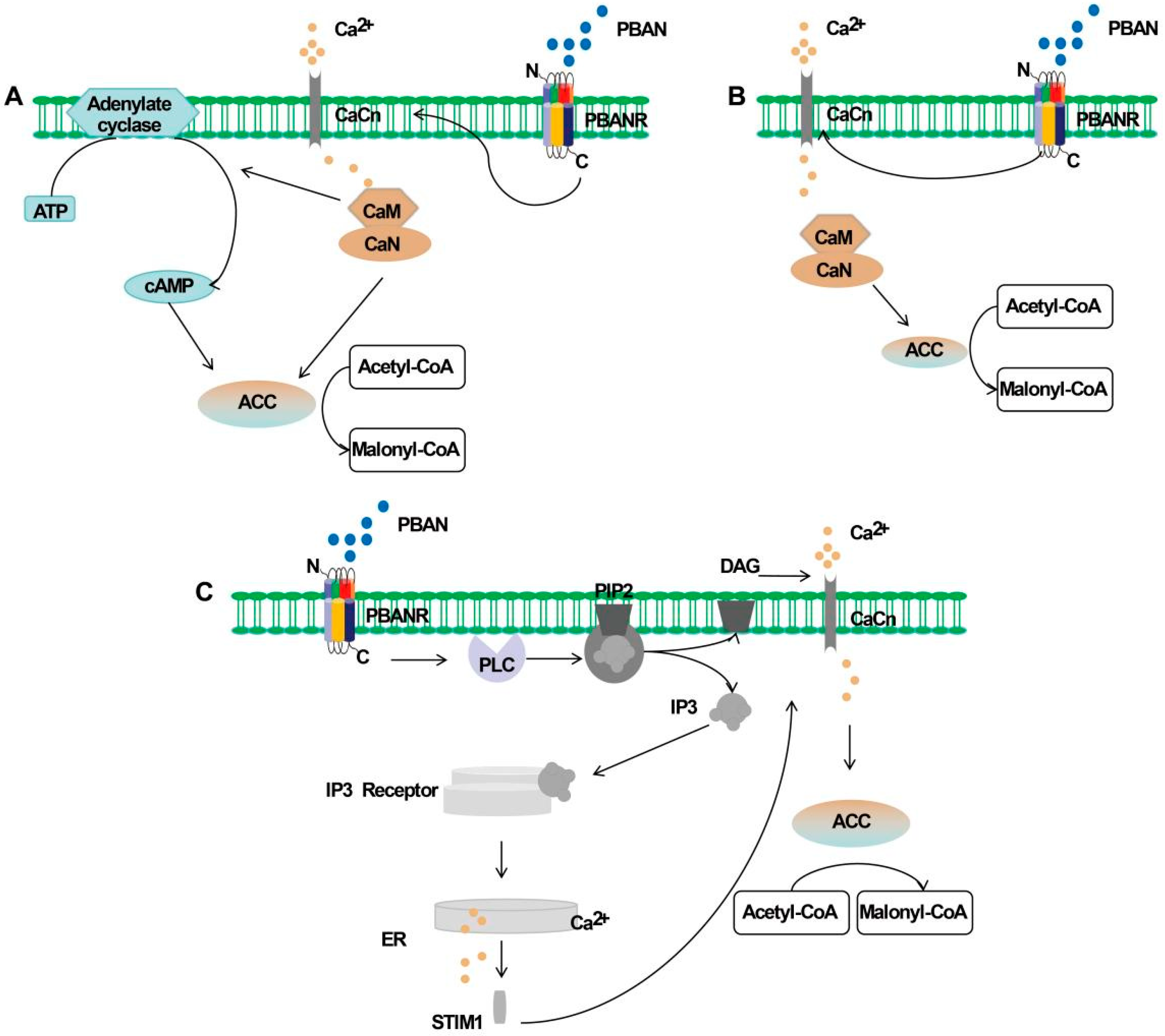
3.3. Second Messenger Signaling Pathways
3.3.1. Signaling Pathway with cAMP as the Second Messenger
3.3.2. Signaling Pathway with Ca2+ as the Second Messenger
3.3.3. Signaling Pathway with IP3 and DAG as Second Messengers
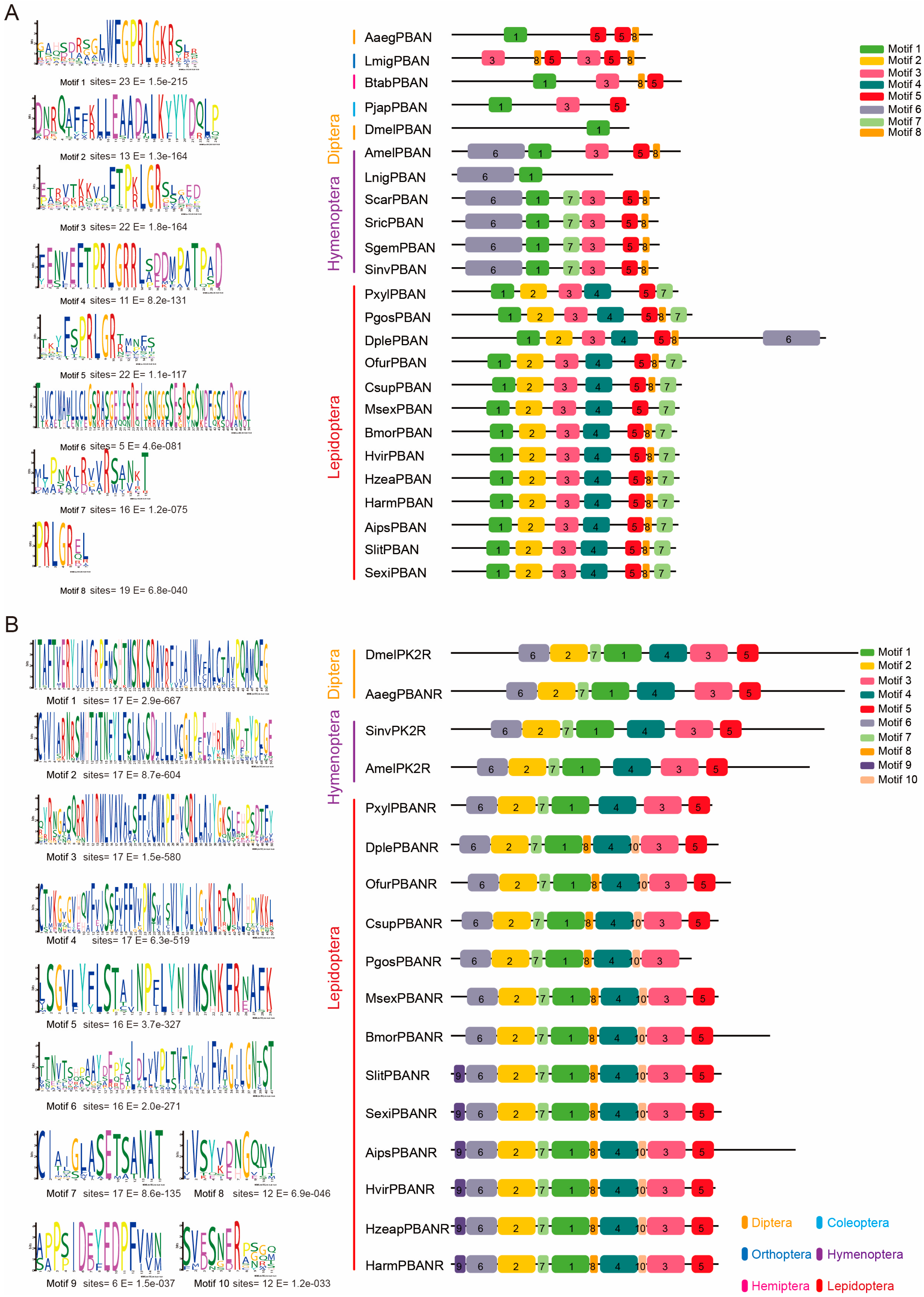
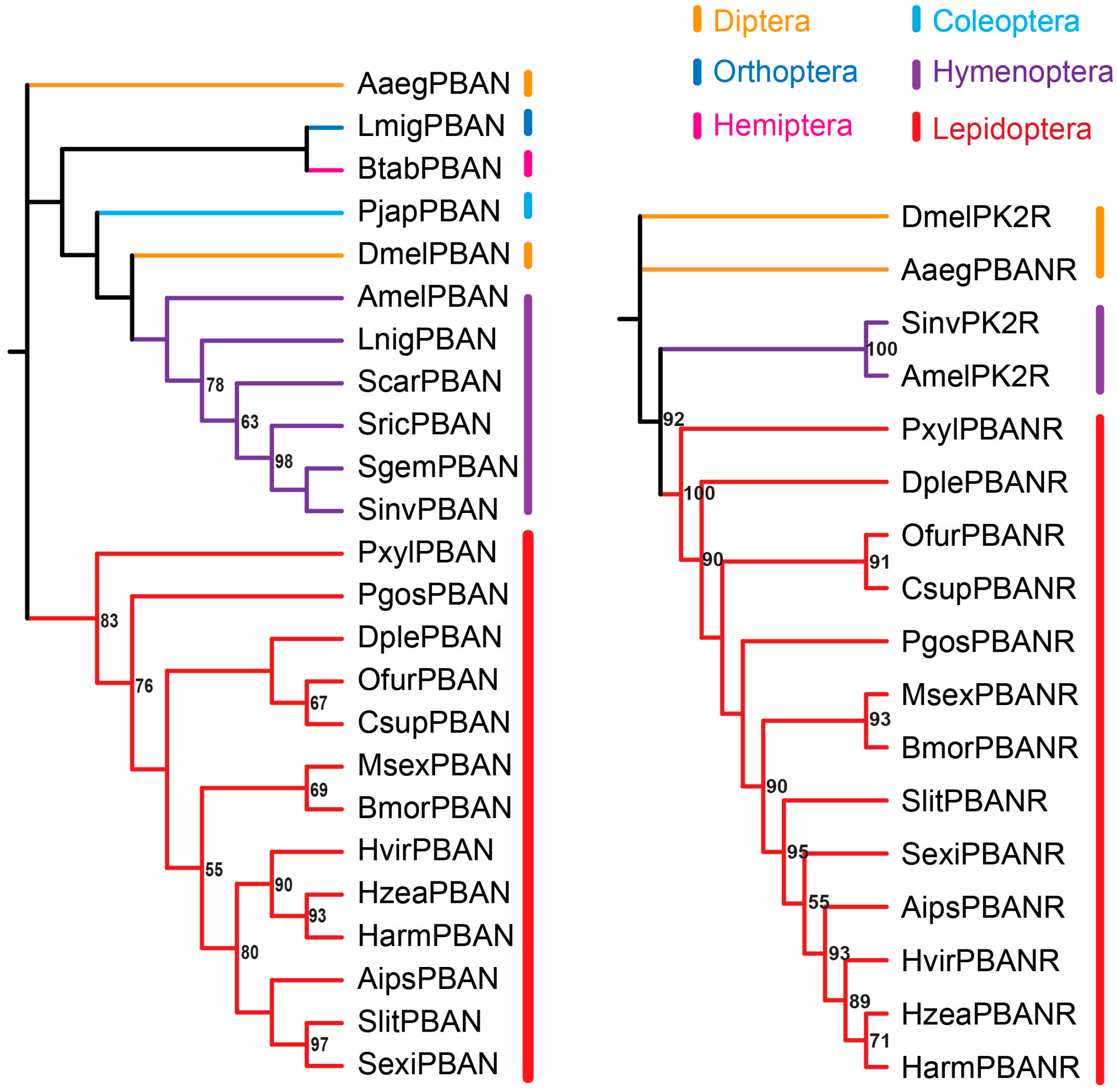
4. Molecular Evolution of PBAN and PBANR
Dataset Construction

5. Termination of Sex Pheromone Synthesis Signals
6. Application of Insect Pheromone Synthesis Mechanisms
7. Prospects
Author Contributions
Funding
Data Availability Statement
Acknowledgments
Conflicts of Interest
Abbreviations
| ACC | Acetyl-coA carboxylase |
| CaM | Calmodulin |
| CaN | Calcineurin |
| DAG | Diacylglycerol |
| ER | Endoplasmic reticulum |
| IP3 | Inositol 1,4,5-trisphosphate |
| PBAN | Pheromone biosynthesis-activating neuropeptide |
| PBANR | Pheromone biosynthesis-activating neuropeptide receptor |
| PLC | Phospholipase C |
| STIM1 | Stromal interaction molecule 1 |
References
- Groot, A.T.; Dekker, T.; Heckel, D.G. The genetic basis of pheromone evolution in moths. Annu. Rev. Entomol. 2016, 61, 99–117. [Google Scholar] [CrossRef] [Scilit]
- Yao, S.; Zhou, S.; Li, X.; Liu, X.; Zhao, W.; Wei, J.; Du, M.; An, S. Transcriptome analysis of Ostrinia furnacalis female pheromone gland: Esters biosynthesis and requirement for mating success. Front. Endocrinol. 2021, 12, 736906. [Google Scholar] [CrossRef] [Scilit] [PubMed]
- Cedden, D.; Bucher, G. The quest for the best target genes for RNAi-mediated pest control. Insect Mol. Biol. 2024, 34, 505–517. [Google Scholar] [CrossRef] [Scilit]
- Mendoza-Alatorre, M.; Julian-Chávez, B.; Solano-Ornelas, S.; Siqueiros-Cendón, T.S.; Torres-Castillo, J.A.; Sinagawa-García, S.R.; Abraham-Juárez, M.J.; González-Barriga, C.D.; Rascón-Cruz, Q.; Siañez-Estrada, L.I.; et al. RNAi in Pest Control: Critical Factors Affecting dsRNA Efficacy. Insects 2025, 16, 737. [Google Scholar] [CrossRef] [Scilit]
- Hull, J.J.; Lee, J.M.; Matsumoto, S. Gqα-linked phospholipase Cβ1 and phospholipase Cγ are essential components of the pheromone biosynthesis activating neuropeptide (PBAN) signal transduction cascade. Insect Mol. Biol. 2010, 19, 553–566. [Google Scholar] [CrossRef] [Scilit]
- Jiang, L.; Zhang, F.; Hou, Y.; Thakur, K.; Hu, F.; Zhang, J.; Jiang, X.; Liu, Y.; Wei, Z. Isolation and functional characterization of the pheromone biosynthesis activating neuropeptide receptor of Chinese oak silkworm, Antheraea pernyi. Int. J. Biol. Macromol. 2018, 117, 42–50. [Google Scholar] [CrossRef] [Scilit] [PubMed]
- Barsagade, D.D.; Gharade, S.A.; Barsagade, V.G. Immunocytochemical localization of leptin hormone in the neurosecretory cells of brain-suboesophageal ganglion complex of tropical tasar silkworm, Antheraea mylitta (D.) eco-race Bhandara. Curr. Sci. 2021, 120, 1611. [Google Scholar] [CrossRef] [Scilit]
- Duportets, L.; Gadenne, C.; Couillaud, F. A cDNA, from Agrotis ipsilon, that encodes the pheromone biosynthesis activating neuropeptide (PBAN) and other FXPRL peptides. Peptides 1999, 20, 899–905. [Google Scholar] [CrossRef] [Scilit]
- Wei, H.; Chang, H.; Zheng, L.; Lin, S.; Chen, Y.; Tian, H.; Zhao, J.; Chen, Y.; Cai, H.; Gu, X.; et al. Identification and expression profiling of pheromone biosynthesis activating neuropeptide in Chlumetia transversa (Walker). Pestic. Biochem. Physiol. 2017, 135, 89–96. [Google Scholar] [CrossRef] [Scilit]
- Du, M.; Liu, X.; Ma, N.; Liu, X.; Wei, J.; Yin, X.; Zhou, S.; Rafaeli, A.; Song, Q.; An, S. Calcineurin-mediated dephosphorylation of acetyl-coA carboxylase is required for pheromone biosynthesis activating neuropeptide (PBAN)-induced sex pheromone biosynthesis in Helicoverpa armigera. Mol. Cell. Proteom. 2017, 16, 2138–2152. [Google Scholar] [CrossRef] [Scilit] [PubMed]
- Chang, Y.; Zhang, Y.; Geng, Z.; Yao, S.; Zhao, W.; Yin, X.; An, S. Hexokinase is required for sex pheromone biosynthesis in Helicoverpa armigera. Insects 2021, 12, 889. [Google Scholar] [CrossRef] [Scilit]
- Zhang, B.; Zhang, Y.; Guan, R.; Du, M.; Yin, X.; Zhao, W.; An, S. Trehalase is required for sex pheromone biosynthesis in Helicoverpa armigera. Insect Mol. Biol. 2022, 31, 334–345. [Google Scholar] [CrossRef] [Scilit]
- Li, Z.; Li, K.; Xi, Y.; Li, Z.Y.; Li, X.; Wei, J.; An, S.; Yin, X. Sublethal concentration of beta-cypermethrin results in the mating failure of Helicoverpa armigera by inhibiting sex pheromone biosynthesis. Entomol. Gen. 2024, 44, 723–734. [Google Scholar] [CrossRef] [Scilit]
- Ragionieri, L.; Özbagci, B.; Neupert, S.; Salts, Y.; Davidovitch, M.; Altstein, M.; Predel, R. Identification of mature peptides from pban and capa genes of the moths Heliothis peltigera and Spodoptera littoralis. Peptides 2017, 94, 1–9. [Google Scholar] [CrossRef] [Scilit] [PubMed]
- Foster, S.P.; Anderson, K.G.; Casas, J. Sex pheromone in the moth Heliothis virescens is produced as a mixture of two pools: De novo and via precursor storage in glycerolipids. Insect Biochem. Mol. Biol. 2017, 87, 26–34. [Google Scholar] [CrossRef] [Scilit] [PubMed]
- Rafaeli, A.; Bober, R.; Becker, L.; Choi, M.Y.; Fuerst, E.J.; Jurenka, R. Spatial distribution and differential expression of the PBAN receptor in tissues of adult Helicoverpa spp. (Lepidoptera: Noctuidae). Insect Mol. Biol. 2007, 16, 287–293. [Google Scholar] [CrossRef] [Scilit]
- Fodor, J.; Hull, J.J.; Köblös, G.; Jacquin-Joly, E.; Szlanka, T.; Fónagy, A. Identification and functional characterization of the pheromone biosynthesis activating neuropeptide receptor isoforms from Mamestra brassicae. Gen. Comp. Endocrinol. 2018, 258, 60–69. [Google Scholar] [CrossRef] [Scilit] [PubMed]
- Shirai, Y.; Ono, H.; Daimon, T. Redundant actions of neuropeptides encoded by the dh-pban gene for larval color pattern formation in the oriental armyworm Mythimna separata. Insect Biochem. Mol. Biol. 2023, 157, 103955. [Google Scholar] [CrossRef] [Scilit]
- Sengupta, M.; Vimal, N.; Angmo, N.; Seth, R.K. Effect of irradiation on reproduction of female Spodoptera litura (Fabr.) (Lepidoptera:Noctuidae) in relation to the inherited sterility technique. Insects 2022, 13, 898. [Google Scholar] [CrossRef] [Scilit]
- Zhang, Y.; He, R.; She, Z.; Yin, X.; Li, X.; Yao, S.; Du, M.; An, S. PBAN regulates sex pheromone biosynthesis by Ca2+/CaN/ACC and Ca2+/PKC/HK2 signal pathways in Spodoptera litura. Insect Mol. Biol. 2024, 33, 363–378. [Google Scholar] [CrossRef] [Scilit]
- Ashok, K.; Bhargava, C.N.; Asokan, R.; Pradeep, C.; Pradhan, S.K.; Kennedy, J.S.; Balasubramani, V.; Murugan, M.; Jayakanthan, M.; Geethalakshmi, V.; et al. CRISPR/Cas9 mediated editing of pheromone biosynthesis activating neuropeptide (PBAN) gene disrupts mating in the Fall armyworm, Spodoptera frugiperda (J.E. Smith) (Lepidoptera: Noctuidae). 3 Biotech 2023, 13, 370. [Google Scholar] [CrossRef] [Scilit] [PubMed]
- Park, Y.; Vatanparast, M. Suppression of PBAN receptor expression reduces fecundity in the fall armyworm, Spodoptera frugiperda. Arch. Insect Biochem. Physiol. 2022, 110, e21897. [Google Scholar] [CrossRef] [Scilit] [PubMed]
- Foster, S.P. Reinvestigation of sex pheromone biosynthesis in the moth Trichoplusia ni reveals novel quantitative control mechanisms. Insect Biochem. Mol. Biol. 2022, 140, 103700. [Google Scholar] [CrossRef] [Scilit]
- Choi, M.Y.; Fuerst, E.J.; Rafaeli, A.; Jurenka, R. Identification of a G protein-coupled receptor for pheromone biosynthesis activating neuropeptide from pheromone glands of the moth Helicoverpa zea. Proc. Natl. Acad. Sci. USA 2003, 100, 9721–9726. [Google Scholar] [CrossRef] [Scilit]
- Raina, A.K.; Jaffe, H.; Kempe, T.G.; Keim, P.; Blacher, R.W.; Fales, H.M.; Riley, C.T.; Klun, J.A.; Ridgway, R.L.; Hayes, D.K. Identification of a neuropeptide hormone that regulates sex pheromone production in female moths. Science 1989, 244, 796–798. [Google Scholar] [CrossRef] [Scilit] [PubMed]
- Cheng, Y.; Luo, L.; Jiang, X.; Zhang, L.; Niu, C. Expression of pheromone biosynthesis activating neuropeptide and its receptor (PBANR) mRNA in adult female Spodoptera exigua (Lepidoptera: Noctuidae). Arch. Insect Biochem. Physiol. 2010, 75, 13–27. [Google Scholar] [CrossRef] [Scilit]
- Delisle, J.; Picimbon, J.F.; Simard, J. Physiological control of pheromone production in Choristoneura fumiferana and C. rosaceana. Arch. Insect Biochem. Physiol. 1999, 42, 253–268. [Google Scholar] [CrossRef] [Scilit]
- Cha, W.H.; Kim, B.; Lee, D.W. Functional analysis of pheromone biosynthesis activating neuropeptide receptor isoforms in Maruca vitrata. Cell 2023, 12, 1410. [Google Scholar] [CrossRef] [Scilit]
- Fodor, J.; Köblös, G.; Kákai, Á.; Kárpáti, Z.; Molnár, B.P.; Dankó, T.; Fónagy, A. Molecular cloning, mRNA expression and biological activity of the pheromone biosynthesis activating neuropeptide (PBAN) from the European corn borer, Ostrinia nubilalis. Insect Mol. Biol. 2017, 26, 616–632. [Google Scholar] [CrossRef] [Scilit]
- Garczynski, S.F.; Hendrickson, C.A.; Harper, A.; Unruh, T.R.; Dornan, A.R. Neuropeptides and peptide hormones identified in codling moth, Cydia pomonella (Lepidoptera: Tortricidae). Arch. Insect Biochem. Physiol. 2019, 101, e21587. [Google Scholar] [CrossRef] [Scilit]
- Kumar, R.S.; Srinivasan, R.; Rawdzah, M.A.; Malini, P. Mapping and identification of potential target genes from short-RNA Seq for the control of Pieris rapae larvae. Genomics 2020, 112, 1464–1476. [Google Scholar] [CrossRef] [Scilit] [PubMed]
- Chen, Y.; Liu, Y.; Tian, H.; Chen, Y.; Lin, S.; Mao, Q.; Zheng, N.; Zhao, J.; Gu, X.; Wei, H. Distribution of pheromone biosynthesis-activating neuropeptide in the central nervous system of Plutella xylostella (Lepidoptera: Plutellidae). J. Econ. Entomol. 2019, 112, 2638–2648. [Google Scholar] [CrossRef] [Scilit]
- Senthilkumar, R.; Srinivasan, R. Sex-specific spatial and temporal gene expressions of Pheromone biosynthesis activating neuropeptide (PBAN) and binding proteins (PBP/OBP) in Spoladea recurvalis. Sci. Rep. 2019, 9, 3515. [Google Scholar] [CrossRef] [Scilit]
- Li, F.; Zhao, X.; Zhu, S.; Wang, T.; Li, T.; Woolfley, T.; Tang, G. Identification and expression profiling of neuropeptides and neuropeptide receptor genes in Atrijuglans hetaohei. Gene 2020, 744, 144605. [Google Scholar] [CrossRef] [Scilit]
- Hull, J.J.; Lee, J.M.; Kajigaya, R.; Matsumoto, S. Bombyx mori homologs of STIM1 and Orai1 are essential components of the signal transduction cascade that regulates sex pheromone production. J. Biol. Chem. 2009, 284, 31200–31213. [Google Scholar] [CrossRef] [Scilit]
- Halmová, M. Regulation of Insect Pheromone Biosynthesis. Bachelor’s Thesis, Univerzita Karlova, Prague, Czech Republic, 2023. [Google Scholar]
- Zhan, S.; Merlin, C.; Boore, J.L.; Reppert, S.M. The monarch butterfly genome yields insights into long-distance migration. Cell 2011, 147, 1171–1185. [Google Scholar] [CrossRef] [Scilit]
- Nieberding, C.M.; Beldade, P.; Baumlé, V.; Martin, G.S.; Arun, A.; Lognay, G.; Montagné, N.; Bastin-Héline, L.; Jacquin-Joly, E.; Noirot, C.; et al. Mosaic evolution of molecular pathways for sex pheromone communication in a butterfly. Genes 2022, 13, 1372. [Google Scholar] [CrossRef] [Scilit]
- Yang, Y.; Tao, J.; Zong, S. Identification of putative Type-I sex pheromone biosynthesis-related genes expressed in the female pheromone gland of Streltzoviella insularis. PLoS ONE 2020, 15, e0227666. [Google Scholar] [CrossRef] [Scilit]
- Li, J.; Zhou, J.; Sun, R.; Zhang, H.; Zong, S.; Luo, Y.; Sheng, X.; Weng, Q. cDNA cloning and sequence determination of the pheromone biosynthesis activating neuropeptide from the seabuckthorn carpenterworm, Holcocerus hippophaecolus (Lepidoptera: Cossidae). Arch. Insect Biochem. Physiol. 2013, 82, 183–195. [Google Scholar] [CrossRef] [Scilit] [PubMed]
- Zhao, C.H.; Li, Q.; Gao, W. Stimulation of sex pheromone production by PBAN-like substance in the pine caterpillar moth, Dendrolimus punctatus (Lepidoptera: Lasiocampidae). Arch. Insect Biochem. Physiol. 2002, 49, 137–148. [Google Scholar] [CrossRef]
- Choi, M.Y.; Vander Meer, R.K. Identification of a new member of the PBAN family of neuropeptides from the fire ant, Solenopsis invicta. Insect Mol. Biol. 2009, 18, 161–169. [Google Scholar] [CrossRef] [Scilit]
- Jindal, V.; Park, Y.; Kim, D. Functional characterization of ecdysis triggering hormone receptors (AgETHR-A and AgETHR-B) in the African malaria mosquito, Anopheles gambiae. Front. Physiol. 2021, 12, 702979. [Google Scholar] [CrossRef] [Scilit]
- Fan, Y.; Rafaeli, A.; Moshitzky, P.; Kubli, E.; Choffat, Y.; Applebaum, S.W. Common functional elements of Drosophila melanogaster seminal peptides involved in reproduction of Drosophila melanogaster and Helicoverpa armigera females. Insect Biochem. Mol. Biol. 2000, 30, 805–812. [Google Scholar] [CrossRef] [Scilit]
- Choi, M.Y.; Rafaeli, A.; Jurenka, R.A. Pyrokinin/PBAN-like peptides in the central nervous system of Drosophila melanogaster. Cell Tissue Res. 2001, 306, 459–465. [Google Scholar] [CrossRef] [Scilit]
- Farris, S.M. Insect PRXamides: Evolutionary divergence, novelty, and loss in a conserved neuropeptide system. J. Insect Sci. 2023, 23, 3. [Google Scholar] [CrossRef] [Scilit]
- Lee, J.; Lee, B.H.; Park, J.J.; Jeong, I.H.; Lee, D.W. Loop-mediated isothermal amplification of PBAN gene for molecular diagnosis of Bemisia tabaci biotype Q (Hemiptera: Aleyrodidae). J. Asia Pac. Entomol. 2022, 25, 101942. [Google Scholar] [CrossRef] [Scilit]
- Fleites, L.A.; Johnson, R.; Kruse, A.R.; Nachman, R.J.; Hall, D.G.; MacCoss, M.; Heck, M.L. Peptidomics approaches for the identification of bioactive molecules from Diaphorina citri. J. Proteome Res. 2020, 19, 1392–1408. [Google Scholar] [CrossRef] [Scilit]
- Cucini, C.; Boschi, S.; Funari, R.; Cardaioli, E.; Iannotti, N.; Marturano, G.; Paoli, F.; Bruttini, M.; Carapelli, A.; Frati, F.; et al. De novo assembly and annotation of Popillia japonica’s genome with initial clues to its potential as an invasive pest. BMC Genom. 2024, 25, 275. [Google Scholar] [CrossRef] [Scilit]
- Hao, K.; Tu, X.; Ullah, H.; McNeill, M.R.; Zhang, Z. Novel Lom-dh genes play potential role in promoting egg diapause of Locusta migratoria L. Front. Physiol. 2019, 10, 767. [Google Scholar] [CrossRef] [Scilit]
- Yun, S.H.; Jang, H.S.; Ahn, S.J.; Price, B.E.; Hasegawa, D.K.; Choi, M.Y. Identification and characterisation of PRXamide peptides in the western flower thrips, Frankliniella occidentalis. Insect Mol. Biol. 2023, 32, 603–614. [Google Scholar] [CrossRef] [Scilit] [PubMed]
- Ma, P.W.; Knipple, D.C.; Roelofs, W.L. Structural organization of the Helicoverpa zea gene encoding the precursor protein for pheromone biosynthesis-activating neuropeptide and other neuropeptides. Proc. Natl. Acad. Sci. USA 1994, 91, 6506–6510. [Google Scholar] [CrossRef] [Scilit]
- Choi, M.Y.; Vander Meer, R.K.; Coy, M.; Scharf, M.E. Phenotypic impacts of PBAN RNA interference in an ant, Solenopsis invicta, and a moth, Helicoverpa zea. J. Insect Physiol. 2012, 58, 1159–1165. [Google Scholar] [CrossRef] [Scilit] [PubMed]
- Sreng, L.; Moreau, R.; Girardie, A. Locust neuropeptides stimulating sex pheromone production in female European corn borer moth, Ostrinia nubilalis. J. Insect Physiol. 1990, 36, 719–726. [Google Scholar] [CrossRef] [Scilit]
- Tang, J.D.; Wolf, W.A.; Roelofs, W.L.; Knipple, D.C. Development of functionally competent cabbage looper moth sex pheromone glands. Insect Biochem. 1991, 21, 573–581. [Google Scholar] [CrossRef] [Scilit]
- Hull, J.J.; Ohnishi, A.; Moto, K.I.; Kawasaki, Y.; Kurata, R.; Suzuki, M.G.; Matsumoto, S. Cloning and characterization of the pheromone biosynthesis activating neuropeptide receptor from the silkmoth, Bombyx mori: Significance of the carboxyl terminus in receptor internalization. J. Biol. Chem. 2004, 279, 51500–51507. [Google Scholar] [CrossRef] [Scilit]
- Khan, F.; Kim, K.; Sung, J.; Lim, H.; Kim, S.G.; Choi, M.Y.; Kim, Y. A novel physiological function of pheromone biosynthesis-activating neuropeptide in production of aggregation pheromone. Sci. Rep. 2023, 13, 5551. [Google Scholar] [CrossRef] [Scilit] [PubMed]
- Kim, Y.J.; Nachman, R.J.; Aimanova, K.; Gill, S.; Adams, M.E. The pheromone biosynthesis activating neuropeptide (PBAN) receptor of Heliothis virescens: Identification, functional expression, and structure-activity relationships of ligand analogs. Peptides 2008, 29, 268–275. [Google Scholar] [CrossRef] [Scilit] [PubMed]
- Lu, Q.; Huang, L.Y.; Chen, P.; Yu, J.F.; Xu, J.; Deng, J.Y.; Ye, H. Identification and RNA interference of the pheromone biosynthesis activating neuropeptide (PBAN) in the common cutworm moth Spodoptera litura (Lepidoptera: Noctuidae). J. Econ. Entomol. 2015, 108, 1344–1353. [Google Scholar] [CrossRef] [Scilit]
- Jurenka, R. Regulation of pheromone biosynthesis in moths. Curr. Opin. Insect Sci. 2017, 24, 29–35. [Google Scholar] [CrossRef] [Scilit]
- Altstein, M.; Ben-Aziz, O.; Bhargava, K. Histochemical localization of the PBAN receptor in the pheromone gland of Heliothis peltigera. Peptides 2003, 24, 1335–1347. [Google Scholar] [CrossRef] [Scilit]
- Jurenka, R.; Nusawardani, T. The pyrokinin/pheromone biosynthesis-activating neuropeptide (PBAN) family of peptides and their receptors in Insecta: Evolutionary trace indicates potential receptor ligand-binding domains. Insect Mol. Biol. 2011, 20, 323–334. [Google Scholar] [CrossRef] [Scilit] [PubMed]
- Eltahlawy, H.; Buckner, J.S.; Foster, S.P. Evidence for two-step regulation of pheromone biosynthesis by the pheromone biosynthesis-activating neuropeptide in the moth Heliothis virescens. Arch. Insect Biochem. Physiol. 2007, 64, 120–130. [Google Scholar] [CrossRef] [Scilit] [PubMed]
- Iwanaga, M.; Dohmae, N.; Fonagy, A.; Takio, K.; Kawasaki, H.; Maeda, S.; Matsumoto, S. Isolation and characterization of calmodulin in the pheromone gland of the silkworm, Bombyx mori. Comp. Biochem. Physiol. B 1998, 120, 761–767. [Google Scholar] [CrossRef] [Scilit]
- Ohnishi, A.; Hull, J.J.; Kaji, M.; Hashimoto, K.; Lee, J.M.; Tsuneizumi, K.; Suzuki, T.; Dohmae, N.; Matsumoto, S. Hormone signaling linked to silkmoth sex pheromone biosynthesis involves Ca2+/calmodulin-dependent protein kinase II-mediated phosphorylation of the insect PAT family protein Bombyx mori lipid storage droplet protein-1 (BmLsd1). J. Biol. Chem. 2011, 286, 24101–24112. [Google Scholar] [CrossRef] [Scilit]
- Zhang, D.; Gao, F.; Jakovlić, I.; Zou, H.; Zhang, J.; Li, W.X.; Wang, G.T. PhyloSuite: An integrated and scalable desktop platform for streamlined molecular sequence data management and evolutionary phylogenetics studies. Mol. Ecol. 2020, 20, 348–355. [Google Scholar] [CrossRef] [Scilit] [PubMed]
- Dou, X.; Jurenka, R. Pheromone biosynthesis activating neuropeptide family in insects: A review. Front. Endocrinol. 2023, 14, 1274750. [Google Scholar] [CrossRef] [Scilit]
- Bailey, T.L.; Boden, M.; Buske, F.A.; Frith, M.; Grant, C.E.; Clementi, L.; Ren, J.Y.; Li, W.W.; Noble, W.S. MEME SUITE: Tools for motif discovery and searching. Nucleic Acids Res. 2009, 37, W202–W208. [Google Scholar] [CrossRef] [Scilit]
- Chen, C.J.; Chen, H.; Zhang, Y.; Thomas, H.R.; Frank, M.H.; He, Y.H.; Xia, R. TBtools: An integrative toolkit developed for interactive analyses of big biological data. Mol. Plant. 2020, 13, 1194–1202. [Google Scholar] [CrossRef] [Scilit]
- Katoh, K.; Rozewicki, J.; Yamada, K.D. MAFFT online service: Multiple sequence alignment, interactive sequence choice and visualization. Brief. Bioinform. 2019, 20, 1160–1166. [Google Scholar] [CrossRef] [Scilit]
- Capella-Gutiérrez, S.; Silla-Martínez, J.M.; Gabaldón, T. trimAl: A tool for automated alignment trimming in large-scale phylogenetic analyses. Bioinformatics 2009, 25, 1972–1973. [Google Scholar] [CrossRef] [Scilit]
- Kalyaanamoorthy, S.; Minh, B.Q.; Wong, T.K.F.; von Haeseler, A.; Jermiin, L.S. ModelFinder: Fast model selection for accurate phylogenetic estimates. Nat. Methods 2017, 14, 587–589. [Google Scholar] [CrossRef] [Scilit]
- Nguyen, L.T.; Schmidt, H.A.; Von Haeseler, A.; Minh, B.Q. IQ-TREE: A fast and effective stochastic algorithm for estimating maximum-likelihood phylogenies. Mol. Biol. Evol. 2015, 32, 268–274. [Google Scholar] [CrossRef] [Scilit]
- Schoofs, L.; De Loof, A.; Van Hiel, M.B. Neuropeptides as regulators of behavior in insects. Annu. Rev. Entomol. 2017, 62, 35–52. [Google Scholar] [CrossRef] [Scilit] [PubMed]
- Yang, Y.; Ma, X.; Zhang, L.; Zhao, W.; Liu, X.; Li, X.; Du, M.; An, S. Octopamine terminates sex pheromone biosynthesis by suppressing PBAN signal in moths. Insect Mol. Biol. 2022, 31, 647–658. [Google Scholar] [CrossRef] [Scilit]
- Bober, R.; Azrielli, A.; Rafaeli, A. Developmental regulation of the pheromone biosynthesis activating neuropeptide-receptor (PBAN-R): Re-evaluating the role of juvenile hormone. Insect Mol. Biol. 2010, 19, 77–86. [Google Scholar] [CrossRef] [Scilit]
- Rizvi, S.A.H.; George, J.; Reddy, G.V.; Zeng, X.; Guerrero, A. Latest developments in insect sex pheromone research and its application in agricultural pest management. Insects 2021, 12, 484. [Google Scholar] [CrossRef] [Scilit] [PubMed]
- Ding, B.J.; Hofvander, P.; Wang, H.L.; Durrett, T.P.; Stymne, S.; Löfstedt, C. A plant factory for moth pheromone production. Nat. Commun. 2014, 5, 3353. [Google Scholar] [CrossRef] [Scilit] [PubMed]
- Tupec, M.; Buček, A.; Valterová, I.; Pichová, I. Biotechnological potential of insect fatty acid-modifying enzymes. Z. Naturforsch. 2017, 72, 387–403. [Google Scholar] [CrossRef] [Scilit]
- Holkenbrink, C.; Ding, B.J.; Wang, H.L.; Dam, M.I.; Petkevicius, K.; Kildegaard, K.R.; Wenning, L.; Sinkwitz, C.; Lorantfy, B.; Koutsoumpeli, E.; et al. Production of moth sex pheromones for pest control by yeast fermentation. Metab. Eng. 2020, 62, 312–321. [Google Scholar] [CrossRef] [Scilit]
- Petkevicius, K.; Löfstedt, C.; Borodina, I. Insect sex pheromone production in yeasts and plants. Curr. Opin. Biotechnol. 2020, 65, 259–267. [Google Scholar] [CrossRef] [Scilit]
- Kallam, K.; Moreno-Giménez, E.; Mateos-Fernández, R.; Tansley, C.; Gianoglio, S.; Orzaez, D.; Patron, N.J. Tunable control of insect pheromone biosynthesis in Nicotiana benthamiana. Plant Biotechnol. J. 2023, 21, 1440–1453. [Google Scholar] [CrossRef] [Scilit]
- Altstein, M. Novel insect control agents based on neuropeptide antagonists: The PK/PBAN family as a case study. J. Mol. Neurosci. 2004, 22, 147–157. [Google Scholar] [CrossRef] [Scilit]
- Zulfiquar, S.; Upadhyay, S.K.; Yadav, D.; Dixit, Y.B.; Prakash, S. Mating Disruption in Insect Pests by Sex Pheromones: A Profound Integrated Pest Management Technique. Int. J. Zool. Investig. 2022, 8, 689–700. [Google Scholar] [CrossRef] [Scilit]
- Li, X.; Lu, H.; Zhao, C.; Tang, Q. Spray-applied RNA interference biopesticides: Mechanisms, technological advances, and challenges toward sustainable pest management. Horticulturae 2026, 12, 137. [Google Scholar] [CrossRef] [Scilit]
- Rafaeli, A. PBAN regulation of pheromone biosynthesis in female moths. In Insect Pheromone Biochemistry and Molecular Biology; Vogt, R.G., Ed.; Elsevier: San Diego, CA, USA, 2003; pp. 107–136. [Google Scholar] [CrossRef] [Scilit]
- Farris, S.M. In silico structural and docking models of dipteran FXPRLamide neuropeptides support ligand-receptor coevolution and suggest mechanisms for ligand bias. PLoS ONE 2025, 20, e0329924. [Google Scholar] [CrossRef] [Scilit]
- Liu, J.; He, Q.; Lin, X.; Smagghe, G. Recent progress in nanoparticle-mediated RNA interference in insects: Unveiling new frontiers in pest control. J. Insect Physiol. 2025, 167, 104884. [Google Scholar] [CrossRef] [Scilit]
- Lin, Y.C.; Lu, Y.H.; Liu, Y.; Su, Y.J.; Lin, Y.H.; Wu, Y.L. Differential RNAi efficacy of siRNA and dsRNA targeting key genes for pest control in Spodoptera litura. Front. Insect Sci. 2025, 5, 1574585. [Google Scholar] [CrossRef] [Scilit] [PubMed]
- Wang, G.; Wang, Q.; Liu, W.; Wen, J.; Yang, Y.; Niu, Z.; Guo, W.; Zhao, D. Effects of double-stranded RNA degrading nucleases on RNAi efficiency in beet moth Spodoptera exigua (Lepidoptera: Noctuidae). Insects 2025, 16, 229. [Google Scholar] [CrossRef] [Scilit]


| Latin Nomenclature | Family | Order | The Main Molecular Components of the Signaling Pathway | References | ||
|---|---|---|---|---|---|---|
| PBAN | PBANR | Second Messenger | ||||
| Antheraea pernyi | Lepidoptera | Saturniidae | + | + | - | [6] |
| Antheraea mylitta | Lepidoptera | Saturniidae | + | - | - | [7] |
| Agrotis ipsilon | Lepidoptera | Noctuidae | + | + | - | [8] |
| Chlumetia transversa | Lepidoptera | Noctuidae | + | - | - | [9] |
| Helicoverpa armigera | Lepidoptera | Noctuidae | + | + | Ca2+/cAMP | [10,11,12,13] |
| Heliothis peltigera | Lepidoptera | Noctuidae | + | - | - | [14] |
| Heliothis virescens | Lepidoptera | Noctuidae | + | + | Ca2+ | [15] |
| Helicoverpa assulta | Lepidoptera | Noctuidae | + | - | - | [16] |
| Mamestra brassicae | Lepidoptera | Noctuidae | + | + | - | [17] |
| Mythimna separata | Lepidoptera | Noctuidae | - | + | - | [18] |
| Spodoptera litura | Lepidoptera | Noctuidae | + | + | Ca2+ | [19,20] |
| Spodoptera frugiperda | Lepidoptera | Noctuidae | + | + | - | [21,22] |
| Spodoptera littoralis | Lepidoptera | Noctuidae | + | + | - | [14] |
| Trichoplusia ni | Lepidoptera | Noctuidae | + | + | - | [23] |
| Helicoverpa zea | Lepidoptera | Noctuidae | + | + | cAMP | [1,24,25] |
| Spodoptera exigua | Lepidoptera | Noctuidae | + | + | - | [26] |
| Chrysodeixis eriosoma | Lepidoptera | Noctuidae | + | - | - | [27] |
| Maraca vitrata | Lepidoptera | Pyralidae | + | + | - | [17,28] |
| Ostrinia nubilalis | Lepidoptera | Pyralidae | + | - | - | [29] |
| Ostrinia furnacalis | Lepidoptera | Pyralidae | + | + | Ca2+ | [2] & NCBI |
| Chilo suppressalis | Lepidoptera | Pyralidae | + | + | - | NCBI |
| Galleria mellonella | Lepidoptera | Pyralidae | + | - | - | NCBI |
| Cydia pomonella | Lepidoptera | Tortricidae | + | - | - | [30] |
| Pieris rapae | Lepidoptera | Pieridae | + | - | - | [31] |
| Plutella xylostella | Lepidoptera | Plutellidae | + | + | - | [32] |
| Spoladea recurvalis | Lepidoptera | Crambidae | + | - | - | [33] |
| Atrijuglans hetaohei | Lepidoptera | Heliodinidae | + | - | - | [34] |
| Bombyx mori | Lepidoptera | Bombycidae | + | + | Ca2+/IP3 DAG | [35,36] |
| Pectinophora gossypiella | Lepidoptera | Gelechiidae | + | + | - | NCBI |
| Danaus plexippus | Lepidoptera | Nymphalidae | + | + | - | [37] |
| Bicyclus anynana | Lepidoptera | Nymphalidae | + | - | - | [38] |
| Manduca sexta | Lepidoptera | Sphingidae | + | + | - | NCBI |
| Streltzoviella insularis | Lepidoptera | Cossidae | + | - | - | [39] |
| Holcocerus hippophaecolus | Lepidoptera | Cossidae | + | - | - | [40] |
| Dendrolimus punctatus | Lepidoptera | Lasiocampidae | + | - | - | [41] |
| Solenopsis richteri | Hymenoptera | Formicidae | + | - | - | [42] |
| Solenopsis geminata | Hymenoptera | Formicidae | + | - | - | |
| Solenopsis carolinensis | Hymenoptera | Formicidae | + | - | - | |
| Solenopsis invicta | Hymenoptera | Formicidae | + | - | - | [42] |
| Lasius niger | Hymenoptera | Formicidae | + | - | - | NCBI |
| Cephalcia chuxiongica | Hymenoptera | Pamphiliidae | + | - | - | NCBI |
| Anopheles gambiae | Diptera | Culicidae | + | - | - | [43] |
| Aedes aegypti | Diptera | Culicidae | + | + | - | NCBI |
| Drosophila melanogaster | Diptera | Drosophilidae | + | - | - | [44,45,46] |
| Bemisia tabaci | Hemiptera | Aleyrodidae | + | - | - | [47] |
| Diaphorina citri | Hemiptera | Psyllidae | + | - | - | [48] |
| Popillia japonica | Coleoptera | Rutelidae | + | - | - | [49] |
| Locusta migratoria | Orthoptera | Acrididae | + | - | - | [50] |
| Frankliniella occidentalis | Thysanoptera | Thripidae | + | - | - | [51] |
| Species | PBAN ID | PK2R/PBANR ID |
|---|---|---|
| Agrotis ipsilon | CAA08774.1 | AMN09327.1 |
| Helicoverpa armigera | XP_063899515.1 | AAW47417.1 |
| Helicoverpa zea | P11159.2 | AAP93921.1 |
| Plutella xylostella | AEP25400.1 | AAY34744.1 |
| Spodoptera exigua | AXY04289.1 | ABY62317.2 |
| Spodoptera littoralis | AAK84160.1 | ABD52277.1 |
| Heliothis virescens | AAO20095.1 | ABU93812.1 |
| Chilo suppressalis | QPA18426.1 | ALM88337.1 |
| Ostrinia furnacalis | UVT35071.1 | AZT88556.1 |
| Manduca sexta | AAO18192.1 | ACQ90219.1 |
| Bombyx mori | AAB24327.1 | NP_001036977.1 |
| Pectinophora gossypiella | AVX48909.1 | AVX48910.1 |
| Danaus plexippus | XP_032528234.2 | OWR48476.1 |
| Solenopsis invicta | ACL35348.1 | AFZ77039.1 |
| Solenopsis richteri | ADI88481.1 | - |
| Solenopsis geminata | ADI88478.1 | - |
| Solenopsis carolinensis | ADI88480.1 | - |
| Lasius niger | KMQ94925.1 | - |
| Apis mellifera | NP_001104182.1 | NP_001091688.1 |
| Drosophila melanogaster | AAF62876.1 | NP_731790.1 |
| Aedes aegypti | Q16N80.1 | AGT80483.1 |
| Popillia japonica | KAK9758775.1 | - |
| Locusta migratoria | AYC12049.1 | - |
| Bemisia tabaci | UCJ19306.1 | - |
Disclaimer/Publisher’s Note: The statements, opinions and data contained in all publications are solely those of the individual author(s) and contributor(s) and not of MDPI and/or the editor(s). MDPI and/or the editor(s) disclaim responsibility for any injury to people or property resulting from any ideas, methods, instructions or products referred to in the content. |
© 2026 by the authors. Licensee MDPI, Basel, Switzerland. This article is an open access article distributed under the terms and conditions of the Creative Commons Attribution (CC BY) license.
Share and Cite
Zhang, Y.; Liu, Z.; Yi, Y.; Chen, H.; Wu, X.; Xu, G.; Yang, J.; Gao, Z. Research Advances in Pheromone Biosynthesis Regulation via the PBAN Signaling Pathway in Insects. Insects 2026, 17, 463. https://doi.org/10.3390/insects17050463
Zhang Y, Liu Z, Yi Y, Chen H, Wu X, Xu G, Yang J, Gao Z. Research Advances in Pheromone Biosynthesis Regulation via the PBAN Signaling Pathway in Insects. Insects. 2026; 17(5):463. https://doi.org/10.3390/insects17050463
Chicago/Turabian StyleZhang, Yu, Zhitao Liu, Yan Yi, Hong Chen, Xia Wu, Guizhi Xu, Jingjun Yang, and Zhiqiang Gao. 2026. "Research Advances in Pheromone Biosynthesis Regulation via the PBAN Signaling Pathway in Insects" Insects 17, no. 5: 463. https://doi.org/10.3390/insects17050463
APA StyleZhang, Y., Liu, Z., Yi, Y., Chen, H., Wu, X., Xu, G., Yang, J., & Gao, Z. (2026). Research Advances in Pheromone Biosynthesis Regulation via the PBAN Signaling Pathway in Insects. Insects, 17(5), 463. https://doi.org/10.3390/insects17050463