Logistics-Mediated Artificial Sympatry and Its Implications for Molecular Detection of Hylurgus ligniperda

Simple Summary
Abstract
1. Introduction
2. Materials and Methods
2.1. Specimen Source and Nucleic Acid Preparation
2.2. Isothermal Amplification and Signal Quantification
2.3. SYBR Green qPCR Confirmation
2.4. Calibration, Sensitivity, and Exclusivity Assessment
3. Results
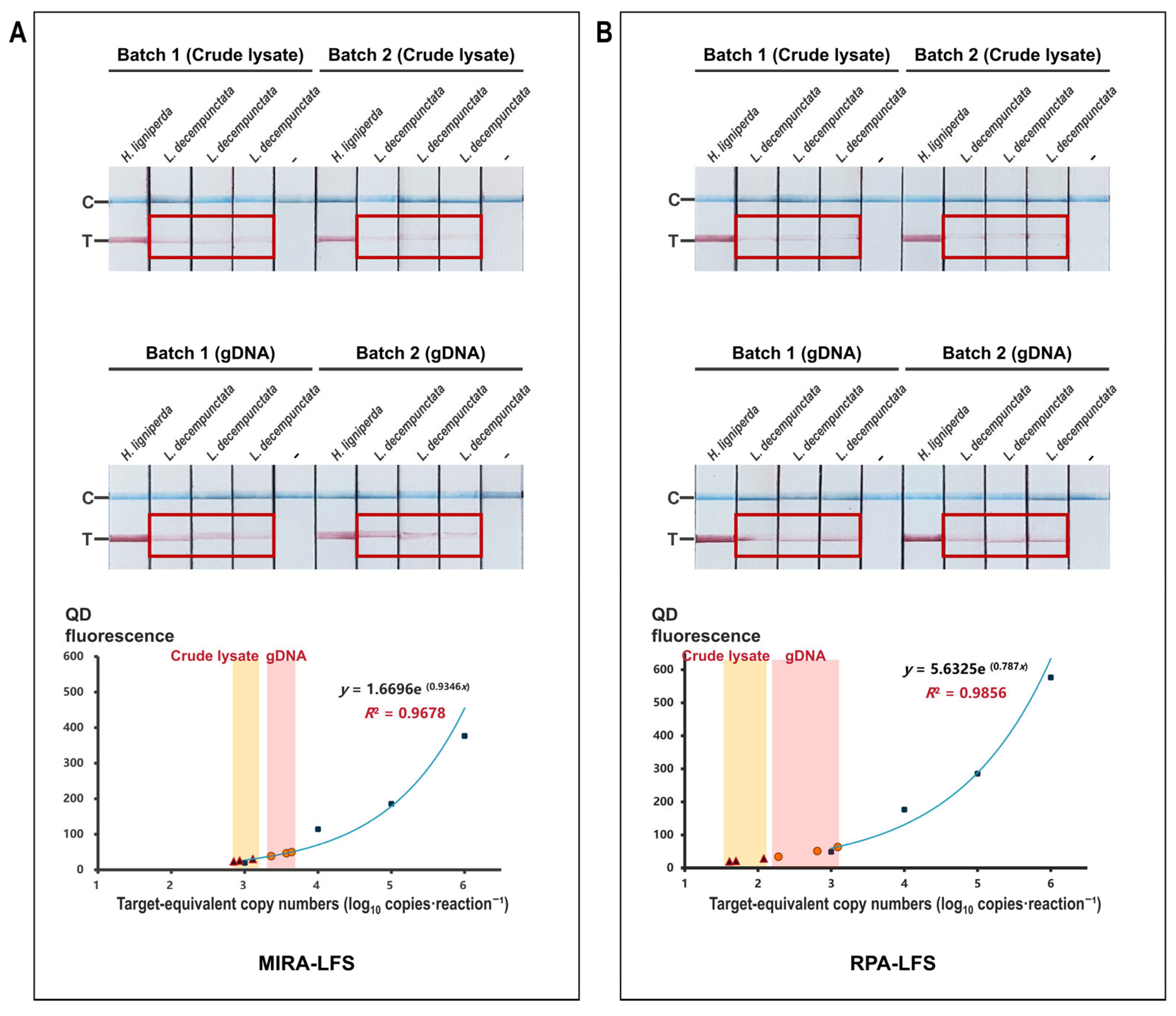
3.1. Cross-Platform Evaluation of Non-Target Amplification
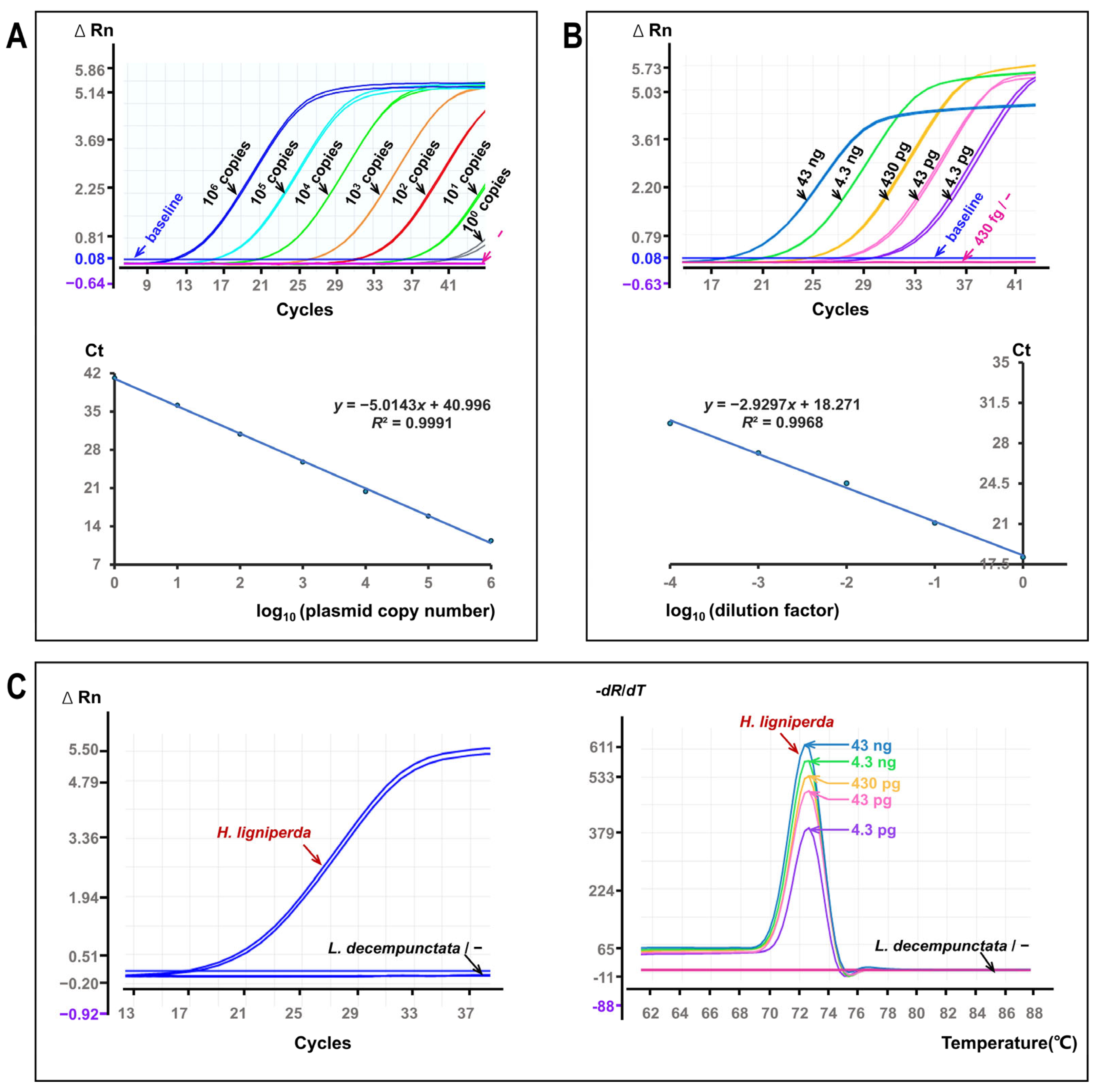
3.2. Quantitative Performance of SYBR Green qPCR
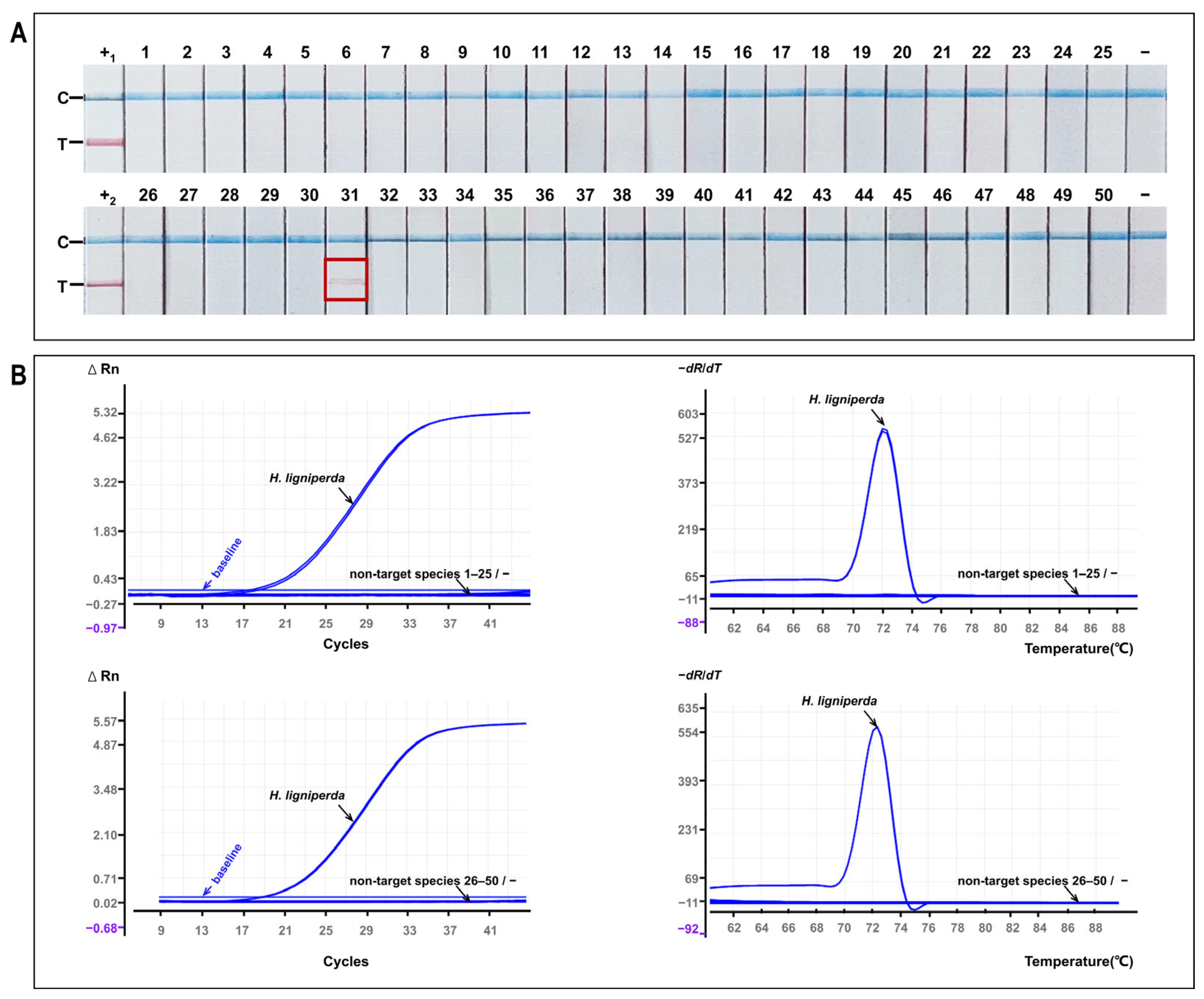
3.3. Specificity Validation and Confirmatory Analysis
4. Discussion
Supplementary Materials
Author Contributions
Funding
Data Availability Statement
Conflicts of Interest
Abbreviations
| MIRA | multiple enzyme isothermal rapid amplification |
| RAA | recombinase-aided amplification |
| RPA | recombinase polymerase amplification |
| LFS | lateral flow strips |
References
- Lin, W.; Park, S.; Jiang, Z.-R.; Ji, Y.-C.; Ernstsons, A.S.; Li, J.-J.; Li, Y.; Hulcr, J. Native or Invasive? The Red-Haired Pine Bark Beetle Hylurgus ligniperda (Fabricius) (Curculionidae: Scolytinae) in East Asia. Forests 2021, 12, 950. [Google Scholar] [CrossRef] [Scilit]
- Hoebeke, E.R. Hylurgus ligniperda: A new exotic pine bark beetle in the United States. Newsl. Mich. Entomol. Soc. 2001, 46, 1–2. [Google Scholar]
- Yan, Z.; Sun, J.; Don, O.; Zhang, Z. The red turpentine beetle, Dendroctonus valens LeConte (Scolytidae): An exotic invasive pest of pine in China. Biodivers. Conserv. 2005, 14, 1735–1760. [Google Scholar] [CrossRef] [Scilit]
- Lawson, S.A.; Carnegie, A.; Cameron, N.; Wardlaw, T.; Venn, T.J. Risk of exotic pests to the Australian forest industry. Aust. For. 2018, 81, 3–13. [Google Scholar] [CrossRef] [Scilit]
- Haack, R.A.; Britton, K.O.; Brockerhoff, E.G.; Cavey, J.F.; Garrett, L.J.; Kimberley, M.; Lowenstein, F.; Nuding, A.; Olson, L.J.; Turner, J.; et al. Effectiveness of the International Phytosanitary Standard ISPM No. 15 on reducing wood borer infestation rates in wood packaging material entering the United States. PLoS ONE 2014, 9, e96611. [Google Scholar] [CrossRef] [Scilit]
- Bi, L.; Tao, J.; Ren, L.; Wang, C.; Zhong, K. Ecological niche studies on Hylurgus ligniperda and its co-host stem-boring insects. Forests 2024, 15, 792. [Google Scholar] [CrossRef] [Scilit]
- Meurisse, N.; Rassati, D.; Hurley, B.P.; Brockerhoff, E.G.; Haack, R.A. Common pathways by which non-native forest insects move internationally and domestically. J. Pest Sci. 2019, 92, 13–27. [Google Scholar] [CrossRef] [Scilit]
- Brockerhoff, E.G.; Bain, J.; Kimberley, M.; Knížek, M. Interception frequency of exotic bark and ambrosia beetles (Coleoptera: Scolytinae) and relationship with establishment in New Zealand and worldwide. Can. J. For. Res. 2006, 36, 289–298. [Google Scholar] [CrossRef] [Scilit]
- Levine, J.M.; D’Antonio, C.M. Forecasting biological invasions with increasing international trade. Conserv. Biol. 2003, 17, 322–326. [Google Scholar] [CrossRef] [Scilit]
- Hulme, P.E. Trade, transport and trouble: Managing invasive species pathways in an era of globalization. J. Appl. Ecol. 2009, 46, 10–18. [Google Scholar] [CrossRef] [Scilit]
- Bao, Z.; Chang, X.; Cheng, L.; Lin, W.; Xu, W.; Shi, J. A highly specific and ultrasensitive approach to detect Hylurgus ligniperda based on RPA–CRISPR–LbaCas12a–LFD system. Pest Manag. Sci. 2025, 81, 7874–7884. [Google Scholar] [CrossRef] [Scilit]
- Rizzo, D.; Da Lio, D.; Bartolini, L.; Salemi, C.; Pennacchio, F.; Rapisarda, C.; Rossi, E. The rapid identification of Anoplophora chinensis (Coleoptera: Cerambycidae) from adult, larval, and frass samples using TaqMan Probe assay. J. Econ. Entomol. 2021, 114, 2229–2235. [Google Scholar] [CrossRef] [Scilit]
- Rizzo, D.; Da Lio, D.; Zubieta, C.G.; Ranaldi, C.; Marrucci, A.; Stabile, I.; d’Agostino, A.; Bartolini, L.; Rapisarda, C.; Pennacchio, F.; et al. A duplex real-time PCR with TaqMan probes for the distinction of Anoplophora chinensis (Forster) and Anoplophora glabripennis (Motschulsky) on different biological matrices. EPPO Bull. 2023, 53, 652–662. [Google Scholar] [CrossRef] [Scilit]
- Li, C.; Wang, B.; Ji, Y.; Huang, L.; Wang, X.; Zhao, W.; Wang, Y.; Wang, H.; Yao, Y. Mitochondrial genome provides species-specific targets for the rapid detection of early invasive populations of Hylurgus ligniperda in China. BMC Genom. 2024, 25, 90. [Google Scholar] [CrossRef] [Scilit]
- Li, C.; Wang, B.; Zhou, Z.; Lin, R.; Huai, W.; Wang, X.; Zong, S.; Yao, Y. On-site genetic diagnosis for the invasive pest Hylurgus ligniperda (Fabricius) and its possible application. Pest Manag. Sci. 2025, 81, 3899–3906. [Google Scholar] [CrossRef] [Scilit]
- Shi, J.; Wang, J.; Xie, W.; Liu, L.; Zheng, X.; Yang, C.; Chen, H.; Lu, Z.; Yang, C.; Shao, B. Establishment and evaluation of two MIRA rapid detection methods for tomato chlorosis virus (ToCV). Pest Manag. Sci. 2026. [Google Scholar] [CrossRef] [Scilit]
- Yuan, X.M.; Weng, X.Z.; Bu, X.L.; Chen, J.; Jiao, J.B.; Peng, X.Q.; Ma, W.S.; Lin, L.Y.; Huang, L.; Pan, X.Y.; et al. Development of a visual rapid detection method for aquatic animal-derived Trypanosoma via MIRA-LFD. Vet. Parasitol. 2026, 341, 110636. [Google Scholar] [CrossRef] [Scilit]
- Dai, Y.; Hu, X.; Zhong, Y.; Chen, L.; Wang, J.; Yin, D.; Yin, L.; Shen, X.; Pan, X.; Liu, X.; et al. Rapid Detection of Duck Enteritis Virus with MIRA, MIRA–qPCR, and MIRA–LFD Assays. Pathogens 2025, 14, 980. [Google Scholar] [CrossRef] [Scilit]
- Tan, M.; Liao, C.; Liang, L.; Yi, X.; Zhou, Z.; Wei, G. Recent advances in recombinase polymerase amplification: Principle, advantages, disadvantages and applications. Front. Cell. Infect. Microbiol. 2022, 12, 1019071. [Google Scholar] [CrossRef] [Scilit]
- Daher, R.K.; Stewart, G.; Boissinot, M.; Bergeron, M.G. Recombinase polymerase amplification for diagnostic applications. Clin. Chem. 2016, 62, 947–958. [Google Scholar] [CrossRef] [Scilit]
- Li, J.; Macdonald, J.; Von Stetten, F. A comprehensive summary of a decade development of the recombinase polymerase amplification. Analyst 2019, 144, 31–67. [Google Scholar] [CrossRef] [Scilit]
- Munawar, M.A. Critical insight into recombinase polymerase amplification technology. Expert Rev. Mol. Diagn. 2022, 22, 725–737. [Google Scholar] [CrossRef] [Scilit]
- Tian, F.; Zhan, Z.; Pei, J.; Huang, H.; Gu, Z. Establishment and comparison of RF-RAA and qPCR for rapid detection of Chinese soft-shelled turtle adenovirus (CSTAdV). Virol. J. 2025, 22, 284. [Google Scholar] [CrossRef] [Scilit]
- Wang, Z.-H.; Zhang, W.; Zhang, X.-Z.; Yao, X.-R.; Huang, W.; Jia, H.; Liu, X.-L.; Hou, S.-H.; Wang, X.-J. Development of a real-time recombinase-aided amplification (RT-RAA) molecular diagnosis assay for sensitive and rapid detection of Toxoplasma gondii. Vet. Parasitol. 2021, 298, 109489. [Google Scholar] [CrossRef] [Scilit]
- Piepenburg, O.; Williams, C.H.; Stemple, D.L.; Armes, N.A. DNA detection using recombination proteins. PLoS Biol. 2006, 4, e204. [Google Scholar] [CrossRef] [Scilit]
- Rostron, P.; Pennance, T.; Bakar, F.; Rollinson, D.; Knopp, S.; Allan, F.; Kabole, F.; Ali, S.M.; Ame, S.M.; Webster, B.L. Development of a recombinase polymerase amplification (RPA) fluorescence assay for the detection of Schistosoma haematobium. Parasites Vectors 2019, 12, 514. [Google Scholar] [CrossRef] [Scilit]
- Cao, Y.; Li, Y.; Li, J.; Wang, L.; Cheng, Z.; Wang, H.; Fan, Z.; Li, H. Rapid and quantitative detection of Pythium inflatum by real-time fluorescence loop-mediated isothermal amplification assay. Eur. J. Plant Pathol. 2016, 144, 83–95. [Google Scholar] [CrossRef] [Scilit]
- Wang, F.; Wu, X.; Xu, D.; Chen, L.; Ji, L. Identification of chicken-derived ingredients as adulterants using loop-mediated isothermal amplification. J. Food Prot. 2020, 83, 1175–1180. [Google Scholar] [CrossRef] [Scilit]
- Nieuwkerk, D.M.; Korajkic, A.; Valdespino, E.L.; Herrmann, M.P.; Harwood, V.J. Critical review of methods for isothermal amplification of nucleic acids for environmental analysis. J. Microbiol. Methods 2020, 179, 106099. [Google Scholar] [CrossRef] [Scilit]
- Hulme, P.E. Unwelcome exchange: International trade as a direct and indirect driver of biological invasions worldwide. One Earth 2021, 4, 666–679. [Google Scholar] [CrossRef] [Scilit]
- Wen, D.; Xu, C.L.; Li, J.Q.; Hua, K.W.; Qiao, Z.Z.; Cheng, X.; Ma, W.H.; Cai, W.L.; Chen, L.Z. A lignin-coated nanopesticide delivery system reduces the risk of avermectin to the natural predator, Harmonia axyridis. Pest Manag. Sci. 2026, 82, 2216–2230. [Google Scholar] [CrossRef] [Scilit]
- Zhang, H.; Wu, J.; Liu, Z.; Wei, X.; Zhuo, Z. Complete Mitochondrial Genome and Its Phylogenetic Analysis of Oides decempunctatus (Coleoptera: Chrysomelidae). Ecol. Evol. 2025, 15, e71819. [Google Scholar] [CrossRef] [Scilit]
- Chen, X.W.; Xie, D.; Chen, H.W.; Jia, N.Y.; Jiang, L.H.; Pan, Z.K.; Wang, Y.J.; Dai, Y.; Chi, D.F.; Yu, J. Effects of Hylurgus ligniperda (Coleoptera: Curculionidae)-microorganism symbiosis complex damage severity on physiological and defensive responses in Pinus thunbergii. J. Econ. Entomol. 2026, 119, 569–583. [Google Scholar] [CrossRef] [Scilit]
- Ouyang, X.H.; Lu, T.T.; Pan, J.L.; Sun, Q.Y. The role of climate change in shaping the distribution patterns of Hylurgus ligniperda and its key natural enemies. Pest Manag. Sci. 2026, 82, 193–205. [Google Scholar] [CrossRef] [Scilit]
- Cheng, L.; Pei, J.H.; Chen, X.S.; Shi, F.M.; Bao, Z.; Hou, Q.D.; Zhi, L.X.; Zong, S.X.; Tao, J. Cold tolerance and metabolism of red-haired pine bark beetle Hylurgus ligniperda (Coleoptera: Curculionidae) during the overwintering period. J. Econ. Entomol. 2024, 117, 1553–1563. [Google Scholar] [CrossRef] [Scilit]
- Liu, Z.; Zhu, B.; Deng, C.; Duan, G.; Li, J.; Fan, G. Jasmonic acid and salicylic acid crosstalk mediates asymmetric interactions between Aphis gossypii and Lema decempunctata in Lycium barbarum. Insects 2025, 16, 876. [Google Scholar] [CrossRef] [Scilit]
- Yamazaki, K.; Lev-Yadun, S. Dark axils and nodes in various plant species may serve as defensive mimicry of beetle and beetle faeces. J. Nat. Hist. 2014, 48, 691–698. [Google Scholar] [CrossRef] [Scilit]
- Wang, Y.J.; Liang, X.J.; Guo, S.J.; Li, Y.K.; Zhang, B.; Yin, Y.; An, W.; Cao, Y.L.; Zhao, J.H. Evaluation of nutrients and related environmental factors for wolfberry (Lycium barbarum) fruits grown in the different areas of China. Biochem. Syst. Ecol. 2019, 86, 103916. [Google Scholar] [CrossRef] [Scilit]
- Meng, J.; Liu, Z.; Gou, C.L.; Rogers, K.M.; Yu, W.J.; Zhang, S.S.; Yuan, Y.W.; Zhang, L. Geographical origin of Chinese wolfberry (goji) determined by carbon isotope analysis of specific volatile compounds. J. Chromatogr. B-Anal. Technol. Biomed. Life Sci. 2019, 1105, 104–112. [Google Scholar] [CrossRef] [Scilit]
- Niemz, A.; Ferguson, T.M.; Boyle, D.S. Point-of-care nucleic acid testing for infectious diseases. Trends Biotechnol. 2011, 29, 240–250. [Google Scholar] [CrossRef] [Scilit]
- Cao, Y.; Yao, R.; Wang, Y.; Huang, C.; Zhang, Y.; Liu, W.; Li, J.; Lin, L.; Tan, L.; Yan, F.; et al. Unlocking precision: Advancing rapid field molecular identification of Tuta absoluta across its life cycle using locked nucleic acid strategies. Sens. Actuators B Chem. 2024, 416, 136059. [Google Scholar] [CrossRef] [Scilit]
- Broeders, S.; Huber, I.; Grohmann, L.; Berben, G.; Taverniers, I.; Mazzara, M.; Roosens, N.; Morisset, D. Guidelines for validation of qualitative real-time PCR methods. Trends Food Sci. Technol. 2014, 37, 115–126. [Google Scholar] [CrossRef] [Scilit]
- Housley, D.J.E.; Zalewski, Z.A.; Beckett, S.E.; Venta, P.J. Design factors that influence PCR amplification success of cross-species primers among 1147 mammalian primer pairs. BMC Genom. 2006, 7, 253. [Google Scholar] [CrossRef] [Scilit]
- Wang, B.-X.; Li, C.-J.; Zhou, Z.-F.; Yao, Y.-X.; Wang, X.-Y.; Zhong, K.; Yang, H.-Q.; Wei, J.-R.; Huai, W.-X. Forecasting the distribution range of Hylurgus ligniperda (Fabricius) (Coleoptera: Curculionidae) in the present and future under the influence of climate change. J. Econ. Entomol. 2025, 118, 132–144. [Google Scholar] [CrossRef] [Scilit]
- Cheng, L.; Shi, F.M.; Bao, Z.; Chen, X.S.; Wang, C.Z.; Pei, J.H.; Hou, Z.H.; Ren, L.L.; Zong, S.X.; Tao, J. Metabolic and survival responses to high temperature stress in the red-haired pine bark beetle Hylurgus ligniperda. J. Therm. Biol. 2025, 131, 104180. [Google Scholar] [CrossRef] [Scilit]
- Wu, Z.J.; Gao, T.; Luo, Y.Q.; Shi, J. Prediction of the global potential geographical distribution of Hylurgus ligniperda using a maximum entropy model. For. Ecosyst. 2022, 9, 100042. [Google Scholar] [CrossRef] [Scilit]
- Yu, Y.m.; Nam, Y.Y.; Kim, Y.G. Occurrence patterns of insect pests in the field of Lycium chinense under environment-friendly management. Korean J. Agric. Sci. 2014, 41, 341–350. [Google Scholar] [CrossRef] [Scilit]
- Yue, G.-H.; Kovacs, B.; Orban, L. A new problem with cross-species amplification of microsatellites: Generation of non-homologous products. Dong Wu Xue Yan Jiu Zool. Res. 2010, 31, 131–140. [Google Scholar] [CrossRef] [Scilit]
- Ruijter, J.M.; Ramakers, C.; Hoogaars, W.M.; Karlen, Y.; Bakker, O.; van den Hoff, M.J.; Moorman, A.F. Amplification efficiency: Linking baseline and bias in the analysis of quantitative PCR data. Nucleic Acids Res. 2009, 37, e45. [Google Scholar] [CrossRef] [Scilit]
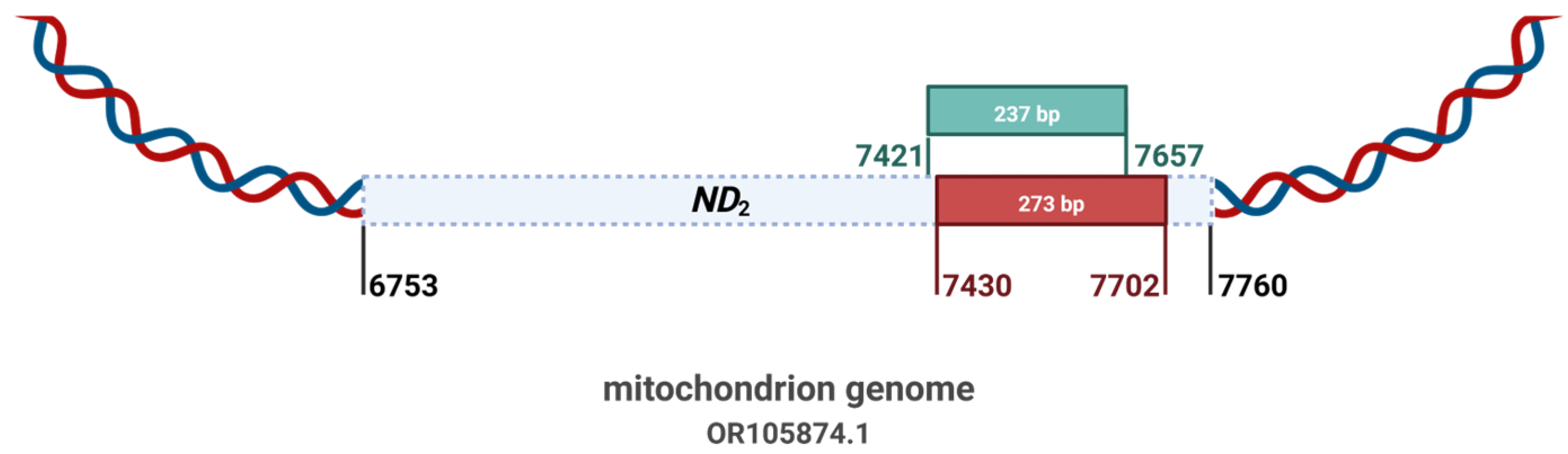



| Primer | Sequence (5′→3′) | Product(bp) | |
|---|---|---|---|
| SYBR Green I qPCR Assay | CLXD-F | CAGGGAGCCAGAAATGAAAGGGGG | 237 |
| CLXD-R | ACTTATTATCTATTATTCCCTTAA | ||
| MIRA-LFS Assay [15] | HLRPA-F | TCTCCTCTAGATCTTGATTAACCGCCTGAA | HLRPA-F/R: 273, HLRPA-P3/R: 208 |
| HLRPA-P3 | [biotin]TTAATAAAATCCAATAAATACTTTTCTTCA(THF)AAACTATAACCAAAT[pho] | ||
| HLRPA-R | [FAM]AGAAATGAAAGGGGGATGCTCCTATTTTTA | ||
Disclaimer/Publisher’s Note: The statements, opinions and data contained in all publications are solely those of the individual author(s) and contributor(s) and not of MDPI and/or the editor(s). MDPI and/or the editor(s) disclaim responsibility for any injury to people or property resulting from any ideas, methods, instructions or products referred to in the content. |
© 2026 by the authors. Licensee MDPI, Basel, Switzerland. This article is an open access article distributed under the terms and conditions of the Creative Commons Attribution (CC BY) license.
Share and Cite
Han, J.; Wang, J.; Cui, J.; Liu, L.; Chen, X.; Cao, Y.; Chen, J.; Song, X. Logistics-Mediated Artificial Sympatry and Its Implications for Molecular Detection of Hylurgus ligniperda. Insects 2026, 17, 408. https://doi.org/10.3390/insects17040408
Han J, Wang J, Cui J, Liu L, Chen X, Cao Y, Chen J, Song X. Logistics-Mediated Artificial Sympatry and Its Implications for Molecular Detection of Hylurgus ligniperda. Insects. 2026; 17(4):408. https://doi.org/10.3390/insects17040408
Chicago/Turabian StyleHan, Jijing, Jiaying Wang, Junxia Cui, Li Liu, Xianfeng Chen, Yuhao Cao, Jiaojiao Chen, and Xuemei Song. 2026. "Logistics-Mediated Artificial Sympatry and Its Implications for Molecular Detection of Hylurgus ligniperda" Insects 17, no. 4: 408. https://doi.org/10.3390/insects17040408
APA StyleHan, J., Wang, J., Cui, J., Liu, L., Chen, X., Cao, Y., Chen, J., & Song, X. (2026). Logistics-Mediated Artificial Sympatry and Its Implications for Molecular Detection of Hylurgus ligniperda. Insects, 17(4), 408. https://doi.org/10.3390/insects17040408