Article

Molecular Identification of Palmistichus elaeisis, Tetrastichus howardi, Trichospilus diatraeae and Trichogramma pretiosum (Hymenoptera: Chalcidoidea)—Important Biocontrol Agents


by
Izabella de Lima Palombo
1,†,
Fabricio Fagundes Pereira
1,*,†,
André Pessoa da Costa
1,
Patrik Luiz Pastori
2,
Alex Polatto Carvalho
2,
Andrea Renata da Silva Romero
3,
André Vieira do Nascimento
3,
Ana Maria Perez Obrien
3,
Patricia Iana Schmidt
3,
Carlos Reinier Garcia Cardoso
4 and
Marcelo Teixeira Tavares
5
1
Faculdade de Ciências Biológicas e Ambientais, Universidade Federal da Grande Dourados, Rodovia Dourados/Itahum, Km 12, Dourados 79804-970, MS, Brazil
2
Faculdade de Ciências Agrárias, Universidade Federal da Grande Dourados, Rodovia Dourados/Itahum, Km 12, Dourados 79804-970, MS, Brazil
3
Empresa Agropartners Consulting, Centro, Araçatuba 16010-220, SP, Brazil
4
Empresa Sistêmica Kovê Ltda., Rodovia Dourados/Itahum, Km 12, Dourados 79804-970, MS, Brazil
5
Centro de Ciências Humanas e Naturais, Departamento de Ciências Biológicas, Universidade Federal do Espírito Santo, Vitória 29043-900, ES, Brazil
*
Author to whom correspondence should be addressed.
These authors contributed equally to this work.
Insects 2026, 17(4), 395; https://doi.org/10.3390/insects17040395

Submission received: 12 February 2026 / Revised: 30 March 2026 / Accepted: 2 April 2026 / Published: 5 April 2026

Simple Summary

Parasitoid wasps play a fundamental role in the biological control of pests. However, their morphological identification can be limited due to the high morphological similarity between species. Our objective was to identify specific genomic variants of the target species Palmistichus elaeisis, Tetrastichus howardi, Trichospilus diatraeae and Trichogramma pretiosum by whole-genomic sequencing. The parasitoids were collected from their hosts and reared in the laboratory. Subsequently, samples composed of adult specimens were preserved in absolute ethanol for morphological and molecular identification. Genomic sequencing generated high-quality data for the four parasitoid species analyzed, allowing for the consistent identification of specific genomic variants. These results provide a precise molecular tool for distinguishing parasitoids used in biological control programs.

Abstract

Parasitoid wasps play a fundamental role in the biological control of pests. However, their morphological identification may be limited due to their small size and the high morphological similarity between species. Our objective was to identify specific genomic variants of the target species Palmistichus elaeisis Delvare & LaSalle, 1993, Tetrastichus howardi (Olliff, 1893), Trichospilus diatraeae Cherian & Margabandhu, 1942, and Trichogramma pretiosum Riley, 1879, (Hymenoptera: Chalcidoidea) by whole-genomic sequencing. Parasitoids were collected from their hosts and established in the laboratory after adult emergence. A sample of each parasitoid was sent to the Departamento de Ciências Biológicas at Universidade Federal do Espírito Santo (UFES) and “Oscar Monte” Entomophagous Insect Collection for morphological identification. Subsequently, samples composed of 20 individuals were preserved in absolute ethanol for DNA extraction. The DNA was extracted, quantified and sequenced on the Illumina Novaseq 6000 platform. Bioinformatic tools were used for quality control, detection of specific genomic variants, principal component analysis (PCA), and support vector machine (SVM). Genomic sequencing generated high-quality data for the analyzed parasitoids, allowing the identification of four specific variants for P. elaeisis, two for Te. howardi, four for Ts. diatraeae and five for Tg. pretiosum. These results provide a precise molecular tool for distinguishing parasitoids used in biological control programs.

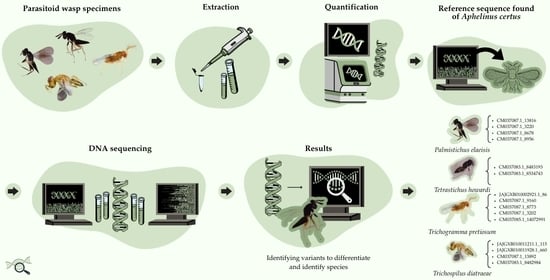
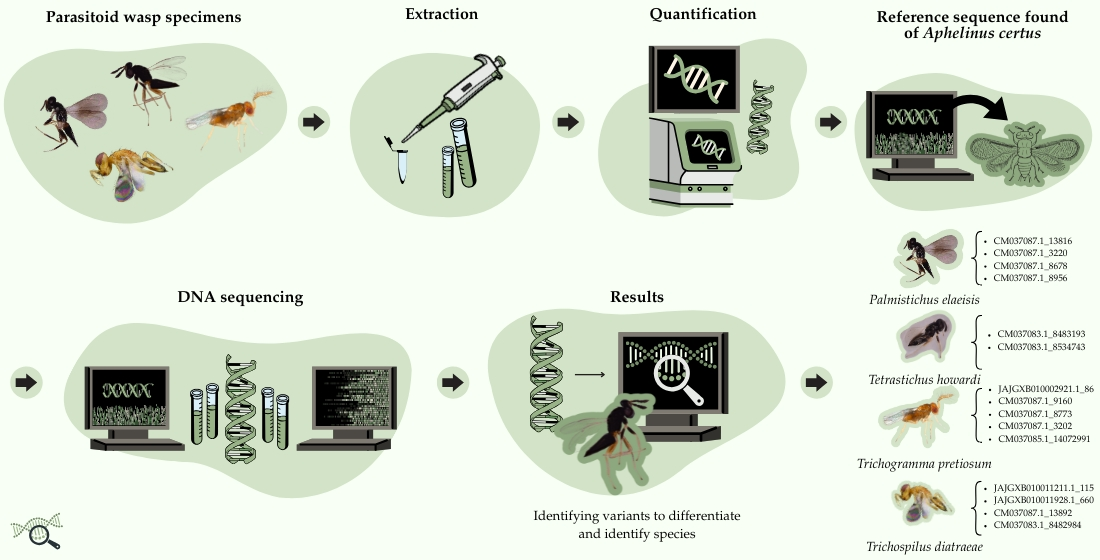
Graphical Abstract

1. Introduction

Parasitoid wasps act as natural enemies of a wide range of arthropods, being widely used as biological control agents to regulate insects that cause economic damage in agricultural and forestry systems [1]. In recent years, several parasitoid species have been identified and recorded as biological products in agricultural crops in Brazil [2,3]. Examples include the gregarious endoparasitoids Palmistichus elaeisis Delvare & LaSalle, 1993, Tetrastichus howardi (Olliff, 1893), Trichospilus diatraeae Cherian & Margabandhu, 1942 (Hymenoptera: Eulophidae), and the egg parasitoid Trichogramma pretiosum Riley, 1879 (Hymenoptera: Trichogrammatidae). These species are used to control various lepidopteran species, especially in integrated pest management programs [2].
Accurate identification of these species is fundamental for the success of biological control programs, since incorrect identification can compromise the efficiency of parasitoid releases and the interpretation of ecological interactions. Traditionally, insect identification is based on the description and classification of species according to observable external and internal characteristics [4]. However, in groups of parasitoid wasps, this approach has some limitations due to the great diversity of species, their minuscule body size, and the high demand for specialized taxonomic expertise [5].
The challenges of species identification are evident in the families Eulophidae and Trichogrammatidae due to the number of morphologically similar species. The family Eulophidae comprises approximately 6000 described species distributed across 347 genera and exhibits high morphological and genetic diversity [6,7]. Species such as P. elaeisis, Te. howardi, and Ts. diatraeae share morphological and behavioral similarities in host selection, frequently parasitizing the eucalyptus brown looper Thyrinteina arnobia (Stoll, 1782) (Lepidoptera: Geometridae) and the sugarcane borer Diatraea saccharalis (Fabricius, 1794) (Lepidoptera: Crambidae) thereby contributing to insect population balance [2,8,9]. Similarly, Trichogrammatidae has a worldwide distribution and is represented by 89 genera and more than 800 described species of egg parasitoid wasps [10]. Among these, Tg. pretiosum can be easily confused with other species of the genus, since its identification depends on the combination of morphological characteristics of the male genitalia, type of antennae, wings and body pigmentation [11,12]. This is one of the most utilized species for the biological control of tomato leafminer Tuta absoluta (Meyrick, 1917) (Lepidoptera: Gelechiidae), in tomato crops in Brazil [13].
Due to the economic and ecological importance of these parasitoid insects, the correct identification of species is fundamental for the success of biological control programs. In this context, molecular approaches have emerged as complementary tools for the rapid and accurate identification and differentiation of species [14]. More consistent genetic information is available for Tg. pretiosum [15,16], whereas P. elaeisis, Te. howardi, and Ts. diatraeae remain underrepresented in molecular studies.
To date, available molecular data for these species are restricted to specific genetic markers, such as mitochondrial genes or ribosomal regions. Although useful, these markers may have limited resolution for distinguishing closely related species [17]. Genomic variants correspond to differences in the deoxyribonucleic acid (DNA) sequence among individuals or species and represent an important source of genetic information for comparative genomic analyses. These variants include single-nucleotide polymorphisms (SNPs), insertions and deletions (indels), and other structural differences distributed across the genome, which can provide higher resolution for distinguishing closely related taxa [18].
The complete mitochondrial genome of Te. howardi has been sequenced, providing insights into its genetic composition and phylogenetic relationships within the family Eulophidae [19]. Similarly, the 28S rDNA region of Ts. diatraeae has been sequenced, with phylogenetic analyses corroborating its placement within this family [20].
In contrast, whole-genome sequencing (WGS) is a flexible high-throughput technology that enables the generation of whole-genome data and the construction of genomic libraries, allowing the identification of unique regions distributed throughout the genome and providing a more robust alternative for the molecular identification of these parasitoids [21]. Furthermore, it is possible to analyze genomic variants that correspond to differences in DNA sequences within species. Among these, the analysis of single-nucleotide polymorphisms (SNPs) is a powerful tool for genetic studies, evolutionary processes, and comparative analyses between taxa. SNPs are widely used due to their abundance in genomes and their functional relevance [18].
In this study, we employed Illumina NovaSeq 6000 sequencing to generate complete genomic data and identify polymorphic regions to differentiate species-specific genomic variants, thereby ensuring accurate identification for biological control programs [22]. Therefore, our objective was to identify specific genomic variants of the target species P. elaeisis, Te. howardi, Ts. diatraeae and Tg. pretiosum by whole-genomic sequencing.

2. Materials and Methods

The work was developed at the Laboratory of Biological Control of Insects (LECOBIOL) of the Federal University of Grande Dourados in the city of Dourados, state of Mato Grosso do Sul, Brazil, in partnership with Agropartners Consulting Company of Araçatuba, São Paulo, Brazil.

2.1. Insect Collection

Parasitoids were collected from their hosts, and a rearing was established at LECOBIOL after adult emergence. The species P. elaeisis and Ts. diatraeae were obtained from pupae of T. arnobia in eucalyptus crops [23,24], while Te. howardi was collected in pupae of D. saccharalis in sugarcane stalks [25]. A sample of each pupal parasitoid was sent to the Departamento de Ciências Biológicas at Universidade Federal do Espírito Santo (UFES) for morphological identification. Following population establishment in the laboratory, these species were reared on alternative hosts such as Anticarsia gemmatalis (Hübner, 1818) (Lepidoptera: Noctuidae) and Tenebrio molitor (Linnaeus, 1758) (Coleoptera: Tenebrionidae).
Trichogramma pretiosum was obtained from eggs of Iridopsis panopla (Prout, 1932) (Lepidoptera: Geometridae) in eucalyptus crops [26]. The eggs were maintained under controlled conditions (25 ± 2 °C, 70 ± 10% relative humidity, and a 14 h photophase) until parasitoid emergence. Specimens were sent to the “Oscar Monte” Entomophagous Insect Collection, located in Campinas, São Paulo, Brazil, at the Reference Laboratory Unit for Biological Control of the Biological Institute under the care of Dr. Nadja Nara Pereira da Silva. Subsequently, Tg. pretiosum were maintained in eggs of host Ephestia kuehniella (Zeller, 1879) (Lepidoptera: Pyralidae) [2].

2.2. DNA Extraction, Quantification and Sequencing

Each sample consisted of a pool of 50 adult individuals of the same species preserved in absolute ethanol and identified as PA03 (P. elaeisis), TH04 (Te. howardi), TD01 (Ts. diatraeae) and TP02 (Tg. pretiosum). Genomic DNA extraction was performed using the DNeasy Blood & Tissue Kit (Qiagen, Hilden, Germany), following the manufacturer’s protocol for insects [27]. Briefly, specimens were homogenized in 400 µL of lysis buffer, followed by the addition of 20 µL of Proteinase K, and incubated at 56 °C for 30 min to promote cell digestion. After incubation, samples were centrifuged at approximately 10,000× g for 1 min to pellet cellular debris. The supernatant containing genomic DNA was then transferred to a new tube and subjected to purification using a silica column system.
DNA quality was initially assessed by measuring the 260/280 absorbance ratio using a biophotometer. DNA concentration was quantified using the Quantus™ Fluorometer (Promega, Madison, WI, USA) together with the QuantiFluor ® ONE dsDNA System reagent (Promega, Madison, WI, USA), following manufacturer’s recommendations.
Genomic libraries were prepared using the ABclonal Rapid Plus DNA Lib Prep Kit for Illumina V2 (ABclonal, Wuhan, China) and sequenced on the Illumina Novaseq 6000 platform (Illumina, San Diego, CA, USA), using the paired-read method (PE150), targeting an average sequencing depth of approximately 30× per sample. The choice of method was based on practicality for preparing libraries based on the selected genomic variants due to its high-throughput capacity and suitability for generating high-quality paired-end reads, enabling robust detection of genomic variation for comparative analyses among species, including those lacking reference genomes [28]. The resulting high-quality sequences were deposited in the GenBank Sequence Read Archive (SRA) under accession number: SRS24932171 for P. elaeisis, SRS24932172 for Te. howardi, SAMN48318921 for Ts. diatraeae and SRS24932169 for Tg. pretiosum.

2.3. Bioinformatic Analysis for Variant Detection

Raw sequencing read quality was assessed using FastQC (v0.11.8). Subsequently, reads were filtered and trimmed using fastp (v0.24.0) to remove adapters, poly-G tails associated with NovaSeq technology, and low-quality bases [29]. Reads shorter than 50 bp after filtering were discarded and the first 10 bases from the 5′ end of each read were trimmed to reduce potential sequencing biases. Sequencing summary statistics, including the number of reads and mean read length per sample before and after quality control, are presented in Table 1.
In order to identify the most suitable reference genome for maximizing species differentiation, a literature review was conducted to illustrate the phylogenetic proximity between the studied taxa and species with available genomic resources [30]. Based on this analysis, the four target species of this study (Tetrastichus howardi, Palmistichus elaeisis, Trichospilus diatraeae, and Trichogramma pretiosum) were aligned against three selected reference genomes: Aphelinus certus (Yasnosh, 1963) (Hymenoptera: Aphelinidae) and Chouioia cunea (Yang, 1989) (Hymenoptera: Eulophidae) and Trichogramma pretiosum (GenBank assembly accession GCA_000599845.3). Reference species were selected based on the availability of complete genomes in public databases and their relatively close phylogenetic relationship with the studied taxa. Sequences were aligned to identify the greatest number of common regions across the target species, considering only biallelic variants and excluding variants fixed among species, thereby enabling efficient genetic differentiation.
Filtered sequences were aligned to the selected reference genomes using the Burrows–Wheeler Aligner (BWA, v0.7.17) [31], allowing the identification of genomic regions shared among the studied species [16]. Alignment files were processed using BEDTools (v2.30.0) [32], allowing the identification of overlapping genomic intervals among the four target species for comparative genomic variant detection. Variant calling was performed using the mpileup algorithm implemented in SAMtools (v1.15) [33], retaining only biallelic single-nucleotide variants (SNVs). Variants were filtered according to the following criteria: sequencing depth greater than 10 reads (DP > 10), absence of multi-allelic sites, and removal of variants that were fixed between species or lacked at least 20 base pairs of high-quality flanking sequence on each side, ensuring sufficient genomic context for reliable downstream analyses. Only variants meeting these criteria were retained, ensuring their applicability for genetic discrimination among the studied taxa.
To validate the most suitable reference genome, a principal component analysis (PCA) was performed with two approaches: (i) using variants with a call rate above 0.5, and (ii) using variants present in the species of interest, enabling comparisons between the first principal component (PC1) observed in the sampling points of the following graphs. Subsequently, the selection of candidate variants was verified using the support vector machine (SVM) model for identification [31].

2.4. Principal Component Analysis, Marker Selection and Distance-Based Validation

Principal component analysis (PCA) was performed to explore the structure of the data and to identify highly informative markers. Two filtering strategies were applied: (i) variants with call rate > 0.5, and (ii) variants shared among all four species of interest and without missing data across samples. Considering the small sample size (n = 4), this threshold corresponds to variants genotyped in at least two samples, allowing retention of informative loci while minimizing data loss.
The PCA was conducted using the prcomp function in R [34], based on a matrix of allele proportions (reference allele dosage) that was centered and scaled. The analysis was used in an exploratory manner to identify markers with the highest contributions to PC1, PC2, and PC3, which were subsequently selected for downstream analyses aimed at species differentiation.
To quantitatively evaluate the discriminatory power of the selected markers, pairwise Euclidean distances were calculated from the same scaled matrix using the dist function in R version 4.4.2 [34]. The resulting distance matrix was visualized as a heatmap with hierarchical clustering using the pheatmap package [35]. Subsequently, candidate variants were further evaluated using the support vector machine (SVM) model for species classification [36], aiming to validate their discriminatory power among the studied taxa.

2.5. Sample Simulation

Considering the limited number of sequences available in the sample set of the target species, additional samples with similar genetic profiles were simulated to expand the test population and evaluate the robustness of variants for species differentiation in different scenarios. Sixty pure samples were simulated, with replications of the individual genetic profiles of P. elaeisis, Te. howardi, Ts. diatraeae and Tg. pretiosum. To evaluate the ability of variants to correctly identify different taxa, 18 mixed samples were generated, combining pairs of species in proportions of 25–75%, 50–50%, and 75–25%.
To validate the efficiency of the selected genetic variants, the data were subjected to PCA with two approaches: (i) using variants with a call rate above 0.5, and (ii) using variants present in the species of interest, allowing comparisons between the first principal component (PC1). Selected variants were validated in silico by the SVM model to predict species.

3. Results

3.1. Reference Genome

Genome sequencing generated high-quality data for the four parasitoid species analyzed (P. elaeisis, Te. howardi, Ts. diatraeae, and Tg. pretiosum), enabling the consistent identification of genomic variants in regions shared among taxa. The quality of the obtained sequences and the performance of the bioinformatic analysis allowed comparisons among the available reference genomes (Table S1).
The results indicate differences in performance among the evaluated reference genomes when considering variant detection and interspecies comparability (Table 2). Although C. cunea presented the highest total number of variants (n = 24,316) and Tg. pretiosum showed the highest number of common variants (n = 866), these results were also associated with a higher proportion of low-depth variants (DP < 10), which may affect the overall reliability of variant detection. Therefore, these metrics alone were not sufficient to ensure consistent discrimination among species.
In contrast, A. certus exhibited a more balanced performance across multiple criteria, including a lower number of fixed variants (n = 296) and a consistent proportion of high-quality variants, showing more consistent variant detection and alignment among allelic sequences across the analyzed species (Table 2).
The PCA, used here as an additional validation step, revealed clear differences among the evaluated reference genomes in terms of consistency and informativeness of variant detection. Aphelinus certus showed the highest concordance between the two filtering strategies, presenting the largest number of variants simultaneously identified in both approaches and shared across all four species (Table 2). Among the top-ranked variants contributing to PC1, 88 were common in the A. certus reference, compared to 82 for C. cunea and none for Tg. pretiosum, indicating greater robustness and reproducibility in the variants identified using A. certus.
Furthermore, A. certus exhibited the highest average length of shared genomic regions, suggesting improved continuity of aligned segments and a more reliable representation of polymorphic sites (Table 3). Overlaps as short as 1 bp may occur due to the intersection of regions across species. These results, together with the quality metrics described above, support the selection of A. certus as the most suitable reference genome for subsequent analyses.

3.2. Variant Identification and Differentiation

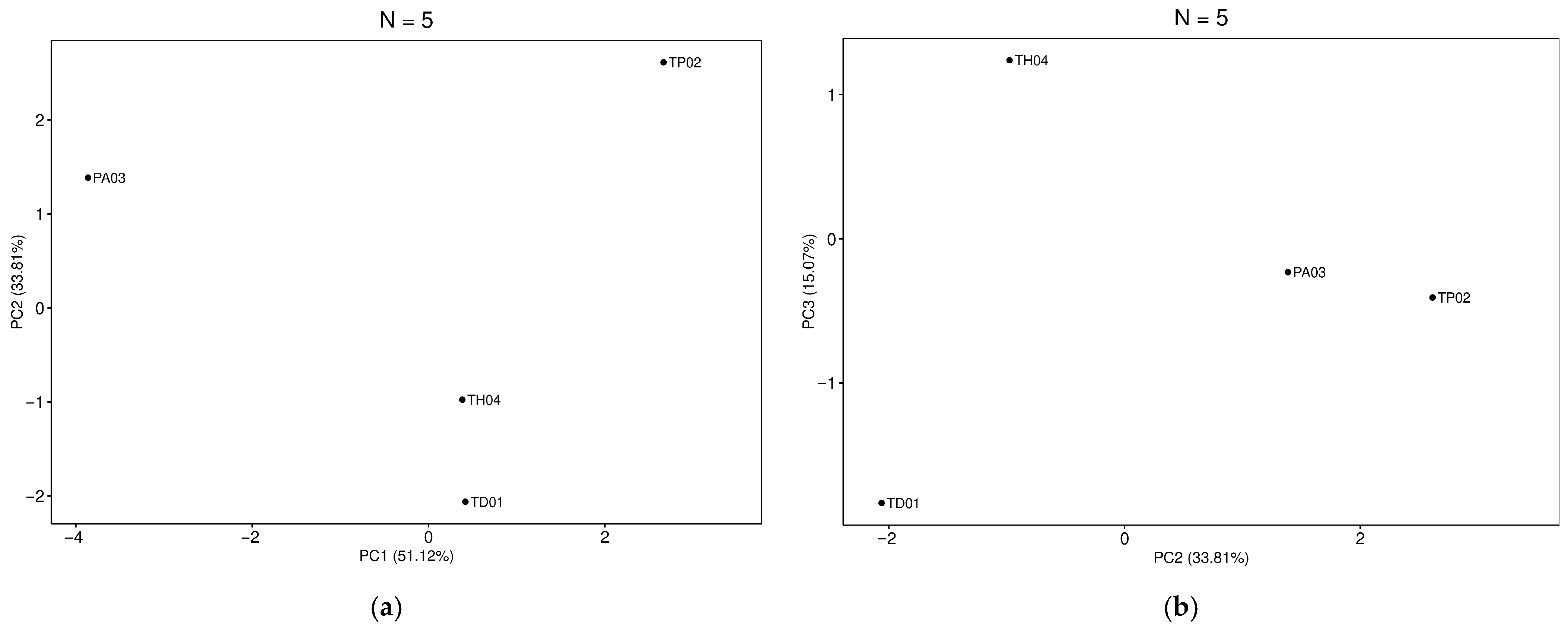
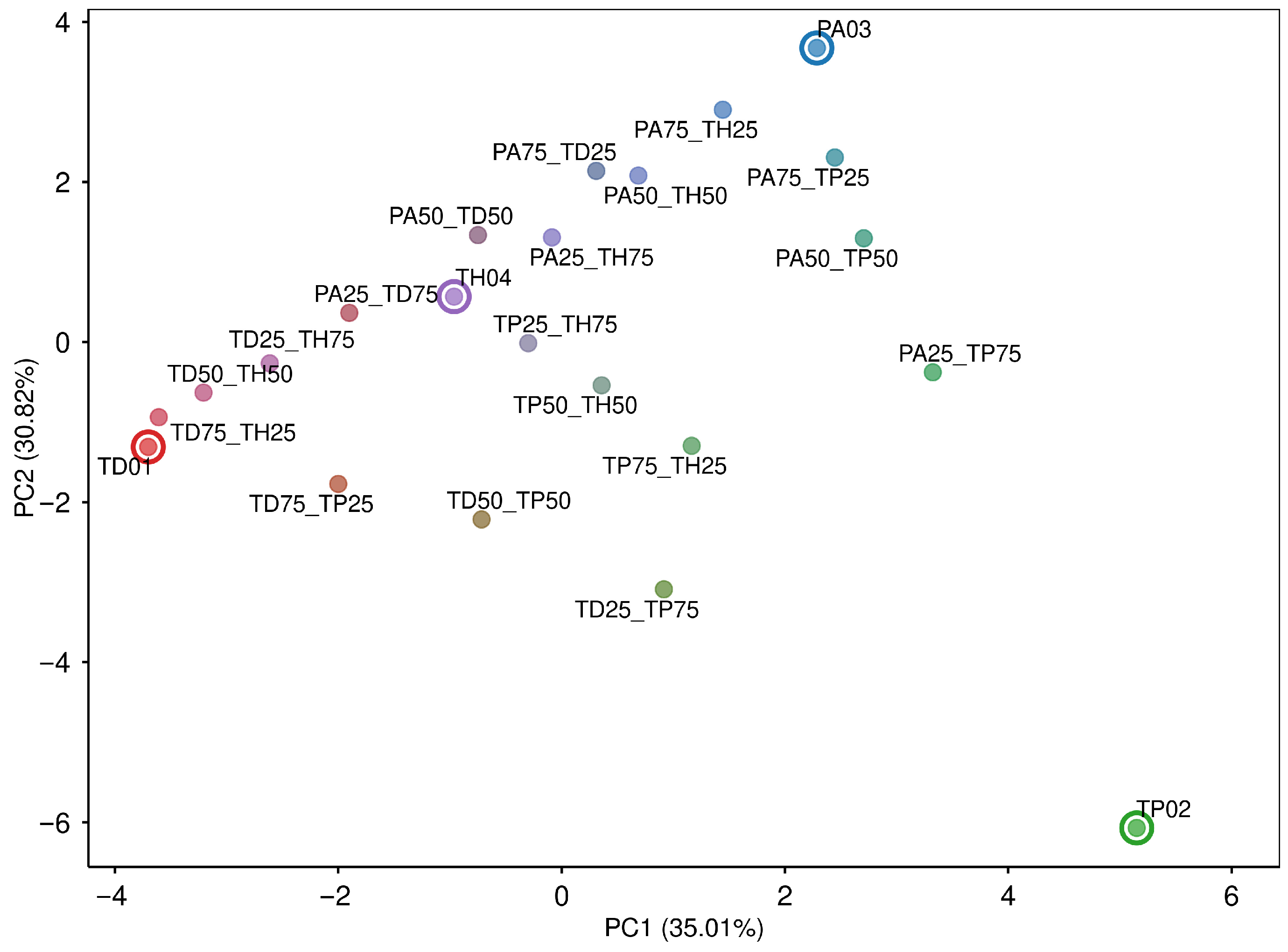
PCA provided evidence for separation between species based on identified genomic variants. The first two principal components (PC1 and PC2) clearly separate the TP02 sample from the other samples with major variation along the first principal component which explains 51.12% of the total variation. From this separation, 15 candidate variants were identified as informative for species differentiation, of which 12 were able to perform this distinction in pairs, totaling 27 variants. In contrast, TD01 and TH04 appear closer, indicating a reduced genetic distance based on the evaluated variants. The second and third PC projections reinforce the differentiation among the samples, with TD01 showing a greater separation along the PC3, which explains 15.07% of the variation (Figure 1).
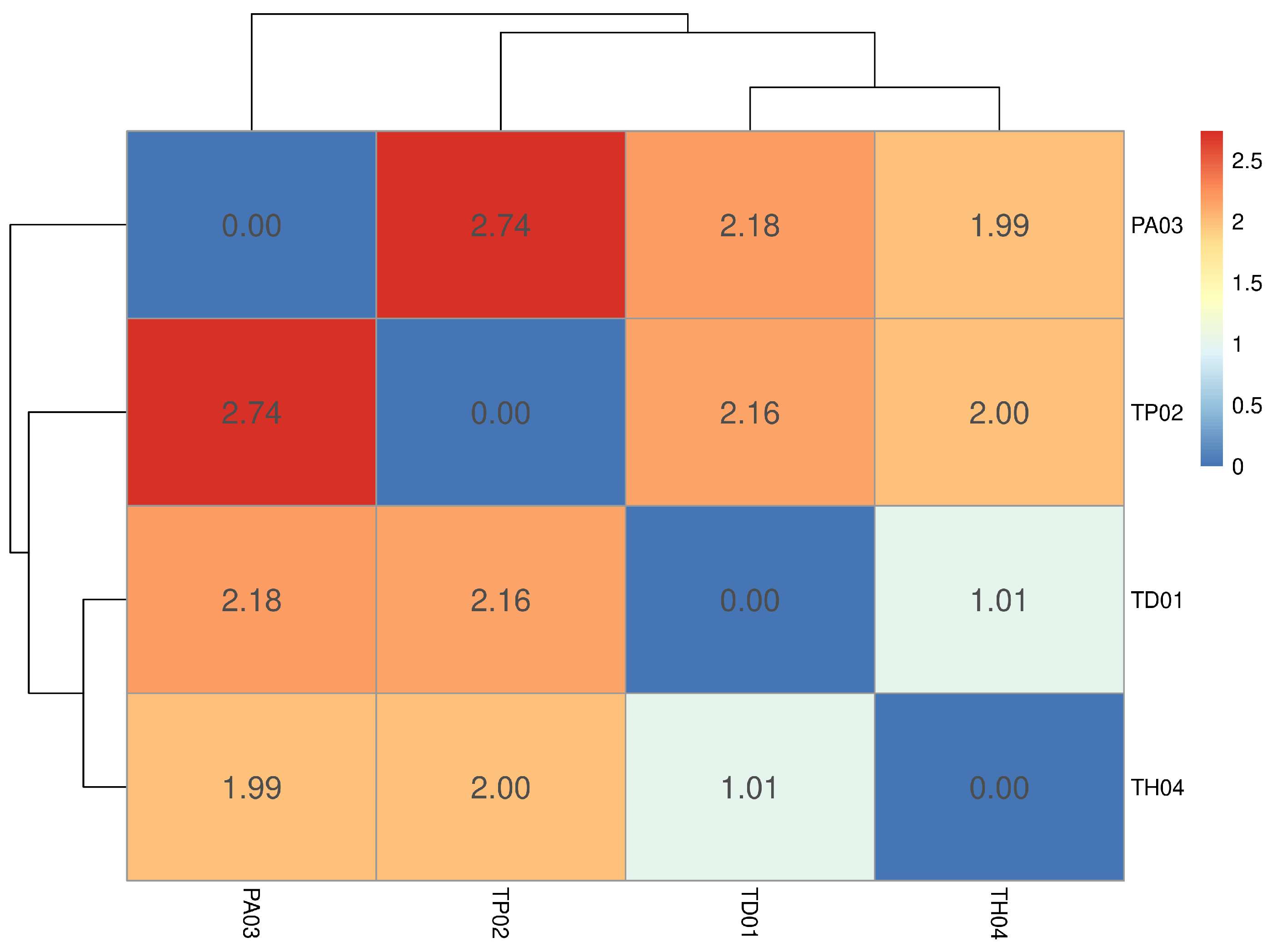
This pattern is further supported by the Euclidean distance heatmap, which provides a quantitative assessment of genetic relationships among samples (Figure 2). The heatmap reveals shorter pairwise distances between TD01 and TH04, confirming their closer genetic relationship, while TP02 exhibits greater distances in relation to the other samples, consistent with the separation observed in the PCA. Overall, the Euclidean distance analysis reinforces the effectiveness of the selected variants in capturing interspecific genetic differentiation.
From this dataset, a subset of diagnostic variants was selected based on their contribution to species differentiation as identified through PCA and Euclidean distance analyses, as well as their allele frequency distribution among species. Table 4 summarizes SNPs showing species-specific patterns, in which the variant allele was fixed or highly frequent in one species while absent or rare in the others. Using this criterion, four diagnostic variants were identified for P. elaeisis, two for Te. howardi, four for Ts. diatraeae and five for Tg. pretiosum allowing their identification of each species individually. In addition to species-specific markers, a set of variants capable of differentiating species in pairwise comparisons was also identified (Table 5). These SNPs display contrasting allele frequencies between species pairs, allowing discrimination between combinations of taxa rather than a single exclusive lineage.
An SVM model was implemented to test the efficiency of these variants in identifying the target species. The performance of the model was evaluated in both pure and mixed samples between multiple species, demonstrating high accuracy in the identification of the target species. The simulation of these species showed that mixed samples were positioned between their respective parental species, supporting the discriminatory capacity of the selected SNPs observed in the PCA (Figure 3).
Each variant was analyzed considering the 50 base pair flanking sequence on each side of the SNP (single-nucleotide polymorphism) type variant, allowing the construction of species-specific probes. This flanking length was defined based on standard criteria for primer and probe design, as regions of 18–25 bp free of variation are generally sufficient for primer binding [37], and the use of ~50 bp on each side ensures adequate sequence context for the selection of primers with suitable physicochemical properties and efficient amplification.

4. Discussion

Accurate species identification is essential for effective biological control. In this study, we established a molecular approach based on whole-genome sequencing to identify four parasitoid species P. elaeisis, Te. howardi, Ts. diatraeae and Tg. pretiosum. The identification of species-specific genomic variants provides a new resource for the reliable recognition of these biological control agents. In addition, the availability of genomic sequences in public databases such as GenBank enables future studies comparing populations from different regions, investigating phylogenetic relationships, and supporting systematic and comparative analyses [4].
An important methodological step in this study was the selection of reference genome for specific variant detection. Among the evaluated references, A. certus showed the best alignment performance, allowing the identification of informative genomic variants based on differences in nucleotide base calls that distinguished the target species. Although the use of a phylogenetically distant reference genome may reduce mapping efficiency and the number of variants detected, the generation of species-specific reference genomes still requires highly validated DNA sequences, advanced bioinformatics knowledge, and substantial financial investment [38]. Consequently, the use of reference genomes from related species has become a common strategy in genomic studies of non-model organisms when specific resources are not available [39]. Even under these conditions, informative variants can still be detected, preserving biologically significant patterns, such as the molecular discrimination of insects previously identified by morphological methods [40].
High-quality genomic sequencing technologies enable the generation of reference genomes and population datasets, contributing to biodiversity monitoring, conservation, and environmental restoration efforts [41]. In biological control programs, parasitoid populations are often multiplied for several generations in biofactories, which may lead to genetic changes associated with mass rearing [2]. Recent studies have shown that long-term mass rearing can reduce genetic diversity and alter population structure, highlighting the importance of genetic monitoring of biological control agents [42]. In the present study, the analysis of simulated mixed samples demonstrated the high accuracy of the selected genomic variants for species identification, even when one species represented only 25% of the sample and another species had 75% representation.
There is no doubt that DNA barcoding sequencing has become a standard and efficient genetic approach for species identification and biodiversity monitoring [43]. Over the years, molecular markers such as COI, ITS2, and 28S have been widely used in studies of parasitoid wasps [44,45,46]. Beyond their taxonomic applicability, these markers have also contributed to understanding processes such as speciation, gene flow, and local adaptation, particularly in ITS2 regions with discriminatory potential among closely related species [47,48]. In addition, markers such as COI and ITS2 have proven useful in quality control of mass rearing by enabling the identification of parasitoid lineages and the investigation of parasitoid–host interactions, including comparisons of genes encoding venom proteins between populations [49,50]. Together, these studies highlight the importance of molecular markers for distinguishing species at both intra- and interspecific levels.
However, sequencing small loci from informative DNA regions may limit the accurate characterization of genetic and taxonomic diversity within communities [41]. In this context, whole-genome sequencing allows the detection of species-specific variants, such as SNPs and indels, providing greater resolution for distinguishing closely related or morphologically similar taxa [16,21,51]. This approach also enables a more detailed investigation of the genetic bases of adaptive traits in insects, including mechanisms related to environmental adaptation and other evolutionary responses [52].
Furthermore, genomic datasets and publicly deposited sequences facilitate comparisons among lineages from different geographic regions and support the genetic monitoring of parasitoid populations used in biological control programs [49,53]. Thus, the advances obtained through whole-genomic sequencing and genetic analyses in this study contribute directly to strengthening the scientific bases of parasitoid production, promoting more efficient, reliable, and sustainable biological control programs.

5. Conclusions

The combination of high-quality DNA extraction and whole-genome sequencing enabled the identification of species-specific genomic variants for P. elaeisis, Te. howardi, Ts. diatraeae and Tg. pretiosum. The approach presented here establishes a novel genomic methodology for the precise molecular identification of these parasitoid species, including mixed samples. By providing reliable genetic markers and publicly available genomic data, these findings open new avenues for future research and have the potential to optimize the application of these species as biological control agents in sustainable agricultural and forestry systems.

Supplementary Materials

The following supporting information can be downloaded at: https://www.mdpi.com/article/10.3390/insects17040395/s1, Table S1: Comparative sequencing and alignment metrics across reference genomes for the four parasitoid species.

Author Contributions

Conceptualization, I.d.L.P. and F.F.P.; methodology, I.d.L.P., A.V.d.N., A.M.P.O., P.I.S. and A.R.d.S.R.; formal analysis, I.d.L.P., F.F.P., A.V.d.N., A.M.P.O., P.I.S. and A.R.d.S.R.; investigation, I.d.L.P. and F.F.P.; recurses, F.F.P. and C.R.G.C.; data curation, A.V.d.N., A.M.P.O., P.I.S. and A.R.d.S.R.; software, A.R.d.S.R.; preparation of the original draft, writing—revision and editing, I.d.L.P., F.F.P., A.P.d.C., P.L.P., A.P.C., M.T.T., P.I.S. and C.R.G.C.; visualization, I.d.L.P., F.F.P. and P.L.P.; supervision, F.F.P.; project administration, F.F.P. and I.d.L.P.; obtaining financing, F.F.P. All authors have read and agreed to the published version of the manuscript.

Funding

The research project was funded by the Associação Sul-Mato-Grossense de Produtores and Consumidores de Florestas Plantadas—REFLORE MS: Projeto 86: CTR 01/2023/UFGD/ Controle de Pragas de Eucalipto com Macrobiológicos no Mato Grosso do Sul—Reflore 3.

Data Availability Statement

The original contributions presented in this study are included in the article/Supplementary Material. Further inquiries can be directed to the corresponding author.

Acknowledgments

The authors thank the Coordenação de Aperfeiçoamento Pessoal de Nível Superior (CAPES) for the fellowship, which made it possible to carry out this course. CNPQ—Conselho Nacional de Desenvolvimento Científico e Tecnológico and the FUNDECT—Fundação de Apoio ao Desenvolvimento do Ensino, Ciência e Tecnologia provided financial support to the laboratory research. We are also grateful to the Associação Sul-Mato-Grossense de Produtores e Consumidores de Florestas Plantadas REFLORE for the trust and financial support of our research. We also received support from the Kovê Systemic, especially Carlos R. G. Cardoso, and the Koppert Brasil Company. F.F.P. thanks CNPq (Proc. #312021/2023-2). M.T.T. thanks FAPES (RONEM 1018/2022, P: 2022-KX881; PROFIX 657/2022, P: 2022-PTJH4), and INCT-HYMPAR (CNPq Proc. #465562/2014-0; FAPESP Proc. #2014/50940-2).

Conflicts of Interest

Authors Andrea Renata da Silva Romero, André Vieira do Nascimento, Ana Maria Perez Obrien, and Patricia Iana Schmidt were employed by the company Empresa Agropartners Consulting. Author Carlos Reinier Garcia Cardoso was employed by the company Empresa Sistêmica Kovê Ltda. The remaining authors declare that the research was conducted in the absence of any commercial or financial relationships that could be construed as a potential conflict of interest.

References

  1. Giunti, G.; Canale, A.; Messing, R.H.; Donati, E.; Stefanini, C.; Michaud, J.P.; Benelli, G. Parasitoid learning: Current knowledge and implications for biological control. Biol. Control 2015, 90, 208–219. [Google Scholar] [CrossRef]
  2. Pereira, F.F.; Pastori, P.L.; Kassab, S.O.; Torres, J.B.; Cardoso, C.R.G.; Fernandes, W.C.; Oliveira, H.N.; Zanuncio, J.C. Uso de eulofídeos no controle biológico de pragas. In Controle Biológico Com Parasitoides E Predadores Na Agricultura Brasileira; Parra, J.R.P., Pinto, A.S., Nava, D.E., Oliveira, R.C., Diniz, A.J.F., Eds.; Fundação de Estudos Agrários Luiz de Queiroz: Piracicaba, São Paulo, Brazil, 2021; pp. 317–361. [Google Scholar]
  3. Wang, Y.; Nansen, C.; Zhang, Y. Integrative insect taxonomy based on morphology, mitochondrial DNA, and hyperspectral reflectance profiling. Zool. J. Linn. Soc. 2016, 177, 378–394. [Google Scholar] [CrossRef]
  4. Smith, M.A.; Rodriguez, J.J.; Whitfield, J.B.; Deans, A.R.; Janzen, D.H.; Hallwachs, W.; Hebert, P.D. Extreme diversity of tropical parasitoid wasps exposed by iterative integration of natural history, DNA barcoding, morphology, and collections. Proc. Natl. Acad. Sci. USA 2008, 105, 12359–12364. [Google Scholar] [CrossRef]
  5. Rasplus, J.Y.; Blaimer, B.B.; Brady, S.G.; Burks, R.A.; Delvare, G.; Fisher, N.; Gates, M.; Gauthier, N.; Gumovsky, A.V.; Hansson, C.; et al. A first phylogenomic hypothesis for Eulophidae (Hymenoptera, Chalcidoidea). J. Nat. Hist. 2020, 18, 597–609. [Google Scholar] [CrossRef]
  6. Burks, R.A.; Gumovsky, A.V.; Hansson, C.; Gates, M.W.; Domer, T.; Perry, R.K. Eulophidae. In Chalcidoidea of the World; Heraty, J., Woolley, J., Eds.; CABI International: Wallingford, UK, 2025; pp. 357–375. [Google Scholar]
  7. UCD Community. Universal Chalcidoidea Database (UCD) Curated in TaxonWorks. 2023. Available online: https://sfg.taxonworks.org/api/v1/ (accessed on 16 December 2025).
  8. Gokhman, V.E.; Yefremova, Z.A.; Yegorenkova, E.N. Karyotypes of parasitic wasps of the family Eulophidae (Hymenoptera) attacking leaf-mining Lepidoptera (Gracillariidae, Gelechiidae). Comp. Cytogenet. 2014, 8, 31. [Google Scholar] [CrossRef]
  9. Pereira, F.F.; Kassab, S.O.; Calado, V.R.F.; Vargas, E.L.; de Oliveira, H.N.; Zanuncio, J.C. Parasitism and emergence of Tetrastichus howardi (Hymenoptera: Eulophidae) on Diatraea saccharalis (Lepidoptera: Crambidae) larvae, pupae and adults. Fla. Entomol. 2015, 98, 377–380. [Google Scholar] [CrossRef]
  10. Burks, R.A.; Pinto, J.D.; Lindsey, A.R. Trichogrammatidae. In Chalcidoidea of the World; Heraty, J., Woolley, J., Eds.; CABI International: Wallingford, UK, 2025; pp. 648–659. [Google Scholar] [CrossRef]
  11. Querino, R.B.; Zucchi, R.A.; Pinto, J.D. Systematics of the Trichogrammatidae (Hymenoptera: Chalcidoidea) with a Focus on the Genera Attacking Lepidoptera. In Egg Parasitoids in Agroecosystems with Emphasis on Trichogramma; Consoli, F.L., Parra, J.R.P., Zucchi, R.A., Eds.; Progress in Biological Control; Springer: Dordrecht, The Netherlands, 2009; Volume 9, pp. 197–218. [Google Scholar] [CrossRef]
  12. Hua, H.Q.; Zhao, Z.Y.; Zhang, Y.; Hu, J.; Zhang, F.; Li, Y.X. Inter- and Intra-Specific Differentiation of Trichogramma (Hymenoptera: Trichogrammatidae) Species Using PCR-RFLP Targeting COI. J. Econ. Entomol. 2018, 111, 1860–1867. [Google Scholar] [CrossRef]
  13. Oliveira, C.M.; Oliveira, J.V.; Barbosa, D.R.S.; Breda, M.O.; França, S.M.; Duarte, B.L.R. Biological parameters and thermal requirements of Trichogramma pretiosum for the management of the tomato fruit borer (Lepidoptera: Crambidae) in tomatoes. Crop Prot. 2017, 99, 39–44. [Google Scholar] [CrossRef]
  14. Frézal, L.; Leblois, R. Four years of DNA barcoding: Current advances and prospects. Infect. Genet. Evol. 2008, 8, 727–736. [Google Scholar] [CrossRef] [PubMed]
  15. Yan, Z.C.; Qi, G.Y.; Yao, T.Y.; Li, Y.X. Mitochondrial genomes of two asexual Trichogramma (Hymenoptera: Trichogrammatidae) strains and comparison with their sexual relatives. Insects 2022, 13, 549. [Google Scholar] [CrossRef] [PubMed]
  16. Lindsey, A.R.; Kelkar, Y.D.; Wu, X.; Sun, D.; Martinson, E.O.; Yan, Z.; Rugman-Jones, P.F.; Hughes, D.S.T.; Murali, S.C.; Qu, J.; et al. Comparative genomics of the miniature wasp and pest control agent Trichogramma pretiosum. BMC Biol. 2018, 16, 54. [Google Scholar] [CrossRef] [PubMed]
  17. Dong, Z.; Wang, Y.; Li, C.; Li, L.; Men, X. Mitochondrial DNA as a molecular marker in insect ecology: Current status and future prospects. Ann. Entomol. Soc. Am. 2021, 114, 470–476. [Google Scholar] [CrossRef]
  18. Lozada-Chávez, A.N.; Bonizzoni, M. Identification of Single Nucleotide Polymorphism from Insect Genomic Data. In Insect Genomics: Methods and Protocols; Springer: New York, NY, USA, 2025; pp. 29–49. [Google Scholar] [CrossRef]
  19. Tang, X.; Lyu, B.; Lu, H.; Tang, J.; Meng, R.; Cai, B. Characterization of the mitochondrial genome of Tetrastichus howardi (Olliff, 1893) (Hymenoptera: Eulophidae). Mitochondrial DNA Part B 2021, 6, 2683–2685. [Google Scholar] [CrossRef]
  20. Santos-Murgas, A.; Jaen, L.A. Contribución al conocimiento e identificación molecular de Trichospilus diatraeae (Hymenoptera: Eulophidae) parasitando pupas de Agraulis vanillae (Lepidoptera: Nymphalidae) en cultivos de Passiflora edulis (Platae: Passifloraceae) en Panamá. Acta Zoológica Mex. 2025, 41, 1–10. [Google Scholar] [CrossRef]
  21. Ahmed, Z.; Renart, E.G.; Zeeshan, S. Genomics pipelines to investigate susceptibility in whole genome and exome sequenced data for variant discovery, annotation, prediction and genotyping. PeerJ 2021, 9, e11724. [Google Scholar] [CrossRef]
  22. Modi, A.; Vai, S.; Caramelli, D.; Lari, M. The Illumina Sequencing Protocol and the NovaSeq 6000 System. In Bacterial Pangenomics; Mengoni, A., Bacci, G., Fondi, M., Eds.; Methods in Molecular Biology; Humana: New York, NY, USA, 2021; Volume 2242, pp. 15–42. [Google Scholar] [CrossRef]
  23. Pereira, F.F.; Zanuncio, T.V.; Zanuncio, J.C.; Pratissoli, D.; Tavares, M.T. Species of Lepidoptera defoliators of Eucalyptus as new host for the parasitoid Palmistichus elaeisis (Hymenoptera: Eulophidae). Braz. Arch. Biol. Technol. 2008, 51, 259–262. [Google Scholar] [CrossRef]
  24. Pereira, F.F.; Zanuncio, J.C.; Tavares, M.T.; Pastori, P.L.; Jacques, G.C.; Vilela, E.F. New record of Trichospilus diatraeae as a parasitoid of the eucalypt defoliator Thyrinteina arnobia in Brazil. Phytoparasitica 2008, 36, 304–306. [Google Scholar] [CrossRef]
  25. Vargas, E.L.; Pereira, F.F.; Tavares, M.T.; Pastori, P.L. Record of Tetrastichus howardi (Hymenoptera: Eulophidae) parasitizing Diatraea sp. (Lepidoptera: Crambidae) in sugarcane crop in Brazil. Entomotropica 2011, 26, 143–146. [Google Scholar]
  26. dos Santos, F.H.M.; Pereira, F.F.; Cardoso, C.R.G.; Lucchetta, J.T.; Santos, J.P.; Ramos, L.F.N.; dos Santos, F.A. First record of Trichogramma pretiosum parasitizing Iridopsis panopla eggs in eucalyptus in Brazil. Fla. Entomol. 2024, 107, 20240042. [Google Scholar] [CrossRef]
  27. Blood, D.; Kits, T. DNeasy Blood and Tissue Handbook; QIAGEN: Hilden, Germany, 2023. [Google Scholar]
  28. Pasquinelli, E.; Rollo, G.; Tinella, F.; Danelli, M.; Minetto, S.; Casamassima, G.; Renieri, A. Validation of the NovaSeq6000 Platform and automated library preparation for CE-IVD equivalence. Comput. Struct. Biotechnol. J. 2025, 27, 4838–4845. [Google Scholar] [CrossRef]
  29. Chen, S.; Zhou, Y.; Chen, Y.; Gu, J. fastp: An ultra-fast all-in-one FASTQ preprocessor. Bioinformatics 2018, 34, i884–i890. [Google Scholar] [CrossRef] [PubMed]
  30. Symonds, M.R.; Elgar, M.A. The evolution of body size, antennal size and host use in parasitoid wasps (Hymenoptera: Chalcidoidea): A phylogenetic comparative analysis. PLoS ONE 2013, 8, e78297. [Google Scholar] [CrossRef]
  31. Li, H.; Durbin, R. Fast and accurate short read alignment with Burrows–Wheeler transform. Bioinformatics 2009, 25, 1754–1760. [Google Scholar] [CrossRef]
  32. Quinlan, A.R.; Hall, I.M. BEDTools: A flexible suite of utilities for comparing genomic features. Bioinformatics 2010, 26, 841–842. [Google Scholar] [CrossRef] [PubMed]
  33. Li, H.; Handsaker, B.; Wysoker, A.; Fennell, T.; Ruan, J.; Homer, N.; Marth, G.; Abecasis, G.; Durbin, R. 1000 Genome Project Data Processing Subgroup. The Sequence Alignment/Map format and SAMtools. Bioinformatics 2009, 15–25, 2078–2079. [Google Scholar] [CrossRef]
  34. R-Core Team. R Version 4.4.2 (Pile of Leaves). Available online: https://www.r-project.org/ (accessed on 2 February 2025).
  35. Kolde, R. Package ‘Pheatmap’. R Package Version 1.0.13; 2025, 1, 790. Available online: https://cran.ms.unimelb.edu.au/web/packages/pheatmap/pheatmap.pdf (accessed on 18 February 2025).
  36. Noble, W.S. What is a support vector machine? Nat. Biotechnol. 2006, 24, 1565–1567. [Google Scholar] [CrossRef]
  37. Dieffenbach, C.W.; Lowe, T.M.; Dveksler, G.S. General concepts for PCR primer design. PCR Methods Appl. 1993, 3, S30–S37. [Google Scholar] [CrossRef]
  38. Bohling, J. Evaluating the effect of reference genome divergence on the analysis of empirical RADseq datasets. Ecol. Evol. 2020, 10, 7585–7601. [Google Scholar] [CrossRef]
  39. Ellegren, H. Genome sequencing and population genomics in non-model organisms. Trends Ecol. Evol. 2014, 29, 51–63. [Google Scholar] [CrossRef]
  40. Ekblom, R.; Wolf, J.B. A field guide to whole-genome sequencing, assembly and annotation. Evol. Appl. 2014, 7, 1026–1042. [Google Scholar] [CrossRef] [PubMed]
  41. Theissinger, K.; Fernandes, C.; Formenti, G.; Bista, I.; Berg, P.R.; Bleidorn, C.; Bombarely, A.; Crottini, A.; Gallo, G.R.; Godoy, J.A.; et al. How genomics can help biodiversity conservation. Trends Genet. 2023, 39, 545–559. [Google Scholar] [CrossRef]
  42. Li, B.; Duan, Y.; Du, Z.; Wang, X.; Liu, S.; Feng, Z.; Tian, L.; Song, F.; Yang, H.; Cai, W.; et al. Natural selection and genetic diversity maintenance in a parasitic wasp during continuous biological control application. Nat. Commun. 2024, 15, 1379. [Google Scholar] [CrossRef] [PubMed]
  43. Kress, W.J.; García-Robledo, C.; Uriarte, M.; Erickson, D.L. DNA barcodes for ecology, evolution, and conservation. Trends Ecol. Evol. 2015, 30, 25–35. [Google Scholar] [CrossRef]
  44. Hebert, P.D.; Ratnasingham, S.; De Waard, J.R. Barcoding animal life: Cytochrome c oxidase subunit 1 divergences among closely related species. Proc. Biol. Sci. 2003, 270, S96–S99. [Google Scholar] [CrossRef] [PubMed]
  45. Dong, Z.; Liu, S.; Zhang, Z. Efficacy of using DNA barcoding to identify parasitoid wasps of the melon-cotton aphid (Aphis gossypii) in watermelon cropping system. BioControl 2018, 63, 677–685. [Google Scholar] [CrossRef]
  46. Gariepy, T.D.; Haye, T.; Zhang, J. A molecular diagnostic tool for the preliminary assessment of host–parasitoid associations in biological control programmes for a new invasive pest. Mol. Ecol. 2014, 23, 3912–3924. [Google Scholar] [CrossRef]
  47. Ratnasingham, S.; Hebert, P.D. BOLD: The Barcode of Life Data System (http://www.barcodinglife.org). Mol. Ecol. Notes 2007, 7, 355–364. [Google Scholar] [CrossRef]
  48. Fagan-Jeffries, E.P.; Cooper, S.J.B.; Bradford, T.M.; Austin, A.D. Intragenomic internal transcribed spacer 2 variation in a genus of parasitoid wasps (Hymenoptera: Braconidae): Implications for accurate species delimitation and phylogenetic analysis. Insect Mol. Biol. 2018, 28, 485–498. [Google Scholar] [CrossRef]
  49. Roderick, G.K.; Navajas, M. Genes in new environments: Genetics and evolution in biological control. Nat. Rev. Genet. 2003, 4, 889–899. [Google Scholar] [CrossRef]
  50. Ye, X.; Yang, Y.; Zhao, X.; Fang, Q.; Ye, G. The state of parasitoid wasp genomics. Trends Parasitol. 2024, 40, 914–929. [Google Scholar] [CrossRef] [PubMed]
  51. Avise, J.C. Phylogeography: The History and Formation of Species; Harvard University Press: Cambridge, MA, USA, 2000. [Google Scholar]
  52. Pita, S.; Rico-Porras, J.M.; Lorite, P.; Mora, P. Genome assemblies and other genomic tools for understanding insect adaptation. Curr. Opin. Insect Sci. 2025, 68, 101334. [Google Scholar] [CrossRef] [PubMed]
  53. Li, F.; Wang, X.; Zhou, X. The genomics revolution drives a new era in entomology. Annu. Rev. Entomol. 2025, 70, 379–400. [Google Scholar] [CrossRef] [PubMed]
Figure 1. Principal component analysis (PCA) based on the most informative variants. (a) Projection of the samples in the space formed by the components PC1 (51.12%) and PC2 (33.81%), indicating the separation between the species. (b) Projection of the same samples in the PC2 (33.81%) and PC3 (15.07%) planes, reinforcing the consistency of the separation observed between the genetic groups.
Insects 17 00395 g001
Figure 2. Heatmap of Euclidean distances among samples based on the selected set of informative genomic variants. Color intensity ranges from blue (lower genetic distance; 0) to red (higher genetic distance; 2.5), representing the magnitude of pairwise dissimilarity. Numerical values within each cell indicate the exact Euclidean distance between sample pairs.
Insects 17 00395 g002
Figure 3. PCA based on simulations of mixed samples, evidencing the clear separation of pure samples and reinforcing the selection of informative variants.
Insects 17 00395 g003
Table 1. Summary of sequencing reads and read length before and after quality control filtering.
SampleSpeciesNumber of ReadsMean Read Length (bp)
BJ24000564-TH04Tetrastichus howardi31,074,280150
BJ24000564-TH04_QCTetrastichus howardi30,943,738140
PA03Palmistichus elaeisis41,805,363150
PA03_QCPalmistichus elaeisis41,693,209140
TD01Trichospilus diatraeae43,207,578150
TD01_QCTrichospilus diatraeae43,040,652140
TP02Trichogramma pretiosum111,828,317150
TP02_QCTrichogramma pretiosum111,157,289140
Table 2. Selection of variants in the common regions of the target species Palmistichus elaeisis, Tetrastichus howardi, Trichospilus diatraeae and Trichogramma pretiosum with reference species Aphelinus certus, Chouioia cunea and Tg. pretiosum (Hymenoptera: Chalcidoidea). DP (Depth): depth of coverage. CR (Call rate): proportion of variants correctly identified.
ReferenceTotalIndels and Multiallelic SystemsDP < 10QualityFixesCommon Among the FourCR > 0.5TOP100
Trichogramma pretiosum173,16757,792 (33.34%)95938 (55.35%)18,164 (10.47%)387 (0.22%)86647250
Chouioia cunea192,97625,543 (13.21%)142,469 (73.71%)24,316 (12.58%)299 (0.15%)3495247109
(82 + 27) 1
Aphelinus certus121,00917,355 (14.32%)86,667 (71.52%)16,162 (13.46%)296 (0.24%)529316688
(88 + 0) 1
1 Sum of Major Components (PC1 + PC2) of common regions.
Table 3. Characterization of the number of overlapping genomic regions shared among Palmistichus elaeisis, Tetrastichus howardi, Trichospilus diatraeae and Trichogramma pretiosum (Hymenoptera: Chalcidoidea). Values correspond to the minimum, median, mean, and maximum lengths of these regions expressed in base pairs (bp).
ReferenceNumber of
Regions
Minimum Length 1Median Length 1Mean Length 1Maximum Length 1
Trichogramma pretiosum244,74511619.23934
Chouioia cunea201,39711721.641934
Aphelinus certus150,82511422.721132
1 Length of overlapping genomic regions.
Table 4. Specific variants of the target species Palmistichus elaeisis (PA03), Tetrastichus howardi (TH04), Trichospilus diatraeae (TD01) and Trichogramma pretiosum (TP02) (Hymenoptera: Chalcidoidea) that allow their individual identification.
FreqGQ *
VariantsPA03TD01TP02TH04TH04PA03TD01TP02TH04TH04Specific
CM037083.1_848298410111127127127127117TD01
CM037083.1_848319300011127127127127127TH04
CM037083.1_8534743000.00411127127127127127TH04
CM037085.1_140729910.050.01610033127102127104TP02
CM037087.1_1381600.9590.95311241271273815PA03
CM037087.1_1389210.0050.97711841271276330TD01
CM037087.1_32020.930.914010.9847037127127127TP02
CM037087.1_322000.97211112770127127127PA03
CM037087.1_86780.96500.02100127127126127127PA03
CM037087.1_87730.0090.0410.99100127127127127127TP02
CM037087.1_895600.97411112712712712765PA03
CM037087.1_91600.0260100127127127127127TP02
JAJGXB010002921.1_860.0120100127127127127127TP02
JAJGXB010011211.1_115100.99611127127127127127TD01
JAJGXB010011928.1_660100.995117353528980TD01
* GQ (Genotype Conditional Quality): Represents the quality of the genotypic call, encoded with Phred score and calculated by the formula (10log10 (p(genotype call is wrong|site is variant))); Higher GQ values indicate greater confidence in the accuracy of the assigned genotype.
Table 5. Variants for pairwise differentiation of the target species Palmistichus elaeisis (PA03), Tetrastichus howardi (TH04), Trichospilus diatraeae (TD01) and Trichogramma pretiosum (TP02) (Hymenoptera: Chalcidoidea).
VariantsPA03TD01TP02TH04TH04* GQ_PA03GQ_TD01GQ_TP02GQ_TH04GQ_TH04* Low* High
CM037083.1_848320010010.987127127127127127TD01 × TP02PA03 × TH04
CM037083.1_848322400.996011127127127127127PA03 × TP02TD01 × TH04
CM037085.1_140729880011112112711212776PA03 × TD01TP02 × TH04
CM037087.1_151540.9910.992000127127127127127TP02 × TH04PA03 × TD01
CM037087.1_32380.9941000127127127127127TP02 × TH04PA03 × TD01
CM037087.1_32410.0061011127127127127127PA03 × TP02TD01 × TH04
CM037087.1_89680110012712712712776PA03 × TH04TD01 × TP02
CM037087.1_910610100127127127127127TD01 × TH04PA03 × TP02
CM037087.1_91330.0050111127127127127127PA03 × TD01TP02 × TH04
JAJGXB010000273.1_851401100127127127127127PA03 × TH04TD01 × TP02
JAJGXB010011211.1_10710011127127127127127TD01 × TP02PA03 × TH04
JAJGXB010012658.1_19110100127127127127100TD01 × TH04PA03 × TP02
* GQ (Genotype Conditional Quality): Represents the quality of the genotypic call, encoded with Phred score and calculated by the formula (10log10 (p(genotype call is wrong|site is variant))); Higher GQ values indicate greater confidence in the accuracy of the assigned genotype. * Low: contains the species pairs with low frequency of the respective variant; High: shows the pairs with high frequency. Contributing to the differentiation between species.
Disclaimer/Publisher’s Note: The statements, opinions and data contained in all publications are solely those of the individual author(s) and contributor(s) and not of MDPI and/or the editor(s). MDPI and/or the editor(s) disclaim responsibility for any injury to people or property resulting from any ideas, methods, instructions or products referred to in the content.