Survival Analysis of Bactrocera oleae Starvation Resistance During Senescence: The Interactive Influence of Diet, Mating Status, and Sex

 ,
,  ,
,  and
and
Simple Summary
Abstract
1. Introduction
2. Materials and Methods
2.1. Insect Rearing and Maintenance
2.2. Experimental Design
2.3. Starvation Experimental Protocol
2.3.1. Procedure for Setting Experimental Insects to Starvation
2.3.2. Observation During the Starvation Period and the Recording of Deaths
2.4. Statistical Analysis
3. Results
3.1. Descriptive Statistics
3.2. Statistical Analysis: Log-Rank (Mantel–Cox) and Kaplan–Meier Survival Curves
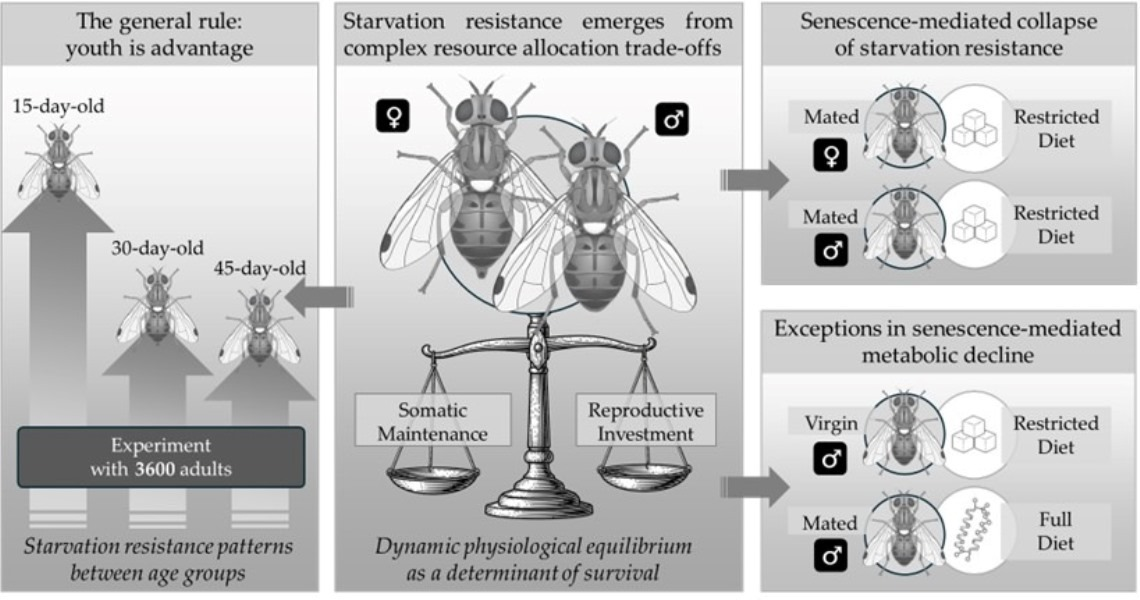
- In male cohorts, starvation resistance generally exhibited a negative correlation with chronological age.
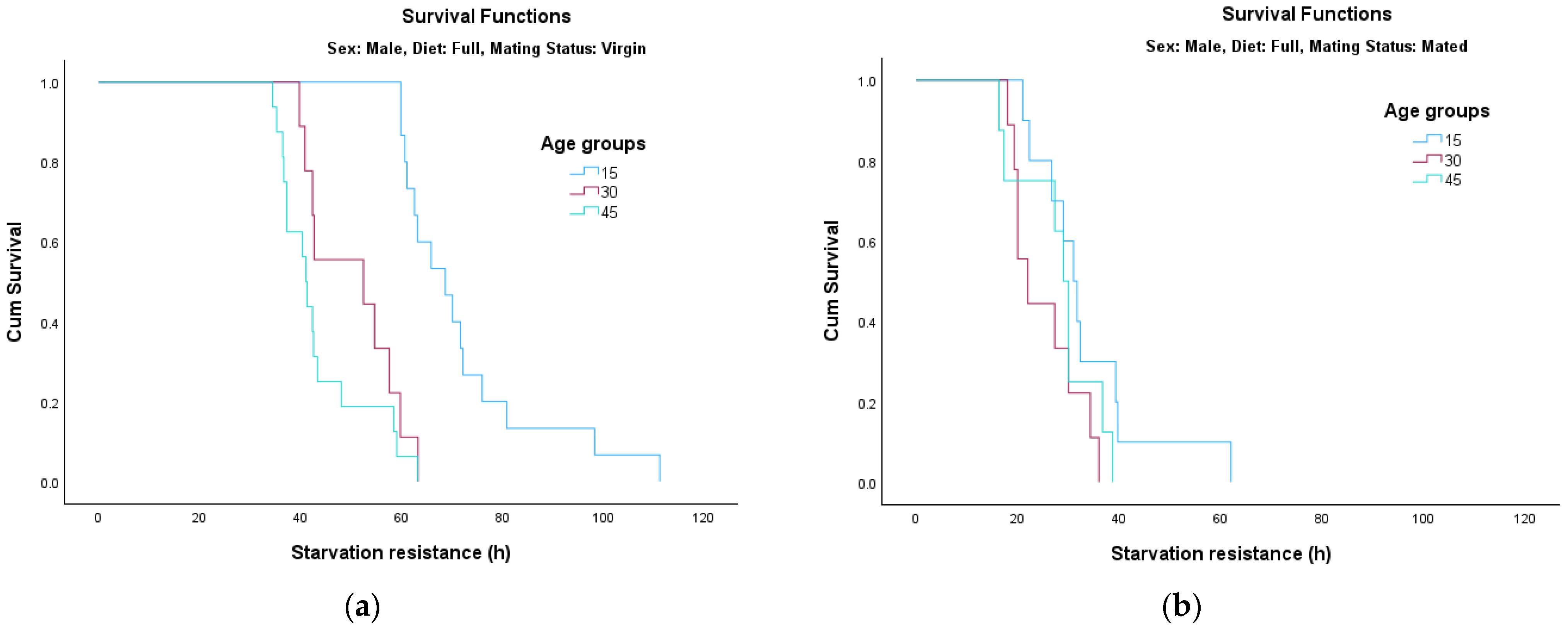
- Full Diet (Figure 2a): For virgin males fed on a full diet, age had a highly significant impact on survival (χ2 = 32.608, df = 2, p < 0.001).
- Full Diet (Figure 2b): In contrast, for mated males on the same diet, the differences between age groups were not statistically significant (p = 0.123); mating appeared to reduce survival across all ages to a similarly low baseline.
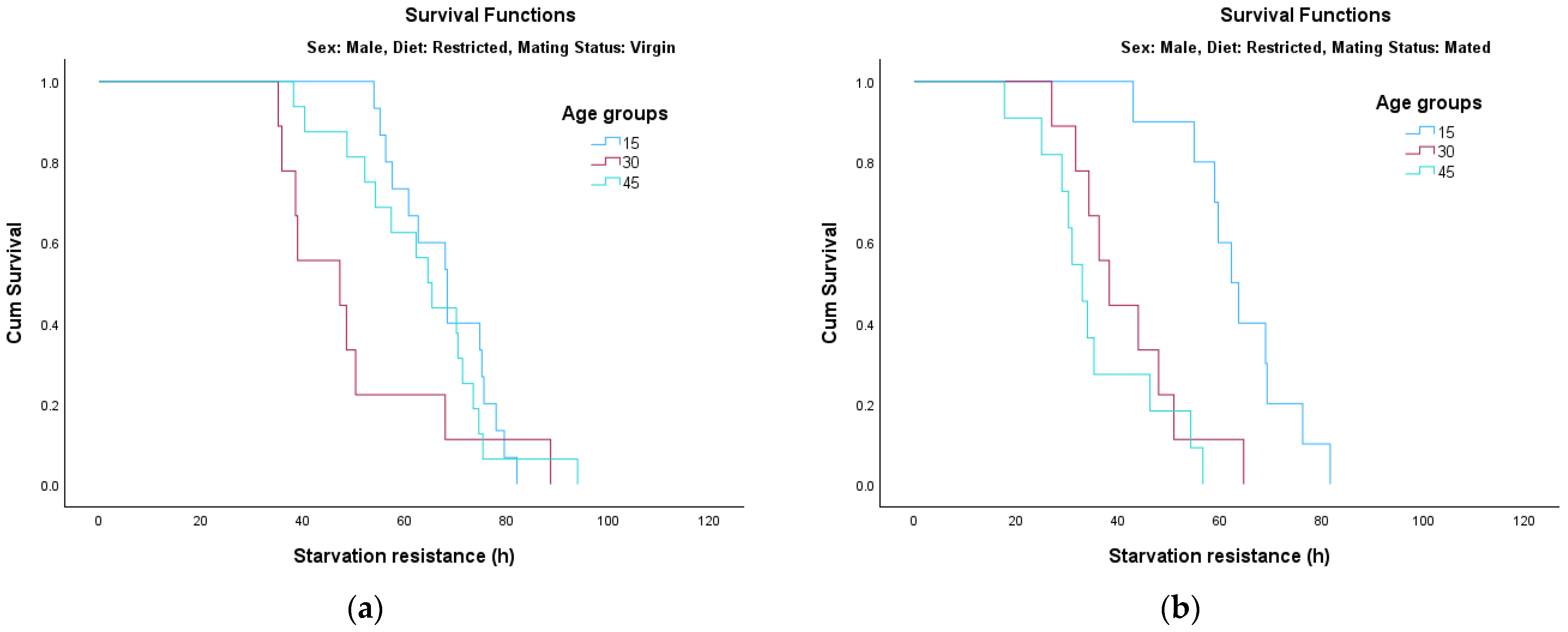
- Restricted Diet (Figure 3a): Under a sugar-based diet, virgin males showed no significant age-dependent variation in survival (p = 0.149).
- Restricted Diet (Figure 3b): However, once mated, age became a highly significant factor (χ2 = 18.471, df = 2, p < 0.001), with younger cohorts (15 days) showing markedly better resistance than older groups.
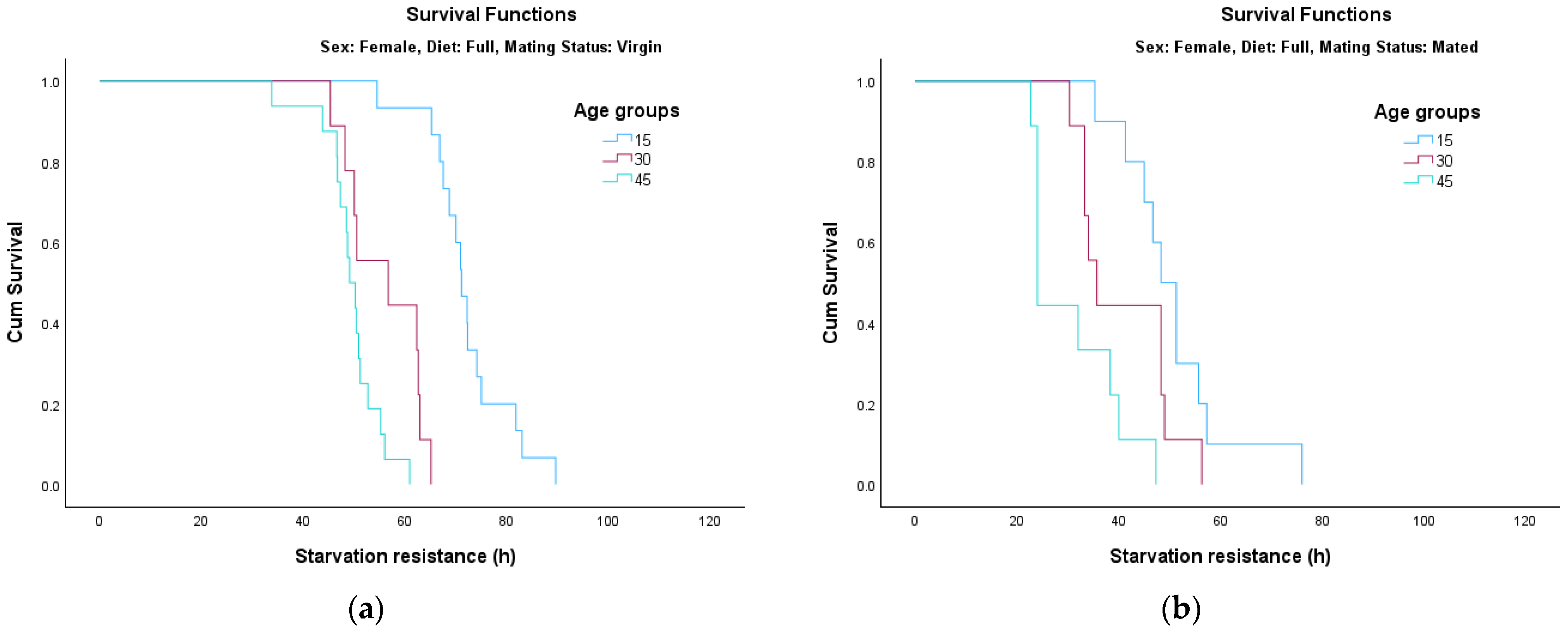
- Full Diet (Figure 4a): Age group differences were most pronounced in virgin females (χ2 = 39.808, df = 2, p < 0.001), with a sharp decrease in resistance as age increased from 15 to 45 days.
- Full Diet (Figure 4b): The age-related decline remained highly significant in mated females as well (χ2 = 15.256, df = 2, p < 0.001).
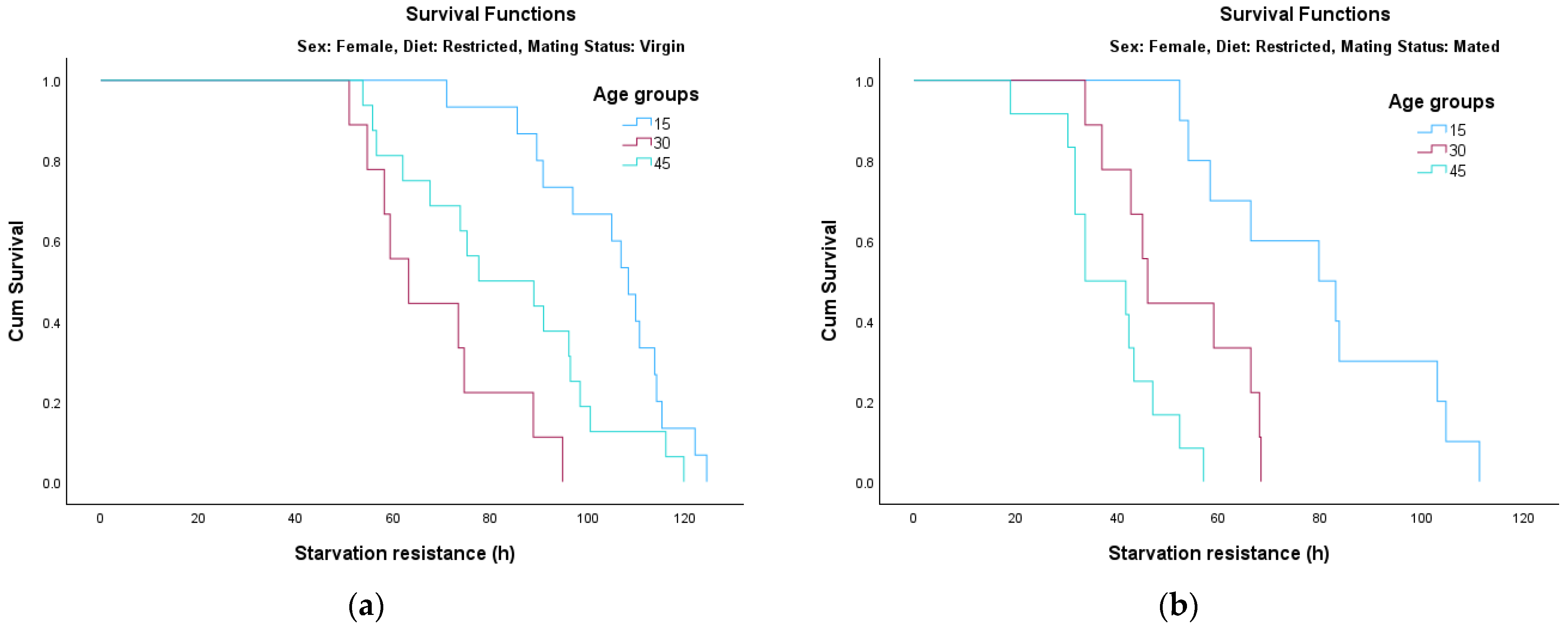
- Restricted Diet (Figure 5a): Dietary restriction appeared to exert a protective effect, particularly for younger females; virgin females at 15 days exceeded 120 h of survival.
- Restricted Diet (Figure 5a,b): Statistical analysis confirmed that age significantly influenced survival for both virgin (χ2 = 19.439, df = 2, p < 0.001) and mated (χ2 = 23.858, df = 2, p < 0.001) females.
3.3. Multivariable Risk Assessment (Cox Proportional Hazards Model)
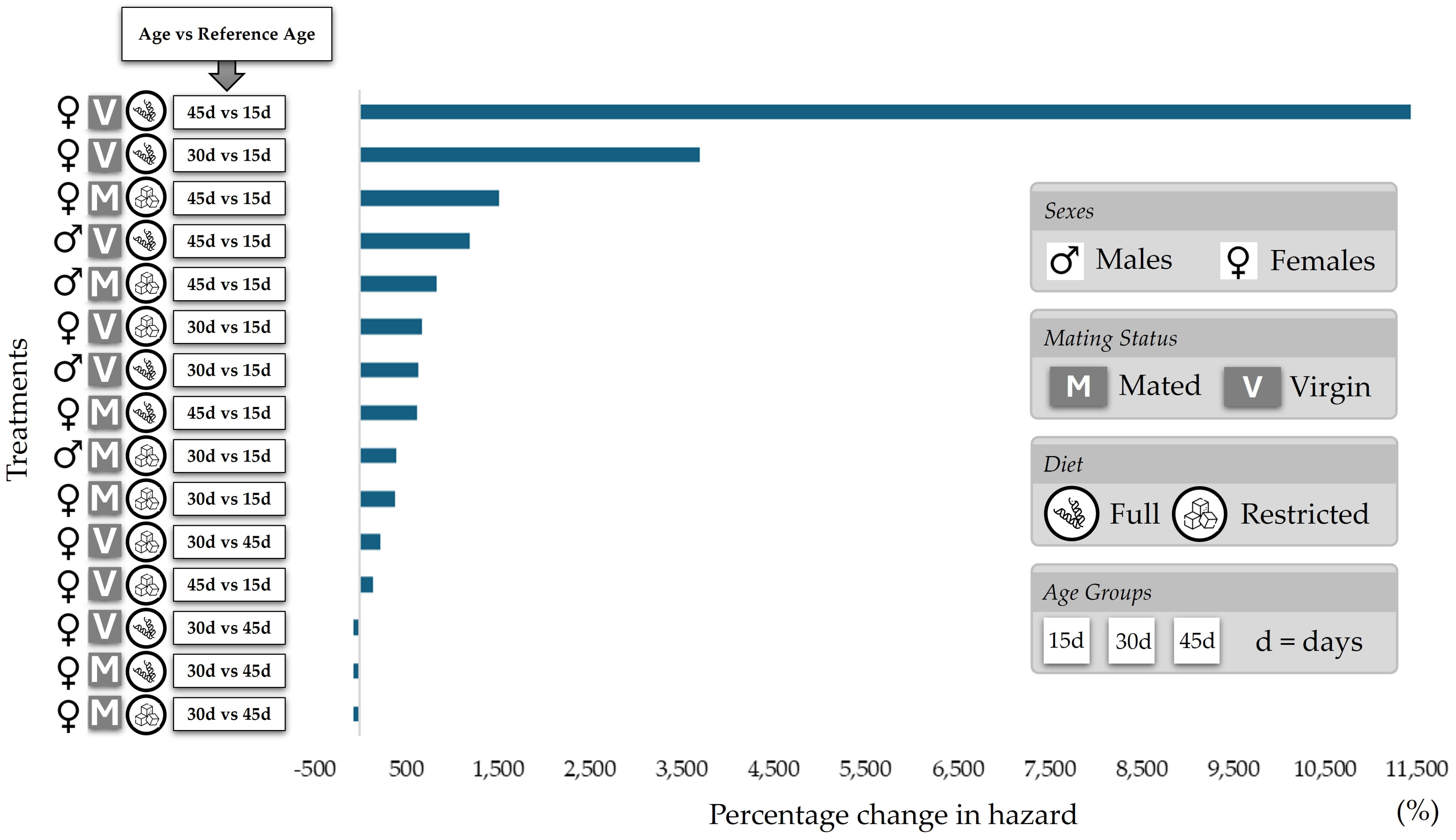
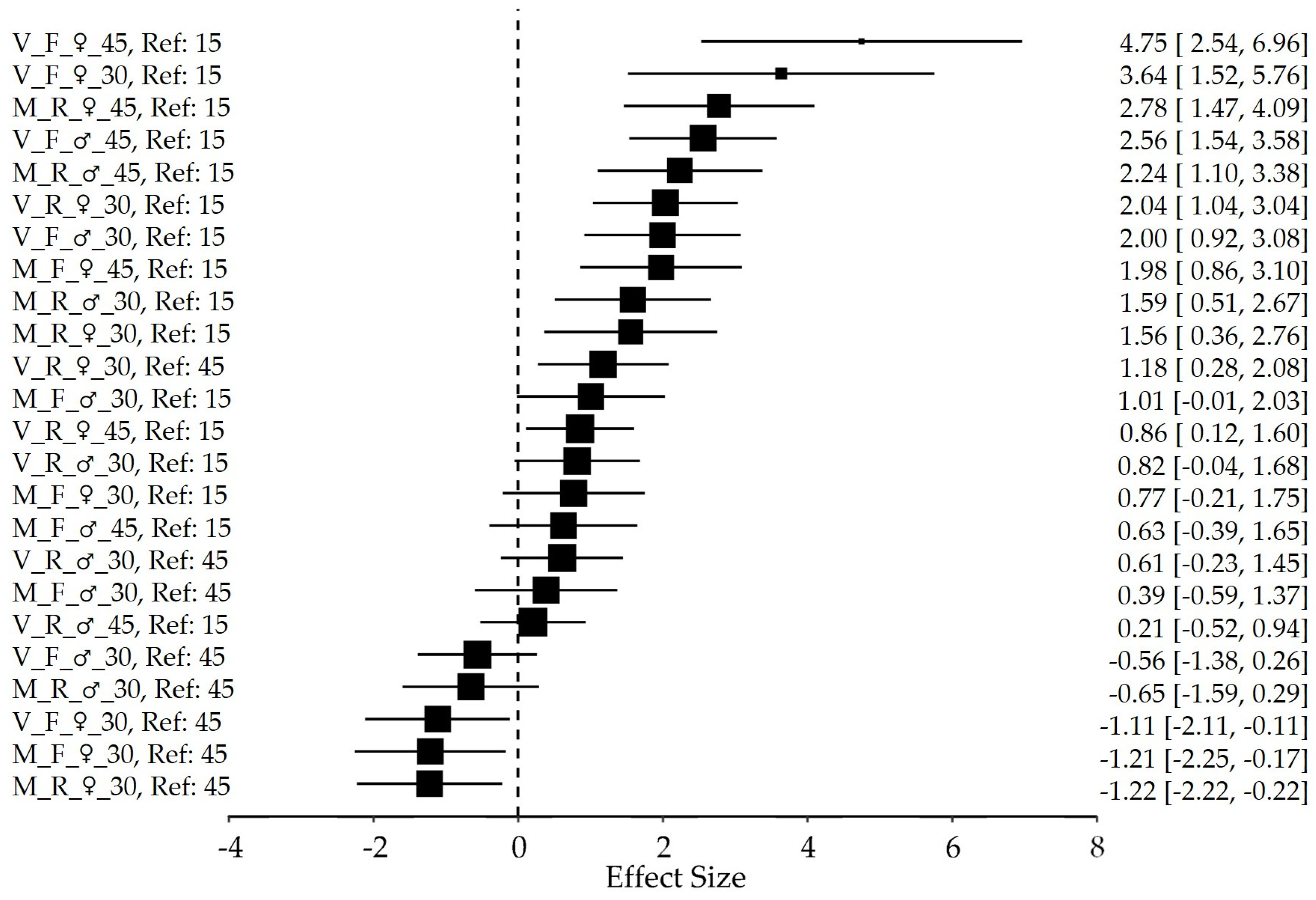
- Age-Dependent Survival Patterns (Reference Age: 15 Days):
- Age-Dependent Survival Patterns (Reference Age: 45 Days)
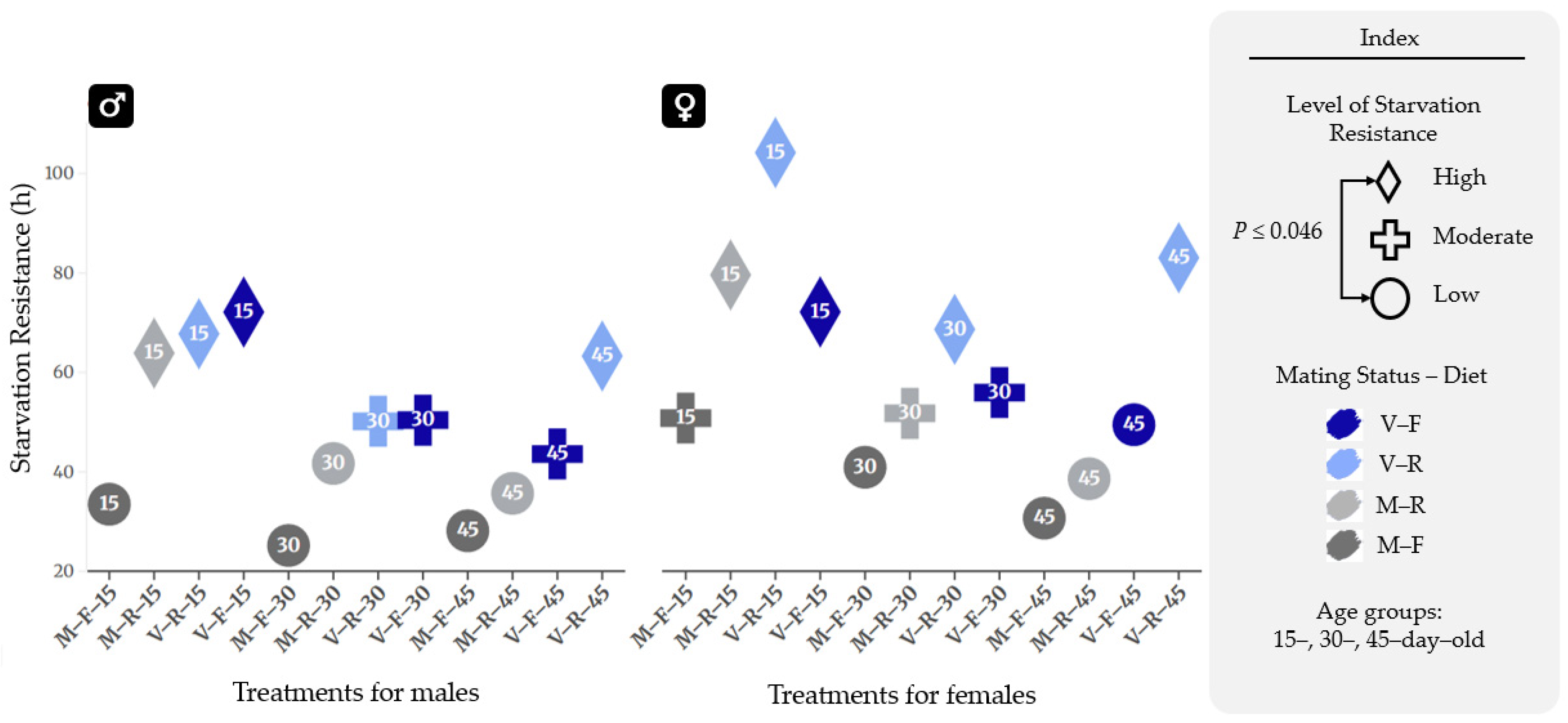
3.4. Post Hoc Analysis of Starvation Resistance (Tukey’s HSD)
4. Discussion
4.1. Senescence and Physiological Decay
4.2. Reproductive Costs and Life–History Trade-Offs
4.3. Dietary Modulation and the “Protein-Survival” Trade-Off
4.4. Sex-Specific Physiological Plasticity
4.5. Boundaries and Future Avenues
5. Conclusions
- Senescence as a driver of physiological decay: Age serves as the fundamental determinant of survival. The observed decline in starvation resistance post-maturation indicates a progressive loss of homeostatic competence and the exhaustion of physiological buffers. The 15-day-old cohort represents the peak of somatic resilience, whereas senescent individuals (45 days old) exhibit a steep reduction in probability of survival, indicating consistent with the progressive depletion of endogenous reserves and potentially reflecting a low evolutionary potential for extending starvation resistance in this specialized tephritid.
- The metabolic cost of reproduction: Mating status acts as a potent physiological stressor that frequently surpasses the impact of chronological age on mortality rates. The rapid depletion of metabolic reserves in mated individuals underscores a critical life–history trade-off. In this “disposable soma” framework, the diversion of energy toward courtship and reproductive behaviors occurs at the direct expense of somatic maintenance and survival during nutrient deprivation.
- Nutritional modulation and resilience: Adult dietary quality dictates the accumulation and mobilization of metabolic reserves, demonstrating how nutritional geometry and the balance of macronutrients shape survival trajectories. While protein-rich diets are necessary for high fecundity, they also modulate the fly’s ability to withstand starvation. High-quality nutrition provides the precursors for a robust metabolic buffer in virgin adults; however, the restriction of sugar exacerbates the energetic debt incurred during mating, leading to accelerated mortality.
- Sex-specific patterns in energy allocation: Distinct survival trajectories exist between the sexes. Females maintain a more regulated decline in resistance throughout senescence, likely due to a larger initial “reserve capital.” In contrast, males exhibit higher vulnerability to rapid reserve depletion, reflecting the volatile metabolic costs associated with male-specific reproductive strategies.
Author Contributions
Funding
Data Availability Statement
Conflicts of Interest
Abbreviations
| B | The estimated regression coefficient |
| = Exp(B) | Hazard Ratio |
Appendix A

| Treatments | Age Group (Days) | Reference Age | B | SE | Wald | p | HR Exp(B) | Change (%Δ) | 95% CI (Lower) | 95% CI (Upper) |
|---|---|---|---|---|---|---|---|---|---|---|
| V_F_♂ | 30 | 15 | 2.00 | 0.55 | 13.33 | 0.000 | 7.383 | +638.3% | 2.52 | 21.59 |
| 45 | 15 | 2.56 | 0.52 | 24.57 | 0.000 | 12.896 | +1189.6% | 4.69 | 35.45 | |
| 30 | 45 | −0.56 | 0.42 | 1.74 | 0.187 | 0.573 | −42.7% | 0.25 | 1.31 | |
| V_F_♀ | 30 | 15 | 3.64 | 1.08 | 11.36 | 0.001 | 37.915 | +3691.5% | 4.58 | 314.05 |
| 45 | 15 | 4.75 | 1.13 | 17.65 | 0.000 | 115.263 | +11,426.3% | 12.58 | 1055.86 | |
| 30 | 45 | −1.11 | 0.51 | 4.83 | 0.028 | 0.329 | −67.1% | 0.12 | 0.89 | |
| V_R_♂ | 30 | 15 | 0.82 | 0.44 | 3.58 | 0.059 | 2.282 | +128.2% | 0.97 | 5.36 |
| 45 | 15 | 0.21 | 0.37 | 0.33 | 0.567 | 1.235 | +23.5% | 0.60 | 2.55 | |
| 30 | 45 | 0.61 | 0.43 | 1.99 | 0.158 | 1.847 | +84.7% | 0.79 | 4.33 | |
| V_R_♀ | 30 | 15 | 2.04 | 0.51 | 16.24 | 0.000 | 7.673 | +667.3% | 2.85 | 20.67 |
| 45 | 15 | 0.86 | 0.38 | 5.00 | 0.025 | 2.352 | +135.2% | 1.11 | 4.98 | |
| 30 | 45 | 1.18 | 0.46 | 6.55 | 0.011 | 3.262 | +226.2% | 1.32 | 8.07 | |
| M_F_♂ | 30 | 15 | 1.01 | 0.52 | 3.78 | 0.052 | 2.754 | +175.4% | 0.99 | 7.65 |
| 45 | 15 | 0.63 | 0.52 | 1.44 | 0.230 | 1.870 | +87.0% | 0.67 | 5.19 | |
| 30 | 45 | 0.39 | 0.50 | 0.60 | 0.437 | 1.473 | +47.3% | 0.55 | 3.91 | |
| M_F_♀ | 30 | 15 | 0.77 | 0.50 | 2.42 | 0.120 | 2.164 | +116.4% | 0.82 | 5.72 |
| 45 | 15 | 1.98 | 0.57 | 12.11 | 0.001 | 7.244 | +624.4% | 2.37 | 22.10 | |
| 30 | 45 | −1.21 | 0.53 | 5.22 | 0.022 | 0.299 | −70.1% | 0.11 | 0.84 | |
| M_R_♂ | 30 | 15 | 1.59 | 0.55 | 8.35 | 0.004 | 4.898 | +389.8% | 1.67 | 14.39 |
| 45 | 15 | 2.24 | 0.58 | 14.92 | 0.000 | 9.391 | +839.1% | 3.01 | 29.26 | |
| 30 | 45 | −0.65 | 0.48 | 1.88 | 0.171 | 0.522 | −47.8% | 0.21 | 1.32 | |
| M_R_♀ | 30 | 15 | 1.56 | 0.61 | 6.50 | 0.011 | 4.756 | +375.6% | 1.43 | 15.77 |
| 45 | 15 | 2.78 | 0.67 | 17.23 | 0.000 | 16.173 | +1517.3% | 4.34 | 60.20 | |
| 30 | 45 | −1.22 | 0.51 | 5.67 | 0.017 | 0.294 | −70.6% | 0.11 | 0.81 |
| Treatments | −2 Log Likelihood | Overall (Score) | Change From Previous Step | Change From Previous Block | ||||||
|---|---|---|---|---|---|---|---|---|---|---|
| Chi-Square | df | Sig. | Chi-Square | df | Sig. | Chi-Square | df | Sig. | ||
| V_F_♂ | 149.842 | 92.545 | 53 | 0.001 | 71.221 | 53 | 0.048 | 71.221 | 53 | 0.048 |
| V_F_♀ | 220.641 | 112.823 | 48 | 0.000 | 0.000 | 48 | 1.000 | 0.000 | 48 | 1.000 |
| V_R_♂ | 147.178 | 78.663 | 73 | 0.304 | 73.707 | 73 | 0.455 | 73.707 | 73 | 0.455 |
| V_R_♀ | 220.641 | 98.081 | 61 | 0.002 | 0.000 | 61 | 1.000 | 0.000 | 61 | 1.000 |
| M_F_♂ | 87.297 | 39.257 | 36 | 0.326 | 42.660 | 36 | 0.206 | 42.660 | 36 | 0.206 |
| M_F_♀ | 88.314 | 55.134 | 33 | 0.009 | 49.049 | 33 | 0.036 | 49.049 | 33 | 0.036 |
| M_R_♂ | 91.209 | 67.283 | 47 | 0.028 | 58.108 | 47 | 0.128 | 58.108 | 47 | 0.128 |
| M_R_♀ | 110.175 | 60.264 | 35 | 0.005 | 46.649 | 35 | 0.090 | 46.649 | 35 | 0.090 |
| Sex | Type III Sum of Squares | df | Mean Square | F | Sig. | Partial Eta Squared | Noncent. Parameter | Observed Power b | |
|---|---|---|---|---|---|---|---|---|---|
| Male | Corrected Model | 32,448.577 a | 11 | 2949.871 | 21.067 | 0.000 | 0.650 | 231.740 | 1.000 |
| Intercept | 296,194.899 | 1 | 296,194.899 | 2115.355 | 0.000 | 0.944 | 2115.355 | 1.000 | |
| V_M | 12,722.599 | 1 | 12,722.599 | 90.862 | 0.000 | 0.421 | 90.862 | 1.000 | |
| F_R | 4321.213 | 1 | 4321.213 | 30.861 | 0.000 | 0.198 | 30.861 | 1.000 | |
| 15–30–45 | 8794.934 | 2 | 4397.467 | 31.406 | 0.000 | 0.334 | 62.811 | 1.000 | |
| V_M × F_R | 1381.121 | 1 | 1381.121 | 9.864 | 0.002 | 0.073 | 9.864 | 0.876 | |
| V_M × 15–30–45 | 135.926 | 2 | 67.963 | 0.485 | 0.617 | 0.008 | 0.971 | 0.128 | |
| F_R × 15–30–45 | 177.201 | 2 | 88.600 | 0.633 | 0.533 | 0.010 | 1.266 | 0.154 | |
| V_M × F_R × 15–30–45 | 3314.522 | 2 | 1657.261 | 11.836 | 0.000 | 0.159 | 23.672 | 0.994 | |
| Error | 17,502.668 | 1788 | 140.021 | ||||||
| Total | 398,417.000 | 1800 | |||||||
| Corrected Total | 49,951.246 | 1799 | |||||||
| Female | Corrected Model | 63,140.974 c | 11 | 5740.089 | 31.875 | 0.000 | 0.734 | 350.625 | 1.000 |
| Intercept | 480,560.739 | 1 | 480,560.739 | 2668.577 | 0.000 | 0.955 | 2668.577 | 1.000 | |
| V_M | 18,148.711 | 1 | 18,148.711 | 100.781 | 0.000 | 0.442 | 100.781 | 1.000 | |
| F_R | 14,455.903 | 1 | 14,455.903 | 80.274 | 0.000 | 0.387 | 80.274 | 1.000 | |
| 15–30–45 | 18,993.974 | 2 | 9496.987 | 52.737 | 0.000 | 0.454 | 105.474 | 1.000 | |
| V_M × F_R | 863.001 | 1 | 863.001 | 4.792 | 0.030 | 0.036 | 4.792 | 0.584 | |
| V_M × 15–30–45 | 1318.414 | 2 | 659.207 | 3.661 | 0.028 | 0.055 | 7.321 | 0.665 | |
| F_R × 15–30–45 | 1811.574 | 2 | 905.787 | 5.030 | 0.008 | 0.073 | 10.060 | 0.808 | |
| V_M × F_R × 15–30–45 | 1037.677 | 2 | 518.838 | 2.881 | 0.060 | 0.043 | 5.762 | 0.555 | |
| Error | 22,870.323 | 1788 | 180.081 | ||||||
| Total | 639,114.400 | 1800 | |||||||
| Corrected Total | 86,011.298 | 1799 | |||||||
| 95% Confidence Interval | |||||||
|---|---|---|---|---|---|---|---|
| Treatment i | Treatment j | Mean Difference (i-j) | Std. Error | p | Lower Bound | Upper Bound | Statistically Significant Difference in |
| V_F_♂_15 | V_F_♂_30 | 21.749 * | 4.99 | 0.002 | 5.13 | 38.37 | age group |
| V_F_♂_15 | V_F_♂_45 | 28.554 * | 4.25 | 0.000 | 14.39 | 42.72 | age group |
| V_F_♂_15 | M_F_♂_15 | 38.660 * | 4.83 | 0.000 | 22.57 | 54.75 | mating status |
| V_F_♂_30 | M_F_♂_30 | 25.200 * | 5.58 | 0.001 | 6.62 | 43.78 | mating status |
| V_R_♂_45 | V_F_♂_45 | 19.712 * | 4.18 | 0.000 | 33.65 | 5.78 | diet |
| V_R_♂_15 | V_R_♂_30 | 17.591 * | 4.99 | 0.028 | 0.97 | 34.21 | age group |
| V_R_♂_45 | M_R_♂_45 | 27.628 * | 4.63 | 0.000 | 12.19 | 43.07 | mating status |
| M_R_♂_15 | M_F_♂_15 | 30.400 * | 5.29 | 0.000 | 12.77 | 48.03 | diet |
| M_R_♂_15 | M_R_♂_30 | 22.200 * | 5.44 | 0.004 | 4.09 | 40.31 | age group |
| M_R_♂_15 | M_R_♂_45 | 28.209 * | 5.17 | 0.000 | 10.99 | 45.43 | age group |
| V_F_♀_15 | V_F_♀_45 | 22.680 * | 4.82 | 0.000 | 6.62 | 38.74 | age group |
| V_R_♀_15 | V_F_♀_15 | 32.053 * | 4.90 | 0.000 | 48.37 | 15.74 | mating status |
| V_F_♀_15 | M_F_♀_15 | 21.360 * | 5.48 | 0.008 | 3.12 | 39.60 | mating status |
| V_F_♀_45 | M_F_♀_45 | 18.800 * | 5.59 | 0.046 | 0.18 | 37.42 | mating status |
| V_R_♀_15 | V_R_♀_30 | 35.556 * | 5.66 | 0.000 | 16.71 | 54.40 | age group |
| V_R_♀_15 | V_R_♀_45 | 21.152 * | 4.82 | 0.001 | 5.09 | 37.21 | age group |
| V_R_♀_45 | V_F_♀_45 | 33.581 * | 4.74 | 0.000 | 17.78 | 49.38 | diet |
| V_R_♀_15 | M_R_♀_15 | 24.603 * | 5.48 | 0.001 | 6.36 | 42.85 | mating status |
| V_R_♀_45 | M_R_♀_45 | 44.440 * | 5.12 | 0.000 | 27.38 | 61.50 | mating status |
| M_R_♀_15 | M_F_♀_15 | 28.810 * | 6.00 | 0.000 | 48.79 | 8.83 | diet |
| M_R_♀_15 | M_R_♀_30 | 27.852 * | 6.17 | 0.001 | 7.32 | 48.38 | age group |
| M_R_♀_15 | M_R_♀_45 | 40.988 * | 5.75 | 0.000 | 21.86 | 60.12 | age group |
References
- Nardi, F.; Carapelli, A.; Dallai, R.; Roderick, G.K.; Frati, F. Population Structure and Colonization History of the Olive Fly, Bactrocera oleae (Diptera, Tephritidae). Mol. Ecol. 2005, 14, 2729–2738. [Google Scholar] [CrossRef]
- Daane, K.M.; Johnson, M.W. Olive Fruit Fly: Managing an Ancient Pest in Modern Times. Annu. Rev. Entomol. 2010, 55, 151–169. [Google Scholar] [CrossRef] [PubMed]
- Fletcher, B.S. The Biology of Dacine Fruit Flies. Annu. Rev. Entomol. 1987, 32, 115–144. [Google Scholar]
- Tzanakakis, M.E. Biology and Ecology of the Olive Fruit Fly; University of Thessaly Press: Volos, Greece, 2006. [Google Scholar]
- Gutierrez, A.P.; Ponti, L.; Cossu, Q.A. Effects of Climate Warming on Olive and Olive Fly (Bactrocera oleae (Gmelin)) in California and Italy. Clim. Change 2009, 95, 195–217. [Google Scholar] [CrossRef]
- Ordano, M.; Engelhard, I.; Rempoulakis, P.; Nemny-Lavy, E.; Blum, M.; Yasin, S.; Lensky, I.M.; Papadopoulos, N.T.; Nestel, D. Olive Fruit Fly (Bactrocera oleae) Population Dynamics in the Eastern Mediterranean: Influence of Exogenous Uncertainty on a Monophagous Frugivorous Insect. PLoS ONE 2015, 10, e0127798. [Google Scholar] [CrossRef]
- Balampekou, E.I.; Koveos, D.S.; Kapranas, A.; Menexes, G.C.; Kouloussis, N.A. The Roles of Mating, Age, and Diet in Starvation Resistance in Bactrocera oleae (Olive Fruit Fly). Insects 2023, 14, 841. [Google Scholar] [CrossRef] [PubMed]
- Nestel, D.; Papadopoulos, N.T.; Liedo, P.; Gonzales-Ceron, L.; Carey, J.R. Trends in Lipid and Protein Contents during Medfly Aging: An Harmonic Path to Death. Arch. Insect Biochem. Physiol. 2005, 60, 130–139. [Google Scholar] [CrossRef]
- Kirkwood, T.B.L. Evolution of Ageing. Nature 1977, 270, 301–304. [Google Scholar] [CrossRef]
- Kirkwood, T.B.L.; Rose, M.R. The Evolution of Reproductive Strategies. Philos. Trans. R. Soc. Lond. B Biol. Sci. 1991, 332, 103–104. [Google Scholar]
- Papadopoulos, A.G.; Koskinioti, P.; Zarpas, K.D.; Prekas, P.; Terblanche, J.S.; Hahn, D.A.; Papadopoulos, N.T. Age and Mating Status Have Complex but Modest Effects on the Critical Thermal Limits of Adult Mediterranean Fruit Flies from Geographically Divergent Populations. J. Therm. Biol. 2024, 126, 104013. [Google Scholar] [CrossRef]
- Carey, J.R.; Papadopoulos, N.; Kouloussis, N.; Katsoyannos, B.; Müller, H.G.; Wang, J.L.; Tseng, Y.K. Age-Specific and Lifetime Behavior Patterns in Drosophila Melanogaster and the Mediterranean Fruit Fly, Ceratitis Capitata. Exp. Gerontol. 2006, 41, 93–97. [Google Scholar] [CrossRef] [PubMed]
- Carey, J.R.; Molleman, F. Reproductive Aging in Tephritid Fruit Flies. Ann. N. Y. Acad. Sci. 2010, 1204, 139–148. [Google Scholar] [CrossRef]
- Tatar, M.; Post, S.; Yu, K. Nutrient Control of Drosophila Longevity. Trends Endocrinol. Metab. 2014, 25, 509–517. [Google Scholar] [CrossRef]
- Nair, K.S.S.; Karnavar, G.K. A Cytological Study of Changes in the Fat Body of Trogoderma Granarium During Metamorphosis, with Special Reference to the Proteinaceous Globules. J. Insect Physiol. 1968, 14, 1651–1659. [Google Scholar] [CrossRef]
- Harshman, L.G.; Zera, A.J. The Cost of Reproduction: The Devil in the Details. Trends Ecol. Evol. 2007, 22, 80–86. [Google Scholar] [CrossRef]
- Rion, S.; Kawecki, T.J. Evolutionary Biology of Starvation Resistance: What We Have Learned from Drosophila. J. Evol. Biol. 2007, 20, 1655–1664. [Google Scholar] [CrossRef] [PubMed]
- Schou, M.F.; Kristensen, T.N.; Kellermann, V.; Schlötterer, C.; Loeschcke, V. A Drosophila Laboratory Evolution Experiment Points to Low Evolutionary Potential under Increased Temperatures Likely to Be Experienced in the Future. J. Evol. Biol. 2014, 27, 1859–1868. [Google Scholar] [CrossRef]
- Marubbi, T.; Cassidy, C.; Miller, E.; Koukidou, M.; Martin-Rendon, E.; Warner, S.; Loni, A.; Beech, C. Exposure to Genetically Engineered Olive Fly (Bactrocera oleae) Has No Negative Impact on Three Non-Target Organisms. Sci. Rep. 2017, 7, 11478. [Google Scholar] [CrossRef]
- Balampekou, E.I.; Koveos, D.S.; Koutsos, T.M.; Menexes, G.C.; Kouloussis, N.A. Factors Affecting Water Deprivation Resistance in Bactrocera oleae (Olive Fruit Fly). Appl. Biosci. 2024, 3, 310–325. [Google Scholar] [CrossRef]
- Toothaker, L.E. Multiple Comparison Procedures; Sage Publications, Inc.: Newbury Park, CA, USA, 1993. [Google Scholar]
- Lumley, T.; Diehr, P.; Emerson, S.; Chen, L. The Importance of the Normality Assumption in Large Public Health Data Sets. Annu. Rev. Public Health 2002, 23, 151–169. [Google Scholar] [CrossRef]
- Blanca, M.J.; Alarcón, R.; Arnau, J.; Bono, R.; Bendayan, R. Datos No Normales: ¿es El ANOVA Una Opción Válida? Psicothema 2017, 29, 552–557. [Google Scholar] [CrossRef] [PubMed]
- Schmider, E.; Ziegler, M.; Danay, E.; Beyer, L.; Bühner, M. Is It Really Robust?: Reinvestigating the Robustness of ANOVA against Violations of the Normal Distribution Assumption. Methodology 2010, 6, 147–151. [Google Scholar] [CrossRef]
- Kaplan, E.L.; Meier, P. Nonparametric Estimation from Incomplete Observations. In Breakthroughs in Statistics. Springer Series in Statistics; Springer: New York, NY, USA, 1958; Volume 53. [Google Scholar]
- Mantel, N. Evaluation of Survival Data and Two New Rank Order Statistics Arising in Its Consideration. Cancer Chemother. 1966, 50, 163–170. [Google Scholar]
- Cox, D.R. Regression Models and Life-Tables. J. R. Stat. Soc. Ser. B Stat. Methodol. 1972, 34, 187–202. [Google Scholar] [CrossRef]
- Schoenfeld, D. Partial Residuals for The Proportional Hazards Regression Model. Biometrika 1982, 69, 239–241. [Google Scholar] [CrossRef]
- Weldon, C.W.; Mnguni, S.; Démares, F.; du Rand, E.E.; Malod, K.; Manrakhan, A.; Nicolson, S.W. Adult Diet Does Not Compensate for Impact of a Poor Larval Diet on Stress Resistance in a Tephritid Fruit Fly. J. Exp. Biol. 2019, 222, jeb192534. [Google Scholar] [CrossRef]
- Arking, R. The Biology of Aging: Observations and Principles, 3rd ed.; Oxford University Press: Oxford, UK, 2006; ISBN 0195167392. [Google Scholar]
- Roberts, S.B.; Rosenberg, I. Nutrition and Aging: Changes in the Regulation of Energy Metabolism With Aging. Physiol. Rev. 2006, 86, 651–667. [Google Scholar] [CrossRef] [PubMed]
- Carey, J.R. Biodemography of the Mediterranean Fruit Fly: Aging, Longevity and Adaptation in the Wild. Exp. Gerontol. 2011, 46, 404–411. [Google Scholar] [CrossRef] [PubMed]
- Gerofotis, C.D.; Kouloussis, N.A.; Koukougiannidou, C.; Papadopoulos, N.T.; Damos, P.; Koveos, D.S.; Carey, J.R. Age, Sex, Adult and Larval Diet Shape Starvation Resistance in the Mediterranean Fruit Fly: An Ecological and Gerontological Perspective. Sci. Rep. 2019, 9, 10704. [Google Scholar] [CrossRef]
- Grotewiel, M.S.; Martin, I.; Bhandari, P.; Cook-Wiens, E. Functional Senescence in Drosophila Melanogaster. Ageing Res. Rev. 2005, 4, 372–397. [Google Scholar] [CrossRef]
- Carey, J.R.; Liedo, P.; Miiller, H.-G.; Wang, J.-L.; Chiou, J.-M. Relationship of Age Patterns of Fecundity to Mortality, Longevity, and Lifetime Reproduction in a Large Cohort of Mediterranean Fruit Fly Females. J. Gerontol. Ser. A 1998, 53A, B245–B251. [Google Scholar] [CrossRef]
- Cordts, R.; Partridge, L. Courtship Reduces Longevity of Male Drosophila melanogaster. Anim. Behav. 1996, 52, 269–278. [Google Scholar] [CrossRef]
- Papadopoulos, N.T.; Liedo, P.; Müller, H.G.; Wang, J.L.; Molleman, F.; Carey, J.R. Cost of Reproduction in Male Medflies: The Primacy of Sexual Courting in Extreme Longevity Reduction. J. Insect Physiol. 2010, 56, 283–287. [Google Scholar] [CrossRef] [PubMed]
- Lee, K.P.; Simpson, S.J.; Clissold, F.J.; Brooks, R.; William, J.; Ballard, O.; Taylor, P.W.; Soran, N.; Raubenheimer, D. Lifespan and Reproduction in Drosophila: New Insights from Nutritional Geometry. Proc. Natl. Acad. Sci. USA 2008, 105, 2498–2503. [Google Scholar] [CrossRef] [PubMed]
- Ben-Yosef, M.; Pasternak, Z.; Jurkevitch, E.; Yuval, B. Symbiotic Bacteria Enable Olive Flies (Bactrocera oleae) to Exploit Intractable Sources of Nitrogen. J. Evol. Biol. 2014, 27, 2695–2705. [Google Scholar] [CrossRef] [PubMed]
- Chapman, T.; Liddle, L.F.; Kalb, J.M.; Wolfner, M.F.; Partridge, L. Cost of Mating in Drosophila Females Is by Male Gland Products. Lett. Nat. 1995, 373, 241–244. [Google Scholar] [CrossRef]
- Davies, L.R.; Schou, M.F.; Kristensen, T.N.; Loeschcke, V. Linking Developmental Diet to Adult Foraging Choice in Drosophila Melanogaster. J. Exp. Biol. 2018, 221, jeb175554. [Google Scholar] [CrossRef]
- Ponton, F.; Tan, Y.X.; Forster, C.C.; Austin, A.J.; English, S.; Cotter, S.C.; Wilson, K. The Complex Interactions between Nutrition, Immunity and Infection in Insects. J. Exp. Biol. 2023, 226, jeb245714. [Google Scholar] [CrossRef]
- Aggarwal, D.D. Physiological Basis of Starvation Resistance in Drosophila Leontia: Analysis of Sexual Dimorphism. J. Exp. Biol. 2014, 217, 1849–1859. [Google Scholar] [CrossRef]


| Sex | Diet | Mating Status | Age Groups | Mean ± SE | 95% Confidence Interval | |
|---|---|---|---|---|---|---|
| Lower Bound | Upper Bound | |||||
| Male | Full | Virgin | 15 | 72.2 ± 3.8 | 64.654 | 79.666 |
| 30 | 50.4 ± 3.0 | 44.498 | 56.325 | |||
| 45 | 43.6 ± 2.3 | 39.187 | 48.025 | |||
| Mated | 15 | 33.5 ± 3.7 | 26.215 | 40.785 | ||
| 30 | 25.2 ± 2.3 | 20.721 | 29.701 | |||
| 45 | 28.2 ± 2.8 | 22.601 | 33.724 | |||
| Restricted | Virgin | 15 | 67.8 ± 2.5 | 62.953 | 72.607 | |
| 30 | 50.2 ± 5.9 | 38.640 | 61.737 | |||
| 45 | 63.3 ± 3.6 | 56.275 | 70.362 | |||
| Mated | 15 | 63.9 ± 3.5 | 57.091 | 70.709 | ||
| 30 | 41.7 ± 3.9 | 34.137 | 49.263 | |||
| 45 | 35.7 ± 3.6 | 28.589 | 42.793 | |||
| Female | Full | Virgin | 15 | 72.2 ± 2.1 | 67.997 | 76.363 |
| 30 | 56.0 ± 2.5 | 51.024 | 60.887 | |||
| 45 | 49.5 ± 1.5 | 46.607 | 52.393 | |||
| Mated | 15 | 50.8 ± 3.5 | 44.002 | 57.638 | ||
| 30 | 40.9 ± 3.2 | 34.769 | 47.120 | |||
| 45 | 30.7 ± 3.0 | 24.743 | 36.657 | |||
| Restricted | Virgin | 15 | 104.2 ± 3.8 | 96.787 | 111.680 | |
| 30 | 68.7 ± 5.1 | 58.667 | 78.689 | |||
| 45 | 83.1 ± 5.2 | 72.826 | 93.336 | |||
| Mated | 15 | 79.6 ± 6.9 | 66.174 | 93.086 | ||
| 30 | 51.8 ± 4.6 | 42.813 | 60.742 | |||
| 45 | 38.6 ± 3.1 | 32.638 | 44.645 | |||
| Treatments | N of Insects | χ2 (Log-Rank) | df | p |
|---|---|---|---|---|
| Male, full diet, virgin | 150 | 32.608 | 2 | <0.001 |
| Male, full diet, mated | 150 | 4.197 | 2 | 0.123 |
| Male, restricted diet, virgin | 150 | 3.805 | 2 | 0.149 |
| Male, restricted diet, mated | 150 | 18.471 | 2 | <0.001 |
| Female, full diet, virgin | 150 | 39.808 | 2 | <0.001 |
| Female, full diet, mated | 150 | 15.256 | 2 | <0.001 |
| Female, restricted diet, virgin | 150 | 19.439 | 2 | <0.001 |
| Female, restricted diet, mated | 150 | 23.858 | 2 | <0.001 |
Disclaimer/Publisher’s Note: The statements, opinions and data contained in all publications are solely those of the individual author(s) and contributor(s) and not of MDPI and/or the editor(s). MDPI and/or the editor(s) disclaim responsibility for any injury to people or property resulting from any ideas, methods, instructions or products referred to in the content. |
© 2026 by the authors. Licensee MDPI, Basel, Switzerland. This article is an open access article distributed under the terms and conditions of the Creative Commons Attribution (CC BY) license.
Share and Cite
Balampekou, E.I.; Koutsos, T.M.; Koveos, D.S.; Kouloussis, N.A. Survival Analysis of Bactrocera oleae Starvation Resistance During Senescence: The Interactive Influence of Diet, Mating Status, and Sex. Insects 2026, 17, 296. https://doi.org/10.3390/insects17030296
Balampekou EI, Koutsos TM, Koveos DS, Kouloussis NA. Survival Analysis of Bactrocera oleae Starvation Resistance During Senescence: The Interactive Influence of Diet, Mating Status, and Sex. Insects. 2026; 17(3):296. https://doi.org/10.3390/insects17030296
Chicago/Turabian StyleBalampekou, Evangelia I., Thomas M. Koutsos, Dimitrios S. Koveos, and Nikos A. Kouloussis. 2026. "Survival Analysis of Bactrocera oleae Starvation Resistance During Senescence: The Interactive Influence of Diet, Mating Status, and Sex" Insects 17, no. 3: 296. https://doi.org/10.3390/insects17030296
APA StyleBalampekou, E. I., Koutsos, T. M., Koveos, D. S., & Kouloussis, N. A. (2026). Survival Analysis of Bactrocera oleae Starvation Resistance During Senescence: The Interactive Influence of Diet, Mating Status, and Sex. Insects, 17(3), 296. https://doi.org/10.3390/insects17030296